RED-blue team BS
see TRUMP 2 TERM CWG CLI WORKING GP WRIGHT ZELDIN BS
DOUG BURGUM COVER FOR ROLLBACK OF IRA/BBB ALT ENERGY WIND 80% ; FOX CHARM OFFENSIVE; SHUT DOWN ZOE OVERSIGHT? NOW VOLS MAUE
SEE CURRY
HAPPER BIG BOOSTER
GEN JOHN KELLY COS 86D
---
OMFG 2 26 12TH DN
UCS AND --- SUED TO SHUT DN BS COMM BUT STILL LOST ON EPA REGS

9:31
President Trump accepted the Washington
9:33
Coal Club's inaugural award on
9:36
Wednesday, declaring him the quote
9:38
undisputed champion of beautiful, clean
9:42
coal, unquote.
9:44
Trump accepted the award, a statue of a
9:47
coal miner from Peabody Energy President
9:49
and CEO Jim Gretch during a White House
9:52
event where Trump announced he directed
9:54
the Pentagon to purchase electricity
9:56
from coal fired plants and said he'd
9:59
asked the energy department to provide
10:01
$175 million in federal funds for
10:05
upgrades at several US coal plants.
10:09
I've saved 74 coal power plants from
10:13
crushing restrictions and closures that
10:16
would have been forced to shut down in
10:18
the very immediate future. And today,
10:20
I'm proud to announce that the Tennessee
10:22
Valley Authority is taking action to
10:24
save two major coal plants in Tennessee.
10:27
Tennessee Valley Authority. In response,
10:30
the Natural Resources Defense Council
10:33
wrote, quote, "While Americans are
10:35
demanding clean, affordable energy, the
10:38
Trump administration's using our tax
10:40
dollars to prop up the nation's
10:42
dirtiest, least efficient power plants.
10:45
It's no wonder fossil fuel lobbyists are
10:48
handing Trump an award today." unquote.
10:51
---
WIKI
:{:{In 2025, Curry was appointed a member of the United States Department of Energy's newly-formed Climate Working Group along with scientists John Christy, Steven E. Koonin, Ross McKitrick, and Roy Spencer, all of whom are known for promoting contrary views of climate change.[32][33]}:
In July 2025, the group released A Critical Review of Impacts of Greenhouse Gas Emissions on the US Climate,[34] which argues that rising CO2 "appears to be less damaging economically than commonly believed, and that aggressive mitigation strategies could be more harmful than beneficial."[35][36]
An international group of 85 scientists lead by climate scientists Andrew Dessler and Robert Kopp wrote a 434-page rebuttal entitled Climate Experts' Review of the DOE Climate Working Group Report,[37] criticizing it for lacking peer review, cherry-picking evidence, misinterpreting citations, and having a predetermined outcome.[38][39][40]}:
Climate_Experts_Review_of_DOE_CWG_Report.pdf - Google Drive
MANYPP OF BIOS
OMG
REF GRNWIRE
https://www.eenews.net/articles/its-the-gold-standard-of-us-climate-research-contrarians-could-write-the-next-one/
It’s the gold standard of US climate research. Contrarians could write the next one.
By Scott Waldman | 12/22/2025
Researchers who have downplayed the threat of global warming have been asked to author the next National Climate Assessment.
The Trump administration has invited a small group of climate contrarians to help write the next installment of the National Climate Assessment, the nation’s preeminent report on global warming, says one of the researchers involved.
The move would advance efforts by the White House to inject widely disputed ideas about climate change into the federal government’s official appraisal of global warming. And it would almost certainly provoke a response from the hundreds of mainstream climate scientists who have worked for years on the National Climate Assessment.
Judith Curry, a former climatologist at the Georgia Institute of Technology, is one of the climate contrarians in line for the new assignment. Earlier this year, Curry joined with four like-minded researchers to produce a separate report for Energy Secretary Chris Wright that downplayed the threat of global warming and called into question the basic tenets of climate science.
Now Curry says that same team — known as the Climate Working Group — has been asked to write the next installment of the National Climate Assessment, or NCA, a congressionally mandated report that comes out every few years and outlines the many ways that global warming is expected to impact the United States and its people.
“The Climate Working Group has been contacted about the NCA,” said Curry, who added that she was open to the idea. “Personally, I would work with whoever’s in charge to get a reasonable outline and get reasonable authors.”
Curry said she expected all five members of the Climate Working Group to work on the National Climate Assessment.
Three of the other authors did not respond to requests for comment from POLITICO’s E&E News. The fourth, Canadian economist Ross McKitrick, said late Sunday that he had not yet been contacted about working on the assessment but declined to comment as to whether he would participate in the next version.
Curry also said that the Trump administration was looking to revive the U.S. Global Change Research Program, the initiative in charge of producing the National Climate Assessment. Earlier this year, the Trump administration dismantled the program and dismissed hundreds of scientists who were already at work on the sixth version of the National Climate Assessment.
Curry said the new effort is starting to take shape. She said the Trump administration already has interviewed candidates for the U.S. Global Change Research Program, and she expected the administration would name a new program chief as soon as next month.
“I think in January, we should have a director of the USGCRP in place,” she said.
The White House did not respond to requests for comment from E&E News. Nor did the Energy Department nor the Office of Management and Budget.
But there’s at least one other sign the Trump administration is looking to write a new version of the National Climate Assessment.
Ryan Maue, who served as chief scientist at the National Oceanic and Atmospheric Administration during the first Trump administration, said last week on the social media site X that he was working on the new climate report.
He described it as a “volunteer effort” and said it would be “mostly completed before end of 2025.”
Maue did not respond to requests for comment from E&E News. But he wrote on X that he was enlisting artificial intelligence to help with the latest National Climate Assessment. He cited the Gemini 3 Pro program as well as Grok, an AI chatbot developed by xAI, the artificial intelligence company led by tech tycoon Elon Musk.
Grok in the past has downplayed the danger of global warming when compared with other AI programs.
The Trump administration’s push to revive the National Climate Assessment and resurrect the U.S. Global Change Research Program adds a new twist to the complicated history of the long-running research effort.
The program was created by Congress in 1990 and signed into law by Republican President George H.W. Bush. Its most visible product is the National Climate Assessment, which comes out roughly every four years and is used to help shape environmental rules, legislation and infrastructure projects.
Five installments of the National Climate Assessment have been published since 2000. The reports explore more than just climate change — they also examine land productivity, water resources, fisheries, ecosystems and the atmosphere.
But earlier this year, the Trump administration fired the federal employees who work for the research program — and it was effectively shuttered. The administration also deleted interactive webpages for the first five versions of the National Climate Assessment and then buried the documents on government websites.
The moves prompted a sharp outcry from the scientific community in part because the National Climate Assessment has earned a reputation for top-notch research. The document includes hundreds of peer-reviewed studies to inform its conclusions, and it relies on the work of hundreds of scientists to write its contents and review its findings.
In contrast, the Energy Department report written by Curry and her colleagues involved a much smaller group of researchers.
Her four co-authors were: McKitrick; Steven Koonin, a former chief scientist for BP who also served as an undersecretary at the Energy Department during the Obama administration; as well as John Christy and Roy Spencer, atmospheric scientists at the University of Alabama, Huntsville.
One climate scientist said the size of that group was indicative of how far the team members’ views fall outside the scientific consensus.
“Serious experts agree and action (on climate change) is needed as soon as possible,” said Katharine Hayhoe, a climate scientist at Texas Tech University who has served as a lead author on multiple versions of the National Climate Assessment.
If the Trump administration wants “people who are not going to tell them those truths,” she added, “those are the only people they have.”
The Energy Department report written by Curry and the rest of the Climate Working Group has been roundly criticized by climate scientists for its reliance on cherry-picked data and its omission of research that disproved its claims.
Scientists whose work was cited in the report said their research was distorted and manipulated. Dozens of scientists produced a 450-page report challenging its claims, and the National Academies offered its own rebuttal of the report as well.
Hayhoe said it’s critical the United States and its leaders get a clear-eyed view of climate change and its impacts.
“This is a matter of safety, security, well being, resilience and preparation for a better future for everyone,” she said. “Regardless of where they live and regardless of how they vote.”
Related Articles
Climatewire
DOE reframes climate consensus as a debate
by Scott Waldman, Benjamin Storrow | 07/31/2025 06:30 AM EDT
Climatewire
How Chris Wright recruited a team to upend climate science
by Benjamin Storrow | 08/11/2025 06:15 AM EDT
Climatewire
Trump team readies more attacks on mainstream climate science
by Scott Waldman | 08/18/2025 06:21 AM EDT
Climatewire
EPA attacks climate science. Here are the facts.
by Chelsea Harvey, Scott Waldman | 07/30/2025 06:20 AM EDT
EXPERIENCE E&E NEWS FIRSTHAND
REF
E AND E POL
Meet the scientists Trump could tap to undermine climate regulations
:{By Scott Waldman, Zack Colman | 03/19/2025 :
Some downplay the threat of global warming. Others question the efficacy of climate policy. All could be of interest to the new administration.
EPA Administrator Lee Zeldin has made it his mission to destroy what he calls the “holy grail” of U.S. climate policy.
But President Donald Trump’s EPA chief can’t do it alone. To smash the holy grail, Zeldin needs help from a rare kind of scientist — the kind who believes climate change isn’t that bad or might even be good for humanity.
Those scientists aren’t easy to find. The overwhelming scientific consensus is that the burning of fossil fuels is heating up Earth, and the planet’s rapid change is putting people at risk for a wide range of calamities — from more extreme storms to rising sea levels to more intense heat waves.
Those threats underpin what’s known as the “endangerment finding” — Zeldin’s holy grail. The 2009 declaration by EPA made clear that greenhouse gases like carbon dioxide are the root cause of climate change, and that EPA has the authority to regulate them under the Clean Air Act because they can harm human health.
The endangerment finding has empowered EPA to establish landmark climate regulations, including limits on the emissions produced by cars or power plants. Rolling back these regulations — and the endangerment finding itself — would require an attack on the climate science that serves as their foundation.
Enter the climate naysayers.
The Trump administration is looking to recruit scientists who could cast doubt on climate science or climate policy, or who view global warming as either a small inconvenience or a boon to humankind.
Once selected, these scientists could add their perspective to a bedrock climate report that comes out every few years, known as the National Climate Assessment. Their contributions to the report, in turn, could be cited as evidence in future efforts to undermine the endangerment finding — all of which would make it easier to quash climate regulations.
The scientists even could help author a second endangerment finding. A Trump-era endangerment finding might, for example, selectively highlight areas of doubt in climate science or tout the perceived benefits of global warming.
To do that, a Trump-approved body of climate findings would center around future scenarios based on lower carbon scenarios than the world is currently experiencing.
It also could emphasize less severe climate trajectories than those envisioned in the original finding, said Roger Pielke Jr., a nonresident fellow at the American Enterprise Institute, a conservative think tank.
“Being able to tease out signals of human-caused climate change in extreme weather — which everybody cares about — are going to be much more challenging with a lower emissions trajectory than a higher one,” said Pielke Jr., who is not involved in any of the efforts and has questioned how scientists can link human-driven warming to specific extreme weather events.
There is a relatively small pool of researchers who could — or would be willing to — engage in such an effort because it would misrepresent decades of climate science by the world’s top science agencies.
“It’s a very small group of people. It’s the same people who have been there for the last 20 years,” said Andrew Dessler, a climate scientist at Texas A&M University. “It’s this endlessly recycled group of people who have been making the same arguments that are unable to convince anybody in the scientific community.”
The White House has not announced its plan yet nor the researchers who might be involved, and it did not respond to a request for comment.
In a statement, an EPA spokesperson said that as “part of this reconsideration process, EPA will leverage the expertise of the White House Budget Office, including the Office of Information and Regulatory Affairs, White House Office of Science and Technology Policy, National Oceanic and Atmospheric Administration, and other relevant agencies.”
Here are some of the scientists who have spent years downplaying climate risks or criticizing climate regulations, and could be tapped by the Trump administration to help Zeldin destroy the “holy grail” of U.S. climate policy.
David Legates
David Legates (second from right) appears at a 2016 event in Washington. | Kris Connor/AFP via Getty Images MORANO
Legates likely would be a key leader. He has worked with Office of Management and Budget Director Russ Vought on a series of proposals to tear down NOAA and to recruit industry and think tank researchers that oppose climate rules to write a government science report.
The two men authored a key chapter outlining their plans in the Project 2025 conservative policy playbook.
Legates, who was the former state climatologist for Delaware until he was asked to step down, served as a top NOAA official in Trump’s first term. He was also detailed to the Office of Science and Technology Policy, but was later removed from that position after attempting to publish a series of research memos that distorted climate science.
For years, Legates has turned a partisan lens to research, claiming that climate change will benefit humanity while climate policy will hurt people. He is affiliated with the Cornwall Alliance, a group of conservative Christian scholars “dedicated to educating the public and policymakers about Biblical earth stewardship.”
Legates declined to comment for this story.
Steve KooniN
Koonin, a New York University physicist and former top scientist at BP, has long pushed to conduct a “red team, blue team” review of climate science, which would pit two groups of scientists against each other to debate a scientific report, such as the National Climate Assessment.
One group would defend the report while the other would highlight its alleged scientific weaknesses. Koonin worked on putting together the effort during the first Trump administration, but the project was eventually scuttled by the White House because some officials were concerned about Trump’s reelection chances.
Koonin said he would prefer to take on the latest report from the Intergovernmental Panel on Climate Change to highlight areas of doubt.
“Anything that I can do to help make the science more transparent, you know, that’s been my goal, and remains my goal, for a long time,” he said.
Richard Lindzen
The retired Massachusetts Institute of Technology atmospheric scientist told POLITICO that he would “of course” help the Trump administration challenge the endangerment finding. Lindzen was dismayed that the red team, blue team exercise to publicly debate established climate science never took off during Trump’s first term.
A longtime critic of accepted climate science, Lindzen applauded Zeldin for calling “bullshit” on a “fake issue” of the severity of rising temperatures. But he acknowledged there may be little upside given how much the scientific community has supported the conclusion that human activity is driving climate change, even if he disagrees with it.
Lindzen argued the courts may offer the most direct route, where he said EPA should argue there “was never any evidence in the first place” to suggest greenhouse gases meet a legally defined standard of dangerous.
“I have no idea what they’re going to do,” he said. “But I think it’s pretty obvious when Trump is running on the issue of ‘Drill, baby drill,’ that he is not going to pay any attention to what is claimed to be the science.”
Ryan Maue
Maue has not had any communication with the Trump administration about serving in any science advisory or agency role, he wrote in a text message. But the libertarian meteorologist would be a natural fit: He served at NOAA and the Office of Science and Technology Policy in Trump’s first term.
Maue agrees that humans are warming the planet, but he has pushed back against stringent government policies to rein in greenhouse gases.
He has often used his large social media following on X to dispute the connections between climate change and specific extreme weather events. He has repeatedly cautioned that the world is not following the worst-case scenario climate trajectory, calling it “highly implausible” — a view that could align with Trump administration thinking to emphasize less dire forecasts.
Judith Curry
Curry said she would help the Trump administration reconsider the endangerment finding if she could work from home, but noted there’s been no outreach from Trump’s team.
The Georgia Tech professor emerita argued the original endangerment finding was “politically driven,” and that its reliance on worst-case climate scenarios compelled more drastic policy than necessary. Despite U.S. greenhouse gas reductions falling 17 percent below 2005 levels, the nation is still off-track of the U.S. share of reductions needed to stabilize global temperatures.
An additional 2 to 3 degrees Fahrenheit of warming by 2100 — which is aligned with current trajectories — “isn’t a big deal because it’s what we’ve seen over the last 100 years, and we’re doing just fine,” said Curry, who is now president of consulting firm Climate Forecast Applications Network.
Scientists have said such increases have brought and would bring massive biodiversity loss, more intense extreme weather events, deadlier heat waves and economic harm through natural disaster damage, lost labor productivity, food insecurity and deteriorating health.
While Curry said there are “plenty of reasons not to like fossil fuels” and that clean energy investment is needed, she claimed “policy isn’t going to help here.” An endangerment finding that reflected less severe consequences for failing to deal with climate change “takes away the urgency for doing all of this” through government policy, she said.
John Christy
Christy is a climate scientist at the University of Alabama in Huntsville and a former lead IPCC author. He has questioned whether humans are driving the observed warming trends in recent decades — something the world’s top science agencies have long confirmed.
He opposed the endangerment finding in 2009 and has questioned the climate models on which it was based in congressional testimony. He is also a longtime proponent of applying a red team, blue team exercise to climate science.
Christy said he believed he could identify weaknesses in the first endangerment finding and that he could use research from the last 15 years to further his argument if the Trump administration pursued a second endangerment finding.
“I would like to see a very clear demonstration that climate models are not capable of telling us about the future of climate to the level of the CO2 forcing that is occurring in the atmosphere,” he said.
In fact, climate scientists have tested the models on which they rely and have found a notable amount of accuracy, particularly the latest versions, which are far more sophisticated than the models of the past.
Will Happer
Happer was part of Trump’s National Security Council in the first term, who mostly worked on classified military projects. He is a professor emeritus of physics at Princeton University, though not a climate scientist.
Happer is one of the few scientists who have given Trump a briefing on climate research, though his views are not supported by the world’s leading science agencies. Happer has long cast doubt on the role humans play in driving global warming and has been a vociferous opponent of climate policy.
In Trump’s first term, Happer worked on the effort to conduct an adversarial review of climate science with Koonin. After that effort was torpedoed by White House officials, Trump told Happer that he wanted to bring him back for a red team, blue team effort in his second term. Trump even discussed a potential nationally televised science “debate,” Happer told POLITICO.
“If I see an opportunity to help, I will,” Happer said. “I think it’s long overdue.”
---
MMA 7 25
Fox News’ America Reports hosted Environmental Protection Agency Administrator Lee Zeldin and Energy Secretary Chris Wright to discuss the Trump administration's proposal to repeal the EPA’s 2009 endangerment finding, which affirmed that greenhouse gases endanger public health and welfare and which has served as the legal foundation for regulating emissions under the Clean Air Act.
Zeldin and Wright used the appearance to frame the repeal as a return to scientific integrity and regulatory restraint, ignoring the harms that this repeal would have on vulnerable communities. Fox anchor Sandra Smith did not challenge the claims and made no mention of the public health implications or regulatory consequences of revoking the finding. The exchange typified Fox’s pattern of amplifying Trump administration narratives about climate and energy while downplaying their real-world impacts.
Video
Citation
From the July 29, 2025, episode of Fox News' America Reports
The segment typified Fox’s role in obscuring the consequences of climate deregulation
During their appearance, Zeldin and Wright were not pressed on the public health, environmental, or legal implications of the proposal to reverse the endangerment finding. Instead, the host framed the discussion around economic themes and legal processes, asking whether repeal would make it easier to “undo a lot more of the Biden-Obama era climate rules.” Viewers heard nothing about the policy’s real-world impacts, but they did hear climate advocates characterized as ideological or extreme. Zeldin referred to them as “climate zealots,” while Wright framed the repeal as a return to “rationalism” — signaling to Fox’s audience that those who defend public protections are unserious.
This approach mirrors Fox’s longstanding pattern of covering regulatory actions through the lens of efficiency, growth, and personal freedom, while sidelining the communities most affected by the Trump administration's harmful actions. The result is a consistent minimization of climate risk and a distorted narrative in which climate and environmental outcomes are treated primarily as a political liability rather than a public necessity.
By allowing unchallenged repetition of misleading claims, and by omitting the central consequences of the policy under discussion, Fox News once again advanced a message strategy that serves to normalize and obscure the dismantling of basic climate and environmental protections.
Zeldin and Wright advanced a series of unsupported or misleading claims
During their appearance on the July 29 episode of Fox News' America Reports, Zeldin and Wright made a series of unsupported or misleading claims about the endangerment finding and what its repeal would mean for Americans.
Zeldin, for example, asserted that repealing the endangerment finding would yield “$1 trillion in savings”—a figure with no grounding in published EPA analyses or historical regulatory assessments. In contrast, EPA data has consistently shown that rules issued under the endangerment finding and the broader Clean Air Act generate substantial net benefits.
The agency’s Second Prospective Study of the Clean Air Act found that “the central benefits estimate exceeds costs by a factor of more than 30 to one," with most benefits stemming from reduced mortality linked to particulate pollution. By 2020, Clean Air Act programs were projected to prevent over 230,000 premature deaths, as well as millions of asthma attacks, heart attacks, and lost workdays annually.
More recently, the EPA’s Regulatory Impact Analysis for vehicle greenhouse gas standards projected net societal benefits of $272.7 billion between 2022 and 2050, with annualized gains of more than $14 billion, driven by fuel savings, reduced emissions, and avoidance of climate damages. These figures underscore that, far from being a financial burden, regulations grounded in the endangerment finding generate substantial and enduring public and economic value.
Similarly, Wright’s claim that the repeal reflects a return to scientific rigor collapses under scrutiny, relying on a report authored by a small group of contrarian scientists, including Steven Koonin and John Christy, who reject the well-established conclusion that greenhouse gas emissions from human activity are driving global warming and endangering public health. Their views stand in opposition to the broader scientific community, which includes the consensus positions of federal agencies such as the National Aeronautics and Space Administration and the National Oceanic and Atmospheric Administration, as well as the Fifth National Climate Assessment, which was produced by the U.S. Global Change Research Program.
Beyond economic distortions and scientific misrepresentation, Zeldin and Wright also ignored the far-reaching legal consequences of repeal — including for the fossil fuel industry itself.
As Grist reported, rescinding the endangerment finding would not only eliminate the federal government’s core authority to regulate greenhouse gases, it could also expose fossil fuel companies to a wave of climate liability lawsuits previously blocked by federal preemption. Some industry groups have reportedly urged the administration not to proceed, warning that repeal could unravel their legal defenses and leave them vulnerable to a patchwork of state regulations and courtroom challenges.
Fox viewers heard nothing about how repeal would harm the very communities most at risk
Zeldin and Wright also failed to mention what rescinding the endangerment finding would mean for public health, environmental protection, or the EPA’s ability to respond to pollution that threatens the air we breathe, the water we rely on, and the land we depend on to live and work. Viewers were not told that the standards targeted for repeal are central to reducing industrial emissions that worsen heat, flooding, and wildfire risk — or that dismantling these protections would increase illness, displacement, and hardship for older adults, children, low-income households, and rural communities, including many in Fox’s own audience.
REF 1
epa-endangerment-finding-repeal-proposal
NO LNX
In Game-Changing Climate Rollback, E.P.A. Aims to Kill a Bedrock Scientific Finding
The proposal is President Trump’s most consequential step yet to derail federal climate efforts and appears to represent a shift toward outright denial of the scientific consensus.
By Maxine Joselow and Lisa Friedman
Reporting from Washington
July 29, 2025
Lee Zeldin, the administrator of the Environmental Protection Agency, said on Tuesday the Trump administration would revoke the scientific determination that underpins the government’s legal authority to combat climate change.
Speaking at a truck dealership in Indianapolis, Mr. Zeldin said the E.P.A. planned to rescind the 2009 declaration, known as the endangerment finding, which concluded that planet-warming greenhouse gases pose a threat to public health. The Obama and Biden administrations used that determination to set strict limits on greenhouse gas emissions from cars, power plants and other industrial sources of pollution.
“The proposal would, if finalized, amount to the largest deregulatory action in the history of the United States,” Mr. Zeldin said. He said the proposal would also erase limits on greenhouse gas emissions from cars and trucks on the nation’s roads.
Without the endangerment finding, the E.P.A. would be left with no authority under the Clean Air Act to regulate the greenhouse gas emissions that are accumulating in the atmosphere from the burning of fossil fuels.
The proposal is President Trump’s most consequential step yet to derail federal climate efforts. It marks a notable shift in the administration’s position from one that had downplayed the threat of global warming to one that essentially flatly denies the overwhelming scientific evidence of climate change.
It would not only reverse current regulations, but, if the move is upheld in court, it could make it significantly harder for future administrations to rein in climate pollution from the burning of coal, oil and gas.
Without the United States working to reduce emissions, it becomes far tougher for the world to collectively prevent average global temperatures from rising by more than 1.5 degrees Celsius, or 2.7 degrees Fahrenheit, above preindustrial levels. That is the threshold beyond which climate scientists say there is significantly greater risk from increasingly destructive storms, droughts, wildfires and heat waves, as well as from species extinction.
In recent weeks, the Trump administration has also moved to scrap restrictions on pollution from power plants, halt key measurements of greenhouse gases in the atmosphere and delay approvals of wind and solar energy projects on federal lands.
“Today’s E.P.A. announcement ignores the blindingly obvious reality of the climate crisis and sidelines the E.P.A.’s own scientists and lawyers in favor of the interests and profits of the fossil fuel industry,” former Vice President Al Gore said in a statement.
To justify the proposal, the E.P.A. cited a report that the Energy Department commissioned from five scientists known for their rejection of the overwhelming scientific consensus on climate change, namely that it is being driven by the burning of fossil fuels, which releases greenhouse gases into the atmosphere.
The New York Times first reported that the Energy Department had hired these scientists, including Steven E. Koonin, a physicist and author of a best-selling book that calls climate science “unsettled,” and John Christy, an atmospheric scientist who doubts the extent to which human activity has caused global warming.
In their report, the scientists criticized the computer models used to predict climate change, saying they tend to overestimate warming. They also wrote that carbon dioxide, the most prevalent greenhouse gas in the atmosphere, has positive effects by helping plants grow and increasing agricultural productivity. And they asserted that overall, government climate regulations have a limited effect on global temperature rise.
The E.P.A. echoed this last argument in the proposed rule, saying greenhouse gases from cars on American roads do not contribute significantly to climate change because they are a small share of global emissions. Reducing these emissions to zero “would not have a scientifically measurable impact” on global climate trends or on public health and welfare, the agency said. Instead, the agency said, climate regulations are what pose the true threat to public health and welfare, because they increase the price of new vehicles and leave fewer choices for car buyers.
Many environmental activists and lawyers criticized those arguments, noting that transportation is the largest source of greenhouse gases in the United States. If the U.S. motor vehicle sector were a country, it would be the fourth-largest emitter of greenhouse gases in the world, according to the E.P.A.’s own data.
“If vehicle emissions don’t pass muster as a contribution to climate change, it’s hard to imagine what would,” said Dena Adler, a senior attorney at the Institute for Policy Integrity at New York University School of Law.
Dan Becker, who leads transportation policy for the Center for Biological Diversity, an environmental group, called the E.P.A. proposal a “cynical one-two punch” that will lead to more gasoline-burning vehicles on the road and fewer tools to reduce tailpipe pollution. He said that the auto-emissions rules being rescinded were projected to prevent 7 billion metric tons of emissions from entering the atmosphere while saving the average American driver about $6,000 in fuel and maintenance over the lifetime of vehicles built under the standards.
“The E.P.A. is revoking the biggest single step any nation has taken to save oil, save consumers money at the pump and combat global warming,” Mr. Becker said.
The administration’s plan has its backers. Daren Bakst, who directs the Center for Energy and Environment at the Competitive Enterprise Institute, a free-market research organization, said, “It is unreasonable to claim that pollutants contribute to endangerment if emissions are de minimis.”
Mike Braun, the governor of Indiana, said at the event in Indianapolis that the Biden administration’s vehicle emissions rules had burdened the auto industry in the state. “As a lifelong entrepreneur for 37 years actually in the automotive business, I think I know a thing or two about it, and you can count on Indiana being for common sense and reining in government,” he said.
John Bozzella, chief executive of the Alliance for Automotive Innovation, a lobbying group for most major carmakers, said in a statement that he was still reviewing the E.P.A.’s announcement. “At the same time, there’s no question the vehicle emissions regulations finalized under the previous administration aren’t achievable and should be revised to reflect current market conditions, to keep the auto industry in America competitive,” he said.
While the Chamber of Commerce and fossil fuel groups had fought the endangerment finding when it was first written, none have been clamoring in recent years for its reversal. This year Marty Durbin, who leads the chamber’s energy institute, called the finding “settled law” and said his group, which is a major business lobbying organization, was not seeking its repeal.
“I’m not aware of anyone in industry who has been pushing for it,” said Jeffrey Holmstead, an energy attorney with the law firm Bracewell who served in the E.P.A. during the administration of the first President George Bush and, later, that of President George W. Bush.
The plan to eliminate the endangerment finding showcases the political evolution of Mr. Zeldin, who for years took moderate positions on climate change and other environmental issues.
A former congressman from a coastal community on Long Island that is struggling with rising sea levels linked to global warming, Mr. Zeldin once joined a bipartisan caucus to address climate change. In 2019 he broke with fellow Republicans to vote against an amendment that would have prohibited the E.P.A. from reducing greenhouse gas emissions.
An ally of Mr. Trump who prominently defended him during House impeachment hearings, Mr. Zeldin moved to the right on energy and other issues during his unsuccessful bid for governor of New York in 2022. Just weeks after his nomination to lead the E.P.A., Mr. Zeldin declared that he would be “driving a dagger through the heart of climate-change religion” by repealing regulations on greenhouse gas emissions
“There are people who, in the name of climate change, are willing to bankrupt the country,” Mr. Zeldin said on the conservative podcast “Ruthless” earlier on Tuesday. One of the co-hosts of the program called the endangerment finding “the left’s tent pole to begin the whole climate grift,” to which Mr. Zeldin agreed.
The proposed repeal of the endangerment finding is all but certain to draw legal challenges, and David Doniger, a senior attorney at the Natural Resources Defense Council, an environmental group, said he expected that it would eventually be struck down in court. He noted that climate science has advanced significantly since 2009, when the finding was issued.
After the proposal is published in the Federal Register, the E.P.A. will solicit comments from the public for 45 days, Mr. Zeldin said. The agency will then finalize the rule, most likely in the next year.
Maxine Joselow reports on climate policy for The Times.
Lisa Friedman is a Times reporter who writes about how governments are addressing climate change and the effects of those policies on communities.
A version of this article appears in print on July 30, 2025, Section A, Page 1 of the New York edition with the headline: E.P.A. To Retract Bedrock Finding On Climate Crisis. Order Reprints
---
REF ALSO NYT
Trump Hires Scientists Who Doubt the Consensus on Climate Change
The three scientists joined the administration after it dismissed hundreds of experts who were assessing how global warming is affecting the country.
Steven E. Koonin, dressed in a dark suit and yellow tie, gestures as he speaks while sitting on a stage.
Steven E. Koonin, a physicist and author, was hired by the Energy Department. He previously worked as a physicist at New York University, as a scientist for the oil and gas company BP and as an under secretary at the Energy Department during the Obama administration.Credit...Aaron M. Sprecher/Bloomberg
By Maxine Joselow
Reporting from Washington
July 8, 2025
The Energy Department has hired at least three scientists who are well-known for their rejection of the overwhelming scientific consensus on climate change, according to records reviewed by The New York Times.
The scientists are listed in the Energy Department’s internal email system as current employees of the agency, the records show. They are Steven E. Koonin, a physicist and author of a best-selling book that calls climate science “unsettled”; John Christy, an atmospheric scientist who doubts the extent to which human activity has caused global warming; and Roy Spencer, a meteorologist who believes that clouds have had a greater influence on warming than humans have.
Their hiring comes after the Trump administration dismissed hundreds of scientists and experts who had been compiling the federal government’s flagship report on how climate change is affecting the country. The administration has also systematically removed mentions of climate change from government websites while slashing federal funding for research on global warming.
In addition, Trump officials have been recruiting scientists to help them repeal the 2009 “endangerment finding,” which determined that greenhouse gases pose a threat to public health and welfare, and which now underpins much of the government’s legal authority to slow global warming, according to two people briefed on the matter who spoke on the condition of anonymity because they were not authorized to comment publicly.
It was not immediately clear what the three scientists were working on or whether they were being paid. Representatives for Dr. Koonin, Dr. Spencer and the Energy Department did not respond to requests for comment.
In a brief phone interview and follow-up email, Dr. Christy said he was not working on the endangerment finding nor collecting a government salary. He declined to comment further.
A vast majority of scientists around the world agree that human activities — primarily the burning of fossil fuels such as oil, gas and coal — are dangerously heating the Earth. That has increased the frequency and intensity of heat waves, droughts and colossal bursts of rain like the storm that caused the deadly flooding now devastating central Texas.
A small minority of scientists, however, rejects this consensus. Dr. Koonin, who has said he is a friend of Energy Secretary Chris Wright, has been one of the loudest critics.
During President Trump’s first term, Dr. Koonin proposed that the Environmental Protection Agency conduct a “red-team, blue-team” exercise to challenge mainstream climate science. A “red team” of climate skeptics would critique major scientific reports on global warming, and a “blue team” of climate scientists would then rebut these claims. At the time, mainstream climate scientists said the proposal would make a mockery of scientific research and create a platform for marginal views that had already been disproved in the normal course of scientific debate.
Image
Roy Spencer, in a dark suit, blue shirt and tie, holds a microphone in one hand and points to a projection on a screen with the other hand.
Roy Spencer, a former NASA scientist and researcher at the University of Alabama, in 2012. He has argued that while human activity has caused some warming, its influence has been smaller than that of natural variations in global cloud cover.
Scott Pruitt, the E.P.A. administrator at the time, told coal industry executives that he planned to conduct the exercise. But John F. Kelly, then the White House chief of staff, ultimately blocked the effort.
Now, Dr. Koonin is listed as a “special government employee” in the Energy Department’s internal email system, the records show. Federal law says special government employees are executive branch appointees named to “perform important, but limited, services to the government, with or without compensation, for a period not to exceed 130 days” during a one-year period. Elon Musk had that classification when he began Mr. Trump’s cost cutting initiative, the so-called Department of Government Efficiency.
Dr. Koonin also serves as a fellow at the Hoover Institution, a conservative-leaning research organization on Stanford University’s campus. He previously worked as a physicist at New York University, a scientist for the oil and gas company BP and an under secretary at the Energy Department during the Obama administration.
In his 2021 book, “Unsettled: What Climate Science Tells Us, What It Doesn’t and Why It Matters,” Dr. Koonin argued that while the planet was warming and human activities had played a role, the scientific consensus was not as certain or as dire as it was frequently portrayed.
In a phone interview in November, Dr. Koonin said that the book had made an impression on Mr. Wright, who ran the oil and gas company Liberty Energy before he was confirmed as energy secretary in February.
“He reached out when I wrote the book and said, ‘This is great,’” Dr. Koonin recalled. “He asked me to come talk to his company at one point — it was a couple years ago — and we got to know each other.”
He added, “Chris and I have talked quite a bit over the last couple years, and I think he is well aligned with what I wrote in the book.”
Dr. Spencer, a research scientist at the University of Alabama in Huntsville, also has a connection to Mr. Wright. In a report published last year by Liberty Energy, Mr. Wright cited atmospheric temperature records that Dr. Spencer had collected. (The overall report, titled “Bettering Human Lives,” made the case that fossil fuels were “essential” to solving global poverty, a claim that some experts have called misleading.)
In addition to his role at the University of Alabama, Dr. Spencer is a policy adviser at the Heartland Institute, a conservative group that rejects mainstream climate science. He previously served as a scientist at NASA and as a visiting fellow at the Heritage Foundation, a right-wing group responsible for creating Project 2025, a conservative blueprint for the new administration.
Dr. Spencer has argued that while human activity has caused some warming, its influence has been smaller than that of natural variations in global cloud cover. While some of Dr. Spencer’s past work has been funded by the government, he has accused federal climate researchers of being biased because they receive taxpayer money.
“The popular opinion that government-funded research is unbiased must be considered quite naïve,” he wrote in his 2010 book “The Great Global Warming Blunder: How Mother Nature Fooled the World’s Top Climate Scientists.”
Image
John Christy, dressed in khaki shorts, sneakers and a blue polo shirt, sits on a chair in front of a large wall map of the world.
:{:{John Christy, an atmospheric scientist who doubts that human activity has caused global warming, in 2014}:
Dr. Christy has worked closely with Dr. Spencer to maintain atmospheric temperature records at the University of Alabama. He has also served as Alabama’s state climatologist since 2000. A vocal critic of climate models, he championed the “red-team, blue-team” exercise and served on an E.P.A. scientific advisory board during the first Trump administration.
When asked about his Energy Department role in a brief phone interview, Dr. Christy said he was an “unpaid person who’s available to them if they need it.”
Michael Mann, a climate scientist at the University of Pennsylvania, expressed alarm that the Energy Department had hired the three scientists.
“What this says is that the administration has no respect for the actual science, which overwhelmingly points in the direction of a growing crisis as we continue to warm the planet through fossil-fuel burning, the consequences of which we’ve seen play out in recent weeks in the form of deadly heat domes and floods here in the U.S.,” Dr. Mann wrote in an email.
Dr. Mann added that the Trump administration appeared to have fired hundreds of “actual government science experts” and replaced them with “a small number of reliable foot soldiers.”
Andrew Dessler, a climate scientist at Texas A&M University, said it would be troubling if these three scientists were involved in repealing the 2009 endangerment finding, which cleared the way for the government to regulate the planet-warming gases emitted by cars, power plants and other industrial sources.
On his first day back in the White House, Mr. Trump signed an executive order that charged the E.P.A. with reviewing the “legality and continuing applicability of” the endangerment finding. And last week, the agency sent a proposal to reconsider the finding to the White House budget office, a first step in repealing it.
An E.P.A. spokesman, Mike Bastasch, declined to comment on the proposal before its public release.
Brad Plumer contributed reporting from Washington.
Maxine Joselow reports on climate policy for The Times.
A version of this article appears in print on July 9, 2025, Section A, Page 16 of the New York edition with the headline: Energy Department Hires Skeptics of Climate Change
===
---
DUCK 12 25
rogerpielkejr.substack.com
https://rogerpielkejr.substack.com › p › energy-realism-and-climate-pragmatism
Energy Realism and Climate Pragmatism at the Department of Energy
Nov 19, 2024Chris Wright testifying before Congress in 2024. He's a climate denier! That is the standard reaction of many in the climate lobby when encountering views on climate and energy deviating from the monomaniacal view that climate is the world's single-most important issue.
Images for PIELKE CHRIS WRIGHT
AI images: show
"There Is A Design Problem In Climate Policy" Featuring Dr. Roger Pielke Jr. & Chris Wright ...
He’s a climate denier!
That is the standard reaction of many in the climate lobby when encountering views on climate and energy deviating from the monomaniacal view that climate is the world’s single-most important issue.
Reactions from climate advocates to the nomination of Chris Wright,1 CEO of Liberty Energy, to serve in Donald Trump’s cabinet as Secretary of Energy have followed this tired and lazy pattern. Here are some examples:
- Rep. Sean Casten (D-IL): “Chris Wright is a climate denier who prioritizes the wants of energy producers over the needs of American consumers.”
- Sierra Club: “Chris Wright is a climate denier who has profited off of polluting our communities and endangering our health and future.”
- The Washington Post: “Climate crisis skeptic is Trump’s top energy pick”2
[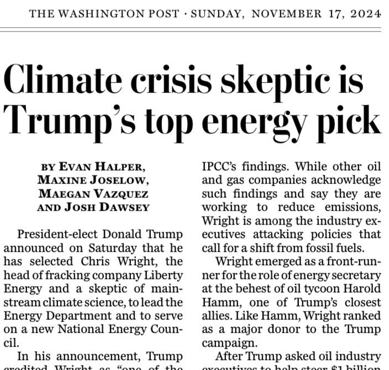 ](https://substackcdn.com/image/fetch/$s_!kRJb!,f_auto,q_auto:good,fl_progressive:steep/https%3A%2F%2Fsubstack-post-media.s3.amazonaws.com%2Fpublic%2Fimages%2F2ddeec4e-da1f-400c-af7a-0fe691a0d5e6_389x370.png)What even is a “climate crisis skeptic”?
The irony here is that Wright’s views on energy and climate, which he has expressed often and in detail, are largely consistent with the findings of the Intergovernmental Panel on Climate Change (IPCC). The views of his critics? Not so much.
Let’s take a look at what Wright has said about climate change in a recent 180-page report called Bettering Human Lives. Wright acknowledges two fundamental realities — climate change is real and fossil fuels have enormous benefits:
The expansion of the global energy supply by adding fossil fuels has greatly improved the human condition; it also brought the risk of climate change caused by increased atmospheric levels of carbon dioxide and other greenhouse gases.
Wright’s plain vanilla views on climate change are consistent with the most recent IPCC assessment:
Human industrial and agricultural activity increases greenhouse gas concentrations and is contributing significantly to a warming trend that earth has experienced over the past 150 years. Total warming over this period has been about 1.3°C (2.3°F).
Wright pulls no punches when characterizing the state of public discussion of climate change, and he is not wrong:
Climate change discourse is unfortunately rife with false claims and alarmist proclamations from all quarters.
Wright cites the IPCC on extreme weather, which — as THB readers know well — expresses findings that contradict many claims made in support of climate activism:
[R]eports from the Intergovernmental Panel on Climate Change (IPCC) actually show no increase in the frequency or intensity of hurricanes, tornadoes, floods, or weather-related droughts.
Wright supports pragmatic climate policies that reduce emissions:
Two things are required for positive progress on climate change: a sober understanding of the issue and the tradeoffs required, and massive improvements in energy technologies that can deliver low-carbon energy that is also low cost, reliable and secure.
Wright clearly differs from many climate activists in his view that while climate change poses real risks, it is one of many problems facing humanity, and not a crisis or existential threat:
LOMBORGIAN
Climate change is a real and global challenge that we should and can address. However, representing it as the most urgent threat to humanity today displaces concerns about more pressing threats of malnutrition, access to clean water, air pollution, endemic diseases, and human rights, among others.
As an energy executive, Wright has a deep understanding of the global energy economy, and he calls for “energy sobriety”:
:{Politicians, policymakers, pundits, and the press talk endlessly about how solar, wind, and batteries can transform our whole energy system and address the climate crisis. The reality is that these politically favored technologies have not, will not, and cannot replace most of the energy services and raw materials provided by hydrocarbons. Today they are deployed almost exclusively in the electricity sector, which delivers only 20% of total primary energy consumption. Manufacturing is the largest user of energy globally, mostly in the form of process heat that cannot effectively be supplied via electricity. Further, the ultra-high-power density required for the likes of aviation, global shipping, long-haul trucking, and mobile mining equipment have no viable replacements in sight.
Critical materials from hydrocarbons provide nitrogen fertilizer that is responsible for fully half of global food production. In addition, hydrocarbons supply critical materials to produce plastics and petrochemicals that are essential components of modern lives. They also provide asphalt, paints, lubricants, cosmetics, 60% of global clothing fiber, and thousands of other products. Without hydrocarbons we would have no way to produce the vast quantities of steel and cement that undergird our built world. Even wind turbines, solar panels, and batteries are made of hydrocarbon materials and require huge amounts of energy from hydrocarbons to supply the high-temperature process heat required for their fabrication. Energy sobriety is desperately needed.}:
What does DOE do, anyway? Here is a capsule summary:
In 1977, the establishment of the Department of Energy brought most Federal energy activities under one umbrella and provided the framework for a comprehensive and balanced national energy plan. While the Nuclear Regulatory Commission maintained its regulatory duties in areas like reactor safety and radiation protection, the Department of Energy undertook responsibility for long-term, high-risk research and development of energy technology, Federal power marketing, energy conservation, the nuclear weapons program, energy regulatory programs, and a central energy data collection and analysis program.
The figure below shows the major elements of the FY2025 DOE budget request to Congress.
[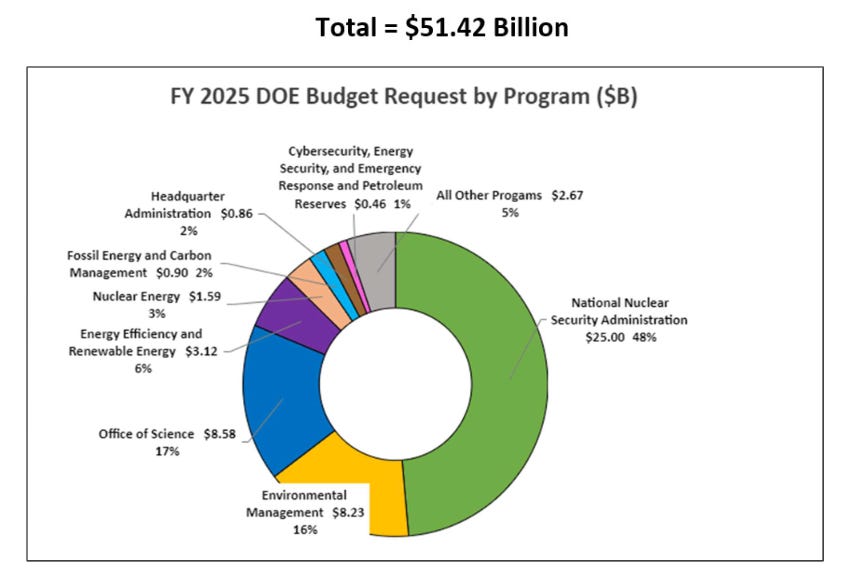 ](https://substackcdn.com/image/fetch/$s_!FOwV!,f_auto,q_auto:good,fl_progressive:steep/https%3A%2F%2Fsubstack-post-media.s3.amazonaws.com%2Fpublic%2Fimages%2F6f8c8f0d-a9cd-4807-8056-5a9ac332241a_854x574.png)DOE FY2025 Budget Request
DOE is not responsible for “drill, baby, drill” — That would be the Department of the Interior. DOE is however one of the leading science agencies of the federal government, overseeing more than $20 billion in research and development.
[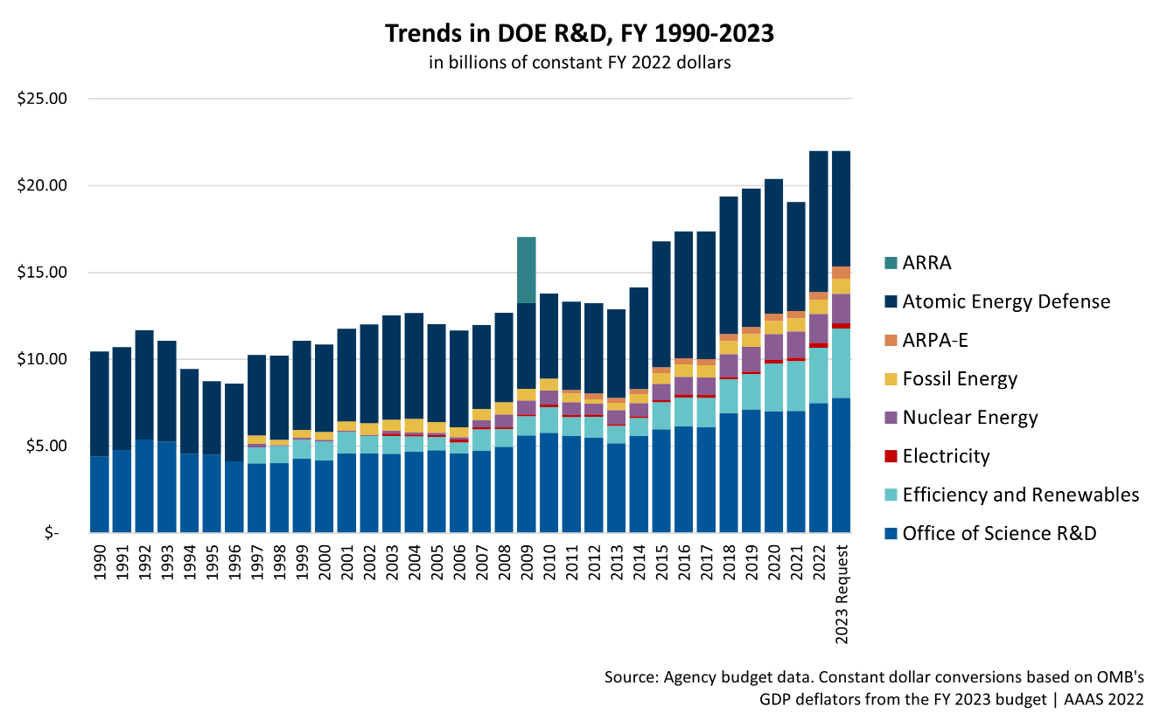 ](https://substackcdn.com/image/fetch/$s_!3bhU!,f_auto,q_auto:good,fl_progressive:steep/https%3A%2F%2Fsubstack-post-media.s3.amazonaws.com%2Fpublic%2Fimages%2F1c4061b2-f42b-48ee-b081-8d2e6cadc751_1160x720.png)Source: AAAS
DOE is also home to 17 national labs around the country.
[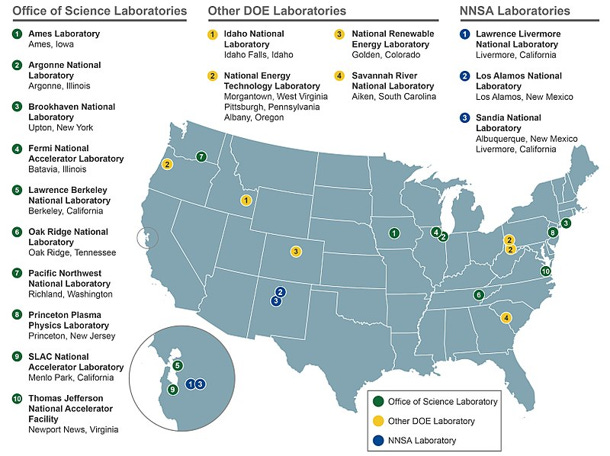 ](https://substackcdn.com/image/fetch/$s_!WqCU!,f_auto,q_auto:good,fl_progressive:steep/https%3A%2F%2Fsubstack-post-media.s3.amazonaws.com%2Fpublic%2Fimages%2Fc67e0f02-f8ba-45e0-ab47-52de3fe713bd_610x456.png)
DOE is focused on the science, technology, and policy dimensions of energy and not on the federal government’s oversight and management of energy resources. In that role, having a climate pragmatist and energy realist as DOE secretary will serve the agency and the nation well.
Rather than call Chris Wright silly juvenile names, the climate community should offer to work with Wright to help deliver — in his words — “massive improvements in energy technologies that can deliver low-carbon energy that is also low cost, reliable and secure.” That is a goal we all should support.
Bonus! Here is a video of me and Chris Wright talking energy and climate just over a year ago (for those who prefer to read, a transcript can be found here):
veriten.com
Chris Wright - en energiminister der ved noget om energi og klima | Klimarealisme.dk
klimarealisme.dk
Senate confirms fossil fuel CEO Chris Wright as energy secretary. He vows to 'unleash' US resources
Senate confirms fossil fuel CEO Chris Wright as energy secretary. He vows to 'unleash' US resources
cpr.org
Senate confirms Trump pick for Energy secretary Chris Wright
usatoday.com
Climate Depot
https://www.climatedepot.com › 2024 › 11 › 21 › roger-pielke-jr-on-chris-wright-energy-realism-climate-pragmatism-at-the-dept-of-energy
Roger Pielke Jr. on Chris Wright: Energy Realism & Climate Pragmatism ...
Nov 21, 2024By Roger Pielke Jr. Excerpt: He's a climate denier! That is the standard reaction of many in the climate lobby when encountering views on climate and energy deviating from the monomaniacal view tha…
Veriten
https://veriten.com › guest › chris-wright
Chris Wright Archives - Veriten
On Wednesday in Denver, we had the pleasure of joining Dr. Roger Pielke Jr. (UC Boulder) and Chris Wright, CEO and Chairman of Liberty Energy for a live discussion as part of Liberty Energy's "Liberty and Energy" Presentation Series.
Watts Up With That?
https://wattsupwiththat.com › 2024 › 11 › 20 › there-is-a-design-problem-in-climate-policy-featuring-dr-roger-pielke-jr-chris-wright-liberty-2
"There Is a Design Problem In Climate Policy" Featuring Dr. Roger ...
Nov 20, 2024Veriten On Wednesday in Denver, we had the pleasure of joining Dr. Roger Pielke Jr. (UC Boulder) and Chris Wright, CEO and Chairman of Liberty Energy for a live discussion as part of Liberty Energy's "Liberty and Energy" Presentation Series. Roger is a Professor in the Environmental Studies department at the University of Colorado Boulder and the author of "The Honest Broker ...
YouTube
https://www.youtube.com › watch?v=n4GULReQPFs
The Politics of Climate Science | Roger Pielke, Jr. - YouTube
"There Is A Design Problem In Climate Policy" Featuring Dr. Roger Pielke Jr. & Chris Wright, Liberty 1.8K views 1 year ago 43:06 Now playing
heatmap.news
https://heatmap.news › climate › chris-wright-mind?next_url= › climate › chris-wright-mind
Inside the Mind of Energy Nominee Chris Wright - heatmap.news
Jan 2, 2025Pielke called both Wright and Doug Burgum, Trump's nominee for Secretary of the Interior and the designated head of a planned National Energy Council "super competent. They know energy, and that's a fantastic starting point," he told me.
American Enterprise Institute - AEI
https://www.aei.org › articles › energy-realism-and-climate-pragmatism-at-the-department-of-energy
Energy Realism and Climate Pragmatism at the Department of Energy
Nov 19, 2024Reactions from climate advocates to the nomination of Chris Wright, 1 CEO of Liberty Energy, to serve in Donald Trump's cabinet as Secretary of Energy have followed this tired and lazy pattern.
https://www.linkedin.com › posts › chris-wright-b8370a17b_there-is-a-design-problem-in-climate-policy-activity-7113619155722924032-vnWd
Chris Wright's Post - LinkedIn
At our recent Liberty & Energy Breakfast, we hosted Roger Pielke Jr., a self-proclaimed "undisciplined academic" and leading expert on extreme weather phenomena.
Veriten
https://veriten.com › guest › roger-pielke-jr
Roger Pielke Jr. Archives - Veriten
"There Is A Design Problem In Climate Policy" Featuring Dr. Roger Pielke Jr. & Chris Wright, Liberty On Wednesday in Denver, we had the pleasure of joining Dr. Roger Pielke Jr. (UC Boulder) and Chris Wright, CEO and Chairman of Liberty Energy for a live discussion as part of Liberty Energy's "Liberty and Energy" Presentation Series.
rogerpielkejr.substack.com
https://rogerpielkejr.substack.com › p › a-red-team-climate-report
A Red Team Climate Report - by Roger Pielke Jr.
Jul 30, 2025DOE Secretary Chris Wright commissioned the report and characterizes it in the report's foreword as follows: The rise of human flourishing over the past two centuries is a story worth celebrating. Yet we are told—relentlessly—that the very energy systems that enabled this progress now pose an existential threat.
WRIGHT HACK STUDY BS
Climate | Department of Energy
DOWNLOAD DOE_Critical_Review_of_Impacts_of_GHG_Emissions_on_the_US_Climate_July_2025
The U.S. Department of Energy (DOE) has released a new assessment of climate science written by five scientists who have long-argued that climate science assessments have overlooked key issues.
The report — A Critical Review of Impacts of Greenhouse Gas Emissions on the U.S. Climate — was released yesterday accompanying the Trump Administration’s announcement that it was reconsidering the Environmental Protection Agency’s 2009 “endangerment finding” on greenhouse gases.
While the authors do not use this terminology, I’m calling this report a “red team” report because it explicitly seeks to challenge aspects of climate science and policy in order to motivate debate and discussion. One of the report’s authors, Steve Koonin, has long argued for a “red team” approach for improving climate science assessments.
I certainly agree with Koonin that legitimate views and voices have been excluded from major climate assessments, as leaders in the community have sought to present a tidy story, convenient for climate politics. However, rather than having dueling assessments, I would much prefer that scientific assessments be run as big tents, with the full diversity of views included, highlight not just areas of consensus, but also areas of uncertainty, disagreement, and ignorance. Climate science has seen far too much gatekeeping.
In the coming weeks I’ll provide several opportunities here at THB to discuss and debate the report — All are welcome, and substantive disagreement is encouraged.
DOE Secretary Chris Wright commissioned the report and characterizes it in the report’s foreword as follows:
The rise of human flourishing over the past two centuries is a story worth celebrating. Yet we are told—relentlessly—that the very energy systems that enabled this progress now pose an existential threat. Hydrocarbon-based fuels, the argument goes, must be rapidly abandoned or else we risk planetary ruin.
That view demands scrutiny. That’s why I commissioned this report: to encourage a more thoughtful and science-based conversation about climate change and energy. With my technical background, I’ve reviewed reports from the Intergovernmental Panel on Climate Change, the U.S. government’s assessments, and the academic literature. I’ve also engaged with many climate scientists, including the authors of this report.
What I’ve found is that media coverage often distorts the science. Many people walk away with a view of climate change that is exaggerated or incomplete. To provide clarity and balance, I asked a diverse team of independent experts to critically review the current state of climate science, with a focus on how it relates to the United States.
I didn’t select these authors because we always agree—far from it. In fact, they may not always agree with each other. But I chose them for their rigor, honesty, and willingness to elevate the debate. I exerted no control over their conclusions. What you’ll read are their words, drawn from the best available data and scientific assessments.
Wright explains his view of climate change:
Climate change is real, and it deserves attention. But it is not the greatest threat facing humanity. That distinction belongs to global energy poverty. As someone who values data, I know that improving the human condition depends on expanding access to reliable, affordable energy. Climate change is a challenge—not a catastrophe.
Today, I see on social media many climate scientists who often appear in the media responding to the report with name calling. We won’t do that here at THB and the comments will be tightly moderated.
:{:{One of the report’s authors, Judith Curry,:(style="background-color:#ffbb16ff"):}: has a very interesting blog post on the report. Curry explains that the DOE and the author team (the “Climate Working Group” or CWG) is interested in comments and critique:}:
DOE welcomes public comments on this report and is setting up a website for comments. The CWG expects to expend considerable time responding to the comments. We’ve already seen a pretty broad range of comments from the DOE scientists; it will be interesting to see what the what the public comments look like
Speaking from the perspective of individuals who have commented on the IPCC and NCA reports only to see our comments ignored, we plan to take a different approach. Rather than primarily seeking to defend our Report, we regard the open comments as an opportunity for dialogue, learning, and clarification of areas of disagreement. We expect to spend considerable time and effort in responding to the comments.
When you read the report you’ll see that my peer-reviewed work with colleagues is widely cited, and you’ll also see multiple references to THB.
The full report can be found here and I look forward to engaging with THB readers in the comments. Also, let me know any requests for future posts on the substance of the report.
*Before you jump into the DOE report, please click that “❤️ Like”. More likes mean that THB rises in the Substack algorithm and gets in front of more readers. Thanks!
*Comments invited!
*If you are looking for a fantastic speaker (that’s me!) at your event, be in touch.
---
---
Science critics angered by scrapped climate panel
Scott Waldman, E&E News reporter
Published: Friday, July 12, 2019
Some of President Trump's most vociferous cheerleaders on environmental policy are angry that he has backed away from a plan to conduct an "adversarial" review of climate science.
---
https://www.eenews.net/stories/1060713373
The proposed White House panel that would conduct an "adversarial" review of climate science is dead for now, as President Trump grapples with negative perceptions of his environmental record at the outset of his reelection campaign.
The monthslong push from within the National Security Council to review established science on climate change divided White House advisers and generated sharp opposition from researchers across the country. The effort, led by a physicist overseeing technology issues at the NSC, William Happer, stalled indefinitely amid internal disagreements within the White House, according to two sources.
"It's been totally stymied by the forces of darkness within the administration, but also by the looming election campaign," said Myron Ebell, a senior fellow at the conservative Competitive Enterprise Institute who led the EPA transition team under Trump.
Happer has consulted conservative groups that attack climate science in an attempt to recruit members for the proposed panel. He's spoken with policy analysts at the Competitive Enterprise Institute, Heartland Institute and CO2 Coalition, a group Happer founded and that claims that the world would be better off with higher levels of carbon dioxide emissions. The theories promoted by those groups are rejected by NASA, NOAA and the world's top science academies.
Happer initially wanted Trump to issue an executive order to create the "Presidential Committee on Climate Security." He wanted the panel to review assertions within the National Climate Assessment related to risks from climate change on national security. Happer briefed Trump on climate science at least twice (Climatewire, June 24).
The idea to create the panel has caused strife within the White House. Among its critics are deputy chief of staff Chris Liddell; Kevin Hassett, the outgoing chairman of the Council of Economic Advisers; Larry Kudlow, director of the National Economic Council; and Kelvin Droegemeier, the president's science adviser. Those supporting the plan include Trump's son-in-law and senior adviser Jared Kushner and Brooke Rollins, assistant to Trump in the Office of American Innovation.
An official at NSC disputed the characterization that the panel was dead, even while confirming that it had been indefinitely delayed. The plan has suffered several downgrades over the months. It was initially proposed as a rapid response team of climate science critics who would challenge government publications on human-caused warming. Recent discussions have centered on the idea of forcing government climate scientists to participate in a debate with critics of their work who deny that humans are causing widespread changes on Earth (Climatewire, June 6). Most recently, the plan was diminished to creating dueling white papers that would elevate climate denialism to the level of consensus science.
Those in talks to participate as critics of mainstream science include John Christy of the University of Alabama, Huntsville, and Judith Curry, former head of the School of Earth and Atmospheric Sciences at Georgia Tech. A potential leader of the exercise was Paul Robinson, a former Department of Energy official who oversaw talks about nuclear weapons tests with the Soviet Union, but who is not trained in climate science.
Trump supporters who want the administration to be more aggressive in its rejection of climate science were frustrated that the climate review panel had been sidelined. Ebell of the Competitive Enterprise Institute sees it as a sign that the Trump campaign is sensitive to Democratic attacks on climate change.
"The reelect campaign has been completely taken over by the usual cast of Republican establishment consultants who are primarily concerned with making very large amounts of money on the campaign," Ebell said.
---
---
omfg
https://www.nytimes.com/2019/05/27/us/politics/trump-climate-science.html
some lnx below
Trump Administration Hardens Its Attack on Climate Science
May 27, 2019
WASHINGTON — President Trump has rolled back environmental regulations, pulled the United States out of the Paris climate accord, brushed aside dire predictions about the effects of climate change, and turned the term “global warming” into a punch line rather than a prognosis.
Now, after two years spent unraveling the policies of his predecessors, Mr. Trump and his political appointees are launching a new assault.
In the next few months, the White House will complete the rollback of the most significant federal effort to curb greenhouse-gas emissions, initiated during the Obama administration. It will expand its efforts to impose Mr. Trump’s hard-line views on other nations, building on his retreat from the Paris accord and his recent refusal to sign a communiqué to protect the rapidly melting Arctic region unless it was stripped of any references to climate change.
And, in what could be Mr. Trump’s most consequential action yet, his administration will seek to undermine the very science on which climate change policy rests.
[Want climate news in your inbox? Sign up here for Climate Fwd:, our email newsletter.]
Mr. Trump is less an ideologue than an armchair naysayer about climate change, according to people who know him. He came into office viewing agencies like the Environmental Protection Agency as bastions of what he calls the “deep state,” and his contempt for their past work on the issue is an animating factor in trying to force them to abandon key aspects of the methodology they use to try to understand the causes and consequences of a dangerously warming planet.
As a result, parts of the federal government will no longer fulfill what scientists say is one of the most urgent jobs of climate science studies: reporting on the future effects of a rapidly warming planet and presenting a picture of what the earth could look like by the end of the century if the global economy continues to emit heat-trapping carbon dioxide pollution from burning fossil fuels.
The attack on science is underway throughout the government. In the most recent example, the White House-appointed director of the United States Geological Survey,James Reilly, a former astronaut and petroleum geologist, has ordered that scientific assessments produced by that office use only computer-generated climate models that project the impact of climate change through 2040, rather than through the end of the century, as had been done previously.
Image
President Trump has pushed to resurrect the idea of holding public debates on the validity of climate science.CreditDoug Mills/The New York Times]
Scientists say that would give a misleading picture because the biggest effects of current emissions will be felt after 2040. Models show that the planet will most likely warm at about the same rate through about 2050. From that point until the end of the century, however, the rate of warming differs significantly with an increase or decrease in carbon emissions.
The administration’s prime target has been the National Climate Assessment, produced by an interagency task force roughly every four years since 2000. Government scientists used computer-generated models in their most recent report to project that if fossil fuel emissions continue unchecked, the earth’s atmosphere could warm by as much as eight degrees Fahrenheit by the end of the century. That would lead to drastically higher sea levels, more devastating storms and droughts, crop failures, food losses and severe health consequences.
Work on the next report, which is expected to be released in 2021 or 2022, has already begun. But from now on, officials said, such worst-case scenario projections will not automatically be included in the National Climate Assessment or in some other scientific reports produced by the government.
“What we have here is a pretty blatant attempt to politicize the science — to push the science in a direction that’s consistent with their politics,” said Philip B. Duffy, the president of the Woods Hole Research Center, who served on a National Academy of Sciences panel that reviewed the government’s most recent National Climate Assessment. “It reminds me of the Soviet Union.”
In an email, James Hewitt, a spokesman for the Environmental Protection Agency, defended the proposed changes.
:{:{}:
}:
“The previous use of inaccurate modeling that focuses on worst-case emissions scenarios, that does not reflect real-world conditions, needs to be thoroughly re-examined and tested if such information is going to serve as the scientific foundation of nationwide decision-making now and in the future,” Mr. Hewitt said.
However, the goal of political appointees in the Trump administration is not just to change the climate assessment’s methodology, which has broad scientific consensus, but also to question its conclusions by creating a new climate review panel. That effort is led by a 79-year-old physicist who had a respected career at Princeton but has become better known in recent years for attacking the science of man-made climate change and for defending the virtues of carbon dioxide — sometimes to an awkward degree.
:{:{}:
}:
Image
The Beaufort Sea in the Arctic, a region that is warming rapidly. The United States recently declined to sign a communiqué on protecting the Arctic unless it omitted references to climate change.CreditAndrew Testa for The New York Times]
:{:{}:
}:
“The demonization of carbon dioxide is just like the demonization of the poor Jews under Hitler,” the physicist, William Happer, who serves on the National Security Council as the president’s deputy assistant for emerging technologies, said in 2014 in an interview with CNBC.
Mr. Happer’s proposed panel is backed by John R. Bolton, the president’s national security adviser, who brought Mr. Happer into the N.S.C. after an earlier effort to recruit him during the transition.
:{:{}:
}:
Mr. Happer and Mr. Bolton are both beneficiaries of Robert and Rebekah Mercer,the far-right billionaire and his daughter who have funded efforts to debunk climate science. The Mercers gave money to a super PAC affiliated with Mr. Bolton before he entered government and to an advocacy group headed by Mr. Happer.
Climate scientists are dismissive of Mr. Happer; his former colleagues at Princeton are chagrined. And several White House officials — including Larry Kudlow, the president’s chief economic adviser — have urged Mr. Trump not to adopt Mr. Happer’s proposal, on the grounds that it would be perceived as a White House attack on science.
:{:{}:
}:
Even Stephen K. Bannon, the former White House strategist who views Mr. Happer as “the climate hustler’s worst nightmare — a world-class physicist from the nation’s leading institution of advanced learning, who does not suffer fools gladly,” is apprehensive about what Mr. Happer is trying to do.
:{:{}:
}:
“The very idea will start a holy war on cable before 2020,” he said. “Better to win now and introduce the study in the second inaugural address.”
But at a White House meeting on May 1, at which the skeptical advisers made their case, Mr. Trump appeared unpersuaded, people familiar with the meeting said. Mr. Happer, they said, is optimistic that the panel will go forward.
Image
William Happer, who serves on the National Security Council, is pushing to create a climate review panel that would question scientific consensus.CreditPool photo by Albin Lohr-Jones]
The concept is not new. Mr. Trump has pushed to resurrect the idea of a series of military-style exercises, known as “red team, blue team” debates, on the validity of climate science first promoted by Scott Pruitt, the E.P.A. administrator who was forced to resign last year amid multiple scandals.
:{:{}:
}:
At the time, the idea was shot down by John F. Kelly, then the White House chief of staff. But since Mr. Kelly’s departure, Mr. Trump has talked about using Mr. Happer’s proposed panel as a forum for it.
:{:{}:
}:
For Mr. Trump, climate change is often the subject of mockery. “Wouldn’t be bad to have a little of that good old fashioned Global Warming right now!” he posted on Twitter in January when a snowstorm was freezing much of the country.
:{:{}:
}:
His views are influenced mainly by friends and donors like Carl Icahn, the New York investor who owns oil refineries, and the oil-and-gas billionaire Harold Hamm — both of whom pushed Mr. Trump to deregulate the energy industry.
ImageThe Daily Poster
Listen to ‘The Daily’: The White House Plan to Change Climate Science]
...
==
==
ee
the fall of 2014, Steven Koonin was finishing up an op-ed for The Wall Street Journal. The theme was a contentious one, especially for a former Obama administration energy official: How certain is climate science?
Koonin sent a draft around to about a dozen people he considers "friendly critics." He wanted their feedback. They included Michael Lubell, Koonin's longtime friend, who was then director of public affairs at the American Physical Society.
Lubell warned him: "You're going to be used."
He told Koonin that it's virtually impossible to have a nuanced position in the climate change debate. "You're either going to be put in one box or the other; you're either a climate denier or you're not. ... Watch, they're going to put a headline on your piece that says you don't think that the science is settled."
Lubell was right. The headline for Koonin's piece: "Climate Science Is Not Settled."
Koonin said of that headline, "I would have chosen something more nuanced." He thinks the working title when he handed it to the Journal was "Climate Clarity." But he noted, "I don't have to sell newspapers."
The op-ed earned Koonin, a theoretical physicist, the ire of many in the climate science world, including his former colleagues in the Obama administration.
John Holdren, who was then President Obama's science adviser, sent Koonin a note saying, more or less: "Dear Steve, I don't think you have this right, and it's not helpful," Holdren said in a recent interview.
Now, Koonin is again in the middle of a controversy.
He advocated for a "red team" approach to climate science in another Wall Street Journal op-edin April. The exercise would allow critics to test the "consensus" around climate science. EPA Administrator Scott Pruitt has publicly expressed interest in the idea, and he's rumored to be considering hiring Koonin to lead the process.
Koonin has met with Pruitt and other Trump administration officials to discuss the idea of a "red team," he told E&E News on Friday. He declined to comment on whether he's in talks about running such an operation, but he said he'd consider it if certain conditions were met.
"I would convene such an exercise only if I felt I could do it with the integrity, thoroughness and transparency that characterizes the best of science advising," he said.
Koonin doesn't like the idea of televising the potential climate debates, despite Pruitt's suggestion that it might be in the public's interest.
"I do not support a televised red team debate," Koonin said. He said he wants an "honest discussion about what the risks are and the certainties and uncertainties, what the efficacy is of various mitigation measures and responses."
EPA spokeswoman Liz Bowman declined to say whether Koonin is in the running for such a job.
She said of a broader effort to assess climate science: "It is essential that certainties and uncertainties in the science are accurately presented to the public and to decisionmakers. A robust, transparent public peer-review evaluation of climate change is something everyone should support."
Koonin, 65, has been director of New York University's Center for Urban Science and Progress since April 2012. From 2009 until 2011, he was undersecretary for science in Energy Department under the Obama administration. He was previously BP PLC's chief scientist and provost of the California Institute of Technology. He has a doctorate in theoretical physics from the Massachusetts Institute of Technology.
'No dog in the fight'
Science — not politics — is what drives him, Koonin insists.
"I've got no dog in the fight about whether this is the greatest catastrophe that's facing the planet or this is a nothing burger," he said. "This is something that is a national issue, and I feel the scientific community has an obligation to see that this is accurately portrayed."
But the climate science debate has long been highly politicized, and Koonin cannot escape it.
He's gotten public blowback from prominent scientists and plenty of criticism from his former Obama administration colleagues, who say he's being used by the Trump team to further an agenda to promote uncertainty and roll back climate change regulations.
In June, scientists Benjamin Santer andKerry Emanueland science historian Naomi Oreskes penned a response in The Washington Post titled, "Attention Scott Pruitt: Red teams and blue teams are no way to conduct climate science."
They wrote that red team exercises "are dangerous attempts to elevate the status of minority opinions, and to undercut the legitimacy, objectivity and transparency of existing climate science."
Holdren wrote his own op-ed in July, in The Boston Globe. "The argument that such a process would be helpful is some combination of naive and disingenuous," he argued.
'Somewhere between Trump and Obama'
So what exactly does Koonin think about climate change?
He said he's not a climate "skeptic," and he doesn't like the term. "I'm a scientist, and I think we have an obligation to portray the science accurately to decisionmakers and the public. That has been my goal throughout."
Asked whether he agrees with President Trump's approach to climate change, he said, "The truth is probably somewhere between Trump and Obama. It doesn't matter what I think about climate policy. I'm just a scientist. These are complicated scientific, political, social and, in some ways, theological issues."
He said, "My only agenda is to get a good science discussion."
In 2014, he wrote, "There is little doubt in the scientific community that continually growing amounts of greenhouse gases in the atmosphere, due largely to carbon-dioxide emissions from the conventional use of fossil fuels, are influencing the climate."
The "crucial, unsettled scientific question for policy," Koonin wrote, is: "How will the climate change over the next century under both natural and human influences?"
He's also interested in geoengineering, the idea that humans can intervene in the environment in order to counter global warming.
In 2009, he co-authored a paper assessing the feasibility of pumping aerosol particles into the atmosphere to induce global cooling. The concept of geoengineering remains highly controversial, due in large part to concerns about unintended side effects.
Koonin said it's important to know what's feasible in terms of responding to climate change. Mitigation "is not going to be enough to do what most people think needs to be done," he told E&E News. He said he thinks adaptation will be "the dominant response," and it's valuable to have other options "in our back pocket."
As for geoengineering, he said, "You want to know whether that's an option or not."
Pruitt's 'straw man'?
Koonin's previous work for a Democratic administration makes him an attractive pick for some of those who support a "red team" approach to climate science.
"He has the Obama administration background, so I think he could be seen as an honest broker," said Myron Ebell, a prominent critic of the prevailing views about climate science. Ebell ran Trump's EPA transition team.
Some of Koonin's former colleagues say he's being used to advance Trump's agenda.
"This is a brilliant man who is politically inept," said a former DOE official who worked with Koonin.
"I think Pruitt is using this as a straw man," that person said. "I hope Koonin doesn't take it."
Another former Obama administration colleague said of Koonin, "I think there's a general sense that he's being exploited by the current administration. ... I think political acumen has always been Steve's Achilles' heel."
That was the case during his time at DOE, the former colleague said. Koonin was very active in helping the Obama administration produce its high-profile Quadrennial Energy Review.
"He always had the sense that if he wrote it, if the policy paper was done, that everyone would just endorse that," the former colleague said. "He struggled to understand that policy has to be sold in the political environment."
Koonin brushes off those criticisms.
"I think I have tried to stick with the science, and if discussing the science disappoints people, that's disappointing to me," he said.
If his goal — to get the science accurately depicted — lines up with what Trump's team wants to do, "that's not so bad," he said.
---
https://www.wsj.com/articles/a-red-team-exercise-would-strengthen-climate-science-1492728579
Tomorrow’s March for Science will draw many thousands in support of evidence-based policy making and against the politicization of science. A concrete step toward those worthy goals would be to convene a “Red Team/Blue Team” process for climate science, one of the most important and contentious issues of our age.
The national-security community pioneered the “Red Team” methodology to test ....
Steven Koonin
---