Scaling in a Complex system
https://medium.com/swlh/scale-a-book-summary-3d39d16321ef
- Visionary physicist Geoffrey West found that despite the riotous diversity in the sizes of mammals, they are all, to a large degree, scaled versions of each other
- West’s assertion that despite their striking differences, all the world’s cities are simply scaled versions of one another—and possibly an extension of the biological systems of which they’re made—has made his name synonymous with the notion of a “science of cities.”
- The distribution of city sizes worldwide follows a power law distribution known as Zipf's law
- It states that the population of cities is inversely proportional to their rank
- In other words, the largest city is typically twice as populous as the second-largest city, three times as populous as the third-largest city
- Research has abundantly demonstrated the predominance of quarter-power law distributions
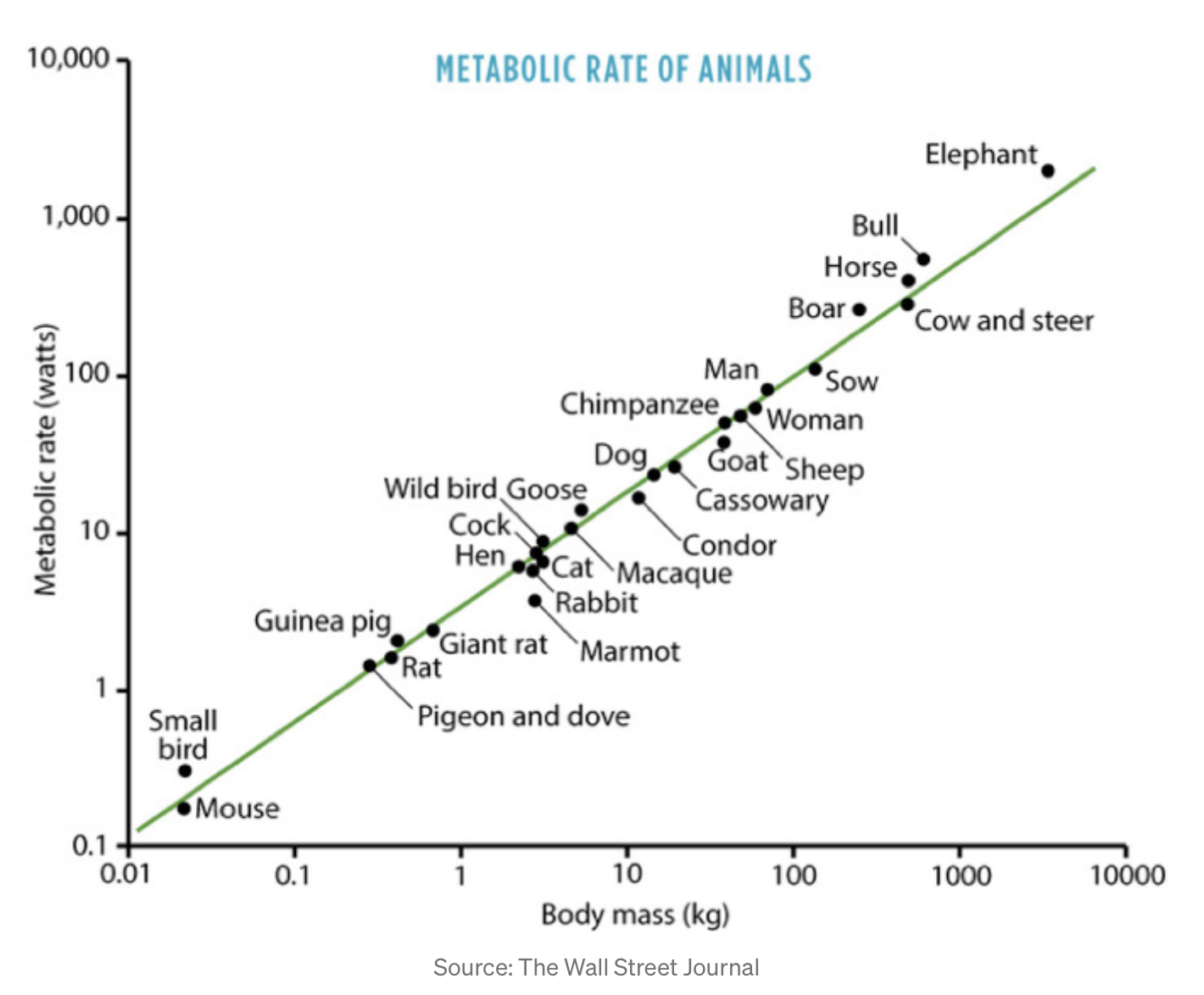
- In biology, when an animal doubles in size (i.e. doubles its body weight), then its number of cells also roughly doubles, but its metabolic rate only increases by about 75%, rather than 100%, as you would naively expect.
- This is a phenomenon known as Kleiber’s Law, after Max Kleiber who pioneered this type of work in the 1930s. It can be formally written as q₀ ~ M(¾), whereby q₀ is the animal’s metabolic rate, and M the animal’s mass. This means that a cat that is 100 times heavier than a mouse only consumes about 100(¾) ~ 32 times the energy that the mouse consumes.
- Nonlinear behavior characterized by the systematic savings as size increases is referred to as sublinear scaling or economy of scale. The figure below, showing metabolic rate as a function of body mass (plotted logarithmically), highlights this behavior.
- More than a hundred power-law distributions have been identified in physics
- The frequency and magnitude of earthquakes follow a power law distribution known as the Gutenberg-Richter law