CAS Nested Systems
- Complex adaptive systems are often nested in broader systems
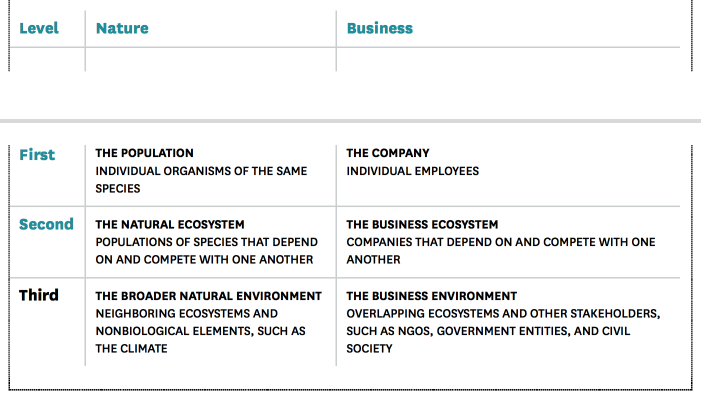
- A population is a CAS nested in a natural ecosystem, which itself is nested in the broader biological environment
- A company is a CAS nested in a business ecosystem, which is nested in the broad societal environment
- Complexity therefore exists at multiple levels, not just within organizational boundaries
- At each level there is tension between what is good for an individual agent and what is good for the larger system
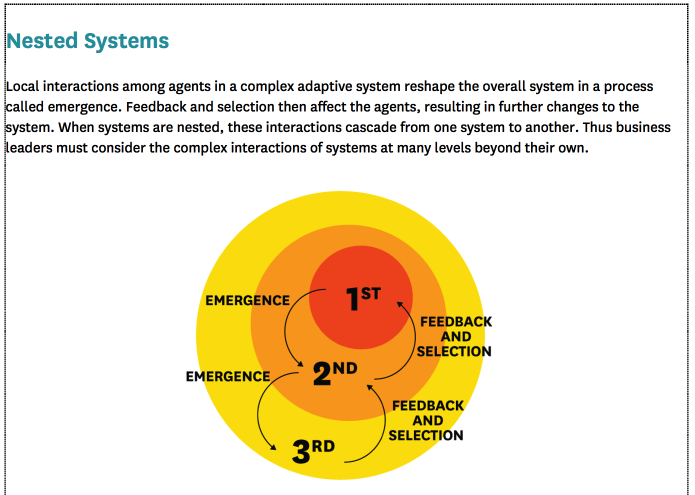
1st Level: Population - Company
2nd Level: Natural Ecosystem - Business
3rd Level: Broader Natural - Environment
Key characteristics of nested systems in complex adaptive systems include:
- Hierarchical Structure: Nested systems create a hierarchical or layered structure within a complex adaptive system. This hierarchy consists of levels or scales, with each level representing a different scope or granularity of analysis.
- Interconnectedness: The subsystems within a complex adaptive system are interconnected, meaning that changes or adaptations in one subsystem can have ripple effects on other subsystems and the larger system. This interconnectedness is a hallmark of complex systems.
- Autonomy and Adaptation: Each nested subsystem may have a degree of autonomy, allowing it to adapt to its local environment or conditions. These adaptations can occur independently within each subsystem.
- Emergent Properties: The interactions among nested subsystems can lead to emergent properties or behaviours at higher levels of the hierarchy. These emergent properties are not necessarily predictable based solely on the characteristics of individual subsystems but arise from their interactions.
- Feedback Loops: Feedback loops, both positive (amplifying) and negative (dampening), play a crucial role in the dynamics of nested systems. Feedback mechanisms can help maintain stability or drive change within and across subsystems.
- Scale-Dependent Behavior: The behavior of nested systems can vary depending on the scale of observation. What is considered a subsystem at one scale may be viewed as a complex adaptive system at a finer scale.