SenseMaker® Genba
SenseMaker® Genba which allows app-based pervasive capture, reporting and engagement of the whole workforce
- Built in part to make the human sensor network aspect of the EU Field Guide more real in practice
- Also a key tool in our work on knowledge, decision making, mapping, measurement and a whole set of other areas
- Allows not only better identification of what is in place but can also allow the engagement of multiple actors in evaluation and identification of change mechanisms
Background
- Originally developed in Toyota, around the idea of ‘Go-Look-See’, the idea of Gemba (or Genba) in manufacturing and quality management is to focus management on what is actually happening on the ground
- This implies engaging all actors, both shop floor workers and executives in observing micro-anomalies, opportunities for improvement and areas of concern
- It is a part of the overall Lean management philosophy and is linked to the Japanese concept of Kaizen or continuous improvement
- It is part of a rich body of methods and concepts that provide for context specific learning through engagement in ‘the place where it actually happens’
SenseMaker® application of Genba
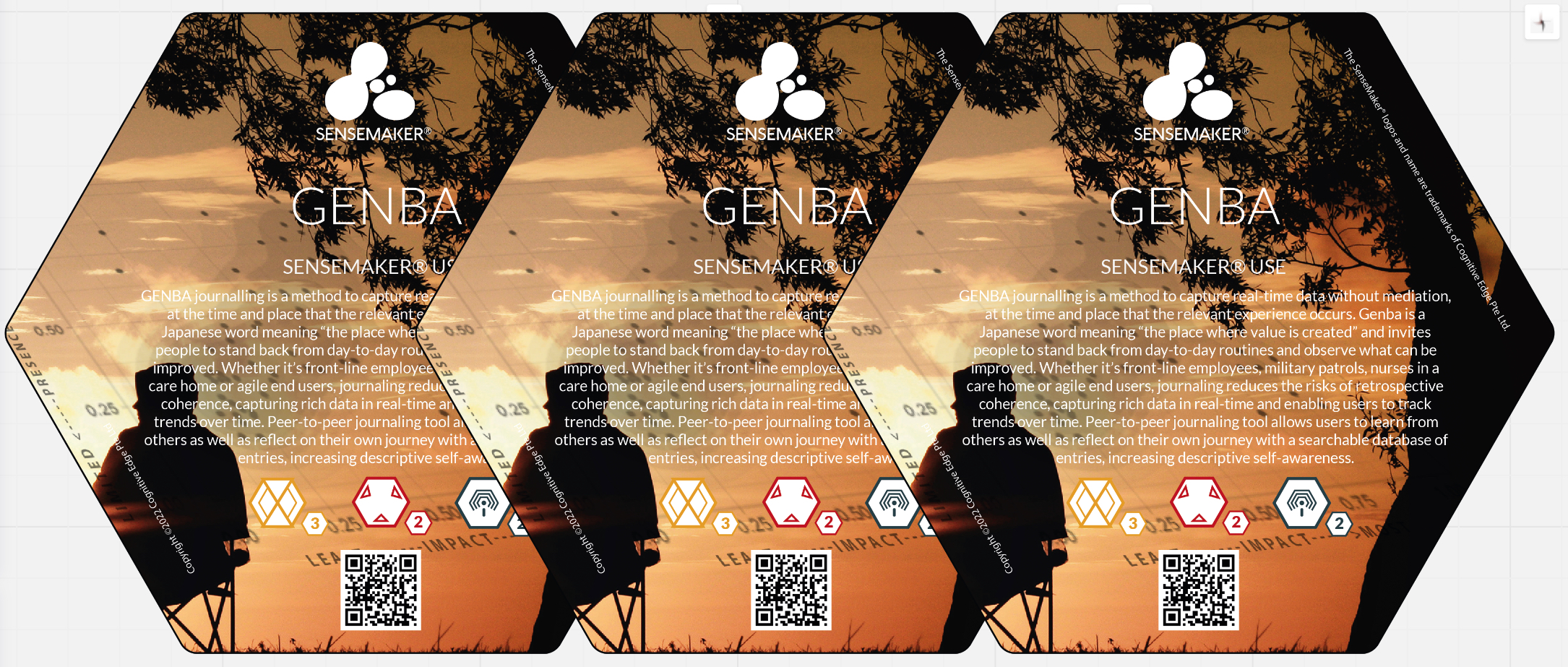
- Takes the concept of ‘Go-Look-See’ and applies it in a more inclusive ecosystems approach through SenseMaker distributed ethnography and journaling, hence further enabling peer to peer learning and agency within organisational learning and development
- Genba system can be used for:
- Lesson learning programmes in real time, rather than solely in retrospect
- To generate cross silo knowledge exchange without central mediation
How it is structured
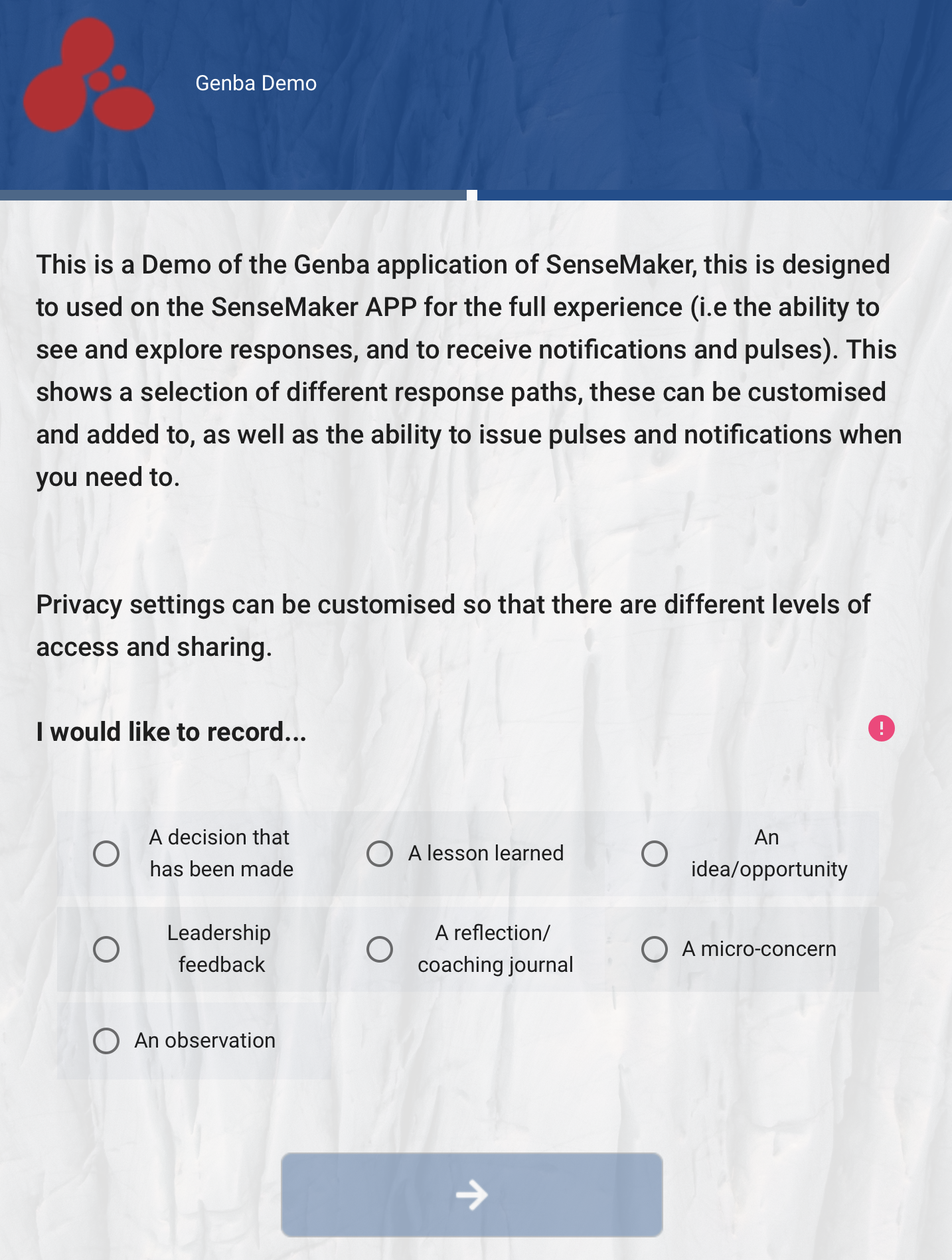
- Uses a single core structure of questions with the addition of branches to provide differential question sets depending upon the input selected
- Very first multiple choice question you see will give you a range of options for the type of inputs you can contribute (such as Share an: Idea, concern, observation etc)
- Depending on which one you select you will be presented with a set of questions that relates to this selection
- A Genba can be seen to be modular in that you may choose to add contribution types or keep it limited to a select few
- These different branches or modules allow respondents to be asked different questions (or the same questions in different ways) to reflect the way they are making sense of the experience they have shared
- A Genba system can be set up to be very generic, but can also have additional modules added in relation to specific inquiries
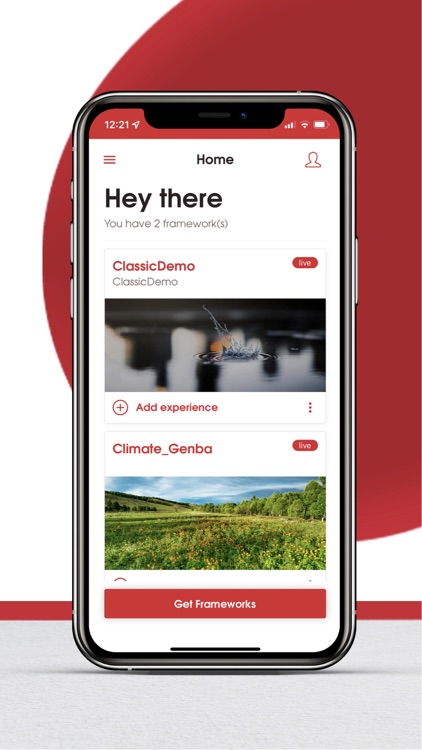
- The big added bonus is that once you have established a cohort on the base journaling system, you can send them notifications and new sets of questions as and when the need arises
What’s unique about it
- Genba does not require a prompting question as with the Unsurvey or MassSense, but is more of a field notebook with a very light structure in the form of a multiple choice question to select ‘what type of input is this’
- Also possible to use conditional logic to have the subsequent questions (or phrasing) change depending on the type of input selected
- Unlike the other configurations of SenseMaker, Genba maintains a networked relationship with the participants, allowing for sharing of data across participants, and notifying participants through the ability to issue reminders, prompts or new sets of questions
- Once data is collected, the ability to overlay, cluster and compare responses from across different response types offers some serious potential for learning across contexts such as mapping challenges against ideas for example, to generate innovation and exaptive triggers.
The reason or value for this use:
The real beauty of a full Genba set up is that it can integrate all of the other kinds of SenseMaker® instances in addition to the base journal design. Members of a Genba cohort can be notified to respond and can be issued new sets of questions (such as a MassSense or unsurvey) when needed.
A case or scenario that best fits: During ‘business as usual” the Genba journal can be used to harvest insights or observations that people feel need to be paid attention to (such as challenges, opportunities and dilemmas) in real time. The contributions can be shared across the network or with restrictions on who can see what. This can be used to provide the foundations of retrospectives and collective sense-making activities, as well as acting as an organisational memory bank that could be used to map changes over longer periods of time. Furthermore, in extraordinary circumstances, such as a crisis or proposed policy change, it would be possible to issue an Unsurvey or MassSense to consult with the Genba cohort in real time.
You can find a basic Genba Demonstration here.