Regenerative Tracks
Regenerative Tracks is a bioregional learning programme for entrepreneurs building businesses that strengthen the ecosystems they're part of
Regenerative Tracks strategy follows a Cynefin Dynamics flow
Participants navigate their way into a viable regenerative business
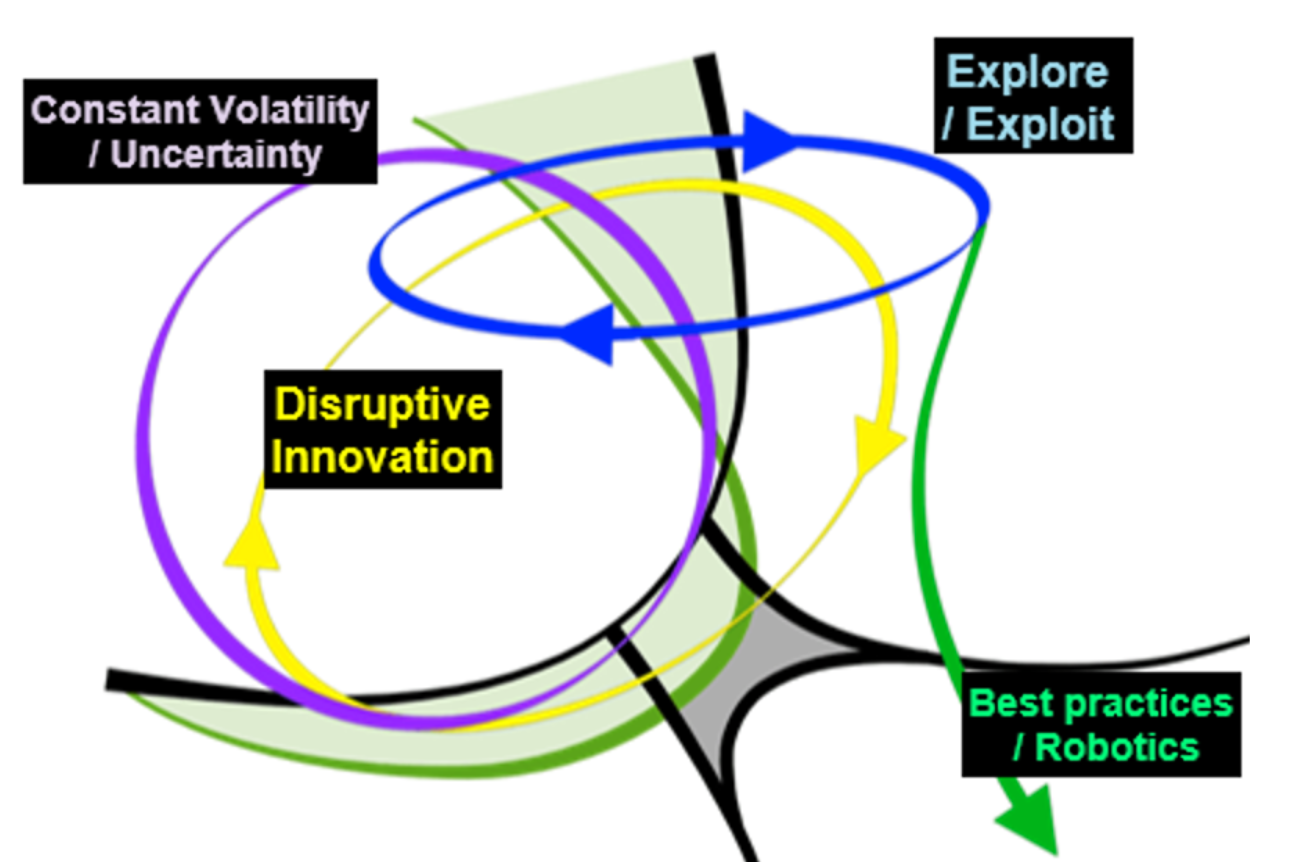
While all loops are potentially possible in a Regenerative Tracks session, the most stable dynamic Explore/Exploit is shown in blue and moves between the complex and the complicated domains
- Begin in the Cynefin complex domain applying the Estuarine Framework to make sense of the current reality
- Gather Big data and Thick data using SenseMaker to inform the design thinking
- Identify small projects in the complex domain worth exploring in a regenerative business
- Map the projects on an Energy/Time grid using the Estuarine Mapping process
- Launch projects as safe-to-fail experiments to probe hypotheses, reveal patterns as constraints, enable Adjacent Possibles to emerge
- When new ideas and solutions are ready to be implemented, move to the Complicated domain for deliverables such as:
- Business case
- Pricing model
- Web platform
- Refined business model canvas
- These are linear outputs that assume:
- predictable progression
- stable if-then cause & effect relationships
- a known sequence of steps
- Close the loop by continuously detecting weak signals of new problem/opportunity spaces as they emerge
Cynefin Dynamics is a scaffold that blends Complex domain emergence with Complicated system structure
- A purely Complex program would be resilient but ungrounded
- A purely Ordered program would be robust but brittle
Regenerative Tracks is mostly Complex, with just enough Ordered structure to:
- provide clarity
- mitigate known risks
- reduce anxiety
- anchor expectations
It's conceivable that a different Cynefin Dynamics loop would be more effective
- Yellow loop (Disrupt) recognizes a more disruptive innovation effort is necessary to shake free from beliefs and paradigms deeply held by experts
- The search for perfect knowledge is broken off due to expert ego conflicts or due to time constraints
- Purple loop (Incubate) understands the context is constantly changing at a fast pace
- Not aiming for an optimal result or best practices but rather seeking a satisficing "good enough until the next change"
Cadence
Cadence relates to the speed with which you change things, the cycle time of change and review and with that the nature of the review process
- Cynefin Dynamic loops mean Estuarine Mapping would be continuous to help define new problem/opportunity spaces as they emerge
Regenerative Tracks recognizes this with “Choose Your Rhythm”
- 1 week – Focus
- 1 month – Balance
- 3 months – Breath
- Each rhythm represents a different depth of immersion, degree of ecosystem integration, and tempo of transformation
- In Estuarine terms, these are governing constraints that create stability and appreciate that orderly planning is required to schedule and resource events
Project Management
- Traditional project management tends to identify deviations from an idealistic future state and get back on track
- Adaptive Project Management is a constructor to manage projects differently
- Acknowledge the dynamic and unpredictable nature of projects and the environments in which they operate
- Emphasize flexibility and agility to change
- Complex facilitation works well in the Complex domain
- When working in the Complicated domain, use Traditional Facilitation
A “best of breed” multi-method approach
- At the heart of this is complex adaptive systems theory, which understands scale not as some form of aggregation and repetition but more like DNA, a process of decomposition and recombination that allows context-specific solutions to be created
- This ‘best of breed’ method is something called Hexi
- Multi-method means allowing people to combine material from different vendors
- A Hexi kit is available for Estuarine Mapping