SenseMaker® Triad analysis
Resist desire to immediately read narratives
- Don’t zero in on a single narrative and attempt to figure out why it was signified that way
- The only person that knows why is the storyteller
- Any interpretation you attempt will include your cognitive biases
- Don’t try or encourage guessing who the storyteller might be from the profile responses (e.g, age, gender, headquarters, etc.)
- Potential danger of looking for blame may arise
- Only reason to read a narrative to understand context to make sense of systemic patterns that have emerged
Look at patterns formed by the dots
- Dominant clusters will be easy to spot
- But it’s just as important to notice gaps and “outlier” responses (i.e., a single isolated story) as these can be “weak signals” or represent innovative opportunities to put into practice
- Observe
- (i) what’s the same?
- (ii) what’s different?
- (iii) what surprises you?
Where patterns are dominant
- Assume that positive stories confirm the triad concept being tested is achieved and present
- Negative stories indicate challenges are being experienced
Where patterns are heavily skewed
- Usually reflect an imbalance somewhere in the system constraints
- Also worthwhile to consider where patterns are not, and to understand why
Multiple-choice Questions (MCQ)s act as filters that allow “slicing and dicing” the narrative data
- Filtering provides another layer of context and ability to interrogate hidden patterns
Example: PM Iron Triangle
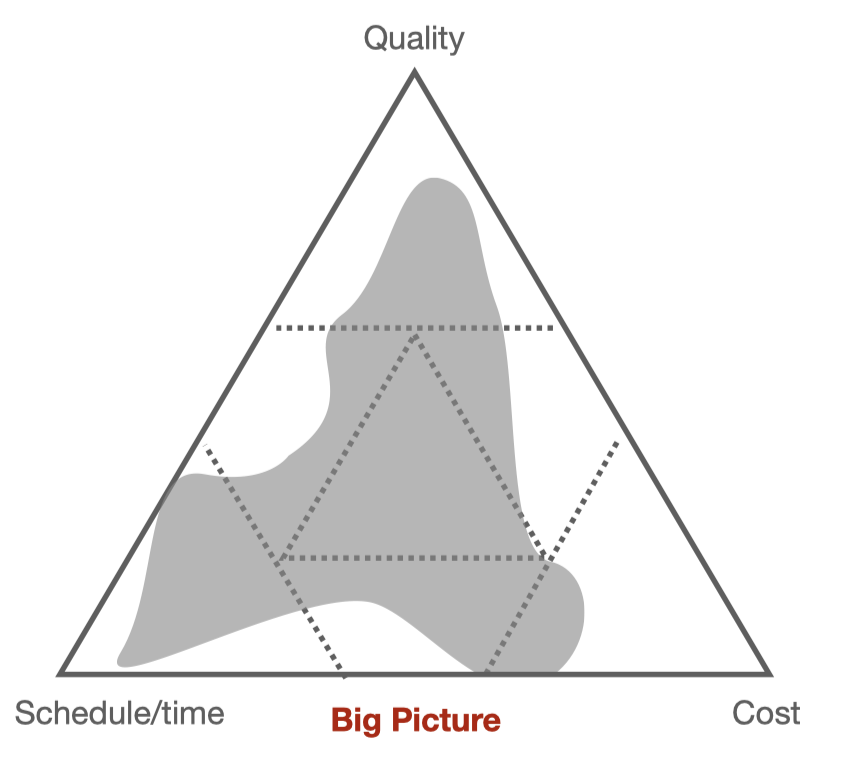
Triad pattern provides a Big Picture sense of what is influencing the organization in terms of output and deliverables
- What general dispositions are revealed?
- Any emergent trends to highlight?
Observations
- Impact on Schedule/time is significant
- Cost is not seen as a major impact
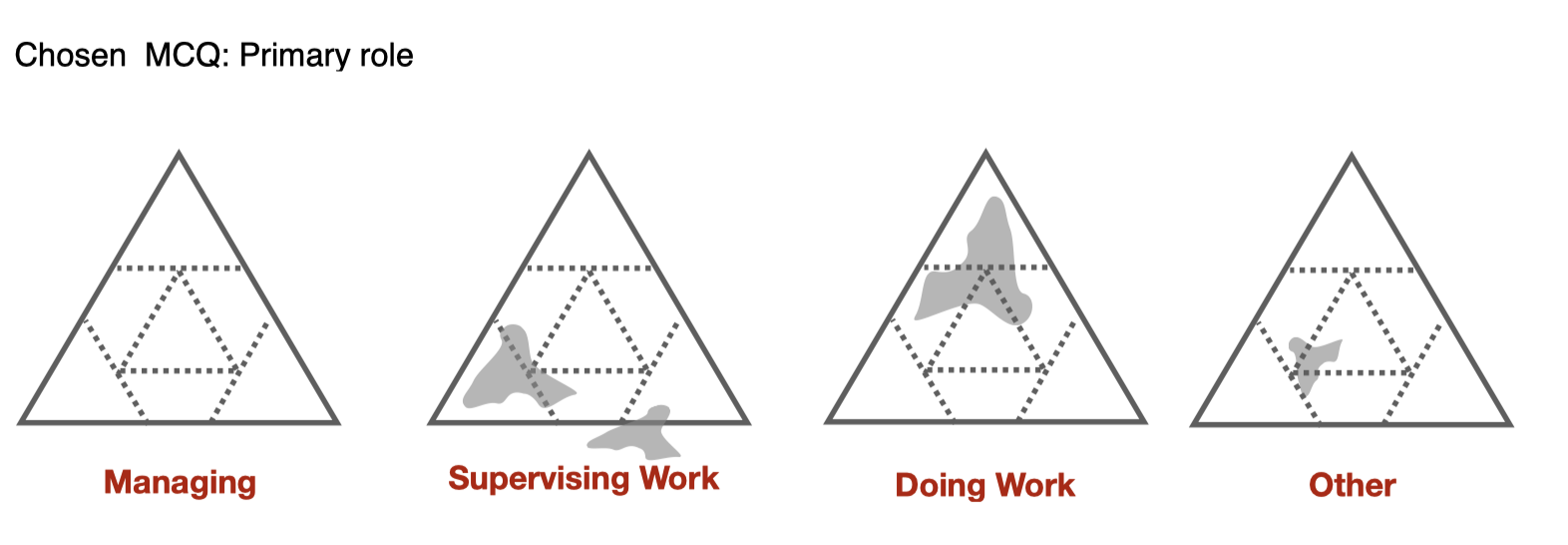
- MCQ filtering provides another layer of context and ability to interrogate hidden patterns
- Note the subset patterns revealed by Primary role filtering
Observations
- Managers indicate Cost is not a major factor as perhaps thought
- Those supervising work are strongly skewed towards meeting Time deadlines
- People doing work show a progressive patterning towards Quality
- The narratives behind the patterns can then be read not to blame but to divulge another layer of context which surround those experiences
This is how we begin to uncover “more stories like this”, and “fewer stories like that”