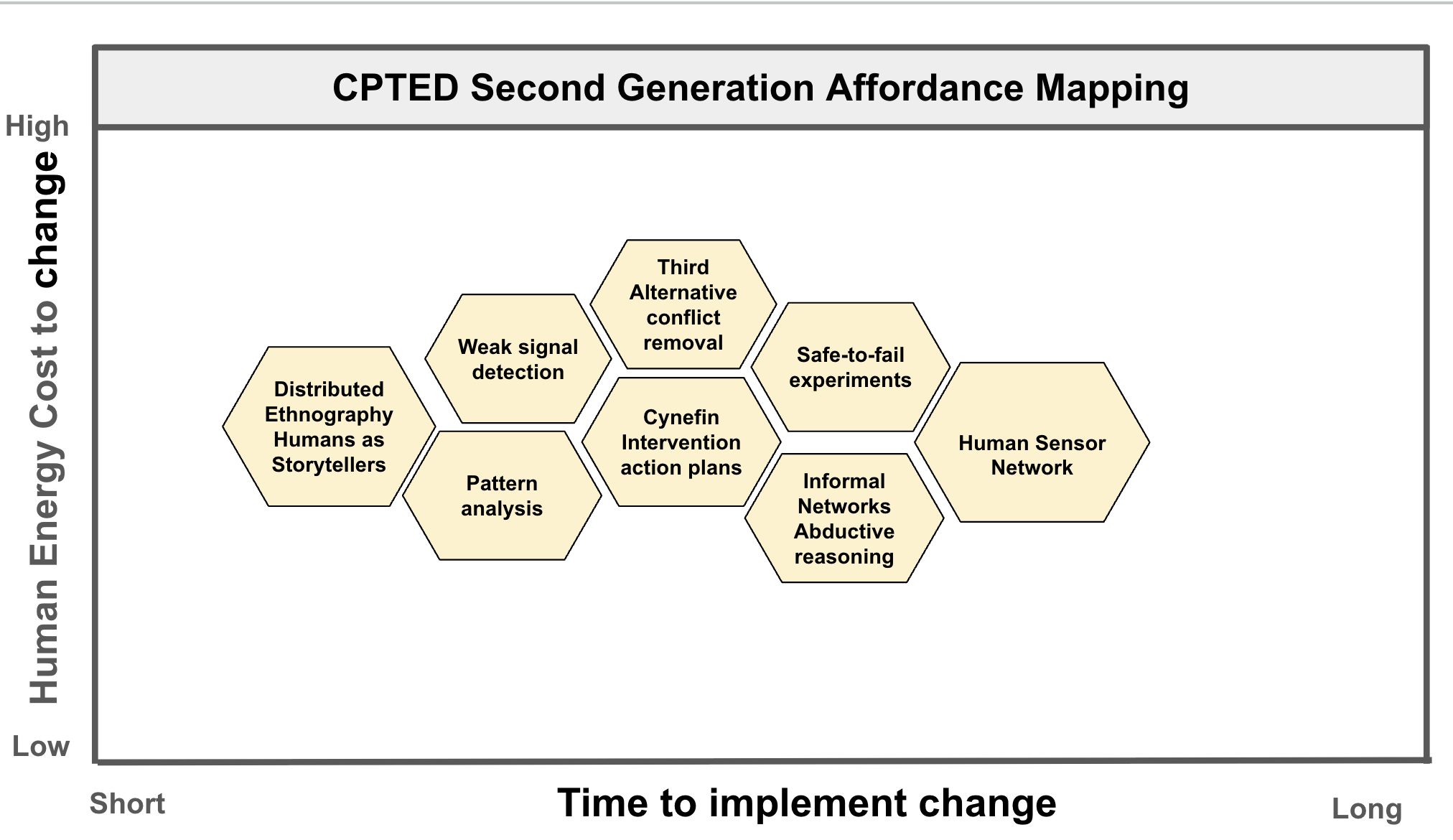
CPTED Second Generation Affordance Mapping
Start a CPTED intervention by building an Affordance map
- It tells you where you are and what you can’t change
- It helps to understand the viability of change
- if you want a metaphor, it is preparing the ground before you plant the crops
- This is the substrate of the complex adaptive system we can manage to reduce project risk and costs
- Emergence means we don’t create nor manage safety
- What we can create and manage are the human-imposed systemic conditions such as legislative acts, regulations, policies, standards, work systems, processes, rules, procedures, practices
- The strength of the social interactions within a community ultimately enables a safe environment to emerge as well as a culture of well-being, positive sense of identity and pride
What a project could look like:
- Engage the community
- Use an anthro-complexity approach: distributed ethnography and the power of humans as storytellers
- Introduce a sense-making platform like SenseMaker® to capture narrative data on crime experiences
2. Analyze patterns that emerge from sharing desirable and undesirable stories
- From storyteller significations identify systemic conditions that
- Encourage crime (strange attractors,,) catalysts)
- Influence how people use and experience a space and participate in activities together
- Impact threshold capacity
- From storyteller significations identify systemic conditions that
3. Pay attention to weak signal information
- Might be detecting pending danger and nearing failure
- Taking preventative action iis moving the operating point away from the Cynefin Clear/Chaotic domains boundary)
- Or a serendipitous opportunity that has unexpectedly emerged
- Might be detecting pending danger and nearing failure
4, Respond to issues residing in the Cynefin Complicated, Clear, Chaotic domains
- Use Action forms
- Appreciate value of storyteller signification on Energy Cost to change and Time to Implement change
5. Design and launch safe-to-fail experiments to explore issues in Complex domain
- Assemble learning teams at the lowest level of coherent granularity (e.g., community, neighbourhood)
- Give leaders, residents and visitors a sense of responsibility and decision-making
- Use entangled trios to keep teams small in size
- Assemble learning teams at the lowest level of coherent granularity (e.g., community, neighbourhood)
6. Some complex issues will require more effort
- Better to remove rather than resolve conflict
- Get things to the level where actions are much more manageable and less controversial
- Deploy Third Alternative synergy plan
- Issues --> Interests --> Needs
7. Support informal networks to create novel CPTED ideas
- Apply Abductive reasoning to connect unrelated elements
- Example: CAS phenomena / CPTED Second Generation principles
- Example: CAS phenomena / CPTED First Generation principles
8. Sustain the momentum
- Report consequences from action plans and safe-to-fail experiments as new entries in the SenseMaker® narrative database
- New narratives leads to updating the Affordance map to co-evolve the Present
- Narrative data refreshing is a key differentiator from the typical consultant one-off case study
- Faster, better, cheaper than traditional survey and biased interviewing
- A socially-cohesive community is a Human Sensor Network