We see the world not as it is but as we are Wayshaping: opening some new pathways Wayshaping- A Multiscale Framework for Sustainable Habit Change How Do We Change? Evolution of Change Practices Change Agent roles in the Cynefin domains Complex Domain: Change Agent as Catalyst, Synergizer Complexity Principles when designing intervention Granularity WRAS (Weaving Risk & Strategy Framework)
WRAS Development
First version was the Risk Matrix which uses granularity of intervention and management of emergence as its primary axis
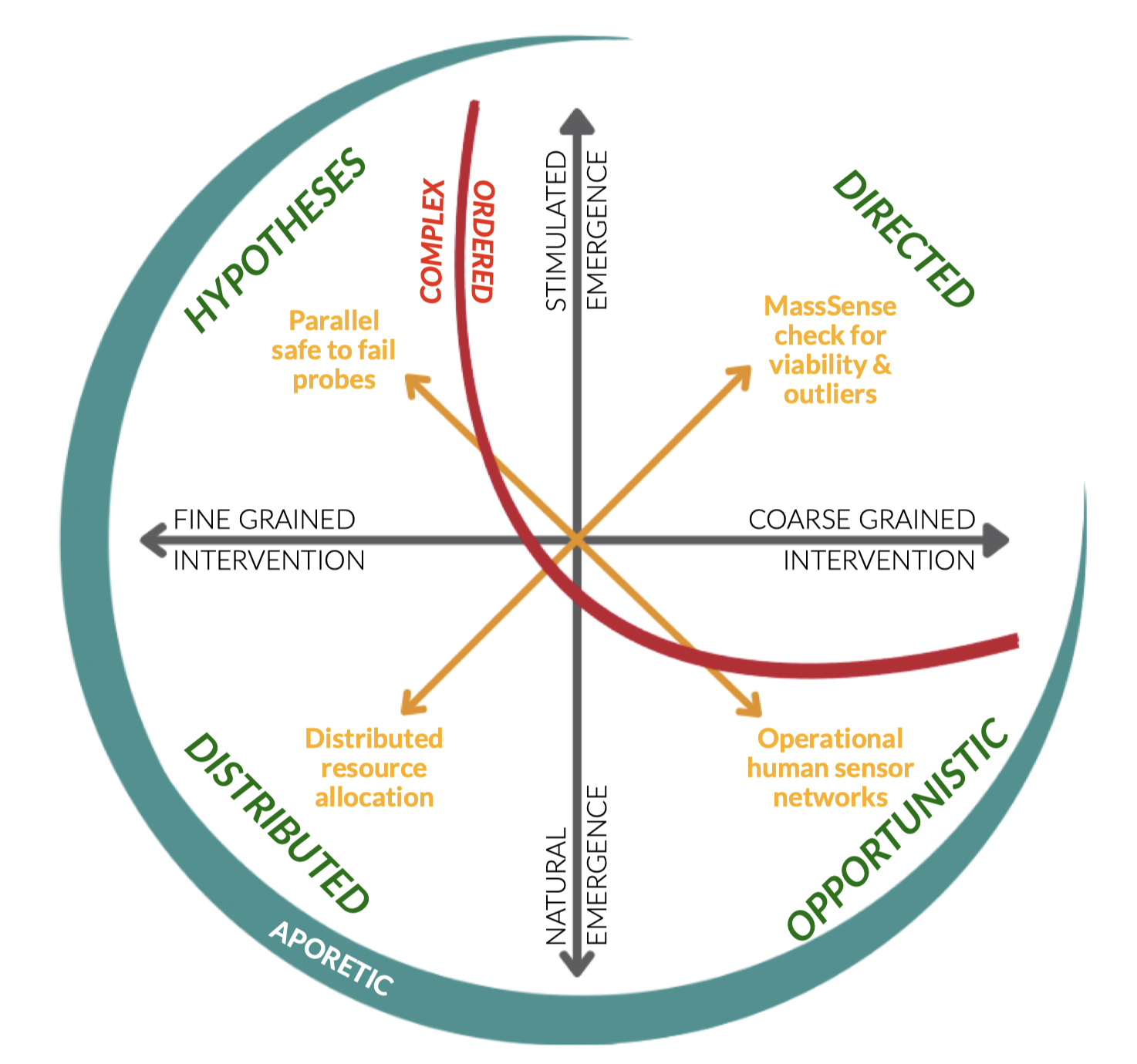
New risk/strategy framework
Cynefin Complex/Ordered boundary (red curve)
Strategy in each space (orange diagonals)
Aporia surrounds strategic choices
If strategy is at the extreme end, may need to go to the Aporetic domain to revisit situation and assess risk
Labelled “Traditional” in earlier Risk Matrix
Strategy is high level (coarse grained) and based on C Suite belief “It’s the right thing to do”
Cynefin Complicated strategy planned by experts predicting the emergence of set objectives, goals, targets
Strategy process normally takes about one or two years to plan, sell, implement (lots of consultations, meetings, etc.)
Top-down approach focuses on controlling deviations that surface in the Clear domain
Minimal desire to shift to Aporia to visit assumptions
“Get the derailed train back on track”
Preferably use MassSense for continuous feedback rather than biased weekly project status meetings
Key here is seizing the opportunity that natural emergence affords
Still at a high level (coarse grained) but more deliberate focus on a specific trend or idea taking shape in the environment (ie. substrate)
Strategy execution is the Cynefin Dynamics Explore-Exploit Blue Loop to deal with uncertainties that may emerge
Note how the Complex/Complicated boundary in red cuts across
Operational Human sensor network used to mitigate risk
Employees, customers, suppliers
External experts (Pulitzer Institute journalists, University doctoral student)
Build paid libraries of sensor networks to test and monitor for emergence
Trigger alerts when an idea has been taken too far (i.e., unintended negative consequences)
Exit to Aporia to assess the strategy and associated risks
Develop AI training set prior to WRAS workshop
Research projects in the past which have product/strategy successes or failures
Don't actually look at the problem as a whole but break up into key incidences
Present the data to people who don't know the outcome (naive agents)
In Sensemaker, index to generate a training data set
Use AI as anticipatory trigger
Use that with an algorithm to monitor incoming data from people's daily reports
Trigger an alert when a pattern of micro reports matches a pattern of micro reports on a previous success to spot emerging opportunities
Good use of AI
Build anticipation into the system
Know what the training data sets were constructed around
Fractal strategy
Might be grand strategy from a country
Might be organizational change for a department
It doesn't really make much difference since problems are very similar
Classic Probe-Sense-Respond method to make sense of unknown unknowns, discover hidden patterns
Identify all coherent hypothesis and launch safe-to-fail experiments in parallel
Also resolve conflict between hunches by learning what happens
Liminal zone near Complex/Complicated boundary tests novel solutions before implementing in the Order systemAporia visited if Cynefin Dynamics Purple Loop path is more coherent for the substrate
Continually detecting weak signals of pending danger and serendipity which naturally and unexpectedly emerge out of the unknown
Not trying to guess what's the right thing to do but seeing what actually worked at scale
Hypothesize what substrate conditions to change
Amplify the good and dampen the bad things
Creates a dynamic environment in which strategy itself will emerge from that substrate
So instead of launching a Directed strategy built on C-suite beliefs, start small in Distributed and then go to Directed with an emergent strategy
Note the Complex/Complicated boundary cutting across
Don't know in advance what is the right thing to do in Complex
Once unknown unknown is discovered, have the knowledge to execute in the Complicated
Cheaper, easier, faster, and more reliable than Directed
A “waiting for it to happen” strategy is to activate distributed cognition offered by humans either in a high state of awareness or triggered by machine sensors
In aviation safety, this is the space where sensors detect pending danger
Click here for explanation of coral zone on the Clear side of the Clear/Chaotic boundary
Aporia visited to make sense of information gathered by diverse and welcomed contradictory perspectives
Small teams (eg. entangled trios ,), maybe 5-7) assembled with enabling constraints
Determine what combination of roles based on historical cases is the most effective at making decisions without reference to higher authority
Reduce bureaucratic inefficiency
Introduce self-regulated ethics and accountability with anonymous participation/unseen observer (Panopticon Effect )
Trust team to spend small amounts of money without actually asking for approval to find out what works and doesn't work
Apply abductive reasoning to probe specific bets on anomalies close in time and distance (proximity )