Main Motions
The main motion.
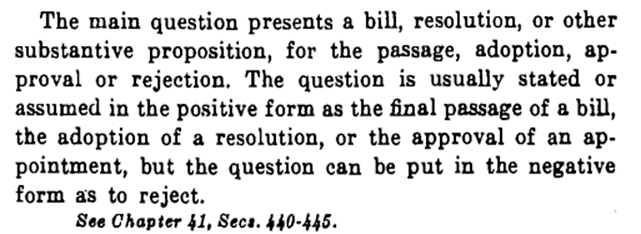
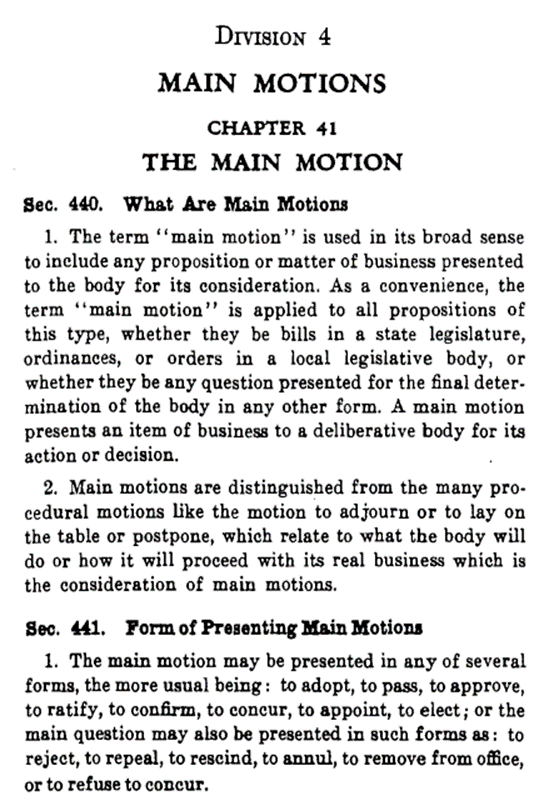
The main question presents a bill, resolution or other substantive proposition for passage, resolution or other substantive proposition for passage, adoption, approval or rejection.
A main motion is:
· Debatable
· Amendable
· Requires a majority vote
· A second is required.
Debate/Discussion: Once a motion has been properly moved and seconded, the Chair asks if there is any debate or discussion. If a member wishes to speak, he/she stands and gains recognition from the Chair, “May I”, before speaking. When there is no further discussion, the Chair asks for a vote. . Either by asking for verbal “yays” and then asking for “nays”… or raising of hands. The Chair announces the result and repeats the motion. “The “yays” have it, the motion carries, we will (repeat the motion).”
Amendment: Once a motion has been put forward it may be amended. A second is required. Amendments are also debatable, amendable, and require a majority vote. During discussion of the main motion an amendment may be proposed. Once an amendment passes it becomes part of the main motion.
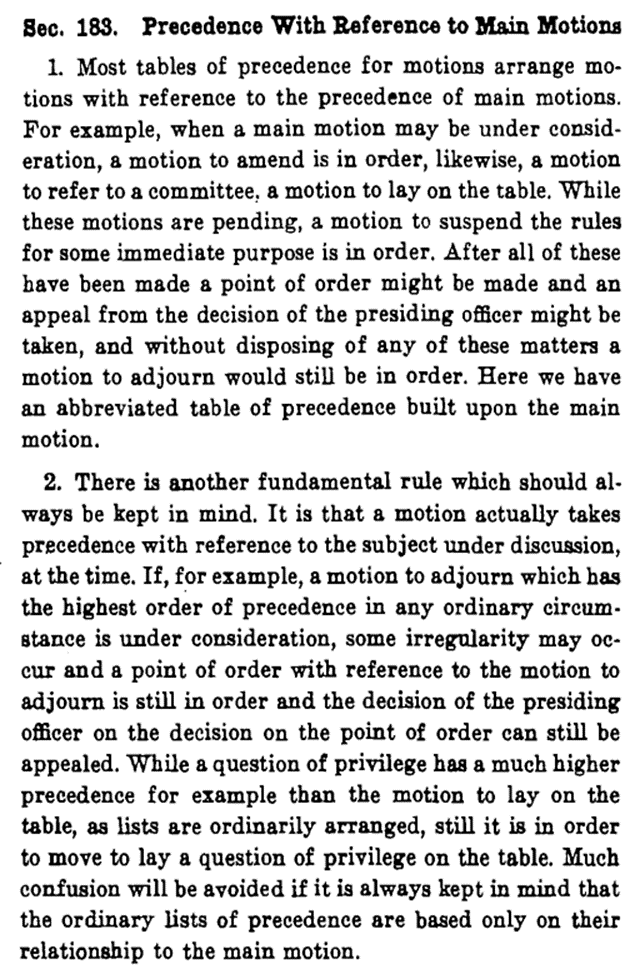
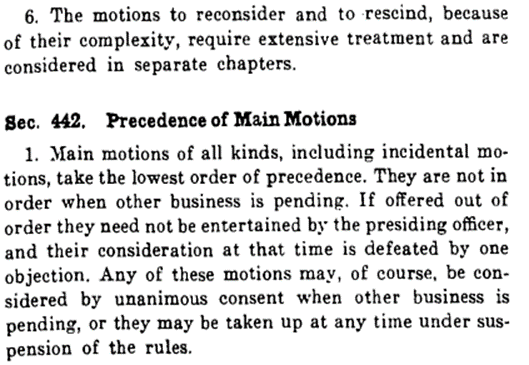
A Main or Principal Motion is a motion made to bring before the assembly, for its consideration, any particular subject. It takes precedence of nothing -- that is, it cannot be made when any other question is before the assembly; and it yields to all Privileged, Incidental, and Subsidiary Motions -- that is, any of these motions can be made while a main motion is pending. Main motions are debatable, and subject to amendment, and can have any subsidiary [12] motions applied to them. When a main motion is laid on the table, or postponed to a certain time, it carries with it all pending subsidiary motions. If a main motion is referred to a committee it carries with it only the pending amendments. As a general rule, they require for their adoption only a majority vote -- that is, a majority of the votes cast; but amendments to constitutions, by-laws, and rules of order already adopted, all of which are main motions, require a two-thirds vote for their adoption, unless the by-laws, etc., specify a different vote for their amendment; and the motion to rescind action previously taken requires a two-thirds vote, or a vote of a majority of the entire membership, unless previous notice of the motion has been given.
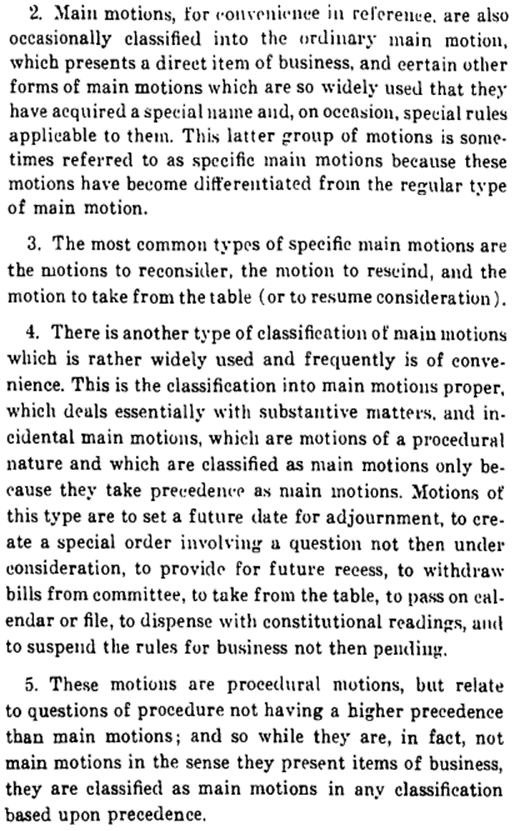
Main motions may be subdivided into Original Main Motions and Incidental Main Motions.Original Main Motions are those which bring before the assembly some new subject, generally in the form of a resolution, upon which action by the assembly is desired. Incidental Main Motions are those main motions that are incidental to, or relate to, the business of the assembly, or its past or future action, as, a committee's report on a resolution referred to it. A motion to accept or adopt the report of a standing committee upon a subject not referred to it is an original main motion, but a motion to adopt a report on a subject referred to a committee is an incidental main motion. The introduction of an original main motion can be prevented by sustaining by a two-thirds vote an objection to its consideration [23], made just after the main motion is stated and before it is discussed. An objection to its consideration cannot be applied to an incidental main motion, but a two-thirds vote can immediately suppress it by ordering The Previous Question / Calling the Question [29]. This is the only difference between the two classes of main motions. The following list contains some of the most common
Incidental Main Motions:
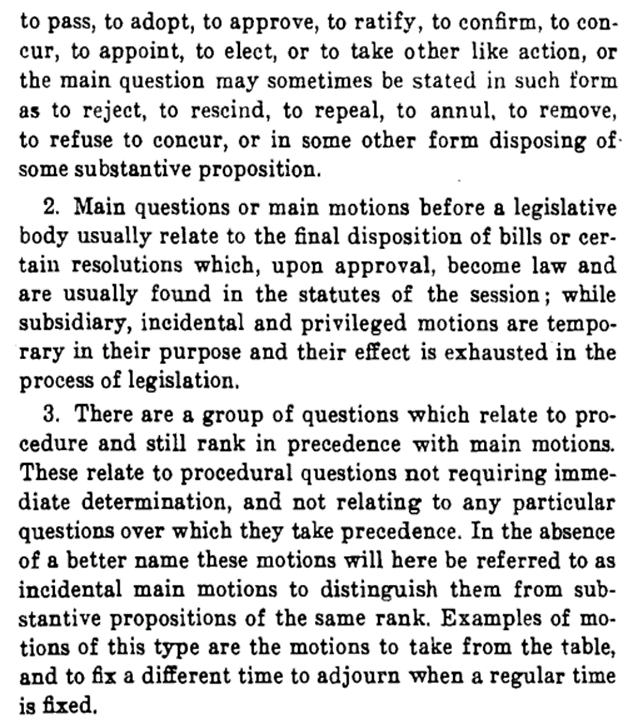
The following motions, though they have procedural elements, have the principal characteristics of main motions and take precedence in the same order.
- To consider Motion to Reconsider
- To rescind
- To dissolve or adjourn sine die when no hour has previously been fixed
- To fix the time for final adjournment or adjournment sine die
- To fix different time to which to adjourn when a regular time is fixed.
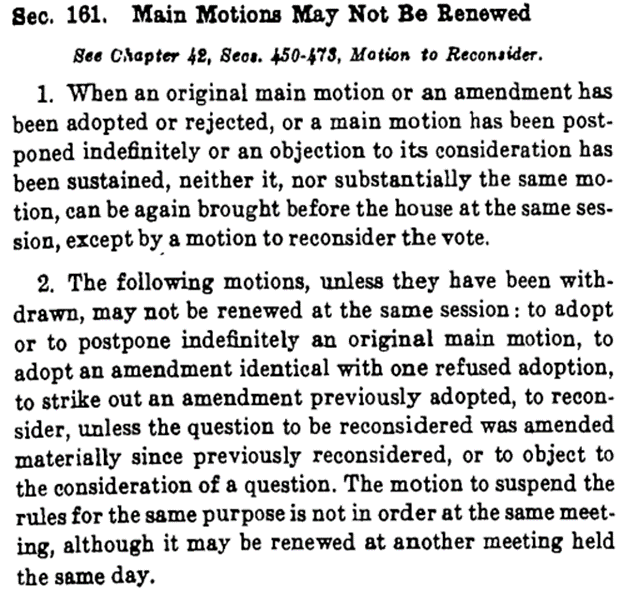
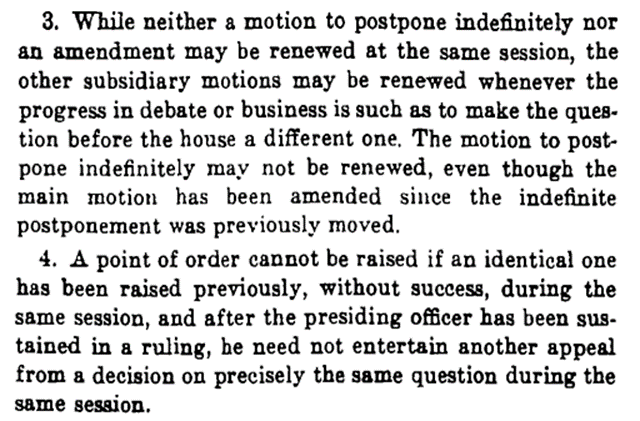
From Mason’s Manual of Legislative Procedure: