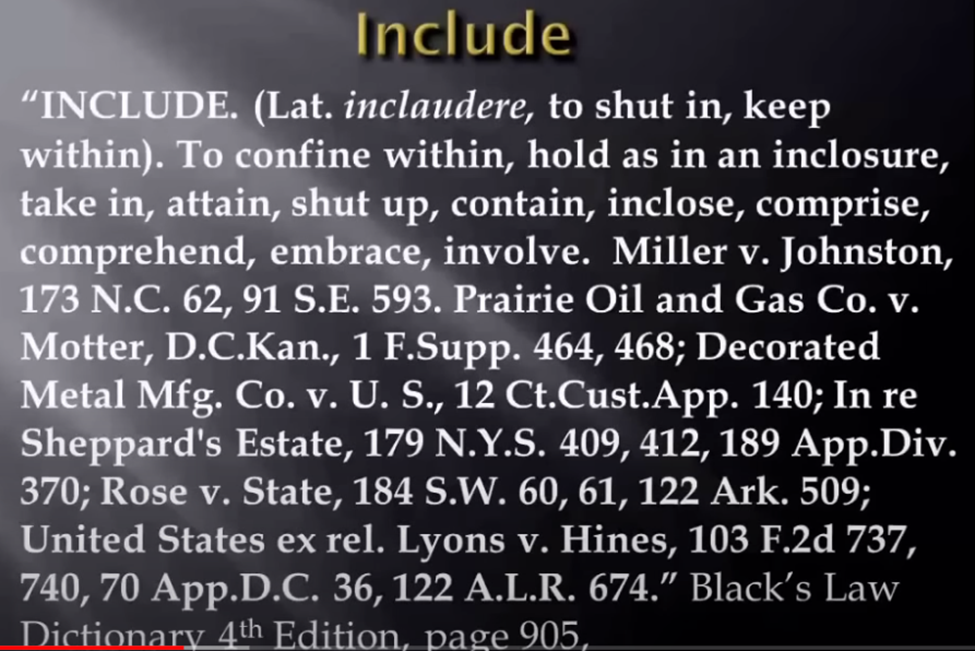
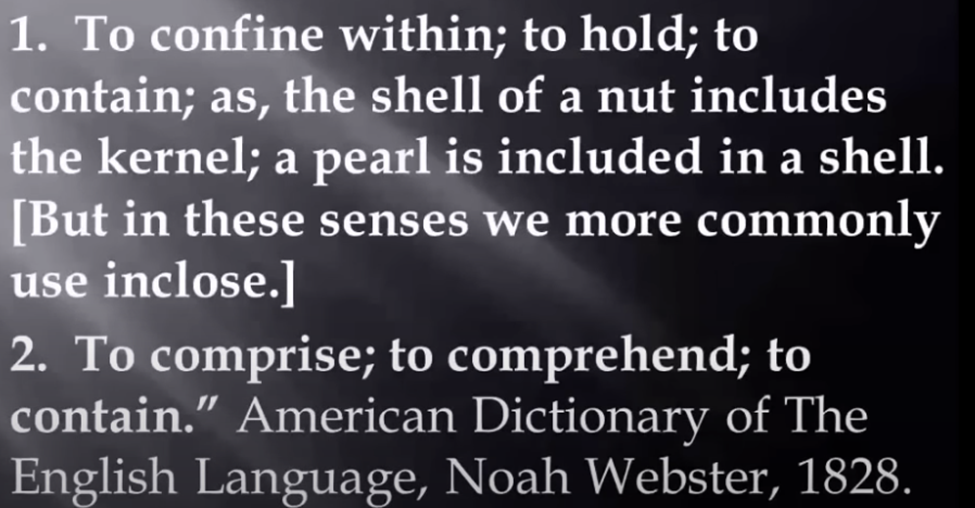
Include / Including
Abusing “includes” and “including”
The words “includes” and “including” are chronically abused to:
- Allow government workers to add or presume anything they want to statutory definitions. If they can add anything they want to the definitions, there is no law.
- Remove all limits on the delegated authority of the government. This violates the 10th Amendment and turns the government into a communist government due to a failure to recognize the limits placed upon the authority of the people in the government.
- Illegally expand the implied meaning of statutory definitions.
- Unlawfully enlarge federal jurisdiction beyond federal territory and thereby achieve an unconstitutional result. Article 4, section 4 is the only mandate found in the constitution. It says the federal government has to protect the states from invasion, and IT becomes the invader if it refuses to recognize the jurisdictional limitations on it within the states of the union. Franchise is the main method to exceed that jurisdiction.
- Cause the reader to believe things that simply are not true.
- The “Rules of Statutory Construction” FORBID adding any thing or class of thing to statutory definitions:
- Statutory definitions REPLACE rather than ENLARGE ordinary meanings. If they supply a definition, you cannot presume the ordinary meaning applies.
- When statutory definitions are provided, the SUPERCEDE rather than ENLARGE the ordinary or common or English meaning of words.
- Why is this? Because law functions as a LIMITATION of power on GOVERNMENT, and cannot do so if the DEFINITIONS are not limiting.
Authority:
“When a statute includes an explicit definition, we must follow that definition, even if it varies from that term’s ordinary meaning.”Meese v. Keene, 481 U.S. 465, 484-485 (1987) “It is axiomatic that the statutory definition of the term excludes unstated meanings of that term”;Colautii v. Frankin, 49 U.S. at 392-9, n. 10 (“As a rule, a definition which declares what a term “means”…excludes any meaning that is not stated”);Western Union Telegraph Co. v. Lenroot, 323 U.S. 490, 502 (1945); Fox v. Standard Oil Co. of N.J., 294 U.S. 87, 95-96 (1935) (Cardozo, J.); see also 1A N. Singer, Sutherland on Statutes and Statutory Construction 47.07, p. 152, and n. 10 (5th ed. 1992) (collecting cases). That is to say, the statute, read “as a whole,” post 998 [530 U.S. 943] (THOMAS, J. dissenting), leads the reader to a definition. That definition does not include the Attorney General’s restriction – “the child up to the head.” Its words, “substantial portion,” indicate the contrary.”
Stenberg v. Carhart, 530 U.S. 914 (2000)