Law
Video: Introduction to Fundamental Law
Video: The Foremost Authority of Fundamental Law
Video: Enumerated Rights of 50 State Constitutions
Video: Usurpation of Authority
:Noun. A rule, particularly an established or permanent rule, prescribed by the supreme power of a state to its subjects, for regulating their actions, particularly their social actions. Laws are imperative or mandatory, commanding what shall be done; prohibitory, restraining from what is to be forborne; or permissive, declaring what may be done without incurring penalty. The laws which enjoin the duties of piety and morality are prescribed by God and found in the Scriptures.
A free and natural citizen who wants to have rights at law must know and understand the law. If you don’t know the law, how do you know something is unlawful?
Law is the science of what is good and just. Our Founders said the law should be written in plain English so the average man could read and comprehend it.
Law is your rights on the:
L. Land (Common Law)
A. Air (Equity Law)
W. Water (Admiralty/ Maritime Law)
Scire et scire debere aequiparantur in jure:To know a thing, and to be bound to know it, are regarded in Law as equivalent.
Ad recte docendum oportet primum inquirere nomina quia rerum cognition a nominibus rerum dependet: In order rightly to comprehend a thing, it is necessary first to inquire into the names, for a right knowledge of things depends on their names. (See Language)
Law is your heritage and your inheritance is liberty. Everyone must know the law. There is no “gray area” when we’re talking about law. It’s black and white.
“The ideal tyranny is that which is ignorantly self-administered by its victims. The most perfect slaves are, therefore, those which blissfully and unawaredly enslave themselves because of their own legal ignorance.” Dresden James
Rights and Law are synonymous, deriving from the French word droit.
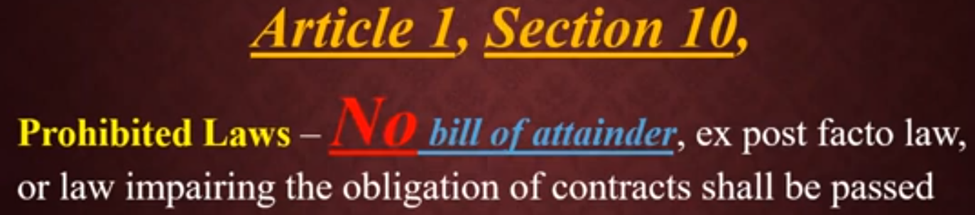
Ex post facto laws Law: An ex post facto law is a law that imposes criminal liability or increases criminal punishment retroactively.
Enacting Clause:
An enacting clause establishes that a law or statute as being a true law and authentic law of the State.
When we look up State or National codes and laws online, just because it appears on the screen doesn’t mean its valid and enforceable law against you, We the People. Don’t take it at face value. See Authority of Law, the pdf posted at the top of this page for examples of “laws” that are not valid and the example of a Rule 12 (b) (6) Motion to dismiss, beginning on page 49. In that document we read, “All laws must have an enacting clause”. The Enactment Clause in the Arkansas Constitution reads: Article 5, Sec. 19 The Enactment Clause for Arkansas “The style of the laws of the State of Arkansas shall be: "Be it enacted by the General Assembly of the State of Arkansas."... which is the legistlature. That is a mandatory constitutional provision. A constitutional provision which requires an enacting clause for all laws is not directory but mandatory. A statute without any enacting clause is void.
“Law of the land” means “The Common Law” – Justic O’Neal in State v. Simmon, 2 Spears 761, 767 (1884); also Justice Bronson in Taylor v. Porter, 4 Hill, 140, 146 *1843)
Law of the Land literally means “Due Process of Law of Law”. Article 4, Section 4 is the process.
"If a nation expects to be ignorant & free in a state of civilization, it expects what never was & never will be”Thomas Jefferson
"It is one of the fundamental maxims of the common law that ignorance of the law excuses no one." Daniels v. Dean, 2 C.A. 421, 84 P. 332.
The burden is on the Sovereigns to know and understand the law and to assert their sovereignty. When we learn law, we learn relationships.

Maxims of Law:
- Justitia est libertate prior.Justice comes before Liberty
- Justitia nemini neganda est. Justice is to be denied to no one.
- Jus et fraus nunquam cohabitant. Right and fraud never abide together.
Lex specialis derogate legi generali: A special Law detracts from the general Law
Supreme Law Library : Court Decisions
Book (PDF) Vattel’s Law of Nations
1800-1860: Law And Justice: Chronology
Key Features of Common Law or Civil Law Systems
Use the Bouvier Law Dictionary to look up terms
The Bouvier dictionary was approved by Congress in 1870 as the official definitions of words from the Constitution of the united States. Law is determined by the definition of the words at the time the law was enacted. The Supreme Court and all the other courts are going to act based upon the definitions and the intent of the legislature. When speaking of “intent”, what were the hearings about? Who said what to who and what was the testimony. what did the congress intend when they passed that law? Who was that law intended to regulate? Is it a law that regulates rights or privileges? The law may be unconstitutional or constitutional in some of its aspects. The intent of the legislature is the law, it may not be worded in the actual statute the way it was intended to be applied.
That throws a monkey wrench into the law. For example the law may say “All persons must get a driver’s license to operate on the road.”
All person’s? Can the legislature pass a law that regulates a right? No. [5 U.S. 137, Marbury v. Madison] identifies the constitution as a superior document and statues, rules, regulations and codes are all inferior to the constitution. Crandall vs Nevada Once you’ve established that driving on the road is a right, which comes from a case called in 1867, and that a right cannot be taxed Hale v. Henkel 1915, so you cannot tax a right and the power to tax is the power to destroy. Is a driver’s license fee a tax or fee? Its a tax, so says your Supreme Court. So is the registration. Crandall forbids taxing a right yet your legislature has passed fees pursuant to driver’s licenses and made a statute that says all persons must have a driver’s license.
Either one of two things: that statute is unconstitutional or its unconstitutional as its applied to you in your case.
If you are going to cite a case, read it. You must be able to form a logically determined basis in your mind for how that decision could have been reached to form an opinion as to why you are going to do what you are going to do, or the judge will throw your case out. If the judge ever pins you down and starts asking you for some merits of the case and you don’t even understand what the case is about, he will probably throw out your case.
Context is Everything
- The ability to discern CONTEXT is usually the LAST skill one develops when learning law because it requires so many other skills to fully master.
- The public FOOL (school) system is DESIGNED to ensure you never learn how to discern LEGAL CONTEXT. Public servants don’t want to hand you the key to your legal chains.
- Most Americans, who are legal neophytes, never learn this skill.
- You are DANGEROUS to a corrupted government in a courtroom if you know this skill, READ the law, and insist on properly applying it as a jurist and a litigant.
- Misunderstandings about context are the main source of needless arguments, controversy and conflict in the freedom community.
- Judges and legislators know that the vast majority of Americans do NOT understand LEGAL CONTEXT or WORDS OF ART. That is why they exploit them so frequently to deceive, confuse and enslave the populace.
- Deception originating in FAILURE TO PROPERLY DISCERN CONTEXT is how corrupt judges and legislators with a criminal financial conflict of interest pit freedom fighters against each other so they can never damage the government’s program. The only way to prevent this tactic is to learn about context and “words of art”!
Why You Must Learn About Context
“Judicial verbicide is calculated to convert the Constitution into a worthless scrap of paper and to replace our government of laws with judicial oligarchy.” – Senator Sam Ervin, during the Watergate hearing.
“When words lose their meaning, people will lose their liberty.” – Confucius, 500 B.C.
“The great enemy of clear language is insincerity. When there is a gap between one’s real and one’s declared aims, one turns as it were instinctively to long words and exhausted idioms, like a cuttle fish spurting out ink.” – George Orwell “Politics and the English Language”, 1946
If a word has an infinite number of meanings [or even a SUBJECTIVE meaning], it has no meaning, and our reasoning with one another has been annihilated.” – Aristotle, Metaphysica Book IV
Never attack the constitutionality of a particular law. We never attack statutes and laws, we attack them as they apply to this man/woman in this case. Most all statutes, laws, rules and regulations, so says the Supreme Court have the presumption of constitutionality and the burden of going forward and showing that they are unconstitutional is upon you, the defendant.
That 1914 statue requiring all persons to have a driver’s license is not unconstitutional. Because there’s a thing called an enabling statute which is right up at the top of Title 49 that identifies classes of persons who are required under that title to have driver’s licenses. So based upon the enabling statute and the power of the legislature which is to enact law, rules and regulation pursuant to trade, commerce, business and industry (it cannot enact laws that affect rights)
This is the way the Supreme Court sees this and the way law works: a group of people want legislation (generally to make money). Pass law concerning whom? If its the doctors they want laws to restrict competition. Labor unions want legislature to protect them against the open shop. The legislature is there to represent the will of the masses of people. Most don’t know much about law. The words “all persons” does not mean every last citizen of the united States, only those who come under the enabling statute of the particular title that’s in question or that’s the subject matter of the law.
So you start to build a framework of basic constitutional concept and law
Black’s Law Dictionaries came later, use the edition closest to the time a law was enacted. Here is an online version of the 2nd edition. Editions of Black’s Law: 1891 (1st) 1910 (2nd) 1933 (3rd) 1951 (4th) 1968 (4thR) 1979 (5th) 1990 (6th) 1999 (7th) 2004 (8th) 2009 (9th) 2014 (10th) 2019 (11th)
Laws may contain a syllabus, which consists of the editor’s comments. Never quote a syllabus when writing a brief or motion because it has no factual foundation in law. You go to the supreme court to quote the judge who said it. Make sure you’re on the majority opinion when you quote it. If you are quoting dicta, that is statements from the minority opinion you’re mistaken and if you quote dicta from the majority opinion you must label it as dicta.
NATURAL LAW
“This law of nature, being coeval with mankind and dictated by God himself, is of course superior in obligation to any other. It is binding over all the globe in all countries, and at all times: no human laws are of any validity, if contrary to this; and such of them as are valid derive all their force, and all their authority, mediately or immediately, from this original.” Blackstone’s Commentaries on the Laws of England (1765-1769) at number 41
“All acts of the legislature apparently contrary to natural rights and justice are, in our law and must be in the nature of things, considered as void. The laws of nature are the laws of God, whose authority can be superseded by no power on earth. A legislature must not obstruct our obedience to him from whose punishments they cannot protect us. All human constitutions which contradict his (God's) laws, we are in conscience bound to disobey.”
1772, Robin v. Hardaway, 1 Jefferson 109 - General Court of Virginia
THE FEDERAL AND STATE CONSTITUTIONS COLONIAL CHARTERS, AND OTHER ORGANIC LAWS OF THE STATES, TERRITORIES, AND COLONIES
A Treatise on The Law of Public Offices and Officers.pdf
Videos
How Do We Know if a Law is Valid?
If You Want To WIn the Game - You Gotta Know the Rules
The Shielding Approach, We are a Nation of Laws
Narradigm Investigation : LAW (Cliff High)
History of law and Babylon, statu(t)e worship, how the Bible affects law today
The three things recognized as being wrong: harm, injury, and loss explained
THE FIRE OF LIBERTY IS SPREADING - PRESERVE IT WITH THE LAW!
It's a word game
Less words say more
Using proper language
The importance of staying honorable before the courts
Know what law is before the court
What to do when the City charges your person
Understanding how to intercourse with the second dimension
Bring the law into the court, Queens Bench, and being placed in a dock
Careful what you wish for, time frame for a wrong, contract law, pot or medicine?
How to Win A Legal Case Without Arguing - Amazing Testimonial
How Americans can restore the rule of law Audio
Lawful refers to Natural Law, law of the Land
It is not a subjugation to foreign law that strangles us, it is lack of adherence to our own rule of law.
AT LAW, Bouvier’s Law, 1856 Edition . This phrase is used to point out that a thing is to be done according to the course of the common law; it is distinguished from a proceeding in equity.
“The common law is the real law, the Supreme Law of the land, the code, rules, regulations, policy and statues are “not the law”, -- Self v. Rhay, 61 WNN (2nd) 261
The difference between lawful and legal; lawful relates to Common Law, law of the land that governs all people. Legal pertains to the legal system with its statutes and Acts , it doesn’t relate to Common Law. So we have these two systems running side-by-side. Legislated statues enforced upon people in the name of law is a fraud. It has no authority and is without mercy. Justice without mercy is Godless and therefore repugnant to our United States Constitution. Lawmakers were given authority by the people to legislate codes, rules, regulations and statues which are policies, procedures, and “law” to control the behavior of bureaucrats, elected and appointed officials, municipalities and agencies but were never given authority to control the behavior of the people as we read in a US Supreme court decision; “All codes, rules, and regulations are for government authorities only, not human/Creators in accordance with God’s laws. All codes, rules, and regulations are unconstitutional and lacking due process...” - Rodrigues v. Ray Donavan (U.S. Department of Labor 769 F.2d 1344, 1348 (1985)
“All laws, rules and practices which are repugnant to the constitution are null and void.” [Marbury v. Madison, 5th US (2 Cranch) 137, 174, 176, (1803)]
Police may be enforcing statutes that aren’t necessarily lawful.
For there to be a crime there has to be an injured party, a human.
There are 4 basic principles that all law needs to be applied to:
- Do Not Breach the Peace
- Cause no one else any Harm
- Cause no one else any Loss
also:
- Do not cause mischief in any agreements or promises
Apart from that, anything else is free rein.
PRINCIPLE OF LIBERTY
Consent and Jurisdiction, it’s all about Consent and Jurisdiction. In order to possess liberty it is extremely important that you understand consent; our servant government cannot do anything without your consent.
CONSENT TO INDICT
The Fifth Amendment states; “No person shall be held to answer for a capital or otherwise infamous crime, unless on a presentment or indictment of a Grand Jury...” therefore our servant government requires the people to get an indictment (grand jury). Judges (servant) have no authority to make a ruling or a judgment on people (master) without your consent. In legal terms, when the judge asks you “do you understand?”, he means do you stand under the authority of this court? So when you say yes, you just gave him/her jurisdiction over you! (see Court English / Legalese / “Words of Art”)
“..., every man is independent of all laws, except those prescribed by nature. He is not bound by any institutions formed by his fellowman without his consent.” [Cruden v. Neale]
Herein is Liberty if “YOU” do not give a court consent, they have no “JURISDICTION” over “YOU”. (Note, if you break a natural law and commit a crime that injures or kills another, a criminal court, or common law court, isn’t going to need your consent in order to have jurisdiction)
INTERPRETATION IN FAVOR OF THE PEOPLE
Any constitutional provision intended to confer a benefit should be liberally construed in favor in the clearly intended and expressly designated beneficiary. “Then a constitution should receive a literal interpretation in favor of the Citizen, is especially true, with respect to those provisions which were designed to safeguard the liberty and security of the Citizen in regard to person and property.” 16AM Jur 2d: 16Am Jur2d., Sec 97; Bary v. United States - 273 US 128
There are only TWO contexts for legal terms:
- Constitutional
- Relates to the states of the Union and EXCLUDES federal territory and legislative jurisdiction of Congress over the SOVERIGN states of the Union.
- Defines “United States” as states of the Union, in a geographic sense.
- Statutory
- Relates to federal territory and EXCLUDES Constitutional states of the Union
- Defines “United States” as federal territory not within any state of the Union
- A Constitutional “citizen of the United States” is a statutory “non-citizen national”. They are NOT the same contexts
These two meanings of “United States” are different contexts. They look the same but have completely different meanings depending on the context.
Geographical terms have COMPLETELY different meanings in these two contexts, such as:
- State
- United States
- Citizen or citizen
Latches: a species of action where a party of reasonable intelligence and integrity, having a right to take an action as prescribed by law and having failed to timely do so, loses all right to proceed. This is occurring because most people don’t read their constitution and know what’s involved.