Legislative Branch
Book: Lex Parliamentaria Americana. Elements of the Law and Practice of Legislative Assemblies in the United States of America
Free pdf of Lex Parliamentaria Americana
The Legislative branch makes the Law (they may also incorrectly make statutes which are unconstitutional and therefore not Law). In the early days we had Common Law and all law wasn’t on the record. Once it went on record it was called Statutes. Statutes were to reinforce the Common Law. All Law passed by Legislature is subject to judicial review. This is where We The People get Redress of Grievances.
Legislatures have made unconstitutional laws intended to regulate the right to obligation to contract. They don’t tell us with whom to contract, but that we must. For example, you must have insurance to drive a car.
In Hale v. Henkel 1915 it states there is a reserved right in the legislature to do an investigation to see if they have exceeded the laws of its creation.
Law of Nations: Legislative Power and Whether It can Change the Constitution:
Here again a very important question presents itself. It essentially belongs to the society to make laws both in relation to the manner in which it desires to be governed, and to the conduct of the citizens: - this is called legislative power. The nation may intrust the exercise of it to the prince, or to an assembly; or to that assembly and the prince jointly; who have then a right to make new laws and to repeal old ones. It is asked whether their power extends to the fundamental laws, -- whether they may change the constitution of the state? The principles we have laid down lead us to decide with certainty, that the authority laid down lead us to decide with certainty, that the authority of these legislators does not extend so far, and that they ought to consider the fundamental laws as sacred, if the nation has not, in very express terms, given them power to change them. For the constitution of the state ought to possess stability: and since that was first established by the nation, which afterwards intrusted certain persons with the legislative power, the fundamental laws are excepted from their commission. It is visible that the society only intended to make provision for having the state constantly furnished with laws suited to particular conjunctures, and, for that purpose, gave the legislature to power of abrogating the ancient civil and political laws that were not fundamental, and of making new ones: but nothing leads us to think that it meant to submit the constitution itself to their will. In short, it is from the constitution that those legislators derive their power: how then can they change it, without destroying the foundation of their own authority? ... If the parliament entered into a debate on making so considerable a change, and the whole nation was voluntarily silent upon it, this would be considered as an approbation of the act of its representatives.
We didn’t give them the power to abrogate the fundamental law. We don’t do Roman Civil law here. We have natural rights and political rights. The court is bound to support the Constitution, not to interpret it. We didn’t delegate the power to interpret the Constitution as that can easily lead to it’s destruction, the servants altering the fundamental principles of the laws. This is also why the Reconstruction Acts were unlawful and void of any effect.
This is why our Founders created the law the way they did.
In Printz vs United States the Supreme Court said: “ We held in New York that Congress cannot compel the States to enact or enforce a federal regulatory program. Today we hold that Congress cannot circumvent that prohibition by conscripting the State’s Officers directly. The federal government may neither issue directives requiring the States to address the particular problem, nor command the State’s Officers, or those of their political subdivision to administer or enforce a federal regulatory program. It matters not whether policy making is involved and no case by case weighing of the burdens or benefits is necessary. Such commands are fundamentally incompatible with our constitutional system of dual sovereignty.”
Legislators don’t have the authority to rule make “Where rights secured by the Constitution are involved, there can be no rule making or legislation which would abrogate them” -- Miranda v. Arizona, 384 U.S. 436, 491
Only people are sovereign and have rights. Bureaucrats, in their capacity, are not sovereign and have no rights. They have authority given by the people and are subject to the statues. “The state cannot diminish rights of the people.” -- Hurtado v. People of the State of California, 110 U.S. 516
Thomas Jefferson said: “I would rather be exposed to the inconveniences attending too much liberty than those attending too small a degree of it”. If one of the people exercises his free will to carry a weapon, travel, practice law, park without depositing money in a meter, use hemp, pharmaceuticals, alcohol, vitamins, minerals or any other substance for medicinal or recreational purposes the legislators do not have the authority to impose a fine, license or make a right a crime”
Congress has often used the Commerce Clause to justify exercising legislative power over the activities of states and their citizens, leading to significant and ongoing controversy regarding the balance of power between the federal government and the states. The Commerce Clause has historically been viewed as both a grant of congressional authority and as a restriction on the regulatory authority of the States.
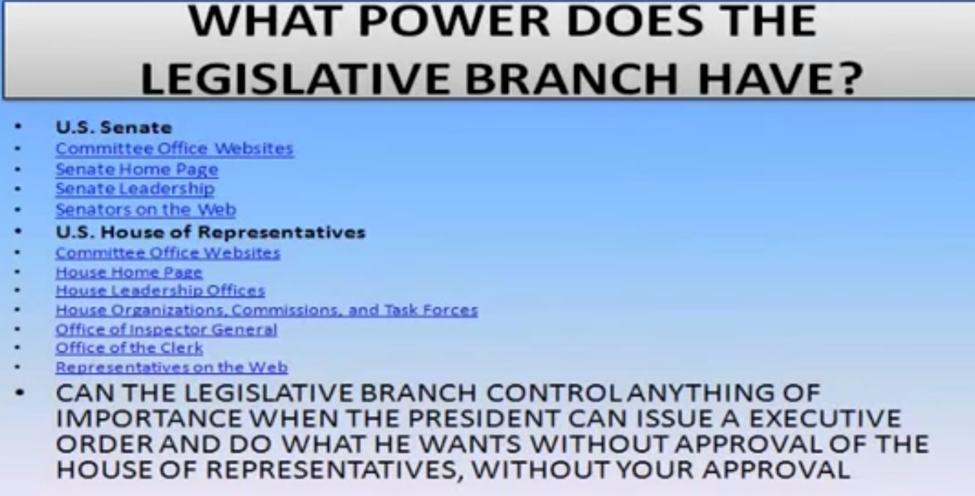
The legislative branch is made up of the House and Senate, known collectively as the Congress. Among other powers, the legislative branch makes all laws, declares war, regulates interstate and foreign commerce and controls taxing and spending policies. The following are legislative branch organizations:
Architect of the Capitol (AOC)
Center for Legislative Archives, National Archives and Records Administration
Congressional Budget Office (CBO)
Government Accountability Office (GAO)
Government Printing Office (GPO)
Library of Congress (LOC)
Office of Compliance
U.S. Senate