Statutes
Videos
All Statutes Convert rights into Privileges
Defeating Statute with One Word
Understanding statute and common law courts
Where the statutory world is headed
Noun. An act of legislature of a state that extends its binding force to all residing in the state, as distinguished from an act which extends only to an individual or company; an act of the legislature commanding or prohibiting something; a positive law. Statues are distinguished from common law. Common law owes its binding force to the principles of justice, to the long use and the consent of a nation. Statues owe their binding force to a positive command or declaration of a governing body.
All Statutes Convert Rights into Privileges 032117.pdf
All statutes are a bill of attainder or Bill of Pains and Penalties
“Bill of Attainder” means legislative acts , no matter what their form, that apply either to named individuals or to easily ascertainable members of a group in such a way as to inflict punishment on them without a judicial trial. United States v. Brown, 381 U.S. 437, 448-49, 85 S. Ct. 1701, 1715, 14 L.Ed. 484, 492 ; United States v. Lovett
There’s a valid purpose for statutes.
Legislators are authorized under the Constitution, ordained by the people, to write statutes and codes, enforced as law, to control bureaucrats, municipalities, government agencies, elected officials, interstate commerce but not the people whose rights are unalienable and cannot be legislated. Statutes are not law, they are policy. They regulate how public officials are to interact with the public. Statutes are the rules for the government employees, they are not to be applied to the public.
However, there are multiple tricks and traps to pull us into statutory law. One of them is, if you live your life as a statutory citizen they assume you volunteered to be ruled by the statutes.
Statutes and regulations apply to regulated persons who are either licensed or convicted felons or made some kind of contractual agreement with their State. Natural inalienable rights cannot be infringed. It takes a free and natural citizen to stand up for their rights by committing the act of breaking the statute and then going into court for redress of grievance.
There are key differences between a statute and a code. The most pronounced features of civil systems are their legal codes, with concise and broadly applicable texts that typically avoid factually specific scenarios. The short articles in a civil law code deal in generalities and stand in contrast with ordinary statutes, which are often very long and very detailed.
The Legislative branch makes the Law (they may also incorrectly make statutes which are unconstitutional and therefore not Law). In the early days we had Common Law and all law wasn’t on the record. Once it went on record it was called Statutes. Statutes were to reinforce the Common Law (which was an unwritten law, everyone understood the basic ten commandments.)
A statute is a formal written enactment of a legislative authority that governs the legal entities of a city, state, or country by way of consent. Typically, statutes command or prohibit something, or declare policy. Statutes are rules made by legislative bodies; they are distinguished from case law or precedent, which is decided by courts, and regulations issued by government agencies.
“The common law is the real law, the Supreme Law of the land, the code, rules, regulations, policy and statues are “not the law”, -- Self v. Rhay, 61 WNN (2nd) 261
Irreconcilable conflict between statute and constitution is to be resolved in favor of the constitutionality and the beneficiary
“In all instances, where the court exercises its power to invalidate legislation on constitutional grounds, the conflict of the statute, with the constitution must be irreconcilable. Thus a statute is not to be declared unconstitutional unless so inconsistent with the constitution that it cannot be enforced without a violation thereof. A clear incompatibility between law and the constitution must exist before the judiciary is justified holding the law unconstitutional. This principle is of course in line with the rule that doubts as the constitutionality should be resolved in favor of the constitutionality and the beneficiary.” 16 Am Jur 2d., Sec. 255
“The general rule is that an unconstitutional statute, though having the form and name of law, is in reality no law, but is wholly void and ineffective for any purpose, since its unconstitutionality dates from the time of its enactment…In legal contemplation, it is as inoperative as if it had never been passed…Since an unconstitutional law is void, the general principles follow that it imposes no duties, confers no right, creates no office, bestows no power or authority on anyone, affords no protection and justifies no acts performed under it…A void act cannot be legally consistent with a valid one. An unconstitutional law cannot operate to supersede any existing law. Indeed, insofar as a statute runs counter to the fundamental law of the land, (the Constitution) it is superseded thereby. No one is bound to obey an unconstitutional law and no courts are bound to enforce it.” Bonnett v. Vallier
16 Am. Jur. 2d. Constitutional Law, section 256
The general rule is that an unconstitutional statute whether federal or state though having the form and name of law, is in reality no law but is wholly void and ineffective for any purpose since unconstitutionality dates from the time of the enactment and not merely from the date of the decision so branding it. An unconstitutional law in legal contemplation is as inoperative as if it never had been passed. Such a statute leaves the question that it purports to settle just as it would be had the statute not been enacted. No repeal of an enactment is necessary since an unconstitutional law is void the general principle follows that it imposes no duties, incurs no rights, creates no office, bestows no power or authority on anyone, affords no protection and justifies no acts performed under it. A contract which rests on an unconstitutional statute creates no obligation to be impaired by subsequent legislation.
No one is bound to obey and unconstitutional law, no courts are bound to enforce it. Persons convicted and fined under a statute subsequently found unconstitutional may recover the fines paid. A void act cannot be legally inconsistent with a valid one, an unconstitutional law cannot supersede an existing valid law. Indeed, insofar as a statute runs counter to the fundamental law of the land it is superseded thereby since an unconstitutional statute cannot repeal or in any effect an existing one, if a repealing statute is unconstitutional the statute which it attempts to repeal remains in full force and effect. And where a clause repealing a prior law is inserted in an act, which act is unconstitutional and void, the provision for the repeal of the prior law will fall with it and will not be permitted to operate as repealing such prior law.
The general principles stated above apply to the constitutions as well as to the laws of several states insofar as they are repugnant to the Constitution and the laws of the United States. Moreover a construction of a statute which brings in conflict with a constitution will nullify it as effectively as if it had in its express terms, been enacted in conflict therewith.
- All statutes (state or federal) passed prior to 1861 are lawful de jure statutes.
- All statutes (state or federal) passed after 1861 are Martial Law Statutes
“Two national governments exist, one to be maintained under the Constitution, with all its restrictions, the other to be maintained by Congress outside and independently of that instrument.” Dissenting opinion of Justice Marshall Harlan. Downes v. Bidwell, 182 U.S. 244 1901
In 1871 Congress set up a corporation to operate the government of the District of Columbia
Officers of the Court have No Immunity When Violating Constitutional Right, from Liability
“The right of action created by statue relating to deprivation under color of law, of a right secured by the constitution and the laws of the United States and comes claims which are based solely on statutory violations of Federal Law and applied to the claim that claimants had been deprived of their rights, in some capacity, to which they were entitled.” Owen v. Independence 100 Vol. Supreme Court Reports, 1398: (1982); Main v. Thiboutot 100 Vol. Supreme Court Reports. 2502: (1982)
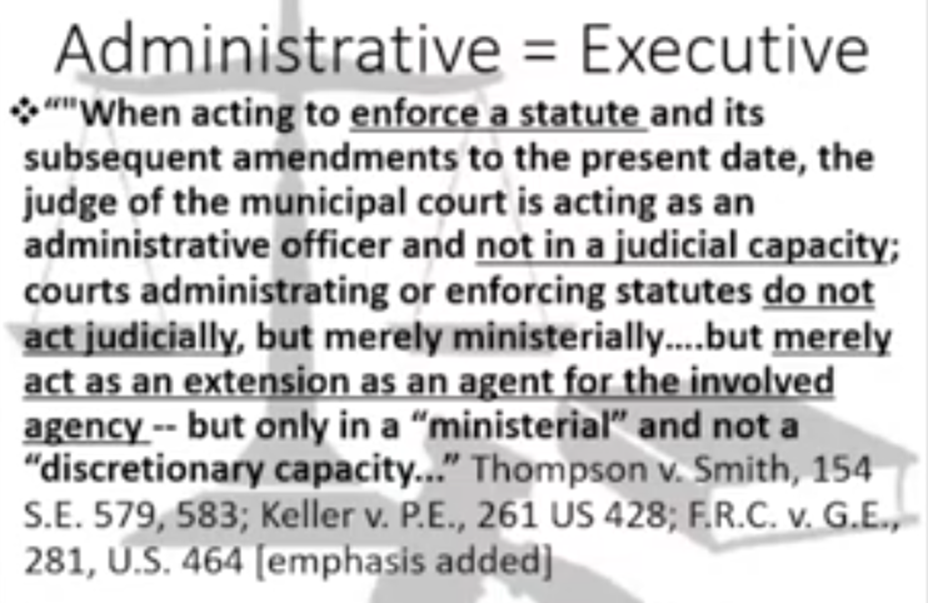
“"When acting to enforce a statute and its subsequent amendments to the present date, the judge of the municipal court is acting as an administrative officer and not in a judicial capacity; courts administrating or enforcing statutes do not act judicially, but merely ministerially….but merely act as an extension as an agent for the involved agency -- but only in a “ministerial” and not a “discretionary capacity...” Thompson v. Smith, 154 S.E. 579, 583;Keller v. P.E., 261 US 428; F.R.C. v. G.E., 281,U.S. 464
US Supreme Court in U.S. v. Cooper, 312 US 600,604, 61 S.Ct 742 (1941): "Since in common usage the term 'person' does not include the sovereign, statutes employing that term are ordinarily construed to exclude it.”
All statutes are written very carefully, and most do not apply to members of the Sovereignty. 99% of the time the government is technically correct.
It is not up to the government to tell you that you are a member of the Sovereignty. The government lawyers make up a statute that properly applies to those entities that they have jurisdiction over. The burden is on us to assert our Sovereignty.
Under US Codes 42 and 18 when you are detained for violating a statute, you have just been kidnapped and if the Judge sets a bail he just set a ransom and when the prosecutor confirms the charges they are all part of a conspiracy and you can put them in jail and receive compensation for your injuries. Its all about Consent and Jurisdiction.
Video: Defeating Statutes with One Word
Example from above video: a statute saying you can’t record near any vehicle with flashing lights. What does near mean? If there’s more than one meaning to a term it can’t stand. If a law is ambiguous is can’t hold up. When you can demonstrate the statute doesn’t hold up you can file a claim that they filed a false claim against you.
If you are going after wording in a statute, the best word to use is “intent” because it’s impossible for them to prove intent. For example, a charge claiming “intent to sell marijuana”.
Capitalization within Statutes and Regulations
Whenever you are reading a particular law, including the U.S. Constitution, or a statute, the _Sovereign_ referenced in that law, who is usually the author of the law, is referenced in the law with the first letter of its name capitalized. For instance, in the U.S. Constitution the phrase “_We the _People”, “_State”, and “_Citizen” are all capitalized, because these were the sovereign entities who were writing the document residing in the _States. This document formed the federal government and gave it its authority. Subsequently, the federal government wrote statutes to implement the intent of the Constitution, and it became the Sovereign, but only in the context of those territories and lands ceded to it by the union states. When that federal government then refers in statutes to federal “States”, for instance in 26 U.S.C. §7701(a)(10) or 4 U.S.C. §110(d), then these federal “States” are Sovereigns because they are part of the _territory_ controlled by the Sovereign who wrote the statute, so they are capitalized. Foreign states referenced in the federal statutes then must be in lower case. The sovereign 50 union states, for example, must be in lower case in federal statutes because of this convention because they are foreign states. Capitalization is therefore always relative to who is writing the document, which is usually the Sovereign and is therefore capitalized. The exact same convention is used in the Bible, where all appellations of God are capitalized because they are sovereigns: “_Jesus" ”, “_God”, “_Him”, “_His”, “_Father”. These words aren’t capitalized because they are proper names, but because the entity described is a _sovereign or an agent or part of the sovereign_. The only exception to this capitalization rule is in state revenue laws, where the state legislators use the _same capitalization_ as the Internal Revenue Code for “State” in referring to federal enclaves within their territory because they want to scam money out of you. In state revenue laws, for instance in the California Revenue and Taxation Code (R&TC) sections 17018 and 6017, “State” means a federal State within the boundaries of California and described as part of the Buck Act of 1940 found in 4 U.S.C. §§105-113.
The “Rules of Statutory Construction” FORBID adding any thing or class of thing to statutory definitions:
- Statutory definitions REPLACE rather than ENLARGE ordinary meanings.
- When statutory definitions are provided, the SUPERCEDE rather than ENLARGE the ordinary or common or English meaning of words. If they supply a definition, you cannot presume the ordinary meaning applies.
- Why is this? Because law functions as a LIMITATION of power on GOVERNMENT, and cannot do so if the DEFINITIONS are not limiting.
Authority:
“When a statute includes an explicit definition, we must follow that definition, even if it varies from that term’s ordinary meaning.”Meese v. Keene, 481 U.S. 465, 484-485 (1987) “It is axiomatic that the statutory definition of the term excludes unstated meanings of that term”;Colautii v. Frankin, 49 U.S. at 392-9, n. 10 (“As a rule, a definition which declares what a term “means”…excludes any meaning that is not stated”);Western Union Telegraph Co. v. Lenroot, 323 U.S. 490, 502 (1945); Fox v. Standard Oil Co. of N.J., 294 U.S. 87, 95-96 (1935) (Cardozo, J.); see also 1A N. Singer, Sutherland on Statutes and Statutory Construction 47.07, p. 152, and n. 10 (5th ed. 1992) (collecting cases). That is to say, the statute, read “as a whole,” post 998 [530 U.S. 943] (THOMAS, J. dissenting), leads the reader to a definition. That definition does not include the Attorney General’s restriction – “the child up to the head.” Its words, “substantial portion,” indicate the contrary.”
Stenberg v. Carhart, 530 U.S. 914 (2000)
16 Am. Jur. 2d. Constitutional Law, section 257
The actual existence of a statute prior to determination that it is unconstitutional is an operative fact and may have consequences which cannot justify being ignored when a statute has been in effect for some time is declared unconstitutional questions of rights claimed to have become vested of status of prior determinations deemed to have finality and acted upon accordingly and of public policy in the light of the nature both of the statute and of its previous application, demand examination. It has been said that an all-inclusive statement of a principle of absolute retroactive invalidity cannot be justified [it would be ex post facto]. An unconstitutional statute is not necessarily a nullity, it may have indeterminate consequences minding upon the people.
There are only TWO contexts for legal terms:
- Constitutional
- Statutory
Geographical terms have COMPLETELY different meanings in these two contexts, such as:
- State
- United States
- Citizen or citizen
Context is Everything
In LAW, the THREE things that matter in deducing the scope of a statute are:
- CONTEXT
- CONTEXT
- CONTEXT
- The ability to discern CONTEXT is usually the LAST skill one develops when learning law because it requires so many other skills to fully master.
- The public FOOL (school) system is DESIGNED to ensure you never learn how to discern LEGAL CONTEXT. Public servants don’t want to hand you the key to your legal chains.
- Most Americans, who are legal neophytes, never learn this skill.
- You are DANGEROUS to a corrupted government in a courtroom if you know this skill, READ the law, and insist on properly applying it as a jurist and a litigant.