Citizen vs National
See also: Status, Status National, Status Change
Videos
Corporate Citizenship
A US Citizen is a Slave
Citizenship is part of a political community.
Nationality is common law. “It is however, true that in all common-law countries it has always and consistently been held that the wife and minor children take the nationality of the husband and father. That is common-law doctrine.” In Re Page 12 F. (2d) 13

- CITIZEN may indicate being a member of a sovereign state, especially one showing democratic forms and usages, owing it allegiance, sharing in individual political rights.
- “The Citizens of each State shall be entitled to all Privileges and Immunities of Citizens in the several States.” US Constitution Article 4, Section 2, Clause 1
- SUBJECT may imply a state of subjection to a person, such as a monarch, without much sense of membership in a political community or sharing in political rights.
- “Subject. - Constitutional Law. One that owes allegiance to a sovereign and is governed by his laws. The natives of Great Britain are subjects of the British government. Men in free governments are subjects as well as citizens; as citizens they enjoy rights and franchises; as subjects they are bound to obey the laws. The term is little used, in this sense, in countries enjoying a Article IV, Sec. 4 Republican Form of Government.” Black's Law Dictionary, Rev. 4thEd
- “In our opinion, it was not the intent of the legislature to restrict the operation of the statute to those only who were subjects of the United States government and exclude therefrom unnaturalized residents of foreign birth, whether white or black.” Prowd v. Gore (1922) 57 Cal.App. 458, 459-461
- “Speaking generally, we may say that the terms subject and citizen are synonymous. Subjects and citizens are alike those whose relation to the state is personal and not merely territorial, permanent and not merely temporary. This equivalent, however, is not absolute. For in the first place, the term subject is commonly limited to monarchical forms of government, while the term citizen is more specially applicable in the case of republics.” John Salmond, Jurisprudence 133 (GlanvilleL. Williams ed., 10th ed. 1947). Black’s Law Dictionary 8th Edition
- “Finally it is to be noticed that the term subject is capable of a different and wider application, in which it includes all members of the body politic, whether they are citizens (i.e., subjects stricto sensu) or resident aliens. All such persons are subjects, all being subject to the power of the state and to its jurisdiction, and as owing to it, at least temporarily, fidelity and obedience.” John Salmond, Jurisprudence 133 (Glanville L. Williams ed., 10th ed. 1947). Black’s Law Dictionary 8th Edition
- NATIONAL a more general word, may apply to anyone owing permanent allegiance to a nation and indicates one belonging to a broad category that includes both people who are legally citizens or subjects and also people who have not attained such legal status.” Webster's Third New International Dictionary, MERRIAM-WEBSTER INC.,Publishers 1986
- The term "national" means a person owing permanent allegiance to a state.
- The term "national of the United States" means (A) a citizen of the United States, or (B) a person who, though not a citizen of the United States, owes permanent allegiance to the United States.
- RESIDENTS “Residents, as distinguished from citizens, are aliens who are permitted to take up a permanent abode in the country. Being bound to the society by reason of their dwelling in it, they are subject to its laws so long as they remain there, and, being protected by it, they must defend it, although they do not enjoy all the rights of citizens. They have only certain privileges which the law, or custom, gives them. Permanent residents are those who have been given the right of perpetual residence. They are a sort of citizen of a less privileged character, and are subject to the society without enjoying all its advantages. Their children succeed to their status; for the right of perpetual residence given them by the State passes to their children.” The Law of Nations, Vattel, Book 1, Chapter 19, Section 213, p. 87
- “One does not necessarily become a non-resident by absconding or absenting himself from his place of abode.” 52 Mo. App. 291
- “Residence. noun. The fact of being officially present; the statutory presence of an incumbent in a benefice.” Funk and Wagnals Standard Dictionary, International Edition Copyright 1965
- “The rights of sovereignty extend to all persons and things, not privileged that are within the territory. They extend to all strangers resident therein; not only to those who are naturalized, and to those who are domiciled therein, having taken up their abode with the intention of permanent residence, but also to those whose residence is transitory. All strangers are under the protection of the sovereign while they are within his territory and owe a temporary allegiance in return for that protection.” Carlisle v United States 83 U.S. 147, 154 (1873)
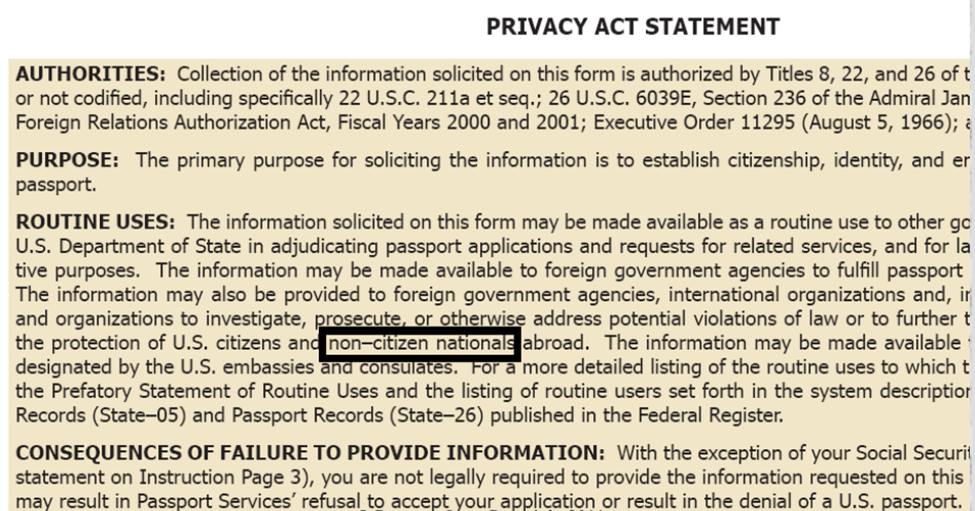
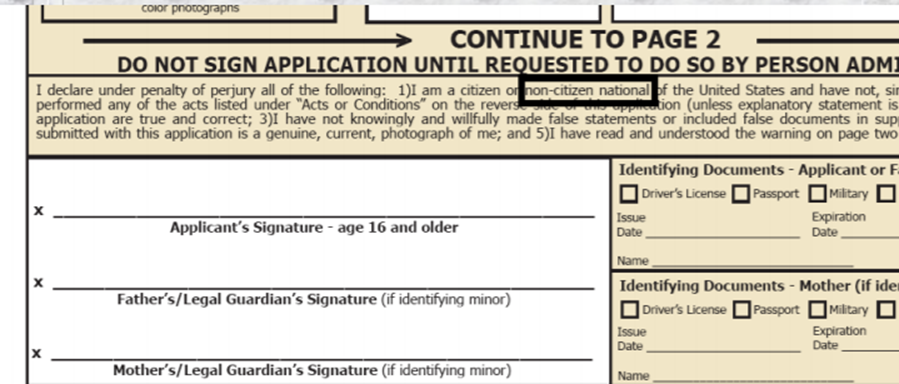
Since all of us have declared ourselves to be "citizens of the United States" and "residents of the United States" without researching those terms, for example on the Drivers License application, marriage license, W-2, Passports, gun permits, and so on, we NOW are presumed to be Federal citizens subject to Federal Control, and we are presumed to be IN THE DISTRICT OF COLUMBIA where the Constitution does not apply.
Amendment XIV, Section 1, Clause 1 of the U.S. Constitution directs that all persons born in the United States are U.S. citizens. This is the case regardless of the tax or immigration status of a person’s parents.
“[T]he term "citizen," in the United States, is analogous to the term "subject" in the common law.” State vs Manual 20 NC 122, 14 C.J.S. 4, p 430
"Therefore, the U.S. citizens residing in one of the states of the union, are classified as property and franchises of the federal government as an "individual entity." Wheeling Steel Corp. v. Fox, 298 U.S. 193, 80 L.Ed. 1143, 56 S.Ct. 773
“The Congress shall have Power to dispose of and make all needful Rules and Regulations respecting the Territory or other Property belonging to the United States” US Constitution, Article 4, Section 3, Clause 2
“The words “people of the United States” and “citizens” are synonymous terms and mean the same thing. They both describe the political body who, according to our republic institutions form the sovereignty, and who hold the power, and conduct the government through their representatives. They are what we familiarly call the sovereign people, and every citizen is one of this people, and a constituent member of the sovereignty.” Dred Scott v Sandford 60 U.S. 393
The term U.S. citizen means a federal citizen. What is unique about Federal Citizens?? The Congress has COMPLETE legislative authority over them:
Section (d)Citizens and residents outside the United States
If any citizen or resident of the United States does not reside in, and does not have his principal place of business in, any United States judicial district, such citizen or resident shall be treated for purposes of this section as residing in the District of Columbia.
"...the individual may stand upon his constitutional rights as a Citizen. He is entitled to carry on his private business in his own way. His power to contract is unlimited. He owes no duty to the state or to his neighbors to divulge his business, or to open his doors to an investigation, so far as it may tend to incriminate him. He owes no such duty to the state, since he receives nothing therefrom, beyond the protection of his life, liberty, and property. His rights are such as existed by the law of the land long antecedent to the organization of the state, and can only be taken from him by Due Process of Law of law, and in accordance with the Constitution. Among his rights are a refusal to incriminate himself, and the immunity of himself and his property from arrest or seizure except under (a judicial power warrant ) a warrant of the law. He owes nothing to the public so long as he does not trespass upon their rights." Hale v. Henkel, 201 U.S. 43
“The persons declared to be citizens are,“All persons born or naturalized in the United States and subject to the jurisdiction of thereof.” The evident meaning of these last words is not merely subject in some respect or degree to the jurisdiction of the United States, but completely subject…” Elk v Wilkins, 112 US 94, 101, 102, (1884)
Citizenship Classes
State Citizen Case Laws
"The term resident and citizen of the United States is distinguished from a Citizen of one of the several states, in that the former is a special class of citizen created by Congress." U.S. v. Anthony 24 Fed. 829 (1873)
"State Citizenship is a vested substantial property right, and the State has no power to divest or impair these rights." Favot v. Kingsbury, (1929) 98 Cal. App. 284, 276 P. 1083
"...it might be correctly said that there is no such thing as a citizen of the United States. ..... A citizen of any one of the States of the Union, is held to be, and called a citizen of the United States, although technically and abstractly there is no such thing." Ex Parte Frank Knowles, 5 Cal. Rep. 300,
“A “US Citizen” upon leaving the District of Columbia becomes involved in “interstate commerce”, as a “resident” does not have the common-law right to travel, of a Citizen of one of the several states.” Hendrick v. Maryland S.C. Reporter’s Rd. 610-625. (1914)
"A citizen of the United States is a citizen of the federal government ..." Kitchens v. Steele 112 F.Supp 383
"there is in our Political System, a government of each of the several states and a government of the United States Each is distinct from the other and has citizens of its own." . US vs. Cruikshank, 92 US 542,
"One may be a citizen of a State and yet not a citizen of the United States. Thomasson v State, 15 Ind. 449; Coryv Carter, 48 Ind. 327 (17 Am. R. 738); McCarthy v.Froelke, 63 Ind. 507; In Re Wehlitz, 16 Wis. 443." Mc
Donel v State, 90 Ind. Rep. 320 at pg 323;
"There is a clear distinction between national citizenship and state citizenship." 256 P. 545, affirmed 278 US 123, Tashiro vs. Jordan
“Instead this provision protects only those rights peculiar to being a citizen of the federal government; it does not protect those rights which relate to state citizenship." Jones v. Temmer, 89 F.Supp 1226 (1993)
"Citizenship of the United States does not entitle citizens to privileges and immunities of Citizens of the State, since privileges of one are not the same as the other” Tashiro v. Jordan May 20, 1927,255 P. 545 Cal. Supreme Court
...the privileges and immunities of citizens of the United States do not necessarily include all the rights protected by the first eight amendments to the Federal constitution against the powers of the Federal government." Maxwell v Dow, 20 S.C.R.448, at pg 455;
"The only absolute and unqualified right of a United States citizen is to residence within the territorial boundaries of the United States," US vs.Valentine 288 F. Supp. 957
"Such construction ignores the rights of a state in virtue of its sovereignty to confer citizenship within its own limits, where the rights incident to such a status are not of the citizenship mentioned in the federal constitution. It does not follow that, because one has all the rights and privileges of a citizen of a state, he must be a citizen of the United States. Such a distinction has long been recognized in this County." See Scott v.Sandford, 19 How.(U.S.) 393, 15 L.Ed. 691; Mitchell v. Wells, 37 Miss.235
“All citizens of the United States shall have the same right, in every State and Territory, as is enjoyed by white citizens thereof to inherit, purchase, lease, sell, hold, and convey real and personal property.” 42 USC § 1982
"After the adoption of the 14th Amendment, a bill which became the first Civil Rights Act was introduced in the 39th Congress, the major purpose of which was to secure to the recently freed Negroes all the civil rights secured to white men... (N)one other than citizens of the United States were within the provisions of the Act.” Hague v. C. I. O., 307 U. S. 496, 509
US CORPORATE CITIZEN:
A so-called 14th Amendment citizen is a corporation
“As used in this chapter:
(15) “United States” means—
(A) a Federal corporation;
(B) an agency, department, commission, board, or other entity of the United States; or
(C) an instrumentality of the United States.”
28 USC § 3002 Definitions
Does not have access to first 8 amendments against powers of federal government
No right to trial by jury
No right to keep and bear arms
No right to face accuser
No right to give evidence against state citizens
No right to common law indictment (Information ONLY)
Mandatory military service
Mandatory taxes
May vote but it doesn’t mean anything – no political power
Fourteenth Amendment
"The thirteenth, fourteenth, and fifteenth amendments were designed mainly for the protection of the newly emancipated negroes." United States v. Anthony, 24 Fed. Cas. 829, Case No. 14,459
“No white person born within the limits of the United States and subject to their jurisdiction, or born without those limits and subsequently naturalized under their laws, owes his status of citizenship to the recent amendments to the Federal Constitution.” Van Valkenburg v. Brown, 43 Cal 43
"The (14th) amendment referred to slavery. Consequently, the only persons embraced by its provisions, and for which Congress was authorized to legislate in the manner were those then in slavery." Bowling v. Commonwealth, (1867), 65 Kent.Rep. 5, 29
"The rights of (original judicial) Citizens of the States, as such, are not under consideration in the fourteenth amendment. They stand as they did before the fourteenth amendment, and are fully guaranteed under other provisions." United States v. Anthony, 24 Fed. Cas. 829, 930 (1873)
"Civil rights under the 14th amendment are for Federal citizens and not State Citizens; Federal citizens, as parents, have no right to the custody of their infant children except subject to the paramount right of the State."Wadleigh v. Newhall, Circuit Court N. Dist. Cal., Mar 13, 1905
A “citizen of the United States” is a civilly dead entity operating as a co-trustee and co-beneficiary of the PCT (Public Charitable Trust), the constructive, cestui que trust of US Inc. under the 14th Amendment, which upholds the debt of the USA and US Inc.Congressional Record, June 13 1967, pp.15641-15646
“Upon the other hand, the 14th Amendment, upon the subject of citizenship, Declares only that "all persons born or naturalized in the United States, and subject to the jurisdiction thereof, are citizens of the United States, and of the state wherein they reside." Here there is a limitation to person born or naturalized in the United States, which is not extended to person born in any place "subject to their jurisdiction."” Downes v. Bidwell (1900) 182 U.S.244, 249-251, 45 L.Ed. 1088, 1092
"The unborn are not included within the definition of "person" as used in the 14th Amendment." Roe v. Wade US Supreme Court 410 US 13, 35 L.Ed. 2d 147, 1973
“And while the Fourteenth Amendment does not create a national citizenship, it has the effect of making that citizenship "paramount and dominant", instead of"derivative and dependant" upon state citizenship.” Colgate v Harvey, 296 U.S.404, on page 427
"The right of trial by jury in civil cases, guaranteed by the 7th Amendment (Walker v. Sauvinet, 92 U. S. 90), and the right to bear arms, guaranteed by the 2nd Amendment (Presser v. Illinois, 116 U. S. 252), have been distinctly held not to be privileges and immunities of citizens of the United States guaranteed by the 14th Amendment against abridgement by the states, and in effect the same decision was made in respect of the
guarantee against prosecution, except by indictment of a grand jury, contained in the 5th Amendment (Hurtado v.California, 110 U. S. 516), and in respect of the right to be confronted with witnesses, contained in the 6th
Amendment." West v. Louisiana, 194 U. S. 258
Citizenship
Citizenship is part of a political community
“Citizenship is a term of municipal law” Roa vs Collector of Customs, 23 Philippine 315, 332, 11 C.J. 775-776
“Citizenship is a political status, and may be defined and privilege limited by Congress.” Ex Parte (NG) Fung Sing, Federal Reporter,2nd Series, Vol. 6, Page 670(1925)
“...it is evident that they [U.S. citizens] have not the political rights which are vested in citizens of the States. They are not constituents of any community in which is vested any sovereign power of government. Their position partakes more of the character of subjects than of citizens. They are subject to the laws of the United States, but have no voice in its management. If they are allowed to make laws, the validity of these laws is derived from the sanction of a Government in which they are not represented. Mere citizenship they may have, but the political rights of citizens they cannot enjoy…” People v. De La Guerra,40 Cal. 311, 342(A.D. 1870)
“Citizenship carries with it the idea of connection or identification with the state and a participation in its functions, and as such implies much more than residence” Harding vs Standard Oil Co.,182 Fed. 421, 11 C.J. 775-776,
CITIZENSHIP VS NATIONALITY
You can be a national without being a citizen. “It is however, true that in all common-law countries it has always and consistently been held that the wife and minor children take the nationality of the husband and father. That is common-law doctrine.” In Re Page 12 F (2d) 135.