NP - RNA interaction/oligomerisation
For purification strategies - how strong is the RNA interaction
(Jiang Biochemistry 2008 pmid: 17002283) describes RNA binding and protein oligomerisation
N function in RNA binding and virus replication - overview
for mechanism see: RNA binding domain (NP)
(Reggiori 2017 ScieRep pmid: 28720894) binds the gRNA and it is essential for the incorporation of the virus genetic material into CoV particles12, 13. Moreover, it is the major component of ribonucleoprotein complex sitting in the virion cores2, 7, 14 and thus also plays an essential architectural role in the virus particle structural organization through a network of interactions with the gRNA, the M protein and other N molecules7, 8, 15.
The two largest domains, the N-terminal domain (NTD), also N1b, and the C-terminal domain (CTD), also N2b, fold independently and have gRNA-binding properties16–18, 21
protein dimers are the basic building blocks of the ribonucleoprotein complex
recombinant SARS-CoV N protein forms oligomers in vitro, although it appears to predominantly exist as a dimer in solution in absence of gRNA.
It is also unclear whether gRNA binding influences CoV N protein oligomerization
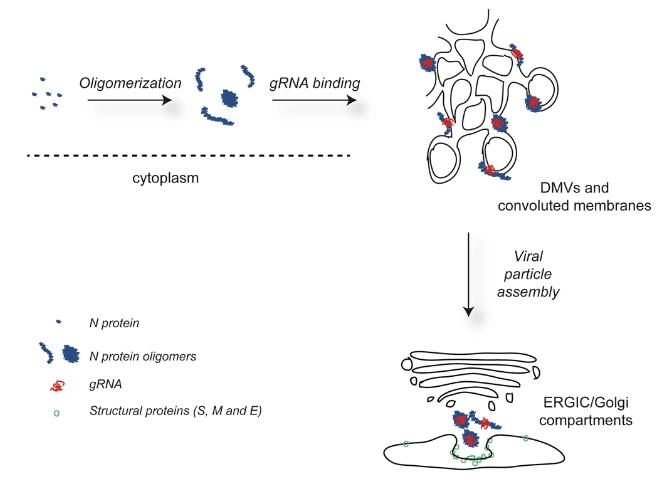
(Kuhn 2007 pmid: 17229691) SARS-CoV Accommodation of the exceptionally large (29-kb) SARS-CoV genome into newly formed virion spherules approximately 82 to 120 nm size(14, 45) necessitates an extremely well-packed, largely helical, supercoiling of the nucleic acid within the RNP core.
- Mature virions are thought to have about 50 to 100 copies of spiketrimers and ca. 200 to 400 copies of N in the membrane-proximal region arranged in a paracrystalline lattice.
- cryoEM study on the supramolecular organization of the structural proteins on the coats of both SARS-CoV and feline CoV showed that the RNP appears as punctuate electrondense features that are clearly associated with M protein and organized as a linear S-M-RNP layer (outside to inside [45]).
- (47) suggest a two-layered organization wherein thread-like densities project from the inner face of the top S-M layer into the two-dimensionally ordered quasilattice of the RNP layer.
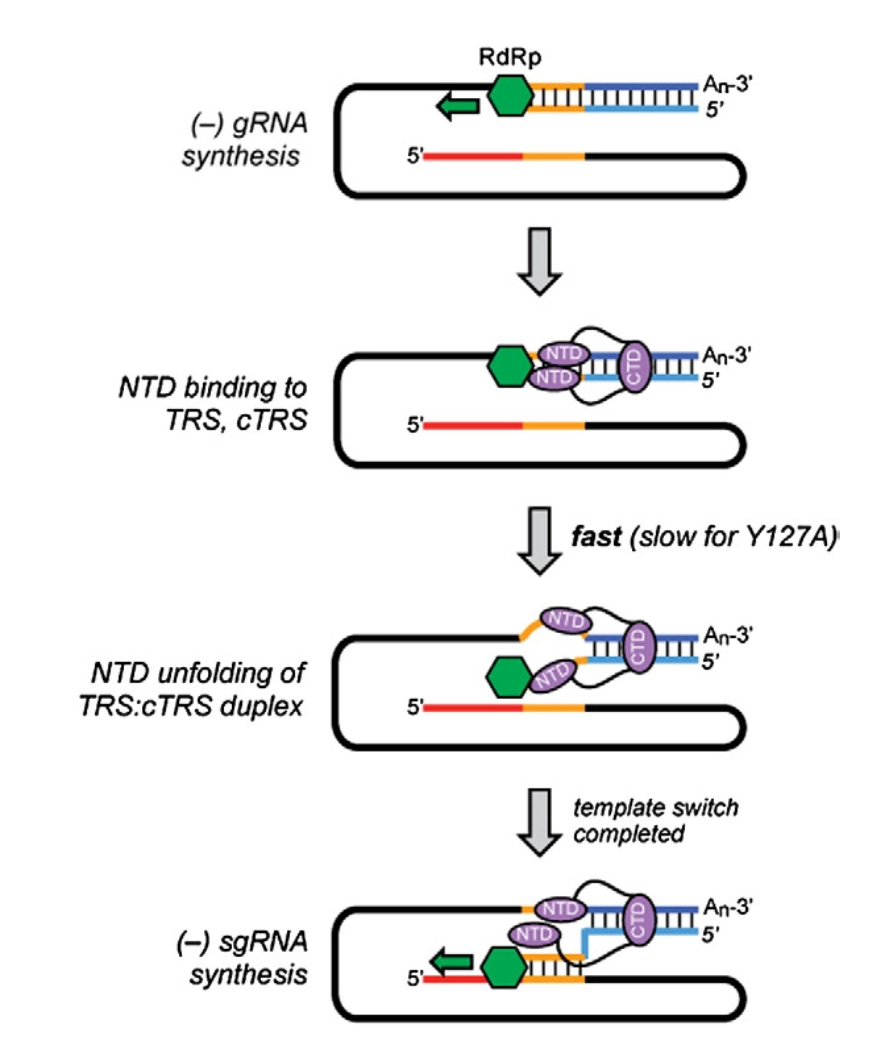
(pmid: 19782089) N binds to TRS and melts duplex
dimerisation domain - structure
(Corbett 2020 pmid: 32654247) N2b domain forms a dimer in solution, addition of the C-terminal spacer B/N3 domain mediates formation of a homotetramer.
NP - dimerisation domain structure
dimerisation is required to allow transcription - denaturing dsRNA
(Giedroc 2009 pmid: 19782089)