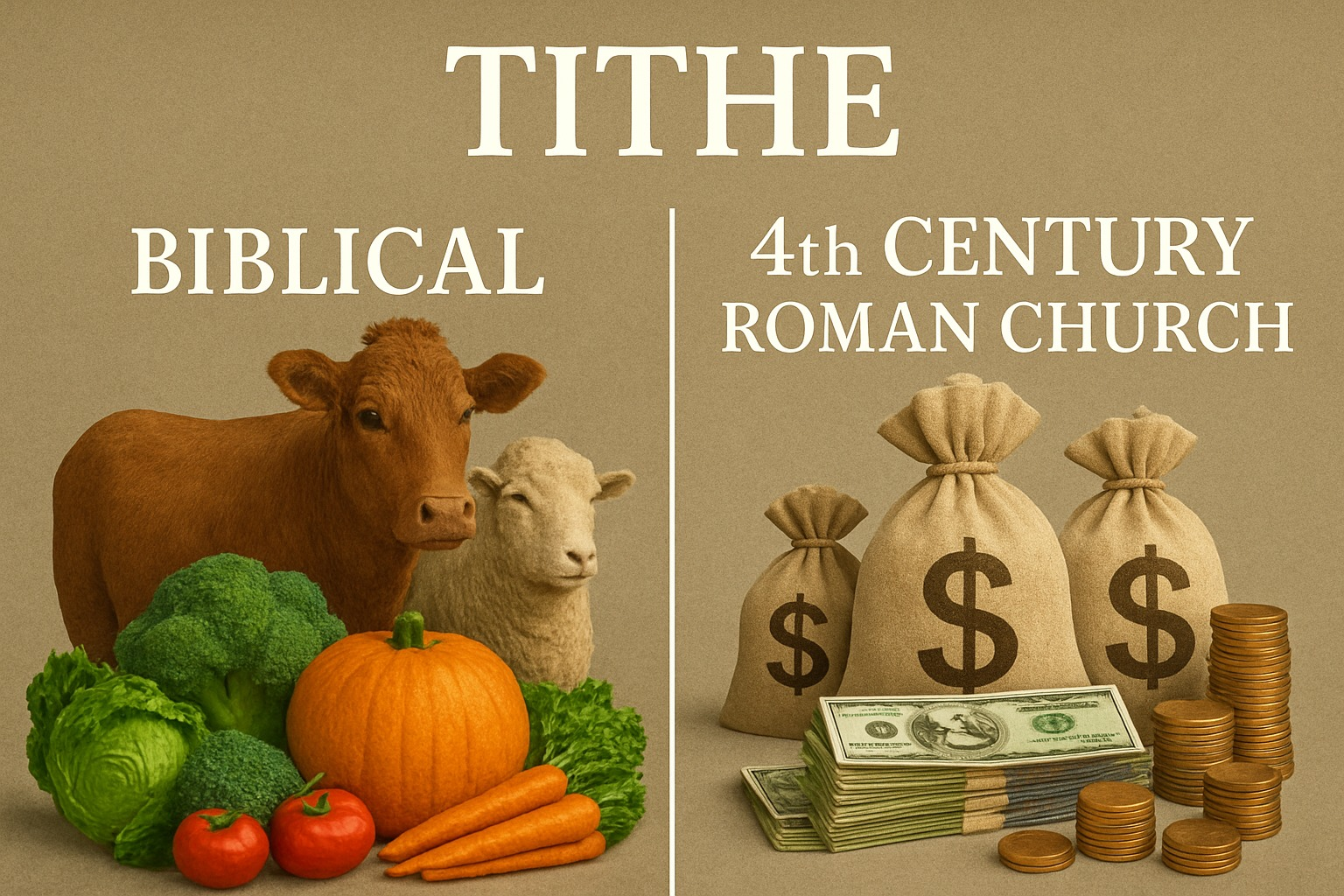
Tithe
Offerings are not to be confused by a tithe (ma’aser) which was a fixed, mandatory 10% of AGRICULTURAL PRODUCE or LIVESTOCK, primarily to support the Levites, the poor, or religious festivals, emphasizing a covenantal obligation.
"A tithe of everything from the land, whether grain from the soil or fruit from the trees, belongs to the Lord; it is holy to the Lord.” Leviticus 27
The only way a tithe was related to "money" was by exchanging your tithe (produce or livestock) in for silver. (... cannot carry your tithe… then exchange your tithe for silver, Deuteronomy 14:22, 24–26
Early church father's did not associate giving with tithing nor 10% - they suggested being generous and voluntarily giving to help the poor, the widows, and the orphans. As is suggested in 1 Corinthians 16:2 when Paul was making a terumah/offering to take to the believers (mostly "Jewish") in Jerusalem because the Gentiles (those outside of Judaism) had shared in the "Jews" spiritual blessings (Romans 15; 2 Corinthians 8; Acts 24).
- Paul assured them he was ceremonially clean and was in the temple courts. He brought them as gifts for the poor and to present as offerings at the temple (Deuteronomy 14 :22-29). This occurred 26-27 years after Jesus' ascension.
It wasn't until the 500s when the Roman Church made it an obligation of finances.
Definition: A tithe (Hebrew: ma’aser, meaning "tenth") is a mandatory giving of one-tenth of one’s produce, livestock, or other agricultural yield, required by God to support specific groups or purposes.
Purpose:
- To support the Levites, who had no land inheritance and served in the tabernacle/temple (Numbers 18:21–24: “I give to the Levites all the tithes in Israel as their inheritance in return for the work they do”).
- To provide for the poor, widows, orphans, and foreigners every third year (Deuteronomy 14:28–29: “At the end of every three years, bring all the tithes… so that the Levites… and the foreigners, the fatherless and the widows… may eat and be satisfied”).
- To fund festival celebrations, where the tithe is consumed in worship before God (Deuteronomy 14:22–26: “Be sure to set aside a tenth of all that your fields produce each year… so that you may learn to revere the Lord your God”).
Characteristics:
- Mandatory: A fixed requirement of 10% (Leviticus 27:30: “A tithe of everything from the land, whether grain from the soil or fruit from the trees, belongs to the Lord; it is holy to the Lord”).
- Specific Amount: Always one-tenth of crops, herds, or flocks (Leviticus 27:32: “Every tithe of the herd and flock—every tenth animal… will be holy to the Lord”).
- Regular: Given annually or every third year for the poor (Deuteronomy 14:28).
Old Testament
- Abraham gave a tenth to Melchizedek (Genesis 14 :20).
- Jacob vowed a tenth of all he received (Genesis 28 :22).
- Malachi 3 :10 emphasizes bringing the “whole tithe into the storehouse” for God’s blessing.
New Testatment
1 Corinthians 16:1–4 (NIV):
"Now about the collection //maamadot// for the Lord’s people: Do what I told the Galatian churches to do. On the first day of every week, each one of you should set aside a sum of money in keeping with your income, saving it up, so that when I come no collections will have to be made. Then, when I arrive, I will give letters of introduction to the men you approve and send them with your gift to Jerusalem. If it seems advisable for me to go also, they will accompany me."
Now after many years, I came bringing nedavot (donations) to my people and also to make korbanot (offerings).
The "Lord’s people" refers to the believers in Jerusalem, often called "saints" in other passages (e.g., Romans 15 :26). Paul is organizing a financial gift to support this community.
This collection is also mentioned in other parts of the New Testament:
- Romans 15:25–27: "Now, however, I am on my way to Jerusalem in the service of the Lord’s people there. For Macedonia and Achaia were pleased to make a contribution for the poor among the Lord’s people in Jerusalem. They were pleased to do it, and indeed they owe it to them. For if the Gentiles have shared in the Jews’ spiritual blessings, they owe it to the Jews to share with them their material blessings."
- 2 Corinthians 8:1–4: Paul describes the generosity of the Macedonian churches in contributing to this effort, despite their own poverty, and urges the Corinthians to follow their example: "In the midst of a very severe trial, their overflowing joy and their extreme poverty welled up in rich generosity… they gave as much as they were able, and even beyond their ability."
- Acts 24:17: Paul, during his defense before Felix, mentions this mission: "After an absence of several years, I came to Jerusalem to bring my people gifts for the poor and to present offerings."
- He brought them as gifts for the poor and to present as offerings at the temple (Deuteronomy 14 :22-29) This occurred 26-27 years after Jesus' ascension.
- ^22 ^Be sure to set aside a tenth of all that your fields produce each year. ^23 ^Eat the tithe of your grain, new wine and olive oil, and the firstborn of your herds and flocks in the presence of the Lord your God at the place he will choose as a dwelling for his Name, so that you may learn to revere the Lord your God always. ^24 ^But if that place is too distant and you have been blessed by the Lord your God and cannot carry your tithe (because the place where the Lord will choose to put his Name is so far away), ^25 ^then exchange your tithe for silver, and take the silver with you and go to the place the Lord your God will choose. ^26 ^Use the silver to buy whatever you like: cattle, sheep, wine or other fermented drink, or anything you wish. Then you and your household shall eat there in the presence of the Lord your God and rejoice. ^27 ^And do not neglect the Levites living in your towns, for they have no allotment or inheritance of their own.
^28 ^At the end of every three years, bring all the tithes of that year’s produce and store it in your towns, ^29 ^so that the Levites (who have no allotment or inheritance of their own) and the foreigners, the fatherless and the widows who live in your towns may come and eat and be satisfied, and so that the Lord your God may bless you in all the work of your hands.
- ^22 ^Be sure to set aside a tenth of all that your fields produce each year. ^23 ^Eat the tithe of your grain, new wine and olive oil, and the firstborn of your herds and flocks in the presence of the Lord your God at the place he will choose as a dwelling for his Name, so that you may learn to revere the Lord your God always. ^24 ^But if that place is too distant and you have been blessed by the Lord your God and cannot carry your tithe (because the place where the Lord will choose to put his Name is so far away), ^25 ^then exchange your tithe for silver, and take the silver with you and go to the place the Lord your God will choose. ^26 ^Use the silver to buy whatever you like: cattle, sheep, wine or other fermented drink, or anything you wish. Then you and your household shall eat there in the presence of the Lord your God and rejoice. ^27 ^And do not neglect the Levites living in your towns, for they have no allotment or inheritance of their own.
- He brought them as gifts for the poor and to present as offerings at the temple (Deuteronomy 14 :22-29) This occurred 26-27 years after Jesus' ascension.
GROK: using sources outside the bible did the church father's discuss tithing or giving financially
Yes, the early Church Fathers discussed tithing and financial giving, often in the context of Christian stewardship, generosity, and support for the church and the poor. Their writings reflect both continuity with Old Testament practices and a shift toward New Testament principles of voluntary, cheerful giving. Below, I’ll summarize their teachings based on available sources, focusing on key figures from the first few centuries of Christianity, as these are typically considered the "Church Fathers" (roughly 1st to 4th centuries AD). I’ll draw on the provided web results where relevant and supplement with general knowledge of patristic writings, ensuring citations are included as per the guidelines.
Overview of Church Fathers’ Views on Tithing and Financial Giving
The Church Fathers did not uniformly mandate tithing as a strict 10% obligation for Christians, as was required under the Old Testament Law for Jews. Instead, they emphasized generous, voluntary giving aligned with New Testament teachings (e.g., 2 Corinthians 9:7, "Each of you should give what you have decided in your heart to give, not reluctantly or under compulsion, for God loves a cheerful giver"). Their discussions often framed giving as an act of faith, love, and stewardship, with tithing sometimes referenced as a minimum standard or a Jewish practice that Christians could exceed.
Key Church Fathers and Their Teachings
- Irenaeus (c. 130–202 AD)
- Teaching: Irenaeus, in Against Heresies, contrasted Old Testament tithing with Christian giving, suggesting that the Mosaic Law’s tithe was a "constraint" or minimum, while Christians, freed by Christ, should give more generously. He wrote: “Instead of the law enjoining the giving of tithes, [Christ taught] to share all our possessions with the poor; and not to love our neighbors only, but even our enemies; and not merely to be liberal givers and bestowers, but even that we should present a gratuitous gift to those who take away our goods.”
- Context: Irenaeus saw tithing as a Jewish practice that Christians surpassed through radical generosity, reflecting Christ’s teachings (e.g., Matthew 5:42). He emphasized giving beyond 10%, including sharing all possessions with the poor, as a mark of Christian freedom and love.
- Implication: Tithing was a starting point, but Christians were called to give sacrificially, motivated by love and faith, not legal obligation.
- Justin Martyr (c. 100–165 AD)
- Teaching: Justin, in his First Apology, described early Christian giving as a voluntary act during worship: “Those who are able and willing give what each thinks fit; and what is collected is deposited with the president, who succors the orphans and widows and those who, through sickness or any other cause, are in want.” He noted that Christians no longer valued hoarding wealth but preferred “innocence” and generosity, giving freely to support the needy and the church.
- Context: Justin highlighted a shift from Old Testament tithing to a model where giving was based on ability and willingness, aligning with 1 Corinthians 16:2 (“Each one of you should set aside a sum of money in keeping with your income”).
- Implication: Financial giving was practical, supporting church leaders and the poor, but not tied to a fixed percentage like tithing.
- Cyprian of Carthage (c. 200–258 AD)
- Teaching: Cyprian, in his Treatise on Works and Alms, criticized ministers who misused church funds and lamented the decline in Christian giving compared to Jewish tithing. He wrote: “They gave tithes, and tithes again upon tithes for orphans, widows, and strangers, whereas someone was saying to me in astonishment at another, ‘Why, such an one givest tithes.’ What a load of disgrace does this expression imply, since what was not a matter of wonder with the Jews has come to be so in the case of the Christians?”
- Context: Cyprian was frustrated by financial misappropriation in the church and saw tithing as a Jewish standard that Christians should at least match, if not exceed, to support the poor and church needs. He viewed giving as a moral duty under the New Covenant, with greater responsibility than under the Old.
- Implication: Tithing was referenced as a baseline, but Cyprian emphasized the need for generous almsgiving, especially in light of corruption.
- Tertullian (c. 155–240 AD)
- Teaching: Tertullian, in his writings, viewed tithing as a Jewish practice that taught “piety towards the Deity and not to covetously grasp everything.” He saw giving as an act of spiritual preservation, preventing wealth from becoming an idol: “The tithes of the fruits and of the flocks taught both piety towards the Deity and not to covetously grasp everything.”
- Context: Tertullian framed giving as a way to maintain spiritual purity, aligning with New Testament calls to generosity (e.g., 1 Timothy 6:17–18). He did not mandate a 10% tithe but used the concept to encourage giving that honored God.
- Implication: Tithing was a historical reference point, but Christian giving was about heart motive and stewardship, not a fixed rule.
- Later Developments (4th Century and Beyond)
- Council of Tours (567 AD) and Third Council of Mâcon (585 AD): These councils encouraged church leaders to teach tithing to congregants, reflecting a growing institutional expectation of financial support for the church. Tithing was seen as a way to honor God and fund ministry, though not always strictly 10%.
- General Trend: By the 4th century, as Christianity became legalized under the Roman Empire, tithing began to resemble a formalized obligation in some regions. By the 8th century, the Holy Roman Empire treated tithes as a tax to Rome, a significant shift from early Christian voluntary giving.
- Context: The early church’s communal model (e.g., Acts 4:32–35, where believers shared everything) gave way to structured giving as churches grew and required financial support for clergy, buildings, and missions.
- Implication: While early Fathers emphasized voluntary giving, later institutionalization led to tithing being encouraged or mandated, often as a minimum standard.