Shield Law
SEE CLIMATE LAWSUITS
SEE RAGA TEAM RED
---
---
GUK 1 26
AS the Trump administration boosts fossil fuels, Americans are increasingly turning to courts to hold big oil accountable for alleged climate deception. That wave of litigation swelled in 2025, with groundbreaking cases filed and wins notched.
But the year also brought setbacks, as Trump attacked the cases and big oil worked to have them thrown out. The industry also worked to secure a shield from current and future climate lawsuits.
Here are some major trends that emerged in US climate accountability litigation last year.
1. Big oil suits progressed but faced challenges
In recent years, 70-plus US states, cities, and other subnational governments have sued big oil for alleged climate deception. This year, courts repeatedly rejected fossil fuel interests’ attempts to thwart those cases. The supreme court denied a plea to kill a Honolulu lawsuit, and turned down an unusual bid by red states to block the cases. Throughout the year, state courts also shot down attempts to dismiss cases or remand them to federal courts which are seen as more favorable to oil interests.
But challenges against big oil also encountered stumbling blocks. In May, Puerto Rico voluntarily dismissed its 2024 lawsuit under pressure. Charleston, South Carolina also declined to appeal its case after it was dismissed.
In the coming weeks, the supreme court is expected to decide if it will review a climate lawsuit filed by Boulder, Colorado, against two major oil companies. Their decision could embolden or hinder climate accountability litigation.
“So far, the oil companies have had a losing record trying to get these cases thrown out,” said Richard Wiles, president of the Center for Climate Integrity, which backs the litigation against the industry. “The question is, does Boulder change that?”
After Colorado’s supreme court refused to dismiss the lawsuit, the energy companies filed a petition with the supreme court asking them to kill the case on the grounds that it is pre-empted by federal laws. If the high court declines to weigh in on the petition – or takes it up and rules in favor of the plaintiffs – that could be boon for climate accountability cases. But if the justices agrees with the oil companies, it could void the Boulder case – and more than a dozen others which make similar claims.
That would be a “major challenge”, said Wiles, “but it wouldn’t be game over for the wave of litigation”.
“It would not mean the end of big oil being held accountable in the court,” he said.
The American Petroleum Institute, the nation’s largest oil lobby group, did not respond to a request to comment.
2. New and novel litigation
Climate accountability litigation broke new ground in 2025, with Americans taking up novel legal strategies to sue big oil. In May, a Washington woman brought the first-ever wrongful-death lawsuit against big oil alleging the industry’s climate negligence contributed to her mother’s death during a deadly heat wave. And in November, Washington residents brought a class action lawsuit claiming fossil fuel sector deception drove a climate-fueled spike in homeowners’ insurance costs.
“These novel cases reflect the lived realities of climate harm and push the legal system to grapple with the full scope of responsibility,” said Merner.
Hawaii this year also became the 10th state to sue big oil over alleged climate deception, filing its case just hours after the Department of Justice took the unusual step of suing Hawaii and Michigan over their plans to file litigation. It was a “clear-eyed and powerful pushback” to Trump’s intimidation, Merner said.
3. Accountability shield
Big oil ramped up its efforts to evade accountability for its past actions this year, said Wiles. They were aided by allies like Trump, who in April signed an executive order instructing the Justice Department to halt climate accountability litigation and similar policies.
In July, members of Congress also tried to cut off Washington DC’s access to funding to enforce its consumer protection laws “against oil and gas companies for environmental claims” by inserting language into a proposed House appropriations bill. A committee passed that version of the text, but the full House never voted on it.
2025 also brought mounting evidence that big oil is pushing for a federal liability shield, which could resemble a 2005 law that has largely insulated the firearms industry from lawsuits. In June, 16 Republican state attorneys general asked the Justice Department to help create a “liability shield” for fossil fuel companies against climate lawsuits, the New York Times reported. Lobbying disclosures further show the nation’s largest oil trade group, as well as energy giant ConocoPhillips, lobbying Congress about draft legislation on the topic, according to Inside Climate News.
Such a waiver could potentially exempt the industry from virtually all climate litigation. The battle is expected to heat up next year.
“We expect they could sneak language to grant them immunity, into some must-pass bill,” said Wiles. “That’s how we think they’ll play it, so we’ve been talking to every person on the Democratic side so that they keep a lookout for this language.”
...
ref
lawsuits-superfund-trump-justice-climate
...By Karen Zraick
Sept. 4, 2025
The Trump administration is escalating its attacks on “polluter pays” laws and lawsuits that try to force fossil fuel companies to help cover the costs of climate change.
There are dozens of these legal fights playing out nationwide. They have become increasingly significant as the Trump administration weakens federal efforts to fight global warming.
The latest move came on Friday, when the Justice Department asked a judge to permanently block New York State from enacting its new Climate Change Superfund Act, a law requiring oil companies to pay billions of dollars to fund projects to protect against intensifying heat, floods, wildfires and other damage from climate change.
“New York has declared war on those responsible for supplying our nation with reliable and affordable energy,” lawyers for the Justice Department wrote.
A senior adviser to Gov. Kathy Hochul, Ken Lovett, shot back that the law was intended to “protect everyday New Yorkers, not corporate polluters” and accused the Justice Department of “federal overreach.”...
---
Inside Trump’s Unorthodox Climate Attacks in Courts Nationwide
The administration is cranking up efforts to kill state laws and legal cases that would force fossil-fuel companies to pay for climate damage.
By Karen Zraick
Sept. 4, 2025
The Trump administration is escalating its attacks on “polluter pays” laws and lawsuits that try to force fossil fuel companies to help cover the costs of climate change.
There are dozens of these legal fights playing out nationwide. They have become increasingly significant as the Trump administration weakens federal efforts to fight global warming.
The latest move came on Friday, when the Justice Department asked a judge to permanently block New York State from enacting its new Climate Change Superfund Act, a law requiring oil companies to pay billions of dollars to fund projects to protect against intensifying heat, floods, wildfires and other damage from climate change.
“New York has declared war on those responsible for supplying our nation with reliable and affordable energy,” lawyers for the Justice Department wrote.
A senior adviser to Gov. Kathy Hochul, Ken Lovett, shot back that the law was intended to “protect everyday New Yorkers, not corporate polluters” and accused the Justice Department of “federal overreach.”
END?
Karen Zraick covers legal affairs for the Climate desk and the courtroom clashes playing out over climate and environmental policy.
:{:{A version of this article appears in print on Sept. 6, 2025, Section A, Page 9 of the New York edition with the headline: Trump Tries to Spare Oil Industry From Paying for Climate Damage.}:
See more on: U.S. Politics, BP Plc., Chevron Corporation, Exxon Mobil Corporation, U.S. Justice Department1`
---
---
icn
As efforts continue to hold some of the world’s largest fossil fuel corporations liable for destructive and deadly climate impacts, backlash from the politically powerful oil and gas industry and its allies in government is on the rise, bolstered by the Trump administration’s allegiance to fossil fuels.
From lobbying Congress for liability protection to suing states over their climate liability laws and lawsuits, attempts to shield Big Oil from potential liability and to shut down climate accountability initiatives are advancing on multiple fronts.
“The effort has escalated dramatically in the past six or seven months,” said Richard Wiles, president of the Center for Climate Integrity, an organization that advocates for holding fossil fuel companies accountable for selling products they knew were dangerously warming the planet.
Pushback to liability initiatives from fossil fuel interests is not new. But the political landscape has shifted dramatically this year as the second Trump administration works to reward loyalists and campaign donors, including fossil fuel interests.
The oil and gas industry spent $445 million during the last election cycle to influence President Donald Trump and Congress, including $96 million on Trump’s re-election campaign, according to the progressive advocacy group Climate Power.
“What has changed is that there is a new administration,” said Lisa Graves, founder and executive director of True North Research, a national investigative watchdog group. And the Trump administration, she said, “is continuing to defend the fossil fuel industry and assail anyone who dares try to hold them accountable.”
Over the past eight years, communities across the country have filed tobacco-style lawsuits targeting ExxonMobil and major players in the fossil fuel industry, seeking to recover damages for localized climate impacts or to force companies to cease greenwashing and other misleading behavior.
More than 30 of these lawsuits brought by municipal, tribal and state governments are working their way through the courts, and several are now closer than ever to reaching trial.
At the same time, some states are enacting or considering so-called climate superfund legislation that would hold large fossil fuel companies strictly liable for climate damages and require them to help pay for a portion of climate change costs incurred by state governments. Vermont and New York both passed climate superfund laws last year, and similar legislation is pending in a handful of other states.
In response to these budding accountability efforts, the fossil fuel industry, the Trump administration, Republicans in Congress and GOP attorneys general are mounting what Wiles describes as a “massive orchestrated campaign” to try to stop climate liability laws and lawsuits in their tracks, and to push for legal immunity akin to what gun manufacturers received two decades ago. Trump’s Department of Justice has even filed highly unusual, if not unprecedented, lawsuits against Vermont and New York seeking to overturn their climate superfund statutes.
“It’s just this superbly choreographed effort on the part of the oil industry and its allies to get gun-industry-style legal immunity for all the damage that they’ve caused,” Wiles told Inside Climate News.
Oil Industry Is Lobbying Congress for a Liability Shield
Among the climate liability lawsuits inching closer to trial: a consumer protection case brought by Massachusetts against ExxonMobil, and suits seeking damages filed by Honolulu, Hawaii, and Boulder, Colorado.
As reported by The Wall Street Journal earlier this year and confirmed by The New York Times last month, industry representatives are lobbying Congress for a liability shield of some kind.
The details remain unclear. But the American Petroleum Institute, a trade group, reports lobbying on “draft legislation related to state efforts to impose liability on the oil and gas industry,” while disclosures from ConocoPhillips show that the company has lobbied on the matter of “state superfund legislation,” including draft legislation in Congress addressing it.
Neither API nor ConocoPhillips responded to requests for comment.
Pat Parenteau, emeritus professor of law at Vermont Law and Graduate School, told Inside Climate News that he thinks immunity provisions for the fossil fuel industry are unlikely to pass the Senate.
But the fact that the fossil fuel industry is lobbying for legal protections suggests to Wiles that the industry realizes it could be facing serious legal jeopardy. “Let’s be clear. You don’t seek a [liability] waiver unless you know you’re guilty,” Wiles said.
Darren Woods, CEO of ExxonMobil, speaks alongside Energy Secretary Chris Wright (left) and Dario Amodei, CEO of Anthropic, at the Pennsylvania Energy and Innovation Summit at Carnegie Mellon University on July 15 in Pittsburgh. Credit: Jeff Swensen/Getty Images
Over the summer, language emerged in a draft House Appropriations Committee spending bill that specifically would prohibit the District of Columbia from using funds to enforce its consumer protection law “against oil and gas companies for environmental claims.” The bill that included this provision passed the committee but was not brought to the full House for a vote.
But climate accountability advocates say the provision was still alarming because it effectively would have shut down D.C.’s ongoing consumer protection lawsuit against Big Oil. That suit, filed in 2020, alleges that several major oil companies lied to consumers about the climate risks of their products and that they continue to mislead consumers through greenwashing campaigns. In April the D.C. Superior Court rejected the companies’ motions to dismiss the suit.
Anne Havemann, deputy director and general counsel at Chesapeake Climate Action Network, said the appropriations provision “is a threat to this ongoing lawsuit.”
“If [D.C.] can’t use any money to prosecute these cases and advance these cases, then it effectively can’t work on them,” she said.
Big Oil Lawyers Seek Supreme Court Intervention
A parallel effort to skirt accountability is playing out in the courts. Fossil fuel companies are vigorously defending themselves in climate liability lawsuits, and they have seen some success in recent months getting cases dismissed by state trial courts.
Now Boulder’s lawsuit is back before the nation’s highest court on a fresh petition from the oil company defendants, after Colorado courts, including the state Supreme Court, refused to dismiss the case. The question posed by the companies in their petition is whether federal law precludes such state law claims.
It is unclear whether the Supreme Court will take up the case this time.
In January the Supreme Court denied a similar petition from oil companies in a case brought by Honolulu. Courts in Hawaii have rejected the companies’ bids to have the case dismissed, and with the Supreme Court declining to intervene, Honolulu’s case is advancing toward a trial.
Parenteau said the prospect of facing a trial and a potential adverse verdict likely has the oil companies extremely worried. “They’re certainly frightened of a trial just from a reputational standpoint,” he said.
The new petition in the Boulder case now offers the Supreme Court another opportunity to step in. Should the justices decide to intervene, legal experts say that it could essentially shut down all climate liability attempts.
“If they do step in, that’s huge. That changes everything,” Parenteau said. “That is the end game.”
“In one fell swoop it could get rid of all of these cases,” said James May, a law professor at Washburn University.
On Oct. 9, over 100 Republican House members submitted an amicus brief to the Supreme Court backing oil companies ExxonMobil and Suncor in their petition to block Boulder’s lawsuit from moving forward. It is the first time that Republicans in Congress have called on the Supreme Court to intervene in this litigation and to shut down not just this one lawsuit but all others like it.
“In recent years, multiple state and local governments have launched a courtroom war against the American energy industry,” the brief asserts in its opening. “It must stop now.”
The 103 Republican House members who signed onto the brief argue that the municipal and state lawsuits against oil and gas companies are trying to “dictate national energy policy” and that only the federal government has the authority to regulate transboundary greenhouse gas emissions.
“They are arguing that it’s solely EPA’s role to regulate greenhouse gases, but the Trump administration is attempting to eliminate that role by revoking the Endangerment Finding. If that revocation goes through and survives in the courts, it will greatly weaken the oil companies’ preemption defense,” Michael Gerrard, founder and faculty director of the Sabin Center for Climate Change Law at Columbia University, told Inside Climate News.
“This full-court press to block these lawsuits shows that the oil companies and their allies in Congress are really nervous about what would come out if any of these cases actually went to trial,” Gerrard added.
Trump Administration on the Offensive
The Trump administration, through its Department of Justice, is fully backing the fossil fuel industry in climate liability litigation, filing amicus briefs, for example, in cases now pending before the U.S. Supreme Court and the Maryland Supreme Court.
But its efforts to shield the industry from accountability extend beyond friend-of-the-court briefs.
Following a White House meeting where oil company executives raised concerns about state climate laws and lawsuits, Trump issued an executive order in April directing Attorney General Pam Bondi to try to put a stop to these legal initiatives.
In response, the DOJ then sued four states, including preemptive suits brought against Hawaii and Michigan before either state had filed such a lawsuit (Hawaii sued major oil companies the next day). The DOJ’s other lawsuits targeted Vermont and New York to try to strike down their climate superfund laws, which are based on the “polluter pays” logic of the Environmental Protection Agency’s Superfund program aimed at forcing polluting companies to remediate damage from toxic waste sites.
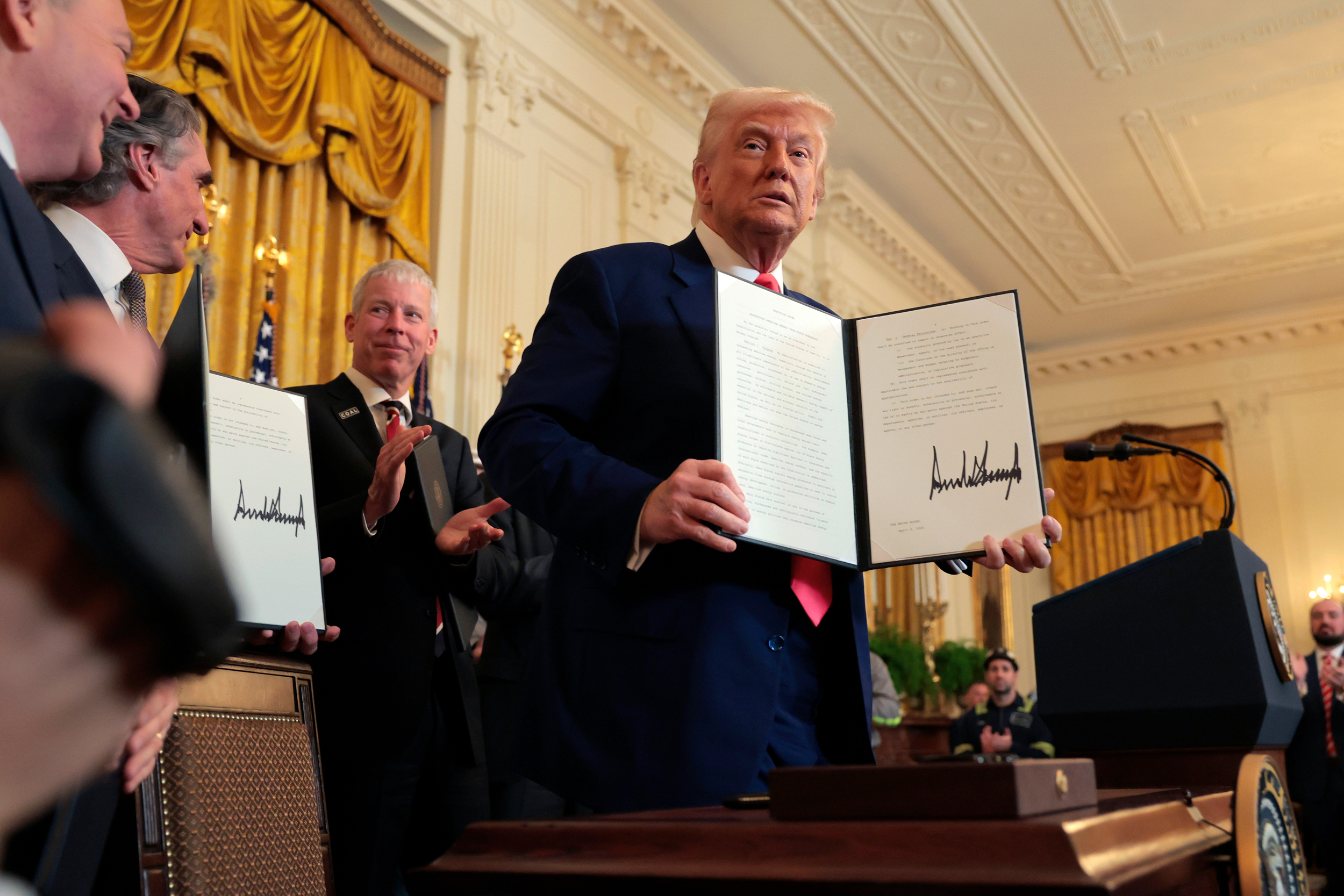 President Donald Trump poses for photos after signing a series of executive orders on American energy production during a ceremony in the East Room of the White House on April 8. Trump was joined by (from left) EPA Administrator Lee Zeldin, Interior Secretary Doug Bergum and Energy Secretary Chris Wright. Credit: Anna Moneymaker/Getty Images
Advances in a field known as climate attribution science have made the “polluter pays” aspect of the superfund laws possible, enabling scientists to quantify the individual contributions of major fossil fuel producers to climate impacts such as sea level rise and heat waves.
The DOJ has now filed motions for summary judgment in both of these lawsuits, asking federal courts to permanently block the states’ climate superfund laws.
“Vermont’s flagrantly unconstitutional statute threatens to throttle energy production, despite this Administration’s efforts to unleash American energy. It’s high time for the courts to put a stop to this crippling state overreach,” Acting Assistant Attorney General Adam Gustafson said in a statement issued by the DOJ on Sept. 16.
Havemann, with the Chesapeake Climate Action Network, told Inside Climate News that the current Trump administration seems to be taking a more aggressive approach to protecting the fossil fuel industry and to fighting attempts to hold it accountable.
“The Trump administration has come in and used many different tools in its toolbox to go after these accountability lawsuits and the laws that also seek to hold the biggest polluters accountable for climate damages,” she said. “It’s very much on the radar of the Trump administration in a way that it has not been in the past.”
The White House did not immediately respond to a request for comment.
“Enter the Dragon”
With U.S. Sen. Ted Cruz (R-Texas) holding the gavel, climate litigation came up as the subject of a Republican-led congressional hearing this summer before a Judiciary Committee subcommittee.
The hearing’s provocative title: “Enter the Dragon—China and the Left’s Lawfare Against American Energy Dominance.”
Cruz used the hearing to attack climate liability lawsuits and claim that they are a nefarious left-wing plot that is in part funded by, and that benefits, the Chinese Communist Party. “Both China and the Democrats want to bankrupt the American energy industry,” Cruz said during the hearing.
NPR’s Michael Copley reported last month that “Cruz’s office has not offered evidence that China or a China-linked nonprofit that Cruz identified by name has funded climate lawsuits in the United States.”
In response to that reporting, Cruz told Inside Climate News that “NPR deliberately ignored objective facts.”
“The Chinese Communist Party uses cut-outs and ‘nonprofits’ to shape U.S. energy policy, funding propaganda, advocacy, and litigation that harm American workers,” Cruz said in an emailed statement, which was also included in the NPR story after it was published. The “China-linked nonprofit” referenced in the NPR story, Energy Foundation China, does fund some climate initiatives, Cruz said in his statement.
“In January 2024, three House committee chairs opened an investigation into Chinese influence, citing EFC’s ties and funding of groups like [the Natural Resources Defense Council] and RMI,” he added.
A spokesperson for RMI, a nonprofit group working on the global energy transition, said that the organization “does not participate in litigation.” RMI’s “work supported by Energy Foundation China, which is a U.S. based charitable organization, is focused squarely on the energy transition inside of China,” the spokesperson added.
The Natural Resources Defense Council (NRDC), a nonprofit group that works to protect public health and the environment, does some “work in China for one reason: there’s not a single global environmental problem that can be fixed unless China is part of the solution,” NRDC spokesperson Josh Mogerman said. He added that the organization “does not fundraise in China” and that “money from China does not fund NRDC litigation in the United States, period.”
Cruz, who represents the country’s biggest oil and gas producing state, did not respond to Inside Climate News’ question about whether he supports immunizing oil companies from liability.
GOP Attorneys General Enter the Fray
During the Cruz-led hearing, the Republican attorney general for the state of Kansas, Kris Kobach, testified as one of the majority witnesses. He referenced the New York and Vermont climate superfund laws, claiming these statutes impose extraterritorial regulation on energy companies, and mentioned that his state and other Republican-led states are suing to try to overturn these state laws.
“We will continue these fights in court as state attorneys general. But we do need some help from Congress,” Kobach said. He suggested that Congress could legislate to expressly preempt state climate laws like the climate superfund laws.
Kobach and 15 other Republican state attorneys general also made this suggestion, along with several other recommendations for congressional action, in a letter addressed to Bondi, the U.S. attorney general.
The June 12 letter references Trump’s executive orders to “unleash” fossil fuels and protect the fossil fuel industry from “state overreach.” The letter says its purpose is to “suggest additional steps” the Department of Justice could take to effectuate these orders and assist in the “fight against anti-energy interests.”
Specifically, the Republican AGs suggest the DOJ could recommend legislation to reinforce federal preemption of state climate liability laws or lawsuits; restrict federal funding for states seeking to impose liability on energy companies; create a right of removal to federal district court for climate suits; and, among other items, stop “activist-funded climate lawsuits” with a liability shield, similar to the law that granted immunity for gun manufacturers.
Wiles, with the Center for Climate Integrity, said it is especially striking to see Republican attorneys general explicitly recommend a similar liability shield for fossil fuel companies. “The attorneys general actually called for Congress to enact a gun-style liability waiver for the oil industry,” he said. “We saw how that [gun industry immunity] ended up. It certainly was not helpful in curbing gun violence or in serving any public interest objective.”
The coordinated litigation strategies and actions of Republican state attorneys general in defense of fossil fuel and other industries stem from an organization called the Republican Attorneys General Association (RAGA), which Graves said was created in the wake of the tobacco industry being held accountable through the 1998 Master Settlement Agreement.
The organization, which currently lists 29 Republican state attorneys general as members, has been funded through donations from conservative judicial activists like Leonard Leo as well as from corporate interests including those in the fossil fuel industry. The American Petroleum Institute gave over $125,000 to RAGA in 2024, and in the first six months of this year Chevron’s Policy, Government and Public Affairs division donated $25,000 to the organization, for example.
Graves describes RAGA as a “pay-to-play organization.”
“It has a pay sheet listing what kind of access you get to attorneys general based on how much you give,” she told Inside Climate News.
“These attorneys general use the prestige of their office and their power and the resources that their taxpayers are providing to serve the interests of industry, select industries that they are most tied to, and that certainly includes the fossil fuel industry,” Graves added.
The Republican Attorneys General Association did not respond to a request for comment.
“A Perilous Moment”
The intensifying backlash to climate accountability efforts coming from the fossil fuel industry and its political defenders is happening at a time when some political scholars warn that the U.S. is sliding into some form of authoritarianism, which advocates say magnifies the challenges of holding powerful interests to account writ large.
“It’s a perilous moment for democratic norms and institutions,” said Kathy Mulvey, accountability campaign director for the climate and energy program at the Union of Concerned Scientists.
“Anybody who is pursuing policy change or litigation for accountability or enforcement is counting on the courts to be a real backstop for democratic institutions,” Mulvey told Inside Climate News.
Should the fossil fuel industry somehow succeed in securing legal immunity, Wiles said it “would be consistent with the erosion of the rule of law that we’re seeing.”
“No industry should be above the law,” he added.
---
ref 404 ag
5 pp ltr to bondi
2025.06.12%20--%20Letter%20to%20Dep%27t%20of%20Justice%20on%20Energy%20Actions
Dear Attorney General Bondi:
We, the undersigned Attorneys General, write to applaud the Department of Justice’s recent
actions to curtail the climate lawfare that has intensified our Nation’s energy crisis.
The energy industry is foundational to American flourishing. President Trump rightly
observed that our Nation “is blessed with an abundance of energy and natural resources that
historically powered our Nation’s economic prosperity.”1 The industry has created millions of
American jobs and annually generates billions of dollars in tax revenue. This money supports
schools, hospitals, and public infrastructure; it also helps ensure that everything from electricity to
transportation to consumer goods remains both available and affordable for all Americans.
Altogether, “[t]he development of domestic energy resources is of paramount public interest.”2
And traditional energy resources like “oil, natural gas, and coal provide 80% of American
energy.”3
President Trump’s recent Executive Orders recognize just how important the energy
industry is to American success. The President noted that the “burdensome and ideologically
motivated ‘climate change’ [and] energy policies” enacted by some States “weaken our national
security and devastate Americans by driving up energy costs for families coast-to-coast, despite
1 Unleashing American Energy, Exec. Order No. 14154, 90 Fed. Reg. 8353, 8353 (Jan. 29, 2025).
2 U.S. Dep’t of Energy, The Economic Benefits of Oil & Gas (2025), https://perma.cc/7R3GTZCP.
3 Nat. Res. Def. Council v. Kempthorne, 525 F. Supp. 2d 115, 127 (D.D.C. 2007).
...3
Unfortunately, the United States Supreme Court has declined up to this point to tackle these
modern-day climate lawsuits and anti-energy state laws head on. For instance, the Court has
recently denied petitions asking the Court to consider whether these state-law-based claims against
energy companies belong in federal court (as they undoubtedly do). Our own efforts before that
Court to protect the interests of our citizens in a strong American energy industry have largely been
rebuffed.14 Thus, we expect that only legislative and executive actions can provide real answers to
these continuing problems.
We therefore write to suggest additional steps the Department could take to effectuate the
President’s Executive Orders and assist our States in continuing the fight against anti-energy
interests. In particular, the Department could recommend legislation that would:
11 E.g., Patrick Brown, How Much Did Increasing “Climate Whiplash” Impact the Los Angeles
Fires?, Breakthrough Inst. (Jan. 29, 2025), https://perma.cc/UEH2-LYF9.
12 Climate Change Superfund Act, N.Y. S.2129-B, 2023–24 Session; Climate Superfund Act, Vt.
S.259, 2023–24 Session.
13 City of San Francisco v. Exxon Mobil Corp., No. 02-18-00106-CV, 2020 WL 3969558, at *20
(Tex. App. June 18, 2020).
14 E.g., Alabama v. California, 145 S. Ct. 757 (Mar. 10, 2025).
p2 notes
4 Protecting American Energy From State Overreach, Exec. Order 14260, 90 Fed. Reg. 15513,
15513 (Apr. 8, 2025).
5 Id. at 15513–14.
6 Ibid.
7 Press Release, U.S. Dep’t of Just., Justice Department Files Complaints Against Hawaii,
Michigan, New York and Vermont Over Unconstitutional State Climate Actions (May 1, 2025),
https://perma.cc/HSZ7-GK4H.
8 Press Release, U.S. Dep’t of Just., Justice Department Launches Anticompetitive Regulations
Task Force (Mar. 27, 2025), https://perma.cc/XGR5-EJYH.
9 E.g., S. Comm. On Com., Sci., & Transp. And H.R. Comm. on Oversight & Accountability,
Republican Staff, Report, Investigation into Sher Edling, LLP (Oct. 7, 2024),
https://perma.cc/4YNQ-GQXE.
10 Am. Energy Inst., The Environmental Law Institute’s Climate Judiciary Project (CJP) Is
Corruptly Influencing the Courts and Destroying the Rule of Law to Promote Questionable
Climate Science (2024), https://perma.cc/8TJT-JNZD.
These protective measures could complement other initiatives that could affirmatively
strengthen our American energy industry. Among other things, Congress and the Administration
could streamline required permitting for energy-related facilities (including related environmental
assessment requirements), extend current grant and tax-incentive programs limited to so-called
“green” energy to domestic energy producers, and continue peeling back anti-energy regulations
:{from past administrations.
Measures like these could be expected to re-empower American}:
industry, better enabling it to fend off unjustified attacks like that seen in recent years.
We unhesitatingly support President Trump’s goals to “restore American prosperity” and
“rebuild our Nation’s economic and military security” by unleashing American energy, and his
commitment to protecting American energy from state overreach. Ending the unlawful assault on
American energy is critical to achieving those objectives. We commend the Department for already
taking action to stop climate lawfare and hope that you will consider our suggestions to further
bolster your efforts.
Sincerely,
Mike Hilgers John B. McCuskey
Nebraska Attorney General West Virginia Attorney General
Steve Marshall Tim Griffin
Alabama Attorney General Arkansas Attorney General
James Uthmeier Chris Carr
Florida Attorney General Georgia Attorney General
Brenna Bird Kris Kobach
Iowa Attorney General Kansas Attorney General
Russell Coleman
Austin Knudsen
Kentucky Attorney General Montana Attorney General
Drew Wrigley Dave Yost
North Dakota Attorney General Ohio Attorney General
Ken Paxton Alan Wilson
Texas Attorney General South Carolina A
marty Jackley
South Dakota Attorney General
Ryan Schelhaas
Interim Wyoming Attorney General
---