FED SCIENCE
BELAted 6 26 TRIGGERED BY OCEAN SENSOR PJT 2025 FUCKERY
SEE MOVE HQ BERHNARDT PENDEJO PJT 2025
---
---
CNN
Researchers say this new Trump rule could destroy American science as we know it. They’re fighting back
By
 Ella Nilsen
,
 Andrew Freedman
Jun 4, 2026
Researchers measure carbon dioxide in the atmosphere at the UC San Diego Scripps Institution of Oceanography in San Diego, California on April 11, 2025. A new rule proposed by the Trump administration would put federal funding for scientific research in the hands of political appointees, likely cutting off money for studies of climate change and other topics the administration ideologically opposes.
Patrick T. Fallon/AFP/Getty Images
Scientists across multiple disciplines are sounding the alarm after the White House proposed taking greater control over how scientific research gets funded and allowing political appointees to decide whether to approve scientific grants.
Critics of the proposed rule say it would codify the administration’s attempts to destroy the scientific research enterprise in the US that has led to remarkable discoveries on treating cancer, HIV and rare diseases — as well as understanding weather and climate science and developing artificial intelligence. It could have far-reaching implications on what kinds of research topics get studied in the first place.
One of the main casualties in OMB’s proposal would be the country’s longstanding scientific peer review process for grantmaking. Peer review has been widely used since the post-World War II research boom, and relies on panels of experts in their fields judging federal funding decisions on the scientific merit of the grant proposals, rather than any politically-motivated criteria.
The proposed rule would also ban research on diversity, equity and inclusion, as well as gender, and stop federally funded international scientific collaborations. And OMB’s changes could target more than scientific research — applying to other federal grant awards from agencies to state and local governments.
“This proposal does not just apply to scientific research funding, it applies to other federal awards in all kinds of contexts,” said Stanford Law School professor Lisa Larrimore Ouellette.
Kate Marvel, a climate scientist who recently left NASA due to political interference in climate-science research there, said peer review has long been an enabler of America’s scientific leadership.
“One of the reasons the USA has historically been such a research superpower is that we’ve had a merit-based science funding system, where research is funded by the federal government based on the assessments of other scientists,” she said.
“The system wasn’t perfect, but it wasn’t stupid,” Marvel added. “Putting uninformed political hacks in charge of it is deeply stupid.”
An OMB spokesman said the proposed rule would “bring transparency to the grantmaking process and ensure taxpayer dollars are spent wisely.”
“Federal grants were already politicized to promote a far-left agenda,” the spokesman said. “That ends now.”
Office of Management and Budget Director Russell Vought speaks during the Republican National Lawyers Association National Policy Conference in Washington, DC, in April.
Aaron Schwartz/Reuters
A plan to protect science
Like any other federal regulation, the OMB proposal is undergoing a public comment period before it gets finalized. Now, individual researchers, scientific journals, universities and medical societies are using this time to flood the zone with public comments. It’s a longshot attempt to trigger Congressional review.
“My goal was to try and mobilize as many people in the scientific community or adjacent communities — patient communities, science lovers, anybody can submit to this docket,” said Elizabeth Ginexi, a former senior program officer at the National Institutes of Health. “They’re required by law to read every single comment and respond to every single comment.”
Ginexi left the NIH after more than 20 years when the Elon Musk-led Department of Government Efficiency came in and started slashing programs all over the federal government. She took the deferred resignation program and has watched the administration try (and sometimes fail) to cut various grant programs. Ginexi said the sweep of the proposed OMB rule alarms her.
“When we’re trying to come up with new clinical trials to test out a new therapeutic for a rare form of cancer, we want the scientists to be judging the merit of those applications,” she said. “Is this clinical trial ready for prime time? Is the molecular biology correct? Who should be making that decision — other scientists, oncologists, or do you want Russell Vought and Donald Trump making that decision?”
Far-reaching impacts
The changes at OMB could impact issue areas from climate science to addiction research.
“Quite frankly, if this goes through, we’re going to see an uptick in addiction and overdose,” said Diane Fishbein, a senior scientist studying addiction at the University of North Carolina, representing the Addiction Science Defense Network.
Eliminating addiction research on the basis of race, ethnicity or gender is not an abstract concept; it could be devastating to real-world people struggling with addiction, Fishbein said. For instance, federally funded research has shown that intervening early with children and adolescents who may be experimenting with less addictive drugs can be a big part of stopping addiction early.
“If we ignore the social determinants of health and other very scientifically important topics, what will happen is this unequal, uneven distribution of services that could otherwise help all communities, all children, all families,” Fishbein said. “This rule basically takes out the ability to really focus on scientific terms, they’re not ideological terms.”
OMB’s rule change could also significantly limit the scope of climate and weather research that gets funded, putting the country at a disadvantage relative to other nations, such as China, which are stepping up in these fields.
Climate scientists warned that the influence of politics in science funding decisions could prevent important new scientific breakthroughs and set their field back years.
“The proposal to base funding decisions on alignment with the administration’s agenda is a particularly acute threat for climate and weather funding, which protects our nation’s infrastructure, economy, agriculture, public safety, and national security,” said Kim Cobb, who leads the Institute at Brown for Environment and Society.

A boat motors by as the Bidwell Bar Bridge is surrounded by fire in Lake Oroville during the Bear fire in September 2020. Human-caused climate change and droughts have exacerbated wildfires in the US and around the world.
Josh Edelson/AFP/Getty Images
President Donald Trump has falsely called human-caused climate change a “hoax” and repeatedly proposed budgets that would gut climate research. Congress has pushed back against those funding cuts, but the new rule is seen by some advocates as an end run around lawmakers, since it would assert more executive branch authority over spending.
Rick Spinrad, an oceanographer who headed the National Oceanic and Atmospheric Administration during the Biden administration, said other countries — such as the former Soviet Union — have let politics dictate research funding with disastrous results.
He also said the OMB proposal contradicts scientific integrity policies put in place at federal agencies, including NOAA, during the past two decades. These have been aimed at limiting political interference in scientific research and communication.
“That all goes down the tube with this rule,” he said.
---
6 26 NO TRANSCRIPT
Jun 11, 2026 #usda #screwworm #farmers
Chris Hayes: Trump and Musk took a chainsaw to the obscure government programs that kept flesh-eating screwworms away from American farms. And now that failure could hit farmers, ranchers, and your grocery bill.
NEWSMAX IDIOCY

---
USDA Staffing Crisis: Research Agencies Face Steep Losses as Reorganization Advances - National Sustainable Agriculture Coalition
USDA Staffing Crisis: Research Agencies Face Steep Losses as Reorganization Advances
September 17, 2025
On July 24, 2025, Secretary Rollins released a memo (SM-1078-015) describing the planned reorganization of the U.S. Department of Agriculture (USDA) staff, drafted without any consultation with farmers or other stakeholders. USDA has already lost more than 20,000 staffsince January 2025 and if the reorganization moves forward as planned, it will result in the likely loss of thousands more staff. This is the second post in a series discussing the loss of USDA staff since January 2025 and the expected impacts of the proposed USDA reorganization across issue areas. This post examines staffing losses and planned cuts across the research agencies at USDA and their devastating impacts on agricultural research and innovation. Our previous post describes the staffing losses across the USDA and states.
USDA’s research agencies – the National Agricultural Statistical Service (NASS), Economic Research Service (ERS), Agricultural Research Service (ARS), and National Institute of Food and Agriculture (NIFA) – have been hit particularly hard by recent staff losses and have significant cuts planned in the reorganization. These research staff and sites provide the human capital and infrastructure for agricultural research as well as data collection and analysis for commodities and rural communities. Unfortunately, recent history has shown that staff losses in these agencies leads directly to reduced productivity and support for stakeholders. In this post, we examine the toll of staffing declines and proposed cutbacks in USDA research agencies, and what they mean for the future of agricultural knowledge and innovation.
After widespread concerns about the proposed reorganization, USDA opened an adhoc public comment opportunity. The National Sustainable Agriculture Coalition (NSAC) encourages organizations and individuals to submit their comments, questions, and concerns regarding the reorganization to USDA at reorganization@usda.gov by September 30, 2025. NSAC remains concerned about the lack of transparency involved in this comment period, given that the opportunity for public comment has not been formally provided through the Federal Register, as is standard practice for proposals of this scope.
Research Staff Have Been Gutted
The four major research agencies of USDA have already lost approximately 23% of their staff since January 2025. 1,600 employees left the research agencies through DOGE’s Deferred Resignation Program (DRP). DRP offered federal employees fully paid administrative leave through September 2025 if employees voluntarily resigned their positions. 351 research agency staff accepted the DRP in the first round beginning in January 2025 and an additional 1,249 research staff accepted the second round of DRP in April 2025.
Figure 1: Research Staff Losses
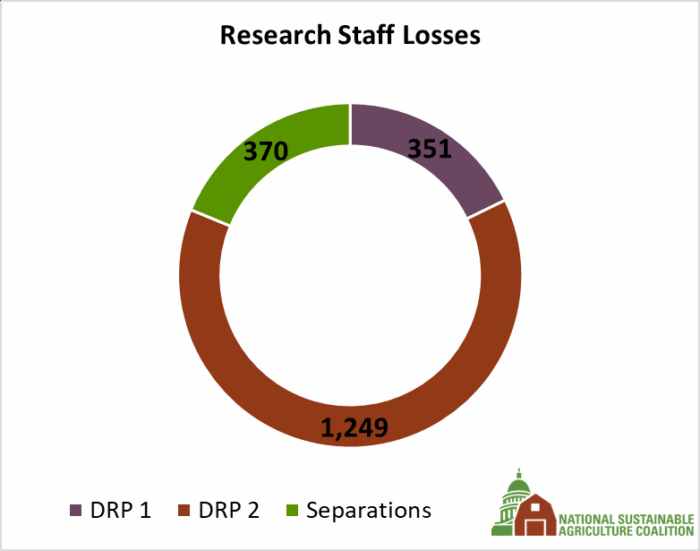
According to the Office of Personnel Management (OPM), approximately 370 additional staff separated from the research agencies between January and March 2025. Separations include staff who retired (voluntary, early, or for disability), quit, had their contracts expired or terminated, were fired, transferred to a different agency, or otherwise separated from employment.
Table 1: Research Staff Losses by Agency
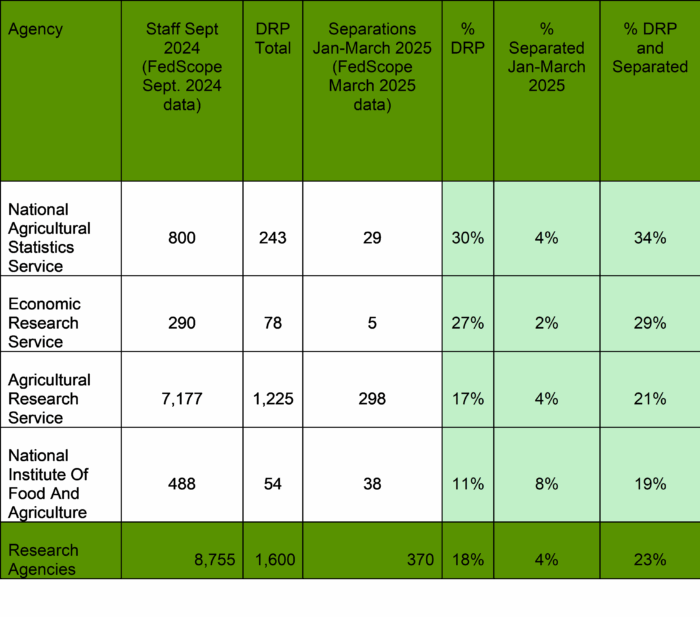
NASS, the internal statistical branch of the USDA, has lost the highest percentage of staff since January 2025 among research agencies, losing approximately 30% of their staff to DRP and 4% additional staff who separated from the agency. NASS collects hundreds of surveys on agriculture and food and prepares a wide range of reports on virtually every component of American agriculture. They administer the Census of Agriculture every five years, the only dataset that provides information on every American county and farm over time. They also collect and analyze data on every commodity and market in American agriculture. NASS provides essential unbiased data on US agriculture that undergirds farmers’ decisions and the decisions of policymakers.
ARS, the internal in-house scientific research agency of the USDA, has lost the largest number of employees since January 2025 among research agencies. ARS lost 1,225 employees to DRP and an additional 298 staff who separated from the agency between January and March 2025. ARS’s mission is to “deliver scientific solutions to national and global agricultural challenges” and they employ a wide range of scientists and staff at a network of research sites throughout the country, often in partnership with universities and private sector companies. The loss of ARS staff undermines the ability of the agency to fulfill its mission and provide the research needed by American farmers and ranchers. ARS researchers, in particular, are highly specialized scientists with skills that are very difficult to replace.
The loss of ARS scientists means that several research projects vital to the resilience of American agriculture have already stopped. In an interview with Wyoming Public Radio, two former ARS researchers talked about the losses caused by the loss of staff such as themselves. According to one scientist: “I worked directly with a lot of farmers, visiting farms, going to meetings of farmers, and making sure that they had the most up-to-date research to inform their management decisions. Also listening to what challenges they were facing, and making sure that those challenges were being reflected in the research that the Agricultural Research Service was doing [and] bringing those concerns back to the researchers.” The scientist further shared: “All my projects revolved around helping smaller farmers deal with the **:{impacts of drought in this region and all of those projects have been cancelled.”}:
The nearly 2,000 employees lost from USDA research agencies directly hinder the ability of the department to fulfill its mission to “advance scientific knowledge related to agriculture.” These staffing losses and administrative setbacks have already led to significant disruptions including delaying or deferring several NIFA research programs for fiscal year 2025. The Foundational and Applied Science Program, for example, was delayed so significantly that the fiscal year 2025 program was skipped altogether and the request for applications is now for fiscal year 2026.
The Reorganization Will Further Degrade Research Agencies
USDA research agencies are already experiencing significant losses in their ability to serve stakeholders and the planned reorganization will cause further damage.
ARS is hit particularly hard by the planned reorganization. The reorganization includes a plan to close the Beltsville Agricultural Research Center (BARC), located in Beltsville, Maryland. BARC has operated since 1910. Comprising approximately 6,000 acres of agricultural research fields and facilities, BARC is the largest ARS research facility and hosts research on food animal production, animal health, entomology, food safety, water management, soil quality, air quality, rangeland systems, sustainable agriculture, plant genetics, plant diseases, crop protection, crop production and virtually every aspect of agricultural production systems.
BARC has produced impactful research for over a century, benefiting American farmers and agriculture. For example, BARC researchers developed and licensed a patented antibody designed for wide-spectrum identification of potyviruses, a major group of plant viruses with high economic impact. These anti-viral technologies are now widely developed and sold by Agdia to detect and prevent potyviruses in a variety of crops such as beans, potatoes, and industrial hemp and prevent billions in lost productivity every year.
Photo by Kaitlan Balsam on Unsplash
Closing and relocating the Beltsville facility will be extremely difficult and costly and will cause unavoidable damage to research productivity. Long-term field studies are particularly important to agricultural research to understand the long-term functioning of agricultural systems such as soil health and pest burden. The long-term field research at Beltsville cannot simply be relocated, and losing these field sites means losing irreplaceable scientific knowledge. Relocating facilities such as the Electron and Confocal Microscopy Unit (ECMU) would be extremely difficult and expensive, if possible at all. While the USDA reorganization plans to close and relocate BARC over several years to minimize research disruptions, experts are highly doubtful that the closure would be able to do so or would generate any cost savings.
Despite claiming to want to move the Department closer to farmers, the reorganization also calls for the closure of ARS Area Offices. ARS is currently divided into five geographic areas: Northeast, Southeast, Midwest, Plains, and Pacific West. Each area has an Area Office that oversees the facilities and staff in that region, ensuring that the research addresses regionally significant topics and problems. Closing Area Offices would undermine the ability to prioritize regional issues and weaken connections to farmers and stakeholders in the region. It would also mean administrative processes such as hiring and facilities management would be funneled through a single national office, creating delays and inefficiencies and would undermine the important regional partnerships and networks with collaborators such as land-grant universities. Closing ARS Area Offices will not “streamline” services, it will weaken local accountability and slow down work.
Likewise, the reorganization calls for the closure of NASS regional field offices to be replaced with offices in five new USDA hubs. NASS has twelve regional field offices in the country, each responsible for the statistical work in that region. These field offices oversee the data collection and management in the states of their region and provide the data and statistics for those states. The field offices are essential to maintaining stakeholder relationships and making sure that farmers and ranchers in every state and region are adequately represented in national statistics. Consolidating NASS offices to the newly proposed hubs in Raleigh, North Carolina; Kansas City, Missouri; Indianapolis, Indiana; Fort Collins, Colorado; and Salt Lake City, Utah would leave large swaths of the country unrepresented. Farmers and ranchers in the Northeast and West Coast, in particular, would have inadequate representation to ensure they are adequately included in agricultural statistics.
NASS regional offices are essential to improving farmers’ trust of the agency and to boosting survey response rates from farmers. Ensuring every farmer is counted in national statistics is essential and regional offices are vital to that effort.
The Deterioration Continues: Staff Losses at ERS and NIFA Since 2019 Relocations
Despite significant public outcry, ERS and NIFA were relocated to Kansas City, Missouri in 2019 during the previous Trump Administration. ERS provides research on economics and agriculture, producing research on future commodity price projections, farm income, and essentially all aspects of American agriculture and rural communities. The economic reports and research generated by ERS are used by farmers, policymakers, and other stakeholders as they make major decisions for the agricultural economy such as changes to commodity programs or loans. NIFA oversees the department’s competitive grant programs, investing in research, education, and extension programs for American agriculture. NIFA funds universities and other partners to advance agricultural science, innovation, and education nationwide.
This relocation of ERS and NIFA led to hard-learned lessons concerning how destructive relocations can be. According to the Government Accountability Office (GAO), these staff losses reduced the number of reports and articles generated by ERS staff in half and led to the loss or delay of several vital industry reports. The loss of these publications and reports meant that farmers and other stakeholders had to make risky decisions with less information. Within NIFA, the relocation led to delays and suspensions of several grant programs and payments. For example, land grant universities across the country struggled as NIFA’s Capacity Grants that support basic research facilities were delayed by more than a fiscal quarter, undermining the research and services of those universities. When NIFA grants are delayed or suspended, vital research is threatened and American farmers and the agricultural sector suffer.
It has taken years for ERS and NIFA to rebuild their capacity following the relocation and attempt to replace the lost institutional knowledge needed to serve American agriculture and stakeholders. But both agencies are again being decimated by staff losses. ERS has lost 27% of their staff to DRP and an additional 2% to other separations. NIFA has also experienced widespread staffing losses since January 2025. NIFA lost 11% of their staff to DRP and an additional 8% to other separations. These staffing losses have already led to delayed and deferred grant programs and will, we can infer based on recent history, lead to further losses in research productivity and delays that undermine American agriculture.
USDA’s Research, Education, and Economics mission area that houses ARS, ERS, NASS, and NIFA is tasked with providing reliable scientific research, data, and analysis for America’s farmers, ranchers, rural communities, and stakeholders. The staff in these agencies are highly skilled and specialized workers who are dedicated to public service. Each of the four agencies have already lost overwhelming numbers of staff and the planned USDA reorganization will further compromise their ability to fulfill their missions.
Filed Under: Carousel, Research, Education & Extension, Staffing
---
---
E AND E GRNWIRE
NO LNX IN ORIG?
USDA defends secretive rollout of reorganization plan
:{By Marc Heller | 07/31/2025
The surprise reorg announcement last week was a flash point at a hearing Thursday, where senators expressed displeasure about being left in the dark.
Stephen Vaden testifying.
Deputy Agriculture Secretary Stephen Vaden on Wednesday. Senate Agriculture Committee
The Department of Agriculture deliberately kept lawmakers in the dark about its plan to reorganize the agency for fear the information would leak out if shared with their offices, Deputy Agriculture Secretary Stephen Vaden told a Senate committee Wednesday.
Vaden, the USDA’s No. 2 official behind Agriculture Secretary Brooke Rollins, said at a Senate Agriculture, Nutrition and Forestry Committee hearing that officials took the secretive approach out of “common courtesy and respect” to the department’s nearly 100,000 employees whom officials wanted to inform first about the sweeping plan.
“There was a thought to that,” Vaden said, responding to complaints from Democrats and Republicans alike about the lack of prior consultation with Congress.
“The employees are the ones who are most directly affected by the secretary’s decision,” Vaden said. “They should hear that decision from the secretary first, and not from a leak that originated from somewhere else.”
The surprise nature of the reorganization announced last Thursday was a flash point at the hearing, where a few Republicans joined Democrats in expressing displeasure that the Trump administration didn’t involve them in the decision.
Agriculture, Nutrition and Forestry ranking member Amy Klobuchar (D-Minn.) said the committee learned of the plan just minutes before it was announced.
Vaden’s assertion that concern for employees was the top priority fell flat with the American Federation of Government Employees, which represents USDA workers. The department didn’t consult in advance with labor representatives either, although consultation is required by federal law when an agency seeks to reorganize and relocate workers, said an AFGE spokesperson, Tim Kauffman.
The USDA plan includes relocating about 2,600 of the agency’s 4,600 Washington-area employees to five regional hubs to be created from North Carolina to Utah.
“The heart of USDA is in the field,” Vaden said, noting that 90 percent of agency workers are already located away from the nation’s capital.
Big plans, big questions
The department’s South Office Building in Washington would be closed, but the Jamie L. Whitten headquarters building with top-level management would be retained.
The USDA research station at Beltsville, Maryland, would close over the course of a yet-to-be-determined number of years, and the Forest Service would dismantle its nine regional offices and shift a yet-to-be-determined number of employees to other locations.
In all, the plan would save the department around $4 billion, Vaden said, although he didn’t offer an estimate of upfront costs. A reduction in force isn’t planned, the USDA has said, although Rollins projected as many as half of Washington-area employees may elect not to relocate.
Few new details about the plan emerged at the hearing, where Vaden fended off vigorous complaints from Democrats and tried to reassure a few skeptical Republicans that officials will collaborate with them from now on.
“The consultation process has just begun,” Vaden said after taking a verbal lashing from Klobuchar, who’d asked whether the agency had run its ideas past the American Farm Bureau Federation, National Farmers Union, or White House Office of Management and Budget.
Vaden didn’t directly answer whether the Farm Bureau — the nation’s biggest lobbying group for farmers — had any input. He said the agency hadn’t consulted with the NFU.
Sen. Amy Klobuchar (D-Minn.) at a hearing Wednesday, May 21, 2025.
Senate Agriculture ranking member Amy Klobuchar (D-Minn.) had sharp words for the Agriculture Department’s reorganization plan. | Jacquelyn Martin/AP
Officials did submit a plan to OMB, Vaden said, although it wasn’t clear if the submission to OMB is the same one the department announced in a news release.
“A plan was submitted to the Office of Management and Budget, and they’re aware of our current plan,” Vaden said.
Klobuchar called the announcement a “half-baked plan with no notice” that would exacerbate the strain caused by the administration’s push to reduce the USDA workforce — an effort that’s yielded some 15,000 departures so far, mostly through deferred resignations.
Klobuchar, who like other Democrats opposed Vaden’s nomination a matter of weeks ago, reminded him that he’d struck a tone of coordination with the committee at his confirmation hearing earlier this year.
“I did not vote for you,” Klobuchar said, “but I did think that you would go in based on your experience and be able to do things that would actually help rural America.”
She added, “I actually took you at your word when you had pledged to work with us on things that would help. That’s not what happened here when we had absolutely no notice about what you were going to do.”
‘Washington is cost-prohibitive’
Some Republicans took issue with not being consulted as well. Sens. John Hoeven of North Dakota and Deb Fischer of Nebraska said they wished the agency had shared the news ahead of time, if for no other reason than to let their states make a case for becoming a hub location.
Hoeven, chair of the Agriculture Appropriations Subcommittee, added that the reorganization will have upfront costs that could be addressed in spending bills for the fiscal year beginning Oct. 1. Those bills have already moved through congressional committees.
“It’s going to change your funding needs,” Hoeven said.
Hoeven, too, pointed to the contrast between the USDA’s unilateral strategy now and its approach during the first Trump administration to relocate the Economic Research Service and the National Institute of Food and Agriculture from the nation’s capital to Kansas City, Missouri.
In that move — which Vaden helped craft as the USDA’s chief counsel at the time — the department hired an outside consultant to conduct a competition that communities could enter.
A total of 136 parties in 35 states, and some of their elected leaders in Washington, made the case for hosting ERS or NIFA. The USDA picked Kansas City based on lower costs of living and other factors after a nearly yearlong review.
Sen. John Hoeven (R-N.D.) at a hearing on Jan. 23, 2025.
Sen. John Hoeven (R-N.D.) pointed out that the reorganization would have an impact on annual appropriations. | Angelina Katsanis/POLITICO
“That’s kind of what we’re looking for this time,” Hoeven said at Wednesday’s hearing, adding that the USDA would have no hub offices within 600 miles of North Dakota. “And we’re in the heart of ag country.”
Vaden said the five hub locations — Fort Collins, Colorado; Salt Lake City; Indianapolis, Raleigh, North Carolina; and Kansas City — make sense because of lower costs of living, already-in-place USDA workforces and proximity to rural areas, measures the department also cited in selecting Kansas City for the ERS and NIFA moves.
“The cost of living here in Washington is cost-prohibitive,” Vaden said, adding that officials want to encourage employees to spend their careers with the USDA and make their salaries go further.
On the merits of the plan, Vaden faced a more mixed, and often friendly, reception.
Klobuchar was the most critical, questioning why the USDA would seek to shutter and consolidate research facilities, and potentially lose researchers in the process, on the heels of deep cuts already in place or proposed.
But Vaden pushed back, saying the plan would close only four research facilities out of 94 across the country. Work now done at the Beltsville facility would continue in other locations, he said.
The reorganization and closing of buildings has solid legal grounds as well, Vaden said. Buildings need to be at least 60 percent occupied — a requirement the targeted Washington buildings don’t meet — and agencies offices are supposed to be as close as possible to constituents, he said.
The 60-percent threshold, Vaden added, is in the “Use It Act,” which was part of the Water Resources Development Act, and signed by then-President Joe Biden in January.
“That is exactly what USDA is choosing to do, follow the law this body passed,” Vaden said.
‘A political calculation’
Vacating four buildings in Washington will save the USDA around $2.2 billion in deferred maintenance costs, Vaden said. He said officials don’t yet know how much will be saved through less expensive rent on leased buildings in the hub areas.
Lawmakers on both sides of the aisle said they endorse the idea of having USDA employees closer to constituents and support more efficient operations.
Vaden didn’t offer much detail on how specific USDA agencies will be affected. The plan is still being ironed out, he said. But he said the Salt Lake City location will be important for the Forest Service as that agency’s nine-region office structure is abandoned.
The Forest Service plans won’t interrupt wildfire operations, Vaden said. Officials picked the USDA hubs in part to support the Forest Service “and especially its aviation needs,” Vaden said.
He said the department wants to build on the Forest Service’s presence in locations such as Colorado and Utah, although the plan doesn’t put Forest Service leadership in California or the Pacific Northwest.
California Sen. Adam Schiff, a Democrat, lamented what he said looks like an extended political swipe at his state. Vaden denied that was the case.
California faces the possible closure of a USDA research facility, has seen conservation grants for farmers canceled and was deemed ineligible for the latest round of farm disaster aid, Schiff said.
“It’s hard not to perceive this as a political calculation rather than one that’s in the best interest of farmers, given our dominance in agriculture,” Schiff said.
Vaden said the latest round of disaster aid was targeted at farmers with crop insurance, and that a later round will address specialty crop growers like those in California — and that politics didn’t play a role.
“That’s not the case at all,” Vaden said.
Contact this reporter on Signal at hellmarcman.49.
---