alberta
==
MERRI OK
see tar sands, koch
el tejas de la norte? ALTA TEJAS
---
-=-=
-=-=
an 8 26
President Donald Trump’s administration continues to provoke right-wing extremists who want members of a Canadian province to secede from their nation, continuing a trend that has persisted since the start of the Republican’s second term.
“The separatists have good reason to think the Trump administration could be an ally,” reported Politico's Mickey Djuric on Sunday. “In January, Treasury Secretary Scott Bessent called Alberta a ‘natural partner for the U.S.’ while referencing the province’s ‘great resources.’
According to Djuric, Bessent told conservative podcaster Jack Posobiec that “people are talking. People want sovereignty. They want what the U.S. has got.”
Even though only 30 percent of Albertans want to secede from Canada, Djuric reported experts are worried they might succeed simply because the pro-union Albertans could stay home out of an excess of confidence that they will pull off secession during the October referendum. One such Albertan is Keith Walker, who lives in a small farming community in southern Alberta and supported Trump’s trade war against Canada by describing Prime Minister Mark Carney’s administration as communism. He compared Trump’s tariffs against Canada to his military campaigns against Cuba, Iran and Venezuela, confidently telling Politico that “that’s why that’s happening.”
Another secessionist told Djuric that “Trump is the only one that can save us,” while the Politico journalist reported that “people have wrapped themselves in Alberta’s flag, wave ‘we’re done’ banners and wear ‘Trump 2024’ and MAGA — Make Alberta Great Again — ball caps. This is an ‘Albertans’ Day’ gathering at the Whistle Stop Cafe, which gained notoriety for bucking pandemic-era rules and which former Alberta premier Jason Kenney calls ‘ground zero’ for the province’s fast-growing separatist movement.”
Djuric added that while “resentment toward the federal government in Ottawa is longstanding in Alberta,” the movement has been “supercharged” by “Trump and the increasingly toxic U.S.-Canada relationship. The separatists are furious about Carney’s friction with Trump and the fraying ties to their southern neighbor. Some even hope the Trump administration might help their cause.”
He also pointed out that “many separatists believe Trump’s presidency makes Alberta’s independence possible, with the United States a ready customer for its oil and gas should they split from Canada. One group, the Alberta Prosperity Project, is trying to seek a C$500-billion U.S. government loan to fund the province’s ‘seamless departure’ from Canada.” Meanwhile Casey Phillips from Edmonton, Alberta declared that “I like freedom and less taxes,” arguing that this justifies Alberta trying to leave the Canadian union.
In February a former senior State Department official warned NBC News that Trump’s cultivation of Albertan separatists is “irresponsible as hell,” continuing that “it’s really irresponsible for the United States to be engaging with these kinds of people, because it just encourages behavior that cannot be in the U.S. national interest.” By contrast, in January Treasury Secretary Scott Bessent argued that "I think we should let them come down into the U.S. and Alberta's a natural partner for the U.S. They have great resources. The Albertans are very independent people... [There is a] rumor that they may have a referendum on whether they want to stay in Canada or not."
He concluded, "People are talking. People want sovereignty. They want what the U.S. has got."
-=-=
---
AN 3 26
For many years, Canada and the United States — both members of the North Atlantic Treaty Organization (NATO) since 1949 — were close allies and trading partners. But U.S./Canada relations took a turn for the worse when U.S. President Donald Trump threatened its northern neighbor with steep tariffs and called for Canada to become "the 51st state" — an idea that Prime Minister Mark Carney and millions of other Canadians are adamantly against.
But in an article published by The New Republic on March 2, Ottawa, Ontario-based journalist John Last details MAGA efforts to exploit separatists in Canada's Alberta province.
Last explains, "Recent months have seen the escalation of a brazen campaign by separatists in the oil-rich province of Alberta to dismember the country and lease its resources to an expansionist American regime, with direct support from officials in the U.S. government…. A recent push for a referendum on independence has achieved unprecedented success, in no small part due to tacit support from the Trump-aligned provincial government."
Last notes that Alberta Premier Danielle Smith "was one of the first Canadian officials to kiss the ring of Trump at Mar-a-Lago, and has long tested the limits of her powers to pursue his crusades and causes at home."
Duane Bratt, who teaches at Mount Royal University in Alberta, told The New Republic, "Since the moment Alberta became a province (in 1905), there's been a movement to separate…. There is an ideological alignment with Trump. On gun rights, climate change, trans rights, renewable energy, wokeness.… it's all consistent with American right-wing movements."
Patrick Lennox, a former intelligence officer for the Royal Canadian Mounted Police, told The New Republic, "There's a real national security threat there. This is the perfect scenario for foreign interference."
Lennox views as the capture of former Venezuelan President Nicolás Maduro as a "warning shot" for Canada and other countries rich in resources.
"The Trump Administration's crusade against Canada may have deeper causes," Last explains. "Figures like Stephen Miller and Steve Bannon, who has explicitly compared Canada to Ukraine, see Canada as a bastion of decadent liberalism in the West that must be broken and subdued, one way or another."
---
---
AN 1 26
A small contingent of an oil-rich province in Canada that desperately wants to join the United States met with President Donald Trump's administration.
The Financial Times reported on Thursday that Trump aides met with the Alberta Prosperity Project, which is a group of far-right separatists who want to leave Canada. Since last April, Trump's State Department officials have met with the group at least three times in Washington, the report said.
"They are seeking another meeting next month with state and Treasury officials to ask for a $500 billion credit facility to help bankroll the province if an independence referendum — yet to be called — is passed," said the report.
According to the group's attorney, Jeff Rath, who was at the meetings, “The US is extremely enthusiastic about a free and independent Alberta."
He went on to brag that he has a better relationship with the Trump administration than Canadian Prime Minister Mark Carney who hammered Trump in a speech at the World Economic Forum.
The State Department downplayed the multiple meetings however, saying, “The department regularly meets with civil society types. As is typical in routine meetings such as these, no commitments were made.”
The White House echoed the statement, adding that there was no commitment of financial support.
Neither Treasury secretary Scott Bessent nor anyone at the Treasury Department knew anything about a "credit facility proposal," said a person familiar when talking to FT. They said they have no intention of engaging.
Canadian conservatives, however, view the group as people who are only looking for attention.
Carlo Dade, at the Canada West Foundation, “The Americans are more than happy to continue to play Canadians off each other."
Indeed, Bessent commented to a white supremacist podcaster that Alberta is a "natural partner" for the U.S. to make given that the province has so much oil.
“The Albertans are very independent people,” the secretary said. “[There is a] rumour that they may have a referendum on whether they want to stay in Canada or not.”
However, Ipsos polling shows that only 3 in 10 residents in Alberta and Quebec would vote to secede from Canada. Still, the separatists are gathering signatures for a petition to deliver to the legislature.
FT added that it's part of deteriorating diplomatic relations between the U.S. and Canada.
---
---
moron gmail 11 22
tensions ran high during today’s Public Order Emergency Commission hearing as Commissioner Paul Rouleau ejected Freedom Convoy lawyer Brendan Miller while Miller attempted to raise issues regarding outstanding motions about the government’s redaction of documents.True North’s Andrew Lawton discusses the explosive turn in the proceedings in this live edition of The Andrew Lawton Show. Also, world leaders descended on Egypt for COP27 – or the big Sharm El-Sheikhdown. ClimateDepot.com‘s Marc Morano joins Andrew to break down the eco-virtue signalling global leaders are partaking in, and how climate lockdowns will soon replace Covid lockdowns. Also, what does Alberta’s new premier mean for Alberta’s energy sector? Alberta Proud president Lindsay Wilson weighs in.
---
==
https://www.desmog.com/2022/09/20/petroleum-papers-geoff-dembicki-oil-sands-canada-exxon-imperial-syncrude-climate-denial/
Imperial Oil might not be a household name in the United States, but the company, which is mostly owned by ExxonMobil, is a big name in Canada. There, it’s one of the major players in Canada’s oil sands — the name for the vast fields containing a tarry mixture of sand, water, and the thick, heavy oil called bitumen — that were first mined in 1967. These oil sands, sometimes called “tar sands,” which lie in northern Alberta, are one of the largest oil reserves in the world.
But the oil that comes from them is distinctive in several ways. Oil sands’ unique texture means it takes more money and energy to refine than traditional crude. In addition, its oil is some of the most carbon-heavy in the world, with up to 20 percent higher emissions, and that has drawn the attention of climate advocates. Because of these factors, asGeoff Dembickiexplains in his new book The Petroleum Papers: Inside the Far-Right Conspiracy to Cover Up Climate Change (Greystone Books, September 20),oil sands producers and refiners, like Imperial Oil or Koch Industries, are particularly vulnerable to any efforts to mitigate climate change that would increase the already higher costs of extracting and refining bitumen.
Dembicki’s book illuminates for the first time how these industry players profited from Canada’s oil sands and then spun those profits into international networks of climate denial that would help extend the oil sands’ lifetime. “Bitumen from Alberta bankrolled the assault on truth led by companies such as Koch Industries and Exxon,” he writes. Dembicki drew heavily on the Imperial Oil Files we published in 2019, relying on internal company documents that demonstrated not only that Imperial Oil knew about climate change by the late 1970s but also that it studied climate solutions — so that it could try to shut them down. As he explains in the book, “Canada could slow down climate change, or it could tap one of the world’s largest oil reserves — but it couldn’t do both.” It chose the oil sands.
Those oil sands–fueled efforts to spread climate denial and delay action aren’t just a thing of the past. As Dembicki demonstrates, “the machinery of Big Oil’s climate crisis denial” continues its work influencing U.S. and Canadian politics even today.
We spoke with Dembicki ahead of the release of The Petroleum Papers. The following conversation has been edited for length and clarity.
Lindsey J. Smith
I want to start with a really simple question: Why write about the oil sands?
Geoff Dembicki
For me, it’s kind of personal because I was born and raised in Edmonton, Alberta. That’s only a few hours’ drive south of the oil sands and, literally, my childhood home was just down the road from a huge oil refinery, and friends and family worked in the oil and gas industry. As I got older, I just wanted to have a better understanding of the industry. And then, of course, once I learned about the massive climate impacts it was creating, and how some of the companies involved with that industry had covered up those impacts and lied to the public that just got me more and more curious.
SMITH
Do you think that other people, even people who are informed about climate change, are aware of the oil sands and of their climate impact?
DEMBICKI
There is a bit of awareness of that, especially in Canada. But part of the reason I wanted to do this book was to really educate readers in the U.S., and in Canada, and all over the world, just about the massive climate impacts that this gigantic oil industry has created. I think when a lot of Americans imagine foreign oil, they’re thinking about like Saudi Arabia, or something, but a huge part of the oil that Americans use every day, and that Canada sends to the U.S., comes directly from the oil sands. And it’s not just like the physical properties of oil that affect what’s happening with climate change. As I explain in the book, there’s a long history of sort of very powerful conservative forces — like Koch Industries, or even going back to Howard Pew in the 1950s and ’60s, and these are people who had a very sort of reactionary, far-right view on the world — and Canada’s oil was important to those types of business people and really funded and made possible this torrent of a very conservative politics, which has had a massive impact on our ability to deal with the climate emergency.
SMITH
A great example of that in the book is thePine Bend refinery owned by Koch Industries.
DEMBICKI
Yeah. I had known that Koch Industries owned and operated this refinery in Minnesota for a while, but I don’t think I knew how central it was to their company and to their history until I started doing more research for this book. Because it [is] placed so closely to the Canadian border, they could import all of this oil from Canada, which other U.S. refiners didn’t usually take because it was lower quality and required specialized equipment. And so the Kochs were able to do that in their Minnesota refinery and then they can sell the processed oil as gasoline and whatever else at extremely high margins. This created so much money for Koch Industries in the early days that it really allowed the company to become the massive industrial behemoth that it is now. And then, of course, everyone knows the political impact of the Koch brothers becoming so wealthy, which is like an absolute restructuring of our entire political system along free market, anti-government, climate denying lines. So I was just amazed at the central role that oil from Canada played in all of that.
Canadian oil sands giant Suncor Energy’s plant. Credit: [Suncor Energy (CC BY-NC-ND 2.0)
SMITH
I think that’s something that will surprise a lot of readers. Beyond Koch Industries, I’m wondering if you could briefly summarize the web of denial connected to the oil sands?
DEMBICKI
Part of the reason we named the book “The Petroleum Papers” is because I was drawing heavily on this large archive of documents that DeSmog and some others obtained, called the Imperial files, which is a record going back decades of what this company discussed internally in terms of the environment and climate change. Imperial Oil was doing all of this research on climate change, going back to like the 1960s even, and then sharing a lot of that research with Exxon executives. The documents are quite, quite amazing and kind of because they show how scientists inside Imperial and Exxon not only studied climate change internally long before the public knew about it, but they also anticipated that climate change would become a major public policy issue. They were really worried that there would be government regulations that would make their oil sands operations no longer profitable. And so before this issue was even clearly defined for the public, Imperial Oil was already figuring out ways to not only discredit the science of climate change, but also to discredit solutions that could fix the climate emergency too.
SMITH
What solutions were they studying?
DEMBICKI
There’s a document from 1993 that was one of the most alarming that I saw in the entire course of doing research for this. Basically, in the early ’90s, climate change was just starting to become a publicly known issue, but it was very ill-defined so people didn’t really know what to think of it. So Imperial Oil decided to model a bunch of different potential solutions for climate change internally so it would know how to respond. Imperial studied a bunch of different solutions… [and] determined that if there was this price on carbon emissions across the whole economy, this could actually have a really big positive impact on fighting climate change.
And then, this part, which was not known before and it was just included in a few footnotes in Imperial’s research, was that in the early days of bringing in such a policy, there would be an economic hit mostly through oil refineries and stuff being closed down. But Imperial actually determined that all of the tax revenue from a carbon price would create this huge amount of money that governments could then spend on green infrastructure and other forms of climate stimulus. And this would actually have a positive impact on the economy. I was just floored by that because it’s like, decades and decades ago, Imperial basically acknowledges that you could do a big part in fixing climate change, and it actually wouldn’t hurt the economy at all, it would probably be good for it. It would just be bad for Imperial Oil, and the oil sands. In this document in 1993, Imperial Oil came up with aconfidential plan to misrepresent its own research to policymakers and government and media. There were all of these talking points emphasizing the uncertainty of climate solutions, how it would be bad for the economy, it would hurt international competitiveness.At this very early stage, when we could have made a big impact in fighting the climate emergency, Imperial had already planted these seeds of sabotage and denial.
---
Read: Exxon Could Have Helped Stop Climate Change 30 Years Ago, ‘Proprietary’ Docs Show
---
SMITH
Wow, that’s infuriating. A lot of the latter half of the book focuses on these climate lawsuits that have come up in the last few years, including some led by a lawyer named Steve Berman, who managed to finally get a ruling in the courts against Big Tobacco. He and others are now trying to prove a similar thing with Big Oil: that these companies knew that their products were harmful, and they misled the public about that. So far, these climate lawsuits haven’t succeeded, but I’m wondering if you have any thoughts on what it might take for one to succeed?
DEMBICKI
I mean, it’s definitely a long game. With tobacco, it took decades to get any sort of ruling against the industry. That said, there’s been climate lawsuits against Big Oil, I believe, filed by more than 20 jurisdictions in the U.S. Those lawsuits haven’t resulted in any big rulings against the industry yet, but the fact that they’re still all sort of moving forward and clearing procedural hurdles is a big deal. To me, though, the most significant thing that these lawsuits do is really change the narrative around climate change. For so long, we’ve had this idea that no one specifically can be held responsible for climate change because it’s something that we all contribute to. But the climate change lawsuits flip all of that on its head, and they point directly at the oil and gas industry. And it’s not just for the emissions that that industry releases, even though they’re significant. It’s the fact that we had all these really good opportunities to bring in meaningful legislation and to clean up the economy, and the oil and gas industry has played a really bad faith role in sabotaging those solutions, spreading denial about them, confusing the public, flooding politics with their money. These lawsuits are pointing blame at specific companies, specific executives, specific industry groups, and I think that we’re still in the early days, but that’s really going to profoundly change how people see the climate emergency.
Suncor’s primary extraction plants separate raw bitumen from the sand in giant separation cells. Credit: [Suncor Energy (CC BY-NC-ND 2.0)
SMITH
One of the lawsuits in particular in the book that caught your attention is a case in Colorado against an oil refinery operated by Suncor, a Canadian oil sands company, in the greater Denver area. The lawsuit names both Suncor and Exxon and calls out the oil sands as a major contributing factor to the pollution locals are dealing with. Why is that lawsuit significant?
DEMBICKI
That one was interesting to me because it specifically named Suncor and Exxon. When I heard about that, I was like, “Oh, this is a lawsuit against the oil sands.” Suncor is the company that grew out of Sun Oil, which created the first commercial oil sands operation back in the ’60s. And the second big commercial oil sands operation was started by Imperial Oil, the Exxon subsidiary. Essentially, it’s litigation against the entire Canadian oil sands industry.
SMITH
Another thing that stood out to me in the book was that some of the U.S.’s early support for developing Canada’s oil sands had to do with wanting to have a friendly source of oil in the face of communism. I feel like we’re in a very similar moment right now, where oil and gas companies are capitalizing on a global political crisis to expand production. What can we take away from that past push to develop the oil sands that also applies to this moment we’re in?
DEMBICKI
I think there are two big takeaways for me, or almost like general principles of disinformation that I have observed taking place over many decades. One of them, as you pointed out, is that the oil and gas industry always, always loves to use a global political crisis for its own favor. Of course, the oil and gas industry isn’t in the business of trying to provide good faith solutions to geopolitical problems. They’re looking out for their profits, and that’s always been the case. So I think we can always expect oil and gas companies to try to turn any large global crisis in [their] favor.
The second big pattern I noticed was at the moments of greatest possibility in fixing the climate emergency, that’s when the disinformation and the torrent of denial will be at its loudest. When governments are close to bringing in huge structural changes to the economy to fight climate change, when that poses the biggest economic threat to oil and gas companies, that’s when their denial machine really just cranks up as loud as possible.[// Brulle]
Learn more about these issues by checking out Dembicki’s book and diving into the Imperial Oil Files.
---
---
... part two of Friends of Science Society's 18th Annual Event online will feature American author Marc Morano with "Green New Deal: The Great Regret".
== SPONSORED [sm font] no lnxNew Yorker Magazine Has a Moral Obligation to Open the Climate Debate Before COP26, says Friends of Science SocietyBy Friends of Science Society Sep 29, 2021 Updated Sep 29, 2021 Comments CALGARY, Alberta, Sept. 29, 2021 /PRNewswire-PRWeb/ -- In response to the Sept. 27, 2021, interview in The New Yorker with Swedish climate activist Andreas Malm
who advocates for 'intelligent sabotage' of critical infrastructure that underpins modern society,
The New Yorker is morally obliged to interview Swedish climate scientists like Hans Jelbring to calm the dangerous rhetoric of Malm before the November 2021 COP26 climate conference,
says Friends of Science Society. As discussed in the LA Review of Books of Jan. 2021, Malm's case is that humanity faces a 'hellscape' earth, and thus rather than march in the streets,
climate activists should sabotage equipment of energy developers and providers.Friends of Science says extremist rhetoric from Malm and groups like Extinction Rebellion exist because of the lack of media coverage of rational, dissenting, scientific views on climate change.The promotion of climate hysteria by Columbia Journalism Review's "Covering Climate Now" project exacerbates the public fears, where some 400 media outlets preach climate catastrophe to an audience of 2 billion people. This one-sided coverage and intentional polarization has now created a danger for society itself with media giving a profile to people like Malm. Local Trending News]A sober reading of the ~4,000-page United Nations IPCC AR6 report released last month, mentions 'climate emergency' and 'climate crisis' only once on a page about media coverage.
The alarming 'hockey stick' graph that appears in the IPCC Summary for Policy Makers (that makes it seem as if now is the hottest time ever) does not appear in the scientific document
as explained in this Friends of Science video – obviously an effort to manipulate policymakers and the media. The 'hockey stick' data set has been deconstructed by Steve McIntyre of Climate Audit.Roger Pielke, Jr.explains that this IPCC report has abandoned the view of a 'hellscape' future for humanity associated with a scenario known as RCP 8.5
and contrary to Malm's claim that wildfires and floods are evidence of climate change, Pielke, Jr.'s review shows the scientific report of the IPCC does not see any such trends. Pielke, Jr. and colleague Justin Ritchie have shown in a peer-reviewed study that most catastrophic thinking on climate has stemmed from persistent use of the RCP8.5 scenario 'as if business-as-usual' when it is implausible. These scenarios were only meant for climate research and not for policy making. Malm's claims about wildfires as evidence of climate change are misinformed, as Friends of Science Society explained last year to a SLATE journalist in this post and video.
Likewise, this year's alarming heat that occurred coincident to the tragic Lytton, BC fire can be understood by atmospheric conditions, as explained by Jean van Vliet and Brigitte van Vliet-Lanoie.Friends of Science Society calls on The New Yorker to be responsible and open up the debate on climate science with qualified scholars holding dissenting views
such as Swedish scientist Gösta Petterson (author of "Falskt Alarm/False Alarm" – his work promoted in English by Elsa Widding),
or any of the scientists and scholars of CLINTEL, the climate intelligence organization of over 900 signatory scientists and scholars who state there is no climate emergency.The CLINTEL World Climate Declaration can be read here.CLINTEL's president, Dr. Guus Berkhout, will be the first speaker at Friends of Science Society's 18th Annual Event, online, this Saturday, October 2, 2021, at 10 a.m. MDT/12 p.m. EDT .
Dr. Berkhout will present "Climate Science: Let the Data Speak" and will show how the actual data does not support the 'hellscape' fears and rhetoric of activists like Malm. On Oct. 6, 2021, at 7 p.m. MDT/9 p.m. EDT, part two of Friends of Science Society's 18th Annual Event online will feature American author Marc Morano with "Green New Deal: The Great Regret". There will be live Q&A following each presentation. Both events are free to the public. About Friends of Science Society is an independent group of earth, atmospheric and solar scientists, engineers, and citizens that is celebrating its 19th year of offering climate science insights.
After a thorough review of a broad spectrum of literature on climate change, Friends of Science Society has concluded that the sun is the main driver of climate change, not carbon dioxide (CO2).Friends of Science Society P.O. Box 23167, Mission P.O.Calgary, AlbertaCanada T2S 3B1 Toll-free Telephone: 1-888-789-9597 Web: friendsofscience.org E-mail: contact(at)friendsofscience(dot)org Web: climatechange101.ca Media Contact Michelle Stirling, Friends of Science Society, 8887899597, media@friendsofscience.org Twitter SOURCE Friends of Science Society
---
---
ding dong!
https://www.alternet.org/2021/06/is-keystone-xl/
comm dr
After more than a decade of grassroots organizing, agitation, and tireless oppositionby the international climate movement, the final nail was slammed into the Keystone XL's coffin Wednesday afternoon when the company behind the transnational tar sands pipeline officially pulled the plugon its plans.
Following consultation with Canadian officials and regulators—including "its partner, the Government of Alberta"—TC Energy confirmed its "termination" of the project in a statement citing the revocation of a federal U.S. permit by President Joe Biden on his first day in office on January 20 as the leading reason.
Climate campaigners, however, were immediate in claiming a final victory after years of struggle against the company and its backers both in Washington, D.C. and Ottawa.
"TC Energy just confirmed what we already knew but it's a thrilling reality all the same—the Keystone XL pipeline is no more and never will be," said David Turnbull, strategic communications director with Oil Change International (OCI).
OMG! It’s official. We took on a multi-billion dollar corporation and we won!! Keystone XL is dead!! The People m… https://t.co/BT5PAhBxmy
— Dallas Goldtooth (@Dallas Goldtooth) 1623271957.0
"After more than 10 years of organizing we have finally defeated an oil giant, Keystone XL is dead!" declared theIndigenous Environmental Network (IEN) in reaction. "We are dancing in our hearts because of this victory! From Dene territories in Northern Alberta to Indigenous lands along the Gulf of Mexico, we stood hand-in-hand to protect the next seven generations of life, the water and our communities from this dirty tar sands pipeline. And that struggle is vindicated."
IEN said that the win over TC Energy and its supporters was "not the end—but merely the beginning of further victories," and also reminded the world that there are "still frontline Indigenous water protectors like Oscar High Elk who face charges for standing against the Keystone XL pipeline."
Calling the news "yet another huge moment in an historic effort," Turnbull at OCI said that while the Canadian company's press statement failed to admit it, "this project is finally being abandoned thanks to more than a decade of resistance from Indigenous communities, landowners, farmers, ranchers, and climate activists along its route and around the world."
Jared Margolis, a senior attorney at the Center for Biological Diversity, declared the victory in the drawn-out battle—which largely took place under the Democratic administration of former President Barack Obama—"a landmark moment in the fight against the climate crisis."
"We need to keep moving away from dirty, dangerous pipelines that lock us into an unsustainable future," added Margolis, who said he now hopes President Joe Biden will take this lesson and apply to other polluting fossil projects. "We're hopeful that the Biden administration will continue to shift this country in the right direction by opposing fossil fuel projects that threaten our climate, our waters and imperiled wildlife," he said. "Good riddance to Keystone XL!"
After YEARS the #NoKXL fight is over. The Keystone Pipeline is finally dead. Now do #Line3 and #DAPL https://t.co/A7YukN0GR0
— RAN (@RAN) 1623274946.0
Jamie Henn and Bill McKibben, both co-founders of 350.org and key architects of the decision to make the Keystone XL pipeline a target and symbol of the global climate movement, also heralded the news.
"When this fight began, people thought Big Oil couldn't be beat." —Bill McKibben, 350.org co-founder
"When this fight began, people thought Big Oil couldn't be beat," said McKibben, who was among those arrested outside the White House in 2011 protesting the pipeline.
"Keystone XL is now the most famous fossil fuel project killed by the climate movement, but it won't be the last," said Henn. "The same coalition that stopped this pipeline is now battling Line 3and dozens of other fossil fuel projects across the country. Biden did the right thing on KXL, now it's time to go a step further and say no to all new fossil fuel projects everywhere."
Clayton Thomas Muller, another longtime KXL opponent and currently a senior campaigns specialist at 350.org in Canada, said: "This victory is thanks to Indigenous land defenders who fought the Keystone XL pipeline for over a decade. Indigenous-led resistance is criticalin the fight against the climate crisis and we need to follow the lead of Indigenous peoples, particularly Indigenous women, who are leading this fight across the continent and around the world. With Keystone XL cancelled, it's time to turn our attention to the Indigenous-led resistance to the Line 3 and the Trans Mountain tar sands pipelines."
McKibben also made the direct connection to KXL and the decision now looming before Biden when it comes to Line 3 in northern Minnesota. "When enough people rise up we're stronger even than the richest fossil fuel companies," he said. "And by the way, the same climate test that ruled out Keystone should do the same for Line 3."
From Your Site Articles
- The debate over mass shootings and domestic terrorism is about to ... ›
- When women become allies to save watersheds and wildlife ... ›
Related Articles Around the Web
- Biden shut down the Keystone XL pipeline. Here's what that means ... ›
- The Keystone XL pipeline is dead. Now what? ›
- Why Keystone XL Is Dead - Scientific American ›
---
---
221 desmog
Meanwhile, an 18-month inquiry led by the province of Alberta into environmental groups opposed to Canadian tar sands is nearing completion — but a Canadian NGO wants the CA$3.5 million inquiry disbanded, alleging that it was improperly established to intimidate opponents of the fossil fuel industry. Read more here.
---
https://theintercept.com/2020/12/08/great-reset-conspiracy/
no lnx
Back in June, the World Economic Forum, best known for its annual Davos summit, kicked off a lunge for organizational relevance at a time when it was already clear that, for the foreseeable future, packing thousands of people, injected-cheek by lifted-jowl, into a Swiss ski resort to talk about harnessing the power of markets to end rural poverty was a nonstarter.
The effort was called the Great Website — I mean the Great Reset. And through articles, videos, webinars, podcasts, and a book by WEF founder Klaus Schwab, it provided a coronavirus-themed rebranding of all the things Davos does anyway, now hastily repackaged as a blueprint for reviving the global economy post-pandemic by “seeking a better form of capitalism.” The Great Reset was a place to hawk for-profit technofixes to complex social problems; to hear heads of transnational oil giants opine about the urgent need to tackle climate change; to listen to politicians say the things they say during crises: that this is a tragedy but also an opportunity, that they are committed to building back better, and ushering in a “fairer, greener, healthier planet.” Prince Charles, David Attenborough, and the head of the International Monetary Fund all figured prominently. That kind of thing.
In short, the Great Reset encompasses some good stuff that won’t happen and some bad stuff that certainly will and, frankly, nothing out of the ordinary in our era of “green” billionaires readying rockets for Mars. Indeed, anyone with even a cursory knowledge of Davos speak, and the number of times it has attempted to rebrand capitalism as a slightly buggy poverty alleviation and ecological restoration program, will recognize the vintage champagne in this online carafe. (This history is explored in an excellent new book and film by the law professor Joel Bakan, “The New Corporation: How ‘Good’ Corporations Are Bad for Democracy.”)
Through its highly influential Global Competitiveness Report, the WEF has played a leading role in the transnational campaign to liberate capital from all encumbrances (like robust regulation, protections for local industries, progressive taxation, and — heaven forbid — nationalizations). Long ago, however, Schwab realized that if Davos didn’t add some do-gooding to its well-doing, the pitchforks that had started amassing at the foot of the mountain would eventually storm the gates (as they came close to doing during the 2001 summit).
SUISSE ANTI-WEF DAVOS MANIFATTACK
[Left/Top: Demonstrators walk over a WEF logo during a rally of opponents of globalization and the World Economic Forum in Geneva, Switzerland, on Jan. 24, 2003. Right/Bottom: Riot police officers attack students during a rally to protest a meeting of the World Economic Forum near the Shilla Hotel where the Geneva-based WEF opened a two-day summit in Seoul, on June 13, 2004.Photo: Martial Trezzini/Keystone/AP; Ahn Young-Joon/AP
And so the giddy sessions on new markets in Malaysia and new startups in California were complemented with somber ones on melting ice caps, United Nations development goals, “impact investing,” “stakeholder capitalism,” and “corporate global citizenship.” In 2003, Schwab introduced the tradition of each January summit having a big theme, starting with the appropriately chastened “Building Trust.” The new Davos tone, though, was truly set in 2005, when actor Sharon Stone, upon hearing Tanzania’s president speak of his nation’s need for mosquito nets to battle malaria, leapt to her feet and turned the session into an impromptu charity auction to purchase the nets. She raised $1 million in five minutes, and a new Davos era was on its way.
If Davos wasn’t “seeking a better form of capitalism” to solve the spiraling crises Davos itself systematically deepened, it wouldn’t be Davos.
The Great Reset is merely the latest edition of this gilded tradition, barely distinguishable from earlier Davos Big Ideas, from “Shaping the Post-Crisis World” (2009) to “Rethink, Redesign, Rebuild” (2010) to “The Great Transformation” (2012) and, who can forget, “Creating a Shared Future in a Fractured World” (2018). If Davos wasn’t “seeking a better form of capitalism” to solve the spiraling crises Davos itself systematically deepened, it wouldn’t be Davos.
And yet search for the term “global reset” and you will be bombarded with breathless “exposés” of a secret globalist cabal, headed by Schwab and Bill Gates, that is using the state of shock created by the coronavirus (which is probably itself a “hoax”) to turn the world into a high-tech dictatorship that will take away your freedom forever: a green/socialist/Venezuela/Soros/forced vaccine dictatorship if the Reset exposé is coming from the far right, and a Big Pharma/GMO/biometric implants/5G/robot dog/forced vaccine dictatorship if the exposé hails from the far left.
Confused? That’s not on you. Less a conspiracy theory than a conspiracy smoothie, the Great Reset has managed to mash up every freakout happening on the internet — left and right, true-ish, and off-the-wall — into one inchoate meta-scream about the unbearable nature of pandemic life under voracious capitalism. I’ve been doing my best to ignore it for months, even when various Reset “researchers” have insisted that all of this is an example of the shock doctrine, a term I coined a decade and a half ago to describe the many ways that elites try to harness deep disasters to push through policies that further enrich the already wealthy and restrict democratic liberties.
There has been a tsunami of examples of the real shock doctrine since the pandemic began: Trump’s attacks on Washington’s regulatory architecture; Education Secretary Betsy DeVos’s amped-up campaign for “school choice,” rather than, say, giving public schools the resources they need to keep children safe; Silicon Valley’s multiheaded power grab, which I wrote about as the Screen New Deal; the Modi government’s cruel attacks on price protections for India’s farmers (setting off a wave of heroic protests) — and so many more.
[US Education Secretary Betsy DeVos speaks at a school choice event in the Roosevelt Room of the White House on May 3, 2017 in Washington, DC. / AFP PHOTO / MANDEL NGAN (Photo credit should read MANDEL NGAN/AFP via Getty Images)U.S. Education Secretary Betsy DeVos speaks at a school choice event in the Roosevelt Room of the White House on May 3, 2017, in Washington, D.C. Photo: Mandel Ngan/AFP/Getty Images
What Schwab and the WEF are doing with the Great Reset is both more subtle and more insidious. Schwab is, of course, absolutely right when he says that the pandemic has revealed many deadly structural failures of capitalism as usual, as does the accelerating climate crisis and the hoovering of the planet’s wealth up toward the Davos class, even in the midst of a global pandemic. But like the WEF’s earlier big themes, the Great Reset is not a serious effort to actually solve the crises it describes. On the contrary, it is an attempt to create a plausible impression that the huge winners in this system are on the verge of voluntarily setting greed aside to get serious about solving the raging crises that are radically destabilizing our world.
Why? For the same reason I keep hearing Facebook ads on NPR podcasts telling me how much Facebook wants to be regulated. Because if our corporate overlords can create this impression, it is less likely that governments will listen to the rising chorus of voices calling on them to do what is required to actually combat spiraling poverty, joblessness, climate breakdown, and informational degeneration: regulate the companies that have created these crises, and tax them, break them up, and, in some cases, put them under public control.
The Great Reset is an attempt to create a plausible impression that the huge winners in this system are on the verge of voluntarily setting greed aside to get serious about solving the raging crises that are radically destabilizing our world.
So no, the Great Reset is not just another name for the Green New Deal, as many a right-winger with a digital chalkboard and an unhealthy AOC obsession is absurdly claiming. It is, first and foremost, about blocking a real Green New Deal, which most assuredly would not have the support of BP, Mastercard, the Prince of Wales, and all of the other Great Reset partners.
And yet, in recent weeks, a slew of right-wing commentators on Fox News, as well as Brazil’s minister of foreign affairs and prominent opposition politicians in Australia and Canada, have claimed to be confused about this and are suddenly giving oxygen to what was, until recently, amarginal conspiracy. Laura Ingraham, Tucker Carlson, and Ben Shapiro have all been terrifying their huge audiences with claims that green socialism is about to be forced down their throats via Schwab’s Great Reset, which, they explain, is the very same thing as President-elect Joe Biden’s “Build Back Better” plan, which is itself a thin cover for Rep. Alexandria Ocasio-Cortez’s Green New Deal. (Like an early fan of an indie punk band, Glenn Beck has been using his perch at The Blaze to point out that he was ranting about the Great Reset when it was just a gleam in Schwab’s eye.)
Do these people honestly think that Schwab is in cahoots with AOC and using the pandemic to put BP out of business — with the full cooperation of BP? Of course not. But President Donald Trump is on his way out, and the Green New Deal is popular — precisely because it is as far away from Davos as it could be, grounded in a polluter-pays ethos and in programs like a jobs guarantee and universal health care that enjoy broad working-class support. For right-wing politicians and the oil companies that back them, the more climate action can be conflated with an organization known for its traffic jams of private jets and its Bond villain founder, the easier it will be to resist any climate plan at all. That’s why the earliest alarmism about the Great Reset came from the Heartland Institute, ground zero of the climate change denial machine.
[Jason Kenney, leader of the United Conservative Party,speaks during a news conference in Calgary, Alberta, Canada, on Friday, April 5, 2019. Kenney said he would create a C$1 billion ($750 million) crown corporation to support Indigenous resource projects including pipelines if he's elected to lead Alberta's government this month, according to an emailed statement. Photographer: Todd Korol/Bloomberg via Getty ImagesJason Kenney, leader of the United Conservative Party, speaks during a news conference in Calgary, Canada, on April 5, 2019. Photo: Todd Korol/Bloomberg/Getty Images
This messaging is gaining traction not because people are suckers but because they are mad — and they have every right to be. Lockdown policies have demanded months of individual sacrifice for the collective good without providing the most basic collective protections to keep families from slipping into starvation and homelessness, or to keep small businesses afloat. Meanwhile, trillions have been spent to backstop markets and bail out multinationals, and pandemic profiteering is rampant. Is it any wonder that so many find it entirely plausible that the same elites who expect them to swallow all the coronavirus-related sacrifices while they party in the Hamptons and on private islands would also be willing to exaggerate the risks of the disease to get them to the accept more bitter “green” medicine, for the common good? As that first Davos theme made clear, trust between the people and the mountaintop has been broken — and it most certainly has not been rebuilt.
For a glimpse of how all of this fits together, take a look at what is going on in Alberta, Canada, under its truly reprehensible premier, one Jason Kenney. Kenney came to power pledging to serve as a shameless valet for the Alberta oil patch, specifically its extra-fast-planet-cooking tar sands. He promised to ram through all pipelines, no matter the opposition, and create a “war room” to surveil all opponents.
Back in March, in the early days of the pandemic, I observed that Kenney deserved the award for the most craven Covid-19 disaster capitalist because he had just laid off 20,000 education workers, supposedly to cover pandemic costs, even as he lavished $7 billion in public subsidies on the Keystone XL pipeline, despite the lockdowns having created a massive glut in crude oil. He followed up in the fall by laying off 11,000 health care workers, a clear effort to use the Covid-19 crisis to open the door to partial U.S.-style health care privatization.
It has surprised no one that Kenney has also presided over a U.S.-style coronavirus explosion, with the province’s positivity rate recently topping 10 percent (higher than the average south of the border). Now Kenney, a self-proclaimed big-government-bashing libertarian, has been reduced to begging Prime Minister Justin Trudeau for funds to build field hospitals.
Is it any wonder he has been looking to change the subject? Last week, Kenney did exactly that, selecting a question about the Great Reset during a Facebook livestream. The premier feigned horror at the idea that Klaus Schwab could possibly see Covid-19 as an opportunity to advance policy goals, describing the plan as a “grab bag of left-wing ideas for less freedom and more government” and “failed socialist policy ideas.” Warming up to his subject, he declared: “I’m not going to be taking any policy direction from Klaus Schwab and his ilk. … Heck no! We are not going to exploit or take advantage of a crisis to advance a political agenda. … It’s very distasteful and regrettable that influential people would explicitly seek to take advantage of a crisis like this to advance their own political vision and values.”
The online right rejoiced: “Jason Kenny Shows Real Leadership Rejecting Klaus Schwab’s New World Order!” declared one outlet, and I can’t bear to link to the many, many others.
Sadly, Kenney’s aversion to crisis opportunism comes late for the thousands of newly unemployed education and hospital workers in his province, or for the hundreds of patients who will soon be getting treatment in its field hospitals. And though Kenney was quick to say that the Great Reset was not a conspiracy theory and that the coronavirus is real, his statements were immediately seized upon by the growing numbers of people who are seriously convinced that Covid-19 is a hoax cooked up by Davos globalists to eliminate their private property, poison their brains with 5G, and take away their right to go to the gym.
In Alberta, thousands of those people participated in maskless “Walk for Freedom” marches last week. I have no doubt that Kenney meant it when he told them to cut it out, just as he no doubt wants Covid-19 to stop ravaging his province, along with his reputation. But what he wants far more is to stop the momentum toward climate action in coronavirus recovery plans so the oil companies that underwrite his party and government can wring out a few more profitable quarters. And he, along with growing numbers of similarly craven politicians the world over, sees fueling the Great Reset conspiracy as the most effective means of achieving that goal.
None of this is to say that Schwab’s Reset push is benign and unworthy of scrutiny. All kinds of dangerous ideas are lurking under its wide brim, from a reckless push toward more automation in the midst of a joblessness crisis, to the steady move to normalize mass surveillance and biometric tracking tools, to the very real (though not new) problem of Bill Gates’s singular power over global health policy. The irony, though, is that the fact-Vitamix currently whirring around the Great Reset actually makes it harder to hold the Davos set accountable for any of this, since legitimate critiques have now been blended together with truly dangerous anti-vaccination fantasies and outright coronavirus denialism.
It also makes it harder to talk about the profound realignment our economies and societies desperately need, a vision a group of us laid out in the short film we released way back in October called “The Years of Repair” — because now all talk about how we change for the better in response to the cruelties that Covid-19 has unveiled is immediately smeared as part of the Great Reset. As the historian Quinn Slobodian recently wrote, years after “The Shock Doctrine” was published, “the right was now appropriating this narrative for its own ends.” Meanwhile, the less fantastical but extremely real shock doctrine maneuvers currently waging war on public schools, hospitals, small farmers, environmental protections, civil liberties, and workers’ rights receive a fraction of the attention they deserve.
Is it all a plan, another kind of elaborate conspiracy? Nothing so elegant. As Steve Bannon kindly told us, the informational strategy of the Trump era has always been to “flood the zone with shit.” Four years later, we can see what this looks like in practice. It looks like far-left and far-right conspiracists sitting down over a tray of information-shit sandwiches to talk about how the Great Reset is Gates’s plan to use the DNA from our Covid-19 tests to turn the United States into Venezuela.
It makes no sense, and that’s just fine by the likes of Bannon, and Kenney as well. Because if you want to keep waging war on the Earth’s life-supporting ecology, a great way to do it is to deliberately pollute its democracy-supporting information ecology. In fact, the pollution is the point.
---
==
420 just bewildering
in environmental news, construction on the Keystone XL pipeline is set to resume. Officials in Alberta, Canada, said they would hand over more than $1 billion to TC Energy — formerly known as TransCanada — so that construction can continue, even though it risks putting construction workers and residents on the pipeline’s path — many of them from indigenous communities — at heightened risk for contracting the coronavirus. South Dakota and several other states recently passed new laws criminalizing protests against pipelines.
---
https://www.cbc.ca/news/politics/trudeau-western-canada-trans-mountain-1.5332365
no lnx pix
CBC
Trudeau extends olive branch to Western Canada, vows to build Trans Mountain despite opposition
John Paul Tasker · CBC News · Posted: Oct 23, 2019 3:56 PM ET | Last Updated: October 23
Prime Minister Justin Trudeau makes his way to a press conference at the National Press Theatre in Ottawa on Wednesday. (Sean Kilpatrick/Canadian Press)
Two days after much of Western Canada rejected the Liberals on election day, Prime Minister Justin Trudeau today vowed to be more sensitive to the needs of Alberta and Saskatchewan and to build the Trans Mountain expansion pipeline in the face of entrenched opposition from environmentalists.
Trudeau told a press conference in Ottawa this afternoon he clearly has to do more to earn the trust of people in the two resource-rich provinces. He said that work will start with ensuring more pipeline capacity is brought online so that oil producers can sell their product abroad at prices closer to the going world rate.
While Trudeau campaigned on a promise of more aggressive action to fight climate change, he said nothing has changed with respect to the government-owned Trans Mountain project and insisted it will be built after years of legal wrangling.
'In the interest of Canada'
"We made a decision to move forward on the pipeline because it was in the interest of Canada to do so, because the environment and the economy need to go together. We will be continuing with the Trans Mountain pipeline expansion," he said.
"Albertans and people in Saskatchewan have faced very difficult years over these past few years because of the global commodity prices, because of the challenges they are facing. For a long time they weren't able to get their resources to markets other than the U.S. We are moving forward to solve those challenges."
Lengths of pipe for the Trans Mountain expansion project are stacked at Edson, Alta. (Jason Franson/The Canadian Press)
If built, the 1,150-kilometre expansion project would nearly triple the existing pipeline's capacity to 890,000 barrels a day. It would transport product directly from Alberta's oilpatch to coastal B.C. for shipping to markets in Asia.
Trudeau has promised any profits from the existing pipeline — pegged at some$500 million a year in corporate tax revenue alone — and the planned expansion will be used to fund green-friendly initiatives to help tackle climate change.
The federal Liberal government has twice approved the $7.4-billion Trans Mountain expansion. Ottawa bought the project from its original U.S. proponent, Kinder Morgan, in 2018 after that company threatened to end all essential spending on the project in response to outspoken opposition from B.C.'s provincial NDP government.
Even after a stunning court decision in August 2018 quashed the Liberal cabinet's initial approvals, Trudeau promised to build the project "the right way." After another consultation process with Indigenous peoples and an improved environmental review, cabinet again approved the project in June 2019. The Federal Court of Appeal is currently reviewing an appeal by Indigenous groups of that second approval.
Trans Mountain's fate not up to MPs
While Trudeau might have to rely in this minority Parliament on vote support from the NDP and Green caucuses — two entities that have expressed strident opposition to Trans Mountain — the project's future does not depend on any one vote in the House of Commons.
In Canada, major natural resources projects like pipelines go through a regulatory review process led by the Canadian Energy Regulator (or, as it was known until recently, the National Energy Board) . It falls to cabinet, and cabinet alone, to give the project a final "yea" or "nay." And while those decisions are subject to judicial review, it's not up to individual parliamentarians to decide whether a particular project is approved.
Power & Politics
?
@PnPCBC
Asked why Liberals were wiped out in Alta. and Sask, @JustinTrudeau said: “Why did this happen is not the central issue we have. The central issue for me is how do we move forward in a way that responds to the concerns that Albertans and Saskatchewanians have clearly expressed.”
Embedded video
Trudeau said he has spoken recently with Western leaders like Calgary Mayor Naheed Nenshi about how the federal government can support a region that has struggled with slumping commodity prices and constrained export capacity.
"I will be reaching out specifically to westerners to hear from them ... to talk about how we can make sure that the concerns, the very real concerns of Albertans, are being addressed and reflected by this government," Trudeau said.
"This is something that I take very seriously, as a responsibility, to ensure that we are moving forward in ways that benefit all Canadians. I will be listening and working with a broad range of people to ensure that happens."
Trudeau rules out coalition, promises gender equity in new cabinet
Appointing a western senator to cabinet would be 'counterproductive', independent senator warns
Manitoba premier stands by federal carbon tax opposition, but says he wants to work with Ottawa
When asked if he'd appoint ministers from the two provinces, Trudeau said that is something he is now "reflecting on."
Trudeau said that not all past federal governments had representation from every corner of the country. He said there are other approaches that could offer regional representation; he didn't say what they are.
Some observers have suggested Trudeau could appoint new Western Canadian representatives to the Senate and have them sit as cabinet ministers to give Alberta and Saskatchewan a voice at the table. Former prime minister Stephen Harper appointed financier Michael Fortier to the Senate to give his government more representation from Quebec.
But Trudeau pointed out that the Senate appointment process is not like it was in the past, as nominations are now governed by an independent, merit-based system.
There is a precedent for naming people who do not hold a seat in Parliament to cabinet.
For example, former prime minister Jean Chrétien appointed Pierre Pettigrew and Stéphane Dion to cabinet. However, in both instances, the two men also agreed to run in upcoming byelections in safe Montreal-area seats.
WATCH | From The National, Trudeau reaches out to the West, commits to pipeline:
Watch
Trudeau reaches out to the West, commits to pipeline
5 days ago 02:18 Turn captions on
Prime Minister Justin Trudeau committed to the Trans Mountain pipeline expansion as one way he will work to improve his relationship with Western Canada. 2:18
John Paul Tasker
Parliamentary Bureau
John Paul (J.P.) Tasker is a reporter in the CBC's Parliamentary bureau in Ottawa. He can be reached at john.tasker@cbc.ca.
==
==
icn 4/19
home province of Canada's tar sands elected a combative, conservative leader this week who came out swinging on the side of the country's struggling oil industry. Jason Kenneypromised to cancel Alberta's carbon tax, lift a cap on greenhouse gas emissions from the tar sands and create a "war room" to combat the oil industry's opponents.
But while his victory Tuesday threw more uncertainty into Canada's efforts to cut greenhouse gas emissions, there may be little Kenney can do on his own to reverse what has been a steady decline in fortunes for Alberta's tar sands over the past few years.
Instead, the fate of the tar sands industry, also known as oil sands, may rest more in the hands of Prime Minister Justin Trudeau and the courts hearing legal challenges to proposed new oil pipelines—and, ultimately, with international energy markets and the macroeconomic forces that shape them.
In his acceptance speech, Kenney told the crowd: "As long as there is growing global demand for oil and gas, the question is who will provide it."
Major oil companies have been asking themselves the same question, and increasingly, they've been saying it won't be the tar sands.
Oil Majors Question the Economics
New tar sands mining projects tend to be big and expensive, and they can take years or even decades to provide meaningful returns on investment. While details vary, they also tend to be among the most carbon-intensive sources of oil, raising the risk that future climate change policies could further increase their costs or even shut them down.
As governments try meet the goals of the Paris climate agreement, advocacy campaigns and investors have been increasing pressure on oil companies to explain what a world of dwindling oil demand would mean for their balance sheets. And, increasingly, oil companies have been saying that, even if they're not turning away from their core product, they are focusing on the lower-cost, most efficient sources of oil.
ConocoPhillips described in a report in February its pivot toward low-cost oil and gas production, a process that included selling tar sands assets.
Executives at Chevron have said they plan to cut the company's emissions, not by producing less oil and gas but by doing so more efficiently.
Saudi Arabia's state-owned oil company, Saudi Aramco, issued a filling with the London Stock Exchange earlier this month that made the case to lenders that the nation's reserves are well positioned because, it says, they can be produced relatively cheaply and with comparatively lower carbon emissions.
In recent years, as global oil prices fell from their highs in 2014—and with Canadian oil prices among the lowest—most of the major international oil companies with a significant investment in Canada's oil sands sold their stakes, primarily to Canadian companies.
A Push for Pipelines and End to Carbon Taxes
Despite all this, Kenney answered his own question: The world needs more Canadian energy, he said. For that to happen, Canada is going to need to build more pipelines. But it's unclear how much leverage Kenney may have in making that happen.
As production increased in recent years without more capacity to ship it, oil companies have had a harder time exporting tar sands crude to refineries in the United States or overseas.
A series of proposals for major pipelines to the Atlantic and Pacific coasts and to the U.S. heartland—including Keystone XL—have been delayed by court fights, denied or canceled over the past few years.
In his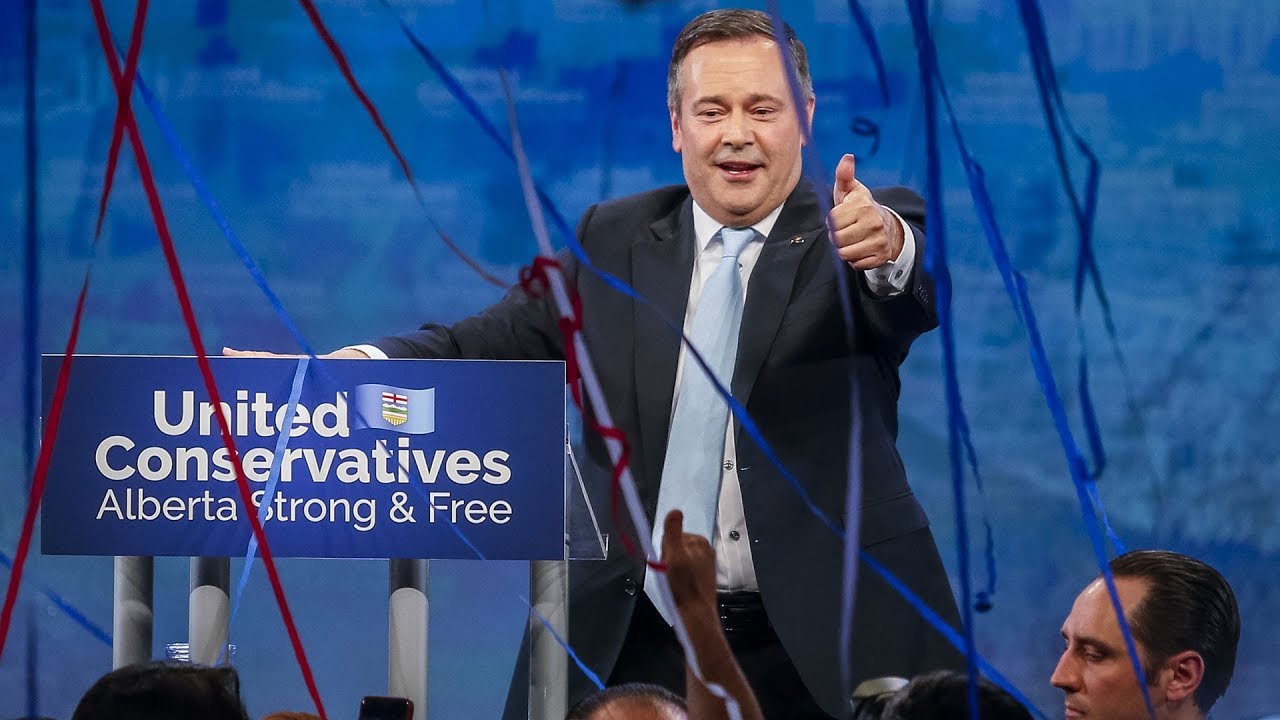 on Tuesday, Kenney blamed other Canadian provinces, the Trudeau administration and a "foreign-funded campaign of special interests" for blocking pipeline expansions, and he called on Quebec and other provinces to help Alberta get its oil to markets overseas if they want to share in its resource wealth.
Attempts to build a pipeline to the East Coast have in the past been stymied by opposition in other provinces—opposition that Quebec Premier Francois Legault made clear on Wednesday remains strong. "There is no social acceptability for a new oil pipeline in Quebec," Legault told reporters on Wednesday, according to the CBC.
Alberta has also been pushing for the expansion of the Trans Mountain pipeline, which carries tar sands crude to a port in British Columbia. U.S.-based Kinder Morgan had been trying for years to triple the pipeline's capacity, but British Columbia and some indigenous First Nations opposed the project. Last year, the Canadian government bought the pipeline to keep expansion hopes alive, but a court rejected the pipeline's permit and ordered a new federal review of the project in consultation with First Nations along the route.
[map]
While a new decision on the project is expected by the end of May, Kenney's win adds uncertainty to the process.
Prime Minister Justin Trudeau's support for the expansion was widely viewed as one half of a grand bargain with Rachel Notley, the outgoing Alberta premier and member of Alberta's New Democratic Party, who lost the election this week to Kenney.
Trudeau had been pushing provinces to enact their own carbon taxes as part of his plan to meet Canada's pledge under the Paris climate agreement. Those that didn't would fall under a new federal tax, which is currently being challenged in court by the government of Ontario. Notley enacted a tax in Alberta along with a cap on emissions from the tar sands, and many political observers said that tax was central to securing Trudeau's support for the pipeline.
With Kenney now promising to scrap both the tax and the cap, the political calculus changes. Trudeau could use the pipeline project as leverage over Kenney, pressing the provincial leader to maintain a carbon tax or for other concessions. Or he could decide to abandon the expansion altogether.
==
==
whoohoo, trend? maybe temp
Canadian Court Halts Expansion of Trans Mountain Oil Pipeline
The Trans Mountain oil plant in Edmonton, Alberta.]pix
By Ian Austen
Aug. 30, 2018
OTTAWA — A Canadian court on Thursday froze plans to expand an oil pipeline that the government is about to purchase, ruling that the government’s National Energy Board had not adequately consulted with Indigenous people along the pipeline’s route or assessed the project’s potential effects on the waters off British Columbia.
While the practical effect of the decision may be a comparatively short construction delay, the ruling added fuel to an already incendiary debate over the Trans Mountain pipeline that links Alberta’s oil sands to an oil tanker port near Vancouver, British Columbia. The pipeline also branches off to refineries in Washington State.
After the pipeline’s owner, Kinder Morgan of Houston, abandoned its plans to add a second pipeline along the existing Trans Mountain route in April, Prime Minister Justin Trudeau’s government stepped in to buy the 715-mile pipeline for 4.5 billion Canadian dollars, or about $3.4 billion. The sale is expected to be completed soon, possibly this week.
Environmentalists and some Indigenous groups immediately called the ruling a major victory, and some of them urged Mr. Trudeau’s government to give up on plans for the expansion, which has drawn widespread protests driven by environmental concerns.
“It’s a huge court case win,” said Chief Lee Spahan of the Coldwater Indian Band, one of the groups that brought the court challenge. “We want our cultural and traditional ways respected.”
The ruling was a setback for Mr. Trudeau, not least because he has repeatedly vowed to consult with Indigenous groups as part of efforts to make amends for past injustices.
Mr. Trudeau’s political critics on the right charged that he had bungled the project.
“This is just a complete failure for the Trudeau government’s handling of the energy sector,” Andrew Scheer, the leader of the Conservative Party, told reporters. “This is just another gut punch.”
But Bill Morneau, the federal finance minister, told reporters in Toronto that the government would still complete the expansion project.
“We are absolutely committed to moving ahead with this project,” Mr. Morneau told a news conference in Toronto. “What the decision today asked us to do is to respond promptly.”
Mr. Trudeau’s backing of the pipeline, which is not universally popular among his supporters, was to some degree a move to persuade Alberta to join his national carbon-tax program. Alberta’s energy industry, particularly the oil sands, is a major carbon emitter, making the province’s cooperation vital.
On Thursday night, however, Rachel Notley, the province’s premier, said that Alberta was withdrawing from the carbon-tax program until construction began on the Trans Mountain extension.
“I am announcing that with Trans Mountain halted until the federal government gets its act together, Alberta is pulling out of the federal climate plan,” Ms. Notley said in a speech. “And let’s be clear: Without Alberta, that plan isn’t worth the paper it’s written on.”
Ms. Notley blamed “successive federal governments” for the situation and said that she had told Mr. Trudeau to immediately appeal the decision to the Supreme Court. She also wants the federal Parliament to hold an emergency session to “assert its authority.”
The case against the expansion was brought by several Indigenous groups, the cities of Vancouver and Burnaby, British Columbia, and two environmental groups.
While most of the consultation with Indigenous groups took place under a previous government led by Conservatives, Canada’s Federal Court of Appeal on Thursday found that a final phase during 2016, Mr. Trudeau’s first full year in office, “fell well short of the mark set by the Supreme Court of Canada.”
Specifically, the court found, “very few responses were provided by Canada’s representatives in the consultation meetings.”
It added that “when a response was provided it was brief, and did not further two-way dialogue.”
But improving the process may be a straightforward matter.
The court said that the new set of consultations it had ordered would most likely be “brief and efficient while ensuring it is meaningful,” making for “a short delay” in the pipeline project.
Gordon Christie, a professor of law at the University of British Columbia and a prominent authority on Indigenous legal issues, said that it might take only a few months for the government to engage in more meaningful consultations with Indigenous groups.
“This has nothing to do with not building a pipeline,” he said from Vancouver. “All they’re required to do is go back, review the concerns and show that they are going to take them seriously and respond in some way. These are not negotiations.”
Nor, he added, does the ruling give Indigenous groups the power to shut down the pipeline project.
Chief Spahan said that the Coldwater Band was looking for specific assurances that the expansion would not lead to oil leaks that threatened its drinking water, which comes from wells.
“When they moved forward, they totally disregarded Coldwater,” he said. “It was like stabbing us in the back.”
Many people in Canada’s energy industry said they were frustrated and disappointed by the prospect of a further delay to the pipeline expansion.
“We’re just tired of this stuff,” said Chris Bloomer, the president and chief executive of the Canadian Energy Pipeline Association. “We, as an industry, just sit here and go: We’re responsible, we’re safe, what more can we do?”
The expansion will put a second pipeline alongside about 610 miles of the 715-mile Trans Mountain pipeline, which opened in 1953. It will increase the system’s capacity to 890,000 barrels a day, from 300,000, at a cost of $7.4 billion.
Most of the oil sent through the Trans Mountain pipeline heads to the United States, mainly through a spur pipeline. Supporters of the expansion argue that it will open Asia as a second market for Canadian oil.
Follow Ian Austen
---