Canada
==
Promoted to primary 5/14 b/c of tar sands and parallels to press and science suppression
NO MERRI
SOME LOST HERE? SEE BAk
SEE MARK CARNEY PM 1 26
cda troops to Greenland?
---
tag 1/15 cda text capt backup
817 capt 11/19 bak
see pipeline enbridge line 3?
see tar sands
CARBON TAX ALBERTA
see rcmp, 1st nation
Resources: http://www.desmog.ca/
eg http://www.desmog.ca/2015/07/31/will-war-science-emerge-election-issue
david bacon says nafta made cda mining #1?
-=-=
-=-=
AN 10 26
Punchbowl News reports that former White House aide Cassidy Hutchinson is next on President Donald Trump's revenge list.
The Justice Department's Civil Rights Division presented evidence to a federal grand jury this week alleging that she "lied to Congress," sources told the outlet.
Hutchinson spent several days testifying to the House Select Committee on Jan. 6 after the attack on the U.S. Capitol. Trump has long maintained that what she said was a lie, so a key piece of the case will be whether the DOJ can prove something she said was false, particularly in the Washington D.C., federal court, which has not been a successful place for District Attorney Jeanine Pirro.
Among her more jarring allegations were that a Secret Service agent told her that the president lunged at him as he drove back to the White House following the speech on the Ellipse. According to Hutchinson, Trump wanted to go to the Capitol to see his supporters as they marched. He'd promised them moments before that he would be with them, but the Secret Service hadn't planned for that.
She also alleged that Trump didn't care about the magnetometer catching his supporters carrying guns, making it clear that he knew they weren't there to hurt him.
So far, Trump has used his Justice Department to target former FBI director James Comey, New York Attorney General Letitia James, prosecutors who investigated him, law firms connected to opponents and news organizations whose coverage he dislikes.
Reuters even documented at least 470 targets of administration retribution by November 2025, including 112 revoked security clearances.
But even failed indictments didn't stop Trump. After Comey posted an image on Instagram showing seashells spelling out "86-47," he was targeted by the FBI and DOJ, claiming he was making a credible threat against the life of the president with the post.
The campaign has also extended beyond criminal investigations and firings of government staff. Trump ordered restrictions on law firms’ security clearances, federal contracts and even access to government buildings, including the federal courts.
Trump swears he's not pursuing any revenge. As recently as Wednesday, Trump alleged that he could have "gone after" Hillary Clinton, and former Presidents Joe Biden and Barack Obama — but hasn't.
Critics argue the pattern turns government power into a tool for personal punishment. He's forcing the targets to spend buckets in legal costs and face professional consequences, even if prosecutions fail or the courts block his executive actions.
For Hutchinson, the question now is whether the Justice Department can prove a crime, or whether the process itself becomes the punishment for testifying against Trump.
-=-=
AN 9 26
Earthquake as Canada negotiates with the EU to join as associate member
-=-=
AN 10 26
On Thursday, a new report revealed that President Donald Trump may be preparing a “blame Canada” approach to coping with Republican midterm losses. According to the Canadian outlet the National Post, Trump is expected to “lash out,” and there are already signs that he is teeing up the United States’ northern neighbor as his target.
“Last week, Trump’s trade adviser Peter Navarro told Canadian lobbyists to ‘get the hell out of our country’ and warned that ‘if you interfere in our elections in Maine and Michigan, you will pay even more dearly,’” writes the Post. “Navarro’s approach? Blame Canada! We heard a similar accusation last year from Ambassador Pete Hoekstra, who equated Canada’s anti-tariff advertising in the U.S. to electoral meddling and warned of consequences.” With actions like this in mind, wonders the Post, “could Canada become a scapegoat for Republican losses?”
“It’s certainly the case that the administration will probably latch onto any sort of external cause to blame bad election results,” said Alfredo Carrillo Obregon, a trade policy analyst at the Cato Institute in Washington. He explained that while he doesn’t think it would be Trump’s “primary explanation... it’s not off the table that someone like Peter Navarro could go onto whatever news outlet he gets interviewed at these days and say that Canada is at fault.”
According to Christopher Sands, director of the Center for Canadian Studies at the Johns Hopkins School of Advanced International Studies in Washington, Trump and his allies may try to cast hostility toward Canada through a partisan lens. “If Democrats do well but are nonetheless seen as the enemy, and Canada is associated with just one party,” he said, “then it becomes harder to have conversations with Republicans who you’ll need unless the Republicans are completely wiped out. That may be part of what the Trump administration’s hoping — to push Canada into a partisan alliance that it can then condemn Mark Carney with all the Democrats that they don’t like.”
Richard Stern, vice president of the Plymouth Institute for Free Enterprise at Advancing American Freedom, told the Post that Trump and the Republicans have been incentivized to shift blame onto Canada for their own policy failures. The U.S. administration has been frantic to paint the tariffs as a foreign policy tool that foreigners pay for when they are really “an offensive, aggressive tax that’s been levied on the American people,” he said, noting that politicians running for reelection “don’t want to tell voters, ‘I’ve done something terrible to you.’ They want to point the finger overseas and at other people.”
But according to Christopher Hernandez-Roy, acting director and senior fellow at the Americas Program of CSIS in Washington, efforts to blame Canada are unlikely to land with the broader American public. “I think President Trump lashing out in the face of a loss is … almost a certainty,” he said. “They can … try to blame Canada, but … I don’t see how that’s really gonna get much traction.” Stephen Nagy, senior fellow at the Macdonald-Laurier Institute, predicts that whatever he targets, “I suspect Trump will do what he always does based on Roy Cohn’s rules of winning, taught to a young Donald Trump: center on relentless aggression, total denial and never admitting defeat.”
-=-=
TRUMP SAID EXXON AND CHEVRON IN VENEZ?
9 26
President Donald Trump's ongoing trade war with Canada just took a major turn — and it was not in the president's interests.
"In Texas and New York, big oil and big money are placing their bets on the future of the energy industry," reported The Globe and Mail's Andrew Willis on Monday. "Major American oil companies and asset managers are lining up to invest in Canadian infrastructure. They seem to have missed U.S. President Donald Trump’s weekend Truth Social post declaring 'I don’t want Canadian anything.'"
Describing the companies in question as ExxonMobil Holdings Corp., ConocoPhillips, KKR & Co. Inc. and Apollo Global Management Inc., The Globe and Mail added that they are also steering clear of Venezuela, which Trump set his sights on earlier this year.
"The American economy runs on Canadian energy," Willis pointed out. "Last year, the U.S. imported $160-billion of oil, gas and electricity from its northern neighbour. Mr. Trump’s attempt to position Venezuela as a counter to Canada’s strongest suits is a bad bluff."
He continued, "The President’s anti-Canada policies are undermined by the actions of the largest U.S. oil companies and biggest asset managers. They are all investing in a robust long-term Canadian relationship. The larger lesson from Mr. Trump’s recent Truth Social postings on Venezuela and Canada is what they say about the President’s declining relevance."
This is not the first report to indicate that Trump's attempt to bully Canada into winning a trade war against the United States has spectacularly failed.
“As Carney prepared to walk away — a rare example of a foreign leader telling the president ‘enough’ — Trump was retreating on another trade front,” reported The Washington Post's David J. Lynch earlier in August. “On Friday, after insisting for more than a year that tariffs do not affect consumer prices, he lifted tariffs on beef imports, saying the move would lead to lower grocery prices.”
Lynch added, “The two developments, coupled with legal challenges to Trump’s tariffs, leave the president’s signature economic policy in a state of flux.”
Wendy Cutler, a former U.S. trade negotiator and currently senior vice president at the Asia Society Policy Institute, also told the Post that Trump's Canada trade war has reached “a juncture where other countries may be very closely watching how this plays out as they also are becoming increasingly frustrated with the demands the U.S. is placing on them in these largely one-sided trade agreements.”
Trump is also failing on the PR front in his trade war against Canada, most recently in trying to retaliate against Canada by renaming Lake Ontario as Lake America.
"Throughout his political career, Trump’s signature skill has been to drive the conversation where he wanted it to go. He declares victory when things have not been won," wrote Slate's Ben Jacobs on Monday. "He ducks attribution with the rhetorical tic 'many people are saying,' frequently followed by things that people are decidedly not saying. He posts outrageous graphics on social media. And, of course, he renames things: Political opponents get nicknames, buildings get Trump’s name, and bodies of water get America’s name."
Yet that has not worked with the Lake Ontario gambit, indicating that Trump's "superpower" with PR may be waning.
-=-=
-=-=
KLEIN ASTRA YT ETF 8 28 26
CARNEY INVITE BLK ROCK AND BLACKSTONE TO DEAL W TRUMP BS, BUT SORTA //?
-=-=
AN 8 26
TARIFF MIZZOU
At a time when the Republican Party is fighting for life under an unpopular president, an economic analysis reveals the red state of Missouri is looking at serious problems as President Donald Trump escalates his prolonged trade war between the U.S. and Canada, according to the Kansas City Star.
Trump may have tried to change the name of Lake Ontario to “Lake America” in his latest sleight to Canada, but there’s nothing symbolic about the impact of the 50 percent tariffs the Trump administration levied on $20 billion worth of Canadian goods. There’s also nothing symbolic about the pain of the retaliatory tariffs Canada plans to impose on roughly 700 American products beginning Sept. 8.
“The Kansas City metro area exports about $4 billion in goods to Canada annually, including vehicles, plastics, chemicals and agricultural products," according to a 2025 study by the Canadian Chamber of Commerce.
“Any variation in tariffs may be sensitive,” said Ariel Dvoskin, who studies trade theory and teaches economics at the University of Missouri Kansas City, “and the [50 percent] variation that we are talking about right now … would substantially affect the exports from KC.”
Dvoskin pointed out that a whopping 37 percent of Kansas City’s exported goods go to Canada, which puts this Trump-voting state in a nasty bullseye. “When you increase tariffs, of course, those who suffer first are workers because prices go up and their real wages go down," Dvoskin said.
The Canadian Chamber of Commerce study identified Kansas City as one of the U.S. cities that would take the hardest hit in a trade war between the North American allies, with Kansas City the third-most vulnerable city in a prolonged trade dispute because of its dependence on Canadian demand.
The info was based on 2023 data, but Andrew DiCapua, the chamber’s principal economist and the study’s author, told the Star that the results still apply today.
“Kansas City really is at the center of this trade war,” DiCapua said. “ … It raises costs for businesses. I mean, someone needs to pay for this. Even if it’s not passed on to consumers right away, someone still needs to pay for the tariffs. So smaller businesses that rely on these supply chains are going to have to eat those costs.”
Frank Lenk, director of economic research at the Mid-America Regional Council, told the Star that Kansas City’s auto industry is among the clearest targets because vehicles are one of the region’s largest exports and much of that trade is tied to Canada. Lenk added that Trump’s trade war can also hike manufacturing costs for companies like Ford and General Motors because parts and materials move back and forth across the border before final assembly.
They can either absorb those costs and threaten their financial integrity and workers or pass the costs down to customers in a colossal wallop.
-=-=
-=-=
an 8 26
President Donald Trump’s administration continues to provoke right-wing extremists who want members of a Canadian province to secede from their nation, continuing a trend that has persisted since the start of the Republican’s second term.
“The separatists have good reason to think the Trump administration could be an ally,” reported Politico's Mickey Djuric on Sunday. “In January, Treasury Secretary Scott Bessent called Alberta a ‘natural partner for the U.S.’ while referencing the province’s ‘great resources.’
According to Djuric, Bessent told conservative podcaster Jack Posobiec that “people are talking. People want sovereignty. They want what the U.S. has got.”
Even though only 30 percent of Albertans want to secede from Canada, Djuric reported experts are worried they might succeed simply because the pro-union Albertans could stay home out of an excess of confidence that they will pull off secession during the October referendum. One such Albertan is Keith Walker, who lives in a small farming community in southern Alberta and supported Trump’s trade war against Canada by describing Prime Minister Mark Carney’s administration as communism. He compared Trump’s tariffs against Canada to his military campaigns against Cuba, Iran and Venezuela, confidently telling Politico that “that’s why that’s happening.”
Another secessionist told Djuric that “Trump is the only one that can save us,” while the Politico journalist reported that “people have wrapped themselves in Alberta’s flag, wave ‘we’re done’ banners and wear ‘Trump 2024’ and MAGA — Make Alberta Great Again — ball caps. This is an ‘Albertans’ Day’ gathering at the Whistle Stop Cafe, which gained notoriety for bucking pandemic-era rules and which former Alberta premier Jason Kenney calls ‘ground zero’ for the province’s fast-growing separatist movement.”
Djuric added that while “resentment toward the federal government in Ottawa is longstanding in Alberta,” the movement has been “supercharged” by “Trump and the increasingly toxic U.S.-Canada relationship. The separatists are furious about Carney’s friction with Trump and the fraying ties to their southern neighbor. Some even hope the Trump administration might help their cause.”
He also pointed out that “many separatists believe Trump’s presidency makes Alberta’s independence possible, with the United States a ready customer for its oil and gas should they split from Canada. One group, the Alberta Prosperity Project, is trying to seek a C$500-billion U.S. government loan to fund the province’s ‘seamless departure’ from Canada.” Meanwhile Casey Phillips from Edmonton, Alberta declared that “I like freedom and less taxes,” arguing that this justifies Alberta trying to leave the Canadian union.
In February a former senior State Department official warned NBC News that Trump’s cultivation of Albertan separatists is “irresponsible as hell,” continuing that “it’s really irresponsible for the United States to be engaging with these kinds of people, because it just encourages behavior that cannot be in the U.S. national interest.” By contrast, in January Treasury Secretary Scott Bessent argued that "I think we should let them come down into the U.S. and Alberta's a natural partner for the U.S. They have great resources. The Albertans are very independent people... [There is a] rumor that they may have a referendum on whether they want to stay in Canada or not."
He concluded, "People are talking. People want sovereignty. They want what the U.S. has got."
-=-=
==---
THREAT 50% TARIFF ON WILDFIRES, USED ARR BOOZE ETC
Canadian Prime Minister Mark Carney incited a MAGA meltdown after pointing out that the United States shared responsibility for the climate change currently dumping wildfire smoke all over the upper U.S.
Nearly 900 wildfires were burning without control in the north, as of Friday, in the wake of an abnormally dry and hot summer. This led to air quality alerts throughout the northeast and the Midwest, with Chicago and Detroit having the worst air of any major cities in the world — and more US cities due for pollution further east over the next few days.
But Republicans, who are loathe to admit that climate change is real and regularly jumps borders, prefer to blame whatever nation is currently suffering out-of-control fires, whether they are blue US states or neighboring ally nations.
However, Carney, while speaking of the disaster to Canadian citizens, pointed out in French that “We need a contribution from the Americans in the fight against climate change ... climate change is everyone's responsibility, including the US.”
This sent MAGA into even more of a fury.
“Canada is a doomed state. Can’t wait until their total economic collapse, and have to ask the US to buy them,” ranted one critic on X.
“Nice deflection while hiding behind the con that is ‘climate change,’ railed another MAGA heckler — while ignoring the vanishing US glaciers in Glacier National Park. “Dude is inept as hell and has no clue about forest management.”
“This climate change is a hoax,” blasted another critic on X, in contradiction to the majority of science. “Even Bill Gates had to admit that we are not dying from climate change. Now that they need extra energy that renewables can't produce for their data centers … [C]limate change doesn't start over 100 separate fires.”
President Donald Trump himself blasted the PM later on Friday, while denying the fact that the US has regularly been plagued by raging fires as well as temperatures rise and regions get less, more sporadic rainfall.
“We are holding Canada responsible for the fact that they are not properly maintaining their Forests, and Brush therein, and the United States is being unnecessarily invaded by filthy, polluted, and unhealthy air, the quality of which is dangerous, and totally unacceptable!” Trump posted on Truth Social. “I will call the Prime Minister during the day to find out what they are going to do about it. The cost is incalculable! Canada has refused to engage in basic Forest Management and Debris Removal, knowing that such refusal will lead to exactly this result.”
Last year, Trump lobbed many of the same accusations at California as that state burned under historic flames, accusing state leaders of not raking forests of debris and not maxing out the Colorado River to wet its dry areas — despite competition with other thirsty western states for the same water source.
A few months previous, in 2024, Trump had threatened to withhold federal aid for fighting California wildfires at a California rally.
---=
science is clear: the planet is warming at an alarming rate and we need to reduce global greenhouse gas emissions.
For decades, effective actions have lagged behind the needs of the moment. The 2022 Intergovernmental Panel on Climate Change (IPCC) report suggested that at least part of the reason for this inaction has been “due to misinformation about climate science that has sowed uncertainty.”
The full scale of this misinformation was revealed in May 2024, when the United States House Committee on Oversight and Accountability completed its three year investigation into how U.S. oil companies sought to avoid accountability for climate change.
The report — tellingly titled Denial, Disinformation and DoubleSpeak: Big Oil’s Evolving Efforts to Avoid Accountability for Climate Change — explores Big Oil’s decades-long campaign of deception and denial finding that:
“Documents demonstrate for the first time that fossil fuel companies internally do not dispute that they have understood since at least the 1960s that burning fossil fuels causes climate change and [that they] then worked for decades to undermine public understanding of this fact and to deny the underlying science”.
Even with what we know about the scale of climate misinformation, these findings make for truly shocking reading.
The committee found that “Big Oil’s deception campaign evolved from explicit denial of the basic science underlying climate change to deception, disinformation, and doublespeak,” and that the fossil fuel industry deliberately spread confusing and misleading narratives, lobbied against climate action and strategically funded under-resourced universities while silencing opposition voices.
The report concluded that, as the climate science became stronger, Big Oil shifted its strategy to one of public support for action while privately avoiding it as part of an “elaborate campaign of deception.”
https://www.youtube.com/embed/QAAbcNl4Lb8?wmode=transparent&start=0
The first episode in a three-part documentary report on climate change denial and the systemic seeding of doubt by the global oil and gas industry produced by PBS Frontline.
While the findings of this report were centred around the U.S., it is likely that many of the same conclusions would apply here in Canada. Indeed, the 2022 IPCC report made clear that while misinformation and the deliberate undermining of science is mainly a phenomenon in the U.S., there are “similar patterns in Canada.”
Oil and gas in Canada
The Canadian Association of Petroleum Producers (CAPP) is the Canadian oil and gas industries’ main lobbying body.
Its website acknowledges the existence of climate change and boldly claims that the “industry is well positioned with expertise in both science and technology to reduce emissions. The global collective challenge is to reduce GHG emissions while also meeting growing demand for affordable and reliable energy.”
Meanwhile, the World Petroleum Congress — a major mouthpiece of the global oil and gas industry — held its 24th event in Calgary in 2023 on the theme of Energy Transition: The Path to Net Zero.
A very different view from that of the oil and gas industry can be found in a 2021 report prepared by Environmental Defence Canada and Oil Change International, which assessed “the climate plans of Canadian oil and gas producers.”
The report concluded that the climate plans of eight Canadian oil and gas producers are — in similar form to their U.S. counterparts — woefully lacking and at times overtly misleading.
Key conclusions of their assessment are that “Canadian oil and gas companies have released a range of complex, misleading climate change pledges that must not be taken at face value.” Moreover, “despite all the talk from Canadian oil and gas companies about climate leadership, their current business plans would fuel further climate disaster and global injustice.”
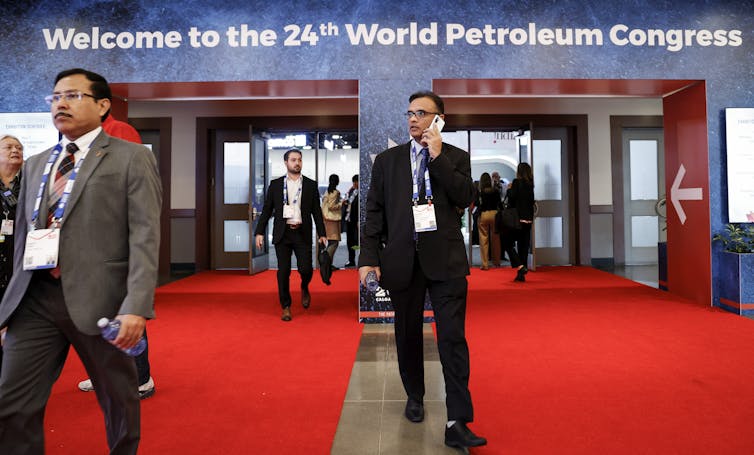
Delegates enter the World Petroleum Congress in Calgary in September 2023. THE CANADIAN PRESS/Jeff McIntosh
All talk
Unfortunately, it seems like this misinformation continues to have an effect.
In a 2024 study by the group Re.Climate, it was found that while Canadians report high levels of concern about climate change, climate denial remains persistent. The report found that “many Canadians say they do not believe we can meet our energy and climate objectives, even when they agree that climate change is a serious threat that requires concerted effort.”
Moreover, there are significant differences across regions and demographics. Mirroring the U.S., Conservative voters were found to be much less concerned about climate change and less supportive of transitioning off fossil fuels. Across Canada, about 72 per cent of Canadians are worried about climate change, with the percentage varying between 84 per cent in Québec to just 45 per cent in Alberta.
Read more: Why the Trans Mountain Pipeline expansion is a bad deal for Canadians — and the world
The persistent denial of climate change is likely the enduring result of industry misinformation, political and energy ideologies, and the actions of climate change denier groups, such as the misleadingly named Friends of Science Society which actively denies the existence of global warming.
The only way to address climate change is by tackling misinformation head on. Holding the oil and gas industry to account for decades of deceit in the U.S. and Canada is an important first step in that process.
- Fossil fuels
- Oil
- Climate change
- Canada
- Global warming
- Petroleum
- Oil and gas
- Misinformation
- Climate denialism
Author
 Gordon McBean
- Professor Emeritus, Department of Geography and Environment, Western University
Disclosure statement
Gordon McBean receives funding from scientific funding organizations at the University. He is affiliated with the Liberlal Party of Canada.
Partners
Western University provides funding as a member of The Conversation CA-FR.
Western University provides funding as a member of The Conversation CA.
DOI
https://doi.org/10.64628/AAM.qwh7jjuf7
 We believe in the free flow of information
Republish our articles for free, online or in print, under a Creative Commons license.
-=-=
---
7/8/26 AN
President Donald Trump is at the NATO summit in Turkey where things grew contentious when he dropped a "diplomatic bombshell" on Canada.
According to a report from the Wall Street Journal, Justin Trudeau kept getting threatening phone calls from Trump before he was replaced by Mark Carney.
At one point in a call, Trump told Canada he would kill a 118-year-old agreement that set the border with the U.S. and its neighbor to the north on maps and on the ground.
The agreement came when Canada was still handled by the United Kingdom, and at the April 1908 Boundary Convention, it was the U.K. that signed the agreement, not Canada. But Trump didn't care, telling Trudeau, “I tear that up, and your whole country unravels.”
Trump seemed confused that the law established the border, but the reality is that a slew of other agreements and treaties set the border, including the Treaty of 1818 and the Oregon Treaty of 1846.
According to the Journal, "Over dinner at Mar-a-Lago, Trudeau’s envoys tried to dissuade Trump from absorbing their country. When one Trump aide pointed out Canada’s 41 million people would lean Democrat, the president came up with a neat solution: just split the northern neighbor into two states, one red, the other blue."
It's unclear how Trump would make that work, given that he has an approval rating in Canada of around 22 percent, according to a Pew Research Center survey.
When Carney took over, he asked for a review of Canada's dependency "on one particular country for its data storage, military hardware, payments processing and even food."
The report called it the first move for a country shifting the U.S. from an ally to a threat. It was a stark contrast to what NATO Secretary-General Mark Rutte did, which is to encourage members that they had to do whatever it would take to keep the alliance together.
"In effect, a push to make Canada America’s 51st state had lighted a fuse of unintended consequences that would play out far beyond North America, as overseas allies asked themselves whether the U.S.-led alliance could truly last," the report said.
Carney's first visit as prime minister was not to the U.S. but to France, where he and President Emmanuel Macron discussed ways to dial down its dependency on the U.S.
"Canada had the critical minerals needed by France, whose state-backed tech firms were taking early steps into the U.S.-dominated spheres of AI and quantum computing. French diplomats joked that since Canada and Denmark share a land border on an uninhabited Arctic island off Greenland, that could make the North American country a legitimate candidate to gain fast-track membership in the EU. Carney laughed," the report said.
When Carney went to the U.K. next, they discussed how "they might band together if the U.S. left 'Five Eyes,'" the U.S.-led intelligence-sharing alliance made up of the U.K., Canada, Australia, New Zealand and the U.S. While that idea never gained traction, it was discussed with MI6.
While in the U.K. his requested report about a world without America was finished and he was able to share it with Kir Starmer’s office.
Starmer wanted to be cautious, insisting that they had to find a way to salvage the relationship between the West and America.
“We don’t have a relationship to keep!” Carney replied, according to the report.
Informal advisor and Trump's son-in-law Jared Kushner was advising Canada to "produce a video that might persuade the president that they were serious about border security. Trudeau’s government hired a film crew to capture two Black Hawk helicopters and a sniffer dog on patrol. Instead of placating Trump, it seemed to fuel his interest in revisiting the placement of the border."
Carney's team, by contrast, began reading clinical and psychological studies on "impulsivity" to better learn how to deal with Trump. They believed that Trump's 51st state idea was really about "price discovery," when he throws out an absurd idea to see how the financial markets will react.
Other aides thought it was more about Trump trying to kick Trudeau while his poll numbers were down.
Either way, Carney has looked for new ideas to deal with the volatility of the American leader while slowly reducing reliance on the U.S.
---
AN 6 26
Trump reignites '51st state' threat as key ally sinks into 'technical recession' - Alternet.org
AN 5 26
Trump administration issues 'profoundly misguided' threat against Canada - Alternet.org
:{---
---
AN 3 26
Canada on Monday announced "landmark" new deals with India as it moves away from reliance on the U.S., per a report from The Daily Beast, as Donald Trump continued to alienate allies with his military strikes on Iran.
Per the report, Canadian Prime Minister Mark Carney and Indian Prime Minister Narendra Modi announced a major 10-year "strategic energy partnership as well as agreements on technology, critical minerals, space, defense and education." The partnership will also include a free trade deal by the end of the year as both countries, who are ostensibly key allies of the U.S., seek to avoid exposure to Trump's sweeping global tariffs. The deal is intended to generate as much as $50 billion in bilateral trade between Canada and India.
Spurred into action by the unprecedented political and economic hostility from the U.S. during Trump's second term, Canada has been seeking new partnerships with other nations. Carney is scheduled to visit with two other key U.S. allies, Australia and Japan, in the coming days. Speaking about the new deal with India, the Canadian prime minister touted just how much engagement with India has resulted from Trump's aggressive global trade moves, and celebrated the two nations "charting our own course for the future."
"There has been more engagement between the Canadian and Indian governments in the last year than there has been in more than two decades combined," Carney said. "This is not merely the renewal of a relationship, it is the expansion of a valued partnership, with new ambition, focus and foresight. A partnership between two confident countries, charting our own course for the future."
The announcement came three days into Trump's unpopular military operation against Iran, conducted in cooperation with Israel. Polls have recently found that more Americans were opposed to the idea of military action against the Middle Eastern nation than supported it, with allies close to Trump worried that he will turn off his own MAGA base by focusing on foreign conflicts that they have long opposed.
As Canada creates new partnerships overseas, allies have also begun to distance themselves from Trump's operation in Iran. U.K. Prime Minister Keir Starmer on Monday said that the country would not be aiding the U.S. in the campaign, stating that his government "does not believe in regime change from the skies." Spanish Foreign Minister Jose Manuel Albares said that the U.S. will not be allowed to use military bases in Spain to conduct operations in Iran, with the country's government condemning the strikes.
---
AN 3 26
For many years, Canada and the United States — both members of the North Atlantic Treaty Organization (NATO) since 1949 — were close allies and trading partners. But U.S./Canada relations took a turn for the worse when U.S. President Donald Trump threatened its northern neighbor with steep tariffs and called for Canada to become "the 51st state" — an idea that Prime Minister Mark Carney and millions of other Canadians are adamantly against.
But in an article published by The New Republic on March 2, Ottawa, Ontario-based journalist John Last details MAGA efforts to exploit separatists in Canada's Alberta province.
Last explains, "Recent months have seen the escalation of a brazen campaign by separatists in the oil-rich province of Alberta to dismember the country and lease its resources to an expansionist American regime, with direct support from officials in the U.S. government…. A recent push for a referendum on independence has achieved unprecedented success, in no small part due to tacit support from the Trump-aligned provincial government."
Last notes that Alberta Premier Danielle Smith "was one of the first Canadian officials to kiss the ring of Trump at Mar-a-Lago, and has long tested the limits of her powers to pursue his crusades and causes at home."
Duane Bratt, who teaches at Mount Royal University in Alberta, told The New Republic, "Since the moment Alberta became a province (in 1905), there's been a movement to separate…. There is an ideological alignment with Trump. On gun rights, climate change, trans rights, renewable energy, wokeness.… it's all consistent with American right-wing movements."
Patrick Lennox, a former intelligence officer for the Royal Canadian Mounted Police, told The New Republic, "There's a real national security threat there. This is the perfect scenario for foreign interference."
Lennox views as the capture of former Venezuelan President Nicolás Maduro as a "warning shot" for Canada and other countries rich in resources.
"The Trump Administration's crusade against Canada may have deeper causes," Last explains. "Figures like Stephen Miller and Steve Bannon, who has explicitly compared Canada to Ukraine, see Canada as a bastion of decadent liberalism in the West that must be broken and subdued, one way or another."
---
an 2 26
Canadian deputy mayor nails Trump as the cause for $4.5 billion loss in US tourism
---
an 2 26
Donald Trump's threats against a bridge connecting the U.S. and Canada flummoxed some of the leaders involved with its creation, but according to a New York Times report, the president's turn may be connected to the influence of a wealthy donor.
On Monday, Trump took to Truth Social with a threat to block the opening of the Gordie Howe International Bridge, a $4.7 billion project connecting Windsor, Ontario, and Detroit, which had been set to open soon. Trump claimed, falsely, that Canada would control both ends of the bridge and that it had been constructed using no American materials. Canadian Prime Minister Mark Carneytold reporters on Tuesday that he has called Trump and is working to resolve the matter.
“I explained that Canada paid for the construction of the bridge," Carney said. "That the ownership is shared between the state of Michiganand the government of Canada, and that in the construction of the bridge, obviously there’s Canadian steel and Canadian workers, but also US steel, US workers that were involved. This is a great example of cooperation between our countries.”
On Wednesday, the New York Times cited two anonymous administration sources who said that Trump's bridge outburst came only hours after Matthew Moroun, a Michigan-based billionaire and transportation magnate whose family owns the Ambassador Bridge, which also connects Windsor and Detroit. Moroun, the sources claimed, met with Trump's Commerce Secretary Howard Lutnick at the White House, with Lutnick later taking a call with the president shortly before his Truth Social post.
Moroun has been a prolific donor to Trump's political campaigns, and his business has long opposed the construction of the Gordie Howe International Bridge. Once opened, it will serve as a competitor to his family's own bridge and divert toll revenue away from it.
The new bridge, named for a late Detroit Red Wings hockey legend, was first proposed in the early 2000s and received approvals in the early 2010s, with construction finally commencing in the summer of 2018, during Trump's first term. As opposed to the Ambassador Bridge, the Gordie Howe is publicly owned. All throughout that time, the Moroun family, led by Matthew's father, Manuel Moroun, vigorously fought against it, alleging at one point that it violated the exclusive rights of his own bridge.
"The Moroun family has for decades mounted legal challenges to block or delay the competing project," the Times explained. "One of the challenges reached the Canadian Supreme Court, while the family has also lobbied extensively against it."
---
cda troops to Greenland?
---
AN 1 26
A small contingent of an oil-rich province in Canada that desperately wants to join the United States met with President Donald Trump's administration.
The Financial Times reported on Thursday that Trump aides met with the Alberta Prosperity Project, which is a group of far-right separatists who want to leave Canada. Since last April, Trump's State Department officials have met with the group at least three times in Washington, the report said.
"They are seeking another meeting next month with state and Treasury officials to ask for a $500 billion credit facility to help bankroll the province if an independence referendum — yet to be called — is passed," said the report.
According to the group's attorney, Jeff Rath, who was at the meetings, “The US is extremely enthusiastic about a free and independent Alberta."
He went on to brag that he has a better relationship with the Trump administration than Canadian Prime Minister Mark Carney who hammered Trump in a speech at the World Economic Forum.
The State Department downplayed the multiple meetings however, saying, “The department regularly meets with civil society types. As is typical in routine meetings such as these, no commitments were made.”
The White House echoed the statement, adding that there was no commitment of financial support.
Neither Treasury secretary Scott Bessent nor anyone at the Treasury Department knew anything about a "credit facility proposal," said a person familiar when talking to FT. They said they have no intention of engaging.
Canadian conservatives, however, view the group as people who are only looking for attention.
Carlo Dade, at the Canada West Foundation, “The Americans are more than happy to continue to play Canadians off each other."
Indeed, Bessent commented to a white supremacist podcaster that Alberta is a "natural partner" for the U.S. to make given that the province has so much oil.
“The Albertans are very independent people,” the secretary said. “[There is a] rumour that they may have a referendum on whether they want to stay in Canada or not.”
However, Ipsos polling shows that only 3 in 10 residents in Alberta and Quebec would vote to secede from Canada. Still, the separatists are gathering signatures for a petition to deliver to the legislature.
FT added that it's part of deteriorating diplomatic relations between the U.S. and Canada.
---
MMA
The Fox-Trump fusion in two Fox & Friends segments
Is it state-run media, or a media-run state? Yes.
Written by Matt Gertz
Published 01/21/26
A year into President Donald Trump’s second turn in the Oval Office, it has become virtually impossible to tell where his administration ends and Fox News begins.
Trump arrived for the World Economic Forum in Davos, Switzerland, on Wednesday morning amid alarm from U.S. allies over his manic, unhinged, and unnerving demands for NATO member Denmark to hand over Greenland. At a Davos speech the day before, Canadian Prime Minister Mark Carney warned of a “rupture” in the world order, in which international rules are being replaced by the mantra that “the strong do what they can, and the weak suffer what they must.”
Here’s how Fox & Friends co-host Rachel Campos-Duffy put it as a helicopter bearing the president touched down in Davos: “It feels like even though this meeting has been going on for a couple days and speeches have been made and interviews have been done, it feels like nothing starts until President Trump arrives — until daddy's home, as so many people say.”
“Just think about the anticipation, the stakes that are going to be made here, just with the presence of President Trump,” she glowed, adding: “Here you have this global conference where President Trump is about to blow it up in terms of his negotiations and stands, and yet nothing starts until he arrives.”
“It is a new day,” she concluded. “America is the center of everything. President Trump is the leader that everything hinges on.”
Video
Citation
From the January 21, 2026, edition of Fox News' Fox & Friends
Campos-Duffy isn’t just a typically sycophantic Fox host with a penchant for conspiracy theories. Her husband, former Fox contributor and Fox Business host Sean Duffy, is one of 24 former network employees who went through the revolving door between the network and the second Trump administration, and he is now the secretary of transportation (Fox & Friends’ former weekend co-host Pete Hegseth is Duffy’s Cabinet colleague as secretary of defense).
At a normal news outlet, employing the wife of a Cabinet secretary for a role which allowed her to shower the president with praise would be an unheard-of ethical disaster. But at Fox, it may not have even been the biggest such calamity of the day.
...
---}:
an 1 26
Canada's Prime Minister fears 'brutal reality' Trump has already broken world order
David Badash The New Civil Rights Movement
---
an 1 26
Canada’s new arrangement with China stuns as Trump drives biggest ally into arms of foe
---
trump tariffs bc gipper rr comml in baseball game
---
finland vs russia resistance
// YT on troubles IRE
This Is What a Modern American Civil War Would Look Like (Making Sense Ep. 441 with Stephen Marche)
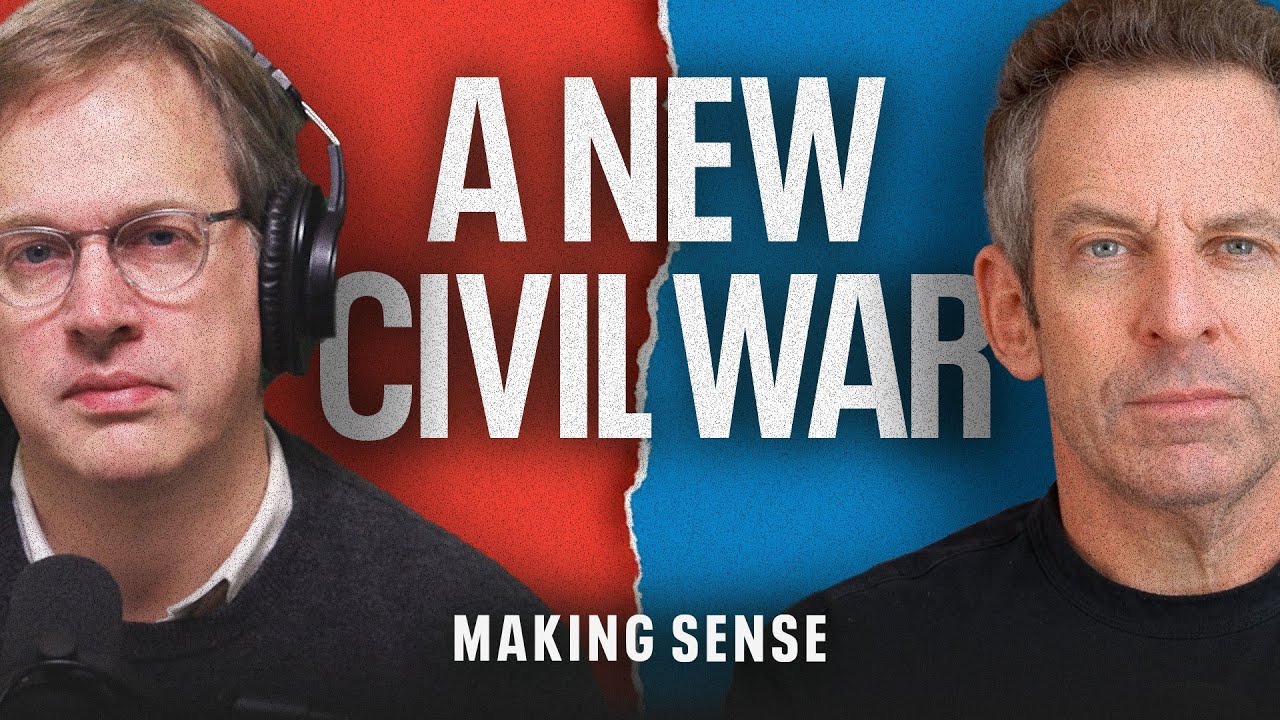
Sam Harris speaks with Stephen Marche about his book The Next Civil War: Dispatches from the American Future. They discuss tensions between the United States and Canada, what a modern American civil war might actually look like, the key risk factors for a civil war, diversity and immigration, extremism on the right and the left, the assassination of Charlie Kirk, the assassination attempts on President Trump, conspiracy theories, how a civil war might be avoided, the possibility of secession, and other topics.
Stephen Marche is a novelist and essayist, and the author of On Writing and Failure and The Next Civil War, among many other works. He has written features and essays for The New Yorker, The New York Times, The Atlantic, Esquire, and The Walrus. He collaborated with artificial intelligence on the first AI-generated novel reviewed in The New York Times, Death of an Author. His most recent novel, The Last Election, was co-written with Andrew Yang. Website: stephenmarche.com
---
anti trump tariff wave flips party politics 4 25 boring lib wins big
SEE MARK CARNEY
---
an 5 25 the conv
In the most non-controversial and basic sense, the rule of law means formal legality. The law binds citizens and governments. When it comes to nation states, law is enacted by democratically elected legislatures; legal statutes are openly available and sufficiently clear to follow. State actions can be judicially reviewed for compliance with a constitution.
In its more ambitious conceptualization, the rule of law can also be understood to include substantive human rights and equity. In Canada, The Constitution Act of 1982 references the rule of law in its preamble.
The modern Canadian iteration of the rule of law — which includes substantive ideas about human rights as well as Indigenous treaty rights — is based on liberal ideas shared by many countries, including, historically, the United States. What distinguishes a rule-of-law state from an authoritarian one to a large extent is whether state actions can be judicially reviewed for compliance with a constitution.
Although rule of law scholars debate the parameters of the concept of the rule of law, few would debate that what is happening during U.S. President Donald Trump’s second term presents anything other than a wholesale attack on the rule of law both domestically in the U.S and internationally.
I am a rule of law researcher, educator and lawyer. Since Trump was elected to his first term in 2016, I’ve relied on American scholars, from a variety of disciplines, to understand what is happening.
These include two prominent Yale professors, philosopher Jason Stanley and historian Timothy Snynder, both of whom have recently announced they’re moving to the Munk School of Global Affairs at the University of Toronto.
Authoritarian impulse
In their scholarship, Stanley and Snyder have sought to explain the authoritarian impulses of the first Trump administration and how to resist it.
Stanley’s father, a German Jew who fled Germany for America in 1939, carries the remembrance of fascism.
Both Stanley and Snyder explore the similarities between what is occurring in Trump’s America, Viktor Orban’s Hungary, Vladimir Putin’s Russia, Xi Jinping’s China and, equally chillingly, between Trump’s America and Adolf Hitler’s Germany. Even prior to the first Trump presidency, Stanley already asked in his 2015 book, How Propoganda Works, whether the U.S., “the world’s oldest liberal democracy,” might already have become a liberal democracy “in name only?”
Examination of propaganda, rhetoric
In his 2018 book, The Road to Unfreedom: Russia, Europe, America, Snyder described Trump as a “sado-populist, whose policies were designed to hurt the most vulnerable people of his own electorate.”
Stanley’s focus on propaganda and rhetoric were especially useful for framing the politics of Trump.
Similarly, Snyder’s focus on the similarities between Trump and other authoritarian leaders, through their attachment to extreme illiberal ideologies, helped frame public discourse in the U.S. during the first Trump presidency. “Illiberal” does not imply conservative in opposition to “being liberal” (with the resonance of “leftist”); rather, it denotes a repudiation of liberal democracy, in the words of political scientist Thomas J. Main.
Both Stanley and Snyder are on the public record explaining their decision to immigrate to Canada, on the basis that they can no longer continue their scholarly activities in an American university, even a premier one like Yale. Jason Stanley speaks with Amanpour and Company.
Improper interference
This is an admission by important thinkers that civil society, intellectuals and critical scholars, in particular, are under assault.
It comes as no surprise given other developments. Trump’s executive orders, threats to some university funding and crackdowns on activists and academics — as well as the attempted deportations of those without U.S. citizenship — have used the idea of combatting campus antisemitism as cover for an attack on free expression, academic independence and student activism.
From my perspective as a Jewish person, a post-secondary teacher and as someone with a legal education, all of these developments have hit hard, especially alongside accounts of some of America’s most prestigious law firms caving to improper interference by the Trump administration.
What ‘fascism’ means
In the introduction to his bestselling 2020 book, How Fascism Works, Stanley wrote: “In recent years, multiple countries across the world have been overtaken by a certain kind of far-right nationalism; the list includes Russia, Hungary, Poland, India, Turkey and the United States.”
He explains the choice of the word “fascism” to speak about each of these countries, despite their differences of degree and context:
“I have chosen the label ‘fascism’ for ultra nationalism of some variety (ethnic, religious, cultural), with the nation represented in the person of an authoritarian leader who speaks on its behalf. As Donald Trump declared in his Republican National Convention speech in July 2016, ‘I am your voice.’”
In his similarly bestselling book, On Tyranny, published in 2017, Snyder wrote: “To abandon facts is to abandon freedom. If nothing is true, then no one can criticize power, because there is not basis upon which to do so. If nothing is true, then all is spectacle. The biggest wallet pays for the most blinding lights.”
Now that Trump is back in office, Stanley and Snyder, as well as Snyder’s Yale colleague and spouse, Marie Shore, the celebrated author of The Ukrainian Night, are leaving Yale for Canada with good reason. Author Timothy Snyder speaks about Democracy and the Risk of Tyranny with Public Policy Forum.
Shared mutual concern
While the departure of a handful of prominent academics is hardly a trend, it raises questions about whether there will be an accelerated academic “brain drain”, or more American students in Canada.
As a Canadian, I would like to say America’s loss is our gain, and I wish these scholars well. I am also aware that narratives of flight to Canada as refuge have historically bolstered national myths while obscuring Canadian inequities. My hope is that Canadians will not observe the arrival of U.S. scholars with smugness, but instead with shared concern.
We should not be blind to this unique moment in which Canada is called to revisit why we care about Canada and keep watch on the rule of law. Yet, we must also recognize our own profound historical blind spots.
For example, while an overt threat to sovereignty is new for some Canadians, it is nothing new for Canada’s Indigenous Peoples. Today it’s important to understand the distinctively Canadian importance of Indigenous law to any reaffirmation of the rule of law tradition in Canada in the 21st century.
Too much cynicism might prevent us from acknowledging the importance of these three scholars’ decisions to leave their country and come to ours at this particular time in history. However, my hope is also that we are also inspired by their considerable truth-telling skills to demand Canada also do better.
Jeffrey B. Meyers, Instructor, Legal Studies and Criminology, *Kwantlen Polytechnic University
This article is republished from The Conversation under a Creative Commons license. Read the original article.
---
⋅ March 14, 2025
This could lead to a MAGA movement in Canada, expert predicts | Fox Business Video
Fox Business
Climate Depot executive editor Marc Morano gives his take on Canada appointing UN Climate Envoy Mark Carney to be prime minister on 'The Bottom ...
'Worst-Case Scenario': Canada Trades Trudeau For Another … Trudeau – IJR
ijr.com
Mark Carney, the newly elected Canadian Liberal Party leader positioned to succeed Justin Trudeau as Prime Minister, may impose familiar far-left ...
'Worst-Case Scenario': Canada Trades Trudeau For Another … Trudeau - The Daily Caller
The Daily Caller
Newly elected Canadian Liberal Party leader Mark Carney is positioned to succeed Justin Trudeau as Prime Minister.
===
strong man beta humiliate
an 12 24
'USA is a threat': Canadians slam 'bully' Trump’s 'arrogant' mockery of 'Governor Trudeau'
---
---
alternet-no lnx
Home | Republicans have been lying to their voters for years — and now those same voters are dying
Thom Hartmann June 14, 2024
This is a climate change story that fossil fuel billionaires and their GOP lackeys would rather you didn’t know.
As more and more people are killed by extraordinarily severe weather in places where it used to be unusual it’s going to get harder and harder to keep Red State citizens from finding out how badly they’ve been screwed by the unholy alliance between Republicans and oil barons.
Severe weather in the United States is not only getting worse, it’s moving.
POLL: Should Trump be allowed to run for office?
There’s a reason L. Frank Baum placed his 1901 novel The Wizard of Oz in Kansas: the worst and most frequent tornado activity in the world at that time was in the American Great Plains states — particularly Kansas.
Now that’s changing, as weather extremes are moving to the Midwest and the South. Recently, deadly tornadoes — some with wind velocities in excess of 200 mph — have ravaged Kentucky, Arkansas, Tennessee, Missouri, Illinois, Georgia, Ohio and Indiana.
This new burst of unusually extreme weather is driven by global warming and its impact on the Arctic, our oceans, and the Gulf of Mexico.
And it’s going to be America’s new normal, although in all probability this is just the beginning and over time it will get a lot worse.
America has always had the most extreme weather of anyplace else on Earth, according to Susan Cutter, director of the Hazards Vulnerability and Resilience Institute at the University of South Carolina.
China has more people and a larger landmass than we do, but, Cutter told ABC News, “they don't have the same kind of clash of air masses as much as you do in the U.S. that is producing a lot of the severe weather.”
The severity of America’s Great Plains states’ historically extreme weather was the result of geography.
While there’s a massive amount of land on either side of the European/Asian land mass, the United States is bracketed by two giant bodies of water, the Pacific and Atlantic oceans. We also have a huge mountain range — the Rockies — that helps determine where turbulent air from the west ends up, particularly as it encounters colder air from the north and warmer air from over the Gulf of Mexico.
As North Carolina state climatologist Kathie Dello told ABC News, it’s because of “where we are on the globe,” adding, “It’s truly a little bit ... unlucky.”
But now, as the Gulf of Mexico is heating up faster than the oceans on either side of us, combined with “bomb cyclone” cold weather coming down from Canada because melting ice in the Arctic is making the Jet Stream less stable, that severe weather is moving to the Midwest and South.
This appears to be one of the most consequential outcomes of climate change, severe weather-wise, for the United States.
As Victor Gensini, associate professor in the Earth, Atmosphere and Environment Department at Northern Illinois University, told The Chicago Tribune, the Midwest and South are replacing the Plains states as the epicenter of severe weather.
“That’s a really, really big deal for human exposure and vulnerability,” Gensini told Ezra Maille. “A tornado that goes through a wheat field in Kansas is not a big deal, but a tornado that goes through southern Cook County is a huge deal.”
He added that the Great Plains will probably continue to experience more and more severe drought while tornado activity is shifting toward the East and South.
The fossil fuel industry has known with a high level of certainty how severe weather was a probable outcome of America’s dependence on their products ever since the 1970s.
Yet for the fifty years since then — and continuing to this day — they fund phony “science” and shills to deny climate change or try to spin it as a positive, all while pouring hundreds of millions of dollars into the campaign coffers and personal bank accounts of mostly Republican politicians.
We’re at least 40 years behind where we should be in dealing with the fossil fuel/global warming crisis because giant oil companies have run massive disinformation campaigns while funding the political careers of hacks in Congress willing to lie to the public for them.
President Jimmy Carter declared a national crisis in 1979 and proposed legislation to create “this nation’s first solar bank, which will help us achieve the crucial goal of 20 percent of our energy coming from solar power by the year 2000.”
FDR had sold bonds to the public to fund a government corporation that would develop synthetic rubber for fighter plane tires back in the day, and Carter wanted to do the same to end our dependence on fossil fuels:
“Just as a similar synthetic rubber corporation helped us win World War II,” Carter said, “so will we mobilize American determination and ability to win the energy war.”
In that same July 15, 1979 speech, he proposed the government issue bonds that would fund:
“[T]he creation of an energy security corporation to lead this effort to replace 2-1/2 million barrels of imported oil per day by 1990. The corporation will issue up to $5 billion in energy bonds, and I especially want them to be in small denominations so that average Americans can invest directly in America’s energy security.”
But it all came crashing down 43 years ago when the fossil fuel industry’s candidate, Ronald Reagan, replaced Carter, killed the solar bank and the bond program, and even took Carter’s solar panels off the roof of the White House.
The big question now is how long the GOP will be able to keep up their climate change denial in the Red states currently being hammered by extreme weather before their citizens catch on to what’s happening and demand action to reduce our carbon emissions.
As Dr. Michael Mann, Presidential Distinguished Professor in the Department of Earth and Environmental Science at the University of Pennsylvania and director of the Penn Center for Science, Sustainability, and the Media (PCSSM), told me yesterday:
“It is rather ironic that many of the states that are seeing the worst climate change impacts—Texas, Florida, Louisiana, Mississippi, Alabama, and Florida—are red states, with governors and legislatures that are far more interested in doing the bidding of polluters than representing the people they’re supposed to be representing.
“Unsurprisingly, these states are all among the lowest when it comes to per capita spending on public education. The alliance of rightwing politicians and polluters prefers a poorly educated electorate, ignorant of the environmental health damage being done to them.”
So, what can be done other than offering subsidies for electric cars?
Number one on the list is to put a price on carbon, which will bend market incentives toward green and renewable energy as a replacement for fossil fuels.
According to the World Bank, there are currently 70 carbon pricing programs in place around the world, covering a bit over 23 percent of all emissions. Some are outright carbon taxes, typically with a rebate program to low- and average-income consumers, and some are cap-and-trade type programs (like President George HW Bush put into place to deal with sulfur dioxide emissions).
Canada’s carbon tax, which they put into place in 2019, is working so well that they actually sped up the process of implementation this year.
The original plan called for the initial $10/ton carbon tax to go up $10 every year until it hit $170/ton. The money collected is then recycled back to low- and average-income consumers to compensate them for the extra costs they’ll incur driving and heating their homes. But the program has been such a success that Canada’s government announced this week they’re raising the carbon tax by a full $15 this year.
They can pull this off because the rebates represent, for most Canadians, far more money in their pockets than the cost of the carbon tax. The brunt of the tax is instead borne by Canadian businesses, which is the group that's been designed to push toward green -- and tax-free or even green-subsidized -- energy sources.
An average taxpayer in Alberta province, for example, now gets a $386 check or bank deposit from their government every three months. It’s $340 quarterly in Saskatchewan, $328 in Newfoundland, $248 in Nova Scotia, and $264 in Manitoba.
This is a system that could work very well here in the US, if only there was the political will to make it happen. And, as we cut emissions and figure out new and better ways to pull existing carbon out of the air and oceans, we may be able to dial back on the increasing severity of storms that are ravaging Red states.
The obstacle to pricing carbon in the US is widespread ignorance of how severe our problem is and its origins in fossil fuel emissions. Fully 58% of Republican and Republican-leaning voters say climate change is “not an important concern” and a mere 17% believe human activities like burning fossil fuels “contribute a great deal to climate change.”
Hopefully the deadly disasters sweeping Red states now will wake up Republican voters and motivate them to demand their Republican politicians stop taking money from fossil fuel billionaires and do something now to stop climate change from getting any worse.
===
==
https://www.desmog.com/2022/09/20/petroleum-papers-geoff-dembicki-oil-sands-canada-exxon-imperial-syncrude-climate-denial/
Imperial Oil might not be a household name in the United States, but the company, which is mostly owned by ExxonMobil, is a big name in Canada. There, it’s one of the major players in Canada’s oil sands — the name for the vast fields containing a tarry mixture of sand, water, and the thick, heavy oil called bitumen — that were first mined in 1967. These oil sands, sometimes called “tar sands,” which lie in northern Alberta, are one of the largest oil reserves in the world.
But the oil that comes from them is distinctive in several ways. Oil sands’ unique texture means it takes more money and energy to refine than traditional crude. In addition, its oil is some of the most carbon-heavy in the world, with up to 20 percent higher emissions, and that has drawn the attention of climate advocates. Because of these factors, asGeoff Dembickiexplains in his new book **The Petroleum Papers: Inside the Far-Right Conspiracy to Cover Up Climate Change** (Greystone Books, September 20),oil sands producers and refiners, like Imperial Oil or Koch Industries, are particularly vulnerable to any efforts to mitigate climate change that would increase the already higher costs of extracting and refining bitumen.
Dembicki’s book illuminates for the first time how these industry players profited from Canada’s oil sands and then spun those profits into international networks of climate denial that would help extend the oil sands’ lifetime. “Bitumen from Alberta bankrolled the assault on truth led by companies such as Koch Industries and Exxon,” he writes. Dembicki drew heavily on the Imperial Oil Files we published in 2019, relying on internal company documents that demonstrated not only that Imperial Oil knew about climate change by the late 1970s but also that it studied climate solutions — so that it could try to shut them down. As he explains in the book, “Canada could slow down climate change, or it could tap one of the world’s largest oil reserves — but it couldn’t do both.” It chose the oil sands.
Those oil sands–fueled efforts to spread climate denial and delay action aren’t just a thing of the past. As Dembicki demonstrates, “the machinery of Big Oil’s climate crisis denial” continues its work influencing U.S. and Canadian politics even today.
We spoke with Dembicki ahead of the release of The Petroleum Papers. The following conversation has been edited for length and clarity.
Lindsey J. Smith
I want to start with a really simple question: Why write about the oil sands?
Geoff Dembicki
For me, it’s kind of personal because I was born and raised in Edmonton, Alberta. That’s only a few hours’ drive south of the oil sands and, literally, my childhood home was just down the road from a huge oil refinery, and friends and family worked in the oil and gas industry. As I got older, I just wanted to have a better understanding of the industry. And then, of course, once I learned about the massive climate impacts it was creating, and how some of the companies involved with that industry had covered up those impacts and lied to the public that just got me more and more curious.
SMITH
Do you think that other people, even people who are informed about climate change, are aware of the oil sands and of their climate impact?
DEMBICKI
There is a bit of awareness of that, especially in Canada. But part of the reason I wanted to do this book was to really educate readers in the U.S., and in Canada, and all over the world, just about the massive climate impacts that this gigantic oil industry has created. I think when a lot of Americans imagine foreign oil, they’re thinking about like Saudi Arabia, or something, but a huge part of the oil that Americans use every day, and that Canada sends to the U.S., comes directly from the oil sands. And it’s not just like the physical properties of oil that affect what’s happening with climate change. As I explain in the book, there’s a long history of sort of very powerful conservative forces — like Koch Industries, or even going back to Howard Pew in the 1950s and ’60s, and these are people who had a very sort of reactionary, far-right view on the world — and Canada’s oil was important to those types of business people and really funded and made possible this torrent of a very conservative politics, which has had a massive impact on our ability to deal with the climate emergency.
SMITH
A great example of that in the book is thePine Bend refinery owned by Koch Industries.
DEMBICKI
Yeah. I had known that Koch Industries owned and operated this refinery in Minnesota for a while, but I don’t think I knew how central it was to their company and to their history until I started doing more research for this book. Because it [is] placed so closely to the Canadian border, they could import all of this oil from Canada, which other U.S. refiners didn’t usually take because it was lower quality and required specialized equipment. And so the Kochs were able to do that in their Minnesota refinery and then they can sell the processed oil as gasoline and whatever else at extremely high margins. This created so much money for Koch Industries in the early days that it really allowed the company to become the massive industrial behemoth that it is now. And then, of course, everyone knows the political impact of the Koch brothers becoming so wealthy, which is like an absolute restructuring of our entire political system along free market, anti-government, climate denying lines. So I was just amazed at the central role that oil from Canada played in all of that.
Canadian oil sands giant Suncor Energy’s plant. Credit: [Suncor Energy (CC BY-NC-ND 2.0)
SMITH
I think that’s something that will surprise a lot of readers. Beyond Koch Industries, I’m wondering if you could briefly summarize the web of denial connected to the oil sands?
DEMBICKI
Part of the reason we named the book “The Petroleum Papers” is because I was drawing heavily on this large archive of documents that DeSmog and some others obtained, called the Imperial files, which is a record going back decades of what this company discussed internally in terms of the environment and climate change. Imperial Oil was doing all of this research on climate change, going back to like the 1960s even, and then sharing a lot of that research with Exxon executives. The documents are quite, quite amazing and kind of because they show how scientists inside Imperial and Exxon not only studied climate change internally long before the public knew about it, but they also anticipated that climate change would become a major public policy issue. They were really worried that there would be government regulations that would make their oil sands operations no longer profitable. And so before this issue was even clearly defined for the public, Imperial Oil was already figuring out ways to not only discredit the science of climate change, but also to discredit solutions that could fix the climate emergency too.
SMITH
What solutions were they studying?
DEMBICKI
There’s a document from 1993 that was one of the most alarming that I saw in the entire course of doing research for this. Basically, in the early ’90s, climate change was just starting to become a publicly known issue, but it was very ill-defined so people didn’t really know what to think of it. So Imperial Oil decided to model a bunch of different potential solutions for climate change internally so it would know how to respond. Imperial studied a bunch of different solutions… [and] determined that if there was thisprice on carbon emissions across the whole economy, this could actually have a really big positive impact on fighting climate change.
And then, this part, which was not known before and it was just included in a few footnotes in Imperial’s research, was that in the early days of bringing in such a policy, there would be an economic hit mostly through oil refineries and stuff being closed down. But Imperial actually determined that all of the tax revenue from a carbon price would create this huge amount of money that governments could then spend on green infrastructure and other forms of climate stimulus. And this would actually have a positive impact on the economy. I was just floored by that because it’s like, decades and decades ago, Imperial basically acknowledges that you could do a big part in fixing climate change, and it actually wouldn’t hurt the economy at all, it would probably be good for it. It would just be bad for Imperial Oil, and the oil sands. In this document in 1993, Imperial Oil came up with aconfidential plan to misrepresent its own research to policymakers and government and media. There were all of these talking points emphasizing the uncertainty of climate solutions, how it would be bad for the economy, it would hurt international competitiveness.At this very early stage, when we could have made a big impact in fighting the climate emergency, Imperial had already planted these seeds of sabotage and denial.
Read: Exxon Could Have Helped Stop Climate Change 30 Years Ago, ‘Proprietary’ Docs Show
SMITH
Wow, that’s infuriating. A lot of the latter half of the book focuses on these climate lawsuits that have come up in the last few years, including some led by a lawyer named Steve Berman, who managed to finally get a ruling in the courts against Big Tobacco. He and others are now trying to prove a similar thing with Big Oil: that these companies knew that their products were harmful, and they misled the public about that. So far, these climate lawsuits haven’t succeeded, but I’m wondering if you have any thoughts on what it might take for one to succeed?
DEMBICKI
I mean, it’s definitely a long game. With tobacco, it took decades to get any sort of ruling against the industry. That said, there’s been climate lawsuits against Big Oil, I believe, filed by more than 20 jurisdictions in the U.S. Those lawsuits haven’t resulted in any big rulings against the industry yet, but the fact that they’re still all sort of moving forward and clearing procedural hurdles is a big deal. To me, though, the most significant thing that these lawsuits do is really change the narrative around climate change. For so long, we’ve had this idea that no one specifically can be held responsible for climate change because it’s something that we all contribute to. But the climate change lawsuits flip all of that on its head, and they point directly at the oil and gas industry. And it’s not just for the emissions that that industry releases, even though they’re significant. It’s the fact that we had all these really good opportunities to bring in meaningful legislation and to clean up the economy, and the oil and gas industry has played a really bad faith role in sabotaging those solutions, spreading denial about them, confusing the public, flooding politics with their money. These lawsuits are pointing blame at specific companies, specific executives, specific industry groups, and I think that we’re still in the early days, but that’s really going to profoundly change how people see the climate emergency.
Suncor’s primary extraction plants separate raw bitumen from the sand in giant separation cells. Credit: [Suncor Energy (CC BY-NC-ND 2.0)
SMITH
One of the lawsuits in particular in the book that caught your attention is a case in Colorado against an oil refinery operated by Suncor, a Canadian oil sands company, in the greater Denver area. The lawsuit names both Suncor and Exxon and calls out the oil sands as a major contributing factor to the pollution locals are dealing with. Why is that lawsuit significant?
DEMBICKI
That one was interesting to me because it specifically named Suncor and Exxon. When I heard about that, I was like, “Oh, this is a lawsuit against the oil sands.” Suncor is the company that grew out of Sun Oil, which created the first commercial oil sands operation back in the ’60s. And the second big commercial oil sands operation was started by Imperial Oil, the Exxon subsidiary. Essentially, it’s litigation against the entire Canadian oil sands industry.
SMITH
Another thing that stood out to me in the book was that some of the U.S.’s early support for developing Canada’s oil sands had to do with wanting to have a friendly source of oil in the face of communism. I feel like we’re in a very similar moment right now, where oil and gas companies are capitalizing on a global political crisis to expand production. What can we take away from that past push to develop the oil sands that also applies to this moment we’re in?
DEMBICKI
I think there are two big takeaways for me, or almost like general principles of disinformation that I have observed taking place over many decades. One of them, as you pointed out, is that the oil and gas industry always, always loves to use a global political crisis for its own favor. Of course, the oil and gas industry isn’t in the business of trying to provide good faith solutions to geopolitical problems. They’re looking out for their profits, and that’s always been the case. So I think we can always expect oil and gas companies to try to turn any large global crisis in [their] favor.
The second big pattern I noticed was at the moments of greatest possibility in fixing the climate emergency, that’s when the disinformation and the torrent of denial will be at its loudest. When governments are close to bringing in huge structural changes to the economy to fight climate change, when that poses the biggest economic threat to oil and gas companies, that’s when their denial machine really just cranks up as loud as possible.[// Brulle]
Learn more about these issues by checking out :{Dembicki’s book:(style="box-sizing:border-box"):}: and diving into :{the Imperial Oil Files:(style="box-sizing:border-box"):}:.
mothertrucker
an 2 22
Canadian officials have a message for US Republicans hyping anti-vax protests in Ottawa: Butt out
Sen. Ted Cruz (Screengrab)
Alex Henderson February 08, 2022
In Ottawa, Canada’s capital city, anti-vax truckers have been protesting a Canadian law that went into effect on January 15 and requires truckers entering Canada from the United States to show proof that they have been vaccinated for COVID-19. And far-right Republicans, from Florida Gov. Ron DeSantis to Sen. Ted Cruz to Texas Attorney General Ken Paxton, have been pandering to the United States’ anti-vax fringe by praising those truckers in Ottawa.
Some Republicans have been donating to their cause. But Canadian Prime Minister Justin Trudeau has a message for those Republicans: butt out.
During a debate in the Canadian Parliament, Trudeau explained, “Individuals are trying to blockade our economy, our democracy, and our fellow citizens’ daily lives. It has to stop.”
Trudeau stressed that the border restrictions will not last forever.
“Canadians trust science,” Trudeau declared. “A few people shouting and waving swastikas does not define who Canadians are.”
Other Canadians who have been critical of the anti-vax protests in Ottawa range from Public Safety Minister Marco Mendicino to Ottawa Mayor Jim Watson.
In a letter to Trudeau, Watson complained, “What was initially described as a peaceful protest has now turned into a siege of our downtown area.” And Mendicino, obviously referring to Republicans in the U.S., said, “We need to be vigilant about potential foreign interference.... Whatever statements may have been made by some foreign official are neither here nor there. We’re Canadian. We have our own set of laws. We will follow them.”
Although former President Donald Trump is not an anti-vaxxer — he said he has received a COVID-19 booster shot and has encouraged others to do the same — he took offense at Trudeau’s comments, calling the Canadian prime minister a “far-left lunatic” and saying that he has “destroyed Canada with insane COVID mandates.”
According to the Associated Press, there have been incidents of violence in connection with the raucous Ottawa protests.
AP reporters Rob Gillies and Tracey Lindeman note, “Steve Bell, the city’s deputy police chief, said aperson from Ohio was arrested in connection with a threat against Ottawa police headquarters. Meanwhile, Ottawa police were investigating a fire at an apartment building that was apparently set by protesters. Matias Munoz said residents of the building south of Parliament Hill were already at their wits’ end Saturday night as the noise of the protest blared through their homes for the ninth night in a row. When he came downstairs Sunday morning, Munoz said the carpet and floor were charred, and there were blackened fire-starter bricks strewn across the lobby.”
119 BC?
https://www.alternet.org/2021/07/heatwave-canada/
221 desmog
Meanwhile, an 18-month inquiry led by the province of Alberta into environmental groups opposed to Canadian tar sands is nearing completion — but a Canadian NGO wants the CA$3.5 million inquiry disbanded, alleging that it was improperly established to intimidate opponents of the fossil fuel industry. **Read more here**.
=
https://theconversation.com/tc-energys-name-change-rebooting-canadian-pipeline-empires-132295
Canada, the recent oil price crash has distracted attention from the controversial Coastal GasLink pipeline project. Buried in that dispute is the recent history of TC Energy, Coastal GasLink’s parent firm.
TransCanada changed its name to TC Energy just after the January 2019 Unist'ot'en stand-off between the RCMP and land defenders in support of a Coastal GasLink injunction. It was also within 10 days of the Unist’ot’en house group of the Wet'suwet'en First Nation alleging violations of their territorial rights at the UN Permanent Forum on Indigenous Peoples.
TC Energy’s name change also overlapped with the renegotiation of controversial TransCanada pipeline contracts in Mexico.
While TransCanada says the change would better represent its increasing activities in Mexico and the United States, it also distanced the firm from controversial projects, among them the Keystone XL project that aimed to expand the Keystone pipeline system in Canada and the U.S.
Keystone XL a flashpoint
Keystone XL has been a key target of global environmental activism against the oilsands and, for a time, resulted in Alberta oil being labelled the Earth’s most carbon-intensive and dirtiest fossil fuel. It also turned public attention to the violation of Indigenous territorial rights in which North American pipeline projects are mired.
[pix]
tC Energy now acknowledges that Keystone XL may never be built.
As opposition to Alberta’s oilsands, associated pipelines, environmental injustice and carbon emissions have ramped up in Canada over the past 15 years, so has North American production of natural gas for energy and export. In this shift, TC Energy’s role as a conduit for U.S. natural gas to Mexico is notable.
TC Energy’s name change also dissociates the firm from Canada. In Mexico and elsewhere in Latin America, Canada’s human rights reputation has plummeted due to violence associated with Canadian mining companies.
Negative image
Canada’s negative brand image in Latin America emerges from a long history of the Canadian government backing its extractive sector at home and abroad. TC Energy’s activities across North America are heavily financed by Canadian entities, including Export Development Canada, private banks and a network of influential board members who lobby the Canadian government for financial and diplomatic support.
Read more: The role of Canadian mining in the plight of Central American migrants
Mexicohad been a net exporter of hydrocarbons to the United States for three decades. But the U.S. shale-gas boom and Mexican energy reform shifted energy trade dramatically and helped foster Mexico’s increasing dependence on American natural gas.
:{
}:
The pattern is reminiscent of Mexico’s abrupt dependence on U.S. maize following the 1994 North American Free Trade Agreement (NAFTA). Mexico shifted from being self-sufficient in this food staple to becoming dependent on imports. The same process has transpired in hydrocarbons, compromising Mexican energy sovereignty.
:{
}:
The privatization of Mexico’s energy sector, which proceeded at a slow creep for decades and accelerated drastically in 2013, has been a flashpoint for protest throughout the country due to high fuel costs.
:{
}:
Helped AMLO get elected
:{
}:
It helped elect opposition leader Andrés Manuel López Obrador to the Mexican presidency in 2018 and factored into the renegotiation of NAFTA.
Read more: Why Mexico's historic elections may bring about big change
TC Energy is among the firms facilitating the growing American and Canadian involvement in the Mexican oil and gas sector. A TransCanada representative was the co-chair of the intergovernmental Canada-Mexico Partnership’s energy sub-committee in 2016.
:{
}:
While TransCanada described a welcoming environment when it shifted activities to Mexico, this has soured with increasing opposition, including Indigenous mobilization, against pipeline projects in Mexico.
:{
}:
Shared risks across the continent
:{
}:
Shortly after López Obrador’s election in 2018, but before he took office, TransCanada suspended pipeline projects in four states due to protests. López Obrador has renegotiated terms associated with various pipeline contracts, including TC Energy, reportedly saving Mexico US$4.5 billion dollars.
:{
}:
In both Canada and Mexico the ecological and financial risks of pipeline projects are shouldered by local residents and pension holders.
:{
}:
As Canadian investment in Mexico’s energy sector has increased, the global financial hazards of locked-in hydrocarbon consumption, which are risky given their financial implications for carbon mitigation measures, have also been more broadly distributed to Mexicans.
In northeastern British Columbia, earthquakes from natural gas fracking threaten dams and pose a risk to the area’s residents, according to the Canadian Centre for Policy Alternatives. The carbon emissions from the first phase of the LNG Canada project that would receive fracked gas via Coastal GasLink are estimated at 3.45 megatonnes per year.
This is a large portion of the province’s future emissions. British Columbia has said it would cut emissions by 80 per cent by 2050, to about 13 megatonnes.
The Coastal GasLink project also poses risks to those whose pensions finance the project if the project is unable to proceed.
In December, TC Energy sold a 65 per cent interest in Coastal GasLink to a consortium involving AIMCo (Alberta Investment Management Corp.) and KKR, a private U.S. financial company operating in partnership with the National Pension Service of Korea. AIMCo manages the funds that secure future income for more than 368,000 public sector employees and pensioners in Alberta and the rest of Canada.
Read more: Coastal GasLink and Canada's pension fund colonialism
In recent years, the inter-governmental Canada-Mexico Partnership has promoted Alberta’s approach to securing “right of way from Indigenous peoples to Mexico. This entails replicating the divisive model that industry has used to get consent from Indigenous peoples in Canada in Mexico.
Given TC Energy’s trajectory over the past decade this is problematic.
TC Energy’s behaviour in Wet'suwet'en has resulted in a nationwide crisis. The Canadian government and Canadian firms should not facilitate the export of those behaviours to Mexico.
tags: Indigenous
Mexico
Keystone XL pipeline
First Nations
Andrés Manuel López Obrador
Wet'suwet'en First Nation
TransCanada
Wet'suwet'en
Coastal GasLink
Alberta oilsands
aha/ish abortion turned xian anti-gubmint
https://www.alternet.org/2020/05/why-religious-freedom-stokes-coronavirus-protests-in-the-u-s/
Pamela E. Klassen, University of Toronto
Religious freedom, cherished as an American ideal, has been frequently invoked in the United States during protests against COVID-19 public health measures.
In Canada, forms of protests — including by churches — are more likely to focus on the systemic underfunding of long-term care and homeless shelters or the lack of sufficient medical and water infrastructure in Indigenous communities.
Why the difference?
Across the U.S., conservative Christians flouted state and municipal social distancing orders as late as March 31, sometimes by overtly breaking the law, claiming thatGod, not the state, will protect the people.
During the Christian Holy Week, evangelical and Pentecostal church leaders, often backed by Republican politicians, brought lawsuits against state and municipal governments, arguing that curtailing religious gatherings for the sake of limiting the spread of COVID-19 was a breach of religious freedom.
With lightning speed, federal and state lawyers weighed in on the balance between public health measures and religious liberty.
By contrast, the story in Canada is largely one of religious organizations of all varieties co-operating with public health measures. To date, there is no equivalent in Canada of these high-profile COVID-19 legal battles in which churches reject both public health directives and state legislation.
Suspicion of science, government
Religiously based suspicion of scientific and government authority is not unique to conservative Christians; Hasidic Jewish communities share these suspicions and constitute a significant number of those infected with COVID-19 in New York state.
Even in the case of Hasidic Jews, however, the border might make a difference: Hasidic communities in Québec have been praised for their diligence in adhering to social distancing, in contrast to those in New York, where some rabbis have mocked public health recommendations.
The contrasting responses to COVID-19 in Canada and the United States are rooted in very different national attitudes about individual and collective responsibility for public health.
In the United States, Democratic front-runner Joe Biden may come to embrace Bernie Sander’s plan for “Medicare for All,” but even the devastating reality of being the country hardest hit so far by COVID-19 has not seemed to turn the tide of public opinion on the need for universal medicare.
In Canada, by contrast, leaders across the political spectrum are throwing their support behind public health care, with even some conservative politicians calling for more funding, especially for long-term care. While Donald Trump tweeted a call to anti-public health protesters to “liberate” their states, in Ontario, Conservative Premier Doug Ford dismissed a scattering of such protesters in Toronto as selfish “yahoos.”
Invoking religious freedom in an attempt to opt out of health-care legislation is much more common in the U.S. than Canada. Both countries protect religious freedom, dating back to 1791 in the United States with the First Amendment of the constitution guaranteeing the “free exercise” of religion, while in Canada, the Canadian Charter of Rights and Freedoms has protected the “freedom of conscience and religion” since 1982.
Religious freedom as a rallying cry
These parallel guarantees, however, stem from very different histories of using religious freedom as a rallying cry, including to resist public health care. I’ve discussed this in my research, especially in relation to women’s reproductive health.
In the wake of former U.S. president Barack Obama’s Affordable Care Act, for example, Catholics and evangelical groups used a religious freedom argument to contest the new mandate that their health insurance plans provide access to contraception for women employees.
In Canada, the less frequent citing of religious freedom rights in the courts to curtail health-care access may be related to a wider acceptance of health care as a public good and a basic human right.
In both Canada and the U.S., the struggle for publicly funded health care in the mid-20th century depended on coalitions of politicians, medical professionals and religious leaders. In Canada, a Baptist minister-turned-politician, Tommy Douglas, galvanized the country with a vision that public health care for all was a human right and, for some, also a religious obligation.
Similarly, in the U.S., when Dr. Montague Cobb, leader of the National Medical Association, successfully argued for Medicare before Congress in 1965, he concluded his testimony with a Christian hymn.
The Canadian version of public health care, however, now serves a much wider range of the population than Medicare does in the U.S., and has become a cornerstone of Canada’s national identity, with minimal overt connections to religion.
But in the United States, public health care remains a source of profound national and religious division.The current Republican administration regularly uses religious freedom legislation, including conscientious objection rules for health-care providers, to chip away at Medicare, limiting access to health care for women, LGBTQ, poor and rural people.
A time of reckoning is coming when public health measures and public and private health-care delivery will be assessed for their effectiveness during the COVID-19 pandemic. The role of religious communities and the ideals of religious freedom in supporting or impeding public health must be included in this reckoning, especially in the United States.
Pamela E. Klassen, Professor of the Study of Religion, University of Toronto
This article is republished from The Conversation under a Creative Commons license. Read the original article.
==
420 just bewildering
in environmental news, construction on the Keystone XL pipeline is set to resume. Officials in Alberta, Canada, said they would hand over more than $1 billion to TC Energy — formerly known as TransCanada — so that construction can continue, even though it risks putting construction workers and residents on the pipeline’s path — many of them from indigenous communities — at heightened risk for contracting the coronavirus. South Dakota and several other states recently passed new laws criminalizing protests against pipelines.
==
==
an open letter to Canadian Prime Minister Justin Trudeau and Deputy Prime Minister Chrystia Freeland, 42 Nobel laureates implored the federal government to "act with the moral clarity required" to tackle the global climate crisis and stop Teck Resources' proposed Frontier tar sands mine.
ew 220
Anti-pipeline protests have shut down major rail networks across Canada as indigenous rights and environmental activists act in solidarity with the Wet'suwet'en people of British Columbia, who are fighting to keep a natural gas pipeline off their land.
Canadian National Railway (CN) said Thursday it would shut down its freight network east of Toronto in response to rail blockades, CNN reported. The same day, VIA Rail, which predominantly uses CN tracks to run passenger trains, said it was suspending the majority of its service. Then, on Sunday, CN announced 1,000 temporary layoffs, The Globe and Mail reported.
"It's our future that's going to be destroyed – it's really important for youth," 17-year-old Malika Gasbaoui, an Ojibwa-Métis from the Laurentians in Quebec who visited one of the blockades, told The Globe and Mail.
Gasbaoui was visiting a blockade in the Tyendinaga Mohawk Territory near Belleville, Ontario, which has cancelled train trips for more than 83,000 people since it began. The blockade was launched Feb. 6 in response to a Royal Canadian Mounted Police (RCMP) raid on camps set up by the Wet'suwet'en to block the construction of the $6 billion Coastal GasLink pipeline, according to CBC News. The demonstrators say they will maintain the blockade until the RCMP leave Wet'suwet'en territory.
Another blockade in the Kahnawake Mohawk Territory outside Montreal has shuttered a commuter rail into the city, The Globe and Mail reported. Anti-pipeline activists also held weekend demonstrations in Vancouver, Vaughan, Ontario and Niagara Falls, Ontario.
The Vaughan protesters blocked trains en route to London, Hamilton, New York and Michigan Saturday before disbanding around 5 p.m., CTV News reported.
"We are here for as long as we can be disruptive," indigenous land defender Vanessa Gray told CTV News. "We are here in solidarity with the Wet'suwet'en land defenders, the hereditary chiefs that oppose the pipeline, with solidarity with everyone who has faced violence from the police arrests and people who are still faced with surveillance from the police. We are here also to shut down Canada."
==
american health care system costs four times more than Canada’s single-payer system
The cost of administering health care in the United States costs four times as much as it does in Canada, which has had a single-payer system for nearly 60 years,…
==
==
bomb train
220
desmog
morning of February 6, an oil train derailed and caught fire near Guernsey, Saskatchewan, resulting in the Canadian village's evacuation. This is the second oil train to derail and burn near Guernsey, following one in December that resulted in a fire and oil spill of 400,000 gallons.
==
https://www.desmogblog.com/2020/02/10/climate-justice-indigenous-solidarity-wetsuweten-rcmp-raids
no lnx many pix vid
Climate Justice and Indigenous Rights Advocates Rally in Solidarity With Wet'suwet'en People as RCMP Continue Raids
By Guest • Monday, February 10, 2020 - 11:54
On February 8, 2020, a Wet'suwet'en solidarity event stopped a Toronto train at Dufferin Street and Bartlett Avenue in Toronto.
By Julia Conley, Common Dreams. Originally published on Common Dreams under CC BY-SA 3.0 US.
Indigenous rights supporters held solidarity actions across Canada over the weekend as the Royal Canadian Mounted Police continued their raids on Wet'suwet'en land in British Columbia.
The Unist'ot'en Camp reported on its official Facebook page Sunday that at least 21 people had been arrested since Thursday, when, as Common Dreams reported, the RCMP conducted a violent pre-dawn raid to fulfill an injunction on behalf ofCoastal GasLink, which aims to build a pipeline in Wet'suwet'en territory in northern British Columbia.
The camp uploaded several videos over the weekend of the resistance to the police, who were reportedly set to meet with Wet'suwet'en hereditary chiefs Saturday to discuss reconciliation regarding the injunction, which was filed despite a long-standing Canadian Supreme Court decision stating the Wet'suwet'en had not given up their homeland in the province. The RCMP reportedly refused to attend the meeting after arriving late.
According to Ricochet, the RCMP expanded its “exclusion zone” Saturday, taking control of most of the territory of the Gidimt'en, one of the five clans of the Wet'suwet'en.
“The exclusion zone has been created by the RCMP to force Wet'suwet'en land defenders off our land,” the Unist'ot'en Camp said in a statement. “It is a colonial and criminalizing tool to illegally and arbitrarily extend RCMP authority onto our lands. The massive exclusion zone, completely under RCMP authoritarian discretion, falls outside the injunction area. Chiefs and Wet'suwet'en people are illegally being denied access to their own territories.”
The neighboring Gitxsan Nation led a solidarity action on Saturday, blocking a rail line in protest of the RCMP's actions, the injunction, and the Canadian government's failure to intervene on behalf of the Wet'suwet'en people's rights.
“The Wet'suwet'en hereditary chiefs and their house members have fought the forcible removal from their territories as they seek to protect their sovereign rights and protect the land, water and air,” Gitxsan hereditary chief Norman Stephens told Richochet. “If their rights are being trampled, our rights are being trampled.”
Other rail blockades were reported across the country, and solidarity actions took the form of rallies and protests at government buildings in Canada as well as in the United States.
Climate action leader Greta Thunberg also expressed support for the Wet'suwet'en on social media.
“Indigenous rights equals climate justice,” Thunberg tweeted.
==
justin t re-elected; coalition problems?
==
==
https://www.alternet.org/2019/11/when-capitalism-kills-culture/
no lnx
When capitalism kills culture
Defense Secretary Ash Carter, center, tours Amazon's headquarters in Seattle, March 3, 2016. DoD photo by Navy Petty Officer 1st Class Tim D. Godbee
Written by The Conversation November 15, 2019
Julien Lefort-Favreau, Queen’s University, Ontario
The story is all too familiar – yet it should command more attention from Canadians.
Recently, the Globe and Mail reported the Ben McNally bookstore, located on Bay Street a stone’s throw from Union Station, would close in 2020. Two days later, Rupert McNally, the founder’s son, confirmed the news on the store’s website. It had been open since 2007.
The reason for the closure is simple: the store will be replaced by an alleyway linking Bay Street to the alley behind it. This redevelopment is part of a project that the owner calls (ironically?) “The Bay Street Village.”
It is therefore a stupid example of gentrification that pits a modest shopkeeper against a greedy landowner.
The increase in the value of Toronto’s real estate is not exactly new. But we can see here an example of a paradigm that is not reassuring for the future of large cities: the profitability of businesses devoted to cultural property is hardly compatible with the overbidding in real estate.
Montréal is facing the same problem, and it affects all independent businesses. In August, the City gave the Commission on Economic and Urban Development and Housing the mandate to conduct public consultations on vacant space on commercial arteries. Several of these areas have rates ranging from 10 to 15 per cent.
A “hygienization” of urban centres
It has already been demonstrated that gentrification is largely based on a city’s ability to offer an interesting and diversified cultural life. Some, such as Richard Florida, have linked this phenomenon to the emergence of a “creative class.”
Geographer Oli Mould, in his excellent book, Against Creativity, published in 2018, attacks the very notion of creativity. He criticizes Richard Florida with virulence by brilliantly showing how “creative” gentrification can also act as a form of hygienization in urban centres that, ironically, hinders spontaneous citizen initiatives. To put it bluntly, once gentrification is completed, culture is more or less eliminated from the central districts.
We are interested in the case of the closure of the Ben McNally bookstore because it shows the consequences of real estate speculation on the vitality of a city and, ultimately, on culture on a national scale. Very quickly, after the announcement by the owners of the bookstore, many players in the Canadian publishing ecosystem expressed serious concerns.
That is because independent bookshops, Ben McNally in particular, do not belong to a large group or chain and aren’t limited to the sole function of selling books. They are truly a place of cultural mediation.
The purpose of booksellers is to introduce readers to more complex works that have received less media attention. In Kingston, Ont., the city where I live, the Novel Idea bookstore is part of the community life. It organizes meetings with local authors and federates a community of readers. In Montréal, bookstores such as Le port de tête, L’Écume des jours and Gallimard also have a clearly established cultural function.
Independent bookstores are places where demanding literature or radical essays can find readers. In short, the exact opposite of a virtual library where algorithms – certainly effective – guide readers’ tastes. There is no doubt that these algorithms favour books that are already selling well, regardless of the careful work of smaller publishers.
For a “bibliodiversity”
Why defend the independence of Canadian literature? Out of pure nationalism? Not exactly.
Rather, it is a question of how the bookstore can, in an era of advanced globalization, be a place of defence for the diversity of cultures, what some have referred to as bibliodiversity: a diversity of languages (in the case of Canada, English, French and Aboriginal literatures), but also socially equitable modes of production and dissemination. In this case, it ensures that cultural property produced with our public funds finds takers.
To put it simply, a book in Canada will sometimes be subsidized at the time of writing through creation grants, in its production through operating grants to publishers, and then sold by Amazon or, in the worst case, unsold due to a lack of suitable distribution locations. The Canadian book system provides a relatively good framework for its authors and publishers to deal with the horrors of the free market, in a spirit of cultural and economic protectionism. But in the current configuration, booksellers seem to be abandoned.
Make the less visible visible
But it is not simply a matter of defending a blurred Canadian identity. It is also a matter of making a diversity of identities visible. Think of the Racines bookstore in Montréal North, which highlights the culture and history of racialized authors. Or, the bookstore L’Euguélionne, which, by settling in the gay village in Montréal and adopting a cooperative structure, has made it its mission to offer a wide selection of literature on women and LGBPT2QIA groups.
An independent bookstore is therefore a meeting place for people from the neighbourhood but also, possibly, for affinity groups. Bookstores can be, in some contexts, sources of resistance. André Schiffrin states in L’argent et les mots – the third volume of a trilogy essential to understanding the effects of cultural globalization – that the number of New York bookstores has been divided by 10 since the post-war period.
Capitalism has its own rhythm, but also its own specific geography. Urban space is profoundly transformed by financial capitalism. Urban spaces are becoming expensive, and the closure of cultural spaces is, metaphorically and by extension, a reduction in the space for ideas and expression.
[ Deep knowledge, daily. Sign up for The Conversation’s newsletter. ]The Conversation
Julien Lefort-Favreau, Assistant Professor, French Studies, Queen’s University, Ontario
==
new 1119
https://insideclimatenews.org/news/04112019/trump-war-california-auto-standards-environment-violations-justice-department-wildfires
As fierce Santa Ana winds whipped the wildfires outside of Los Angeles, stirring exactly the kind of infernos that scientists expect in a hotter, drier California, President Donald Trump was gloating over the new allies he has won in his epic battle to block that state's efforts to fight climate change.
California has been a world innovator in crafting environmental policy, and its pioneering approach to the difficult issue of carbon emissions from cars helped put the United States on course to cleaner, more efficient vehicles. But a multi-pronged assault by the Trump administration now seeks both to hobble California's climate efforts and to shred the state's reputation as an environmental leader.
In its latest move, the Trump administration doubled down on its fight to eliminate the state's carbon emissions rules for vehicles. It had already revoked California's authority to set higher standards. Now it was pressuring carmakers to take its side in California's lawsuit over the move. When GM, Fiat Chrysler and Toyota made the surprise decision to comply last week,Trump tweeted: "California has treated the Auto Industry very poorly for many years, harming Workers and Consumers. We are fixing this problem!"
The attack isn't just on auto standards. On Sunday, Trump tweeteda threat to cut U.S. aid for fighting California wildfires, reiterating his previous falseclaim that they are due to the state (which owns of just 2 percent of the forest land within its borders) failing to "clean" its forest floor. Trump's Justice Department sued the state a week earlier, arguing that California exceeded its authority when it launched a cap-and-trade agreement with Quebec to lower fossil fuel emissions.
At the same time, Trump's Environmental Protection Agency has threatened to use its authority under the Clean Air Act to withdraw federal highway funds from the state over air pollution, and to initiate enforcement action for water pollution violations. In a flourish, the EPA blamed the latter on human waste and needles from homeless people in San Francisco.
Those warnings, issued directly from the desk of EPA Administrator Andrew Wheeler, were at odds with the agency's hands-off approach under Trump. At a time when EPA is weakening environmental standards on both air and water pollution and enforcement activity is at its lowest level in a decade, the agency was invoking one of the most severe penalties available, for a state that has invested billions in improved air quality and has among the best compliance records in the nation on water pollution.
California's governor has called the moves "pure retaliation," while former federal officials say that the unusual nature of the enforcement actions, and the management of the cases by top Trump appointees in Washington, reeks of political score-settling.
Together, the Trump administration's actions try to deliver the message that California is a laggard in addressing visible air pollution and sewage, and that the state's aggressive focus on global warming is a misguided distraction at best.
But the Trump administration's California narrative falls apart with a cursory review of the science and the state's record as a national leader in environmental protection. And it remains to be seen whether it has the legal arguments to persuade the courts, which will have the final say.
How Did We Get Here?
This is not the first time that politicians have sought to caricature California as a victim of its own progressive policies.
Former Vice President Dick Cheney famously usedCalifornia's electricity crisis of 2001 as a pretext for expanded U.S. oil and natural gas production. Only later did it become clear that California's power shortages were created, not by conservation-oriented policies, but by profit-hungry energy traders like Enron who took advantage of the state's experiment with deregulation.
The same administration also sought to block California's effort to regulate greenhouse gas emissions from passenger vehicles, but the auto industry's collapse in 2008 forced it into the arms of the federal government for help. President Barack Obama's administration brokered an historic $80.7 billion bailout of the carmakers, which included an agreement to put California's standards into effect nationwide. It forced a gradual fleet-wide improvement in fuel economy that by 2025 would have cut 6 billion tons of carbon dioxide, the biggest step any nation has taken to reduce greenhouse gases.
Soon after Trump was elected, the carmakers sought to partially undo that deal—they still wanted a nationwide standard, but more flexibility. The Trump administration, however, sought a head-on battle with California that the automakers had long said they hoped to avoid.
Launching such a war runs counter to the Trump administration's stated goal of giving more environmental authority to the states. Just last month, for example, the Trump EPA delegated increased authority to North Dakota for oversight of oil and gas sites, and waste facilities, and power plants.
But EPA Administrator Wheeler has portrayed California as a different case—a rogue state that needed to be reined in.
==
https://insideclimatenews.org/news/25102019/canada-children-climate-change-lawsuit-fossil-fuels-teens-youth-erosion-permafrost-wildfires
==
==
icn 919
In Canada, Politicians and an Election Targeted
Government policies on climate change also appear to be triggering toxic online activity. Early this week, Canada Environment Minister Catherine McKenna, who is implementing that nation's carbon tax policy, said that she has been assigned an additional security detailbecause of abuse she has received both online and in person.
And last week, a Canadian government agency issued a report concluding there was evidence of a campaign of coordinated, false social media postings around last April's election for premier of Alberta—a campaign in which climate policy was a key issue. The majority of the questionable postings were in support of the eventual winner, conservative Jason Kenney, who won the election while pledging to repeal the province's carbon tax, which he did in May, and to create a "war room" to combat the oil industry's opponents.
The government agency, Rapid Response Mechanism Canada, was created as part of the G7 nation's effort to respond to foreign influence in democratic elections. RRM Canada said there was no evidence of foreign actors involved in the questionable social media activity around the Alberta election. But, the agency said, "some national actors were disseminating material using tactics that were similar to those used by foreign actors."
Gerald Kutney, an Ottawa-based consultant and author of a 2014 book on climate politics, said it has become difficult to discern what is genuine discussion and what is coordinated attack messaging on Twitter around climate change.
"It's no longer social media, it's bot media," he said. "It's difficult to know the difference."
==
dn 619
==
In Canada, a national inquiry found that the disappearance and murder of thousands of indigenous women and girls over decades amounts to a “Canadian genocide.” The report, which was obtained by CBC News ahead of its official release today, says that “We do know that thousands of Indigenous women, girls and 2SLGBTQQIA (two-spirit, lesbian, gay, bisexual, transgender, queer, questioning, intersex and asexual) have been lost to the Canadian genocide to date” and are the result of “state actions and inactions rooted in colonialism and colonial ideologies.”
TOPICS:
==
ew 519
Climate Change Blamed as Flooding Forces Thousands to Evacuate in Canada
https://grist.org/article/the-arctics-ticking-carbon-bomb-could-blow-up-the-paris-agreement/
yoder 3/19
Even in a dream-come-true scenario where we manage to stop all the world’s carbon emissions overnight, the Arctic would inevitably get hotter and hotter. That’s according to a new report by U.N. Environment, which says the the region is already “locked in” to wintertime warming of 4 to 5 degrees C (7.2 to 9 degrees F) over temperatures of the late 1900s.
The report, released at the U.N. Environment conference in Kenya on Wednesday, says that theArctic is warming twice as fast as the planetary average, and models show that it’s on track to become ice-free during the summer as soon as 2030.
That’s the bad news. So here’s even worse news. The Arctic contains much of the world’s permafrost, which holds what the report calls a “sleeping giant” made of greenhouse gases. As the ground warms, the microbes in the soil wake up and start belching greenhouse gases. Estimates vary, but the report says1.5 trillion tons of carbon dioxide lurk beneath the Earth’s permafrost. That’s more than 40 times as much CO2 as humans released into the atmosphere last year, and double the amount of the gas in the atmosphere today.
If that permafrost stayed permanently frozen, as the word itself suggests it should, we could continue worrying about other stuff. But researchers expect Arctic permafrost to shrink 45 percent compared to today. Unleashing that stored-up carbon dioxide and methane would obviously “derail efforts” to limit warming to 2 degrees C (3.6CK degrees F) as outlined in the Paris Agreement, the report says. But then again, it would derail pretty much everything.
“New evidence suggests that permafrost is thawing much faster than previously thought, withconsequences not just for Arctic peoples and ecosystems, but for the planet as a whole because of feedback loops,” the report states.
This is one of the runaway warming scenarios, often called the “carbon bomb” or “methane bomb.” (Permafrost holds both greenhouse gases.) Unlike a real bomb, however, it wouldn’t explode all at once. And at least one recent study suggests that we still have time to defuse it.
Within the Arctic, the soil formerly known as permafrost — let’s call it “meltafrost” — could pose a danger to 70 percent of current infrastructure by 2050, as well as the region’s 4 million inhabitants, 10 percent of whom areindigenous. Recent studies have shown that permafrost thaw could cause houses to collapse, lead to uneven roads, and threaten important cultural and archaeological sites.
The North Pole runs warmer than the rest of the planet because of a phenomenon called “Arctic amplification” — basically a region-specific term for feedback loops. “[W]hen sea ice melts in the summer, it opens up dark areas of water that absorb more heat from the sun, which in turn melts more ice,” the report explains.
These rapid changes in the Arctic might seem far away, but you will feel them, too. For those of you on the coasts, keep in mind that the melting of Arctic glaciers and Greenland’s ice sheet makes up a third of sea-level rise around the globe. Rising seas will wreak havoc in coastal regions as they deal with flooding, damaged buildings, and the saltwater contamination of drinking water sources.
And for those further inland, there’s the wild weather. The melting of the Arctic causes changes in the jet stream and disrupts weather patterns much further south. It’s been linked to worsening drought across the western United States, stalled hurricanes in the East, and the polar vortex that occasionally dips down over North America to turn us all into popsicles.
As many are fond of saying, “What happens in the Arctic does not stay in the Arctic.”
==
==
icn 4/19
home province of Canada's tar sands elected a combative, conservative leader this week who came out swinging on the side of the country's struggling oil industry. Jason Kenneypromised to cancel Alberta's carbon tax, lift a cap on greenhouse gas emissions from the tar sands and create a "war room" to combat the oil industry's opponents.
But while his victory Tuesday threw more uncertainty into Canada's efforts to cut greenhouse gas emissions, there may be little Kenney can do on his own to reverse what has been a steady decline in fortunes for Alberta's tar sands over the past few years.
Instead, the fate of the tar sands industry, also known as oil sands, may rest more in the hands of Prime Minister Justin Trudeau and the courts hearing legal challenges to proposed new oil pipelines—and, ultimately, with international energy markets and the macroeconomic forces that shape them.
In his acceptance speech, Kenney told the crowd: "As long as there is growing global demand for oil and gas, the question is who will provide it."
Major oil companies have been asking themselves the same question, and increasingly, they've been saying it won't be the tar sands.
Oil Majors Question the Economics
New tar sands mining projects tend to be big and expensive, and they can take years or even decades to provide meaningful returns on investment. While details vary, they also tend to be among the most carbon-intensive sources of oil, raising the risk that future climate change policies could further increase their costs or even shut them down.
As governments try meet the goals of the Paris climate agreement, advocacy campaigns and investors have been increasing pressure on oil companies to explain what a world of dwindling oil demand would mean for their balance sheets. And, increasingly, oil companies have been saying that, even if they're not turning away from their core product, they are focusing on the lower-cost, most efficient sources of oil.
ConocoPhillips described in a report in February its pivot toward low-cost oil and gas production, a process that included selling tar sands assets.
Executives at Chevron have said they plan to cut the company's emissions, not by producing less oil and gas but by doing so more efficiently.
Saudi Arabia's state-owned oil company, Saudi Aramco, issued a filling with the London Stock Exchange earlier this month that made the case to lenders that the nation's reserves are well positioned because, it says, they can be produced relatively cheaply and with comparatively lower carbon emissions.
In recent years, as global oil prices fell from their highs in 2014—and with Canadian oil prices among the lowest—most of the major international oil companies with a significant investment in Canada's oil sands sold their stakes, primarily to Canadian companies.
A Push for Pipelines and End to Carbon Taxes
Despite all this, Kenney answered his own question: The world needs more Canadian energy, he said. For that to happen, Canada is going to need to build more pipelines. But it's unclear how much leverage Kenney may have in making that happen.
As production increased in recent years without more capacity to ship it, oil companies have had a harder time exporting tar sands crude to refineries in the United States or overseas.
A series of proposals for major pipelines to the Atlantic and Pacific coasts and to the U.S. heartland—including Keystone XL—have been delayed by court fights, denied or canceled over the past few years.
In his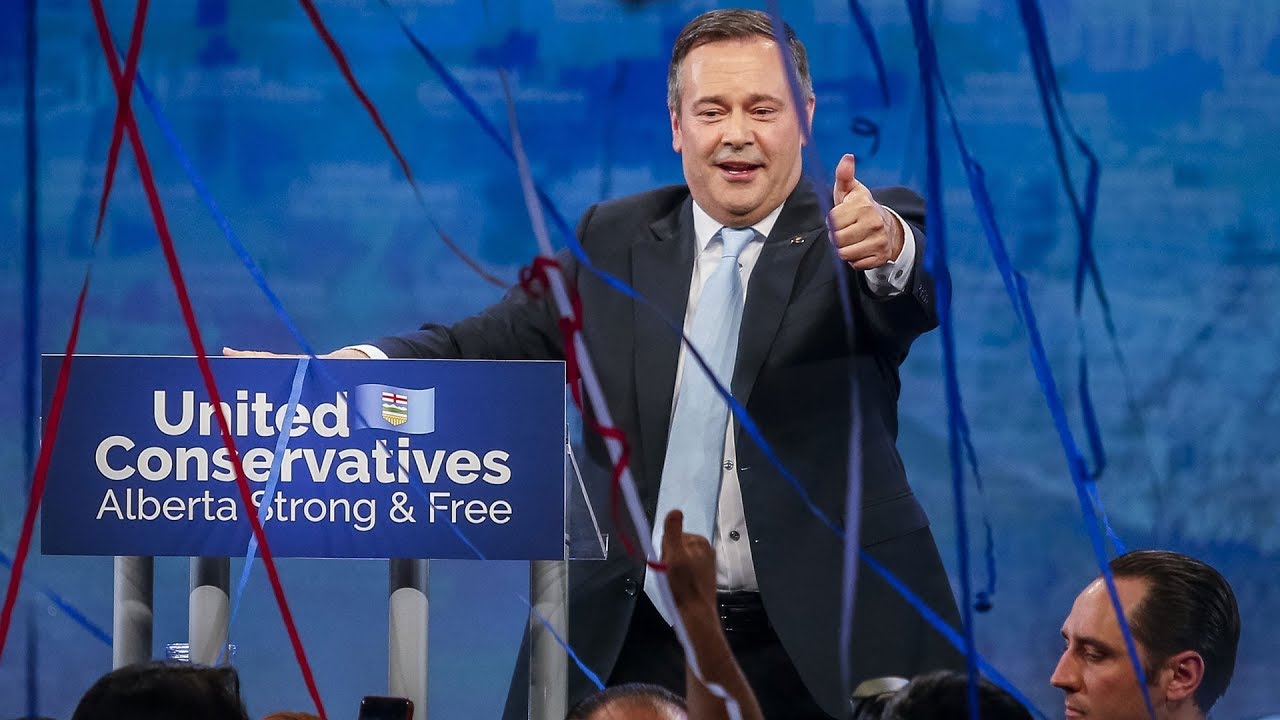 on Tuesday, Kenney blamed other Canadian provinces, the Trudeau administration and a "foreign-funded campaign of special interests" for blocking pipeline expansions, and he called on Quebec and other provinces to help Alberta get its oil to markets overseas if they want to share in its resource wealth.
Attempts to build a pipeline to the East Coast have in the past been stymied by opposition in other provinces—opposition that Quebec Premier Francois Legault made clear on Wednesday remains strong. "There is no social acceptability for a new oil pipeline in Quebec," Legault told reporters on Wednesday, according to the CBC.
Alberta has also been pushing for the expansion of the Trans Mountain pipeline, which carries tar sands crude to a port in British Columbia. U.S.-based Kinder Morgan had been trying for years to triple the pipeline's capacity, but British Columbia and some indigenous First Nations opposed the project. Last year, the Canadian government bought the pipeline to keep expansion hopes alive, but a court rejected the pipeline's permit and ordered a new federal review of the project in consultation with First Nations along the route.

While a new decision on the project is expected by the end of May, Kenney's win adds uncertainty to the process.
Prime Minister Justin Trudeau's support for the expansion was widely viewed as one half of a grand bargain with Rachel Notley, the outgoing Alberta premier and member of Alberta's New Democratic Party, who lost the election this week to Kenney.
Trudeau had been pushing provinces to enact their own carbon taxes as part of his plan to meet Canada's pledge under the Paris climate agreement. Those that didn't would fall under a new federal tax, which is currently being challenged in court by the government of Ontario. Notley enacted a tax in Alberta along with a cap on emissions from the tar sands, and many political observers said that tax was central to securing Trudeau's support for the pipeline.
With Kenney now promising to scrap both the tax and the cap, the political calculus changes. Trudeau could use the pipeline project as leverage over Kenney, pressing the provincial leader to maintain a carbon tax or for other concessions. Or he could decide to abandon the expansion altogether.
==
The horror of the New Zealand terror attack that targeted two mosques during Friday congregational prayers and left 50 people dead has raised important questions about the kind of ideas that inspire this senseless violence. In Canada, the 2017 Québec mosque shooting that left six Muslim men dead also forced the question: what drives the hate that leads to white nationalist terror?
Recently I attended a “free speech” conference on the outskirts of Toronto. In attendance at the event were lawyers from prominent legal firms and other professionals. When I challenged one of the speakers for remarks I felt promoted hatred against Muslims, I was physically assaulted.
I have long been examining the question of what fuels white nationalist hatred by documenting and mapping the “Islamophobia industry” in Canada. The industry is a constellation of individuals, media outlets, think tanks, politicians and organizations that purvey racism and Islamophobia. These include white nationalist and “alt-right” groups that are proliferating and expanding their reach in Canada from upward of 100 groups in 2015 to nearly 300 by 2018.
While the alt-right, neo-Nazi and white supremacist groups are the foot soldiers of the movement, there are other, more covert players that form the soft power of this widespread industry. These power brokers use cultural, political and economic ideas to influence, shape and inform white nationalist views. They help circulate bigotry by dressing it up as patriotism and purveying it through “respectable” channels.
I refer to this as the “liberal washing” of white nationalism, where politically camouflaged xenophobic, Islamophobic and racist notions are disguised under the veneer of liberal discourse such as “protecting democracy,” “freedom” and the “rule of law” from what are regarded as illiberal, anti-modern and anti-democratic minorities.
I had a front-row seat to liberal-washed hate messaging at the conference held by Canadians for the Rule of Law, a registered charity that seeks to challenge “political tribes” and “disruptors” who question the rule of law in Canada.
Teaching Islamophobic fear and bigotry
The idea that “Islamists” are infiltrating and imposing shariah law in Canada was a common narrative at this event and disturbingly echoed the views of the New Zealand shooter, whose manifesto spoke of Muslim “invaders” who were corrupting western civilization.
The vague deployment of the term “Islamist” at this conference reduced a broad political spectrum to a narrow epithet for the violent overthrow of democratic rule to install an Islamic State. The Islamist bogeyman became the dominant representation of Muslims. Fear-mongering about the infiltration of the Muslim Brotherhood in Canada was used as a clarion call to warn of impending threats to Canada’s freedom and democracy from Muslim neighbours, organizations, politicians, Muslim Student Associations and Islamic schools.
Preserving Canadian “values” from the corruption of minorities seems far more reasonable than shouting racist slogans in the street — except this liberal-washing of hate is simply another way of echoing and dog-whistling white nationalist, xenophobic ideals by masquerading them through more “civil” and “polite” discourse.
One of the supporting organizations of the conference was Act For Canada, an offshoot of Act For America, one of the most prominent anti-Muslim groups in the United States. Their website outlines their goals:
“ACT! For Canada is a forum for citizens concerned about the triumphalist brand of Islam that seeks to erode our cherished western principles of free speech and equality with the goal of eventual Islamic supremacy in the West ….”
Other groups supporting the conference included conservative media outlet TAG TV, the Bangladeshi Minority Rights group, B’nai Brith and several pro-Zionist groups that equate criticism of Israel as anti-Semitic and “illegal.” The conference also received funding from Daniel Pipe’s Middle East Forum think tank that “protects western values from Middle Eastern threats” and “emphasizes the danger of lawful Islamism.”
A front row seat to hate
To set the tone for the day, conference organizers began with a condemnation of the New Zealand terror attack. Attendees were asked to rise for a moment of silence. It turns out the silence was not to commemorate the victims of this heinous hate crime, but rather to honour “free speech.”
I spent a long day of being a fly on the wall at this conference, hearing non-stop pro-Zionist rhetoric denying that Israel was oppressing Palestinians and consuming a steady diet of Islamophobic bigotry. Along with this came calls for preserving “Judeo-Christian democracy,” protecting against multiculturalism and the need to build a “coalition of the willing,” (the term used by George W. Bush to refer to countries who supported militarily or politically the 2003 U.S-led invasion of Iraq), to challenge “Islamists” and preserve the rule of law in Canada.
Most egregiously, in one session I attended, panellists repeatedly referred to the Al Noor mosque in New Zealand where the terror attack occurred as a “known site of radicalization” without citing any evidence. They complained the media was not publicizing this information. Despite their caution to say this was not a justification for the shootings, I was concerned their salacious and unfounded claim against the Al Noor mosque created further fear and hatred against Muslims.
I finally decided to intervene.
One of the panellists was Christine Douglass-Williams, who in 2017 was removed from the Canadian Race Relations Foundation for remarks described by non-profit organizations as Islamophobic.
I asked her about a speech she made in Iceland in which she warned Icelanders about the “Islamicist supremacist incursion into their country:”
“Islamic supremacists will smile at you and invite you to their gatherings, make you feel loved and welcomed but they do it to deceive you and take over you, your land, and your freedoms …Many friendly, seemingly ‘moderate’ Muslims are deceiving you …”
I asked her what her warning was for Canadians, given that’s what she told Icelanders.
Not so free speech
Douglass-Williams became defensive and said she was misquoted. I was paraphrasing, but I told her I took the information directly from an article she wrote. The moderator became angry and told me I couldn’t speak anymore. He told me to leave.
I protested and said I was trying to engage in a dialogue, to exercise my free speech rights, which this conference purported to uphold. The moderator, who is an “ethicist,” informed me I was now trespassing and had to leave.
Did I breach conference decorum by being unwilling to be silenced? Yes. Did they have a right to ask me to leave because I spoke after being told to be quiet? Technically, yes. I did not plan to interrupt the far-right echo chamber, but when I did intervene in the discussion, I realized it was likely I’d be asked to leave because of my views. And I was willing to do so peacefully. But I was not prepared for what happened next.
I stood up voluntarily to leave as instructed by the moderator. But I made one final comment: I said their thinly veiled white supremacist views and Islamophobic fear-mongering is the kind of rhetoric that inspires white nationalist terror.
That comment caused a commotion.
A man from the audience grabbed me and pulled me from the room, twisting my arm with force. I shouted to the silent onlookers: “This man is hurting me! He has no right to touch me!”
A man in the audience shouted back: “You are lucky to even be in this country!”
During this incident, not one person said or did anything. All cellphones, by order of the conference, were surrendered so no one took videos of the incident. I had to wait to call the police until afterwards.
As the man was physically accosting me, I looked over my shoulder to the crowd in the room. They did not look like Proud Boys wearing Doc Martens; they were mainly white seniors that included a retired school psychologist, a teacher and lawyers dressed in suits and ties. Others wore leisurewear, the kind worn on a winter cruise.
One of the people in the room was a former Toronto police officer and “security expert.” I thought he might see the danger in the situation and stop it, so I appealed to him: “You are a former police officer and I’m telling you this man is assaulting and hurting me!”
He stared at me and said nothing. Ironically, all of this occurred during a panel about public safety and upholding “the rule of law.” No amount of “liberal washing” will clean this dirty laundry.
Editor’s Note: Prior to publishing this article, The Conversation Canada asked the organizer of the conference, Canadians for the Rule of Law, why Jasmin Zine was forcibly removed from the event she attended. Donald Carr, president of Canadians for the Rule of Law, replied in an email that Zine “did not conform to clearly stated ‘rules’ relating to asking questions of the panellists.” Carr said Zine was asked to surrender the microphone after asking her question and that conference organizers then considered her to be a “trespasser on private property” and asked the conference’s private security firm to escort her out. Carr admitted an “unknown individual from the audience seized the professor to take her out, but on request, released her” and a security officer escorted Zine to the lobby of the building. Carr said a police officer subsequently interviewed several people and told conference staff that there “had been no illegal action.” Zine has since received an email from the investigating officer from York Regional Police who indicated that people at the conference he spoke to “were not very forthcoming with information about the suspect.” The officer said conference organizers told him the suspect was selling books at the conference, but they didn’t have any contact information for him. “I’m sorry I could not find the suspect and give you anymore closure in this upsetting matter,” the officer concluded.
Jasmin Zine, Professor of Sociology, Wilfrid Laurier University
This article is republished from The Conversation under a Creative Commons license. Read the original article.
==
schizo policies
https://www.motherjones.com/environment/2019/03/us-and-canadian-oil-production-push-the-planets-climate-goals-out-of-reach/
https://www.ecowatch.com/canada-supreme-court-fossil-fuel-companies-2627712275.html
Green energy campaigners in Canada applauded a precedent-settiing Supreme Court rulingon Thursday which ordered the bankrupt Alberta-based oil and gas company Redwater Energy to clean up its failed wells instead of leaving the task to the public.
Observing the "polluter pays principle," the 5-2 ruling overturned two earlier decisions by lower courts which had sided with a federal law stating that insolvent companies could prioritize paying back their creditors over fulfilling their environmental obligations.
"Bankruptcy is not a license to ignore rules," Chief Justice Richard Wagner wrote in the ruling, which was celebrated as one that would set a new precedent for the entire country.
...
==
https://yyy.theguardian.com/world/2019/jan/07/canada-indigenous-anti-pipeline-protesters
no lnx
...The pipeline project has previously faced numerous delays, after a group of protesters constructed a blockade – named Unist’ot’en Camp – in order to prevent construction vehicles from accessing the area.
On 14 December, a British Columbia court granted TransCanada an injunction permitting them access to the construction site and ordering the removal of the blockade. Within days, activists erected the new barrier, named the Gidimt’en checkpoint.
On Sunday, Unist’ot’en Camp issued a statement of support for the Gidimt’en checkpoint: “The RCMP’s ultimatum, to allow TransCanada access to unceded Wet’suwet’en territory or face police invasion, is an act of war. Canada is now attempting to do what it has always done – criminalize and use violence against indigenous people so that their unceded homelands can be exploited for profit.”
Both the Unist’ot’en and Gitimd’en are part of the five clans which make up the Wet’suwet’en.
In recent years, British Columbia has been the site of a number of high-profile legal cases surrounding the issue of land title. Because few of the province’s First Nations signed treaties with colonial governments, the courts have often been the arbiters of land rights disputes.
The Delgamuukw v British Columbia case – which covers part of the Wet’suwet’en territory – previously found that indigenous rights to their historical territory are not “extinguished” for lack of a treaty.
Wet’suwet’en claim they retain title to the land and as a result, have sole authority to deny or grant access to the territory.
Trudeau's environmental record on the line in Canada election year
Read more
The pipeline feud comes as energy companies in Canada are facing numerous delays and barriers to their infrastructure projects, including environmental assessments and adequate consultations with indigenous communities on whose territory the projects would pass through.
Another high-profile pipeline project, Trans Mountain, was halted over the summer after a federal court determined indigenous communities had not been adequately consulted during the approvals process.
British Columbia premier John Horgan, who made headlines for his fight against the Trans Mountain pipeline, has cheered on the C$40bn liquid natural gas project – of which the Coastal GasLink is a critical piece – citing the large number of jobs and revenue that will result from its completion.
While the provincial government has said the facility will be the cleanest of its kind in the world, a report from the Pembina Institute found that the project would increase the province’s emissions by 8.6 megatonnes by 2030.
Protesters at the Gitimd’en checkpoint have vowed to prevent the project from being built on their territory.
...
==
5/18
https://www.ecowatch.com/canada-kinder-morgan-pipeline-2573283566.html
yikes kinder morgan
==
chevron 4/18
https://www.ecowatch.com/us-bank-pipelines-financing-policy-2559289565.html
==
https://www.ecowatch.com/transcanada-tar-sands-2482964658.html
TransCanada May Abandon Energy East Tar Sands Pipeline
TransCanada wants to suspend and may even cancel its proposed $15.7-billion Energy East pipeline, which would carry tar sands oil across most of the Canadian continent.
The pipeline giant—the same company behind the controversial Keystone XL—is seeking a 30-day pause on the project in order to do a "careful review" of the National Energy Board's (NEB) tough, new climate standards.
The NEB, Canada's pipeline regulator, announced last month it was widening the scope of its Energy East and Eastern Mainline Project assessment to consider upstream and downstream, or indirect, greenhouse gas emissions.
As the National Observer explained, the NEB's new rules are a departure from its previous practice of only reviewing the impact of pollution caused during pipeline construction and operations—it also considers the impact of pollution caused by the production and consumption of the oil to be shipped by an operator.
NEB also said it will provide "more visibility" to the evaluation of risks associated with accidents such as oil spills.
TransCanada said the NEB's expanded pipeline standards could affect the "costs, schedules and viability" of its Energy East project. NEB said it will make a decision on the company's request "in a timely manner."
TransCanada's announcement is a win for environmentalists who have long protested the project.
According to the Natural Resources Defense Council, the proposed Energy East pipeline would transport 1.1 million barrels per day of mostly tar sands oil from Alberta to St. John and would bring a significant increase in carbon pollution—the equivalent to the annual emissions of as many as 54 million passenger vehicles—and lock in high-carbon infrastructure expected to operate for at least 50 years.
As 350.org founder Bill McKibben tweeted: "Whoa! Transcanada may abandon its #energyeast pipeline because it doesn't want to confront the climate implications"
...
==
2x?
bart mcg: sunoco:
The presentation divided groups into categories of "radicals" "idealists" "realists" and "opportunists"and outlined how to engage with them. Rising Tide North America, Oil Change International and the Indigenous Environmental Network were labeled as radicals. Sierra Club and Amnesty International were among groups called idealists, while groups including Pembina and the World Wildlife Fund were called realists.
Some of the groups mentioned have recently been the targets of surveillance in Canada coordinated by the federal energy regulation board, the National Energy Board.
cf http://www.nationalobserver.com/2017/05/05/news/spies-our-midst-rcmp-and-csis-snoop-green-activists
==
http://www.huffingtonpost.ca/2013/12/15/stratfor-canadian-government_n_4449505.html
no link
Stratfor, a.k.a 'Shadow CIA,' Had Contracts With 13 Federal Departments: WikiLeaks
12/15/201312:08 EST | Updated 02/14/2014 05:59 EST
Ben Makuch, The Canadian PressCP
OTTAWA - At least 13 Canadian government agencies have had subscriptions with U.S. private intelligence firm Strategic Forecasting, Inc. or Stratfor, sometimes dubbed a shadow CIA, newly released WikiLeaks emails indicate.
Stratfor came under fire recently after a leaked company document prepared for an oil company outlined ways to counter activist groups, such as Greenpeace, who oppose Canada's oil-sands development.
The same cache of leaked emails indicates Canadian federal agencies have purchased at least half a million dollars in Stratfor services.
Stratfor's Presentation On Countering Anti-Oilsands Activists
Reportedly prepared for Suncor, 2010.
[docs?]
Stratfor Oilsands Presentation, 2010
Emails from January 2009 and February 2011 show invoices of $13,125 and $13,725 for one-year Stratfor subscriptions for Foreign Affairs and International Trade, which were not publicly disclosed by the department.
Under proactive disclosure policy, Canadian government contracts worth more than $10,000 must be posted on the web.
Foreign Affairs spokesperson Jean-Bruno Villeneuve says there was a clerical error in not reporting the contracts.
Villeneuve added the subscriptions were "used widely within the department to help inform policy development and analysis."
Stratfor declined to answer questions about the recent leaks, referring The Canadian Press to a posted statement about its policy not to comment on any of the WikiLeaks documents.
"Some of the emails may be forged or altered to include inaccuracies; some may be authentic," the statement reads.
"We will not validate either. Nor will we explain the thinking that went into them. Having had our property stolen, we will not be victimized twice by submitting to questioning about them."
A Canadian intelligence expert says some federal departments use private firms such as Stratfor to augment their supply of intelligence.
"I think it's not uncommon," Wesley Wark said in an interview.
"Particularly for people in the intelligence analysis world of the Canadian government … to have contracts from time to time with private-sector firms for delivery of certain kinds of analytical problems, which is basically what Stratfor does."
Wark says such services can be expensive and beyond the budgets of government agencies.
In another leaked email, dated March 3, 2011, a senior executive in the firm applauds a Stratfor employee for cementing a long-term contract with National Defence.
The deal was on behalf of the Canadian Forces College in Toronto, worth $240,600 over three years.
The leaks suggest National Defence has had the highest-value agreements with Stratfor.
"We locked them in for a three-year commitment," says the email, with several replies of congratulation for the coup.
According to the same email chain, National Defence paid Stratfor $78,225 in 2011, $80,175 in 2012 and $82,200 for this year. The contract was publicly disclosed by the department.
The deal gave the college "Authenticated Access to STRATFOR Enterprise Premium Portal," which includes "Up to 10 individual user accounts" with access to sophisticated analysis and geopolitical forecasts.
National Defence's publicly posted contract reports also show an agreement with Stratfor worth $182,377 from 2008 to 2011.
In 2006, a Stratfor analyst described in an email another deal with comparable value.
"We just inked a deal beginning yesterday similar to the Air Force," the analyst wrote to a colleague, "except it covers the Canadian Forces for $50k (the) first year and $60k for (the) subsequent year."
Industry Canada used an "enterprise premium portal" subscription similar to that of National Defence, an April 2005 email indicates, although a dollar figure was not reported. Another email indicated a renewal of a subscription in 2010.
Additional emails from the WikiLeaks database show the Public Safety Department, whose umbrella includes the Canadian Security Intelligence Service, had a deal with Stratfor in 2010 and 2011, although the valuation was not given.
WikiLeaks obtained the emails from a high-profile hacking of over five million Stratfor emails by alleged Internet activist and Anonymous member, Jeremy Hammond. Hammond pleaded guilty in a U.S. court and received a 10-year sentence last month.
"I don't think they (Stratfor) have formal access to classified material," said Wark.
"But the people who work at Stratfor are for the most part former members of the American intelligence community and have some connections. ... But they're primarily, I think, working with open-source material."
Here is the Stratfor Canadian government subscription list, according to WikiLeaks cables: Transport Canada; Industry Canada; Export Development Canada (Crown corp.); Citizenship and Immigration; Canadian International Development Agency (now part of Foreign Affairs);Natural Resources; Canadian Nuclear Safety Commission; Treasury Board; Canadian Air Transport Security Authority; RCMP; Public Safety; National Defence; Foreign Affairs.
https://twitter.com/BMakuch
MORE:Businessoilsands stratforstrafor tar sandsstratforstratfor canadian governmentstratfor oilsandsstratfor suncorsuncor stratfortar sands stratfor
http://www.nationalobserver.com/2017/05/18/news/canadas-spies-collude-energy-sector
Part Two: Government spies collude with energy sector:
Canada's spies collude with the energy sector
By Bruce Livesey in News, Energy, Politics | May 18th 2017
Critics say the federal government is spying on environmentalists and First Nations and sharing their findings with the oil patch. File photo of oilsands by Kris Krug
This is the second installment of a two-part investigative series on government, spies and the oil industry
In the fall of 2013, Jason Augustine was in the thick of one of the most important standoffs First Nations activists have ever had with energy companies.
As a district war chief with the Mi'kmaq Warriors Society, and a member of the Elsipogtog First Nation near Rexton, a village on the east coast of New Brunswick, Augustine and his band were engaged in a protest against fracking. For weeks he and his fellow activists blocked the entrance to a compound where a fracking company had stored equipment, among other protests. Augustine notes that they did this because with fracking, "the gas (that is released) contaminates drinking water."
In October of that year, RCMP officers, with guns drawn and dispatching pepper spray, descended on the blockade, arresting 40 protesters, Augustine among them. Five RCMP vehicles were set on fire during this final confrontation. Augustine was later sentenced to 18 months of probation, and pled guilty to assaulting a police officer, two counts of obstructing a police officer, and one count of mischief. This standoff, however, galvanized attention to the issue of fracking and the province soon placed a moratorium on it.
November 1, 2013 photo of Jason Augustine outside Moncton Law Court from twitter by Jessica Doria-Brown, CBC
Yet Augustine's problems with the RCMP have continued: the 42-year-old is frequently followed by what Augustine believes are government vehicles. “And it’s just not me that’s been followed,” he remarks. “A lot of our Warriors Society members get followed. It’s just going to a different reserve and they still get followed. They are always monitoring us and trying to figure out what we are doing.”
“I see it as harassment,” he continues. “Why can’t we live our lives without being watched? We stood up for our water and our land, you know. We did that, and under our treaties we have the right to do that.”
As discussed in Part One of our two-part series, the federal government has created a massive and sophisticated spying apparatus – overseen primarily by the RCMP and the Canadian Security Intelligence Service (CSIS) – designed to track the actions of First Nations and environmental activists opposed to so-called "critical infrastructure" projects, namely the tar sands, pipelines, fracking and mining. But critics of this network say it does more than just spy on people – it tries to intimidate too. More importantly, the fruits of all of this espionage are often shared with the energy sector.
As an example of intimidation, in May of 2012, the Yinka Dene Alliance in BC decided to take a “Freedom Train” across Canada to Toronto, bringing attention to Enbridge’s proposed Northern Gateway pipeline, which was slated to connect the oilsands to the BC coast (last year, the Trudeau government canceled the pipeline after former PM Harper had approved it). The Alliance planned to arrive in Toronto in time for Enbridge’s annual shareholders’ meeting. Among the 37 band members who left BC on the train was John Ridsdale, the Hereditary Chief of the Na'Moks, Tsayu Clan, Wet'suwet'en, who lives in Smithers, BC.
On the train with them, recalls Ridsdale, were undercover officers, presumably RCMP or CSIS, or both. “When you have people going up and down an aisle of a train – you know you are being watched,” he says. “They were easy to pick out. They were not really trying to be undercover – they wanted us to know we were being watched.” The trip went off without incident, culminating in a rally and march in downtown Toronto.
Ridsdale says that First Nations people protesting resource development “take it for granted we are all monitored… (but) we are nonviolent and we are here to protect the land and water and freedom. We are not against development – we are against the manner (in which) they do it.”
In response to questions furnished by the National Observer, the RCMP said as part of its mandate "the RCMP does have the requirement to identify and investigate criminal threats, including those to critical infrastructure." They also noted "the RCMP has instituted a measured approach to large-scale public order events."
Wet'suwet'en First Nation Hereditary Chief Na'Moks (John Ridsdale) signs the Treaty Alliance Against Tar Sands Expansion in Vancouver, B.C. on Thurs. Sept. 22, 2016. Photo by Elizabeth McSheffrey
Idle No More panics the intelligence bureaucracy
Yet the culmination of this type of espionage and intimidation occurred after the birth of Idle No More. Founded in late 2012 by four Saskatchewan women in response to Harper’s omnibus bills that gutted laws designed to protect the environment over resource development projects, Idle No More led to teach-ins, blockades, protests and rallies as well as a National Day of Action. It even sparked solidarity protests in other countries.
Yet Idle No More caused panic within the federal government’s intelligence and surveillance bureaucracy, which swung into action. “Idle No More was, as far as I know, the most completely surveilled social movement in Canadian history,” says Carleton University criminologist Jeffrey Monaghan, who has studied this issue. “Every single event had intelligence gathering about it. Whether it’s open source or more covert methods. We’re talking about very remote events in like Prince Albert, Saskatchewan to the more contentious ones, like Sarnia. Every single event was being scrutinized, was being monitored and was being cataloged."
Idle No More protesters march against then-Prime Minister Stephen Harper's policies on Parliament Hill in Ottawa on December 22, 2012. Photo by Isabeau Doucet.
“On top of that, you had formations of national security working groups at the highest level of the bureaucracy having regular updates and streaming information directly to the prime minister and national security adviser and cabinet in real time.”
Indeed, a heavily-redacted 11-page report obtained by the National Post in 2014 shows that CSIS was involved in preparing an all-of-government approach to dealing with the First Nations protests. The report, and a PowerPoint presentation, revealed that Ottawa was planning for every eventuality, concerned by the decentralized, leaderless nature of Idle No More. Moreover, says Clayton Thomas-Muller, a former Idle No More organizer: "There were multiple reports of CSIS and RCMP agents contacting individuals at their homes and in public over participation in Idle No More. Any time an officer of the settler colonial state... approaches an Indigenous person, it is considered threatening, given the statistics around the criminalization of Indigenous peoples and our over-representation in Canada's jails."
Intelligence shared with energy sector
What happens to all of the information and data gathered about activists?
For one thing, some of it is shared with the energy sector. Starting in 2005, Natural Resources Canada, in collaboration with CSIS and the RCMP, began hosting twice-yearly classified briefings with executives from energy companies at CSIS’s headquarters in Ottawa - which continue to this day.“You have the RCMP and CSIS giving these briefings to the private sector – but the private sector wanting those briefings to be driven by the demands of those receiving the information,” says University of New Brunswick sociologist Tia Dafnos, who has researched this topic.
File photo of CSIS sign by the Canadian Press
In 2012, Tim O’Neill, a senior criminal intelligence research specialist with the RCMP’s Critical Infrastructure Intelligence Team, wrote an email in which he said the purpose of these meetings “is to provide intelligence briefings to select energy representatives so they are able to implement the required security precautions to protect their assets. The briefings also provide a forum for the private sector to brief the Canadian intelligence and law enforcement community on issues we would not normally be privy to.” This email noted that the energy sector executives possess at least a “Level II (Secret) Security Clearance.” Indeed, Keith Stewart, head of Greenpeace Canada’s climate campaign, estimates “there are over 200 executives in the natural resources sector who have security clearance from CSIS and RCMP around these things like critical infrastructure.”
Agendas for these briefings, that have emerged through access to information requests, show that items of discussion include issues such as “security challenges presented by Radicalized Individual Groups to Canada’s Energy Sector” and “Extremist Activities within Aboriginal Communities”, and topics such as "Improvised Explosive Devices”, or on specific projects, such as the oilsands and Northern Gateway pipeline.
These briefings are well-attended, too. On the government side, they include people from the RCMP and all of Canada’s intelligence services, as well from the departments of Natural Resources, Defence, Public Safety, Transport, Industry Canada, National Energy Board (NEB), Atomic Energy Canada Ltd., the governments of New Brunswick, Quebec and Alberta, and the federal Office of the Auditor General, among others.
On the corporate side, however, it's unclear who attends. All federal documents have been censored prior to release under access to information legislation to remove the names of companies that send executives to the meetings.
Nonetheless, in 2013, minutes to one meeting reveal that networking and coffee receptions at the briefing was sponsored by the pipeline company, Enbridge Inc., along with the (US) $250-billion Toronto-based global conglomerate, Brookfield Asset Management Inc. (Enbridge did not respond to requests for a response while Brookfield says it has been a number of years since they have participated in the briefings, and did so only because they were concerned about cyber-security and loss prevention).
Meanwhile, Canadian Natural Resources Ltd., which operates the Horizon oilsands project in Fort McMurray, Alberta, was an invitee to the briefings, according to one RCMP email (the company refused to discuss its participation in these briefings when approached by National Observer). “This is how the energy companies have become part of the national security bureaucracy themselves,” observes Monaghan. “They are embedded within the bureaucracy because now, for the most part, 'critical infrastructure' is privately owned… It’s a two-way street: the police and CSIS have deputized the companies and their security actors to provide intelligence as well. This emerges from the energy companies putting pressure on the governments saying ‘You are not doing enough to stop these activists from disrupting whatever’.”
Jeffrey Monaghan, Carleton University, Ottawa, spies, Canada, oil patch
Ottawa-based criminologist Jeffrey Monaghan has researched espionage targeting environmental and First Nations activists for years. He is seen here at Carleton University. Photo by Alex Tétreault
Astonishingly, it seems that some of the information collected has been passed on to the companies before it’s even seen by all divisions of the RCMP. In a 2010 email from O’Neill, he mentions that another RCMP officer “was very concerned that the private sector was receiving intell prior to the Detachments, which of course should not be the case as the Divisional CICI (Critical Infrastructure Criminal Intelligence) analysts should be disseminating our products within their Divisions.”
CSIS spokesperson Tahera Mufti does not deny the agency shares intelligence with other parties, saying in a statement to the National Observer: "The role of CSIS is to investigate activities suspected of constituting threats to the security of Canada, and to report on these to the Government of Canada. CSIS collects and analyzes threat-related information, which is typically disseminated to government partners through intelligence reports and other intelligence-related briefings."
In a response to question by National Observer on these briefings, the RCMP said that they, "through the National Critical infrastructure Team, assists in the identification of criminal threats to Canada's critical infrastructure and develops information products that may be used by first responders and the private sector to assess and mitigate risks associated to these threats."
National Energy Board (NEB) collects intelligence on activists
The intelligence gathered is also shared with the federal energy regulator, the National Energy Board (NEB), which is supposed to be a neutral tribunal over the approval and oversight of pipelines and other projects.
Yet documents released by the NEB show that its security staff have been alarmed about protesters showing up at hearings – and gathers intelligence on who they might be. To this end, CSIS and the RCMP provides the NEB with information. In 2013, the NEB’s head of security, wrote in an email that the Board’s security team had consulted with CSIS “at national and regional levels,” noting that they would continue monitoring all sources of information with police and intelligence partners.
Emails that have come to light through access to information requests show that the NEB security staff have been in constant contact with the RCMP's Critical Infrastructure Intelligence Team (CIIT) about potential protests at hearings, too.
In 2013, for instance, a member of the CIIT wrote to NEB staff and at least one CSIS official, Tom Lanzer, regarding the risk of interference with the Board’s hearings by groups opposed to oil sands and pipeline development. Despite acknowledging that CIIT had no intelligence indicating a criminal threat to the NEB or its members, the email advises that CIIT “will continue to monitor all aspects of the anti-petroleum industry movement” and said this information was also being shared with CSIS.
In response to a query from the National Observer, the NEB did not deny it monitors people who appear before the hearings. Sarah Kiley, a communications officer with the Board, said "we are required to continuously assess any potential security risks and take the appropriate steps to make sure that our staff, our Board Members and those attending our hearings, are safe and can freely participate in our hearings. Advice, guidance and other services provided by lead security agencies support federal agencies, such as the National Energy Board, in maintaining acceptable levels of security."
Is spying on peaceful protesters legal?
But is all of this espionage and sharing of data actually legal?
Paul Champ doesn’t think so. The Ottawa-based human rights lawyer is involved in two on-going complaints launched by British Columbia's civil liberties association against the RCMP and CSIS over their role in spying on peaceful protesters. Launched in 2014, Champ says the complaints have become "bogged down... These processes are ridiculously slow and unresponsive and obviously lack transparency" and he says there is no end in sight.
Champ argues that the Mounties and CSIS have no legal grounds to spy on people who are opposed to projects that don’t even exist – which is true for most of the pipelines being discussed.
“It’s one thing if it's a pipeline that’s already been built and people are protesting that, than maybe, theoretically, there’s a threat to that critical infrastructure,” says Champ, “but here these environmental and Indigenous groups are opposed to the policy of a pipeline. And a policy, in my mind, cannot be viewed as an aspect of national security. Therefore the jurisdiction of national security by CSIS cannot be engaged.”
Lawyer Paul Champ responding to questions in the House of Commons on March 12, 2015, on Bill C-51. Screencap from Vimeo
Champ notes that in order to justify this surveillance, “there is a legal threshold that must be crossed before an individual or group can be actively investigated... We think they need some kind of grounds to suspect, in the case of the RCMP, that someone has committed a criminal offense, is about to commit a criminal offense or, in the case of CSIS, that a group is, or might be, a threat to national security as defined by the act. We have a set of legal thresholds and until they are met CSIS and RCMP should not be getting themselves involved in gathering information about groups that are otherwise lawfully exercising their democratic rights.”
Champ also notes that “there’s no authority to be a sharing their intelligence reports with third parties such as corporations. Or the NEB, for that matter. Sharing information in that way is outside their jurisdiction and the CSIS Act and is a breach of (people’s) Charter rights.”
Has this espionage under the Trudeau government continued? In fact, evidence suggests nothing has changed. After all, Trudeau has approved or supports the Kinder Morgan, Keystone XL and Energy East pipelines, and greenlit a $11.4-billion liquefied natural-gas (LNG) mega-project in British Columbia. And the twice-yearly briefings held at CSIS's headquarters with the energy sector continue.
“The bottom line is that Canada’s entire economic paradigm is fundamentally based on the oppression of Indigenous people’s collective rights, the dispossession of Indigenous peoples from their lands to provide open-door access to extractive companies to get resources to international markets to sell to the highest bidder,” says tar sands campaigner and Manitoba Cree, Clayton Thomas-Muller, who has been the target of RCMP surveillance himself. “When we look at all of the pipelines and all of the oilsands and all of the mining and all of the mega-hydro dams and the places where Canada’s most toxic and destructive industries are placed, it's in the backyards of First Nations peoples. So it’s a very big issue.”
Indeed, shortly after the Kinder Morgan and Enbridge Line 3 pipelines were approved by the Trudeau government late last year, Natural Resources Minister Jim Carr gave a speech to a group of business leaders in Edmonton, where he assured them: “If people choose for their own reasons not to be peaceful, then the government of Canada, through its defence forces, through its police forces, will ensure that (your) people will be kept safe.”
A few days later, Carr said he regretted his remarks and apologized.
==
https://fsrn.org/2016/09/earth-hits-co2-concentration-point-of-no-return-canada-plants-a-carbon-bomb/
LNG BC ok'd env cda
==
3 Reasons the Historic U.S.-Canada Commitment to Curbing Methane Emissions Is Big
==
alberta plan?
http://www.nationalobserver.com/2015/05/04/news/how-canada-made-koch-brothers-rich
Author's note: Until this past February, I worked as a contracted television producer for Global TV and its current affairs program,16x9.Last fall, I was commissioned to do a story for the program about the Koch brothers, their holdings in Alberta’s oil sands and their interest in getting the Keystone XL pipeline built. In January, two days before the 22-minute documentary was about to air on16x9,Global's senior management pulled the story. After Jesse Brown'sCanadaland published a story aboutits sudden disappearance, Global fired me, although I was not quoted in that story or had any involvement with it. What you're about to read includes some of the material that has not yet been permitted to be shown on Global.
The attacks were nasty.
In the winter of 2011, Karen Kleiss, a reporter with theEdmonton Journal, wrote a story about how Koch Industries Inc. had hired a lobbyist in Alberta. The story provided background on the Wichita, Kansas-based energy conglomerate, its presence in Alberta, and its American billionaire owners, Charles and David Koch.
Kleiss reported at the time that no one from Koch Industries addressed her questions. Nevertheless, after her story appeared, Koch Industries went on the offensive. On their website, kochfacts.com – and in vivid red type – they lashed out at Kleiss’s article, claiming it was “slanted,” that it “parroted partisan political rhetoric and other distortions” and that its coverage of the Koch brothers registering a lobbyist in Alberta was a “purported story.” The Koch Industries representative summed up by saying:
“There is a place for opinion on the op-ed pages, on blogs, and on Twitter. It does not belong on the news pages of an objective journal.”
What the paragraph-by-paragraph rebuttal did not dispute was Kleiss's assertion that Koch industries is “an American energy conglomerate owned by two powerful billionaire brothers who help fund the Tea Party and climate change denial movements in the U.S.”
The attack was so strong that Lucinda Chodan, editor-in-chief of the Journal at the time, felt compelled to write a lengthy response to Koch defending her reporter’s work. The company replied by taking further potshots at the newspaper and at Kleiss’s judgment.
Around the same time, a similar scenario was playing out after Reuters ran a story entitled “Koch Brothers Positioned To Be Big Winners If Keystone XL Pipeline Is Approved,” that also detailed Koch’s holdings in Canada. It discussed how the Koch brothers would benefit if the Keystone XL pipeline was built.
Written by David Sassoon, a journalist who runs InsideClimate News— a Brooklyn, NY-based, Pulitzer prize-winning website that covers climate change issues— the Reuters piece eventually elicited a ferocious response from Koch’s PR department. The company accused Sassoon of publishing “falsehoods” and of being an “environmental activist,” and Reuters of printing “advocacy journalism.”
Koch Industries even took out ads via Facebook and Google with a photo of Sassoon under the headline “David Sassoon’s Deceptions.”
Once again, a Reuters editor had to intervene with a lengthy letter to Koch defending their use of Sassoon’s reporting. These attacks went on for some months. Today, Kleiss and Sassoon refuse to discuss these events.
But at that time Koch Industries’ campaigns against the media were not unusual. Their website, KochFacts, criticized reporting in The New York Times, The New Yorker, Mother Jones, Forbes.com,The Washington Post and Bloomberg's Markets Magazine.
By 2011, the Koch brothers – currently the sixth richest people in the world, with US$42.3-billion apiece – were attracting attention because of their efforts at influencing the US political system, helping foster the Tea Party movement, and attacking attempts to curb climate change. They were also emerging as political kingmakers: two weeks ago, the brothers were in the news for endorsing Scott Walker, the governor of Wisconsin, as their choice for the Republican presidential nominee (Walker is well-known for his attacks on labour rights in his state).
Koch Industries, the second-largest private company in the US, has become infamous for playing hardball....eenpeace’s most recent research shows that since 1997, the Kochs have spent a total of US$79-million to groups that deny climate change science.
Some of that cash has come north to Canada – specifically to the Fraser Institute. Asfirst revealed by the Vancouver Observer, tax records show that since 2007, the Fraser Institute, one of Canada’s oldest conservative think tanks, has pocketed a total of US$765,000 from one of Charles Kochs’ foundations.
“Multiple generations of Fraser Institute staffers and donors and board members have had links to the federal Conservative Party,” says Rick Smith, executive director of the Broadbent Institute, a liberal think tank. “There’s no doubt that the Fraser Institute’s aggressive denial of climate change, you can see resonating in Harper government policy.”
Given that the Kochs’ companies generate huge quantities of greenhouse gases, this expenditure is no surprise. But it also has a direct bearing on their plans for the oil sands.
For instance, the Kochs’ Dunkirk project will be using in situ technology – whereby the bitumen is steamed out of the ground. Yet Erin Flanagan, an oil sands analyst with the Pembina Institute, says “when you compare in situ drilling and open pit mining, in situ is actually 2.5 times more greenhouse-gas damaging per barrel than a barrel through mining.”
And then there is the Keystone XL pipeline, which would connect the oil sands to the Gulf of Mexico. Koch Industries claims they have no financial stake in, or party to the design and construction of Keystone – even producing a YouTube video to this effect. And it’s true the company has booked no capacity on the pipeline, should it ever be built.
These denials ring a little hollow to some: after all, the tar sands are the world’s third largest source of oil and the Kochs control at least 1.1 million acres of it. “The Koch brothers are very interested in the Keystone XL pipeline going through,” insists Mike Casey of NextGen Climate. “They'll tell you that they're not, but the reality is that they understand that it’s a key piece of enabling infrastructure for tar sands development. Without a major pipeline, the tar sands do not get developed.”
Indeed, the oil industry is desperate to build pipelines for two reasons: cost and capacity. “Pipelines are going to replace rail over the long term and will be a cheaper option for these (oil sands) projects,” explains Sam La Bell, an oil analyst with Veritas Investment Research, a Bay Street equity research firm. “From that point of view, it will probably cost you from $8 to $12 a barrel on a pipeline, whereas you will pay up to $20 a barrel for rail. It’s the cheaper option.”
In fact, the financial industry has pointed to the cost difference as being critical. In a 2013 Royal Bank of Canada (RBC) report on Keystone, they said if it does not go ahead “oil sands projects slated for start-up in the 2014-16 timeframe are likely to proceed at a much slower pace or be deferred.” A Goldman Sachs report the same year said if Keystone was not approved, supply to the U.S. of oil sands fuel begins to level off.
Moreover, transporting bitumen by rail has its limits. “With rail capacity, we will be at capacity by 2017 and 2018,” says La Bell. “So, in other words, all of the takeaway capacity – rail and pipelines – would be used up by that point. Beyond 2017 we need longer term options to pan out” – in other words, pipelines like Keystone.
In short, Koch will be hampered in exploiting their oil sands holdings if Keystone and other pipelines are not approved. As Casey says: “They're not holding 1.1 million acres of tar sands for conservation purposes.”
Which is one reason the Kochs have perhaps invested so heavily in backing the pro-Keystone Republican Party.
In 2012, for example, Koch-affiliated organizations raised US$404-million during the US election cycle. This past US midterm, they spent US$290-million to help Republicans win control of the Senate. The Republicans’ first order of business was to introduce a bill in the Senate on Keystone, which was passed in January (Obama vetoed it).
This winter, it was revealed that the Kochs and their billionaire friends plan to spent US$889-million on the 2016 election cycle – or more than double what the Republican National Committee spent in 2012.
“I think they are doubling down on their efforts to change the balance of power in the U.S.,” says Schulman. “They are funding really their own political party.”
The National Observer contacted a Koch Industries spokesperson multiple times for comment on the issues raises in this article. The company did not respond.
Meanwhile, as the Koch brothers continue to make headlines over their political ambitions, the evidence suggests that behind their veil of secrecy lies a plan to continue profiting from Canada’s oil.
As Mike Casey says: “These are business people and they invest politically to advance a business agenda and financial agenda, and they're not in the tar sands because they like the look of the landscape.”
==
==
http://www.desmog.ca/2015/10/14/new-report-shows-systematic-dismantling-canada-s-environmental-laws-under-conservative-government
==
http://www.desmog.ca/2015/12/10/canada-intervenes-keep-human-and-indigenous-rights-climate-treaty-during-final-hours-paris-negotiations
...Yet, among the high-level talks, Canada stepped in to raise another crucial issue: the potential exclusion of indigenous rights from the text of the agreement, expected to be agreed Friday.
Catherine McKenna, Canada’s Minister of Environment and Climate Change, spoke before a plenary hosted by French President Françoise Hollande late Wednesday night to implore international leaders to make reference to human and indigenous rights in the Paris climate agreement stronger and permanent.
“The agreement must recognize adequately the importance of respecting human rights and the rights of indigenous peoples,” McKenna said.
Indigenous Rights Uncertain in Climate Treaty
Last week negotiators placed the only reference in the draft text to such rights within square brackets. This means it is contested and could eventually be removed from the final agreement. Indigenous leaders at the climate talks say they want to see a climate deal that not only acknowledges the unique rights of indigenous peoples but that traditional lands, cultures and practices have been greatly impacted by climate change.
In addition, indigenous groups want to ensure a new low-carbon plan is not used to by governments to justify controversial hydro, wind or other projects.
“We are deeply concerned that the reference to human rights and rights of indigenous peoples…is under brackets,” McKenna said, recommending the reference be “unbracketed as we move forward.”
McKenna further called for human and indigenous rights to appear in the “operational paragraphs” of the text as well as in the agreement’s introduction, where it currently sits. The introduction is not legally binding.
“This is critically important to us,” McKenna said.
Last week indigenous groups observing the negotiations revealed countries including Norway, the United Kingdom and the European Union were working to remove mention of human and indigenous rights from the agreement.
Saudi Arabia and the United States have argued specifically against the inclusion of human rights, saying the language could open up unnecessary liabilities in an agreement that, they argue, is only supposed to be about environment....
==
new minister
Leaders in Canada’s environmental community are expressing optimism about the appointment of lawyer Catherine McKenna as Minister of Environment and Climate Change at a swearing in ceremony in Ottawa Wednesday morning.
“Including climate change in the environment minister’s title signals how high a priority this issue is to our new federal government,” said Merran Smith, executive director of Clean Energy Canada.
As a lawyer, McKenna focused on international trade and competition and co-founded a charity focused on advancing human rights in the developing world. She was also a legal adviser and negotiator for the United Nations peacekeeping mission in East Timor. A video on her website shows her biking around Ottawa with her three children.
Although her background isn’t heavily weighted to environment and climate change, Ed Whittingham, executive director of the Pembina Institute, said it’s a good appointment.
“I’m impressed with the NGO experience, which suggests a very different approach to working with environmental NGOs like Pembina,” Whittingham told DeSmog Canada. “It indicates a more engaging, communicative, collaborative approach, reading the tea leaves right now.”
McKenna pulled off an upset on Oct. 19, defeating popular NDP MP Paul Dewar to win her seat in Ottawa Centre. She will lead a Canadian delegation to Paris later this month for a critical United Nations meeting to negotiate a new agreement on cuts to greenhouse gas emissions.
“I think she has just the right kind of experience,” said Louise Comeau, executive director of Climate Action Network Canada. “We’ve moved beyond the science and even the economic dimensions on climate change. This is now about the issues of justice and fairness and I think she’s well positioned to deal with that.”
Comeau is also pleased with the appointment of Stephane Dion as Minister of Foreign Affairs and Winnipeg South CentreMP Jim Carr as Minister of Natural Resources. Dion, Carr and McKenna will co-ordinate during next month’s climate negotiations.
“The minister responsible for Natural Resources Canada doesn’t have a vested interest in the oilsands or pipelines so we can expect a more open mind on transitioning to a clean energy system,” Comeau told DeSmog Canada. “I’m quite optimistic. This signals a significant attempt to move forward in a balanced way.”
The Liberals’ election platform was vague when it came to how to decrease greenhouse gas emissions, promising only to work with provinces to put a price on carbon and to end subsidies for the fossil fuel industry. But Prime Minister Justin Trudeau has vowed that Canada will do its part to prevent the catastrophic consequences of more than a two-degree rise in global temperatures.
The Liberals have also promised to restore robust environmental assessments and to review changes to the Fisheries Act. Nunavut MP Hunter Tootoo was named Minister of Fisheries, Oceans and the Canadian Coast Guard during Wednesday’s swearing in ceremony.
Tootoo defeated Conservative MP and former minister of environment Leona Aglukkaq. Aglukkaq had to apologize in December 2014 for reading the newspaper while opposition parties asked the government about high food prices in the North during Question Period. She also once indicated that there’s still “debate” about some elements of climate science.
The Liberals will have a lot of catching up to do on the environment file. New documents obtained by CBC indicate federal efforts to reduce greenhouse gas emissions will make just a small dent, in part due to many of the most effective programs — such as the ecoEnergy efficiency programs to help homes and business save energy — being cancelled by the Conservative government.
“For the last 10 years at the federal-provincial table they wouldn't even allow the word climate change to be used. That's a challenge,” Ontario's Environment Minister Glen Murray told the CBC.
http://www.desmog.ca/2015/11/04/meet-canada-s-new-environment-minister-catherine-mckenna
==
Alberta's New Climate Plan: What You Need to Know
Alberta's government unveiled a sweeping plan on Sunday to phase out coal, curb emissions from oil and gas, grow renewables and price carbon, marking a stark policy reversal for the province that is home to the tar sands. "This is the day we step up, at long last, to one of the world's biggest problems—the pollution that is causing climate change," said Alberta Premier Rachel Notley.
==
This City is the World’s First to Mandate Climate Change Warning Labels on Gas Pumps.
ding dong b2 clone bye bye
http://www.democracynow.org/2015/10/20/canadians_oust_stephen_harper_right_wing
TV background (VN)
peter kent wiki ~ kyoto, pro xl:
Minister of the Environment
In a cabinet shuffle on January 4, 2011, Kent was named Minister of the Environment.[13] His participation at the U.N. Climate Change Summit in Nov. 2011, has been controversial as it has been noted Canada plans to withdraw from the Kyoto protocol and is urging other countries to do the same - even though Canada is among the top 10 GHG polluter nations.[14]
As a result of Mr. Kent's performance at the Durban conference, including his stated intention to withdraw from Kyoto, opposition politicians raised objections during the December 14, 2011 session of the Canadian House of Commons. In response to one of Mr. Kent's comments, MP Justin Trudeau was heard to call Mr. Kent a "piece of shit," in contravention of established decorum of the House.[15]
As Minister of the Environment, Kent was a vocal supporter of the development of the oil sands, in line with the conservative government's stated economic priorities. He went so far as to make accusations of treason against opposition party members. "One of the opposition parties has taken the treacherous course of leaving the domestic debate and heading abroad to attack a legitimate Canadian resource which is being responsibly developed and regulated," Kent told reporters. This was in response to two NDP members of Parliament going to Washington to argue the Keystone pipeline should not go ahead until Canada has come up with a better plan to combat climate change.[16]
In a CBC interview, Kent stated there is no evidence that the oil sands developments are polluting the Athabasca River.[17][18] His statement was later contrasted by a "secret" Environment Canada presentation released under FOI. The presentation highlights contamination of the Athabasca River as a high profile concern. Citing elevated levels of pollutants near mining sites including hydrocarbons and heavy metals, possible effects on health of wildlife and downstream communities, and questioning current government data which is unable to generate a "big picture" view of impacts on the ecosystem.[19][20]
Kent was an advocate of improving the Species At Risk Act, in particular making it apply to whole ecosystems rather than just individual species.[21]
Legacy
Kent was demoted from cabinet in the summer of 2013, shortly after his 70th birthday, in a cabinet shuffle which Prime Minister Harper described “generational change” in order to make room for younger MPs to become ministers.[22] He has been described by some critics such as environmentalist Rick Smith as “Canada’s Worst Environment Minister Ever”for allegedly being a "green rubber stamp for destructive, ill-considered, industrial behaviour, all while glibly blaming “foreign interests” for meddling with Canada’s overwhelmingly foreign-owned oil and gas sector" by restricting the ability of environmental assessment to limitpipeline construction, walking away from the Kyoto Protocol after the country had signed it, reducing protection for lakes and rivers, disbanding the National Round Table on the Environment and the Economy and prohibiting it from making its research public and supporting the development of the oil sands despite concerns about its impact on the environment.[23][24]^
Kent has named his accomplishments as being wastewaster regulation, changes to the Species at Risk Act and overseeing greenhouse gas regulations for vehicle emissions but that he regrets not being able to implement greenhouse gas regulations for the oil and gas industry.[22]
Backbench
As a backbench MP, Kent has called on the government to fund HPV vaccinations for boys, in addition to current vaccination programs for girls, after he survived a bout with throat and tongue cancer at the end of 2013.[25] He also criticized the Harper government for drawing up an "enemies list" of uncooperative bureaucrats and hostile stakeholders.[26]
Kent has stated his intention of standing in the 2015 federal election despite his demotion from cabinet.[26]
replaced by inuit woman: https://en.wikipedia.org/wiki/Leona_Aglukkaq
Minister of Health
Aglukkaq was named the Minister of Health on October 30, 2008,[4] and is the first Inuk in Canadian history to be appointed to the Cabinet of Canada.[5] Jack Anawak andNancy Karetak-Lindell previously held parliamentary secretary positions, which are not part of the cabinet itself.
Considerable public attention was focused on Aglukkaq during the 2009 swine flu outbreak [[smithfield vera cruz mx] where hundreds of Canadians were infected with the H1N1 virus. The Liberal health critic said that Aglukkaq was doing a "terrific job," and especially liked how the minister phoned all opposition critics to build consensus on the swine flu issue.[6][7]
Health Canada officials sent two dozen body bags, normally sent to hospitals, to a Manitoba First Nation. The move was interpreted by some to mean the government was not being upfront with First Nations about the danger they face from H1N1, some others saw it as offensive. After Aglukkaq investigated the incident, she accepted an apology from the Health Canada official who sent the body bags, saying that it was an accident and that she found no wrong intention on their part.[citation ^needed]
^---
^http://insideclimatenews.org/carbon-copy/15052015/tar-sands-full-speed-canada-promises-emissions-cuts-climate-talks
^...
The goal, announced by Leona Aglukkaq, environment minister in the Conservative federal government, would reduce Canada's greenhouse gas (GHG) emissions by 30 percent below 2005 levels by 2030.
By comparison, pledges announced by the United States would occur a bit faster—cutting up to 28 percent by 2025, enough to stay on track with its past commitments. And those offered by Europe would cut much deeper, to at least 40 percent below 1990 by 2030.
Canada's greenhouse gas emissions have climbed steadily since 2009, when it matched the United States in pledging reductions of 17 percent by 2020. Essentially all the backsliding is attributable to growth in tar sands oil production in Alberta. Other economic sectors and other provinces have done better at reducing emissions.
The only hope for Canada to meet this new target it is that some provinces are taking more ambitious steps to cut emissions. Ontario, for example, has just announced provincial targets that are far more dramatic than the federal goals....
==
rio tinto alcan
http://www.desmog.ca/2015/06/03/kitimat-residents-muzzled-speaking-out-rio-tinto-alcan-s-plan-increase-air-pollution
==
hope 5/15
http://www.globalpossibilities.org/the-texas-of-canada-just-elected-a-left-wing-government/
==
4/15
25,000 March in Canada Demanding Action on Climate Change
Thousands of Canadians marched through the streets of Québec City, Québec on Saturday to demand action from... ecowatch
==
http://thinkprogress.org/climate/2015/03/27/3639318/canada-trades-oil-for-water/
==
http://www.alternet.org/guatemalas-indigenous-people-fighting-back-against-exploitation-multinational-mining-companies cda
==
10/14
World's Scientists Call on Canadian PM Stephen Harper to Restore Science Funding, Freedom (CBC News)
==
3/15 see PM sorta screwed with oil price drop
---
The document casting Naidoo as a potential terroristic threat puts South Korea among a host of governments recently discovered to be targeting Greenpeace. The Indian government cracked down on the group, as well as other international environmental NGOs, ahead of Obama’s recent visit to the country, and the Royal Canadian Mounted Police, irked by the group’s anti-Keystone activism, named Greenpeace alongside the Sierra Club and Tides Canada in a leaked document outlining potentially violent threats to Canadian infrastructure.
==
Canada Leads the World in Forest Decline, Study Says
Sep 5, 2014
(PostMedia News)
The world's virgin forests are being lost at an increasing rate and the largest portion of the degradation is in Canada, according to a new report.
No longer is Brazil the main villain in the struggle to stop forest destruction.
"Canada is the number one in the world for the total area of the loss of intact forest landscapes since 2000," Peter Lee, of Forest Watch Canada, said in an interview.
He said the main drivers are fires, logging and energy and industrial development.
"There is no political will at federal or provincial levels for conserving primary forests," he said. "Most logging done in Canada is still to this day done in virgin forests."
==
nat resources canada
| Sheila Wilson | Sheila Wilson | Sheila Wilson |
|---|---|---|
| Postal address: | 580 Booth St. Ottawa ON K1A0E4 Canada | |
| Phone: | +1.6139925095 | |
| Fax: | ||
| Email: | shwilson@nrcan.gc.ca |
==
Canada has cut nearly $3 billion in spending and up to 5,000 jobs from its science-based departments, according to a union representing federal scientists.
Keystone Ads Mislead on Canada's Deep Cuts to Environmental Monitoring
The ads were hard to miss for anyone taking the subway in Washington, D.C.—particularly someone working at the White House, the State Department or Congress.
The ads were hard to miss for anyone taking the subway in Washington, D.C.—particularly someone working at the White House, the State Department or Congress.
They included images of children waving the American and Canadian flags, a green mountain with a river running through it, and construction workers building a new pipeline in Texas.
The ads in some of the capital's busiest Metro stations are but a small part of an aggressive, ongoing campaign that targets the most powerful people in Washington. The goal: President Obama's approval for the Keystone XL pipeline, a major expansion project that could bring more of Canada's carbon-intensive tar sands oil into the United States.
Prime Minister Stephen Harper's government has set aside $22.7 million for an advertising blitz this year to promote oil and Canada's other natural resources in the United States, Europe and Asia. But scientists and environmental groups say the advertising message is misleading its target audience about the Canadian government's failure to clean up the oil sands, Canada’s fastest growing source of greenhouse gas emissions.
"Those [advertising] messages aren't accompanied by any changes in policy—they're basically defending Canada's current record, which we know to be quite poor when it comes to climate," said Danielle Droitsch, the Canada project director for the Natural Resources Defense Council, a U.S. environmental group that has criticized the Keystone pipeline project and the expansion of Canada's oil sands industry.
Environment Canada, the Canadian counterpart to the U.S. Environmental Protection Agency, recently issued a report that projected a 42 percent cut in its pollution management and mitigation programs before the 2016-17 fiscal year. A labor union representing federal scientists, the Professional Institute of the Public Service of Canada, has estimated the Canadian government is in the middle of a three-year purge, cutting nearly $3 billion in spending and up to 5,000 jobs from its science-based departments.
Meanwhile, Canada's advertising campaign—which includes the pro-oil sands government website gowithcanada.ca [3]—touts Canada as a reliable partner and a "world environmental leader in the oil and gas sector." It also boasts of a new oil sands monitoring system "founded on science and transparency."
Harper's government defends the campaign, saying it wants to ensure that other countries get all the facts. But one fact the ads don't mention is that the oil sands industry's rising carbon footprint is projected to wipe out reductions elsewhere in Canada's economy, putting Harper's commitment to reduce annual emissions to about 3 percent above 1990 levels by 2020 out of reach.
 [4]
Promise vs. Performance
Environment Canada estimates that greenhouse gases from the oil sands industry grew by 62 percent from 2005-2011. They are projected to grow a further 84 percent by 2020.
Harper has repeatedly pledged, but delayed, introducing rules to reduce those greenhouse gases. At the same time, his government dismantled a team of seven specialists who helped design the oil sands monitoring program. They also had the expertise to draft credible tests and regulations for air pollution and greenhouse gases in the oil sands. The government eliminated their jobs, forcing some into early retirement or transfers.
It has also apparently prevented the remaining three members from using all their skills to tackle the environmental challenges in the oil sands. An internal email, distributed within Environment Canada's Emissions Research and Measurement Section (ERMS), revealed that the section's manager couldn't find any work for the specialists in the new federal and provincial Joint Oil Sands Monitoring (JOSM) initiative that the government promotes in its advertising campaign.
"All of the staff are affected by the fact that there is no oil sands work...as a result of the changes," wrote the manager, Fred Hendren, in the leaked email sent on April 14. "The intent is to find permanent duties for all of the staff."
Environment Canada confirmed that the joint monitoring plan won't be testing stack emissions directly from the source. Instead, the plan will test ambient air "at some distance from sources."
Former members of the emissions research team, speaking through their union, have urged the government to allow them to measure emissions directly from stacks, in order to establish baseline data on mercury and other substances. The union said that would also allow the government to collect other information it needs to draw up credible regulations to reduce air pollution, water pollution and greenhouse gases.
Department spokesman Mark Johnson said the work done under the joint monitoring plan was meant to complement Alberta's existing regulatory approach, which uses emissions data reported by oil companies.
But the union representing the scientists said the absence of independent data will compromise the credibility of any new regulations.
With the internal team disbanded, the department now hires consultants when it needs emissions research.
"When you cut an entire group and then simply farm it out to an outside contractor that really isn't even qualified to do that work, that to me smacks of incompetence," said local union president Stephen Vanneste. "But it's also pretty mean-spirited. There's no good intention there."
The union said it is looking into possible grievances but needs one of the government scientists or engineers to make a formal complaint.
"People are very reluctant to stick their neck out because they are very much afraid—and justifiably so—that they're going to get their heads cut off," Vanneste said.
Peers, Papers and Potatoes
The Canadian government's advertising also fails to mention some of the new peer-reviewed research emerging from the oil sands as part of the new monitoring program.
Those include studies that have documented rising toxic pollution such as mercury and cancer-linked compounds around oil sands production. But in most cases, the government scientists that have produced this research were unavailable for interviews, feeding into criticism that Harper is muzzling scientists who produce inconvenient research for industry. The allegations prompted a probe launched last year by a federal watchdog.
An industry spokesman told InsideClimate News that he wasn't aware of recent cases of alleged muzzling of scientists. He said the industry supports transparency and wants scientists to provide context about their research and data, which is featured on the monitoring plan's online public website [5].
"That's really the foundation that we've been [doing by] trying to increase the level of transparency of all of the monitoring in that region," said Greg Stringham, vice president of oil sands and markets at the Canadian Association of Petroleum Producers.
The oil sands are natural deposits of bitumen—a tar-like heavy oil—mixed with sand under forests in northern Alberta. It takes massive amounts of water and energy to extract and process the oil, leaving a significant footprint on the surrounding water, air, wildlife and climate.
The process is more expensive than conventional oil production, but the industry has historically received billions of dollars in subsidies or tax incentives. It has also created tens of thousands of jobs while generating billions of dollars in tax revenues for both Alberta and Canada.
Stephane McLachlan, a professor of environmental science at the University of Manitoba, has praised his peers in government for doing credible research but he is concerned that the joint monitoring plan fails to examine human health impacts.
"It's the hot potato that no one wants to hold," said McLachlan.
He said his own research, examining consumption habits of local aboriginal communities and their traditional sources of food, found additional evidence of toxins accumulating in ducks, fish and some mammals that are putting human health at risk.
McLachlan said he felt compelled to release the data prior to peer review because of those risks.
The federal Canadian Health Department downplayed McLachlan’s findings, saying he hadn't showed "conclusive" evidence linking the oil sands activities to human health problems.
It declined a request for an interview with one of its experts.
Environment Canada has also declined interviews with scientists who published recent peer-reviewed papers on mercury contamination. It didn't provide an explanation for the lack of media access but instead provided written statements that downplay some aspects of the evidence.
The Harper government previously spent at least $9 million on a domestic ad campaign in 2012 to convince Canadians it was promoting economic growth while "maintaining high environmental protection standards." These ads followed a first round of budget cuts to environmental monitoring programs, combined with new laws that reduced federal oversight.
Meantime, there's no sign that public relations and marketing efforts are slowing down. The Harper government is paying international public relations firm Fleishman-Hillard at least $5 million to plan and manage the campaign. It recently renewed the firm's contract until 2015, which could mean more ads are on the way.
"Often when we talk with decision makers on Capitol Hill, they also have observed that there really isn't a difference between the government of Canada and the tar sands industry," said Droitsch, the NRDC Canada project director. "I think that for those members of Congress who are concerned about the tar sands issue, it hasn't helped Canada [and the industry] to be so closely aligned."
Comment space is provided for respectful discourse. Please consult our comment policies [8] for more information. We welcome your participation in civil and constructive discussions.
Links:
[1] http://insideclimatenews.org/author/mike-de-souza
[2] http://insideclimatenews.org/sites/default/files/canadaenergyposter_0.png
[3] http://gowithcanada.ca
[4] http://insideclimatenews.org/sites/default/files/images/canadaenergyposter2.png
[5] http://www.jointoilsandsmonitoring.ca/
[6] http://insideclimatenews.org/news/20121114/climate-change-scientists-global-warming-stephen-harper-canada-skeptics-oil-sands-budget-cuts-muzzling-protests
[7] http://insideclimatenews.org/news/20140214/harper-govt-makes-moves-silence-canadas-leading-environmental-groups
[8] http://insideclimatenews.org/about/comment-policies
[9] http://insideclimatenews.disqus.com/?url=http%3A%2F%2Finsideclimatenews.org%2Fnews%2F20140902%2Fkeystone-ads-mislead-canadas-deep-cuts-environmental-monitoring
==
http://thinkprogress.org/climate/2014/09/04/3478734/nova-scotia-fracking-ban/
==
http://insideclimatenews.org/news/20140623/first-nations-being-courted-back-tar-sands-refinery-projects-their-land
if BC pipeline goes in undermines XL fight?
http://www.globalpossibilities.org/first-nations-first-dibs-says-canadas-supreme-court/
==
:{Canada Is Warming At Double The Global Average:(style="outline:none"):}:
http://link.huffingtonpost.com/4cb49b68b61807701fa21cad1nhba.6qj/U6yTNuYQ9wfDF0lvC83a7
===
http://thinkprogress.org/climate/2014/05/23/3428984/canada-war-on-environmentalists/
...Can’t Criticize If You Don’t Know
In all, I was delayed for about 45 minutes — a relatively painless experience — but I did get the feeling I wasn’t the only one being hassled in Canada for an association with environmentalism. Indeed, as interviews with multiple reporters and activists show, the federal government places numerous obstacles in the way of those who try to disseminate information about the Canadian tar sands. Many believe this has amounted to a full-on war.
There are logical reasons why impeding environmental journalists could be in Canada’s interest. The tar sands are the third largest oil reserve in the world, and production is currently accelerating so quickly that the government predicts capital investments will reach $218 billion over the next 25 years. Part of that investment could come from the Keystone XL pipeline, the controversial proposal that, if approved, would bring up to 830,000 barrels of Canadian crude oil per day down to refineries in the U.S.
So it makes sense that Canadian officials may want to prevent environmental perspectives on Fort McMurray’s vast tar sands reserves, which have replaced thousands of acres of boreal forest with massive refineries and sprawling mining sites — shiny, black excavated deserts that sit next to glowing white ponds of chemical waste. A small portion of boreal forest remains, but it doesn’t do much to cover the scars.
CREDIT: NEXTGEN CLIMATE ACTION
From the air, you can see enormous white smokestacks 50 miles away. And from the ground, you can talk to those who have been physically harmed by accidental releases from the white ponds of tar sands chemical waste, called tailings ponds, which leech into the Athabasca river and flow downstream to First Nations communities like Fort Chip, where cancer rates have skyrocketed in the last 30 years.
Stories that describe the detrimental effects of Canada’s fossil fuel boom — not to mention the high carbon-intensity of tar sands oil extraction or unlikelihood that mining sites will ever be adequately reclaimed — threaten public support for projects like Keystone XL, and by extension, speedy and lucrative development.
‘A Culture Of Secrecy’
According to Tom Henheffer, executive director of the non-profit Canadian Journalists for Free Expression (CJFE), the Canadian federal government has been actively working for the last decade to prevent journalists’ access to information, particularly in science-related fields. The trend only got worse, he said, when current Prime Minister Stephen Harper, a fierce supporter of tar sands development, took office in 2006.
“It’s specifically very bad in science-related fields, but it extends into every other field,” Henheffer said. “This government has a culture of secrecy that is extremely harmful to Canadian society.”
This government has a culture of secrecy that is extremely harmful to Canadian society.
Henheffer, whose group in April released its annual Review of Free Expression in Canada Report Card, noted two main issues at play. One, he said, is an increase in the amount of bureaucracy journalists must go through to get information. The other is a gradual de-funding of research, so the information journalists want isn’t even created in the first place.
The CJFE’s report card gave a failing grade to Canada’s access-to-information (ATI) system, which saw delays beyond the legal time limit affecting almost 45 percent of information requests, and more than 80 percent of responses partially or mostly censored. That report card also slammed the government for cutting scientific research, dismissing more than 2,000 scientists and cutting 165 research programs affecting “almost every federal scientific and monitoring institution.”
The report also noted a nationwide “muzzling” of federal scientists, citing government efforts to ensure its scientists limit discussions with the media on their work — much of which includes the environmental and climate impacts of tar sands development. This was confirmed in 2007, when a leaked PowerPoint presentation from Environment Canada revealed that government scientists were told to refer all media queries to communications officers who would help them respond with “approved lines.”
The current climate, Henheffer said, is frustrating journalistic efforts throughout the country.
“They’ve essentially dismantled our access to information system,” he said. “It makes investigative journalism impossible.”
The ‘Extremist Threat’ Of Environmentalists
Along with access to information for journalists, Stephen Harper’s government has also been working to dismantle environmental groups, a fact that has been revealed, ironically, by document requests from journalists. Those documents show unprecedented attempts from agencies across the federal government to spy on, de-fund, and otherwise disrupt the efforts of environmental groups.
[Environmental] groups threaten to hijack our regulatory system to achieve their radical ideological agenda.
The most recent example of this has been a rigorous effort by the Canada Revenue Agency to target environmental groups for possible abuse of their nonprofit charity statuses, alleging they may be violating the limits on how much political advocacy work they can do. The CRA’s $8 million effort was launched in 2012, shortly after the pro-tar sands group Ethical Oil kicked off a public campaign to “expose the radical foreign funded environmental groups” criticizing the oil industry.
“There are environmental and other radical groups that would seek to block this opportunity to diversify our trade,” Joe Oliver, then-Natural Resources Minister, wrote at the time. “These groups threaten to hijack our regulatory system to achieve their radical ideological agenda. They seek to exploit any loophole they can find, stacking public hearings with bodies to ensure that delays kill good projects.”
One of the original groups targeted was ForestEthics, a British Columbia-based nonprofit with branches in Vancouver and San Francisco. One of the fiercest and more outspoken opponents of the tar sands and the proposed Northern Gateway pipeline, the group responded by giving up its charitable status (thereby giving up tax breaks to its donors) so it could focus more on combating what it refers to as “attacks on the environment.”
“Ever since we formed the advocacy group we’ve been under further … ‘intense scrutiny’ I guess is the nicest way to put it, because the advocacy group is set up explicitly for the sake of taking on the Harper government,” ForestEthics tar sands campaigner Ben West said.
West said that since his group founded its advocacy arm, it has been a target of a recently-revealed spying effort by the Canadian federal government. That effort, revealed in November by a public records request from the Vancouver Observer, showed that officials had been sending spies to meetings of anti-tar sands groups, relaying their plans for rallies and strategies for public meetings.
What’s more, documents obtained in February by the Guardian revealed that both Canada’s national police force and intelligence agency view environmental activist protest activities as “forms of attack,” and depict those involved as national security threats. Greenpeace, for example, is officially regarded as an “extremist” threat.
West said the revelations have had a “chilling” effect on the groups’ volunteer and donor base.
“The word is out that ForestEthics is one of the groups that the federal government is paying close attention to, and that has an impact on people’s comfort levels and their desire to get involved,” West said. “If you look at the pieces of the documents we were able to get our hands on, they explain what was happening at meetings where you would have had to have been in the room to have known the content of that meeting.”
‘A Government Of Thugs’
In addition to the more-calculated attempts to prevent environmental criticism, multiple reporters and activists say they experience an egregious amount of defensiveness, spitefulness, and intimidation from the federal government that prevents them from doing their jobs effectively.
“We have a government of thugs in Ottawa these days who are absolutely ruthless,” said Andrew Nikiforuk, an award-winning journalist who has been reporting critically on Canada’s oil and gas industry for more than 20 years. “It’s a hostility and thuggery, is the way I would describe it. That’s exactly what it is.”
We have a government of thugs in Ottawa these days who are absolutely ruthless.
Nikiforuk says he’s been shut out of government events, “slandered and libeled” by a member of the government’s conservative party, and repeatedly contacted by government flacks who criticize his reporting.
The most blatant example of government intimidation Nikiforuk can recall was when members of Canada’s Energy Resources Conservation Board actively tried to prevent the publication of his 2010 book, Tar Sands, claiming he made numerous factual errors and posting a long letter about it on its website. Nikifourk rebutted the claims, eventually winning the Society of Environmental Journalist’s Rachel Carson Book Award for his reporting.
Documentary and satire filmmakers Andy Cobb and Mike Damanskis also said they experienced government intimidation when, like me, they were detained at the Fort McMurray airport in October 2013. Unlike me, however, they were deported.
“He basically told us that the tar sands weren’t news, that he wasn’t recognizing us as journalists, and that if we wanted to come to Canada, we weren’t going to be able to do it today,” Damanskis said.
Though it seemed like at first they would be able to enter the country without working papers, Damanskis and Cobb said the border official had an “immediate change of heart” after watching a clip of their previous work — a video satirizing the infamous Mayflower, Arkansas tar sands pipeline spill.
Border spokesperson Lisa White said she was not authorized to speak on specific cases, and declined to specify whether officers were allowed to make entry decisions based on the content of journalists’ work. She did say, however, that documentary filmmakers required working papers to enter Canada, and that all entry decisions are made on a case-by-case basis.
“All decisions are made in accordance with Canadian law,” she said.
Swift And Snarky Push-Back
Of course, it’s important to note that journalists like Nikiforuk, Damaskis, and Cobb are more likely to get negative feedback from Canadian government officials because they are not, and don’t claim to be, completely objective. All three are openly and fiercely opposed to the speed of tar sands development.
But even reporters who are seemingly more objective toward development have been subject to government push-back. For example, Economist correspondent Madelaine Drohan said via e-mail that Alberta’s provincial government once posted a “defensive” response on its website to an article she wrote that mentioned leaks from tailings ponds, which are large lakes of tar sands waste. That response has since been removed, but Drohan said she remembers it happening.
“It made me think that the government was even more sensitive than the industry,” she said.
As for hostility from the Alberta provincial government, one journalist pointed specifically to David Sands, a director at Alberta’s Public Affairs Bureau, whose Twitter account is made up largely of rebuttals to journalism critical of Alberta government. In recent tweets, Sands compared two newspapers’ coverage of Parliament to “jihad,” among other critical responses.
“Yeah, I’m the mean guy,” Sands told ThinkProgress. “It’s definitely my personal style, but nobody told me to be mean.”
Sands said part of his job is tracking down stories that include inaccuracies about Alberta government policies. He said he’s the only one in his department with the specific mandate to do so.
Still, many have criticized Alberta for the number of people they’ve employed to hunt down stories. According to documents obtained by the Canadian Taxpayers’ Federation in April, Alberta employs 214 communications professionals at a cost of $21 million per year, a number that the National Post noted “far outstrips” the number of reporters who cover government.
Sands rebutted that story too, saying communications staff span a range of departments — healthcare, education, law enforcement — that are not all dedicated to attacking journalists.
“It’s sort of an enjoyment of the media to say we have 214 communications people who are all dealing with the media,” he said. “When reporting is challenged, people take it very personally.”
The Strategy Is Working — Or Is It?
Thus far, government push-back against environmental journalism seems to be working. As a recent survey of Canadian journalists showed, many environmental and climate stories about the tar sands often go unreported. That survey, titled “The Alberta Oil Sands, Journalists, and Their Sources,” questioned 20 reporters with extensive daily experience reporting on the tar sands.
Of the 20, 14 said stories about the tar sands were not being told, and seven of those 14 said environmental issues were the main ones untouched. Environmental damage done by leaking tailings ponds and bitumen waste; toxic contaminants leeching into the water; the impact of excess sulfur produced in the mining process — all of those were included in the issues journalists perceive as under-reported.
“I hate this story,” one reporter who participated in the study said. “It’s important, but there’s no direction or progression.”
As for activist groups, Ben West of ForestEthics said the hostility has actually been helping his group’s efforts. And it’s not just the group itself. As the government’s attacks have become more and more public, West says his and other environmental advocacy groups have been obtaining record-breaking donations from individuals — what he calls a “clear sign” that Canadians want to protect their environment from the tar sands.
“I actually kind of welcome these attacks from the federal government in a sense, because they are a great opportunity to highlight how crazy our government’s acting, and use it as a reason to ask people for more support,” he said. “Many Canadians feel strongly about this. Let the government create their own disincentives.”
===
alter: April 23, 2014 |
Fancy living up in Canada? Granted, it’s a bit chilly. But the middle class up there has just blown by the U.S. as the world’s most affluent. America’s wealthy are leaping ahead of the rest of much of the globe, but the middle class is falling behind. So are the poor. That’s the sobering news from the latest research put out by LIS, a group based in Luxembourg and the Graduate Center of the City University of New York.
After taxes, the Canadian middle class now has a higher income than its American counterpart. And many European countries are closing in on us. Median incomes in Western European countries are still a bit lower than those of the U.S., but the gap in several countries, including the Netherlands, Sweden and Britain, is significantly smaller than it was a decade ago. However, if you take into account the cost of things like education, retirement and healthcare in America, those European countries’ middle classes are in much better shape than ours because the U.S. government does not provide as much for its citizens in these areas. So the income you get has to be saved for these items.
The report found also found that the median U.S. income, which stands at $18,700, has remained about the same since 2000. And it found that the poor in much of Europe earn more than poor Americans.
==
...
In part, Vancouver is just lucky. British Columbia is rich in hydroelectric power, so keeping the lights on in all those coffee bars pumps a lot less CO2 into the atmosphere than in cities where power comes from fossil fuels. It also helps that Vancouver has a relatively mild West Coast climate. Inland cities like Minneapolis and Denver, with more weather extremes, need more fuel for heat in the winter and electricity for air conditioning in summer.
But Vancouver has also made a lot of smart public policy choices. Even as the Canadian national government backslides on environmental protection, Canada’s more liberal localities are making progress. Ontario banned coal-fired electricity this year.
Vancouver has been committed to sustainability, and creating policies to advance that goal, for several decades. Mayor Gregor Robertson keeps raising the bar on his predecessor’s successes. He developed the comprehensive “Greenest City 2020 Action Plan,” which lays down benchmarks that each sector of the city’s government must achieve....grist
==
http://insideclimatenews.org/todaysnews/20140304/aboriginal-rights-threat-canadas-oil-and-gas-mining-plans-documents-reveal
==
...But while President Obama has encouraged citizens to "stand up and speak up" to demand change on energy, Canadian Prime Minister Stephen Harper's administration has tried to silence critics of pro-tar sands policies.
In the most recent evidence, seven influential environmental organizations have become the subject of rigorous audits by the Canada Revenue Agency.
Activists allege that the scrutiny is an attempt by the Harper administration to subdue tar sands opponents as decision time looms for pipelines needed to bring Alberta's landlocked oil to market—the Texas-bound Keystone XL and the Northern Gateway to the Pacific Coast of British Columbia.
"Canadians are starting to understand that the government has overstepped and overreached in its attacks against environmentalists and scientists," saidTzeporah Berman, a Vancouver-based environmentalist and co-founder of the activist group ForestEthics. "We're seeing a growing grassroots movement as a result. … People are angry."
The prime minister's office directed requests for comment to the Canadian Revenue Agency (CRA). Noël Carisse, a spokesman for CRA, said that since 2012 "the CRA has conducted additional review activities focused on political activities. Audits are being conducted in addition to our regular audit activities, and will include charities from across the entire spectrum of charitable activity."
The revenue agency is auditing the environmentalists for possible abuse of their nonprofit charitable status, which exempts them from paying taxes and allows donors to claim contributions as tax deductions. Canadian law states that nonprofits can only use 10 percent of their resources for political advocacy work. The CRA is investigating whether the groups exceeded this limit.
For decades, Canadian nonprofits interpreted political advocacy to mean they couldn't endorse candidates or elected officials. Like in the United States for tax-exempt organizations, support for or criticism of government policy was customary.
"They are seemingly reinterpreting what they perceive as being political activity," said Tim Gray, executive director of Environmental Defence, one of the green groups being audited. "It is a shifting landscape."
If the CRA determines that the organizations passed their annual political advocacy limit, they could lose their charitable tax status, forcing them to pay taxes and potentially driving away donors. That could cause some of the groups to shutter their doors, Gray and Berman said.
In addition to Environmental Defence, other groups being investigated include the David Suzuki Foundation, Tides Canada, West Coast Environmental Law, the Pembina Foundation, Equiterre and the Ecology Action Centre, according to theCBC, which first reported the audits.
The targeted groups have been instrumental in raising public awareness about the impacts of tar sands development on the environment and climate. They stoked a grassroots movement that helped delay the Northern Gateway pipeline in Canada and, together with U.S. environmentalists, helped make the Keystone XL a climate red line for Obama.
Environmental organizations appear to be bearing the brunt of the recent investigations.
While most of the groups are still under review by the agency and are therefore staying mum, Gray said his organization received its results from the CRA.
"They told us that basically everything we do is no longer charitable," he said. The group immediately filed an appeal. If rejected, Gray said he is unsure what that will mean for his organization's future.
Across the Border
The audits are the latest in a string of attacks on environmentalists and scientists in recent years by a Harper government that has made oil sands expansion a centerpiece of its economic agenda. Since Harper took office in 2006, production of Alberta's carbon-intensive tar sands crude has doubled, and Canada has set a goal to at least double it again in the years ahead.
Simultaneously, the conservative administration has cut funding for climate science research, shuttered environmental research labs and buried government reports highlighting the dangerous climate and environmental implications of runaway oil sands development. It has also muzzled its own scientists from speaking about the issue, cancelled thousands of environmental assessments for pipelines, oil sands mining and other development projects, and gutted 70 environmental protection laws in 2013 alone.
In 2012, the government listed environmentalists as a terrorist threat.
Amid the erosion of environmental law in Canada, across the border in the United States the Obama administration has sought to apply federal law to combating climate change. The centerpiece of this work is an historic regulation under the Clean Air Act to cut carbon pollution from the nation's coal plants. ...ICN 2/14
==
Canada’s End-Run Around Keystone XL Pipeline Opposition
Much to the surprise of everyone, climate activists in the United States led by environmental author and activist Bill McKibben and the action group he helped to found, 350.org, have succeeded in delaying U.S. government approval of the Keystone XL pipeline for more than two years. Once considered a sure thing, the pipeline, if completed, will carry 830,000 barrels per day of diluted bitumen (“syncrude”) some 1,700 miles from theAthabasca tar sands in Alberta to refineries on the U.S. Gulf Coast. It has, however, been held up by detailed environmental impact studies and other procedural steps ordered by the U.S. State Department. (Because the pipeline will cross an international boundary, it requires approval from the Secretary of State and, ultimately, the president, but not Congress.)
Opponents of the pipeline claim that by facilitating the exploitation of particularly carbon-dense Canadian tar sands, it will substantially increasegreenhouse gas emissions into the atmosphere. The use of this bitumen-based fuel releases more carbon per unit of energy than conventional petroleum and its energy-intensive extraction generates additional carbon emissions. Should all of the bitumen in Canada -- the equivalent of 1 trillion barrels of oil -- be consumed, it’s “game over for the climate,” as former NASA climate scientist James Hansen has famously written.
How the Obama administration will come down on Keystone XL is still unknown. In a speech on climate policy last June, the president indicated that he would give highest priority to climate considerations when deciding on the pipeline. “Allowing the Keystone pipeline to be built requires a finding that doing so would be in our nation’s interest,” he said. “And our national interest will be served only if this project does not significantly exacerbate the problem of carbon pollution.” At the time, his comments raised the hopes of climate activists that Obama would ultimately decide against the pipeline. More recently, however, an environmental assessment conducted at the behest of the State Department and released on January 31st cast doubt on this outcome. The report’s reasoning: even though the exploitation of Canada’s tar sands will increase the pace of carbon emissions, their extraction and delivery to refineries is assured by alternative means -- mainly rail -- if the pipeline isn’t built and so its construction will not “significantly exacerbate” the problem of greenhouse gas emissions.
While this is certainly a uniquely sophistic (and shaky) argument, it is important to note that the Canadian producers and their U.S. partners are indeed attempting to stage an end-run around opposition to the pipeline by increasing their reliance on rail cars to deliver tar sands.
“The indecision on Keystone XL really spawned innovation and mobilized alternatives, and rail is a clear part of the options available to our industry,”observed Paul Reimer, senior vice president in charge of transport at Cenovus Energy, a Canadian oil company planning to increase rail shipments from 7,000 barrels a day to as many as 30,000 barrels a day by the end of 2014. Other Canadian firms have similar expansion plans. All told, the Canadians claim that, over the coming years, they will be able to increase rail-carrying capacity from the current 180,000 barrels per day to as much as 900,000 barrels, or more than would be carried by the pipeline.
If this were to happen, count on one thing: rail transport will turn out to have its own problems -- and its own opposition. Not surprisingly, then, Canada’s oil industry still craves approval for Keystone XL, as it wouldallow even greater tar sands exports and legitimize the use of this carbon-heavy fuel. But the growing reliance on rail transportation does once again demonstrate the powerful gravitational pull of Planet Carbon. “At the end of the day, there’s a consensus among most energy experts that the oil will get shipped to market no matter what,” says Robert McNally, a former energy adviser to President George W. Bush.
Reducing Carbon’s Pull
These three recent encounters in the historic struggle to avert the most destructive effects of climate change tell us a great deal about the nature and terrain of the battlefield. Climate change is not the product of unfortunate meteorological phenomena; it is the result of burning massive quantities of carbon-based fuels and spewing the resulting gaseous wastes into the atmosphere. As long as governments, corporations, and consumers prefer carbon as an energy source, the war on climate change will be lost and the outcome of that will, in turn, be calamitous.
There is only one way to avert the worst effects of climate change: make the consumption of carbon unattractive. This can be accomplished, in part, by shaming -- portraying the producers of carbon-rich fuels as the enemies of human health and survival. It’s an approach that has already achieved some modest successes, as in the prevention, until now, of Keystone’s construction. Withdrawing funds from fossil fuel firms, or disinvestment, is another useful approach. Many student and religious groups are attempting to hinder oil drilling activities by pushing their colleges and congregations to move their investment funds elsewhere.
But shaming and disinvestment campaigns are insufficient; much tougher sanctions are required. To stop the incineration of our planet, carbon must be made expensive -- so costly, in fact, that renewables become the common fuel of choice.
There are at least two ways to move toward accomplishing this: impose a tax on carbon emissions, raising the cost of fossil fuels above those of renewables; or adopt a universal cap-and-trade system, forcing major carbon emitters to buy permits (at ever-increasing cost) in order to release greenhouse gases into the atmosphere. Both measures have been advocated by environmentalists and some attempts have been made to institute each of them. (Both California and the European Union, for example, are implementing cap-and-trade systems.) There may be other approaches to the problem that could prove even more effective, but the most essential thing is to recognize that genuine progress on climate change will not be possible until carbon fuels lose their financial allure. For this to happen, as BP’s Dudley begrudgingly acknowledged on January 15th, “you need carbon pricing. Universally accepted carbon pricing.”
The gravitational pull of carbon is immensely powerful. It cannot be overcome by symbolic gestures or half measures. The pressures to keep burning fossil fuels are too great to be overcome in piecemeal fashion. Rather, these forces must be met head-on, with the institutionalization of equally powerful counter-forces that make fossil fuels economically unattractive. We humans have a choice: we can succumb to carbon’s gravitational pull and so suffer from increasingly harsh planetary conditions, or resist and avoid the most deadly consequences of climate change.
Michael T. Klare, a*TomDispatch regular*, is a professor of peace and world security studies at Hampshire College and the author, most recently, ofThe Race for What’s Left. A documentary movie version of his bookBlood and Oilis available from the Media Education Foundation.
==
Canadian Gov't Emissions Report Undermines Keystone Pipeline Pitch
When Alberta Premier Alison Redford came to Washington this year to urge approval of the Keystone XL pipeline, she argued that producing tar sands oil generates much less global warming pollution today than it did two decades ago.
It would be wrong, Redford reasoned, for the U.S. to block the project on climate change grounds.
Artist Blacklisted by Canada Over Criticism of Climate Policy Takes Show to U.S.
Three years ago, Franke James was a little-known artist who found herself blacklisted by the Canadian government for making art that lambasted the rapidly expanding tar sands. Infuriated and emboldened by the censure, James churned out a slew of pieces criticizing the government, published a book and in the process became one of Canada's most outspoken environmental activists.
While the Obama administration dithers overwhether to approve TransCanada’s planned Keystone XL pipeline, the pipeline builder announced Thursday that it will pursue an even bigger project connecting Alberta’s tar-sands oil fields with refineries in the nation’s east.
The 2,700-mile, $12 billion Energy East Pipeline would carry 1.1 million barrels per day, making it more than a third larger than Keystone XL, which is intended to carry 800,000 bpd.
==
altern: Other notable industry associations include the Canadian Council of Chief Executives [14] (CCCE), formerly called the Business Council on National Issues (BCNI), a group comprised of Canada’s top 150 CEOs who were a major force for the promotion and implementation of the North American Free Trade Agreement (NAFTA). The CCCE remains one of the most influential “interest groups” in Canada.
In the United States there are prominent industry associations like the Business Council, the Business Roundtable, and the Financial Services Forum. The Business Council describes itself as “a voluntary association of business leaders whose members meet several times a year for the free exchange of ideas both among themselves and with thought leaders from many sectors.”
Northern Gateway Pipeline Opposed By BC Government
The Huffington Post B.C. | Posted: 05/31/2013 1:47 pm EDT | Updated: 05/31/2013 2:39 pm EDT
http://www.huffingtonpost.ca/2013/05/31/northern-gateway-pipeline-opposed-bc-government_n_3367366.html?ir=Green
==
by Brad Johnson
Showing remarkable gall, Canadian environmental minister Peter Kent took time from a climate change summit with the United States to promote the Keystone XL tar sands pipeline. At the summit, Kent and U.S. Secretary of State Hillary Clinton announced a coalition to reduce short-lived climate pollutants. Kent called the deal, to which Canada has pledged $3 million, a “critical step forward” in the fight against climate change. Kent also pushed Clinton to approve the Keystone XL tar sands pipeline, which alone would add five billion tons of greenhouse pollution to the atmosphere over its lifetime:
Environment Minister Peter Kent on Thursday pressed U.S. Secretary of State Hillary Clinton on the merits of the Keystone XL pipeline and affirmed the Harper government’s belief the Obama administration’s rejection of the $7-billion project had “nothing to do with the merit of the application.”
But Kent, in Washington for a summit on climate change, pointedly declined to weigh in on current efforts by congressional Republicans to strip the U.S. State Departmentof its authority to approve a new application for the 2,700-kilometre [1700 mile] oilsands pipeline.
Kent’s promotion of the Keystone XL tar sands pipeline made a mockery of the climate pollution deal covering methane, hydrofluorocarbons, and black carbon, to which the United States has pledged $12 million and Canada $3 million. The Keystone XL pipeline is a $7000 million project.
“Action on short-lived climate pollutants will have clear benefits for particularly vulnerable regions like the Canadian Arctic,” Kent said. “The fragile Arctic environment is susceptible to the impacts of short-lived climate pollutants which may be partly responsible for the accelerated warming trend that we are recording there.”
The worst thing Canada can do to the “fragile Arctic environment” would be to mine and burn the “carbon bomb” of the tar sands.
If the short-lived pollution deal is a “critical step forward” in the fight against global warming, then investing billions in the exploitation of Canada’s tar sands is a giant leap backward.
This post was originally published by ThinkProgress.
Related Stories:
Tar Sands Destroying Wolf & Caribou Populations in Canada
Read more: http://www.care2.com/causes/canadian-minister-promotes-tar-sands-at-a-climate-summit.html#ixzz2Uhc74Mrs
valero wants to bring tarsand to wales? kpfa 5/29 8 am Pembroke
http://www.radio4all.net/index.php/program/67208
(// venz dirty oil blocked) fqd notarsands.com emily cotes ---tarsnads network climateradio kpfa defusing the climate bomb phil england;http://www.radio4all.net/index.php/program/67208
kent at conf w/ shell http://www.no-tar-sands.org/2012/10/activists-disrupt-speeches-by-canadian-minister-and-shell-chairman/
OTTAWA-Federal Conservatives are downplaying concerns over Prime Minister Stephen Harper’s newly-selected boss for Environment Canada and the bureaucrat’s knowledge about global warming.
The department’s new deputy minister, Bob Hamilton, ran into trouble last Monday at a parliamentary committee when he was asked to explain what causes climate change.
“Wow. Umm. They didn’t tell me I’d have to answer questions like that when I took this job. I think that it’s – I don’t know the total answer to that –,” said Hamilton, before Conservative MPs interrupted to prevent him from continuing.
Hamilton made the remarks as the committee of MPs reviewed his recent nomination along with the appointment of Parks Canada’s new chief executive officer, Alan Latourelle.
After this story was posted online, Environment Canada emailed Postmedia News a statement on Hamilton’s behalf in which he said his job was to produce the best advice based on a full range of considerations, including scientific information produced internationally, nationally and within the department.
“In the case of climate change, the science clearly supports the conclusion that it is occurring, and that human activities are mostly responsible,” Hamilton said in the statement, sent more than 11 hours after Postmedia News had asked the deputy minister to explain his comments from Monday and also to explain whether he believed the scientific evidence.
“I am proud that EC is at the leading edge of scientific knowledge and contributes to the work of the Intergovernmental Panel on Climate Change (IPCC).”
But a few days earlier, as NDP deputy leader and environment critic Megan Leslie attempted to get answers from Hamilton, Tory MPs at the parliamentary committee argued that the bureaucrat’s knowledge of climate change was not relevant.
“It doesn’t seem to me, unless there’s something I’m missing, that that would relate at all to resumes or CVs or work experience of Mr. Latourelle and Mr. Hamilton,” said Stella Ambler, a Conservative MP representing the riding of Mississauga South, near Toronto.
Leslie fired back that the issue was indeed relevant.
To support the government position and its travelling ministers, Ottawa has launched a $16 million marketing campaign that includes a new website and newspaper advertisements in the US to promote Keystone KL. The thrust of the campaign is the promotion of Canada as a reliable supplier of oil and a “world environmental leader” in the field of oil and gas development.
The millions of dollars being spent on marketing efforts and road trips is unsettling to many in the scientific and environment community.
“I think it’s pretty inappropriate for government ministers to be salesmen for particular industries particularly when opinion in Canada is so divided,” Sierra Club of Canada Executive Director John Bennett told The Vancouver Observerin an interview. “We cancelled regulations, we backed out of the Kyoto Protocol, we’ve had four different plans with three different (emission reduction) targets and each time they announced targets they were weaker and further off.”
The federally funded campaign comes two months after the Alberta government purchased a full-page Sunday *New York Times* ad promoting the pipeline as “the choice of reason.” According to *The Globe and Mail*, ads “targeted at lobbyists and lawmakers” appeared last Monday, May 13, on Beltway-insider sites The Hill and Politico, and are slated to run later in other influential publications.

Go With Canada, the government’s newly launched website, promotes the idea of the Keystone XL pipeline as a crucial component of the U.S.-Canada alliance. “America faces a choice,” it states. “It can import oil from Canada — a secure and environmentally responsible neighbor that is committed to North American energy independence — or it can choose less stable offshore sources with much weaker environmental standards.”
The Globe and Mail reports:
The taxpayer-funded campaign doesn’t solely focus on TransCanada’s private $5.3-billion pipeline proposal designed to link the vast oil sands reserves with massive refineries along the Gulf coast and thus provide the vital access to major markets that will, in turn, permit further oil sands development. There also is a major effort to portray Canada as a leader in curtailing greenhouse gases and environmentally responsible. Both claims are apparently intended to deflect attacks by anti-Keystone XL groups.
But some of the figures the government’s website touts to back up those claims have already been called into question, says CBC News:
The site asserts that “Innovation and research drives improvement in the oil sands — GHG emissions have dropped 26 per cent between 1990 and 2011.”
In fact, Canada’s greenhouse gas emissions more than tripled between 1990 and 2011. The emissions intensity per barrel of oil fell 26 per cent.
CBC also notes that this “current promotional onslaught has been years in the making,” with meetings as far back as March 2010 between the Canadian government and oil industry to start hashing out their communications strategy.
Will the marketing money work? Obama is, after all, the one with the final say — but it looks like the Canadian government, seeing what a fractious issue the pipeline has become, is counting on the president’s tendency to take what he assumes to be the politically safe route.
But when half of Americans don’t even know what the Keystone XL pipeline is [PDF], any information campaign — for or against — has its work cut out for it.
h/t: Fiona Woo at World Future Council ...http://grist.org/news/canadas-government-is-spending-millions-to-get-you-to-like-the-keystone-pipeline/?utm_campaign=daily&utm_medium=email&utm_source=newsletter&sub_email=pat13%40dslextreme.com
flint hills is koch canada
In Canada, Koch companies employ more than 2,000 people involved in manufacturing, trading, marketing and sales.
Flint Hills Resources, LLC, through its subsidiaries, is a leading refining, chemicals and biofuels company. Its subsidiaries market products such as gasoline, diesel, jet fuel, ethanol, biodiesel, olefins, polymers and intermediate chemicals, as well as base oils and asphalt. The refining business operates refineries in Minnesota, Texas and Alaska with a combined crude oil processing capacity of more than 800,000 barrels per day. The petrochemical business has production facilities in Illinois, Michigan and Texas. The renewables business operates ethanol plants in Iowa and Nebraska, a biodiesel plant in Texas, and has made equity investments in bioenergy companies. The asphalt business produces and markets product in the Midwest and Alaska. A subsidiary owns a 50 percent interest in a lubricants base oil facility in Louisiana. Flint Hills Resources is among Canada’s largest crude oil purchasers, shippers and exporters. To meet the needs of its more than 130 Canadian crude oil customers, the supply group operates a fully integrated marketing and customer service desk in Calgary and operates a crude oil terminal in Hardisty, Alberta. The group also coordinates crude oil supply for the company’s Pine Bend Refinery in Minnesota.
Globe and Mail)
The Harper government is pulling out of a United Nations convention that fights droughts in Africa and elsewhere, which would make Canada the only country in the world outside the agreement.
The federal cabinet last week ordered the unannounced withdrawal on the recommendation of Foreign Affairs Minister John Baird, ahead of a major scientific meeting on the convention next month in Germany.
The abrupt move caught the UN secretariat that administers the convention off-guard, which was informed through a telephone call from The Canadian Press.
==
http://grist.org/news/the-wto-may-halt-ontarios-clean-energy-program/
chomsky says health care b/c in 50's cda unions demnanded it for all vs US got form themselves https://www.youtube.com/watch?feature=player_embedded&v=FJUA4cm0Rck
--
transcanada: http://www.huffingtonpost.com/2012/10/11/keystone-xl-new-york-times_n_1959033.html?ref=topbar XL pipe: landowner then reporters
bill mck RS 8/16
Almost every government with deposits of hydrocarbons straddles the same divide. Canada, for instance, is a liberal democracy renowned for its internationalism – no wonder, then, that it signed on to the Kyoto treaty, promising to cut its carbon emissions substantially by 2012. But the rising price of oil suddenly made the tar sands of Alberta economically attractive – and since, as NASA climatologist James Hansen pointed out in May, they contain as much as 240 gigatons of carbon (or almost half of the available space if we take the 565 limit seriously), that meant Canada's commitment to Kyoto was nonsense. In December, the Canadian government withdrew from the treaty before it faced fines for failing to meet its commitments.
==
On July 1, Canada Day, Canadians awoke to a startling, if pleasant, piece of news: For the first time in recent history, the average Canadian is richer than the average American.
According to data from Environics Analytics WealthScapes published in the Globe and Mail, the net worth of the average Canadian household in 2011 was $363,202, while the average American household’s net worth was $319,970.
lagging:
...
The National Round Table on the Environment and the Economy added every provincial and federal measure — existing and proposed — to reduce emissions.
Canada is on track to achieve only half of its 2020 target to reduce greenhouse gases by 17 per cent below 2005 levels, the report says.
"Canada will not achieve its 2020 GHG emissions reduction target unless significant new, additional measures are taken. More will have to be done. No other conclusion is possible," it concludes.
Indeed, the federal environment commissioner and many analysts have reached the same conclusion. This report, however, is the first full accounting to add every initiative on the books and project emissions out to 2020 and 2030.
The federal government, after several false starts, has decided to regulate each carbon-producing sector one by one, implementing the rules gradually over the coming years.
Provinces have taken their own paths, with British Columbia implementing a carbon tax and Quebec heading toward a cap-and-trade system...
...
Because it seems the wrong sort of Conservatives beholden to the lobby of fossil fuel energy companies, are currently managing the fortunes of the developed world. Take as an example the Canadian government today…
The Harper government echoing the Cheney-Bush administration’s climate failure policies that led to Katrina and many more Katrinas to come, has now fully abandoned Canada’s climate commitments and backtracks on all progress made in the last twenty five years. Yet the Good Canadians went further than the Cheney-Bush daft policies because the Canadians also cut back completely on science spending and have muzzled government scientists who might stray from the official line. And all this happened since the Conservative Party of Canada, won a parliamentary majority after being in a minority government for many years. It has since staked out an aggressively inimical position on many issues, yet most notably on stifling science, developing the Tar Sands wildly, and trashing the environment pell mell. Scary as hell is how Canadian scientist describe the descent of Canada into the dark ages…
But the rot in Ottawa has set in quite some time ago, and certainly, well before Stephen Harper came to being the Prime Minister. It started with the misguided self aggrandizing effort of the Canadians to become the Saudi Arabia of the North by developing the dirtiest fuel known to man. The fossil fuel called Tar Sands. And all the previous governments of Canada had already climbed on the bandwagon to torpedo potential global Climate Change negotiations because they felt that a legally binding global Climate Change agreement to reduce emissions, might derail their hoped for riches coming from the Tar Sands development. And their mad rush to build pipelines to transport the Tar Sands oil, to wherever it can be burned and further continue warming up our planet is a plan twenty years in the making.
It is a vicious cycle if we have ever seen one. A self perpetuating myth of national fossil fuels wealth, when in fact they destroy the only true wealth we all have — the Environmental Commons. And all this is a sea change for the old Canadian defense of the environment legacy. A big change indeed.
Because this is a big change for a country with a proud history in moderation, conservative science and conservation environmental policy. Back in the 1980s, under ultra-conservative prime minister Brian Mulroney, Canada led the way in international policies to control acid rain and chlorofluorocarbons. That is when the Montreal Protocol on Substances that Deplete the Ozone Layer was born and to this day still is the most successful piece of international environmental legislation ever enacted. And it also led to the creation of the best and most successful environmental markets to date. And that was a great success…
Alas those days are long gone. Because after a decade of tepid efforts to reduce greenhouse gas emissions, Canada formally withdrew from its Kyoto pledges in December 2011 during the Durban talks, further torpedoeing the Global Climate Talks that it undermined actively for the last seven years. At the 2007 Bali climate conference, Canada and Russia stood alone in opposing science-based emissions targets. Canada’s undermining of the talks in the 2009 Copenhagen conference, earned it a “Fossil of the Year” award from the Environmental Parliament.
And Canada actively undermined their own and the world’s environment in earnest, like the Climate pariah it now appears to have become. This was especially true, when the Good Canadians dynamited the Copenhagen talks intentionally. In part this happened because everyone thought of Canada as a friend of the Environment, and thus we were completely blindsided when they turned on us. And because Canada was always given the benefit of the doubt, since it merely pretended to be a good global citizen, as the current government doctrine reveals. And the Good Canadians had recognized that the targets of emissions set under Kyoto, had been a welcome PR fiction for many years, as all previous centre-left governments made very little effort to cut CO2 emissions while they actively developed their Tar Sands.
But under the conservative Harper government they have moved from “Moosehead” induced apathy to outright hostility. At the 2007 Bali climate conference, Canada and Russia stood alone in opposing science-based emissions targets. As host nation of the G8 and G20 summits in 2010, Canada resisted making emissions a priority issue, and the government has continued to advocate strongly for the illogical development of Alberta’s tar sands, regardless of the vast environmental costs and externalities.
The government is also backtracking on other environmental matters. Last week, a former fisheries official leaked documents suggesting that the government wants to reword its Fisheries Act so that it no longer prohibits activity that harms fish habitat. Instead, the ban would cover only activities that harm “fish of economic, cultural or ecological value”, a much narrower – and harder-to-prove – restriction. The change would make it much easier to gain approval for industrial developments such as the pipelines, now built to transport the dirty Tar sands oil to the ocean coasts and South to the US.
Meanwhile, the Canadian government has also been cutting back sharply on its funding of environmental science. Hundreds of staff have been cut at “Environment Canada” the federal environmental department in a rather fascist push culling those of an open mind and an environmental disposition. Funding has also stopped for the Polar Environment Atmospheric Research Laboratory, a key monitoring system for global temperatures and the only reliable observer for the ozone hole in the Arctic, that now rivals in size the one of the Antarctic. Replacement funds are not due to come until 2017, leaving a huge data gap at a time when the Arctic is warming faster than any other region on earth and its ozone hole is approaching the size of the Antarctic ozone hole in our atmosphere. Funding cuts have also crippled Canada’s air-pollution monitoring network. As you piece together the parts of this puzzle yo can easily determine the evil genius operating behind the curtain and it’s not just the affable uncle Harper at work here but rather the whole of the Tar Sands political apparatus bought and sold off down the river to perdition… acting in concert and unison to stem any progress on science based rational Public Policy.
And proof of that comes when you see that Canada’s anti-science policies reach far beyond the environment itself but also into the People’s choice in order to pre-empt their reaction when they wake up to the horrors perpetuated in their name. Last year, the government did away with its compulsory long-form census, which was sent to about 20 per cent of households. By making this census voluntary instead of mandatory, the government effectively destroyed its value as an unbiased baseline of information on Canadian society, the economy and people’s choice....
http://panokroko.wordpress.com/2012/04/03/tar-sands-dictate-canadas-public-policy/
attackes on canadians:
Big Oil and the Canadian government are showing their true colors these days, and what an ugly spectacle it is. Not content to squeeze tar sands oil profits from Canada's boreal forest, the industry and the Harper regime are working overtime to squelch free speech in this once-vibrant democracy.
Their main target is nonprofit groups that oppose the Keystone XL and other tar sands pipeline projects. To silence these voices, the government has begun questioning whether the groups are following charitable tax codes and started proposing laws to limit their advocacy work. They've even equated environmental groups with terrorists and money launders.
This effort to stack the deck in favor of big oil companies doesn't just limit the rights of nonprofits. It endangers the rights of all people -- on both sides of the borders -- to breathe clean air, drink safe water, have a healthy climate and preserve forests and farmlands for our children.
The attacks began after President Obama rejected the Keystone XL tar sands pipeline to the Gulf of Mexico. Now another pipeline designed to take tar sands oil westward to China is also stirring large public concern. Farmers, ranchers, business owners, religious leaders, members of First Nations, scientists, and many others have concluded that these pipelines will endanger their communities. They also know that strip mining tar sands is devouring Canada's boreal forest and that producing tar sands generates more than three times the greenhouse gas emissions as conventional oil.
People across Canada have made their opposition to tar sands known. The Canadian federal government responded by branding clean energy advocates as "radicals" and threatening to add environmental groups to the list of extremist organizations under anti-terrorism legislation. The attacks expanded when those who questioned tar sands were accused of treason and one Minister even accused environmental charities of "money laundering" for American donors.
But all of this was just the opening gambit. In April, the Canadian federal government's budget bill rolled back many of Canada's major environmental laws on clean water, wildlife, and climate change. Perhaps most significant, it drastically limited the public's right to participate and comment on environmental reviews. Instead it gave the Prime Minister ultimate authority over pipeline proposals such as the controversial tar sands projects.
The budget also cut funding for environmental protection while leaving the $1.3 billion in federal subsidies for the oil industry largely intact. And in a time of supposed belt tightening, it included an extra $8 million to audit environmental groups, specifically going after those opposed to new tar sands pipelines....
http://www.huffingtonpost.com/frances-beinecke/an-oil-industry-witch-hun_b_1563884.html?ref=green
These sources reveal that Koch Industries has touched virtually every aspect of the tar sands industry since the company established a toehold in Canada more than 50 years ago. It has been involved in mining bitumen, the hydrocarbon resin found in the oil sands; in pipeline systems to collect and transport Canadian crude; in exporting the heavy oils to the U.S.; in refining the sulfurous, low-grade feedstock; and in the subsequent distribution and sale of a variety of finished products, from jet fuel to asphalt. The company has also created or collaborated with other companies that have become leading players in the development of Alberta's oil resources, and it remains deeply invested in western Canada’s oil patch.
Koch Industries declined to answer any questions for this story.
Bitumen from Canada's tar sands is dirtier and thicker than conventional oil. Extracting and processing this unconventional fossil fuel creates far more greenhouse gases than drilling for the light, sweet oil most Americans are familiar with. Environmentalists, supported by many scientists, want tighter regulations imposed on this crude to minimize its role in the U.S. economy as part of a larger effort to move beyond petroleum.
The oil industry is fighting these efforts in court, in public and behind the scenes. A turn toward clean fuels, or the regulation of greenhouse gas emissions, or the adoption of a tax on carbon would diminish sales and profits for the major players in the oil sands, including the Kochs. Most of Canada's oil exports end up in the United States.
The Kochs are also active in Canadian politics.
Their company recently added another lobbyist in Alberta to lobby the provincial government about energy and resource development issues. The Kochs have also been longtime contributors to the Fraser Institute, an influential policy shop closely allied with Prime Minister Stephen Harper and as bullish as he is on the development and export of oil sands crude to global markets. They contributed $500,000 between 2007 and 2010 alone. ...
http://insideclimatenews.org/news/20120510/koch-industries-brothers-tar-sands-bitumen-heavy-oil-flint-pipelines-refinery-alberta-canada
Today Koch Industries has both upstream and downstream interests:
• The company is one Canada's largest crude oil purchasers, shippers and exporters, with more than 130 crude oil customers.
The Civil Society Coalition on Climate Change is composed of many of these international groups. In 2007, it published a 100-page book titled Civil Society Report on Climate Change, written by 46 groups in 36 countries. In April, India’s Liberty Institute, a member of the coalition, launched the report at a press conference in New Delhi.
The U.S. Committee for a Constructive Tomorrow (CFACT), which has received over $542,000 from the ExxonMobil Foundation, has also created a European group of the same name. In January, CFACT-Europe published “The Climate Catastrophe — What Is It All About? — The Nairobi Report on Climate Change, Climate Madness, and Climate Hoax.”
In Canada, the Friends of Science Society and the Natural Resources Stewardship Project have some key members in common, and both groups have been active in the cause of global warming skepticism. Friends of Science made the film Climate Catastrophe Cancelled: What You’re Not Being Told About the Science of Climate Change in 2005, and subsequent reporting has revealed that the group receives about a third of its funding from the petroleum industry.
The Natural Resources Stewardship project keeps its funding footprint hidden.
The group is led by Tim Ball, a retired climatology professor at the University of Winnipeg, and formerly by Tom Harris, a lobbyist who worked for the Toronto-based High Park Group and has been linked to energy industry lobbying interests. Harris has gone on to be the executive director of the International Climate Science Coalition, which seeks to push “the collapse of climate change alarmism,” according to a speech Harris made at the Heartland Institute’s March conference.
==
keystone XL pipeline
Koch support
dems
Canada's government muzzles scientists, stonewalls press queries about health, environment and climate
By Cory Doctorow at 6:53 am Saturday, Feb 18
The Canadian Harper government's policy of not allowing government researchers to speak without approval and without being attended by political minders is in the news again. A series of speakers at an AAAS meeting told the international science community that climate, environmental and health research that calls government policy into question is routinely suppressed. Prof Andrew Weaver of U Victoria said, "The only information [the press] are given is that which the government wants, which will then allow a supporting of a particular agenda."
The allegation of "muzzling" came up at a session of the AAAS meeting to discuss the impact of a media protocol introduced by the Conservative government shortly after it was elected in 2008.
The protocol requires that all interview requests for scientists employed by the government must first be cleared by officials. A decision as to whether to allow the interview can take several days, which can prevent government scientists commenting on breaking news stories.
Sources say that requests are often refused and when interviews are granted, government media relations officials can and do ask for written questions to be submitted in advance and elect to sit in on the interview...
The Postmedia News journalist obtained documents relating to interview requests using Canada's equivalent of the Freedom of Information Act. She said the documents show interview requests move up what she describes as an "increasingly thick layer of media managers, media strategists, deputy ministers, then go up to the Privy Council Office, which decides 'yes' or 'no'".
Canadian government is 'muzzling its scientists
==
State of play – Canada
Canada is the only country in the world that signed and
ratified the Kyoto Accord and then openly announced it
would not meet its commitments. Canada is also the only
country to decrease its mitigation emissions pledge for
- In addition, the Canadian government provides over
$1.3 bn Canadian dollars in handouts to the oil industry
every year, despite calls from within the Department of
Finance to end these subsidies and committing to phase
out fossil fuel subsidies at the G20 in 200934.
• At the heart of Canada’s intransigence on climate
change is the development of the tar sands, the fastest
growing source of emissions in Canada. Oil sands
emissions numbers were deliberately left out of
the most recent national inventory of Canada’s
greenhouse gas pollution submitted to the UN, but
these data were given to oil and gas lobbyists from
the Canadian Association of Petroleum Producers
(CAPP) by Environment Canada engineer.35
• The Canadian government’s efforts to undermine clean
energy policy extend beyond its own borders. The
current government has established an ‘Oil Sands
Advocacy Strategy’, developed in coordination with
companies such as Shell and other members of
CAPP.36 The Department of Foreign Affairs and federal
officials are systematically working to weaken and
undermine clean energy and climate change policies
in other countries in order to promote the interests of
oil companies, including California’s low-carbon fuel
standard, a US federal clean fuels policy known as
Section 526, and the EU’s Fuel Quality Directive.
• Working with the Canadian government is Royal
Dutch Shell, the world leader in greenhouse gas
emissions.37 While Shell claims to be concerned about
climate change, it is investing almost exclusively in the
continuous discovery of new oil reserves, including the
huge expansion of the tar sands. Shell is a signatory
to several climate leadership statements, including the
Prince of Wales’ recent 2 Degree Communiqué, yet our
report details how Shell has directly made statements
opposing the EU 30% emission reduction goal. As a
prominent member of the Petroleum Association of
Japan, it has also opposed Japan making a second
commitment to Kyoto, and as a member of the
American Petroleum Association it has opposed US
climate legislation.
TransCanada is a Canadian corporation that owns pipelines in Canada and the United States.
"With more than 50 years experience, TransCanada is a leader in the responsible development and reliable operation of North American energy infrastructure. Founded in 1951 and headquartered in Calgary, Alberta, TransCanada has approximately 3,550 employees and is the general partner and a common unit holder of TC PipeLines, LP." ^[1]^
Contents [hide] |
Tar Sands, 2011
In 2011, TransCanada requested permission to build a 1,661 mile pipeline from Canada's tar sands oil fields to U.S. refiners in Texas. The so-called Keystone XL Pipeline would import as much as 510,000 barrels per day. Koch Industries is responsible for close to 25 percent of the oil tar sands crude that is imported into the United States, and are one of the biggest refiners of Alberta oil sands crude oil. ^[2]^ Some speculated that Koch Industries would benefit significantly from the project. ^[3]^
The proposed pipeline is highly controversial due to the anticipated environmental harm the project would have and groups in opposition to the pipeline have held large protests to prevent its construction.[4]
Closing Sundance units 1 and 2
In February 2011, TransAlta said it will be closing operations at two of the Sundance coal-fired units because repairs would be too costly. The Sundance 1 and 2 units have been down since December 2010. The units comprise 560 MW of the 2,126 MW Sundance power plant, which operates as a baseload facility for the Alberta electricity system.[5]
The closing of the units could cost consumers more than $200 million in unrealized refunds through Alberta’s Balancing Pool. The agency that oversees power purchase agreements would have to pay that amount to TransAlta as net book value of the plants and to TransCanada as partial payment on the remainder of its contract. TransCanada holds the Sundance units' power purchase agreement and expects reimbursement.[5]
Iroquois Pipeline
TransCanada held the largest ownership share of the Iroquois Gas Transmission System, a natural gas pipeline that brings gas from eastern Canada to the New York City area. Iroquois was constructed over substantial environmental opposition. The construction methods did not comply with Iroquois' proposal to the Federal Energy Regulatory Commission. As a result a number of supervisors, as well as Iroquois' President were convicted of crimes.[6][7][8]
Directors
Accessed September 2009: ^[9]^
- S. Barry Jackson - Chair
- Harold N. Kvisle - President and CEO
- Kevin E. Benson
- Derek H. Burney
- Wendy K. Dobson
- E. Linn Draper
- Paule Gauthier
- Kerry L. Hawkins
- Paul L. Joskow
- John A. MacNaughton
- David P. O'Brien
- W. Thomas Stephens
- D. Michael G. Stewart
Contact
Web: http://www.transcanada.com
Resources and articles
Related Sourcewatch articles
References
- ↑ About, TransCanada, accessed September 25, 2009.
- ↑ Koch Industries Handles 25 Percent of Canada Tar Sand Oil, Sustainablebusiness.com, May 23, 2011.
- ↑ David Sassoon, Koch Brothers Positioned to Win Big if Keystone XL Pipeline is Approved, Reuters / SolveClimate, Feb 10, 2011, accessed July 11, 2011.
- ↑ Tarsands Action, organizational website. November 16, 2011.
- ↑ ^5.0^ ^5.1^ "TransAlta issues notice of termination for Sundance units" Power-Gen, Feb. 10, 2011.
- ↑ Berger, Joseph (October 17, 1996). "Pipeline Supervisors Charged With Harming Environment", New York Times. Retrieved on 2011-11-17.
- ↑ Berger, Joseph (March 27, 1995). "Hazard Underground: A special report.; 375 Miles of Suspected Short Cuts Fuel Fears of Northeast Pipeline", New York Times. Retrieved on 2011-11-17.
- ↑ Berger, Joseph (May 17, 1996). "Builder of Pipeline For Canadian Gas Said to Admit Guilt", New York Times. Retrieved on 2011-11-17.
- ↑ Directors, TransCanada, accessed September 25, 2009.