WATER2
818 see main
WAR?
see drink
see pvtization
see drought
see prop 1 CA WATER
an 10 25
---
an 2 25
President Donald Trump has taken credit for distributing water to Southern California, but Fox News Chief National Security Correspondent Jennifer Griffin said otherwise. In fact, she said in a post on X on Monday, the water went to farmers whose dormant crops did not need it.
“President Trump again said he ‘turned the water on’ in California and that water could have been used to fight the wildfires,” Griffin wrote. “A few facts: The water released by the Army Corps of Engineers from 2 dams in Central California has no way to reach Southern California. The sudden rush alarmed local farmers whose land was nearly flooded.”
She added: “The water is usually kept in reserve to help farmers in Central California during summer drought months. There are no crops that need the water right now. They are dormant. The water was released by the Army Corps of Engineers from Terminus Dam at Lake Kaweah and Schafer Dam at Lake Success but has no way to connect to the aqueduct to deliver water to Southern California to be used for wildfires (most of which are now no longer burning).”
READ MORE: 'Exaggerated his own made-up claim': CNN rapid-fire fact-check busts Trump’s presser talking points
Griffin was responding to a post from Elon Musk’s Department of Government Efficiency: “Congratulations to the Administration and DOI’s [Department of Interior] Bureau of Reclamation for more than doubling the Federally pumped water flowing toward Southern California in < 72 hours. Was an honor for the DOGE team to work with you. Great job!”
Trump repeated the claim during a press conference Monday.
More water from Northern California would not have changed the outcome of the fires that destroyed parts of Los Angeles, a spokesperson for California Gov. Gavin Newsom told the Los Angeles Times.
“There is no shortage of water in Southern California,” Newsom’s spokesperson, Tara Gallegos, said. “Water operations to move water south through the Delta have nothing to do with the local fire response in Los Angeles. Trump is either unaware of how water is stored in California or is deliberately misleading the public.”
READ MORE: 'Steamrolling anything in his way': How Trump is 'bulldozing state and local power'
Senator Alex Padilla (D-Calif.) also questioned the move. “Unscheduled water releases require close coordination with local officials and safety personnel, as well as downstream agricultural water users, in order to reduce flood risks to communities and farms,” he wrote to Defense Secretary Pete Hegseth. “Based on the urgent concerns I have heard from my constituents, as well as recent reporting, it appears that gravely insufficient notification was given, recklessly endangering residents downstream.”
“Today, 1.6 billion gallons and, in 3 days, it will be 5.2 billion gallons. Everybody should be happy about this long fought Victory!” Trump posted on X last week. “I only wish they listened to me six years ago — There would have been no fire!
---
---
an 225
Trump recently ordered the release of massive amounts of water from two California dams, and now local farmers are scrambling to preserve precious freshwater resources needed for dry summer months.
The Los Angeles Times reported Friday that the U.S. Army Corps of Engineers — acting on Trump's orders — released water from the Terminus Dam at Lake Kaweah and the Schafer Dam at Lake Success, which are both in Tulare County in the San Joaquin Valley. Whereas water was originally flowing from the Terminus Dam at 57 cubic feet per second (cfs), it's now reportedly flowing at more than 1,500 cfs. The flow from Lake Success went from 105 cfas to 990 cfs as of Friday morning.
In a post to his official X account, Trump tweeted a "photo of beautiful water flow that I just opened in California," writing: "Today, 1.6 billion gallons and, in 3 days, it will be 5.2 billion gallons." He suggested that the water release would help officials in the Golden State fight wildfires in Southern California.
READ MORE:'Help people instead of score political points': Trump feud with Newsom hits boiling point
"Everybody should be happy about this long fought Victory!" he tweeted. "I only wish they listened to me six years ago – There would have been no fire!
In response to an inquiry from the Los Angeles Times, U.S. Army Corps of Engineers spokesperson Gene Pawlik confirmed that the release of water from the dams was done "to ensure California has water available to respond to the wildfires." He added that the water release was "consistent with the direction" of Trump's January 24 executive order announcing "emergency measures to provide water resources in California."
However, water managers in Tulare County told Bakersfield, California-based news site SJV Water — which covers water issues in the San Joaquin Valley – that there are multiple physical and legal barriers that prevent the valley's water from getting to Southern California. SJV Water reported that the water would have to be "pumped at great expense" across the valley to the California Aqueduct, where it would still need to travel hundreds of miles to make it to the Los Angeles area.
“Every drop belongs to someone,” Kaweah River Watermaster Victor Hernandez told SJV Water. “The reservoir may belong to the federal government, but the water is ours. If someone’s playing political games with this water, it’s wrong.”
READ MORE:'Not good': Trump proposes 'getting rid of' FEMA and conditioning California aid on voter ID
The two dams are considered important reservoirs of water for farmers in the San Joaquin Valley, which is known for its "Citrus Belt" that produced more than four million tons of citrus fruits — particularly Mandarin, Navel and Valencia oranges, along with grapefruits and lemons — in the 2020-2021 season alone. Tulare County water manager Dan Vink said the release of water from the dams could make irrigation difficult.
"A decision to take summer water from local farmers and dump it out of these reservoirs shows a complete lack of understanding of how the system works and sets a very dangerous precedent," Vink said. "This decision was clearly made by someone with no understanding of the system or the impacts that come from knee-jerk political actions."
Climate scientist Peter Gleick — who specializes in water issues — lamented on Bluesky that water resources farmers had been "relying on" were effectively "thrown away" by the Trump administration all for the sale of "a photo op & a bragging media post."
"This water will not be captured, will not be useful for cities or farms or firefighting," Gleick wrote. "It is now lost."
READ MORE:Why CA farmers who backed Trump are 'reckoning with an uncomfortable contradiction'
Click here to read the Los Angeles Times' article (subscription required) and click here to read SJV Water's full report.
===
===
MMA
CNN’s Daniel Dale fact-checks Trump’s claims that CA water policy exacerbated LA fires
Special ProgramsClimate & Energy
Written by Allison Fisher
Published 01/24/25
On January 20, as part of his day one executive orders, President Donald Trump directed several U.S. agencies to restart a policy from his first term that reroutes water from Northern California to Southern California. The order ties Trump’s policy to the devastating fires in California that are so far responsible for 28 deaths and more than $250 billion in damages, effectively canonizing the false right-wing media claim that current California water policy impeded efforts to contain the LA fires.
Right-wing media wildfire misinformation underpins Trump’s executive order on California water policy
At the outset of the LA fires, the most costly in California history, Trump blamed “federal and state protections for California’s endangered delta smelt fish. He falsely claimed that those regulations led to inadequate water availability for firefighting efforts.”
As The New York Times explained at the time:
> Peter Gleick, co-founder of the Pacific Institute, a California research organization that focuses on water, said Mr. Trump was spouting “complete nonsense.”
“There’s no link between California’s water policies and efforts to protect endangered species and water availability for firefighters,” Mr. Gleick said. “They’re completely unrelated."
He noted that Southern California reservoir levels, including ones that feed Los Angeles, are above normal for this time of year. “There’s no water shortage,” he said. “The real issue is that urban water systems are not built or designed to fight massive, urban wildfires.”
Despite this and other fact-checks confirming Trump’s claims are inaccurate, right-wing media elevated this misinformation while firefighters raced to suppress the fires. As firefighters continue their battle to contain the blazes, Trump and right-wing media have continued to spread this falsehood, undeterred by the facts.
During Trump’s first sit-down interview since his swearing in, the president and Fox host Sean Hannity continued to push falsehoods about the LA fires, saying they were caused by poor forest management and lack of water due to California’s water policies. During the interview, Hannity asked Trump whether aid to the state would “be contingent on them practicing the science of forestry.” In response Trump said, “I don't think we should give California anything until they let water flow down.”
Video
Citation
From the January 22, 2025, edition of Fox News' Hannity
Most recently, Trump repeated the false claims while visiting North Carolina (and hours before visiting California):
But much more importantly, in California, just to revert to it for a second, millions of gallons of water are waiting to be poured down through, already, the halfpipes that are already built. … And about 20 years ago they turned off the water. And it is the water that comes from the Pacific Northwest, some of it comes out of Canada. And it flows there and it probably has flowed there for a million years and they turned it off and they route it out to the Pacific. And in the meantime, you don't have water in the hydrants, you don’t have water in the sprinkler systems. … Everyone is trying to figure out, “Why aren't they turning it back” — they say it’s the delta smelt, it’s a fish. But I find that hard to believe.
Moments after Trump’s comments, which aired live on Fox News and CNN, CNN’s Daniel Dale fact-checked the claim that water policy played a role in the LA fires:
The fact is that whatever happened in Los Angeles has nothing to do with a little fish in Northern California, like President Trump keeps saying. He keeps saying or suggesting that there was insufficient water in Los Angeles. You know, those dry hydrants we heard about in Pacific Palisades because the state didn't send enough water down from Northern California to L.A., instead was doing environmental protection like protecting the delta smelt. I've talked to a bunch of experts in California water policy. Complicated stuff. But on this subject, it's not complicated. Those two things have nothing to do with each other. If you look at California water data, it's available online. You'll see that there is no shortage of water in the Los Angeles area.
Trump’s January 22 interview with Hannity and his visit to California on January 24 came just days after the president signed an executive order that directs U.S. agencies to restart work “to route more water from the Sacramento-San Joaquin Delta to other parts of the state for use by the people there who desperately need a reliable water supply.” The order reads: “The recent deadly and historically destructive wildfires in Southern California underscore why the State of California needs a reliable water supply and sound vegetation management practices in order to provide water desperately needed there, and why this plan must immediately be reimplemented.”
an 12 24
Water stayed at the forefront of news about conservation, health and money in New Mexico this year, and pressure is growing for increased support from the Roundhouse in the January legislative session.
As the world keeps heating up due to human burning and extraction of fossil fuels, New Mexico faces the dual anxiety of too much water at times, and too little at others.
While unprecedented levels of federal money was made available for water projects during the Biden administration – from drought projects to drinking water concerns — advocacy groups say costs for addressing long-neglected contamination issues across the nation are “grossly underestimated.”
Flash floods poised to continue in disaster areas through monsoon season
Source New Mexico covered nearly 100 stories about water in 2024, ranging from U.S. Supreme Court casesto introducing the state’s new water czar to deadly flooding following wildfires and storms.
Here’s some stories you might have missed, and a look forward at what’s coming around the bend.
Rivers and streams
The relationship between chronic drought and deadly, devastating floods remains, as fires consumed forest and homes around Ruidoso, followed by walls of water and mud sloughing off the mountains during monsoon season.
Burn scars around the state faced flooding this summer, washing out homes and flooding houses, but also spaces like schooling.
Student enrollment in Ruidoso school district remains steady despite post-wildfire flood danger
Climate disaster continued into election season, closing polling sites, after flooding swept through Chaves County, killing two people and devastating areas around the river.
While winter weather early with heavy wet snow downing power lines and raising flood concerns in the aftermelt, New Mexico remains in drought, with loaded dice for a drier, warmer wintercoming.
Wildlife advocates reached a deal with the federal government over the to end a lawsuit over the tiny, silvery minnow, but humans and continued habitat loss from a drying Rio Grande continue to imperil its survival.
Feds, irrigation district say keep your wheels off of the silvery minnow
The New Mexico attorney general escalated stream access lawsuits, asking judges to penalize landowners fencing off streams along the Pecos basin for not acting sooner. A judge still hasn’t ruled on that case.
The federal picture
Many of the effects on New Mexico’s waters stemmed from Washington.
The nation’s highest court struck a blow to Texas, New Mexico and Colorado’s proposed plan to end a decade-long, costly lawsuit over Rio Grande water. Instead, the court sided with the federal government and ordered the case to continue. The high court appointed a new special master, who heard from the parties and sent them back to the negotiating table. If no agreement is reached, the plan is to head back to trial.
That’s not all. New Mexico agency and water conservationists remained concerned from the 2023 Supreme Court ruling in Sackett v. EPA. The decision removed pollution protections for many intermittent waters – and endangered an estimated 93% of New Mexico streams and wetlands. The decision drove further protections of 250 miles of streams.
Congress has yet to act on $3.7 billion in a historic bid to settle lawsuits and manage tribal water rights in New Mexico, despite calls from the New Mexico delegation for leadership to act.
New Mexico received a federal grant to examine how “forever chemicals” have affected drinking water systems across the state, even as it starts blood testing residents around areas with impacted groundwater.
Water is for drinking, too
It’s been nearly a year since state officials released findings that Camino Real Regional Utility Authority, which provides drinking water for more than 19,000 residents in Sunland Park and Santa Teresa, had been sending them water with “high levels of arsenic.” It also had multiple safety deficiencies. In a media release on Dec. 16, the utility said it has addressed nearly all of state inspectors’ concerns from last year, and has had three quarters without an arsenic violation according to state tests.
In November, attorneys filed a lawsuitagainst the utility company and the local government entities that run it, alleging their actions violated residents’ civil rights. Earlier this year the utility got both a new director and a new board, but only after a delay resulting in a blame game between officials after a failure to file documents with the state.
The troubles at the utility sparked state officials to take a closer look at drinking water systems across the state and may result in future fines for dozens of utilities that provided no answer or insufficient plans to address issues.
Scientist says there’s legacy plutonium contamination in Los Alamos
Money and water
One thread Source NM will follow in 2025 is how New Mexico spends its money when it comes to its most precious resource.
While oil and gas revenues have kept money flowing for the state government’s operations, water conservation nonprofits and the executive branch are asking state lawmakers to turn the tap on in 2025 for water investment.
The state has asked a judge to award money and compel the military to clean up “forever chemicals” which have contaminated water beneath bases in the state.
Las Vegas finally received its first installment of federal funding to fix its water systems after they were damaged during the 2022 wildfire season.
Source New Mexico is part of States Newsroom, a nonprofit news network supported by grants and a coalition of donors as a 501c(3) public charity. Source New Mexico maintains editorial independence. Contact Editor Shaun Griswold for questions: info@sourcenm.com.
===
ICN 10 23
Under a 1944 treaty, Mexico must share water from the Rio Conchos and other tributaries of the Rio Grande with the United States in five-year cycles.
With the clock ticking toward an inexorable treaty deadline, the U.S. and Mexico are under pressure to find a solution without setting off a local rebellion. And climate change and drought, not to mention provocations from Texas politicians, are complicating the challenge.
Many in Chihuahua state are pleading with the Mexican federal government to find another way to comply with the treaty while saving the reservoir water for local farmers.
The government “should take a close look at the situation, at why farmers are opposed to them taking the water,” said Jaime Ramírez Carrasco, municipal president of the town of San Francisco de Conchos, an hour’s drive south of Delicias. “We can’t let life in our region be extinguished just to give life to another region.”
More of our coverage of the biggest story on the planet:
The U.S. Fish and Wildlife Service will consider tightening protections on the West Indian manatee after concluding that a petition demanding that the animal’s endangered status be restored presented substantial scientific evidence.
September’s stunning rise of the average global temperature is all but certain to make 2023 the warmest year on record, and 2024 is likely to be even hotter.
Solar projects are surging nationwide. But keeping solar cells out of the dump requires a market for recycled solar materials that is much more robust than what currently exists.
Tensions Rise in the Rio Grande Basin as Mexico Lags in Water Deliveries to the U.S.
BY MARTHA PSKOWSKI, INSIDE CLIMATE NEWS, AND PHOTOS BY OMAR ORNELAS, EL PASO TIMES
In 2020, rebellious Mexican farmers occupied a dam in parched Chihuahua state to prevent the federal government from sending its reservoir water to Texas under a 1944 treaty. With the clock ticking toward another treaty deadline, the two sides are struggling for a solution.
https://www.alternet.org/2021/10/water-crisis/
UN rept
https://www.alternet.org/saudi-farming-water-crops-arizona/
mma 6 23
Right-wing media are attempting to discredit mainstream coverage and reactions around the Supreme Court’s recent decision to limit bodies of water protected under the Clean Water Act.
On May 25, the Supreme Court ruled unanimously in favor of wealthy Idaho couple Michael and Chantell Sackett in Sackett v. Environmental Protection Agency, after a 14-year legal battle in which they fought to do construction near protected wetlands without a permit. All nine justices ultimately agreed they could do so, however, their reasoning differed and concurring opinion on the scope of the case was split 5-4.
Five conservative justices ruling for the majority decided that definitions previously laid out in the 51-year-old Clean Water Act were the problem, considerably narrowing the scope of which bodies of water must be protected. According to the environmental law nonprofit EarthJustice, which filed anamicus brief in the case, the new decision means that “as many as half of the 118 million acres of wetlands in the U.S. are no longer protected by the Clean Water Act, embracing the decades-long demands of mining companies, the fossil fuel industry, reckless developers, and other big polluters.”
Mainstream media coverage of the ruling rightfully highlighted this serious outcome. Democratic lawmakers including Sens. Chuck Schumer (D-NY) and Elizabeth Warren (D-MA) called out the decision’s radical implications and suggested it was driven by a partisan conservative agenda. Other experts pointed out that the majority decision ignores the best available science on how pollutants move through ecosystems.
In response, right-wing media celebrated the decision and slammed its critics, claiming that the unanimous ruling was intentionally being ignored to mislead the public and fit the narrative that conservative, Trump-appointed justices were making controversial decisions. In reality, the outcome of Sackett v. EPA was nothing if not controversial. Even Trump-appointed Justice Brett Kavanaugh opted to side with the court’s three liberal justices, saying the majority’s decision to redefine what is protected under the Clean Water Act went against scientific evidence.
Right-wing media attacks focus on the majority’s decision to gut the Clean Water Act
Right-wing media attempted to expose those who called out the very real impacts of gutting the Clean Water Act and implied that the only decision that mattered — and the only one that should be publicized — was the unanimous ruling in favor of the Sacketts. Suggesting otherwise, according to them, was a gross misrepresentation of the ruling.
These allegations started on May 25 in response to Schumer’s tweet attacking the “MAGA Supreme Court” for the decision to “erode our country’s environmental laws,” adding that “this ruling will mean more polluted water, and more destruction of wetlands.” Twitter users accused Schumer of lying by highlighting the unanimous ruling in favor of the Sacketts, and even added a community note clarifying the decision. Echoing the online backlash, right-wing media including Fox News and Newsmax piled on Schumer as well.
- Trending Politics owner Collin Rugg: “I was today years old when I found out Ketanji Brown Jackson was a MAGA Republican.”Twitter, [5/29/23]
- Conservative precious metals investment influencer account Wall Street Silver pushed back on Schumer’s tweet: “It was a 9-0 unanimous opinion.”Twitter, [5/27/23]
- A Daily Wire op-ed claimed that Schumer labeling the decision as “MAGA” was a “smear” against the Supreme Court:“Democrats attempt to smear anybody who goes against their agenda as a ‘MAGA’ extremist — even if those individuals are liberal members of the United States Supreme Court.” Daily Wire, [5/27/23]
- Right-wing comedian Tom Shillue, filling in for Fox’s Greg Gutfeld, said the decision was “about as MAGA as a tofu hotdog with a Bud Light."“Senate Majority Leader Chuck Schumer took time out from never having a real job and slammed yesterday's Supreme Court ruling,” Shillue said. “Shockingly, Schumer described the decision as the work of a MAGA court. This despite the fact the decision was 9-0. Yeah, that’s MAGA — that’s about as MAGA as a tofu hotdog with a Bud Light.” Fox News, *Gutfeld!*, [5/26/23]
- Shillue later added that “there are plenty of liberals still on the court,” while Fox News contributor Kat Timpf asked if Schumer even bothered to look at the ruling.“It's just ‘MAGA’ and it doesn’t even make any sense,” Timpf said. “I mean, you know that. Did he not even bother to look at the 9-0?" Fox News, *Gutfeld!*, [5/26/23]
- Newsmax co-host Bianca de la Garza dismissed Schumer’s comment and the 5-4 split.“To be very clear, all nine judges unanimously agreed that the EPA overstepped its authorities,” she said. “I guess any reason to throw in MAGA, he’ll take.” Newsmax, *John Bachman Now*, [5/26/23]
- Fox News host Sean Hannity: “*IT WAS UNANIMOUS, CHUCK!* ‘All 9 judges agreed that the EPA overstepped its authority and that the plaintiffs’ property should not be subject to EPA regulation.’”Twitter, [5/26/23]
- Fox Business host Liz MacDonald accused Schumer of politicizing the ruling: “This was a unanimous ruling, so that means Justice Ketanji Brown Jackson, Elena Kagan, Sonya Sotomayor joined in this unanimous ruling. So are they MAGA too? Why is this politicizing everything?” Fox Business, *The Evening Edit*,[5/26/23]
- Townhall accused Democrats of having “grossly misled on the outcome of the case.” “Democrats are not taking the news well, to the point that they've grossly misled on the outcome of the case,” Townhall wrote. “In a tweet from his official account, Senate Majority Leader Chuck Schumer (D-NY) lamented about how the ‘MAGA Supreme Court is continuing to erode our country's environmental laws,’ despite how, again, it was unanimous.” Townhall, [5/25/23]
- National Review senior writer Dan McLaughlin mocked Schumer over the 9-0 decision: “Unanimous SCOTUS decision written by George W. Bush appointee. Outcome joined by GHW Bush appointee, 2d GW Bush appointee, 2 Obama appointees, & a Biden appointee. The 3 Dems joined a concurring opinion written by a Trump appointee. Chuck Schumer: That's so MAGA!” Twitter, [5/25/23]
Right-wing media also attacked The Washington Postand Bloomberg for not highlighting the unanimous decision more prominently, or even falsely stated that this was not even mentioned.
- Radio host Erick Erickson: “You’d never know from Bloomberg that the decision was unanimous.”Twitter, [5/25/23]
- Red State blogger known as Bonchie: “This is the first seven paragraphs of the Post's write-up. Can you tell it was actually a 9-0 unanimous decision?” Twitter, [5/25/23]
- Former New York Post columnist and Daily Wire content creator Frank Fleming: “What the hell is wrong with the Washington Post misleading people like that?” “I have to defend Schumer a bit here,” Fleming wrote. “Everyone is dunking on him for this being a unanimous decision, but the Washington Post article he links doesn't mention that and calls it a 5-4 decision (when actually, it's separate concurring opinions). What the hell is wrong with the Washington Post misleading people like that?” Twitter [5/25/23]
Why the 5-4 split between the concurring justices matters
It’s true that all nine justices ruled in favor of the Sacketts. Specifically, they found that the Army Corps of Engineers and the EPA did not have jurisdiction over this particular property. But despite what right-wing media say, the differences in their reasoning are important.
Initially, the Sacketts filed a lawsuit against the EPA because the agency ordered them to remove sand and gravel fill from the lot where they wanted to build a house, arguing that it was on protected wetlands and they would need to return the area to its natural state. The couple brought the case to the Supreme Court for the first time in2012 after lower courts sided with the EPA, maintaining that the property was subject to the Clean Water Act and the Sacketts did indeed need permits to continue construction. The Supreme Court at the time ruled in favor of the Sacketts’ right to challenge the EPA’s order.
Aided by the Cato Institute and Americans for Prosperity, both of which were founded by the fossil fuel billionaire Koch brothers, as well as other industry groups, the Sacketts managed to get their case in front of the Supreme Court for a second time. They were represented by thePacific Legal Foundation,which has received funding from the fossil fuel industry and its allies and also fought to weaken the Clean Water Act back in 2006.
This time, five far-right justices didn’t just rule in favor of the Sacketts — they went so far as to adopt the narrowest possible definition of which waters are protected by the Clean Water Act, completely changing how the law has functioned for the past 51 years. Kavanaugh, along with three liberal justices, argued that this decision went too far. Though they wrote a concurring opinion, he and three other justices fundamentally disagreed with Justice Samuel Alito’s reading of the law, which would not protect wetlands unless they have a “continuous surface connection” to bodies of water. Kavanaugh explained why that doesn’t make sense in his concurring opinion (citations omitted):
“Because of the movement of water between adjacent wetlands and other waters, pollutants in wetlands often end up in adjacent rivers, lakes, and other waters. Natural barriers such as berms and dunes do not block all water flow and are in fact evidence of a regular connection between a water and a wetland. … The scientific evidence overwhelmingly demonstrates that wetlands separated from covered waters by those kinds of berms or barriers, for example, still play an important role in protecting neighboring and downstream waters, including by filtering pollutants, storing water, and providing flood control. In short, those adjacent wetlands may affect downstream water quality and flood control in many of the same ways that adjoining wetlands can."
Right-wing media’s gripes ignoring the concurring opinion and framing the Supreme Court’s unanimous ruling as key to the case are completely bad-faith attempts to gaslight the public into thinking that the decision was less controversial than it actually was. This narrative directly benefits the industries that were so keen to help gut a bedrock environmental law while refusing to accept clear scientific evidence that is inconvenient to their bottom line. As Earthjustice puts it, the effort was part of “a coordinated push by industry polluters that want to blow a hole in the Clean Water Act, bulldoze cherished wetlands, and contaminate the country’s streams with waste from mining, oil and gas, and agro-industrial operations as they see fit, just to maximize their profits.”
This isn’t the first time this court has delivered a victory to polluters. In June 2022, the court’s conservative majority issued a devastating ruling in West Virginia v. EPA that severely limited the EPA’s power to make power plants cut the toxic pollution that is driving the climate crisis.
lake meade low
https://www.alternet.org/2021/06/water-wars/
VV
When it comes to dams, we're not just talking about hydropower. We're talking about agriculture, water storage and flood control. We're talking about storing hazardous materials. While the first dam Americans think of is usually the Hoover Dam or the Grand Coulee, most in the US are embankment dams (which are made from soil that retains the water). Many in the US were built and owned by the federal government. Today, however, more than half of them are privately owned, operated and maintained.
It may come as a shock, but the average age of the more than 90,000 dams in the US is 56. The number that are hazardous and outdated is growing. The American Society of Civil Engineers estimated thatrepairing them would cost nearly $45 billion.That price tag is prohibitive when neither the federal government nor the private owners of these dams is willing to front the money. We are seeing the makings of a 21st-century "water war," in the US and around the globe, but it's a war being waged over more than dams.
Underneath this story of development are the stories of conflict over water rights, the privatization of water resources, and the steady depletion of aquifers and rivers.
Especially in the American West, states are suffering through drought after drought, through problems with groundwater extraction and through conflict over who has the right to which water. In the US, as is the case in most other countries, maintaining the infrastructure for the safe use of water comes with a high financial cost as well as a high political cost. The financial cost is self explanatory, but the political cost comes from the fact that repairing things like dams and other hydrological infrastructure projects is rarely something politicians can point to as "savvy" or "impressive." It's attractive for politicians to claim they're building new and impressive water projects. But repairing infrastructure? Well, that just doesn't sound like a cool campaign ad.
In the 19th century, Americans packed their belongings and made their lives in the western United States in search of gold, coal, oil, or just to build a new life. But in the process of settling, and basically claiming the West as "American," one of the most important resources has become increasingly scarce and expensive: water.
In the West, water issues have been consistently a flashpoint, not just between and among states but also between and among white settlers, Indigenous Americans, federal government officials and the business elite. The West holds the headwaters of the major rivers in the continent, mainly the Columbia, Missouri, Mississippi, Rio Grande and the Colorado. But, importantly, the West also has the driest regions as well: the Mojave, Great Basin, and Chihuahua deserts. Historically, and to this day, the region depends on consistent irrigation to maintain agricultural production, especially because rainfall is totally insufficient. The scale of this irrigation development grew exponentially in the late 19th century as the federal government aimed to make the West attractive to agricultural settlers. The Bureau of Reclamation constructed dams across many western rivers to store water and then make use of it for irrigation. In the early 20th century, the dams the US Army Corps of Engineers constructed began to provide hydroelectric power as well as irrigation, water supply and recreation.
However, this so-called "great" era of federal investment came to a halt in the late 1980s, especially with the Water Resources Development Act in 1986. This legislation led to the general view that private and local interests should shoulder more of the financial burden for these water projects, that the environment is a new consideration that must be factored into planning and maintenance, and that smaller or more marginal projects (especially those on Indigenous American reservations) will most likely not be constructed. So for most of the 20th century, the federal government's massive investment in water projects fulfilled the main objective: attracting settlers to the West. Virtually none of the cities in the west today, nor any of the major industries in the region—such as mining, manufacturing, agriculture, and others—would have survived if not for the federal investment in water projects across the region.
However, underneath this story of development are the stories of conflict over water rights, the privatization of water resources, and the steady depletion of aquifers and rivers. Most of the rivers have been dammed to the limit to capture the runoff and in many western states the groundwater has been tapped beyond the recharging limits of the aquifers. The "water wars" of the 21st century are only going to get more intense.
In the 20th century, most fights took place in courtrooms or in legislatures, but there were also literal conflicts.One of the most famous was the conflict between Los Angeles County and the Owens Valley. In 1904, William Mulholland, the man in charge of the waterworks in Los Angeles, decided to divert the Owens River to Los Angeles County. This would mean enough water for decades. Despite years of pushback from residents in the Owens Valley (as well as some naysayers in the federal government), Mulholland achieved his objective, and his ditch in the San Fernando Valley was hailed as a great achievement that rivaled the Panama Canal itself.
In the 20th century, most fighting took place in courtrooms or in legislatures, but there was also literal shooting over water.
In what seemed like a few hours, Los Angeles transformed from a region plagued by water shortages into a virtual oasis. However, in 1924, citizens of Owens Valley decided to use dynamite to make their point heard and reverse the water diversion. With this, the conflict left the legislature and turned into a shooting contest. After three years of on-again off-again fighting, then some negotiation, the Angelenos coughed up $12 million to "clean up Owens Valley." For the citizens of Owens Valley, however, it was a Pyrrhic victory. Today, they're fighting back. Across the country (between Texas and New Mexico for example), there are other conflicts over water.
One of the most important fights over water comes from Indigenous Americans, who, since a landmark 1908 Supreme Court case (Winters v. United States), have been trying to get their rightful claim over water on reservations. Despite this case "reserving" water for Native Americans in 1908, the federal government as well as white citizens across the West have made it harder for Indigenous Americans to get even their fair share of drinking water, let alone funding for irrigation projects on their lands.
So the "water wars" in the 21st century are already upon us.
They might not be as bloody as the "war" in California in the early 20th century, but the stakes will be higher. Across the country there are failing dams that neither private companies nor the federal government is willing to repair;rivers like the Colorado are virtually dying from overuse, ensuring that eventually citizens, especially those living in arid and drought-prone climates, will be fighting harder for water; and most importantly, some of the most marginalized communities, like Indigenous Americans, continue to fight inside and outside the system for the basic right to water.
America was once hailed for its irrigation and dam development as a beacon of "modernization." As one looks deeper, however, it's clear the conflict over water has not only been drawn out, but it's also a fight that won't be ending anytime soon.
FROM YOUR SITE ARTICLES
- Cain's Milwaukee Meltdown: Will Koch Still Love His 'Brother From ... ›
- Noam Chomsky: Ronald Reagan's Secret, Genocidal Wars - Alternet ... ›
- California Is Fast Running Out of Water - Blame It on Big Ag ... ›
RELATED ARTICLES AROUND THE WEB
- What You Need to Know About the World's Water Wars ›
- Where will the 'water wars' of the future be fought? | World Economic ... ›
- Interstate water wars are heating up along with the climate ›
"It's a climate catastrophe': Most of the salmon in California's 2nd largest river dead or dying
June 15, 2021
The Klamath flows from Oregon into Northern California. The second largest river in California is home to marine life like salmon and trout and has served as the life force for many communities around its more...
https://www.alternet.org/2021/06/major-extinction-events/
Roughly 66 million years ago, an asteroid or comet struck the planet and wiped out three-quarters of every animal and plant species alive. Known as the Cretaceous–Paleogene extinction event (K–Pg), it has been immortalized in popular culture because of its association with the end of the dinosaurs' reign on Earth.
That is why scientists are hopeful that a new study regarding the rate of extinction nowadays may hammer home the urgency of our pollution problems. In an international study led by the Justus Liebig University Giessen that included geologists, paleontologists, evolutionary biologists and many others, researchers found that in some cases, man-made factors are causing an extinction rate that surpassesthat of the Cretaceous–Paleogene extinction event.
The study, which was published last month in the journal Communications Earth & Environment, closely analyzed past extinction rates for freshwater animals and plants, then used that information to extrapolate likely future extinction rates. They discovered that the average predicated rate for freshwater animals and plants today is three orders of magnitude higher than it was during the Cretaceous–Paleogene extinction event. If current trends continue unabated, one-third of all freshwater species alive today may be forever gone by 2120.
If that happens, we can expect that the damage to our freshwater ecosystem — which, inevitably, has an impact on ecosystems everywhere else on the planet — will be effectively permanent.
"Our results indicate that, unless substantial conservation effort is directed to freshwater ecosystems, the present extinction crisis will have a severe impact to freshwater biota for millions of years to come," the authors write.
Even after the extinction event itself abated, the extinction rate remained high for 5.4 million years; the ecological recovery period required another 6.9 million years. Hence, the authors believe that our current situation might be comparable. Even if the man-made impact on life on Earth "ceases immediately, the already triggered phase of extinction might still involve several million years," they write.
Speaking to the Naturalis Biodiversity Center, the study's lead author Dr. Thomas A. Neubauer explained that "losing species entails changes in species communities and, in the long run, this affects entire ecosystems. We rely on functioning freshwater environments to sustain human health, nutrition and fresh water supply." He added that "despite our short existence on Earth, we have assured that the effects of our actions will outlast us by millions of years."
In the study itself, the authors explained that the extinction crisis "has consequences on many levels," noting that smaller changes compound into larger ones that eventually have devastating consequences.
"Radical changes in ecosystem functioning, in turn, may have severe implications on ecosystem services for humanity, such as food provision, disease resistance or economic benefits," the authors write. "Thus, if we continue to lose species at the fast pace our analysis suggests, we will continue to impair ecosystem services to our own disadvantage."
The new study is one of many red flags being thrown up by the planet about a number of pollution issues that threaten our survival. A February report by the World Wide Fund for Nature (WWF) and Global Wildlife Conservation revealed that roughly one-third of the world's 18,075 freshwater fish species face possible extinction. The reasons for this include climate change, the introduction of invasive species, habitat destructions, pollution, and overly aggressive draining and damming.
In September a report by the World Wildlife Fund (WWF) found that overall population sizes of "mammals, birds, amphibians, reptiles and fish" have dropped by 68 percent since 1970, indicating that the planet "is being destroyed by us at a rate unprecedented in history." Some scholars have already coined a term, Anthropocene, to describe the geological epoch brought about by climate change and marked by the proliferation of mass extinctions. We are already in the midst of what scientists refer to as the Holocene extinction, or the sixth known mass extinction event in the Earth's history, this one due to human activity.
FROM YOUR SITE ARTICLES
- The quest to save the banana from extinction - Alternet.org ›
- Why this philosopher fears we have a 1 in 6 chance of existential ... ›
- Marine life is fleeing the equator to cooler waters. History tells us this ... ›
RELATED ARTICLES AROUND THE WEB
- Mass extinction facts and information from National Geographic ›
- Six (Mass) Extinctions in 440 Million Years ›
- Mass Extinction Event ›
whiskey's for drinkin'
https://www.alternet.org/2021/05/bundy/ nor ca water
far-right anti-government activist Ammon Bundy has made national news on multiple occasions, from leading an armed occupation of the Malheur National Wildlife Refuge in Oregon to anti-mask standoffs in Idaho that resulted in extremists converging on a state judge's home.
Now, according to The Sacramento Bee, Bundy and his followers could be about to get involved in another confrontation with the government — this time over water shutoffs in Northern California.
"In the summer of 2001, local farmers and other activists armed with saws and blowtorches breached a chain-link fence and opened the headgates of a federal canal that supplies farmland in Oregon and far Northern California," reported Ryan Sabalow. "Local farmer Grant Knoll was among the activists there that year. The protesters forced the gates open three times but were eventually blocked by U.S. marshals. Now, with a drought just as severe as two decades ago — and with farmers' water again cut off — he's prepared to fight again."
"This spring, he and another farmer, Dan Nielsen, bought the property next to the headgates in Klamath Falls, Ore.," said the report. "They erected a red and white tent surrounded by American flags and protest signs, and they're holding regular gatherings. And they're working with a group with close ties to anti-government activist Ammon Bundy."
According to the report, "Federal water managers have for years struggled to strike a balance between supplying water for farmers while still leaving enough water in Oregon's Upper Klamath Lake to keep two species of endangered suckers from going extinct." However, the government also is obligated to send spurts of water down the canals known as "flushing flows" to maintain the health of local salmon populations local tribes depend on, and amid a drought, they lack the water for even that, let alone to supply farmers with everything they are asking for.
Farmers, however, don't buy the government's explanation, claiming water levels are higher than would exist in a drought.
"Knoll said the Bundy family's fight with the federal government has proven that if activists push back forcefully, the feds will back down," said the report. "Members of the Bundy family and their supporters have been acquitted or mistrials were declared after armed standoffs with federal authorities in Oregon and in Nevada."
You can read more here.
medium 221
Water Is Being Traded on the Stock Market for the First Time
Some say trading water as a commodity could help mitigate future water crises, but others are highly…
https://www.alternet.org/2020/09/this-billionaire-gop-governors-coal-company-is-poised-to-get-a-big-break-from-his-own-regulators-propublica/
west Virginia environmental regulators are proposing to reduce the fines that a coal company owned by the state’s governor could pay for water pollution violations that are the focus of a federal court case. The move comes after the company stopped paying penalties required as part of a settlement four years ago to clean up its mines across the Appalachian coalfields.
Environmental groups allege that the Red Fox Mine, a large strip-mining site in southern West Virginia owned by Gov. Jim Justice’s Bluestone Coal Corp., continues to exceed discharge limits for harmful substances. The suit could result in substantial payouts — the maximum potential federal penalties are nearly $170 million — that would go to the U.S. Treasury.
In the weeks before a trial in the case, lawyers for Bluestone filed documents detailing a draft deal worked out separately with the state’s Department of Environmental Protection. The state agency, whose administrator is appointed by Justice, has agreed to settle the violations for a fine of $125,000, according to a court filing by the environmental groups’ lawyers. (State and federal governments share the authority to enforce water pollution rules.) Lawyers for Bluestone are asking the judge to throw out the federal case, saying the state settlement and hundreds of thousands of dollars in federal fines the company already paid for the same violations should resolve the matters.
Lawyers for the Ohio Valley Environmental Coalition and other groups say the state settlement doesn’t moot their suit, and they urged a federal judge not to grant Bluestone’s request to throw out the case.They called the state action “a self-dealing administrative order” and said the proposed penalties “are insufficient to deter future violations, leaving a realistic prospect of continued noncompliance.” At best, the lawyers say, the amount paid would offset potential fines in the federal court action.
The fight to force Justice’s empire to follow pollution rules, the groups say, symbolizes the larger ongoing fight over how aggressively to regulate an industry that remains politically powerful, even as its economic influence declines.
The state’s environmental regulators are seen as friendly to coal companies, so the reduced fines are in keeping with prior actions. In one significant example from a decade ago, a $20 million federal settlement with Massey Energy revealed that West Virginia officials were not even reviewing disclosures that Massey had filed reporting thousands of water pollution violations.
“Coal companies pollute,” said Vivian Stockman, executive director of the Ohio Valley Environmental Coalition. “There seems to be little consequence to carrying on business in disregard for the law. This has been the case over decades.”
The proposed settlement is the latest in which government agencies overseen by Justice have had to regulate businesses owned by Justice, a billionaire whom Forbes has labeled the richest person in the state. He owns a vast array of businesses, including coal mines, resort hotels and agricultural interests, many of them regulated by the state agencies that report to him.
An investigation this year by ProPublica found that companies run by the governor’s family have accumulated $128 million in judgments and settlements in cases brought by vendors and other businesses and government entities over unpaid bills. Justice companies that own or are affiliated with the historic Greenbrier Resort have said in court filings that they are “near financial insolvency.”
Mike Carey, a lawyer for Bluestone Coal, called any suggestion that the company is getting preferential treatment “completely baseless.”
The court records filed in the federal case indicate that state regulators first proposed the settlement more than a year ago, and that it then included a suggested penalty of $883,000. But in its new proposal, which must face public comment before it is finalized, WVDEP proposed a $2.1 million fine, but then dropped that to $125,000. The agency noted that’s the maximum allowed under state law but did not explain why it had earlier proposed a larger amount.
While Justice’s adult children have day-to-day control over the family’s business operations, the governor continues to guide the empire. Justice has repeatedly said his role as governor poses no conflict, and he wants nothing from the state for his businesses or his family.
The last tussle over the governor’s coal mines came to a head in 2016, when weeks before Justice won that year’s general election, his company agreed to pay a $900,000 fine for past violations, penalties for future violations and millions of dollars for new pollution control measures.
The deal resolved more than 23,000 water pollution violations between 2009 and 2014 by Justice mines in West Virginia, Virginia, Tennessee, Kentucky and Alabama, then under the umbrella corporate parent, Southern Coal Corporation, according to court records filed as part of that settlement. (Southern Coal, like Bluestone, was also owned by the Justice family.)
“This settlement is designed to bring the companies into compliance with the Clean Water Act and requires actions that should prevent future violations,” Assistant Attorney General John Cruden said at the time.
But hundreds of times since that 2016 federal deal, those mines discharged more solids, iron, manganese, aluminum and other pollutants than allowed by their environmental permits, the company’s own public reports show.
Justice’s companies have paid hundreds of thousands of dollars in fines for those violations, which are fairly common and seen as a cost of doing business in the coal industry. In August 2019, the environmental groups filed suit against Bluestone, alleging excess discharges of selenium, which can be toxic to fish and other aquatic life.
State and federal agencies have somewhat overlapping authority to regulate coal industry pollution. Federal law also allows citizens to file suit over Clean Water Act violations, both to seek fines, payable to the government, and to force measures to stop further violations.
Then, this year, the Justice companies “apparently stopped paying” some of the stipulated penalties, citing the lawsuit, according to a court filing by the plaintiffs. In a May report to federal regulators, Bluestone Coal marked a list of some of those selenium violations as “in litigation payment not applied.”
A federal judge has cited that report and noted unpaid stipulated penalties for 40 selenium violations that date back to July 2018.
A spokeswoman for the Environmental Protection Agency said that the earlier settlement does not allow Bluestone to stop paying stipulated penalties, but she declined to say what action, if any, federal officials might take “because this is an active enforcement case.”
Carey said that the report indicating those fine payments were being held back because of the litigation “was an error.”
In a court filing Tuesday, Carey indicated that a $35,000 payment for some of the fines was made on Sept. 4. Carey also alleged that the environmental groups had offered during settlement negotiations to resolve their lawsuit, and give the company three years to come into compliance, if Bluestone Coal would donate $600,000 and 850 acres of land near the New River Gorge, a scenic area, to the West Virginia Land Trust, a group that tries to protect wilderness in the state.
Bluestone Coal lawyers had earlier tried to have the selenium case dismissed, arguing that it was preempted by the 2016 settlement.
But in a ruling in June, U.S. District Judge David A. Faber in Bluefield, West Virginia, declined to throw out the case, saying that the continuing violations, and Bluestone Coal’s failure to comply with a timeline for installing a treatment system, showed the need for the citizen suit. Then, in July, Faber issued a second ruling that found Bluestone liable for the selenium violations. The judge noted that Bluestone Coal could be liable for more than 3,000 days of water permit violations, which could amount to a maximum fine of $169.2 million, according to the citizen groups.
On Tuesday, Faber postponed a Sept. 23 bench trial meant to determine a remedy for the violations. Instead, he scheduled a hearing that day on Bluestone’s request to have the case thrown out.
Like his political ally President Donald Trump, Justice has been clear that he wants to curb government regulations meant to protect the environment, especially as those apply to the coal industry and other fossil energy operations.
In his first State of the State address in February 2017, Justice said that, under his administration, the state Department of Environmental Protection would stop saying “no” to business and industry. A week later, he belittled WVDEP inspectors when he told a natural gas industry group that they would have to stop showing up for work with “a tank top and flip-flops on” and looking like they “haven’t shaved in three months.”
At the WVDEP, Justice put in charge a former coal company executive and energy industry consultant, Austin Caperton. In an early speech once he took office as WVDEP secretary, Caperton said he “doesn’t trust” the science that says human activities such as burning fossil fuels are warming the planet, a position that puts him at odds with mainstream science.
As recently as 2017, the federal Office of Surface Mining Reclamation and Enforcement issued a report outlining continuing failures by the state to police water pollution by coal companies. OSMRE has said it is continuing to monitor WVDEP’s efforts to improve oversight of the coal industry.
Over the years, selenium pollution has been especially tricky for coal companies to deal with, presenting expensive and long-term treatment challenges. Violations have prompted other citizen group lawsuits like the one against Bluestone and scientific studies that warned of stream damage from the selenium discharged by mining operations.
In response to questions about Bluestone Coal and its policing of the coal industry more broadly, the WVDEP provided a statement that indicated it was considering a change in the selenium limits for the Red Fox permit that, if approved, would “resolve that component of the enforcement action for the site.”
==
8/20
predictable mo-fo
https://climate.nasa.gov/news/3008/stunning-forecast-a-century-of-ice-loss-for-nearly-100000-glaciers/
Pat Brennan,
NASA's Jet Propulsion Laboratory
The ice in one of the world’s highest concentrations of non-polar glaciers could see significant melting before the end of the century, potentially affecting sea levels around the globe, according to a new computer model from the NASA Sea Level Science Team.
The region, known as High Mountain Asia, could see ice loss run from 29 to 67 percent, depending on the level of greenhouse gas emissions over the period modeled.
According to the study, water flow in monsoon-fed river basins, driven largely by melting glaciers, could hit its peak by 2050 – potentially reducing runoff beyond that time and forcing changes in how water is consumed, or forcing communities to find other water sources. Understanding the coming changes in such flows is critical to proper planning for hydropower, irrigation, and water supplies.
A Leap Forward in Glacier Modeling
The new “Python Glacier Evolution Model,” or PyGEM, uses extensive data sets, instead of less detailed estimates from isolated, regional effects or extrapolations based on a small number of glaciers.
“This is a huge advance compared to previous studies,” said David Rounce, a researcher at the University of Alaska, Fairbanks, and a member of the NASA Sea Level Science Team, who is lead author of the new modeling study. “We are able to assess changes in glacier mass and runoff at an unprecedented scale.”
By sheer number, High Mountain Asia accounts for 44 percent of all the glaciers in the world—apart from the Greenland and Antarctic ice sheets—though it accounts for only a fraction of glacial mass. The melting of these glaciers over decades contributes significantly to rapid, and accelerating, global sea-level rise.
As they grow in power and precision, computer models are revealing the intricate dance of climate, ice-melt, and sea-level rise with increasing clarity....[map]
==
omg
https://yyy.theguardian.com/environment/2020/may/29/megadrought-us-south-west-fires-water-research
US south-west in grip of historic 'megadrought', research finds
Intensified by climate change, the current 20-year arid period is one of the worst on record, with wide-ranging effects
Samuel Gilbert
@samuelgilbert1
Fri 29 May 2020 05.30 EDTLast modified on Fri 29 May 2020 08.31 EDT
The Enterprise Bridge passes over a section of Lake Oroville that is nearly dry on 19 August 2014 in Oroville, California. The region is in the grip of a 20-year megadrought, research suggests.
When Ken Pimlott began fighting US wildfires at the age of 17, they seemed to him to be a brutal but manageable natural phenomenon.
Dust bowl conditions of 1930s US now more than twice as likely to reoccur
Read more
“We had periodic [fire] sieges in the 80s, but there were breaks in between,” said Pimlott, the former head of the California department of forestry and fire protection. But no longer. “That doesn’t really happen any more. Now you can’t even blink” between fires, he said. “We’re seeing the kinds of fires we have never seen before.”
A recent study published in the journal Science helps explains why, revealing that the south-western US is in the grip of a 20-year megadrought – a period of severe aridity that is stoking fires, depleting reservoirs and putting a strain on water supplies to the states of the region.
“You see impacts everywhere, in snowpacks, reservoir levels, agriculture, groundwater and tree mortality,” said co-author Benjamin Cook, of Columbia University’s Lamont Doherty Earth Observatory. “Droughts are these amazingly disruptive events. Water sits at the foundation of everything.”
Researchers compared soil moisture records from 2000-2019 to other drought events from the past 1,200 years. They found that the current period is worse than all but one of five megadroughts identified in the record.
Unlike past megadroughts – brought on by natural fluctuations in the Earth’s climate – this current drought has been heavily influenced by human-induced climate change, “pushing what would have been a moderate drought in south-western North America into megadrought territory”, according to the study.
“Global warming has made the drought much worse than it otherwise would have been,” said Cook. “We estimate 30-50% is attributed to climate change.”
According to Nasa, 19 of the 20 warmest years on record have occurred since 2001. Climate change, if unchecked, will hit the American south-west particularly hard.
A major concern is the megadrought’s impact on water supplies in the region. It has experienced explosive growth – half of the nation’s fastest-growing states are in the south-west – made possible by elaborate river diversion projects and massive reservoirs.
Over the past two decades, drought-depleted rivers, and population growth has led to steep declines in two of the nation’s largest reservoirs, Lake Mead and Lake Powell, on which which tens of millions of people depend.
Water deliveries from the Colorado River are also being rationed this year, for the first time.
For Pimlott, this drought has manifested itself in 21st-century fires unlike any he had previously witnessed. In 2018, a fire tornado destroyed part of one northern California town, and almost the entire community of Paradise, California, was wiped out by a blaze that claimed 85 victims.
“Were seeing more intense fires, with longer durations,” he said.
===
https://www.ecowatch.com/clean-water-act--2645821708.html
the U.S. Supreme Court ruled against the Trump administration Thursday in a case Earthjustice called "the clean water case of the century."
:{
}:
The case concerned a Maui, Hawaii wastewater treatment plant that pumped around four million gallons of sewage a day into groundwater, where some of it reached the Pacific Ocean, The New York Times reported. Maui County and the Trump administration argued that the plant did not need a Clean Water Act permit if the waste was passing through groundwater before entering protected waters, but the court rejected that narrow interpretation of the landmark environmental law six to three.
"We do not see how Congress could have intended to create such a large and obvious loophole in one of the key regulatory innovations of the Clean Water Act," Justice Stephen Breyer wrote in the majority opinion, as Earthjustice reported
[twt?]
Earthjustice brought the case on behalf of Maui environmental groups Hawaiʻi Wildlife Fund, Sierra Club-Maui Group, Surfrider Foundation and West Maui Preservation Association. Both the Hawaiʻi District Court and the Ninth Circuit Court of Appeals had ruled against the county, but the Supreme Court case was high stakes.
"If the Supreme Court endorses the county's position, it would open a massive loophole for every polluter in the country to avoid regulation of their discharges by the law that protects the nation's waterways," arguing Earthjustice attorney David Henkin said in November 2019.
By backing up the county's case, the Trump Environmental Protection Agency was also reversing the agency's historic position, The Associated Press reported. This is in keeping with other Trump administration attempts to weaken water protections, such as its rollback of the Clean Water Rule rule granting protection to small streams and wetlands.
"This decision is a huge victory for clean water," Henkin said. "The Supreme Court has rejected the Trump administration's effort to blow a big hole in the Clean Water Act's protections for rivers, lakes and oceans."
Henkin said it was likely the lower court would now order the Maui plant to get a permit for its activities and ensure they do not damage the ocean. They have already been found to have harmed a coral reef.
Chief Justice John Roberts and Justices Ruth Bader Ginsburg, Sonia Sotomayor, Elena Kagan and Brett Kavanaugh joined Breyer in the majority opinion, while Justices Clarence Thomas, Neil Gorsuch and Samuel Alito dissented, though Alito wrote his own dissent, The New York Times reported.
"Based on the statutory text and structure, I would hold that a permit is required only when a point source discharges pollutants directly into navigable waters," Thomas wrote, according to The Associated Press.
In the majority ruling, the court did not go as far as the environmental advocates, who argued a permit was needed for any pollutants that "actually and foreseeably reach navigable surface waters," The New York Times reported.
The Ninth Circuit Court of Appeals had ruled entirely in favor of the environmental groups, but Breyer said that standard was too all-encompassing and would include things like "pollutants carried to navigable waters on a bird's feathers."
Instead, he argued that discharges into groundwater had to be regulated if they were the "functional equivalent" of a direct discharge.
But Earthjustice still touted the decision as a win, and CNN Supreme Court analyst and University of Texas School of Law professor Steve Vladeck said it would boost water-protection efforts.
"Compared to the argument that it does not require permits for any groundwater pollution, which the county and the three dissenting justices all argued, this result will both empower the federal government to more aggressively regulate such pollution and allow private parties to sue when that regulation fails," Vladeck told CNN.
- Maui Mayor Rejects Clean Water Act Settlement, Aims for Supreme ... ›
- U.S. Supreme Court Agrees to Hear Hawaii Clean Water Act Case ... ›
==
https://www.ecowatch.com/water-crisis-5-lessons-2645724350.html
5 Lessons for the Future of Water
Apr 16 ew
==
new Study Projects Severe Water Shortages in the Colorado River Basin
:{BY: BOB BERWYN
The loss of the reflective snowpack drives evaporation and reduces the flow of water, the study found. Read More}:
==
==
Simmons’s company Waste Control Specialists LLC, a subsidiary of the publicly traded Valhi Inc.,
texas nuke dump permit perry
dereg nat 919
bad
- The Trump administration hid a scientific report showing that its “plan to send more water to San Joaquin Valley farmers would force critically endangered California salmon even closer to extinction, and starve a struggling population of West Coast killer whales,” reports the Sacramento Bee.
- Career scientists at the Environmental Protection Agency told their superiors “to ask for a new environmental review of the proposed Pebble mine,” which would locate a massive copper and gold mine in Alaska, upstream of one of the world’s biggest wild salmon runs. But they “were overridden by political staffers” seeking to get the project approved before the 2020 election, according to Greenwire, who then edited the recommendation out of documents sent to another federal agency.
==
https://www.alternet.org/2019/09/lithium-mining-for-green-electric-cars-is-leaving-a-stain-on-the-planet/
no lnx
Lithium mining for ‘green’ electric cars is leaving a stain on the planet
Written by Nicole Karlis / Salon September 8, 2019
In 2018, the International Energy Agency (IEA) made a prediction that had the potential to disrupt the auto industry: by 2030, there would be nearly 125 million electric vehicles owned by people around the world, they said. That was a significant increase compared to the 3.1 million electric vehicles globally owned in 2017.
“The uptake of electric vehicles is still largely driven by the policy environment,” the IEA said in the report. “The 10 leading countries in electric vehicle adoption all have a range of policies in place to promote the uptake of electric cars.”
Cars and trucks account for nearly one-fifth of all carbon emissions in the United States, according to the Union of Concerned Scientists. Fossil-fuel vehicles emit an average of 24 pounds of carbon dioxide and other hazardous gases for every gallon of gas consumed. On the surface, emission-free electric cars might seem a significant improvement.
Yet other regions of the world will suffer as humanity transitions to electric cars. Specifically, mining for lithium — the essential element for batteries used in many electric cars, as well as other portable electronics — is wreaking havoc on the world’s deserts.
Lithium is found in the brine of salt flats. In order to obtain lithium, holes are drilled into the flats to pump the brine to the surface. This allows lithium carbonate to be extracted through a chemical process.
Last week, Bloomberg published a report detailing how the boom in lithium mining is irreversibly destroying the local environment of northernChile’s Atacama desert. Mining for lithium means means removing large amounts of water, which means depleting the water supply for locals. According to the report, the Tilopozo meadow in Chile used to be a shelter for shepherds traveling at night, yet has become barren due to lack of grass or water. That puts a severe strain on local farmers.“We’re fooling ourselves if we call this sustainable and green mining,” Cristina Dorador, a Chilean biologist, told Bloomberg. “The lithium fever should slow down because it’s directly damaging salt flats, the ecosystem and local communities.”
Cairn Energy Research Advisors estimates the lithium ion industry is expected to grow from 100 gigawatt hours (GWh) of annual production in 2017 to 800 GWhs in 2027—not only as a result of electric cars, but also because lithium is used in batteries to power various electrical and electronic goods, including mobile phones. Much of this will be mined from the South America’s Lithium Triangle, which spans across Argentina, Bolivia and Chile, an area that is said to hold more than half the world’s supply of the metal beneath its salt flats. Another major deposit comes from Australia.
“One of the biggest environmental problems caused by our endless hunger for the latest and smartest devices is a growing mineral crisis, particularly those needed to make our batteries,” Christina Valimaki an analyst at Elsevier, told UK’s Wired.
One of the side effects of lithium mining is water pollution: the process of mining can affect local water supplies, potentially poisoning communities. Yet chemical leakage is also a major concern when it comes to lithium mining. The lithium carbonate extraction process harms the soil, and can cause air pollution. There are also concerns around how to recycle it. Eco-nonprofit Friends of the Earth notes that lithium recycling is fraught, as the metal is “toxic, highly reactive and flammable.”
“It tends to be incinerated or ends up in landfill due to very low collection rates and flawed waste legislation,” Friends of the Earth states in their lithium factsheet. “Low collection rates, the low and volatile market price of lithium, and the high cost of recycling relative to primary production have contributed to the absence of lithium recycling.” The organization recommends further social and environmental impact assessments should be made.
Yet does that mean that electric cars are equally destructive as fossil-fueled ones? Not necessarily. But the idea that electric cars, or anything with lithium batteries, is “green” might be a farce. And as demand rises, the hidden costs will become more apparent.
==
guk 819
Oil built Saudi Arabia – will a lack of water destroy it?
https://www.wri.org/blog/2019/08/17-countries-home-one-quarter-world-population-face-extremely-high-water-stress
Once-unthinkable water crises are becoming commonplace.
Reservoirs in Chennai,India’s sixth-largest city, are nearly dry right now. Last year, residents of Cape Town, South Africa narrowly avoided their own “Day Zero” water shut-off. And the year before that, Rome rationed water to conserve scarce resources.
The reasons for these crises go far deeper than drought: Through new hydrological models, WRI found that water withdrawals globally have more than doubled since the 1960s due to growing demand – and they show no signs of slowing down.
New data from WRI’s Aqueduct tools reveal that 17 countries – home to one-quarter of the world’s population—face “extremely high” levels of baseline water stress, where irrigated agriculture, industries and municipalities withdraw more than 80% of their available supply on average every year. Forty-four countries, home to one-third of the world, face “high” levels of stress, where on average more than 40% of available supply is withdrawn every year. (Check your country’s water stress level in the full rankings at the end of this post.) Such a narrow gap between supply and demand leaves countries vulnerable to fluctuations like droughts or increased water withdrawals, which is why we’re seeing more and more communities facing their own “Day Zeros” and other crises...
==
guk no lnx 719
Device could bring both solar power and clean water to millions
Researchers say one invention could solve two problems for people lacking basic resources
Nicola Davis
@NicolaKSDavis
Tue 9 Jul 2019 16.00 BST Last modified on Wed 10 Jul 2019 17.04 BST
A woman fetches drinking water from a well in Zimbabwe
More than 780 million people worldwide lack basic access to safe drinking water. Photograph: Philimon Bulawayo/Reuters
A device that can produce electricity from sunlight while simultaneously purifying water has been produced by researchers, an invention they say could solve two problems in one stroke.
The researchers say the device is not only a source of green energy but also offers an alternative to current technologies for purifying water. These, they add, often consume large amounts of electricity and require infrastructure beyond the reach of many communities that lack basic access to safe drinking water – a situation thought to affect more than 780 million people worldwide.
“These people spend a collective 200m hours a day fetching water from distant sources,” said Prof Peng Wang, a co-author of the research from King Abdullah University of Science and Technology in Saudi Arabia.
With solar farms often located in arid regions, the device could provide clean water where it is needed most. What is more, the team say it could be used in a backyard or on an industrial scale.
“Having a significant amount of freshwater produced continuously on a daily basis [means] many challenging tasks can then be easily achievable,” said Wang. “The generated clean water can be used [for] cleaning solar panels to remove dust particles; it can be use to irrigate plants and crops, making desert agriculture possible.”
Writing in the journal Nature Communications, Wang and colleagues reveal how they constructed the device.
On the top is a horizontal commercial silicon solar cell and beneath this are several tiers through which saline, brackish or contaminated surface water is run. Waste heat from the solar cell warms the saline water passing immediately beneath it – the water evaporates, passes through a membrane and condenses to yield clean water, releasing heat in the process that warms the saline water in the tier below that – the process is then repeated for the next tier. The purified water flows out of the device and is collected.
The team found the device can be used to purify saltwater as well as seawater contaminated with heavy metals, with the water collected containing levels of lead, copper, sodium, calcium and magnesium all below the levels deemed safe for drinking water by the World Health Organization.
While the team outline various versions of the device, they reveal that under conditions on a par with a bright, cloudless day the energy efficiency of the solar cell was about 11% – a figure they say is on a par with what would be expected without the distillation section attached, and higher than previously reported by others working on such devices.
The device was also able to produce clean water from seawater at a rate they say is higher than conventional solar stills.
The device, while not the first to make use of solar distillation, has a particular advantage: by combining two types of device that typically each require a large land area, and mounting systems, the approach is relatively compact.
Wang said the device turned the traditional link between water and electricity on its head: conventionally, electricity is produced by heating water to produce steam that is then used to turn turbines. While he said the team was still working on scaling up the device and reducing costs, they are optimistic.
“It is our hope that we move quickly to push this technology towards its large-scale adoption,” he said.
==
==
The Scary New Math of Factory Farm Waste
==
619 daily kos
Rare and strange’: Clash over water kills 15 monkeys in India during brutal heatwave
==
india and paki fight for water in Kashmir? Dar Jamal ice bk
Are **India** **and** Pakistan on the Verge of a **Water** War?
https://foreignpolicy.com/2019/02/25/are-india-and-pakistan-on-the-verge-of-a-water-war-pulwama-kasmir-ravi-indus/
Interview Are India and Pakistan on the Verge of a Water War? In reprisal for a deadly terrorist attack in Kashmir, the Indian government says it will divert river waters that downstream Pakistan ...
**India** to cut **water** to Pakistan as **Kashmir** conflict escalates ...
https://www.dw.com/en/india-to-cut-water-to-pakistan-as-kashmir-conflict-escalates/a-47622188
News India to cut water to Pakistan as Kashmir conflict escalates. The move has come amid rising tensions in Kashmir after an attack on an Indian military post.
MI also CA
Nestlé is trying to crush a tiny town of less than 2,000 people. All to keep sucking their most precious resource -- water.
Right now, Nestlé is pumping 250 gallons of water a minute or more than 350,000 gallons every single day from Osceola Township. Bottling it up, and selling it off for massive profit. And guess how much Nestlé pays?
Just $200 a year. Yes, you read that right.
But the community of Osceola is fighting back: it’s gearing up to appeal a court decision that outrageously let Nestlé take more water from the tiny township.
This tiny community is up against the might of Nestlé. Its legal costs are spiralling and Nestlé is still trying to bully it into backing down.
==
https://www.chinadialogue.net/article/show/single/en/9654-Source-of-Mekong-Yellow-and-Yangtze-rivers-drying-up
2017
==
https://www.21stcentech.com/climate-change-impact-major-rivers-asia/
2013
...The map above shows howAsia’s rivers rely on Himalayan glaciers to provide much of the water that feeds China, India, Vietnam, Laos, Thailand, Burma, Nepal, Bhutan and Pakistan.These glaciers are twenty times the size of those found in the European Alps and feed the Ganges, Indus, Mekong, Yangtze, Huang He (Yellow), Brahmaputra (a major branch of the Ganges), Irrawaddy and Salween rivers which provide drinking water and irrigation for 1.5 billion people in nine countries.
Before we look at the river basins themselves it is important to understand what exactly scientists are observing in the Himalayas and the Tibetan Plateau. The eastern and central parts of this area of the world are seeingaccelerated melting affecting water sourcesfor rivers draining from that area. While the western areas remain unchanged or are seeing glacier growth so that rivers relying on these sources are unaffected.
This variability in the Himalayan glaciers is attributed to the difference in mean altitudes between the western and eastern parts of the mountain and plateau area with the east experiencing greater heating because of terrain features and higher elevation. Other potential factors include atmospheric pollution drifting in from the burning of forests in India and Indonesia, and from desert dust and increased desertification along the edge of the Gobi.
For those areas that continue to rely on the annual monsoon precipitation the melting of alpine glaciers and the snow pack will have less impact. But the monsoons have a lesser affect on the upper reaches of these rivers where headwaters originate. That means if glacial melt increases or decreases it may impact populations in the upper courses more than the monsoon-fed downstream areas. But monsoons are seasonal and from time to time they don’t come and these areas experience drought. It is during these times that the glaciers become the significant provider of continuous river flow. Needless to say if climate change models are right, and most scientists believe very strongly that they are, Himalayan glaciers will play a significant and growing part in the increasing water crisis in this part of the world.
So let’s look at these glacier fed rivers and the enormous importance each plays for the people, animals and plants that live along their banks.
Ganges River
Also known at the Ganga stretches 2,525 kilometers (over 1,500 miles). The main river originates from the melt-water of the Gangotri Glacier in the western Himalayas and flows south and east through an enormous flood plain to its delta on the Bay of Bengal. In Bangladesh the river is joined by its main tributary, the Brahmaputra. The Ganges crosses much of Northern India and Bangladesh. A number of its lesser branches originate in land-bound Nepal.
The Ganges River Basin serves as the agricultural heartland of both India and Bangladesh and the most heavily populated river basin in the world. The river has been dammed for generating hydroelectricity. Much of it is subject to seasonal monsoons with river levels fluctuating dramatically. Water is drawn off for irrigation as well. It is a water source for cities that lie along its course. Industries draw from it. And it is sacred to Hindus.
Today the river faces serious challenges from water overuse with some areas running dry at times. So what will happen should the glaciers of the Western Himalayas experience intensive melting? The Ganges, already running dry in many places would simply cease to exist for periods of time. For the 655 million who depend on it this represents an impending catastrophe.
Indus River
Almost 40% of the water that flows in the Indus River comes from the glaciers of the Tibetan Plateau making it far more vulnerable to any changes in the rate of Himalayan melting. Stretching 2,900 kilometers (1,800 miles) it is Pakistan’s major source of freshwater for urban and agricultural use and a lifeline for the 300 million who live on its banks or near it.
Much of the country through which the Indus flows is extremely arid and other than seasonal monsoons gets little precipitation. This makes it an important source of irrigation and even more susceptible to climate change. The history of the river valley shows just how much small variations in precipitation can exact an enormous toll on people dependent on the river with evidence of an earlier civilization succumbing to past climate events.
Mekong River
Made famous to much of us here in North America because of the Vietnam War, this extraordinary river stretches 4,350 kilometers (2,700 miles) from its origins in the Eastern Himalayas to its delta at the southernmost tip of Vietnam. In China it is known as the Lancang. It contains the second largest freshwater fishery in the world with fish representing the largest protein contributor to the 60 million who live along the river’s banks and tributaries.
The Mekong crosses through four countries (China, Laos, Cambodia and Vietnam) and it is the cooperation of these countries or lack of it that represents a significant threat to the future health of the river basin in the 21st century. China is building numerous dams in the upper Mekong and Laos plans to make similar investments. The dams fulfill the demand for hydroelectricity. The dams already built are impacting river levels downstream significantly. If more (all in the planning stage) get constructed the lower Mekong may run dry. Now add to this climate change with altered seasonal rainfall and rising temperatures in the highland plateaus of the Himalayas affecting glaciation, and the river may encounter even greater fluctuations.
Yangtze River
The third longest river in the world stretching 6,418 kilometers (3,988 miles), the Yangtze is the heart and soul of the Middle Kingdom. It rises from the glaciers of the Tibetan plateau with its basin covering 20% of China. One-third of China population, close to 450 million, live on or near its banks. But increasing melting of the glaciers that feed the Yangtze is threatening the river because unlike the Indus or Ganges, there is no seasonal monsoon to make up the shortfall.
Another Yangtze problem is human water use along the river with much of the flow being taken up by agriculture and industrial use. Today the discharge of raw sewage and industrial pollutants is threatening fish farms and compromising drinking water. Add to this changes in the river flow created by the Three Gorges Dam and the engineering of a South-to-North Water transfer project to replenish the Huang He River to the north and you have a serious water crisis on your hands.
[map]
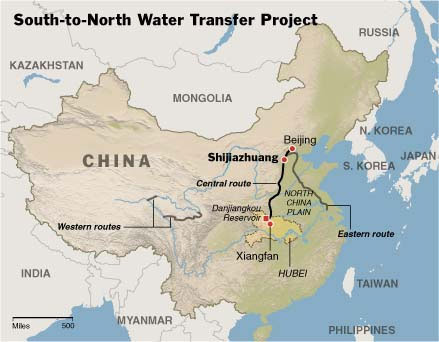
Huang He (Yellow) River
China’s second river and the second longest in Asia is as central to the rise of Chinese civilization as the Yangtze is central to the country. Known as the Huang He or Yellow it is 5,464 kilometers (3,395 miles) long and originates to the north of the Yangtze in the Qinghai-Tibetan plateau. It has always been a temperamental river with major floods throughout its history. These have been some of the worst human disasters ever recorded. Some of the floods originate from collapsed ice dams formed at the river’s glacial source. These ice dams and their breakup continue to be a problem even today with the Chinese government occasionally bombing the ice buildup before it becomes dangerous.
It is this river of all those in this part of Asia that is most susceptible to the environmental impact of global warming and climate change. Since 1966 the glaciers that feed the river have shrunk by 17%. The melting is 10 times the average rate seen over the last 300 years. The cause is rising temperatures and growing deserts as the permafrost melts and the ground dries up. Scientists estimate that overall land degradation in the Huang He source has reached 34.4%.
With water levels in decline, China is embarking on a massive water diversion scheme called the South-to-North Water Transfer Project.
Brahmaputra River
Measuring 2,900 kilometers (1,790 miles), the Brahmaputra originates in the Angsi Glacier of the Western Himalayas. Of all the rivers described here it is the least developed by those who live on its banks. The river crosses the Tibetan Plateau in China before making a dramatic turn into India and finally joining the Ganges near its mouth in Bangladesh. Tributaries of the Brahmaputra flow from Bhutan as well. So all in all the river basin serves four countries.
The population that lives along its banks or nearby numbers well over 30 million. The area is seismically unstable and the river is prone to mudslides along its steep slopes which create temporary dams and flash floods. Yet China is in the process of building a dams in the upper reaches for both flood control and power generation.
Like the Ganges, the Brahmaputra gets its source water from glacial melt but as the river turns into India and Bangladesh also receives a significant amount from the monsoon. Both these water sources may be affected by rising atmospheric temperatures which inevitably will accelerate the melt (although not seen yet in the Western Himalayas) and create variability in the seasonal monsoon (already happening).
Irrawaddy River
At 2,170 kilometers (1,340 miles) this river is the largest in Myanmar (Burma). Most of the 47 million in the country live on or near the Irrawaddy. Its tributaries flow from the eastern margins of the Tibetan plateau and although not directly fed by glaciers originates high in the same mountains as the other rivers we have described here.
China, Myanmar’s closest economic partner, is in the process of building seven hydroelectric dams along the river and its tributaries. The largest of these, the Myitsone, is an ecological disaster compromising 47 villages and destroying spawning habitats for native fishes. And that doesn’t take into consideration the downstream consequences with diminished flow and impacts to the river delta, a principal growing area for the country.
==
In the Mount Everest Region, World's Highest Glaciers Are Melting, Receding BY: KUNDA DIXIT In this photo essay, the editor of the Nepali Times describes dramatic changes underway in the ice and snow of the Himalayan Mountains. :{Read more ...}:Researchers monitoring the supraglacial ponds say their area has grown by 70 percent in the past 10 years alone. The ponds are fringed by ice cliffs and caves that accelerate the melting. The melted ice has carved an outflow channel through the left lateral moraine, so there is no large glacial lake on the Khumbu like elsewhere in Nepal. Scientists conclude that the Khumbu Glacier is not about to vanish, and the Icefall is not going to turn into a waterfall any time soon. However, the permanent ice catchment of the glacier above 6,000 meters could start to deplete under a worst-case scenario of 5 degrees Celsius warming. |
==
kpfa 8/28
1 mil acres almond san joachin vly ? (impaired drainage, not much GNP?) Resnick?
denham amnedmnt, valadao [defunct 2018]
gut ESA [drollinger fish > man] David B esq
salt, flush chem, heat
jacobs doyle
https://www.eenews.net/stories/1060095217
California's biggest water players quietly gathered on the shores of Lake Tahoe this week, hoping to reconcile some long-standing differences involving tunnels, fish, rivers and more.
In an unpublicized summit that convened Monday, Bureau of Reclamation Commissioner Brenda Burman met with representatives from Democratic Gov. Jerry Brown's administration as well as officials from the state's major rural and urban water districts. And though the get-together was largely kept under wraps, some interested parties described it as an effort to reach a "global solution" to problems that until now have defied resolution.
Among the topics discussed: Brown's $17 billion plan to build twin tunnels under the Sacramento-San Joaquin River Delta, the coordinated operation of state and federal projects that shuttle water from the wet north to farms and cities in the arid south, and California's controversial proposal to reduce water deliveries to farmers from the San Joaquin River to benefit fish.
California Department of Water Resources spokeswoman Erin Mellon confirmed the meeting yesterday.
"The state and federal water projects are intertwined," she said in an email. "We have a joint interest in ensuring our water system meets the needs of California communities and ecosystems and will maintain an open dialogue to achieve these goals."
The meeting, held at a resort and conference center on Lake Tahoe's North Shore, comes as the Trump administration has ramped up pressure on California. Last weekend, Interior Secretary Ryan Zinke issued a memo asking for his staff to come up with recommendations within two weeks to increase deliveries to California farmers (*Greenwire*, Aug. 21).
Zinke's memo empowered Deputy Secretary David Bernhardt to provide the "final recommendation for action." Bernhardt is a former lawyer for the Westlands Water District, the state's largest agricultural water district.
In a letter dated the same day, Aug. 17, Reclamation formally called for renegotiating a 1986 compromise with the state concerning the operation of the state and federal projects.
The complicated coordinated operation agreement focuses in large part on the Sacramento-San Joaquin River Delta. At its core, it lays out requirements for how much water state reservoirs andfederal reservoirs must release to flow into the delta for ecological and water quality purposes. Most of that water flows through the San Francisco Bay and out to the ocean; it does not enter the projects' conveyance system to farms and cities in the south.
Under the agreement, the federal Central Valley Project reservoirs are required to release much more of that water, up to three-quarters of it.
Reclamation agreed to that in 1986 for two main reasons: It operates most of the large reservoirs in California — so it had more water available — and it needed to use the state's more powerful pumps south of the delta to effectively move water.
Conditions have changed since 1986, though, including federal Central Valley Project contractors wanting more of that water. The bureau and the state have long sought to update the 1986 agreement but have failed to do so.
The letter is the first time the agency has officially issued a "notice of negotiation" for a new agreement, and it set a one-year deadline for talks.
If the bureau comes out ahead, it could have a major impact on contractors who get water from the California State Water Project, including the Metropolitan Water District of Southern California — the country's largest water seller.
Metropolitan provides water to 19 million people and has been the biggest proponent of Brown's tunnels.
The district's board was briefed on the Lake Tahoe meeting this week, which staff said General Manager Jeffrey Kightlinger and Assistant General Manager Roger Patterson would attend. Kightlinger declined to comment on the meeting.
A few Metropolitan Water District directors expressed skepticism about the bureau's plans.
Director Mark Gold, who represents Los Angeles, criticized Zinke's memo on updating the Central Valley Project to increase deliveries to farms.
"The feds could be investing in updating CVP infrastructure," he said. "It's written in there pretty strongly, but there is no commitment in trying to put resources to do so, which I thought was also a pretty glaring loophole."
==