COAL 3
1219
---
NO MERRI
SEE ZELDIN EPA MERCURY PARTIC // TRUMP FOX
SEE ARSENIC 5 26 DATA CTRS
SEE DEREG COAL DRINING WATER HVY METALS
mofo's on blk lung, also covid bailout
SEE MERCURY
---
law firm cave pro bono for coal?!
must say beut clean 1st?
---
OMFG SEE OFFSHORE WIND
...Consumers Energy, which owns the J.H. Campbell plant, has reported that the cost of complying with the Trump administration’s orders has reached $400 million. Consumers Energy is passing those costs on to electric utility customers throughout the 15-state Midcontinent Independent System Operator (MISO) regional power grid that includes Michigan. Consumers Energy had previously expected that replacing the J.H. Campbell plant with solar power and energy storage would save Michigan customers $600 million by 2040.
In March, Trump appointees at the U.S. Department of Energy and the Department of Justice cited Stevenson’s blog post in a legal brief defending the J.H. Campbell plant orders against a legal challenge by Michigan’s Attorney General Dana Nessel. Trump’s Secretary of Energy Chris Wright has issued multiple orders over the past year requiring Consumers Energy to delay closing the J.H. Campbell plant using emergency powers under Section 202(c) of the Federal Power Act.
“The Trump Administration is crying wolf over a non-existent energy emergency, while at the same time undermining every effort made to increase the efficiency, affordability, and reliability of domestic energy markets,” Nessel said last month, after Wright issued his fifth order targeting the plant for continued operation.
In his blog post, Stevenson argued that the J.H. Campbell plant should remain open at least until the Michigan Public Service Commission approves a new generation plan for Consumers Energy, and that state utility regulators should consider nuclear and natural gas as options for replacing Campbell.
The Mackinac Center wants to keep a DTE coal plant that buys petroleum coke from Koch Carbon running until 2040, rather than closing it by 2032
ARSENIC ZELDIN
GGL 5 26
[### Trump administration aims to roll back limits on toxic ...

The Hill
https://thehill.com › policy › energy-environment › epa...](https://thehill.com/policy/energy-environment/epa-toxic-wastewater-coal-fired-power-plants/)
22 hours ago — It is the latest step that President Donald Trump's administration has taken to pull back regulations on coal mining and coal-fired power and ...Read more
AI Overview
EPA Administrator Lee Zeldin is facing intense scrutiny over policies that roll back federal limits on toxic heavy metals like arsenic, lead, and mercury from industrial polluters.
U.S. Senate (.gov) +3
Controversial Actions and Impact:
- Coal Ash & Wastewater: The EPA proposed rolling back requirements for coal ash wastewater and delaying cleanup deadlines at unlined coal ash dumps. This move allows coal-fired power plants to discharge more heavy metals into local waterways.
 Sierra Club +2
- Repeal of 2024 MATS Regulations: Zeldin repealed the Biden-era Mercury and Air Toxics Standards (MATS), returning enforcement to the looser 2012 standards. This decision allows power plants and trash incinerators to emit higher levels of hazardous air pollutants like arsenic, which are strongly linked to cancers and neurological damage.
 Earthjustice +3
- Smelter Pollution Waivers: During Senate oversight hearings, Zeldin was pressed over the EPA's handling of industrial polluters—such as mining smelters near fenceline communities and elementary schools—that continue to emit tons of toxic arsenic into the air.
U.S. Senate (.gov) +1
Criticism and Responses:
- Congressional Pushback: Lawmakers have sent formal letters demanding the EPA retract its rollbacks, citing the severe health risks.
 Congresswoman Jennifer McClellan (.gov)
- Public Health and Legal Action: Environmental advocacy groups, including Earthjustice, have launched lawsuits and campaigns to challenge the EPA's decisions to scale back protections.
Earthjustice +2
- EPA Defense: Administrator Zeldin has defended the measures as regulatory relief for the energy sector, arguing that the pre-existing 2012 air toxics limits remain strict and functional. Track official federal rulemaking and environmental impacts on the Environmental Protection Agency portal.
:{:{}:
Lee Zeldin Intends to Allow More Heavy Metals ... - Sierra Club}:}:
Jun 30, 2025 — Lee Zeldin's proposal to allow coal companies to dump more heavy metals into our waterways defies all common sense.

Sierra Club
McClellan and Tonko Send Letter to Administrator Zeldin Urging ...
Jul 23, 2025 — McClellan and Tonko Send Letter to Administrator Zeldin Urging EPA to Retract Proposal to Weaken Pollution Standards * “It is the ...

Congresswoman Jennifer McClellan (.gov)
WATCH: In Senate EPW Hearing, Kelly Presses EPA on Lead ...
Apr 29, 2026 — Sen. Kelly shows EPA Administrator Zeldin how close the hazardous lead and arsenic smelter is to an elementary school during an EP...
---
HILL
HARRISBURG, Pa. (AP) — The U.S. Environmental Protection Agency moved Thursday to roll back limits that require coal-fired power plants to prevent the release of toxic heavy metals into streams and rivers through polluted groundwater, saying a three-year-old rule is unduly costly for the energy industry at a time when energy demand is spiking.
It is the latest step that President Donald Trump’s administration has taken to pull back regulations on coal mining and coal-fired power and empower fossil fuels as a primary energy source to feed the rapid growth of artificial intelligence data centers.
In its proposed rule, the EPA said a 2024 rule under President Joe Biden misjudged the effectiveness and cost of the regulation, and had the effect of shutting down coal-fired power plants at a time when energy demand is spiking.
Changing the rule is critical to making electricity more affordable and reliable, while advancing the economy, EPA Administrator Lee Zeldin said in a statement.
---
OMFG 2 26 12TH DN
UCS AND --- SUED TO SHUT DN BS COMM BUT STILL LOST ON EPA REGS

9:31
President Trump accepted the Washington
9:33
Coal Club's inaugural award on
9:36
Wednesday, declaring him the quote
9:38
undisputed champion of beautiful, clean
9:42
coal, unquote.
9:44
Trump accepted the award, a statue of a
9:47
coal miner from Peabody Energy President
9:49
and CEO Jim Gretch during a White House
9:52
event where Trump announced he directed
9:54
the Pentagon to purchase electricity
9:56
from coal fired plants and said he'd
9:59
asked the energy department to provide
10:01
$175 million in federal funds for
10:05
upgrades at several US coal plants.
10:09
I've saved 74 coal power plants from
10:13
crushing restrictions and closures that
10:16
would have been forced to shut down in
10:18
the very immediate future. And today,
10:20
I'm proud to announce that the Tennessee
10:22
Valley Authority is taking action to
10:24
save two major coal plants in Tennessee.
10:27
Tennessee Valley Authority. In response,
10:30
the Natural Resources Defense Council
10:33
wrote, quote, "While Americans are
10:35
demanding clean, affordable energy, the
10:38
Trump administration's using our tax
10:40
dollars to prop up the nation's
10:42
dirtiest, least efficient power plants.
10:45
It's no wonder fossil fuel lobbyists are
10:48
handing Trump an award today." unquote.
10:51
---
AN 11 25
A Trump administration order to keep an aging and unneeded Michigan coal-fired power plant open and online reportedly is costing taxpayers about $615,000 per day, or $113 million to date. Closing the plant would save taxpayers about $640 million by 2040.
“The Trump administration in May ordered utility giant Consumers Energy to keep the 63-year-old JH Campbell coal plant in western Michigan, about 100 miles north-east of Chicago, online just as it was being retired,” according to The Guardian.
“The costs of unnecessarily running this jalopy coal plant just continue to mount,” Michael Lenoff, an attorney with Earthjustice, which is suing over the order, told The Guardian.v
President Donald Trump signed a national energy emergency order on his first day in office this year, rolling back regulations.
In court documents, Michigan Attorney General Dana Nessel said that the administration’s latest order is “arbitrary and illegal.”
Consumers Energy, the operator of the plant, did not ask the Trump administration for the order to keep the coal plant running, and the Trump administration did not consult local regulators, a spokesperson for the Michigan public service commission (MPSC), told the Guardian in May.
“The unnecessary recent order … will increase the cost of power for homes and businesses in Michigan and across the midwest,” the chair of the MPSC, Dan Scripps, said in a statement at the time.
Reporting on what it called Trump’s “pro-fossil fuel agenda,” The Guardian in January quoted the president:
“We have something that no other manufacturing nation will ever have, the largest amount of oil and gas of any country on Earth, and we are going to use it – let me use it,” Trump said in his inaugural address. “We will be a rich nation again, and it is that liquid gold under our feet that will help to do it.”
===
NO TBL ANNO SEE MERCuRY
heATED EMILY
gmail 10 25
The Environmental Protection Agency’s work protecting clean air and water is grinding to a halt.
As the government shutdown enters its fourth week, thousands of EPA workers (https://substack.com/redirect/563558e5-6d97-4cee-8973-7a77a7d1470b?j=eyJ1IjoiMW42ZTYifQ.vyvZ_z0oLghKX6Zag1WJ71bIfqAlxqUD_SD6A_ZPsUM) are receiving notice they’ll be sent home. Furlough notices are “widespread” across the EPA, E&E News reported on Monday (https://substack.com/redirect/4b92c259-7aee-45fb-99b4-0e607c20f64b?j=eyJ1IjoiMW42ZTYifQ.vyvZ_z0oLghKX6Zag1WJ71bIfqAlxqUD_SD6A_ZPsUM), “including a large percentage of staffers in EPA’s air and water offices.”
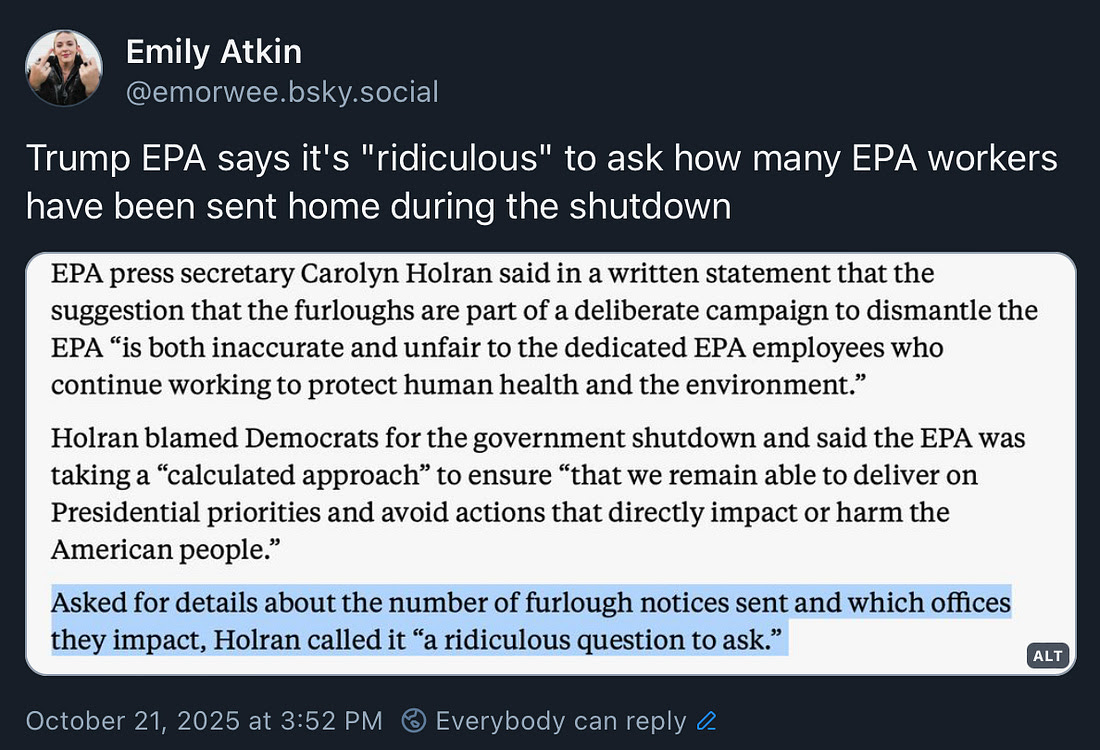
The exact number of furloughed EPA employees is about 4,000 (https://substack.com/redirect/563558e5-6d97-4cee-8973-7a77a7d1470b?j=eyJ1IjoiMW42ZTYifQ.vyvZ_z0oLghKX6Zag1WJ71bIfqAlxqUD_SD6A_ZPsUM), or about 27 percent of the agency’s workforce, Politico reported. The agency would not confirm or deny that number. (Asked for details about which EPA employees have been sent home, the EPA’s press secretary refused (https://substack.com/redirect/200e8af3-688d-45c8-b514-7c34ecea0a2a?j=eyJ1IjoiMW42ZTYifQ.vyvZ_z0oLghKX6Zag1WJ71bIfqAlxqUD_SD6A_ZPsUM), telling Inside Climate News it was “a ridiculous question to ask.”)
 (https://substack.com/redirect/f71f61d9-ecd8-426d-9278-3870b439daa1?j=eyJ1IjoiMW42ZTYifQ.vyvZ_z0oLghKX6Zag1WJ71bIfqAlxqUD_SD6A_ZPsUM)
More employees are likely to be sent home as the shutdown continues. The Trump administration’s latest shutdown contingency plan considers nearly 90 percent of the EPA’s workforce (https://substack.com/redirect/3c94e865-e3d2-4401-a91a-9fad29052bc7?j=eyJ1IjoiMW42ZTYifQ.vyvZ_z0oLghKX6Zag1WJ71bIfqAlxqUD_SD6A_ZPsUM) to be “non-essential” or “partially essential,” and therefore eligible for furlough. “Many activities will halt, including research and the publication of research results, and the issuance of new grants, contracts and permits,” theLos Angeles Timesreported (https://substack.com/redirect/3c94e865-e3d2-4401-a91a-9fad29052bc7?j=eyJ1IjoiMW42ZTYifQ.vyvZ_z0oLghKX6Zag1WJ71bIfqAlxqUD_SD6A_ZPsUM). “Critically, civil enforcement inspections—on-site visits to facilities to check their compliance with environmental regulations—will also cease.”
Furloughs are also just the latest blow to the EPA’s workforce. Before the shutdown, 4,000 EPA employees had already been fired or had taken a buyout (https://substack.com/redirect/b92e7773-3533-4d74-85e4-02fcd4c8b4cc?j=eyJ1IjoiMW42ZTYifQ.vyvZ_z0oLghKX6Zag1WJ71bIfqAlxqUD_SD6A_ZPsUM). The agency’s climate offices and its scientific research arm (https://substack.com/redirect/ca431d5c-d714-4622-9205-7d2f9437a775?j=eyJ1IjoiMW42ZTYifQ.vyvZ_z0oLghKX6Zag1WJ71bIfqAlxqUD_SD6A_ZPsUM) are also in the process of being disbanded (https://substack.com/redirect/91db77d3-cd06-4e44-bc83-63b75b9cfeb2?j=eyJ1IjoiMW42ZTYifQ.vyvZ_z0oLghKX6Zag1WJ71bIfqAlxqUD_SD6A_ZPsUM). And the bleeding is expected to continue if and when the government reopens; The Trump administration has proposed a 55 percent cut to EPA funding in its 2026 budget request.
But there is at least one group of EPA employees who the Trump administration considers “essential,” and are still on the job: the people making it legal for coal plants to release more mercury into the environment.
Upgrade to paid (https://substack.com/redirect/2/eyJlIjoiaHR0cHM6Ly9oZWF0ZWQud29ybGQvc3Vic2NyaWJlP3V0bV9zb3VyY2U9cG9zdCZ1dG1fY2FtcGFpZ249ZW1haWwtY2hlY2tvdXQmbmV4dD1odHRwcyUzQSUyRiUyRmhlYXRlZC53b3JsZCUyRnAlMkZ3aGF0cy1lc3NlbnRpYWwtdG8tdHJ1bXBzLWVwYS1tb3JlJnI9MW42ZTYmdG9rZW49ZXlKMWMyVnlYMmxrSWpveU56WXdPVGt3TENKcFlYUWlPakUzTmpFeE5UUTVOVFVzSW1WNGNDSTZNVGMyTXpjME5qazFOU3dpYVhOeklqb2ljSFZpTFRJME56TWlMQ0p6ZFdJaU9pSmphR1ZqYTI5MWRDSjkuNDl2c3F1R0VDV09ZazJHYWNXOW5RcnV3c2dsMlo3SVZ1ZTNtRGJKWU1NcyIsInAiOjE3NjY3NDEzOSwicyI6MjQ3MywiZiI6dHJ1ZSwidSI6Mjc2MDk5MCwiaWF0IjoxNzYxMTU0OTU1LCJleHAiOjIwNzY3MzA5NTUsImlzcyI6InB1Yi0wIiwic3ViIjoibGluay1yZWRpcmVjdCJ9.gB95fkPWNpAJP1M2pG4CGlMezB2Nc6eX21PuG8EAj3E?&utm_medium=email&utm_source=subscribe-widget&utm_content=176674139)
The detail was first reported Friday by Lisa Friedman at theNew York Times (https://substack.com/redirect/5dc6868c-f1c8-4a3b-be7c-3092648549a5?j=eyJ1IjoiMW42ZTYifQ.vyvZ_z0oLghKX6Zag1WJ71bIfqAlxqUD_SD6A_ZPsUM).Despite the widespread stoppage of climate, environmental and public health work during the shutdown, she reported, “the workers responsible for carrying out the president’s plans for more fossil fuels and less wind and solar power are still hard at work.”
Specifically, at the EPA, Friedman reported that “employees are finalizing a plan to allow more mercury emissions from coal plants, according to two people familiar with the work underway.”
Friedman is referring to Trump’s plan torepeal the 2024 Mercury and Air Toxics Standards (MATS) (https://substack.com/redirect/32de8db6-f940-4222-bf09-cf587cf9d121?j=eyJ1IjoiMW42ZTYifQ.vyvZ_z0oLghKX6Zag1WJ71bIfqAlxqUD_SD6A_ZPsUM) rule. The 2024 MATS rule, implemented by the Biden administration, strengthened older pollution regulations (https://substack.com/redirect/3747b588-6910-4437-ba49-98a6cdecff0a?j=eyJ1IjoiMW42ZTYifQ.vyvZ_z0oLghKX6Zag1WJ71bIfqAlxqUD_SD6A_ZPsUM) on coal- and oil-fired power plants. In addition to placing stricter limits on mercury pollution, the 2024 rule required coal companies to install systems that continually monitor emissions. It also eliminated a loophole that allowed coal plants to exceed pollution limits when starting up.
In June, Trump’s EPA Administrator Lee Zeldin announced plans to repeal the strengthened mercury regulations (https://substack.com/redirect/e288410b-de38-4d57-ac3f-777ae35e4b28?j=eyJ1IjoiMW42ZTYifQ.vyvZ_z0oLghKX6Zag1WJ71bIfqAlxqUD_SD6A_ZPsUM), arguing they were created only to kill the coal industry. “The primary purpose of these Biden-Harris administration regulations was to destroy industries that didn’t align with their narrow-minded climate change zealotry,” Zeldin said in a statement (https://substack.com/redirect/135d9c80-6ae7-4d0d-b7e1-46845de4b224?j=eyJ1IjoiMW42ZTYifQ.vyvZ_z0oLghKX6Zag1WJ71bIfqAlxqUD_SD6A_ZPsUM).
In reality, the regulations were designed to protect kids from being poisoned. Mercury is a highly dangerous neurotoxin that causes developmental problems in infants and damages children’s brains. No amount of exposure is safe (https://substack.com/redirect/d05c0dbe-e743-4bb6-b0d4-4b0079373698?j=eyJ1IjoiMW42ZTYifQ.vyvZ_z0oLghKX6Zag1WJ71bIfqAlxqUD_SD6A_ZPsUM).
Once emitted by coal plants into the air, mercury then settles into waterways, contaminates fish, and lingers in ecosystems for decades. Mercury pollution from coal plants is the primary reason why tuna and swordfish are considered unsafe for pregnant and other vulnerable people to consume.
One recent study estimated (https://substack.com/redirect/afe55720-b29e-40d7-8e09-c15c58466243?j=eyJ1IjoiMW42ZTYifQ.vyvZ_z0oLghKX6Zag1WJ71bIfqAlxqUD_SD6A_ZPsUM) that emissions from coal are costing Americans $13 billion to $26 billion per year in additional ER visits, strokes and cardiac events, and a greater prevalence and severity of childhood asthma events. That’s why the EPA has spent decades reducing mercury pollution.
But now, even with the government closed, Trump and Zeldin are racing to let coal plants release more mercury into the air. And they’re doing it for one reason: Because the coal industry asked them to.
Trump loves to talk about how he’s bringing back “clean” coal. As he infamously said in his speech to the U.N. last month (https://substack.com/redirect/7568a703-4b40-4ea8-8722-d9ba7a65828c?j=eyJ1IjoiMW42ZTYifQ.vyvZ_z0oLghKX6Zag1WJ71bIfqAlxqUD_SD6A_ZPsUM), ”I have a little standing order in the White House: Never use the word coal. Only use the words: Clean, beautiful coal. Sounds much better, doesn’t it?”
But “clean” coal doesn’t exist (https://substack.com/redirect/c4d25665-48cc-4f08-a042-d3b91e62da0f?j=eyJ1IjoiMW42ZTYifQ.vyvZ_z0oLghKX6Zag1WJ71bIfqAlxqUD_SD6A_ZPsUM). And even if it did, it wouldn’t describe what Trump and Zeldin are bringing back.
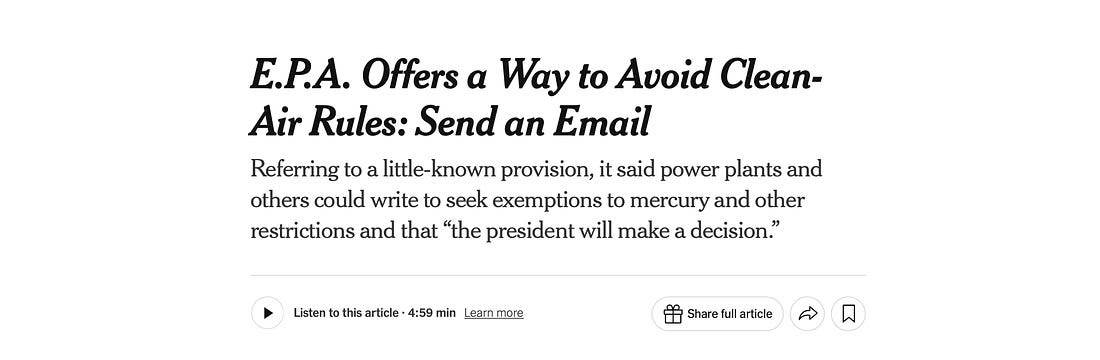
For the last year, coal companies have been explicitly asking Trump to make coal dirtier—and Trump has been complying. Back in March, Trump’s EPA sent a blast notification to coal companies, telling them if they wanted to be exempted from pollution requirements like the mercury standard, all they had to do was ask (https://substack.com/redirect/bc2774fe-e266-4702-88d2-eb03505dd20e?j=eyJ1IjoiMW42ZTYifQ.vyvZ_z0oLghKX6Zag1WJ71bIfqAlxqUD_SD6A_ZPsUM).
The EPA even provided an email template that coal companies could use to make their request.
 (https://substack.com/redirect/541a8aec-c239-4cba-97c4-26c4e359cd8b?j=eyJ1IjoiMW42ZTYifQ.vyvZ_z0oLghKX6Zag1WJ71bIfqAlxqUD_SD6A_ZPsUM)
A New York Times article (https://substack.com/redirect/bc2774fe-e266-4702-88d2-eb03505dd20e?j=eyJ1IjoiMW42ZTYifQ.vyvZ_z0oLghKX6Zag1WJ71bIfqAlxqUD_SD6A_ZPsUM) describes the process by which the Trump administration is allowing coal companies to request exemptions from pollution regulations.
Since then, Trump has personally granted temporary exemptions from the 2024 Mercury Air Toxic Standards for 68 coal plants—representing more than a third of U.S. coal-fired capacity, according to Utility Dive (https://substack.com/redirect/1dda1a0f-a35d-4945-9494-b35bb585fb61?j=eyJ1IjoiMW42ZTYifQ.vyvZ_z0oLghKX6Zag1WJ71bIfqAlxqUD_SD6A_ZPsUM).
These temporary exemptions likely explain why the EPA is rushing to permanently repeal the 2024 mercury standards, even during a government shutdown. Because if those temporary exemptions are allowed to expire, coal companies will be forced to comply with strong pollution laws.
This is what it looks like when the fossil fuel industry doesn’t just lobby the government, but becomes the government. The agency designed to protect people from pollution gets turned into a customer service department for coal—even when the entire government is shut down. The shutdown itself has many moving parts, and it’s easy for stories like this to get lost in the shuffle. But the quiet dismantling of protections for children’s health is one that will leave a lasting mark.
Share (https://substack.com/app-link/post?publication_id=2473&post_id=176674139&utm_source=substack&utm_medium=email&utm_content=share&utm_campaign=email-share&action=share&triggerShare=true&isFreemail=true&r=1n6e6&token=eyJ1c2VyX2lkIjoyNzYwOTkwLCJwb3N0X2lkIjoxNzY2NzQxMzksImlhdCI6MTc2MTE1NDk1NSwiZXhwIjoxNzYzNzQ2OTU1LCJpc3MiOiJwdWItMjQ3MyIsInN1YiI6InBvc3QtcmVhY3Rpb24ifQ.S8GH3MgWEpPXIzINbbEDclNSIqIvoERI5fUIIgzTJh4)
*Have a news tip? Contact me securely via Signal at emorwee.06
REF SPOX NO LNX
TBL
The Trump administration moved Monday to slash federal jobs across two key environmental and conservation agencies, targeting employees who work on scientific research and the enforcement of anti-pollution laws.
At the Environmental Protection Agency, staff received a new round of furlough notices as funding dwindles amid the government shutdown. The Department of the Interior disclosed plans to permanently cut more than 2,000 positions, according to a court filing by its chief personnel officer.
The Interior Department layoffs, also known as a Reduction in Force, are at the center of ongoing litigation over President Donald Trump and his administration’s efforts to further gut the federal workforce.
Monday’s filing came in response to a judge’s order requiring the Interior Department to disclose its layoff plans for unionized employees. The administration said it intends to eliminate 2,050 Interior Department positions, a decision made before the government shutdown began.
That timing contradicts Trump’s recent claim that government layoffs stemmed from the shutdown.
Most of the planned cuts would hit the U.S. Geological Survey, the Bureau of Land Management, the National Park Service’s regional offices and Interior’s main headquarters, according to the filing.
The Interior Department manages national parks, wildlife refuges and other public lands. It oversees environmental and wildlife conservation, fulfills trust obligations to Alaska Natives and Native American tribes and conducts scientific research on endangered species, water resources and natural hazards like flooding and wildfires so officials can better respond to them.
Those research positions would be especially hard hit by the planned layoffs, including projects focused on the Great Lakes ecosystems and the USGS Columbia Environmental Research Center in Missouri, where scientists study toxic contaminants such as PFAS, a class of chemicals Trump’s health and human services secretary, Robert F. Kennedy Jr., has pledged to address.
Asked for comment, the White House referred questions to the Interior Department, which did not respond.
Environmental groups described the move as part of a broader campaign by Trump and his administration to eliminate research and data collection on environmental contamination after carrying out what EPA Administrator Lee Zeldin called the largest rollback of environmental protections in U.S. history.
“This plan would eviscerate the core science that every American depends on,” said Jennifer Rokala, executive director of the conservation group the Center for Western Priorities, in a statement about the new Interior Department cuts revealed Monday.
Rokala said the planned cuts “would devastate scientific research across the Rocky Mountains, Great Plains, and Great Lakes,” while harming workers who “make our parks and public lands the envy of the world.”
Rokala also said that Monday’s filing revealed only the planned layoffs for unionized employees: “We don’t know how many non-union offices and positions are also on the chopping block.”
At the EPA, the new furlough notices arrived as the agency’s funding dries up. Last week, Trump said the shutdown was an opportunity to dismantle “Democrat programs that we want to close up or we never wanted to happen.” He has repeatedly cast environmental protection, conservation and related public health issues as “woke” and left-wing.
Some of the country’s key environmental protections, and in fact the EPA itself, date back to the Republican Nixon administration.
“Only Trump’s EPA would lay off the people who protect our kids from breathing polluted air and drinking contaminated water but keep the pesticide office open to greenlight more poisons,” said J.W. Glass, EPA policy specialist at the conservation organization Center for Biological Diversity.
Glass, in a written statement, accused the administration of using the shutdown to dismantle the EPA, leaving “our communities paying the price.”
EPA press secretary Carolyn Holran said in a written statement that the suggestion that the furloughs are part of a deliberate campaign to dismantle the EPA “is both inaccurate and unfair to the dedicated EPA employees who continue working to protect human health and the environment.”
Holran blamed Democrats for the government shutdown and said the EPA was taking a “calculated approach” to ensure “that we remain able to deliver on Presidential priorities and avoid actions that directly impact or harm the American people.”
Asked for details about the number of furlough notices sent and which offices they impact, Holran called it “a ridiculous question to ask.”
In a written statement, Peter Murchie, senior director at the nonprofit Environmental Protection Network and a former EPA official, called on Congress to intervene and stop the “systematic dismantling.”
“The health harms facing American families—cancer, childhood asthma, infertility, organ failure—don’t pause for politics,” Murchie said. “When EPA’s expert staff are sent home, large parts of the agency’s work simply stop.” END INSERT
Further reading:
2 scientists call on RFK Jr. to stop coal mercury rule rollback (https://substack.com/redirect/ab804842-6401-44c0-afd0-b8641c14befe?j=eyJ1IjoiMW42ZTYifQ.vyvZ_z0oLghKX6Zag1WJ71bIfqAlxqUD_SD6A_ZPsUM). (E&E News, October 17).
RFK Jr., once poisoned by mercury, is silent as EPA weakens rules against it (https://substack.com/redirect/e02d2702-73c7-40b7-9c88-5885a93e7b94?j=eyJ1IjoiMW42ZTYifQ.vyvZ_z0oLghKX6Zag1WJ71bIfqAlxqUD_SD6A_ZPsUM). (E&E News, March 18).
Trump officials offer $625 million bailout to rescue coal (https://substack.com/redirect/a8e7cd51-3126-4f08-998e-2689de79adb9?j=eyJ1IjoiMW42ZTYifQ.vyvZ_z0oLghKX6Zag1WJ71bIfqAlxqUD_SD6A_ZPsUM). (New York Times, September 29).
These companies avoided clean air rules. It took a single email (https://substack.com/redirect/ba87e401-076e-4947-abfd-4a2ecc677c31?j=eyJ1IjoiMW42ZTYifQ.vyvZ_z0oLghKX6Zag1WJ71bIfqAlxqUD_SD6A_ZPsUM). (New York Times,July 29).
Other stories I’m following:
The government is shut down. But not for fossil fuels (https://substack.com/redirect/5dc6868c-f1c8-4a3b-be7c-3092648549a5?j=eyJ1IjoiMW42ZTYifQ.vyvZ_z0oLghKX6Zag1WJ71bIfqAlxqUD_SD6A_ZPsUM). (New York Times, October 17).
More than 700,000 federal employees have been sidelined and thousands more are at risk of being fired as the government shutdown (https://substack.com/redirect/276f2f4a-1f63-4e02-9711-5ab0b3152011?j=eyJ1IjoiMW42ZTYifQ.vyvZ_z0oLghKX6Zag1WJ71bIfqAlxqUD_SD6A_ZPsUM) drags on. But the workers responsible for carrying out the president’s plans for more fossil fuels and less wind and solar power are still hard at work. Some are approving permits for companies that want to extract metals, coal, oil and gas from public lands and federal waters. Others are rolling back limits on the greenhouse gas emissions that are driving climate change.
---
OMFG
AN 7 25
The U.S. Environmental Protection Agency's decision Friday to eliminate its scientific research arm drew horrified responses from public health experts and climate advocates, who warned that the Trump administration is targeting the foundation of the department's work to shield Americans from hazardous chemicals, toxic pollution, and drinking water contaminants.
"This is grim news," said Adam Gaffney, an ICU doctor at the Cambridge Health Alliance. "For decades, the EPA's Office of Research and Development has produced the science that underlies the regulations and technologies that protect us from innumerable hazards."
"You can't put a number on the lives that it has saved. Now Trump and Zeldin are killing it," Gaffney added, referring to the president's handpicked EPA administrator.
Since taking charge at the EPA, Lee Zeldin has moved aggressively to implement President Donald Trump's executive orders aimed at gutting the agency's staff and freeing oil and gas corporations from regulatory restraints.
The agency will soon have 12,448 employees, after starting the year with more than 16,000. Staffers at the targeted research office—which had more than 800 employees as of earlier this week—reportedly learned of what one public health expert called "the ultimate Friday night purge" through the EPA's public press release.
In the statement, Zeldin said the elimination of the Office of Research and Development would help "ensure the agency is better equipped than ever to deliver on our core mission of protecting human health and the environment."
But scientists said the closure of the research office would have the opposite impact, leaving the agency's ability to protect the environment and public health badly compromised.
Gretchen Goldman, president of the Union of Concerned Scientists, said that "it is absolutely devastating that Trump officials would shut down this office in its entirety."
"Science, data, and research underpin all of EPA's work, from protections from harmful chemicals to air quality standards to safe drinking water. It's hard to see how EPA can fulfill its mission without its scientific research arm," said Goldman. "The nation enjoys a cleaner environment thanks to the decades of high-quality research coming out of this office. Our nation cannot let this stand. Members of Congress must act."
In his public messaging, Zeldin has deemphasized the EPA's fundamental responsibility to protect the environment, instead casting the agency as a promoter of "energy dominance"—the slogan Trump administration officials have used to describe the president's commitment to boosting fossil fuel drilling.
Earlier this year, Zeldin boasted about launching "the biggest deregulatory action in U.S. history," targeting power plant rules, Mercury and Air Toxics Standards, and other regulations.
"Out in the open, Zeldin's EPA has been dismantling protections against precisely the sorts of dangers that right-wingers warn are coming from alleged deep-state conspiracies: toxic, cancer-causing chemicals that corporations have lobbied to freely inject into our air, water, food, and bodies," The New Republic's Kate Aronoff wrote in a recent column.
"Among the broader suite of regulations Zeldin's EPA has promised to roll back," Aronoff wrote, "is one that would require coal-fired power plant operators to upgrade wastewater treatment facilities, limiting their ability to freely discharge toxins like mercury, arsenic, selenium, lead, and bromide and to threaten local drinking water supplies."
NOW READ:'Like an open fire hose': Trump ripped as cracks show in MAGA media
---
---
MMA
In his first 100 days as EPA administrator, Lee Zeldin has used his frequent Fox appearances to shape the climate discourse
Special ProgramsClimate & Energy
Written by Allison Fisher
Research contributions from Harrison Ray
Published 05/16/25
Environmental Protection Agency Administrator Lee Zeldin has used his many appearances on Fox News and Fox Business to become one of the most visible members of the Trump administration so far. A Media Matters analysis found that Zeldin made at least 36 appearances on cable news during his first 100 days as EPA administrator, with 35 of those occurring on Fox networks — the most of any Trump Cabinet official.
Appearing on networks that are friendly to Trump’s agenda has allowed Zeldin to push climate-related misinformation and shape the discourse around environmental issues as he emerges “as one of the most devoted public champions” of Trump’s quest to “demolish the Biden agenda.”
Staples of Zeldin’s Fox appearances have included promoting rollbacks of environmental safeguards, hyping cuts and the elimination of programs at the EPA, and pushing the campaign to claw back congressionally allocated climate funds. He has also appeared on Fox to defend Trump’s orders to boost coal and muddy the waters on the root causes of the Tijuana River sewage issue.
- ## Zeldin appeared twice as much as Trump’s first EPA administrator, Scott Pruitt, in half the time.
- Lee Zeldin is far outpacing his recent Trump administration predecessors in cable news appearances.
During the first six months of his tenure, Trump’s first-term EPA administrator, Scott Pruitt, appeared 15 times across cable news — Fox News (12 appearances), CNN (2) and MSNBC (1).
Andrew Wheeler, who served as Pruitt’s deputy and assumed the top spot after Pruitt resigned amid scandal, appeared only 3 times on cable while serving in the position, all on Fox.
- ## Zeldin is using Fox to push misinformation about climate funding
- Fox News has aired more than 50 segments amplifying Zeldin’s false claims that $20 billion in federal climate grants allocated by Congress through the Inflation Reduction Act were mired in waste, fraud, and abuse. In fact, the network's coverage has been largely informed by Zeldin while Fox has omitted important details of the story reported by other news outlets that challenge his claims.
The administration tried to freeze the IRA funds, using the claims of waste and fraud, but a federal judge chastized the agency for failing to provide “credible evidence” for the claims. Even after the EPA was rebuffed in court, Zeldin’s public campaign to demonize the climate grants — many of which were intended to reduce climate and air pollution and mobilize public and private capital in underserved communities — and their recipients has continued undeterred on Fox networks.
- ## Here’s how Zeldin is using Fox appearances to shape the discourse around a number of environmental issues.
- ##### Environmental protections
On March 12, Zeldin announced sweeping measures to undo environmental protections and radically reshape the agency’s mission in what he has proudly called the “largest deregulatory announcement in U.S. history.”
As part of these actions, Zeldin has redefined the mission of the EPA. Rather than focusing on the agency’s twin tenets of environmental protection and public health, Zeldin has promised to fulfill “President Trump’s promise to unleash American energy, lower cost of living for Americans, revitalize the American auto industry, restore the rule of law, and give power back to states to make their own decisions.” And he has used Fox networks to promote and justify this shift.
Zeldin has claimed on Fox programs that current environmental protections need to be rolled back because they are "suffocating the economy” and that they have nothing to do with environmental protection but rather are part of former President Joe Biden’s “green new scam.” Zeldin’s arguments neatly position environmental safeguards into a pre-existing Fox News narrative that demonizes all climate action.
On the March 16 edition of Fox & Friends Weekend, host Charlie Hurt reflected this characterization of regulations back to Zeldin, saying: “Green New Deal things have nothing to do with actually cleaning the environment or clean air or clean water. It more has to do with spending money on pet projects that benefit basically, like, political supporters of the Democrat party.”
Such claims discount the role of environmental protections in public health and corporate polluter accountability. For example, Zeldin wants to loosen wastewater regulations for coal and other steam-powered power plants and relax limits to the amount of mercury and other toxic metals power plants can emit. Zeldin claims these regulations “improperly targeted coal-fired power plants,” even though coal plants emit “the vast majority of mercury and other toxic air pollution.”
The EPA also wants to make it easier for manufacturers to release more particulate matter, or soot, even though “exposure to these tiny particles has been linked to asthma attacks, heart attacks, strokes and other ailments.” In fact, one analysis, based on a 2024 report from the Environmental Protection Network that assessed the public health benefits of various EPA regulations, found that the targeted rules “were set to save the lives of nearly 200,000 people in the years ahead.”
Environmental justice
Zeldin is redefining environmental justice efforts as “forced discrimination programs” in order to nix it as part of Trump’s executive order on “ending radical and wasteful government DEI programs and preferences.”
To that end, he has closed the Office of Environmental Justice and External Civil Rights and signaled that he is “eliminating all diversity, equity and inclusion and environmental justice offices and positions immediately,” leaving under-resourced grassroots environmental justice groups to take over these efforts. Hundreds of environmental justice grants are being canceled as well.
On Fox, Zeldin has repeatedly suggested that the EPA previously used terms like “environmental justice” to “justify spending money not on actually directly remediating challenges to land, air, and water in America, but to funding left-wing activist groups.”
Zeldin used similar language in Fox coverage when he announced the closure of the EPA museum, calling it “another tribute to environmental justice” and saying: “What's amazing is over the course over this last administration, all this talk about environmental justice and climate change, it was really to justify giving out tens of billions of dollars to their friends through self-dealing conflicts of interests, unqualified recipients.” Zeldin’s closure of the EPA museum was covered by at least 5 other Fox News programs.
Tijuana River sewage issue
The Tijuana River sewage issue is one of the first specific environmental issues Zeldin discussed on Fox News. Every year, billions of gallons of sewage and toxic industrial waste flow down the Tijuana River, across the U.S.-Mexico border, and into the Pacific Ocean. It is a complex, decades-old, transjurisdictional issue that environmentalists and governments at the local, state, and federal level have been grappling with for years.
Zeldin has predominately characterized this issue as Mexico’s failure to stop pollution from crossing the border, while largely ignoring Mexico’s efforts to improve the problem and other progress made by the Biden administration.
For example, in March 2024, federal funding was secured to make the repairs and updates needed at California’s South Bay International Wastewater Treatment Plant. And in December, Biden approved $250 million in additional funding “towards the full repair and expansion of the South Bay International Wastewater Treatment Plant,” which is expected to be functional in the next five years.
In January 2024, Mexico began rehabilitating a shuttered wastewater treatment plant, the San Antonio de los Buenos plant, and on April 28 of this year, the plant started treating waste again. Taken together, the improvements to the U.S. waste treatment plant and the wastewater infrastructure in Mexico are “intended to eliminate up to 90% of untreated wastewater reaching the coast.”
Fox News has aired at least a dozen segments on the issue, many of which have been shaped by Zeldin’s framing.
- ## Here’s how Fox personalities are responding to Zeldin’s deregulatory efforts.
- Zeldin's Fox-heavy communications strategy has allowed him to dodge tough questioning and push misleading talking points with limited rebuttal. Fox hosts have rarely probed the consequences of cutting climate and environmental programs and rolling back safeguards, instead echoing his argument that previous government climate initiatives “didn’t really have anything to do with protecting the environment.”
Here are three examples of Fox News and Fox Business hosts teeing up Zeldin to talk about deregulation of environmental protections, efforts to boost coal, and “media attacks” on his actions.
On Sunday Night in America, host Trey Gowdy set up Zeldin to push the narrative that the protections he’s rolling back were part of a political agenda rather than pertinent to public health and safety:
- > TREY GOWDY (HOST): We all want clean water and air, period. But regulation has gotten out of control, and it’s used to advance political agendas. Lee Zeldin aims to change that. He recently terminated a $2 billion grant that started doling out money after Harris lost. He joins us now. Welcome to you, Mr. Administrator. Have you already identified areas of regulation which do nothing to advance safety or health, but simply advance a political agenda?
- On the April 1 edition of Larry Kudlow’s Fox Business program, Kudlow hosted Zeldin to discuss the EPA’s efforts to “grow the economy” and slash “red tape.” Kudlow congratulated the administrator on his recent deregulatory actions: “Thirty-one rule changes in one day at EPA. That's probably a world record, Lee Zeldin.”
Kudlow went on to reflect Zeldin’s characterization of environmental protection as radical: “A lot of the Biden stuff didn't really have anything to do with protecting the environment. It had to do with their radical Green New Deal climate change stuff. I mean, protecting the environment is very important. ... But this stuff has nothing to do with that.”
On April 10, Fox Business anchor Maria Bartiromo asked for Zeldin’s reaction to Trump’s so-called “clean coal” plan. She also applauded the agency for stripping grants from environmental justice projects and gave him a platform to respond to recent reporting from Politico on his shift from “‘pro-climate Republican to ‘one of the Trump disruptors”:
- > MARIA BARTIROMO (ANCHOR): You’ve said that the EPA is already reinvigorating America’s clean coal industry?
LEE ZELDIN (EPA ADMINISTRATOR): … At EPA just over four weeks ago, we announced what amounted to the largest deregulatory action in the history of the country. Just one agency was able to do that. Why? Because at the end of the Biden administration in 2023 and 2024, there were all sorts of regulations coming out. And as it related to the coal industry, the Biden EPA was trying to strangulate the coal industry out of existence.
…
BARTIROMO: I mean, look, you've been doing so well. I love the fact that you're taking costs out while also opening up the spigot of opportunities in energy. Your interview with Laura Ingraham recently was fantastic as you walked us through the building. Now the EPA is refusing to give Oregon an $85 million Biden-era grant meant to fund environmental justice projects in the state. You have uncovered lots of things that aren't exactly what they seem, Lee. These actions ramp up media attacks on you. Politico wrote this: “From pro-climate Republican to one of the Trump disruptors, EPA administrator Lee Zeldin's attacks on his agency’s spending and regulations have made him a rising star in the Trump cabinet but left some former colleagues mystified.”
Methodology...}:
---
---
mma
Research/Study
Trump's push to bring back coal finds support with right-wing media
Special ProgramsClimate & Energy
Written by Ilana Berger
Published 04/16/25
- Right-wing media jumped to defend four recent executive orders signed by President Donald Trump to bolster the dying coal industry, telling viewers that reviving what they often incorrectly called “clean coal” would make the country more competitive with China and allow the U.S. to dominate the AI “arms race” by ensuring an abundant supply of reliable energy. Conservative outlets are also framing Trump as an ally to coal miners — even as the administration eliminates trusted resources to protect their health and safety.
- ## Trump made it easier for companies to mine in more places with fewer environmental protections and prolonged the lives of coal plants set to be decommissioned
- On April 8, Trump “signed a series of executive orders aimed at boosting the struggling coal industry, a reliable but polluting energy source that’s long been in decline.” The Associated Press: “Under the four orders, Trump uses his emergency authority to allow some older coal-fired power plants set for retirement to keep producing electricity to meet rising U.S. power demand amid growth in data centers, artificial intelligence and electric cars. Trump also directed federal agencies to identify coal resources on federal lands, lift barriers to coal mining and prioritize coal leasing on U.S. lands. In a related action, Trump also signed a proclamation offering coal-fired power plants a two-year exemption from federal requirements to reduce emissions of toxic chemicals such as mercury, arsenic and benzene.” The Associated Press, [4/8/25]
- Surrounded by coal miners, Trump said, “We’re ending Joe Biden’s war on beautiful, clean coal once and for all.”Trump announced that “all those plants that have been closed are going to be opened if they're modern enough or they'll be ripped down and brand-new ones will be built.” He added that the orders would “rapidly expedite leases for coal mining on federal lands” and “unlock the sweeping authorities of … the Defense Production Act to turbocharge coal mining in America.” Roll Call, [4/8/25]
- Trump’s efforts to revive coal are likely to fail because of economic factors.Coal can no longer compete with cheaper sources of energy like renewables and natural gas. Additionally, many of the country’s roughly 200 remaining coal plants are outdated and would need “extensive and expensive upgrades to continue running,” according to The New York Times. The New York Times, [4/14/25]
- Trump gave the Department of Energy the sole authority to determine how long coal plants stay open.By extending emergency powers, Trump aims “to keep unprofitable and polluting coal plants open in the name of reliability — and stick utilities, customers, and communities with the hefty financial and health costs,” according to Canary Media. In 2017, Energy Secretary Rick Perry tried to do something similar, directing the Federal Energy Regulatory Commission “to issue a rule providing for assured cost recovery (including a return on equity) for coal and nuclear plants.” All five FERC commissioners rejected the directive because the Energy Department “did not show a need to bail out the plants and ignored the cost of doing so,” claiming that because “the plan excluded other types of power that could provide resilience to the grid, it was unduly discriminatory or preferential.” Canary Media, [4/9/25; Natural Resources Defense Council, 3/31/25]
- ## Echoing Trump, right-wing media falsely claim that coal is “clean”
- Coal ash — a toxic byproduct of coal-fired power that contains heavy metals like arsenic, lead, and mercury — harms air quality and threatens waterways. In some states, coal ash can be stored in unlined pits, creating a high risk for leeching into groundwater, and contaminants can also get mixed into nearby bodies of water during extreme weather events like floods and hurricanes. In March, EPA Administrator Lee Zeldin announced he would be handing enforcement of the agency’s 2015 coal ash rule over to the states, all but ensuring that more pollution will be permitted. The EPA is also “reviewing” a 2024 rule that “essentially prohibits any pollution of groundwater or water bodies by coal plant sites, regardless of the exact source.”
- One America News Network host Dan Ball told West Virginia state Sen. Chris Rose, “I got to feel like you’re pretty excited for your state and just for the American people in general that we can open up other avenues of clean-burning fossil fuels instead of trying to ram electric — electric, solar, wind, and everything else down our throats.” Ball later asked, “America burns coal the cleanest of any country on the planet, right?” Rose agreed, claiming, “If you was to turn off all the coal consumption, all the coal generation in America, it would have zero measurable environmental impact on the world.” OANN, *Real America with Dan Ball*, [4/9/25]
- Washington Examiner columnist Salena Zito told right-wing host Jesse Kelly, “Coal mining is not what you think it is. It's not a guy with a pick, you know, crawling underground. It's a very technology-driven industry, it's a very clean industry. The industry has changed dramatically in the past 15 years.” The First, *I’m Right with Jesse Kelly*, [4/9/25]
- Discussing what Trump’s orders mean for coal production in the U.S., guest Bo Copley told Fox’s Carley Shimkus that “technology moves every day and it becomes cleaner every day.” He added, “The people who have been against coal for years because it is harmful to the environment or because it’s impacting Mother Earth, it is funny now to watch them burn electric cars because, well, I thought they were supposed to be for the environment but apparently they are for anything that’s not in Donald Trump's agenda.” Fox News, *Fox & Friends First*, [4/9/25]
- Fox News contributor Deroy Murdock said, “One thing about coal, as you say, it’s cleaner now than it used to be. Trump likes talking about clean coal, beautiful clean coal, and I guess the scrubbers and so on are able to take a lot of the pollutants out.”While improved technology has significantly cut pollution from coal plants, they still produce more greenhouse gas emissions than any other source of energy by far. “Although coal accounted for about 67 percent of CO2 emissions from the sector, it represented only about 32 percent of the electricity generated in the United States in 2016,” according to the EPA. Communities near coal plants and even coal trains also experience higher rates of asthma and heart disease, and water pollution from coal ash is a major problem in these areas as well. Fox Business, *The Big Money Show,* [4/8/25; University of California, Davis, 4/18/24; FactCheck.org, 11/19/18; MarylandMatters.org, 3/24/25]
- ## Right-wing media justify abandoning efforts to control pollution and greenhouse gas emissions by deflecting to China
- Regardless of what China is doing, phasing out coal makes economic sense for the U.S. According to think tank RMI, “The latest research indicates that emissions from uneconomically dispatched coal plants — coal plants that run when cheaper resources are available — cost communities $13–$26 billion in health costs each year.” A 2023 study from the think tank Energy Innovation found that “it’s more expensive for 99% of the country’s coal-fired power plants to keep running” than it would be to replace them with brand-new local solar or wind farms. “Coal is unequivocally more expensive than wind and solar resources, it’s just no longer cost competitive with renewables,” said policy analyst Michelle Solomon.
- After Fox Business host Stuart Varney asked what he would say to environmentalists who are upset with Trump’s executive orders, mining executive Randall Atkins replied that they are “misguided” and claimed that “the Chinese are doing a better job of it than we are because they’re building two new power plants a week,” adding, “We have a long way to go to catch up, and indeed that is what I think the president’s agenda of America first is all about.”Atkins falsely claimed that “there are ways that you can safely and cleanly burn coal,” adding that “coal, of course, is the dominant fuel in the United States.” Fox Business, *Varney & Co.*, [4/10/25; ABC News, 3/18/25]
- Former Trump EPA chief of staff and Project 2025 co-author Mandy Gunasekara deflected Varney’s question about whether we have “abandoned CO2 emissions control completely” by saying that “all of the purported regulatory benefits of the Biden-era regulations” are “essentially undone by two weeks of China operating their coal plants in the current status quo.” Gunasekara claimed that the Trump administration has “certainly not” abandoned CO2 regulations but added, “If we really wanted to have a serious conversation about greenhouse gas emissions, you would look to China.” Fox Business, *Varney & Co.*, [4/9/25]
- While discussing how the executive orders aim to revive coal plants, Fox Business host Jackie DeAngelis said that “hundreds of coal plants” across the country “have closed in the past 20 years, but don’t tell that to China because they operate over a thousand of them. America shut down while China was powering up.” Fox Business, *The Big Money Show*, [4/9/25]
- Discussing Trump’s executive orders on coal, guest Larry Beherns told OANN host Riley Lewis, “China is a major adversary to American trade and American power. And yet, last year, they increased their coal production by 8%. They’re not worried about any type of environmental regulations.”Beherns, communication director for the fossil fuel industry advocacy group Power the Future, added that “for President Trump to say — correctly say — that we can do it better and cleaner here in the United States, and we’re going to do exactly that, is a huge step forward, and it couldn’t have happened fast enough.” OANN, *The Real Story with Riley Lewis*, [4/9/25; DeSmog, accessed 4/14/25]
- ## Right-wing media misleadingly insist that bolstering coal is necessary for “AI dominance”
- Experts predict that renewable energy and nuclear power — not coal — can meet the long-term energy demands of AI. “Between 2030 and 2035 the rise in renewables and nuclear [in China] pushes coal into decline,” according to a recent report on AI from the International Energy Agency. “In Europe renewables and nuclear are set to supply most of the additional electricity required, with their combined share rising to 85% by 2030.” Even easing restrictions on coal plants would likely not be enough to make them attractive investments in the U.S. In The Atlantic, Matteo Wong writes, “Using natural gas, coal, or oil to power the way to an AI future will not be the inevitable result of the physics, chemistry, or economics of electricity generation so much as a decision driven by politics and profit.”
- OANN chief White House correspondent Daniel Baldwin said that Trump’s executive actions “expanding the use of coal — clean coal” are necessary because “the United States is going to need a lot more energy because China is obviously going to be involved in that AI race.” OANN, *The Real Story with Riley Lewis*, [4/11/25]
- Former West Virginia Republican Senate candidate Bo Copley told Fox host Carley Shimkus that coal is “absolutely” the answer to power AI development in the U.S. Shimkus said, “One of the reasons the president is so interested in coal is because it takes a massive amount of energy to fuel these AI plants, and AI is the future.” Fox News, *Fox & Friends First*, [4/9/25]
- In an interview with West Virginia Gov. Patrick Morrisey discussing Trump’s orders, Fox host Steve Doocy said that coal plants are beneficial because of the ability to “put data centers or AI centers on top of a, you know, this endless supply of coal you have got, that’s brilliant. Not only do you put coal miners back to work, but you bring in a new industry.”Fox News, *Fox & Friends*, [4/9/25]
- Discussing Trump’s executive orders, right-wing reporter Salena Zito told right-wing host Jesse Kelly that coal is needed to provide “an abundance of energy”to power AI data centers. Comparing the situation to the Cold War “arms race,” Zito told Kelly, “Today, it’s the race for AI dominance.” She also claimed that data centers “desperately need electricity, and a lot of it,” and “they are not going to be able to get it solar or wind. They’re going to get it from three entities: natural gas, coal, and nuclear.” The First, I’m Right with Jesse Kelly, [4/9/25]
- On his radio show, Fox host Sean Hannity praised Trump’s orders to “reinvigorate affordable, reliable clean coal and how critical coal is to achieving American energy and artificial intelligence dominance.” Hannity also celebrated Trump’s decision to withdraw the U.S. from the Paris climate agreement, complaining that “the worst, dirtiest coal on Earth is being used in China,” which also has “the most filthy air on the face of the earth.” Premiere Networks, *The Sean Hannity Show*, [4/8/25]
- ## Right-wing media posture Trump as a friend to coal miners
- The Trump administration is delaying the implementation of a rule to limit miners’ exposure to silica dust, a major cause of black lung disease. Health and Human Services Secretary Robert F. Kennedy Jr. has also eliminated a “trusted and universally relied upon” unit at the National Institute for Occupational Safety and Health that significantly reduced instances of black lung disease in longtime coal workers and “gives every miner in the county — roughly 50,000 — access to care for free.” Among NIOSH’s 900 layoffs (representing nearly two-thirds of the agency’s total workforce) 400 were mine safety researchers. The cuts come at a time when “20% of coal miners in Central Appalachia are suffering from black lung – the highest rate detected in more than 25 years.”
- While discussing tariffs, Fox's Lawrence Jones said that Trump is “fighting for the little guy” as evidenced by the miners who accompanied him as he signed the April 8 executive orders.“They are cheering him on as well,” Jones claimed. “Elites have gotten used to a certain lifestyle and what we were invested in the market and all that, but he is fighting for the little guy right now. I think we may just want to hold on and see what happens. If they start to turn on it, then I think we have a different ballgame here.” [Fox News, Fox & Friends,
- Newsmax host Greg Kelly praised “the connection President Trump had with some of these regular guys who came to see this monumental executive order for them,” accompanied by the chyron “President Trump: A Man of the People.”He also said that Trump’s order was “designed to get coal back on its feet again after it was unjustly shut down by Joe Biden.” Later, Kelly declared that “one of the reasons why the coal workers were so nice and happy to be at the White House today” was that Biden promised to “end fossil fuels.” Newsmax, *Greg Kelly Reports*, [4/9/25]
- War Roomcorrespondent Natalie Winters asked a coal miner “Is President Trump the only, first, from your perspective, president who has actually treated you guys with the dignity and respect that your industry deserves?” Jackson replied, “Absolutely,” because federal energy policy “always left you with an unsettling feeling until President Trump’s first term and now with his second.” Real America’s Voice, *War Room with Steve Bannon*, [4/8/25]
- Fox host Jeanine Piro asked, “If Donald Trump only cared about himself and lining the pockets of the rich, why would he be fighting like he’s fighting right now? Why would he be doing what he did in the White House today with those coal miners?”
Fox News, *The Five*, [4/8/25]
//
Fox Business pushes “clean coal” and other energy falsehoods to rally behind Trump's so-called energy dominance plan
04/11/25
---
===
OMG
mojo wired
This story was originally published by Wired and is reproduced here as part of the*Climate Desk *collaboration 4 25}:
Last Tuesday, President Donald Trump held a press conference to announce the signing of executive orders intended to shape American energy policy in favor of one particular source: coal, the most carbon-intense fossil fuel.
“I call it beautiful, clean coal,” President Trump said while flanked by a crowd of miners at the White House. The crowd chuckled knowingly at the now-familiar phrase. “I tell my people never use the word coal unless you put ‘beautiful, clean’ before it.”
Trump has talked about saving coal, and coal jobs, for as long as he’s been in politics. This time, he’s got a convenient vehicle for his policies: the growth of AI and data centers, which could potentially supercharge American energy demand over the coming years. One of the executive orders signed Tuesday includes instructions to designate coal as a “critical mineral,” expedite coal leasing on federal land, and identify opportunities for expanding coal-fired power to support data centers.
Using coal to drive AI “would be one of the great technology ironies of all time: Let’s go to a 1700s technology in order to power 21st-century technology.”
Using coal to drive AI “would be one of the great technology ironies of all time: Let’s go to a 1700s technology in order to power 21st-century technology,” says Seth Feaster, an energy data analyst at the Institute for Energy Economics and Financial Analysis. “It really is a vast oversimplification of how power markets, power production, and the grid works in the US.”
In Tuesday’s presser, Trump, trodding familiar territory, targeted Democrats for the destruction of coal jobs as part of a “Green New Scam,” laying the blame on both Joe Biden and Barack Obama. In truth, though, coal retirement isn’t a function of who’s in the White House. More coal-fired power came offline under Trump’s first presidency than under either of Obama’s terms.
Unfortunately for Trump, the US coal industry suffers from some truly unavoidable economic realities. The last large coal-fired power plant built in the US came online in 2013; coal plants in the US are, on average, 45 years old. This aging fleet also has higher maintenance and upkeep costs for equipment than competing types of power. The fracking revolution in the 2010s—as well as the increasing availability of cheap renewables—has also made coal-fired power increasingly expensive. In 2023, just 16 percent of the US’s power generation was from coal, down from 51 percent in 2001.
With the executive order, Trump is “putting the thumb on one energy source in particular that happens to be one of the highest-cost energy sources,” says John Moore, a director at the National Resource Defense Council. “There are much cheaper and cleaner options.”
While coal’s downward turn in the US has been predictable, something has changed since the last time Trump was in office: AI. After remaining flat for several decades, various industry forecasts now predict skyrocketing demand for energy as companies talk a big game around plans for data centers. In September, Bloomberg Intelligence found that data center electricity use in the US could increase fourfold over the next five years, driven in large part by generative AI. Goldman Sachs, meanwhile, said in February that global energy demand from data centers could increase 165 percent by the end of the decade.
The promise of new demand is driving some utilities to reconsider scheduled coal plant retirements. In Virginia, where Amazon Web Services keeps 96 data centers and is investing $35 million to expand its campuses, the regional transmission organization, PJM Interconnection, requested a delayed retirement of two coal plants due to increased demand from data centers. Demand from Google and Meta data centers has also kept a coal-fired power plant in Nebraska online past its retirement date.
But keeping a patient on life support is substantially different than bringing a corpse back from the dead. A PJM executive said at a conference last month that he wasn’t sure if the market was “sending the signal right now that coal should actually stick around.” Building new, technologically up-to-date coal plants—an idea Trump floated at Tuesday’s presser—would be a hard sell in an economy where investors are wary of big capital investments for outdated technology. Tech companies, meanwhile, are focusing long-term energy investments on nuclear power, as well as renewables and battery technologies.
Even in states where coal wields political power, data centers haven’t proven to be a savior. In March, lawmakers in West Virginia attached provisions to juice up coal use to a bill intended to jump-start the data center industry in the state. Despite cheerleading from the governor, the bill ultimately passed without the coal provisions after Appalachian Power, West Virginia’s largest utility, intervened, claiming that the coal requirements would raise bills for customers. An executive told lawmakers that even a big new customer like a data center wouldn’t spur the utility to buy more coal-fired power; the regulatory and financial reality, he said, favors natural gas.
Regulations on coal plant emissions are a clear target for this administration. Last month, the EPA rolled out a suite of attacks on a wide swath of regulations, signaling its intent to reconsider everything from rules on power plant emissions to greenhouse gas reporting. The agency also created an email address to allow polluters to petition for a temporary exemption from mercury and air toxics standards set out under the Clean Air Act—known as the MATS rule—as the agency reconsidered a host of pollution rules. Montana’s Colstrip power plant—one of the dirtiest coal plants in the country, which was fighting upgrades mandated by an updated pollution rule—has already requested an exemption.
If the new executive orders are any suggestion, the Trump administration sees this deregulation, and the targeting of climate change policies, as a key element of propping up coal. A separate presidential proclamation released Tuesday extends the MATS exemption for an unknown number of coal plants, while another executive order tasks the attorney general with attacking state-level climate regulations, singling out Vermont, New York, and California.
It’s possible that costs for coal could come down slightly with fewer climate regulations. “You can run all these coal plants without environmental regulations or reduced environmental regulations—I’m sure that will save industry money,” Feaster says. “Whether or not the communities around those places really want that is another issue. Those environmental regulations are there for a reason.”
Costs, after all, aren’t just measured in dollars. Coal emissions include a mix of heavy metals and chemicals, including sulfur dioxide, that can be deadly to people living around power plants. A study published in 2023 in Science estimated that between 1999 and 2020, coal-fired power plants were responsible for 460,000 excess deaths in the US alone. Coal waste, meanwhile, is stored in toxic ponds of ash; spills have cost some utilities millions of dollars in settlements.
Utilities, Feaster says, have priced in the health risks of coal and the liabilities that come with coal into their decisions. But it’s not clear if the Trump administration understands these risks. Cuts at Health and Human Services this month have expelled workers involved in black lung research and other protections for coal miners at the National Institute for Occupational Safety and Health.
On Wednesday, as international markets melted down, Donald Trump posted an invite on TruthSocial to companies to move their business to the US. “No Environmental Delays,” he wrote. “DON’T WAIT, DO IT NOW!”
---
mma
Fox Business pushes “clean coal” and other energy falsehoods to rally behind Trump's so-called energy dominance plan
Jackie DeAngelis: “We’re looking at crude oil around $60 a barrel — that's another one of what I call one of the bright spots in the market that is essential to Donald Trump's overall strategy”
Special ProgramsClimate & Energy
Written by Allison Fisher
Published 04/11/25 mma
Fox Business’ The Big Money Show aired a segment purportedly on achieving American energy dominance in which the hosts used false narratives and missing context to cheerlead the president's actions on energy.
Airing on April 7, the segment came several days after oil prices plunged to the lowest level since the pandemic due to market fears of a global recession – and hours before Trump signed his executive orders aimed at boosting coal production.
Here are five things Fox Business got wrong (or omitted) about energy:
Video
Citation
From the April 8, 2025, edition of Fox Business' The Big Money Show
Coal is not clean, and programs that protect coal miners have been cut by DOGE
Host Jackie DeAngelis previewed Trump’s executive orders on coal by claiming that the U.S. has “some of the cleanest coal that there is in the world.”
Despite advances in technology, coal continues to have devastating health impacts on communities, including developmental delays in children, asthma, cancer, and premature death. In fact, in the U.S. alone, 460,000 deaths were attributed to coal plant pollution between 1999 and 2020. Meanwhile, the number of cases of black lung disease — which affects an estimated 16% of coal workers — has recently risen.
The number of operating coal plants has declined in the U.S. because of cheaper and clean options. According to a newanalysis from a nonpartisan energy/climate think tank, 99 percent of existing U.S. coal plants are more expensive to run than it would cost to replace them with local wind, solar, or energy storage resources.
And excluded from the discussion about Trump’s plans for coal is the fact that the entire unit of people working at the Coal Workers' Health Surveillance Program — a program of the Centers for Disease Control that coal miners are entitled to by law — were put on administrative leave on April 1 as part of the sweeping scheme to reduce the federal government.
Also part of the effort was the termination of “leases for three dozen offices in the Mine Safety and Health Administration, the agency responsible for enforcing mine safety laws.” As ABC reported: “Retired coal miner Stanley ‘Goose’ Stewart questions whether it's safe for anyone to work in the industry right now.”
Oil prices are down because of fear of a global recession — not because of Trump’s “drill, baby, drill” agenda
DeAngelis said “one of the bright spots in the market” is that crude oil currently costs “around $60 a barrel” and argued that plunging oil prices were “essential to Donald Trump's overall strategy” to bring down energy costs and increase “supply to meet future demand” for things like artificial intelligence and crypto mining.
While a steep drop in oil prices will eventually mean lower gas prices, those prices would come as a result of fears of a global recession that pushes demand for oil down, not because of an increased supply from U.S. producers.
On the contrary, oil and gas producers are already cutting back investments in drilling not only due to fear of a global slowdown but also because tariffs on production materials like steel are making drilling more expensive at the same time that oil is selling for less. As one producer explained to The New York Times:
“We’re going from ‘drill, baby, drill’ to ‘wait, baby, wait,’” said D. Kirk Edwards, chief executive of a small West Texas oil and gas producer that recently scrapped drilling plans because of higher steel costs. Steel tubing, valves and other components — which now face a 25 percent tariff — make up about 20 percent of the cost of a well, he said.
“You’re not going to go out and spend money to drill a well when your costs are higher because of steel and your product prices are dramatically lower,” Mr. Edwards said
And they are not alone. Industries that are driving “future demand” like AI are also cutting back. On April 6, Microsoft delayed indefinitely a $1 billion project to build three new data centers in Licking County, Ohio.
DeAngelis and the other hosts did not mention these critical details about what plunging oil prices would mean for U.S. oil and gas producers if they continue and how it would negatively impact Trump’s “drill, baby, drill” agenda.
On April 9, Trump paused some of his reciprocal tariffs. The New York Times reported that in response, oil prices bounced back to $62 a barrel but noted, “For now, many companies are waiting to see where prices settle before adjusting drilling or spending plans. As this week has demonstrated, commodity prices can be very volatile.”
The fracking industry has not delivered the jobs and prosperity it promised
Fox News contributor Deroy Murdock claimed that if environmentalists don’t like coal, they should embrace natural gas, because it produces half as much carbon dioxide as coal.
“Here in New York State we’ve got a lot of natural gas. … We won’t touch it,” he said. “The left in this state doesn’t want to do anything about it. It would be a very good way to get a lot of energy, create jobs, bring prosperity to an area that’s just sort of sitting there very quietly, and at the same time produce one half of the CO2 that coal does.”
Again, this fails to consider that even if those areas were open for fracking, they would likely go undeveloped because it is not profitable amid the current climate of uncertainty. Reviewing a recent fossil fuel industry survey, The New York Times reported:
Without clarity about long-term trade policies, operators said, it’s difficult to invest in facilities that may not be operational for years to come. “The administration’s chaos is a disaster for the commodity markets. ‘Drill, baby, drill’ is nothing short of a myth and populist rallying cry,” wrote one respondent from an exploration and production firm. “Tariff policy is impossible for us to predict and doesn’t have a clear goal. We want more stability.”
Murdock also erroneously suggested that fracking brings prosperity to the communities that sit atop shale gas deposits. In his example, Pennsylvania, the second largest natural gas-producing state in the U.S., jobs in the oil and gas industry account for less than 1% of all jobs in the state, and the industry continues to shed employees, in part because of automation. It also has failed to deliver the wealth promised to many communities burdened with fracking wells, while instead bringing health issues.
Meanwhile, “clean energy industries employ more than 8 times more PA workers than the state’s gas industry.”
Renewable energy accounted for 93% of new capacity last year and is creating hundreds of thousands of jobs
Fox contributor Brian Brenberg noted that “95% of the proposed energy projects” currently in development are “renewable projects,” but he attempted to dismiss this telling stat by claiming that “the time required to get those permitted and up in running has doubled since the year 2000.” Even if that is true, according to one fossil fuel trade paper, “renewable energy projects generally face shorter permitting periods compared to fossil fuel projects.”
He went on to suggest that politicians are promising coal miners green jobs that never materialize. In fact, clean energy technologies constituted93% of new energy generation capacity added to the grid last year alone, and the climate provisions in the Inflation Reduction Act“have spurred the highest levels of factory construction in American history, with more than 400,000 new jobs announced across the country.”
One of those projects, which broke ground in May 2023, is a facility that will manufacture energy storage batteries in Weirton, West Virginia – the state with the most coal-mining jobs in the U.S. According to Reuters, Breakthrough Energy Ventures “said the factory will begin making battery systems in 2024 and … create at least 750 jobs in the state, which has suffered for years from a lack of high paying jobs as coal production falters amid the energy transition.”
Trump is not pursuing an all-of-the-above energy strategy. He is relentlessly trying to kill clean energy development.
Murdock suggested that the push for coal — “burn, baby, burn” — along with Trump’s “drill, baby, drill” agenda are part of the “all-of-the-above approach to energy” to deal with “all this increased demand for electricity.”
Anchor Cheryl Casone suggested that Trump's energy strategy is about “hundreds of thousands of jobs,” claiming that “this is why President Trump has been so keyed into the energy infrastructure industry.” She also argued that the U.S. is going to “need all of the energy sources for AI data centers.”
The Trump administration approach is not encompassing “all energy sources.” It is actively rolling back clean energy, which is putting energy and manufacturing jobs at stake while jeopardizing U.S. leadership in clean energy development. And several new analyses say energy prices for Americans will rise and hundreds of thousands of jobs will be lost if Trump’s campaign promise to repeal the Inflation Reduction Act is achieved. For example, according to one report, repealing IRA incentives and program funding would cause the loss of more than 700,000 jobs throughout the country in 2030 (while also increasing cumulative household energy costs by $32 billion from 2025-2035).
Notably, as The Wall Street Journal reported, oil industry jobs are shrinking even in the best of times:
Falling prices put an additional squeeze on an already tight job market for petroleum engineers, geologists and drilling-rig hands. Recruiters say oil-industry workers are already having a tough time finding jobs after a series of layoffs in the wake of mergers and other cost-cutting moves.
Chevron said it planned to cut some 8,000 jobs globally by the end of 2026 in a bid to bring down structural costs, while Exxon Mobil and ConocoPhillips had previously said they plan to cut hundreds of jobs in the wake of their acquisitions of Pioneer Natural Resources and Marathon Oil.
---
yikes
https://www.eenews.net/articles/coal-emissions-on-pace-for-record-setting-2022/
---
morano
cop28 ff mention, i say fail saudi cop prez cjina push for FF gone so world will rely on them; stuart v; net zero soviet style ceNtral plan 3x renewable insane, ; al gore blame mental health crisis one of main reasons ynd ppl look at agw; 8 yo OCT sue epa indoctrination k to college baseless feAR EARTH WILL END UNLESS UN COMES UP W/ DOCUMENT; TOO HOT HOMEWORK DAY GRETA
no lnx vid
Top power grid watchdog warns fossil fuel shutdowns could destabilize future reliability
Assessment 'paints another grim picture of our nation’s energy future,' power industry group says
By Thomas Catenacci FOX Business
Phasing out fossil fuels is an ‘insane goal’: Marc Morano
Climate Depot executive editor Marc Morano discusses worldwide calls to phase out fossil fuels and Al Gore blaming the mental health crisis on climate change.
A lead watchdog group that oversees and monitors the U.S. power grid issued a warning Wednesday that the nation may soon face considerable reliability issues due to premature retirements of existing fossil fuel power sources.
The North American Electric Reliability Corporation (NERC) — a nonprofit organization that makes periodic recommendations to boost reliability — published its annual Long-Term Reliability Assessment (LTRA) report which concluded that large swaths of the U.S. face either an elevated or high risk of capacity shortfalls. NERC noted that premature retirements, or power plant shutdowns that occur before replacement power comes online, are a leading factor in determining future reliability issues.
"The electric power industry continues to face challenges in the future. A rapidly changing resource mix, a threat landscape, extreme weather, inverter-based resources," John Moura, NERC's director of reliability assessment and performance analysis, told reporters Wednesday on a media call.
"But really focusing in on reliability, managing the pace of a rapidly-changing resource mix, which includes not only making sure you don't retire prematurely, but also that we're building enough resources and making sure they're dispatchable really continues to be our greatest reliability risk in the future," Moura added.
US GRID OPERATORS WARN BIDEN'S POWER PLANT CRACKDOWN COULD TRIGGER 'SIGNIFICANT POWER SHORTAGES'
California windmills and power lines
A view of windmills and power lines in Tracy, California, on Aug. 17, 2022. (Reuters/Carlos Barria / Reuters Photos)
The LTRA report highlighted how the region managed by Midcontinent Independent System Operator, which oversees much of the Midwest, faces some of the highest grid risks as a result of coal generation retirements that are projected to outpace new green energy development at certain points in the future.
"Demand is forecast to increase and that's happening faster than their transitioning — their resource mix is growing. They have plans to retire about five gigawatts of coal-fired generation and replace that with natural gas-fired resources, also solar and some batteries," said Mark Olson, NERC's manager of reliability assessments. "But what we see is there are periods where, during this transition, they have capacity shortfalls."
In addition, the West, including California, and the Northeast, including New York, are regions facing elevated risk, while the remainder of the East Coast is facing normal risk heading into 2024.
BIDEN ADMINISTRATION RIGGED INTERNAL ANALYSIS, SOFTENING BLOW OF POWER PLANT REGULATIONS: REPORT
The report, meanwhile, comes as the Biden administration and several states continue to push for an aggressive transition from fossil fuel power generation to green energy sources like wind and solar.
In May, the Environmental Protection Agency (EPA) unveiled regulations targeting fossil fuel-fired power plant emissions, which grid operators have warned could exacerbate future reliability problems. In its announcement, the federal agency said the plan "would avoid" 617 million metric tons of carbon pollution through 2042 via new standards forcing plants to either utilize carbon capture technology or shut down.
Emissions spew from a large stack at the coal-fired Brandon Shores Power Plant in Baltimore on March 9, 2018.
According to the agency's analysis, the proposal would force U.S. electric generation derived by coal plants without carbon capture to decline 67% by 2030 and 100% by 2035, while coal plants with carbon capture will increase 29% and 13%, respectively, the analysis also showed.
WHITE HOUSE ECO COUNCIL AT ODDS OVER TECHNOLOGY CENTRAL TO BIDEN'S GREEN GOALS
"We commend NERC for its work to maintain a reliable supply of electricity," Michelle Bloodworth, the president and CEO of coal trade group America's Power, said Wednesday in a statement. "Unfortunately, NERC’s latest assessment is deeply troubling because it indicates that, despite several years of warnings about the possibility of electricity shortages in many parts of the country, the risk of electricity shortages has grown worse."
"This is largely due to coal retirements, EPA policies, and dangerous subsidies for unreliable sources of energy," she continued. "We again urge Congress and federal and state policymakers to act immediately on these continued warnings."
Michael Regan
Environmental Protection Agency Administrator Michael Regan testifies before the Senate Appropriations Committee on May 3. (Chip Somodevilla/Getty Images / Getty Images)
And Jim Matheson, the CEO of the National Rural Electric Cooperative Association, which represents 900 local electric cooperatives nationwide, added that the report Wednesday was the latest to paint a "grim picture" for the future of the nation's power grid.
CLICK HERE TO GET THE FOX NEWS APP
"NERC’s latest assessment paints another grim picture of our nation’s energy future as demand for electricity soars and the supply of always-available generation declines," Matheson said in a statement.
"Nine states saw rolling blackouts last December as the demand for electricity exceeded available supply," he said. "And proposals like the EPA’s power plant rule will greatly compound the problem. Absent a major shift in state and federal energy policy, this is the reality we will face for years to come."
---
OMFG
you can't make this up: https://www.deseret.com/utah/2020/10/1/21497568/former-coal-ceo-robert-murray-files-black-lung-benefits-crandall-canyon-mine-robert-murray-energy
Former coal CEO Robert Murray files for black lung benefits
By Associated PressOct 1, 2020
[Robert Murray, founder, owner, president and CEO of Murray Energy Corp. gives a briefing on efforts to find trapped miners at the Crandall Canyon Mine near Huntington, Utah. Murray stated it would take a minimum of 3 days to get to the miners. A mine collapse trapped 6 miners about 1700 hundred feet below the surface. They believe the collapse was caused by an earthquake about a mile below where the miners were working. Aug. 7, 2007 Photo by Stuart Johnson], Deseret News]
CHARLESTON, W.Va. —Former coal CEO Robert E. Murray, who has fought federal regulations on the industry, has filed an application with the U.S. Department of Labor for black lung benefits, according to a published report.
West Virginia Public Broadcasting and Ohio Valley ReSource report the former head of Murray Energy said on the form that he is still board chairman of the company but can no longer serve as president and CEO due to his health.
Murray has fought federal mine safety regulations for years. His company filed an unsuccessful lawsuit in 2014 over regulations to cut the amount of coal dust in coal mines to reduce the incidence of black lung disease, saying they were overly burdensome and costly to the industry.
Murray owned the Crandall Canyon Mine in Emery County, Utah, where two collapses in 2007 killed nine men — six who were trapped and three trying to rescue them. In one volatile news conference outside the mine, Murray vehemently defended the mining industry, went off on global warming and called out by name reporters and news outlets whose stories on the collapse he deemed nonfactual.
The government later fined Genwal Resources, the operator of the mine at the time, $1.34 million for violations that contributed to the deaths of six miners plus nearly $300,000 for other violations. In 2012, Genwal Resources admitted in federal court to misdemeanor criminal charges of violating federal mine health and safety laws, though the charges weren’t directly related to the fatal collapses. The company was fined $500,000.
In the black lung claim, Murray, 80, says he is heavily dependent on oxygen and is “near death.”
Murray Energy Holdings emerged last month from federal bankruptcy protection under a new name and ownership group.
The new company, St. Clairsville, Ohio-basedAmerican Consolidated Natural Resources Inc., is the largest privately owned U.S. coal operator with active mines in Alabama, Kentucky, Ohio, West Virginia and Utah.
West Virginia Public Broadcasting and Ohio Valley ReSource confirmed the authenticity of Murray’s claim documents by entering his last name, birthdate and a case ID number into an online portal maintained by the Labor Department. If the claim goes before an administrative law judge, some parts would become public.
Murray says in the claim that he worked underground while supervising operations for several years.
“During my 63 years working in underground coal mines, I worked 16 years every day at the mining face underground and went underground every week until I was age 75,” Murray wrote.
Murray declined to speak on the record with the news outlets, but said he has black lung from working in underground mines and is entitled to benefits. He also disputed that he fought regulations to stop black lung and threatened to file a lawsuit if a story was published indicating he fought federal regulations and benefits, the outlets said.
Murray told NPR last year that his lung disease was not caused by working in underground mines.
“It’s idiopathic pulmonary fibrosis. IPF, and it is not related to my work in the industry. They’ve checked for that,” Murray told NPR. “And it’s not — has anything to do with working in the coal mines, which I did for 17 years underground every day. And until I was 76, I went underground twice a week.”
aha hmn well it is an investment rag, but odd lack of cursory denunciation of vlad? nuke plant under attack, 1 million refugees
https://www.benzinga.com/markets/asia/22/03/25989426/war-in-ukraine-causes-coal-to-go-parabolic-our-top-name-thats-poised-to-profit-from-the-coal-boom
War In Ukraine Causes Coal To Go Parabolic: Our Top Name That's Poised To Profit From The Coal Boom.
David Pinsen , Portfolio Armor, Benzinga Contributor FOLLOW
March 04, 2022
War In Ukraine Causes Coal To Go Parabolic: Our Top Name That's Poised To Profit From The Coal Boom.
Coal Goes Parabolic
Before the current war in Ukraine, there was already upward pressure on coal, due to a combination of the lockdowns limiting production in 2020 plus a misguided focus renewable energy, as Noah Rothman noted last October:
The sloppy, blinkered effort to transition away from fossil fuels to hypothetical sources of power that cannot meet the energy consumption needs of the planet due to the constraints imposed on them by the laws of physics is an obstacle to meeting “newly minted environmental, social and governance standards for clean energy.”
:{
}:
And a prime beneficiary of that was Peabody Energy Corporation BTU +14.71% (Get Free Alerts for BTU), whose shares spiked that in October after the company announced that its coal revenue in Q3 would be the highest in seven quarters and it offered bullish forward guidance. BTU shares spiked again last month, as the company posted another monster quarter in Q4. Russia's invasion of Ukraine--and the extraordinary sanctions levied against Russia in response--will likely add fuel to this quarter.
Get the inside access traders just like you are using to profit more and win bigger. Don't miss out on Benzinga Pro! Click Here to Start a FREE 14-day trial! (No Credit Card Required)
As Bloomberg energy reporter Javier Blas noted on Thursday, Russia is a major coal exporter (#3 in the world in 2019), and high quality coal has nearly doubled in price as some buyers are eschewing Russian commodities, which is limiting global supply.
manchin a coal millionaire (son and bro?) trying to block climate in BBB
coal is making electricity more expensive than mortgages in West Virginia: 'It does feel wrong'
October 25, 2021
Centrist Democratic Sen. Joe Manchin, not unlike former President Donald Trump, has been unwavering in his support of fossil fuels — which he obviously believes plays well with West Virginia voters. But the...
https://www.alternet.org/2021/09/joe-manchin-2654895078/
no lnx an 921
League of Conservation Voters gives scorecards to members of Congress based on their environmental records, and LCV's National Environmental Scorecard gives Sen. Joe Manchin of West Virginia a 54% favorable score for 2020 and an overalllifetime score of 49% — compared to the 96% lifetime score LCV gives Rep. Alexandria Ocasio-Cortez of New York City or the embarrassing 3% lifetime score LCV gives Rep. Jim Jordan of Ohio. Manchin, who receives neither AOC's stellar rating from LCV nor the abysmal rating given to Jordan, has had a friendly relationship with the coal industry than many other Democrats — and that relationship is the focus of an article published by The Intercept on September 3.
Journalist Daniel Boguslaw's article notes what Manchin has had to say about fossil fuels versus green energy and examines, in great detail, his relationship to the coal industry in West Virginia. The centrist Democrat told CNN, "If you're sticking your head in the sand and saying that fossil (fuel) has to be eliminated in America — and they want to get rid of it, and thinking that's going to clean up the global climate — it won't clean it up all. If anything, it would be worse."
Boguslaw explains, "Manchin's claim that climate pollution would be worsened by the elimination of fossil fuels — or by the resolution's actual, more incremental climate provisions — is highly dubious, if not outright false. What would unquestionably be impacted, however, is Manchin's own personal wealth."
The journalist goes on to offer elaborate details about Manchin's relationship with coal.
"For decades, Manchin has profited from a series of coal companies that he founded during the 1980s," Boguslaw notes. "His son, Joe Manchin IV, has since assumed leadership roles in the firms, and the senator says his ownership is held in a blind trust. Yet between the time he joined the Senate and today, Manchin has personally grossed more than $4.5 million from those firms, according to financial disclosures. He also holds stock options in Enersystems Inc., the larger of the two firms, valued between $1 and $5 million."
Boguslaw continues, "Those two companies, Enersystems Inc. and Farmington Resources Inc., the latter of which was created by the rapid merging of two other firms, Manchin's Transcon and Farmington Energy, in 2005. Enersystems purchases low-quality waste coal from mines and resells it to power plants as fuel, while Farmington Resources provides 'support activities for mining' and holds coal reserves in the Fairmont area."
The 74-year-old Manchin has been a fixture in West Virginia politics for decades. After serving in the West Virginia State Senate in the 1980s and 1990s, Manchin served as governor of West Virginia before being elected to the U.S. Senate in 2010. West Virginia is a deep red state, but being a Democrat didn't prevent Manchin from getting reelected to the U.S. Senate in 2012 and 2018. And during the Barack Obama era, Boguslaw notes, he fought against stricter Environmental Protection Agency rules.
"Manchin's advocacy for relaxing environmental regulations on the coal industry extends well beyond coal ash," Boguslaw observes. "In at least one instance, that advocacy was linked to the interests of the Edison Electric Institute, or EEI — an energy producer trade group tied directly to Manchin coal, as Sludge reported in July. In 2012, Manchin was one of the loudest voices opposing the Obama-era EPA rules limiting mercury and aerosolized acid emissions from power plants like Grant Town, which supplies power to an EEI member."
FROM YOUR SITE ARTICLES
What do Manchin and Sinema want to cut from Biden's plan? Dental ... ›
The hopelessly 'naïve' Joe Manchin has become Mitch McConnell's ... ›
Manchin made over $500K last year from West Virginia's most ... ›
RELATED ARTICLES AROUND THE WEB
Joe Manchin says he will oppose a $3.5 trillion budget bill ›
Supreme Court and Joe Manchin tighten Biden's political straitjacket ... ›
Joe Manchin: Why I'm voting against the For the People Act | Op-Ed ... ›
https://www.alternet.org/2021/05/west-virginia-coal-mines/
salon
on Earth Day this year, as President Biden assembled world leaders to a climate summit to focus on a "clean energy future," retired coal miner Chuck Nelson hunkered down in the green hills of West Virginia, recovering from a recent stroke and with one remaining kidney, as thousands of tons of explosives from mountaintop removal strip mining operations detonated nearby with a toxic haze of coal dust.
Yes, Greta (Thunberg), we still blow up mountains in the United States to mine deadly coal.
While coal mining has decreased dramatically in recent years, state permits for reckless mountaintop removal operations by absentee corporations, which involve only small numbers of non-union heavy equipment operators and explosives, in contrast to labor-intensive underground mines, continue to be doled out in central Appalachia in a desperate attempt to shake down the region for a final coal tattoo.
In fact, the West Virginia Department of Environmental Protection celebrated Earth Day by rubber-stamping a new strip-mining permitfor an out-of-state coal company, slated to destroy 1,085 acres of forested ridges and wreak havoc for neighboring communities for the next eight years, despite decades of protestby local citizens and reams of shocking health studies on heightened cancer, heart andbirth defect rates associated with mountaintop removal mining dust.
The endless war on the central Appalachian mountains continues. Needlessly, we should add.
"Millions of acres of Appalachian mountains have been permanently destroyed, and thousands of miles of streams have been permanently buried," emailed Nelson, whose wife died from chronic obstructive pulmonary disease in 2019. "With a flow of permits being processed right now, thousands more acres are planned to be wiped away forever. As devastating as mountaintop removal mining is to our majestic mountains, and the people's health impacts, only 3% of it is for electrical demand — only 3%. Mountaintop removal mining goes against everything we're fighting for in trying to deal with the climate crisis. These are criminal acts carried out by criminal enterprises."
Instead of recognizing thecentury-old legacy of ruin in coal country, from Appalachia to Alaska and 20-odd states and several First Nations in between — including an enduring array of abandoned mines, dangerous coal slurry impoundments, fraudulent "reclamation" projects, polluted waterways, desperate black lung victims, and gutted and sick communities with few economic options — the Biden administration risks falling into the trap of outdated policies.
Two days after Earth Day applause, the Department of Energy quietly awarded millions of dollars "to boost the economic potential of coal and power plant communities," and subsidize "critical mineral extraction from coal and associated waste streams," as well as widely debunked carbon capture and storage schemes.
Listen here: Advocates in coal country have been calling for a Green New Deal since 2008 — and acoalfields regeneration fund for everyone in coal mining communities, not simply the out-of-state companies, and not just throwing out a few job training opportunities for the dwindling ranks of largely non-union miners.
If the Biden administration and Congress truly want to build back better, they should have passed the RECLAIM ACT years ago, simply to start the process of reclaiming and reinvesting in all mining regions. And they should now double down on the commitment and make the Appalachian region, like all extraction zones from the Illinois Basin to the Navajo Nation to the Powder River Basin, a showcase for a clean energy economy, not a backwoods of denial.
If the Biden administration and Congress want to end the war on Appalachia, they should simply pass the Appalachian Community Health Emergency (ACHE) Act,which calls for a moratorium on such devastating operations until a basic health study is completed.
This is one of the most shameless realities in regulation: One of the Trump administration's first acts was to cancel a long-term health study on the impacts of mountaintop removal mining.
The sad truth is that this humanitarian and environmental crisis has been a federally sanctioned disaster since Jimmy Carter begrudginglysignedthe Surface Mining Control and Reclamation Act in 1977, complaining that it would allow "the mining companies to cut off the tops of Appalachian mountains to reach entire seams of coal."
Let's repeat that phrase, "cut off the tops of Appalachian mountains" — as in the tops of more than 500 mountains for over a half-century, literally clear-cutting deciduous forests and the region's ancient carbon sink, blowing ridges into oblivion with explosives and dumping the toxic remains and pulverized heavy metals in polluted streams, and ravaging the lives of citizens considered collateral damage, along with everything else in the way.
It doesn't have to be like this. Last month, Canadian government officials reversed their own 45-year policy for open-pit coal mining, admitting, "We didn't get this one right."
It's time for Biden and Congress to get this one right in Appalachia and all mining communities.
Just listen to Vernon Haltom, director of Coal River Mountain Watch, based in the frontline extraction zones of West Virginia, not in Washington, an organization that deserves as much support as possible:
With millions of Americans seriously ill or dead from the COVID pandemic, the stockholders and executives of Alpha Metallurgical Resources have no qualms about filling the air in Appalachian communities with carcinogenic blasting dust. Their enablers at the West Virginia Department of Environmental Protection have no qualms about rubber stamping new and renewed mountaintop removal permits, "just following the law" to sentence innocent people to death and misery. People like WVDEP permit supervisor Laura Claypool face no negative consequences for their actions, apparently not even remorse, but the people face the consequences of death. How do they sleep at night? It's not as if they don't know about the dozens of peer-reviewed health studies demonstrating that mountaintop removal is a deadly public health threat. No, they sleep soundly in the comfort of a steady job doing the coal barons' bidding. The WVDEP has made it personal by approving the death of friends and family like Judy Bonds, Larry Gibson and Joanne Webb, so they shouldn't be surprised if we make it personal about their cold, inhumane decisions. But since they've proven their incapacity for basic human decency, we need the Appalachian Communities Health Emergency (ACHE) Act, H.R. 2073 in this U.S. Congress, to protect the people.
FROM YOUR SITE ARTICLES
- Who made Joe Manchin 'The Decider'? Here's why West Virginia's ... ›
- This billionaire governor's coal companies owe millions more in ... ›
- Mining History Museum Preserves the Labor History That Led to ... ›
RELATED ARTICLES AROUND THE WEB
- West Virginia Mining | American Experience | Official Site | PBS ›
- Interactive map of coal mines in West Virginia | American ... ›
- Life After Coal: The Decline and Rise of West Virginia Coal Country ... ›
==
https://theconversation.com/whats-really-driving-coal-powers-demise-153868
321
people often point to plunging natural gas prices as the reason U.S. coal-fired power plants have been shutting down at a faster pace in recent years. However, new research shows two other forces had a much larger effect: federal regulation and a well-funded activist campaign that launched in 2011 with the goal of ending coal power.
We studied the retirement of U.S. coal-fired units from January 2008 to September 2016 and compared the effects of various market factors, regulations and activism on their early closure. In all, 348 coal-fired units either retired or switched to natural gas during that time.
Among the many pressures on coal power that we reviewed, a federal regulation implemented in 2015 had the biggest overall effect. The Cross State Air Pollution Rule requires states to reduce soot and smog pollution that blows across states lines, including from power plants. We estimate that it was responsible for reducing the expected production life of the coal power units that it affected by a total of 1,170 years.
Looking at coal units individually, however, we found that the Sierra Club’s Beyond Coal campaign, backed by over US$174 million to date from Bloomberg Philanthropies, had the most impact per targeted plant.
The campaign works by generating public pressure on utilities and state and local politicians to close down coal-fired units, often through targeted lawsuits. When the Beyond Coal campaign targeted a coal-fired unit, we found that the unit’s life expectancy, normally 50-60 years, was reduced by an average of just over two years.
The Cross State Air Pollution Rule was the second-biggest factor per individual plant, though it affected more plants. It reduced the expected life span of each coal-fired generating unit that it affected by an estimated average of about 21 months.
We were surprised to find that neither low natural gas prices nor the adoption of renewable energy significantly reduced the life of coal units. Both have been widely touted by politicians and business leaders as the market-based drivers of coal plant retirement.
 Falling natural gas prices had little impact on coal-fired power plant closures. David Drake and Jeffrey York, CC BY-ND
However, while adoption of renewable energy alone did not reduce coal units’ life spans, the average use of each source of renewable energy in an area did have a significant impact. Coal units operating in regions with high average renewable energy use retired an average of 15 months earlier.
It is important to note that a large number of coal plants were already nearing the end of their lifecycles during this period. But through statistical modeling, we were able to isolate the impact of each of these interventions on accelerating the retirement of a given unit.
Why it matters
A rapid transition away from carbon-intensive energy sources such as coal is essential to reduce greenhouse gas emissions that are warming the planet. Burning coal releases nearly twice as much carbon dioxide per unit of energy produced as natural gas does, and natural gas’s contribution to global warming is significant.
From 2011 through 2018, coal-fired generating capacity in the U.S. contracted by 23%. We estimate that the emissions impact of the accelerated retirements we studied was equivalent to taking 38 million typical passenger cars off the road.
The common narrative has been that market forces and economics have driven the demise of coal. However, our research suggests that a continued focus on federal policy is a more effective route for reducing emissions.
The Biden administration has already halted new leases for coal, oil and gas extraction on federal lands. And its climate task force – which includes the Cabinet-level department and agency heads – met in February to start coordinating governmentwide climate change solutions. Those likely will include new regulations and could include a price on carbon.
What’s next
Our current work sheds light on where responsibility lies for the acceleration of coal-fired power unit retirements through late 2016.
Next, we are interested in expanding on our findings about differences between renewable energy use and initial adoption. Understanding how to increase use of renewable sources, while creating new businesses and jobs, is a critical research agenda for addressing climate change.
==
an 1020
https://www.alternet.org/2020/10/trump-mcconnell-face-backlash-from-kentucky-voters-for-their-failure-to-deliver-on-this-promise/
Kentucky paper busts Trump and McConnell's failed pledge to bring back coal: 'Inability to meet promises' made
==
https://www.alternet.org/2020/10/coal-miners-turn-their-backs-on-trump-over-failed-promises-i-dont-care-to-listen-to-him-anymore/
https://www.alternet.org/2020/09/this-billionaire-gop-governors-coal-company-is-poised-to-get-a-big-break-from-his-own-regulators-propublica/
west Virginia environmental regulators are proposing to reduce the fines that a coal company owned by the state’s governor could pay for water pollution violations that are the focus of a federal court case. The move comes after the company stopped paying penalties required as part of a settlement four years ago to clean up its mines across the Appalachian coalfields.
Environmental groups allege that the Red Fox Mine, a large strip-mining site in southern West Virginia owned by Gov. Jim Justice’s Bluestone Coal Corp., continues to exceed discharge limits for harmful substances. The suit could result in substantial payouts — the maximum potential federal penalties are nearly $170 million — that would go to the U.S. Treasury.
In the weeks before a trial in the case, lawyers for Bluestone filed documents detailing a draft deal worked out separately with the state’s Department of Environmental Protection. The state agency, whose administrator is appointed by Justice, has agreed to settle the violations for a fine of $125,000, according to a court filing by the environmental groups’ lawyers. (State and federal governments share the authority to enforce water pollution rules.) Lawyers for Bluestone are asking the judge to throw out the federal case, saying the state settlement and hundreds of thousands of dollars in federal fines the company already paid for the same violations should resolve the matters.
Lawyers for the Ohio Valley Environmental Coalition and other groups say the state settlement doesn’t moot their suit, and they urged a federal judge not to grant Bluestone’s request to throw out the case.They called the state action “a self-dealing administrative order” and said the proposed penalties “are insufficient to deter future violations, leaving a realistic prospect of continued noncompliance.” At best, the lawyers say, the amount paid would offset potential fines in the federal court action.
The fight to force Justice’s empire to follow pollution rules, the groups say, symbolizes the larger ongoing fight over how aggressively to regulate an industry that remains politically powerful, even as its economic influence declines.
The state’s environmental regulators are seen as friendly to coal companies, so the reduced fines are in keeping with prior actions. In one significant example from a decade ago, a $20 million federal settlement with Massey Energy revealed that West Virginia officials were not even reviewing disclosures that Massey had filed reporting thousands of water pollution violations.
“Coal companies pollute,” said Vivian Stockman, executive director of the Ohio Valley Environmental Coalition. “There seems to be little consequence to carrying on business in disregard for the law. This has been the case over decades.”
The proposed settlement is the latest in which government agencies overseen by Justice have had to regulate businesses owned by Justice, a billionaire whom Forbes has labeled the richest person in the state. He owns a vast array of businesses, including coal mines, resort hotels and agricultural interests, many of them regulated by the state agencies that report to him.
An investigation this year by ProPublica found that companies run by the governor’s family have accumulated $128 million in judgments and settlements in cases brought by vendors and other businesses and government entities over unpaid bills. Justice companies that own or are affiliated with the historic Greenbrier Resort have said in court filings that they are “near financial insolvency.”
Mike Carey, a lawyer for Bluestone Coal, called any suggestion that the company is getting preferential treatment “completely baseless.”
The court records filed in the federal case indicate that state regulators first proposed the settlement more than a year ago, and that it then included a suggested penalty of $883,000. But in its new proposal, which must face public comment before it is finalized, WVDEP proposed a $2.1 million fine, but then dropped that to $125,000. The agency noted that’s the maximum allowed under state law but did not explain why it had earlier proposed a larger amount.
While Justice’s adult children have day-to-day control over the family’s business operations, the governor continues to guide the empire. Justice has repeatedly said his role as governor poses no conflict, and he wants nothing from the state for his businesses or his family.
The last tussle over the governor’s coal mines came to a head in 2016, when weeks before Justice won that year’s general election, his company agreed to pay a $900,000 fine for past violations, penalties for future violations and millions of dollars for new pollution control measures.
The deal resolved more than 23,000 water pollution violations between 2009 and 2014 by Justice mines in West Virginia, Virginia, Tennessee, Kentucky and Alabama, then under the umbrella corporate parent, Southern Coal Corporation, according to court records filed as part of that settlement. (Southern Coal, like Bluestone, was also owned by the Justice family.)
“This settlement is designed to bring the companies into compliance with the Clean Water Act and requires actions that should prevent future violations,” Assistant Attorney General John Cruden said at the time.
But hundreds of times since that 2016 federal deal, those mines discharged more solids, iron, manganese, aluminum and other pollutants than allowed by their environmental permits, the company’s own public reports show.
Justice’s companies have paid hundreds of thousands of dollars in fines for those violations, which are fairly common and seen as a cost of doing business in the coal industry. In August 2019, the environmental groups filed suit against Bluestone, alleging excess discharges of selenium, which can be toxic to fish and other aquatic life.
State and federal agencies have somewhat overlapping authority to regulate coal industry pollution. Federal law also allows citizens to file suit over Clean Water Act violations, both to seek fines, payable to the government, and to force measures to stop further violations.
Then, this year, the Justice companies “apparently stopped paying” some of the stipulated penalties, citing the lawsuit, according to a court filing by the plaintiffs. In a May report to federal regulators, Bluestone Coal marked a list of some of those selenium violations as “in litigation payment not applied.”
A federal judge has cited that report and noted unpaid stipulated penalties for 40 selenium violations that date back to July 2018.
A spokeswoman for the Environmental Protection Agency said that the earlier settlement does not allow Bluestone to stop paying stipulated penalties, but she declined to say what action, if any, federal officials might take “because this is an active enforcement case.”
Carey said that the report indicating those fine payments were being held back because of the litigation “was an error.”
In a court filing Tuesday, Carey indicated that a $35,000 payment for some of the fines was made on Sept. 4. Carey also alleged that the environmental groups had offered during settlement negotiations to resolve their lawsuit, and give the company three years to come into compliance, if Bluestone Coal would donate $600,000 and 850 acres of land near the New River Gorge, a scenic area, to the West Virginia Land Trust, a group that tries to protect wilderness in the state.
Bluestone Coal lawyers had earlier tried to have the selenium case dismissed, arguing that it was preempted by the 2016 settlement.
But in a ruling in June, U.S. District Judge David A. Faber in Bluefield, West Virginia, declined to throw out the case, saying that the continuing violations, and Bluestone Coal’s failure to comply with a timeline for installing a treatment system, showed the need for the citizen suit. Then, in July, Faber issued a second ruling that found Bluestone liable for the selenium violations. The judge noted that Bluestone Coal could be liable for more than 3,000 days of water permit violations, which could amount to a maximum fine of $169.2 million, according to the citizen groups.
On Tuesday, Faber postponed a Sept. 23 bench trial meant to determine a remedy for the violations. Instead, he scheduled a hearing that day on Bluestone’s request to have the case thrown out.
Like his political ally President Donald Trump, Justice has been clear that he wants to curb government regulations meant to protect the environment, especially as those apply to the coal industry and other fossil energy operations.
In his first State of the State address in February 2017, Justice said that, under his administration, the state Department of Environmental Protection would stop saying “no” to business and industry. A week later, he belittled WVDEP inspectors when he told a natural gas industry group that they would have to stop showing up for work with “a tank top and flip-flops on” and looking like they “haven’t shaved in three months.”
At the WVDEP, Justice put in charge a former coal company executive and energy industry consultant, Austin Caperton. In an early speech once he took office as WVDEP secretary, Caperton said he “doesn’t trust” the science that says human activities such as burning fossil fuels are warming the planet, a position that puts him at odds with mainstream science.
As recently as 2017, the federal Office of Surface Mining Reclamation and Enforcement issued a report outlining continuing failures by the state to police water pollution by coal companies. OSMRE has said it is continuing to monitor WVDEP’s efforts to improve oversight of the coal industry.
Over the years, selenium pollution has been especially tricky for coal companies to deal with, presenting expensive and long-term treatment challenges. Violations have prompted other citizen group lawsuits like the one against Bluestone and scientific studies that warned of stream damage from the selenium discharged by mining operations.
In response to questions about Bluestone Coal and its policing of the coal industry more broadly, the WVDEP provided a statement that indicated it was considering a change in the selenium limits for the Red Fox permit that, if approved, would “resolve that component of the enforcement action for the site.”
==
==
desmog 920
campaigners were hailing a "massive victory" as the UK government finally decided against giving planning permission to a big new coal mine in a Northumberland beauty spot.
fossil free ca
CalPERS Receives 0's and 1's
(out of 10) in Coal Policy
Reclaim Finance released the Coal Policy Tool on Tuesday rating global financial institutions' coal policy. CalPERS ranked among the worst in the world despite their claims to be sustainable.
Check out our blog article on the US Finance Sector Lagging on Coal Policy
--
Monday, we will be releasing a scathing report highlighting CalPERS' ongoing investments in coal. The report uncovers CalPERS's continued investments in coal and coal-related stocks despite the SB185 law regulating their investment in thermal coal. Keep Reading
==
https://www.alternet.org/2020/07/this-is-one-total-failure-by-donald-trump-that-is-actually-good-for-the-united-states/
no lnx
This is one total failure by Donald Trump that is actually good for the United States
Royalty-free stock photo ID: 1427778647 WILKES-BARRE, PENNSYLVANIA/USA – OCTOBER 10, 2016: Republican Presidential nominee Donald Trump holds a 'Trump Digs Coal' sign during a rally Oct. 10, 2016, at Mohegan Sun Arena in Wilkes-Barre, PA.]
Written by Mark Sumner / Daily Kos July 30, 2020
To say that in 2019 America produced less coal than it has in any year since 1978 is telling only part of the story. Because in 1978 coal mines across the country were engaged in a national miner’s strike—one in which the President Jimmy Carter was definitely on the wrong side of history in attempting to force miners back on the job through the courts. Ultimately, though the miners technically won in terms of getting what they wanted, they lost because the strike accelerated the focus of mining companies into western coal fields where they would eventually break the union by shutting out union miners from large new surface mines while idling smaller mines in the east.
But there was no miner’s strike in 2019. There was also no coronavirus pandemic, because that didn’t become a problem until after the first of the year. What the latest numbers from the Energy Information Administration show is an industry in rapid decline. A minor increase in 2017 has proven to be unsustainable, despite Donald Trump throwing the industry every possible assistance. Coal production declined 7% in 2019. And the data available so far shows that 2020 will be even worse for an industry that’s vanishing faster than anyone would have believed possible a decade ago. Electricity generated by coal in the U.S. fell to a 42-year low in 2019, decreasing over 15% in a single year. Since then it has fallen an amazing 34% in the last five months. That’s not 34% total, it’s 34% on top of the 15% decline last year.
The Powder River Basin in Wyoming continues to be the nation’s largest source of coal, producing almost 40% of the nation’s product.In Wyoming, a pair of huge mines there—one from Arch, the other from Peabody—together making up the majority of the state’s production. But the fact that those two companies, the nation’s largest coal companies and long-time fierce competitors, had to team up in the last year in an effort to reduce costs and retain control of a shrinking market shows how tenuous the industry has become. Production in Wyoming was down by 9% in 2019. What was once a steady stream of coal trains coming out of the Powder River Basin has become an increasingly ragged flow; one that is threatening to fall to a trickle in 2020.
Meanwhile, the New Mexico Public Regulation Commission has voted to close the last coal-powered generating facility in the whole Four Corners region. The decision is an easy one, because even though replacing the coal plant with 100% renewable power will require a $1 billion investment, it will actually save ratepayers in the region more than $6 per month, while creating 1,000 construction jobs. That’s because at this point building new solar and wind facilities is actually cheaper than simply maintaining existing coal plants. That kind of economics is why New Mexico isn’t alone actually being ahead of targets to move to renewable power.
The New Mexico decision follows just months after Arizona closed the Navajo Generating Station at Page, Arizona. That plant was the last coal-fired plant in the state, and it was fed by the state’s last coal mine. Now both are gone. Instead, visitors to the Navajo Nation will find a huge new solar facility that produces power for 13,000 homes.
Even in states long associated with coal production, the plants are closing. At what was once the largest coal powered generating plant in the world, Paradise Steam Plant in western Kentucky, the last of three huge turbines has made the switch to natural gas. That switch means that Paradise will still produce greenhouse gases, but it will no longer generate millions of tons of coal ash for the surrounding communities, or throw out a plume of both mercury and uranium that reaches a thousand miles to the sea.
The declining cost of renewables also means that what coal companies once viewed as the industry’s savior—exported coal—is also in decline. Coal exports were actually down 29% in the first five months of 2020. Companies have actually dropped several of the efforts to build export facilities as overseas markets evaporate even faster than those in the United States.
The industry crash also means that the efforts to save coal through “next generation” plants has completely crumbled. It’s been almost three years since what was supposed to be the nation’s first “clean coal” plant announced that it would not burn coal at all, ending a $6 billion experiment in failure. And on Tuesday, the only remaining commercial scale clean coal project in the United States was cancelled. As Oilprice.com reports, Petra Nova, which was supposed to capture carbon dioxide from a coal-fired power plant near Houston, has been “mothballed.” There is another project out there—North Dakota’s “Project Tundra”—but it exists only on paper and is unlikely to ever move forward.
As with many industries, coal mining employment has fallen sharply during the pandemic, but even before COVID-19 made the news, mining jobs were already in a steep decline.
Back in 2017, as he was signing an order scrapping regulations and allowing coal companies to openly bribe foreign governments, The Washington Post reported on his ecstatic support for coal. “We’re bringing back jobs, big league,” said Trump. “We’re bringing them back at the plant level. We’re bringing them back at the mine level. The energy jobs are coming back.”
None of that happened. The plants are gone. The mines are gone. The industry is going. Despite everything he did to make coal profitable and everything he’s done to stand in the way of renewable energy, Donald Trump has utterly failed. And this is one failure we should all be applauding.
==
2018 bs doe study
https://blog.ucsusa.org/jeremy-richardson/department-of-energy-releases-bogus-coal-study
Department of Energy Releases Bogus Study to Prop Up Coal Plants
JEREMY RICHARDSON, SENIOR ENERGY ANALYST | APRIL 10, 2018, 9:40 AM EDT
This post is a part of a series onCoal-in-Context
UPDATE (4/16/2018): PJM has released its own response, noting that the NETL report “reaches some sweeping conclusions that are not supported by the specific facts concerning grid operations” and debunking NETL’s claim that blackouts would have occurred without the coal units dispatched during the bomb cyclone.
A few months ago, the Department of Energy (DOE) made a request to one of its national labs, the National Energy Technology Laboratory (NETL), to study the impacts on the electricity grid of a severe cold snap called the bomb cyclone that hit the Northeast in early January 2018. NETL conducts important R&D on fossil energy technologies. The report released last week uses deeply flawed assumptions to inaccurately paint coal (and to a lesser extent, fuel oil) as the savior that prevented large-scale blackouts during the extreme cold, while greatly understating the contribution from renewable energy sources. It also estimates a bogus value for coal providing these so-called “resiliency” services. One has to wonder whether this deeply flawed and misleading study is part of the administration’s continued attempts to prop up the coal industry at all costs, especially after FERC rejected the DOE’s fact-free proposal to bail out coal and nuclear plants late last year. The utility FirstEnergy, which owns and operates a fleet of coal and nuclear generators, immediately seized upon NETL’s report and is petitioning DOE for an emergency bailout.
Separating the Facts from the Fiction
The report emphasizes the fact that fossil and nuclear power played a critical role in meeting peak demand during the cold snap. Across six regions, according to the report, coal provided 55 percent of daily incremental generation, and the study concludes that at least for PJM Interconnection (which manages the electricity grid across 12 Midwest and Mid-Atlantic states as well as DC), “coal provided the most resilient form of generation, due to available reserve capacity and on-site fuel availability, far exceeding all other sources” without which the region “would have experienced shortfalls leading to interconnect-wide blackouts.” The report then goes on to incorrectly estimate value of these “resiliency” services to be $3.5 billion for PJM.
The nugget of truth here is that we do need reserve capacity to be available in times of peak demand, especially during extreme weather events that lead to greatly increased need for heating or cooling. And this is especially important during the winter, when the demand for natural gas for home heating spikes in some parts of the country, leading to higher prices and less natural gas available for electricity generation (since home heating takes priority over electricity generation in terms of natural gas pipeline delivery contracts). In the Northeast, which uses a lot of natural gas for heating, this shortfall in natural gas led to an increase in electricity generation from dirty fuel oil, as the report points out.
However, regional transmission organizations (RTOs) and independent system operators (ISOs) were prepared for the cold snap, and the markets performed as expected. PJM in particular put systems in place to prepare for extreme cold weather following the 2014 Polar Vortex, and electricity markets in the Eastern U.S. are organized to provide payments to power plants for providing either energy (electrons to the grid) or capacity (the ability to switch on and provide a certain level of output if called upon). As fossil generators retire because they are uneconomic, plenty of other resources are under construction or in advanced planning stages and will be ready at the time they’re needed. This is why planning for future electricity needs is critical, and this is the responsibility of regional grid operators—one they take quite seriously.
To that point, grid operators and reliability experts see no threat to grid reliability from planned retirements of coal and nuclear power plants. The North American Electric Reliability Corporation (NERC), whose mission is to ensure the reliability of the bulk power system for the continent, finds in its 2017 Long-Term Reliability Assessment, that (contrary to NETL raising potential reliability issues from future coal and nuclear retirements) most regions of the country have sufficient reserve margins through 2022, as new additions more than offset expected retirements. PJM, in its strongly worded response to FirstEnergy’s petition to DOE for an emergency bailout (see below), stated “without reservation there is no immediate threat to system reliability.”
Beyond this, the report and its pseudo-analytic underpinnings really goes off the rails. Let’s take a few of its misleading points in turn.
How to Quantify Resiliency
NETL decided to consider the incremental generation from each fuel source—that is, how much more electricity was produced by each fuel during the bomb cyclone—as a metric for which fuel provides the grid with resilient services. As they put it:
....
===
620 guk
===
==
https://www.alternet.org/2020/05/trumps-gutting-of-environmental-rules-will-lead-to-hundreds-of-thousands-of-deaths
...
nyt 100 rules ~
...this article will focus on just four major attacks on environmental protections initiated by the Trump Administration. Three of the attacks have significantly weakened the standards for soot, mercury and carbon dioxide. I chose these three because EPA staff has actually estimated the number of deaths that will occur due to the roll back of each of these protections. In addition, I will examine the administration’s unprecedented suspension of all environmental regulations/enforcement under cover of the COVID-19 pandemic. This suspension gives corporations control over major environmental decisions. The administration’s deregulatory offensive reflects a value system that literally prioritizes corporate profits over American lives.
Weakening Mercury & Air Toxic Standards: 110,000 Preventable Deaths over a Ten-Year Period...
==
==
guk --> desmog 5/20
...fossil fuel companies have taken at least $50 million in taxpayer money they probably won’t have to pay back, according to a review of coronavirus aid meant for struggling small businesses by the investigative research group Documented and the Guardian.
A total of $28 million is going to three coal mining companies, all with ties to Trump officials, bolstering a dying American industry and a fuel that scientists insist world leaders must shift away from to avoid the worst of the climate crisis.
The other $22 million is being paid out to oil and gas services and equipment providers and other firms that work with drillers and coal miners.
Melinda Pierce, the legislative director for the Sierra Club, said: “The federal money Congress appropriated should be going to help small businesses and frontline workers struggling as a result of the pandemic, not the corporate polluters whose struggles are a result of failing business practices and existed long before COVID-19 entered the public lexicon.”
More than 40 Democratic lawmakers have argued that fossil fuel companies should not get any assistance under the coronavirus aid package.
Some Democrats have also warned the forgivable loans being made under Congress’ Paycheck Protection Program could be a transparency disaster.
Banks and lending institutions are distributing the money, so the government says it cannot track recipients in real time. The loans revealed have been made public only through news reports and securities filings by publicly traded companies, although the Federal Reserve has committed to issuing monthly reports.
So far, it’s clear the program is not working as intended. The funds are aimed at helping small businesses to keep paying their employees and covering other recurring expenses during the economic downturn. But they have been exploited by large companies forced to return the money amid a public outcry, including the Los Angeles Lakers, Shake Shack, and Ruth’s Chris Steak House.
The industry aid comes as the Trump administration is reportedly considering a broader bailout for oil and gas corporations, which were already under pressure before the coronavirus and have watched oil prices nosedive because of a global price war and low demand for gasoline. The U.S. government could make loans to oil and gas companies, essentially making taxpayers investors in the industry.
The Federal Reserve on Thursday also announced changes to its lending rules that could help indebted petroleum firms.
“The idea that oil workers are getting a paycheck is great,” said Jamie Henn, a spokesman for the Stop the Money Pipeline campaign who co-founded the environment group 350.org. “The worry is that the money’s going to the top and not going to filter down.”
The $50 million already paid to fossil fuel companies is a small fraction of the the $2.1 trillion Coronavirus Aid, Relief, and Economic Security Act, known as the Cares Act. But the total assistance to the industry is likely much larger than can currently be tallied and will continue to grow.
Environmental advocates and oversight experts tracking the funds say it’s impossible to count how much of the money will assist fossil fuels, including because some firms provide services across multiple industries.
“All of this is voluntary disclosures by the companies,” said Jesse Coleman, a senior researcher with Documented. “No matter what, it’s going to be an incomplete picture of what’s going on.”
Coleman said in many cases the fossil fuel companies getting aid have made bad investments and “now they’re going to come crawling hat in hand and say: look at what the coronavirus did to us.”
Among the coronavirus aid recipients is Hallador Coal, an Indiana-based coal mining company that hired Donald Trump’s former environment chief Scott Pruitt as a lobbyist. The company’s former government relations director now works at the energy department. Hallador is taking $10 million to fund two months of payroll and other expenses.
Coal mining company Rhino Resources, which was formerly run by Trump’s Mine Safety and Health Administration head, David Zatezalo, is receiving $10 million.
Coal firm Ramaco Resources, whose CEO, Randy Atkins, is on the energy department’s National Coal Council, is getting $8.4 million.
The U.S. coal industry has been in steep decline, driven out of the market by cheap natural gas and environmental concerns. Trump campaigned on putting coal miners back to work, and his agencies have unsuccessfully explored ways to bail out coal companies, which are seeing their lowest employment levels in modern history. The Trump administration has also rescinded nearly all of the environment and climate protections the fossil fuel industry has opposed.
Fossil fuel companies can also take advantage of tax benefits under the coronavirus legislation, including deferring payment of social security and medicare taxes.
The Missouri-based Peabody Energy coal company has said it will speed up collecting an alternative minimum tax refund of $24 million to 2020 and defer $18 million of owed taxes.
U.S. taxpayers already subsidize the fossil fuel industry at roughly $20 billion a year, according to conservative estimates.
The Center for International Environmental Law has accused the oil, gas, and plastics industries of “exploiting the crisis by aggressively lobbying for massive bailouts and special privileges in a desperate attempt to revive an oil and gas industry already in decline.”
The Institute for Energy Economics and Financial Analysis argues that federal lending to the oil and gas sector would be “a complete waste of money,” because it wouldn’t fix the industry’s underlying financial problems.
Oil industry lobbyists have pushed for changes at the Federal Reserve to let companies with large amounts of debt use its Main Street Lending Program and borrow to pay off existing loans.
In an April 15 letter to the Federal Reserve, the oil trade group the Independent Petroleum Association of America asked for the new provisions, saying “oil and natural gas producers are not looking for a government handout; they are seeking a bridge to help survive this economic disruption.”
Environmental advocates say the move would disproportionately benefit small and mid-sized oil and gas companies, such as Occidental Petroleum, which has nearly $80 billion in liabilities on its balance sheet.
Graham Steele, who directs the corporations and society initiative at Stanford Graduate School of Business, called the situation the “classic disaster scenario where an opportunistic administration and industry is taking advantage of a crisis.”
“And by the way, these are industries driving climate change. It’s both a bad financial proposition of the Fed and for taxpayers and a bad situation for the planet.”
===
==
https://www.alternet.org/2020/04/theyre-crooks-coal-industry-aims-to-exploit-coronavirus-crisis-to-cut-payments-to-miners-with-black-lung
no lnx omg
‘They’re crooks’: Coal industry aims to exploit coronavirus crisis to cut payments to miners with black lung
Written by Jake Johnson / Common Dreams April 12, 2020
:{
}:
Some of the largest coal companies in the United States are using the coronavirus crisis to pressure Congress to slash the tax that finances the Black Lung Disability Trust Fund, a lifeline for more than 20,000 miners whose lung disease makes them more vulnerable to COVID-19.
:{
}:
The Washington Post reported this week that the National Mining Association (NMA), a trade group that represents the biggest U.S. coal operators still standing,“asked Congress last month for a 55 percent cut in the excise tax for the trust fund, and a suspension of another fee that pays to clean up abandoned mines. Altogether the operators say they could save about $220 million.”
“While the level of taxation to back the fund has fluctuated sharply over the past two years,” the Post noted, “it currently stands at $1.10 for every ton of coal mined underground and 55 cents for surface coal.”
Harold Sturgill, a 60-year-old retired miner who was diagnosed with black lung in 1998, said in an interview with the Post that coal companies are “going to try to use this virus thing to stop paying benefits.”
“They’re crooks,” Sturgill said
Sierra Club
@SierraClub
“The burden should be on the coal operators,” Bounds said. “They come in our state, they mine our coal, they fill their pockets up, they declare bankruptcy. They leave with all the cash, and there’s no money to pay the miners.” https://www.washingtonpost.com/business/2020/04/08/coal-black-lung-coronavirus/ … #blacklungkills #covid19
As covid-19 hits, coal companies aim to cut the tax they pay to support black lung miners
The nation’s coal companies, citing the economic impact of the covid-19 pandemic, want to roll back their payments to the Black Lung Disability Trust Fund. That would leave the federal government to...
washingtonpost.com
30
10:29 AM - Apr 9, 2020
Twitter Ads info and privacy
31 people are talking about this
The NMA explicitly pointed to the coronavirus crisis in its tax cut request to Congress (pdf)—which was not included in the stimulus package that Congress passed last month—and labeled the coal industry “essential” to energy production in the United States. A group of Republican senators is currently pressuring the Federal Reserve to allow coal companies to benefit from the multi-trillion-dollar CARES Act.
“As the country faces this unique and mounting challenge around the COVID-19 pandemic, U.S. coal miners continue to work to provide the resources necessary to power America while bracing for the severe financial distress facing all sectors across the nation,” NMA wrote to congressional leaders. “To minimize the impact of this crisis on the coal industry, Congress should ensure all businesses have the financial resources necessary to ride out the pandemic.”
The group, according to the Post, intends to keep pushing for the tax cut in future stimulus legislation.
As EcoWatch reported earlier this week, “in some states like West Virginia, coal mines have been classified as essential services and are staying open during the COVID-19 pandemic, even though the close quarters miners work in and the known risks to respiratory health put miners in harm’s way during the spread of the coronavirus.”
“Nobody knows what this virus is going to do when it gets to this area,” Jimmy Moore, a 74-year-old black lung patient in Shelby Gap, Kentucky, told HuffPost. “It’s probably just going to wipe us out.”
Miners and advocates have long warned about the financial health of the Black Lung Disability Trust Fund, which is deeply in debt, and repeatedly asked lawmakers to act to ensure that the program is sustainable over the long term. Last July, as Common Dreams reported, a group of around 120 retired miners traveled to Washington, D.C. to demand congressional action to secure the fund’s finances, only to be brushed aside by Senate Majority Leader Mitch McConnell, a Kentucky Republican.
Lynda Glagola, chairwoman of the National Coalition of Black Lung and Respiratory Disease Clinics, told the Post that if Congress grants the coal industry its desired tax cut, “the fund will spiral deeper and deeper into debt causing it to become a red financial flag.”
“Especially at this time, as the economy is collapsing right before our eyes,” Glagola warned, “lawmakers will soon be looking for programs to cut to save money and reduce the national debt and deficit.”
In response to NMA’s request, Rep. Raúl Grijalva (D-Ariz.)—chairman of the House Natural Resources Committee—and Rep. Matthew Cartwright (D-Pa.) wrote a letter (pdf) to congressional leaders last month urging them to reject the coal industry’s “wish-list” and “focus federal resources on the workers, families, and communities that are being hardest hit by this crisis.”
“The coal industry is taking advantage of the country’s current circumstances to advocate for policies that are completely unrelated to the current crisis, policies that would in fact set back efforts to improve the health and lives of people across the country,” the lawmakers wrote. “At a time when the country is facing a pandemic due to a respiratory illness, it is particularly egregious for the coal industry to advocate reducing the Black Lung Excise Tax.”
===
==
Indiana Bill Would Make it Harder to Close Coal Plants
:{BY: DAN GEARINO
If the bill passes, Indiana would become the third in the U.S. to pass a law aimed at combating market forces that make renewables and natural gas cheaper than coal. Read More}:
...The bill doesn't say it's designed to apply only to coal plants, but it sets out criteria that would mean that coal plants are the only ones covered under the law.
Utilities would need to follow new rules for giving notice of plans to close or sell the plants, and state regulators would need to conduct a review to make sure the plans are in the public interest. Another part of the bill says it is in the public interest for Indiana to have a mix of power plants that provide "reliability, availability, fuel security and diversity"—some of the same terms the coal industry uses to argue for why its plants should stay open.
The measure also would make some plants more profitable for utilities, saying that eligible plants can earn an extra one percent profit over the level currently allowed.
The rules would stay in place until July 2021, allowing time for a state commission to complete a study of the state's energy system and recommend proposals for the 2021 legislative session. The commission is co-chaired by Rep. Ed Soliday, a Republican who also is the lead sponsor of the coal-plant bill.
During last week's hearing, Soliday said the bill is meant to pause the rapid changes in the way Indiana utilities generate electricity while the task force continues to work.
"It is not a bill to make coal last until a second coming," he said.
The bill would lead to higher utility bills, because utilities would be more likely to extend the lives of expensive coal plants, on top of the additional profit they would be allowed to earn. Those costs would be passed on to consumers.
"It's confusing that there's enough political will to literally force consumers to pay more for their power than they otherwise would," said Mark Dyson, principal in the electricity practice at the Rocky Mountain Institute, a nonprofit research group that promotes clean energy. "It kind of boggles the mind."
If Owners Put Coal Plants Up for Sale, Will Anyone Buy?
If the bill becomes law, Indiana would be the third state since the beginning of 2019 to pass a law that subsidizes coal plants or tries to slow down plans to close the plants.
Is this a trend? If so, it is a small one. But analysts say the legislation can best be understood as a response to the much larger trend of coal's eroding competitiveness, which is happening despite efforts by the Trump administration to help the industry by rolling back regulations.
In Wyoming, Gov. Mark Gordon signed a bill last year requiring owners of coal-fired power plants to explore selling the plants before closing them. Since then, the utility Pacificorp has announced a plan to close two coal plants in the state, a process that will provide the first test of how the law will work in practice.
The big problem with the law from the coal industry's perspective is that there may not be a buyer.
"Nobody in their right mind wants to buy a coal plant in 2020," Dyson said, noting that the environmental and economic problems with operating a coal plant won't vanish under new ownership....
Coal Train Protesters Target One of New England’s Last Big Coal-Fired Power Plants
:{BY: PHIL MCKENNA
By standing in front of coal trains, they’re starting to draw attention to the power plant’s impact on climate change and ratepayers’ wallets. Read More}:
==
https://www.alternet.org/2019/12/how-mitch-mcconnell-gave-a-sweet-deal-to-the-kentucky-coal-industry/
no lnx
How Mitch McConnell gave a sweet deal to the Kentucky coal industry
Written by Maureen Nevin Duffy / DC Report December 30, 2019
Kentucky coal miners—along with the rest of us—will be paying the price to keep the government running next year. And we can thank Kentucky’s senior senator, Senate Majority Leader Mitch McConnell, for the sellout.
Buried in the giant $1.4 trillion government spending package that McConnell ushered through the Senate last week was a relatively modest $15 billion, 30-year payout to sustain the Black Lung Disability Trust Fund—a boon to the majority leader’s home state coal miners. As many as 1 in 5 of coal miners suffer from black lung.
But here’s the kicker: What McConnell had removed from the must-pass funding legislation. In order to keep the government running, McConnell threw out provisions that would have forced coal companies to commit to higher payments toward the health-care costs of their employees and retirees, nixing requirements to extend the commitment period and modestly increase the tax on coal mining companies that are supposed to support the trust fund.
In short, McConnell let the coal industry skip out and leave the $15 billion black lung tab for everyone else to pay.
The move was mind-boggling, considering McConnell is already under scrutiny and criticism for partnering with a previously sanctioned Russian businessman, Oleg Deripaska, who McConnell voted to de-sanction. Deripaska, who owns Rusal, a Russian-owned coal company, joined McConnell in a project that his home state of Kentucky voted in 2017 to invest $15M of taxpayer money.
‘A Handout’
“This is a handout. This is a giveaway,” Jim Waters of the Bluegrass Institute for Public Policy Solutions, told WaPo in August. Waters reasoned that judgment might have been clouded by the possible thousands of area jobs that could be added. “I think the excitement of that overrode some of the due diligence.”
McConnell’s strange allegiances to influences domestic and foreign have clearly reached the grassroots level. As Mikaela Curry, a community organizer and member of Kentuckians for the Commonwealth, wrote in an op-ed in the Courier-Journal, Feb. 22, entitled, “Mitch McConnell is silent on coal while Kentucky miners suffer and die”: “When McConnell speaks up for coal, it always seems to align with the people profiting in the fossil fuel industry and not the hard-working people he is supposed to represent.”
Disabled Miners
Most poignant are the call outs to McConnell from those suffering physically as well as financially from his unwillingness to make the coal companies own up to their responsibility to their current and retired workers and their families. Patty Amburgey, now secretary of the local black lung association in Letcher County, is the widow of a coal miner who died of Black Lung Disease after leaving mining, “blind, unable to feel his legs or arms, and constantly short of breath,” according to his obit.
“I’m asking [Mr. McConnell] to please remember that East Kentucky is a mining area,” his widow wrote in Kentuckians for the Commonwealth. “And we do have a lot of miners and the election is coming up. I want him to understand that.” Obviously, Mr. McConnell is betting his Appropriations Bill will heal these sores and smooth his way to re-election.
But that may not be so easy in practice. Instead of increasing the excise tax rate in effect in 2018, which sunset on Jan. 1, 2019, Congress failed to act, which allowed the tax for coal companies to reset to 1985 rates, lowering contributions by 55% (from $1.10 per ton of coal from subsurface mines to $.50 and from $0.55 per ton for coal from surface mines to just $0.25), which many in Congress had contested.
Companies Protected
After congressional wrangling, the 2020 tax rate will revert to 2018 rates of $1.10 and $0.55 per ton, respectively. But those prices will sunset again on Dec. 31, 2020, and if not renewed will revert to the 1978 rate of $0.50 and $0.25 per ton. The companies also are protected from market price rises by a ceiling cap on the tax of 4.4% of its coal selling price.
In June, the House Ways and Means Committee approved a 10-year extension as part of a broader package. Rep. Bobby Scott (D-Va.) proposed the rate be renewed at a higher rate through 2029. He and co-sponsors want to see the Trust Fund fully funded with no sunsets.
While Moscow Mitch steers millions toward business ventures with oligarchs, many in Appalachia want lawmakers to realize that a hike in the excise tax of $0.14 per ton for surface-mined coal and $0.28 per ton for underground-mined coal would eliminate the debt in the Fund completely by 2050, according to the General Accounting Office.
==