MILO 2
congrats primary, evil pending 11/17
all phobes 12 22 tho anti-sem by proxy? kanye fuentes
TIM POOL
see provocateur
-=-=
-=-=
-=-=
08/31/2026 RWW
by
- Chris Arnold @ NPR: Milo Yiannopoulos, far-right critic of U.S. immigration, is deported from U.S.
The far-right British commentator Milo Yiannopoulos, who enthusiastically supported President Trump's immigration crackdown, has been arrested and deported for allegedly living in the U.S. illegally.
- Martin Pengelly @ Zeteo: Laura Loomer Gets a Pass For Her Racism as the Media Continues to Bash Hasan Piker Instead
The top Trump ally is racially abusing Florida Dem Angie Nixon but, sure, DC journalists, keep going after the critic of Israel instead. Meanwhile, Trump escalates his assault on our (failing) media.
- Dan Lamothe and Tara Copp @ The Washington Post: Pentagon secretly installs military influencers in civilian roles
Conservative veterans with large social media followings have been hired by the Defense Department and are amplifying Pete Hegseth’s culture-war fights.
- Robert Mackey @ The Guardian: Michigan Senate candidate Mike Rogers says he saw Bin Laden’s body with his ‘own eyes’. He did not
Ex-House intel committee chair, now running against Abdul El-Sayed, instead saw photo of Osama bin Laden’s body.
- Glenn Thrush and Michael C. Bender @ The New York Times: From Top Civil Rights Post, She Spars With the Left, and Her Colleagues
Harmeet Dhillon, who leads the Justice Department’s civil rights unit, has extracted flashy agreements and personnel moves from big universities and sought to force states to turn over confidential voter data.
- Tom Latchem and Will Neal @ The Daily Beast: Conspiracy Nut Fronting Trump’s $2.3B Flub Revamp Revealed
The public face of DHS’s self-deportation competition made a name for himself by role-playing as a jihadist.
- Greg Owen @ LGBTQ Nation: Anti-LGBTQ+ & Christian nationalist groups unite to target schools’ anti-outing policies
Moms for Liberty and the Thomas More Society falsely claim they’ve already won the fight.
-=-=
AN 8 26
The far-right activist known for being among the first to be removed from Twitter is now in ICE custody, TMZ reported on Friday.
Provocateur Milo Yiannopoulos was snatched by ICE in Louisiana and is currently being held in a detention center there, inmate records show. TMZ said that the circumstances are not clear, but he was detained at an airport.
Yiannopoulos worked for Kanye West as his "chief of staff," until the two parted ways in 2024. He was also part of the Ye24 campaign and served as director for political operations.
West is scheduled to perform on Friday night in New Orleans.
TMZ recalled that one of the more recent Yiannopoulos scandals was when he accused West's dentist of supplying the rapper with nitrous oxide for recreational use. The dentist denied the allegations.
Yiannopoulos is from the U.K., and not an American citizen. He has been a far-right media personality for years and has become prominent through the Gamergate controversies. He wrote for Breitbart News and drew attention with his deliberately confrontational online persona. He marketed himself as a gay conservative opponent of feminism, Islam, “political correctness” and social-justice movements, but critics say his public career relied on inflammatory attacks and harassment of marginalized groups.
Twitter permanently suspended Yiannopoulos in July 2016 after actress Leslie Jones received a torrent of racist and sexist abuse following his posts about her "Ghostbusters" reboot. Twitter said he had violated its rules against “inciting or engaging in targeted abuse or harassment," though he denied responsibility and called the ban censorship. His account was later reinstated under Elon Musk’s ownership, NPR reported.
Opposition to him also stems from other controversies, including past statements appearing to defend sexual relationships between adults and underage boys. The fallout cost him his Breitbart job, a planned CPAC appearance and a book contract in 2017, KERA News recalled.
In late 2022, West introduced the far-right provocateur as his campaign manager and adviser. Yiannopoulos later said he helped arrange the infamous Mar-a-Lago dinner between Donald Trump and West, in which white nationalist and Holocaust denier Nick Fuentes also appeared.
Infighting in the West universe ultimately drove Yiannopoulos out. The West campaign’s treasurer later resigned and alleged that Yiannopoulos submitted potentially falsified invoices and engaged in improper campaign transactions. Yiannopoulos denied any wrongdoing. The association between West and Yiannopoulos added to the controversy surrounding both men, as it combined already inflammatory public conduct with Yiannopoulos’s record of far-right activism and online provocation.
-=-=
- Ryan Thorpe and **:{Christopher F. Rufo @ City Journal: The Freak World of Nicholas J. Fuentes}:
Beneath the spectacle, the right-wing influencer has created a heap of human wreckage.
HUH?
Whatever else may be said about him, one fact cannot be denied: Nicholas J. Fuentes, the 27-year-old racialist influencer, is on the run of his life.
That’s a remarkable shift from 2017, when Fuentes was a little-known university freshman who hosted a political talk show. Over time, he developed a fanatical, cultlike following known as the “Groypers.” His digital following soon crossed over into the real world: first, with his involvement in the 2017 Unite the Right rally; then, with his long-running feud with conservative activist Charlie Kirk; and finally, with his role in “Stop the Steal,” which culminated outside the U.S. Capitol on January 6.
Fuentes has cultivated a reputation as the most provocative and controversial figure on the Right. He has done this by embracing taboos, praising Hitler, and opposing interracial marriage. In turn, he has ridden a wave of spectacle and outrage to new heights, with an appearance on The Tucker Carlson Show, and garnering frequent coverage in outlets such as the New York Times and The Atlantic.
Attempting to undercut his growing influence, the media and Fuentes’s right-leaning critics both tend to focus on Fuentes’s record of offensive remarks. Take Fuentes’s appearance on Piers Morgan Uncensored. During the two-hour interview, Morgan played a litany of clips from Fuentes’s talk show, highlighting bigoted comments he’s made over the years.
But this line of attack merely plays into Fuentes’s hands. As one of us has previously noted, Fuentes is best understood as an actor in what postmodern theorist Jean Baudrillard called “hyperreality.” Under conditions of hyperreality, symbols of past phenomena lose their meaning and circulate as hollowed-out images through the digital landscape, where they drive discourse and spark emotional reactions.
This is the framework through which Fuentes, with his professed admiration for Hitler and Stalin, and his embrace of anti-Semitism, should be understood. Above all, he is engaged in a performative demand for attention, cynically harnessing transgression to drive clicks, sow chaos, and gain notoriety.
By contrast, this City Journal investigation—which draws on livestreams, a review of public records, and interviews with key associates—focuses not on Fuentes’s words but on his actions. (Fuentes did not return a detailed request for comment for this article.) It looks beneath the spectacle of outrage and the self-mythology he has curated and reveals a shocking heap of human wreckage that has accumulated within Fuentes’s political universe: betrayal, pedophilia, suicide, murder.
Welcome to the freak world of Nicholas J. Fuentes.
Nicholas Joseph Fuentes was born in Chicago in 1998. He grew up in the suburb of La Grange Park. In high school, he served as student council president. After graduation, he briefly attended Boston University before dropping out. Fuentes then moved back to the Chicago area, where, every weeknight, he livestreams his talk show, America First with Nicholas J. Fuentes.
With a greenscreen backdrop, Fuentes sits behind a wooden desk, typically in a suit and tie, pontificating on political and cultural events. Frequently, he launches into expletive- and slur-laced rants. Fuentes presents himself as a dissident truthteller in a world of lies; the ringmaster of a revitalized Right; and a spokesman for young, patriotic men sold out by the elites.
The reality behind the scenes, however, is quite different from this public-facing mythology. The world that has surrounded Fuentes over the past decade is one of paranoia, intrigue, drama, and betrayals. Several of his associates have broken from his movement over the years, spilling dirt on his operation in the process, with allegations and counter-allegations following in the wake of their apostasy. At the same time, Fuentes has developed a fanatical, cultlike following, with many Groypers—at his insistence—swearing a public oath to “rape, kill, and die for Nicholas J. Fuentes.”
One of these young men is Dalton Clodfelter, a 25-year-old Fuentes follower who spoke to City Journal. Clodfelter says he first encountered Fuentes through viral video clips and eventually connected with him through an online group chat. There, he says, the two “hit it off.” At the time, Clodfelter was young, religious, and serving in the U.S. Army.
“I was pretty naïve at the time,” he recalled. “I wanted to be a commentator. I started out on radio when I was 16. I wanted to be a guy that talked and [Fuentes] was more than happy to help me along.”
In the years that followed, Clodfelter pursued a career as an online commentator, attempting to follow in Fuentes’s footsteps. Clodfelter posted openly extreme, racist, and anti-Semitic rants; he often used racial slurs. As a result, Clodfelter claims, mainstream platforms banned his accounts. Seeking an alternative, he moved over to cozy.tv, which Fuentes created to host his own show after being banned from other platforms.
“I was making really great money streaming,” Clodfelter said. “[Then] all of a sudden, like, these income sources are being taken away. . . . Now, I’ve got to figure out a new way to generate this income and supplement these things, and that really did suck on top of all the social media banning. The good thing was, Nick offered me a platform.”
Clodfelter’s association with Fuentes and his own language—including a pledge to “rape, kill, and die”—pushed him further and further from the real world. As he got deeper into the Groyper cult, Clodfelter underwent a period of dramatic disintegration: he was kicked out of the military and saw income streams dried up, and his first marriage ended in divorce, he claims; his online comments grew more extreme, erratic, and disturbed.
The end result was predictable. In a livestream, Clodfelter admitted he’d become unemployable. “I’m really untouchable,” he said. “I can’t go work for a congressman, that’s not going to happen. I can’t go get a job even at, like, a McDonald’s . . . . You look me up—look my name up . . . see what you find, and let me know if you’d hire me.”
Yet Clodfelter is unrepentant about his association with Fuentes and harbors no “resentment” for the personal cost he’s paid.
“I appreciate Nick and everything he’s done and what he’s built and everything he did for me,” he says. Fuentes might have led him down the path to personal ruin, but he was the one who took the final steps. “I decided to say the N-word. I decided to say I love Hitler . . . . And now I’m here.”
In the grand scheme of things, Clodfelter might have gotten off easy. Other Groypers have ended up in prison.
On Jan. 6, 2021, Fuentes was in Washington, D.C., where he joined crowds contesting the 2020 presidential election results. Near the Capitol, Fuentes urged the crowd onward.
“Keep moving towards the Capitol!” he into a bullhorn. “It appears we are taking the Capitol back from the police right now! Keep marching and don’t relent. Never relent! Break down the barriers and disregard the police!”
Numerous Groypers entered the Capitol that day. One rioter even carried an “America First” flag into the building. But after urging his followers toward the Capitol, Fuentes himself did not go inside. He was investigated but has not been arrested or charged in association with the day’s events.
This fact has raised eyebrows within far-right circles, particularly given the video evidence of him encouraging others to disobey the police. A former FBI agent, who spoke to City Journal on the condition of anonymity, said agents were instructed to “take down every person who was at January 6.” Fuentes, through his attorney, denied having been knowingly interviewed by federal law enforcement.
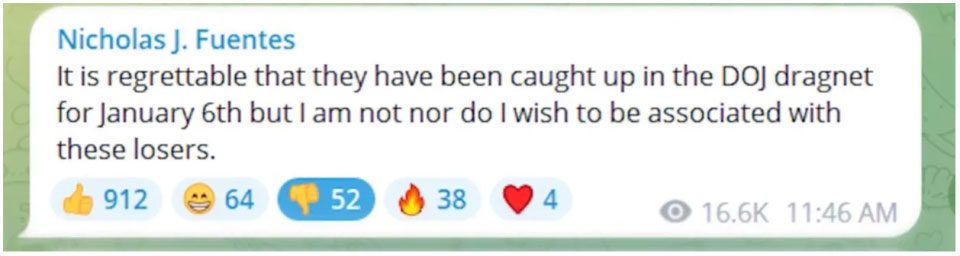
While Fuentes may have escaped the long arm of the law, other Groypers present that day weren’t so lucky. In the months that followed, at least seven were charged and sentenced for entering the Capitol on January 6. In the aftermath of their arrests, Fuentes disavowed the arrested Groypers, calling them “losers” and saying he did not “wish to be associated with” them. They may have pledged to “rape, kill, and die,” but in the Groyper movement, loyalty appears only to run in one direction.
One question has dogged Fuentes for years: How does he make his money and finance his political operation? During his livestreams, fans must pay a minimum of $20 to pose questions during his Q+A sessions. He has solicited donations and hawks America First merchandise and subscriptions to his $100-a-month private Telegram channel.
Fuentes’s largest known donor to date was a French computer programmer and cryptocurrency millionaire named Laurent Bachelier. In December 2020, as right-wing factions were organizing the “Stop the Steal” protest in Washington, D.C., Bachelier transferred roughly $522,000 in Bitcoin to a network of white nationalist and neo-Nazi activists. The largest recipient, by far, was Fuentes, who received roughly $250,000. Hours after initiating the Bitcoin transfers, Bachelier committed suicide at the age of 35.
Within three months, Bachelier’s donation to Fuentes had effectively doubled in value due to a significant spike in the price of Bitcoin.
After January 6, Fuentes’s finances appear to have been briefly imperiled. The Gray Zone, an investigative outlet edited by hard-left journalist Max Blumenthal, published a purported letter that the Department of Justice sent Fuentes, stating that the DOJ had frozen accounts belonging to Fuentes on January 23, 2021. By the summer of 2021, however, the purported letter claimed DOJ had withdrawn its request to freeze the account.
In spite of this, Fuentes allegedly continued to claim publicly that his funds remained frozen. That narrative unraveled when Jaden McNeil, a former close associate and the treasurer of Fuentes’s nonprofit, said on a livestream that Fuentes had regained access to the funds, a claim corroborated by the Gray Zone’s purported records.
“He’s had that [money] back from the feds for almost a year,” McNeil said on the livestream, accusing Fuentes of using the story to raise money while, at the same time, purchasing an expensive car. “He’s a total liar.”
Over the years, Fuentes has also sought money from at least one prominent right-wing benefactor, according to sources familiar with the meeting, who spoke on the condition of anonymity. One former associate claims that in January 2022, Fuentes was scouting real estate in Tampa Bay, where he was considering moving his political operation. During the trip, the associate claims, Fuentes drove four hours to Miami to meet a then-employee of Peter Thiel, the right-wing venture capitalist who has financially backed Republican causes, including the campaigns of President Donald Trump and then-Senate candidate J. D. Vance.
Armed with a presentation, Fuentes pitched Thiel’s employee on providing funding for his show and political operation, according to multiple sources familiar with the meeting who spoke on the condition of anonymity. Thiel, one source claimed, never replied to Fuentes’s request.
Soon after, Fuentes began launching a series of public attacks not only on Thiel, whom he called “the CIA,” but also on Trump and Vance. Fuentes also now bemoans the influence of Thiel funding in right-wing circles, despite having allegedly sought out the very Thiel funding he condemns. Multiple former Fuentes associates who spoke to City Journal claim that the Thiel story is telling, as it reveals Fuentes’s true motivations: not political grievances, but personal ones.
Conversations with multiple former associates paint a picture of Fuentes’s positions as not rooted in principle, but shifting with his perceptions of personal advantage and what he perceives as threats to his ego.
“[There’s an] extraordinary gap between the way he describes himself and presents himself to his followers . . . and his real life,” said former Fuentes ally Milo Yiannopoulos. “He’s somebody who doesn’t believe in anything at all.”
Perhaps the most sordid chapter in the Fuentes story involves his relationship with Ali Alexander, a political activist and key organizer of “Stop the Steal.” In 2023, Alexander was accused of asking teenage boys for sexual photographs.
Amid the fallout from the scandal, Fuentes initially “disavowed” Alexander’s actions, while lashing out at the accusers, saying the teenaged boys were guilty of “flirting” with Alexander. “The real victim in this entire saga is me,” Fuentes said.
He had also previously downplayed the allegations on his show. “If we’re talking about rape and murder and things like that, okay, but we’re talking about flirting?” Fuentes said. “Give me a f***ing break.”
Fuentes has long been aware of Alexander’s alleged proclivities. On a livestream in 2017, Fuentes said there was “abundant evidence” that Alexander “would like to interact in a sexual way with young fashy white boys quite like myself, and like others.” In a video posted by hard-right journalist Dustin Nemos—which purportedly depicts events from November 2020, during the so-called Million MAGA March—a young-looking male, whom Nemos describes as a teenager, recounts to Fuentes a conversation in which the alleged teenager called Alexander a “pedo.” Fuentes responded: “How do people not know about it?”
Despite this history, Fuentes continued to associate with Alexander, appearing alongside him at various political events, including one Fuentes encouraged his supporters to attend. After the scandal broke, Fuentes reportedly pressured one of Alexander’s accusers to recant his allegation in exchange for securing him a job in politics. (Fuentes denied this at the time; he did not return a City Journal request for clarifying comment.) That year, Fuentes also acknowledged on a livestream that, during the Kanye West presidential campaign, he had remained in daily contact with Alexander despite the allegations. In 2024, a Colorado police department confirmed that it was working with “partner agencies” in Texas to investigate Alexander.
Alexander did not return a request for comment.
The Alexander scandal is not an aberration, but part of a broader culture within the Groyper movement. In 2022, Alejandro Richard Velasquez Gomez, a Fuentes fan who had been photographed with him at a political event, was charged with possession of child pornography and making interstate threats on a Turning Point USA event. In the aftermath of the arrest, Fuentes attempted to distance himself, saying Gomez had “nothing to do with me or America First.”
Fuentes’s own comments on sexual topics are equally disturbing. He has stated that convicted sex offender Jeffrey Epstein was “cool as f***”; has expressed skepticism about age of consent laws; and indicated he wants to marry a 16-year-old girl when he turns 30. For the Groypers, the transgression of political and sexual taboos is part of Fuentes’s appeal. The more furious the denunciations of Fuentes—racist, sexist, pedophile, Nazi—the deeper his audience digs in. “These labels don’t mean anything,” says Clodfelter, the Fuentes follower. “Those words are meaningless to us now . . . . It doesn’t affect us anymore. And Nick proves that.”
From one perspective, we might be tempted to dismiss Fuentes as a hyperreal spectacle. His Groyper movement relates to politics the same way pornography relates to sex: stripped of meaning, flattened into an image, sensationalized for personal gain.
But hyperreality does not mean unreal, and, like pornography, it can often intrude on reality in ugly and unexpected ways. Conservatives who care about the future of the movement should understand that Fuentes is corrosive. Despite his self-mythology as the most right-wing pundit in America, he is, in a real sense, a tool of the Left. Progressive activists have spent the past decade pushing the narrative that conservatives are Nazis and Donald Trump is Hitler. In Fuentes, they have finally found their man.
The spectacle moreover is not only politically corrosive, but personally corrosive to its participants. At heart, the Fuentes phenomenon is not about ideas, or ideology, or power; it is about an angry, broken young man leading other angry, broken young men down a digital trail that ends in ruin.
Fuentes might laugh about his command for his followers to “rape, kill, and die for Nicholas J. Fuentes,” explaining it away as irony or a morbid joke. But it was only a matter of time before one of his followers, lost in the cult atmosphere of the Groyper movement and unable distinguish reality from hyperreality, would take it seriously.
That is precisely what happened last January, when a black teenager named Solomon Henderson walked into Antioch High School, outside Nashville, with a 9mm pistol and fired 10 rounds into the cafeteria, killing a 16-year-old girl and injuring another student, before turning the gun on himself.
The purported manifesto Henderson left behind—a copy of which found online corresponded to contemporary news descriptions—revealed a fascination with mass shooters, including the neo-Nazi Anders Breivik, who killed dozens of children in Norway in 2011; and a pastiche of radical ideologies lifted from internet forums and imageboards. At the logical level, these ideologies, especially when set against Henderson’s racial identity, seem to make little sense. But in the freak world, populated by a rainbow of nihilists, a black teenager, drunk on the hyperreal spectacle, can murder a young girl in a school cafeteria while calling himself an “Involuntary N[*]gger” and a “Groyper Incel.”
In the manifesto, Henderson asked himself, “Is there a particular groups[sic]or people that radicalized you the most?” He weaves one answer into the subsequent list of irony-laden names—once in plain lettering, and later, in all caps: NICK FUENTES.
:{Ryan Thorpe is an investigative reporter at the Manhattan Institute.Christopher F. Rufo is a senior fellow at the Manhattan Institute, a contributing editor ofCity Journal, and the author ofAmerica’s Cultural Revolution
new rep 12 25
The online MAGA-verse were at each other’s throats more than usual this weekend, as right-wing commentators Benny Johnson, Milo Yiannopoulos, and Tucker Carlson were all points of controversy.
The first tiff started on Saturday, when Yiannopoulos—who has made a name for himself as an openly gay far-right bigot—accused multiple conservative influencers like Johnson and Charlie Kirk of being closeted gay men on Tim Pool’s podcast with swindler and former MAGA Representative George Santos, who is also gay.
“One of the most distinctive things about the right-wing in this country is its homosexual overtones. Benny Johnson posts pictures of his children every two days—it’s weird. And everybody knows what went on with Benny Johnson in those lobbies and those hotel rooms at SAS. Everybody knows,” said Yiannopoulos.
“I don’t know what you’re talking about,” Santos replied.
“Men, younger men. Not underage, at least I don’t know that. His wife was crying drunk in the lobby three SAS’s in a row about how her husband was upstairs with boys,” Yiannopoulos claimed. “Go ask her.”
“Come on, Milo, aren’t you ever scared of getting sued?” Santos asked.
Yiannopoulos insisted he was telling the truth, and that he’d never been sued.
On Sunday, Johnson threatened to sue him.
“I am duty bound to take action to protect my family against those who maliciously defame and attack us. More to come on that soon,” he wrote. “Pray for healing for some really sick and delusional people. Jesus is about redemption. The legal system is about justice. Happy Sunday.”
Yiannopoulos responded in a message addressed to Johnson and his wife, Kate:
“I know more about defamation than any lawyer you will hire. Benny is a public figure. Malice is a nonstarter. I have receipts, and the truth is a total defense against any claim of defamation or libel. Do you want to lose a defamation case to MILO YIANNOPOULOS OF ALL PEOPLE about whether or not you are gay? Do you want to even fight one? The people who have poured money into making you a big deal are about to lose their entire investment,” he ranted.
“I know more about your marriage than you think I do,” he continued, “and I have evidence, and I have witnesses. I know who to subpoena. I know what questions to ask. About nocturnal liaisons dangereuses with chaps in assless chaps and about being caught in flagrante delicto at conferences attended by students, some of whom may have been under 18 (I guess we’ll find out!).”
Yiannopoulos also claimed that Turning Point USA may have faked Charlie Kirk’s death.
Meanwhile, other far-righters—mostly Islamophobes and Zionists—were at pundit Tucker Carlson’s throat for his purchase of a property in Qatar.
“Speaking on stage at the Doha Forum in Qatar, Tucker Carlson told Qatar’s Prime Minister Al Thani that he is buying a place in Qatar this week because he’s an ‘American”; and he will live and go wherever he wants,” MAGA crank Laura Loomer posted on Sunday. “Qatar is the financier of the Muslim Brotherhood and they continue to allow HAMAS officials to live in Doha, where Tucker now wants to buy a place to live.”
“Let me explain the joke: Qatar is a bloodthirsty, terror-supporting slave state, and Tucker Carlson is rubbing it in your face that he’s an unregistered foreign agent for them,” another account wrote.
It’s clear that Trump’s base is fraying at the seams. From those questioning the validity of Trump’s “America First” and our fealty to Israel, like Representative Marjorie Taylor Greene, Nick Fuentes, and Tucker Carlson, to those like Yiannopoulos spreading conspiracy theories only Candace Owens would touch, it’s clear that whatever base of hatred Trump still has is fractured.
:{December 8, 2025/
---}:
AN 12 25
The New Republic’s Jim Geraghty thinks MAGA has gone completely off the deep end with its latest conspiracy theory: that Charlie Kirk is not really dead, placing him alongside figures like Elvis Presley and Tupac Shakur in the pantheon of “still alive” myths.
Writing Monday, Geraghty said the conspiracy is coming from people known for insisting they are “just asking questions,” and added, “I wish I were making that up, but I am not.”
The Manhattan Institute released a report dividing the Republican Party into two groups, a small, "but still sizable faction" with policy beliefs that aren't all that conservative. In fact, they're actually progressive on multiple issues. The report revealed that a "significant" amount of those now believe that the Sept. 11 attacks on the World Trade Towers were an "inside job," the moon landing was fake, and stories of the Holocaust are "exaggerated" or never happened.
Far-right commentator Tim Pool welcomed "controversy-courting gadfly" Milo Yiannopoulos on the show where he questioned if Kirk's assassination was real.
“The astronomically inadequate explanations given, in my view, for the actions before, at, and after Charlie’s death and the behavior afterwards from both the federal government and Turning Point executives — you think nothing of his deeply, deeply sinister wife?" he continued.
Former Rep. George Santos (R-N.Y.), who was recently pardoned by President Donald Trump, was also on the show, and pressed Yiannopoulos on how Kirk's wife was "sinister."
"Have you seen the difference in the size of her hands with Charlie’s in their wedding pictures, and then compared it to him in his casket?" Yiannopoulos asked.
"Are you saying she’s a man?" Santos questioned.
"No, no. I'm saying that wasn't Charlie in there," Yiannopoulos claimed.
He went on to ask whether Kirk's body was somehow "lost" or "vanishingly slight."
Geraghty compared it to the conspiracy theories that question whether former President John F. Kennedy actually survived the Dallas shooting in 1963.
The columnist also cited a glowing *Wall Street Journal*profile on Pool from July in which they painted the podcaster, his guests "and those like him, represent the new wave of right-of-center voices. They’re the wise minds and leaders on the rise, shaping the discourse and guiding the national conversation."
Geraghty explained, "Poll results like that suggest that Trump has succeeded in attracting two sizable and significant groups to his political coalition: disaffected Democrats who rarely agree with the Republican Party on policy but like Trump’s personal style, and lunatics who doubt that the Holocaust or moon landing happened or that al-Qaeda is responsible for the 9/11 attacks."
---
RWW
10/21/2025
by
- Glenn Beck says that the recent "No Kings" protests were "a deep state operation."
- White nationalist Lauren Witzke claims that she has "partnered with" Megyn Kelly to give away tickets to Kelly's upcoming tour.
- Janet Porter is still trying to turn her life story into a movie.
- Milo Yiannopoulos reports that "doctor thinks I have a brain tumor."
- Finally, Oklahoma state Sen. Shane Jett declares that "if you want to look at what a government looks like when it builds its foundation on the Hebrew republic and acknowledges God Almighty as its foundation, then look no further than the government that was created by we the people."
---
---}:
rww
11/21/2024
by
As Right Wing Watch has noted multiple times in the past, one of the defining characteristics of Christian nationalists is their willingness to misrepresent history, as time after time they spread blatant falsehoods in defense of their right-wing ideology. Often, this is rooted in their own ignorance about the Founding Era and the creation of the Constitution, and that tendency was on full display during a of Tim Pool's podcast.
Pool and guest Milo Yiannopoulos were trying to convince conservative journalist Elad Eliahu that the United States was founded as a Christian nation. The debate was largely incoherent and uninformed, as exemplified by Pool's ludicrous assertion that the 4th, 5th, and 6th Amendments in the Bill of Rights were "literally" derived from the biblical story of Sodom and Gomorrah.
"Do you know why the Founding Fathers created the 4th, 5th, and 6th [Amendments]?" Pool asked, confidently. "It's the story of Sodom and Gomorrah. It is literally as the spoken word of the Founding Fathers. Benjamin Franklin said, 'It is better that 100 guilty persons escape than one innocent suffer,' which was a play on Blackstone's formulation; it is better that 10 guilty persons escape than one innocent suffer which is literally the story of Sodom and Gomorrah [where God said] 'If but one righteous person exists, I will not destroy this land.' It was literally the Bible, which is why they said we should enshrine this in the Constitution."
Video URL
Pool's claim is, of course, nonsense and frankly doesn't even make sense, as it is exceedingly difficult to even imagine how the story of Sodom and Gomorrah could have been responsible for the various due process amendments included in the Bill of Rights:
Fourth Amendment
The right of the people to be secure in their persons, houses, papers, and effects, against unreasonable searches and seizures, shall not be violated, and no warrants shall issue, but upon probable cause, supported by oath or affirmation, and particularly describing the place to be searched, and the persons or things to be seized.
Fifth Amendment
No person shall be held to answer for a capital, or otherwise infamous crime, unless on a presentment or indictment of a grand jury, except in cases arising in the land or naval forces, or in the militia, when in actual service in time of war or public danger; nor shall any person be subject for the same offense to be twice put in jeopardy of life or limb; nor shall be compelled in any criminal case to be a witness against himself, nor be deprived of life, liberty, or property, without due process of law; nor shall private property be taken for public use, without just compensation.
Sixth Amendment
In all criminal prosecutions, the accused shall enjoy the right to a speedy and public trial, by an impartial jury of the state and district wherein the crime shall have been committed, which district shall have been previously ascertained by law, and to be informed of the nature and cause of the accusation; to be confronted with the witnesses against him; to have compulsory process for obtaining witnesses in his favor, and to have the assistance of counsel for his defense.
Furthermore, Benjamin Franklin had nothing to do with crafting the Bill of Rights, which was drafted by James Madison before being edited and consolidated by both the House of Representatives and the Senate. Additionally, Madison's draft largely originated from him choosing from among the dozens of amendments suggested by the states during their various constitutional ratifying conventions.
In fact, many of the things contained in Madison's initial draft were versions of thing already contained in state Bills of Rights or were provisions designed to address issues that had outraged American colonists leading up to the American Revolution.
As historian Carol Berkin explained in her book, "The Bill of Rights: The Fight to Secure America's Liberties":
Many of the guarantees Madison laid out conformed to traditions and expectations established by almost two hundred years of Anglo-American political culture. Some reflected an adaptation of the "rights of Englishmen” to the new experiment in republican government. But many of them also revealed the Revolutionary generation's persistent memory of the abuses arising from imperial policies in the 1760s and 1770s.
We have listened to countless professional Christian nationalist activists make a myriad of baseless and misleading statements over the years, but this is the first time we'd ever heard anyone claim that a key portion of the Bill of Rights was rooted in the biblical story of Sodom and Gomorrah. Needless to say, if there was even a shred of evidence to support this notion, we are confident that we would likely have heard it first from someone other than Tim Pool.
---
an 8 23 no lnx
Feds to MTG: Tell us more about that anti-Islam, Nazi-adjacent provocateur who used your credit card
Alexandria Jacobson
andRaw Story
August 18, 2023
This article was paid for by AlterNet subscribers. Not a subscriber? Try us and go ad-free for $1. Prefer to give a one-time tip? Click here.
The Federal Election Commission has questions for Rep. Marjorie Taylor Greene (R-GA) about a credit card charge that ties her congressional campaign to far-right agitator Milo Yiannopoulos and and rapper Kanye West.
Greene’s congressional campaign committee received a letter from the FEC on Tuesday asking for “information essential to full public disclosure of your federal election campaign finances” regarding reimbursement of $7,020.16 that was labeled as “use of campaign credit card for personal expense.”
Let’s back up.
Last month, Raw Story reported on the receipt, which appeared on a financial disclosure submitted to federal regulators by Greene for Congress.
Seemingly, the receipt was reimbursement for Yiannopoulos’ use of the Greene campaign’s credit card in November to purchase a campaign website domain for the yet-to-be-launched 2024 presidential campaign of West.
RELATED ARTICLE: Milo Yiannopoulos settles up with Marjorie Taylor Greene for Kanye West website scandal
Yiannopoulos, who is known for online harassment and making bigoted and controversial statements, including comments seemingly defending pedophilia, worked for Greene as an unpaid intern in 2022, Insider reported.
The reimbursement amount matches the GoDaddy expense on Nov. 22, 2022, for “domain registration and hosting” that Greene previously reported, according to The Daily Beast.
Yiannopoulos’ initial transaction was for the purchase of ye24.com and occurred on the same day that West, who now goes by Ye, dined with former President Donald Trump and white nationalist Nick Fuentes, The Daily Beast reported.
Shortly afterward, West and Fuentes, a Holocaust denier, appeared together on right-wing conspiracy theorist Alex Jones’ show where West made anti-Semitic comments praising Hitler and Nazis, Politico reported.
West reportedly fired Yiannopoulos, who took credit for setting up the dinner at Mar-a-Lago, in December but rehired him as “director of political operations” in May, according to The Daily Beast.
West ran for president in 2020 but hasn’t officially announced a 2024 run.
The FEC’s request for additional information addressed to Greene’s treasurer, Jason Boles, said, “This receipt appears to be related to an apparent unauthorized use of Committee funds. The Commission notes your explanation of the unauthorized activity. Although the Commission may take further legal action regarding this apparent improper use of Committee funds, any further clarifying information that you can provide will be taken into consideration.”
Boles did not respond to Raw Story’s request for comment at the time of publication.
Exclusive: Milo Yiannopoulos settles up with Marjorie Taylor Greene for Kanye West website scandal
Alexandria Jacobson
andRaw Story
July 16, 2023
Scandal-ridden far-right commentator Milo Yiannopoulos has seemingly settled up — financially — with Rep. Marjorie Taylor Greene (R-GA).
Yiannopoulos reimbursed Greene’s campaign $7,020.16 on May 12 for “use of campaign credit card for personal use,” according to a new Federal Election Commission filing reviewed by Raw Story.
In November, Yiannopoulos had purchased a campaign website domain for Kanye West’s yet-to-be-launched 2024 presidential domain using Greene’s campaign credit card.
Yiannopoulos, who is known for online harassment and making bigoted and controversial statements, including comments seemingly defending pedophilia, worked for Greene as an unpaid intern in 2022, Insider reported.
The reimbursement amount matches the GoDaddy expense on Nov. 22, 2022, for “domain registration and hosting” that Greene previously reported, according to The Daily Beast.
Yiannopoulos’ initial transaction was for the purchase of ye24.com and occurred on the same day that West, who now goes by Ye, dined with former President Donald Trump and white nationalist Nick Fuentes, The Daily Beast reported.
Shortly afterward, West and Fuentes, a Holocaust denier, appeared together on right-wing conspiracy theorist Alex Jones’s show where West made anti-Semitic comments praising Hitler and Nazis, Politico reported.
West reportedly fired Yiannopoulos, who took credit for setting up the dinner at Mar-a-Lago, in December but rehired him as “director of political operations” in May, according to The Daily Beast. West ran for president in 2020 but hasn’t officially announced a 2024 run.
Greene’s campaign and congressional office did not respond to Raw Story’s requests for comment by publication time.
From Your Site Articles
Holocaust denier Nick Fuentes could become the new face of MAGA ›
'Homophobia always will be' a key part of 'MAGA populism': journalist ›
Kanye West can start paying white nationalists from his old presidential campaign again ›
Related Articles Around the Web
Milo Yiannopoulos says he is interning for Marjorie Taylor Greene ... ›
Milo Yiannopoulos Caught in Marjorie Taylor Greene-Kanye West ... ›
Why Marjorie Taylor Greene Hired Milo Yiannopoulos As an Intern ›
Report
https://boingboing.net/2023/05/10/milo-yiannopoulous-may-have-scammed-marjorie-taylor-greene-and-kanye-west.html
- Matt Shuham @ HuffPost: The Mysterious Fourth Man At The Trump-Ye Dinner Tells His Story.
- Kathryn Joyce @ Salon: Christian nationalism’s white supremacy crisis: Bitter battle on the far right.
- Jack Jenkins @ Religion News Service: Ye’s Trump dinner is a high point for Catholic nationalists’ influence campaign.
- Aidan McLaughlin @ Mediaite: Kanye West’s Biggest Boosters Tucker Carlson and Candace Owens Go Silent After He Goes Full Nazi.
- Alex Bollinger @ LGBTQ Nation: Meet the ex-gay grifter behind Kanye West’s downward spiral.
- Brandy Zadrozny @ NBC News: Elon Musk’s ‘amnesty’ pledge brings back QAnon, far-right Twitter accounts.
- Joe Jervis: Trump Sends Video Message To Fundraiser For Rioters.
- Tom Hals and Jonathan Stempel @ Reuters: Alex Jones files for bankruptcy following $1.5 billion Sandy Hook verdicts.
Tags: Alex Jones Donald Trump Elon Musk Kanye West Milo Yiannopoulos Round-Up
no lnx vid twt
Meet the ex-gay grifter behind Kanye West’s downward spiral
If Kanye West is hanging out with this guy, his hateful tirades on Alex Jones's show are no surprise.
By Alex Bollinger Friday,December 2, 2022
Gay man Milo Yiannopoulos was the Grand Marshal of the Straight Pride Parade.Then-out gay man Milo Yiannopoulos was the Grand Marshal of a Straight Pride Parade
Kanye West’s meltdown yesterday – where he said on Infowars that he liked Hitler and “loves Nazis” – comes just weeks after he announced that he was working closely with ex-gay grifter Milo Yiannopoulos.
It’s not surprising that West thought his antisemitic tirade would be met with more approval from Alex Jones and his audience if he’s been spending so much time with Yiannopoulos, considering the latter’s hateful rhetoric against Black people, Jewish people, gay people, disabled people, and others from just this past month.
Several weeks ago, West and Yiannopoulos were spotted hanging out by the celebrity gossip site X17.
LGBTQ Nation
“This is Milo right here, working on the campaign,” West said. He clarified that he meant his own 2024 presidential campaign.
Yiannopoulos’s account on Telegram – he has been kicked off numerous social media platforms, including Twitter and Facebook – shows that he is working closely with West and has been photographed with the rapper several times in the past few weeks. Yiannopoulos also claimed that he set up Donald Trump’s recent Mar-a-Lago dinner with white supremacist Nick Fuentes in order to get revenge on the former president.
Yiannopoulos’s Telegram account is full of hatred for historically oppressed minority groups. Almost daily, he’s posting messages that would be considered career-ending for a more mainstream political consultant.
:{
}:
“No N-Word November has begun,” he wrote before bragging about using the N-word. “I’ve already failed, but don’t let that stop you.”
Telegram message from Milo Yiannopoulos
He posted a clip of a man holding a woman’s head and captioned it “Disney be like WATCH THE BLACK HOMOS,” possibly a reference to the new Disney movie Strange World, where one of the main characters is a gay, biracial teen.
Telegram message from Milo Yiannopoulos
He shared a message from someone else calling Pennsylvania Senator-elect John Fetterman (D) a “re***d” after he suffered a strokeand referred to his Republican opponent, Dr. Mehmet Oz, as “a Turk” and laughed at it.
Telegram message from Milo Yiannopoulos
:{
}:
In another message, Yiannopoulos denounced Trump by saying that he is “continuing to suck the boots of the Jewish powers that be who hate Jesus Christ, hate our country, and see us all as disposable cattle.”
Telegram message from Milo Yiannopoulos
He accused House Speaker Nancy Pelosi’s (D-CA) husband Paul Pelosi of “DRUNKEN FA***TRY” and called CBS News’s decision to stop using Twitter “The absolute fa***try.”
And that’s just a sampling.
West has been spending time at midrange restaurants and on private jets with Yiannopoulos and Fuentes, where the three antisemitic, racist, and homophobic men can share their thoughts on politics and reinforce each other’s biases and conspiracy theories.
West gets two companions who won’t push back against his hate, and Fuentes and Yiannopoulos get the lifestyle that comes with West’s vast wealth.
Yiannopoulos has been accused of grifting West by fellow right-winger Laura Loomer. This past weekend she said that Yiannopoulos collects “s**t” on wealthy people he interacts with on a hard drive he calls “The Vault.” She also shared messages where Yiannopoulos called West “gay” and a “BLACK HOMOSEXUAL” – West has never come out as gay and was married to Kim Kardashian – from earlier this year. She also posted video of Yiannopoulos bragging about his hard disk.
:{
}:
On Telegram just hours after West’s meltdown on Infowars and after he got kicked off Twitter, Yiannopoulos stood by West, saying that West getting kicked off Twitter for posting a swastika superimposed on a Star of David violated his “artistic expression” and called out Twitter’s new CEO, Elon Musk. Yiannopoulos asked his followers to “Pray for Ye” and said, “God often uses the most unexpected people in the most unexpected ways to accomplish His Will.”
Yiannopoulos used to be one of Trump’s biggest supporters, back when he was an openly gay far-right troll, referring to the former reality TV host as “daddy” and using his substantial influence on the far-right to support Trump’s 2016 campaign.
When Trump lost the 2020 election, Yiannopoulos swore “vengeance,” declared that he would “BURN THE REPUBLICAN PARTY TO THE F**KING GROUND,” and called Trump a “selfish clown.”
The next year, Yiannopoulos claimed that he was no longer gay. He even made a video where he allegedly threw his engagement ring – which he called “the Sodomy Stone” – into the ocean to prove just how not-gay he is now.
Earlier this year, he was spotted with Rep. Marjorie Taylor Greene (R-GA) and she said that he was her intern. He was still making racist content for the internet. It’s unclear if he is still her intern, but he said he was helping Greene do campaign spots as late as October of this year. While he hates Trump now, he continues to shower affection on Greene on social media.
Fuentes – who says that having sex with women is gay so he refrains from any sexual activity at all – is a controversial figure on the right. The normally accommodating Mike Pence has called on Trump to apologize for giving “a white nationalist, an antisemite and Holocaust denier a seat at the table.”
Fuentes even allegedly caused a fight between Rep. Greene and Rep. Lauren Boebert (R-CO), after Greene spoke at Fuentes’ America First Political Action Conference (AFPAC). Boebert was said to be so upset by Greene’s lack of political savvy in being seen with Fuentes in public that she confronted Greene at a meeting of the Freedom Caucus. Witnesses thought they were going to get physically violent until another member of Congress “stepped in to de-escalate.”
soap opera
rightwingwatch.org/post/extremism-on-the-menu-trumps-dinner-with-ye-milo-and-nick-fuentes/
many lnx twt vids
Extremism on the Menu: Trump’s Dinner With Ye, Milo, and Nick Fuentes
Kyle MantylaBy Kyle Mantyla | November 28, 2022 2:23 pm
Nick Fuentes—the racist, misogynistic, antisemitic, America-hating, Christian fascist leader of the white nationalist America First movement—is usually a prolific poster on social media (at least on the far-right platforms from which he has not already been banned). Given that Fuentes is fully aware that his radical views and relentless bigotry have largely rendered him politically toxic, it raised some questions about just what he might be up to when he mysteriously and uncharacteristically went silent a little over a week ago.
It turned out that Fuentes had good reason to fall silent, as he was busy dining with former President Donald Trump at Mar-a-Lago and hanging out with Kanye West, reportedly to help the rap mogul plot a run for the White House.
How did we get here?
First, let’s begin with West. West, who now goes by the name Ye, received widespread criticism and condemnation earlier this month after his latest antisemitic outburst. But he found support in Fuentes, who has long idolized West, and shares his antipathy toward Jewish people. Galvanized by West, Fuentes has doubled down on his own virulently antisemitic views.
On Friday, Nov. 18, TMZ reported that West had been photographed in Beverly Hills with Milo Yiannopoulos—the far-right shyster who was once a right-wing enfant terrible until his career imploded after he defended pederasty and who has since rebranded himself as “ex-gay” and militantly Catholic. Yiannopoulos and Fuentes are close allies, with Yiannopoulos orchestrating Rep. Marjorie Taylor Greene’s appearance at Fuentes’ America First Political Action Conference in February. Given that Yiannopoulos, who was until recently interning for Greene’s congressional office, was publicly seen hanging around with West in California, it seemed likely to Right Wing Watch that Fuentes was doing the same, especially when Fuentes briefly reemerged on Telegram to post an illustrated image of himself shaking hands with West.
These suspicions were confirmed on Sunday, Nov. 20, when a video was posted on YouTube showing West and Yiannopoulos together in which West announced that he intends to run for president. At one point in the video, Fuentes could be seen briefly in the background.
On Tuesday, Nov. 22, West posted a message on Twitter revealing that he had met with Trump at his Mar-a-Lago resort in Florida. That same night, Right Wing Watch received an email from a reader containing a brief video showing West and Fuentes walking through the Miami airport together.
Initially, it was unclear what sort of meeting West had had with Trump and whether Fuentes had been involved, but eventually it was revealed that West, Fuentes, and Yiannopoulos had dined with Trump at his Mar-a-Lago club. Trump was “really impressed” by Fuentes, according to West, a statement Fuentes himself confirmed.
When Fuentes finally returned home from his whirlwind trip, he did a livestream broadcast on Friday night in which he announced that his nightly program is being suspended indefinitely as he and Yiannopoulos transition to working on West’s presidential campaign.
Predictably, a wave of outrage followed the revelation that Trump had dined with Fuentes, whose radical political agenda and unrelenting stream of racism, misogyny, homophobia, antisemitism, and bigotry have been diligently documented by Right Wing Watch for years.
This development has created a worst-case scenario for Trump. Not only is the former president flailing about desperately to shield himself from the ramifications of dining with two notorious antisemites, but he’s trying to do so without denouncing Fuentes directly, apparently for fear that doing so will harm his 2024 presidential prospects. But that ship has already sailed; Fuentes and those in his America First movement who had been militant Trump supporters have already nearly universally shifted their loyalties to West and his nascent presidential campaign.
In addition to damaging Trump, the West presidential campaign is deepening a rift in the America First movement. Fuentes’ ally Laura Loomer, a far-right activist and failed congressional candidate, is using the news to go scorched earth in attacking Yiannopoulos,whom she blames for sabotaging her recent congressional campaign.Loomer has been posting messages on Telegram blasting Yiannopoulos as a “narcissistic fraud” and a vindictive sociopath who has weaseled his way into West’s orbit for the purpose of blackmailing him.
Over the weekend, Loomer posted messages allegedly from Yiannopoulos earlier this year in which Yiannopoulos repeatedly asserted that West is gay, as well as a video of Yiannopoulos publicly bragging that he collects “shit” on nearly everyone he interacts with and keeps it stored on a hard drive he calls “The Vault.” Having Yiannopoulos on his campaign, Loomer suggested, would only spell trouble for West.
West’s presidential campaign is off to a predictably rocky start, as he appears to have given Fuentes and Yiannopoulos access to his Twitter account, which they promptly used to attack right-wing commentator Ben Shapiro, whom both despise. The tweets have since been deleted, but this likely provides a preview of the chaos to come from a vanity presidential campaign being run by three raging narcissists.
For his part, Fuentes has said that he has shifted his allegiance to West because “we must dream bigger” and West is the only one “talking about how the aspirations of the Trump Movement have been hijacked.” It is worth remembering just what Fuentes’ stated “aspirations” are: to see a far-right authoritarian seize control of this country who will ignore the Constitution, suspend elections, and install himself as dictator while imposing Christian fascism on the nation.
Fuentes had hoped that Trump would be the vehicle by which to achieve his goal, but it appears his loyalty has shifted to West, which raises the question: Does West agree with Fuentes’ authoritarian vision?
Tags: Donald Trump Kanye West Laura Loomer Milo Yiannopoulos Nick FuentesElection 2024
---some lnx
...On Friday, Nov. 18, TMZ reported that West had been photographed in Beverly Hills with Milo Yiannopoulos—the far-right shyster who was once a right-wing enfant terrible until his career imploded after he defended pederasty and who has since rebranded himself as “ex-gay” and militantly Catholic. Yiannopoulos and Fuentes are close allies, with Yiannopoulos orchestrating Rep. Marjorie Taylor Greene’s appearance at Fuentes’ America First Political Action Conference in February. Given that Yiannopoulos, who was until recently interning for Greene’s congressional office, was publicly seen hanging around with West in California, it seemed likely to Right Wing Watch that Fuentes was doing the same, especially when Fuentes briefly reemerged on Telegram to post an illustrated image of himself shaking hands with West.
...
when Fuentes finally returned home from his whirlwind trip, he did a livestream broadcast on Friday night in which he announced that his nightly program is being suspended indefinitely as he and Yiannopoulos transition to working on West’s presidential campaign.
Predictably, a wave of outrage followed the revelation that Trump had dined with Fuentes, whose radical political agenda and unrelenting stream of racism, misogyny, homophobia, antisemitism, and bigotry have been diligently documented by Right Wing Watch for years.
This development has created a worst-case scenario for Trump. Not only is the former president flailing about desperately to shield himself from the ramifications of dining with two notorious antisemites, but he’s trying to do so without denouncing Fuentes directly, apparently for fear that doing so will harm his 2024 presidential prospects. But that ship has already sailed; Fuentes and those in his America First movement who had been militant Trump supporters have already nearly universally shifted their loyalties to West and his nascent presidential campaign.
In addition to damaging Trump, the West presidential campaign is deepening a rift in the America First movement. Fuentes’ ally Laura Loomer, a far-right activist and failed congressional candidate, is using the news to go scorched earth in attacking Yiannopoulos, whom she blames for sabotaging her recent congressional campaign. Loomer has been posting messages on Telegram blasting Yiannopoulos as a “narcissistic fraud” and a vindictive sociopath who has weaseled his way into West’s orbit for the purpose of blackmailing him.
Over the weekend, Loomer posted messages allegedly from Yiannopoulos earlier this year in which Yiannopoulos repeatedly asserted that West is gay, as well as a video of Yiannopoulos publicly bragging that he collects “shit” on nearly everyone he interacts with and keeps it stored on a hard drive he calls “The Vault.” Having Yiannopoulos on his campaign, Loomer suggested, would only spell trouble for West.
...
West’s presidential campaign is off to a predictably rocky start, as he appears to have given Fuentes and Yiannopoulos access to his Twitter account, which they promptly used to attack right-wing commentator Ben Shapiro, whom both despise. The tweets have since been deleted, but this likely provides a preview of the chaos to come from a vanity presidential campaign being run by three raging narcissists.
For his part, Fuentes has said that he has shifted his allegiance to West because “we must dream bigger” and West is the only one “talking about how the aspirations of the Trump Movement have been hijacked.” It is worth remembering just what Fuentes’ stated “aspirations” are: to see a far-right authoritarian seize control of this country who will ignore the Constitution, suspend elections, and install himself as dictator while imposing Christian fascism on the nation.
Fuentes had hoped that Trump would be the vehicle by which to achieve his goal, but it appears his loyalty has shifted to West, which raises the question: Does West agree with Fuentes’ authoritarian vision?
...
On Friday, right-wing Washington Examiner political correspondent Byron York took to Twitter to warn that former President Donald Trump's increasingly open fraternization with white nationalists like Nick Fuentes is a crisis for the Republican Party.
"Trump, Kanye, Nick Fuentes — No longer a disaster waiting to happen," wrote York. "Now just a disaster.
This comes after Fuentes reportedly traveled to Trump's Mar-a-Lago country club residence in Palm Beach, Florida for a meeting — after which pro-Trump rapper Kanye West claimed that Trump was "really impressed" with the far-right activist.
Fuentes first gained prominence after his participation in the 2017 white supremacist "Unite the Right" rally in Charlottesville, Virginia, which resulted in the murder of a counterprotester. He leads a movement known as the "Groyper Army," an association of extremist internet trolls whose mission is to inject white nationalist ideology into the mainstream of political debate. Fuentes was active in politics during the 2022 midterms as well, with failed Washington Congressional candidate Joe Kent seeking his endorsement.
Kanye West himself, who also goes by the mononym Ye, has come under heavy fire in recent weeks for promoting anti-Semitic beliefs, including a social media rant in which he said he was going to go "death con 3" on Jewish people.
All of this comes as Trump is preparing for his third consecutive run for president in 2024, which has conservative forces unsure whether to fall in with the base or back him once more.
yells at kanye b/c might run against him? also milo
an 11 22
11 22 rww
- shane Vaughn rejoiced over former President Trump’s announcement that he is running for president again in 2024: “God’s anointed servant is rising up from the ashes.”
- Eric Metaxas was on hand for Trump’s announcement and declared that “when I think how this country has suffered these two years I get choked up thinking how good things were under Trump.”
- Jarrin Jackson is confident that Trump will win in 2024 because “the people who love Jesus are going to be doing what they need to be doing.”
- Ali Alexander proclaims that Trump can only win if he hires Alexander: “Trump cannot Beat the Fraud without me. Don’t mean to sound arrogant but I’m the only one in the movement to demonstrate it since November 2018.”
- Vincent James thought that Trump’s announcement speech was “dog shit”: “People don’t want elegance, people want revenge. … People are looking for Trump to go Mussolini mode.”
- Milo Yiannopouloshad a similar reaction: “Trump supporters want HEADS ON PIKES AND THE ENEMY’S LOVED ONES WEEPING OVER THEIR BATTERED CORPSES.”
- Finally, Nick Fuentes attacked Trump’s speech as “one of the worst things I’ve ever seen in my entire life”: “This was awful. It’s hard to imagine how it could have been worse.”
Tags: Ali Alexander Donald Trump Eric Metaxas Jarrin Jackson Milo Yiannopoulos Nick Fuentes Shane Vaughn Vincent James Election 2024 Leftovers
- D’Souza thinks that conservatives should “deliver a giant UP YOURS” to the Jan. 6 Committee by lining his pockets by watching his Big Lie documentary.
- Prior to landing his “internship” with Rep. Marjorie Taylor Greene, Milo Yiannopoulos nuked all of his social media accounts, but apparently forget to purge his Parler account.
- Speaking of Yiannopoulos, he could repeatedly be heard off-screen helping to produce Greene’s response to Jan. 6 Committee’s Thursday night hearing.
- MAGA pastor and GOP congressional candidate Mark Burns declares that the proper solution to the issue of gun violence in America is “simply add more guns.”
- Finally, since seemingly every Republican candidate who loses now claims their election was stolen and refuses to concede, Rachel Hamm is alleging fraud in California’s secretary of state election, which she lost by hundreds of thousands of votes.
Tags: Dinesh D'Souza Marjorie Taylor Greene Mark Burns Milo Yiannopoulos Rachel Hamm Leftovers
an 6 22 badash
**Marjorie Taylor Greene** (R-GA) has hired a far right-wing agitator and activist who appeared to support sexual “relationships” between boys as young as 13 and older men.
In 2016 Milo Yiannopoulos said, “I think in the gay world some of the most important, enriching and incredibly life-affirming, important shaping relationships very often between younger boys and older men.”
Those remarks were part of a video in which “Yiannopoulos discussed romantic relationships between teenage boys and adult men while being interviewed for the Drunken Peasants podcast in early 2016,” NBC News had reported in 2017. “Asked whether he was advocating for ‘cross-generational relationships,’ Yiannopoulos said: ‘Yeah, I don’t mind admitting that.'”
At that time, Heavy also reported: “In the video, Yiannopoulos describes how he feels sexual relationships between boys and older men can be positive. He denies he was defending pedophilia in the video, saying that term refers to younger children, not ‘someone who is 13-year-old, who is sexually mature.’ He also says, ‘We get hung up on this sort of child abuse stuff to the point where we are heavily policing consensual adults.'”
Yiannopoulos said in an apology, “I do not advocate for illegal behavior,” and, “I do not support child abuse. It’s a disgusting crime of which I have been a victim.”
Monday afternoon The Hill reported: “Right-wing provocateur Milo Yiannopoulos is working as an unpaid intern in the Congressional office of Rep. Marjorie Taylor Greene (R-Ga.).”
“Yiannopoulos, 37, announced the job on his Telegram account Monday with a photo of his official intern congressional badge,” The Hill added, noting “Greene’s office confirmed to The Hill that Yiannopoulos is indeed their intern.”
“At the end of April,” The Daily Beast also reports, “the hate-spewing ideologue—once a ubiquitous MAGA figure until he appeared to defend pedophilia in a YouTube video—attended a Greene press conference and, after it wrapped, was escorted with the congresswoman into the Capitol building through a ‘members only’ entrance.”
Rep. Greene has repeatedly attacked the LGBTQ community, and expanded her attacks to the larger liberal voting bloc, suggesting Democrats and anyone who supports LGBTQ people is a pedophile or supports pedophilia. Earlier Monday she posted this, one of several of her tweets calling people “groomer” or using the term “grooming.”
==
https://www.alternet.org/2021/05/proud-boys-2652973184/
salon
The right-wing media company Censored.TV, launched by Proud Boys founder (and VICE Media co-founder) Gavin McInnes in 2019, is "laying off all its staff," according to one of its hosts, onetime alt-right superstar Milo Yiannopoulos. For the moment, however, the site remains live. Censored.TV website hosts content posted by various conservative personalities behind a paywall, accessible to subscribers who pay $10 a month.
It remains unclear whether the site will keep trying to produce content without paid staff or will close down. "Sad news! You may have heard the rumors that Censored.TV is laying off all its staff," Yiannopoulos wrote on Telegram on Wednesday morning. "This week, I was told there's no longer enough money for my producer, despite the thousands of subscribers I've brought into the network. I love Gavin and will always be grateful to him for hosting my show when no one else would. In the meantime, I am entirely without any regular source of income. ...They paid me late 11 months out of the last 12, so I suppose I should have seen it coming."
Yiannopoulos didn't return Salon's request for comment[twt
mcInnes' entire site will reportedly no longer have any production or editorial staff, which would seem to make producing new content problematic. "I am told the whole editorial team is gone, and the shows are all getting stripped back to bare bones,"
Yiannopoulos, who now identifies as "ex-gay," added. "Gavin has fought tooth and nail to keep the company alive, and I wish him well and pray for his continued success."Yiannopoulos hosted a Friday night program on Censored.TV called "Friday Night's All Right,"which frequently far-right ideology with absurd hijinks, such as inviting white nationalist Nicholas Fuentes on the show to pour alcohol on himself, in an apparent effort to lure subscribers.
Other "stars" who host programming on the Censored.TV platform include right-wing hoax artist Jacob Wohl, anti-Muslim activist Laura Loomer and the anonymous online troll known as "CopperCab." Loomer didn't return Salon's request for comment on the future of her respective program on the website.
In a Wednesday afternoon interview with Salon, Wohl argued that Yiannopoulos' claims about the far-right media company lacked nuance and it was only Yiannopoulos' staff that was laid off due to subpar program ratings. "Censored TV isn't going anywhere," Wohl told Salon. "None of the staff, besides the staff that worked on Milo's show, have been, in fact, laid off or furloughed," he added.
Wohl further took problem with Yiannopoulos' claims that the network didn't pay out the far-right pundit on time for his work. "I have never had anything show up late from Censored TV," Wohl, known for his sticky relationship with the truth, further told Salon.
Yet, there is plenty of reason to take Wohl's claims with a grain of salt, as the duo (Yiannopoulos and Wohl) have become bitter enemies after Yiannopoulos threatened to kill Wohl associate, Jack Burkman's dog "Jackie Jr." over an unpaid speaking fee stemming from an appearance made at one of Wohl's meritless press conferences.
Late on Wednesday night, in an email to Salon, McInnes wrote, "completely false," apparently contradicting the claims made by Yiannopoulos.
McInnes started Censored.TV shortly after his sudden departure from Glenn Beck's The BlazeTV (Blaze Media) in December 2018, which was never clearly explained. "Blaze Media no longer has a relationship with Gavin McInnes, and per company policy, cannot comment on personnel matters," Beck's media group tweeted out at the time.
While the future of McInnes' media company hangs in the balance, the Proud Boys, the extremist men's group he founded, has etched its name into history. "Established in the midst of the 2016 presidential election by VICE Media co-founder Gavin McInnes, the Proud Boys are self-described 'Western chauvinists' who adamantly deny any connection to the racist 'alt-right,'" the Southern Law and Poverty Center notes. McInnes left the Proud Boys in 2018, around the time the group began to be identified with street violence, and more than two years before it became infamous for numerous members' involvement in the Capitol riot on Jan. 6.
FROM YOUR SITE ARTICLES
- The Proud Boys mark their threatening return in Oregon - Alternet.org ›
- Leaked data reveals a surprising fact about who funds the Proud Boys ›
- Proud Boys leader Enrique Tarrio suggests he may be 'running for ... ›
RELATED ARTICLES AROUND THE WEB
- Who are the Proud Boys? Group mentioned at debate has violent ... ›
- US Election 2020: Who are the Proud Boys - and who are antifa ... ›
- Proud Boys: who are the far-right group that backs Donald Trump ... ›
https://www.alternet.org/2020/08/the-gop-is-the-party-of-leftovers-political-observers-rip-far-right-activist-laura-loomers-primary-victory-in-florida/
proud boys gavin mcinnes at party, roger, and milo [roger is out of jail, commuted by trump so all clear?)
==
aha: conservatives claim to be unfairly silenced by labels, sexist, racist, but i'm coming to see it as central to identity/reverse victimhood
white guys once had assured status/living in factories
related?
see provocateur eg milo; coulter does standup?!
beck and rush used to retreat when busted as just entertainer/clown
alt rt trolls get to spew hate then say, just kidding, just pwning/ owning the libs, can't believe you fell for it? feminists and lesbians said to have no sense of humor?
ok to trigger the snowflakes, yet rt is under attack, free speech being crushed, identity politics, victim narrative (mirror)
==
mma
Foundation For Individual Rights In Education
The Foundation for Individual Rights in Education (FIRE) is a legal and advocacy organization that claims to “defend and sustain individual rights at America’s colleges and universities.” FIRE primarily handles “case” submissions from students who believe their free speech rights were violated, connecting some to attorneys, including through its national program designed to file targeted, high-profile cases against public universities. FIRE has partnered with anti-LGBTQ hate group Alliance Defending Freedom for some of these cases. It has also frequently weighed in on sexual misconduct cases, arguing that the definition of sexual harassment should not include “large amounts of constitutionally protected expression, such as any unwanted ‘sexual comments, gestures, jokes, or looks,’” and defended campus organizations that use hateful rhetoric or seek to exclude potential group members based on sexual orientation. Recently, FIRE took up the cause of defending student groups that did not want to pay extra security costs for hosting serial harasser Milo Yiannopoulos on his campus speaking tour, during which he engaged in targeted public harassment of individual students. FIRE receives substantial funding from a handful of conservative private donors, including $3.5 million from anonymous conservative donors through Donors Capital Fund and DonorsTrust, $1.3 million each from the right-wing Bradley Foundation and Sarah Scaife Foundation, and about $1 million between the Charles Koch Foundation and F.M. Kirby Foundation.
Click here to return to the top.
==
C&C kathy griffin severed head to sharon angle? bull's eye over rival cands, "2nd amendment remedies"; tiller baby killer, pipe bombs mail; stella ilhan hanged as traitor...
==
==
something awful: faggot was a term appropriated by senior members of a board? prophylactic co-opt of term as self defense? I am so secure in my identity/status/rep here that i can use this insult term without harm? pre-emptive? bannon/mercer had a plan/project in mind that morphd into dang faggt tour?
// cuck squish ?
==
latest frontier in renta-toms? you can't call us homophobes anymore b/c we have token one as proxy for trump./alt rt; child molestation a bridge too far?
==
why wd milo release this? settling score trumps ideol solidarity
nOVEMBER 4, 2019
Former Breitbart editor Milo Yiannopoulos published a leaked audio recording that he claims shows white nationalist leader Richard Spencer shouting racist slurs and threats after the deadly white supremacist rally in Charlottesville.
Yiannopoulos, who reportedly _{worked with white supremacists}_ to mainstream their rhetoric through Breitbart News before he lost his job there, _{published the audio in a blog post}_. The audio, which Yiannopoulos claimed was confirmed by a source close to Spencer, appears to capture the prominent white nationalist unleashing a flurry of slurs aimed at Jews and African Americans after the _{murder of Heather Heyer}_ at the 2017 rally. The audio has not been verified by Salon.
Yiannopoulos wrote that the audio was recorded at an “emergency meeting” following Heyer’s death. Heyer was killed by white nationalist James Fields, who drove his car into a crowd of protesters. After the rally, President Trump was accused of emboldening white nationalists when he claimed there were _{“very fine people on both sides”}_ of the rally.
“My ancestors f**king enslaved those little pieces of f**king sh*t,” the man identified as Spencer shouts in the audio recording. “They don’t do this to f**king me. We’re going to f**king ritualistically humiliate them.”
“Little f**king kikes,” the audio continues. “They get ruled by people like me. Little f**king octaroons.”
The audio includes a threat to return to Charlottesville repeatedly.
“We are coming back here like a f**king hundred times,” the voice in the recording says. “I am so mad. I am so f**king mad at these people. I am coming back here every f**king weekend if I have to. Like this is never over. I win. They f**king lose. That’s how the world f**king works. I rule the f**king world. Those pieces of sh*t get ruled by people like me.”
“We are going to destroy this f**king town,” he added.
“It is not clear why Spencer was blaming Jews and black people for the death,” Yiannopoulos wrote.
Spencer, who has advocated for a _{“peaceful ethnic cleansing”}_ of nonwhite Americans, rose to prominence after a _{string of glowing profiles}_ that touted him as a “dapper white nationalist” trying to “make racism cool again.” After the 2016 election, Spencer was recorded giving a speech in which he declared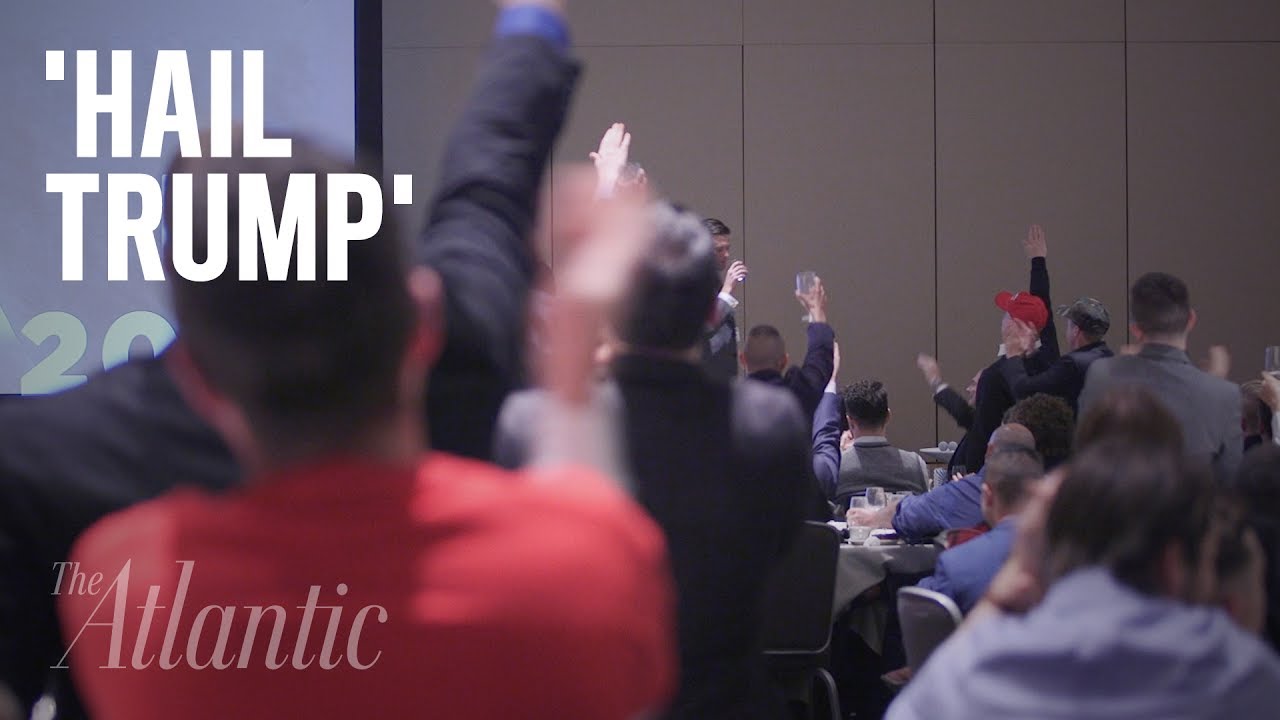 as members of the audience gave the Nazi salute. He was later recorded _{being punched in the face}_ at Trump’s inauguration, prompting endless debate over whether it was appropriate to “punch Nazis.” Spencer helped popularize the term _{“alt-right”}_ to obfuscate the racist ideology behind the movement.
Yiannopoulos has _{his own ties to Nazism}_ and was _{banned by Twitter}_ for inciting online mobs. In a leaked message, he recently complained that he could no longer _{“put food on the table”}_ without access to mainstream social media platforms.
Yiannopoulos told _{Newsweek}_ that he shared the audio out of a mutual “hate” between the two men.
"I have always publicly hated Spencer, and he has always publicly hated me,” he said. “He thinks I'm a degenerate race-mixing kike and I think he's a knuckle-dragging racist in a cheap suit.”
The audio was _{first published}_ by the far-right group “Daily Groyper.” The group suggested that the leak was in response to a recent _{rift among white nationalist groups}_.
The audio leak prompted a _{new round of criticism}_ aimed at Twitter CEO Jack Dorsey, who personally intervened to prevent the social network from banning Spencer’s account, according to _{The Wall Street Journal}_. A Twitter employee told _{Motherboard}_ earlier this year that the social network has been reluctant to create an algorithm that would effectively police white supremacist content on the website “because the collateral accounts that are impacted can, in some instances, be Republican politicians.”
neo-Nazi Richard Spencer went into a racist rage after the death of Heather Heyer: Leaked audio
In January 2017, Richard Spencer gained fame as a result of a number of articles highlighting him as the new, “dapper” face of white nationalism.
Jen Hayden / Daily Kos November 4, 2019
In January 2017, Richard Spencer gained fame as a result of a number of articles highlighting him as the new, “dapper” face of white nationalism. Then, there was the infamous incident at a Trump inauguration protest in which he was punched in the face during a live television interview.
In August 2017, Richard Spencer was one of the leaders of the “Unite the Right” rally in Charlottesville where Heather Heyer was killed, and many others seriously injured, after one of Spencer’s buddies drove into a crowd of anti-Nazi protesters. Spencer was apparently furious about the negative coverage of their violent Nazi rally and now his fellow alt-right pal (or former pal) Milo Yiannopoulos has leaked audio on YouTube, which Yiannopoulos says is Spencer in a racist rage, recorded after the rally. For what it’s worth, YouTube is one of the only social media platforms that hasn’t banned Yiannopoulous. He was permanently banned from Twitter after a racist attack on comedian Leslie Jones..
This is definitely NSFW as it contains explicit and racist language.
BAILEY, THE LIBTARDTARIAN ??
@atheist_cvnt
Milo just uploaded leaked audio of Richard Spencer reacting to the death of Heather Heyer and the negative press it did to his movement.
Just in case there was any question of the so-called "dapper white nationalist" being a raged fuelled hateful monster.
Explicit warning.
Embedded video
When you hear that audio, recall Donald Trump, President of the United States, defending these people, calling them “very fine people.” Sickening.
https://www.democraticunderground.com/100212658769
[link:https://www.salon.com/2019/11/04/leaked-audio-purportedly-captures-richard-spencers-racist-violent-threats-after-charlottesville/|
Leaked audio purportedly captures Richard Spencer's racist, violent threats after Charlottesville
“We are going to destroy this f**king town,” he is heard saying in the audio. "I rule the f**king world." [i win]
Former Breitbart editor Milo Yiannopoulos published a leaked audio recording that he claims shows white nationalist leader Richard Spencer shouting racist slurs and threats after the deadly white supremacist rally in Charlottesville.
“My ancestors f**king enslaved those little pieces of f**king sh*t,” the man identified as Spencer shouts in the audio recording. “They don’t do this to f**king me. We’re going to f**king ritualistically humiliate them.”
“Little f**king kikes,” the audio continues. “They get ruled by people like me. Little f**king octaroons.”
The audio includes a threat to return to Charlottesville repeatedly.
“We are coming back here like a f**king hundred times,” the voice in the recording says. “I am so mad. I am so f**king mad at these people. I am coming back here every f**king weekend if I have to. Like this is never over. I win. They f**king lose. That’s how the world f**king works. I rule the f**king world. Those pieces of sh*t get ruled by people like me.”
“We are going to destroy this f**king town,” he added.
1. He spoke at a Muslim-bashing event alongside Milo Yiannopoulos and Steve Bannon.
David Horowitz,who runs the hard-core-Islamophobic FrontPage Magazine, organizes what he calls a "Restoration Weekend" every year. Past attendees have included Pamela Geller, Jeff Sessions, Nigel Farage, Laura Ingraham, and a slew of lesser-known Islamophobes and random alt-right cretins.
Last year's event included Milo Yiannopoulos, the ex-Breitbart writer whose career is in the toilet thanks to dueling pedophilia- and Nazi-sympathizing scandals; Hungarian nationalist group member Sebastian Gorka; former Trump adviser Steve Bannon; and U.S. Rep. Ron DeSantis, the Jacksonville congressman who is now one of the frontrunners to become Florida's next governor.
DeSantis doesn't exactly shy away from courting the far right — he has leaned hard on Trump's January endorsement of him — but the appearance raises serious questions about the kind of company DeSantis is willing to keep.
Other attendees at last year's event were British alt-right troll Katie Hopkins (who once advocated placing Muslims in internment camps), fired Google sexist James Damore, "campus conservative" Charlie Kirk, Trump-worshipping Congressman Devin Nunes, virulent Islamophobe Mark Steyn, anti-immigrant author Douglas Murray, and fellow Florida Rep. Brian Mast.
Horowitz's Restoration Weekends don't typically get a ton of mainstream press, likely because Horowitz and his fellow FrontPage writers are far from household names. (Horowitz himself has spent this week on Twitter downplaying the severity of anti-black lynchings in the Old South.)
But DeSantis' appearance at the event last year, which went unreported save a few mentions in FrontPage and Breitbart, shows the congressman's willingness to pander to some of the most outwardly hateful members of the Republican base. At the time of the November conference, DeSantis had not yet announced his run for governor but apparently had no issues appearing alongside Yiannopoulos, who had already been outed for his comments endorsing pedophilia and hiskaraoke party with outright neo-Nazi Richard Spencer.BuzzFeed's damning report on Yiannopoulos' leaked emails — which showed him making Nazi jokes and using "kristallnacht" as a password — had hit the internet a month before the event took place. DeSantis, a former Tea Party darling, spoke on the same stage anyway.
===
https://observer.com/2018/10/robert-mercer-bankrolled-pac-ali-alexander/
Billionaire Robert Mercer gave money to a PAC advised by a self-proclaimed “interpreter of energy.”
The spiritualist in question is Ali Alexander, formerly known as Ali Akbar, a GOP political operative with a notorious reputation that allegedly includes fraud.
“On the eve of the 2016 election, Robert Mercer donated $60,000 to a PAC Alexander advises,” reported Politicoon Monday. “Alexander, who identifies himself as black and Arab, brings a more new-age approach to the culture wars, calling himself an ‘interpreter of energy for this period.’”
Alexander is one of the many New Right media celebrities orbiting Trumpland who built a brand through livestreaming musings on political warfare. Like many New Right figures, he also has a history of dog whistling to the nationalist wing of the MAGA movement.
After the first “Unite the Right” rally in Charlottesville, Virginia, Alexander interviewed the white nationalist Matt Colligan alongside former Gateway Pundit reporter Lucian Wintrich. Colligan was identified as a tiki-torch holding participant at the gathering of white nationalists which resulted in the murder of protester Heather Heyer.
“Nazi flags, ‘Hitler did nothing wrong’ memes, and attacks on mainstream media were displayed by Colligan during the livestream,” noted Right Wing Watch in its coverage of the since-deleted Periscope. “Akbar insisted that the conversation was ‘not a debate’ and that ‘there’s no winner, there’s no loser’ in the duo’s friendly discussion with Colligan.”
Alexander also claimed that white men have been caricatured as evil by “white fat bitches” in the media, a sentiment which resonated with Wintrich and Colligan.
Wintrich was fired from the Gateway Pundit this August after appearing on a podcast hosted by the white nationalist Nicholas Fuentes. Alexander also appeared on Fuentes’ program over the summer to discuss the far-right identitarianism movement, where he speculated that “a number of Jewish people do hate crimes against their own communities to get press.”
This year, Alexander has made it a habit to note members of the media who are Jewish.
Jake Tapper, who is a Jewish left-leaning journalist who works at CNN, was obsessed with packages that could not detonate and the tragic Synagogue shooting but dismissed the FL GOP shooting today. Called it simple “vandalism.”
Our Media are Bloodthirsty to “get even” with Trump
— Ali Alexander (@ali) October 29, 2018
Anti-white comments from Jewish anti-Trump commentator, Bill Kristol.
This kind of bigoted thinking painted as altruism is in fact still bigotry.
We are all God’s children and no race or sex is destined to save the other. You sound like Hitler.
Ironic, you ethnic supremacist. https://t.co/mxug3as9f8
— Ali Alexander (@ali) August 5, 2018
The conservative jewish publication, The Daily Wire, has millions of dollars in funding from good Christian Texans. I wish they covered these topics like the arrest of Posobiec’s attacker. I’ve asked to no avail. Don’t know why.
— Ali Alexander (@ali) June 3, 2018
“Jake Tapper, who is a Jewish left-leaning journalist who works at CNN, was obsessed with packages that could not detonate and the tragic Synagogue shooting but dismissed the FL GOP shooting today. Called it simple ‘vandalism,'” tweeted the operative on Monday, referring to an incident earlier in the day in which the windows of Volusia County’s GOP headquarters were shot with bullets.
Alexander isn’t the only fringe figure Mercer has bankrolled. After Milo Yiannopoulos was fired from Breitbart, the Republican megadonor bankrolled his independent media venture (Milo Inc.) before a Buzzfeed report exposed the provocateur’s ties to white supremacists and neo-Nazis. Mercer resigned from his hedge fund, Renaissance Technologies, after the story’s publication.
Over the summer, PayPal suspended Yiannopoulos’ account over trolling a Jewish journalist with Nazi rhetoric through the company’s platform.
Alexander could not be reached for comment.
Filed Under: Politics, National Politics, Heather Heyer, Robert Mercer, Unite The Right, Lucian Wintrich, New Right, Ali Akbar, Matt Colligan
==
Roger Stone’s Scheme To “Prove” Clinton Stole Election From Trump
bruceewilson / October 24, 2016
Only days before the 2016 presidential election, an October 14th-20th Reuters/Ipsos survey has shown that nearly 70 percent of Republicans believe “a Clinton victory would be because of illegal voting or vote rigging”.
During his third and final debate with Democratic presidential nominee Hillary Clinton, GOP nominee Donald Trump refused to promise to accept the results of the upcoming election. Trump later clarified his position — “I will totally accept the results of this great and historic presidential election, if I win.” More recently, Trump’s son Eric has said his father will accept the election results “if it’s fair”.
Meanwhile, a longtime Trump adviser and dirty tricks political operative — who back in 2000 helped stage a riot that shut down the Florida vote recount in the 2000 presidential election — has just launched a venture, allegedly to find evidence of 2016 election vote fraud, that appears based on the certainty that there will be significant Democratic Party-linked electoral fraud in the upcoming election.
It’s called “Stop The Steal” — a Roger Stone project which has popped into existence more or less simultaneously with the emergence of a new far-right conspiracy theory alleging a George Soros plot to steal the 2016 election from Trump by manipulating electronic voting machines.
In short, Donald Trump might really be planning the high risk strategy, with a murky end-game, of undercutting the legitimacy of a Hillary Clinton 2016 election win — a strategy telegraphed months ago by his political operative Roger Stone just as Trump’s poll numbers began to sag.
Back on July 30th, in an appearance on the alt-right Milo Yiannopoulos show, Stone laid out the script, advising that Donald Trump should “constantly” repeat messages such as,
“I am leading in Florida. The polls all show it. If I lose Florida, we will know that there’s voter fraud. If there’s voter fraud, this election will be illegitimate”.
And since his poll numbers began to collapse in early August, Trump has dutifully followed Stone’s script, by ceaselessly predicting electoral fraud in the upcoming 2016 election. Trump’s rhetoric deeply worries scholars. Harvard professor Steven Levitsky told the New York Times,
“To a political scientist who studies authoritarianism, it’s a shock. This is the stuff that we see in Russia and Venezuela and Azerbaijan and Malawi and Bangladesh, and that we don’t see in stable democracies anywhere.”
During his July 30th Yiannopoulos show appearance, Roger Stone also predicted that theft of the 2016 election would lead to “a constitutional crisis, widespread civil disobedience” and even a “blood bath”.
Now, with Trump’s poll numbers even lower and a Clinton win likely, Stone appears to be preparing the post-November 8th surprise.
If Hillary Clinton takes the 2016 presidential election, within days after the November 8th vote Donald Trump, who has for months now been predicting electoral fraud, may well announce that he has empirical evidence to “prove”, or at least strongly indicate, that such fraud has really taken place.
If so, some of that evidence — which probably won’t be taken very seriously by professional pollsters but will help cement, in the minds of Trump supporters, the conviction that the election was stolen from Donald Trump — will probably come from Stone, whose role in the current election includes claiming “backchannel” communication with Wikileaks, an ongoing source of anti-Clinton leaks in the 2016 election.
Roger Stone’s most famous dirty tricks feat might be the 2000 election manufacturing of the notorious “Brooks Brothers riot” in which paid GOP operatives violently stormed Florida’s Miami-Dade County election board, an act of sabotage which helped shut down the board’s recount of votes that might have reversed George W. Bush’s razor thin lead in Florida and put Democrat Al Gore in the White House.
Sixteen years later, Stone appears to be at it again.
In a Thursday, October 20th radio show interview, Roger Stone told Sam Bushman, host of the Liberty Roundtable radio show — a nationally syndicated alt-right talk radio show which back on March 1st featured a widely noticed interview with Donald Trump, Jr. — about Stone’s apparent plan to run his own exit polling operation in various states on November 8th.
Stone claimed he already had one hundred committed volunteers, with more on the way. As he explained it to Bushman, at a little past eighteen minutes into the second one-hour segment of Sam Bushman’s Monday through Friday two-hour show,
“We have a little program I’m working with, called stopthesteal.org, where we are collecting volunteers to work certain targeted precincts, in certain targeted counties, in certain targeted states, where we think they may steal, where we think they may manipulate the machines.
If you compare the exit poll results with the results of the machines on a one-by-one basis, and there’s a wide swing, you would know that you have voter fraud…
(…)
You can’t just get out there and say ‘This is rigged’ because you lost. But we are going to attempt to amass the evidence — and hopefully we’re wrong. Hopefully it’s unnecessary. And there’s the real answer. But these machines can be rigged easily and this is the only way to check and see if they are. Exit polls are more valid, more accurate than other polls because people don’t know, when they’re leaving the polling place, who has won yet. There’s a tremendous tendency to gravitate to the person, you know, who wins.”
Stone proceeded to explain Hillary Clinton’s consistent lead over Donald Trump in national polls as the result of a vast conspiracy of pollsters to “set a public expectation level” that would neatly coincide with the November 8th voting results which would be the produced by electronic voting machine fraud.
So, “if the final poll shows that Hillary wins by nine, let’s say, hypothetically, and Hillary wins the machines by nine, you’ll see they’ve been coordinated,” reasoned Stone.
And who controlled the electronic machines that would steal the 2016 election away from Trump ?
Bushman’s co-host Curt Crosby then asked Roger Stone about a (discredited) conspiracy theory, first advanced on October 18th by the Daily Caller media website, which suggested a connection between billionaire investor George Soros and an international voting technology company, Smartmatic, alleged to control voting machines in 16 US states. Seeming to endorse the claim, Stone replied,
“Yeah, I saw the story about Soros having a stake in machine company. I would point out that the people who owned the Diebold machines, I think their company’s now called Premier Election Services — I don’t know how much more generic you can get — they were very close to the Bushes. I’ve always believed the machines were rigged by George Bush, George W. Bush, against Kerry in Ohio, in the second Bush election.
So, I believe both sides engaged in this.”
Following the Daily Caller, host of the popular conspiracy theory website Alex Jones suggested that if Hillary Clinton wins the 2016 election, George Soros could become the de-facto “shadow president” of the United States.
The fact-checking website Snopes.com has assessed the Daily Caller story claims to be “false”, and the Smartmatic company states it “will not be deploying its technology in any U.S. county for the upcoming 2016 U.S. Presidential elections.”
Underscoring that statement is the fact that in 2007 Smartmatic sold its major U.S. Sequoia Voting Systems division, to a group of private investors, as part of the company’s strategic move away from the U.S. market. As reasons for its divestment from the U.S. market, Smartmatic cited,
“the difficult climate in the United States marketplace, tainted by a non-stop debate against foreign investment, especially in the election technology area”
The Daily Caller conspiracy theory story evokes a longstanding obsession of the American far-right concerning an allegedly impending foreign takeover of U.S. government that will enslave the American people.
In many of the seemingly endless versions of this conspiracy theory genre, which has been floating around since the late 1980s, when an evil cabal — that might include Jewish financiers, globalists, the United Nations, or the anti-Christ — achieves control of U.S. government, foreign or UN troops then emerge from secret lairs, in national parks or U.S. military bases, to summarily execute countless Americans and force the rest, tens of millions or more, into concentration camps.
In one version of this conspiracy theory that was popular in the 1990s, Jewish financiers and the Illuminati (who were controlled by the anti-Christ) were conspiring against the American people, and the most visible figures in the plot were President Bill Clinton and Hillary Clinton who, within the satanic Illuminati hierarchy, was said to outrank her husband Bill.
Now Hillary Clinton, who in decades of encrusted conspiracy theory has long been linked to an evil conspiracy to enslave (or worse) the American people, is poised to become president.
And on hand to gather evidence to “prove” Clinton’s theft of the 2016 election, via Soros-linked manipulation of voting machines, will be Roger Stone and his motley crew of exit pollers.
And if Hillary Clinton does win, Stone’s “evidence” (including sketchy exit poll data) will provide Trump supporters a convenient entry point into the newly emergent mythos concerning the theft of the election.
The legend of Soros control (and manipulation) of American electronic voting machines will then proliferate and acquire the multiple levels of intricate, self-referential detail characteristic of the “birther” conspiracy theories that challenged President Barack Obama’s American citizenship.
But Stone’s key claim — that “exit polls are more valid” than others polls (and thus the best benchmark for determining possible election fraud according to Stone) — is a rather dubious one.
In reality, American-style exit polls tend to be inaccurate, and for a number of reasons. One is that younger voters are more likely to participate in them than older voters. As explained in a June 27, 2016 New York Times story titled Exit Polls, and Why the Primary Was Not Stolen From Bernie Sanders,
“The exit polls try to correct for this bias by giving more weight to older respondents. The way it works is pretty novel: Interviewers guess the age of voters as they leave the polling place.”
That crude patch only goes so far :
In the 1992 election, exit polls showed Bill Clinton winning Texas (the state went to George Bush, Sr.) In the 2000 election, exit polls showed Al Gore winning the states of Alabama, Arizona, Colorado, and North Carolina (he lost all four, by huge margins.) 2004 election national exit polls showed John Kerry three points ahead of George W. Bush (for more on the unreliability of exit polls, see 1,2).
As a seasoned political operative whose career goes back to the Nixon presidency, Roger Stone is presumably well aware of the unreliability of exit polls. So what’s he up to ?
The likely true purpose of Stone’s exit poll scheme will be to generate a pseudo-empirical body of evidence pointing to the very sort of electoral fraud Donald Trump has been warning of since the start of August. And, the beauty of it is that Roger Stone won’t even necessarily need to rig his exit polls.
The Stone/Trump “election will be rigged” PR campaign seems to have begun in earnest starting with an August 1st Fox interview in which Donald Trump told Sean Hannity,
“I’m telling you, November 8th, we’d better be careful because that election is going to be rigged. And I hope the Republicans are watching closely or it’s going to be taken away from us.”
The timing was notable — only a few days earlier, on July 27th, aggregated national polls had shown Donald Trump opening up a slim 1.1% lead, 45.7% to 44.6%, over Hillary Clinton. It was probably the high water mark of the Trump campaign.
But only a few days later, Trump’s polling numbers began to crash. By August 1st, Trump’s polling was down to 42% and Hillary Clinton had opened up almost a 4 percent lead. By August 9th, Clinton’s lead over Trump was almost 8%.
That was the context for the start of Donald Trump’s “rigged election” talk. His poll numbers were collapsing, along with presidential aspirations. Trump then seemed to follow Roger Stone’s lead.
Only two days before Trump told Sean Hannity that the “election is going to be rigged”, on July 30, Stone had joined alt-right star Milo Yiannopoulos in an interview on Yiannopolous’ eponymous podcast show that was showcased by Breitbart news. In the deeply disturbing interview, Stone told Yiannopolous,
“I think we have widespread voter fraud, but the first thing that Trump needs to do is begin talking about it constantly. He needs to say for example, today would be a perfect example: ‘I am leading in Florida. The polls all show it. If I lose Florida, we will know that there’s voter fraud. If there’s voter fraud, this election will be illegitimate, the election of the winner will be illegitimate, we will have a constitutional crisis, widespread civil disobedience, and the government will no longer be the government.’ ”
Stone went on to predict, to Yiannopoulos, a “bloodbath” if the 2016 election were stolen from Trump.
Roger Stone’s 2016 accusations of electoral fraud actually predate the general election. Back in April 2016, Stone suggested to Politico that Donald Trump’s Wisconsin GOP primary loss to Ted Cruz was probably due to voting fraud via electronic voting machines.
Stone cited, as a source for claim, the work of mathematician Richard Charnin — who has asserted, on the basis of (unreliable) exit poll results, a pattern of election fraud in Wisconsin in the 2012 and 2014 elections.
Then, in an August 16, 2016 op-ed published by The Hill, Can the 2016 election be rigged? You bet, Roger Stone focused on the very real fact that electronic voting machines which produce no backup paper records and are demonstrably very easy to hack are in still in wide use in states across the country. Stone again cited the work of Richard Charmin.
“We are now living in a fake reality of constructed data and phony polls. The computerized voting machines can be hacked and rigged”, warned Stone in his August 16th The Hill op-ed.
That statement featured two of the three pillars in Roger Stone’s narrative that’s likely to be deployed post-November 8th, in a PR campaign to sear into the minds of Trump supporters the unshakeable belief that the election was stolen from Donald Trump :
1) Electronic voting machines can be easily hacked (this is proven and uncontested), and through their hacking many national and state elections have been stolen (alleged by Democrats, Republicans, and Independents but contested).
2) Most of the national and state surveys of voter preference leading up to the 2016 election have been rigged against Donald Trump, in favor of Hillary Clinton (neither Trump nor his surrogates have produced a shred of evidence to back up this claim.)
3) Exit polls are a reliable benchmark for determining possible electoral fraud (exit polls are in fact notoriously unreliable— see 1,2,3).
Of course, Roger Stone’s exit polls probably won’t be the sort of extensive, rigorous, and methodologically sophisticated (not to mention expensive) exit poll surveys done elsewhere around the world (but not in the U.S.) to confirm the veracity of vote counts.
Stone’s polls will, if anything, likely be even less rigorous than the comparatively lax U.S. election exit polls traditionally carried out by Edison Research, which typically have a significant margin of error.
So even if he doesn’t tamper with his raw data, Stone’s exit poll data will almost inevitably demonstrate substantial deviations from the recorded voting results. All Stone will need to do is select some data sets which show the greatest deviations and gift-wrap them for rightwing media.
Of course, there’s no reason whatsoever to trust data produced under a project, concerning the veracity of the 2016 election results, that’s headed by a hardened, partisan political operative who has admitted to covertly manipulating at least one prior presidential election.
Not to mention that Stone has asserted the American moon landings were faked and heavily praised conspiracy theorist James Fetzer who, “has claimed that the Holocaust, Sandy Hook Elementary School shooting, and 9/11 attacks were faked”.
Nonetheless, Stone’s suspect data, trumpeted by Donald, will confirm the worst suspicions of Trump voters desperate for explanations of how Donald Trump’s meteoric political ascent could have so quickly crashed to earth : The pre-election polls were rigged for Hillary. The voting was rigged for Hillary. The exit polls prove it.
Roger Stone has candidly voiced regret for his 2000 election “Brooks Brothers riot” stunt, not because of its anti-democratic nature but for its awful fruit — the disastrous U.S. invasion and occupation of Iraq which has led in turn to the rise of ISIS ; In 2008 Stone told the Daily Beast,
“When I look at those double-page New York Times spreads of all the individual pictures of people who have been killed [in Iraq], I got to think, ‘Maybe there wouldn’t have been a war if I hadn’t gone to Miami-Dade.’ “
Regardless, in 2016 Stone is at it again. This time, judging by Stone’s July 30th prediction that voter fraud in the upcoming election could cause a “bloodbath”, the result might well be a post-election riot, or worse.
But does Stone want all-out armed conflict ? Probably not.
Even though almost one quarter (24%) of Trump supporters believe that the losing candidate should challenge the election results, and almost one in five Trump supporters (19%) believe, according to a new survey, that violence would be justified if Hillary Clinton wins the election, Trump supporters skew towards the elderly end of the age demographic and may lack the energy and ambition to launch a second civil war.
More likely goals include the general destabilization of American democracy and, in particular, the de-legitimizing, at least in the minds of tens of millions of dedicated Trump supporters, of Hillary Clinton’s presidency.
An October 14-20 Ipsos/Reuters survey showed that only one half of Republicans would accept Hillary Clinton as their president and an astonishing number, almost 70 percent, “said a Clinton victory would be because of illegal voting or vote rigging”.
In other words, the Stone/Trump election fraud narrative has already been widely accepted among Trump supporters, and so Roger Stone’s “Stop The Steal” project will merely provide some additional details and back-story to flesh it out.
That establishes a political climate even more toxic than when Barack Obama assumed the presidency in early 2009. So, we will inevitably see a replay, probably with greater intensity, of the post-1992 and post-2008 campaigns to cripple, respectively, the presidencies of Bill Clinton and Barack Obama.
Trump’s angry millions will also be primed to become avid viewers of Trump TV or whatever media venture Donald Trump (perhaps along with Breitbart news mogul Steve Bannon, official CEO of the Trump for President effort) might launch in 2017.
In other words, the rage that Donald Trump, Roger Stone, and others have provoked among Trump’s voter base can help monetize Trump’s new business model.
That business model will further vitiate sagging mainstream media outlets by bleeding off viewers, and it will further mainstream the toxic mix of populist rage, xenophobic nationalism, and rightwing conspiracy theory that helped propel Donald Trump to the 2016 Republican Presidential nomination in the first place.
And, it will help pave the way for Trump 2.0, whoever that may be.
It’s widely recognized that even if Donald Trump loses the 2016 election his candidacy has served as a terrifying proof-of-concept, of the fact that America appears primed for the rise of populist, rightwing authoritarianism.
But, how has this come to pass ? And is there a deeper story to be told ?
Donald Trump’s presidential candidacy has underscored an emergent national crisis — Americans are splitting into two mutually hostile camps, each with its own, very different epistemic reality. Each camp has its own narrative, its own facts, its own reality.
One camp draws its set of facts almost exclusively the self-referential media ecosystem represented by Fox News, Rush Limbaugh and rightwing talk radio, and a swarm of insurgent Internet media entities — Breitbart News, the Drudge Report, the Daily Caller, The Blaze, World Net Daily, Infowars, and so on.
In that epistemic reality, it is taken as fact that President Barack Obama was not born an American citizen, is probably a secret Muslim, did not head the Harvard Law Review, and golfs more than any American president in history (he doesn’t.)
There are many academics digging into the issue of how this happened.
One is sociologist and retired U.S. Army intelligence analyst James Scaminaci, who reports coming home to the U.S. in 2003 from assignments in Bosnia and Herzegovina — where he had analyzed the criminal and social networks behind the ongoing ethnic cleansing there — and discovering, to his dismay the impact that the politicized religious right was exerting in American politics
By 2009, Scaminaci was writing extensively on the rise of the Tea Party movement and on the increasingly rancorous political climate in America – that Scaminaci considered pre-revolutionary (see this Salon.com interview with Scaminaci.)
“What escapes these scholars,” writes Scaminaci, “is the idea that what they measure in their studies is the result of a deliberate strategy of destruction.”
The Tea Party-driven takeover of Congress and the Senate in 2010 closely resembled the Newt Gingrich-led 1994 Republican takeover of Congress which, like the 2010 takeover, led to government paralysis. It also enabled the Republican congressional impeachment of President Bill Clinton.
According to scholars Norman Ornstein and Thomas Mann, “Gingrich delegitimized the Congress” which in turn “began the populist conservative hatred of government.”
As it happens, Gingrich had been trained by one of the most important architects of the American religious right, Paul Weyrich, a man designated “The Robespierre of the Right” in a 2007 New Republic story and who co-founded (and arranged initial funding for) much of the movement’s early infrastructure. In 1996, Weyrich told PBS Frontline that he and Gingrich were “right now traveling down the same freeway”.
And, Weyrich was the very Christian right leader, according to James Scaminaci, who was “responsible for the development of the strategy of Fourth Generation Warfare–the central aim of which is to delegitimize the federal government.”
At his influential Free Congress Foundation think tank, Weyrich was the longtime employer and close colleague of William S. Lind, a brilliant paleoconservative military strategist most responsible for the development of “Fourth Generation Warfare” (4GW), a style of warfare useful to insurgencies and terrorist groups that blurs civilian/combatant distinctions and uses a wide spectrum of tactics, from public relations and propaganda to outright violence.
The paramount goal of 4GW is the delegitimization of the targeted government or power structure.
William Lind has publicly noted that multiple copies of his seminal 1989 US Marine Corps Gazette on 4GW were found in the Tora Bora, Afghanistan caves of al-Qaeda leader Osama Bin Laden.
Scholars both of al-Qaeda and Fourth Generation Warfare have also noted (see link, above) that the apparent inspiration for al-Qaeda’s grand strategy behind it’s devastating September 11, 2001 terrorist attacks on the World Trade Center and the Pentagon seems to have come from William Lind’s 4GW ideas.
Since retiring from the U.S. Army in 2009, James Scaminaci has written an impressive body of academic monographs analyzing the rise of the Tea Party, and the contemporary insurgent American right, as an expression of Fourth Generation Warfare with the ultimate aim of overthrowing the existing American social and political order.
Scaminaci notes, of Donald Trump’s Republican Presidential nomination acceptance speech, that,
“Trump’s speech has been described as angry and dark, dystopian and desperate, apocalyptic, appealing to fear, a campaign of fear, a psychotic disorder, demagoguery, and America in crisis. But his remarks are entirely consistent with the tone and substance of Williams S. Lind’s Fourth Generation Warfare writings. Key passages speak to the question of legitimacy, specifically that President Obama or Secretary Clinton, or the unnamed federal government have failed to protect citizens from undocumented murdering immigrants and Muslim terrorists.”
During the Spring of 2016, William S. Lind personally met with Donald Trump and gave Trump the 2009 book that Lind co-authored with the late Paul Weyrich, The Next Conservatism. The Lind/Weyrich book outlines a policy platform remarkably similar to the platform Donald Trump ran on in the 2016 GOP primaries.
The book also contains a several page explanation of Fourth Generation Warfare.
In his 105 page monograph titled The Free Congress Foundation’s Political-Military Strategy Documents, James Scaminaci traces some of the dense connections between William Lind’s ideas and the white nationalist right that played a major role in propelling Donald Trump to the 2016 GOP presidential nomination.
Lind is author of the 2014 book Victoria — A Novel of Fourth Generation Warfare that favorably depicts white Christian militia insurgents toppling the federal government and carrying out mass ethnic cleansing.
see stone 2 for lnx
==
vanity
peter Thiel, it turns out, isn’t the only Facebook-rich tech titan throwing in his lot with Donald Trump. Joining him in those illustrious ranks is Palmer Luckey, the young Oculus founder whose net worth soared to some $700 million after he sold his virtual-reality start-up to Facebook in 2014 for $2 billion. Luckey was just 17 when he created the prototype for Oculus Rift in his parents’ garage, in Long Beach, California, before a wildly successful Kickstarter campaign put his V.R. headset on the map. Now, he’s using that money to pay it forward, reportedly funding the Nimble America PAC, a pro–Donald Trump, anti–Hillary Clinton political-action group “focused on promoting the ideals of America First, Smart Trade, Legal Immigration, and Ethical Behavior,” according to the group’s Facebook page.
Nimble America, as the Daily Beast first reported, is an organization that makes anti-Clinton memes. The group made its debut on the unofficial Trump-fan subreddit r/The_Donald, where its founders said it had already “proven that shitposting is powerful and meme magic is real.” But Nimble America aspired to something greater: bringing its memes to the real world. One of the group’s most notable projects is a billboard in Pennsylvania with Clinton’s face on it, declaring that the Democratic presidential nominee is “too big to jail.” It was the sort of project that “no campaign is going to run,” Luckey said. Luckey’s Reddit pseudonym, “NimbleRichMan,” which was listed on Nimble America’s Web site as the group’s vice president, has since been removed. But when Luckey spoke with the Daily Beast, he seemed to think that funding the group was one big joke. “I’ve got plenty of money. Money is not my issue,” he said. “I thought it sounded like a real jolly good time.”
Luckey, whose mentor at Oculus was chief technology officer, Doom co-creator, and noted libertarian John Carmack, became involved with Nimble America through r/The_Donald, where he first collaborated with two of the group’s moderators, and then suggested holding a fund-raiser for Trump, with Luckey promising to match any contribution made. “I came into touch with them over Facebook,” Luckey said of Nimble America’s founders. “It went along the lines of, ‘Hey, I have a bunch of money. I would love to see more of this stuff.’ They wanted to build buzz and do fund-raising.” According to the Daily Beast, Luckey had also been in touch with Milo Yiannopoulos, the Breitbart tech editor and alt-right ringleader.
Luckey has since deleted his NimbleRichMan Reddit account, but according to the Daily Beast, Luckey’s now gone Reddit posts included such quotes as “You can’t fight the American elite without serious firepower. They will outspend you and destroy you by any and all means." He also participated in an A.M.A. (ask me anything) discussion in which he said, “We know Hillary Clinton is corrupt, a warmonger, a freedom-stripper. Not the good kind you see dancing in bikinis on Independence Day, the bad kind that strips freedom from citizens and grants it to donors.”
==
1st gig post fall?
==
rww
UPDATE (11/13/18): Since the publication of this article, the American Priority conference event page has been modified. The QAnon “expert” panel mentioned in this article has been delisted and some listed speakers who frequently spread the conspiracy theory are no longer listed as conference speakers. Fox News contributor Pete Hegseth no longer appears in the lineup; American Priority conference’s Alex Phillips tells Right Wing Watch that Hegseth withdrew due to an unexpected family obligation.
Heritage Foundation Distinguished Visiting Fellow Stephen Moore and Fox News contributor Pete Hegseth are scheduled to appear at a conference in Washington, D.C., next month where a panel of believers in the “QAnon” conspiracy theory plan to present. Moore served as an economic adviser to President Donald Trump during the 2016 presidential campaign.
The conference was announced earlier this year as an alternative to the Conservative Political Action Conference, which Ali Alexander (also known as “Ali Akbar”), one of the original American Priority conference organizers, said neglected the Trump base, despite a CPAC speaker roster that has included administration officials (including the president himself).
Fox News and Heritage Foundation have not answered Right Wing Watch’s requests for comment.
The current agenda page for the American Priority Conference lists as one of its “conference topics” the “QAnon” conspiracy theory, which surmises that President Donald Trump has ordered someone (or a group of people) with top-level federal security clearance to gradually reveal a secret collaboration between Trump and Special Counsel Robert Mueller to take down a satanic pedophile ring said to span the globe, and allegedly involves top Democratic leaders. Believers of the conspiracy theory, which revolves around an anonymous figure known only as “Q,” who shares via cryptic riddles posted to an image board notorious for child pornography, believe that Trump will eventually subject such top Democrats as Hillary Clinton to military tribunals.
The American Priority event promises “an open panel discussion from Q Experts.” The website does not contain any additional information about the planned panel. Speakers listed on the conference lineup include YouTube personality Jordan Sather, a prominent producer of QAnon content on YouTube.
Sather, who was on Comedy Central as a QAnon conspiracy theorist, uploads content perpetuating the conspiracy theory almost every single day online, where he has nearly 160,000 subscribers on YouTube. Just this morning, Sather [posted](mailto:%3cblockquote%20class=%22twitter-tweet%22%20data-partner=%22tweetdeck%22%3e%3cp%20lang=%22in%22%20dir=%22ltr%22%3eStop%20it.%20Staaahp.%20%3ca%20href=%22https://twitter.com/hashtag/QAnon?src=hash&ref_src=twsrc%5Etfw%22%3e%23QAnon%3c/a%3e%20%3ca%20href=%22https://t.co/TNCkjEdeqw%22%3epic.twitter.com/TNCkjEdeqw%3c/a%3e%3c/p%3e—%20Jordan%20Sather%20%28@Jordan_Sather%29%20%3ca%20href=%22https://twitter.com/Jordan_Sather/status/1060562948479868929?ref_src=twsrc%5Etfw%22%3eNovember%208,%202018%3c/a%3e%3c/blockquote%3e) an image to Twitter suggesting that news that Supreme Court Justice Ruth Bader Ginsberg had been hospitalized with fractured ribs was part of the QAnon conspiracy theory.[grafic]
Dustin Nemos, another QAnon content producer, is also slated to speak at the conference. Another speaker is Kari Baxter Donovan, who once promoted an apparently Q-themed article at Populist Media, which appears to have been deleted, tweeting its link with the tagline, “Q is for everyone” and the hashtag “#QAnon” hashtag, which she has also used to promote content as recently as November 3.
Another speaker slated for the conference is Marjorie Taylor Greene, who posted about QAnon on Facebook as recently as November 5. DeAnna Lorraine, who is also appearing at the conference, has tweeted about QAnon, too.
The event also features breakout sessions with other pro-Trump conspiracy theorists including Matt Couch, who’s responsible for spreading lies about the murder of former DNC staffer Seth Rich, and Laura Loomer.
The conference is also scheduled to feature presenters known to have had friendly interactions with figures within the white supremacist “alt-right” movement, including ,
 , and **Milo Yiannopoulous**.
Deputy Director of the anti-immigrant group NumbersUSA Chris Chmielenski is also slated to speak at the American Priority conference.
Right now, the conference shows only two full sponsors: An entity called American Grassroots Council, Inc., which appears to have only a shell website, and Americans For The Trump Agenda, a project of the United States Public Policy Council, Inc., a 501(c)(4) nonprofit whose principal officer is listed as Emy Delgaudio, an Amway distributor. (Amway is the pyramid-style company founded by Richard DeVos, the late father-in-law of current Secretary of Education Betsy DeVos.)
This article has been updated for clarity, with a link added to comments by a conference organizer, Ali Alexander, regarding the need for a conference alternative to CPAC. Alex Phillips, who told Right Wing Watch that he is now the “sole owner and organizer” of the American Priority conference, said that Alexander left the project in August.
Tags: Pete Hegseth Stephen Moore conspiracy theories The Storm Fox News ChannelHeritage Foundation
==
https://www.newyorker.com/magazine/2018/07/02/how-social-media-trolls-turned-uc-berkeley-into-a-free-speech-circus
Letter from Berkeley
July 2, 2018 Issue
How Social-Media Trolls Turned U.C. Berkeley Into a Free-Speech Circus
Public universities have no choice but to welcome far-right speakers seeking self-promotion. Should the First Amendment be reinterpreted for the digital age?
By Andrew Marantz
“Would I rather devote our precious resources to more class sections, overdue building repairs, or many other things we badly need?” the chancellor of U.C. Berkeley said. “Absolutely. But we have to make this work.”Photograph by Mark Peterson / Redux for The New Yorker
One afternoon last fall, I sat in the Free Speech Movement Café, on the campus of the University of California, Berkeley, drinking a fair-trade, shade-grown coffee. Students at nearby tables chatted in Spanish, Japanese, Russian, and English; next to me, a student alternated between reading a battered copy of “The Myth of Sisyphus,” by Camus, and checking Facebook on her phone. “This café,” a placard read, “is an educational reminder for the community that the campus freedoms we take for granted did not always exist, and, in the democratic tradition, had to be fought for.” In the fall of 1964, left-wing students at U.C. Berkeley demanded the right to hand out antiwar literature on Sproul Plaza, the red brick agora at the center of the campus. The administration refused, citing rules against the use of school property for external organizing. The students’ struggle, which became known as the Free Speech Movement, consumed the university’s attention for much of the academic year, and made minor national celebrities of the movement’s undergraduate leaders—especially Mario Savio, who was rakish enough to be a countercultural icon and articulate enough to be interviewed on television. Joan Baez went to Berkeley to show support for the students, singing “We Shall Overcome” from the steps of Sproul Hall. In the end, the students won, and some of them went on to join the next generation of professors and university administrators. “Freedom of speech,” Mario Savio once said, “is the thing that marks us as just below the angels.”
Fifty-three years later, the mood on campus was distinctly less celestial. Like the agitation throughout the country, the agitation at Berkeley had many long-roiling causes, but its proximate cause was easy to identify: a right-wing professional irritant named Milo Yiannopoulos. A former Breitbart editor and a self-proclaimed “Internet supervillain,” he was known less for his arguments than for his combative one-liners and protean, peroxide-blond hair. Another word for “Internet supervillain” is “troll,” and, whenever too many news cycles passed without any mention of him, Yiannopoulos showed up somewhere unexpected, such as the White House press briefing room or a left-leaning college campus, hoping to provoke a reaction.
In the process, he convinced his supporters that he should be a poster child for campus free speech, a principle that is universally lauded in theory but vexingly thorny in practice. In the 2017-18 academic year, Politico reported, an unusually large number of universities struggled “to balance their commitment to free speech—which has been challenged by alt-right supporters of President Donald Trump—with campus safety.” One expert on campus life called this “the No. 1 topic of the year.” Many college administrators were forced to devote their scarce time and money to securing on-campus venues for pugnacious right-wing speakers such as Ann Coulter and David Horowitz; arch-conservative policy entrepreneurs such as Heather Mac Donald and Charles Murray; and avowed racists such as Richard Spencer. These are names that a lot of Americans would prefer to forget. All of these figures hold views that are divisive, or worse. Yet this is precisely what makes them useful test cases. The Supreme Court’s most important First Amendment opinions often concern the lowliest forms of human expression: a burning cross, a homophobic slur, a “bong hits 4 jesus” banner.
Yiannopoulos, who claims to disdain identity politics but rarely forgoes an opportunity to call attention to his sexual orientation, spent much of 2016 and the early part of 2017 on what he called the Dangerous Faggot Tour, visiting dozens of colleges across the country. Each stop was part Trump rally, part standup show, part PowerPoint deck, and part bigoted rant. At U.C. Santa Barbara, a group of young men wearing red “Make America Great Again” hats carried Yiannopoulos into the venue on a litter; he then delivered, in a genteel Oxbridge accent, a lecture called “Feminism Is Cancer.” At the University of Wisconsin-Milwaukee, he projected a photo of a transgender student, subjecting her to public mockery. “It’s just a man in a dress, isn’t it?” he said.
The last stop on his tour, on February 1, 2017, was U.C. Berkeley, the nation’s preëminent public university, in one of its most proudly left-leaning cities. A week before Yiannopoulos’s arrival, the U.C. system had reaffirmed its promise to protect undocumented students from arrest and deportation. In response, Yiannopoulos called for Berkeley’s administrators to be criminally prosecuted. There were rumors that he planned to name undocumented students from the stage, alerting Immigration and Customs Enforcement to their presence. There was little that administrators could do. At a public institution, cancelling a speech because of what the speaker might say is called prior restraint, and the courts have generally deemed it unconstitutional.
On the afternoon of the event, fifteen hundred protesters amassed on Sproul Plaza. Some called themselves Antifa, for “anti-Fascist,” a loose collective of far-left vigilantes who draw inspiration from the European anarchist tradition. A few protesters, wearing black clothing and bandannas or masks over their faces, hurled metal police barricades through a plate-glass window of Berkeley’s student center; someone set fire to a lighting rig, and flames leaped several stories into the air. A Berkeley student, wearing a red hat that said “Make Bitcoin Great Again,” was interviewed by a local news crew as the mayhem escalated behind her. “I’m looking to just make a statement by being here, and I think the protesters are doing the same,” she said. “And props to them, for the ones who are doing it nonviolently.” Moments later, a masked protester ran up and pepper-sprayed her in the face.
Police evacuated Yiannopoulos from campus before he could speak. The next morning, the riot was the lead story on “Fox & Friends.” The show’s most prominent fan, Donald Trump, who had been President for less than two weeks, tweeted, “If U.C. Berkeley does not allow free speech and practices violence on innocent people with a different point of view - no federal funds?” The whole spectacle was such a boon to Yiannopoulos’s brand that some left-wing conspiracy theorists wondered whether he had hired the masked protesters himself.
Spring came, and then summer. The annual Berkeley Kite Festival took place at the marina. Biologists from Berkeley published a paper in Science explaining how chickens grow feathers. Yiannopoulos wrote a book that included some of the zingers he’d trotted out at his college talks, and it reached No. 2 on the Times nonfiction best-seller list.
Carol Christ, a scholar of Victorian literature and a former president of Smith College, took office as Berkeley’s new chancellor. She had been a Berkeley professor for many years, beginning in 1970—close enough to the Free Speech Movement to be touched by its spirit. A few days into the fall semester, she announced that a student group had invited Yiannopoulos back to Berkeley, and that she intended to let him speak. Citing the Bill of Rights and John Stuart Mill’s “On Liberty,” she declared that her first academic year as chancellor would be “a free speech year.” “We would be providing students with a less valuable education,” Christ wrote, “if we tried to shelter them from ideas that many find wrong, even dangerous.” The homage was surely unintentional, but “Dangerous” happened to be the title of Yiannopoulos’s book.
Whether a sophist like Milo Yiannopoulos may speak at a public university like Berkeley is less a question of what the law is than of what the law should be. The Supreme Court has been consistent, during the past half century or so, in its broad interpretation of the First Amendment. “Speech can’t be prevented simply because it’s offensive, even if it’s very deeply offensive,” Erwin Chemerinsky, the dean of the U.C. Berkeley School of Law and the co-author of a book called “Free Speech on Campus,” told me one morning in his office. He grimaced sympathetically as he talked, like a doctor delivering bad news. “I would argue that it’s generally a good idea to protect speech we don’t like, even when we’re not legally obligated to do so, but in this case we are.”
Voltaire, anti-Semite and sage of the Enlightenment, is credited with the aphorism “I disapprove of what you say, but I will defend to the death your right to say it.” Chemerinsky, arguably the foremost First Amendment scholar in the country, believes, in the Voltairean tradition, that free speech is the bedrock of a free society. I asked him about the Antifa activists who had vowed to shut down Yiannopoulos’s events by any means necessary. “Violence is never protected by the Constitution,” he said. “And preventing the speech of others, even by using one’s own speech, is called the heckler’s veto, and it is not protected, either.”
On talk radio and social media, many free-speech advocates lack Chemerinsky’s judiciousness. Some answer every challenge with a recitation of the First Amendment, as if its forty-five words were a magic spell that could settle any debate. Free-speech skeptics on the left can be equally predisposed to bad-faith arguments—misreading or ignoring the Constitution, dismissing the concept of free speech as inherently racist, or simply bypassing discourse and setting public property on fire.
There are better arguments. “No one is disputing how the courts have ruled on this,” john a. powell, a Berkeley law professor with joint appointments in the departments of African-American Studies and Ethnic Studies, told me. “What I’m saying is that courts are often wrong.” Powell is tall, with a relaxed sartorial style, and his manner of speaking is soft and serenely confident. Before he became an academic, he was the national legal director of the A.C.L.U. “I represented the Ku Klux Klan when I was in that job,” he said. “My family was not pleased with me, but I said, ‘Look, they have First Amendment rights, too.’ So it’s not that I don’t understand or care deeply about free speech. But what would it look like if we cared just as deeply about equality? What if we weighed the two as conflicting values, instead of this false formalism where the right to speech is recognized but the harm caused by that speech is not?”
Yiannopoulos and many of his defenders like to call themselves free-speech absolutists, but this is hyperbole. No one actually believes that all forms of expression are protected by the First Amendment. False advertising, child pornography, blackmail—all are speech, all are illegal. You’re not allowed to shout “Fire!” in a crowded theatre, make a “true threat,” or incite imminent violence. These are all exceptions to the First Amendment that the Supreme Court has made—made up, really—over time. The boundaries can and do shift. In 1940, a New Hampshire man was jailed for calling a city marshal “a damned Fascist.” The Supreme Court upheld the conviction, ruling that the words were not protected by the First Amendment, because they were “fighting words,” which “by their very utterance inflict injury or tend to incite an immediate breach of the peace.”
Are some of Yiannopoulos’s antics—say, his attempts to intimidate undocumented and transgender students—closer to fighting words than to intellectual discourse? Maybe. But the fighting-words doctrine has fallen out of favor with the courts. In 2006, the Westboro Baptist Church picketed a soldier’s funeral, carrying signs that read “Thank God for dead soldiers” and “You’re going to Hell.” Even factoring in almost seven decades of epithet inflation, this would seem more injurious than “damned Fascist.” And yet the Supreme Court ruled that the signs were protected by the First Amendment.
In the nineteen-seventies, when women entered the workplace in large numbers, some male bosses made salacious comments, or hung pornographic images on the walls. “These days, we’d say, ‘That’s a hostile workplace, that’s sexual harassment,’ ” powell said. “But those weren’t recognized legal concepts yet. So the courts’ response was ‘Sorry, nothing we can do. Pornographic posters are speech. If women don’t like it, they can put up their own posters.’ ” He drew an analogy to today’s trolls and white supremacists. “The knee-jerk response is ‘Nothing we can do, it’s speech.’ ‘Well, hold on, what about the harm they’re causing?’ ‘What harm? It’s just words.’ That might sound intuitive to us now. But, if you know the history, you can imagine how our intuitions might look foolish, even immoral, a generation later.”
In the media, and on his Facebook and Instagram feeds, Yiannopoulos tirelessly promoted his return to Berkeley. Instead of a mere lecture, he envisioned “a huge, multi-day event” called Milo’s Free Speech Week. A video had recently come to light in which he’d made some deeply ill-advised comments about pederasty. Afterward, he’d been widely condemned on both the left and the right. He seemed to hope that his Berkeley appearance would restore him to mainstream relevance, and perhaps marketability.
He posted a schedule, at FreeSpeechWeek.com, that culminated in the presentation of the first annual Mario Savio Award for Free Speech. (Savio died in 1996; his son Daniel told the Guardian that Yiannopoulos’s appropriation of his father’s legacy was “some kind of sick joke.”) When Yiannopoulos spoke privately to his influential friends on the far right, he often said, “This will be our Woodstock.” He released a list of more than twenty speakers, which included many of the usual free-speech warriors and also some surprising names, such as the secretive military-security magnate Erik Prince. In addition to Yiannopoulos, the four headliners would be Ann Coulter; Pamela Geller, a virulently Islamophobic blogger from Long Island; Mike Cernovich, a conspiracy theorist and vigilante journalist; and Steve Bannon, newly fired from his job as Trump’s chief strategist. To build anticipation, Yiannopoulos’s team made promotional videos about each headliner, in the style of an action-movie trailer. “Bannon Infiltrates Berkeley,” less than thirty seconds long, has been viewed more than thirty thousand times.
Mindful of the potential for violence, some students requested a robust police presence; others suggested that more police on campus would make them feel less safe, not more; still others demanded that the university cancel Free Speech Week. More than a hundred and fifty Berkeley faculty members and graduate students signed an open letter calling for a campus-wide boycott. Christ told me that she never considered cancelling the event. “The reputational cost would simply be too high,” she said. Reputational cost is impossible to quantify, but the literal cost to U.C. Berkeley, in security fees alone, was likely to exceed a million dollars. The university had a budget deficit of more than a hundred million dollars, with less funding coming from the state in recent years. “Would I rather devote our precious resources to more class sections, overdue building repairs, or many other things we badly need?” Christ continued. “Absolutely. But we have to make this work.” Others on campus speculated that Yiannopoulos’s real goal was to force a government-subsidized institution to expend as many resources as possible. On FreeSpeechWeek.com, there were T-shirts for sale reading “Defund Berkeley.”
Traditionally, outside speakers don’t have unilateral power to schedule their own events on college campuses—like vampires, they have to be invited in—and Yiannopoulos was the guest of a conservative student organization called the Berkeley Patriot. “We don’t want to seem like we support someone like Milo, because we don’t,” Pranav Jandhyala, one of the Patriot students, told the Daily Cal, the campus newspaper. “We’re simply inviting him because free speech is protected.” As the ostensible organizers of the event, the students had to sign contracts and waivers, assuming significant legal risk. At the time, the Berkeley Patriot had existed for only a few months. It had between five and twenty active members, depending on the definition of “active.” For a while, the administration and the Patriot students worked well together. “We’re treating them the way we’d treat any other students who are taking on something difficult and need our support,” Dan Mogulof, the assistant vice-chancellor for public affairs, told me. “We want to be sure that they don’t feel unsafe or marginalized.”
Then things began to fall apart. The university set several deadlines, and, amid negotiations over contracts, the Patriot students missed them all. It also became clear that Yiannopoulos’s lineup was not a list of confirmed speakers but a wish list. “Contrary to news reports, I have not been contacted about participating in Free Speech Week,” Heather Mac Donald tweeted. Erik Prince told The Atlantic that his presence on the list was “a typo.” Bannon said nothing publicly, but several people told me that he was scheduled to be in China that week. “I would never under any circumstances appear at an event that included Milo Yiannopoulos,” Charles Murray told The Chronicle of Higher Education. Asked why, Murray responded, “Because he is a despicable asshole.”
Carol Christ told me, “The metaphor I’ve been thinking about a lot is that of an object and its shadow. At first, I was imagining a conventional lecture: the lecture is the object; the digital recording is its shadow.” We were sitting in her office, which she hadn’t had time to finish unpacking. Several copies of the Norton Critical Edition of “The Mill on the Floss,” which she had edited, remained in a cardboard box on the floor. “By contrast,” she continued, “when I consider Milo’s—I’ll use the word ‘event,’ although I’m not sure that that’s exactly the right word—it’s becoming clearer that he’s actually trying to plant a narrative, a trail of impressions and images, that lives primarily in the digital world, and that we, this physical campus, are merely the shadow.”
Yiannopoulos is not the only orator who has figured out that a speaking gig at a public university, especially in the face of fierce ideological opposition, is an easy way to attract an audience. “My college tour began after the victory by Donald Trump,” Richard Spencer, a proponent of “peaceful ethnic cleansing,” said in a recent YouTube video. “I loved it. I thought it was a great success, and so did most everyone else.” Such speakers often portray themselves as soldiers for free speech, but more often they use the First Amendment as a convenient shield.
One fall afternoon at Berkeley, outside the Free Speech Movement Café, several undergraduates gathered in a semicircle around an oversized poster, Sharpies in hand, doing what their liberal-arts curriculum had trained them to do: dissecting a text. “This is so full of fallacies, I just assumed it was by a student,” one of them said. In fact, it was a transcription of a lecture that the conservative pundit Ben Shapiro had delivered on campus the previous week. A former Breitbart editor, he now runs a site called the Daily Wire and hosts “The Ben Shapiro Show,” the most popular right-wing podcast in the country. A first-year student with pink highlights in her hair pointed to one sentence: “The Constitution was not written by a bunch of people who speak Korean.” It was one step in Shapiro’s argument that there was no systemic racism in the United States. “As an Asian-American, I feel personally attacked,” she said, adding, “I’m, like, half joking.” Another sentence on the poster read, “Income inequality is not the big problem; nobody rich is making you poor.” Above the latter clause, a student had written, in blue, “False premise, no one suggests that.” Another student wrote, in red, “Read Marx plz.”
Shapiro tries to appeal to both the pro-Trump and the anti-Trump factions of the Republican base, spitting out indignant syllogisms in a rapid nasal delivery that sounds like a podcast played at double speed. He had reserved a lecture hall on Sproul Plaza, and a thousand protesters showed up outside the venue. Compared with Yiannopoulos’s appearance, there were far more police, and they were far more aggressive. They arrested nine protesters and confiscated a few sticks and other potential weapons. There was no violence—at least, not of the physical variety. “Speech is violent, we will not be silent!” a group of students, standing outside the Martin Luther King Jr. Student Union, chanted. Later, I asked Viana Roland, a political-science student who had joined the chant, what she’d meant. Roland is from Santa Maria, a farm town several hours south of Berkeley. “Folks in my family pick strawberries, and some of them are undocumented,” she said. “Shapiro says that systemic racism is a myth. That is an apologetics for white supremacy, an ideology with a long legacy of violence.” Because she was an Afro-Latina, she said, “that violence might be an abstraction to some people, but it’s not abstract to me.”
I asked john powell what he thought about the rhetorical tactic of conflating speech with bodily harm. “Consider the classic liberal justification for free speech,” he said. “ ‘Your right to throw punches ends at the tip of my nose.’ This is taken to mean that speech can never cause any kind of injury. But we have learned a lot about the brain that John Stuart Mill didn’t know. So these students are asking, ‘Given what we now know about stereotype threat and trauma and P.T.S.D., where is the tip of our nose, exactly?’ ”
Adam Jadhav, a Ph.D. student in Berkeley’s geography department, has little patience for the classic liberal approach. While lecturing in a course called Global Environmental Politics, he projected a slide arguing that Yiannopoulos’s event was “not about robust exchange of ideas” but “about a shadowy political element weaponizing a narrow interpretation of the First Amendment.” A conservative student took a photo, in which Jadhav is clearly identifiable; someone sent it to Yiannopoulos, who shared it on Instagram.
“Idiots in the comments were calling me a fat slob because I didn’t tuck in my shirt,” Jadhav told me at a taquería a couple of blocks from campus. “I was, like, dude, come on, it’s a kurta.” Jadhav has thick-framed glasses, a small hoop earring, and a tattoo of a parrot on his forearm. The parrot, in a speech bubble, quotes Marx: “The point, however, is to change it!” “It” refers to the world. Marx was expressing his exasperation with armchair philosophers who are all talk and no action.
“I consider myself an activist, not just an academic,” Jadhav continued, ordering a beer. “I align myself with Antifa, although that term is sometimes misunderstood. I’m not Black Bloc”—the masked, black-clad contingent that uses violence. “Most of us, percentage-wise, are not Black Bloc. I do, however, think it’s important to stand up against hypernationalism and Fascism in all its forms. That might entail breaking unjust laws, but that’s how progress has always been made.”
After Jadhav’s picture circulated online, Christ wrote him a warm e-mail expressing her sympathy. He thanked her, but urged her to “control the narrative” when it came to Yiannopoulos. “What I meant was: Let’s not get played,” Jadhav said. “He’s coming here to make people afraid, and to milk us for attention.” There were real victims of government overreach—dozens of protesters rounded up in mass arrests at Trump’s Inauguration; Desiree Fairooz, an activist who was arrested for laughing during the confirmation hearing of Attorney General Jeff Sessions—but Yiannopoulos, who has never been jailed or injured at his speeches, wasn’t one of them.
Recently, on Fox News, Ben Shapiro said, “Everything has been deemed hate speech on campus. . . . There is a big part of the left—and it’s growing—that says that it is incumbent to protect the campus from ideas that are dissenting.” This premise has become commonplace, even among liberals, but the evidence is mixed. One study, from 2015, did find that forty per cent of millennials, a greater proportion than in any other age group, would want the government to be able to censor speech that is “offensive to minority groups.” But another study, conducted the following year, found that only twenty-two per cent of college students wanted universities to ban offensive speech—a lower proportion than in the rest of the American adult population. In March, a political scientist named Jeffrey Sachs analyzed the most recent data, broken down by age. In conclusion, he tweeted, “There is no campus free speech crisis, the kids are all right, those that say otherwise have lost all perspective, and the real crisis may be elsewhere.”
It was a bright Friday morning, and Dan Mogulof, the Berkeley public-affairs administrator, was speed-walking to California Hall, a Beaux-Arts building where the chancellor and other top administrators have their offices. In theory, Free Speech Week was to begin in forty-eight hours. But, Mogulof had told me, “No speakers have been confirmed, no venues have been confirmed, no one on Milo’s team will answer simple questions.” Margo Bennett, the chief of campus police, said that “pretty much everything we know about Milo’s plans, at this point, we’re getting from his Instagram.”
At the entrance to California Hall, Mogulof took a call on his cell phone. His eyebrows shot up, and he pumped his fist like a golfer sinking a long putt. Then he hung up and paced the corridors, popping in through various doors and interrupting meetings. “Sorry, friends, but it’s rare that I get to bring good news,” he said to a roomful of deans and assistant chancellors. “I’m just now—as in, right now—learning that a Berkeley Patriot student is telling local media that the event is off.”
College administrators across the country were watching Free Speech Week closely. Richard Spencer was scheduled to speak soon at the University of Florida, and Charles Murray had been invited to the University of Colorado in Boulder. Officials from both schools were embedded with Berkeley’s administrators, Mogulof said, “to observe—see what works, see what doesn’t—and apply those lessons when it’s their turn in the hot seat.”
Mogulof hurried to Sproul Plaza, where he had called a press conference for print and TV reporters, both local and national. “I just texted someone from the Patriot,” one reporter said to another. “I asked if Free Speech Week was cancelled, and the response was ‘LOL, unclear.’ So that’s my headline, I guess: ‘LOL, Unclear.’ ”
As Mogulof spoke to the reporters, an undergraduate sociology student walked by, holding an iced coffee and a Rice Krispies Treats wrapper. She shouted a question at Mogulof: “Students have a right to go to their classes and feel safe in their classrooms, and you’re ready to compromise that for, like, the First Amendment that you’re trying to uplift?”
“Your concerns are right on the money,” Mogulof said. The student was not satisfied. She continued to ask questions, using her phone to film the interaction. As she talked, a few of the TV cameras swung toward her. “Please do not take video of me!” she said, holding up her phone like a talisman.
Mike Cernovich, a right-wing vigilante journalist, said of a planned rally at Berkeley, “If there’s a screaming Antifa crowd, and if I maybe have to street-fight my way in and break a few noses in self-defense, that’s all good optics for me.”Photograph by Mark Peterson / Redux for The New Yorker
“Um, it’s a press conference,” one of the camera operators said.
A newspaper reporter said, “How’s that for free speech?”
That night, I called Yiannopoulos and asked him where he was. “I’ve landed in San Francisco, but my specific location is top secret, I’m afraid,” he said. “I’m not even telling dear friends, much less the press. For security reasons. I’m sure you understand.”
It took me twenty minutes to discover his secret location, and another forty-five minutes to get there by bart. It was a chain hotel situated between a strip mall and an eight-lane highway, in the commuter suburb of Walnut Creek. I found Yiannopoulos and his entourage in a “Grill & Lounge” area decorated in at least five clashing shades of taupe. Yiannopoulos greeted me with a kiss on the cheek, as though he had no memory of our earlier conversation. “Normally, we stay at places that are far, far posher than this,” he said. “If you follow my Instagram, you know that already. But I’m afraid this trip had to be thrown together at the last minute. For security reasons, you understand.”
Ann Coulter and Steve Bannon were no-shows. Joining Yiannopoulos were a few of his employees and the two remaining headliners, Pamela Geller and Mike Cernovich. “I’ll do anything for Milo,” Geller said, sipping a cocktail. “He and I are the same piece of kishke, as my grandmother used to say.” Her persona is reminiscent of late-career Joan Rivers, but with more splenetic bigotry and fewer punch lines. “If Milo doesn’t have freedom of speech, nobody does,” she went on. “Besides, his company’s publishing my next book, so it’s good cross-promotion.”
“Milo, what’s the deal tomorrow, man?” Cernovich said. “Are we speaking on campus? Off campus? What the fuck is going on?”
“O.K., so this hasn’t been announced yet, but we’re giving a big press conference on Treasure Island,” Yiannopoulos said. “I’m going to make my entrance by speedboat, with a camera trailing me on a drone, and we’re going to be live-streaming it all on Facebook.”
“I don’t do boats,” Geller said. “I projectile-vomit. But I love it for you, Milo, it’s a fabulous idea. I predict two hundred and fifty thousand viewers watching that live stream, at least.”
“I’ll be wearing this gorgeous Balmain overcoat—I’ll show you—with this huge fur collar,” Yiannopoulos said.
Geller and Cernovich changed the subject to Internet censorship. “They kicked me off Google AdSense,” Geller said. “I was making six figures a year from that. You can’t even share my links on Pinterest now! I’m ‘inappropriate content.’ ”
Yiannopoulos looked bored. “You guys are so selfish,” he said. “We used to be talking about me.” He turned to his stylist, a glassy-eyed, wisp-thin man, and whispered, “Go get the coat.”
They continued hashing out plans. “So we’ll walk in with you, through the streets of downtown Berkeley,” Cernovich said. “If there’s a screaming Antifa crowd, and if I maybe have to street-fight my way in and break a few noses in self-defense, that’s all good optics for me.”
“Maybe we should line up on the Sproul steps,” Yiannopoulos said, “surrounded by Berkeley students wearing ‘Defund Berkeley’ T-shirts.”
“Why don’t we march in with our arms linked together, like the Martin Luther King people, singing ‘We Shall Overcome’?” Cernovich said.
“We’ll do our thing, and then at some point the protests will turn violent,” Yiannopoulos said. “That will become the focus, and then we can just get ourselves out of there.” He reclined in his chair and smiled. “It’s all coming together,” he said.
The stylist came back with the coat, and Yiannopoulos squealed. “Pamela, is this coat to die for or what?” he said.
“Oh, my God, Milo, I’m dying,”Geller said. “It’s sick.”
He put the coat on and turned around, again and again, examining his reflection in the darkened glass of a window.
“It’s fabulous,” Geller said. “It’s sick. I hate you.”
There was no speedboat, no drone footage, no press conference on Treasure Island. Yiannopoulos, live-streaming on Facebook from his hotel room, delivered what he called a press conference, although the only questions came from online commenters. He invited Christ “to participate in a debate with me.” Later, when I asked her whether she would consider accepting his offer, she laughed.
The next day, police escorted Yiannopoulos, Geller, and Cernovich onto Sproul Plaza through a back entrance. The plaza was ringed by police in riot gear; helicopters thumped overhead; snipers were visible on the rooftops. A crowd of supporters and protesters gathered outside the barricades, waiting to be let in. Yiannopoulos was not allowed onto the Sproul Hall steps. Instead, he stood on a concrete landing nearby, facing about thirty people. “I am here, in the name of Mario Savio, to make you stop!” one protester shouted.
Yiannopoulos addressed his audience. “I invite you to join me for a moment, on your knees, to pray,” he said. “Pray for each other, for the fortitude and strength to carry on, to fight for free speech in the face of overwhelming odds.” He knelt and clasped his hands. Few joined him. Geller tried to lead the crowd in a rendition of “We Shall Overcome,” but, beyond those three words, nobody could remember the rest of the song. After about fifteen minutes, Yiannopoulos took a couple of selfies and left. No arrests were made, and no violence was reported. “I don’t even know if this is gonna make it to air tonight,” a local TV reporter said.
As his caravan left town, Yiannopoulos live-streamed from the back seat of an S.U.V. “We don’t care if the police are throttling access to make sure there’s only thirty people there,” Yiannopoulos said. “None of that stuff is gonna deter us, because we don’t crave acceptance and publicity the way liberals do. We just want to be left alone.” I watched the stream with Mogulof, who was eating a York Peppermint Patty. “So I guess that was the most expensive photo op in Berkeley’s history, huh?” he said.
The day after his fifteen-minute Free Speech Week, Yiannopoulos left for Hawaii, and Berkeley tried, warily, to return to normal. In a classroom at the law school, john powell was teaching a seminar on civil rights. One student asked whether something like the intentional infliction of emotional distress, a concept from tort law, might be extended to free-speech cases. “It’s an interesting question,” powell said. “Why do we think, for example, that burning a cross is injurious? It’s just a symbol. And yet even Clarence Thomas, who is rarely sympathetic to such arguments, recognizes that the symbol itself is emotionally injurious.”
“Let’s make a pact—I won’t tell you about my day if you won’t tell me about yours.”
They discussed Plessy v. Ferguson, the 1896 case upholding a Louisiana law that segregated railcars by race. “The petitioner argued that segregation ‘stamps the colored race with a badge of inferiority,’ ” powell said. “But the Court rejected that and said, in effect, ‘If you feel stigmatized, it’s just in your mind.’ ” That changed in 1954, when the Court issued its unanimous decision in Brown v. Board of Education. “They finally found that segregation was, in fact, inherently harmful,” powell said. “And what was the harm? The Court was very explicit: it’s psychological harm.” He paused, arching an eyebrow slightly. “This means that there is precedent for weighing psychological injury as a real concern.”
Later that fall, Judith Butler, the cultural theorist and Berkeley professor, spoke at a forum sponsored by the Berkeley Academic Senate. “If free speech does take precedence over every other constitutional principle and every other community principle, then perhaps we should no longer claim to be weighing or balancing competing principles or values,” Butler said. “We should perhaps frankly admit that we have agreed in advance to have our community sundered, racial and sexual minorities demeaned, the dignity of trans people denied, that we are, in effect, willing to be wrecked by this principle of free speech.”
Butler’s partner, the political philosopher and Berkeley professor Wendy Brown, was teaching a course called Introduction to Political Theory. “It was an amazing experience to be discussing Mill while all this stuff was blowing up around us,” she said. “It’s one thing for a student to feel that, through the free exchange of ideas, ‘the truth will out.’ It’s another thing to defend that position while Milo is staging his political theatre outside your window.”
Shortly before winter break, Carol Christ recorded a YouTube video. “In many ways, it was a classic Berkeley semester,” she said, “as we dealt with complex, controversial issues that played out across the campus and the country.” A Berkeley student recorded a parody, holding a mug of tea and wearing a Carol Christ costume consisting of a gray wig and a sweater cape. In a chipper voice, she spoke of “a classic Berkeley semester” in which “Nazis frolicked across the campus”—a result, the Christ impersonator said, “of my neoliberal, Fascist-aligned white feminism.” She topped off her tea with a generous pour of whiskey.
Some speakers began to lose their taste for on-campus provocation. In March, Richard Spencer appeared at Michigan State University. Two dozen protesters and counterprotesters were arrested outside the venue—the Pavilion for Agriculture and Livestock Education—and Spencer ended up speaking to a near-empty hall. Afterward, he posted a video. “I really hate to say this, and I definitely hesitate to say this,” he said, “but Antifa is winning.”
The last time I checked, the only content on FreeSpeechWeek.com was a photo of Yiannopoulos and the words “milo will return to berkeley in spring 2018.” I texted Yiannopoulos, who had recently been shilling dietary supplements from the InfoWars studio, in Texas, to ask whether this was true. “Yes I am going back to Berkeley,” he responded. “Working it out with the students now.” No one at U.C. Berkeley had heard about any such plans.
Still, conservative speech at Berkeley continued in Yiannopoulos’s absence. In April, Charlie Kirk, the executive director of the national conservative student group Turning Point U.S.A. and a friend of Donald Trump, Jr., announced that he would give a talk at Berkeley. He tweeted:
My message will be quite clear:
:{
}:
Open borders are inhumane
:{
}:
We must build a militarized wall
:{
}:
There are only 2 genders
:{
}:
Berkeley should be defunded.
Speaking alongside Kirk was Turning Point’s communications director, Candace Owens, a vitriolic young conservative with a knack for creating viral moments. Before she went by her own name, Owens was a YouTuber who called herself Red Pill Black, a reference to the fact that she was an African-American who had “escaped the Democrat plantation.” Near the beginning of the talk, two hecklers stood up, and one of them shouted, “These aren’t ideas, this is Fascism.” They were ejected, and the audience cheered. “Antifa, if you really take a look at their platform . . . they seem to be the ones that are the white supremacists,” Owens said. “They feel like their ideas are so supreme to everybody else’s that they have the right to boycott, to be violent.”
Four days after the panel, Kanye West tweeted, “I love the way Candace Owens thinks,” followed by several tweets in which he expressed his “love” for Donald Trump. Despite widespread bewilderment and outrage, West refused to back down, insisting that his views were not about politics per se but about the higher principle of untrammelled expression. “Love who you want to love,” West tweeted. “That’s free thought.”
In late May, Congress held a hearing on “Challenges to the Freedom of Speech on College Campuses.” One of the witnesses was Bret Weinstein, a biologist who, until recently, taught at Evergreen State College, in Olympia, Washington. Last year, after he wrote a controversial e-mail, students protested and demanded that he be fired. Amid growing unrest on campus, a group of students posted a photo of themselves wielding baseball bats. Weinstein sued the college, alleging that it had failed to protect him from “threats of physical violence,” and left his teaching job. The college admitted no wrongdoing, but settled for half a million dollars. At the congressional hearing, Weinstein was introduced with the title Professor-in-Exile. “The First Amendment is simply not sufficient to protect the free exchange of ideas,” he said.
Near the end of the school year, I met Erwin Chemerinsky, the law-school dean, at a coffee shop in downtown Berkeley. “There is no guarantee that the marketplace of ideas will lead to truth, and that’s obviously a big problem,” he said. He is a Voltairean, not a Panglossian. Nonetheless, he continued, “My distrust of government is so great that I can’t think of a way to address that problem without making it worse.” Later, I talked to john powell. “There are any number of areas—gay rights, animal rights, housing—where legal reformers have set out to change the law,” he said. “If our speech laws looked more like Canada’s, would that be the end of democracy as we know it?”
Classes were over. The year of free speech, for all practical purposes, had come to a close. Outside California Hall, next to the Free Speech Bikeway, a grounds crew was spreading cedar mulch on the flower beds. The plate-glass window on Sproul Plaza had been replaced; nearby, seniors were putting on their caps and gowns and posing for photos. A shin-high self-driving robot scooted across the plaza with a sticker on its flank (“How’s my programming?”).
In 2014, at a teach-in commemorating the fiftieth anniversary of the Free Speech Movement, Wendy Brown spoke against trigger warnings and in favor of exposing students to new ideas. “When we demand, from the right or the left, that universities be cleansed of what’s disturbing,” she said, “we are complicit with the neoliberal destruction of the university.” Back then, Milo Yiannopoulos was still an obscure opinion journalist, and Donald Trump was still a reality-show magnate. “I haven’t radically shifted my position, but it’s fair to say that I’ve shifted my emphasis,” Brown told me. “I’ve become newly attuned to how free speech can be used as cover for larger political projects that have little to do with airing ideas.”
Carol Christ told me that the events of the past academic year hadn’t changed her faith in the First Amendment, but that they had made her wonder how an eighteenth-century text should be interpreted in the twenty-first century. “Speech is fundamentally different in the digital context,” she said. “I don’t think the law, or the country, has even started to catch up with that yet.” The University of California had done everything within its legal power to let Yiannopoulos speak without allowing him to hijack Berkeley’s campus. It was a qualified success that came at a steep price, in marred campus morale and in dollars—nearly three million, all told. “These aren’t easy problems,” Brown told me. “But I don’t think it’s beyond us to say, on the one hand, that everyone has a right to express their views, and, on the other hand, that a political provocateur may not use a university campus as his personal playground, especially if it bankrupts the university. At some point, when some enormous amount of money has been spent, it has to be possible to say, O.K. Enough.” ?
This article appears in the print edition of the July 2, 2018, issue, with the headline “Fighting Words.”
Andrew Marantz, a contributing editor, has written for The New Yorker since 2011
no lnx
ref
https://www.newyorker.com/news/daily-comment/the-mistake-the-berkeley-protesters-made-about-milo-yiannopoulos
j cobani
week, PBS broadcast “Birth of a Movement,” a film about the battle between William Monroe Trotter, a firebrand African-American publisher born a few years after the end of the Civil War, and D. W. Griffith, the filmmaker responsible for the racist classic “Birth of a Nation.” Trotter, a contemporary of W. E. B. Du Bois, was a Boston native and graduate of Harvard University, and an uncompromising advocate for racial equality, if a bit of a loose cannon. Trotter’s contempt for the accommodationist response to Southern racism championed by, among others, Booker T. Washington culminated in his incitement of a riot when Washington attempted to give an address in Boston. The pivotal conflict of his career, however, was his attempt to prevent Griffith’s ode to the Ku Klux Klan from being shown in the city. “Birth of a Nation” was not simply the first blockbuster in American cinematic history; its racialist propaganda inspired a rebirth of the K.K.K., which had all but died out prior to the film’s release. It was screened in the White House, reportedly to accolades from Woodrow Wilson himself. Trotter found himself caught between the First Amendment ideals that allowed him to publish his newspaper, the Guardian, and fighting against the distribution of Griffith’s film and, by extension, the racial terrorism that it facilitated. He chose the latter approach, appealing unsuccessfully to Boston’s political leadership to have the film banned as obscene. Griffith found the protests against his film to be a form of intolerance.
It would be tempting to think of Trotter’s concerns as particular to that era. No film as egregiously racist as “Birth of a Nation” would be released so widely, and treated as a mainstream hit, today. The current debates regarding free speech tend to center as much on the rights of those making offensive statements as those potentially affected by what is being said. Five days before PBS broadcast its documentary (in which I appear as a commentator), a version of Trotter’s dilemma played out at the University of California,
Berkeley, when the campus erupted in violence on the day of a planned speech by Milo Yiannopoulos, a Breitbart editor and gleefully acerbic provocateur nominally distinct from the so-called alt-right. Last year, Yiannopoulos was permanently banned from Twitter for his role in a campaign of racist, sexist harassment directed at Leslie Jones, a “Saturday Night Live” cast member. When Twitter suspended his account, Yiannopoulos denounced it as “cowardly” and declared himself a martyr for the cause of free speech. Twitter, he said, was “a no-go zone for conservatives.” The tacit admission that Yiannopoulos sees targeted abuse of a female African-American comedian as “conservative” is revealing, if only in that it strips away the fig leaf of euphemism separating the alt-right from the hive of racism and sexism that defined last year’s Presidential election. That it was the Berkeley College Republicans who invited himto campus further supported this association. No chemistry department would extend an invitation to an alchemist; no reputable department of psychology would entertain a lecture espousing phrenology. But amid the student conservatives at Berkeley—and along the lecture circuit where he is a sought-after speaker—Yiannopoulos’s toxic brew of bigotries apparently meets their standard for credibility. And this recognition is as big a problem as anything he has said in his talks or in his erstwhile existence as a Twitter troll.
An even more disturbing element of the Jones incident lay in Yiannopoulos’s prediction that the Twitter ban would make him even more prominent than he was prior to it—a prediction that has largely held true. Threshold Editions, an imprint of Simon & Schuster, extended a reported two-hundred-and-fifty-thousand-dollar contract to him for a book adaptation of his lectures, titled “Dangerous.” Last month, Roxane Gay, a black female author who has also been the target of digital harassment, dropped her contract with the publishing house in protest of its association with Yiannopoulos and the mainstreaming of his bigotry. Other authors are considering following suit. (I currently have a contract with Simon & Schuster.) The concern, however, is that in the Bizarro World of American recrimination, every act of principle only furthers the perception that abusers are the real victims.
In the aftermath of the clash with Trotter, Griffith published a pamphlet titled “The Rise and Fall of Free Speech in America,” and directed a film titled “Intolerance,” which criticized not racism but people who were intolerant of it. Yiannopoulos is of a blinkered tradition that sees no distinction worth examining between martyrdom and limitations on one’s ability to attack others. Yiannopoulos’s act is the political equivalent of an N.B.A. guard flopping in the hope of drawing a foul, a rendition of victimhood so aptly executed as to pass for the real thing.
The further fact of Yiannopoulos’s fervent support for President Trump is not, then, surprising. Few figures in American history have better weaponized the imaginary grievances of entitled people who consider themselves oppressed than Trump has. This is precisely the reason the black-clad rioters among the protesters at Berkeley who prevented Yiannopoulos from speaking—the school cancelled the event, citing danger to the public—served his ultimate interests. It was a tactical error that ignored everything 2016 should have taught us. As with Trump, who treats every reasonable criticism of his Presidency as another nail in a crucifixion, and his electorate, which eagerly co-signs that sentiment, Yiannopoulos has emerged from Berkeley as both the putative victim and victor. In the wake of the debacle, his book rocketed to No. 1 on the pre-order list in Amazon’s political-humor section. Scott Adams, the creator of the comic strip “Dilbert,” stated that he was ending his support for Berkeley, where he received a master’s degree, because he would not feel “safe” on the campus. Most significantly, Trump weighed in, tweeting, “If U.C. Berkeley does not allow free speech and practices violence on innocent people with a different point of view - no federal funds?”
The ordinary spectrum of hypocrisy is not broad enough to encompass Trump, who directed the fury of his unruly admirers at specific members of the press during his rallies, and denounced the profession as “dishonest,” and threatened to “open up” the nation’s libel laws, now adopting the pose of a protector of the First Amendment. At issue here is not freedom of speech but the freedom to treat other people, particularly vulnerable ones, badly; the freedom to whip up sentiment along the predictable fault lines and to do so without facing any consequence; the freedom to embolden forces that represent a tangible danger to people. While the digital cavalry of the alt-right rode to Yiannopoulos’s defense, there was almost nothing said, certainly not by Trump publicly, although he spoke to Justin Trudeau, the Canadian Prime Minister, by phone about the six Muslims killed in Quebec City by a gunman who shared many of the demagogic President’s views.
Lost in the hypertensive reactions to the incident was the fact that, before the violence, the university leadership supported Yiannopoulos’s right to speak, assigned security to protect the event, and defied requests from students and faculty to withdraw the invitation. By most accounts, the rioters were not part of the campus community and thus Berkeley was, as the Foundation for Individual Rights in Education noted, now being chastised for the behavior of people with whom it had no relationship and whom it had little capacity to control. Whatever Scott Adams’s hypothetical fears for his safety on Berkeley’s campus, they pale in comparison to the realistic fears that many Muslims have about their places of worship being targeted for arson, as was a mosque in Texas, the day after Trump signed his executive order on immigration, last month, one near Seattle, two weeks earlier, and one in Florida, last September. The Southern Poverty Law Center documented eight hundred and sixty-seven incidents of harassment, many of which involved people specifically invoking Trump’s name, in the ten days following the Presidential election. The largest group of these incidents involved anti-immigrant sentiments, followed by instances of anti-black and anti-Semitic bigotry.
We know or ought to know that, in a hierarchical society, even civil liberties can be used in ways that reinforce those hierarchies. We are witnessing the rebirth of alchemy as a serious endeavor, an undertaking in which we transform abuse into victimhood, billionaires into besieged outsiders, and the vulnerable into vectors of mass danger. It is no more empirically sound than the old mutations of lead into gold—but it is far more marketable. And it is far more dangerous than the inept rogues who showed up on Berkeley’s campus that evening
==
https://slate.com/technology/2018/06/before-annapolis-capital-gazette-shooting-milo-yiannopoulos-said-he-wanted-to-see-people-shoot-journalists.html
no lnx many ish
Yiannopoulos Posted a Threatening Instagram About Journalists, and the Social Network Left It Up for Hours
By APRIL GLASER
JUNE 28, 201810:24 PM
SYDNEY, AUSTRALIA - NOVEMBER 29: Milo Yiannopoulos speaks during a press conference on November 29, 2017 in Sydney, Australia. Yiannopoulos is in Australia for his Troll Academy Tour. (Photo by Lisa Maree Williams/Getty Images)
Milo Yiannopoulos, probably saying something offensive.
Lisa Maree Williams/Getty Images
Over the past week, infamous internet far-right provocateur, onetime friend of Steve Bannon, and former Breitbart editor Milo Yiannopoulos sent threatening messages to multiple reporters, according to Davis Richardson of the New York Observer. “I can’t wait for the vigilante squads to start gunning journalists down on sight,” Yiannopoulos texted Richardson when asked for comment on a story about a restaurant Yiannopoulos frequents.
Yiannopoulos sent the same message to the Daily Beast’s Will Sommer in an email, which Sommer included in a story he published Tuesday about how Yiannopoulos is joining forces with far-right YouTube personalities to attempt a “soft coup” of the conservative party. Under a screenshot of the story posted to his Instagram account, Yiannopoulos added the caption, “where is the lie,” confirming, and in a sense even bragging, that he told Sommer he was excited for journalists to get gunned down by vigilante shooters.
That Instagram post received more than 7,000 likes, according to a screenshot tweeted by BuzzFeed reporter Joe Bernstein, who shared the image Wednesday, before news broke Thursday afternoon that a gunman—in what appears to be a completely unrelated event—visited the offices of the Capital Gazette, the daily newspaper chain that covers Annapolis, Maryland, and killed at least five people; several others were seriously injured. The shooter was reportedly male, acting alone, and is now in police custody. There is no current connection known between Yiannopoulos’ quote and Instagram post and the tragedy in Annapolis.
View image on TwitterView image on Twitter
Joe Bernstein
?
@Bernstein
A reader tells me that he reported Milo's @instagram post threatening journalists with gun violence, and the company found it did not violate their community guidelines
7:58 AM - Jun 27, 2018
1,093
988 people are talking about this
Yiannopoulos has more than 348,000 Instagram followers and a verified account. Bernstein noted in his Wednesday-afternoon tweet that although Yiannopoulos’ threatening post was reported to Instagram, theFacebook-owned social media photo-sharing sitedecided that the post didn’t violate its community guidelines. The person who reported Yiannopoulos’ photo shared a screenshot of Instagram’s decision not to remove it. The screenshot shows that more than 19 hours after the post went up, Instagram said they were keeping it up.
According to Instagram’s community guidelines, hate speech may be allowed when it’s “being shared to challenge it or to raise awareness,” but the company has explicit policies against “serious threats of harm to public and personal safety.” Nevertheless, Instagram offers some leeway if the post is coming from someone with a strong following. “We do generally allow stronger conversation around people who are featured in the news or have a large public audience due to their profession or chosen activities,” the guidelines read. It’s not clear whether the Yiannopoulos post wasn’t considered to be a serious threat or if it was read as an expression of his professional persona, or whether Instagram had some other reason for deciding to let it stay up. But whatever Instagram’s rationale was for not taking the post down, it’s hard not to read the photo and caption as an incitement to violence. Bernstein later tweeted that a representative from Instagram later told him that the decision not to take the post down was a mistake and that it had been removed.
Social media websites provide a platform for people with controversial, and sometimes violent, views to reach large audiences without needing to rely on the popular press. That dynamic can be a very good thing, offering people who may have important perspectives and stories the opportunity to be heard. But if the companies that own these platforms don’t also take care to properly uphold community safety standards and quickly ferret out bad behavior, people with a hateful agenda can use their tools to promote harm—or even violence. And that’s why it’s important for these powerful companies to take action and respond to reports of dangerous activity, even when a journalist doesn’t call them out.
Venmo, the PayPal-owned peer-to-peer money-sharing service, kicked Yiannopoulos off its services on Thursday, according to multiple reports, after he used the platform to send Talia Lavin—a former fact checker at the New Yorker—$14.88. Lavin is Jewish, and “14/88” is a common neo-Nazi and white-nationalist reference.
View image on TwitterView image on Twitter
Sergio Quintana
?
@svqjournalist
Here is the official statement from Venmo/Paypal about booting Milo Yiannopoulos from the payment platforms.
4:51 PM - Jun 28, 2018 · San Francisco, CA
45
37 people are talking about this
https://www.vox.com/culture/2017/2/22/14684460/milo-yiannopoulos-book-deal-conservative-publishing-threshold-editions-simon-schuster
Why Milo Yiannopoulos’s canceled book deal isn’t a moral win for conservative publishing
By Constance Grady@constancegrady Feb 22, 2017, 12:30pm EST
SHARE
Photo by Drew Angerer/Getty Images
Earlier this week, Simon & Schuster announced the cancellation of its contract with Milo Yiannopoulos, the infamous internet troll and proud darling of the white supremacists of the self-described alt-right. The announcement followed months of controversy and outrage surrounding nearly anything having to do with Yiannopoulos. It also came on the heels of Yiannopoulos being disinvited from speaking at the annual Conservative Political Action Conference, in response to the resurfacing of an old video in which Yiannopoulos defended pedophilia.
Simon & Schuster announced the cancellation quietly, in the trade magazine Publishers Weekly, and it is keeping its editorializing to an absolute minimum. When Vox emailed the publisher to request a comment, a spokesperson repeated word for word the statement printed in Publishers Weekly: “After careful consideration, Simon & Schuster and its Threshold Editions imprint have cancelled publication of Dangerous by Milo Yiannopoulos.”
But just this December, when Simon & Schuster announced that it had acquired Yiannopoulos’s book, it did so with a mild flourish. There was a Hollywood Reporter article, and the trade publication Publisher’s Lunch listed Yiannopoulos at the top of the nonfiction section in its daily list of book deals.
RELATED
Milo Yiannopoulos’s book deal represents a troubling shift in conservative publishing
It wasn’t the big, splashy rollout that, say, beloved children’s author Philip Pullman received last week when he revealed that he’s writing a follow-up to the His Dark Materials trilogy. It was instead an announcement with the gentlest and most subdued of jazz hands, as if to say: Observe, we are about to publish a book by a political pundit of minor notoriety. Which, for acquiring imprint Threshold Books — Simon & Schuster’s designated home for conservative authors and half the pundits of Fox News — is more or less par for the course.
But Milo Yiannopoulos is not mildly notorious. He is infamous for his bigotry and for leading vicious harassment campaigns — and the fact that Threshold Books eventually canceled his contract after he said he was okay with pedophilia does not change the fact that the publisher seemed to be okay with everything else he represented. It appears Threshold was perfectly willing, and even eager, to capitalize on the career Yiannopoulos built through hatred and bigotry, right up until the bigotry started to look like it wouldn’t be profitable.
Threshold Books tried to treat Yiannopoulos like any other vaguely famous pundit. That didn’t work out very well.
In the days after its December announcement, Threshold Books gave every indication that it planned to treat Yiannopoulos like any other slightly famous author, albeit one whose bubble might well be on the verge of bursting. The imprint had him on what appeared to be an accelerated publication schedule, with his book initially slated to come out this March, despite the fact that Yiannopoulos would later claim, in early February, that he had not yet submitted his final manuscript.
If Yiannopoulos is to be believed, the timeline suggests that Threshold was apparently planning to edit, copy edit, lay out, print, bind, and distribute his book in the span of about a month. (It usually takes at least nine months to shepherd a manuscript from submission through publication.) Often, when a publisher rushes a book, it’s trying to capitalize on someone’s 15 minutes of fame: Better to spend the extra money to get the book out fast, the thinking goes, than risk losing the entire sales base by publishing a year after everyone’s already forgotten about this guy.
Everything about the announcement made it seem as though Threshold believed Yiannopoulos was like any other author in its catalog, someone whose book a conservative audience could be counted on to buy — assuming it could get the book out before a conservative audience forgot who Yiannopoulos was. Certainly nothing about the announcement qualified as awareness that the deal was about to face an enormous swell of outrage and a boycott. But that’s exactly what happened.
Milo Yiannopoulos is a professional internet troll known for harassment and bigotry
Shortly after Threshold’s deal with Yiannopoulos was announced, prominent liberal intellectuals announced that they would be boycotting Simon & Schuster. The Chicago Review of Books announced that it would not review any Simon & Schuster books in 2017. Literary superstar Roxane Gay pulled her upcoming book from Simon & Schuster’s list.
And that’s because Yiannopoulos is not a garden-variety conservative author. He is a professional troll who weaponized Twitter as a tool for (racist, sexist, transphobic) harassment so effectively that Twitter was forced to permanently ban him. On his ongoing college speaking tour, he has doxed trans students, putting their lives in danger. He routinely makes hyperbolically offensive statements like “feminism is cancer,” designed to rile up liberals, and then when liberals get angry, he winks and says he didn’t really mean it: He was just being provocative.
RELATED
Milo Yiannopoulos: Breitbart’s star provocateur and Trump champion, explained
But none of that — not Yiannopoulos’s history of harassment and bigotry, not the widespread outcry and the loss of major authors — was enough for Threshold Books to think twice about acquiring his book in the first place, let alone cancel his contract. It took the resurfacing of a video in which Yiannopoulos explicitly defends pedophilia for Threshold to pull the plug.
The cancellation of Yiannopoulos’s book deal suggests a dangerous acceptance of bigotry from conservative thinkers
For many on the left, including writers like Gay, the timing of Threshold’s decision demonstrates that the publisher doesn’t really care about Yiannopoulos’s right to free speech so much as it liked what he was saying before he got to the part about pedophiles — and, more importantly, that it believed its customers would like what he was saying. Threshold thought it could make money from his book, and now it doesn’t think it will. Writes Gay:
When his comments about pedophilia/pederasty came to light, Simon & Schuster realized it would cost them more money to do business with Milo than he could earn for them. They did not finally “do the right thing” and now we know where their threshold, pun intended, lies. They were fine with his racist and xenophobic and sexist ideologies. They were fine with his transphobia, anti-Semitism and Islamophobia. They were fine with how he encourages his followers to harass women and people of color and transgender people online. Let me assure you, as someone who endured a bit of that harassment, it is breathtaking in its scope, intensity, and cruelty but hey, we must protect the freedom of speech.
In other words, Threshold has sent a clear message: Explicit bigotry, harassment, and hatred are tolerable among conservative thinkers. Defense of child molestation is where we draw the line in the sand.
Conservative book publishing is still mired in dog-whistle punditry
Yiannopoulos’s canceled contract is a minor victory for the left, but it does not mean conservative book publishing is going to enter a new golden age of sober-minded thought. Book publishing has already found that it can make obscene amounts of money on dog-whistle racism and fearmongering, and it learned as much by doing the same kind of cynical calculations that first led it to strike a book deal with Yiannopoulos: This person is getting attention, this person has an audience, this person is someone who will effectively sell books. It’s not a decision motivated by commitment to free speech or to any particular ideology. It’s a decision motivated by profit margins.
RELATED
What Trump aide Monica Crowley's plagiarism scandal says about conservative publishing
What conservative book publishing has learned from the Milo Yiannopoulos controversy is that it is unlikely to make significant amounts of money publishing a provocateur who defends pedophilia, and it will definitely lose prestige and cultural capital. But publishers will continue to make money on authors who are just a little more guarded than Yiannopoulos in their bigotry, and they will likely continue to push the envelope on how guarded that bigotry has to be, as long as they think they can make money by doing so.
Meanwhile, Yiannopoulos is planning to seek another publisher for Dangerous and has said he’ll donate 10 percent of the eventual royalties to child abuse charities. (The last time he announced he’d be making a major charitable donation — to white men — it never panned out.)
“I’m not going anywhere,” he says.
==
==
https://www.politico.com/story/2018/04/27/yiannopoulos-business-implodes-after-death-of-crypto-billionaire-557456
Running out of money and down on his luck, right-wing provocateur Milo Yiannopoulos laid off the small staff of Milo Entertainment Inc. earlier this month, according to three people familiar with the situation.
Yiannopoulos’ company has fallen on hard times ever since his former patrons, Robert and Rebekah Mercer, severed their financial backing last year.
According to the sources, Yiannopoulos had been expecting to instead receive significant financial backing from the banking heir and cryptocurrency billionaire Matthew Mellon. But those hopes were dashed with Mellon’s unexpected death from an apparent drug overdose on April 16.
On Monday, Yiannopoulos posted a photo on Instagram of himself with Mellon. “I spent a few days and nights in Miami and LA with the incredible human being Matthew Mellon, the last of them just a day before he passed,” Yiannopoulos wrote in the caption. “He was brilliant, infectious and warm-hearted and I will never forget getting to know this remarkable person. Rest in peace now, MM. You left a giant stamp on the world.”
With Mellon’s unexpected death, Yiannopoulos could no longer afford the staff of Milo Entertainment.
“He fired everybody,” said one person familiar with Yiannopoulos’ operation, which had employed a handful of full-time and part-time staffers.
Among them was the journalist Chadwick Moore, who was technically terminated several days before learning of his firing, according to two people familiar with the situation....
==..
"Troll Nation: How the Right Became Trump-Worshipping Monsters Set on Rat-F*cking Liberals, America, and Truth Itself" by Amanda Marcotte.
https://www.alternet.org/heres-how-us-became-troll-nation-gamergate-rise-trump
primer/ sum
...
sad truth is that Trump owes his victory to a very dark turn in American conservatism.Unlike right wing ideologues of old, who at least tried to portray themselves as stabilizing and constructive, the right in the era of Trump is a movement of annihilation. They are bigoted, sexist, and mean, and often don’t even try to dress these destructive impulses up in the garb of tradition or religion.
They delight in cruelty for its own sake. Building something positive has no real value in this new right wing. Pissing off perceived enemies, such as feminists and liberals, is the only real political goal worth fighting for.
They are, in other words, a nation of trolls.
Trolling is a term that started on the internet, to describe people whose main purpose online was irritating other people. It’s the sort of thing that people of all political stripes used to engage in, a casual bullying for its own sake that was low stakes. But as the boundaries between real life and internet life have broken down, and as the internet has become the primary form of political communication, trolling morphed into something of a right wing philosophy.
No longer do those on the right feel any need to offer a particularly positive vision of America. Even Trump’s campaign slogan, “Make America Great Again,” was rarely backed up with an articulated vision of what, exactly, that greatness entailed. Instead, it was an angry yelp, aimed at liberal America. It’s about tearing apart a new America that was becoming more feminist and racially diverse. When social progress cannot be argued against, its opponents instead turn to trolling. And Trump — ignorant, thoughtless, mean, barely literate — would be their leader.
Trump’s election had the strangest of bellwethers: the world of video games.
It’s hard to believe it now, but in 2014, a storm of controversy raged for months in the online world of video gamers and became the template for what has been deemed “Trumpism.” Before there was Trump, there was “Gamergate,” where the smaller but equally American community of video game players was torn apart as the same bitter white guys (and their sad suck-up female supporters) lost their minds because some women had opinions about video games.
To most people who witnessed it at the time, Gamergate seemed like one of those incomprehensible internet wars that fades as quickly as it erupts, but in retrospect, it was an alarming portend of the rise of Trump, the alt-right and an America that now has torch-wielding white supremacists starting street fights in the name of fascism. It foretold a country where the American right has devolved into a nihilistic movement, prepared to tear down the country rather than share it fairly with women, LGBT people and people of color.
Like many historical calamities, Gamergate began because a young man did not accept it when a woman told him no.
In August 2014, a man named Eron Gjoni wrote a nearly 10,000 word essay about his ex-girlfriend, a video game developer named Zoë Quinn. The piece, which he posted online, was an incoherent train wreck of thwarted male entitlement, in which Gjoni obsessed about Quinn’s sex life. Calling a girl a slut online is often enough to get the internet hoards to attack her, but Gjoni’s real stroke of genius was in claiming Quinn’s professional success was not a result of her talent, but due to her trading sexual favors for good press coverage....
The accusation, and this cannot be stated clearly enough, was flat-out false. (Quinn did date a journalist, but he never wrote about her work.) But it played off the resentment so many men feel when they see a woman who has more professional success than they do. The lie gave these men a comforting fiction to cling to, which is that women who excel aren’t really talented or interesting, but instead must be cheating — using sex or liberal guilt or anything but their actual talents to get ahead.
It’s the same myth that millions would later use to convince themselves that Trump was somehow more worthy of their vote than Clinton.
Gjoni shared his post on internet forums where a lot of young men had already gathered to complain about women who were gaining a foothold in the video game industry. The result was the stalker’s dream: Hundreds, possibly thousands of young men (and some women!) became lieutenants in Gjoni’s quest to punish Quinn for dumping him. They harassed and threatened Quinn until she was forced to leave her home.
The campaign continued to spiral even further out of control, as the online mob expanded the circle of harassment. The targets of the Gamergate are familiar to anyone who watched the rise of Trump. While women who were viewed as uppity were the main hate objects, accusations also flew against journalists, deemed corrupt and out of touch by the Gamergaters. People who advocated for gender and racial equality were sneeringly dismissed as “SJWs,” short for “social justice warriors.” The vitriol was always justified by a hazy nostalgia for the good old days, when video games were supposedly simple and didn’t bother players with all this political correctness.
Gamergaters, one could say, wanted to make video gaming “great again.”
While the entire debacle garnered a lot of media attention, mostly from journalists—including myself—who couldn’t believe how angry so many young men were, one enterprising young writer named**Milo Yiannopoulos**saw an opportunity. He saw that Gamergaters were incoherent and unorganized, but with a little leadership, they could be whipped into a hard-right youth movement. Yiannopoulos got to work injecting himself into the middle of Gamergate, writing apologies for the movement on the far-right site Breitbart and riling up the harassment mobs on Twitter.
Mainstream conservatives tend to lean on arguments of tradition and morality in order to undermine women’s progress. Older conservatives try to spin their sexist views in positive terms, claiming that putting restrictions on women’s reproductive rights and job opportunities is about constructing a happy family life. Traditional conservatism is genteel and condescending to women.
Yiannopoulos, despite — or because — he’s both gay and British, seemed to get why Gamergaters were different. He dispensed with the niceties of the past and embraced a politics of unvarnished resentment. He told angry young men that they were being terrorized by “an army of sociopathic feminist programmers and campaigners, abetted by achingly politically correct American tech bloggers,” and gave his young followers permission to embrace the politics of destruction.
Milo didn’t pretend to be motivated by sexual morality or family values. Instead, he wallowed in foul language and braggadocio about his sexual exploits. He told his readers that they were justified in their feeling that women had, by striving for equality, stolen something from them. He offered them an anti-feminism stripped of any pretense towards chivalry, instead giving them permission to embrace a politics composed of nothing but resentment and destructive urges. He let them believe that the minor bumps and bruises of young adulthood, such as career struggles or dating struggles, [ snowflakes] were the direct result of women’s efforts towards equality — and that justified harassment and cruelty towards women in return.
Gamergate faded, but Yiannopoulos’s star continued to rise. Mainstream media sources were fascinated by how he was selling a right wing politics that wasn’t interested in the usual justifications of social order or religious faith. Milo portrayed himself as a rebel, framing destructiveness as subversion. He harnessed an army of young male supporters he cultivated by tapping their resentments towards women, and pointed their ire at targets, such as Muslim immigrants, that fit the larger Breitbart agenda of white nationalism.
It was Yiannopoulos who really grasped, for instance, that the 2016 reboot of Ghostbusters, which starred four women instead of four men, created a perfect opportunity to tap into a vein of male outrage. For every man who still can’t believe women are allowed to reject him, for every male college student angry that a girl got better grades, for every sexist still bitter that a woman got promoted over him at work, Milo offered yowling about the supposed injustice of Ghostbusters as an opportunity for revenge.
Yiannopoulos called the movie “an overpriced self-esteem device for women betrayed by the lies of third-wave feminism.” It was a perfect distillation of his immense powers of projection. It’s his audience whose self-esteem is shattered by seeing women in the kind of comedic roles they wish to believe that only men are capable of mastering. And it’s his audience that would rather tear the Ghostbusters franchise down by its ears than have to share it with women.
As with Gamergate, Yiannopoulos was a ringleader in the movement to destroy Ghostbusters through an online harassment campaign, a movement that unsurprisingly focused mostly on the one woman of color on the cast, Leslie Jones, who Yiannopoulos called “barely literate” and “another black dude.”
Even Trump got involved, putting out a 6-minute video where he whined, “And now they’re making Ghostbusters with only women. What’s going on?!”
The harassment of Jones got Yiannopoulos kicked off Twitter, but his banning only seemed to reinforce the view of Yiannopoulos’s fans that they are victims of a “politically correct” culture that supposedly wishes to suppress supposed truths about race and gender through shaming and censoriousness.
To be clear, neither Yiannopoulos nor the modern right writ large invented this idea of trolling the left as a political ideology onto itself. Plenty of right wing personalities laid the pathway for the idea that messing with liberals is a reasonable substitute for having a coherent political philosophy.Rush Limbaugh, for instance, has maintained a multi-decade career as a radio talk show host by focusing his show primarily on the subject of the alleged evils of liberals and why listeners should hate these ominous creatures.
But after decades of that kind of propaganda, trolling liberals is no longer considered just a fun sport, but the ultimate purpose of conservative politics. The idea of making a positive argument in favor of conservative values has atrophied, leaving only the desire to troll in its place.
Ultimately, Yiannopoulos’s most lasting legacy will likely be in his support for the Trump campaign, which in turn helped a generation of resentful young men believe that voting Trump, who Yiannopoulos called “Daddy,” was the ultimate way to troll the feminists and liberals they hate. That Trump had nothing positive to offer doesn’t bother Milo and his fans. If anything, that is seen as a plus: Trump is the politics of destruction, personified.
“I can put up with almost anything from Donald Trump, because of the existential threat he poses to political correctness,” Yiannopoulos told me when I interviewed him in October 2016.
“He’d rather grab a p**sy than be one,” Yiannopoulos said after a tape was released of Trump, apparently unaware of a hot mic, bragging about how he likes to kiss and grab women “by the p**sy” without their consent. Sexual assault is of no concern to this new right. It angers feminists and puts women in their place, after all. What else do you need to know?
Milo and his millions of supporters embody the nihilism that defines the new right under Trump. They don’t particularly care if Trump is a failure or incapable of doing or creating anything positive. He’s just a human sledgehammer to wield against a world that is starting to question whether white men are inherently superior to the rest of us. He’s revenge for every woman who wouldn’t fuck them, every black guy that got better grades, every younger relative who wrinkled their nose at them when they had too many drinks at Thanksgiving and let loose with a racial slur.
“I could stand in the middle of 5th Avenue and shoot somebody and I wouldn’t lose voters,” Trump bragged while campaigning for the Iowa caucus.
It’s a brag that rings true, at least for his most ardent supporters. Depending on whom he shot, they might even cheer.
But imagine if Trump got hit on the head and had a personality change that led him to declare that, in interest of rectifying hundreds of years of white supremacy, he was supporting reparations. Then, after all this time, his base would turn on him.
Both Gamergate and the Yiannopoulos-led campaign against Ghostbusters have much in common with the strategy Trump used to transition out of being a reality TV star and into politics: Birtherism, a widespread conspiracy theory on the right that holds that Barack Obama was an illegitimate president because he was supposedly not born in the United States.
Trump didn’t invent birtherism, which writer Ta-Nehisi Coates calls “that modern recasting of the old American precept that black people are not fit to be citizens of the country they built.” But Trump did use his fame as a tabloid fixture and the host of The Apprentice to repeatedly inject the conspiracy theory into mainstream media spaces that used to be hostile to the kind of people who breathlessly recite racist urban legends.
Starting in the spring of 2011, Trump appeared on Fox News, NBC, MSNBC, and CNN, claiming, falsely, that Obama was hiding his true birth certificate and that a “tape’s going to be produced fairly soon” proving Obama was born in Kenya. Even after Obama, in an effort to shut down the Trump-fueled media chatter, produced the birth certificate, Trump kept at it, declaring on Twitter that the birth certificate is “a fraud” and suggesting Obama was having people murdered to cover up the truth.
Trump also started pushing the idea that Obama hadn’t gotten into Columbia University and Harvard Law School honestly. Trump repeatedly claimed he would pay millions of dollars in a ransom to get copies of Obama’s transcripts, clearly implying that Obama didn’t have the grades and had cheated to get into these prestigious universities.
Trump’s birtherism and Yiannopoulos’s campaigns around Gamergate and "Ghostbusters," are about saying, without coming right out and saying it, that women and people of color are inferior to white men. The implication of all these movements is that the success enjoyed by women or people of color is unearned and inauthentic, that people like them simply cannot actually be smart or talented or even legitimate enough to get that far. And that everyone else supposedly sees it, too, but are too cowed by the fear of being called “racist” or “sexist” to say so publicly.
This narrative has a special appeal to men like Trump, who aren’t particularly special or intelligent. The idea that the unfit are getting elevated by “affirmative action” or “political correctness” allows such men to believe that they would be the stars and the much-heralded geniuses, if those undeserving inferiors weren’t sucking all the oxygen out of the room.
Yiannopoulos himself was set to ride a narrative of white male victimization to the kind of fame and fortune that continues to elude his female or non-white peers in mediocrity. Even after he got kicked off Twitter, he secured a quarter million dollar advance on a book deal with Simon & Schuster and was starting to book high profile appearances on shows like “Real Time with Bill Maher,” where he received a convivial welcome.
Then a video surfaced in early 2017 showing Milo decrying the “arbitrary and oppressive idea of consent” that legally and morally prevents adult men from having sex with 13-year-old boys, a social more he blamed on “the left.” While celebrating Trump bragging about the sexual abuse of adult women was treated by many in both right wing and mainstream media as a joyous assault on political correctness, celebrating the sexual abuse of boys was a bridge too far. After all, most of the people in power had themselves once been a boy, vulnerable to sexual predation.
Yiannopoulos lost his book deal and most of his mainstream media support after that. Luckily for him, the landings for the oppressed wealthy white man tend, even in 2017, to be feathery soft. Yiannopoulos self-published his book and is getting a heavy promotion schedule at Breitbart. He also has a lucrative speaking career, getting paid the big bucks by conservative groups on college campuses who see booking him as a delightful way to troll the liberals.
Milo’s career demonstrates that, in the 21st century, one doesn’t need interesting ideas or any real talents to sell yourself as a thought leader on the right. All you need is an overweening sense of white male entitlement and a gleeful sadism in defending it. As long as you have both those things, nothing you can say or do, no matter how offensive or terrible, will cause an audience of bitter white men (and some women!) to pry themselves away from you.
Ask Milo’s hero: Donald J. Trump. Or, as people now call him, “Mr. President.”
Excerpted with permission from "Troll Nation: How the Right Became Trump-Worshipping Monsters Set on Rat-F*cking Liberals, America, and Truth Itself" by Amanda Marcotte.
==
ref
https://www.salon.com/2018/01/31/antifa-vs-milo-yiannopoulos-who-won/
mark bray bk on antifa
no lnx
Antifa vs. Milo Yiannopoulos: Who won?
It’s been a year since anti-fascist protests shut down a Yiannopoulos gig at UC Berkeley, to much media criticism
1.6K9079
MARK BRAY
01.31.2018•3:58 PM
A year has passed since black-clad anti-fascists smashed windows and launched fireworks to shut down right-wing provocateur Milo Yiannopoulos’ scheduled speech at the University of California, Berkeley, on February 1, 2017. Unsurprisingly, pundits immediately condemned these “masked hoodlums who arrived from off-campus” for denigrating Yiannopoulos’ “freedom of speech.” The year of conflict on campus that ensued around speakers like Yiannopoulos, Richard Spencer and Charles Murray provoked fascinating debates about speech rights that tap into our most deeply held principles. But pundits also objected to the “no-platforming” of Yiannopoulos for another reason: that “such actions turbo-charge his fame.”
Berkeley witnessed “self-defeating violence” that was a “gift” to Yiannopoulos, according to The Chicago Tribune. A column in The New Yorker argued the protest was “a tactical error” that “served his ultimate interests.” “Milo Yiannopoulos feeds on your violent protests,” The Daily Beast claimed, because they allowed him to cultivate his “image as a victim of liberal intolerance.” Ultimately, “resorting to violence is particularly stupid,” The Telegraph asserted, because it plays into Yiannopoulos’ “oh-so-obvious trolling.”
As surely as the sun rises in the east, smashing windows to shut down a self-described “provocateur” was allegedly destined to propel Milo Yiannopoulos into the media stratosphere. But did it? A year is a reasonable enough sample size to start assessing the real effects of the Berkeley protest and the accuracy of pundit predictions.
The media frenzy that followed on the heels of the Berkeley protest seemed to confirm the assumption that bonfires benefitted Yiannopoulos. Pre-orders of his book "Dangerous" skyrocketed and Bill Maher fawned over him on "Real Time." Overnight, Milo Yiannopoulos had become a household name.
Yiannopoulos’ fortunes started to change a little over two weeks later, however, when a video surfaced showing him making pro-pedophilia remarks. Immediately this revelation caused Simon & Schuster to terminate his lucrative book deal, the conservative conference CPAC to cancel his planned speech at its annual event and hard-right news site Breitbart to urge his resignation from his editorial post. Though this fiasco was largely self-inflicted, the timing of the release of this 2016 video shortly after the Berkeley protest suggests that enhanced scrutiny accompanied his newfound fame. As the self-described “supervillain of the internet” was about to be welcomed into the conservative mainstream at CPAC, the conservative “Reagan Battalion” site unearthed his pedophilia comments. Yiannopoulos seems to have flown too close to the sun. Despite the media predictions that militant protest would “only help” his brand soar, it became painfully obvious that not all publicity is good publicity when you have skeletons in the closet.
More skeletons were unearthed when Buzzfeed published an exposé revealing Yiannopoulos’ links to prominent white nationalists and neo-Nazis. As the months fell off the 2017 calendar, Yiannopoulos was denounced by his former mentor Steve Bannon, defunded by the right-wing Mercer family and booted out of his role as a weekly contributor for The Daily Caller after one column. (The Daily Caller editor who brought him on was fired as well.) Even his own lawyers abandoned him in his suit against Simon & Schuster for terminating his book contract.
The impact of the Berkeley demonstration and other anti-Milo protests is most obvious when we examine the trajectory of Yiannopoulos’s speaking engagements. From February 2016 through the infamous Berkeley incident on February 1, 2017, Yiannopoulos scheduled approximately 61 public speaking appearances (most for his “Dangerous Faggot Tour”). Of those 61, twelve were shut down by protesters or cancelled by administrators for security concerns. Notable examples other than Berkeley included Black Lives Matter protesters who confronted Yiannopoulos at DePaul University in May 2016 (a planned return to DePaul in September was cancelled by the administration) and students and allies at UC Davis who successfully blocked the entrance to an event Yiannopoulos had scheduled with Martin Shkreliin January 2017. Another seven of his talks were cancelled for logistical reasons. At least five of the 42 that occurred were interrupted in one way or another: Rutgers students smeared themselves with fake blood, UCLA students attempted to block the entrance to the event, and University of Minnesota, Twin Cities students interrupted him with air horns.
How did the media spectacle of bonfires and fireworks at Berkeley affect Yiannopoulos’s ability to organize future speaking engagements? Robert Schlesinger, writing in U.S. News & World Report, was confident back in February 2017 that the actions of “the masked vigilantes . . . no doubt guaranteed another dozen speaking engagements” for Yiannopoulos. Actually, he failed to deliver even that modest number of public talks over the next year. Though Yiannopoulos attempted to schedule about 16 public talks between February 2, 2017 and February 1, 2018, six of those planned talks were cancelled at universities like San Diego Stateor private venues like the Patio Theater in Chicago because of a mix of popular pressure and “security” concerns. The United Liberty Coalition attempted to bring Yiannopoulos to Phoenix, but they gave up after they were rejected by 62 different venues. Eight of his talks, including all seven in Australia, were listed as occurring in a “secret location” to deter protesters. One of the only openly advertised events Yiannopoulos managed to organize was the woeful “Free Speech Week” at Berkeley in September 2017, which collapsed into a 20-minute talk in front of an audience of 50-100.
This dramatic decline in his public appearances over the past year is directly correlated with the precedent set in February 2017 at Berkeley. Love it or hate it, images of targeted property destruction in northern California provided a powerful incentive for venues to avoid potential headaches.
Reasonable people will disagree about the influence of the Berkeley protest on Yiannopoulos’ plummet. What is not debatable, however, is that media predictions about the inevitable ascent of Milo Yiannopoulos after getting shut down in Berkeley were wrong. A year later, already banned from Twitter, Yiannopoulos now has no access to media platforms like Breitbart and the Daily Caller, no publisher for his books, no mega-donors to bankroll him and dwindling opportunities for public speaking. In an age of social media and 24-hour cable news cycles, Yiannopoulos is already old news. The short-lived nature of his stardom is even evident on Google Trends which shows that after spiking in early 2017, the frequency of subsequent Google searches for his name have plunged to 2016 levels.
Yet, this discussion misses the most crucial aspect of protests at Berkeley, Rutgers, DePaul, UCLA and other campuses. Pundits asked how protests would affect Milo Yiannopoulos’ public profile. They failed to ask more important questions: How do Yiannopoulos’ events and the rhetoric he spews endanger those he targets, and how can they fight back? How these protests affect Yiannopoulos (or other far-right figures like Richard Spencer or Ann Coulter) is interesting; how they affect resistance to the far right is essential. Lost in such debates is the astounding mobilization over recent years of a broad anti-racist movement encompassing Black Lives Matter groups, labor unions, faith communities, immigrants’ rights coalitions, anti-fascist networks, feminist collectives and LGBTQ organizations that will not just ignore attempts to make white supremacy great again. We must situate the property destruction at Berkeley, heckling at UMASS Amherst, the air horns at Minnesota, the blockade at UC Davis, and other acts of disruption within this process of movement-building to understand their full effect.
Strategic and tactical debates rage within these circles, as they do in all movements. But by smashing windows rather than allowing Yiannopoulos to out undocumented students, as Berkeley officials claimed he was about to do, by dousing oneself in fake blood rather than let him promote rape culture, by barricading the entrance to his event rather than give him an opportunity to verbally attack a transgender student (as he had at the University of Wisconsin at Milwaukee),these students and their allies prioritized the safety of those under attack and expanded the range of tactics available to resist the far right.
More fundamental than the tactical repertoire, however, is a shared understanding that it is dangerous to allow the far right to normalize racism, xenophobia and homophobia (for even the openly gay Yiannopoulos penned an article title “Gay Rights have made us Dumber, It’s Time to Get Back in the Closet”). If we truly believe that Black Lives Matter, then we cannot accept the discursive legitimacy of anti-black racism that argues otherwise. If we are committed to taking seriously those who have spoken out to say #MeToo, then we cannot shrug off the anti-feminist promotion of patriarchal values as a simple difference of opinion. We may disagree about how to resist, but resist we must.
This requires expanding our view beyond the capriciousness of celebrity. As long as there is demand for outlandish misogyny or Islamophobia, the next Milo will step up to bask in the spotlight. Protest is not just about influencing an intended target, but building power.
Would shutting down Milo Yiannopoulos at Berkeley in February 2017 propel him into stardom? A year later we can see that pundits offered us the wrong answer. Yet, if we focus on resistance, we can also see that they were asking the wrong question.
AN sugarman cf jane m
Indeed, the Mercers have been one of Breitbart's most generous patrons, underwriting its star blogger Milo Yiannopoulos' short-lived entertainment venture, Milo Inc., and even providing Bannon's personal security detail. Robert Mercer ultimately pulled his financing for Yiannopoulos and sold his shares in the far-right news outlet, but Rebekah remains a part-owner.
https://www.alternet.org/news-amp-politics/real-reason-mercers-have-cut-ties-steve-bannon
==
CHE
ON THE DAY Donald J. Trump was inaugurated as president of the United States, Jessica Gamble, the head of her university's chapter of the College Republicans, stood on an auditorium stage and addressed her fellow conservatives.
"The University of Washington is a bastion of academic excellence," she said. "You got into this school for a reason. When your voice and your ideas are not heard, discourse suffers."
The day was a victory for Ms. Gamble, too. She had arrived at the Seattle campus four years earlier from a town whose total population would fit in this auditorium. She loved the university but had grown frustrated by a liberal atmosphere that she found stifling.
After Mr. Trump's election, in November, it had felt openly hostile. Somebody had made a flier calling Ms. Gamble a racist. It listed her cellphone number along with her father's. But things were changing. Republicans were back on top. The new president had promised to crack down on political correctness on college campuses. Ms. Gamble's liberal classmates hated the Republicans more than ever, but they had been powerless to stop her from inviting an ally of the new president to speak on campus. And for every creepy message left on her cellphone as a result of the flier, there were dozens of notes from conservatives around the world lauding her for her courage.
"Thank you for those messages," she said now, standing at the corner of the stage and reading from her notes in a crisp monotone, "because you kept me going."
She then introduced the Republicans guest or honor. A man wearing oversized sunglasses, copious jewelry, and a puffy green shawl strode theatrically across the stage. The crowd cheered.
"Hello, faggots," said Milo Yiannopoulos.
THAT WAS in January. In the weeks since, Mr. Yiannopoulos, an editor at the pro-Trump media outlet Breitbart, has seen his star rise as a free-speech martyr after a violent protest at the University of California at Berkeley -- instigated not by students but outside groups, according to officials -- prompted the police to cancel his scheduled talk. The protest drew condemnation from many corners, including the West Wing, where President Trump fired off a tweet threatening to withhold Berkeley's federal funding.
But it was Mr. Yiannopoulos's appearance at the University of Washington, a week and a half earlier, that revealed how the incursion of his brand of politics can leave a public university smoldering even if no campus property is set aflame. Whether it exposed existing fault lines or created new ones, Mr. Yiannopoulos's tour forced administrators and students to confront the fact that campus culture is now bitterly contested territory -- a space in which free speech and safety can seem like conflicting values.
Mr. Trump's election has been deeply discomfiting to colleges, not only because of the president himself but because of the various figures who have risen to power on his coattails. Among them is Mr. Yiannopoulos, the Breitbart editor famous for encouraging online abuse campaigns against people, usually women, whom he has deemed worthy of scorn.
The 3 3-year-old provocateur began taking his act to college campuses in 2015, hoping to cut into the young, conservative body politic and connect its brain to its spleen. In regularly protested (and occasionally canceled) talks, he denied the existence of campus rape culture and the gender wage gap, mocked feminists and transgender people, highlighted cases in which hate crimes had been exposed as hoaxes, and explained that the biggest threat to black lives in America is other black people.
"I have never been offended," he told Bloomberg Businessweek. "I don't know what it means." .
Mr. Yiannopoulos, who is gay, branded his string of campus appearances the "Dangerous Faggot Tour," and took to calling Mr. Trump "daddy." Mr. Yiannopoulos speaks in the vexing dialect of online imageboard sites, a patois of pseudo-ironic viciousness and inside jokes that the so-called alt-right has used to wage an asymmetrical war against respectability politics. But he is also capable of sounding erudite, which, combined with a suit and tie and his British accent, can make him appear at home on a university stage.
Yet he is just as likely to arrive wearing a hot-cop outfit, border-patrol gear, or gold chains and black lipstick. At Louisiana State University, he appeared onstage wearing a giant blonde wig, a full-length white dress, and heels and calling himself "Ivana Wall."
"The only natural response to outrage culture," he told students at the University of Pittsburgh, "is to be outrageous."
AMONG YOUNG conservatives it would be hard to find a less-likely ally of Mr. Yiannopoulos than the student who championed his appearance at Washington.
Ms. Gamble, who is 22, grew up in Carbonado, a former coal-mining town near Mount Rainier with 600 residents and no traffic lights. Her parents were fiscal conservatives who did not have college degrees. 11er father built and installed cabinets before the recession forced him to take a job as a purchasing manager for a company that sold machine parts. Her mother kept the books for a local chain of tire retailers. Their daughter cultivated solitary hobbies like hunting and fishing.
At age 10, Ms. Gamble was transfixed by a televised debate in which Dino Rossi, the Republican candidate for governor, parried questions from the moderator and his Democratic opponent with charm and precision. "He didn't mumble over his words, he didn't think about it too long," she remembers, "He just knew the answer." Mr. Rossi went on to lose his election by 133 votes, the narrowest gubernatorial margin in the history of modern elections.
It was proof that every single vote mattered, even in a smudge of a town like Carbonado. Maybe Ms. Gamble could make a difference. She became hooked on politics, confounding her parents by keeping the family television perpetually tuned to C-Span. She resolved to enroll at the University of Washington's flagship campus, in Seattle, which sat just across Lake Washington from Bellevue, home of the state Republican Party headquarters.
Coming to Seattle gave Ms. Gamble culture shock. She had to get used to falling asleep to the sound of traffic and the glow of streetlights outside her window. And the political environment was just as disorienting.
She began to glimpse the uncharted depths of liberal politics. She had never considered transgender people and the battle for more inclusive personal pronouns. Racial politics were practically brand new to her, and much thornier than they had seemed from afar.
Ms. Gamble now saw textures in the political landscape that didn't exist in Carbonado. She couldn't pretend to know the answer to everyone's problems. So she began to drift on the ideological spectrum -- not from right to left, but from authoritarian to libertarian. If you don't understand someone else's life, she figured, better just to stay out of it.
ALAN-MICHAEL WEATHERFORD also came to the University of Washington from rural America. His hometown was not a town but a "census-designated place" in Virginia with fewer than 200 residents. He grew up on a farm there with his mother and stepfather, who worked at a factory that made furniture. At age 10, after a custody battle, he went to live with his biological father in a suburb of Richmond. Near the end of high school he came out as gay, and was kicked out of the house.
He enrolled at Christopher Newport University, becoming the first in his family to go to college, and eventually went to Washington as a doctoral student. He teaches a class called "Queerin' the Americas," where he uses novels, films, and poetry to "deconstruct people's commonsensical understandings about minoritized people" -- those whose narratives have been turned away by mainstream culture.
Mr. Weatherford has cultivated a keen sensitivity to the social dynamics that make others even more vulnerable than him. Yes, he is gay, but he is also white, eis (identifies with the gender on his birth certificate), and able-bodied. "I have a lot of privilege," he says.
Mr. Weatherford belongs to a caucus within his academic labor union that focuses on accounting for the specific needs of its most vulnerable members. He volunteers at a local prison, teaching Spanish to inmates. His syllabus includes a trigger warning.
He sees his work, inside the classroom and out, as part of a corrective to the biases against "minoritized" people that persist on campus, despite what Mr. Trump and his conservative allies say about highereducation's liberal hegemony. Mr. Weatherford had watched warily as Mr. Yiannopoulos's college tour snaked its way around the country.
The doctoral student had a term for Mr. Yiannopoulos's flamboyant embrace of Mr. Trump's politics: "White homonationalism."
The Breitbart editor had a term for Mr. Weatherford's vigilant embrace of trigger warnings, safe spaces, and microaggressions: "Horseshit."
In July, Mr. Trump accepted the Republican nomination. The political battle lines were drawn.
Around the same time, Mr. Weatherford learned that the Republicans at Washington had invited Mr. Yiannopoulos to speak on campus.
He hadn't been Ms. Gamble's first choice as a guest speaker. She had supported Rand Paul in the primaries. Very few of the Republican club members were fans of Mr. Trump.
But it was an election year, and most of the club members had watched a favorite candidate endure what they considered to be hyperbolic criticism from the left. They wanted a speaker who would embody a piercing counterpoint.
The university's student government held its own presidential election in the spring, and Ms. Gamble and her conservative friends were irritated by the candidates' attempts to "out-progressive one another."
The university then was considering the creation of a temporary "tent city" on campus where up to 100 homeless people could live and govern themselves. Ms. Gamble and her fellow conservatives thought it was a bad idea, but every student-government candidate supported it.
Ms. Gamble says she rarely faced outward hostility toward her political views in the classroom, but the small moments in which she felt unwelcome or invisible had added up over the years. Speaking up for moderate conservatism felt like whispering in a loud room. The frustration is hard to convey to an outsider, she says, but her fellow Republicans seemed to understand intuitively.
"You're put into that position where either you're quiet, or you fight back," she says. And when you fight back, "It's a bit more conservative than you intend to, and it's a bit more rash than you intend to."
Ann Coulter would have been a bold choice for a speaker, but nobody in the club liked her. There was a lot of support for Ben Shapiro, a young conservative pundit known, in part, for opposing Mr. Trump and telling Mr. Yiannopoulos to "grow up" -- moves that had earned him a rolling wave of anti-Semitic messages online. But Mr. Shapiro came with a $10,000 price tag. Mr. Yiannopoulos, whose college tour was being subsidized by Breitbart, did not charge a fee.
Mr. Yiannopoulos, says Ms. Gamble, was the fiscally conservative choice. Dino Rossi would be proud.
NOT LONG after Mr. Yiannopoulos accepted Ms. Gamble's invitation, a petition circulated online asking Ana Mari Cauce, the university's president, to "stand up for student safety and tolerance" and ban him from campus.
Ms. Cauce was sympathetic. The president was a former professor of psychology and American ethnic studies who had dedicated her own research to illuminating the unique risks facing women, gays, immigrants, and people of color.
She was an immigrant herself, having fled Cuba with her family when she was 3 years old. Her brother, Cesar, a North Carolina union organizer, was shot and killed while protesting a rally of the Ku Klux Klan and the American Nazi Party in what came to be known as the "Greensboro Massacre." Later, when Ms. Cauce came out as gay, her mother told her, "Now both my children are dead." (She eventually came to accept her daughter's sexual orientation.)
Political tensions on campus reached a new pitch after Mr. Trump's election. In mid-November students from LGBT and women-of-color advocacy groups led a walkout to protest Mr. Trump's policy proposals. People waved signs that denounced the president-elect in blunt, vulgar terms. The next day, somebody hit a Muslim student in the face with a bottle, giving her a concussion.
Ms. Cauce reassured undocumented students that university police officers would not ask about their immigration status.
But she could not reassure them about Mr. Yiannopoulos.
In December the president released a statement expressing disgust for Mr. Yiannopoulos's tactics. Without naming him, she addressed the Breitbart editor directly.
"If all you can do is attack and tear down those you disagree with, then 1 encourage you to level your attacks at me," she wrote. "While some of the points you claim to be trying to make are worthy of discussion, I am proud to stand in opposition to those who are not only willing, but actively looking to stir up hate and fear, especially when it is targeted at those who are already the most vulnerable."
By then, Ms. Cauce had consulted with the Washington attorney general's office, which advises the university on legal matters, and decided not to intervene. She instead encouraged students to steer clear of the event and deny Mr. Yiannopoulos the attention he sought.
If the president had tried to block Mr. Yiannopoulos's talk, the university would have faced a lawsuit that it would have lost, according to Ronald K.L. Collins, a professor at the law school who specializes in the First Amendment. Norman Arkans, a university spokesman, said Ms. Cauce's decision was based not just on the legal ramifications but also on the principle of free speech.
The power to revoke Mr. Yiannopoulos's invitation rested in the hands of the students who had extended it -- in particular, a stifflipped libertarian from Carbonado who was eager to make her voice count.
THE FLIER arrived in Ms. Gamble's inbox from an anonymous email address just after New Year's. "The Racist in Your Class," read the header.
Below: two pictures of her from her Facebook profile, followed by a note about the scheduled talk by Mr. Yiannopoulos.
"Let Jessie know what you think about her close friendships with Neo-Nazis and white supremacists," it suggested. "Why don't you tell her father too while you're at it."
The flier directed readers to Ms. Gamble's email address and social-media accounts, and listed both her phone number and her father's.
It took a friend only a few hours of sleuthing to trace the flier to the person Ms. Gamble believes to be its author, a graduate student at the university whom she says she has never met. The flier soon disappeared from where it had been posted online, but its claims about the Republican club's president were echoed on anarchist websites.
Maj. Steve Rittereiser, spokesman for the university police, said the flier did not constitute harassment because it was not a threat. "To some degree," he told the student newspaper, "there's a free-speech piece to this thing."
Changing her cellphone number turned out to be relatively easy, and Ms. Gamble kept a cool demeanor about the flier, but it frightened her. It also deepened her resolve.
"To be honest," she says, "we were more committed to Milo as more and more obstacles were thrown our way."
The university did not try to persuade the Republican club to disinvite Mr. Yiannopoulos, but it did make the club pay for extra security during his visit. After all, the Breitbart editor would not be the only outsider able to claim free-speech rights on the Washington campus. Protesters would be allowed to assemble outside. And Mr. Yiannopoulos's college tour was designed to attract attention well beyond the borders of campus.
The Republicans set up a page on the fund-raising website GoFundMe. Their campaign brought in more than $12,000, enough to pay all the costs of the event, which sold out.
In the weeks leading up to Inauguration Day the students began to thrill to the notion of defying the campus forces that were so determined to stymie their speaker and brand them as bigots by association. "Even people that were more moderate got sick of being treated that way," says Ms. Gamble, "and they wanted to come out and hear someone stick it to that kind of culture on campus."
ON THE day Mr. Yiannopoulos arrived, Mr. Weatherford helped coordinate a peaceful takeover of the library adjacent to the building where the Breitbart editor was scheduled to speak. Uniting under the naine "UW Resist," the leaders of several student-advocacy groups held a teach-in, leading sessions on how to effectively organize and take political action.
Some people roamed around the library with phones. Mr. Weatherford knew some of Mr. Yiannopoulos's admirers were fond of "doxxing" -- posting personal information about their opponents online and encouraging the internet trolls to swarm. It was hard to know the intentions of the camera-wielding strangers, but he suspected they might be trying to out undocumented students.
He and the other student advocates had come prepared. "We had a whole safety team dedicated to making sure they were OK," he says. "We escorted them in and out of the building, making sure they were covered up."
Mr. Weatherford wanted to get off campus before Mr. Yiannopoulos arrived. After the teach-in, he walked with a group to join a protest in a different part of the city.
They carried anti-Trump signs. A few of them chanted, "No justice, no peace!" When a man walking in the other direction stopped and started filming them, they used the signs to cover their faces.
The man with the camera walked alongside the group. He continued to film. "You're invading my safe space," he deadpanned when someone held a sign up to his lens.
Mr. Weatherford, dressed in black and carrying a bullhorn, walked over to the man. "Just cut it out," said the doctoral student. "You're trying to doxx people."
The man argued that recording people in public was not the same as "doxxing" them. "You guys have doxxed the organizer of this event already," he said, referring to Ms. Gamble.
He kept trying to follow the protesters, and Mr. Weatherford kept getting in his way. "You wanna get away from me dude?" the man said, raising his voice.
Mr. Weatherford's reply was matter-offact: "I don't have to."
As Mr. Yiannopoulos and protesters from around Seattle converged on campus, the peaceful protests of the afternoon gave way to a rowdy scene.
A human wall jammed in front of the building where Mr. Yiannopoulos's talk was going to be held. Protesters tried to block ticket holders from entering the venue, while police officers tried to keep protesters from rushing the entrance. Bricks and other objects flew through the air. "Who's the real fascists?" someone yelled.
Inside the auditorium, Ms. Gamble stood onstage and thanked her parents, who were in the audience. "I promise all the stress and worrying I put you through will one day be worth it."
When Mr. Yiannopoulos appeared, just after 8 p.m., the sparse crowd rose to its feet and cheered. "The monsters, the unpleasant monsters of the progressive left, I'm sorry to tell you, have left us half-full this evening," he said.
"There are apparently, I'm told, 1,500 more people with weapons on their way over here," he said. "God, it's so, so sexually exciting!"
The first half-hour of the talk played like a stand-up routine, as the Breitbart editor tested his audience's appetite for jokes about how women and gender-studies students are ugly, how protesters are unemployed losers, and how those upset by Mr. Trump's election should simply kill themselves.
Ms. Gamble sat in the front row. She would never say some of the things Mr. Yiannopoulos was saying, even if she supported his right to say them. He seemed more angry at campus political correctness than she was. At heart she was a wonk, not a culture warrior. "It was very hit-and-miss with me," she says. But the Breitbart editor was nothing if not entertaining.
Mr. Yiannopoulos had just delivered a punchline about "Latinx," the gender-neutral pronoun for people of Latin-American descent, when somebody in the audience stood up and told him that somebody outside the venue had been shot.
It took a few moments for Mr. Yiannopoulos to realize he was not being heckled. The playfulness drained from his voice.
"Is that real?" he said.
THE 34-YEAR-OLD victim was not a student. According to news reports, he is a computer-security engineer and a member of the Industrial Workers of the World, a socialist labor group, who was there to protest Mr. Yiannopoulos's talk.
Around 8:30 p.m., the man lay bleeding in the middle of the public square, shot in the abdomen.
Days after the incident, The Seattle Times reported that the shooter was a former student at the university who had expressed support on Facebook for Mr. Yiannopoulos and the National Rifle Association, and had sent the Breitbart editor a message earlier in the evening seeking an autograph. (The campus police said this has not been confirmed, and the investigation remains open.)
The victim remains in the hospital. Sarah Lippek, his lawyer, asked that The Chronicle not print her client's name because his family is worried about harassment.
She added that her client does not want the person who shot him to go to prison. He instead wants to sit down with the shooter and seek justice through dialogue.
Inside the auditorium, nobody knew anything. Mr. Yiannopoulos excused himself from the stage. The audience members murmured and took out their phones, trying to glean information from the initial news reports.
After a minute, Mr. Yiannopoulos returned and suggested that the show go on.
"If you think that is insensitive or inappropriate I completely understand, and please make yourself heard now," he said in a sober tone. "But my view is that if we don't continue, they have won."
The crowd stood and applauded, then chanted his name.
When he resumed, Mr. Yiannopoulos started into the core theme of his talk: "Cyberbullying isn't real."
He explained that the goal of campus liberals was to blur the distinction between words and actions, so that they would be justified in retaliating against offensive humor and microaggressions with actual violence. He encouraged the audience to picture hordes of armed "social-justice warriors" enraged by mere words, exacting vigilante justice.
"Now, we've just heard of something awful happen outside, and it strikes me that this is the perfect illustration of what I'm talking about," said Mr. Yiannopoulos.
A stranger saying vicious things on the internet, he said, is different than a stranger attacking you 011 the street. Only the latter does real harm.
"If you don't like words, you don't reach for a pistol," he said. "You reach for an off switch."
AT 4 in the morning, Mr. Weatherford's phone started to buzz.
Strangers were sending him messages on Twitter.
"We fouuuund youuuu."
"Bend over they are coming."
"You are done."
A person whose Twitter avatar featured an illustration of Pepe the Frog -- a popular "alt-right" mascot -- dressed as Mr. Trump sent the graduate student a still image of himself from a video shot the previous afternoon.
"Btw, this is a doxxing," the person wrote.
The man Mr. Weatherford had confronted on the sidewalk films protests as a hobby. Fie had posted the video of their argument on YouTube.
One commenter had identified Mr. Weatherford as a university employee, Another pointed users to his RateMyProfessors.com page. New reviews soon appeared, claiming that Mr. Weatherford traded good grades for sexual favors and had once beaten a student with a baseball bat while screaming, "I hate white people!" (He reported the postings to the site, which has since removed them.)
On 4chan, the online iinageboard site, anonymous commenters mused about getting him fired and splitting his head open. One user mentioned seeing him around campus and name-checked his Spanish class number and section.
"im gonna beat yout faggot ass bitch," said an email sent to his university address, "youre done for."
Frightened, Mr. Weatherford wrote to Ms. Cauce. I Ie knew the president sometimes responded directly to students who came to her with problems.
"I recognize that 1 carry a lot of privilege, but provided that this extent of harassment is happening to me, 1 can't even fathom what others that are more vulnerable are experiencing," he told her. "We are not all equal; some of us need to be protected in an environment that actively seeks to destroy us. You can help to prevent that."
"Doxxing" threats were new territory for Ms. Cauce. She forwarded his note to the campus police and the student-life office.
Mr. Weatherford felt that she had brushed him off. He later filed a report with the university police. A detective is investigating one particular threat against him. An officer now escorts him to class.
Through his union he has filed a grievance with the university, arguing that by allowing Mr. Yiannopoulos to speak on campus it had created a hostile work environment.
Free speech sounds simple in theory, says Mr. Weatherford. Legally speaking, it is an equalizer: everybody has the right. In practice, though, the benefits of free speech tend to accrue to the powerful, he says. And in this case, the university should have used its own power to stand up for its most vulnerable constituents, even if it meant risking a lawsuit.
"This is what happens to minoritized people," he says. "We don't get listened to."
Ms. GAMBLE says she has no regrets. She feels bad that someone was shot, but she blames outside agitators and ineffective crowd control, not Mr. Yiannopoulos.
She liked what the Breitbart editor said about cyberbullying not being real. After the hell she caught for inviting him to campus, Ms. Gamble found it comforting to think that she didn't have to let other people's angry words change how she felt about herself.
"If you don't dwell on it," she says, "and you know who you are and where you stand in life and you know what your end goal is, it's not something that's meant to hurt you."
Ms. Gamble, who expects to land a job with the King County Republican Party, knows what her end goal is.
It is the same goal she had in mind when she invited Mr. Yiannopoulos to embolden the conservatives on her liberal campus to speak their minds. It is the same goal she has had ever since Mr. Rossi's articulate case for conservatism inspired her to go into politics.
She wants to amplify red voices in a blue state.
What will those voices be saying? That, she doesn't know.
"'Conservative' is definitely a term that's changing post-Trump," she says.
"It's kind of like, 'Conserving what?'"
==
https://www.alternet.org/news-amp-politics/trump-diehard-and-former-milo-yiannopoulos-intern-stabs-father-death-calling-him
A prolific online troll and former intern of Milo Yiannopoulos has been charged with first-degree murder after allegedly stabbing his father to death in his Washington home. According to audio of the incident obtained by the Daily Beast, 33-year-old Lane Davis set upon his father after the latter called him a Nazi. "He’s chasing us around the house,” Davis' mother told a police dispatcher. “He’s mad about something on the internet about leftist pedophiles and he thinks we’re leftist and he’s calling us pedophiles, and I don’t know what-all.”
Davis has entered a plea of not guilty, and his trial is scheduled for January.
The Samish Island native fits a disturbing if increasingly familiar profile. After dropping out of Washington State University in 2004, he developed a following on YouTube peddling conspiracy theories that ran the gamut from 9/11 being an inside job to vaccines causing autism. By 2014, he had become a fixture in Gamergate, a campaign of online harassment of women in the video game industry that included doxxing and death threats. Davis would ultimately renounce his fellow travelers in the movement, but that did not stop him from targeting Joshua Idehen, whose manager, agent and charity he contacted accusing the London musician of pedophilia.
Shortly thereafter, Davis began working for Milo Yiannopoulos, with whom he co-wrote an article accusing the MacArthur Foundation of promoting censorship on social media. Yiannopoulos, who was recently outed for his close collaboration with prominent neo-Nazis and members of the alt-right, has since released the following statement to the Daily Beast:
“Mr. Davis was a volunteer for me for a brief period of time prior to my founding Milo, Inc. I was unhappy with his work and discontinued the relationship. I then experienced his anger firsthand as he threatened me and later went to Buzzfeed making false and inaccurate accusations."
Davis parlayed his short tenure at Breitbart into an unpaid blogging gig at a far-right website called theRalphRetort.com, which features such verticals as "SJW Insanity" and "Campus Crazies," and whose editor, Ethan Ralph, is serving an eight-month sentence in Loudon County, Virginia, for assaulting a police officer. Ralph's wife pledged to remove all of Davis' stories, which he posted under the name Seattle4Truth.
A fervent Trump supporter, Davis had grown increasingly agitated in recent months, so much so that his father had taken to recording his rage-fueled outbursts on his phone. On the day of his arrest, the Daily Beast reports Davis "retweeted posts celebrating the Second Amendment, bemoaning diversity, and spreading conspiracy theories that alleged Hillary Clinton’s campaign chairman John Podesta was involved in a child sex ring and DNC staffer Seth Rich had been murdered."
“He just lives on the internet and he gets really worked up about everything that’s going on," his mother told police. "He needs an intervention of some kind here.”
Minutes later, her husband was bleeding to death on the back porch, and her son had raised his hands in the air, awaiting his arrest.