NETWORK TV
new cat, vs cable? 11/15
no merri
6/17 also mainstream corp media?
see jrnl fail 1-4 EJ2 5 26
===
SEE CBS BARI WEISS FAIL
see abc cbs attacked by trump 3 25
TERRY MORAN FIRED ABC ~ MILLER; CAVE RPE GEORGE S
===
===
-=-=
MMA
Federal disaster reports under the Trump administration leave journalists to source climate explanations elsewhere
NASA and NOAA analyses still provide detailed meteorology, trends, and preparedness information while omitting explanations of human-caused warming that earlier federal accounts included
*Special* ProgramsClimate & Energy
Written by Evlondo Cooper
Published 09/16/26
On September 9, the National Oceanic and Atmospheric Administration announced that the contiguous United States had experienced its hottest summer in 132 years of records. Its public summary provided readers, including journalists, with detailed information about record temperatures and expanding drought, but it did not explain how human-caused warming contributed to the conditions it described.
The same pattern appears in NASA’s report on July’s western heat wave and NOAA’s analysis of the July 2025 Texas floods. Across these examples, federal agencies continued to provide detailed information about the meteorology, broken records, damage, and in some cases worsening long-term trends without explaining how climate change had increased those risks.
These omissions are not isolated. The Trump administration has also disrupted other federal sources of information the public relies on to understand climate risk. In April 2025, it terminated the contract supporting the coordinating office of the U.S. Global Change Research Program, which produces the National Climate Assessment. NOAA also stopped updating its billion-dollar disaster database, and Climate.gov stopped publishing after its entire staff was laid off.
Journalists have used that research to explain extreme weather. In October 2024, MSNOW’s (then-MSNBC’s) All In with Chris Hayes referenced NOAA’s billion-dollar disaster data during an interview with agency climatologist Adam Smith. Smith explained that billion-dollar disasters had become much more frequent since the 1980s. He described how climate change adds heat to the ocean and atmosphere, contributing to extreme weather — including heavier rainfall — and noted that communities’ exposure and vulnerability compound the damage.
The billion-dollar database, Climate.gov, and the assessment program are gone. The analyses that remain are as detailed as ever — what the reports examined here no longer explain is why.
Federal climate analyses can shape reporting even when they do not appear in a published story or on-air segment. Journalists may consult them to understand an event, prepare for interviews, identify relevant questions, or check their own understanding before writing or going on air. When those accounts do not explain how climate change is contributing to the extreme weather they describe, reporters have to find that explanation elsewhere, and it may never make it into the published story.
NASA’s 2026 heat-wave analysis omitted the climate explanation previously included in its 2024 analysis
The western heat wave described in NASA’s July 15 report struck when a heat dome settled over the northern Rockies. NASA reported all-time temperature records at sites in Montana, Wyoming, and Utah, along with a tenfold increase in the rate of heat-related emergency department visits across the Mountain states during the July heat.
NASA explained how the high-pressure system trapped hot air and suppressed clouds and precipitation. Its account also placed the event within a longer-term trend, noting that “heat waves like this one have become more frequent in the United States in recent decades” and that summer heat waves “roughly doubled in number between 1980 and 2023, increasing from an average of two to four per month.”
NASA omitted the climate explanation despite contemporaneous analyses linking the same mid-July 2026 heat wave to human-caused warming. Climate Central found that human-caused climate change made the extreme heat “at least three times more likely” across large parts of the western and northern United States from July 13 through July 15, affecting more than 118 million people west of the Mississippi.
Climate Central later found that nearly half of the contiguous United States experienced temperatures “made at least five times more likely by climate change” during the mid-July heat wave.
The omission was not limited to 2026. In its June 26, 2025, account of a heat wave across the Midwest and Northeast, NASA likewise described the heat dome, broken temperature records, dangerous humidity, and widespread heat warnings, but it did not explain how global warming contributed to the extreme heat.
During a comparable eastern heat wave in June 2024, NASA combined descriptions of the meteorology, broken records, health effects, and long-term heat trends with a direct climate explanation. The agency noted at the time that the “frequency and intensity of heatwaves have increased in recent decades because of the rising concentrations of greenhouse gases in the atmosphere. They expect these increases to continue in the future.”
NOAA’s 2025 Texas flood analysis did not address how warming is changing extreme rainfall
In July 2025, catastrophic flash floods swept through the Texas Hill Country, including communities along the Guadalupe River. By July 23, the reported death toll from the floods was at least 137 people.
NOAA’s analysis, first published on August 11, 2025, described the conditions that set the stage for the flooding, including prolonged drought and an influx of tropical moisture, before detailing the intense rainfall and damage that followed. The report did not connect the extreme rainfall to human-caused climate change.
But that climate connection was well established when the Texas floods struck in 2025. In a July 9, 2025, article about the floods published by The Texas Tribune, University of South Carolina climate scientist Claudia Benitez-Nelson explained that warmer air holds more moisture, enabling heavier rainfall. “Climate change is turning ordinary weather into these disasters,” she said. Climate Central also explained how global warming contributes heavier rainfall.
Earlier federal accounts of extreme flooding did make that connection, though. In an August 3, 2022, report on catastrophic flooding in St. Louis and eastern Kentucky, NASA explained that “once-rare events are becoming more likely as Earth’s atmosphere warms and can hold more moisture.”
Journalists are left to supply the climate context federal accounts omit
From June 29 through July 26, 2026, ABC, CBS, and NBC aired 194 segments about three major heat events without mentioning climate change, according to a Media Matters analysis. These events included the mid-July heat dome described by NASA. Viewers received forecasts, warnings, public health information, and reports of broken records without an explanation of how human-caused warming was intensifying heat.
Federal climate information has previously helped journalists provide that missing context.
During the July 12, 2023, episode of CNN’s Early Start, a correspondent report used the National Climate Assessment to explain how extreme flooding events are becoming more frequent and devastating. A few months later, a November 14 CBS Evening News segment about the National Climate Assessment discussed why the effects of climate change in the United States were “far-reaching and worsening,” highlighted the growing frequency of billion-dollar weather disasters, and connected U.S. greenhouse gas emissions primarily to the burning of fossil fuels.
Journalists can obtain climate explanations from other sources, including attribution researchers who provide rapid, event-specific analysis about how global warming is driving extreme weather. But that work does not replace climate context in federal accounts that reporters may already be consulting as authoritative background. When those accounts leave the connection out, more of the explanatory work shifts to newsrooms, where journalists must first recognize the gap before seeking out additional research and integrating it into their reporting.
If that additional reporting does not happen, audiences can receive detailed coverage of worsening heat, floods, and other disasters without understanding why those risks are increasing. The event, the damage, and even the worsening trend can remain visible while the human cause disappears.
//
08/06/26
08/28/26
06/29/26
-=-=
---
MMA How broadcast TV news covered environmental justice in 2025 | Media Matters for America 5 26
How broadcast TV news covered environmental justice in 2025
Special ProgramsClimate & Energy
Written by Evlondo Cooper
Published 05/27/26
Environmental justice coverage — reporting that connects the harmful effects of pollution, environmental hazards, or policy decisions to socially marginalized communities — remained nearly absent from corporate broadcast TV news last year, even as environmental risks and pollution exposure affected communities across the country.
In 2025, ABC, CBS, and NBC aired just 2 environmental justice segments combined, a further decline from recent years and the lowest level recorded since 2018. The absence of environmental justice reporting is not a gap in topic coverage, but a failure to explain how environmental risk is distributed across vulnerable communities. Broadcast networks aired numerous segments about industrial accidents, pollution, and regulatory changes, but these were typically framed as isolated environmental hazards rather than examined through a justice lens. This coverage failed to explain how environmental harms can compound existing vulnerabilities tied to poverty, racial discrimination, rural isolation, and other forms of social and economic marginalization.
This distinction is critical: Environmental hazard coverage — such as reporting on industrial accidents, fossil fuel infrastructure, and public health harms — describes what happened. Environmental justice coverage explains that environmental harms do not impact all communities equally. Certain communities are more at risk than others, and that is a question of exposure, power, and accountability. Without that lens, coverage can document the hazard while obscuring the conditions that made some communities more vulnerable, leaving audiences with an incomplete account of who is harmed, why those harms persist, and who benefits when the causes remain unnamed.
Environmental justice is also distinct from climate justice. While climate justice focuses more broadly on unequal climate impacts and equitable climate responses, this analysis uses a narrower environmental justice standard focused on the “development, implementation, and enforcement of protective environmental laws, regulations, and policies” and whether environmental harms or risks disproportionately affect specific communities by race, color, national origin, or income.
Key findings}:
- Corporate broadcast networks aired 2 environmental justice segments in 2025 across ABC, CBS, and NBC. This represents a sharp decline from 2024, when these same networks aired a total of 7 environmental justice segments.
- CBS and NBC each aired 1 environmental justice segment. ABC aired 0 environmental justice segments in 2025.
- Separately, PBS NewsHour aired 3 environmental justice segments in 2025. (NewsHour is included to contextualize coverage of environmental justice for comparison purposes only. PBS is excluded from our corporate broadcast totals due to differences in funding structure and program format.)
- ## How corporate broadcast networks covered environmental justice in 2025
- Environmental justice coverage has fallen from 19 segments in 2021 to just 2 in 2025, continuing a multiyear erosion in both frequency and depth. What began as a limited, but measurable, area of reporting has narrowed each year, with networks offering fewer segments about how environmental harms disproportionately affect marginalized communities.
- Combined broadcast news environmental justice segments aired 2020-2025| 2020 | 2021 | 2022 | 2023 | 2024 | 2025* |
| 4 | 19 | 12 | 9 | 7 | 2 |
- The 2 segments aired in 2025 constitute the smallest total recorded since this study began and reflects a yearslong pattern in which environmental coverage has become increasingly detached from questions of equity, exposure, and systemic risk.
- Corporate broadcast news networks' environmental justice segments aired 2020-2025| Network | 2020 | 2021 | 2022 | 2023 | 2024 | 2025 |
| ABC | 0 | 2 | 2 | 2 | 3 | 0 |
|---|---|---|---|---|---|---|
| CBS | 1 | 13 | 5 | 4 | 3 | 1 |
| NBC | 3 | 4 | 5 | 3 | 1 | 1 |
- ABC did not air any environmental justice segments in 2025. CBS and NBC each aired 1 qualifying segment.
On April 22, 2025, CBS Evening News aired a segment examining cuts to an Environmental Protection Agency program designed to reduce pollution “in minority and low-income communities,” explicitly linking federal policy decisions to disproportionate environmental harm and public health impacts.
- Video file
:{Video
Citation
From the April 22, 2025, episode of CBS Evening News
- On May 15, 2025, NBC Nightly News aired a segment investigating pollution from artificial intelligence infrastructure, reporting that industrial emissions and environmental impacts from data centers were harming nearby Black communities.
-
Citation
From the May 15, 2025, episode of NBC Nightly News
- These segments demonstrate that environmental justice reporting remains possible within broadcast formats, but in 2025 this lens was nearly absent.
- ## Environmental justice stories broadcast networks missed
- Broadcast networks aired coverage of some environmental stories in 2025 that contained clear environmental justice dimensions, but the segments were not framed through that lens. Across coverage of policy, emerging technologies, and industrial disasters, reporting did document environmental harm — but it rarely explained how that harm was unevenly distributed or why certain communities faced greater exposure.
- #### Trump administration environmental actions
In 2025, the Trump administration advanced a series of disastrous environmental policy changes, such as workforce reductions at the Environmental Protection Agency, which included eliminating the EPA's Office of Environmental Justice and External Civil Rights and regional environmental justice divisions; regulatory rollbacks; and a proposed repeal of the endangerment finding, which underpins federal limits on greenhouse gas emissions. That proposal came to fruition in February of this year, when the EPA finalized a rule overturning the endangerment finding.
These policy changes have direct environmental justice impacts. Communities of color and low-income communities are often located in proximity to environmental hazards and rely on federalsupport to address environmental harm.
For example, the Trump administration terminated $180 million in congressionally authorized funding supporting projects focused on “environmental justice” and “environmental and public health challenges that local communities identify as priorities, from watershed cleanups to air-quality monitoring, stormwater infrastructure, remediating lead and asbestos poisoning, and reducing childhood asthma," before a federal court ruled the termination unlawful.
These kinds of cuts, alongside weakened regulatory authority, can mean fewer inspections, delayed cleanup, and weaker enforcement, compounding exposure in areas where residents already face elevated risks.
Broadcast coverage of these developments largely failed to provide this context, leaving viewers uninformed about how changes to environmental enforcement and regulatory authority could affect vulnerable communities already facing disproportionate pollution exposure.
- #### Pollution from emerging technology infrastructure
The expansion of artificial intelligence infrastructure and data centers has introduced a new set of environmental risks. These technologies require large amounts of electricity and water and can contribute to emissions, particularly when powered by fossil fuel-based energy systems. Data centers can also be “disruptively noisy,” to the point where some residents living near them have reported sleep disruption and headaches. This is consistent with findings from public health researchers: Noise pollution is linked to poor sleep, learning and mental health issues, heart disease, and even hypertension.
These impacts are largely borne by marginalized communities. One study found that “nearly half” of U.S. data centers are “in census tracts with above-median environmental burdens, such as air pollution, park access and water pollution,” while many others were located in communities with “social vulnerability indicators, such as poverty and lower education levels.” State-level reviews show that new facilities are frequently sited near low-income communities and communities of color.
This pattern raises clear environmental justice concerns. The environmental burdens associated with data centers — including increased nitrogen oxide pollution and heavy water use in drought-prone regions — are often concentrated in communities that already face higher exposure to environmental hazards but are “desperate for economic development.”
Despite these risks, broadcast news coverage in 2025 rarely examined the uneven distribution of these impacts. Only one segment, aired by NBC, reported that pollution from artificial intelligence infrastructure could harm a nearby Black community.
- #### Industrial pollution and disasters
Broadcast networks aired numerous segments about industrial accidents throughout the year, including refinery explosions, chemical plant fires, a lithium plant explosion in California, oil leaks along the Gulf Coast, and manufacturing plant accidents. Events like these pose immediate risks to the surrounding communities, including exposure to toxic chemicals, degraded air quality, and potential long-term health effects.
These incidents would have been excellent opportunities for networks to discuss environmental justice. Industrial facilities are “more likely to be located in low-income communities of color,” where residents face multiple other stressors that could make them more vulnerable to the health impacts associated with chemical exposure. The risks associated with these facilities are not limited to acute events such as explosions or leaks; they are part of ongoing patterns of exposure shaped by “land-use decisions, regulations, and market-based forces.”
Broadcast coverage of these events typically focused on the immediate impacts, such as evacuations, injuries, and air quality warnings. For example, after an explosion and subsequent fire at Chevron’s El Segundo refinery in October, coverage across broadcast networks emphasized the explosion, emergency response, and safety conditions, but it failed to examine the effects that long-standing pollution burden caused by the refinery had on the surrounding communities. Reporting rarely extended beyond the incident itself to examine the historical factors that shape industrial siting or the cumulative risks faced by residents.
- ## How PBS NewsHour covered environmental justice in 2025
- PBS NewsHour aired 3 environmental justice segments in 2025, more than the combined total of ABC, CBS, and NBC, but still a small number given the scope of environmental harms affecting socially marginalized communities throughout the year.
Segments that met our criteria for environmental justice coverage explicitly identified how environmental risks affect marginalized communities and connected those impacts to broader systemic conditions.
(NewsHour is included to contextualize coverage of environmental justice for comparison purposes only. PBS is excluded from corporate broadcast totals due to differences in funding structure and program format.)
- ## How broadcast networks can improve or center justice in their environmental reporting
- Environmental justice coverage continued to decline in 2025 even as pollution events, industrial accidents, AI infrastructure, and environmental policy changes affected vulnerable communities across the country. There’s no shortage of opportunities to tell these stories. But environmental reporting often stops before asking the questions that would make those stories complete.
- #### Ask who is impacted, and why
Stronger coverage would begin by treating unequal exposure as a key detail of the story, rather than an optional follow-up. When a refinery explodes, a chemical plant burns, a water system fails, or federal protections are weakened, the central questions should include who is most exposed, what risks those communities already face, and what public or private decisions shaped those conditions.
All this matters because environmental harm is not distributed randomly. As mentioned above, industrial facilities are frequently concentrated near communities with less political and economic power. Aging infrastructure, weak enforcement, land-use decisions, and regulatory rollbacks can turn already overburdened communities into places where residents breathe polluted air, drink unsafe water, face higher health risks, or struggle to recover after disasters.
In majority-Black Birmingham, Alabama, residents living near a former coke plant and a federal Superfund site lost EPA funding for an air-monitoring program meant to help document the pollution they breathe every day.
Reporting that stops at the agency announcement, for example, rather than examining who relied on the funding or protection being cut, misses the larger public-interest question: Why are vulnerable communities repeatedly placed in harm’s way?
- #### Draw on diverse sources
A stronger environmental justice framework would also broaden the range of sources included in environmental coverage. Official statements, company responses, and emergency briefings are necessary but not sufficient. Grassroots organizations, environmental health researchers, legal advocates, former regulators, and local public health officials can often provide the context needed to understand how exposure compounds over time. Community members should not just appear as witnesses after a disaster; they’re often the people with the most direct knowledge of recurring pollution, complaint histories, health concerns, and enforcement failures.
- #### Connect policy to material outcomes
Environmental justice reporting also requires outlets to connect policy decisions to material outcomes. Regulatory rollbacks, permitting and zoning decisions, enforcement changes, and infrastructure development can determine where pollution is allowed, which violations are addressed, and whose complaints are taken seriously. Coverage that reports these decisions without explaining their consequences leaves viewers without a clear understanding of the stakes.
This approach would not require every environmental story to become a long investigation. It would require networks to consistently incorporate context into the reporting they’re already doing.
A chemical spill can be reported as a breaking news event while also noting who lives nearby and whether the facility has a history of violations. A refinery explosion can include emergency response details while also explaining the pollution burden surrounding the facility. A story about federal environmental cuts can identify which communities depend most on federal programs. A report on new energy or technology infrastructure can examine not only economic benefits, but also who bears the environmental costs.
Broadcast networks have the reach and resources to make those connections visible. Doing so would give audiences a fuller account of environmental risk and strengthen accountability for the industries, institutions, and public officials that shape exposure. Without that context, environmental harm is too easily presented as isolated, unavoidable, or disconnected from power. That’s why environmental justice should not be treated as a niche topic or a special frame reserved for rare segments. It must become a basic standard for reporting on pollution, public health, infrastructure, and environmental policy.
- ## Methodology
//
06/17/25 11:19 AM EDT
04/03/24 9:59 AM EDT
03/16/23?
---
How broadcast TV news covered environmental justice in 2024
Special ProgramsClimate & Energy
Written by Evlondo Cooper
Published 06/17/25 MMA
Corporate broadcast news coverage of environmental justice declined in 2024. ABC, CBS, and NBC aired a combined total of just 7 environmental justice segments, compared to 9 such segments in 2023. This continues a multiyear trend of declining airtime dedicated to stories about how environmental racism, economic exploitation, and environmental degradation disproportionately harm vulnerable communities.
Environmental justice refers to the disproportionate impact of environmental harms — such as air and water pollution, toxic exposure, or policy neglect — on communities that are already socially or economically marginalized. These include Black, Latino, Indigenous, and low-income populations that are more likely than other groups to live near industrial facilities, aging infrastructure, or fossil fuel extraction sites and bear the brunt of pollution to the air, land, and water.
Media Matters reviewed morning and evening newscasts on corporate broadcast networks ABC, CBS, and NBC from January 1 through December 31, 2024. Segments were coded as relating to environmental justice if they included coverage of environmental impacts, regulations, or health hazards and identified a specific marginalized community as affected. For the first time, the study includes weekend morning and evening news programs and ABC’s GMA3. Weeknight and weekend episodes of PBS News Hour were reviewed for comparison but are not included in the segment total.
- ## Key findings
- From January 1 through December 31, 2024, corporate broadcast networks — ABC, CBS, and NBC — aired a total of 7 segments about environmental impacts, regulations, or health hazards that included a mention of a socially marginalized community. This marks a continued decline from 9 such segments in 2023 and 12 in 2022.
- CBS and ABC each aired 3 environmental justice segments in 2024 while NBC aired just 1.
- PBS News Hour aired 11 environmental justice segments in 2024, which is more than the combined total from the three corporate broadcast networks. Weeknight and weekend episodes of PBS News Hour were reviewed for comparison but are not included in the segment total.
- Corporate broadcast networks also failed to cover several major environmental justice stories, including the water funding crisis in Jackson, Mississippi; the Supreme Court’s decision to halt EPA ozone protections; ongoing pollution monitoring failures along the Houston Ship Channel; and the growing barriers to black lung compensation in Kentucky.
- ## How corporate broadcast networks covered environmental justice in 2024
- In 2024, corporate broadcast networks aired just 7 segments about environmental impacts, regulations, or health hazards that also identified how those issues affected a socially marginalized community. This continues a multiyear trend of declining environmental justice coverage.
- Combined broadcast news environmental justice segments aired 2020-2024| 2020 | 2021 | 2022 | 2023 | 2024 |
| 4 | 19 | 12 | 9 | 7 |
- CBS and ABC each aired 3 environmental justice segments in 2024; NBC aired 1.
- Corporate broadcast news networks' environmental justice segments aired 2020-2024| Network | 2020 | 2021 | 2022 | 2023 | 2024 |
| ABC | 0 | 2 | 2 | 2 | 3 |
|---|---|---|---|---|---|
| CBS | 1 | 13 | 5 | 4 | 3 |
| NBC | 3 | 4 | 5 | 3 | 1 |
- ## What environmental justice coverage looked like in 2024
Most of the 7 qualifying segments that aired in 2024 focused on long-standing crises, with limited attention given to newer or escalating issues. One segment featured remarks from Chelsea Clinton at an environmental justice event highlighting the disproportionate impacts of extreme heat and pollution on low-income families, communities of color, and Indigenous populations. Another examined elevated asthma rates and property devaluation in neighborhoods near major highways. Other segments covered lead contamination in drinking water and chemical exposure in industrial corridors.
Despite the overall decline in volume, a few segments stood out for their clarity and framing.
Notable environmental justice segments in 2024
During the May 6, 2024, episode of GMA3, ABC profiled twin sisters Joy and Jo Banner, who are leading efforts to stop new industrial development in Louisiana’s “Cancer Alley” through The Descendants Project, which challenges the siting of new petrochemical and grain export facilities in a region already saturated with polluting infrastructure. The segment focused on their environmental justice work and highlighted the legacy of zoning changes that enabled industrial expansion in majority-Black communities, noting that the United Nations has identified the cumulative health burden in the area as environmental racism.
Citation
From the May 6, 2024, episode of ABC's GMA3
- During the March 19, 2024, episode of CBS Evening News, correspondent Charlie De Mar reported on a new study estimating that nearly 70% of children under 6 in Chicago may be exposed to lead-contaminated drinking water. The segment highlighted disproportionate exposure risks faced by Black and Hispanic children and featured local environmental advocate Chakena Perry, who explicitly framed the issue as both a public health crisis and an issue of environmental justice.
- Video file
Video
Citation
From the March 19, 2024, episode of CBS Evening News
- During the January 10, 2024, episode of NBC Nightly News, correspondent Cynthia McFadden reported on the aftermath of the Exide battery plant closure in East Los Angeles, California. One advocate described the state’s response as environmental racism, citing years of failed cleanup efforts and continued exposure to toxic lead and arsenic in working-class Latino neighborhoods. The segment included community voices calling out the lack of accountability and the long-term health impacts still affecting residents.
-
Citation
From the January 10, 2024, episode of NBC Nightly News
- ## Broadcast news failed to cover major environmental justice stories in 2024
- Corporate broadcast networks continued to miss critical environmental justice stories in 2024, offering minimal or no sustained national coverage of events that directly affected the health, safety, and rights of overburdened communities. These are not examples of misframing; they are stories that, based on their scale and impact, warranted broader attention and did not receive it.
Jackson, Mississippi, water rate hike amid funding shortfall
In early 2024, Jackson’s federally appointed water system manager warned that cash reserves for water system upgrades had been depleted, prompting a 24% rate increase on water usage. The city, which is 82% Black and has long suffered infrastructure neglect, had already diverted emergency federal funds just to stay solvent. At the same time, the EPA closed a civil rights investigation into whether the state had discriminated in allocating water funds, finding insufficient evidence even though the agency acknowledged disproportionate harm. Jackson remains under a federal agreement to overhaul its water system after repeated violations of the Safe Drinking Water Act. The situation reflected the ongoing fallout from the Jackson water crisis, one of the country’s most recent and visible environmental justice crises, which received national coverage in 2022. It deserved ongoing national coverage, but corporate broadcast networks did not return to the story in 2024.
Air monitoring failures in Houston’s petrochemical corridor
In March 2024, a joint investigation by The Texas Tribune, Environmental Health News, and palabra, a multimedia, informative news initiative of the National Association of Hispanic Journalists, revealed that state-run air monitors around the Houston Ship Channel failed to adequately track key pollutants such as benzene, formaldehyde, and particulate matter in heavily impacted Latino neighborhoods such as Cloverleaf and Manchester. In many cases, monitors didn't measure the most hazardous pollutants at all, or presented the data in ways that were inaccessible to residents, especially in communities where most families speak Spanish at home. Despite decades of documented exposure and multiple studies identifying elevated cancer risks and life-expectancy gaps in the region, the findings did not receive national coverage from corporate broadcast networks.
Barriers to black lung compensation in Kentucky
In March 2024, NPR reported on Kentucky coal miners facing growing obstacles to receiving black lung compensation after a 2018 state law sharply limited who can diagnose the disease. As advanced cases surged among younger miners, the law left just one doctor in the state authorized to evaluate claims. CBS aired a on the toll of black lung disease in West Virginia, but no major network probed the issue’s clear implications for environmental justice in poor, rural white communities.
Supreme Court blocks EPA ozone protections
In June 2024, the Supreme Court blocked the Environmental Protection Agency’s implementation of the “good neighbor” provision of the Clean Air Act, a rule designed to curb cross-state ozone pollution from power plants and industrial sources. The rule had already reduced nitrogen oxide emissions by 18% across 10 states and was projected to prevent over a million asthma episodes and thousands of premature deaths, especially in overburdened communities. The court’s decision stalled those benefits for cities across the eastern U.S., where low income neighborhoods and communities of color already experience elevated rates of ozone-related illness. Despite its public health implications for vulnerable populations, the decision received little attention from corporate broadcast news.
- ## How PBS covered environmental justice in 2024
- PBS News Hour aired 11 environmental justice segments in 2024 — more than the combined total of ABC, CBS, and NBC. The network, which is fighting funding cuts from the Trump administration, not only aired more segments, but often presented them with greater clarity, depth, and connection to the systemic roots of environmental harm.
News Hour reported on a wide range of environmental justice issues, from petrochemical pollution and water infrastructure failure to disaster recovery and regulatory erosion. Several segments explicitly named the racial and economic disparities behind environmental exposure, while others examined how national policy shifts, such as President Donald Trump's appointment of EPA Administrator Lee Zeldin, threaten the agency's mission and the country's few climate and environmental justice protections.
Notable stories included a segment on new research linking premature births in Louisiana’s Cancer Alley to decades of unregulated pollution, an interview with environmental justice pioneer Dr. Beverly Wright following a federal court decision that limits the EPA’s ability to investigate racial disparities in permitting, and a profile of a South Central Los Angeles climate activist whose organizing work grew out of firsthand exposure to air pollution and food injustice.
PBS News Hour also covered Indigenous resistance to mineral mining, systemic inequities in wildfire and hurricane recovery, and the disproportionate risks faced by communities of color when federal science and forecasting infrastructure are weakened.
PBS’ 2024 coverage showed that environmental justice reporting can be consistent, community-informed, and policy-literate, without requiring breaking news to justify its inclusion. It offers a model for how broadcast news can treat environmental justice not as a silo, but as a lens that sharpens public understanding.
- ## What a second Trump administration means for environmental justice and what broadcast networks must do now
- Thirty years of environmental justice policy, including advances in environmental justice, have been dismantled in a matter of months. Since January 2025, the EPA’s Office of Environmental Justice has been eliminated, and billions in environmental justice grants have been rescinded or frozen. Oil and gas permitting has expanded in communities previously protected by environmental justice screening tools — tools designed to assess cumulative pollution burdens and demographic risk factors — and the broader federal regulatory framework is being reshaped under Project 2025, a blueprint designed to reduce the government’s capacity to track, regulate, or respond to cumulative environmental harm.
These changes are already weakening core protections for communities that have long borne the brunt of pollution to their air, land, and water, such as when the EPA and Department of Justice abandoned a case asserting that a synthetic rubber plant posed an immediate threat to residents in Cancer Alley. The elimination of federal accountability mechanisms makes it harder for residents to challenge hazardous permitting decisions, access public health data, or secure basic investments in safe infrastructure. Without sustained media scrutiny, these shifts will continue to proceed largely beyond public view.
Environmental justice coverage is not just about documenting harm after the fact. When done well, it helps the public understand who makes environmental decisions, if and how those decisions are contested, and what stakes exist for health, equity, and legal redress. It connects federal rollbacks to local realities, from blocked air monitors to unfunded pipe replacements, and restores public understanding of why regulatory power matters.
Broadcast news still has the reach and access to make these changes visible by pressing officials on the erosion of protections, following the money behind deregulatory efforts, and elevating the lived experiences of frontline communities without reducing them to disaster coverage. But to do so, it must treat environmental justice not as a special interest story, but as part of the national interest.
Environmental justice coverage must become routine, not reactive. And this second Trump term marks a pivotal test of whether corporate broadcast networks will continue tracing harm only in hindsight or begin treating environmental justice as a standing obligation of public accountability.
- ## Methodology
---
mma
How corporate broadcast networks covered Earth Month in 2025
Special ProgramsClimate & Energy
Written by Evlondo Cooper
Published 05/07/25
Corporate broadcast networks devoted nearly 2.5 hours of airtime to Earth Day and Earth Month coverage in 2025 — though much of it failed to meet the moment. Overall, Earth Day coverage has declined over the past three years, reaching its peak in 2022. At a time when the Trump administration is waging a sustained assault on climate and environmental policy, the need to connect climate and environmental challenges to their political causes has never been more urgent.
Major networks largely overlooked how this assault by the administration is deepening the climate crisis and threatening public health. Key deregulatory actions by the administration went mostly unmentioned, even as they reshaped the environmental landscape in real time. Earth Month coverage must do more than raise awareness. It must hold power to account, and it must rapidly improve to meet that standard going forward.
- ## Topline findings
- Corporate broadcast networks — ABC, CBS, and NBC — aired a combined 2 hours and 28 minutes across 42 segments of climate and environmental-related coverage during Earth Month in 2025. Only 5 segments mentioned any actions taken by the Trump administration, including the Environmental Protection Agency, or EPA Administrator Lee Zeldin, all of which aired on CBS.
- ABC led with 54 minutes across 15 segments, followed by CBS with 50 minutes across 14 segments, and NBC with 44 minutes across 13 segments.
During Earth Week (April 20–27), broadcast networks aired a combined 93 minutes of coverage across 23 segments.
- ABC led with 33 minutes across 8 segments, followed by NBC with 31 minutes across 8 segments, and CBS with 29 minutes across 7 segments.
On Earth Day itself (April 22), the networks aired 42 minutes across 11 segments.
- ABC again led with 25 minutes across 6 segments, followed by CBS with 13 minutes across 4 segments, and NBC with 4 minutes across 1 segment.
Broadcast network coverage of Earth Day has steadily declined over the past four years, falling from 71 minutes across 20 segments in 2022 to 46 minutes in 2023 and 2024, and just over 42 minutes across 11 segments in 2025.
- ## How broadcast networks covered Earth Month
- #### Trump’s environmental rollbacks were largely ignored
Despite a coordinated push by the Trump administration to dismantle environmental protections, corporate broadcast networks rarely connected those actions to the environmental and climate segments they aired during Earth Month. Of the 42 total segments aired by ABC, CBS, and NBC, only 5 directly referenced the administration’s climate or environmental policy agenda, and all of them aired on CBS.
Although CBS did more than its peers to hold the administration accountable, even its coverage faltered under pressure. One of the few times EPA Administrator Lee Zeldin appeared outside the Fox News ecosystem came during the April 20 episode of CBS’ Face the Nation, which presented a critical opportunity for a mainstream news network to confront Zeldin directly about his sweeping environmental rollbacks and contested attempt to claw back $20 billion in climate funding. While host Weijia Jiang opened with questions about the administration's deregulatory actions and funding freezes, Zeldin relied on vague economic justifications, procedural deflections, and claims already dismissed by a federal judge. Jiang did not challenge his misrepresentations or press him on climate and public health consequences of the EPA's actions, effectively allowing Zeldin to replicate his Fox playbook on a mainstream platform without meaningful accountability.
ABC and NBC did not air any Earth Month segments that explicitly named the Trump administration’s environmental actions, even though both networks produced segments with clear policy implications, including segments about pollution, extreme weather, and species loss. At a time when the Trump administration is actively dismantling environmental protections, this lack of attribution points to a deeper flaw in network climate coverage — a reluctance to link environmental outcomes to the decisions that drive them.
Consumption-focused content continued to dominate Earth Month coverage
Climate and environmental coverage during Earth Month continued to rely heavily on consumption-based framing. Segments promoting lifestyle changes, product swaps, and green shopping tips often displaced deeper analysis of structural drivers of climate change or systemic accountability.
ABC was the network that most consistently chose this approach, airing multiple segments that focused on eco-friendly deals and product promotions. Although these segments framed environmental awareness as a positive consumer choice, they did little to contextualize the limitations of individual action or connect the promotion of eco-friendly products to broader questions of corporate responsibility and accountability, missing an opportunity to present climate action as a collective project rooted in policy, infrastructure, and justice, not just personal lifestyle choices.
- ## Notable Earth Month coverage
- While much of the coverage during Earth Month defaulted to surface-level environmental themes or consumer framing, several segments across ABC, CBS, and NBC offered more substantive approaches. These segments stood out for linking environmental harms to policy, incorporating expert perspectives, or foregrounding systemic challenges instead of individual responsibility. They demonstrated what broadcast climate journalism can look like when it moves beyond symbolic gestures and engages with structural causes and consequences.
During the April 22 episode of ABC's Good Morning America, chief meteorologist Ginger Zee explored enhanced rock weathering as a climate solution, highlighting efforts to repurpose mine waste as finely ground rock dust that can both remove carbon dioxide from the atmosphere and enrich farmland.
- Video file
Citation
From the April 22, 2025, episode of ABC's Good Morning America
- The April 22 episode of CBS Evening News featured a segment examining how EPA budget cuts under the Trump administration are undermining pollution monitoring and public health projects in marginalized communities. One of the strongest Earth Day segments in recent years, it framed the rollback of environmental justice programs as a deliberate policy choice with material human and ecological costs.
- Video file
Video Player
Citation
From the April 22, 2025, episode of CBS Evening News
- During the April 25 episode of NBC's Today, the network spotlighted climate-resilient architecture, focusing on how intentional building design can help communities adapt to rising seas, heavier rainfall, and more frequent extreme weather.
- Video file
Video Player
Citation
From the April 25, 2025, episode of NBC's Today
- Other notable segments included the April 6 episode of CBS Evening News, which aired one of the few segments to directly link a Trump-era policy to climate risk. The report mentioned the administration’s plan to increase timber production by weakening forest protections, outlining how the move could undermine climate mitigation and heighten wildfire danger. CBS Evening News also aired a two-part series on April 22 and 23 that investigated how nuclear waste from the Manhattan Project ended up in a St. Louis waterway, exposing nearby communities to long-term health risks and highlighting a legacy of environmental injustice.
During the April 21 episode of Good Morning America, Ginger Zee reported that emissions from buildings and construction now surpass those from transportation in order to highlight emerging low-carbon construction methods, including 3-D-printed homes and recycled-material bricks, as scalable solutions. The April 3 episode of NBC’s Today aired a substantive segment on the health risks of microplastic exposure, spotlighting new research that found plastic particles in human brains and arteries and linked them to higher rates of dementia, heart attack, and cancer.
- ## How corporate broadcast networks can improve Earth Month coverage
- Earth Month remains a largely missed opportunity for broadcast networks to inform the public, hold power accountable, and deepen understanding of the systems driving climate and environmental collapse. To meet the scale of the climate crisis and serve the public interest, coverage must move beyond symbolic gestures and consumer advice. These are three areas where improvement is both urgent and achievable.
Prioritize political accountability
Coverage should directly connect environmental harms to the policies and people responsible for them, especially the Trump administration’s ongoing deregulatory agenda. Viewers deserve clarity on how decisions in Washington shape climate outcomes, public health, and environmental injustice. Earth Month should not obscure those connections; it should confront them. Segments must name the consequences of rollbacks on air and water protections, forest management, and fossil fuel regulation, particularly as those impacts accumulate in frontline communities.
Replace consumer framing with structural analysis
Segments centered on personal product choices and “green” lifestyle tips should evolve toward reporting on systemic forces like fossil fuel subsidies, regulatory capture, and corporate greenwashing. Covering climate as a governance and accountability issue could help viewers understand the real levers of change.
Elevate underrepresented voices and environmental justice
Too often, Earth Month coverage privileges corporate perspectives or individual consumers over the communities most affected by environmental harms. That must change. Networks should include frontline activists, Indigenous leaders, and local organizers whose work directly addresses the consequences of environmental injustice. Earth Month coverage should reflect the lived reality of those most impacted, not just the aesthetics of sustainability.
- ## Methodology...
---
Broadcast TV news mentioned solutions in 23% of its climate coverage in 2024
04/17/25
---
---
mma
Broadcast nightly news largely failed to cover looming Trump tariffs
Economists predict price spikes and job losses from proposed tariffs on Canada, Mexico, and China
Written by Zachary Pleat
Published 01/31/25
Weeknight broadcast news programs from ABC, CBS, NBC, and PBS have largely failed to cover President Donald Trump’s expected 25% tariffs on imports from Canada and Mexico and 10% tariffs on imports from China since he announced them the day he took office for a second time on January 20. Economists are predicting that the tariffs, which the White House has confirmed are scheduled to take effect February 1, will function as an import tax paid by U.S. customers, leading to price spikes, higher inflation, and the loss of hundreds of thousands of American jobs.
Economists have predicted significant job losses and increases in the inflation rate from Trump’s upcoming tariffs
- The Peterson Institute for International Economics estimates that the recently announced tariffs on Canada, China, and Mexico alone would raise inflation by half a percentage point in 2025 and cost the U.S. more than $250 billion in lost economic growth during Trump’s term. These figures include similar retaliatory measures from China. Peterson Institute for International Economics, [1/17/25]
- The Tax Foundation estimates that Trump’s tariffs will lead to 344,000 lost jobs, increase taxes on Americans by $1.2 trillion over the next decade, and reduce gross domestic product by 0.4%.Tax Foundation, updated [1/31/25]
- Nobel Prize-winning economist Joseph Stiglitz: The higher inflation rate from Trump’s tariffs means “central banks will raise interest rates,” possibly “leading to the worst of possible outcomes – interest rates going up with stagflation, interest rates going up in the face of a weak economy.” The Guardian, [1/31/25]
- Moody’s Analytics chief economist Mark Zandi: Trump’s tariffs “will result in higher prices for the things that we import. … It will add to inflationary pressures.” CNN, [1/31/25]
- Nomura chief economist for developed markets David Seif: Because of Trump’s tariffs, “there is likely to be higher inflation this year than there otherwise would be, and that might limit the Federal Reserve to a single rate cut this year.” The Guardian, [1/31/25]
- The Cato Institute explained that because of the integration of Canada and Mexico in the U.S.’s car market, the tariffs “will harm US automotive operations and workers, as well as American car consumers.” Cato Institute, [1/29/25]
- GasBuddy’s head of petroleum analysis Patrick De Haan: “There could also be an economic slowdown if these tariffs are implemented. … It could send our economy into a recession simply because it's a massive increase in cost that consumers would essentially pay.” Milwaukee Journal Sentinel, [1/31/25]
- ## Broadcast evening news programs mostly failed to inform their viewers about Trump’s devastating tariffs
- Media Matters reviewed news coverage from January 20 to January 30 from ABC’s World News Tonight, CBS’ Evening News, NBC’s Nightly News, and PBS’ News Hour and found:
- CBS’Evening Newsdiscussed Trump’s upcoming tariffs in 2 segments for a total of 3 minutes and 23 seconds.
- PBS’News Hourdiscussed Trump’s upcoming tariffs in 1 segment for a total of 53 seconds.
- ABC’sWorld News Tonightand NBC’sNightly Newsfailed to cover Trump’s upcoming tariffs at all.
Both of the CBS segments and the lone PBS segment did mention that the tariffs were likely to increase prices and/or inflation. The failure of ABC and NBC to inform their nightly viewers at all about the issue is even more glaring in light of their significant digital coverage of the tariffs.
- ## Methodology...
---
===
Mirroring how ABC’s debate moderators treated climate change, cable news networks aired 31 hours of post-debate coverage without a single mention of climate
Special ProgramsClimate & Energy
Written by Evlondo Cooper
Published 09/16/24 mma
ABC News relegated climate change to a brief, last-minute question during the September 10 presidential debate — even as millions of Americans faced a stark backdrop of climate-driven disasters.
The consequences of this choice to downplay the climate crisis extended beyond the debate itself — major cable news networks completely ignored the issue in more than 31 hours of combined post-debate coverage.
This omission highlights a systemic issue in news media: The frequent deprioritization of climate change despite the urgent and pervasive harm global warming is causing to communities across the country. In fact, 99% of Americans experienced at least one alert for extreme heat, wildfires, storms, or flooding this summer.
As climate-related events continue to reshape America, this lack of substantive coverage from influential news sources raises significant concerns about public awareness of this critical issue in the context of the 2024 election.
- ## Topline findings
- A Media Matters review of debate coverage during the 24-hour period immediately following the September 10 presidential debate found:
- Cable news networks — CNN, Fox News, and MSNBC — aired a combined 31 hours and 22 minutes of debate coverage across 211 segments.
- None of the segments referenced the climate change portion of the debate.
- ## How national TV news covered the debate's climate portion
- The September 10 debate between Vice President Kamala Harris and former President Donald Trump relegated climate change to a brief, last-minute question, despite the issue’s critical importance.
Climate activist and founder and director of Fossil Free Media Jamie Henn captured the frustration of many observers in a post that encapsulated the moderators’ negligent climate coverage during the debate, adding that “it basically sums up the American mainstream media's approach [to] the issue”:
- Journalist Emily Atkin argued that the debate was “a disappointing illustration of ignorance about the stakes and science of climate change,” arguing that climate change is among many voters’ top concerns because of its impact on other key issues like inflation and rising electric bills.
- > Because if you care about the fact that food prices and inflation are skyrocketing; that water and electric bills are through the roof; that health care costs just keep getting higher; that immigration is on the rise; or that the American dream of owning a home is out of most people’s reach; then guess what—you care deeply about climate change. Rising temperatures made worse by unchecked fossil fuel expansion are driving all of these problems—and they’ll all spiral out of control if we don’t quickly tackle the climate crisis. … Climate is the kitchen-table issue of our lifetimes.
- Writing for The Atlantic, Zoë Schlanger emphasized the stark contrast between the debate's climate discussion and ongoing climate disasters, noting that the debate “was held while wildfires rage in Nevada, Southern California, Oregon, and Idaho. Louisiana is bracing for a possible hurricane landfall.”
These observations highlight the disconnect between the urgency of the climate crisis and its treatment in presidential debates. This disconnect was further amplified during the extensive post-debate coverage, where climate change was conspicuously absent despite cable news networks dedicating significant airtime to analyzing the debate:
- MSNBC aired 12 hours and 40 minutes across 76 segments.
- CNN aired 9 hours and 57 minutes across 73 segments.
- Fox News aired 8 hours and 45 minutes across 62 segments.
ABC's deprioritization of climate during the debate marked a step backwards from recent improvements. By relegating climate to a brief, last-minute question, the network’s moderators failed to build on the more substantive climate discussions in 2020, signaling to other news outlets that it was not a priority topic. This editorial decision had a ripple effect, influencing the focus of post-debate coverage across the major cable news channels.
Other issues raised during the debate, such as reproductive rights and immigration, received correspondingly in-depth coverage in post-debate discussions. In contrast, the brief treatment of climate change led to its complete omission from subsequent coverage. Networks instead filled this void with predictable partisan narratives, further sidelining this important topic.
This systemic neglect reflects and reinforces the marginalization of climate issues in political discourse. The cumulative effect is a missed opportunity to inform voters about a critical issue, contributing to the ongoing cycle of climate inaction in politics and media.
- ## Climate change is a pressing issue, but cable news’ election coverage is failing to match the urgency of the crisis
- As the 2024 election unfolds, the United States has grappled with a series of climate-related crises. Wildfires continue to rage across the Western states, threatening communities and livelihoods. The Gulf Coast just saw a tropical storm rapidly intensify into a powerful Category 2 hurricane, while recent extreme heat waves strained infrastructure throughout the summer. Meanwhile, the insurance industry’s ongoing retreat from high-risk areas is leaving millions of Americans vulnerable to climate-induced financial ruin.
These events highlight the importance of moderators getting presidential candidates to discuss climate change. However, the responsibility extends beyond these high-profile debates. Throughout the election cycle, national TV news outlets must rise to the challenge of conveying the gravity of the climate crisis to the American public.
Climate change impacts the economy, national security, public health, and many other issues. News coverage should highlight these connections, showing how global warming is reshaping Americans’ lives and intersecting with key election issues.
National TV news networks must also provide voters with comprehensive information on candidates’ climate stances, pushing beyond sound bites to examine the details and effects of their proposals. Voters deserve to understand how potential leaders plan to address this existential threat with the urgency it deserves.
Finally, cable news outlets should treat climate change as a central, not peripheral, election issue, and emphasize its connections to other policy concerns. By integrating climate discussions into wider election coverage, news outlets can elevate this vital issue to the forefront of political discourse, providing voters with the comprehensive information they need to make informed decisions about our shared future.
- ## Methodology...
===
===
Only 4% of national TV news segments about Hurricane Beryl mentioned climate change
07/11/24 mma
Only 4% of national TV news segments about Hurricane Beryl mentioned climate change
Special PROGRAMSCLIMATE & ENERGY
WRITTEN BY EVLONDO COOPER
PUBLISHED 07/11/24
Hurricane Beryl, the first hurricane of the 2024 Atlantic season, rapidly intensified to a Category 5 storm by July 2, becoming the earliest recorded Category 5 hurricane in an Atlantic hurricane season. Fueled by climate-warmed ocean waters, Beryl caused severe damage and death in the Caribbean before making landfall in Texas on July 8 and causing widespread flooding and power outages. While Beryl's exceptional development and destructive path received extensive media coverage, national TV news largely failed to connect the storm to climate change, missing another opportunity to inform the public about the links between global warming and extreme weather events.
- ## Topline findings
- A Media Matters review of national TV news coverage of Hurricane Beryl from July 1-8 found:
- Corporate broadcast and cable news networks aired a combined 701 minutes across 343 segments about Hurricane Beryl, with only 15 segments (4%) mentioning climate change.
- Cable news networks — CNN, Fox News, and MSNBC — aired a combined 520 minutes across 234 segments about Hurricane Beryl, with 9 mentioning climate change.
- Corporate broadcast TV networks — ABC, CBS, and NBC — aired a combined 181 minutes across 109 segments about Hurricane Beryl, with 6 mentioning climate change.
- 32 segments mentioned rapid intensification, a climate signal.
- ## Researchers directly connect Hurricane Beryl's strength to climate change
- Hurricane Beryl's record-breaking development and devastating impact commanded extensive media attention. Rapidly intensifying from a tropical depression on June 28 to a Category 5 hurricane by July 2, Beryl became the earliest Category 5 storm in Atlantic basin history. The hurricane wreaked havoc across the Caribbean, claiming 11 lives before making landfall in Texas on July 8. There, it caused widespread flooding, left millions without power during a heat wave, and resulted in at least 7 more fatalities.
As is typical for major weather events, national TV news provided robust coverage of Hurricane Beryl, reporting in detail about the storm's path, intensity, and immediate impacts. They consistently highlighted Beryl's record-breaking nature, noting its status as the earliest Category 5 hurricane in Atlantic history. Coverage included timely updates on evacuation orders, emergency responses, and the logistics of disaster management. Reporters and meteorologists emphasized the storm's unprecedented rapid intensification and its potential for catastrophic damage. This comprehensive coverage of the hurricane's progression, its record-setting characteristics, and its immediate effects served as a vital public service.
However, while the coverage excelled in reporting the “what” of Hurricane Beryl, it again largely missed the “why.”
The climate connection to Beryl's intensity is clear, though it remained largely absent from media coverage. A ClimaMeter analysis revealed how “events similar to the low pressure system leading to Hurricane Beryl” have changed compared to similar past events in the region: temperatures have risen by up to 1°C, precipitation has increased by as much as 30%, and wind speeds have intensified by as much as 10%. Crucially, the analysis noted that Beryl was “fueled by exceptionally warm ocean temperatures.” These record-breaking water temperatures are directly attributable to climate change, providing the energy for Beryl's rapid intensification. According to ClimaMeter:
- > According to the IPCC report … anthropogenic climate change has increased observed precipitation, winds, and storm surge associated with some tropical cyclones, and there is evidence for an increase in the annual global proportion of Category 4 or 5 tropical cyclones in recent decades.
- This statement directly links the intensification of hurricanes like Beryl, fueled by warming oceans, to human-caused climate change.
- ## Few segments made climate connection despite clear signs
- Despite the clear climate signals driving the storm's record-breaking nature, the majority of news segments failed to connect Hurricane Beryl to climate change. Out of 343 total segments reviewed during the studied period, only 15 (4%) mentioned climate change.
On cable:
- CNN aired 272 minutes of coverage about Hurricane Beryl across 111 segments, with 7 segments mentioning climate change.
- MSNBC aired 107 minutes of coverage across 46 segments, with 2 segments mentioning climate change.
- Fox News aired 141 minutes across 77 segments. No segments mentioned climate change.
On the corporate broadcast networks:
- ABC aired 63 minutes across 39 segments, with 3 segments mentioning climate change.
- CBS aired 59 minutes across 37 segments, with 2 segments mentioning climate change.
- NBC aired 59 minutes across 33 segments, with 1 segment that mentioned climate change.
The disconnect between Beryl's climate links and national TV news’ coverage of the storm is particularly concerning given the increasing intensity of extreme weather events, including hurricanes. By failing to consistently make these connections, national TV news outlets are leaving their audiences uninformed about the full scope of the climate crisis and its immediate impacts on their lives.
Despite the overall lack of climate coverage, there were a few standout segments that not only effectively connected Hurricane Beryl to climate change but also incorporated key elements necessary for comprehensive extreme weather coverage.
During the July 3 episode of CNN News Central, climate correspondent Bill Weir effectively connected Hurricane Beryl to other seemingly discrete extreme weather events, linking them all to climate change. He quantified atmospheric heat-trapping pollution, explained how it fuels various weather extremes, and emphasized their unprecedented nature. Weir also explicitly tied these climate-driven extreme weather events to greenhouse gas emissions from fossil fuels, illustrating the interconnectedness of global warming’s impacts and their root cause.
- Video
CitationFrom the July 3, 2024, episode of CNN News Central
- The July 6 episode of MSNBC’s The Katie Phang Show featured climate scientist Michael Mann, who connected Hurricane Beryl's rapid intensification to human-caused warming from fossil fuels. Mann also linked Beryl to concurrent wildfires, floods, and heat waves, emphasizing their compound effects on infrastructure, emergency resources, and public health. His analysis demonstrated how these climate-driven extreme weather events drive a complex web of cascading consequences with far-reaching societal impacts.
- Video file
Video
CitationFrom the July 6, 2024, episode of MSNBC's The Katie Phang Show
- ## Extreme weather has already been historic this summer, but national TV news coverage is failing to match the urgency of the crisis
- The coverage of Hurricane Beryl highlights a critical shortcoming in national TV news. National TV news shows have consistently missed opportunities to connect this year’s extreme weather events to the larger climate crisis.
Even a concise statement, inspired by language suggested by Covering Climate Now, could offer broadcasters a quick and effective way to make the climate connection: “Human-caused climate change is intensifying hurricanes by warming ocean waters, increasing atmospheric moisture, and raising sea levels. These factors contribute to more rapid storm intensification, heavier rainfall, and more destructive storm surges.”
Organizations like Covering Climate Now are equipping journalists with tools to enhance their approach to disaster coverage. Their efforts aim to enable news outlets to consistently contextualize extreme weather events within the framework of climate change.
As we confront an increasingly unstable climate future, the role of informed, responsible journalism has never been more critical. It's time for our media coverage to match the urgency of the crisis at hand. Adopting clear, scientifically-grounded language to connect extreme weather to climate change is just the start. To truly improve coverage, national TV news shows must go further: they should provide broader context for these events, linking them to long-term climate trends; connect extreme weather to upcoming elections, highlighting the stakes of our political choices; discuss climate justice, acknowledging the unequal impacts on vulnerable communities; and demand accountability from the fossil fuel industry for its role in driving the climate crisis.
By embracing these practices, news outlets can offer their audiences a more comprehensive understanding of our rapidly changing world and the actions needed to stave off the worst consequences of climate change.
- ## Methodology...
4 24 pix = vids
Climate solutions coverage on broadcast news programs declined in 2023
Corporate broadcast news coverage of Earth Day could boost the quantity and quality of coverage in 2024
Special PROGRAMSCLIMATE & ENERGY
WRITTEN BY ALLISON FISHER
RESEARCH CONTRIBUTIONS FROM EVLONDO COOPER
PUBLISHED 04/16/24
In 2023, corporate broadcast news mentioned climate solutions in only 22% of climate segments, or 95 out of 435 — a decline from the previous three years. 2023 broke a trend of improvement in quantity of climate solutions coverage: Solutions were mentioned in 29% of segments in 2020, 31% of segments in 2021, and reached a zenith of 35% in 2022.
In general, discussion of solutions should happen alongside discussions of the myriad climate impacts, including extreme weather, that make up the bulk of climate reporting on broadcast TV news. The best coverage of climate solutions does two things: It centers on solutions that are at scale with what is needed to reduce carbon emissions, and it avoids — or at the very least vets — solutions pushed by corporations and fossil fuel interests, which often do little to tackle the root cause of global warming.
As Earth Day coverage ramps up, this study looks at which networks have led the way on climate solutions coverage, how networks covered solutions in 2023, and what networks can do to improve this coverage in April and beyond.
- ## CBS was the best-performing network in terms of volume of climate solutions segments
* CBS led its competitors in climate solutions coverage, mentioning solutions in 49 segments (33% of its segments), followed by NBC with 28 (20% of its segments) and ABC with 17 (12%). The vast majority of these segments on CBS (37) aired on the network’s morning news program CBS Mornings. CBS has led on climate solutions coverage for the last three years running — in fact, the network has led the field in overall volume of climate coverage since at least 2020.
One example illustrates the nuance the network brings to climate solutions coverage. A segmentthat aired on May 1 addressed one common critique of renewable energy sources — the environmental impact of wind turbine blades and solar panels that are no longer in use. The segment featured a company that recycles renewable energy materials, keeping them out of landfills. The segment provided key context around this subject, including that solar is the fastest growing energy source in the U.S. and that renewable energy is key to addressing climate change by allowing us to move away from fossil fuels while addressing a side effect of the rapid buildout of renewable energy, which has been exploited by bad faith actors.
The highest concentration of climate solution coverage came in April
- Nearly a quarter (23%) of segments mentioning climate solutions aired during April — a month when networks typically elevate their climate and environmental coverage in observation of Earth Day. In April the networks aired almost two times as many segments featuring climate solutions as they did in July, the month with the second highest volume of climate solutions coverage. During the week leading up to Earth Day, corporate broadcast TV networks ABC, CBS, and NBC spent a combined 182 minutes — just over three hours — discussing climate and environmental issues.
NBC led with climate solutions coverage in April, with 9 segments, followed by CBS with 8 and ABC with 5. Notably, while CBS and ABC had their peak overall coverage in July, NBC’s was in April, when it aired 1 hour of climate coverage.
One climate solutions segment that appeared on NBC, during the April 20 edition of  *, discussed local climate solutions related to food waste while connecting the effort to the broader climate crisis. Correspondent Anne Thompson noted, “Each year, food loss and waste in the U.S. produces emissions equal to the planet-warming carbon dioxide from 42 coal-fired power plants.”
- ## The most-discussed climate solutions were renewable energy technologies and adaptation
- The largest share of solutions coverage focused not on mitigation of climate change but on adaptation to it — mentioned in 29 segments — showing that coverage has started to more regularly acknowledge that we are already living in a world affected by a changed climate. These mentions ranged from discussion of
 and tree planting campaigns intended to
 to consideration of
 given that the warming climate’s sea-level rise and extreme weather are making some locations increasingly uninhabitable.
Renewable technologies such as solar and wind energy were mentioned in 22 segments. The topics ranged from action taken by the Biden administration to drive renewables to the role of renewable energy in meeting international climate agreements to even challenges faced by renewable energy.
Corporate broadcast TV news is vetting fringe and false solutions
Broadcast TV networks gave little airtime to fringe or false solutions. Fringe solutions are those that are generally unproved or prohibitively expensive like carbon capture and sequestration. False solutions are those that would not make any meaningful difference, such as carbon offsets, or represent questionable strategies for solving climate change, like many corporate net zero pledges. False solutions have also derived from industry or conservative talking points — like fracked natural gas as a bridge fuel and “clean coal.”
Unlike in previous years, broadcast networks did not discuss carbon offsets as a viable climate solution for industry and corporations in our monitoring. Carbon capture technology appeared in only 2 segments — and in both cases the technology was discussed in relation to a new proposed power plant rule that identifies carbon capture technology as one way carbon-intensive power sources could reduce emissions.
ABC’s World News Tonight reported on the rule when it was announced on May 11, noting, “A new rule will allow power plants to use carbon capture to reduce their emissions while still burning fossil fuels.”
During the June 29 edition of *CBS Mornings*, senior national and environmental correspondent Ben Tracy did a deeper dive into the technology while reporting on the new rule, noting that “some critics say that carbon capture is actually an expensive and misguided distraction in the fight against climate change.”
Two segments referenced geoengineering, a controversial approach to addressing climate impacts.
[vid]
ABC’s Good Morning America aired a on April 18 on efforts to address the water shortages happening along the Colorado River, which included a discussion of “weather modification or cloud seeding.”
And CBS Saturday Mornings aired a segment on April 22 about some limited scientific support for geoengineering due to the fact that climate change mitigation efforts are not ramping up fast enough. The segment focused on solar engineering — a set of technologies to cool the earth by reflecting sunlight back into space.
CBS’ Tracy once again approached the subject critically, asking two individuals experimenting with geoengineering to cool the earth, “Should a couple of tech bros be the guys experimenting with this with no scientific background?”
The segment made it clear that shifting away from fossil fuels is still necessary and that these technologies are “a sign of desperation” and are thought by some critics to be dangerous.
Corporate broadcast TV news is generally not connecting climate solutions to the drivers of climate change (fossil fuels) and to climate-fueled extreme weather events
- Only 7 segments that mentioned climate solutions also mentioned the phrase fossil fuels. In fact, overall, only 12% of climate segments on corporate broadcast news, or 52 out of 435, mentioned the phrase “fossil fuels.” Networks need to better articulate the problem — the burning of fossil fuels — in order to present the best solutions to audiences.
In one positive example, ABC explicitly tied fossil fuels to environmental degradation and solutions during its Earth Day coverage. Reporting on the role of plastics in consumer products on the April 21 edition of Good Morning America, guest Anna Robertson of The Cool Down — a climate and sustainability media platform — said plastic is “created by using fossil fuels, which create pollution in our atmosphere.” The segment went on to offer consumer-based solutions to reducing plastic use.
While it is prudent to offer audiences accessible individual solutions during Earth Day coverage, Earth Day has unfortunately often been co-opted by corporations to promote “green consumerism” and put the onus of solving climate change on individual people rather than the industries that are most responsible for carbon emissions.
While individual actions are important in solving climate change, and mass consumption drives many of the climate and environmental problems that the planet faces today, this approach to sustainability is problematic because what’s really needed to solve the climate crisis is widespread societal change and collective action that forces a rapid reduction in fossil fuel use.
While networks fell short in connecting climate solutions to the broader issue of fossil fuel emissions, they did a better job connecting solutions directly to sectors that contribute to global emissions. For example, there were 7 segments that discussed solutions to make the fashion industry — which contributes up to 10% of global carbon dioxide output — more sustainable. There were also 7 segments that discussed solutions related to the transportation sector, which is the largest contributor to climate pollution, and there were 9 segments discussing solutions within the food industry (food waste alone contributes 10% of global emissions).
Likewise, networks should integrate discussions of solutions into extreme weather coverage and other moments when climate change’s impacts are the most visible. Major extreme weather events garner a high volume of coverage across morning and evening news programs, but too often this coverage does not include discussions about how to mitigate the emissions that are driving increasingly destructive and deadly weather events. In 2023, only 2% (10 of 435) of segments mentioned both an extreme weather event and a climate solution.
In one positive example, during the July 26 edition of *CBS Mornings* the network aired an interview with climate policy expert Leah Stokes, who discussed the connection between last summer’s historic heat waves and climate change and the need to stop burning fuels. The segment concluded with Tracy pointing out that “demand for electric vehicles is accelerating and renewable energy is more abundant and cheaper than ever, but unless we dramatically cut planet-warming emissions this record hot summer might be the coolest one we have left.”
But this example is the exception, not the rule. In order to tell the full story of the climate crisis, broadcast news networks have to clearly connect climate solutions to both the problem and the impacts those solutions seek to address.
Methodology...
---
National TV news coverage of COP28 was sparse and inconsistent | Media Matters for America
---
---
not fail? 4 23
https://www.mediamatters.org/broadcast-networks/35-climate-segments-corporate-broadcast-tv-news-2022-featured-climate-solutions
---
---
many grf not here
mma 12 23 matt g
the failures of legacy news outlets paved Donald Trump’s path to the presidency in 2016.
Obsessive, spectacle-minded coverage from major broadcast and cable networks and print and digital publications helped push the real estate mogul and reality TV star ahead of the pack during the Republican primary, as their top executives touted the resulting boom in ratings and profits.
And while critical scrutiny of Trump’s bigotry and authoritarianism increased during the general election campaign, outlets remained wedded to a “both sides” vision of journalism which resulted in disproportionate coverage of relatively minor scandals involving Trump’s Democratic opponent, Hillary Clinton — particularly in the days just before the election.
The result was a narrow Trump victory, followed by four years of chaos, corruption, cruelty, conspiracy theories, mass death, proto-fascism, election subversion, and, ultimately, insurrection.
The twice-impeached, four-times-indicted former president is now seeking a return to office, with a stated goal of using the federal government to exact “retribution.” He has openly toyed with the “termination” of the Constitution’s limits on presidential power, promised to unleash the FBI and Justice Department on his enemies, and said he would act as a “dictator,” albeit only on “day one” of his term.
But for much of this year, the legacy news outlets that helped usher Trump to power were complacent. Nakedly authoritarian comments from the would-be president drew relatively muted coverage, while his potentially disastrous policy proposals were often ignored. If the press’s over-coverage aided Trump’s previous ascendance, this time around he has benefited from its relative neglect.
Media Matters is naming the legacy media our Misinformer of the Year for 2023.
The press plays an essential agenda-setting role in American politics. Decisions made by news executives, editors, TV newscasters and bookers, reporters, and pundits determine which issues the public sees, reads, and hears about, and the tone with which those topics are covered.
Media Matters produced a series of studies this year assessing the news coverage of Trump by the nation’s five largest newspapers by circulation (the Los Angeles Times, The New York Times, USA Today, The Wall Street Journal, and The Washington Post); the Big Three broadcast networks (ABC, CBS, and NBC); and the three major cable news networks (CNN, MSNBC, and Fox News). While the news media have become increasingly fragmented, those outlets feature relatively large audiences and both retain an outsized influence on and reflect broader trends in the industry.
Our studies found that while many individual journalists at those networks and publications produced vital reporting on Trump’s actions and plans, the overall coverage of the outlets often did not meet the moment.
Data: Major news outlets keep downplaying Trump’s incendiary remarks and hazardous policies
Trump’s involvement in the January 6 insurrection, in which his supporters stormed the U.S. Capitol in an effort to subvert the results of the 2020 election, is perhaps the single most salient aspect of his political career.
But after Trump launched his new campaign with two January rallies, 77% of cable segments, 62% of top newspaper articles, and all broadcast news segments about the campaign failed to mention that role.

After President Joe Biden announced his reelection bid in April, we found that media coverage would often highlight his age but not Trump's, even though the former president is only three years younger.
Reviewing five months of coverage in major newspapers, we found that of all the articles that mentioned the age of either candidate, all five papers mentioned Biden’s age a great deal more.

We further determined that cable news mentioned Biden’s age 4 times as often as Trump’s in a four-day period in September beginning with the release of a poll that included questions about both candidates’ ages and health.

Major outlets not only provided comparatively little coverage of Trump’s age, but they also downplayed a series of verbal gaffes and incoherent statements he made. In September and October, Trump mixed up the authoritarian leaders of Hungary and Turkey; confused his former Republican opponent Jeb Bush and Jeb’s brother, former President George W. Bush; mixed up a number of his Democratic opponents with former President Barack Obama; and made a garbled statement accusing Biden of leading the country into “World War II.”
None of those remarks were covered on broadcast news, and they received relatively light coverage from the cable networks.

We also found that Trump received relatively lax coverage for a series of unhinged, extremist comments he made over the last four months of the year.
When the former president and likely Republican nominee suggested that Gen. Mark Milley, then chairman of the Joint Chiefs of Staff, deserved to be executed for his criticism of Trump, the comments were ignored by the Big Three broadcast networks and Fox, and they received 21 and 41 minutes of coverage, respectively, from CNN and MSNBC.
We subsequently reviewed coverage after Trump complimented the terrorist group Hezbollah as “very smart”; accused migrants of “poisoning the blood of our country”; said that “liberal Jews” are voting “to destroy America”; and called for “ideological screening” of immigrants and the barring of those who don’t like “our religion.”
Only the Hezbollah remark received more than 12 minutes of coverage from a cable news network or any broadcast coverage at all (just over 1 minute of coverage combined across ABC and NBC).

Likewise, in November Trump repeatedly pledged to “root out” his political opponents, who he claimed “live like vermin within the confines of our country” and want to “destroy America,” drawing comparisons from experts on authoritarianism to the rhetoric of genocidal fascist dictators.
But the remarks were largely ignored, drawing significantly less coverage from major outlets than the outlets gave Clinton’s description of some Trump supporters as a “basket of deplorables” in 2016.
grf]
The legacy press did no better in covering some of Trump’s most consequential policy ideas this year.
Trump announced in August that he plans to impose a 10% tariff on all imported goods, the revenue from which his campaign team said would go toward tax cuts slanted toward the rich. Experts decried the tariff plan as “a disaster for the U.S. economy” that would raise prices for American consumers, particularly the poor and middle class, and potentially trigger “global economic chaos.”
But Trump’s tariff proposal received vanishingly little television coverage over the following month. ABC, CBS, and NBC did not cover it on their national morning, evening, or Sunday political talk shows. CNN and MSNBC each provided less than 1 minute of coverage, within a single segment, and neither addressed the potential impact for Americans, while Fox ignored the plan.
In November, Trump said that if he is elected he wants to “terminate” the Affordable Care Act, which provides health coverage to 35 million Americans and protects the coverage of many more with preexisting conditions. We found that the broadcast networks totally ignored Trump’s threat. While the cable news networks covered Trump’s threat in 35 segments, they largely ignored its potential consequences for the public.
2024 will push political journalism to the breaking point
There were signs of improvement as the year came to a close. The New York Times produced major investigations on the Trump team's radical, authoritarian plans for if he returns to power, while The Atlantic devoted an entire issue to analyzing what will occur “If Trump Wins.” Each set the agenda for the rest of the press, drawing substantial secondary coverage.
The legacy press also might be turning a corner on coverage of Trump’s extremist rhetoric. When he first accused migrants of “poisoning the blood of our country” in a September speech, ABC, CBS, and NBC all ignored the comment, while CNN, Fox, and MSNBC combined to give it only 22 minutes of coverage over two weeks. But when he repeated the vile remark in December, the same outlets gave it the attention it deserved: Each broadcast network ran at least 3 segments on the comment, and the cables combined for more than 11 times as much airtime (245 minutes) over the course of only four days.
It's possible that as the presidential primaries come to a close, reporting focusing on “not the odds, but the stakes” will become more of the norm rather than the exception.
But the job of the political press will become only more difficult over the next year. Republicans and right-wing media will pressure journalists to repeat the mistakes they made during Trump’s first general election campaign. They have spent years assembling a series of debunked conspiracy theories and bad-faith innuendoes related to the business interests of Biden’s son, Hunter, and next year they plan to leverage those phony grievances to impeach the president. Republicans recognize that they lack actual incriminating evidence of wrongdoing by Joe Biden — but they know that if they can stir up a scandal, they can give legacy news outlets something to talk about besides Trump’s alleged criminality.
Fox News host Jesse Watters laid out the plan in August.
“Without the impeachment, you have back-to-back-to-back-to-back Trump trials,” he explained. “The media’s not going to cover anything else. Biden’s going to hide, and Trump is going to be criminalized on TV. But if Republicans time this right and follow the evidence where it leads, impeachment is going to run counter to the Trump trials next year.”
Watters knows that such a plan could work on journalists because a similar approach succeeded in 2016. A return to that form would put the American experiment in democracy — and the free press itself — in jeopardy.
---
---
3%hurricane stories
---
---
https://www.mediamatters.org/broadcast-networks/gov-greg-abbott-refused-connect-texas-recent-devastating-rain-and-flooding
no lnx many vids
gov. Greg Abbott refused to connect Texas’ recent devastating rain and flooding to climate change. National TV networks largely stayed silent as well.
Special PROGRAMS
CLIMATE & ENERGY
WRITTEN BY TED MACDONALD
PUBLISHED 08/25/22
Between August 21 and August 22, nearly 15 inches of rain fell over the Dallas/Fort Worth area, leading to severe flooding and at least one death and marking the second-highest rainfall amount ever recorded at the area's airport. This record-breaking, extreme rainfall event was bad enough for Texas Gov. Greg Abbott to sign a disaster declaration on Tuesday. But he refused to connect the flooding to climate change, and in reporting on the event, national TV networks largely stayed silent as well.
Over a two-day period from August 22 to 23, news shows on TV networks ABC, CBS, NBC, CNN, and MSNBC aired 61 combined segments or weather reports on Texas’ extreme rainfall and flooding. Only 10 of them (16%) mentioned climate change.
This is despite the fact that the event is being talked about as a “1-in-1,000-year flood,” and scientists are linking this event to climate change. According to the Texas Tribune:
The rise in average temperatures brought by climate change can strongly affect extreme precipitation events by increasing the intensity of rainfall during storms, climate scientists have found. Such events could become more frequent in the coming decades as the effects of climate change worsen.
In Texas, rainfall intensity has increased by about 7% since 1960. And the risk of extreme precipitation events across the state is increasing even as the Western half of the state has generally seen a flat or declining trend in precipitation totals over the past century, according to a 2021 report by the state’s climatologist.
Texas could experience 30% to 50% more events of extreme rain by 2036 compared to 1950-1999, the report found.
In general, climate change has helped worsen precipitation and flooding worldwide.
NBC was the only corporate broadcast TV news network to mention climate change while reporting on Texas’ extreme precipitation event
NBC mentioned climate change in 4 of its 9 segments (44%) on Texas’ extreme precipitation event. Of those 4, 3 came on their morning news program Today, and one was on its evening news program NBC Nightly News. A good example came from the August 23 edition of the third hour of Today, where both NBC’s Sam Brock and NBC’s weather anchor Al Roker linked the event to climate change.
Video Citation From the August 23, 2022, edition of NBC's Today
ABC and CBS, meanwhile, aired 9 segments and 6 segments, respectively. None of these segments connected the event to climate change.
Cable news networks CNN and MSNBC aired only a combined 6 climate segments
MSNBC mentioned climate in only 3 of 11 segments (27%). A good example came during an interview with Beto O’Rourke on the August 23 edition of The ReidOut, where he stated, “We're there for those who are undergoing the worst flooding and the worst rainfall that we've seen in a thousand years in this part of Texas. But, Joy, to your point, these are the consequences of our emissions, our inaction in the face of the consequences of climate change, and our inability to take the right steps, the action necessary to confront this before it's too late.”
Video From the August 23, 2022, edition of MSNBC's The ReidOut
CNN mentioned climate change in only 3 of its 26 segments (12%) on Texas’ extreme precipitation event. Of those 3, 2 came on the August 22 and 23 editions of The Lead with Jake Tapper. The other came during the August 23 edition of New Day.
National TV networks do a much better job of connecting climate change to extreme heat and drought events than to other extreme weather
While all extreme weather events are deadly and carry their own climate connections, national TV news has done a much better job this year connecting climate change to extreme heat and drought events than to other extreme weather. Over a five-day period between August 12 and 16, 57% of combined segments on global extreme weather events mentioned climate change. The large majority of these climate mentions came in segments on extreme heat or drought. Additionally, over another five-day period between July 19 and 23, 40% of combined global extreme heat segments mentioned climate change.
Contrast this with extreme precipitation events. Over an eight-day period between June 14 and June 21, these same networks aired 49 combined segments on flooding in Yellowstone National Park. Only 7 of these Yellowstone segments (14%) mentioned climate change.
This discrepancy occurs even though over the past five weeks, there have been five 1,000-year rain events. All of these events have hit abnormally dry areas. Writing in The Washington Post, Matthew Capucci notes that “the weather facing the nation bears the fingerprint of a warming world. While it seems contradictory, both drought and flooding are closely tied to human-driven warming and are altering our environment and how we interact with it.”
These extremely rare precipitation events are not new, either. For example, extreme rainfall in Newark, New Jersey, last year due to Hurricane Ida was a 1,000-year event. Destructive Western European floods in 2020 were a 500-year event. Going further back, 2017’s Hurricane Harvey in Texas was a 1,000-year event. Given these facts, there’s just no excuse for TV news not to be connecting these extreme precipitation events to climate change.
National TV news also shows a bias toward the Northeast legacy media and power corridor when it comes to extreme precipitation events
While these extreme precipitation events are occurring all across the U.S., it’s generally the Northeast U.S., where major media outlets are located, that receives the brunt of coverage. Evlondo Cooper of Media Matters made this point last year while discussing Hurricane Ida:
Unlike coverage of Hurricane Ida’s landfall in Louisiana at the end of August -- which included few climate mentions, discussions about the need to shore up vulnerable infrastructure against the new climate normal, or calls for political action -- national cable news coverage of Ida’s impact on the Northeast was more substantive, and even included in-depth discussions about the need to improve and protect valuable infrastructure on the East Coast.
Cable news coverage on September 2 mentioned that climate change drove Ida’s destructiveness dozens of times, and 26 segments mentioned the storm’s impact on infrastructure or the need for climate resiliency. Throughout the day, cable news hosts featured public officials from impacted communities in New Jersey, New York, and Pennsylvania who made the case for why their areas needed more climate-resilient infrastructure.
It’s the poorest communities, and those that generally have contributed the least to climate change, that will be hit the hardest by climate-fueled weather events. TV networks are willing to make the rain and flooding connection to climate change in places like New York, and they need to do it in places like Texas and the Southeast too.
Greg Abbott is a climate denier. National TV news should not follow his lead on climate silence
Abbott, like many of his fellow Republicans in Texas, is a climate denier. It’s no surprise that he ignored the climate links to the recent flooding event. However, he holds office in a state that, in addition to the recent bout of rain and flooding, has suffered through climate-fueled drought and extreme heat this summer; suffered a polar vortex two years ago that proved that the state's electrical grid is not prepared for climate change; and suffered through the deadly Hurricane Harvey in 2017.
TV networks need to do a better job of linking the climate crisis to extreme weather events and also discussing how we can solve this crisis and better prepare for these events in the future. It should not be following the lead of someone who peddles antiquated climate denial views.
Methodology
Media Matters searched transcripts in the SnapStream video database for all original episodes of ABC’s Good Morning America and World News Tonight; CBS’ Mornings and Evening News; and NBC’s Today and Nightly News as well as all original programming on CNN and MSNBC for any of the terms “precipitation,” “storm,” “disaster,” or “weather” or any variations of either of the terms “flood” or “rain” within close proximity of any of the terms “Texas,” Dallas,” “Fort Worth,” or “Tarrant” from August 22, 2022, through August 23, 2022.
We counted segments, which we defined as instances when Texas’ historic rain and flooding event was the stated topic of discussion or when we found “significant discussion” of Texas’ rain or flooding event. We defined significant discussion as instances when two or more speakers in a multitopic segment discussed the rain or flooding event with one another. We also included weather reports, which we defined as instances when Texas’ rain or flooding event was the stated topic of discussion by a meteorologist in front of a green screen.
We did not include passing mentions, which we defined as instances when a single speaker mentioned the rain or flooding event, or teasers, which we defined as instances when the host or anchor promoted a segment about the rain or flooding event coming up later in the broadcast.
We then reviewed each segment or weather report for mentions of the terms “climate” or “global warming.”
IN THIS ARTICLE
Broadcast Networks. cable
National TV networks get better at linking climate change to extreme weather events, but still largely fail to mention solutions
08/18/22 2:42 PM EDT
National TV networks do a poor job of mentioning causes of (and solutions to) climate change in segments on global extreme heat
07/27/22 3:32 PM EDT
National TV networks mention climate change in 32% of segments on global extreme heat
07/19/22 3
---
---
National TV networks mention climate change in 32% of segments on global extreme heat
07/19/22
Punishing extreme heat is affecting countries all across the globe this week. Extreme “red” heat warnings were issued in the United Kingdom for the first time, and Wales recorded its highest-ever temperature. At least 1,100 people have died in Spain and Portugal due to the extreme heat, which has fueled wildfires there and in parts of France. The Midwestern U.S. and Central Asia are suffering from extreme heat as well.
The European heat is truly exceptional, and its connections to the climate crisis are unquestionable. As climate reporter Andrew Freedman recently noted on Twitter, “the word ‘unprecedented’ is as overused as the phrase ‘the new normal,’ but the extreme heat event underway in Europe truly is historic. And it would not be as hot without human-caused global warming.”
Despite the clear links between climate change and extreme heat, corporate broadcast and cable TV news programs failed to consistently connect climate change to these global extreme heat events. Out of 62 combined segments and weather reports discussing the historic heat waves on ABC, CBS, NBC, CNN, and MSNBC, from July 16-18, only 20 (32%) mentioned climate change. The vast majority of extreme heat segments mentioning climate (16) were related to the European heat wave.
News shows on ABC, CBS, and NBC ran a combined 27 global heat segments – 37% of them mentioned climate change
From July 16-18, corporate broadcast networks ABC, CBS, and NBC aired 10 mentions of climate change related to extreme heat, and 7 of those mentions were in the context of reporting on the European heat wave.
Climate change was mentioned in 5 of ABC’s 12 extreme heat segments (42%). Four of those segments were in the context of European heat, and 1 in the context of U.S. heat. The latter mention was by meteorologist Ginger Zee on the July 18 edition of World News Tonight and represented the only climate mention in a weather report on corporate broadcast news.
Meanwhile, NBC aired 9 segments covering the extreme heat, with 3 of them (33%) mentioning climate change – 2 in the context of U.S. heat, and 1 in the context of European heat. CBS aired 6 extreme heat segments, with 2 (33%) mentioning climate change – both came in the context of European heat.
The July 18 edition of CBS Mornings included a good example of how extreme weather coverage can benefit from interviews with experts in the field who can credibly communicate the science and urgency of action to viewers. CBS correspondent Roxana Saberi interviewed Kirsty McCabe of the U.K.’s Royal Meteorological Society, who stated that “climate change has everything to do with the extreme weather that we're seeing at the moment – and it's human-induced climate change, it’s not a natural variation.” She later stated that “if we don't do something now and take drastic action, we will continue to see these things happening.
[vid? the July 18, 2022, edition of CBS Mornings
broken down by region, the corporate broadcast networks aired 11 news segments on the European heat, 10 segments on U.S. heat, and 6 that combined both European and U.S. heat.
In June, these same networks mentioned climate in just 9% of combined segments on various extreme weather events happening around the globe. Last week, they mentioned climate in a combined 38% of segments on the Washburn Fire, which threatened Yosemite National Park and its iconic sequoias.
Cable TV networks CNN and MSNBC ran a combined 31 segments on global extreme heat – 10 of them, or 32%, mentioned climate change
MSNBC aired 10 segments on extreme heat, and 7 of them (70%) mentioned climate change – making them the best-performing network reviewed in this time period. Four mentions came in segments about European heat, 2 on both European and U.S. heat, and 1 specific to extreme heat in Texas. MSNBC also featured the only mention by cable news of climate change in a weather report, which occurred while reporting on the European heat wave on the July 18 edition of Katy Tur Reports.
CNN ran 21 such segments, and only 3 (14%) mentioned climate change. All 3 came in the context of covering European heat. While lacking in climate mentions during its extreme heat coverage, the network featured one segment that did a particularly good job of putting these events within the context of the climate crisis and articulating the high stakes of climate inaction. During the 5 a.m. hour of the July 16 edition of CNN Newsroom, the reporter stated that “the extreme heat and drought fuelling what scientists say is a sign of the effects of climate change,” before going to climate scientist Michael Mann to explain further. Later in the segment, the reporter stated, “As the mercury climbs, scientists again warning [that] without addressing the climate crisis, weather events like this will grow more common and more extreme."
[vid]
broken down by region, these networks aired 19 segments on the European heat, 10 segments that combined both European and U.S. heat, 5 segments on U.S. heat (two of which were specific to Texas), and one segment on the heat wave currently affecting Asia.
In June, these networks mentioned climate in a combined 21% of segments on various extreme weather events. Last week, they mentioned climate in 37% of segments on the Washburn Fire.
Notably, Fox News ran 4 weather reports on extreme heat, and none of them mentioned climate change. Two were specific to U.S. heat, and 2 combined both U.S. and European heat. We did not include Fox’s numbers in the full dataset due to the network's long history of downplaying the severity of climate change.
The heat will only worsen this week (especially in parts of Europe), so these networks have an opportunity to better incorporate climate change in their reporting
Temperatures are expected to remain very high in the U.K. and France through July 19. Numerous record-high temperatures may be set in the Midwestern U.S. as well on this date, giving these networks an opportunity to accurately report on climate change in their extreme heat reporting throughout the rest of the week.
Methodology...
https://www.mediamatters.org/broadcast-networks/how-broadcast-tv-news-covered-environmental-justice-2021
Key Findings
Broadcast morning and evening news shows on ABC, CBS, and NBC aired a combined 153 segments about environmental impacts, regulations, or health hazards in all of 2021, and just 19 of them (12%) included mention of a socially marginalized community.
CBS aired the most environmental justice segments (13), followed by NBC (4), and ABC (2).
While not included in the official results, PBS NewsHour aired 13 environmental justice segments.
The majority of environmental justice segments focused on government action (14) and the health impacts of pollution or chemical waste (9).
Topics such as industrial accidents (2) and disaster recovery (3) were rarely reported through an environmental justice lens.
National TV news shows missed key opportunities to apply an environmental justice lens to important national stories such as the 2021 Texas winter storm, a toxic wastewater leak in Florida, and the Colonial pipeline hack.
Even segments about obvious environmental justice stories, such as the lead water crisis in Benton Harbor, Michigan, were mostly shallow and lacked important context.
National TV news only aired 19 environmental justice segments in 2021, which was still an improvement from 2020
Corporate broadcast TV news networks aired 19 environmental justice segments in 2021. CBS, which clearly outpaced the other broadcast networks, aired the highest number of such segments (13), followed by NBC (4), and ABC (2).
https://www.alternet.org/2021/05/fox-news-2653092281/?rs=182
no graf
Fox News possesses an “outsized influence" on the American public, especially among religious viewers.
That was the conclusion of the nonprofit Public Religion Research Institute in a report released just after the 2020 presidential election. It noted that 15% of Americans cited Fox News as the most trusted source – around the same as NBC, ABC and CBS combined, and four percentage points above rival network CNN. The survey of more than 2,500 American adults also suggested that Fox News viewers trend religious, especially among Republicans watching the show. Just 5% of Republican viewers of the channel identified as being “religiously unaffiliated" – compared to 15% of Republicans who do not watch Fox News and 25% of the wider American public.
To further explore the relationship between different faiths and the TV news they associate with as part of my research on religion data, I analyzed the result of another survey, the Cooperative Election Survey.
The annual survey, which was fielded just before the November 2020 election, with the results released in March, polled a total of 61,000 Americans over a number of topics. One question was on their news consumption habits. It asked what television news networks respondents had watched in the prior 24 hours.
Percentage of respondents who saw TV news in past 24 hours
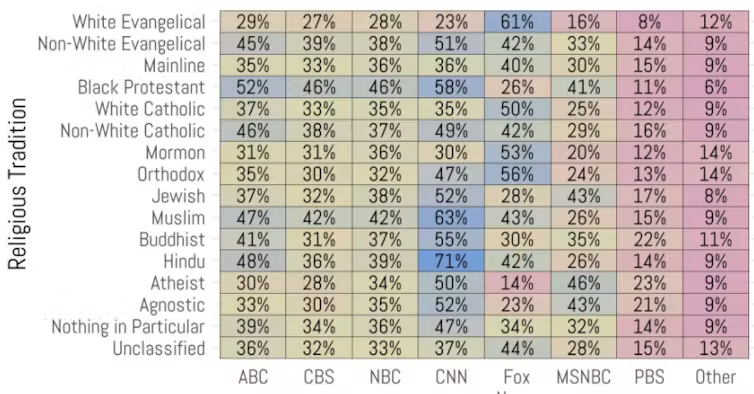
Some very interesting patterns emerged across religious traditions – and the nonreligious – and the type of media being consumed. For instance, of the the big three legacy news operations – ABC, CBS and NBC – there was no strong base of viewership in any tradition.
In most cases, about a third of people from each religious tradition said that they watched one of those legacy networks in the last 24 hours. PBS scored very low among every tradition. In most cases fewer than 15% of respondents reported watching PBS in the time frame.
graf]
however, the numbers for the three major cable news networks – CNN, Fox News and MSNBC – were much higher across the board. In eight of the 16 religious and nonreligious traditions categorized in the poll, CNN viewership was at least 50% of the sample. This was led by 71% of Hindus who watched CNN and 63% of Muslims.
The least likely group to watch CNN was clearly white evangelicals, at just 23%. In comparison, MSNBC scored lower nearly across the board. In fact, in none of the 16 classification groups was viewership of MSNBC greater than it was for CNN.
Fox News viewership was higher than that of MSNBC, but was not as widely dispersed as it is for CNN. It's no surprise, given its reputation as a conservative news outlet, that 61% of white evangelicals say that they watch Fox News – in the last election, around 80% of white evangelicals voted for Republican candidate Donald Trump. The other three traditions where viewership was at least 50% are white Catholics, Mormons and members of the Eastern Orthodox Church. It should come as no surprise, as those are three groups that consistently vote for the Republican Party. Just 14% of atheists watched Fox, which is just about in line with the share of white evangelicals who watch MSNBC.
Fracturing right-wing media
But with the fracturing of conservative media sources seeing more competitors vying for viewers among the right, Fox News could see a drop in viewership from the religious right.
In the wake of the 2020 presidential election, Fox News viewership plunged as many Trump supporters believed that the network was not being loyal to their standard-bearer of the GOP.
Given the vast number of news options that people of faith have and the increase in political polarization in the United States, the pressure for networks to deliver the news that people want to hear will only increase as time passes.
Ryan Burge, Assistant Professor of Political Science, Eastern Illinois University
This article is republished from The Conversation under a Creative Commons license. Read the original article.
FROM YOUR SITE ARTICLES
- Rep. Matt Gaetz is trying to take Fox News' Tucker Carlson down ... ›
- Jen Psaki torches Fox News' Peter Doocy: Trying to 'disprove a ... ›
- Watch: Joe Biden cracks up the room with his response to a Fox ... ›
post hosp photo op
https://www.alternet.org/2020/10/katie-couric-calls-out-tv-networks-for-getting-played-by-trumps-white-house-i-find-it-infuriating/
https://www.alternet.org/2020/09/this-is-how-you-normalize-a-madman-scholars-and-press-watchdogs-urge-corporate-media-to-treat-trump-like-the-authoritarian-threat-he-is/
no lnx twt pix
This is how you normalize a madman': Scholars and press watchdogs urge corporate media to treat Trump like the authoritarian threat he is
Lisa Newcomb and Common Dreams September 25, 2020
Major news outlets failed the American people, critics say, when they chose to bury coverage of President Donald Trump's Wednesday comment that he would not commit to a peaceful transition of power—a statement watchdogs say demanded above-the-fold, front-page headlines that simply did not materialize.
"Newsroom leaders made a considered, intentional decision not to panic after Trump was elected," Dan Froomkin, editor of PressWatchers.org, wrote in a scathing rebuke of corporate media's apparent nonchalant attitude towards the president's rhetoric. "This was an epic, obvious mistake, and everything that has happened since was in some sense entirely predictable."
Froomkin continued, "They should have gone on a war footing—and by that I don't mean a partisan war against Trump, I mean a journalistic war against lies, ignorance, and intolerance."
Critics weighed in on the relative non-importance corporate news outlets assigned—in print and online—to Trump's latest suggestion that he may not cede the office of the presidency should he lose in November:
Some observers balked when Peter Baker, chief White House correspondent for the New York Times, attempted to explain away the Times' decision to bury the news by citing print publication deadlines. One pointed to the late-evening news of Supreme Court Justice Ruth Bader Ginsburg's death last week, which was an above-the-fold feature in the next day's Times print edition.
Broadcast media also drew rebukes for its lack of emphasis on Trump's veiled threat at the democratic process.
"Wednesday's network evening newscasts on ABC, CBS, and NBC were no better," Eric Boehlert, founder and editor of PressRun wrote. "Not only did none of them lead with Trump's stunning proclamation, none of the broadcasts even reported on Trump's comments. This is how you normalize a madman. (CNN and MSNBC did a much better job covering the transfer-of-power story.)"
At PressWatchers.org, Froomkin explained how the dynamics in corporate newsrooms have led to complacency among journalists tasked with reporting on Trump's presidency:
One overarching problem is that our major newsrooms have simply gotten so corporate and even-keeled that our top editors value unflappability as a signal virtue. (OK, I admit I take this one a little personally, being a flappable person. A top Washington Post editor once called me "hysterical.") Flappable people don't rise through the ranks. Corporate people do.
Journalism to me is about crusading for the truth. But the notion that a serious, major news organization would pursue a crusade on behalf of its community is considered hippy shit by the people in charge these days. So is consistently standing up to a lawless con man. They've gotten used to printing lies. They barely squawk when Trump calls them the "enemy of the people." They have their algorithms, and they won't give them up no matter what. They just continue to "do the work."
So yeah, their news souls are dead. There, I said it.
Lawmakers and progressive advocates called out the dangerous threat to democracy uttered by the commander-in-chief—and the corporate media for treating it like any other day in Trump's scandal-laden presidency.
"Great (not) to watch journalists reporting Trump's latest direct attacks on the republic as if it's all just a regular press conference," longtime journalist Dan Gillmortweeted Wednesday. "Historians will see Big Journalism's business as usual in this emergency as one of the proximate causes of the American republic's death."
Sen. Bernie Sanders (I-Vt.) gave a speech Thursday denouncing Trump's declared refusal to commit to a peaceful transition of power, saying: "This is not just an election between Donald Trump and Joe Biden. This is an election between Donald Trump and democracy—and democracy must win."
Sanders also outlined steps necessary to prepare the American public and lawmakers for chaos of election night and beyond, calling on the news media specifically to "prepare the American people to understand there is no longer a single election day and that it is very possible that we may not know the results on November 3."
Froomkin pointed out that corporate media's opinion pages are more accurately depicting the real danger of Trump's recent rhetoric than front-page headlines.
"But as usual, to capture the real drama of what's going on, you have to go to the opinion writers—and the editorial cartoonists," he wrote, sharing a link to an op-ed by Washington Post columnist Greg Sargent.
"What really matters here is that Trump is making an actual declaration of intent," Sargent wrote, "not just to refuse to respect the outcome, but rather to try to cancel and override it, if he is able to get away with it."
Boehlert issued a more dire warning:
Trump isn't running for re-election in the sense he's hoping to accumulate more voter support than Biden. (His campaign keeps taking down ads in swing states.)Trump's running to maintain power. He's signaling that he'll refuse to give it up and will not accept his defeat as being legitimate. He's trying to steal an election. In reality, he doesn't care what the results are—he has no intention of abiding by the nation's will, and thinks he can count on the corrupt support of the GOP, the Department of Justice, and the United States Supreme Court to win his lawless battle in the days and weeks after the election.
"Our democracy is at stake," Boehlert concluded. "Trump is trying to steal an election, and the press should say so, every day until Election Day."
==
https://www.mediamatters.org/broadcast-networks/corporate-broadcast-tv-news-fails-make-crucial-connection-between-record
:{Corporate broadcast TV news fails to make crucial connection between record-breaking California wildfires and climate crisis:(style="box-sizing:border-box"):}:
09/10/20 2:07 PM EDT
==
==
were we not seeing progress?
| only 4% of wildfire segments on ABC, CBS, and NBC mentioned climate change |
August was a turbulent month for wildfire activity in the Western U.S. California alone suffered through two of its largest wildfires in recent history, and there are more than 80 other large, active fires burning in 15 states. Record-breaking temperatures and climate change are playing a role in the size and scale of the fires, and the coronavirus pandemic is complicating efforts to contain the blazes and safely evacuate those in their path. Media Matters found that ABC, CBS, and NBC aired a combined 114 segments about wildfires on their morning and evening news shows from August 1 to August 31. Only five of the 114 wildfire segments -- just 4% of them -- mentioned climate change. |
==
Twenty Years of Advocacy, Not Journalism, on Global Warming
The media has forged a consensus around climate change.
By Rich Noyes
April 23, 2010
wsj BS
From the Media Research Center
For more than two decades, the so-called mainstream media have preached the dangers of manmade global warming, insisting American businesses and consumers must make massive economic sacrifices to ward off a global climate catastrophe. Not even last November's exposure of e-mails from leading scientists on the alarmist sideof the debate — showing them conniving to fudge or suppress data, discredit critics and distort the peer review process — has caused journalists to finally take a skeptical approach to radical environmentalists' doomsaying.:{
:{:{}:
A new study from the MRC's Business & Media Institute documents how ABC, CBS and NBC have been just as strident in their advocacy in the months following "ClimateGate" as they were in the 20 years that preceded the scandal. At the same time, a review of the Media Research Center's archives going back to the late 1980s shows just how strongly reporters have pushed the liberal line on global warming. Here are just some of the many examples:
:{:{}:
• "Global warming could mean economic upheaval. It could bring suffering. It could bring starvation....The causes of global warming are no mystery. The biggest culprit is carbon dioxide, or CO2, a bi-product when man burns fossil fuels to run cars or generate electricity....If we fail to act, there may be hell to pay in a hotter world....Global warming is not a fact, just a widely-held theory. The problem is, if man waits for proof, it may be too late."
— Host Don Harrison narrating CNN's primetime Climate In Crisis special, August 1, 1989.
:{:{}:
•"}:As the science editor at Time, I would freely admit that on this issue we have crossed the boundary from news reporting to advocacy.":{:{}:
— Time's Charles Alexander at a September 16, 1989 global warming conference at the Smithsonian Institute, as quoted in the October 5 Wall Street Journal.
:{:{}:
}:• "If the world is to head off the risk of global warming, with its danger of massive crop failure, or rising sea levels, or spreading starvation in the poorest countries, then America — the largest producer of the gases that cause global warming — is in the spotlight.":{:{}:
— ABCreporter Ned Potter on World News Tonight, April 7, 1992.
:{:{}:
• "Environmentalists see catastrophes of biblical proportions, from droughts to melting ice caps that send sea levels rising."
— Correspondent Barry Petersen on the CBS Evening News, December 1, 1997.
:{:{}:
• Karen Kerrigan, Small Business Survival Committee: "To say that the science is conclusive...is actually bunk."
Host Ted Koppel: "I was just going to make the observation that there are still some people who believe in the Flat Earth Society, too, but that doesn't mean they're right."}:}:}:}:}:}:}:
— Exchange on the December 9, 1997 Nightline.
AN
Scientists at the United Nations’ intergovernmental body focusing on biodiversity sounded alarms earlier this month with its report on the looming potential extinction of one million species—but few heard their calls, according to a German newspaper report.
Deutsche Welle reported Thursday that partially because the Intergovernmental Science-Policy Platform on Biodiversity and Ecosystem Services (IPBES) released its report on what it called nature’s “unprecedented” decline on the same day that the Duke and Duchess of Sussex had their first child, news reports on the study’s grave implications were few and far between.
While some international and progressive outlets—including Common Dreams—published high-profile stories on the report when it was released, just two of Britain’s national newspapers included any reporting about biodiversity on their front pages on May 7, the day after the royal baby was born to Meghan Markle and Prince Harry.< ABC, NBC, and MSNBC did not air a single prime-time mention of the major new U.N. biodiversity report warning of ecosystem collapse. The new royal baby got airtime, though. By @theodorejay. https://t.co/EQPe2qnNJx #CoverClimate#CoveringClimate #ClimateCoverage #EndClimateSilence
— Lisa Hymas (@lisahymas) May 8, 2019
Deutsche Welle’sreport was mirrored by revelations in a Media Matters report published earlier this week which showed that ABC News devoted more time to covering the royal baby’s birth in the week after the child was born than it had to stories about the climate crisis in all of 2018—even as organizers like 16-year-old Greta Thunberg led worldwide climate strikes.
“Where [is] the breaking news?” tweeted Thunberg the day after IPBES released its report. “The extra news broadcasts? The front pages? Where are the emergency meetings? The crisis summits? What could be more important?...
house "mean" but senate not much better
http://www.alternet.org/news-amp-politics/how-corporate-media-enabled-gops-audacious-plan-steal-health-care-coverage-23
no img link
How Corporate Media Enabled the GOP's Audacious Plan to Steal Health Care Coverage from 23 Million Americans
Corporate media is finally talking about Trumpcare. It’s too little too late.
By Adam Johnson / AlterNet June 23, 2017, 8:46 AM GMT
Republicans in the Senate are about to radically overhaul former President Obama’s landmark Affordable Healthcare Act but you’d hardly know it watching American media. The sheer size of this shift involved in the American Health Care Act (AHCA), both in moral and economic terms, cannot be overstated. 23 million Americans stand to lose their health insurance, and according to one study, 18,000 to 28,000 people will die as a result of the GOP bill by 2026. But for weeks, while the public could have had some say-so as to what was in the bill by pressuring Republicans for more transparency, major media sat by and did next to nothing.
One Media Matters survey found over one two-week period in early June, as the bill was being molded in secret, major networks all but ignored the topic. CBS News didn’t cover the subject at all, ABC gave it a mere 40 seconds and NBC News dedicated just under 2.5 minutes out of roughly five hours of news. By contrast, NBC News program “Sunday Night With Megyn Kelly” set aside 700% more time, or 17.5 minutes, to the urgent topic of Alex Jones.
Newspapers didn’t fare much better. Though most did report on the subject and the corresponding GOP coverup, the story was largely buried. During the same two-week period in early June, only two front pages from major newspapers featured the story, out of a total of 40.
The most urgent political issue of the past decade was all but a non-issue in major media outlets. And in the rare case it was mentioned, the fact that Republicans were deliberately keeping the process secret was not.
Without this key piece of context, one was left with the distinct impression there was a degree of bipartisan input into the law rather than the truth—that the AHCA was a cynical power grab by Senate Republicans.
The net effect played out as one would expect: according to a survey by research company Morning Consultant, only 22 percent of regisitered voters had heard “a lot” about how Senate Republicans were writing the ACHA in secret--well behind topics such as Trump sharing classified intelligence with Russia, the Paris climate accords, and the Comey testimony.
What makes this dereliction of duty by the media uniquely sleazy is it plays directly into the Republican PR strategy for passing Trumpcare. The goal from the beginning was to keep the bill secret and reveal its contents at the 11th hour, similar to how the House passed its AHCA last bill in early May. According to a report by Axois earlier this month:
Senate Republicans are working to finish their draft health care bill, but have no plans to publicly release it, according to two senior Senate GOP aides.
"We aren't stupid," said one of the aides. One issue is that Senate Republicans plan to keep talking about it after the draft is done: "We are still in discussions about what will be in the final product so it is premature to release any draft absent further member conversations and consensus."
When the most powerful forces in the country expressly flaunt their secrecy and even frame it as a positive, one would think this would bait the media into more coverage, not lull them into less. By keeping the process airtight, the GOP effectively starved the press of content to report on. But the conspiracy to keep the process hidden from the public was itself a story and one in urgent need of covering. While some did, such as cable outlet MSNBC and Vox.com, they were the exception, not the rule.
A corporate media that obsesses about balanced reporting likely feared looking overtly partisan by highlighting the ploy at work, but once again, this false balance let Republicans off the hook. It wasn’t until this week, when protesters gave editors and producers visuals of disabled people being dragged out by Capitol police and the contents of the bill itself was revealed that they started paying attention. But now it’s too late: the bulk of the bill has been written and a vote is likely going to be jammed in before the sleepy fourth of July weekend.
No public discussion. No measurable outrage from major media on the total lack of public discussion. Some handwringing late into the process, and last-minute attempts by pro-Democratic media to rally the troops, but ultimately the Republican strategy of dodging the media worked exactly as they hoped it would.
==
guard uk
==
http://www.alternet.org/environment/pbs-only-network-reporting-climate-change-and-trump-wants-cut-it
Media Matters for America has published its annual review of American evening newscast climate coverage for 2016, and the results are stunning:
In 2016, evening newscasts and Sunday shows on ABC, CBS, and NBC, as well as Fox Broadcast Co.’s Fox News Sunday, collectively decreased their total coverage of climate change by 66 percent compared to 2015
In all of 2016, these news programs spent a combined grand total of 50 minutes talking about climate change. More than half of that come from CBS Evening News, which nevertheless only spent half as much time talking about climate change in 2016 as it had in 2015.
It’s certainly not as though 2016 lacked newsworthy climate stories. We learned in January that 2015 had smashed the record for hottest year, previously set just a year earlier. And 2016 just kept getting hotter, with nearly every month setting a new heat record. In September, the US and China agreed to formally ratify the Paris climate agreement. The list goes on and on, with newspapers like The Guardian constantly publishing important climate-related news throughout the year.
During 2016 there was also an ongoing presidential campaign in which the candidates’ views on climate science and policy should have been featured prominently. Unfortunately, climate change was rarely raised in the primary debates, and never in the general election debates. In fact, on Sunday news programs, Bernie Sanders brought up climate change four times more often than the program hosts.
Only after the election did news networks finally examine what a President Trump would mean for the Earth’s climate:
ABC, CBS, NBC, and Fox News Sunday did not air a single segment informing viewers of what to expect on climate change and climate-related policies or issues under a Trump or Clinton administration. While these outlets did devote a significant amount of coverage to Trump’s presidency, airing 25 segments informing viewers about the ramifications or actions of a Trump administration as they relate to climate change, all of these segments aired after the election.
As Senator Brian Schatz (D-HI) noted, this was a dismal failure by the American news networks:
In a year when the American people were deciding who our next leader should be, you would think there would have been more discussions about climate change in our news programs, not less. This isn’t just shameful, it’s irresponsible. The climate is changing, and it’s affecting everything from the weather to our national security and our economy. Its impacts are already being felt and the American people deserve to know more about it.
PBS was the oasis in this desert of climate news coverage. PBS NewsHour was the only show that examined what impact a Trump or a Clinton presidency would have on climate-related issues and policies before the election. The PBS news program aired more than double the number of climate news segments as any of its network competitors, and interviewed or quoted three times more scientists than even CBS Evening News. ABC World News Tonight failed to interview or quote a single scientist about climate change.
Perhaps unsurprisingly given his climate denial, Trump’s proposed budget would completely defund the Corporation for Public Broadcasting, which partially funds PBS. About half of that federal funding goes to local PBS stations that broadcast PBS NewsHour. Some of those stations – especially those in rural areas which rely particularly heavily on federal funding – would likely have to shut down, were Trump to get his budgetary wish.
With so little news coverage on the subject, it’s also unsurprising how confused Americans are about climate change—just 49% of Americans realize that most scientists think global warming is happening, and only 53% understand that humans are causing the problem. While concern among Americans about global warming is at an eight-year high, only 64% worry a great deal or fair amount.
That’s entirely understandable – if our leaders deny the problem, and our news networks don’t report on it, Americans are lacking the information signaling that global warming is an urgent threat. That’s why, although Americans (including Trump voters would prefer that their political leaders take steps to address the problem, they don’t few it as a high priority, and thus aren’t bothered by the lack of political action....
==
==
http://www.alternet.org/environment/broadcast-networks-climate-coverage-was-utterly-miserable-during-election-year
Secretary of State John Kerry, in Marrakesh this week for international climate talks, recently said it “pissed him off” that there wasn’t a single question asked about climate change during the six hours of televised presidential and vice presidential debates prior to the election.
Kerry’s annoyance is justified. Given rapidly rising global temperatures, dramatic extreme weather events, the global agreement to curb carbon emissions, and stark divisions among the major party candidates, climate change deserved to be one of the most talked-about issues of the campaign. And yet, outside of a passing reference during the “town hall” presidential debate, the candidates were not asked about it, despite the fact that queries about climate change were the fourth most-popular question category submitted by the public for the town hall debate, demonstrating that voters wanted to hear about it.
But it wasn’t only the debates.
Since January, the broadcast television networks barely reported on climate, even though this year is on pace to be the hottest one in the books, setting a record for the third year in a row. Out of more than 1,700 evening, morning, weekly and Sunday public affairs news programs aired between January 1 and October 31, the four commercial broadcast networks that provided moderators for the debates — ABC, Fox, CBS and NBC — collectively aired only 32 segments and 24 briefs on the topic, a total of56 pieces. And most of the evening news segments ran less than two and a half minutes in length, while each brief was no more than three or four sentences long.
By contrast, the commercial broadcast networks found time for considerably less important topics. Take the coverage of New England Patriots quarterback Tom Brady and the fallout over his “Deflategate” football tampering scandal. During the first nine months of this year, ABC, CBS and NBC aired 33 segments and 40 briefs on Brady, for a total of 73 pieces. (Fox’s lone national news show somehow missed the story.) Nearly half of the pieces — 34 — were on Deflategate and Brady’s four-game suspension. The rest reported on such riveting topics as Brady’s haircut, his new $200 cook book, and his new family dog, Fluffy.
Rating the Networks
Fox Broadcasting Company — not to be confused with 21st Century Fox’s cable channel Fox News — was by far the worst offender. The network doesn’t have a nightly news program, but it does air Fox News Sunday, a public affairs show hosted by Chris Wallace, the moderator of the third and final presidential debate. Since the beginning of the year, Fox News Sunday only broached the topic of climate change once, during an interview Wallace did with Green Party presidential candidate Jill Stein on September 4. Stein mentioned it in one sentence, and Wallace changed the subject. But Fox News Sunday was not alone. The topic didn’t come up on the other Sunday morning political gabfests either unless a guest mentioned it in passing. More often than not that guest was Bernie Sanders. (Given the incidental nature of these remarks, they aren’t included in the segment or brief totals.)
ABC, where town hall debate co-moderator Martha Raddatz works, was only marginally better than Fox, and it runs a lot more news programming. The network has aired only three segments on climate change this year, and they were all variations of the same story. On January 6, Good Morning America ran a relatively long segment on a melting glacier in Iceland that is retreating about a hundred yards every year. Nightline aired a shorter version of the piece that night, and the next morning, Good Morning America did a follow-up. Since then, the network aired only seven climate-related briefs, six on Good Morning America and one on World News Tonight, which merely reported that bumblebees are “threatened by climate change” in a two-sentence piece.
Over the same time frame, NBCaired 11 segments and two briefs on climate change. Seven segments were on Today, and the other four ran on NBC Nightly News, which is anchored by Lester Holt, the moderator of the first presidential debate.
Two of the four Nightly News segments piggybacked on other news stories. On August 20, an NBC correspondent took time off from the Rio Olympics to talk with locals about deforestation. Two weeks later, on September 3, the show reported on the G-20 Economic Summit in China, where President Obama and Chinese President Xi formally committed to the Paris climate agreement. All of the individual segments were well done, but given the magnitude and urgency of climate change, the fact that NBC’s premier daily news program ran only four segments on the topic over the course of nine months is incomprehensible.
CBS, whose correspondent Elaine Quijano moderated the vice presidential debate, aired the most segments and briefs of the broadcast networks— but that’s still not saying much. Nearly all of the briefs — 14 of 15 — and more than half of the segments — 11 of 18 — were on CBS This Morning or CBS Sunday Morning.
Two segments on The CBS Evening News linked climate change with extreme weather events. A July 20 segment on the heat wave broiling residents in more than two dozen states featured a National Weather Service meteorologist explaining how climate change works in simple, understandable terms. Two months later, on September 17, the show reported that the “world is on pace for the warmest year on record, breaking marks set in 2015, 2014 and 2010. But scientists say it’s more than temperatures. They have connected man-made climate change to deadly heat waves, droughts, and devastating floods.”
Those Evening News stories were excellent, but they were two of only five climate-related segments the show aired since the beginning of the year. 60 Minutes, meanwhile, sent a correspondent to Greenland to meet with climate scientists for a segment that aired on January 31 and again on July 31. That was it for the newsmagazine, but its competition at ABC and NBC — 20/20 and Dateline — avoided the issue altogether.
Millions are Watching, and They’re Not Being Served
The relatively few climate-related segments that did air on ABC, CBS and NBC since January demonstrate that the networks are quite capable of covering the subject in a compelling way. The amount of attention they devoted, however, was nowhere near what it should have been given the magnitude of the problem.
Besides their scanty coverage, the networks missed some obvious opportunities to make the climate connection. For example, all of the evening newscasts reported on the devastating rains and flooding in Louisiana last August. According to Climate Nexus, the storm that triggered the flooding “was supercharged by running over a warmer ocean and through an atmosphere made wetter by global warming.” No matter, according to Media Matters, none of the five NBC Nightly News segments, three World News Tonight segments, or three CBS Evening Newssegments on the floods cited the climate link. That’s just bad reporting.
One other point to consider is when the networks aired the bulk of their climate stories and briefs. Nearly two-thirds of the segments (20 of 32) aired on one of the network morning shows, as did more than 85 percent of the briefs (21 of 24). Why is that important? Because nearly twice as many viewers watch the evening news shows.
That said, despite the fact that the legacy broadcast networks have lost ground to cable and online sources in recent years, all of their news shows still command sizable audiences. According to figures from the week of October 24, slightly more than 23 million people watched one of the three broadcast networks’ evening newscasts. ABC’s World News Tonight led the pack with an audience of nearly 8.19 million viewers, just edging out NBC Nightly News for the top spot. The CBS Evening News came in last with 6.79 million viewers that week.
Fortunately, to paraphrase a Nobel Prize-winning poet, you don’t need a TV network to know which way the wind blows. Despite Donald Trump’s well-publicized contention that climate change is a Chinese-inspired hoax, nearly three-quarters of American voters now say global warming is happening and nearly 70 percent support a carbon tax.
When the story of this past election is written, however, a glaring and mystifying fact for historians will no doubt be how little attention was paid to perhaps the most important issue of our time. And the failure of the commercial broadcast networks to adequately address climate change should be front and center in that story. Their track record covering climate change this year has been so pathetic, it arguably violates the spirit — if not the letter — of the federal requirement that broadcast networks serve the public interest.
Elliott Negin is a senior writer at the Union of Concerned Scientists.
==
The Tyndall Report, a non-partisan media monitoring firm that has been tracking the nightly news broadcasts of ABC, CBS, and NBC, found that Trump is tromp, tromp, tromping over the airtime of everyone else.
From last January through November, these dominant flagship news shows devoted 234 minutes of prime-time coverage to the incessant chirping of the yellow-crested birdbrain, with no other contender getting even a fourth of that.
Take Bernie Sanders, who’s stunning the political establishment with a fiery populist campaign that’s drawing record crowds. Indeed, Sanders’ upstart campaign is commanding a comparable share of support within the Democratic Party’s voting base to what Trump is enjoying from the Republican electorate.
And — get this — polls also show Bernie trouncing The Donald if they face each other in November’s presidential showdown. So surely he’s getting a proportional level of media coverage by the networks on our public airwaves, right?
Ha, just kidding! The big networks’ devotion of 234 minutes to all-things-Trump was “balanced” by less than 10 minutes for Sanders. Most egregious was ABC, the Disney-owned network. ABC’s World News Tonight awarded 81 minutes of national showtime to Trump last year — and for Bernie: 20 seconds.
How self-serving of the media moguls. The one candidate who is effectively rallying large numbers of voters to oppose the rise of corporate oligarchy — including in the media — has the plug pulled on him.
Of course, this only amplifies the truth of what Sanders is saying about the villainy of corporate profiteers, and it fuels a greater determination by his millions of grassroots supporters to end the reign of greed in America.
Jim Hightower is a national radio commentator, writer, public speaker, and author of the new book, "Swim Against the Current: Even a Dead Fish Can Go With the Flow." (Wiley, March 2008) He publishes the monthly "Hightower Lowdown," co-edited by Phillip Frazer.
==
==
busted
http://mediamatters.org/research/2015/11/13/network-evening-news-programs-yet-to-address-wh/206839
In recent months, media investigations have revealed that Exxon Mobil peddled climate science denial for years after its scientists recognized that burning fossil fuels causes global warming, prompting New York's Attorney General to issue a subpoena to Exxon and all three Democratic presidential candidates to call for a federal probe of the company. But despite these developments, the nightly news programs of all three major broadcast networks -- ABC, CBS, and NBC -- have failed to air a single segment addressing the evidence that Exxon knowingly deceived its shareholders and the public about climate change.
Media Reports Revealed Exxon's Acceptance Of Climate Science Pre-Dated Its Funding Of Climate Denial, Prompting Calls For Investigations
Media Report: Email Shows "Exxon Knew Of Climate Change In 1981 ... But It Funded Deniers For 27 More Years."On July 8, InsideClimate News and The Guardian reported on an email from a former Exxon employee that was highlighted by the Union of Concerned Scientists. InsideClimate News noted that the email showed "Exxon scientists studied the impact of greenhouse gas emissions on global warming as far back as 1981," and that "company's early awareness of climate change and willingness to factor it into business decisions starkly contrasts with the path it took a decade later, when it led efforts to cloud public understanding of climate science and delay action to reduce emissions of greenhouse gases, such as carbon dioxide." The Guardian similarly reported that ExxonMobil "knew as early as 1981 of climate change -- seven years before it became a public issue, according to a newly discovered email from one of the firm's own scientists. Despite this, the firm spent millions over the next 27 years to promote climate denial." The Guardian further reported:
...
Major Broadcast Networks' Nightly News Shows Have Completely Ignored Exxon Developments
Evening News Programs On ABC, CBS, And NBC Have Yet To Address Exxon's Climate Deception.Nexis and Snapstream searches for "Exxon" and "ExxonMobil" revealed that the nightly news shows on ABC, CBS, and NBC all failed to air a single segment about the growing Exxon story, covering neither the media investigations, the Democratic candidates' comments, nor the New York Attorney General's actions.
ABC And CBS Briefly Mentioned New York Attorney General Investigation On Morning News Shows.ABC's Good Morning America and CBS This Morning both briefly mentioned New York Attorney General Schneiderman's investigation into Exxon in news rundowns. ABC, *Good Morning America*, [11/6/15; CBS, CBS This Morning, 11/6/15]
==
==