PBS/NPR
---
SEE NPR 2
GOOD ON EJ 2025
===
bak 120
model of self-correction, even on seemingly trivial matters [as self defense of rw attacks?]
note ATI big damage, then flame-out, done in by Frontline doc vid?
===
rww 7 25
Mark Meckler celebrates Republicans defunding NPR and PBS because they are "anti-American, anti-conservative, anti-religious, anti-traditional values propaganda."
// XO
an 7 25
Although Donald Trump vehemently denied knowing anything about Project 2025 during the 2024 presidential race, far-right Christian nationalist Russell Vought — a major architect of the Project 2025 agenda — now heads the U.S. Office of Management and Budget (OMB). Project 2025 called for federal government employees to be fired in huge numbers and replaced with an army of MAGA loyalists, and Vought has been pushing Project 2025's recommendations at OMB.
On Thursday morning, June 17, Vought attended a Christian Science Monitor breakfast — where, according to Politico's Katherine Tully-McManus, he openly expressed his disdain for bipartisanship.
Vought told reporters, "The appropriations process has to be less bipartisan…. There is no voter in the country that went to the polls and said, 'I'm voting for a bipartisan appropriations process.' That may be the view of something that appropriators want to maintain."
READ MORE: 'Didn’t you vote to pass this?' GOP rep stumps CNN host after blasting bill he voted for
The previous day, the U.S. Senate passed a rescissions package that includes major cuts to the Corporation for Public Broadcasting (CPB) as well as to foreign aid. And Vought is hoping that more cuts will be forthcoming.
Vought told reporters, "We are willing to send up additional rescissions. I think if this continues to pass, we're likely to send up another rescissions package that would come soon, and we'll be working on that to try to get that across the finish line. We're not there yet."
Politico's Nicholas Wu posted Tully-McManus' reporting on X, formerly Twitter. And Vought's comments against bipartisanship are generating a lot of discussion on the social media platform.
X user Roger Dodger posted, "That is one of the more obscene things I have heard. Just terrible."
READ MORE:'Who in the world would be stupid enough to believe that?' Morning Joe torches Trump
Another X user, Catherine H., sarcastically wrote, "Yeah, because why would you want a unified country?"
X user Scott Plante commented, "Not how democracies work, Russ."
Another X user, Biscuit Salad, wrote, "He is old, and any pretense that the two term president with a decade-long death grip on his party isn't 'the establishment' gets more hilarious every day."
7 25
pass 9b recission 2 gop defect? ! PBS
---
===
How broadcast TV news covered environmental justice in 2024
Special ProgramsClimate & Energy
Written by Evlondo Cooper
Published 06/17/25 MMA
Corporate broadcast news coverage of environmental justice declined in 2024. ABC, CBS, and NBC aired a combined total of just 7 environmental justice segments, compared to 9 such segments in 2023. This continues a multiyear trend of declining airtime dedicated to stories about how environmental racism, economic exploitation, and environmental degradation disproportionately harm vulnerable communities.
Environmental justice refers to the disproportionate impact of environmental harms — such as air and water pollution, toxic exposure, or policy neglect — on communities that are already socially or economically marginalized. These include Black, Latino, Indigenous, and low-income populations that are more likely than other groups to live near industrial facilities, aging infrastructure, or fossil fuel extraction sites and bear the brunt of pollution to the air, land, and water.
Media Matters reviewed morning and evening newscasts on corporate broadcast networks ABC, CBS, and NBC from January 1 through December 31, 2024. Segments were coded as relating to environmental justice if they included coverage of environmental impacts, regulations, or health hazards and identified a specific marginalized community as affected. For the first time, the study includes weekend morning and evening news programs and ABC’s GMA3. Weeknight and weekend episodes of PBS News Hour were reviewed for comparison but are not included in the segment total.
- ## Key findings
- From January 1 through December 31, 2024, corporate broadcast networks — ABC, CBS, and NBC — aired a total of 7 segments about environmental impacts, regulations, or health hazards that included a mention of a socially marginalized community. This marks a continued decline from 9 such segments in 2023 and 12 in 2022.
- CBS and ABC each aired 3 environmental justice segments in 2024 while NBC aired just 1.
- PBS News Hour aired 11 environmental justice segments in 2024, which is more than the combined total from the three corporate broadcast networks. Weeknight and weekend episodes of PBS News Hour were reviewed for comparison but are not included in the segment total.
- Corporate broadcast networks also failed to cover several major environmental justice stories, including the water funding crisis in Jackson, Mississippi; the Supreme Court’s decision to halt EPA ozone protections; ongoing pollution monitoring failures along the Houston Ship Channel; and the growing barriers to black lung compensation in Kentucky.
- ## How corporate broadcast networks covered environmental justice in 2024
- In 2024, corporate broadcast networks aired just 7 segments about environmental impacts, regulations, or health hazards that also identified how those issues affected a socially marginalized community. This continues a multiyear trend of declining environmental justice coverage.
- ...
---
On Thursday, the Republican-controlled House of Representatives passed legislation that, if signed into law, would strip federal funding from NPR and PBS. One of the four Republicans who voted against it is now speaking out.
Most of the $9.4 billion rescissions package (legislation in which Congress claws back money that was previously appropriated) is targeting foreign aid through the U.S. Agency for International Development (USAID) and the African Development Foundation, with approximately $8 billion being cut from those agencies. However, the remainder of the money was allocated toward the two public broadcasting agencies that are partially funded by the Corporation for Public Broadcasting (CPB).
In a post to his website, Rep. Mark Amodei (R-Nev.) slammed the cuts to NPR and PBS, saying that his constituents depended on their local public broadcasting affiliates to get basic information. And he called on his colleagues to not rush to strip funding from the CPB before having a larger conversation about what the impact of those cuts would be.
READ MORE:'Monarchy': Federal judge compares Trump to 'King George'
"If we do not have time to think about it, we sure as hell have time to talk about it before October 1st when the impacts of these rescinded funds would start to be felt,” Amodei said, referring to the start of Fiscal Year 2026. "This is forward funding. So, before we trigger major consequences for our local public broadcasting stations throughout the West and other rural areas, we need more discussion—rather than railroading folks over the East Coast’s editorials and indiscretions."
"I agree we must make meaningful cuts to shrink our federal deficit; however, I would be doing a disservice to the thousands of rural constituents in my district if I did not fight to keep their access to the rest of the world and news on the air," he continued.
"Having the ability to discuss real impacts, beyond just the global perspective, is a healthy and necessary step," he added. "I’m sure we will be voting on this again before the cake is fully baked, so I look forward to working with my colleagues to improve and protect this infrastructure our rural communities rely on."
The rescissions package is Congress' first attempt to codify some of the cuts made by Tesla and SpaceX CEO Elon Musk's Department of Government Efficiency (DOGE) earlier this year. In addition to Rep. Amodei, Reps. Brian Fitzpatrick (R-Pa.), Nicole Malliotakis (R-N.Y.) and Michael Turner (R-Ohio) also voted no.
READ MORE:'Hushed the entire chamber': Democrat confronts GOP rep on House floor in 'shouting fight'
Click here to read Amodei's full statement.
---
an 525
A Sesame Street character with the most trash and a fragile ego was possibly one parody too far for President Donald Trump, according to the Daily Beast:
“The president signed an executive order to halt all federal funding to PBS, the free public broadcasting service. Almost immediately, people began to suspect that Trump’s vendetta against the network wasn’t because of its 'woke programming,'" wrote the Beast's Clare Donaldson. "Instead, it’s all to do with a certain puppet show that has been trolling the man since the ’80s.”
One of Trump’s longest-running haters isn’t one of his alleged scam victims, but “‘Sesame Street’—the educational children’s program that taught generations of kids to read and count.”
Read more:'Losing the base': MTG goes on massive rant against Trump
Cue the song lyric:*“He’s got so much trash it spills out of his can!”
Ronald Grump first hit the scene in the late 1980s as a “famous Grouch builder” looking to replace Oscar’s trash can with a condominium of waste bins called “Grump Tower.” All Oscar had to do was surrender his can and relocate to a trashy condo in Grump’s new construction.
There were strings attached, of course, so Oscar ends up fighting his way back out of Grump’s twisty contract with the help of the Sesame Street community.
Later, in the 1990s, ‘Sesame Street’ convinced actor Joe Pesci to lend his voice for another round as Grump threatens to turn Sesame Street into “Grump World.”
READ MORE:'Kill them all': Shocking details about Fetterman’s behavior raise concerns over his health
The show later did a parody ofTrump’s NBC reality show The Apprentice.
Read the entire Daily Beast article here.
---
---
NOTUS
April 29, 2025
A federal judge in D.C. on Tuesday blocked the White House from immediately exerting control over NPR and PBS just a day after President Donald Trump claimed to have the authority to fire most of the directors overseeing their parent company, the Corporation for Public Broadcasting.
U.S. District Judge Randolph Moss forbade the Trump administration from replacing three board members without providing at least two days’ notice to give the court time to potentially step in....
===
MMA
November 25, 2024, edition of Newsmax's *Chris Plante: The Right Squad
CHRIS PLANTE (HOST): I've been a champion of getting rid of funding for the Corporation for Public Broadcasting for way more than a decade. You know, in the media universe that is an ever expanding universe that's exploding before our very eyes, I don't think we need to spend half a billion dollars or more to fund, let's face it, the NPR network is a total — it is a saturation propaganda network, 100% dedicated to the Democrat Party. It's like a foreign entity invaded the United States and set up this radio network.
MICHAEL FOLDI (CO-HOST): And you have a successful radio show with no support from the corporation.
PLANTE: Yeah, that's right. Yeah.
FOLDI: Because people actually want to listen to it.
PLANTE: I could use $535 million dollars for my show.
...
PLANTE: All right. Also, you know, Sesame Street is a multi-billion dollar corporation, one of the most profitable outfits in the history of the world. And I think we're still funding them, too. You know, Big Bird can earn his own paycheck.
MERCEDES SCHLAPP (CO-HOST): And they've gone a bit woke, too.
MATT SCHLAPP (CO-HOST): Elmo.
===
an 11 24
Revenge—it’s a big part of Trump’s life,” Mother Jones‘ David Corn (10/19/16) wrote just before Trump was elected to the presidency the first time:
In speeches and public talks, Trump has repeatedly expressed his fondness for retribution. In 2011, he addressed the National Achievers Congress in Sydney, Australia, to explain how he had achieved his success. He noted there were a couple of lessons not taught in business school that successful people must know. At the top of the list was this piece of advice: “Get even with people. If they screw you, screw them back 10 times as hard. I really believe it.”
Knowing this about Trump, Democrats and liberals worry that he will use the Department of Justice, especially if Matt Gaetz is confirmed as attorney general, as an unrestrained vehicle to pursue the prosecution of political enemies.
But given Trump’s constant attacks on media—“the opposition party,” as his ally Steve Bannon called the fourth estate (New York Times,1/26/17)—journalists fear that he will use the power of the state to intimidate if not destroy the press.
Defunding public broadcasting
Trump called for defunding NPR (Newsweek, 4/10/24) after a long-time editor accused the radio outlet of liberal bias in the conservative journal Free Press (4/9/24). Rep. Claudia Tenney (R–NY) introduced legislation to defund NPR because “taxpayers should not be forced to fund NPR, which has become a partisan propaganda machine” (Office of Claudia Tenney, 4/19/24). With Republicans also holding both houses of congress, bills like Tenney’s become more viable. Trump has previously supported budget proposals that eliminate funding for the Corporation for Public Broadcasting (Politico, 3/27/19).
The infamous Project 2025, a conservative policy agenda many see as a blueprint for the second Trump term, calls for the end to public broadcasting, because it is viewed as liberal propaganda:
> Every Republican president since Richard Nixon has tried to strip the Corporation for Public Broadcasting (CPB) of taxpayer funding. That is significant not just because it means that for half a century, Republican presidents have failed to accomplish what they set out to do, but also because Nixon was the first president in office when National Public Radio (NPR) and the Public Broadcasting Service (PBS), which the CPB funds, went on air.
In other words, all Republican presidents have recognized that public funding of domestic broadcasts is a mistake. As a 35-year-old lawyer in the Nixon White House, one Antonin Scalia warned that conservatives were being “confronted with a long-range problem of significant social consequences—that is, the development of a government-funded broadcast system similar to the BBC.”
All of which means that the next conservative president must finally get this done, and do it despite opposition from congressional members of his own party if necessary. To stop public funding is good policy and good politics. The reason is simple: President Lyndon Johnson may have pledged in 1967 that public broadcasting would become “a vital public resource to enrich our homes, educate our families and to provide assistance to our classrooms,” but public broadcasting immediately became a liberal forum for public affairs and journalism.
PBS and NPR, as FAIR (10/24/24) has noted, has for decades caved in to right-wing pressures—PBS by adding conservative programming, NPR by trying to rid itself of political commentary altogether. But the right will never let go of its ideological opposition to media outlets not directly owned by the corporate class.
‘Whether criminally or civilly’
Trump also has a well known track record of revoking the credentials of journalists who produce reporting he doesn’t like (Washington Post, 2/24/17, 5/8/19; New Republic, 11/5/24). It is realistic to assume that a lot more reporters will be barred from White House events in the years ahead.
While a bill that would grant the secretary of the treasury broad authority to revoke nonprofit status to any organization the office deems as a “terrorist” organization has so far failed (Al Jazeera, 11/12/24), it is quite possible that it could come up for a vote again. If this bill were to become law, the Treasury Department could use this ax against a great many progressive nonprofit outlets, like Democracy Now! and the American Prospect, as well as investigative outlets like ProPublica and the Center for Investigative Reporting.
The department could even target the Committee to Protect Journalists, which has already said in response to Trump’s victory, “The fundamental right to a free press, guaranteed by the First Amendment of the US Constitution, must not be impaired” (11/6/24).
Margaret Sullivan (Guardian, 10/27/24), an avid media observer, said there is no reason to think Trump will soften his campaign against the free press. She said:
In 2022, he sued the Pulitzer Prize board after they defended their awards to the New York Times and the Washington Post. Both newspapers had won Pulitzer Prizes for investigating Trump’s ties to Russia.
More recently, Trump sued ABC News and George Stephanopoulos for defamation over the way the anchor characterized the verdict in E. Jean Carroll’s sexual misconduct case against him. Each of those cases is wending its way through the courts.
She added:
There is nothing to suggest that Trump would soften his approach in a second term. If anything, we can expect even more aggression.
Consider what one of Trump’s most loyal lieutenants, Kash Patel, has said.
“We’re going to come after the people in the media who lied about American citizens, who helped Joe Biden rig presidential elections,” Patel threatened during a podcast with Steve Bannon. “Whether it’s criminally or civilly, we’ll figure that out.”
Trump has already gone after the New York Times and Penguin Random House since Sullivan wrote this. CJR (11/14/24) said:
The letter, addressed to lawyers at the New York Times and Penguin Random House, arrived a week before the election. Attached was a discursive ten-page legal threat from an attorney for Donald Trump that demanded $10 billion in damages over “false and defamatory statements” contained in articles by Peter Baker, Michael S. Schmidt, Susanne Craig and Russ Buettner.
It singles out two stories coauthored by Buettner and Craig that related to their book on Trump and his financial dealings, Lucky Loser: How Donald Trump Squandered His Father’s Fortune and Created the Illusion of Success, released on September 17. It also highlighted an October 20 story headlined “For Trump, a Lifetime of Scandals Heads Toward a Moment of Judgment” by Baker and an October 22 piece by Schmidt, “As Election Nears, Kelly Warns Trump Would Rule Like a Dictator.”
And just before his victory, Trump sued CBS News, alleging the network’s “deceitful” editing of a recent 60 Minutes interview with Vice President Kamala Harris “misled the public and unfairly disadvantaged him” (CBS News, 10/31/24).
Expect more of this, except this time, Trump will have all the levers of the state on his side. And whatever moves the next Trump administration makes to attack the press will surely have a chilling effect, which will only empower his anti-democratic political agenda.
===
MMA 9 24
PBS NewsHour highlights the positive impact of migrant workers in Springfield, Ohio 09/10/24
mma 5 24
===
Fact sheet: Right-wing attacks on public media | Media Matters for America
9 pp pdf
the ideological takeover of public broadcasting has been a strategy and goal of conservativeinstitutions since at least the 1990s. Think tanks The Heritage Foundation and ManhattanInstitute and political actors including Heritage’s Mike Gonzalez and Manhattan’s ChristopherRufo have long railed against public broadcasting, calling it “biased,” “woke,” “ propaganda.”
Key figures behind the attacks on public broadcastingConservative think tanks including The Heritage Foundation and The Manhattan Institute aswell as political actors such as Christopher Rufo have spearheaded recent attacks on public broadcasting and NPR President and CEO Katherine Maher.While The Heritage Foundation and The Manhattan Institute have a long history of attacking public broadcasting, Rufo, a longtime anti-civil rights activist, has only recently shifted hisfocus to Maher.
● THE HERITAGE FOUNDATION / MIKE GONZALEZ○ Project 20251, a comprehensive transition plan organized by right-wing think tankThe Heritage Foundation to guide the next GOP presidential administration, andThe Heritage Foundation make it clear that a future Trump administration wouldescalate the right’s decadeslong effort to ideologically defund and transformpublic broadcasting networks.
Donald Trump’s first administration already offereda preview of a conservative takeover of public broadcasting, which included thepurging2of veteran journalists and executives from Voice of America and otherbroadcasters under authority of the U.S. Agency for Global Media.○ Project 2025’s policy book, Mandate for Leadership: The ConservativePromise, features a chapter by Heritage Foundation senior fellow MikeGonzalez advising a future Republican administration on how to defund “woke...
public media institutions like PBS and NPR, which are funded by theCorporation for Public Broadcasting.3■ Gonzalez, who has been calling on Congress to defund public media sinceat least420175, claims that “all Republican presidents have recognizedthat public funding of domestic broadcasts is a mistake” and that “thenext conservative President must” defund public media “and do it despiteopposition from congressional members of his own party if necessary.”■ Gonzalez also argues that “the government should not be compelling theconservative half of the country to pay for the suppression of its ownviews.”■ Gonzalez outlines how a Republican president could defund publicmedia by refusing to sign any spending bill that earmarks “a penny forthe CPB.”●
THE MANHATTAN INSTITUTE● The Manhattan Institute has also attacked public broadcasting and advocatedagainst government funding for the industry. Specifically, the conservative thinktank has argued that the existing public6broadcasting7model hurts8local journalism and no longer serves its original mission. A 2020 report from theManhattan Institute argues that the “public broadcasting establishment hurtsthe future of local journalism.” The report supported then-President DonaldTrump’s proposal to drastically cut funding for public broadcasting.9 10...
CHRISTOPHER RUFO○ RUFO’S ATTACKS ON MAHER■
Christoper Rufo, of The Manhattan Institute, has relentlessly campaigned against NPR CEO Katherine Maher, highlighting old socialmedia posts and media from Maher to portray her as the picture of “left-wing ideological capture of institutions.” Rufo highlighted aselection of Maher’s past statements to portray this image to hisaudience.11 12■ Rufo used Maher’s old social media posts to claim that she has atroubling view of censorship and democracy. Rufo smeared Maher as a“left-wing activist who openly endorses censoring, deplatforming, andpunching political opponents.”13 14 15 16■ Rufo also highlighted the “possibility that Katherine Maher collaboratedwith U.S. intelligence” and said her ideology is to bring “the ColorRevolution” and follow “regime-change models in Egypt, Tunisia, andLibya.”17 18○
RUFO’S HISTORY OF ANTI-CIVIL RIGHTS ACTIVISM■ A senior fellow at The Manhattan Institute, Rufo has become right-wingmedia’s most popular anti-civil rights activist, first emerging in 2020 topush the baseless, viral claim that critical race theory (CRT) has infiltratedsensitivity trainings in federal agencies, the military, and schools, and thedangerous lie that LGBTQ people are trying to “groom” children as part of a vast left-wing plot.■
Rufo’s attacks on CRT● Recently, Rufo has taken up attacking “diversity, equity, andinclusion” (DEI) initiatives to target higher education andcampaign against people in positions of authority whom he views as antithetical to conservative ideology.● In 2024, Rufo helped spearhead a campaign against formerHarvard President Claudine Gay, using plagiarism allegations of...p 7
name of “freedom of speech.” Media Matters’ data has repeatedly shown that allegations of social media bias against conservatives are baseless.37 38● Conservative acquisition of media outlets and platforms○ Conservatives have taken to acquiring their own social media platforms andmedia outlets in an effort to create an information media system that feedsright-wing propaganda to a larger audience. A.J. Bauer reported on this trend in Politico, noting Elon Musk’s acquisition of Twitter,
Donald Trump’s creation of TruthSocial, and the emergence of other conservative alternative platforms like Gaband Jason Miller’s Gettr (which is reportedly on the verge of shutting down).39
AsA.J. Bauer wrote for Politico, this “is merely the latest front in a 70-year effort byconservative activists to cultivate an alternative media system to rival mainstreammedia hegemony. There is no comparable left-wing counterpart.”40● Similarly, wealthy conservatives have been buying local media outlets to injectright-wing talking points into the local media ecosystem.
Sinclair BroadcastingGroup Chairman David Smith purchased The Baltimore Sun, raising concernsabout the direction of the paper, as Smith has shown that he is more than willingto use his local news resources to put a thumb on the scale for Republican causes.At Sinclair, he required outlets to air “must run” segments that injected a right-wingnarrative into local news reports.41 42 43 44● For 20 years, Media Matters has been countering the right’s false accusationsof a liberal media bias and has found that on issue after issue, the bias does notexist.
:{:{ Media Matters studies have shown that national broadcast and cablenetworks barely covered gaffes and incoherent statements made by Trump andtop newspapers have mentioned Joe Biden’s age more than twice as much asTrump’s. Major news outlets also gave much less coverage to Trump’s “vermin”attack as they did Clinton’s “deplorables” remark. Media coverage of climate issues has consistently fallen short, and mainstream outlets have struggled with}:
contextually covering abortion and reproductive rights issues and have platformeddisinformation from anti-abortion advocates. Mainstream outlets have alsofollowed conservative media’s lead in setting a right-wing tone and coverage approach on key issues such as immigration, crime and have conceded economic coverage to the right at times, such as with the recent conservative-led fixation on“stagflation.”45 46 47 48 49 50 51 52 53●
NPR’s own staffers have pushed back on Uri Berliner’s claims of a liberal bias atNPR and among leadership. In a blog titled “How my NPR colleague failed at‘viewpoint diversity,’” Steve Inskeep observed that Berliner “gave a perfectexample of the kind of journalism he says he’s against.” Inskeep noted thatBerliner’s piece was “filled with errors and omissions,” such as falsely claiming thatthe editorial team was unanimously made up of registered Democrats.
Inskeepalso noted several of Berliner’s “sweeping statements” that offered no evidence orlacked context, such as claiming that there is no debate over stories at NPR, just a“frictionless” process like an “assembly line.” Inskeep noted that NPRcorrespondent Eyder Peralta similarly wrote on Facebook, “There are a few bits of ...
===
literally demon-ized?
https://www.alternet.org/2021/05/fox-news-2653092281/?rs=182
no graf
Fox News possesses an “outsized influence" on the American public, especially among religious viewers.
That was the conclusion of the nonprofit Public Religion Research Institute in a report released just after the 2020 presidential election. It noted that 15% of Americans cited Fox News as the most trusted source – around the same as NBC, ABC and CBS combined, and four percentage points above rival network CNN. The survey of more than 2,500 American adults also suggested that Fox News viewers trend religious, especially among Republicans watching the show. Just 5% of Republican viewers of the channel identified as being “religiously unaffiliated" – compared to 15% of Republicans who do not watch Fox News and 25% of the wider American public.
To further explore the relationship between different faiths and the TV news they associate with as part of my research on religion data, I analyzed the result of another survey, the Cooperative Election Survey.
The annual survey, which was fielded just before the November 2020 election, with the results released in March, polled a total of 61,000 Americans over a number of topics. One question was on their news consumption habits. It asked what television news networks respondents had watched in the prior 24 hours.
Percentage of respondents who saw TV news in past 24 hours
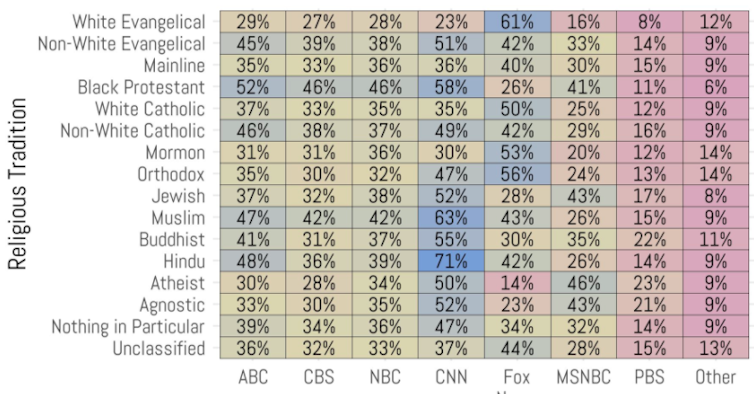
Some very interesting patterns emerged across religious traditions – and the nonreligious – and the type of media being consumed. For instance, of the the big three legacy news operations – ABC, CBS and NBC – there was no strong base of viewership in any tradition.
In most cases, about a third of people from each religious tradition said that they watched one of those legacy networks in the last 24 hours. PBS scored very low among every tradition. In most cases fewer than 15% of respondents reported watching PBS in the time frame.
graf]
however, the numbers for the three major cable news networks – CNN, Fox News and MSNBC – were much higher across the board. In eight of the 16 religious and nonreligious traditions categorized in the poll, CNN viewership was at least 50% of the sample. This was led by 71% of Hindus who watched CNN and 63% of Muslims.
The least likely group to watch CNN was clearly white evangelicals, at just 23%. In comparison, MSNBC scored lower nearly across the board. In fact, in none of the 16 classification groups was viewership of MSNBC greater than it was for CNN.
Fox News viewership was higher than that of MSNBC, but was not as widely dispersed as it is for CNN. It's no surprise, given its reputation as a conservative news outlet, that 61% of white evangelicals say that they watch Fox News – in the last election, around 80% of white evangelicals voted for Republican candidate Donald Trump. The other three traditions where viewership was at least 50% are white Catholics, Mormons and members of the Eastern Orthodox Church. It should come as no surprise, as those are three groups that consistently vote for the Republican Party. Just 14% of atheists watched Fox, which is just about in line with the share of white evangelicals who watch MSNBC.
Fracturing right-wing media
But with the fracturing of conservative media sources seeing more competitors vying for viewers among the right, Fox News could see a drop in viewership from the religious right.
In the wake of the 2020 presidential election, Fox News viewership plunged as many Trump supporters believed that the network was not being loyal to their standard-bearer of the GOP.
Given the vast number of news options that people of faith have and the increase in political polarization in the United States, the pressure for networks to deliver the news that people want to hear will only increase as time passes.
Ryan Burge, Assistant Professor of Political Science, Eastern Illinois University
This article is republished from The Conversation under a Creative Commons license. Read the original article.
FROM YOUR SITE ARTICLES
- Rep. Matt Gaetz is trying to take Fox News' Tucker Carlson down ... ›
- Jen Psaki torches Fox News' Peter Doocy: Trying to 'disprove a ... ›
- Watch: Joe Biden cracks up the room with his response to a Fox ... ›
===
==
5/20 covid see plandemic
==
==
mma
The cycle of Fox News coverage and President Donald Trump’s id repeated itself this weekend, this time involving the network’s coverage of the now-infamous blowup between Secretary of State Mike Pompeo and NPR reporter Mary Louise Kelly.
Kelly interviewed Pompeo on Friday. She asked him about Ukraine and impeachment, and he responded that he was only on to talk about Iran. After the interview, Kelly reported that Pompeo challenged her to find Ukraine on a map of the world without country labels on it. She also contends that Pompeo used profanity throughout their exchange.
After Kelly reported that, Pompeo responded with an official statement on Saturday, calling her a liar and suggesting that she confused Ukraine with Bangladesh. As many pointed out, this is ridiculous: Kelly has a masters degree in European studies from Cambridge and would not have said that Ukraine is in southeast Asia.
But Fox News took Pompeo's insult credulously, writing it up and leading its website. Fox host Mark Levin tweeted a link to the story, suggesting that NPR should no longer exist. Trump immediately agreed.
==
https://www.alternet.org/2020/01/shameful-assault-on-press-freedom-mike-pompeo-denounced-for-insulting-and-contemptuous-statement-lashing-out-at-npr-reporter/
Secretary of State Mike Pompeo lashed out at NPR reporter…
no lnx
‘Shameful assault on press freedom’: Mike Pompeo denounced for ‘insulting and contemptuous’ statement lashing out at NPR reporter
Written by Common Dreams January 26, 2020
Secretary of State Mike Pompeo lashed out at NPR reporter Mary Louise Kelly in a statement Saturday a day after she pressed Pompeo on issues including former ambassador Marie Yovanovitch and he reportedly yelled at her with expletives and demanded she identify Ukraine on a map.
In her Friday interview with Pompeo, Kelly asked about the administration’s Iran policy and pressed Pompeo about when—since he said he has “defended every State Department official”—he had done so for Yovanovitch.
He did not point to any such remarks.
Amazing clip. Pompeo: zip.
Brava, @NPRKelly and Morning Edition. I don’t get to say that very often these days, but it is justified here. pic.twitter.com/3iEHEPjCef
— Jay Rosen (@jayrosen_nyu) January 24, 2020
NPR reported,
Immediately after the questions on Ukraine, the interview concluded. Pompeo stood, leaned in, and silently glared at Kelly for several seconds before leaving the room.
A few moments later, an aide asked Kelly to follow her into Pompeo’s private living room at the State Department without a recorder. The aide did not say the ensuing exchange would be off the record.
Pompeo then went on to attempt to berate Kelly.
NPR’s Mary Louise Kelly says the following happened after the interview in which she asked some tough questions to Secretary of State Mike Pompeo. pic.twitter.com/cRTb71fZvX
— Daniel Dale (@ddale8) January 24, 2020
Pompeo, in his statement, accused Kelly of lying about having the follow-up conversation off the record, asserted her conduct was “shameful,” and called the indent “another example of how unhinged the media has become in its quest to hurt President Trump and this administration.”
He also suggested, contrary to Kelly’s account, that she did not point to Ukraine on a map. “It is worth noting that Bangladesh is NOT Ukraine,” he wrote.
Pompeo claims @NPRKelly mistakenly identified Bangladesh as Ukraine. As we evaluate what may be the most breathtakingly childish official statement ever issued by a Secretary of State in over two centuries, consider the magnitude of the mistake he implausibly claims she made: https://t.co/ShLL4eDWzn pic.twitter.com/K5WlJkIwzl
— Walter Shaub (@waltshaub) January 25, 2020
Pompeo’s remarks drew condemnation from journalists including Washington Post reporter Jason Rezaian, who called them “a shameful assault on #PressFreedom. Americans deserve a Secretary of State that is diplomatic, can answer foreign policy questions honestly, upholds our values and respects the press. This one doesn’t.”
Wired also pointed to its reporting from October that “Pompeo seems to particularly bristle under tough questioning from female reporters.”
Pompeo’s Saturday attack on Kelly also sparked five Democratic senators—Robert Menendez (N.J.), Tim Kaine (Va.), Ed Markey (Mass.), Jeff Merkley (Ore.), and Cory Booker (N.J.)—to write to Pompeo, denouncing the secretary of state’s comments as “insulting and contemptuous.”
“Instead of calling journalists ‘liars” and insulting their intelligence when they ask you hard questions you would rather not answer,” the senators wrote, “your oath of office places on you a duty and obligation to engage respectfully and transparently.”
===
==
Secretary of State Mike Pompeo lashed out at NPR reporter…
Trump hits NPR with veiled threat after Pompeo blow-up with reporter over Ukraine
President Donald Trump issued a veiled threat against National Public…
===
1/17/20
PBS new hour flattery interview with maduro opponent, ended with charming factoid he survived mudslide as child
===
==
https://www.alternet.org/2019/11/news-legend-bill-moyers-calls-on-pbs-to-televise-the-trump-impeachment-hearings-in-full-page-nyts-ad/
==
GZERO World with Ian Bremmer Television Show:{:(style="margin-right:0.25em"):}:[edit:{]}:
In each episode of GZERO World, Ian Bremmer shares his perspective on recent global events and interviews the world leaders, experts and newsmakers shaping today’s international politics.[2] Episodes conclude with "Puppet Regime," a political satire series that features puppet versions of world leaders, including Donald Trump, Vladimir Putin, Angela Merkel, Kim Jong-Un, Mark Zuckerberg, and Elizabeth Warren, among others.
“GZERO World” is distributed nationally by American Public Television, and “GZERO World with Ian Bremmer” debuted its second season on US public television nationwide on 5 July, 2019.[3] It is also produced as a podcast.[4]Funded by First Republic Bank and supported by Harold J. Newman and James and Merryl Tisch.[5]
GZERO Concept (history of GZERO)
The term G-Zero world refers to an emerging vacuum of power in international politics created by adecline of Western influence and the domestic focus of the governments of developing states.[6][7] It aims to explain a world in which there is no single country or group of countries that has ability and will, economically and politically, to drive a truly global agenda.
The term G-Zero was first coined by political scientists Ian Bremmer and David F. Gordon.[8][9] G-Zero became the main theme of Ian Bremmer's book, Every Nation for Itself: Winners and Losers in a G-Zero World. (New York: Portfolio, May 2012; revised paperback 2013). ISBN 978-1-59184-468-6.
..---
Eurasia gp (biz)
fired carter page pro putin
Bremmer hosts the weekly digital and US national public television show, GZERO World with Ian Bremmer, where he explains the key global stories of the moment, sits down for in-depth conversations with newsmakers and thought leaders, and satirizes current affairs in a segment called , featuring puppet world leaders and a puppet Ian, voiced by Bremmer. Previous guests include Rwandan President Paul Kagame, New York Times White House correspondent Maggie Haberman, EU Commissioner Margrethe Vestager, 23rd Governor of the Reserve Bank of India Raghuram Rajan, former German Foreign Minister and Vice-Chancellor Sigmar Gabriel, Emirati Youth Minister Shamma Al Mazrui, Mexico's former Foreign Minister Jorge Castañeda, retired United States Army four-star general Stanley McChrystal, and Senators Cory Booker, Marco Rubio, Rand Paul, and Chris Coons. Extended cuts of the interview are published in the GZERO World podcast.
===
https://www.alternet.org/2019/10/ralph-nader-how-corporate-power-is-locking-out-experts-and-civil-leaders-and-winning/
no lnx
Ralph Nader: How corporate power is locking out experts and civil leaders — and winning
Written by Ralph Nader / Common Dreams October 27, 2019
The lawmakers are doing it. The candidates are doing it. The mass media are doing it. All are excluding from their arenas the leading citizen groups as never before, since the early nineteen sixties. The nonprofit national advocacy/research organizations that led the way for social reforms are being shut out of the political process. These groups were pioneers in consumer rights, environmental protections, labor rights, and whistle-blower protections. These groups fought for freedom of information laws and practices and access to justice in ways that have made our country better in so many ways.
Television anchors like Judy Woodruff (The News Hour, PBS) and Chuck Todd (Meet the Press, NBC) prefer to interview reporters, political consultants or tired columnists, instead of knowledgeable civic leaders who use facts and speak truth to power.
One result of this marginalization is that the public discussion of key services and safeguards for the people is often vapid and fact-starved. For starters, the talking heads who are invited on news shows rarely, if ever, speak of the corporate crime wave, the corporate welfare scandals, or many preventable mass casualties that flow from corporate negligence and cover-ups. The few news articles on such subjects are often thin and untimely because reporters are not in regular touch with citizen groups, instead choosing to rely on irregular official leaks and occasional insider information.
Take, for example, the current discussion on Medicare-for-All or single-payer health insurance. The Democratic presidential candidates and other progressive lawmakers who support catching up with dozens of other industrial nations are not making the strongest case for this basic human right. They say that all Americans should have access to health care, referring to the unaffordable price of care.
The corporatists and some of these Democratic presidential hopefuls attack Medicare-for-All, asserting that the program would be prohibitively expensive by citing wild projections from biased think tanks. Bernie Sanders rebuts by proposing overdue restoration of higher taxes on the wealthy and big business. He asserts that whatever increases there are on the middle class would more than be made up by no longer having to pay health insurance premiums and out of pocket costs.
Moreover, most advocates of single payer do not stress the millions of ailments and injuries which persist because people cannot afford health insurance to get diagnosed and treated in a timely manner. According to the Wall Street Journal, roughly 30 million Americans are uninsured and 86 million Americans are underinsured. And about 40,000 of them die from that same deprivation each year. Such casualties due to lack of insurance do not happen in countries with universal insurance.
Furthermore, little mention is made of Canada’s far more efficient single-payer (public insurance, private delivery of care) that covers every Canadian at half the average per capita cost of that in the U.S. Canada also has free choice of doctor and hospital, in contrast to the cruel, narrow networks in the U.S.
Canada has better outcomes, less billing fraud by far and fewer casualties due to “medical error and negligence.” This is because the U.S. has a serious problem of over-diagnosis and over treatment, due to profit motives built into our chaotic, wasteful, corrupt, and profiteering system.
Single payer means one billing agent in Canada, not inscrutable bills from 1500 insurance companies with manipulated codes and discriminatory fees (for example, many hospitals charge the uninsured more in the U.S.).
In Canada, there is far less anxiety, dread, and fear about medical bills than in the U.S. Imagine what that is worth!
In the U.S. people worry that if they change jobs, they’ll lose their insurance. In Canada, physicians practice medicine, not complex bookkeeping. In the U.S., physicians plead for permission to treat their patients, while slow-paying insurance companies look out for their corporate bottom line.
The sheer administrative costs in the U.S. are, as a percentage of overall costs, more than double the administrative costs in Canada. Health care in Canada is on average less than $5000 average per capita per year; in the U.S. it has just soared over $10,000 per capita per year. Canada spends 10% of its GDP on health care and covers everyone; the U.S. is reaching 18% of GDP while leaving out tens of millions of people.
No one in Canada has to go bankrupt due to medical bills, as is the case half a million times a year in the U.S. Drug prices for the same drugs are lower in Canada than in the U.S. due to the bargaining power of Canadian single-payer system. Just in terms of correlating health care data, single payer detects what works and what doesn’t far better than the secret proprietary data of many U.S. insurance companies (which excessively compensate their executives). For example, in 2017, Aetna paid its CEO, Mark Bertolini, nearly $59 million as compensation (see the Hartford Courant article published on April 7, 2018). These salaries and compensation packages come out of your pockets, as do the co-pays, deductibles. The maddeningly complex fine-print exclusions add insult to injury.
In the U.S. people resort to GoFundMe campaigns to collect money for major operations that cost far more than they would in Canada. After all, to get the same procedures all Canadians have to do is show their Medicare card which is given to them at birth.
At the extreme, people in the U.S. commit minor crimes just to go to jail to get health insurance. Recently, a couple in their seventies in Washington state took their lives due to being so overwhelmed by their soaring medical bills.
These and other examples further illustrate the advantages of a single-payer system. These numerous points were conveyed in a printed pamphlet personally delivered to dozens of members of Congress (see “25 Ways the Canadian Health Care System is Better than Obamacare for the 2020 Elections” and singlepayeraction.org). Some of these deliveries were followed by my personal calls. To date, not one office, other than Congressman Jamie Raskin’s, acknowledged receipt. Nor have any of these lawmakers or the presidential candidates used such obvious arguments in this pamphlet or other available materials to rebut or to explain. Rarely do any media outlets present the overwhelming advantages of a single-payer health care system.
Recently, liberal columnist, Mark Shields appeared on the PBS News Hour and mindlessly characterized single payer as being too expensive.
When Medicare was established in 1965, the elderly had no trouble giving up their private health insurance plans that could at any time have been weakened, dropped, or not renewed. Just as today, workers with private company plans can be forced to accept less coverage or be laid off without any coverage. Mr. Shields seemed to have forgotten the fear that workers have about the unilateral power of companies to change the rules and delay or limit the benefits.
The foregoing case for a single-payer health insurance system is just one example of how corporate power prevails when there is media and political exclusion of the informed and experienced civic community. Speak up, people!
==
===
:{White supremacist Pat Buchanan will co-star on public television’s relaunched McLaughlin Group:(style="box-sizing:border-box"):}:
:{:(style="box-sizing:border-box;display:flex;height:1.5em;margin-right:1em;width:1.5em"):}:08/14/19
Morning Edition’s Think Tank Sources Lean to the Right
Thirty-five percent of think tank sources on NPR’s morning news show were from conservative or center-right groups, while 19 percent involved progressive or center-left groups
[grafs]
When it comes to seeking “expert” opinions on events for its reports, NPR often looks to a trusted roster of think-tank sources. In a study of NPR’s Morning Edition from February to July 2018, FAIR found that sources from left-of-center think tanks were underrepresented, with right-leaning think tank sources appearing almost twice as often.
Out of 129 episodes aired Monday through Friday over the course of six months, researchers and fellows representing think tanks were quoted 144 times. Centrist think tanks were most commonly heard on Morning Edition, with 63 interviews (44 percent of citations). Fifty-one (35 percent) of the show’s interviews were with conservative or center-right groups, while 28 (19 percent) involved progressive or center-left groups.
Representatives from two think tanks—the pro-seafood Lobster Institute and the Rich Earth Institute, which promotes turning urine into fertilizer—could not be placed on the political spectrum.
Of the 63 right-leaning interviews, we characterized 37 as featuring representatives from conservative groups—e.g., the Heritage Foundation and American Enterprise Institute—while 14 categorized ascenter-right, like the Cato Institute and Foreign Policy Research Institute. The 28 left-of-center interviews broke down into 16 from center-left think tanks (e.g., Prison Policy Initiative and Center on Global Energy Policy) and 12 with progressives like the Women’s Refugee Commission and the MLK Research and Education Institute. (Center-left think tanks were distinguished from progressive think tanks largely on the basis of their corporate underwriting.) The contrast between Morning Edition’s use of clearly conservative and clearly progressive think tanks was stark: Analysts from the former appeared more than three times as often as interviewees from the latter.
 Journalists are often advised to use caution when citing think tanks in their stories, as JournalistResource.org urged in a tip sheet for reporters:
Think tanks often provide valuable and impartial policy research. But entrenched conflicts of interest across the political spectrum, and pandering to donors, often raise questions about their independence and integrity.
FAIR has noted (e.g., Extra!, 7/13) that the funding think tanks receive from corporations, wealthy foundations and governments often shapes the agendas they push. NPR’s own Ethics Handbook employs a cautionary tone regarding the sourcing of think tanks. It stresses NPR reporters’ responsibility to be aware of such organizations’ conflicts of interest:
Before we put “experts” in our stories, we have to know where their financial support comes from, who’s paid for their latest work and whether they’re doing any lobbying or advocating related to the issue we’re interviewing them about. It’s information that may knock them out of stories and needs to be shared if they stay in.
Contrary to its code of ethics, NPRrarely if ever discloses the financial supporters of think tanks. For example, one of its most-cited think tanks, the conservative Center for Strategic and International Studies, receives funding from weapons manufacturers like Boeing and Lockheed Martin. This was not mentioned during a segment (7/13/18) on arms control negotiations between Russia and the US, even though NPR cited two different representatives from the think tank.
NPR went further into unethical territory by ambiguously sourcing the Center for Immigration Studies. Although the Center is classified as a white supremacist extremist group by the Southern Poverty Law Center, Morning Editioncited its analysts four times on immigration issues without any mention of its radical and racist ideology. Instead, NPR described the group as one that “advocates for restrictions on immigration” (3/5/18) or “favors stricter immigration enforcement” (4/23/18)—or the network chose not to characterize it at all (2/22/18). In one segment, NPR decided to quote CIS director Mark Krikorian (3/5/18), who has made numerous racist claims throughout his career, including his assertion that Haiti is “screwed up” because it “wasn’t colonized long enough.”
The centrist think tank Woodrow Wilson International Center for Scholars, along with the right-wing think tanks the Heritage Foundation and the Center for Strategic and International Studies, followed behind AEI closely as the next most cited. Curiously, Morning Edition only mentioned the political leanings of any of these think tanks once, when a representative from “the conservative Heritage Foundation” was used to balance an argument by constitutional lawyer Neal Katyal against Trump’s travel ban (4/25/18).Over six months, the most cited think tank was the right-wing American Enterprise Institute, with fellow Jonah Goldberg appearing on the air seven times to discuss a range of topics, from his most recent book to Trump’s immigration stance. NPR has long had a fixation with Goldberg (FAIR.org, 7/13/17), and it’s clear this interest has not waned. Goldberg’s affiliations with the AEI are not mentioned in these interviews; instead, he’s described as a “conservative columnist.” (AEI has provided a home for some of the most extreme members of the foreign policy establishment, including John Bolton and John Yoo, as well as giving Charles Murray a base to write the pro-eugenics book The Bell Curve.)
Fellows from conservative think tanks were given the courtesy of lengthy interviews. Morning Edition (5/15/18) dedicated an entire segment to Arthur Brooks’ opinions on the political climate when he stepped down as the president of the American Enterprise Institute. Likewise,Stephen Moore from the Heritage Foundation gave interviews in three segments,and two fellows from CSIS were each given their own interview. Only once did a left-of-center think tank receive similar attention, when NPR‘s Steve Inskeep (4/13/18) interviewed Ruy Teixeira with the liberal Center for American Progress.
The center and right dominated coverage of some of the most-covered topics in the study period. When Trump and Russia were discussed, conservative and center-right analysts appeared seven times, while those from center-left and progressive groups were interviewed only three times. On North Korea, centrist think tanks monopolized coverage, with 15 cites; analysts from right-wing think tanks commented on North Korea twice, with progressive and center-left think tanks completely shut out. Right-wing think tanks were often sought out to comment broadly on Trump administration immigration policy, while progressive think tanks were mostly brought in for analysis of specific issues, such as food stamp work requirements or the effects of rising sea level on housing markets.
According to a PEW Research study, NPR’s audience is generally left of center, with 41 percent found to be “consistently liberal” and another 26 percent being “mostly liberal.” Despite this, Morning Edition marginalized viewpoints from left-of-center think tanks. Voices from the non-corporate end of the spectrum were especially left out, with progressive analysts accounting for only 8 percent of the total—a disappointing statistic from a network that was set up to provide an alternative to corporate-sponsored media.
===
===
https://www.alternet.org/2019/03/leaked-audio-exposes-oil-and-gas-execs-laughing-with-joy-over-cozy-access-to-trump-officials/
A newly-leaked audio recording reveals that oil and gas executives in a private meeting were “giddy” with laughter in the summer of 2017 as they rejoiced over the “unprecedented access” they were being given to the highest levels of the Trump administration, boasting about their ability to have closed-door meetings with top officials and the ascendance of their own industry colleagues to some of the most powerful seats of government.
Among the topics in the recording, reports Reveal at the Center for Investigative Reporting—which was provided the audio—the oil and gas executives who belong to theIndependent Petroleum Association of America (IPAA) “are heard discussing David Bernhardt, now deputy secretary of the Interior and a former industry lobbyist.” Notably, Bernhardt—described by the executives in the recording as a close friend and industry operative—has now been nominated by President Trump to be the next Secretary of Interior, with his confirmation hearings scheduled for next week.
Lance Williams, a senior reporter for Reveal, detailed the contents of the recorded June 2017 meeting, which took place inside a Ritz-Carlton hotel conference room in Southern California, with an extensive piece for Politico‘s weekend magazine published Saturday. Williams said the “recording gives a rare look behind the curtain of an influential oil industry lobbying group” congratulating itself on their political fortunes under a friendly administration.
Williams reports:
Dan Naatz, the association’s political director, told the conference room audience of about 100 executives that Bernhardt’s new role meant their priorities would be heard at the highest levels of Interior.
“We know him very well, and we have direct access to him, have conversations with him about issues ranging from federal land access to endangered species, to a lot of issues,” Naatz said, according to an hourlong recording…
To a room full of laughter, IPAA’s CEO Barry Russell in the recording described one meeting with Scott Pruitt, the president’s EPA administrator at the time. What was expected to be a simple meet-and-greet, Russell explained, quickly became a friendly opportunity for the fellow industry insiders to provide Pruitt with a wish list for deregulation and agency rule changes. “What was really great is there was about four or five EPA staffers there, who were all like, ‘Write that down, write that down,’ all the way through this,” Russell stated. “And when we left, I said that was just our overview.”
Russell, with the room reportedly still laughing, subsequently bragged: “It’s really a new world for us and very, very helpful.”
Specifically, the IPAA and other allies were holding meetings during that period with the Interior Department, the EPA, and other agencies to reduce regulations on fracking, public lands restoration, methane restrictions, and species protection. From Politico:
At the meeting, the association’s leaders distributed a private “regulatory update” memo that detailed environmental laws and rules that it hoped to blunt or overturn. The group ultimately got its way on four of the five high-profile issues that topped its wish list.
Trump himself was a driving force behind deregulating the energy industry, ordering the government in 2017 to weed out federal rules “that unnecessarily encumber energy production.” In a 2017 order, Zinke called for his deputy secretary—Bernhardt—to make sure the department complied with Trump’s regulatory rollbacks.
The leaked recording comes in the wake of reporting by journalist Andrew Perez of Maplight on Fridayrevealed that Bernhardt and the lobbying firm he once worked for, Brownstein Hyatt Farber Schreck, have donated almost a million dollars over the last five years to the very senators who will soon vote on his confirmation.
According to Perez:
A MapLight review of campaign finance data found that Bernhardt, Brownstein Hyatt employees and the firm’s political action committee contributed more than $225,000 to members of the Senate Energy and Natural Resources Committee between 2013 and 2018. The panel will hold a hearing on his nomination next week.
The firm and its employees also donated more than $960,000 to current members of the Senate, who will cast the final vote on Bernhardt’s confirmation.
Colorado’s senators, Democrat Michael Bennet and Republican Cory Gardner, were the top recipients of cash from Brownstein Hyatt, which has a major lobbying presence in Denver. The third-biggest haul went to Senate Majority Leader Mitch McConnell, R-Ky. Bennet voted to confirm Bernhardt as deputy secretary but has announced he will oppose his nomination to lead the agency.
Asked to comment on the audio recording of the IPAA meeting, Nada Culver, senior counsel for the Wilderness Society, told Politico that the lobby group’s access ultimately resulted in attaining much of what it wanted from the Trump administration. “The IPAA’s wish list was granted as asked, in the executive order, and in the actions taken by the Department of the Interior,” Culver said. “It pains me to say it.”
With Bernhardt’s confirmation hearing set for next week, environmental groups are rallying constituents to call their senators to reject the nominee.
As Anne Hawke of the NRDC told her group’s members this week, “Bernhardt’s sorry record in protecting America’s natural resources, wildlife and waters makes him uniquely unfit for the job, and we urge you to call on lawmakers to reject his nomination.”
President Trump, the Hawke further warned, “is handing over the future of our public lands, wildlife, waters and all they support to a man who has made a living for decades attacking all of that to benefit some of the biggest industrial polluters on the planet.”
===
NRATV, the media arm of the National Rifle Association, had a crazy week.
They kicked the week off by going after the children’s show Thomas & Friends. Feel free to read that last sentence again. The show had partnered with the United Nations to promote equal opportunities, introducing two female characters, one of them depicted as being from Kenya. This set off alarms for NRA spokesperson Dana Loesch. Not only did she lash out at the message they were trying to convey, they ran a graphic depicting the trains wearing KKK hoods as they rode on flaming tracks. Mattel, which owns the Thomas brand, issued a statement saying that inclusivity was a priority.
The next day Loesch suggested that Botham Jean, an innocent black man who was killed in his own apartment by a Dallas police officer, would have survived had he been a “law abiding gun owner.”
Defending her remarks about Jean, Loesch invoked Philando Castile’s death, lying about the events that transpired. Castile was killed by a police officer during a routine traffic stop after telling the officer that he had a gun in his possession. Loesch, in addition to getting the events wrong, said that Castile would be alive if he had behaved like she would have. Castile’s mother again called out Loesch and the NRA.
After Trump tweeted a conspiracy theory this week that the death toll from Hurricane Maria in Puerto Rico wasn’t as high as was now being reported, a new low even by his standards, NRATV host Grant Stinchfield came to the president’s defense, calling the death toll numbers bogus.
It is clear that the NRA's racism is a core part of its strategy. They are invested in the regime of white supremacy, and deeply fear that a changing America would take a fresh look at widespread gun violence -- and what could be done about it.
Also: Tucker Carlson keeps pushing white nationalist talking points on his show, and white supremacists are thrilled with him.
===
==
https://www.alternet.org/trump-fans-accuse-npr-taxpayer-funded-partisan-advocacy-after-it-tweets-out-declaration-independence
Fourth of July, which means it’s time, once again, for patriotic displays of deep-rooted American traditions. Across the nation, citizens will gather to celebrate the birth of the nation with fireworks and apple pie; and they will watch, once again, as Donald Trump supporters accuse National Public Radio of inciting a treasonous uprising against the president by tweeting out the Declaration of Independence.
As per it’s own annual tradition, NPR last year tweeted out the Declaration of Independence line-by-line—a seemingly innocuous tribute to the nation’s founding document, which outlined the thirteen original colonies’ intention to separate from the Kingdom of Great Britain.Defenders of the president attacked NPR for “calling for a revolution” by tweeting phrases like “A Prince whose character is thus marked by every act which may define a Tyrant, is unfit to be the ruler of a free people.”
Many patriots remembered last year’s MAGA-snafu, and pulled up front row seats to this year’s explosive fireworks display:
many eg twits
===
frontline doc on betsy devos? also work w/ pro publ on alt rt (broadcast?)
but
I watched the documentary twice, preparing to be interviewed by Channel 13, and was repelled by the partisan nature of the presentation. I googled the funders and discovered that the lead funder is the Rose Mary and Jack Anderson Foundation, a very conservative foundation that is a major contributor to the Friedman Foundation for Educational Choice, which advocates for vouchers. The Anderson Foundation is allied with Donors Trust, whose donors make contributions that cannot be traced to them. Mother Jones referred to this foundation as part of “the dark-money ATM of the conservative movement.” Other contributors to Donors Trust include the Koch brothers’ Americans for Prosperity and the Richard and Helen DeVos Foundation.
The second major funder is the Prometheus Foundation. Its public filings with the IRS show that its largest grant ($2.5 million) went to the Ayn Rand Institute. The third listed funder of “School Inc.” is the Steve and Lana Hardy Foundation, which contributes to free-market libertarian think tanks.
In other words, this program is paid propaganda. It does not search for the truth. It does not present opposing points of view. It is an advertisement for the demolition of public education and for an unregulated free market in education. PBS might have aired a program that debates these issues, but “School Inc.” does not.
==
http://www.alternet.org/environment/pbs-only-network-reporting-climate-change-and-trump-wants-cut-it
Media Matters for America has published its annual review of American evening newscast climate coverage for 2016, and the results are stunning:
In 2016, evening newscasts and Sunday shows on ABC, CBS, and NBC, as well as Fox Broadcast Co.’s Fox News Sunday, collectively decreased their total coverage of climate change by 66 percent compared to 2015
In all of 2016, these news programs spent a combined grand total of 50 minutes talking about climate change. More than half of that come from CBS Evening News, which nevertheless only spent half as much time talking about climate change in 2016 as it had in 2015.
It’s certainly not as though 2016 lacked newsworthy climate stories. We learned in January that 2015 had smashed the record for hottest year, previously set just a year earlier. And 2016 just kept getting hotter, with nearly every month setting a new heat record. In September, the US and China agreed to formally ratify the Paris climate agreement. The list goes on and on, with newspapers like The Guardian constantly publishing important climate-related news throughout the year.
During 2016 there was also an ongoing presidential campaign in which the candidates’ views on climate science and policy should have been featured prominently. Unfortunately, climate change was rarely raised in the primary debates, and never in the general election debates. In fact, on Sunday news programs, Bernie Sanders brought up climate change four times more often than the program hosts.
Only after the election did news networks finally examine what a President Trump would mean for the Earth’s climate:
ABC, CBS, NBC, and Fox News Sunday did not air a single segment informing viewers of what to expect on climate change and climate-related policies or issues under a Trump or Clinton administration. While these outlets did devote a significant amount of coverage to Trump’s presidency, airing 25 segments informing viewers about the ramifications or actions of a Trump administration as they relate to climate change, all of these segments aired after the election.
As Senator Brian Schatz (D-HI) noted, this was a dismal failure by the American news networks:
In a year when the American people were deciding who our next leader should be, you would think there would have been more discussions about climate change in our news programs, not less. This isn’t just shameful, it’s irresponsible. The climate is changing, and it’s affecting everything from the weather to our national security and our economy. Its impacts are already being felt and the American people deserve to know more about it.
PBS was the oasis in this desert of climate news coverage. PBS NewsHour was the only show that examined what impact a Trump or a Clinton presidency would have on climate-related issues and policies before the election. The PBS news program aired more than double the number of climate news segments as any of its network competitors, and interviewed or quoted three times more scientists than even CBS Evening News. ABC World News Tonight failed to interview or quote a single scientist about climate change.
Perhaps unsurprisingly given his climate denial, Trump’s proposed budget would completely defund the Corporation for Public Broadcasting, which partially funds PBS. About half of that federal funding goes to local PBS stations that broadcast PBS NewsHour. Some of those stations – especially those in rural areas which rely particularly heavily on federal funding – would likely have to shut down, were Trump to get his budgetary wish.
With so little news coverage on the subject, it’s also unsurprising how confused Americans are about climate change—just 49% of Americans realize that most scientists think global warming is happening, and only 53% understand that humans are causing the problem. While concern among Americans about global warming is at an eight-year high, only 64% worry a great deal or fair amount.
That’s entirely understandable – if our leaders deny the problem, and our news networks don’t report on it, Americans are lacking the information signaling that global warming is an urgent threat. That’s why, although Americans (including Trump voters would prefer that their political leaders take steps to address the problem, they don’t few it as a high priority, and thus aren’t bothered by the lack of political action....
==
punked?
On November 7th, a train carrying ethanol in DOT-111 tank cars derailed in Wisconsin, resulting in rail cars rupturing and a spill of 18,000 gallons of ethanol into the Mississippi River.
The next day, a train carrying Bakken crude oil derailed in a residential area in Watertown, Wisconsin, resulting in a spill of around 1,000 gallons of oil.
These two spills provide another stark reminder of the dangers of moving oil and ethanol along waterways and through residential areas.
It also apparently provided an opportunity for National Public Radio (NPR) to push multiple oil and rail industry talking points. And the article on NPR's website notes NPR is sponsored by America's Natural Gas (ANGA).
==
http://www.radiodiaries.org/the-man-who-put-the-p-in-npr/
---
frontline icn exxon study early, high quality "monster" data
tanker pjt, then scaled back, did modelling
then GCC 1986-9 shift in thinking, new ppl
http://www.democracynow.org/2015/9/24/inside_exxons_great_climate_cover_up
==
frontline montana crackhouse ATI
===
sesame st goes to hbo
http://www.alternet.org/culture/even-sesame-street-gentrified-now-tv-show-drops-its-radical-notion-urban-working-class-are
==
omg:
see also tomlinson
http://www.sourcewatch.org/index.php/Kenneth_Tomlinson
Kenneth Y. Tomlinson was renominated November 14, 2006, by President George W. Bush as chairman of the Broadcasting Board of Governors for a term on the board expiring August 13, 2007, "even though the nomination has been stalled in the Senate amid allegations of misconduct." [1]
In November 2005, Tomlinson resigned as chairman of the Corporation for Public Broadcasting (CPB), a position to which he was elected in September 2003. [2][3] Tomlinson's resignation was due to adverse findings of an internal investigation by the CPB Inspector General, Kenneth Konz, into Tomlinson's controversial use of outside "bias ratings" to make executive decisions regarding shows such as NOW with Bill Moyers. Findings from the investigation were released in a November 15th, 2005 report in which Konz found Tomlinson had violated statutory provisions and the board's code of ethics in regards to how he dealt with programmers creating new public affairs programs. Konz also states Tomlinson improperly reviewed shows and applied political tests when seeking a CEO and president for the CPB. [4]
In a statement released ahead of the report announcing Tomlinson's resignation, the board said:
"The board does not believe that Mr. Tomlinson acted maliciously or with any intent to harm CPB or public broadcasting, and the board recognizes that Mr. Tomlinson strongly disputes the findings in the soon-to-be-released Inspector General's report...Nonetheless, both the board and Mr. Tomlinson believe it is in the best interests of the Corporation for Public Broadcasting that he no longer remain on the board." [5]
Contents
- 1 Background
- 2 Tomlinson's Role at CPB
- 3 Scrutiny of Tomlinson's Role at BBG
- 4 Book
- 5 SourceWatch Resources
- 6 External links
===
In January 1989 the R.J.Reynolds Tobacco Company (RJR) was desperately trying to salvage its 'smokeless' Premier cigarette from marketing oblivion. On behalf of RJR Matt Swetonic, then a Senior Vice President in Hill & Knowlton's New York office, set out to court Kenneth Tomlinson, the then Executive Editor of Readers Digest, in the hope of garnering favorable media coverage. (These days Tomlinson is the controversial Chairman of the Corporation for Public Broadcasting).
For RJR the attraction of pitching the Premier story to the Readers Digest was precisely because for decades it had relentlessly highlighted the deadly impact of smoking. Favorable media coverage of Premier could not only undermine tobacco control activists arguments against cigarettes but could help reverse the relentless march to market share dominance of Philip Morris's Marlboro brand.
For well over a year Swetonic had been unsuccessfully pushing RJR for authorisation to set up a meeting with the Readers Digest. Finally in October 1988 Swetonic got the go ahead. "Approach Readers Digest (thru Swetonic) re: interest in article on full results of study," a schedule for a PR plan noted.
In mid-January 1989 Swetonic met Tomlinson at a meeting of the Cub Scouts. In a briefing note to RJR, Swetonic noted that after he mentioned a September 1988 New York Times editorial on Premier, Tomlinson requested a sampling of newspaper clippings. "I felt it important that we not be perceived as trying to hide the 'negative' publicity on Premier," he wrote in a memo. While the sample clips included some that were "negative," Swetonic reported that "articles on its 'taste', 'smell' and consumer acceptance, on the other hand, did not seem to be important, considering the attributes that the Digest appeared to be most interested in."
==
part time, down from 4
NPR Reduces Its Environment Team to One Reporter," InsideClimate News, 10-24-2014
http://act.forecastthefacts.org/go/894?t=6&akid=620.100725.VGuUmi
"NPR Guts Its Environment And Climate Reporting Team, Becomes 'Part of the Problem'," Think Progress, 10-24-2014
http://act.forecastthefacts.org/go/895?t=8&akid=620.100725.VGuUmi
"Washington Post Gets (More) Serious About Climate Change, Hires Chris Mooney to Blog," Think Progress, 10-5-2014
http://act.forecastthefacts.org/go/896?t=10&akid=620.100725.VGuUmi

NPR Reduces Its Environment Team to One Reporter
NPR has cut back on the number of staffers focused solely on the environment and climate change.
===
punked by entine re roddick?
Scott Simon (born March 16, 1952)[1][2] is an American journalist and the host ofWeekend Edition Saturday on National Public Radio. He also guest-hosts Need to Know (PBS). In 2013, Scott received a great deal of positive attention[3] when he started tweeting from his mother's deathbed.[4]
Contents
Life and career:{:(style="margin-right:0px;margin-left:0px"):}:[edit:{]}:
Simon was born in Chicago, Illinois, the son of comedian Ernie Simon and actress Patricia Lyons.[5][6][7] He also had a sister who died at a young age.[8] He grew up in major cities across the United States and Canada, including Chicago, New York, San Francisco, Los Angeles, Montreal, Cleveland, and Washington, D.C.[6] After his father died, his mother married Ralph G. Newman, a former minor league baseball player and American Civil War scholar and author who ran the Abraham Lincoln Bookshop in Chicago.[9][10]
Simon's first book, Home and Away: Memoir of a Fan, was published in the spring of 2000, and his second, Jackie Robinson and the Integration of Baseball, was published in 2002. Simon has written a book – Baby, We Were Meant for Each Other: In Praise of Adoption – about his family's experiences. He is also the author of two novels: Pretty Birds (2005) and Windy City: A Novel of Politics(2008).
Simon has hosted BBC World News America, filling in for Matt Frei.[Authentication required.] In 1992-1993, Simon was the anchor ofNBC's Weekend Today.
In May 2010, Simon was awarded an Honorary Doctor of Humane Letters degree from Willamette University where he was the keynote speaker for that year's commencement exercises.[11]
After September 11, 2001, Simon spoke and wrote in support of the "war on terror." Simon wrote an op-ed for the October 11, 2001 Wall Street Journal, "Even Pacifists Must Support This War."[12] Simon questioned nonviolence at greater length in the Quaker publication Friends Journal in December 2001, provoking many angry letters, to which Simon replied in the May 2003 edition.
Family:{:(style="margin-right:0px;margin-left:0px"):}:[edit:{]}:
Simon met French documentary filmmaker Caroline Richard during an NPR interview in 2000. They married September 10, 2000, in a mixed faith (Methodist, Quaker, and Jewish) service in Ridgefield, Connecticut, at the home of fashion designer Alexander Julian.[1]They have two daughters, both adopted as babies from China; the first, Elise, in 2004,[13][14][15] and the second, Lina, in 2007.[16]They consider themselves a Jewish family (Simon's father was Jewish and his mother was of Irish Catholic background).[14][17] Simon and his wife were contacted by police as part of the Alexander Litvinenko poisoning. The family was staying at a hotel near the restaurant at the center of the poisoning incident, and had twice bought food there for their young daughter. The health of the family was not affected.[18]
==
PBS only network to mention TPP, but only once
---
http://www.pbs.org/wgbh/pages/frontline/environment/climate-of-doubt/transcript-31/
Myron Ebell on PBS Frontline: "Climate of Doubt"
October 25, 2012 (broadcast 23rd. kinda sad singer?) Hockenberry
A growing number of Americans doubt the urgency or existence of man-made global warming. On Tuesday, October 23, PBS Frontline took a look at the men and women who have helped shift public opinion---chief among them, CEI's Myron Ebell.
Myron Ebell responds to Frontline in a CEI LibertyWeek Podcast here. Watch "Climate of Doubt" yourself and tell us what you think on Twitter or Facebook. Was Frontline fair to questioners and dissenters?
---
heartlandL horner, cmonk, james tayor, myron ebell (ppl who dig and grow stuff on our side)
Climate of Doubt
CORRESPONDENT
John Hockenberry
WRITTEN BY
Catherine Upin and John Hockenberry
PRODUCED AND DIRECTED BY
Catherine Upin
NEWSCASTER: Chicago is now under full national security.
NEWSCASTER: A no-fly zone is in effect.
JOHN HOCKENBERRY, PRI’s The Takeaway: [voice-over] It was a big weekend in Chicago. Last spring, the president was in town, along with the leaders of NATO, to discuss threats to global security and nuclear proliferation. At a huge convention center, the eyes of the world were watching.
But across town in a small hotel ballroom, the fate of the world was also on the agenda. The eyes of the world might have missed this gathering.
SPEAKER: Get ready for your Al Gore snow job!
JOHN HOCKENBERRY: The message here is that man-made global climate change is a myth, a hoax. This conference is an annual pilgrimage for the key skeptics. We came here to understand how they have made their views a mainstream fact of American politics.
They think of themselves as rebels up against the biggest players in science, government and the media.
JOE BAST, President, Heartland Institute: —wind and solar are based on public fear of global warming, and the mainstream media has pretty much given up its role as an independent reporter on these things and has become an advocate.
MYRON EBELL, Competitive Enterprise Institute: If you add up all of the resources of our side of the debate and all of the resources of the other side of the debate, this is a David versus Goliath story.
JOHN HOCKENBERRY: [on camera] You’re doing pretty well.
MYRON EBELL: There are holdouts among the urban bicoastal elite, but I think we’ve won the debate with the American people in the heartland, the people who get their hands dirty, people who dig up stuff, grow stuff and make stuff for a living, people who have a closer relationship to tangible reality, to stuff.
We need to keep banging away on the science—
JOHN HOCKENBERRY: [voice-over] Myron Ebell chairs a group called the Cooler Heads Coalition, one of a team of skilled policy advocates driving a remarkable turnaround that has already changed the U.S. political landscape.
CHRISTOPHER MONCKTON, Science and Public Policy Institute: Warming isn’t, in fact, accelerating. In fact, there’s been none for 15 years.
JOHN HOCKENBERRY: There’s Christopher Monckton, a big draw at these meetings, who brings the skeptics to their feet every time.
CHRISTOPHER MONCKTON: God bless America!
JOHN HOCKENBERRY: Republican congressman James Sensenbrenner of Wisconsin, vice chairman of the House Science Committee.
Rep. JAMES SENSENBRENNER (R-WI), Vice Chair, Cmte. on Science, Space & Technology: Paul Krugman accused my colleagues and me of treason against the planet. [laughter]
JOHN HOCKENBERRY: There’s Chris Horner from the Competitive Enterprise Institute, and James Taylor, senior fellow at the Heartland Institute, organizer of this gathering.
JAMES TAYLOR, Heartland Institute: The debate indeed is over!
In the years prior to 2007, the 2008 elections, we actually heard from many folks that we should tone it down on global warming, we should not talk about the issue, because the court of public opinion had already decided and we were on the losing end. But we believe that if we present the case to the American people and it resonates, if they get it, then that’s going to work its way up the political stepladder.
JOHN HOCKENBERRY: [on camera] You’ve really changed the game on global warming.
JAMES TAYLOR: Oh, I certainly hope so.
JOHN HOCKENBERRY: [voice-over] These political messengers rely on a small group of outspoken scientific contrarians, like climatologist Pat Michaels of the libertarian Cato Institute.
PATRICK J. MICHAELS, Cato Institute: Every paragraph can be contested.
JOHN HOCKENBERRY: Willie Soon is an astrophysicist who studies the sun and stars.
WILLIE SOON: —mechanism to transport anything from the tropics to the arctic—
JOHN HOCKENBERRY: And Fred Singer, the veteran scientist at these proceedings. He’s a retired physicist once responsible for government weather satellites, who tells people the climate needs no help from worried humans.
FRED SINGER, Founder, Science and Env. Policy Project: Climate, to me, has become a non-issue. It’s a phantom issue. There’s nothing wrong with climate. It will change no matter what we do. It’ll get colder. It’ll get warmer. We just have to wait a little.
JOHN HOCKENBERRY: Singer says he’s dedicated to explaining his theories about global warming.
[on camera] What keeps you going? What’s your motivation?
FRED SINGER: Basically, I like to see good science being done and protected. I think I’m fighting here for scientific truth. That’s important to me.
JOHN HOCKENBERRY: Do you think the science is being hyped on global warming?
FRED SINGER: Oh, very definitely, yes.
JOHN HOCKENBERRY: [voice-over] Armed with that conviction, this team of skilled political messengers and contrarians has certainly changed the game. In just four years, the number of Americans who agree global warming is manmade has dropped to about half. It’s a message that is inspiring a new generation of skeptics.
CONFERENCE GOER: I would like to (INAUDIBLE) these scientists who came and talked and have dedicated their lives to debunking this fallacy, so to speak.
JOHN HOCKENBERRY: Once upon a time, what these people call a fallacy had another name, the truth.
AL GORE, Fmr. Vice Pres.: ["Inconvenient Truth"] You’ve heard of off the charts. Within less than 50 years, it’ll be here. The so-called skeptics—
JOHN HOCKENBERRY: In 2006, the film An Inconvenient Truth told a disturbing story and galvanized public awareness about the climate.
BRIAN WILLIAMS, NBC News: And now to a new report on global warming from a prestigious panel of scientists convened by the U.N.—
WOLF BLITZER, CNN: There’s a new grim report out today from—
JOHN HOCKENBERRY: This comprehensive report in 2007 took it to another level. Scientists from 30 nations concluded that global warming is unequivocal and that human activity is mostly the cause.
SAM CHAMPION, ABC News Weather Editor: It is the definitive report on global warming, and it’s frightening.
NOBEL CEREMONY: I call upon the Peace Prize laureate for 2007, Al Gore, to come forward—
JOHN HOCKENBERRY: The U.N. scientists and former vice president Al Gore would share the Nobel Peace Prize. The cause had a consensus and a credible leader. The skeptics would take on both.
JAMES TAYLOR: I think Al Gore was probably the best thing that could happen to global warming skeptics.
MYRON EBELL: From my perspective, Al Gore was the perfect proponent and leader of the global warming alarmists because he’s very politically divisive and controversial.
TIM PHILLIPS, Pres., Americans for Prosperity: I think it was his tone and manner. He did at a certain point come across as holier than thou. And that’s another thing about Americans. They’re not really big on holier than thou.
SEAN HANNITY, Fox News Channel: Now, that is a G2-V aircraft—
JOHN HOCKENBERRY: Personalizing the attacks was part of an approach that was immediately embraced and amplified by friendly media.
SEAN HANNITY: And that is the former vice president getting off that plane, into a Town Car, by the way, not a hybrid!
CHRIS HORNER, Competitive Enterprise Institute: He equates the failure to recycle aluminum cans with the Holocaust!
MYRON EBELL, Competitive Enterprise Institute: He wants to be a superhero action figure.
JOHN HOCKENBERRY: Myron Ebell was acting on a broad strategy he helped create more than a decade ago. In this 1998 action plan, “Victory will be achieved,” it said, when the public “recognizes uncertainties in climate science.”
Today at the Washington, D.C., headquarters of the Competitive Enterprise Institute, a free market think tank, you can see Myron Ebell’s philosophy proudly displayed on the walls.
MYRON EBELL: They’re all CEI authors. What we’re fighting is the expansion of government. And there are many pretexts for expanding government.
JOHN HOCKENBERRY: Opposing government action on climate change to defend American freedom is a perfect fit.
MYRON EBELL: We felt that if you concede the science is settled and that there’s a consensus, you cannot— the moral high ground has been ceded to the alarmists.
JOHN HOCKENBERRY: [on camera] So you had to go to work and break down this consensus.
MYRON EBELL: Yes. And we did it because we believed that the consensus was phony. We believed that the so-called global warming consensus was not based on science, but was a political consensus, which included a number of scientists.
JOHN HOCKENBERRY: [voice-over] In 2009, agreement on global warming seemed part of the solid wave of enthusiasm that elected Barack Obama. With the changing of the guard in Washington, there was a bipartisan call to action, a sense of inevitability.
HOUSE SERGEANT AT ARMS: Madam Speaker, the president of the United States!
JOHN HOCKENBERRY: An idea that for years had struggled for attention in Congress would get its moment of truth.
Pres. BARACK OBAMA: So I ask this Congress to send me legislation that places a market-based cap on carbon pollution—
JOHN HOCKENBERRY: The president backed the so-called cap-and-trade approach, a system of regulations and financial incentives to eventually reduce the emission of carbon into the atmosphere.
[on camera] It seemed there was consensus on climate change.
Sen. JOHN KERRY (D), Massachusetts: There was an uneasy consensus, but the people who have always objected to change had not yet really engaged. And because of the consensus, because there was a sense that there was going to be movement, that galvanized the action of the people who oppose it.
MYRON EBELL: The American people hadn’t focused on these issues until it actually came to a vote in Congress on a bill to implement these policies.
JOHN HOCKENBERRY: [voice-over] The soft consensus for taking action ran into the bitter partisan divisions in Congress. Congressional hearings on cap-and-trade would become a stage where opposing views would get equal time.
Rep. EDWARD MARKEY (D-MA), Chair, Subcmt. on Energy & Environment: Professor Schrag, you’ve just heard what Dr. Michaels said—
JOHN HOCKENBERRY: Pro cap-and-trade lawmakers would call leading climate scientists and policy makers to make the argument for action now.
Prof. DANIEL SCHRAG, Earth and Planetary Sciences, Harvard Univ.: It’s very clear from that estimate that, in fact, we’re in for bigger trouble.
THOMAS R. KARL, Dir., NOAA’s National Climatic Data Center: One of the things that we’ve already seen is many observed changes in the climate—
Gen. GORDON R. SULLIVAN (Ret.), Assn. of the United States Army: Global climate change is a serious threat to our national security.
JOHN HOCKENBERRY: The skeptics had their own witnesses. They testified that nothing was settled and that global warming might actually be good for the planet.
Rep. JOHN SHIMKUS (R), Illinois: Say that again? Carbon dioxide is what?
CHRISTOPHER MONCKTON: It’s plant food.
Rep. JOHN SHIMKUS: It’s plant food.
CHRISTOPHER MONCKTON: Yes.
JOHN HOCKENBERRY: The testimony of the skeptics argued for a timeout. There was enough uncertainty, they said, to justify delay.
CHRISTOPHER MONCKTON: The right response to the non-problem of global warming — first slide, please — is to have the courage to do nothing.
E. CALVIN BEISNER, Cornwall Alliance for the Stewardship of Creation: But the fear of catastrophic man-made global warming is mistaken.
PATRICK MICHAELS: This demonstration shows that the oft-reported mantra in Washington, quote, “The science is settled,” is not true at all.
JOHN HOCKENBERRY: Skeptics had found a seat at the table, but the scientific consensus still had the momentum. When cap-and-trade came up for a vote in the House in 2009, it passed with eight Republicans on board.
PRESIDING OFFICER: The bill is passed!
MYRON EBELL: The Waxman-Markey cap-and-trade bill passed the House very narrowly, 219 to 212. The members of the Senate, who were going to take it up in July, went home for the 4th of July recess, and they got an earful from their constituents.
Sen. CLAIRE McCASKILL (D), Missouri: You don’t trust me?
CROWD: No!
CONSTITUENT: Let’s talk about some of your other votes, such as cap-and-trade.
CONSTITUENT: We are not for more government!
JOHN HOCKENBERRY: The tea party saw a frightening expansion of government in the health care plan and the push for cap-and-trade.
CONSTITUENT: You’re a traitor, Lindsey Graham! You’ve betrayed this nation and you betrayed the state!
Rep. JAMES SENSENBRENNER (R), Wisconsin: The people of this country were really not concerned one way or the other on this issue until the economy started going south in 2008.
JOHN HOCKENBERRY: [on camera] Was that an opportunity to push back on climate change, the recession?
Rep. JAMES SENSENBRENNER: It sure was.
TIM PHILLIPS: [rally] I’m Tim Phillips, president of Americans for Prosperity. We’re here in Billings, Montana—
JOHN HOCKENBERRY: What part did you play?
TIM PHILLIPS: We certainly did TV ads, radio ads, social media. We did rallies, events. We launched something we called Hot Air.
And we’re sending a message to Senator Baucus and Senator Tester to vote no on this job-killing, tax-increasing cap-and-trade!
We got up a hot-air balloon, put a banner on the side of it that said, “Cap-and-trade means higher taxes, lost jobs, less freedom.” And we went all over the country doing events and stirring up grass roots anger and frustration, concern.
TELEVISION COMMERCIAL: Cap-and-trade will slow the economy and cost American jobs.
JOHN HOCKENBERRY: [voice-over] Americans for Prosperity’s well-financed campaign was an aggressive one, ads that went after cap-and-trade policy—
TELEVISION COMMERCIAL: America can’t afford the cap-and-trade tax.
JOHN HOCKENBERRY: —and said the science was a hoax.
TELEVISION COMMERCIAL: Congress should stop wasting our money and focus on real problems!
TELEVISION COMMERCIAL: Isn’t it time Congress listened to the rest of us?
JOHN HOCKENBERRY: In the tea party’s anti-tax, anti-big government message, you could now hear the skeptic mantra attacking climate science and cap-and-trade.
TEA PARTY RALLY SPEAKER: —cap-and-trade and taxing America to death and our children—
JOHN HOCKENBERRY: At some tea party events, global warming skeptics were a big draw.
TEA PARTY SPEAKER: It gives me great pleasure to welcome Lord Monckton!
JOHN HOCKENBERRY: Introduced like a professional wrestler, Christopher Monckton is a former British journalist who admits he has no scientific qualifications.
CHRISTOPHER MONCKTON, Competitive Enterprise Institute: Now we are met on a great battlefield of a new civil war!
JOHN HOCKENBERRY: But here, whipping up the crowd is his indisputable expertise.
CHRISTOPHER MONCKTON: —know that in American-speak, you have a word for global warming. Can someone tell me what it is?
CROWD: Bull-[expletive deleted]!
CHRISTOPHER MONCKTON: All together! Global warming is?
CROWD: Bull-[expletive deleted]!
JOHN HOCKENBERRY: Events like these fertilized the growing public doubt about climate change that was beginning to register with senators. With widespread anxiety over a shrinking economy, cap-and-trade was tabled in the Senate. The momentum towards action on global warming was vanishing.
TIM PHILLIPS, Pres., Americans for Prosperity: I often say if you ever wonder as an activist on our side, are you making a difference, just look at cap-and-trade. January of ‘09, we had a president with 60 votes in the Senate and then Speaker Pelosi with a 50-plus seat majority. And cap-and-trade was at the top of their agenda. And in the end, they were beaten.
JOHN HOCKENBERRY: [on camera] You’ve said, “If we win the science argument, I think it’s game set and match.”
TIM PHILLIPS: Uh-huh.
JOHN HOCKENBERRY: Why do you want to win the science argument?
TIM PHILLIPS: If the science argument is won, I do think it would, you know, pull out the final underpinning of this legislative effort and this regulatory effort the left is undertaking.
JOHN HOCKENBERRY: [voice-over] Diminish the credibility of the scientific consensus, and action on climate change grinds to a halt. At a conference in Long Island, we witnessed how these skeptics build their message of doubt. We once again saw Fred Singer—
FRED SINGER, Founder, Science and Env. Policy Project: This is a conference mainly for medical doctors—
JOHN HOCKENBERRY: —delivering his message to a group of physicians who seemed eager to hear it.
FRED SINGER: —tell me that there hasn’t been any perceptive trend. We essentially get no warming trend—
In the last 10 years, there hasn’t been a warming. We don’t know why that is. But one doesn’t see any warming in the observations. There simply is no trend.
JOHN HOCKENBERRY: No warming in the last 10 years? No long-term trend? Climate scientists would say that’s playing games with the data.
ANDREW DESSLER, Climate Scientist, Texas A&M University: You can, if you want, very carefully select the end points of your time series, the starting month and the ending month, and you can come up with— maybe you can come up with something that shows no warming.
JOHN HOCKENBERRY: In a sense, what Dessler saying is that you can do this at home. On a complex chart, depending on the beginning points X and ending points Y, you can select a trendline that does indeed show temperature going down.
[on camera] Could I pick 10 years of world history and show a climate cooling?
GAVIN SCHMIDT, Climate Scientist, NASA Goddard Institute: Oh, you could totally do that! In fact, you could take the entire climate history that we have in the instrumental record and you could find cooling trends every 10 years.
JOHN HOCKENBERRY: [voice-over] Cooling trends between 1958 and 1969, 1969 and 1978, 1978 and 1987, and so on. Scientists have a name for this. They call it “going down the up escalator.”
GAVIN SCHMIDT: You pick the end points and you could find any particular year as part of a cooling year. But actually, the whole thing has been moving up.
ANDREW DESSLER: If you look at all of the data, it’s quite clear that the warming is continuing.
KATHARINE HAYHOE, Climate Scientist, Texas Tech Univ.: So the 2000s was the warmest decade on record. The 1990s was the warmest decade before that, the 1980s before that. And most of us in the field of climate science expect, but we can’t be sure— we expect that the 2010s will be warmer than the 2000s.
JOHN HOCKENBERRY: Against the backdrop of all the pressure from skeptic groups, Congress ordered a comprehensive review of climate change research by the National Academy of Sciences. The findings came back even stronger on human-caused climate change, and a subsequent study showed 97 percent of active climate scientists agreed.
[on camera] What’s settled here on climate change?
RALPH CICERONE, Pres., National Academy of Sciences: Virtually every place on earth is warming up. And people who have tried to go back and scrub the data — like, is there a mistake with the way they’re making these measurements — they’ve all concluded, no, the people who are doing this work at the key places around the world are agreeing with each other.
JOHN HOCKENBERRY: What’s the bottom line, though, on human-caused global warming? I raise my hand in a high school science class and you’re the teacher. Are humans causing the global warming we’re seeing? What’s your answer?
RALPH CICERONE: Mostly. Yeah. Scientists are trying to shoot it down all the time, and in years and years and years, nobody’s been able to. So at some point, you have to say maybe it’s right.
JOHN HOCKENBERRY: [voice-over] Here’s what the National Academy of Sciences report actually says.
[on camera] “Climate change is occurring and is largely caused by human activities and poses a significant risk for a broad range of human and natural systems.” You say that’s false?
FRED SINGER, Founder, Science and Env. Policy Project: Yes.
JOHN HOCKENBERRY: False?
FRED SINGER: False.
JOHN HOCKENBERRY: And if most of the climate scientists believe that statement, they’re deluded?
FRED SINGER: Yes.
JOHN HOCKENBERRY: And you’re seeing something they’re not seeing?
FRED SINGER: Yes.
JOHN HOCKENBERRY: So it’s 97 percent of them and one of you?
FRED SINGER: Oh, well, you can put it that way if you like, but I don’t think that’s the way it works. There’s hundreds of us— hundreds, thousands of us. Look, 31,000 scientists and engineers signed a statement to the contrary to what you just read.
JOHN HOCKENBERRY: The Oregon petition?
FRED SINGER: Yes.
JOHN HOCKENBERRY: [voice-over] The 14-year-old petition is not exactly an exclusive club. A bachelor of science degree is all it takes to get you on the list. This document, skeptics claim, counters the scientific consensus on global warming.
[on camera] Now, are they all scientists?
FRED SINGER: Yes. One third of them have Ph.D.s. Look, they are not specialists in climate.
JOHN HOCKENBERRY: Well, some were celebrities and— right?
FRED SINGER: Oh—
JOHN HOCKENBERRY: [voice-over] It’s a time-honored tactic by the skeptics, authentic-looking documents and reports that don’t stand up to independent scrutiny. Singer also signed the Oregon petition, and this is not his first time going up against accepted science.
[on camera] Was the science around chlorofluorocarbons hyped, the science around secondhand smoke hyped, the science around the ozone layer hyped, going back 10, 15, 20 years?
FRED SINGER: I’m happy to discuss all of these since I’ve been deeply involved in all these topics that you mention. Let me start with secondhand smoke—
ANDREW DESSLER: Fred Singer is, I think, a professional contrarian. When I was in graduate school, I worked on stratospheric ozone depletion. And Fred would call me when I was in grad school and talk to me about how he didn’t think humans were depleting ozone.
And before that, he had real questions about whether humans were causing acid rain. And he didn’t think that nuclear winter was sound science. And he really criticized the work that connected secondhand smoke to health impacts. And now he doesn’t think global warming is an issue.
WOLF BLITZER, CNN Anchor: —Al Gore making his case. So is global warming fact or fiction? Let’s get to a debate—
JOHN HOCKENBERRY: [voice-over] But Fred Singer’s case was bolstered when in November of 2009, the skeptics got a break that would put climate scientists on the defensive.
CHRIS HORNER, Competitive Enterprise Institute: They falsified results. It’s the fraud, stupid, to oversimplify it. That’s what we’re talking about.
JOHN HOCKENBERRY: An apparent scandal, and skeptics made the most of it.
CHARLIE GIBSON, ABC News: —some stolen emails—
JOHN HOCKENBERRY: It erupted out of more than a thousand hacked emails which included scientists’ internal conversations about global temperature data.
CHRIS HORNER, Competitive Enterprise Institute: These people have already been revealed as not having any honor. Now they’re being revealed as not having a sense of shame.
JOHN HOCKENBERRY: A few suspicious-seeming emails, taken out of context, would become “climate-gate.” Even though nine subsequent investigations would find no tampering with data, the impact of these emails would live on.
KATHARINE HAYHOE, Climate Scientist, Texas Tech Univ.: Even the lady in the supermarket has heard of the “climate-gate” emails that purport to show that scientists have fabricated data or manipulated data and that the whole idea of global warming has been proven to be a hoax.
That is completely ridiculous. Continuing to use those emails as evidence that global warming is not real is inaccurate. By continuing to use those emails to slander the scientific reputation not only of those individual scientists, but of a field as a whole, is irresponsible.
TALK RADIO HOST: —thousands of documents and internal emails coming out—
JOHN HOCKENBERRY: Katharine Hayhoe personally felt the effects of “climate-gate.” A climate scientist at Texas Tech in the panhandle, she’s the lead author of a federal research report detailing the impact of global warming in the U.S.
TALK RADIO HOST: The emails are real! Read the—
JOHN HOCKENBERRY: She spends every Sunday in the church where her husband preaches.
PREACHER: You’ve heard this verse, maybe some of us, since you were this high—
KATHARINE HAYHOE: I think the perception is often that climate scientists are godless, tree-hugging liberals out to suck all the money out the average person and use it all to fund all of this research.
JOHN HOCKENBERRY: [on camera] How much of this is a part of your worldview?
KATHARINE HAYHOE: My faith is integral to who I am. That’s what defines me, not what I do on a day-to-day basis. And so when I study the planet, I feel as if I’m studying something that God created.
JOHN HOCKENBERRY: [voice-over] After she wrote a chapter on climate change for a book on environmental policy, a private group suddenly requested her emails.
KATHARINE HAYHOE: Just before Christmas this past year, I got my first Freedom of Information Act request. And it was a bit of a shock.
JOHN HOCKENBERRY: [on camera] The charge is that you used taxpayers’ money to engage in your personal activism about climate change.
KATHARINE HAYHOE: Every single professor, when invited to write a submitted chapter for an edited volume to be published by an academic press pro bono, would say, “Yes, that’s part of our resume, that’s part of what we’re asked at the end of each year, did you write any edited book chapters.” So it’s part of our job to do that.
JOHN HOCKENBERRY: To write stuff?
KATHARINE HAYHOE: Yes.
ATI VIDEO: American Tradition Institute, restoring science, accountability—
JOHN HOCKENBERRY: [voice-over] The group requesting Katharine Hayhoe’s emails is the American Tradition Institute.
CHRIS HORNER: [ATI video] There was a lot of the argument behind the climate movement that didn’t withstand scrutiny generally.
JOHN HOCKENBERRY: Here is their chief lawyer, Chris Horner, who wrote the request. Chris Horner would not speak with FRONTLINE on camera, but ATI told us they were just looking for insights into how scientists made their deliberations.
Texas A&M scientist Andrew Dessler is an expert on how clouds relate to climate change. He became a target of the American Tradition Institute after one quote in a front page New York Times article. Dessler received a legal request for emails the next morning.
ANDREW DESSLER: And I actually had the first quote in the story. And within hours of that story coming out, the university received an FOIA request for my email. The goal of this was to try to find something in the emails that would be used to embarrass climate science. They were just rolling the dice. It was completely random. They had no reason to think that there was anything improper, but they were hoping to hit the jackpot like they did with “climate-gate.”
JOHN HOCKENBERRY: As we began our reporting, ATI requested emails climate scientists might have sent to FRONTLINE.
ANDREW DESSLER: You know, I don’t let it stop me. I fully expect that after this program airs, I’ll get another FOIA request for all of my emails with you. And you know, I’ll just deal with that.
As a climate scientist, I think a lot about the future. It goes with the job. And I want to make sure that in 50 years or 100 years or 200 years, nobody can ever say we didn’t warn them.
[www.pbs.org: More from Dessler]
JOHN HOCKENBERRY: This summer at the Washington, D.C., Defending the Dream summit for the group Americans for Prosperity, they have their own warning— beware the leftist agenda that they believe underlies the climate change movement. Reducing emissions is cover for reducing freedom, they say. And they have the means to carry their free market message anywhere in the U.S.
TIM PHILLIPS: This is our sixth annual Defending the American Dream summit. We launched these in the fall of 2007. It’s a great way to bring activists together from around the country to kind of bond with the organization. And also, it’s good to have a bunch of free market conservatives in D.C. occasionally, as well.
JOHN HOCKENBERRY: [on camera] How does free market conservatism relate to climate change and the scientific argument over—
TIM PHILLIPS: It doesn’t to the scientific side. It very much so relates to the policies that the left pushes in the name of global warming. I mean, every once in a while, I’ll make a statement about the science, but that’s a tiny percentage of what we do and how we spend our money.
JOHN HOCKENBERRY: Oh, you win on the policy, you win on the science.
TIM PHILLIPS: I think so. I do.
JOHN HOCKENBERRY: [voice-over] This is a community of skeptics. At the AFP rally, I ran into Myron Ebell, a supportive attendee and a speaker.
[on camera] Why are you here?
MYRON EBELL: Well, these are the grass roots that, you know, support our side. This is essentially a more organized form of a tea party group, right? A better funded.
JOHN HOCKENBERRY: You said we’ve made great headway. What it means for candidates in the Republican side is if you buy into green energy or you play footsie on this issue, you do so at your political peril.
TIM PHILLIPS: You do. Absolutely. And that’s the big change, and it is important. Again, I remember four, five or even three years ago, John, a lot of Republicans, they would. They would play games with this. They’d say, “OK, oh, well, gosh, I think I need a green energy agenda. But I won’t go all the way and support cap-and-trade.” They did. They tried to walk down the middle, and that’s wrong.
I think it’s philosophically inconsistent, but it’s also politically disadvantageous. And we’ve worked hard to make that so, by the way.
VIDEO AT AFP CONFERENCE: The left has had the edge as long as I can remember. They march out to the town, whatever they’re told to do, under the direction or the coercion of the union leadership—
TIM PHILLIPS: One thing we’ve changed with AFP is we now have an army, too. And we can do calls and emails and letters and rallies, events and pressure, and I think that’s made a big difference. Our side didn’t have that five or six years ago on this issue. We do now. And I do think it’s a new day for that reason.
[www.pbs.org: More from Phillips]
JOHN HOCKENBERRY: [voice-over] This new day has dramatically transformed the way lawmakers approach global warming on Capital Hill. Suddenly, the news was who wasn’t talking about it.
CORAL DAVENPORT, National Journal: Fred Upton, who is chairman of the House Energy and Commerce Committee— he’s charged with writing regulations that would control climate change emissions. And when I asked him this question, “Do you think climate change is causing the earth to become warmer,” and he smiled — nice guy — and said, “I’m sorry, I’m just not going to answer that.” And he turned around and went onto the House floor, where as a reporter I’m not allowed to go.
JOHN HOCKENBERRY: Coral Davenport reports on energy and environmental issues for The National Journal.
[on camera] For him to say, “I don’t want to talk about this,” is that like the chairman of the Armed Services Committee saying, “I don’t want to talk about Pentagon”?
CORAL DAVENPORT: Absolutely. Yes. But I should say that that does seem to be a change in Chairman Upton’s views before he took on this leadership. Fred Upton, you know, has long been a moderate who’s worked on this issue, who’s reached across the aisle on these issues. Before he became chairman of the House Energy and Commerce Committee, on his Web site he had the phrase that “climate change is a problem.” That was deleted after he became chairman of the House Energy Committee. So we’re definitely seeing a shift on this.
JOHN HOCKENBERRY: [voice-over] Chairman Upton declined FRONTLINE’s request for an interview. But the congressman wasn’t the only one not talking. In 2011, The National Journal tried to poll all GOP lawmakers on climate change.
CORAL DAVENPORT: I came up with the idea to ask every Republican member of Congress three simple questions about climate change. They were very simple. They were basically, you know, “Do you think that climate change is causing the earth to become warmer?”
JOHN HOCKENBERRY: [on camera] Straightforward.
CORAL DAVENPORT: “How much, if any of that, do you think is attributable to human activity?” And “What’s the appropriate government response?” And normally, lawmakers love to answer questions. They love to opine.
This was amazing. Members of Congress did not want to answer the questions. They— in some cases, they just said straight up, “I’m not going to answer that.” In some cases, what was really amazing is they literally ran into an elevator, and an— you know, and the elevator closed when I asked.
JOHN HOCKENBERRY: [voice-over] With their majority in the House, GOP lawmakers took steps to keep the issue from coming up at all, including dissolving the official House Committee on Global Warming.
[on camera] Why did you reach out only to Republicans on this?
CORAL DAVENPORT: It’s rare to find a Democrat who will outright flatly question or deny the basic scientific precepts of climate change.
JOHN HOCKENBERRY: [voice-over] This new political environment has been an opportunity for lawmakers like Republican James Sensenbrenner of Wisconsin to claim they are the new mainstream view on global warming.
[on camera] Do you believe global warming is caused by the activity of human beings?
Rep. JAMES SENSENBRENNER (R-WI), Vice Chair, Cmte. on Science, Space & Technology: Partially, but not completely.
JOHN HOCKENBERRY: Percentage?
Rep. JAMES SENSENBRENNER: Can’t predict that.
JOHN HOCKENBERRY: Thirty percent, fifty percent?
Rep. JAMES SENSENBRENNER: Well, I know it’s not zero and I know it’s not 100. I can’t tell you what number it is in between.
JOHN HOCKENBERRY: If 97 percent of scientists say it is mostly or significantly caused by human activity, what do you say to that?
Rep. JAMES SENSENBRENNER: They are entitled to their opinion. But they are going to have to—-
JOHN HOCKENBERRY: Do you think this will ever be settled scientifically, if 97 percent consensus doesn’t settle it for you?
Rep. JAMES SENSENBRENNER: Well, I— you know, I think that it’s up to the scientists and their supporters to convince the public that this is the right thing to do. And the supporters of that side of the argument in the Congress have been a huge flop.
JOHN HOCKENBERRY: [voice-over] I visited one of the key Democrats on this issue, Massachusetts senator John Kerry. What had happened to all the momentum of four years ago?
Sen. JOHN KERRY (D), Massachusetts: Well, American politics is being completely defined by huge sums of money. We had really a very broad coalition of people who believed that we ought to move forward and do something. But as the campaign and the fear built up, people began to retreat.
They spent huge sums of money in a campaign of major disinformation that had an impact, had a profound impact. And it has now made many people in public life very gunshy because they’re afraid of having those amounts of money spent against them.
JOHN HOCKENBERRY: [voice-over] This is what they fear, what happened in 2010 to six-term South Carolina congressman Bob Inglis, a Republican who once thought he was a safe incumbent in his solidly red state.
BOB INGLIS (R), Fmr. Congressman, South Carolina: You know, I’m pretty conservative fellow. I got a 93 American Conservative Union rating, 100 percent Christian Coalition, 100 percent National Right to Life, A with the NRA, zero with the ADA, Americans for Democratic Action, a liberal group, and 23 by some mistake with the AFL-CIO. I demand a recount. I wanted a zero.
JOHN HOCKENBERRY: But Inglis does accept the scientific consensus on global warming and favors legislation to curb the effects of CO2 in the atmosphere. He faced a tea party rebellion in his primary.
BOB INGLIS: I had a big tent gathering in Spartanberg County, a bunch of Republicans underneath a great big tent. Comes a question to me, “Yes or no, do you believe in human causation on climate change?” Well, I had a bad habit of answering questions, so I said yes. Boo, hiss, comes the crowd. I was blasted out from underneath the tent. And so— I mean, there were a couple of hundred, 300 people there. I mean, it was intense.
JOHN HOCKENBERRY: He was pounded in commercials and on talk radio.
BOB INGLIS: It became an oft-repeated theme on talk radio, and that is a major source of information, of course, for Republican primary voters. They were hearing, “Inglis has left the reservation. He’s over there somewhere with Al Gore.”
So how are things around here?
STORE OWNER: Slow. The economy’s way off and—
BOB INGLIS: When you get the financial collapse going, that’s what made it possible for some well-spent money to blow doubt into the science because, you know, the bankers failed us, the federal government is failing us, it’s spending too much money, and these scientists who are funded by that federal government, they’re probably in it, too. And besides, they’re godless liberals.
JOHN HOCKENBERRY: Inglis was defeated.
MYRON EBELL, Competitive Enterprise Institute: Bob Inglis was defeated in a Republican primary 79 to 21 percent. Now, how many times has an incumbent who isn’t in prison or facing a prison sentence lost his own primary by 79 to 21 percent? This was overwhelming. But what’s happened is—
JOHN HOCKENBERRY: [on camera] The smile on your face suggests, “Man, we won one.”
MYRON EBELL: Of course we won one!
Rep. BOB INGLIS: We’re on the record. And our grandchildren, our great-grandchildren are going to read—
JOHN HOCKENBERRY: This climate hearing in the lame duck Congress was Inglis’s last.
Rep. BOB INGLIS: Your child is sick, 98 doctors say treat him this way, two say, “No, this other is the way to go.” I’ll go with the two. You’re taking a big risk with those kids.
Rep. JAMES SENSENBRENNER: That was a very key factor in 10 to 15 congressional districts in the 2010 election, where strong supporters of climate change legislation ended up being defeated.
Sen. JOHN KERRY: And there’s nothing like a loss in an election to promote fear in the survivors. And that’s exactly what happened in the United States Congress.
JOHN HOCKENBERRY: Beyond Washington, in wave after wave, the skeptic tactic of fighting scientific warnings with doubt and delay was finding success. Tennessee passed a law allowing the views of climate change skeptics to be taught in schools. A Virginia state legislator cut the words “sea level rise” from an official request to study coastal communities, calling it a left-wing term.
Here in North Carolina, a warning from scientists on sea level rise would cause politicians to try and legislate climate change out of existence.
STANLEY RIGGS, Geological Sciences, East Carolina Univ.: Yes, they’re here to try and protect these houses. They’re here to—
JOHN HOCKENBERRY: In 2010, 19 scientists on a state commission warned of a possible sea level rise by the end of the century.
STANLEY RIGGS: Here you get an idea of the nature of these dunes—
JOHN HOCKENBERRY: Geologist Stanley Riggs was one of the scientists.
STANLEY RIGGS: What we were asked to do is to develop what is the history of sea level rise and what can North Carolina expect 25 years from now, 50 years from now, 100 years from now?
JOHN HOCKENBERRY: The report said to expect a 39-inch ocean rise, an estimate in the middle of a range consistent with other predictions for the region.
[on camera] Thirty-nine inches— if that comes to pass here, everything we’d see—
STANLEY RIGGS: This town will be under water.
JOHN HOCKENBERRY: [voice-over] The commission’s warning was seen as a threat by a coastal economic development group, NC-20.
TOM THOMPSON, Chairman, NC-20: Now you add the flood from a storm, hurricane, whatever—
JOHN HOCKENBERRY: Tom Thompson is the group’s chairman.
TOM THOMPSON: They had a draft policy which mandated that everything be designed and constructed to a 39-inch sea level rise. People that recommended we plan immediately for 39 inches did not understand the economic consequences.
JOHN HOCKENBERRY: Thompson is a skeptic himself and fears scientists and their warnings far more than he fears any climate change.
[on camera] You’re not worried.
TOM THOMPSON: I don’t believe we’re going to have a sea level rise anywhere close to that. I think there are credible scientists out there that are saying it’s beginning to decelerate, and I think it will.
JOHN HOCKENBERRY: [voice-over] NC-20's Web site contains a familiar archive of skeptic information. There’s the Oregon petition and a host of sources for people looking to doubt the scientific consensus, people like North Carolina state representative Bill Cook.
[on camera] Who do you rely on?
BILL COOK (R), North Carolina State Rep.: I rely on whatever science makes good sense.
JOHN HOCKENBERRY: You want to show me—
BILL COOK: Sure.
JOHN HOCKENBERRY: So this here— this here’s one of the sources?
BILL COOK: Yes. This is a book by Fred Singer and Dennis T. Avery.
JOHN HOCKENBERRY: Right. And what about this book really was meaningful to you?
BILL COOK: Well, it’s very factual. It tells all the studies and gives you a complete bibliography on who did what kind of study and where it was done and when it was done and how it was done. This book made better sense to me than what I’ve seen from other sources. CO2 is a gas that is used by all these beautiful trees, grass.
JOHN HOCKENBERRY: It’s a good thing.
BILL COOK: It’s a good thing.
JOHN HOCKENBERRY: [voice-over] Cook co-sponsored a bill to compel North Carolina to disregard scientific warnings about climate change. It was written by state senator David Rouzer.
DAVID ROUZER (R), North Carolina State Senator: Well, you know, I don’t necessarily listen to any one person. And I can’t, you know, tick off a whole list of scientists that are pro-sea level rise and a whole list of scientists that aren’t. I’m just coming at it from a common sense standpoint. The earth has been warming and cooling since day one. And you know, the effect on sea level change, what do we know about it?
JOHN HOCKENBERRY: The bill would limit authorities to considering historical data in their sea level projections. The future could only be based on the past.
GAVIN SCHMIDT, Climate scientist, NASA Goddard Institute: The problem is— I mean, North Carolina beachfronts are very close to sea level. You’re very close, and you’re vulnerable because of hurricane effects, because of the storm surges, and you’re vulnerable because of high tides. Those vulnerabilities don’t go away because you just legislate them away.
[www.pbs.org: Watch on line]
JOHN HOCKENBERRY: When the bill hit the beaches of North Carolina, it had become so controversial that the provision disregarding global warming was dropped. But the science was put on hold for four years. There would have to be a new coastline study, and skeptic views would need to be considered.
[on camera] Well, you’re winning.
TOM THOMPSON: Well, we won this one. This was a home run.
JOHN HOCKENBERRY: Yeah, this was a home run.
TOM THOMPSON: And we’re going to be involved, I hope, in picking some of the scientists that come in to redo this thing because they definitely were one-sided.
STANLEY RIGGS, Geological Sciences, East Carolina Univ.: —the real estate people, and they have a lot to lose if we have to change—
What they’re saying is that we have to include all the naysayers and all the people who say climate change isn’t happening, that sea level isn’t rising. So it’s got to be—
JOHN HOCKENBERRY: Which makes it look like you’re just one opinion.
STANLEY RIGGS: Yeah.
JOHN HOCKENBERRY: Which means you’ve lost.
STANLEY RIGGS: Well, for the moment. There’s the tester right there. That ocean will dictate what happens. The ocean’s going to win.
JOHN HOCKENBERRY: [voice-over] But for now, back at the Heartland conference in Chicago, they feel they’re winning. Their campaign of alternative scientific studies, opinion pieces, books and advertising, charts and presentations has been building for years.
It’s been money well spent. In the early days, much of it came from fossil fuel interests. Heartland presenter Willie Soon has received money from ExxonMobil. Chris Horner was formerly a registered lobbyist for oil, gas and chemical companies. Climatologist Pat Michaels of the Cato Institute has estimated 40 percent of his funding has come from fossil fuel interests. Exxon at the time was one of Heartland’s most generous donors.
STEVE COLL, Author, Private Empire: ExxonMobil and American Power: There were a lot of corporations, including oil companies, that objected to the Kyoto accords in 1997, but most of them lobbied against the treaty on economic and fairness grounds. But Exxon did something that I think was fairly radical, which was that they chose to go after the science.
*COMPETITIVE ENTERPRISE INSTITUTE COMMERCIAL: And as for carbon dioxide, it isn’t smog or smoke, it’s what we breathe out and plants breathe in.
JOHN HOCKENBERRY: Borrowing tactics used on behalf of the tobacco industry, advocacy groups were enlisted to confuse the issue and shut down new federal regulations.
CEI COMMERCIAL: They call it pollution. We call it life.
STEVE COLL: A lot of these groups were run by economists, litigators, lawyers and public policy specialists, people who specialized in getting a message out.
JOHN HOCKENBERRY: [on camera] This group may not have been scientists, but they were really good at this sort of thing.
STEVE COLL: Well, some of them actually came out of campaigning on behalf of the tobacco industry. The explicit goal that was written down as part of this campaign was, “Let’s create doubt, create a sense of a balanced debate, and make sure that these lines of skepticism and dissent become routinely a part of public discussion about climate science.” And in fact, they succeeded at that.
JOHN HOCKENBERRY: [voice-over] Exxon’s millions for skeptic groups made it a public target, which would eventually be a problem for a publicly traded company.
[on camera] When did this become a PR problem on some level for Exxon?
STEVE COLL: Well, environmental groups, scientists, and later members of Congress became aware of this campaigning because it was right out in the open. At ExxonMobil shareholder meetings, some of these activists and dissenters started turning up to protest ExxonMobil’s funding of such groups.
JOHN HOCKENBERRY: [voice-over] In 2006, new leadership at ExxonMobil decided to reassess this “fight the science” strategy.
STEVE COLL: They reviewed some of these free market groups that they had been funding, and they cut funding to the most radical among them, especially the smaller sort of purpose-built groups that were just concentrating on attacking climate science.
JOHN HOCKENBERRY: Exxon stopped funding this Heartland conference and its sponsors five years ago. But that didn’t stop the broader mission of defending the free market.
[on camera] If dealing with global warming did not involve intervention in the economy, would Heartland Institute be involved in this?
JAMES TAYLOR, Heartland Institute: That’s a theoretical question. We believe in limited government and free markets. We believe in identifying and implementing sound science, free market solutions to societal problems.
JOHN HOCKENBERRY: [voice-over] And that message has generated solid financial support for activist groups like Americans for Prosperity.
TIM PHILLIPS, Pres., Americans for Prosperity: We have over 80,000 activists and donors across the country who fund AFP.
JOHN HOCKENBERRY: [on camera] Some big donors?
TIM PHILLIPS: Sure. You bet. We’re glad to have big donors. Absolutely.
JOHN HOCKENBERRY: Exxon?
TIM PHILLIPS: I wish we had more corporate support. They don’t tend to want to give to AFP very often. They think, frankly, that we’re too out there on the free market front.
JOHN HOCKENBERRY: Koch brothers?
TIM PHILLIPS: David Koch’s the chairman of our AFP Foundation. We’re glad to have his support. We don’t disclose the level of contributions, but we’re very proud to have their support.
Americans for Prosperity— we’re blessed with just such a leader in our chairman, David Koch.
JOHN HOCKENBERRY: [voice-over] With money from their oil and gas holdings, David Koch and his brother Charles, along with other powerful family foundations, have quietly become the venture capitalists of this free market ideology.
DAVID KOCH: The American dream of free enterprise capitalism is alive and well.
ROBERT BRULLE, Sociologist: The major funders of the climate counter-movement are ideologically-driven foundations that are very much concerned about conservative values and world views.
JOHN HOCKENBERRY: Sociologist and Stanford fellow Robert Brulle is studying the funding patterns of these groups. In fact, he’s noticed a new benefactor, an entity called “Donors Trust.”
[on camera] Who’s Donors Trust?
TIM PHILLIPS: Donors Trust I think is a C-4 or C-3 that’s given to us. Absolutely.
JOHN HOCKENBERRY: [voice-over] We discovered that nearly half of Americans for Prosperity’s support comes from Donors Trust.
[on camera] And do you know who’s behind it?
TIM PHILLIPS: I think their board is publicly listed. I’m pretty sure.
JOHN HOCKENBERRY: [voice-over] Their directors are listed, but the donors aren’t. From this office on an unassuming street in Alexandria, Virginia, according to public records, Donors Trust has become the number one supporter of the groups that lead this movement.
ROBERT BRULLE: We don’t know a lot about Donors Trust. It is a black box with a few little clues coming out here and there, but no real image can be formed yet.
JOHN HOCKENBERRY: Donors Trust supports limited government and free enterprise. With a promise of anonymity, their Web site says, “for donors who wish to safeguard their charitable intent.”
ROBERT BRULLLE: So you see this shift from attributable funding to anonymous funding, which insulates the giver from any kind of political fallout from their giving. People were organizing around, “Oh, evil ExxonMobil. Oh, evil Koch brothers.” Now it’s Donors Trust, Donors Capital— who are they? They get money, they give it out.
[www.pbs.org: More from Robert Brulle]
JOHN HOCKENBERRY: And that quiet money buys a platform for people like Christopher Monckton.
CHRISTOPHER MONCKTON, Science and Public Policy Institute: The scientists who are pushing this scam have a political agenda. It’s a Marxist agenda. Of course, they wouldn’t call themselves that. They call themselves environmentalists. Green is the new red, if you like.
JOHN HOCKENBERRY: Amidst all of the conspiratorial language and arguable claims by the skeptics, the idea of doing something about climate change has gotten lost.
Sen. BARACK OBAMA (D-IL), Presidential Candidate: This is not just an economic issue or an environmental concern, this is a national security crisis.
JOHN HOCKENBERRY: The national call to action from just four years ago has vanished.
Sen. JOHN MCCAIN (R-AZ), Presidential Candidate: Global warming demands our urgent attention.
MITT ROMNEY (R-MA), Fmr. Governor: The risks of climate change are real and that you’re seeing climate change. I think human activity is contributing to it.
Rep. NANCY PELOSI (D-CA), Fmr. Speaker of the House: We don’t always see eye to eye, do we, Newt?
NEWT GINGRICH (R-GA), Fmr. Speaker of the House: No, but we do agree our country must take action to address climate change.
SEAN HANNITY, Fox News: Why would you ever do a commercial with Nancy Pelosi?
NEWT GINGRICH, Presidential Candidate: I was really stupid.
SEAN HANNITY: Do you believe global warming, man-made global warming is real?
NEWT GINGRICH: I— I believe we don’t know.
MITT ROMNEY, Presidential Candidate: We don’t know what’s causing climate change.
RICK SANTORUM (R-PA), Presidential Candidate: There is no such thing as global warming.
Gov. RICK PERRY (R-TX), Presidential Candidate: The science is not settled on this.
JOHN HOCKENBERRY: Even for President Obama, action on climate change has been only a passing reference in a close election campaign.
Pres. BARACK OBAMA: Denying climate change won’t make it stop. These things won’t make for a brighter future.
TIM PHILLIPS: That issue is not good for them right now. If you’ve noticed, the president doesn’t talk much about it anymore.
JOHN HOCKENBERRY: [on camera] I’ve noticed.
TIM PHILLIPS: I mean, I’ve noticed that. We’ve—
JOHN HOCKENBERRY: Does that make you feel good?
TIM PHILLIPS: I think it says a lot about the effort and I think it says a lot about Americans making a decision.
JAMES TAYLOR: It’s real interesting because we don’t hear Barack Obama talking much about it.
JOHN HOCKENBERRY: I know.
JAMES TAYLOR: We don’t hear Mitt Romney talking much about it.
JOHN HOCKENBERRY: What if you’re wrong?
MYRON EBELL: What if anybody is wrong in this debate?
JOHN HOCKENBERRY: What if you’re wrong?
MYRON EBELL: Then I’ll have to say I’m sorry and I wish we could speed up our efforts to reverse the policies that we have supported here at CEI.
JOHN HOCKENBERRY: [voice-over] Apologies or not, inaction has consequences.
NEWSCASTER: High temperature records broken by the hundred.
JOHN HOCKENBERRY: There is now no concerted national response to climate change.
NEWSCASTER: The worst wildfire season in Texas—
BYRNES: And delay, the scientific community says, is what the planet simply can’t afford.
ANDREW DESSLER, Climate Scientist, Texas A&M University: Climate change is coming. It means drought. It means fire. It means suffering.
KATHARINE HAYHOE, Climate Scientist, Texas Tech University: The entire climate is changing. It’s affecting our energy, our water, our agriculture and our health.
NEWSCASTER: —drought has forced it to drink from its last reserves—
RALPH CICERONE, Pres., National Academy of Sciences: The amount of sea ice on the Arctic Ocean 2012 is a record low.
NEWSCASTER: We’ll all have to start getting used to this kind of thing—
STEVE COLL, Author, Private Empire: ExxonMobil and American Power: The problem with climate change is that, I think, to many Americans, it has seemed like a threat not to living generations but to future generations. And with that uncertainty, and with the economic climate that we are in, Americans have been unwilling to impose a tax on themselves in order to protect generations as yet unborn.
It may be that over the next 10 or 15 years, Americans will reconsider the ideas that were propounded by these campaigners, which is to say that there’s a lot of doubt about all of the tenets of the science, and follow a different kind of intuition, which is that this is here with us now.
===
OMG
Georgia Republican leader who organized an October lecture for GOP lawmakers in which a birther activist said that President Barack Obama and the United Nations are using "mind-control" to implement a sustainability agenda is resigning from the state Senate.
Senate Majority Leader Chip Rogers (R-Woodstock) announced Tuesday that he is stepping down from his Senate seat to take a position with Georgia Public Broadcasting, WSB reports. Rogers, who worked in broadcasting prior to his 2002 election to the state House, will assume a position working on combining Georgia businesses with public education. The Atlanta Journal-Constitution reported thatamong Rogers' new duties will be hosting a weekly radio show on economic development.
In November, following the disclosure of the "mind-control" lecture, Rogers announced that he would be stepping down as majority leader at the end of the year, saying he wanted to spend more time with his family. He kept his Senate seat, however and was elected to a third term last month.
The October lecture regarding Agenda 21, the U.N. sustainability program, came to light in mid-November when Better Georgia, a progressive group,released video of the four-hour workshop. In the workshop, Field Searcy, a birther activist who was expelled from the Georgia Tea Party, claimed that Obama and the U.N. were using "mind-control" to implement the program. Agenda 21, which does not contain the force of law in the United States, was designed during an international environmental conference in Brazil in 1992 and has been endorsed by Democratic and Republican presidents.
Searcy also claimed that Agenda 21 would eliminate rural development, paved roads, floor and wall tiles, sewers, golf courses and scuba diving, among other issues. Searcy compared Obama's rural agenda to genocide programs employed by Soviet leader Joseph Stalin and Chinese leader Mao Zedong.
Rogers distanced himself from the lecture, saying that he was letting a constituent group discuss issues with senators. Rogers' spokesman told The Huffington Post last month that Rogers did not know the content of Searcy's presentation beforehand and that the senator didn't attend the entire presentation. Rogers had previously pushed legislation to ban Agenda 21 implementation in Georgia in 2011. Searcy's full presentation can be found here.
“I don’t know if he was there for the more salicious parts," Rogers' spoksman, Rogert Trim, said last month. "He probably sat politely if he was there, that is his style.”
Agenda 21 has become a common foe for conservative state legislators, with lawmakers in several states pushing outright bans or resolutions denouncing the moves. Democrats have criticized the anti-Agenda 21 crusade, with New Hampshire state Rep. Christopher Serlin (D-Portsmouth) calling the issue "real tinfoil hat material" and Kansas state Rep. Mike Slattery (D-Mission) denouncing his colleagues as "stupid is a stupid does" for debating the issue.
Rogers serves as the treasurer of the American Legislative Exchange Council and was reelected to a third Senate term last month. Georgia Gov. Nathan Deal (R) named Rogers to a state task force on digital learning last month.
===
alternet
2) Billionaire John D. Arnold’s attack on public-employee pensions. Have you heard that the biggest problem facing our states, counties and cities is the bloated, lavish, insane level of money that goes to public-employee pensions? Of course you have, and that's partly thanks to billionaire John Arnold. Arnold got his start at Enron trading natural gas derivatives. After Enron he used his Enron money to form an energy-trading hedge fund. Now he is using his fortune to fund various philanthropic causes, including helping to keep Head Start running [9] when Republicans recently shut down the government. Unfortunately he has also dedicated part of his fortune to gutting public-employee pensions.
In a September report for the Institute for America’s Future, the Plot Against Pensions [10] (which has excerpts posted on Salon), [11]David Sirota showed how the Pew Charitable Trusts was working in partnership with (and funded by) Arnold. The findings in Sirota’s report include:
- Conservative activists are manufacturing the perception of a public pension crisis in order to both slash modest retiree benefits and preserve expensive corporate subsidies and tax breaks.
- The Pew Charitable Trusts and the Laura and John Arnold Foundation are working together in states across the country to focus the debate over pensions primarily on slashing retiree benefits rather than on raising public revenues.
Then last week, in The Wolf of Sesame Street: Revealing the secret corruption inside PBS’s news division [12] at PandoDaily, Sirota revealed how PBS’ WNEThad solicited Arnold to fund a two-year series of “news” shows named “The Pension Peril” that would promote cutting the pensions of public employees. In this story, Sirota wrote:
“In recent years, Arnold has been using massive contributions to politicians [13], Super PACs [14], ballot initiative efforts [15], think tanks [16] and local front groups [13] to finance a nationwide political campaign aimed at slashing public employees’ retirement benefits. His foundation which backs his effortsemploys top Republican political operatives [17], including [18] the former chief of staff [19] to GOP House Majority Leader Dick Armey (TX). According to its own promotional materials, the Arnold Foundation is pushing [20]lawmakers in states across the country “to stop promising a (retirement) benefit” to public employees.”
WNET severed the relationship. According to the New York Times [21], "WNET, the New York City public television broadcaster, said on Friday that it would return a $3.5 million grant it received to sponsor an ambitious project on public pensions in the face of charges that it solicited inappropriate underwriting for the series.”
To its credit the Times’ story gave full credit to Sirota’s reporting,
"Earlier, after a critical report [12] on Wednesday by David Sirota on the website PandoDaily, WNET officials said they were comfortable with the foundation’s funding. Mr. Sirota sharply criticized WNET for accepting the Arnold Foundation money because John Arnold, a former hedge fund manager, has financially backed efforts to persuade municipalities to cut public employee pension benefits."
Note that Arnold allies are pushing [22] a ballot initiative in California to gut public-employee pensions.
==
Just a few hours after anti-pension billionaire John Arnold responded to Pando’s exclusive story about media corruption, public broadcasting officials have now issued their own response – and like Arnold, they are stonewalling. Meanwhile, new questions are being raised about the larger pattern this scandal seems to embody.
Taking the “public” out of PBS
In its response to proof that they violated PBS’s own rules about conflicts of interest, WNET officials said only that “we are scrupulous about our editorial objectivity.” For its part, afterReuters’ Felix Salmon said Pando’s report “looks very bad for PBS (and) it’s also bad for Arnold,” the Laura and John Arnold Foundation issued a second statement, this one claiming “we have nothing to hide” about the PBS arrangement. Yet, tellingly, the Arnold Foundation – like PBS – still refuses to release the full contract between itself and WNET.
WNET officials also once again refused to address questions about why they did not explicitly disclose Arnold’s funding of the pension programming. Pando previously reported that PBS only mentioned Arnold in a long list of funders at the beginning of a few PBS shows, but did not mention that Arnold was explicitly funding PBS’s pension series. In its new response, WNET pointed to just three generalized mentions as alleged proof that it disclosed their Arnold relationship. However, those officials had no comment about why they did not explicitly disclose to viewers the direct funding of the pension programming. They also did not address why they omitted any reference of Arnold in its promotional materials announcing the series.
PBS rules prohibit corporate, political or ideological interests from financing programming that directly involves those interests’ agendas. According to PBS’s website, the rules do this to prevent the entire frame of said programming from “pre-ordaining” conclusions and systemically skewing coverage in an ideological direction.
The “Pension Peril” series, funded by the anti-pension billionaire John Arnold, is a good example of how such skewing works to bias news coverage and suppress contextualizing facts. The individual public television journalists in the series may not knowingly be toeing Arnold’s ideological line when they conduct their “Pension Peril” reporting (indeed, Pando never suggested they were). However, as Pando noted in its original report, the core assumptions baked into the series as a whole - namely, that pensions are singularly creatingperiland driving state and local budget crises – are highly ideological and are not substantiated by empirical data.
Those “Pension Peril” assumptions, which often end up protecting corporate subsidies and downplaying the idea of tax increases on the rich, have been reflected in PBS’s pension coverage. Those assumptions also not-so-coincidentally happen to be the very ones being promoted by the Arnold Foundation in state legislatures across the country. Indeed, despite corporate subsidies dwarfing pension shortfalls, the foundation insists in its pension material that the primary “way to create a sound, sustainable and fair retirement savings program is to stop promising a (retirement) benefit” to police officers, firefighters, teachers and other public employees.
In its statement, WNET officials did not attempt to explain how their solicitation of Arnold for the “Pension Peril” series funding complies with PBS’s own rules.
Putting the “plutocratic” into PBS
Revelations of a billionaire anti-pension activist being permitted to stealthily finance anti-pension content on the public airwaves evokes memories from a decade ago. That’s when the modern campaign to privatize – and plutocratize – public broadcasting first began.
Back in 2005, that campaign involved the scandal-plagued Bush-installed chairman of the Corporation for Public Broadcasting launching a secret probe of PBS programs that evaluated how loyally those shows supported the Bush administration’s agenda. Some of those shows were subsequently cancelled, and as the watchdog group Fairness and Accuracy in Reporting (FAIR) documents, PBS’s news coverage is shifting to the right. Meanwhile, in a report about the Corporation for Public Broadcasting, FAIR documents:
In the midst of all of the attention to the CPB’s fight against liberal bias, the agency quietly announced a round of grantees for its “America at a Crossroads” project (6/27/05). Among the projects receiving CPB support are The Case for War, a film about neoconservative Richard Perle made by Perle’s longtime friend Brian Lapping; The Sound of the Guns, a film about former CIA director William Colby made by Colby’s son; Soldiers of the Future, which “will tell the story of Donald Rumsfeld’s recent efforts to transform America’s military”; Warriors, in which American Enterprise editor Karl Zinsmeister argues that the U.S. military “attracts a cross-section of citizens motivated by idealism and patriotism”; and Studying Hatred, a film by David Horowitz co-author Peter Collier.
FAIR notes that “a rival to Fox News Channel could be launched with the list of conservatives who have hosted or produced shows on public television” in recent years. According to the group, those include John McLaughlin, Peggy Noonan, Ben Wattenberg, Laura Ingraham and Larry Elder, Tony Brown, William Bennett, Milton Friedman, Fred Barnes and Tony Snow. Additionally, notes the group, “Corporate and investment-oriented shows such as Wall Street Week, Adam Smith’s Money World, The Nightly Business Report and CEO Exchange have long been a staple of PBS programming.”
As Pando previously noted, PBS now airs programs like the “Free Markets Series”promoting right-wing voices and financed by a foundation funded by a billionaire Wall Street investor and run by a financier of right-wing political causes. According to American University, it is also scheduled to this year distribute “an extended slate of documentaries” from a right-wing Koch funded front group run by corporate and financial executives and staffed by a panoply of right-wing media voices. One of the programs is about “the evils of the welfare system.”
A call for enforcement of PBS’s own rules
In response to Pando’s exclusive report on the Arnold-PBS connection, FAIR and others are calling for action to enforce the rules the public broadcasting system tells Congress it is following.
“Those who created the PBS system were explicit about one thing: Commercial conflicts of interest – from sponsors to corporate owners – affect the kind of journalism that a media outlet can produce,” said FAIR’s Peter Hart. “PBS sets a high bar for themselves; if we want independent, aggressive public broadcasting, then we must hold them to their own standards – especially when they fail to follow their own rules.”
University of Illinois professor Robert McChesney, who studies the tensions between money, politics and media, says one of the core problems is declining taxpayer funding for public broadcasting.
“Because the United States, unlike all other major democracies, fails to provide anywhere near sufficient funding for its public broadcasting system, the system relies upon foundations, corporations and wealthy individuals to bankroll much of the programming, including the news,” he said. “These private funders have their own agendas, and their involvement is always a tension for maintaining the integrity of the journalism.”
McChesney, a founder of the watchdog group Free Press, cited the Arnold-PBS relationship as proof that ideology is also at work in public television’s editorial decisions.
“Let some billionaire bankroll a ‘news’ series about the dangers of pensions for working-class people for the economy, and PBS faces no great criticism from Capitol Hill, where such views are regarded by the millionaires who dominate Congress as perfectly logical,” he said. “Let, say, Bruce Springsteen, offer the same amount of money to bankroll a series on how socialism might be a smart response to the economic crisis, and he probably won’t get his telephone call returned by his PBS contact.”
Wick Rowland, the former president and CEO of Colorado Public Television, predicts this trend will continue until legislators commit to much stronger financing of public broadcasting.
“There is going to be all kinds of mischief like this when we are telling the system we aren’t going to give it enough resources,” says Rowland, who was the longtime dean of the University of Colorado school of journalism.
He adds that there seems to be a bipartisan consensus to underfund public broadcasting not just because of the expense (which is comparatively tiny), but also because lawmakers fear the implications of a robust public media.
“There is a concern (among policymakers) that if public media becomes too strong and central as it is in other countries, then it becomes a dangerous force to them,” he said. “A strong public media would allow for some of the journalism and other work that public service broadcasting is supposed to do. But that kind of journalism disturbs the apple cart.”
http://pando.com/2014/02/13/how-pbs-is-becoming-the-plutocratic-broadcasting-service/
==
npr gets punked
...
In a muddled attack on the Center for Media and Democracy (CMD) and those who are concerned about produce grown in sewage sludge, "The Salt," NPR's James Beard award-winning food blog, parroted sewage sludge industry PR and misled readers with the article "Whole Foods Bans Produce Grown With Sludge. But Who Wins?" published on January 21. The article was written in response to CMD's report on January 15 that the natural and organic foods retailer Whole Foods had agreed to develop a policy to ensure it would not sell produce grown in sewage sludge. It quotes this reporter as well as two sewage sludge promoters, but fails to quote toxicologists or epidemiologists or reference any current scientific studies about the effects of spreading sewage sludge....
NPR Buys the Sludge Industry's Polished PR
For the source of "The Salt" article's claims, look to the well-funded PR companies hired by the sewage sludge industry and its lobby groups, such as the Water Environment Federation, which had a budget of well over $20 million in 2012 and which invented the PR euphemism "biosolids."
"The Salt" article does not quote any consumer or environmental advocates or any of the scientists who have published the extensive list of scientific studies CMD sent to "The Salt" reporter several days before the article was published. It does rely on industry representative Chris Peot and sludge booster Sally Brown of the University of Seattle, who has unabashedly promoted the use of sewage sludge to grow food and called those who oppose the practice "ecoterrorists."
Brown's claim, parroted by "The Salt," that people are only concerned about the land application of sewage sludge because they're uncomfortable with "poop" flies in the face of the scientific evidence documenting substantial cause for alarm.
http://www.prwatch.org/node/12374
==
Why is WGBH Legitimizing David Koch's Climate Change Denial?, The Huffington Post, 10-15-2013
http://act.forecastthefacts.org/go/539?t=16&akid=285.100725.XNz74F
Last Wednesday, more than 50 people gathered outside of WGBH -- Boston's public television station and the largest producer of national PBS television content -- with 119,000petition signatures calling on the station to drop David Koch from its board. Even Elmo was there (well, a local climate activist dressed up as Elmo), to say that a man who has spent millions spreading lies about climate change doesn't belong on the board of an institution that seeks to enrich "people's lives through programs and services that educate [...]" WGBH spokespeople were quick to respond that as a board member, Koch has no impact on their programming. This may well be true, but it misses the point of the campaign, and misunderstands the nature of our country's ongoing struggle against climate change denial.
The WGBH campaign comes on the heels of a scandalat New York's WNET, where Koch's presence on the board clearly did have an influence on programming, leading WNET staff to give the cold shoulder to a documentary called Citizen Koch, which then led documentary funder ITVS to pull their support for the film. WGBH's response to this controversy has been that such a thing could never happen at WGBH. Maybe they are right (though I am sure WNET would have said the same thing before this year). But the issue of Koch being on the board is not what he does to WGBH and its programming, but what they are doing for him. Giving Koch a seat on their board legitimizes who Koch is, and what he does, as being within the frame of reasonable political debate. And when it comes to climate change denial, that should no longer acceptable, not in a country where more than half of the counties were declared drought disaster areas in 2012, where rebuilding from Superstorm Sandy will take years, and where our wildfire season is now two months longer than just four decades ago.
It's pretty easy to see this process of legitimizing Koch in action. In response to the campaign, board chair Amos Hostetter said that GBH has "no political litmus test" for its board members, and that "Diversity is something we highly value." But climate change is not something that reasonable people can disagree about, and climate change denial is not just another "diverse" political viewpoint. It's a systematic effort to lie to the American people about a scientific fact. And for the Kochs, those lies are directly supporting their bottom line. By allowing Koch on their board, by accepting his largesse, WGBH is saying to Koch and the world -- we're ok that you are willfully trying to convince Americans that the single greatest threat to our lives and livelihoods doesn't even exist, as long as you keep your donations coming.
It's useful here to think about some analogies where this equation would never compute. If Koch was known to be a major funder of "research" to show that tobacco doesn't cause cancer, WGBH would not take his money. Likewise, if Koch were engaged in a massive, well-funded campaign to deny that HIV leads to AIDS, his support would also be unwelcome. Why? Because it's widely recognized that the promotion of these scientific conspiracy theories aren't just wrong, but are also deeply injurious to people around the world. Why should we look at climate change any differently?
Climate change has already claimed the lives of hundreds of thousands through increasingly extreme weather, and its expected to claim 100 million lives by 2030. No one will be exempt from the wreckage. By 2050, WGBH's home city of Boston could be under as much as 10 feet of water from storm surge caused by a hurricane. At some point, we as a society must band together and say that those who deny the existence of climate change are denying the very humanity of those lives it will destroy. We must agree that their cynical misinformation campaign is not an acceptable contribution to the political debate, and that any institution that understands the reality of climate change will cut ties with those who deny it. Members of Forecast the Facts, many of whom are also WGBH members are donors, are encouraging WGBH to see that that time is now.
We are well aware that this is a high stakes decision. Koch has given millions to programs like Nova. So it's no surprise that people like Nova film producer Miles O'Brien have been skeptical of our campaign, tweeting "Methinks protestors at #WGBHshould watch the #nova film I produced on climate change b4 acting like silly muppets." But people like Miles O'Brien, and the WGBH board, should be the ones most eager to cut ties with Koch. Because they know how serious climate change is. They understand how far our society is from accepting and acting on that reality. And they know the central role that Koch has played in fostering that uncertainty. It's not just that his money is tainted. It's that taking his money actually helps Koch's climate denial be effective. Because by definition, if WGBH will accept Koch's donations and give him a seat on their board, then his massive contributions to the climate denial machine can't be that bad.
One of the speakers at last week's rally, Reverend Fred Small, put the question in appropriately moral terms, saying, "David Koch may not have broken a single law, but he is a criminal. He is a criminal because climate change is a crime against humanity and the earth. Global warming is theft. It steals from our own children and from the most vulnerable people on the planet, most of them poor and of color."
WGBH has done as much as any institution to educate Americans about the reality of climate change. Now they have the chance to do something even more important -- refuse to lend their good name and sterling reputation to the climate change denial of David Koch.
==
Ben Wattenberg is a senior fellow at the American Enterprise Institute and moderator and host of the PBS series Think Tank. He also writes a weekly newspaper column syndicated by United Media.
===
mayer
Last fall, Alex Gibney, a documentary filmmaker who won an Academy Award in 2008 for an exposé of torture at a U.S. military base in Afghanistan, completed a film called “Park Avenue: Money, Power and the American Dream.” It was scheduled to air on PBS on November 12th. The movie had been produced independently, in part with support from the Gates Foundation. “Park Avenue” is a pointed exploration of the growing economic inequality in America and a meditation on the often self-justifying mind-set of “the one per cent.” As a narrative device, Gibney focusses on one of the most expensive apartment buildings in Manhattan—740 Park Avenue—portraying it as an emblem of concentrated wealth and contrasting the lives of its inhabitants with those of poor people living at the other end of Park Avenue, in the Bronx.
Among the wealthiest residents of 740 Park is David Koch, the billionaire industrialist, who, with his brother Charles, owns Koch Industries, a huge energy-and-chemical conglomerate. The Koch brothers are known for their strongly conservative politics and for their efforts to finance a network of advocacy groups whose goal is to move the country to the right. David Koch is a major philanthropist, contributing to cultural and medical institutions that include Lincoln Center and New York-Presbyterian Hospital. In the nineteen-eighties, he began expanding his charitable contributions to the media, donating twenty-three million dollars to public television over the years. In 1997, he began serving as a trustee of Boston’s public-broadcasting operation, WGBH, and in 2006 he joined the board of New York’s public-television outlet, WNET. Recent news reports have suggested that the Koch brothers are considering buying eight daily newspapers owned by the Tribune Company, one of the country’s largest media empires, raising concerns that its publications—which include the Chicago Tribune and the Los Angeles Times—might slant news coverage to serve the interests of their new owners, either through executive mandates or through self-censorship. Clarence Page, a liberal Tribune columnist, recently said that the Kochs appeared intent on using a media company “as a vehicle for their political voice.”
“Park Avenue” includes a multifaceted portrait of the Koch brothers, telling the history of their family company and chronicling their many donations to universities and think tanks. It features comments from allies like Tim Phillips, the president of the Kochs’ main advocacy group, Americans for Prosperity, and from activists in the Tea Party, including Representative Michele Bachmann, of Minnesota, who share the Kochs’ opposition to high taxes and regulation. (It also contains a few quotes from me; in 2010, I wrote an article about the Kochs for this magazine, noting that they were funding much of the opposition to President Barack Obama by quietly subsidizing an array of advocacy groups.)
A large part of the film, however, subjects the Kochs to tough scrutiny. “Nobody’s money talks louder than David Koch’s,” the narrator, Gibney, says, describing him as a “right-wing oil tycoon” whose company had to pay what was then “the largest civil penalty in the E.P.A.’s history” for its role in more than thirty oil spills in 2000. At one point, a former doorman—his face shrouded in shadow, to preserve his anonymity—says that when he “started at 740” his assumption was that “come around to Christmastime I’m going to get a thousand from each resident. You know, because they are multibillionaires. But it’s not that way.” He continues, “These guys are businessmen. They know what the going rate is—they’re not going to give you anything more than that. The cheapest person over all was David Koch. We would load up his trucks—two vans, usually—every weekend, for the Hamptons . . . multiple guys, in and out, in and out, heavy bags. We would never get a tip from Mr. Koch. We would never get a smile from Mr. Koch. Fifty-dollar check for Christmas, too—yeah, I mean, a check! At least you could give us cash.”
In a recent phone interview, Neal Shapiro, the president of WNET, said that he grew concerned about the film, which he had not yet watched, after Ira Stoll, a conservative writer, lambasted it in the Post.On the Friday before the film’s Monday airdate, Stoll, whose Web site, Future of Capitalism, has frequently defended the Kochs, wrote, “If the station has any sense, it will use the time until then to reconsider its decision to air the program.” He added, “If it doesn’t, its trustees and donors, some of whom live on Park Avenue, may want to consider whether they want to continue supporting an institution that insults them so viciously.” The reviewer for the Times was more positive, writing, “There is plenty here to turn you into a Wall Street occupier,” and observing, “If you were still on the fence about whether to despise the superrich, this film will almost surely make a hater out of you.”For decades, federal funding for public broadcasting has been dwindling, and the government’s contribution now makes up only twelve per cent of PBS’s funds. Affiliates such as WNET are almost entirely dependent on gifts, some of which are sizable: in 2010, WNET received fifteen million dollars from James Tisch, the C.E.O. of Loews Corporation, and his wife, Merryl. (James Tisch is now the chairman of WNET’s board.) In New York City, such benefactors inevitably live in lavish buildings. Indeed, several relatives of WNET board members live at 740 Park.
That Friday, Shapiro initially said, he called Koch at his office and told him that the Gibney film “was going to be controversial,” noting, “You’re going to be a big part of this thing.” Shapiro offered to show him the trailer, and added that he hoped to arrange “some sort of on-air roundtable discussion of it, to provide other points of view.” It could air immediately after the documentary. (Shapiro told me, “We did this after Ken Burns’s film on baseball, too. We like to have a local angle.”) Shapiro asked Koch, “Do you want to be involved?” He also offered Koch the opportunity to provide a written response, which the station could air after the show.
According to Shapiro, Koch, who rarely speaks in public, passed on the roundtable offer, saying, “I may just want to take it in and watch it, and form an opinion.” He agreed to think about contributing a written response.
Shapiro acknowledges that his call to Koch was unusual. Although many prominent New Yorkers are portrayed in “Park Avenue,” he said that he “only just called David Koch. He’s on our board. He’s the biggest main character. No one else, just David Koch. Because he’s a trustee. It’s a courtesy.” Shapiro, who joined WNET six years ago, from NBC News, added, “I can’t remember doing anything like this—I can’t remember another documentary centered around New York and key people in the city, and such controversial topics.”
PBS has standards for “editorial integrity,” and its guidelines state that “member stations are responsible for shielding the creative and editorial processes from political pressure or improper influence from funders or other sources.” A PBS spokesperson, when asked if it considered WNET’s actions appropriate, said, “WNET is in the best position to respond to this query,” noting that member stations are autonomous.
Every so often, it becomes known that a news outlet has altered its coverage in order not to offend a sponsor. In 1998, ABC News, which is owned by Disney, cancelled a report on the hiring of convicted pedophiles at Disney World. Days earlier, Michael Eisner, Disney’s chairman at the time, had told NPR, “I would prefer ABC not to cover Disney.” In Brill’s Content, a report on the incident said that it validated “the viewing public’s worst fears about conglomerate ownership of major news outlets.”
PBS has long been a political target of conservatives. During the last Presidential campaign, when Mitt Romney recommended eliminating government funding for public broadcasting, he echoed critics such as Newt Gingrich, who, in 1995, called public television élitist—a “little sandbox for the rich.” Conservatives have said that the WNET host Bill Moyers exhibits a “very strident left-wing bias,” and have suggested that characters on “Sesame Street” and “Arthur” indoctrinate children with left-wing values, such as acceptance of homosexuality. When Koch joined the boards of WGBH and WNET, it seemed to mark an ideological inroad, enabling him to exert influence over a network with a prominent news operation. Meanwhile, the member stations, by having Koch as a trustee, were inoculating themselves against charges of liberal bias, and positioning themselves to receive substantial new donations.
In fact, according to a well-informed source, WNET was about to embark on an ambitious capital campaign, and before Gibney’s film aired Koch had been planning to make a very large gift. “It was going to be a seven-figure donation—maybe more,” the source said. Shapiro denies that Koch’s patronage was a motive for his phone call.
Several days after our interview, Shapiro e-mailed me to say, “I now think my timeline was off. . . . I apparently misspoke.” He said that he had not called David Koch until the Monday that the Gibney documentary was to air. Shapiro added that he repeated his invitation to Koch to join the roundtable on Monday afternoon. Shapiro’s timetable is puzzling, given that WNET taped the roundtable that Monday at 11 a.m. The other participants had been invited the preceding Friday. Gibney, unlike Koch, was not asked to join the roundtable, which featured Jeff Madrick, a liberal fellow at the Roosevelt Institute, and Diana Furchtgott-Roth, a conservative fellow at the Manhattan Institute; they discussed income inequality in broad terms. The moderator, who noted that Koch was a trustee, repeatedly mentioned that Koch’s philanthropic contributions totalled a billion dollars.
Shortly before “Park Avenue” aired, Melissa Cohlmia, the chief spokesperson for Koch Industries, sent WNET a two-paragraph statement criticizing the film as “disappointing and divisive.” Cohlmia acknowledges, however, that neither she nor Koch had watched it. WNET aired the statement, unedited, immediately after the film. Cohlmia said that she based the critique on the trailer.
The weekend before “Park Avenue” aired, Gibney said, it was clear that “something weird had happened.” Shapiro called him at home. “He was very upset,” Gibney said. “They were thinking of pulling the program.” Gibney was told that the most pressing problem was Charles Schumer, the Democratic senator from New York. Schumer’s staff had called WNET, arguing that “Park Avenue” falsely accused the Senator of supporting tax loopholes for hedge-fund managers. Gibney double-checked his research and stood by his interpretation. Nevertheless, Shapiro told him that he planned to allow Schumer to add a response after the broadcast. But, Gibney noted, “Shapiro told me nothing about the Kochs.”
Gibney gives credit to Shapiro and WNET for airing his film uncensored. He is disappointed, though, that the station gave Koch and Schumer the last word. “They tried to undercut the credibility of the film, and I had no opportunity to defend it,” he said. Moreover, WNET replaced the introduction to “Park Avenue,” which was delivered by the actor Stanley Tucci, with one calling the film “controversial” and “provocative.” Gibney noted that he had asked to interview the Kochs while making “Park Avenue,” but they had refused. Cohlmia initially denied this, but after Gibney’s office provided me with the relevant e-mails she acknowledged that she had been contacted.
Shapiro emphasized that, by showing the Gibney film, he had made “the right call.” Still, spokespeople at WNET and PBS conceded that the decision to run the rebuttals was unprecedented. Indeed, it was like appending Letters to the Editor to a front-page article. Gibney asked me, “Why is WNET offering Mr. Koch special favors? And why did the station allow Koch to offer a critique of a film he hadn’t even seen? Money. Money talks.” He added that the Kochs’ willingness to issue a disclaimer without seeing the film “does not give me much confidence about how they might run the Tribune’s newspapers.”
Despite WNET’s hasty effort to mollify David Koch, “Park Avenue” apparently so offended him that he cancelled his plan to make a large donation. Cohlmia refused to confirm or deny this, as did Shapiro. “We do not discuss the details of gifts made by our donors,” he said, adding that he and Koch didn’t discuss the film after it aired.
Shapiro said that, in the end, he was comfortable with the journalistic standards of “Park Avenue,” and noted that he’d heard many positive comments from viewers, as well as negative ones. (The broadcast received high ratings for a PBS documentary.) But he said he felt blindsided by the Independent Television Service—the small arm of public television that funds and distributes independent films—for not giving him sufficient advance warning of the documentary’s contents. ITVS, which is based in San Francisco and was founded some twenty years ago by independent filmmakers, prides itself on its resistance to outside pressure. Its mandate is to showcase opinionated filmmakers who “take creative risks, advance issues and represent points of view not usually seen on public or commercial television.” “Park Avenue” was part of its popular series “Independent Lens,” which is aired by dozens of PBS member stations.
Shapiro acknowledged that, in his conversations with ITVS officials about “Park Avenue,” he was so livid that he threatened not to carry its films in the future. The New York metropolitan area is the largest audience for public television, so the threat posed a potentially mortal blow to ITVS. Several months earlier, it had succeeded in holding on to a prominent slot on WNET only after a public lobbying campaign by independent filmmakers.
Five days after “Park Avenue” aired, a producer at Gibney’s firm, Jigsaw Productions, was shopping in a clothing store in SoHo at the same time as two other customers: Thomas and Alice Tisch, who live at 740 Park. They are the brother and sister-in-law of James Tisch. The producer recalls that, after the Tisches heard her mention to another customer where she worked, they denounced what they called the film’s incendiary rhetoric against the rich. They went on for twenty minutes, warning that such hateful attitudes could lead many wealthy New Yorkers to move to Florida, where the taxes are lower, and arguing that neighbors of theirs who spent millions of dollars on parties helped waiters and caterers.
There were reverberations on the West Coast, too, at the headquarters of ITVS. “Neal Shapiro was on a rampage against ITVS,” a public-television executive said. In an effort to placate him, ITVS sent him a box of candy. “It was delicious,” Shapiro told me.
A week later, Tia Lessin and Carl Deal, respected documentary filmmakers who were working on a project with ITVS, shared some good news with their funders: their film, which was about the influence of money on American politics after the Supreme Court’s 2010 decision in the Citizens United case, had been accepted by the Sundance Film Festival and would compete for Best Documentary.
Lessin and Deal had provisionally called the film “Citizen Corp,” but they worried that the title made it sound like a film about a corpse. After Sundance officials pressed for a final title so that they could start promoting it, Lessin and Deal told ITVS that they had settled on “Citizen Koch.”
The new title reflected the evolution of the narrative: reporting had focussed increasingly on the pitched battle in Wisconsin over the efforts of Scott Walker, the Republican governor, to ban collective bargaining by public-sector-employee unions. As the Times reported, Koch Industries was among Walker’s primary financial backers in his 2010 gubernatorial campaign.
Lessin and Deal had received widespread acclaim for their 2008 film about Hurricane Katrina, “Trouble the Water,” which won the Sundance Film Festival’s Grand Jury award. They had been nominated for an Academy Award and had been producers on two films made by the progressive activist Michael Moore, “Fahrenheit 9/11” and “Bowling for Columbine”; Lessin had worked with Martin Scorsese on documentaries about Bob Dylan and George Harrison.
Lessin and Deal say that they are registered with neither political party, but an early synopsis of their proposed film reflected the liberal view that the Citizens United ruling had endangered democracy by drowning out ordinary voters’ concerns in a surge of corporate cash. This stance is scarcely novel, but their narrative focus was original: working-class Republicans who felt betrayed by the Party’s attack on public-employee unions in Wisconsin. Virtually from the start, the Kochs had figured prominently in their proposal. On February 12, 2012, Lessin and Deal sent ITVS a six-minute preview that mentioned the Kochs multiple times as major contributors to conservative candidates and causes. At one point, the words “two billionaire extremists” appeared onscreen.
Lessin and Deal kept meticulous records of their exchanges with ITVS officials, and it seems that the collaboration was relatively smooth until Gibney’s documentary aired. In April, 2012, ITVS recommended that the film receive a hundred and fifty thousand dollars in funding. “Please accept this as confirmation and congratulations,” the ITVS notification said. It went on, “Everyone here at ITVS looks forward to working with you on your very exciting and promising program.” A few weeks later, ITVS sent a multipage contract to the filmmakers, and negotiations seemed close to a resolution just before “Park Avenue” aired. Arash Hoda, the production manager at ITVS, sent Lessin and Deal an upbeat e-mail about the contract, saying, “This looks good . . . moving forward.”
Claire Aguilar, then the vice-president of programming at ITVS, was similarly encouraging after watching a two-and-a-half-hour rough cut bearing the title “Citizen Koch.” She sent the filmmakers an e-mail that said, “Great rough cut—thank you for sharing it.” She said that she wasn’t crazy about the new title, but she wasn’t adamantly opposed to it, either.
A television producer knowledgeable about ITVS said that “there had been no concern” until the Gibney documentary aired, and that few executives there had watched the rough cut. Suddenly, many ITVS officials seemed desperate to see it. Lessin and Deal were told to send a password-protected video link of the unfinished film to ITVS. Within days, the video had been played almost thirty times. “It was a real problem, because of ‘Park Avenue,’ ” a public-television official aware of the situation said. “Because of the whole thing with the Koch brothers, ITVS knew WNET would never air it. Never.”
According to the television producer, it seemed like ITVS executives “didn’t want it to get to higher levels at PBS” that another Koch film was in the pipeline: “They were trying to hide things. They didn’t want ITVS’s name connected to it at Sundance. They were afraid of two things—that PBS would catch wind of it, and that Lessin and Deal would go to the press and say that PBS didn’t want them talking about David Koch.”
Lessin and Deal took notes on their phone conversations with ITVS officials, which show that they were pushed to drop the Koch name from the title and to place less emphasis on the brothers’ political influence. On December 7th, the filmmakers’ notes indicate, Lois Vossen, the vice-president and senior series producer at ITVS, warned Lessin and Deal that the title “Citizen Koch” was “extraordinarily problematic.” Vossen’s job is to select films for “Independent Lens” and then pitch the programs to PBS. She told Lessin and Deal that the new title would make it exceedingly hard for her to champion the film at PBS, saying, “I would say I feel as though I would have both hands tied behind my back, and probably duct tape over my mouth.” (Vossen, reached for comment, said that she was just getting off a plane and would try to call back. She never did.)
The messages from ITVS officials grew confusing. Aguilar again praised the film as “great,” and said, “I think you’ve preserved the anger of the film, which I love.” Other officials, though, kept urging the filmmakers to change the title, add negative material about Democrats, and delete an opening sequence that showed Sarah Palin speaking at a rally sponsored by Americans for Prosperity, the Kochs’ main advocacy group. Several times, Lessin and Deal asked ITVS officials if Koch’s trusteeship at WNET was a factor. During the phone meeting on December 7th, Vossen said, “I can absolutely assure you that ITVS does not want your film to be buried.” She said of the title, “I think you understand why it’s problematic. . . . We live in a world where we have to be aware that people with power have power.”
During a conference call on January 14th, Jim Sommers, the senior vice-president of content for ITVS, acknowledged to Lessin and Deal that, after Gibney’s film aired, there was “one station that gave us a lot of push-back about it.” Was the station in New York? He said, “Ha, ha, ha, that might be it.” According to the television producer, “They kept using words like ‘balance,’ but what they really meant was ‘Get rid of the Koch story line.’ ”
Lessin said of ITVS staffers, “These are good people. Our sense was that there was something bigger than them going on. They weren’t being straight with us.” Deal said, “They’re not supposed to be spineless bureaucrats. ITVS was set up by filmmakers to have a voice in the public-broadcasting universe. Their mission statement basically says, ‘Be brave, be independent.’ We never thought they’d back down.”
Ruby Lerner, the president and the executive director of Creative Capital, which helped fund Lessin and Deal’s Katrina film, said that she regards the “self-censorship” practiced by public-television officials to be “a scarier thing” than the overt kind: “They seem to be putting themselves in the Koch brothers’ shoes and trying not to offend them.” Even on public television, she argued, patronage buys influence. “It raises issues about what public television means,” she said. “They are in the middle of so much funding pressure.”
Michael Moore remembers Lessin and Deal fondly: Lessin got arrested while working with him on a documentary about labor issues at Disney World, and Deal found file footage of Paul Wolfowitz getting his hair slicked down by an aide, after Wolfowitz helpfully spat on his own comb. (The bit appeared in “Fahrenheit 9/11.”) Moore said that he’s not surprised that the two ran into obstacles in public television, given Koch’s trustee role, adding, “The words ‘chilling effect’ came immediately to mind.”
In January, the film débuted at Sundance, where it was respectfully reviewed. A critic atVariety argued that “Citizen Koch,” still in unfinished form, had too many plot strands, but concluded that it “vividly displayed” the “warping effect” of the Citizens United decision.
Lessin and Deal began to suspect that ITVS was dragging out negotiations. But they kept editing the film, following notes that ITVS had given them. Deal said, “Although we made many changes, they never looked at the new cut. They just kind of stopped.” On April 15th, ITVS notified Lessin and Deal that it had “decided not to move forward with the project.” Lessin said, “We were in shock. We had a deal.”
ITVS officials ascribe their decision to growing editorial differences. They issued a prepared statement: “ITVS commenced negotiations to fund the film ‘Citizen Corp’ based on a written proposal. Early cuts of the film did not reflect the proposal, however, and ITVS ceased negotiations.”
Lessin and Deal said that this is untrue. Although they had changed the title, they said, in a joint statement, “The film we made is identical in premise and execution to the written and video proposals that ITVS green-lit last spring. ITVS backed out of the partnership because they came to fear the reaction our film would provoke. David Koch, whose political activities are featured in the film, happens to be a public-television funder and a trustee of both WNET and WGBH. This wasn’t a failed negotiation or a divergence of visions; it was censorship, pure and simple.” The filmmakers consider this an ironic turn: “It’s the very thing our film is about—public servants bowing to pressures, direct or indirect, from high-dollar donors.”
In the end, the various attempts to assuage David Koch were apparently insufficient. On Thursday, May 16th, WNET’s board of directors quietly accepted his resignation. It was the result, an insider said, of his unwillingness to back a media organization that had so unsparingly covered its sponsor. ♦
==
PBS Killed Wisconsin Uprising Documentary "Citizen Koch" To Appease Koch Brothers
by Brendan Fischer [1] — May 20, 2013 - 8:12pm
Share this [2]
"Citizen Koch," a documentary about money in politics focused on the Wisconsin uprising, was shunned by PBS for fear of offending billionaire industrialist David Koch, who has given $23 million to public television, according to Jane Mayer of the[3]New Yorker [3].The dispute highlights the increasing role of private money in "public" television and raises even further concerns about the Kochs potentially purchasing eight major daily newspapers.
The film from Academy Award-nominated filmmakers Carl Deal and Tia Lessin documents how the U.S. Supreme Court's Citizens Uniteddecision helped pave the way for secret political spending by players like the Kochs, who contributed directly and indirectly [4] to the election of Wisconsin Governor Scott Walker in 2010 and came to his aid again [5] when the battle broke out over his effort to limit collective bargaining.
Originally slated to appear on PBS stations nationwide as part of the "Independent Lens" series, "Citizen Koch" had its funding pulled after David Koch was offended by another PBS documentary critical of the billionaire industrialists.
"People like the Kochs have worked for decades to undermine public funding for institutions like PBS," Deal told the Center for Media and Democracy. "When public dollars dry up, private dollars come in to make up for the shortfall."
And that private funding can conflict with PBS' "public" mission and its editorial integrity. The PBS distributor "backed out of the partnership because they came to fear the reaction our film would provoke," Deal and Lessin said in a statement. "David Koch, whose political activities are featured in the film, happens to be a public-television funder and a trustee of both [New York PBS member station] WNET and [Boston member station] WGBH. This wasn’t a failed negotiation or a divergence of visions; it was censorship, pure and simple.”
"Park Avenue" Documentary Raised Koch Hackles
In November of last year, the New York PBS affiliate WNET aired a documentary by Oscar-winning filmmaker Alex Gibney, "Park Avenue," that explored growing income inequality by contrasting the lives of residents in a luxury apartment building in Manhattan with individuals living on the other end of Park Avenue, in the Bronx. The film focuses on one of the apartment's wealthiest residents, David Koch, and does not paint a particularly positive image of the billionaire industrialist and his brother, Charles.
Koch is also a board trustee and major donor to WNET. And WNET's president called him before the documentary aired to alert Koch to the critical content -- and took the nearly unprecedented step of airing a disclaimer from Koch following the film calling it "disappointing and divisive." WNET also replaced the original introduction to the film, which had been narrated by actor Stanley Tucci, with one calling the film "controversial" and "provocative."
“They tried to undercut the credibility of the film, and I had no opportunity to defend it,” the film's director Gibney told Mayer. "Why is WNET offering Mr. Koch special favors?"
Independent Television Service (ITVS), an arm of PBS that funds and distributes independent films, had funded "Park Avenue," and aired it as part of ITVS' popular "Independent Lens" series that runs on dozens of PBS member stations. ITVS also funded "Citizen Koch" and it was also slated to be aired on the Independent Lens series.
But "Citizen Koch" got caught in the blowback.
Fearing Koch Backlash, Funding Pulled on "Citizen Koch"
ITVS was excited about the "Citizen Koch" documentary before "Park Avenue" aired. In April 2012, the company informed Deal and Lessin their film would receive $150,000, and that “Everyone here at ITVS looks forward to working with you on your very exciting and promising program.”
But once "Park Avenue" aired, WNET blamed ITVS for impacting its relationship with David Koch and not providing advance notice of the film's contents. Mayer writes:
"[WNET President Neal] Shapiro acknowledged that, in his conversations with ITVS officials about 'Park Avenue,' he was so livid that he threatened not to carry its films in the future. The New York metropolitan area is the largest audience for public television, so the threat posed a potentially mortal blow to ITVS."
ITVS got the message, and quickly changed its tune on "Citizen Koch."
Lessin and Deal began receiving pressure from ITVS executives to change the title and de-emphasize the Kochs' political influence. One executive told the filmmakers the title was "extremely problematic" and that “we live in a world where we have to be aware that people with power have power.”
On a conference call in January, ITVS executives acknowledged the push-back from WNET over the "Park Avenue" film, and again urged the filmmakers to change the storyline. Sources told Mayer that what their message was "Get rid of the Koch story line ... Because of the whole thing with the Koch brothers, ITVS knew WNET would never air it."
"It is always a struggle for documentaries to get out there," Deal told CMD. "That's why PBS and ITVS are so important: they support independent filmmakers to say new things on the public airwaves." But because of funding pressures, "we won't have access to that audience now," he said. "We're disappointed."
PBS Reaction to "Citizen Koch" Proved the Film's Point: Money Talks
"Citizen Koch," which premiered at Sundance in January and competed for Best Documentary, followed the activism and struggles of former Republicans who felt betrayed by Walker's union-busting move (which he never mentioned on the campaign trail). The film documents the role of Koch-funded entities like Americans for Prosperity, which spent $10 million [6] aiding Walker in his recall election. The film's final scene shows an Americans for Prosperity official making the incredible claim the group is "just like the Red Cross, just like any other nonprofit.”
In April of this year, one day after the film had its Dairy State premiere at the Wisconsin Film Festival, ITVS informed Lessin and Deal it had "decided not to move forward with the project."
In a statement, the filmmakers said this is an ironic turn: “It’s the very thing our film is about—public servants bowing to pressures, direct or indirect, from high-dollar donors.”
ITVS wrote in a prepared statement: “ITVS commenced negotiations to fund the film ‘Citizen Corp’ based on a written proposal. Early cuts of the film did not reflect the proposal, however, and ITVS ceased negotiations.” The filmmakers disagreed. “The film we made is identical in premise and execution to the written and video proposals that ITVS green-lit last spring," they said in a statement.
"I don't believe there was a concerted conspiracy to keep 'Citizen Koch' off of public television, with David Koch as a ringleader," Deal told CMD. "Instead, Koch's presence and role in that world created an environment that was hostile to our message. And that was enough."
Just before Mayer's New Yorker article was published, on May 16, David Koch resigned from WNET's board. The resignation was the result, a source told Mayer, "of his unwillingness to back a media organization that had so unsparingly covered its sponsor."
As has been widely reported [7], the Kochs are now considering a purchase of eight major daily newspapers currently owned by the Tribune Companies. And that has Deal worried.
"For anybody who says the owner or funder of an outlet doesn't have an impact on what gets published, I hope they'll think again."
This article has been updated.
===
Amy G: kpfT was 4th pacifica? berk, LA, NY DC? blown up 2x in Houston, proudest act KKK
===
Liberty Capital
|
---
9/29/11
WASHINGTON -- Setting a collision course with Democrats that could drag out for months, House Republicans on Thursday unveiled plans to cut federal money for job training, heating subsidies and grants to better-performing schools.
The draft measure for labor, health and education programs also seeks to block implementation of President Barack Obama's signature health care law, cut off federal funds for National Public Radio and Planned Parenthood, and reduce eligibility for grants for low-income college students. HOUSE?
===
ecoterror law art:
One illustration of the role advertising plays in dictating news coverage is the case of a public television station which lost its funding from Gulf and Western in 1987 because it showed a documentary which was critical of corporate development activities.[[223]](http://www.elawreview.org/elaw/382/ecoterrorism_a_critical_analys.html#_edn223)The chief executive of Gulf and Western complained that the documentary was "virulently anti-business if not anti-American."[[224]](http://www.elawreview.org/elaw/382/ecoterrorism_a_critical_analys.html#_edn224)For further illustration of the role of advertising on media coverage, the manager of corporate communications forGeneral Electric (which now owns NBC) has stated: "We insist on a program environment that reinforces our corporate messages."[[225]](http://www.elawreview.org/elaw/382/ecoterrorism_a_critical_analys.html#_edn225)Moreover, Proctor & Gambleinstructs its advertising agency that "[t]here will be no material on any of our programs which could in any way further the concept of business as cold, ruthless, and lacking in all sentiment or spiritual motivation."[[226]](http://www.elawreview.org/elaw/382/ecoterrorism_a_critical_analys.html#_edn226)
http://www.elawreview.org/elaw/382/ecoterrorism_a_critical_analys.html
Echo Chamber: Rush Limbaugh and the Conservative Media Establishment
By Kathleen Hall Jamieson, Joseph N. Cappella
says NPR has same protective function as Rush?!
---
defund: http://www.onthemedia.org/transcripts/2011/03/11/02
defund 09
Republican effort to defund NPR fails
By Daniel Tencer http://www.rawstory.com/rs/2010/11/18/gop-effort-defund-npr-fails/
http://www.fair.org/index.php?page=1180
..
Liberal bias?
That NPR harbors a liberal bias is an article of faith among many conservatives. Spanning from the early ’70s, when President Richard Nixon demanded that “all funds for public broadcasting be cut” (9/23/71), through House Speaker Newt Gingrich’s similar threats in the mid-’90s, the notion that NPR leans left still endures.
...
CTT: SIDEBAR::
The Right Stuff: NPR’s think tank sources
FAIR’s four-month study of NPR in 1993 found 10 think tanks that were cited twice or more. In a new four-month study (5/03–8/03), the list of think tanks cited two or more times has grown to 17, accounting for 133 appearances.
FAIR classified each think tank by ideological orientation as either centrist, right of center or left of center. Representatives of think tanks to the right of center outnumbered those to the left of center by more than four to one: 62 appearances to 15. Centrist think tanks provided sources for 56 appearances.
The most often quoted think tank was the centrist Brookings Institution, quoted 31 times; it was also the most quoted think tank in 1993. It was followed by 19 appearances by the conservative Center for Strategic and International Studies and 17 by the centrist Council on Foreign Relations. The most frequently cited left-of-center organization was the Urban Institute, with eight appearances.
Diversity among think tank representatives was even more lopsided than the ideological spread, with women cited only 10 percent of the time, and people of color only 3 percent. Only white men were quoted more than twice, the most frequent being Anthony Cordesman of the Center for Strategic and International Studies (8 appearances), Michael O’Hanlon of Brookings (7) and E.J. Dionne, also of Brookings (6).
—S.R. and D.B.
A few weeks ago video pimp and propagandist, James O’Keefe, released a heavily edited and deliberately deceptive video that purported to expose an institutional bias at National Public Radio. It was quickly debunked and denounced as a fraud by analysts across the political spectrum, including those at Glenn Beck’s web site, The Blaze.
Nevertheless, partisans in Congress and agenda-driven conservatives in the press continue to behave as if the video were legitimate. The House of Representatives, on a party-line vote, passed a resolution to defund NPR – a purely symbolic gesture as the Senate is not likely to concur.
The latest attack comes from former NPR correspondent, and confessed bigot, Juan Williams, in an op-ed for The Hill. After first conceding that “NPR is an important platform for journalism,” Williams joins his conservative comrades in calling for federal defunding of NPR. But he also reveals his self-serving and vengeful motivation by slandering NPR in saying that…
“They’re willing to do anything in service of any liberal with money. This includes firing me and skewing the editorial content of their programming.”
Nowhere in the article did Williams support his contention that “liberal money” was behind either his termination or any of its reporting. This is nothing more than a personal vendetta on Williams’ part. He is merely using the funding debate to strike his own blows against a former employer for whom he obviously bears a deep resentment.
However, if the right wants to introduce the issue of federal funding of the media into the public debate, they should be prepared to see their own Fox gored. Fox News has been the beneficiary of government largess for years and it is time to stop it and make Fox pay its own way. As far back as 1999, there have been reports documenting how News Corp, Fox’s parent company, exploited loopholes in tax laws that permitted them to avoid levies that all other citizens have to pay. From The Economist:
“…News Corporation and its subsidiaries paid only A$325m ($238m) in corporate taxes worldwide. In the same period, its consolidated pre-tax profits were A$5.4 billion. So News Corporation has paid an effective tax rate of only around 6%. By comparison, Disney, one of the world’s other media empires, paid 31%. Basic corporate-tax rates in Australia, America and Britain, the three main countries in which News Corporation operates, are 36%, 35% and 30% respectively.”
The article goes on to describe how News Corp used a complex network of accounting dodges including as many as 60 shell companies that were incorporated in such tax havens as the Cayman Islands, Bermuda, the Netherlands Antilles and the British Virgin Islands. More recently, an investigation by the New York Times revealed that…
“By taking advantage of a provision in the law that allows expanding companies like Mr. Murdoch’s to defer taxes to future years, the News Corporation paid no federal taxes in two of the last four years, and in the other two it paid only a fraction of what it otherwise would have owed. During that time, Securities and Exchange Commission records show, the News Corporation’s domestic pretax profits topped $9.4 billion.”
When giant, prosperous, multinational corporations weasel out of their tax obligations, ordinary citizens are the ones who are forced to make up the shortfall. That is effectively a tax subsidy for the corporations funded by you and me and all of the indignant Tea Partiers who claim to oppose special interest favors for the elite.