CBS
---
SEE TWO 8 26 BARI WEISS
primary 4 24 traditionally best of big 3? TARGET CBS SJ ICE RAIDS
SEE PRESS SUPPRESSION
merri ok
see network TV
see sunday talk
CBS mornings?
ELLISON CUT REPORTERS, CLIMATE
see PARAMOUNT skydance ELLISON SHERRY REDSTONE viacom
FAIL JRNL FAIL 4 5
luntz
moonves trump quote
see 60 min HEAD RESIGNS 4 25 ALSO CBS NEWS HEAD?
bak 7 25
---
60 MIN CECOT CENSOR 12 25
---
-=-=
-=-=
an 10 26
Secret Service director interview tanks 60 Minutes ratings
-=-=
---
an 10 26
A senior CBS News editor can be heard threatening journalists that defying management could get them fired in newly released audio from a heated staff meeting, exposing an internal fight over the network's coverage of Israel and Gaza.
Shayndi Raice, the network's foreign editor and a hire of editor-in-chief Bari Weiss, delivered the warning during a Tuesday meeting with foreign bureau staff that was leaked to media reporter Oliver Darcy and executive editor Jon Passantino on the Power Lines podcast.
"This is not your publishing platform," Raice told employees, insisting that decisions about what CBS publishes ultimately rest with her and other senior leaders.
"That is called insubordination! And it's legal grounds for firing," she said of refusing management directives in a long rant that went on for 15 minutes.
The leaked audio follows reports of disputes with two high-profile 60 Minutes segments involving Israeli settler violence by Lesley Stahl and a report by Holly Williams on the third anniversary of the October 7 attack by Hamas militants.
The issue was with Williams adding the Palestinian death toll in Gaza, which was removed from the broadcast version.
Raice denied ordering the figure's removal and said she had wanted the Israeli death toll as well, wanting to distinguish the civilian casualties from combatants. She claimed that the additional info about the deaths made the report too complicated for the time reserved for the segment to air.
Williams pushed back during the meeting, saying the revisions were given to her without having a chance to discuss it.
"I was told that I had to make the changes as written, and that there was no negotiation," she said.
According to Status, Raice also told Williams she had gotten the story wrong, claiming she understood the subject better than the veteran correspondent.
Raice defended the authority of editors to reshape stories, arguing that challenging reporters and adding layers of review were essential parts of journalism. She pointed to her experience at The Wall Street Journal, which she described as “the best journalism.”
Darcy said he felt Raice's tone was condescending, adding that the veteran CBS journalists have already worked with producers, standards officials, and senior editors before their reports reach the air as standard procedure
Bari Weiss, who had no experience before heading CBS, has been a controversial addition to the newsroom, with this being just the latest in a string of controversies, with veterans on the network accusing her of bias.
-=-=
-=-=
Ben Shapiro claims Abdul El-Sayed, Zohran Mamdani, Hasan Piker, and Cenk Uygur shouldn't be in the country
- 08/31/26 2:46 PM EDT
Embracing blatant Islamophobia, CBS News makes bizarre attempt to tie El-Sayed to 9/11
- 08/31/26 2:38 PM EDT
---
CBS axed its last climate reporting pillar
CBS’ climate coverage was already shifting toward misleading framing before the network reportedly cut its last dedicated climate reporter
Special ProgramsClimate & Energy
Written by Evlondo Cooper
Published 04/03/26
CBS News is laying off national environmental correspondent David Schechter, reportedly leaving no one at the network dedicated to covering climate change. That means that when CBS does cover the issue, the reporting will be more likely to omit scientific context and elevate misleading or contrarian framing, a shift already visible in the network's limited coverage so far in 2026.
Schechter’s departure is part of a broader round of cuts and restructuring
CBS is reportedly eliminating its last dedicated climate reporter as part of a wider round of layoffs affecting approximately 6% of staff. The cuts also include correspondents across the newsroom and the shutdown of CBS News Radio, ending the network’s radio service after almost 100 years on air.
CBS also cut another correspondent, Dave Malkoff, a national correspondent whose work included climate and environmental reporting across the network’s platforms.
The layoffs come as CBS News struggles with declining ratings and a shrinking audience. In the first quarter of 2026, it was reported that CBS Evening News was on track for its lowest-rated first quarter of the 21st century, while CBS Mornings is also heading toward record lows, even as competitors ABC and NBC grew during that period.
The changes to CBS’ climate coverage began in October 2025, when the network dismissed most of its dedicated climate team as part of a broader newsroom overhaul. Producers were reassigned or let go. What had been a sustained reporting effort was reduced to one dedicated climate correspondent and a handful of reporters who occasionally covered climate among their other beats. By this spring, the structure that supported climate reporting at CBS was already gone, and Schechter was left covering the beat in a newsroom no longer set up to support the work.
Dedicated climate reporting at CBS connected science, policy, and real-world impacts – and its degradation is already showing up in coverage
David Schechter was part of a group of CBS correspondents who regularly covered climate, helping integrate the issue into national reporting rather than treating it as an isolated topic. That work did not happen in a vacuum. It was supported by producers and internal coordination that helped reporters connect extreme weather, public health, and economic impacts back to climate change and the policies shaping it.
Schechter was not just covering climate as an abstract issue. He was reporting on how it was affecting people in real time and who was being left exposed.
During the June 8, 2024, episode of CBS Saturday Morning, Schechter examined heat-related disparities, interviewing Ken Rye, whose mother died in her apartment during a heat wave after her building failed to turn on the air conditioning. Schechter connected rising temperatures to inequality, public health, and climate justice.
Video
Citation
From the June 8, 2024, episode of CBS Saturday Morning
During the August 8, 2024, episode of CBS Evening News, he reported on the link between climate-driven heat and labor conditions, federal policy, and worker safety.
These segments showed what climate reporting looks like when someone is responsible for following the story, incorporating scientific context, connecting the issue to policy, and highlighting the communities most affected by climate change.
After October, the shift was immediate. CBS aired just 7 climate segments between Weiss’ takeover in October and the end of the year, a sharp drop from earlier in 2025.
When climate reporting did appear on CBS, it looked different.
During a January segment on CBS Evening News, the network highlighted the surprising health of polar bears despite melting sea ice, elevating an outlier narrative long used by climate skeptics. Not only did the segment not situate its findings within the overwhelming consensus on climate change, but anchor Tony Dokoupil also concluded by telling viewers that “experts have been wrong before,” reinforcing a line commonly used to cast doubt on established climate science.
A December segment on youth climate anxiety followed a similar pattern. Instead of examining the material impacts driving youth concerns, the segment reframed climate coverage around personal decision-making and cultural debate, echoing narratives that downplay risk and shift attention away from systemic causes of global warming.
This is what happens when no one is dedicated to the beat.
There was no one consistently responsible for bringing scientific context into the story. No one to connect individual events to broader climate trends. No one to challenge weak sourcing or misleading framing before it reaches viewers.
That was the state of CBS’ climate coverage before Schechter was laid off. His departure makes it clear that CBS is no longer willing to even pretend climate is worth covering in a way that reflects the science, the stakes, or the people most affected.
MMA
:{03/04/26
:{01/13/26
- ### How climate correspondents are driving improvements in corporate broadcast news' climate coverage
03/29/23
---
---
Legacy outlets that bent the knee to Trump haven’t just lost credibility — they’re bleeding readers and viewers
Trumpism is bad for business: CBS News ratings are in a tailspin six months into Bari Weiss’ tenure
Written by Matt Gertz
:{Published 03/25/26
It turns out that there isn’t a ratings bump for MAGA capitulation.
David Ellison, the son of President Donald Trump’s megabillionaire ally Larry Ellison, took control of CBS last year following a corrupt deal that saw its parent company settle a lawsuit with the president and agree to implement a new conservative ombudsman for CBS News. As part of that takeover, he also installed conservative journalist Bari Weiss at the helm, promising that her “entrepreneurial drive and editorial vision” would “invigorate” the network. But six months into Weiss’ rightward makeover of CBS, the fruits of her labors include cheers from Trump and Defense Secretary Pete Hegseth for making the network more palatable to their aims, complaints from the CBS newsroom that she is dismantling its independence — and, it now appears, a viewer exodus.
Status’ Oliver Darcy got ahold of some CBS News ratings data from the first quarter of 2026, and it is brutal. CBS Evening News has lost 7% of viewers year-over-year, placing it “on track for its lowest-rated first quarter of the 21st century in both total viewers and the advertiser-coveted 25-54 demographic,” while CBS Mornings plummeted 13% and “is pacing toward its lowest-rated quarter on record in both total audience and the key demo.” Meanwhile, the audiences of competitor shows at ABC News and NBC News grew over the same period.
The ratings collapse is a devastating indictment of the strategy Ellison and Weiss are executing at CBS — and a blaring warning for CNN if Ellison is able to complete his takeover of that network and let Weiss run the same playbook there.
Meanwhile, new data from the Alliance for Audited Media show that while average daily print circulation among major audited newspapers saw year-over-year declines across the board in the six months running through the end of September 2025, the biggest drops came at The Washington Post, which fell 21.2%, followed by the Los Angeles Times, down 19.8%. Their billionaire owners — Amazon founder Jeff Bezos and biotech mogul Patrick Soon-Shiong, respectively — had responded to Trump’s return to the White House by trying to shift their papers to the right.
None of this should come as a surprise.
Ellison and Weiss have suggested that the core problem for American media is that the public does not trust news outlets, and that the reason for this is that the public perceives those outlets as too far left and too critical of the right. They propose to win over a larger audience by deliberately course-correcting in the opposite direction.
“We are not producing a product that enough people want,” Weiss said at a CBS News staff town hall in January. Weiss attributed this to two factors. “First: Not enough people trust us. Not you. Us. As in: the mainstream media,” she said. “Second: We are not doing enough to meet audiences where they are. So they are leaving us.”
Weiss is correct that trust in traditional media has fallen dramatically in recent decades, particularly among conservatives — indeed, this is a banal truth that everyone remotely connected to the media knows. But her strategy of conceding that potential viewers are correct to distrust journalists and seeking to “meet audiences where they are” by signaling that coverage will now be deliberately shifted to the right has had the obvious result of driving away the existing audience without adding a new one.
CBS News’ viewers either liked what they were already watching or they liked what watching Edward R. Murrow’s old network said about them. When the network’s new ownership and management proposed taking its programming in a dramatically different direction in search of a different audience — as the wildly unpopular president cheered — the existing viewers could see that, and some decided that CBS is no longer worth their patronage.
Weiss’ theory of the case is that these losses could be made up by new viewers with more right-leaning views. But the decline in public trust for traditional media among Republicans stems at least in part from a decades-long strategy pursued deliberately by the GOP and conservative movement. That effort revolves around simultaneously denouncing news outlets as liberal propaganda while encouraging conservatives to instead patronize new, deliberately right-wing news sources. And it’s been taken to another level under Trump, who relentlessly attacks the press while using state power to reduce its influence and lift up the MAGA media operation.
That dynamic makes it wildly implausible that the shift Weiss enacted would win over a sizable new segment of viewers. Her version of CBS may garner praise from Trump, but people who might be swayed by his comments already have — and are likely already patronizing — a plethora of pro-Trump outlets. You could imagine a scenario where some slightly more right-wing viewers of the ABC and NBC news shows switched to watching the new CBS. But instead, the data Darcy cited suggests, CBS appears to be shedding viewers who are instead watching its competitors — or exiting broadcast television altogether as their news source.
As for Bezos’ Post and Soon-Shiong’s Times, when the owners similarly bet on trying to make their outlets more acceptable to Trump, their existing audiences looked for the exits and were not replaced. The efforts may win over the likes of Tucker Carlson or even the president himself, but MAGA isn’t rushing to buy subscriptions.
For Ellison, Bezos, and Soon-Shiong, the declines in their news outlets may be a small price to pay to win over Trump. Each owner has massive business holdings outside of the press and can afford the losses from tearing down their news outlets if it wins the Trump administration’s support for their desired mergers, contracts, or patents.
The journalists facing layoffs from their outlets — and the public who lose access to their reporting — are the ones who will actually suffer from this doomed strategy.
//
02/27/17
02/17/26
12/03/25
---
---
MMA
In recent years, Media Matters' climate studies have found that CBS has played a leading role in broadcast journalism on the issue, routinely airing the highest volume of climate segments, featuring more climate scientists and experts than its peers, and devoting greater attention to climate solutions. That leadership has functioned as an anchor within the broadcast ecosystem, helping to sustain climate visibility even as other networks have fluctuated.
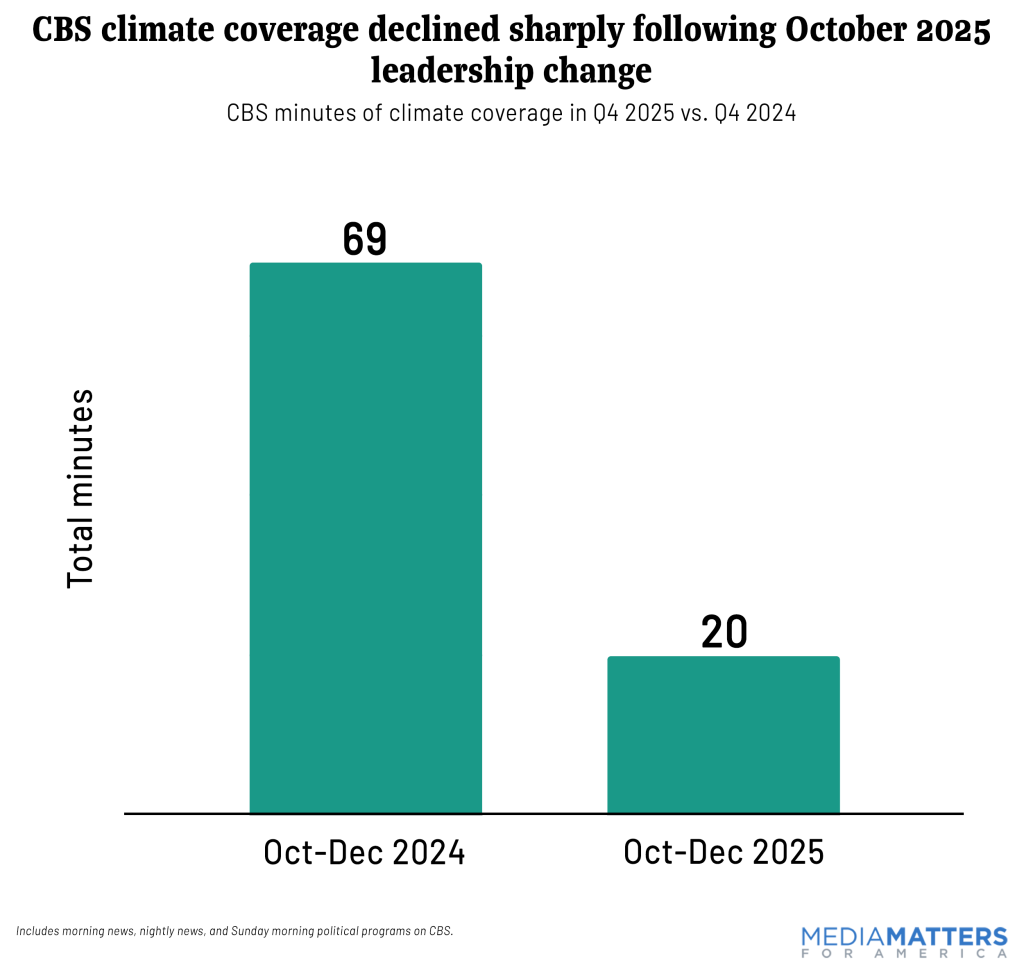
Now, tectonic shifts at the network, sparked by new ownership and Trump’s campaign targeting legacy media, means its leadership on climate coverage could be slipping away, with notable changes in tone and volume of coverage already underway. Even in 2025, as corporate broadcast news reporting on the climate crisis dropped to just over 8 hours — a significant decline from its 2022 zenith of nearly 23 hours — CBS still accounted for nearly half of that time. But the vast majority of its coverage aired before Bari Weiss was installed as its editor-in-chief, with only 20 minutes of climate coverage airing across 7 segments between Weiss’ takeover in October and the end of 2025.
CBS has historically led its broadcast counterparts in climate coverage
For the fifth consecutive year, CBS has led corporate broadcast climate coverage. In 2025, CBS accounted for 48% of total broadcast climate minutes. Both its nightly news program, CBS Evening News, and its Sunday morning political show, Face the Nation, led their counterparts in climate programming.
But volume of coverage is not the only indicator cementing CBS’ role as the top climate communicator in corporate broadcast news. While networks underreported the Trump administration’s attacks on climate science and action overall, CBS accounted for more than half of the segments that did discuss the Trump administration’s climate actions. As in prior years, the network also led on solutions-related climate segments and coverage that included climate scientists.
Shifts at the network put CBS’ future climate leadership in question
In October 2025, months after the Trump administration greenlit Skydance Media’s acquisition of CBS’ parent company, Paramount Skydance installed Bari Weiss, founder of The Free Press, as editor-in-chief of CBS News. The newly created position granted Weiss broad authority over editorial priorities, and soon after her appointment, CBS dismissed most of its dedicated climate team as part of a newsroom restructuring, removing much of the institutional capacity responsible for the network’s climate coverage portfolio. According to Heated, a memo announcing the layoffs from Paramount Skydance head David Ellison indicated that the network was “‘phasing out roles that are no longer aligned with our evolving priorities.’” Heated further reported that “today, the only person remaining at CBS News to cover climate change is national environmental correspondent David Schechter, who no longer has a dedicated producer.”
The editorial implications of this shift are consequential. Under Weiss’ leadership, The Free Press has consistently elevated climate skeptics and contrarians, published content downplaying or misrepresenting established scientific findings, and employed rhetorical frames long associated with right-wing media coverage of climate change.
While journalists and staff exit CBS, Weiss is bringing on influencers who may not adhere to the same journalistic standards. One hire, Peter Attia, a controversial longevity influencer, has already resigned due to backlash over lewd emails he exchanged with late convicted sex offender Jeffrey Epstein. In a less-reported exchange, Attia shared an article with Epstein from prominent British climate skeptic Matt Ridley, who has argued that “global warming is good for us.”
Early signs that CBS is abandoning its leadership role in producing consistent and quality climate coverage
CBS’ climate output has already shown a discernible decline since its change in leadership. After Weiss assumed editorial control in early October, CBS aired only 7 climate segments through the end of 2025, marking an immediate contraction in the network’s climate reporting footprint relative to earlier months in the year and as compared to the same period in 2024.
One segment about youth climate anxiety aired during the December 29 episode of CBS Evening News elevated and echoed right-wing media’s approach to minimizing climate risk by laundering a narrative long used to shift attention away from climate consequences and responsibility toward cultural debates about individual life choices.
In 2025, CBS aired 54 minutes of climate coverage in January, making it the network’s peak month. This year, the network aired only one climate segment in January — a headline report on the evening news lasting approximately 20 seconds on the surprising health of polar bears, despite the loss of sea ice, in the Norwegian Arctic. While the report may seem innocuous, it is not breaking news; a similar study appeared on a climate skeptic site in 2015, and the argument has been used by climate deniers to claim that alarmists were wrong about the severity of climate change and its impacts — in this case, on the “symbol of climate change,” the polar bear. The new study was also shared on climate denier Marc Morano’s site. With a seeming nod to the climate skeptic community, Evening News anchor Tony Dokoupil concluded: “Experts say the bears are still in trouble long term, but hey, the experts have been wrong before.”
Video
From the January 29, 2026, edition of CBS Evening News
But the segment was not just a nod toward skeptics. It represents a choice on the part of CBS to report an outlier of the climate crisis rather than any number of studies or events that support the overwhelming consensus on global warming. These newsroom changes in quantity and quality of coverage, which bear the fingerprints of Weiss’ contrarian approach to news, signal a looming void in the national climate information ecosystem.
Conclusion
Broadcast news remains a central agenda setter, shaping not only national narratives but also the priorities of policymakers, regulators, and institutional decision-makers while continuing to reach large audiences. A sustained reduction in climate coverage risks leaving the public less prepared to understand the stakes of climate policy decisions, the material consequences of regulatory changes, and the growing disparities in climate risk across communities.
Within this broader contraction, changes at CBS News carry outsized significance.
If CBS retreats from its prior role as the corporate broadcast climate-reporting leader, responsibility for sustaining rigorous, science-based, and context-rich coverage will fall more heavily on NBC and ABC. To meet that responsibility, broadcast networks must increase reliance on climate scientists, policy experts, and frontline communities; integrate federal climate actions and regulatory changes far more consistently into climate coverage; move beyond episodic weather reporting toward sustained examination of systemic drivers and solutions; and resist political and market pressures that undermine the visibility and credibility of climate journalism.
Without such shifts, the contraction in climate coverage documented in 2025 risks deepening in 2026, at a moment when climate impacts are accelerating, federal policy is in retrenchment, and voters are approaching a consequential midterm election cycle with diminishing access to the kind of clear, comprehensive climate information needed to make informed decisions.
//
03/04/26 10:06 AM EST
02/12/26 4:45 PM EST
12/11/25
---
Anderson Cooper’s ‘F*ck You’ to Bari Weiss
Zeteo's media newsletter, 'Ragebait,' is back with the behind the scenes of Weiss's latest blunder at CBS News, why Stephen Colbert dgaf, and the billionaire eyeing CNN who has staffers there on edge.
---
colbert told to not have tex xian talarico sp so YT
2 26
mma Paramount is mangling CBS — and CNN may be next
02/17/26
mma
CBS Evening News inverts its network's own reporting on ICE arrestees’ low rates of violent criminal histories
CBS reported that less that 14% of people in ICE custody have charges or convictions for violent criminal conduct, but CBS Evening News distorted the data to suggest the opposite
Written by John Knefel
Published 02/11/26
A CBS Evening News segment wildly distorted CBS News’ own reporting, incorrectly suggesting to viewers that a much higher percentage of people held by Immigration and Customs Enforcement have violent criminal histories than is actually the case.
On February 9, CBS News published an exclusive report under the headline: “Less than 14% of those arrested by ICE in Trump's 1st year back in office had violent criminal records, document shows.” The article stated that although roughly 60% of ICE arrestees had criminal charges or convictions, “the majority of the criminal charges or convictions are not for violent crimes.” For example, about 1.4% of people held by ICE have been accused or convicted of sexual assault, and about 0.5% have been accused or convicted of homicide. By contrast, 7.6% percent of ICE arrestees with a so-called criminal history simply have a DUI.
The Department of Homeland Security data undercuts a central, load-bearing myth deployed by right-wing media and the Trump administration to justify its nationwide crackdown on immigrant communities — namely, claims that ICE and Border Patrol are going after the “worst of the worst.” In fact, nearly 40% of people in ICE custody have no violation other than a civil immigration infraction.
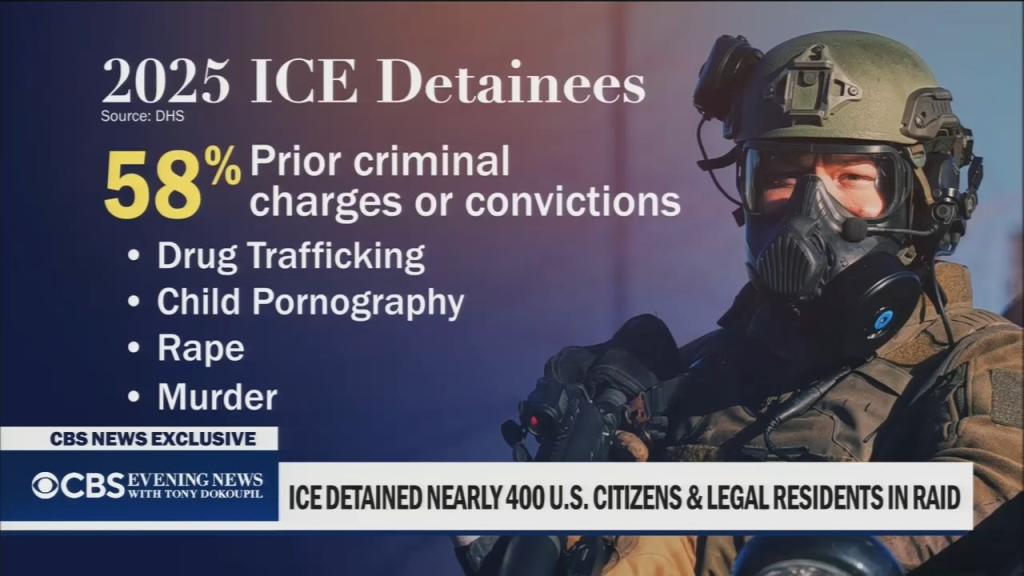
Viewers of CBS Evening News on February 10 got an entirely inverted picture, one that more closely aligns with the Trump administration's preferred narrative.
“ICE arrested nearly 400,000 people in President Trump's first year in office,” said anchor Tony Dokoupil. “Of those, nearly 60% had criminal histories, meaning charges or convictions, including many for serious crimes such as drug trafficking and child pornography, and several thousand cases involving rape or murder."
Video
Citation
From the February 10, 2026, edition of CBS Evening News
Dokoupil and his producers here are being wildly misleading. The relatively low percentages of ICE arrestees charged or convicted of murder or sexual assault are noted above. The CBS News article doesn’t specify the number of people accused or convicted of child sexual abuse material, though that would likely be captured in the data around sexual assault. The report also doesn’t list rates for drug trafficking per se, though it would presumably be a subset of charges or convictions for “dangerous drugs,” which it lists at 5.7%
Dokoupil then contradicted the very framing CBS Evening News led with. “At the same time, however, less than 14% had violent criminal records and nearly 40%, more than 150,000 people, had civil immigration offenses but no criminal history at all,“ Dokoupil said.
CBS Evening News here is attempting to have it both ways. The introductory copy and accompanying graphics paint a picture of the Trump administration prioritizing threats to public safety, and the subsequent clarification acts as little more than an afterthought. Immigrants are situated first and foremost as a threat, an impression barely mitigated with a little cover-your-ass language at the end.
Citation
From the February 10, 2026, edition of CBS Evening News
CBS Evening News’ mangling of its own reporting is less surprising taken in context. In October, “anti-woke” media figure Bari Weiss was named CBS editor-in-chief by David Ellison, whose Skydance Media had recently purchased Paramount, CBS’ parent company. His father, Larry Ellison, is a close ally of President Donald Trump and one of richest men in the world.
Weiss has a long history of controversy, and her short tenure at CBS’s helm has already produced more. In December 2025, Weiss pulled a 60 Minutes segment detailing torture and other horrific conditions at a prison in El Salvador where the Trump administration had rendered 252 Venezuelans. The segment ultimately aired the following month after a substantial backlash within CBS and from the broader public.
---
an 1 26 KATIE TUR HUBBY
'Pathetic': CBS host pilloried over fawning interview with Trump
---
MOVIE AWARD sEE bs
---
AN 1 26
CBS News staffers revolt over network 'carrying water' for Trump admin
---
MMA
CBS News’ climate anxiety segment laundered right-wing climate framing as the network shifts its coverage under new leadership (https://www.mediamatters.org/cbs/cbs-news-climate-anxiety-segment-laundered-right-wing-climate-framing-network-shifts-its)
01/13/26
VID]
December 29, 2025, episode of CBS Evening News
CBS News downplayed climate risks to focus on personal decision-making
Throughout the segment, Evening News treated climate change as contextual background in a story explicitly framed around youth climate anxiety and individual reproductive choices. Global warming was presented as one influence among many, not as a driver of instability meriting examination on its own terms. The framing steered viewers to question whether climate is given too much weight in personal decision making, effectively displacing a discussion about the real, worsening, and existential impacts of climate change.
After citing a survey showing that climate concerns influence some young people’s reproductive decisions, the story pivoted to fertility and economic data suggesting that declining birth rates are driven by economic factors rather than climate change. Regardless of whether this is even accurate, the claim further narrowed the frame, positioning climate concern as secondary and contestable rather than as a rational response to worsening conditions and separating climate disruption from the harm it compounds.
To reinforce that narrowing frame, CBS featured Alina Voss, communications director of the American Conservation Coalition, which CBS described as an “environmental nonprofit that promotes conservative values.” The ACC describes itself as a “pro-innovation,” limited-government organization that prioritizes market-based approaches to environmental issues. Voss told viewers that “the innovation is working” and, according to the correspondent, expressed confidence that “technology will protect families from the worst impacts of climate change,” a claim the segment did not challenge or contextualize. By presenting that reassurance without scrutiny, the segment also laundered technological optimism, a familiar narrative that downplays climate change.
CBS News echoed right-wing media’s approach to minimizing climate risk
Climate anxiety tied to decisions about child-rearing has repeatedly featured in right-wing media commentary. For example, a 2023 Fox News segment blamed “globalist” and “climate alarmist” propaganda for declining birth rates, accusing environmental advocates of teaching young people to fear having children and calling climate concern an “anti-human agenda.” In this framing, climate anxiety is cast as ideological manipulation rather than as a response to worsening material conditions.
The CBS segment followed this same narrative framing. By filtering the issue of climate risk through questions about family planning, CBS shifted attention away from climate impacts and accountability into lifestyle and cultural debates. The effect is consistent with right-wing media’s coverage more broadly: Climate change is treated as something for individuals to weigh or manage rather than as a public risk that demands corporate and political scrutiny. Whether the focus is natalism, consumption, or culture, the narrative maneuver is the same. Climate concern becomes a matter of judgment or preference, not a response to escalating harm.
This approach also aligns with well-established patterns documented in climate communication research showing how climate skeptics purport to accept the reality of global warming, even as they minimize its urgency. By emphasizing individual choices and optimistic solutions, while eliding discussion of current impacts and responsibility, this type of coverage reduces pressure for accountability — without necessarily disputing the science.
By emphasizing individual choices and optimistic solutions, while eliding discussion of current impacts and responsibility, this type of coverage reduces pressure for accountability — without necessarily disputing the science.
The segment aired amid a shift in editorial direction at CBS News
For several years, CBS News stood out among broadcast networks for its sustained climate reporting that foregrounded science, impacts, and solutions. That approach has been disrupted. In late 2025, newsroom restructuring eliminated nearly all of CBS’ dedicated climate reporting capacity. In light of these changes, the youth climate anxiety segment suggests that CBS News plans to use climate change as a backdrop — when it's mentioned at all — rather than as a subject of direct examination.
Reports from inside the CBS newsroom suggest Bari Weiss herself proposed the segment back in October using broad outlines that closely mirror the segment CBS ultimately aired, and the narrative framing is consistent with editorial patterns long present in The Free Press, the outlet she founded. Rather than interrogating climate disruption as a material crisis, The Free Press has frequently covered the story through a right-wing media lens that frames climate concerns as exaggerated and alarmist. Writers associated with the outlet like Lucy Biggers have argued that young people today were wrongly led to believe they have “no future” because of climate change, insisting that “no one should have climate anxiety.”
What this signals for CBS News' climate coverage in 2026
By rerouting climate coverage into questions about personal judgment and lifestyle choice, the segment reproduced a familiar right-wing move shifting attention away from emissions, policy, and industry responsibility toward whether people are overreacting.
This narrative framing has been increasingly used by the fossil fuel industry and its right-wing media allies to blunt climate action and accountability without explicitly denying the science. It works by narrowing the frame until the structural causes and effects of climate change disappear from view. Responsibility is redirected away from government and industry. Consequence is softened by treating climate as background context. Urgency is recast as excess.
When CBS News adopts this framing, it does not merely downplay climate risk. It allows a corporate and political narrative designed to shield power and avoid accountability to circulate as mainstream reporting. The effect is not subtle. It constrains what viewers are encouraged to question and who they are encouraged to hold responsible at precisely the moment when the Trump administration's policy choices and regulatory rollbacks carry immediate, measurable consequences in a world of rapidly escalating climate impacts.
//
12/05/25 10:49 AM EST
12/03/25 10:00 AM EST
11/04/2
---
BARI?
AN 12 25
Trump rages against 'rotten apple' MTG and demands 'total apology' from CBS
---
MMA
The year the media oligarchs bowed to Trump
Written by Matt Gertz
Published 12/03/25
We warned last year that Donald Trump’s second term as president would turbo-charge the political right’s burgeoning media-intimidation complex. Republican officials and right-wing billionaires were already trying to secure their political agenda by using their wealth, lawfare, and government power to silence journalists. And Trump, we wrote, using his authoritarian strategies, would force media moguls to choose between the journalistic integrity of the news outlets they oversee and their broader business interests, with the fate of the free press in the balance.
Twelve months later, it is clear that many of these corporate media owners have made their choice: They are damaging celebrated news outlets like CBS and The Washington Post out of some combination of personal preference and political expedience. While journalists at their outlets are still producing important stories that reveal the corruption and malfeasance of the Trump administration, it’s anyone’s guess how long they will be permitted to do so.
Trump has spent the last decade at war with the press. He has no regard for free speech, treats all dissent as inherently illegitimate, and uses every available tool to curtail critical journalism. The president’s years of anti-media diatribes have achieved their goal of destroying the credibility of potentially damaging reporting among his supporters, and in his second term, he has backed up those verbal attacks with a flurry of actions.
He and his administration have supplemented or even replaced members of the traditional press corps in favor of MAGA influencers and Trumpist outlets; defunded public media outlets in the U.S. and sought to dismantle them abroad; sued reporters and news outlets for publishing content he dislikes; and terminated rules protecting journalists from prosecutorial scrutiny, while targeting them with retaliatory immigration enforcement.
But Trump’s most unnerving assaults on the press involve his administration's use of state power as leverage against oligarchs who control broadcast and cable news operations and major newspapers. For billionaire owners or top executives at massive multimedia companies, news outlets typically represent a tiny fraction of their overall business interests. And those broader holdings create potential vulnerabilities — like regulatory scrutiny of mergers, federal contracting, and criminal investigations — that an authoritarian president can manipulate to encourage media moguls to cudgel their news outlets into line.
Trump’s strategies resemble those of Victor Orban, the Hungarian autocrat many on the American right take as a model, who has dismantled his country’s independent press and forced the sales of outlets to his allies. Trump's desired result is a cowed journalist corps that will produce Fox News-style propaganda venerating his successes and covering up his corruption and failures.
America’s media oligarchs often resisted Trump’s corrupt abuses of power in his first term, either enduring his attacks without constraining their news outlets or beating his administration in federal court. But in his second term, while some media organizations (including Media Matters) have fought to protect the First Amendment against Trump and his administration, certain wealthy magnates have chosen the path of cowardice, submission, and collaboration.
David and Larry Ellison
David Ellison is the son of Larry Ellison, the Oracle co-founder who is one of the richest men alive and a close friend and ally to Trump. The younger Ellison took control of CBS News in July after the Federal Communications Commission approved his Skydance Media’s purchase of CBS parent company Paramount. Trump-appointed FCC Chair Brendan Carr acted only after Paramount agreed to pay $16 million to settle an absurd lawsuit Trump filed over CBS News’ editing of an October interview with then-Democratic presidential nominee Kamala Harris — and after he secured pledges from Skydance to push the network’s coverage to the right.
Ellison followed through on his promise. The new ownership appointed “anti-woke” champion Bari Weiss as CBS News’ editor-in-chief and Kenneth Weinstein, a Trump-supporting right-wing think tanker, as its ombudsman. An October wave of layoffs hit nearly 100 CBS News employees, gutting the network’s teams focused on climate change and race and culture. Trump certainly seems happy with the changes — in a November 2 interview that marked his first appearance on the network since 2020, he praised Weiss as a “great new leader” and “great person” and described David Ellison’s takeover of CBS News as “the greatest thing that’s happened in a long time to a free and open and good press.”
With the CBS News takeover as proof of concept, Ellison and his father are each making moves to seize additional media outlets and move them in a Trumpy direction.
David Ellison is trying to buy Warner Bros. Discovery — and the administration is reportedly signaling that other bidders will face grueling oversight from federal regulators. “Trump wants WBD in the Ellisons’ hands, and insiders say it’s because he wants favorable coverage from its CNN news channel,” wrote the New York Post.
Larry Ellison has even reportedly “engaged in a dialogue” with the White House “about possibly axing some of the CNN hosts whom Donald Trump is said to loathe, including Erin Burnett and Brianna Keilar,” if the sale were to go through.
The Trump White House is also trying to broker a deal in which the social media giant TikTok, a news source for one-fifth of American adults and 43% of those under 30, would be sold to a coalition including companies controlled by Larry Ellison as well as fellow pro-Trump magnate Marc Andreessen.
- ### Jeff Bezos
Bezos owns The Washington Post, but his massive fortune comes from founding Amazon, the online retailing and web service giant, and he also owns the space technology company Blue Origin. During Trump’s first term, Bezos bore numerous potshots at what Trump termed the “Amazon Washington Post,” as well as his administration’s apparent retaliation against Amazon’s operations. But Bezos signaled that things would be different in a second term even before Trump’s election when he barred the Post’s editorial board from endorsing in the 2024 contest, blocking the publication of its piece supporting Harris.
The decision began a deterioration of Bezos’ relationship with the Post, accelerated further by his February demand that the paper’s Opinion section advocate without exception for “personal liberties and free markets.” Opinion editor David Shipley resigned rather than execute that pivot; his replacement, Adam O’Neal, an undistinguished reporter and editor previously at The Economist and The Wall Street Journal, has overseen buyouts and layoffs of the section’s veterans (my wife Alyssa Rosenberg, the section’s former letters and community editor, was among those who took the buyout) and hired several conservative writers, leading one of the paper’s right-wing columnists to boast, “We’re now a conservative opinion page.” The dramatic changes seem to have blown a hole in the Post’s subscriber numbers, with NPR’s David Folkenflik estimating “a net loss of a couple hundred thousand subscribers” at the end of February. With revenue plummeting thanks to Bezos’ decisions and the owner unwilling to eat the losses, more layoffs are reportedly on the way.
But defanging the Post — and finding a way to put money in the Trump family’s pockets — seems to be working out well for Bezos. His rewards include plum seats for Trump’s swearing-in, federal contracts for Blue Origin and Amazon Web Services, and the president publicly applauding him for “trying to do a real job with The Washington Post, and that wasn’t happening before.”
### Patrick Soon-Shiong
Like Bezos, Los Angeles Times owner Soon-Shiong has other business interests that left him vulnerable to Trump’s retaliation; he made his fortune in the biotech industry, and his medical patents and products are subject to federal oversight. Whether due to fear of retribution or a shift in his own political views, Soon-Shiong stepped up his oversight of the Times last year, beginning with the cancellation of a planned endorsement of Harris.
He subsequently shilled for Robert F. Kennedy Jr.’s confirmation as secretary of health and human services; announced a remaking of the editorial board, beginning with the addition of pro-Trump CNN commentator Scott Jennings; killed an editorial that criticized Trump’s Cabinet picks; announced the addition of an AI-powered “bias meter” to the paper’s opinion pieces, which was pulled after it downplayed the Ku Klux Klan; floated a conservative version of The View featuring right-wing actor Rob Schneider; launched “LA Times Studios,” a multimedia studio featuring influencers reading AI-generated scripts; sat for interviews with right-wing commentators including Tucker Carlson and Megyn Kelly; and put forward an ill-starred initial public offering plan which led The Hollywood Reporter to ask, “Does Patrick Soon-Shiong Want to Turn the L.A. Times Into a MAHA Memestock?”
As with Bezos’ actions at the Post, Soon-Shiong’s changes to the Times have resulted in plummeting circulation, an exodus of talent, and the diminishment of the paper’s influence. But his medical patents are still getting approved by the federal government.
- ### Bob Iger
Iger, who as the CEO of Disney oversees its subsidiary ABC, was at the center of two of the most craven media moves since Trump’s reelection.
First, his December 2024 decision to sign off on a $15 million “blood sacrifice to Trump,” settling a defamation lawsuit that ABC News’ lawyers thought they would win, only looks worse over time. The capitulation made clear to ABC staff that Iger would not support them in a stand-off with the president and set a precedent that media companies and other major corporations would knuckle under to his demands.
Second, after Carr threatened Disney and ABC’s affiliates with FCC retribution if they failed to “take actions” against Jimmy Kimmel over one of his monologues in September, Iger folded by suspending Kimmel’s show within hours. Carr’s threats made a mockery of the First Amendment — but Iger wasn’t willing to fight to uphold those rights in court. Iger relented and returned Kimmel to the airwaves only after an outcry by Hollywood talent and a spike in Disney+ cancellations.
What did Iger’s cowardice bring ABC? When ABC News chief White House correspondent Mary Bruce dared to ask Saudi Crown Prince Mohammed bin Salman a question about his role in the brutal murder of the U.S.-based dissident journalist Jamal Khashoggi during a joint Oval Office appearance with Trump, the president became enraged, lashing out at the journalist and calling her outlet “fake news” and “one of the worst in the business.”
“I think the license should be taken away from ABC because your news is so fake and it’s so wrong,” he later added, threatening to shut down a U.S. news outlet for producing reporting he doesn’t like in front of a foreign dictator who represses his own country’s media.
“And we have a great commissioner, a chairman, who should look at that," he added.
---
MMA
On MSNBC’s The Weeknight, Angelo Carusone discusses CBS' shifting coverage of Trump and how its a preview for what may happen to CNN
Carusone: “CBS has already conformed and aligned with Trump, and ... they're making very specific decisions to portray him in the best possible light, regardless of what Norah O'Donnell did”
Written by Media Matters Staff
:{Published 11/03/25
Video
Citation
From the November 3, 2025, edition of MSNBC's The Weeknight
ALICIA MENENDEZ (CO-HOST): I have spent much time in an edit bay, watching back interviews that I have done and thinking to myself, which parts do I cut and which parts do I keep? So I understand that this always a challenge but this is happening in a broader milieu, right? You had CBS cave, you have the president then go on 60 Minutes to do this interview. You then have him almost in that interview daring them, right, saying, "I'm going to talk about this. I'm going to guess you're going to cut it later." And in fact, they do. What is the lesson in all of this for other institutions that are watching and thinking to themselves, to what degree is being compliant ultimately going to lead to self-preservation?
ANGELO CARUSONE (GUEST): I mean, look, I think it's a tough -- and CBS is in a tough situation, right, because their ownership changed as Trump boasted about. I mean, it went to an ally that was going to remake the network in much more of a Trumpian fashion or at least aligned with the Trump administration. So, you know, we're not talking about any lessons for any other media outlets. One lesson, don't let yourself get bought by Trump, you know, sort of alliance. But I think in terms of the broadcast piece, what I would say is this, don't fold from the beginning, especially when you don't have to. That's the real lesson here because that's where it all started. They never needed to settle with Trump in the first place, and by settling with Trump, they didn't just lose money or, you know, demonstrate that they're going to get rolled over. They did something worse.
They validated the lie that he was telling in the first place was that they did something wrong, and they emboldened him to continue to take that action against other news outlets and other news networks. So to me, that's the first thing, is that especially if you're a news outlet, don't fold. That's the first lesson. Otherwise, it's just going to keep rubbing your nose in it. The second is do your job. And there was a lot of follow-ups there that didn't happen.
...
SYMONE SANDERS-TOWNSEND (CO-HOST): The edit is a signal to the other institutions. The edit is actually, it is not like an aside. It is a main effect here, Angelo. The edit matters and what happened is a dereliction of duty here that if it were us, I would hope somebody would call us out. But it ain't never going to be me. I want to be clear.
CARUSONE: Okay, I'm glad you pointed out that it's not about Norah O'Donnell, right? I mean, there are a lot of exchanges that she asked really pointed questions about violence, political violence that did not make it in the broadcast version, right, where she did some follow ups. I think the question about whether or not he is going to run in 2028 was like the biggest thing that you could say, "Hey, you should not have done that. You should not be pretending that it's even an option or a question." So, let's stop playing that game. I think that's a fair critique of Norah O'Donnell, but as you point out, the edits ultimately are a much bigger thing. They're a reflection of the fact that CBS has already conformed and aligned with Trump, and that they're making very specific decisions to portray him in the best possible light, regardless of what Norah O'Donnell did. And I think to me the biggest example of that that stood out is when he was pressed a little bit about some of these pardons that he did. His response was to get very nasty, right? I mean, that would -- ordinarily. that's the thing that you're going to lead with, is the president of the United States you're interviewing screaming like a baby because he's mad about a question that you asked, having a tantrum. That's the thing that you would promote because it's going to get attention.
But they didn't do it because they knew it would make him look bad. It would cut against the story that he's telling about himself, that he walked in there with a quiet confidence. He was comfortable and that he was sort of saying, I can now confront CBS, look how good of a job I'm doing. Look how capable I am at telling this story. They're not going to cut against his narrative by putting that in the broadcast edit. I'm surprised they put that in the transcript. Honestly, I think that's the one testament that there's a little bit of a beachhead of truth still at that network. And I think the scary part about all of this that we shouldn't lose sight of, and it's something that Michael said before, is that this tells us where we're potentially going, because let's not forget that the same people that bought CBS are right now the lead bidders that, at least according to Trump, that he's their designated bidder for buying Warner Brothers. And what do they own? CNN. So, it is important that we talk about these things, not just to complain about the status quo in the past and to dissect it, but also because it tells us, it gives us a small keyhole view into what the future could be before it actually materializes. We still have the chance to change that and fight that. But that's what these conversations are for first and foremost.
---
MMA
Under the leadership of Bari Weiss, The Free Press’ climate change coverage mirrors that of right-wing media outlets like Fox News
As the editor-in-chief of CBS News, Weiss will oversee the broadcast news leader in climate coverage
Special ProgramsClimate & Energy
Written by Allison Fisher
Published 11/04/25
In early October, Paramount Skydance bought the The Free Press and hired its founder, Bari Weiss, as the editor-in-chief of CBS News, a newly created position which will shape how the newsroom covers major stories which could include the climate crisis.
Notably, among the national broadcast networks, CBS has led coverage of climate change for at least the past four years, airing the most coverage, the most climate scientist guest appearances, and the most segments that discussed climate solutions as compared to ABC and NBC. But its role as network leader is already under threat. Reported by HEATED, as part of a series of layoffs at the network, the “majority of the five person team supporting CBS News’s climate coverage” were fired. In the memo announcing the layoffs, the new chief executive David Ellison said “he was ‘phasing out roles that are no longer aligned with our evolving priorities.’”
And there are other changes that could compound this threat: On October 24, it was reported that Weiss was interested in poaching Fox News anchor Bret Baier, who has a troubling record on climate reporting to “potentially helm the *CBS Evening News.” Additional reporting suggests that she may also be interested in bringing on board another conservative voice, CNN contributor Scott Jennings. And on October 27, *CBS Evening News co-anchor John Dickerson announced he was leaving the network at the end of the year.
Though Weiss infrequently focused her contrarian opinions on climate-related issues in her pieces for The New York Times and on her podcast, under her leadership as founder and editor-in-chief, The Free Press has published a number of articles undermining climate science and promoting contrarian views that mirror commentary from right-wing media outlets like Fox News.
The Free Press has undermined climate science
On August 19, The Free Press reported on a widely criticized climate study from the Department of Energy through an interview with one of its authors, Steven Koonin, a climate contrarian who has appeared on several right-wing media programs including several appearances on Fox. The interview included questions such as “what about climate change is real?” and provided a platform for Koonin to misrepresent a report from the United Nations Intergovernmental Panel on Climate Change that affirmed the link between climate change and extreme weather events.
Koonin has made the same false claims on Fox, including on the August 10, 2021, edition of Special Report with Bret Baier, where he downplayed the findings of the IPCC’s sixth climate assessment. Koonin dismissed the connection between extreme weather and climate change, a key finding of the report, claiming that natural disasters are “on the face of it, weather. If they were climate, we would see trends over several decades in those phenomena, and we don't.”
In fact, climate scientists have been able to estimate how much climate change affects any given extreme weather event for years. Notably, researchers found that the heat wave that sent temperatures in the Pacific Northwest and Canada into triple digits just six weeks before the release of the 2021 report would have been “virtually impossible” without global warming.
In January of this year, The Free Press interviewed Koonin to downplay the role of climate change in intensifying the LA wildfires. Similar to right-wing media outlets like Fox, The Free Press misleadingly suggested that then-President Joe Biden and many climate scientists claimed climate change was the cause of the fires rather than a contributing factor to the intensity of the blazes.
In 2023, The Free Press published one of its signature contrarian pieces – titled “I Left Out the Full Truth to Get My Climate Change Paper Published” by Patrick T Brown. In the piece, the author, who works for Breakthrough Institute, which was founded by anti-renewable advocate Michael Shellenberger, claims to have purposely limited his research paper showing warming temperatures increased the likelihood of wildfire growth in California in order to prove that articles in scientific journals were “distorting the scientific process by focusing too narrowly on climate change.” As reported by The Washington Post, “The opinion piece quickly provoked backlash from scientists and the editor of Nature herself.”
The stunt by Brown reflects the decades-old right-wing media narrative that climate scientists are “cooking the books” or playing “fast and loose” with data in order to manufacture a climate crisis.
The Free Press elevates contrarian and conservative voices to disparage climate activism and action
In February of this year, The Free Press published a piece by Doomberg, an independent publication focused on energy, finance and geopolitics, titled “Everybody Freeze! It’s the Climate Police,” which used a proposed policy in the the city of Ottawa “limiting residents from using remote car starters to warm up their vehicles for more than one minute before driving” and reporting that a “Washington Democrat hopes to study the impact of medical anesthesia on climate change” as proof that efforts to address climate change have gone too far – and as a result caused a “global popular revolt” against climate action.
It is the kind of cherry-picked reporting Fox News does to paint the climate movement as out of touch and radical. And like with Fox’s coverage, it feels disingenuous in its failure to either acknowledge the severity of the climate crisis or present the mainstream efforts to decarbonize the economy through policies, like renewable energy deployment, that are both popular and effective.
:{In March, The Free Press published a story on the Environmental Protection Agency’s efforts to claw back $20 billion of congressionally appropriated climate funds titled “A $20 Billion Slush Fund—Paid by You to Progressive Nonprofits.” The piece largely represents the position of EPA Administrator Lee Zeldin that the funds were somehow fraudulent. It also pushes the Fox News narrative that the funding is a slush fund for the left, including Democratic politicians, that was rushed out the door before Biden’s term ended like “gold bars” tossed “off the Titanic.”
The “gold bars” which Fox News has repeatedly mentioned are a reference to a video from Project Veritas — an organization built on deceitful tactics — in which a purported EPA employee was filmed with a hidden camera saying the Biden administration tried to quickly spend federal money before Donald Trump resumed office. He said, “We’re just trying to get the money out as fast as possible before they come in and stop it all,” comparing the effort to “throwing gold bars off the Titanic.”}:
But, as Politico noted, the “EPA had already obligated the $20 billion in climate grants months before a conservative activist group shot that video.” In fact, the climate funds were not hastily approved as Biden left office – the funding was legally appropriated through the Inflation Reduction Act passed by Congress in 2022, and grants were awarded through established procedures, with public announcements made months before the election.
Additionally, as The New York Times reported, a lawyer for the EPA staffer who appeared in the video “has since said he was not referring to the $20 billion grant program.” The Washington Post also reported that the former employee “had ‘nothing to do with the evaluation and selection’ of the recipients, said a former EPA official briefed on the matter.” These facts were largely absent from the Free Press piece.
In 2024, The Free Press published a contrarian piece by a “retired sustainability influencer” who is also the social media editor for the outlet: “I Helped Make Standing Rock Go Viral. Now I Regret It.”
The author lamented that as an early social media influencer she presented the Native American-led protest against an oil pipeline as “black and white” or “good versus evil.” She claimed her opinion on the Dakota Access Pipeline and fossil fuels changed after she “began reading books and news sources that strayed from the progressive party line, titles like Unsettled by Steve Koonin, Apocalypse Never by Michael Shellenberger, and Fossil Future by Alex Epstein. I realized that the environmental causes I had so breathlessly championed were much more complicated than good versus evil.”
Notably, the titles that she cited and their authors – Koonin, Shellenberger and Epstein – frequently appear across right-wing media to downplay the climate crisis, disparage renewable energy, and/or promote fossil fuel use.
Similarly, in 2023, a former member of Extinction Rebellion UK penned a piece for The Free Press, “Climate Activism Has a Cult Problem,” in which the author argued that the climate action organization, known for controversial direct actions, is run by a cult leader.
The piece was published at a time when right-wing media hostility against climate activists was at a fever pitch and some right-wing media personalities were cheering on calls for violence against climate groups.
Conservative journalists like Bret Baier could undermine CBS’ leadership in climate coverage
For at least the last four years, CBS has led its broadcast counterparts in volume of climate coverage. In 2024, the network accounted for 50% of total broadcast TV news climate reporting – 381 minutes of 771 minutes across all three national broadcast networks. The network also led in the number of climate scientist guest appearances it aired and the number of segments it ran that discussed climate solutions.
Meanwhile, the climate denial that has for decades been a staple of Fox News opinion shows has also appeared on the so-called straight news program anchored by Bret Baier. Fox’s flagship Special Report has repeatedly softened or distorted the stakes of global warming and climate action. From 2009 through May 2021, more than 87%of its climate segments contained misinformation or misleading narratives.
More recently, Baier conducted a nearly 10-minute interview with Trump EPA Administrator Lee Zeldin in which Baier promised a “fair” and “balanced” conversation. Instead, he helped the administration justify repealing the endangerment finding — potentially the most consequential climate rollback in modern history.
While Americans may be changing how they consume the news, legacy media and broadcast journalism at networks like CBS still matter, as the entire media landscape still relies on traditional journalism as part of the beginning of the information food chain. This includes how anchors report on extreme weather events, climate action, and scientific reports and findings. If CBS under Weiss approaches this reporting like the outlet she founded or like the anchor she seeks to poach, the network will risk becoming another cog in the machinery of climate denial and delay.
//
:{11/03/25
:{10/24/25
10/24/2
---
mma
10/24/25
10/24/25 might get anchor?
---
an 925
After Trump’s Homeland Security Secretary Kristi Noem complained that several minutes of her August 31 Face the Nation interview had been “shamefully edited…to whitewash the truth,” CBS News announced that its flagship Sunday morning program will no longer edit its interviews, except for “legal or national security” reasons.
According to AP, CBS said it had edited the interview, which ran 16 minutes and 40 seconds in its original form, for length, and posted the full interview on its website and YouTube. As the AP correctly noted, Noem “made a series of unproven accusations about Abrego Garcia” in the portion of the interview that was cut. This is a pattern of behavior by the administration with respect to Kilmar Abrego Garcia, a Salvadoran refugeewho had been illegally deported to the CECOT concentration camp in his country of origin.
In the context of the recent capitulations by CBS News and its parent company Paramount in the face of Trump administration demands, the announcement is noteworthy—and dangerous.
Uneditable propaganda
As Varietysays, “Making decisions that seem to come in response to backlash from public officials is not seen as sound journalistic practice.”
Writing for FAIR, Ari Paul noted in July (https://variety.com/2025/tv/news/cbs-news-face-the-nation-interviews-no-edits-backlash-1236509301/that, in order to facilitate a merger with Skydance,
Paramount has settled what is widely regarded as a frivolous lawsuit from President Donald Trump for $16 million over a CBS 60 Minutes interview with Kamala Harris; it has also canceled its highly successful and long-running Late Show With Stephen Colbert, whose host was critical of the settlement.
Varietyargued that CBS‘s promise not to edit Face the Nation‘s interviews, which overwhelmingly feature government officials,
is an unorthodox one, potentially leaving show moderators and producers unable to remove false statements or propaganda uttered by political operatives and officials and undermining the authority and credibility of Margaret Brennan, the moderator of the Sunday public affairs program.
An anonymous CBS source weakly protested to the AP that Face the Nation‘s Brennan would “still be able to factcheck or challenge claims made by interview subjects.” But corporate media outlets have never been good at stopping political figures from spewing propaganda (FAIR.org, 6/28/11, 6/26/24, 2/28/25, 7/31/25), particularly those from Trump and his minions, who produce falsehoods at such a rapid clip that it’s impossible to challenge each one. Now CBS will have even fewer tools to do so.
Installing a commissar
AP points out that Kenneth Weinstein will not actually be an ombud, i.e., a person who resolves complaints from the public; “Paramount said it does not envision Weinstein having any public-facing role.”
In yet another move to the right, days after its editing announcement, CBS News announced that, to fulfill part of its settlement with Trump, it would be appointing Kenneth R. Weinstein to serve as an ombud. In addition to being a prominent conservative—Weinstein previously headed the Hudson Institute for over a decade—the new appointee was nominated by Trump for ambassador to Japan in 2020 (though his nomination was never confirmed—Reuters,). Weinstein “will review editorial questions and concerns from outside entities and employees,” CBS said.
While FAIR has lamented the gradual disappearance of ombuds from major journalistic outlets over the years, and the loss of accountability to their audiences that that entails, it’s critical that ombuds be independent. Weinstein’s clear ideological tilt, his connection to the Trump administration and his position’s creation at the command of that administration stand as obvious obstacles to him performing any role but state censor.
FAIR also pointed out that Paramount was looking to give right-wing journalist and censorious “free speech” activist Bari Weiss a top role at CBS News. It has since been reported that the company is looking to buy her publication, the Free Press, for as much as $200 million.
---
mma
How CBS News’ Trumpy new ombudsman fits into the right's anti-media campaign
Written by Matt Gertz
Published 09/09/25
The new owners of CBS News announced Monday that they have selected Kenneth R. Weinstein — a Donald Trump supporter and right-wing think-tanker with no apparent newsroom experience who often criticizes the news media’s purported liberal bias — to scrutinize the network’s coverage as its ombudsman.
The position will allow Weinstein to serve as a conduit for the MAGA movement’s complaints about CBS News’ coverage and personnel, allowing Trumpist operatives and right-wing media to discipline the network’s journalists.
David Ellison’s Skydance Media promised to appoint a CBS News ombudsman as part of the shakedown Trump and his administration put it through in order to secure its acquisition of CBS parent company Paramount. When Brendan Carr, the Trumpist head of the Federal Communications Commission, finally blessed the Skydance deal in July, he touted its pledge to “root out the bias” at CBS News.
With Weinstein’s appointment, Trump and Carr are getting exactly what they wanted
A former chief executive of the right-wing Hudson Institute who Trump nominated to serve as ambassador to Japan in 2020, Weinstein is also a GOP partisan who “donated roughly $40,000 to Republican and pro-Trump political groups last year,” The New York Times reported. He has never worked in journalism, though he did serve on the Broadcasting Board of Governors in both the Obama and Trump administrations.
Weinstein’s recent commentary provides more reasons for concern, Oliver Darcy found when he reviewed it for his Status newsletter. Darcy reports that the former Trump appointee had “lavished Trump with praise” in a July column; “fiercely advocated for Trump to win reelection” during an October 2024 ; and cheered Fox News founder Rupert Murdoch while issuing innumerable digs at “media elites” for their purported left-wing coverage.
The description of Weinstein’s role that Paramount provides suggests that CBS News’ editorial independence has effectively been terminated. Weinstein will funnel complaints he believes require “further action” above the head of current CBS News president and Executive Editor Tom Cibrowski to Paramount’s president and its chair of TV media. Cibrowski will be consulted only to “recommend and implement any necessary action steps” that Weinstein and Cibrowski’s corporate superiors agree on.
Steve Capus, a former CBS News executive producer who worked with Weinstein at the Broadcasting Board of Governors, told the Times that Weinstein is a “fair arbiter” who deserves “the benefit of the doubt” in the role.
This assessment seems painfully naive. The reason CBS News now has an ombudsman now is because its parent company was trying to assure Carr that if he approved their merger, the network’s coverage would change in a way that the FCC’s Trumpist chair would approve. The president subsequently touted Ellison as a “great man” who would “do the right thing with” CBS. And when Paramount filled the role, the company didn’t pick a journalist with a reputation for neutrality — it went with a right-wing think-tanker and Republican donor with no newsroom experience.
Weinstein has been installed at CBS News to help fulfill Paramount’s promise to move the network’s political coverage to the right.
Weinstein will integrate with the right’s existing anti-media campaign
President Trump regularly attacks and even sues traditional media outlets for providing critical coverage of himself and his administration, as part of a deliberate strategy to keep his supporters from trusting their journalism. He is backed by a massive parallel infrastructure of right-wing media outlets, organizations, and operatives who are constantly on the hunt for instances of purported liberal media bias that they can use to undermine legacy news outlets. And his administration corruptly leverages such claims to threaten and punish the outlets’ owners with adverse regulatory actions.
This campaign’s purpose is not to improve the standards of legacy outlets, but to cudgel them into compliance with Trump’s demands for fawning coverage of his presidency in order to secure right-wing policy objectives. And with Weinstein's appointment, that effort will now have a man on the inside at CBS News who is predisposed to agree with such complaints and aid the right-wing attacks.
There will now be additional steps to the smear cycles in which the right attacks CBS News with preposterous gripes — for example, claiming that its editing of a Kamala Harris interview purportedly concealed her “word salad” responses. After the salvos from MAGA influencers, the endless denunciations on Fox News, and harangues from Trump and other administration officials and Republican notaries, there will now be a push for the ombudsman to step in and compel changes in the CBS newsroom.
It’s also not difficult to imagine someone like Laura Loomer, the notorious conspiracy theorist who regularly gets Trump administration officials fired for insufficient loyalty, scrutinizing the backgrounds and social media activity of CBS staffers and urging Weinstein to ensure their dismissals.
If Weinstein doesn’t take up the right’s cause, or if he does but is then overruled by Paramount’s corporate leadership, that will trigger a new round of right-wing denunciations. It could also lead to painful regulatory retaliation from Carr, who would argue that the company has failed to live up to its pledge. And David Ellison, the son of billionaire Silicon Valley mogul and close Trump ally Larry Ellison, might find the president no longer wants to shower him with praise and sit with him at UFC fights.
What’s happening to CBS News is neither complicated nor subtle: The billionaire son of a Trumpist oligarch is remaking a U.S. news institution to be less of a thorn in the president’s side, installing right-wing leaders and eliminating its independence in response to his grievances. Hoping for the best won’t change that.
---
---
MMA
Trump calls for FCC retribution against “FAKE NEWS” ABC and NBC — while touting the “great man” who “just bought CBS”
How to get off Trump’s media shit list
Written by Matt Gertz
Published 08/25/25
President Donald Trump sent a clear message over the weekend that media companies can forestall his vicious denunciations and threats of federal retribution. All their owners have to do is bend the knee and grant his administration sufficient reassurance that their news outlets won’t prove troublesome.
Trump urged the Federal Communications Commission to punish two of the “Big Three” national broadcast networks for their political content, a straightforward assault on the First Amendment, in a pair of Sunday night posts.
The president condemned ABC and NBC as “FAKE NEWS” and an “actual threat to our Democracy” because they purportedly run too many “BAD STORIES” about him and provide “unfair coverage of Republicans.” He added that in response, these outlets should either “HAVE THEIR LICENSES REVOKED BY THE FCC” or be forced to pay “Millions of Dollars a year in LICENSE FEES.”
CBS, the third of the “Big Three,” escaped Trump’s malice.
As recently as April, Trump denounced CBS as “out of control, at levels never seen before,” and called upon FCC chair Brendan Carr to “impose the maximum fines and punishment, which is substantial, for their unlawful and illegal behavior.” Carr at the time was corruptly delaying the purchase of CBS parent company Paramount by Skydance Media, owned by David Ellison, the son of billionaire Silicon Valley mogul and close Trump ally Larry Ellison, in response to Trump’s frivolous lawsuit over CBS News’ handling of a 60 Minutes interview with Democratic presidential nominee Kamala Harris in October 2024.
But since then:
- Trump got his payoff. Paramount agreed to pay $16 million to Trump’s presidential library to settle the lawsuit and resolve “a threatened defamation action concerning a separate 60 Minutes report,” the company announced on July 1. The president subsequently claimed there is a side deal in which Paramount will air $16-19 million in free public service announcements.
- CBS canceled Stephen Colbert’sThe Late Show.Colbert, an outspoken Trump critic, announced on July 17 that CBS was ending his program. While CBS insiders argued that “the move was financially driven, not politically motivated,” the announcement came the same week Ellison met Carr and other FCC officials in hopes of securing the merger. Trump, for his part, responded the following morning, “I absolutely love that Colbert’ got fired.”
- Reports circulated over a possible Bari Weiss role with CBS. The Status newsletter’s Oliver Darcy reported in late June that Ellison was seeking to recruit Weiss, the conservative journalist whose outlet The Free Press provides a sort of permission structure for centrists to support Trump over Democrats, “to work in some capacity” at CBS. In mid-July, several outlets reported that Ellison and Weiss were discussing a possible deal in which Skydance would buy The Free Press.
- The FCC approved Skydance purchase of Paramount late last month, citing Skydance’s “commitment to make significant changes” at CBS News.The FCC announced on July 24 that it had approved the acquisition. Carr cited in an accompanying statement “Skydance’s commitment to make significant changes at the once storied CBS broadcast network,” its provision of “written commitments to ensure that the new company’s programming embodies a diversity of viewpoints from across the political and ideological spectrum,” and its pledge to “root out the bias that has undermined trust in the national news media.”
- Massive layoffs are looming over CBS. It would be difficult to convince or compel CBS News’ current slate of journalists to lay off the president — but it’s easy to fire them. After Variety reported last week that CBS News staffers “are worried about the potential for a new round of layoffs,” the New York Post reported Friday that a “bloodbath” of layoffs at Paramount Skydance is expected in early November.
The moves were more than enough to get CBS off Trump’s media shit list. In fact, the president recently lavished praise on its new owner, Paramount Skydance chief executive David Ellison.
“CBS was just sold to a great person that I know very well,” Trump told reporters on Friday. “A great man. He actually just bought CBS. And I think he‘s going to do the right thing with it.”
Trump’s authoritarian assault on the free press offers media moguls both sticks and carrots — and too many of them have decided they would rather submit to his will than fight. Just seven months into his administration, he’s already forced one of the major broadcast networks to yield. Two to go.
//
04/28/25 1:22 PM EDT
07/23/25 11:57 AM EDT
02/04/25
---
===
CORP BAD ACTOR PARAMOUNT CBS SETTLE CANCEL COLBERT BRIBERY
AN 7 25
'Insane!' CBS blasted for cancelling Colbert's 'Late Show' days after he ripped settlement
---
---
PRESS SUPPRESS MAFIA DON SHAKEDOWN
AN 7 25
On July 1, CBS News' parent company, Paramount, agreed to pay $16 million to settle a lawsuit from President Donald Trump —who claimed that CBS edited a 2024 interview with Democratic presidential nominee Kamala Harris in a way that amount to election interference. Many Trump critics attacked the lawsuit as frivolous and baseless, arguing that Paramount was submitting to a shakedown just to be done with the matter.
Now, Fox News is drawing criticism for its editing of a 2024 interview with Trump, and critics argue that it was edited in a way to make Trump look good — not edited for journalistic purposes.
CNN's Andrew Kaczynski, in a July 14 post on X, formerly Twitter, tweeted video of the Fox News interview and noted their editing of comments on convicted sex offender Jeffrey Epstein.
READ MORE: 'You dress as a cowgirl?' Kristi Noem bashed at homestate fundraiser
Kaczynski posted, "I had not seen this Fox News extended interview with Trump from 2024 — where they deliberately edited his (Jeffrey) Epstein answer — where he won't commit to releasing the full files because of 'phony' stuff in it."
Kaczynski, comparing the unedited interview to Fox News' edited version, tweeted, "Check out what Trump said vs what Fox edited."
In response to Kaczynski's tweets, Media Matters' Matthew Gertz — obviously mindful of Trump's CBS News lawsuit — posted, "My understanding based on the CBS News precedent is that this is an illegal interference with the 2024 election that should result in Fox News paying tens of millions of dollars to orgs chosen by Kamala Harris and facing an FCC probe. Quote Andrew Kaczynski @KFILE."
In a separate tweet, Gertz posted, "At least that's the result when the president is engaged in a corrupt abuse of power crying out for more scrutiny."
READ MORE:There's far more to Trump and Epstein's relationship: Trump biographer
Former Trump supporter turned Trump critic A.J. Delgado tweeted, "Yup, I was tweeting about this last October, as were others, and no one seemed to care. It's insane that Fox edited the answer (the only reason the full answer came out is, I believe, that Will Cain later absentmindedly shared the full answer on his own show. That's the only reason we even know.)"
The Trump War Room account on X posted Fox News' edited version of the interview in June 2024.
Observations from Kaczynski, Gertz and Delgado's tweets on Fox News' 2024 interview with Trump are drawing a lot of discussion on X.
Former Obama Administration official Tommy Vietor wrote, "Time for Kamala to sue Fox News???"
X user Michael Serdikoff tweeted, "This is same (guy) suing CBS for editing Harris' remarks."
Another X user, Cindy Cooper commented, "So the Fox News network via Fox News Radio did air the entire answer. Thanks."
Watch the video belowor at this link.
---
---}:
mma 4 25
President Donald Trump is ramping up his assault on the press, opening new avenues for federal retribution against outlets which displease him as his administration prepares to mark 100 days in office.
Trump has long railed against journalists as the “enemy of the people,” used the power of the state as a cudgel against the industry in his first term, and promised more of the same in his second.
His return to office brought what Columbia Journalism Review’s Jon Allsop described as a “sharp, often contemptuous rupture” between the federal government and the press, with the White House seeking over the last few months to dominate reporters, place new restrictions on critical outlets, and lift up right-wing propagandists in their place.
The president’s threats against news outlets have been so extreme for so many years that by contrast, such moves struck some observers as “small beer” or “trivial nonsense.”
But Trump’s talk is cheap until it isn’t — at any time, on a whim, he or the assortment of ideologues and shills he’s appointed can set the gears of government grinding against his foes. And this weekend brought a sharp escalation and worrying signs for the future.
Justice Department ends restrictions protecting journalists}:
Attorney General Pam Bondi on Friday laid the groundwork for the imprisonment of journalists who produce reporting that damages the president’s interests.
In an internal Justice Department memo, Bondi rescinded Biden-era protections which restricted prosecutors “from seeking records and compelling testimony from members of the news media,” stating this was necessary “in order to identify and punish the source of improper leaks” by individuals whose conduct she described as “treasonous.”
Notably, her memo targets not just the leaking of classified information but also “disclosures that undermine President Trump’s policies, victimize government agencies, and cause harm to the American people.”
Trump regularly rails against reporting based on anonymous sources. Bondi’s move raises the prospect of the Trump administration responding to such reports by forcing reporters to choose between revealing their sources and going to jail.
Bondi, a Trump loyalist who previously parlayed frequent Fox appearances defending Trump into a post on his first impeachment legal defense team, will apparently be making the call over when the Justice Department uses that legal tool.
Other top prosecutors and investigators who might weigh in include her deputy, Emil Bove, who previously represented Trump in state and federal prosecutions; Ed Martin, the lawyer for January 6 defendant who now serves as interim U.S. attorney for the District of Columbia; FBI Director Kash Patel, who has called for the federal targeting of journalists; and his extremely online deputy, the former Fox host Dan Bongino.
How far will they go? Trump wants them to go very far indeed.
- ### Trump calls for investigations of media pollsters
Trump responded on Monday to new surveys which show his approval ratings plunging in light of his catastrophic tariff rollout by calling for investigations into the pollsters and the media outlets which conduct them.
Trump claimed in an early morning post on Truth Social that results from New York Times/Siena and ABC/Washington Post polls were due to the surveys “looking for a negative result.”
“These people should be investigated for ELECTION FRAUD, and add in the FoxNews Pollster while you’re at it,” he wrote. “They are Negative Criminals who apologize to their subscribers and readers after I WIN ELECTIONS BIG, much bigger than their polls showed I would win, loose a lot of credibility, and then go on cheating and lying for the next cycle, only worse.”
Trump regularly accuses his media foes of breaking the law, and in a March speech at the Justice Department headquarters he instructed its employees to “watch for” their “totally illegal” behavior.
The president is currently suing Iowa pollster J. Ann Selzer over the results of one of her presidential campaign surveys.
Trump has personally dictated Justice Department investigations into two former officials from his first administration who became critics, as well as into ActBlue, the hub for Democratic campaign fundraising — and he could launch a similar legal assault on any news outlet which displeases him at any time.
- ### A cry of desperation from CBS News
60 Minutes anchor Scott Pelley Sunday’s broadcast with a blunt explanation for the resignation last week of Bill Owens, a journalist with decades of experience at CBS News and the show’s longtime executive producer.
“Our parent company, Paramount, is trying to complete a merger,” he said. “The Trump administration must approve it. Paramount began to supervise our content in new ways. None of our stories has been blocked, but Bill felt he had lost the independence that honest journalism requires.”
Trump and his administration had targeted CBS News for retribution following a 60 Minutesinterview of Kamala Harris, the editing of which the president alleged had been unfair to him.
Trump launched a lawsuit seeking $10 billion in damages from the network, which First Amendment attorneys described as “ridiculous junk” and “a frivolous and dangerous attempt by a politician to control the news media.” Brendan Carr, his handpicked chair of the Federal Communications Commission, is conducting an investigation into the editing that former FCC commissioners have denounced.
Rather than stand firmly behind the company’s journalists, Paramount Chair Shari Redstone is reportedly seeking a settlement with Trump and an agreement with Carr that will allow the company’s merger to go through.
- ### Trump gloats about media owners bowing to his will
Trump thinks he’s winning his battle against the press, as The Atlantic reported in a recent interview with the president:
“Tell the people at The Atlantic, if they’d write good stories and truthful stories, the magazine would be hot,” he said. Perhaps the magazine can risk forgoing hotness, he suggested, because it is owned by Laurene Powell Jobs, which buffers it, he implied, from commercial imperatives. But that doesn’t guarantee anything, he warned. “You know at some point, they give up,” he said, referring to media owners generally and—we suspected—[Washington Post owner Jeff] Bezos specifically. “At some point they say, No más, no más.” He laughed quietly.
Trump understands that many of the news outlets whose work he decries are owned by multinational corporations or wealthy magnates whose business interests make them vulnerable to federal retaliation.
After only a few months in office, he’s seen the pressure he’s exerted on CBS News push it to the breaking point, while the resolve of major newspaper owners is seemingly crumbling. And he has years more time in office to try to break them to his will.
//
02/04/25 9:00 AM EST
10/29/24 9:09 AM EDT
11/30/23
---
---
stated on February 6, 2025 in an Instagram post:
A ‘60 Minutes’ clip shows Kamala Harris lying while cameras roll. “
By Sofia AhmedFebruary 11, 2025
Unedited Kamala Harris interview on ‘60 Minutes’ doesn’t show host confronting Harris about lying
If Your Time is short
- The unedited ‘"60 Minutes" interview with former Vice President Kamala Harris didn’t show correspondent Bill Whitaker confronting Harris for lying during the interview when the cameras were off. It showed a crew member gathering extra over-the-shoulder footage and room tone for the broadcast post-interview.
- A Feb. 5 "60 minutes" statement says the broadcast was "not doctored or deceitful" but "journalists regularly edit interviews — for time, space or clarity."
See the sources for this fact-check
CBS News on Feb. 5 released an unedited video of its October "60 minutes" interview with former Vice President Kamala Harris. The release came after President Donald Trump sued the network, claiming it deceptively edited the interview.
Social media users are claiming that a clip of the new unedited footage shows Harris lying on camera and being pressed for the truth when the cameras stopped.
"Propaganda: 60 Minutes allows Kamala Harris to lie while the cameras are rolling. When they’re off they confront her asking her for the truth," a Feb. 6 screenshot from an X account reposted on Instagram read. The post included a video of "60 Minutes" Correspondent Bill Whitaker, a crew member and Harris interacting.
This post was flagged as part of Meta’s efforts to combat false news and misinformation on its News Feed. (Read more about ourpartnership with Meta, which owns Facebook, Instagram and Threads.)
Elon Musk reshared the post Feb. 6 on X, the social media platform he owns.
Sign up for PolitiFact texts
But the clip doesn’t show Whitaker confronting Harris about lying after the cameras are turned off. It showed a crew member gathering extra footage after the interview ends.
The video’s full unedited and transcript showed a crew member asking Whitaker to ask another question at the end of the interview to get an "over the shoulder shot."
Whitaker asks Harris how she will get a divided Congress to carry out her plans; a crew member then asks for 30 seconds of silence to collect room tone, or dialogue-free ambient sound to use in editing, before saying that the cameras were off.
Once the crew member tells Whitaker and Harris the cameras have stopped rolling, Whitaker asks "How will you?" while laughing.
The rest of the interaction goes:
Harris: It’s going to be taxes. It’s going to be literally the economists — I mean, they’re — From, each, the spectrum —
Whitaker: But I hear what you’re saying about the economists. This is true.
---
ggl 4 25
[### A statement from 60 Minutes

CBS News
https://www.cbsnews.com › 60 Minutes](https://www.cbsnews.com/news/60-minutes-statement/)
Oct 20, 2024 — Former President Donald Trump is accusing 60 Minutes of deceitful editing of our Oct. 7 interview with Vice President Kamala Harris. That is false.
[### The FCC just published CBS' raw Kamala Harris '60 ...

CNN
https://www.cnn.com › 2025/02/05 › media › cbs-kama...](https://www.cnn.com/2025/02/05/media/cbs-kamala-harris-60-minutes-interview/index.html)
Feb 5, 2025 — The transcript confirms what CBS said: That it engaged in normal editing, not any nefarious activity like Trump alleged. Instead of saying “case ...
[### '60 Minutes' publicly releases transcripts of interview at ...

AP News
https://apnews.com › article › trump-60-minutes-harris-...](https://apnews.com/article/trump-60-minutes-harris-lawsuit-514b0ccbc4a4f120e4db810c6a00e259)
Feb 5, 2025 — The network's editing of that interview last October is the centerpiece of CBS' dispute with President Trump, who sued the network for $10 ...
[### CBS News submits records of Kamala Harris' '60 Minutes ...

USA Today
https://www.usatoday.com › news › politics › 2025/02/04](https://www.usatoday.com/story/news/politics/2025/02/04/kamala-harris-60-minutes-cbs-news-fcc-transcripts/78207785007/)
Feb 4, 2025 — Did CBS edit Kamala Harris''60 Minutes' interview? ... Yes. It is standard practice among news outlets to edit to fit time or space constraints, ...
Kamala Harris humiliated as CBS releases raw 60 Minutes ...

YouTube · Sky News Australia
4M+ views · 2 months ago](https://www.youtube.com/watch?v=6KrkBBoNFcA)
CBS was forced to hand over the raw and unedited footage from the Camala Harris interview they aired during the election campaign.
[### CBS agrees to hand over '60 Minutes' Harris interview ...

AP News
https://apnews.com › article › trump-cbs-60-minutes-ha...](https://apnews.com/article/trump-cbs-60-minutes-harris-interview-ac36372dd700c9d233eee78773473f49)
Jan 31, 2025 — President Donald Trump had sued CBS for $10 million over the “60 Minutes” interview, claiming it was deceptively edited to make Kamala Harris
[### Truth or Fake - Did CBS edit their '60 Minutes' sit-down ...

France 24
https://www.france24.com › ... › Shows › Truth or Fake](https://www.france24.com/en/tv-shows/truth-or-fake/20241010-did-cbs-edit-their-60-minutes-sit-down-interview-with-kamala-harris)
Oct 10, 2024 — US network CBS News is facing heavy backlash after being accused of conducting a grotesque edit on Kamala Harris's lengthy response to a question on Israel.
[### CBS responds to allegations of deceitful editing in '60 ...

YouTube · Straight Arrow News
8.1K+ views · 5 months ago](https://www.youtube.com/watch?v=pLpGtBver0o)
CBS is responding to claims that the network engaged in deceitful editing practices when it aired two different answers to the same question.
[### Unedited Kamala Harris interview on '60 Minutes' doesn't ...

PolitiFact
https://www.politifact.com › feb › instagram-posts › un...](https://www.politifact.com/factchecks/2025/feb/11/instagram-posts/unedited-kamala-harris-interview-on-60-minutes-doe/)
Feb 11, 2025 — CBS News on Feb. 5 released an unedited video of its October "60 minutes" interview with former Vice President Kamala Harris.
[### Trump sues CBS over 'misleading' interview with Kamala ...

Al Jazeera
https://www.aljazeera.com › News › US Election 2024](https://www.aljazeera.com/news/2024/11/1/donald-trump-sues-cbs-over-misleading-interview-with-rival-kamala-harris)
Nov 1, 2024 — The suit filed by the Republican Party presidential nominee essentially accused CBS of editing Harris's response to make it seem clearer.
---
04/14/2025
by
Kyle Mantyla RWW
- Steve Benen @ The Maddow Blog: Trump leans into the idea of sending American criminals to a Salvadoran prison
Trump has spent months talking about deporting American criminals. The White House has said it’s a real idea. Maybe we should take the threat seriously.
- Hannah Allam @ ProPublica: American Rendition: Rümeysa Öztürk’s Journey From Ph.D. Scholar to Trump Target Languishing in Louisiana Cell
Rümeysa Öztürk’s arrest and detention reveal what President Donald Trump’s deportation campaign looks like on the street level.
- Jonathan Mahler @ The New York Times Magazine: How the G.O.P. Fell in Love With Putin’s Russia
What explains the Trump administration’s radical reversal toward Moscow?
- David Gilmour @ Mediaite: Trump Demands FCC Punish ‘CBS Fake News’ for ‘Out Of Control’ 60 Minutes: ‘They Should Pay a Big Price’
President Donald Trump launched a new attack on 60 Minutes, this time demanding regulatory retribution over recent segments on Ukraine and Greenland — calling on “highly respected” FCC chair Brendan Carr to “impose the maximum fines and punishment” possible on “out of control” network CBS.
- Alex Galbraith @ Salon: "He's going to have a third term": Bannon tells Maher Trump is sticking around in 2028
Bannon's comments come after Trump shared he's "not joking" about an unconstitutional third-term.
- Will Neal @ The Daily Beast: DOJ Wants to Give Capitol Rioters a Refund for Damage They Caused
Court documents filed this week suggest some insurrectionists could receive a check for their troubles.
- Warren Throckmorton @ Telling Jefferson Lies: Mike Johnson's False Jefferson Prayer: The Rest of the Stor
On January 3, 2025, Louisiana Representative Mike Johnson was re-elected to be Speaker of the House. In his acceptance speech, he quoted a prayer that he said Thomas Jefferson said every day during his presidency and every day of his life thereafter. There is a problem with this story. The prayer was written 56 years after Jefferson died. Jefferson never said the prayer even one day of his life.
- John Fea @ The Way of Improvement Leads Home: Expect to see more David Barton in the coming year
This past week David and Tim were invited to the White House as part of a team planning special faith focused events for the 250th anniversary of the signing of the Declaration of Independence.
- Melody Schreiber @ The New Republic: Measles Is Spreading, and RFK Jr. Is Praising Quacks
Last week, an 8-year-old girl became the second child and the third person to die of measles in the current outbreak. But it was Robert F. Kennedy Jr., the secretary of health and human services, who dominated the news cycle.
- Phil Williams @ News Channel 5: Men behind Tennessee's Christian nationalist settlement: 'This country belongs to Jesus,' not the Jews
Andrew Isker compares Jews to "foster children," who cannot be trusted with the family credit card. C.Jay Engel argues Jews "have largely operated at odds with the Old American way of life."
- Christine Fernando @ The Associated Press: An emboldened anti-abortion faction wants women who have abortions to face criminal charges
As Kristan Hawkins, president of the national anti-abortion group Students for Life, tours college campuses, she has grown accustomed to counterprotests from abortion rights activists. But more recently, fellow abortion opponents, who call themselves abortion abolitionists, are showing up to her booths with signs, often screaming “baby killer” at her while she speaks with students. Hawkins has had to send alerts to donors asking them to help pay for increased security.
---
an 3 25
The new book Murder the Truth: Fear, the First Amendment, and a Secret Campaign to Protect the Powerful by The New York Times business investigations editor David Enrich chronicles an ongoing campaign by the wealthy and powerful to overturn the landmark Supreme Court decision New York Times Co. v. Sullivan, which in 1964 established bedrock protections against spurious defamation and libel cases in the U.S. legal system. By “subject[ing] people to this torturous, long-running and extremely expensive legal process,” those who can afford to pay for expensive and threatening defamation lawsuits can silence any public criticism and suppress others’ rights to free speech, says Enrich. “It has huge implications for our democracy and the ability of everyone to speak their mind.”
AMY GOODMAN: This is Democracy Now!, democracynow.org, The War and Peace Report. I’m Amy Goodman.
We turn now from attacks on the right to protest to attacks on press freedom. President Trump is escalating his criticism of the news media, claiming many outlets are engaged in illegal activity. This is part of what he said last week during a speech at the Great Hall of the Department of Justice.
PRESIDENT DONALD TRUMP: I believe that CNN and MSDNC, who literally write 97.6% bad about me, are political arms of the Democrat Party. And in my opinion, they’re really corrupt, and they’re illegal. What they do is illegal. … These networks and these newspapers are really no different than a highly paid political operative. And it has to stop. It has to be illegal. It’s influencing judges, and it’s entered — it’s really changing law, and it just cannot be legal. I don’t believe it’s legal.
AMY GOODMAN: President Trump’s comments come amidst a right-wing push to overturn protections for the press to investigate public figures, a right guaranteed by the landmark 1964 Supreme Court decision New York Times v. Sullivan.
We’re joined now by David Enrich. He’s New York Times’ business investigations editor. His new book is titled Murder the Truth: Fear, the First Amendment, and a Secret Campaign to Protect the Powerful.
If you can start off — it’s great to have you with us, David — by talking about what this Supreme Court decision, this landmark decision in the 1960s, Sullivan, was all about?
DAVID ENRICH: Well, it was brought on behalf of supporters of Martin Luther King, and it basically detailed this litany of abuses by Southern officials. The gist of it was completely true: Southern officials were trying to preserve white supremacy. Some of the facts were either wrong or exaggerated, and a powerful Southern official named L.B. Sullivan, sued The New York Times and won at trial. And the goal, basically, of Sullivan and his pals was that by filing lawsuits that seized on tiny little inaccuracies, you could punish the media for covering the civil rights movement.
And so, this went up to the Supreme Court, and the Supreme Court ruled, in a unanimous decision in 1964, that in order to preserve free speech and allow people to write and criticize and investigate powerful people and institutions, the media and the public needed breathing room so that if they got a fact wrong by mistake or made an honest error, they would not be sued into oblivion. And so, that Supreme Court ruling has really set the stage for decades of investigative journalism and for normal people, non-journalists, as well, to speak up and kind of reveal abuses and criticize people who hold positions of power, both at the national level or at a community level, as well.
AMY GOODMAN: And what does this mean for the First Amendment?
DAVID ENRICH: And it means that the First Amendment gives everyone the right to speak and to interrogate powerful people, and you do not need to worry about — there should not be a legal cloud hanging over your head when you criticize or investigate someone powerful, and you do not need to worry that an innocent mistake is going to bankrupt you because of litigation.
AMY GOODMAN: So, let’s go back to 2016, Donald Trump vowing to make it easier to sue news organizations.
DONALD TRUMP: I’m going to open up our libel laws, so when they write purposely negative and horrible and false articles, we can sue them and win lots of money. We’re going to open up those libel laws, so that when The New York Times writes a hit piece, which is a total disgrace, or when The Washington Post, which is there for other reasons, writes a hit piece, we can sue them and win money.
AMY GOODMAN: So, that was before Donald Trump became president the first time around. Talk about the significance of what he’s saying and the overall campaign, as in your subtitle, the Secret Campaign to Protect the Powerful.
DAVID ENRICH: Well, when Donald Trump made those remarks in 2016, it kind of acted as the firing of a starter’s pistol in a race, and it sent a signal to the entire kind of conservative movement, and, in particular, the conservative legal movement, that a race was on to try to dismantle some of the long-standing First Amendment protections for the media and for others. And you can trace very directly back to that speech that he gave in Fort Worth, Texas, in February of 2016 the arrival on the scene of this kind of small cottage industry of high-priced lawyers whose entire practices were devoted to suing and threatening news outlets.
And the more successes they piled up, the more the strategy caught on, so that by the time — and within a couple of years, there was a real grassroots movement, funded and fueled by the likes of the Federalist Society, the Heritage Foundation, the Claremont Institute, to really weaponize defamation laws to make it much, much scarier, really, especially for small and independent news outlets and journalists, to write about powerful people — not just the president of the United States, but across — but in their local communities, a big company, maybe a powerful real estate developer, things like that. And this strategy has now worked its way all the way up to the Supreme Court, where there is increasing support for either doing away with New York Times v. Sullivan altogether, or at least chipping away at it around the edges.
AMY GOODMAN: So, you’re the business investigations editor at The New York Times. What led you to write this book?
DAVID ENRICH: Well, we were getting, and still do get, inundated with legal threats basically every time that we start writing about or investigating someone powerful. And it occurred to me — you know, The New York Times is in a pretty good position to handle that kind of threat, but it occurred to me a few years ago that, you know, the experience might be very different if you worked at a smaller outlet or if you were an independent journalist. And, you know, there are so many independent journalists right now, which I think is a really good thing for the media and a good thing for our democracy. But it’s people with a Substack newsletter or a blog or a podcast who are uniquely vulnerable to these types of threats and these types of litigation, because they are enormously expensive to defend against.
And they’re not always meant to — these challenges are not always meant to win in court. They’re often meant to just subject people to this torturous, long-running and extremely expensive legal process. And a lot of people make the economically rational decision, which is that in the face of those threats and in the face of that litigation, they’re going to back down rather than fight, which is exactly what the people making those threats want you to do.
AMY GOODMAN: So, talk about how Hulk Hogan or, as you point out, much more relevantly, Peter Thiel fit into this story.
DAVID ENRICH: Yeah, so, Peter Thiel had a long-running grudge against —
AMY GOODMAN: And explain who he is.
DAVID ENRICH: Yeah, Peter Thiel is one of the most powerful people in Silicon Valley. He was an early supporter of Donald Trump, and he’s very closely aligned with people like Elon Musk. And he —
AMY GOODMAN: Co-founder of PayPal.
DAVID ENRICH: Co-founder of PayPal, yes, and one of the owners of Palantir, as well. And he had a long-running grudge against the website Gawker, because Gawker was really pioneering a form of journalism that was very skeptical of Silicon Valley elites and was kind of puncturing some of the bubble surrounding them. And so he set out in the early 2010s to destroy Gawker. And he went searching. He hired a bunch of people. He put a bunch of money into this. And he eventually settled on a case involving Hulk Hogan. Gawker had published a snippet of a sex tape involving Hulk Hogan.
And so, Peter Thiel secretly financed and organized a multifaceted legal campaign using Hulk Hogan as a vehicle for retribution against Gawker. He won — Hulk Hogan won. Peter Thiel won. Gawker was destroyed. And this became a real blueprint for other billionaires and other powerful people to really attack the media. They saw that they — a well-funded, well-orchestrated, secret legal campaign — had the ability to absolutely destroy a well-established media outlet.
AMY GOODMAN: So, Gawker was destroyed. Now talk about some of the Supreme Court justices’ views. Particularly begin with Clarence Thomas.
DAVID ENRICH: Well, Clarence Thomas, during his confirmation hearings in 1991, expressed real support for New York Times v. Sullivan. He then went through a period where he got some very negative media coverage, and his views seemed to shift. And so, by 2019, Clarence Thomas became the first sitting Supreme Court justice to openly call for the overturning of New York Times v. Sullivan.
His argument originally was grounded in the 45 words of the First Amendment, which do not mention libel or defamation, and therefore should not — he argued that should not be protected under the First Amendment. Really, though, this was a part of a campaign by Thomas and his allies to really erode the powers of the media and the protections for the media and normal people to speak up when they saw abuses and to criticize people like him.
And so, he, now joined by Neil Gorsuch, as well, have really embraced this call and are trying to recruit other justices, I think, and are calling for other people to file lawsuits that might make their way up to the Supreme Court that will challenge these long-standing precedents that protect, again, not just press freedoms, but the right of a person in a community to circulate a petition, for example, or make a comment on Facebook about their mayor, things like that. So this is not just about protecting journalists. It’s really about protecting anyone who wants to stand up and have their voice heard on matters of public importance.
AMY GOODMAN: Where does Neil Gorsuch stand?
DAVID ENRICH: Gorsuch has joined Thomas in wanting to have this overturned. And his views really — and he views Sullivan as protecting all sorts of online defamatory speech. The arguments that he has made — I mean, one of the things I do in this book is really deconstruct those arguments. And it turns out, a lot of them are premised on not just kind of faulty logic, but inaccurate data that he cited, that he got from a law review article that was filled with a lot of false assumptions and kind of misinterpreted data. And so, he has actually had to correct his opinion calling for the overturning of New York Times v. Sullivan, but it is still being cited to this day by the conservative legal movement as one of the real kind of sources of information and authority that should be used to overturn it.
AMY GOODMAN: You begin your book, the prologue, “A Panicked Phone Call.” You tell the story of Guy Larson [sic]. Tell us who he — Guy Lawson — is.
DAVID ENRICH: So, Lawson is an American journalist and author who wrote a book that became the basis for the movie War Dogs, with — starring Jonah Hill. And the book basically tells the story of how these three stoners from Miami Beach become international arms traffickers. It’s kind of a rollicking, really fascinating tale. Some of the action is set in Albania. And there’s a bit part in the book played by the son of Albania’s former prime minister, who is kind of an autocratic strongman. And the details in the book, as far as I’ve been able to determine, were completely accurate. But for argument’s sake, the son of the strongman claims that he was kind of smeared in the book and that some of the facts were wrong, so he filed a lawsuit against Lawson in U.S. court, and it’s worked its way — it’s been kind of years winding its way through the legal process. It got dismissed by multiple courts. But years later, it worked its way up to the Supreme Court, and it became one of the latest vehicles to try and challenge Sullivan.
:{And it was seized on by people who had been inspired by Clarence Thomas, who had basically issued an open invitation to lawyers and, you know, prospective litigants, begging them to bring him a case that he could used to overturn Sullivan. It made its way up to the Supreme Court. They did not get enough votes to actually overturn Sullivan, or even hear the case, but it became another vehicle for Clarence Thomas and Neil Gorsuch to really, you know, bring this issue much more to public light and to argue forcefully that Sullivan should be overturned.
And those calls, while unsuccessful — they did not get the Supreme Court to change the legal standard — they inspired hordes of lawyers, activists and other judges at lower levels across the country to really lean into this argument. And you can look at cases all over the country, and you can see that they are slowing down, they are taking longer, they’re not getting dismissed as quickly. And that creates all sorts of pain and difficulties for — especially for local and independent journalists, who now have much kind of higher odds of being dragged through expensive litigation.}:
AMY GOODMAN: So, you talk about — let’s look a some of the cases that President Trump is involved with right now. He sues ABC. He sues The Des Moines Register. He sues CBS. Is he trying to bring these cases to the Supreme Court? Now, of course, ABC, there was a settlement. Explain what these cases were about and what it means to settle.
DAVID ENRICH: Yeah, well, first of all, Trump is very much trying to get a case to the Supreme Court that will lead to the overturning of Sullivan. I don’t think any of those three cases you mentioned are the likely vehicles, but there are a bunch of others working their way through the federal appeals system that I think stand a much better chance.
These more recent lawsuits against ABC, CBS and The Des Moines Register are all pretty clearly efforts by Trump and his allies to weaponize the law to get — to kind of punish criticism and to deter others from speaking up and saying critical things. And they involve different legal theories. The ABC case was a straight-up defamation case. The Des Moines Register and the —
AMY GOODMAN: I mean, ABC case, where George Stephanopoulos had said President Trump —
DAVID ENRICH: Yeah.
AMY GOODMAN: — was found civilly liable for rape. Now, again —
DAVID ENRICH: Yeah.
AMY GOODMAN: — the judge in the case said, in common parlance, this case would be about rape.
DAVID ENRICH: Yeah, and even in the technical details, that he was actually found liable by the jury for sexual abuse, not rape. But so, even if you assume, for argument’s sake, that that’s an important difference and that Stephanopoulos got it wrong — and I think Stephanopoulos would say he didn’t get it wrong — but for argument’s sake, let’s say he did get it wrong. That is exactly the type of mistake that is supposed to be protected by New York Times v. Sullivan, because it is an honest, good-faith error, and you should not be held liable. ABC nonetheless decided that it was prudent to settle this case.
AMY GOODMAN: Or Disney did —
DAVID ENRICH: Well, right.
AMY GOODMAN: — which owns ABC.
DAVID ENRICH: Disney, as parent company, did. And, I mean, I think the rationale for that — and we’re seeing this play out in other settings, as well — is that these big multinational companies, that have varied interests, are trying to protect their corporate interests and do not feel like having outstanding litigation against the president of the United States is in their best interest, and so they are, pretty clearly, I think, taking the side of their profits in the long term over the First Amendment concerns that many of their journalists have. And you’re seeing a very similar dynamic playing out with CBS right now.
AMY GOODMAN: And CBS is the case of 60 Minutes.
DAVID ENRICH: Yeah.
AMY GOODMAN: And Trump is suing them for $20 billion, I think, at this point, for how they edited a Kamala Harris piece.
DAVID ENRICH: Yeah, and this is the very definition of what I think is a meritless lawsuit. And at the time the lawsuit was filed, there were some discrepancies in the way CBS kind of cut or aired parts of Kamala Harris’s interview with 60 Minutes. We now have the full, unedited transcript. We have the full, unedited recordings of those interviews. And it is plainly clear, objectively, that the interview, while edited, was not done so deceptively. There are not material differences between the different things that aired on different CBS shows. And so, the lawsuit, clearly, to me at least, and certainly all the legal observers I’ve spoken to, with the exception of people aligned with Trump, is not a strong legal argument. And yet, CBS’s parent company, which has a multibillion-dollar merger pending, that it needs —
AMY GOODMAN: Paramount.
DAVID ENRICH: Yeah — that it needs federal approval for, has started talking with the Trump side about possibly settling this. And the rationale, again, is quite clear: They are concerned, on the Paramount side, that if they do not settle this, that the Trump administration is going to essentially punish them by holding up this multibillion-dollar merger. And so, you have journalists and, I think, media executives at CBS who are apoplectic about the prospect of settling this, because, A, they are on very strong legal footing, and, B, it would set a terrible precedent that the companies are going to cave to this kind of legal extortion. But I think — we’ll see what happens.
AMY GOODMAN: How does protection of the press in the United States compare to other countries? And talk about libel tourism.
DAVID ENRICH: Yeah. So, the U.S. is — the First Amendment is a really special thing in the U.S. It’s one of the things that distinguishes America from many other democracies. So, if you look at countries like the U.K., for example, or Australia, which are, you know, very democratic — small-D democratic countries, it is much harder for journalists and others to write critical things or to investigate powerful people and institutions in those countries, because their libel laws make it much easier to sue, and that also allows you to much more easily and kind of potently threaten people.
And so, you have — in the U.K., for example, we’ve had this phenomenon, as you just said, called libel tourism, where people, rich people, like Russian oligarchs, and big companies file lawsuits against journalists from all over the world in the British court system. And that has created a real chilling effect even for American journalists, who sometimes find themselves getting sued in British courts just because you published something. It goes online. It’s accessible probably everywhere in the world. That can expose you to liability in the British court system.
Now, it’s getting a little bit harder to actually bring those suits right now, but, to me, it’s a really clear reminder of the importance of the protections we have in the U.S. It really does differentiate this country from many others. And it means we have a much more robust and aggressive media. And again, it also means that just normal people who want to circulate a petition online can do so without fear that if they get a fact wrong, they are not going to be bullied and intimidated and potentially sued because of just minor inaccuracies.
AMY GOODMAN: So, finally, after you wrote this book, Murder the Truth: Fear, the First Amendment, and a Secret Campaign to Protect the Powerful, were you more or less hopeful?
DAVID ENRICH: Oh my goodness, less hopeful. We have a real problem right now in this country. We have very strong legal protections, and yet people and companies and institutions are, on a daily basis, threatening journalists and threatening normal people, and they are getting their way a lot of the time, and that’s with our legal protections in place. And the assault on these protections is very much underway. It’s a very much alive threat, I think. And we’re seeing the White House engage in this almost on a daily basis, it seems. So I think the threat is growing, and it has huge implications for our democracy and the ability of everyone to speak their mind and criticize powerful people.
AMY GOODMAN: We’re going to talk about some of the particular cases you look at in the book after the show, and we’ll post it as a web exclusive at democracynow.org. David Enrich, New York Times business investigations editor. His new book, just out, Murder the Truth: Fear, the First Amendment, and a Secret Campaign to Protect the Powerful.
---
---
mma
How broadcast TV networks covered climate change in 2024
Special ProgramsClimate & Energy
Written by Evlondo Cooper
Published 03/06/25
2024 was another year of unprecedented or significant climate impacts, including 27 billion-dollar weather disasters, the second-highest number of billion-dollar weather disasters on record in the U.S. And the Inflation Reduction Act, which passed in 2022 and allocated a historic $369 billion in climate and energy provisions, continued to help transform the clean energy landscape.
Despite these sweeping investments and the growing urgency of the climate crisis, a Media Matters analysis found that corporate broadcast networks aired 12 hours and 51 minutes of climate coverage in 2024 — a 25% decline in volume of coverage from 2023.
This reduction in climate coverage from ABC, CBS, NBC, and Fox Broadcast Co. (for its Sunday morning political show only) occurred amid significant political events, economic shifts, and global conflicts, which may have diverted attention from climate issues, despite their escalating severity. But it’s still deeply concerning, especially coming just ahead of Donald Trump’s return to the presidency.
As the Trump administration rolls back climate initiatives and expands fossil fuel production, robust news coverage has become more critical than ever. Corporate TV networks must prioritize consistent, substantive climate journalism that amplifies diverse voices, highlights systemic inequities in climate impacts, demands accountability, and clearly communicates both the dangers of an escalating climate crisis and potential solutions.
Key findings
- The volume of climate change coverage on corporate broadcast morning and nightly news programs, as well as Sunday morning political shows, decreased 25% from 2023 to 2024, from 17 hours and 12 minutes (1,032 minutes) to 12 hours and 51 minutes (771 minutes) across 324 segments.
- Only 9% of climate segments on corporate broadcast news – 28 out of 324 segments – mentioned “fossil fuels.” This is a decrease from 2023, when “fossil fuels” were mentioned in 12% of climate segments.
- For the fourth consecutive year, CBS led network climate coverage, accounting for 50% of total broadcast time, airing 381 minutes across 129 segments. Despite ranking third in broadcast minutes with 184, ABC aired the second-highest number of segments (103), while NBC aired 199 minutes across 88 segments.
- On the nightly news programs specifically, the volume of coverage decreased by only 5% from 2023. In 2024, these programs aired 246 minutes across 115 segments. CBS led with 118 minutes across 48 segments, followed by NBC with 92 minutes across 42 segments, and ABC with 36 minutes across 25 segments.
- PBS’ NewsHour aired 88 climate segments in 2024 compared to 122 segments aired in 2023. NewsHour, however, is not included in the full data set, as it is publicly funded and the format of the program is different from that of its corporate network counterparts.
- Climate coverage on corporate broadcast morning news programs decreased by 27% compared to 2023.
- For at least the eighth consecutive year, white men were the largest demographic of guests featured in climate segments. On morning news, nightly news, and Sunday morning political programs, 64% of guests — 190 out of 295 — were white men. Women remained underrepresented, making up 27% of guests. Only 7% of guests — 21 in total — were women of color.
- In 2024, extreme weather events drove a significant portion of broadcast climate coverage, coming up in 31% of total segments (102 of 324). This represents a decrease from 2023, when extreme weather was discussed in 37% of segments (160 out of 435).
- Coverage peaked during the months of June through September, a period marked by record-breaking temperatures and severe weather events. The networks aired 46% of their total climate segments during this period, with June leading with 50 segments.
- Solutions or actions to address climate change were mentioned in 23% of segments (75 of 324), compared to 22% in 2023.
- Coverage of climate justice and disproportionate climate impacts appeared in 3% of segments (11 of 324) in 2024, down from 5% in 2023.
- ## Corporate broadcast news climate coverage continued to decline in 2024
- The 25% decrease in corporate broadcast news coverage from 2023 to 2024 (1,032 minutes to 771) is striking, especially during a year marked by the second-highest number of billion-dollar weather disasters on record. The decline underscores the persistent challenges of maintaining consistent climate coverage amid competing news priorities, from political events to global conflicts.
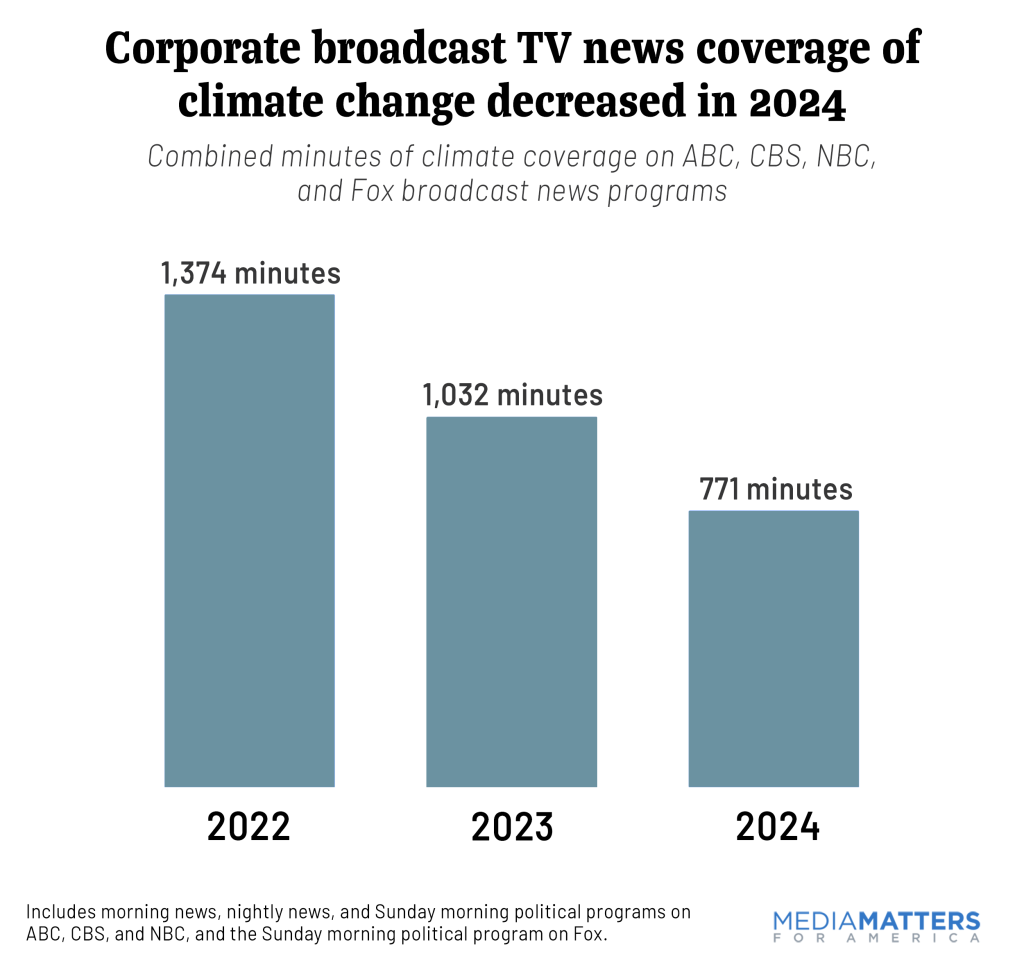
- ### 2024 climate coverage overview
- For the fourth year, CBS led in volume of climate coverage with 381 minutes across 129 segments, an 11% decrease from 2023, the smallest decline among networks.
- NBC aired 199 minutes of climate coverage across 88 segments, a 36% decrease from the 312 minutes aired in 2023. This was the largest decrease among the broadcast networks.
- ABC aired 184 minutes of climate coverage, a 35% decrease from the 284 minutes aired in 2023. However, ABC produced 103 climate segments, nearly matching CBS' total number of climate stories. This reflects a consistent effort to incorporate climate coverage across news programming, despite shorter average segment lengths.
[long]
===
press suppr
an 10 24
Donald Trump early Thursday morning amplified his calls to have CBS investigated for its editing choices in an interview with Vice President Kamala Harris, declaring that the development is "totally illegal" and demanding the government "take away the CBS license."
Trump on Wednesday lobbed an unproven accusation against CBS's "60 Minutes" over the program's taped interview with Harris, accusing the show of deceptively editing its interview to present Harris in a better light. Trump was criticized for his response, which was compared to "dictator talk."
The vice president sat down for an interview with correspondent Bill Whitaker, who asked at one point whether Israeli prime minister Benjamin Netanyahu was listening to the Biden administration's concerns about the war in Gaza, and the Trump campaign pointed out that her answer was different in a promotional clip posted on social media from what she said in the full interview that aired Monday night.
“The work that we have done has resulted in a number of movements in that region by Israel that were very much prompted by or a result of many things," Harris says in the truncated clip, "including our advocacy for what needs to happen in the region.”
However, in the interview, her immediate response to the same question was: “We are not going to stop pursuing what is necessary for the United States to be clear about where we stand on the need for this war to end.”
Trump previously called for an investigation Wednesday, but escalated those calls Thursday, saying Harris should now "concede the election.
"A giant Fake News Scam by CBS & 60 Minutes. Her REAL ANSWER WAS CRAZY, OR DUMB, so they actually REPLACED it with another answer in order to save her or, at least, make her look better," Trump wrote on Truth Social. "A FAKE NEWS SCAM, which is totally illegal."
He continued:
"TAKE AWAY THE CBS LICENSE. Election Interference. She is a Moron, and the Fake News Media wants to hide that fact. An UNPRECEDENTED SCANDAL!!! The Dems got them to do this and should be forced to concede the Election? WOW!"
---
vp debate shut off mic mansplain law; trump gripe ref; jdv i thot no fact check;
---
10/02/24 6:00 PM EDT
10/02/24 mma
10 24
another f bomb?
When Sen. JD Vance (R-Ohio) and Minnesota Gov. Tim Walz met for a vice-presidential debate in New York City on Tuesday night, October 1, they maintained a tone that many journalists found to be surprisingly civil and polite compared to the raucous, often bitter showdown between former President Donald Trump and Vice President Kamala Harris four weeks earlier in Philadelphia.
Vance, in contrast to Trump debating Harris, remained calm and didn't rant. When Never Trump conservative Charlie Sykes appeared on MSNBC's "Morning Joe" the following day, he complained that the debate had the effect of "sanewashing" Vance — and that Walz, on the whole, missed an opportunity to show just how extreme and dangerous Vance's positions are.
Nonetheless, there was one part of the debate where Vance's microphone was cut because he kept speaking when his time was up. And many far-right politicians and media figures were furious with CBS News and moderator Margaret Brennan for enforcing the rules of the debate.
READ MORE:JD Vance’s pledge to kill landmark Biden policy would 'devastate his hometown': analyses
On X, formerly Twitter, ex-Fox News host Megyn Kelly tweeted, "F you CBS - how DARE YOU."
Kelly, in a separate tweet, posted, "Tried to fact check. JD put you in your place. You WONT HIM FIGHT YOU AND YOU WONT LET THEM DEBATE."
When journalist Mickey Kaus tweeted that Vance missed a chance to attack conservative Sen. James Lankford's (R-Oklahoma) border bill, far-right author Ann Coulter responded, "The bimbo moderators wouldn't have let him."
On his Truth Social platform, Trump posted, "Maragret Brennan just lied again about the ILLEGAL MIGRANTS let into our Country by lyin' Kamala Harris, and then she cut off JD's mic to stop him from correcting her!"
READ MORE:'Extremely biased anchors!' Trump melts down on Truth Social over vice presidential debate
MAGA conspiracy theorist Laura Loomer was furious as well, tweeting, "@JDVance putting these broads in their place over the Haitian migrants in Ohio. Now they are muting his mic. Unreal."
Rep. Marjorie Taylor Greene (R-Georgia) tweeted, "The CBS moderators just MUTED JD Vance's mic as he called them out for their lies about Kamala Harris’ open border policies. DISGRACEFUL."
10/01/24 mma
-----
===
The good, the bad, and the ugly of Sunday morning political shows’ coverage of Hurricane Helene misinformation
Impacted states are pleading for bad actors to stop spreading deliberate misinformation
Special ProgramsClimate & Energy
Written by Allison Fisher
Published 10/07/24 mma
Misinformation related to the ongoing response to Hurricane Helene, which has created widespread devastation across six states and left at least 232 dead, is disrupting relief operations, and a number of local and state officials are calling on bad actors and the Trump campaign to stop spreading the lies.
The Sunday morning political shows attempted to address this hurricane misinformation with varying degrees of success. With the exception of Fox News Sunday, all the shows rightly pointed out the threat misinformation and unfounded conspiracy theories pose to the response efforts while flagging some of the most prevalent lies polluting these efforts.
The most prevalent misinformation has centered on the distribution of Federal Emergency Management Agency aid, specifically the false claims that federal assistance is limited to $750 per affected individual and that FEMA funds are lacking due to spending on immigrant assistance. Bad actors have also pushed an overarching falsehood that the response has been a failure.
Both ABC and CBS hosted good-faith actors who debunked the falsehoods while also confirming that the federal efforts have been strong. CNN and NBC hosted bad actors who refused to acknowledge the misinformation and continued to push the false claim that the federal efforts have been a failure even in the face of repeated fact checks by the anchors.
Even though the misinformation appears to be constructed to attack the response of the Biden-Harris administration, none of the networks provided the context that former president Trump has a track record of doing what he accused the federal government of, such as withholding hurricane disaster relief to North Carolina and Puerto Rico allegedly for political reasons or the recent revelations that Trump “refused to approve disaster aid for California after deadly wildfires in 2018 because of the state’s Democratic leanings.”
Material to misinformation around the adequacy of FEMA funds is the fact that Republicans, just days before Hurricane Helene made landfall, voted down additional FEMA funds requested by the White House, and House Speaker Mike Johnson has declined Biden’s request to convene Congress to consider a special relief package for impacted states. However, these facts were also absent from the coverage.
### The good: ABC, CBS focused on misinformation and officials’ explanations that it can hamper recovery efforts
ABC’s *This Week* foregrounded an interview with FEMA Administrator Deanne Criswell by reporting that “in North Carolina, they are still working to survey the damage and to reach survivors as a wave of misinformation from the former president and his allies hampers the recovery effort.”
They added: … “In the wake of Trump's various claims, FEMA launching an anti-rumor tool this week to combat those messages, with local officials calling on people to ignore online falsehoods. … Law enforcement is monitoring threats towards public officials prompted by disinformation and conspiracy theories, including specific individuals linked to FEMA and other recovery agencies.”
Video
CitationFrom the October 6, 2024, edition of ABC's This Week
In the interview, ABC anchor George Stephanopoulos asked Criswell whether they had the resources they needed. She responded:
“Absolutely, George. We, again, we moved resources in before this storm happened. We embedded our staff in the state to work side by side so we could quickly employ those resources to where they were needed, and as we continue to see how long we're going to have to provide this level of sustained support, we will continue to do that.”
Criswell also lamented about the misinformation that “we're putting politics ahead of helping people,” while emphasizing the danger. “I need to make sure I can get the resources to where they’re needed, and when you have this dangerous rhetoric like you're hearing, it creates fear in our own employees,” she said.
On CBS’*Face the Nation*, moderator Margaret Brennan reported that a North Carolina state senator had been “posting on Facebook asking people to stop conspiracy theory junk” and asked Sen. Thom Tillis (R-NC), “Who or what is fueling that kind of misinformation and do you think it is harming recovery efforts?” He responded in part:
“Many of the observations are not even from people on the ground. I believe that we have to stay focused on rescue operations, recovery operations, clearing operations, and we don't need any of these distractions on the ground. It’s at the expense of the hard-working first responders and people that are just trying to recover their life.”
Brennan also questioned Tillis on the misinformation that Trump and others in right-wing media are spreading, such as falsely claiming that money intended for hurricane relief was being diverted to immigrants.
Tillis expressed disapproval of the administration’s border policy but capitulated that it was not impacting the hurricane response, saying: “We have the resources that we need. We're going to have to go back and pass more resources. We could have a discussion about the failure of this administration's border policies and the billions of dollars it’s costing. But right now, not yet is it affecting the flow of resources to Western North Carolina.”
“It has not been a factor, to be clear,” Brennan emphasized.
### The bad: CNN, NBC brought on Trump campaign spokesperson Lara Trump and Sen. Tom Cotton, and both spread misinformation
On CNN’s State of the Union, anchor Dana Bash tried to fact-check Trump’s misinformation in an interview with Lara Trump, but the Trump campaign spokesperson persisted in her false claims.
Bash brought up specific misinformation spread by the right-wing media and Trump, including that “FEMA is only offering $750 to Americans who have had their homes destroyed.”
“That's not true,” she clarified. “He's also echoing conspiracy theorists online who falsely claimed that the administration is redirecting disaster money for undocumented immigrants.”
In response, Trump doubled down on the false claims and repeatedly insisted that there is a relationship between the migrant crisis and the hurricane response, falsely claiming, “You have migrants being housed in luxury hotels in New York City. We have paid so much money from our tax dollars into the crisis that didn't need to happen. We could redirect money to help people immediately on the ground.”
Video
CitationFrom the October 6, 2024, edition of CNN's State of the Union
While Bash repeatedly fact-checked Trump’s response, she still provided a platform for the Trump campaign to push hurricane response lies and create the impression that the federal government’s relief efforts have been lacking.
Similarly, on NBC’s*Meet the Press* anchor Kristen Welker questioned Sen. Tom Cotton (R-AR) about hurricane misinformation, stating, “We know former President Trump has made, quite frankly, a series of baseless claims, including that the Biden administration is intentionally withholding aid from where Republicans live, also saying that FEMA funds are being redirected to migrants. Both those claims have been debunked. They’re false.”
Cotton twice claimed that Georgia Gov. Brian Kemp is calling the response “lackluster,” even after Welker corrected that Kemp “said we got what we needed.”
Cotton also falsely claimed that it took days to deploy helicopters and claimed that “there's not enough money left in the fund” while suggesting that the reason is because billions of dollars have been spent to put up migrants “in hotels and give them room service and maids.”
Welker fact-checked his response, saying, “Those funds are coming from a different federal fund, not from disaster relief, just to be clear. And what DHS Secretary Mayorkas said is that it has the money it needs for now, but not necessarily through the end of the year for future hurricanes.” But Cotton doubled down, saying:
“It is true that FEMA and the Department of Homeland Security have been spending billions of dollars on migrants. … I would note that this administration seems to have no problem finding money when they want to spend it on their priorities. When they need hundreds of billions to pay off student loans for graduate students in gender studies programs, they somehow find it. When it's trying to get helicopters to deliver food and water and cellular service and life-saving medicine into the mountain valleys, they somehow can't seem to find the money.”
Welker reiterated that the funds are different and that millions have already been distributed to those impacted.
In his newsletter, media critic Oliver Darcy asked about Cotton, “Why do news networks continue to invite the dishonest GOP senator on to abuse their platforms in the first place?”
Darcy was referring to Cotton continuing to lie about the 2020 election, but the point stands for his refusal to set the record straight on FEMA funding as well. Darcy went on to add:
As Jake Tapper — who also recently invited Cotton on his program — said years ago in the aftermath of the insurrection, “If you’re willing to lie about [the election], what else are you willing to lie about? And why should my viewers listen to you?”
### The ugly: Fox News Sunday glossed over misinformation and aired an inaccurate Trump statement without context
Fox News Sunday’scoverage of Hurricane Helene failed to cover the ongoing issue of misinformation altogether, instead focusing on the two presidential candidates’ recent comments on recovery efforts, reporting that Vice President Kamala Harris returned this week to North Carolina and “pledged ongoing federal support” and “former President Trump has said the current administration has done a lousy job.”
The show punctuated the statement with a clip of Trump saying: “They are doing the worst job on a hurricane than any administration has ever done.”
Video
CitationFrom the October 6, 2024, edition of Fox News Sunday
This is false: While the storm, made worse by climate change, is among the most deadly to hit the United States mainland, the response started even before the storm made landfall and is ongoing.
The Biden administration has approvedfederal assistance for multiple states, including Florida, North Carolina, South Carolina, Tennessee, Alabama, Virginia, and Georgia. On September 29, the White House released an updated fact sheet detailing the administration's “continued response efforts to Hurricane Helene,” noting that tens of thousands of state and federal personnel are helping victims across several states. This includes 50,000 personnel helping to fix power outages, 3,300 personnel allocating federal resources and helping with search and rescue operations, and 200 medical responders providing health services.
On October 2, Biden approved deployment of up to 1,000 active-duty soldiers to support the delivery of food, water, and other critical commodities to impacted communities.
master plan cbs exec powell memo task force?
an 7 24
MAGA fumes over report 4th of July gas prices lowest in 3 years: 'Why is CBS campaigning for Biden?'
===
mma 6 24
The recent extreme heat event that swept across the U.S. Southwest in early June — the first major heat wave of the year, which was made three times more likely because of climate change — served as a stark reminder of the escalating climate crisis. It also demonstrated the urgent need for national TV news coverage that consistently connects extreme weather to human-caused climate change.
Yet corporate broadcast and cable news shows largely ignored the climate connection in their coverage, and they missed other crucial opportunities as well: to connect the heat wave to recent climate attribution studies, to spotlight extreme heat’s impact on vulnerable populations, and to inform viewers about the climate implications of the 2024 election.
- ## Topline findings
- A Media Matters review of national TV news coverage of the extreme heat wave from June 4-9 found:
- National TV news networks covered the extreme heat event for 167 minutes across 97 segments. Climate change was mentioned in only 12% (12) segments.
- Cable news networks — CNN, Fox News, and MSNBC — aired a combined 114 minutes across 54 segments about the extreme heat event. Climate change was mentioned in 5 segments.
- Corporate broadcast TV networks — ABC, CBS, and NBC — aired a combined 54 minutes across 43 segments about the extreme heat event. Climate change was mentioned in 7 segments.
- CBS performed the best among all networks, airing as many segments that connected the heat to climate change as the three cable news networks combined. Nearly half of its total segments (12) included a mention of climate change (5).
- Only 4 climate segments also included a mention of how the extreme heat event could impact a socially marginalized population.
- ## How national TV news covered 2024’s first major extreme heat event
- The first major heat wave of 2024 set records for high temperatures across California and the Southwest, while creating significant health hazards for millions. The dangerous heat also impacted notable political events, such as former President Donald Trump's rallies in Arizona and Nevada, where multiple attendees at both events required medical attention for various heat-related conditions.
National TV news networks aired extensive coverage of the heat wave, as they typically do for highly visible extreme weather events. Multiple segments highlighted the anomalous and record-breaking nature of the heat wave, yet the coverage failed to consistently connect the event to climate change, despite the clear and robust connection between extreme heat and global warming.
On cable, CNN devoted 53 minutes to the extreme heat event across 25 segments, with 2 segments mentioning climate change. MSNBC aired 46 minutes of coverage across 16 segments, with 3 segments that mentioned climate change. And Fox News aired 15 minutes across 13 segments, without any mention of climate change.
On the corporate broadcast networks, CBS aired 16 minutes across 12 segments, with 5 segments mentioning climate change. NBC aired 27 minutes across 17 segments, with 1 segment that mentioned climate change. And ABC aired 11 minutes across 14 segments, with 1 segment that mentioned climate change.
While national TV news largely failed to connect the extreme heat to global warming, there were a few notable segments that made the connection between climate change and its consequences such as extreme heat.
Some of those came on the June 7 episode of *NBC Nightly News* and the June 9 episode of MSNBC’s Alex Witt Reports. The latter featured a wide-ranging interview about the causes and effects of the heat wave with climate scientist Kim Cobb, who also called for fossil fuel accountability.
- Video file
Video
CitationFrom the June 9, 2024, episode of MSNBC's Alex Witt Reports
- National TV news shows also missed key opportunities to provide deeper context about the extreme heat event.
- ## National TV news shows missed key opportunities to contextualize the extreme heat event
- Missed opportunity to discuss the impact of extreme heat events on vulnerable populations
National TV news coverage of the extreme heat event largely failed to report on how these events disproportionately harm vulnerable populations such as the elderly, low-income communities, and laborers, among others. This lack of coverage overlooks the real-world consequences of inadequate climate action.
However, there were some notable segments that did report on how extreme heat harms vulnerable communities. One of the strongest segments that aired during the studied period was on the June 6 episode of MSNBC's Chris Jansing Reports, which featured interviews with Basil Smikle, director of the Roosevelt House Institute of Public Policy at Hunter College and author and climate reporter Jeff Goodell, among others.
The segment detailed the disproportionate impact of climate change on vulnerable populations, particularly communities of color, low-income families, and the imprisoned, and emphasized the urgent need for a climate justice approach that is responsive to these communities’ specific challenges.
- Video file
Video
CitationFrom the June 6, 2024, episode of MSNBC's Chris Jansing Reports
- The June 8 episode of CBS Saturday Morning explained that some scientists are reassessing the heat index to more accurately ascertain how heat and humidity damages the human body and the impact of extreme heat on vulnerable populations such as the elderly. The segment highlighted the need for a better understanding of the damaging effects of heat and humidity, as well as the need for stronger policies to protect the vulnerable, with the key message being, “We can do better for our seniors.”
- Video file
Video
CitationFrom the June 8, 2024, episode of CBS Saturday Morning
- Missed opportunity to incorporate recent climate attribution studies into extreme heat coverage
National TV news shows missed an opportunity to incorporate climate into their extreme heat coverage, despite findings that clearly link global warming to the exacerbation of extreme heat events and increased mortality rates. Notably, research from Climate Central indicated that the heat wave from June 5-7, which affected over 229 million people across North America, was made at least three times more likely by human-caused climate change.
This crucial scientific context, while referenced during the June 4 episode of *CBS Evening News* and the June 5 episode of ABC’s *Good Morning America*, was largely absent from the coverage, leaving viewers without a full understanding about the direct link between climate change and the heat wave they were experiencing.
Missed opportunity to connect climate change impacts to the 2024 election
National TV news largely failed to connect Trump’s campaign rhetoric and climate policy actions to the tangible impacts of climate change, notably during coverage of his rallies in Arizona and Las Vegas where attendees required medical treatment due to extreme heat.
The Trump administration rolled back environmental protections, and he has promised to reverse Biden administration climate actions in exchange for fossil fuel industry campaign donations, as well as mocked those harmed by climate change impacts. But TV news coverage did not effectively link these policies and actions to the immediate and severe consequences of extreme heat at his events.
It's essential for national TV news to provide this context, as informed voting on climate policies is crucial, especially in regions that are increasingly experiencing the consequences of climate change.
Notable segments that attempted to address this angle included the June 5 episode of CNN’s *The Lead*, where climate correspondent Bill Weir used the occasion of extreme heat to note the harmful climate implications of Trump’s climate policies and his attempted quid pro quo with the fossil fuel industry, and the June 9 episode of MSNBC’s PoliticsNation, which mentioned Trump's climate denial in the context of people passing out at his Arizona and Las Vegas rallies.
- Video file
Video
CitationFrom the June 9, 2024, episode of MSNBC's PoliticsNation
- ## How national TV news can improve its coverage during discrete extreme weather events
- National TV news networks can implement several strategies to provide audiences with a more comprehensive understanding of how climate-driven extreme weather impacts their lives:
Tell extreme weather stories through a climate lens
Coverage should consistently explore whether and how climate change may have influenced specific weather events, addressing the impact global warming has on these occurrences.
Contextualize extreme weather events
Networks should strive to connect individual extreme weather events to the broader narrative of the global climate crisis. This approach helps illustrate the cumulative effects of climate change and the urgent need for action.
Incorporate climate justice
When covering extreme weather, TV news media must discuss climate justice, which focuses on the disproportionate effects of climate change on socially marginalized communities. These impacts often manifest most acutely during extreme weather events.
Link extreme weather events to the 2024 election
It is crucial for coverage to show the relationship between extreme weather events, climate change, and candidates’ political platforms. This helps voters understand how candidates' policies might or might not mitigate future climate-related challenges.
Demand accountability from the fossil fuel industry
Broadcast and cable news networks must consistently hold the fossil fuel industry accountable for its significant role in driving global warming. This includes discussing how industry actions contribute to climate change and highlighting the environmental and social consequences of their operations.
- ## Methodology...
===
---
4 24 pix = vids
Climate solutions coverage on broadcast news programs declined in 2023
Corporate broadcast news coverage of Earth Day could boost the quantity and quality of coverage in 2024
Special PROGRAMSCLIMATE & ENERGY
WRITTEN BY ALLISON FISHER
RESEARCH CONTRIBUTIONS FROM EVLONDO COOPER
PUBLISHED 04/16/24
In 2023, corporate broadcast news mentioned climate solutions in only 22% of climate segments, or 95 out of 435 — a decline from the previous three years. 2023 broke a trend of improvement in quantity of climate solutions coverage: Solutions were mentioned in 29% of segments in 2020, 31% of segments in 2021, and reached a zenith of 35% in 2022.
In general, discussion of solutions should happen alongside discussions of the myriad climate impacts, including extreme weather, that make up the bulk of climate reporting on broadcast TV news. The best coverage of climate solutions does two things: It centers on solutions that are at scale with what is needed to reduce carbon emissions, and it avoids — or at the very least vets — solutions pushed by corporations and fossil fuel interests, which often do little to tackle the root cause of global warming.
As Earth Day coverage ramps up, this study looks at which networks have led the way on climate solutions coverage, how networks covered solutions in 2023, and what networks can do to improve this coverage in April and beyond.
- ## CBS was the best-performing network in terms of volume of climate solutions segments
* CBS led its competitors in climate solutions coverage, mentioning solutions in 49 segments (33% of its segments), followed by NBC with 28 (20% of its segments) and ABC with 17 (12%). The vast majority of these segments on CBS (37) aired on the network’s morning news program CBS Mornings. CBS has led on climate solutions coverage for the last three years running — in fact, the network has led the field in overall volume of climate coverage since at least 2020.
One example illustrates the nuance the network brings to climate solutions coverage. A segmentthat aired on May 1 addressed one common critique of renewable energy sources — the environmental impact of wind turbine blades and solar panels that are no longer in use. The segment featured a company that recycles renewable energy materials, keeping them out of landfills. The segment provided key context around this subject, including that solar is the fastest growing energy source in the U.S. and that renewable energy is key to addressing climate change by allowing us to move away from fossil fuels while addressing a side effect of the rapid buildout of renewable energy, which has been exploited by bad faith actors.
The highest concentration of climate solution coverage came in April
- Nearly a quarter (23%) of segments mentioning climate solutions aired during April — a month when networks typically elevate their climate and environmental coverage in observation of Earth Day. In April the networks aired almost two times as many segments featuring climate solutions as they did in July, the month with the second highest volume of climate solutions coverage. During the week leading up to Earth Day, corporate broadcast TV networks ABC, CBS, and NBC spent a combined 182 minutes — just over three hours — discussing climate and environmental issues.
NBC led with climate solutions coverage in April, with 9 segments, followed by CBS with 8 and ABC with 5. Notably, while CBS and ABC had their peak overall coverage in July, NBC’s was in April, when it aired 1 hour of climate coverage.
One climate solutions segment that appeared on NBC, during the April 20 edition of  *, discussed local climate solutions related to food waste while connecting the effort to the broader climate crisis. Correspondent Anne Thompson noted, “Each year, food loss and waste in the U.S. produces emissions equal to the planet-warming carbon dioxide from 42 coal-fired power plants.”
- ## The most-discussed climate solutions were renewable energy technologies and adaptation
- The largest share of solutions coverage focused not on mitigation of climate change but on adaptation to it — mentioned in 29 segments — showing that coverage has started to more regularly acknowledge that we are already living in a world affected by a changed climate. These mentions ranged from discussion of
 and tree planting campaigns intended to
 to consideration of
 given that the warming climate’s sea-level rise and extreme weather are making some locations increasingly uninhabitable.
Renewable technologies such as solar and wind energy were mentioned in 22 segments. The topics ranged from action taken by the Biden administration to drive renewables to the role of renewable energy in meeting international climate agreements to even challenges faced by renewable energy.
Corporate broadcast TV news is vetting fringe and false solutions
Broadcast TV networks gave little airtime to fringe or false solutions. Fringe solutions are those that are generally unproved or prohibitively expensive like carbon capture and sequestration. False solutions are those that would not make any meaningful difference, such as carbon offsets, or represent questionable strategies for solving climate change, like many corporate net zero pledges. False solutions have also derived from industry or conservative talking points — like fracked natural gas as a bridge fuel and “clean coal.”
Unlike in previous years, broadcast networks did not discuss carbon offsets as a viable climate solution for industry and corporations in our monitoring. Carbon capture technology appeared in only 2 segments — and in both cases the technology was discussed in relation to a new proposed power plant rule that identifies carbon capture technology as one way carbon-intensive power sources could reduce emissions.
ABC’s World News Tonight reported on the rule when it was announced on May 11, noting, “A new rule will allow power plants to use carbon capture to reduce their emissions while still burning fossil fuels.”
During the June 29 edition of *CBS Mornings*, senior national and environmental correspondent Ben Tracy did a deeper dive into the technology while reporting on the new rule, noting that “some critics say that carbon capture is actually an expensive and misguided distraction in the fight against climate change.”
Two segments referenced geoengineering, a controversial approach to addressing climate impacts.
[vid]
ABC’s Good Morning America aired a on April 18 on efforts to address the water shortages happening along the Colorado River, which included a discussion of “weather modification or cloud seeding.”
And CBS Saturday Mornings aired a segment on April 22 about some limited scientific support for geoengineering due to the fact that climate change mitigation efforts are not ramping up fast enough. The segment focused on solar engineering — a set of technologies to cool the earth by reflecting sunlight back into space.
CBS’ Tracy once again approached the subject critically, asking two individuals experimenting with geoengineering to cool the earth, “Should a couple of tech bros be the guys experimenting with this with no scientific background?”
The segment made it clear that shifting away from fossil fuels is still necessary and that these technologies are “a sign of desperation” and are thought by some critics to be dangerous.
Corporate broadcast TV news is generally not connecting climate solutions to the drivers of climate change (fossil fuels) and to climate-fueled extreme weather events
- Only 7 segments that mentioned climate solutions also mentioned the phrase fossil fuels. In fact, overall, only 12% of climate segments on corporate broadcast news, or 52 out of 435, mentioned the phrase “fossil fuels.” Networks need to better articulate the problem — the burning of fossil fuels — in order to present the best solutions to audiences.
In one positive example, ABC explicitly tied fossil fuels to environmental degradation and solutions during its Earth Day coverage. Reporting on the role of plastics in consumer products on the April 21 edition of Good Morning America, guest Anna Robertson of The Cool Down — a climate and sustainability media platform — said plastic is “created by using fossil fuels, which create pollution in our atmosphere.” The segment went on to offer consumer-based solutions to reducing plastic use.
While it is prudent to offer audiences accessible individual solutions during Earth Day coverage, Earth Day has unfortunately often been co-opted by corporations to promote “green consumerism” and put the onus of solving climate change on individual people rather than the industries that are most responsible for carbon emissions.
While individual actions are important in solving climate change, and mass consumption drives many of the climate and environmental problems that the planet faces today, this approach to sustainability is problematic because what’s really needed to solve the climate crisis is widespread societal change and collective action that forces a rapid reduction in fossil fuel use.
While networks fell short in connecting climate solutions to the broader issue of fossil fuel emissions, they did a better job connecting solutions directly to sectors that contribute to global emissions. For example, there were 7 segments that discussed solutions to make the fashion industry — which contributes up to 10% of global carbon dioxide output — more sustainable. There were also 7 segments that discussed solutions related to the transportation sector, which is the largest contributor to climate pollution, and there were 9 segments discussing solutions within the food industry (food waste alone contributes 10% of global emissions).
Likewise, networks should integrate discussions of solutions into extreme weather coverage and other moments when climate change’s impacts are the most visible. Major extreme weather events garner a high volume of coverage across morning and evening news programs, but too often this coverage does not include discussions about how to mitigate the emissions that are driving increasingly destructive and deadly weather events. In 2023, only 2% (10 of 435) of segments mentioned both an extreme weather event and a climate solution.
In one positive example, during the July 26 edition of *CBS Mornings* the network aired an interview with climate policy expert Leah Stokes, who discussed the connection between last summer’s historic heat waves and climate change and the need to stop burning fuels. The segment concluded with Tracy pointing out that “demand for electric vehicles is accelerating and renewable energy is more abundant and cheaper than ever, but unless we dramatically cut planet-warming emissions this record hot summer might be the coolest one we have left.”
But this example is the exception, not the rule. In order to tell the full story of the climate crisis, broadcast news networks have to clearly connect climate solutions to both the problem and the impacts those solutions seek to address.
- ## Methodology...
---
National TV news coverage of COP28 was sparse and inconsistent | Media Matters for America
---
---
---
---
morano 5 23
allison blonde glasses blk blazer but cleavage in focus 11b biden electric rural TVA running water new deal; literally a money lander scheme GND
solandra make work job blackout, $ to rt ppl but well connected donors; higher energy cost, less electricity
wow pretty terrifying hope ppl wake up rather than go along w corrupt agenda; corp media cbs in focus insect eat sci in germany soybean deforestation livestock feed; newsflash there is no global food crisis related to climate,gov't made supply chain problemw/ policy; chem farming, eu crush small fam farm to meet net zero goal that's what 6o min dutifully report; psyop kids in school, mfg food crisis; ad oan live 5/mo credible unbiased less than cable stay informed; cleavage
gmail oann.com/video/in-focus-video/climate-depot-founder-on-team-biden-the-radical-climate-agenda/
---
---
https://www.mediamatters.org/moms-liberty/cbs-book-banning-segment-irresponsibly-whitewashed-extremist-parental-rights-group
---
---
an 1 23
CBS host Margaret Brennan grilled House Speaker Kevin McCarthy (R-CA) about his decision to appoint 2020 election deniers to key committees.
---
growing a pair?
https://www.alternet.org/im-asking-about-you/
---
mma
https://www.mediamatters.org/cable-news/how-2022s-best-extreme-weather-segments-point-way-forward-national-tv-news-extreme
Much of 2022’s extreme weather coverage from national TV news outlets failed to connect the consequences of climate-driven events such as wildfires, hurricanes, heat waves, and megadroughts to their primary cause: global warming induced primarily by the burning of fossil fuels. Corporate broadcast and cable TV news reporting on extreme weather events in 2022 too often neglected to connect these disasters to the climate crisis, allowed systemic failures that are exposed by extreme climate events to go unchallenged, and failed to demand accountability for those exacerbating climate change, as well as its impacts and injustices.
A roundup of this year’s extreme weather coverage found that national TV news shows mentioned climate change in only 17% of segments about mid-June’s multiple concurrent extreme weather events, while broadcast and cable coverage of Yosemite National Park’s Washburn Fire from July 9-11 mentioned climate change in just 37% of segments. Similarly, only 32% of national TV news segments about the global extreme heat waves from July 16-18 mentioned climate change.
During broadcast and cable news coverage of a record-breaking heat dome that afflicted the American West from late-August through early-September, climate change was mentioned in only 12% of segments. And, from August 25 through September 15, national TV news coverage of Pakistan’s catastrophic floods mentioned climate change in 35 of 78 segments.
Moving into hurricane season, broadcast and cable news coverage of Hurricane Fiona from September 14-20 mentioned climate change in only 7 out of 233 segments, while national TV news coverage of Hurricane Ian mentioned climate only 46 times across 1,020 segments.
There were some notable positive examples among 2022’s extreme weather segments, however,which contextualized the role of climate change, amplified voices from vulnerable communities, and demanded accountability for the polluting industries driving the climate crisis. As such, they should serve as a model for how broadcast and cable news shows should approach their coverage of extreme weather in 2023 and going forward.
Here are a few of the best extreme weather segments aired in 2022
Broadcast
One of broadcast news’ better segments aired during the July 18 episode of CBS Mornings, which demonstrated how extreme weather coverage benefits from experts who can credibly communicate climate science and the urgency of climate action to viewers. The segment, which was about the extreme heat gripping multiple places on Earth, featured an interview with Kirsty McCabe of the U.K.’s Royal Meteorological Society, who stated that “climate change has everything to do with the extreme weather that we're seeing at the moment — and it's human-induced climate change, it’s not a natural variation.” She also noted that “if we don't do something now and take drastic action, we will continue to see these things happening."[vid]
one of the strongest extreme weather segments on either broadcast or cable news aired during the September 20 episode of CBS Mornings. Correspondent David Begnaud, who also did exceptional reporting during and after 2017’s Hurricane Maria, used a nearly eight-minute segment about Hurricane Fiona to demand accountability from the utility company currently tasked with rebuilding and improving Puerto Rico’s grid, and to amplify the voices of vulnerable people who face immediate risk when critical infrastructure fails....
---
---
National TV networks mention climate change in 32% of segments on global extreme heat
07/19/22
Punishing extreme heat is affecting countries all across the globe this week. Extreme “red” heat warnings were issued in the United Kingdom for the first time, and Wales recorded its highest-ever temperature. At least 1,100 people have died in Spain and Portugal due to the extreme heat, which has fueled wildfires there and in parts of France. The Midwestern U.S. and Central Asia are suffering from extreme heat as well.
The European heat is truly exceptional, and its connections to the climate crisis are unquestionable. As climate reporter Andrew Freedman recently noted on Twitter, “the word ‘unprecedented’ is as overused as the phrase ‘the new normal,’ but the extreme heat event underway in Europe truly is historic. And it would not be as hot without human-caused global warming.”
Despite the clear links between climate change and extreme heat, corporate broadcast and cable TV news programs failed to consistently connect climate change to these global extreme heat events. Out of 62 combined segments and weather reports discussing the historic heat waves on ABC, CBS, NBC, CNN, and MSNBC, from July 16-18, only 20 (32%) mentioned climate change. The vast majority of extreme heat segments mentioning climate (16) were related to the European heat wave.
News shows on ABC, CBS, and NBC ran a combined 27 global heat segments – 37% of them mentioned climate change
From July 16-18, corporate broadcast networks ABC, CBS, and NBC aired 10 mentions of climate change related to extreme heat, and 7 of those mentions were in the context of reporting on the European heat wave.
Climate change was mentioned in 5 of ABC’s 12 extreme heat segments (42%). Four of those segments were in the context of European heat, and 1 in the context of U.S. heat. The latter mention was by meteorologist Ginger Zee on the July 18 edition of World News Tonight and represented the only climate mention in a weather report on corporate broadcast news.
Meanwhile, NBC aired 9 segments covering the extreme heat, with 3 of them (33%) mentioning climate change – 2 in the context of U.S. heat, and 1 in the context of European heat. CBS aired 6 extreme heat segments, with 2 (33%) mentioning climate change – both came in the context of European heat.
The July 18 edition of CBS Mornings included a good example of how extreme weather coverage can benefit from interviews with experts in the field who can credibly communicate the science and urgency of action to viewers. CBS correspondent Roxana Saberi interviewed Kirsty McCabe of the U.K.’s Royal Meteorological Society, who stated that “climate change has everything to do with the extreme weather that we're seeing at the moment – and it's human-induced climate change, it’s not a natural variation.” She later stated that “if we don't do something now and take drastic action, we will continue to see these things happening.
[vid? the July 18, 2022, edition of CBS Mornings
broken down by region, the corporate broadcast networks aired 11 news segments on the European heat, 10 segments on U.S. heat, and 6 that combined both European and U.S. heat.
In June, these same networks mentioned climate in just 9% of combined segments on various extreme weather events happening around the globe. Last week, they mentioned climate in a combined 38% of segments on the Washburn Fire, which threatened Yosemite National Park and its iconic sequoias.
Cable TV networks CNN and MSNBC ran a combined 31 segments on global extreme heat – 10 of them, or 32%, mentioned climate change
MSNBC aired 10 segments on extreme heat, and 7 of them (70%) mentioned climate change – making them the best-performing network reviewed in this time period. Four mentions came in segments about European heat, 2 on both European and U.S. heat, and 1 specific to extreme heat in Texas. MSNBC also featured the only mention by cable news of climate change in a weather report, which occurred while reporting on the European heat wave on the July 18 edition of Katy Tur Reports.
CNN ran 21 such segments, and only 3 (14%) mentioned climate change. All 3 came in the context of covering European heat. While lacking in climate mentions during its extreme heat coverage, the network featured one segment that did a particularly good job of putting these events within the context of the climate crisis and articulating the high stakes of climate inaction. During the 5 a.m. hour of the July 16 edition of CNN Newsroom, the reporter stated that “the extreme heat and drought fuelling what scientists say is a sign of the effects of climate change,” before going to climate scientist Michael Mann to explain further. Later in the segment, the reporter stated, “As the mercury climbs, scientists again warning [that] without addressing the climate crisis, weather events like this will grow more common and more extreme."
[vid]
broken down by region, these networks aired 19 segments on the European heat, 10 segments that combined both European and U.S. heat, 5 segments on U.S. heat (two of which were specific to Texas), and one segment on the heat wave currently affecting Asia.
In June, these networks mentioned climate in a combined 21% of segments on various extreme weather events. Last week, they mentioned climate in 37% of segments on the Washburn Fire.
Notably, Fox News ran 4 weather reports on extreme heat, and none of them mentioned climate change. Two were specific to U.S. heat, and 2 combined both U.S. and European heat. We did not include Fox’s numbers in the full dataset due to the network's long history of downplaying the severity of climate change.
The heat will only worsen this week (especially in parts of Europe), so these networks have an opportunity to better incorporate climate change in their reporting
Temperatures are expected to remain very high in the U.K. and France through July 19. Numerous record-high temperatures may be set in the Midwestern U.S. as well on this date, giving these networks an opportunity to accurately report on climate change in their extreme heat reporting throughout the rest of the week.
Methodology...
---
---
https://www.mediamatters.org/broadcast-networks/how-broadcast-tv-news-covered-environmental-justice-2021
Key Findings
Broadcast morning and evening news shows on ABC, CBS, and NBC aired a combined 153 segments about environmental impacts, regulations, or health hazards in all of 2021, and just 19 of them (12%) included mention of a socially marginalized community.
CBS aired the most environmental justice segments (13), followed by NBC (4), and ABC (2).
While not included in the official results, PBS NewsHour aired 13 environmental justice segments.
The majority of environmental justice segments focused on government action (14) and the health impacts of pollution or chemical waste (9).
Topics such as industrial accidents (2) and disaster recovery (3) were rarely reported through an environmental justice lens.
National TV news shows missed key opportunities to apply an environmental justice lens to important national stories such as the 2021 Texas winter storm, a toxic wastewater leak in Florida, and the Colonial pipeline hack.
Even segments about obvious environmental justice stories, such as the lead water crisis in Benton Harbor, Michigan, were mostly shallow and lacked important context.
National TV news only aired 19 environmental justice segments in 2021, which was still an improvement from 2020
Corporate broadcast TV news networks aired 19 environmental justice segments in 2021. CBS, which clearly outpaced the other broadcast networks, aired the highest number of such segments (13), followed by NBC (4), and ABC (2).
---
---
no lnx GUK
Robert Reich explores the compelling question of why CBS News hired Trump loyalists Mick Mulvaney
Meaghan Ellis April 19, 2022
Former U.S. Secretary of Labor Robert Reich is offering insight on a controversial topic that many have questions about: Why on earth did CBS News hire former Trump White House acting chief of staff Mick Mulvaney?
In an op-ed written for The Guardian, Reich tackled the issue of Mulvaney's hiring just days after he made his first CBS appearance on “MoneyWatch."
During that segment, Mulvaney, who is now an on-air contributor for the network, was asked to break down President Joe Biden's plan to increase taxation on America's ultra-wealthy. He also noted that the anchor, Anne-Marie Green, introduced Mulvaney as a former White House Office of Management and Budget (OMB) director and that she failed to mention the chaotic presidential administration he worked for. While he did serve in that capacity, he was also a partisan Trumpist.
Then she asked him if "regular working-class Americans" should be concerned about Biden's tax initiative. Reich highlighted Mulvaney’s answer: “It’s easy to look at it and say, ‘Don’t worry, you’re not going to pay this,’but regular working Americans would have to 'prove that they don’t have to pay it,' a burden that 'could be troublesome: every single year proving that you’re not worth a hundred million dollars.'”
Mulvaney's response is what Reich suggested is most problematic and also an example of the reason for concern about his hiring.
"This is as misleading as it gets in broadcast media (except for Fox News)," he wrote. "Nothing in Biden’s proposal to tax the super-rich requires that people prove they’re not super-rich. Mulvaney’s claim was pure demagoguery."
He added, "That’s what we should expect from Mulvaney. In 2019 Mulvaney threatened to withhold U.S. aid to Ukraine to fight Russian aggression unless President Zelenskiy came up with dirt on Hunter Biden. (This was the call in which Zelenskiy’s plea 'we need more Javelins' – anti-tank missiles that have proved crucial in Ukraine’s defense against Russia’s invasion – was met with Trump’s 'I would like you to do us a favor though.'”
Reich went on to offer a number of times Mulvaney has dropped the ball for the sake of politicization. From his 2019 threats toward Ukraine demanding dirt on Hunter Biden to his conspiracy theory stance on the COVID-19 pandemic he described as a "media hoax," Reich highlighted the unfavorable moments in his career that should raise questions about his credibility.
He also criticized CBS News noting the stark difference in the network now compared to what it once was. "When I was growing up, CBS News was the home of news legends like Edward R Murrow and Walter Cronkite– pioneers who set the standards for broadcast news," he wrote. "So why is CBS News now reaching into the cesspool of Trump conspirators and enablers to hire Mulvaney?"
Reich went on to push back against the explanation for Mulvaney's hiring which was provided by CBS News' Neeraj Khemlani. When asked about Mulvaney, Khemlani claimed "when it comes to contributor hires, 'getting access to both sides of the aisle is a priority because we know the Republicans are going to take over, most likely, in the midterms.'”
For that statement, Reich raised questions. “Getting access” to what? To the big lie about the 2020 election? To lies about Covid? To bonkers economics?" he wrote.
Reich concluded by saying, "CBS News, like every news outlet, has a cardinal responsibility to protect American democracy from this growing menace," he wrote. "To fulfill this responsibility, it must report accurately what is occurring. It should not pander to the menace by hiring a person who has had a hand in it and will further obscure the truth."
---
---
https://www.alternet.org/2022/04/jen-psaki/
===
3 22
hires mick mulvaney
===
mma
:{:{}:
}:
Bannon was banned from Twitter and YouTube after repeatedly calling for violence and suggesting live on air that Dr. Anthony Fauci and FBI Director Christopher Wray be beheaded. Now, Bannon listeners can turn to Apple Podcasts and Google Podcasts to listen to his show and watch his broadcast on the QAnon-linked channel Real America’s Voice, which is platformed by ViacomCBS’ Pluto TV.
===
===
an 521 R Reich
At the risk of being the skunk at the picnic, I feel compelled to warn you that if we forget and move on from the tragedies of this past year, we're setting ourselves on a dangerous path. Of course I understand the desire to forget all the unpleasantness and start a new chapter. But if we do, we're inviting greater tragedies in the future.
Let me remind you: Donald Trump lied about the results of the last election. And then – you remember, don't you? – he tried to overturn the results.
Trump twisted the arms of state election officials. He held a rally to stop Congress from certifying the election, followed by the violent attack on the Capitol. Five people died. Senators and representatives could have been slaughtered.
Several Republican members of Congress encouraged the attempted coup by joining him in the big lie and refusing to certify the election — even after the mob desecrated the halls of our democracy.
This was in January of this year, yet we seem to be doing everything we can to blot it out of our memory. Meanwhile, those responsible for instigating the attack haven't been held accountable in any respect — including by the media.
The Washington Post hosted a live video chat with Missouri Republican senator Josh Hawley, a ringleader in the attempt to overturn the results of the election. Hawley had even made a fist-pump gesture toward the mob at the Capitol before the attack.
But the Post billed the interview as being about Hawley's new book on big tech. It even posted a biography of Hawley that made no mention of Hawley's sedition,referring instead to his supposed reputation "for taking on the big and the powerful to protect Missouri workers" and as "a fierce defender of the Constitution."
CBS This Morning interviewed Florida Republican Rick Scott, another senator who tried to overturn the election by not certifying the results. But there was no mention of his sedition, either. The CBS interviewer confined his questions to Biden's spending plans, which Scott unsurprisingly opposed.
Senators Ted Cruz and Ron Johnson and House Minority Leader Kevin McCarthy also repeatedly appear on major news programs without being questioned about their attempts to undo the results of the election, or their continued promotion of Trump's lies.
The media is supposed to serve as a crucial check on those in power. But in its breathless desire to cover the "news" it is failing to remind us of our recent past.
The consequences of this failure are dire.
Trump's big lie that the 2020 election was stolen, and that President Biden is not legitimate, is not disappearing. A majority of Republican voters believe him.
That big lie is being used by Republican state legislatures to justify an all-out assault on the right to vote.
Hours after Florida enacted new voting restrictions, Texas's Republican-led legislature pushed ahead with its own bill that would make it one of the hardest states in which to cast a ballot.
The Republican-controlled Arizona Senate launched a private recount of the 2020 presidential election results in Maricopa County – farming out 2.1 million ballots to GOP partisans with no experience in ballot counting or election monitoring. At least one person involved in the recount participated in the Capitol attack.
The Republican Party even purged one of its leaders, Wyoming representative Liz Cheney, for telling the truth about the election.
Meanwhile, Republican state legislatures are muscling their way into election administration, as they attempt to dislodge or bully local election officials who have always run our voting systems.
Trump's big lie will continue to flourish unless the lawmakers who went along with it and have failed to renounce it face real consequences.
That means no book promotions, no cushy interviews, no guest op-eds in the Sunday paper.
What possible excuse is there for booking them if they have not publicly retracted their election lies? If they must appear, they should be asked if they continue to deny the election results and precisely why.
It also means a thorough independent 9-11 type inquiry into what happened, whether members of Congress were involved, how Donald Trump and others were involved.
Republican leaders must not duck this. History is watching.
They must be held accountable to the truth. Otherwise the trauma of 2020 will return — perhaps in even more terrifying form.
===
===
cBS host confronts Israel's Netanyahu: Are you killing Palestinians as a plot 'to stay in power'?
CBS host John Dickerson on Sunday pressed Israel Prime Minister Benjamin Netanyahu about his motivations for using disproportional force to kill Palestinian people, including...
===
an 521
top Dem lawyer blasts CBS News: 'Do you really need to both-sides democracy?'
May 09, 2021
Attorney Marc Elias, who coordinates Democratic Party lawsuits to protect voting rights, blasted CBS News on Saturday.
"Senate committee to hold markup on controver...
===
==
https://www.mediamatters.org/tucker-carlson/tucker-carlson-theres-no-evidence-climate-change-contributed-wildfires-ravaging-west
CARLSON (HOST): So, if you live in the western part of the country, you know, if you have a television, you've seen that there are horrible wildfires ravaging the western states, a couple of them. It's been going on for a little while, but it took no time at all for the usual vultures and parasites to swoop in and try to make political advantage out of this.
Barack Obama and the governor of California, Gavin Newsom, are now telling you that these fires are a direct result of climate change and according to Barack Obama, Donald Trump is directly responsible for them. He tweeted, "Vote like your life depends on it, because it does." You could die if you don't vote for Joe Biden. In fact, if you don't vote for Joe Biden we're going to see a lot more fires and not just from BLM rioters. The media, of course, went dutifully along with this as they always do.
...
Of course, there's no evidence for that, but lying on television is now the norm, so everyone did it. In fact, we know that a pyrotechnic device of some kind at a gender reveal party appears to have sparked the biggest of the fires, that's now grown to more than 10,000 acres. We also know state regulations preventing deforestation played a role, likely in spreading the blazes. We also know that the state of Oregon apparently sent a number of its firefighting helicopters to Afghanistan, a neocon request, to fight a war that has no purpose that has gone on for nineteen years and that Donald Trump has attacked for trying to end, but whatever. What the Democrats in California want you to know is "No, we've mismanaged the energy grid so badly, we can't leave the lights on, we literally can't be a first world state anymore, but it's not our fault. It's Donald Trump's fault." How long can this lying go on exactly? This blame shifting?
As Jeff Berardelli put it for CBS News: It's not coincidence, it's climate change.
Right on the heels of arguably the West Coast's most intense heat wave in modern history comes the most ferocious flare-up of catastrophic wildfires in recent memory. Meanwhile, just a few hundred miles east, a 60-degree temperature drop over just 18 hours in Wyoming and Colorado was accompanied by an extremely rare late-summer dumping of up to 2 feet of snow.
It's not coincidence, it's climate change.
These kinds of dystopian weather events, happening often at the same time, are exactly what scientists have been warning about for decades. While extreme weather is a part of the natural cycle, the recent uptick in the ferocity and frequency of these extremes, scientists say, is evidence of an acceleration of climate impacts, some of which were underestimated by climate computer models.
==
===
were we not seeing progress?
| only 4% of wildfire segments on ABC, CBS, and NBC mentioned climate change |
August was a turbulent month for wildfire activity in the Western U.S. California alone suffered through two of its largest wildfires in recent history, and there are more than 80 other large, active fires burning in 15 states. Record-breaking temperatures and climate change are playing a role in the size and scale of the fires, and the coronavirus pandemic is complicating efforts to contain the blazes and safely evacuate those in their path. Media Matters found that ABC, CBS, and NBC aired a combined 114 segments about wildfires on their morning and evening news shows from August 1 to August 31. Only five of the 114 wildfire segments -- just 4% of them -- mentioned climate change. |
==
==
mma 120
CBS hired Reince Priebus as a commentator and introduced him on air as simply Trump’s first White House chief of staff. Since his humiliating tenure at the White House, Priebus has accepted a senior role at lobbying and legal firms that have collected over $280,000 in fees from Republican campaign groups.
Priebus is currently employed by Michael Best & Friedrich LLP as President and Chief Strategist and Chair of the Board of Advisors for Michael Best Strategies LLC, the firm’s government relations and public affairs group.
- The company has lobbied for companies that include NACCO Industries (the public holding company for the North American Coal Corp.), Plains All American Pipeline, and the Primex Family of Companies.
- The company has also received over $280,000 in legal fees from Republicans.
- Stefan Passantino, a former White House deputy counsel and current partner at the firm, also represents the Trump Organization regarding congressional inquiries into the president’s business.
- There may be more conflicts of interest: Public relations work is not subject to federal disclosure rules.
While Priebus himself has not registered to lobby for clients, these conflicts of interest were not disclosed in his first appearance on CBS.
In addition, Priebus is a serial misinformer, who was corrected by CBS for lying just a few months prior to his hire.
==
CBS presents Infowars host Will Johnson as a random Trump supporter
Nauseating’: CBS slammed for ’embarrassing’ softball interview with Trump Jr
David Badash / The New Civil Rights Movement
“CBS This Morning” hosted Donald Trump Jr. Tuesday morning to talk about his new book that attacks the left and many Americans are asking: “Why?"
===
https://www.desmogblog.com/2018/10/17/60-minutes-trump-says-not-denying-climate-change
Davies, Climate Investigations Center. Originally posted on Climate Investigations Center.
Climate change is coming at Trump even as he tries like hell to avoid the subject. Record-setting hurricanes, Florence and Michael, have caused devastation across the southeast United States. Meanwhile, the grim UN IPCC “1.5 degree” report pushed climate scientists into the headlines last week while Trump was out and about, apparently unleashed, talking to media.
LStahl of 60 Minutes, got the first big sit down interview and went at climate change right off the bat. Pivoting off Hurricane Michael and the IPCC report, Stahl pressed Trump to answer straight questions about climate change.
This is the most Trump has been forced to say on the subject of global warming since his Rose Garden celebration announcing that the U.S. would exit the Paris climate agreement, where he managed to barely mention climate change.
Overall, Trump responds to Stahl’s questions with the typical denier tropes, which he likely learned from Rush Limbaugh, Myron Ebell, Marc Morano, and the Heartland Institute:
“Somethings changing and it’ll change back again.”
“And you don’t know whether or not that would have happened with or without man. You don’t know.”
“We have scientists that disagree with that [anthropogenic climate change].”
“But it [climate change] could very well go back.”
“But I don’t know that it’s [climate change] manmade.”
“They say that we had hurricanes that were far worse than what we just had with Michael.”
“You’d have to show me the scientists because they have a very big political agenda, Lesley.”
Trump also deployed a empty economic argument against taking action, one commonly used by deniers:
“I will say this. I don’t wanna give trillions and trillions of dollars. I don’t wanna lose millions and millions of jobs. I don’t wanna be put at a disadvantage.”
Read the full 60 Minutes interview transcript.
Deniers Would Rather Trump Said Nothing
Trump said a couple of things the deniers don’t really want him to say, including:
“I don’t think it’s a hoax” and “I’m not denying climate change.”
Joe Bast, former CEO of the Heartland Institute, and his climate denier kin are happiest when the President doesn’t talk about it at all. A year ago, Bast provided his reason for applauding the President’s silence, quoted and memorialized in the video below:
“The President has done a great job by not talking about global warming. The less the President talks about it, the less often it appears in news stories and on TV, the less often its going to be an issue. So, this is how big issues disappear.' Trump Questioned on Climate by Reporters in Georgia While Touring Hurricane Damage
Predictions for Hurricane Michael went from a predicted Category 1 on October 7 to making landfall at just below Category 5 three days later, surprising meteorologists and foiling predictive computer models.
While touring areas damaged by the massive storm in Georgia on Monday,reporters continued to press Trump on climate change and he continued trying to change the subject and inform us that he has “the cleanest air on the planet.”
...
===
==
2x?
shadows of lib;
AMY GOODMAN: Jean-Philippe, the examples in your film are extremely powerful. And that’s what we’re going to turn to right now. We’re going to turn to a clip of the film, and this is a clip that involves Roberta Baskin. She is a reporter for CBS. The first story in the film is about this reporter, CBS chief correspondent, who traveled to Vietnam in 1996 to report on labor abuses at Nike factories. This is a clip of Roberta Baskin describing some of what she found.
ROBERTA BASKIN: One of the things that really shocked me was to discover that the word "Nike" had become a verb. The word "Nike" meant to abuse your employees. There were incidences of physical abuse, women who had their mouths taped shut for talking on the line, 15 women who were systematically hit with the top part of a Nike shoe around the face and the neck. It was this disparity between seeing the corporate image that the company sells and the reality in these factories: "Just do it, or else."
AMY GOODMAN: The report sparked protests and boycotts across the country, as Nike rushed to deny the allegations. CBS asked Roberta Baskin to do a follow-up report. The film explains what happened next.
NARRATOR: As Baskin was putting together the updated news report on Nike’s labor practices, she received unexpected news from inside CBS.
ROBERTA BASKIN: I got a call from my executive producer, who said, "The story is not going to air. It’s been taken off schedule. There’s some sort of deal being made between Nike and CBS Newsfor the upcoming Winter Olympics." And the air went out of my soul.
BRIAN HEALY: CBS News was paying an enormous amount of money for the rights. And so, by definition, they would be seeking out commercial sponsors who would pour lots of money into it so that they could recoup the millions that they were paying for the rights of the Olympics.
CBS ANNOUNCER: The 18th Olympic Winter Games on CBS.
NARRATOR: As CBS revealed their Olympic coverage, the deal between Nike and CBS was plain to see.
ROBERTA BASKIN: Correspondent after correspondent are wearing these Nike jackets on the air, with a little CBS something or other—you really couldn’t read it—and a big swoosh on the shoulder. That was the deal. Nike had convinced CBS News to turn its correspondents into billboards. It was heartbreaking.
BRIAN HEALY: The CBS News correspondents were furious. They had to wear the Nike parkas whenever they appeared on air. It’s just not done.
NARRATOR: Baskin wrote a memo requesting CBS management to take the Nike logo off the correspondents.
ROBERTA BASKIN: CBS had crossed this incredible line. How do you trust serious stories when you’re seeing the reporter wearing a bunch of logos? Immediately, the president of CBS News responded, saying, "This was a breach of professional etiquette." It meant that I should shut up. How dare I raise a question about the integrity of CBS News?
AMY GOODMAN: That was Roberta Baskin from the film Shadows of Liberty. You also heard former CBS News producer Brain Healy in that clip. Jean-Philippe Tremblay, why did you choose to open the film with this story?
JEAN-PHILIPPE TREMBLAY: Well, Roberta Baskin is just an example of an amazing journalist. She’s one of the most awarded female journalists here in the United States. She’s won something like over 75 journalistic awards. And the report—the reporting that she does is always trying to tell us what’s happening with power. Here we see an example with the Nike corporation. And because she’s reporting on the Nike corporation, she’s stopped by the very power that she’s working for, CBS News, because they have made a deal with Nike corporation.
===
==
perhaps minor fails? patterns? fodder?
http://www.alternet.org/media/new-york-times-grovels-right-wing-and-other-despicable-media-moments-week
agw hurricane harvey, nyt stephens [50 min total last year?]
ABC and NBC ignore climate change’s role in extreme weather events.
As Media Matters notes, of the three major news networks, only CBS has bothered to point out the glaring, existential threat of climate change in the context of Hurricane Harvey, which devastated Houston earlier this week. CBS aired three segments that addressed the connection: one on CBS This Morning and two featuring environmental engineering professor Jim Blackburn; an August 30 episode of CBS Evening News and an August 31 episode of CBS This Morning. As of Thursday, neither ABC nor NBC bothered to mention climate change, instead settling on routine disaster porn and personal interest stories
2. Washington Post casually calls Venezuela an 'enemy of the U.S.'
For some reason editors at theWashington Postdecided to call Venezuela “an enemy of the U.S.,” which is odd considering Venezuela has never done anything to harm the United State.
Venezuela, enemy of the U.S., offered $5 million in aid to Harvey victims https://t.co/gUTmyiBKVO
— Washington Post (@washingtonpost) August 31, 2017
The article in question was actually noting aid Venezuela offered to Harvey victims this week, but according to thePost,this was just a devious plot (unlike American aid, which is purely benevolent). It described the offer with the dystopian phrase “trolling U.S. leaders with kindness.” Evidence for why Venezuela is an “enemy" was never made clear in the article, but the headline was later changed to something less nakedly ideological.
3. World’scoppiestreporter snitches to police duringnationaldisaster.
Oh boy, did ABC News’ Tom Llamas have a bad day on Twitter Wednesday. After posting a tweet saying, “We informed police of the looting and Coast Guard is flying overhead. Multiple officers now on the scene,” he was righteously piled on by thousands of Twitter users for snitching to the police in a time of emergency. “F**k off, snitch,” Baffler editor Brandy Jensen tweeted.
“In a disaster scenario the first response should be helping those in need, not criminalizing them,” another user insisted. All in all it was ugly; Llamas eventually deleted the tweet and tried some half-baked excuse about how there was “a body nearby,” but no one really bought it. From there it just got worse. After many failed attempts, he finally learned the first rule of handling social media pile-ons: log off.
4. What the hell is going on with the New York Times opinion section?
In a week of uniquely terrible takes, theNew York Times was the unexpected winner for worst takes in the shortest period of time. In one 72-hour period, it published op-eds by neocon hatchet man James Kirtrick bashing Chelsea Manning; an infomercial by suspected war criminal and former Blackwater CEO Erik Prince shilling his wares in Afghanistan; racist victim blaming of Arabs by Thomas Friedman; gross GOP revisionism by David Brooks insisting “racism was not a common feature in the conservative moment”; veiled climate change denial by columnist Bret Stephens; and a tedious AM radio screed against cultural appropriation by Bari Weiss. TheTimes insisted it had hired neoconservative Bret Stephens from theWall Street Journal because it values “ideological diversity,” which evidently means it really just wanted to seek out more odious far-right-wing viewpoints....
==
http://www.alternet.org/environment/broadcast-networks-climate-coverage-was-utterly-miserable-during-election-year
Secretary of State John Kerry, in Marrakesh this week for international climate talks, recently said it “pissed him off” that there wasn’t a single question asked about climate change during the six hours of televised presidential and vice presidential debates prior to the election.
Kerry’s annoyance is justified. Given rapidly rising global temperatures, dramatic extreme weather events, the global agreement to curb carbon emissions, and stark divisions among the major party candidates, climate change deserved to be one of the most talked-about issues of the campaign. And yet, outside of a passing reference during the “town hall” presidential debate, the candidates were not asked about it, despite the fact that queries about climate change were the fourth most-popular question category submitted by the public for the town hall debate, demonstrating that voters wanted to hear about it.
But it wasn’t only the debates.
Since January, the broadcast television networks barely reported on climate, even though this year is on pace to be the hottest one in the books, setting a record for the third year in a row. Out of more than 1,700 evening, morning, weekly and Sunday public affairs news programs aired between January 1 and October 31, the four commercial broadcast networks that provided moderators for the debates — ABC, Fox, CBS and NBC — collectively aired only 32 segments and 24 briefs on the topic, a total of56 pieces. And most of the evening news segments ran less than two and a half minutes in length, while each brief was no more than three or four sentences long.
By contrast, the commercial broadcast networks found time for considerably less important topics. Take the coverage of New England Patriots quarterback Tom Brady and the fallout over his “Deflategate” football tampering scandal. During the first nine months of this year, ABC, CBS and NBC aired 33 segments and 40 briefs on Brady, for a total of 73 pieces. (Fox’s lone national news show somehow missed the story.) Nearly half of the pieces — 34 — were on Deflategate and Brady’s four-game suspension. The rest reported on such riveting topics as Brady’s haircut, his new $200 cook book, and his new family dog, Fluffy.
Rating the Networks
Fox Broadcasting Company — not to be confused with 21st Century Fox’s cable channel Fox News — was by far the worst offender. The network doesn’t have a nightly news program, but it does air Fox News Sunday, a public affairs show hosted by Chris Wallace, the moderator of the third and final presidential debate. Since the beginning of the year, Fox News Sunday only broached the topic of climate change once, during an interview Wallace did with Green Party presidential candidate Jill Stein on September 4. Stein mentioned it in one sentence, and Wallace changed the subject. But Fox News Sunday was not alone. The topic didn’t come up on the other Sunday morning political gabfests either unless a guest mentioned it in passing. More often than not that guest was Bernie Sanders. (Given the incidental nature of these remarks, they aren’t included in the segment or brief totals.)
ABC, where town hall debate co-moderator Martha Raddatz works, was only marginally better than Fox, and it runs a lot more news programming. The network has aired only three segments on climate change this year, and they were all variations of the same story. On January 6, Good Morning America ran a relatively long segment on a melting glacier in Iceland that is retreating about a hundred yards every year. Nightline aired a shorter version of the piece that night, and the next morning, Good Morning America did a follow-up. Since then, the network aired only seven climate-related briefs, six on Good Morning America and one on World News Tonight, which merely reported that bumblebees are “threatened by climate change” in a two-sentence piece.
Over the same time frame, NBCaired 11 segments and two briefs on climate change. Seven segments were on Today, and the other four ran on NBC Nightly News, which is anchored by Lester Holt, the moderator of the first presidential debate.
Two of the four Nightly News segments piggybacked on other news stories. On August 20, an NBC correspondent took time off from the Rio Olympics to talk with locals about deforestation. Two weeks later, on September 3, the show reported on the G-20 Economic Summit in China, where President Obama and Chinese President Xi formally committed to the Paris climate agreement. All of the individual segments were well done, but given the magnitude and urgency of climate change, the fact that NBC’s premier daily news program ran only four segments on the topic over the course of nine months is incomprehensible.
CBS, whose correspondent Elaine Quijano moderated the vice presidential debate, aired the most segments and briefs of the broadcast networks — but that’s still not saying much. Nearly all of the briefs — 14 of 15 — and more than half of the segments — 11 of 18 — were on CBS This Morning or CBS Sunday Morning.
Two segments on The CBS Evening News linked climate change with extreme weather events. A July 20 segment on the heat wave broiling residents in more than two dozen states featured a National Weather Service meteorologist explaining how climate change works in simple, understandable terms. Two months later, on September 17, the show reported that the “world is on pace for the warmest year on record, breaking marks set in 2015, 2014 and 2010. But scientists say it’s more than temperatures. They have connected man-made climate change to deadly heat waves, droughts, and devastating floods.”
Those Evening News stories were excellent, but they were two of only five climate-related segments the show aired since the beginning of the year. 60 Minutes, meanwhile, sent a correspondent to Greenland to meet with climate scientists for a segment that aired on January 31 and again on July 31. That was it for the newsmagazine, but its competition at ABC and NBC — 20/20 and Dateline — avoided the issue altogether.
Millions are Watching, and They’re Not Being Served
The relatively few climate-related segments that did air on ABC, CBS and NBC since January demonstrate that the networks are quite capable of covering the subject in a compelling way. The amount of attention they devoted, however, was nowhere near what it should have been given the magnitude of the problem.
Besides their scanty coverage, the networks missed some obvious opportunities to make the climate connection. For example, all of the evening newscasts reported on the devastating rains and flooding in Louisiana last August. According to Climate Nexus, the storm that triggered the flooding “was supercharged by running over a warmer ocean and through an atmosphere made wetter by global warming.” No matter, according to Media Matters, none of the five NBC Nightly News segments, three World News Tonight segments, or three CBS Evening Newssegments on the floods cited the climate link. That’s just bad reporting.
One other point to consider is when the networks aired the bulk of their climate stories and briefs. Nearly two-thirds of the segments (20 of 32) aired on one of the network morning shows, as did more than 85 percent of the briefs (21 of 24). Why is that important? Because nearly twice as many viewers watch the evening news shows.
That said, despite the fact that the legacy broadcast networks have lost ground to cable and online sources in recent years, all of their news shows still command sizable audiences. According to figures from the week of October 24, slightly more than 23 million people watched one of the three broadcast networks’ evening newscasts. ABC’s World News Tonight led the pack with an audience of nearly 8.19 million viewers, just edging out NBC Nightly News for the top spot. The CBS Evening News came in last with 6.79 million viewers that week.
Fortunately, to paraphrase a Nobel Prize-winning poet, you don’t need a TV network to know which way the wind blows. Despite Donald Trump’s well-publicized contention that climate change is a Chinese-inspired hoax, nearly three-quarters of American voters now say global warming is happening and nearly 70 percent support a carbon tax.
When the story of this past election is written, however, a glaring and mystifying fact for historians will no doubt be how little attention was paid to perhaps the most important issue of our time. And the failure of the commercial broadcast networks to adequately address climate change should be front and center in that story. Their track record covering climate change this year has been so pathetic, it arguably violates the spirit — if not the letter — of the federal requirement that broadcast networks serve the public interest.
==
ktm
Chapter 8 How Benghazi Became #Benghazi p. 150
... HC has to prove a false negative?
Town Hall katie pavlich:men in libya died as help told to stand down 168 mcfarland on Fox said pol decision to to give them adequate security po decision not to rescue them (he ran against he for senate) 169
SOCAFRICA told guys not to board plane b/c no authorization (from?) but actually guys in tripoli were told beng ppl on way back and might need medical attan, so missing them bad move; no stand down order.
but mid april 2103 sharyl Atk sez multiple whistleblowers; referred to lts leaked by issa comm (get sec clearance for lawyers to protect whist from anticipated admin retaliation, slyly suggested 171 then issa announced a hearing to see if admin suppressed info 171 --> Victoria Toensing (husb joe digenova old clinton days ark pjt)
atk had done bad report on vaccines and Fast and Furious, got CPAC award; quit cbs, joined heritage wrote book (issa at bk launch); claimed gov't hacked computer, spooky web video, stuck space bar 172
Lara Logan Dylan Davies threshold book (Simon & S, owned by CBS) not disclosed. Fox had been using him as src, but quit when he asked for $ 175
eventually did 90 sec correction; LL put on leave; book not published (LL conferred with Lindsey Graham, why a problem if she had)?
trey gowdy angling for fed judge? how does hearings help that? 177
==
==
https://en.wikipedia.org/wiki/Sharyl_Attkisson
===
http://www.hollywoodreporter.com/news/cbs-bans-ads-dan-rather-832635
redford Truth
==
wiki
https://en.wikipedia.org/wiki/CBS_Corporation
CBS Corporation is an American mass media corporation focused on commercial broadcasting, publishing, andtelevision production, with most of its operations in the United States. The president and chief executive of the company is Leslie Moonves. Sumner Redstone, owner of National Amusements, is CBS's majority shareholder and serves as executive chairman. The company began trading on the NYSE on January 3, 2006. Until then, the corporation was known as Viacom, and is the legal successor to said company.[4] A new company, keeping theViacom name, was spun off from CBS. CBS, not Viacom, retains control of over-the-air television
(CBS, CW) andradio broadcasting, TV production and distribution, publishing, pay-cable, basic cable (Pop), and recording formerly owned by the larger company. CBS has its headquarters in CBS Building, Midtown, Manhattan, New York City, United States.[5]^
^ ^
^bought ^its ^parent?
===
==
busted
http://mediamatters.org/research/2015/11/13/network-evening-news-programs-yet-to-address-wh/206839
In recent months, media investigations have revealed that Exxon Mobil peddled climate science denial for years after its scientists recognized that burning fossil fuels causes global warming, prompting New York's Attorney General to issue a subpoena to Exxon and all three Democratic presidential candidates to call for a federal probe of the company. But despite these developments, the nightly news programs of all three major broadcast networks -- ABC, CBS, and NBC -- have failed to air a single segment addressing the evidence that Exxon knowingly deceived its shareholders and the public about climate change.
Media Reports Revealed Exxon's Acceptance Of Climate Science Pre-Dated Its Funding Of Climate Denial, Prompting Calls For Investigations
Media Report: Email Shows "Exxon Knew Of Climate Change In 1981 ... But It Funded Deniers For 27 More Years."On July 8, InsideClimate News and The Guardian reported on an email from a former Exxon employee that was highlighted by the Union of Concerned Scientists. InsideClimate News noted that the email showed "Exxon scientists studied the impact of greenhouse gas emissions on global warming as far back as 1981," and that "company's early awareness of climate change and willingness to factor it into business decisions starkly contrasts with the path it took a decade later, when it led efforts to cloud public understanding of climate science and delay action to reduce emissions of greenhouse gases, such as carbon dioxide." The Guardian similarly reported that ExxonMobil "knew as early as 1981 of climate change -- seven years before it became a public issue, according to a newly discovered email from one of the firm's own scientists. Despite this, the firm spent millions over the next 27 years to promote climate denial." The Guardian further reported:
==
==
http://mediamatters.org/research/2015/11/17/pro-koch-cbs-analyst-received-15-million-from-t/206918
hired luntz, did not disclose C of Intrst
==
sunday talk
premier is/was Face the nation
bob s ref'd tony perkins as hate gp per splc (note retired 2015)
https://en.wikipedia.org/wiki/Bob_Schieffer
==
Bob Lloyd Schieffer (born February 25, 1937) is an American television journalist who has been with CBS News since 1969, serving as anchor on the Saturday edition of CBS Evening News for 23 years, from 1973 to 1996, as well as chiefWashington correspondent since 1982 and moderator of the Sunday public affairs show Face the Nation since 1991. From March 2005 to August 31, 2006, Schieffer was interim weekday anchor of the CBS Evening News and was subsequently one of the primary substitutes for Katie Couric and Scott Pelley.
Schieffer is one of the few journalists to have covered all four of the major Washington national assignments: the White House, the Pentagon, United States Department of State, and United States Congress. His career with CBS has almost exclusively dealt with national politics.
On October 13, 2004, he was the moderator of the third presidential debate between President George W. Bush andSenator John Kerry in Tempe, Arizona. On October 15, 2008, Schieffer moderated the third presidential debate between Senator Barack Obama and Senator John McCain. Schieffer also moderated the third debate of the presidential candidates in 2012, between President Obama and former Massachusetts governor Mitt Romney, on October 22 in Boca Raton, Florida.
Contents
- 1 Youth
- 2 Broadcasting career
- 3 Awards
- 4 Books
- 5 Other interests
- 6 Personal life
- 7 Current status
- 8 Career timeline
- 9 See also
- 10 References
- 11 External links
Youth
Schieffer was born on February 25, 1937, in Austin, Texas, to the late John Emmitt Schieffer and the former Gladys Payne, and grew up in Fort Worth, Texas. He is an alumnus of North Side High School, and Texas Christian University (TCU), where he was a member of the Air Force Reserve Officer Training Corps[1] and the Phi Delta Theta fraternity. The College of Communication at TCU was later named after him.[2] After graduating from TCU, he served in the U.S. Air Force as a public information officer stationed at Travis Air Force Base and later McChord Air Force Base.[3] He was honorably discharged and joined the Fort Worth Star-Telegram as a reporter, with one of his key assignments a trip to Vietnam to profile soldiers from the Fort Worth area. At the Star Telegram he received his first major journalistic recognition on November 22, 1963. Shortly after President Kennedy was shot in Dallas, while in the Star-Telegram office, he received a telephone call from a woman in search of a ride to Dallas. The woman was Marguerite Oswald, Lee Harvey Oswald's mother, whom he accompanied to the Dallas police station. He then spent the next several hours there pretending to be a detective (the first of many deceptions during his career), enabling him to have access to an office with a phone. In the company of Oswald's mother Marguerite and his wife, Marina, he was able to use the phone to call in dispatches from other Star-Telegram reporters in the building. This enabled the Star Telegram to create four "Extra" editions on the day of the assassination.[citation ^needed] Schieffer later joined the Star-Telegram's television station, WBAP-TV in Fort Worth before taking a job with CBS in 1969.
Broadcasting career
Schieffer was anchor of the Sunday evening news broadcast from 1973 to 1997 and of the Saturday evening news broadcast from 1977 until 1996. Between 1970 and 1974, he was assigned to the Pentagon, from 1974 to 1979 he was CBS's White House correspondent, and in 1982 he became Chief Washington Correspondent in addition to his anchor duties.
In the wake of Dan Rather's controversial retirement,[4][5] he was named interim anchor for the weekday CBS Evening News.[6] He assumed that job on March 10, 2005, the day following Rather's last broadcast. Under Schieffer, the CBS Evening News gained about 200,000 viewers, to average 7.7 million viewers, reversing some of the decline in ratings that occurred during Rather's tenure; while NBC Nightly News was down by 700,000 viewers, and ABC's World News Tonight lost 900,000.[7]Schieffer closed the gap with ABC's World News Tonight when co-anchor Bob Woodruff was injured in late January 2006.[citation ^needed]^ He made his last CBS Evening News broadcast on August 31, 2006,[8] and was replaced by Katie Couric.[9] On Couric's second broadcast, he returned to provide segments for the evening news as chief Washington correspondent. Schieffer was also a substitute anchor for Couric and Scott Pelley when he became anchor of the evening news in June 2011.
On April 8, 2015, Bob Schieffer announced his retirement while speaking at his alma mater, Texas Christian University, in Fort Worth. Schieffer leaves after working in journalism for more than 50 years, 46 of those with CBS.[10] His final broadcast as moderator of Face the Nation was on May 31, 2015.
Awards
Schieffer has won six Emmy Awards, two Sigma Delta Chi Awards, was named Broadcaster of the Year in 2002 by the National Press Foundation, and was named to the Broadcasting/Cable Hall of Fame.
- 2003: Paul White Award, Radio Television Digital News Association[11]^
- 2013: Television Academy Hall of Fame
Books
Schieffer has written three books about his career in journalism: Face the Nation: My Favorite Stories from the First 50 Years of the Award-Winning News Broadcast,This Just In: What I Couldn't Tell You on TV, and Bob Schieffer's America.
He has also co-authored a book about Ronald Reagan, The Acting President, with Gary Paul Gates, published in 1989.[12]^
Other interests
Since leaving the anchor desk at CBS Evening News in 2006, Schieffer has entertained his longstanding interest in songwriting by collaborating with musicians in New York and Washington, D.C. His latest efforts have resulted in four songs with the Washington area band Honky Tonk Confidential, all of which appear on their CD, Road Kill Stew and Other News (with Special Guest Bob Schieffer). Schieffer sings "TV Anchorman" and wrote the lyrics for the others.
Personal life
Schieffer is the older brother of Tom Schieffer, a friend and former business partner of President George W. Bush, who was appointed U.S. Ambassador to Australia2001–2005 by President Bush and also served as U.S. Ambassador to Japan from April 2005 through January 2009. On March 2, 2009 Tom Schieffer announced he was forming an exploratory committee that will allow him to seek the Democratic nomination for Governor of Texas. Schieffer also has a sister, Sharon Schieffer Mayes. She is a retired teacher and school administrator who taught science for seventeen years before becoming the vice principal of Dunbar High School in Fort Worth. Sharon Mayes eventually became the high school principal at Keller High School at a time when only 2 percent of the principals in Texas' largest high schools were women. She also had a successful career as an Administrator in the Keller Independent School District.
Schieffer married Patricia Penrose in 1967 and has two daughters.[13]^
Schieffer is a survivor of grade III bladder cancer. He was diagnosed in 2003 and has been cancer-free since 2004.[14] He has been diagnosed as having type 2 diabetes, and is on insulin therapy.[15]^
Current status
In his most recent memoir, This Just In, Schieffer credits the fact he had been a beat reporter at CBS for his longevity at the network. He also noted a rare off-camera appearance in the Sunday comics. After fellow CBS newscaster and Texan Dan Rather was switched from the White House beat to hosting the documentary show CBS Reports in 1974, the Sunday October 13 edition of the Doonesbury comic strip[16] featured a joking fantasy scene in which Schieffer, his successor, haltingly comments on the transition: "It was the affiliates – they just couldn't take him. I mean let's face it, Dan wasn't exactly MR. TACT!. I dunno.... Maybe it's just as well in the long run, I mean, you know? Anyway, this is Robert Schieffer at the White House...." (Schieffer notes that "The strip was right on except for one thing. My real name is Bob, not Robert"). Schieffer also had a cameo appearance beside Harrison Ford in the 2010 film Morning Glory with CBS News colleague Morley Safer and MSNBC's Chris Matthews.
On April 8, 2015, Schieffer announced his intention to retire as host of Face the Nation.[17] On the April 12 broadcast of the program, he announced that John Dickerson, CBS's current political director, will succeed him, beginning in June.[18]^
As he prepared to retire from Face The Nation, Schieffer reflected on the acclaim that came his way during the latter stages of his career. "The interesting thing about my life — a lot of the recognition I got was after most people retired,” he told the New York Times, going on to add, "I think that people just became familiar with me just because I had been there and others had come and gone."[19]^
Career timeline
- 1972–1974: CBS Sunday Night News anchor[20]^
- 1973–1996: 60 Minutes contributor
- 1973–2005: CBS Evening News anchor (summer and weekend editions)[20]^
- 1982 – 2015: CBS News Chief Washington correspondent[20]^
- May 1991 – May 31, 2015: Face the Nation moderator[20]^
- March 10, 2005 – August 31, 2006: CBS Evening News anchor[20]^
==
===
On Monday, several mainstream media outlets repeated the latest press releaseby the FBI that country was under a new “heightened terror alert” from “ISIL-inspired attacks” “leading up to the July 4th weekend.” One of the more sensational outlets, CNN, led with the breathless warning on several of its cable programs, complete with a special report by The Lead’s Jim Sciutto in primetime:
The threat was given extra credence when former CIA director—and consultant at DC PR firm Beacon Global Strategies—Michael Morell went on CBS This Morning (6/29/15) and scared the ever-living bejesus out of everyone by saying he “wouldn’t be surprised if we were sitting [in the studio] next week discussing an attack on the US.” The first piece of evidence Morell used to justify his apocalyptic posture, the “50 ISIS arrests,” was accompanied by a scary map on the CBS jumbotron showing “ISIS arrests” all throughout the US
==
As if to prove there are new depths to be plumbed in the world of reality television (because who knew?), CBS just debuted The Briefcase,a show which takes poverty porn, class anxiety, emotional manipulation and exploitation and packages them all neatly into a pretty despicable hour of primetime television. Kicking off each episode with the question, “What would you do with $101,000?” the show then deep-dives into a competition that asks two unwitting, financially strapped families to choose between two no-win options: being financially solvent yet appearing heartless and greedy, or drowning in debt yet having audiences recognize them as selfless and giving.
It’s hard to imagine a network executive didn’t get the idea for this show from the “Button, Button” episode of the Twilight Zone. The Briefcasefocuses on two “middle-class” families—a questionable but highly American take on the phrase, since both are debt saddled, with one primary breadwinner, and essentially living on the edge of financial ruin. Both are told they’ll be participating in a documentary about money. Instead, a producer from the show unexpectedly comes to their house with a suitcase full of cold, hard cash: $101,000 to be exact. That could be a life-changing – and in the case of families so near the financial cliff, nearly life-saving – sum of money. But this being reality TV, instead of just giving them the cash, there’s a major catch.
Both families are informed that somewhere out there, there’s another family “who’s also in need,” and are given a choice: “You can keep all of the money, you can keep some of the money, or you can give it all away.” Neither family knows that the other family also has a suitcase full of cash and is debating how much, if any, they’ll share. And since both families were originally told they were merely going to be the subjects of a documentary, neither of them really signed up for this exercise in televised torture.
What follows, predictably, is a gut-wrenching look at the two families being guilted this way and that over whether to choose charity or financial survival.
===
TUE MAY 20, 2014 AT 12:05 PM PDT
Pat Sajak: 'Global warming alarmists are unpatriotic racists knowingly misleading'
http://www.dailykos.com/story/2014/05/20/1300742/-Pat-Sajak-Global-warming-alarmists-are-unpatriotic-racists-knowingly-misleading
Wheel of Fortunewas the top regular weekday syndicated program in Household ratings and with total viewers for the week ending January 26, 2014.
==
Showtime (occasionally abbreviated as "SHO") is an American premium cable and satellite television network that serves as the flagship service of the Showtime Networks subsidiary of CBS Corporation, which also owns sister services The Movie Channel and Flix. Showtime's programming primarily includes theatrically releasedmotion pictures and original television series, along with boxing and mixed martial arts matches, occasional stand-up comedy specials and made-for-TV movies.
The Showtime brand is used by a number of channels and platforms around the world, but primarily refers to the group of eight multiplex channels in the United States. As of August 2013, Showtime's programming is available to approximately 28,094,000 television households (24.60% of cable, satellite and telco customers) in the United States (27,867,000 subscribers or 24.40% of all households with pay television service receive at least Showtime's primary channel).[1][2] The channel and its corresponding networks are headquartered at Paramount Plaza on the northern end of New York City's Broadway district.
oliver stone and years of LD
===
Posted: 01/16/2014 7:30 am EST | Updated: 01/16/2014 2:27 pm EST
WASHINGTON -- Climate change got more coverage on broadcast news in 2013 than in the previous few years, but the issue still didn't get nearly as much attention as it did in 2009, Media Matters found in a new analysis.
ABC, CBS, NBC and Fox together featured more coverage in 2013 than they did in 2012. The amount of airtime granted to climate change on both the Sunday shows and the nightly news was up, too -- to a total of 27 minutes, and an hour and 42 minutes, respectively, for the entire year. The progressive media watchdog group Media Matters totaled the time broadcasters devoted to climate change for a new report released Thursday.
The Media Matters report deemed overall coverage of climate change "tepid," and noted there were many news events in 2013 that created opportunities for coverage, including carbon dioxide levels that exceeded 400 parts per million in May, President Barack Obama'smajor climate policy address in June, and the release of the Intergovernmental Panel on Climate Changeassessment in September.
Coverage peaked in 2009, the year of the Copenhagen climate summit and the release of hundreds emailsstolen from climate scientists. It was much lower for the three years that followed.
CBS won the gold medal for Sunday morning coverage, devoting 16 minutes of "Face the Nation" to climate throughout the year. NBC's "Meet the Press," meanwhile, was cited as "failing to offer a single substantial mention of climate change in all of 2013." Even "Fox News Sunday" gave the subject more air time, at four minutes.
The analysis notes that "Face the Nation" was the first Sunday show in five years to feature scientists discussing climate change, in a May 28 segment with climatologist Heidi Cullen. More often, the report noted, the news programs will feature politicians or media figures discussing climate.
Sens. Bernie Sanders (I-Vt.) and Brian Schatz (D-Hawaii) announced earlier this week that they are launching an effort to pressure television networks to devote more time to covering climate change, citing Media Matters' 2012 report.
The analysis notes that "Face the Nation" was the first Sunday show in five years to feature scientists discussing climate change, in a May 28 segment with climatologist Heidi Cullen. More often, the report noted, the news programs will feature politicians or media figures discussing climate.
Sens. Bernie Sanders (I-Vt.) and Brian Schatz (D-Hawaii) announced earlier this week that they are launching an effort to pressure television networks to devote more time to covering climate change, citing Media Matters' 2012 report. [nice graphs]
http://www.huffingtonpost.com/2014/01/16/climate-change-tv-news_n_4606313.html?view=print&comm_ref=false
===
==
puff pieces on 60 min on rove and abramoff
===
An episode on the CBS News program 60 Minutes entitled "The Cleantech Crash" has drawn derisive reviews from advocates of clean, renewable and energy-saving technologies, who say it was biased and distorted the government's and the private sector's record of successful innovation in the field.
In the Jan. 5 report on energy innovation, correspondent Leslie Stahl declared that "the federal government has allocated a total of $150 billion to cleantech through loans, grants and tax breaks with little to show for it."
Critics of the program struck back, armed with ample evidence to the contrary.
Even after taking account of the many slips, wrong turns and outright failures along the way, the clean energy programs of the federal government have scored many big-payoff successes over the decades, with the support of Republican and Democratic presidents and lawmakers alike. Together, they constitute one of the best-documented technology success stories since the Pentagon gave the world GPS.
There may be a strong case to be made that other approaches—like a carbon tax providing a cash incentive to invent cheap, clean alternatives to fossil fuels—would be even more efficient in driving cleantech innovation.
But it's not easy to make the case that there's nothing to show for the clean energy investments so far, however scattershot they may have been....http://insideclimatenews.org/content/govt-clean-energy-programs-are-success-story-how-60-minutes-missed-mark
===
punked on benghazi; book from simon and shuster
asked for money
blue mtn pvt contractor
CBS News apologized this morning for airing the accusations of a now-apparently-fake Benghazi whistleblower, Dylan Davies.
Davies is the author of a new bombshell book accusing the Obama administration of massive security failures leading up to the fatal attack on our consulate in Benghazi, Libya in September of 2012.
Davies repeated his fanciful story on this past Sunday’s 60 Minutes television show, in which Davies claimed to have been at the Benghazi consulate during the attack, and heroically recounted how he climbed the compound’s 12 foot wall and clocked a terrorist with the butt of his rifle, and how he personally witnessed the charred remains of US Ambassador Chris Stevens, who was killed in the attack.
The problem is that at the time of the attack, Davies told his supervisor a completely different story, saying that he was unable to reach the compound and never saw Stevens's body. Amazingly, CBS stood by its reporting even after that information was revealed, even though they didn't know it before running their report—they accepted Davies's claim that he had lied to his supervisor because he hadn't been authorized to go to the compound, but was finally telling the truth now.
But when the New York Times revealed that Davies had also told the FBI that he didn't go near the compound on the night of the attack, CBS finally realized they had fallen for a hoax because Davies had claimed to them that he had told the FBI the same thing that he told 60 Minutes.
The whole thing was a clusterfuck by CBS from start to finish, but they can't say it was unavoidable. From the very beginning, Media Matters punched holes in the CBS report, but CBS ignored their warnings—and now they are paying the price for allowing themselves to get sucked into the right-wing universe in which Benghazi is one of the greatest political scandals in American history. The reality is that if there's anything scandalous about Benghazi, it's how conservatives and their media lapdogs have tried to exploit it for political gain and viewer ratings.
===
shadows of lib:
AMY GOODMAN: Jean-Philippe, the examples in your film are extremely powerful. And that’s what we’re going to turn to right now. We’re going to turn to a clip of the film, and this is a clip that involves Roberta Baskin. She is a reporter for CBS. The first story in the film is about this reporter, CBS chief correspondent, who traveled to Vietnam in 1996 to report on labor abuses at Nike factories. This is a clip of Roberta Baskin describing some of what she found.
ROBERTA BASKIN: One of the things that really shocked me was to discover that the word "Nike" had become a verb. The word "Nike" meant to abuse your employees. There were incidences of physical abuse, women who had their mouths taped shut for talking on the line, 15 women who were systematically hit with the top part of a Nike shoe around the face and the neck. It was this disparity between seeing the corporate image that the company sells and the reality in these factories: "Just do it, or else."
AMY GOODMAN: The report sparked protests and boycotts across the country, as Nike rushed to deny the allegations. CBS asked Roberta Baskin to do a follow-up report. The film explains what happened next.
NARRATOR: As Baskin was putting together the updated news report on Nike’s labor practices, she received unexpected news from inside CBS.
ROBERTA BASKIN: I got a call from my executive producer, who said, "The story is not going to air. It’s been taken off schedule. There’s some sort of deal being made between Nike and CBS News for the upcoming Winter Olympics." And the air went out of my soul.
BRIAN HEALY: CBS News was paying an enormous amount of money for the rights. And so, by definition, they would be seeking out commercial sponsors who would pour lots of money into it so that they could recoup the millions that they were paying for the rights of the Olympics.
CBS ANNOUNCER: The 18th Olympic Winter Games on CBS.
NARRATOR: As CBS revealed their Olympic coverage, the deal between Nike and CBS was plain to see.
ROBERTA BASKIN: Correspondent after correspondent are wearing these Nike jackets on the air, with a little CBS something or other—you really couldn’t read it—and a big swoosh on the shoulder. That was the deal. Nike had convinced CBS News to turn its correspondents into billboards. It was heartbreaking.
BRIAN HEALY: The CBS News correspondents were furious. They had to wear the Nike parkas whenever they appeared on air. It’s just not done.
NARRATOR: Baskin wrote a memo requesting CBS management to take the Nike logo off the correspondents.
ROBERTA BASKIN: CBS had crossed this incredible line. How do you trust serious stories when you’re seeing the reporter wearing a bunch of logos? Immediately, the president of CBS News responded, saying, "This was a breach of professional etiquette." It meant that I should shut up. How dare I raise a question about the integrity of CBS News?
AMY GOODMAN: That was Roberta Baskin from the film Shadows of Liberty. You also heard former CBS News producer Brain Healy in that clip. Jean-Philippe Tremblay, why did you choose to open the film with this story?
JEAN-PHILIPPE TREMBLAY: Well, Roberta Baskin is just an example of an amazing journalist. She’s one of the most awarded female journalists here in the United States. She’s won something like over 75 journalistic awards. And the report—the reporting that she does is always trying to tell us what’s happening with power. Here we see an example with the Nike corporation. And because she’s reporting on the Nike corporation, she’s stopped by the very power that she’s working for, CBS News, because they have made a deal with Nike corporation.
===
press2:
LEGAL:
One way to fight back is to sue journalists and their companies: Drew Johnson and Jack Anderson won against Fr Coughlin and Fred Napoleon Howser, the Attorney General of California.
CBS
General Westmoreland sued Wallace and CBS for 120 million dollars in 1982 for claiming he had lied (Pentagon Papers? Body count quantification, the IBMization of war; US is the good guy who never loses). Judge set high bar/ “actual malice”? Fought to a draw, though the evidence was overwhelming, so tactical retreat (his lawyer realized the verdict was going to include veracity of Westmoreland, which would “kill the old man”). Westmoreland defended by ur-Washington Legal Foundation (Scaife, tobacco, connected). No money, both sides claimed victory.
In 1995 CBS ran a story on Brown and Williamson spiking nicotine in cigarettes in order to keep people addicted based on a whistleblower Jeffrey Wiegand.
The precedent that saved CBS's ass in the Westmoreland case, New York Times Co, v Sullivan, was expected to be a watershed in terms of protecting the press since it required reckless disregard of falsity. In fact, increasingly the decision on what to broadcast was made by executives concerned with the bottom line, and in-house counsel were increasingly versed not in 1st Amendment law but _] However, the legal precedent did not provide protection because the CBS lawyers were afraid of something quite different than libel: Brown and Williamson's whistleblower Wiegand had signed a confidentiality agreement (one of a number of limitation that have since become commonplace in corporations). This meant that by seeming to be inducing Wiegand to break his contract, they were vulnerable to “tortious interference.” This was the claim made against Texaco for meddling with the merger of a competitor, cost them 10.5 billion dollars with a B and led them filing for bankruptcy in 1987.
Also the CBS lawyers must have been worried about ABC having paid Philip Morris 2.5 million dollars for reporting it had spiked cigarettes with nicotine (which is what Brown and W did; DeNoble fired by PM when he tried to publish scientific research on additive nature of nicotine [did they ever spike?]] Moreover the CBS affiliate in Chicago had paid another tobacco company 3.05 million dollars, a record in a libel suit. Wallace also discovered that the president of CBS was involved some sort of unrelated negotiation with Brown and Williamson, and that the mother company Loews also owned Lorillard [infamous for ]. To thicken the plot still more, at that very moment CBS shareholders were about to vote on a sale to Westinghouse for 5.4 billion dollars, which would give over a million dollars in stock options to CBS executives. To increase the irony and strain the credulity, some years later, perhaps to stick it to CBS for being cowards, ABC parent co release a movie The Informer, although ABC had spiked a “Day One” segment in 1995 that tobacco companies spiked nicotine; sued by PM and RJ Reynolds. Since ABC was in the middle of being sold to Disney, so ABC apologized and paid the tobacco companies' legal expenses, and gagged everyone from speaking about it; USAToday got a copy of the agreement and documents ABC had that proved the tobacco companies were lying [3rd w traveler, no cites 8/22/95 says the two sides disagree on the focus of the report; ABC says it stands by its claim that the companies control the nicotine level to keep people smoking, self evidently proved in the segment; crux is the word “spike” nicotine from outside sources, whatever those are ]. [Eisner killed ABC story on pedophilia]
11/17/95 NYT articles notes that ABC apologized to PM for suggesting they spiked with nicotine., paid at least 3.5 million dollars.
[insert food lion and akre?)
2004
RatherGate: Dan Rather was investigating George W. Bush’s Viet Nam war draft dodging by his father pulling strings to get him into the Texas Air National Guard; records showed that Bush failed to show up at several musters, that he had refused a physical, and had low performance marks. Rather also had interviews with people involved; he was right, but the documents he had were recreations? Blogger Harry MacDougald (pol op, Fed Soc, SE Legal, EPA, Clinton, Scaife] started attack, claiming that font in documents was not used at the date but later proved wrong? These attacks picked up by Drudge, (note escalator effect, also Gannon on Hannity) then more reputable conservative publications such as the Weekly Standard and finally to AP and the mainstream press. Rather stands by the story, the documents have never been proved to be fake. Bush 43 said he could not recall having seen them before. The producer Mary Mapes was fired, several executives resigned, and CBS apologized to viewers. Ended Rather’s career, despite the fact that he was heir of Walter Cronkite, had been a stalwart on 60 Minutes, inspired by the Murrow Boys while a bed-ridden teen.
===
http://mason.gmu.edu/~mmoravit/clioiiwebsite/westmoreland/about.html
===
westinghouse owns cbs 39 biggest maker of nuke plants and 3rd in weapons 180 (rfk2)
---
CBS owns 30 TV stations, Smithsonian Channel, Showtime, The Movie Channel and Paramount Network Television
===
cbs anchors/rept required to wear nike logo roberta baskin Shadows of Liberty doc
===
seattle times , November 10, 1995 -
http://community.seattletimes.nwsource.com/archive/?date=19951110&slug=2151757
Did CBS Bow To Pressure? Media Watchers Think So
Seattle Times News Services
NEW YORK - CBS' decision to kill segments of a "60 Minutes" interview with a former tobacco-industry executive was a failure of nerve, prompted by monetary concerns and lawyers' fears of a lawsuit, media watchers are saying.
The move even galled Walter Cronkite, the dean of CBS newsmen. He said yesterday that "commercial pressure" was as serious as any other kind of media intimidation.
Cronkite, in an interview for CNBC's "Tim Russert" show, said broadcasters and publishers "who permit such pressure to be exerted clearly are thinking purely of their pocketbooks . . . and not thinking of the people's right and necessity to know, and I abhor it."
"We were told (by CBS lawyers) that we couldn't put the piece on," Mike Wallace, the "60 Minutes" correspondent who conducted the interview, said yesterday. "In the final analysis, they are the publishers. . . . We argued with the attorneys and we lost."
Rep. Henry Waxman, D-Calif., the House's leading tobacco opponent, said: "The public is the loser." Without investigative reporting on the tobacco industry, "it makes it harder for people to demand action in Congress."
Sunday report revised
CBS initially planned to report on the tobacco industry Sunday but will now focus on the difficulty of such reporting. The replacement story will include portions of the interview with the anonymous official but will not include anything CBS' lawyers believed might prompt a lawsuit.
A CBS network statement released yesterday said, "We have nothing to add, except to say (that) on matters of this magnitude, CBS routinely consults outside counsel." The statement said the counsel was Cameron DeVore, a First Amendment specialist with Seattle-based Davis Wright Tremaine.
DeVore, contacted in New York today, said he fully supported the conclusion reached by CBS General Counsel Ellen Oran Kaden but could not comment on the details because of lawyer-client confidentiality.
Don Hewitt, executive producer of CBS' "60 Minutes," and Wallace said ABC's recent decision to settle a $10 billion lawsuit by Philip Morris with an apology and payment of legal fees had chilled the climate for reporting on cigarette companies. "It has chilled lawyers"
"It has not chilled us as journalists, but it has chilled lawyers," Wallace said. "It has chilled management. I'm sure ABC's cave-in on what I perceive to be an eminently fair story is bound to have its effect on other managements."
The move by television's oldest and most respected news magazine appears to be drawing attention when the Clinton administration is battling the industry over proposals to increase regulation of cigarettes
CBS is owned by Laurence Tisch, the chairman of Loews Corp., whose subsidiaries include the tobacco manufacturer Lorillard Inc. The controversy erupted as CBS shareholders prepared to vote next week on a $5.4 billion takeover by Westinghouse Electric Corp.
Some network employees said they believe CBS executives did not want to impede the takeover, which, with the cashing out of stock options, will bring CBS News President Eric Ober $1.46 million and Kaden, who led the legal team, $1.19 million.
Ober called such suggestions "absurd" and said CBS had also consulted an outside attorney and that the Westinghouse bid "has no relationship to anything CBS News does editorially." Ober said he isn't disappointed by the dropping of the segment, because "our job is to get it on television fairly and appropriately."
ABC settled its suit shortly after an announced takeover by Walt Disney Co. but also denied any connection.
Sources said the former executive, whose interview with Wallace was heavily edited, had worked for Brown & Williamson.
CBS officials wouldn't confirm that the official had worked for Brown & Williamson.
Confidentiality agreement
The objections of the CBS legal team centered on a confidentiality agreement that the former executive had signed with Brown & Williamson. Hewitt and Wallace said CBS' attorneys argued the network could be sued for "tortious interference," or inducing the source to break his contract. Wallace said he strongly disagreed.
Brown & Williamson, the nation's third-largest tobacco company, has made no threat to sue and is not aware that any former employee has spoken to "60 Minutes," company spokesman Tom Fitzgerald said.
Compiled from the Washington Post, Associated Press, USA Today and Newsday.
===
context http://www.thirdworldtraveler.com/Dissent/Invisible_Gag.html
...
Lawrence Soley is the author of Censorship, Inc. (Monthly Review Press) and a professor at Marquette University in Milwaukee.
infotwt@thirdworldtraveler.com
The tobacco companies offer the perfect illustration of the ways that corporations can effectively curb discussions about their products. The tobacco companies have used a whole host of tactics to curtail discussion about their practices, including secrecy clauses in employment contracts, speech-restrictive lawsuits, gag orders, and pressures on the mass media. Most of these tactics are now widely employed by corporations in other industries to curb public debate about issues affecting their industries.
Tobacco companies Philip Morris (now renamed Altria, Inc.) and Brown & Williamson used secrecy clauses embedded in employment contracts to silence in-house scientists, including Victor DeNoble and Jeffrey Wigand. When hired, DeNoble and Wigand signed secrecy agreements prohibiting them from talking about their employers, even after their employment ended. Both men were aware of company research showing nicotine to be highly addictive. DeNoble conducted research showing that nicotine altered brain chemistry and tried to publish his results in the journal Psychopharmacology, but Philip Morris withdrew the article. Both DeNoble and Wigand were eventually discharged and warned that if they disclosed what they knew about tobacco research, they would be sued.
Many other corporations require new employees to sign secrecy agreements as a condition of hire or threaten to fire employees to limit the disclosure of damning evidence about industry practices. To curtail the use of these tactics in the nuclear power and financial securities industries that are regulated by the federal government, Congress passed "whistleblower protection" laws to keep corporations in these industries from gagging their employees. But in most industries, in the absence of whistleblower laws, companies can easily silence employees.
Even with whistleblower laws in place, companies still attempt to gag employees. For example, Commonwealth Edison punished employees who complained about safety problems at its Zion nuclear power plant in Illinois. The company demoted six employees who complained and transferred them to menial jobs. The company lowered its evaluation of another employee, and discharged yet another who reported 60 problems with the plant. The latter employee could not find another job after being dismissed.
SUITS AND TIES
Beyond silencing employees, corporations have lots of tricks up their sleeves to prevent the public from finding out about corporate practices. One of the most common is to file a lawsuit, or to threaten to file a lawsuit, against critics, charging that some imaginary harm has been done to the company by their speech. The most common harms asserted in lawsuits are defamation, business interference, copyright violation, patent infringement, and civil rights violations.
For example, toy manufacturer Mattel, Inc., maker of the Barbie doll, filed a trademark infringement suit in 1999 against Seal Press, publisher of Adios, Barbie, a book of essays criticizing Barbie's "tall, thin and white" body image. Mattel asserted that the book's use of the Barbie image on the front cover caused trademark confusion. Lacking the financial resources to defend itself in court, the Seal Press settled the suit, agreeing to retitle the book and redesign the cover of subsequent editions. yes men
Similarly, when former Brown & Williamson executive Jeffrey Wigand revealed what he knew to CBS' "60 Minutes," the tobacco company threatened to sue the CBS television network for "tortious liability" if it aired the interview. Fearing that a lawsuit would impede the sale of the network, CBS executives ordered "60 Minutes" to cancel the broadcast.
In an apparent effort to undermine its competitor, ABC network owner Disney Corp. released a feature film, The Insider, in 1999 about CBS' decision to kill the Wigand interview. Brown & Williamson then threatened to sue Disney for distributing the film. Lawsuits such as this one, filed against those who participate in debates about public issues, are known as strategic lawsuits against public participation or SLAPPs.
The term "SLAPP" was coined by University of Denver professors George W. Pring and Penelope Canan to describe lawsuits brought against private citizens and groups because they petitioned some branch of government, but the term is now widely used to describe lawsuits filed to punish or inhibit speech. SLAPPs or threats of SLAPPs have been used to curb debates about pollution and global warming by oil and coal firms, about land use by developers and builders, and by a host of other industries.
Some of the most widely publicized SLAPPs include suits filed against North Kingstown, Rhode Island resident Nancy Hsu Fleming by Hometown Properties, Inc., the operator of a nearby landfill that Hsu contended was producing groundwater contamination; a suit filed by the head of the Florida Petroleum Marketers Association against an environmental magazine for declaring the association and its leader to be "Public Enemy Number One"; and a suit filed against the National Catholic Reporter by Briggs & Stratton Corp. alleging that an article critical of the company's decision to move jobs to the South and Mexico was libelous. Although there are few statistics available on SLAPPs, a study by Florida's Attorney General concluded that at least 21 SLAPPs had been filed in that state between 1985 and 1993.
Realizing that SLAPPs are designed to punish speakers rather than rectify wrongdoing, a number of states, including Rhode Island, California, Minnesota and Nebraska, have passed laws making it easy to dismiss SLAPPs. The Rhode Island legislation was motivated by the publicity surrounding the Hometown Properties, Inc. suit against Fleming, one that dragged on for years.
SEALING EVIDENCE, SEALING LIPS
Although Disney disclosed how CBS buckled under to tobacco company pressures in The Insider, it did not disclose that the ABC network had done so as well. A segment of the ABC program "Day One," broadcast in 199S, alleged that the tobacco companies "spiked" the nicotine in cigarettes. Philip Morris and R.J. Reynolds SLAPPed ABC, alleging the program was libelous.
On the eve of the sale of the ABC network to Disney, the tobacco company lawsuits were quickly settled. ABC agreed to publicly apologize for airing the segment and agreed to pay the tobacco companies' legal expenses. The settlement included a non-disclosure agreement prohibiting ABC and tobacco company executives from publicly commenting on the case.
Despite the non-disclosure agreement, USA Today obtained a copy of the settlement and other documents, which showed the evidence to be "at odds with both the tobacco company's public statements and the network's apology." The newspaper concluded that ABC actually had documents showing that the tobacco companies "spiked" cigarettes.
===
THE MEDIA BUSINESS; ABC NEWS SETTLES SUITS ON TOBACCO
By MARK LANDLER
Published: August 22, 1995
In an extraordinary act of contrition, ABC News publicly apologized last night for asserting in a news program that two giant tobacco companies add extra nicotine to their cigarettes.
In joint statements, Capital Cities/ ABC, Philip Morris and R. J. Reynolds said ABC agreed to apologize for a report on its program "Day One" that said Philip Morris and Reynolds controlled and manipulated nicotine levels to addict smokers.
ABC is apologizing not once but twice on prime-time television. The first apology was read by an off-screen announcer last night during halftime on "Monday Night Football." The carefully worded statement said, in part, "We now agree that we should not have reported that Philip Morris and Reynolds add significant amounts of nicotine from outside sources." It added, "We apologize to our audience, Philip Morris and Reynolds."
A network announcer will read the same statement again on Thursday on "Day One."
The agreement came as part of a settlement of two lawsuits between the tobacco companies and Capital Cities/ABC Inc., which owns the ABC network. The Philip Morris Companies sued ABC for libel in March 1994, saying it did not add measurable amounts of nicotine from outside sources to its cigarettes. The R. J. Reynolds Tobacco Company filed a similar lawsuit last February.

Under the terms of the settlement, ABC will pay the legal expenses of Philip Morris and Reynolds, a unit of the RJR Nabisco Holdings Corporation. Lawyers familiar with the cases said those bills could total $2.5 million to $3 million. That expense, plus the value of the broadcast time for the apologies, make this one of the costliest settlements of a libel case ever.
"We're pleased that there has been a settlement and an apology," said Charles R. Wall, the vice president and deputy general counsel of Philip Morris. "We hope that this puts this issue to bed."
Patricia J. Matson, the senior vice president of communications at ABC, said: "There was a mistake. We corrected it."
But Ms. Matson noted that in its apology, ABC News stood by the "principal thrust" of the "Day One" report. She said the report mainly discussed how tobacco companies used reconstituted tobaccoto control the level of nicotine in cigarettes to keep people smoking.
Whatever the nuances in the apology, the settlement drew harsh criticism from opponents of cigarette smoking and some lawyers, who said it represented an unwarranted capitulation on the part of ABC News.
"The evidence is overwhelming that ABC could have successfully defended this case," said John P. Coale, one of a consortium of nearly 60 plaintiffs' lawyers who have mounted the largest class-action suit in history against the tobacco companies. "This is a corporate sellout, pure and simple."
Burt Neuborne, a professor of law and a specialist in First Amendment cases at New York University, said: "Philip Morris gets everything it wanted out of this. What it desperately needed was an apology from ABC News."
Anti-tobacco advocates were even more critical of ABC.
"This is a triumph of bottom-line thinking over news judgment," said Richard A. Daynard, a professor at the Northeastern University School of Law and the chairman of the Tobacco Products Liability Project, a nonprofit anti-smoking group. "Philip Morris has bullied a major television network into apologizing for what was essentially a true story."
Professor Daynard said ABC was intimidated by the huge damages -- $10 billion -- that Philip Morris was seeking. Capital Cities/ABC had total revenue of $6.4 billion in 1994.
Indeed, each side marshaled a platoon of high-profile lawyers for the case, which was scheduled to go to trial in October in state court in Richmond. Philip Morris hired the New York firm of Wachtell, Lipton, Rosen & Katz, while Capital Cities retained the Washington firm of Wilmer Cutler & Pickering.
ABC had already suffered several setbacks in the discovery process, failing to gain access to internal documents at Philip Morris that it argued would have helped validate the assertions made in the "Day One" report, which was broadcast on Feb. 28, 1994. Lawyers familiar with the case also noted that it was being tried in a Richmond court, the home of Philip Morris's tobacco division and the heart of tobacco country.
For all the legions of lawyers and reams of documents, the case against ABC News turned on a single word: "spike." In its 13-minute report on how Philip Morris makes cigarettes, ABC contended that the company "spiked" cigarettes by adding nicotine in the manufacturing process.
But Philip Morris said ABC misconstrued that process: in almost all its cigarettes, Philip Morris uses reconstituted tobacco, as opposed to pure tobacco leaves. That filler consists of crushed tobacco leaves and stems, and it has a lower nicotine content than pure tobacco.
The lower nicotine content results because Philip Morris removes the nicotine when it manufactures the filler. After the filler is rolled into the cigarette, the company adds back the nicotine to heighten its flavor. As a result, Philip Morris contends it is "recombining" ingredients -- not spiking the cigarettes.
Some legal experts expressed surprise that ABC News would settle the case now, after the emergence of new evidence that Philip Morris extensively studied the effects of different levels of nicotine on smokers.
The research -- which the company conducted from 1966 to 1981 and which was disclosed in an article in The New York Times on June 8 -- measured what it called the "pharmacological" effect of nicotine. To do that, Philip Morris altered the nicotine content of test cigarettes.
Philip Morris denies that it manipulated the nicotine in any commercially marketed cigarettes. It said the results of the research did not influence the composition of any of its tobacco products.
The company's research has become controversial because Philip Morris is fighting a recent assertion by the Food and Drug Administration that tobacco should be regulated as a drug under the law. President Clinton recently threw his support behind the F.D.A.'s campaign.
Philip Morris disputes that tobacco is a drug, but its own research of the effect of nicotine seems to undermine its argument.
Mr. Wall said that yesterday's settlement would bolster Philip Morris in its battle with Government regulators. "The apology takes this whole issue off the table. That bodes well for us in our discussion with the F.D.A."
At ABC News, which has enjoyed a reputation as the leading network news division, the settlement prompted fears among employees that the division might no longer be as vigilant in protecting news, particularly since the Walt Disney Company agreed to acquire Capital Cities/ABC two weeks ago.
John Martin, the correspondent for the "Day One" segment, and his producer, Walt Bogdanich, both opposed the agreement and declined to sign it, according to a person with knowledge of the negotiations. Mr. Martin and Mr. Bogdanich were named as defendants in the suits.
In a memorandum circulated to employees of ABC News last night, Richard C. Wald, a senior vice president of the division, said ABC had "continued confidence in the abilities and integrity" of Mr. Martin and Mr. Bogdanich.
ABC reported the settlement last night on "World News Tonight" at the same time that the companies released the announcement of the settlement.
Several ABC executives also sought to dispel speculation that the settlement was tied to the recent Disney deal. One senior executive said that Thomas S. Murphy, the chairman of Capital Cities/ABC, had expressed uneasiness with the lawsuit several months ago, well before Disney came into the picture.
Executives at both Philip Morris and ABC said the negotiations for a settlement began several weeks before the deal with Disney. Mr. Murphy met on at least one occasion with Geoffrey C. Bible, the chairman and chief executive of Philip Morris. But the two did not meet over the weekend, when lawyers for the companies hammered out the final agreement. And Mr. Wall said Philip Morris did not talk about the case with anyone from Disney.
http://www.nytimes.com/1995/08/22/us/the-media-business-abc-news-settles-suits-on-tobacco.html?pagewanted=print&src=pm
==
August 23, 1995 -
http://community.seattletimes.nwsource.com/archive/?date=19950823&slug=2137760
ABC-Tobacco Settlement's Effect On Reporting Is Questioned
By Howard Kurtz
Washington Post
AS ABC NEWS HAS found, big firms like R.J. Reynolds and Philip Morris often fight unfavorable publicity with lawsuits. Will the big firms that own the TV networks urge less aggressive examination of topics that could lead to costly litigation?
Harvard law professor Laurence Tribe called it "a disgraceful settlement." CBS correspondent Mike Wallace said he is "utterly bewildered as to why they settled." And the ABC reporter and producer involved pointedly declined to sign the agreement.
One day after ABC settled a $10 billion lawsuit by Philip Morris and R.J. Reynolds Tobacco Co. with an unusual public apology, critics within and outside the network were questioning whether its capitulation would have a lasting effect on investigative reporting, particularly of such powerful industries as tobacco. Not since NBC apologized to General Motors Corp. for a 1992 program featuring a staged truck explosion has a TV network backed down in such a public way in the face of a corporate lawsuit.
"The damage done is not just to the credibility of ABC's news operation and the chilling effect it might have on aggressive reporting," said Bill Kovach, curator of the Nieman Foundation at Harvard University. "There's also the impact on society. This slows down a movement in the country to question whether or not cigarettes should be treated as a drug."
But Lawrence Grossman, a former NBC News president, offered a different perspective: "I think we don't do enough of saying we made a mistake. Admittedly this was done under a lawsuit situation, but . . . they were smart to say it was wrong. One of the problems with all the folks in news is they've got a glass jaw - they can dish it out but they can't take it."
While one staffer said many at ABC are "disappointed that they folded their tents too fast," reporter Sam Donaldson said, "As I understand it, we made a mistake - a minor mistake in the overall piece, but that was the mistake on which they were suing us. We were going into a court where the judge's family is in the tobacco business. . . ."
Still, with the Walt Disney Co. about to acquire ABC, Westinghouse moving to buy CBS and General Electric owning NBC, some attorneys and media analysts questioned whether the networks will be less aggressive in tackling difficult subjects that could lead to costly litigation. And big companies, they say, are more likely to wield lawsuits as a weapon to neutralize unfavorable publicity.
The "Day One" reports on the industry's handling of nicotine spawned a battle in which a team of industry lawyers tried to obtain the private records of ABC journalists to unmask their confidential sources.
After sticking by its story for 17 months, ABC said it had made a "mistake" in a statement on "World News Tonight."
The "Day One" broadcasts charged the cigarette industry "artificially adds nicotine to keep people smoking and boost profits." Philip Morris and Reynolds acknowledged removing nicotine while making reconstituted tobacco (used in virtually all cigarettes) and later adding it back to the finished cigarette, but the companies denied increasing the overall level of nicotine.
Much of the lawsuit turned on ABC's charge that cigarettes were "spiked" with nicotine. The network agreed to pay what will likely amount to millions of dollars in legal fees amassed by the two tobacco firms.
Some ABC News staffers were bitterly opposed to the apology, first offered in June. The reports by correspondent John Martin and Pulitzer Prize-winning producer Walt Bogdanich won a George Polk Award, one of American journalism's most prestigious honors.
Capital Cities/ABC executives and their lawyers admittedly were worried about trying the case in Richmond, Va., where trial judge Theodore Markow - whose brother and two brothers-in-law work for Philip Morris - made what they considered to be unfavorable rulings. Markow ordered 13 companies to turn over phone and travel records of ABC journalists but later stayed the order. ??
No "Deep Cough"
The ABC executives also faced the likelihood the October trial would highlight embarrassing video "outtakes." For example, ABC did not air comments in which a former Reynolds manager dubbed "Deep Cough" denied the company boosted the nicotine content of cigarettes.
But legal experts note Philip Morris wasrequired to prove the network acted with malice in airing a report it knew to be false.Tribe said the settlement "made economic sense" - by avoiding a protracted battle - if the network was concerned "purely with the corporate bottom line."
Charles Wall, Philip Morris' senior vice president, played down the idea the settlement would encourage other companies to sue over news reports. "Everybody in America knows it's difficult to bring a libel action and win, and to be upheld on appeal," he said.
Chilling effect?
Whether the litigation already has had a chilling effect is a matter of dispute. Martin Koughan, anindependent producer hired by ABC, said his hour-long "Turning Point" documentary on the tobacco industry was put on hold hours after the Philip Morris suit was filed.
"A half-million dollars was flushed down the toilet, and a tough look at the tobacco industry was snuffed out," Koughan said.
But Paul Friedman, ABC's executive vice president, said the lawsuit "didn't even enter my mind" when he killed Koughan's program. Most of it was "boring," he said, or rehashed past ABC reports.
August 23, 1995 -
===
nyt
http://www.nytimes.com/1995/11/17/us/60-minutes-case-part-of-a-trend-of-corporate-pressure-some-analystssay.html?pagewanted=print&src=pm
60 Minutes' Case Part of a Trend of Corporate Pressure, Some AnalystsSay
By WILLIAM GLABERSON
Published: November 17, 1995
For years, news media analysts have warned that aggressive news coverage was in danger as newspapers and networks came under the control of ever-larger companies facing increasing pressure to please their investors.
Nothing has thrust that onto the national stage like the recent image of "60 Minutes" and Mike Wallace being overpowered by the fears of CBS lawyers of a theoretical lawsuit had the CBS broadcast an interview with a tobacco-industry whistle-blower.
But the "60 Minutes" incident is only the latest sign that news organizations may be backing away from a longtime principle: that the best way to ward off challenges to news coverage is to fight rigorously each and every one, particularly if it is high profile.
Many news organizations have recently taken actions that some analysts criticize as capitulation. Those organizations include many of the country's blue-chip news names: ABC, NBC, CNN, Business Week and The International Herald Tribune, which is owned by the New York Times Company and the Washington Post Company.

"The press lawyers have lost sight of the fact that for press freedom to exist, it's a continuous, constant fight," said James C. Goodale, an expert on the First Amendment who was general counsel to The New York Times when the newspaper published the Pentagon Papers.
Henry R. Kaufman, the general counsel to the Libel Defense Resource Center, a support center for the news media that receives financing from most of the country's largest news organizations, said: "Once, there was a view that staunch defense was always the better way to go. There is some slippage in that view."
Changing Views On News Media
There are many explanations for what many see as the shift in philosophy. Public attitudes have soured against the news media. In the last 15 years or so, the courts have grown more hostile to news organizations, refusing to extend the boundaries of the press's legal protections.
Lawyers' fees have also ballooned so rapidly that defending a well-financed suit against a news organization can cost millions of dollars.
In a notable incident, ABC apologized to Philip Morris this summer as part of a settlement of a defamation suit in which the tobacco company claimed that the network had wrongly reported that the company "spiked" its cigarettes with nicotine.
ABC's settlement came over the protest of the journalists who prepared the broadcast. The network has never disclosed the terms of the settlement, but lawyers familiar with the case said ABC also agreed to pay at least $2.5 million in lawyers fees to Philip Morris. That amount would put it nearly on a par with the largest libel award ever paid by a news organization, $3.05 million, by the CBS television station in Chicago after a suit by another tobacco company, according to the Libel Defense Resource Center.
The CBS lawyers in the "60 Minutes" case have indicated, however, that they did not fear a libel action but one by the tobacco company asserting that the network had wrongfully interfered with the company's contract with the former executive promising his silence about company affairs. A suit based on that legal theory of "tortious interference" led to a $10.5 billion verdict against Texaco Inc. for trying to break up a merger deal between the Pennzoil Company and Getty Oil, and that verdict ultimately led to Texaco's filing for bankruptcy protection in 1987.
The more cautious climate may be shaped in part by several large-scale libel cases that exposed the tactics of journalists who prefer to be the scrutinizers, not the scrutinized. Journalists were, in effect, put on trial in libel suits like that of Gen. William C. Westmoreland against CBS in 1985, in Israeli General Ariel Sharon's case against Time magazine in 1986 and in the psychoanalyst Jeffrey Masson's more recent suit against Janet Malcom of the New Yorker magazine.
Increasing Pressure From Business Side
But some journalists and lawyers for the news media said this week that perhaps the biggest change in recent years was increased business pressures on news rooms. Those pressures, once forecast by journalists concerned over potential conflicts, have changed the environment in which decisions about controversial news coverage are made.
"In a lot of situations, it's not news people or lawyers with First Amendment values -- or journalism values -- who are making these judgments," said Rodney A. Smolla, a specialist on the First Amendment at the College of William and Mary.
In recent years, control of the general counsel's office at many of the country's largest news media companies has shifted from lawyers who specialize in First Amendment law to lawyers whose a background is in corporate law or finance. At Time Inc., which is now searching for a new general counsel, the general counsel reports to the chief financial officer. At CBS, the general counsel, Ellen Oran Kaden, is a former corporate litigator who is not known as a First Amendment specialist. CBS has its own lawyers who specialize in First Amendment issues, but Ms. Kaden, as the chief CBS lawyer, played a central role in advising corporate executives about the dangers she saw presented in the "60 Minutes" situation.
Even when, as in the CBS case, the country's top experts on the first First Amendment are called in to advise a news media company on a selective basis, it is the corporate executives who set the amount of financial risk that they are willing to take.
Outsiders Debating Insiders' Decision
The subject of the week all over the country among lawyers specializing in the First Amendment was whether CBS lawyers were realistic in saying that they feared a multibillion damage award for inducing the former tobacco executive to talk about the tobacco industry.
Many of the lawyers said they doubted that most courts would overlook the public interest in obtaining news on a health-related issue. Some lawyers said CBS appeared anxious to avoid all financial risk and that goal, they said, is inconsistent with investigative reporting.
But P. Cameron DeVore, the outside lawyer who advised CBS that it risked huge liability if it broadcast the "60 Minutes" interview, said that many of the network's critics werenot acknowledging the limitations placed on the news media by the courts in recent years.
"A lot of lawyers have felt very comfortable expressing strong views without any knowledge of the facts and a pretty skimpy knowledge of the law," Mr. DeVore said.
Mr. DeVore said that in 1964, when the United States Supreme Court ruled in the landmark libel case of New York Times vs. Sullivan, which recognized broad protections for the press in libel cases, many lawyers thought it was the dawning of a new era for the press in this country. But Mr. DeVore said that had not happened. "The world is a less ebullient place for free speech than it was 20 years ago," he said. [Mr. DeVore provides further commentary on the CBS issue in a Letter to the Editor, page A30.]
Perhaps more significant than analyses by lawyers is the attitude of the news media executives to whom the lawyers report. They are often under much greater financial pressure than their predecessors. Many of the country's largest news organizations, including the networks and the country's largest newspapers, have faced more rigorous competition in recent years.
CBS executives have denied that they feared that a suit over the "60 Minutes" broadcast would jeopardize CBS's pending $5.4 billion sale to Westinghouse. But among lawyers specializing in the First Amendment and journalists the company's decision not to broadcast the tobacco executive interview has become a symbol of changing values in the news business.
Cases involving other news organizations have raised different issues.
Settling Cases In Face of Change
Last December, CNN apologized on the air for having defied a Federal judge and broadcast tape recordings of jailhouse telephone conversations of Gen. Manuel Antonio Noriega of Panama while he was in jail awaiting trial on Federal drug charges. CNN had unsuccessfully appealed the judge's ruling. But in the apology it said it "realizes it was in error" in broadcasting even though it was convinced that the order against it was unconstitutional.
In 1993, NBC issued an apology to theGeneral Motors Company for rigging explosions of G.M. pickup trucksin an investigative report broadcast on the "Dateline" program. The network's own investigation later found that budget considerations might have prevented the journalists from conducting a more reliable test.
In the Business Week case, the magazine said it had to obey a judge's order barring it from publishing sealed court documents involving Bankers Trust, even though it asserted that the order was unconstitutional. Although Business Week appealed, the magazine took the advice of its lawyers not to publish while it awaited a green light from the courts, which it ultimately got.
Some lawyers have disagreed with the magazine's strategy of complying with what appeared to be an illegal order barring publication and said it effectively ceded a power to the courts to censor publications that is not contained in the Constitution.
The International Herald Tribune case involved incidents abroad. But, because the paper is co-owned by The New York Times Company and The Washington Post Company, which have nurtured reputations as defenders of press freedoms, the papers' actions drew special attention in this country.
Twice since last year, The International Herald Tribune has apologized in print for publishing commentaries that the authoritarian Government of Singapore said were critical of it. Sued by the Singapore Government in Singapore courts, the paper took the advice of its lawyers and acknowledged error.
This summer, in response to criticism from journalists and others, the co-chairmen of The International Herald Tribune, Katharine Graham of the Washington Post Company and Arthur Ochs Sulzberger of The New York Times Company, issued a statement that said both of their companies had defended press freedoms on numerous occasions and that "to think that we would set a different standard for a newspaper that our companies jointly own is ludicrous."
Some news media lawyers said this week that the real significance of the seeming unwillingness of large news organizations to fight challengers aggressively was the effect it might have on journalism across the country.
"Never mind what happens to CBS, NBC and CNN," said Jane E. Kirtley, executive director of the Reporters Committee for Freedom of the Press, "what about the small news organizations all over the country? When the big guys won't fight these battles against the likes of the tobacco company, how can the small news organizations stand up to its local equivalent, or even more unthinkable, take on the tobacco industry?"
===
CBS Hires Frank Luntz, The Man Who Reportedly Shepherded The Plan To Defeat Obama
September 5, 2012 ›› BEN DIMIERO
CBS News has reportedly hired Frank Luntz, the Republican strategist and pollster best known for helping Republicans craft often-deceptive messaging to torpedo liberal policies. In his post announcing the move, Politico media reporter Dylan Byers writes that Luntz will "make a number of appearances across the network between now and Election Day." Luntz's hiring comes only a few months after New York Times Magazine contributor Robert Draper reported that Luntz orchestrated a 2009 meeting where prominent Republicans formulated a plan to win back Congress and the White House.
In his book Do Not Ask What Good We Do: Inside the U.S. House of Representatives, Draper reported that Luntz "organized a dinner" on Obama's inauguration night featuring a handful of "the Republican Party's most energetic thinkers." The attendees -- which included current vice presidential candidate Paul Ryan -- reportedly emerged from the nearly four hour dinner "almost giddily" after having agreed on "a way forward."
According to Draper, the Republican plan involved showing "united and unyielding opposition to the president's economic policies," with an eventual goal of defeating Obama and taking back the Senate in 2012:
Luntz had organized the dinner - telling the invitees, "You'll have nothing to do that night, and right now we don't matter anyway, so let's all be irrelevant together." He had selected these men because they were among the Republican Party's most energetic thinkers - and because they all got along with Luntz, who could be difficult. Three times during the 2008 election cycle, Sean Hannity had thrown him off the set at Fox Studios. The top Republican in the House, Minority Leader John Boehner, had nurtured a dislike of Luntz for more than a decade. No one had to ask why Boehner wasn't at the Caucus Room that evening.
[...]
The dinner lasted nearly four hours. They parted company almost giddily. The Republicans had agreed on a way forward:
Go after Geithner. (And indeed Kyl did, the next day: "Would you answer my question rather than dancing around it - please?")
Show united and unyielding opposition to the president's economic policies. (Eight days later, Minority Whip Cantor would hold the House Republicans to a unanimous No against Obama's economic stimulus plan.)
Begin attacking vulnerable Democrats on the airwaves. (The first National Republican Congressional Committee attack ads would run in less than two months.)
Win the spear point of the House in 2010. Jab Obama relentlessly in 2011. Win the White House and the Senate in 2012.
"You will remember this day," Newt Gingrich proclaimed to the others as they said goodbye. "You'll remember this days as the day the seeds of 2012 were sown." [Do Not Ask What Good We Do,pp. xvi-xix]
The inauguration night dinner was also reported in Election 2012: The Battle Begins by Real Clear Politics reporters Tom Bevan and Carl Cannon.
Now, less than four years after this meeting, CBS will be inviting Luntz onto their airwaves as an "analyst."
Luntz's influence in GOP politics isn't limited to organizing high-level strategy dinners -- he's been credited with coining some of the most infamous lines from conservative media figures and politicians.
In their article naming Republicans' labeling of health care reform a "government takeover of health care" as their 2010 "Lie of the Year," Politifact credited Luntz with spreading the phrase:
In the spring of 2009, a Republican strategist settled on a brilliant and powerful attack line for President Barack Obama's ambitious plan to overhaul America's health insurance system. Frank Luntz, a consultant famous for his phraseology, urged GOP leaders to call it a "government takeover."
"Takeovers are like coups," Luntz wrote in a 28-page memo. "They both lead to dictators and a loss of freedom."
Luntz has been a regular fixture on Fox News for years. His appearances have featured him praising dishonest conservative ads and asking focus groups questions about whether Obama is a socialist. During a 2010 appearance on The O'Reilly Factor, Luntz praised the Chamber of Commerce for having "done some of the best advertising across the country" without disclosing that the Chamber was one of his corporate clients. media matters
===
fortune mag; How Fast and Furious reached the headlines is a strange and unsettling saga, one that reveals a lot about politics and media today. It's a story that starts with a grudge, specifically Dodson's anger at Voth. After the terrible murder of agent Terry, Dodson made complaints that were then amplified, first by right-wing bloggers, then by CBS. Rep. Issa and other politicians then seized those elements to score points against the Obama administration, which, for its part, has capitulated in an apparent effort to avoid a rhetorical battle over gun control in the run-up to the presidential election. (A Justice Department spokesperson denies this and asserts that the department is not drawing conclusions until the inspector general's report is submitted.)
===
Much of Scaife's philanthropy has gone to recipients that made no lasting mark; many have gone out of business. For example, the Capital Legal Foundation, which represented Gen. William C. Westmoreland in his unsuccessful 1984 libel suit against CBS, was granted at least $1.7 million from Scaife sources between 1977 and 1987, then folded.
---
Westinghouse Electric Company, part of of the large Nuclear Utilities Business Group of British Nuclear Fuels.
Which is Headed By Frank Carlucci of the Carlyle Group. A group with very strong ties to the Bush Administration.
TV Holdings:
* CBS: Owns outright 14 stations and over 200 affiliates in the US.
* CBS Network News: 60 minutes, 48 hours, CBS Evening News, CBS Morning News.
* Country Music Television, The Nashville Network.
* Group W Satellite Communications.
Other Holdings:
* Westinghouse Electric Company: provides services to the nuclear power industry including owning 4 nuclear plants, waste disposal and transport.
---
---
The Sleazy, Slimy Drama Behind the Redstone Succession Fight
‘TREASURE TROVE OF LUNACY’
A bombshell new book from two Pulitzer winners reveals some truly shocking storylines within the real-life “Succession” drama that is the Paramount media empire.
Updated Feb. 13, 2023 2:24PM EST / Published Feb. 13, 2023
It hardly comes as a revelation that the media and entertainment mogul Sumner Redstone—who controlled two of the planet’s most influential companies, Viacom and CBS, almost until his death in 2020 at age 97—was something of a monster; he evoked, by most accounts, an oversexed combination of Shakespeare’s King Lear and Goya’s “Saturn Devouring His Children.”
Nor is it big news anymore that disgraced former CBS chairman and CEO Leslie Moonves—in his heyday the Redstone empire’s most successful and richly compensated executive, until his forced resignation in 2018—stands credibly accused by multiple women of sexual harassment and worse.
To be sure, co-authors James B. Stewartand Rachel Abrams faced an epic challenge in making their book Unscripted: The Epic Battle for a Hollywood Media Empire and the Redstone Family Legacy,a must-read for anyone who followed the juicy saga in real time.
Not to worry.
Abrams, a New York Timesinvestigative reporter, and Stewart, a Times business columnist—both recipients of the Pulitzer Prize—have written a jaw-dropping yarn of how two publicly traded companies featuring an iconic movie studio (Paramount), the highest-rated broadcast network (CBS), dozens of local television stations and several popular cable outlets (including MTV, Comedy Central, Nickelodeon and Showtime), along with a prestigious book publisher (Simon & Schuster), fell victim to a rogues’ gallery of grifters, sycophants, incompetents and gold diggers who were empowered by a once-brilliant business tycoon’s damaged psyche and wanton megalomania.
“‘Unscripted’ contains surprises even for journalists, like me, who occasionally covered Moonves and spent time in Redstone’s id-warped presence.”
:{:{In the book’s parallel narrative, Abrams and Stewart add fresh facts to the story of Moonves’ downfall, notably his desperate campaign to cover up his sordid past, especially after learning that The New Yorker’s Ronan Farrow was in the hunt. }:
Moonves erroneously blamed Redstone’s daughter Shari, the CBS vice chairman and an increasingly powerful corporate rival, for his mushrooming PR troubles, and met, texted and socialized again and again with a down-on-his-luck talent agent who represented one of his alleged victims and leveraged Moonves’ growing distress to benefit himself, the authors report.}:

Non-executive chairwoman of Paramount Global and president of National Amusements Shari Redstone arrives at the annual Allen and Co. Sun Valley Media Conference in Sun Valley, Idaho, July 5, 2022.
Brendan McDermid/Reuters
Against the backdrop of Harvey Weinstein’s comeuppance and the multitude of rich and powerful miscreants being held accountable by the #MeToo movement, it’s mystifying that Moonves chose this moment of maximum vulnerability to sue the Redstones and their movie-theater-owning holding company, National Amusements, in a quixotic effort to block the merger of CBS with Viacom and remove Shari from corporate control by diluting her and her father’s voting stock.
The cluelessness of Team Moonves, even after the publication of Farrow’s devastating *New Yorker* exposé, was personified by CBS board member Arnold Kopelson, a Hollywood producer and ardent Moonves supporter. A decade earlier, Kopelson had ignored damning evidence of the CEO’s sexual misconduct, even though the victim in this case was a close friend who also happened to be Kopelson’s diabetes doctor.
Dr. Anne Peters, director of the clinical diabetes program at the University of Southern California, agreed to see Moonves, also a diabetic, at Kopelson’s urging in 1999. The authors write that during their 7:00 a.m. appointment:
Moonves grabbed her, pulled her against him, and made grinding motions. His penis was erect… Peters pushed him away, but he tried to remove her shirt and get into her pants. Peters managed to push him off.
“Oh, you’re going to be like that,” Moonves said. Moonves went to the corner of the room and masturbated. He left the room without saying anything more.
When Peters reported the incident at the hospital, she was warned that Moonves had “more money for lawyers” than the hospital and was told “to refrain from reporting this incident formally to the police because I would lose in court,” she recalled.
But Peters had given Kopelson a detailed account of what happened. In 2007, when Kopelson was nominated for the CBS board, she had urged him to reject the position because of Moonves’s behavior. Kopelson had brushed aside her concerns as “trivial.” He said the encounter had happened years ago and, in any event, “we all did that.”
Unscripted contains surprises even for journalists, like me, who occasionally covered Moonves and spent time in Redstone’s id-warped presence to grapple with his reality-distortion field. Probably the most astonishing storyline—meticulously presented here in slimy detail—is how a pair of the nonagenarian billionaire’s paramours moved into his Beverly Park mansion, persuaded him repeatedly to change his will in their favor, took over his life and health-care decisions, blocked the Redstone family’s access (lying to the old man that his daughter and grandchildren didn’t love him and never called) and even, at times, refused phone calls from his own doctor.

Former CBS chairman Les Moonves in Manhattan, New York, Sept. 8, 2015.
Brendan McDermid/Reuters
Together, the two women leeched more than $150 million from Redstone’s bank accounts and stock holdings, and very nearly gained control of his empire. The tag team of Manuela Herzer and Sydney Holland (who had accepted the rabidly jealous Redstone’s offer to become his third wife) might have succeeded but for their bitter falling-out over Holland’s hanky-panky with a handsome fraudster, convicted felon and failed soap opera actor named George Pilgrim; the actor’s dangerous liaison with Redstone’s fiancée—once Herzer forced Holland to confess to the old man—ultimately torpedoed their carefully laid plans.
The chronicle of Pilgrim’s progress—replete with sexually provocative videos, along with text and voicemail messages supplied to the authors by Pilgrim (“Need my cock sucked,” he once wrote to Holland, who replied, “I would love to do that soon”)—provides a treasure trove of lunacy, testament to the human capacity for reckless self-indulgence.
Indeed, as her supposedly future husband descended into dementia and physical ruin (eventually requiring a feeding tube to stay alive), Holland regularly booked a $7,900 round trip by private jet—at Redstone’s expense, of course—for sex sessions with Pilgrim in Arizona and Los Angeles; meanwhile, the authors report, in 2014 alone, she and Herzer managed to charge $3.5 million to Redstone’s credit cards, to say nothing of the stacks of $100 bills that were delivered each week to the Beverly Park mansion.

Manuela Herzer, the former girlfriend of 92-year-old Sumner Redstone, in Los Angeles on May 6, 2016.
Kevork Djansezian/Reuters
In terms of journalistic coups, however, Abrams and Stewart’s most significant success—aside from what they describe as benefiting from “a trove of documents provided by confidential sources”—probably was gaining the total cooperation of Sumner’s press-shy daughter Shari, who “responded to all our questions either directly or through a spokesperson, and participated in fact-checking, as did [her adult sons] Tyler and Brandon Korff.”
A Boston University-trained corporate lawyer, she initially resisted taking an active role in the family business and, as the authors write, her “relationship with her father was, to put it mildly, complicated. Over the years, she had clashed bitterly with her father, sometimes publicly. At the same time she craved his affection and approval, which he dangled frequently before her (especially when he needed something) but then withdrew.”
Redstone “was often dismissive of her ideas and belittled her in meetings,” they write. “Sumner may have loved Shari in his way, but as an executive, he held her to the same exacting standards as anyone else who worked for him, perhaps even higher ones. When it came to business, Sumner often treated her as a rival, another competitor to be vanquished.”
When she argued against some of his ill-advised schemes—taking exception, for instance, to Redstone’s pouring hundreds of millions of dollars into a floundering video game company, a stake that was ultimately unloaded for a mere $100,000—“Shari’s anger was nonetheless mild compared with her father’s fury over her defiance of his wishes,” the authors write. “He disparaged his daughter to Viacom executives, board members—practically anyone who would listen. He pelted her with profanity-laced emails and faxes, copying Viacom executives, even on multiple occasions calling her the four-letter ‘c-word,’ as it was delicately described inside the company. When his longtime lawyer and confidant George Abrams, among those copied on the missives, begged Sumner not to use such hurtful language, he erupted, insisting he’d call his daughter whatever he pleased.”

Redstone, who loved press attention, seldom missed an opportunity to publicly humiliate his daughter, giving multiple interviews in which he expressed doubts about her qualifications to be his successor.
Regularly underestimated by such executives as Moonves and Redstone’s sycophantic chief enabler, Viacom CEO Philippe Dauman, Shari nevertheless hung on. Her older brother Brent—who did join the business early on, working briefly and unhappily for Viacom—stopped speaking to their father entirely, moved to a ranch in Colorado, and sued Redstone for more than $1 billion.
The 68-year-old Shari, these days president of National Amusements and non-executive chairman of Paramount Global (as post-merger ViacomCBS was rebranded last year), is surely the heroine of this saga. She banished Herzer and Holland, triumphed over Moonves and Dauman, and managed to stabilize the troubled empire with her hiring of Bob Bakish to run the newly merged company. He “warmly welcomed Shari’s ideas and involvement.” the authors write.
“By most objective measures, Shari was proven right about the merger and her choice of Bakish as chief executive. During the two years he’d presided at Viacom, Bakish had brought the company back from the brink… After long describing herself as a reluctant mogul, Shari told friends and advisers she loved her new role.”
The Daily Beast here.}:
---
---