Revkin/ Dot Earth
i thought this was dead; it was the Green Blog and bureau?
pielke shill
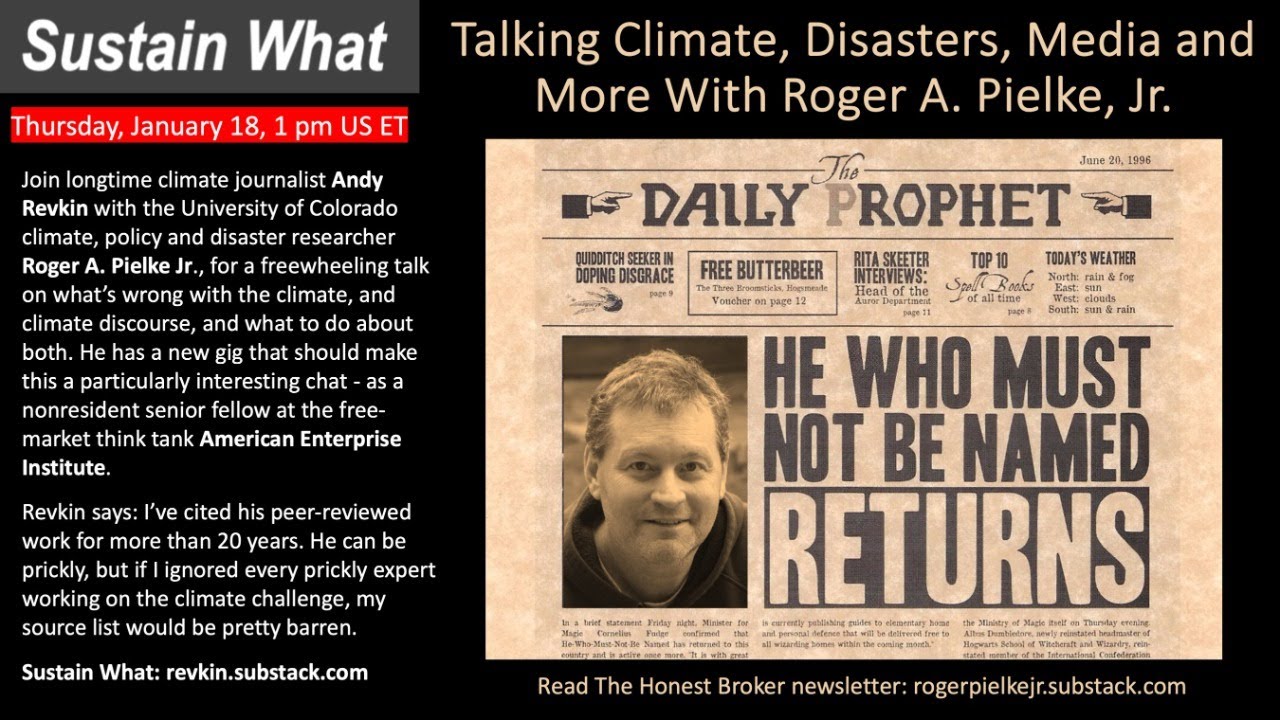
1:16:34
Join longtime climate journalist Andy Revkin with the University of Colorado climate, policy and disaster researcher Roger A ... Pielke has a new ...
YouTube · Andrew Revkin · Jan 19, 2024
wiki hansen
After Hansen's arrest in 2009 in West Virginia, New York Times columnist Andrew Revkin wrote: "Dr. Hansen has pushed far beyond the boundaries of the conventional role of scientists, particularly government scientists, in the environmental policy debate."[69] In 2009, Hansen advocated the participation of citizens at a March 2 protest at the Capitol Power Plant in Washington, D.C. Hansen stated, "We need to send a message to Congress and the president that we want them to take the actions that are needed to preserve climate for young people and future generations and all life on the planet".
==
https://e360.yale.edu/features/a_journalist_reflects_on_the_rising_heat_in_climate_debate
1/10
A Journalist Reflects on the Rising Heat in Climate Debate
Although he writes one of the most popular blogs on the environment, Dot Earth author Andrew Revkin recognizes both the drawbacks and potential of the Web for exploring complex issues. In an interview with Yale Environment 360, Revkin explains why the rhetoric surrounding climate change has gotten so hot.
JANUARY 26, 2010
During the past year, as the discussion of climate-change issues has become more heated, journalist Andrew Revkin has often been in the midst of controversy. In one incident in October, conservative talk show host Rush Limbaugh called Revkin an “environmental wacko” and suggested on the air that he commit suicide.
In an interview with Yale Environment 360 editor Roger Cohn, Revkin said he will now spend more time focusing on environmental education, starting with a course he will be teaching at Pace University that will address a question he regularly asks on Dot Earth: “Nine Billion People + One Planet = ?” (Or, as he says of a projected global population of 9 billion by 2050, “How do you make that happen without total screw-ups?”) In the wide-ranging interview, Revkin also talked about why the U.S. public has remained relatively unconcerned about climate change, what bothers him about writing a blog, and what he sees as the prospects for a world with 9 billion people.A reporter for the New York Times since 1995 and author of the popular Dot Earth blog, Revkin has had an unusually high public profile for a journalist who covers environmental issues. So it attracted media attention last month when Revkin announced he would be leaving the Times staff, but would continue writing Dot Earth.
“I could see us getting into a world where we’re just sort of living these hermetic lives,” he says, “…where we have no connection to the natural world anymore.”
Yale Environment 360: What made you make the decision recently to leave the staff position at the New York Times?
Andy Revkin: Well, I’ve been at the Times almost 15 years… It’s been an amazing portal through which to explore some of the biggest issues facing humanity right now. But I got to a point where the hamster-wheel quality of being a news reporter, where you are on this little cage thing and it’s spinning faster and faster, and trying to mesh the print work with the blog work [Dot Earth], which I started two-and-a-half years ago, was really challenging…
e360: In the last year in particular, you endured a lot of criticism from both sides of the climate change spectrum —from the skeptics and deniers, but also from some of the more mainstream climate scientists. Rush Limbaugh, on air, even called for you to commit suicide. I’m glad you didn’t take him up on that.
Revkin: He floated a thought experiment… Yes, I’ve been enduring a number of barbs, some justified.
e360: Did any of that criticism or controversy affect your decision to leave the Times?
Revkin: Well, you know, it does wear you down. Although, here I am continuing to blog, which is the worst of what you experience online. So I guess I must either have a thick skin or be really stupid… The blog is a daily sort of exploration of issues that involves a lot of passions and has a lot of echo chamber aspects. I still feel the online effort is worth more than the downside. The potential upside is real.
e360: The downside, as you see it, is the superficiality of some of the back-and-forth in the commenting and the level of the rhetoric?
Revkin: On NPR the other day, some DJ played the old Monty Python routine: “I’d like to have an argument.” And it reminded me so much of the blogosphere. Because he goes into this room and this guy just starts spewing at him, and he says, “That’s not an argument, that’s mere contradiction.” And then of course he realizes he’s paying for the service of arguing. But there is a difference between contradiction and argument. Argument is sort of framing a set of statements around a position. Often what is in the blogosphere is just people lobbing things at each other, just contradicting each other. Even if they have links or background, it’s not that there’s a learning curve. That part is discouraging.
e360: There’s been so much heat surrounding the whole issue of climate change, and some real nastiness surrounding the discussion, particularly in the last year. Why do you think that’s true, and do you see any possibility that that’s going to change at any point?
Revkin: Well, I think it will probably get worse before anything really happens. There are a couple of trends. One is that push is coming to shove — twenty years ago the treaty that was signed in Rio by so many leaders waspurely aspirational — it didn’t have teeth… There was lot of lobbying, a lot of intensity. But the stakes were not concretely laid out. Now you are talking about bills going through at least one side of the Congress, we’re close to having a bill passed that might get to a president’s desk. The EPA has determined that the stuff [greenhouse gas] is dangerous and needs to be regulated. So the stakes are higher, and people are getting more intense, people meaning the lobbying community.
And there is money on the other side. But the idea that, somehow, Al Gore and his minions are the powerbrokers here, compared to the fossil fuel interests, kind of amuses me. Because you look at the total amount of money in the renewable energy universe versus the amount of money in the carbon fuel universe, it is not even close.
e360: What role does the Web play in all this?
Revkin: The Web is an amplifier and an echo chamber that takes assertions and distills them down in to bullion-cube intensity and lobs them around at light speed… Actually, Rush Limbaugh’s diatribe on my comments on population and climate and carbon were not the result of him hearing me. They were the result of one of his staff reading a blog post that was a distorted distillation of what I said through a Web video interaction at a meeting. I don’t think he would have lobbed that bomb if there hadn’t been the blogosphere out there to condense down into a caricature something that someone says. And then that moves around at light speed and leads to this kind of amplification.
e360: So they’re commenting not on what you said but on…
Revkin: On how it was interpreted. And no one ever goes back to the source.
e360: There are the skeptics, the deniers out there, whose view is that the Earth is either not warming at all, or that human activity is not in any way responsible for it. This point of view has been pretty widely discredited by virtually all scientific organizations. But it’s still out there. How do you think journalists should be handling that? Should they be giving due to the skeptics’ point of view? Should they be ignoring it? It’s a difficult debate or discussion to cover, I think, as a journalist. How do you find it?
“There are scientists with different personal views of the level of danger that global warming poses.”
Revkin: Well, over the years I’ve written quite a bit about this question about how to cover these issues. And I think if it’s a story about a development in the science, such as what’s going on with Greenland’s glaciers, I talk to people who are studying Greenland’s glaciers, first of all. I don’t call the Cato Institute. But I also don’t call the World Wildlife Fund. If it’s a science question, I talk to scientists. And there are some scientists working in the field with different personal views of the level of danger that global warming poses, even among those who don’t disagree it’s an actual phenomenon.
I try to make sure that people understand that there are several different sets of questions here. One is, can humans warm the climate? That’s the most basic question, and the answer is a resounding “yes.”Pat Michaels, a libertarian, a Cato Institute guy, who is also University of Virginia emeritus, he absolutely agrees on that. The next level of question is, are we doing that? Is it already discernible? That’s a slightly more difficult question. And that involves a combination of modeling, observations, comparison with past climate behavior…. There are plenty of scientists who are publishing work in this field, who are serious, who are not some bought-and-sold advocates [who] don’t hold the view that you can make a confident case that more than half of the recent warming is our doing…[note that he does not name one]
e360: You have been covering this issue for at least two decades, that I’m aware, at least as far back as the Rio summit [in 1992], right?
Revkin: Well, my first long cover story on global warming was in 1988…
e360: Has public understanding of this issue evolved, changed, increased much over that time?
Revkin: The polling I’ve seen says, we are still basically in three buckets. The biggest bucket is the middle — the people who are disengaged, confused, totally uninterested in anything except Britney Spears or the stock market… And then there’s about 20 percent who absolutely reject the idea that humans are or could dangerously destabilize the climate. And then there are about — and again these are very rough numbers — 15 to 20 percent who are totally bought-in, who call their Congress people and say we need a climate bill, you know, who turn out the lights when they leave rooms and all that stuff. And that hasn’t really changed at all.
In fact, there’s pretty good evidence that when you have some event, or when the Al Gore movie came out, it essentially appeared to intensify the positions of people who are already in either the 20 percent who are bought in or the 20 percent who reject this concept utterly. It hardened positions, rather than changed positions.
e360: Do you think the fact that most people are really still not paying attention or are that concerned about this issue, do you think that’s a function of the media and scientists not communicating it well, or is it a function of people not really reacting to a problem or situation that seems very far off into the future?
Revkin: It’s pretty primal. Which explains why there are some advocates for action on climate who keep trying to link the here-and-now events: Australian wild fires, or the tree die-off [in North America]. If they can make the point that these changes that you’re seeing viscerally in your landscape now are the result of this thing, maybe that will be more likely to change people. But there, too, the causal linkage between a regional change and human-driven warming of the climate through the buildup of greenhouse gases is one of the hardest things to do confidently.
The idea of 9 billion people living that energy-intense a life doesn’t seem tenable.”
I’ve done a number of pieces starting in 2006 that really say that no matter what you think of global warming, the world does not have the energy menu it will need to have a smooth ride to 2050. Not even remotely. Two billion of us are cooking on firewood and dung right now, and would very happily move to charcoal, coal,anything, so that they’re not dying prematurely from indoor smoke in their houses and their huts in Africa or South Asia. And then you have us super-emitters here in America, from 300 million to 400 million of us in the next 30 to 40 years. And somehow or other the idea of 9 billion people living that energy-intense a life doesn’t seem tenable.
So the fossil-fuel norm doesn’t look like it’s doable. And the norm of having no energy options is completely untenable. No matter what you think of the climate problem, we have an energy problem.
e360: You mentioned earlier that one of the reasons you decided to leave the Times staff was a sense that you could contribute more on these issues in other ways, one of them being teaching. How so, and what are your plans for teaching now?
Revkin: The main thing I will be doing at Pace University is building a course that essentially mirrors what I’ve been doing at the blog. It’s a course that poses a question: How do we head toward more or less nine billion people with the fewest regrets?My working title for my course is “Nine Billion + 1 =?” Nine billion people plus one planet — how do you make that happen without total screwups?…
What I really want to create is a hub, a portal, so that a school in New Delhi can interact with a school in New York, so the students are co-learning about some of these issues as well.
e360: Have you laid the groundwork for any of that?
Revkin: Well, I was at Linfield College in Oregon, a professor there came from Wheaton College recently, and mentioned that a professor of U.S.-Russian relations at Wheaton several years back did an innovation. This teacher started co-teaching U.S.-Russian relations with a professor of the same subject in St. Petersburg, Russia. And they were doing it with a video hookup. You know, Skype is free. So, suddenly you have American and Russian students co-learning U.S.-Russian relations. And I can’t see the downside there.
e360: You posed the question on your column, you posed it today: Nine billion people plus one planet equal what? What’s your answer to that? How can humanity — facing population, warming, environmental degradation — how can it flourish in the next few centuries or even in the next century and avoid severely degrading many of the planet’s life-sustaining systems.
Revkin: In canvassing a lot of people’s thinking about this problem, there’s obviously a wide range of views. Some are say we’re going to hit a wall, we just haven’t hit at yet…
e360: The planetary boundary argument?
Revkin: Yes. And then there’s the innovator crowd, the crowd who’s always said, “Look back in history. Every time we thought we’ve hit a resource limit we’ve found either an end-run or an innovation that makes it go away.” A resource is only something you define as a need, and those change all the time. Coal, four hundred years ago, was a black rock, meaningless. Now it’s the fundamental underpinning of our energy systems. Maybe in twenty years it won’t be anymore. That’s the idea.
Without evolving our sense of values, we could just lose things that don’t have to be lost.”
Both arguments have merits. I think we can have a totally functional planet with nine billion people. We can feed them, provide water, have energy — the world is bathed in untold terawatts of solar power. But the thing that we could easily lose is the diversity of life on the planet. Having large ecosystems that have great migrations — there have been some books recently about the end of great animal migrations. Africa is still basically an unpopulated continent, despite the fact that it’s going to see a doubled human population in the next 50 years. But you will see some of those great things go away.The great apes, the great fishes, the tunas, the sharks, are clearly in deep trouble.And it’ll probably happen in a way that successive generations won’t even notice. This is a concept of shifting baselines that many people have different terms for.
e360: Meaning, people don’t even remember what was there 30 or 50 years earlier?
Revkin: Yes… There are already some academics saying that the Arctic, for a young person growing up now, is a place in flux. When you and I were kids, the Arctic was this frozen wasteland. But for this generation, it will be unremarkable that there is growing transit through the Arctic Ocean, that it’s basically a functional ocean, that polar bears are a rarer, more-endangered species and that we’re thinking about it more in that way than as just an Arctic predator… It becomes a given.
When I was in college, I worked on lobster boats in Rhode Island, doing marine fisheries work in summers. And one of the old codgers who worked at the fisheries center with me, he used to joke and say, “We use lobsters as cod bait.” We don’t use lobsters as cod bait now, you know — he was the last of the breed who knew of that level of abundance. And I have written a lot about Jeremy Jackson, Carl Safina, and all the marine biologists who bemoan the great losses of fishes. You can still go buy tuna in the market, but the tunas that we know now are just a shadow of what was in the oceans before.
So there’s a wistful sense, just to think about how much richness could be sustained if we care more about it. And this is where these issues of how dangerous climate change is or how important the Amazon is, they’re as much questions of values as they are questions of data.
And I wrote a piece, sort of a provocative piece about suppose we get the perfect energy source, suppose Dan Nocera at MIT or Nate Lewis at Caltech, they do it. Bang. You know, and suddenly we have abundant free solar power, so we can get off coal in a hurry… Someone just hits the home run. Does that solve the world’s environmental problems? Hardly. Because suddenly we can do whatever we want. Energy is the great enabler. We can turn seawater into drinking water. That shows we can do that in limitless amounts, if we have limitless free energy. We can grow synthetic crops and all kinds of stuff. And we could also pave over the world.
So without evolving our sense of values, even as we push on technological innovation, we could be in — I wouldn’t even say big trouble — we could just lose things that I think don’t have to be lost. And even in that there’s an interesting debate. Should I care?
I recently went up to Toronto to do some reporting. You know, I went to Newark airport in a car. I walked 50 yards in the terminal. I flew to Toronto’s downtown airport. I got out of the plane, went across the little tube into a ferry, and I’m in downtown Toronto… Toronto has one of the largest underground complexes, one of the largest in the world. It’s 23 kilometers of underground living. I spent almost the entire day in Toronto indoors. And mostly underground.
And, you know, I could see us getting into a world where we’re just sort of living these hermetic lives — where we have limitless energy, and we have no connection to the natural world anymore.
==
https://dotearth.blogs.nytimes.com/2013/06/13/a-film-presses-the-climate-and-security-case-for-nuclear-energy/
“Pandora’s Promise” is a provocative and important new documentary making the case for nuclear power as a safe and large-scale substitute for fossil fuels. There’s a flaw in the film’s approach that undercuts its mission, but I still see it as vital viewing and a refreshing new direction in a tired old battle over the shape of America’s energy future.
The film, which opened in New York City Wednesday night and expands to 15 cities on Friday, was bound to generate strong reactions among people long opposed to this energy source. In a discussion that I moderated after a screening Monday night at the Jacob Burns Film Center in Pleasantville, N.Y., Robert F. Kennedy, Jr., flatly told the director, Robert Stone, that the film was an “elaborate hoax” and a “big lie."
what’s fascinating is that not all foes of nuclear energy are in attack mode. A case in point is Terry Tempest Williams, a cancer survivor, anti-nuclear campaigner and ferociously expressive writer on nature and human nature. In The Nation this week, she engaged in a long and fascinating dialogue on the film with Mark Hertsgaard, a journalist echoing Kennedy’s derisive view. You can read a pivotal excerpt from Williams’s take below. In the magazine, she criticizes Stone for the film’s dismissive treatment of critics of the nuclear industry (I concur) but still calls the film “compelling” (I concur).
The film, like a host of documentaries these days — from “Gasland” to “The Cove” — has a strong point of view and pulls no punches. It centers on a Greek chorus of liberal greens who’ve come around to embracing the atom, including Stewart Brand, the author of “Whole Earth Catalog” and “Whole Earth Discipline,” and Mark Lynas, the British environmental writer who wrote a popular global warming book, “Six Degrees,” and “The God Species.”
|*Insert* | The Times has [published a feature about the film and the director, including the fun detail that Robert Stone, now 54, made his first movie, on the dawn of environmental consciousness, using his mother’s Super 8 camera on the first Earth Day.]
It also draws on the deeply informed views of Richard Rhodes, the journalist and Pulitzer Prize winning historian of atomic weapons. I’ve also posted a valuable essay that Rhodes wrote on his views and the film’s conclusions, and critics.*
In a section of the film highlighting how nuclear power, by displacing coal, can save thousands of lives, Rhodes pointedly says, “To be anti-nuclear is basically to be in favor of burning fossil fuels.”
Please read his piece later, and everything that follows, after trying to set aside the blinders and filters we all deploy in facing questions like this.
“Pandora’s Promise” is essential viewing because of the way it challenges people, including its protagonists, to examine their own fears or predispositions.
The film marvelously starts with Mark Lynas, now a determined champion of nuclear power, nervously “having a wobble” as he rides through the evacuation zone around Japan’s devastated Fukushima Daiichi power plant. Watching his radiation detector ping away in the deserted area, he says:
There’s no energy source that does this, that leaves huge areas contaminated by this, this strange, invisible presence, which you know is potentially deadly. Everything has its drawbacks, everything has its risks, but this is something which is unique to nuclear.
Lynas goes on, of course, to explain why he remains in support of harnessing nuclear energy, particularly through advanced reactor designs that don’t come with the waste stream and complexity of the light-water reactor design that dominates the industry today — overgrown terrestrial versions of the power source in nuclear submarines.
The film’s main flaw is its finger-waving and dismissive approach to critics of the nuclear industry. Data on cancer or other health risks from radiation have, from Hiroshima and Chernobyl onward, revealed a substantial capacity in humans and other species to endure quite substantial exposure. But that doesn’t mean the risk is nil, and “ the feeling of risk” — to echo the vital work of the psychologist Paul Slovic — is deep and profound, as even Lynas and the director found in their Fukushima tour.
I think the film suffers by not incorporating input from reasoned critics of the nuclear industry, many of whom are not entirely opposed to harnessing the atom. Dave Lochbaum of the Union of Concerned Scientists and Thomas Cochran at the Natural Resources Defense Council come to mind.
Instead, it depicts the opposition mainly through shots of the anti-nuclear campaigner Helen Caldicott engaged in raucous demonstrations. She may be famous, but her accusations that international agencies are knowingly underplaying radiation risks have been repeatedly debunked (most thoroughly by the British environmentalist George Monbiot). This makes her far too easy a target. Serious engagement with critics of nuclear power — whether on economics, industry practices or health and environmental issues — is absent.
The film also avoids discussing the high costs and logistical and policy hurdles to adding substantially to the country’s, or world’s, existing fleets of operating nuclear plants. The scale and costs required to cut into coal use using any technology — nuclear, wind, solar or otherwise — is incredibly daunting.
Nonetheless, the film’s sections exploring how nuclear technology became demonized, from the abandonment of the completed Shoreham plant on Long Island to the shutdown of government research on a next generation of plant designs, are informative and convincing.
So, too, is the film’s argument that those, like Hertsgaard, warning of nuclear energy leading to arms proliferation are forgetting that, through the Megatons to Megawatts program, fuel from thousands of warheads from the arsenal of the former Soviet Union has been recycled and used in American power plants. As Stewart Brand explains:
We’re recycling all these nuclear warheads into energy, electricity, and nuclear power. And, so, nuclear power is doing more to de-nuclear-weaponize the world than any other thing that we do. Poetically, it’s rather beautiful. The very things that were designed to blow up our cities are now lighting up our cities. And amazingly, 10 percent of American electricity, half of our nuclear power, comes from reprocessed Russian warheads.
As promised, here’s an excerpt from Terry Tempest Williams’s side of the conversation in The Nation, which beautifully captures the value of the film:
“I belong to a Clan of One-Breasted Women. My mother, my grandmothers and six aunts have all had mastectomies. Seven are dead.” So begins the epilogue of my memoir, “Refuge: An Unnatural History of Family and Place, written in 1991.” As Utahns, residents of the Atomic West, we are hibakusha, explosion-affected people bound by the wind. Half of my family has died from cancers that I believe were a result of radioactive fallout caused by aboveground nuclear explosions tested in the Nevada desert from 1945 to 1962….
So when I say that Robert Stone’s film “Pandora’s Promise” challenged my thinking after thirty years of antinuclear activism and repeated arrests at the Nevada Test Site on behalf of “the Clan of One-Breasted Women,” it is not a small statement. This crack in my own thinking is heightened by the fact that I am now watching my extended community of plants, animals, rocks, rivers and human beings be ravaged by the oil and gas industry, be it fracking or the razing of vulnerable wildlands. And then there is the BP oil spill.
For me, this film’s strength was not that it changed my mind, which it did not, but that it expanded it. I am interested in having an open conversation about nuclear energy. Climate change is real. We know we must wean ourselves off fossil fuels. So what are the alternatives? Are renewable energy sources enough for the energy-poor around the world? My questions are many. Richard Jeffries, the nineteenth-century British naturalist, wrote: “Never, never rest contented with any circle of ideas, but always be certain that a wider one is still possible.”
I urge you to read the full exchange here.
Here’s a roundup of other reactions. Back in January when “Pandora’s Promise” was unveiled at the Sundance Film Festival, Owen Gleiberman of Entertainment Weekly hailed it beneath a headline calling the film “radically sane.”
After a screening in March, the Chicago Tribune columnist Eric Zorn pointed to the same problem that frustrated me and Terry Tempest Williams – the lack of reasoned voices with nuclear concerns – but still said this: “‘Pandora’s Promise’ stands to be the most important movie about the environment since ‘An Inconvenient Truth.'”
Manohla Dargis of The Times disliked the “deck-stacking” but also criticized Stone’s argument.
Anne Michaud of Newsday likes the film but notes that its depiction of the Shoreham plant closure on Long Island didn’t mention there was no workable evacuation plan.
Finally, for a thorough look at the film’s potential value in breaking through the emotion-laden reactions many of us bring to discussions of radiation risk, read the laudatory Scientific American post by David Ropeik, a longtime risk analyst and risk communication consultant.
:(style="background-color:#ffffff;"):}::{1:03 p.m. | Update | :(style="background-color:#ffffff;;font-weight:700"):}::{[Ed Lyman of the Union of Concerned Scientists digs in on a host of what he calls “less-than-half truths” in the documentary and accuses the filmmakers of the same kind of cherry picking they deride anti-nuclear activists for.]
==
too much heavy metal?
https://en.wikipedia.org/wiki/Andrew_Revkin
Andrew C. Revkin is an American science and environmental journalist, author and educator. He has written on a wide range of subjects including destruction of the Amazon rain forest, the 2004 Asian tsunami, sustainable development, climate change, and the changing environment around the North Pole. He is the founding director of the Initiative on Communication and Sustainability at The Earth Institute of Columbia University.[1] Previously he was strategic adviser for environmental and science journalism at National Geographic Society.[2] Through 2017 he was senior reporter for climate change at the independent investigative newsroom ProPublica.[3] He was a reporter for The New York Times from 1995 through 2009. In 2007, he created the Dot Earth environmental blog for The Times.The blog moved to the Opinion Pages in 2010 and ran through 2016. From 2010 to 2016 he was also the Senior Fellow for Environmental Understanding at Pace University.[4] He is also a performing songwriter and was a frequent accompanist of Pete Seeger.
- :{1:(style="display:table-cell;padding-left:0px;padding-right:0.5em"):}::{Early life:(style="display:table-cell"):}:
- :{2:(style="display:table-cell;padding-left:0px;padding-right:0.5em"):}::{Career:(style="display:table-cell"):}:
- :{3:(style="display:table-cell;padding-left:0px;padding-right:0.5em"):}::{Songwriter and musician:(style="display:table-cell"):}:
- :{4:(style="display:table-cell;padding-left:0px;padding-right:0.5em"):}::{Awards:(style="display:table-cell"):}:
- :{5:(style="display:table-cell;padding-left:0px;padding-right:0.5em"):}::{References:(style="display:table-cell"):}:
- :{6:(style="display:table-cell;padding-left:0px;padding-right:0.5em"):}::{External links:(style="display:table-cell"):}:
Early life
Andrew Revkin was born and raised in Rhode Island. He graduated from Brown University in 1978 with a degree in Biology.[5] He later received a Master's in Journalism from the Columbia University Graduate School of Journalism.[6][7]
Career
Early in his career he held senior editor and senior writer positions at Discover magazine and Science Digest, respectively.[8]
From 1995 through 2009, Revkin covered the environment for The New York Times. In 2003, he became the first Times reporter to file stories from the North Pole area and in 2005-6 broke stories about the Bush administration's interference with scientific research, particularly at NASA.[9]
In 2010, he joined Pace University's Academy for Applied Environmental Studies as Senior Fellow for Environmental Understanding.[10]
Revkin has also written books on humanity's weather and climate learning journey, the once and future Arctic, the Amazon, and global warming.[11] He was interviewed by *Seed* magazine about his book The North Pole Was Here, which was published in 2006. He stressed that "the hard thing to convey in print as journalists, and for society to absorb, is that this is truly a century-scale problem."[12]
Revkin is among those credited with developing the idea that humans, through growing impacts on Earth’s climate and other critical systems, are creating a distinct geological epoch, the Anthropocene.[13] He was a member of the "Anthropocene" Working Group from 2010 to 2016. The group is charged by a branch of the International Commission on Stratigraphy with gauging evidence that a formal change in the Geologic Time Scale is justified.[citation needed]

Works
- Weather: An Illustrated History, from Cloud Atlases to Climate Change. New York: Sterling, 2018,ISBN 1454921404
- The North Pole Was Here: Puzzles and Perils at the Top of the World. Boston: Kingfisher, 2006, ISBN 9780753459935
- Global Warming: Understanding the Forecast. New York: Abbeville Press, 1992, ISBN 978-1558593107
- The Burning Season: The Murder of Chico Mendes and the Fight for the Amazon Rain Forest. Washington, DC: Island Press, 2004 [1990], ISBN 978-1-55963-089-4
-- translated and published also in Spanish, French, Italian, Dutch, German, Portuguese, Japanese and Thai editions[14]
Films
...
==
7/19
Columbia University’s Earth Institute is starting a new initiative to assess, develop and disseminate communications innovations that can speed and spread progress on climate change and other sustainability challenges. It will be headed by well-known journalist and author Andrew Revkin, who has covered environmental and human sustainability for more than 30 years.
The Initiative on Communication and Sustainability will, among other things, develop toolkits and forums to help scientists and journalists communicate more effectively with each other and with the public and policymakers. It will put a particular emphasis on bridging the sciences, arts and humanities. Reporting to Earth Institute director Alex Halliday, Revkin will work with people in many other parts of Columbia, including the Journalism School, the School of the Arts and the Office of Public Affairs.
==
what happened to this guy? 7/20 interview shillenberger booktv
https://www.c-span.org/video/?473859-1/after-words-michael-shellenberger
off bs
Shellenberger, founder and president of Environmental Progress, offered his thoughts on what he calls “apocalyptic” environmentalism and provided some solutions on how to address environmental issues of today and into the future. He was interviewed by Andrew Revkin, author and Columbia University’s diirector of the Earth Institute Initiative on Communication and Sustainability
...
00:00:35
A LITTLE CABIN FEVER I MUST ADMIT . NOT THAT I'M THERE BUT I'M EAGER TO GET BACK TO TRAVELING AGAIN . I WAS SICK OF IT BEFORE THE PANDEMIC AND NOW I AM EAGER TO GET OUT OF CALIFORNIA . HOW ARE YOU ? Show Less Text
00:00:52
PRETTY GOOD. WE'RE ALL DOING WHAT WE CAN TO SHARE A MOMENT, EVEN THOSE AVOIDING THE CONTAGION WHICH SUPPOSEDLY PRESAGED WHAT WAS GOING TO HAPPEN REALLY...
Show Full Text
00:01:40
THANKS ANDY . THE ARGUMENTS IN THE BOOK IS CLIMATE CHANGE IS REAL BUT IT'S NOT THE END OF THE WORLD AND IT'S NOT EVEN ALMOST AREAS ENVIRONMENTAL PROBLEM...
Show Full Text
00:04:29
I GUESS THE GOAL IS TO PROD AND KIND OF GET A NEW CONVERSATION GOING . ALTHOUGH I DO WONDER SOMETIMES AND I WONDER THIS ABOUT ALL BOOKS, I'VE WRITTEN...
Show Full Text
00:06:45
THANKS FOR THE QUESTION. I THINK SO OBVIOUSLY TITLES ARE TITLES THAT YOU ONLY GET ONE OR TWO WORDS FOR THE TITLE . THE BOOK IS BASICALLY A DEFENSE...
Show Full Text
00:11:25
ONE OF THE GOOD ARGUMENTS FOR THE US STAYING INVOLVED IN NUCLEAR ENERGY WORK IS THAT I'VE HEARD AFTER FUKUSHIMA PARTICULARLY WAS THAT INTERNATIONAL...
Show Full Text
00:13:11
THANKS. I THINK THE IDEA THAT THE UNITED STATES SHOULD COMPUTE ON ENERGY , I THINK IT'S THE RIGHT ONE.SO YOU SEE COUNTRIES LIKE RUSSIA AND THE UAE...
Show Full Text
00:16:14
HOW MUCH OF THE RESISTANCE HAVE YOU FACED IN THAT MANY OTHERS CAN LOOK AT THE PORTFOLIO OF ENERGY OPTIONS YOU WOULD NEED TO LIMIT GLOBAL WARMING AND...
Show Full Text
00:17:10
THAT'S A GREAT QUESTION. I THINK WE HAVE TO JUST REFLECT ON THE FACT THAT THERE'S BEEN A HUGE SEA CHANGE IN PUBLIC ATTITUDES, AT LEAST IN THE ATTITUDES...
Show Full Text
00:20:53
YOU FEEL THAT GLOBALIZATION IS COMING TO AN END?
00:21:00
I DON'T THINK GLOBALIZATION IS COMING TO AN END . I THINK THE GLOBAL SYSTEM IS IN CRISIS . I THINK EVERY MAJOR INSTITUTION IN OUR SOCIETY IS IN CRISIS AND I WAS REFLECTING THE OTHER NIGHT THAT THE THING EVERYBODY BELIEVES ABOUT THE PANDEMIC IN THE FIRST FEW WEEKS IS THAT WASHING YOUR HANDS WAS THE MOST IMPORTANT BUT WE DIDN'T NEED TO WEAR MASKS . NOW THE THINKING IS THAT MASKS ARE OF ESSENTIAL IMPORTANCE AND WASHING YOUR HANDS IS LIKE SURE BUT WE DON'T REALLY KNOW AND IT MIGHT TRANSFER. WORLD HEALTH ORGANIZATION, I DON'T THINK FROM THAT INTENTIONS, I JUST THINK THEY'RE A DISCREDITED ORGANIZATION . I THINK THE WHITE HOUSE IS A DISCREDITED INSTITUTION . I'M SORRY TO SAY THIS BECAUSE I KNOW IT'S HER FORMER EMPLOYER, I THINK THE NEW YORK TIMES IS NOT HAVE THE CREDIBILITY ONCE HAD AREA IT READS LIKE THE GUARDIAN OR THE NATION . IT DOESN'T READ LIKE A NEWSPAPER . I'M STRUCK AND ANDY I'M SURE YOU ARE TWO COMMON ENVIRONMENT STORIES ONLY HAVE ONE SIDE OF THE STORY. I READ A BLOOMBERG PIECE THAT PUTS OUR FRIENDS LEAH STEPS. IT DOESN'T PUT ANYBODY CRITICAL OF RENEWABLES AT ALL . THAT'S STANDARD NOW SO THESE INSTITUTIONS ARE I THINK IN CRISIS RIDDEN THERE IN A CRISIS OF CREDIBILITY AND TRUST . I DON'T THINK THAT MEANS INSTITUTIONS ARE GOING TO GO AWAY , WHAT IT MEANS IS THOSE INSTITUTIONS ARE GOING TO NEED NEW LEADERS WHO HAVE A DIFFERENT WORLDVIEW. ACTUALLY ARE MORE COMFORTABLE EXPRESSING THE FACT THAT WE DON'T KNOW IF MASKS MIGHT WORK OR NOT BUT YOU MIGHT WANT TO WEAR THEM OR ARE WORRIED ABOUT THEM BEING, THE REAL ISSUE IS THEY'RE WORRIED ABOUT THEIR NOT HAVING ENOUGH MASKS BUT INSTEAD OF SAYING THAT THERE WAS THIS KIND OF MANIPULATION SO I DON'T THINK GLOBALIZATION IS COMING TO AN END . I THINK NATIONS ARE GOING TO GET BACK IN TOUCH WITH THE FACT THAT WE'RE ALL COMPETING WITH EACH OTHER IN SOME ESSENTIAL WAY AND WHERE ALL ECONOMIC NATIONALISTS . I THINK WITHOUT KIND OF THINKING ABOUT IT . BUT THESE INSTITUTIONS ARE ULTIMATELY GOING TO NEED TO BE KIND OF REGENERATED BY NEW LEADERSHIP AND NEW IDEAS. Show Less Text
00:23:03
LET'S TALK ABOUT CLIMATE DIPLOMACY BRIEFLY AND I WANT TO GET TO ECOLOGY AND JESSE ASKED ABOUT A COUPLE OF PEOPLE . BUT SOMETHING YOU SAID TO MY CONCEPT...
Show Full Text
00:25:39
IT'S A GREAT OBSERVATION ANDY. YOU KNOW I VIEW ON THE UNITED NATIONS, I JUST DON'T THINK IMPLEMENTS WILL HAVE MUCH INFLUENCE OVER THE DIVISIONS THAT...
Show Full Text
00:28:19
I VIEW THAT AS WELL GIVEN THE INITIATIVE , HOW DO YOU MAKE INFORMATION MATTER IN THIS NEW INFORMATION ENVIRONMENT . MATTER MEETING YOU DIDN'T ASK THE...
Show Full Text
00:30:26
I'M GOING TO MAKE ONE OBSERVATION BEFORE I ANSWER TOTALLY WHICH IS THAT TO CLAIM THAT I MADE THAT ARE VERY CONTROVERSIAL BUT I THINK ARE SCIENTIFICALLY...
Show Full Text
00:31:16
ON THE LATTER ONE , IT'S CLEAR THAT THE CLIMATE HAS CHANGED FROM CO2. TRANSLATING THAT INTO SOME COMPONENT OF LOW HURRICANE IS IMPOSSIBLE BUT AT THE...
Show Full Text
00:32:16
I THINK THAT THE DISAGREEMENT YOU AND I MIGHT HAVE OR I MIGHT HAVE WITH OTHERS ANYMORE ABOUT WHAT IS APPROPRIATE SCIENCE MEDICATION RATHER THAN WHAT...
Show Full Text
00:34:32
I AGREE WITH YOU ON WRITTEN, I WAS TALKING ABOUT THE WORK OF NORMA BAUER, A DISASTER ANALYST WHO DOES A LOT OF WORK THAT WAS IN THE IPCC REPORT AND...
Show Full Text
00:35:53
THAT I DO FEEL THERE HAS TO BE A WAY FORWARD IN DISTINGUISHING BETWEEN CHANGES IN THE STORM, THE PHENOMENON FROM CHANGES IN THE LAWSUITS AND IMPACT...
Show Full Text
00:36:43
I THINK THE IPCC SCIENCE IS PRETTY DARN GOOD. I DEFENDANT IN THE BOOK THOUGH I'M CRITICAL OF WORKING GROUP 3 WHICH IS THE RECOMMENDATIONS OF WHAT TO...
Show Full Text
00:37:47
THERE BOTH IMPACTS , THERE CERTAINLY IMPACTS AND CREATING PATHWAYS FORWARD THAT MAKES SENSE. LET'S CIRCLE BACK TO ED WILSON. IT'S PRETTY CLEAR THAT...
Show Full Text
00:39:35
CREATIVE POLICY AND WHAT THE ROLE OF EMPOWERING INDIGENOUS COMMUNITIES?
00:39:46
GREAT. I THINK THE FIRST THING I WOULD TRY TO DO IN BOTH THE AMAZON AND THE OTHER PLACE I SPENT A LOT OF TIME IS NOW WORKING WITH WHICH IS WHERE THE...
Show Full Text
00:44:40
I DID A LOT OF REPORTING ON BOOKING FUEL A COUPLE OF YEARS AGO . AND IT'S WHERE THE ISSUE WAS ANTIPATHY AND A LOT OF EUROPEAN COUNTRIES TO SUPPORTING...
Show Full Text
00:45:34
I WANT TO TALK BRIEFLY ABOUT POPULATION AND GLOBES, 10 YEARS AGO , I WROTE A PIECE IN MY DAUGHTER'S LOG AT TIMES , 12 YEARS AGO. ON THE DEMOGRAPHER...
Show Full Text
00:47:10
FOR SURE. I'VE OBVIOUSLY HUMANS ARE HAVING A HUGE IMPACT . THERE'S SO MANY OF US WE HAVE , THE ONLY FOOD AND ENERGY. YOU DID A GOOD JOB OF DESCRIBING...
Show Full Text
00:51:00
WE HAVE A FEW MINUTES LEFT AND I WANT TO CIRCLE BACK TO ME NEIL 'S LATEST BOOK , I GOT TO SHARE IT . 300,000 WORDS , GOES IT KIND OF SURPRISED ME . I...
Show Full Text
00:55:41
WE'RE DOWN HERE TO THE END AND IT'S BEEN A GREAT HOUR TALKING WITH YOU . THERE'S MUCH MORE TO GO OVER GOING FORWARD I'M SURE AND WILL TRY TO HAVE YOU...
nothng aftr2017?
has written books on global warming, the changing Arctic and the assault on the Amazon rain forest, as well as three book chapters on science communication.
Revkin is among those credited with developing the idea that humans, through growing impacts on Earthâs climate and other critical systems, had created a geological age of our own making,â known increasingly as the Anthropocene. From 2010 through 2016, he was a member of the Anthropocene Working Group, created by the international geological community to assess whether a new geological epoch has begun.
He is also a performing songwriter and for 20 years was a frequent accompanist of folk legend Pete Seeger. Two films have been based on Revkinâs work: âRock Starâ (Warner Brothers, 2001) and âThe Burning Seasonâ (HBO, 1994). He lives in the Hudson Valley.
- andrew.revkin@propublica.org
- Andrew Revkin
- @Revkin
- 914-441-5556
==
Andrew C. Revkin
Recent and archived work by Andrew C. Revkin for The New York Times
https://www.nytimes.com/by/andrew-c-revkin
Greta Thunberg and the Lessons of the Sea (not an asshole)
A trans-Atlantic crossing by boat can teach us about confronting the global warming crisis.
link to pro nuke 2015 (not shill?)
For years, it has often seemed that those most passionately pressing for a rapid transition from still-abundant fossil fuels to non-polluting energy sources have been as focused on attacking each others’ arguments as they have on fighting powerful interests defending the status quo (as well as perhaps the biggest foe — inertia, both in society and infrastructure). The result has often felt like a three-legged race — or worse.
So it felt like a fresh spring breeze to see constructive discussion sparked by “Fighting Climate Change With Innovation,” a Foreign Affairs essay proposing a public-private mix of clean-energy investments, policies and incentives aimed at overcoming technological hurdles and accelerating deployment. The piece was written by Varun Sivaram of the Council on Foreign Relations and Teryn Norris, a young analyst (featured here before) who was most recently working for the Department of Energy.
Sivaram just wrote a post on the Council on Foreign Relations’s “Energy, Security, and Climate” blog responding to and exploring the reactions to the essay. His piece is reposted below with permission, followed by some overarching thoughts from me.
Beyond Climate Confusion: Why Both Energy Innovation and Deployment Matter
- By Varun Sivaram*
I have a new essay in the May/June issue of Foreign Affairs—“The Clean Energy Revolution: Fighting Climate Change with Innovation”—which I co-authored with Teryn Norris, a former advisor at the Department of Energy (DOE). ...
By ANDREW C. REVKIN
Aug. 29, 2019
DOT EARTH
After Nine Years and 2,810 Posts, a Dot Earth Farewell
After nine years and 2,810 posts, a blog seeking a sustainable path for humans on a finite planet comes to an end.
By ANDREW C. REVKIN
Dec. 5, 2016
DOT EARTH
Facing Standing Rock Campaign, Obama Administration Blocks Dakota Pipeline Path
Intensifying Indian protests prompted the Obama administration to block a pipeline’s path in North Dakota.
By ANDREW C. REVKIN
Dec. 4, 2016
DOT EARTH
Will California Ever Let Sierra Nevada Forests Burn?
In the Sierra Nevada, California’s main forest fire problem lies in not letting forests burn.
By ANDREW C. REVKIN
Dec. 4, 2016
DOT EARTH
A Belated Farewell to a Pioneering Polar Bear Researcher
A tribute after the death of a young and innovative field researcher who used a scat-sniffing dog to help figure out polar bears’ changing diets.
By ANDREW C. REVKIN
Dec. 3, 2016
DOT EARTH
TED’s Science Curator Sees Hope in Earth’s Anthropocene Age
TED’s new curator of science, David Biello, explains why he sees hints of hope in Earth’s emerging Anthropocene “age of us.”
By ANDREW C. REVKIN
Nov. 30, 2016
DOT EARTH
What Changed, and Didn’t, After the 1988 Slaying of a Rain Forest Hero in Brazil
After the murder of Chico Mendes in 1988, a new brand of green governance developed on Brazil’s rain forest frontier, but political instability poses fresh threats.
By ANDREW C. REVKIN
Nov. 28, 2016
DOT EARTH
Under Trump, Will NASA’s Space Science Include Planet Earth?
Advisors to President-elect Trump see little merit in NASA emphasizing “Earth-centric” science.
By ANDREW C. REVKIN
Nov. 28, 2016
DOT EARTH
In Madagascar Test, Drone Delivers Medicine by Air
Drones, mainly associated with missiles, are poised to deliver medicines in Madagascar.
By ANDREW C. REVKIN
Nov. 26, 2016
DOT EARTH
An Exercise to Sift for Sources Amid a Blitz of Fake News
A web-sifting exercise that helps students of all ages figure out how facts or fakery flow online.
By ANDREW C. REVKIN
==
https://www.alternet.org/2019/09/the-incredible-belief-that-corporate-ownership-does-not-influence-media-content/
see also jnlism fail
no lnx
The incredible belief that corporate ownership does not influence media content
Written by Alison Rose Levy / FAIR September 19, 2019
As Sen. Bernie Sanders (CJR, 8/26/19) has recently noted, corporate ownership of media interferes with the core societal function of the press: reporting and investigating key issues at the intersection of public need and governance. And nowhere is that more critical than when it comes to climate. Due to their corporate conflicts of interest, trusted news authorities have diverted us from our primary responsibility—assuring a viable habitat for our children and grandchildren.
As a journalist who has worked both inside and outside of establishment media, I see influence as embedded in a corporate media culture rather than in isolated cases of CEO dictates. It happens in little ways, such as how an interviewer frames a question, and in big ways, like the decision to exclude a topic, a person or a group of people from the airwaves.
Like most US companies, news organizations are hierarchies, which people who have worked in corporate offices can readily understand. Given that “90% of the United States’ media is controlled by five media conglomerates,” the top executive at many news outfits is likely the CEO of a multinational corporation. The word comes down from the business execs to the company’s division chiefs, as seen in countless movies (like the 1976 classic Network). This was how it was when I worked on primetime national news at CBS in the 1990s.
On the inside, it wasn’t easy to see organizational bias, when job security and team work required overlooking it. The response to the heavily promoted primetime news pairing of two well-known anchors exemplified how news personnel learn to toe the line. The two anchors had zero chemistry, but no one mentioned it, as if an unwritten code had been instantly internalized. This dragged on for two years, pulling down the network’s ratings.
Higher-ups would never offer editorial staff direct input on content. That’s what the executive and middle management were for. Would these managers confide to their staff that the big guns gave them a certain direction? No. Whatever it was, they would present it as their own, and it would be adopted.
Within this culture, controlling the content goes on in whispers, frowns, headshakes and decisions made behind closed doors. If anyone strays into a verboten zone, as I did when I proposed a feature about Native Americans, those in the know privately communicate the ethos that is expected and allowed. “We never put American Indians on air because they talk too slow,” a producer explained.
Despite such experiences, when I left CBS, I respected the many producers with whom I’d worked, many of whom are still employed at the various networks. That work experience honed editorial judgment in ways impossible to measure, for which I am infinitely grateful. It also showed me that organizational agendas and values can trump claims to objectivity.
Reporting from Independent Media
Yet over a decade later, working in progressive online media, I was still astonished that several major stories I covered, were anywhere from underplayed to entirely absent from establishment news.
When I began to cover fracking in New York state in 2009, at first both 60 Minutes (11/14/10) and the New York Times (11/27/09, 10/29/11) covered it as a Hatfield/McCoy feud between upstate rural neighbors, rather than as an invasive industrial activity with a host of health and environmental repercussions.
During the critical years of the major fracking buildout from 2005 to 2016, the New York Times gave a prominent environmental platform to self-declared “climate champion” Andrew Revkin, whose reporting FAIR (Extra!, 2/10) called “a source of some comfort—and crowing—for the climate change denial crowd.” His pro-industry stance on fracking and naysaying on methane impacts condoned an industrial expansion that has produced far-reaching environmental damage.
The Times’ Ian Urbina (6/25/11) did invaluable reporting on fracking’s faulty economic model. But in 2013, the paper of record closed its environmental desk, even as Inside Climate News (1/11/13) was reporting that “worldwide coverage of climate change continued a three-year slide.”
MSNBC show hosts like Rachel Maddow and Chris Hayes rarely covered fracking, instead letting gas and oil industry ads reassert claims of safety. Nonprofit environmental groups, leading activists, along with a growing body of independent journalists filled the media void, including my own reporting at Huffington Post, AlterNet and EcoWatch.
The TTP
In 2014, I began to report on the Transpacific Partnership (TTP) and other concurrent global trade agreements, which are often characterized as core to President Barack Obama’s “legacy” (e.g., New York Times, 6/14/15; Washington Post, 6/24/15). The agreement’s full provisions were never revealed to the public prior to the June 2015 vote granting absolute trade authority to Obama—authority that would have passed to Trump if the agreement had been ratified in late 2016, as Obama hoped.
In conducting multiple interviews with trade analysts, as well as following the protests in Europe and the resulting leaks of the contents, I learned from trade analyst William Waren (Connect the Dots, 1/28/15) that even prior to the TPP’s passage and ratification, plans were underway for the buildout of fracking, gas and oil, and coal trade and global export freed by its anticipated passage.
Nothing within the unenforceable Paris Agreement would have prevented it. In fact, the Paris Agreement provisions were nonbinding, while the trade agreements that were being secretly negotiated concurrently, including the Trade in Services Agreement (TiSA), were designed to be binding, to “effectively trump whatever commitment is made in Paris,” Waren revealed on Connect the Dots (12/9/15).
Further, the TPP’s planned instatement of an international corporate tribunal with international legal authority over all nations would have mortally injured global democracies. In 2016, Mark Ruffalo summed up what was at stake in the fight: Expanding the Investor-State Dispute Settlement (ISDS) provisions in NAFTA via TPP
would block worldwide environmental and social progress while empowering corporations to undermine existing climate and environmental policies.
As we witness the Trump administration’s deconstruction of US environmental regulatory infrastructure—appointment by appointment, policy by policy—let’s appreciate that in defeating TPP and associated trade deals (thanks to the work of grassroots organizers and independent media), Americans dodged a bullet.
If the US had passed the TPP as planned during the 2016 lame duck session of Congress, both the US and all co-signers (a total of 12 countries) would have been contractually bound to a wholesale takedown of environmental regulations and economic barriers to fossil fuel development—as well as the loss of any right to challenge corporate rule or prevent health and environmental impacts. The climate impacts of the intended gas and oil buildout would likely have been devastating and decisive.
Nevertheless, the forward drive to pass the TPP occurred in a near void of corporate coverage. What had been negotiated behind closed doors with multinational corporations remained their business secrets. Prior to its authorization in June 2015, no mainstream outlet thoroughly investigated and disclosed the TPP’s provisions. Obama’s most memorable pro-TPP television appearance was singing about it with Jimmy Fallon. FAIR (6/11/16) called the enthused Vox coverage (6/10/16) of Obama’s performance
a borderline parody of everything wrong with corporate-owned “new media”: What we have here is a Comcast-funded website plugging a Comcast-owned TV show to promote a trade deal aggressively lobbied for by Comcast.
Both the New York Times and its liberal economist columnist, Paul Krugman, covered the TPP infrequently. Krugman (10/6/15) professed he was a “lukewarm opponent” of it, and minimized its importance. “We’re not talking about a world-shaking deal here,” he wrote (3/11/15) three months before the Senate granted Obama the authority to sign the final agreement without further consultation or deliberation.
Prior to the vote, a college friend of the MSNBC host Chris Hayes assured me that Hayes, a former environmental reporter for The Nation, would be deeply concerned about these trade deals. I was dubious, but she was insistent. With the contact she provided, I sent all of my TPP research and sources on to Hayes. I received no response.
Rather than cover the TPP, MSNBC went on to fire Ed Schultz, the sole show host who covered trade agreements. (Sadly, the 64-year-old Schultz died in 2018.) In surveying TPP coverage, Media Matters (2/4/15) found that Schultz was the exception in a near-total blackout by all three major networks. Week after week, Hayes and other MSNBC hosts devoted airtime to meticulously dissecting far more minor concerns.
As in any large organization, the firing and hiring of staff speaks volumes to surviving staff members about the owners’ priorities. The unseen casualties among reporters of integrity, and the disservice to journalism, cannot be overestimated. Those working in corporate media get the message without anyone having to tell them, and highly paid show hosts have the most to lose.
The press’ mission is to inform the citizenry and flag abuses to power, not promote special interests. When citizens blind themselves to a news organization’s corporate entanglements, and trust the outlet to be truthful anyway, it is, to put it mildly, extraordinarily naïve.
It’s not about whether or not the public has access to a private conversation or confidential memo sent to editorial with a corporate dictate. The evidence is what’s given airtime and what isn’t over many years.
Was it just happenstance that MSNBC, for example, failed to cover the TPP after firing Ed Schultz? Comcast, the owner of MSNBC, sat at the table behind closed doors during the five-year long negotiations of the TPP’s specific trade provisions.
Have MSNBC or any of its competitors uncovered Comcast’s agenda for the trade agreements? What if concerns over intellectual property rights, for example, made it a corporate mission to pass a deal that also happened to radically hasten the climate tipping point? Should any company have that much power?
No business, no matter how sizeable, should have the right to subvert the actions and political choices necessary to address climate, as well as the activated movement capable of assuring that at long last we do what needs to be done. The only sane response is to support the movement, and the independent media outlets that provide a platform for ideas, facts, studies, polls, policy initiatives and disclosures outside the corporate media frame—and to overhaul the media to address this unfair use of public airwaves for gain and compromise as the world burns.
Andrew C. Revkin is an American, non-fiction, science and environmental writer. He has written on a wide range of subjects including destruction of the Amazon rain forest, the 2004 Asian tsunami, science and politics, climate change, and the North Pole. A reporter for the New York Times from 1995–2009, Revkin currently writes theDot Earth environmental blog for The Times' Opinion Pages. He is also Senior Fellow for Environmental Understanding at the Pace Academy for Applied Environmental Studies at Pace University,[1] as well as a songwriter and musician.
Contents
Education and career
Born and raised in Rhode Island, Revkin graduated from Brown University in 1978 with a degree in Biology. He later received a Master's in Journalism from the Columbia University Graduate School of Journalism.
Early in his career he held senior editor and senior writer positions at Discover Magazine and Science Digest, respectively.
From 1995 through 2009, Revkin covered the environment for The New York Times. In 2003, he became the first Times reporter to file stories from the North Pole area and in 2005-6 broke stories about the Bush administration's interference with scientific research, particularly at NASA.[2]
In 2010, he joined Pace University's Academy for Applied Environmental Studies as Senior Fellow for Environmental Understanding.[3]
Revkin has also written books on the once and future Arctic, the Amazon, and global warming.[4] He was interviewed by *Seed* magazine about his book The North Pole was Here, which was published in 2006. He stressed that "the hard thing to convey in print as journalists, and for society to absorb, is that this is truly a century-scale problem."[5]
Works
- The North Pole Was Here: Puzzles and Perils at the Top of the World. Boston: Kingfisher, 2006, ISBN 9780753459935
- Global Warming: Understanding the Forecast. New York: Abbeville Press, 1992, ISBN 978-1558593107
- *The Burning Season: The Murder of Chico Mendes and the Fight for the Amazon Rain Forest*. Washington, DC: Island Press, 2004 [1990], ISBN 978-1-55963-089-4
-- translated and published also in Spanish, Italian, Dutch, German, Portuguese, and Thai editions[6]
Films based on his work
Two films have been based on Revkin's writing:
- The Burning Season (1994), a prize-winning HBO film starring Raul Julia and directed by John Frankenheimer, was based on Revkin's eponymous biography of Chico Mendes, the slain defender of the Amazon rain forest.
- Rock Star (2001), starring Mark Wahlberg and Jennifer Aniston, was based on "A Metal-Head Becomes a Metal-God. Heavy," a 1997 New York Times article by Revkin. The article described how a singer in aJudas Priest tribute band rose to replace his idol in the real band.
Songwriter and musician
Revkin is a multi-instrumentalist and songwriter who sometimes backed up Pete Seeger and, from 2003 to 2011, was part of Uncle Wade, a blues-roots band.[7]
His first album, A Very Fine Line, featuring guest contributions by Dar Williams, Mike Marshall (musician) and Bruce Molsky, was released in November, 2013.[8][9]
Awards
- 2011 National Academy of Sciences, National Academy of Engineering, and Institute of Medicine joint National Academies Communication Award[10]
- 2008 John Chancellor Award, Columbia University[11][12][13]
- 2007-2008 Dr. Jean Mayer Global Citizenship Award, Tufts University[14]
- 2007 Honorary Sol Feinstone Environmental Award, SUNY-ESF, Syracuse, NY[15]
- 2006 John Simon Guggenheim Fellowship[1]
- American Association for the Advancement of Science (two awards)[1]
- Investigative Reporters and Editors Award, for a magazine article "on the worldwide death toll from misuse of Paraquat"[1]
- Honorary doctorate, Pace University[1]
- His book, The North Pole Was Here, was "A Junior Library Guild selection"[16]
References
A group statement has emerged from “Sustainable Humanity, Sustainable Planet, Our Responsibility,” the Vatican meeting of scientists, economists, theologians and others that I participated in earlier this month. (If you missed it, click here to watch or read the summary I presented as the meeting ended.)
my of SciencesSome of the participants in a Vatican workshop on sustainable development, outside the Pontifical Academy of Sciences. (Larger)
The workshop was remarkable both because it was only the second joint meeting of the Pontifical Academies of Sciences and Social Sciences and because of the range of participants: fromArchbishop Roland Minnerath (of Dijon, France) to the 96-year-old Scripps Institution oceanographer Walter Munk to Paulus Zulu, a South African sociologist.
The statement divides humanity’s task, appropriately, into the technical and scientific enterprise of nurturing human societies with sustainable sources of clean energy and food — which the participants deemed “available or within reach,” and the much greater challenge of building the moral commitment and governmental and financial structures that can reduce inequity, profiteering and other social ills. It held echoes of Pope Francis’s writings:
Human action which is not respectful of nature becomes a boomerang for human beings that creates inequality and extends what Pope Francis has termed “the globalization of indifference” and the “economy of exclusion” (Evangelii Gaudium), which themselves endanger solidarity with present and future generations.
A line about “redistribution of wealth” will surely raise hackles in some circles. And there was no mention of the words population or fertility, even though there were long discussions of demographics at the meeting demonstrating that both population and consumption growth matter. Nontheless, for many participants, myself included, it was a valuable step simply for the Vatican to host this meeting and a discussion including the full array of factors shaping humanity’s journey. Pope Francis’s brief meeting with the participants, along with the involvement of several of his senior advisers, hinted that some of the conclusions have a decent chance of emerging in his anticipated writings on the environment.
As in any statement reflecting the shared views of a range of individuals and institutions, this one lacks specifics, although a host of policy choices were explored in the four days of presentations and discussion. Once the permanent archive of papers and presentations is available, I’ll add a link.
Here’s an excerpt with a link to the full statement: