PUTIN 2
see main and bak 4/19
see three 2/22
also tag vlad
see poison attack /assassination
see navalny opposition
recall his start in KGB?!
html locomotive
an 2 22
Fox News' Tucker Carlson is still defending his support of Russian President Vladamir Putin while dismissing the importance of Ukraine.However, key Republican voters appear to have a different opinion on the critical topic.
On Monday, February 21, the conservative political commentator fired back at Democratic critics during his segment of "Tucker Carlson Tonight." In response to the disapproval of his desire to speak with Putin, he said:
“We won’t be quiet, and not just because this is a news organization,” Carlson said on Monday evening. “Because we’re Americans, and we can talk to anyone we want. We can have any opinion we feel like having. That is not treason, it is not un-American. It’s the whole point of America."
Despite Carlson's claims, Politico is shedding light on a key group of Republican voters who strongly disagree with Carlson. Per Politico, Andrew Futey, who serves as the Ukrainian Congress Committee of America president and an active voice in Republican politics, explained the perspective of Ohio Ukrainians.
"Ohio’s Ukrainians are well-organized and politically active — a Midwestern constituency with a strong working-class element that actually votes in part on foreign policy, and punches above well above its size in their state’s politics, according to many Ukrainian Americans I recently spoke to in Ohio. There aren’t specific polls on Ukrainian voting patterns in the state, but traditionally these voters made up a “Reagan Republican-like community,” says Andrew Futey, president of the Ukrainian Congress Committee of America, a nonpartisan national nonprofit that advocates for Ukrainian-American interests."
Futey also noted that “isolationismabsolutely, absolutely is not something the community grasps or will ever support."
Andy Fedynsky — the director of the Ukrainian Museum-Archives in Cleveland Ohio — also argues otherwise. Speaking to Politico, he refuted Carlson's arguments explaining why Ukraine is far more important than the conservative commentator realizes.
“Most of the history of Ukraine is never a history of taking someone else’s land, but rather defending its own,” said Bohdan Danylo, the bishop of the Ukrainian Catholic Church, St. Josaphat Cathedral.
“If we, as a birthplace of democracy — and this democracy that is still standing, United States of America … if we think that today those principles are not defended by peace-loving and freedom-loving Ukrainians, we are mistaken,” Danylo also said.
Lubomir Zhybak, a Ukrainian pastor in Youngstown,Ohio had also sounded off about Carlson's rhetoric. In a letter he reportedly sent via Fox News' "Viewer Feedback" platform, he wrote, "The reason why I am writing to you is to express my disdain at your seemingly biased anti-Ukrainian statements that you recently made on your shows regarding the current conflict between Ukraine and Russia. I think your comments not only offend us, Ukrainians, but also the millions of Ukrainian people who have been murdered by the Soviets and Russians throughout the course of history."
As a critical battleground state for the Republican Party, candidates have to consider how the Ukrainian controversy could impact the midterm elections for the party. Although Carlson is a dominant voice among conservatives, he could be doing more harm than good with his relentless dismissal of Ukraine.
eve of probable ukraine invasion
https://www.alternet.org/2022/02:{/trump-:(style="background-color:#ffff66;"):}:putin/
"tough, smart"
wingnuttery
https://www.alternet.org/2022/02/fox-news-wild-wednesday/
an 2 22
no lnx vid
Fox News descended into utter insanity on Wednesday
Maria Bartiromo ignorantly asks Kevin McCarthy to 'look at the 25th Amendment' to remove Biden
Brandon Gage February 16, 2022
Today has been a wild one over in Fox News propaganda land, even by their standards. This morning, anchor Jesse Watters urged the United States to annex Canada to save it from Prime Minister Justin Trudeau, whom Watters suggested is a communist. And he was serious.
“We have to finish the wall and build a fresh one in the north if this keeps up. Or we could just liberate the Canadians from their dictatorship,” said Watters. “It’s not like America hasn’t done that before. There’s room for a few more stars on the flag.”
Good luck with that.
The full eight-minute segment is below:
Watters: Trudeau getting his chance to play dictator
youtu.be
Meanwhile, on Mornings with Maria on Fox Business, host Maria Bartiromo accused President Joe Biden of manufacturing the crisis between Russia and Ukraine as a “ruse” to yank attention away from – who else? – Hillary Clinton.
Bartiromo expressed skepticism predicated on what “some Congressmen were telling me over the weekend” that Russian President Vladimir Putin would want to invade Ukraine, given the vast amount of control he has over Europe’s energy resources.
Those conversations, Bartiromo explained, were “why I questioned whether or not the whole thing was a ruse, with Jake Sullivan coming out so hystericalover the weekend telling us to get out of Ukraine, and Russia’s gonna invade today. Obviously, in retrospect, he was trying to change the conversation from Hillary Clinton and her bad behavior and her dirty tricks against Donald Trump.”
Right-wingers have baselessly convinced themselves that Clinton spied on Trump’s 2016 presidential campaign and presidency, citing a report from former Special Counsel John Durham in which he made no such allegation and explicitly stated that there was no evidence of that happening.
Bartiromo’s guest, Gristedes andD’Agostino Foods Chairman and Chief Executive Officer John Catsimatidis, insisted that “Putin was never going to invade Ukraine” and that Putin “withdrew the troops” out of fear that Biden “would do something stupider.”
Putin has not withdrawn any of his forces, and Ukraine remains surrounded by 150,000 Russian troops.
Catsimatidis also believes that Biden has overblown the situation with Russia to get “inflation prices” and “Mexico” off the “front page of The New York Times.”
Bartiromo agreed.
“Yeah, it takes off the front page inflation and it takes off the front page Hillary Clinton and Jake Sullivan pushing the Russia collusion hoax for so many years,” she said.
Former Special Counsel Robert Mueller determined in his 2019 report that it was not a hoax.
Watch below:
==
apple and ggle pull navalny vote aggregator caved
kid killer teen suicide?
https://www.alternet.org/2021/09/facebook-teen/
salon
It's been a rough week for Facebook CEO Mark Zuckerberg.
Ire against the 37-year-old Harvard dropout and his social media platform has been one of the rare points of bipartisan agreement on Capitol Hill this week as revelation after revelation about Facebook's pitfalls continues to trickle out, many from a series of internal documents obtained by The Wall Street Journal.
Lawmakers are now calling for Zuckerberg to testify in front of Congress, in particular about a number of internal reports cited by the Journal that determined Instagram, which is owned by Facebook, had a marked negative impact on young women.
Researchers for the company reportedly found in March of 2020 that "32% of teen girls said that when they felt bad about their bodies, Instagram made them feel worse." In another study, Facebook found that more than 40% of teenage Instagram users in the U.S. and U.K. reported feeling "unattractive", and said the feeling began on the app.
This information was allegedly shared with Zuckerberg personally last year during a presentation — though he didn't mention any of those findings at a Congressional hearing just a few months ago on the impacts of social media on children, saying simply, "Social apps to connect with other people can have positive mental-health benefits."
When asked point-blank whether Facebook researches the effects of social media he added, "I believe the answer is yes."
A group of Democrats, including Sen. Ed Markey, D-Mass., and Reps. Kathy Castor, D-Fla., and Lori Trahan, D-Mass., wrote a letter to Zuckerberg asking him to scrap plans to roll out a version of Instagram specifically for children.
Another bipartisan group of Senators, announced a probe of told CNBC Tuesdaythey are "in touch with a Facebook whistleblower and will use every resource at our disposal to investigate what Facebook knew and when they knew it — including seeking further documents and pursuing witness testimony."
The head of public policy at Instagram, Karina Newton, responded to the allegations in a blog post highlighting research by Pew Internet on teens in the US that stated"81% of teens said that social media makes them feel more connected to their friends, while 26% reported social media makes them feel worse about their lives."Newton also said the company is researching ways to shift users away from repeatedly looking at certain topics that might "contribute to negative social comparison."
Among the other pitfalls the Journal uncovered at Facebook include reports that cartel activity on both Facebook and Instagram has gone unchecked, and that worldwide, the response to posts that are against the terms of use is "inadequate" at best and at worst, is non-existent. Other reports found that while Zuckerberg himself wanted to use Facebook to get America vaccinated, the platform was a breeding ground for anti-vaxxers, who "swarmed" the WHO and UNICEF pages with comments against the vaccine. The MIT Technology Review also obtained an internal report that foreign troll farms were able to reach more than 140 million Americans a month with misinformation leading up to last year's election, a development that surely had an effect on the millions of Americans who still believe, without any real evidence, that President Joe Biden's victory was somehow illegitimate.
The news also highlights how the ownership structure of Facebook essentially allows Zuckerberg to rule by decree — despite the protests of others both within and outside the publicly traded company. Zuckerberg holds 57.9% of the voting power at the company and is both chairman of the board and CEO, meaning there's not much anyone else can do to promote greater transparency or big-picture changes that they believe may be better for society.
"At Facebook, the annual general meeting is largely just theater," Robert Bartlett, a law professor at UC Berkeley who teaches securities regulation and corporate finance, told Marketwatch this week.
But even without voting power, shareholders of the company are still pushing the company to make changes that would benefit society as a whole — part of a trend that has seen "activist investors" take greater control over behemoth companies that have long operated with one goal and one goal only: profit.
The most high profile example came earlier this year when an "activist" hedge fund managed to win three seats on the board of ExxonMobil — the result of continued backlash against the company for the role it plays in climate change.
It remains unclear whether Mark Zuckerberg will make any changes at Facebook as a result of this week's news.
https://www.alternet.org/2021/07/putin--trump-kremlin-documents/
Joe Biden may be president, but in too many ways the Age of Trump marches on. American political and civic life continues to resemble a spy thriller, a horror movie or a science fiction dystopia that keeps spawning sequels. Most Americans want to escape the theater, but the doors are locked. Those who remain in their seats love these movies and can't get enough of their charismatic star.
The ending of this saga has been obvious since the beginning: Donald Trump is a malevolent force, with no loyalty to the United States and its people; yet his followers worship him as a god and nothing can tear them away from the cult.
Almost every day there are new plot twists. As reported last week, the highest-ranking officers and civilian leaders of the U.S. military were concerned that Trump might try to stage a military coup after his defeat in the 2020 presidential election. Gen. Mark Milley, chairman of the Joint Chiefs of Staff, considered a plan to resist such a move through mass resignations, a last-ditch effort to save democracy.
As detailed in Carol Leonnig and Philip Rucker's new book "I Alone Can Fix It," Trump became so enraged after losing to Joe Biden that some feared he would stage a "Reichstag fire" incident, in the mode of Adolf Hitler, that might allow him to seize absolute power. House Speaker Nancy Pelosi even asked Milley to ensure that Trump would not launch a nuclear attack and use the ensuing crisis as an excuse to suspend the Constitution and remain in power.
More "revelations" have followed: Last Thursday the Guardian reported that it had obtained classified documents from a 2016 meeting where the Russian government launched its secret campaign in support of Trump:
Vladimir Putin personally authorised a secret spy agency operation to support a "mentally unstable" Donald Trump in the 2016 US presidential election during a closed session of Russia's national security council, according to what are assessed to be leaked Kremlin documents.
The key meeting took place on22 January 2016, the papers suggest, with the Russian president, his spy chiefs and senior ministers all present.
They agreed a Trump White House would help secure Moscow's strategic objectives, among them "social turmoil" in the US and a weakening of the American president's negotiating position.
Russia's three spy agencies were ordered to find practical ways to support Trump, in a decree appearing to bear Putin's signature.
Western intelligence agencies are understood to have been aware of the documents for some months and to have carefully examined them. The papers, seen by the Guardian, seem to represent a serious and highly unusual leak from within the Kremlin.
The Guardian has shown the documents to independent experts who say they appear to be genuine. Incidental details come across as accurate. The overall tone and thrust is said to be consistent with Kremlin security thinking.
At this purported Kremlin meeting, Putin and the Russian intelligence services concluded that Trump could be easily manipulated to serve Russia's strategic goals because he is an "impulsive, mentally unstable and unbalanced individual who suffers from an inferiority complex." This document concludes, "It is acutely necessary to use all possible force to facilitate [Trump's] election to the post of US president."
The Guardian further concludes that the Kremlin's internal report was likely the work of Vladimir Symonenko, a senior Kremlin official who "provides Putin with analytical material and reports, some of them based on foreign intelligence." He discussed various "American weaknesses" Russian agents could exploit, including "a 'deepening political gulf between left and right," the U.S. 'media-information' space, and an anti-establishment mood under President Barack Obama."
The Guardian report has been met with considerable skepticism, some of it from the usual suspects who continue to claim — despite an abundance of known and proven facts — that the scandal sometimes dubbed "Russiagate" was all a hoax, or at least grossly exaggerated. But it's also fair to say that some respected national security experts are suspicious about the timing of the Guardian story, and the authenticity and provenance of the documents in question.
But other national security and intelligence experts believe the Guardian story is true and the Kremlin documents are authentic. Robert Baer, a former CIA case officer and author of several bestselling books who serves as an intelligence and security analyst for CNN, believes the Kremlin document is legitimate and was likely leaked to the Guardian by British intelligence.
In a recent conversation with journalist Ian Masters, Baer said that Donald Trump may indeed have served as a "useful idiot" on behalf of Russian interests, sent into the heart of American democracy as a "Trojan horse to cause problems." He suggests that Russian intelligence used the technique of "framing a guilty man" to muddy the waters around Trump and make him a more effective chaos agent.
Writing at Esquire, Charles Pierce explains how he reconciles concerns about the veracity of the Kremlin papers:
Are experts within the Western intelligence agencies divided about the authenticity of the documents, and did someone who believes them to be the smoking gun leak them in order to force the action? I'd certainly want to know more about their provenance than I do now.
Frankly, my impulse is to believe what The Guardian reported. The revelations certainly seem believable given some of the otherwise inexplicable actions of the previous president* and his administration*, and they also conform to the methods of ratfcking Russia has used in other democracies in Europe. (What up, Estonia?) And they also track with what we've learned recently about the former president*'s rabid-badger attempts to stay in power after he'd clearly lost the election — and, for that matter, his continued attempts to undermine confidence in this country's electoral system.
But my innate caution against leaping to conclusions based on leaks from intelligence services of any kind makes me cautious about this being a conclusive Eureka moment. Too many shadowy people have too many shadowy agendas for me to accept anything emerging from those shadows too readily. But there is one conclusion I will stand by, based on the Guardian story and its conformity to what a lot of us suspected was true about the previous president*: We simply have got to get rid of the Electoral College. Now.
Whatever one concludes about the authenticity of these Kremlin papers, one conclusion is obvious: Their observations about Donald Trump, and about the vulnerability of American society to disinformation and subversion, are correct.
Both Robert Mueller's report and the Senate Intelligence Committee's report on the 2016 election (the latter completed under Republican leadership) have conclusively shown that Russia interfered to help Donald Trump win as a way of advancing its strategic goals. Moreover, it is a matter of public record that Trump's inner circle included at least one Russian agent.
At almost every key juncture in his presidency, Trump made decisions that advanced Russia's interests to the disadvantage of the United States. In both public and private, he was strikingly submissive and deferential to Putin. Whether that reflects blackmail and control, or simply hero worship and admiration, is an unsettled question.
Even members of Trump's administration and Republican elected officials questioned his loyalty to the country, especially after the astonishing Helsinki summit of 2018.
In the end, Russia's strategy would prove to be brilliant:Trump left the White House with the U.S. a weakened world power, gripped by a plague that has killed at least 600,000 people, along with a neofascist insurgency that shows no signs of dying out. Right-wing terrorism and other violence is escalating, and the nation has become irreparably polarizedby the increasing radicalism of Republicans and the right.
In recent weeks I have reflected a great deal on my 2019 conversation with the late Dr. Jerrold Post, the founding director of the CIA's Center for the Analysis of Personality and Political Behavior. In Post's long and distinguished career, he served as the CIA's head psychological profiler under five presidents of both political parties. He described Donald Trump this way:
If one were to subtract from the ranks of political leaders all those with significant narcissistic personality features, the ranks would be perilously impoverished. I see Donald Trump as representing the quintessential narcissist. Using that phrase, though, is not to make a diagnosis, but to say he has a preponderance of these traits. Someone such as Donald Trump with that trait has no capacity to empathize with others, no constraints of conscience. Donald Trump also demonstrates a paranoid orientation. Whenever anything goes wrong, there is someone to blame.
There is also unconstrained aggression. This is very important. Never apologize, never admit you're wrong. That is part of Donald Trump's political style. But negotiating foreign policy is different from negotiating how to buy a skyscraper. Donald Trump also shows through his behavior a deep underlying insecurity. His grandiosity aside, Donald Trump is extremely fragile, and that trait is associated with extreme sensitivity.
Post also warned, nearly two years before it happened, that Donald Trump was unlikely to leave office peacefully:
In the last chapter of my new book I quote one of my favorite poems, which is, "Do not go gentle into that good night, but rage, rage at the dying of the light." I do not believe that Donald Trump will go gentle into that good night. In a close election, there is a very real hazard in terms of both potential outcomes. Should Trump win, as he did in 2016, he will make it a much bigger win and talking about the fraudulent election support on the Democratic side. But should Trump lose narrowly, I think we can be assured that he will not concede early. Trump may not even recognize the legitimacy of the election.
How will the American people deal with these continuous "revelations" about Trump and his regime? To this point, the response seems to be impotent rage. Because Trump and his inner circle are almost entirely rich white men, they will face no serious punishment for their crimes and other wrongdoing. Many Americans feel justifiable rage about a system which has one set of rules and laws for the rich and powerful (who are white) and another set for everyone else.
America is not just experiencing a democracy crisis caused by the Trump movement and the Jim Crow Republicans. The problem goes much deeper: America's political and social institutions are experiencing a legitimacy crisis, in which Trumpism is one symptom of a much larger disease.
The American people must decide whether their rage can be turned to productive or regenerative possibilities, or whether they continue to live in a state of learned helplessness, shrugging their shoulders as even more of the Trump regime's crimes are revealed. On that decision rests the future of democracy.
FROM YOUR SITE ARTICLES
- Documents about fake Bill Barr investigation of Trump obstruction of ... ›
- Intelligence security experts react to bombshell new Trump-Putin ... ›
- 'Beyond Putin's wildest dreams': Kremlin's backing of Trump had ... ›
RELATED ARTICLES AROUND THE WEB
- Trump Kompromat Claimed: Kremlin Documents Reportedly Show ... ›
- The person to 'weaken' America: what the Kremlin papers said about ... ›
- Reported Kremlin Leak Appears to Confirm Existence of Trump ... ›
waiting for confirm; other stories just daid trump wd weaken US, so win win
https://www.alternet.org/2021/07/kremlin-and-trump/
no lnx
'Beyond Putin's wildest dreams': Kremlin's backing of Trump had goal to 'alter mass consciousness in certain groups'
Alex Henderson July 15, 2021
A leaked document obtained by the Guardian indicates that the Kremlin ordered its spying agencies to back Donald Trump during the 2016 presidential election.
During a closed January 22, 2016 national security session in Russia, according to the document, Russian President Vladimir Putin authorized a spying agency to back the "mentally unstable" Trump for president of the United States.
The document reads, "It is acutely necessary to use all possible force to facilitate his election to the post of U.S. president."
According to Guardian reporters Luke Harding, Julian Borger and Dan Sabbagh, "The key meeting took place on 22 January 2016, the papers suggest, with the Russian president, his spy chiefs and senior ministers all present. They agreed a Trump White House would help secure Moscow's strategic objectives, among them 'social turmoil' in the U.S. and a weakening of the American president's negotiating position. Russia's three spy agencies were ordered to find practical ways to support Trump, in a decree appearing to bear Putin's signature."
Never Trump conservative George Conway tweeted:
Here are some reactions to the Guardian's reporting.
FROM YOUR SITE ARTICLES
Busted: Trump engaged in 3-week 'flurry of communication' with ... ›
HHS official who manipulated CDC reports on COVID-19 has deep ... ›
'Owned by Putin': Trump accused of 'literal treason' after bombshell ... ›
'Literally copied from Putin': Intelligence expert blasts Trump's RNC ... ›
RELATED ARTICLES AROUND THE WEB
Trump is parroting the Kremlin line on the Navalny poisoning ... ›
Kremlin: Trump tells Putin about idea for summit with Russia ›
Trump Pushed CIA to Give Intelligence to Kremlin, While Taking No ... ›
fbi 250K$ reward for KK?
https://www.alternet.org/2021/03/trump-russia-campaign/
max Boot, a Russian-American author and historian and a fellow on the Council on Foreign Relations,says the U.S. Intel Community's just-released report on Russia's attack on the 2020 presidential election is "evidence of cooperation" – at least – between the Trump campaign and Moscow.
The report details that **Russian President Vladimir Putin** once again interfered in the election, again to help President Donald Trump, and to hurt now-President Joe Biden.
"I would say this is certainly evidence," Boot says, "it may be evidence of collusion, but it's definitely evidence of cooperation and congruence between the Russians and the Trump campaign."
Boot praised the Biden administration for authorizing the release of the report, which he says Americans would not have seen under the Trump administration, while singling out Acting Trump DNI and DNI Rick Grinnell and John Ratcliffe, who "consistently tried to minimize and downplay Russian election interference."
Importantly, Boot notes the report shows "just how closely the Russian messaging during the election echoed the messaging of the Trump campaign of Fox News and this kind of whole right wing media industrial complex."
"It's fascinating to see the extent to which the Russians were pushing the same messages about alleged Biden corruption, about his supposedly corrupt son, about you can't trust mail-in ballots, that the Democratic Party is trying to interfere with the election. These were the things that Trump was saying, but these were also the things that the Russians were saying, and in fact, the report highlights the close ties between Russian agents of influence like Andrii Derkach from Ukraine. Ukraine and Rudy Giuliani the president's lawyer, Konstantin Kilimnik is another one, who is a former business partner of Paul Manafort, Trump's former campaign manager, so these ties are a copious and disturbing and to use a word we haven't heard in a few years, I would say this is certainly evidence. If not, it may be evidence of collusion, but it's definitely evidence of cooperation and and congruence between the Russians and the Trump campaign."
Watch...
trump keeps extending invites, G7 etc? Putin envy
221
jails navalny for not showing for parole while in coma?!, big protests
chat like old pals
https://www.alternet.org/2021/02/trumps-hidden-calls-and-private-conversations-with-putin-are-now-in-bidens-hands-report-says/
https://www.alternet.org/2020/10/former-cia-official-reveals-why-intel-officers-are-terrified-to-brief-trump-on-russia/
U.S. intelligence officers responsible for briefing President Donald Trump on the country's potential threats are reportedly"terrified" to brief him on anything Russian-related due toconcerns about his possibly explosive reaction.
During an interview with GQ magazine, former CIA official Marc Polymeropoulos weighed in on Trump's perplexing affinity for Russian President Vladimir Putin to like him. At this point, Polymeropoulos insists no one is willing to brief the president on anything involving Russia.
"No one's going to brief anything on Russia to the president," Polymeropoulos told GQ correspondent Julia Ioffe. "They're terrified of doing that. I know that from the briefers. Because he'll explode and the whole thing will get derailed, because he has this weird affinity for [Russian President Vladimir] Putin."
When Polymeropoulos was asked why the subject of Putin and Russia are such delicate issues in the White House, insisted Trump "wants Putin to like him."
According to Polymeropoulos, the issue is sensitive for Trump because: "He doesn't want to be embarrassed in front of Putin, that's part of the dilemma. Polymeropoulos went on to recall how Trump interacted with the Queen as he noted that the president insists on being connected to people who have "glamour and cachet."
"Just look at how he behaves with the Queen. That's how he behaves with everyone who has any glamour and cachet," Polymeropoulos continued, adding, "Putin has everything he doesn't have."
The latest news comes as intelligence reports warn of the possibility of Russian election interference as election day fast approaches. In 2016, the former Soviet republic was accused of running disinformation campaigns in an effort to sway the election in Trump's favor. Now, reports suggest Trump's personal attorney Rudy Giuliani may be Russia's new target to help circulate disinformation campaigns on Democratic presidential nominee Joe Biden in a manner similar to the attacks on former U.S. Secretary of State Hillary Clinton during the 2016 presidential election.
Trump has repeatedly refused to address situations involving Putin.
==
1020 tom d
In an all-too-literal fashion, The Donald is indeed proving to be history's "fire and fury" president.
And don't for a moment think that there was no warning about the over-the-top burning now underway in this country. After all, in 2019, parts of Australia were singed to a crisp in a way never before seen, killing at least 25 humans and possibly more than a billion animals. And that country, too, was headed by a climate-change denier, a man who once brought a piece of coal to parliament and handed it around while soothingly telling other legislators, "Don't be afraid, don't be scared." In addition, in recent years, the Arctic (of all places) has been smoking and burning in an unprecedented fashion, heating its permafrost and releasing staggering amounts of greenhouse gases into the atmosphere. Oh, and this June, the temperature in a small town in Siberia crossed the 100-degree mark for the first time.
By the way, Russia, too, is run by a leader who until recently was a climate denier. I mean, what is it about the urge of so many of us in such a crisis to support those dedicated to quite literally destroying this planet as a livable place for... well, us? (Hey there, Jair Bolsonaro!)
1020
trump ‘is aiding and abetting Putin’s efforts’: HR McMaster
During an appearance on MSNBC this Thursday, former National Security advisor to President Trump, H.R. McMaster, was asked if President Trump is posing a greater threat to the 2020 election than Vladimir Putin.
McMaster said that he agrees Trump is "aiding an abetting
also fresh air
https://www.alternet.org/2020/10/trump-putin-soul-crushing-summit-showed-muellers-team-russia-benefited-from-the-2016-election-report
Federal prosecutors and FBI agents for special counsel Robert Mueller's Department of Justice (DOJ) office were left reeling after President Donald Trump publicly sided with Russian President Vladimir Putin following the Helsinki summit in 2018, according to memoir written by former Mueller prosecutor, Andrew Weissmann.
The memoir titled, "Where Law Ends[tyranny begins, enscribed on doj/ bldg]: Inside the Mueller Investigation" details the timeline of events that transpired just days after Mueller's office 12 Russian military intelligence officers were indicted for their alleged role in the alleged "hack and dump" leak operative carried out against Democratic National Committee and the Hillary Clinton campaign.
Despite the charges and evidence presented to support the indictments, Trump defended Putin as he insisted the president simply said that his country was not responsible.
"I have President Putin," Trump said at the time. "He just said it's not Russia I will say this: I don't see any reason why it would be."
"By this time, Trump not only had the conclusions of the original intelligence assessment, but the incontrovertible proof" from Mueller's team "to expand on and corroborate it," Weissmann wrote. "Still, Trump said, Putin 'was extremely strong and powerful in his denial,' and that was apparently enough for him."
According to the memoir, prosecutors in Mueller's office saw Trump's remarks as "surreal" and "soul crushing." Many found Trump's remarks to be relatively alarming.
"It was like they'd built up a mountain of incriminating evidence only to watch the prosecutor suddenly decide to call off the case and go home, just because the defendant said he wasn't guilty," Weissman added.
Weissmann continued, "The scene in Helsinki should have been stunning to the average American viewer, but for those within our office who'd poured energy into pinning down these facts, it was profoundly alarming.Here was our own president kowtowing to Putin, denying the election interference he had perpetrated on our nation and siding with a bloody dictator over a bipartisan consensus in the Senate and the nonpartisan conclusions of the IC that Putin had attacked our democracy."
Weissman's memoir, "Where Law Ends: Inside the Mueller Investigation" was released on Tuesday, September 29.
==
https://www.rferl.org/a/putinfellas-russia-putin-mafia/27713771.html
5/16
as deputy mayor of St. Petersburg in the 1990s, Vladimir Putin spent a lot of time with gangsters.
He collaborated with the infamous Tambov and Malyshev organized crime groups to gain control of St. Petersburg's gambling industry.
He used his office to help launder mafia money and to arrange foreign travel for known mobsters.
And security for the Ozero dacha cooperative he co-founded with some of his former KGB pals was provided by a company run by the Tambov gang, whom Putin also helped secure a monopoly over the city's fuel distribution network.
Putin was, in fact, an important liaison between the local government and the criminal underworld, Karen Dawisha writes in her highly acclaimed book Putin's Kleptocracy.
And when he moved into the Kremlin, Putin put his old mafia contacts to use as key tools of Russian statecraft.
"A significant part of Russian organised crime is organised directly from the offices of the Kremlin," the International Business Times quoted Ben Emmerson, a prominent British attorney who represents the family of slain Russian defector Aleksandr Litvinenko,as saying.
Likewise, Russian organized crime expert Mark Galeotti noted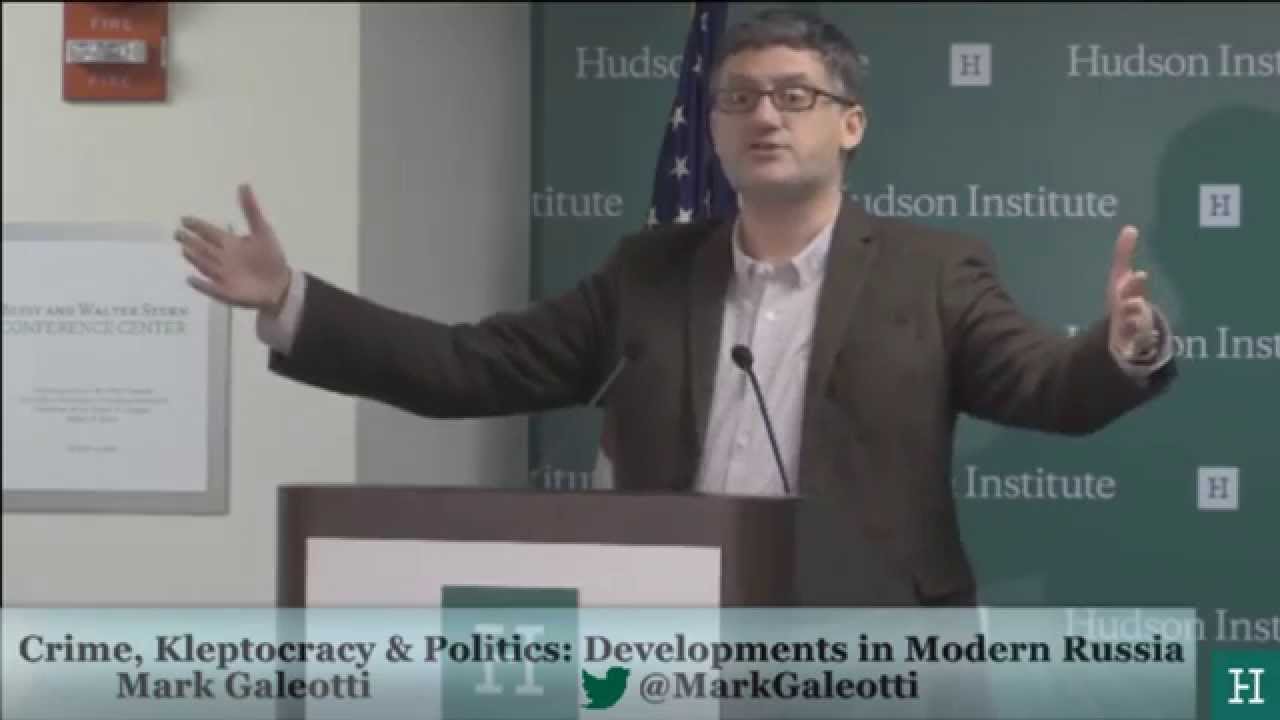 * at the Hudson Institute that Putin's Russia is "not so much a mafia state as a state with a nationalized mafia."
Putin's Kremlin has used organized crime to carry out the tasks it wants to keep its fingerprints off, be it arms smuggling, assassinations, raising funds for black ops, or stirring up trouble in the former Soviet space.
Moscow relied heavily on local organized crime structures in its support for separatist movements in Transdniester, Abkhazia, South Ossetia, Crimea, and the Donbas.
In the conflict in eastern Ukraine, organized crime groups served as agents for the Kremlin, fomenting pro-Russia unrest and funneling arms to rebel groups.
Putin's weaponization of the mafia stems from his political education in the gangsters' paradise that was St. Petersburg.
"In genealogical terms, Putin is the product of the KGB. But in sociological terms, he is the product of the new class that emerged in the Darwinian conditions of the 1990s: business-minded, ambitious, nationalistic, and coldly utilitarian about norms and rules," veteran Russia-watcher James Sherr of Chatham House wrote in a recent report.
But now, thanks to Spanish Judge Jose de la Mata, the mask is coming off Putin's mafia statecraft in a big way.
Judge de la Mata hasissued international arrest warrants for a dozen reputed Russian gangsters from the Tambov and Malyshev gangs, including current and former Russian government officials.
On the wanted list are Interior Ministry official Nikolai Aulov, VladislavReznik, a member of the ruling United Russia party who is deputy head of the State Duma's Finance Committee, and former Deputy Prime Minister Igor Sobolevsky.
Other officials linked to the gangs, but not subject to warrants, include two longtime Putin confidants: former Prime Minister Viktor Zubkov and current Deputy Prime Minister Dmitry Kozak.
Also named are former Defense Minister Anatoly Serdyukov and former Information Technology Minister Leonid Reiman.
The charges -- which include complicity in assassinations, weapons trafficking, extortion, fraud, forgery, bribery, drug smuggling, and money laundering -- are based on a decade-long investigation and stem from a 488-page complaintfiled by Spanish prosecutors Juan Carrau and Jose Grinda in May 2015.
In 2010, Grinda briefed U.S. officials in Madrid about the investigation, informing them that the Kremlin used "organised crime groups to do whatever the government of Russia cannot acceptably do as a government."
According to a classified cable from the U.S. embassy that was published by Wikileaks, the prosecutor told the American officials that Putin's Russia was a "virtual mafia" state where it was impossible to distinguish between the government's activities and those of organized crime groups.
In terms of countering the threat Putin's Russia poses to the West, the Spanish investigation is no less important than NATO's moves to rotate four brigades through the alliance's frontline states in Eastern Europe.
The alliance's decision to beef up defenses on its eastern flank should create a credible deterrent to the kinetic threat from Moscow.
But dealing with the more insidious non-kinetic threat, the one stemming from Moscow's weaponization of organized crime, is a job for law-enforcement.
NOTE:This post has been updated to reflect correct and clarify information regarding the arrest warrants.
==
==
https://warontherocks.com/**2018**/11/a-tangled-web-organized-crime-and-oligarchy-in-putins-russia/
mark Galeotti, The Vory: Russia’s Super Mafia.(Yale University Press, 2018).
The vory, the professional elite of Russian organized crime, have roots that go far back into the days of the tsars. While many historians trace the origins of organized crime to the emergence of the mafia in Sicily in the mid-19th century, a new book by Mark Galeotti suggests that professional criminals were an important component of Russian society as much as a century before that. Like the Sicilian mafia, they developed customs and rituals, codes of conduct, and even their own language and song.
The Russian criminal world, and the vory who presided over it, endured despite concerted efforts by the authoritarian tsarist state to wipe out the bandits.With these failures, professional criminals became entrenched in Russian life and society. As Galeotti points out, Joseph Stalin worked closely with professional criminals, both as a bank robber and a pirate, in the Caucasus region in the early 20th century — the final years of the Russian Empire. But Stalin was careful to cover up this past by physically eliminating his previous criminal associates. Notwithstanding the execution of Stalin’s fellow bandits, Russia’s professional criminals largely survived the Soviet revolution. Subsequently, however, many were rounded up and placed in labor camps, where many of them preyed on the political prisoners with whom they were often confined. Galeotti draws on the memoirs of survivors of long-term incarcerations, such as Varlam Shalamov, a great raconteur of the labor camp environment, who wrote after his release, “the criminals were not human.”
During the Soviet era, true vory refused to cooperate with the state, ensuring that their children did not attend school or serve in the military. But as Galeotti explains, the political calculus of the criminal world changed in the final days of the Soviet Union, setting organized criminals on a trajectory that would lead them to assume political influence and wealth at the end of the Soviet period and in the tumultuous transitional period that followed. The Voryprovides a fine framework to understand the strong links between crime and politics that characterized the end of the Soviet era.
The book’s excellent historical analysis shines a light on Russian organized crime at the organizational and tactical level. It doesn’t tackle more contemporary strands of organized crime, such as the real-estate dealings linked to President Donald Trump or the links between Russian organized crime and the heights of Russian oligarchical power. However, the book effectively analyzes the voryin the protection business and the emerging economy of the early post-Soviet era, when state property was privatized. In this way, Galeotti lays the basis for understanding the shifting relationship between crime and politics in contemporary Russia, where wealth and power are highly concentrated around President Vladimir Putin and his inner circle.
The links between Russian state power and organized crime persist today, impacting global economics and politics. Galeotti does not trace these relationships to the highest levels of American power. Two recent books by Seth Hettena and Craig Unger, on the other hand, explore in detail Trump’s ties with Russian professional criminals who have laundered their money into his properties and even conducted a high-level gambling operation out of Trump Tower. Between the two, Hettena more clearly documents these relationships and explores their important implications for democracy. Still, both books provide a useful supplement to Galeotti’s work, in many ways picking up where he leaves off to examine the more contemporary and transnational reverberations of modern Russian organized crime.
In his chapter “New Times, New Vory,” Galeotti takes us through the dramatic transformation of Russian organized crime after the collapse of the Soviet Union.After the regime’s demise, many new states emerged, but the crime links of the Soviet period continued. Organized criminals were key actors in the waning years of Soviet power, and they emerged with great visibility and potency after the old government had fallen. Soviet authorities had stamped out private enterprise, but the entrepreneurial character of many vory, combined with their willingness to use extraordinary violence, positioned them to assume a vital economic role in the early post-Soviet period — what Galeotti calls a “gangsterisation of business.” The criminal world benefited greatly from the privatization of state property, and organized criminals became arbiters of disputes in the absence of a functioning state.
The Vory accurately explains that post-Soviet organized crime was not based on the more common forms of transnational crime, but rather was much more a product of the privatization of former state property. Furthermore, these criminals were key sellers of security and protection services. But the purchase of these services was far from voluntary, as those who refused to pay for this “protection” found themselves driven out of business or exposed to brute and sometimes terrifying force.
However, as the Russian state began to reassert its authority under Putin, members of organized crime became less important than the oligarchs whom they had helped ascend to wealth and power. Today,Putin controls the oligarchs, and together they control and exploit the criminal world to their mutual advantage.....
==
https://www.alternet.org/2020/09/this-passage-from-a-russian-dissident-reads-as-an-haunting-warning-for-the-united-states-in-2020/
==
https://www.alternet.org/2020/09/how-alexei-navalny-revolutionized-opposition-politics-in-russia-before-his-apparent-poisoning
no lnx vid
the harrowing videos of Alexei Navalny, a blogger who has captured popular frustration in Russia, screaming in agony on Aug. 20, 2020 before being removed unconscious from a plane to a waiting ambulance, demonstrate the Kremlin’s increasing reliance on coercion to control dissent.
This attack is not the first Navalny has endured. In 2017, he was doused with a green antibiotic that compromised his vision. In 2019, while in jail for organizing protests, he suspected he had been poisoned. Navalny has also been wrongly convicted on charges of financial wrong-doing three times. Although he was released to prevent him from becoming a national martyr, his brother and co-defendant, Oleg, served three-and-a-half years in jail.
Throughout this period, the Kremlin worked to discredit Navalny without making him a martyr.
:{
}:
My book “Elections, Protest, and Authoritarian Regime Stability: Russia 2008-2020,” reveals the nature of Navalny’s threat to the Kremlin – one strong enough to make the claims that he has been poisoned credible.
Focus on corruption
When he came onto the national stage 2010, Navalny brought a new type of opposition to Russian politics. He is in tune with popular concerns and able to find common ground across nationalist and liberal activists. He calls for removing President Vladimir Putin through elections, while articulating a new vision for Russia.
Navalny’s importance is not about popularity. The Kremlin’s arrests and disinformation campaigns have raised enough suspicions among voters that polling shows he would not win a national election, even in the unlikely event of a fair fight.
:{
}:
Instead, Navalny’s challenge to Putin’s regime rests on his innovative ideas and organizing strategies that have made him a force in Russian politics.
He began as a lawyer, challenging the large Russian energy companies by buying stock and thus gaining the right to attend shareholders’ meetings. He used his access to defy corporate leadership and release documents to demonstrate malfeasance.
:{
}:
He established The Anti-Corruption Foundation – now labeled a “Foreign Agent” by the Kremlin – which collected citizens’ reports of corrupt practices. His RosYama project, literally “Russian Hole,” allows citizens to go online to report potholes – a widespread, chronic problem in Russia – and track the government response.
:{
}:
Navalny amplified his anti-corruption fight in 2011, when he labeled Putin’s political party, United Russia, the “Party of Crooks and Thieves”. When these efforts contributed to mass protest against electoral fraud, Navalny was at the fore. Addressing an unprecedented crowd in 2011, he said, “I see enough people here to take the Kremlin and [Government House] right now but we are peaceful people and won’t do that just yet.”
:{
}:
He joined the movement’s Coordination Council and forged ties across the diverse opposition with the goal of reforming Putinism.
:{
}:
His canny use of social media has given thousands of Russians – both old and, especially, young – new insight and ways to protest against their government.
New model of opposition
Navalny drew on the resources of these protests – activists, themes, online fundraising strategies and new coalitions – to build an opposition strategy that links elections and a variety of forms of protest. He brought together an impressive team of young activists who challenge the regime at every step of the election process, from party formation to candidate registration and vote counting.
Volunteers go door-to-door or accompany candidates to meet voters on their daily commutes or in apartment courtyards. They build temporary structures, called “cubes,” on busy streets, where they educate voters about policy. Campaign leaders urge activists to share online messages offline with those who do not use the internet.
New electoral technologies
When he fell ill, Navalny was campaigning on behalf of a new generation of local candidates.
By demonstrating that Russian elections are little more than performances of the state’s capacity to manufacture votes, the Navalny team reveals the lack of choice and accountability in the system.
In summer 2019, this strategy led to significant protests after the regime barred almost all of the opposition candidates in Moscow’s municipal elections. When the government cracked down on pro-democracy demonstrators, Navalny’s team built a web-based way to identify any candidate who shared its values and urged voters to support that candidate – even if the candidate was in a party that they detested.
Recent work by political scientists Mikhail Turchenko and Grigorii Golosov demonstrate that Navalny’s “Smart Vote” strategy made a real difference in Russias’s 2019 local elections, helping to defeat nearly a third of Putin-aligned candidates in Moscow. Navalny’s team was gearing up to do the same thing in the September 2020 vote.
Social media innovation
Navalny’s creative use of new media is not limited to pothole repairs and voting apps. Beginning in 2006, he wrote a popular blog on the Live Journal social networking service. When the Kremlin shut down his blog in 2012, he reinvented his social media presence.
The Anti-Corruption Foundation produced a short film, “Don’t Call Him Dimon,” that lampooned former President and Prime Minister Dmitry Medvedev by showing his vast sneaker collection and flying a drone over his duck pond. Like ducks, sneakers became symbols of the opposition. The expose revealed the myth of Medvedev as an honest leader.
The exposes have continued on Navalny’s YouTube channel. His broadcasts have probed Russian intervention in U.S. elections, the Kremlin’s failure to provide COVID-19 relief and rigged Russian elections. These stories challenge the narrative presented in Russian state media, combating the regime’s systematic disinformation campaign.
Navalny narrates this video about the corruption of former Prime Minister of Russia Dmitry Medvedev. There are English subtitles.]
Inspiring a new generation
Navalny’s efforts have captured the imagination of young Russians and demonstrated the effects of generational change. Following “Don’t Call Him Dimon,” tens of thousands of young people took to the streets, shocking a country that believed Putin’s opposition was played out. Months later, they flocked to join Navalny’s presidential campaign organization.
Navalny knew the dangers of being the face of opposition to the Putin regime. The day before he fell ill, he joked with young supporters that his death would do more harm to the Kremlin than his activism.
It’s clear that Russians – who have taken to Twitter to urge him to hold on – don’t want to test that hypothesis
.The Conversation
Regina Smyth, Professor, Indiana University.
==
https://www.alternet.org/2020/08/vladimir-putin-is-on-the-ballot-in-november/ wa mo
Vladimir Putin is on the ballot this November.
You won’t see his name or watch his ads. But make no mistake, Putin has a lot riding on this election and he’s counting on your vote.
What will a vote for Putin mean?
First, Putin is looking to reshape the world order in a way that benefits Moscow, builds his personal power and establishes him as the world’s toughest leader capable of outrageous cunning, manipulation and disruption.
a successful outcome—meaning President Trump is re-elected—means his Russia will be able to wantonly throw its weight around globally. He will assertively create unseen but ever-present fear and dependence in neighboring nations including Belarus, Ukraine, the Baltic states and Georgia. Russia’s renewed and enhanced influence also will be felt in countries farther away and immediately affected by America’s acquiescence to Putin’s newfound power. Countries such as Syria, Libya, Afghanistan, Venezuela, Nicaragua, and Cuba.
Putin’s victory would usher in a world that would be unimaginable to those Americans who endured the Cold War and continue to suffer the 21st century Middle East conflicts fought for oil and influence.
This already was a watershed year for Russia’s President-for-Life Vladimir Vladimirovich Putin—“Vova” for short. He consolidated his domestic power with a sneaky recent referendum that gave him both symbolic and vitalconstitutional changes.
On the symbolic front, he played up family values and nationalist sentiment with laws against same-sex marriage and a codified “belief in God.” On the substantive side, new constitutional reforms give primacy to Russian law over international norms. One more thing: Term limits changed to allow Putin the presidency through 2036.
Constitutional reforms mean he no longer needs to practice new jiu-jitsu political moves. In the past, Putin had to horse-trade his presidential role for the prime ministership. No more. He can now reside in gilded presidential palaces forever and a day.
Tragically, Putin has mobilized a military and militia around a neo-nationalism that satisfies a popular thirst for pride. While his regime fails to deal with improving his people’s lot, it overcompensates for its economic and material failings by freely pouring the emotion-stirring libations of Russian exceptionalism and nostalgia for a deceptively reclaimable empire.
By drowning—or poisoning and defenestrating—opposition voices like Alexei Navalny, Putin deprives his citizens freedom of speech and choice. Russians are left with little to show for their industrious and inventive nature, feeling impoverished despite their abundantly rich culture and overflowing natural resources. What they are left with is Putin.
Secure in his position at home, Putin now shifts his roving eye around the world to spy where he can assert his parasitic power—which is where November’s election could play into Putin’s hands.
American voters can decide how much of a free ride to give Moscow. Putin already got away with interfering in the 2016 U.S. election, collaborating with the winning campaign as the Senate revealed this week. Putin continues his interference, no longer relying on Wikileaks or Facebook to peddle and amplify divisively toxic narratives. He’s hard at work.
If Putin wins again this cycle, prepare for renewed global adventurism.The carte blanche he received these last few years allowed him to stick around Crimea and stick it to Ukraine. He bleeds American soldiers in Afghanistan. While Congress tried to exact a toll for the illegal Crimean invasion and occupation, the war in Ukraine’s Donbass and for paying bounties to kill our troops, crickets is the only thing we hear from the executive, the perfect soundtrack for an ambitious dictator.
The 2020 election campaign will focus foreign-policy debates on which side will be tougher on China. One candidate will try to pin the other as being soft on China and suggest that Xi Jinping is on the ballot.
China policy differences are a legitimate political target, and the policies of both sides should be viewed with discerningly cold, critical eyes. Beijing seeks regional hegemony in and around the South China Sea and everywhere else in its neighborhood. It has cracked down at home in Hong Kong and it threatens Taiwan. Xi and China do have global ambitions.
Xi, however, is not on this year’s ballot in the United States. There is a strong bipartisan American consensus on the China threat. Both parties are on the same page. They may not agree on how to deal with the threat—are tariffs effective?—but are clear-eyed about China’s intentions and capabilities.
Not so with Russia or Putin. The two parties diverge dramatically. Somehow, a party that was once the most vocal, moral and aggressively determined to counter Moscow has now embraced Putin and his posse. What happened?
Putin is on this year’s ballot, so think twice before marking mail-in ballots or donning masks to go pull a lever. The vote you cast counts in both Moscow and the world.
==
funny how RW keeps accusing Clintons of murder, but have no problem when putin actually does?!
https://theconversation.com/how-alexei-navalny-revolutionized-opposition-politics-in-russia-before-his-apparent-poisoning-144830
german doctors offered to treat, russians made excuse to delay plane, in coma on plane?!
==
8/20 sen intel report 5 final says meddling 2016 and now
==
an 820
Rusal, a Russian aluminum company, has invested heavily in a mill that the North American company Braidy Industries has planned for Eastern Kentucky — and according to a Senate Intelligence report on Russian interference in the 2016 presidential election, Rusal is a “proxy for the Kremlin.”
In 2019, journalist Morgan Watkins reports in the Louisville Courier Journal, Rusal agreed to invest $200 million in Braidy’s mill. And the bipartisan Senate Intelligence report, released on August 18, describes Russian oligarch and Rusal co-owner Oleg Deripaska’s ties to the Kremlin.
According to the report, “Deripaska’s companies, including Rusal, are proxies for the Kremlin, including for Russian government influence efforts, economic measures and diplomatic relations.”
Watkins notes that according to a Securities and Exchange Commission report that Braidy filed in June, Rusal had provided $75 million for the mill as of December 31, 2019 but had discontinued contributions until Braidy could secure another $300 million in funding.
the U.S. government has imposed sanctions on Rusal, but Kentucky’s two Republican senators — Sen. Rand Paul and Senate Majority Leader Mitch McConnell — have voted against keeping the sanctions in place. Watkins notes that on August 19, the Kentucky Democratic Party “questioned McConnell’s decision to support lifting the sanctions on Rusal in light of the Senate Intelligence Committee report’s identification of Rusal as a proxy for the Kremlin.”
no lnx
National Security
Trump’s 2016 campaign chair was a ‘grave counterintelligence threat,’ had repeated contact with Russian intelligence, Senate panel finds
By
Karoun Demirjian and
Ellen Nakashima
August 18, 2020
:{
}:
President Trump’s 2016 campaign chairman posed a “grave counterintelligence threat” due to his interaction with people close to the Kremlin, according to a bipartisan Senate report released Tuesday that found extensive contacts between key campaign advisers and officials affiliated with Moscow’s government and intelligence services.
:{
}:
In its report, the Republican-led Senate Intelligence Committee states that Trump’s then-campaign chair Paul Manafort worked with a Russian intelligence officer “on narratives that sought to undermine evidence that Russia interfered in the 2016 U.S. election,” including the idea that purported Ukrainian election interference was of greater concern.
It found that a Russian attorney who met with Manafort, along with the president’s son, Donald Trump Jr., and his son-in-law Jared Kushner at Trump Tower in 2016, had “significant connections” to the Kremlin. The information she offered them was also “part of a broader influence operation targeting the United States that was coordinated, at least in part with elements of the Russian government,” the report stated.
But the panel also concluded that the FBI’s handling of Russian threats to the election was “flawed” and that the bureau gave “unjustified credence” to allegations about Trump’s Russia ties made in a dossier compiled by former British spy Christopher Steele, “based on an incomplete understanding of Steele’s past reporting record.”
Document: Read the Senate Intelligence Committee’s report on Russian interference in the 2016 election]
The Senate Intelligence Committee’s three-and-a-half year investigation stands as Congress’s only bipartisan examination of Russian interference in the 2016 election. The panel, significantly, agreed that the FBI overestimated Steel’s reliability and that Manafort and other aides exposed the campaign to undue Russian influence. But its leaders were noticeably divided along party lines in how they interpreted the report’s significance, and several committee members — including its acting chairman Sen. Marco Rubio (R-Fla.) — endorsed dissenting conclusions about Trump’s own culpability.
The partisan divisions are a sign that the panel’s tome likely will not put to rest the political wrangling over how seriously to treat foreign interference in U.S. democracy as the country heads into its most divisive election in modern history.
“After more than three years of investigation by this Committee, we can now say with no doubt, there was no collusion,” a group of six panel Republicans, including Rubio, wrote in a statementinstead accusing the Democratic Party of coordinating with foreign actors to produce Steele’s dossier.
“In 2016, the Democratic Party, using a series of arm’s length transactions, hired a foreign citizen to seek out dirt on a political opponent, provided by foreign sources,” the Republicans wrote, attacking the FBI for “sloppy work and poor judgment.”
Five Democrat senators — including Kamala D. Harris (D-Calif.), the party’s 2020 vice-presidential nominee — asserted the report “unambiguously shows that members of the Trump Campaign cooperated with Russian efforts to get Trump elected.” Referring specifically to their findings on Manafort, the Democrats wrote, “This is what collusion looks like.”
The intelligence committee’s vice chairman, Sen. Mark R. Warner (D-Va.), who did not sign onto the Democrats’ dissenting views, noted “a breathtaking level of contacts between Trump officials and Russian government operatives that is a very real counterintelligence threat to our elections,” and he encouraged “all Americans to carefully review the documented evidence of the unprecedented and massive intervention campaign waged on behalf of then-candidate Donald Trump by Russians and their operatives and to reach their own independent conclusions.”
The committee’s past chairman Sen. Richard Burr (R-N.C.), who oversaw the bulk of the investigation and also steered clear of the GOP’s dissent, struck a position in the middle.
“One of the Committee’s most important — and overlooked — findings is that much of Russia’s activities weren’t related to producing a specific electoral outcome, but attempted to undermine our faith in the democratic process itself,” he said in a statement. “Their aim is to sow chaos, discord, and distrust. Their efforts are not limited to elections. The threat is ongoing.”
Senate panel told Justice Dept. of suspicions over Trump family members’ Russia testimony
Burr and Warner launched the committee’s probe before Trump’s inauguration in January 2017 and sustained the bipartisan investigation over the following three and a half years, even as other Congressional investigations into the same matter faltered along partisan lines. Since the Senate Intelligence Committee began its probe, former special counsel Robert S. Mueller III also released a 448-page report on Russian interference in the 2016 election — and Trump was impeached and acquitted after Democrats accused him of coercing Ukrainian leaders to interfere in the 2020 election.
Though the committee’s probe covers much of the same turf as Mueller’s investigation, it was different in nature. Mueller was running a criminal probe; the Senate committee was conducting an intelligence investigation — a distinction that helps to explain some of nuanced differences between their conclusions.
The Senate panel’s probe, which was mostly driven by the committee’s bipartisan staff, included more than 200 witnesses and considered evidence relating to Russian disinformation, Trump’s personal, business and campaign contacts with Russians and the transition period following the 2016 election.
:{
}:
At one point, the document all but concludes that Trump aides were duped and manipulated by Russian interests they were too callow to understand.
“Russian officials, intelligence services, and others” acting in concert with the Kremlin “were capable of exploiting the transition team’s shortcomings,” the report concluded. “Based on the available information, it is possible — and even likely — that they did so.”
The report also presents a damning portrait of the Trump campaign’s hasty move in March 2016 to assemble a foreign policy team, asserting that it had recruited inexperienced people without thoroughly vetting them and thus potentially exposed itself to Russian influence.
“Ultimately,” the committee wrote, “the foreign policy team exposed the Trump Campaign to significant counterintelligence vulnerabilities.”
The committee pointed to Trump campaign aide George Papadopoulos, who attempted to secure a face-to-face meeting between Trump and Russian President Vladimir Putin through “highly suspicious” contacts with people close to the Russian government. Ultimately, investigators concluded, Papadopoulos “was not a witting co-optee of the Russian the Russian intelligence services. The panel also found that while Russia seemed to show an interest in campaign adviser Carter Page, investigators “found no indication that Page had useful Campaign information for the Russian intelligence services to extract, nor meaningful influence for them to exploit.”
The committee did find however that Putin personally directed the 2016 hack-and-leak campaign targeting the Democratic Party, the Democratic Congressional Campaign Committee and the Clinton campaign. The anti-secrecy group WikiLeaks “actively sought and played a key role in the Russian campaign and very likely knew it was assisting a Russian intelligence influence effort,” the report stated, surmising that a Russian military spy agency, known as the GRU, transferred hacked emails to WikiLeaks likely because it offered a more effective platform for publicity than the GRU’s own methods.
Yet investigators could not “reliably determine the extent of authentic, nonpublic knowledge” Trump’s friend Roger Stone had about WikiLeaks’s coming releases and shared with the campaign.
The panel noted that its investigation was hampered by several witnesses’ refusing interviews and to produce documents, citing Fifth Amendment rights that protect against self incrimination. These included Stone, Manafort and Rick Gates, the campaign’s deputy chair at that time. The panel’s request to interview Julian Assange was rebuffed.
The committee also outright accused Blackwater founder and Trump supporter Erik Prince of stonewalling its investigation, saying that it was “hampered by a lack of cooperation” and that his account of a controversial 2017 meeting in the Seychelles alongside a Russian official was “brief and deceptive.”
:{
}:
The committee previously released other volumes detailing aspects of its inquiry. Those reports focused on U.S. election security, Russia’s use of social media in disinformation campaigns, the Obama administration’s response to the perceived threat in 2016 and the intelligence community’s joint assessment that Russia had interfered in an attempt to tip the scales in Trump’s favor.
Yet the panel’s effort to maintain a bipartisan approach has not saved it from partisan scrutiny. Last year, the panel came under fire from Senate Republicans after issuing a subpoena for Donald Trump Jr. to come in for a second round of testimony.
After his testimony, Trump Jr. was one of several witnesses that the panel referred to the Justice Department for closer scrutiny over discrepancies between their testimony and that of Gates, the ex-deputy campaign chair who was a key witness in Mueller’s probe.
:{
}:
Earlier this year, Burr stepped aside as panel chairman after coming under scrutiny over stocks he sold in industries hit badly by the coronavirus pandemic. Rubio has been serving as acting chairman in his place.
russians wd be stupid not to use Qanon?
720 srch: russia putin GRU qanon disinformation active measures
Search Results
Web results
Putin's Goal Is to Bring Down American Democracy - The ...www.theatlantic.com › magazine › archive › 2020/06
The Russians were expecting the election of Hillary Clinton—and preparing to immediately declare it a fraud. The embassy in Washington had attempted to ...
Missing: qanon ?| Must include: qanon
https://www.theatlantic.com/magazine/archive/2020/06/putin-american-democracy/610570/
[long]
...#democracyrip was both the hashtag and the plan. The Russians were expecting the election of Hillary Clinton—and preparing to immediately declare it a fraud. The embassy in Washington had attempted to persuade American officials to allow its functionaries to act as observers in polling places. A Twitter campaign alleging voting irregularities was queued. Russian diplomats were ready to publicly denounce the results as illegitimate. Events in 2016, of course, veered in the other direction. Yet the hashtag is worth pausing over for a moment, because, though it was never put to its intended use, it remains an apt title for a mission that is still unfolding.
Russia’s interference in the last presidential election is among the most closely studied phenomena in recent American history, having been examined by Special Counsel Robert Mueller and his prosecutors, by investigators working for congressional committees, by teams within Facebook and Twitter, by seemingly every think tank with access to a printing press. It’s possible, however, to mistake a plot point—the manipulation of the 2016 election—for the full sweep of the narrative.
Events in the United States have unfolded more favorably than any operative in Moscow could have ever dreamed: Not only did Russia’s preferred candidate win, but he has spent his first term fulfilling the potential it saw in him, discrediting American institutions, rending the seams of American culture, and isolating a nation that had styled itself as indispensable to the free world. But instead of complacently enjoying its triumph, Russia almost immediately set about replicating it. Boosting the Trump campaign was a tactic; #DemocracyRIP remains the larger objective.
[From the April 2020 issue: George Packer on how Trump is winning his war on American institutions]
In the week that followed Donald Trump’s election, Russia used its fake accounts on social media to organize a rally in New York City supporting the president-elect—and another rally in New York decrying him. Hackers continued attempting to break into state voting systems; trolls continued to launch social-media campaigns intended to spark racial conflict. Through subsidiaries, the Russian government continued to funnel cash to viral-video channels with names like In the Now and ICYMI, which build audiences with ephemera (“Man Licks Store Shelves in Online Post”), then hit unsuspecting readers with arguments about Syria and the CIA. This winter, the Russians even secured airtime for their overt propaganda outlet Sputnik on three radio stations in Kansas, bringing the network’s drive-time depictions of American hypocrisy to the heartland....
The Russians have learned much about American weaknesses, and how to exploit them. Having probed state voting systems far more extensively than is generally understood by the public, they are now surely more capable of mayhem on Election Day—and possibly without leaving a detectable trace of their handiwork. Having hacked into the inboxes of political operatives in the U.S. and abroad, they’ve pioneered new techniques for infiltrating campaigns and disseminating their stolen goods. Even as to disinformation, the best-known and perhaps most overrated of their tactics, they have innovated, finding new ways to manipulate Americans and to poison the nation’s politics. Russia’s interference in 2016 might be remembered as the experimental prelude that foreshadowed the attack of 2020....
PROPAGANDA BACKFIRE: The Kremlin's Conspiracy ...bylinetimes.com › 2020/06/02 › propaganda-backfire-t...
Jun 2, 2020 - By supporting theories aimed at destabilising the US during the Coronavirus pandemic, Kseniya Kirillova reports on how Putin has opened up ...
Russian troll accounts purged by Twitter pushed Qanon and ...www.nbcnews.com › tech › social-media › russian-troll...
Feb 2, 2019 - The accounts' tweets featured the hashtag #MAGA, usually in support of President Trump, almost 38000 times — the most of any hashtag.
Missing: GRU ?active ?measures
https://www.nbcnews.com/tech/social-media/russian-troll-accounts-purged-twitter-pushed-qanon-other-conspiracy-theories-n966091
no lnx pix
new batch of troll accounts identified by Twitter as having ties to Russia’s propaganda operation revealed an emphasis on promoting far-right conspiracy theories such as Qanon to Americans.
Twitter announced Thursday the removal of 418 accounts tied to the Kremlin-backed Internet Research Agency, the disinformation group whose employees were indicted by special counsel Robert Mueller last February for attempted election interference.
The accounts’ tweets featured the hashtag #MAGA, usually in support of President Donald Trump, almost 38,000 times — the most of any hashtag. #ReleaseTheMemo, a social media campaign pushed by allies of the president last year that aimed to discredit some members of the FBI, was tweeted 37,583 times.
In all, the 400-some accounts tweeted more than 900,000 tweets.
At the time, close allies of Trump brushed off suggestions that #ReleaseTheMemo, which trended on Twitter, was boosted by Russian influence. "Russian trolls have nothing to do with releasing the memo. That was a vote of the intelligence committee,” counselor to the president Kellyanne Conway said last February.
[Related
BUSINESS
Like the fringe conspiracy theory Qanon? There's plenty of merch for sale on Amazon]
Some now-purged users spammed Twitter with tweets repeating the hashtag “#ReleaseTheMemo.”
When removing the spam-style messages that included multiple hashtags, the second-most tweeted topic for the Russian troll accounts was #Qanon, a baseless conspiracy theory that claims Mueller and Trump are secretly working together to take down a global pedophile ring run by celebrities and Democratic politicians.
#GreatAwakening and #FollowTheWhiteRabbit, which are catchphrases for #Qanon followers, also featured prominently in the Russian trolls’ tweets.
Nina Jankowicz, a global fellow at the Kennan Institute focusing on Russia and technology, told NBC News that Qanon’s often outlandish narratives about a secret global cabal fueled by the United States fits well with Russian propaganda’s larger narrative.
:{
}:
“One of the Kremlin’s favorite tactics is to inspire confusion and doubt to sow distrust in government. Qanon certainly does that,” Jankowicz said.
:{
}:
“Amplifying the conspiracy theory also makes it look like it has more supporters, distracting from more substantive issues in the online discourse.”
[Related
TECH
What is Qanon? A guide to the conspiracy theory taking hold among Trump supporters]
Qanon, a more elaborate offshoot of the "pizzagate" conspiracy theory, came to prominence when several Trump supporters showed up at the president’s rally in Tampa, Florida, this past August carrying “Q” signs and wearing T-shirts supporting the conspiracy.
In the last year, believers in the conspiracy have also been in armed standoffs with the police in Arizona, and one blocked the Hoover Dam demanding the “Release of the OIG Report,” a Qanon-based conspiracy theory loosely derived from the success of #ReleaseTheMemo.
All of the 30 most-used hashtags pushed by the suspected Russian troll accounts focused on either support for Trump, conspiracy theories that targeted his political opponents or a separate — but sometimes overlapping — trolling campaign that meant to demean Muslims.
The hashtags #IslamIsTheProblem, #StopImportingIslam and #BanShariaLaw were each tweeted more than 15,000 times by the 481 Russian troll accounts.
The accounts attempted to emulate Americans on both sides of the political aisle.
One account identified by Twitter as a Russian troll account, @QuartneyChante, posed as an African-American woman. One of her tweets received more than 66,000 retweets.
“Dear White People. It’s a privilege to learn about racism instead of experiencing it your whole life,” the tweet read.
The account was even featured in several news articles, including a Mashable story dubbed "Dear white women: Here's how to step up for women of color.”
Jankowicz said the widespread dissemination of the tweets is a good reminder not to trust everything you read on social media.
“That account was created fairly recently and gained a lot of traction quickly, it seems,” Jankowicz said. “It’s pretty sad, but unless accounts use a plausible name and personal photo on Twitter, I’d advise users against interacting with them.”
Ben Collins
Ben Collins covers disinformation, extremism and the internet for NBC News.
Image: Joe Murphy
Joe Murphy
Joe Murphy is a data editor at NBC News Digital.
https://theconversation.com/trumps-use-of-religion-follows-playbook-of-authoritarian-leaning-leaders-the-world-over-140050
It was a striking moment: Donald Trump, Bible in hand, posing for photos in an apparent moment of political theater made possible by the dispersal of protesters through the use of tear gas.
:{
}:
The president’s visit to St. John’s Episcopal Church, known as “the Church of the Presidents,” came immediately after giving a Rose Garden speech framing himself as “your president of law and order” and threatening to send federal troops to “restore security and safety in America.” The next day, Trump made another high-profile visit to a place of worship, this time Washington’s St. John Paul II National Shrine.
Coming at a time of social turbulence, critics accused Trump of following authoritarian-leaning world leaders by sidling up to religion to reinforce an image as a strongman defending a particular brand of tradition. Bishop of the Episcopal Diocese of Washington Mariann Budde said as much, commenting that Trump used the Bible at St. John’s “as if it were a prop or an extension of his military and authoritarian position.”
As a scholar who has researched the interaction of politics and faith for decades, I know how potent religion can be as a political tool.
A powerful tool
Religion creates meaning in our lives by articulating values about how we relate to one another. But just as it can unite us, religion can also be a source of division – used to “other” people who are not of the faith and don’t share the same traditions and rituals.
When enough people perceive – or can be convinced – that traditional elements of the social fabric are at risk, religious signaling through the use of symbols and images can help would-be authoritarians cement their power. They present themselves as protectors of the faith and foes of any outsider who threatens tradition.
Russian President Vladimir Putin sunbathes with a cross on display over his bare chest. Alexey Nikolsky/AFP via Getty Images]
In Russia, this phenomenon is seen in President Vladimir Putin’s forging of a strategic alliance with the Russian Orthodox Church. For his part, Putin presents himself not just as a commanding leader, but also as a devoutly religious Russian. When he appears shirtless, for example, the large cross he wears around his neck is always visible. Meanwhile, the Church promotes traditional moral values and maintains a distance from the rest of the worldwide Orthodox Christian community, thereby separating the “truly Russian” from the outsider. In their most recent collaboration, Putin and the Church proposed amendments to the Russian constitution that would enshrine Russians’ faith in God, define marriage as the union of a man and a woman and, tellingly, proclaim “the great achievement of the [Russian] people in defense of the Fatherland.” These changes, all of which are intended to reinforce Putin’s base of support, would be jarringlynationalistic additions to the constitution.
Putin benefits from this insider-outsider dynamic in advancing his goal of restoring Russia to his vision of its past territorial glory. In justifying the Russian incursion into Crimea, Putin argued that the region had “sacral importance for Russia, like the Temple Mount in Jerusalem for the followers of Islam and Judaism.” Defending and expanding Russian territory is a much easier sell if it is framed as the defense of the holy.
Religious imagery
We see a similar dynamic in India, where Prime Minister Narendra Modi’s grip on power relies in large part on his embrace of a version of Hindu nationalism that elevates Hindus as “truly Indian” insiders and singles out Muslims as outsiders.
Like Putin, Modi wraps himself in religious imagery. He makes high-profile visits to remote Hindu temples while electioneering and never wears green because of its association with Islam.
Then-prime minister candidate Narendra Modi visits a shrine on horseback while electioneering in 2014. Strdel/AFP via Getty Images
Modi’s Hindu nationalism cements his popularity among devout Hindus and builds public support for anti-Muslim policies, such as stripping the only majority-Muslim state in India of its autonomy and enacting a controversial new law preventing Muslim migrants from attaining Indian citizenship.
Trump as savior
Trump has stumbled in attempts to portray himself as personally devout, declining to name a favorite passage from the Bible and stating that he has never sought forgiveness from God for his sins.
Nevertheless, public opinion polls have consistently shown that white Christians comprise the core of Trump’s base, although there are recent signs of a dip even among this key group.
And while it is important to note that many white Christians do not support Trump, 29% of evangelicals go so far as to say they believe he is anointed by God.
Where Trump succeeds is in presenting himself as a Christian nationalist, much as Putin and Modi style themselves as the stout defenders of their countries’ dominant religions.
One way Trump achieves this end is by making statements such as this one on the campaign trail earlier this year: “We’re going to win another monumental victory for faith and family, God and country, flag and freedom.”
In their new book “Taking America Back for God,” sociologists Andrew Whitehead and Samuel Perry contend that many of Trump’s white Christian supporters see him as their long-awaited savior – not just the protector of traditional religion, but also the defender of a bygone way of life.
In that imagined past, white men ruled the roost, families went to church every Sunday and outsiders knew their place.A deep-rooted desire for a return to that past may have been why Trump’s Make America Great Again slogan has proved so potent. As Yale scholar Philip Gorski has argued, that phrase can be interpreted to mean “making white Christianity culturally dominant again.”
As such, we should not be surprised that in the current moment of crisis Trump is attempting to use religion to reinforce differences between his supporters and his opponents. Like Putin, he is posing as the defender of a particular version of a glorious past. And echoing Modi, he is doing this by building support through the denigration of the outsider.
aha: abortion turned xian anti-gubmint; in 80's RR televangelists had TV programs/stations; Rove courted (organized) for Bush 43; now drollinger cabinet and GOTV network (AI/digital tracking?); scary overlap with militias?! patriot prayer
putin cozied up to? thus US xians gave him pass on collusion, plus if true delegitimatizes trump, who delivers anti-abortion judge and SCOTUS w/ mcconnell
https://www.alternet.org/2020/05/why-religious-freedom-stokes-coronavirus-protests-in-the-u-s/
...
==
https://www.alternet.org/2020/04/trumps-tragic-clowning-and-his-global-surrender-to-china-and-russia-have-exposed-america-as-a-declining-empire
xi putin
==
| Moscow Silently Expands Surveillance of Citizens | ||||||||
|---|---|---|---|---|---|---|---|---|
| The system is ostensibly to help in the fight against COVID-19 as facial recognition cameras are being used to ensure that everyone placed under self-quarantine stays off the streets. | READ MORE » |
=
==
3/20 bktv not vetted
JANUARY 17, 2020
Between Two Fires
Joshua Yaffa, Moscow correspondent for the New Yorker, looks at life in Russia under Vladimir Putin.
putin up for 36 yr term, into 80's, ast female cosmo also in 80's?
==
saudis targeting russian, frackers collateral damage!?
NB DESMOG TRACKING IMPENDING BANKRUPTCY? KEPT AFLOAT BY BANKS?
aha ish // disaster cap'l, never waste a crisis to dustoff wishlist
Will an oil tycoon who donated $500,000 to support Trump’s re-election get bailed out by his administration?
https://www.alternet.org/2020/03/will-an-oil-tycoon-who-donated-500000-to-support-trumps-re-election-get-bailed-out-by-his-administration
no lnx
Will an oil tycoon who donated $500,000 to support Trump’s re-election get bailed out by his administration?
Written by Igor Derysh / Salon March 12, 2020
With oil prices plunging during the coronavirus outbreak, the Trump administration is weighing a federal bailout for oil and natural gas companies, according to a new report.
President Donald Trump has repeatedly touted a fracking boom under his administration, but oil and gas companies have seen profits drop amid an oil price war between Russia and Saudi Arabia.
“Alarmed” by the prospect that some of these companies, many of which are already in debt, [see desmog]could go out of business, White House officials have pushed for a federal bailout in the form of low-interest government loans, The Washington Post reported.
Among those pushing for the bailout is Harold Hamm, a billionaire Trump adviser who owns Continental Resources, an energy companywhich lost half of its market value Monday.
Hamm told The Post that although he had not made “direct” contact with the president, he advised the administration to consider “any action that the administration might take to protect and preserve American interests at this time from being unfairly disadvantaged.”
Hamm has given more than $500,000 to support Trump’s re-election effort since 2017, the government watchdog group Citizens for Ethics and Responsibility in Washington noted.
Some Trump advisers told The Post that the administration was eyeing “targeted assistance” for the companies. Though under consideration, another official warned that “political blowback over the idea may eventually lead campaign advisers and others in [the] administration to talk Trump out of it.”
Chris Rupkey, the chief economist at MUFG Union Bank, told the outlet that he expects significant political backlash.
“It’s difficult when governments selectively target individual industries,” he said. “And there’s going to be pushback on it, because it’s political and may be tied to the administration’s contacts and the people it knows.”
Cornell University professor Robert Hockett, who has advised Sen. Bernie Sanders, I-Vt., and Sen. Elizabeth Warren, D-Mass., on economic policy, added that it was ridiculous to look out for big fracking companies while millions need relief.
“We are in the midst of a crisis where people are literally having to skip work and may miss paychecks or face medical debt,” he said. “The idea you would look to help out shale companies now is like something out of a satire or a bad movie. It’s absurd.”
Trump also said that he was looking at bailing out airlines, cruise lines and the hospitality industryTuesday, as they reel from the impact of COVID-19, the disease spread by the novel coronavirus. But the bailout proposals have received public pushback from Republicans.
==
an 220
https://www.alternet.org/2020/02/opposition-urges-russia-without-putin-in-rally-for-slain-liberal/
https://www.alternet.org/2020/02/william-barr-promotes-christian-tyranny-in-latest-speech/
no lnx
William Barr promotes Christian tyranny in latest speech
Written by Chrissy Stroop / Religion Dispatches February 29, 2020
I’ve said it before, and if you’re reading this, you’ve very likely heard the same thing darkly muttered among liberals and progressives if you haven’t said it yourself: I never thought anything could possibly make me miss Attorney General Jefferson Beauregard Sessions III. And yet, with his willingness to throw away our norms, checks, and balances, to politicize the Justice Department, to sacrifice the rule of law itself on the altar of Trump—current Attorney General William Barr has done it. As authoritarian as he was, invoking Romans 13 to defend the Trump administration’s indefensibly inhumane policy of caging children separated from their asylum-seeking parents, Sessions had at least enough genuine concern for the rule of law to recuse himself from the Mueller investigation, against the tweeter-in-chief’s explicit wishes.
In other ways, however, Sessions and Barr are clearly cut from the same cloth.Sessions, a Methodist, has asserted that without belief in God it is impossible to believe in truth, suggesting that non-believers are unfit to serve in government. In recent months, Barr, a Catholic, has expounded the same views much more forcefully and at much greater length, including in a speech he delivered Wednesday at the National Religious Broadcasters Convention in Nashville. NRB is an international evangelical organization whose board members include John Fuller of far-right powerhouse Focus on the Family and Tim Wildmon of the American Family Association, a Southern Poverty Law Center designated anti-LGBT hate group.
Featuring predictable dog whistles about “federalism” (i.e., “states’ rights”) and “the corporate—or ‘mainstream’—press,” Barr’s speech to NRB was divided into sections focusing on “religion, the decentralization of government power, and the free press,” all of which, Barr claims, have “have eroded in recent decades.” But today I’ll focus largely on Barr’s view of religion and its ideal place in society and the public sphere.
Barr’s exposition weaves together a variety of reactionary tropes, many of which have roots in the nineteenth century. (While it would be impossible to tease them apart and trace their relationships and genealogies in a short commentary, for those interested in an academic unpacking of Barr’s rhetoric, “The Russian Origins of the So-Called Post-Secular Moment: Some Preliminary Observations,” which I wrote for State, Religion and Church, will provide a helpful overview.)
The attorney general’s speech was likewise full of so many tensions, contradictions, and weak arguments that it resembles the “Gish gallop” style of debate, making it difficult to believe that they were all offered in good faith. In typical Christian nationalist form, Barr quoted American Founding Father John Adams: “We have no government armed with the power which is capable of contending with human passions unbridled by morality and religion. Our Constitution was made only for a moral and religious people. It is wholly inadequate for the government of any other.”
Asked to comment, Freedom From Religion Foundation’s Andrew Seidel, author of The Founding Myth: Why Christian Nationalism is Un-American, maintained, “Barr is misreading Adams.” To substantiate the point, he observed, “Adams, like the other founders, thought religion and morality were two separate entities; Barr thinks they are one and the same. The founders thought religion could be a substitute for morality. We now know that they were wrong on this point.”
What Seidel means here, as he details in his book, is that as Enlightenment elites, the Founding Fathers believed that they were educated and cultivated enough to be moral without religion, but that the masses were too uncultivated to do the same. The masses would therefore require religion. Seidel maintains that the founders were wrong on this point, and we can admit as much while still admiring their positive achievements.
Seidel adds, “If the founders believed that religion was important to ensure moral behavior for the masses but not for themselves, that means that the founders were moral without religion. It also means they founded the American government on their own morality, not religion,” concluding that “Barr is inadvertently refuting his entire argument by trying to co-opt Adams.”
Seidel’s work can also help us see that Barr is twisting Tocqueville in his attempt to marshal the nineteenth-century French observer of American democracy in support of his view that moral behavior is impossible without religion. A claim, by the way, that is entirely fact-free.
And Seidel is certainly correct that Sessions and Barr go much further than the Founding Fathers in claiming, as Barr did in his NRB speech, that moral values “must flow from a transcendent Supreme Being.” Despite Barr’s whiggish praise of “the Anglo-American political system” and his espoused disdain for Enlightenment thinker Jean-Jacques Rousseau, his views on the necessity of an external, transcendent source of morals in order for humans to achieve virtue is much more prominent in Continental European thought than in the English-speaking world.
But Barr is a smooth gaslighter, and he represents his argument for theocratic authoritarianism as a defense of “liberal democracy.” Barr’s European (and sometimes American) antecedents were often more honest, admitting that they viewed liberal democracy, due to its supposed godlessness and concomitant lack of truth, as a failure that would have to be replaced with either “totalitarianism” (the “ersatz religions” of fascism or Communism) or “a religious society.”
Indeed, Barr’s claim that “the right way to transform the world is for each of us to focus on morally transforming ourselves” is almost a direct quote from the early twentieth-century anti-Communist Nikolai (Nicholas) Berdyaev, who might well have influenced the attorney general, if not directly, then through Berdyaev’s profound influence on late Soviet dissident Alexander Solzhenitsyn, whom he cites. While Solzhenitsyn’s bravery in exposing the brutal Soviet GULAG system of prison camps should never be forgotten, Solzhenitsyn was no fan of the West.
In 1978, he gave a famous speech lambasting the West’s supposed decline in terms that would surely be congenial to Sessions and Barr. And later Solzhenitsyn, who had been expelled from the USSR, voted with his feet, accepting Russian citizenship from Vladimir Putin’s government and returning to his homeland, pleased with the way that Christian nationalist authoritarianism had replaced Communism as the Russian state’s guiding ideology. The closeness of Putinist Russians and American right-wingers that has come to light in recent years should not surprise us. But we should be very clear that what both parties want is neither democracy nor pluralism, however much Barr may claim to support both.
Barr claims he supports separation of church and state, but the claim is clearly disingenuous: “While most everyone agrees that we must have separation of Church and State, this does not require that we drive religion from the public square and affirmatively use government power to promote a culture of disbelief.” The tell here is that the attorney general conflates the idea of a religiously neutral public square with “using government power to promote a culture of disbelief.” The notion that there’s no religious neutrality, and that therefore,if public institutions are not promoting religion, they are promoting secular humanist ideology by default, is a hallmark of dominionist Christian thinking. His NRB audience would have no trouble getting the message.
Like authoritarians, narcissists, and abusers of all kinds, Christian extremists seek to paint themselves as victims,and Barr’s speech is a prime example of this powerful rhetorical tactic. In it, the attorney general blames supposedly nefarious secularists for the contentious state of American politics when, in fact, data shows us that precisely the opposite is true—America’s polarization has been driven by our radicalized, mostly Christian, Right.
Trump’s toady of an attorney general may wax poetic about his fear of the potential tyranny of a secular majority, but he is transparently trying to promote Christian tyranny, only in the guise of “liberal democracy.” It doesn’t take much digging beneath the surface to see that Barr’s authoritarian approach to religion derives from a very dark view of human nature. Authentic supporters of democracy, by contrast, understand that despite our human limitations—which are quite real but not nearly so severe as those posited by the toxic doctrine of “original sin”—it’s possible to build a society around a shared social contract grounded in the simple recognition of our shared human condition, and on that basis to foster functional institutions and a healthy respect for pluralism.
==
ref
The Russian Origins of the So-CalledPost-Secular Moment: Some PreliminaryObservations
Christopher Stroop
—
Senior Lecturer at the Russian Presidential
Academy of National Economy and Public Administration (Moscow,
Russia). cstroop@gmail.com
This piece argues that there are a number of paths through which we might investigate Russian connections to the emergence of post-secularism, with the collapse of the
USSR
and the post-Soviet revival
of Russian Orthodoxy representing only the most obvious. A thus far less developed but important approach involves unravelingan intellectual-historical trajectory by focusing on the influenceof anti-Bolshevik Russian religious philosophers in the West. The
article shows that after the founding of the Soviet Union, the anti-Bolshevik Russian emigration emerged as a signi?cant vehicle forthe transmission of Russian ideas in the West, contributing to thedevelopment of an anti-secular discourse with roots in the 20?th
century that was able to achieve some prominence thanks to theCold War. This discourse associated religiosity with freedom andatheism with unfreedom. Stroop argues that this discourse, in thedevelopment of which Russian intellectuals played an important role, emerged in reaction against the perceived cultural threat of
nihilism, and he suggests that it is a similar concern over the possible
consequences of nihilism that has led to the emergence of the post-secular moment.
Keywords:
religious, secular, post-secularism, nihilism, atheism,
Communism, Russian Orthodoxy, Russian religious philosophy, Russia
and the West, Sergei Bulgakov, Nikolai Berdyaev, Lev Shestov, Russian emigration, Cold War, anti-secular discourse...
==
https://www.alternet.org/2020/02/ag-barr-and-betsy-devos-rail-against-secularism-and-a-culture-of-disbelief-at-religious-broadcasters-convention/
no lnx
AG Barr and Betsy DeVos rail against secularism and a ‘culture of disbelief’ at religious broadcasters convention
Written by Alex Henderson February 27, 2020
no no direct connect to vlad, but interview mention vfb? bank, and a russia bank in cyprus?
https://www.alternet.org/2020/02/the-million-dollar-question-finance-editor-breaks-down-dojs-bizarre-abandonment-of-a-russian-money-laundering-case-against-deutsche-bank/
no lnx
‘The million-dollar question’: Finance editor breaks down DOJ’s bizarre abandonment of a Russian money laundering case against Deutsche bank
Written by Alex Henderson February 18, 2020
When other banks weren’t making generous loans to Donald Trump and the Trump Organization, Deutsche Bank was. David Enrich, finance editor of the New York Times and author of the new book, “Dark Towers: Deutsche Bank, Donald Trump and an Epic Trail of Destruction,” discussed Deutsche’s relationship Trump and a seemingly abandoned U.S. Department of Justice (DOJ) case against the bank during a Monday night, February 17 appearance on MSNBC’s “The Rachel Maddow Show.”
Maddow, noting that Trump “probably owes hundreds of millions of dollars to this one institution,” asked Enrich “whatever happened to” a possible U.S. Department of Justice (DOJ) case against Deutsche Bank that involved a “Russian money laundering scandal.” And Enrich responded, “That is the million-dollar question.”
Enrich explained that during the final months of the Obama Administration, the DOJ was “close” to bringing a “criminal case” against Deutsche Bank “for its involvement in Russian money laundering” — but after Trump became president, the case fell by the wayside.
“Deutsche Bank executives became convinced that this was just too hot to handle for the Trump Administration,” Enrich told Maddow. “They did not want anyone in the Administration to bring more public attention to thevery close relationship between Deutsche Bank and Russia on the one hand and Deutsche Bank and Trump on the other hand.”
Maddow asked Enrich what Deutsche Bank has told him about either the Trump Administration or the bank’s ties to Russia. And Enrich responded, “They’ve publicly refused to speak (or) say much of anything in public about their client. They acknowledge that Trump is a client. Trump has disclosed, in his limited White House disclosures, the amounts that he owes and what those loans are.”
Enrich went on to say, “They are trying to — desperately, I think — make this very bad situation, where they are kind of the public face of Donald Trump’s finances…. go away.”
==
https://theconversation.com/american-influence-could-take-the-hit-as-putin-zelenskiy-try-to-make-peace-in-ukraine-127500
==
https://www.alternet.org/2019/12/putin-told-me-ex-white-house-officials-reportedly-said-trumps-view-of-ukraine-was-poisoned-by-the-russian-president
n o lnx
‘Putin told me’: Ex-White House officials reportedly said Trump’s view of Ukraine was poisoned by the Russian president
Written by Cody Fenwick December 19, 2019
Though the Ukraine scandal suddenly burst on to the scene of American politics in September and quickly led to President Donald Trump’s impeachment this week, its origins have been festering for much longer, a new report from the Washington Post found on Thursday.
Multiple former White House officials told the Post that Trump’s negative view of Ukraine was influenced directly by Russian President Vladimir Putin. Based in part on discussions he had with Putin, these officials said, Trump came to believe that Russia didn’t interfere in the 2016 election, but Ukraine had instead.
It was this conspiracy theory that Trump referenced in his infamous July 25 phone call with Ukrainian President Volodymyr Zelensky. Trump pushed Zelensky to conduct two investigations. One, which has received the most attention, was of Joe Biden and his son. But the other referenced the cybersecurity company Crowdstrike and a “server” from the 2016 election, the subject of a baseless conspiracy theory about Ukraine.
Fiona Hill, who served under Trump’s former nationals security adviser John Bolton on the National Security Council as an expert in Russia, testified to Congress that this conspiracy theory is a myth intentionally propagated by Russian intelligence in order to deflect blame for its crimes and to undermine Ukraine. Reports have found that lawmakers have been briefed by U.S. intelligence officials on these findings, as well.
While some White House officials only inferred that Trump’s belief in the Ukraine conspiracy came from Putin, others had more direct evidence, according to the report. The Post explained:
One former senior White House official said Trump even stated so explicitly at one point, saying he knew Ukraine was the real culprit because “Putin told me.”
Two other former officials said the senior White House official described Trump’s comment to them.
The report also found that many White House officials tried to disabuse Trump of this false notion, but they failed. Rudy Giuliani, the president’s personal lawyer, has publicly bought into these theories.
In July 2017, when Trump had his much-discussed first meeting with Putin at the G-20, the pair spoke for a total of about three hours. One hour-long informal meeting at a dinner during that time was not initially disclosed by the White House.
The Post story continued:
Three former senior administration officials said Trump repeatedly insisted after the G-20 summit that he believed Putin’s assurances that Russia had not interfered in the 2016 campaign. The officials said Kelly, national security adviser H.R. McMaster and Secretary of State Rex Tillerson all tried to caution Trump not to rely on Putin’s word, and to focus on evidence to the contrary that U.S. intelligence agencies had collected.
Over the next several months, Trump privately told aides on several occasions that he believed Ukraine had interfered and tried to help Clinton win the White House, former officials said.
“The strong belief in the White House was that Putin told him,” one former official said.
==
==
https://www.alternet.org/2019/12/russia-and-the-republicans-vladimir-putins-american-subsidiary
Russia and the Republicans: Vladimir Putin’s American subsidiary Russians went looking for allies on the American left for… |
==
https://www.alternet.org/2019/12/former-cia-officer-putins-long-game-is-to-destroy-western-democracies-and-the-gop-is-helping-him/
n olnx
Former CIA officer: Putin’s ‘long game’ is to ‘destroy western democracies’ — and the GOP is helping him
Written by Alex Henderson December 10, 2019
As articles of impeachment against President Donald Trump move forward in the U.S. House of Representatives, pro-Trump Republicans continue to insist that Ukraine interfered in the 2016 presidential election — a claim that foreign affairs expert Fiona Hill described as total nonsense during her testimony before the House Intelligence Committee last month.Regardless, Republican Sen. Richard Burr of North Carolina recently told an NBC News reporter that in 2016, “Every elected official in the Ukraine was for Hillary Clinton. Is that very different than the Russians being for Donald Trump?” And former CIA officer Alex Finley, in a December 10 article for Just Security, explains why Burr’s assertion is a “false equivalence” that “completely and dangerously mischaracterizes the threat we are facing” from Russian President Vladimir Putin.
In 2016, Finley explains, some “Ukrainian officials publicly expressed a dislike for candidate Trump” and “looked to hold” some “corrupt” associates of former President Viktor Yanukovych “accountable” — and one of those associates “happened to be Trump’s campaign chairman” (Paul Manafort). But, Finley quickly adds, “Russian President Vladimir Putin, on the other hand, is aiming to destroy western democracies.”
Those who think that statement about Putin sounds “overblown,” Finley asserts, should consider what Putin told the Financial Times: “The liberal idea has become obsolete. It has come into conflict with the interests of the overwhelming majority of the population.”
Putin, Finley stresses, is opposed to the very ideal of liberal democracy.
“Russia has been running, and continues to run, a covert intelligence operation aimed at duping westerners and inflaming internal divisions, in order to break down our democratic institutions,” Finley observes. “Putin aims to bring down the western liberal order, which — with the United States at the helm — has generally brought peace and stability to the west for 70 years.”
Republicans, Finley warns, “should ask themselves why Putin sees them as a good partner” in his anti-U.S. goals.
Finley goes on to list some things that the Russian government under Putin’s leadership did in 2016, from hacking Democratic e-mails to running an “influence campaign” through websites like WikiLeaks to infiltrating “the NRA and GOP circles with Maria Butina and Alexander Torshin.”
Moreover, Finley writes, Putin’s government is not only trying to undermine western liberal democracy in the United States, but also, in Italy, France, Germany and other countries that have long been U.S. allies.“Congressional Republicans have become pansies of Putin in a much larger game,” Finley warns. “This is not about one election or even two elections. Putin is playing a long game aimed at changing the international system in his favor, and Republicans are aiding and abetting him. Does the party of Ronald Reagan really want to be an accomplice to the destruction of the U.S.-led liberal world order?”
==
https://www.alternet.org/2019/12/military-leaders-at-the-pentagon-panicked-as-us-troop-affinity-for-russia-grows-report/
no lnx deriv
Military leaders at the Pentagon panicked as US troop affinity for Russia grows: report
Written by Tom Boggioni / Raw Story December 8, 2019
According to a report from Voice of America, military leaders at the Pentagon are growing increasingly concerned with the popularity of Russian President Vladimir Putin within the military ranks due to the influence of Russian propaganda and Donald Trump’s boosterism.
The report states, “While most Americans still see Moscow as a key U.S. adversary, new polling suggests that view is changing, most notably among the households of military members. The second annual Reagan National Defense Survey, completed in late October, found nearly half of armed services households questioned, 46%, said they viewed Russia as ally. Overall, the survey found 28% of Americans identified Russia as an ally, up from 19% the previous year.”
That same survey links Putin’s increasing popularity to the election of President Donald Trump.
“Pollsters found the positive views of Russia seemed to be ‘predominantly driven by Republicans who have responded to positive cues from [U.S.] President [Donald] Trump about Russia,’ according to an executive summary accompanying the results,” VOA reports.
At the same time, Washington Monthly reports, “Now, due to purely partisan interests, the nation’s military is being warped into supporting the hostile foreign power–against our own values, geopolitical interests, and intelligence services It’s like the plot from a bad spy novel, except that it’s happening right out in the open. This is the situation as it stands between Trump, Russia, the Republican Party and Ukraine.”
“U.S. defense and security officials have told VOA that Russia has been targeting U.S. military personnel, specifically, with a ramped-up influence campaign, as far back as 2017 in preparation for the November 2018 midterm elections,” VOA reports. “Russia’s goal, they said, was not so much to swing the result of the elections but to seed U.S. military personnel with the right type of disinformation so that they would be predisposed to view Russia and its actions in a more favorable way in the future.”
You can read more here.
https://www.alternet.org/2019/12/how-trump-is-aligning-the-us-military-with-the-russian-white-supremacist-criminal-syndicate/
no lnx
How Trump is aligning the US military with the Russian white supremacist criminal syndicate
Written by David Atkins / Washington Monthly December 8, 2019
Whether you’re a fervent nationalist or citizen-of-world internationalist, this story should inspire some alarm:
Russian efforts to weaken the West through a relentless campaign of information warfare may be starting to pay off, cracking a key bastion of the U.S. line of defense: the military.
While most Americans still see Moscow as a key U.S. adversary, new polling suggests that view is changing, most notably among the households of military members.
The second annual Reagan National Defense Survey, completed in late October, found nearly half of armed services households questioned, 46%, said they viewed Russia as ally.
Overall, the survey found 28% of Americans identified Russia as an ally, up from 19% the previous year.
So a significantly larger portion of the military–nearly half!–sees Russia as an ally than does the general public. If your first reaction is that this is part of a tribalistic Trump effect on a constituency that leans conservative overall, you would be right.
Generally, the pollsters found the positive views of Russia seemed to be “predominantly driven by Republicans who have responded to positive cues from [U.S.] President [Donald] Trump about Russia,” according to an executive summary accompanying the results.
While a majority, 71% of all Americans and 53% of military households, still views Russia as an enemy, the spike in pro-Russian sentiment has defense officials concerned.
It’s easy to sound the alarm over this for basic national security reasons. From a traditional Westphalian perspective, it is clearly dangerous for the people we entrust to secure the country’s self-defense to be much more favorable to our fiercest geopolitical foe than the public. It should be the other way around. It is beyond alarmingwhen put in the proper context: one of the country’s two major political parties was just assisted in the previous election by its greatest foe; the president who was elected by a minority of voters with that rival’s help has continued to run interference for that rival, has been weirdly obsequious to its dictatorial leader, has refused to accept his own intelligence services’ findings about the criminal theft of opposition documents in the election, and is to this day extorting and undermining a nation in a hot war with that same rival power in an effort to fabricate dirt on a political rival for the next election and, amazingly, to frame the victim of the extortion for the crimes of its rival aggressor.
The president has embroiled his personal lawyer, his Attorney General, his Vice President and his Secretary of State in the conspiracy as well. And all of this is occurring even as the president rules under a cloud of suspicion about his own personal and business financial ties to the same rival power.
And now, due to purely partisan interests, the nation’s military is being warped into supporting the hostile foreign power–against our own values, geopolitical interests, and intelligence services It’s like the plot from a bad spy novel, except that it’s happening right out in the open. This is the situation as it stands between Trump, Russia, the Republican Party and Ukraine. And no one can do anything about it because the Republican Party sees itself as locked into a demographic death spiral as it sheds support from every demographic except the declining share older, white, exurban evangelicals, and is therefore willing to defend even the most abominable behavior in exchange for nominating a slew of extremist radical judges who they hope will derail any progressive priorities for the next several decades.
But even this understates the cause for alarm.Because Russia isn’t just a geopolitical foe: it is also the global leader of white supremacy and fossil fuel kleptocracy. It is an international criminal syndicate operating as a government, and it is actively recruiting allies and henchmen all around the world. As I said last year,it’s not so much that the United States lost or is losing the Cold War (we didn’t lose it), as much as that racist plutocrats won it:
In order to pacify the populace during this process, Putin and allies used the standard timeless conservative tactics: they allied themselves with rural and socially conservative religious elements, ramped up hostile rhetoric toward supposedly corrupt outsiders, leveraged racist and sexist sentiments against domestic minorities and women’s rights groups, and portrayed themselves as the only ones who could make Russia great again.
It was unsurprising, then, that a Russian government aligned with racist, sexist and plutocratic principles would find an easy friend in Donald Trump and the American Republican Party. They are natural allies. It is less that America became Russia’s client state, than that the conservative movements in both America and Russia made a semi-secret criminal global compact that neither could acknowledge publicly. Since Trump’s election, their wealthy patriarchal white supremacist movement has sought and encouraged allies in Britain, Europe, Brazil and elsewhere, seeking to align the world against socially inclusive economic progressivism in favor of plutocratic ethnonationalism.
The American white supremacist movement has long looked to Russia and Putin as friends and allies.They see Western Europe as engaged in destruction of the white race through liberal immigration policies, of male dominance through embrace of feminism, of rural fossil fuel power through embrace of policies designed to fight climate change, and of conservative Christianity through cultural secularization. They see America as destined to follow along on the same path, and they see Russia (as well as a few former Eastern Bloc countries like Poland and Hungary) as the only major world power to be moving in the other direction, asserting the privileges of wealth, patriarchy, orthodox fundamentalism, and fossil fuel extraction industries. There is nothing they would like better than for an America in a conservative counterrevolution to abandon NATO and align wholeheartedly with Putin. Trump’s hostility to Merkel and Macron is seen as a feature, not a bug: his subservience to Putin an advantage.
In this sense, Trump is not just pushing the military toward favoring a rival nation-state that is actively sabotaging our own for his own personal and political benefit. He is attempting to align the military with a global white supremacist, patriarchal fossil fuel-backed mafia syndicate. It’s almost certain that he is also hoping that in a Constitutional crisis pitting Western secular liberal values against said syndicate, that the military will help overthrow democracy itself on the syndicate’s behalf.
We aren’t there yet. But another four years of Trump in the White House could have very dark consequences for the entire world. It can happen here.
==
booktv 1119
Rachel Maddow, "Blowout"MSNBC's Rachel Maddow argued that the gas and oil industry are weakening…:{
}::{:{rachel bktv 11/19}::{
}:putin solve for pattern; nat gas makes $ but also divides/disrupts; Fitrash deal as middleman (not needed) 800m$ in one year 2007 [but can be siphoned and directed to diff purposes; gazprom itlself loses some $;:{
}:2006 Putin back Party of regions Manafort; ~ Orange Yulia Tymo; she undid sweetheart deal, got rid of middleman firtsh 2009; she was arrested under anti-corruption by prosecutor [appt by Yut, charged by parl?]:{
}:Firtash gets new deal 4 bill$ profit one year?! w/ help of US PR firm?:{
}:Yano 180 on camp pledge to get closer to EU, putin offers 15 bill$ ukr, ppl don'r fall for it; 9/21/12 small # ppl grows fast Maidan revo 100k ppl; pots for armor; Cops harass, putin thinks cold will drive them home but no, embaraa sochi olympics; 2/18/18? slingshots; KIa; ring of fire as defense; snipers, machine guns: we will give our lives to be free, not slaves; yano called off force (lost nerve?) and fled to east (regions safehouse?) :{
}:Biden had made mult visits, said wd protect ukr vs russia; said russia "withering" clinging to past, could not cope w/ new changing world; [150m ppl, biggerst geo, gdp less than s korea or italy; :{
}:Rudy says firtash a pal, client...resource curse: decline democ, follow $; FF corps make "own weather"; saudi: better to discover water; OPEC devil's excrement":{
}:Activ meas 2016 a wild pitch; why take huge risk (HC a russia hawk; she could easily find out] :{
}:putin desperate to get rid of sanction b.c petrostate; he and rex made deal for 1/4 billion$ (#1 in industry if not history):{
}:Rex had no clue he wd be offered SoS (never met trump, thot they wanted advice on energy)}:
11/19
https://www.bbc.com/news/world-europe-50264747
no lnx pix
Powerful 'Putin's chef' Prigozhin cooks up murky deals
4 November 2019
The wealthy Russian businessman nicknamed "Putin's chef" - Yevgeny Prigozhin - has his fingers in lots of pies.
He made his fortune running catering businesses in the 1990s - hence the nickname. And he joined President Vladimir Putin's elite circle when the Russian leader started dining at his luxury floating restaurant in St Petersburg, called New Island, in 2001.
Like many other Russian oligarchs, Mr Prigozhin, 58, has branched out into various businesses, uses shadowy offshore firms and enjoys a lavish jet-set lifestyle.
But the US government is trying to clip Mr Prigozhin's wings: it has stepped up sanctions against him and his businesses because of his alleged meddling in US elections.
Investigations by Western journalists and think tanks also link Mr Prigozhin to a Russian mercenary group called Wagner, accused of pursuing Russian state interests in war-torn Syria and Libya, as well as hotspots in sub-Saharan Africa.
Who are Russia's shadowy mercenaries fighting in Syria?
He has denied the Western allegations, but his business ventures remain very opaque.
He came to prominence in St Petersburg, Mr Putin's home city, but was not in the original group of Putin allies, who formed a dacha (country-house) club called Ozero.
In his twenties, before becoming a hot-dog salesman and successful caterer, he was jailed for nine years for robbery and fraud.
Russia's "shock therapy" capitalism of the 1990s created many business opportunities for criminals, as they could call on friends to fend off aggressive rivals.
Mr Prigozhin has kept a low profile for years, but in 2011 he told a St Petersburg newspaper about a children's tale he once wrote, which featured midgets defending a king against enemies.
How did he get involved in US politics?
The US Treasury announced new sanctions against Mr Prigozhin on 30 September, accusing him of steering Russian efforts to influence the US 2018 mid-term elections.
He was implicated again through the infamous Internet Research Agency (IRA), identified as a St Petersburg "troll factory" which, US authorities say, used fake internet accounts and fake news to influence US voters in the 2016 presidential election.
Mr Prigozhin, his Concord Catering firm, business associates and IRA were indicted by a US Grand Jury in February 2018 over that election interference.
The charges were drawn up by US Special Counsel Robert Mueller, who was investigating alleged Russian attempts to help Donald Trump's election campaign.
Mr Prigozhin shrugged off the indictment, saying: "Americans are very impressionable people; they see what they want to see. I'm not at all upset that I'm on this list. If they want to see the devil, let them see him."
US election tampering charge for Russians
The tactics of a Russian troll farm
Russia-Trump troll suspect defends role]
The latest sanctions target Mr Prigozhin and some of his luxury assets over "influence operations" linked to the US 2018 mid-term elections.
Once again, the US government says, his IRA used "fictitious personas on social media and disseminated false information". The activities are not thought to have distorted the US election results.
The US believes he funds the agency via Concord Catering.
The US Treasury posted this photo of Mr Prigozhin's yacht St Vitamin
The US sanctions name three private jets and a luxury yacht allegedly used by Mr Prigozhin, his family and associates - luxuries registered in the Seychelles and Cayman Islands offshore tax havens.
US individuals and firms are now prohibited from doing business with him or providing services for his jets and yacht, called St Vitamin. The jets have flown many times to destinations in Africa, the Middle East and Europe in recent years, the US statement says.
Concord Catering has now been ordered by a Moscow court to pay compensation to parents over a food poisoning outbreak.
Mr Prigozhin's firm provides meals for Moscow's schools, but last December about 130 kindergarten children fell ill with dysentery.
The oligarch's African cookbook
Research by Facebook and internet specialists at Stanford University points to opinion-forming operations on social media in Africa, linked to Mr Prigozhin.
On 30 October Facebook said it had suspended three networks of Russian internet accounts aimed at covertly influencing events in several African countries.
The Russian origins of the "inauthentic" behaviour were masked by using local nationals, it said.
The first network targeted: Madagascar, the Central African Republic, Mozambique, Democratic Republic of Congo, Ivory Coast and Cameroon.
The second network targeted Sudan and the third focused on Libya.
A BBC investigation found that at least six candidates were offered money by Russians in Madagascar's 2018 presidential elections.
Mr Prigozhin dismissed the Facebook allegations, saying the US media giant was "indulging in PR for itself".
A year ago Russia sent 175 military instructors to the Central African Republic (CAR) - a country racked by militia violence - to help the army of President Faustin-Archange Touadéra.
Wagner mercenaries are reported to be active in CAR, where Russia has won gold and diamond mining concessions. France, CAR's former colonial master, also has a military presence in the country.
It was while trying to investigate a suspected link between the mines and the mercenary group that three Russian journalists were shot dead in an ambush in 2018. Nobody has been charged in connection with it.
A CNN investigation unearthed a CAR government mining contract withLobaye Invest, a Russian firm run by Yevgeny Khodotov, another St Petersburg businessman reported to be linked to Mr Prigozhin's network.
But Lobaye Invest is shrouded in secrecy, and Mr Prigozhin has denied any link to it.
Russian soldiers belonging to an outfit called Sewa Security are protecting President Touadéra. It is suspected of being a front company for Wagner.
In August 2018 Russian soldiers and diplomats were seen close to the CAR president
Last month President Putin hosted 43 African leaders in the Black Sea resort of Sochi, underlining Russia's new global ambition. He is keen to revive Moscow's Soviet-era ties with African countries, challenging the West.
What are Putin's intentions in Africa?
What else has Mr Prigozhin been doing?
His alleged link to Wagner is through his military catering business: under President Putin he won a big deal to feed the Russian armed forces.
The US Treasury has put Wagner on the sanctions list too, saying it "sent soldiers to fight alongside separatists in eastern Ukraine".
It says Mr Prigozhin "has extensive business dealings" with the Russian defence ministry.
The oligarch's latest venture is similarly aligned with Mr Putin's agenda.
He is heading a new pro-Kremlin media group called Patriot. The group says it will counter "anti-Russia" media that "do not notice the good things that are happening in the country".
It brings together four news websites based in St Petersburg: RIA FAN news agency, Narodnye Novosti, Ekonomika Segodnya and Politika Segodnya.
Its combined audience is reckoned to be greater than that of state news agency Tass or pro-Kremlin broadcaster RT.
Mr Prigozhin said he was glad to head Patriot's board of trustees.
Research by the BBC's Laurence Peter
==
aha:
DERI BUILDS ALUM PLANT IN MOSCOW MITCH'S DEPRESSED APPALACHIAN STATE AFTER COAL REVIVAL FAILS; MCCONN BLOCKS ALL EFFORTS TO DEFEND 2020 ELECTIONS?!
gates gave polling data to Deri pal of putin; another oligarch pal funds IRA; trolls need info on US elections to weaponize DNC server hacked info; active measures are mostly about delegimatize US elections, but hillary has been tough/hawkish [who went for reset button?] but trump kissing putin's ass since...? Putin can kill rivals and press, but needs economy to stay in power? [sanctions could kick off recession). he has no economy, minor petro state, so sanctions matter (deal with exxon Rex biggest in history?)
TRUMP REPEATS PUTIN LINE THAT CRIMEA WANTS TO BE RUSSIAN
MANAFORT WAS UNEMPLOYED AND THUS OFFERED TO WORK FOR TRUMP CAMP FOR FREE (but owed millions to deripaska oligarch,so feed info; why wd that be worth millions unless putin could use it to get trump aND RID of sanctions, even early crimea ones could set off russian recession?!
impeach BS BO gave blankets while trump gave javelins (actually extortion)
maidan revo 20124, YaNU dic fled to russia 2/22/14; replaced in election by poroshenko
invaded 2014; RNC convention 2015, trump back channels to putin kremlin multiple, NRA, blackwater...
The Ukrainian revolution of 2014 (also known as the Euromaidan Revolution or Revolution of Dignity; Ukrainian: Революція гідності, Revoliutsiia hidnosti) took place in Ukraine in February 2014, when a series of violent events involving protesters, riot police, and unknown shooters in the capital, Kiev, culminated in the ousting of the elected Ukrainian President, Viktor Yanukovych, MANAFORT and the overthrow of the Ukrainian Government.[34]
2014 Ukrainian revolution - Wikipedia
https://en.wikipedia.org › wiki › 2014_Ukrainian_revolution
2.
:{Jump to :(style="overflow-wrap:break-word"):}:Advance toward **Maidan** - The Ukrainian revolution of 2014 (also known as the Euromaidan Revolution or Revolution of Dignity; Ukrainian: Революція гідності, Revoliutsiia hidnosti) took place in Ukraine in February 2014, when a series of violent events involving protesters, riot police, and unknown shooters in the capital, Kiev, culminated in ...
List of people killed during the ... · Berkut (special police force) · Arseniy Yatsenyuk
==
==
...mma
Beyond social media, the claims first popularized by ZeroHedge were also featured on disreputable right-wing conspiracy theory websites Infowars and The Gateway Pundit as well as smaller such platforms including The Federalist Papers, WayneDupree.com, [your]News, The Daily Coin, and MAGA Daily Report. (*Hannity* and Fox “straight news” program *Fox News @ Night* later covered the Reuters report as well, while featuring pictures and a discussion of Hunter Biden.)
The source of ZeroHedge’s story appears to be an article from Interfax-Ukraine that repeated unsubstantiated claims about illegal payments from Burisma to Biden made by Ukrainian Members of ParliamentAndriy Derkach and Oleksandr Dubinsky at a press conference they held at the news agency, where they did not offer evidence to back their claims. Interfax-Ukraine’s parent company is a Russian business, Interfax, that was recently praised by Vladmir Putin as making “a major contribution to strengthening the authority and prestige of journalism.” Derkach’s claim about the payments isn’t new. As Time reported, in recent months Derkach has repeatedly made public statements alleging improper payments from Burisma to Biden. Those statements failed to catch on in the way the statements made at the press conference on Wednesday did. Other Ukrainian lawmakers have accused Derkach -- who does not belong to a political party and, according to Time, “studied in the early 1990s at Russia’s top intelligence academy” -- of advancing the interests of Russia, which is currently waging a war against Ukraine. According to Kyiv Post, Derkach has made separate accusations about Biden receiving improper payments in an offshore account while providing “no evidence to support these accusations.” According to Ukraine experts interviewed by NBC News, Derkach and Dubinsky are “not credible” and likely held the press conference to boost Trump.
==
https://www.alternet.org/2019/11/thank-god-putin-is-gloating-that-political-battles-in-the-us-are-putting-accusations-of-election-interference-on-ukraine/
ukraine vis impeach?
...interesting timing on Russian President Vladimir Putin’s part. In an economic forum in Moscow Wednesday, Putin remarked that he’s pleased that “political battles” in the United States have distracted from Russia’s interference in the 2016 election.
“Thank God,” he told the gathering, “no one is accusing us of interfering in the U.S. elections anymore; now they’re accusing Ukraine.”
Yes, that is very handy for him, isn’t it. It would sure be good to know if he and Donald Trump discussed just how convenient for everyone it would be if Trump could get Ukraine to take the blame for it all.
But that’s pure speculation. Putin’s trolling of the U.S., however, is very real.
==
djt exonerates on skip poisioning 1019 london embassy
https://www.alternet.org/2019/09/the-national-plot-against-american-global-leadership/
no lnx wa mo
nat'l plot against American global leadership
Written by Washington Monthly September 30, 2019
America is looking inward, resembling a sullen, sometimes confused navel-gazing couch-potato. It’s tired of going outside and bored with the world.
The president of the United States went to the United Nations last week to let foreign leaders know we were picking up our marbles and going home. He just told the entire world that globalism is dead. Long-live insular, parochial patriotism!
National pride, defense, and attention to domestic issues are keenly important, of course. But America’s two wide oceans and friendly neighbors do not divorce us from the rest of the world’s trade, economy, or politics, even if our national “Netflix and Chill ” attitude makes foreigners seem distant and irrelevant.
As America sits in darkness, twiddles its thumbs and fiddles with its video-game controller, our country is also desperately trying to figure out how to reckon with our failed overseas adventures. How do we extract ourselves from our foolish foreign wars. Recent steps forward seem instead to take us down a notch. We’re still trying to reconcile how we spent such unjustifiable amounts of our nation’s blood and treasure in places we bombed and occupied, uninvited, after 9/11.
During this expensive 18-year distraction and our current global withdrawal, the rest of the world has taken advantage of our insecurity and division, recognizing that this is the moment for our adversaries to grow their influence and stretch their borders—a chance to build their global futures.
China is busy constructing islands to expand its territory, Russia is building bridges to physically tether its illegally occupied neighbor to the motherland. America’s strategic power competitors are actively developing, squatting or usurping land to grow their power and presence beyond their current boundaries. They are sparing no expense to buy and bully their way further onto the world stage.
What about the United States? Under the current leadership, it’s still trying to get Mexico to sign an IOU to build a border wall with a “big beautiful door.” Instead of bridges, America is building walls.
America’s new foreign policy lens is a monocle focused on China’s meteoric growth and insatiable ambition. Our policymakers should instead be wearing bifocals. Better yet, progressives should see the whole picture, becauseas America actively tries to ground a high-flying China, it has lost sight of a Russia quietly spreading its wings.
Russia’s recent 12-mile, $4 billion dollar bridge to its occupied and annexed Crimean peninsula is the most obvious of connectors to an expanded future. Less visible are Moscow’s growing military and economic ties to various nations around the world.
In Ukraine and Georgia, Russia’s presence is increasingly permanent. From Syria to Egypt, Turkey, and Iran, Moscow’s strategic and regional interests are an exercise in thuggish petro-politics. Its unstated “Energy First” security policy is driving its aggressive meddling in Venezuela. Most concerning, the Kremlin’s relationship with Beijing is warming up.
Vladimir Putin and Xi Jinping now are besties who conduct joint military exercises and form a U.N. Security Council veto bloc. With Russia economically sanctioned and China in the U.S. penalty box, these two nations are accommodating each other’s needs and finding common cause. They are witnessing a fracturing, anti-globalist and increasingly insular West ready to forsake the world entirely. New Russian relationships may seem like ephemeral convenient alliances, but Putin wants to make them enduring and permanent, beyond just friends with benefits.
President Trump may think his personal touch, Russian outreach, and Putin praising is going to entice Moscow to help contain Beijing, but this scenario is a policy fantasy. Russia pursues its raw economic and security interests in a cynical zero-sum game.It supports authoritarians and ignores abuses of human rights, press freedom, and democratic norms. This suits many world leaders perfectly.
Erdogan, Orban, Sisi, Assad, Xi—a rogues’ gallery of authoritarians and assassins make up Moscow’s expanding universe. These nations together seek to challenge the previously stable Western-dominated world order and are maneuvering to limit Washington’s influence.
The Trump administration favors bilateral agreements over multilateral institutions and alliances, hoping for weaker partners and better deals by dumping allies to pursue an America First folly. This practice allows Russia both to build bridges and destroy American inroads. It helps give Xi a boost when America threatens his economy. It keeps Nicolás Maduro in power—despite Vice President Mike Pence forcefully telling Caracas he must go.
China and Russia are going for broke in this great game by building ports, dams, roads, railways, pipelines, communications infrastructure, and political partnerships around the world—and, eventually, all the way up to America’s borders. They may be making an expensively bad geopolitical bet. Or not.
Trump doesn’t really care. Instead of countering or matching our adversaries’ expansionist global strategy, America’s developer-in-chief wants to build only one permanent thing: a solid, reliable, and exclusively nativist political movement at home.
Markos Kounalakis, Ph.D. is a foreign affairs columnist for McClatchy News, a visiting fellow at the Hoover Institution, and President and Publisher emeritus of the Washington Monthly.
==
"This is spy movie stuff’: Rachel Maddow worries Putin may assassinate — inside America
MSNBC anchor Rachel Maddow on Friday worried that Russian President…
==
if russia basically has no economy, at least exports except oil, why is it not more involved in denial?]
trms
https://www.c-span.org/video/?461371-2/fall-books-2019-preview-author-discussion
my new book. which is called blowout.some of you may know, i have this t.v. show where i get to -- you guys still have tvs! [laughter] for most of you very soon it will be a phone show. but right now it's a t.v. show where i get to cover the news in my own way and is my choice as to which stories i cover and how and at what length. for that show, i read several thousand words a day. and as long as there are no swearwords among them and as long as i abide by nbc news rules and standards are pretty much can say all the words i write on my own terms on t.v. every night. which means i have the greatest job on earth. but that may also make you wonder why on top of that, i would be so greedy as to want an additional outlet. yet to further express myself and give my take on what i think is going on in the world. in the abstract, i don't. but in 2012 and i wrote my first book, drift, and this past year when i started working on blowout, i really felt like i ended up book rating almost despite myself because in the course of my day job, i found myself repeatedly getting stuck. just in doing my regular work trying to explain the days news, trying to make sense of larger dynamic in which the new cycle was unfolding. both in 2012 and this past year. i kept feeling like i was getting caught in an intellectual bottleneck. there was this process that i could see at work in the world. a dynamic that came to think was pretty important for explaining the news on any given day. but it is an idea that's a couple of hundred pages long idea.
although i took incessantly a couple of hundred page long idea does not fit into my daily work. it is the same thing for me that happens in 2012. if any of you remember drift also the book when it came out it was about the use of american military power becoming unmoored from democratic decision-making. wars that never end and that the public never notices. and congress never votes on. i felt compelled to write drift because i felt that it was a tellable story about where it all came from. a fairly recent story and i felt it was a way to point out over a couple hundred pages why it didn't have to be that way forever. that was my first book.
my new book, blowout, came from a realization i had that sort of had me in the same way. which is that there is a fairly simple that i think uniquely destructive dynamic at work behind a bunch of news that we are living through right now. and it has to do with the oil and gas industry. it is a couple hundred pages long so it had to be a book. but the basic idea is that the democratic system of government and competent governance overall, both at home and abroad, they have a really potent and unrelenting enemy and not one industry. and oil and gas industry is a rich and dangerous sector of the business world but i think it also ought to be recognized as a political entity.
one has a track record of gobbling down even seemingly strong government and spitting out the bumps. part of the books subtitle is the phrase, rogue state russia. you may know that in my day job i have spent a -- amount of time on the russian attack on the 2016 election and its implications and aftermath. this book is not a book about that attack per se. but it does let me get off my chest a thing that i hope americans could better understand about why russia would have wanted to do a thing like that. and why they chose those weird methods. i think russia mounted the attack on our election from a position of profound economic and strategic weakness. for me, coming to understand that has been revelatory in terms of thinking about what they did but also what they've done since the attack and why and what makes for success in their own eyes when they mount these kinds of operations.
just one last point. i recognize that the oil and gas industry is a big bold committed thing. it is made up of many companies that are run by many executives that have many employees and many shareholders. each of whom is a person like who came from a mother. it is very nice. [laughter] i don't think the oil and gas industry is bad because it is made up of bad people. i think the story here is that it is a uniquely destructive entity particularly to our democracy and democracies abroad because of its inherent purpose and because of the profoundly cynical but rational expectations that industry has built for itself in terms of the way it does business. as you know, when used as directed, this is an industry whose products are in the process of ending the world. and sooner than we were really say expecting. but even before we get to the climate apocalypse, that's a ministry in the meantime really is doing its best to undermine our ability to govern ourselves effectively. and to make good group decisions about how to handle all of our challenges, including the ones that we get from them. so, i know, cheery, right?
there's a lot of oklahoma city, there are some siberia and equatorial guinea. there's a very talented -- there seats in hell -- there is a little bit of xena the warrior princess. some radioactive milk, and a comically terribly failed spy ring it up of terrible, terrible spies. and i know the cover, under the covers a little apocalyptic. actually briefly lobbied for the statute -- the statue of liberty to have a clown nose. my mother told me based on the cover she is afraid to read it. i will admit it is sort of about the end of the world. but i also think it is kind of a funny story. [laughter] so, in any case i hope that you like it. i want to thank you for this time. i want to thank you in advance. free interest, as i say it comes out on october 1.
==
Putin warned US before drone was shot down not to attack Iran
https://nypost.com/.../putin-warned-us-before-drone-was-shot-down-not-to-attack-iran...
1.
Under pressure from Trump, OPEC embraces Putin - Reuters
https://www.reuters.com/...putin.../under-pressure-from-trump-opec-embraces-putin-i...
1.
Iran–Russia relations - Wikipedia
https://en.wikipedia.org/wiki/Iran–Russia_relations
2.
===...U:{nlike previous years in which Iran's air fleet were entirely western made,:(style="background-color:#ffffff;"):}::{ :(style="background-color:#ffffff;"):}:Iran's Air Force and civilian air fleet are increasingly becoming domestically and Russian built as the US and Europe continue to maintain sanctions on Iran.[28][29][30] In 2010, Iran's refusal to halt uranium enrichment led the UN to pass a new resolution, number 1929 to vote for new sanctions against Iran which bans the sale of all types of heavy weaponry (including missiles) to Iran. This resulted in the cancellation of the delivery of the S-300 system to Iran:[31] In September 2010 Russian President Dmitry Medvedev signed a decree banning the delivery of S-300 missile systems, armored vehicles, warplanes, helicopters and ships to Iran.[32] This may cause the loss of $13 billion in arms sales to Iran and force Iran to depend on China for arms in the future according to Igor Korotchenko.[33] Mahmoud Ahmadinejad also criticised Russia for kowtowing to the United States.[34] As a result of the cancellation, Iran brought suit against Russia in Swiss court and in response to the lawsuit Russia threatened to withdraw diplomatic support for Iran in the nuclear dispute.[35]
Since the outbreak of the Syrian civil war in 2011, Iran and Russia have become the Syrian government's principal allies in the conflict, openly providing armed support. Meanwhile, Russia's own relations with the West plummeted due the Ukraine crisis, the 2018 Skripal poisoning incident in Great Britain, and alleged Russian interference with Western politics, prompting the U.S. and Europe to retaliate with sanctions against Russia. As a result, Russia has shown a degree willingness to ally with Iran militarily. Following the JCPOA agreement, President Vladimir Putin lifted the ban in 2015 and the delivery of the S-300 missile defense system to Iran was agreed to[36]. The delivery was completed in November 2016 and was to be followed by a $10 billion deal that included helicopters, planes and artillery systems.[37]
See also: Russia–Syria–Iran–Iraq coalition
Trade
Hassan Rouhani and Putin in Tehran, 20 November 2015

**In addition to their trade and cooperation in hydrocarbons, Iran and Russia have also expanded trade ties in many non-energy sectors of the economy,** including a large agriculture agreement in January 2009 and a telecommunications contract in December 2008.[38] In July 2010, Iran and Russia signed an agreement to increase their cooperation in developing their energy sectors. Features of the agreement include the establishment of a joint oil exchange, which with a combined production of up to 15 million barrels of oil per day has the potential to become a leading market globally.[39] Gazprom and Lukoil have become increasingly involved in the development of Iranian oil and gas projects.
In 2005, Russia was the seventh largest trading partner of Iran, with 5.33% of all exports to Iran originating from Russia.[40] Trade relations between the two increased from US$1 billion in 2005 to $3.7 billion in 2008.[38] Motor vehicles, fruits, vegetables, glass, textiles, plastics, chemicals, hand-woven carpet, stone and plaster products were among the main Iranian non-oil goods exported to Russia.[41] According to Reuters (Wed Apr 2, 2014), Iran and Russia have made progress towards an oil for goods deal sources said would be worth up to $20 billion.[42][43]
Relations between Russia and Iran have increased as both countries are under U.S. sanctions and are seeking new trade partners. The two countries signed a historic US$20 billion energy deal in 2014.[44][45]
Eurasian Economic Union
See also: Eurasian Economic Union
As Iran and Russia economic and geo-political relations have improved over the years, Russia and the EEU have opted for Iran to join the Eurasian Economic Union as well. Currently, only one EEU country, Armenia, has direct land borders with Iran. Iran currently remains a key partner of the Eurasian Economic Union.
Iran has expressed interest in joining the EEU.[46] During a meeting between Kazakhstan President Nursultan Nazarbayev and Iranian President Hassan Rouhani, they discussed the prospect of cooperation between the customs union and Iran. According to the Iranian Ambassador to Russia, Mehdi Sanaei, Iran is focusing on signing an agreement with the EEU in 2015 regarding mutual trade and reduction of import tariffs to central Asian countries and trading in national currencies as part of the agreement rather than in USD (US dollars).[47]
In May 2015, the Union gave the initial go-ahead to signing a free trade agreement with Iran. Described as the EEU's "key partner in the Middle East" by Andrey Slepnev, the Russian representative on the Eurasian Economic Commission board in an expert-level EEU meeting in Yerevan,[48] Viktor Khristenko furthermore noted that Iran is an important partner for all the EEU member states. He stated that "Cooperation between the EEU and Iran is an important area of our work in strengthening the economic stability of the region".[49]
https://www.alternet.org/2019/05/former-director-of-national-intelligence-makes-it-clear-that-trump-would-not-have-won-without-russias-help
Former director of national intelligence makes it clear that Trump would not have won without Russia’s help
Former director of national intelligence makes it clear that Trump would not have won without Russia’s help Kremlin
written by Mark Sumner / Daily Kos May 26, 2019
375
When Donald Trump produced the first list of names for his death list this week, he didn’t include that of former Director of National Intelligence James Clapper. But Clapper appears to be out…
When Donald Trump produced the first list of names for his death list this week, he didn’t include that of former Director of National Intelligence James Clapper. But Clapper appears to be out to remedy this oversight by pointing out the fact that the Trump campaign didn’t just cooperate with Russia—it’s extremely unlikely Trump would have been elected without Russian support.
As Newsweek reports, Clapper’s just-released memoirs don’t shy away from drawing the obvious conclusion about the impact of the Russian interference and the benefits to Trump. As Clapper writes, “Surprising even themselves, [Russia] swung the election to a Trump win. To conclude otherwise stretches logic, common sense and credulity to the breaking point. Less than eighty thousand votes in three key states swung the election. I have no doubt that more votes than that were influenced by this massive effort by the Russians.”
Not only did the intelligence community have the information they needed to see that Russian interference was more than sufficient to cover Trump’s narrow margin of electoral victory—Trump knows it. Because the information Clapper is referencing was included in the first presentation that the intelligence community gave to Trump in January 2017.
Clapper is also clear in exactly why there wasn’t a larger effort in 2016 to fight back against Russia launching a military operation to interfere in a U.S. election.”House Speaker Paul Ryan and Senate Majority Leader Mitch McConnell said they would not support a bipartisan statement that might hurt their nominee for president,” wrote Clapper. “It seemed they had decided by then that they didn’t care who their nominee was, how he got elected or what effects having a foreign power influence our election would have on the nation, as long as they won.”
Trump has referenced Clapper dozens of times in Twitter and in his rally speeches. At first he claimed that the DNI had absolved Trump of any collaboration with Russia, though that wasn’t what Clapper said. Then that Clapper had written a “beautiful letter” praising Trump. But by the time that the Mueller investigation began, Trump listed Clapper among the “liars” who were conspiring against him, including FBI Director James Comey and CIA Director John Brennan. The former DNI also became a frequent target of attacks on Fox News, including by Trump favorites Hannity and Fox and Friends.
==
https://www.alternet.org/2019/05/the-disturbing-connections-between-trump-putin-and-austrian-neo-nazis/
Trump hadn’t even been inaugurated on December 20, 2016 when I wrote “Trump, Austrian Neo-Nazis, and Putin,” but I had already detected a troubling nexus between the three. Here is how I began that piece:
In the process of pointing out that their flirtations with John Birchers and other general “rightwing nutballish” behaviors are quickly turning the Trump administration “into the grease trap of American political history,” Charles Pierce stops to notice that incoming National Security Adviser Michael Flynn is still in league with the Russkies. To wit, the lunatic far-right Austrian Freedom Party leader Heinz-Christian Strache traveled to New York in November to meet with Flynn. The Freedom Party presidential nominee, Norbert Hofer, just came within a whisper of winning an revanchist Anschlussian political victory in the early December election. He had hoped to do better, saying just prior to the vote that he was drawing “encouragement from Donald Trump’s presidential victory in the United States.”
The November meeting in Trump Tower between Michael Flynn and Austrian neo-Nazis wasn’t the reason I wrote the post, though. I was responding to an article in Foreign Policy that reported:
Heinz-Christian Strache, Freedom Party leader, and Norbert Hofer, the candidate who narrowly lost Austria’s presidential election earlier this month, signed a “working agreement” on Monday with Russian President Vladimir Putin’s United Russia Party, according to a statement from the Freedom Party.]
Charles Pierce responded: “At the risk of being called a neo-McCarthyite, may I point out that this smacks an awful lot of the incoming administration’s involvement in a worldwide right-wing movement at the center of which is our good friend Vladimir Putin.”
Here was my reaction to Pierce:
Of course, this is impossible because liberals who lived through the Cold War keep telling me that all this Russia-bashing is just so much Dulles Brothers flimflam designed to distract the plebes from their rightful destiny at the head of the dictatorship of the proletariat. To bash Russia is to bash the left here at home in order to crush the left everywhere from Ho Chi Minh City to Buenos Aires.
It therefore cannot be that our president is in the thrall, if not the control, of a “worldwide right-wing movement” to restore the purity of essence to the European bloodstream and bring Christianity back to its former central and crusading glory.
Or, in other words, you need to check that “grease trap of American political history” carefully, because a few of the roles have been reversed.
I revisit this all today because Heinz-Christian Strache has just found himself in a pickle. He apparently took the “working agreement” with Vladimir Putin a few steps too far, and he did it on six-hour video tape recorded in July 2017. In truth, he was set up—by whom it is still not clear. People posing as highly-connected Russians discussed various corrupt schemes that involved trading favorable contracts for assistance in helping Strache’s political party in the upcoming elections. There was also this:
The supposed investor already had a plan: She proposed acquiring a 50-percent stake in the Kronen Zeitung, a highly influential Austrian tabloid, and to use the newspaper as a mouthpiece backing Strache and his FPÖ party in the election campaign. Strache, dressed casually in a slightly ratty T-shirt and jeans, seemed enthusiastic – mostly about the proposal, but also about the woman herself. “Are you kidding? She’s hot,” he said, with a Viennese lilt.
Strache, who is currently Austria’s vice chancellor and the head of the Freedom Party, took the bait and failed to notify the authorities that Russians were attempting to bribe him.
I don’t know who set this trap or why they waited almost two years to expose Strache, but the episode provides one more example of how neo-Nazis believe that the Russians are their allies and seek to work with them to further their political ambitions. As I pointed out in my November 2017 “A #TrumpRussia Confession in Plain Sight” piece, there’s plenty of evidence that something similar happened between the Trump campaign and Russia. That is why we need to see Robert Mueller’s counterintelligence report.
We already know that Trump used the National Enquirer to help him cover up his affairs and promote his candidacy. We know that Michael Flynn is currently awaiting sentencing after exposing attempts to bribe him into silence. Now we know that Heinz-Christian Strache is not only a nexus between Trump and Putin, but corrupt to the core. We’ve seen the white nationalist strains of Trumpism and the president’s strange affinity for Putin.
And yet somehow the president says he’s been exonerated.
https://www.alternet.org/2019/04/a-matter-of-public-record-yale-history-professor-lists-50-reasons-trump-is-indebted-to-putin-dating-back-to-1984/
Timothy Snyder is the author of “The Road To Unfreedom”, of which The Guardian says — “Timothy Snyder is professor of history at Yale. His book Bloodlands, about the fallout of second world war atrocities on the eastern front, won the prestigious Hannah Arendt prize and was described by the late, great Tony Judt as “the most important book to appear on this subject in decades”. And yet as he unfolds this contemporary sequel, you might well hear, as I did from time to time, those sneery voices now lodged in your head that whisper of “liberal elitism” and “fake news” and “MSM” and “tempting conspiracies”, and which refuse ever, quite, to be quieted. How did we get here? Snyder has a good idea.”
Mr. Snyder on Twitter:
- “Why we do think that Mr. Trump owes a debt to Mr. Putin? Here are fifty reasons. All of the facts are a matter of public record, and all of the sources can be found in my book The Road to Unfreedom. #RoadToUnfreedom
- 1/50 In 1984, Russian gangsters began to launder money by buying and selling apartment units in Trump Tower (#RoadToUnfreedom, p. 220).
- 2/50 In 1986, Mr. Trump was courted by Soviet diplomats, who suggested that a bright future awaited him in Moscow (#RoadToUnfreedom, p. 220).
- 3/50 In 1987, the Soviet state paid for Mr. Trump to visit Moscow, putting him up in a suite that was certainly bugged (#RoadToUnfreedom, p. 220).
- 4/50 In 2006, Russians and other citizens of the former Soviet Union financed Trump SoHo, granting Mr. Trump 18% of the profits — although he put up no money himself (#RoadToUnfreedom, p. 221).
- 5/50 In 2008, the Russian oligarch Dmitry Rybolovlev in effect gave Mr. Trump $55 million in an unusual real estate deal. In 2016, Mr. Rybolovlev appeared in places where Mr. Trump campaigned (#RoadToUnfreedom, p. 221).
- 6/50 In 2008, Donald Trump Jr. explained that the Trump Organization was dependent upon Russia. (#RoadToUnfreedom, p. 221).
- 7/50 In 2010, the Russian propaganda server RT helped American white supremacists to spread the lie that Barack Obama was not born in the United States. In 2011, Mr. Trump became the most prominent backer of this lie. (#RoadToUnfreedom, p. 223).
- 8/50 Mr. Trump was endorsed by the Russian political technologist Konstantin Rykov in 2012 (#RoadToUnfreedom, p. 102).
- 9/50 In April 2013, the FBI busted two gambling rings inside Trump Tower, which according to authorities were run by a Russian citizen. The US attorney who ordered the raid was later fired by Mr. Trump (#RoadToUnfreedom, p. 103).
- 10/50 Mr. Trump expressed the wish, on 18 June 2013, to be Mr. Putin’s “best friend.” (#RoadToUnfreedom, p. 102).
- 11/50 Mr. Trump was paid $20 million by Russians to spectate at a beauty pageant in summer 2013. The man who did the work, Aras Agalarov, would later help to arrange a meeting between the Trump campaign and Russians. (#RoadToUnfreedom, p. 102).
- 12/50 In summer 2014, a Russian advance team was sent to the United States to plan the cyber war of 2016 (#RoadToUnfreedom, p. 194).
- 13/50 In 2014 Mr. Putin’s advisor Sergey Glazyev anticipated the “termination” of the American elite (#RoadToUnfreedom, p. 226).
- 14/50 In 2014 a Russian think tank, the Izborsk Club, outlined the principles of a new information war to be fought against the United States (#RoadToUnfreedom, p. 226).
- 15/50 Steve Bannon met with Russian energy executives in 2014 and 2015, and tested messages about Putin on American voters. He would later run Mr. Trump’s campaign (#RoadToUnfreedom, p. 194).
- 16/50 In late 2014 Russia penetrated the email networks of the White House, the Department of State, and the Joint Chiefs of Staff (#RoadToUnfreedom, p. 194).
- 17/50 When Mr. Trump announced his candidacy in June 2015, Russia’s Internet Research Agency created and staffed a new American Department. (#RoadToUnfreedom, p. 227).
- 18/50 In October 2015, while running for president, Mr. Trump signed a letter of intent to have Russians build a tower in Moscow and put his name on it. The Trump Organization planned to give its penthouse to Mr. Putin as a present (#RoadToUnfreedom, p. 222).
- 19/50 In October 2015, Mr. Trump tweeted that “Putin loves Donald Trump” (#RoadToUnfreedom, p. 222).
- 20/50 Felix Sater, who had brokered deals between the Trump Organization and Russian investors, wrote in November 2015 that “Our boy can become president of the United States and we can engineer it” (#RoadToUnfreedom, p. 222).
- 21/50 Mr. Trump was endorsed in late 2015 by the think tank of the pro-Kremlin oligarch Konstantin Malofeev (#RoadToUnfreedom, p. 150).
- 22/50 In early 2016, the chair of the foreign relations committee of the Russian parliament said that Mr. Trump could “drive the Western locomotive right off the rails” (#RoadToUnfreedom, p. 218).
- 23/50 In February 2016, Mr. Putin’s cyber advisor boasted: “We are on the verge of having something in the information arena that will allow us to talk to the Americans as equals” (#RoadToUnfreedom, p. 227).
- ...
==