CORRUPTION
THIS IS MOSTLY ABOUT INTERNATIONAL BRIBERY? ALSO IT'S THE OPPOSITE OF TRANSPARENCY?
220 new tag will not disting US vs int'l: corupt
domestic will be under crimes and scandals
MAP: http://transparency.org/cpi2010/results
kleptowatch: http://100r.org/feature/kleptowatch/
promoted to primary 818 confluence of for and domestic, trump real estate MONEY LAUNDER
also ties to tax dodge offshore bank
// to human rights violations
see corruption int'l for newer
see cult corrupt for US
---
thom an 12 23
— Morbidly rich billionaires in America haven’t just been buying Supreme Court justices — they’ve also purchased over 100 federal judges... Lever News is reporting on research that discovered over 100 federal judges have been getting lavish vacations and trips around the world, fully paid for by some of America’s most politically aggressive billionaires and their companies and foundations. We thought the corruption was limited to Clarence Thomas, Sam Alito, Neil Gorsuch, John Roberts, Brett Kavanaugh, and Amy Coney Barrett but now it appears the rot is much deeper.
The story is truly grotesque and explains why so many Americans are losing faith in our nation’s institutions. When five corrupt Republicans on the Supreme Court legalized political bribery with Citizens United in 2010, they apparently also legalized the bribery of judges up and down the line, including themselves.
Never ones to miss an opportunity, several billionaires and their foundations have stepped forward to pick up their very own federal judges while they’re still going for cheap. Invest a few million in luxury vacations, make billions when the regulatory or tax laws are struck down or changed by the judges who took the vacations: buying judges and politicians is the best investment available in America today.
---
exxon guy busted, CONFIRM BUFFER
https://www.channel4.com/news/revealed-exxonmobils-lobbying-war-on-climate-change-legislation
explosive footage was obtained byUnearthed, Greenpeace UK’s investigative platform,who posed as head-hunters to obtain the information from one of ExxonMobil’s most senior Washington lobbyists.
The recordings appear to reveal the secretive behind-the-scenes activities of a lobbyist for a company that claims in public to support action on climate change, while fighting against legislative attempts to tackle it.
ExxonMobil say they “have supported climate science for decades” and accuse Greenpeace of “waging a multi-decade campaign” against their company and industry.
They insist their “lobbying fully comply with all laws and are publicly disclosed on a quarterly basis.”
‘Shadow groups’
Keith McCoy is a senior ExxonMobil lobbyist on Capitol Hilland has represented the company in its liaison with the US Congress for the last eight years.
Greenpeace UK’s Unearthed platform posed as head-hunters looking to hire a Washington D.C. lobbyist for a major client. They approached Mr McCoy, who agreed to speak over Zoom.
During the covert recordings, which have been passed to Channel 4 News, Mr McCoy claims:
- thecompany secretly fought against legislative action on climate change using third-party organisations
- he lobbied key senators to remove and/or diminish climate change measures from President Biden’s US $2 trillion infrastructure and jobs bill as it proceeds through the legislative process
- he regards trade bodies like theAmerican Petroleum Institute as “whipping boys” in order to avoid public scrutiny on Capitol Hill
- BUFFER
During the virtual meeting held on 7 May, the investigators asked Mr McCoy questions about ExxonMobil’s current and historical lobbying on environmental issues.
In the excerpts from the footage to be broadcast on Channel 4 News tonight, Mr McCoy claims that ExxonMobil has aggressively fought science to deny climate change in order to maximise profit and shareholder return. He alleges that ExxonMobil joined “shadow groups” to pursue climate change denial.
Mr McCoy said: “Did we aggressively fight against some of the science? Yes. Did we hide our science? Absolutely not. Did we join some of these shadow groups to work against some of the early efforts? Yes, that’s true. But there’s nothing, there’s nothing illegal about that.
“We were looking out for our investments. We were looking out for our shareholders.”
ExxonMobil told Channel 4 News that they “have supported climate science for decades.”
‘It’s like fishing’
Mr McCoy likens the approach to lobbying congressmen to the way fishermen target fish, claiming that ExxonMobil puts out “bait” and then “reels in” congressmen on issues like carbon tax, electric vehicles, chemicals, taxation and infrastructure.
Mr McCoy said: “When you have an opportunity to talk to a member of Congress, I liken it to fishing, right? You know you have bait, you throw that bait out. And they say: ‘Oh, you want to talk about infrastructure, yeah.’
“And then you start to reel them in and you start to have these conversations about federal leasing programmes, you start to have these conversations about a carbon tax. You know, it’s all these opportunities that you use and to use the fishing analogy again just to kind of reel them in.”
He added: “I make sure I get them the right information that they need so they look good. And then they help me out. They’re a captive audience. They know they need you. And I need them.”
He says lobbyists aim to have a direct relationship with a member of congress, adding: “You want to be able to go to the chief… and say we need congressman so and so to be able to either introduce this bill, we need him to make a floor statement, we need him to send a letter. You name it, we’ve asked for everything.”
‘The Kingmaker’
Mr McCoy names 11 senators who he says are “crucial” to ExxonMobil: Senator Shelley Moore Capito, Senator Joe Manchin, Senator KyrstenSinema,Senator Jon Tester, Senator Maggie Hassan, Senator John Barrasso, Senator John Cornyn, Senator Steve Daines, dem Senator Chris Coons, Senator Mark Kelly and Senator Marco Rubio
We gave all these senators a chance to respond. All the senators declined to comment. There is no suggestion of illegality.
Channel 4 News has established, through Federal Election Commission (FEC) data, that all except two of these senators (Senators Maggie Hassan and Mark Kelly) have received financial contributions from ExxonMobil.
ExxonMobil insists “our lobbying efforts fully comply with all laws and are publicly disclosed on a quarterly basis”.
Mr McCoy described Senator Joe Manchin as “the Kingmaker” in the Senate and he says he spoke to his office on a weekly basis.
The FEC data shows Senator Manchin has received at least $12,500 from the ExxonMobil Political Action Committee in declared disbursements since the beginning of the 2011-12 election cycle.
Mr McCoy described how a “big piece of [his] job is education and advocacy” and says that in his work on behalf of ExxonMobil he argues that US government programmes to roll outelectric vehicles are unrealistic. [INVENTED PRIUS AND BATT THEN BAILLED]
He said: “The research and development conversation has taken us a long way because of climate change. And there is a struggle to find solutions and to get the reductions that they’re looking for. And you’re not going to be able to just switch to battery operated vehicles or wind for your electricity. And just having that conversation around why that’s not possible in the next 10 years is critically important to the work that we do.”
‘Whipping boy’
Mr McCoy described a lobbying strategy in which he claims ExxonMobil uses third parties to mask its interests from public view and accountability.
He said: “We don’t want it to be us, to have these conversations, especially in a hearing. It’s getting our associations to step in and have those conversations and answer those tough questions and be for, the lack of a better term, the whipping boy for some of these members of congress.”
He added: “There was something we were working on earlier this week where we, where our CEO was invited to a hearing from a member of congress who we know is just going to rip him to shreds when he goes there. So, we look at it and we say: well, why us?”
Mr McCoy claims that ExxonMobil lobbied Congress to dilute the climate provisions of President Biden’s Infrastructure Bill.
He said: “That’s a completely different conversation when you start to stick to roads and bridges.And instead of a $2 trillion bill, it’s an $800 billion dollar bill. If you lower that threshold, you stick to highways and bridges then a lot of the negative stuff starts to come out.”
“Why would you put in something on emissions reductions on climate change to oil refineries in a highway bill? So, people say yeah that doesn’t make any sense, so then you get to the germane of saying that shouldn’t be in this bill.”
ExxonMobil said: “Our discussion on the bill are not accurately portrayed. Our lobbying efforts are related to a tax burden that could disadvantage us businesses.”
Carbon tax
Mr McCoy appears to suggest that ExxonMobil’s public support for a carbon tax is underpinned by the conviction it will never happen, allowing the company to “support” it in order to appear green.
He said: “I will tell you there is not an appetite for a carbon tax. It is a non-starter. Nobody is going to propose a tax on all Americans. And the cynical side of me says yeah we kind of know that. But it gives us a talking point. We can say well what is ExxonMobil for? Well we’re for a carbon tax.
“Carbon tax is not gonna happen. I have always said, and I’ve worked on climate change issues for twenty years. There’s a lot of talk around it and the bottom line is it’s going to take political courage, political will in order to get something done. And that just doesn’t exist in politics. It just doesn’t.
Purporting to speak on behalf of ExxonMobil, Mr McCoy also expressed a corporate view that, contrary to science,natural gas is a clean energy source.
He said: “On a clean electricity standard, we think natural gas will play a key role in anything. And not just as a bridge fuel. We think it is a low emission energy source and should be part of a clean electricity standard.”
ExxonMobil statement
A spokesperson for ExxonMobil told Channel 4 News: “Greenpeace has waged a multi-decade campaign against our company and industry, which has included false claims and unlawful actions at our facilities as well as those of other companies around the world.
“Our lobbying efforts are related to a tax burden that could disadvantage U.S. businesses, and we have made that position known publicly. ExxonMobil stands by our position thatincreased taxes on American businesses make the U.S. less competitive.
“We have been clear in supporting an efficient, economy-wide price on carbon as the best way to achieve the goals of the Paris Agreement.While there is not broad support for a tax, we are actively and publicly discussing other options, including lower-carbon fuels and other sector-based approaches that would place a uniform, predictable cost on carbon.
“We have supported climate science for decades.Greenpeace and others have distorted our position on climate science and our support for effective policy solutions.
”ExxonMobil transparently engages with a variety of trade associations, think tanks and coalitions in order to promote informed dialogue and sound public policy in areas pertinent to the Corporation’s interests.
“ExxonMobil exercises its right to engage in lobbying in the United States at both the Federal and State levels to advocate our positions on issues that affect our Corporation and the energy industry.
“We have a responsibility to our customers, employees, communities and shareholders to represent their interests in public policy discussions that impact our business.
“Our lobbying efforts fully comply with all laws and are publicly disclosed on a quarterly basis, including the issues we discuss.”
---
===
an 12 23
a far-right Republican House lawmaker is alleging some members of Congress are compromised by “women, drugs, booze,” and suggested they are being blackmailed by Russia.
“This is how it works,” **U.S. Rep. Tim Burchett**(R-TN) told far-right podcast host Benny Johnson (video below). “You’re visiting, you’re out of the country, or out of town, or you’re in a motel or a bar in D.C., and some, whatever you’re, you’re into – women or men or whatever – comes up, and they’re very attractive, and they’re laughing at your jokes and, and they, and you’re buying them a drink, next thing you know you’re in the motel room with them naked.”
“And next thing you know, you know, you’re about to make a key vote and what happens?” Burchett continued. “Some well-dressed person comes up and whispers in your ear, ‘Hey, man, there’s tapes out on you,’ or, ‘Were you in a motel room, on, whatever with whoever?’ And then you’re like, ‘uh-oh,’ and [they] said, ‘You really ought not be voting for this thing.'”
Johnson described Burchett’s description as being “BLACKMAILED.”
READ MORE: ‘I Fought for It’: Republican Takes Credit for $650,000 in Federal Funds From Bill She Voted Against
“You got powerful people and they write the big checks,” Rep. Burchett said. “Let’s be honest and powerful people in this country, they write the big checks, and they, you know, they’re the ones out on the tarmac when the President comes and visits, and, whichever party they’re in, they’re always either out on the tarmac or in the private room. They’re the ones that write the big checks.”
“They don’t care who’s in, they hate this country, they hate what we’re about, but they love their portfolios and they love their money more than they do anything else,” Burchett continued. “And they protect it and they protect the people that do that and by doing so, you know, the old honeypot. The Russians do that. And I’m sure members of Congress have been caught up – why in the world would good conservatives vote for crazy stuff like what we’ve been saying out of Congress?”
“If it’s women, drugs, booze, it’ll find you in D.C. and in most elected offices, and that’s what people in power influence do. And it’s just, and I’ve been in this game my whole life has been 16 years in the state legislature in Tennessee and eight years as county mayor, and now I’m in my fifth year of Congress, but it’s just it. The stakes are higher but the with the game is still the same.”
===
---
https://www.alternet.org/2021/08/corporate-lobbying/
no lnx twt
'Democracy for sale': Analysis ties corporate consolidation to increased lobbying
Jessica Corbett and Common Dreams August 26, 2021
An analysis published Wednesday about corporate consolidation and political lobbying in the United States found that large mergers—particularly in Big Tech, the pharmaceutical industry, and the oil and gas sector—has increased corporate control of American democracy.
The new research paper from the American Economic Liberties—entitled Project Democracy for Sale: Examining the Effects of Concentration on Lobbying in the United States (pdf)—was authored by Reed Showalter, an attorney and a fellow at the anti-monopoly group.
"Concentrated markets are bad for consumers, bad for workers, and bad for innovation. But this research suggests that the concentration crisis in America is even more than a purely economic problem—it's also a democracy problem," Showalter said in a statement.
"We urgently need to understand and contain the power that monopolies have over the rest of us," he asserted. "Lawmakers, enforcers, and leaders cannot afford to ignore the widespread harms from concentration any longer."
The report emphasizes that "the bigger companies get, the more powerful they become. A large majority of Americans distrust concentrated economic power, and criticism of the world's largest companies is a regular part of discourse within America's political parties and around the world. Research has borne out the power of money in politics."
"Corporate lobbying works," the paper continues. "A number of studies show that the amount spent on lobbying positively impacts a firm's equity returns and market share. Firms that engage in lobbying also appear to have lower effective tax rates than those that do not."
Given those conditions, Showalter examined the U.S. internet, pharmaceutical, and fossil fuel sectors. The paper notes that the first case study "primarily includes digital platform companies like Google, Facebook, Amazon, and Netflix" and "does not extend, for example, to internet providers and other internet infrastructure companies."
The researcher found "a noteworthy relationship" between consolidation and political activity. Though the data is a bit limited—which the paper acknowledges, urging some degree of caution—it shows that "in all three industries, concentration appears to predict elevated lobbying spending."
According to Showalter:
In the oil and gas industry as well as among internet companies, the more market power a corporation acquires, the more it lobbies. In the pharmaceutical industry, the data is even more compelling. When pharmaceutical companies gained market power, they lobbied more, and when they lost market power, they lobbied less. One tentative conclusion from this analysis is that monopolies seek to acquire political power, whereas competitive businesses focus on competing with each other instead of dominating public rule-making bodies.
"In short, the results of this report suggest that not only is big business good at lobbying, but that bigger business leads to more lobbying," the paper says. "That means monopoly is a threat to representative democracy—and that protecting our democracy requires effective antitrust."
The report also addresses the political implications of Showalter's findings—specifically, the suggestion that the negative impacts of industry concentration "cannot be understood merely through the consumer welfare lens" and using that standard to govern antitrust "allows practitioners in the field to ignore non-price effects" of companies consolidating.
The new research "casts doubt on pure regulatory solutions that do not reduce concentration, since more lobbying can mitigate regulatory action or even turn regulatory choices into mechanisms to protect entrenched incumbents," the paper says. "If concentration begets political influence, then even a hypothetically economically efficient monopoly offering low consumer prices can still be an undemocratic usurper of political power."
In other words, according to the report, "stronger antitrust premised on reducing corporate concentration should be understood not just as a mechanism to address market power problems, but as an anti-corruption measure in itself."
Concluding that "corporate concentration and antidemocratic political influence go hand in hand," Showalter urges U.S. policymakers to recognize the limits of the consumer welfare standard when creating and implementing new regulations for major industries.
"The antitrust laws were a response to rising economic concentration, and the laws' framers recognized that concentrated economic power can poison our democracy," he writes. "This article is a starting point but hopefully also a reminder that antitrust is equipped and designed to grapple with the political ramifications of economic concentration. Those crafting and enforcing the doctrine should feel empowered to step into the shoes they were meant to fill."
The New York Times' "DealBook" newsletter noted Showalter's ties to President Joe Biden:
Showalter's report begins with an interesting acknowledgment, thanking Tim Wu, a former Columbia law professor who is now a technology and competition policy adviser at the White House. What's more, Showalter works at the law firm founded by Jonathan Kanter, whom President Biden recently nominated to lead the Justice Department's antitrust division. Showalter said that Kanter did not discuss the report with him and that his work as a fellow was separate from his day job. But he acknowledged more generally that the expansive approach to antitrust that his report advocated appeared to be ascendant in the halls of power.
The report comes as Congress is considering a package of antitrust bills advanced by the House Judiciary Committee in late June.Demand Progress executive director David Segal pointed out at the time that "many members are reciting Big Tech's talking points and pushing their amendments. This is why it is necessary that Congress act to break these companies up and diminish their power of speech, the economy, and our government."
"No matter what does or doesn't emerge from Congress in the coming weeks or months, it is vital that the Biden administration use existing tools to rein in the power of these monopolies," he added, calling Lina Khan, the president's pick to chair the Federal Trade Commission, "a tremendous step in this direction" and urging more similar actions that prioritize the public interest.
FROM YOUR SITE ARTICLES
Historian on the implications of corporate imperialism: Here's what ... ›
55 corporations paying no federal tax last year spent $450 million on ... ›
The True History of Libertarianism in America: A Phony Ideology to ... ›
RELATED ARTICLES AROUND THE WEB
How Corporate Lobbyists Conquered American Democracy - The ... ›
How And Why Corporate Lobbying Will Continue To Matter During ... ›
The truth about lobbying: 10 ways big business controls government ... ›
---
---
an 1220
Trump's most recent batch of pardons, announced on Wednesday, December 23, ranges from his 2016 campaign manager, Paul Manafort, to Charles Kushner (father of White House Senior Adviser Jared Kushner). During the Russia investigation, Trump repeatedly dismissed former special counsel Robert Mueller's work as a "hoax" — which was the same word he later used to describe the Ukraine scandal and the COVID-19 pandemic. But journalist Jonathan Chait, in an article published by New York Magazine, argues that Trump's decision to pardon Manafort shows just how substantial the Russia investigation was.
Chait explains, "The official White House statement justifying the pardon of Paul Manafort explains that his prosecution 'was premised on the Russian collusion hoax.' But Trump's pardon — a ploy so well signaled its inevitability was clear even before he stepped into the Oval Office and that he has floated for years to keep Manafort quiet — is the final proof the Russia investigation was not a hoax, but a scandal Trump used his powers to thwart."
...Chait notes that Manafort "spent the bulk of" the 2010s "managing the campaign of corrupt, pro-Russian Ukrainian President Viktor Yanukovych" and "was being paid for this job by Russian oligarch Oleg Deripaska."
"Manafort was almost surely not an instrument for (Russian President Vladimir) Putin to control Trump's campaign in anything like as direct a fashion as the Kremlin seemed to control Yanukovych's puppet regime in Kiev," Chait recalls. "Manafort did, however, maintain a continuous line of contact with Russia throughout the 2016 campaign (through) his former business partner, the Russian spy Konstantin Kilimnik. At one point during the campaign, Manafort met Kilimnik in New York and passed him 75 pages of detailed polling information."
Looking back on Manafort's decision not to cooperate with the U.S. Department of Justice during the Russia investigation, Chait argues, "The fact Manafort withheld cooperation from prosecutors, and then received a pardon from Trump, may have been sufficient to insulate either man from legal consequences. But the pattern of facts creates an overwhelming presumption of guilt. Manafort possesses the legal right to withhold cooperation from prosecutors, and Trump possesses the constitutional right to reward him for doing so with a pardon. But neither man is owed the suspension of disbelief required to consider them innocent."
Trump, Chait observes, "has repeatedly floated future pardons to his partners to prevent them from ratting him out" — and that includes Manafort.
Chait explains, "(Trump) ran the Mafia-boss playbook, but one enhanced by a power no godfather could dream of wielding…. There is an old cliché in Washington that says it's the cover-up, not the crime, that gets you. The line comes from an era when the crimes were more modest and cover-ups harder to sustain. Sometimes, cover-ups succeed."
FROM YOUR SITE ARTICLES
- Critics warn Trump is gearing up to pardon Roger Stone, Mike Flynn ... ›
- Ex-FBI agent warns Trump could pardon Paul Manafort next week ... ›
- Trump just pardoned Roger Stone, Paul Manafort, and Charles ... ›
RELATED ARTICLES AROUND THE WEB
- Paul Manafort: The man who helped Trump win - BBC News ›
- Paul Manafort released from prison because of virus concerns ... ›
- The Origins of Paul Manafort, Trump's Former Campaign Manager ... ›
---
---
it's also a devil term
“Do So. Don't vote. Don't be involved in politics. It's like a sign of resistance against – not government, against politics. And voting. And very soon they're making their own YouTube videos. This is the prime minister’s house that's being graffitied! … It was carnage.
“And the reason why this was such a good strategy is because we knew, and we really really knew, that when it came to voting, all the Afro-Caribbean kids wouldn't vote, because they ‘Do So’. But all the Indian kids would do what their parents told them to do, which is go out and vote. And so all the Indians went out and voted, and the difference on the 18-35-year-old turnout is like 40%, and that swung the election by about 6% – which is all we needed!”
Again, Nix was selling his company’s expertise in promoting cynicism and apathy to suppress turnout among the opposition. But this campaign was even more manipulative: enlisting young Afro-Caribbeans in what pretended to be an authentic youth movement, secretly designed to manipulate them into surrendering their votes. This is what ‘compliance’ means in psychological warfare: achieving the desired behavioural effect from a ‘hostile audience’.
Asked for comment on the Do-So campaign, Nix responded in an email earlier today, writing, “The objective of this campaign was to highlight and protest against political corruption.There is nothing unlawful or illegal about assisting with this activity. SCL / CA has never undertaken voter suppression and there is no evidence to the contrary.”
Nix’s closing comments in his summer 2016 pitch were tantalising: “We’ve got an in-house intelligence team, so we can do full intelligence protection… Opposition don’t hack your emails and everything else. And we're pretty good at getting intelligence too… You know what? We do a lot of counter operations.You can spend $10 million on an election.Or we can send one of our guys in to go offer the leader of the opposition a bribe, you know, three weeks before polling. It's a very good way to win an election.”
Beneath the veneer, this seems to have been some of the work Alexander Nix was most proud of. This is how he pitched his company around the world, just as he was finally starting to work for Trump. This is the man who the Mercers and Steve Bannon enlisted to help them reshape the American political mind.
==
when a dozen tiaras just won't do:
Dato' Sri Haji Mohammad Najib bin Tun Haji Abdul Razak (Jawi: محمد نجيب بن عبدالرازق; born 23 July 1953) is a Malaysian politician who served as the 6th Prime Minister of Malaysia from 2009 to 2018. He was the former President of the United Malays National Organisation (UMNO), the leading party in Malaysia's Barisan Nasional (BN) coalition, which maintained control of Malaysia's government as a parliamentary majority for more than sixty years until the coalition's defeat in the 2018 general election.
On 3 July 2018, Najib was arrested by the Malaysian Anti-Corruption Commission (MACC), investigating how RM42 million (US$10.6 million) went from SRC International into Najib's bank account. Police seized 1,400 necklaces, 567 handbags, 423 watches, 2,200 rings, 1,600 brooches and 14 tiaras worth $273 million.[2]
==
doom tip pt on amazon rainforest connects corruption to global warming, tho oil extracted from indig land a long time, poisioning them
https://yyy.theguardian.com/world/2019/jul/25/amazonian-rainforest-near-unrecoverable-tipping-point
guk no lnx
Amazon deforestation accelerating towards unrecoverable 'tipping point'
Data confirms fears that Jair Bolsonaro’s policy encourages illegal logging in Brazil
Jonathan Watts in Altamira
@jonathanwatts
Thu 25 Jul 2019 17.40 BST Last modified on Thu 25 Jul 2019 21.37 BST
Amazon rainforest turned into farmland. An area the size of Greater London has been lost this month. Photograph: Nacho Doce/Reuters
Deforestation of the Brazilian Amazon has surged above three football fields a minute, according to the latest government data, pushing the world’s biggest rainforest closer to a tipping point beyond which it cannot recover.
The sharp rise – following year-on-year increases in May and June – confirms fears that president Jair Bolsonaro has given a green light to illegal land invasion, logging and burning.
Clearance so far in July has hit 1,345 sq km, a third higher than the previous monthly record under the current monitoring system by the Deter B satellite system, which started in 2015.
With five days remaining, this is on course to be the first month for several years in which Brazil loses an area of forest bigger than Greater London.
The steady erosion of tree cover weakens the role of the rainforest in stabilising the global climate. Scientists warn that the forest is in growing danger of degrading into a savannah, after which its capacity to absorb carbon will be severely diminished, with consequences for the rest of the planet.
“It’s very important to keep repeating these concerns. There are a number of tipping points which are not far away,” said Philip Fearnside, a professor at Brazil’s National Institute of Amazonian Research. “We can’t see exactly where they are, but we know they are very close. It means we have to do things right away. Unfortunately that is not what is happening. There are people denying we even have a problem.”
It may also complicate ratification of Brazil’s biggest ever trade deal with the European Union if EU legislators decide the South American nation is not keeping its side of the bargain, which includes a commitment to slow deforestation in line with the Paris climate agreement.
The official numbers from the National Institute for Space Research are a growing embarrassment to Bolsonaro, who has tried to fob them off as lies and criticised the head of the institute.Earlier this week, the president insisted the numbers should be screened by the ministry of science and technology and shown to him before being made public so that he did not get “caught with his pants down”.
This has raised fears that the data could be vetted in future rather than automatically updated online each day as is currently the case.
In his first seven months in power, Bolsonaro, who was elected with strong support from agribusiness and mining interests, has moved rapidly to erode government agencies responsible for forest protection.
He has weakened the environment agency and effectively put it under the supervision of the agricultural ministry, which is headed by the leader of the farming lobby. His foreign minister has dismissed climate science as part of a global Marxist plot. The president and other ministers have criticised the forest monitoring agency, Ibama, for imposing fines on illegal land grabbers and loggers. The government has also moved to weaken protections for nature reserves, indigenous territories and zones of sustainable production by forest peoples and invited businesspeople to register land counter-claims within those areas.
This has emboldened those who want to invade the forest, clear it and claim it for commercial purposes, mostly in the speculative expectation it will rise in value, but also partly for cattle pastures, soya fields and mines.
Earlier this month, it was reported that thousands of gold miners illegally invaded Yanomami indigenous territory near the border with Venezuela. Elsewhere, illegal loggers have mounted at least two attacks in response to Ibama enforcement operations,according to the Folha newspaper. On 4 July, they reportedly burned an Ibama truck in Espigão d’Oeste, Rondônia state and last week they were said to have burned bridges in Placas, Pará state.
Rather than defend his officials, the environment minister Ricardo Salles appeared to side with the loggers when he gave a speech to a group of them in Rondônia soon afterwards, in which he reportedly told them: “The timber industry deserves to be respected … What happens today in Brazil, unfortunately, is the result of years and years and years of a public policy of producing laws, rules, regulations that are not always related to the real world. What we are doing now is precisely bringing the legal part of the real world that happens in every country from north to south.”
During a recent G20 meeting, Bolsonaro told the German chancellor Angela Merkel that she had no right to criticise because Brazil’s conservation record was superior to that of Europe’s. This is a dubious claim, according to Climate Observatory, which cites World Bank data that shows Germany has given protected status to a bigger share of its land than Brazil.
Brazil is also going backwards fast. After an 80% reduction in the rate of deforestation between 2006 and 2012, successive governments have relaxed protections. Clearance has been creeping up. Last year, deforestation rose 13% to the highest level in a decade. This year is on course to be far worse and the trend is back towards the dark days of the early 2000s.
“Unfortunately, it is absurd, but it should not catch anyone by surprise. President Jair Bolsonaro and minister Ricardo Salles are dismantling our socio-environmental policies,” said Carlos Rittl, the executive secretary of the Climate Observatory, an NGO formed by a coalition of environmental groups.
He said Salles had eradicated the department responsible for policies to combat deforestation, that no leaders have been appointed in eight of the nine Ibama regional offices, and that operations to combat environmental crimes declined 70% between January and April 2019 compared with the same period last year.
The Deter satellite data is considered preliminary, but it is usually a guide to the longer-term trends. More detailed annual figures are usually released towards the end of the year, after the National Institute for Space Research has calculated data from the more powerful Prodes satellite system.
Trees are considered essential to climate stability. Earlier this month, a study indicated that planting a trillion trees could remove two-thirds of all the emissions that have been pumped into the atmosphere by human activities. But scientists say maintaining existing forests, particularly in the tropics, is far more important.
==
---
https://www.alternet.org/2019/10/russian-witness-thrown-from-a-window-after-his-name-was-exposed-by-trump-tower-lobbyist-emails
no lnx
Russian witness thrown from a window after his name was exposed by Trump Tower lobbyist: emails
Written by Tom Boggioni / Raw Story October 4, 2019
According to a report from the Daily Beast, a witness who was taking part in a U.S. trial aimed at Russian corruption — and who fell from a window to his death — reportedly had his name exposed in emails connected to alleged pro-Kremlin disinformation campaign operative Natalia Veselnitskaya.
Emails uncovered by the Beast point the finger directly at Veselnitskaya, who met with Don Trump Jr. at Trump Tower in 2016 that became a major part of special counsel Robert Mueller’s report on Russian involvement in Donald Trump’s presidential campaign.
Noting the death of Nikolai Gorokhov, who was reportedly thrown from the window of a hotel in Moscow prior to appearing in a corruption trial, the Beast reports, “A cache of emails obtained by the Dossier Center, which is a Russian opposition organization based in London, exposes the depth of foreign asset entanglement in Trump’s America at the precise moment that the president’s dealings with Ukrainian officials threaten to pull the Department of Justice and State Department into an unseemly impeachment fight.”
The report goes on to state that “The cache of emails that detail Veselnitskaya’s legal campaign and lobbying efforts in Washington, D.C., were shared with The Daily Beast by the Dossier Center, which is funded by Mikhail Khodorkovsky,one of Putin’s most prominent exiled critics, ” before adding, “The emails cannot be independently verified by The Daily Beast via a digital signature but elements contained within them including cell phone numbers, bank details, planning, email addresses, and hearing dates can be confirmed by cross-checking with subsequent court papers, lobbyist filings and other reporting.”
“New emails from the same cache, which includes messages from and to Veselnitskya and her aide and translator Murat Glashev, shed light on Veselnitskaya’s lobbying and legal campaign against the Magnitsky Act and appear to suggest that it may have been carried out in breach of another U.S. law and court orders,” the report continues. “Some of the emails suggest the breaking of an order put in place by a New York court to protect the identity of Gorokhov, a Russian witness who testified in a sealed deposition. His evidence was hidden amid fears of reprisals back home.”
You can read more here.
---
Corruption triumphs in Guatemala’s presidential election
Naomi Roht-Arriaza, University of California, Hastings
For their next president, Guatemalans must choose between two veteran politicians with shady pasts and alleged ties to organized crime.
==
key argument requires many qualifiers in the final summation (possibly after the intervention of libel lawyers): “Mogilevich and the Russian mafia’s compromising of Trump had begun by possibly using Trump real estate to launder their money,” he writes. “They had ensnared him with some form of kompromat, most likely, though exactly what form is unclear.”
---
https://www.alternet.org/election-2016/how-donald-trump-was-bailed-out-bankruptcy-russia-crime-bosses
sumner d kos
In 2008, Donald Trump Jr. attended a real estate conference, where he stated that
Russians make up a pretty disproportionate cross-section of a lot of our assets. We see a lot of money pouring in from Russia.
As it turns out, that may have been an understatement. Human rights lawyer Scott Horton, whose work in the region goes back to defending Andrei Sakharov and other Soviet dissidents, has gone through a series of studies by the Financial Timesto show how funds from Russian crime lords bailed Trump out after yet another bankruptcy. The conclusions are stark.
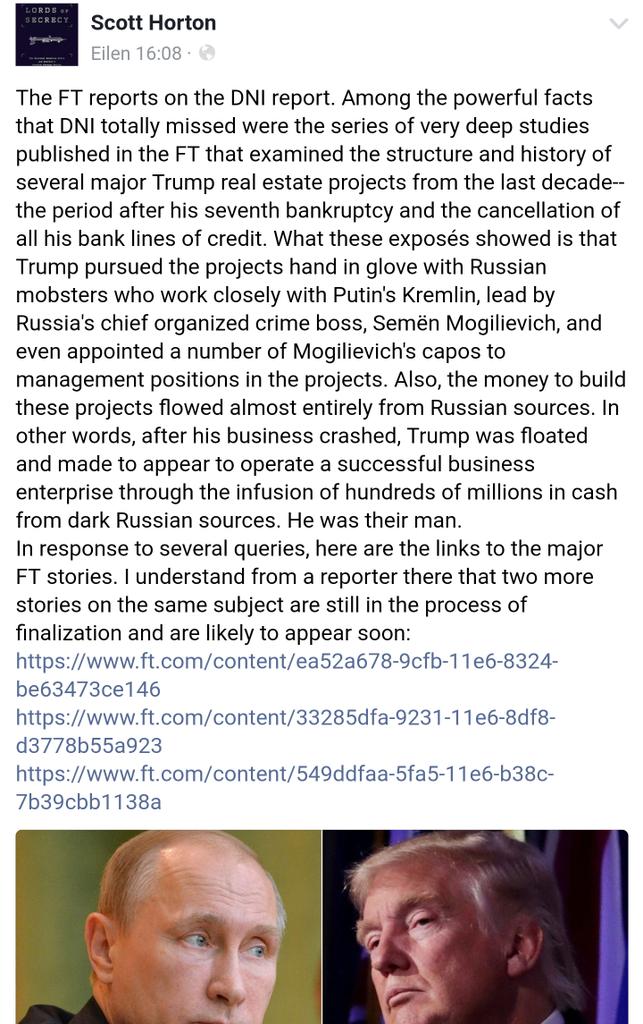
Among the powerful facts that DNI missed were a series of very deep studies published in the [Financial Times] that examined the structure and history of several major Trump real estate projects from the last decade—the period after his seventh bankruptcy and the cancellation of all his bank lines of credit. ...
The money to build these projects flowed almost entirely from Russian sources. In other words, after his business crashed, Trump was floated and made to appear to operate a successful business enterprise through the infusion of hundreds in millions of cash from dark Russian sources.
He was their man.
Yes, even that much seems fantastic, and the details include business agencies acting as a front for the GRU, billionaire mobsters, a vast network of propaganda sources, and an American candidate completely under the thumb of the Kremlin.
It reads like the a B-grade spy novel, a plot both too convoluted—and too bluntly obvious—for John le Carré. The problem is it may not be a conspiracy theory. It may be a conspiracy.
Horton’s analysis comes from piecing together information in three Financial Times “deep reports.” One of these focused on Sergei Millian, the head of the Russian American Chamber of Commerce in the US at the time of Trump Jr.’s “money pouring in from Russia” claim.
Mr Millian insists his Russian American Chamber of Commerce (RACC) has nothing to do with the Russian government. He says it is funded by payments from its commercial members alone.
Most of the board members are obscure entities and nearly half of their telephone numbers went unanswered when called by the Financial Times. An FT reporter found no trace of the Chamber of Commerce at the Wall Street address listed on its website.
Why was RACC’s background filled with so many holes? The Financial Times quotes former Russian MP Konstantin Borovoi in tagging the chamber as a front for intelligence operations that dates back to Soviet times.
“The chamber of commerce institutions are the visible part of the agent network . . . Russia has spent huge amounts of money on this.”
Millian helped arrange for Trump to visit Moscow in 2007, and had other outings with Trump in the states, including a visit to horse races in Miami. Millian claims that he had the right to market Trump properties in Russia.
“You could say I was their exclusive broker,” he told Ria. “Then, in 2007-2008, dozens of Russians bought apartments in Trump properties in the US.” He later told ABC television that the Trump Organisation had received “hundreds of millions of dollars” through deals with Russian businessmen.
Despite documents and photos showing Trump with Millian, Trump denied their association during the campaign.
Hope Hicks, Mr Trump’s campaign spokeswoman, said Mr Trump had “met and spoke” with Mr Millian only “on one occasion almost a decade ago at a hotel opening”.
The second *Financial Times* article puts Trump at the middle of a money laundering scheme, in which his real estate deals were used to hide not just an infusion of capital from Russia and former Soviet states, but to launder hundreds of millions looted by oligarchs. All Trump had to do was close his eyes to the source of the money, and suddenly empty apartments were going for top dollar.
Among the dozens of companies the Almaty lawyers say the Khrapunov laundering network used were three called Soho 3310, Soho 3311 and Soho 3203. Each was a limited liability company, meaning their ownership could easily be concealed.
The companies were created in April 2013 in New York. A week later, property records show, they paid a total of $3.1m to buy the apartments that corresponded with their names in the Trump Soho, a 46-storey luxury hotel-condominium completed in 2010 in a chic corner of Manhattan.
Why would Trump’s organization make such a good means of laundering funds? Because real estate has an arbitrary value. Is that apartment worth $1 million? Two million? Why not $3 million for a buyer who really wants it? When the whole transaction is just one LLC with undisclosed ownership paying another LLC with undisclosed ownership, it’s even neater than hiding the money in an offshore account. And while some businesses require due diligence in looking at the source of funds, real estate is a bit more … flexible.
The laws regulating US real estate deals are scant, experts say. Provisions against terrorism financing in the Patriot Act, passed in the aftermath of the September 11 2001 attacks, obliged mortgage lenders to conduct “know your customer” research. But money launderers pay in cash. Sales such as those of the Trump Soho apartments have passed through this loophole, which was partially closed only this year.
Converting funds stolen overseas into property in the US and cash in the account of an LLC represented a win for both the oligarchs and Trump. Best of all, Trump’s sole requirement was that he pay scant attention to the deal—something at which he was already a proven master. For example, the actual owners of the Trump Soho were anotherlimited liability company, Bayrock.Trump was a partner in the LLC and Bayrock cut the checks Trump received when those apartments were sold. And yet ...
In a 2011 deposition, given in a dispute over the Fort Lauderdale project, Mr Trump said he had “never really understood who owned Bayrock”.Jody Kriss, a former Bayrock finance director, has claimed in racketeering lawsuits against his former employer that Bayrock’s backers included “hidden interests in Russia and Kazakhstan”. Bayrock has denied Mr Kriss’s allegations but declined to answer questions about the source of its funds and its relationship with the Khrapunovs.
The third articledigs more deeply into the origins of Bayrock and its connection with Trump. That connection … was very close.
The Republican presidential nominee and Bayrock were both based in Trump Tower and they joined forces to pursue deals around the world — from New York, Florida, Arizona and Colorado in the US to Turkey, Poland, Russia and Ukraine. Their best-known collaboration — Trump SoHo, a 46-storey hotel-condominium completed in 2010 — was featured in Mr Trump’s NBC television show The Apprentice.
This is the same group about which Trump said he “never really understood” the ownership.
“I don’t know who owns Bayrock,” Mr Trump said. “I never really understood who owned Bayrock. I know they’re a developer that’s done quite a bit of work. But I don’t know how they have their ownership broken down.”
At the very least, Trump confessed to partnering with, taking money from, and acting as a representative for a corporation whose ownership he didn’t know, in deals that totaled hundreds of millions in countries around the world.However, it seems far more likely that Trump knowingly worked with oligarchs, groups associated with the Russian government, and plain old mobsters. Why? Because he was desperate.
By the 2000s, the property developer and casino owner with ready access to the capital markets and the biggest New York banks was no more. A series of corporate bankruptcies had limited his financing options. Mr Trump had become an entertainer who portrayed a tycoon on television and licensed his name to businesses looking for a brand, leading to fee-making opportunities as disparate as Trump University and Trump Vodka.
The Trump Organization was a hollow shell and Trump was bankrupt, but Donald Trump the public figure was a “successful businessman,” a screen behind which criminal activity could be carried out on a massive scale. Throwing his name at every scheme in existence wasn’t a strategy, it was a fire sale on Trump’s respectability. Steaks? Water? Vodka? Fake real estate school? You pony up the cash, and Trump will slap his name on it. Because by the early 2000s, Trump wasn’t just broke, he had nothing left to pawn. He wasn’t a successful businessman, but he still played one on TV. His image had more value than his real estate portfolio.
But the apartments and buildings where Trump held some degree of ownership could be turned into value again. All it took was partnering with foreign crime bosses looking for a place to stash their cash. To inflate the value of his portfolio, Trump had to do nothing other than look away as the dirty money poured in from one LLC to the next.Citizens in Russia, Kazakhstan, and other former Soviet states lost hundreds of millions, but Trump got a cut as looted funds flowed through offices and apartments in buildings that carried those critical gold letters.
Horton’s evaluation of this material in coordination with the declassified DNI report is that Trump actively worked with and for Russian interests.
What these exposes showed, is that Trump pursued the projects hand in glove with Russian mobsters who worked closely with Putin’s Kremlin ...
But based on the information in the Financial Times report, it appears that there are actually two possible answers. Trump may have been actively involved with and working for Russian sources. He might also have simply played the role of useful idiot, displaying his readiness to feign ignorance about any deal … so long as it generated some funds to float his sinking boat.
In the end, there’s not a lot of difference in the outcome. Trump got money. Oligarchs cleaned their cash. Russia got their man.
==
==
Trump Jr. Pushed ‘Blatantly Illegal’ Project In India, Former Official Says — ‘Trump, Inc.’ Podcast
by Eric Umansky, ProPublica , and Andrea Bernstein , WNYC
A Trump project in Mumbai had its permits revoked after investigators found “significant irregularities.” Then Trump Jr. travelled to India to get the decision overruled.
https://www.propublica.org/article/trump-inc-podcast-donald-trump-jr-india-project
propublica
==
==
omg why?
https://www.ecowatch.com/disappointing-backwards-step-critics-blast-u-s-exit-from-global-oil-gas-anti-corruption-effort-2505846330.html
==
omg why?
https://www.ecowatch.com/disappointing-backwards-step-critics-blast-u-s-exit-from-global-oil-gas-anti-corruption-effort-2505846330.html
...Bloomberg reported that the withdrawal comes after the American Petroleum Institute, Exxon Mobil Corp. and Chevron Corp. lobbied against a similar regulation compelling U.S. energy and mining companies to disclose those payments, which President Donald Trump rolled back earlier this year.
"It's pretty disgraceful for the United States," Jana Morgan, director of Publish What You Pay, a coalition that urges financial transparency in the extractive industry, told Bloomberg. "Chinese state-owned oil companies and Russian state-owned oil companies" are disclosing payments.
"So you literally have American companies that are less transparent than Russian and Chinese state-owned enterprises," she said.
Democrats also criticized the decision. The Hill reported that the U.S. joined the agreement in 2011 after a joint effort from Sen. Ben Cardin (D-Md.) and former Sen. Richard Lugar (R-Ind.)....
---
---
above i make distinction, but now coming to USA (norms must be codified b/c djt says no line anymore (//ta-n coates)
Expert sees risk of corruption in Trump foreign government deals
Sarah Chayes, author of "Thieves of State," talks with Rachel Maddow about the structure of corruption in some developing nations and why she sees a risk of that kind of corruption spreading to the United States under Donald Trump. Duration: 9:13
http://www.msnbc.com/rachel-maddow/watch/expert-sees-risk-of-corruption-in-trump-foreign-government-deals-1078287427951
---
Mossack Fonseca panama papers
--
http://www.ecowatch.com/pulitzer-prize-storm-lake-times-2355740850.html
In addition, an international collaboration between McClatchy, the Miami Herald and the International Consortion of Investigative Journalists that resulted in the landmark Panama Papers investigation into offshore tax havens was awarded the prize for Explanatory Reporting.
The Guardian listed [no linl] the wide-ranging ramifications of the revelations contained in the Panama Papers:
Iceland's prime minister Sigmundur Davíð Gunnlaugsson wasforced to quit after it emerged that his family had sheltered cash offshore. There were demonstrations in Argentina and a small war in Azerbaijan, initiated—some believed—to distract from revelations concerning the president and his daughters.
In China, censors blocked the words "Panama Papers" and jammed the website of the Guardian. In Russia, aides to Vladimir Putin fumed about a western "spy" conspiracy after it emerged that Putin's oldest friend, the cellist Sergei Roldugin, had about $2bn flowing into a network of British Virgin Islands companies.
The founders of the Panamanian law firm, Jürgen Mossack and Ramón Fonseca, were arrested in February. They are currently in jail on suspicion of money laundering following a coordinated swoop by prosecutors across Latin America.
---
---
https://globalvoices.org/2016/01/01/for-s**outheast-asia-2015-was-a-year-of-corruption-scandals/**
Three issues grabbed the headlines in Southeast Asia in 2015, namely, the historic electoral defeat of the military-backed party in Myanmar, the Indonesian haze caused by forest fires, and the corruption scandals involving leaders of the ruling parties.
In Malaysia, the prime minister is accused of pocketing more than 600 million US dollars from anomalous bank transactions involving the country’s state-run investment firm. In Thailand, the junta which grabbed power in 2014 is facing allegation that it built a graft-ridden park. In Indonesia, the House speaker resigned his post after he was implicated in an extortion scandal. And in the Philippines, the vice president is hounded by plunder charges.
Malaysian Prime Minister Najib Abdul Razak admitted that he has 600 million dollars in his bank but denied that the funds came from state coffers. He claimed that a supporter from the Middle East donated the money for the election campaign of the ruling party. Many doubted his explanation and called for his resignation. The issue generated funny Internet memes mocking the prime minister while large protests were organized across the country.
The Wall Street Journal published an investigative piece on the questionable bank transfers involving the prime minister and 1MDB, the state-owned investment firm:
#1MDBMovies : Popcorn ready guys pic.twitter.com/jUh8yWhzWp
— Pemegang Kuali (@rzmil) July 8, 2015
In Thailand, the junta’s anti-corruption pledge became less credible after allegations surfaced that large kickbacks were demanded for the construction of the Rajabhakti Park in Prachuap Khiri Khan Province. The junta commissioned the construction of the park featuring seven giant statues of popular kings in honor of the monarchy. An army general acknowledged the anomaly which led to a formal investigation although government spokespersons denied that the park is overpriced. Last month, the junta ordered the indefinite closure of the park to prevent protesters from staging political actions in the area. Meanwhile, Facebook users who shared and liked infographics about the park scandal were charged for insulting the monarchy, a crime that can result to several years of incarceration.
View image on Twitter
View image on Twitter
Follow
Bangkok Post @BangkokPostNews
New inquiry into Rajabhakti Park http://bit.ly/1R3aLNb
2:38 AM - 24 Nov 2015
4 4 Retweets 1 1 like
This cartoon shows the junta leader preventing activists from holding a protest in the park
View image on Twitter
View image on Twitter
Follow
stephff cartoonist @stephffart
cartoon of the day : Rajabhakti Park corruption scandal
9:07 AM - 8 Dec 2015
2 2 Retweets 2 2 likes
In Indonesia, House Speaker Setya Novanto is accused of asking for a 20 percent stake in theFreeport mining worth 4 billion US dollars in exchange of a contract allowing the company to continue operating in the country. An audio recording between Novanto and Freeport executives was presented as evidence against the politician. Novanto admitted that he made the demand but insisted that he was only joking. He was being investigated for ethics violation when he stepped down as House speaker last December 16. Novanto’s behavior was widely condemned in Indonesia.
Novanto is no stranger to controversy. Last September, he was criticized for appearing at the political rally of United States presidential candidate Donald Trump
3 Sep 15
Yenni Kwok @yennikwok
Indonesia House Speaker Setya Novanto & Deputy House Speaker Fadli Zon attend Donald Trump's campaign rally in NYC https://twitter.com/apathoni/status/639578912171823104 …
Follow
Yenni Kwok @yennikwok
Donald Trump: Do they like me in Indonesia?
Setya Novanto: Yes, highly
Fadli Zon: [Trump]'s a friend of Indonesia http://www.businessinsider.com/heres-the-story-behind-the-end-of-donald-trumps-press-conference-2015-9 …
6:35 PM - 3 Sep 2015
Photo published for Here's the story behind the unexpected moment at the end of Donald Trump's press conference
Here's the story behind the unexpected moment at the end of Donald Trump's press conference
He has big fans in the Indonesian government.
businessinsider.com
6 6 Retweets 2 2 likes
In the Philippines, Vice President Jejomar Binay is facing several corruption charges in connection to alleged anomalous contracts he signed when he was still mayor of Makati City, the country’s financial center. Binay, one of the frontrunners in the 2016 presidential election, described the corruption cases as politically-motivated. He questioned the string of cases filed against him, which he said was made to disqualify him as a candidate in the election.
Here's one of the many Internet memes alluding to Vice President Binay's corruption cases:
View image on Twitter
View image on Twitter
Follow
Caste @castewyo_rene
Down with corruption…..down Binay
6:41 PM - 7 Aug 2015
Retweets likes
2015 will be remembered as the year when Myanmar voted for change. But elsewhere in the Southeast Asian region, it’s politics as usual for politicians who are accused of abusing their power for personal gain.
==
dodd- frankprovision to acc't for oil? it? $
white SEC
Finish 1504
make sure the Securities and Exchange Commission finishes the job to make Big Oil publish what they pay and put an end to secret deals.
---
http://www.c-span.org/video/?406808-5/open-phones-sarah-chayes
seb junger pal/recs
https://www.amazon.com/Thieves-State-Corruption-Threatens-Security/dp/0393239462
Thieves of State: Why Corruption Threatens Global Security 1st Edition
by Sarah Chayes
===
America's Descent into a Third-World-Style Kleptocracy
By Rebecca Gordon [1] / TomDispatch [2]
November 24, 2015
A top government official with energy industry [4] holdings huddles [5] in secret with oil company executives to work out the details of a potentially lucrative “national energy policy.” Later, that same official steers billions [6] of government dollars to his former oil-field services company. Well-paid elected representatives act with impunity, routinely trading [7]government contracts and other favors for millions of dollars. Meanwhile, ordinary citizens live in fear of venal police forces [8] that suck them dry by charging fees [9] for services,throwing [10] them in jail when they can’t pay arbitrary fines or selling [11] their court “debts” to private companies. Sometimes the police just take people’s life savings [12] leaving them with no recourse whatsoever. Sometimes they steal and deal [13] drugs on the side. Meanwhile, the country’s infrastructure crumbles. Bridges collapse [14], or take a quarter-century [15] to fix after a natural disaster, or (despite millions spent) turn out not to be fixed [16] at all. Many citizens regard their government at all levels with a weary combination of cynicism and contempt. Fundamentalist groups respond by calling for a return to religious values and the imposition [17] of religious law.
What country is this? Could it be Nigeria or some other kleptocratic [18] developing state? Or post-invasion Afghanistan where Ahmed Wali Karzai, CIA asset and brother of the U.S.-installed president Hamid Karzai, made many millions [19] on the opium trade (which the U.S. was ostensibly trying to suppress), while his brother Mahmoud raked in millions more [20] from the fraud-ridden Bank of Kabul? Or could it be Mexico, where the actions of both the government and drug cartels have created [21] perhaps the world’s first narco-terrorist state?
In fact, everything in this list happened (and much of it is still happening) in the United States, the world leader -- or so we like to think -- in clean government. These days, however, according to the Corruption Perception Index of Transparency International (TI), our country comes in only 17th [22] in the least-corrupt sweepstakes, trailing European and Scandinavian countries as well as Canada, Australia, and New Zealand. In fact, TI considers us on a par with Caribbean island nations like Barbados and the Bahamas. In the U.S., TI says [23], “from fraud and embezzlement charges to the failure to uphold ethical standards, there are multiple cases of corruption at the federal, state and local level.”
And here’s a reasonable bet: it’s not going to get better any time soon and it could get a lot worse. When it comes to the growth of American corruption, one of TI’s key concerns[24] is the how the Supreme Court’s 2010 Citizens United decision [25] opened the pay-to-play floodgates of the political system, allowing Super PACs to pour billions of private and corporate money into it, sometimes in complete secrecy [26]. Citizens Unitedundammed the wealth of the super-rich and their enablers, allowing big donors like casino capitalist -- a description that couldn’t be more literal -- Sheldon Adelson to use [27] their millions to influence government policy.
Kleptocracy USA?
Every now and then, a book changes the way you see the world. It’s like shaking a kaleidoscope and suddenly all the bits and pieces fall into a new pattern. Sarah Chayes’sThieves of State: Why Corruption Threatens Global Security [28] shook my kaleidoscope. Chayes traveled to Afghanistan in 2001 as a reporter for NPR. Moved by the land and people, she soon gave up reporting to devote herself to working with non-governmental organizations helping “Afghans rebuild their shattered but extraordinary country.”
In the process, she came to understand the central role government corruption plays in the collapse of nations and the rise of fundamentalist organizations like the Taliban, al-Qaeda, and the Islamic State. She also discovered just how unable (and often unwilling) American military and civilian officials were to put a stop to the thievery [29] that characterized Afghanistan’s government [30] at every level -- from the skimming [31] of billions in reconstruction funds at the top to the daily drumbeat of demands for bribes and “fees” from ordinary citizens seeking any kind of government service further down the chain of organized corruption. In general, writes Chayes, kleptocratic countries operate very much as pyramid schemes, with people at one level paying those at the next for the privilege of extracting money from those below.
Chayes suggests that “acute government corruption” may be a major factor “at the root” of the violent extremism now spreading across the Greater Middle East and Africa. When government robs ordinary people blind, in what she calls a “vertically integrated criminal enterprise,” the victims tend to look for justice elsewhere. When officials treat the law with criminal contempt, or when the law explicitly permits government extortion, they turn to what seem like uncorrupted systems of reprisal and redemption outside those laws. Increasingly, they look to God or God’s laws and, of course, to God’s self-proclaimed representatives. The result can be dangerously violent explosions of anger and retribution. Eruptions can take the form of the Puritan iconoclasm [32] that rocked Catholic Europe in the sixteenth century or present-day attempts by the Taliban or the Islamic State to implement a harsh, even vindictive version of Islamic Sharia law, while attacking “unbelievers” in the territory they control.
Reading Thieves of State, it didn’t take long for my mind to wander from Kabul to Washington, from a place where American-funded corruption was an open secret [33] to a place where few would think it applicable. Why was it, I began to wonder, that in our country “corruption” never came up in relation to bankers the government allowed to sell mortgages to people who couldn’t repay them, then slicing and dicing their debt into investment “securities” that brought on the worst recession since the 1930s? (Neil Barofsky, who took on the thankless role of inspector general for the Troubled Asset Relief Fund, tells the grim tale of how the government was “captured by the banks” in his 2012 bookBailout [34].)
Chayes made me wander ever deeper into the recent history of Washington's wheeling and dealing, including, for instance, the story of the National Energy Policy Development Group, which Vice President Dick Cheney convened in the first weeks of George W. Bush’s presidency. Its charge was to develop a national energy policy for the country and its deliberations -- attended [5] by top executives of all the major oil companies (some of whom then denied [5] before Congress that they had been present) -- were held in complete secrecy. Cheney even refused to surrender the list of attendees when the Government Accountability Office sued him, a suit eventually dropped after Congress cut that agency’s budget. If the goal was to create a policy that would suit the oil companies, Cheney was the perfect man to chair the enterprise.
In 2001, having suggested [35] himself as the only reasonable running mate for Bush, Cheney left his post as CEO at oilfield services corporation Halliburton. “Big changes are coming to Washington,” he told [35] ABC News, “and I want to be a part of them.” And so he was, including launching a disastrous war on Iraq, foreseen and planned for in those energy policy meetings. Indeed, documents shaken loose in a Freedom of Information Act suit brought by Judicial Watch and the Sierra Club showed that in March 2001 -- months before the 9/11 attacks -- energy task force members were already salivating [36] over taking possession of those Iraqi oil fields. Nor did Cheney forget his friends at Halliburton. Their spin-off company, KBR, would receive [37] a better-than-1,000-to-1 return on their investment in the vice president (who’d gotten a $34 million [4] severance package from them), reaping $39.5 billion in government contracts in Iraq. And yet when did anyone mention “corruption” in connection with any of this?
Chayes’s book made me think in a new way about the long-term effects of the revolving door [38] between the Capitol -- supposedly occupied by the people’s representatives -- and the K Street suites of Washington’s myriad lobbyists. It also brought to mind all those former members of Congress [39], generals [40], and national security state officials who parachute directly out of government service and onto the boards of defense-oriented companies or into cushy consultancies [41] catering to that same security state.
It also made me think in a new way about the ever-lower turnouts [42] for our elections. There are good reasons why so many Americans -- especially those living in poverty and in communities of color -- don’t vote. It’s not that they don’t know their forebears died [43] for that right. It’s not that they don’t object when their votes are suppressed [44]. It’s that, like many other Americans, they clearly believe their government to be so corrupt that voting is pointless.
Are We in Ferguson -- or Kabul?
What surprises me most, however, isn’t the corruption at the top, but the ways in which lives at the bottom are affected by it. Reading Thieves of Stateset me thinking about how regularly money in this country now flows from the bottom up that pyramid. If you head down, you no longer find yourself on Main Street, U.S.A., but in a place that seems uncomfortably like Kabul; in other words, a Ponzi-scheme world of the first order.
Consider, for instance, the Justice Department’s 2015 report [45] on the police in Ferguson, Missouri, about whom we’ve learned so much since Michael Brown, an unarmed black teenager, was shot [46] to death on August 9, 2014. As it happens, the dangers for Ferguson’s residents hardly ended with police misconduct. “Ferguson’s law enforcement practices are shaped by the city’s focus on revenue rather than by public safety needs,” Justice Department investigators found:
“This emphasis on revenue has compromised the institutional character of Ferguson’s police department, contributing to a pattern of unconstitutional policing, and has also shaped its municipal court, leading to procedures that raise due process concerns and inflict unnecessary harm on members of the Ferguson community.”
The report then recounted in excruciating detail the extent to which the police were a plague on the city’s largely black population. Ferguson was -- make no mistake about it -- distinctly Kabul, U.S.A. The police, for instance, regularly accosted residents for what might be termed “sitting in a car while Black,” and then charged them with bogus “crimes” like failing to wear a seat belt in a parked car or “making a false declaration” that, say, one’s name was “Mike,” not “Michael.” While these arrests didn’t make money directly for the police force, officers interested in promotion were told to keep in mind that their tally of “self-initiated activities” (tickets and traffic stops) would have a significant effect on their future success on the force. Meanwhile, those charged often lost their jobs and livelihoods amid a welter of court appearances.
Ferguson’s municipal court played its own grim role in this ugly scheme. As Justice Department investigators discovered, it did not “act as a neutral arbiter of the law or a check on unlawful police conduct.” Instead, it used its judicial authority “as the means to compel the payment of fines and fees that advance[d] the city’s financial interests.”
By issuing repeated arrest warrants when people missed court appearances or were unable to pay fines, it managed to regularly pile one fine on top of another and then often refused to accept partial payments for the sums owed. Under Missouri state law, moving traffic violations, for instance, automatically required the temporary suspension of a driver’s license. Ferguson residents couldn’t get their licenses back until -- you guessed it -- they paid their fines in full, often for charges that were manufactured in the first place.
As if in Kabul, people then had to weigh the risk of driving license-less (and getting arrested) against losing their jobs or -- without a car -- not making it to court. With no community service option available, many found themselves spending time in jail. From the police to the courts to city hall, what had been organized was, in short, an everyday money-raising racket of the first order.
And all of this was linked to the police department, which actually ran the municipal court. As the Justice Department report put it, that court “operates as part of the police department... is supervised by the Ferguson chief of police, is considered part of the police department for city organizational purposes, and is physically located within the police station. Court staff report directly to the chief of police.” He, in turn, ran the show, doing everything from collecting fines to determining bail amounts.
The Harvard Law Review reported [11] that, in 2013, Ferguson had a population of 22,000. That same year, “its municipal court issued 32,975 arrest warrants for nonviolent offenses,” or almost one-and-a-half arrests per inhabitant. The report continued:
“In Ferguson, residents who fall behind on fines and don’t appear in court after a warrant is issued for their arrest (or arrive in court after the courtroom doors close, which often happens just five minutes after the session is set to start for the day) are charged an additional $120 to $130 fine, along with a $50 fee for a new arrest warrant and 56 cents for each mile that police drive to serve it. Once arrested, everyone who can’t pay their fines or post bail (which is usually set to equal the amount of their total debt) is imprisoned until the next court session (which happens three days a month). Anyone who is imprisoned is charged $30 to $60 a night by the jail.”
Whether in Kabul or Ferguson, this kind of daily oppression wears people down. It’s no surprise that long before the police shot Michael Brown, the citizens of Ferguson had little trust or respect for them.
Privatizing Official Corruption
But might Ferguson not have been an outlier, a unique Kabul-in-America case of a rogue city government bent on extracting every penny from its poorest residents? Consider, then, the town of Pagedale [47], Missouri, which came up with a hardly less kleptocratic way of squeezing money out of its citizens. Instead of focusing on driving and parking, Pagedale routinely hit [47] homeowners with fines for “offenses” like failing to have blinds and “matching curtains” on their windows or “unsightly lawns.” Pagedale is a small town, with 3,300 residents. In 2013, the city’s general revenues totaled $2 million, 17% percent from such fines and fees.
Might such kleptocratic local revenue-extraction systems, however, be limited to just one Midwestern state? Consider then the cozy relationship that Augusta, capital of Georgia, has with Sentinel Offender Services, LLC [48]. That company makes electronic monitoring equipment used by state and local government agencies, ranging from the Los Angeles County Probation Department to the Massachusetts Office of the Commissioner of Probation. Its website touts the benefits to municipalities of what it calls “offender-funded programs” in which the person on probation pays the company directly for his or her own monitoring, saving the courts the cost of administering a probation system. In return, the company sets its own fees at whatever level it chooses. “By individually assessing each participant a fee based on income,” says Sentinel, “our sliding-fee scale approach has shifted the financial burden to the participant, allowing program growth and size to be a function of correctional need rather than budget availability.”
“Profiting from Probation,” a 2014 Human Rights Watch report [49], offers a typical tale of an Augusta resident named Michael Barrett. Arrested for shoplifting a can of beer, he entered a local court system that was focused on revenue extraction via a kind of official extortion, which is the definition of corruption. Even to step into a courtroom to deal with his “case,” he had to hand over an $80 fee for a court-appointed defense lawyer. Then, convicted, he would be sentenced to a $200 fine and probation. Because the charge was “alcohol-related,” the court required Barrett to wear an electronic bracelet that would monitor his alcohol consumption, even though his sentence placed no restrictions on his drinking. For that Sentinel bracelet, there was a $50 startup fee, a $39 monthly “service” charge, and a $12 “daily usage” fee. In total, he was forced to pay about $400 a month to monitor something he was legally allowed to do. Since Barrett couldn’t even pay the startup fee, he was promptly thrown in jail for a month until a friend lent him the money.
Such systems of privatized “justice” that bleed the poor are now spreading across the U.S., a country officially without debtor’s prisons. According to the Harvard Law Reviewarticle, some cities charge a “fee” to everyone they arrest, whether or not they’re ever convicted of an offense. In Washington, D.C., on the other hand, for “certain traffic [50] and a number of lower level criminal offenses,” you can simply pay your arresting officer “to end a case on the spot,” avoiding lengthy and expensive court costs. Other jurisdictions charge people who are arrested for the costs of police investigations, prosecution, public defender services, a jury trial (“sometimes with different fees depending on how many jurors a defendant requests”), and incarceration.
Watch Your Ass(ets)
Even Machiavelli, who counseled princes seizing new territory to commit all their crimes at once because human beings have such short memories, warned that people will accept pretty much any kind of oppression unless “you prey on the possessions or the women of your subjects.” So many centuries later, while we women now tend to believe we belong to ourselves, civil asset forfeiture [51] is still a part of American life. Unlike criminal asset forfeiture, which permits the government to seize a person’s assets after conviction of a crime, civil forfeiture allows local, state, or federal law enforcement to seize and keep someone’s money or other property even if he or she is never charged. If, say, you are suspected of involvement with drugs or terrorism, the police can seize all the money you have on you on thespot, even if they don’t arrest you -- and you have to go to court to get it back.
Federal asset forfeiture collections have risen from around $800 million in 2002 to almost $4.5 billion in 2014, according [51] to the Institute for Justice (IJ). Governments defend the practice as a means of preventing suspected criminals -- especially high-level drug dealers -- from using their money to commit more crimes. But all too often, it’s poor people whose money is “forfeited,” even when they've committed no crime. The Pennsylvania ACLU reported [52] that police take around a million dollars from Philadelphians each year in 6,000 separate cases -- and not from drug lords either. More than half the cases involve seizures of less than $192, and in a city that’s only 43% black, 71% of those seizures from people charged with no crimes come from African Americans. If your property is seized, you can try to go to court to get it back but, says the ACLU [53], you should expect to make an average of four court appearances. Most people just give up.
Reading Thieves of Statereminded me that we’re not living in the country many of us imagine, but in something like an American klepto-state. Corruption, it turns out, doesn’t just devour the lives of people in far-off nations. Right now, it’s busy shoving what’s left of our own democracy down our throats.
Chayes documents how such corruption can lead to violent explosions in other countries. Indeed, it was a final kleptocratic insult -- a police woman’s slap in the face after he refused to pay a bribe to retrieve his confiscated vegetable cart -- that led Tunisian Mohamed Bouazizi [54] to burn himself to death and touch off the Arab Spring. As Machiavelli wrote so long ago, people will put up with a lot -- torture [55], mass surveillance [56], even a car full of clowns [57] masquerading as candidates for president -- but they don’t like being robbed by their own government. Sooner or later, they will rebel. Let’s hope, when that happens, that we don’t end up under the rule of our own American Taliban [58] or some billionaire reality TV star.
Rebecca Gordon is the author of Mainstreaming Torture: Ethical Approaches in the Post-9/11 United States [59]. She teaches in the philosophy department at the University of San Fran
---
*Source URL: http://www.alternet.org/news-amp-politics/americas-descent-third-world-style-kleptocracy*
*Links:
[1] http://www.alternet.org/authors/rebecca-gordon
[2] http://www.tomdispatch.com/
[3] http://tomdispatch.us2.list-manage.com/subscribe?u=6cb39ff0b1f670c349f828c73&id=1e41682ade
[4] http://www.politifact.com/truth-o-meter/statements/2010/may/24/chris-matthews/chris-matthews-says-cheney-got-34-million-payday-h/
[5] http://www.washingtonpost.com/wp-dyn/content/article/2005/11/15/AR2005111501842_pf.html
[6] http://www.businessinsider.com/halliburton-company-got-395billion-iraq-2013-3
[7] http://www.citizensforethics.org/policy/entry/earmark-reform
[8] https://www.washingtonpost.com/news/wonk/wp/2015/11/10/report-in-lean-times-police-start-taking-a-lot-more-stuff-from-people/
[9] http://www.policechiefmagazine.org/magazine/index.cfm?fuseaction=print_display&article_id=2108&issue_id=62010
[10] http://www.npr.org/sections/codeswitch/2015/02/09/384968360/jail-time-for-unpaid-court-fines-and-fees-can-create-cycle-of-poverty
[11] http://harvardlawreview.org/2015/04/policing-and-profit/
[12] http://ij.org/report/policing-for-profit/introduction/
[13] http://www.alternet.org/drugs/5-outrageous-cases-drug-war-police-corruption-week
[14] https://en.wikipedia.org/wiki/I-35W_Mississippi_River_bridge
[15] https://en.wikipedia.org/wiki/Eastern_span_replacement_of_the_San_Francisco%E2%80%93Oakland_Bay_Bridge
[16] http://www.sfgate.com/bayarea/article/Plague-of-problems-puts-Bay-Bridge-seismic-safety-6253577.php
[17] http://www.politicususa.com/2015/02/25/57-republicans-dismantle-constitution-christianity-national-religion.html
[18] http://www.aljazeera.com/indepth/features/2014/03/revealing-tunisia-corruption-under-ben-ali-201432785825560542.html
[19] http://www.nytimes.com/2009/10/28/world/asia/28intel.html
[20] http://www.reuters.com/article/2014/11/11/us-afghanistan-bank-idUSKCN0IV1X020141111
[21] http://www.tomdispatch.com/blog/175971/tomgram%3A_rebecca_gordon,_it_didn%27t_work_in_afghanistan,_so_let%27s_do_it_in_mexico
[22] https://www.transparency.org/cpi2014/results
[23] http://www.transparency.org/country#USA
[24] https://www.transparency.org/country/#USA_Overview
[25] https://www.law.cornell.edu/supct/html/08-205.ZS.html
[26] http://www.acslaw.org/acsblog/citizens-united%E2%80%99s-biggest-surprise-the-collapse-of-disclosure
[27] http://talkingpointsmemo.com/cafe/iran-deal-big-donors-citizens-united
[28] http://www.amazon.com/dp/0393352285/ref=nosim/?tag=tomdispatch-20
[29] http://www.tomdispatch.com/post/176068/tomgram%3A_engelhardt%2C_roads_to_nowhere%2C_ghost_soldiers%2C_and_a_%2443_million_gas_station_in_afghanistan/
[30] https://www.americanprogress.org/issues/security/report/2015/03/17/108613/tackling-corruption-in-afghanistan-its-now-or-never/
[31] http://www.voanews.com/content/bribes-in-afghanistan-last-year-reached-almost-four-billion-dollars/1599111.html
[32] https://en.wikipedia.org/wiki/Iconoclasm#Protestant_Reformation
[33] http://www.tomdispatch.com/post/176068/tomgram%3A_engelhardt,_roads_to_nowhere,_ghost_soldiers,_and_a_$43_million_gas_station_in_afghanistan/
[34] http://www.amazon.com/dp/1451684959/ref=nosim/?tag=tomdispatch-20
[35] http://abcnews.go.com/US/story?id=96384&page=1
[36] http://www.projectcensored.org/8-secrets-of-cheneys-energy-task-force-come-to-light/
[37] http://www.ibtimes.com/winner-most-iraq-war-contracts-kbr-395-billion-decade-1135905
[38] http://www.opensecrets.org/revolving/
[39] https://www.opensecrets.org/revolving/top.php?display=Z
[40] http://www.duffelblog.com/2013/02/general-worried-about-finding-job-as-lobbyist-defense-consultant-after-retirement/
[41] http://www.thefiscaltimes.com/Articles/2013/06/05/DOD-Retirees-From-4-star-General-to-7-Figure-Income
[42] http://www.nytimes.com/2014/11/12/opinion/the-worst-voter-turnout-in-72-years.html
[43] https://www.splcenter.org/what-we-do/civil-rights-memorial/civil-rights-martyrs
[44] https://www.aclu.org/map/battle-protect-ballot-voter-suppression-measures-passed-2013
[45] http://www.justice.gov/sites/default/files/opa/press-releases/attachments/2015/03/04/ferguson_police_department_report.pdf
[46] http://www.nytimes.com/interactive/2014/08/13/us/ferguson-missouri-town-under-siege-after-police-shooting.html?_r=0
[47] http://www.nytimes.com/2015/11/05/us/lawsuit-accuses-missouri-city-of-fining-homeowners-to-raise-revenue.html?emc=edit_th_20151105&nl=todaysheadlines&nlid=65427895
[48] http://www.sentrak.com/faqs/
[49] http://perma.cc/K6WC-T2XT
[50] http://www.dccourts.gov/internet/public/aud_criminal/handlearrest.jsf
[51] http://ij.org/report/policing-for-profit/introduction/#citation_32
[52] https://www.aclu.org/news/new-aclu-report-shows-philadelphia-da-seizes-1-million-cash-annually-innocent-philadelphians
[53] http://www.aclupa.org/files/1814/4526/3118/Broken_Justice_-_Montgomery_County_final.pdf
[54] https://en.wikipedia.org/wiki/Mohamed_Bouazizi
[55] http://www.nytimes.com/interactive/2014/12/09/world/cia-torture-report-document.html
[56] http://www.theguardian.com/world/interactive/2013/nov/01/snowden-nsa-files-surveillance-revelations-decoded#section/1
[57] http://www.rollingstone.com/politics/news/inside-the-gop-clown-car-20150812
[58] http://www.salon.com/2014/07/03/we_are_a_corporate_theocracy_now_the_christian_right_seeks_cultural_and_political_domination/
[59] http://www.amazon.com/dp/0199336431/ref=nosim/?tag=tomdispatch-20
[60] mailto:corrections@alternet.org?Subject=Typo on America's Descent into a Third-World-Style Kleptocracy
[61] http://www.alternet.org/
[62] http://www.alternet.org/%2Bnew_src%2B*
==
Mauritania 103 84
Nepal 104 94
Pakistan 104 109
Honduras 104 109
Togo 104 112
The Gambia 104 131
Azerbaijan 104 135
Kazakhstan 104 136
Nicaragua 111 91
Madagascar 111 109
Russia 113 131
Nigeria 114 91
Lebanon 114 94
Cameroon 114 115
Kyrgyzstan 114 115
Iran 114 143
Uganda 119 104
Ukraine 119 113
Papua New Guinea 121 54
Bangladesh 121 100
Kenya 121 104
Guinea 121 115
Laos 121 140
Central African Republic 126 127
Paraguay 126 72
Tajikistan 128 138
Congo, Republic of 128 107
Chad 130 127
Congo 130 136
Cambodia 132 120
Myanmar 132 124
Zimbabwe 132 126
Burundi 135 131
Syria 135 144
Haiti 137 102
Guinea-Bissau 137 121
Angola 137 125
Yemen 137 138
Venezuela 137 140
Libya 142 118
Eritrea 142 147
Uzbekistan 142 148
Turkmenistan 145 149
Iraq 146 127
Afghanistan 147 131
Sudan 148 145
Somalia 149 146
North Korea 149 150
==
==
nam tries to quash transparency laws
*terra verde 6/6/14 http://www.kpfa.org/archive/show/45*
oil co's africa coltan FEC? global witness, 1504 dodd frank
resources watch ; co's pay for dodged tax in billions? US even? karina
http://www.earthrights.org/
[http://www.earthrights.org/ EarthRights International] (ERI) is a nongovernmental, nonprofit organization that combines the power of law and the power of people in defense of human rights and the environment, which we define as "earth rights." We specialize in fact-finding, legal actions against perpetrators of earth rights abuses, training grassroots and community leaders, and advocacy campaigns. Anti-corrpution, [http://www.earthrights.org/campaigns/true-cost-chevron-network True Cost of Chevron].
===
Arctic special How oil and corruption have become so closely linked
Eifion Rees
As a new oil-fever gathers pace in Arctic countries such as Greenland the lesson from history is that where there is oil, corruption will quickly follow.
...
Rumours that a deeper, darker ocean flows beneath the cold coastal waters of Greenland have triggered a scramble to drill for oil off the world’s largest island.
And if prospectors hit pay dirt – a potential 52 billion barrels of oil equivalent – then it won’t be virgin white pack ice and a pristine marine environment alone that risk becoming sullied. Reputations, business deals and politicians may be tarred and sticky too.
Because where oil is found then history tells us that corruption will follow.
Transparency International’s Corruptions Perceptions Index 2010highlights the connection: Russia, the world’s largest producer and second largest exporter of oil, ranks 154 out of 178 countries for corruption. Its low standing spells trouble for the Russian Arctic, where oil-fever is increasing as sea ice recedes. In August, state oil company Rosneft signed a £1.9 billion deal with ExxonMobil to drill for 40 billion barrels under the South Kara Sea.
Meanwhile Mikhail Khodorkovsky, formerly head of Russian oil company Yukos languishes in jail on charges of fraud that many believe are politically motivated – Yukos is now part of Rosneft – and this week a high court battle begins between another two oil-rich oligarchs. Boris Berezovsky claims he was intimidated by Roman Abramovich into selling his shares in the oil company Sibneft for a knock-down price. Berezovsky fled Russia in 2000 after falling out with Vladimir Putin. Russia’s powerful president is also alleged to be Europe’s richest man.
Greenland does not yet feature on the corruption index – which has Iran and pre-war Libya (fourth and 17th largest oil producers in the world) tied at 146 and Iraq and Afghanistan at 175 and 176 respectively – but that will change if oil is found. Its ability to spread and taint is already well documented elsewhere in the world.
Nigeria, Venezuela and Ecuador...
Last month a report revealed the extent of damage wrought to Nigeria’s Niger Delta by 50 years of oil drilling by Shell. A succession of governments effectively relied on the company to police itself and clean up spills. Almost 80 per cent of Nigeria’s revenue comes from oil and gas, which has earned Africa’s largest oil producer an estimated $600 billion since the 1960s. Approximately 70 per cent of its people live below the poverty line.
In 2009, Shell paid £9.6m to settle a legal action accusing it of complicity in the execution in 1995 of nine Ogoni tribal leaders including playwright Ken Saro-Wiwa, who were campaigning to stop the destruction of their environment. The settlement meant it did not have to answer charges of colluding with the military dictatorship of the time to clamp down on protests and had whole army units in its pay.
A confidential 2009 cable published by Wikileaks last year also found Shell boasting that it had company spies in ‘all the relevant ministries’ of Nigeria’s government.
Huge environmental and social harm has been wrought in South America too, as governments and corporations link up to exploit vast oil reserves. When oil was discovered in Venezuela at the start of the last century, corruption worsened drastically. The world’s 11th largest producer and exporter of oil is now ranked 164th in the world for corruption.
In Ecuador it is an oil company alleging dirty dealings. Chevron-Texaco was sole operator in the country from 1964 to 1990, causing massive contamination of land and damage to human health. In February, an Ecuadorian court fined it £5.3 billion and ordered it to pay £600 million in compensation.
The US firm had initially requested the trial be held in Ecuador but has since branded its justice system corrupt and vowed to fight the charges ‘until hell freezes over’. America was the victim following the Deepwater Horizon oil spill in the Gulf of Mexico in 2010. Compare the relative alacrity of BP’s response to that particular disaster.
The world’s largest oil reserves are controlled by national oil companies (NOCs), which – as a March 2011 report into the policies of the 44 companies that control 60 per cent of the world’s oil companies makes clear – are among the least open in terms of anti-corruption programmes. For these countries, oil and the national interest are inextricably intertwined; some may be run by corrupt leaders or dictators, but a world addicted to oil still needs to access their reserves. As a result it often becomes politically expedient to look the other way.
Tony Blair shook hands with Colonel Gaddafi in 2004 to facilitate a £550m Shell deal for exploration rights in Libya, for example – to the outrage of families of the victims of the Lockerbie bombing. Oil companies from across the world are now scrambling to return to post-Gaddafi Libya, including British firm BP and French firm Total, the two countries most supportive of the colonel’s ousting.
‘All too often corruption and lack of government accountability mean the citizens of oil-rich countries remain poor while powerful elites cash in,’ says Oliver Courtney of Global Witness, which has recently released a report on corruption in Liberia’s oil sector. ‘Companies don’t have to declare what they pay foreign governments for access to oil and governments don’t have to make the contracts public. If they don’t know what deal has been done, citizens can’t tell if it’s fair or sustainable. Too often, it’s neither.’
A new hope for transparency
One positive move towards more transparency came earlier this month, as the US joined the Extractive Industries Transparency Initiative (EITI) and also proposed legislation that would force new firms to reveal their ultimate owners to prevent foreign politicians squirreling away stolen wealth in stateside ‘shell’ companies.
EITI signatories must ensure that oil, gas and mining interests – public and private – openly declare what they pay to government in order to prevent revenues being pocketed by corrupt officials. But compliance won’t prevent questionable oil deals being brokered: with no internationally recognised government since a coup in 2009, EITI ‘candidate country’ Madagascar recently offered up its tar sands to Total for the extraction of billions of barrels of oil.
Nigeria was designated EITI compliant this year, a country in which in 2005 were identified ‘unprecedented financial discrepancies, mispaid tax and system inefficiencies. Over $800m of unresolved differences between what companies said they paid in taxes, royalties and signature bonuses, and what the governments said it received were identified.’ Transparency International still ranks Nigeria 134th out of 178 countries for corruption.
As with wider environmental issues there is a notable lack of leadership from other countries. Only 35 countries have signed up to EITI; non-signatories include Canada and the UK, both of which are held up by emerging energy powerhouses such as Brazil and India as reasons not to join themselves. It remains to be seen what difference, if any, the new US position will make.
In the meantime the rumoured sea of oil off Greenland remains elusive. The firm with drilling rights, Edinburgh-based Cairn Energy, has two more test wells to sink this year, but the signs are not promising. It may yet strike it lucky, however, in which case Greenland will be making its debut on the corruption index in the very near future.