Social Safety Net
belated? 11/17
819, not sure i'm not neglecting
SEE TWO
mercer wants to eliminate?
see libtard / struct fr
see welfare and snap, school lunch
medicare
me vs we commons
---
11 23an
ahead of President Joe Biden's goal to "win back rural voters" in 2024, according to a Thursday Politico report, House Speaker Mike Johnson (R-LA), "is a proponent of more hardline GOP efforts to overhaul the Supplemental Nutrition Assistance Program, the country's largest anti-hunger program that serves 41 million low-income Americans," farmers and rural Americans.
Per Politico, Johnson has referred to SNAP, formerly called "food stamps," as "our nation's most broken and bloated welfare program."
As a result, "Many Democrats are alarmed that Johnson's rise to speaker will embolden GOP hardliners who are eager to target nutrition spending in the farm bill," the report notes.
"I can't imagine the Mike Johnson that we know would pass up the opportunity to secure as many conservative wins as possible in this farm bill," a Republican aide told Politico. "And that means serious SNAP reforms."
The news outlet notes the new speaker "is still assembling his team," and "has yet to dive into detailed planning for the next farm bill."
Politico reports, "House Republicans are essentially guaranteed to need Democratic votes to pass the next farm bill, given the GOP's narrow majority and opposition within the House GOP over the topline spending. Even some House Republicans, like Dusty Johnson, say the task ahead is significant, given there are 'a number of hardliners who struggle to get to 'yes' on anything."
Johnson told the news outlet, "At the same time, you've got some pragmatic farm-state members who get frustrated with the political gamesmanship."
Still, "as a senior member of the conservative-leaning Republican Study Committee," Politico emphasizes, Johnson's history includes supporting "proposals to roll back food aid expansions under Biden and block states from exempting some work requirements for SNAP."
READ MORE:House GOP unveils budget with trillions in cuts to medicaid, food benefits and more
According to the report, far-right "Republicans are pressing to include similar measures in the next farm bill. Such a move would upend the fragile bipartisan coalition needed to pass the legislation — a blow to House Republicans who represent the majority of rural and farm districts, including Johnson, as well as more centrist GOP members who will be fighting for their political lives in 2024.
U.S. Rep. Jim McGovern (D-MA) told the news outlet the speaker is "100 percent wrong on SNAP," which he believes is "one of the most impactful tools we have to fight poverty."
The Democratic lawmaker added, "Anyone who thinks the solution is more cuts is living in an alternate reality."
Politico's full report is available at this link.
---
jj comm dr
https://www.alternet.org/reagan-2659475294/
In 1983, just before signing legislation that cut Social Security benefits, then-President Ronald Reagan declared that "we're entering an age when average Americans will live longer and live more productive lives."
But Reagan's assumption of ever-rising life expectancy in the U.S. turned out to be false, according to a new analysis, a fact with painful consequences for those who saw their Social Security benefits pared back thanks to the 1983 law's gradual increase of the full retirement age—the age at which one is eligible for unreduced Social Security payments.
As Conor Smyth wrote Monday for the People's Policy Project, a left-wing think tank, theSocial Security Amendments of 1983hiked the full retirement age "from 65 in 2000 to 67 at the end of 2022."
"What this actually meant was not that the age at which people could retire and start drawing Social Security benefits changed—that remained at 62," Smyth explained. "Instead, by raising what's called the full retirement age (FRA) by two years, the law effectively cut benefit levels across the board, regardless of the age that any particular individual began claiming Social Security benefits. The result is that those retiring at 62 today face a 50% greater penalty for retiring before the change than they would have before 2000."
The 1983 law was an outgrowth of a special presidential commission headed by Alan Greenspan, a right-wing economist who would go on to serve as chair of the Federal Reserve for nearly two decades.
Smyth noted that before final passage of the measure—which cleared the House and Senate with bipartisan support, including from then-Sen. Joe Biden—"a popular argument for raising the retirement age was that life expectancy had increased, so people should work for longer."
"The presumption was that the increase in life expectancy since Social Security's implementation would continue as the retirement age rose. But, in reality, something peculiar happened," Smyth wrote. "Over the same period during which the 1983 law forced the retirement age up from 65 to 67, life expectancy in the U.S. actuallydeclined. In 2000, U.S. life expectancy was 76.8 years. According to data released last December, life expectancy in 2021 was 76.4 years. This was the second consecutive year of significant life expectancy decline."
"That's a drop of 0.4 years over a time span when the FRA rose by nearly two years," Smyth observed. "So not only have Americans seen their benefits cut by an increase in the FRA, they now also face a particularly morbid version of a benefit cut in the form of shorter lives."
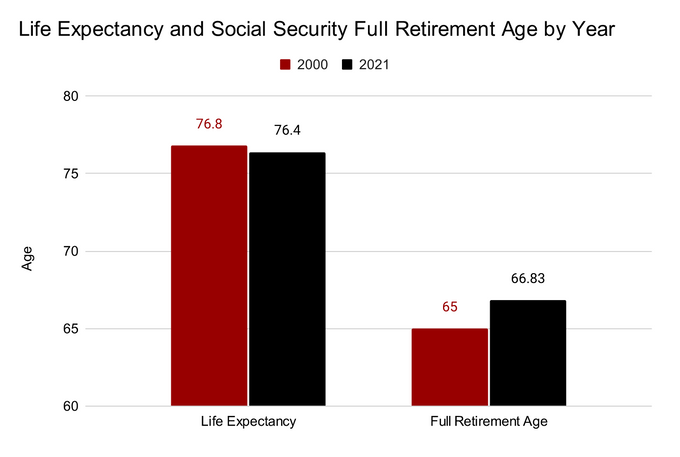
(Image: People's Policy Project)
The new analysis comes as some congressional Republicans are openly advocating further increases in the retirement age, with one GOP lawmaker recently declaring that people "actually want to work longer."
In a policy agenda released last year, theHouse Republican Study Committee (RSC) echoed Reagan-era arguments in favor of raising the full retirement age to 70—a change that would cut Social Security benefits across the board at a time when many retirees are struggling to afford basic necessities.
The RSC agenda states that Republican legislation known as the Social Security Reform Act would "continue the gradual increase of the normal retirement age that current law has set in motion at a rate of three months per year until it is increased by three years for those reaching age 62 in 2040, 18 years from now."
"This adjustment," the document claims, "would begin to realign the Social Security full retirement age to account for increases in life expectancy since the program's creation."
President Biden and congressional Democrats have pledged to reject any proposed cuts to Social Security, which Republicans have threatened to pursue in exchange for a deal to raise the debt ceiling.
In addition to urging Biden and Democratic lawmakers to stand firm against Social Security cuts, advocates are calling on the president to embrace a Social Security expansion plan such as the one recently proposed by Sens. Bernie Sanders of Vermont and Elizabeth Warren of Massachusetts, which would fund benefit increases by raising the payroll tax cap so that wealthier Americans contribute a more equal share to the program.
"President Biden campaigned on a promise to expand Social Security's modest benefits, while dedicating more revenue to it. Most Democratic senators and members of the House support that as well. Yet the mainstream media fails to take those proposals seriously," Nancy Altman, president of the advocacy group Social Security Works, wrote in an op-ed for Common Dreams last week.
"If the Biden administration championed an expansion plan, unveiled at a White House event with major stakeholders in attendance," Altman added, "that could not be ignored."
an 7 22 pvt all
Since the beginning of his campaign, Blake Masters, the conservative venture capitalist turned U.S. Senate hopeful from Arizona, has been drawn to the kind of rhetorical extremism that now animates the Republican Party, bandying insults and talking points of the kind that require no specialized knowledge or experience but nevertheless leave an indelible impression on Republican voters. As far back as 2015, Masters told The Washington Post, he'd been entranced by the rhetoric of Donald Trump, a loud misogynist, who during one of his presidential debates proudly embraced accusations of sexism rather than deny them.
"You've called women you don't like fat pigs, dogs, slobs, and disgusting animals," then-Fox News anchor Megyn Kelly said to Trump during a 2016 GOP debate. "Your Twitter account ––"
"Only Rosie O'Donnell," Trump interjected, before getting rapturous applause from the crowd.
It was during this now-notorious back-and-forth, Masters explained, that he had his lightbulb moment.
"Somehow he just busted through some wall," Masters recently told the Post of Trump. "He didn't apologize. He kind of just picked on her as this target."
Since then, Masters has largely emulated the former president's brashness on all matters political. Just this May, in the wake of the Supreme Court's rescission of Roe v. Wade, the former tech executive stressed the need for nationwide ban on abortion, a practice that he called "demonic" just last year, according to The Tuscon Weekly. Masters also believes that the Capitol riot was an FBI-led "false flag operation"; that the American education system is pushing "gay sex ideology" onto students; and that Democratic elites are deliberately attempting to loosen borders and win future elections with a more pliant voting bloc from the Third World.
Of course, none of this is particularly unique to the MAGA agenda, which has for the most part set its sights on culture war issues like abortion, race, immigration, sex, and gender. But Masters also espouses a strange flavor of half-baked libertarianism that calls for the complete abolition of long-standing cornerstones for American welfare.
For one, Masters supports a generalized push to privatize the country's water supply, according to audio provided to Salon by American Bridge, a Democratic Super PAC.
"Would you support the transferring of water resources to private ownership?" a voter asked Masters two weeks ago during a campaign event in Sedona, Arizona.
"In general, yes," Masters responded, because "the state can't do it and you don't want the government doing a lot of this stuff."
To be sure, private water companies would be nothing new for the nation. But anecdotal evidence suggests that water is the kind of basic human right that has no business under Corporate America's thumb.
Back in 2017, The Washington Post reported that states that offload their publicly-owned water infrastructure to private corporations tend to see rate hikes for customers, adding to the millions of Americans whose sinks, toilets, and showers are routinely disconnected for unpaid bills, as The Guardian reported.
Janice Beecher, the director of Michigan State University's Institute of Public Utilities, told the Post that state officials "should ask good questions, and they should understand the trade-offs" before selling off their municipal water systems, because "once it's gone, it's gone."
According to a sweeping 2016 analysis from the Food & Water Watch, a consumer rights organization, private water companies charge 58 percent more than their publicly-owned counterparts. In states like New Jersey and Pennsylvania, the premium can be as high as 79 and 84 percent respectively.
And that's just pricing. Public Citizen, another consumer rights group, found that privatization leads to worse water quality, job losses, over-extraction, and corruption. To add insult to injury,$26.5 billion of the EPA's budget goes to for profit-water providers, which presently control 10% of the nation's water supply, suggesting that water companies have trouble sustaining themselves without the largesse of the government.
Meanwhile, cities all across America are now attempting to expropriate water infrastructure they sold off in response to complaints about rate hikes and bad service. However, as the Post reported, exercising eminent domain in this area can be extremely costly, leading to municipal deficits that, ironically, might have been the original impetus for privatization.
Apart from water, Masters also has a grand, albeit ill-defined, vision to privatize Social Security, the federal insurance program that provides benefits to 65 million retired, disabled, and unemployed people.
"We got to cut the knot at some point though because I'll tell you what, I'm not going to receive Social Security," Masters said at a primary debate back in June. "I'm a millennial."
"We need fresh and innovative thinking, maybe we should privatize Social Security," he added at the time. "Private retirement accounts, get the government out of it."
Make no mistake: Social Security security has been a perennial punching bag for the Republican Party for decades.
As early as 2004, then-President Bush campaigned on privatizing the program, arguing that young people should be able to take "ownership" of their future benefits by investing their tax withholdings into a private account that would be subject to the whims of market forces.
"We should make the Social Security system a source of ownership for the American people," Bush said in a January 2004 State of the Union address.
However, the plan ultimately unraveled once it became clear that it was massively unpopular amongst the American public, 96 percent of whom currently support Social Security as is.
Today, both parties agree that Social Security needs to be reformed, in part because the retirement funds are projected to run dry by 2034. But what that reform should look like breaks down across party lines.
Democrats, for their part, have argued that the program should be expanded – along with provisions that would create a minimum benefit and a cost-of-living adjustment – through tax increases. Unsurprisingly,Republicans have repudiated this plan as anti-business, instead proposing plans to raise the minimum age of retirement, establish "rescue committees" that would mull cuts behind closed doors, and even sunset the program every five years.
an 320
this is a trap’: Progressives sound alarm on Republicans’ Social Security sneak attack hidden in coronavirus billJake Johnson / Common D
==
https://www.alternet.org/2020/03/how-trump-has-made-it-harder-for-the-u-s-to-weather-a-recession/
no lnx
How Trump has made it harder for the US to weather a recession
President Donald J. Trump listens as Assistant to the President for Economic Policy Larry Kudlow speaks at a press conference during the 50th Annual World Economic Forum meeting Wednesday, Jan. 22, 2020, at the Davos Congress Centre in Davos, Switzerland. (Official White House Photo by Shealah Craighead)]
Written by Cody Fenwick March 17, 2020
As the coronavirus send the United States and the entire global economy hurtling toward recession, President Donald Trump and his defenders have claimed the administration’s policies have left the United States better prepared for the downturn. But in reality, the president’s effects on the course of the economy thus far have been greatly exaggerated, and many of his policies have actually put Americans at greater risk in the event of financial catastrophe.
To understand why Trump’s policies have put us at risk, you have to appreciate the best possible policy response to a recession: automatic stabilizers.
Many automatic stabilizers are actually very familiar to most people. The category includes, for example, SNAP (commonly called food stamps) and unemployment insurance.
These policies are critically important because as a recession worsens, they automatically start ramping up.As more people lose their jobs, more people go on unemployment, and the program starts paying out more money. When more people on short on cash and need help buying for food — a common occurrence in a recession — they apply for and get SNAP to feed their families. The government starts doing exactly what it should do in a recession: spending public money to make up for the private shortfall in spending.
The best policies are “automatic” in the sense that lawmakers don’t have to change the law in a recession for the programs to spend more money; they respond to the need, and if there’s more need, the programs spend more money.
This is a great way to fight a recession because it provides support to the people who are hurt worst by the downturn. That’s good for humanitarian reasons, but also in crudely economic terms because it means the money the government is almost guaranteed to be spent back into the economy. If you give money to people who are doing OK in a recession, they might just try to save it for later. Since recessions are defined by a reduction in economic activity, policies that can efficiently promote economic activity will help soften the blow and speed the recovery. And since these policies ramp up automatically, there’s less uncertainty about how much support there will be, which can help reassure businesses and investors that the recession won’t be as severe as it might otherwise be. And you can skip entirely the interminable debates and political gamesmanship endemic to the U.S. Congress.
But because of the anti-government and anti-welfare ideology that still poisons the GOP and conservative movement, under the Trump administration, many automatic stabilizers have been significantly weakened.
For example, in December 2019, the Department of Agriculture Secretary Sonny Purdue announced a plan that could kick almost 700,000 people off the rolls of SNAP. It imposes stricter work requirements on the program, which makes it harder for adults who don’t have jobs to get support. Purdue framed this as an effort to fight back against “dependency” on government:
“We need to encourage people by giving them a helping hand but not allowing it to become an indefinitely giving hand,” said Secretary Perdue. “Now, in the midst of the strongest economy in a generation, we need everyone who can work, to work. This rule lays the groundwork for the expectation that able-bodied Americans re-enter the workforce where there are currently more job openings than people to fill them.”
The administration has worked in other ways, too, to limit access to the program. Even in good economic times, these kinds of rules can impose large burdens on people who, for whatever reason, struggle to get or keep a job and need help buying food. If a recession hits, these restrictive measures are even worse. As recently as last week, BuzzFeed reported that the administration had considered delaying the implementation of the rule but had decided to push forward. On Monday, a federal judge halted the change, as Chicago Tribune reported:
“Especially now, as a global pandemic poses widespread health risks, guaranteeing that government officials at both the federal and state levels have flexibility to address the nutritional needs of residents and ensure their well-being through programs like SNAP, is essential,” wrote Chief Judge Beryl Howell of the U.S. District Court for the District of Columbia.
…
Howell halted the rule’s implementation until the court makes a final decision on its legality, saying it will likely be deemed “arbitrary and capricious” because it didn’t appear to consider the hundreds of thousands of submitted comments that raised concerns. The USDA had estimated 1.1 million people would be newly subject to the work rules and nearly 700,000 people nationwide were likely to lose food assistance as a result of the change. Some 36 million Americans are enrolled in SNAP.
But as the Tribune pointed out, tens of thousands have already been kicked off the rolls of SNAP because of similar federal rules under the Trump administration.
The problem goes far beyond SNAP. Catherine Rampell at the Washington Post reported that under Trump — as well as before him — states and the federal government have weakened other policies that could serve as automatic stabilizers:
Elsewhere, the administration has been demanding states add additional paperwork requirements for enrollment in both Medicaid and the Children’s Health Insurance Program, causing eligible families to lose coverage.
The administration also recently announced a proposal to convert part of Medicaid to block grants. This would mean states would get a capped annual amount of federal dollars for the program. It would also limit states’ ability to expand enrollment during a downturn.
Then finally there’s the unemployment insurance program, yet another policy designed to serve as a safety net both for individual families and the macroeconomy as a whole. In theory, it allows jobless people to keep paying bills and patronizing local businesses.
…
This problem clearly pre-dates Trump. Even so, his administration has since encouraged states to add more bureaucratic hurdles — including by doing more widespread drug testing as a condition of benefit receipt. This appears to be a solution in search of a problem, based on the handful of states that have experimented with similar programs before. It’s also expensive, and it slows down benefit receipt.
And it’s not just public health insurance that has been diminished under Trump. After his extensive efforts to undermine Obamacare, the uninsured rate began rising under his administration after consistently falling under his predecessor. This, too, will impose greater burdens on Americans in a recession — especially a recession driven by a public health threat.
Rampell also noted that Larry Kudlow, director of the National Economic Council under Trump, had touted the benefits of automatic stabilizers in the face of a recession without acknowledging how significantly they had been diminished.
Now, it does appear as if Congress and the administration are prepared to move forward with some non-automatic stabilizers to fight the coming recession. This could potentially be stimulus spending in the form of direct cash to families, which would likely be the best option. But many argue that Democrats — who generally favor such policies — should only agree to go along with such a plan if Republicans agree to make the policy automatic. That way, if a recession happens under the next Democratic president, the same beneficial counter-cyclical measures could ramp up without Congress needing to act. Because as Republicans proved in 2009, if a Democrat is in the White House, the GOP is much less willing to spend money to benefit the American people.
==
https://www.alternet.org/2020/03/disaster-socialism-will-coronavirus-crisis-finally-change-how-americans-see-the-safety-net/
https://www.alternet.org/2020/03/rise-of-a-shadow-political-party-how-christian-nationalists-worship-power-and-why-they-love-trump/
https://www.alternet.org/2020/03/rise-of-a-shadow-political-party-how-christian-nationalists-worship-power-and-why-they-love-trump/
no lnx
Rise of a ‘shadow political party’: How Christian nationalists worship power — and why they love Trump
Written by Amanda Marcotte / Salon March 4, 2020
It’s one of the most enduring conundrums of the Donald Trump era: How is it that the Christian right, the self-appointed monitors of American morality, have come to so enthusiastically back a thrice-married chronic adulterer who lies as easily as he breathes?
Author Katherine Stewart has the answer: Because the true god these folks worship is power. In her book, “The Power Worshippers: Inside the Dangerous Rise of Religious Nationalism,” Stewart details how she traveled around the country, getting to know the various Christian conservative figures that are whipping support for Trump and his agenda. She deems the “Christian nationalists” and demonstrates how their supposedly Christian values always come second to their endless quest for power.
Stewart spoke with Salon about her new book. This interview has been edited for clarity and length.
In the intro of the book you write that most Americans view the Christian right as a “cultural movement centered on a set of social issues, such as abortion and same-sex marriage.” But in fact, it’s a political movement and its ultimate goal is power. What do you mean by that?
I think when we think of the religious right, we’re often thinking of a cultural movement or social movement that works from the bottom up, expressing the anxieties and reactions of a particular group in American society to change social realities, focused on issues like reproductive rights or same-sex marriage.But Christian nationalism really works from the top down. It actively shapes and manipulates its target population, and it often shifts its target.
When movement leaders are talking to the congregants or to pastors who speak to congregants, it’s all abortion all the time. The foot soldiers may even believe that they’re fighting for things like a ban on abortion or same-sex marriage, but the leaders have actually consciously reframed these issues in such a way that they can control the vote of a large subsection of the American public. They use that to solidify and maintain political power for themselves and their allies, to increase the flow of public and private money in their direction, and to enact economic policies that are favorable to their funders.
When you dig a little deeper into what the movement leaders talk about when they talk with one another, they actually advocate for a very wide range of policy issues that don’t just have to do with abortion or same-sex marriage. A lot of it has to do with economic policy. A lot of it has to do with foreign policy, social policy. It’s important to look at the movement in this broader fashion as a political movement that wants power.
Tell me more about that. How does someone argue that there’s something Christian about, say, low tax and low regulation?
They say that the Bible favors minimal government or no government. The Bible is against regulation, against the social safety net. Unless the social safety net is managed by the church.
Someone like Ralph Drollinger — who targets political leaders at the top levels of government — he’s got this Bible study group in the Capitol that’s been attended by at least 11 members of Trump’s cabinet, including Mike Pence. He also has Bible study groups targeting the Senate and House of Representatives, and they’re very well-attended. So he’s arguably one of the most politically influential pastors in America.
He argues that social welfare programs have no basis in Scripture. He says that the government should not directly fund needs for the poor. He says the responsibility to meet the needs of the poor lies first with a husband and a marriage, second with a family if the husband is absent, and third with the church. He says nowhere does God command the institutions of government or commerce to fully support those with genuine needs.
These policies are incredibly favorable to the plutocratic fortunes that are funding the movement. The movement wouldn’t be what it is without some subsection of very wealthy individuals and extended families that are supporting the movement financially. I’m thinking of like theDeVos, Prince families, the Green family, and so many others that I described in my book.
These families, in turn, benefit from a deregulation of lack of environmental control regulation, low taxation, and minimal workers’ rights. Drollinger himself derived a lot of his early funding from agribusiness kings, people who own large agribusiness conglomerates in Central Valley,California, and the San Joaquin Valley. So it’s a kind of economic policy that actually is favorable to many of the big-picture funders of the movement.
We also have to recognize that the role of public money is absolutely huge. A lot of the calls for “religious freedom” that characterize much of the activism of the movement today are often seen, rightly so, as a demand that conservative Christians should be able to discriminate against LGBT Americans, nonreligious women and members of the religious minority groups. But even more than that, activists have their eye on a vast potential flow of public funds in the future. This is one of the reasons why the calls for religious freedom are just like this ever-louder drum beat that we’re hearing in so many places.
This agenda has been made really explicit in the field of public educationwhere activists are determined to expand access to public funds in the form of vouchers. They’ve actually placed a key voucher case before the Supreme Court, which they hope will allow a greater funnel of funds in their direction.
The United States spends something like $700 billion a year on K-12. So Christian nationalists realize that, if they can get their hands on a small portion of that in the name of religious liberty, the money will flow without end. So when you look at the larger demands of the movement, it’s not just about these culture war issues, it’s about public policy, foreign policy, and it’s about money.
You call it a Christian nationalist movement, not a white nationalist movement, not the Christian right even. Why do you call it a Christian nationalist movement?
Christian nationalism is a political ideology. It says that what makes the United States distinctive is not our democratic system of government, or our Constitution, or our history of assimilating diverse people in a pluralist society. Instead, it insists that the foundation of legitimate government is bound up inextricably with the reactionary understanding of a particular religion. It basically says that the U.S. was founded on the Bible, and can only succeed if it stays true to that foundation.
It’s also not just an ideology, but a device for mobilizing and often manipulating large segments of the population and for concentrating power in the hands of this new elite. Vladimir Putin in Russia, or Viktor Orban in Hungary, or Erdogan in Turkey tie themselves closely to religious conservatives in their countries, to consolidate an authoritarian form of power. We’re seeing this today with Trump’s alliances, with our own religious conservatives.
You write that America’s conservative churches have been converted into “loyal cells of a shadow political party.” What do you mean by that?
Leaders of the movement have figured out that pastors drive votes, and so they organize pastors into these networks, to get them on the same page politically.They give themtools through networks of conservative churchesin order to do that, to help them turn out votes for hyper-conservative candidates.
Recently, I found myself at a small church in rural North Carolina, with dozens of evangelical pastors from the area. I was at an event sponsored by an organization called Watchmen on the Wall, which is an initiative of the Family Research Council, which is one of the largest and most powerful policy groups of the Christian right.
Watchmen on the Wall claims to have over 25,000 pastor members. They get all these pastors networked together, and they have these presentations where they tell them what issues matter and how to turn out the vote on these “biblical issues.” There wasn’t a slightest doubt about which way these pastors were expected to tell their congregations to vote.
They were instructed to form what they call culture impact teamswithin their churches. They have to figure out which members of their congregation are politically active, well-connected with other members, and motivated to get them to vote according to “biblical values.” They gave these pastors these booklets, 200 pages of material that help them form these culture impact teams.
They actually give them tools to get them out to vote. They give them tens of thousands of voter guides, and pastors were encouraged to take as many as they could use and hand out.
Your chapter on the anti-abortion movement in the book is titled “Inventing Abortion.” You write that it’s a myth that the movement was a reaction to a sincere belief in protecting fetal life. Tell me more. What is this Christian right obsession with abortion? Where does it come from? What is it actually about?
When Roe v. Wade was passed, the liberalization of abortion laws was something that many, if not most, Republican partisans supported. The early battles over abortion tended to be between Catholics and Protestants, with Protestants largely on the side of liberalization of abortion laws. Even though Catholic hierarchy is opposed to abortion, many Catholic individuals supported some form of liberalization based on sort of lived experience.
At that time that Roe v. Wade passed, the abortion law reform really conformed with the Republican party’s support for Protestant values, birth control. Billy Graham in 1968 said, “In general, I would disagree with the Catholic stance. I believe in Planned Parenthood.”
The most liberal abortion law in the country was signed in 1967 by California’s Republican governor, Ronald Reagan. Barry Goldwater, who is this great conservative hero, supported abortion law liberalization early in his career. His wife, Peggy, was a co-founder of Planned Parenthood in Arizona.
When Roe v. Wade passed, in fact, there was a wire service run by the Southern Baptist Convention. The bureau chief of the Baptist Press wrote a piece saying that religious liberty, human equality, and justice are advanced by the Supreme Court decision.
This was not an issue that united the Republican party at all, until activists from the new right got involved and were really searching for an issue that could unite the party.
At the time, they’d come together out of concern that institutions like Bob Jones University would be deprived of their lucrative tax advantage. But they knew that preserving tax advantages for racially segregated academies is not going to be an issue that could really unite the party. So they kind of looked around for an issue that could unite conservative Catholics and conservative Protestants.
Bit by bit, they settled on abortion and sort of purged the Republican party of its pro-choice representatives. They needed a single issue that they could get people to vote on, and abortion became that issue.
Let’s talk about Donald Trump. He’s obviously not a religious man. He knows little of Christian theology. He can’t even get the terminology right. He can’t really even be bothered to pretend otherwise. So how is a man like that such a hero to the Christian nationalists?
First, the movement realizes that much of their agenda is advanced through the courts and he’s delivering them everything that he promised.
I was at a Road To Majority conference, that’s Ralph Reed’s conference, right before the election. Trump held up a list of justices and he said, “I’m going to choose Supreme Court justices from this list,” and every single one of them was pro-life. Of course, the issue wasn’t just abortion, but abortion becomes code for the entire agenda.
There’s that transactional side of it. But I think that there’s another side too. Trump’s anti-democratic attributes are a vital part of his attraction for this movement.
This movement doesn’t really believe in modern representative democracy. At bottom, they sound as though they prefer autocrats. In fact, what they really want is a king. Paula White is always calling Trump a king. Ralph Drollinger is always talking about kinging and kings. Trump has been referred to as King Cyrus.
The thing about kings like Cyrus is that they don’t have to follow the rules. They are the law. Trump understands this longing for the hard hand of the despot. That is what has made him such an attractive leader to this movement.
==
320 an
trump admits he’ll be ‘cutting’ entitlements — but here’s what he really revealed
==
https://www.alternet.org/2020/02/trumps-latest-judicial-nominee-wants-to-abolish-social-security/
220
no lnx
Trump’s latest judicial nominee wants to abolish social security
Written by Joan McCarter / Daily Kos February 26, 2020
There’s another deplorable nominee on Mitch McConnell’s conveyor belt: Stephen Schwartz, nominated to the U.S. Court of Federal Claims and pending in the Judiciary Committee. This is impeached president Donald Trump’s second go at having Schwartz appointed to this court, which hears claims against the federal government. Trump wants Schwartz there because he’s argued that Social Security should be abolished because being elderly and disabled “is a natural aspect of the human condition” so those people shouldn’t get any assistance.
Those are recent views from the too-young Schwartz, who wrote them 15 years ago in the student newspaper at Yale. When he was an undergraduate. He also “wrote that the departments of Transportation, Agriculture and Education lack a ‘constitutional basis,’ and that Social Security benefits were intended to prevent ‘outright starvation’ but had become a ‘standard component of most retirement programs.'” Pull yourself up by your bootstraps, you lollygagging 80 year olds.
Of course that’s not all. Schwartz has also been in on legal efforts to disenfranchise African American voters in North Carolina and in Virginia’s public bathroom wars, trying to make transgender students’ bladders explode. As a pet attorney for the Koch network in its Cause of Action institute, he has sued the federal government multiple times. “There are lots of circumstances today in America where agencies of the federal government exercise their discretion in ways that are terrible for personal liberty, for economic freedoms,” he said in an interview during one of those suits.
Because personal liberty and economic freedom mean having to find a job when you’re in your 70s or 80s or 90s so you can eat. “Schwartz is another example of Trump’s ideal nominee for the bench: a conservative ideologue who is determined to undermine civil rights and federal agencies,” Vanita Gupta, who headed the Obama Justice Department’s civil rights division, told The Washington Post.
Schwartz faced stiff opposition in 2017 from a variety of quarters, and his nomination eventually languished as the committee and Mitch McConnell focused on more critical seats. This appointment needs to be squelched again.
==
aha: gop voodoo reductionist cut gov't boost economy: but floor needed for innovation/start small biz: se corp coup: trumpistas stick w/ him tho he is clearly hurting them.
https://www.alternet.org/2020/02/financial-writer-explains-why-trumps-proposed-federal-budget-would-be-an-economic-calamity-possibly-pushing-the-us-to-the-brink-of-a-recession/
no lnx
Financial writer explains why Trump’s proposed federal budget would be an ‘economic calamity’ — possibly pushing the US to ‘the brink of a recession’
Written by Alex Henderson February 20, 2020
Whoever the Democratic Party ends up nominating for the 2020 presidential election — whether it’s Sen. Bernie Sanders of Vermont, former New York City Mayor Mike Bloomberg or someone else — President Donald Trump will no doubt be campaigning aggressively on the state of the U.S. economy, claiming that a second Trump term would be synonymous with prosperity and economic growth. But liberal/progressive writer Michael Linden, in a February 20 op-ed for CNN Business’ website, offers a long list of reasons why he believes that the federal budget Trump is proposing would be an “economic calamity.”
Trump’s proposed budget, according to Linden, is “full of outdated ideas that would instantly weaken the economy and undermine our ability to grow and prosper over time.” For example, Linden notes, Trump “proposes massive immediate cuts to the kinds of public services, protections and health care that help propel short-term economic growth by supporting demand for goods and services.”
“Just last quarter,” Linden observes, “the government was contributing the most to GDP than at any other point since the end of the Great Recession. President Trump’s budget would reverse that, withdrawing critical support at a time when growth has already slowed. The cuts are so deep, so massive and so poorly targeted that they could be large enough to even push us to the brink of a recession.”
The CNN Business contributor goes on to point out that “overall economic activity grew by only 2.1% over the last year. Well, Trump’s budget includes roughly $958 billion in total cuts in the first four years. That amounts to about 1% shaved off of total gross domestic product right there.”
Deep cuts to social programs, Linden emphasizes, don’t promote economic growth — they harm it.
“Programs like Medicaid, food stamps and tax credits for low-income families tend to permeate throughout local economies most effectively, and those are exactly the resources that President Trump’s budget envisions cutting to the tune of about $335 billion in the next four years,” Linden explains. “These cuts could reduce overall economic activity by another .3% to .4%.Put it all together, and Trump’s plan would slash the overall economic growth rate down to well under 1% over the next few years — putting us right on the edge of outright economic contraction.”
One of the things liberal presidents of the past understood — including President Franklin Delano Roosevelt in the 1930s and 1940s and President Lyndon B. Johnson in the 1960s — is that when the American middle class prospers and has more money to spend, that money goes into the U.S. economy. 2020 presidential hopefuls Sanders and Sen. Elizabeth Warren clearly understand those principles of New Deal and Great Society economics.
Trump’s proposed federal budget, Linden contends, fails to recognize the vital role that “workers and consumers” play in the economy.
“Workers and consumers are what drive growth and prosperity,” Linden asserts. “When workers have the support and investment they need to do their best work, they innovate, create and do more with less time and fewer resources. When consumers have money in their pockets, they drive demand for goods and services and induce businesses to invest in the future…. Trump’s budget slashes at those very foundations: education, health care, research and development.”
==
==
https://theconversation.com/ai-algorithms-intended-to-root-out-welfare-fraud-often-end-up-punishing-the-poor-instead-131625
President Donald Trump recently suggested there is “tremendous fraud” in government welfare programs.
Although there’s very little evidence to back up his claim, he’s hardly the first politician – conservative or liberal – to vow to crack down on fraud and waste in America’s social safety net.
States – which are charged with distributing and overseeing many federally funded benefits – are taking these fraud accusations seriously. They are increasingly turning to artificial intelligence and other automated systems to determine benefits eligibility and ferret out fraud in a variety of benefits programs, from food stamps and Medicaid to unemployment insurance.
Of course, government agencies should ensure that taxpayer dollars are spent effectively.The problem is these automated decision-making systems are sometimes rife with errors and designed in ways that punish the poor for being poor, leading to tragic results.
As a clinical law professor who has researched safety net programs and has represented low-income clients in public benefits cases for over 20 years, I believe it’s essential these systems are designed in ways that are fair, transparent and accountable to prevent hurting society’s most vulnerable.
...
==
an 220
https://www.alternet.org/2020/02/whit-house-budget-to-propose-savage-cuts-to-medicare-medicaid-and-social-security-while-hiking-pentagon-and-wall-funds/
an 220
Trump’s assault on the social safety setRyan LaRochelle, Luisa S. Deprez / Washington Monthly
https://www.alternet.org/2020/02/the-shame-of-child-poverty-in-the-trump-era-poor-kids-lose-as-billionaires-cash-in/
no lnx
Rajan Menon / Tom Dispatch February 3, 2020
The plight of impoverished children anywhere should evoke sympathy, exemplifying as it does the suffering of the innocent and defenseless. Poverty among children in a wealthy country like the United States, however, should summon shame and outrage as well. Unlike poor countries (sometimes run by leaders more interested in lining their pockets than anything else), what excuse does the United States have for its striking levels of child poverty? After all, it has the world’s 10th highest per capita income at $62,795 and an unrivaled gross domestic product (GDP) of $21.3 trillion. Despite that, in 2020, an estimated 11.9 million American kids — 16.2% of the total — live below the official poverty line, which is a paltry $25,701 for a family of four with two kids. Put another way, according to the Children’s Defense Fund, kids now constitute one-third of the 38.1 million Americans classified as poor and 70% of them have at least one working parent — so poverty can’t be chalked up to parental indolence.
Yes, the proportion of kids living below the poverty line has zigzagged down from 22% when the country was being ravaged by the Great Recession of 2008-2009 and was even higher in prior decades, but no one should crack open the champagne bottles just yet. The relevant standard ought to be how the United States compares to other wealthy countries. The answer: badly. It has the 11th highest child poverty rate of the 42 industrialized countries tracked by the Organization for Economic Cooperation and Development (OECD). Winnow that list down to European Union states and Canada, omitting low and middle-income countries, and our child poverty rate ranks above only Spain’s. Use the poverty threshold of the OECD — 50% of a country’s median income ($63,178 for the United States) — and the American child poverty rate leaps to 20%.
The United States certainly doesn’t lack the means to drive child poverty down or perhaps even eliminate it. Many countries on that shorter OECD list have lower per-capita incomes and substantially smaller GDPs yet (as a UNICEF report makes clear) have done far better by their kids. Our high child-poverty rate stems from politics, not economics — government policies that, since the 1980s, have reduced public investment as a proportion of GDP in infrastructure, public education, and poverty reduction. These were, of course, the same years when a belief that “big government” was an obstacle to advancement took ever-deeper hold, especially in the Republican Party. Today, Washington allocates only 9% of its federal budget to children, poor or not. That compares to a third for Americans over 65, up from 22% in 1971. If you want a single fact that sums up where we are now, inflation-adjusted per-capita spending on kids living in the poorest families has barely budged compared to 30 years ago whereas the corresponding figure for the elderly has doubled.
The conservative response to all this remains predictable: you can’t solve complex social problems like child poverty by throwing money at them. Besides, government antipoverty programs only foster dependence and create bloated bureaucracies without solving the problem. It matters little that the actual successes of American social programs prove this claim to be flat-out false. Before getting to that, however, let’s take a snapshot of child poverty in America.
Sizing Up the Problem....
efining poverty may sound straightforward, but it’s not. The government’s annual Official Poverty Measure (OPM), developed in the 1960s, establishes poverty lines by taking into account family size, multiplying the 1963 cost for a minimum food budget by three while factoring in changes in the Consumer Price Index, and comparing the result to family income. In 2018, a family with a single adult and one child was considered poor with an income below $17,308 ($20,2012 for two adults and one child, $25,465 for two adults and two children, and so on). According to the OPM, 11.8% of all Americans were poor that year.
By contrast, the Supplementary Poverty Measure (SPM), published yearly since 2011, builds on the OPM but provides a more nuanced calculus. It counts the post-tax income of families, but also cash flows from the Earned Income Tax Credit (EITC) and the Child Tax Credit (CTC), both of which help low-income households. It adds in government-provided assistance through, say, the Supplemental Nutritional Assistance Program (SNAP), Temporary Aid to Needy Families (TANF), the Children’s Health Insurance Program (CHIP), the National School Lunch Program (NSLP), Medicaid, subsidies for housing and utilities, and unemployment and disability insurance. However, it deducts costs like child care, child-support payments, and out-of-pocket medical expenses. According to the SPM, the 2018 national poverty rate was 12.8%.
Of course, neither of these poverty calculations can tell us how children are actually faring. Put simply, they’re faring worse. In 2018, 16.2% of Americans under 18 lived in families with incomes below the SPM line. And that’s not the worst of it. A 2019 National Academies of Sciences, Engineering, and Medicine study commissioned by Congress found that 9% of poor children belong to families in “deep poverty” (incomes that are less than 50% of the SPM). But 36% of all American children live in poor or “near poor” families, those with incomes within 150% of the poverty line.
Child poverty also varies by race — a lot. The rate for black children is 17.8%; for Hispanic kids, 21.7%; for their white counterparts, 7.9%. Worse, more than half of all black and Hispanic kids live in “near poor” families compared to less than a quarter of white children. Combine age and race and you’ll see another difference, especially for children under five, a population with an overall 2017 poverty rate of 19.2%. Break those under-fives down by race, however, and here’s what you find: white kids at 15.9%, Hispanic kids at an eye-opening 25.8%, and their black peers at a staggering 32.9%.
...
==
timing bizzaRE unless smash and grab window?
https://www.alternet.org/2019/12/the-trump-administration-just-declared-war-on-social-security/
no lnx
The Trump Administration just declared war on social security
Social Security Commissioner Andrew Saul, Image via Screengrab CSPAN.
Written by Alex Lawson / Independent Media Institute December 18, 2019
American workers contribute to Social Security with every paycheck. When they do, they are earning comprehensive insurance protections. Social Security insures against the loss of wages due to old age, disability, or (for the surviving family of a worker) death. While Social Security is best known as a retirement program, disability and survivor’s benefits are equally essential.
An attack on any part of Social Security is an attack on the entire system and all current and future beneficiaries. The latest proposal from Donald Trump’s administration, which is designed to rip benefits away from hundreds of thousands of Americans with disabilities, amounts to a declaration of war on Social Security.
The Trump administration proposal would require millions of Social Security Disability Insurance (SSDI) and Supplemental Security Income (SSI) beneficiaries to re-prove their eligibility for benefits as often as every six months—far more frequently than is currently the case.There is no justification for this policy. The United States already has some of the strictest eligibility criteria for disability benefits in the world. More than half of all claims are denied.
We should be making it easier for workers to claim the Social Security benefits they’ve earned with every paycheck, not harder. And ripping benefits away from current beneficiaries, who rely on them to survive, is even worse.
We know what the effects of the Trump proposal would be, because Ronald Reagan implemented a very similar benefit cut back in the 1980s. Reagan’s policy ripped away the benefits of 200,000 Americans with disabilities. The New York Times reported that “people with obvious physical and mental disabilities” lost their benefits “without having been interviewed.”
Ultimately, Reagan was forced to reverse his attack on Social Security after massive public outcry, and bipartisan condemnation from Congress—but not before 21,176 people died, including several who died by suicide, “because their benefits were cut off.”
Donald Trump himself might not be a diligent student of history, but his advisers—men like Mick Mulvaney, Trump’s chief of staff and a longtime enemy of Social Security—know exactly what they are doing. They want to resurrect Reagan’s Social Security cut knowing full well that it killed people.
This could impact any of us, even those of us who are currently healthy. Imagine that you are hit by a car tomorrow, and suffer life-altering injuries that prevent you from working. You’re faced with crushing medical bills, and you’ve lost your income. In such situations, SSDI benefits are a crucial lifeline. Donald Trump wants to rip that lifeline away.
Trump and Mulvaney are targeting people with disabilities first, because they perceive them as politically vulnerable. But if they are allowed to get away with this attack, it will be only the beginning. They want to destroy every part of Social Security, including retirement benefits, and turn it over to their criminal friends on Wall Street.
We must stop Trump’s plan. The Social Security Administration is collecting comments on the proposal until the end of January. You can comment opposing the plan here. Everyone must also call their elected officials. Congressional condemnation played a huge role in forcing Ronald Reagan to reverse his version of the attack, and it can stop Trump in his tracks.
If we let the politicians in Washington, D.C., take away some people’s earned benefits, it means they can take away all of our earned benefits.
This article was produced by Economy for All, a project of the Independent Media Institute.
Alex Lawson is the executive director of Social Security Works, a non-profit advocacy group that supports expanding benefits to address America’s growing retirement security crisis. Lawson has appeared on numerous TV and radio outlets and is a frequent guest host of The Thom Hartmann Program, one of the top progressive radio shows in the country.
omg; border is our future, stalking horse trial balloons?
https://www.alternet.org/2019/12/a-consulting-firm-advised-ice-to-cut-migrants-food-and-medical-care-to-save-costs-worrying-agency-officials/
no lnx many
A consulting firm advised ICE to cut migrants’ food and medical care to save costs — worrying agency officials
Written by Ian MacDougall / ProPublica December 3, 2019
Two years of Republican government has been an incompetent circus — and even worse than we expected
Heather Digby Parton / SalonDecember 24, 2018
So long, Republican Congress, and good riddance.
no lnx
Two years of Republican government has been an incompetent circus — and even worse than we expected
Written by Heather Digby Parton / Salon December 24, 2018
Poor Paul Ryan. The golden boy of the Ayn Rand crowd was once assumed to be a future president, or at least one of the great statesmen of the Republican Party. He was considered a rarity among Republican pols — a policy wonk with the polish and personality of Ronald Reagan. (I know that sounds crazy, but people really did think that.)
When Barack Obama came into office he saw Ryan as a partner in reducing the federal deficit and the White House went out of its way to feature him prominently in various domestic policy "summits" that were held in the early months of that administration. Obama's opinion changed after he tried to negotiate with Ryan and his cohorts in the House Republican leadership, but it took years for the political media to see Ryan for what he really was: a callow ideologue without much character when the chips were down.
Paul Krugman had his number back in 2010:
Mr. Ryan has become the Republican Party’s poster child for new ideas thanks to his "Roadmap for America’s Future,” a plan for a major overhaul of federal spending and taxes. News media coverage has been overwhelmingly favorable; on Monday, The Washington Post put a glowing profile of Mr. Ryan on its front page, portraying him as the G.O.P.’s fiscal conscience. He’s often described with phrases like “intellectually audacious.”
But it’s the audacity of dopes. Mr. Ryan isn’t offering fresh food for thought; he’s serving up leftovers from the 1990s, drenched in flimflam sauce.
But oh, did they love those blue, blue eyes of his.
Ryan never wanted to be House speaker. He wanted to be president. But when John Boehner was finally forced out by the Freedom Caucus and his heir apparent, Kevin McCarthy, tanked his chances with loose talk about using the Benghazi hearings to hurt Hillary Clinton's presidential campaign, Ryan was the only person all Republicans could agree on. He reluctantly signed on. And in doing that he ended up signing his political death warrant.
Ryan's performance as speaker showed him to be feckless, hypocritical and weak in just about every way. He couldn't control his crazies on the one hand and couldn't deal effectively with the crazy in the White House on the other. He ended up being a yes-man for an unfit president who didn't even understand how the three branches of government work. Krugman nailed it again this year upon word of Ryan's retirement. Commenting on the media's surprise, even now, that Ryan and his cohorts have blown the deficit up to unprecedented proportions and happily enabled Donald Trump, Krugman wrote:
[T]he principles they claimed to have never had anything to do with their actual goals. In particular, Republicans haven’t abandoned their concerns about budget deficits, because they never cared about deficits; they only faked concern as an excuse to cut social programs.
And if you ask why Ryan never took a stand against Trumpian corruption, why he never showed any concern about Trump’s authoritarian tendencies, what ever made you think he would take such a stand? Again, if you look at Ryan’s actions, not the character he played to gullible audiences, he has never shown himself willing to sacrifice anything he wants — not one dime — on behalf of his professed principles. Why on earth would you expect him to stick his neck out to defend the rule of law?
Surprise. Paul Ryan is just another partisan hack. Still, I don't think even I expected him to be as terrible at the job as he has been. As he takes his farewell tour, which President Trump generously stepped all over with his silly government shutdown, it pays to recall just what a disaster he has been and the rubble he leaves in his wake.
First, let's recall that when Boehner saw the writing on the wall, he at least made a deal to keep the government open and raise the spending limit for two years as a parting gift to the American people. Granted, he wasn't negotiating with an insane president, but he did have the insane Freedom Caucus in the House, allied with the meddling Ted Cruz in the Senate at the time. He spent every last chit trying to calm things down on his way out the door. Ryan's just rolled along with all of Trump's lurching about on the budget and the wall and is leaving in the midst of total chaos.
We have finally reached the end of this two-year period of total Republican control of the government. It's important to look at what they did when they had it. They managed to pack the courts with unfit, inexperienced extremists in the mold of the man who nominated them. No matter how few people agree with their agenda or vote for them in the future, they will have a strong influence through the extremist right-wing judiciary they have installed in lifetime positions. That's one mission they actually accomplished. Of course, that had nothing to do with Paul Ryan.
They managed to get tax cuts for the wealthy and corporations, their Holy Grail, enacted. That was just a generous gift to their big donors, no strings attached and no expectation that it would benefit average Americans. It hasn't.
They just passed a criminal justice reform package that was backed by the Koch brothers and other big-money libertarian types, one suspects just in time to help a spate of rich white guys heading off to jail. (Presidential son-in-law Jared Kushner pushed this through having lived through his father's incarceration for fraud. What a family.)
They couldn't get Obamacare repealed, although Trump's minions have been working overtime to sabotage it from within. They didn't get Trump's wall. The national debt has exploded and the president is on the verge of being impeached. That's quite a record.
But don't worry. This will work out just fine for them. It's just a more extreme version of what they always do. They wreck the economy and destroy all faith in government. Then when the Democrats win as a result of their malfeasance, they stand on the sidelines and wail about fiscal responsibility and demand that Democrats cut services for average people. Like clockwork, rich media celebrities will undoubtedly stroke their chins and sagely advise the people to "grow up" and "take their medicine" by giving up things like health care and retirement security.
Look for Paul Ryan to be batting those baby blues and wringing his hands on TV over debt and deficits any day now. It's a beautiful scam and it's been working for decades. If you didn't know better you'd almost think they planned it this way.
https://www.alternet.org/2019/10/punishing-the-poor-for-being-hungry/
no lnx
Punishing the poor for being hungry
Written by David K. Shipler / Washington Monthly October 11, 2019
The United States might be the only country in the world where poverty is considered a moral failing—on the part of the victims, not the society. When conservatives are in charge of government, this judgment infiltrates policy. Republicans move repeatedly to twist regulations around an assumption that the poor don’t want to work and don’t make sound decisions. And when this bias affects children’s nutrition, it can cause lifelong impairment.
In the last year alone, the Trump administration has taken multiple shots at food stamps, now called SNAP (Supplemental Nutrition Assistance Program), which helped feed about 40 million people last year. The latest change, one week ago, would cut benefits by $4.5 billion over five years. Even in a booming economy, one in seven households with children were considered “food insecure” last year, according to the Department of Agriculture’s 2018 survey, meaning that they weren’t sure of having enough food for everyone.
Research in the rapidly advancing field of neuroscience has documented the severe biological assaults caused by inadequate nutrition during sensitive phases of brain development. Numerous studies, compiled in a lengthy National Academy of Sciences report, From Neurons to Neighborhoods, portray a devastating landscape of cognitive deficiency resulting from nutritional deprivation. The insufficiency of healthy food during a pregnant woman’s second trimester can reduce the creation of neurons, the brain’s impulse-conducting cells. Malnutrition in the third trimester restricts their maturation and retards the production of branched cells called glia.
Iron is essential to promote the growth of the brain in size and the creation of the nerve-transmitting myelin sheath around the brain’s nerve fibers. The impact of iron deficiency in a baby, therefore, never disappears, even once the deficiency is eliminated. One longitudinal studythat followed children from infancy through adolescence found that they scored lower “in arithmetic achievement and written expression, motor functioning, and some specific cognitive processes such as spatial memory and selective recall.”
Teachers reported that such children displayed “more anxiety or depression, social problems, and attention problems.” It is no great leap of logic to see learning disabilities as one result of malnutrition. And a child who can’t do decently in school, who can’t follow half of what a teacher is saying, is more inclined to drop out.
For those Republicans who are moved more by self-interest than empathy, it’s worth noting that high school dropouts earn less that those with degrees, pay less in taxes, have more serious medical problems, and are at higher risk of ending up in jail.
Yet Trump’s people have sought to saddle the $68 billion-a-year SNAP program with restrictions and cuts to the monthly benefits, which now come on debit cards with declining balances, and typically last a family only two or three weeks. Certain regulations that the Trump administration has either enacted or has openly considered would treat needy Americans with suspicion and distrust. For instance:
Officials have considered imposing a drug-testing regime on SNAP recipients (although not on farmers who receive huge federal subsidies as part of the same legislation).
The Agriculture Department, which administers the program, published a rule in July to eliminate states’ option to raise eligibility limits above the federal ceiling, which is 130 percent of the poverty line.
Previously, states could get waivers to enroll families earning more if their housing and child-care expenses soaked up a big percentage of their income. More generous housing subsidies would help, because in many parts of the country, where rent can consume 50 percent or more of a family’s budget, the money for food gets squeezed. The comment period on the rule change ended in September; once adopted, it will cut off about 3 million recipients.
In last week’s action, the administration effectively took away $75 in benefits from one out of every five families by recalculating how housing and utilities costs are figured.
The Trump administration tried to tighten work requirements in this year’s budget, Congress refused, and officials have gone ahead anyway to partially evade the legislative intent. Since 1996, single able-bodied adults with no dependents, up to age 49, could get SNAP benefits for only three months in a three-year period unless they worked or were in job training at least 80 hours a month. States could waive the rule in areas with acute joblessness. Trump wanted to expand the requirement to age 59 and, more harmfully, apply it to those with children over six years old. That was rejected by Republicans and Democrats in Congress. So last December the Agriculture Department did what it could administratively by making it much harder for states to get waivers.
In his 2019 budget, Trump proposed replacing half of a family’s cash grants with a food package of cereal, pasta, peanut butter, canned fruit and vegetables, meat, poultry, and other items deemed good for them. Sending such packages to 40 million people would have been so costly and impractical that the idea collapsed of its own weight. But the notion seemed borne of a patronizing attitude toward the poor, who suffer from a disparaging stereotype that they do not act responsibly.
Clinics treating childhood malnutrition see a broad array of causes. Lack of money is the centerpiece, but lack of knowledge about healthy eating can also contribute to some cases. Health providers find that some parents don’t know how to cook with relatively inexpensive ingredients. New immigrants unfamiliar with American food can be fooled by ads into thinking that Coke and Cheetos are healthy. So can Americans themselves. Lots of junk food is cheap and filling, hence the nation’s epidemic of obesity, which can be a sign of malnutrition.
Supermarkets with fresh, healthy food are scarce in many low-income neighborhoods. A child’s food allergies can be baffling without the funds and information required to have a large assortment of choices on hand. Single parents doing shift work can’t keep track of what their kids are being fed by multiple caregivers. Nor do they usually have the orderly life that allows them to sit children down calmly to feed them, or have a regular family meal.
In other words, childhood malnutrition is created at the confluence of problems and disabilities that magnify and reinforce one another. They must all be addressed. The cognitive impairment that results cannot be attacked by a country that keeps electing officials who entangle the safety net in a set of punitive impulses.
David K. Shipler is a Washington Monthly contributing writer, a Pulitzer Prize-winning author of seven books, and a former foreign correspondent for The New York Times. He blogs at The Shipler Report.
==
https://www.alternet.org/2019/09/republicans-want-to-cut-social-security-behind-closed-doors/
no lnx
Trump’s big farmer grift: He’s giving millions to the rich while starving the poor
https://www.alternet.org/2019/08/trumps-big-farmer-grift-hes-giving-millions-to-the-rich-while-starving-the-poor
Written by Jim Hightower / Creators Syndicate August 15, 2019
Donald Trump loooooves farmers. We know this because he says so. “Farmers, I LOVE YOU!” he declared in December. And we’ve learned that whenever The Donald says something, it’s true — even when it’s not.
These days, he’s loving farmers to death. Trump has ignored the obvious need to get monopolistic price-fixing bankers, suppliers and commodity buyers off their backs. And he’s ineptly playing tariff games with China and other buyers of U.S. farm products, causing exports and farm prices to tumble. The result is that our ag economy is tumbling into a deep ditch, slamming farm families and rural America with a rising tsunami of bankruptcies.
Adding crude insult to economic injury, Trump’s doofus of an ag secretary, Sonny Perdue, laughed at farmers, branding them “whiners” for opposing his majesty’s disastrous policies.
So, needing a political “I love you” gesture, Trump has been sending big bouquets of money to some of his beloved farmers. Our money. Lots of it — $28 billion so far, in what he cynically (and comically) calls the Market Facilitation Program, otherwise known as a taxpayer bailout.
But TrumpLove turns out to be highly selective, with more than half of the government payments going to the biggest farm owners. The Department of Agriculture initially announced a $125,000 limit on the amount any one farm could get, but every Trump deal seems to have a gimmick in it to give a special break to the slickest operators. The slickum in this deal is that assorted members of a family can claim to be owners of the same farm and be eligible for bailout money, even if they do no actual farming and live in New York City! Thus, one Missouri farm family got $2.8 million worth of subsidy love from Trump, and more than 80 families topped half a million in payments.
Meanwhile, the great majority of farmers — 80% of eligible grain farmers — got zilch from Donald the Dealmaker. The smaller producers who are most endangered by his export collapse got less than $5,000. So Trump’s “Market Facilitation” is squeezing the many who are most in need while helping a few of the largest get even bigger.
While the Trumpistas are presently trying to plow a multibillion-dollar subsidy into big grain farms, they’re shockingly stingy when it comes to our society’s moral responsibility to make sure the least-wealthy among us get an adequate level of food. Their latest effort in the practice of mass minginess is to try literally taking food off poor children’s plates. Using a tangle of federal red tape, Trump ideologues and bureaucratic minions are intervening to prevent states from providing food stamp assistance to millions of their people.
According to federal rules, to qualify for food aid, a family of three should have an income under $27,000 a year. But with rents, utilities, health care and even food prices constantly rising, millions of Americans can’t make ends meet on such a low income. Thus, 40 states have stepped in to loosen that income restriction so families at least get the minimum nutrition humans need. Far from being welfare moochers (as far-right-wing extremists screech), these recipients overwhelmingly are working families, children, the elderly and Americans with disabilities. The benefit is hardly lavish; it averages only $127 a month, but even this modest outlay has proven enormously successful in mitigating poverty.
Congress actually authorized states to make such pragmatic income adjustments in a 1996 revamp of the law. But look out! Here comesSonny Perdue again, rising up on his hind legs to proclaim that naughty state officials are using that authority as a “loophole” to circumvent Trump’s federal authority. So Sonny and Donnie are demanding that a whole new bureaucracy of food stamp “eligibility police” be set up to monitor the assets of hard-hit people who’re just trying to get adequate food on their tables. This nonsense will cost tens of millions of our dollars to harass the poor in an autocratic hope of nabbing a couple of hungry families who have a dime more in assets than miserly Trumpistas claim they should have.
What we have here is government by plutocratic authoritarians who’ll gleefully dole out millions to a wealthy family and then just as gleefully go out of their way to deny food to millions of poor families.
Populist author, public speaker and radio commentator Jim Hightower writes “The Hightower Lowdown,” a monthly newsletter chronicling the ongoing fights by America’s ordinary people against rule by plutocratic elites. Sign up at HightowerLowdown.org. COPYRIGHT 2019 CREATORS.COM
==
https://www.alternet.org/2019/08/republican-attacks-on-the-social-security-2100-act-are-an-assault-on-public-health/
==
==
aha ish: lakoff strict fr is tough love go to bed w/o supper, sink or swim it's a tough world; nurturing mo feeds kids. ?
AN pa threat to jail take kids] links to
Last year in Texas, as his friends stood and watched, a 12-year old boy had his school breakfast taken from him and thrown in the trash. It wasn't the class bully acting out, it was a school cafeteria worker supposedly following policy. Why? The child's meals card, which can be refilled by parents, was 30 cents short. This week, it happened again, only it wasn't a 12-year old boy in Texas, it was 40 elementary school kids in Utah who had their school lunches taken out of their hands and thrown in the trash in front of them. The reason? Insufficient funds on their meals cards. The Salt Lake Tribune interviewed one parent, who said she had not been notified that her child's meals card was overdrawn.
The school claims to have notified all the parents and saw a growing problem with non-payment, so they took action -- by literally taking food away from hungry children, in front of their friends. Apparently, no teacher or administrator stepped in to stop the madness, although one teacher may have paid for some of the lunches from her own pocket. "It was pretty traumatic and humiliating," said Erica Lukes, whose 11-year-old daughter had her cafeteria lunch taken from her as she stood in line Tuesday at Uintah Elementary School," the Salt Lake Tribune reports. "Lukes said as far as she knew, she was all paid up. 'I think it's despicable,' she said. 'These are young children that shouldn't be punished or humiliated for something the parents obviously need to clear up.'" KSL reports "Sophia Isom, Lukes' daughter, was met by a district nutrition manager who was monitoring accounts."
"SO SHE TOOK MY LUNCH AWAY AND SAID, 'GO GET A MILK,' " SOPHIA SAID. "I CAME BACK AND ASKED, 'WHAT'S GOING ON?' THEN SHE HANDED ME AN ORANGE. SHE SAID, 'YOU DON'T HAVE ANY MONEY IN YOUR ACCOUNT SO YOU CAN'T GET LUNCH.' " SHE SAID THE FOOD WAS BEING THROWN OUT. SOPHIA SAID THE SAME THING HAPPENED TO MANY STUDENTS, AND IT WAS THE TALK OF THE LUNCH PERIOD.
Jason Olsen, a Salt Lake City District spokesman, said the district's child-nutrition department became aware that Uintah had a large number of students who owed money for lunches. As a result, the child-nutrition manager visited the school and decided to withhold lunches to deal with the issue, he said. The school district released a statement saying the "situation could have and should have been handled in a different manner. We apologize." The statement, posted to Facebook, has almost 6000 comments, most of them negative.
==
==
https://www.alternet.org/2019/05/the-trump-administrations-insidious-plan-to-cut-social-security-benefits/
==
https://www.alternet.org/2019/05/trump-continues-his-attack-on-working-people-by-moving-to-redefine-poverty-and-slash-social-programs-for-millions
Julia Conley / Common Dreams May 8, 2019
The Trump administration on Monday moved to change the definition of “poverty” in the United States in a proposal which combines the president’s attempts to portray the U.S. economy as…
The Trump administration on Monday moved to change the definition of “poverty” in the United States in a proposal which combines the president’s attempts to portray the U.S. economy as strong with his repeated attacks on the working poor and their access to government services.
In a regulatory filing, President Donald Trump’s Office of Management and Budget (OMB) wrote that it may change how inflation is calculated in order to reduce the number of Americans who are living below the federally-recognized poverty line and are therefore eligible for certain government support services and social programs.
As Melissa Boteach, who oversees income security programs at the National Women’s Law Center (NWLC), wrote on Twitter, the change “seems technical, but it’s actually a big attack on working people.”
Melissa Boteach
@mboteach
- May 6, 2019
Replying to @mboteach
Remember last year when the Trump admin declared that “our War on Poverty is largely over and a success”? https://www.whitehouse.gov/wp-content/uploads/2018/07/Expanding-Work-Requirements-in-Non-Cash-Welfare-Programs.pdf ….
Now he’s acting on this bogus notion, trying to slowly define people out of poverty by decree. 2/
Melissa Boteach
@mboteach
Seems technical, but it’s actually a big attack on working people. In short, Trump wants to weaken how our poverty definition keeps pace with cost of living. So each year, as costs go up, many working people w/low pay would gradually be stripped of WIC, Medicaid & other basics 3/
15
5:27 PM - May 6, 2019 · Washington, DC
Twitter Ads info and privacy
See Melissa Boteach's other Tweets
Under the administration’s proposal, which was first reported by Bloomberg News, the government would shift to a system known as “Chained CPI,” which assumes consumers will change what they buy as items grow more expensive through inflation, suggesting that they are not struggling to afford necessities.
The definitional change would result in a slower inflation rate, which is used to determine how many Americans are eligible for programs like Medicaid, SNAP benefits, and other federal assistance.
As of 2018, a family of four making $25,900 per year was considered to be living in poverty, based on the necessities they could afford with the current inflation rate.
Under the new system, OMB officials wrote in the proposal, “changes to the poverty thresholds, including how they are updated for inflation over time, may affect eligibility for programs that use the poverty guidelines.”
Boteach wrote that the proposal demonstrates “how out of touch Trump is with lives of working-class people,” noting that even the current poverty line does little to reflect the amount of money an American family actually needs to live comfortably in the wealthiest country on the planet.
In fact, wrote Boteach, the new standards will make the government’s understanding of poverty and inequality even less accurate.
Melissa Boteach
@mboteach
- May 6, 2019
Replying to @mboteach
Seems technical, but it’s actually a big attack on working people. In short, Trump wants to weaken how our poverty definition keeps pace with cost of living. So each year, as costs go up, many working people w/low pay would gradually be stripped of WIC, Medicaid & other basics 3/
Melissa Boteach
@mboteach
This proposal shows how out of touch Trump is with lives of working-class ppl. “Americans on average report that it would take more than $55,000 in annual income to be considered out of poverty.” That’s more than TWICE our current threshold https://www.americanprogress.org/issues/poverty/reports/2014/01/07/81702/50-years-after-lbjs-war-on-poverty/ …
4/
12
5:29 PM - May 6, 2019 · Washington, DC
Twitter Ads info and privacy
50 Years After LBJ’s War on Poverty - Center for American Progress
A major new study of public attitudes about poverty, work, and economic opportunity reveals that many Americans remain in economic hardship and desire new efforts to provide low-income families with...
americanprogress.org
15 people are talking about this
Melissa Boteach
@mboteach
- May 6, 2019
Replying to @mboteach
Sadly, even w/low unemployment, poverty & hardship are still a mainstay in American life. And guess what? Unilaterally redefining it doesn’t do a damn thing to help someone secure a better job, put food on the table, or pay critical health care bills.6/ https://www.americanprogress.org/issues/poverty/reports/2018/03/07/447412/ensuring-basic-living-standards/ …
View image on Twitter
Melissa Boteach
@mboteach
This is a cynical attempt to squeeze working-class people. Their incomes will STILL be too low to make ends meet, but Trump’s decree would make it harder for them to qualify for help. 7/
9
5:40 PM - May 6, 2019 · Washington, DC
Twitter Ads info and privacy
See Melissa Boteach's other Tweets
Some critics on social media denounced the proposal as Trump’s latest “cruel” measure aimed at weakening the systems meant to support the poorest Americans and struggling working class families.
David Roberts
?
@drvox
Trump is going to change how poverty is measured, with the intent of rendering a bunch of people ineligible for social assistance. His base will support this arbitrary cruelty b/c even though it hurts them, it also hurts brown people. https://www.bloomberg.com/news/articles/2019-05-06/trump-poverty-line-inflation …
133
12:15 PM - May 6, 2019
Twitter Ads info and privacy
Trump May Redefine Poverty, Cutting Americans From Welfare Rolls
The Trump administration may alter the way it determines the national poverty threshold, putting Americans living on the margins at risk of losing access to welfare programs.
bloomberg.com
79 people are talking about this
Democratic Coalition
?
@TheDemCoalition
This appears to be the latest cruel and incompetent effort by the Trump administration to make it harder to access welfare programs.#ShitholePresidenthttps://www.bloomberg.com/news/articles/2019-05-06/trump-poverty-line-inflation …
243
12:53 PM - May 6, 2019
Twitter Ads info and privacy
Trump May Redefine Poverty, Cutting Americans From Welfare Rolls
The Trump administration may alter the way it determines the national poverty threshold, putting Americans living on the margins at risk of losing access to welfare programs.
bloomberg.com
358 people are talking about this
Paul Krugman
?
@paulkrugman
For the moment, Republicans have mostly stopped pretending to care about deficits. But they're still eager to cut aid to the poor 1/ https://www.bloomberg.com/news/articles/2019-05-06/trump-poverty-line-inflation …
1,691
5:32 AM - May 7, 2019
Twitter Ads info and privacy
Trump May Redefine Poverty, Cutting Americans From Welfare Rolls
The Trump administration may alter the way it determines the national poverty threshold, putting Americans living on the margins at risk of losing access to welfare programs.
bloomberg.com
The OMB’s proposal follows multiple attacks on social welfare programs by the Trump administration as it attempts to keep families from accessing SNAP benefits, commonly known as food stamps, and Medicaid. The administration and the Republican Party have pushed in 2018 to require people who use food stamps to work at least 20 hours per week, a move which would push at least one million Americans out of the program.
The federal budget proposal unveiled in March also included more than $1 trillion in cuts to Medicaid, threatening the healthcare of tens of millions of Americans.
The administration has spent much of the last two years insisting that the American economy is thriving—frequently pointing to the GDP, the stock market, and low unemployment rates as evidence.
But studies have shown that low unemployment numbers offer a misleading picture of how American families are actually coping in the economy, as the Bureau of Labor Statistics (BLS) does not count “600,000 ‘discouraged workers’ who say they are no longer looking because they don’t think they can find a job,” according to Quartz.
Critics have pointed out that 40 percent of families are unable to save enough moneyto pay for a $400 emergency; 137 million American households struggle to pay healthcare costs; and nearly 80 percent of workers live paycheck-to-paycheck—regardless of the GDP or the stock market.
The OMB’s proposal, wrote Georgetown University and public policy researcher Joan Alker, is “a novel way to take healthcare, etc., away from people AND make it look like there are fewer poor people.”...
==
===
https://www.alternet.org/2019/03/a-federal-judge-just-struck-a-blow-to-the-trump-administrations-cruel-plot-to-gut-medicaid/
On Wednesday, a federal judge dealt a massive blow to one of the Trump administration’s pet projects.
Washington, D.C. District Court judge James Boasberg struck down work requirements in Kentucky and Arkansas, ruling that the waivers granted by Health and Human Services Secretary Alex Azar were not valid because work requirements do not further the Medicaid Act’s mission of improving public health.
The rules differ in some ways, but both broadly require certain Medicaid recipients to complete a minimum number of work or community service hours each month and provide proof to the state.
Kentucky’s work requirement, known as Kentucky HEALTH, was the first to be approved by the Trump administration but was struck down last year by the same judge, and the newly revised rules were scheduled to take effect on April 1. Arkansas has already implemented its work requirement system, known as Arkansas Works, with disastrous consequences — over 18,000 people in the state have lost Medicaid coverage, many of whom actually were working but couldn’t figure out how to meet the state’s confusing reporting requirements, especially those in rural areas who don’t have easy access to the internet.
Boasberg criticized Arkansas for doing virtually nothing to help Medicaid recipients understand and comply with the new work requirement, saying “the State’s outreach efforts may well be falling severely short.” He further criticized Kentucky, which argued that their work requirement does further the mission of expanding health coverage because Gov. Matt Bevin intended to cancel Medicaid expansion entirely if he didn’t get his way: “The Court cannot concur that … states are so armed to refashion the program Congress designed in any way they choose.”
Several other Republican-controlled states are currently seeking approval for similar work requirement programs.
Medicaid is a joint federal-state program — both Congress and the states provide funding, and the states are in charge of administering the program within their borders. The Medicaid Act sets strict guidelines about how the program can be run, but the Department of Health and Human Services can approve what are called “Section 1115” waivers if a state has a custom-designed plan that would promote health and coverage beyond what traditional Medicaid does. The Trump administration is trying to flip this on its head, encouraging states to apply for waivers that will lead to fewer people being covered.
Boasberg’s ruling holds that states cannot use Section 1115 waivers in this manner. “That provision of the Act does not turn the comprehensive Medicaid program into a buffet for states,” he wrote.
Medicaid work requirements are a particular passion of Seema Verma, the administrator of the Centers for Medicare and Medicaid services. She has claimed that denying low-income people health coverage is actually good for them, insisting that “it is not compassionate to trap people on government programs or create greater dependency on public assistance.” She has also claimed that work requirements do further the mission of Medicaid, pointing to studies that show people with jobs tend to be healthier (when in reality the correlation is probably the other way around.)
Arkansas and Kentucky were early adopters of the Affordable Care Act’s Medicaid expansion, which made the program available to people up to 138 percent of the poverty line. The Affordable Care Act originally required states to expand Medicaid, but a Supreme Court ruling allowed states to decide whether they wanted to or not. Republicans in these states are now intent on chipping away at this progress, and work requirements are one way the Trump administration is encouraging them to do it.
For now, that effort has hit a roadblock.
==
NEO-LIB
***
https://www.alternet.org/2019/03/time-for-a-change-can-2020-democrats-break-free-from-the-failures-of-neoliberalism/
One of the most striking things about the blossoming 2020 Democratic primary campaign is how much the candidates have broken with the party’s defensive, neoliberal posture of the past quarter-century — a period of time in which Republicans have only won the popular vote for president once, but have nonetheless dominated the parameters of debate. Now, all that has changed. In 2016, Bernie Sanders’ advocacy of Medicare for All was read as a fringe position by a fringe candidate. Heading into 2020, it has polled as high as 70 percent support, and is now a mainstream candidate position, embraced by his Senate colleagues Kirsten Gillibrand, Elizabeth Warren and Kamala Harris, as well as former HUD Secretary Julián Castro and Rep. Tulsi Gabbard.
The dramatic health care shift is just one facet of a much broader transformation that a younger, increasingly diverse electorate is demanding — a transformation leading away from the Democrats’ decades-long infatuation with neoliberalism, with a similar expansion of support for ideas like a $15 minimum wage, debt-free college education, taxing the wealthy, a federal jobs guarantee and a Green New Deal.
Up until 2016, leading Democrats had accepted the basic premises of conservatives (“The era of big government is over,” Bill Clinton famously proclaimed), while still claiming continuity with traditions they had largely abandoned.Typically, as exemplified by “welfare reform” (my 2010 critique here), means-testing would replace universal programs, with success defined by reducing costs and the number of people served, rather than by improving people’s lives. Clinton’s presidency followed a path laid out by Charles Peters, founder and editor of the Washington Monthly, in his influential 1983 essay, “A Neoliberal’s Manifesto,” where he put it thus:
We still believe in liberty and justice for all, in mercy for the afflicted and help for the down and out. But we no longer automatically favor unions and big government or oppose the military and big business. Indeed, in our search for solutions that work, we have to distrust all automatic responses, liberal or conservative.
In short, neoliberals argued they shared liberal/left values, but favored “more practical solutions.”
But time has shown them not to be more practical after all, as Democratic activists and base voters have increasingly come to realize. The question in 2020 is how the party as a whole evolves, how it honestly comes to terms with its past. It’s a question that all the presidential hopefuls must grapple with — and their supporters as well.
Economic policies like NAFTA and Wall Street deregulation represent core neoliberal failures in the economic realm that stretch back long before Peters, as described by economic historian Philip Mirowski (“Never Let a Serious Crisis Go to Waste”) and colleagues (“The Road from Mont Pelerin: The Making of the Neoliberal Thought Collective”). But the economic vision has profound social consequences, as Mirowski elsewhere notes: “While neoliberal think tanks are busy riling up the groundlings with debt clocks and boogeyman statistics of ratios of government expenditure to GDP, neoliberal politicians organize to extravagantly increase incarceration and policing of those whom they deem unfit for the marketplace.”
A whole host of such offshoot policies incubated by Peters, his colleagues and funders — mass incarceration, school privatization, welfare reform, etc. — have likewise been discredited as well, with profound impacts on the unfolding 2020 presidential primary race. A growing awareness of how these failures are linked, and what’s required to replace them, ought to play a significant part in that race. If it does not, Democrats risk needlessly repeating past failures and handing Republicans yet another chance to make things dramatically worse.
Republicans are doing that right now, imposing work requirements to roll back Medicaid expansion, even as new research shows welfare reform had significant negative impacts on children: The “intergenerational effects of welfare reform on adolescent behaviors were unfavorable, particularly for boys, and do not support longstanding arguments that limiting cash assistance leads to responsible behavior in the next generation.”
...
==
[cf hedges we need to give ppl security/net or they will keep going for fake populism/magical thinking; is this reverse/leverage? but ties into road to serdom RR BS?]
ballot measures in Idaho, Nebraska, and Utah to expand Medicaid didn't just draw out a lot of voters; it might have created some, and not just for the midterm election. Evidence from the last four years of the Affordable Care Act's Medicaid expansion suggests that people who get Medicaid turn into voters.
1118
Trump and Republicans in Congress love to demonize government handouts, which, in fact, their own supporters depend on and are increasingly financed by taxpayers in blue states.
The federal program Temporary Assistance for Needy Families – what we used to call “welfare” – provides cash assistance to fewer than 1 percent of Americans.
But the Trump administration is proposing to lump many social programs under a new agency with the word “welfare” in its title.
A recent White House report on imposing work requirements, for example, put Medicaid, food assistance, and housing aid into a rebranded program called “noncash welfare.”
Defined this broadly, a large chunk of America relies on welfare. Add in disability benefits, unemployment insurance, and medical benefits, such so-called “welfare” amounts to 17 percent of the average American’s income.
Welfare has become especially unpopular in “red” states that vote Republican and support Trump.
But these same states are often the biggest beneficiaries of government assistance.
Include price supports for agriculture, subsidies for land management and forestry, and defense contractors, and you find that a large portion of the economies of red states depend on federal dollars.
Here’s the irony. Residents of “blue” states send more tax money to Washington than they get back in federal help, while residents of “red” states send less money to Washington than they get back in federal help.
In 2015, for example, New Jersey got back only 74 cents in federal spending for every tax dollar it sent to Washington. New York got back 81 cents, Connecticut: 82 cents, and Massachusetts: 83 cents.
But when you turn to the red states, it’s the opposite. Mississippi received $2.13 for every tax dollar it sent to Washington. West Virginia: $2.07. Kentucky: $1.90. And South Carolina: $1.71.
Taking the Trump administration’s expansive view of the meaning of welfare to its logical conclusion to include all those benefiting from federal spending, blue states are sending welfare to red states – the same red states that say they don’t like welfare.
Under Trump’s new tax law, blue states will be giving even more welfare handouts to red states. That’s because the law set new limits to the amount of state and local taxes people can deduct from their federal taxable incomes. And since people in blue states pay much more state and local taxes than people in red states, blue-staters will be paying that much more in federal taxes.
Which means an even bigger transfer from blue state residents to all those red state Republican voters, whose party despises handouts.
Now, I should add that some of us here in blue states don’t mind giving red states a bigger helping hand. The vast majority of Americans also oppose cuts to programs that aid the poor, elderly and sick. Because most Americans figure we’re all in this together, and those of us who can do so ought to help out those in need.
We don’t regard it as welfare handouts. We call it social insurance. Indeed, social insurance is needed and used by almost all of us, when you include Social Security, Medicare, and unemployment insurance. And even programs relied upon mostly by the poor end up helping a large portion of us because roughly one-third of all Americans are poor at some point in their lives.
So remember, attacks on so-called welfare are just another means of attacking the things most of us need, and dividing the country into us and them.
In reality, voters in red states are as dependent on the federal government as voters in blue states, and, truth be told, even more dependent.
==
==
...Vote on the issues that are important to you: health care, education, the environment, women's reproductive rights, student loans, etc. Vote locally for local candidates you trust on issues that affect you, your family and community.
But also keep asking yourself, why should we continue to allow a know-nothing, narcissistic egomaniac free rein to destroy a democracy that once represented, in Abraham Lincoln’s famous words, “the last best hope of Earth?”
Because the economy is doing well? This shameless president is quick to take credit for what is, according to Forbes magazine, “just a continuation from Obama’s presidency.” Job growth has been steady for the last eight years.
And try selling that booming economy to those who are working two and three and four jobs to scratch out a living, the 41 million Americans in poverty, a third of them kids—or to the more than half a million homeless. As Philip Alston,U.N. special rapporteur on extreme poverty, said in June, “In a rich country like the United States, the persistence of extreme poverty is a political choice made by those in power.”
Why would you vote to keep Trump unchecked? Because he and Republican candidates suddenly are promising that they’d never, cross their hearts, ever disallow people with pre-existing conditions from decent health care? That’s a lie; they’ve spent eight years trying to repeal the Affordable Care Act some seventy times and the Justice Department backs a Texas lawsuit that would overturn Obamacare’s protection of insurance for those with pre-existing conditions.
And lest we forget, should they hold onto their majorities in the House and Senate, the GOP leadership is openly talking about gutting Medicare, Medicaid and Social Security, the programs you’ve paid for throughout your working life. These reductions are to compensate for the trillion-dollar deficit they themselves created with their billions in beloved tax cuts for the rich. There’s even talk about cutting or eliminating the Federal minimum wage.
Or would you vote for Trump’s cohort because you think Democrats want open borders—another lie—or that marauding caravans of brown-skinned foreigners are going to sweep into the country laden with disease and explosive vests? Trump makes incendiary noises about voiding the 14th amendment to the Constitution and sending as many as 15,000 troops to the Mexican border, defending us against an imaginary, bogus enemy.
Former secretary of state and chair of the joint chiefs of staff Colin Powell said, “I see no threat requiring this kind of deployment,” and he’s right. It’s a flim-flam charade that could cost taxpayers up to $10 million a day, a cynical political stunt steeped in resentment and hate.
"Barbed wire used properly can be a beautiful sight.” Trump honest-to-God said that on Saturday. Let that sink in for a moment. Land of the free and home of the brave.
He says such things even though the United States is a nation of immigrants, a society made up of people from every other country, Trump concocts a phony national emergency, rejects refugees, tears children from their families and places them in prisons, mocks other lands, and pledges to build a wall to keep people out of America.
His infamous wall will not be built; the wall is in his mind, the wall is in the minds of those of his followers who refuse to open their eyes and ears to comprehend the contributions and needs of the world around them. Such beliefs must be rejected. We must celebrate the opposite, the belief that openness and unity are the only paths to peace and freedom. You can take a stand with your vote.
This is a presidency built on indecency, amorality and falsehood. The *Washington Post*’s FactChecker database of his “tsunami of untruths” has now gone past 6420: “[I]n the seven weeks leading up the midterm elections, the president made 1,419 false or misleading claims — an average of 30 a day.”
According to Peter Baker and Linda Qiu of *The New York Times*, it is “a litany of misleading statements and falsehoods that exaggerate even legitimate accomplishments and distort opponents’ views beyond the typical bounds of political spin. In the past couple of weeks alone, the president has spoken of riots that have not happened, claimed deals that have not been reached, cited jobs that have not been created and spun dark conspiracies that have no apparent basis in reality. He has pulled figures seemingly out of thin air, rewritten history and contradicted his own past comments.”
Domestically, Trump has resorted not only to lies but to paranoid politics, fear-mongering and racism aimed at diverting attention from the hollowness of his programs. There is no national emergency; the “American carnage” he decried in his inaugural address comes instead from a weaponized extreme right he urges on as he simultaneously attacks the nation’s free press as an enemy of the people. He’s deeply afraid of what reporters uncover about his rule on what seems like an hourly basis: corruption run amok, nepotism, deep deregulation, injustice, his failure to cope with infrastructure or gun violence or schools or veterans or pretty much anything of substance.
As for overseas, it’s true that it’s a difficult world out there but our president makes it far worse with his zero-sum, it’s-not-enough-for-me-to-win, everyone-else-has-to-lose philosophy. He has embraced dictators in a bear hug, declared America First while encouraging rabid nationalism in other countries, fostered an inchoate trade policy and rejected global cooperation.
His lack of historical knowledge and refusal to learn the lessons of the world are deadly dangerous. When news came out that he refused to give up a mobile phone that is being hacked regularly by the Chinese and others, perhaps even more disturbing was that some aides were unperturbed, “because he rarely digs into the details of the intelligence he is shown and is not well versed in the operational specifics of military or covert activities.”
Tuesday will be our chance, on a nationwide basis, to steer our—our—country away from a further descent into madness, to throw a roadblock in front of a lying would-be tyrant, to set boundaries, to force oversight. And we must vote not only for the representatives who will challenge his policies and investigate his scheming in Washington but for the state officials and legislators who will press for reform, change voting laws and oversee redistricting after the 2020 census that will combat the plague of gerrymandering that has given the GOP disproportionate power in the House of Representatives.
As Abraham Lincoln said in 1862, “We must disenthrall ourselves, and then we shall save our country.”
Vote. Vote. Vote.
==
https://www.alternet.org/heres-why-americans-hate-big-government-even-when-they-benefit-it
For 40 years, Republicans have attacked Lyndon Johnson’s War on Poverty as a disastrous failure. Suddenly, last month, President Trump’s Council of Economic Advisors stood decades of history on its head, much as Trump himself did when he claimed, “Hillary Clinton started birtherism, and I ended it!” The War on Poverty was a tremendous success, Trump’s CEA said in a new report. Poverty is no longer problem. But dependency on government is: The remaining problem is “the decline of self-sufficiency”!
“Between 1961 and 2016, consumption-based poverty fell from 30 percent to 3 percent, amounting to a 90 percent decline,” the report claimed. “Based on historical standards of material wellbeing and the terms of engagement, our War on Poverty is largely over and a success.”
But the so-called “consumption-based poverty” rate is absurd on its face, as seen in a chart accompanying that text, showing less poverty during the Great Recession than during the dot-com boom a decade earlier — a rare period of tight labor markets and rising wages, even for low-wage workers. In short, as is often the case in Trumplandia, the narrative had nothing to do with reality. But the narrative is a powerful one, echoing Mitt Romney’s scorn for the 47 percent of Americans he labeled as “takers.”
Fortunately, a new book by Cornell political scientist Suzanne Mettler seems custom-made for blowing this report to bits, as well as illuminating a complex history at odds with many common myths. “The Government-Citizen Disconnect” explains that government social spending has grown substantially over the years — more so in red states than blue — even as wages have largely stagnated ever since the 1970s. Never before have so many Americans gotten so much from their government in so many different ways, or appreciated it so little.
Examining 21 federal programs — Social Security, Medicaid, SNAP, the home mortgage interest deduction, etc. — Mettler finds that 96 percent of adults have received benefits from at least one of these policies, and that the average person has utilized five. What’s more, those who get the most tend to have the most negative anti-government attitudes. Rather than shedding light on what’s happening in America today, the CEA report can best be understood as a classic symptom of the long-standing disconnect that Mettler explores in her new book.
The relationship between government social benefits and the health of democracy has been a recurrent theme throughout Mettler’s work. On the most positive side, in “Soldiers to Citizens: The G.I. Bill and the Making of the Greatest Generation,” she found that the GI Bill didn’t just help millions of veterans join the middle class, it inspired them to become active participants in civic organizations as well as politics, producing a civic "golden age." On the other hand, in “The Submerged State: How Invisible Government Policies Undermine American Democracy,” she explored how benefits distributed indirectly — through tax breaks or services from private companies (as with Obamacare subsidies) — obscure the role of government, as well as responsibility for who benefits most.
Throughout all her books, we can see how government policies have the potential to enrich people’s lives materially as well as encouraging their participation as citizens — or how they can fail to do so. In “The Government-Citizen Disconnect,” Mettler focuses on the central dilemma of how government programs over the past 40 years have come to produce civic and material results so profoundly at odds with one another.
I want to begin by asking about the subject of your book — the government-citizen disconnect, and two things you've said about it. You write that "while trust in government has eroded and suspicion and hostility have grown, people are more reliant on government than ever." Secondly, you've written, "What is at stake here is not only the future of American social provision but, more importantly, the well-being of democratic governance," which goes to its significance. Salon spoke with her about her book, about the disconnect, and about what it means for America as a functioning democracy.
I was actually really surprised by it too. I have been, for many years, studying changes in the rates of Americans who use 21 different federal social policies. When I began this research a long time ago, I thought that some of these policies were atrophying in coverage. But when I got back to the project, I found that, really, policies across the board have increased their coverage, at different rates. We’re in a long period now, since the 1980s, of hostility toward government social programs on the part of conservatives, and that has continued. But they only succeeded in getting one major policy decimated, and of course that was AFDC — Aid to Families with Dependent Children — in 1996.
Every other policy has remained intact, and coverage has grown. When you look at it across time, what you find is that when you add up all these policies — if you’re looking at just the direct, visible policies, in 1969 they made up 7 percent of the average American’s income, and now it’s 17 percent. Then I looked further and included policies in what I previously called the "submerged state," policies in the tax code that serve the same purposes as the other policies — like housing, health care, and so on — but we often don't think of them as social policies, because of their design. If you add those in, the average American adult uses about 4.5 policies in their lifetime. So those policies are very common, and people are using lots of different social policies, at different times for different reasons. Yet on all sorts of indicators, people's attitudes about government and become more negative over the past several decades.
You look back to the middle of the 20th century, and Americans had very high levels of trust in government. On measures that we call political advocacy, statements like "government officials don't care about people like me," or "I have no say what government does," most Americans would disagree with those negative statements back then, whereas now the vast majority agree with those. It's been a change over time, so that started back in the Vietnam era, with Watergate, etc., but then it's really increased over time. What surprising is if you look back at that time, in the middle of the 20th century, we actually asked a lot more of citizens then. Tax rates were higher then, and we had conscription during the Vietnam War, with men having to serve in the military. Now, relatively speaking, we don’t ask vmuch of citizens, we give them more in terms of social benefits, and yet people have these very poor attitudes. So that's the paradox that I'm trying to grapple with in the book. That's the puzzle.
First of all, it means that these policies are constantly under attack. When you look at who participates in politics, people who are not very well aware of the policies they use are most likely to participate. So higher income people participate more, and most of their benefits come through the tax code. People aren't thinking much about government doing much for them.So that's the nature of the disconnect. What about its significance?
The Trump administration has made several efforts, most recently through the new CEA report and recommendations, to add work requirements to some of the most frequently used social policies — SNAP (previously called “food stamps”) and Medicaid -- and to refer to these programs as “welfare.” We used to reserve that term solely for Aid to Families with Dependent Children, a policy that was terminated in 1996, and replaced by the more restrictive Temporary Assistance to Needy Families, which is now used by less than 1 percent of Americans annually. But now conservatives are trying to reignite and widen the war on welfare with these efforts to stigmatize more policies, treating them as if they are for the “undeserving,” and undermining their legitimacy.
As a political strategy, it makes sense, in that those who rely on means-tested policies are less likely to participate in politics than others, so they lack political clout. Meanwhile a good share of Americans, over 40 percent, hold very unfavorable views of welfare.
But in fact, the average American uses a means-tested policy at some point in his or her life. We rely on the safety net when unemployment soars, as it did in the Great Recession; furthermore, changes in the economy and workplace since the mid-20th century have made these programs all the more important, given slow wage growth, increased job insecurity and fewer jobs that offer benefits.
Then there are the larger concerns that I see about Americans lacking confidence in government. This is something I’ve worried about for a long time, yet it seemed kind of like an academic concern not that long ago. Now it's more of a real concern. We’re been in a long period where our major political discourse is anti-government discourse, and people have bought into that. What this country is founded on is the principle of self-government, that we can govern ourselves, and yet what people are endorsing, really, is thinking of our own government as the enemy. That is in the long-term fundamentally detrimental to our capacity as a society to engage in collective action, to work together across differences and to make headway on all the challenges that are facing us.
One of the things you write about is the theory of policy feedback. That's something people outside the field may not be familiar with, but it’s important for focusing attention on the experiential foundations of policymaking and reality-based self-governance. Can you explain what that is?
Policy feedback is a concept that's been around now for a few decades among political scientists. It means that policies, once established, can have the effect of reshaping politics. They may affect who participates in politics, or the kinds of political demands people make. For example, Social Security, as Andrea Campbell at MIT has shown, has over time fostered more political activity among senior citizens who wanted to protect the benefits, and it's been quite protected over time, because of that dynamic.
In this book, I was looking more broadly at how the use of policies affect people's attitudes about government, generally speaking. I did not find compelling evidence that there's much impact. I found that people who use visible means-tested policies, there are some policy feedback effects for their attitudes about government. They're more likely to think "government has helped me in times of need," or "government has provided opportunities for me to improve my standard of living," that kind of thing.
But overall, I thought that the policies that are hidden in the tax code would not have much impact, and they don’t. I was surprised that the visible policies did not have more of an impact on people's attitudes about government. I thought they would, across the board, have more positive effects than they do, and for the most part they have not had much impact. So I don't think people connect the dots very much. I don't think they think, "You know, if I look across my lifetime, government was there for me in various instances, and therefore I think government cares about people like me." Not many people make that connection.
You point out that in both 2012, when Romney made his infamous "47 percent" remark, and in 2016, the Republicans won more states that are more dependent on government. Why is significant and not just some odd quirk?
It's really interesting, Romney had made that comments suggesting that people who use government benefits are more likely to support the Democrats. When I look at the Electoral College and the average usage of social benefits by state there's not really a relationship. There are plenty of solidly red states that were in Romney’s column and then in Trump’s column that rely heavily on social benefits. So then it's like the plot thickens: Here you have people in areas that rely a lot on social benefits, and yet they are electing people who are often promising to scale back those benefits. We've seen a lot of that in recent years. And so that's a problem piece. What's going on? What can explain this?
I think various different things are at play. In the analyses that I did, one factor that was consistently significant, and shaped people's attitudes about government in a negative direction, was their views about welfare. When people are asked about welfare, about 45 percent of Americans will say they have unfavorable views of it,. It turns out that that is a very significant determinant of their broader views about government.
Because if people look at that one policy — whatever they mean by that — and they extrapolate, they’re thinking that government has these policies that I don't think are fair or right, and that's basically what government is: It gives special advantages to people who don't work to pay their own way, it gets them special benefits and doesn't take care of people like me who work hard, etc. I think conservatives have managed to capitalize on that kind of approach and that has served them well. For example, I look at the state of Kentucky.
Yes I wanted to ask about the history there, over time. I thought it was fascinating.
To me, this is just a book full of puzzles and paradoxes, and Kentucky is one of them. I felt like if I could understand what's happening in Kentucky, I could understand American politics. You go back to as recently as the 1980s, and Kentucky was sending moderate Democrats to Congress, and they included some progressives who were responsible for some really important social and educational social policies.By the 1990s, they begin to send moderate Republicans to Congress. And then, from the mid-'90s to the present, their delegation becomes more and more conservative, so that they're sending Tea Party folks and Freedom Caucus folks to Congress. But at the same time — I have a graph [below] in the book that shows this — the proportion of the average Kentuckian's income that comes from the federal government increases dramatically, from 10 percent in 1970 to 23 percent in 2015.
I drill down to the congressional district level. For example, in Kentucky's 6th District, the congressman's name is Andy Barr, and he's one of the proponents of having work requirements and time limits for food stamps. In some counties in his district, 52 percent of the average person's income comes from federal social transfers. This is just mind-boggling.
So I tried to learn what I can about this. That philosophy about welfare is probably a factor that comes into play there. I looked at the determinants of those negative attitudes about welfare. There's long been attention to race, and I do find that race is significant, that whites are more likely than people of color to be anti-welfare. But the other factor that is highly significant is income growth. I divided up the respondents into all these subgroups, and each of the middle-income groups had a very negative feeling toward welfare, much more, more so than both low-income people and high-income people.
You have people who we been in this long era of rising economic inequality, where for middle-income people and low-income people their wages have been pretty stagnant, or in some occupations deteriorating over time. So I think people have felt like they're not getting ahead, their kids are not having greater opportunities, and the Republican Party in Kentucky has effectively made the case of connecting the dots for them in a way that says the problem is Democrats and their environmental policies which have been detrimental to the coal industry and so on. Now, if you dig down, there's not good evidence for that, but they have managed to command the narrative and gives people an explanation. And while Americans generally like the policies they use, when it comes to these more general principles, they are still very anti-government. I'm sure there's other things that play into it, but those are some of the main things that stood out to me.
You look at two specific policy areas in more detail, and I’d like to ask you about them. First, your comparison of welfare and the earned-income tax credit.
This is something else I found really boggling. So the earned-income tax credit, for sociologists or economists who write about it, it's a big success. It's our largest anti-poverty program now, that has a big impact in raising a lot of people's household incomes above the poverty level. From that point of view, it's quite successful. Respondents like it very much; they feel it’s a policy that treats them with dignity and respect. They get to go to the offices of H&R Block to fill out their tax forms and get the returns; they like it much better than when they went to these dark, dingy welfare offices where they were treated in a way that was very disrespectful.
But I wanted to know: What is the political impact of that? Does that make people feel better about government? I thought maybe it would, and to the contrary, I found that it does not have an impact, and in fact, people who use EITC have very negative attitudes about government, and those attitudes remain intact and unaffected by EITC. What that says to me is that these people are the working poor, whose lives have been very difficult in recent decades. They epitomize what I've been saying about people who are middle-income and yet they’re seeing less opportunity, they’re not getting ahead, and I think they’re borne much of the brunt of that.
There's also, for people in that group, a sense of this fiscal cliff: They may have qualified for some other social benefits for a time, and then, just when they start making more income, suddenly they no longer qualify for those things, such as food stamps, for example. So then they're more resentful. We did a bunch of open-ended, in-depth interviews with people to try to explore what they were thinking about these policies. That's what many people told us, that they felt that government was unfair because people would make more income and then they wouldn’t qualify for things.
That's what I saw happening with the earned income tax credit. Now those individuals – when we compared them to AFDC and TANF beneficiaries, those [latter] folks were more likely to have more positive attitudes about government, but the EITC folks were more likely to vote, more likely to participate in politics than the AFDC/TANF beneficiaries. So it illustrates that wider pattern I was finding. It's interesting because most policies in the tax code are for high-income people. They’re submerged, people use them but they don't think government has done anything for them. I wondered, would that be different for these low-income people who are EITC beneficiaries? But it's the same basic pattern. I think a general pattern of these policies and tax codes is that people view it not as government giving them a benefit, but rather them getting to keep more of their own money, simply because of the way it’s distributed, designed and delivered.
Another issue area you focused on was higher education, and the different forms of support involved. What did your comparison of those different forms of support show?
There again, policies with the most visible design have an impact. So people who used the G.I. Bill, and Pell Grants are — controlling for other factors — more likely to feel that government has provided opportunities them to improve their standard of living. I was really struck by these findings. It's consistent with early research I’ve done with other data sets. I wrote a book about the World War II G.I. Bill, and found it really had a very positive impact in different ways.
In each of these instances, what you're seeing is that when policies are delivered in a way that government’s role is clear, it has a different impact than when it’s channeled through the tax code, as is the case with say the 529 benefits or the American Opportunity Tax Credit or student loans, which is a hybrid sort of policy — it's visible in some ways, but less so in others, and does not have that much of an impact on people's feelings that government cares about them or has provided opportunities.
What would be your broadest, major takeaway from all this?
The major takeaway is that people's views about welfare was the one thing that was consistent in every single model I ran, every attitude that we looked at. People's views about welfare were highly significant. Some of those other things about people's social identities and partisan affiliations, they would pop up in one model or another, but not with the same clear pattern that there was about views about welfare.
Returning to something touched on before, about the different levels of participation — both for voting and otherwise. You showed that America's voting gap is quite large. No other country is really similar, but it's invisible, virtually, in terms of the political discourse. It’s not a subject that gets a lot of air time, ink or electrons. These people don't vote, and the issues that matter for them just sort of disappear from the conversation. What did you find? And why does it matter?
I'm not really breaking new ground here, there's a big scholarship that shows that people who are lower-income and have less education are less likely to vote. I'm just adding to that: Yes, these are people who use these particular policies and their voices are not heard. We have known for a while, from scholars that study economic inequality, that politicians respond particularly to high income people. There's really great work on this by Martin Gilens at UCLA, for example, and this underscores that same finding. The policies that benefit higher-income people tend to be protected, and policies that benefit lower-income people tend to be under attack more often.
I like to end my interviews by asking what's most important question I didn't ask. What would that be for you? And what’s the answer?
Maybe where this leaves us is: Where do we go from here? What can be done? I've been talking for a while in my work about how we ought to create policies where government's role is more visible, and we ought to deliver policies in a way where we're trying to make that evident to people. For those things to happen, I think you have to have the political will, and right now that's not the case. What I actually think is more significant now is organizing on the ground, interacting with people and helping to connect the dots for them.
If you go back to the middle of the 20th century, when many more Americans belonged to labor unions than today, labor unions helped to make it more evident to people what difference government makes to them, and what policies were helpful. The AARP does that and continues to do that for retired people, on the role of Medicare and Social Security in their lives. But we don't have many other organizations that do that. For these problems we have been talking about, and lots of others that are confronting American democracy these days, it's necessary for people to become active at the grassroots level in organizations, and for those organizations to make these connections with people.
==
6/18
https://www.alternet.org/house-republicans-pass-bill-requiring-millions-work-food-stamps
House Republicans just passed major legislation that would
require millions of people who are disabled or possibly otherwise unable to work, to work to be eligible for food stamps. The farm bill passed by a very narrow margin: 213-211. 20 Republicans joined with Democrats to oppose the archaic legislation.
The work requirement, which President Trump specifically praised in a statement via Twitter, would require "millions of low-income Americans who receive nutritional assistance to work at least 20 hours a week or enroll in a job training program," USA Today reports. but Democrats oppose the legislation, especially the work rule, saying "the new requirements would slash benefits to needy families and the elderly, jeopardizing their ability to put food on the table."
The food stamp program is officially known as SNAP, or Supplemental Nutrition Assistance Program.
==
==
voodoo tax cut --> austerity:
https://www.alternet.org/holy-grail-republican-tax-cuts-about-paul-ryans-parting-gift-rich
yet another Tax Day in America. Eager to deliver another so-called win ahead of the midterm elections, Republicans are using the occasion to roll out even more tax cuts for the rich.
With fewer than half of Americanscomplaining that their personal tax obligation is too high — the smallest percentage in more than five years — and the recently passed GOP tax bill still significantly underwater, Republican lawmakers somehow think the best way to fend off building Democratic momentum is to reward wealthy GOP donors all over again.
Standing next to anti-tax crusader Grover Norquist (he of "drown government in the bathtub" fame), Sen. Ted Cruz, R-Texas, recently announced his plan to ease the tax burden paid by America’s wealthiest citizens. Mind you, those people have already been helped out tremendously by the GOP’s tax law, which made a 40 percent reduction in the top corporate tax rate permanent while setting a 2025 expiration date on cuts to individual taxes and rates.:{
}:
“When you’re investing more capital in businesses it means you’re hiring more people, it means you’re buying more equipment, it means you’re raising wages and that you’re driving economic growth,” Cruz said of his new proposal to index capital gains for inflation. The Texas Republican's push for a second part of the GOP tax cuts is certain to exacerbate already growing concerns about budget deficits.
Just last week, the nonpartisan Congressional Budget Office (CBO) found that the Republican tax cuts will fuel historic deficits. In March the federal deficit was $208 billion, an increase of $32 billion from last year. The Treasury Department had already said that the deficit increased 18.4 percent in February compared to 2017. GOP tax cuts are estimated to add $1 trillion or more to federal budget deficits over a decade, even after economic growth is taken into account.
Nevertheless, Republicans have stayed calm and carried on with tax cuts.
On Monday, President Donald Trump traveled to Florida where he praised the GOP tax law for driving one of the "greatest booms" to the U.S. economy. But job growth has actually slowed since Trump took office. Introducing his bill to discount capital gains taxes, in effect, to account for inflation, Ted Cruz claimed, “We’re seeing the economic benefits of this tax cut, even just a few months into it. Over four million Americans have already gotten pay raises or bonuses directly as a result of the tax cut.” But most Americans have not noticed a larger paycheck since the law was enacted, according to a CNBC poll released in March. A recent analysis from the pro-reform group Americans for Tax Fairness found that 433 corporations out of the Fortune 500 have not offered any bonuses or wage increase to employees since the passage of corporate tax cuts. Instead, the analysis found, companies spent 37 times as much on stock buybacks.
Even as GOP groups pour money into efforts to sell their tax cuts for the donor class to the voting base, the law remains massively unpopular. (A group linked to the Koch brothers has spent about $30 million in ads focusing on the tax law since August, and plans to run $400 million worth of ads in vulnerable GOP districts leading up to this year’s midterms.) Just 27 percent of Americans think the GOP tax cuts were a good idea, according to a new NBC News/Wall Street Journal poll released on Monday. In other words, the Republican tax plan has actually gotten less popular with voters over time.
ut popularity was never really the goal, was it? The point was to starve the federal government of tax revenue in order to justify slashing the social safety net — something Republicans in Congress and the White House began to address in earnest last week.
Just one day after the CBO released its forecast of a ballooning federal deficit, Trump ordered federal agenciesto conduct a broad review of so-called welfare programs to identify new work requirements to place on recipients. Right on time, House Republicans then introduced the 2018 Farm bill, featuring a stringent new proposal to mandate that adults between the ages of 18 and 59 work part-time jobs or be enrolled in at least 20 hours per week of job training in order to receive food stamps under the SNAP program.
Aside from the fact that SNAP spending is already down — from $79.8 billion in 2013 to about $70 billion in 2017 — the CBO estimates that as many as one million people could be kicked off the program as a result of Republicans’ proposed new rule. Most working-age SNAP recipients who don't receive disability benefits already work, especially those able-bodied, childless adults who House Republicans claim abuse the system.
Meanwhile, the Republican-controlled Congress followed up their corporate tax cuts with a massive omnibus budget that boosts spending past previous budget caps by $300 billion over two years....
==
==
https://www.alternet.org/economy/pete-petersons-ghost
Peter G. “Pete” Peterson, the billionaire businessman and anti-government crusader, died last week at the age of 91. He leaves behind family and friends who will miss him, and a vast coterie of consultants and politicians who may miss his checks even more. They can take comfort from the words of Percy Bysshe Shelley: “He doth not sleep/he hath awakened from the dream of life …”
Peterson will be mourned by those who loved him. But that’s no reason to forget the harm he has done, especially since his family vows to continue his work. His son, speaking on behalf of the foundation Peterson created, says that “we will carry on his legacy with passion and pride.”
That legacy is marked by Pete Peterson’s long war against Social Security and Medicare, his austerity economics, and the false aura of objectivity Peterson used to promote his ideology.
Behind his carefully stage-managed veneer of bipartisanship (his team once tried to get me suspended from a publication for calling him right-wing), Peterson engaged in a decades-long war on the social contract. Programs like Social Security and Medicare were his immediate targets, but his ultimate goal was even broader: He wanted to extinguish the ideal of public goods, and put an end to the notion that certain social programs should be universal.
Peterson took conservative ideas and gave them an undeserved air of truth and neutrality. Politicians who embraced them were more likely to receive a steady flow of high-dollar contributions and gaining entrée to the right salons and alliances.
Thanks to Peterson, prominent journalists can make outlandish and inaccurate statements about “entitlement” programs, while still laying claim to journalistic objectivity. That’s no mean feat on Peterson’s part – although it becomes easier when you can spend nearly half a billion dollars in four years to promote your agenda, as Peterson did. (Peterson engaged in his crusade for decades; his total spending isn’t known.)
Peterson may be gone, but his ideology still holds sway in the corridors of political and media power.
Doing the Math
“The standard operating procedures of private equity—purchasing businesses, adding debt, minimizing taxes, cutting costs (and facilities and employment), extracting large fees—are just the sort of things to aggravate popular anger about finance.”Peterson was a corporate success at a young age, and then joined Richard Nixon’s Cabinet. But he became a billionaire as co-founder of the Blackstone Group, one of four firms that exemplify what The Economist calls “the barbarian establishment.” As that (hardly left-wing) publication writes:
Peterson promptly put his billions to work on a new mission: Cutting government programs, especially Medicare and Social Security, and reducing government deficits. (The fact that these moves would reduce the political incentive to tax billionaires is never mentioned in Peterson’s work.)
Peterson’s sleight-of-hand trick, and it was a brilliant one, was to present his opinions as neutral and objective truth. As the New York Times reported in 2011:
“If some consider him Cassandra and others Chicken Little, Mr. Peterson considers himself, in self-deprecating (and self-interested) terms, as a data-driven businessman who ‘simply did the math.’”
The Peterson team claims that its proposals would exclude the poor, but cuts are a slippery slope. Social Security benefits are already meager, and any reductions – including cuts to cost-of-living increases and increases in the eligibility age – will lead to added poverty. Here’s some real math: Medicare saves lives, and “greater spending per beneficiary is associated with significantly lower mortality rates.” So does Medicaid. Social Security lifts 22 million Americans out of poverty, including children and non-elderly adults.
And poverty kills.
Sleight of Hand
Deficits were Peterson’s obsession. But when it came to economics, Peterson did the arithmetic, not “the math.” His zero-sum approach to government budgets failed to recognize the wide range of policy choices that are open to governments or the ways that government spending can create economic growth.
In a 2010 Wall Street Journal op-ed, Peterson argued that “spending cuts must play a lead role in any solution to our long-term structural deficits.” That’s an ideological statement that can’t be found anywhere in “the math.” For revenue, Peterson’s go-to solution was a consumption tax that would disproportionately harm the middle class.
No cut is too cruel for the Peterson crowd. A Peterson-backed group praised the draconian spending cuts in Donald Trump’s budget proposal last year, writing, “The President deserves credit for setting a fiscal goal and working to meet it.”
But it chastised the Republican for failing to apply an equally heavy hand to Social Security and Medicare.
Testing Mean
The policy heart of the Peterson agenda is means testing: of Social Security, Medicare, and other vital government programs. The Concord Coalition, which Peterson co-founded, pioneered the idea of means-testing Social Security benefits and reducing them for anyone making $40,000 per year or more. The idea quickly spread to Medicare and other universal programs.
It sounds reasonable, at first. Why should rich people collect taxpayer-funded benefits? One answer – because it’s an insurance program – can be hard to convey, but is nevertheless important.
Voters forget that means-testing is a slippery slope. Once it’s applied to vital programs, it can be ratcheted down until most Americans are excluded from them. Should we means-test public high schools? Elementary schools?
Means-testing works for anti-poverty programs. But under social insurance programs like Social Security, everybody contributes and everyone is eligible for benefits (with limited exceptions).
For 50 years, both political parties favored these kinds of universal programs. Peterson changed that.
When people are debating means-testing, they’re not asking a more obvious question: If we’re so concerned about giving “free rides” to rich people, why don’t we just raise their taxes?
Supporting Cast
Peterson assembled an ensemble cast of characters to push his message. Ex-senator Alan Simpson became a key spokesman, primarily because he shared Peterson’s gift for making a heavily ideological agenda sound like blunt truth-telling. Erskine Bowles, David Walker, and a coterie of economic and policy consultants also filled the ranks.
Peterson recruited media figures, too, through his “Fiscal Summits” and other events. Prominent journalists were offered hosting and guest appearances at Peterson events (and were presumably paid for them) At least one received a board seat on a Peterson organization, while at the same time “objectively” covering Peterson-style initiatives. (I reported on Lesley Stahl’s conflict of interest in 2013.) Journalists were also given talking points to help them sound knowledgeable about fiscal policy.
Politicians of both parties embraced the Peterson agenda for years. Bill Clinton, who received Peterson funding on the road to the White House. turned the Democratic Party in a more Peterson-friendly fiscal direction. Clinton emphasized deficit reduction, privatization, and means-testing as president, while over-praising the skills of the private sector.
Reaching the Summit
...
==
Blue Apron but for the poor. On the heels of a $1.5 trillion tax cut for multinational corporations and the richest tenth of the 1 percent, it's a proposal so transparent in its contempt for lower-income earners that few public officials would consider it, much less pitch it to the public. Then again, Office of Management and Budget Director Mick Mulvaney is not most public officials.
According to the Washington Post, the Trump administration aims to roll back the federal food stamps program, embracing what Jim Weill, president of the Food Research and Action Center, calls a "Depression-era approach" to fighting hunger. Rather than receive paper coupons or credit toward an EBT card, as many as 81 percent of SNAP recipients would be issued "America's Harvest Boxes" approved by the USDA, each containing nonperishable food items like shelf-stable milk, juice, grains, cereals, pasta, peanut butter and beans, as well as canned meat, fruits and vegetables.
“What we do is propose that for folks who are on food stamps, part—not all, part—of their benefits come in the actual sort of—and I don't want to steal somebody's copyright—but a Blue Apron-type program where you actually receive the food instead of receive the cash,” Mulvaney told the White House press corps during a Monday briefing. “It lowers the cost to us because we can buy [at wholesale prices] whereas they have to buy it at retail. It also makes sure they're getting nutritious food. So we're pretty excited about that."
Where to begin? While a meal on food stamps costs $1.37, the average order from Blue Apron's meal-kit delivery service runs upwards of $10 per person. Blue Apron also allows its customers to purchase from a menu of eight meals, including fresh fish, meat and produce—a privilege neither the president nor his budget director believes the poor are entitled to.
Adding potential injury to insult, Mulvaney makes no mention of how the Harvest Box plan will address the individual dietary restrictions of millions of Americans. Nor does he explain how canned meats and produce, which are typically loaded with preservatives, will meet the nutritional needs of their recipients.
The proposal would likely upend the supermarket industry, with chains like Walmart, Target and Aldi losing billions in food stamp payments. Unsurprisingly, the Food Marketing Institute, a lobbying group for grocery stores, has called the boxed meals "expensive, inefficient and unlikely to generate any long-term government savings."
Blue Apron itself has not been without its detractors. As the Post notes, the company "saw its customer base contract in 2017. A recent report by the market research firm Datassential found that four in 10 lapsed meal-kit subscribers dropped their service because they were too costly."
The Trump administration's latest budget proposal is almost certainly dead on arrival. But as long as the GOP controls all three branches of government, no social welfare program is safe and no prospective cut is too shameless.
==
voodoo --> omg
AH 12/17
djt dick-ensian:
hat same attitude is driving social policy in the United States today. Only now that the tax overhaul is all but a done deal have we begun to read about why our Republican House and Senate and President seem so little worried about tax cuts that, simple arithmetic tells us, we cannot afford. All month we have been reading about the size of the tax cuts and the plutocrats who will benefit, but there has been very little honest reckoning about what will be the most serious human consequences.
Now, however, are we learning the reason. The real goal is eliminating dependency by punishing the poor for being poor.
In a short update, Chye-Ching Huang of the Center on Budget and Policy Priorities tells us: “The congressional budget resolution that Congress approved in October, which created the process and set the parameters for the tax bill, also calls for $5.8 trillion in budget cuts over the coming decade, including deep cuts in Medicaid, Medicare, and other health care programs; basic assistance including food assistance through SNAP (formerly known as food stamps); and non-defense discretionary funding, the part of the budget that funds education and training, transportation and other infrastructure, medical research, child and elder care, and other important priorities.”
From the *Washington Post*‘s Caitlin Dewey we learn that Trump-appointed officials in the Department of Agriculture are considering major limitations within the food stamp program, now known as the Supplemental Nutrition Assistance Program (SNAP): “SNAP is America’s largest anti-hunger program, providing an average benefit of $125 per person each month to 42 million Americans. The majority of SNAP recipients are children or seniors, though participation rose sharply across all demographic groups during and after the recession, peaking in 2013 at 47.6 million.” Officials are considering “new restrictions on purchases of soda and candy,” but also considering more significant cuts: “The agency is also considering a proposal to allow states to reduce payments to some groups of people, including undocumented immigrants’ citizen children… The secretaries’ proposals would allow states to significantly change how they offer nutrition assistance. Through the use of the waivers, the USDA could unilaterally enact the proposals on a state-by-state basis without further congressional action….”
Why are these proposed changes so utterly devastating? Here is Harvard University ethnographer Kathryn Edin—from her (2015) book, $2.00 a Day: Living on Almost Nothing in America—reporting on the collapse of welfare programs after passage in 1996 of the welfare reform law and the subsequent shift of responsibility for welfare programs from the federal government to the states, which have provided very unevenly for poor families: “Starting in 2001, more and more families with children who were receiving SNAP began to report that they had no other source of cash income to live on—not from work, not from public assistance. By 2006, the number of such families had grown 143 percent from a decade before. By 2012, 1.2 million families on SNAP told eligibility workers they had no other income.” (pp. 30-31)
Earlier this week *POLITICO* published a scathing indictment of planning that has been going on in federal departments to reduce federal servicesonce tax reform has been enacted: “The Trump administration and Republicans in Congress are hoping to make the most sweeping changes to federal safety net programs in a generation, using legislation and executive actions to target recipients of food stamps Medicaid and housing benefits. The White House is quietly preparing a sweeping executive order that would mandate a top-to-bottom review of the federal programs on which millions of poor Americans rely. And GOP lawmakers are in the early stages of crafting legislation that could make it more difficult to qualify for these programs… Federal health officials are encouraging states to impose work requirements on able-bodied adults on Medicaid—a major philosophical shift that would treat the program as welfare, rather than health insurance. The Agriculture Department said last week that it would soon give states greater control over the food stamp program, potentially opening the door to drug testing or stricter work requirements on recipients of the $70 billion program long targeted by fiscal conservatives… The president is expected to sign the welfare executive order as soon as January, according to multiple administration officials, with an eye toward making changes to health care, food stamps, housing and veterans programs, not just traditional welfare payments… Although the effort to reshape the country’s welfare system is all but guaranteed to produce powerful political backlash, it appears to have broad backing from conservative congressional Republicans, who are already coordinating with the White House on a legislative agenda to complement expected executive actions.”
Paul Ryan, the Speaker of the House of Representatives, who, for years, has proposed his own miserly federal budget plans, is quoted by POLITICO: “We have a welfare system that’s basically trapping people in poverty and effectively paying people not to work, and we’ve got to work on that.” Not considered in all this planning is whether jobs are available and whether people using programs like SNAP are able to work.
Paul Krugman, the Nobel-prize winning economist and regular columnist for the *NY Times,* is one writer who has highlighted what all this will mean for our society and our children. As an economist, Krugman believes cuts in programs like the Children’s Health Insurance Program (CHIP) and welfare programs like SNAP—programs that, incidentally, help children be able to thrive at school—are economically foolish. He also deplores what such cuts to social programs say about the decline in our society’s ethic of social responsibility: “Children who get adequate care are more likely to be healthier and more productive when they become adults, which means that they’ll earn more and pay more in taxes. They’re also less likely to become disabled and need government support… By the way, broadly similar results have been found for the food stamp program: Ensuring adequate nutrition for the young means healthier, more productive adults, so that in the long run this aid costs taxpayers little or nothing. But such results, while interesting and important, aren’t the main reason we should be providing children with health care and enough to eat. Simple decency should be reason enough. And despite everything we’ve seen in U.S. politics, it’s still hard to believe that a whole political party would balk at doing the decent thing for millions of kids while rushing to further enrich a few thousand wealthy heirs. That is, however, exactly what’s happening.”
If you wonder what all this commentary about planned cuts to social service and health and nutrition programs is doing in a public education blog, consider these previous posts—about sociologist Sean Reardon, writing about the impact of poverty on education—about Harvard’s Daniel Koretz examining how poverty affects test scores—about author Jack Schneider reflecting on poverty and public education.
==
https://www.alternet.org/economy/3-noxious-myths-about-poor-republicans-are-using-slash-social-safety-net
Republicans continue to use long-debunked myths about the poor as they defend lower taxes for the richand deep cuts to the social safety netto pay for them. In so doing, they are essentially expressing scorn for working class and low-income Americans.
:{
}:
Sen. Chuck Grassley,for example, recently justified reducing the number of wealthy families exposed to the estate tax as a way to recognize “the people that are investing, as opposed to those that are just spending every darn penny they have, whether it’s on booze or women or movies.”
Similarly, Sen. Orrin Hatchraised concerns about funding certain entitlement programs. “I have a rough time wanting to spend billions and billions and trillions of dollars to help people who won’t help themselves, won’t lift a finger and expect the federal government to do everything,” he said.
These statements, the likes of which I expect we’ll all hear more of in coming months, reinforce three harmful narratives about low-income Americans: People who receive benefits don’t work, they don’t deserve help and the money spent on the social safety net is a waste of money.
Based on my research and 20 years of experience as a clinical law professor representing low-income clients, I know that these statements are false and only serve to reinforce misconceptions about working class and poor Americans.
Food participants get an average of $125 a month, hardly enough to feed a family without earning money as well.
Most welfare recipients are makers not takers
The first myth, that people who receive public benefits are “takers” rather than “makers,” is flatly untrue for the vast majority of working-age recipients.
Consider Supplemental Nutrition Assistance Program benefits, formerly known as food stamps, which currently serve about 42 million Americans. At least one adult in more than half of SNAP-recipient households are working. And the average SNAP subsidy is $125 per month, or $1.40 per meal – hardly enough to justify quitting a job.
As for Medicaid, nearly 80 percent of adults receiving Medicaid live in families where someone works, and more than half are working themselves.
In early December, House Speaker Paul Ryan said, “We have a welfare system that’s trapping people in poverty and effectively paying people not to work.”
Not true. Welfare – officially called Temporary Assistance to Needy Families – has required work as a condition of eligibility since then-President Bill Clinton signed welfare reform into law in 1996. And the earned income tax credit, a tax credit for low- and moderate-income workers, by definition, supports only people who work.
Workers apply for public benefits because they need assistance to make ends meet. American workers are among the most productive in the world, but over the last 40 years the bottom half of income earners have seen no income growth. As a result, since 1973, worker productivity has grown almost six times faster than wages.
In addition to wage stagnation, most Americans are spending more than one-third of their income on housing, which is increasingly unaffordable. There are 11 million renter households paying more than half their income on housing. And there is no county in America where a minimum wage worker can afford a two-bedroom home. Still, only 1 in 4 eligible households receive any form of government housing assistance.
To be sure, there are recipients of public benefits who do not work. They are primarily children, the disabled and the elderly – in other words, people who cannot or should not work. These groups constitute the majority of public benefits recipients.
Society should support these people out of basic decency, but there are self-interested reasons as well. To begin with, all working adults have been children, will someday be old and, at any time, might face calamities that take them out of the workforce. The safety net exists to rescue people during these vulnerable periods. Indeed, most people who receive public benefits leave the programs within three years.
Moreover, many public benefits pay for themselves over time, as healthier and financially secure people are more productive and contribute to the overall economy. For example, every dollar in SNAP spending is estimated to generate more than $1.70 in economic activity.
Similarly, Medicaid benefits are associated with enhancing work opportunities. The earned income tax credit contributes to work rates, improves the health of recipient families and has long-term educational and earnings benefits for children.
The current federal minimum wage is hardly enough to feed a family. AP Photo/Kiichiro Sato
What the needy deserve
The second myth is that low-income Americans do not deserve a helping hand.
This idea derives from our belief that the U.S. is a meritocracy where the most deserving rise to the top. Yet where a person ends up on the income ladder is tied to where they started out.
Indeed, America is not nearly as socially mobile as we like to think. Forty percent of Americans born into the bottom-income quintile – the poorest 20 percent – will stay there. And the same “stickiness” exists in the top quintile.
As for people born into the middle class, only 20 percent will ascend to the top quintile in their lifetimes.
The third myth is that government assistance is a waste of money and doesn’t accomplish its goals.
In fact, poverty rates would double without the safety net, to say nothing of human suffering. Last year, the safety net lifted 38 million people, including 8 million children, out of poverty.
The facts of welfare
In trotting out these myths, Republican lawmakers are also tapping into long-standing racist stereotypes about who receives support. For instance, the “welfare queen” – a code word for an African-American woman with too many children who refuses to work – is a fiction.
The facts of welfare are that most recipients are white, families that receive aid are smaller on average than other families and the program requires recipients to work and is tiny in relation to the overall federal budget – about half a percent. Yet, the welfare queen is an archetype invoked to generate public antagonism against the safety net. Expect her to make frequent appearances in the months to come.
 Americans should demand fact-based justifications for tax and entitlement reforms. It is time to retire the welfare queen and related tropes that paint needy Americans as undeserving.
This article was originally published on The Conversation. Read the original article.
Michele Gilman is a venable Professor of Law, University of Baltimore and is affiliated with the ACLU of Maryland and the Women's Law Center