social sec 2 SSA
===
see doge dogebagsMUSK
rename 2 3 25
bak fail html
merri ok
3/18 medicare medicaid 2 disambig
===
-=-=
-=-=
an 9 26
Economist blows whistle on multi-billion dollar plot to rob Social Security
===
-=-=
AN 8 26
An extreme position does not become less extreme just because someone can put forward one that’s even more extreme. Massacring 100 children doesn’t become a moderate position just because someone is advocating killing 200 children.
This is how we should view the line being pushed by “moderate” voices that we have to deal with the $40 trillion debt with both spending cuts and tax hikes. The reality is that, apart from the military and Homeland Security, there is little fat in spending to be cut, as even Elon Musk inadvertently acknowledged.
Insofar as we have a deficit problem, the issue is on the tax side, as can be easily shown. The rich have been taking an ever-larger share of national income over the last half-century, and they don’t feel like paying taxes on their winnings.The major media outlets, which are all controlled by rich people, are pretending to be moderate by saying that we need to both raise taxes and cut spending. But there is nothing moderate about saying that we have to cut programs like Social Security, Medicare, and Medicaid because Republicans have given big tax breaks to their campaign contributors.
Republicans pushed these tax cuts, knowing they would increase the deficit, but did not make any corresponding cuts in spending because the cuts would be incredibly unpopular. Now they are using their control over the media to insist that these cuts are now absolutely necessary to offset all the lost tax revenue from tax cuts put in place by Reagan, Bush II, and Trump.
The Jeff Bezos-owned Washington Post gave us a great example of this fake moderate position in its editorial, “To get the national debt under control, start with the retirement state.” The piece makes its case by taking the example of a two-earner couple, with average earnings of $100,000 a year. It shows that the couple, turning 65 in 2025, can expect lifetime Social Security benefits of $739k compared with tax contributions of just $597k. A couple with the same income retiring in 2045 can expect lifetime benefits of $987k compared to tax contributions of $735k.
After laying out this disparity for Social Security (it has a similar story for Medicare, which I’ll come to), it then makes an argument for reducing Social Security for high-income people. This is three-card Monte level deception.
If the idea is that we should reduce the benefits of high-income workers, honest people would look at the relative taxes and benefits for high-income workers. Social Security is explicitly designed to have a progressive payback structure, which means that relatively moderate-income workers, like the ones highlighted in the WaPo editorial, have higher paybacks relative to their taxes.
If the editors were interested in doing an apples- to-apples comparison, here’s what the picture would look like. (This is taken from the exact same source.)
As can be seen, high-income people pay considerably more in taxes than they get back in benefits. For a high-income woman retiring in 2025, the gap is $263k. For a high-income man, the gap is $336k. (The gap is larger for men than women because their life expectancy is shorter.) For a high-income woman retiring in 2045, the gap is $259k. For a high-income man, the gap is $346k.
If the point is to make an argument for reducing the benefits of high-income retirees, then show the taxes and benefits for high-income retirees. No one disputes that Social Security looks like a pretty good deal for more moderate-income retirees, but these people don’t typically have much income in retirement. I guess Jeff Bezos’ paper would have been too embarrassed to argue that we have to reduce the average monthly Social Security benefit of $2,071.
The Post’s editorial makes the push that while cutting Social Security, we should expect people to be more reliant on private 401(k)s. In addition to increasing risk, this is also enormously inefficient. Private 401(k)s cost more than 40 times as much to administer per dollar of benefits as Social Security. It is understandable that Mr. Bezos would be happy to see more money going to his rich friends in the financial industry, but most of us would rather see the money going to ordinary workers.
Medicare Benefits: Big Bucks to Hospitals and Drug Companies Are Not Benefits to Workers
The Post’s graphs do show a huge imbalance between the taxes paid out for Medicare and the cost of the benefits received. This is also deceptive.
In the United States, we pay almost twice as much per person for healthcare as the average for other wealthy countries. This is not because we get more or better healthcare. Our life expectancy ranks near the bottom for wealthy countries.
The big bucks for healthcare go to the income of drug companies, insurers, hospitals, medical equipment makers, and doctors. In each case, we pay two times as much, or more, than people in other wealthy countries.
A paper that was not answerable to one of the richest people in the world would suggest bringing our payments in line with the rest of the world. But instead, the WaPo wants to beat up on the country’s retirees.
No one should be confused: cutting Social Security and Medicare benefits to reduce the deficit is not a moderate position. It’s one that attacks hundreds of millions of ordinary workers to avoid taxing the rich or reducing waste in our health care system. That is extreme, but the rich media owners pushing this position will do everything they can to convince us they are being fair and balanced.
-=-=
AN TC 6 26 Rice University provides funding as a member of The Conversation US.
Every year, the panel overseeing the trust fund for Social Security and Medicare publishes its annual financial report. And every year, its members make clear that the programs’ reserves will be exhausted by the time Gen X retires – meaning they will no longer be able to pay full scheduled benefits by the mid-2030s.
While many media outlets cover this news as a one-day story, this year’s report should be seen as a much more ominous warning. The latest projection, released on June 9, 2026, is that the Social Security trust fund will be depleted by 2032, at which point incoming revenue can pay only about 78% of scheduled benefits. For the 1 in 5 Americans who receive Social Security, that means a potential across-the-board benefit cut of roughly 22% unless Congress acts.
What makes this year’s warning especially troubling is that the deterioration isn’t driven by a temporary downturn but by deeper demographic and policy changes: Fewer expected births, lower immigration, slower growth in the workforce and reduced future revenue from the taxation of Social Security benefits.
The fundamental challenge, though, has been obvious for years. There are too few current and future workers to support the growing number of retirees. And now, there are fresh headwinds that make the math even more daunting. Record debt levels and elevated interest rates are reducing the fiscal resources available for lawmakers to implement solutions, while declining immigration and birth rates mean that the supply of current and future workers is even smaller than previously projected.
These pressures don’t mean Social Security will disappear. It will always exist as long as workers and employers pay into the program. But for anyone who expects to retire starting in the early 2030s, the potential for a cut to benefits is real.
As a scholar of public finance, I argue that this looming deadline recalls the crisis policymakers faced in the early 1980s. Once again, the issue of reform is about to move from a distant worry to an immediate political problem. And failure to reach a bipartisan compromise will bring both economic pain and political damage.
Fresh pressures
In 1983, President Ronald Reagan and House Speaker Tip O’Neill struck their historic bipartisan compromise to extend the life of the program by raising taxes and the eligibility age. This time, the challenge will be far harder.
To start with, the federal government now carries a much higher debt burden, topping 100% of annual GDP, compared to about 35% in the early 1980s. And the Congressional Budget Office projects large deficits adding to that debt in the coming decades, with the annual budget shortfall rising from US$1.9 trillion in 2026 to $3.1 trillion in 2036 under current tax and spending laws. Public debt is projected to rise to 120% of GDP by 2036, leaving less and less fiscal room to patch Social Security.
Servicing that debt is also becoming more expensive. Although the Federal Reserve trimmed interest rates in 2024 and 2025, the cost of borrowing remains elevated as concerns over inflation grow, exacerbated by oil price spikes and the crisis in the Strait of Hormuz. Markets now expect the Fed to hold rates steady for a while, and some investors are betting it may even raise them later this year.
The demographic picture is also unforgiving. Baby boomers continue to retire, Americans are living longer, and birth rates have fallen sharply. Since 2007, the U.S. birth rate has fallen by 23% and has remained below replacement level for years. The result is fewer future workers paying payroll taxes, even as the number of retirees grows.
A final factor is immigration.
While other aging countries have turned to immigration to shore up public finances and revitalize their labor force, the U.S. has taken the opposite approach. According to the U.S. Census Bureau, net migration to the U.S. is estimated to have fallen by 2.4 million between 2024 and 2026, amid the Trump administration’s crackdown on unauthorized migrants and its efforts to discourage green card applications.
The new report referenced these challenges, noting that lower immigration and fertility estimates will have “a negative projected effect on Social Security’s financial status.” It also addressed the effects of the massive policy bill that President Donald Trump and the Republican Congress pushed through in 2025, which among other things cut the income tax that retirees pay on Social Security benefits.
The near-term economic changes of that legislation will “have a positive effect,” the report said, but in the longer run it will also weaken the program’s finances.
A slow-motion crisis
It’s important to remember that before the 1983 deal was sealed, Social Security was far closer to insolvency than it is today. The program was nearing the point where it could no longer pay full benefits on time.
The problem was caused by a mix of high inflation, weak wage growth, the recessions of the 1970s and early 1980s, and mounting demographic pressure. Americans were living longer, birth rates were falling, and the number of workers supporting each beneficiary was declining.
The 1983 reform was negotiated under Reagan, a Democratic-controlled House and a Republican-controlled Senate, with help from a bipartisan commission led by future Federal Reserve Chair Alan Greenspan. It addressed the program’s immediate financing crisis by accelerating scheduled increases in the payroll tax and phasing in a higher full retirement age, from 65 to 67. It also anticipated the retirement of the baby boomers and the growing burden they would place on future workers.
The historic overhaul, which came only after months of wrangling, bought the country time. Just as important, it showed that with bipartisan support, a Social Security deal is possible. But it also underscored the danger of waiting too long. When policymakers delay, the menu of options gets smaller, the required changes get larger, and the economic and political pain increases.
Social Security’s next crisis won’t arrive suddenly. It’s arriving in slow motion. The question isn’t whether the program can be fixed, but whether elected officials will act while they still have room to choose among less costly options. I believe the real lesson of 1983 is that waiting until the last minute will turn a chance for reform into a political emergency, and little good comes from governing by crisis.
John W. Diamond, Director of the Center for Public Finance at the Baker Institute, Rice University
This article is republished from The Conversation under a Creative Commons license. Read the original article.
---
COM DR
Ted Cruz Admits Trump Accounts Are Designed to Privatize Social Security Over Time
One advocate said the Texas Republican laid bare the “two-pronged strategy to push Social Security privatization: Creating the Trump accounts with one hand and gutting the Social Security Administration with the other.”
May 08, 2026
---
:
an 2 26
Leaders at the Social Security Administration are reportedly instructing agency employees to provide Immigration and Customs Enforcement with information about in-person beneficiary appointments.
Wired reported Friday that the instructions were “recently communicated verbally to workers at certain SSA offices.” The outlet quoted an unnamed employee with direct knowledge of the orders who said that “if ICE comes in and asks if someone has an upcoming appointment, we will let them know the date and time.”
Undocumented immigrants are not eligible for Social Security benefits, though they do contribute tens of billions of dollars per year to the program through payroll taxes. Noncitizens can qualify for Social Security, but Wired noted that they are “required to appear in person to review continued eligibility of benefits.”
“Social Security numbers are issued to US citizens but also to foreign students and people legally allowed to live and work in the country,” the outlet observed. “In some cases, when a child or dependent is a citizen and the family member responsible for them is not, that person might need to accompany the child or dependent to an office visit.”
The revelation that SSA workers are being told to hand over appointment details to ICE came amid an ongoing congressional fight over proposed reforms to the immigration agency that has resulted in a funding lapse at the Department of Homeland Security, which has a data-sharing agreement with the Social Security Administration.
“You’re seeing SSA becoming an extension of Homeland Security,” Leland Dudek, the former acting commissioner for the Social Security Administration, told Wired.
SSA is currently led by Frank Bisignano, a former financial services CEO who backed the Elon Musk-led assault on government agencies via the Department of Government Efficiency, or DOGE.
Indications that ICE has Social Security field offices in its crosshairs as part of the Trump administration’s large-scale, lawless mass deportation campaign sparked outrage. In a joint statement, Reps. John Larson (D-Conn.) and Richard Neal (D-Mass.) said that “under this administration, ICE has been transformed into Donald Trump’s secret police force—accountable to nobody.”
“They are killing Americans in our streets, sending masked agents to snatch mothers from their children, and illegally blocking members of Congress from even visiting their facilities,” Larson and Neal said Friday. “Today, we were informed that ICE is attempting to infiltrate the Social Security Administration too—using field offices to further round up and detain people, and scaring people out of getting the benefits they need.”
“It was bad enough that Donald Trump and Kristi Noem have already used Social Security as a means to get immigrants to ‘self-deport.’ We led the effort to stop them and passed legislation to prevent them from continuing that policy,” the Democrats added. “Now, Congress needs to act to end ICE’s reign of terror in our communities and block this cruel and inhumane plan.”
---
AN COM DR 2 26
Democratic Rep. John Larson of Connecticut is an irreplaceable leader in the fight to expand Social Security. As the top Democrat on the Social Security subcommittee of the Ways and Means Committee, he combines deep policy expertise with passionate advocacy for Social Security’s 67 million beneficiaries and its 185 million contributors.
Rep. Larson’s signature legislation, the Social Security 2100 Act, would increase Social Security’s modest benefits for everyone. It also includes additional targeted increases for the most vulnerable. And it is paid for by requiring millionaires and billionaires, who currently stop paying into Social Security after their first $184,500 in income, to finally pay their fair share.
Not surprisingly, billionaires hate the Social Security 2100 Act—and the man who wrote it. That’s why they are backing Rep. Larson’s primary challenger, corporate lawyer Luke Bronin. Hidden behind shadowy outside groups, they plan to pour enormous sums into the race.
These billionaires know that the clock is ticking. The Social Security 2100 Act has support from nearly 90% of House Democrats. Democratic Leader Hakeem Jeffries (D-NY) has pledged that if Democrats take back the House this November, they will hold a vote on the bill—setting the stage for it to become law the next time there is a Democratic trifecta.
Bronin and his Wall Street buddies can’t understand the fear felt by millions of Americans who don’t know how secure our Social Security is, with billionaires like Elon Musk buying political power to try to demolish the system brick by brick.
Thanks to Rep. Larson’s leadership, we are closer than ever to expanding Social Security. It’s no accident that the Social Security 2100 Act has such widespread support among the entire Democratic caucus, including both progressives and moderates. Rep. Larson made that happen by appealing to his colleagues in person at every opportunity—the type of work many members of Congress leave to their staff.
Rep. Larson is legendary for his tenacity. When Rep. Alexandria Ocasio-Cortez (D-NY) was first elected to Congress, she was shunned by Democratic leadership and many of her Democratic colleagues. Not Rep. Larson. He immediately went to her office and asked for her support for the 2100 Act. In fact, I was called by her staffer, who asked me who the guy patiently waiting in her office with a folder for her explaining Social Security expansion was.
Rep. Larson works this tirelessly to educate every member of the caucus about Social Security expansion. AOC signed on—and recorded a video with Rep. Larson about their mutual support for Social Security.
Wall Street and its billionaires know that their best shot at stopping Social Security expansion is to take out Rep. Larson. That’s why they are uniting behind Bronin.
Rep. Larson grew up in a public housing project. He went to state university and then worked as a history teacher. In contrast, Bronin went to a fancy prep school and Yale University. He then worked in corporate law and focused on opportunistically climbing the political ladder.
Bronin was elected mayor of Hartford in 2015, on a pledge to serve out his full term. Bronin broke that pledge to unsuccessfully run for governor of Connecticut two years later. At the time, the Connecticut Mirrorreported that “even admirers of Bronin, most of whom declined to be quoted by name, said he risked being seen as an opportunist, someone more interested in advancement than completing a difficult job.”
That’s exactly what Wall Street is looking for, and has found in Luke Bronin—someone who wants power for its own sake, and is happy to carry out its preferred agenda. Wall Street wants to deprive Social Security of its greatest champion in the US House, and Bronin is its weapon of choice.
Tellingly, Bronin attacks Rep. Larson for fighting too hard for Social Security. I think that is because Bronin and his Wall Street buddies can’t understand what life is like for the 154,216 residents of Connecticut’s First Congressional district and the 67 million Americans around the country who rely on Social Security to live their lives independently and with dignity.
Bronin and his Wall Street buddies can’t understand the fear felt by millions of Americans who don’t know how secure our Social Security is, with billionaires like Elon Musk buying political power to try to demolish the system brick by brick. President Donald Trump and Musk have closed offices, broken the phones, and most destructively fired thousands of workers needed to keep the system functioning. Larson has been fighting against that destruction and shined a spotlight on it. Social Security is in the greatest danger in its 90 year history, and it is because of Wall Street and its billionaires.
More than ever, we need Rep. Larson leading the fight to protect and expand Social Security.
*Alex Lawson is the Executive Director of Social Security Works, the convening organization of the Strengthen Social Security Coalition -- a coalition made up of over 340 national and state organizations representing over 50 million Americans.
---
an 12 25
an in-depth report published by the Washington Post on Tuesday offers new details about the damage being done to the Social Security Administration during President Donald Trump’s second term.
The Post, citing both internal documents and interviews with insiders, reported that the Social Security Administration (SSA) is “in turmoil” one year into Trump’s second term, resulting in a customer service system that has “deteriorated.”
The chaos at the SSA started in February when the Trump administration announced plans to lay off 7,000 SSA employees, or roughly 12% of the total workforce.
This set off a cascade of events that the Post writes has left the agency with “record backlogs that have delayed basic services to millions of customers,” as the remaining SSA workforce has “struggled to respond to up to 6 million pending cases in its processing centers and 12 million transactions in its field offices.”
The most immediate consequence of the staffing cuts was that call wait times for Social Security beneficiaries surged to an average of roughly two-and-a-half hours, which forced the agency to pull workers employed in other divisions in the department off their jobs.
However, the Post‘s sources said these employees “were thrown in with minimal training... and found themselves unable to answer much beyond basic questions.”
One longtime SSA employee told the Post that management at the agency “offered minimal training and basically threw [transferred employees] in to sink or swim.”
Although the administration has succeeded in getting call hold times down from their peaks, shuffling so many employees out of their original positions has damaged the SSA in other areas, the Post revealed.
Jordan Harwell, a Montana field office employee who is president of American Federation of Government Employees (AFGE) Local 4012, said that workers in his office no longer have the same time they used to have to process pay stubs, disability claims, and appointment requests because they are constantly manning the phones.
An anonymous employee in an Indiana field office told the Post that she has similarly had to let other work pile up as the administration has emphasized answering phones over everything else.
Among other things, reported the Post, she now has less time to handle “calls from people asking about decisions in their cases, claims filed online, and anyone who tries to submit forms to Social Security—like proof of marriage—through snail mail.”
Also hampering the SSA’s work have been new regulations put in place by Tesla CEO Elon Musk’s Department of Government Efficiency that bar beneficiaries from making changes to their direct deposit information over the phone, instead requiring them to either appear in person at a field office or go online.
The Indiana SSA worker told the Post of a recent case involving a 75-year-old man who recently suffered a major stroke that left him unable to drive to the local field office to verify information needed to change his banking information. The man also said he did not have access to a computer to help him change the information online.
“I had to sit there on the phone and tell this guy, ‘You have to find someone to come in... or, do you have a relative with a computer who can help you or something like that?’” the employee said. “He was just like, ‘No, no, no.’”
Social Security was a regular target for Musk during his tenure working for the Trump administration, and he repeatedly made baseless claims that the entire program was riddled with fraud, even referring to it as “the biggest Ponzi scheme of all time.”
---
an 12 25
Trump's Social Security changes spark 4 major consequences: report
MMA
Fox’s Maria Bartiromo embraces raising the retirement age for Social Security
10/07/25
---
mma
Fox Business' Maria Bartiromo pushes raising retirement age for Social Security
09/18/25
---}:
an 7 25 sn
Retired professor Larry White says the email message he got on July 4 from the Social Security Administration was unlike any he’s ever seen from the agency.
“The Social Security Administration (SSA) is celebrating the passage of the One Big, Beautiful Bill,” the email message began — using the official name of the massive legislation signed by President Donald Trump that cuts taxes and also slashes spending on Medicaid and SNAP, along with making numerous other policy changes.
White, 71, who lives in Middleton, Wisconsin, has been getting Social Security Administration email since he retired from the Beloit College psychology faculty in 2019. But until the July 4 message, he said, every single one has been straightforward, factual — and nonpolitical.
The message included a misleading description of one provision in the new law. The Social Security Administration later published a correction.
That alone angered White. But that the message was sent at all was just as irritating, he told the Wisconsin Examiner.
The email, including a quote from Social Security Commissioner Frank Bisignano, “appeared to value currying favor with the president over telling Americans the truth,” White said. “I want our federal agencies to be independent, nonpartisan offices that act with integrity and serve the public, not the president.”
The Social Security message claims that the legislation “ensures that nearly 90% of Social Security beneficiaries will no longer pay federal income taxes on their benefits…”
“This is a historic step forward for America’s seniors,” Social Security Commissioner Frank Bisignano stated.
A screenshot of the Social Security Administration message sent to the agency’s email list early July 4, 2025.
As was soon widely reported, however, the message itself was off the mark.
“I was surprised to see SSA send this out as an email to such a large list since this seems more about politics than anything specific to the program,” said J. Michael Collins, a household economics expert at the University of Wisconsin. Collins directed a Social Security research center at the UW until the Trump administration shut it down earlier this year.
The actual change that the message refers to is to income taxes paid by all people 65 or older with incomes $75,000 a year or less for single filers and $150,000 a year or less for couples — regardless of whether they’re collecting Social Security or not, Collins explained.
While the message appears to single out Social Security income, “there is no new exemption of SSA income from federal income taxes, just a new deduction for all people 65+ regardless of income source,” Collins told the Wisconsin Examiner in an email message.
For people who are 64 or younger and who get income from Social Security, there’s no comparable tax cut, he added.
To be sure, the reduction does give some help to taxpayers 65 or older who collect Social Security.
A 2022 IRS tax tip explains that half of Social Security income is taxable for a single person whose income is $25,000 to $34,000 and for a married couple filing jointly whose income is $32,000 to $44,000.
For a single person with income over $34,000 or a married couple with income over $44,000, 85% of their Social Security income is taxable.
Social Security beneficiaries with incomes below the $75,000 or $150,000 ceiling will get relief from those tax bills — along with everyone else 65 or older whose income also falls below those limits.
The tax break also lasts just a few years, ending in 2028 — stretching the claim that qualifying beneficiaries “will no longer” pay income taxes.
The email message produced a sharp blowback.
“I was appalled — it was really unprecedented,” Nancy Altman, president of the advocacy group Social Security Works, told the Wisconsin Examiner in a phone interview. “They’ve taken an agency that’s supposed to be above politics and made it an arm of propaganda.”
Altman recalled thatwhen Social Security checks were mailed in October 1972, President Richard Nixon suggested including an insert in which he could take credit for a benefit increase — even though he had initially opposed it. The commissioner at the time, Robert Ball, threatened to resign if Nixon followed through, and Nixon backed off, Altman said.
As originally worded, the email message appeared to suggest two separate tax cut provisions — one for Social Security recipients 65 and older and one for others:
“The new law includes a provision that eliminates federal income taxes on Social Security benefits for most beneficiaries, providing relief to individuals and couples. Additionally, it provides an enhanced deduction for taxpayers aged 65 and older, ensuring that retirees can keep more of what they have earned.”
On July 7, the Social Security Administration added a correction and changed the second sentence in that paragraph to, “It does so by providing an enhanced deduction for taxpayers aged 65 and older…”
The correction waspreviously reported by HuffPost reporter Arthur Delaney.
The morning that he received the Social Security message, White, the retired Beloit professor, wrote back to Bisignano directly — guessing at a direct email address for the Trump-appointed Social Security Commissioner.
“Commissioner Bisignano, When did the Social Security Administration become so blatantly political? I thought government agencies like the USPS were supposed to just go about their business from one administration to the next, but clearly that’s not the case with the SSA. You have become an unabashed mouthpiece for Trump. Shame on you!”
“I was upset that the head of a major federal agency would act in a way that undermines the public’s trust,” White told the Wisconsin Examiner.
“For years, Trump has expressed contempt for America’s once-revered institutions — courts, universities, the press, medical experts, climate scientists, long-time allies abroad … the list is a long one,” White added. “Trump wants to diminish any group or individual who questions his aims or methods.”
The email message appears to play directly to that characteristic of the president, he said, and White fears that will diminish the agency in the public eye.
“What upsets me is that the commissioner of the SSA foolishly wrote a letter that will prompt millions of Americans to question the integrity of the SSA,” White said. “It takes years for an organization to build up a good reputation, but it can be fatally damaged almost overnight.”
Wisconsin Examiner is part of States Newsroom, a nonprofit news network supported by grants and a coalition of donors as a 501c(3) public charity. Wisconsin Examiner maintains editorial independence. Contact Editor Ruth Conniff for questions: info@wisconsinexaminer.com.
---
an 6 25
Gunning for Social Security: Analyst says GOP 'not satisfied with massive reductions to Medicaid'
---
still saying 300 yr get SS but now fixed!
raw 625
Late-night Trump brag shattered by 'damning' report issued just hours later
// an 6 25
An analysis by Washington Post fact checker Glenn Kessler shows the Trump administration is still wheeling out lies months after they’ve been outed.
“This is an example of how, even after falsehoods are exposed, the spin machine keeps working,” wrote Kessler, referring to a March 4 post by President Donald Trump that “government databases list … 3.47 million people from ages 120 to 129, 3.9 million people from ages 130 to 139. 3.5 million people from ages 140 to 149. And money is being paid to many of them.”
In February, the Washington Post published an article documenting the truth of the matter, that Social Security databases rely on an almost 70-year-old computer programming language called COBOL, which doesn’t have a standardized way to store dates.
READ MORE: 'Stop the foolishness': Susan Collins in the hot seat as she navigates Trump's second term
This means ancient programmers assigned a default date, such as 1875, to people lacking birth information, many of them seniors born before a reliable federal birth recording program was in place. But when Musk’s DOGE team scanned Social Security systems, “they were shocked to find people listed in the system with absurd ages because of the limitations of an old programming language,” writes Kessler.
People familiar with Social Security’s systems were already aware of the issue, of course. The Social Security Administration has automatically terminated the benefits of people once they reach age 115 since 2015. Kessler reports the U.S. Office of Inspector General had recommended a cleanup of the system in 2023, but Social Security deferred the project because it would “divert resources” from other important work and “would have limited or no benefit to the administration.” A 2023 IG report found the vast majority of beneficiaries who lacked a birth date had already died and been purged from the system anyhow. Plus, any major overhaul could introduce new errors to the system.
Still, the notion of wrongdoers scamming Social Security was “an irresistible talking point,” says Kessler, so much so that DOGE bragged of fixing the “problem” late last month on social media: “After 11 weeks, Social Security has finished this major cleanup initiative: ~12.3M individuals aged 120+ have now been marked as deceased.”
“The post was carefully worded,” said Kessler. “It did not claim that 12 million people had received improper payments. Instead, it said that these people had been marked as deceased. In other words, DOGE appears to have implemented the plan suggested by the IG two years ago.”
READ MORE:Swing state voters beg their Republican senator to protect them from the Trump grift-ocracy
Despite that, Kessler said Trump supporters eagerly greeted the news and used it to justify the president's “original false claim.”
Sen. Tim Scott (R-S.C.) was one of many cheerleaders jumping aboard a non-moving train, claiming: "No more 300-year-olds getting Social Security checks because of Elon Musk. Thank God President Trump had the wisdom to put Elon in place."
The train included other personalities such as right-wing entertainer Sean Hannity, and Speaker Mike Johnson.
“… [W]ithin the echo chamber of the pro-Trump universe, a problem that never existed now has been fixed,” Kessler said.
READ MORE: MAGA rhetoric backfires as far-right activist suggests violence against trump admin officials
Read the original Washington Post report at this link.
---
MMA // MUSK?
05/20/25
===
an 5 25
An internal Trump administration document reportedly shows that anti-fraud checks recently installed at the Social Security agency have found just two cases of potentially improper benefit claims out of more than 110,000—a rate of 0.0018%.
The documents, first reported Thursday by Nextgov/FCW, further undercut President Donald Trump and billionaire Elon Musk's narrative that Social Security is brimming with fraud. Musk falsely in March that "40% of the calls into Social Security were fraudulent."
The anti-fraud checks for Social Security have been applied only to benefit claims made over the phone. According to the internal document, "No significant fraud has been detected from the flagged cases." Earlier this year, amid widespread outrage, the Social Security Administration (SSA) walked back a proposal to scrap many of its phone-based benefit claim services.
Nextgov/FCW noted Thursday that the Trump administration's deployment of the anti-fraud tools beginning last month "did cause delays, as SSA changed its phone procedures to add the checks on the backend."
"The lags stem from the three-day hold placed on telephone claims in order to run the anti-fraud [checks], a move that 'delays payments and benefits to customers, despite an extremely low risk of fraud,'" Nextgov/FCW reported, citing the internal document.
Sen. Elizabeth Warren (D-Mass.) said in a statement that "the Trump-Musk Social Security takeover has only meant more chaos and confusion for Americans."
"Every one of DOGE's so-called 'mistakes' is a backdoor cut to people's benefits," said Warren. "There's nothing efficient about making it harder for people to access the checks they’ve earned and are owed."
On social media, Warren called the revelations in the internal administration document "a HUGE scandal."
It's long been clear that Social Security fraud is minuscule, with an inspector general report published last year estimating that just 0.84% of Social Security benefits paid out between 2015 and 2022 were dispensed improperly—and even those improper payments were not necessarily fraudulent.
The new reporting out Thursday bolstered warnings that the Trump administration's hunt for fraud is a mere pretext for slashing Social Security benefits and weakening the program.
"Turns out there ISN'T rampant Social Security fraud, but Elon's witch hunt, driven by his insane conspiracy theories, IS keeping seniors from getting their benefits as quickly as they should be," Sen. Patty Murray (D-Wash.) wrote on social media. "THIS is Republican governing: hunting for nonexistent fraud while breaking Social Security."
Frank Bisignano, the newly confirmed SSA administrator, has close ties to Musk's Department of Government Efficiency and has defended the president's false claim that tens of millions of "dead" people are receiving Social Security benefits.
CNNreported earlier this week that as SSA combs "through its databases to check whether beneficiaries are alive or dead" at Trump and Musk's behest, agency staffers are "seeing more people coming in to be resurrected" after being falsely deemed deceased.
"I've been saying it all along," former SSA chief Martin O'Malley wrote Thursday. "Elon Musk is the biggest fraud, not Social Security."
NOW READ:The backlash is here — and Republicans have no one to blame but themselves
---
'I’m not dead': How 'countless' US citizens were 'killed off' Social Security databases thanks to DOGE
an 4 25
---
---
OMFG
AN 3 25
One of President Donald Trump's closest advisors is now suggesting that most of the tens of millions of Americans who rely on Social Security wouldn't be concerned if they didn't receive their benefits.
During a with Chamath Palihapitiya and David Friedberg, Commerce Secretary Howard Lutnick vociferously defended the Trump administration's mass firings and budget cuts to multiple federal agencies. He also heaped praise on South African centibillionaire Elon Musk's Department of Government Efficiency (DOGE) — particularly his controversial goal of cutting Social Security.
In one exchange, Lutnick — who has a net worth of approximately $2 billion according to Investopedia — suggested that the best approach to root out fraud within the Social Security Administration (SSA) was to "stop payments and listen." He also argued that only a "fraudster" would call the SSA if they missed their monthly Social Security payment.
READ MORE:'This is not right!' Elderly woman explodes at GOP senator over Social Security cuts
"I describe it to people this way: Let's say Social Security didn't send out their checks this month. My mother-in-law, who is 94, she wouldn't call and complain. She just wouldn't. She'd think something got messed up, and she'll get it next month," said Lutnick, who paid for his 16,250 square-foot mansion with $25 million in cash. "A fraudster always makes the loudest noise, screaming, yelling and complaining."
"Elon [Musk] knows this by heart," he continued. "Anyone who's been in the payment system and the process system knows the easiest way to find a fraudster is to stop payments and listen. Because whoever screams is the one stealing!"
Lutnick's assertion that Social Security beneficiaries would be unbothered by a missed payment ignores the fact that for millions of recipients, those monthly benefits are critical. According to the Center on Budget and Policy Priorities, nearly four in 10 American adults aged 65 and up would have incomes below the official poverty line without Social Security. Alex Lawson, who is executive director of the advocacy group Social Security Works, told AlterNet that Lutnick's remarks reveal "the problem with government by the billionaires for the billionaires."
"They have no idea what life is like for ordinary Americans. Living in lazy luxury means Lutnick cannot understand that for millions of Americans, missing a single Social Security check means they can’t eat, they can’t pay their rent, they can’t live," Lawson said. "I cannot imagine a more offensive and out of touch comment, it would be funny if it weren’t actually terrifying.”
READ MORE:'You work for us not Trump!' Protesters met with silence from Alaska U.S. senator
Watch the video of Lutnick's comments below, or byclicking this link.
---
---
an 3 25
Defenders of the Social Security Administration on Friday blasted acting Commissioner Leland Dudeks' threat to shut down the agency in response to a federal judge cutting off the Department of Government Efficiency's access to SSA data.
U.S. District Judge Ellen Hollander wrote Thursday that "the DOGE team is essentially engaged in a fishing expedition at SSA." She issued a temporary restraining order targeting affiliates of the government-gutting entity created by Republican President Donald Trump and led by Big Tech CEO Elon Musk, the richest person on the planet.
While the advocacy and labor groups behind the lawsuit celebrated the order from Hollander—who was appointed to the District of Maryland by former President Barack Obama—Dudek responded to the ruling with a threat to shut down the agency entirely.
"My anti-fraud team would be DOGE affiliates. My IT staff would be DOGE affiliates," Dudek told Bloomberg. "As it stands, I will follow it exactly and terminate access by all SSA employees to our IT systems."
"Now, like a child who didn't get his way, he is threatening to shut down Social Security."
Dudek—who is leading the SSA until the U.S. Senate decides whether to confirm Trump's nominee, former Fiserv CEO Frank Bisignano—said he would ask the judge to immediately clarify her order, adding: "Really, I want to turn it off and let the courts figure out how they want to run a federal agency."
Lee Saunders, president of the American Federation of State, County, and Municipal Employees (AFSCME)—which filed the suit with the Alliance for Retired Americans and the American Federation of Teachers—said in a Friday statement that "for almost 90 years, Social Security has never missed a paycheck—but 60 days into this administration, Social Security is now on the brink."
"Acting Commissioner Leland Dudek has proven again that he is in way over his head, compromising the privacy of millions of Americans, shutting down services that senior citizens rely on, and planning debilitating layoffs, all in service to Elon Musk's lies," he continued. "Now, like a child who didn't get his way, he is threatening to shut down Social Security. Rather than comply with a lawful court order, he wants to see millions of families, retirees, and disabled individuals go hungry, suffer, and potentially lose their homes all to curry favor with anti-worker billionaires. It's despicable."
"Even for this administration, this is a new low. Project 2025 didn't dare mention Social Security, but we always knew they would put it on the table," he added, citing a Heritage Foundation-led blueprint for remaking the government. "We've fought back efforts by anti-union extremists and billionaires to privatize and gut Social Security before, and we'll do it again. Workers paid into this program; it belongs to us."
Groups that are not part of the case also took aim at Dudek on Friday. Max Richtman, president and CEO of the National Committee to Preserve Social Security and Medicare, called the threat "to hold hostage" the earned benefits of over 70 million people "inexcusable" and "yet another example of the Trump administration's hostility to American seniors."
"Dudek is throwing a temper tantrum—claiming that if DOGE can't access American's data, neither can anyone else," he said. "No one in the federal government has the breadth of access to data that Elon Musk has demanded. Social Security employees' access is compartmentalized and only made available on a 'need-to-know' basis, and those with access to the data go through rigorous screening, training, and are subject to fines and/or jail time for violating this policy."
Richtman asserted that "Musk's continued effort to justify his actions by doubling down on thoroughly debunked claims of 'massive fraud' at SSA are being laid bare as a mere pretext for acquiring every American's personal information—which could then be used as weapons against anyone who disagrees with the Trump administration's actions."
Nancy Altman, president of Social Security Works, declared that "Dudek's leadership has been the darkest in Social Security's nearly 90-year history. He has sown chaos and destruction... His highest loyalty is to Elon Musk and Donald Trump, not to the beneficiaries that the agency is meant to serve. Singlehandedly, he has taken the security out of Social Security."
"Members of Congress who remain silent are complicit. The Trump-nominated commissioner, who will have his confirmation hearing next week, is no better. In fact, he proudly calls himself 'a DOGE person,'" she warned of Bisignano.
"Every member of Congress, Republicans and Democrats alike, must condemn the destruction of our Social Security system and demand that the Trump administration follow Judge Hollander's order," Altman added. "They must make it clear that no president—even one who thinks he is a king—can shut down our Social Security system."
an 3 25
Despite his pledge of "maximum transparency," Elon Musk has gone to great lengths to obscure the names and activities of staffers working for his Department of Government Efficiency—even claiming at one point that it is illegal to publicly identify members of the advisory commission.
That didn't stop Wired from publishing a story on Thursday that names 10 DOGE operatives who have infiltrated the Social Security Administration, which is facing deep staffing cuts that advocates warn could impact the delivery of benefits.
The staffers, according to Wired, are Akash Bobba, Scott Coulter, Marko Elez, Luke Farritor, Antonio Gracias, Gautier Cole Killian, Jon Koval, Nikhil Rajpal, Payton Rehling, and Ethan Shaotran. The list "includes a number of young engineers whose presence at the SSA has not been reported."
"This team appears to be among the largest DOGE units deployed to any government agency," the outlet noted. "Many of them have worked or interned at Musk companies such as Tesla and SpaceX, and the majority of them have also appeared at other government agencies in recent weeks, as part of DOGE's incursion into the government."
Three of the DOGE staffers—Gracias, Koval, and Rehling—don't seem to have any prior government experience," Wired observed, "but Gracias does have a long history with Musk—he worked at Tesla for 14 years as a company director and helped Musk take the company public."
The details came amid widespread alarm and legal action over DOGE staffers' access to highly sensitive information at SSA, which administers benefits to tens of millions of Americans.
Bloombergreported Thursday that "at least seven DOGE staffers have been granted access to a database known as the Master File of Social Security Number Holders and SSN Applications, also known as Numident."
"They currently have read-only access as they try to connect the dots between Social Security numbers and possible fraudulent benefits," Bloomberg added.
Both Musk and President Donald Trump have falsely claimed in recent weeks that tens of millions of dead people are receiving Social Security benefits.
Wired reported that "one of the tasks the DOGE cohort will be assigned is how people identify themselves to access their benefit payments."
"Experts with decades of experience at the agency are now worried that DOGE operatives working across multiple agencies increases the risk of SSA data being shared outside of the agency, or that their inexperience will lead to them breaking systems entirely," the outlet added.
Leland Dudek, whom Trump installed as acting SSA commissioner last month, has acknowledged to senior agency staff that Musk's lieutenants are now effectively in the driver's seat at the department, making key decisions despite their lack of knowledge of SSA systems.
"Are we going to break something?" Dudek asked during a recent closed-door meeting with SSA staffers and advocates. "I don't know."
The new reporting on DOGE staffers' presence at SSA comes as Democratic lawmakers are demanding an investigation into Musk's activities at the agency amid mounting concerns that he wants to privatize Social Security.
In a letter to the Republican chair of the Senate Finance Committee earlier this week, Sen. Ron Wyden (D-Ore.) and other Democratic senators warned that DOGE staffers' "unfettered access" to SSA data raises "a profound risk of causing irreparable harm to the agency's systems and Americans' financial security."
===
===
ref wired
no lnx
WIRED
These Are the 10 DOGE Operatives Inside the Social Security Administration
Makena Kelly David Gilbert
:{PoliticsMar 13,
These Are the 10 DOGE Operatives Inside the Social Security Administration
The team working at the Social Security Administration appears to be among the largest DOGE units deployed to any government agency.
At least 10 people associated with Elon Musk’s so-called Department of Government Efficiency (DOGE) are now working at the Social Security Administration, according to government records reviewed by WIRED; this includes a number of young engineers whose presence at the SSA has not been reported. The ballooning of DOGE’s presence at the federal agency—which Bloomberg, citing sworn statements filed in federal court Wednesday, previously reported—comes as Musk and his cohorts are publicly threatening social security benefits, citing unsubstantiated claims of mass fraud.
The DOGE-affiliated personnel in question are currently listed in the agency’s internal organizational chart. Background checks for two are still pending, according to a filing by the SSA in federal court in Maryland opposing a motion for a temporary restraining order filed by unions that would prevent DOGE from accessing SSA records. (A sworn statement attached to the filing from the SSA’s deputy commissioner of human resources claims that six of the background checks are still pending.)
The operatives—whom the government did not name in its filing—are, according to internal documents, Akash Bobba, Scott Coulter, Marko Elez, Luke Farritor, Antonio Gracias, Gautier Cole Killian, Jon Koval, Nikhil Rajpal, Payton Rehling, and Ethan Shaotran. This team appears to be among the largest DOGE units deployed to any government agency.
Ten of the DOGE-affiliated staffers are listed as part of the same group within Microsoft Teams, which SSA employees use for internal communication, according to a screenshot shared with WIRED. They are listed as “IT Specialists” based at the agency’s headquarters in Washington, DC, except for Bobba, who is listed as “Front Office” in the office of the chief information officer (CIO).
Many of them have worked or interned at Musk companies such as Tesla and Space X, and the majority of them have also appeared at other government agencies in recent weeks, as part of DOGE’s incursion into the government. Musk has made wild claims about the social security system, calling it a “Ponzi scheme” and falsely claiming that millions of 150-year-olds were fraudulently collecting benefits.
Got a Tip?
Are you a current or former government employee who wants to talk about what's happening? We'd like to hear from you. Using a nonwork phone or computer, contact the reporters securely on Signal at makenakelly.32 and davidgilbert.01.
According to the SSA court filing and accompanying sworn statements, seven of them have read-only access to several datasets including the Master Beneficiary Record, which contains detailed information about individuals and their benefits. Those same DOGE representatives also have read-only access to Numident, a database containing information about everyone who’s ever applied for a Social Security number, as well as data referred to as “Treasury Payment Files Showing SSA Payments from SSOARS.” (The Social Security Online Accounting and Reporting System is a set of systems containing “information on the SSA’s financial position and operations,” according to the SSA.)
These records contain a great deal of personally identifying and financial information; in filings the government says DOGE accessing them is necessary to “detect fraud.”
While it’s been unclear even to well-placed insiders what specifically DOGE is doing inside the Social Security Administration, Musk has repeatedly voiced his desire to “eliminate” large parts of the system in the US, recently claiming that the fact that there are more Social Security numbers than there are US citizens—a well-known quirk of the SSA system—“might be the biggest fraud in history.”
Sources have told WIRED that one of the tasks the DOGE cohort will be assigned is how people identify themselves to access their benefit payments. Experts with decades of experience at the agency are now worried that DOGE operatives working across multiple agencies increases the risk of SSA data being shared outside of the agency or that their inexperience will lead to them breaking systems entirely.
In the SSA filing, lawyers for the agency claim that the DOGE operatives have “no access to SSA production automation, code, or configuration files.” A previous sworn statement from Tiffany Flick, the agency’s former acting chief of staff, claims that its CIO, Michael Russo, was DOGE-aligned and demanded that Bobba be given access to “everything, including source code.”
Last month, President Donald Trump’s administration appointed Russo as the SSA’s new CIO, despite his having no apparent previous government experience. Russo came to DOGE from payments company Shift4, which was founded by Jared Isaacman, Trump’s nominee to run NASA. The office of the CIO works on “implementation of a comprehensive systems configuration management, database management and data administration program,” according to the agency’s own website, and is responsible for strategic planning.
According to an affidavit filed on Friday as part of a lawsuit designed to halt what the suit called DOGE’s “unprecedented” seizure of SSA data, Flick outlined how she tried to educate Russo on how information at SSA is handled and the measures in place to prevent fraud.
“Mr Russo seemed completely focused on questions … based on the general myth of supposed widespread social security fraud, rather than facts,” Flick said, adding that Russo was unwilling to understand SSA’s complex systems and instead seemed fixated on conspiracy theories about fraud within the system, such as Musk’s claim that millions of 150-year-olds were receiving benefit payments. Flick also wrote that she was “not confident” that DOGE operatives had “the requisite knowledge and training to prevent sensitive information from being inadvertently transferred to bad actors.”
Flick’s affidavit named Coulter and Bobba as two of the DOGE associates joining SSA, alongside Russo. Coulter was a New York–based hedge fund manager whose fund, Cowbird Capital, was shuttered last year, according to Business Insider. (Coulter appears to be the DOGE lead at SSA. While the affidavit from the deputy commissioner of human resources doesn’t name him, it does identify the lead as a worker detailed from NASA, and Coulter is the only one of the 10 DOGE workers listed in internal NASA records reviewed by WIRED.)
Gracias, another private equity figure who is now part of the DOGE team at SSA, is the founder of Valor Equity Partners. Men named Jon Koval and Payton Rehling are listed on Valor's website as a vice president and a data engineer, respectively.
Gracias, Koval, and Rehling don’t seem to have any prior government experience, but Gracias does have a long history with Musk—he worked at Tesla for 14 years as a company director and helped Musk take the company public. Gracias spent time with Musk at Mar-a-Lago ahead of Trump’s inauguration and later described their conversations about how they believed the government functioned, on the All In podcast. (“It's broken now. And so literally, money is flowing out,” went one confusing Gracias claim, about how money is moving from the Treasury department to other agencies.) Later, Gracias mentioned the SSA. “The only audit that I've seen is actually from the Social Security Administration. When you read it, I've got one of the partners who have read the thing, it's just riddled with material weaknesses.”
Most Popular
Gear
Donald Trump Bought a $90,000 Tesla With 37 Recall Notices Against It
By Jeremy White
Politics News
Inside Elon Musk’s ‘Digital Coup’
By Makena Kelly
Security News
What Really Happened With the DDoS Attacks That Took Down X
By Lily Hay Newman
Policy
‘People Are Scared’: Inside CISA as It Reels From Trump’s Purge
By Eric Geller
Many of the other DOGE names listed in SSA’s internal records have previously been reported by WIRED as young, inexperienced technologists working at other government agencies.
Individuals having access to the records of multiple agencies is highly unusual and problematic, experts say. “Federal law places strict controls on personal data held by agencies, including limits on cross-agency transfers and rigorous training requirements for personnel who have a legitimate need for access,” says John Davisson, the director of litigation at the Electronic Privacy Information Center. “Ignoring those safeguards and haphazardly putting systems at multiple agencies under the thumb of a single engineer obliterates those protections. They’re hotwiring the federal government with a total disregard for privacy and data security.”
Bobba, a former Palantir intern and recent UC Berkeley graduate, was first appointed to the Office of Personnel Management (OPM) before moving to the General Services Administration (GSA). According to Flick’s testimony, “There were challenges with Mr. Bobba’s background check that took a few days to resolve.” Flick did not expand on what those issues were but stated that Bobba was eventually granted access to sensitive SSA systems after Russo and Musk lieutenant Steve Davis directly pressured top SSA administrators. The acting commissioner was ultimately replaced by Leland Dudek, a mid-level staffer who was, Flick asserted, on leave after having communicated with DOGE outside normal channels—something he later bragged about in a LinkedIn post.
Farritor, a 23-year-old former Thiel Fellow and Space X intern who helped to recruit other young engineers to join DOGE on a Discord group for SpaceX interns, has also appeared internally at the GSA, the Department of Health and Human Services, the United States Agency for International Development (USAID), the Centers for Disease Control and Prevention, the Centers for Medicare & Medicaid Services, the Department of Energy, and the Department of Education.
Rajpal, a former Twitter and Tesla employee, now at the SSA, has also appeared at the National Oceanic and Atmospheric Administration, OPM, and the Consumer Financial Protection Bureau.
WIRED previously reported that Elez, a 25-year-old engineer also on the SSA list, at one point had read and write access within the federal payment system at the Treasury Department. He was also deployed at Customs and Border Protection, Immigration and Customs Enforcement, and the Department of Homeland Security, according to The New York Times. Elez briefly resigned from DOGE after racist comments posted by an account he was linked to were discovered by The Wall Street Journal, but returned after Musk and Vice President JD Vance posted in defense of him on X.
Shaotran, another young DOGE employee, is a 22-year-old Harvard student and a runner-up at an xAI hackathon. (xAI is Musk’s artificial intelligence company.) He has been deployed at GSA and the Department of Education and was recently onboarded at the Department of Housing and Urban Development, according to internal documentation.
Killian is a 24-year-old former computer science student who matriculated at McGill University and has been part of DOGE’s work at the Environmental Protectin Agency and GSA, as well as the SSA.
The SSA did not respond to a request from WIRED about what the DOGE operatives are working on inside the agency.
In a Tuesday meeting, United States DOGE Service administrator Amy Gleason told staff that Musk-affiliated engineers and some legacy USDS workers would be headed to SSA to improve “identity proofing,” say sources who were in the meeting. The US DOGE Service is a permanent rebranding of the US Digital Service. Identity proofing is the process SSA uses to identify that users are who they say they are in order to access their benefits. The process includes registering with identity apps such as the government’s own Login.gov or third-party services such as ID.me.
At a meeting last week, according to The Washington Post, Dudek, the SSA’s acting commissioner, told staff that the “DOGE people” were effectively in charge of day-to-day operations at the agency and “were going to make mistakes.” He also made it clear that he had been in direct contact with the White House.
“I work for the president,” Dudek said, according to a longer recording of the meeting obtained by ProPublica. ”I need to do what the president tells me to do. I’ve had to make some tough choices, choices I didn’t agree with, but the president wanted it, and I did it.”
In February, Dudek outlined plans to fire 7,000 employees at the SSA and close more than half of the agency’s regional offices, while confirming that many of the SSA’s most senior staff were departing. This week, the agency reportedly gave up on the idea of fully abandoning phone service for clients after The Washington Post reported on the plan.
The SSA houses a highly complex system built on decades-old technology and contains some of the most sensitive personal information held anywhere within the US government. The threat posed by DOGE engineers making mistakes within these systems, experts say, is huge.
Martin O’Malley, a former SSA commissioner, warned last week, following DOGE’s incursion, that within months the SSA system could ”collapse” and recipients would see “an interruption of benefits." This warning was repeated by Flick, who wrote in her affidavit that DOGE’s lack of knowledge of the SSA systems, “combined with the significant loss of expertise as more and more agency personnel leave, have me seriously concerned that SSA programs will continue to function and operate without disruption.”
“It’s a valid fear that personally identifiable information will be exfiltrated or source code messed with without necessary controls and rigor,” John McGing, a former SSA employee who worked at the agency for almost four decades, tells WIRED.
Additionally, DOGE has imposed a $1 spending limit on federal credit cards, which has led to some regional SSA offices experiencing issues buying basic supplies, including paper and toner, according to details shared with WIRED by one SSA employee.
“We have started rationing paper,” the source says. “People like to ask for four copies of their benefit verification letter. We’ve been giving them one and telling them to make their own copies.”
The provision of sign language interpreters for appointments at the SSA have also been interrupted due to the $1 spending limit. “We have to go back to that client and tell them we can’t provide an interpreter, even though everything on our website says we will provide that,” the source said, citing an incident that happened this week.
SSA staff are also now unable to order death certificates, which are used to verify whether someone within the system is dead or not, according to an email reviewed by WIRED.
The source added that the office is also unable to pay the company that shreds mountains of documents it prints out on a daily basis, raising fears that piles of paper with highly sensitive personally identifiable information could soon be left lying around the office.
an 3 25
Critics cheer as Dem rips GOP refusal to probe Trump-Musk push to privatize Social Security
===
---
---
https://www.mediamatters.org/social-security/abcs-jonathan-karl-rewrites-republicans-long-history-targeting-social-security
---
---
biden cut ss not all, not even maj? mtg liar but
https://www.alternet.org/:{proof-republicans-social-security-medicare/}:
stand up for seniors and they did; preempted hostage?
---
---
see rick scott plan, ron johnson 5 yr sunset? raise age to 70?
https://www.mediamatters.org/social-security/fox-lying-about-gop-plans-cut-social-security-and-medicare
---
===
an 922
When Democrats enjoyed a major blue wave in the 2006 midterms and recaptured both branches of Congress, the dominant factor was frustration over the Iraq War. But Democrats, especially Rep. Nancy Pelosi of California, also hammered then-President George W. Bush over his proposal to privatize Social Security. Republican Bush described that blue wave as a “thumping” for his party.
Despite that 2006 thumping, former House Speaker Paul Ryan subsequently advocated privatizing Social Security during the Barack Obama years — once again giving Democrats an issue to attack Republicans on. Journalist Natalie Allison, in an article published by Politico on September 22, emphasizes that as wildly unpopular as that proposal is, some Republicans continue to revisit it anyway.
“For two decades, campaign after campaign, Republican politicians have floated the idea of privatizing government entitlement programs, including Social Security and Medicare,” Allison explains. “And campaign after campaign — from Paul Ryan to George W. Bush — it’s been a loser. But for some reason, they keep trying. The latest is Don Bolduc, New Hampshire’s GOP Senate nominee, who advocated privatizing Medicare during a campaign town hall in early August.”
READ MORE: Congressional progressives warn GOP wants to 'take a chainsaw to' Social Security
Bolduc, a far-right MAGA Republican and conspiracy theorist who once called conservative Republican New Hampshire Gov. Chris Sununu a “Chinese communist sympathizer,” is hoping to unseat incumbent Democratic Sen. Maggie Hassan in New Hampshire. And he has done a lot of flip flopping during his campaign. In 2021, Bolduc was a “Stop the Steal” Trumpster, making the false and thoroughly debunked claim that widespread voter fraud robbed former President Donald Trump of a second term. Now, Bolduc is walking that back, saying that the 2020 election was not stolen from Trump and admitting that President Joe Biden won the election fairly. And another thing Bolduc is walking back is his proposal to privatize Medicare.
“Bolduc’s remarks about privatizing Medicare will all but certainly be used against him in advertisements by Democrats, who have long used the threat of changes to Social Security and Medicare to animate older voters,” Allison notes. “Bolduc’s opponent, incumbent Sen. Maggie Hassan, has said she would fight to protect existing Social Security and Medicare programs. The reversal on Medicare isn’t Bolduc’s first since he clinched the Republican nomination in New Hampshire’s primary last week. Bolduc, who unapologetically declared over the last two years that he believed the 2020 election was stolen from Trump, announced two days after the primary that he had changed his mind — a clear attempt to appeal to the more moderate and independent voters he’ll need to vote for him in the general election in November.”
In Wisconsin, Allison observes, Republican Sen. Ron Johnson — who is seeking a third term — has suggested that Medicare and Social Security should not be automatically renewed every year. And his Democratic opponent, Mandela Barnes, has been attacking him for it via a group called Seniors for Mandela.
Meanwhile, in Arizona’s U.S. Senate race, Blake Masters — the Trump-backed MAGA Republican who is running against incumbent Democratic Sen. Mark Kelly — has also flip-flopped on privatizing Social Security. In June, Masters said, “We need fresh and innovative thinking. Maybe we should privatize Social Security. Private retirement accounts, get the government out of it.” But Masters now says that he is opposed to privatizing Social Security or Medicare.
READ MORE:JD Vance changes course on Social Security and Medicare
“Masters’ change of heart on Social Security hasn’t stopped Democrats from pummeling the Republican nominee with television attack ads on the issue,” Allison writes. “The Democratic Senatorial Campaign Committee has spent more than $1.7 million on television ads in Arizona specifically highlighting Masters’ comments on privatizing Social Security — a topic they’re still putting money behind on the air. Other Democratic groups have taken out digital ads on the topic. It appears their messaging is breaking through to voters. During a focus group conducted Thursday by the anti-Trump Republican Accountability Project, viewed exclusively by Politico, two of the nine Arizona voters participating — each of whom voted for Trump in 2016 but not in 2020 — brought up Masters’ views on Social Security.”
READ MORE:'Self-serving, multimillionaire' Ron Johnson targets Medicare and Social Security
---
rick scott?
https://www.alternet.org/2022/03/revealed-new-gop-plan-to-raise-taxes-on-working-people-and-end-social-security/
---
// rick scott?
https://www.alternet.org/2022/02/madison-cawthorn-2656782306/
U.S. Rep. Madison Cawthorn (R-NC) has revealed his “New Contract with America” that’s designed to destroy Social Security, one of the most successful and life-saving programs in U.S. history, to “incentivize” the elderly to return to work.
---
trump launches 'despicable' last-minute attack on Social Security
December 07, 2020
Just weeks away from relinquishing power to incoming President-elect Joe Biden, the Trump administration is quietly launching a last-minute assault on Social Security by rushing ahead with a rule that, if implemented, could deny critical benefits to hun
---
===
Trump really does have a plan to destroy Social Security
Nancy J. Altman / Common Dreams September 11, 2020
Donald Trump’s nonstop lies, together with his endless cries of “fake news” and “hoax,” make the role of media fact checkers more important than ever. Unfortunately, on the crucial issue…
===
https://www.alternet.org/2020/09/trumps-payroll-tax-ploy-ploy-endangers-social-security-and-it-will-have-to-be-paid-back-next-year/
---
// says will cut payroll deduction covid but stealth attack on SS?
https://www.alternet.org/2020/08/trump-just-admitted-on-live-television-he-will-terminate-social-security-and-medicare-if-he-wins-reelection/
---
==
https://www.alternet.org/2020/07/white-house-pushes-pure-giveaway-to-rich-investors-while-urging-cut-to-pandemic-unemployment-aid/
no lnx twt
White House pushes ‘pure giveaway’ to rich investors — while urging cut to pandemic unemployment aid
Written by Jake Johnson / Common Dreams July 15, 2020
The Trump White House is publicly advocating a massive tax cut for wealthy U.S. investors while simultaneously urging Congress to pare back the expanded unemployment benefits currently serving as a financial lifeline for more than 30 million—and counting—jobless Americans.
In an interview on Fox Business Monday, White House economic adviser Larry Kudlow said President Donald Trump wants included in the next Covid-19 stimulus package “a payroll tax holiday”—which critics warn is a stealth attack on Social Security—and a reduction in the capital gains tax.
A levy on profits from the sale of assets, the capital gains tax disproportionately affects the wealthy and most of the benefits of any cut would largely be enjoyed by rich investors.
Slashing the capital gains tax is a longtime goal of congressional Republicans and Trump, who last year considered but ultimately abandoned a legally dubious plan to lower the tax with an executive order.
While stressing that formal talks with Congress on the next stimulus package have not yet begun, Kudlow said the administration is also pushing for “reforms” to the $600-per-week boost in unemployment insurance (UI) payments, which he characterized as excessively generous “disincentives” to work.
The benefits are set to expire at the end of the month without action from Congress.
“So the White House position is that we have to cut the incomes of 30 million people who lost their jobs or who lost hours, while also giving a giant tax cut to the biggest corporations and the richest people in the world,” tweeted Michael Linden, executive director of the Groundwork Collaborative, a progressive think tank.
“Regarding the ‘capital gains holiday,’ remember this key stat: 82% of all capital gains tax is paid by the richest 1%,” Linden added. “A capital gains tax holiday is a pure giveaway to the rich.”
The Washington Post reported Tuesday that after previously urging complete expiration of the enhanced unemployment benefits, “Trump administration officials have begun opening the door to accepting a narrower version of what Congress previously approved.”
“One potential compromise discussed by Republican lawmakers would involve cutting the unemployment benefit from $600 per week to between $200 and $400 per week and making up at least part of the difference by sending another round of $1,200 stimulus payments,” the Post reported.
Trump spokesman Judd Deere told the Post that the White House is open to approving a reduction in the current weekly UI payments but remains opposed to extending the full $600-per-week.
“UI reform is a priority for this White House in any phase four package and we are in ongoing discussions with the Hill,” said Deere.
Julia Wolfe, state economic analyst with the Economic Policy Institute, warned in a blog post last week that if Congress fails to extend the enhanced unemployment benefits through next year, “it could cost us more than five million jobs and $500 million in personal income.”
“We should despair for the millions who have lost their jobs and for their families,” Wolfe wrote, “and our top priority as a country should be protecting the health and safety of workers and our broader communities by paying workers to stay home when possible, whether that means working from home some or all of the time, using paid leave, or claiming UI benefits.”White House pushes ‘pure giveaway’ to rich investors — while urging cut to pandemic unemployment aid
Written by Jake Johnson / Common Dreams July 15, 2020
---
==
romney?
https://www.alternet.org/2020/05/the-gops-covert-plot-to-gut-social-security-is-gaining-steam/
==
==
https://www.alternet.org/2020/05/democrats-demand-trump-state-department-turn-over-secret-plan-to-slash-social-security-amid-pandemic/
no lnx
Democrats demand Trump State Department turn over ‘secret plan’ to slash Social Security amid pandemic
Written by Jake Johnson / Common Dreams May 18, 2020
House Democrats are demanding that the Trump administration turn over to Congress all documents related to an internal State Department plan that reportedly proposes giving Americans direct cash payments in exchange for cuts to their Social Security benefits, an idea advocacy groups denounced as “monstrous.”
In a letter (pdf) sent late last week to Keith Krach—Under Secretary for Economic Growth, Energy, and the Environment at the State Department—Reps. Joaquin Castro (D-Texas) and John Larson (D-Conn.) called on the administration to release in full the so-called “Eagle Plan,” the existence of which was first reported last week by the Washington Post.
“In this moment of crisis, when millions of Americans are struggling to make ends meet and fear for their retirement, we should be enhancing Social Security, not developing policies to reduce benefits,” the lawmakers wrote. “The idea that you would ask individual Americans to sell out their hard-earned retirement security as the price of desperately-needed help during a crisis is unacceptable.”
The Post reported that the “Eagle Plan” was written by Paul Touw, chief strategy officer to Krach, and forwarded to the White House Council of Economic Advisers by President Donald Trump’s son-in-law Jared Kushner.
In a statement, Castro characterized the internal State Department proposal as “a secret plan to cut hard-earned Social Security benefits.”
“This should not be a surprise after earlier this year in Davos when President Trump said, ‘At the right time, we will take a look at that,'” Castro said. “Jeopardizing retirement security during a health and economic crisis that disproportionally impacts older Americans is not the ‘right time’—we should only be strengthening Social Security.”
Larson, who has proposed an emergency expansion of Social Security benefits during the coronavirus crisis, echoed Castro, saying “the idea that we would ask Americans to sell out their retirement and long-term security for assistance during a crisis is insane.”
“Social Security is here for Americans for times exactly like the ones we face today,” said Larson. “It is time we strengthen it. This attempt is ludicrous.”
Rep. John Larson
@RepJohnLarson
.@JoaquinCastroTx & I are urging the Trump Administration to turn over all documents & information involved in their plan to cut Social Security. Social Security is here for Americans for times exactly like the one we face today. We need to strengthen it. https://www.washingtonpost.com/national-security/democrats-scrutinize-state-department-plan-to-overhaul-social-security/2020/05/14/c6cd3e10-9622-11ea-8107-acde2f7a8d6e_story.html …
Democrats scrutinize State Department plan to overhaul Social Security
The “Eagle Plan” is among the options that have circulated in the Trump administration to address concerns about the ballooning national debt.
washingtonpost.com
119
2:50 PM - May 15, 2020
Twitter Ads info and privacy
66 people are talking about this
According to the Post, the “Eagle Plan” is one of two proposals to cut Social Security that senior White House officials have considered in recent days as the administration and congressional Republicans claim to be concerned about the rising deficit. Progressives have warned that the GOP’s renewed deficit hawkery is a cynical ploy to justify gutting safety net programs.
Alex Lawson, executive director of advocacy group Social Security Works, said in a statement last week that the “Eagle Plan” would “force people to choose: Go hungry today or work until you die.”
“The Trump administration is obsessed with using the coronavirus crisis to undermine our Social Security system,” said Lawson. “Social Security is an earned insurance benefit. It is not a piggy bank.”
“This plan, and any plan that raids Social Security, is a moral abomination,” Lawson added. “Instead of trying to steal the earned benefits of desperate people, the government should be sending $2,000 a month to everyone in America, as Democrats in Congress have proposed.”
==
---
https://www.alternet.org/2020/05/inside-trumps-brazen-plot-to-gut-social-security/
---
---
https://www.alternet.org/2020/05/the-trump-administrations-monstrous-idea-direct-payments-in-exchange-for-cuts-to-social-security-benefits
==
---
an 320
this is a trap’: Progressives sound alarm on Republicans’ Social Security sneak attack hidden in coronavirus billJake Johnson / Common D
---
---
https://www.alternet.org/2020/02/trumps-latest-judicial-nominee-wants-to-abolish-social-security/
==
---
https://www.alternet.org/2019/09/republicans-want-to-cut-social-security-behind-closed-doors/
no lnx
Republicans want to cut Social Security ‘behind closed doors’
Written by Nancy J. Altman / Independent Media Institute September 5, 2019
Senator Joni Ernst (R-IA) just said out loud what Republican politicians usually only talk about in secret meetings with their billionaire donors: The GOP wants to cut our earned Social Security benefits—and they want to do it behind closed doors so that they don’t have to pay the political price.
At a recent town hall, Ernst stated that Congress needs to “sit down behind closed doors” to “address Social Security.” She vaguely asserted, “A lot of changes need to be made in this system going forward.” But, she complained, if these changes were proposed in public, she would be accused of pushing “granny over a cliff.” It is not hard to figure out what “changes” she has in mind.
There are many “changes” that should be made to strengthen Social Security and make it even better than it already is. But none of those have to be done secretly.
Congress should address our nation’s looming retirement income crisis by increasing Social Security’s modest benefits. Congress should combat rising income and wealth inequality, by requiring the wealthiest Americans to contribute to Social Security at the same rate as the rest of us.
Congress should enact caregiver credits for those who perform essential but unpaid labor caring for their children, aged parents, and other family members. Those crucial caregivers should receive credit toward future Social Security benefits so they don’t retire into poverty.
In addition, Congress should update the way that Social Security’s benefits are adjusted so that they reflect the high health care and prescription drug costs that beneficiaries experience. The annual cost of living adjustment is intended to keep benefits from eroding, to allow beneficiaries to tread water. But without updating the measure of inflation, those benefits are losing value each year.
Those are just some of the improvements that Congress should make. But those are not the “changes” Ernst has in mind, because none of those changes need to be done behind closed doors. Numerous pieces of legislation proposing those changes have been introduced in Congress—though none by Senator Ernst or her Republican colleagues.
Indeed, 210 House Democrats have co-sponsored the Social Security 2100 Act, which expands Social Security’s modest benefits, while ensuring that all benefits can be paid in full and on time through the year 2100 and beyond.Every Democratic presidential candidate opposes cutting Social Security benefits, and nearly all support expanding them. Meanwhile, neither Donald Trump nor a single Republican member of Congress is sponsoring or cosponsoring any legislation that increases benefits or even ensures that they can be paid in full and on time beyond 2035.
No action is the same as supporting cuts.As Representative John Larson (D-CT), chairman of the House’s Social Security Subcommittee and the author of the Social Security 2100 Act, has explained, “The hard truth of the matter is that Republicans want to cut Social Security, and doing nothing achieves their goal.”
Larson and his Democratic colleagues are calling Republicans’ bluff. Under Democratic control, Congress has held numerous hearings on Social Security and the importance of protecting and expanding it. Larson and his Democratic colleagues are planning to have a recorded, public vote on the Social Security 2100 Act this fall.
The legislation has enough votes to pass the House of Representatives. But don’t expect Majority Leader Mitch McConnell (R-KY) to bring it to a vote in the Senate. And don’t expect Senator Ernst or her other Republican colleagues to urge him to do so.
With respect to Social Security, just as with the issue of legislating background checks and other overwhelmingly popular commonsense legislation to reduce the epidemic of gun violence, Republican politicians will not say what they are for. In the case of gun legislation, they block action. In the case of Social Security, they block action unless Democrats agree to go behind closed doors so the public doesn’t know who pushed the cuts.
We should not let Republican politicians get by with platitudes about “saving” and “fixing” Social Security. And we certainly shouldn’t let them hide behind closed doors and undermine our Social Security.
As polarized as the American people are over many issues, we are not polarized about Social Security. Republicans, Democrats and Independents, of all ages, races and genders, overwhelmingly agree. We understand that Social Security is more important than ever. We overwhelmingly reject any cuts to its modest benefits.
The only group that disagrees is Republican Party donors. As an ideological matter, they hate Social Security because it puts the lie to their assertions that government can’t work. They do not want to pay their fair share. Indeed, they would love to get their hands on the money now flowing to Social Security.
When President George W. Bush proposed destroying Social Security by privatizing it, the American people overwhelmingly rejected his plan. But Republican politicians learned the wrong lesson. As unpopular as Bush’s proposal was, he was at least willing to advocate for it publicly. Rather than recognize the proposal was the problem, Ernst and her fellow Republicans think the problem was being honest with the American people.
Like Bush, they want to enact a Social Security proposal that is deeply unpopular. But unlike Bush, they want to enact it in the dark of night. Fortunately, their Democratic colleagues won’t let them get away with that undemocratic act. Nor should the American people.
All of us who have a stake in Social Security—which is every one of us—should insist that those seeking our vote tell us if they support expanding or cutting Social Security. If they refuse to tell us, if they ramble on about their desire to “save” or “fix” or “strengthen” Social Security in secret, we should draw the obvious inference: They want to cut Social Security. We should use the election to ensure they do not have the power to do that—and certainly not behind closed doors.
Nancy J. Altman is a writing fellow for Economy for All, a project of the Independent Media Institute. She has a 40-year background in the areas of Social Security and private pensions. She is president of Social Security Works and chair of the Strengthen Social Security coalition. Her latest book is The Truth About Social Security. She is also the author of The Battle for Social Security and co-author of Social Security Works!
This article was produced by Economy for All, a project of the Independent Media Institute.
---
---
https://www.alternet.org/2019/08/republican-attacks-on-the-social-security-2100-act-are-an-assault-on-public-health/
==
---
https://www.alternet.org/2019/05/the-trump-administrations-insidious-plan-to-cut-social-security-benefits/
Trump administration, continuing its assaults on the most vulnerable Americans, is now going after disabled people with limited English proficiency. Dependent children of people who become disabled are among those likely to be hurt by the new rule.
The rule, not yet in effect, would deny Social Security disability benefits to people whose language difficulty makes them unemployable in the market, but who Team Trump thinks should be able to find jobs where an inability to speak or understand instructions is only a minor problem, citing among other examples cook and gardener.
---
HTML FAIL NO LNX
socialsec220
social security medicare (htlm fail)
---
3/18 medicare medicaid 2 disambig
see social safety net
bak 919 bak 2020 html fixed
promote primary 919 as proxy for fights, plus aha moderation ~ inequality, commons
---
https://www.alternet.org/2020/02/blatant-lie-seema-verma-claims-trump-not-cutting-medicaid-as-he-pushes-plan-doing-just-that/
==
trump looks to take an axe to Medicaid — and people will die as a result
Jake Johnson / Common Dr
==
timing bizzaRE unles smash and grab window?
https://www.alternet.org/2019/12/the-trump-administration-just-declared-war-on-social-security/
no lnx
The Trump Administration just declared war on social security
Social Security Commissioner Andrew Saul, Image via Screengrab CSPAN.
Written by Alex Lawson / Independent Media Institute December 18, 2019
American workers contribute to Social Security with every paycheck. When they do, they are earning comprehensive insurance protections. Social Security insures against the loss of wages due to old age, disability, or (for the surviving family of a worker) death. While Social Security is best known as a retirement program, disability and survivor’s benefits are equally essential.
An attack on any part of Social Security is an attack on the entire system and all current and future beneficiaries. The latest proposal from Donald Trump’s administration, which is designed to rip benefits away from hundreds of thousands of Americans with disabilities, amounts to a declaration of war on Social Security.
The Trump administration proposal would require millions of Social Security Disability Insurance (SSDI) and Supplemental Security Income (SSI) beneficiaries to re-prove their eligibility for benefits as often as every six months—far more frequently than is currently the case. There is no justification for this policy. The United States already has some of the strictest eligibility criteria for disability benefits in the world. More than half of all claims are denied.
We should be making it easier for workers to claim the Social Security benefits they’ve earned with every paycheck, not harder. And ripping benefits away from current beneficiaries, who rely on them to survive, is even worse.
We know what the effects of the Trump proposal would be, because Ronald Reagan implemented a very similar benefit cut back in the 1980s. Reagan’s policy ripped away the benefits of 200,000 Americans with disabilities. The New York Times reported that “people with obvious physical and mental disabilities” lost their benefits “without having been interviewed.”
Ultimately, Reagan was forced to reverse his attack on Social Security after massive public outcry, and bipartisan condemnation from Congress—but not before 21,176 people died, including several who died by suicide, “because their benefits were cut off.”
Donald Trump himself might not be a diligent student of history, but his advisers—men like Mick Mulvaney, Trump’s chief of staff and a longtime enemy of Social Security—know exactly what they are doing. They want to resurrect Reagan’s Social Security cut knowing full well that it killed people.
This could impact any of us, even those of us who are currently healthy. Imagine that you are hit by a car tomorrow, and suffer life-altering injuries that prevent you from working. You’re faced with crushing medical bills, and you’ve lost your income. In such situations, SSDI benefits are a crucial lifeline. Donald Trump wants to rip that lifeline away.
Trump and Mulvaney are targeting people with disabilities first, because they perceive them as politically vulnerable. But if they are allowed to get away with this attack, it will be only the beginning. They want to destroy every part of Social Security, including retirement benefits, and turn it over to their criminal friends on Wall Street.
We must stop Trump’s plan. The Social Security Administration is collecting comments on the proposal until the end of January. You can comment opposing the plan here. Everyone must also call their elected officials. Congressional condemnation played a huge role in forcing Ronald Reagan to reverse his version of the attack, and it can stop Trump in his tracks.
If we let the politicians in Washington, D.C., take away some people’s earned benefits, it means they can take away all of our earned benefits.
This article was produced by Economy for All, a project of the Independent Media Institute.
Alex Lawson is the executive director of Social Security Works, a non-profit advocacy group that supports expanding benefits to address America’s growing retirement security crisis. Lawson has appeared on numerous TV and radio outlets and is a frequent guest host of The Thom Hartmann Program, one of the top progressive radio shows in the country.
---
==
national disgrace’: Trump proposes Social Security change that could end disability benefits for hundreds of thousands
"The Trump administration is attacking another vulnerable population: those who…
==
https://www.alternet.org/2019/10/trump-just-launched-a-stealth-attack-on-medicare/
no lnx many
Trump just launched a stealth attack on Medicare
Written by Diane Archer / Common Dreams October 7, 2019
Watch out, older Americans and people with disabilities! President Trump just announced a plan to give corporate health insurers more control over your health care. His new executive order calls for “market-based” pricing, which would drive up costs for everyone with Medicare, eviscerate traditional Medicare, and steer more people into for-profit “Medicare Advantage” plans.
Seema Verma, the Trump appointee who heads the Centers for Medicare and Medicaid Services (CMS), may not have warned Trump about the slew of government audits revealing that many Medicare Advantage plans pose “an imminent and serious risk to the health of… enrollees.” They also overcharge taxpayers to the tune of $10 billion a year.
In the last few years alone, CMS’ limited audits have highlighted major issues with Medicare Advantage plans. Reports from the Department of Health and Human Services Office of the Inspector General (OIG) and Government Accountability Office (GAO) have underscored these issues. They have recommended that CMS increase its oversight of Medicare Advantage plans and its enforcement efforts.
A Medicare Payment Advisory Commission report indicates that the problems with Medicare Advantage may be even more far-reaching than the government audits indicate. The Medicare Advantage plans have failed to turn over reliable and complete claims data, as required by law. Without this data, it’s not possible to know whether they are covering the health care services they are paid to provide or to oversee them to the extent necessary.
Last month, Senators Sherrod Brown, Amy Klobuchar, Chris Murphy, Richard Blumenthal, Bernie Sanders and Debbie Stabenow laid out several serious malfeasances by these corporate Medicare insurers—including UnitedHealth Group, Aetna, Cigna and Humana—in a detailed letter they sent to Verma.
The insurers’ wrongdoings are systematic. They are ongoing. They endanger the health and financial well-being of millions of people. They undermine the financial integrity of the Medicare program and harm the U.S. Treasury. Yet, to date, CMS has failed to develop, let alone execute, a plan to hold these insurers accountable for violating their legal obligations and to ensure their members get the health care to which they are entitled.
Tens of billions in overcharges are one big problem. Medicare Advantage plans have been overcharging the government for their services for many years now, by claiming that their members are in worse health than they actually are in order to increase payments. To make matters worse, they have refused to pay back the tens of billions in overpayments that the federal government has made to them. UnitedHealth successfully fought to keep the government from collecting this money.
Another major concern is that Medicare Advantage plans are failing to cover the care their members need and are entitled to. Government audits show that Medicare Advantage plans are inappropriately delaying and denying care and coverage to hundreds of thousands (if not millions) of their members. This puts patients’ health and safety at risk. Thousands of people end up paying for care that should have been covered—or foregoing care altogether.
CMS has not named or flagged these corporate health plans on its Medicare website or notified people in any other way of plans with serious violations, as it had agreed to do at the recommendation of the Office of the Inspector General. So, people with Medicare are unaware when they enroll in a Medicare Advantage plan that the government has found to be jeopardizing the health and safety of its members. Instead, CMS continues to give four- and five-star ratings to some of these health plans. In the process, it misleads older adults and people with disabilities about their performance.
What’s more, CMS has found that a sizeable number of Medicare Advantage plans have for years issued highly inaccurate provider directories; and, the GAO has noted “concerns about ensuring enrollee access to care.” Many of these health plans have narrowed their provider networks. GAO suggests that it is not at all clear which of these Medicare Advantage plans have an adequate number and mix of health care providers in their networks.
To date, the Trump administration has been steering people into Medicare Advantage plans, without regard to their deficiencies. And, it has failed to provide people with Medicare with meaningful information about their health plan choices as required by law. It is on a reckless path, promoting the business interests of Medicare Advantage plans that violate the law over the health care needs of vulnerable Americans.
The administration and its congressional allies are playing a game of bait and switch with older adults and people with disabilities. They allow Medicare Advantage plans to lure people with benefits that traditional Medicare does not offer, such as dental care and transportation services to the doctor, without exposing their failings. The Trump administration’s goal is to fully privatize Medicare and shift more costs onto older and disabled Americans.
To be clear, Trump’s executive order does nothing to hold the Medicare Advantage plans accountable for their fraudulent overcharges or their inappropriate denials of care and coverage. Rather, it rewards them. It gives them even more discretion regarding the services they cover and the freedom to create new bells and whistles to lure in members. The health and financial well-being of older and disabled Americans hangs in the balance.
This article was produced by Economy for All, a project of the Independent Media Institute.
---
https://www.alternet.org/2019/09/how-american-inequality-follows-us-to-the-grave/
no lnx
How American inequality follows us to the grave
Written by Independent Media Institute September 13, 2019
by Tom Conway
Regular exercise and an apple a day may help to keep the doctor away. But to live a long, healthy life, it helps to be rich.
Income inequality is a pox on America. The rich keep getting richer and the poor keep getting poorer. CEO pay keeps rising while workers’ paychecks have been all but flat for decades. As a result, income inequality now rivals that of the robber baron days of the early 1900s, when labor unions were virtually outlawed while corporate monopolies thrived.
It gets worse. It turns out that low income is an actual pox, killing people before their time. The nonpartisan Government Accountability Office found in a study released on September 9 that poor people live shorter lives than rich people.
This is appalling. And preventable.
Researchers at the GAO discovered that poor people are doomed to an early death. They tracked a group of people who were in their 50s in 1992—and found that that the wealthier members of the group were much more likely than the poorer ones to be alive in 2014.
Money may not be able to buy happiness, but it can buy longevity.
The early death effect of poverty plays out in whole neighborhoods and towns. Take the coal community of McDowell County, West Virginia, where the poverty rate is nearly 32 percent. As of 2016, a man’s life expectancy there was 63.9 years, the lowest among U.S. counties.
By organizing themselves into unions, workers can buy themselves more time on earth. That’s because median weekly earnings of union workers are about 22 percent higher than those of nonunion workers—$1,051 compared to $860, according to the U.S. Bureau of Labor Statistics.
Organized labor also fights to get workers better health insurance and retirement benefits. Unions work to make workplaces safer and to hold companies responsible for unsafe conditions so workers don’t die on the job.
Unions lift people out of poverty and narrow income inequality. They help to close racial- and gender-based pay gaps. People with decent incomes and benefits are better able to access health care, afford healthy food and enjoy comfortable retirements.
The opposite also is true. The lower rate of unionism in recent years has allowed income inequality to grow, and that has led, as the GAO study shows, to disparities in life expectancy. Even the Grim Reaper favors the rich.
Because unions help build the middle class, government used to support them, especially under President Franklin Delano Roosevelt in the 1930s and 40s. But not now.
Now, organized labor is under attack. President Trump’s National Labor Relations Board has made a series of anti-worker decisions that includes denying unions access to an employer’s public spaces, such as hospital cafeterias; denying SuperShuttle drivers the right to organize; and allowing employers to withdraw recognition of unions before negotiations for a new contract begin.
GOP-controlled legislatures in states ranging from Wisconsin to West Virginia have passed so-called right-to-work laws that allow workers to benefit from union contracts without joining the union and paying dues and without even paying smaller fees charged to non-members to cover the cost of union services such as negotiations and grievance cases.
And last year, the U.S. Supreme Court, packed with Republican appointees, issued the Janus decision that made the entire country right-to-work for public-sector workers. In all 50 states now, public-sector workers who don’t join unions can pay nothing but still enjoy the higher wages and other benefits that dues-paying members get.
As right-wingers legislated away union rights over the past four decades, the power of unions declined, and the middle class became stuck. U.S. Census Bureau data released on September 10 show that middle-class wages are roughly the same now as 20 years ago.
That’s two decades of stagnation. For workers, not CEOs. Since 1978, CEO pay packages have risen nearly 940 percent.
Eight executives at Philadelphia Energy Solutions illustrate how the rich look out for themselves while stiffing everyone else. Together, those executives received almost $4.6 million in retention bonuses on the heels of the June 21 explosion and fire that shut down the refinery, pushed the company into bankruptcy and put about 1,000 employees—many of them members of United Steelworkers Local 10-1—on the street without pay or health insurance.
The employees were the ones who risked their lives the day of the disaster by taking quick action to prevent the release of lethal hydrofluoric acid, saving untold lives inside the plant and across Philadelphia.
The executives who operated the plant—and were ultimately responsible for the fire and explosion—got a big payoff. The workers got pink slips.
This kind of rapacity is so pervasive that it might actually be hurting the economy. Money is being concentrated in the hands of super-rich people who are more likely to invest it than spend it, and that can affect growth.
At the other end of the spectrum are people like those in the GAO study who died younger than they deserved.
Many of them relied on Social Security to scrape by in retirement. The poorest people in the group didn’t own homes or even cars. They had only what social insurance programs provided.
Like labor unions, these programs are under attack.
The Trump administration has so weakened Obamacare that the portion of Americans without health insurance increased last year.
And after Congress gave rich people and corporations that huge tax cut in 2017, Republican leaders talked about cutting Social Security and Medicare to pay for it. They didn’t do it yet, but the fight isn’t over.
Sen. Joni Ernst, a Republican from Iowa, recently suggested that Congress meet behind closed doors to discuss “changes” in Social Security. She said she feared public backlash from having the conversation in public. More specifically, she said she didn’t want to look like she was pushing “granny over a cliff.”
Sen. Ernst’s flippancy speaks volumes. It shows how little she and other Republicans think of the grannies and grandpas, dads and moms, and working men and women who have broken their backs to pay taxes and provide for their families.
Some will struggle all of their working lives, still be unable to save anything for retirement and die early deaths. Sen. Ernst needs to wake up. The Republicans’ pro-wealth, anti-labor and anti-social welfare campaigns are pushing people over a cliff before they live long enough to become grannies.
Tom Conway is the international president of the United Steelworkers Union (USW).
This article was produced by the Independent Media Institute.
==
---
https://www.alternet.org/2019/09/republicans-want-to-cut-social-security-behind-closed-doors/
no lnx
Republicans want to cut Social Security ‘behind closed doors’
Written by Nancy J. Altman / Independent Media Institute September 5, 2019
Senator Joni Ernst (R-IA) just said out loud what Republican politicians usually only talk about in secret meetings with their billionaire donors: The GOP wants to cut our earned Social Security benefits—and they want to do it behind closed doors so that they don’t have to pay the political price.
At a recent town hall, Ernst stated that Congress needs to “sit down behind closed doors” to “address Social Security.” She vaguely asserted, “A lot of changes need to be made in this system going forward.” But, she complained, if these changes were proposed in public, she would be accused of pushing “granny over a cliff.” It is not hard to figure out what “changes” she has in mind.
There are many “changes” that should be made to strengthen Social Security and make it even better than it already is. But none of those have to be done secretly.
Congress should address our nation’s looming retirement income crisis by increasing Social Security’s modest benefits. Congress should combat rising income and wealth inequality, by requiring the wealthiest Americans to contribute to Social Security at the same rate as the rest of us.
Congress should enact caregiver credits for those who perform essential but unpaid labor caring for their children, aged parents, and other family members. Those crucial caregivers should receive credit toward future Social Security benefits so they don’t retire into poverty.
In addition, Congress should update the way that Social Security’s benefits are adjusted so that they reflect the high health care and prescription drug costs that beneficiaries experience. The annual cost of living adjustment is intended to keep benefits from eroding, to allow beneficiaries to tread water. But without updating the measure of inflation, those benefits are losing value each year.
Those are just some of the improvements that Congress should make. But those are not the “changes” Ernst has in mind, because none of those changes need to be done behind closed doors. Numerous pieces of legislation proposing those changes have been introduced in Congress—though none by Senator Ernst or her Republican colleagues.
Indeed, 210 House Democrats have co-sponsored the Social Security 2100 Act, which expands Social Security’s modest benefits, while ensuring that all benefits can be paid in full and on time through the year 2100 and beyond. Every Democratic presidential candidate opposes cutting Social Security benefits, and nearly all support expanding them. Meanwhile, neither Donald Trump nor a single Republican member of Congress is sponsoring or cosponsoring any legislation that increases benefits or even ensures that they can be paid in full and on time beyond 2035.
No action is the same as supporting cuts. As Representative John Larson (D-CT), chairman of the House’s Social Security Subcommittee and the author of the Social Security 2100 Act, has explained, “The hard truth of the matter is that Republicans want to cut Social Security, and doing nothing achieves their goal.”
Larson and his Democratic colleagues are calling Republicans’ bluff. Under Democratic control, Congress has held numerous hearings on Social Security and the importance of protecting and expanding it. Larson and his Democratic colleagues are planning to have a recorded, public vote on the Social Security 2100 Act this fall.
The legislation has enough votes to pass the House of Representatives. But don’t expect Majority Leader Mitch McConnell (R-KY) to bring it to a vote in the Senate. And don’t expect Senator Ernst or her other Republican colleagues to urge him to do so.
With respect to Social Security, just as with the issue of legislating background checks and other overwhelmingly popular commonsense legislation to reduce the epidemic of gun violence, Republican politicians will not say what they are for. In the case of gun legislation, they block action. In the case of Social Security, they block action unless Democrats agree to go behind closed doors so the public doesn’t know who pushed the cuts.
We should not let Republican politicians get by with platitudes about “saving” and “fixing” Social Security. And we certainly shouldn’t let them hide behind closed doors and undermine our Social Security.
As polarized as the American people are over many issues, we are not polarized about Social Security. Republicans, Democrats and Independents, of all ages, races and genders, overwhelmingly agree. We understand that Social Security is more important than ever. We overwhelmingly reject any cuts to its modest benefits.
The only group that disagrees is Republican Party donors. As an ideological matter, they hate Social Security because it puts the lie to their assertions that government can’t work. They do not want to pay their fair share. Indeed, they would love to get their hands on the money now flowing to Social Security.
When President George W. Bush proposed destroying Social Security by privatizing it, the American people overwhelmingly rejected his plan. But Republican politicians learned the wrong lesson. As unpopular as Bush’s proposal was, he was at least willing to advocate for it publicly. Rather than recognize the proposal was the problem, Ernst and her fellow Republicans think the problem was being honest with the American people.
Like Bush, they want to enact a Social Security proposal that is deeply unpopular. But unlike Bush, they want to enact it in the dark of night. Fortunately, their Democratic colleagues won’t let them get away with that undemocratic act. Nor should the American people.
All of us who have a stake in Social Security—which is every one of us—should insist that those seeking our vote tell us if they support expanding or cutting Social Security. If they refuse to tell us, if they ramble on about their desire to “save” or “fix” or “strengthen” Social Security in secret, we should draw the obvious inference: They want to cut Social Security. We should use the election to ensure they do not have the power to do that—and certainly not behind closed doors.
Nancy J. Altman is a writing fellow for Economy for All, a project of the Independent Media Institute. She has a 40-year background in the areas of Social Security and private pensions. She is president of Social Security Works and chair of the Strengthen Social Security coalition. Her latest book is The Truth About Social Security. She is also the author of The Battle for Social Security and co-author of Social Security Works!
This article was produced by Economy for All, a project of the Independent Media Institute.
---
---
https://www.alternet.org/2019/08/republican-attacks-on-the-social-security-2100-act-are-an-assault-on-public-health/
==
---
https://www.alternet.org/2019/05/the-trump-administrations-insidious-plan-to-cut-social-security-benefits/
Trump administration, continuing its assaults on the most vulnerable Americans, is now going after disabled people with limited English proficiency. Dependent children of people who become disabled are among those likely to be hurt by the new rule.
The rule, not yet in effect, would deny Social Security disability benefits to people whose language difficulty makes them unemployable in the market, but who Team Trump thinks should be able to find jobs where an inability to speak or understand instructions is only a minor problem, citing among other examples cook and gardener.... The proposed rule contradicts another Trump rule change. Both rules are squarely aimed at immigrants.
The proposed Social Security rule change is the latest example showing that to Team Trump no one is too poor, too powerless or too far down the economic ladder to escape their malicious attention.
People with difficulty speaking in any language could be denied benefits, opponents argue.
"We’re very concerned at how this administration is chipping away” at benefits for people, said Jenna McDavid of the Diverse Elders Coalition.
Hidden Intention
Buried deep in the Federal Register notice is the point of the rule change, which “would revise ‘Illiterate or unable to communicate in English’ to simply ‘Illiterate.’”
We’ve linked to the administration’s pending new rule explanation in the Federal Register, a difficult to comprehend government publication which I review frequently. This explanation stands out as one of the most verbose and obtuse proposed rule changes I’ve ever read because the explanation is designed to obscure the purpose.
The existing 40-year-old rule says “limited education means ability in reasoning, arithmetic, and language skills, but not enough to allow a person with these educational qualifications to do most of the more complex job duties needed in semi-skilled or skilled jobs.”
The rule change comes at a time when, the Trump administration says, the share of American workers with limited English proficiency is growing.
“The working-age population (ages 25–64) with [limited English proficiency] increased from approximately 5.4 to 17.8 million between 1980 and 2016, while more than doubling, from 5.1% to 10.5%, as a percentage of the population,” the notice of the proposed rule change stated. “Within this group, the number of individuals who spoke no English more than quadrupled from approximately 682,000 to 2.8 million” people.”
McDavid noted that the Trump administration has taken diametrically opposed positions on the value of English proficiency.
In a proposed rule to turn away people at the border, Team Trump asserted “an inability to speak and understand English may adversely affect whether an [immigrant] can obtain employment.” But in the proposed Social Security rule, McDavid pointed out, “the Administration claims that ability to speak English is irrelevant for an individual’s ability to find employment.”
No Definition of ‘Illiteracy’
One anonymous commentator noted that the proposed rule fails to define illiteracy. That would matter if the government argued that someone who can read and write in their native tongue is literate even if they cannot communicate in English, creating grounds to deny benefits.
About one in five Americans speak a language other than English at home. And about 25 million Americans, or one in 13, have limited proficiency in English.
Some of the 241 people who filed comments favor denying benefits to disabled people who are not proficient in English.
“There is no reason for them not to be able to communicate in the English language,” Peter Alamillo III wrote. “Children are taught English in school, either public or private. There is no reason for applicants for survivors [sic] benefits, etc. to have an inability to communicate in English.”
He said the proposed new rule “is a very prudent change that will help to save the SSA money for individuals and programs that truly need it instead of wasting it on foolhardy and unnecessary non-essential matters.”
Poor and Sick
Others noted that individuals lacking proficiency in English are more likely to be poor and suffer ill unhealth, among them Karla Guerra, writing on behalf of a community organization in Oakland, Calif. “The implementation of this proposal would result in diminished opportunities for health for disabled LEP individuals and their families,” she wrote.
Emily Voelker complained that the new rule “would mean that over 10,000 disabled and low-English proficient workers per year would no longer qualify for and receive benefits when they are unable to work. It’s discrimination that helps no one – and only hurts people who are already vulnerable to prejudice.
Perhaps the most direct and damning comment was filed by Margo Vanderhill:
“This proposed rule is clearly discriminatory. Many Native Americans cannot speak English (due to living in very isolated regions). They are not immigrants yet [they] would be affected by this rule.
“Other immigrants (documented and legal) may not be able to speak English, but that in no way should bar them from assistance. They may be unable to speak English because of emotional or intellectual disabilities. That does not diminish their qualifications for disability.
The proposed rule change does indicate racial bias and Xenophobic attitudes for those proposing the change.”
Yup. That’s standard operating procedure for this administration, which propagates harm using language that even those highly proficient in English find nearly incomprehensible.
==
---
The remarkable Mothers of Social Security
Nancy J. Altman / Independent Media Institute
This Mother’s Day, let’s celebrate the remarkable Mothers of Social Security. Without them, this essential program may never have been born. It certainly would be much less successful and effective.…
==
https://www.alternet.org/2019/03/a-federal-judge-just-struck-a-blow-to-the-trump-administrations-cruel-plot-to-gut-medicaid/
On Wednesday, a federal judge dealt a massive blow to one of the Trump administration’s pet projects.
Washington, D.C. District Court judge James Boasberg struck down work requirements in Kentucky and Arkansas, ruling that the waivers granted by Health and Human Services Secretary Alex Azar were not valid because work requirements do not further the Medicaid Act’s mission of improving public health.
The rules differ in some ways, but both broadly require certain Medicaid recipients to complete a minimum number of work or community service hours each month and provide proof to the state.
Kentucky’s work requirement, known as Kentucky HEALTH, was the first to be approved by the Trump administration but was struck down last year by the same judge, and the newly revised rules were scheduled to take effect on April 1. Arkansas has already implemented its work requirement system, known as Arkansas Works, with disastrous consequences — over 18,000 people in the state have lost Medicaid coverage, many of whom actually were working but couldn’t figure out how to meet the state’s confusing reporting requirements, especially those in rural areas who don’t have easy access to the internet.
Boasberg criticized Arkansas for doing virtually nothing to help Medicaid recipients understand and comply with the new work requirement, saying “the State’s outreach efforts may well be falling severely short.” He further criticized Kentucky, which argued that their work requirement does further the mission of expanding health coverage because Gov. Matt Bevin intended to cancel Medicaid expansion entirely if he didn’t get his way: “The Court cannot concur that … states are so armed to refashion the program Congress designed in any way they choose.”
Several other Republican-controlled states are currently seeking approval for similar work requirement programs.
Medicaid is a joint federal-state program — both Congress and the states provide funding, and the states are in charge of administering the program within their borders. The Medicaid Act sets strict guidelines about how the program can be run, but the Department of Health and Human Services can approve what are called “Section 1115” waivers if a state has a custom-designed plan that would promote health and coverage beyond what traditional Medicaid does. The Trump administration is trying to flip this on its head, encouraging states to apply for waivers that will lead to fewer people being covered.
Boasberg’s ruling holds that states cannot use Section 1115 waivers in this manner. “That provision of the Act does not turn the comprehensive Medicaid program into a buffet for states,” he wrote.
Medicaid work requirements are a particular passion of Seema Verma, the administrator of the Centers for Medicare and Medicaid services. She has claimed that denying low-income people health coverage is actually good for them, insisting that “it is not compassionate to trap people on government programs or create greater dependency on public assistance.” She has also claimed that work requirements do further the mission of Medicaid, pointing to studies that show people with jobs tend to be healthier (when in reality the correlation is probably the other way around.)
Arkansas and Kentucky were early adopters of the Affordable Care Act’s Medicaid expansion, which made the program available to people up to 138 percent of the poverty line. The Affordable Care Act originally required states to expand Medicaid, but a Supreme Court ruling allowed states to decide whether they wanted to or not. Republicans in these states are now intent on chipping away at this progress, and work requirements are one way the Trump administration is encouraging them to do it.
For now, that effort has hit a roadblock.
---
beat 2018 --> dirty tricks: (anti-democratic authoritarian moves)
eg https://www.exposedbycmd.org/2019/03/04/right-wing-funded-groups-battle-new-state-governors
ctr-attack
If the corporate-funded influence groups on the Right have their way, there will be no honeymoon for newly elected Democratic governors.
Affiliates of the State Policy Network (SPN), a network of right-wing “think tanks” in 49 states bankrolled by the Kochs and other billionaires and big corporations, have already been deployed to oppose legislation introduced by Democratic governors in states that previously had GOP governors.
Last week the Center for Media and Democracy (CMD) wrote about the battle over Medicaid in Wisconsin, where the newly elected Democratic governor, Tony Evers, who replaced the GOP’s Scott Walker, has introduced a measure to expand Medicaid in the state.
The article showed how right-wing “think tanks,” in this case the Wisconsin Institute for Law & Liberty (WILL) and the Center for Research on the Wisconsin Economy (CROWE), and state legislators quickly rolled out a flawed study to exaggerate the costs of Medicaid expansion to the tune of $600 million. The “research” was released without noting that the paper supported the anti-Medicaid expansion position taken by the groups’ major funders: the Bradley Foundation and the Koch brothers.
Minimum Wage Fight in Illinois
In Illinois, Governor J.B. Pritzker, who defeated Republican incumbent Bruce Rauner, introduced an increase in the state’s minimum wage as one of his first acts. The state’s SPN affiliate, the Illinois Policy Institute (IPI), quickly went on the attack, repeating claims that a rise in the minimum wage reduces jobs,because Illinois would have higher minimum wages than surrounding states. The group does not consider the relative cost of living among Midwestern states, and ignores the experience of nearby Minnesota where 92,600 have directly benefited from the January 1 increase, the Economic Policy Institute reports.
Nonetheless, the Illinois legislature voted along party lines to increase the state minimum wage to $15 by 2025, starting with a $1 increase next year to $9.25 an hour. On February 19, the Governor signed the bill into law.
IPI is well-connected to right-wing billionaires. The GOP megadonor Richard Uihlein has provided $11.8 million through his foundation to IPI since 2009, according to a CMD analysis of IRS filings. Robert Mercer has donated $1.1 million through his foundation to IPI over the same period, and the preferred piggy bank of the Koch donor network, DonorsTrust and its sister organization Donors Capital fund, has funneled over $1.5 million to IPI since 2010.
Notably, IPI has received $717,300 from SPN itself between 2012 and 2017, making it one of the largest grant recipients over this period.
Previously IPI was listed as a “partner organization” in the Charles Koch Institute‘s Liberty@Work program, but the current status of that program is unknown.
Consistent with the opinions of its funders, IPI also does not consider the ripple effect of a rise in the incomes of low wage workers.
A recent study by the Economic Policy Institute finds that raising the federal minimum wage to $15 an hour by 2024 would increase wages for 40 million U.S. workers, which would “stimulate the economy and spur greater business activity and job growth.”
Renewable Energy in New Mexico
In New Mexico, newly elected Democratic Governor Lujan Grisham has made increasing the state’s reliance on renewable energy a hallmark of her first year. “We know that we cannot rely on the federal government right now to lead on climate action,” Lujan Grisham said in her January 15 State of the State address. “It is our responsibility and indeed our moral obligation to ensure our planet and our state are preserved for our children and their children.”
The SPN local affiliate, the Rio Grande Foundation (RGF), came right out to oppose the increase in renewable energy the state relies on, from 20 percent to 50 percent by 2030, and then to 80 percent by 2040, saying it will raise electrical bills.
RGF has received over half a million dollars from DonorsTrust since 2010 and tens of thousands from the Charles Koch Foundation since 2015. In addition, RGF has held joint events with the Charles Koch Institute.
RGF fails to consider the cost of carbon on health and its effects on climate change in its analysis. The industry-backed group also leaves out the fact that renewable energy prices in New Mexico have gone down by 60 percent to 70 percent, according to the newly appointed state energy agency head, Cottrell Propst, and that as new technologies are adopted the costs will come down even more. “We know that this technology and cost will not stay the same for renewables or energy storage,” Propst said. “History shows us it’s good to be ambitious, it’s good to be bold.”
RGF does not share that ambition and is even out of step with the state’s major utilities which, while not now embracing the same targets as the Governor, support increases in the state renewable energy standard to reduce carbon emissions.
Medicaid Work Rules in Michigan
The SPN affiliate in Michigan, Mackinac Center for Public Policy, is already battling newly elected Governor Gretchen Whitmer’s reconsideration of a 2018 law that included a work rule requirement for Medicaid recipients. Mackinac lobbied for the work requirement and testified in support of its passage.
Whitmer wants a reconsideration of the requirement in light of new research showing that people are losing coverage in Arkansas, one of the first states with the work requirement. Thousands of people in the state have lost coverage because of failing to report their activities, whether they are meeting rules or not, and almost 17,000 Medicaid recipients in all lost coverage in 2018.
In December alone, 4,655 Medicaid recipients lost coverage, many for failing to report their activities to the state. “Arkansas takes an especially aggressive approach to terminating coverage due to paperwork and compliance issues, such as not responding to a (state) request for information quickly enough,” the Arkansas Times reported.
The Mackinac Center ignores the negative societal effects a work requirement has and instead focuses on cutting Medicaid costs. “Medicaid has ballooned into an unwieldy and massively expensive entitlement program that crowds out access to services and vital resources for that most vulnerable population,” Mackinac reports.
But it provides no such evidence for its claims. Whitmer believes the Arkansas research may show that vulnerable people are losing coverage and that, until it is known who is losing coverage and why, Michigan should go slow on adopting the work rules.
Mackinac Center has received over $1.5 million from the Bradley Foundation since 1993 and $590,000 from the Koch family foundations since 2001, as well as over $3.4 million from the DonorsTrust conduits since 2010.
---
==
AN 12/18
Don’t let the Trump administration corporatize Medicare
==
https://www.alternet.org/economy/trumps-budget-director-reveals-plans-attack-social-security-and-medicare
Opponents of Social Security and Medicare are so eager to end these two overwhelmingly important and popular earned benefits that they can’t contain themselves. Mick Mulvaney, the Trump administration’s director of the Office of Management and Budget, is the latest to make crystal clear the longstanding plan to destroy both programs.
Speaking at a conference of state legislators hosted by the anti-government American Legislative Exchange Council (“ALEC”), Mulvaney just revealed that he plans first to go after what he sees as more politically achievable cuts. He explained that the next step, presumably after Trump is in his second term, will be for the administration not just to cut these programs but to end them as we know them.
Mulvaney is apparently so eager to go after our earned benefits that he threw the point into a speech to state legislators, even though both Social Security and Medicare are federal programs.
Mulvaney’s apparent uncontained enthusiasm to take away people’s earned benefits is similar to that of Mitch McConnell, who just weeks before the midterm, called for Social Security and Medicare to be “adjusted” (code for destroying them). McConnell couldn’t resist broadcasting his intentions, even though these programs are extremely popular even with Republican voters.
Why are these opponents so hostile to such important programs? Social Security, now more than eight decades old, and Medicare, now more than five decades old, have stood the test of time. Both of these efficient, virtually universal, overwhelmingly popular programs insure us against risks that all of us face. Rich or poor, anyone can suffer a disabling illness or accident, making work impossible. Rich or poor, any parent can die prematurely leaving dependent children. Rich or poor, all of us hope to live to old age and, if we are so fortunate, require income we cannot outlive and health insurance for the treatments and medication we inevitably will need.
The private sector is incapable of providing the wage and health insurance that Social Security and Medicare provide as efficiently, universally, securely or effectively as the federal government. Insurance works best when the greatest numbers of people are covered. The only entity that can require that everyone is covered and pays premiums as soon as they start working is the federal government. That is one of the reasons both Social Security and Medicare work so well.
And that is why Mulvaney, McConnell, and other opponents of these programs want to end them. These programs put the lie to their ideological zealotry, which insists that the private sector is always better than government.
Decades ago, opponents of these programs were forthright that their objections were ideological. They did not see the creation and administration of universal insurance programs as an appropriate role for the federal government. But the American people overwhelmingly disagreed, so this argument was utterly unsuccessful.
Now most opponents have changed their tactics, and proclaim their love for these programs. President George W. Bush, for example, proclaimed, “Social Security was a great moral success of the 20th century, and we must honor its great purposes in this new century.” His very next sentence argued for radically changing it.
Similarly, Mulvaney, McConnell, and other opponents hide their straightforward ideological opposition. Rather, these opponents subversively seek to undermine confidence in Social Security’s and Medicare’s future by asserting that both programs are unaffordable.
Worse, in their efforts to end Social Security and Medicare, they seek to turn Americans against each other. They tell us that seniors are taking from children, that people with disabilities are taking from seniors.
Moreover, in their efforts to lull us into thinking they are not seeking to hurt our legitimate interests, opponents claim that our vital and earned financial protection in the event of disability isn’t as “core” as our financial protection in the event of old age. In his recent ALEC speech, Mulvaney tried to make just such a claim, asserting, “You can reform and save a ton of money in Medicare and Social Security and not touch the primary pillars for the next several years.” Along those same lines, last April, Mulvaney rhetorically asked, “Do you really think that Social Security disability insurance is part of what people think of when they think of Social Security?”
I am confident that the over 10 million Americans receiving Social Security because of wages lost as the result of serious, work-ending disabilities understand that Social Security disability insurance is Social Security. When American workers pay into Social Security with every paycheck, disability insurance is one of the protections they earn, along with life insurance and retirement annuities.
Social Security disability benefits are inextricably intertwined with Social Security’s retirement and survivor benefits. Social Security benefits are generated from the same formula. When workers with disabilities reach retirement age, their benefit is unchanged in amount but is paid as a retirement benefit, no longer as a disability benefit. Despite those facts, though, Mulvaney’s claim that Social Security disability insurance is not really Social Security is a convenient rhetorical game to claim “core” benefits are not being touched.
For Medicare, Mulvaney revealed another trick before his ALEC audience. He floated the idea of Medicare no longer reimbursing teaching hospitals its fair share of those hospitals’ costs, arguing that the cut wouldn’t hurt beneficiaries. Like his claim that Social Security disability insurance is not “really’ Social Security, beneficiaries would be hurt, though not immediately, and the cause of the hurt would be difficult to trace.
While benefits wouldn’t be directly cut, it certainly would limit the ability of Medicare beneficiaries to get treatment at teaching hospitals if that were their choice and the best setting for their care. To the extent Medicare didn’t pay its fair share and teaching hospitals nevertheless continued to treat seniors and people with disabilities, those costs would be shifted to everyone else.
And, of course, this is just the start, Mulvaney made clear. “In the long term you’ll have to [make more major changes.] The president has asked me to fix the easy stuff first,” Mulvaney explained to his audience.
Fortunately, the Democrats—who support expanding, not cutting, Social Security and Medicare—have control of the House of Representatives, at least for now. But, all of us who want to keep the benefits we have earned must remain vigilant. We must not be fooled or confused into allowing opponents to make what they deem “easy” cuts to our earned benefits.
These opponents will not give up. And neither must we. Expanding, not cutting, our Social Security and Medicare is profoundly wise policy and is overwhelmingly popular. But it will only become a reality if we keep our voices loud, reminding our political leaders that it’s voters, not donors, to whom they must account next election day.
This article was produced by Economy for All, a project of the Independent Media Institute.
---
==
AN
"Easy to pay for something that costs less': New study shows 'Medicare for All' would save US $5.1 trillion over 10 years
By Jake Johnson, Common Dreams
"Medicare for All promises a system that
==
[cf hedges we need to give ppl security/net or they will keep going for fake populism/magical thinking; is this reverse/leverage?]
ballot measures in Idaho, Nebraska, and Utah to expand Medicaid didn't just draw out a lot of voters; it might have created some, and not just for the midterm election. Evidence from the last four years of the Affordable Care Act's Medicaid expansion suggests that people who get Medicaid turn into voters.
An author of one of the studies, Jake Haselswerdt, an assistant professor of political science at the University of Missouri, says, "We can confidently say: When you expand Medicaid eligibility, participation goes up." The theories include the fact that Medicaid has been shown to increase financial stability as well as mental health treatment, and has meant particular improvement for people suffering from depression. Maybe they have more capacity, both in time and in their personal well-being, to participate. It's also possible that enrolling hooked them into the mechanisms of getting registered to vote and then voting.
Maybe it's the greater investment they have in their government by having it work for them. "These are programs that have a major effect on people's lives," said Andrea Campbell, a professor of political science at M.I.T. who is an expert on the politics of Social Security. Seeing government work and having it work for you can raise the stakes and spur greater involvement.
Whatever the reason, a handful of studies have used the example of Medicaid expansion, comparing adjacent counties in states that accepted the expansion with counties in states that did not. Expansion counties have a 3-4 percentage point increase in registrations AND voting. What isn't clear at this point is how durable that increase is, since we only have four years’ worth of data to work with.
But with health care front and center in the political debate this cycle, and almost certainly in the next as well, chances are pretty good the trend is going to stick around a little longer.
https://www.alternet.org/medicaid-expansion-doesnt-just-make-people-healthier-it-makes-democracy-healthier-too
---
---
koch loss
https://www.exposedbycmd.org/2018/11/16/koch-machine-suffers-major-losses-its-health-care-agenda/
For the past decade, the Koch brothers and their network of political and policy groups have made fighting government health benefits and reforms the centerpiece of their electoral agenda. But the 2018 midterm election results show that the tide of public opinion has turned against them.
Despite the best efforts of the Koch’s astroturf group, Americans for Prosperity (AFP), Medicaid expansion ballot measures passed in Utah, Idaho, and Nebraska, providing coverage to an additional 325,000 low-income people. Republican governors who have been blocking Medicaid expansion were defeated in at least three states, and dozens of new Democratic candidates won seats in Congress by promising to protect the Affordable Care Act.
Together with a poor showing by one of the Kochs’ super PACs, AFP Action, the loss of these three state ballot initiatives to expand Medicaid suggests that AFP is seriously out of step with voters.
All three states had ballot initiatives that passed and were opposed by AFP. A measure proposing a cigarette tax to fund Medicaid expansion lost in Montana, which passed expansion legislation in 2016.
Thirty-four states had already approved expansion, and the passage of the initiatives raises the number to 37. Before this election, Maine had been the only state to pass a Medicaid expansion ballot measure.
Status of state Medicaid expansion decisions, Kaiser Family Foundation, 2018
In Maine, Governor Paul LePage (R) vetoed legislation to expand Medicaid five times, but voters took the matter to the ballot in 2017 and won by a margin of nearly 2 to 1. Maine’s newly elected governor, Janet Mills (D), has vowed to implement expansion.
AFP had worked hard to oppose Medicaid expansion in Maine, where expansion means coverage for an additional 70,000 or 80,000 people, and its chapters in Utah, Nebraska, and Idaho conducted new opposition campaigns this year involving radio, digital media and mailings.
In Nebraska, Medicaid expansion will cover 86,000 additional people, while in Utah 170,000 people will gain coverage, along with 69,000 more in Idaho.
The Koch-backed State Policy Network (SPN) — a right-wing web of “think tanks” across the country — also provided support to AFP in these states by publishing numerous studies opposing Medicaid expansion.
The Maine Heritage Policy Center published a lengthy report titled, “Reject Medicaid Expansion,” which claimed that expansion is too costly for Maine and would not result in lives saved.
The Idaho Freedom Foundation published a piece on its website arguing that Medicaid expansion would be expensive and an insult to first settlers who never lamented “their lack of health insurance, healthcare, or insisting that the government provide it, or any other services, to them.”
Utah’s Sutherland Institute wrote on its website that expanding Medicaid would raise the sales tax and result in lower quality healthcare, and Nebraska’s Platte Institute for Economic Research argued that Medicaid expansion would result in cuts to K12 funding and higher property taxes.
Public Opinion Shifting
It is clear from the election results that public opinion has shifted against the Kochs’ “free market” approach to health care and steadfast opposition to government health regulations and benefits.
Pre-election polls showed that health care was the most important issue to voters in battleground states, and 55 percent of voters in non-expansion states said they wanted Medicaid expansion.
Not only did voters approve health care access ballot measures, they voted for governors who made expanding Medicaid coverage part of their platform.
In Wisconsin, Democrat Tony Evers defeated incumbent Republican Governor Scott Walker. Evers assured voters that he would accept federal dollars for expanding Medicaid and would protect those with pre-existing conditions.
In Kansas, Democrat Governor-elect Laura Kelly promised on the campaign trail to advocate for and sign a bill approving Medicaid expansion in her first year.
And in Maine, Democrats seized control from the Republicans in the governor’s mansion and the Senate after years of Governor LePage’s obstruction of reform.
In Florida and Georgia, where gubernatorial elections are still undecided, Democrats Stacey Abrams (GA) and Andrew Gillum (FL) made Medicaid expansion a major campaign issue.
==
==
Because the economy is doing well? This shameless president is quick to take credit for what is, according to Forbes magazine, “just a continuation from Obama’s presidency.” Job growth has been steady for the last eight years.
And try selling that booming economy to those who are working two and three and four jobs to scratch out a living, the 41 million Americans in poverty, a third of them kids—or to the more than half a million homeless. As Philip Alston, U.N. special rapporteur on extreme poverty, said in June, “In a rich country like the United States, the persistence of extreme poverty is a political choice made by those in power.”
Why would you vote to keep Trump unchecked? Because he and Republican candidates suddenly are promising that they’d never, cross their hearts, ever disallow people with pre-existing conditions from decent health care? That’s a lie; they’ve spent eight years trying to repeal the Affordable Care Act some seventy times and the Justice Department backs a Texas lawsuit that would overturn Obamacare’s protection of insurance for those with pre-existing conditions.
And lest we forget, should they hold onto their majorities in the House and Senate, the GOP leadership is openly talking about gutting Medicare, Medicaid and Social Security, the programs you’ve paid for throughout your working life. These reductions are to compensate for the trillion-dollar deficit they themselves created with their billions in beloved tax cuts for the rich. There’s even talk about cutting or eliminating the Federal minimum wage....
---
https://www.alternet.org/right-wing/donald-trump-and-republicans-work-every-day-destroy-social-security-medicare-and-medicaid
during..Trump’s campaign for president, he promised over and over again to protect Social Security, Medicare and Medicaid. Now, in the lead-up to the midterm elections, Trump is claiming to have kept that promise. Completely in character for a president who doesn’t let a day go by without lying, he recently falsely claimed, “We’re saving Social Security, the Democrats will destroy Social Security. We’re saving Medicare. The Dems, you look at what they’re doing. They want to destroy Medicare.”
It’s time to set the record straight. Far from keeping his word, Trump and his administration have spent every day since taking power working to destroy Social Security, Medicare and Medicaid.
Here are 10 of the Trump administration’s worst attacks on the American people’s Social Security, Medicare and Medicaid:
- Trump nominated Congressman Mick Mulvaney to be the Office of Management and Budget (OMB) director. Mulvaney has a long history of working to destroy Social Security and Medicare. In 2011, he said, “We have to end Medicare as we know it.”
Every single Republican senator voted to confirm Mulvaney, while every Democrat voted against.
- Trump nominated Tom Price to lead the Department of Health and Human Services, which oversees Medicare. Price has stated that “We will not rest until we make certain that government-run health care [e.g., Medicare] is ended” and decried “the federal government’s intrusion into medicine through Medicare.”
Every single Republican senator voted to confirm Price, while every Democrat present voted against. After less than a year on the job, Price was forced to resign in disgrace, and Trump replaced him with Alex Azar, a former pharmaceutical executive who tripled the price of insulin.
- As soon as Trump took office, the Republican Party’s top priority was to take health care away from tens of millions of Americans. If “Trumpcare” had become law, it would have cut $880 billion from Medicaid, creating a disaster for seniors who rely on Medicaid for long-term care. It would also have created a Medicare time bomb by starving the program of essential funding.
- Trump’s 2018 budget proposal sought cuts of $800 billion to Medicaid and Social Security Disability Insurance over 10 years. When OMB Director Mulvaney was asked if these cuts would lead to fewer people receiving their earned Social Security disability benefits, he replied, “I hope so.”
- Republicans passed a massive tax giveaway to billionaires and corporations, which they are now using as an excuse to demand cuts to Social Security, Medicare and Medicaid.
- Nearly every House Republican voted for a so-called “Balanced Budget Amendment,” which would make it unconstitutional for Social Security to use its own $2.9 trillion trust fund to pay promised benefits. (Fortunately, the Amendment did not attain the two-thirds majority required for passage.)
- The Trump administration floated a proposal to eliminate the payroll tax, which would have served as a Trojan horse to undermine Social Security.
- Trump issued an executive order opening the door to the politicization of Administrative Law Judges, who are supposed to impartially resolve disputes between Social Security and Medicare beneficiaries and the people in government who run those programs.
- The Trump administration announced plans to get rid of a rule that allowed nursing home residents and their families, in facilities that accept Medicare or Medicaid funding, the right to take those facilities to court for alleged neglect, abuse or sexual assault.
- The Trump administration began allowing states to impose work requirements on Medicaid beneficiaries.
This article was produced by the Independent Media Institute.
==
https://www.alternet.org/economy/pete-petersons-ghost
Peter G. “Pete” Peterson, the billionaire businessman and anti-government crusader, died last week at the age of 91. He leaves behind family and friends who will miss him, and a vast coterie of consultants and politicians who may miss his checks even more. They can take comfort from the words of Percy Bysshe Shelley: “He doth not sleep/he hath awakened from the dream of life …”
Peterson will be mourned by those who loved him. But that’s no reason to forget the harm he has done, especially since his family vows to continue his work. His son, speaking on behalf of the foundation Peterson created, says that “we will carry on his legacy with passion and pride.”
That legacy is marked by Pete Peterson’s long war against Social Security and Medicare, his austerity economics, and the false aura of objectivity Peterson used to promote his ideology.
Behind his carefully stage-managed veneer of bipartisanship (his team once tried to get me suspended from a publication for calling him right-wing), Peterson engaged in a decades-long war on the social contract. Programs like Social Security and Medicare were his immediate targets, but his ultimate goal was even broader: He wanted to extinguish the ideal of public goods, and put an end to the notion that certain social programs should be universal.
Peterson took conservative ideas and gave them an undeserved air of truth and neutrality. Politicians who embraced them were more likely to receive a steady flow of high-dollar contributions and gaining entrée to the right salons and alliances.
Thanks to Peterson, prominent journalists can make outlandish and inaccurate statements about “entitlement” programs, while still laying claim to journalistic objectivity. That’s no mean feat on Peterson’s part – although it becomes easier when you can spend nearly half a billion dollars in four years to promote your agenda, as Peterson did. (Peterson engaged in his crusade for decades; his total spending isn’t known.)
Peterson may be gone, but his ideology still holds sway in the corridors of political and media power.
Doing the Math
“The standard operating procedures of private equity—purchasing businesses, adding debt, minimizing taxes, cutting costs (and facilities and employment), extracting large fees—are just the sort of things to aggravate popular anger about finance.”Peterson was a corporate success at a young age, and then joined Richard Nixon’s Cabinet. But he became a billionaire as co-founder of the Blackstone Group, one of four firms that exemplify what The Economist calls “the barbarian establishment.” As that (hardly left-wing) publication writes:
Peterson promptly put his billions to work on a new mission: Cutting government programs, especially Medicare and Social Security, and reducing government deficits. (The fact that these moves would reduce the political incentive to tax billionaires is never mentioned in Peterson’s work.)
Peterson’s sleight-of-hand trick, and it was a brilliant one, was to present his opinions as neutral and objective truth. As the New York Times reported in 2011:
“If some consider him Cassandra and others Chicken Little, Mr. Peterson considers himself, in self-deprecating (and self-interested) terms, as a data-driven businessman who ‘simply did the math.’”
The Peterson team claims that its proposals would exclude the poor, but cuts are a slippery slope. Social Security benefits are already meager, and any reductions – including cuts to cost-of-living increases and increases in the eligibility age – will lead to added poverty. Here’s some real math: Medicare saves lives, and “greater spending per beneficiary is associated with significantly lower mortality rates.” So does Medicaid. Social Security lifts 22 million Americans out of poverty, including children and non-elderly adults.
And poverty kills.
Sleight of Hand
Deficits were Peterson’s obsession. But when it came to economics, Peterson did the arithmetic, not “the math.” His zero-sum approach to government budgets failed to recognize the wide range of policy choices that are open to governments or the ways that government spending can create economic growth.
In a 2010 Wall Street Journal op-ed, Peterson argued that “spending cuts must play a lead role in any solution to our long-term structural deficits.” That’s an ideological statement that can’t be found anywhere in “the math.” For revenue, Peterson’s go-to solution was a consumption tax that would disproportionately harm the middle class.
No cut is too cruel for the Peterson crowd. A Peterson-backed group praised the draconian spending cuts in Donald Trump’s budget proposal last year, writing, “The President deserves credit for setting a fiscal goal and working to meet it.”
But it chastised the Republican for failing to apply an equally heavy hand to Social Security and Medicare.
Testing Mean
The policy heart of the Peterson agenda is means testing: of Social Security, Medicare, and other vital government programs. The Concord Coalition, which Peterson co-founded, pioneered the idea of means-testing Social Security benefits and reducing them for anyone making $40,000 per year or more. The idea quickly spread to Medicare and other universal programs.
It sounds reasonable, at first. Why should rich people collect taxpayer-funded benefits? One answer – because it’s an insurance program – can be hard to convey, but is nevertheless important.
Voters forget that means-testing is a slippery slope. Once it’s applied to vital programs, it can be ratcheted down until most Americans are excluded from them. Should we means-test public high schools? Elementary schools?
Means-testing works for anti-poverty programs. But under social insurance programs like Social Security, everybody contributes and everyone is eligible for benefits (with limited exceptions).
For 50 years, both political parties favored these kinds of universal programs. Peterson changed that.
When people are debating means-testing, they’re not asking a more obvious question: If we’re so concerned about giving “free rides” to rich people, why don’t we just raise their taxes?
Supporting Cast
Peterson assembled an ensemble cast of characters to push his message. Ex-senator Alan Simpson became a key spokesman, primarily because he shared Peterson’s gift for making a heavily ideological agenda sound like blunt truth-telling. Erskine Bowles, David Walker, and a coterie of economic and policy consultants also filled the ranks.
Peterson recruited media figures, too, through his “Fiscal Summits” and other events. Prominent journalists were offered hosting and guest appearances at Peterson events (and were presumably paid for them) At least one received a board seat on a Peterson organization, while at the same time “objectively” covering Peterson-style initiatives. (I reported on Lesley Stahl’s conflict of interest in 2013.) Journalists were also given talking points to help them sound knowledgeable about fiscal policy.
Politicians of both parties embraced the Peterson agenda for years. Bill Clinton, who received Peterson funding on the road to the White House. turned the Democratic Party in a more Peterson-friendly fiscal direction. Clinton emphasized deficit reduction, privatization, and means-testing as president, while over-praising the skills of the private sector.
Reaching the Summit
...
==
https://www.alternet.org/news-amp-politics/us-no-country-older-men-and-women
https://www.alternet.org/deeply-immoral-values-todays-republican-leaders
tax voodoo
==
OMG
http://exiledonline.com/monster-koch-bust-charles-koch-used-social-security-to-lure-friedrich-von-hayek-to-america/
MONSTER KOCH BUST: CHARLES KOCH USED SOCIAL SECURITY TO LURE FRIEDRICH VON HAYEK TO AMERICA
By Yasha Levine and Mark Ames
“Ha-ha! Those suckers will believe anything! “
This article appeared in the October 17, 2011 edition of The Nation
There’s right-wing hypocrisy, and then there’s this: Charles Koch, billionaire patron of free-market libertarianism, privately championed the benefits of Social Security to Friedrich Hayek, the leading laissez-faire economist of the twentieth century. Koch even sent Hayek a government pamphlet to help him take advantage of America’s federal retirement insurance and healthcare programs.
This extraordinary correspondence regarding Social Security began in early June 1973, weeks after Koch was appointed president of the Institute for Humane Studies.Along with his brothers, Koch inherited his father’s privately held oil company in 1967, becoming one of the richest men in America. He used this fortune to help turn theIHS, then based in Menlo Park, California, into one of the world’s foremost libertarian think tanks. Soon after taking over as president, Koch invited Hayek to serve as the institute’s “distinguished senior scholar” in preparation for its first conference on Austrian economics, to be held in June 1974.
Hayek initially declined Koch’s offer. In a letter to IHS secretary Kenneth Templeton Jr., dated June 16, 1973, Hayek explains that he underwent gall bladder surgery in Austria earlier that year, which only heightened his fear of “the problems (and costs) of falling ill away from home.” (Thanks to waves of progressive reforms, postwar Austria had near universal healthcare and robust social insurance plans that Hayek would have been eligible for.)
IHS vice president George Pearson (who later became a top Koch Industries executive) responded three weeks later, conceding that it was all but impossible to arrange affordable private medical insurance for Hayek in the United States. However, thanks to research by Yale Brozen, a libertarian economist at the University of Chicago, Pearson happily reported that “social security was passed at the University of Chicago while you [Hayek] were there in 1951. You had an option of being in the program. If you so elected at that time, you may be entitled to coverage now.”
A few weeks later, the institute reported the good news: Professor Hayek had indeed opted into Social Security while he was teaching at Chicago and had paid into the program for ten years. He was eligible for benefits.
On August 10, 1973, Koch wrote a letter appealing to Hayek to accept a shorter stay at the IHS, hard-selling Hayek on Social Security’s retirement benefits, which Koch encouraged Hayek to draw on even outside America. He also assured Hayek that Medicare, which had been created in 1965 by the Social Security amendments as part of Lyndon Johnson’s Great Society programs, would cover his medical needs.
Koch writes: “You may be interested in the information that we uncovered on the insurance and other benefits that would be available to you in this country. Since you have paid into the United States Social Security Program for a full forty quarters, you are entitled to Social Security payments while living anywhere in the Free World. Also, at any time you are in the United States, you are automatically entitled to hospital coverage.”
Then, taking on the unlikely role of Social Security Administration customer service rep, Koch adds, “In order to be eligible for medical coverage you must apply during the registration period which is anytime from January 1 to March 31. For your further information, I am enclosing a pamphlet on Social Security.”
* * *
The private correspondence between two of the most important figures shaping the Republican Party’s economic policies—billionaire libertarian Charles Koch and Nobel Prize–winning economist Friedrich Hayek, godfather of today’s free-market movement—were obtained by Yasha Levine from the Hayek archives at the Hoover Institution at Stanford University. This is the first time the content of these letters has been reported on.
The documents offer a rare glimpse into how these two major free-market apostles privately felt about government assistance programs—revealing a shocking degree of cynicism and an unimaginable betrayal of the ideas they sold to the American public and the rest of the world.
Charles Koch and his brother, David, have waged a three-decade campaign to dismantle the American social safety net. At the center of their most recent push is the Koch-funded Americans for Prosperity, which has co-sponsored Tea Party events, spearheaded the war against healthcare reform and supported Wisconsin Governor Scott Walker’s attack on public sector unions. FreedomWorks, another conservative group central to the rise of the Tea Party and the right-wing attempt to dismantle Social Security and Medicare, emerged from an advocacy outfit founded by the Koch brothers called Citizens for a Sound Economy. FreedomWorks now exists as a separate entity that champions the “Austrian school” of economics.
Hayek, a founder of that school of thought, is primarily known for two major works. The first, The Road to Serfdom (1944), grudgingly accepts the possibility that some “free” countries might find it necessary to set up a bare-minimum catastrophic social insurance program limited to the very neediest, so long as the benefits do not incentivize productive members of society to abandon free-market retirement savings or medical insurance.
Hayek’s comparatively liberal attitude toward social insurance hardened considerably by the time he published his 1960 opus, The Constitution of Liberty. Despite privately spending the intervening years paying into Social Security, Hayek devoted an entire chapter—titled “Social Security”—to denouncing the modern welfare state as a gateway to tyranny and moral decay. Ironically, one of Hayek’s main objections to government programs like Social Security was the “fundamental absurdity” of using tax dollars to promote their benefits. In other words, Hayek publicly objected to the kind of brochure that Charles Koch sent him. In their private correspondence, however, we could find no objection to this “fundamental absurdity.”
By the mid-1970s, Hayek had fully distanced himself from the modest benefits he’d originally conceded to in The Road to Serfdom. In his preface to the 1976 edition, he explained his “error”: “I had not wholly freed myself from all the current interventionist superstitions, and in consequence still made various concessions which I now think unwarranted.”
Publicly, in academia and in politics, in the media and in propaganda, these two major figures—one the sponsor, the other the mandarin—have been pushing Americans to do away with Social Security and Medicare for our own good: we will become freer, richer, healthier and better people.
But the exchange between Koch and Hayek exposes the bad-faith nature of their public arguments. In private, Koch expresses confidence in Social Security’s ability to care for a clearly worried Hayek. He and his fellow IHS libertarians repeatedly assure Hayek that his government-funded coverage in the United States would be adequate for his medical needs.None of them—not Koch, Hayek or the other libertarians at the IHS—express anything remotely resembling shame or unease at such a betrayal of their public ideals and writings. Nowhere do they worry that by opting into and taking advantage of Social Security programs they might be hastening a socialist takeover of America. It’s simply a given that Social Security and Medicare work, and therefore should be used.
* * *
Shortly after this exchange, in 1974, Hayek won the Nobel Prize in economics. The next year he went on something of a victory tour of the United States, which ended at the IHS, where he spent the summer as a resident scholar. Hayek returned to Menlo Park again in the summer of 1977. The Nation has filed a Freedom of Information Request with the Social Security Administration to discover if, in fact, Hayek received Social Security payments or used Medicare during his residencies at the institute or at any other time. At press time, these requests have not been answered.
Meanwhile, in 1974, Charles Koch founded the Cato Institute (called the Charles Koch Foundation until 1977). This think tank has done more than any other to push for an end to Social Security. In 1983 the Cato Journal published a blueprint of how to destroy Social Security, “Achieving a ‘Leninist Strategy,’” by Stuart Butler and Peter Germanis. The authors acknowledged that a strong coalition of Americans backed Social Security and thus saw the need for “guerrilla warfare against both the current Social Security system and the coalition that supports it.” Victory could be far in the future, “but then, as Lenin well knew, to be a successful revolutionary, one must also be patient and consistently plan for real reform,” they write.
As part of Cato’s campaign, the institute has launched various groups and projects, including the Project on Social Security Choice, whose co-chair is José Piñera, architect of Augusto Pinochet’s controversial pension privatization scheme in Chile. Cato Institute members and alumni also dominated President George W. Bush’s commissionon Social Security in his first term and spearheaded Bush’s failed attempt to privatize the program in the early months of his second term.
Thanks in part to Hayek’s writings and to the Koch brothers’ decades-long war on the social safety net, Americans are among the Western world’s few citizens without universal healthcare. Not surprisingly, life expectancy here has fallen to forty-ninth place in the world, while medical costs are double those of other Western nations. By contrast, Hayek’s native Austria, which has a public health plan that covers 99 percent of the population, boasts a healthcare system ranked ninth in the world by the World Health Organization.
* * *
When Texas Governor Rick Perry, a front-runner in the Republican primary for president, derides Social Security as a “Ponzi scheme” or a “monstrous lie,” that rhetoric can be traced back to the work of Hayek and Koch. And yet we now know that in private practice, Hayek was perfectly content to pay into Social Security and that Koch encouraged him to draw upon both Social Security and Medicare. Did they really believe what they wrote? Or were these attacks just scare-talk meant for the rubes, for you and us, “the public”?
Calling this mere hypocrisy downplays the seriousness of their fraud. Koch and Hayek are no more hypocritical than the used-car salesman who knowingly sells a lemon to a gullible buyer, or the financial agency that rates “AAA” instruments it knows are crap. This is a grand swindle played on a trusting, gullible public, a scam whose goal is to con America’s dying middle class into handing over their retirement money to the richest 0.1 percent, convincing them that in doing so, they’re “empowering” themselves and protecting their “individual liberty.”
Another question hangs over all this: Why didn’t Charles Koch offer to put up some of his enormous wealth to pay for Hayek’s temporary medical insurance? One obvious answer: because the state had already offered a better and freer program. But perhaps Koch’s stinginess also reveals the social ethic behind libertarian values: every man for himself; selfishness is a virtue.
---
http://www.alternet.org/story/149721/ayn_rand_railed_against_government_benefits%2C_but_grabbed_social_security_and_medicare_when_she_needed_them/
---
America's very rich keep trying to start a movement among college students to blame senior citizens for the sorry state of the economy that kids will inherit. Specifically, the billionaires keep trying to scapegoat Social Security.
This is part of the public relations effort to create a "grand bargain" to cut America's (fast-declining) budget deficit. The Peter G. Peterson Foundation has spent about a billion dollars of Peterson's own money to create faux movements to get students to take up this unlikely cause.
The latest of the billionaires to try this gambit is Stanley Druckenmiller, net worth estimated at $2.9 billion, former head of the hedge fund Duquesne Capital. Druckenmiller's personal campus crusade has been the subject of two fawning profiles, one by Tom Friedman in Wednesday's Times, the other by James Freeman in Saturday's Wall Street Journal.
Druckenmiller's campus crusade is based on such preposterous economics that I hereby challenge him to a college debate or series of debates. Freeman's puff piece in the Journal begins thus:
Stan Druckenmiller makes an unlikely class warrior. He's a member of the 1% -- make that the 0.001% -- one of the most successful money managers of all time, and 60 years old to boot. But lately he has been touring college campuses promoting a message of income redistribution you don't hear out of Washington. It's how federal entitlements like Medicare and Social Security are letting Mr. Druckenmiller's generation rip off all those doting Barack Obama voters in Generation X, Y and Z.
"I have been shocked at the reception. I had planned to only visit Bowdoin, " his alma mater in Maine, he says. But he has since been invited to multiple campuses, and even the kids at Stanford and Berkeley have welcomed his theme of generational theft.
The Tom Friedman column, titled, "Sorry, Kids. We Ate It All.," which I addressed in the American Prospect Thursday, Friedman wrote:
After we baby boomers get done retiring -- at a rate of 7,000 to 11,000 a day -- if current taxes and entitlement promises are not reformed, the cupboard will be largely bare for today's Facebook generation. But what are the chances of them getting out of Facebook and into their parents' faces -- and demanding not only that the wealthy do their part but that the next generation as a whole leaves something for this one? Too bad young people aren't paying attention. Or are they?
Wait! Who is that speaking to crowds of students at Berkeley, Stanford, Brown, U.S.C., Bowdoin, Notre Dame and N.Y.U. -- urging these "future seniors" to start a movement to protect their interests? That's Stan Druckenmiller, the legendary investor...
Where to start? If you itemize all the reasons why recent college graduates face a wretched economy, Social Security doesn't even make the list. What does make the list are unreliable jobs that pay lousy wages, the aftereffects of a financial bubble created on Wall Street, and unaffordable college that leaves graduates starting life with more than a trillion dollars worth of debt.
The next generation, and the one after that, will have a shot at a decent life if we can get growth and a fairer distribution of earnings back on track. That project has nothing whatever to do with Social Security or the federal deficit. On the contrary, if we keep on the austerity kick and further cut social outlays that promote opportunities, growth will be even slower.
The biggest lie in Druckenmiller's crusade is the premise that the income distribution problem is somehow generational and that he, as a billionaire, has anything whatever in common with most college students or most recipients of Social Security. One of his pitches to students is that Social Security is excessive because he, a very wealthy man, receives it but doesn't need it.
But for the vast majority of the elderly, Social Security is a lifeline, and a meager one at that. Some two-thirds of all seniors depend on Social Security for half of their income. Fully 46 percent of elderly widows and other unmarried seniors depend on Social Security for at least 90 percent of their income.
The entire projected 75-year shortfall in the Social Security trust funds that conservatives make such a big deal about is around one percent of GDP per year. We could make it up with modest tax increases on wealthy people like Druckenmiller.
Since Social Security is financed by payroll taxes -- on wage and salary income -- the real Social Security crisis is the crisis of stagnant wages. If average wages had continued to track average productivity growth during the past three decades, as they did in the three decades after World War II, Social Security would be in perpetual surplus.
The real crisis facing the elderly is not that Social Security is excessive but that it's inadequate -- especially with the collapse of traditional pensions in favor of far less reliable 401k plans (another counter-revolution made on Wall Street.)
There is a certain moral blindness and chutzpah of very wealthy people trying to enlist students in a generational movement against the alleged affluence of their grandparents. The real issue here is not generation, but class, specifically Druckenmiller's class.
Contrary to the claim in writer Freeman's opening sentence -- that Druckenmiller makes "an unlikely class warrior," his crusade is precisely class war, of the sort we have been seeing for decades -- of the very wealthy against everyone else.
Happily, most of America's students don't seem to be taking the bait. None of Pete Peterson's front groups has had much resonance on campus -- not his "Fiscal Wake-Up Tour," nor "Fix the Debt," nor more far-fetched groups aimed a college students such as "America's Promise Alliance," nor the foundation's poetry contest aimed at battling deficits in verse.
However, these crusades do have a certain resonance among media elites and even in the Obama White House. As we go into the next phase of a trumped up budget crisis, with Social Security and Medicare as targets A and B, the politics and economics could not be more perverse.
So how about it Mr. Druckenmiller? If you are so sure of the righteousness of your cause, how about defending yourself in a campus debate?
Robert Kuttner's new book is Debtors' Prison: The Politics of Austerity Versus Possibility. He is co-editor of The American Prospect and a senior Fellow at Demos.
==
==
Freshman Colorado Congressman Scott Tipton received an award recently for his work in support of senior citizens from a group called RetireSafe. Tipton was one of 20 Republicans elected to Congress from swing districts to have received the award, according to RollCall, but the award was fake, or at least the group that gave the award was fake. RetireSafe is an industry front group run by Republican and conservative politics figures and founded by Pharmaceutical Research and Manufacturers of America to push policies that will boost industry profits.
It’s the kind of revelation that has become commonplace in today’s political news, where industry and government figures exchange revolving seats, yet it still has the power to shock in its details.
“Local news reports and campaign advertisements trumpeted the awards…” RollCall writes, “providing these Republicans with valuable political cover for supporting controversial bills, such as the budget proposed by House Budget Chairman Paul Ryan (R-Wis.) that would have dramatically revamped Medicare.”
RetireSafe bills itself as a nonpartisan senior citizens advocacy organization, but it is led by former Bush and Reagan administration officials, small-government activists and pharmaceutical industry lobbyists and consultants. It is funded at least in part by the Pharmaceutical Research and Manufacturers of America, the drug industry’s chief lobbying group, and at times has served as a third-party entity to validate the industry’s agenda….
The award, which sounds a lot like an endorsement that could come from one of dozens of other seniors groups, can then be used as a credential on the campaign trail.
Matt Inzeo, communications director for the Colorado Democratic Party, said the story demonstrated that Republicans like Tipton will have a very hard time this year selling their service-slashing pro-industry priorities to constituents.
“While Scott Tipton stakes his political future on fake awards from front groups, Colorado seniors know he pushed a raw deal on them by trying to turn Medicare into a voucher program,” Inzeo wrote in an email. “Tipton can’t paper over the fact that he would hike seniors’ health care costs by over $6,000 a year, and this charade shows that lame attempts to hide the facts will quickly backfire.”
Tipton has made news in the short months since he took office for accusations of corruption and dirty tricks.
He was investigated by and apologized to a House ethics committee for pushing communication services through his offices for Broadnet, a company where his daughter worked as a lobbyist and where his nephew worked as CEO. More recently he was accused of packing his town meetings with Republicans and mining industry interests by sending out announcements of scheduled meetings to select email lists.
The RetireSafe seniors award shell game seemed to have worked on at least a small scale for Tipton, garnering a brief spot in the Grand Junction Daily Sentinel. The award presentation ceremony drew members of the Alzheimer’s Association and the Colorado Gerontological Society.
The Sentinel piece:
Tipton’s bill wins kudos from group
A Washington, D-C.-based organization that described itself as a watchdog for personal freedom and advocate for seniors on Social Security and Medicare recognized U.S. Rep. Scott Tipton, R-Colo., for sponsoring legislation to repeal a part of the new health care law.
Al Cors Jr., RetireSafe.org vice president, gave Tipton a plaque recognizing him for sponsoring legislation to repeal the Independent Payment Advisory Board, which has the task of reducing the growth of Medicare and is required to implement its first proposals in 2015.
RetireSafe.org, which says it represents more than 400,000 seniors, lists health, financial, national and personal security as a pyramid of goals supporting personal freedom.
Representatives of the Alzheimer’s Association and Colorado Gerontological Society attended the presentation.
According the Democratic Party Congressional Committee, the Alliance for Retired Americans on Friday alerted its members that RetireSafe was not to be trusted; it’s a “front group for the pharmaceutical industry” the group wrote in an email. AARP has issued a similar statement. Tipton could not be reached for comment.
==
- The Koch brothers want to destroy the most popular government program of all, Social Security, by funding right-wing think tanks that spread misinformation about Social Security's long-term financial health, claiming it will not survive. They want people to invest their retirement savings on Wall Street, which is riskier and would earn billions in fees for investment firms. They want to raise the retirement age for Social Security to 70, which would especially penalize blue-collar workers who do manual labor, as their bodies wear out more quickly than white-collar workers.
http://www.alternet.org/print/election-2014/11-things-koch-brothers-dont-want-you-know-robert-greenwalds-newly-updated-documentary
---
“Don’t retreat, instead reload!”
Much of the right-wing’s resurgence is due to its intense investment in technology and communications. Republicans, as well as right-wing conservatives, realized that their image could be salvaged if repackaged properly. And the most discussed post-2008 election concern was the advantage held by the Left in communication infrastructure. In a December 2008 reflection piece titled the “Roots of Defeat,” Republican consultant Patrick Ruffini wrote in the National Review that progressive news sites, like the Huffington Post and Talking Points Memo, were the constant purveyors of “attack memes” against the conservative movement and its candidates. Talking Points Memo had led the liberal blogosphere’s mobilization against President Bush’s attempt to privatize Social Security in 2005. In addition to its rapid news coverage, the web site posted the phone numbers of Democratic politicians who had indicated support for Bush’s proposal and encouraged readers to call. The groundswell of opposition from bloggers, then the general public, marked the first significant policy defeat for President Bush. As Ruffini noted, the defeat punctured Bush’s “aura of invincibility and presage[d] the death spiral to come.” ThinkProgress, where I began working in 2009, had helped expose much of disgraced lobbyist Jack Abramoff’s relationship with the Bush administration, and Talking Points Memo broke the story of the Bush Justice Department’s systematic political firings of U.S. Attorneys around the country. As the 2008 election unfolded, the McCain campaign’s positions and statements were instantly fact checked and scrutinized by leading progressive web sites. Ruffini observed that progressive blogs did actual research and reporting while most conservative bloggers were “generally commentators and not reporters.” He also noted that the Right lacked many of the technological innovations employed by Barack Obama’s campaign, and, more important, lacked a powerful online megaphone for its ideological goals.
As conservative writer Ross Douthat noted in a post-election interview about the future of conservatism, the Internet also served as a vital organizing platform for progressives. DailyKos, Douthat said, was one of the main sources of “left-wing populist anger against the excesses of the Bush Administration.” The DailyKos system allows the public, after registering, to post blog entries, which are either selected by moderators or voted up to the “Recommended” list by other users. Other organizations, from MoveOn to Democracy for America to the message board Democratic Underground, had helped feed the surge in leftist populism through the Internet by providing opportunities for like-minded people to find each other instantly.
The justification makes no mention of whether people have the stamina, agility and muscle power to do such work, especially if they are disabled. Most recipients of Social Security Disability Insurance payments receive between $800 and $1,800 per month (the average for 2019 is $1,234).
The proposed rule contradicts another Trump rule change. Both rules are squarely aimed at immigrants.
The proposed Social Security rule change is the latest example showing that to Team Trump no one is too poor, too powerless or too far down the economic ladder to escape their malicious attention.
People with difficulty speaking in any language could be denied benefits, opponents argue.
"We’re very concerned at how this administration is chipping away” at benefits for people, said Jenna McDavid of the Diverse Elders Coalition.
Hidden Intention
Buried deep in the Federal Register notice is the point of the rule change, which “would revise ‘Illiterate or unable to communicate in English’ to simply ‘Illiterate.’”
We’ve linked to the administration’s pending new rule explanation in the Federal Register, a difficult to comprehend government publication which I review frequently. This explanation stands out as one of the most verbose and obtuse proposed rule changes I’ve ever read because the explanation is designed to obscure the purpose.
The existing 40-year-old rule says “limited education means ability in reasoning, arithmetic, and language skills, but not enough to allow a person with these educational qualifications to do most of the more complex job duties needed in semi-skilled or skilled jobs.”
The rule change comes at a time when, the Trump administration says, the share of American workers with limited English proficiency is growing.
“The working-age population (ages 25–64) with [limited English proficiency] increased from approximately 5.4 to 17.8 million between 1980 and 2016, while more than doubling, from 5.1% to 10.5%, as a percentage of the population,” the notice of the proposed rule change stated. “Within this group, the number of individuals who spoke no English more than quadrupled from approximately 682,000 to 2.8 million” people.”
McDavid noted that the Trump administration has taken diametrically opposed positions on the value of English proficiency.
In a proposed rule to turn away people at the border, Team Trump asserted “an inability to speak and understand English may adversely affect whether an [immigrant] can obtain employment.” But in the proposed Social Security rule, McDavid pointed out, “the Administration claims that ability to speak English is irrelevant for an individual’s ability to find employment.”
No Definition of ‘Illiteracy’
One anonymous commentator noted that the proposed rule fails to define illiteracy. That would matter if the government argued that someone who can read and write in their native tongue is literate even if they cannot communicate in English, creating grounds to deny benefits.
About one in five Americans speak a language other than English at home. And about 25 million Americans, or one in 13, have limited proficiency in English.
Some of the 241 people who filed comments favor denying benefits to disabled people who are not proficient in English.
“There is no reason for them not to be able to communicate in the English language,” Peter Alamillo III wrote. “Children are taught English in school, either public or private. There is no reason for applicants for survivors [sic] benefits, etc. to have an inability to communicate in English.”
He said the proposed new rule “is a very prudent change that will help to save the SSA money for individuals and programs that truly need it instead of wasting it on foolhardy and unnecessary non-essential matters.”
Poor and Sick
Others noted that individuals lacking proficiency in English are more likely to be poor and suffer ill unhealth, among them Karla Guerra, writing on behalf of a community organization in Oakland, Calif. “The implementation of this proposal would result in diminished opportunities for health for disabled LEP individuals and their families,” she wrote.
Emily Voelker complained that the new rule “would mean that over 10,000 disabled and low-English proficient workers per year would no longer qualify for and receive benefits when they are unable to work. It’s discrimination that helps no one – and only hurts people who are already vulnerable to prejudice.
Perhaps the most direct and damning comment was filed by Margo Vanderhill:
“This proposed rule is clearly discriminatory. Many Native Americans cannot speak English (due to living in very isolated regions). They are not immigrants yet [they] would be affected by this rule.
“Other immigrants (documented and legal) may not be able to speak English, but that in no way should bar them from assistance. They may be unable to speak English because of emotional or intellectual disabilities. That does not diminish their qualifications for disability.
The proposed rule change does indicate racial bias and Xenophobic attitudes for those proposing the change.”
Yup. That’s standard operating procedure for this administration, which propagates harm using language that even those highly proficient in English find nearly incomprehensible.
==
===
The remarkable Mothers of Social Security
Nancy J. Altman / Independent Media Institute
This Mother’s Day, let’s celebrate the remarkable Mothers of Social Security. Without them, this essential program may never have been born. It certainly would be much less successful and effective.…
==
https://www.alternet.org/2019/03/a-federal-judge-just-struck-a-blow-to-the-trump-administrations-cruel-plot-to-gut-medicaid/
On Wednesday, a federal judge dealt a massive blow to one of the Trump administration’s pet projects.
Washington, D.C. District Court judge James Boasberg struck down work requirements in Kentucky and Arkansas,ruling that the waivers granted by Health and Human Services Secretary Alex Azar were not valid because work requirements do not further the Medicaid Act’s mission of improving public health.
The rules differ in some ways, but both broadly require certain Medicaid recipients to complete a minimum number of work or community service hours each month and provide proof to the state.
Kentucky’s work requirement, known as Kentucky HEALTH, was the first to be approved by the Trump administration but was struck down last year by the same judge, and the newly revised rules were scheduled to take effect on April 1. Arkansas has already implemented its work requirement system, known as Arkansas Works, with disastrous consequences — over 18,000 people in the state have lost Medicaid coverage, many of whom actually were working but couldn’t figure out how to meet the state’s confusing reporting requirements, especially those in rural areas who don’t have easy access to the internet.
Boasberg criticized Arkansas for doing virtually nothing to help Medicaid recipients understand and comply with the new work requirement, saying “the State’s outreach efforts may well be falling severely short.” He further criticized Kentucky, which argued that their work requirement does further the mission of expanding health coverage because Gov. Matt Bevin intended to cancel Medicaid expansion entirely if he didn’t get his way: “The Court cannot concur that … states are so armed to refashion the program Congress designed in any way they choose.”
Several other Republican-controlled states are currently seeking approval for similar work requirement programs.
Medicaid is a joint federal-state program — both Congress and the states provide funding, and the states are in charge of administering the program within their borders. The Medicaid Act sets strict guidelines about how the program can be run, but the Department of Health and Human Services can approve what are called “Section 1115” waivers if a state has a custom-designed plan that would promote health and coverage beyond what traditional Medicaid does. The Trump administration is trying to flip this on its head, encouraging states to apply for waivers that will lead to fewer people being covered.
Boasberg’s ruling holds that states cannot use Section 1115 waivers in this manner. “That provision of the Act does not turn the comprehensive Medicaid program into a buffet for states,” he wrote.
Medicaid work requirements are a particular passion of Seema Verma, the administrator of the Centers for Medicare and Medicaid services. She has claimed that denying low-income people health coverage is actually good for them, insisting that “it is not compassionate to trap people on government programs or create greater dependency on public assistance.” She has also claimed that work requirements do further the mission of Medicaid, pointing to studies that show people with jobs tend to be healthier (when in reality the correlation is probably the other way around.)
Arkansas and Kentucky were early adopters of the Affordable Care Act’s Medicaid expansion, which made the program available to people up to 138 percent of the poverty line. The Affordable Care Act originally required states to expand Medicaid, but a Supreme Court ruling allowed states to decide whether they wanted to or not. Republicans in these states are now intent on chipping away at this progress, and work requirements are one way the Trump administration is encouraging them to do it.
For now, that effort has hit a roadblock.
---
beat 2018 --> dirty tricks: (anti-democratic authoritarian moves)
eg https://www.exposedbycmd.org/2019/03/04/right-wing-funded-groups-battle-new-state-governors
ctr-attack
If the corporate-funded influence groups on the Right have their way, there will be no honeymoon for newly elected Democratic governors.
Affiliates of the State Policy Network (SPN), a network of right-wing “think tanks” in 49 states bankrolled by the Kochs and other billionaires and big corporations, have already been deployed to oppose legislation introduced by Democratic governors in states that previously had GOP governors.
Last week the Center for Media and Democracy (CMD) wrote about the battle over Medicaid in Wisconsin, where the newly elected Democratic governor, Tony Evers, who replaced the GOP’s Scott Walker, has introduced a measure to expand Medicaid in the state.
The article showed how right-wing “think tanks,” in this case the Wisconsin Institute for Law & Liberty (WILL) and the Center for Research on the Wisconsin Economy (CROWE), and state legislators quickly rolled out a flawed study to exaggerate the costs of Medicaid expansion to the tune of $600 million. The “research” was released without noting that the paper supported the anti-Medicaid expansion position taken by the groups’ major funders: the Bradley Foundation and the Koch brothers.
Minimum Wage Fight in Illinois
In Illinois, Governor J.B. Pritzker, who defeated Republican incumbent Bruce Rauner, introduced an increase in the state’s minimum wage as one of his first acts. The state’s SPN affiliate, the Illinois Policy Institute (IPI), quickly went on the attack, repeating claims that a rise in the minimum wage reduces jobs,because Illinois would have higher minimum wages than surrounding states. The group does not consider the relative cost of living among Midwestern states, and ignores the experience of nearby Minnesota where 92,600 have directly benefited from the January 1 increase, the Economic Policy Institute reports.
Nonetheless, the Illinois legislature voted along party lines to increase the state minimum wage to $15 by 2025, starting with a $1 increase next year to $9.25 an hour. On February 19, the Governor signed the bill into law.
IPI is well-connected to right-wing billionaires. The GOP megadonor Richard Uihlein has provided $11.8 million through his foundation to IPI since 2009, according to a CMD analysis of IRS filings. Robert Mercer has donated $1.1 million through his foundation to IPI over the same period, and the preferred piggy bank of the Koch donor network, DonorsTrust and its sister organization Donors Capital fund, has funneled over $1.5 million to IPI since 2010.
Notably, IPI has received $717,300 from SPN itself between 2012 and 2017, making it one of the largest grant recipients over this period.
Previously IPI was listed as a “partner organization” in the Charles Koch Institute‘s Liberty@Work program, but the current status of that program is unknown.
Consistent with the opinions of its funders, IPI also does not consider the ripple effect of a rise in the incomes of low wage workers.
A recent study by the Economic Policy Institute finds that raising the federal minimum wage to $15 an hour by 2024 would increase wages for 40 million U.S. workers, which would “stimulate the economy and spur greater business activity and job growth.”
Renewable Energy in New Mexico
In New Mexico, newly elected Democratic Governor Lujan Grisham has made increasing the state’s reliance on renewable energy a hallmark of her first year. “We know that we cannot rely on the federal government right now to lead on climate action,” Lujan Grisham said in her January 15 State of the State address. “It is our responsibility and indeed our moral obligation to ensure our planet and our state are preserved for our children and their children.”
The SPN local affiliate, the Rio Grande Foundation (RGF), came right out to oppose the increase in renewable energy the state relies on, from 20 percent to 50 percent by 2030, and then to 80 percent by 2040, saying it will raise electrical bills.
RGF has received over half a million dollars from DonorsTrust since 2010 and tens of thousands from the Charles Koch Foundation since 2015. In addition, RGF has held joint events with the Charles Koch Institute.
RGF fails to consider the cost of carbon on health and its effects on climate change in its analysis. The industry-backed group also leaves out the fact that renewable energy prices in New Mexico have gone down by 60 percent to 70 percent, according to the newly appointed state energy agency head, Cottrell Propst, and that as new technologies are adopted the costs will come down even more. “We know that this technology and cost will not stay the same for renewables or energy storage,” Propst said. “History shows us it’s good to be ambitious, it’s good to be bold.”
RGF does not share that ambition and is even out of step with the state’s major utilities which, while not now embracing the same targets as the Governor, support increases in the state renewable energy standard to reduce carbon emissions.
Medicaid Work Rules in Michigan
The SPN affiliate in Michigan, Mackinac Center for Public Policy, is already battling newly elected Governor Gretchen Whitmer’s reconsideration of a 2018 law that included a work rule requirement for Medicaid recipients. Mackinac lobbied for the work requirement and testified in support of its passage.
Whitmer wants a reconsideration of the requirement in light of new research showing that people are losing coverage in Arkansas, one of the first states with the work requirement. Thousands of people in the state have lost coverage because of failing to report their activities, whether they are meeting rules or not, and almost 17,000 Medicaid recipients in all lost coverage in 2018.
In December alone, 4,655 Medicaid recipients lost coverage, many for failing to report their activities to the state. “Arkansas takes an especially aggressive approach to terminating coverage due to paperwork and compliance issues, such as not responding to a (state) request for information quickly enough,” the *Arkansas Times* reported.
The Mackinac Center ignores the negative societal effects a work requirement has and instead focuses on cutting Medicaid costs. “Medicaid has ballooned into an unwieldy and massively expensive entitlement program that crowds out access to services and vital resources for that most vulnerable population,” Mackinac reports.
But it provides no such evidence for its claims. Whitmer believes the Arkansas research may show that vulnerable people are losing coverage and that, until it is known who is losing coverage and why, Michigan should go slow on adopting the work rules.
Mackinac Center has received over $1.5 million from the Bradley Foundation since 1993 and $590,000 from the Koch family foundations since 2001, as well as over $3.4 million from the DonorsTrust conduits since 2010.
---
==
AN 12/18
Don’t let the Trump administration corporatize Medicare
==
https://www.alternet.org/economy/trumps-budget-director-reveals-plans-attack-social-security-and-medicare
Opponents of Social Security and Medicare are so eager to end these two overwhelmingly important and popular earned benefits that they can’t contain themselves. Mick Mulvaney, the Trump administration’s director of the Office of Management and Budget, is the latest to make crystal clear the longstanding plan to destroy both programs.
Speaking at a conference of state legislators hosted by the anti-government American Legislative Exchange Council (“ALEC”), Mulvaney just revealed that he plans first to go after what he sees as more politically achievable cuts. He explained that the next step, presumably after Trump is in his second term, will be for the administration not just to cut these programs but to end them as we know them.
Mulvaney is apparently so eager to go after our earned benefits that he threw the point into a speech to state legislators, even though both Social Security and Medicare are federal programs.
Mulvaney’s apparent uncontained enthusiasm to take away people’s earned benefits is similar to that of Mitch McConnell, who just weeks before the midterm, called for Social Security and Medicare to be “adjusted” (code for destroying them). McConnell couldn’t resist broadcasting his intentions, even though these programs are extremely popular even with Republican voters.
Why are these opponents so hostile to such important programs? Social Security, now more than eight decades old, and Medicare, now more than five decades old, have stood the test of time. Both of these efficient, virtually universal, overwhelmingly popular programs insure us against risks that all of us face. Rich or poor, anyone can suffer a disabling illness or accident, making work impossible. Rich or poor, any parent can die prematurely leaving dependent children. Rich or poor, all of us hope to live to old age and, if we are so fortunate, require income we cannot outlive and health insurance for the treatments and medication we inevitably will need.
The private sector is incapable of providing the wage and health insurance that Social Security and Medicare provide as efficiently, universally, securely or effectively as the federal government. Insurance works best when the greatest numbers of people are covered. The only entity that can require that everyone is covered and pays premiums as soon as they start working is the federal government. That is one of the reasons both Social Security and Medicare work so well.
And that is why Mulvaney, McConnell, and other opponents of these programs want to end them. These programs put the lie to their ideological zealotry, which insists that the private sector is always better than government.
Decades ago, opponents of these programs were forthright that their objections were ideological. They did not see the creation and administration of universal insurance programs as an appropriate role for the federal government. But the American people overwhelmingly disagreed, so this argument was utterly unsuccessful.
Now most opponents have changed their tactics, and proclaim their love for these programs. President George W. Bush, for example, proclaimed, “Social Security was a great moral success of the 20th century, and we must honor its great purposes in this new century.” His very next sentence argued for radically changing it.
Similarly, Mulvaney, McConnell, and other opponents hide their straightforward ideological opposition. Rather, these opponents subversively seek to undermine confidence in Social Security’s and Medicare’s future by asserting that both programs are unaffordable.
Worse, in their efforts to end Social Security and Medicare, they seek to turn Americans against each other. They tell us that seniors are taking from children, that people with disabilities are taking from seniors.
Moreover, in their efforts to lull us into thinking they are not seeking to hurt our legitimate interests, opponents claim that our vital and earned financial protection in the event of disability isn’t as “core” as our financial protection in the event of old age. In his recent ALEC speech, Mulvaney tried to make just such a claim, asserting, “You can reform and save a ton of money in Medicare and Social Security and not touch the primary pillars for the next several years.” Along those same lines, last April, Mulvaney rhetorically asked, “Do you really think that Social Security disability insurance is part of what people think of when they think of Social Security?”
I am confident that the over 10 million Americans receiving Social Security because of wages lost as the result of serious, work-ending disabilities understand that Social Security disability insurance is Social Security. When American workers pay into Social Security with every paycheck, disability insurance is one of the protections they earn, along with life insurance and retirement annuities.
Social Security disability benefits are inextricably intertwined with Social Security’s retirement and survivor benefits. Social Security benefits are generated from the same formula. When workers with disabilities reach retirement age, their benefit is unchanged in amount but is paid as a retirement benefit, no longer as a disability benefit. Despite those facts, though, Mulvaney’s claim that Social Security disability insurance is not really Social Security is a convenient rhetorical game to claim “core” benefits are not being touched.
For Medicare, Mulvaney revealed another trick before his ALEC audience. He floated the idea of Medicare no longer reimbursing teaching hospitals its fair share of those hospitals’ costs, arguing that the cut wouldn’t hurt beneficiaries. Like his claim that Social Security disability insurance is not “really’ Social Security, beneficiaries would be hurt, though not immediately, and the cause of the hurt would be difficult to trace.
While benefits wouldn’t be directly cut, it certainly would limit the ability of Medicare beneficiaries to get treatment at teaching hospitals if that were their choice and the best setting for their care. To the extent Medicare didn’t pay its fair share and teaching hospitals nevertheless continued to treat seniors and people with disabilities, those costs would be shifted to everyone else.
And, of course, this is just the start, Mulvaney made clear. “In the long term you’ll have to [make more major changes.] The president has asked me to fix the easy stuff first,” Mulvaney explained to his audience.
Fortunately, the Democrats—who support expanding, not cutting, Social Security and Medicare—have control of the House of Representatives, at least for now. But, all of us who want to keep the benefits we have earned must remain vigilant. We must not be fooled or confused into allowing opponents to make what they deem “easy” cuts to our earned benefits.
These opponents will not give up. And neither must we. Expanding, not cutting, our Social Security and Medicare is profoundly wise policy and is overwhelmingly popular. But it will only become a reality if we keep our voices loud, reminding our political leaders that it’s voters, not donors, to whom they must account next election day.
This article was produced by Economy for All, a project of the Independent Media Institute.
===
==
AN
By Jake Johnson, Common Dreams
"Medicare for All promises a system that
==
[cf hedges we need to give ppl security/net or they will keep going for fake populism/magical thinking; is this reverse/leverage?]
ballot measures in Idaho, Nebraska, and Utah to expand Medicaid didn't just draw out a lot of voters; it might have created some, and not just for the midterm election. Evidence from the last four years of the Affordable Care Act's Medicaid expansion suggests that people who get Medicaid turn into voters.
An author of one of the studies, Jake Haselswerdt, an assistant professor of political science at the University of Missouri, says, "We can confidently say: When you expand Medicaid eligibility, participation goes up." The theories include the fact that Medicaid has been shown to increase financial stability as well as mental health treatment, and has meant particular improvement for people suffering from depression. Maybe they have more capacity, both in time and in their personal well-being, to participate. It's also possible that enrolling hooked them into the mechanisms of getting registered to vote and then voting.
Maybe it's the greater investment they have in their government by having it work for them. "These are programs that have a major effect on people's lives," said Andrea Campbell, a professor of political science at M.I.T. who is an expert on the politics of Social Security. Seeing government work and having it work for you can raise the stakes and spur greater involvement.
Whatever the reason, a handful of studies have used the example of Medicaid expansion, comparing adjacent counties in states that accepted the expansion with counties in states that did not. Expansion counties have a 3-4 percentage point increase in registrations AND voting.What isn't clear at this point is how durable that increase is, since we only have four years’ worth of data to work with.
But with health care front and center in the political debate this cycle, and almost certainly in the next as well, chances are pretty good the trend is going to stick around a little longer.
https://www.alternet.org/medicaid-expansion-doesnt-just-make-people-healthier-it-makes-democracy-healthier-too
---
---
koch loss
For the past decade, the Koch brothers and their network of political and policy groups have made fighting government health benefits and reforms the centerpiece of their electoral agenda. But the 2018 midterm election results show that the tide of public opinion has turned against them.
Despite the best efforts of the Koch’s astroturf group, Americans for Prosperity (AFP), Medicaid expansion ballot measures passed in Utah, Idaho, and Nebraska, providing coverage to an additional 325,000 low-income people. Republican governors who have been blocking Medicaid expansion were defeated in at least three states, and dozens of new Democratic candidates won seats in Congress by promising to protect the Affordable Care Act.
Together with a poor showing by one of the Kochs’ super PACs, AFP Action, the loss of these three state ballot initiatives to expand Medicaid suggests that AFP is seriously out of step with voters.
All three states had ballot initiatives that passed and were opposed by AFP. A measure proposing a cigarette tax to fund Medicaid expansion lost in Montana, which passed expansion legislation in 2016.
Thirty-four states had already approved expansion, and the passage of the initiatives raises the number to 37. Before this election, Maine had been the only state to pass a Medicaid expansion ballot measure.
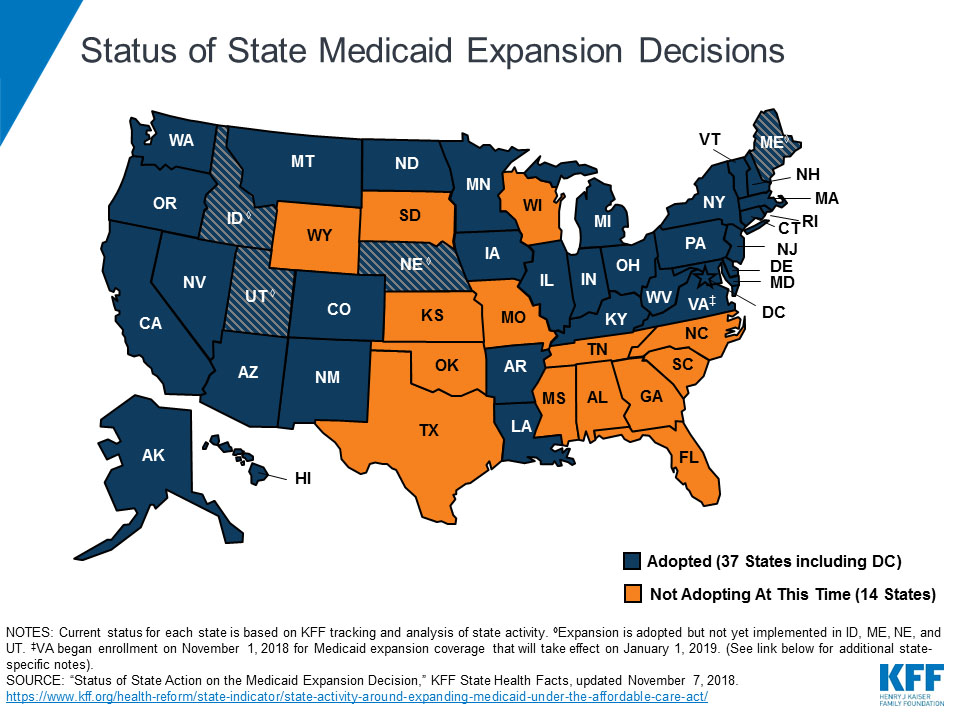
In Maine, Governor Paul LePage (R) vetoed legislation to expand Medicaid five times, but voters took the matter to the ballot in 2017 and won by a margin of nearly 2 to 1. Maine’s newly elected governor, Janet Mills (D), has vowed to implement expansion.
AFP had worked hard to oppose Medicaid expansion in Maine, where expansion means coverage for an additional 70,000 or 80,000 people, and its chapters in Utah, Nebraska, and Idaho conducted new opposition campaigns this year involving radio, digital media and mailings.
In Nebraska, Medicaid expansion will cover 86,000 additional people, while in Utah 170,000 people will gain coverage, along with 69,000 more in Idaho.
The Koch-backed State Policy Network (SPN) — a right-wing web of “think tanks” across the country — also provided support to AFP in these states by publishing numerous studies opposing Medicaid expansion.
The Maine Heritage Policy Center published a lengthy report titled, “Reject Medicaid Expansion,” which claimed that expansion is too costly for Maine and would not result in lives saved.
The Idaho Freedom Foundation published a piece on its website arguing that Medicaid expansion would be expensive and an insult to first settlers who never lamented “their lack of health insurance, healthcare, or insisting that the government provide it, or any other services, to them.”
Utah’s Sutherland Institute wrote on its website that expanding Medicaid would raise the sales tax and result in lower quality healthcare, and Nebraska’s Platte Institute for Economic Research argued that Medicaid expansion would result in cuts to K12 funding and higher property taxes.
Public Opinion Shifting
It is clear from the election results that public opinion has shifted against the Kochs’ “free market” approach to health care and steadfast opposition to government health regulations and benefits.
Pre-election polls showed that health care was the most important issue to voters in battleground states, and 55 percent of voters in non-expansion states said they wanted Medicaid expansion.
Not only did voters approve health care access ballot measures, they voted for governors who made expanding Medicaid coverage part of their platform.
In Wisconsin, Democrat Tony Evers defeated incumbent Republican Governor Scott Walker. Evers assured voters that he would accept federal dollars for expanding Medicaid and would protect those with pre-existing conditions.
In Kansas, Democrat Governor-elect Laura Kelly promised on the campaign trail to advocate for and sign a bill approving Medicaid expansion in her first year.
And in Maine, Democrats seized control from the Republicans in the governor’s mansion and the Senate after years of Governor LePage’s obstruction of reform.
In Florida and Georgia, where gubernatorial elections are still undecided, Democrats Stacey Abrams (GA) and Andrew Gillum (FL) made Medicaid expansion a major campaign issue.
==
==
Because the economy is doing well? This shameless president is quick to take credit for what is, according to Forbes magazine, “just a continuation from Obama’s presidency.” Job growth has been steady for the last eight years.
And try selling that booming economy to those who are working two and three and four jobs to scratch out a living, the 41 million Americans in poverty, a third of them kids—or to the more than half a million homeless. As Philip Alston,U.N. special rapporteur on extreme poverty, said in June, “In a rich country like the United States, the persistence of extreme poverty is a political choice made by those in power.”
Why would you vote to keep Trump unchecked? Because he and Republican candidates suddenly are promising that they’d never, cross their hearts, ever disallow people with pre-existing conditions from decent health care? That’s a lie; they’ve spent eight years trying to repeal the Affordable Care Act some seventy times and the Justice Department backs a Texas lawsuit that would overturn Obamacare’s protection of insurance for those with pre-existing conditions.
And lest we forget, should they hold onto their majorities in the House and Senate, the GOP leadership is openly talking about gutting Medicare, Medicaid and Social Security, the programs you’ve paid for throughout your working life. These reductions are to compensate for the trillion-dollar deficit they themselves created with their billions in beloved tax cuts for the rich. There’s even talk about cutting or eliminating the Federal minimum wage....
===
https://www.alternet.org/right-wing/donald-trump-and-republicans-work-every-day-destroy-social-security-medicare-and-medicaid
during..Trump’s campaign for president, he promised over and over again to protect Social Security, Medicare and Medicaid. Now, in the lead-up to the midterm elections, Trump is claiming to have kept that promise. Completely in character for a president who doesn’t let a day go by without lying, he recently falsely claimed, “We’re saving Social Security, the Democrats will destroy Social Security. We’re saving Medicare. The Dems, you look at what they’re doing. They want to destroy Medicare.”
It’s time to set the record straight. Far from keeping his word, Trump and his administration have spent every day since taking power working to destroy Social Security, Medicare and Medicaid.
Here are 10 of the Trump administration’s worst attacks on the American people’s Social Security, Medicare and Medicaid:
1. Trump nominated Congressman Mick Mulvaney to be the Office of Management and Budget (OMB) director. Mulvaney has a long history of working to destroy Social Security and Medicare. In 2011, he said, “We have to end Medicare as we know it.”
Every single Republican senator voted to confirm Mulvaney, while every Democrat voted against.
2. Trump nominated Tom Price to lead the Department of Health and Human Services, which oversees Medicare.Price has stated that “We will not rest until we make certain that government-run health care [e.g., Medicare] is ended” and decried “the federal government’s intrusion into medicine through Medicare.”
Every single Republican senator voted to confirm Price, while every Democrat present voted against. After less than a year on the job, Price was forced to resign in disgrace, and Trump replaced him with Alex Azar, a former pharmaceutical executive who tripled the price of insulin.
- As soon as Trump took office, the Republican Party’s top priority was to take health care away from tens of millions of Americans. If “Trumpcare” had become law, it would have cut $880 billion from Medicaid, creating a disaster for seniors who rely on Medicaid for long-term care. It would also have created a Medicare time bomb by starving the program of essential funding.
- Trump’s 2018 budget proposal sought cuts of $800 billion to Medicaid and Social Security Disability Insurance over 10 years. When OMB Director Mulvaney was asked if these cuts would lead to fewer people receiving their earned Social Security disability benefits, he replied, “I hope so.”
- Republicans passed a massive tax giveaway to billionaires and corporations, which they are now using as an excuse to demand cuts to Social Security, Medicare and Medicaid.
6. Nearly every House Republican voted for a so-called “Balanced Budget Amendment,” which would make it unconstitutional for Social Security to use its own $2.9 trillion trust fund to pay promised benefits. (Fortunately, the Amendment did not attain the two-thirds majority required for passage.)
- The Trump administration floated a proposal to eliminate the payroll tax, which would have served as a Trojan horse to undermine Social Security.
- Trump issued an executive order opening the door to the politicization of Administrative Law Judges, who are supposed to impartially resolve disputes between Social Security and Medicare beneficiaries and the people in government who run those programs.
- The Trump administration announced plans to get rid of a rule that allowed nursing home residents and their families, in facilities that accept Medicare or Medicaid funding, the right to take those facilities to court for alleged neglect, abuse or sexual assault.
10. The Trump administration began allowing states to impose work requirements on Medicaid beneficiaries.
This article was produced by the Independent Media Institute.
==
https://www.alternet.org/economy/pete-petersons-ghost
Peter G. “Pete” Peterson, the billionaire businessman and anti-government crusader, died last week at the age of 91. He leaves behind family and friends who will miss him, and a vast coterie of consultants and politicians who may miss his checks even more. They can take comfort from the words of Percy Bysshe Shelley: “He doth not sleep/he hath awakened from the dream of life …”
Peterson will be mourned by those who loved him. But that’s no reason to forget the harm he has done, especially since his family vows to continue his work. His son, speaking on behalf of the foundation Peterson created, says that “we will carry on his legacy with passion and pride.”
That legacy is marked by Pete Peterson’s long war against Social Security and Medicare, his austerity economics, and the false aura of objectivity Peterson used to promote his ideology.
Behind his carefully stage-managed veneer of bipartisanship (his team once tried to get me suspended from a publication for calling him right-wing), Peterson engaged in a decades-long war on the social contract. Programs like Social Security and Medicare were his immediate targets, but his ultimate goal was even broader: He wanted to extinguish the ideal of public goods, and put an end to the notion that certain social programs should be universal.
Peterson took conservative ideas and gave them an undeserved air of truth and neutrality. Politicians who embraced them were more likely to receive a steady flow of high-dollar contributions and gaining entrée to the right salons and alliances.
Thanks to Peterson, prominent journalists can make outlandish and inaccurate statements about “entitlement” programs, while still laying claim to journalistic objectivity. That’s no mean feat on Peterson’s part – although it becomes easier when you can spend nearly half a billion dollars in four years to promote your agenda, as Peterson did. (Peterson engaged in his crusade for decades; his total spending isn’t known.)
Peterson may be gone, but his ideology still holds sway in the corridors of political and media power.
Doing the Math
“The standard operating procedures of private equity—purchasing businesses, adding debt, minimizing taxes, cutting costs (and facilities and employment), extracting large fees—are just the sort of things to aggravate popular anger about finance.”Peterson was a corporate success at a young age, and then joined Richard Nixon’s Cabinet. But he became a billionaire as co-founder of the Blackstone Group, one of four firms that exemplify what The Economist calls “the barbarian establishment.” As that (hardly left-wing) publication writes:
Peterson promptly put his billions to work on a new mission: Cutting government programs, especially Medicare and Social Security, and reducing government deficits. (The fact that these moves would reduce the political incentive to tax billionaires is never mentioned in Peterson’s work.)
Peterson’s sleight-of-hand trick, and it was a brilliant one, was to present his opinions as neutral and objective truth. As the New York Times reported in 2011:
“If some consider him Cassandra and others Chicken Little, Mr. Peterson considers himself, in self-deprecating (and self-interested) terms, as a data-driven businessman who ‘simply did the math.’”
The Peterson team claims that its proposals would exclude the poor, but cuts are a slippery slope. Social Security benefits are already meager, and any reductions – including cuts to cost-of-living increases and increases in the eligibility age – will lead to added poverty. Here’s some real math: Medicare saves lives, and “greater spending per beneficiary is associated with significantly lower mortality rates.” So does Medicaid. Social Security lifts 22 million Americans out of poverty, including children and non-elderly adults.
And poverty kills.
Sleight of Hand
Deficits were Peterson’s obsession. But when it came to economics, Peterson did the arithmetic, not “the math.” His zero-sum approach to government budgets failed to recognize the wide range of policy choices that are open to governments or the ways that government spending can create economic growth.
In a 2010 Wall Street Journal op-ed, Peterson argued that “spending cuts must play a lead role in any solution to our long-term structural deficits.” That’s an ideological statement that can’t be found anywhere in “the math.” For revenue, Peterson’s go-to solution was a consumption tax that would disproportionately harm the middle class.
No cut is too cruel for the Peterson crowd. A Peterson-backed group praised the draconian spending cuts in Donald Trump’s budget proposal last year, writing, “The President deserves credit for setting a fiscal goal and working to meet it.”
But it chastised the Republican for failing to apply an equally heavy hand to Social Security and Medicare.
Testing Mean
The policy heart of the Peterson agenda is means testing: of Social Security, Medicare, and other vital government programs. The Concord Coalition, which Peterson co-founded, pioneered the idea of means-testing Social Security benefits and reducing them for anyone making $40,000 per year or more. The idea quickly spread to Medicare and other universal programs.
It sounds reasonable, at first. Why should rich people collect taxpayer-funded benefits? One answer – because it’s an insurance program – can be hard to convey, but is nevertheless important.
Voters forget that means-testing is a slippery slope. Once it’s applied to vital programs, it can be ratcheted down until most Americans are excluded from them. Should we means-test public high schools? Elementary schools?
Means-testing works for anti-poverty programs. But under social insurance programs like Social Security, everybody contributes and everyone is eligible for benefits (with limited exceptions).
For 50 years, both political parties favored these kinds of universal programs. Peterson changed that.
When people are debating means-testing, they’re not asking a more obvious question: If we’re so concerned about giving “free rides” to rich people, why don’t we just raise their taxes?
Supporting Cast
Peterson assembled an ensemble cast of characters to push his message. Ex-senator Alan Simpson became a key spokesman, primarily because he shared Peterson’s gift for making a heavily ideological agenda sound like blunt truth-telling. Erskine Bowles, David Walker, and a coterie of economic and policy consultants also filled the ranks.
Peterson recruited media figures, too, through his “Fiscal Summits” and other events. Prominent journalists were offered hosting and guest appearances at Peterson events (and were presumably paid for them) At least one received a board seat on a Peterson organization, while at the same time “objectively” covering Peterson-style initiatives. (I reported on Lesley Stahl’s conflict of interest in 2013.) Journalists were also given talking points to help them sound knowledgeable about fiscal policy.
Politicians of both parties embraced the Peterson agenda for years. Bill Clinton, who received Peterson funding on the road to the White House. turned the Democratic Party in a more Peterson-friendly fiscal direction. Clinton emphasized deficit reduction, privatization, and means-testing as president, while over-praising the skills of the private sector.
Reaching the Summit
...
==
https://www.alternet.org/news-amp-politics/us-no-country-older-men-and-women
https://www.alternet.org/deeply-immoral-values-todays-republican-leaders
tax voodoo
==
OMG
http://exiledonline.com/monster-koch-bust-charles-koch-used-social-security-to-lure-friedrich-von-hayek-to-america/
MONSTER KOCH BUST: CHARLES KOCH USED SOCIAL SECURITY TO LURE FRIEDRICH VON HAYEK TO AMERICA
“Ha-ha! Those suckers will believe anything! “
This article appeared in the October 17, 2011 edition of The Nation
There’s right-wing hypocrisy, and then there’s this: Charles Koch, billionaire patron of free-market libertarianism, privately championed the benefits of Social Security to Friedrich Hayek, the leading laissez-faire economist of the twentieth century. Koch even sent Hayek a government pamphlet to help him take advantage of America’s federal retirement insurance and healthcare programs.
This extraordinary correspondence regarding Social Security began in early June 1973, weeks after Koch was appointed president of the Institute for Humane Studies.Along with his brothers, Koch inherited his father’s privately held oil company in 1967, becoming one of the richest men in America. He used this fortune to help turn theIHS, then based in Menlo Park, California, into one of the world’s foremost libertarian think tanks. Soon after taking over as president, Koch invited Hayek to serve as the institute’s “distinguished senior scholar” in preparation for its first conference on Austrian economics, to be held in June 1974.
Hayek initially declined Koch’s offer. In a letter to IHS secretary Kenneth Templeton Jr., dated June 16, 1973, Hayek explains that he underwent gall bladder surgery in Austria earlier that year, which only heightened his fear of “the problems (and costs) of falling ill away from home.” (Thanks to waves of progressive reforms, postwar Austria had near universal healthcare and robust social insurance plans that Hayek would have been eligible for.)
IHS vice president George Pearson (who later became a top Koch Industries executive) responded three weeks later, conceding that it was all but impossible to arrange affordable private medical insurance for Hayek in the United States. However, thanks to research by Yale Brozen, a libertarian economist at the University of Chicago, Pearson happily reported that “social security was passed at the University of Chicago while you [Hayek] were there in 1951. You had an option of being in the program. If you so elected at that time, you may be entitled to coverage now.”
A few weeks later, the institute reported the good news: Professor Hayek had indeed opted into Social Security while he was teaching at Chicago and had paid into the program for ten years. He was eligible for benefits.
On August 10, 1973, Koch wrote a letter appealing to Hayek to accept a shorter stay at the IHS, hard-selling Hayek on Social Security’s retirement benefits, which Koch encouraged Hayek to draw on even outside America. He also assured Hayek that Medicare, which had been created in 1965 by the Social Security amendments as part of Lyndon Johnson’s Great Society programs, would cover his medical needs.
Koch writes: “You may be interested in the information that we uncovered on the insurance and other benefits that would be available to you in this country. Since you have paid into the United States Social Security Program for a full forty quarters, you are entitled to Social Security payments while living anywhere in the Free World. Also, at any time you are in the United States, you are automatically entitled to hospital coverage.”
Then, taking on the unlikely role of Social Security Administration customer service rep, Koch adds, “In order to be eligible for medical coverage you must apply during the registration period which is anytime from January 1 to March 31. For your further information, I am enclosing a pamphlet on Social Security.”
* * *
The private correspondence between two of the most important figures shaping the Republican Party’s economic policies—billionaire libertarian Charles Koch and Nobel Prize–winning economist Friedrich Hayek, godfather of today’s free-market movement—were obtained by Yasha Levine from the Hayek archives at the Hoover Institution at Stanford University. This is the first time the content of these letters has been reported on.
The documents offer a rare glimpse into how these two major free-market apostles privately felt about government assistance programs—revealing a shocking degree of cynicism and an unimaginable betrayal of the ideas they sold to the American public and the rest of the world.
Charles Koch and his brother, David, have waged a three-decade campaign to dismantle the American social safety net. At the center of their most recent push is the Koch-funded Americans for Prosperity, which has co-sponsored Tea Party events, spearheaded the war against healthcare reform and supported Wisconsin Governor Scott Walker’s attack on public sector unions. FreedomWorks, another conservative group central to the rise of the Tea Party and the right-wing attempt to dismantle Social Security and Medicare, emerged from an advocacy outfit founded by the Koch brothers called Citizens for a Sound Economy. FreedomWorks now exists as a separate entity that champions the “Austrian school” of economics.
Hayek, a founder of that school of thought, is primarily known for two major works. The first, The Road to Serfdom (1944), grudgingly accepts the possibility that some “free” countries might find it necessary to set up a bare-minimum catastrophic social insurance program limited to the very neediest, so long as the benefits do not incentivize productive members of society to abandon free-market retirement savings or medical insurance.
Hayek’s comparatively liberal attitude toward social insurance hardened considerably by the time he published his 1960 opus, The Constitution of Liberty. Despite privately spending the intervening years paying into Social Security, Hayek devoted an entire chapter—titled “Social Security”—to denouncing the modern welfare state as a gateway to tyranny and moral decay. Ironically, one of Hayek’s main objections to government programs like Social Security was the “fundamental absurdity” of using tax dollars to promote their benefits. In other words, Hayek publicly objected to the kind of brochure that Charles Koch sent him. In their private correspondence, however, we could find no objection to this “fundamental absurdity.”
By the mid-1970s, Hayek had fully distanced himself from the modest benefits he’d originally conceded to in The Road to Serfdom. In his preface to the 1976 edition, he explained his “error”: “I had not wholly freed myself from all the current interventionist superstitions, and in consequence still made various concessions which I now think unwarranted.”
Publicly, in academia and in politics, in the media and in propaganda, these two major figures—one the sponsor, the other the mandarin—have been pushing Americans to do away with Social Security and Medicare for our own good: we will become freer, richer, healthier and better people.
But the exchange between Koch and Hayek exposes the bad-faith nature of their public arguments. In private, Koch expresses confidence in Social Security’s ability to care for a clearly worried Hayek. He and his fellow IHS libertarians repeatedly assure Hayek that his government-funded coverage in the United States would be adequate for his medical needs.None of them—not Koch, Hayek or the other libertarians at the IHS—express anything remotely resembling shame or unease at such a betrayal of their public ideals and writings. Nowhere do they worry that by opting into and taking advantage of Social Security programs they might be hastening a socialist takeover of America. It’s simply a given that Social Security and Medicare work, and therefore should be used.
* * *
Shortly after this exchange, in 1974, Hayek won the Nobel Prize in economics. The next year he went on something of a victory tour of the United States, which ended at the IHS, where he spent the summer as a resident scholar. Hayek returned to Menlo Park again in the summer of 1977. The Nation has filed a Freedom of Information Request with the Social Security Administration to discover if, in fact, Hayek received Social Security payments or used Medicare during his residencies at the institute or at any other time. At press time, these requests have not been answered.
Meanwhile, in 1974, Charles Koch founded the Cato Institute (called the Charles Koch Foundation until 1977). This think tank has done more than any other to push for an end to Social Security. In 1983 the Cato Journalpublished a blueprint of how to destroy Social Security,“Achieving a ‘Leninist Strategy,’” by Stuart Butler and Peter Germanis. The authors acknowledged that a strong coalition of Americans backed Social Security and thus saw the need for “guerrilla warfare against both the current Social Security system and the coalition that supports it.” Victory could be far in the future, “but then, as Lenin well knew, to be a successful revolutionary, one must also be patient and consistently plan for real reform,” they write.
As part of Cato’s campaign, the institute has launched various groups and projects, including the Project on Social Security Choice, whose co-chair is José Piñera, architect of AugustoPinochet’s controversial pension privatization scheme in Chile. Cato Institute members and alumni also dominatedPresident George W. Bush’s commissionon Social Security in his first term and spearheaded Bush’s failed attempt to privatize the program in the early months of his second term.
Thanks in part to Hayek’s writings and to the Koch brothers’ decades-long war on the social safety net, Americans are among the Western world’s few citizens without universal healthcare. Not surprisingly, life expectancy here has fallen to forty-ninth place in the world, while medical costs are double those of other Western nations. By contrast, Hayek’s native Austria, which has a public health plan that covers 99 percent of the population, boasts a healthcare system ranked ninth in the world by the World Health Organization.
* * *
When Texas Governor Rick Perry, a front-runner in the Republican primary for president, derides Social Security as a “Ponzi scheme” or a “monstrous lie,” that rhetoric can be traced back to the work of Hayek and Koch. And yet we now know that in private practice, Hayek was perfectly content to pay into Social Security and that Koch encouraged him to draw upon both Social Security and Medicare. Did they really believe what they wrote? Or were these attacks just scare-talk meant for the rubes, for you and us, “the public”?
Calling this mere hypocrisy downplays the seriousness of their fraud. Koch and Hayek are no more hypocritical than the used-car salesman who knowingly sells a lemon to a gullible buyer, or the financial agency that rates “AAA” instruments it knows are crap. This is a grand swindle played on a trusting, gullible public, a scam whose goal is to con America’s dying middle class into handing over their retirement money to the richest 0.1 percent, convincing them that in doing so, they’re “empowering” themselves and protecting their “individual liberty.”
Another question hangs over all this: Why didn’t Charles Koch offer to put up some of his enormous wealth to pay for Hayek’s temporary medical insurance? One obvious answer: because the state had already offered a better and freer program. But perhaps Koch’s stinginess also reveals the social ethic behind libertarian values: every man for himself; selfishness is a virtue.
---
---
America's very rich keep trying to start a movement among college students to blame senior citizens for the sorry state of the economy that kids will inherit. Specifically, the billionaires keep trying to scapegoat Social Security.
This is part of the public relations effort to create a "grand bargain" to cut America's (fast-declining) budget deficit. The Peter G. Peterson Foundation has spent about a billion dollars of Peterson's own money to create faux movements to get students to take up this unlikely cause.
The latest of the billionaires to try this gambit is Stanley Druckenmiller, net worth estimated at $2.9 billion, former head of the hedge fund Duquesne Capital. Druckenmiller's personal campus crusade has been the subject of two fawning profiles, one by Tom Friedman in Wednesday's Times, the other by James Freeman in Saturday's Wall Street Journal.
Druckenmiller's campus crusade is based on such preposterous economics that I hereby challenge him to a college debate or series of debates. Freeman's puff piece in the *Journal* begins thus:
Stan Druckenmiller makes an unlikely class warrior. He's a member of the 1% -- make that the 0.001% -- one of the most successful money managers of all time, and 60 years old to boot. But lately he has been touring college campuses promoting a message of income redistribution you don't hear out of Washington. It's how federal entitlements like Medicare and Social Security are letting Mr. Druckenmiller's generation rip off all those doting Barack Obama voters in Generation X, Y and Z.
"I have been shocked at the reception. I had planned to only visit Bowdoin, " his alma mater in Maine, he says. But he has since been invited to multiple campuses, and even the kids at Stanford and Berkeley have welcomed his theme of generational theft.
The Tom Friedman column, titled, "Sorry, Kids. We Ate It All.," which I addressed in the American Prospect Thursday, Friedman wrote:
After we baby boomers get done retiring -- at a rate of 7,000 to 11,000 a day -- if current taxes and entitlement promises are not reformed, the cupboard will be largely bare for today's Facebook generation. But what are the chances of them getting out of Facebook and into their parents' faces -- and demanding not only that the wealthy do their part but that the next generation as a whole leaves something for this one? Too bad young people aren't paying attention. Or are they?
Wait! Who is that speaking to crowds of students at Berkeley, Stanford, Brown, U.S.C., Bowdoin, Notre Dame and N.Y.U. -- urging these "future seniors" to start a movement to protect their interests? That's Stan Druckenmiller, the legendary investor...
Where to start? If you itemize all the reasons why recent college graduates face a wretched economy, Social Security doesn't even make the list. What does make the list are unreliable jobs that pay lousy wages, the aftereffects of a financial bubble created on Wall Street, and unaffordable college that leaves graduates starting life with more than a trillion dollars worth of debt.
The next generation, and the one after that, will have a shot at a decent life if we can get growth and a fairer distribution of earnings back on track. That project has nothing whatever to do with Social Security or the federal deficit. On the contrary, if we keep on the austerity kick and further cut social outlays that promote opportunities, growth will be even slower.
The biggest lie in Druckenmiller's crusade is the premise that the income distribution problem is somehow generational and that he, as a billionaire, has anything whatever in common with most college students or most recipients of Social Security. One of his pitches to students is that Social Security is excessive because he, a very wealthy man, receives it but doesn't need it.
But for the vast majority of the elderly, Social Security is a lifeline, and a meager one at that. Some two-thirds of all seniors depend on Social Security for half of their income. Fully 46 percent of elderly widows and other unmarried seniors depend on Social Security for at least 90 percent of their income.
The entire projected 75-year shortfall in the Social Security trust funds that conservatives make such a big deal about is around one percent of GDP per year. We could make it up with modest tax increases on wealthy people like Druckenmiller.
Since Social Security is financed by payroll taxes -- on wage and salary income -- the real Social Security crisis is the crisis of stagnant wages. If average wages had continued to track average productivity growth during the past three decades, as they did in the three decades after World War II, Social Security would be in perpetual surplus.
The real crisis facing the elderly is not that Social Security is excessive but that it's inadequate -- especially with the collapse of traditional pensions in favor of far less reliable 401k plans (another counter-revolution made on Wall Street.)
There is a certain moral blindness and chutzpah of very wealthy people trying to enlist students in a generational movement against the alleged affluence of their grandparents. The real issue here is not generation, but class, specifically Druckenmiller's class.
Contrary to the claim in writer Freeman's opening sentence -- that Druckenmiller makes "an unlikely class warrior," his crusade is precisely class war, of the sort we have been seeing for decades -- of the very wealthy against everyone else.
Happily, most of America's students don't seem to be taking the bait. None of Pete Peterson's front groups has had much resonance on campus -- not his "Fiscal Wake-Up Tour," nor "Fix the Debt," nor more far-fetched groups aimed a college students such as "America's Promise Alliance," nor the foundation's poetry contest aimed at battling deficits in verse.
However, these crusades do have a certain resonance among media elites and even in the Obama White House. As we go into the next phase of a trumped up budget crisis, with Social Security and Medicare as targets A and B, the politics and economics could not be more perverse.
So how about it Mr. Druckenmiller? If you are so sure of the righteousness of your cause, how about defending yourself in a campus debate?
Robert Kuttner's new book is Debtors' Prison: The Politics of Austerity Versus Possibility. He is co-editor of The American Prospect and a senior Fellow at Demos.
==
==
Freshman Colorado Congressman Scott Tipton received an award recently for his work in support of senior citizens from a group called RetireSafe. Tipton was one of 20 Republicans elected to Congress from swing districts to have received the award, according to RollCall, but the award was fake, or at least the group that gave the award was fake. RetireSafe is an industry front group run by Republican and conservative politics figures and founded by Pharmaceutical Research and Manufacturers of America to push policies that will boost industry profits.
It’s the kind of revelation that has become commonplace in today’s political news, where industry and government figures exchange revolving seats, yet it still has the power to shock in its details.
“Local news reports and campaign advertisements trumpeted the awards…” RollCall writes, “providing these Republicans with valuable political cover for supporting controversial bills, such as the budget proposed by House Budget Chairman Paul Ryan (R-Wis.) that would have dramatically revamped Medicare.”
RetireSafe bills itself as a nonpartisan senior citizens advocacy organization, but it is led by former Bush and Reagan administration officials, small-government activists and pharmaceutical industry lobbyists and consultants. It is funded at least in part by the Pharmaceutical Research and Manufacturers of America, the drug industry’s chief lobbying group, and at times has served as a third-party entity to validate the industry’s agenda….
The award, which sounds a lot like an endorsement that could come from one of dozens of other seniors groups, can then be used as a credential on the campaign trail.
Matt Inzeo, communications director for the Colorado Democratic Party, said the story demonstrated that Republicans like Tipton will have a very hard time this year selling their service-slashing pro-industry priorities to constituents.
“While Scott Tipton stakes his political future on fake awards from front groups, Colorado seniors know he pushed a raw deal on them by trying to turn Medicare into a voucher program,” Inzeo wrote in an email. “Tipton can’t paper over the fact that he would hike seniors’ health care costs by over $6,000 a year, and this charade shows that lame attempts to hide the facts will quickly backfire.”
Tipton has made news in the short months since he took office for accusations of corruption and dirty tricks.
He was investigated by and apologized to a House ethics committee for pushing communication services through his offices for Broadnet, a company where his daughter worked as a lobbyist and where his nephew worked as CEO. More recently he was accused of packing his town meetings with Republicans and mining industry interests by sending out announcements of scheduled meetings to select email lists.
The RetireSafe seniors award shell game seemed to have worked on at least a small scale for Tipton, garnering a brief spot in the Grand Junction Daily Sentinel. The award presentation ceremony drew members of the Alzheimer’s Association and the Colorado Gerontological Society.
The Sentinel piece:
Tipton’s bill wins kudos from group
A Washington, D-C.-based organization that described itself as a watchdog for personal freedom and advocate for seniors on Social Security and Medicare recognized U.S. Rep. Scott Tipton, R-Colo., for sponsoring legislation to repeal a part of the new health care law.
Al Cors Jr., RetireSafe.org vice president, gave Tipton a plaque recognizing him for sponsoring legislation to repeal the Independent Payment Advisory Board, which has the task of reducing the growth of Medicare and is required to implement its first proposals in 2015.
RetireSafe.org, which says it represents more than 400,000 seniors, lists health, financial, national and personal security as a pyramid of goals supporting personal freedom.
Representatives of the Alzheimer’s Association and Colorado Gerontological Society attended the presentation.
According the Democratic Party Congressional Committee, the Alliance for Retired Americans on Friday alerted its members that RetireSafe was not to be trusted; it’s a “front group for the pharmaceutical industry” the group wrote in an email. AARP has issued a similar statement. Tipton could not be reached for comment.
==
- The Koch brothers want to destroy the most popular government program of all, Social Security, by funding right-wing think tanks that spread misinformation about Social Security's long-term financial health, claiming it will not survive. They want people to invest their retirement savings on Wall Street, which is riskier and would earn billions in fees for investment firms. They want to raise the retirement age for Social Security to 70, which would especially penalize blue-collar workers who do manual labor, as their bodies wear out more quickly than white-collar workers.
http://www.alternet.org/print/election-2014/11-things-koch-brothers-dont-want-you-know-robert-greenwalds-newly-updated-documentary
===
“Don’t retreat, instead reload!”
Much of the right-wing’s resurgence is due to its intense investment in technology and communications. Republicans, as well as right-wing conservatives, realized that their image could be salvaged if repackaged properly. And the most discussed post-2008 election concern was the advantage held by the Left in communication infrastructure. In a December 2008 reflection piece titled the “Roots of Defeat,” Republican consultant Patrick Ruffini wrote in the National Review that progressive news sites, like the Huffington Post and Talking Points Memo, were the constant purveyors of “attack memes” against the conservative movement and its candidates.Talking Points Memo had led the liberal blogosphere’s mobilization against President Bush’s attempt to privatize Social Security in 2005. In addition to its rapid news coverage, the web site posted the phone numbers of Democratic politicians who had indicated support for Bush’s proposal and encouraged readers to call. The groundswell of opposition from bloggers, then the general public, marked the first significant policy defeat for President Bush. As Ruffini noted, the defeat punctured Bush’s “aura of invincibility and presage[d] the death spiral to come.” ThinkProgress, where I began working in 2009, had helped expose much of disgraced lobbyist Jack Abramoff’s relationship with the Bush administration, and Talking Points Memo broke the story of the Bush Justice Department’s systematic political firings of U.S. Attorneys around the country. As the 2008 election unfolded, the McCain campaign’s positions and statements were instantly fact checked and scrutinized by leading progressive web sites. Ruffini observed that progressive blogs did actual research and reporting while most conservative bloggers were “generally commentators and not reporters.” He also noted that the Right lacked many of the technological innovations employed by Barack Obama’s campaign, and, more important, lacked a powerful online megaphone for its ideological goals.
As conservative writer Ross Douthat noted in a post-election interview about the future of conservatism, the Internet also served as a vital organizing platform for progressives.DailyKos, Douthat said, was one of the main sources of “left-wing populist anger against the excesses of the Bush Administration.” The DailyKos system allows the public, after registering, to post blog entries, which are either selected by moderators or voted up to the “Recommended” list by other users. Other organizations, from MoveOn to Democracy for America to the message board Democratic Underground, had helped feed the surge in leftist populism through the Internet by providing opportunities for like-minded people to find each other instantly.