dissent
8 22 belated/ redumbent? this for good and bad
neglected
merri ok
immunity 6-3 sotoMAYOR kbj
NOTE WOMEN POC
---
---
---
---
===
---
---
---
KBJ REAMED CLARENCE ON 14TH BIRTHRIGHT 6 26
---
(AP) — The Supreme Court on Tuesday erased limits on how much political parties can spend in coordination with candidates for Congress and president, striking down a federal election law that is more than 50 years old.
Prodded by a Republican-led lawsuit that includes Vice President JD Vance, the court’s six conservative justices were again in the majority of the latest decision that upended congressionally enacted limits on raising and spending money to influence elections. The court’s 2010 Citizens United decision opened the door to unlimited independent spending in federal elections.
The limits on party spending stem from a desire to prevent large donors from skirting caps on individual contributions to a candidate by directing unlimited sums to the party, with the understanding that the money will be spent on behalf of the candidate.
The Supreme Court had previously upheld the limits, in 2001.
But Justice Brett Kavanaugh, writing for the court, said that decision was wrong and should be overruled. “In short, constitutional text, history and precedent establish that the political-party coordinated-expenditure limits violate the First Amendment,” Kavanaugh wrote.
Justice Elena Kagan’s dissent for the three liberal justices said the court “ushers in untold harm” by enabling parties to funnel large contributions to individual candidates, far in excess of what donors can give those candidates directly.
National parties now will be able to make direct contributions to candidates’ campaigns,
The decision is likely to give Republicans at least a short-term boost because they maintain a sizable cash advantage over Democrats.
The Republican National Committee and its Senate and House campaign fundraising arms have dwarfed Democrats’ in the months before congressional elections where the GOP is defending narrow majorities in both houses.
At the end of May, the RNC reported having more than $125 million to spend, its highest-ever cash on hand total, according to its most recent Federal Election Commission filing in May. Meanwhile, the National Republican Senatorial Committee had more than $48 million on hand in its most recent report and the National Republican Congressional Committee had more than $81 million.
In the same period, the Democratic National Committee had $14.4 million on hand, while the Democratic Senatorial Campaign Committee had roughly $37 million and the Democratic Congressional Campaign Committee, roughly $73 million.
The Republican committees for House and Senate candidates filed the lawsuit in Ohio in 2022, joined by Vance, then a senator from Ohio, and then-Rep. Steve Chabot.
After President Donald Trump took office for his second term, the Federal Election Commission dropped its defense of the law and joined with Republicans in urging that it be overturned.
Democrats had called on the court to uphold the law, even though there is wide agreement that the spending limits have hurt political parties in an era of unlimited spending by other organizations.
Last year, the coordinated party spending for Senate races ranged from $127,200 in several states with small populations to nearly $4 million in California, the most populous state. For House races, the limits were $127,200 in states with only one representative and $63,600 everywhere else.
Entrenched divisions between liberal and conservative justices over campaign finance restrictions were on display when the court heard arguments in December.
“Every time we interfere with the congressional design, we make matters worse,” said Justice Sonia Sotomayor, a dissenter in Citizens United and the court’s other campaign money cases.
By contrast, Justice Samuel Alito, a member of the Citizens United majority, described the decision as “much maligned, I think unfairly maligned.” The effect of the decision was to ”level the playing field,” Alito said, by expanding the right to spend freely that had previously belonged only to media companies.
Associated Press writer Thomas Beaumont contributed to this report.
---
---
AN 4 26
The U.S. Supreme Court, “nine angry men and women in black robes,” according to Philadelphia Inquirer columnist Will Bunch, has gone “off the rails,” and is now “at war with itself.”
“Almost every day, there are new signs — from shocking news leaks to surprisingly indecorous public jabs, and legal opinions that read like cries for help — that the U.S. Supreme Court is at war … with itself,” Bunch argues. “Looming large over this soft civil war inside one of America’s three branches of government is our most fundamental liberty, the right to vote.”
Pointing to President Donald Trump’s war in Iran, amid its “shaky” ceasefire and “the daily unraveling” of the White House, “the biggest bombshell wasn’t dropped in the Persian Gulf but in the pages of the New York Times.”
Bunch is referring to the widely-cited scoop from the Times‘ Jodi Kantor and Adam Liptak, that reveals the extreme steps Chief Justice John Roberts took to block President Barack Obama’s Clean Power Plan — and expand the powers of the Court via the “shadow docket.”
“For more than a decade now, these emergency rulings have largely constrained Democratic presidents and boosted the power of Donald Trump on major issues,” Bunch writes.
He notes that the Times published a batch of five justices’ secret memos, including those from Roberts, that “exposed the hypocrisy” of the Chief Justice, “who has argued during his two decades overseeing the court that its justices are not political actors but impartial umpires ‘calling balls and strikes,’ based on sound interpretation of the law.”
Bunch states these memos “reveal Roberts as less an umpire and more the manager of a team desperate to win the World Series for corporate America.”
The leaking of the memos, which, to many, cast Roberts in a negative light, “is just the latest in a series of news leaks and public statements coming from the Supreme Court that lack any precedent, legal or otherwise.”
Bunch says the court had already been facing a “crisis of credibility,” given the “revelations of alleged corruption” swirling about Justice Clarence Thomas, and the “billion-dollar efforts by wealthy conservatives to shape and then lobby the court.”
The Times’ report was far from the first leak.
In 2022 came the “Mother of All Leaks” — the draft opinion that would ultimately overturn 1970s’ landmark ruling, Roe v. Wade.
The leaker was never discovered, but “there’s been much speculation that it came from the conservative wing hoping the news coverage would prevent last-minute defections.”
Meanwhile, since the Court’s 2024 decision granting President Donald Trump and all presidents sweeping immunity from criminal prosecution for “official acts,” Bunch writes, “there has been even less decorum and more overt verbal warfare.”
Sometimes, justices publish their snipings inside their opinions, “as when Justice Sonia Sotomayor wrote in response to that ruling on presidential power that POTUS is now ‘a king above the law,’ signing off ‘with fear for our democracy.'”
Bunch says an even more “shocking” event occurred when Sotomayor “lashed out” at Justice Brett Kavanaugh, when she commented that one of his opinions had come from “a man whose parents were professionals. And probably doesn’t really know any person who works by the hour.”
She quickly apologized.
Like the 2022 leak, no one has publicly stated who leaked the secret memos to The New York Times.
But, Bunch surmises, someone “very high in the judicial pyramid is trying to send a ‘bat signal’ to the American public — that things at the nation’s highest court have gone off the rails.”
---
---
AN 3 26
On Monday, March 23 in the case Villarreal v. Alaniz, the U.S. Supreme Court rejected an appeal from Laredo, Texas-based journalist Priscilla Villarreal — who believes she was wrongly arrested while doing her work. Villarreal argued that the arrest was a First Amendment violation, but most of the High Court's justices disagreed with her appeal and declined to take the case.
Liberal Justice Sonia Sotomayor, however, offered a vehement dissent in the decision, agreeing with Villarreal (who goes by La Gordiloca online) that journalism was being treated like a crime.
In a newletter published by Slate on March 26, journalist Shirin Ali emphasizes that the High Court's Villarreal v. Alaniz decision and Sotomayor's dissent come at a time when journalism is under attack from the second Trump Administration.
"This week," Ali argues, "the Supreme Court effectively shielded the nation's law enforcement from consequences when it treats journalism as a crime. In rejecting an appeal in Villarreal v. Alaniz, the Court has allowed local officials in Texas to remain immune from prosecution for arresting a journalist who published information she received from a government official. This case presented a strikingly simple question: Does it violate a journalist's First Amendment rights if they are arrested for requesting and publishing information that a government employee willingly hands over?.... The case of Villarreal v. Alaniz has been ping-ponging through the courts since 2019, when it was first filed by Priscilla Villarreal….. Things took a sharp turn for her in 2017, when she was arrested at her home for allegedly violating section 39.06(c) of the Texas Penal Code."
Ali adds, "The obscure law bans a person from soliciting or receiving nonpublic information from a public servant by means of their office or employment with the intent to obtain a benefit."
The Slate reporter notes that although a judge dismissed the charges against Villareal and criticized the Texas law for being too vague, Villareal "fought back with a lawsuit demanding damages."
In her dissent, Sotomayor laid out her arguments in favor of Villareal's position.
The Barack Obama appointee wrote, "It should be obvious that this arrest violated the First Amendment….. By arresting Villarreal, rather than solely disciplining the employee for any wrongdoing, county officials took this 'everyday journalism' and transformed it 'into a crime.' This was a blatant First Amendment violation. No reasonable officer would have thought that he could have arrested Villarreal, consistent with the Constitution, for asking the questions she asked."
The High Court's March 23 decision, Ali argues, is especially bad in light of the Trump Administration's attacks on the First Amendment.
"As we collectively watch Trump's second presidency play out, when he has weaponized every tool at the executive's disposal to attack speech he does not like —Washington Post reporter Hannah Natanson, late night host Jimmy Kimmel, and a slew of major national news organizations come to mind — the Supreme Court's lack of action threatens all Americans," Ali writes. "Journalists have a singular ability to hold the Trump Administration and local governments all across the country accountable, through shedding light on what they are doing and how they are wielding their power. Criminalizing this work without consequence doesn't just endanger those journalists; it threatens everyday Americans who rely on local and national reporting in nearly all aspects of their lives."
---
---
AN 1 26
In its 6-3 ruling in *Vasquez Perdomo v. Noem* handed down on Monday, September 8, the U.S. Supreme Court upheld the way in which the Trump Administration is conducting U.S. Immigration and Customs Enforcement (ICE) raids. A federal court judge in Los Angeles and the 9th Circuit Court of Appeals had ruled that the raids amounted to illegal racial profiling, but the High Court's six GOP-appointed justices disagreed. The three dissenters, meanwhile, were Democratic appointees: Justices Sonia Sotomayor, Ketanji Brown Jackson and Elena Kagan.
:{:{Critics of the Vasquez Perdomo v. Noem ruling range from the American Immigration Council to the America Civil Liberties Union (ACLU) to MSNBC host Ali Velshi, who described the decision as anti-4th Amendment during a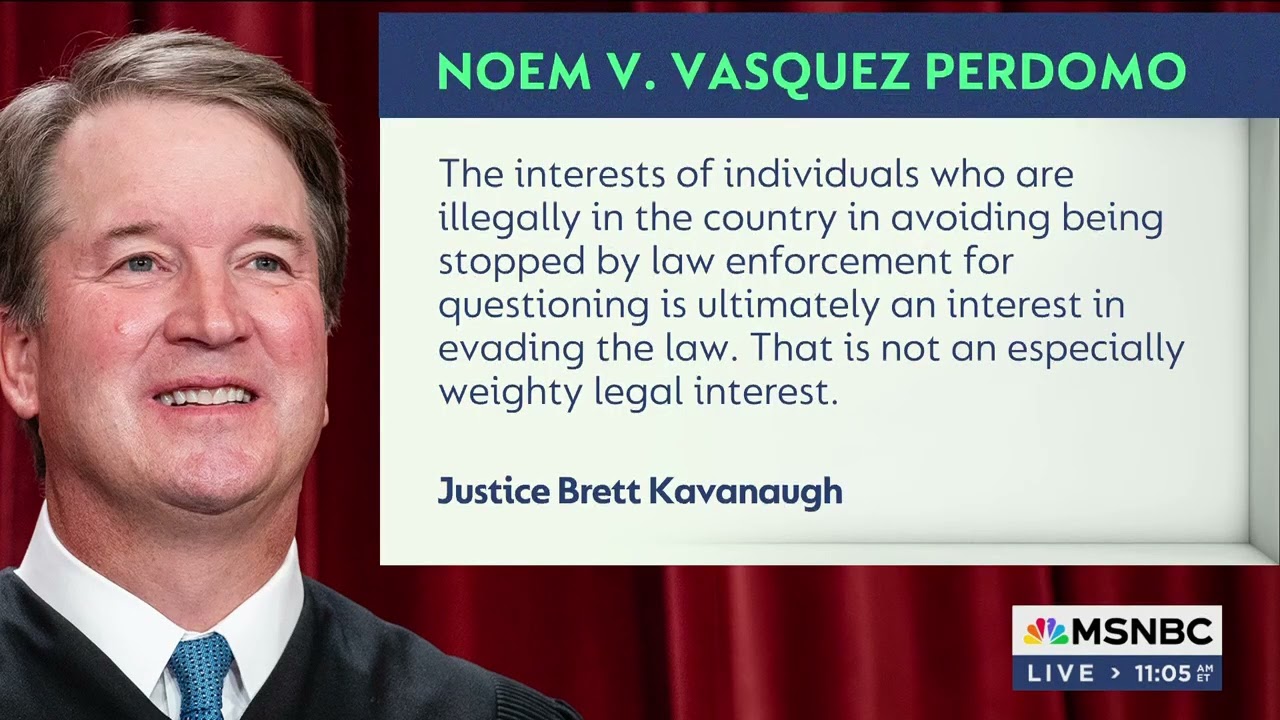 }:
The decision's implications, Velshi warned, go way beyond immigration policy and ICE raids and treat the U.S. Constitution's 4th Amendment as expendable. Ratified in 1791 as part of the Bill of Rights, the 4th Amendment protects against unreasonable search and seizure.
READ MORE:'Doing a pretty terrible job': Trump official mocked over response to dismal economic data
"ICE agents now have the High Court's blessing to racially profile people during immigration sweeps in Los Angeles," Velshi warned. "They're allowed to stop people based solely on their apparent race or ethnicity, language or accent, the type of work they do, where they do it. The 4th Amendment requires reasonable suspicion before anyone, any person, citizen or not, documented or not, can be stopped by law enforcement. The law is not allowed to just guess at that — that because of how you look or speak, or where you live and work, that you might have committed a crime."
Velshi continues, "Equal protection forbids race as a factor. The lower courts enforced that principle; the Supreme Court just erased it. And perhaps the most outrageous part: the conservative majority in the Supreme Court issued their decision using the so-called shadow docket, where the Court rules on Trump Administration emergency motions without oral arguments or explanation — no hearing, no accountability, just judicial fiat handed down in the dark."
However, the MSNBC host, who is originally from Canada, stressed that "this ruling isn't about immigration" and has "broader implications."
"It tells millions of Americans that your protection from unreasonable search and seizure depends on whether the government decides you look like you belong, which is not what the Constitution's Framers envisioned, I hope — certainly not democracy as we have come to know it in this country," Velshi told viewers. "Consider Brian Gavidia, a U.S. citizen from East Los Angeles — who voted for (Donald) Trump, by the way…. He says federal agents shoved him against a fence, twisted his arm, and demanded to know which hospital he was born in. All because he looked Latino. This is the new normal that the Court has sanctioned."
READ MORE:'Republican for Trump': Alleged Kirk shooter's grandmother confirms entire family is MAGA
Velshi attacked Justice Brett Kavanaugh's reasoning in Vasquez Perdomo v. Noem as "hollow," stressing, "Rights are not conditional favors granted after innocence is proven — they are the shield against arbitrary suspicion in the first place. Kavanaugh's distorted logic seems to suggest that if you're brown, you're guilty of an immigration violation until you're proven innocent…. That's not just sloppy logic, it's dangerous….. It's not that the conservative justices don't understand the Constitution; it's that they don't care…. Once the 4th Amendment is treated as negotiable for one group — Latino communities, brown people, in this case — it becomes weaker for all of us."
---
---
AN 1 26
U.S. Supreme Court Justice Ketanji Brown Jackson wrote a dissent in a case involving mail-in ballots where she needled her conservative colleague, Justice Brett Kavanaugh.
Last year, Kavanaugh penned an opinion giving more leeway to immigration agents by claiming that they rarely take American citizens into custody, and if by mistake one is taken, they're released very quickly.
Slate legal reporter and analyst Mark Joseph Stern noticed that in Bost v. Illinois State Board of Elections, Jackson added an interesting citation in footnote eight.
"Contemporary commentators predicted that our decision in Lyons would close the door to 'a broad range of analogous lawsuits' aimed at systemic misconduct and abuse on the part of law enforcement," Jackson wrote, referencing the necessary information. "That prediction proved accurate. Today, courts routinely rely on Lyons to deny plaintiffs standing to seek injunctions against future police behavior. See, e.g., J. W. ex rel. Tammy Williams v. Birmingham Bd. of Educ., 904 F. 3d 1248, 1267 (CA11 2018) (per curiam); Shain v. Ellison, 356 F. 3d 211, 216 (CA2 2004); Whitfield v. Ridgeland, 876 F. Supp. 2d 779, 787– 788 (SD Miss. 2012)."
The final citation she mentioned was the direct attack.
"See also Noem v. Vasquez Perdomo, 606 U. S. _, _ (2025) (KAVANAUGH, J., concurring) (slip op., at 4) (concluding that, under Lyons, Latino plaintiffs who were 'stopped for immigration questioning allegedly without reasonable suspicion of unlawful presence' lacked standing to seek an injunction)."
"She isn't letting this one go," commented Stern.
"I’m trading this now and it’s making my day better," The Nation's legal analyst Elie Mystal added on BlueSky.
---
---
CONTEXT
AN 1 26
An extensive new study from a team of Ivy League economists has uncovered just how much the Supreme Court has shifted towards favoring the wealthier side in any given case, with a New York Times report concludingreport concluding that you can "follow the money" to determine how it will in any given case.
The new study, dubbed "Ruling for the Rich," was published on Monday and hailed from the team of Yale's Fiona Scott Morton, Columbia's Andrea Prat and Columbia's Jacob Spitz. Adam Liptak, the leading Supreme Court correspondent for the Times, dug into its findings, noting that "the wealthy have the wind at their backs before the justices," and questioning whether or not they are living up to their oath to "do equal right to the poor and to the rich."
Per Liptak's analysis, the study found that Republican appointees, who have held a 6-3 majority on the Supreme Court since 2020 and an overall majority for much longer, are "far more likely than Democratic ones to side with the wealthy," and adding "that the Supreme Court has become deeply polarized in cases pitting the rich against the poor." This is now in sharp contrast to the court of the mid-20th Century, "when appointees of the two parties were statistically indistinguishable" in terms of favoring wealthier parties.
Specifically, the study found that Republican-appointed justices sided with wealthier parties in cases around 70 percent of the time. By comparison, in 1953, conservative justices sided with them only 45 percent of the time.
Speaking with Liptak about the findings, Adam Cohen, author of the book "Supreme Inequality," noted that the study essentially reiterated ideas about the court's conduct that "some of us have been observing for a long time."
“But it is great to see,” Cohen added. “Respected academics crunching the numbers and producing the data to show that this is exactly what has been going on.”
These findings come as leaders in both political parties are ramping up plans to radically alter their campaign finance plans ahead of an upcoming decision, in which the court is widely expected to lift the limits on how much party committees and campaigns are allowed to coordinate with each other. This, experts argue, would hand even more power to the wealthiest donors and further erode the power of small-dollar donors.
---
---
VOTER SUPPRESS
AN 1 26
NO LNX
Inside the GOP plot to end America as we know it
Thom Hartmann January 05, 2026
It’s not just a brand new year; it’s a midterm election year. And the stakes this coming November are mind-boggling, so, of course, Republicans are starting to do everything they can to rig the election.
Just a week ago, for example, Trump’s Postal Service changed the rules about getting your mail-in ballot postmarked so it’ll be counted. Instead of postmarking letters when they’re received, Post Offices will now postmark them when they get “processed,” which may happen days later.
In the 2024 presidential election, the feds estimated that around 104,000 mail-in ballots nationwide weren’t counted because they were postmarked late; with this change, the number this fall and for 2028 could be in the millions.
Meanwhile, Republican secretaries of state are enthusiastically purging voters from the rolls as they get ready for this fall. Remember, reporter and economist Greg Palast found, using official federal and state numbers, that in 2024:
Kamala Harris“Trump lost. That is, if all legal voters were allowed to vote, if all legal ballots were counted, Trump would have lost the states of Wisconsin, Michigan, Pennsylvania and Georgia. Vice-President would have won the Presidency with 286 electoral votes.“And, if not for the mass purge of voters of color, if not for the mass disqualification of provisional and mail-in ballots, if not for the new mass “vigilante” challenges in swing states, Harris would have gained at least another 3,565,000 votes, topping Trump’s official popular vote tally by 1.2 million.”
You’d think we each have a right to vote, rather than voting being just a privilege that Republican-controlled states could take away in dozens of different ways.
Supreme Court Republicans on the ruled, for example, that we have a right to own a gun. As a result, before a state or local government can take away your gun, they must first go before a judge to prove the necessity of doing so.
But, Republicans on the Court tell us, Republican secretaries of state can eliminate your right to vote without even telling you; how does that make sense?
14th Amendment After all, the to the Constitution references “the right to vote at any election” and even says that any state that violates that right shall lose members of its congressional delegation as punishment.
The 19th Amendment references “The right of citizens of the United States to vote…”
The 24th Amendment starts, “The right of citizens of the United States to vote…”
The 26th Amendment is all about, “The right of citizens of the United States, who are eighteen years of age or older, to vote…”
ConstitutionAdditionally, the , in Article I, Section 4, says that Congress can make federal laws that overrule state laws restricting or regulating voting:
“The Times, Places and Manner of holding Elections for Senators and Representatives, shall be prescribed in each State by the Legislature thereof; but the Congress may at any time by Law make or alter such Regulations…”
And, sure enough, Congress did just that in 1993 when it passed the National Voter Registration Act (NVRA), sometimes referred to as the Motor Voter Act because, among other things, it provided for the option of instant voter registration when a person gets a driver’s license in every state in the union.
Now known as 52 U.S. Code § 20501, this law of the land opens with:
The Congress finds that -(1) the right of citizens of the United States to vote is a fundamental right
(2) it is the duty of the Federal, State, and local governments to promote the exercise of that right and
(3) discriminatory and unfair registration laws and procedures can have a direct and damaging effect on voter participation in elections for Federal office and disproportionately harm voter participation by various groups, including racial minorities.
And it wasn’t a particularly contentious law when it was passed: every Democrat present in the Senate voted for it (Rockefeller missed the vote) as did all but two Republicans.
So how did we get from the Constitution repeatedly asserting a “right to vote” and Congress passing a law that unambiguously proclaims that right, to the current state of affairs where states regularly and methodically deprive citizens of their “right” to vote and instead claim that it’s merely a privilege?
As I lay out in The Hidden History of the War On Voting, much of the blame rests with the most conservative and regressive of our federal institutions, the Supreme Court.
The first real test of the NVRA came in 2018, when Ohio’s Republican Secretary of State, John Husted, went on a voter-purge binge (that hit Black, student, and elderly neighborhoods particularly hard) and was sued by the A. Phillip Randolph Institute for violating Ohio citizens’ constitutional right to vote.
In a bitter 5-4 decision, the Republican majority ruled in Husted v Randolph that purging voters because they failed to return a junk-mail-like postcard was entirely legal.
It’s a practice that was called “caging” back when Karl Rove’s guy was allegedly doing it and it was illegal then but has, since that Court ruling, spread to pretty much every Republican-controlled state in the nation.
They’ll identify a part of the state that they consider particularly “prone to fraud“ — in other words, filled with a lot of Black and brown people — and mail postcards that look like junk mail into those precincts. When people failed to return them, they are automatically removed from the voting rolls. In most cases they don’t even know they’ve been purged until they show up to vote and are turned away.
Justice Samuel Alito’s decision was particularly biting, claiming that the arguments made by the citizens who’d lost their right to vote were “worse than superfluous” and their argument that they shouldn’t have to regularly check in with the Secretary of State’s office to stay on the voter rolls represented logic “no sensible person” could agree with.
Sensible or not, in his dissent, liberal Justice Stephen Breyer pointed out that around 4 percent of Americans move every year. Yet, he wrote:
“The record shows that in 2012 Ohio identified about 1.5 million registered voters — nearly 20 percent of its 8 million registered voters — as likely ineligible to remain on the federal voter roll....”
Justice Sonia Sotomayor’s dissent was even more scathing.
“Congress enacted the NVRA against the backdrop of substantial efforts by States to disenfranchise low-income and minority voters,” she wrote, “including programs that purged eligible voters from registration lists because they failed to vote in prior elections.“The Court errs in ignoring this history and distorting the statutory text to arrive at a conclusion that not only is contrary to the plain language of the NVRA but also contradicts the essential purposes of the statute, ultimately sanctioning the very purging that Congress expressly sought to protect against.”
She then quoted the “right to vote” NVRA preamble noted above, and, essentially, accused the conservatives on the Court of helping Republicans in the states they controlled engage in massive racial and economic discrimination in the voting process.
“[This decision] entirely ignores the history of voter suppression against which the NVRA was enacted and upholds a program that appears to further the very disenfranchisement of minority and low-income voters that Congress set out to eradicate. … Our democracy rests on the ability of all individuals, regardless of race, income, or status, to exercise their right to vote.”
The “right to vote” took another hit when the State of Florida’s Supreme Court ordered a recount of the 2000 presidential election but five Republicans on the US Supreme Court ignored the 10th Amendment (“states’ rights”) and stopped the recount.
That was a good thing for George W. Bush because when the Florida vote was later recounted by a consortium of newspapers including the New York Times and the Washington Post, they found, as the Times noted on Nov. 12, 2001:
“If all the ballots had been reviewed under any of seven single standards and combined with the results of an examination of overvotes, Mr. Gore would have won...”
Nonetheless, Chief Justice William Rehnquist dismissed all the nation’s concerns about the Court flipping the 2000 presidential election in that totally partisan 5-4 decision, writing in his opinion:
“[T]he individual citizen has no federal constitutional right to vote for electors for the President of the United States.”
Which casts us in a pretty terrible light. As Rep. Jamie Raskin (D-MD) points out:
“The constitutions of at least 135 nations — including our fellow North American countries, Canada and Mexico — explicitly guarantee citizens the right to vote…”
Instead, Raskin notes, because of five corrupt Republicans on the US Supreme Court we’re in the company of countries like Azerbaijan, Chechnya, Indonesia, Iran, Libya, and Pakistan.
Republicans are pushing a full-blown authoritarian agenda and they know it’s so unpopular that the only way they can get it through is to suppress the vote and thus rig the system.
That’s why they’ve already successfully passed previously-unthinkable major voter suppression laws in 18 states and have them pending in many more. They’ve changed the law in Georgia and several other states so that they can now throw out the votes from entire neighborhoods or cities where they don’t like the outcome; all they have to do is vaguely assert a “suspicion of fraud.”
Between the massive gerrymandering effort the GOP has launched nationwide and the Post Office’s changes that’ll hit Blue states with high levels of mail-in voting (some only have mail-in voting), the next few elections are going to be a real challenge for Democrats.
Additionally, as you’re reading these words, millions of voters are being purged from the rolls in Red states, particularly in Blue cities with significant minority populations.
As a result, this fall we’re going to have to show up in absolutely overwhelming numbers just to get squeaker victories in these now-heavily-rigged Republican-controlled states.
Unless enough of us stand up, speak up, and get active to regain control of Congress this fall and push legislation protecting American voters, Republicans will continue to eviscerate the voting right they’ve now turned into a privilege until it becomes completely meaningless.
And that will signal the end of America as we know it.
---
===
omg 6 25 an neutered judic on natl injunction
dissent soto and kbj
What the Supreme Court did was far more dangerous than ending birthright citizenship
---
---
AN 12 25
On Monday morning, December 8, the U.S. Supreme Court listened to oral arguments in Trump v. Slaughter — a case dealing with President Donald Trump's ability, under the U.S. Constitution, to fire employees of independent government agencies.
Trump and his allies, in the case, are promoting a far-right legal doctrine known as the Unitary Executive Theory — which claims that presidents have total control over who can be fired in the federal government. But opponents of the Unitary Executive Theory vehemently disagree, arguing that Congress has the ability to create agencies that are independent from a president's executive powers. One of those opponents is Rebecca Slaughter, who is arguing that Trump had no right to fire her from the Federal Trade Commission (FTC) because of the independence she enjoyed.
During the December 8 hearing, Solicitor General John Sauer was aggressively grilled by the High Court's three Democratic appointees: Justices Elena Kagan, Sonia Sotomayor and Ketanji Brown Jackson. And MS NOW's Lisa Rubin offered, emphasizing that Kagan was essentially accusing Trump of trying to carry out an "enormous power grab." VID]
Rubin told Cabrera, "This concept of a unitary executive…. has gained currency among political conservatives," adding, "Certainly, it's not a legally conservative theory because it is a gigantic enlargement of executive power. That's not how legal conservatives have traditionally thought, but that is what's going on here."
According to Rubin, the "liberal justices" are "playing out the consequences of the logic being employed by the (Trump) Administration, which is (that) this isn't just about the FTC."
Rubin told Cabrera, "I want to read to you something that Justice Kagan said in her discussion with the solicitor general, John Sauer, because I thought it got to the heart of what this is really about…. The idea was that the president was supposed to do the executing, but he wasn't supposed to do the legislating…. In other words, in Justice Kagan's view, this is a power grab by the president… That, according to Justice Kagan and the other liberals on the Court, is an enormous power grab with real consequences for our country."
Georgetown University law professor Paul Butler, also on the panel, predicted that the High Court's GOP-appointed justices will "almost certainly" rule in Trump's favor and "say the president has the authority to fire the FTC commissioner."
"This outcome is virtually certain," Butler told Cabrera and Rubin — who agreed with him that the outcome in Trump v. Slaughter is a "fait accompli" and that the GOP-appointed supermajority will reject the arguments of Kagan, Sotomayor and Jackson."
---
===
July 01, 2024
US Supreme Court lawyer and legal analyst Neal Katyal, speaking with MSNBC's Katie Phang on Monday,expressed fear that he suspects "there's something really dangerous" happening to the rule of law in the United States.
Phang noted how "stunned" legal experts were when Trump lawyer John Saul, during oral arguments in April, suggested that a president should be able to assassinate political opponents.
"Now the majority's saying that if the president says it falls within the purview of his official acts, does he now legally and officially say, 'I can commit murder?'" Phang asked Katyal.
READ MORE:'Crowned Trump king': Experts warn SCOTUS immunity decision 'death knell for democracy'
"It's unfathomable that the Supreme Court which has been such an august body, Chief justice John Marshall, Justice Thurgood Marshall — people like that — are issuing a decision like this," the Supreme Court lawyer replied, "that allows for such things — as calling them official acts. And that's why I think you saw Justice Sotomayor [write], 'With fear for our democracy, I dissent.'"
Katyal continued, "And I can tell you, I've never seen language like this in a Supreme Court opinion or dissent. There is something really dangerous going on here, and something that is really threatening the entire basis of our constitution and separation of powers."
"My parents came to this country from another because of the principle that no one was above the law," the MSNBC legal analyst emphasized. "That's what we hold out as most dear. And now to have a Supreme Court opinion that blesses, to be sure, 100%, it blesses the president pressuring his justice department to falsely say that there were election irregularities. They say that's an official act."
"Once you go down that road, the pressure on presidents to do all sorts of untoward things is immense," the legal expert emphasized. Fortunately, for 200 years, we've elected people — Republicans and Democrats alike — who've colored within those lines. But I fear that the next one may not be so solicitous of our constitutional values and norms."
READ MORE:Watergate lawyer: Nixon 'would have walked' under 'radical SCOTUS ruling'
Watch the video below or at this link.
---
===
an 7 24
chief Justice John Roberts and his right-wing colleagues on the Supreme Court are projecting their own insecurities and "hurt feelings" onto women who are calling out their flawed and dangerous rulings, wrote Dahlia Lithwick in a scorching analysis for Slate.
This comes after Roberts concluded the court's term with a ruling that gives former President Donald Trump a presumption of absolute immunity for "official acts," without clearly defining what those acts are.
And, in his majority opinion, he put down Justice Sonia Sotomayor's furious dissent as sounding "a tone of chilling doom" — a dismissal many described as condescending.
That was reinforced when former Trump White House attorney Ty Cobb dismissed the dissent on CNN as “a little hysterical, and it really offered no analysis. A lot of screaming, no analysis.”
"Screaming. Insubstantial. Hysterical," wrote Lithwick. "What men call banshees, women call prophecy. And of course if there are any sitting justices on the Roberts court whose entire jurisprudence can be reduced to a soggy skein of hurt feelings and self-pity, they are not females."
On the contrary, she wrote, Sotomayor's dissent, "Added interpolations that were not in her printed text and all but castigated her conservative colleagues. This is what frustration embodied looks like. And the failure to take that respectfully or even seriously? That is a play as old as the hills."
It's hard to swallow this criticism, wrote Lithwick, given that warnings that Roe v. Wade would be overturned were similarly dismissed as “hysterical” including by senators who voted to confirm Trump's Supreme Court Justices, like Sen. Ben Sasse (R-NE).
Furthermore, the warnings that Trump will be emboldened by this ruling to defy the law and extrajudicially target opponents with the expectation he'll be immune from prosecution for it is completely founded, she noted — as Trump is already posting about the idea of a "televised military tribunal" for former Rep. Liz Cheney (R-WY), who voted to impeach him and investigated him over January 6.
"This isn’t hypothetical. This isn’t fearmongering. This is how Trump lives and will continue to live. It is how he governs and how he will continue to govern," Lithwick concluded — and people in power should stop laughing off women whenever they voice real fears about their rights and prospects.
"It’s almost as if the conservative justices’ commitment to originalism requires them to believe that women who raise any objection to their tidy paradigms should be viewed as either empty vessels or scheming witches. It’s almost as if they wish to lay down the tracks for just such a project. It’s almost as if in granting Donald Trump immunity, they may have found their path there."
===
===
7 24
the Supreme Court justices who dissented to Monday's ruling on former President Donald Trump's presidential immunity claim called it a mockery of the Constitution that reshapes the institution of the presidency.
Justices Sonia Sotomayor, Elena Kagan and Ketanji Brown Jackson dissented to Chief Justice John Roberts ruling that Trump was entitled to absolute immunity for actions carried out in his official capacity as president — but not all presidential actions were official.
"Today’s decision to grant former Presidents criminal immunity reshapes the institution of the Presidency," Sotomayor wrote.
"Orders the Navy’s Seal Team 6 to assassinate a political rival? Immune. Organizes a military coup to hold onto power? Immune. Takes a bribe in exchange for a pardon? Immune. Immune, immune, immune."
The justices condemn their six colleagues — whose argument was penned by Chief Justice John Roberts — for a decision they say condones treason.
"The indictment paints a stark portrait of a President desperate to stay in power," wrote Sotomayor. "Because our Constitution does not shield a former President from answering for criminal and treasonous acts, I dissent."
This dark tone was met with a glib response from Roberts in his ruling.
"As for the dissents, they strike a tone of chilling doom that is wholly disproportionate to what the Court actually does today," writes Roberts. "[We] conclude that immunity extends to official discussions between the President and his Attorney General, and then remand to the lower courts to determine 'in the first instance' whether and to what extent Trump’s remaining alleged conduct is entitled to immunity."
While the question of immunity still remains unclear, legal experts say its increasingly unlikely Americans won't see their presumptive Republican nominee stand trial on election interference charges before election day in November.
The Supreme Court spent two months deliberating the presumptive Republican nominee's argument against the federal election interference case — raising concerns of deliberate delay as Trump could kill the case if he reclaims the White House.
While Trump argued he cannot be prosecuted for any official acts as a standing U.S. president, special counsel Jack Smith countered the former president acted as a private citizen pursuing his own personal gain.
The argument stalled the Washington D.C. case for months as the argument worked its way through the appeals court system.
Three of the nine judges were appointed by Trump — Justices Amy Coney Barrett, Brett Kavanaugh and Neil Gorsuch.
Justice Clarence Thomas faced direct calls for recusal over the conflict of interest presented by his wife Ginny's participation in Trump's efforts to challenge the 2020 election.
On Monday, Sotomayor argued the majority's decision "completely insulate Presidents from criminal liability."
"Argument by argument, the majority invents immunity through brute force," she concludes. "Under scrutiny, its arguments crumble."
---
an 7 24
// dissent
On Monday morning, July 1, the U.S. Supreme Court handed down its anxiously awaited decision on former President Donald Trump's claim that he enjoys absolute immunity from prosecution in special counsel Jack Smith's federal election interference case.
The 6-3 decision came down along party lines, with the dissent from Democrat-appointed justices Sonia Sotomayor, Elena Kagan and Ketanji Brown Jackson. Sotomayor was especially scathing in her dissent, arguing that the ruling gives presidents way too much authority.
Justice Amy Coney Barrett was part of the GOP majority in the ruling. But journalist Jonathan Allen noted that there is some nuance in her reasoning.
READ MORE: 'Paid in blood': How the loss of Supreme Court legitimacy can lead to political violence
On X, formerly Twitter, Allen posted, "This SCOTUS opinion is near-total victory for Trump legally and a total win in terms of delaying/possibly vitiating prosecution. A president enjoys *presumptive immunity* for any acts inside and extending to the outer perimeter of his official duties Also big win for prez power."
But in a separate tweet, Allen also pointed out that "Barrett's partial concurrence is worth reading."
Allen noted, "She takes issue specifically with the idea that protected conduct can't be introduced as evidence at trial of a president. Also says it is hard to see pressuring state legislators - namely AZ House speaker — as an official act."
In an article published by Newsweek on July 1, reporter Katherine Fung said of Barrett, "While she agreed with the Court's opinion at large, she disagreed with one part of the ruling that held the Constitution prevents protected conduct from being introduced as evidence in a criminal prosecution against a former president, siding with the bench's three liberals instead."
READ MORE: Sonia Sotomayor: Supreme Court just gave presidents power to assassinate political rivals
Barrett wrote, "The Constitution does not require blinding juries to the circumstances surrounding conduct for which Presidents can be held liable. To make sense of charges alleging a quid pro quo, the jury must be allowed to hear about both the quid and the quo, even if the quo, standing alone, could not be a basis for the President's criminal liability."
Some MAGA Republicans are highly critical of Barrett's concurrence.
Trump supporter Sharon Cooper tweeted, " What is going on with Amy Coney Barrett? Who is she? She is a Supreme Court Justice, with a misguided view of our justice system."
Hans Mahncke posted, "Of course, Amy Coney Barrett had to disagree with something (she thinks that it should be allowable for a jury to be presented with official presidential acts as evidence of crimes having been committed)."
@GingerAmero wrote, "ACB is horrible and whoever recommended her should never be taken seriously ever, again." And @HoneywellNTodd attacked Barrett as "Justice Karen."
Meanwhile, legal expert Steve Vladeck
said of Barrett, " There's an important sub-part of the Trump immunity ruling in which #SCOTUS holds that "protected conduct" (that can't be prosecuted) also can't be used as *evidence* to establish other charges.
READ MORE:SCOTUS 'staged a coup' and will resemble Russian courts if Trump wins: conservative expert
---
an 6 24 raw
Supreme Court on Friday ruled in an 8-1 vote that the government had the right to restrict access to firearms for alleged domestic abusers.
However, there was one notable dissent in the ruling: Justice Clarence Thomas.
As flagged by Slate's Mark Joseph Stern, Thomas argued that all regulations of firearms should be deemed in violation of the Second Amendment "unless it is consistent with the Nation's historical tradition of firearm regulation."
Thomas then claimed that there is "not a single historical regulation" that "justifes the statute at issue."
Commenting on this, Stern said that Thomas seemed to be arguing that restricting abusers' access to firearms was off-limits because "wife-beating was not generally a crime" at the time of the country's founding in the 18th Century.
Stern was not the only observer to express shock at the logic behind Thomas' ruling.
"And Thomas’s dissent is utterly ridiculous and disingenuous," argued former tennis starMartina Navratilova. He is a disgrace to our highest court. Anita Hill should have been believed!!!"
"Clarence Thomas is the only Supreme Court justice who wants to arm domestic abusers," wrote former Chicago Sun-Times editor Mark Jacob. "He’s a pox on our society."
Matt Fuller, the cofounder of the centrist think tank Third Way, also had a horrified reaction to the Thomas dissent.
"Three reactions: 1) I can't believe this was even a question 2) Thank God 3) Clarence Thomas is a corrupt lunatic," he wrote.
Fred Guttenberg, a gun safety advocate whose daughter was murdered in the Parkland school shooting, said that Thomas' dissent "is only further proof that he is simply a threat to America."
NOTUS Reports' Matt Fuller, meanwhile, simply posted a description of the brutal assault that respondent Zackey Rahimi allegedly gave to his girlfriend and commented, "Clarence Thomas thinks this person should be allowed to have a gun."
---
promoted to primary: opposed CU
Dissent: Justice Sonia Sotomayor suggested corporate personhood was a mistake. The majority ignored the argument that corporations are already granted a number of privileges (eternal life, ability to sign contracts). Justice Stevens wrote a ninety page dissenting opinion, the longest in his career.
---
dissent wise latina woman indeed
---
---
2018 9th circuit
https://www.politico.com/news/2021/07/01/supreme-court-california-disclosure-law-donors-497554
no lnx
Supreme Court nixes California disclosure law in blow to dark-money opponents
The high court ruled a state law requiring not-for-profit organizations that raise money in California to disclose their donors violated the donors' First Amendment rights.
The Supreme Court has ordered California to stop collecting the names and addresses of top donors to charities, siding with a nonprofit group with links to billionaire Charles Koch.
The Americans for Prosperity Foundation, backed by political megadonors Charles Koch and the late David Koch, brought one of the suits. | David Zalubowski, File/AP Photo
By JOSH GERSTEIN and ZACH MONTELLARO
07/01/2021
The Supreme Court dealt a blow Thursday to efforts to rein in so-called dark money political groups, issuing a ruling striking down California’s policy of demanding donor lists from nonprofit organizations.
The high court split 6-3 along ideological lines in its decision on a pair of cases challenging that California requirement, which forced non-profits raising money in California to give the state copies of federal tax forms containing donor information.
Chief Justice John Roberts, who wrote the majority opinion for the court, ruled that California’s “blanket demand” for that information “is facially unconstitutional.”
“When it comes to the freedom of association, the protections of the First Amendment are triggered not only by actual restrictions on an individual’s ability to join with others to further shared goals. The risk of a chilling effect on association is enough,” Roberts wrote for the court.
The ruling could have a political impact, complicating donor-disclosure requirements for groups that often pour large sums into elections but stop just short of the “express advocacy” for or against candidates that triggers stricter rules on revealing the sources of donations.
The court ruled that the California mandate for groups to turn over donor information to the state, even if kept confidential, was overly broad.
“The point is that a reasonable assessment of the burdens imposed by disclosure should begin with an understanding of the extent to which the burdens are unnecessary, and that requires narrow tailoring,” Roberts wrote.
Roberts’ ruling did not address the federal government’s authority to require the filing of donor information with the Internal Revenue Service. Most charities are still required to file lists of donors giving over $5,000 in a given year, but in 2018 the IRS dropped the requirement for some politically-oriented groups.
The justices’ ruling Thursday addressed lawsuits filed by two politically active, conservative nonprofit organizations in 2015. The Americans for Prosperity Foundation,backed by political megadonors Charles Koch and the late David Koch, brought one of the suits. The other was filed by theThomas More Law Center,a Michigan-based legal organization active on behalf of Catholic causes that was bankrolled by Tom Monaghan, founder of Domino’s Pizza.
Both organizations argued that California rules requiring filing of donor lists with state officials violate the First Amendment by discouraging individuals from giving and by exposing them to threats and harassment.
In 2016, AFP persuaded a federal judge in Los Angeles to issue a permanent injunction against the requirement. The judge said the state rarely used the information, but often disclosed it accidentally with charities’ public tax filings.
However, two years later, a 9th Circuit Court of Appeals panel unanimously reversed that ruling,holding that the state had a legitimate need for the data and that the Koch-founded group had not shown a significant burden on donors.
It’s unclear how the Supreme Court’s conclusions will impact similar donor-disclosure requirements at the federal level. The Internal Revenue Service has generally done a better job of keeping filings it receives confidential.
Part of Roberts’ opinion does, however, open the door to challenges to other disclosure requirements: “While exacting scrutiny does not require that disclosure regimes be the least restrictive means of achieving their ends, it does require that they be narrowly tailored to the government’s asserted interest,” he wrote.
Justice Sonia Sotomayor, writing in dissent and joined by the two other liberal-leaning justices, did however predict that the decision would open the floodgates to weakening disclosure requirements.
“Today’s analysis marks reporting and disclosure requirements with a bull’s-eye,” she wrote. “Regulated entities who wish to avoid their obligations can do so by vaguely waving toward First Amendment ‘privacy concerns.’”
The high court rulings could have a broader impact on efforts by Democrats to broaden and increase disclosure requirements, particularly for groups that run ads that mention federal candidates while stopping short of explicitly endorsing or opposing them.
The For the People Act, congressional Democrats’ massive campaign and ethics reform legislation that is stalled in the Senate amid Democratic infighting and a successful Republican filibuster last week, also contains provisions that would remake campaign finance disclosure law if enacted.
Senate Majority Leader Chuck Schumer stands with Sens. Raphael Warnock and Amy Klobuchar while speaking with reporters before a vote on the For the People Act.
CONGRESS
[Senate Republicans block Dems’ sweeping elections reform bill
BY MARIANNE LEVINE AND ZACH MONTELLARO]
Amid the hundreds of pages of the bill is a long-fought-over proposal that would dramatically expand which organizations are required to disclose donors and expenditures if they spend a nominal amount on communications that broadly mention federal candidates.
Republicans are now broadly opposed to such measures, a turnabout from two decades ago when prominent GOP leaders backed robust disclosure rules as an alternative to attempts to restrict donations to campaigns and outside groups.
“Republicans are in favor of disclosure,” Sen. Mitch McConnell (R-Ky.) said in a 2000 interview. “Why would a little disclosure be better than a lot of disclosure?”
McConnell has said that soon after those comments — and the passage of the Bipartisan Campaign Reform Act despite his opposition in 2002 — he concluded that such rules for groups that don’t engage in express advocacy violate the First Amendment. In the AFP case decided Thursday, he filed an amicus brief saying donor-disclosure requirements should face the “strictest scrutiny” when reviewed in court.
While AFP and the Thomas More Law Center unsurprisingly garnered support for their legal challenges from other conservative organizations, several liberal groups and First Amendment advocates also urged the Supreme Court to rule in favor of donor privacy in the cases.
The NAACP Legal Defense & Educational Fund, the American Civil Liberties Union, the LGBTQ rights advocacy group Human Rights Campaign and others argued that the justices should hold that California’s failure to keep the donor information confidential violated the conservative groups’ rights.
However, the liberal organizations’ brief — which drew significant interest from conservative justices at oral arguments — pushed the court toward a narrow decision that would not upset disclosure requirements for political campaigns or address the rights of regulators with a better track record for confidentiality to gather donor information.
FILED UNDER: CAMPAIGN FINANCE, CALIFORNIA, U.S. SUPREME COURT,}}:
---
---