Fourth 4th Amend
SEE PPL LOSE
~ TRUMP FASCIST SECRET POLICE KAVANAUGH RULE
law gp 10 24
Corporate_Hijacking_of_the_4th_Amendment
Meet the man currently leading Border Patrol's operations in LA
4TH BOVINO ICE
:{---
---
AN 1 26
In its 6-3 ruling in *Vasquez Perdomo v. Noem* handed down on Monday, September 8, the U.S. Supreme Court upheld the way in which the Trump Administration is conducting U.S. Immigration and Customs Enforcement (ICE) raids. A federal court judge in Los Angeles and the 9th Circuit Court of Appeals had ruled that the raids amounted to illegal racial profiling, but the High Court's six GOP-appointed justices disagreed. The three dissenters, meanwhile, were Democratic appointees: Justices Sonia Sotomayor, Ketanji Brown Jackson and Elena Kagan.
:{Critics of the Vasquez Perdomo v. Noem ruling range from the American Immigration Council to the America Civil Liberties Union (ACLU) to MSNBC host Ali Velshi, who described the decision as anti-4th Amendment during a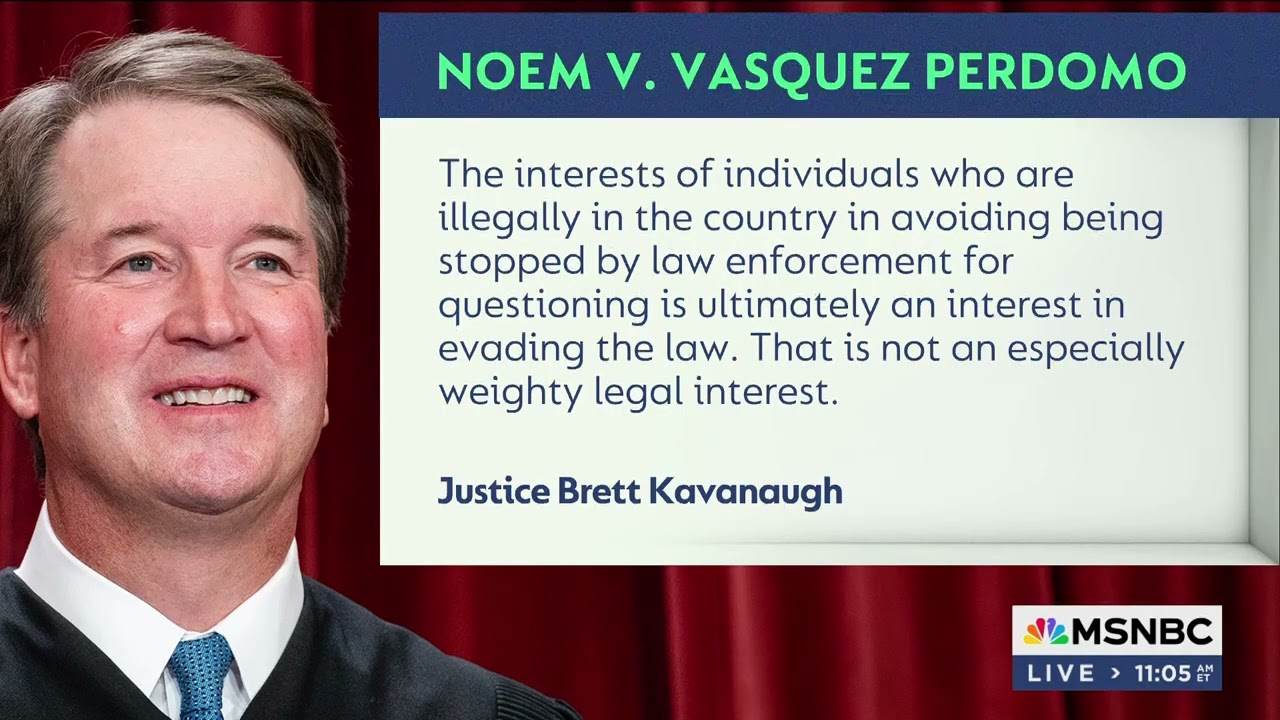
The decision's implications, Velshi warned, go way beyond immigration policy and ICE raids and treat the U.S. Constitution's 4th Amendment as expendable. Ratified in 1791 as part of the Bill of Rights, the 4th Amendment protects against unreasonable search and seizure.
READ MORE:'Doing a pretty terrible job': Trump official mocked over response to dismal economic data
"ICE agents now have the High Court's blessing to racially profile people during immigration sweeps in Los Angeles," Velshi warned. "They're allowed to stop people based solely on their apparent race or ethnicity, language or accent, the type of work they do, where they do it. The 4th Amendment requires reasonable suspicion before anyone, any person, citizen or not, documented or not, can be stopped by law enforcement. The law is not allowed to just guess at that — that because of how you look or speak, or where you live and work, that you might have committed a crime."
Velshi continues, "Equal protection forbids race as a factor. The lower courts enforced that principle; the Supreme Court just erased it. And perhaps the most outrageous part: the conservative majority in the Supreme Court issued their decision using the so-called shadow docket, where the Court rules on Trump Administration emergency motions without oral arguments or explanation — no hearing, no accountability, just judicial fiat handed down in the dark."
However, the MSNBC host, who is originally from Canada, stressed that "this ruling isn't about immigration" and has "broader implications."
"It tells millions of Americans that your protection from unreasonable search and seizure depends on whether the government decides you look like you belong, which is not what the Constitution's Framers envisioned, I hope — certainly not democracy as we have come to know it in this country," Velshi told viewers. "Consider Brian Gavidia, a U.S. citizen from East Los Angeles — who voted for (Donald) Trump, by the way…. He says federal agents shoved him against a fence, twisted his arm, and demanded to know which hospital he was born in. All because he looked Latino. This is the new normal that the Court has sanctioned."
READ MORE:'Republican for Trump': Alleged Kirk shooter's grandmother confirms entire family is MAGA
Velshi attacked Justice Brett Kavanaugh's reasoning in Vasquez Perdomo v. Noem as "hollow," stressing, "Rights are not conditional favors granted after innocence is proven — they are the shield against arbitrary suspicion in the first place. Kavanaugh's distorted logic seems to suggest that if you're brown, you're guilty of an immigration violation until you're proven innocent…. That's not just sloppy logic, it's dangerous….. It's not that the conservative justices don't understand the Constitution; it's that they don't care…. Once the 4th Amendment is treated as negotiable for one group — Latino communities, brown people, in this case — it becomes weaker for all of us."
---
no lnx
The next target on Trump's list should trouble all of us
Thom Hartmann
October 08, 2025
Remember the old TV crime/drama shows? A cop would bang on a suspect’s door and the suspect would say, through the door, “Do you have a warrant?” The officer would then walk away, promising to come back later with the requisite paper signed by a judge.
No more. Now they’re kicking in doors, shooting pepper-gas balls into the open windows of cars driven by reporters, smashing windows and furniture, and concealing their faces and identities like the Klan did in days of old. In Chicago, they’ve shot two unarmed people, killing one. And there wasn’t a warrant signed by a judge to be seen anywhere.
People ask, “Are we there, yet? Has America gone fascist? Are we now in a militarized dictatorship?”
Last week’s illegal, unconstitutional military assault on an apartment building in Chicago argues “Yes.” And if it doesn’t stimulate a similar level of public outrage as the Jimmy Kimmel suspension did, we’re all screwed.
And by “all” I mean you, too. None of us are safe if all of us aren’t safe. We have to stand up and speak out now.
Trump, Vance, Hegseth, and Noem carefully selected a low-income apartment building filled with Black and Hispanic people, correctly believing that the American mainstream media wouldn’t give it the coverage they would if ICE and our military had instead kicked in the doors of a building full of middle-class white people.
Soldiers rapelled from Black Hawk helicopters as some 300 masked agents ran throughout the apartment building kicking in doors, dragging American citizens out (including near-naked children) into the street and zip-tying them for hours.
They then trashed multiple apartments, ripping up furniture, smashing windows, breaking and scattering possessions, and removing and carting away phones and laptops. No warrants signed by judges were presented and one ICE thug, when asked about the shivering American citizen kids standing in the freezing cold, said, “F--- the children.”
This is the exact same sort of thing that British forces did against the colonists in the 1770s that provoked our nation’s Founders to write in the Fourth Amendment to our Constitution:
“The right of the people to be secure in their persons, houses, papers, and effects, against unreasonable searches and seizures, shall not be violated, and no Warrants shall issue, but upon probable cause, supported by Oath or affirmation, and particularly describing the place to be searched, and the persons or things to be seized.”}:
MAGA is delighted; puppy-killer Noem claims people were “clapping in the streets,” although there doesn’t appear to be any evidence of that. MAGA folks seem to think that because they’re white they’re safe from attack by this regime.
But when they’re done with the brown folks, they’ll be coming for the white people next. They’ll start with Democrats — Trump called them “Satan” last week — but history shows they won’t stop there.
It’s already started, with Trump’s most recent National Security Directive that instructs the 200-plus local police/FBI Joint Terrorism Task Forces all across the country to begin investigating anybody or any group that exhibits or has ever given a donation to any group showing “indicia of terrorism” including being anti-Christian; anti-capitalism; extremism on migration, race, or gender; and hostility towards those who hold traditional views on family, religion, or morality.
Do you have a queer kid? A Black or Hispanic friend? Are you a union member? Have you failed to attend church over the past few years? Are you Jewish or Muslim? Unitarian? Ever donated to a civil rights group? Voted Democratic? Or voted for a Republican who Trump despises, like Liz Cheney or Adam Kinzinger?
You’re next.
They may have already started surveilling you, tapping your phone, reading your emails, collecting your browser and location history.
This isn’t the first time masked, armed agents of the government have terrorized American citizens. In the late 1870s and the 1920s, in Portland, Oregon (among other cities) armed, hooded members of the Klu Klux Klan were deputized and unleashed against racial minorities, Catholics, Jews, union members, and other “criminals and undesirables.”
Oregon had been so taken over by the Klan that in the election of 1876 their electoral college votes were challenged by both parties in Congress, leading, in part, to the election being handed to Republican Rutherford B. Hayes.
Eventually, Oregon and the rest of America rejected masked secret police and vigilantes in our streets. Now, in this generation, it’s our turn.
Christopher Armitage, on his Existentialist Republic Substack newsletter, argues forcefully that masked federal agents committing crimes should be arrested by state and local police:
“Here’s what you need to know: Federal agents are committing state felonies every day. Breaking and entering. Kidnapping. Assault. When they kick down doors without judicial warrants, when they detain citizens without probable cause, when they point guns at children, these are crimes under state law. And Democratic governors have the power to prosecute those crimes …“When ICE agents face potential state prosecution for breaking down doors, they’ll start getting real warrants signed by real judges. When pointing guns at families could mean assault charges, they’ll think twice. When detaining U.S. citizens could mean kidnapping prosecutions, they’ll check IDs more carefully.” (emphasis added)}:
And Trump can’t pardon state crimes; those convicted end up in state prisons. It’s probably why, like the Klan of old, they conceal their identities.
ICE isn’t bothering to get the kinds of warrants required by the Fourth Amendment, instead they’re using “administrative warrants” signed by ICE officials; these are just window-dressing paperwork and are not legal warrants.
Armitage points out:
“So when ICE breaks down a door with only administrative paperwork, that’s burglary under California Penal Code 459. When they haul away citizens without probable cause, that’s kidnapping under Penal Code 207. When they point weapons at unarmed families, that’s assault under Penal Code 245.”}:
He correctly tells us all to contact our state and local elected officials and demand that they enforce the laws of our states.
You can duckduckgo.com search for your town’s mayor’s office, your state representative and senator, and you can call your House and Senate members at 202-224-3121.
This brutal, illegal attack on American citizens last week was the Trump regime’s most visible “crossing the Rubicon” moment. If it stands, it will become normal and none of us are safe.
When the government becomes the criminal, silence is complicity. The Fourth Amendment is not a relic or a privilege; it’s the firewall between freedom and tyranny. If we allow it to burn, we’re setting fire to the idea of America itself.
Every citizen, every journalist, every elected official who still believes in the rule of law must speak out, organize, and demand accountability before this becomes irreversible. History does not forgive those who stayed quiet while justice was destroyed in plain sight.
The time to speak out and demand action is now.
---
---
AN 9 25
Justice Sonia Sotomayor had harsh words for the Supreme Court in her dissent in a ruling allowing Immigration and Customs Enforcement to continue to arrest people based on profiling Latinos working low-wage jobs.
Monday morning, the Supreme Court of the United States issued an emergency decision in Noem v. Vasquez Perdomo.The case concerns “Operation At Large,” which deployed ICE agents in the Los Angeles area to car washes, bus stops, farms and other locations believed to be frequented by Latino people who may or may not be undocumented immigrants. On July 11, the Central District Court of California ruled that ICE had to stop Operation At Large until appeals in the case could be heard.
The Court’s ruling contained no official explanation for the ruling, however Justice Brett Kavanaugh wrote a concurrence. In his concurrence, Kavanaugh said the law allowed ICE to “‘briefly detain’ an individual ‘for questioning’” if they have “a reasonable suspicion, based on specific articulable facts, that the person being questioned . . . is an alien illegally in the United States.”
READ MORE: Loyalty Litmus Test? Trump Allies Quietly Prep SCOTUS Short List
Operation At Large, he said, represented “reasonable suspicion” to detain someone on the following factors: “(i) presence at particular locations such as bus stops, car washes, day laborer pickup sites, agricultural sites, and the like; (ii) the type of work one does; (iii) speaking Spanish or speaking English with an accent; and (iv) apparent race or ethnicity.”
He added that “apparent ethnicity alone cannot furnish reasonable suspicion” but could be a “‘relevant factor,” and that if someone detained by ICE turned out to be a citizen, they would be “free to go after the brief encounter.”
Sotomayor disagreed that this is what was happening, citing what had happened to other citizens. Jason Gavidia worked at a Los Angeles tow yard that ICE stopped at. Agents repeatedly asked if he was a citizen. They then took his phone, pushed him against a metal fence, twisted his arm, and took away his identification, according to Sotomayor’s dissent.
“Other Operation At Large encounters have included even more force and even fewer questions. For example, agents pulled up in four unmarked cars to a bus stop in Pasadena; ‘the doors opened and men in masks with guns started running at’ three Latino men who were having their morning coffee, waiting to be picked up for work,” she wrote.
“In Glendale, nearly a dozen masked agents with guns ‘jumped out of . . . cars’ at a Home Depot, and began ‘chasing’ and ‘tackl[ing]’ Latino day laborers without ‘identify[ing] themselves as ICE or police, ask[ing] questions, or say[ing] anything else.’ In downtown Los Angeles, agents ‘jumped out of a van, rushed up to [a tamale vendor], surrounded him, and handled him violently,’ all ‘[w]ithout asking . . . any questions.'”
Sotomayor concluded that Operation At Large and the Court’s decision “all but declared that all Latinos, U. S. citizens or not, who work low wage jobs are fair game to be seized at any time, taken away from work, and held until they provide proof of their legal status to the agents’ satisfaction.”
She also condemned the court for not issuing an explanation beyond the concurrence. She alleged that the Court had been eager to “circumvent the ordinary appellate process” when it comes to President Donald Trump and his administration.
“Some situations simply cry out for an explanation, such as when the Government’s conduct flagrantly violates the law,” Sotomayor wrote, adding that Operation At Large and the Court’s ruling clearly violates the Bill of Rights.
“The Fourth Amendment protects every individual’s constitutional right to be ‘free from arbitrary interference by law officers.’ After today, that may no longer be true for those who happen to look a certain way, speak a certain way, and appear to work a certain type of legitimate job that pays very little. Because this is unconscionably irreconcilable with our Nation’s constitutional guarantees, I dissent,” she wrote.
---
mta congr ppt (see spkr notes)
Hale v. Henkel [1906]
Corporations can claim immunity against searches and seizures of their books, records and other property.
Justice Harlan’s dissent
“In my opinion, a corporation - 'an artificial being, invisible, intangible, and existing only in contemplation of law' - cannot claim the immunity given by the 4th Amendment; for it is not a part of the 'people,' within the meaning of that Amendment.”
See v. City of Seattle [1967]:
Corporation protected from random inspections by
fire departments.
Marshall v. Barlow’s Inc. [1978]:
Corporations can require OSHA to produce a warrant to inspect for safety violations, prohibiting surprise inspections of corporate property.
In spite of Justice Harlan’s opinion, the decision has been the basis for preventing the government from investigating the books of corporations for most of the last century, effectively allowing corporations to prevent citizens, communities and regulatory agencies from stopping corporate pollution, health and labor violations, and other assaults on people or the commons.
- EXAMPLES: Deepwater Horizon, Southwest airline
===
=
comm dr greg c 2024
let’s Wish Corporate Constitutional Rights a Very Unhappy Birthday
The actual “birth” of corporate constitutional rights, often referred to as “corporate personhood,” wasn’t Citizens United; it dates to May 10, 1886 in the Santa Clara v. Southern Pacific Railroad Company ruling.
May 10, 2024Common Dreams
The origins of the current political influence by weapons corporations to profit from perpetual wars, occupations, and arm sales; the fossil fuel industry to continue burning oil, gas, and coal in the face of irrefutable evidence that it’s overheating the planet; and insurance and pharmaceutical corporations to prevent the enactment of Medicare for All aren’t any law, regulation, or executive decision. Rather, they’re Supreme Court rulings that define corporate entities as legal “persons” with many of the same rights as human beings under the U.S. Constitution.
This reality didn’t begin with the *Citizens United v. FEC* 2010 decision, contrary to common belief. Citizens United simply expanded corporate First Amendment “free speech rights” to directly donate (or, more accurately, invest) in elections that originated with the *First National Bank of Boston v. Bellotti* case in 1978
The actual “birth” of corporate constitutional rights, often referred to as “corporate personhood,” dates to May 10, 1886 in the *Santa Clara v. Southern Pacific Railroad Company* ruling. The summary of the tax case, called the “headnotes”—not the actual decision—granted the railroad corporation with “equal protection rights” under the 14th Amendment.
All the good work by individuals and organizations to legalize protections of individuals, communities, and nature and hold corporate entities accountable for their harms will never be systemically achieved as long as we continue to constitutionalize corporate rights as equivalent to the rights of human persons.
The 14th Amendment granted citizenship to all persons born or naturalized in the U.S, including former enslaved human beings. Although it was not intended to apply to corporations, they hijacked the Amendment for their political and economic benefit. As former Supreme Court Justice Hugo Black declared, “Of the cases in this court in which the 14th Amendment was applied during the first 50 years after its adoption, less than one half of 1% invoked it in protection of the negro race, and more than 50% asked that its benefits be extended to corporations.”
Human persons are grossly unequal to corporations. Bankruptcy, tax, and criminal laws are more favorable to “corporate persons” than human beings. Corporations can write off certain legal expenses; real people can’t. Laws increasingly allow corporations to design arbitration rules that force employees and customers to settle disputes over unsafe products, consumer fraud, employment discrimination, nonpayment of wages, and other instances of corporate malfeasance. And unlike human persons with limited lifespans and physical mobility, corporations can live forever and legally and quickly move assets between physical locations to evade accountability.
The Santa Clara corporate perversion of the 14th Amendment profoundly shifted how corporations were defined. Until then, state legislatures granted individuals a corporate charter, or license, to conduct business. The charter established specific standards for a limited period, after which in many instances the business became public. The charter’s terms were privileges, not rights. If the business violated the charter’s terms, it was revoked by state legislatures or courts, which frequently occurred, and the company was dissolved. The same occurred following the shift from individually granted charters to the creation of state laws addressing entire categories of corporations, such as banks, railroads, and canals.
Santa Clararepresented a tectonic antidemocratic shift in the authority to define corporate entities—from the state legislative arena to federal courts, specifically the U.S. Supreme Court, which was beyond the direct reach of citizens and elected officials. It unleashed business corporations to massively plunder, profit, and protect themselves from democratic accountability, resulting in the declining protection of people, communities, and the ability to ensure a livable natural world.
Corporate First Amendment political “free speech” rights to invest money in elections, including the Citizens Uniteddecision, is the most recent constitutional descendant of the Santa Claraprecedent. There are many others.
√ First Amendment Right Not to Speak, Negative Speech Rights and Commercial Speech Rights
The Supreme Court overturned a California state law allowing a ratepayer advocacy group to enclose information in the utility corporations’ billing envelopes calling for regulations that would lower utility rates and a New York law that would save energy by banning the promotion of the use of electricity by a utility corporation.
A court also overturned a Vermont law mandating the disclosure of a dangerous synthetic growth hormone on dairy products.These court-invented rights have been used by corporate entities to defy the legitimate rights of people to know factual information; the authority of government to protect the health, safety, and welfare of residents; the provision of basic health needs of employees; and the ability to hold corporations publicly accountable.
VS TWITTER FILES BS?
{ √ Fourth Amendment Search and Seizure Rights}:
The Supreme Court overturned laws mandating routine surprise inspections of corporate property, claiming the “right of the people to be secure in their persons [and] houses... against unreasonable searches and seizures” applied to corporations. These judicial decisions treat corporate entities like human persons, even though the Fourth Amendment’s original language applies only to human beings, their homes, and personal effects. Governmental attempts to protect the public from the dangers stemming from commercial activities like food contamination, drug impurities, automobile defects, and environmental hazards are thwarted by removing surprise inspections, thus allowing businesses to hide, alter, or disguise dangerous conditions.
BOEING DOOR 737 MAX?
√ Fifth Amendment Takings Rights
The Supreme Court has struck down regulatory laws protecting homeowners and workers from corporations, claiming the laws are a “taking of property without just compensation.” This includes a Pennsylvania law regulating the mining of coal beneath homes to prevent their sinking and a California law allowing union organizers from having access to agricultural employees at worksites under certain conditions.
Public laws to protect residents, communities, and the natural world should supersede legally mandated compensation of lost present and future corporate profits. This is especially urgent as it becomes more evident that to tackle climate change, fossil fuels must be kept in the ground. This may simply not be possible as long as corporations can assert Fifth Amendment “takings rights.”
Corporate constitutional rights transcend Citizens United and corporate First Amendment political “free speech” rights. All the good work by individuals and organizations to legalize protections of individuals, communities, and nature and hold corporate entities accountable for their harms will never be systemically achieved as long as we continue to constitutionalize corporate rights as equivalent to the rights of human persons.
The We the People Amendment (HJR54) is the only current proposal that seeks the abolition of all corporate constitutional rights. More support is needed to add co-sponsors. The amendment, however, will never achieve sufficient power to make change until we decolonize our minds from believing that corporate rule and rights are inevitable and irreversible. A good place to start, especially on this day, is to internalize the statement: “Slavery is the legal fiction that a person is property. Corporate personhood is the legal fiction that a property is a person.”
It’s time we quickly end the life of constitutional corporate persons.
===
SEE IRATE
Sorrell v. IMS Health Inc., 564 U.S. ___ (2011)
In Sorrell, the U.S. Supreme Court invalidated Vermont’s Prescription Confidentiality Law,
ruling that it violated the First Amendment free speech rights of the Association of
Pharmaceutical Manufacturers.
Issue: Can a state prohibit the nonconsensual sale of doctors’ prescribing information
contained in nonpublic prescription drug records, or is such a restriction an improper
infringement on the free speech of pharmaceutical companies?
Rule: Speech in aid of pharmaceutical marketing is a form of expression protected by the Free
Speech Clause of the First Amendment.
Application: Background: Pharmaceutical manufacturers promote their drugs to doctors
through a process called "detailing." This often involves a scheduled visit to a doctor's office to
persuade the doctor to prescribe a particular pharmaceutical. Detailers bring drug samples as
well as medical studies explaining the "details" and potential advantages of the particular
drugs. Knowledge of a physician's prescription practices—called "prescriber-identifying
information"—enables a detailer to better ascertain which doctors are likely to be interested in
a particular drug and how to best present a particular sales message.
Facts of the Case: In 2007, Vermont enacted the Prescription Confidentiality Law, which
prohibited pharmacies, health insurers, and similar entities from selling records containing
prescriber-identifying information to be used for marketing pharmaceuticals absent the
prescriber's consent. State Attorney General William H. Sorrell was sued by three Vermont
data-miners, and an association of pharmaceutical manufacturers that produce brand-name
drugs, claiming that their First Amendment rights to free speech were being violated. The
Supreme Court agreed.
The court's reasoning and ruling: Vermont has imposed a restriction on access to information
in private hands. “An individual's right to speak is implicated when information he or she
possesses is subjected to 'restraints on the way in which the information might be used' or
disseminated.” This violates the pharmaceutical manufacturers' First Amendment rights
because the law forbade the use of this information for marketing purposes. Vermont's law
violates content and speaker-based neutrality of free speech in regulating the drug companies'
“speech,” which is actually access to information. This requires heightened judicial scrutiny.
Transformation: Because the drug retailers are required by law to keep records of
prescription sales, physicians' prescription histories are essentially open to data-miners and
pharmaceutical manufacturers, who then use this information to target physicians, often with
high-pressure sales tactics, to convince them to prescribe their expensive brand-name drugs
rather than less expensive, bio-equivalent generic, alternatives.
Effect: Physicians' prescription histories can be sold to data-miners for the purpose of
marketing.
Fictional Representational Story: I am a Vermont State legislator who has been fighting to
protect medical privacy, including physician confidentiality; avoidance of harassment by
pharmaceutical companies; and the integrity of the doctor-patient relationship. Our law was
intended to improve public health and reduce healthcare costs by preventing pharmaceutical
companies from doing such targeted selling of their drugs. This regulation has been ruled
unlawful by the U.S. Supreme Court. We contend that prescription histories are not a
commodity to be bought and sold by pharmaceutical companies. We contend that our law
regulates, not speech, but simply access to, information. Without this law, we cannot stop the
sale of doctors' prescription records to drug manufacturers who use this information for their
own gain.
Written by: Anne Pflager Disclaimer: For educational purpose only
===
http://climatecasechart.com/climate-change-litigation/principle-law/fourth-amendment/
also ~ walker
EXXON ASSERTS 1ST4TH 14TH
http://climatecasechart.com/climate-change-litigation/case/exxon-mobil-corp-v-healey/
Exxon Mobil Corp. v. Healey
Filing Date: 2016
Case Categories:
Principal Laws:
First Amendment, Fourth Amendment, Fourteenth Amendment, Commerce Clause, Supremacy Clause, State Law—Common Law
Description: Action by Exxon Mobil Corporation to bar enforcement of civil investigative demand issued by Massachusetts attorney general and subpoena issued by New York attorney general.
[LONG LIST OF DOCS, OTHER CASES]
===
jennie? yahoo mail
mta email 3/22
Hale v. Henkel, probably one of the most cited cases (over 1,600 times), was decided by the United States Supreme Court on this day, in 1906.
...116 years later, Hale v Henkel keeps granting Corporations an ill-gotten right to privacy.
as we all know, Corporations are not mentioned anywhere in the U.S. Constitution, but thanks to the rulings of activist Supreme Court Justices, Corporations hijacked the Constitution and Rights that were intended only for individuals. Hale v Henkel is a prime example.
In this case, the SCOTUS established the power of a federal grand jury engaged in an investigation into corporate misconduct to require the corporation in question to surrender its records.
The Ruling:
"An order for the production of books and papers may constitute an unreasonable search and seizure within the Fourth Amendment. While a search ordinarily implies a quest by an officer of the law, and a seizure contemplates a forcible dispossession of the owner, still the substance of the offense is the compulsory production of private papers, whether under a search warrant or a subpoena duces tecum, against which the person, be [an] individual or corporation, is entitled to protection."
And thus, the Corporate hijacking of the 4th Amendment, which was intended to protect the individual's right to privacy, including protection against unreasonable searches and seizures without a warrant began.

How does this affect you?
A subsequent ruling in Wilson v. United States (1911) built upon Hale v. Henkel by prohibiting corporate officers from invoking their own personal Fifth Amendment privilege against self-incrimination to justify a failure to turn over corporate documents.
This led to many circumstances in which corporations may exercise their right to "shut the door" on government inspectors who lack a search warrant. The resulting delay may be enough for a company to cover up signs of wrongdoing. Even if evidence is collected under a search warrant, there is no guarantee that it will hold up in court.
Such was the case when in 1997, the Environmental Protection Agency (EPA) received an anonymous tip from an employee of Riverdale Mills, a wire-mesh manufacturer that sits on the Blackstone River near Worcester, Mass. The employer claimed that the mill's wastewater treatment system was not working, and so the EPA agents got a search warrant to investigate and collected evidence which was later used by the government to indict Riverdale's owner on two counts of violating the Clean Water Act. But despite having a warrant and following the rules, the case fell apart after the judge handling the case threw out key evidence (water test results) because the EPA took samples on the mill property without informing the owner.
Like this, there are plenty of other similar examples where thanks to judicial decisions, commercial entities are granted privacy protections that thwart the governments' attempt to protect the public from a multitude of dangers by removing the advantage of surprise inspections allowing businesses to hide, alter or disguise dangerous conditions.
Not everyone was happy with granting corporations 4th Amendment rights, though. In his dissent in Hale v Henkel, Justice Harlan stated: "...the power of the government, by its representatives, to look into the books, records and papers of a corporation of its own creation, to ascertain whether that corporation has obeyed or is defying the law, will be greatly curtailed, if not destroyed.
lack of an authentic democracy is due not only to corporate campaign donations (or investments) or domination of the media. We’ll never have democracy so long as corporations possess any inalienable constitutional rights, including never-intended 4th Amendment search and seizure privacy rights. That's why Move to Amend educates and organizes to abolish ALL corporate constitutional rights and hijacks. Please support our work. Inalienable rights are for human beings, not artificial legal creations of government and the We The People Amendment will establish that once and for all!
End Corporate Rule. Legalize Democracy. Move to Amend!
....Nike's not alone in seeking Constitutional protection against bad publicity. In 1986,Dow Chemical sued the federal government. The company argued that the use of aerial photography by the Environmental Protection Agency (EPA) was a violation of the corporation's Fourth Amendment rights. Dow asserted that the EPA shouldn't be able to snap photos in search of federal violations. The Fourth Amendment protects Americans from unreasonable search and seizure, and Dow alleged its rights were violated by EPA flyovers [source: Connecticut General Assembly]. The Supreme Court ultimately decided 5 to 4 to uphold the lost case, opining that Dow couldn't reasonably expect privacy in its chemical plant [source: New York Times].
But corporations have been successful in court as well. In the1978 case Marshall v. Barlow's, Inc., the Supreme Court established freedom from search for businesses under the Fourth Amendment. Prior to the ruling, agents from the federal _Occupational Safety and Health Administration _(OSHA) could inspect any business for safety violations without alerting the owner or asking his or her permission [source: USSC Plus]. Following the Marshall case, incorporated businesses were granted the same protection human citizens have from police searches. OSHA now must either receive permission from the owner or show evidence that a violation has occurred and obtain a search warrant [source: CBIA].
howstuffworks
===
ppl lose amend rights
https://www.alternet.org/2021/07/central-florida-sheriffs-department-draws-sharp-criticism-for-advanced-surveillance-program-report/
===
===
an 2 24
Sen. Ron Wyden and privacy rights advocates this week are sounding the alarm about an anti-abortion group using cellphone location data to send misinformation to people who visited hundreds of Planned Parenthood clinics across the country.
"If a data broker could track Americans' cellphones to help extremists target misinformation to people at hundreds of Planned Parenthood locations across the United States, a right-wing prosecutor could use that same information to put women in jail," Wyden (D-Ore.) said in a statement Tuesday.
"Federal watchdogs should hold the data broker accountable for abusing Americans' private information," he added. "And Congress needs to step up as soon as possible to ensure extremist politicians can't buy this kind of sensitive data without a warrant."
"That data brokers can track people visiting Planned Parenthood is terrifying enough. That law enforcement agencies can simply buy this type of sensitive data—rather than getting a warrant—is even worse."
Since the right-wing U.S. Supreme Court reversedRoe v. Wade with its June 2022 decision in Dobbs v. Jackson Women's Health Organization, anti-choice state policymakers have ramped up attacks on abortion rights, elevating concerns about patient privacy.
Wyden explained in a Tuesday letter that his office launched an investigation after The Wall Street Journalreported last May that the Veritas Society, a nonprofit established by Wisconsin Right to Life, hired the advertising agency Recrue Media for an anti-abortion ad campaign targeting clinic visitors, whose locations were tracked by the data broker Near Intelligence.
As Wyden wrote to Federal Trade Commission (FTC) Chair Lina Khan and U.S. Securities and Exchange Commission (SEC) Chair Gary Gensler:
My staff spoke with Steven Bogue, the co-founder and managing principal of Recrue Media on May 19, 2023, who revealed that to target these ads, his employees used Near's website to draw a line around the building and parking lot of each targeted facility. On May 26, 2023, my staff spoke with Near's chief privacy officer, Jay Angelo, who confirmed that, until the summer of 2022, the company did not have any technical controls in place to prevent its customers targeting people who visited sensitive facilities, such as reproductive health clinics. On a webpage that has since been taken down, but was saved by the Internet Archive, the Veritas Society stated that in 2020 in Wisconsin alone, it delivered 14.3 million ads to people who visited abortion clinics, and "served ads to those devices across the women's social pages, Facebook, Instagram, and Snapchat." The scale of this invasive surveillance-enabled ad campaign remains unknown, however, Mr. Bogue told my staff that the company used Near to target ads to people who had visited 600 Planned Parenthood locations in the lower 48 states.
Justin Sherman, who studies data brokers at Duke University, toldPolitico that "this is the largest targeting campaign we've seen to date against reproductive health clinics based on brokered data."
In case you missed this yesterday, I discovered that data brokers are helping anti-abortion extremists exploit location data to target patients. The prospect of how red-state prosecutors could abuse this information should terrify every single American with a smartphone.
— (@)
Wyden also highlighted Journalreporting from October about Near selling location data to defense contractors that resold it to U.S. Defense Department and intelligence agencies. He wrote that Angelo, the privacy officer, "confirmed that the company had for three years sold location data to the defense contractor AELIUS Exploitation Technologies."
"Mr. Angelo revealed that after joining Near in June of 2022, he conducted a review of the company's practices and discovered that the company was facilitating the sale of location data to the U.S. government that had been obtained without user consent," the senator continued, noting the removal of "misleading statements" from Near's website.
"The former executives that led Near during the period in which it engaged in these egregious violations of Americans' privacy are now under criminal investigation, according to a statement made by the company's lawyer during a December 11, 2023, bankruptcy hearing. But prosecuting those individuals for engaging in financial fraud will not address Near's corporate abuses," Wyden argued, urging the FTC and SEC to take various actions over the company's "outrageous conduct" that "recklessly harmed the public and investors."
Wyden's letter comes as the Republican-controlled U.S. House plans to take up the Reforming Intelligence and Securing America Act, which would reform Section 702 of the Foreign Intelligence Surveillance Act (FISA), spying powers temporarily extended late last year that agencies—especially the Federal Bureau of Investigation (FBI)—have abused.
Section 702 only allows warrantless surveillance targeting foreigners located outside the United States, but Americans' data is also swept up, and privacy advocates within and outside of Congress—including Wyden—have long been pushing for warrant protections, a key issue in this week's debates about the Republican-led reform bill.
A shocking invasion of privacy that lays bare just how far forced-birth extremists will go to track, monitor, intimidate & scare women.\n\nI am deeply concerned with how this data could be used by states that criminalize abortion. This must be investigated. \nhttps://t.co/TO0Y2QMgx4
— (@)
Responding to Wyden's letter, Rep. Zoe Lofgren (D-Calif.) said Wednesday that "this is outrageous. Americans' most personal private health data is being bought and sold for politics. Major surveillance changes are needed. i.e. If Congress acts, reforms from our Fourth Amendment Is Not For Sale Act must be part of a FISA reform."
Reintroduced by Lofgren, Wyden, and a bipartisan coalition of lawmakers last July, that bill would require the U.S. government to get a court order compelling data brokers to disclose information as well as bar law enforcement and intelligence agencies from buying data on people in the U.S. and Americans abroad if it was obtained from a user's account or device, or deceptive practices.
Privacy rights campaigners and experts also responded to Wyden's letter with renewed calls for closing the data broker loophole.
"That data brokers can track people visiting Planned Parenthood is terrifying enough. That law enforcement agencies can simply buy this type of sensitive data—rather than getting a warrant—is even worse," said Ashley Gorski, senior staff attorney at the ACLU's National Security Project. "This Thursday, Congress must vote to close the loophole for law enforcement purchases from data brokers. The government shouldn't be able to buy its way around the Fourth Amendment."
The organizations Demand Progress and EPIC concurred in social media posts sharing Politico's reporting on the letter.
"The continued sale of our most sensitive information to and by shady data brokers not only fuels harmful surveillance advertising systems, but enables government agencies—from local police departments to state attorneys general to the FBI—to sidestep the Fourth Amendment," said EPIC counsel Sara Geoghegan in a statement. "We urgently need to rein in data brokers and enact comprehensive privacy rules to protect us from these grave harms in the post-Roe era we live in."
---
thom h 10 22
...But that’s just the beginning of the out-of-control and dangerous behavior of the far-right radicals on today’s court. Since there’s been a conservative majority on the Court it has, among other things:
*Handed the 2000 election to George W. Bush
*Radically cut back the rights of unions to organize and represent workers
*Declared that billionaires buying politicians is merely “free speech”
*Gutted the power of the EPA to regulate planet-destroying carbon pollution
*And ripped the heart out of both the Civil Rights Act and the Voting Rights Act.
In just the past year this Court, now stacked with 3 new and deeply unqualified (but young!) hard-right Trump-humping activists, has already ruled to:
*End the 6th Amendment right of prisoners to challenge convictions when their lawyers were demonstrably corrupt or incompetent (Shinn v Ramirez. In her dissent, Justice Sotomayor wrote, “The Court’s decision will leave many people who were convicted in violation of the Sixth Amendment to face incarceration or even execution without any meaningful chance to vindicate their right to counsel.”
*Further gut Americans’ right to vote. In 3 separate cases, Merrill v Milligan, Wisconsin Legislature v. Wisconsin Elections Commission, and Ardoin v. Robinson the six rightwing justices endorsed three separate Republican gerrymanders and voting maps in Wisconsin, Louisiana, and Alabama that were each unabashedly based on efforts to enhance the electoral power of white voters.
*Remove from US citizens who move to (or live in) Puerto Rico the right to receive certain Social Security benefitsin their US v Vaello-Madero case. Whacking the rights of over 300,000 Americans living in PR, the six crazies on the Court ruled that only Congress could fix the damage they themselves were doing. The problem with that, as Justice Sonia Sotomayor pointed out in her dissent, is that because PR isn’t yet a state and has no member of Congress to fight on their behalf the Court was simply “punishing disparities suffered by citizen residents of Puerto Rico under Congress’ unequal treatment.”
*Take away your Miranda rights to remain silent, avoid self-incrimination, and know you have access to a lawyer. Americans cannot, the 6 “conservatives” on the Court ruled in Vega v. Tekoh, sue police officers who fail to tell them their Miranda rights.
*Eliminate many non-citizens’ rights under the Constitution when abused by the federal government. While the Constitution refers to “persons” rather than “citizens” in most critical places (like the 14th Amendment guaranteeingequal protection under the law), the Court decided in two cases, Garland v. Gonzalez and in Johnson v. Arteaga-Martinez, that noncitizens often are not entitled to bond hearings or class-wide injunctive relief when screwed by the feds.
*Rip away 4th Amendment privacy rights against unreasonable search and seizure for all persons living within 100 miles of an ocean or our borders with Mexico or Canada (that’s two out of three American citizens – even here in Portland, I’m within 100 miles of the Pacific Ocean). In Egbert v Boule, the six rightwingers on the Court ruled that border patrol and other federal officers can search you, your home, or your vehicle for any old reason they want because you live in the vicinity of a border or ocean and they consider you suspicious. No warrant necessary anymore.
*Give police officers who use excessive force immunity from accountability. In Rivas-Villegas v. Cortesluna and City of Tahlequah, OK v. Bond the Court upheld its own invention, the doctrine of “qualified immunity,” that makes it almost impossible to sue cops when they wail on you or even kill you (in the Tahlequah case they killed a man in his own garage) for little or no reason.
*Kill the power of the EPA under the Clean Air Act to regulate carbon pollution or protect communities from having their water supplies poisoned by industry seeking profits. West Virginia v EPA ended that agency’s power to regulate carbon dioxide in our atmosphere, and Louisiana v American Rivers handed polluters, overturning 50 years of precedent, the power to overrule states’ and tribes’ rules against pollution of their waterways.
That was last year, and apparently it was just a warm-up:
*Now the Court, in addition to taking on Moore v Harper that could guarantee no Democrat in our lifetimes will ever again become president, is planning to take a second large bite out of the Voting Rights Act in Merrill v Mulligan.
*In Students for Fair Admissions v. Harvard and Students for Fair Admission v. University of North Carolina the 6-judge majority will probably end affirmative action.
*In Kennedy v. Bremerton School District the Court allowed a coach to impose prayer on public school students because “religious liberty.”
*Even as guns have become the leading cause of death among American children and gun-related crime is washing over our country like a poisonous bloody tide, the Court is preparing to unleash even more weapons on our nation by gutting gun owner licensure laws in New York State Rifle & Pistol Association v. Bruen.
Virtually every one of these decisions are or will be based on the power the Court gave itself to overturn laws passed by Congress and signed by the President in its 1803 Marbury v Madison case.
===
===
exxon knew
4th 7x?
http://climatecasechart.com/case/exxon-mobil-corp-v-healey/
| 10/05/2018 | Brief | :{Download:(style="box-sizing:border-box;margin:0px 2px 0px 0px;padding:0px;display:inline-block;speak:none;text-rendering:auto;-webkit-font-smoothing:antialiased;width:30px;height:30px;vertical-align:middle;text-align:center;transition:color 0.1s ease-in 0s"):}: | Brief filed for New York attorney general. | On October 5, 2018, both attorneys general filed their briefs urging the Second Circuit to affirm the dismissal of the case. The New York attorney general argued that Exxon’s lawsuit was not ripe because failure to comply with its investigative subpoena would not have automatic consequences. The New York attorney general further argued that, in any event, the district court had correctly concluded that Exxon failed to adequately plead a First Amendment claim or any other claim, including Fourth Amendment, due process, conspiracy, and dormant Commerce Clause claims. The attorney general also contended that the district court had properly found that amendment of Exxon’s complaint would be futile. |
---
==
Exxon Argued for Reversal of District Court’s Dismissal of Lawsuit Against Attorneys General. On August 3, 2018, Exxon Mobil Corporation (Exxon) filed its opening brief asking the Second Circuit Court ofAppeals to reverse the dismissal of Exxon’s lawsuit challenging the constitutionality of investigations by the New York and Massachusetts attorneys general of climate change-related disclosures.
Exxon argued that the district court had failed to address its viewpoint discrimination claims, which Exxon described as the “centerpiece” of its complaint. Exxon also contended that the district court had erroneously imposed an evidentiary burden on Exxon rather than accepting what Exxon argued were plausible allegations while also improperly drawing inferences favoring the attorneys general.
Exxon further argued that it had adequately pleaded its claims under the Fourth Amendment, Fourteenth Amendment, and Commerce Clause regardless of whether it had adequately pleaded that the attorneys general were motivated by an improper purpose. Exxon also sought to reverse the dismissal on res judicata grounds of its claims against the Massachusetts attorney general. Exxon argued that its constitutional claims were not raised or decided in Massachusetts state court proceedings and that it had not had a full and fair opportunity to raise the claims.
==
OMG
Murray Energy v. Public Citizen (2014)—A corporation sued a public interest group that criticized the corporation because it blocked a health and safety rule for defamation, violation of privacy, and alleged that thecorporation suffered mental anguish and emotional distress,
===
ppl lose, started w. phrama RX data?
alfonso saldana
For decades, the U.S. government has been blatantly violating our Fourth Amendment rights by engaging in warrantless mass surveillance of our activities -- aided by corporations who have created an entire industry of mining and selling that data to them!
A new bill aims to put an end to this wildly unconstitutional practice -- the Fourth Amendment Is Not For Sale Act would close the huge loopholes in our federal privacy laws that the government has been exploiting to spy on our internet activity, emails, phone calls, geolocation, etc.
Contact your Rep today and urge them to support both this important legislation, as well as the #WeThePeopleAmendment:{ :(style="box-sizing:border-box"):}:(by clicking on our Action Page and and filling out your information in a form, you'll be provided with your Rep's contact information and scripts to make it super easy -- and you can be assured we will NEVER share your data)!
Free Press Action Government Relations Director Sandra Fulton made the following statement:
“Every time federal agents buy data from unregulated and exploitative data brokers they’re violating the spirit of the Fourth Amendment. The intelligence community has manipulated legal loopholes to create a sweeping public-private surveillance mechanism that targets immigrants, people of color and other vulnerable communities. The bill is a much needed response to repeated abuses by federal agencies. These abuses include reports about ICE purchasing massive amounts of data from mobile applications, and the military purchasing data from a Muslim prayer application."
Corporations should NOT be profiting off of our government's unconstitutional activities -- and the fact that they are allowed to enjoy these rights they were never intended to have (and exclusively exercise at the expense of the rights of actual human beings) is absolutely outrageous!
Thank you for doing your part to hold our Congress accountable to representing the rights of We The (Real) People.
https://www.movetoamend.org/4th_amendment_act
==
The Fourth Amendment
A response to British King George’s excessive invasions of privacy in colonial America, the Fourth Amendment pulls no punches: “The right of the people to be secure in their persons, houses, papers, and effects, against unreasonable searches and seizures, shall not be violated, and no Warrants shall issue, but upon probable cause, supported by Oath or affirmation, and particularly describing the place to be searched, and the persons or things to be seized.”
Privacy Needs & Rights
Sorrell v. IMS Health Inc., 564 U.S. _ (2011)
Corporation's Fourth Amendment Rights --- Warrant Searches / Inspections
Safe Community & Safe Environment
Marshall v. Barlow's Inc., 436 U.S. 307 (1978)
http://scc-mta.org/sites/default/files/MTA_IRATE_Doc_Version_02_04_13.pdf
==
Tomgram: Peter Van Buren, RIP, The Bill of Rights
Posted by Peter Van Buren at 6:26pm, :{:{June 15, }::{2014.}:
Follow TomDispatch on Twitter @TomDispatch.}:
http://www.tomdispatch.com/post/175856/tomgram%3A_peter_van_buren,_rip,_the_bill_of_rights/
part 2 of 3:
When it comes to spying, surveillance, and privacy, a simple rule applies to our world: however bad you think it is, it’s worse. Thanks to Edward Snowden, we’ve learned an enormous amount about the global surveillance regime that one of America’s 17 intelligence outfits has created to suck into its maw (and its storage facilities) all communications on the planet, no matter their form. We certainly know a lot more than we did a year ago about what the government is capable of knowing about us. We’ve also recently learned a good deal about “big data” and what corporations can now know about us, as well as how much more they may know once your house is filled with “smart” technology.
Less is understood about howcorporate surveillance is coming to the workplace,but sooner or later -- count on it -- the company or business you work for will be capable, via intelligent software, of monitoring every move you make, not to speak of everyone you may be in touch with while on the clock. The truth is, whatever the euphemisms, just about every imaginable way of knowing and surveilling you is here or on its way.
In Oakland, California, for instance, you could mistake the anodyne name of “the Domain Awareness Center” for the latest in New Age spiritualism. In fact, as CNN recently reported, it’s a “proposed central surveillance facility where authorities can monitor the Port of Oakland and the city's airport to protect against potential terrorism.” Someday, it may integrate “live, 24/7 data streams from closed circuit traffic cameras, police license plate readers, gunshot detectors, and other sources from all over the entire city of Oakland.” This means that, despite theoretically being on the lookout for terrorists (how many of those are there in Oakland?), it will be able to track you anywhere in the area.
It’s no exaggeration to say that in our developing brave new world of surveillance, inside or outside your house, there will be nowhere that you aren't potentially trackable and surveillable, no space that is just yours and no one else's. This also means that, however bad you think it is, government and corporate employees somewhere are already creating the next set of processes, technologies, and facilities to monitor you in yet more vivid detail.
Now, let’s add rule two: however bad you think it is, you don’t know the half of it. Yes, you’ve been following the Snowden NSA revelations, but no Snowden has stepped forward (yet) to reveal what the CIA or FBI or Defense Intelligence Agency or Department of Homeland Security or National Geospatial-Intelligence Agency is doing. And as far as the national security state is concerned, the less you know, the better. Take, for example, a recent Associated Press story with this revelation: citing “security reasons” (as always), the Obama administration “has been quietly advising local police not to disclose details about surveillance technology they are using to sweep up basic cellphone data from entire neighborhoods.”
It might even be your neighborhood. In such a situation, it will be easy enough perhaps to forget the value of the sense of privacy in your life, whether you feel you have something to hide or not. Just yesterday, the Supreme Court put a rare brake on the loss of privacy, ruling that the police must have a warrant to search your cell phone after your arrest. In the second of a three-part series on the shredding of the Bill of Rights (amendment by amendment), State Department whistleblower and TomDispatch regular Peter Van Buren takes on the destruction of the protections for American privacy in the Fourth Amendment -- destruction that, if we’re not careful, could soon seem as American as apple pie. Tom
Shredding the Fourth Amendment in Post-Constitutional America
Four Ways It No Longer Applies
Here’s a bit of history from another America: the Bill of Rights was designed to protect the people from their government. If the First Amendment’s right to speak out publicly was the people's wall of security, then the Fourth Amendment’s right to privacy was its buttress. It was once thought that the government should neither be able to stop citizens from speaking nor peer into their lives. Think of that as the essence of the Constitutional era that ended when those towers came down on September 11, 2001. Consider how privacy worked before 9/11 and how it works now in Post-Constitutional America.
The Fourth Amendment
A response to British King George’s excessive invasions of privacy in colonial America, the Fourth Amendment pulls no punches: “The right of the people to be secure in their persons, houses, papers, and effects, against unreasonable searches and seizures, shall not be violated, and no Warrants shall issue, but upon probable cause, supported by Oath or affirmation, and particularly describing the place to be searched, and the persons or things to be seized.”
In Post-Constitutional America, the government might as well have taken scissors to the original copy of the Constitution stored in the National Archives, then crumpled up the Fourth Amendment and tossed it in the garbage can. The NSA revelations of Edward Snowden are, in that sense, not just a shock to the conscience but to the Fourth Amendment itself: our government spies on us. All of us. Without suspicion. Without warrants. Without probable cause. Without restraint. This would qualify as “unreasonable” in our old constitutional world, but no more.
Here, then, are four ways that, in the name of American “security” and according to our government, the Fourth Amendment no longer really applies to our lives.
The Constitutional Borderline
Begin at America's borders. Most people believe they are “in” the United States as soon as they step off an international flight and are thus fully covered by the Bill of Rights. The truth has, in the twenty-first century, become infinitely more complicated as long-standing practices are manipulated to serve the expanding desires of the national security state. The mining of words and concepts for new, darker meanings is a hallmark of how things work in Post-Constitutional America.
Over the years, recognizing that certain situations could render Fourth Amendment requirements impractical or against the public interest, the Supreme Court crafted various exceptions to them. One was the “border search.” The idea was that the United States should be able to protect itself by stopping and examining people entering the country. As a result, routine border searches without warrants are constitutionally “reasonable” simply by virtue of where they take place. It’s a concept with a long history, enumerated by the First Congress in 1789.
Here’s the twist in the present era: the definition of “border” has been changed. Upon arriving in the United States from abroad, you are not legally present in the country until allowed to enter by Department of Homeland Security (DHS) officials. You know, the guys who look into your luggage and stamp your passport. Until that moment, you exist in a legal void where the protections of the Bill of Rights and the laws of the United States do not apply. This concept also predates Post-Constitutional America and the DHS. Remember the sorting process at Ellis Island in the late nineteenth and early twentieth centuries? No lawyers allowed there.
Those modest exceptions were all part of constitutional America. Today, once reasonable searches at the border have morphed into a vast “Constitution-free zone.” The “border” is now a strip of land circling the country and extending 100 miles inland that includes two-thirds of the U.S. population. In this vast region, Customs and Border Protection (CBP) can set up checkpoints and conduct warrantless searches.At airports, American citizens are now similarly subjected to search and seizure as filmmaker Laura Poitras -- whose work focuses on national security issues in general and Edward Snowden in the particular -- knows firsthand. Since 2006, almost every time Poitras has returned to the U.S., her plane has been met by government agents and her laptop and phone examined.
There are multiple similar high-profile cases (including those of a Wikileaks researcher and a Chelsea Manning supporter), but ordinary citizens are hardly exempt. Despite standing in an American airport, a pane of glass away from loved ones, you are not in the U.S. and have no Fourth Amendment rights. How many such airport searches are conducted in the aggregate is unknown. The best information we have comes from a FOIA request by the ACLU. It revealed that, in the 18-month period beginning in October 2008, more than 6,600 people, about half of them U.S. citizens, were subjected to electronic device searches at the border.
Still, reminding us that it’s possible to have a sense of humor on the road to hell, the CBP offers this undoubtedly inadvertent pun at its website: “It is not the intent of CBP to subject travelers to unwarrantedscrutiny.” (emphasis added)
Making It All Constitutional In-House
Here’s another example of how definitions have been readjusted to serve the national security state's overriding needs: the Department of Justice (DOJ) created a Post-Constitutional interpretation of the Fourth Amendment that allows it to access millions of records of Americans using only subpoenas, not search warrants.
Some background: a warrant is court permission to search and seize something. As the Fourth Amendment makes clear, it must be specific: enter Thomas Anderson's home and look for hacked software. Warrants can only be issued on “probable cause.” The Supreme Court defined probable cause as requiring a high standard of proof, or to quote its words, “a fair probability that contraband or evidence of a crime will be found in a particular place.”
A subpoena on the other hand is nothing more than a government order issued to a citizen or organization to do something, most typically to produce a document. Standards for issuing a subpoena are flexible, as most executive agencies can issue them on their own without interaction with a court. In such cases, there is no independent oversight.
The Department of Justice now claims that, under the Fourth Amendment, it can simply subpoena an Internet company like Facebook and demand that they look for and turn over all the records they have on our Mr. Anderson. Their explanation: the DOJ isn't doing the searching, just demanding that another organization do it. As far as its lawyers are concerned, in such a situation, no warrant is needed. In addition, the Department of Justice believes it has the authority to subpoena multiple records, maybe even all the records Facebook has. Records on you? Some group of people including you? Everyone? We don't know, as sources of data like Facebook and Google are prohibited from disclosing much about the information they hand over to the NSA or other government outfits about you.
It’s easy enough to miss the gravity of this in-house interpretation when it comes to the Fourth Amendment. If the FBI today came to your home and demanded access to your emails, it would require a warrant obtained from a court after a show of probable cause to get them. If, however, the Department of Justice can simply issue a subpoena to Google to the same end, they can potentially vacuum up every Gmail message you’ve ever sent without a warrant and it won’t constitute a “search.” The DOJ has continued this practice even though in 2010 a federal appeals court ruled that bulk warrantless access to email violates the Fourth Amendment. An FBI field manual released under the Freedom of Information Act similarly makes it clear that the Bureau’s agents don’t need warrants to access email in bulk when it’s pulled directly from Google, Yahoo, Microsoft, or other service providers.
How far can the use of a subpoena go in bypassing the Fourth Amendment? Recently, the inspector general of the Department of Veterans Affairs (VA) issued a subpoena -- no court involved -- demanding that the Project On Government Oversight (POGO) turn over all information it has collected relating to abuses and mismanagement at VA medical facilities. POGO is a private, non-profit group, dedicated to assisting whistleblowers. The VA subpoena demands access to records sent via an encrypted website to POGO under a promise of anonymity, many from current or former VA employees.
Rather than seek to break the encryption surreptitiously and illegally to expose the whistleblowers, the government has taken a simpler, if unconstitutional route, by simply demanding the names and reports. POGO has refused to comply, setting up a legal confrontation. In the meantime, consider it just another sign of the direction the government is heading when it comes to the Fourth Amendment.
Technology and the Fourth Amendment
Some observers suggest that there is little new here. For example, the compiling of information on innocent Americans by J. Edgar Hoover's low-tech FBI back in the 1960s has been well documented. Paper reports on activities, recordings of conversations, and photos of meetings and trysts, all secretly obtained, exposed the lives of civil rights leaders, popular musicians, and antiwar protesters. From 1956 to at least 1971, the government also wiretapped the calls and conversations of Americans under the Bureau’s counterintelligence program (COINTELPRO).
But those who look to such history of government illegality for a strange kind of nothing-new-under-the-sun reassurance have not grasped the impact of fast-developing technology. In scale, scope, and sheer efficiency, the systems now being employed inside the U.S. by the NSA and other intelligence agencies are something quite new and historically significant. Size matters.
To avoid such encroaching digitization would essentially mean withdrawing from society, not exactly an option for most Americans. More of life is now online -- from banking to travel to social media. Where the NSA was once limited to traditional notions of communication -- the written and spoken word -- new possibilities for following you and intruding on your life in myriad ways are being created. The agency can, for instance, now collect images, photos, and video, and subject them to facial recognition technology that can increasingly put a name to a face. Such technology, employed today at casinos as well as in the secret world of the national security state, can pick out a face in a crowd and identify it, taking into account age, changes in facial hair, new glasses, hats, and the like.
An offshoot of facial recognition is the broader category of biometrics, the use of physical and biological traits unique to a person for identification. These can be anything from ordinary fingerprinting to cutting-edge DNA records and iris scans. (Biometrics is already big business and even has its own trade association in Washington.) One of the world's largest known collections of biometric data is held by the Department of State. As of December 2009, its Consular Consolidated Database (CCD) contained more than 75 million photographs of Americans and foreigners and is growing at a rate of approximately 35,000 records per day. CCD also collects and stores indefinitely the fingerprints of all foreigners issued visas.
With ever more data available, the NSA and other agencies are creating ever more robust ways to store it. Such storage is cheap and bounteous, with few limits other than the availability of electricity and water to cool the electronics. Emerging techwill surely bypass many of the existing constraints to make holding more data longer even easier and cheaper. The old days of file cabinets, or later, clunky disk drives, are over in an era of mega-data storage warehouses.
The way data is aggregated is also changing fast. Where data was once kept in cabinets in separate offices, later in bureaucratically isolated, agency-by-agency digital islands, post-9/11 sharing mandates coupled with new technology have led to fusion databases. In these, information from such disparate sources as license plate readers, wiretaps, and records of library book choices can be aggregated and easily shared. Basically everything about a person, gathered worldwide by various agencies and means, can now be put into a single “file.”
Once you have the whole haystack, there’s still the problem of how to locate the needle. For this, emerging technologies grow ever more capable of analyzing Big Data. Some simple ones are even available to the public, like IBM's Non-Obvious Relationship Awareness software(NORA). It can, for example, scan multiple databases, geolocation information, and social media friend lists and recognize relationships that may not be obvious at first glance. The software is fast and requires no human intervention. It runs 24/7/365/Forever.
Tools like NORA and its more sophisticated classified cousins are NSA's solution to one of the last hurdles to knowing nearly everything: the need for human analysts to “connect the dots.” Skilled analysts take time to train, are prone to human error, and -- given the quickly expanding supply of data -- will always be in demand. Automated analysis also offers the NSA other advantages. Software doesn't have a conscience and it can't blow the whistle.
What does all this mean in terms of the Fourth Amendment? It’s simple: the technological and human factors that constrained the gathering and processing of data in the past are fast disappearing. Prior to these “advances,” even the most ill-intentioned government urges to intrude on and do away with the privacy of citizens were held in check by the possible. The techno-gloves are now off and the possible is increasingly whatever an official or bureaucrat wants to do. That means violations of the Fourth Amendment are held in check only by the goodwill of the government, which might have qualified as the ultimate nightmare of those who wrote the Constitution.
On this front, however, there are signs of hope that the Supreme Court may return to its check-and-balance role of the Constitutional era. One sign, directly addressing the Fourth Amendment, is this week's unanimous decision that the police cannot search the contents of a cell phone without a warrant. (The court also recently issued a ruling determining that the procedures for challenging one's inclusion on the government’s no-fly list are unconstitutional, another hopeful sign.)
Prior to the cell phone decision, law enforcement held that if someone was arrested for, say, a traffic violation, the police had the right to examine the full contents of his or her cell phone -- call lists, photos, social media, contacts, whatever was on the device. Police traditionally have been able to search physical objects they find on an arrestee without a warrant on the grounds that such searches are for the protection of the officers.
In its new decision, however, the court acknowledged that cell phones represent far more than a "physical object." The information they hold is a portrait of someone's life like what’s in a closet at home or on a computer sitting on your desk. Searches of those locations almost always require a warrant.
Does this matter when talking about the NSA's technological dragnet? Maybe. While the Supreme Court's decision applies directly to street-level law enforcement, it does suggest an evolution within the court, a recognition of the way advances in technology have changed the Fourth Amendment. A cell phone is not an object anymore; it is now recognized as a portal to other information that a person has gathered in one place for convenience with, as of this decision, a reasonable expectation of privacy.
National Security Disclosures Under HIPPA
While the NSA’s electronic basket of violations of the Fourth Amendment were, pre-Snowden, meant to take place in utter secrecy, here’s a violation that sits in broad daylight: since 2002, my doctor can disclose my medical records to the NSA without my permission or knowledge. So can yours.
Congress passed the Health Information Portability and Accountability Act (HIPPA) in 1996 “to assure that individuals’ health information is properly protected.” You likely signed a HIPPA agreement at your doctor's office, granting access to your records. However, Congress quietly amended the HIPPA Act in 2002 to permit disclosure of those records for national security purposes. Specifically, the new version of this “privacy law” states: “We may also disclose your PHI [Personal Health Information] to authorized federal officials as necessary for national security and intelligence activities.” The text is embedded deep in your health care provider’s documentation. Look for it.
How does this work? We don’t know. Do the NSA or other agencies have ongoing access to the medical records of all Americans? Do they have to request specific ones? Do doctors have any choice in whose records to forward under what conditions? No one knows. My HMO, after much transferring of my calls, would ultimately only refer me back to the HIPPA text with a promise that they follow the law.
The Snowden revelations are often dismissed by people who wonder what they have to hide. (Who cares if the NSA sees my cute cat videos?) That's why health-care spying stands out. How much more invasive could it be than for your government to have unfettered access to such a potentially personal and private part of your life -- something, by the way, that couldn’t have less to do with American “security” or combating terrorism.
Our health-care providers, in direct confrontation with the Fourth Amendment, are now part of the metastasizing national security state. You’re right to be afraid, but for goodness sake, don't discuss your fears with your doctor.
How the Unreasonable Becomes Reasonable
At this point, when it comes to national security matters, the Fourth Amendment has by any practical definition been done away with as a part of Post-Constitutional America. Whole books have been written just about Edward Snowden and more information about government spying regularly becomes available. We don't lack for examples. Yet as the obviousness of what is being done becomes impossible to ignore and reassurances offered up by the president and others are shown to be lies, the government continues to spin the debate into false discussions about how to “balance” freedom versus security, to raise the specter of another 9/11 if spying is curtailed, and to fall back on that go-to “nothing to hide, nothing to fear” line.
In Post-Constitutional America, the old words that once defined our democracy are twisted in new ways, not discarded. Previously unreasonable searches become reasonable ones under new government interpretations of the Fourth Amendment. Traditional tools of law, like subpoenas and warrants, continue to exist even as they morph into monstrous new forms.
Americans are told (and often believe) that they retain rights they no longer have. Wait for the rhetoric that goes with the celebrations of our freedoms this July 4th. You won’t hear a lot about the NSA then, but you should. In pre-constitutional America the colonists knew that they were under the king's thumb. In totalitarian states of the last century like the Soviet Union, people dealt with their lack of rights and privacy with grim humor and subtle protest. However, in America, ever exceptional, citizens passively watch their rights disappear in the service of dark ends, largely without protest and often while still celebrating a land that no longer exists.
Peter Van Buren blew the whistle on State Department waste and mismanagement during the Iraqi reconstruction in his first book, **We Meant Well:**How I Helped Lose the Battle for the Hearts and Minds of the Iraqi People. A Tom Dispatch regular, he writes about current events at his blog, We Meant Well. His new book, Ghosts of Tom Joad: A Story of the #99Percent, is available now. This is the second in a three-part series on the shredding of the Bill of Rights.