CLARENCE 3
7 22
main guard uk glitch
see gini tag
SEE GINNI 5
no merri
see press suppress libel NYT v Sullivan
see GINNI tag Gini
see alito
SEE COMSTOCK
BIRTHRIGHT 14TH?
leo CRC
MACHINE GUNS
SEE CLARENCE CLERKS HALIKIAS HUB CHICu JONES DAY
SEE ETHICS FAIL
yikes so cannon ~ jack smith
For the Eleventh Circuit - Clarence Thomas, Associate Justice> (Alabama,Florida, Georgia)
rv 250k --> unitedhealthcare
bak 9 26
---
see 2nd amend gun bump stocks domestic abusers
see originalist see alito
badash tag: https://www.thenewcivilrightsmovement.com/?s=Clarence+Thomas}:}:
---
sob on felon disenfranchise by pal
---
did not recuse on trump immunity 4 24
---
-=-=
-=-=
SCOTUS MAIN VOTE FAIL 6-3 ALITO CLAR
AN 9 26
The real reason the Supreme Court blocked Trump and the Postal Service
-=-=
-=-=
AN 9 26
HUH? TED C
https://www.alternet.org/clarence-thomas-2677870464/
-=-=
DUCK AI
Search Assist
In 2014, billionaire Harlan Crow's company purchased a Savannah, Georgia home where Justice Clarence Thomas's mother lived and two nearby vacant lots from Thomas and his relatives for $133,363, and later spent tens of thousands of dollars on renovations including a carport, roof repairs, and a new fence and gates.
The New Civil Rights Movement
Billionaire Harlan Crow Bought Property From Clarence Thomas. The ...
- A Crow Holdings company soon began paying the roughly $1,500 in annual property taxes on Thomas' mother's house, according to county tax records. The taxes had previously been paid by Clarence and Ginni Thomas.

- Daily Mail
- https://www.dailymail.com › news › article-11970619 › Billionaire-Republican-megadonor-Harlan-Crow-bought-133-363-HOUSE-Clarence-Thomas.html
Harlan Crow bought a $133,363 HOUSE from Clarence Thomas
- Clarence Thomas' wealthy megadonor friend Harlan Crow bought property from him in a deal the Supreme Court justice failed to disclose, according to a new report. A company belonging to Texas billionaire Crow, who has showered Thomas with lavish trips and odd yet pricey gifts, bought a series of

- ProPublica
- https://www.propublica.org › article › clarence-thomas-scotus-undisclosed-luxury-travel-gifts-crow
Clarence Thomas Secretly Accepted Luxury Trips From Major GOP Donor
- <p>If Thomas had chartered the plane and the 162-foot yacht himself, the total cost of the trip could have exceeded $500,000. Fortunately for him, that wasn't necessary: He was on vacation with ...
Newsweek
https://www.newsweek.com › clarence-thomas-full-list-free-luxury-trips-revealed-1912728
Clarence Thomas: Full List of Free Luxury Trips Revealed
The report said that Thomas had received vacations, including a previously unreported trip on a yacht around the Bahamas, as well as 26 private-jet flights and eight helicopter flights, among ...
TIME
https://time.com › 6269743 › supreme_court_clarence_thomas_luxury_vacations
Justice Clarence Thomas Accepted Luxury Trips: What to Know - TIME
Lawmakers are alarmed over a report that Supreme Court Justice Clarence Thomas has accepted and failed to disclose luxury vacation trips for over two decades.
- E&E News
- https://www.eenews.net › articles › thomas-monsanto-years-offer-window-into-justices-enviro-roots
Thomas' Monsanto years offer window into justice's enviro roots
- New research explores the early environmental work of the Supreme Court justice — and his resistance to recuse from cases involving his former employer. As debate roils over Justice Clarence ...
As debate roils over Justice Clarence Thomas’ involvement in election-related cases, one environmental lawyer is exploring another time the Supreme Court justice has faced recusal calls.
In a new Harvard Environmental Law Review article, lawyer Scott Stern delves into Thomas’ history as a Monsanto Co. attorney in the late 1970s during the dawn of the modern environmental movement — and his resistance over the years to bow out of cases involving the agrochemical giant.
Based on his research of archival materials, Stern purports that Thomas’ three years at Monsanto early in his legal career helped transform him from registered Democrat at age 18 to one of the Supreme Court’s most conservative members at 73.
“[T]he effect Monsanto and the broader chemical industry had on [Thomas] was profound,” wrote Stern, a recent Yale Law School graduate who is now a clerk for the 9th U.S. Circuit Court of Appeals. “The effect he, in turn, has had on the environment and on our environmental rights is undeniable.”
Stern’s article comes as Democratic lawmakers and some ethics experts have called for Thomas to step back from cases related to the 2020 election and for the Supreme Court — or Congress — to strengthen its recusal rules.
The calls follow reporting on March 24 by The Washington Post and CBS News that the justice’s wife — Virginia Thomas, who goes by Ginni — had urged then-White House chief of staff Mark Meadows to push baseless claims that the 2020 election had been stolen from former President Donald Trump.
In January, Clarence Thomas was the sole vote against the Supreme Court order that blocked Trump’s request to withhold White House communications from the House select committee investigating the Jan. 6 Capitol Hill riot.
“This is a textbook case for removing him, recusing him from these decisions, and all I hear is silence from the Supreme Court right now,” said Sen. Amy Klobuchar (D-Minn.), a member of the Senate Judiciary Committee, during a March 27 appearance on ABC’s “This Week.”
Republicans like Senate Minority Leader Mitch McConnell of Kentucky have come to Thomas’ defense.
“Washington Democrats are now trying to bully this exemplary judge of 30-plus years out of entire legal subjects or off the Court entirely,” McConnell said during a March 30 speech on the Senate floor.
The Supreme Court did not respond to a request for comment on this story.
Supreme Court recusals are a controversial subject, as they are left to the discretion of the justices, who rarely explain their decisions to step back from cases.
Judicial disqualification law requires justices to bow out of cases in which their impartiality “might reasonably be questioned” — including in disputes presenting family or financial conflicts or where a jurist has served as a private practice attorney “in the matter in controversy.”
Recusals can also sometimes cause problems for the court if the remaining eight justices cannot form a majority.
While recusals from cases involving former employers depend on the particular facts of a dispute, debate over Thomas’ participation in Monsanto cases “highlights another deficiency in the current ethics regime,” said Alicia Bannon, director of the judiciary program at NYU’s Brennan Center for Justice.
“Even when judges recuse themselves or are asked to recuse themselves, they don’t typically give reasons for their decisions,” she said. “In instances where there could potentially be a case for recusal — but it’s very fact-dependent — having the justices give reasons for their decisions is very important for accountability.”
Questioning impartiality
During his 30 years on the nation’s highest bench, Thomas has faced calls to stay out of Monsanto cases but has routinely helped issue rulings in favor of the company and other chemical industry litigants, Stern found in his paper.
He cited one document in a polychlorinated biphenyls contamination case in which a plaintiffs’ lawyer said a search for records related to Thomas’ role at Monsanto might be “useful to induce settlement and/or head off appeal from final judgment.”
Monsanto manufactured the chemicals, known as PCBs, from 1935 until they were banned in the United States in 1979. While he was at Monsanto, Thomas was responsible for negotiating contracts for PCB disposal, Stern wrote.
“Clearly, it would appear that members of the public as well as litigants are questioning Justice Thomas’s impartiality, or are at least well aware that others could raise such questions,” Stern wrote. “Whether such questioning is ‘reasonable’ is, per the statute, up to Justice Thomas himself.”
Thomas has weighed in on PCB contamination cases that have come before the Supreme Court.
In the 1997 case General Electric Co. v. Joiner, for example, Thomas was part of the court’s unanimous rejection of a claim related to electrician Robert Joiner’s case that GE and Monsanto should be held liable for his exposure to PCBs while working with machinery at a Georgia utility plant.
Joiner said the chemicals “promoted” the lung cancer he later developed.
The Supreme Court has taken up many more Monsanto cases since Thomas arrived on the bench in 1991 — and the justices could soon consider a petition from the company that has the potential to upend a landmark cancer settlement related to its Roundup weedkiller (Greenwire, Dec. 9, 2021).
In his paper, Stern cited instances of other justices recusing in similar circumstances. As one example, Justice John Paul Stevens — whose son, a Vietnam war veteran, died from cancer — did not participate in former military members’ challenges against Monsanto and other manufacturers of the lethal herbicide Agent Orange.
Monsanto, which is now owned by the German pharmaceutical company Bayer AG, did not respond to a request for comment on this story.
Limited role for agencies
As a member of the Supreme Court, Thomas has repeatedly expressed skepticism of broad powers for federal agencies like EPA — an attribute Stern links back to the justice’s early environmental work.
When Thomas left Monsanto in 1979 for a two-year stint advising then-Sen. John Danforth (R-Mo.) on environmental issues, Thomas worked with corporate lobbyists fighting new federal laws like the Toxic Substances Control Act.
Shortly after former President Ronald Reagan was elected, Thomas urged Danforth to pursue a position on the Environment and Public Works Committee to “limit the impact of the Clean Air and Clean Water Acts,” according to the lawmakers’ archived documents, which Stern reviewed for his research.
“After all,” Stern wrote, “reining in these laws could cripple the regulatory authority of EPA and liberate companies like Monsanto to operate unencumbered.”
From Danforth’s office, Thomas eventually joined the Reagan team as assistant secretary for civil rights at the Department of Education — but two of his biographers say the administration originally eyed him for an environmental position.
He went on to serve as chair of the Equal Employment Opportunity Commission and was appointed by former President George H.W. Bush to the U.S. Court of Appeals for the District of Columbia Circuit.
That move eventually catapulted Thomas to the nation’s highest bench.
Stern wrote in his paper that he aimed to offer a fuller view of Thomas’ environmental work at a time when the justice’s “once-fringe positions” are gaining mainstream acceptance by the court’s newly bolstered conservative wing.
Challenges seeking to limit the reach of both the Clean Air Act and the Clean Water Act are currently before the Supreme Court — as is a case that could upend Chevron deference, which gives agencies like EPA leeway to interpret ambiguous statutes (Greenwire, Feb. 14).
“[H]is environmental ideology matters because, as numerous commentators have argued, Thomas — the senior Associate Justice on an increasingly conservative Court — is arguably the nation’s most influential justice,” Stern wrote.
Reporter Niina H. Farah contributed.
=-=
The Radicalization of Clarence Thomas - The New Republic
- Thomas's responsibilities at Monsanto included drafting contracts, advising managers on legal matters, dealing with liability issues, and registering pesticides and herbicides with federal agencies.
journals.law.harvard.edu
The Justice From Monsanto: the Environmental Life and Law of Clarence ...
INTRODUCTION On January 14, 1980, the director of government relations at Monsanto— an immense agrochemical corporation—wrote to Clarence Thomas, a young legislative assistant in the office of Senator John C. Danforth, to ask for a favor.1 Danforth was, at the time, a Republican senator from the
-=-=
54 PP SCOTT W STERN
...
up with some of the pending legislative issues that you feel will be important to Monsanto as a corporation . . . .”6 The “issue” about which the executive was writing to Thomas was the U.S. Fish and Wildlife Service’s recent proposal to protect the Illinois mud turtle by designating certain areas in Missouri, Illinois, and Iowa as “Critical Habitat” for the turtles, thus impeding Monsanto’s ability to use and develop the land around one of its plants.7 In response, Monsanto had commissioned its own study, purporting to demonstrate that the mud turtle was not in need of protection, and it wanted Danforth to communicate this to the Fish and Wildlife Service (“the Service”).8 Eleven days later, Danforth did just that, lambasting the Service for its “apparently shabby treatment of Monsanto.”9
And though the Service’s director replied that it had sent Monsanto’s study to nine turtle specialists, eight of whom had “severely criticized” its methods, within a few months the Service had dropped its proposal to protect the mud turtle.10 Monsanto’s director of environmental operations wrote to Danforth, thanking him and his staff—“especially Clarence Thomas.”11 On its face, this might seem to be a rather unremarkable exchange. Lobbyists drafting letters for legislators was not uncommon at the time,12 and the influence of the chemical industry on legislators and administrative agencies has been well-documented.13
...
islative aide at its center: Clarence Thomas—the longest-serving Justice on the current U.S. Supreme Court. Indeed, this exchange exemplifies a more broadly important—and shockingly little-known—aspect of Justice Thomas’s life: that his career and judicial philosophy are inextricably linked to the field of environmental law. Indeed, Thomas’s only private sector experience was almost three years working as a lawyer for Monsanto, and this stint was followed by two years advising Senator Danforth on environmental and energy issues.
When members of the newly elected Reagan Administration sought to hire him away from Danforth, their first offer was to be an advisor to the White House on energy and environmental policy, as that was thought to be Thomas’s specialty.14 This Article is the first to document or analyze Thomas’s environmental experience and ideology in any depth
. Drawing on never-before-cited archival materials, it argues that Thomas’s environmental work was key to the development of his conservative political and judicial philosophy. As a young man, Thomas was fairly liberal; he grew more conservative precisely because of his experiences at Monsanto—a pioneer in anti-environmental lobbying and litigation—and then as a Senate aide, where he relentlessly lobbied his boss on behalf of corporate interests, including Monsanto’s. Archival materials document a clear through-line, connecting Monsanto’s fierce opposition to government scrutiny to Thomas’s legislative work and subsequent judging. As a Justice, Thomas has displayed a profound faith in the expertise and importance of untrammeled private enterprise and a deep skepticism of the administrative state. This can be observed in his many environmental opinions, not least those deciding in favor of Monsanto itself. In short, Thomas judges like the chemical industry attorney he once was. This Article does not argue that Thomas’s environmental experience is some sort of skeleton key for understanding his jurisprudence; rather, it argues that this experience represents an important, and previously ignored, part of his life that played a not insignificant role in shaping his influential ideology. Scholars have hardly
...
P 11
Monsanto, and a number have overlooked his time there—his only experience in private practice—altogether.61 Merida and Fletcher noted that he was one of only two Black lawyers in the office,62 and Thomas would later recall complaining about the company’s failure to advance “talented blacks.”63 Andrew Peyton Thomas, in his sympathetic account of Thomas’s life, observed that the young lawyer was unprepared for “the tedium of corporate practice at Monsanto,”64 and multiple biographers have documented Thomas’s frustration with his failure to move through the ranks quickly enough.65
Thomas himself described his years at Monsanto as among “the happiest times of my life,” in large part because it was during this moment that he grew closer to his brother,66 but he remembered initially feeling bored and stifled by the corporate work, though he grew to enjoy it more once he started working on “Monsanto’s waste-disposal contracts.”67 Nonetheless, he soon came to view his move to Monsanto as “a mistake.”68 Thomas left Monsanto in August of 1979, but his biographers differ on the question of who instigated that departure. According to Mayer, Abramson, and Foskett, Senator Danforth—“[a]nxious to integrate his Senate office”— sought out his former employee, offering him a job as a legislative assistant in Washington.69 Thomas took the job on the condition that his assignments not be related to race.70 According to more detailed accounts by Merida, Fletcher...
Black conservatives.82 In December 1980, just weeks after Reagan was elected, there was a historic gathering of Black conservatives at San Francisco’s Fairmont Hotel, headlined by the Black economist Thomas Sowell and Reagan’s “righthand man” Edwin Meese.83
Many of the conference’s attendees soon assumed positions of power in the Reagan Administration.84 Thomas—identified as “a young aide to Sen. John Danforth” speaking “with barely controlled exhilaration”—was quoted in the Washington Post as saying, “It’s really kind of good to be here because someone might agree with me for a change.”85 A day later, a lengthy profile of Thomas appeared in the Post, describing him as “work[ing] only on energy, environment and public works policy for Sen. Danforth, staying away from black issues . . . .”86
This generated a lot of attention for the young staffer87—the “beginning of public exposure that would change [his] life and raise [his] blood pressure.”88 A few months later, Thomas received a call from the Office of Presidential Personnel, with a job offer.89 According to two of Thomas’s biographers, the presidential staffers invited him to become an advisor to the White House on environmental and energy policy, but Thomas declined, apparently considering the position too junior.90
The Administration quickly called back with a new offer.91 Although Thomas had told the Post in 1980, “If I ever went to work for the [Equal Employment Opportunity Commission (“EEOC”) or did anything directly connected with blacks, my career would be irreparably ruined,”92 he accepted a job as assistant secretary for civil rights in the Department of Educa
...
tion, followed a year later by a position as chairman of the EEOC.93 In these positions, he did work on race issues, but apparently felt some degree of “isolation” because “of the perceived anti-minority views of our Administration” and the “tremendous hostility toward Black appointees by other Blacks.”94 Nonetheless, he was finally on the fast-track to power.
After President George H.W. Bush nominated Thomas to the D.C. Circuit in 1989, Senator Strom Thurmond testified during Thomas’s confirmation hearing to the nominee’s “impressive background,” noting that “[f]rom 1977 to 1979, he worked for Monsanto Co. handling corporate matters, such as antitrust, contracts, and governmental regulation,” and that from 1979 to 1981 Thomas worked for Danforth on “issues relating to energy, environment, Federal lands, and public works.”95
A year later, after Bush nominated Thomas to the Supreme Court, an attorney at Baker & Hostetler, testifying before the Senate Judiciary Committee on behalf of a national organization of Black Republicans, lauded Thomas’s “wealth of experience,” adding, “having worked as an attorney for Monsanto Corp., he could be the only Justice to have worked in the corporation counsel office of a major company.”96 This experience was not, of course, the focus of Thomas’s confirmation hearings; rather, credible allegations of sexual harassment by lawyer Anita Hill nearly stopped Thomas’s ascent to the Court—and have dogged him ever since.97 Nonetheless, the Senate confirmed Thomas in late 1991, and he has served on the Supreme Court ever since. He is its longest-serving current Justice
...
ibertarian conservatism. After reading Sowell, he began to “read others— Hayek, Paul Johnson, there’s a whole range of people. I’ve been through the Ayn Rand period.”121 He became more outspoken about his conservative beliefs at the office, fulminating against school integration, affirmative action, busing, federal intervention to ameliorate race relations, and the civil rights establishment,122 “surprising Danforth with his zeal.”123 Meanwhile, representing the State of Missouri on criminal appeals helped to shift Thomas’s thinking on the racism of the criminal justice system to the right. He used to believe that “most imprisoned blacks [were] political prisoners,” but after opposing the appeal of a Black man convicted of raping a Black woman, he changed his mind: “Until then I had ignored the obvious implications of black-on-black crime rates. After I worked on that case, I knew better than to assume that whites were responsible for all the woes of blacks, and stopped throwing around the word ‘oppression’ so carelessly.”124
Thomas later claimed that when he began working at Monsanto in 1977, he thought of himself as “an independent.”125 Three years later, in the fall of 1980, he would officially change his party registration to Republican.126 The time in between—encompassing Thomas’s years at Monsanto and a year working on environmental matters in Danforth’s senate office—were thus pivotal to his political journey.
Thomas’s much higher salary at Monsanto almost certainly made him more sympathetic to the Republican Party’s economic platform, and he came to see welfare, affirmative action, and the broader government safety net as undermining individuals’ ability to help themselves.127 Thomas would later recall a conversation during his Monsanto years in which he told his brother that his brother would get more conservative “as soon as he started paying the taxes to finance [the Democratic] party’s pipe dreams.”128 A few years later, as a congressional staffer, Thomas met Sowell, who would, in...
Thomas himself apparently feels that scholars overemphasize race in their interpretations of him. In his revealing handwritten annotations to a draft of a biography about himself, Thomas repeatedly stressed his frustration that the biographer was, in his view, dwelling too much on race and racism.139 “Not everything I did had some racial ramification,” he scrawled at one point.140 Political scientists have shown that Thomas is the most conservative justice on the Court in decades,141 but they cannot explain why. Resentment of his privileged Yale classmates, immersion in the conservatism of Thomas Sowell and others, experience defending the carceral state, and Thomas’s own growing wealth provide only part of this explanation. To more fully understand the conservative transformation—and the conservative jurisprudence—of Clarence Thomas, scholars must look to Monsanto and the rise of the industrial right.
II. MONSANTO AND THE RISE OF THE INDUSTRIAL RIGHT When Thomas arrived at the spacious, suburban offices of Monsanto in the first days of 1977, he was not simply starting a new job; he was entering a new world. Monsanto, in the late 1970s, was a company in flux—it was both rapidly growing and reorganizing but also straining to find new sources of business; it was both under assault from environmental activists and government regulators but also flexing its newfound political muscle with some assurance.
Fundamentally, during the years Thomas worked at Monsanto, the chemical industry was among the most libertarian, most anti-environmental, and most politically active corporate sectors in the United States. The following Part thus provides crucial context for Thomas’s swift turn to the right. During the years he began seriously considering conservatism, he was working for a company, and within an industry, that was beginning to lobby regularly, litigate fiercely, and affirmatively shape its public image for the first time.
Although the details of what precisely Thomas did on a day-to-day basis at Monsanto are unlikely to be uncovered in the foreseeable future—as the relevant documents either no longer exist or are tightly controlled by Monsanto itself—this context is none...
P 87
Spring, by Rachel Carson.152 The book was a profound and lyrical indictment of the indiscriminate use of chemical pesticides, especially DDT, which Carson charged with causing cancer and other illnesses in both humans and nonhuman animals.153 The chemical industry’s response to Silent Spring was “vicious,” according to the scholar Jensen Sass, “and serious attempts were made not only to discredit Carson’s work but to attack her person.”154 Monsanto— which had been a major producer of DDT155—was among the first chemical companies to attack Carson, parodying her writing in its company magazine.156 Other chemical firms threatened Carson’s publisher with legal action, though to no avail.157
In spite of these efforts, Silent Spring both reflected and engendered a growing wave of public pressure for environmental reform, and, by the early 1960s, the Nixon Administration had established the Environmental Protection Agency (“EPA”); Congress, in turn, passed such landmark environmental statutes as the National Environmental Policy Act (“NEPA”),158 the Clean Air Act (“CAA”),159 and the Clean Water Act (“CWA”).160
Quickly, environmental compliance came to consume some 5.5 percent of Monsanto’s capital costs.161 The ascendant environmental movement, coupled with steeper competition from foreign chemical companies and brewing troubles with OPEC, led
...
Monsanto to embark on “a lengthy process of self-reinvention.”162 In response to these pressures, the firm began professionalizing its political activities and started focusing more attention and money on influencing the government.163 For the first time, Monsanto committed considerable resources toward convincing federal legislators and regulators to, say, restrict cheaper foreign exports or stabilize domestic oil prices.164 These interactions—though still fairly tame and informal by modern standards—led Monsanto executives to realize that they would have to exert greater control over the federal government in order to guarantee their “organizational autonomy.”165 Whereas the firm’s response to Silent Spring had been “reactionary and largely ad hoc,”166 its leaders realized that they would have to be less reactive and more proactive in their political activities.167
This awakening coincided with the ascension of Jack Hanley, Monsanto’s first “outsider” CEO and a confirmed member of “the new right that emerged in the mid-1970s,” deeply skeptical of government regulation and intervention.168 By the mid-1970s, Monsanto was a somewhat more assured political force, and the environmental movement was in some flux. The movement’s seminal achievements were behind it, and conservatives were becoming more organized in their opposition. Although, in years past, many conservative political figures had at least tentatively embraced the environmental cause,169 the influence of industry—including Monsanto—had moved
Republican politicians to become ardent opponents of government regulation of business, especially environmental regulation.170 Environmental activists came to believe that Gerald Ford was “surrounded by doctrinaire anti-environmentalists” as the Republican President restored funding for massive water projects, vetoed stripmining legislation, and tried to weaken environmental statutes.171 Complementing these efforts, industry groups became savvier about the precise government offices on which to focus their lobbying efforts.172 Nonetheless, what the scholar Judith Layzer called “an extremely motivated and proenvironmenta
...
-=-=
Clarence Thomas Had a Child in Private School. Harlan Crow Paid the Tuition.
2023
May 4, 2023,
ProPublica is a nonprofit newsroom that investigates abuses of power. Sign up to receive our biggest stories as soon as they’re published.
Update, May 4, 2023: This story has been updated to reflect that Mark Paoletta, a longtime friend of Clarence Thomas who has also served as Ginni Thomas’ lawyer, acknowledged Harlan Crow’s tuition payments.
In 2008, Supreme Court Justice Clarence Thomas decided to send his teenage grandnephew to Hidden Lake Academy, a private boarding school in the foothills of northern Georgia. The boy, Mark Martin, was far from home. For the previous decade, he had lived with the justice and his wife in the suburbs of Washington, D.C. Thomas had taken legal custody of Martin when he was 6 years old and had recently told an interviewer he was “raising him as a son.”
Tuition at the boarding school ran more than $6,000 a month. But Thomas did not cover the bill. A bank statement for the school from July 2009, buried in unrelated court filings, shows the source of Martin’s tuition payment for that month: the company of billionaire real estate magnate Harlan Crow.
The payments extended beyond that month, according to Christopher Grimwood, a former administrator at the school. Crow paid Martin’s tuition the entire time he was a student there, which was about a year, Grimwood told ProPublica.
“Harlan picked up the tab,” said Grimwood, who got to know Crow and the Thomases and had access to school financial information through his work as an administrator.
Before and after his time at Hidden Lake, Martin attended a second boarding school, Randolph-Macon Academy in Virginia. “Harlan said he was paying for the tuition at Randolph-Macon Academy as well,” Grimwood said, recalling a conversation he had with Crow during a visit to the billionaire’s Adirondacks estate.
ProPublica interviewed Martin, his former classmates and former staff at both schools. The exact total Crow paid for Martin’s education over the years remains unclear. If he paid for all four years at the two schools, the price tag could have exceeded $150,000, according to public records of tuition rates at the schools.
Thomas did not report the tuition payments from Crow on his annual financial disclosures. Several years earlier, Thomas disclosed a gift of $5,000 for Martin’s education from another friend. It is not clear why he reported that payment but not Crow’s.
The tuition payments add to the picture of how the Republican megadonor has helped fund the lives of Thomas and his family.
“You can’t be having secret financial arrangements,” said Mark W. Bennett, a retired federal judge appointed by President Bill Clinton. Bennett said he was friendly with Thomas and declined to comment for the record about the specifics of Thomas’ actions. But he said that when he was on the bench, he wouldn’t let his lawyer friends buy him lunch.
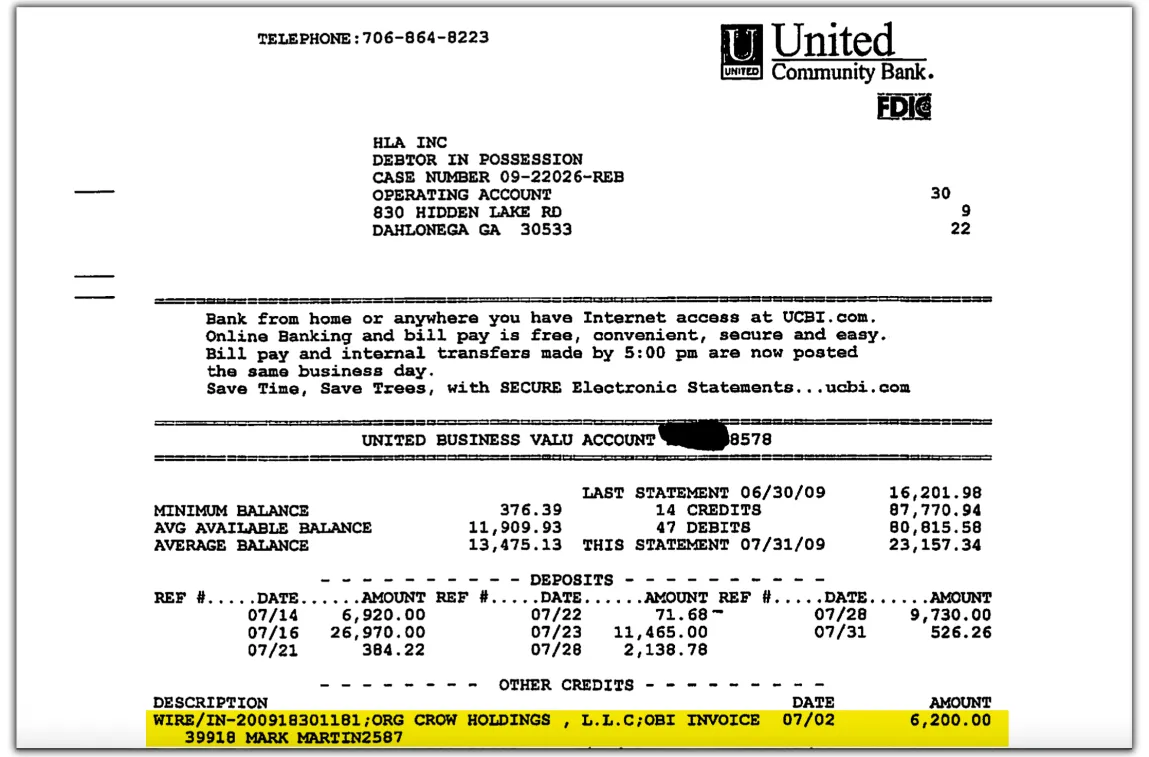 A July 2009 bank statement for Hidden Lake Academy shows a wire from Crow Holdings LLC. Excerpt from court records. Highlights added by ProPublica.
Thomas did not respond to questions. In response to previous ProPublica reporting on gifts of luxury travel, he said that the Crows “are among our dearest friends” and that he understood he didn’t have to disclose the trips.
ProPublica sent Crow a detailed list of questions and his office responded with a statement that did not dispute the facts presented in this story.
“Harlan Crow has long been passionate about the importance of quality education and giving back to those less fortunate, especially at-risk youth,” the statement said. “It’s disappointing that those with partisan political interests would try to turn helping at-risk youth with tuition assistance into something nefarious or political.” The statement added that Crow and his wife have “supported many young Americans” at a “variety of schools, including his alma mater.” Crow went to Randolph-Macon Academy.
Crow did not address a question about how much he paid in total for Martin’s tuition. Asked if Thomas had requested the support for either school, Crow’s office responded, “No.”
Last month, ProPublica reported that Thomas accepted luxury travel from Crow virtually every year for decades, including international superyacht cruises and private jet flights around the world. Crow also paid money to Thomas and his relatives in an undisclosed real estate deal, ProPublica found. After he purchased the house where Thomas’ mother lives, Crow poured tens of thousands of dollars into improving the property. And roughly 15 years ago, Crow donated much of the budget of a political group founded by Thomas’ wife, which paid her a $120,000 salary.
“This is way outside the norm. This is way in excess of anything I’ve seen,” said Richard Painter, former chief White House ethics
lawyer for President George W. Bush, referring to the cascade of gifts over the years.
Painter said that when he was at the White House, an official who’d taken what Thomas had would have been fired: “This amount of undisclosed gifts? You’d want to get them out of the government.”
A federal law passed after Watergate requires justices and other officials to publicly report most gifts. Ethics law experts told ProPublica they believed Thomas was required by law to disclose the tuition payments because they appear to be a gift to him.
Justices also must report many gifts to their spouses and dependent children. The law’s definition of dependent child is narrow, however, and likely would not apply to Martin since Thomas was his legal guardian, not his parent. The best case for not disclosing Crow’s tuition payments would be to argue the gifts were to Martin, not Thomas, experts said.
But that argument was far-fetched, experts said, because minor children rarely pay their own tuition. Typically, the legal guardian is responsible for the child’s education.
“The most reasonable interpretation of the statute is that this was a gift to Thomas and thus had to be reported. It’s common sense,” said Kathleen Clark, an ethics law expert at Washington University in St. Louis. “It’s all to the financial benefit of Clarence Thomas.”
Martin, now in his 30s, told ProPublica he was not aware that Crow paid his tuition. But he defended Thomas and Crow, saying he believed there was no ulterior motive behind the real estate magnate’s largesse over the decades. “I think his intentions behind everything is just a friend and just a good person,” Martin said.
[After this story was published, Mark Paoletta, a longtime friend of Clarence Thomas who has also served as Ginni Thomas’ lawyer, released a statement. Paoletta confirmed that Crow paid for Martin’s tuition at both Randolph-Macon Academy and Hidden Lake, saying Crow paid for one year at each. He did not give a total amount but, based on the tuition rates at the time, the two years would amount to roughly $100,000.
Paoletta said that Thomas did not have to report the payments because Martin was not his “dependent child” as defined in the disclosure law. He criticized ProPublica for reporting on this and said “the Thomases and the Crows are kind, generous, and loving people who tried to help this young man.”]
Crow has long been an influential figure in pro-business conservative politics. He has given millions to efforts to move the law and the judiciary to the right and serves on the boards of think tanks that publish scholarship advancing conservative legal theories.
Crow has denied trying to influence the justice but has said he extended hospitality to him just as he has to other dear friends. From the start, their relationship has intertwined expensive gifts and conservative politics. In a recent interview with The Dallas Morning News, Crow recounted how he first met Thomas. In 1996, the justice was scheduled to give a speech in Dallas for an anti-regulation think tank. Crow offered to fly him there on his private jet. “During that flight, we found out we were kind of simpatico,” the billionaire said.
The following year, the Thomases began to discuss taking custody of Martin. His father, Thomas’ nephew, had been imprisoned in connection with a drug case. Thomas has written that Martin’s situation held deep resonance for him because his own father was absent and his grandparents had taken him in “under very similar circumstances.”
Thomas had an adult son from a previous marriage, but he and wife, Ginni, didn’t have children of their own. They pitched Martin’s parents on taking the boy in.
“Thomas explained that the boy would have the best of everything — his own room, a private school education, lots of extracurricular activities,” journalists Kevin Merida and Michael Fletcher reported in their biography of Thomas.
Thomas gained legal custody of Martin and became his legal guardian around January 1998, according to court records.
Martin, who had been living in Georgia with his mother and siblings, moved to Virginia, where he lived with the justice from the ages of 6 to 19, he said.
Living with the Thomases came with an unusual perk: lavish travel with Crow and his family. Martin told ProPublica that he and Thomas vacationed with the Crows “at least once a year” throughout his childhood.
That included visits to Camp Topridge, Crow’s private resort in the Adirondacks, and two cruises on Crow’s superyacht, Martin said. On a trip in the Caribbean, Martin recalled riding jet skis off the side of the billionaire’s yacht.
Roughly 20 years ago, Martin, Thomas and the Crows went on a cruise on the yacht in Russia and the Baltics, according to Martin and two other people familiar with the trip. The group toured St. Petersburg in a rented helicopter and visited the Yusupov Palace, the site of Rasputin’s murder, said one of the people. They were joined by Chris DeMuth, then the president of the conservative think tank the American Enterprise Institute. (Thomas’ trips with Crow to the Baltics and the Caribbean have not previously been reported.)
Thomas reconfigured his life to balance the demands of raising a child with serving on the high court. He began going to the Supreme Court before 6 a.m. so he could leave in time to pick Martin up after class and help him with his homework. By 2001, the justice had moved Martin to private school out of frustration with the Fairfax County public school system’s lax schedule, The American Lawyer magazine reported.
For high school, Thomas sent Martin to Randolph-Macon Academy, a military boarding school 75 miles west of Washington, D.C., where he was in the class of 2010. The school, which sits on a 135-acre campus in the Shenandoah Valley, charged between $25,000 to $30,000 a year. Martin played football and basketball, and the justice sometimes visited for games.
Randolph-Macon was also Crow’s alma mater. Thomas and Crow visited the campus in April 2007 for the dedication of an imposing bronze sculpture of the Air Force Honor Guard, according to the school magazine. Crow donated the piece to Randolph-Macon, where it is a short walk from Crow Hall, a classroom building named after the Dallas billionaire’s family.
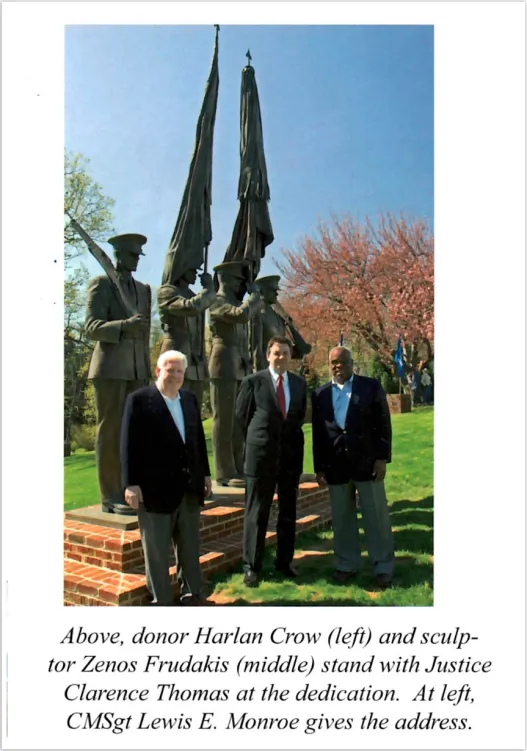 Harlan Crow and Clarence Thomas attended the 2007 dedication of a statue gifted by Crow to Randolph-Macon Academy. The Sabre Magazine
Martin sometimes chafed at the strictures of military school, according to people at Randolph-Macon at the time, and he spent his junior year at Hidden Lake Academy, a therapeutic boarding school in Georgia. Hidden Lake boasted one teacher for every 10 students and activities ranging from horseback riding to canoeing. Those services came at an added cost. At the time, a year of tuition was roughly $73,000, plus fees.
The July 2009 bank statement from Hidden Lake was filed in a bankruptcy case for the school, which later went under. The document shows that Crow Holdings LLC wired $6,200 to the school that month, the exact cost of the month’s tuition. The wire is marked “Mark Martin” in the ledger.
Crow’s office said in its statement that Crow’s funding of students’ tuition has “always been paid solely from personal funds, sometimes held at and paid through the family business.”
Grimwood, the administrator at Hidden Lake, told ProPublica that Crow wired the school money once a month to pay Martin’s tuition fees. Grimwood had multiple roles on the campus, including overseeing an affiliated wilderness program. He said he was speaking about the payments because he felt the public should know about outside financial support for Supreme Court justices. Martin returned to Randolph-Macon his senior year.
Thomas has long been one of the less wealthy members of the Supreme Court. Still, when Martin was in high school, he and Ginni Thomas had income that put them comfortably in the top echelon of Americans.
In 2006 for example, the Thomases brought in more than $500,000 in income. The following year, they made more than $850,000 from Clarence Thomas’ salary from the court, Ginni Thomas’ pay from the Heritage Foundation and book payments for the justice’s memoir.
It appears that at some point in Martin’s childhood, Thomas was paying for private school himself. Martin told ProPublica that Thomas sold his Corvette — “his most prized car” — to pay for a year of tuition, although he didn’t remember when that occurred.
In 2002, a friend of Thomas’ from the RV community who owned a Florida pest control company, Earl Dixon, offered Thomas $5,000 to help defray the costs of Martin’s education. Thomas’ disclosure of that earlier gift, several experts said, could be viewed as evidence that the justice himself understood he was required to report tuition aid from friends.
“At first, Thomas was worried about the propriety of the donation,” Thomas biographers Merida and Fletcher recounted. “He agreed to accept it if the contribution was deposited directly into a special trust for Mark.” In his annual filing, Thomas reported the money as an “education gift to Mark Martin.”
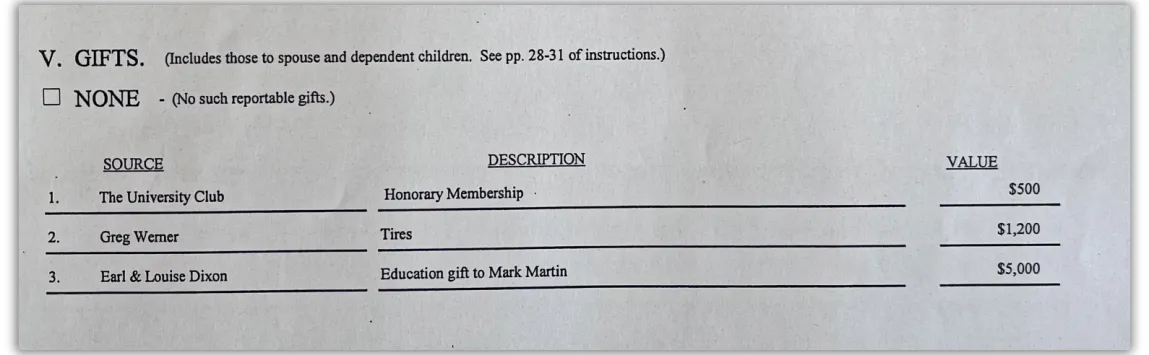 Thomas disclosed an education gift to Martin from a friend in his 2002 disclosure filing. Free Law Project
Corrections
Gabriel Sandoval contributed research.
Contributors
Joshua Kaplan
- I’m a Pulitzer Prize-winning reporter at ProPublica, where I write about the government, money and power.
- Have a Tip for a Story?
Justin Elliott
alex Mierjeski
- I’m a research reporter at ProPublica
3x but key $#? 550k$ crow
ref politico ginni
https://www.politico.com/story/2011/02/justice-thomass-wife-now-lobbyist-048812
By Kenneth P. Vogel, John Bresnahan and Marin Cogan
02/04/2011
She started as a congressional aide in the 1980s, became a midlevel Republican operative, then briefly left politics, reemergingin 2009 as founder of a tea party group before steppingdown amid continued questions about whether her actions were appropriate for the spouse of a Supreme Court justice.
Now, Virginia “Ginni” Thomas, wife of Justice Clarence Thomas, has recast herself yet again, this time as the head of a firm, Liberty Consulting, which boasts on its websiteusing her “experience and connections” to help clients “with “governmental affairs efforts” and political donation strategies.
Thomas already has met with nearly half of the 99 GOP freshmen in the House and Senate, according to an e-mail she sent last week to congressional chiefs of staff, in which she branded herself “a self-appointed, ambassador to the freshmen class and an ambassador to the tea party movement.”
But her latest career incarnation is sparking controversy again.
Thomas’s role as a de facto tea party lobbyist and — until recently — as head of a tea party group that worked to defeat Democrats last November “show a new level of arrogance of just not caring that the court is being politicized and how that undermines the historic image of the Supreme Court as being above the political fray,” said Arn Pearson, a lawyer for Common Cause, the left-leaning government watchdog group.
“It raises additional questions about whether Justice Thomas can be unbiased and appear to be unbiased in cases dealing with the repeal of the health care reform law or corporate political spending when his wife is working to elect members of the tea party and also advocating for their policies.”
Even among congressional Republicans, with whom Thomas boasts she has close ties, the reaction to the entreaties from her new firm, Liberty Consulting ranged from puzzlement to annoyance, with a senior House Republican aide who provided Thomas’s e-mail to POLITICO, blasting her for trying to “cash in” on her ties to the tea party movement.
Freshman Rep. David Schweikert (R-Ariz.) — who courted tea party activists and who was endorsed by Liberty Central, the tea party nonprofit group she headed until December — was unaware of Thomas’s new effort.
“This is the spouse of Justice Thomas?” he said, when asked by POLITICO on Tuesday about her outreach. “No, I’ve never met her. It’s not something I’ve heard about. And I hang out with a lot of freshman,” he said.
While Thomas was well-known in conservative circles as an aide to former House Majority Leader Dick Armey, as a midlevel staffer at the U.S. Chamber of Commerce and at The Heritage Foundation and as the spouse of one of the court’s most conservative justices, she did not draw much attention until 2009, when she started speaking at tea party rallies.
Late that year, she establishedLiberty Central, a group she envisioned as forming a bridge between the conservative establishment and the anti-establishment tea party movement. It was a new role and a new measure of prominence for Thomas, and it marked the beginning of a string of headaches for her and her husband.
Legal ethicists assertedthat Thomas’s role could compromise her husband’s impartiality, especially since the group is not required to report its donors and could have benefitted from the Supreme Court’s Citizens United ruling last year in which Justice Thomas sided with the majority in a decision that allowed corporations to fund campaign ads, often without disclosing their contributions.
To be sure, other federal judges have politically active spouses, including federal appeals court Judge Marjorie Rendell, whose husband is former Pennsylvania Gov. Ed Rendell, and 9th Circuit Court of Appeals Judge Stephen Reinhardt, whose wife, Ramona Ripston, will step down this month after decades running the Southern California branch of the American Civil Liberties Union.
Rendell’s political committees were required to reveal all donations. But the ACLU is registered under sections of the tax code that do not require public disclosure of donors, as is Liberty Central — and Common Cause, for that matter.
But the Thomases came under particular scrutiny after POLITICO revealed that, while the Supreme Court was deliberating over the Citizens United case, Liberty Central had received a $550,000 anonymous contribution.
404 990 27 pp conlon
snip
wayback
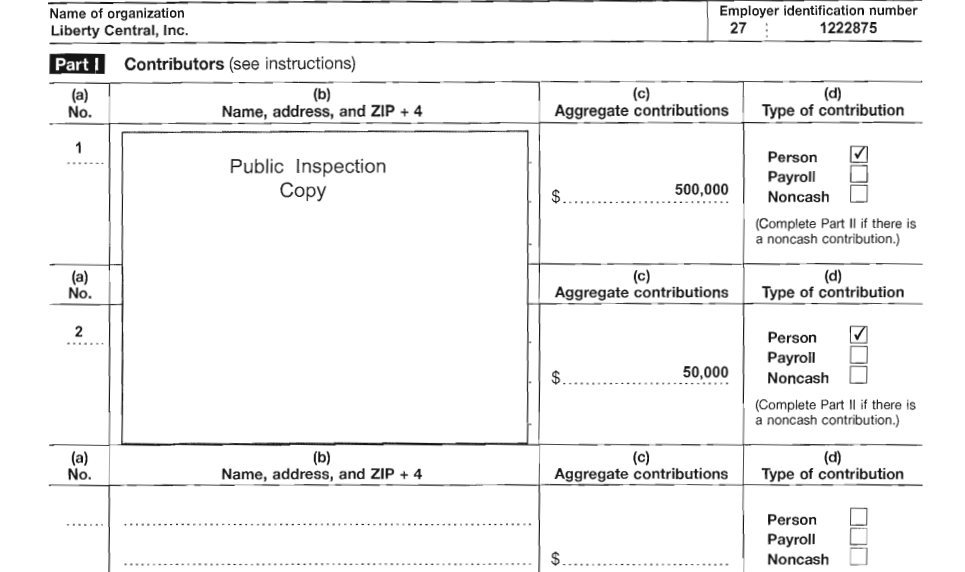
https://www.politico.com/static/PPM156_liberty_central.html
Common Cause, in a letter to the Justice Department, suggestedthat Thomas should have recused himself from the case and charged that “the complete lack of transparency of Liberty Central’s finances makes it difficult to assess the full scope of the ethics issues raised by Ms. Thomas’s role in founding and leading the group.”
In addition, in a letterto the Judicial Conference, Common Cause pointed out that Justice Thomas had failed to report on his disclosure filings his wife’s income over the past decade, prompting the judge to amend13 years of reports to indicate sources — though not amounts — of his wife’s income.
At first, it didn’t seem that the attention affected Thomas’s efforts to build Liberty Central. She assembled an impressive staff and board, while circulating among major conservative establishment donors with whom she and her husband had long, close relationships.
POLITICO has learned, for instance, that the initial $500,000 contribution came from Dallas real estate investor Harlan Crow, a major GOP donor who held an event for Liberty Central at his home a few months after the group launched. He also once gave Justice Thomas a $19,000 “Frederick Douglass Bible” as a gift and donated $150,000 to build a new wing named for Thomas on a Savannah, Ga., library that Clarence Thomas visited frequently in his youth.
But Thomas and Liberty Central ran into problems after it was revealed in October that she had left a voice mail, requestingan apology from Anita Hill, the woman who accused her husband of sexual harassment during his confirmation hearings for the high court in 1991. That prompted another surge of attention and — according to a conservative who knows Ginni Thomas and is familiar with her work at Liberty Central — it “spooked” at least one donor.
About a month later, Thomas stepped down from her leadership post at Liberty Central, and it was announced that the group was mergingwith another conservative nonprofit group calledthe Patrick Henry Center for Individual Liberty. Sources told POLITICO that Thomas essentially put Liberty Central on the block because it was struggling to raise enough money to support its big staff and high overhead.
Liberty Consulting filedincorporation papers in Virginia only a day after news broke of the changes at Liberty Central.
Reached by phone on Wednesday, Thomas said she was having trouble with the signal, telling a POLITICO reporter: “I would be happy to talk with you, but I really can’t understand clearly what you’re asking, so maybe this is not a good time to talk.”
She did not respond to subsequent voice mail or e-mail messages.
In a December interviewwith the conservative Daily Caller, though, Thomas said she planned to spend the bulk of her time working as a consultant for Liberty Central and the Patrick Henry Center, and would “help them in any way I can think of, whether it’s lobbying on the Hill or connecting with the grass roots, or helping speak or write or fundraise.”
But lobbying records show no registrations for Thomas, Liberty Consulting, Liberty Central or the Patrick Henry Center.
When asked whether Thomas was being paid through Liberty Consulting as a consultant, Liberty Central general counsel Sarah Field did not answer directly. “She was and continues to be the founder of Liberty Central, and we look forward to working with her and with other passionate conservative activists, and that’s all there is to it,” Field said.
Thomas and her friends reject the suggestion that the call to Anita Hill precipitated Ginni Thomas’s stepping down from Liberty Central — Thomas told The Daily Caller that the story line was “laughable.” She did, however, concede that the call was “probably a mistake on my part,” adding that, if her move to an outside consulting role “has the extra benefit of helping reduce distractions, that’s fine with me.”
And Leonard Leo, an executive at the conservative Federalist Society who is a longtime friend of the Thomases and sits on Liberty Central’s board, told POLITICO in November that the call had no impact on Liberty Central’s fundraising or on Thomas.
“The people that were supportive of Liberty Central were supportive of her,” he said, adding, “I don’t think that they were going to pull back from her at a time when she needed support more than anything else.”
He called the controversy over the Hill call “a nothing burger” for Thomas. “This is a woman who has been through it all. There are few women in Washington who have had to put up with what she has.”
But the source who knows Thomas and is familiar with her work at Liberty Central said her continuing reinvention of herself — especially so soon after raising big money and assembling a staff for a new nonprofit — has hurt her standing in conservative circles.
“Ginni’s reputation around town is now even more of a fake entitled woman who is only here because of her husband,” the source said. “Now she has opened her own lobbying shop ... not sure how (the) conservative circle will feel when they find that out, or if they’ll care or not.”
So far, they don’t.
Roughly half a dozen aides for new members told POLITICO that their offices received handwritten meeting requests from Thomas the day after they were sworn in, as well as follow-up e-mails requesting a meeting with her — but only one of them had met with her. The rest had no plans to do so.
-=-=
“What Ginni Thomas and Leonard Leo wrought: How a justice’s wife and a key activist started a movement”
September 10, 2023, 2:42 pmcampaign finance, chicanery, Supreme Court
Very deep dive by Politico’s Heidi Pryzybyla:
At the time, the Citizens United ruling was widely expected, as the court had already signaled its intentions. When it came, it upended nearly 100 years of campaign spending restrictions.
The conservative legal movement seized the moment with greater success than any other group, and the consequences have shaped American jurisprudence and politics in dramatic ways.
From those early discussions among Leo, Thomas and Crow would spring a billion-dollar force that has helped remake the judiciary and overturn longstanding legal precedents on abortion, affirmative action and many other issues. It funded legal scholars to devise theories to challenge liberal precedents, helped to elect state attorneys general willing to apply those theories and launched lavish campaigns for conservative judicial nominees who would cite those theories in their rulings from the bench.
The movement’s triumphs are now visible but its engine remains hidden: A billion-dollar network of groups, most of which are registered as tax-exempt charities or social welfare organizations. Taking advantage of gaps in disclosure laws, they shield the identities of most of their donors and some of the recipients of the funds. Among those who’ve been paid by the groups are leading thinkers and individuals with close personal ties to Leo — including a whopping $7 million to a group run by a close friend and his wife. They also include a for-profit business for which Leo himself is chairman and which received tens of millions of dollars from his nonprofit network.
Leo’s role as the central figure in this movement has long been known, culminating in his acquisition last year of what many believe to be the largest political donation in history. Few are aware of the extent to which the movement’s baby steps were taken in concert with Ginni Thomas.
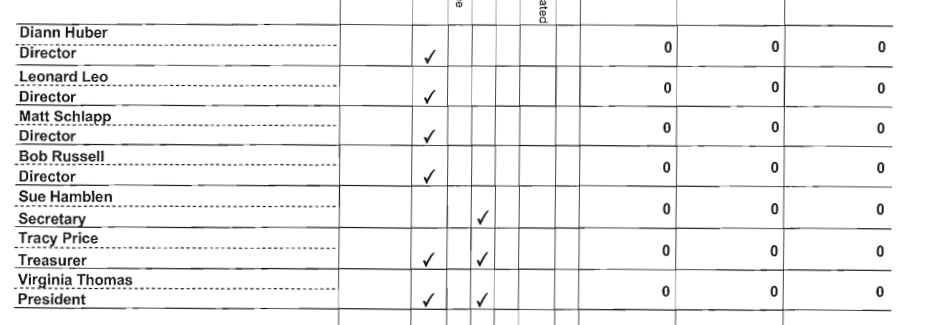
Two months before the Citizens United decision, but after the justices had signaled their intentions by requesting new arguments, attorney Cleta Mitchell — later to play a role in Donald Trump’s false claims about the 2020 elections — filed papers for Ginni Thomas to create a nonprofit group of a type that ultimately benefited from the decision. Leo was one of two directors listed on a separate application to conduct business in the state of Virginia. Thomas was president. She signed it on New Year’s Eve of 2009, and Crow provided much of the initial cash. A key Leo aide, Sarah Field, would come aboard to help Thomas manage the group, which they called Liberty Central.
After Liberty Central went public, it provoked an outcry over a Supreme Court justice’s wife promoting causes like overturning Obamacare that were before her husband’s court. Leo and Thomas changed gears. His network reactivated a dormant group, the Judicial Education Project, which would go on to become a major supplier of amicus briefs before the nation’s highest court. She created a for-profit consulting business using a similar name — Liberty Consulting — that enabled her to perform consulting work for conservative activist groups.
The Judicial Education Project supplied some of her business: Documents indicate Leo ordered at least one recipient of his groups’ funds, Kellyanne Conway, to make payments to Ginni Thomas for unspecified work, according to a Washington Post story earlier this year.
Now, Liberty Consulting is a focus of interest from congressional committees probing the Supreme Court’s ethics disclosures. Senate Democrats have demanded that Leo and Crow provide a list of “gifts, payments, or other items of value” they’ve given Thomas and her husband.…
-=-=
PETITION TO THE SUPREME COURT OF THE UNITED STATES AND TO THE U.S. CONGRESS
(By signing this form, you will be added to the Supreme Court petition and an email will be sent to your U.S. Representatives and Senators.)
Subject: Justice Clarence Thomas must recuse himself from Monsanto Co. v. Durnell, No. 24-1068, due to conflicts of interest undermining judicial impartiality.
To the Honorable Justices of the Supreme Court of the United States and the U.S. Congress:
We, the undersigned citizens, believe that Justice Clarence Thomas should recuse himself from participating in Monsanto Co. v. Durnell — a case docketed for the current term involving alleged harms from Monsanto’s Roundup herbicide — because of his previous employment with the company, his documented history of support for the company as a Senate aide, and longstanding ethical concerns related to his position on previous cases involving Monsanto — all of which give rise to reasonable questions about his impartiality.
Background
Monsanto Co. v. Durnell is a petition for writ of certiorari in which Monsanto seeks review of a state court judgment against it on claims that exposure to glyphosate — the active ingredient in Roundup — caused serious illness, and that Monsanto failed to warn consumers about the risks.
Grounds for Recusal
Under 28 U.S.C. § 455, federal judges and justices should disqualify themselves “in any proceeding in which their impartiality might reasonably be questioned,” including when they have a former professional relationship with a party.
1. Former Employment at Monsanto
- Early in his career, Clarence Thomas worked as an attorney for Monsanto Corporation in the late 1970s. Subsequently, as a Senate aide, it is documented that he relentlessly lobbied his boss on behalf of corporate interests, including Monsanto’s.
- Although more than four decades have passed, this prior professional relationship creates at least the appearance of bias when Thomas adjudicates cases involving his former employer — particularly given the seriousness and potential economic impact of disputes like Durnell.
- In past Supreme Court cases involving Monsanto, including Monsanto Co. v. Geertson Seed Farms (2010), Thomas did not recuse despite this connection, while other justices, like Justice Breyer, voluntarily stepped aside when they had distinct personal ties to the case.
2. Judicial Ethics and Public Confidence
- Supreme Court justices are not bound by the Judicial Code of Conduct that applies to lower federal judges, and are rarely required to explain recusal decisions. Still, experts and lawmakers have repeatedly noted that the Court’s legitimacy depends on avoiding even the appearance of partiality.
- Public trust in the judiciary is eroding, in part due to perceptions that justices participate in cases where conflicts should warrant recusal. Ensuring that Justice Thomas steps aside from Monsanto Co. v. Durnell would affirm the principle that justice must not only be done but be seen to be done.
3. Precedent and Standards
- In federal practice, judges routinely recuse themselves when a reasonable observer could question their impartiality, including when they previously represented a party in a matter substantially related to the case before the judge.
- Although recusal by a Supreme Court justice is discretionary, it is grounded in the same normative principles that apply across the judiciary: fairness, impartiality, and confidence in the rule of law....
-=-=
AN 8 26
Justice Clarence Thomas does not do podcasts, or, really, much media of any kind, said Above the Law journalist and litigator Kathryn Rubino. So, it clearly took something serious to turn up on Sen. Ted. Cruz’ podcast “Verdict with Ted Cruz.”
Sure, the sit down was timed with a book launch, but Rubino said it was also fueled by the fact that Thomas is still hurting from getting caught engaging in what looks like horrendous corruption.
“If you’ve followed Supreme Court scandals over the last few years you know, it’s the reporting that revealed Thomas spent two decades accepting luxury travel and other largesse from GOP megadonors and declining to tell anyone about it,” reported Rubino, adding that Thomas marched straight into Cruz’ podcast for some self-soothing over getting busted.
“You’re one of the people who actually stands up, particularly at times when others seem to wither, and I appreciate it,” Thomas told Cruz. “And more personally, when we, my wife and I, were under attack for obvious reasons, you and Mike Lee and some of the other friends would stand up,” he said. “So I really appreciate that.”
“It’s fascinating that Thomas refers to it as ‘under attack,’ as though the ProPublica reporters who documented the roughly $500,000 Indonesia vacation aboard Harlan Crow’s superyacht were the ones who’d done something untoward, and not the justice who left all of it off the disclosure forms federal law requires him to file,” said Rubino. “Thomas has been nursing this grievance since the story broke, his first real explanation for the whole thing boiled down to my rich friends told me it was fine.
But the gifts kept surfacing, Rubino said. Crow bought three properties from Thomas, including the house where Thomas’s mother lived rent-free, and he paid the private-school tuition for Thomas’ grandnephew.
“By our count, the undisclosed benefits ran to something like $5.8 million. When the Senate Finance Committee asked Crow to itemize any of it, his Gibson Dunn lawyers told the Senate to take their chances with contempt, then doubled down. Thomas eventually amended his disclosures (better than before, nowhere near where they need to be) and then reporters just kept finding more vacations,” said Rubino.
Worse, Thomas was a member of a billionaire’s club, with billionaire friends that “lavished him with pricey gifts,” said Rubino. “Even the RV Thomas uses to establish his everyman bona fides was financed by a rich buddy, via a “loan” that was never paid back.”
But of course, Thomas’s ethics issues run deeper than money, with his wife, right-wing operative Ginni Thomas, sending her “LOVE” to the January 6th rioters hours before the Capitol was stormed, and firing off nearly 30 texts to Mark Meadows urging him to keep fighting the legitimate election putting Biden in the White House.
---
14TH AMEND
AN 6 26
The U.S. Supreme Court issued a decision striking down President Donald Trump's birthright citizenship executive orderin an opinion that was written by Chief Justice John Roberts. However, Justice Ketanji Brown Jackson issued her own concurrence that targeted Justice Clarence Thomas by name.
After 31 pages of Roberts walking through the long history of birthright citizenship in the law, Jackson wrote a response to the dissent that Thomas penned along with Justices Samuel Alito and Neil Gorsuch.
"Despite his longstanding endorsement of a 'colorblind' Constitution, Justice Thomas now surprisingly suggests that the Citizenship Clause was a race-conscious remedial measure, relating only to 'freed slaves such as Dred Scott,' post, at 56, and those who shared with them certain characteristics ... It is for this reason, he says, that 'children who were born in the United States but [to parents] not domiciled here' are not entitled to claim birthright citizenship. ... But that narrow vision of the Fourteenth Amendment bears little relationship to the history of its ratification. Even worse, Justice Thomas’ telling elides the entire point of the Second Founding: The Reconstruction Amendments were an anticaste, antisubordination reset for the Nation, not a mere spot treatment for the dark stain of slavery."
She goes on to allege that Thomas has a "myopic treatment" of the 14th Amendment.
"The Amendment caused a paradigm shift in the trajectory of our Nation; the teacher who scolds a student for bullying a classmate hopes the student learns the broader lesson of treating everyone with kindness, not just that one kid," she says.
She even went so far as to add an extensive footnote of cases "denied by this court" that refers back to Thomas' slavery argument.
"It is common ground that the Fourteenth Amendment was 'enacted ... with the one pervading purpose of securing equal citizenship for the freed slaves.' Also true is the fact that this Court 'has time and again denied Americans that promise.'"
Her footnote for that comment reads: "I suspect, though, that Justice Thomas and I disagree about when and how that promise has been denied by this Court. My list is long (and sadly only getting longer)." She cited 11 separate cases, the most recent of which refers back to a decision earlier this term in *Louisiana v. Callais.*
Jackson closes by saying, "Thankfully, a majority of the Court remembered this today, and has dutifully preserved the most basic animating principle of our Nation’s founding — that all human beings are created equal — once more."
Bill Shein called it a "blistering concurring opinion/takedown of Clarence Thomas's dissent."
Northwestern University School of Law Professor Paul Gowder said, "Justice Jackson knows what's up." He later added, "God bless Justice Jackson actually talking about what the Black folks who won the clause had said and done."
Loyola University School of Law Professor Justin Levitt wrote, "Justice Jackson is absolutely on fire in her birthright concurrence, unloading on the dissent not only for their votes in this case, but its apparent inconsistency with most of the 'colorblindness' jurisprudence of the past few terms."
---
Roger Severino
Material Contributors - What Does Project 2025 Say?
Authored the section about: Section 3.5: Department of Health and Human Services
Served in the Trump Administration: Yes. Severino served in the Department of Health and Human Services as director of the Civil Rights Office from 2017 until 2021.
In His Own Words
The son of Columbian immigrants, Severino has been described by the Human Rights Campaign as a “radical anti-LGBTQ activist.” As director of the HHS Office for Civil Rights, Severino removed nondiscrimination protections for LGBTQ individuals42 established in the Patient Protection and Affordable Care Act. Removing the provision allowed health care providers to deny care based on a patient’s sexuality or gender identity.
On a far weirder note, The Atlantic57 notes that his office is “sparsely decorated, with a crucifix and a Clarence Thomas bobblehead.”
Full Bio
-=-=
-=-=
8 26
Trump's AG pick is letting a a 111-year-old corpse dictate your rights
Thom HartmannAugust 06, 2026
Todd Blanche is campaigning to become our real, confirmed Attorney General, presumably so he can better help Donald Trump, his corrupt family, and the 13 billionaires in his cabinet make off with as much of our money as they can.
Most recently, his campaign took him to the rightwing “religious” group Intercessors for America. When he was asked about progress in totally ending legal abortion in America, or at least Red State America, he told them:
“We don’t have complete victory yet, but we will have victory, and victory will be soon, and and it will be permanent.”
He added, later in the call:
“If states have said, ‘We are going to protect the unborn and we’re going to protect every life from the moment of conception,’ we’re putting practices and policies in place so that other states and other organizations can’t attack that. They can’t do things like they’re doing with mailing in mail-order drugs.”
So, how’s he going to pull this off? His sworn testimony before Congress may offer us a glimpse into the plan.
Ted Cruz asked him:
“18 USC 24 Section 1461, the Comstock Act, provides that every article or thing designed or adapted or intended for producing abortion is declared to be non-mailable. I have to admit that statutory text to me looks quite straightforward. It is not subtle. It is not difficult. It is straightforward. …
“[W]ill you commit that the Department will carefully evaluate every lawful action available to ensure the faithful enforcement of the Comstock Act and other Federal pro-life acts?”
Blanche answered: “Yes.”
How does he plan to “protect every life from the moment of conception”? Apparently, with the Comstock Act. And he may well have the backing of the six Republicans on the Supreme Court as their next step after their Dobbs decision.
Back during oral arguments before the Supreme Court in March of 2024, the Comstock Act was invoked repeatedly by Sam Alito, Clarence Thomas, and Erin Hawley, the wife of Republican Senator Josh Hawley, who was the lawyer arguing before the Court that the abortion drug, Mifepristone, should be banned nationwide.
Justice Sam Alito said:
“This [Comstock Act] is a prominent provision. It’s not some obscure subsection of a complicated, obscure law. Everybody in this field knew about it.”
Erin Hawley was emphatic:
“We don’t think that there’s any case of this court that empowers FDA to ignore other federal law. The Comstock Act says that drugs should not be mailed … either through the mail or through common carriers.”
And Clarence Thomas laid out the possibility of future litigation when he essentially threatened the lawyer for Danco Laboratories, the manufacturer of Mifepristone:
“How do you respond to an argument that mailing your product and advertising it would violate the Comstock Act?” He went on to note that the law “is fairly broad, and it specifically covers drugs such as yours.”
In other words, they want the Act enforced today.
So, what the heck is the Comstock Act and why are Republicans trying to revive it before the Supreme Court and in threatening letters to pharmacy chains?
You’ve probably never heard of Anthony Comstock, a Civil War Union soldier and New York Postmaster, who died in 1915. You need to learn about him and his legacy, however, as his long fingers are about to reach up out of the grave and wrap themselves around the necks of every American woman of childbearing years.
Anthony Comstock was a mama’s boy who hated sex. His mother died when he was 10 years old and the shock apparently never left him; women who didn’t live up to her ideal were his open and declared enemies, as were pornography, masturbation, and abortion. He was so ignorant of sex and reproduction that he believed a visible human-like fetus developed “within seconds” of sexual intercourse.
Comstock spent decades scouring the country collecting hard-core pornography, which he enthusiastically shared with men in Congress, and harassing “loose women.” For example, when he visited a belly-dancing show (then a new craze) in Chicago at the Cairo Theatre during the World’s Fair of 1893, he demanded the show be shut down.
As Amy Sohn, who wrote a brilliant Comstock biography titled The Man Who Hated Women, noted:
“Despite national controversy and Comstock’s intervention, ultimately the only alteration made to the fair’s belly dancing was costuming: the dancers swapped their gauze blouses for thin woolen undershirts. The vice hunter had lost in Chicago. But he would not forget the dancers, and would have four of them arrested and fined when they came to New York that winter. New York, after all, was Comstockland.”
Comstock lobbied for and shepherded through Congress a law passed on March 3, 1873 titled “An Act for the Suppression of Trade in, and Circulation of, obscene Literature and Articles of immoral Use.” Today we refer to it as the Comstock Act.
It’s language with regard to abortion is not at all ambiguous:
“Every obscene, lewd, lascivious, indecent, filthy or vile article, matter, thing, device, or substance … designed, adapted, or intended for producing abortion, or for any indecent or immoral use; and
“Every article, instrument, substance, drug, medicine, or thing which is advertised or described in a manner calculated to lead another to use or apply it for producing abortion, or for any indecent or immoral purpose; and
“Every written or printed card, letter, circular, book, pamphlet, advertisement, or notice of any kind giving information, directly or indirectly, where, or how, or from whom, or by what means any of such mentioned matters, articles, or things may be obtained or made, or where or by whom any act or operation of any kind for the procuring or producing of abortion will be done or performed, or how or by what means abortion may be produced, whether sealed or unsealed; and
“Every paper, writing, advertisement, or representation that any article, instrument, substance, drug, medicine, or thing may, or can, be used or applied for producing abortion, or for any indecent or immoral purpose; and
“Every description calculated to induce or incite a person to so use or apply any such article, instrument, substance, drug, medicine, or thing—
“Is declared to be nonmailable matter and shall not be conveyed in the mails or delivered from any post office or by any letter carrier.” (emphasis mine)
The penalty is also not ambiguous. Persons mailing information about abortion, or drugs or devices to produce an abortion:
“[S]hall be fined under this title or imprisoned not more than five years, or both, for the first such offense, and shall be fined under this title or imprisoned not more than ten years, or both, for each such offense thereafter.” (emphasis mine)
The Biden administration argued that the Comstock Act of 1873 was set aside almost a century ago.
And, indeed, in 1930, the Appeals Court for the Second Circuit ruled in Youngs Rubber Corp. v. C.I. Lee & Co that the law couldn’t apply to things sent through the mail that are legal, even if they were illegal at the time of the passage of the Comstock Act. (The case involved condoms manufactured by Youngs Rubber Company.)
“Such a construction,” the Court wrote, “would prevent mailing to or by a physician of any drug or mechanical device ‘adapted’ for contraceptive or abortifacient uses, although the physician desired to use or to prescribe it for proper medical purposes.”
The law has been amended by Congress four times (in 1955, 1958, 1971, and 1994), but the language above about abortion was never struck because legislators figured the 1930 appeals court’s ruling rendered it nugatory.
But don’t tell that to Trump’s appointee, Texas District Judge Matthew Kacsmaryk of Amarillo, who ruled in 2023 that Mifepristone was to be banned nationwide: he based a large part of his decision on the plain language of the Comstock Act.
Republican members of Congress agree, and want the Comstock Act enforced nationwide now. They think they don’t even need a ruling from the Supreme Court: they just need Todd Blanche to “enforce the law already on the books.”
In a letter sent to CVS (among other pharmacy chains), Mississippi Republican Senator Cindy Hyde-Smith and eight other Republican senators (Lankford, Daines, Braun, Rubio, Marshall, Risch, Crapo and Blackburn) wrote that the Biden interpretation (and that of Congress in 1955, 1958, 1971, and 1994) is wrong.
They explicitly asserted that the Comstock Act is still in effect and they want it enforced:
“We write to express our support and agreement with 21 [Republican] State Attorneys General,” they wrote “who have reminded you that Federal law in 18 U.S.C. 1461-1462 [the Comstock Act] criminalizes nationwide using the mail, or interstate shipment by any express company or common carrier, to send or receive any drug that is ‘designed, adapted, or intended for producing abortion.’”
The 1930 court ruling that lawmakers and judges had, for over 90 years, believed only applied the Comstock Act to items that were illegal (like child porn), Senator Hide-Smith wrote:
“[D]oes not protect CVS or any other individual or entity from being prosecuted within the five-year statute of limitations for the illegal mailing or interstate shipment of abortion drugs … even for conduct that occurs today.”
Keep in mind, under the plain language of the Comstock Act this could also apply to birth control pills, IUDs, and other things used to prevent pregnancy. And, of course, pornography and “masturbation devices” like vibrators.
The lawyer for Republicans defending Kacsmaryk’s ruling, Erin Hawley, went so far as to assert before the Fifth Circuit Court of Appeals that even physicians and pharmacies shouldn’t be able to receive Mifepristone or other drugs that could produce an abortion via the mail, FedEx, or UPS:
“What the Comstock law says is that it is improper to mail things that induce or cause abortions, which is precisely the action the FDA took in 2021 when it permitted the mailing of abortion drugs.”
If Hawley’s interpretation is enforced by Todd Blanche once he’s securely settled into his office with a vote by Republicans in the Senate, all abortions in the United States could be ended when drugs and suction and surgical devices designed specifically for the procedure can no longer be shipped to hospitals, clinics, or physicians’ offices.
This is no idle threat.
As Washington Post reporter Dan Diamond wrote for his Substack newsletter, anti-abortion activist Mark Lee Dickson, who’s helped several cities around the country put into law local versions of the Comstock Act, told him:
“If a future president were to enforce these federal statutes, then they could shut down every abortion facility in America.”
This is the specific goal of these mostly “Christian” religious fanatics: to completely outlaw all abortion and radically restrict access to birth control. And having Blanche start enforcing the law that’s already on the books, provoking a battle heading for the Supreme Court, is all it would take.
Such a case would, based on Blanche’s sworn testimony to the Senate, have Republicans, Clarence Thomas, and Sam Alito gleefully rubbing their hands in anticipation.
So, if you’re concerned about the future of abortion rights in America, it might be a good time to call your Senators — particularly if either is a Republican — and let them know your thoughts on Blanche’s nomination that’ll probably get a vote in the next two days.
-=-=
-=-=
AN 5 26 VID]
A recent dissent from U.S. Supreme Court Justice Clarence Thomas has prompted two legal analysts to question just "how far gone" the infamous conservative is.
Last week when the Supreme Court temporarily upheld telehealth access to Mifepristone, a frequently used drug that can expel pregnancies and miscarriages.
Thomas wrote in his own dissent, disagreeing with the majority of the court, claiming that the 1873 Comstock Act blocks the mail delivery and telehealth prescriptions for the drug. The law, however, applied to "obscene" materials and was used to stop the mailing of adult photos, magazines and other items.
“I write separately to note that, as Louisiana argued below, it is a criminal offense to ship Mifepristone for use in abortions,” said Thomas. “The Comstock Act bans using ‘the mails’ to ship any ‘drug ... for producing abortion.’"
Those pharmaceutical companies, Thomas claimed, "cannot, in any legally relevant sense, be irreparably harmed by a court order that makes it more difficult for them to commit crimes."
He said that they should be "thrown in prison."
"Applicants, which are the makers of these drugs, are not entitled to a stay of an adverse court order based on lost profits from their criminal enterprise. They cannot in any legally relevant sense be irreparably harmed by a court order that makes it more difficult for them to commit crimes," Thomas continued.
Slate legal reporter Mark Joseph Stern spoke with "Balls and Strikes" deputy editor Madiba Dennie, who called the Thomas opinion "outrageous."
Stern wondered what Dennie made of Thomas "throwing down" and "making the Comstock act great again."
She keyed in on the claim that the companies are part of some "criminal enterprise" as if they were "some guy on the corner selling heroin."
"I'm just like, 'Okay, buddy.' Like it's like somebody's been watching too much crime TV," she quipped.
Dennie went on to say it was "really egregious and just really trying to legitimize what was once a fringe theory that the Comstock Act does apply here, that it is valid, that it's still good law and should be used to prosecute all so many people."
"It's truly something absurd. I think it just shows how far gone Clarence Thomas is," she continued. "The language is on another level."
Stern explained that the language comes from the "crazy far-right anti-abortion advocates."
"They have been saying for years that this is a criminal network and a criminal conspiracy, and Thomas is just like, 'Absolutely. I'm just going to copy-paste that stuff into the U.S. reports, right?'" Stern argued.
Dennie agreed, "I think you have seen this sort of trend for Thomas for a while. Like he always describes abortion as this really nefarious, like racist eugenics-like operation happening across the country. And yeah, he really sees the opportunity to sort of put that put that into into his dissent here and mix in some criminality for good measure."
Stern clarified that she wasn't being hyperbolic, that Thomas did describe it as a racist eugenics program in a previous opinion.
"So, this guy is not pretending to be a neutral judge in these cases. He is like, 'We must outlaw abortion and imprison everyone who participates in it, including quite possibly patients,'" Stern said.
---
SEE LIBEL
5 13? 26 good YT dn
claR 180 AFTER BAD PRESS, JOINED BY ---
FEDSOC HERIT CLAREMONSTERS
### "Murder the Truth": David Enrich on Right-Wing Campaign to ... www.youtube.com › watch
[
19:33](https://www.youtube.com/watch?v=71ex9pAe248)
Support our work: https://democracynow.org/donate/sm-desc-yt The new book Murder the Truth: Fear, the First Amendment, and a Secret Campaign ...
YouTube · Democracy Now! · Mar 20, 2025
---
sen? comm shows 3 more pvt jet eg natl parks, san jose 6 24 msnbc
---
4 26 ANALYSIS LEGAL AF WACKO SPEECH NATURAL LAW = GOD VS CONSENT OF PPL
PROGRESSIVEISM FOREIGN OTTO VON BISMARCK
Clarence Thomas' SHOCK BIZARRE Speech EXPOSED - YouTube
---
an 4 26
When Justice Clarence Thomas joined the U.S. Supreme Court in 1991, he had strong disagreements not only with the liberal justices, but also, with Ronald Reagan appointees Anthony Kennedy and Sandra Day O'Connor. Kennedy had a libertarian approach to conservatism, embracing a right-view of economics but voting with the High Court's liberal justices on cases involving gay rights and abortion.
Thomas, however, had an ally in Justice Antonin Scalia (Reagan's most socially conservative High Court appointee), and Justice Samuel Alito was often described as Thomas' kindred spirit after then-President George W. Bush appointed him in 2006.
According to analysis from SCOTUSblog's Kelsey Dallas in July 2025, Thomas and Alito "agreed in 97 percent of all cases resolved with opinions from the Court and in 100 percent of the closely divided (6-3 or 5-4) ones in the 2024-25 term." But Reason's Damon Root, in an article published on April 23, describes a rare example of Thomas and Alito finally having a major disagreement.
The case that found the far-right justices on opposite sides was Hencely v. Fluor Corporation,decided on April 22.
"It originated with a suicide bombing carried out by a Taliban operative at the U.S. Bagram Air Base in Afghanistan," Root explains. "Army Specialist Winston Hencely was severely injured in the attack and later filed suit for negligence in state court against the Fluor Corporation, the U.S. military contractor that employed the bomber. In its own investigation of the matter, the U.S. Army faulted the Fluor Corporation for, among other things, 'an unreasonable complacency by Fluor to ensure Local National employees were properly supervised at all times, as required by their contract.' The question presented by the case was whether Hencely's state lawsuit may proceed or whether it is preempted by federal law."
Root continues, "Writing for the majority, Thomas held that Hencely's state negligence suit may move forward. 'No provision of the Constitution and no federal statute justifies that preemption of the State's ordinary authority over tort suits,' Thomas wrote. 'Nor does any precedent of this Court command such a result.'"
Hencely v. Fluor was a 6-3 ruling, with Thomas joined by the High Court's three Democratic appointees (Justices Sonia Sotomayor, Elena Kagan and Ketanji Brown) and two Donald Trump appointees (Neil Gorsuch and Amy Coney Barrett). The dissenters were Alito, Chief Justice John Roberts and Trump appointee Brett Kavanaugh.
"What a fascinating line up," Root comments. "Not only do we have the rare sight of Thomas butting heads with Alito, but we have Thomas joined by all three Democratic appointees, while Alito has mustered the votes of only Roberts and Kavanaugh. In this case, as in certain others, the principles of federalism helped to make for some unusual judicial bedfellows."
Root argues that "Alito basically accused Thomas of letting federalism run amok to the detriment of the war powers of the national government."
The libertarian journalist notes, "'May a State regulate security arrangements on a military base in an active warzone?' Alito demanded. 'May state judges and juries pass judgment on questions that are inextricably tied to military decisions that balance war-related risks against long-term strategic objectives? In my judgment, the answer to these questions must be no, and for that reason, this state-law tort case is preempted by the Constitution's grant of war powers exclusively to the Federal Government.'"
---
---
4 26 alito and clar under pressure to bail; clar crazy speech // d’souza fake history
an 4 26
I’ve long assumed that Samuel Alito was the worst.
Alito — who authored the majority opinion in Dobbs v. Jackson Women's Health Organization (2022), the case that ended constitutional abortion rights by merely asserting that the high court’s prior opinion inRoe v. Wade (1973) was wrongly decided; who accepted a 2008 luxury fishing trip to Alaska, including private jet travel, from hedge fund billionaire and GOP donor Paul Singer yet failed to disclose it on Alito's financial forms and didn’t even recuse himself from decisions involving Singer’s subsequent business before the Supreme Court; who hoisted an inverted American flag outside his Virginia home shortly after the January 6 Capitol riot, a symbol of support for Trump's false claims of a stolen 2020 election — has the moral and intellectual stature of a poisonous toad.
But I’ve come to revise my view of the court’s worst Justice.
Clarence Thomas is 77 years old. He has now served on the Supreme Court for over 34 years, making him the longest-serving member of the Court. He is a bitter, angry, severe hard-right, intellectually dishonest, ideologue. After reading his latest thoughts on America, I’ve concluded Thomas is even worse than Alito.
Last Wednesday, Thomas gave a rare public address at the University of Texas in Austin that began as a banal tribute to the Declaration of Independence before degenerating into a misleading screed against progressivism.
“At the beginning of the twentieth century, a new set of first principles of government was introduced into the American mainstream,” Thomas intoned. “The proponents of this new set of first principles, most prominently among them the twenty-eighth president, Woodrow Wilson, called it progressivism.”
Thomas went on to blame progressives for the worst crimes of the 20th century, insisting that “Stalin, Hitler, Mussolini, and Mao” were all “intertwined with the rise of progressivism,” as was “racial segregation,” “eugenics,” and other evils.
This is pure rubbish.
In reality, America’s Progressive era emerged at the start of the 20th century from the corruption and excesses of America’s first Gilded Age (we’re now in the second, if you hadn’t noticed) — its record inequalities of income and wealth, its “robber barons” who monopolized industries and handed out sacks of money to pliant legislators, it’s dangerous factories and unsafe working conditions, its violent attacks on workers who tried to form unions, its corporate control over all facets of government, its widespread poverty and disease, and its corrupt party machines.
In many ways, the Progressive Era — whose most prominent leader was Republican president Theodore Roosevelt, not Woodrow Wilson, by the way — saved capitalism from its own excesses by instituting a progressive income tax, an estate tax, pure food and drug laws, and America’s first laws against corporate influence in politics.
Then, under Teddy Roosevelt’s fifth cousin (Franklin D.), came Social Security, the 40-hour workweek (with time-and-a-half for overtime), the right to form unions, and laws and regulations that limited Wall Street’s ability to gamble with other people’s money.
Clarence Thomas got it exactly backwards. Had we not had the Progressive Era and its reforms extending through the 1930s, America might well have succumbed to fascism — as did Germany under Hitler, and Italy under Mussolini, or to communist fascism, as did Russia under Stalin. Progressive and New Deal reforms acted as bulwarks against the rise of fascism in America.
In fact, it’s been the demise of such reforms since Ronald Reagan that have opened the way to Trumpian neo-fascism.
Over a third of American workers in the private sector were unionized in the 1950s, giving them bargaining leverage to get higher wages and better working conditions. Now, fewer than 6 percent are unionized, which has contributed to the flattening of wages, a contracting middle class, inequalities of income and wealth rivaling the first Gilded Age, and an angry and suspicious working class that’s become easy prey for demagogues.
Wall Street has been deregulated — allowing it to go on gambling sprees such as the one that produced the financial crisis of 2008, which claimed millions of working peoples’ homes, savings, and jobs.
America’s social safety nets have become so frayed that almost a fifth of the nation’s children are now in poverty. Yet Reagan, George W. Bush, and Trump have slashed taxes on the rich and on big corporations and have allowed giant corporations to merge into giant monopolies rivaling the trusts of the first Gilded Age. And Trump has ushered in an era of corruption the likes of which America hasn’t seen since that earlier disgraceful era.
Thomas claims that “The century of progressivism did not go well.” Baloney. It helped America create the largest middle class the world had ever seen, while also extending prosperity to millions of Black and brown people.
The tragedy is that America turned its back on progressivism and on social progress, in part because of the Supreme Court and Justice Clarence Thomas.
Flashback: I was in law school in 1973 when the Supreme Court decided Roe, protecting a pregnant person’s right to privacy under the 14th amendment to the Constitution.
Clarence Thomas was in my law school class at the time, as was Hillary Rodham (later Hillary Clinton) and Bill Clinton.
The professors used the “Socratic method” – asking hard questions about the cases they were discussing and waiting for students to raise their hands in response, and then criticizing the responses. It was a hair-raising but effective way to learn the law.
One of the principles guiding those discussions is called stare decisis — Latin for “to stand by things decided.” It’s the doctrine of judicial precedent. If a court has already ruled on an issue (say, on reproductive rights), future courts should decide similar cases the same way. Supreme Courts can change their minds and rule differently than they did before, but they need good reasons to do so, and it helps if their opinion is unanimous or nearly so. Otherwise, their rulings appear (and are) arbitrary — even, shall we say? — partisan.
In those classroom discussions almost fifty years ago, Hillary’s hand was always first in the air. When she was called upon, she gave perfect answers – whole paragraphs, precisely phrased. She distinguished one case from another, using precedents and stare decisis to guide her thinking. I was awed.
My hand was in the air about half the time, and when called on, my answers were meh.
Clarence’s hand was never in the air. I don’t recall him saying anything, ever.
Bill was never in class.
Only one of us now sits on the Supreme Court. And he has shown no respect for stare decisis.
Nor has he respected judicial ethics.
A federal law — 28 U.S. Code § 455 — requires that “any justice, judge, or magistrate judge of the United States shall disqualify himself in any proceeding in which his impartiality might reasonably be questioned.”
In the aftermath of the 2020 election, Thomas’s wife, Ginni, actively strategized with White House chief of staff Mark Meadows on overturning the election results. Between Election Day 2020 and the days following the January 6th attack on the Capitol, she exchanged 29 text messages with Meadows, in which she spread false theories about the election, urged Meadows to overturn the election results, and called for specific actions from the White House to help overturn the election. She also served as one of nine board members of a group that helped lead the “Stop the Steal” movement and called for the punishment of House Republicans who participated in the U.S. House Select Committee investigating the January 6th attack.
Yet Clarence Thomas has repeatedly participated in cases that have come to the high court directly or indirectly involving the 2020 election results, refusing to disqualify himself.
In addition, he failed to disclose his wife’s income from her work at the Heritage Foundation, in violation of the Ethics in Government Act.
Finally, there’s his speech last week in Austin. How can Americans be expected to believe in the impartiality of the Supreme Court in general and Clarence Thomas in particular when he condemns an entire philosophy of government — progressivism — and all the people who continue to call themselves progressives, in effect labeling them neo-fascists?
At the start of his speech last week in Austin, Clarence Thomas noted that “My wife Virginia and I have many wonderful friends and acquaintances here, and it is so special to have our dear friends Harlan and Kathy Crow join us today.”
He was, of course, referring to the Republican mega-donor who has spent the last twenty years lavishing Thomas with personal gifts, luxury yacht trips, fancy vacations, and funding for Ginni Thomas’s political organization.
Small wonder that Clarence Thomas prefers the Gilded Age over the Progressive Era. He’s the living embodiment of The Gilded Age’s public-be-damned excesses.
Hence, he’s my nominee for the worst justice in modern Supreme Court history.
*Robert Reich
---
hick h
4 27 26 an
Former Secretary of Labor Robert Reich has come to a conclusion. While he once thought the worst Supreme Court justice was Samuel Alito — who authored the death of Roe v. Wade — he has since amended his position. Now, he asserts that “bitter, angry, severe hard-right, intellectually dishonest ideologue” Clarence Thomas “is even worse than Alito.”
Reich says he came to this conclusion following a recent speech by Thomas in which he was ostensibly praising the Declaration of Independence, but ended up delivering a “misleading screed against progressivism.” In the speech, Thomas claimed that progressives were to blame for history’s worst crimes, insisting that Stalin, Hitler, Mussolini and Mao were all “intertwined with the rise of progressivism.”
“This is pure rubbish,” writes Reich, going on to explain that not only is much of the basic history proffered by Thomas regarding the roots of progressivism outright wrong, but rather than contributing to authoritarianism, “Progressive and New Deal reforms acted as bulwarks against the rise of fascism in America.” He argues that progressive policies “saved capitalism from its own excesses by instituting a progressive income tax, an estate tax, pure food and drug laws and America’s first laws against corporate influence in politics,” then provided the labor protections necessary for workers to improve their quality of life.
“Clarence Thomas got it exactly backward,” says Reich. “Had we not had the Progressive Era and its reforms extending through the 1930s, America might well have succumbed to fascism — as did Germany under Hitler and Italy under Mussolini, or to communist fascism, as did Russia under Stalin.”
He went on to point out that many of these progressive gains were rolled back under subsequent Republican administrations, then noted that not only has Thomas displayed an inaccurate appraisal of history, but he’s proven his disregard for judicial ethics. As an example, Reich cites Thomas’s repeated participation in cases tied to the 2020 election results, even though his wife, Ginni, was directly involved with efforts to overturn the election.
Thomas’s wife, writes Reich, “actively strategized with White House chief of staff Mark Meadows on overturning the election results. Between Election Day 2020 and the days following the January 6 attack on the Capitol, she exchanged 29 text messages with Meadows, in which she spread false theories about the election, urged Meadows to overturn the election results, and called for specific actions from the White House to help overturn the election. She also served as one of nine board members of a group that helped lead the ‘Stop the Steal’ movement and called for the punishment of House Republicans who participated in the U.S. House Select Committee investigating the January 6 attack.”
Even so, Thomas presided over several related cases, refusing to disqualify himself.
What’s more, says Reich, Thomas bears other blatant conflicts of interest. At the opening of his speech attacking progressives, Thomas noted that, “My wife Virginia and I have many wonderful friends and acquaintances here, and it is so special to have our dear friends Harlan and Kathy Crow join us today.” This is a reference to a “Republican mega-donor who has spent the last 20 years lavishing Thomas with personal gifts, luxury yacht trips, fancy vacations, and funding for Ginni Thomas’s political organization.”
“Hence,” concludes Reich, “he’s my nominee for the worst justice in modern Supreme Court history.”
---
QUIET FOR A WHILE NOW
AN 4 26
When U.S. Supreme Court Justice Thurgood Marshall announced his retirement in 1991 and President George H.W. Bush nominated Clarence Thomas, he wanted the seat to be held by another Black justice. Marshall was an historic figure: Appointed by President Lyndon B. Johnson in 1967, he was the first Black justice in the High Court's history.
But Thomas, now 77, was a major departure from Marshall in terms of judicial philosophy. While Marshall (who passed away in 1993) was decidedly liberal, Thomas is a far-right social conservative. And over the years, he had strong disagreements with not only the late liberal Justice Ruth Bader Ginsburg, but also, with retired libertarian/conservative Justice Anthony Kennedy.
Thomas looked back on U.S. history during a Wednesday night, April 15 speech at the University of Texas, Austin Law School, arguing that progressive politics are incompatible with the U.S. Declaration of Independence. But The New Republic's Matt Ford, in an article published on April 17, argues that Thomas got history wrong in multiple ways.
Thomas told attendees, "As we meet today, it is unclear whether these principles will endure. At the beginning of the 20th Century, a new set of first principles of government was introduced into the American mainstream. The proponents of this new set of first principles, most prominently among them the 28th president, Woodrow Wilson, called it progressivism. Since Wilson's presidency, progressivism has made many inroads in our system of government and our way of life. It has coexisted uneasily with the principles of the Declaration. Because it is opposed to those principles, it is not possible for the two to coexist forever."
But according to Ford, Thomas' take on U.S. history is wildly inaccurate.
"Thomas is correct that progressivism was introduced around the turn of the 20th Century, that Woodrow Wilson was the 28th president, and that Wilson was a progressive," Ford explains. "The historical accuracy ends there. Presenting Wilson as the inventor of progressivism is historically illiterate, akin to saying that Joseph Stalin invented communism or that Ronald Reagan invented conservatism. In reality, the progressive era emerged in the 1890s from the corruption and excesses of the Gilded Age."
Ford continues, "A broad range of activists, journalists, legislators, and judges challenged the societal ills that had emerged from the nation's rapid industrialization…. I'm sure that Wilson would have liked to claim credit for inventing the progressive movement, but he was one figure in a much larger social and political ecosystem. Republicans and Democrats alike both supported the movement and its reforms, and the first president to embrace it was actually Theodore Roosevelt."
Ford argues that for Thomas, it is "rhetorically advantageous to make" Wilson "the standard-bearer of progressivism" because he "was perhaps the most racist person to hold the presidency between Andrew Johnson and Donald Trump."
"It allows certain conservative intellectuals to adopt the guise of anti-racism while simultaneously opposing the civil rights laws passed decades after Wilson died," Ford notes. "I bring all of this up not to defend Wilson himself, but to point out the importance of getting history correct."
:{---
AN 1 26
An extensive new study from a team of Ivy League economists has uncovered just how much the Supreme Court has shifted towards favoring the wealthier side in any given case, with a New York Times report concludingreport concluding that you can "follow the money" to determine how it will in any given case.
The new study, dubbed "Ruling for the Rich," was published on Monday and hailed from the team of Yale's Fiona Scott Morton, Columbia's Andrea Prat and Columbia's Jacob Spitz. Adam Liptak, the leading Supreme Court correspondent for the Times, dug into its findings, noting that "the wealthy have the wind at their backs before the justices," and questioning whether or not they are living up to their oath to "do equal right to the poor and to the rich."
Per Liptak's analysis, the study found that Republican appointees, who have held a 6-3 majority on the Supreme Court since 2020 and an overall majority for much longer, are "far more likely than Democratic ones to side with the wealthy," and adding "that the Supreme Court has become deeply polarized in cases pitting the rich against the poor." This is now in sharp contrast to the court of the mid-20th Century, "when appointees of the two parties were statistically indistinguishable" in terms of favoring wealthier parties.
Specifically, the study found that Republican-appointed justices sided with wealthier parties in cases around 70 percent of the time. By comparison, in 1953, conservative justices sided with them only 45 percent of the time.
Speaking with Liptak about the findings, Adam Cohen, author of the book "Supreme Inequality," noted that the study essentially reiterated ideas about the court's conduct that "some of us have been observing for a long time."
“But it is great to see,” Cohen added. “Respected academics crunching the numbers and producing the data to show that this is exactly what has been going on.”
These findings come as leaders in both political parties are ramping up plans to radically alter their campaign finance plans ahead of an upcoming decision, in which the court is widely expected to lift the limits on how much party committees and campaigns are allowed to coordinate with each other. This, experts argue, would hand even more power to the wealthiest donors and further erode the power of small-dollar donors.
---
PRO PUB
TOOL SCOTUS
Did you know? Every year, the Supreme Court’s nine justices fill out a form that discloses their financial connections to companies and people.
We have a database that allows you to search for organizations and people that have paid the Supreme Court justices, reimbursed them for travel and given them gifts: https://propub.li/3GyKA3R
---
AN 12 25
The U.S. Supreme Court handed President Donald Trump a rare, if temporary, loss on Tuesday, over his efforts to deploy the National Guard in Illinois.
The Court rejected the Trump administration’s emergency request to send troops to Chicago. The administration had claimed that troops were needed to protect federal agents.
“At this preliminary stage, the Government has failed to identify a source of authority that would allow the military to execute the laws in Illinois,” the Supreme Court declared, according to The Washington Post.
The Post called the ruling a “major defeat” for the Trump administration that “could have far-reaching effects,” and a “significant setback for his campaign to push troops into cities across the country over the objections of local and state leaders.”
In rebuffing Trump’s bid, NBC News reported, “the court at least provisionally rejected the Trump administration’s view that the situation on the ground is so chaotic that it justifies invoking a federal law that allows the president to call National Guard troops into federal service in extreme situations.”
“Those circumstances can include when ‘there is a rebellion or danger of a rebellion’ or ‘the president is unable with the regular forces to execute the laws of the United States.'”
The high court reportedly also cited the Posse Comitatus Act, which limits the use of the U.S. Armed Forces to enforce domestic laws.
Bloomberg Law’s Jordan Fischer reported that “In a 6-3 order, the court says at least at this stage the administration has not overcome the Posse Comitatus Act.”
Former U.S. Attorney Joyce Vance, calling it a “Huge loss” for the administration, wrote: “SCOTUS tells Trump no on deployment of Illinois Nat’l Guard, finding a valid exception to the Posse Comitatus Act doesn’t exist.”
Dissenting were Justices Samuel Alito, Clarence Thomas, and Neil M. Gorsuch.
---
---
clarence approved writ then voted ~?
civil contemp for order disobey immigr 2 laws
conservative Justice Clarence Thomas and at least four of his colleagues on the U.S. Supreme Court, though it's unclear how many, unceremoniously declined to disturb a federal judge's order blocking enforcement of SB 4-C, a law that created state criminal penalties for illegal immigration in Florida.
The Wednesday denial of Florida Attorney General James Uthmeier's application for a stay of U.S. District Judge Kathleen Williams' preliminary injunction pending appeal in the 11th U.S. Circuit Court of Appeals was only one line, containing no further explanation or reasoning from SCOTUS.
"The application for stay presented to Justice Thomas and by him referred to the Court is denied," the order said.
In April, Williams, a Barack Obama appointee, sided with the plaintiffs, the Florida Immigrant Coalition and the Farmworker Association of Florida, granting the temporary restraining order and the injunction they requested. Williams was persuaded by the argument that SB 4-C amounted to an unconstitutional state assertion of immigration enforcement powers that belong to the federal government.
---
:{===
an 12 24
badash
In 2005, President George W. Bush’s nominee, John Roberts, became Chief Justice of the Supreme Court. Five years later, just over one quarter of the country (27%) disapproved of him. By last year, that disapproval number had risen to nearly half the nation: 46%.
Since 2021, Gallup reports, the Supreme Court’s disapproval rating has consistently remained in the mid to upper 50s—a roughly ten-point increase compared to the previous decade. The majority of Americans have an apparent growing dissatisfaction with a court that wields ultimate authority while becoming increasingly secretive and activist on some of the nation’s most consequential issues.
While the Supreme Court’s job is not to make decisions based on popularity contests, it relies on the other two branches of the federal government to enforce its rulings. And when the Supreme Court’s credibility falls into question, some warn, our institutions may be at risk.
In October, Bloomberg Opinion’s Noah Feldman warned the Supreme Court’s “legitimacy crisis is getting worse.”
READ MORE: ‘Two Things Could Be True’: White House Reveals Why Hunter Pardon Might Not Have Happened
“Democrats’ faith in the court began to fail after the 2000 Bush v. Gore decision, then went into freefall over the last couple of years,” Feldman wrote. “They worry the justices aren’t sufficiently ethical. They deplore the eagerness of the court’s conservative majority to overturn 50 years of precedent on issues like abortion and affirmative action. They are appalled at the court’s defiance of originalism — the idea that Constitutional law should rest on the document’s original meaning — to grant criminal immunity to former President Donald Trump for official acts while president.”
Nearly two years ago the Alliance for Justice (AFJ), a progressive coalition of nearly 140 organizations “advocating for a fair and independent justice system,” published a piece warning that the Supreme Court was “destroying its own legitimacy.”
“The Court’s wounds are entirely self-inflicted,” William W. Taylor, III, wrote at the AFJ. “It has a far-right agenda and the scholarship informing its decisions is often questionable. Worse, new details have come to light of relationships some justices have had with wealthy ideological soulmates, including those with interest in cases before the Court. The Court’s credibility and the public’s acceptance of its decisions depends upon trust that it is not subject to outside influence. While lobbying may be common and acceptable in the legislative and executive branches, it is not — nor ought not to be — conceivable in our courts.”
The New York Times on Tuesday took a deep dive into the behind-the-scenes conversations at the end of the summer of 2023 among the Supreme Court justices as they weighed whether or not to establish a code of ethics, amid a nation angered by numerous reports of what many see as blatant corruption.
“Last year, pressure on the court and the chief justice intensified. Journalists revealed that Justice Thomas had accepted far more largess from Harlan Crow, a conservative donor, than he had disclosed, including decades of travel on private jets and a superyacht, and boarding school tuition for his grandnephew. The public uproar also reflected another concern: Virginia Thomas, his wife, had been involved in Mr. Trump’s efforts to overturn the 2020 election,” The Times reports.
“Faced with ethics controversies and a plunge in public trust, they were debating rules for their own conduct, according to people familiar with the process,” The Times adds, revealing that “behind the scenes, the court had divided over whether the justices’ new rules could — or should — ever be enforced.”
In the end, the justices all signed onto a new code of ethics for the nation’s highest court, but one that “had no means of enforcement.”
It was quickly criticized.
READ MORE: Why the Hunter Biden Pardon Is ‘Justified’ According to Legal Experts
Liberals on the court have since gone public with their apparent frustration that although there is finally a code of ethics, there is no way to enforce it.
“All three liberals — Justices Sotomayor, Kagan and Jackson — supported enforcement, The Times reports.
“Rules usually have enforcement mechanisms attached to them, and this one — this set of rules — does not,” Justice Elena Kagan said in July.
“I haven’t seen a good reason why the ethics code that the Supreme Court adopted shouldn’t be enforceable,” Justice Ketanji Brown Jackson said. “Other justices have posited certain ways in which it could be made enforceable but we have not yet determined or decided to do that.”
By contrast, at least some of the majority right-wing justices appear opposed to any code, certainly one that would have methods of enforcement.
“In the private exchanges, Justice Clarence Thomas, whose decision not to disclose decades of gifts and luxury vacations from wealthy benefactors had sparked the ethics controversy, and Justice Samuel A. Alito Jr. wrote off the court’s critics as politically motivated and unappeasable,” The Times revealed. “Justice Gorsuch was especially vocal in opposing any enforcement mechanism beyond voluntary compliance, arguing that additional measures could undermine the court. The justices’ strength was their independence, he said, and he vowed to have no part in diminishing it.”
The Times also reveals that the justices “seemed to codify their own preferences” when they drafted, or signed off on the code of ethics.
Those preferences appear largely financial.
The justices “gave themselves no firm restrictions on gifts, travel or real estate deals. Nothing in the new rules appears aimed directly at the trips and gifts Justice Thomas accepted. The code says only that justices should uphold the dignity of the office and comply with existing gift guidelines, in separate federal rules, which make allowances for ‘personal hospitality.’ Justice Thomas has maintained that his nondisclosure of gifts and free travel did not violate those rules,” according to The Times. Other legal experts disagree, with some saying he broke the law.
Since signing the new code of ethics, “questions about the justices’ behavior have continued. The Times revealed that two provocative flags associated with the Jan. 6 riot had flown at the homes of Justice Alito and his wife. The second was displayed at his New Jersey beach house just as the justices were considering the new ethics rules. That summer, he also accepted concert tickets from a far-right German princess. He later disclosed those, but in keeping with the new rules, said nothing about his free stay at her 500-room Bavarian palace.”
Last month, U.S. Senator Sheldon Whitehouse (D-RI), among the Senate’s top proponents of Supreme Court reform, wrote: “As long as the Court maintains a secretive billionaire gifts program for justices and unique immunity from ethics scrutiny for itself, and as long as its decisions predictably align with those billionaire interests, its reputation will continue to crash.”
---
9 24 an denver r
---
yikes so cannon
For the Eleventh Circuit - Clarence Thomas, Associate Justice> (Alabama,Florida, Georgia)
---
===
an july 2x? russia trip
Two Senate Democrats have published a list of roughly three dozen lavish gifts Supreme Court Associate Justice Clarence Thomas received from right-wing billionaires during his time on the Court.
On the eve of the Independence Day holiday, Sens. Sheldon Whitehouse (D-Rhode Island) and Ron Wyden (D-Oregon) called on Attorney General Merrick Garland to appoint a special counsel to investigate Thomas for "possible violations of ethics and tax laws" in his "repeated and willful omissions" of gifts from wealthy benefactors.
"The scale of the potential ethics violations by Justice Thomas, and the willful pattern of disregard for ethics laws, exceeds the conduct of other government officials investigated by the Department of Justice for similar violations," Whitehouse and Wyden wrote. "The breadth of the omissions uncovered to date, and the serious possibility of additional tax fraud and false statement violations by Justice Thomas and his associates, warrant the appointment of a Special Counsel to investigate this misconduct."
READ MORE:**Expert: Clarence Thomas could face 'criminal prosecution' by not paying taxes on gifts**
On page 14 of the PDF Whitehouse posted to his Senate website, there are two lists of gifts to Thomas. The first list describes gifts from far-right real estate magnate Harlan Crow, and the second list shows gifts from other wealthy sponsors, like entrepreneur Anthony Welters — who "loaned" Thomas a luxury RV and then later forgave the loan — and billionaire Wayne Huizenga.
The gifts from Crow date back to 2003, and list excursions like "Yacht trip to Russia and the Baltics" and Helicopter to Yusipov Palace, St. Petersburg." Out of the roughly two dozen gifts Crow gave to Thomas, four are private school tuition payments for his grand-nephew. Many of Crow's other gifts were private jet flights and yacht cruises, including one Sens. Whitehouse and Wyden described as "around Greek islands."
And out of the gifts on the second list, three were from Huizenga, two were from Welters, and five were from former Berkshire Hathaway board member David Sokol. Billionaire Warren Buffett, who owns Berkshire Hathaway, forced Sokol out in 2011 after he learned that Sokol bought a stake in a company he later convinced Buffett's company to buy. Buffett called Sokol's actions "inexplicable" and "inexcusable."
"No government official should be above the law. Supreme Court justices are properly expected to obey laws designed to prevent conflicts of interest and the appearance of impropriety and to comply with the federal tax code," the senators wrote. "We therefore request that you appoint a Special Counsel authorized to investigate potential criminal violations by Justice Thomas under the disclosure, false statement, and tax laws; pursue leads of related criminal violations by donors, lenders and intermediate corporate entities; and determine whether any such loans and gifts were provided pursuant to a coordinated enterprise or plan."
READ MORE:**Clarence Thomas cut off contact with man he raised 'as a son' — now he faces decades in prison**
In 2023, Pulitzer Prize-winning investigative reporter Davide Cay Johnston commented that it was possible Thomas could face "criminal prosecution" by not paying taxes on the previously undisclosed gifts from Crow and others. He opined that any lower-level court judge would not be able to avoid the charges if they failed to pay taxes on gifts worth millions of dollars.
"What Clarence Thomas has done would result in not only any judges in America being removed from the bench, but there is a good chance it would result in criminal prosecution for income tax fraud and for false filings in his mandatory financial ethics disclosure statements," Johnston said in December.
Last month, anti-corruption watchdog group Fix the Court totaled Thomas' gifts and found that the conservative jurist had received approximately $4 million in gifts dating back to 2004 – far more than any other justice on the Supreme Court. And of the 193 gifts Thomas received, he only listed 27 on his required financial disclosure reports.
Click here to read Whitehouse and Wyden's full letter to Garland.
READ MORE:[Clarence Thomas discloses billionaire Harlan Crow paid for two luxury vacations after decades of trips
---
an ah 9 24
many critics of U.S. Supreme Court Justice Clarence Thomas argued that in light of his wife Ginni Thomas' efforts to help former President Donald Trump overturn the 2020 election results, he needed to recuse himself from Trump v. the United States. But Justice Thomas refused, and he was among the six GOP-appointed justices who, in that case, ruled that U.S. presidents enjoy immunity from criminal prosecution for "official" acts but not for "unofficial" acts.
In a biting opinion column published on September 4, the Washington Post's cites Ruth Marcus as a "persuasive reason" why the High Court "does need an enforcement mechanism."
"Just when you think Virginia 'Ginni' Thomas can't do any more to cast disrepute on the institution where her husband has served as a justice for more than three decades — just when you think that perhaps, just perhaps, the justices and their spouses have been chastened by the torrent of bad publicity — there she goes again," Marcus argues. "The latest bombshell from ProPublica and Documented involves Thomas' gushing, all-caps thank-you e-mail to the conservative First Liberty Institute."
READ MORE:'Friendly crowd': Here are 5 takeaways from Fox News' Trump townhall
The Post columnist continues, "This is not just any conservative organization — it's one that litigates extensively before the Supreme Court, on some of its most contested cases involving religious liberty and LGBTQ+ rights. And Thomas' e-mail was not just some generic note of appreciation. It was to praise First Liberty for its fierce, and deep-pocketed, fight against — wait for it — proposals to reform the Supreme Court and strengthen ethics enforcement against the justices."
Marcus warns that Ginni Thomas "isn't just lobbying to 'Stop the Steal' — she's trying to Stop the Reform of her husband's own institution."
"So much for separate careers," Marcus laments. "Ginni Thomas' own behavior around the 2020 election, and Clarence Thomas' conduct in accepting, and failing to disclose, thousands of dollars' worth of gifts from wealthy conservatives helped trigger the push for Court reform in the first place. Now, we know, Ginni Thomas is a behind-the-scenes player seeking to frustrate any changes — and a grateful…. beneficiary of First Liberty's efforts on the Thomases' behalf."
Marcus adds, "This would be wildly inappropriate if First Liberty were a run-of-the-mill ideological organization, but the group isn't only that. It's a frequent litigant before the Supreme Court and the lower federal courts."
READ MORE:Ex-Rep. Liz Cheney endorses Kamala Harris citing 'danger that Trump poses'
*Ruth Marcus' full Washington Post column is available at this link (subscription required).
===
bench slapped by ?
an 67 24
matt g says scotus
Andrew Weissmann, an attorney who served as a lead prosecutor in former special counsel Robert Mueller’s office, on Monday detailed the impact of Judge Aileen Cannon’s decision to dismiss special counsel Jack Smith’s classified documents case against Donald Trump, telling MSNBC she “stands alone” in her ruling.
Cannon, a Trump appointee, delivered the shocking ruling on Monday, dismissing the classified documents case against the former president. Cannon decided the appointment of Smith violated the Constitution under both the Appointments Clause and the Appropriations Clause.
Weissmann, speaking to MSNBC, noted “under both those constitutional provisions, [Cannon] said that the executive branch does not have that power. “
READ MORE:Experts pin blame on Clarence Thomas as Cannon dismisses Trump classified docs case
“She’s restricting the power of the executive branch of government — that is the president, the attorney general — from appointing a special counsel, saying that's something that would have to be done by congressional statute, or the president himself would have had to appoint this person, not [Attorney General] Merrick Garland.”
“It is in distinct contrast to all of the other cases that have dealt with this,” Weissmann said.
Weissmann noted various special counsel appointments, including Robert Hur, who investigated President Joe Biden, and the special counsel who prosecuted Hunter Biden.
“All of those other judges, where there's been this challenge, have rejected the view of Judge Cannon,” Weissmann said. “She stands alone.”
READ MORE:Questions and fury after MSNBC pulls plug on Monday Morning Joe following Trump shooting
“What she's doing in many ways is putting in writing what she has done de facto in this case: she’s delayed this case at every step,” Weissmann continued. “The one difference now is that by making this ruling in writing — not just sort of slowing the case to a complete standstill, which has been her want — this will go to the 11th Circuit [Court of Appeals]. The government can appeal this because every other case they have won.”
Weissmann explained he “actually litigated this issue when [he] was part of special counsel Mueller's investigation.”
“And the courts, I think quite correctly, rejected what Judge Cannon did, and said that the attorney general has ample authority to appoint a special counsel as an inferior officer,” he said. “This, though, is the kind of issue I think will go to the 11th Circuit and I think it might go to the Supreme Court.”
Weissmann added a “final point” for “cynical viewers,” telling MSNBC “they can put this decision by Judge Cannon alongside the Supreme Court's immunity decision from two weeks ago to really think about the problem with rule of law in this country.”
“This is the kind of decision that would affect the D.C. case,” the attorney later added. Remember, D.C. is where Jack Smith has the January 6th insurrection case. The D.C. Court of Appeals has rejected Judge Cannon's decision. They do not believe there's a problem with the way in which the special counsel was appointed. That's what they held in the Mueller investigation. they said there was ample authority.”
Weismann said in that case, a Trump-appointed judge “held there was no problem at all with the attorney general appointing [special counsel Mueller].”
“Her reasoning was that the attorney general can follow any sort of internal guidance he wants in running the Department of Justice,” Weismann said. “He can appoint all sorts of people to help him. He can hire people. He has all sorts of underlings that are at his beck and call.”
“There’s no problem in the attorney general hiring all sorts of people beneath him to carry out the work of the Department of Justice,” the attorney explained. “She said that's true of special counsel Mueller, it would be true of special counsel Jack Smith. That's the reasoning in D.C. It was rejected by Judge Cannon. So there's now conflict between the D.C. cases and Judge Cannon.”
READ MORE: Dems 'slept-walked into Armageddon' as Trump coalesced GOP into 'wholly owned subsidiary of MAGA'
---
ref an 7 24
U.S. District Judge Aileen Cannon in a 93-page opinion has dismissed the Espionage Act/classified documents case against ex-president Donald Trump, claiming Special Counsel Jack Smith’s appointment by Attorney General Merrick Garland “violates the Appointments Clause of the United States Constitution.” Legal experts, calling her ruling “wrong,” say U.S. Supreme Court Justice Clarence Thomas is to blame.
Donald Trump was indicted by a grand jury on 37 felony charges, 31 of them under the Espionage Act, in the case related to his alleged unlawful removal, retention, and refusal to return hundreds of documents, many classified, some top secret, and some so secret they include the nation’s nuclear secrets.
“There’s no case any more, it’s been dismissed,” observed former U.S. Attorney Chuck Rosenberg, a former Counselor to the U.S. Attorney General, on MSNBC. He said he is “confident” Judge Cannon’s ruling would be appealed.
Politico’s Kyle Cheney reported the bombshell news:
Other legal experts agree.
“This ruling (which is wrong six ways from Sunday) can (and will) be immediately appealed to the Eleventh Circuit,” wrote professor of law Steve Vladeck. “To me, the only question is whether the Special Counsel also asks for the case to be reassigned on remand…”
Former federal civil rights prosecutor Dr. Kristy Parker, Counsel at Protect Democracy, said: “Hard to characterize how wrong this is — at least in a world where law matters. We may not be in that world any longer.”
READ MORE: Biden Channels Lincoln in Address on Trump Assassination Attempt: ‘We Are Not Enemies’
Last month in oral arguments the argument Smith’s appointment was unlawful was made to Cannon, MSNBC’s Lisa Rubin noted Monday morning, saying that the judge appeared at the time to dismiss that claim.
“People tried this against Special Counsel Robert Muller,” MSNBC’s Ken Dilanian stressed, “and were unsuccessful and it’s really important to point out and so viewers understand there’s nothing in this opinion that speaks to the merits of this case, to the classified documents to the allegations of obstruction of justice. This is an entirely procedural issue. It’s a constitutional question. It’s whether whether the law establishing the Special Counsel violates the appointments clause, and she also actually made a ruling on a separate argument about the appropriations clause. And and she, and she’s decided that the way Congress is funding the way the Special Counsel is funded, is not appropriate either.”
Constitutional law professor and political scientist Anthony Michael Kreis described the dismissal as “Insanity.”
Noting today is also the start of the 2024 Republican National Convention, founder and Executive Director of Protect Democracy, Ian Bassin, a former Associate White House Counsel, blasted the Trump-appointed judge:
“Cannon likely thought releasing her latest gift to Trump at the opening of the RNC would help him, but changing today’s headlines to a pic reminding that Trump stole our nation’s most sensitive nat’l security docs and hid them in his bathroom may not be the gift she thinks it is.”
Cannon likely thought releasing her latest gift to Trump at the opening of the RNC would help him, but changing today’s headlines to a pic reminding that Trump stole our nation’s most sensitive nat’l security docs and hid them in his bathroom may not be the gift she thinks it is. pic.twitter.com/9aUEg3yGLh
— Ian Bassin 🇺🇸 (@ianbassin) July 15, 2024
MSNBC legal analyst Joyce Vance, a former U.S. Attorney called Cannon’s decision, “Absolutely incredible,” while concurring the ruling will be appealed.
“That’s it,” she added. “Unless the 11th Circuit & ultimately SCOTUS disagree, Trump goes free for walking out of the White House with top secret documents. At best, this is seriously delayed. Disgusted.”
READ MORE: ‘Supposed to Be Hard’: Political Experts Explain Their Thinking on Biden and the Election
Some legal experts, including Vance, point to U.S. Supreme Court Justice Clarence Thomas’ separate concurrence in the Trump immunity case as giving Judge Cannon the roadmap to come to this decision.
“This was the argument advanced by Justice Thomas in his concurrence in Trump v. US, which no other Justice signed into at the time,” Vance noted.
Professor of law Leah Litman observed, “Justice Thomas’s ‘Cannon-currence’ worked.”
Parenthetically, she explained, “In the Trump immunity case, Justice Thomas wrote separately to suggest the special counsel was unlawfully appointed; the reasoning laid out the roadmap for this (wrong) result/decision.”
“Justice Thomas strikes again,” wrote professor of law Melisa Murray. “Not only did a majority of the Court give presidents almost unfettered license in the immunity case, Justice Thomas concurred separately to question the constitutionality of the special counsel. He laid the table and Judge Cannon took a seat.”
“Surprising absolutely no one,” observed legal journalist Cristian Farias. “This is a Federalist Society pipe dream, one they could never achieve during the Mueller years. And precisely what Clarence Thomas, all alone, suggested should happen in the Trump immunity case.”
But, he added, “This is not the end.”
Read the social media posts above or at this link.
READ MORE: ‘Betrayal’: Trump Hosts ‘Russian Puppet’ Viktor Orbán as Biden Hosts NATO Leaders
---
===
an ah 8 24
With its 6-3 GOP supermajority, the U.S. Supreme Court is now, critics say, dominated by hard-right ideologues. But in an article published on August 12, Vox's Ian Millhiser warns that the High Court could move even further to the right if former President Donald Trump defeats Vice President Kamala Harris in the 2024 presidential election. And if that happens, Millhiser argues, there is a good chance that the First Amendment will suffer.
"The good news for proponents of free speech is that, based on the Court's most recent First Amendment decisions, it does appear to have a 6-3 majority in favor of preserving the post-1960s understanding of that amendment," Millhiser writes. "The bad news is that there are three justices willing to drastically shrink the protections offered by that amendment. And those three could easily swell to five if former President Donald Trump gets to appoint more justices to the Court."
Millhiser adds, "Justice Sonia Sotomayor, one member of the Court's pro-free speech majority, is now 70. Chief Justice John Roberts, another member of that majority, will turn 70 shortly after the next president is inaugurated."
READ MORE:**Trump is losing it because he's afraid of losing**
The Vox journalist notes that Justices Clarence Thomas and Neil Gorsuch "have openly called for New York Times v. Sullivan (1964), the fount of press freedom in the United States, to be overruled" — and Trump agrees with them.
"More broadly, Sullivan stands for the proposition that state governments cannot use defamation law to maliciously target the press," Millhiser explains. "If a reporter makes a serious error, that reporter may still be liable for defamation. But governments that want to shut down a newspaper cannot simply wait until a reporter misremembers which song was sung at a rally, and then pounce with a multi-million-dollar lawsuit."
Millhiser points out that many times in U.S. history, the First Amendment has come under attack — from the Comstock Act to Sen. Joseph McCarthy (R-Wisconsin) "ramping up his witch hunts against suspected communists."
"In the American system, where justices serve until they retire or die, no one can be sure how much power each president will have to reshape the Constitution," the Vox journalist observes. "A vote for Trump is a vote to roll the dice on a drastically different vision of free speech in the United States — one that bears far more resemblance to the not-so-distant past than it does to anything most modern-day Americans have experienced."
READ MORE:[Inside the GOP plot to silence Texas voters
*Read the full Vox article at this link.
===
an 7 24
Two Senate Democrats have published a list of roughly three dozen lavish gifts Supreme Court Associate Justice Clarence Thomas received from right-wing billionaires during his time on the Court.
On the eve of the Independence Day holiday, Sens. Sheldon Whitehouse (D-Rhode Island) and Ron Wyden (D-Oregon) called on Attorney General Merrick Garland to appoint a special counsel to investigate Thomas for "possible violations of ethics and tax laws" in his "repeated and willful omissions" of gifts from wealthy benefactors.
"The scale of the potential ethics violations by Justice Thomas, and the willful pattern of disregard for ethics laws, exceeds the conduct of other government officials investigated by the Department of Justice for similar violations," Whitehouse and Wyden wrote. "The breadth of the omissions uncovered to date, and the serious possibility of additional tax fraud and false statement violations by Justice Thomas and his associates, warrant the appointment of a Special Counsel to investigate this misconduct."
READ MORE:Expert: Clarence Thomas could face 'criminal prosecution' by not paying taxes on gifts
On page 14 of the PDF Whitehouse posted to his Senate website, there are two lists of gifts to Thomas. The first list describes gifts from far-right real estate magnate Harlan Crow, and the second list shows gifts from other wealthy sponsors, like entrepreneur Anthony Welters — who "loaned" Thomas a luxury RV and then later forgave the loan — and billionaire Wayne Huizenga.
The gifts from Crow date back to 2003, and list excursions like "Yacht trip to Russia and the Baltics" and Helicopter to Yusipov Palace, St. Petersburg." Out of the roughly two dozen gifts Crow gave to Thomas, four are private school tuition payments for his grand-nephew. Many of Crow's other gifts were private jet flights and yacht cruises, including one Sens. Whitehouse and Wyden described as "around Greek islands."
And out of the gifts on the second list, three were from Huizenga, two were from Welters, and five were from former Berkshire Hathaway board member David Sokol. Billionaire Warren Buffett, who owns Berkshire Hathaway, forced Sokol out in 2011 after he learned that Sokol bought a stake in a company he later convinced Buffett's company to buy. Buffett called Sokol's actions "inexplicable" and "inexcusable."
"No government official should be above the law. Supreme Court justices are properly expected to obey laws designed to prevent conflicts of interest and the appearance of impropriety and to comply with the federal tax code," the senators wrote. "We therefore request that you appoint a Special Counsel authorized to investigate potential criminal violations by Justice Thomas under the disclosure, false statement, and tax laws; pursue leads of related criminal violations by donors, lenders and intermediate corporate entities; and determine whether any such loans and gifts were provided pursuant to a coordinated enterprise or plan."
READ MORE:Clarence Thomas cut off contact with man he raised 'as a son' — now he faces decades in prison
In 2023, Pulitzer Prize-winning investigative reporter Davide Cay Johnston commented that it was possible Thomas could face "criminal prosecution" by not paying taxes on the previously undisclosed gifts from Crow and others. He opined that any lower-level court judge would not be able to avoid the charges if they failed to pay taxes on gifts worth millions of dollars.
"What Clarence Thomas has done would result in not only any judges in America being removed from the bench, but there is a good chance it would result in criminal prosecution for income tax fraud and for false filings in his mandatory financial ethics disclosure statements," Johnston said in December.
Last month, anti-corruption watchdog group Fix the Court totaled Thomas' gifts and found that the conservative jurist had received approximately $4 million in gifts dating back to 2004 – far more than any other justice on the Supreme Court. And of the 193 gifts Thomas received, he only listed 27 on his required financial disclosure reports.
Click here to read Whitehouse and Wyden's full letter to Garland.
---
}:
context 7 24
Alito’s 'infuriating' claims prove he 'doesn’t have a clue about what we do': emergency medicine doc
idaho woman ER airlifted to utah?
===
OSHA clarence an 7 24 ah
Inside Clarence Thomas’ new legal target: 'It’s unconstitutional' - Alternet.org
When the U.S. Supreme Court handed down its controversial ruling in Loper Bright Enterprises v. Raimondo on June 28, it overturned a decision that had been the law of the land for 40 years: Chevron U.S.A., Inc. v. Natural Resources Defense Council, Inc.
That landmark 1984 decision established what was known as "Chevron deference," which said that judges and courts should defer to the expertise of officials at federal regulatory agencies. Critics of the June 28 ruling argue that it seriously undermines the ability of government agencies to regulate everything from clean water and air quality to health care.
According to Business Insider, one agency that Justice Clarence Thomas is hoping to see abolished is the Occupational Safety and Health Administration (OSHA).
READ MORE: **SCOTUS limits government agencies in bombshell decision with sweeping implications**
Business Insider's Grace Eliza Goodwin reports, "The Supreme Court, on Tuesday, (July 2), announced which cases it would consider next and which it wouldn't. Among those the Court rejected was a case that challenged the authority of OSHA, which sets and enforces standards for health and safety in the workplace. And Thomas, widely considered to be the most conservative justice on the already-mostly conservative Court, wasn't happy."
Goodwin adds, "In a dissent, he explained why he believed the High Court should've taken the case: OSHA's power, he argues, is unconstitutional."
Thomas wrote, "Congress purported to empower an administrative agency to impose whatever workplace-safety standards it deems 'appropriate.' That power extends to virtually every business in the United States."
Goodwin notes that the 6th Circuit Court of Appeals "upheld OSHA's constitutionality" in 2023.
READ MORE:[Conservative warns Dems to get it together and confront Trump's 'true menace'
*Business Insider's full report is available at this link.
===
an 6 24 raw
Supreme Court on Friday ruled in an 8-1 vote that the government had the right to restrict access to firearms for alleged domestic abusers.
However, there was one notable dissent in the ruling: Justice Clarence Thomas.
As flagged by Slate's Mark Joseph Stern, Thomas argued that all regulations of firearms should be deemed in violation of the Second Amendment "unless it is consistent with the Nation's historical tradition of firearm regulation."
Thomas then claimed that there is "not a single historical regulation" that "justifes the statute at issue."
Commenting on this, Stern said that Thomas seemed to be arguing that restricting abusers' access to firearms was off-limits because "wife-beating was not generally a crime" at the time of the country's founding in the 18th Century.
Stern was not the only observer to express shock at the logic behind Thomas' ruling.
"And Thomas’s dissent is utterly ridiculous and disingenuous," argued former tennis starMartina Navratilova. He is a disgrace to our highest court. Anita Hill should have been believed!!!"
"Clarence Thomas is the only Supreme Court justice who wants to arm domestic abusers," wrote former Chicago Sun-Times editor Mark Jacob. "He’s a pox on our society."
Matt Fuller, the cofounder of the centrist think tank Third Way, also had a horrified reaction to the Thomas dissent.
"Three reactions: 1) I can't believe this was even a question 2) Thank God 3) Clarence Thomas is a corrupt lunatic," he wrote.
Fred Guttenberg, a gun safety advocate whose daughter was murdered in the Parkland school shooting, said that Thomas' dissent "is only further proof that he is simply a threat to America."
NOTUS Reports' Matt Fuller, meanwhile, simply posted a description of the brutal assault that respondent Zackey Rahimi allegedly gave to his girlfriend and commented, "Clarence Thomas thinks this person should be allowed to have a gun."
soto dissent said simple, quack duck vs clarence nerdy trivia
BB 6 24
after a gunman killed 58 people in Las Vegas and hurt hundreds more using a bump stock to automate his rifle fire into the crowd, then-president Donald Trump banned the devices. The U.S. Supreme Court today lifted that ban, with Justice Clarence Thomas (R—Harlan Crow) saying that firearms with bump stocks do not meet the Federal definition of a machine gun irrespective of their rate of fire.
The 6-3 vote fell on ideological lines, with Justice Sonia Sotomayor voicing her dissent: "When I see a bird that walks like a duck, swims like a duck, and quacks like a duck, I call that bird a duck." In his concurrence with the majority, Justice Samuel Alito conceded that in "practical terms" a weapon equipped with a bump stock is a machine gun but that it was down to Congress to ban them.
The ruling does not lift state bans on bump stocks; eighteen states have done so. The NRA briefly supported the federal ban, sensing public fury at the massacre, but returned to opposing it when no serious political support for gun reform emerged.
===
6 24 an
Clarence Thomas cut off contact with man he raised 'as a son' — now he faces decades in prison
---
an 6 24 no grf spike
for more than 20 years U.S. Supreme Court Justice Clarence Thomas and often his wife, Ginni Thomas, were the guests of billionaire Republican mega-donor Harlan Crow, who reportedly treated the couple to luxury air and sea travel and trips to his resort and other destinations, complete with gifts including clothing, all expenses paid. Now, following years of reports on the alleged ethics and corruption scandals of right-wing Supreme Court justices, and after an ethics policy newly-adopted by the SCOTUS justices, the latest disclosure report offers critical revelations.
“Supreme Court Justice Clarence Thomas has disclosed for the first time trips to Bali and to a private club in California in 2019 paid for by his friend and benefactor, Texas billionaire Harlan Crow, according to financial disclosures released Friday for eight of the nine justices,” The Washington Post reports.
“The required annual reports, covering activity in 2023, also show three justices — Brett M. Kavanaugh, Neil M. Gorsuch and Ketanji Brown Jackson — received six-figure book payments,” The Post adds. “Jackson also accepted four concert tickets from Beyoncéworth nearly $4,000 and two pieces of art to display in her chambers.”
READ MORE: ‘People Keep Getting Jobs’: Economists Impressed by Latest Jobs Report as Wages Grow
On Thursday, Fix The Court revealed over the past 20 years Justice Thomas has accepted nearly $6 million in what the government watchdog believes are gifts disclosed by Thomas, gifts reported by the media including especially ProPublica, and “likely” gifts its investigation identified.
According to Fix The Court’s publicly posted spreadsheet, tallying up all the gifts Justice Thomas accepted, including disclosed, identified, and “likely” gifts, based on their investigations and on news reports, Justice Thomas appears to have accepted $5,879,796 worth of gifts.
The total of all gifts all justices accepted over the past two decades, not including amounts in today’s disclosure report, according to Fix The Court, is $6,592,657.
RELATED: ‘GoFundMe’: Experts Say Clarence Thomas Being ‘Sponsored by Billionaires’ Is ‘Bribery’
Responding to Friday’s disclosure news, retired White House correspondent Peter Maer, an award-winning journalist, wrote: “Cashing in on #SCOTUS.”
Thursday night MSNBC’s Chris Hayes reported on Fix The Court’s investigation.
Watch below or at this link.
===
alternet-no lnx
Home | America's new Tokyo Rose
Thom HartmannMay 25, 2024
An international fascist movement — led by Russia, Hungary, and China — is on the march worldwide, and America is in its crosshairs.
Case in point: Ohio Republican Senator and maximally rich dude J.D. Vance, who dresses up his Trump/Putin toadyism in more elegant and acceptable garb than “bleach blonde bad-built butch body™” Marjorie Taylor Greene is capable of.
In an article for the elite Financial Times, Vance recently wrote:
“We owe it to our European partners to be honest: Americans want allies in Europe, not client states, and our generosity in Ukraine is coming to an end. Europeans should regard the conclusion of the war there as an imperative. ... And Europe should consider how exactly it is going to live with Russia when the war in Ukraine is over.”
Instead of expressing shock at such a treason-weasel statement, the wise elders at Politico ran an article quoting him that was headlined: “J.D. Vance Has a Point.”
Just a week earlier, Vance had tried to convince skeptical European officials at the Munich Security Conference that America, the largest and most powerful military force in the world, in combination with all of the European Union and NATO nations, doesn’t have the ability to produce enough weapons to help Ukraine hold off Putin’s Russia, which has an economy the size of Italy’s and is currently begging for discount missiles and drones from Iran and North Korea.
When Vance said, “The West doesn’t make enough munitions to support an indefinite war,” it’s a safe bet they were popping champagne in the Kremlin, just like they did that night in 2016 when Trump was declared president after a multi-million-dollar Russian investment in social media on his behalf. At least now Vance will definitely be able to count on continuing support from Russian and Chinese social media trolls.
His next stop was Face The Nation where, last week, he engaged in this made-for-Russian-television exchange with CBS’s Margaret Brennan (the actual dialogue is more lengthy; I’ve quoted its summary here from the Biden campaign):
Brennan: “Viktor Orbán seized control of universities and put them in foundations that were run by his allies. He rewrote the Constitution, he neutered the courts, and he has tried to control the media. Is that what you're advocating for in the US?
Vance: “I think he’s made smart decisions that we could learn from in the United States.”
The watershed moment in American history that led to this was when five corrupt Republicans on the Supreme Court ruled in Citizens United (and three other decisions) that bribing US politicians is no longer bribery or political corruption but, instead, is merely “First Amendment-protected free speech.”
The cash that rightwing billionaires, foreign governments, and corporations are stuffing into corrupt politicians’ pockets isn’t “money,” the rightwing majority on the Court ruled: it’s First Amendment protected “free speech.” Those corporations aren’t (to paraphrase John Marshall) lifeless, soulless creations of the law: they are, Republicans on the Court said, “persons” with a constitutional right to free speech.
All this made us ripe for the picking by foreign governments that see the very ongoing existence of American democracy as a threat to the legitimacy of their own oligarchies.
To the point of Vance and Greene, Justice John Paul Stevens, in his Citizens United dissent, warned us that his five conservative colleagues on the Supreme Court had not only thrown the door open to American billionaires and corporations corrupting our politicians and political process: they also, he wrote, rolled out the welcome mat to foreign governments.
“If taken seriously, our colleagues’ assumption that the identity of a speaker has no relevance to the Government’s ability to regulate political speech would lead to some remarkable conclusions.
“Such an assumption would have accorded the propaganda broadcasts to our troops by ‘Tokyo Rose’ during World War II the same protection as speech by Allied commanders.”
“Tokyo Rose,” of course, was the infamous Japanese intelligence officer who was constantly on the radio listened to by US solders in the Pacific theater during WWII, telling our people in uniform that the war was lost, Japan would win, and they should just go home. Her broadcasts — much like Trump’s and Vance’s modern day proclamations — were designed to destroy our sense of national resolve and solidarity.
“More pertinently,” Stevens added in the next sentence of his dissent, “it would appear to afford the same protection to multinational corporations controlled by foreigners as to individual Americans…”
All foreign governments or corporations have to do is set up a subsidy corporation in the United States to pour money into our political process. Opensecrets.org documents how millions in foreign money is now sloshing around in the coffers of American politicians.
Thus, today, one part of that work of ending American democracy is being done in the US by Orbán’s Hungarian oligarchs and his government, shoveling money into US lobbying and influence operations in ways legalized by Clarence Thomas’ tie-breaking Citizens United vote. Along with dozens of other governments.
Documents obtained by the Global Project Against Hate and Extremism (GPAHE) found that Orbán hired a lobbying firm and a PR company, both started by former Florida Republican Congressman Connie Mack IV, to promote his image to reporters and politicians in the US. He also, GPAHE noted, hired another GOP-aligned lobbying firm to hook up Tucker Carlson with Orbán and Hungary.
To date, Orbán has spent millions in America purchasing good will with US politicians and media figures, as revealed by The New York Times in an article titled “Hungary’s Leader Fights Criticism in U.S. via Vast Influence Campaign.”
And, of course, it’s not just Orbán who’s flooding the US with money and influence campaigns to discredit democracy and promote authoritarianism. The US example of democracy is a major threat to every iron-fisted regime in the world, and increasingly they’re finding common cause to tear us down and remove that hazard.
From the French Revolution in 1789 to the people’s uprising in Beijing in 1989, people around the world have used language and icons from the pens of Benjamin Franklin, Thomas Paine, Thomas Jefferson and their peers.
On May 29th, 1989, over twenty thousand people gathered around a 37-foot-tall papier-mâché statue in Beijing’s Tiananmen Square. They placed their lives in danger, but that statue was such a powerful archetypal representation that many were willing to die for it…and some did. They called their statue the “Goddess of Democracy”: it was a scale replica of the Statue of Liberty that stands in New York harbor on Liberty Island.
China will never again tolerate such an eruption of democracy on their soil and, having recently taken down democracy in Hong Kong, appear to be planning to extinguish the troublesome democratic example of nearby (and ethnically Chinese) Taiwan.
The tip of their spear in the US is TikTok, where pro-Trump posts, perhaps boosted by their algorithm the way some believe they are on X and Facebook, outnumber pro-Biden posts by two-to-one.
Since January 2023 on TikTok, hashtag #Trump2024 has received 427.8 million likes compared with 50.9 million likes for #Biden2024. They’re currently running a massive TV campaign promoting the site without disclosing its connection to the Chinese Communist Party.
These authoritarian regimes are definitely coming after democracies: from their point of view, this is war.
Right now a major corruption scandal is sweeping Europe, as politicians and media figures from more than a half-dozen countries have been busted for taking money from Russia in exchange for parroting Putin’s lines about Ukraine, publishing articles written by Russian intelligence operatives over their own bylines, and even introducing anti-Ukraine legislation written by Russian agents.
As Alex Finley wrote a month ago for The New Republic:
“It is naïve to think the same pattern does not exist in the United States, given the ample evidence of coordinated pro-Russian talking points from several Republican politicians. Just this week, Marjorie Taylor Greene spoke to Steve Bannon about Ukraine’s persecution of Christians, which is a Kremlin talking point aimed at boosting the pro-Moscow wing of Ukraine’s Orthodox Church.
“The U.S. should be spending money on the border with Mexico, not on Ukraine aid? That’s a Kremlin talking point. Russia invaded Ukraine to defend itself against an expanding NATO? That’s a Kremlin talking point. Call for a cease-fire, and give Russia Crimea and eastern Ukraine? That’s a Kremlin talking point.”
How much money or back-channel support are Greene, Trump, and Vance (among about 150 other Republicans) getting from Putin, Orbán or Xi? Nobody knows.
The problem, of course, is that Citizens United allows Russian, Chinese, Hungarian, and other foreign influence campaigns targeting US democracy to remain impossible to track down amidst the ocean of dark money flooding the US political system, legalized by Citizens United. Tokyo Rose, it turns out, was a piker.
When Thomas and Alito voted for Citizens United, they may have thought Stevens’ concerns were overblown; they just didn’t want the billionaire gravy train they were fully legalizing for themselves and Republican politicians nationwide to stop.
But now their twin doctrines of corporate personhood and money-as-speech have metastasized so extensively they threaten to kill their host, ending democracy here and turning America into another Putin- or Orbán-style autocracy run by Hitler-wannabee Donald Trump.
After Trump took millions from foreign governments while in the White House, Democrats this week introduced legislation to go around the Supreme Court and specifically outlaw presidents from taking such foreign bribes. Citizens United is why Trump felt comfortable asking fossil fuel executives representing several foreign based corporations for a $1 billion bribe.
Citizens United is no longer just a matter of political corruption; it’s a national security issue as well.
Which is why Congress must, as soon as Democrats regain control of that body, reverse it and allow the reinstatement of the hundreds of federal and state good-government laws which that decision overturned.
Pass it on.
May 16th, 2024
|
Warren’s Consumer Protection Agency Saved In New SCOTUS Decision—Authored By Thomas
//
The Fifth Circuit Is In For A Beatdown
Thursday’s Supreme Court decision validating the constitutional soundness of the Consumer Financial Protection Bureau not only reversed the Fifth Circuit, but did so via one of the appellate court’s brothers-in-ideological-arms, Clarence Thomas.
The argument against the CFPB, targeting its funding structure, was weak enough that only Justices Samuel Alito and Neil Gorsuch had the appetite to embrace it.
Doily-like arguments are no impediment either to the mostly right-wing judges on the Fifth Circuit, some of whom are openly auditioning for maybe future President Donald Trump’s SCOTUS shortlist.
This trend is likely to continue. Two high-profile cases coming down the pike — one on whether people under domestic-violence restraining orders can have guns, and one on reimposing restrictions on the abortion drug mifepristone — saw even the right-wing justices squirm during oral arguments. If it acts on those instincts, the Court would reverse the Fifth Circuit twice more.
Death, taxes, think pieces tripping over themselves to credit the Court for its moderation. While there will inevitably be columns written by people making a lot more money than I am about how this rash of cases represents some great, cloak-swathed pivot to the center, it just doesn’t. The Supreme Court repeatedly overturning the Fifth Circuit is much more about the extremity of the latter than the reasonableness of the former.
Some members of the bench’s right flank still care about the appearance of impartiality. They still get puffed up and sputtery when even right-wing litigants bring them transparently stupid arguments.
This dynamic is much rarer at the Fifth, a court populated with judges molded more in Alito’s image than John Roberts’.
If the Supreme Court does uphold a very thin layer of protection for victims of domestic violence, if it keeps mifepristone accessible as usual nationwide, those are causes for (muted) celebration. But don’t let anyone tell you it’s because the Court is getting better — the Fifth is just getting worse.
----
READ MORE:[Expert: Clarence Thomas could face 'criminal prosecution' by not paying taxes on gifts
Law 'requires' Alito and Thomas to recuse: ex-federal prosecutor - Alternet.org
===
an 5 24
alternet-no lnx
The supreme scheme: How Alito and Thomas are fueling the ongoing Trump coup
Associate Supreme Court Justice Clarence Thomas sits with his wife and conservative activist Virginia Thomas while he waits to speak at the Heritage Foundation on October 21, 2021 in Washington, DC. (Photo by Drew Angerer/Getty Images)
Thom Hartmann May 20, 2024
Senator Dick Durbin, chairman of the Judiciary Committee, needs to act.
Supreme Court Associate Justice Sam Alito was just caught red-handed promoting Trump’s fascist “stop the steal” campaign to overthrow the 2020 election and end democracy in America by flying the upside-down flag at his home. He then went on Fox “News” and lied that it was his wife’s fault and that she did it because schoolchildren at a nearby bus stop saw a neighbor’s “F*ck Trump” yard sign.
In fact, as the Lincoln Project’s Steve Schmidt pointed out this past weekend:
“Mrs. Alito was so alarmed by the degradations and profane, yet protected speech that she went immediately home, and inverted the American flag signaling distress. Here’s the problem: there were no school buses and no school children on them in January 2021 in Alexandria, Virginia. Schools in the city were closed for a full year as a result of the pandemic and didn’t re-open until March 2021.”
READ: America in the final stage of a 40-year transition
But Alito’s fingers were apparently far deeper in the January 6th coup attempt than most Americans realize. Trump lawyer Sydney Powell pointed out on Stew Peters’ rightwing YouTube channel that she, Louie Gohmert, and Kari Lake (among others) had filed a lawsuit against Vice President Mike Pence to prevent him from certifying the Electoral College vote on January 6th.
It was a legal attempt to try to do what Trump sent a mob to do when the legal strategy failed:
“We were filing a 12th Amendment constitutional challenge to the process that the Congress was about to use per the Electoral Act provisions that simply don’t jibe with the 12th Amendment to the United States Constitution, and Justice Alito was our circuit court justice for that. Louie Gohmert was the plaintiff in our lawsuit and we were suing the Vice President to follow the 12th Amendment as opposed to the Electoral Count Act.” (emphasis mine)
The 12th Amendment, ratified in 1804, is the provision under which a contested election for president gets thrown to Congress, as happened in the 1876 election where Democrat Sam Tilden got more electoral and popular votes than Republican Rutherford B. Hayes by the first count.
That election ended up thrown to the House because three states had submitted two sets of Electoral College votes (just like Trump’s are fake electors), so Congress cut a deal to end Reconstruction in exchange for making Hayes president, even though he arguably lost the election.
The lawsuit, filed by Gohmert, Kari Lake, and a handful of Republican operatives, demanded the delay so Republicans on the Supreme Court could decide who’d be president, just like they did in the 2000 election. It called for:
“[R]espondent Vice President of the United States to refrain from invoking the dispute-resolution provisions of the Electoral Count Act of 1887 … for the duration of this Court’s consideration of a timely filed petition for a writ of certiorari. As set forth in the argument below, the ECA violates the Electors’ Clause, the Twelfth Amendment, and the Constitution’s structural protections of liberty.”
If Alito would rule that Pence must defer to Congress per the 12th Amendment, the election of 2020 would be thrown to the House with each state having one vote. There, the presidency would have gone to Trump 27-23, because 27 states’ congressional delegations were then controlled by Republicans.
This was not a brand-new or hastily organized plan. I wrote on March 13, 2020 — eight months before the election — that Republicans I knew in Washington DC had informed me that the Trump folks were planning this exact strategy.
And, sure enough, here it was, with Sam Alito as the inside man.
The invasion of the House chamber by the “stop the steal” traitors was, by the theory of this plan, supposed to delay the counting of electoral college votes at least for a day, to give Alito time to act on the next day, January 7th. He and the courts would then rule that the 12th amendment took precedent to law made since then, Congress would declare Trump the winner, and that would be the end of the discussion.
But Nancy Pelosi got wind of the plot and blew it up by re-convening Congress at 8 pm to count the votes, just two hours after the last of the rioters had left the building and before Alito could rule. As Trump‘s senior attorney Powell told Peters:
“Nancy Pelosi had finagled to file an amicus brief in it — there had been inside goings on in Congress where I believe it was Steve Scalise and [Speaker Kevin] McCarthy [who] kept her from being an actual party; she wanted to work herself inside the case as a party but somehow that didn’t happen — so she got notice when we made our filing because she’d filed an amicus brief. And then everything broke loose and she really speeded up reconvening Congress to get the vote [count] going, or [Bill Barr’s] Justice [Department] might have issued an injunction to stop it all, which is what should have happened.”
In the end, Alito had to turn down the lawsuit on the morning of January 7th because Congress had already voted to certify the election for Biden.
As a result, we’ll never know how close we came to having a single corrupt Supreme Court justice overturn the election, but that flag flying outside his house gives us a pretty good clue as to what he may well have done the morning of January 7th had Pelosi not quickly acted the previous evening.
But Alito’s attempts to overturn our democracy weren’t limited to his support for Trump’s treasonous acts on January 6th. Were it not for Alito, Clarence Thomas, and at least two other Republicans on the Court, Donald Trump would by now have almost certainly been convicted in federal Judge Tanya Chutkan’s courtroom of seditiously trying to overthrow our government.
That federal criminal case was rapidly moving along when Trump’s lawyers made the absurd assertion that he was immune from prosecution for his attempted sedition because of a brand new, previously unheard of, and totally bizarre, made-up doctrine of presidential immunity. Even Richard Nixon didn’t have the cojones to try that one: he simply admitted his guilt and accepted a pardon to avoid going to prison.
It only takes four members of the Court to grant certiorari, allowing the Court to hear a case: four or more Republicans on the Court went out of their way to give Trump the delay he desperately needed. On February 28th, they granted cert and scheduled oral arguments for the very last day of their 2023-2024 session, the week of April 22nd.
To add insult to the injury to our republic, in oral arguments Alito dropped this little bomb on America, turning the case against Trump inside-out and claiming Trump should get a free pass to crime all he wanted:
“I’m sure you would agree with me that a stable democratic society requires that a candidate who loses an election, even a close one, even a hotly contested one, leave office peacefully, if that candidate is an incumbent?
“All right. Now if an incumbent who loses a very close, hotly contested election knows that a real possibility after leaving office is not that the president is going to be able to go off into a peaceful retirement, but that the president may be criminally prosecuted by a bitter political opponent, will that not lead us into a cycle that destabilizes the functioning of our country as a democracy?
“And we can look around the world and find countries where we have seen this process, where the loser gets thrown in jail.”
Thankfully, at least for the historical record, the Attorney representing Jack Smith’s Justice Department, Michael Dreeben, immediately replied:
“I think it’s exactly the opposite, Justice Alito.”
But Alito, not Dreeben, is on the Court and is the decision-maker. Alito thus gave — and continues to give — Trump a desperately needed further delay by slow-walking his own part of the Court’s decision in the Trump immunity case.
Even if they rule against Trump, which everybody assumed would happen before Alito dropped that rhetorical turd into the proceeding, by giving Donny the delay he wanted, the Republicans on the Court reduced the chance that Trump will ever be held to account for his crimes.
While the Court typically releases their decisions during the summer, they have the option of waiting as long as they want — even until well past the November election date. So, if Trump is elected, he can fire Jack Smith and end the prosecution himself.
And it’s not like Alito and Thomas don’t have a stake in this fight. If Biden is re-elected, by the 2028 election Alito will be 78 and Thomas 80. Insiders have speculated that both would like to retire soon and have their replacements appointed by a Republican president.
And it won’t be the first time a corrupt Republican on the Court threw an election just to insure that body remained in Republican hands. You’ll recall, in 2000 Sandra Day O’Connor’s husband told friends that the reason she voted to stop the Florida Supreme Court-ordered recount and make George W. Bush president was simply because she didn’t want Al Gore to choose her replacement.
Arguably the most galling part of this entire pathetic drama is the response of Democrats with subpoena power in the US Senate. Judiciary Committee Chairman Dick Durbin, for example, issued a miserably weak request for Alito to recuse himself from cases having to do with January 6th, rather than demand the man resign and calling a hearing to make it happen.
We all know what would have happened if the shoe was on the other foot.
A Republican-controlled Senate confronting a Democratic Supreme Court appointee accused of corruption would be holding nationally televised public hearings, dragging that justice and his family and intimates before Congress for a grilling, and demanding both prosecution and impeachment.
That’s exactly what happened in the spring of 1969, when Republicans on the Senate Judiciary committee — along with a coordinated effort by President Nixon and Republicans in the media — accused the most liberal member of the Court, Abe Fortas, of being corrupt.
This was Nixon’s chance to flip the balance of the Supreme Court, while conservatives across the nation were still angry about the Brown v Board decision.
Fortas had taken a $20,000 payment from a man he’d defended years earlier; the man hadn’t been able to pay at the time, and finally came up with the money a year or so after LBJ put Fortas on the Court. Not exactly a crime, by any measure.
Fortas was also paid a $15,000 advance for a book he wrote, and Republicans alleged his wife had evidence of tax evasion, although it later turned out that charge was entirely manufactured out of thin air. No crimes here, either.
Nonetheless, the complaints about “Supreme Court corruption” and accompanying threats and pressure from Congressional Republicans against Fortas and his wife — and the firestorm in the media stirred up by Republican commentators — was so intense that Fortas resigned on May 14, 1969 just to get the torture to stop.
Consider that when you think about Alito’s wife hanging the upside-down flag, or her close association with hard-core rightwing causes including her alleged involvement in “Operation Higher Court.” Or Ginni Thomas’ involvement with the January 6th coup attempt itself, texting Trump Chief of Staff Mark Meadows:
“Watermarked ballots in over 12 states have been part of a huge Trump & military white hat sting operation in 12 key battleground states,” and “Biden crime family & ballot fraud co-conspirators (elected officials, bureaucrats, social media censorship mongers, fake stream media reporters, etc.) are being arrested & detained for ballot fraud right now & over coming days, & will be living in barges off GITMO to face military tribunals for sedition.”
Keep in mind that in the 2016 election, the singular thing that caused millions of Republicans — who otherwise considered Trump a fraud, con man, and sexual pervert — to vote for him was that Mitch McConnell was holding Merrick Garland’s seat on the Supreme Court open.
As Vox reported:
“One in five [2016] voters told CNN in an exit poll that the Supreme Court was one reason they had cast a ballot. Of the voters who said it was the ‘most important factor’ in their decision, 56 percent voted for Trump. According to the Washington Post, 26 percent of all Trump voters polled said that the Supreme Court was the basis of their decision.”
This fall, the corruption of the Supreme Court by corporate, billionaire, and fossil fuel interests should be at the top of Biden’s re-election campaign: polls show a majority of Americans are horrified by it.
Both Thomas — whose bribe-taking in exchange for his votes on Citizens United and other cases is well documented — and his rightwing buddy Sam Alito must resign or face impeachment. If Republicans could pull it off against a totally innocent Abe Fortas back in the day, Democrats should be able to do it now against two guys whose corruption is obvious to everybody.
Democrats in Congress — particularly on the Senate Judiciary Committee — need to grow a damn spine and make it happen.
NOW READ: The Supreme Court's wealth-driven corruption crisis
---
an 5 24
War Room" host Steve Bannon has often described himself as a "Leninist" — not because he actually embraces communist ideology or the economic teachings of Vladimir Lenin, Leon Trotsky or Karl Marx, but because he believes that former President Donald Trump's MAGA movement needs to tear down in order to create.
Lenin taught that communism, in order to be successful, needed to destroy existing institutions — not try to reform them. Bannon, similarly, has called for MAGA to give the United States' federal government a dramatic reset.
The New Republic's Michael Tomasky, in a scathing article published on May 20, applies the "Leninist" concept to U.S. Supreme Court Justices Samuel Alito and Clarence Thomas — both of whom, he argues, are not traditional jurists, but "Christian nationalists" seeking to reorder the United States along theocratic lines.
READ MORE:Senate Judiciary Committee Chair calls for Samuel Alito's recusal from January 6 cases
"Mostly, what they're doing from the bench, especially on the big cases, is right-wing judicial activism," Tomasky argues. "This is because they see themselves as vanguardists in a movement — specifically, a Christian nationalist movement to overthrow the existing secular order and impose a quasi-theocracy where people are free to discriminate against others, provided they're doing so on the basis of their 'religious beliefs'…. Alito and Thomas have told and shown us time and time again that this is the America they want."
Tomasky elaborates, "Alito's Dobbs opinion cites common law going back to the 13th Century characterizing abortion as a crime, as if something that was commonly believed 700 years ago should influence us today. Thomas' infamous Dobbs concurrence warned us that Dobbs was just the beginning, and the Court is coming for same-sex marriage and even contraceptive rights. This is not calling balls and strikes, people."
The New Republic staffers goes on to explain what the "monomaniacal, steroidal judicial activism" favored by Alito and Thomas has in common with Leninism.
"Alito and his cohort are not on the Court to interpret law," Tomasky warns. "They are on the Court to change society. They are part of a movement dedicated to same. This is what makes them Leninists — vanguard members of a severe and narrow ideological movement that seeks total power for the purpose of fundamentally reordering society."
READ MORE: 'Partisan insurrectionist': Calls mount for Alito's ouster after 'Stop the Steal' scandal
Tomasky continues, "Lenin used cruder methods, early 20th Century tsarist Russia being altogether more welcoming of crude and violent methods than 21st Century democratic America. But the impulses are identical."
READ MORE: 'Enamored with his own mythology': Clarence Thomas hates 'hideous' DC — even though it made him rich
*Read Michael Tomasky's full New Republic article at this link.
---
---
an no lnx
It's time to hold co-conspirator Ginni Thomas accountable
Ginni Thomas speaking at the 2017 Conservative Political Action Conference in National Harbor, Maryland, (Gage Skidmore)
Thom Hartmann April 15, 2024
Now that Republicans on the Supreme Court have forced a pause in Donald Trump’s federal trial for trying to overthrow the government of the United States and install himself as dictator for life, Jack Smith and his team may have a little time on their hands.
Respectfully, I’d suggest this may be a great time to dust off his identification of Trump’s six main co-conspirators and roll out indictments against each of them. None were president so, even if Trump did have “total immunity for life,” they are all vulnerable to immediate prosecution.
Of the six co-conspirators who’re called out in Jack Smith’s indictment of Trump, the media have figured out the identities of five of them with a pretty high level of certainty. They’re believed to be Rudy Giuliani (#1), John Eastman (#2), Sidney Powell (#3), Jeffrey Clark (#4), and Kenneth Chesebro (#5).
READ: The most corrupt Supreme Court in the world and the Trump coup
The sixth one is more ambiguous, perhaps intentionally by Smith’s team because of the potentially explosive political ramifications: many people believe it’s Ginni Thomas, the notorious wife of the most corrupt Supreme Court justice in over a century. Other possibilities include Steve Bannon, Peter Navarro, Moscow-born Boris Epshteyn, or Roger Stone.
Co-conspirator #6 is identified by Smith as “a political consultant who helped implement a plan to submit fraudulent slates of presidential electors to obstruct the certification proceeding.” Ginni Thomas owns her own political consulting firm and was an open advocate of the fraudulent elector scheme.
Thomas also had access to the private phone numbers and emails for multiple Senators and members of the House who she reached out to between the time Trump was declared the loser of the November 3, 2020 election (November 7th) and the insurrection attempt on January 6, 2021. As Jack Smith wrote:
“Co-Conspirator 6 attempted to confirm phone numbers for six United States Senators whom the Defendant [Trump] had directed Co-Conspirator 1 [Giuliani] to call and attempt to enlist in further delaying the certification.”
And, sure enough, it appears that’s exactly what Ginni Thomas was up to.
Two days after the election, but before it had been called for Biden, she sent a YouTube video titled “TRUMP STING w CIA Director Steve Pieczenik, The Biggest Election Story in History, QFS-BLOCKCHAIN” to White House Chief of Staff Mark Meadows. Pieczenik was a far-right crackpot who’d previously claimed that Sandy Hook was a ‘false flag’ operation, but this video (which has since been taken down) claimed the election was stolen.
Thomas wrote to Meadows about the video:
“I hope this is true; never heard anything like this before, or even a hint of it. Possible??? Watermarked ballots in over 12 states have been part of a huge Trump & military white hat sting operation in 12 key battleground states.”
She followed that up with a second message to Meadows:
“Biden crime family & ballot fraud co-conspirators (elected officials, bureaucrats, social media censorship mongers, fake stream media reporters, etc) are being arrested & detained for ballot fraud right now & over coming days, & will be living in barges off GITMO to face military tribunals for sedition.”
But Ginni Thomas was just getting started.
On November 19th, hours after Sidney Powell held a press conference to claim the election was stolen via voting machine fraud, Thomas texted Meadows:
“Suggestion: You need to buck up your team on the inside, Mark. The lower level insiders are scared, fearful or sending out signals of hopelessness vs an awareness of the existential threat to America right now. You can buck them up, strengthen their spirits. Monica Crowley may have a sense of this [from] her Nixon days.”
After Meadows replied, Thomas wrote:
“You guys fold, the evil just moves fast down underneath you all. Lots of intensifying threats coming to ACB [Amy Coney Barrett] and others.”
As court case after court case went against Trump, and Republican officials in swing states like Georgia were speaking out loudly to say that Trump had, indeed, lost the election by a huge margin, Thomas continued her pressure campaign. On November 24th, she texted Meadows:
“I can’t see Americans swallowing the obvious fraud. Just going with one more thing with no frickin consequences… the whole coup and now this… we just cave to people wanting Biden to be anointed? Many of us can’t continue the GOP charade.”
In January, after Vice President Pence refused to block the counting of Electoral College votes for Joe Biden (and it was obvious to the whole world that Trump had lost by 7 million votes), she texted a somewhat having-it-both-ways message:
“We are living through what feels like the end of America. Most of us are disgusted with the VP and are in a listening mode to see where to fight with our teams. Those who attacked the Capitol are not representative of our great teams of patriots for DJT!! Amazing times. The end of Liberty.”
The indictment says that co-conspirator #6 was involved in the fake elector scheme. Thomas’ involvement in that scheme apparently started immediately after the election. As The Washington Post noted:
“New documents show that Thomas indeed used the platform to reach many lawmakers simultaneously. On Nov. 9, she sent identical emails to 20 members of the Arizona House and seven Arizona state senators. That represents more than half of the Republican members of the state legislature at the time.
“The message, just days after media organizations called the race for Biden in Arizona and nationwide, urged lawmakers to ‘stand strong in the face of political and media pressure’ and claimed that the responsibility to choose electors was ‘yours and yours alone.’ They had ‘power to fight back against fraud’ and ‘ensure that a clean slate of Electors is chosen,’ the email said.”
But that was just the opening. Thomas spent weeks aggressively pushing the message that the election was stolen from Trump and the lawmakers must find a way to keep Trump in the White House.
On December 13th, Thomas blasted out an email to 22 members of the US House and one US senator. It referenced a video that called on lawmakers to ignore voters and simply make Trump president for a second term. It read:
From: Ginni Thomas noreply@freeroots.com
Sent: Sunday, December 13, 2020 10:20 AM
To: Russell Bowers
Subject: Lawmakers, Please Watch This Video!
Dear Representative Bowers,
As state lawmakers, you have the Constitutional power and authority to protect the integrity of our elections - and we need you to exercise that power now! Never before in our nation's history have our elections been so threatened by fraud and unconstitutional procedures. That's why the nation's eyes are now on you. Before you choose your state's Electors, I ask you to do two things:
(1) Please watch this 2-minute video! youtube.com/watch?v=2--_yte_SiE
(2) And then, please consider what will happen to the nation we all love if you do not stand up and lead. Thank you,
Ginni Thomas
Indicting these six Trump co-conspirators would not only keep the story of their openly criminal (and arguably traitorous) activity in the front of the nation’s consciousness, it would also satisfy the simple demand of justice that criminals — particularly criminals who tried to take down our government — are held to account.
And even if Ginni Thomas is not co-conspirator #6, her case still requires a serious examination by the FBI and DOJ. She was clearly — by her own words — in the thick of the fake elector scheme, which was a blatant felony.
This would also inform the Republicans on the Supreme Court, who just tied a metaphorical rope to Jack Smith’s ankle and tossed the anvil on the other end into a lake, that we’re all paying attention to their treachery.
Smith and the Department of Justice are not without tools and resources right now. The question is whether they’re willing to do battle with a group of people who are openly working to manipulate the system to the benefit of Trump and his fascist cronies.
It’s time for Smith and company to up their game.
FROM YOUR SITE ARTICLES
A 'zealous election denier’s' secret meeting with Ginni Thomas is now coming to light ›
Leonard Leo allies lead effort to establish publicly funded religious school ›
'Flag-waving' liberal Norman Lear, now 100, warns against the 'threat of authoritarianism' America faces ›
Expert: Clarence Thomas could face 'criminal prosecution' by not paying taxes on gifts ›
'I remember Hitler,' says 91-year-old Republican behind Trump eligibility case ›
RELATED ARTICLES AROUND THE WEB
The Supreme Court's Ginni Thomas problem is bigger than ethics ›
Bombshell New Leonard Leo, Ginni Thomas, Harlan Crow ... ›
Is It Time to Hold Possible Co-Conspirator Ginni Thomas ... ›
Timeline Shows Clarence and Ginni Thomas Benefitted from Crow ... ›
Congressional investigation needed into Clarence and Ginni Thomas ›
===
---
---
1 24 judd ymail
david D. Smith, the executive chairman of Sinclair Broadcast Group (Sinclair), purchased the Baltimore Sun — the largest newspaper in Maryland — for an undisclosed sum. The acquisition means another powerful media outlet will be under the control of a wealthy conservative businessman with a history of using local media outlets to push an ideological agenda.
Smith is the son of Sinclair founder Julian Sinclair Smith and, along with his brothers, controls the company. Sinclair, a publicly traded company, owns or operates 185 local television stations across 86 markets. A 2018 study published in the American Political Science Review found that stations purchased by Sinclair "coverage of national politics at the expense of local politics" and undergo "a significant rightward shift in the ideological slant of coverage."
Sinclair regularly requires its local affiliates to run segments pushing right-wing talking points. In 2018, Sinclair affiliates were required to have local anchors read a script warning views about "fake stories" being published by other media outlets "to push their own personal bias and agenda." The trend was described as "extremely dangerous to a democracy." The argument, which included no actual examples, matched then-president Donald Trump's rhetoric about the media.
When Sinclair faced criticism for puppeteering its local anchors, Trump defended the company. "So funny to watch Fake News Networks, among the most dishonest groups of people I have ever dealt with, criticize Sinclair Broadcasting for being biased," Trump said. "Sinclair is far superior to CNN and even more Fake NBC, which is a total joke."
Sinclair stations were also required to run political commentary from Boris Epshteyn, who previously served as a Trump advisor and surrogate. Sinclair hired Epshteyn as its chief political analyst. Epshteyn's segments for Sinclair were mostly indistinguishable from his work for the Trump campaign. "The American people demand change, and they demand action, and that’s exactly what they’ll get from this administration going forward," Epshteyn declared in one piece.
Jared Kushner, Trump's son-in-law and advisor, said that in 2016, the Trump campaign provided Sinclair stations with extensive access to Trump in exchange for friendly coverage that did not include fact-checking. "We are here to deliver your message," Smith told Trump in a 2016 meeting. Sinclair executives denied there was anything unusual or unethical about its dealings with the Trump campaign. Sinclair affiliates have also promoted right-wing conspiracy theories, including claims that DNC staffer Seth Rich was murdered by a hitman as payback for sharing sensitive emails to Wikileaks.
The history of using Sinclair-owned stations to push a right-wing agenda predates Trump. In 2004, "Sinclair ordered its stations to broadcast an hour-long documentary — preempting prime-time programming — titled Stolen Honor: Wounds That Never Heal that blamed Democratic nominee John Kerry for the torture of American prisoners of war in Vietnam."
In an interview with the Baltimore Sun, Smith defended Sinclair's news coverage "as balanced and apolitical." According to Smith, Sinclair is "not perfect" but overall is "much better than a lot of folk."
Smith, not Sinclair, is purchasing the Baltimore Sun — although that may be a distinction without a difference. Smith said, "he envisions opportunities for partnerships between The Sun and Sinclair, such as promoting each other’s stories, and other synergies in the future."
The checkered history of Smith's right-hand man
Smith did not purchase the Baltimore Sun alone. He brought along one partner: Armstrong Williams, a right-wing pundit and operative.
:{:{Williams has his own syndicated show on Sinclair stations. His social media accounts are full of incendiary statements about Democrats and liberals. "Each day Joe Biden has sat in office, we have gotten closer and closer to a fascist communist nation," Armstrong wrote on January 10. On January 5, he accused Biden of "destroy[ing] American democracy."}:
On December 19, Armstrong decried "the real time consequences of being infiltrated by radical left-wingers and the acceptance of their insane political agendas." (The issue was the Pope slightly softening his stance on same-sex marriages.) On December 6, Armstrong called Biden "a senile senior citizen" who "barely knows right from left." Armstrong also called the prosecutors pursuing cases against Trump as "terrorists" and promoted false narratives and conspiracy theories about the January 6, 2021 attack on the U.S. Capitol.}:
Armstrong served as an advisor to former presidential candidate and Secretary of Housing and Urban Development Ben Carson. He claims to have paid for Justice Clarence Thomas' wedding reception. In 2005, Armstrong lost his syndicated column after it was revealed that he had been paid $240,000 by the George W. Bush administration to promote their signature education initiative, No Child Left Behind.
Follow the money
Smith has used his vast wealth to support a variety of far-right causes. The Baltimore Banner reports that since 2015, Smith, through his family foundation, has donated large sums to Young Americans for Liberty ($581,000), Project Veritas ($536,000), Turning Point USA ($150,000), and Moms for Liberty ($121,000).
Smith does not support Baltimore Mayor Brandon Scott (D), and has sought to recruit opponents to unseat him. Sinclair stations have provided highly favorable coverage to former Mayor Shelia Dixon (D), who is running against Scott this year. Armstrong conducted an interview with Dixon on a Sinclair affiliate last summer that consisted mostly of "praise for Dixon and criticism of current elected officials."
In 2022, Smith backed a successful ballot initiative to impose term limits on Baltimore's elected officials. Currently, Smith is "underwriting Renew Baltimore, a ballot drive to cap and lower the property tax rate."
Now, Smith has a new tool in his arsenal to shape Baltimore's politics: the city's paper of record.
---
---
an ah no lnx 1 234
Analyst lays out 8 of Clarence Thomas’ worst scandals: 'Undisclosed largesse'
Alex Henderson January 15, 2024
Justice Clarence Thomas has been controversial throughout his 32 years on the U.S. Supreme Court, from law professor Anita Hill's sexual harassment allegations in 1991 to his call for the Court to "reconsider" landmark decisions like New York Times v. Sullivan (1964) and Griswold v. Connecticut (1965). And ProPublica's in-depth reporting on the gifts he received from billionaire Harlan Crow has inspired some of his most vocal detractors, including Rep. Alexandria Ocasio-Cortez (D-New York), to call for his impeachment.
In a listicle published on January 12, The Week's Peter Weber describes eight of the scandals that Thomas has faced.
"Most of the recent disclosures about Thomas involve undisclosed largesse from Harlan Crow and other conservative billionaire friends," Weber notes. "But Thomas faced calls for investigation or impeachment even before the new reports."
The scandals Weber describes include: (1) "the Ginni Thomas texts non-recusal," (2) "luxury vacations from billionaire benefactors," (3) "selling" his "mother's home to Crow," (4) "reporting of income from defunct real estate firm," and (5) "private school tuition" for his grandnephew Mark Martin "from Crow."
Also on Weber's list: (6) "secret contracting payments for Ginni Thomas," (7) "the mysterious luxury RV loan," and (8) "Thomas hinted he would quit as largesse began."
Justice Thomas' wife, far-right GOP activist Ginni Thomas, has been a major promoter of former President Donald Trump's false claim that the 2020 election was stolen from him.
"Her partisan activism was always a discomfiting situation, since the spouses of Supreme Court justices typically aim for apolitical," Weber explains. "But it became especially awkward after former President Donald Trump lost in 2020 and Ginni Thomas sent GOP state lawmakers and Trump's White House chief of staff Mark Meadows e-mails and text messages imploring them to fight to overturn President Biden's victory. She also attended — briefly, she said — Trump's rally outside the White House on January 6, 2021, that bled into the Capitol riot."
READ MORE: Trump's criminal trials could 'embarrass' Ginni and Clarence Thomas: ex-federal prosecutor
Weber continues, "Ginni Thomas' involvement in efforts to overturn Trump's loss, including pushing top White House officials to fight the defeat, constituted an evident conflict of interest for her husband when those legal challenges inevitably ended up at the Supreme Court. But Justice Thomas did not recuse himself."
Read Peter Weber's full listicle for The Week at this link.
Elie Mystal: Get ready for the Supreme Court to 'go against the 14th Amendment'
FROM YOUR SITE ARTICLES
What a Supreme Court impeachment from 1805 could mean for Clarence Thomas: historian ›
Senator asks chief justice to force Thomas’ recusal from Trump case ›
Clarence Thomas is breaking the law by ruling on Jan. 6 matters: Harvard legal scholar ›
RELATED ARTICLES AROUND THE WEB
Thomas calls for overturning precedents on contraceptives, LGBTQ ... ›
Supreme Court should rethink precedents on contraception access ... ›
Report: Texts show Ginni Thomas pushed Meadows to help overturn ... ›
GGL 6 25
RV HMO EXEC
- AI: Potential conflict of interest: At the time of the HMO case, Welters was CEO of AmeriChoice, an HMO later acquired by UnitedHealth.
- Participation despite potential conflict: While Thomas reportedly recused himself from other cases involving UnitedHealth, he participated in this specific case.
- Impact of the ruling: The 2004 ruling broadly benefited the health insurance industry by shielding employer-sponsored insurers from liability if they refused to cover certain services and patients were harmed.
- Undisclosed loan: The loan from Welters was not disclosed publicly at the time of the ruling and was only revealed later by the New York Times in 2023.
- Loan forgiveness: Investigations by Senate Democrats suggest that most, or even all, of the loan was ultimately forgiven by Welters, which could have implications for tax reporting and ethics disclosures.
- Questions of impartiality: Critics argue that the circumstances surrounding the RV loan and the Justice's decision to participate in the HMO case raise serious questions about the impartiality of the Supreme Court.
In summary: The connection between Justice Thomas's RV loan from a health insurance executive and his participation in a case affecting the health insurance industry has generated controversy and led to calls for stricter ethics rules for Supreme Court justices.
[### Clarence Thomas's $267230 R.V. and the Friend Who ...

_The New York Times_
https://www.nytimes.com › 2023/08/05 › clarence-tho...](https://www.nytimes.com/2023/08/05/us/clarence-thomas-rv-anthony-welters.html)
Aug 5, 2023 — The vehicle is a key part of the justice's just-folks persona. It's also a luxury motor coach that was funded by someone else's money.
[### Clarence Thomas, a $267000 RV, and Why American ...

Rolling Stone
https://www.rollingstone.com › politics › politics-features](https://www.rollingstone.com/politics/politics-features/clarence-thomas-rv-loan-health-care-1235059440/)
Jul 13, 2024 — The scandal-plagued Supreme Court justice got an RV from a top health insurance executive. Then he protected the industry.
[### Clarence Thomas failed to fully repay $267000 loan for ...

The Guardian
https://www.theguardian.com › us-news › oct › clarenc...](https://www.theguardian.com/us-news/2023/oct/25/clarence-thomas-anthony-welters-luxury-rv-loan-forgiven)
Oct 25, 2023 — Clarence Thomas failed to fully repay $267,000 loan for luxury RV, inquiry finds ... In the case of the luxury RV – a Prevost Marathon Le Mirage ...
Missing: HMO | Show results with: HMO
[### Wyden Statement on Clarence Thomas's Forgiven Quarter- ...

Senate Finance Committee (.gov)
https://www.finance.senate.gov › chairmans-news › wy...](https://www.finance.senate.gov/chairmans-news/wyden-statement-on-clarence-thomass-forgiven-quarter-million-dollar-rv-loan)
Feb 1, 2024 — So, the documents we've seen indicate Justice Thomas received a $267,000 loan to buy a luxury RV and never repaid most— and likely not even a ...
Missing: HMO CASE
[### The Saga of Clarence Thomas and His Luxury RV Takes a ...

The New Republic
https://newrepublic.com › article › clarence-thomas-rv-l...](https://newrepublic.com/article/181627/clarence-thomas-rv-loan-democrats-letter)
May 16, 2024 — In a new letter, Democratic senators press the associate justice on whether he's paid off the loan for that famous R.V.—and whether he may have ...
Missing: HMO | Show results with: HMO
[### Most of Justice Clarence Thomas' RV loan forgiven, report ...

AP News
https://apnews.com › article › supreme-court-clarence-t...](https://apnews.com/article/supreme-court-clarence-thomas-motorcoach-loan-ethics-afed2073e0d7cf4a994256ce35d5063f)
Oct 25, 2023 — All or most of a $267000 loan obtained by Supreme Court Justice Clarence Thomas to buy a RV appears to have been forgiven, according to a ...
Missing: HMO | Show results with: HMO
[### Justice Thomas's R.V. Loan Was Forgiven, Senate Inquiry ...

The New York Times
https://www.nytimes.com › U.S. › Politics](https://www.nytimes.com/2023/10/25/us/politics/clarence-thomas-rv-loan-senate-inquiry.html)
Oct 26, 2023 — The justice failed to repay much, perhaps all, of the $267230 loan. His benefactor wiped the slate clean, with ethical and potential tax ...
Missing: HMO | Show results with: HMO
[### Clarence Thomas Couldn't Cover $267000 For An RV, But ...

Jalopnik
https://www.jalopnik.com › clarence-thomas-couldn-t-c...](https://www.jalopnik.com/clarence-thomas-couldn-t-cover-267-000-for-an-rv-but-1851592926/)
Jul 15, 2024 — Justice Thomas didn't recuse himself from an influential 2004 healthcare case despite being given a generous RV loan from a healthcare executive.
[### Justice Thomas Queried by Senators on Tax Compliance ...

Tax Notes
https://www.taxnotes.com › featured-news › 2024/05/16](https://www.taxnotes.com/featured-news/justice-thomas-queried-senators-tax-compliance-rv-loan/2024/05/16/7jrw6)
May 17, 2024 — Two top Senate taxwriters are pushing Supreme Court Justice Clarence Thomas to disclose whether he violated tax laws regarding repayment of ...
Missing: HMO | Show results with: HMO
[### Clarence Thomas Embraces Loan Forgiveness (For His ...

Balls and Strikes
https://ballsandstrikes.org › Articles Archive](https://ballsandstrikes.org/ethics-accountability/clarence-thomas-rv-loan-forgiveness/)
Oct 26, 2023 — The Court's most ethically compromised justice didn't repay a “substantial” part of the loan for his $267,230 luxury RV.
Missing: HMO | Show results with: HMO
---
an 1 24
north Carolina Lt. Gov. Mark Robinson, a far-right MAGA Republican and election denier known for his anti-gay, anti-transgender and anti-Muslim views, appears to be the frontrunner in North Carolina's 2024 GOP gubernatorial primary.
Robinson has never backed down from the Big Lie, maintaining that the 2020 presidential election was stolen from Donald Trump — a false claim that has been repeatedly debunked. And he has been unwavering in his devotion to Trump on the campaign trail.
In an article published on January 11, the Daily Beast's Sam Brodey describes newly obtained documents that "shed light on the extent of his private ties to the movement to contest, overturn, and delegitimize Donald Trump's defeat in the 2020 election."
The "zealous election denier," according to Brodey, met with far-right GOP activist Ginni Thomas — a major election denier who is married to U.S. Supreme Court Justice Clarence Thomas — "weeks after the January 6 attack on the U.S. Capitol and Biden's inauguration."
"According to a copy of Robinson's official schedule, which was produced through a Freedom of Information Act request, the lieutenant governor had a meeting with (Ginni) Thomas on March 30, 2021," Brodey explains. "But Robinson didn't just speak with Thomas that afternoon; the calendar note indicates he met with Thomas and a group she helped run called Frontliners for Liberty.
Initially a Facebook group that described itself as 'a new collaborative, liberty-focused, action-oriented group of state leaders representing grassroots armies,' according to CNBC, Frontliners for Liberty morphed into a key organizing venue for far-right activists nationwide working desperately to keep Trump in power — even after Trump was out of office."}:
Brodey adds, "Ultimately, Thomas' group was influential enough for it to draw the scrutiny of the House Select Committee to Investigate January 6. "
The Daily Beast reporter notes that although it's "unclear exactly what Robinson and (Ginni) Thomas discussed in their March 2021 meeting," Robinson has "continued to cast doubt on the election through his rhetoric."
READ MORE:'Start reading some of those quotes': Republican defends Hitler’s and Stalin's writings
"As recently as December 2023," Brodey observes, "Robinson was also downplaying the violent attack on the Capitol, telling a local GOP club that it was 'this minor little thing,' according to audio of the remarks obtained by The Daily Beast…. As Robinson asks voters for the power to lead one of the country's perennial battleground states, the news of his 2021 meeting with Thomas and the Frontliners adds to his record undermining an election many Republicans accept they lost and hope to leave behind."
When he defeated Democratic Yvonne Lewis Holley in North Carolina's lieutenant governor's race in 2020, Robinson became the first African-American to win that position in his state. Robinson, however, has been a very polarizing figure in North Carolina politics, often drawing criticism from both Democrats and Never Trump conservatives for the many inflammatory statements he has made.
The North Carolina Democratic Party has described Robinson as "homophobic, anti-Semitic, and downright unhinged."
"Predictably," Brodey observes, "Robinson's campaign for the North Carolina governorship has made the state's GOP establishment uneasy and delighted the MAGA base."
READ MORE:North Carolina Republicans aren't only anti-freedom but they’re openly racist as well
*Read The Daily Beast's full report at this link (subscription required).
---
clarence-thomas-faces-tax-fraud-allegations-over-undisclosed-gifts
---
===
hypoc
an 12 23 no lnx
Busted: Jim Jordan and James Comer have a new judicial plan
Matt Laslo
andRaw Story
December 25, 2023
WASHINGTON – Republicans in Congress aren’t just doing all they can to impeach the Biden name – and possibly President Joe Biden himself – they’re also going to extraordinary lengths to protect two billionaire GOP megadonors who helped the party remake the Supreme Court in recent years.
For one, House Judiciary Committee Chair Jim Jordan (R-OH) and Oversight Committee Chair James Comer (R-KY) are trying to stymie Washington, D.C. Attorney General Brian Schwalb’s investigation into Federalist Society co-chairman Leonard Leo.
Schwalb is looking into allegations that Leo is illegally profiting off non-profits. Jordan and Comer have responded by threatening to subpoena Schwalb.
ALSO READ: A neuroscientist’s guide to surviving Christmas with Trump-loving relatives
Meanwhile on the other side of the U.S. Capitol, Republicans on the Senate Judiciary Committee walked out en masse, boycotting Democrats’ effort to subpoena Leo and Republican jurisprudence sugar daddy Harlan Crow over the hundreds of thousands of dollars in gifts he’s given to Justice Clarence Thomas and his wife Ginni over the decades, according to a ProPublica investigation.
The GOP offensive to protect two billionaire donors is blatant hypocrisy, according to ethics watchdogs.
“There are many senators who will say anything. I mean, as long as it's their guy, they'll defend anything, and they have no consistency whatsoever and they're completely hypocritical,” Melanie Sloan, a senior adviser for nonpartisan watchdog American Oversight, told Raw Story.
ALSO READ: Florida judge’s son is a neo-Nazi patron: data leak
In today’s tribal and perpetually warring Congress, it seems even pay-to-play politics are now partisan. While Senate Republicans are vowing to use all procedural tools at their disposal to block Leo and Crow from being subpoenaed, most in the party are also backing the Biden impeachment inquiry because they say Hunter Biden was selling access to his father — an accusation for which they’ve provided no evidence to date.
On paper – paper stamped with GOP letterhead, mind you – the impeachment inquiry is focused on buying access.
“It better be, because, quite honestly, Hunter Biden's personal problems aren't the issue. The issue is whether he was selling access to a vice president willing to provide that access, and whether the vice president at the time – the current president – was enriched by it,” Sen. Kevin Cramer (R-ND) told Raw Story.
As for the hundreds of thousands of dollars in private jet travel, stays at his private retreat and luxurious free vacations aboard his 162-foot yacht that Supreme Court Justice Clarence Thomas and his wife Ginni admitted to receiving from Harlan Crow?
“That's not enriching yourself, because you went on a boat ride for God's sake. That's not the same as cash in your checking account,” Cramer said of ProPublica’s revelations.
Cramer argues, if the trips weren’t free “maybe he wouldn't have gone on it.”
“The difference is … he’s a friend. Friends are allowed to provide hospitality for you in their home or on their boat. That's very different than a foreign adversary providing cash to a sitting vice president of the United States through his son. That's barely, barely even in the same ballpark, if at all,” Cramer said. “It’s a stretch, to say the least. It's just, it's not the same thing.”
That’s not even mentioning the free private school tuition Thomas’ nephew – who he raised like a son – received from Crow, which ProPublica estimates could have totaled upward of $150,000.
ALSO READ: Busted: These healthcare nonprofits are accepting millions from Big Tobacco
Senate Democrats, some of whom argue Thomas was in a prime position to rule on cases that effect Crow’s fortune, are particularly interested in whether Crow declared the lavish free vacations and travel as business expenses on his federal taxes.
For Leo – co-chairman of the Federalist Society, including the $1.6 billion fortune it now controls – Campaign for Accountability filed an IRS complaint alleging he’s funneling money from seven nonprofit entities he controls to his for-profit businesses, thus illegally profiting off campaign donations. The apparent interference from Jordan and Comer is appalling to watchdogs.
“Then, at the same time, they're screaming about the politicization of justice when they talk about Donald Trump, but they want to tell a sitting U.S. attorney – you know, the state's attorney for D.C. – who he can and can't look at because they don't want him looking at Leonard Leo,” Sloan said. “They just are bowing down at the altar of Leonard Leo and his $1.6 billion.”
House Republicans deny they’re interfering with an ongoing investigation.
“I’m confused. So it’s OK for Democrats to subpoena Leonard Leo and Harlan Crow, but not OK for us to look into AG Schwalb? Isn’t that literally the definition of a double standard — a.k.a Democrats can do something, but we can’t?” Russell M. Dye, communications director and counsel for the House Judiciary Committee, emailed Raw Story.
ALSO READ: ‘Too preposterous to be real’: College hires ‘pink slime’ publisher as journalism prof
Republicans say there’s no reason for an investigation, because the megadonors aren’t accused of trying to change the outcomes of specific cases before the Supreme Court.
“I really think there's like a fundamental difference here between trading favors and not, right? The difference here is the consideration. I've seen no evidence that any of the Supreme Court justices, least of all Clarence Thomas, offered to give anything back. To me, that’s the big difference,” Sen. J.D. Vance (R-OH) told Raw Story.
“Now look, if Harlan Crow or anybody else wrote $100 million to a Supreme Court Justice, and say, ‘Hey, please do this thing in my benefit’ — well, that raises some serious problems. But is it the standard that a Supreme Court justice can't have a rich friend?” Vance continued. “If they want to set that standard, it’s up to them, but I don't think that that raises nearly the same pay-to-play concerns as Joe Biden’s situation.”
Gifts are different than business appears to be the current GOP ethical standard for such matters.
“We're not talking about gifts. This is business. So with Hunter [Biden], this is, you know, he's on the Burisma board. He's doing these foreign business deals in Ukraine and China and lots of offices, and he is openly out there selling his dad,” Sen. Josh Hawley (R-MO) told Raw Story. “At the very least, he's clearly making money off his father. The question is, did the president benefit from that? That's what they need to answer. So that's why we have the inquiry.”
When pressed on the impeachment inquiry into Biden, former Senate Judiciary Committee Chair Sen. Chuck Grassley (R-IA) wasn’t up to date on the specifics, even as he proudly remembers getting the investigative ball rolling for House Republicans.
“You’re talking about the substance of it. I’m not sure I can talk about the substance of it,” Grassley told Raw Story. “Except, the process is necessary to complete what [Sen. Ron] Johnson (R-WI) and I started four years ago, and that is to get all the information that Congress is entitled to in our oversight capacity and that's what it's all about, as far as I know.”
The Supreme Court adopted a new code of ethics since the lavish gifts were first reported, so Democrats’ complaints are outdated, Grassley argues.
ALSO READ: You blew it in New Hampshire, Joe Biden. Pray it doesn’t hurt you — and then some
“Because the judicial branch put out their … new regulation, and if that doesn’t take care of it – and we won't know that for a little while, maybe a year or two – then maybe that'd be a legitimate question,” Grassley said. “But right now it’s not a legitimate question considering the initiative of the Supreme Court.”
After all, 10 Republicans on the Senate Judiciary Committee walked out of the vote to subpoena Leo and Crow on November 30 – allowing Democrats to pass the measure 11-0 – Senate Republicans argue the vote broke committee rules.
“They’re not legal,” Sen. John Kennedy (R-LA) told Raw Story. “Anybody who knows a lawbook from a J. Crew catalog knows they can get those subpoenas quashed in one hearing.”
Because of wholesale GOP opposition, there doesn’t seem to be the votes to formalize the subpoenas on the Senate floor where Republicans are threatening to require a 60-vote threshold.
“You’ll never see this come to the floor,” Judiciary Committee ranking member Sen. Lindsey Graham (R-SC) told Politico. “We’ll attack it legally, we’ll vote against it. It’d be a s—show.”
Even as the party hasn’t decided how it will proceed in the Senate, many Democrats expected this.
“We're going after the icons of the Republican Party, Leonard Leo, of course, and, to some, Justice Thomas. They’re very sensitive to that,” Senate Democratic Whip Dick Durbin (D-IL) told Raw Story. “Public sentiment is overwhelmingly in our favor, so they have got to be strident in opposition.”
The two different standards for Biden and GOP donors is remarkable to Democrats.
“Republicans want to protect the court that they have packed, and they protect the court by maintaining its status as an unaccountable highest court of the land,” Rep. Hank Johnson (D-GA) told Raw Story. “It looks like they're doing everything they can to keep hidden the secret relationships that are going on at the court with powerful interests that bring cases before the court.”
To the top Democrat on the House Oversight Committee, Rep. Jamie Raskin (D-MD), this made-for-Fox-and-Newsmax drama shows how completely former President Donald Trump has remade the GOP in his own image.
“It is just sad the way that Donald Trump has completed his stranglehold over the Republican Party,” Raskin told Raw Story. “Donald Trump has taught them – from the Charlottesville riot forward – that there should be no enemies on the right. And they have no enemies on the right, and they will take no principled stance against anybody on the right, no matter how fascistic they are.”
===
BLUMENTHAL RECUSE
Senator asks chief justice to force Thomas’ recusal from Trump case - Alternet.org
an 12 23
even after she testified before the January 6 Select Committee in 2022, far-right GOP activist Ginni Thomas continued to embrace the Big Lie and maintained that the 2020 presidential election had been stolen from Donald Trump — a claim that conservative then-Rep. Liz Cheney (R-Wyoming) and others on the Committee repeatedly debunked.
In an article published by Politico on December 21, former federal prosecutor Ankush Khardori lays out the implications that Trump's legal problems have for Ginni Thomas and her husband, U.S. Supreme Court Justice Clarence Thomas. Two of the four criminal indictments that Trump is facing are related to his efforts to overturn the 2020 election results —one being prosecuted by special counsel Jack Smith for the U.S. Department of Justice (DOJ), the other by Fulton County District Attorney Fani Willis for the State of Georgia.
According to Khardori, there is both good news and bad news for the Thomases where Trump's indictments are concerned.
The good news for the Thomases, Khardori writes, is that Ginni Thomas probably doesn't have any legal exposure. The bad news is that Trump's prosecutions could seriously "embarrass" and humiliate the Thomases.
"If Trump proceeds to trial in the Justice Department prosecution and is found guilty of the alleged offenses, then Ginni Thomas will come off looking even worse for immersing herself so thoroughly in his lies, for repeating his bogus conspiracy theories and for lobbying White House and state officials to do his corrupt bidding," Khardori explains. "Justice Thomas would go down in history as a Supreme Court justice whose spouse participated in an unprecedented, illegal and corrupt effort to prevent the peaceful transfer of power in this country."
Khardori, however, seriously doubts that Ginni Thomas has any "criminal liability" and argues that a "far likelier scenario" is that she actually believes Trump and his allies' claims of election fraud but did not break any laws in the process.
But that lack of "liability," Khardori writes, doesn't mean that Justice Thomas shouldn't recuse himself from any Supreme Court cases involving Trump and the 2024 election. Trump is claiming that Smith's election interference case against him should be thrown out because he was still president in late 2020 and early 2021 and therefore, enjoys "immunity" from prosecution — a claim that Smith totally disagrees with and is asking the U.S. Supreme Court to evaluate as soon as possible.
READ MORE:Chutkan slams Trump in latest ruling rejecting immunity argument: No 'divine right of kings'
"Justice Thomas should recuse himself because Ginni Thomas — an apparent true believer in Trump's election-fraud claims — is a victim of Trump's alleged crimes," Khardori argues. "That means that both Ginni Thomas and Justice Thomas have a direct reputational stake in the outcome of the proceedings — one that further calls into serious question the justice's ability to render an independent decision strictly on the merits of either case."
READ MORE:George Conway tears apart 'logically weak' dissents in Colorado Supreme Court's Trump ruling
*ReadAnkush Khardori's full op-ed for Politico at this link.
---
Experts say Clarence Thomas being 'sponsored by billionaires' is 'bribery' - Alternet.org
---
Clarence Thomas vehemently objects to LGBTQ conversion therapy case denial by SCOTUS - Alternet.org
---
an 11 23
the Senate Judiciary Committee on Thursday approved subpoenas for conservative billionaire Harlan Crow and the Federalist Society's Leonard Leo despite loud objections from the committee's Republican members.
Axios reported that during the roll call for the subpoenas, Republicans repeatedly "shouted objections." Sen. Lindsey Graham (R-South Carolina) was quoted yelling "come on, man" as chairman Dick Durbin (D-Illinois) conducted the vote. Punchbowl News reporter Heather Caygle tweeted that Republicans then "left the room during the vote."
The chaos started after Durbin moved to suspend rule IV, which allows for debate, in order to move directly to the subpoena vote. Republicans were upset, claiming debate over the confirmation of judicial nominees was being prematurely stifled. Durbin responded that the committee had already debated the nominees "at great length" during a prior hearing before moving ahead with the rule IV motion.
"You're going to have a lot of consequences coming if you go down this road," Sen. Tom Cotton (R-Arkansas) told the committee. "Listen to me, I've cautioned a lot of you."
"So you're telling us to shut up? You want us to shut up? That's what you're saying," Sen. Marsha Blackburn (R-Tennessee) said to Durbin.
Even though the uproar in the committee was ostensibly over the process of debating judicial nominees, a Senate Republican aide speaking anonymously to Axios told the publication that senators' anger was more in relation to the subpoenas of Crow and Leo.
:{:{The Senate Judiciary Committee ordered the subpoenas for both Harlan Crow and Leonard Leo in relation to Crow's numerous undisclosed gifts to Supreme Court Associate Justice Clarence Thomas, and Leo's facilitation of those gifts. Currently, all federal judges — including members of the Supreme Court – are banned from receiving gifts and compensation for speeches and public appearances under the Ethics Reform Act of 1989.}:
READ MORE:Ex-judge: Clarence Thomas RV loan another example of justice 'doing an end run' around ethics rules
"Leo’s efforts to keep Thomas happy meant 38 destination vacations, a voyage on a yacht around the Bahamas, 26 private jet flights (plus eight by helicopter), a dozen VIP passes to professional and college sporting events (typically sitting in a box), two stays at luxury resorts in Florida and Jamaica, and a standing invitation to an exclusive golf club overlooking the Atlantic coast," Gertner wrote. "Most of these were arranged by Leo and paid for by conservative billionaires."
---
---
an 10 23
as the the United States Supreme Court faces an "ethical crisis" following ProPublica's report earlier this year exposing Justice Clarence Thomas' history of receiving lavish gifts from billionaires, Senate Judiciary Committee Democrats, according to a CNN report, announced Monday they will soon vote to authorize subpoenas in their ongoing probe of the court.
Per CNN, this comes as "four justices – Chief Justice John Roberts and Justices Brett Kavanaugh, Elena Kagan and Amy Coney Barrett" over the last few months "have expressed various forms of support for some kind of ethics reform at the high court, although no announcement has been made."
Chair Dick Durbin (D-IL) said, "The Supreme Court is in an ethical crisis of its own making," CNN notes, adding that the "subpoenas would target Harlan Crow, Leonard Leo and Robin Arkley II, who have all been linked to Thomas and others in recent news stories."
The news outlet reports the Democratic senator added "that the three had declined to fully engage with the committee on a voluntary basis during its inquiry," saying "Due to Crow, Leo and Arkley's intransigence, the Committee is now forced to seek compulsory process to obtain the information they hold."

CNN notes:
*The latest allegation against Thomas occurred last week after The New York Times reported that he failed to repay a 'significant' portion of a $267,230 loan from a friend that allowed him to by a luxury motorcoach in 1999, according to a memo issued by Democrats on the Senate Finance Committee. Hours after the report appeared, a lawyer for Thomas disputed the findings arguing that the loan had never been forgiven. 'The Thomases made all payments,' the lawyer, Elliot S. Berke, said in a statement to CNN.
A Democratic aide told the news outlet the committee "is likely to vote on the subpoenas on November 9."
---
Jo Becker @ The New York Times: Justice Thomas’s R.V. Loan Was Forgiven, Senate Inquiry Finds.
---
What a Supreme Court impeachment from 1805 could mean for Clarence Thomas: historian - Alternet.org
===
---
no lnx 9 23
It’s time to investigate Ginni Thomas
Ginni Thomas in 2017 (Gage Skidmore
Thom Hartmann
September 05, 2023
Want to get Clarence Thomas off the Supreme Court? The best route to do so may be through his wife, Ginni.
There’s history here, and it’s really worth knowing.
Back in March, I shared with you the story of how Senator Strom Thurmond torpedoed LBJ’s plan to make Abe Fortas Chief Justice — Fortas was then the most liberal justice on the Supreme Court — by running the “Abe Fortas Film Festival,” showing porn movies to men in the Senate on a continuous basis for weeks.
Thurmond dragged the process out long enough that Johnson’s term expired and Vice President Hubert Humphrey lost the election to Richard Nixon (who’d committed treason to win the White House by cutting a deal with the Vietnamese to turn down the peace treaty they’d negotiated with LBJ). Once Nixon became president, he put Warren Burger on the Court and into that top slot.
But that’s only part of the story, and the rest of it, particularly in light of the most recently unearthed nakedly corrupt behavior by Clarence Thomas, brings forward a possible solution to the unwillingness of the Supreme Court to police themselves and Congress’s inability to begin impeachment proceedings.
No Supreme Court justice in history has been either prosecuted or removed by impeachment. (Samuel Chase was impeached in the House in 1805, but the Senate failed to convict and remove him from office.)
But Richard Nixon figured out how to get one off the bench — specifically, the ultra-liberal Abe Fortas — and there’s a lesson in that experience for us today.
While Nixon’s motives back then were entirely partisan and corrupt, the Court today faces a genuine crisis of confidence that shakes Americans’ trust in their government. And credibility is the only tool the Court has to enforce its decisions, as Alexander Hamilton pointed out in Federalist 78:
“[T]he judiciary, from the nature of its functions, will always be the least dangerous to the political rights of the Constitution; because it will be least in a capacity to annoy or injure them.
“The Executive not only dispenses the honors, but holds the sword of the community. The legislature not only commands the purse, but prescribes the rules by which the duties and rights of every citizen are to be regulated.
“The judiciary, on the contrary, has no influence over either the sword or the purse; no direction either of the strength or of the wealth of the society; and can take no active resolution whatever. It may truly be said to have neither FORCE nor WILL, but merely judgment; and must ultimately depend upon the aid of the executive arm even for the efficacy of its judgments.” (emphasis Hamilton’s)
The revelations about three decades of Clarence Thomas’ corrupt behavior have been coming fast and furious in the past few weeks, on top of the shocking revelations laid out last April about billionaire Harlan Crow’s spending millions, starting in 1994, to cement his “friendship” with and apparent influence over the justice.
:{:{}:
}:
ProPublica discovered that Crow had showered millions in gifts and luxury vacations on the Thomas’, bought Clarence’s mother’s home and lets her live there rent-free, and put the boy they were raising as their son through high-end prep schools. Since then, America has also learned that Crow also appears to be profiting mightily from Thomas’ tie-breaking votes on the Court.
:{:{}:
}:
For example, Thomas was the tie-breaking vote to gut federal protections for half the wetlands in America, putting the most ecologically diverse and fragile ecosystems in the country up for commercial and residential development.
Lever News is reporting that this accomplishes a goal that Crow’s companies and the trade associations they’re members of have been working toward for years, perhaps even decades.
They’ve spent millions on lobbying, court battles, and submitting Amicus (Friend of the Court) briefs in federal courts, including specifically advocating for the outcome Thomas assured with his tie-breaking vote in last week’s Sackett v. Environmental Protection Agency case.
Earlier, Paul Blumenthal had written for Huffington Post about how Crow’s company might benefit if the Clean Water Act was gutted by the Supreme Court, in part because they had some huge development projects that were apparently waiting on the ability to pave over, build on, or erect next to wetlands that had federal protection:
:{:{}:
}:
“In 2022, Crow Holdings Industrial sought authorization from the Army Corps of Engineers under the Clean Water Act for a warehouse development in Georgia that would result in ‘cumulative adverse impacts to 6.87 acres of wetland.’”
:{:{}:
}:
Since the Sackett decision, those wetlands are presumably no longer a concern for Crow’s company. Time to make some money!
This is just one of literally dozens — and perhaps hundreds — of decisions Thomas voted on that might have either affected Crow’s companies, affiliated entities and trade groups, or comported with Crow’s political perspective.
But while simple corruption like this would probably get a state court judge impeached or even thrown in jail, it apparently isn’t enough to draw fire from either the Justice Department (the only agency with the power and authority to take on the Supreme Court) or Congress (via impeachment).
Trying to overthrow the government of the United States, however, may be another matter altogether. And that’s where Clarence’s wife Ginni may be vulnerable.
:{:{}:
}:
When Richard Nixon wanted to get rid of Abe Fortas, embarrassment (via the “Fortas Film Festivals”) wasn’t enough: Fortas defended his vote to legalize pornographic movies and ignored the critics.
:{:{}:
}:
But then Nixon ordered his attorney general, John Mitchell, to convene a grand jury to investigate a bogus allegation that Fortas’ wife had engaged in a tax-avoidance scheme.
She was a lawyer with a prestigious DC firm and an obscure rightwing source had alleged the proof of her involvement in the tax scheme could be found in her safe. It made for lurid headlines, even though she happily emptied the safe for her bosses in the law firm.
Mitchell then began pulling together the grand jury and Fortas — knowing the old saw that “a grand jury can indict a ham sandwich” — put an end to the entire charade by resigning from the Court.
As Nixon’s White House Counsel John Dean, who was there and knew the players, wrote in his book on the era (The Rehnquist Choice):
“Did the Justice Department have the goods on Fortas? Not even close. Mitchell’s talk was pure bluff. … Lyndon Johnson’s Justice Department had investigated this question [back when Fortas was nominated for Chief Justice in 1968] and found nothing improper…. Reopening of the matter by Richard Nixon’s Justice Department was purely a means to torture Fortas.”
Nixon’s persecution of Abe Fortas’ wife was as bogus as his war on drugs, both being done for purely political reasons (as I mentioned yesterday).
With Ginni Thomas, though, the story is quite different.
One of the crimes for which Donald Trump, Rudy Giuliani, et al are being investigated is defrauding the federal government (and the voters) by fielding a slate of false or phony electors to steal the 2020 election from Joe Biden and award it to Donald Trump.
The Washington Post obtained copies of messages Ginni Thomas sent to more than half the Republican legislators in Arizona and multiple ones in Wisconsin encouraging them to do just that. She wrote:
“As state lawmakers, you have the Constitutional power and authority to protect the integrity of our elections - and we need you to exercise that power now! Never before in our nation’s history have our elections been so threatened by fraud and unconstitutional procedures.”
Asking them to watch a video purporting to prove the election was stolen (that’s since been deleted from YouTube for violating their terms of service), Thomas concluded her message with:
“[P]lease consider what will happen to the nation we all love if you do not stand up and lead.”
The Post also, in a separate article, documented multiple clear violations of ethics norms committed by the Thomas couple, some of which may rise to the level of violations of law.
Additionally, it’s possible Ginni Thomas was involved in the organization of January 6th, although she has denied it publicly. Only an investigation by an agency with subpoena power like a grand jury could determine the truth.
As The New York Times Magazine noted in February of last year:
“Dustin Stockton, an organizer who worked with Women for America First, which held the permit for the Ellipse rally, said he was told that Ginni Thomas played a peacemaking role between feuding factions of rally organizers ‘so that there wouldn’t be any division around January 6.’
“‘The way it was presented to me was that Ginni was uniting these different factions around a singular mission on January 6,’ said Stockton, who previously worked for Bannon.”
A federal grand jury investigation of Ginni Thomas would serve several purposes.
— First, it would demonstrate that there can be consequences for blatant corruption by members of the Supreme Court and their families, thus serving as a deterrent to corrupt practices by other or future justices.
— Second, it could shed light on some of the behind-the-scenes actions around the January 6th attempted insurrection and the effort to overturn the election through the criminal fake elector scheme.
— Third, it may provoke Clarence Thomas to finally pack it in and leave the Court, as his predecessor Abe Fortas did back in the day.
Given his apparent fear of appearing partisan, it’s unlikely Attorney General Merrick Garland would take an action like this on his own or directly through the DOJ. After all, he dithered and ignored Trump’s clear criminality for almost two full years until he was shamed into doing something by the public January 6th Committee hearings.
But, if there’s enough public pressure, it may provoke him to appoint a surrogate, a special counsel, to convene a grand jury and begin the necessary investigations.
And it’s entirely possible, after Jack Smith sends Donald Trump to prison (please, G-d!), that he’ll have some time on his hands which could be well spent sticking around Washington, DC…
From Your Site Articles
AOC leads call for DOJ investigation of Clarence Thomas ›
Why the worst may be yet to come for Clarence Thomas: report ›
Ginni Thomas tears into Kevin McCarthy in joint letter with ex-Trump attorney Cleta Mitchell ›
'I admit it': Ginni Thomas told the Jan. 6 Committee she never saw 'specific evidence' of 'voter fraud' ›
An entire branch of government is sinking into an irredeemable Trump-fueled muck of corruption - Alternet.org ›
Related Articles Around the Web
Ginni Thomas, wife of Justice Clarence Thomas, testifies before Jan ... ›
Justice Thomas' wife long steeped in conservative politics | AP News ›
Ginni Thomas: the Supreme Court justice's wife caught up in ... ›
---
---
https://www.alternet.org/supreme-court-justices-facilitated-shooting/
an 8 23 no lnx vid
US Supreme Court justices 'facilitated' racially motivated Florida shooting: law professor
Maya BoddieAugust 28, 2023
New York University law professor Melissa Murray suggested conservative United States Supreme Court justices played a role in the killing of three Black people at a Jacksonville, Florida Dollar General Saturday night.
During Sunday night's episode of The Mehdi Hasan Show, hostMehdi Hasansaid, "Melissa, the shooting yesterday occurred during the commemoration of the 60th anniversary of the March on Washington, where multiple speakers called out the scourge of gun violence as a threat to all Americans, but particularly Black Americans. What was your reaction, as a Black American, hearing this horrific news out of Florida yesterday, of all days?"
Murray replied, "Well, Mehdi, in that litany of white conservatives who might contribute to this culture of hate through their combination of this kind of violence and rhetoric that underwrites it, you could also have added the six members of the United States Supreme Court, who have also facilitated this through their expansive interpretation of the Second Amendment — the unprecedented expansion of the Second Amendment — that really facilitates the keeping and bearing of arms and allows this kind of violence to happen.
She continued, "Just a few weeks after the Buffalo shooting last year on June 23rd, the court announced its decision in Bruen — a major gun rights case, which expanded the scope of the Second Amendment beyond anything that we have seen in the history of this country. So again, every branch of government is involved in this. Every branch of government has facilitated this, and every branch of government has a role to play in making us more safe and less ideologically terroristic."
According to a League of Women Voters report last year, "On June 23, the Supreme Court of the United States handed down its decision inNew York State Rifle and Pistol Association v. Bruen, overturning a New York gun safety law.The Court ruled that New York’s law requiring a license to carry concealed weapons in public places is unconstitutional."
The report also notes, "Justice Clarence Thomas, writing for a majority of the Court, expressed concerns about what he saw as the subjective role of New York state officials in deciding whether someone applying for a concealed carry license has met the state’s requirements."
Watch the video below or at this link.
Mehdi Hasan Show: NYU law professor Melissa Murray on Jacksonville shooting
youtu.be
READ MORE: Supreme Court temporarily reinstates ATF 'ghost gun' rules: report
League of Women Voters' full report is available at this link.
FROM YOUR SITE ARTICLES
Pro-gun GOP Rep compares Parkland shooting survivor David Hogg to insurrectionists ›
Watch: GOP lawmaker bizarrely blames abortion for mass shootings ›
Firearms are leading cause of death in Tennessee kids: report ›
RELATED ARTICLES AROUND THE WEB
Supreme Court ruling creates turmoil over gun laws in lower courts ... ›
Judges Find Supreme Court's Bruen Test Unworkable | Brennan ... ›
Clarence Thomas Created a Confusing New Rule That's Gutting ... ›
===
no lnx 8 23 an
House Democrats call on Clarence Thomas to resign over 'stunning' corruption
Jake Johnsonand Common Dreams August 11, 2023
Several House Democrats on Thursday pushed U.S. Supreme Court Justice Clarence Thomas to immediately resign after the investigative outlet ProPublica revealed fresh details about the powerful judge's billionaire-funded—and undisclosed—luxury vacations.
Rep. Ted Lieu (D-Calif.), a member of the House Judiciary Committee, said in a statement that Thomas' "alleged actions are not just shocking, they are illegal."
"Disclosure laws like the ones Justice Thomas allegedly violated are meant to provide transparency and prevent corruption," Lieu added. "Justice Thomas' alleged actions don't just appear corrupt, they are corrupt because of the unprecedented scale of his ethical and legal violations. Justice Thomas has brought shame upon himself and eroded the credibility of the Supreme Court. Justice Thomas should resign immediately."
ProPublica reported Thursday that Thomas has taken at least 38 luxury trips on the dime of ultrawealthy executives and Republican donors, some of whom have had business interests reach the high court.
The outlet noted that "while some of the hospitality, such as stays in personal homes, may not have required disclosure, Thomas appears to have violated the law by failing to disclose flights, yacht cruises, and expensive sports tickets."
ProPublica's detailed account of the gifts Thomas has received for decades from a group of right-wing executives renewed outrage over the Supreme Court's lack of ethical standards. Unlike every other federal court in the U.S., the Supreme Court does not have a binding code of ethics, providing an opening for justices to take dozens of private jet flights and stay at luxury resorts with the help of conservative billionaires.
"No justice should accept these types of gifts,"Rep. Gerry Connolly (D-Va.) said Thursday. "Thomas has repeatedly brought dishonor and ethical malpractice to our highest court. I reiterate my call that he must resign. This is exactly why we need SCOTUS ethics reform."
Rep. Pramila Jayapal(D-Wash.), the chair of the Congressional Progressive Caucus, called Thomas' conduct "unprecedented," "stunning," and "disgusting," writing that it is "the height of hypocrisy to wear the robes of a SCOTUS [justice] and take undisclosed gifts from billionaires who benefit from your decisions."
"Resign," she added.
Rep. Bill Pascrell (D-N.J.)joined his colleagues in demanding Thomas' resignation, slamming the right-wing justice as "corrupt as hell."
Thomas insists that he has "always sought to comply with the disclosure guidelines," but the justice has a long history of failing to disclose key items, such as income that his wife has received from right-wing organizations.
In April, after ProPublicareported that Thomas has been taking undisclosed yacht and private jet trips funded by billionaire GOP megadonor Harlan Crow for more than two decades, Rep. Alexandria Ocasio-Cortez(D-N.Y.) toldThe Lever that she would be willing to draft articles of impeachment against Thomas if no other House member did so.
To date, no House lawmaker has unveiled articles of impeachment even as the Supreme Court's ethical crisis spirals further out of control. An impeachment vote against Thomas would stand no chance in the House, which is controlled by Republicans.
A few House Democrats nevertheless voiced support for an impeachment vote on Thursday.
Rep. Summer Lee (D-Pa.) noted that she "called for a vote to impeach Justice Thomas if he would not resign back in April—before we even knew just how much farther his corruption goes thanks to ProPublica's reporting."
Rep. Rashida Tlaib (D-Mich.), for her part, wrote Thursday, "Today's a good day to impeach Clarence Thomas."
FROM YOUR SITE ARTICLES
The $267,230 RV Clarence Thomas 'scrimped and saved to afford' was financed by wealthy friend: report ›
Why the worst may be yet to come for Clarence Thomas: report ›
'You want yachts? We got yachts': Hayes blasts 'kept man' Clarence Thomas over billionaire ties ›
RELATED ARTICLES AROUND THE WEB
Dems revive calls for Clarence Thomas resignation, Supreme Court ... ›
Justice Thomas: SCOTUS 'should reconsider' contraception, same ... ›
The Elite Circle Clarence Thomas Entered That Led to the Supreme ... ›
===
https://www.alternet.org/news-politics/clarence-thomas-2663174649/
pp an 8 23
series: Friends of the Court: SCOTUS Justices’ Beneficial Relationships With Billionaire Donors
Supreme Court Justice Clarence Thomas’ decades-long friendship with real estate tycoon Harlan Crow and Samuel Alito’s luxury travel with billionaire Paul Singer have raised questions about influence and ethics at the nation's highest court.
During his three decades on the Supreme Court, Clarence Thomas has enjoyed steady access to a lifestyle most Americans can only imagine. A cadre of industry titans and ultrawealthy executives have treated him to far-flung vacations aboard their yachts, ushered him into the premium suites at sporting events and sent their private jets to fetch him — including, on more than one occasion, an entire 737. It’s a stream of luxury that is both more extensive and from a wider circle than has been previously understood.
Like clockwork, Thomas’ leisure activities have been underwritten by benefactors who share the ideology that drives his jurisprudence. Their gifts include:
At least 38 destination vacations, including a previously unreported voyage on a yacht around the Bahamas; 26 private jet flights, plus an additional eight by helicopter; a dozen VIP passes to professional and college sporting events, typically perched in the skybox; two stays at luxury resorts in Florida and Jamaica; and one standing invitation to an uber-exclusive golf club overlooking the Atlantic coast.
This accounting of Thomas’ travel, revealed for the first time here from an array of previously unavailable information, is the fullest to date of the generosity that has regularly afforded Thomas a lifestyle far beyond what his income could provide. And it is almost certainly an undercount.
While some of the hospitality, such as stays in personal homes, may not have required disclosure, Thomas appears to have violated the law by failing to disclose flights, yacht cruises and expensive sports tickets, according to ethics experts.
Perhaps even more significant, the pattern exposes consistent violations of judicial norms, experts, including seven current and former federal judges appointed by both parties, told ProPublica. “In my career I don’t remember ever seeing this degree of largesse given to anybody,” said Jeremy Fogel, a former federal judge who served for years on the judicial committee that reviews judges’ financial disclosures. “I think it’s unprecedented.”
This year, ProPublica revealed Texas real estate billionaire Harlan Crow’s generosity toward Thomas, including vacations, private jet flights, gifts, the purchase of his mother’s house in Georgia and tuition payments. In an April statement, the justice defended his relationship with Crow. The Crows “are among our dearest friends,” Thomas said. “As friends do, we have joined them on a number of family trips.”
The New York Times recently surfaced VIP treatment from wealthy businessmen he met through the Horatio Alger Association, an exclusive nonprofit. Among them were David Sokol, a former top executive at Berkshire Hathaway, and H. Wayne Huizenga, a billionaire who turned Blockbuster and Waste Management into national goliaths. (The Times noted Thomas gives access to the Supreme Court building for Horatio Alger events; ProPublica confirmed that the access has cost $1,500 or more in donations per person.)
Records and interviews show Thomas had another benefactor,oil baron Paul “Tony” Novelly, whose gifts to the justice have not previously been reported. ProPublica’s totals in this article include trips from Crow.
Each of these men — Novelly, Huizenga, Sokol and Crow — appears to have first met Thomas after he ascendedto the Supreme Court. With the exception of Crow, their names are nowhere in Thomas’ financial disclosures, where justices are required by law to publicly report most gifts.
The total value of the undisclosed trips they’ve given Thomas since 1991, the year he was appointed to the Supreme Court, is difficult to measure. But it’s likely in the millions.
Huizenga sent his personal 737 to pick Thomas up and bring him to South Florida at least twice, according to John Wener, a former flight attendant and chef on board the plane. If he were picked up in D.C., the five-hour round trip would have cost at least $130,000 each time had Thomas chartered the jet himself, according to estimates from jet charter companies. In February 2016, Thomas flew on Crow’s private jet from Washington to New Haven, Connecticut, before heading back on the jet just three hours later. ProPublica previously reported the flight, but newly obtained U.S. Marshals Service records reveal its purpose: Thomas met with several Yale Law School deans for a tour of the room where they planned to display a portrait of the justice. (Crow’s foundation also gave the school $105,000, earmarked for the “Justice Thomas Portrait Fund,” tax filings show.)
Don Fox, the former general counsel of the U.S. Office of Government Ethics and the senior ethics official in the executive branch, said, “It’s just the height of hypocrisy to wear the robes and live the lifestyle of a billionaire.” Taxpayers, he added, have the right to expect that Supreme Court justices are not living on the dime of others.
Fox, who worked under both Democrat and Republican administrations, said he advised every new political appointee the same thing: Your wealthy friends are the ones you had before you were appointed. “You don’t get to acquire any new ones,” he told them.
Thomas and Novelly did not respond to a detailed list of questions for this story. Huizenga died in 2018 and his son, who is the president of the family’s holding company, also did not respond to multiple requests for comment.
In a statement to ProPublica, Sokol said he’s been close friends with the Thomases for 21 years and acknowledged traveling with and occasionally hosting them. He defended the justice as upright and ethical. “We have never once discussed any pending court matter,” Sokol said. “Our conversations have always revolved around helping young people, sports, and family matters.”
“As to the use of private aviation,” he added, “I believe that given security concerns all of the Supreme Court justices should either fly privately or on governmental aircraft.”
The justices have said they follow court rules prohibiting them from accepting gifts from a group of people so frequently that “a reasonable person would believe that the public office is being used for private gain.” But what actually constitutes a gift under those rules is ambiguous and, in practice, justices have few restrictions on what they can accept. Other members of the court have accepted travel underwritten by wealthy businessmen and speaking invitations at universities. Stephen Breyer accepted a flight to a Nantucket wedding from a Democratic megadonor. Ruth Bader Ginsburg took a tour of Israel and Jordan paid for by an Israeli billionaire. Those gifts are public because Breyer and Ginsburg disclosed them.
Thomas, however, is apparently an extreme outlier for the volume and frequency of all the undisclosed vacations he’s received. He once complained that he sacrificed wealth to sit on the court, though he depicted the choice as a matter of conscience. “The job is not worth doing for what they pay,” he told the bar association in Savannah, Georgia, in 2001, “but it is worth doing for the principle.”
To track Thomas’ relationships and travel, ProPublica examined flight data, emails from airport and university officials, security detail records, tax court filings, meeting minutes and a trove of photographs from personal albums, including cards that Thomas’ wife, Ginni, sent to friends. In addition, reporters interviewed more than 100 eyewitnesses and other sources: jet and helicopter pilots, flight attendants, airport workers, yacht crew members, security guards, photographers, waitresses, caterers, chefs, drivers, river rafting guides and C-suite executives.
ProPublica has not identified any legal cases that Huizenga, Sokol or Novelly had at the Supreme Court during their documented relationships with Thomas, although they all work in industries significantly impacted by the court’s decisions.
In a small-circulation biography given to Huizenga’s friends and family, Thomas acknowledged that he and Huizenga discussed some of the billionaire’s companies but said their relationship was never transactional. “It wasn’t that kind of friendship,” he told the interviewer. The justice said they’d prefer to go to a small restaurant in a strip mall or sit on the billionaire’s lawn and drink tea or diet soda.
“We are in a society where everything is quid pro quo,” Thomas said, but not with the Huizengas. “I don’t do anything for them and they can’t do anything for me.”
“Four Lucky Couples”
On Labor Day weekend 2019, Thomas boarded a private plane in Washington, D.C., for the first leg of a sojourn out West. The vacation had been months in the making and, thanks to Sokol, it was all taken care of. He’s hosted the Thomases virtually every summer for a decade.
The first stop was the Great Plains. It was the home opener at the University of Nebraska-Lincoln, which Ginni Thomas had attended before transferring. The Thomases were joined there by other couples, including one of the justice’s most vocal advocates, Mark Paoletta, who then worked for the federal government, and his wife.
Sokol, a major university donor who graduated from the Omaha campus, arranged for the group to attend the football and volleyball games with all-access passes. Clarence Thomas met with the football team the day before the game. The group walked out of the tunnel before kickoff. During halftime, they stood on the sidelines to watch the marching band perform, at one point posing for a picture in the end zone: “The Sokols took four lucky couples to the first Nebraska footbal game of the season,” Ginni Thomas wrote in one of the card captions.
Sokol runs a private equity firmand now also chairs a holding company that owns large international shipping and power utility corporations. He resigned from Berkshire Hathaway in 2011 amid an internal investigation by the company that found he had violated its insider trading policy. (At the time, Sokol denied wrongdoing and said his resignation was unrelated to the episode; he was never indicted.)
That Saturday, the group watched both the football and volleyball games from luxury suites. The football skybox, which typically costs $40,000 annually, belonged to Tom Osborne, a former Republican congressman who was also the head coach of the team for 25 years. Hosting the Thomases had ripple effects. A local priest requested a ticket for his 87-year-old mother, but the volleyball coach had to tell him none was available. “All of our tickets have been taken for Clarence Thomas and his group,” the coach wrote.
The Thomases have been treated to at least seven University of Nebraska-Lincoln games — five arranged by Sokol — in recent years. The Times first reported on Thomas’ appearances at some of them.
Thomas has never reported any of those tickets on his yearly financial forms. Judiciary disclosure rules require that most gifts worth more than $415 be disclosed. “It’s so obvious,” said Richard Painter, former chief White House ethics lawyer for President George W. Bush. “It all has to be reported.” ProPublica identified more than 60 federal judges who disclosed tickets to sporting events between 2003 and 2019. In 1999, Thomas disclosed private flight and accommodations for the Daytona 500 but hasn’t reported any other sporting events before or since.
In a statement, Osborne confirmed Thomas has “watched a couple of football games” in his suite, which the university had given to him. He said he is “taxed” for the use of the suite but did not answer whether Thomas has ever reimbursed him. The University of Nebraska-Lincoln did not respond to requests for comment.
On Sunday, the morning after the football game in Nebraska,Sokolflew with Thomas by private jet to Sokol’s Paintbrush Ranch just outside Jackson Hole, Wyoming. The property, valued in the low eight figures, sits in the foothills of Shadow Mountain. A local radio personality said of the estate: “This is the ultimate home and it has the most iconic view of the Tetons I’ve seen. Ever.”
Sokol also owns a waterfront mansion in Fort Lauderdale, Florida, currently worth $20.1 million, where he’s hosted the Thomases as well, according to photos of the visits. The 12,800-square-foot property includes a home theater, elevator, walk-in wine cellar and yacht docking. (In addition, Sokol and Thomas have shared an opulent lodge together while vacationing at Crow’s private lakeside resort, Camp Topridge, in the Adirondacks.)
In Wyoming, the Thomases fished, rafted on the Snake River and sat by a campfire overlooking the Teton Range with the other couples. At one point, the Paolettas serenaded the justice with a song they wrote about him.
Like Thomas, Paoletta did not disclose the trip on his yearly financial filings. At the time, Paoletta was general counsel and the designated ethics official at the Office of Management and Budget. In a statement, Paoletta said he wasn’t required to disclose the trip because he had reimbursed Sokol, but he did not say how much or provide documentation of those payments. “I complied with all ethics laws and regulations,” Paoletta said.
Details of the vacation to Nebraska and Wyoming were drawn from photographs, trip planning emails and social media posts, as well as interviews with airport workers, local residents and others familiar with the travel, including river raft guides.
Since 1990, Sokol and his wife have donated more than $1 million to Republican politicians and groups, along with smaller amounts to Democrats. Last October, in New Orleans, Sokol made a direct reference to a pending Supreme Court case while addressing a group of former Horatio Alger scholarship recipients. (Thomas was not in attendance.)
The speech veered into territory that made many of those in attendance uncomfortable and left others appalled, emails and others messages show. Sokol, who has written extensively about American exceptionalism and the virtues of free enterprise, minimized slavery and systemic racism, some felt. He then criticized President Joe Biden’s student loan forgiveness plan, arguing Biden had overstepped the government’s authority, according to a recording of the speech obtained by ProPublica.
“It’s going to get overturned by the Supreme Court,” Sokol predicted, echoing a common legal commentary.
He was right. This summer, the court struck down Biden’s student loan forgiveness plan. Thomas voted in the majority.
Deep Sea Fishing in the Caribbean
Nearly every spring, Novelly, a billionaire who made his fortune storing and transporting petroleum, takes his two yachts on a fishing expedition to the Bahamas’ Exuma Islands. Photographs from the trips show porcelain beaches, cerulean waters and fresh mahi-mahi. Friends and family come and go for days at a time.
Three of Novelly’s former yacht workers, including a captain, told ProPublica they recall Thomas coming on board the vessels multiple times in recent years. Novelly’s local chauffeur in the Bahamas said his company once picked Thomas up from the billionaire’s private jet and drove him to the marina where one of the yachts, Le Montrachet, frequently docks.
Le Montrachet, named after the premium French wine, is a 126-foot luxury vessel complete with a full bar, multiple dining areas, a baby grand piano, accommodations for 10 guests and a handful of smaller fishing boats and jet skis. Novelly charges about $60,000 a week to outsiders who want to charter it.
Another past guest on Novelly’s yacht is “Alligator” Ron Bergeron, one of the biggest land and roadway developers in Florida.Around 2018, Novelly and Thomas went to Bergeron’s private ranch on the edge of the Everglades — a sprawling, gated estate with centuries-old cypress trees and an 1800s-style saloon on site. He described Novelly as a man who likes to share his success with others. “He’s very generous with all his friends,” Bergeron told ProPublica.
Bergeron said his conversations with Thomas at the ranch were strictly about charity work and not business. “You’re talking about a great man,” Bergeron said, “who gives his time to make a difference for America.”
Since 1999, Novelly’s family and companies have publicly disclosed at least $500,000 to conservative causes and Republican candidates in federal elections. (Before then, he had given to both parties.)
Novelly, who recently stepped down from his CEO roles, ran his business affairs aggressively, ending up on the wrong side of the government in at least two cases. He spends much of his time between St. Louis and Boca Raton, Florida, where he has a 23,000 square-foot palatial estate appraised at $22.2 million. In 2002, Novelly established residency and a holding company in the Virgin Islands. During a hearing with local officials, Novelly described the arrangement there as a “quid pro quo,” meaning the U.S. territory received a boost to the local economy in return for offering substantial tax breaks. The IRS would later call it an “abusive tax avoidance scheme” and pursued Novelly for millions in back taxesand penalties. Novelly denied the characterization and eventually settled with the government for a negotiated amount.
There’s no evidence his friendship with Thomas helped Novelly in one of his most significant disputes. In 2005, the Justice Department sued Novelly’s company, Apex Oil, because its corporate predecessor had contributed to a massive groundwater contamination beneath an Illinois village and then Apex refused to help with the cleanup. Apex argued the spill had occurred before the company went through a bankruptcy years earlier. Several judges ruled against Apex, which eventually appealed to the Supreme Court in 2010. The justices declined to hear the case, and the company had to pay about $150 million to help remove oil from the soil.
It’s not clear how Thomas voted in the case because such votes are not typically public. The vacations ProPublica identified appear to have occurred after the case was resolved.
In 2020, Apex Oil, Sokol and Crow helped fund a documentary defending Thomas as a response to an HBO film that was critical of the justice. Sokol called the HBO movie a “Molotov cocktail into our homes” and a prime example of America’s eroding civility.
The “Most Coveted” Invitation in the World
Thomas’ first billionaire benefactor is likely H. Wayne Huizenga, believed to be the only person in American history to build three separate Fortune 500 companies. One of the three was AutoNation, which Huizenga founded in 1996 before building it into the largest car dealer in the country. Between 1998 and 1999, Huizenga’s holding company spent $500,000 lobbying federal agencies that regulate the automotive industry,according to OpenSecrets data. Over the years, the Huizenga family and companies gave millions to state and federal Republican candidates and once threw a fundraiser for the Florida GOP that helped keep the party afloat for months.
The billionaire was known to regularly lavish gifts and perks on those in his orbit. He routinely took friends on opulent vacations. He paid his employees handsomely and sometimes covered their bills and personal expenses. On a whim, Huizenga once handed box tickets for the opera, which were worth thousands, to his caterer, Bob Leonardi.
“I led the life of a multimillionaire without being one,” Leonardi said.
For 20 years, Thomas benefited from Huizenga’s attention as well, availing himself of the billionaire’s fleet of aircraft and other luxuries. Huizenga took Thomas to see the Miami Dolphins and Florida Panthers several times between the mid-’90s and mid-2000s, according to interviews and photographs. Huizenga owned both teams at the time.
Executives saw Thomas around Huizenga’s office often. Richard Rochon, the former president of Huizenga Holdings, saidThomas once shadowed the billionaire during meetings. “He just wants to see what I do every day,” Rochon recalled Huizenga saying.
On at least two occasions, Thomas attended Huizenga’s birthday and Christmas parties, which the billionaire held inside his private hangar at the Fort Lauderdale airport. Van Poole, a lobbyist and former chairman of the Florida GOP, recalled riding down the elevator at the nearby Hyatt Pier 66 hotel — which Huizenga also controlled — when the Thomases stepped in with a security detail. The group discussed college sports and then traveled to the party together, Poole said.
Thomas occasionally flew on Huizenga’s helicopters, sometimes taking off from the roof of the corporate headquarters, and at least one of his Gulfstream jets around Florida, according to his former pilots. But the billionaire’s most luxurious planes were a pair of 737 jets he had retrofitted like a lounge, complete with recliners, love seats, mahogany dining and card tables and gourmet food.
At least two times in the mid 2000s, Huizenga sent one of them to pick up Thomas and deliver him to Fort Lauderdale, said John Wener, the flight attendant on board.
Wener recalled chatting with the justice about his nomination to the Supreme Court and the tumultuous Senate confirmation hearings after Thomas’ former aide, Anita Hill, accused him of sexual harassment. “He said, ‘Just imagine a job interview and you’re in front of 100 people that hate you,’” Wener recalled Thomas remarking. “‘How would that interview go?’”
In the early 2000s, Huizenga gave Thomas something that was priceless at the time: a standing invitation to his exclusive, members-only golf club, the Floridian. Designed by golf legend Gary Player, the course was lined with cottages for Huizenga’s friends, a yacht marina for them to dock and a helipad if they wanted to fly in. One family friend told the Huizenga family biographer that the Floridian was “the most coveted private golf invitation in the world.” Those who worked and played there said the membership rolls were a Rolodex of the rich, famous and powerful: From Michael Douglas and Rush Limbaugh to Michael Bloomberg and former Vice President Dan Quayle. Donald Trump once asked to be a member but Huizenga spurned him, according to three of Huizenga’s former employees.
All 200-plus members were “honorary” and didn’t pay dues — Huizenga covered everything. “It was a little slice of heaven, a magical place,” former media personality Matt Lauer told the biographer. “You drove through the gates and it was this fairytale land that he had created.”
It’s unclear if Thomas was a member or Huizenga’s frequent guest with similar privileges. The billionaire’s former personal photographer and two former golf pros at the club recalled seeing Thomas there multiple times over the years. One of Huizenga’s helicopter pilots said he had picked the justice up from the property. And a fifth employee, a former waitress and concierge, said she once served Thomas and Huizenga, who were wearing golf attire, as they dined alone in the enormous waterfront clubhouse for lunch. “Have you met a Supreme Court justice?” Huizenga asked the waitress before she took their order. “This is Clarence Thomas.”
Today, the Floridian, which the Huizenga family sold in 2010 before it underwent renovations, has a $150,000 initiation fee.
Paying for Access to the Supreme Court Chambers
Thomas first met Huizenga at a formal gala in Washington, D.C., in 1992, when they were both inducted into the Horatio Alger Association.Henry Kissinger and Maya Angelou were among the other honorees that year. The organization, named after the 19th-century novelist who popularized rags-to-riches folklore, gives millions in college scholarships each year and also brings together some of the country’s wealthiest, self-made business tycoons for opulent events. (In real life, Alger was a minister on Cape Cod who resigned from his parish after he was credibly accused of molesting boys.)
“We were proud to honor Justice Thomas more than 30 years ago,” an association spokesperson said in a statement, “and remain grateful for his continued involvement in our organization.” She said Thomas spends countless hours mentoring scholarship recipients.
Thomas appears to have met Huizenga, Sokol, Novelly and Bergeron through the organization. Several of Thomas’ trips to Florida in the 2000s appear to have been connected with the association. In that time period, he joined Huizenga at Horatio Alger scholarship ceremonies in South Florida, travel that the justice disclosed in several of his yearly financial filings.
However, he never identified Huizenga in any of his disclosures. The association spokesperson confirmed to ProPublica that the billionaire hosted those events “and covered all costs involved.”
Experts said that means Thomas’ disclosures would be, at a minimum, incomplete and misleading because the rules require federal judges to identify the source of the gifts they receive. “Source means the person or entity that paid for it,” said Kathleen Clark, a legal ethics authority at Washington University in St. Louis.
Belonging to the association has had its privileges. As part of a board meeting, the Thomases once went on a lavish trip to Jamaica, where they were hosted by a wealthy donor who owned a luxury hotel atop a former sugar plantation. Johnny Cash performed.Horatio Alger Association membership itself is worth at least $200,000,according to the organization’s meeting minutes in 2007, a sum that those who nominate a new member are responsible for raising in that person’s honor. The association spokesperson said there was no requirement to raise money for new members back when Thomas was inducted.
Thomas has likely helped the group earn many times that figure since then. Every year, the justice hosts an event for members inside the Supreme Court’s Great Hall. The Times previously reported that the event afforded the Horatio Alger Association unusual access to the court.
ProPublica examined boxes of the association’s historical archives, including financial records that show the group has required donations of at least $1,500 — $7,500 for nonmembers — to attend the Supreme Court event. In 2004, those who donated $100,000 for a table at the main ceremony got 10 seats inside the Supreme Court. In the judiciary’s code of conduct — which is general guidance that does not apply to Supreme Court justices, though they say they consult it — there is explicit language advising federal judges against using their position to fundraise for outside organizations.
But that’s what Thomas has done, said Virginia Canter, a former government ethics lawyer who served in administrations of both parties and reviewed the association’s financial records at ProPublica’s request.
“To use the Supreme Court to fundraise for somebody’s charity is, to me, an abuse of office,” she said. Canter acknowledged the organization may do good work, but that’s besides the point, she said, because wealthy donors aren’t supposed to be able to pay thousands of dollars to visit a justice inside the courthouse walls.
“It’s pay to play,” Canter added, “isn’t it?”
in minority on indep legislature BS
see leo, singer, harlan
killed affirmative action and student debt same week--> resegregation of college/usa
https://www.alternet.org/clarence-thomas-1983-affirmative-action/
an 8 23 no lnx
The $267,230 RV Clarence Thomas 'scrimped and saved to afford' was financed by wealthy friend: report
The questions surrounding United States Supreme Court Associate Justice Clarence Thomas' financial relationships with wealthy conservative donors sprouted a new tendril over the weekend, this time involving a swankily personalized motor coach that Thomas obtained in 1999.
"There he is behind the wheel during a rare 2007 interview with 60 Minutes, talking about how the steel-clad converted bus allows him to escape the 'meanness that you see in Washington," correspondents Jo Becker and Julie Tate recalled of Thomas in The New York Times on Saturday. "He regularly slips into his speeches his love of driving it through the American heartland —'the part we fly over.' And in a documentary financed by conservative admirers,Justice Thomas, who was born into poverty in Georgia, waxes rhapsodic about the familiarity of spending time with the regular folks he meets along the way in R.V. parks and Walmart parking lots."
:{
}:
The potential problem, Becker and Tate explained, is that Thomas did not pay for the luxury camper himself, despite attesting that he did.
READ MORE: Republican megadonor who funded Clarence Thomas’ luxury trips backs Chris Christie’s super PAC: report
"His Prevost Marathon cost $267,230, according to title history records obtained by The New York Times. And Justice Thomas, who in the ensuing years would tell friends how he had scrimped and saved to afford the motor coach, did not buy it on his own," Becker and Tate wrote. "In fact, the purchase was underwritten, at least in part, by Anthony Welters, a close friend who made his fortune in the health care industry."
Welters, Becker and Tate continued, "provided Justice Thomas with financing that experts said a bank would have been unlikely to extend — not only because Justice Thomas was already carrying a lot of debt, but because the Marathon brand's high level of customization makes its used motor coaches difficult to value."
Although Welters conceded to the Times that he "loaned a friend money as I have other friends and family," neither he nor Thomas responded to additional inquiries on the matter.
"The two men's silence serves to obscure whether Justice Thomas had an obligation to report the arrangement under a federal ethics law that requires justices to disclose certain gifts, liabilities and other financial dealings that could pose conflicts of interest," Becker and Tate said. "Vehicle loans are generally exempt from those reporting requirements, as long as they are secured by the vehicle and the loan amount doesn’t exceed its purchase price. But private loans like the one between Mr. Welters and Justice Thomas can be deemed gifts or income to the borrower under the federal tax code if they don't hew to certain criteria: Essentially, experts said, the loan must have well-documented, commercially reasonable terms along the lines of what a bank would offer, and the borrower must adhere to those terms and pay back the principal and interest in full."
READ MORE: 'Enough is enough': Robert Reich demands Clarence Thomas resign or be impeached
Former President George W. Bush's chief White House ethics lawyer Richard Painter told the Times that despite the parallels between how gifts and taxes are disclosed, "justices just should not be accepting private loans from wealthy individuals outside their family."
Painter added that "You have to ask, why is a justice going to this private individual and not to a commercial lender, unless the justice is getting something he or she otherwise could not get?"
READ MORE: How billionaire Harlan Crow slashed his tax bill by taking Clarence Thomas on superyacht cruises
Becker's and Tate's complete analysis is available at this link (subscription required).
an pro publ 7 23
sCOTUS Justices’ Beneficial Relationships With Billionaire Donors
For months, Harlan Crow and members of Congress have been engaged in a fight over whether the billionaire needs to divulge details about his gifts to Supreme Court Justice Clarence Thomas, including globe-trotting trips aboard his 162-foot yacht, the Michaela Rose.
Crow’s lawyer argues that Congress has no authority to probe the GOP donor’s generosity and that doing so violates a constitutional separation of powers between Congress and the Supreme Court.
Members of Congress say there are federal tax laws underlying their interest and a known propensity by the ultrarich to use their yachts to skirt those laws.
Tax data obtained by ProPublica provides a glimpse of what congressional investigators would find if Crow were to open his books to them. Crow’s voyages with Thomas, the data shows, contributed to a nice side benefit: They helped reduce Crow’s tax bill.
The rich, as we’ve reported, often deduct millions of dollars from their taxes related to buying and operating their jets and yachts. Crow followed that formula through a company that purported to charter his superyacht. But a closer examination of how Crow used the yacht raises questions about his compliance with the tax code, experts said. Despite Crow's representations to the IRS, ProPublica reporters could find no evidence that his yacht company was actually a profit-seeking business, as the law requires.
“Based on what information is available, this has the look of a textbook billionaire tax scam,” said Senate Finance Committee chair Ron Wyden, D-Ore. “These new details only raise more questions about Mr. Crow’s tax practices, which could begin to explain why he’s been stonewalling the Finance Committee’s investigation for months.”
Crow, through a spokesperson, declined to respond to ProPublica’s questions.
As ProPublica reported in April, Crow lavished gifts on Thomas for over 20 years, often in the form of luxury trips on Crow’s jet and yacht. One focus of the investigations is whether Crow disclosed his generosity toward Thomas to the IRS, since large gifts are subject to the gift tax. Another is whether Crow treated his trips with Thomas as deductible business expenses. (While the data sheds light on how Crow might have accounted for Thomas’ trips, there are no clear implications for Thomas’ own taxes, experts said.)
Crow’s entry into the world of superyacht owners came nearly 40 years ago. By 1984, his father, Trammell Crow, had forged his real estate fortune, and Harlan, then in his 30s, was taking an increasing role in the family business. That year, father and son worked together to erect the 50-story Trammell Crow Center in downtown Dallas. They also formed a company, Rochelle Charter Inc., with the purpose of leasing out their new yacht, the Michaela Rose.
ProPublica’s trove of IRS data, which contains tax information for thousands of wealthy individuals, includes both Harlan Crow and his parents, who filed jointly. The data shows his parents with a majority share in Rochelle Charter. After they both died, Harlan Crow took full control in 2014.
ProPublica’s data for the company runs from 2003 to 2015. Rochelle Charter reported losing money in 10 of those 13 years. Overall, the net losses totaled nearly $8 million, with about half flowing to Harlan Crow. By using those deductions to offset income from other sources, the Crows saved on taxes. (The wealthy often find ways to deduct the expense of a private jet; the records don’t make it clear whether Crow is doing so.)
For Crow, the tax breaks from his yacht were just one way he was able to achieve a lighter tax burden. The tax code is particularly friendly to commercial real estate titans, and Crow generally enjoyed low taxes during that same period: He paid an average income tax rate of 15%, according to the IRS data. It’s a rate typical of the very wealthiest Americans but lower than the personal federal tax rates of even many middle-income workers.
Crow’s biggest deduction from the Michaela Rose came in 2014, when, after the death of his mother, Crow decided to renovate the yacht. The interior needed updating to fit more contemporary notions of glamour (for one, less gold plating). The work was expensive: Crow’s tax information shows a $1.8 million loss from Rochelle Charter that year.
In order to claim these sorts of deductions, taxpayers must be engaged in a real business, one that’s actually trying to make a profit. If expenses dwarf revenues year after year, the IRS might conclude the activity is more of a hobby. That could lead to the deductions being disallowed, plus penalties. Nevertheless, the ultrawealthy often pass off their costly pastimes, like horse racing, as profit-seeking businesses. In doing so, they essentially dare the IRS to prove otherwise in an audit.
For a yacht owner to meet the legal standard of operating a for-profit business, said Michael Kosnitzky, co-chair of the private client and family office group at the law firm Pillsbury Winthrop, “You have to be regularly chartering the yacht to third parties at fair market value,” typically through an independent charter broker.
ProPublica interviewed around a dozen former crew members of the Michaela Rose, some of whom spent years aboard the ship, and none said they were aware of the boat ever being chartered. ProPublica also reviewed cruising schedules for three different years. According to the former staff and the schedules, use of the vessel appears to have been limited to Crow’s family, friends and executives of Crow’s company, along with their guests.
Moreover, in an attempt to trademark the name of his yacht, Crow struggled to provide evidence that he chartered his ship. In 2019, an attorney representing Rochelle Charter filed an application with the U.S. Patent and Trademark Office for the request. This required demonstrating commercial use of the name Michaela Rose. The attorney, of the law firm Locke Lord, wrote that the name was used for “yacht charter services for entertainment purposes” and as evidence attached a brochure.
“This magnificent yacht has cruised the oceans of the world with a graceful and gentle motion found only on the most superior seagoing vessels,” the pamphlet said, and it went on to extol the vessel’s “fine, seakindly hull” and “mahogany paneled formal dining room” that seats 16. But it said nothing about chartering.
“Registration is refused because the specimen does not show the applied-for mark in use in commerce,” the USPTO’s attorney responded.
Crow’s attorney asked the USPTO to reconsider. The brochure was “provided by Applicant directly to its customers and potential customers,” he wrote. Wasn’t that enough?
When USPTO again refused, the attorney provided new evidence: screenshots of the websites superyachts.com and liveyachting.com. These show “links and references to yacht ‘Charter’ services offered in connection with Applicant’s MICHAELA ROSE mark,” the attorney wrote.
At this point, the USPTO agreed to approve the trademark, but the evidence was dubious. Hundreds of ships have profiles on superyachts.com whether they are available to charter or not. The LiveYachting page merely encouraged readers to contact a broker “for finding out if she could be offered for yacht charters.”
“Reviewing the file, it’s not clear to me that the yacht was actually offered for use in commerce in a way that would justify a trademark,” said Neel Sukhatme, a professor at Georgetown Law and visiting scholar with USPTO.
Since April, when the Senate Finance Committee first sent Crow a long list of questions about Thomas’ trips on his jet and yacht, Crow has refused to provide extensive answers. But last month, his attorney, Michael Bopp of the law firm Gibson Dunn, did shed some light on how his chartering business worked: Crow leased from himself. (Gibson Dunn is representing ProPublica pro bono in a case against the U.S. Navy.)
For Crow’s personal use of the Michaela Rose, including trips when the Thomases were guests, “charter rates … were paid to the Crow family entities” that owned the yacht, Bopp wrote in a letter to Wyden. The letter did not specify who, if anyone, paid when Crow’s friends, family or employees used the vessel or how he determined the charter rate. Crow’s spokesperson declined to clarify these details.
According to Bopp, then, whenever Crow used his yacht, Crow (or one of his businesses) would pay his own company, Rochelle Charter, and Rochelle Charter would put that down as revenue. On the other side of the ledger would go the considerable expenses of operating the yacht: maintenance, crew, fuel and other costs. If, at the end of the year, Rochelle Charter’s revenue from chartering exceeded those expenses, Crow would pay tax on that income.
But the taxes of the ultrawealthy often have an up-is-down quality. The clear incentive is to welcome losses, not profits. If, as happened most years for which ProPublica has data, Rochelle Charter’s expenses far exceeded revenue, Crow would save on taxes.
These sorts of arrangements “should be aggressively audited,” said Brian Galle, a professor at Georgetown Law and former federal prosecutor of tax crimes.
“Assuming that the uses of the yacht are mostly personal, Crow should not be able to take a deduction,” he said, calling “absurd” the idea that “the more personal use you get from the yacht, the more deduction you get to claim.”
Crow treated personal trips on his jet in a similar fashion, according to his attorney. Wealthy business owners often derive tax savings from their jets, since business-related flights are fully deductible, and the rich can often find ways to blend business and pleasure, as ProPublica has reported. The company that owns Crow’s jet is not in ProPublica’s data set, so it’s unclear if it reported net losses.
Bopp’s letter describes the standard way that jet owners account for nonbusiness guests: “Reimbursements at rates prescribed by law,” he wrote, were paid to the Crow business that owned his jet. The IRS has a “Standard Industry Fare Level” that jet owners use to calculate the value of a seat aboard a jet for any trip. The amount is roughly equivalent to the cost of a first-class commercial ticket, far below what it would actually cost to charter a jet.
The Senate investigation has also focused on an entirely different tax question: Given that Thomas’ trips on Crow’s jets and yachts could easily be valued in the hundreds of thousands of dollars, did Crow report them to the IRS as taxable gifts?
For each year that Crow gave gifts to someone that exceeded a certain threshold ($17,000 in 2023), he was required to file a gift tax return. That might or might not have resulted in a tax bill for Crow, depending on how much he’d already given to others over the course of his life. (The lifetime limit for total gifts is $12.9 million in 2023.)
But, according to Bopp’s letter, Crow didn’t consider the trips reportable. The gift tax, Bopp wrote, was created to prevent people from avoiding the estate tax by simply giving away assets before death. But Crow still owned his jet and yacht after hosting Thomas. “Value [was] not transferred out of the hosts’ taxable estates,” he argued. Therefore, no gift tax.
Tax experts told ProPublica, on the contrary, that these sorts of luxury trips should be analyzed as gifts.
Beth Kaufman, a partner with Lowenstein Sandler who specializes in estate planning and a veteran of the Treasury Department’s Office of Tax Policy, said she’d counseled clients on the issue. After one couple took their extended family on an exotic vacation, she said, she helped them calculate the reportable costs and file a gift tax return.
However, taxpayers rarely report these sorts of trips, experts said. One important factor is that the IRS has no way of knowing about gifts like these unless they happen to be uncovered in an audit. The agency has also signaled no interest in scrutinizing these kinds of interactions. In fact, experts weren’t aware of any audits related to gifts of this kind.
The result is a situation where, counterintuitively, the gift tax can be easier to avoid the richer the host is.
As explained in a recent paper by two law professors and a private practitioner, everyone agrees that giving $500,000 to a friend would necessitate filing a gift tax return for that amount. Using that $500,000 to buy an all-expense-paid yacht cruise for friends would be treated no differently. But if someone owns a luxury yacht and takes their friends on a cruise, the situation gets muddy. Crow’s attorney even argues there was no gift at all.
That “doesn’t square with fundamental notions of fairness,” said Bridget Crawford, one of the paper’s authors and a professor at Pace Law School.
How to apportion the costs for Crow and his guests is debatable, Crawford said. Crow might argue he would have gone on the cruise without his friends anyway, but at the very least, she said, some portion of the costs of the trip (e.g., the crew and food) should be allocated to his guests.
She and her co-authors urged Congress and the IRS to make it clear these sorts of gifts should be disclosed and provide guidelines for valuing them.
“A lot of these tax rules were developed in an era where there were a few millionaires and the tiniest number of billionaires,” Crawford said, “and now there are many. This is becoming a more visible problem.”
FROM YOUR SITE ARTICLES
- 'Comedic level of corruption': Clarence Thomas’s relationship with Harlan Crow based on 'cozying up' ›
- Watchdog: 'Time to subpoena Clarence Thomas and Harlan Crow' ›
- Busted: Analysis reveals billionaire Clarence Thomas benefactor gave millions to dark money groups ›
RELATED ARTICLES AROUND THE WEB
- Harlan Crow on collision course with Senate over Clarence Thomas ... ›
- Harlan Crow Wants to Stop Talking About Clarence Thomas - The ... ›
- A look at Harlan Crow, the billionaire central in Clarence Thomas ... ›
===
7 23 an no lnx
'Not appropriate': Lawyers with Supreme Court business sent Venmo payments to former Clarence Thomas aide
Alex Henderson July 12, 2023
Justice Clarence Thomas, now 75, has never been more influential on the U.S. Supreme Court — or more controversial.
During the 1990s and 2000s, Thomas' views were not typical of the High Court on the whole. The Court leaned conservative in those days, but Ronald Reagan-appointed Justices Anthony Kennedy and Sandra Day O'Connor had issues with Thomas' far-right social conservatism. So did the late Justice John Paul Stevens, appointed by Republican President Gerald R. Ford in 1975.
The Court, however, has since moved so far to the right that Thomas has way more influence than he did 20 or 30 years ago. And he has been inundated with controversy, from his wife, Ginni Thomas' efforts to overturn the 2020 presidential election results to a series of bombshell reports in ProPublica detailing the gifts he received from billionaire GOP donor Harlan Crow — and failed to report.
READ MORE: 'Stonewalling': Tensions escalate between Harlan Crow and US Senate over gifts to Clarence Thomas
Now, questions are being raised about Rajan Vasisht, a former Justice Thomas aide.
The Guardian's Stephanie Kirchgaessner, in a report published on July 12, explains, "Several lawyers who have had business before the Supreme Court, including one who successfully argued to end race-conscious admissions at universities, paid money to a top aide to Justice Clarence Thomas, according to the aide's Venmo transactions. The payments appear to have been made in connection to Thomas' 2019 Christmas party."
The reporter adds, "The payments to Rajan Vasisht, who served as Thomas' aide from July 2019 to July 2021, seem to underscore the close ties between Thomas — who is embroiled in ethics scandals following a series of revelations about his relationship with a wealthy billionaire donor — and certain senior Washington lawyers who argue cases and have other business in front of the justice."
The former Thomas aide's Venmo account, according to Kirchgaessner, shows that in late 2019, he "received seven payments" from "lawyers who previously served as Thomas legal clerks."
READ MORE: Busted: Analysis reveals billionaire Clarence Thomas benefactor gave millions to dark money groups
The attorneys who made the Venmo transactions, Kirchgaessner reports, included Kate Todd (who was a White House deputy counsel under former President Donald Trump), Consovoy McCarthy (who made anti-affirmative action arguments to the Court), Elbert Lin (former West Virginia solicitor general and a major critic of environmental policies), and the late Will Consovoy.
Richard Painter, ex-chief White House ethics lawyer under President George W. Bush, believes it is "not appropriate" for former Thomas clerks to essentially send the High Court payments via Venmo.
Painter told The Guardian, "There is no excuse for it. Thomas could invite them to his Christmas party, and he could attend Christmas parties as long as they are not discussing any cases. His Christmas party should not be paid for by lawyers. A federal government employee collecting money from lawyers for any reason.… I don't see how that works."
READ MORE: Ron DeSantis wants to 'improve' the Supreme Court toward the 'gold standard' of Clarence Thomas
The Guardian's full report is available at this link.
FROM YOUR SITE ARTICLES
Clarence Thomas in 1983: 'God only knows where' I would be if not for affirmative action ›
Mike Lee insists 'attack' on Clarence Thomas is over his 'audacity to be conservative as a Black man' ›
The Clarence Thomas 'cover-up' could lead to his downfall: watchdog ›
RELATED ARTICLES AROUND THE WEB
The Elite Circle Clarence Thomas Entered That Led to the Supreme ... ›
Clarence Thomas received a Super Bowl ring from Jerry Jones ... ›
Clarence Thomas Secretly Accepted Luxury Trips From GOP Donor ... ›
===
===
OMG
an 6 23
no lnx
for decades, Florida had a reputation for being an incredibly volatile swing state. Floridians often split their tickets, and President George W. Bush won the state twice before it went to President Barack Obama in both 2008 and 2012. Democrats and Republicans had to work extra hard with Florida voters because the Sunshine State was neither ultra-Democratic Massachusetts nor ultra-Republican Alabama.
But that was before the Ron DeSantis era, which has found Florida moving way to the right. Republicans now dominate all three branches of Florida's state government: executive, legislative and judicial.
In a report published on June 20, Washington Post reporters Beth Reinhard and Josh Dawsey describe DeSantis and his allies' campaign to push the Florida Supreme Court way to the right.
READ MORE: Ron DeSantis accuses teachers of 'forcing' students to pick pronouns
"For decades, the ambitions of Florida's Republican governors were stymied by the liberal-leaning (Florida) Supreme Court," Reinhard and Dawsey explain. "That is, until Ron DeSantis was elected. The Court let him erase a congressional district with a large Black population. It opened the door to a law making it easier to impose the death penalty. Now, it's poised to rule on the governor's plan to outlaw most abortions in the third-most-populous state."
:{
}:
The reporters emphasize that theFlorida Supreme Court's "hard-right turn" was "by design" —and encouraged by the right-wing Federalist Society.
"DeSantis seized on the unusual retirement of three liberal justices at once to quickly remake the court," according to Reinhard and Dawsey. "He did so with the help of a secretive panel led by Leonard Leo — the key architect of the U.S. Supreme Court’s conservative majority — that quietly vetted judicial nominees in an Orlando conference room three weeks before the governor's inauguration."
Leo, known for his many years as vice president of the Federalist Society, played a major role in the demise of Roe v. Wade. And Reinhard and Dawsey stress that Leo helped give Florida "one of the most conservative state supreme courts in the country."
READ MORE: Ron DeSantis vows to 'destroy leftism' and 'woke ideology' if elected president
"(DeSantis) repeatedly points to his overhaul of the state court as a sign of how he would approach the (federal) judiciary if elected (president)," the reporters note. "He has called Justice Clarence Thomas 'our greatest living justice' and pledged to move the U.S. Supreme Court even further to the right than President Donald Trump did."
READ MORE: 'Boxed in': Why Trump’s 2020 fixation is a 'fundamental problem' for Ron DeSantis
Read The Washington Post's full report at this link (subscription required).
===
6 23 disclose extension, alito too
https://www.alternet.org/clarence-thomas-2661134368/
===
===
an raw 6 23
chief Justice John Roberts reportedly surprised everyone and went against his own personal mission when he authored a ruling finding that Alabama likely violated the Voting Rights Act's prohibition on racial gerrymandering by packing most of the state's Black voters into a single congressional district.
The ruling, which was joined by all three liberal members of the court along with a partial agreement from the conservative Justice Brett Kavanaugh, was a surprise to legal observers, who had expected the country's top court to weaken the Voting Rights Act protections and find Alabama's map satisfactory.
That was the expectation in part because of Roberts' "40-year battle to whittle down racial equality protections enshrined in the crowning glory of the civil rights movement," according to a report from The Guardian's Ed Pilkington on Saturday.
"The chief justice’s decision to cling closely to precedent and avoid a sweeping reframing of voting rights law took supreme court observers by surprise," Pilkington wrote. “'Speechless!' was how Robyn Sanders, an elections lawyer with the Brennan Center for Justice, described her reaction. 'An amazing victory for voting rights, Black voters, and the Voting Rights Act.'"
The report continues:
"The chief justice has demonstrated a consistent desire to dilute or destroy elements of the landmark Voting Rights Act of 1965, and in so doing has opened the floodgates to a torrent of voter suppression measures from Republican states that continues today. This time, though, Roberts reined himself in."
Roberts was able to do so by focusing on the Court's precedent, as opposed to trying to rewrite the law, Pilkington added. And his intentions are reportedly more about the long game.
"A key to understanding Roberts’s intentions is that he plays the long game," the article states. "He likes to present himself as a bridge-builder who represents the moderate center of American jurisprudence. He is also highly sensitive to the slump in public trust in the supreme court that has followed embarrassing revelations about Clarence Thomas’s luxury holidays paid for by a Texan billionaire."
FROM YOUR SITE ARTICLES
- How John Roberts can 'tap his inner LBJ' to 'dare his colleagues to dissent' to ethics rules: columnist ›
- Chief Justice John Roberts’ anti-abortion activist wife may have 'influenced' his 'judicial decisions' ›
- 'Positively disgraceful': John Roberts buried by ethics expert for refusal to talk about Clarence Thomas ›
RELATED ARTICLES AROUND THE WEB
- How a Supreme Court justice's paragraph put the Voting Rights Act ... ›
- Opinion | John Roberts Throws a Curveball - The New York Times ›
- Inside John Roberts' Decades-Long Crusade Against the Voting...
===
===
https://yyy.theguardian.com/law/2023/jun/08/supreme-court-voting-rights-decision-allen-milligan
alabama discriminated against Black voters when it drew its seven congressional districts last year, the supreme court has ruled, a decision that is a major victory for the Voting Rights Act (VRA).
The decision was 5-4, with Chief Justice John Roberts and Justice Brett Kavanaugh joining the court’s three liberal justices in the opinion. Writing for the majority of the court, Roberts noted the court was rejecting Alabama’s effort to get it to rewrite its longstanding interpretation of section 2 of the Voting Rights Act, which outlaws voting practices that discriminate on the basis of race. The decision means that section 2 of the law, one of its last remaining powerful provisions, will remain intact.
“The heart of these cases is not about the law as it exists. It is about Alabama’s attempt to remake our §2 jurisprudence anew,” Roberts wrote. “We find Alabama’s new approach to §2 compelling neither in theory nor in practice. We accordingly decline to recast our §2 case law as Alabama requests.”
The decision was an unexpected outcome from Roberts and the court, both of whom have significantly hollowed out the Voting Rights Act in recent years. As a young lawyer in the justice department in the 1980s, Roberts argued for narrowing the interpretation of section 2. The court has rarely sided with voting rights litigants who allege voting discrimination.
The decision in the case, Allen v Milligan, means that Alabama will have to draw its congressional map to include a second majority-Black district. Black voters currently comprise a majority of the voting age population in just one district, despite making up a quarter of the state’s population.
“This decision is a crucial win against the continued onslaught of attacks on voting rights,” Deuel Ross, an attorney with the NAACP Legal Defense and Educational Fund who argued on behalf of the plaintiffs, said in a statement. “Alabama attempted to rewrite federal law by saying race had no place in redistricting. But because of the state’s sordid and well-documented history of racial discrimination, race must be used to remedy that past and ensure communities of color are not boxed out of the electoral process.”
The ruling also is a boon to similar cases in Louisiana, Texas and Georgia, where litigants currently are suing to require the drawing of additional majority-minority districts. “This precedent also lays a foundation for fair map decisions in our other Section 2 cases,” said Marina Jenkins, the executive director of the National Redistricting Foundation, a Democratic-aligned group that is involved in those cases.
Alabama could have easily drawn a second majority-Black district, the challengers in the case argued. They offered several sample maps with possible configurations of how to do so. Last year, a three-judge panel unanimously agreed with that argument and ordered the state to do so. The panel, which included two judges appointed by Donald Trump, said the question of whether the state had violated the law was “not a close one”.
Notably, the majority rejected an argument from Alabama that it should only be required to draw an additional majority-Black district if the plaintiffs could prove it was required without considering race. That theory would have made it extremely difficult for plaintiffs to show discrimination had occurred in redistricting against minority voters.
“This court has long recognized – and as all members of this court today agree – the text of §2 establishes an effects test, not an intent test,” Kavanaugh wrote in a concurring opinion. “The effects test, as applied by Gingles to redistricting, requires in certain circumstances that courts account for the race of voters so as to prevent the cracking or packing – whether intentional or not – of large and geographically compact minority populations.”
Joe Biden praised the court’s decision and said he and Vice-President Kamala Harris would continue to push Congress to restore the full protections of the Voting Rights Act. The US supreme court, in a 5-4 opinion authored by Roberts in 2013, gutted a key provision of the law that required states with a history of voting discrimination to get voting changes pre-cleared by the federal government before they went into effect.
“The right to vote and have that vote counted is sacred and fundamental – it is the right from which all of our other rights spring. Key to that right is ensuring that voters pick their elected officials – not the other way around,” the president said in a statement. “Today’s decision confirms the basic principle that voting practices should not discriminate on account of race, but our work is not done.”
Merrick Garland, the US attorney general, praised the decision in a statement.
“Today’s decision rejects efforts to further erode fundamental voting rights protections, and preserves the principle that in the United States, all eligible voters must be able to exercise their constitutional right to vote free from discrimination based on their race,” he said. “The right to vote is the cornerstone of our democracy, the right from which all other rights ultimately flow.”
Justice Clarence Thomas wrote a dissenting opinion that was joined at various parts by fellow conservative justices Samuel Alito, Neil Gorsuch and Amy Coney Barrett. The supreme court has long misinterpreted section 2, he wrote, restating his prior view that it does not even apply to redistricting cases. He also wrote that the majority opinion required too much consideration of race in drawing district lines and urged a more race-neutral approach.
“As applied here, the amended §2 thus falls on the wrong side of ‘the line between measures that remedy or prevent unconstitutional actions and measures that make a substantive change in the governing law’,” Thomas wrote. “It replaces the constitutional right against intentionally discriminatory districting with an amorphous race-based right to a ‘fair’ distribution of political power, a ‘right’ that cannot be implemented without requiring the very evils the constitution forbids.”
Alito, writing separately in dissent, also said that the plaintiffs advocating for an additional majority-minority district “must show at the outset that such a district can be created without making race the predominant factor in its creation”.
“Today’s decision unnecessarily sets the VRA on a perilous and unfortunate path,” he wrote.
The supreme court intervened in February 2022 on an emergency request and allowed Alabama’s maps to go into effect for the 2022 elections. Even though Alabama’s election was not until the end of May, the court said it was too close to the election to upend the map.
Alabama had argued that the lower court had wrongly decided the case by taking race too much into account. The challengers in the case should have been required to show that they could draw a second majority-Black district without considering race at all, Edmund LaCour, the state’s solicitor general, said during oral argument last year.
The case was seen as a “textbook” example of the kind of discrimination in redistricting that section 2 of the Voting Rights Act was designed to prevent. The provision outlaws any voting practice that discriminates on the basis of race and litigants have frequently used it to challenge electoral maps that make it harder for minorities to elect the candidate of their choice. It was widely understood to be the most powerful remaining provision in the landmark civil rights law after the US supreme court’s 2013 decision in Shelby County v Holder. That decision blocked another part of the landmark civil rights law requiring states with a history of voting discrimination to get their changes approved by the federal government.
===
===
no lnx
New podcast episode unearths the extent of Justice Clarence Thomas' scandals — dating back to the 1980s
https://www.npr.org/podcasts/481105292/more-perfect
Meaghan EllisMay 19, 2023
U.S. Supreme Court Justice Clarence Thomas may be facing new allegations for lavish gifts he's received from wealthy donors, but a recent podcast episode is shedding light on the real timeline of scandals that have plagued him in the past.
WNYC Supreme Court-focused podcast "More Perfect," host Julia Longoria highlighted Thomas' previous discussions about his transition from being "a Malcolm X-admiring revolutionary to arguably the most conservative justice," according to Business Insider.
Thomas' remarks were included in a 1987 profile published by The Atlantic's Juan Williams. At the time, Thomas was employed as an aide for Sen. John Danforth (R-Miss.). He'd traveled to San Francisco, Calif. to attend a conference for Black conservatives. Although he wasn't a known name at the time, he caught Williams' attention.
READ MORE: Watchdog group urges Clarence Thomas to resign for 'extreme misconduct' and 'repeated ethical failings'
Williams noted that Thomas shared his opinion on welfare when he explained his opposition toward public assistance.
"Thomas was the most interesting of a very self-important crowd because he was so brutally candid," Williams wrote. "In discussing welfare policy he explained that his opposition to public assistance was an outgrowth of his sister's experience on welfare in Georgia."
"She gets mad when the mailman is late with her welfare check," Thomas said, according to Williams' recount of the conversation. "That is how dependent she is. What's worse is that now her kids feel entitled to the check too. They have no motivation for doing better or getting out of that situation."
Although Thomas wasn't well-known at the time, his comments sparked criticism. After interacting with Thomas, Williams decided to write about their discussion. In his article, Williams offered a critical assessment of the little-known public official as he slammed Thomas for publicly condemning his own sister.
READ MORE: Clarence Thomas opposes a 'landmark precedent' guaranteeing defendants the right to counsel: legal columnist
"He had never been subject to that kind of media spotlight," Williams said of the emerging Republican. "The response from most readers of The Washington Post was, 'Wow, this guy's out of his mind. Why is he bringing up his sister? Why is he putting her in that ugly public position?'"
After the piece was published, Williams noted that Thomas was displeased and didn't speak to him for a prolonged period of time. When they did reconvene, Thomas acted as if he were hurt by Williams' words.
READ MORE: GOP billionaire donor who funded Clarence Thomas’ lavish lifestyle also donated heavily to Sinema, Manchin
You can listen to the full podcast at NPR.
FROM YOUR SITE ARTICLES
Why the worst may be yet to come for Clarence Thomas: report ›
Clarence Thomas opposes a 'landmark precedent' guaranteeing defendants the right to counsel: legal columnist ›
'Ethics be damned': Legal experts aghast over bombshell report on Clarence Thomas’ luxury lifestyle ›
RELATED ARTICLES AROUND THE WEB
U.S. Senate: U.S. Senate Roll Call Votes 102nd Congress - 1st ... ›
Federal judge calls out judicial panel's handling of 2011 ethics ... ›
A Timeline Of Clarence Thomas-Anita Hill Controversy As ... ›
===
no lnx an ah 5 23
...justice Clarence Thomas has been controversial throughout his 32 years on the U.S. Supreme Court, but he has suffered especially bad publicity in 2022 and 2023 — so bad that Rep. Alexandria Ocasio-Cortez (D-New York) has even been calling for his impeachment.
First came revelations that his wife, far-right GOP activist Ginni Thomas, had tried to help Republicans overturn the 2020 presidential election results despite the fact that President Joe Biden defeated former President Donald Trump by more than 7 million votes. Then came a series of reports from ProPublica focusing on Justice Thomas' relationship with billionaire megadonor Harlan Crow.
According to ProPublica, Justice Thomas has, for "over 20 years," been "treated to luxury vacations" by Crow and failed to report them. Nor did the justice report that Crow bought property from him and paid his grandnephew's tuition in a private boarding school.
READ MORE: 'Rank corruption': AOC calls for Clarence Thomas’ impeachment following bombshell report on megadonor gifts
In an article published by The New Republic on May 15, journalist Michael Tomasky offers some reasons why he believes the Crow scandal won't be letting up in the weeks ahead.
Two senators who are scrutinizing Justice Thomas aggressively, according to Tomasky, are Senate Finance Committee Chairman Ron Wyden (D-Oregon) and Senate Budget Committee Chairman Sheldon Whitehouse (D-Rhode Island), who is also a member of the Senate Judiciary Committee.
"Wyden and Whitehouse mean business," Tomasky argues. "Whitehouse has been the Democrats' point person in the Senate for years on these ethics matters. But of the two, Wyden spells more potential trouble for Thomas and Crow because as chairman of one of Congress' tax-writing committees, he has what's called 6103 authority: the power to ask for any citizen's tax returns at any time for any reason."
Justice Thomas, Tomasky writes, has been "stonewalling" the U.S. Senate about his relationship with Crow and the "full extent" of the "gifts" he has received. But Wyden and Whitehouse are showing no signs of letting up.
READ MORE: Watchdog: 'Time to subpoena Clarence Thomas and Harlan Crow'
"It's my understanding that there's more news coming on Thomas and Crow," Tomasky explains. "It seems highly possible that what we know so far, ghastly as it is, barely scratches the surface. And Wyden and Whitehouse are going to keep at this."
The journalist adds, "To paraphrase (Winston) Churchill, this isn't the end of the story. This is just the beginning of the end."
READ MORE: 'Comedic level of corruption': Clarence Thomas’s relationship with Harlan Crow based on 'cozying up'
The New Republic's full report continues at this link.
FROM YOUR SITE ARTICLES
Conservatives defending Harlan Crow’s gifts to Clarence Thomas also have ties to GOP megadonor: report ›
GOP billionaire donor who funded Clarence Thomas’ lavish lifestyle also donated heavily to Sinema, Manchin ›
'Ethics be damned': Legal experts aghast over bombshell report on Clarence Thomas’ luxury lifestyle ›
RELATED ARTICLES AROUND THE WEB
A look at Harlan Crow, the billionaire central in Clarence Thomas ... ›
Judicial record undermines Clarence Thomas defence in luxury gifts ... ›
Clarence Thomas Didn't Disclose Harlan Crow Real Estate Deal ... ›
===
rww 5 23
the revelations about Supreme Court Justice Clarence Thomas failing to report financial favors given to him and his family by billionaire and Republican mega-donor Harlan Crow just keep coming.
Given how central Thomas has been to the right-wing effort to gain ideological dominance of the federal courts—and use that dominance to return the U.S. to a pre-New Deal constitutional order—it’s not surprising that right-wing legal and political groups have rallied around Thomas.
Sen. Ted Cruz (R-Texas) is the latest to ignore evidence of Thomas’s repeated lawbreaking and dismiss Pro Publica’s investigative reporting as a “high-tech lynching,” the phrase Thomas used to deflect allegations against him during his confirmation hearing years ago. In fundraising emails this week, Cruz slammed the calls for ethics reform that have spread in response to evidence that Thomas has violated disclosure laws with impunity for many years. Cruz’s emails did not substantively address the apparent repeated violations of disclosure laws by Thomas in ways that hid the scale of financial favors Crow has showered on Thomas and the justice’s right-wing activist wife Ginni; Cruz simply dismissed the well-documented allegations as “baseless.”
Claiming that Thomas is “unable to defend himself from political attacks,” the Cruz email told supporters that there is a way they can help: by sending cash to Cruz’s campaign committee.
Cruz and other Republicans on the Senate Judiciary Committee are also the beneficiaries of Crow’s largesse. Crow, a founder of the right-wing anti-tax Club for Growth and a board member of the conservative American Enterprise Institute,refused this week to provide the Senate Judiciary Committee with a full list of the gifts and payments he has made to Thomas and his family.
“Clarence Thomas does not belong on the Supreme Court,” People For the American Way President Svante Myrick argued in a recent op ed. People For the American Way has asked its members and activists to sign a petition calling on the Department of Justice to investigate Thomas and hold him accountable.
===
===
rww 5 23
the revelations about Supreme Court Justice Clarence Thomas failing to report financial favors given to him and his family by billionaire and Republican mega-donor Harlan Crow just keep coming.
Given how central Thomas has been to the right-wing effort to gain ideological dominance of the federal courts—and use that dominance to return the U.S. to a pre-New Deal constitutional order—it’s not surprising that right-wing legal and political groups have rallied around Thomas.
Sen. Ted Cruz (R-Texas) is the latest to ignore evidence of Thomas’s repeated lawbreaking and dismiss Pro Publica’s investigative reporting as a “high-tech lynching,” the phrase Thomas used to deflect allegations against him during his confirmation hearing years ago. In fundraising emails this week, Cruz slammed the calls for ethics reform that have spread in response to evidence that Thomas has violated disclosure laws with impunity for many years. Cruz’s emails did not substantively address the apparent repeated violations of disclosure laws by Thomas in ways that hid the scale of financial favors Crow has showered on Thomas and the justice’s right-wing activist wife Ginni; Cruz simply dismissed the well-documented allegations as “baseless.”
Claiming that Thomas is “unable to defend himself from political attacks,” the Cruz email told supporters that there is a way they can help: by sending cash to Cruz’s campaign committee.
Cruz and other Republicans on the Senate Judiciary Committee are also the beneficiaries of Crow’s largesse. Crow, a founder of the right-wing anti-tax Club for Growth and a board member of the conservative American Enterprise Institute,refused this week to provide the Senate Judiciary Committee with a full list of the gifts and payments he has made to Thomas and his family.
“Clarence Thomas does not belong on the Supreme Court,” People For the American Way President Svante Myrick argued in a recent op ed. People For the American Way has asked its members and activists to sign a petition calling on the Department of Justice to investigate Thomas and hold him accountable.
===
https://www.alternet.org/activist-arranged-thomas-wife-payouts/
an 5 23
no lnx
clarence Thomas' wife, "Ginni" Thomas, reportedly received tens of thousands of dollars for consulting work, and her name was intentionally left off of the paperwork.
:{
}:
Ginni Thomas received the funds from conservative activist Leonard Leo—who has also helped former President Donald Trump select judicial nominees—according to the Washington Post's investigation. The news comes at a time when Clarence Thomas himself is under firefor reportedly receiving undisclosed gifts.
:{
}:
Leo made the arrangements through former Trump Administration official Kellyanne Conway, according to the Washington Post's report.
:{
}:
"In January 2012, Leo instructed the GOP pollster Kellyanne Conway to bill a nonprofit group he advises and use that money to pay Virginia 'Ginni' Thomas, the documents show," according to the report. "The same year, the nonprofit, the Judicial Education Project, filed a brief to the Supreme Court in a landmarkvoting rights case."
The investigation further uncovered the circumstances surrounding how the payments were made secret.
"Leo, a key figure in a network of nonprofits that has worked to support the nominations of conservative judges, told Conway that he wanted her to 'give' Ginni Thomas 'another $25K,' the documents show. He emphasized that the paperwork should have 'No mention of Ginni, of course,'" according to the Washington Post.
:{
}:
The Polling Company, Conway's firm, reportedly sent the Judicial Education Project a $25,000 bill, and listed the reason only as "Supplement for Constitution Polling and Opinion Consulting."
"In all, according to the documents, the Polling Company paid Thomas's firm, Liberty Consulting,$80,000 between June 2011 and June2012, and it expected to pay $20,000 more before the end of 2012," according to the Washington Post's investigation. "The documents reviewed by The Post do not indicate the precise nature of any work Thomas did for the Judicial Education Project or the Polling Company.
In a statement, Leo reportedly told The Post that, "Knowing how disrespectful, malicious and gossipy people can be, I have always tried to protect the privacy of Justice Thomas and Ginni."
FROM YOUR SITE ARTICLES
'Ethics be damned': Legal experts aghast over bombshell report on Clarence Thomas’ luxury lifestyle ›
Why Clarence and Ginni Thomas have done more than anyone to 'damage the High Court’s reputation': journalist ›
Ex-GOP rep. slams 'slimy and unethical' Clarence and Ginni Thomas business enterprise ›
RELATED ARTICLES AROUND THE WEB
Why the Clarence and Ginni Thomas scandal still matters. ›
Is Ginni Thomas a Threat to the Supreme Court? | The New Yorker ›
The Long Crusade of Clarence and Ginni Thomas - The New York ... ›
ref no lnx
Judicial activist directed fees to Clarence Thomas’s wife, urged ‘no mention of Ginni’
Leonard Leo told GOP pollster Kellyanne Conway to bill nonprofit, then use money to pay spouse of Supreme Court justice
By Emma Brown, Shawn Boburg and Jonathan O'Connell
May 4, 2023
Leonard Leo, a conservative judicial activist, speaks at the National Catholic Prayer Breakfast in D.C. in 2019. (Michael Robinson Chavez/The Washington Post)
Conservative judicial activist Leonard Leo arranged for the wife of Supreme Court Justice Clarence Thomas to be paid tens of thousands of dollars for consulting work just over a decade ago, specifying that her name be left off billing paperwork, according to documents reviewed by The Washington Post.
In January 2012, Leo instructed the GOP pollster Kellyanne Conway to bill a nonprofit group he advises and use that money to pay Virginia “Ginni” Thomas, the documents show. The same year, the nonprofit, the Judicial Education Project, filed a brief to the Supreme Court in a landmark voting rights case.
Leo, a key figure in a network of nonprofits that has worked to support the nominations of conservative judges, told Conway that he wanted her to “give” Ginni Thomas “another $25K,” the documents show. He emphasized that the paperwork should have “No mention of Ginni, of course.”
:{
}:
Conway’s firm, the Polling Company, sent the Judicial Education Project a $25,000 bill that day. Per Leo’s instructions, it listed the purpose as “Supplement for Constitution Polling and Opinion Consulting,” the documents show.
:{
}:
In all, according to the documents, the Polling Company paid Thomas’s firm, Liberty Consulting, $80,000 between June 2011 and June 2012, and it expected to pay $20,000 more before the end of 2012. The documents reviewed by The Post do not indicate the precise nature of any work Thomas did for the Judicial Education Project or the Polling Company.
The arrangement reveals that Leo, a longtime Federalist Society leader and friend of the Thomases, has functioned not only as an ideological ally of Clarence Thomas’s but also has worked to provide financial remuneration to his family. And it shows Leo arranging for the money to be drawn from a nonprofit that soon would have an interest before the court.
Clarence Thomas gift disclosures
The polite struggle to do something — anything — about Clarence Thomas
Crow tuition payment for Thomas relative adds to outcry over court ethics
A brief timeline of Clarence Thomas’s ethics questions
Analysis
Despite outrage from some, Congress reluctant to act on Supreme Court ethic...
Clarence Thomas has for years claimed income from a defunct real estate fir...
Clarence Thomas’s ethics are not the Supreme Court’s only problem
Analysis
Veteran U.S. judge joins calls for Supreme Court ethics code
Veteran U.S. judge joins calls for Supreme Court ethics code
Gorsuch property sale renews calls for Supreme Court ethics reform
The low cost (for a rich person) of sponsoring a Supreme Court justice
The low cost (for a rich person) of sponsoring a Supreme Court justice
Analysis
Complaints about Justice Thomas’s disclosures sent to judicial committee
Clarence Thomas might have recognized law at issue in his real estate deal
Analysis
Senators call for probe of Thomas amid report of real estate deals with GOP donor
Judicial activist directed fees to Clarence Thomas’s wife, urged ‘no mention of Ginni’
Judicial activist directed fees to Clarence Thomas’s wife, urged ‘no mentio...
Parsing Clarence Thomas’s statements on the gifts he didn’t disclose
Analysis
Justice Thomas: Advisers said no need to report travel with GOP donor
Supreme Court justices under new ethics disclosures on trips, other gifts
Justice Thomas accepted luxury travel for years from GOP donor, report says
What is Bohemian Grove? The secretive camp visited by Clarence Thomas.
Who is Harlan Crow, the GOP megadonor who vacations with Justice Thomas?
End of carousel
In response to questions from The Post, Leo issued a statement defending the Thomases. “It is no secret that Ginni Thomas has a long history of working on issues within the conservative movement, and part of that work has involved gauging public attitudes and sentiment. The work she did here did not involve anything connected with either the Court’s business or with other legal issues,” he wrote. “As an advisor to JEP I have long been supportive of its opinion research relating to limited government, and The Polling Company, along with Ginni Thomas’s help, has been an invaluable resource for gauging public attitudes.”
Of the effort to keep Thomas’s name off paperwork, Leo said: “Knowing how disrespectful, malicious and gossipy people can be, I have always tried to protect the privacy of Justice Thomas and Ginni.”
Leo’s statement did not address questions about whether he had arranged other work for Ginni Thomas or how much money he directed to her in all from the nonprofit.
Conway, who was a senior adviser in the Trump White House, did not respond to messages seeking comment.
Virginia “Ginni” Thomas, wife of Supreme Court Justice Clarence Thomas, on Capitol Hill last year. (Jabin Botsford/The Washington Post)
The Thomases did not respond to messages seeking comment. Ginni Thomas, a political activist and former GOP aide on Capitol Hill, has long maintained that she and her husband keep their careers separate.
In December 2012, the Judicial Education Project submitted an amicus brief in Shelby County v. Holder, a case challenging a landmark civil rights law aimed at protecting minority voters. The court struck down a formula in the Voting Rights Act that determined which states had to obtain federal clearance before changing their voting rules and procedures. Clarence Thomas was part of the 5-to-4 majority.
Thomas issued a concurring opinion in the case, arguing that the preclearance requirement itself is unconstitutional. Thomas’s opinion, which was consistent with a previous opinion he wrote, favored the outcome the Judicial Education Project and several other conservative organizations had advocated in theiramicus briefs. He did not cite the Judicial Education Project brief.
Legal ethics experts disagreed about whether the arrangement outlined by Leo and the payments from Conway should have led Thomas to recuse himself from the Shelby case.
Federal law requires justices to recuse if their “impartiality might reasonably be questioned,” a standard that has not been well-defined as applied to filers of amicus briefs, the experts said. Law professor Kathleen Clark of Washington University said that if the Judicial Education Project paid Ginni Thomas $100,000 in the year and a half before it filed its brief, the size and timing of the payments would have been enough to cast doubt on Clarence Thomas’s impartiality and require his recusal. Law professor Stephen Gillers of New York University, however, said that as the rule is now interpreted, the link appeared too “attenuated” to require recusal.
But both experts said the arrangement shows that current ethics rules and disclosure requirements fail to protect public confidence in the independence of the courts. For example, although justices must report the name of companies that pay their spouses, they are not required to report the names of the companies’ clients. In this case, even if there were such a requirement, it is not clear that the Judicial Education Project would have been listed as a client, because the fees intended for Ginni Thomas were to go through Conway.
“The idea that Leonard Leo, who has a passionate ideological interest in how the court rules and who has worked hard for years to advance that interest, could pick up the phone and generate substantial compensation to Virginia Thomas, which also benefits Clarence Thomas — that idea is bad for the country, the court and the rule of law,” Gillers said. “It’s not the way the Supreme Court should do its business or allow its business to be done.”
The effort to keep Ginni Thomas’s name off paperwork makes the arrangement seem “more egregious,” said Clark.
In his statement to The Post, Leo said that Ginni Thomas’s work had no bearing on her husband’s opinions.
“I have known Clarence and Ginni Thomas since 1990. They are dear friends and are people of tremendous good will and integrity. Anybody who thinks that Justice Thomas is influenced in his work by what others say or do, including his wife Ginni, is completely ignorant of who this man is and what he stands for. And anybody who thinks Ginni Thomas would seek to influence the Supreme Court’s work is completely ignorant of the respect she has for her husband and the important role that he and his colleagues play in our society.”
Leonard Leo and the Supreme Court's push to the right
28:51
Conservatives are winning the battle for America’s courts, a triumph decades in the making. This is how they did it. (Video: Dalton Bennett, Jesse Mesner-Hage, Jorge Ribas/The Washington Post)]
Leo, 57, has for years been the behind-the-scenes leader of a network of interlocking nonprofits that has raised and spent hundreds of millions of dollars to support conservative judges and causes. Marble Freedom Trust, one of the organizations Leo chairs, received a contribution worth $1.6 billion in 2020 from a Chicago businessman, Barre Seid.
The Judicial Education Project was part of that network, although Leo was not listed on its tax filings or incorporation records. Leo’s allies founded the Judicial Education Project in 2004. Its mission was to “conduct research and educate the public on the role of the judiciary as laid out in the U.S. Constitution,” according to its tax filings. It secured tax-exempt status in 2011 and was not initially well-funded, filing paperwork with theIRS indicating it brought in less than $50,000 annually.
In 2012, it received about $1.5 million from donors whose identities were not publicly disclosed,the tax filings show. The Judicial Education Project spent $150,000 on “polling” that year, according to its tax filing. The filing does not identify which firm did the work.
The president of the Judicial Education Project that year was Neil Corkery, a Leo ally and bookkeeper for several of his nonprofit groups. Corkery certified on the group’s 2012 tax filing that no one other than the group’s officers or key employees had control over the nonprofit.
Corkery declined to comment.
Clarence Thomas has been under scrutiny since ProPublica revealed in April that Texas billionaire Harlan Crow took him on lavish vacations and also bought from Thomas and his relatives a Georgia home where Thomas’s mother lived; the transaction was not listed on the justice’s annual disclosure forms.
Senate Democrats this week held a hearing focused on Supreme Court ethics. Chief Justice John G. Roberts Jr. declined an invitation to testify, offering instead a statement signed by all the justices in which they reaffirmed their commitment to abide by “foundational ethics principles and practices.”
During the hearing, Sen. Sheldon Whitehouse (D-R.I.) mentioned Leo, who The Post has reported used the nonprofit network during the Trump administration to conduct publicity campaigns in support of nominees he helped select. “This guy doesn’t have business before the court,” Whitehouse said. “His business is the court.”
Leo’s ties to the Thomases go back decades and span their personal and professional lives.
Leo advised Clarence Thomas through his contentious confirmation process in the early 1990s and made Thomas the godfather of one of his children. Leo also has hosted the justice at his New England vacation home, according to the New York Times.
At a Federalist Society event in 2018, Thomas shared a stage with Leo and jokingly told him, “You’re the Number Three most powerful person in the world.”
The year before that, Ginni Thomas called Leo a “mentor to me” and “a hero” when she honored him with one of her Impact awards for conservative activists.
“Leonard Leo has single-handedly changed the face of the judiciary,” she said at the awards dinner, held at what was then the Trump International Hotel in Washington. “He has many hats. That isn’t even all he does. He does not really tell all that he does. But I know enough to know the man is a force of nature.”
In 2009, when Thomas founded a tea party-aligned nonprofit called Liberty Central, Leo served on the board, tax filings show. Corkery was the nonprofit’s accountant, public records show.
Thomas stepped away from Liberty Central in late 2010 amid controversy over whether its anonymous funding — including one donation for $500,000 — posed a potential conflict of interest for her husband. (Politico reported the following year that thedonation had come from Crow.)
She then formed Liberty Consulting, a for-profit firm. On her LinkedIn page, Thomas describes her work as collaborating with “citizen activists, leaders and nonprofits to succeed and have impact in defending the principles that have made America an exceptional nation.”
Liberty Consulting began receiving payments from Conway’s firm within months of its creation in 2011, documents reviewed by The Post show. On multiple occasions, Thomas contacted the Polling Company to discuss her payments, the documents show.
The documents do not indicate whether Thomas knew of Leo’s role in the arrangement with Conway’s company, or of the Judicial Education Project’s role. (Conway sold the company in 2017 to what is now known as CRC Advisors, another firm that Leo chairs.)
Since its first amicus brief, in the voting rights case in 2012, the Judicial Education Project has submitted about a dozen amicus briefs to the Supreme Court. It has argued for limiting or rolling back race-based college admissions policies,regulations on greenhouse-gas emissions and gun-control measures.
In 2014, the group filed a brief in theHobby Lobby case, which challenged a mandate in the Affordable Care Act that employers make contraception available to workers at no cost to the workers. The court’s ruling struck down part of the requirement in a split decision, with Clarence Thomas again in the narrow majority.
:{
}:
Supreme Court Justice Clarence Thomas at the White House in 2018. (Chip Somodevilla/Getty Images)]
Thomas’s votes were aligned with the Judicial Education Project in six of the cases in which it filed briefs, including the Hobby Lobby case and two involving affirmative action at public universities. Thomas, a longtime critic of affirmative action, voted with the majority to uphold Michigan’s prohibition on race-based admissions at its public universities, and he dissented in a ruling that upheld admissions policies at the University of Texas.
Thomas’s votes did not align with the group’s position in three other cases, including one that largely upheld the Environmental Protection Agency’s ability to regulate greenhouse-gas emissions. The court did not take up all the cases in which the Judicial Education Project filed briefs.
The group’s interest in the Supreme Court extended beyond the courtroom. It spent money on campaigns to support President Donald Trump’s nominations of Brett M. Kavanaugh and Neil M. Gorsuch to the Supreme Court. And it is listed as a funder in the credits of a 2020 documentary that celebrated Thomas. Clarence and Ginni Thomasare featured extensively in the documentary, titled “Created Equal: Justice Thomas In His Own Words,” talking about the justice’s upbringing and his judicial philosophy.
As the Judicial Education Project pushed for a conservative court, the group grew into a financial juggernaut and was rebranded as the 85 Fund. Between 2020 and 2021, its revenue nearly doubled from about $66 million to more than $117 million, tax forms show.
Even so, the group has never had more than a handful of employees, tax filings show. It has listed its main office address as a UPS Store situated amid rowhouses and retail stores in the Georgetown neighborhood of D.C.
Alice Crites contributed to this report.
===
press on the scent?
https://www.alternet.org/viral-video-scalia-gifts-thomas/
an 5 23 1 of 3 no lnx
Thursday, May 4, ProPublica published yet another bombshell report on U.S. Supreme Court Justice Clarence Thomas' relationship with billionaire GOP donor Harlan Crow. According to ProPublica reporters Joshua Kaplan, Justin Elliott and Alex Mierjeski, Crow paid thousands of dollars in boarding school tuition for Thomas' grandnephew Mark Martin.
The May 4 article follows ProPublica's reporting, on April 6, that Thomas, for more than 20 years, has "been treated to luxury vacations" by Crow and failed to report it. ProPublica also reported, on April 13, that Thomas sold a Georgia property to Crow and didn't report that either.
ProPublica's May 4 report has received countless reactions on Twitter.
READ MORE: 'Way outside the norm': Texas billionaire paid for private school tuition for Clarence Thomas’ child
MSNBC/NBC News legal analyst Glenn Kirschner, tweeting ProPublica's May 4 article, argued, "THIS. IS. IMPEACHABLE. Criminal former president jet-setting. Insurrectionists in Congress. Compromised Supreme Court Justices. Guns. Our republic is at extreme risk."
Noah Bookbinder, president of Citizens For Responsibility and Ethics in Government (CREW), devoted an entire Twitter thread to ProPublica's report. According to Bookbinder, "This smacks of Thomas using his official position for personal gain. That's a major ethical problem in and of itself, as noted in the civil and criminal complaint @CREWcrew filed with the Chief Justice and the Attorney General."
Bookbinder added, "Also, Crow is a very wealthy person with business interests in the outcome of Court decisions, and someone who has dedicated much time and money to achieving conservative political objectives and conservative courts…. Taking these gifts is way beyond the pale. Failing to disclose them is unthinkable; any federal employee would know this. If this does not lead to a real investigation, and a binding code of conduct and inspector general for the Court, it's hard to imagine what would."
Mother Jones' David Corn tweeted, "This is getting ridiculous. Does Harlan Crow also pay for Clarence Thomas' robes? How many scandals can one Supreme Court justice generate? Thomas' continued presence on the court shows how deeply corruption has infected GOP politics."
READ MORE: 'Rank corruption': AOC calls for Clarence Thomas' impeachment following bombshell report on megadonor gifts
Former MSNBC host Keith Olbermann wrote, "OK, out. Get Clarence Thomas the f*** out of here. The Supremely Corrupt Court. GET CLARENCE THE F*** OUT OF HERE."
Americans For Tax Fairness posted, "BREAKING: Harlan Crow and his family's average yearly political contributions went up 862% after Citizens United was decided in 2010. Who provided a deciding vote for that case? Justice Clarence Thomas, a 'family friend' they showered with luxury travel and gifts for 20+ years."
Author David Simon recalled Justice Abe Fortas' resignation from the Warren Court during the 1960s, tweeting, "The ghost of Abe Fortas is now walking the halls of the high court muttering obscenities. Clarence Thomas is the most corrupt Justice in American history and we are simply sitting on our hands and letting him devour the integrity of the U.S. Supreme Court."
Journalist Victoria Brownworth wrote, "If Justice Ketanji Brown Jackson had taken $150k in tuition fees from a billionaire like Clarence Thomas did from Harlan Crow, the GOP would be demanding her resignation. Clarence Thomas must resign."
Author Ann Crossley tweeted, "Clarence Thomas really is Harlan Crow's huckleberry isn't he? Justice Clarence Thomas is merely Harlan Crow's SCOTUS real estate. Harlan Crow owns Clarence Thomas."
@WhatAimeeWrites posted, "Absolute power corrupts absolutely. Thomas must resign."
Twitter user William M. Scott, @WilliamMScottIV, posted, "If this gift and the travel must be reported, and Thomas broke the law, and Crow knew his gifts were not being reported and broke the law, why can't you say Crow conspired with Thomas to break the law and defraud the United States?"
Democratic strategist Sawyer Hackett noted, "24 hours after Ted Cruz claims there's a 'smear campaign' against Clarence Thomas — we find out billionaire Harlan Crow also paid for Thomas’s adopted son’s $75K/year private school tuition. Vacations, accommodations, home purchases, free tuition."
Empower Project Research Director Neil Stenhouse sarcastically wrote, "But if we publicly question Thomas' integrity, won't that disrupt the magical force field that keeps the court functioning as an impartial body serving the public?"
READ MORE: Top Senate Democrat: 'Clarence Thomas should be subpoenaed'
FROM YOUR SITE ARTICLES
Billionaire Harlan Crow bought property from Clarence Thomas and the Justice didn’t disclose the deal ›
How Clarence Thomas’ judicial record undermines his defense in Harlan Crow scandal ›
'Ethics be damned': Legal experts aghast over bombshell report on Clarence Thomas’ luxury lifestyle ›
RELATED ARTICLES AROUND THE WEB
Wyden Letter to Harlan Crow Seeks Complete Account of Gifts to ... ›
Opinion | Harlan Crow, Clarence Thomas's Benefactor, Is Not Just ... ›
Clarence Thomas Didn't Disclose Harlan Crow Real Estate Deal ... ›
hit job
critics of U.S. Supreme Court Justice Clarence Thomas, from Rep. Alexandria Ocasio-Cortez (D-New York) to former MSNBC host Keith Olbermann have been calling for his impeachment or resignation in response to a damning series of reports from ProPublica. First, ProPublica reported that Thomas, for over 20 years, had "been treated to luxury vacations" by billionaire GOP donor Harlan Crow and failed to report it.
Subsequently, ProPublica reported that Thomas had sold property in Georgia to Crow and didn't report that either. And on Thursday, May 4, ProPublica reported that Crow had paid thousands of dollars in boarding school tuition for the far-right justice's grandnephew Mark Martin.
Crow vigorously defended his relationship with Thomas in an interview with the Dallas Morning Newsand attacked ProPublica's reporting as a "political hit job."
READ MORE:'Corrupt' Clarence Thomas ripped after report reveals billionaire donor paid relative’s tuition: 'Impeachable'
The billionaire Republican told the Morning News, "I don't think the media cares really much about Harlan Crow, and I think they're right. They shouldn't care much about Harlan Crow. But I think that the media, and this ProPublica group in particular, funded by leftists, has an agenda to destabilize the (Supreme) Court."
Crow continued, "What they've done is not truthful. It lacks integrity. They've done a pretty good job in the last week or two of unfairly slamming me and more importantly than that, unfairly slamming Justice Thomas."
But ProPublica Editor-In-Chief Stephen Engelberg is pushing back against Crow's claims that the publication's Thomas/Crow reporting has partisan motivations.
Engelberg told the Morning News, "As investigative journalists, our job is to unearth the facts. If Harlan Crow disputes the accuracy of our reporting involving Justice Clarence Thomas, we invite him to provide us with the details so we can correct any inaccuracies."
rEAD MORE:'Way outside the norm': Texas billionaire paid for private school tuition for Clarence Thomas’ child
Engelberg went on to say, "As investigative journalists, our job is to unearth the facts. It's worth noting that he and Justice Thomas were given detailed, written questions in advance of our stories. Thomas declined to respond. Crow's answers were included in full. He questioned none of the facts we reported."
READ MORE:Top Senate Democrat: 'Clarence Thomas should be subpoenaed'
an pro publ series fr of ct
clarence Thomas’ Beneficial Friendship With a GOP Megadonor
In 2008, Supreme Court Justice Clarence Thomas decided to send his teenage grandnephew to Hidden Lake Academy, a private boarding school in the foothills of northern Georgia. The boy, Mark Martin, was far from home. For the previous decade, he had lived with the justice and his wife in the suburbs of Washington, D.C. Thomas had taken legal custody of Martin when he was 6 years old and had recently told an interviewer he was “raising him as a son.”
Tuition at the boarding school ran more than $6,000 a month. But Thomas did not cover the bill. A bank statement for the school from July 2009, buried in unrelated court filings, shows the source of Martin’s tuition payment for that month: the company of billionaire real estate magnate Harlan Crow.
The payments extended beyond that month, according to Christopher Grimwood, a former administrator at the school. Crow paid Martin’s tuition the entire time he was a student there, which was about a year, Grimwood told ProPublica.
“Harlan picked up the tab,” said Grimwood, who got to know Crow and the Thomases and had access to school financial information through his work as an administrator.
Before and after his time at Hidden Lake, Martin attended a second boarding school, Randolph-Macon Academy in Virginia. “Harlan said he was paying for the tuition at Randolph-Macon Academy as well,” Grimwood said, recalling a conversation he had with Crow during a visit to the billionaire’s Adirondacks estate.
ProPublica interviewed Martin, his former classmates and former staff at both schools. The exact total Crow paid for Martin’s education over the years remains unclear. If he paid for all four years at the two schools, the price tag could have exceeded $150,000, according to public records of tuition rates at the schools.
Thomas did not report the tuition payments from Crow on his annual financial disclosures. Several years earlier, Thomas disclosed a gift of $5,000 for Martin’s education from another friend. It is not clear why he reported that payment but not Crow’s.
The tuition payments add to the picture of how the Republican megadonor has helped fund the lives of Thomas and his family.
“You can’t be having secret financial arrangements,” said Mark W. Bennett, a retired federal judge appointed by President Bill Clinton. Bennett said he was friendly with Thomas and declined to comment for the record about the specifics of Thomas’ actions. But he said that when he was on the bench, he wouldn’t let his lawyer friends buy him lunch.
Thomas did not respond to questions. In response to previous ProPublica reporting on gifts of luxury travel, he said that the Crows “are among our dearest friends” and that he understood he didn’t have to disclose the trips.
ProPublica sent Crow a detailed list of questions and his office responded with a statement that did not dispute the facts presented in this story.
“Harlan Crow has long been passionate about the importance of quality education and giving back to those less fortunate, especially at-risk youth,” the statement said. “It’s disappointing that those with partisan political interests would try to turn helping at-risk youth with tuition assistance into something nefarious or political.” The statement added that Crow and his wife have “supported many young Americans” at a “variety of schools, including his alma mater.” Crow went to Randolph-Macon Academy.
Crow did not address a question about how much he paid in total for Martin’s tuition. Asked if Thomas had requested the support for either school, Crow’s office responded, “No.”
Last month, ProPublica reported that Thomas accepted luxury travel from Crow virtually every year for decades, including international superyacht cruises and private jet flights around the world. Crow also paid money to Thomas and his relatives in an undisclosed real estate deal, ProPublica found. After he purchased the house where Thomas’ mother lives, Crow poured tens of thousands of dollars into improving the property. And roughly 15 years ago, Crow donated much of the budget of a political group founded by Thomas’ wife, which paid her a $120,000 salary.
“This is way outside the norm. This is way in excess of anything I’ve seen,” said Richard Painter, former chief White House ethics lawyer for President George W. Bush, referring to the cascade of gifts over the years.
Painter said that when he was at the White House, an official who’d taken what Thomas had would have been fired: “This amount of undisclosed gifts? You’d want to get them out of the government.”
A federal law passed after Watergate requires justices and other officials to publicly report most gifts. Ethics law experts told ProPublica they believed Thomas was required by law to disclose the tuition payments because they appear to be a gift to him.
Justices also must report many gifts to their spouses and dependent children. The law’s definition of dependent child is narrow, however, and likely would not apply to Martin since Thomas was his legal guardian, not his parent. The best case for not disclosing Crow’s tuition payments would be to argue the gifts were to Martin, not Thomas, experts said.
But that argument was far-fetched, experts said, because minor children rarely pay their own tuition. Typically, the legal guardian is responsible for the child’s education.
“The most reasonable interpretation of the statute is that this was a gift to Thomas and thus had to be reported. It’s common sense,” said Kathleen Clark, an ethics law expert at Washington University in St. Louis. “It’s all to the financial benefit of Clarence Thomas.”
Martin, now in his 30s, told ProPublica he was not aware that Crow paid his tuition. But he defended Thomas and Crow, saying he believed there was no ulterior motive behind the real estate magnate’s largesse over the decades. “I think his intentions behind everything is just a friend and just a good person,” Martin said.
Crow has long been an influential figure in pro-business conservative politics. He has given millions to efforts to move the law and the judiciary to the right and serves on the boards of think tanks that publish scholarship advancing conservative legal theories.
Crow has denied trying to influence the justice but has said he extended hospitality to him just as he has to other dear friends. From the start, their relationship has intertwined expensive gifts and conservative politics. In a recent interview with The Dallas Morning News, Crow recounted how he first met Thomas. In 1996, the justice was scheduled to give a speech in Dallas for an anti-regulation think tank. Crow offered to fly him there on his private jet. “During that flight, we found out we were kind of simpatico,” the billionaire said.
The following year, the Thomases began to discuss taking custody of Martin. His father, Thomas’ nephew, had been imprisoned in connection with a drug case. Thomas has written that Martin’s situation held deep resonance for him because his own father was absent and his grandparents had taken him in “under very similar circumstances.”
Thomas had an adult son from a previous marriage, but he and wife, Ginni, didn’t have children of their own. They pitched Martin’s parents on taking the boy in.
“Thomas explained that the boy would have the best of everything — his own room, a private school education, lots of extracurricular activities,” journalists Kevin Merida and Michael Fletcher reported in their biography of Thomas.
Thomas gained legal custody of Martin and became his legal guardian around January 1998, according to court records.
Martin, who had been living in Georgia with his mother and siblings, moved to Virginia, where he lived with the justice from the ages of 6 to 19, he said.
Living with the Thomases came with an unusual perk: lavish travel with Crow and his family. Martin told ProPublica that he and Thomas vacationed with the Crows “at least once a year” throughout his childhood.
That included visits to Camp Topridge, Crow’s private resort in the Adirondacks, and two cruises on Crow’s superyacht, Martin said. On a trip in the Caribbean, Martin recalled riding jet skis off the side of the billionaire’s yacht.
Roughly 20 years ago, Martin, Thomas and the Crows went on a cruise on the yacht in Russia and the Baltics, according to Martin and two other people familiar with the trip. The group toured St. Petersburg in a rented helicopter and visited the Yusupov Palace, the site of Rasputin’s murder, said one of the people. They were joined by Chris DeMuth, then the president of the conservative think tank the American Enterprise Institute. (Thomas’ trips with Crow to the Baltics and the Caribbean have not previously been reported.)
Thomas reconfigured his life to balance the demands of raising a child with serving on the high court. He began going to the Supreme Court before 6 a.m. so he could leave in time to pick Martin up after class and help him with his homework. By 2001, the justice had moved Martin to private school out of frustration with the Fairfax County public school system’s lax schedule, The American Lawyer magazine reported.
For high school, Thomas sent Martin to Randolph-Macon Academy, a military boarding school 75 miles west of Washington, D.C., where he was in the class of 2010. The school, which sits on a 135-acre campus in the Shenandoah Valley, charged between $25,000 to $30,000 a year. Martin played football and basketball, and the justice sometimes visited for games.
Randolph-Macon was also Crow’s alma mater. Thomas and Crow visited the campus in April 2007 for the dedication of an imposing bronze sculpture of the Air Force Honor Guard, according to the school magazine. Crow donated the piece to Randolph-Macon, where it is a short walk from Crow Hall, a classroom building named after the Dallas billionaire’s family.
Martin sometimes chafed at the strictures of military school, according to people at Randolph-Macon at the time, and he spent his junior year at Hidden Lake Academy, a therapeutic boarding school in Georgia. Hidden Lake boasted one teacher for every 10 students and activities ranging from horseback riding to canoeing. Those services came at an added cost. At the time, a year of tuition was roughly $73,000, plus fees.
The July 2009 bank statement from Hidden Lake was filed in a bankruptcy case for the school, which later went under. The document shows that Crow Holdings LLC wired $6,200 to the school that month, the exact cost of the month’s tuition. The wire is marked “Mark Martin” in the ledger.
Crow’s office said in its statement that Crow’s funding of students’ tuition has “always been paid solely from personal funds, sometimes held at and paid through the family business.”
Grimwood, the administrator at Hidden Lake, told ProPublica that Crow wired the school money once a month to pay Martin’s tuition fees. Grimwood had multiple roles on the campus, including overseeing an affiliated wilderness program. He said he was speaking about the payments because he felt the public should know about outside financial support for Supreme Court justices. Martin returned to Randolph-Macon his senior year.
Thomas has long been one of the less wealthy members of the Supreme Court. Still, when Martin was in high school, he and Ginni Thomas had income that put them comfortably in the top echelon of Americans.
In 2006 for example, the Thomases brought in more than $500,000 in income. The following year, they made more than $850,000 from Clarence Thomas’ salary from the court, Ginni Thomas’ pay from the Heritage Foundation and book payments for the justice’s memoir.
It appears that at some point in Martin’s childhood, Thomas was paying for private school himself. Martin told ProPublica that Thomas sold his Corvette — “his most prized car” — to pay for a year of tuition, although he didn’t remember when that occurred.
In 2002, a friend of Thomas’ from the RV community who owned a Florida pest control company, Earl Dixon, offered Thomas $5,000 to help defray the costs of Martin’s education. Thomas’ disclosure of that earlier gift, several experts said, could be viewed as evidence that the justice himself understood he was required to report tuition aid from friends.
“At first, Thomas was worried about the propriety of the donation,” Thomas biographers Merida and Fletcher recounted. “He agreed to accept it if the contribution was deposited directly into a special trust for Mark.” In his annual filing, Thomas reported the money as an “education gift to Mark Martin.”
FROM YOUR SITE ARTICLES
- 'Political campaign designed to smear': Ted Cruz defends Clarence Thomas ›
- 'Ethics be damned': Legal experts aghast over bombshell report on Clarence Thomas’ luxury lifestyle ›
- Dem Senator: Scalia accepted over 70 undisclosed gifts similar to Clarence Thomas ›
RELATED ARTICLES AROUND THE WEB
- Clarence Thomas to amend financial disclosure forms to reflect sale ... ›
- A Timeline Of Clarence Thomas-Anita Hill Controversy As ... ›
corresp dinner
https://www.alternet.org/paid-for-his-mommas-house/
an 4 23
no lnx
A billionaire GOP megadonor’s citizenship in tax haven 'raises new questions' about Clarence Thomas: report
Alex HendersonApril 26, 2023
Throughout his 32 years on the U.S. Supreme Court, Justice Clarence Thomas, now 74, has been controversial. Thomas, a George H.W. Bush appointee, was confirmed to the High Court after a contentious U.S. Senate battle in which attorney Anita Hill alleged that he had sexually harassed her — an allegation Thomas vehemently denied. And during the 1990s and 2000s, the far-right justice often butted heads with the late liberal Justice Ruth Bader Ginsburg as well as with Justice Anthony Kennedy (a right-wing libertarian and Ronald Reagan appointee who was replaced by Justice Brett Kavanaugh after his retirement in 2018) on issues like abortion and gay rights.
Thomas hasn't become any less divisive during the Joe Biden era. Progressive Rep. Alexandria Ocasio-Cortez (D-New York) has called for his impeachment, citing reports that his wife, MAGA activist Ginni Thomas, was part of efforts to overturn the 2020 presidential election results and falsely claimed that the election was stolen from former President Donald Trump — as well as ProPublica's reporting that Justice Thomas, for over 20 years, was treated to luxury vacations by billionaire GOP donor Harlan Crow and failed to report it. ProPublica has also reported that Thomas didn't report a real estate transaction in which he sold property in Georgia to Crow.
The chances of Thomas actually being impeached are small. Republicans have a single-digit majority in the U.S. House of Representatives, while Democrats have a narrow effective majority in the U.S. Senate. And not many of AOC's fellow Democrats have publicly joined her in calling for his impeachment. Nonetheless, Justice Thomas continues to be a target of scathing criticism from his opponents, and a report by the Project On Government Oversight's Jason Paladino and The Intercept's Ken Klippenstein will only add to the criticism.
READ MORE: Bernie Sanders: DOJ 'should be' investigating Clarence Thomas
In their report, published on April 25, Paladino and Klippenstein reveal thatThomas "may have benefitted" from Crow's citizenship on St. Kitts and Nevis.
"Harlan Crow, the billionaire GOP donor who paid for luxury travel on his private jet and yacht for Supreme Court Justice Clarence Thomas, was a dual citizen of the U.S. and the island nation of St. Kitts and Nevis as recently as last year, according to recently unearthed documents," Paladino and Klippenstein explain. "In 2012, Crow and his family were granted passports for St. Kitts and Nevis, a tax haven known for impenetrable financial secrecy, through a cash-for-citizenship scheme…. The revelation of Crow's history as a dual citizen of a nation considered to be one of the world's most secretive tax havens raises new questions about the lavish, undisclosed gifts to Supreme Court Justice Clarence Thomas, first revealed by ProPublica."
The reporters continue, "On Monday, (April 24), Senate Finance Committee Chairman Ron Wyden (D-OR) sent a letter to Crow seeking evidence that Crow 'complied with all relevant federal tax and ethics laws' — something his dual-citizen status is sure to complicate…. Even among tax havens, St. Kitts and Nevis is considered high-risk by regulators, once even appearing on a Financial Stability Forum list of countries that were 'non-cooperative' with global efforts to fight money laundering and financial crime."
Paladino and Klippenstein note that although there is "no evidence that Crow's dual citizenship is connected to any illegal activity," the "existence of the potential conflict of interest" for Justice Thomas "is alarming to ethics experts."
READ MORE: Clarence Thomas should face thousands in civil penalties: watchdog
Rep. Hank Johnson (D-Georgia) told POGO and The Intercept, "If tax avoidance and secrecy are what Harlan Crow was seeking, it might be no coincidence that concurrently and for more than two decades, Justice Thomas has been concealing the full extent of his financial relationship with Harlan Crow. The public interest requires that financial relationships between Supreme Court justices and people like Harlan Crow be publicly disclosed."
READ MORE: John Roberts sidesteps Senate request to discuss Clarence Thomas scandals
Read the full POGO/Intercept report at this link.
FROM YOUR SITE ARTICLES
Billionaire Harlan Crow bought property from Clarence Thomas and the Justice didn’t disclose the deal ›
How Clarence Thomas’ judicial record undermines his defense in Harlan Crow scandal ›
'You sort of just gasp': Clarence Thomas’ billionaire GOP donor hoards Hitler artifacts ›
RELATED ARTICLES AROUND THE WEB
Clarence Thomas Secretly Accepted Luxury Trips From GOP Donor ... ›
Opinion: What Clarence Thomas calls hospitality looks a lot more ... ›
Justice Clarence Thomas failed to disclose 2014 real estate deal ... ›
an 4 23
no lnx twt
Senator Ed Markey (D-MA) is calling on Supreme Court Justice Clarence Thomas to resign over allegations of corruption spanning more than two decades. He is the first sitting U.S. Senator to do so.
“I will say what needs to be said: Clarence Thomas should resign from the Supreme Court of the United States. His reputation is unsalvageable,” Sen. Markey, flanked by U.S. Senator Elizabeth Warren (D-MA) and U.S. Rep. Ayanna Pressley (D-MA).
“It is evident that he cannot judge right from wrong, so why should he be judging the country’s most important cases on its highest court?” Sen. Markey asked.
The three Massachusetts Democrats spoke as they kicked off a 20-city bus tour Monday from Boston, focusing on strengthening ethics in the nation’s highest court, as the Boston Globe reports.
“The court must take action in order to rebuild its legitimacy by enforcing its own recusal rules, adopting a binding code of conduct, strengthening restrictions on gifts of privately funded travel, and increasing the transparency of justices’ financial dealings and interests,” Markey also said.
READ MORE: Gorsuch Sold Land to Law Firm Head With Cases Before SCOTUS 9 Days After Being Confirmed – He Didn’t Disclose Buyer’s Name
Senators Markey and Warren also called for expanding the Supreme Court by four seats, to 13, which would more accurately represent the nation and its current judicial system.
”I don’t want to mess with the Supreme Court,” Senator Warren told reporters. “But the Supreme Court is messing with our democracy. Make no mistake, the Supreme Court faces a crisis of legitimacy. The Constitution gives Congress the ability to check the Supreme Court’s power, including by changing its size, no constitutional amendment.”
Rep. Pressely added, ”I’m here with my partners in government and community to organize and mobilize to enact common sense reforms to our highest judicial court.”
“We deserve and demand a Supreme Court representative of the people and capable of upholding the law.”
READ MORE: Top Senate Democrat Goes After Clarence Thomas’ Billionaire Benefactor
The tour is being organized by a coalition of more than 30 progressive groups called the Just Majority campaign, The New York Times reported, as more see the increasingly urgent need for judicial reform in the wake of the Roberts Court’s rulings on abortion and its now-infamous shadow docket.
“This is new to us,” Mini Timmaraju, the president of NARAL Pro-Choice America, told The Times.
Timmaraju “said her organization’s decision to join the campaign was driven in part by recent court decisions on abortion rights, gun control and other issues that run counter to well-documented public opinion.”
“We feel a special obligation to jump in now,” she also said. “It feels the time is right to start having this conversation about expansion. Everything has to be on the table.”
Watch a clip of Senator Markey’s remarks, and the full event video below or at this link.
Sens. Markey and Warren and Rep. Pressley Kick Off 'Just Majority' Campaign
www.youtube.com
FROM YOUR SITE ARTICLES
Dick Durbin already abandoned calling Clarence Thomas to justify accepting secret special gifts ›
John Roberts sidesteps Senate request to discuss Clarence Thomas scandals ›
The Clarence Thomas 'cover-up' could lead to his downfall: watchdog ›
RELATED ARTICLES AROUND THE WEB
Clarence Thomas didn't declare lavish gifts. But federal workers are ... ›
Clarence Thomas says trips with billionaire didn't need to be ... ›
A Timeline Of Clarence Thomas-Anita Hill Controversy As ... ›
an 4 23
according to the executive director of Citizens for Responsibility and Ethics, Supreme Court Justice Clarence Thomas' avalanche of ethical problems may not bring him down, but the ensuing cover-up could.
The longtime conservative justice who has been on the court since 1991 is currently facing massive scrutiny over having his lifestyle supplemented with "gifts" and trips paid for by a conservative billionaire, as well as real estate transactions and payments that are raising eyebrows.
Starting with ProPublica's report on the relationship the conservative justice and his wife Ginni have with Texas billionaire Harlan Crow, calls have grown for a Senate investigation and for Supreme Court Chief Justice John Roberts to testify before Congress about what he plans to do about Thomas' ethical transgressions.
According to CREW's Noah Bookbinder, efforts by Thomas to explain away and "cover-up" his activities could end up being a bigger problem.
Writing for MSNBC, he suggested, "Thomas’ actions place him in potential legal jeopardy, and further undermine the Supreme Court’s legitimacy in the eyes of a public that has become increasingly skeptical of its ability to act as an apolitical arbiter of the law," before noting the former President Richard Nixon resigned when his Watergate cover-up caught up with him.
"That’s a lesson that the country learned from the Watergate scandal. The revelation that some Nixon campaign employees broke into the Democratic Party headquarters didn’t cause a generation of Americans to lose their faith in government," he wrote before adding, "Time and again the cover-up is what ultimately causes the downfall."
He continued, "This is poison for the Supreme Court. It is an institution built on a foundation of public trust: It does not have the power of the purse or the authority to enforce the laws that it interprets. Credibility is its currency. And that foundation of credibility is already eroding," and then added, "Thomas has an ethical duty, and he failed to live up to it. As a result, he has caused greater harm to himself, his legacy and the Supreme Court as an institution than disclosing his conduct would have done. And in doing so he learned the same lesson that many before him have been forced to learn: Honesty may be painful or uncomfortable, but the alternative is worse. And once again, our democracy may end up paying dearly for that lesson."
You can read more here.
https://www.alternet.org/the-right-wing/clarence-thomas-2659892417/
overturn AA preced.
https://www.alternet.org/why-clarence-thomas-explanation-for-gifts-from-gop-megadonor-don-t-hold-up-columnist/
no lnx an 4 23
kos
it never ends.The Washington Post is now reporting yet another oddity on Supreme Court Justice Clarence Thomas' legally mandated financial disclosures. Since 2006 Thomas has reported somewhere between $270,000 and $750,000 from a family real estate company called Ginger, Ltd., Partnership.
:{
}:
That's a good chunk of change, and the catch? Thomas and his wife shuttered Ginger, Ltd., in 2006. It doesn't exist. Thomas has earned up to $750,000 over the last 17 years from a ghost company.
The Post is able to explain what's likely happened here. In 1982, Ginni Thomas' now-deceased parents formed Ginger, Ltd., as a Nebraska real estate company, collecting rent from two residential developments. That company ceased to exist in 2006; a new company named Ginger Holdings, LLC was formed with the same business address, with Ginni Thomas' sister Joanne Elliot listed as the manager. The assets of the former company were transferred to the new one.
Ginni Thomas, notably, "is not named in state incorporation records" for the new company, reports the Post.
That's where the Post's answers end and the questions begin. Contacted by the Post, Joanne Elliot suggested the reporters call Ginni Thomas for information about the company "before hanging up," which is an odd response from the alleged head of the company. So what's going on?
The most obvious presumption would be that the company was restructured into an LLC for mercurial legal reasons, closing shop and reopening with Joanne Elliot as the manager while distancing sister Ginni Thomas.
Ginni continued to make regular profits from the company. Justice Thomas, however, never bothered to update the new company status—and hasn't updated it in the nearly 20 years since the original company shuttered.
If that sounds familiar, it's because it is. The Post notes that this error is "among a series of errors and omissions that Thomas has made on required annual financial disclosure forms over the past several decades," ones that "raised questions about how seriously Thomas views his responsibility to accurately report details about his finances to the public."
That's not a great use of the raising questions trope, from the Post. There aren't "questions" to be had how Thomas views his legal responsibilities in public reporting his financial dealings while on the bench.
Thomas, a sitting justice of the Supreme Court, did not disclose the sale of his mother's Georgia home to a hard-right Republican billionaire who has been plying that justice and his wife with lavish vacation getaways for years. He did not disclose that billionaire Harlan Crow literally purchased from Thomas the house his mother resides in, or that Crow spent a five-figure sum on renovating the property, or that Crow appears to have let Thomas' mother remain in the house despite the sale, or that Crow reportedly purchased the property with the intent of building a museum honoring Thomas.
There's no plausible way that Clarence Thomas can claim that he believed a real estate transaction in which notorious Republican political activist Crow purchased property from him for the purposes of building a museum about him didn't require legal disclosure. The whole point of judicial disclosures is to publicly ensure wealthy Americans are not tipping courtroom scales by doing expensive favors for the justices deciding each issue; "purchased my home to build a museum celebrating how great I am" is about as overt a favor as it's possible to imagine.
It's not a question of whether Thomas is taking his legal disclosure responsibilities seriously. He self-evidently isn't. Thomas has continually misrepresented income or flat-out omitted it from his disclosures and, when caught, continually claims either incompetence in filling out the forms or sniffed that the lavish vacations and other perks offered to him free of charge are not disclosable gifts because he and the billionaire Republican political activist are pals.
Clarence Thomas is ostensibly a justice of the Supreme Court. If there is anyone in America with access to legal advice about how government forms ought to be filled out, it is him. If it is truly beyond him to fill out a few legally mandated government forms without making countless mistakes, he has no business writing up judicial decisions in which he decides what U.S. laws mean for everybody else.
As we have all seen, Supreme Court justices are held to lower ethical standards than anyone else in government—or, at least, these current nine are. It is almost literally impossible for a justice to break ethics rules, and yet somehow Thomas continues to brazenly ignore one of the few remaining ethical requirements.
"The wealthy political activist who pays for my vacation getaways purchased a house from me in order to build a museum to me" is out of bounds even if Crow wasn't letting Thomas' mother keep living in the place. That's comic book levels of crooked. I mean, for f---s sake.
FROM YOUR SITE ARTICLES
Clarence Thomas keeps telling on himself ›
Clarence Thomas’ 'concerning' real estate deal with a GOP billionaire must be 'fully scrutinized': columnist ›
Unequal Justice: Clarence Thomas isn't going anywhere ›
RELATED ARTICLES AROUND THE WEB
The Stench of Corruption Is Growing Stronger Around the Supreme ... ›
Clarence Thomas Failed to Report Real Estate Deal With Billionaire ... ›
The Self-Fulfilling Prophecies of Clarence Thomas | The New Yorker ›
AOC big ginni clarence crits
https://www.alternet.org/rank-corruption-aoc-calls-for-clarence-thomas-impeachment-following-bombshell-report-on-megadonor-gifts/
an 4 23
no lnx
in 2014, one of Texas billionaire Harlan Crow’s companies purchased a string of properties on a quiet residential street in Savannah, Georgia. It wasn’t a marquee acquisition for the real estate magnate, just an old single-story home and two vacant lots down the road. What made it noteworthy were the people on the other side of the deal: Supreme Court Justice Clarence Thomas and his relatives.
The transaction marks the first known instance of money flowing from the Republican megadonor to the Supreme Court justice. The Crow company bought the properties for $133,363 from three co-owners — Thomas, his mother and the family of Thomas’ late brother, according to a state tax document and a deed dated Oct. 15, 2014, filed at the Chatham County courthouse.
The purchase put Crow in an unusual position: He now owned the house where the justice’s elderly mother was living. Soon after the sale was completed, contractors began work on tens of thousands of dollars of improvements on the two-bedroom, one-bathroom home, which looks out onto a patch of orange trees. The renovations included a carport, a repaired roof and a new fence and gates, according to city permit records and blueprints.
A federal disclosure law passed after Watergate requires justices and other officials to disclose the details of most real estate sales over $1,000. Thomas never disclosed his sale of the Savannah properties. That appears to be a violation of the law, four ethics law experts told ProPublica.
The disclosure form Thomas filed for that year also had a space to report the identity of the buyer in any private transaction, such as a real estate deal. That space is blank.
“He needed to report his interest in the sale,” said Virginia Canter, a former government ethics lawyer now at the watchdog group CREW. “Given the role Crow has played in subsidizing the lifestyle of Thomas and his wife, you have to wonder if this was an effort to put cash in their pockets.”
Thomas did not respond to detailed questions for this story.
In a statement, Crow said he purchased Thomas’ mother’s house, where Thomas spent part of his childhood, to preserve it for posterity. “My intention is to one day create a public museum at the Thomas home dedicated to telling the story of our nation’s second black Supreme Court Justice,” he said. “I approached the Thomas family about my desire to maintain this historic site so future generations could learn about the inspiring life of one of our greatest Americans.”
Crow’s statement did not directly address why he also bought two vacant lots from Thomas down the street. But he wrote that “the other lots were later sold to a vetted builder who was committed to improving the quality of the neighborhood and preserving its historical integrity.”
ProPublica also asked Crow about the additions on Thomas’ mother’s house, like the new carport. “Improvements were also made to the Thomas property to preserve its long-term viability and accessibility to the public,” Crow said.
Ethics law experts said Crow’s intentions had no bearing on Thomas’ legal obligation to disclose the sale.
The justice’s failure to report the transaction suggests “Thomas was hiding a financial relationship with Crow,” said Kathleen Clark, a legal ethics expert at Washington University in St. Louis who reviewed years of Thomas’ disclosure filings.
There are a handful of carve-outs in the disclosure law. For example, if someone sells “property used solely as a personal residence of the reporting individual or the individual’s spouse,” they don’t need to report it. Experts said the exemptions clearly did not apply to Thomas’ sale.
The revelation of a direct financial transaction between Thomas and Crow casts their relationship in a new light. ProPublica reported last week that Thomas has accepted luxury travel from Crow virtually every year for decades, including private jet flights, international cruises on the businessman’s superyacht and regular stays at his private resort in the Adirondacks. Crow has long been influential in conservative politics and has spent millions on efforts to shape the law and the judiciary. The story prompted outcry and calls for investigations from Democratic lawmakers.
In response to that reporting, both Thomas and Crow released statements downplaying the significance of the gifts. Thomas also maintained that he wasn’t required to disclose the trips.
“Harlan and Kathy Crow are among our dearest friends,” Thomas wrote. “As friends do, we have joined them on a number of family trips.” Crow told ProPublica that his gifts to Thomas were “no different from the hospitality we have extended to our many other dear friends.”
It’s unclear if Crow paid fair market value for the Thomas properties. Crow also bought several other properties on the street and paid significantly less than his deal with the Thomases. One example: In 2013, he bought a pair of properties on the same block — a vacant lot and a small house — for a total of $40,000.
In his statement, Crow said his company purchased the properties “at market rate based on many factors including the size, quality, and livability of the dwellings.”
He did not respond to requests to provide documentation or details of how he arrived at the price.
Thomas was born in the coastal hamlet of Pin Point, outside Savannah. He later moved to the city, where he spent part of his childhood in his grandfather’s home on East 32nd Street.
“It had hardwood floors, handsome furniture, and an indoor bathroom, and we knew better than to touch anything,” Thomas wrote of the house in his memoir, “My Grandfather’s Son.”
He inherited his stake in that house and two other properties on the block following the death of his grandfather in 1983, according to records on file at the Chatham County courthouse. He shared ownership with his brother and his mother, Leola Williams. In the late 1980s, when Thomas was an official in the George H.W. Bush administration, he listed the addresses of the three properties in a disclosure filing. He reported that he had a one-third interest in them.
Thomas was confirmed to the Supreme Court in 1991. By the early 2000s, he had stopped listing specific addresses of property he owned in his disclosures. But he continued to report holding a one-third interest in what he described as “rental property at ## 1, 2, & 3” in Savannah. He valued his stake in the properties at $15,000 or less.
Two of the houses were torn down around 2010, according to property records and a footnote in Thomas’ annual disclosure archived by Free Law Project.
In 2014, the Thomas family sold the vacant lots and the remaining East 32nd Street house to one of Crow’s companies. The justice signed the paperwork personally. His signature was notarized by an administrator at the Supreme Court, Perry Thompson, who did not respond to a request for comment. (The deed was signed on the 23rd anniversary of Thomas’ Oct. 15 confirmation to the Supreme Court. Crow has a Senate roll call sheet from the confirmation vote in his private library.)
Thomas’ financial disclosure for that year is detailed, listing everything from a “stained glass medallion” he received from Yale to a life insurance policy. But he failed to report his sale to Crow.
Crow purchased the properties through a recently formed Texas company called Savannah Historic Developments LLC. The company shares an address in Dallas with Crow Holdings, the centerpiece of his real estate empire. Its formation documents were signed by Crow Holdings’ general counsel. Business records filed with the Texas secretary of state say Savannah Historic Developments is managed by a Delaware LLC, HRC Family Branch GP, an umbrella company that also covers other Crow assets like his private jet. The Delaware company’s CEO is Harlan Crow.
A Crow Holdings company soon began paying the roughly $1,500 in annual property taxes on Thomas’ mother’s house, according to county tax records. The taxes had previously been paid by Clarence and Ginni Thomas.
Crow still owns Thomas’ mother’s home, which the now-94-year-old continued to live in through at least 2020, according to public records and social media. Two neighbors told ProPublica she still lives there. Crow did not respond to questions about whether he has charged her rent. Soon after Crow purchased the house, an award-winning local architecture firm received permits to begin $36,000 of improvements.
Crow’s purchases seem to have played a role in transforming the block. The billionaire eventually sold most of the other properties he bought to new owners who built upscale modern homes, including the two vacant lots he purchased from Thomas.
Crow also bought the house immediately next door to Thomas’ mother, which was owned by somebody else and had been known for parties and noise, according to property records and W. John Mitchell, former president of a nearby neighborhood association. Soon the house was torn down. “It was an eyesore,” Mitchell said. “One day miraculously all of them were put out of there and they scraped it off the earth.”
“The surrounding properties had fallen into disrepair and needed to be demolished for health and safety reasons,” Crow said in his statement. He added that his company built one new house on the block “and made it available to a local police officer.”
Today, the block is composed of a dwindling number of longtime elderly homeowners and a growing population of young newcomers. The vacant lots that the Thomas family once owned have been replaced by pristine two-story homes. An artisanal coffee shop and a Mediterranean bistro are within walking distance. Down the street, a multicolored pride flag blows in the wind.
Do you have any tips on the courts? Justin Elliott can be reached by email at justin@propublica.org or by Signal or WhatsApp at 774-826-6240. Josh Kaplan can be reached by email at joshua.kaplan@propublica.org and by Signal or WhatsApp at 734-834-9383.
FROM YOUR SITE ARTICLES
GOP billionaire donor who funded Clarence Thomas’ lavish lifestyle also donated heavily to Sinema, Manchin ›
Congress members announce hearing and demand chief justice investigate Clarence Thomas’ trips ›
Conservatives defending Harlan Crow’s gifts to Clarence Thomas also have ties to GOP megadonor: report ›
RELATED ARTICLES AROUND THE WEB
Clarence Thomas Report Puts Spotlight on Harlan Crow, an ... ›
The Self-Fulfilling Prophecies of Clarence Thomas | The New Yorker ›
A Timeline Of Clarence Thomas-Anita Hill Controversy As ... ›
edit bd
| Clarence Thomas keeps telling on himself. Are we listening? |
| He continues to think we’re fools, too. |
| The eldest member of the Supreme Court's rightwing supermajority – let’s just say he keeps telling on himself. |
| Last week, ProPublica revealed that Justice Clarence Thomas had been palling around for decades with a rightwing billionaire, accepting luxury gifts virtually every year, including world tours on his superyacht. Yet the man who presides over the law, telling us what the law is, didn’t obey the law. Federal ethics statutes require disclosure of gifts of “anything of value.” |
| He didn’t. |
| But he does think we’re fools. |
In the beginning, when it wasn’t clear whether Crow bought influence – they were merely traveling together is all – they were “close personal friends.” Now that it’s been established that money changed hands, and that this money exchange looks like buying influence, the “close personal friendship” has become “our dearest friends.” At this rate, the Thomases and the Crows will be blood kin next week. |
| In response to the report, he said, in so many words, that he didn’t determine himself what the law is, relied on someone else to tell him what it is, then failed to obey the law based on that other person’s misreading of the law, so it wasn’t his fault that he failed to obey it. |
| Then Thomas told on himself. |
| He said, well, he was “advised” that the law didn’t apply given that, you know, billionaire Harlan Crow is one of his “close personal friends.” |
| This is what I zeroed in on last week. I said that if I were a billionaire hoping to influence a justice, I’d want to do it without appearing to be doing it. One of the best ways of influencing without appearing to, I said, is by becoming one of the justice’s “close personal friends.” |
| The Democrats on the Senate Judiciary Committee have begun raising hell in response to ProPublica’s report. That’s good. The first branch of government should reassert its authority over the third. But, as I said, if the focus is things, the focus is wrong. The thing of value in this “close personal relationship” isn’t a thing. It’s the “close personal relationship.” |
| I stress this again, because Thomas did. |
| He told on himself, again. |
| This week, ProPublica reported that Crow bought the Thomas family properties in Pinpoint, Georgia. “The transaction marks the first known instance of money flowing from the Republican megadonor to the Supreme Court justice. The Crow company bought the properties for $133,363 from three co-owners — Thomas, his mother and the family of Thomas’ late brother, according to a state tax document and a deed dated Oct. 15, 2014, filed at the Chatham County courthouse.” |
| It’s weird for the “close personal friend” of a Supreme Court justice to become his elderly mother’s landlord. (She still lived in the house at the time of purchase.) But who am I to judge? The money is also small beer – $133,363 is a lot to normal people, but not to a real estate mogul. |
| That isn’t the point. The point is that a justice charged with telling the rest of us what the law is didn’t obey it. “The disclosure form Thomas filed for that year also had a space to report the identity of the buyer in any private transaction, such as a real estate deal. That space is blank.” |
| That's when Thomas told on himself again. |
| “Harlan and Kathy Crow are among our dearest friends,” he said in a statement. “As friends do, we have joined them on a number of family trips.” Then Crow told on Thomas. The gifts, he said, were “no different from the hospitality we have extended to our many other dear friends.” |
| This is upping the ante. |
| In the beginning, when it wasn’t clear whether Crow bought influence – they were merely traveling together is all it was – they were “close personal friends.” Now that it’s been established that money changed hands, and that this money exchange looks like influence-buying, “close personal friendship” has elevated to “our dearest friends.” |
| At this rate, the Thomases and the Crows will be blood kin next week. |
| No one's paying attention to the evolution of this relationship. We should. In it is pretty much everything we need to know about the problem. The best part? Thomas is telling on himself. He’s confessing. |
| He’s confessing four things. |
| One, that the problem isn’t a thing – gifts or money – but a relationship with a very obscenely rich man who can buy whatever he wants. |
| Two, that the justice might obey the law, even as he’s telling the rest of us what the law is, thus appearing to compromise his jurisprudence as well as the jurisprudence of the rest of the Supreme Court justices. |
| Three, that his jurisprudence may not be as compromised as it seems. |
| Listen carefully to what he's saying. He's saying that he didn’t have to obey a law requiring the disclosure of “anything of value,” not in spite of a "closer personal friendship" with a billionaire, but because of it. |
| In that, he’s telling us that he obeys a law higher than the laws of mere democracy, probably the law governing the bonds of patrician men. Because of his bond, Thomas has the right to preside over the law, tell the rest of us what the law is and hold himself as the exception to it. |
| And finally, that he knows that’s bullshit. He knows that the more we insist on him obeying the same laws everyone else obeys, and that the more he insists that he doesn’t – this is a matter of manly virtue, not a matter of democracy – the more the rest of us are going to raise hell. |
| So he lied. |
| It’s too late. |
| He already told on himself. |
whitehouse wants hearing, house prolly not? 4 23
judic policy quietly changed so travel has to be declared in future? kpfa 3 -3 3, roberts acb and brett/ care about scotus cred?
https://www.mediamatters.org/new-york-times/how-new-york-times-rehabilitated-john-yoo-torture-lawyer-trump-legal-critic
mma 4 23
after ProPublica recently revealed that right-wing megadonor Harlan Crow had spent decades lavishing gifts on Supreme Court Justice Clarence Thomas, The New York Times provided conservative lawyer John Yoo an opportunity to defend the man for whom he’d once clerked.
John Yoo, a law professor at the University of California, Berkeley, who clerked for Justice Thomas and served in President George W. Bush’s administration, said in an interview that he did not believe that vacations or gifts would play any role in the decisions the justice issued. The criticism of the justice’s ties to Mr. Crow, he added, reflected a broader campaign.
“This is part of this attack on him that goes back to ever since he joined the court,” Mr. Yoo said. “That somehow he couldn’t hold these views from his own free thoughts.”
Mr. Yoo added that he did not think the justice could be swayed by any attempts to curry favor.
“If rich business people want to influence the Supreme Court, they are wasting their money if they think they can spend it on Justice Thomas, who is by all accounts the one who started out life in the deepest poverty, and to who, in my view, money means the least and who is least impressed by all the pomp and circumstance of the court,” Mr. Yoo said.
Close readers of the Times might recognize Yoo’s name from any number of stories the paper had published since Donald Trump was elected president in 2016. Yoo served a very specific function in the mainstream media ecosystem at the time — he was a conservative and purported legal authority who would occasionally offer mild criticism of Trump, mostly along procedural grounds.
What Times readers, especially younger ones, might not realize is that Yoo infamously drafted executive branch briefs, which later came to be known as the torture memos, that provided legal cover for the George W. Bush administration’s sprawling rendition, detention, and interrogation program — that is, the torture program. Along with then-Assistant Attorney General Jay Bybee (now a judge on the 9th U.S. Circuit Court of Appeals) and a small number of other executive branch lawyers and advisers, Yoo laid the legalistic foundation for torture operations carried out in Afghanistan, Iraq, Guantanamo Bay, and countries that hosted CIA-run or associated “black sites.”
Although Yoo left the government in 2003, he was still a controversial figure at the end of the decade. “Mr. Yoo and Mr. Bybee were not acting as fair-minded analysts of the law but as facilitators of a scheme to evade it,” the Times wrote in a 2010 editorial titled: “The Torture Lawyers.”
“The White House decision to brutalize detainees already had been made,” the editorial board continued. “Mr. Yoo and Mr. Bybee provided legal cover.”
The Times’ editorial board was even more forceful in 2014, listing Yoo in a piece headlined: “Prosecute Torturers and Their Bosses.”
Over the course of these years, when Yoo was mentioned in the paper, it was frequently in reference to a Bush-era controversy. (Yoo also played a central role in approving broad, warrantless wiretapping under the Stellar Wind program, run by the National Security Agency.)
There appears to be little consistency beyond that point in how Yoo was referenced by the Times. A story in 2013 describes Yoo as “a high-ranking Bush administration lawyer who wrote several major opinions on torture,” notably eliding that his opinions justified it. A news analysis from 2013 euphemistically says Yoo “declared harsh interrogation legal.” Two stories about the Supreme Court, one from 2012 and another from 2013, omit Yoo’s role in the program.
But by the time of Trump’s inauguration, the Bush administration had largely been rehabilitated by mainstream outlets, bringing even some of its most notorious characters — like Yoo — back into polite society. After institutionally referring to Yoo as a “torture lawyer” just years earlier, the Times began to welcome him back into its pages as both a source on the straight news side and to write op-eds, almost always referring to him simply as an academic or former government official. In doing so, the Times engaged in an ongoing project of whitewashing the true nature of the so-called war on terror.
What follows is a thorough, if not exhaustive, list of instances in which The New York Times has quoted Yoo or mentioned him since early 2017 as a reliable source of information without referencing the torture memos. In some cases, Yoo is quoted as a conservative critic of Trump, serving to further sanitize not only Yoo’s reputation, but Bush’s as well by proxy.
With the rise of Trump, The New York Times increasingly quoted or mentioned Yoo without referencing the torture memos...
an 4 23
no lnx
Ex-GOP rep. slams 'slimy and unethical' Clarence and Ginni Thomas business enterprise
CREW demands 'immediate investigation' of Clarence and Ginni Thomas for possible 'conflicts of interest'
Sarah K. BurrisandRaw StoryApril 10, 2023
Former Republican Rep. Denver Riggleman (VA) cautioned critics of Manhattan D.A. Alvin Bragg's case against former President Donald Trump, noting that it's still not really known what all Bragg has because the specifics weren't included in the indictment or the statement of facts.
CNN's Jim Acosta began the segment with the recent ABC News poll saying that 64 percent of Americans agree that Trump acted illegally. Just 36 percent think he didn't act illegally.
"When you're doing something as we did on the J6 case, that evidence builds and builds and builds and builds," said Riggleman. "And even today, I think if we looked at all the data from J6, which we haven't been able to do yet, really, I think we would even see more of the key players. So when I hear an attorney talking about a client that you know all, it's a rancid ham sandwich. You know, for me, I'm, like, you don't know the data he has to message for his client. He's getting paid. So for me, you know, it's just somebody else sort of screaming into a popcorn box."
Acosta noted that the poll numbers are growing worse, noting that they're far worse than they were in 2020.
Trump has spent the last week telling his supporters that this isn't an attack on him but an attack on his MAGA followers. His advisers even equated Trump with Jesus Christ, taking the legal hit for his supporters. But Riggleman doesn't think that's how it works in this case because normal people don't have to pay off porn stars.
"You know, even if you don't get charged, I don't know if paying off porn stars is that sort of resume builder that you want as a POTUS," explained Riggleman. "So, I think that's what you get to is, you have a lot of individuals out there saying, hey, you know, was the indictment politically motivated, right? Some of you say it is, but it still should have happened. But again, when you're paying off porn stars, and you're using your sort of almost like a legal type of way of funneling that money, I think normal people, you know, they go to work every day around businesses like me, and you look at that and say, okay, you know what? I haven't even paid off any porn stars lately myself."
He said that it was pathetic.
When the two began talking about the recent report that Clarence Thomas' was getting free trips from a wealthy GOP donor that has cases before the court. Riggleman recalled working on the Jan. 6 committee, the text messages that they found from Mark Meadows' computer came from Ginni Thomas, the wife of the Supreme Court Justice that worked for far-right fringe groups and was pressing a number of efforts to take over the 2020 election.
"But when you see something like Harlan Crow, you wonder how much money he's given to GOP causes," said Riggleman. "I think there's a Dallas report — Dallas news —$13 million to the GOP. The fact that she funnels a lot of money through her lobbying efforts. You know, she's probably a member of seven, eight, or nine significant lobbying groups for the GOP since 2009. For me it looks like it's Clarence and Ginni have their own business models, like the Thomas Business Enterprise, right? That they're able to leverage her access based on the fact that she's married to the most probably the most powerful Republican in the country, right? A guy that's forever."
He went on to say that he's read her deposition many times from the Jan. 6 committee and that she's being incredibly vague in her statements around her participation of Jan. 6.
"We know that she was involved. And now we have an individual, you know, like Harlan Crow, who's a billionaire, right?" Riggleman continued. "Who's probably funneled millions of dollars right through vacations for the Thomases but also in constant contact with other people who are very high up in the GOP. Even if it's not illegal, it feels pretty slimy and unethical. But again, when you're talking about making money, what better way than to influence pedal, right? With the last name of Thomas, right?"
See the full segment below or at the link here.
the sketchy influence of clarence and ginni thomas
youtu.be
#story_page_post_article
FROM YOUR SITE ARTICLES
GOP billionaire donor who funded Clarence Thomas’ lavish lifestyle also donated heavily to Sinema, Manchin ›
Clarence Thomas is telling on himself ›
'You sort of just gasp': Clarence Thomas’ billionaire GOP donor hoards Hitler artifacts ›
RELATED ARTICLES AROUND THE WEB
Clarence Thomas anti-abortion opinion in Box v. Planned ... ›
Clarence Thomas says trips paid for by billionaire were 'personal ... ›
The Self-Fulfilling Prophecies of Clarence Thomas | The New Yorker ›
---ref
no lnx vid?
justice Clarence Thomas said he loves traveling through good old-fashioned RV parks. He loves a good Walmart parking lot. It isn't that he doesn't enjoy Europe, it's that he really just loves America. At least, that's what the Supreme Court Justice said in a video surfaced Thursday by MSNBC's Joy Reid.
"I prefer the United States and I prefer seeing a regular part of the United States. I prefer going across the rural areas. I prefer the RV parks, I prefer the Walmart parking lots to the beaches, and things like that," Thomas says in the video. "There is something normal tell me about it. I come from a regular stock and I prefer that. I prefer being around that."
Thomas was caught accepting millions in trips from a man with cases before the Court, who paid for Thomas to island hop around Indonesia on his yacht and private plane. An expose from ProPublica revealed that the big donor to conservative judicial causes pals around with Thomas regularly.
"Really, Clarence?" Reid asked on her show after watching the video. "That's right Supreme Court Justice Clarence Thomas, wants you to believe that he's the everyman who prefers the vacation and a Walmart parking lot rather than in more lavish locales, because who doesn't enjoy spending their downtime at the 'save money, live better store.'"
Slate reporter Mark Joseph Stern, also appearing on Reid's show, suggested that the lavish trips could actually be a crime.
Democrats have already vowed an investigation.
See the full conversation with Stern about the issue below.
ah an 4 23 1 of 2
On April 6, ProPublica published a bombshell report saying that U.S. Supreme Court Justice Thomas had, for "over 20 years," been "treated to luxury vacations by Republican donor Harlan Crow" and failed to report it. Thomas' allies were quick to rush to his defense. And some of those defenders, according to The Lever's Andrew Perez, are Crow associates themselves.
:{
}:
One of them is The Manhattan Institute's Ilya Shapiro.
Perez, in an article published by The Lever on April 11, explains, "Hours after ProPublica dropped its report on Thomas, Ilya Shapiro, a senior fellow at the right-wing think tank Manhattan Institute, tweeted, 'Unless Harlan Crow has some business before the Court, the @propublica report about Justice Thomas is a big breathless nothingburger.' Unmentioned: The Manhattan Institute, where Shapiro leads an amicus brief filing program lobbying the Supreme Court to rule certain ways on issues like student debt cancellation and corporate taxation, boasts Crow's wife Kathy on its board of trustees and has been called 'wonderful' by Crow himself."
READ MORE: How Clarence Thomas’ concurring opinion suggests other rights may be vulnerable after Roe: analysis
Perez also notes that conservative journalist Jonah Goldberg, formerly of the National Review and now editor-in-chief of The Dispatch, has been defending Crow vigorously. On April 8, Goldberg tweeted, "Harlan Crow is a deeply honorable, decent, and patriotic person. He's not the strawman Thomas haters are trying to make him."
:{
}:
According to Perez, "As The Dispatch separately noted in a news article covering Crow's gifts to Thomas, 'Harlan Crow is a minority investor in The Dispatch and a friend of the founders.' Goldberg is also a senior fellow at the American Enterprise Institute, a right-wing think tank where Crow serves on the board of trustees. Previously, Goldberg was a senior fellow at the National Review Institute, the nonprofit affiliated with the conservative National Review magazine."
READ MORE: Democrats must do all they can to expose 'corrupt' Clarence Thomas and 'destroy his reputation': journalist
Read The Lever’s full article at this link.
links
on April 6, ProPublica published a bombshell report saying that U.S. Supreme Court Justice Thomas had, for "over 20 years," been "treated to luxury vacations by Republican donor Harlan Crow" and failed to report it. Thomas' allies were quick to rush to his defense. And some of those defenders, according to The Lever's Andrew Perez, are Crow associates themselves.
One of them is The Manhattan Institute's Ilya Shapiro.
Perez, in an article published by The Lever on April 11, explains, "Hours after ProPublica dropped its report on Thomas, Ilya Shapiro, a senior fellow at the right-wing think tank Manhattan Institute, tweeted, 'Unless Harlan Crow has some business before the Court, the @propublica report about Justice Thomas is a big breathless nothingburger.' Unmentioned: The Manhattan Institute, where Shapiro leads an amicus brief filing program lobbying the Supreme Court to rule certain ways on issues like student debt cancellation and corporate taxation, boasts Crow's wife Kathy on its board of trustees and has been called 'wonderful' by Crow himself." READ MORE: https://www.alternet.org/2022/06/clarence-thomas-2657559336...How Clarence Thomas’ concurring opinion suggests other rights may be vulnerable after Roe: analysis ttt Perez also notes that conservative journalist Jonah Goldberg, formerly of the National Review and now editor-in-chief of The Dispatch, has been defending Crow vigorously. On April 8, [, "Harlan Crow is a deeply honorable, decent, and patriotic person. He's not the strawman Thomas haters are trying to make him."](https://twitter.com/JonahDispatch/status/1644725092826398726
Goldberg%20tweeted)
[https://www.levernews.com/the-paid-pundits-defending-clarence-thomas-and-his-billionaire-benefactor/](https://twitter.com/JonahDispatch/status/1644725092826398726
Goldberg%20tweeted)
[According to Perez, "As The Dispatch separately noted in a](https://twitter.com/JonahDispatch/status/1644725092826398726
Goldberg%20tweeted)news article covering Crow's gifts to Thomas, 'Harlan Crow is a minority investor in The Dispatch and a friend of the founders.' Goldberg is also a senior fellow at the American Enterprise Institute, a right-wing think tank where Crow serves on the board of trustees. Previously, Goldberg was a senior fellow at the National Review Institute, the nonprofit affiliated with the conservative National Review magazine." READ MORE:...
no lnx
Democrats must do all they can to expose 'corrupt' Clarence Thomas and 'destroy his reputation': journalist
Alex Henderson April 11, 2023
During the 1990s, far-right Justice Clarence Thomas often found himself at odds with both Democrats and fellow Republicans on the U.S. Supreme Court. Liberal Justice Ruth Bader Ginsburg had more than her share of disagreements with Thomas, and Ronald Reagan appointees Anthony Kennedy and Sandra Day O'Connor were likely to part company with Thomas when it came to right-to-privacy decisions, abortion and gay rights.
Thomas' closest ideological ally on the High Court during the 1990s was Justice Antonin Scalia, who died in 2016. They were the socially conservative justices who were the most likely to side with the religious right, and their critics — a mixture of liberals, progressives and right-wing libertarians — regarded them as the Court's lunatic fringe.
But in 2023, the High Court on the whole is way to the right of where it was during the Bill Clinton years. Thomas has much more influence among his fellow justices than he did in the past, and he is more controversial than ever. When Rep. Alexandria Ocasio-Cortez (D-New York) calls for Thomas' impeachment, she has a variety of reasons — from his wife Ginni Thomas' efforts to overturn the 2020 presidential election results to ProPublica's damning report that Justice Thomas, "for over 20 years," has "been treated to luxury vacations by billionaire Republican donor Harlan Crow."
READ MORE: Revealed: Clarence Thomas' luxury lifestyle 'is being subsidized' by a billionaire GOP megadonor
In a scathing article published by The New Republic on April 10, journalist Michael Tomasky emphasizes that Democrats should do everything they can to "destroy" the "reputation" of Justice Thomas — who he describes as "one of the most influential associate justices in modern history" as well as "the most plainly corrupt" one.
“ProPublica's report last week is jaw-dropping," Tomasky writes. "In the end, it shows this: Thomas used to report his gifts from right-wing billionaire Harlan Crow…. Rather than stop accepting the gifts, he just decided to stop reporting them — which ProPublica says is against the law. Can he be impeached? Not now, with the GOP in control of the House. If that changes, sure, they can try, as Alexandria Ocasio-Cortez and others have suggested."
Tomasky continues, "Of course, he would be acquitted in the Senate, where two-thirds are required to convict…. But that's no reason for Democrats not to do it. In fact, as I suspect AOC understands, the way partisanship works today in this country, that's precisely an excellent reason to do it."
The journalist argues that even though the U.S. is probably stuck with Thomas, it's important to make sure that his reputation suffers as badly as possible.
READ MORE: Ex-GOP rep. slams 'slimy and unethical' Clarence and Ginni Thomas business enterprise
"Destroy his reputation," Tomasky recommends. "If nothing else, ensure that he goes down in history the way he deserves: as one of the most unqualified Supreme Court justices ever, who has gone on to leave as light an intellectual footprint as someone serving three-plus decades could leave. Make him — and his wife, Ginni, who is also completely without scruples in the way she, as the spouse of a Supreme Court justice, entangles herself in our public life — a metaphor for every insidious thing the far-right wing has done to this country."
By attacking Thomas' reputation, the New Republic journalist argues, Democrats need to make him a symbol of everything that is "corrupt" and "reactionary" about the modern Republican Party.
"Journalists started the job; Democrats have to finish it," Tomasky writes. "They may never remove Thomas from the bench, but they can drive home a story that most Americans already seem to believe anyway: that Clarence Thomas is an embarrassment to the Supreme Court and the country, and the worship of this man on the right is one of the greatest symbols of their contempt for standards, the law, precedent, and democracy."
READ MORE: How Clarence Thomas' concurring opinion suggests other rights may be vulnerable after Roe: analysis
Read The New Republic’s full article at this link.
FROM YOUR SITE ARTICLES
'Oh, please': Critics scoff at Clarence Thomas' defense of secret luxury trips ›
Congress members announce hearing and demand chief justice investigate Clarence Thomas’ trips ›
Here Are 5 of Clarence Thomas’ Worst Decisions - And Proof Judge Brett Kavanaugh Is Cut from the Same Cloth ›
RELATED ARTICLES AROUND THE WEB
Supreme Court's Clarence Thomas defends luxury trips - BBC News ›
Clarence Thomas Secretly Accepted Luxury Trips From GOP Donor ... ›
Clarence Thomas says trips with billionaire didn't need to be ... ›
https://www.alternet.org/clarence-thomas-2659834042
Democrats must do all they can to expose 'corrupt' Clarence Thomas and 'destroy his reputation': journalist
Thomas' closest ideological ally on the High Court during the 1990s was Justice Antonin Scalia, who died in 2016. They were the socially conservative justices who were the most likely to side with the religious right, and their critics — a mixture of liberals, progressives and right-wing libertarians — regarded them as the Court's lunatic fringe.
But in 2023, the High Court on the whole is way to the right of where it was during the Bill Clinton years. Thomas has much more influence among his fellow justices than he did in the past, and he is more controversial than ever. When Rep. Alexandria Ocasio-Cortez (D-New York) https://www.reuters.com/world/us/democratic-lawmaker-ocasio-cortez-wants-us-supreme-court-justice-thomas-2023-04-09/...calls for Thomas' impeachment, she has a variety of reasons — from his wife Ginni Thomas https://www.nytimes.com/2022/05/20/us/politics/ginni-thomas-election-trump.html...efforts to overturn the 2020 presidential election results to https://www.propublica.org/article/clarence-thomas-scotus-undisclosed-luxury-travel-gifts-crow"...ProPublica's damning report that Justice Thomas, "for over 20 years," has "
The journalist argues that even though the U.S. is probably stuck with Thomas, it's important to make sure that his reputation suffers as badly as possible.
READ MORE: [Ex-GOP rep. slams 'slimy and unethical' Clarence and Ginni Thomas business enterprise
"Destroy his reputation," Tomasky recommends. "If nothing else, ensure that he goes down in history the way he deserves: as one of the most unqualified Supreme Court justices ever, who has gone on to leave as light an intellectual footprint as someone serving three-plus decades could leave. Make him — and his wife, Ginni, who is also completely without scruples in the way she, as the spouse of a Supreme Court justice, entangles herself in our public life — a metaphor for every insidious thing the far-right wing has done to this country."
By attacking Thomas' reputation, the New Republic journalist argues, Democrats need to make him a symbol of everything that is "corrupt" and "reactionary" about the modern Republican Party.
"Journalists started the job; Democrats have to finish it," Tomasky writes. "They may never remove Thomas from the bench, but they can drive home a story that most Americans already seem to believe anyway: that Clarence Thomas is an embarrassment to the Supreme Court and the country, and the worship of this man on the right is one of the greatest symbols of their contempt for standards, the law, precedent, and democracy."
READ MORE: How Clarence Thomas' concurring opinion suggests other rights may be vulnerable after Roe: analysis
Read The New Republic’s full article at this link.
FROM YOUR SITE ARTICLES
- 'Oh, please': Critics scoff at Clarence Thomas' defense of secret luxury trips ›
- Congress members announce hearing and demand chief justice investigate Clarence Thomas’ trips ›
- Here Are 5 of Clarence Thomas’ Worst Decisions - And Proof Judge Brett Kavanaugh Is Cut from the Same Cloth ›
RELATED ARTICLES AROUND THE WEB
- Supreme Court's Clarence Thomas defends luxury trips - BBC News ›
- Clarence Thomas Secretly Accepted Luxury Trips From GOP Donor ... ›
- Clarence Thomas says trips with billionaire didn't need to be ... ›
Supreme Court Justice Clarence Thomas, and his infamous wife Ginni, have been the benefactors of many, many luxurious trips and gifts from "close personal friend" Harlan Crow. In addition to private resorts, billionaire Crow has an extensive collection of dictator and Nazi memorabilia.
Crow, the billionaire heir to a real estate fortune, has said that he's filled his property with these mementoes because he hates communism and fascism. Nonetheless, his collections caused an uproar back in 2015 when Marco Rubio attended a fundraiser at Crow's house on the eve of Yom Kippur. Rubio's critics thought the timing was inappropriate given, you know, the Hitler stuff.
"I still can't get over the collection of Nazi memorabilia," says one person who attended an event at Crow's home a few years ago and asked to remain anonymous. "It would have been helpful to have someone explain the significance of all the items. Without that context, you sort of just gasp when you walk into the room." One memorable aspect was the paintings: "something done by George W. Bush next to a Norman Rockwell next to one by Hitler." They also said it was "startling" and "strange" to see the dictator sculptures in the backyard.
===
mma 4 23 note no evidence
INGRAHAM (HOST): It seems like a real run up by the media to push for either more members of the court, more court packing or just changing the subject from the absolutely desperate shape the US economy is in and the desperate numbers, definitely bad numbers for Joe Biden.
...This is total bull, okay? And I put this in the same category as Alvin Bragg's indictment against President Trump.
https://www.alternet.org/clarence-thomas-2659749180/
an 4 23
no lnx in orig?
'A flagrant violation': More legal, ethics experts slam Clarence Thomas over bombshell corruption allegations
David Badash andThe New Civil Rights Movement April 06, 2023
U.S. Supreme Court Justice Clarence Thomas is under fire after a bombshell ProPublica report detailed the expensive vacations he’s been given, gifts of a Republican megadonor, for more than two decades, without disclosing certain portions of them – which legal experts say he is required by federal law to do.
At issue are important questions of ethics and law.
The vacations, revealed in ProPublica’s extensive and detailed report Thursday, from a legal standpoint appear to be worth hundreds of thousands if not millions of dollars in total. From an ethical standpoint, some say, they have cost the institution of the Supreme Court further repetitional damage.
Justice Thomas at times was accompanied on these lavish trips by his wife Ginni Thomas, the far-right activist and lobbyist who worked behind the scenes to try to overturn the 2020 presidential election.
:{
}:
Together or apart, one person who joined them on these all-expenses-paid trips to private resorts via private jets and private yachts was the gift-giver: billionaire Dallas real estate magnate and GOP mega donor Harlan Crow.
READ MORE: For Decades Clarence Thomas Has Accepted Luxury Vacations from a GOP Megadonor Without Disclosing Them
ProPublicarevealed the details of one of Thomas’ almost yearly trips.
:{
}:
“In late June 2019, right after the U.S. Supreme Court released its final opinion of the term, Justice Clarence Thomas boarded a large private jet headed to Indonesia. He and his wife were going on vacation: nine days of island-hopping in a volcanic archipelago on a superyacht staffed by a coterie of attendants and a private chef,” ProPublica reports.
:{
}:
“If Thomas had chartered the plane and the 162-foot yacht himself, the total cost of the trip could have exceeded $500,000. Fortunately for him, that wasn’t necessary: He was on vacation with real estate magnate and Republican megadonor Harlan Crow, who owned the jet — and the yacht, too.”
Justice Thomas “has gone with Crow to the Bohemian Grove, the exclusive California all-male retreat, and to Crow’s sprawling ranch in East Texas. And Thomas typically spends about a week every summer at Crow’s private resort in the Adirondacks.”
Crow, who financially supports right wing causes, in 2011, according to Politico, contributed $500,000 to help Ginni Thomas start her consulting group, “Liberty Consulting, which boasts on its website using her ‘experience and connections’ to help clients with ‘governmental affairs efforts’ and political donation strategies.”
The ProPublica report includes an image of a painting that hangs at Crow’s private lakeside resort, Camp Topridge, in the Adirondacks that features shows Crow and Justice Thomas “smoking cigars at the resort. They are joined by lawyers Peter Rutledge, Leonard Leo and Mark Paoletta.”
READ MORE: Students Across the Country Walk Out of School to Protest Gun Violence After Nashville as TN House GOP Moves to Expel Dems
Leonard Leo is a vice president of The Federalist Society and sits on its board. The Federalist Society was the right-wing clearing house for most of Donald Trump’s federal court appointees, including his three Supreme Court nominees, and Leo is seen as the man behind those picks.
Meanwhile, legal experts are responding to the bombshell report, confirming ProPublica’s assertion that Thomas’ “failure to report the flights appears to violate a law passed after Watergate that requires justices, judges, members of Congress and federal officials to disclose most gifts, two ethics law experts said. He also should have disclosed his trips on the yacht, these experts said.”
Slate senior writer Mark Joseph Stern, an attorney who writes about the courts and the law and wrote a book on the Roberts Supreme Court, calls Justice Thomas’ actions “corruption.”
Stern observes that “federal law DOES require justices to disclose most gifts of value.”
“It’s clear that Thomas brazenly violated this law many times. We should call this what it is: corruption,” he says.
“Just to be clear here,” Stern adds, “it was a flagrant violation of federal law for Thomas to accept this wildly expensive luxury vacation without reporting it as a gift—his conduct isn’t just unseemly, it’s illegal.”
READ MORE: ‘They Had an Insider on SCOTUS’: Legal Experts Stunned by Bombshell Clarence Thomas Was Seen as ‘Key’ by Trump Lawyers
The award-winning investigative reporter for The New Yorker, Jane Mayer, pointing to ProPublica’s report, says: “This is why public trust in the Supreme Court is cratering.”
Leah Litman, Assistant Professor of Law and The University of Michigan School of Law, says, “no one is doing a better job at making the case that the Supreme Court is broken than … the Court and its Justices.”
Top national security attorney Brad Moss offers this exercise: “Change the name of the Justice to Kagan or Sotomayor, and the name of the donor to Soros. Then think about how Fox would react.”
Imani Gandy, Editor-at-Large covering courts and the law for Rewire News Group, does not mince words.
“Clarence Thomas should be impeached,” she says. “He broke the law.”
Attorney and former Biden deputy cabinet secretary, Cristóbal Alex asks, “How do you impeach a Supreme Court Justice?
“Besides being married to someone who conspired to overthrow our government, Justice Thomas has accepted what appears to be millions of dollars in undisclosed gifts,” Alex notes.
RELATED ARTICLES AROUND THE WEB
Justice Thomas: SCOTUS 'should reconsider' contraception, same ... ›
Clarence Thomas has waited over 30 years for this moment | CNN ... ›
A Timeline Of Clarence Thomas-Anita Hill Controversy As ... ›
===
https://www.alternet.org/clarence-thomas-2659747910/
an 4 23
no lnx
in the wake of the latest bombshell report revealing incriminating details about U.S. Supreme Court Justice Clarence Thomas' luxurious lifestyle, legal experts are weighing in with critical remarks and concerns as calls for accountability increase.
According to the new report:
"For more than two decades, Thomas has accepted luxury trips virtually every year from the Dallas businessman without disclosing them, documents and interviews show. A public servant who has asalary of $285,000, he has vacationed on [Harlan] Crow’s superyacht around the globe. He flies on Crow’s Bombardier Global 5000 jet. He has gone with Crow to the Bohemian Grove, the exclusive California all-male retreat, and to Crow’s sprawling ranch in East Texas. And Thomas typically spends about a week every summer at Crow’s private resort in the Adirondacks."
READ MORE: Clarence Thomas opposes a 'landmark precedent' guaranteeing defendants the right to counsel: legal columnist
The report also emphasized: “The extent and frequency of Crow’s apparent gifts to Thomas have no known precedent in the modern history of the U.S. Supreme Court.”
Now, legal experts have taken to Twitter with ethical concerns as they've pointed out the many issues with Thomas' conflicts of interest.
"There’s been a lot of talk by MAGA Republicans this week about the judge in NYC," former Trump administration official Olivia Troye tweeted. "If you want to talk about a judge & their family let’s talk about Justice Clarence Thomas & his wife Ginni…"
"Our country is poisoned from within," tweeted former Rep. Denver Riggleman (R-Va.). "Ethics be damned. And with his wife, Ginni, being a major GOP influencer with multiple organizations that funnel and accept money in GOP circles—and certified Q quack—Clarence Thomas should not be allowed anywhere near a judicial decision.…"
READ MORE: How Clarence Thomas went from a 'fringe figure with extremist views' to the Court’s 'center of gravity': report
Calls have also increased for Thomas to be impeached from the Supreme Court or held accountable amid reports on the latest findings.
"Google 'Clarence Thomas RV' and you'll find endless puff pieces about him and Ginni being ascetics who spend their free time with the common folk," Max Kennerly tweeted. "Turns out their vacations were really on private planes and superyachts — trips they concealed in violation of federal law."
"What is the penalty for violating the disclosure law? Would the DOJ need to first file a criminal complaint?" Chief financial correspondent Felix Salmon also asked.
According to a new report from The Washington Post, Supreme Court disclosures will likely hold justices accountable going forward.
:{
}:
"Supreme Court justices and all federal judges must provide a fuller public accounting of free trips, meals and other gifts they accept from corporations or other organizations, according to revised regulations quietly adopted this month," the report notes.
The latest controversy followsThomas' own remarks insisting that the Supreme Court was being "bullied" following the overturn of Roe v. Wade. At the time, Thomas also raised concerns about Americans disrespecting the government, a remark Truthout's Sharon Zhang described as a form of "glaring hypocrisy" given the Supreme Court justice's reputation.
The judicial system “can’t be an institution that can be bullied into giving you just the outcomes you want,” Thomas said, implying that the opposing views toward institutions “bode ill for a free society.” Per the report, Thomas also said, "Young people are especially guilty of disrespecting government institutions like courts."
Pushing back against the remarks, Zhang wrote:
Thomas’s comments sparked ire among abortion rights supporters, who pointed out the glaring hypocrisy of telling people to simply live with decisions made by 9 unelected judges with lifetime appointments who are not subject to any oversight. As political commentators pointed out, Republican attempts to overturn the 2020 presidential election are a prime example of people not being able to live with an outcome they don’t like — but Thomas has yet to condemn the anti-democratic campaign and coup attempt, perhaps because of his wife Ginni Thomas’s involvement in those events.
READ MORE: Here Are 5 of Clarence Thomas’ Worst Decisions - And Proof Judge Brett Kavanaugh Is Cut from the Same Cloth
FROM YOUR SITE ARTICLES
How Clarence Thomas went from a 'fringe figure with extremist views' to the Court’s 'center of gravity': report ›
What a Supreme Court impeachment from 1805 could mean for Clarence Thomas: historian ›
Ginni Thomas’ testimony to Jan. 6 committee sparks calls to investigate Clarence Thomas ›
RELATED ARTICLES AROUND THE WEB
Justice Thomas: SCOTUS 'should reconsider' contraception, same ... ›
A Timeline Of Clarence Thomas-Anita Hill Controversy As ... ›
Clarence Thomas has waited over 30 years for this moment | CNN ... ›
ref badash 11/22
https://www.thenewcivilrightsmovement.com/2022/11/they-had-an-insider-on-scotus-legal-experts-stunned-by-bombshell-clarence-thomas-was-seen-as-key-by-trump-lawyers/
Washington Post bombshell revealing Trump attorneys saw **Justice Clarence Thomas** as the key to getting the U.S. Supreme Court to overturn the 2020 election is leaving several legal experts stunned.
The Post reports eight emails “ordered released by U.S. District Judge David O. Carter of California, include correspondence between Trump lawyers Kenneth Chesebro, John Eastman and others discussing various legal strategies to convince Republican members of Congress to object to the official certification of electoral votes in a joint session of Congress on Jan. 6, 2021.”
In one email “from Chesebro to Eastman and several others sent on Dec. 31, 2020, Chesebro argued that [U.S. Supreme Court Justice Clarence] Thomas would ‘end up being key’ to asking the high court to overturn then-President-elect Joe Biden’s win in contested states.”
The Post states the email also says, “they should ‘frame things so that Thomas could be the one to issue some sort of stay or other circuit justice opinion saying Georgia is in legitimate doubt.'”
Politico’s Kyle Cheney sums up the scheme.
“Chesebro made the plan explicit: Get any remotely favorable ruling from a federal judge — not to win outright but to embolden GOP state legislatures, Congress or Pence to reverse the results.”
Politico‘s reporting includes copies of the redacted emails, and adds: “Chesebro contended that Thomas would be ‘our only chance to get a favorable judicial opinion by Jan. 6, which might hold up the Georgia count in Congress.'”
“I think I agree with this,” Eastman replied.
“Eastman,” Politico notes, “an architect of Trump’s last-ditch bid to subvert the 2020 election, once clerked for Thomas and had corresponded with his wife, Virginia, in the weeks before Jan. 6.”
READ MORE: Ginni Thomas Attempts to Influence Overturn of Election Even Wider Than Previously Known
“[I]f we can just get this case pending before the Supreme Court by Jan. 5,” Chesebro wrote in one email, “ideally with something positive written by a judge or justice, hopefully Thomas, I think it’s our best shot at holding up the count of a state in Congress.”
Richard Signorelli, a former Asst. U.S. Attorney for the Southern District of New York (SDNY) blasted both the Supreme Court Justice and his far right wing activist wife, **Ginni Thomas**.
“They had a damn insider on SCOTUS who they thought would help them overthrow our democracy,” Signorelli tweeted. “He’s married to a deranged MAGA cult member. He won’t even recuse himself.”
Former Harvard Constitutional Law professor Laurence Tribe blasted Chesebro.
“We now learn that Ken Chesebro saw Justice Thomas as Trump’s ‘only chance’ to stop the 2020 election from being duly certified. Such abhorrent abuse of an attorney’s license to practice law should be strictly disciplined and perhaps criminally prosecuted,” he tweeted.
Attorney and writer Rachel Solar, pointing to the Politico article asks: “When is it enough???? His wife is an insurrectionist He refuses to recuse He’s the Trump election-denial go-to? Come on.”
Journalist Helen Kennedy goes one step further.
“Hey look! It wasn’t just critics of the Supreme Court who thought Clarence Thomas was corrupted – Trump’s lawyers said so too in secret emails just revealed.”
https://www.alternet.org/troubling-questions-ginni-thomas-group/
an 3 23
legal experts are responding to bombshell reporting from The Washington Post revealing **Ginni Thomas**, the spouse of a U.S. Supreme Court Justice, who had unprecedented access to the Trump White House and Oval Office, for years headed a secretive right-wing activist organization funded through a web of dark money groups, whose purpose was to wage a culture war against the left.
The Post reports the organization, Crowdsourcers for Culture and Liberty, took in nearly $600,000 in anonymous funds to fuel its efforts to battle “cultural Marxism,” as Ginni Thomas, who headed the group, called their mission.
Thomas had stepped away from her previous non-profit right-wing activist group “amid concerns that it created potential conflicts for her husband on hot-button issues before the court,” The Post says, and yet, she led Crowdsourcers for Culture and Liberty, which creates the same concerns. Where is the money coming from? What is the group doing with it? How much crossover is there between her activism and the group’s targets and efforts, and U.S. Supreme Court Justice Clarence Thomas’ work?
According to The Post, in tax filings of its think tank sponsor, Crowdsourcers for Culture and Liberty is described as an “informal, unincorporated nonprofit association which serves as an incubator for ideas across a network of conservative leaders, cultural entrepreneurs, and cultural influences.”
It appears great efforts were made to ensure the donors to Thomas’ Crowdsourcers group would not be able to be publicly identified.
“In 2019, anonymous donors gave the think tank Capital Research Center, or CRC, $596,000 that was designated for Crowdsourcers, according to tax filings and audits the think tank submitted to state regulators. The majority of that money, $400,000, was routed through yet another nonprofit, Donors Trust, according to that organization’s tax filings. Donors Trust is a fund that receives money fromwealthy donors whose identities are not disclosed and steers it toward conservative causes,” The Post explains.
Thomas, who is reportedly active in another secretive far-right-wing group, the **Council for National Policy**, brought two well-known far-right wing activists from CNP into Crowdsourcers for Culture and Liberty: former Trump attorney, ally, and advisor Cleta Mitchell, and Turning Point USA founder Charlie Kirk.
the New York Times last year described the Council for National Policy as an organization that “brings together old-school Republican luminaries, Christian conservatives, Tea Party activists and MAGA operatives, with more than 400 members who include leaders of organizations like the Federalist Society, the National Rifle Association and the Family Research Council.”
But despite all the obvious red flags, an attorney for Ginni Thomas, Mark Paoletta, told The Washington Post she was “proud of the work she did with Crowdsourcers, which brought together conservative leaders to discuss amplifying conservative values with respect to the battle over culture.”
READ MORE: Ginni Thomas ‘Intertwined’ With ‘Vast’ Campaign Pressuring Supreme Court to Overturn Roe: Report
“She believes Crowdsourcers identified the Left’s dominance in most cultural lanes, while conservatives were mostly funding political organizations,” Paoletta also told The Post.
“There is no plausible conflict of interest issue with respect to Justice Thomas,” he claimed.
Others disagree.
U.S. Senator Sheldon Whitehouse (D-RI), who is also an attorney, responded to The Post’s report by mocking Paoletta’s claim there is no conflict of interest.
“Donors Trust was central to the far-right Court-packing operation, and now they pass secret donor funds to a justice’s spouse, but ‘no plausible conflict of interest’? Please.”
Sen. Whitehouse went on to explain his additional concerns.
“Plus, remember that the secrecy conduits like Donors Trust keep the *public* from knowing what’s happening, but nothing prevents the secret donor from telling the spouse or the justice, ‘Hey, that money that secretly came through to you — that’s me.'”
Adam Smith, Vice President for Democracy Initiatives at the watchdog group Citizens for Responsibility and Ethics in Washington (CREW), observed: “Seems like the spouse of a Supreme Court Justice shouldn’t be able to hide the source of huge donations that could be from people with business before the court.”
READ MORE: Ginni Thomas’ Attempts to Influence Overturn of Election Even Wider Than Previously Known
CREW’s President, Noah Bookbinder, a former federal corruption prosecutor, adds: “Hundreds of thousands in anonymous donations to an activist group led by Ginni Thomas, spouse of a Supreme Court justice, raises all kinds of troubling questions about who could be influencing decisions that affect all of us.”
Attorney and Slate Magazine senior writer covering courts and the law, Mark Joseph Stern, pushed back against any idea the nearly $600,000 funding came from small donations.
“Ginni Thomas’ various political ventures have never had any small/grassroots donors. They have ALWAYS been funded by a handful of ultra-wealthy individuals and organizations who are very obviously trying to curry favor with her husband,” Stern :{sa:(style="background-color:#ffff66;"):}:id.
Former White House aide and CNN commentator Keith Boykin, also an attorney, called for Justice Thomas to recuse from certain cases: “If Justice Ketanji Brown Jackson had to recuse herself from the Harvard affirmative action case, then Clarence Thomas should recuse himself from all the cases on right-wing issues in which his activist wife, Ginni Thomas, is involved.”
FROM YOUR SITE ARTICLES
- 'I admit it': Ginni Thomas told the Jan. 6 Committee she never saw 'specific evidence' of 'voter fraud' ›
- Why ‘unhinged conspiracy nut’ Ginni Thomas’ post-election texts are relevant to the Supreme Court’s ‘integrity’ and ‘credibility’: conservative ›
- Ginni Thomas’ group raised almost $600,000 in 'anonymous donations' to fight 'cultural Marxism': report ›
RELATED ARTICLES AROUND THE WEB
- First on CNN: Ginni Thomas agrees to January 6 committee interview ›
- 1/6 chairman: Ginni Thomas reiterates false election claims | AP News ›
- Is Ginni Thomas a Threat to the Supreme Court? | The New Yorker ›
https://www.washingtonpost.com/investigations/2023/03/28/ginni-thomas-crowdsourcers-anonymous-donations/
ref
a little-known conservative activist group led by Virginia “Ginni” Thomas, the wife of Supreme Court Justice Clarence Thomas, collected nearly $600,000 in anonymous donations to wage a cultural battle against the left over three years, a Washington Post investigation found.
The previously unreported donations to the fledgling group Crowdsourcers for Culture and Liberty were channeled through a right-wing think tank in Washington that agreed to serve as a funding conduit from 2019 until the start of last year, according to documents and interviews. The arrangement, known as a “fiscal sponsorship,” effectively shielded from public view details about Crowdsourcers’ activities and spending, information it would have had to disclose publicly if it operated as a separate nonprofit organization, experts said.
The Post’s investigation sheds new light on the role money from donors who are not publicly identified has played in supporting Ginni Thomas’s political advocacy, long a source of controversy. The funding is the first example of anonymous donors backing her activism since she founded a conservative charity more than a decade ago. She stepped away from that charity amid concerns that it created potential conflicts for her husband on hot-button issues before the court.
Thomas’s activism has set her apartfrom other spouses of Supreme Court justices. She has allied with numerous people and groups that have interests before the court, and she has dedicated herself to causes involving some of the most polarizing issues in the country.
In 2020, she privately pressed White House Chief of Staff Mark Meadows to pursue efforts to overturn the presidential election, and she sent emails urging swing-state lawmakers to set aside Joe Biden’s popular-vote victory in awarding electoral votes. When those efforts were revealed by The Post last year, they intensified questions about whether her husband should recuse himself from cases related to the election and attempts to subvert it.
In recent months, the high court has faced increasing scrutiny over a range of ethical issues, including the lack of transparency surrounding potential conflicts of interest and a whistleblower’s claimthat wealthy Christian activists sought access to justices at social gatherings to shore up their resolve on abortion and other conservative priorities.
In a brief statement to The Post, Mark Paoletta, a lawyer for Ginni Thomas, said she was “proud of the work she did with Crowdsourcers, which brought together conservative leaders to discuss amplifying conservative values with respect to the battle over culture.”
“She believes Crowdsourcers identified the Left’s dominance in most cultural lanes, while conservatives were mostly funding political organizations,” Paoletta wrote. “In her work, she has complied with all reporting and disclosure requirements.”
He wrote: “There is no plausible conflict of interest issue with respect to Justice Thomas.”
A spokeswoman for the Supreme Court did not respond to questions for Clarence Thomas.
In 2019, anonymous donors gave the think tankCapital Research Center, or CRC, $596,000 that was designated for Crowdsourcers, according to tax filings and audits the think tank submitted to state regulators. The majority of that money, $400,000, was routed through yet another nonprofit, Donors Trust, according to that organization’s tax filings. Donors Trust is a fund that receives money from wealthy donors whose identities are not disclosed and steers it toward conservative causes.
The documents do not say how or whether the money was spent. It is not clear how much compensation, if any, Ginni Thomas received.
CRC, which bills itself as an “investigative think tank,” is dedicated to uncovering anonymously funded influence campaigns by unions, environmental groups and other left-leaning nonprofits. Among its trustees is Edwin Meese III, the conservative elder statesman and former attorney general in the Reagan administration. Its president is Scott Walter, a former aide to President George W. Bush.
Around the time CRC agreed to channel the anonymous donations to Crowdsourcers, CRC signed a brief asking the Supreme Court to hear a case that conservative groups hoped would rein in fuel emission regulations in Oregon, records show. The court voted not to take up the case. As is routine, the votes of the individual justices were not disclosed.
Paoletta wrote that “Ginni Thomas had no knowledge of nor any connection whatsoever to an amicus brief CRC joined.”
Walter did not respond to requests for comment.
Meese said in a brief telephone interview that CRC’s trustees agreed to the arrangement because Crowdsourcers “was a group that had similar objectives and it was felt it would be helpful to them.” Such arrangements are common among other nonprofits, experts said.
Former CRC chairman Michael Franc told The Post that it was “a courtesy for this group so that it could get going without having to start up on its own, something to ease the ability of this group to raise and use their money.”
Walter proposed the Crowdsourcers arrangement to the think tank’s board members and mentioned Ginni Thomas’s involvement, Franc said.
Seeking ‘culture warriors’
On May 18, 2019, Thomas told influential right-wing donors and activists about Crowdsourcers in a private meeting, video from the event shows. The left, she said, was pushing “cultural Marxism” and “eroding the pillars of our country.”
“We have some culture warriors, but we have a lot more to do,” Thomas said at a meeting of the Council for National Policy in Northern Virginia, according to the video, which was obtained by the nonprofit watchdog Documented and has been previously reported. “Conservatives and Republicans are tired of being the oppressed minority."
[pix vid]
May 18, 2019, Virginia “Ginni” Thomas, wife of Supreme Court Justice Clarence Thomas, presented Crowdsourcers for Culture and Liberty in McLean, Virginia. (Video: Council for National Policy via Documented)
The concept for Crowdsourcers had taken shape during discussions with “35 of the best thinkers about what the left is doing,” she said.
Mitchell, chair of the Public Interest Legal Foundation, speaks at the Pennsylvania Leadership Conference in Camp Hill, Pa., in April 2022. (Matt Rourke/AP)
O’Keefe, the founder of Project Veritas, speaks during the Conservative Political Action Conference in National Harbor, Md., on March 4. (Evelyn Hockstein/Reuters)
Thomas said partners in the effort included Cleta Mitchell, chair of the Public Interest Legal Foundation, a nonprofit that submits amicus briefs to the Supreme Court in election law cases. Mitchell planned to establish a political action committee to “protect President [Donald] Trump,” according to a slide Thomas displayed during the closed-door meeting. James O’Keefe, the founder of Project Veritas — known for hidden-camera stings that aim to embarrass liberals — would lead an effort to “protect our heroes,” she said. And Richard Viguerie, a pioneer in conservative direct-mail campaigns, would head up an effort to “brand the left,” she said.
Mitchell said in a brief phone interview that she did not know anything about Crowdsourcers and that nothing ever came of the political action committee.
“Ginni has asked me over the years to do a lot of different things,” she said. “I always try to respond.”
O’Keefe and Viguerie did not respond to requests for comment.
Thomas described herself as having a key role in bringing Crowdsourcers together. “I’m not the answer person. If anyone knows me, you know this. I’m merely a convener,” she said. “I find the talent and I put them in a room and I help them talk to one another.”
She said the group was “now under” the Capital Research Center, though she did not mention the funding. It is not clear exactly when in 2019 the anonymous donations were made.
Crowdsourcers had held its first meeting four months earlier at the Salamander Resort & Spa in Middleburg, Va., a 340-acre bucolic retreat with equestrian facilities. Attendees at the January 2019 meeting gathered for dinner and met in a conference room the next day, splitting into several groups — each dedicated to a theme such as politics, education or family — to brainstorm ways to counter the left, said a person who attended and spoke on the condition of anonymity to describe a private event.
Members communicated through a private Google group, emails obtained by The Post show. The emails contained warnings not to share information that would reveal the identities of the group’s members. “ABSOLUTELY … DO NOT FORWARD EMAILS FROM HERE WITHOUT REMOVING ALL IDENTIFYING INFORMATION FROM THIS LISTSERV,” warned one.
In February 2019, Thomas’s assistant emailed the Google group announcing the addition of new members, including Charlie Kirk, president of the pro-Trump student group Turning Point USA; Larry Solov, chief executive of Breitbart News; and Allen B. West, a former Republican congressman from Florida. Thomas replied, “WELCOME new leaders!!!”
Both Thomas and her assistant used email addresses belonging to her for-profit consulting business, Liberty Consulting.
In that same message, Thomas wrote that she had been trying to raise money for Crowdsourcers. “We had many great meetings with interested donors, but we don’t yet have specific funding yet, so prayers still needed,” she wrote.
She added that Crowdsourcers’ next biweekly conference call would include a presentation from Steve Hantler, an adviser to Bernie Marcus, a Home Depot co-founder and major conservative donor. Hantler is listed as the “principal officer” in a nonprofit group called the Job Creators Network Foundation, its tax filings show. The group has in recent years asked the Supreme Court to strike down the Biden administration’s student loan forgiveness program.
Hantler declined to comment. Spokespeople for Kirk and West did not provide comment for this story. A spokeswoman for Solov said that “sometimes Breitbart people get put on informational lists ... to know what people are thinking and doing.”
By late 2019, Crowdsourcers had engaged Tim Clark, who spearheaded Trump’s 2016 campaign in California, to serve as its national director.
In an email obtained by The Post, Clark issued an invitation to a March 2020 public launch of the group. He made clear that Crowdsourcers did not have the money to pay for members’ travel and lodging for the event, which was to be held in Washington.
The launch was scheduled for March 6, 2020. “Culture Summit 2020 will focus on the Left’s escalating war across American culture and how we go on offense to better preserve America’s liberties for another generation,” read the invitation obtained by The Post.
It’s not clear whether the meeting — which would have taken place just as the nation was beginning to grapple with the spread of the coronavirus — was held as planned.
Clark did not respond to a request for comment.
A ‘temporary accommodation’
CRC’s funding relationship with Crowdsourcers continued through the end of 2021, records show. The relationship was described in CRC tax filings as a “fiscal sponsorship arrangement.” Under such agreements, an existing charity houses a start-up group with a similar mission until the smaller group gets off the ground.
In its tax filings, the think tank wrote that it provided “fiduciary oversight, financial management and other administrative services to help build the capacity” of Crowdsourcers. The filings describe Crowdsourcers as an “informal, unincorporated nonprofit association which serves as an incubator for ideas across a network of conservative leaders, cultural entrepreneurs, and cultural influences.”
Franc, the former CRC chairman, said the idea “didn’t seem like it was particularly controversial” when it was presented to the board for approval. “It was maybe putting some money in one of our accounts to make it easier to access it,” he said. “It was presented to us as a courtesy, something that was more of a temporary accommodation.”
Franc said the think tank had no role in raising the $596,000 that it channeled to Crowdsourcers.
Crowdsourcers was never established as an independent nonprofit group, according to a search of an IRS database.
Philip Hackney, a former IRS attorney who is now an associate law professor at the University of Pittsburgh, said such arrangements are not uncommon or improper. He said they do allow the start-up group to avoid having to disclose information that independent nonprofits must reveal in annual tax filings, such as its officers or details about its spending.
“You would be able to keep names and salaries off of any documents,” he said.
Indeed, Thomas’s title in Crowdsourcers is not a matter of public record and could not be determined.
CRC’s annual audits show that the $596,000 dedicated to Crowdsourcers was “released” from donor restrictions over three years, meaning donors’ conditions on how it could be spent had been satisfied or lifted, experts said.
About $207,000 for Crowdsourcers was released in 2019, $85,000 in 2020 and the remaining $303,000 in 2021, the audits show. CRC’s most recent tax filing in 2021, obtained by Documented, said it had ended its agreement with Crowdsourcers at the close of that year.
An intersection with the court
[pix Justice Clarence Thomas sits with his wife, Virginia “Ginni” Thomas, while he waits to speak at the Heritage Foundation in Washington in October 2021. (Drew Angerer/Getty Images)]
:{
}:
In 2019, the year the funding arrangement began, a trade group that represents industrial companies, the American Fuel and Petrochemical Manufacturers, had unsuccessfully sued Oregon over a program that regulates how fuels are produced and transported.
On Feb. 8 of that year, CRC joined free-market groups including the Cato Institute and the Pacific Legal Foundation in an amicus brief urging the Supreme Court to reconsider lower court decisions upholding the program.
It was the only time CRC, founded in 1984, has filed a brief with the court in recent decades, according to Supreme Court records dating to 2001.
For the court to hear a case, at least four justices must agree.
On May 13, 2019, the court declined to hear the case.
The fact that CRC filed an amicus brief before the Supreme Court around the same time it was supporting the work of Crowdsourcers does not on its own present a conflict of interest that would have required Clarence Thomas to recuse himself, according to Stephen Gillers, a legal ethics expert at New York University. If Ginni Thomas was paid for her work with Crowdsourcers — either directly or through her consulting firm — then there could be a recusal issue depending on the size and timing of the payment, Gillers said.
All federal judges, including Supreme Court justices, are required to recuse themselves in certain circumstances, including when they or their spouses have a financial interest in a party before the court or when a reasonable person might question their impartiality. But because the Supreme Court sits atop the judiciary, there is no higher court to review each justice’s recusal decisions.
Gillers said ordinary Americans might find it puzzling that “one half of a married couple is at the ramparts on political issues that then get translated into legal issues that her husband has to decide.” But there is no rule prohibiting that, he said, and it’s not clear how one could be crafted.
Ginni Thomas has long maintained that she and her husband keep their careers separate. “I can guarantee that my husband has never spoken to me about pending cases in the court. It’s an ironclad rule in our house,” she told congressional investigators last year who were examining the Jan. 6, 2021, attack on the Capitol. “Additionally, he’s uninterested in politics, and I generally don’t discuss with him my day-to-day work in politics.”
Controversy over Ginni Thomas’s political activism dates back to at least 2010, after she founded the nonprofit Liberty Central to harness the energy of the then-burgeoning tea party movement. Though she described Liberty Central as “nonpartisan” and focused on the principles of the Founding Fathers, she spoke even then about “activating a community of grass-roots patriots” to wage a cultural war.
“It’s time to wake up and refocus. Just like in a farm setting we need to till the ground, plant the seeds, tend the crops and pray for rain before we can harvest the crops,” she said that year in a speech to the Conservative Political Action Conference. “The left has been tending their crops, you guys. It has occurred in high schools, in K-12 textbooks, in colleges and Hollywood and mainstream media in our churches and in government. We’ve been asleep.”
Ginni Thomas launched Liberty Central with an anonymous donation of $500,000 and another of $50,000, sparking questions about potential conflicts of interest for her husband. (Months after the launch, Politicoreported that the $500,000 investment had come from Harlan Crow, a Texas real estate magnate and major donor to conservative candidates and causes who had also given Clarence Thomas a Bible worth $19,000 that had once belonged to Frederick Douglass, according to the justice’s financial disclosures.)
Amid those questions, Ginni Thomas stepped away from Liberty Central in November 2010. She went on to establish Liberty Consulting. Because Liberty Consulting is a for-profit firm, it is subject to fewer public reporting requirements. Little is known about the firm’s clients, besides those that have listed payments to Liberty in required disclosures.
A nonprofit called the Center for Security Policy, which filed an amicus brief with the court in 2017 in support of the Trump administration’s Muslim ban, reported in its tax filings that it paid Liberty Consulting a total of $236,000 in 2017 and 2018, the New Yorker first reportedlast year. A political action committee run by Viguerie, the Crowdsourcers member and direct-mail pioneer, also reported paying Liberty $5,000 in 2018 for “video production.”
As a Supreme Court justice, Clarence Thomas must list sources of his wife’s income on annual financial disclosure forms, but not the amount. Since 2018, he has reported that Liberty Consulting was the sole source of income for his wife, and that the firm paid her a salary and benefits.
Clarence Thomas is not required to report the firm’s clients.
an 3 23
one of the most influential Republicans of the 20th Century was U.S. Supreme Court Chief Justice Earl Warren, appointed by GOP President Dwight D. Eisenhower. One landmark ruling after another was handed down by the Warren Court, from New York Times v. Sullivan (1964) to Griswold v. Connecticut (1965) to Stanley v. Georgia (1969) to Brown v. the Board of Education (1954).
Another was Gideon v. Wainwright, a 1963 decision guaranteeing criminal defendants the right to legal counsel. Three years later, the protections of Gideon grew even stronger thanks to the Warren Court's 1966 ruling in Miranda v. Arizona. The Miranda warning famously recited in countless police dramas includes elements of both Gideon v. Wainwright and Miranda v. Arizona, including, "If you cannot afford an attorney, one will be appointed to you."
Far-right Justice Clarence Thomas, during his 32 years on the High Court, has made no secret of his disdain for the Warren Court. And that includes Gideon v. Wainwright.
In an opinion column published by MSNBC's website on March 19, legal blogger Jordan Rubin explains, "In a 2019 dissent, in which he was joined by Donald Trump appointee Neil Gorsuch, Thomas wrote that the justices who decided Gideon decades ago didn't attempt 'to square the expansive rights they recognized with the original meaning of' the Constitution. Of course, we've seen this GOP Court trample rights under the guise of originalism. And while this was only two justices calling Gideon into question, we've learned that precedent only means what the Court's current majority wants it to mean. I recently noted the irony of Thomas and Gorsuch wanting to revisit a landmark defamation precedent, given that doing so could hurt Fox News."
The "landmark defamation precedent" that Rubin is referring to is New York Times v. Sullivan. In that case, the Warren Court unanimously ruled that in defamation lawsuits, the defendant has to prove "actual malice" — the thing that Dominion Voting Systems is trying to prove in its $1.6 billion lawsuit against Fox News. Dominion, thanks to Sullivan, has a huge burden of proof in that case. And Fox News' legal team is — ironically, as Rubin points out — using, in its defense, a legal precedent that Thomas dislikes.
"But when it comes to further weakening the right to counsel," Rubin observes, "a majority latching on to that idea would be more than ironic: It would be tragic."
READ MORE:Ginni Thomas' testimony to Jan. 6 committee sparks calls to investigate Clarence Thomas
===
https://historynewsnetwork.org/article/158887
Reagan is a revered figure in American life. Certainly, liberals are critical of his legacy on many counts. But Americans in general rank him as one of our greatest presidents, perhaps most of all because of his role in ending the Cold War.
Yet a specter hovers over Reagan’s reputation, one too little addressed by historians. This is his disturbing record on issues of race and civil rights.
There has been much fine history written in recent years about the white “backlash” against the progress of racial equality in American life, a backlash dating back to the 1940s. Yet, rather oddly, Reagan and Reaganism—the broader political tendency he represented, which generally favored limited government at home and military supremacy abroad—have not figured centrally in these counter-histories to the era of progressive strides toward freedom. Ronald Reagan was the most successful and effective white backlash politician in the post-Brown era, and the conservative appeal to white voters as white voters was a central component in the broader politics of Reaganism.
Reagan opposed the Civil Rights Act of 1964 and the Voting Rights Act of 1965. After these historic measures were firmly in place, Reagan—perfectly representing broader tactical shifts within the conservative movement—pivoted to a new stance. Now he supported individualistic civil rights protections, but he framed the new danger on the race front as that of “quotas,” by which he meant affirmative action.
I know of no instance where Reagan explicitly acknowledged his change of position on civil rights, although perhaps such evidence exists somewhere. “Certainly no one of us would challenge government’s right and responsibility to eliminate discrimination in hiring and education,” he told one audience when he ran for president in 1976. Actually, Reagan had spent years “challenging” exactly this. Reagan went on to say, “If your ancestry is Czechoslovakian, Polish, Italian, or if you are of the Jewish faith, you may find yourself the victim of discrimination” in favor of presumably less deserving African Americans, because of affirmative action policies.
Reagan’s exploitation of racial tension proved more a political tool for gaining power in the 1980s than an essential component of Reaganite governance. This, however, does not mean that Reagan’s racial backlash politics played no role in his policymaking. It was something he believed in, but, as a politician of great skill and calculation, Reagan made necessary compromises on race matters.
After Reagan became president in 1981, he pursued no onslaught against affirmative action. Some Republicans supported at least some forms of this policy, and the issue had done its necessary work for Reagan, helping him with certain segments of the electorate as he captured the White House. Instead of issuing executive orders curtailing affirmative action, Reagan chose the slower course of naming executive and judicial appointees who showed little zeal for civil rights enforcement in general. The Justice Department’s Civil Rights Division, as well as the Equal Employment Opportunity Commission, now chaired by Clarence Thomas, became far less active. Most important were Reagan’s judicial nominees, including Sandra Day O’Connor, who became the stealth conservative on the U.S. Supreme Court, her reputation as a moderate—based largely on her unwillingness to overturn Roe v. Wade—belied by her lead role in decisions that undid certain affirmative action policies and the cold treatment she generally gave plaintiffs of color who alleged discrimination.
The racial politics of Reaganism are displayed in two legislative episodes. In 1982, Reagan signed a twenty-five-year extension of the Voting Rights Act, maintaining the need for “preclearance” with the U.S. government for any change in voting laws in a list of jurisdictions with ugly histories of political apartheid. Reagan’s popularity was at a low point; the deep recession of 1981-82 had put him back on his heels politically. Non-southern Republicans in Congress did not want to go to the mat to get the largely southern jurisdictions covered by the Act out from under the preclearance burden. So Reagan signed the extension, compromising his principles. (In 2013, the U.S. Supreme Court vitiated the preclearance provision of the Act.)
In 1988, with Reagan’s presidency waning, he vetoed the Civil Rights Restoration Act, which Congress had passed after forging a bipartisan coalition designed to undo the Supreme Court’s Grove City College decision of 1984, which had opened the door to discrimination against all legally “protected classes” by private educational institutions and other organizations. By this time, Reagan had little clout on Capitol Hill and there was not much of a White House operation designed to sustain the veto. With no elections left to run, Reagan was making a point and demonstrating his convictions. His explanation for his veto—which Congress quickly overrode—was that the pending law would “unjustifiably extend the power of the federal government over the decisions and affairs of private organizations.” This was anti‒civil rights boilerplate; he could have used the same words to explain his opposition to the Civil Rights Act of 1964.
In 1984, when Reagan won an historic reelection victory, 85 percent of Americans casting votes were white. Reagan got about two thirds of their votes. This by itself spelled a huge win for him. This is not to say that white voters all voted for Reagan because they were white. But Reagan rode the white backlash—along with other major issues, to be sure—farther than anyone else ever did in American history, before or since. It is long since time that historians of Reagan, Reaganism, and the 1980s overcame their reluctance to tell this basic part of that era’s history plainly.
===
an 3 23
https://www.alternet.org/ron-desantis-2659533898/
https://www.flsenate.gov/Session/Bill/2023/1316
no lnx
How DeSantis declared war on the last century’s 'most important 1st Amendment decision': legal analyst
Alex Henderson March 08, 2023
Gov. Ron DeSantis and his MAGA Republican allies in the Florida State Legislature have made no secret of their disdain for the mainstream media. During a roundtable discussion that he hosted in February, DeSantis argued that it should be easier to sue journalists for defamation. And a Republican ally, Florida State Rep. Alex Andrade, later proposed a bill that would do exactly that: Florida House Bill 951.
:{
}:
Andrade's bill would be a blatant violation of New York Times v. Sullivan, the landmark 1964 U.S. Supreme Court decision that set a tough standard for proving defamation. Under Sullivan, defamation must involve "actual malice," which is very difficult to prove. Dominion Voting Systems is trying to show "actual malice" in its $1.6 billion defamation lawsuit against right-wing Fox News, and ironically, the voting technology company would have an easier time proving its case if the High Court overturned Sullivan and agreed with Andrade's bill. Andrade and DeSantis believe that Sullivan was wrongly decided.
Meanwhile, Florida State Sen. Jason Brodeur (another Republican DeSantis ally) has proposed a bill that would require bloggers who write about state officials to register with the state government and file regular reports on their activities. Even former House Speaker Newt Gingrich (R-Georgia) has slammed the Brodeur-sponsored Florida Senate Bill 1316 as unconstitutional, tweeting, "The idea that bloggers criticizing a politician should register with the government is insane. It is an embarrassment that it is a Republican state legislator in Florida who introduced a bill to that effect. He should withdraw it immediately."
READ MORE: Civil libertarians slam Ron DeSantis’ 'brazen and blatantly unconstitutional' war on press freedom
In a scathing op-ed published by The Guardian on March 7, journalist Trevor Timm — executive director and co-founder of the Freedom of the Press Foundation — warns that DeSantis and his allies have declared an all-out war on the U.S. Constitution's 1st Amendment. And Timm is as critical of Andrade's bill as he is of Brodeur's.
"Ron DeSantis, the Florida governor, and his cronies, not content with destroying free speech in public schools, have set for themselves a new target: destroying press freedom and every Floridian's right to criticize public officials," Timm argues. "Along the way, they aim to overturn the most important 1st Amendment U.S. Supreme Court decision of the 20th Century."
The decision that Timm is referring to is, of course, New York Times v. Sullivan. Timm notes that DeSantis and his allies are hoping to "weaken the 'actual malice' standard from Sullivan, to make it easier for public officials to sue newspapers or critics."
"Now, can states just pass laws that blatantly ignore Supreme Court precedent? Of course not," Timm explains. "Any responsible judge would strike this down as unconstitutional right away. But DeSantis may be hoping for a friendly appeals court ruling from a Trump-appointed judge or Supreme Court showdown to revisit the Sullivan ruling — following the same decades-long Republican strategy that finally overturned Roe v. Wade. And in the meantime, DeSantis can burnish his anti-media bona fides for his presidential run, and Republican legislatures around the country can use the opportunity to copy the bill or one-up him."
READ MORE: FL GOP bill would 'allow government officials to harass and bankrupt' opposers with defamation lawsuits
Timm points out that "many legal scholars consider" Sullivan the greatest 1st Amendment victory of "the last century" — a victory that DeSantis and his allies would like to roll back.
"It is one of the primary reasons newspapers in the U.S. can aggressively report on public officials and powerful wealthy individuals without the constant fear that they are going to be sued out of existence," Timm observes. "And up until a few years ago, when Justices Clarence Thomas and Neil Gorsuch started criticizing it, everyone assumed it was settled law."
Timm compares Brodeur's blogger bill to a draconian law that was passed under President Vladimir Putin in Russia in 2014.
"The proposed law, authored by state legislator Jason Brodeur, would — I kid you not — compel 'bloggers' who criticize the governor, other officers of the executive branch, or members of the legislature to register with the State of Florida," Timm observes. "Under the bill, anyone paid to write on the internet would have to file monthly reports every time they utter a government official's name in a critical manner. If not, they'd face potentially thousands of dollars in fines. It's a policy so chilling that it would make Vladimir Putin proud, and I wish that was hyperbole."
Timm continues, "In 2014, Russia's autocratic leader signed a very similar provision, then known as the 'blogger’s law.' As The Verge explained at the time, 'under it, any blogger with more than 3000 readers is required to register with the Roskomnadzor, Russia’s media oversight agency."
The agency that Brodeur has proposed would be similar to the pro-Putin Roskomnadzor, Timm argues.
"DeSantis has turned Florida into a national laboratory for speech suppression," the journalist warns. "And every American, Republican or Democrat, should be horrified."
READ MORE: How an overtly 'authoritarian' Florida GOP bill is designed to silence anti-DeSantis bloggers: journalist
Read Trevor Timm’s full op-ed for The Guardian at this link.
FROM YOUR SITE ARTICLES
Why DeSantis supporters’ response to Trump’s 'groomer' attack is 'hypocritical' and 'pathetic': conservative ›
How Fox News 'knowingly feeds viewers lies' with its 'cynical pander-for-profit' model: conservative ›
Joy Reid torches Ron DeSantis for trying to morph Florida into a 'petri dish for everything on 4Chan' ›
RELATED ARTICLES AROUND THE WEB
New Florida bill aims to limit legal protections for news media ›
Florida bill would require bloggers who write about governor ... ›
Florida's Anti-Political Blogging Bill Is Just as Crazy as It Sounds ›
===
===
comm dr an
dem orig?!
Legal experts said Friday that a federal judge's ruling in West Virginia illustrates the danger posed by the U.S. Supreme Court's right wing majority, which ruled this year in New York State Rifle & Pistol Association v. Bruen that restrictions on firearms must fall within the so-called "historical tradition" of gun laws.
U.S. District Judge Joseph Goodwin, who was appointed to the Southern District of West Virginia by former Democratic President Bill Clinton, ruledagainst a federal law prohibiting people from possessing firearms with serial numbers that have been "altered, obliterated, or removed."
"Serial numbers were largely unknown to the Framers, Goodwin wrote. And so the Second Amendment confers a right to remove them from modern weapons."
Serial numbers have been required for guns since the passage of the Gun Control Act of 1968 and are intended to prevent the illegal sale of guns and to allowing law enforcement to trace firearms.
But basing his ruling on the majority Supreme Court opinionwritten by Justice Clarence Thomas in June, Goodwin said Wednesday that requiring serial numbers is not part of the "historical tradition of firearm regulation" and therefore runs afoul of the Second Amendment.
In his majority opinion in Bruen, which overturned New York's state law restricting the concealed carry of firearms in public, Thomas wrote that for a gun control law to stand, the federal, state, or local government "must affirmatively prove that its firearm regulation is part of the historical tradition that delimits the outer bounds of the right to keep and bear arms."
Goodwin's opinion, said Demand Justice, which advocates for Supreme Court reform, demonstrates the far-reaching impact the Bruen ruling could have on gun laws across the country.
"That radical ruling is impacting measures as basic as a requirement that guns have serial numbers," said the group.
The case heard by Goodwin originated with a traffic stop in Charleston, West Virginia during which police found a gun with the serial number removed. The driver, Randy Price, had also been convicted of a felony.
Price argued in court that he had a constitutional right to have the firearm, while lawyers for the federal government said the law regarding serial numbers was a "commercial regulation" that did not violate the Second Amendment.
On Thursday, Slate journalist Mark Joseph Stern wrote that while Goodwin's ruling "might sound bizarre... his analysis closely follows Thomas' test" that requires the government to prove a gun regulation had a historical "analogue" in 1791, when the Second Amendment was ratified, or 1868, when it was imposed throughout the U.S.:
The only remaining question is whether the government could find an analogous regulation from 1791 or 1868 that restricted the possession of guns with an altered serial number. It could not, for a fairly obvious reason: Serial numbers only became common following the mass production of firearms, which took off in the decades after the Civil War.
Serial numbers were largely unknown to the Framers, Goodwin wrote. And so the Second Amendment confers a right to remove them from modern weapons.
When Bruen was handed down in June, Stern called the ruling "a revolution in Second Amendment law" which would ultimately go "so, so far beyond concealed carry."
Goodwin noted in his opinion on Wednesday that firearms that can't be traced using a serial number "are likely to be used in violent crime and therefore a prohibition on their possession is desirable," but said that argument "is the exact type of means-end reasoning the Supreme Court has forbidden me from considering."
Stern suggested that parts of Goodwin's opinion read "as if the judge is desperate to show readers just how dangerous and radical [the Bruen] ruling is."
According to the Supreme Court, Stern wrote, "all that counts is that serial number laws arose over the last century, so they are too modern to comport with the Second Amendment. Goodwin made this point over and over again; it almost sounded like he was quietly protesting the extreme and dangerous results demanded by the Bruen test."
"His decision thus doubled as a warning," he added. "The Supreme Court's Second Amendment jurisprudence has grown so radical that it now shields criminals trying to conceal their involvement in a violent crime."
===
prog mag an 2 23
Under the guise of the regressive legal theory of “originalism,” the United States Supreme Court Republican-appointed majority has issued a series of ultra-right rulings on such vital issues as voting rights, gerrymandering, union organizing, the death penalty, environmental protection, gun control, abortion, and campaign finance. The end goal appears to be nothing less than the dismantling of the last vestiges of the New Deal and the Civil Rights movement.
But in addition to being reactionary, is the court also guilty of corruption? The answer depends on how we define and think of corruption.
In the strictest legal sense, the justices appear to be in the clear. Under federal law, “public corruption” is defined as “a breach of the public’s trust by government officials who use their public office to obtain personal gain,” asking for or receiving anything of value in exchange for an official act. In a 2016 decision reversing the bribery conviction of former Virginia GOP Governor Bob McDonnell, the Supreme Court narrowed the legal definition of public corruption to require strict proof of a “quid pro quo”—a swap of money or another benefit in return for a specific governmental favor.
But from a larger moral and political perspective, the court’s Republican majority is far from innocent. We expect all federal judges—and particularly those at the top of the judicial pyramid—not only to be law-abiding but to be free of political bias and conflicts of interest. We expect them to honor the enormous faith we have placed in them to use their lifetime appointments to be forthright stewards of justice and democracy.
That faith has been breached time and again.
Ethical Cannon 2A of The Code of Conduct for United States Judges requires those who don the robe to “respect and comply with the law,” and “to act at all times in a manner that promotes public confidence in the integrity and impartiality of the judiciary.” Cannon 2B further advises that a “judge should not allow family, social, political, financial, or other relationships to influence judicial conduct or judgment.”
There also is federal statute, found at Title 28, section 455 of the United States Code, that requires judges to disqualify themselves when they have a personal bias or prejudice toward a party,or when the judge or their spouse has a financial interest in a proceeding, or they or their spouses have “any other interest that could be substantially affected by the outcome” of a proceeding before them.
The problem is that the Code of Conduct does not apply to the Supreme Court. And there is no mechanism for enforcing the disqualification criteria against a sitting justice. The Supreme Court stands alone as the only tribunal in the nation without any ethical accountability beyond impeachment, which for all practical purposes is an ineffective remedy. (Only one Justice in our entire history has been impeached—Samuel Chase in 1804—and he was acquitted by the Senate.)
The most obvious offender is Clarence Thomas, who has gotten away with flagrant misconduct as a result of this lack of accountability. Under the 1978 Ethics in Government Act, all high-ranking federal officials are required to file yearly financial disclosure statements for themselves and their spouses to safeguard against conflicts of interest. But for many years, Thomas failed to report his wife Ginni's earnings on the mandatory annual financial disclosure forms that he signed under penalty of perjury, indicating that his spouse had no non-investment income. In fact, she was steadily employed in high-level jobs as a policy analyst and an outspoken conservative activist.
According to Common Cause, Ginni—who is also a lawyer—received more than $686,000 between 2003 and 2007 working for the Heritage Foundation. In 2011, claiming incredulously that he had misunderstood his reporting responsibilities, Thomas amended his financial disclosures, which can now be examined on the OpenSecrets.org website.
Thomas again generated headlines when he refused to recuse himself in cases involving the January 6 insurrection and Trump’s efforts to overturn the results of the 2020 election, despite Ginni’s prominent role as an organizer of the “stop the steal” campaign.
Thomas is not the only justice with a spouse whose work has raised conflict-of-interest questions. According to The New York Times, Chief Justice Roberts’ wife Jane has made millions in her career as a recruiter for high-profile law firms, some of which litigate cases before the Supreme Court. The Chief Justice, however, has never recused himself from a matter involving his wife’s recruits and has never disclosed her client list on his annual financial reports.
Additional potential conflicts of interest have surfaced around donations made to the Supreme Court Historical Society, a non-profit charity founded in 1974 to promote and celebrate the court’s legacy. Over the past two decades, the society reportedly raised more than $23 million from corporations, law firms, and other groups. The donors, in turn, receive special access to the Justices, who regularly attend the society’s annual black-tie dinner as well as lectures and other functions the society sponsors.
Among those who have attended society events and helped raise donations on its behalf is the Reverend Rob Schenck, an Evangelical minister and anti-abortion crusader.In a June 2022 letter to Chief Justice Roberts and in later interviews with The New York Times, Schenck claimed he was told in advance of the court’s 2014 decision in Burwell v. Hobby Lobby, which held that the owners of for-profit corporations may lawfully refuse to fund health insurance coverage for employees for contraception on religious grounds. The source of the leak, Schenck alleged, was Justice Samuel Alito, the author of the Hobby Lobby majority opinion.
Alito also has been at the center of the scandalous leak last May of the draft majority opinion in Dobbs v. Jackson Women’s Health Organization, which Alito wrote, overruling Roe v. Wade.
===
===
an me 2 23
a new report is shedding light on the increased calls for code of conduct guidelines to be put in place for U.S. Supreme Court justices, which would hold them to the same professional standards as judges in lower courts.
"Every time allegations are made about ethical lapses on the Supreme Court, the same question is asked: Why, unlike federal judges in lower courts, do the nine justices not have a binding code of conduct?" MSNBC's Lawrence Hurley wrote.
According to Hurley, those calls increased drastically due to the controversy involving Virginia "Ginni" Thomas, the wife of U.S. Supreme Court Justice Clarence Thomas. Thomas is facing scrutiny for her involvement in former President Donald Trump's attempt to overturn the results of the 2020 presidential election.
"Until now, the justices have held firm, even though district court and appeals court judges are bound by ajudicial ethics code," he wrote. "Among other things, it requires judges to 'avoid impropriety and the appearance of impropriety in all activities.' If judges breach the code, they can be investigated and reprimanded via a separate complaint process."
The growing calls for a code of conduct come as Sen. Chris Murphy (D-Conn.) prepares to reintroduce a legislative proposal. In a recent statement, Murphy expounded on the issue as he called for "increase transparency" and more forms of accountability.
"It’s a simple, nonpartisan solution to increase transparency, enforce accountability, and start to rebuild public confidence in the court," Murphy said in a statement.
While justices have argued there are certain codes in place, Hurley pointed out the issues with that writing, "The justices say they follow the spirit of the code, introduced in 1973, but they have never formally adopted one of their own. There is also no procedure that allows for complaints to be investigated short of the drastic step of impeachment."
===
===
an badash 1 23
Lobbyist and promoter of Donald Trump’s “Big Lie,” **Ginni Thomas**, is uniting with ex-Trump attorney **Cleta Mitchell** and two dozen others from the far-right to attack and oppose **GOP Majority Leader Kevin McCarthy**‘s attempt to become Speaker of the House.
In a joint letter from the Conservative Action Project, Thomas, the spouse of Supreme Court Justice Clarence Thomas, Mitchell, and the other 24 signatories assail McCarthy’s leadership.
“Conservative organizations and the millions of grassroots conservatives we represent are united in our support of the 20 courageous members of Congress seeking to change the status quo in Washington,” the letter reads.
Those 20 have voted against McCarthy for Speaker.
“Rather than engage them in a good faith negotiation, Rep. Kevin McCarthy has instead maligned both the requests and the messengers. He has publicly and through proxies leveled attacks against members of his own party, including threatening to deny committee assignments for those who continue to oppose him. Moreover, he has failed to answer for, or commit to halting, his coordinated efforts in the 2022 elections to promote moderate Republican candidates over conservatives," it charges.
“Because of this, he has thus far failed to garner the 218 votes necessary to lead the House GOP conference in three separate rounds of voting, it adds, although as of now that McCarthy has lost five votes," the letter adds. “The job of the Speaker is to garner a consensus among disparate factions of the party, and unite them.”
The Conservative Action Project, founded in 2008, was behind the 2010 “Mount Vernon Statement,” an attack on the left that wrongly claims the U.S. Constitution promotes a conservative point of view. It accused the federal government of acting “with little concern for the limits of the Constitution, which is increasingly dismissed as obsolete and irrelevant.” There were Democratic majorities in both the House and Senate at the time, and Barack Obama was President.
Cleta Mitchell participated in Donald Trump’s infamous phone call to Brad Raffensperger, during which he pressured the Georgia Secretary of State to “find 11,780 votes.” Trump is under criminal investigation over that call. Last year The New York Times reported Mitchell had been subpoenaed by investigators.
Mitchell, an anti-LGBTQ activist, was also subpoenaed by the U.S. House Select Committee on the January 6 Attack.
She “participated in efforts to prevent, delay, or overturn election results,” and “promoted false claims of election fraud to Members of Congress,” the Committee’s chairman Bennie Thompson charged last year.
Among the other signatories are Kenneth Blackwell of the **Family Research Council**, which appears on the Southern Poverty Law Center’s list of anti-LGBTQ hate groups. Also, David Bossie, the conservative activist and lobbyist who heads Citizens United, the group that won the Supreme Court case that has led to massive amounts of dark money in American politics.
===
==
2x?
lindsey gr subp
https://www.alternet.org/2022/10/clarence-thomas-sparks-outrage-subpoena
===
an ah 12 22
During the 1990s, Justice Clarence Thomas and the late Antonin Scalia represented the lunatic fringe of the U.S. Supreme Court. Thomas’ far-right social conservatism stood in contrast to the liberalism of the late Justice Ruth Bader Ginsburg, the right-wing libertarianism of Justice Anthony Kennedy and the moderate conservatism of Justice Sandra Day O’Connor.
But with the High Court now dominated by the radical right, Thomas is no longer out of step with most of his fellow justices. These days, Thomas is arguably more influential on the Court than Chief Justice John Roberts. And the activism of his wife, far-right conspiracy theorist Ginni Thomas, has been drawing more and more scrutiny — especially in light of his wife’s efforts to help former President Donald Trump overturn the 2020 election results.
Many critics of the Thomases have been stressing that it is a major conflict of interest for someone as active on the far right as Ginni Thomas to be married to a Supreme Court justice. Democratic Rep. Alexandria Ocasio-Cortez of New York City has even called for Justice Thomas’ impeachment.
Ginni Thomas has insisted that there is no conflict of interest because the Thomases operate in “separate lanes.” But journalist Michael Tomasky, in a scathing article published by The New Republic on December 23, lays out some reasons why the “separate lanes” argument is problematic. The New Republic, in fact, has picked Clarence and Ginni Thomas as their “Scoundrels of the Year” for 2022.
“Clarence Thomas, now concluding his 36th year as an associate justice of the Supreme Court, has spent years flouting the ethics rules to which all federal judges except Supreme Court justices must adhere,” Tomasky explains. “Ginni Thomas has spent those same years in the thick of the right-wing infrastructure that has pushed cause after cause after cause — many of which have eventually made their way to the Supreme Court. She has maintained that the two operate in ‘separate lanes’ professionally. It’s a line that kinda-sorta worked…. It was always murky at best. But in 2022, it became far less so.”
Tomasky continues, “She texted urgently with Trump White House Chief of Staff Mark Meadows in late 2020 and early 2021 about strategies to overturn the election, as The Washington Post revealed in a blockbuster story back in March. In due course, the matter of Meadows’ e-mails and other White House documents relating to the January 6 insurrection came before the Supreme Court — an extremely conservative Supreme Court, remember, now with three justices appointed by Trump himself. And in January 2022, the only justice to vote against ordering the release of the material was the one whose wife’s scribblings were included within it.”
The Big Lie — Trump’s false claim that the 2020 presidential election was stolen from him through widespread voter fraud — has been thoroughly debunked time and time again. But it’s a conspiracy theory that the wife of a U.S. Supreme Court justice aggressively promoted during the late 2020/early 2021 lame duck session.
In one of her text messages to Meadows, Tomasky notes, Ginni Thomas wrote, “Biden crime family & ballot fraud co-conspirators (elected officials, bureaucrats, social media censorship mongers, fake stream media reporters, etc) are being arrested & detained for ballot fraud right now & over coming days, & will be living in barges off GITMO to face military tribunals for sedition.”
The U.S. is in a dangerous place, Tomasky warns, when the wife of an influential U.S. Supreme Court justice holds such views and is very active in her party.
“If we are to believe the ‘separate lanes” theory,” Tomasky argues, “then we accept not only that Ginni did not share the content of these messages with her husband, which is plausible, but also, that she never said to him, over dinner or while relaxing with Fox News at night, that she had exchanged texts with Meadows. You can believe that if you want.”
Tomasky adds that when it comes to conflicts of interest, no one on the Supreme Court is worse than Justice Thomas.
“When Ruth Bader Ginsburg joined the D.C. Court of Appeals, her husband quit practicing tax law and returned to teaching,” Tomasky notes. “When John Roberts was nominated for the High Court, his wife left her law practice and resigned from a position at a pro-life group. Not the Thomases. Make no mistake: The entire right-wing bloc has damaged the Court’s credibility. But no one has damaged the Supreme Court’s reputation more than the Thomases.”
===
===
an 12 22
Following reports of the Jan. 6 committee’s decision to refer Trump’s criminal charges to the Justice Department, _{social media users are asking}_ why Virginia ‘Ginni’ Thomas didn’t get the same treatment, Newsweek reports.
The wife of long-time Supreme Court judge Clarence Thomas, Thomas was in the spotlight earlier this year after a texting thread between her and Trump’s former Chief of Staff Mark Meadows came to light. In the texts, Thomas urged Meadows to use his influence and power _{to help overturn the 2020 election}_.
Not only was she in cahoots with Meadows, but Alternet previously reported that the conservative activist _{communicated with John Eastman}_ – the Republican lawyer who received criminal referral from the Jan. 6 committee for his attempt to deem Mike Pence powerful enough to discard electoral college votes.
Twitter users are not happy about the committee’s failure to refer Thomas as well.
Jonathan Goldman _{tweeted}_, "How do you make a criminal referral for John Eastman but not Ginni Thomas? They literally conspired to overthrow democracy together."
“So Ginni Thomas just gets away with it because she's married to a Supreme Court Justice?" _{another Twitter user}_ asked.
Adam Rifkin _{tweeted}_ "What about Ginni Thomas? #TrumpCoupAttempt" along with a video of a June MSNBC segment on Thomas and Eastman’s communication.
READ MORE: Bombshell emails raise new questions about Ginni Thomas contacts with John Eastman: WaPo reporter
It is not confirmed that the Justice Department will carry out the recommended charges against Trump and Eastman. And _{according to a tweet}_ from CBS correspondent Robert Costa, it is currently “unclear” whether the “complete transcript” from Thomas’ September meeting with the Jan. 6 committee will be released to the public.
READ MORE:_{**Ginni Thomas has become a 'one-woman constitutional crisis': columnist**}_
===
===
an raw 12 22
Former acting Solicitor General Neal Katyal was the lawyer who appeared before the Supreme Court to argue in the Moore v. Harper case, and he not only came prepared, he came prepared to go after the justices with their own words.
As the counsel for Common Cause, Katyal walked through the ways in which the Supreme Court inserted itself into the state laws after previously saying that they were leaving laws up to the states to decide, which is yet another contradiction. That said, the courts claimed "states rights" for abortion but then blocked it for gun regulation.
The exchange between Katyal and Thomas began with the latter saying that he'd been wanting to ask the lawyer questions for 30 years, drawing laughter from the Court crowd.
Katyal fired back: "I've waited for this case for you because it goes to exactly how you interpret the constitution, with history." He went on to explain how the history of the courts shows just how wrong the Republican side is.
"You said this court normally doesn't second-guess state court's interpretation of their own Constitution," said Thomas. "Would you say that in the case of Baker v. Carr?"
"I don't think you declare it unconstitutional. Any number of things. To say they got their own Constitution wrong is just a matter of interpretation. That is -- " Katyal said as Thomas interrupted.
"It was purely an interpretation of their own Constitution," said Thomas.
"And violation of federal law," said Katyal
"Yeah. In the end, it was invalidating their interpretation of their redistricting principles," said Thomas.
"And Justice Thomas, it's the same point picking up on Justice Kavanaugh's questioning. Palm Beach, the court said that sovereignty was at its apex when talking about state constitutions and interpretations by state courts," said Katyal.
"Let me ask you this," Thomas stepped in again. "It may be a bit unfair. If the state legislature had been very, very generous to minority voters in their redistricting and the state supreme court said under their state constitution that this was -- it violated their own state Constitution of North Carolina, would you be making the same argument?"
"Yes," Katyal said.
"Justice Gorsuch said it seems as though it depends on -- though it depends on what ox is being gorged. You would be making the same argument?" Thomas asked again.
"This Court never second-guessed state interpretations of their own constitutions," Katyal explained, returning to his argument that the Court has never gone to war with the states like this before. "If it's a general clause and it benefits or hurts minority voters, Justice Sutton says that's the process the states deal with. There is a special safeguard here which is the second half of the elections clause which allows Congress to supplant whatever that errant state decision is."
"What is the source of the authority for the state of North Carolina's Supreme Court to be involved in a federal election?" Thomas asked. "I understand there's no disagreement about a state legislature, but this is a federal election and it's similar to the problem we had with the presidential election in Bush v. Gore."
Bush v. Gore had a provision in it that said it would only apply to that case and should never be used as case law.
"It's just like *Smiley*, your honor. It's the exact same thing. It's a federal issue. The North Carolina court is interpreting the elections clauses and powers and the question is whether or not they have misread it or not and so I think that's the source of the substantive -- alleged substantive violation here. The spirit of your question, for 233 years, this court's never gotten involved and said, hey, we're going to, you know, say the North Carolina court got it wrong or their provision was too abstract for enforcement or anything like that. Rather, this court has always stayed on the sidelines, let the state process unfold subject to that other part of the trident check, Congress, in the second half of the elections cause."
Meanwhile the debate didn't fare well with the opposing counsel, who faced off against Justice Sonia Sotomayor. At one point she told him, "It seems that every answer you give is to get you what you want, but it makes little sense."
Listen to the argument below orat this link.
===
===
an 12 22
https://www.alternet.org/supreme-court-robert-borks-revenge/
This is the first of a multi-part Dig series, The Supreme Court’s War on the Future, investigating how the Supreme Court was remade in the image of Robert Bork.
To fully appreciate and understand the Supreme Court’s hard cut to extremism, start with the failed nomination of Robert Bork in 1987. Bork never made it to the summit of the judiciary, but the legal theory of “originalism” he pioneered now thoroughly dominates the bench.
The Supreme Court’s controlling majority of six Republican activists has embraced originalism as an article of faith and practice. Under the stewardship of Chief Justice John Roberts, the court has deployed its tools and techniques to reinterpret the Constitution and create a legacy of legal devastation with a series of landmark rulings on voting rights, gerrymandering, union organizing, the death penalty, environmental protection, gun control, abortion and campaign finance. The court’s current session, which opened in early October, promises to deliver more of the same, with cases on “religious liberty” and LGBTQ discrimination, the “independent state legislature” doctrine, affirmative action and more.
Roberts and company are Bork’s ideological offspring and revenge. Their jurisprudence is the culmination of a project that began with Bork long before his rejection by the Senate.
Until his failed Supreme Court nomination, Bork had a storied career. In March 1973, while on hiatus from Yale, Bork joined the Nixon administration as solicitor general. In October of that year, he was named acting attorney general and subsequently followed Nixon’s orders to fire Archibald Cox, the first Watergate special prosecutor, in what became known as the “Saturday Night Massacre”. In 1982, Reagan appointed Bork to the District of Columbia Circuit Court of Appeals, a position he held until 1988.
As a primary architect of originalism, Bork had become by the mid-1980s — along with Ed Meese, Reagan’s attorney general — the face of a legal counterrevolution aimed at reversing the expansion of civil rights and liberties that had been achieved during Chief Justice Earl Warren’s tenure on the court (1953-1969). His mission was to turn back the judicial clock to a pre-New Deal version of the United States.
A prolific writer as both an academic and an appellate judge, Bork argued at various points in his career that the Constitution contained no implied right to privacy, that Roe v. Wade was wrongly decided, and the Civil Rights Act of 1964 was unconstitutional. He also rejected the “one person, one vote” principle of legislative districting. Bork’s outspokenness and abrasive demeanor set him apart from the growing corps of conservative lawyers and legal scholars that were coalescing in the 1980s, making him a vulnerable target for Democrats determined to keep him off the nation’s highest judicial body.
* * *
The campaign to torpedo Bork’s nomination took shape quickly. On July 1, 1987, the day , Sen. Ted Kennedy (D-Mass) took to the senate floor to denounce Bork’s selection to replace retiring conservative jurist Justice Lewis Powell.(Powell is best remembered in progressive circles for a confidential memo he penned in 1971 urging business leaders to become more involved in high-stakes litigation and the selection of judges, advice that led to the formation of institutions such as the Business Roundtable, the Heritage Foundation, the Pacific Legal Foundation, the Cato Institute, the Federalist Society and the Chamber of Commerce National Litigation Center.)
In words that would come to doom Bork’s nomination and spark a roiling debate about originalism that continues to this day, Kennedy decried what he called “Robert Bork’s America” as “a land in which women would be forced into back-alley abortions, blacks would sit at segregated lunch counters, rogue police could break down citizens’ doors in midnight raids, schoolchildren could not be taught about evolution, writers and artists would be censored at the whim of government, and the doors of the federal courts would be shut on the fingers of millions of citizens for whom the judiciary is often the only protector of the individual rights that are the heart of our democracy.”
For 12days in September, the Senate Judiciary Committee debated Bork’s qualifications, and heard five days of candid testimony from Bork himself. Much of the scrutiny focused on originalism as a method of constitutional interpretation and judicial decision-making. The prominent constitutional scholars that testified against Bork included Professor Laurence Tribe of Harvard and Professor Philip Kurland of the University of Chicago, who had worked as a consultant to the Senate Judiciary Committee during the Watergate investigation.
Outside the D.C. Beltway, another fierce battle took place. By the time the Senate hearings commenced, anti-Bork forces had raised a war chest of $12 million. In a manner similar to today’s political campaigns, the money was spent on focus groups, opinion polls, media consultants and especially on print, radio and TV advertising.
A newspaper ad taken out by the National Abortion Rights Action League asserted a vote for Bork was the equivalent of voting for a politician who threatened to reverse “every advance women have made in the 20th century.” Similar ads were placed by the National Education Association and Planned Parenthood.
Most devastating of all was a 60-second paid for by People for the American Way and narrated by the famed actor Gregory Peck. In his best Atticus Finch voice, Peck sounded the tocsin:
"Robert Bork wants to be a Supreme Court justice, but the record shows he has a strange idea of what justice is. He defended poll taxes and literacy tests which kept many Americans from voting. He opposed a civil rights law that ended 'whites only' signs at lunch counters. He doesn’t believe the Constitution protects your right to privacy. And he thinks that freedom of speech does not apply to literature and art and music. Robert Bork could have the last word on your rights as citizens. But the Senate has the last word on him.”
On the other side of the divide, Reagan went to great lengths to salvage the nomination, describing Bork’s appointment as his “top domestic priority.” But even the “Great Communicator” couldn’t get his message to resonate. Public opinion, which trended slightly in favor of Bork in early September, turned decisively against him by the end of the month. A Tribune Media poll released on Sept. 28 showed the public opposed the nomination by nearly a 2-to-1 margin.
Bork’s prospects officially came to an end on Oct. 23, 1987. With six Republicans crossing party lines, the full Senate turned thumbs down against him by a vote of 58-42, the most lopsided vote against a high court candidate in U.S. history. His fall from grace was colossal. Ever since, judicial nominees have come to be wary of being “Borked,” a term that has entered the lexicon as a synonym for rejection in the face of adverse publicity and harsh cross-examination. Bork resigned from the Court of Appeals in 1988 and returned to academia, becoming a dyspeptic critic of liberalism, bemoaning the decline of Western culture, which he addressed with special bile in his book, Slouching Toward Gomorrah: Modern Liberalism and American Decline (1996). He died in relative obscurity in 2012.
* * *
Bork was defeated, but originalism lived on. Even before his nomination, the theory had established a beachhead on the court with the confirmation of Antonin Scalia in 1986. Although Scalia was in many ways as doctrinaire as Bork, the Senate unanimously confirmed him 98-0 on the same day it voted in favor of William Rehnquist’s elevation to the position of chief justice by a margin of 65-33. Having spent their capital in a losing bid to block Rehnquist, Senate Democrats were either too dispirited, disorganized or not yet fully aware of the dangers and potency of originalism to put up a fight against the first Italian-American justice. Compared to the treatment Rehnquist and Bork received, Scalia’s confirmation hearing was a lovefest.
Scalia was nine years younger than Bork and had served with him on the D.C. Court of Appeals. Scalia also had a background in academia. In 1982, as a law professor at the University of Chicago, Scalia helped organize one of the first chapters of the Federalist Society, and became the chapter’s faculty advisor. He remained active in the society as a coveted speaker and symposium guest until his passing in 2016.
In 1991, the Senate narrowly confirmed another self-declared originalist and Federalist Society member, Clarence Thomas, after a bitter confirmation hearing highlighted by Anita Hill’s explosive allegations of sexual harassment. Nominated by President George W. Bush, Thomas also came to the high court by way of the D.C. circuit, but had produced only a modest paper trail, obscuring his future political machinations. Two years later, however, according to The New York Times, Thomas told two of his law clerks that he planned to serve on the court until 2034, and until then would make the lives of liberals “miserable.”
Scalia and Thomas brought a new brand of originalism to the court that arose in response to critics who charged that the actual intentions of the framers of the Constitution were too varied, conflicting and often ambiguous to serve as a basis for judicial decision-making. Instead of emphasizing original intent, they and other “new originalists” focused on the “original public meaning” of Constitutional provisions, which, they contended, could be ascertained from the recorded debates of the founding era and from such sources as late 18th-century dictionaries. The key, as law professors Michael Rappaport of the University of San Diego and John McGinnis of Northwestern University, explained in an influential 2007 law review article would be to determine “how a reasonable person at the time of the Constitution’s adoption would have understood its words and how they thought they should be interpreted.”
All originalists — whether of the old or new stripe — contend that their approach limits the subjectivity of judges and acts as a restraint on judicial activism.
In fact, originalism does nothing of the sort. Fordham University history professor Saul Cornell summed up the fatal flaws of the theory in a scathing 2011 Dissent article, New Originalism: A Constitutional Scam. The first academic iteration of Originalism, Cornell wrote, rested on “shaky historical foundations” because the Founders “did not speak with a single voice on most constitutional questions.” New Originalism, embodied by the more activist Federalist Society, was in Cornell’s estimation even more dubious, amounting to “little more than an intellectual shell game in which contemporary political preferences are shuffled around and made to appear part of the Constitution’s original meaning.”
Result-oriented judging, of course, has existed from the earliest days of the republic. Originalism in a nascent form existed long before the term was attached to a specific legal philosophy in the latter part of the 20th century. One of its earliest expressions came in the Dred Scott case of 1857, perhaps the most odious decision ever issued by the Supreme Court, which held that Black Americans of African descent could never be U.S. citizens. Plessy v. Ferguson, the 1896 decision that upheld the constitutionality of racial segregation even after the ratification of the 13th, 14th, and 15th amendments, is another originalist landmark.
Originalism in a nascent form existed long before the term was attached to a specific legal philosophy in the latter part of the 20th century. One of its earliest expressions came in the Dred Scott case of 1857, perhaps the most odious decision ever issued by the Supreme Court, which held that Black Americans of African descent could never be U.S. citizens.
As the court entered the second decade of the 21st century, however, it remained divided between conservatives, liberals and centrists, often dividing 5-4 in major rulings. The ascension of Donald Trump as the 45th president in 2016 and the death of Justice Ruth Bader Ginsberg in 2020 radically altered the balance.
During the 2016 presidential campaign, Trump promised that, if elected, his judicial nominees would “all [be] picked by the Federalist Society.” Before the election, Trump released two lists of Supreme Court candidates, both compiled by the Federalist Society and the far-right Heritage Foundation.
After the election, Trump proved for once true to his word, meeting with Leonard Leo, then the Federalist Society’s executive vice president, to map out plans for selecting Scalia’s successor. Soon thereafter, Leo took a leave of absence from the society to formally advise Trump on the confirmation process for both Neil Gorsuch, who succeeded Scalia, and Brett Kavanaugh, who replaced the retiring centrist Anthony Kennedy. Leo had done the same in 2005-06, counseling President George W. Bush on the nominations of Roberts and Samuel Alito.
It’s easy to understand why Trump was attracted to the Federalist Society. From its fledgling beginnings as a debating club at a handful of elite law schools in the early 1980s, the society had mushroomed into a nationwide networkof 70,000 economic, social and Christian conservatives, along with right-wing libertarians, organized in lawyers’ chapters in 90 cities, and with student affiliates in nearly every major law school. No longer a shoestring operation, the society’s 2016 budget exceeded $26 million, raised in large part from contributions by right-wing philanthropists like the Koch brothers and other deep-pockets like the Mercer, Scaife, and Lynde and Harry Bradley foundations.
Trump also pledged during the 2016 campaign that his Supreme Court nominees would be “originalists” in the mold of Scalia. He fulfilled that pledge, too, with the selection of Gorsuch, Kavanaugh and, finally, Amy Coney Barrett. Barrett’s confirmation in 2020 brought the number of former or current Federalist Society members on the tribunal to six. (Though Roberts says he doesn’t recall belonging to the Federalist Society, the group listed him as a member in its 1997-98 directory.)
For the most part, Barrett followed the post-Bork strategy of other high-court nominees, refusing in her confirmation hearing to give direct answers to important questions such as whether the Constitution requires a peaceful transfer of power, or if a president can pardon himself for federal crimes.
New Originalism, embodied by the more activist Federalist Society, was in Cornell’s estimation even more dubious, amounting to “little more than an intellectual shell game in which contemporary political preferences are shuffled around and made to appear part of the Constitution’s original meaning.”
But when asked by Sen. Diane Feinstein (D-CA) what it means to be an originalist, Barrett readily replied: “In English, that means that I interpret the Constitution as a law and that I interpret its text as text, and I understand it to have the meaning that it had at the time people ratified it. So that meaning doesn’t change over time, and it’s not up to me to update it or infuse my own policy views into it.” In an exchange with Sen. Amy Klobuchar (D-MN), she also revealed that Roe v. Wade was not a precedent the court could never reconsider and overrule.
And so, the stage was set for the court to implement an even more regressive form of originalism. In June, it handed down its opinions in Dobbs v. Jackson Women’s Health Organization and New York Rifle & Pistol Association v. Bruen. In Dobbs, the court not only upheld a restrictive Mississippi abortion law, but finally made the far right’s fevered dream of overturning Roe v. Wade and Planned Parenthood v. Casey come true. In Bruen, the court struck down a century-old New York state regulation on concealed handgun permits as violative of the Second Amendment.
In both cases, the court abandoned the traditional methods of judicial scrutiny that require judges to determine the constitutionality of challenged laws by balancing the governmental interests advanced by the laws in question against the competing rights of individuals affected by the laws. In place of interest-balancing, the court substituted a test based exclusively on the Justices’ highly selective reading of history and their sense of tradition.
Writing for a 5-4 majority in Dobbs, Alito advanced the march toward right-wing judicial supremacy, declaring that both Roe and Casey were “egregiously wrong from the start” because the word “abortion” doesn’t appear anywhere in the first eight amendments to the Constitution, or anywhere else in the text. He also held that abortion cannot be considered an implied or “unenumerated” fundamental right under the 14th Amendment’s due process clause — as Roe and Casey both held — because it is not “deeply rooted in [our] history and tradition.” As a result, he concluded, the court was free to overrule Roe and Casey unconstrained by the doctrine of stare decisis, which holds that judges should adhere to precedent.
Instead of respecting precedent, Alito reached deep into the bowels of Anglo-American common law to override it. He cited, among other sources, the work of Henry de Bracton, a 13th-century English cleric and judge who condemned abortions as homicide, and a 17th-century English jurist who described abortion as a “great crime” and sentenced at least three women to death for witchcraft. By the time the 14th Amendment was ratified in 1868, Alito raged on, “three-quarters of the States [had] made abortion a crime at all stages of pregnancy,” in order to prove his point that abortion rights are not deeply rooted in our history.
The only solution, in Alito’s view, was to strip abortion of its Constitutional protections and return the issue to “the people’s elected representatives,” opening the door to state abortion bans and the possibility of a future federal statute outlawing abortion nationwide.
Alito’s reading of history was shoddy. Not only did he give no weight to the 50 years that Roe had been the law of the land, but he ignored the actual early history of abortion rights in America. As University of Illinois history professor Leslie J. Reagan explained in her definitive study, When Abortion Was a Crime, “During the eighteenth and early nineteenth centuries…abortions were illegal only after ‘quickening,’ the point at which a pregnant woman could feel the movements of the fetus (approximately the fourth month of pregnancy).”
Repudiating Roe and Casey was also unnecessary. The court easily could have upheld the Mississippi statute, which outlawed almost all abortions after 15 weeks, without scrapping the federal right entirely, as Roberts urged in a separate opinion.
Clarence Thomas wrote the 6-3 opinion in Bruen, which was joined by all the court’s Republican appointees, including Roberts. Like Alito, Thomas applied a specious history and tradition test to strike down New York’s long-standing handgun permit system. In so doing, he dismissed the broad history of gun regulation in the U.S., dating back to the earliest days of the republic. As Fordham’s Professor Cornell, one of the foremost authorities on the actual history of the Second Amendment, observed in a critique of Bruen published by SCOTUSBlog:
“The originalist methodology applied by Thomas has one set of rules that apply to interpreting legal texts that support gun rights, and another more demanding set of standards that apply to those that undermine them. The Thomas version of originalism might be summarized as follows: No amount of evidence is enough to support gun control, but no iota of evidence is too little to legitimate gun-rights claims. If one of the goals of originalism was to limit judicial discretion (a value few originalists continue to espouse now that they have a supermajority on the court), then the Thomas rule does the opposite. It provides a license to cherry-pick evidence with reckless abandonif the materials support the ideological agenda of the Federalist Society.”
Combined with the public leak of the draft of Alito’s Dobbs opinion in May and the fast-brewing scandal involving the role of Ginni Thomas in events related to the Jan. 6 insurrection, the court’s move to the right has triggered a crisis of legitimacy.In increasing numbers, Americans have lost trust in the court as an institution, and have come to see it correctly as a political body rather than an impartial arbiter of justice. The Dobbs decision is deeply unpopular, with 60% of respondents in recent rolls disapproving of the ruling. According to a June Gallup survey, Americans’ confidence in the court has plummeted to a new low. A mere 25% of respondents told Gallup they had “a great deal” or “quite a lot” of confidence in the Court.
And more bad decisions are on the horizon. In his concurring opinion in Dobbs, Thomas called upon his benchmates to revisit such privacy-based precedents as the right to contraception (Griswold v. Connecticut, 1965), the right to engage in same-sex intimacy (Lawrence v. Texas, 2003), and the right to same-sex marriage (Obergefell v. Hodges, 2015). Thomas and Gorsuch are also on record as favoring reconsideration of New York Times v. Sullivan (1964), another product of the Warren Court that shields the media from potentially crippling defamation lawsuits. Reaching even farther into the future, originalist academics such as the University of San Diego’s Rappaport have questioned the constitutionality of Social Security and Medicare.
There is a better and more reality-centered way to adjudicate constitutional issues. Originalism’s rival, known variously as “living or dynamic constitutionalism,” asserts that while the text of the Constitution may be the starting point of any analysis, the meaning of the Constitution should evolve over time and accommodate contemporary values, social needs and changing traditions.
A good example of the alternative can be found in Kennedy’s majority opinion in Obergefell. As the court’s swing justice, Kennedy sometimes adopted originalism, as he did in his 2010 opinion in Citizens United v. F.E.C. In Obergefell, he took a full-throated living constitutionalism approach, writing:
“The nature of injustice is that we may not always see it in our own times. The generations that wrote and ratified the Bill of Rights and the Fourteenth Amendment did not presume to know the extent of freedom in all of its dimensions, and so they entrusted to future generations a charter protecting the right of all persons to enjoy liberty as we learn its meaning.”
It is no small irony that Kennedy was nominated to the court after Bork was defeated. But Kennedy retired in 2018, replaced by Kavanaugh, whose confirmation Senate Democrats were unable to halt.
There’s no denying the future of the Supreme Court looks grim. Still, as the successful fight against Bork long ago demonstrated, hope should never be abandoned. With enough public pressure and effective organizing, the court can be reformed and brought to serve the nation’s needs in the 21st century.
The prospects for reform will be subject of part II of this series.
===
11 22 an raw
On Tuesday's edition of MSNBC's "Deadline: White House," former Republican congressman and House January 6 Committee adviser Denver Riggleman weighed in on the efforts to gain communications by key allies of former President Donald Trump.
This comes after the Supreme Court shut down a request by Arizona Republican Party Chairwoman Kelli Ward, who is suspected of working with Trump's allies to create a list of fraudulent presidential electors, to shut down a subpoena of her phone records — a subpoena which, according to Riggleman, could produce valuable information.
"Let me tell you, metadata and data is very powerful," said Riggleman. "When you talk about Kelli Ward, you're talking about someone who could be in the political side and the legal and the militant side. So when you have individuals fighting their phone records, you wonder why. And there could be one or two calls that go to people that are rally or right extremist groups and there are White House numbers and who was she talking to in the White House around January 6."
"As far as the Secret Service texts, I would like to see what is policing," said Riggleman. "But the before and after could be very powerful. On the Secret Service texts, if they could put that thread together it is very interesting to see who thought Trump was doing the right thing and who was supporting him and things of that nature. As far as Kelli Ward, I think you have a factor for people whose data out there, whether they realize, that the technical teams have a millions of lines of data and there is a link system to see the connections very quickly. And it is very, very robust. So I think you see that is why people are fighting."
Furthermore, continued Riggleman, when it comes toClarence Thomas — whose wife was heavily involved in pressuring Arizona lawmakers to throw out the 2020 election results, and who was one of only two justices to vote in favor of Ward's request, it is "not a surprise that he voted against this."
"I have a special place in my heart with the Thomases, and it is to a point that if there is not more investigation into Ginni Thomas, I don't know what to say," said Riggleman. "I think she's key. I was one of the first to see the text messages, I think we need to do a much deeper drive into Ginni Thomas and some of the people around her."
Watch below or at this link.
===
===
https://www.alternet.org/2022/11/clarence-thomas/
an comm dr 11 22
no lnx twt
A long-standing call for U.S. Supreme Court Justice Clarence Thomas to face impeachment proceedings was renewed Monday after the right-wing judge indicated in an unsigned dissent that he would have blocked enforcement of the House January 6 panel's subpoena for the communications records of Arizona Republican Party Chair Kelli Ward.
The House committee investigating the deadly January 6 insurrection "is seeking Ward's records related to her role in former President Donald Trump's effort to steal the 2020 election as a fake elector casting ballots in the Electoral College for Trump," HuffPost reported.
In a 7-2 vote, the Supreme Court on Monday paved the way for the panel to obtain Ward's phone records, rejecting the Arizona GOP chair's appeal. Right-wing Justice Samuel Alito joined Thomas in dissenting.
This marked the second time Thomas has tried to hinder the committee's probe of the Trump-led effort to remain in office despite his 2020 election loss—a plot in which Thomas' wife, right-wing activist Ginni Thomas, played a major role.
Thomas in January was the only justice to vote against the release of White House records to the panel. Two months later, text messages between former White House chief of staff Mark Meadows and Ginni Thomas showed that she had been in communication with Trump's team about efforts to overturn President Joe Biden's electoral victory.
Weeks later, it was revealed that Ginni Thomas had lobbied Republican lawmakers in Arizona and other states to reject Biden's electors and appoint fake ones who would support Trump. Since late March, congressional Democrats have called on Clarence Thomas to recuse himself, resign, or be impeached for apparently trying to shield his wife's anti-democratic political activities from scrutiny.
"His wife, Ginni Thomas, pressured Arizona officials to illegally overturn Trump's loss," Citizens for Responsibility and Ethics in Washington (CREW), a D.C.-based watchdog, noted Monday. "It's absurd that Thomas did not recuse."
"Justice Thomas must face an impeachment inquiry," the pro-democracy advocacy group Free Speech for People tweeted.
A petition calling for the impeachment of Clarence Thomas has garnered more than 1.2 million signatures since details about Ginni Thomas' direct participation in Trump's failed coup were first made public.
---
A long-standing call for U.S. Supreme Court Justice Clarence Thomas to face impeachment proceedings was renewed Monday after the right-wing judge indicated in an unsigned dissent that he would have blocked enforcement of the House January 6 panel's subpoena for the communications records of Arizona Republican Party Chair Kelli Ward.
The House committee investigating the deadly January 6 insurrection "is seeking Ward's records related to her role in former President Donald Trump's effort to steal the 2020 election as a fake elector casting ballots in the Electoral College for Trump," HuffPost reported.
In a 7-2 vote, the Supreme Court on Monday paved the way for the panel to obtain Ward's phone records, rejecting the Arizona GOP chair's appeal. Right-wing Justice Samuel Alito joined Thomas in dissenting.
This marked the second time Thomas has tried to hinder the committee's probe of the Trump-led effort to remain in office despite his 2020 election loss—a plot in which Thomas' wife, right-wing activist Ginni Thomas, played a major role.
Thomas in January was the only justice to vote against the release of White House records to the panel. Two months later, text messages between former White House chief of staff Mark Meadows and Ginni Thomas showed that she had been in communication with Trump's team about efforts to overturn President Joe Biden's electoral victory.
Weeks later, it was revealed that Ginni Thomas had lobbied Republican lawmakers in Arizona and other states to reject Biden's electors and appoint fake ones who would support Trump. Since late March, congressional Democrats have called on Clarence Thomas to recuse himself, resign, or be impeached for apparently trying to shield his wife's anti-democratic political activities from scrutiny.
"His wife, Ginni Thomas, pressured Arizona officials to illegally overturn Trump's loss," Citizens for Responsibility and Ethics in Washington (CREW), a D.C.-based watchdog, noted Monday. "It's absurd that Thomas did not recuse." petition calling for the impeachment of Clarence Thomas has garnered more than 1.2 million signatures since details about Ginni Thomas' [John Eastman](https://www.commondreams.org/news/2022/09/01/corrupt-hell-demands-clarence-thomas-resign-follow-new-details-wifes-election
===https://www.politico.com/news/2022/11/02/trump-lawyers-saw-justice-thomas-as-only-chance-to-stop-2020-election-certification-00064592
...https://www.rawstory.com/john-eastman-hiding-emails-appeal/) shows Donald Trump's lawyers were counting on U.S. Supreme Court Justice Clarence Thomas to help them disrupt Joe Biden's election win, and their certainty raises new questions about his wife's role in the scheme....
oops another artl?
Trump attorney Kenneth Chesebro wrote Dec. 31, 2020, that Thomas would be "our only chance to get a favorable judicial opinion by Jan. 6" on a challenge to election results in Georgia, whose circuit court he oversees, and Washington Post reporter Jacqueline Alemany wondered on MSNBC's "Morning Joe" why he and Eastman felt so confident about the justice's willingness to assist.
"The fringy lawyers that were surrounding Trump and helping him in his efforts to overturn the results of the election in the last few months of his presidency had reason to believe, at least publicly, that justice Clarence Thomas was going to be sympathetic to their cause. Remember in December of 2020, Thomas along with [Justice Samuel] Alito issued a brief statement after the audacious Texas lawsuit was filed, calling to ultimately throw out the results of the 2020 election in four battleground states. The majority dismissed it, but Alito and Thomas expressed a statement that was sympathetic to the lawsuit, and said that the majority threw it out too quickly."
"Now the question is, I think, privately, what reasons did John Eastman and Kenneth Chesebro have to believe that Thomas would be sympathetic to them if he got a lawsuit in front of them?" she added.
Ginni Thomas was corresponding with Eastman during that same period, along with White House chief of staff Mark Meadows and Republican legislatures in key states won by Biden, and Alemany said the newly revealed emails place her under additional scrutiny.
"It's a very small world here," Alemany said. "There was no indication in the correspondence that either of the Thomases were [copied] on the e-mails, but you can clearly see why John Eastman was fighting hard to prevent the release of these e-mails."
Host Joe Scarborough said the revelations were scandalous.
"It's shocking, the behavior between John Eastman, Ginni Thomas, and the efforts to overthrow, throw out democratic election for the presidency," Scarborough said. "Also, their misreading of what Clarence Thomas and Alito did when they went along with an opinion in a Pennsylvania case, the only time the court wrote anything of substance on the election challenges, they said about the Pennsylvania case, which involved the court in Pennsylvania overruling the state legislature. That race is a constitutional question, and I think they rightly said, this race has questions we probably should address now, but even if we did address them now, it wouldn't change the outcome of the election, so there you have even the two most conservative justices saying even if we take this question up, which we think we should, there aren't going to be enough votes to change the fact that Joe Biden's the next president of the United States."
Watch the video below or at this link.
===
===
an 10 22
Florida Gov. Ron DeSantis has arguably become the second most prominent figure in the far-right MAGA movement — second only to former President Donald Trump. If Trump doesn’t run for president in the 2024 election, countless pundits have observed, DeSantis would have a very good shot at winning the Republican nomination. And DeSantis has become so prominent in his party that according to newly obtained e-mails, he had lunch with a U.S. Supreme Court Justice in 2021: Clarence Thomas.
The e-mails were obtained by American Oversight under Florida’s open-records law and show DeSantis’ assistant coordinating the lunch, which was held at the U.S. Supreme Court on June 23, 2021. Four of Thomas’ clerks, according to the e-mails, attended.
In a May 20, 2021 e-mail, Thomas assistant Shean Kelly Makel wrote, “Justice Thomas will attend the June 23rd luncheon with Governor DeSantis and the Justice's four law clerks. Do you think that the Governor would mind coming to the Supreme Court for lunch? Technically we are still closed to the public but the clerks can order lunch from a local restaurant. Or they can dine at Capital Grille. Please let me know."
READ MORE: Ron DeSantis’ lack of 'bipartisan success' is the key to his popularity with MAGA voters: columnist
In a separate e-mail, dated June 1, 2021, Makel wrote, “The Justice and his law clerks will dine in the Natalie Rehnquist Dining Room from 12:00 -2:00 p.m. Would the Governor arrive with his security detail? If so, I would need his contact info for the security team here at the Court. I will let them handle the logistics on arriving to the Court, parking and, etc. Does the Governor have any food allergies? Or a restricted diet?"
Thomas is now the longest-serving justice on the U.S. Supreme Court. The Republican justice was nominated by the late President George H.W. Bush in 1991 after Justice Thurgood Marshall announced his retirement. Marshall, nominated by Democratic President Lyndon B. Johnson in 1967, was the first Black justice on the High Court — and Bush 41 nominated an African-American justice to replace an African-American justice. But while Marshall, who died in 1993, was a liberal, Thomas is a far-right social conservative known for embracing an ultra-strict version of Catholicism and for his staunch opposition to abortion and gay rights.
DeSantis, also known for being a far-right social conservative, served in the U.S. House of Representatives before narrowly defeating Democrat Andrew Gillum, a former Tallahassee mayor, in Florida’s 2018 gubernatorial race. While that race was quite close, the 2022 reelection is, according to polls, shaping up to be a much larger win for DeSantis. Some polls released in late October have shown DeSantis with double-digit leads over his Democratic challenger, Charlie Crist.
===
swalwell mention she funded jan 6?!
===
an 1-0 22
Ginni Thomas, a far-right Republican activist and the wife of U.S. Supreme Court Justice Clarence Thomas, has been a consistent promoter of the Big Lie — falsely claiming that the 2020 election was stolen from former President Donald Trump. And when she recently spoke to the January 6 select committee, Ginni Thomas didn’t back down from that claim even though it has been repeatedly debunked.
The watchdog group Citizens for Responsibility and Ethics in Washington (CREW) voiced its concerns about Ginni Thomas and Justice Thomas in a letter sent to the House Judiciary Committee and the Senate Judiciary Committee on Monday, October 24.
CREW President Noah Bookbinder told those committees, “It is critical that those responsible for the attack on the Capitol be held accountable and that the integrity of the Supreme Court not be tainted by conflicts of interest. The Judiciary Committees have responsibility for the oversight of our judiciary and law enforcement agencies, and investigating Ginni Thomas’ conduct and Justice Thomas’ failure to recuse is an essential exercise of that oversight responsibility.”
READ MORE: [Ginni Thomas has become a 'one-woman constitutional crisis': columnist
CREW, in an October 24 announcement, noted that Justice Thomas “has recused himself from 54 cases since joining the Supreme Court” in 1991 “in order to avoid the perception of potentialconflicts of interest, including 17 cases involving his son.” But according to CREW, Justice Thomas “has never recused because of a potential conflict involving his wife.”
Bookbinder, in the letter, warned, “It is hard to imagine something more damaging to the public trust in the Supreme Court than a Justice ruling on cases that could relate to their spouses’ attempts to overturn American democracy. An immediate investigation is needed.”
The letter was addressed to two Democrats (Sen. Dick Durbin of Illinois and Rep. Jerry Nadler of New York) and two Republicans (Sen. Chuck Grassley of Iowa and Rep. Jim Jordan of Ohio).
Bookbinder told the members of Congress, “Ms. Thomas also contacted state officials in key states to encourage them to set aside the results of statewide elections and thereby alter the results of the presidential election. Soon after the 2020 election, Ginni Thomas e-mailed legislators in Arizona asking them to appoint a so-called ‘clean slate of electors’ rather than those legitimately chosen by the people of Arizona. She also contacted legislators in Wisconsin urging them to appoint their own set of electors rather than those chosen by the people of Wisconsin.”
READ MORE: 'Conflict of interest': Ginni Thomas linked to anti-abortion groups that lobbied to overturn Roe
===
===
MSNBC's Mehdi Hasan recently offered a detailed breakdown of how the U.S. Supreme Court's involvement in the U.S. Department of Justice's (DOJ) classified documents investigation could ultimately prove to be favorable for former President Donald Trump.
On Tuesday, October 11, Hasan appeared on "All In with Chris Hayes" where he explained the circumstances surrounding the investigation.
"After Trump workshopped a number of outlandish lies, including the claim that the FBI planted the top secret documents at Mar-a-Lago, he decided to do what he always does: sue," Hasan said.
"So he went judge shopping to see if he could find a sycophant within our judicial system who would tie themselves into legal knots to give him the outcome, the cover he wanted," the journalist continued. "And it paid off. Trump was assigned right wing Judge Aileen Cannon, whom he himself appointed and who was confirmed by the Senate after he lost the last election. Cannon, a Federalist Society member, you'll be shocked to hear, quickly went to work dismantling basic legal logic on behalf of the guy who put her on the bench."
Hasan went on to offer a word of advice to Democratic lawmakers:
"Democrats, take note. This is why the federal judiciary is so important, and it is why Republicans like Mitch McConnell have dedicated their political careers to reshaping it in their image for at least the next generation. Because the law, sadly, tends to be whatever an unelected judge decides it is. Which is how you end up with a judge like Aileen Cannon issuing a legally dubious ruling, appointing a special master to review the documents at Trump's request, essentially blocking the executive branch via the Department of justice from reviewing its own documents."
Hasan continued, "Now, the government appealed that ruling, which legal experts called 'laughably bad' and 'untethered from the law.' And a Federal Court of Appeal seemed to agree, essentially blocking part of it from taking effect. But Trump was not satisfied with getting most of what he wanted."
Explaining how the U.S. Supreme Court ties in, Hasan said, "So, he put his lawyers to work again; this time appealing all the way to the Supreme Court. In fact, the appeal was written in such a narrow and specific way, constitutional law professor Steve Vladeck posited, quote, 'Trump demanded that his lawyers take this case to the Supreme Court, and they found the one argument they could make that was not factually or legally frivolous.'"
READ MORE: Donald Trump's 240-page Mar-a-Lago Supreme Court petition went straight to Clarence Thomas
"Now, you might be asking why Donald Trump wanted to take this case all the way to the Supreme Court," he said, noting the legal loophole where U.S. Supreme Court Justice Clarence Thomes could come into play.
"Well, there is this wonky rule on the Supreme Court," Hasan explained, "where individual justices handle emergency appeals from specific district courts, and the justice overseeing the 11th Circuit, whose decision Trump is appealing, is none other than Clarence Thomas."
He also further explained why Thomas poses a potential threat. "Now, in addition to being arguably the most conservative justice on the court, Thomas is also the husband of far-right activist Ginny Thomas, who, in addition to pushing bonkers QAnon conspiracy theories to Trump White House officials, also personally worked to try and help facilitate Trump's attempted coup, including participating directly in that possibly criminal fake electorate scheme."
Watch the video below or at this link.
===
https://www.alternet.org/2022/10/clarence-thomas/
no lnx
How Clarence Thomas’ conservative activism defies 'a fundamental principle' of US democracy: political scholar
Neil Roberts and The Conversation October 10, 2022
Neil Roberts, University of Toronto
With the opening of the U.S. Supreme Court’s new session on Oct. 3, 2022, Clarence Thomas is arguably the most powerful justice on the nation’s highest court.
In 1991, after Thomas became an associate justice and only the second African American to do so, his power was improbable to almost everyone except him and his wife, Virginia “Ginni” Thomas.
He received U.S. Senate confirmation despite lawyer Anita Hill’s explosive workplace sexual harassment allegations against him.
Today, Thomas rarely speaks during oral arguments, yet he communicates substantively through his prolific written opinions that reflect a complicated mix of self-help, racial pride and the original intent of America’s Founding Fathers.
He isn’t chief justice. John Roberts Jr. is.
:{
}:
But with Thomas’ nearly 31 years of service, he’s the longest-serving sitting justice and on track to have the lengthiest court tenure ever.
June Jordan, pioneering poet and cultural commentator, observed in 1991 when President George H.W. Bush nominated Thomas that people “focused upon who the candidate was rather than what he has done and will do.”
As a scholar of political theory and Black politics, I contend we haven’t learned from this vital insight.
Conservative activism
Thomas’ service is under increasing scrutiny as his wife, a conservative activist, testified on Sept. 27, 2022, before the House committee investigating the Jan. 6 attack on the U.S. Capitol that she still believes false claims that the 2020 election was rigged against Donald Trump.
According to documents obtained by that committee, Ginni Thomas was instrumental in coordinating efforts to keep former President Donald Trump in office. Her efforts included sending emails to not only former White House Chief of Staff Mark Meadows but also state officials in Arizona and Wisconsin.
Of particular concern to the Jan. 6 committee is testimony from Thomas on her email correspondence with John Eastman, her husband’s former law clerk, who is considered to be the legal architect of Trump’s last-ditch bid to subvert the 2020 election.
In my view, Clarence and Ginni Thomas’ intertwined lives highlight a distressing underside to their personal union: the blurring of their professional and personal lives, which has had the appearance of fracturing the independence of the executive and judicial branches of government.
In this light, Thomas’ sole dissent in the case involving Trump’s turning over documents to the Jan. 6 committee is all the more alarming.
:{
}:
‘What he has done and will do’
:{
}:
Clarence Thomas has cultivated a distinct judicial philosophy and vision of the world – and a view of his place in it.
:{
}:
From what can be gleaned from his own writings and speeches, his vision has been derived from Black nationalism, capitalism, conservatism, originalism and his own interpretations of the law.
:{
}:
Since Thomas’ confirmation, his ideas and rulings have attracted many critics.
:{
}:
But his interpetations of the law are now at the center of the high court’s jurisprudence.
In his concurring opinion of the court’s decision to overturn Roe v. Wade, Thomas argued that the court should reconsider reversing other related landmark rulings, including access to contraception in Griswold v. Connecticut, LGBTQ+ sexual behavior and sodomy laws in Lawrence v. Texas and same-sex marriage in Obergefell v. Hodges.
In short, Thomas’ sentiments reveal a broader ultraconservative agenda to roll back the social and political gains that marginalized communities have won since the 1960s.
The rulings in those cases, Thomas wrote, relied on the due process clause of the 14th Amendment and “were demonstrably erroneous decisions.”
“In future cases,” Thomas explained, “we should reconsider all of this Court’s substantive due process precedents, including Griswold, Lawrence, and Obergefell … we have a duty to ‘correct the error’ established in those precedents.”
Other recent Supreme Court rulings, on Second Amendment rights, Miranda rights, campaign finance regulations and tribal sovereignty, are also evidence of Thomas’ impact on the nation’s highest court.
The long game
In his memoir and public speeches, Thomas identifies as a self-made man.
Though he has benefited from affirmative action programs – and the color of his skin played a role in his Supreme Court nomination – Thomas has staunchly opposed such efforts to remedy past racial discrimination. Like other notable Black conservatives, Thomas argues that group-based preferences reward those who seek government largesse rather than individual initiative.
With the exception of guidance of Catholic Church institutions and his grandfather Myers Anderson, Thomas claims he earned his accomplishments by effort, hard work and his own initiative.
In a 1998 speech, Thomas foreshadowed his judicial independence and made clear that his attendance before the National Bar Association, the nation’s largest Black legal association, was not to defend his conservative views – or further anger his critics.
“But rather,” he explained, “to assert my right to think for myself, to refuse to have my ideas assigned to me as though I was an intellectual slave because I’m black.”
:{
}:
“I come to state that I’m a man, free to think for myself and do as I please,” Thomas went on. “I’ve come to assert that I am a judge and I will not be consigned the unquestioned opinions of others. But even more than that, I have come to say that, isn’t it time to move on?”
But like many of Thomas’ complexities, his own self-made narrative distorts the ideas of the first prominent Black Republican who remains one of his intellectual heroes – Frederick Douglass, the statesman, abolitionist and fugitive ex-slave whose portrait has hung on the wall of Thomas’ office.
:{
}:
But in “Self-Made Men,” a speech he first delivered in 1859. Douglass disagreed with the idea that accomplishments result from solely individual upliftment.
:{
}:
“Properly speaking,” Douglass wrote, “there are in the world no such men as self-made men. That term implies an individual independence of the past and present which can never exist.”
Law against the people
Thomas’ view of the law is rooted in the originalism doctrine of an immutable rather than living U.S. Constitution.
Since the 1776 Declaration of Independence, modern America for Thomas has been predominantly a republic, where laws are made for the people through their elected representatives. Unlike a pure democracy, where the people vote directly and the majority rules, the rights of the minority are protected in a republic.
:{
}:
Dating back to ancient Rome, the history of republicanism is a story of denouncing domination, rejecting slavery and championing freedom.
:{
}:
Yet in my view, American republicanism has an underside: its long-standing basis in inequality that never intended its core ideals to apply beyond a small few.
Thomas claims consistency with America’s original founding.
In my view, Thomas’ perilous conservative activism works against a fundamental principle of the U.S. Constitution – “to form a more perfect union.”
Thomas’ rulings reveal a broader ultraconservative agenda to roll back the social and political gains that marginalized communities have won since the 1960s.The Conversation
Neil Roberts, Professor of Political Science, University of Toronto
This article is republished from The Conversation under a Creative Commons license. Read the original article.
===
an 10 22
Donald Trump on Tuesday petitioned the U.S. Supreme Court to intervene in his classified documents case, and reverse a ruling from the 11th Circuit Court of Appeals that allowed the U.S. Dept. of Justice access to the more than 100 classified and top secret documents federal agents recovered from his Mar-a-Lago residence and resort.
Trump is asking the nation’s highest court to order a special master to continue to inspect the 103 classified documents, despite the special master emphatically stating the government, not Trump, gets to decide what is classified and what is not, especially when Trump refused to provide a list of what he considered declassified.
The lawsuit, which is a massive 240 pages, mostly made up of other documents including the now infamous FBI photo of the classified documents on the Mar-a-Lago rug, is addressed to “The Honorable Clarence Thomas, Circuit Justice for the Eleventh Circuit,” and refers to the former president as “President Trump.”
The lawsuit also mentions the contents that federal agents took, including “89 empty envelopes,” while not noting they were classified document envelopes.
“As part of the 11th Circuit’s decision, the panel allowed the criminal investigation to use the seized documents, something [Judge] Cannon had previously barred,” The Washington Post notes. “Trump’s filing seeks only to reverse the appeals court’s ruling on the special master’s access to the documents, not the part of the decision concerning the investigation.”
===
===
https://yyy.theguardian.com/law/2022/jan/28/clarence-thomas-supreme-court-affirmative-action-case-ginni-thomas
GUK
Who has more influence on supreme court: Clarence Thomas or his activist wife?
Justice’s wife, Ginni Thomas, sits on the board of conservative group that backs lawsuit seeking to end affirmative action, raising concerns it could present potential conflict of interest
Ed Pilkington
@edpilkington
Fri28 Jan 2022
Clarence Thomas, the hardline conservative supreme court justice, is facing calls for his recusal in the case over race-based affirmative action in college admissions that the court agreed to hear this week.
US supreme court will hear challenge to affirmative action in college admission
Read more
The case, which is being brought against Harvard and the University of North Carolina, is the latest potential conflict of interest involving Thomas and his wife Virginia Thomas. Ginni, as she is known, is a prominent rightwing activist who speaks out on a raft of issues that frequently come before the nation’s highest court.
A one-person conservative powerhouse, she set up her own lobbying company Liberty Consulting in 2010. By her own description, she has “battled for conservative principles in Washington” for over 35 years.
:{
}:
The challenge to the two universities’ race-conscious admissions policies is being brought by Students for Fair Admissions (SFFA). Its leader Edward Blum has been a relentless opponent of affirmative action and voting rights laws.
His argument that race-based affirmative action is a quota system that discriminates against Asian students is framed with the supreme court’s newly emboldened rightwing majority in mind. A central player in that new six-justice conservative supermajority is Clarence Thomas, who is the longest-serving of the justices and at 73 will be the oldest once Stephen Breyer retires.
Justice Thomas’s influence has soared in recent months with the rightward shift of the court following Donald Trump’s three nominations, to the extent that some pundits now dub him the unofficial chief justice of the court.
SFFA’s lawsuit seeking to strike down affirmative action has received the enthusiastic backing of the conservative National Association of Scholars. It filed an amicus brief in support of the suit, accusing Harvard admissions officials of being prejudiced against Asian students and stereotyping them as “uninteresting, uncreative and one-dimensional”.
Ginni Thomas sits on the advisory board of the National Association of Scholars. Observers are concerned that her position with a group that has intervened in the affirmative action case could present appearances of conflict of interest.
Virginia ‘Ginni’ Thomas, wife of the supreme court Justice Clarence Thomas, watches Amy Coney Barrett take the constitutional oath in the White House on 26 October 2020. Photograph: Patrick Semansky/AP
Noah Bookbinder, president of the government ethics watchdog Crew,told the Guardian that while supreme court regulations may not legally require Thomas to recuse himself, there were serious questions to answer.
“Ginni Thomas is an advisory board member of an organization that has taken a very specific position on a case in front of her husband. That will make it hard for the public to be confident that he’s going to be totally unbiased.”
Bookbinder said that in the circumstances “the better course of action would be for him to recuse or for her to cease her involvement in that organization.”
The potential appearance of a conflict of interest over the Harvard case was noted in a recent investigation by the New Yorker reporter Jane Mayer that takes a deep dive into the overlapping interests of the couple. The article chronicles in devastating detail the many instances where Ginni’s political activism appears to present problems for the image and integrity of the court.
“Ginni Thomas has held so many leadership or advisory positions at conservative pressure groups that it’s hard to keep track of them,” Mayer concluded. “Many, if not all, of these groups have been involved in cases that have come before her husband.”
In the most troubling recent instance, Ginni Thomas lent her voice to Trump’s big lie that the 2020 presidential election was stolen from him. She was vocal on the subject in the buildup to the violent insurrection at the US Capitol on January 6 last year that led to the deaths of five people and left more than 100 police officers injured.
On the morning of the January 6 itself, Mark Joseph Stern of Slate reported, Thomas posted on her Facebook page words of encouragement for the “Stop the Steal” marchers in Washington. “LOVE MAGA people!!!!”, she said., “GOD BLESS EACH OF YOU STANDING UP or PRAYING!”
Soon after the insurrection, Thomas was forced to apologise to her husband’s former supreme court law clerks for comments she made privately to them that appeared to lament Trump’s defeat in the 2020 election. The remarks were sent to a private email list called “Thomas Clerk World”.
In the emails, disclosed by the Washington Post, she wrote: “Many of us are hurting, after leaving it all on the field, to preserve the best of this country. I feel I have failed my parents who did their best and taught me to work to preserve liberties.”
An even more direct intervention in the politics surrounding Trump and the big lie was made last December when Thomas joined 62 other influential conservatives in signing an open letter to the leader of the Republicans in the House of Representatives, Kevin McCarthy. It urged him to expel the Congress members Liz Cheney and Adam Kinzinger from the Republican party.
Their sin, the letter writers opined, was to serve on the House committee investigating the January 6 insurrection. They described the committee as an “overtly partisan political persecution that brings disrespect to our country’s rule of law [and] legal harassment to private citizens who have done nothing wrong”.
Since the Capitol insurrection, the Department of Justice has arrested more than 725 defendants in relation to the storming of the building. Federal prosecutors have charged 225 with assaulting, resisting or impeding police officers, including over 75 charged with using a deadly or dangerous weapon or causing serious bodily harm to an officer.
Last week the supreme court rejected attempts by Trump to block the January 6 committee from acquiring his White House records from the time of the attack. There was only one dissent from the bench to that 8-to-1 decision: it came from Clarence Thomas.
“Ginni Thomas’s activities are unprecedented in supreme court history in terms of a spouse engaging in issues that are constantly before the court,” said Gabe Roth, executive director of Fix the Court, a non-partisan group which advocates supreme court reform. “The appearance of impropriety is in itself impropriety – all the supreme court has is the trust of the public, and once you chip away at that you are in trouble.”
Roth added that Thomas’s comments in the days before January 6 were clearly problematic given her husband’s vote on the Trump documents. “It’s possible that the January 6 committee has emails between Ginni Thomas and administration officials from that day or the days leading up to it given how vocal she was. That’s definitely a place where Justice Thomas should have recused himself.”
Should the rightwing majority around Thomas use its newfound muscle to ban affirmative action, as is widely predicted, it would mark the negation of more than 30 years of settled constitutional law on the matter. What lies ahead bears strong resemblance to Roe v Wade, the landmark 1973 ruling that made abortion legal which the court is probably poised to weaken or even overturn outright.
:{
}:
Mayer points out in the New Yorker that an amicus brief was filed in the supreme court case challenging Roe by Robert George who also sits on the advisory board of the National Association of Scholars alongside Ginni Thomas.
Roth told the Guardian that a simpler solution to the full recusal of Clarence Thomas from the affirmative action case might exist. That would be to remove the National Association of Scholars’ amicus brief.
“There is an easy way to deal with this perceived conflict of interest – strike the amicus brief,” he said.
It is established practice in all federal appeals courts, though not in the supreme court, that amicus briefs brought by anybody with a connection to a judge hearing a case are routinely thrown out.
The president of the National Association of Scholars, Peter Wood, told the Guardian that he knew of no conflict of interest relating to Thomas’s position on the advisory board. “Ms Thomas’s role is to provide advice to NAS in response to questions I put to her about NAS policy and initiatives. I have never discussed with her any NAS matter that was likely to come before the supreme court,” he said.
===
an 922
Alexandria Ocasio-Cortez of New York City hasn’t been shy about calling for U.S. Supreme Court Justice Clarence Thomas to either be impeached or resign, arguing that the activism of his wife — far-right MAGA Republican and conspiracy theorist Ginni Thomas — presents a major conflict of interest. After the 2020 presidential election, Ginni Thomas was heavily involved in MAGA efforts to get the election results overturned and promoted the Big Lie in a series of text exchanges with Mark Meadows (who served as White House chief of staff under President Donald Trump). Justice Thomas, AOC has argued, has no business serving on the High Court in light of his wife’s unwillingness to accept democratic election results.
Another conflict of interest for Justice Thomas, according to abortion rights activists, is his wife’s extensive involvement in the anti-abortion movement. That involvement goes way beyond attending or helping to organize anti-abortion rallies. In an article published by The Guardian on September 9, journalist Ed Pilkington reports that Ginni Thomas was extensively involved in lobbying efforts to get the High Court to overturn Roe v. Wade.
On June 24, those lobbyists got their way when the High Court’s radical-right majority overturned Roe v. Wade with its ruling in Dobbs v. Jackson Women’s Health Organization. Clarence Thomas was one of the Republican-appointed justices who voted to overturn Roe, along with Samuel Alito and all three of Trump’s High Court appointees: Brett Kavanaugh, Neil Gorsuch and Amy Coney Barrett.
READ MORE: Ginni Thomas continued to associate with Big Lie promoters even after Trump left office: report
“Ginni Thomas, the self-styled ‘culture warrior’ and extreme right-wing activist, has links to more than half of the anti-abortion groups and individuals who lobbied her husband Clarence Thomas and his fellow U.S. Supreme Court justices ahead of their historic decision to eradicate a woman’s right to terminate a pregnancy,” Pilkington reports. “A new analysis of the written legal arguments, or ‘amicus briefs,’ used to lobby the justices as they deliberated over abortion underlines the extent to which Clarence Thomas’ wife was intertwined with this vast pressure campaign. The survey found that 51 percent of the parties who filed amicus briefs calling for an end to a federal abortion right have political connections to Ginni Thomas, raising concerns about a possible conflict of interest at the highest levels of the U.S. judiciary.”
Pilkington notes that Dobbs v. Jackson Women’s Health Organization “attracted an almost unprecedented 130 amicus briefs from both sides of the legal argument.” The analysis of those amicus briefs was carried out by the group Advance Democracy, Inc. and shared with The Guardian.
“Of those, 74 were filed in favor of overturning the right to an abortion, enshrined in 1973 in Roe v Wade,” according to Pilkington. “In turn, the new analysis shows that 38 of the 74 anti-abortion amicus briefs — 51 percent — were produced by entities and individuals with links to Ginni Thomas. They included right-wing groups, religious interests, prominent conservative individuals and lawyers…. The revelation that there is substantial overlap between Ginni Thomas and the anti-abortion lobbying effort focused on her husband and the other conservative justices will intensify the growing sense of unease surrounding her hyper-energetic conservative activism.”
Pilkington continues, “In recent years, she has placed herself in the thick of some of the most bitterly contested political controversies that have come — or could come — before the Court…. Thomas has been dubbed a ‘radical insurrectionist’ for her role in backing Trump’s attempt to subvert the 2020 presidential election. Yet her husband has refused to recuse himself from cases relating to the insurrection, including one in January in which he became the only justice to dissent in an 8-1 decision over allowing hundreds of documents held by the National Archives to be reviewed by the House committee investigating the January 6 storming of the U.S. Capitol.”
Melissa Murray, a New York law University law professor and co-host of the Supreme Court-related podcast “Strict Scrutiny,” believes that there is a major conflict of interest where the Thomases are concerned.
Murray told The Guardian, “The Thomases are normalizing the prospect of too close an association between the Supreme Court and those who litigate before it. This isn’t the first time that Mrs. Thomas has had dealings with those who come before the Court and seek her husband’s vote.”
When the Dobbs ruling was handed down, Justice Thomas urged the High Court to “reconsider” rulings that offered protections for contraception and gay rights — and the cases he specifically mentioned were 1965’s Griswold v. Connecticut, 2003’s Lawrence v. Texas and 2015’s Obergefell v. Hodges.
“Ginni Thomas’ ties with groups responsible for the whirlwind lobbying campaign over abortion could have serious ramifications in future cases that come before the Court,” Pilkington notes. “Clarence Thomas made it clear, in his concurring opinion in Dobbs, that he intends to use exactly the same arguments that were deployed in overthrowing Roe v. Wade to challenge the constitutional right to same-sex marriage, same-sex relations and contraception. Many of the interests to which Ginni Thomas was connected who filed anti-abortion amicus briefs have a parallel track record of anti-LGBT agitating.”
===
===
an 9 22
Rep. Alexandria Ocasio-Cortez of New York City has been calling for the impeachment of U.S. Supreme Court Justice Clarence Thomas, arguing that in light of his wife Ginni Thomas’ efforts to overturn the 2020 presidential election results, he has no business taking part in cases that are related, in any way, to the January 6, 2021 insurrection. But fellow House Democrats, for the most part, haven’t been receptive to AOC’s recommendation — although they agree that Thomas should recuse himself from any January 6-related cases.
Like presidents, U.S. Supreme Court justices can be impeached in the United States. Members of the U.S. House of Representatives have the power to impeach a Supreme Court justice and give members of the U.S. Senate articles of impeachment to be considered in an impeachment trial. But impeaching High Court justices is even more of a rarity in U.S. history than impeaching presidents.
Four U.S. presidents have been targets of articles of impeachment: Andrew Johnson, Richard Nixon, Bill Clinton and Donald Trump — although, in Nixon’s case, there was never a trial in the Senate. Nixon, during the Watergate scandal in , resigned before the impeachment process got that far. But as presidential historian/author Lindsay M. Chervinsky explains in an article published by the conservative website The Bulwark on September 2, only one U.S. Supreme Court justice has faced impeachment in the country’s 246-year history: Samuel Chase. And that was back in 1804/1805 when Thomas Jefferson was president.
“On February 4, 1805, Vice President Aaron Burr gaveled into session the impeachment trial of Justice Samuel Chase for high crimes and misdemeanors,” Chervinsky explains. “The stakes were impossibly high. No Supreme Court justice had ever been impeached. Every decision would establish precedent and shape future proceedings — so that the aftermath of the trial lasted far longer than the participants could have possibly imagined, down to the present day. Our ideas about impeachment and its role in the justice system can be directly traced to Chase’s trial, over 200 years ago.”
Chervinsky continues, “Chase certainly made an excellent target. Outside of his family, no one liked him. When George Washington nominated Chase to the High Court in 1796, many Federalists questioned whether he had the temperament to serve as a justice, even though he belonged to their party…. His cantankerous and querulous nature was so extreme that it earned him thenickname ‘Old Bacon Face.’ Bad humor was one thing, but Chase’s behavior on the bench was also highly partisan. He had campaigned openly for John Adams in 1800 and relished handing down extreme sentences to defendants accused of sedition against the Adams Administration.”
In 1804, Chervinsky notes, the U.S. House of Representatives voted, 73-32, to impeach Chase — and in 1805, Chase was “acquitted on every charge” in his Senate trial. Chase remained on the High Court until his death in 1811 at the age of 70.
“All told, the House has impeached 14 federal judges since 1789, and the Senate has removed 8 of them,” Chervinsky observes.“The charges have included waging war on the U.S. government during the Civil War, improper business relationships with litigants, favoritism, tax evasion and criminal conviction, perjury, and solicitation of a bribe. Among the acquitted judges, the articles of impeachment cited charges of favoritism and abuse of power. The Senate has never removed a Supreme Court justice.”
READ MORE: Why Samuel Alito’s 'militant Christianity' is a 'problem for the rest of us': journalist
Chervinsky goes on to explain what this history means for Justice Thomas in 2022.
“Let’s say, hypothetically, that evidence continues to emerge implicating Ginni Thomas, wife of Justice Clarence Thomas, in the efforts by Trump supporters to overturn the 2020 election,” the presidential historian writes. “And let’s further suppose that a case involving some aspect of those efforts or the January 6th insurrection comes before the Supreme Court. Under these circumstances, most judicial ethics experts and reasonable observers would likely agree that Justice Thomas should recuse himself, but he has shown no interest in doing so thus far.”
Chervinsky adds, “He has already been involved in several Supreme Court actions that have in some way touched on the 2020 election. Most strikingly, when the Court in January rejected Trump’s attempt to keep various White House records from being sent to the House January 6th Committee, Thomas was the only justice who disagreed; he would have sided with Trump.”
Chervinsky has two recommendations: (1) “Congress could pass legislation mandating that the code of conduct for federal judges applies to the Supreme Court,” and (2) “Congress can start to treat impeachment as a suitable response to wildly inappropriate, if not outright illegal, behavior.”
“To reconceive of judicial impeachment in this way would force us to revisit the precedents set by Samuel Chase’s impeachment,” Chervinsky writes. “Two years after Chase’s acquittal, Jefferson wrote that the whole debacle was ‘a farce which will not be tried again.’ He was right — so far.”
READ MORE: A GOP talking point suggests birth control is not at risk — but evidence suggests otherwise
===
https://www.alternet.org/2022/09/corrupt-as-hell-clarence-thomas/
jake j cmn dr an 9 22
U.S. Supreme Court Justice Clarence Thomas faced fresh calls to step down Thursday after new reporting revealed that his wife's involvement in efforts to overturn the 2020 presidential election was broader than previously known, extending to the battleground state of Wisconsin as well as Arizona.
Emails obtained by the Washington Post and the organization Documented show that Ginni Thomas, a longtime far-right activist with close ties to the conservative dark money network, "messaged two Republican lawmakers in Wisconsin: state Sen. Kathy Bernier, then chair of the Senate elections committee, and state Rep. Gary Tauchen," the newspaper reported.
"Bernier and Tauchen received the email at 10:47 a.m. on November 9, virtually the same time the Arizona lawmakers received a verbatim copy of the message from Thomas," the Post added. "Ginni Thomas' political activism is highly unusual for the spouse of a Supreme Court justice, and for years it has raised questions about potential conflicts of interest for her husband. She has said that the two of them keep their professional lives separate."
But watchdog groups and Democratic lawmakers have questioned that claim and demanded that Thomas, at the very least, recuse himself from election-related cases—something he notably didn't do while his wife was engaged in attempts to keep former President Donald Trump in power.
"Reminder that Clarence Thomas heard election cases while his wife conspired to overthrow democracy," Rep. Bill Pascrell (D-N.J.) tweeted Thursday. "Clarence Thomas is corrupt as hell and should resign from the Supreme Court."
House Democrats have also called on the party leadership to launch impeachment proceedings against the right-wing justice, a demand backed by more than 1.2 million people across the U.S.
christina Harvey, executive director of Stand Up America, said in a statement Thursday that "if Clarence Thomas had any shame, he would resign immediately."
"But he doesn't," Harvey continued, "so Congress must act immediately to pass a code of ethics for the Supreme Court that would require justices to recuse themselves in cases where they have an actual or apparent conflict of interest."
The latest revelations from the Post add to the newspaper's previous reporting about Ginni Thomas' messages to then-White House Chief of Staff Mark Meadows and Arizona Republicans in the wake of Trump's election loss.
"Ginni Thomas didn't just push Mark Meadows to overturn the election or urge lawmakers in Arizona to ignore the popular vote," tweeted the watchdog group Citizens for Responsibility and Ethics in Washington. "She also pushed Wisconsin lawmakers to ignore Biden's victory in the state."
"Despite all this, she's still on a federal board," the group added, referring to Thomas' spot on the Library of Congress Trust Fund Board. Trump appointed her to a five-year term on the board in May 2020.
Thomas' actions in the aftermath of the 2020 presidential contest have drawn the scrutiny of the House select committee investigating the January 6, 2021 assault on the U.S. Capitol, an attack fueled by Trump's lies about the presidential election.
The Post reported Thursday that the House panel "asked Thomas to sit for a voluntary interview in June."
"The committee also sought a broad range of documents from her, including any related to plans to overturn the election and all communications with members of Congress and their staff and Justice Department employees," the Post noted. "At the time, Thomas indicated she would comply. 'I can't wait to clear up misconceptions. I look forward to talking to them,' Thomas told the Daily Caller, her former employer."
"Less than two weeks later, on June 28, Paoletta told the committee that while Thomas remained willing to sit for an interview, he did not believe there was 'sufficient basis' for her to do so," the Post added.
The House committee is expected to kick off a new series of hearings on the January 6 attack this month.
===
https://www.c-span.org/video/?521801-2/created-equal
book docu michael pack claremonster and POW paoletta, also // https://www.c-span.org/video/?464486-1/the-enigma-clarence-thomas**
July 19 2022 calls for Clarence impeachment, :{ petition 1.2 million signatures:(style="background-color:transparent;font-variant-numeric:normal;font-variant-east-asian:normal;text-decoration-line:underline;text-decoration-skip-ink:none;vertical-align:baseline;white-space:pre-wrap"):}: newsweek
no lnx
https://www.thenation.com/article/politics/ginni-clarence-thomas/
SUPREME COURTGOVERNMENTCORRUPTION
Clarence and Ginni Thomas, the Supreme Court’s Unethical “It” Couple
How the Thomases have been able to get away with their decades long abuse of influence.
By Elie MystalFEBRUARY 9, 2022
Associate Supreme Court Justice Clarence Thomas sits with his wife and conservative activist Virginia Thomas while he waits to speak at the Heritage Foundation on October 21, 2021, in Washington, D.C. (Drew Angerer / Getty Images)
It seems the wider world is becoming acquainted with the ethical disaster that is the conservative power couple Supreme Court Justice Clarence Thomas and his wife, Virginia “Ginni” Thomas. A few weeks ago, The New Yorker published an excellent exposé by Jane Mayer of Ginni’s long history of conservative political activism on behalf of causes and even litigants who appear before her husband’s court. For people who hadn’t been following the couple for the past 30 years, the piece was a revelation.
Long-term court watchers have been aware of the problem since at least 2000. That’s when Ginni was employed vetting potential staff and cabinet appointments for George W. Bush while the result of the election was in dispute. Eventually, the Supreme Court anointed Bush the winner of that election, with Ginni’s husband, Clarence, casting one of the deciding votes in the 5-4 ruling.
But while it’s fun to dunk on Ginni, a right-wing social gadfly who has inserted herself on the wrong side of nearly every issue, it’s important to remember that the corrupt actor here is Clarence. Ginni Thomas is under no moral or ethical obligation to behave better than any other right-wing culture warrior. America doesn’t pay her salary. If she wants to spend her time fanning the flames of insurrection and drawing up enemies lists for Donald Trump, she is free to do so.
No Safe Place To Hide
It is her husband who has been elevated to a position of public trust. It is her husband who has held himself out as an impartial arbiter of justice. It is her husband who has been morally unfit for the Supreme Court every single day he’s been on it, and he is the one who should be investigated and called on to answer for his ethical failings.
A report last week in Politico that hints at secret correspondence between the Thomases and Florida Governor and Covid pitchman Ron DeSantis illustrates why it is ultimately Clarence who is the ethical structure fire in this relationship. According to the website, documents turned over to a government watchdog group include an e-mail from Ginni to DeSantis. In it, she is trying to get him to speak to a group of “conservative patriots” (whatever that means) and she needs to remind DeSantis who she is. She tells him that she’s interviewed him before, saw him at a state dinner, and “my husband has been in contact with him too on various things of late.”
It’s an interesting e-mail. On the surface, it sounds like Ginni is trying to get DeSantis to do what she wants with the age-old “Do you know who my spouse is?” ploy. It’s worked for her before. Indeed, in Mayer’s piece, she relates a story in which Trump gave Ginni an audience to present her enemies list, and Trump apparently said that he never would have met with her but for the fact her husband sits on the Supreme Court. It’s gross and, frankly, pathetic, but I’m sure a version of that e-mail is sent around Washington, D.C., roughly 100 times an hour.
Again, the problem is not Ginni Thomas’s invoking her powerful husband to advance her own interests; the problem is with Clarence Thomas’s habit of honoring the influence checks his spouse is spreading around town—or, at a minimum, his appearance of honoring those checks. Lest you forget, Florida was one of 19 states that recently sued the Biden administration over its vaccine mandates for health care workers at facilities that receive Medicare or Medicaid funding. DeSantis has been one of the most outspoken opponents of vaccine or mask mandates. His state and the other pro-Covid states lost their lawsuit at the Supreme Court, but Thomas was one of the three justices who agreed with Florida and dissented from the opinion.
I wonder what DeSantis and Thomas have been talking about.
It’s highly inappropriate for a governor of a state involved in active litigation in front of the Supreme Court to be in contact with a justice who is hearing that case. There are entire canons of law that limit what’s called “ex parte communication.” In essence: Judges cannot talk privately with people who have business before their court unless the other litigants are present. This isn’t about holding judges to a higher standard—it’s legal ethics 101. DeSantis might not be named in the lawsuit his state filed against the government, but it’s wrong for Thomas to have any contact with him, even if all they were talking about was which Sesame Street character frightens the snowflakes on their side the most.
I say “inappropriate” and “wrong,” but I can’t say “illegal,” because the Supreme Court is the only court in the United States that operates without ethics rules. Clarence and Ginni Thomas have been able to get away with their decades-long abuse of influence and power because there is no law governing when Supreme Court justices should recuse themselves from cases. Each justice makes that decision based on their own conscience, and Clarence Thomas—who is on the court despite allegations of sexual harassment—evidently doesn’t have one. Thomas refuses to recuse himself from any case despite his wife’s advocacy on behalf of litigants before him, and it’s impossible to know how many secret conversations he’s had with people who have interests before the court—such as the ones he’s apparently had with DeSantis.
Understand, every time a Supreme Court justice does recuse themselves from a case, they’re doing so voluntarily. Justice Elena Kagan, for instance, used to be the solicitor general for the United States under President Barack Obama. After she was appointed to the Supreme Court by Obama, she was confronted by a number of cases that she had worked on as an advocate. She recused herself from all those cases out of a concern with the appearance of impartiality. But she didn’t have to; under the current rules, nobody could have forced her to.
We need actual laws defining the manner in which Supreme Court justices are expected to conduct themselves. They should not be able to hear cases if they have a financial connection to one of the litigants. They should not be able to hear cases if a close family member works for one of the litigants, including one of the branches of “the government of the United States,” which is often a party to Supreme Court cases. They should not be allowed to have ex parte communications with any of the litigants, including litigants who work for governments with business in front of the court, as was the case in the DeSantis situation.
And that’s just the basic stuff, the rules that every judge in the country except those on the Supreme Court have to abide by. But I think we should push ethics requirements farther. I think we should bar Supreme Court Justices from participating in fundraising activities or speaking at fundraisers.
Last week, Neil Gorsuch carried on the long tradition of conservative Supreme Court justices speaking at the Federalist Society’s annual conference. Gorsuch, Samuel Alito, alleged attempted rapist Brett Kavanaugh, and, yes, Clarence Thomas, have all given speeches at the event before. But I think the prohibition should extend beyond political action groups (the Federalist Society calls itself a “debating society,” which just proves my point that prohibiting a specific type of organization is something corrupt justices could easily work around). I don’t think the justices should be allowed to do a fundraiser for BeNiceToPuppies.org. Kittens should have confidence in the courts too.
The real game changer, however, would be requiring Supreme Court justices to recuse themselves from any cases involving the executive branch that appointed them. I think a new justice should have to sit out all the “United States v. [Whoever]” cases that come before them while the president who appointed them is still in office. The idea that a president might pick the justices who could then go on to rule them the winner of a disputed presidential election is intolerable. Sure, the three Trump-appointed justices rejected Trump’s scurrilous attempts to subvert the 2020 election, but his legal claims were bad and borderline incoherent. The next Republican who tries to install himself as a dictator will not be as incompetent as Trump, and letting that Republican pick their own judges shouldn’t ever be a thing.
Congress has the authority to legislate some ethical guidelines for the Supreme Court, and Congress is the only body that can start an impeachment investigation into the corruption of individual justices. But it will not act. When Republicans are in control, they probably like the influence-peddling Ginni Thomas engages in: She’s working to advance their agenda, after all. When Democrats are in control, they seem interested neither in holding the justices accountable for past transgressions nor in reforming the court to stop future ethical failures.
MORE FROM MYSTAL
NO ATTACK ON VOTING RIGHTS IS TOO RACIST FOR THIS SUPREME COURT
Absent congressional action, the only person who could really do anything about the Thomases would be Chief Justice John Roberts. He doesn’t have the formal power to, say, order Thomas to recuse himself from cases, but he could certainly make it known to Thomas that he should cut it out, or publicly encourage Congress to act. But Roberts has decided to go in the other direction, turning a blind eye to corruption in the judiciary and arguing that the court can police itself, even though nobody has policed Thomas for 30 years.
And that is how Clarence and Ginni Thomas get away with it. The Thomases act unethically because there are no ethical rules to stop them. They brazenly flout propriety because their conservative friends do the same thing with impunity. Congress could put a stop to this, but it won’t.
Until that happens, we will continue to have nine unelected, unaccountable people who can go as far as to veto health and safety regulations if state governors are nice to their spouses over e-mail. Welcome to the pathetic excuse for a “republic” we’ve been living in this whole time.
===
https://www.alternet.org/2022/03/clarence-thomas/
U.S, Supreme Court Justice Clarence Thomas has a business relationship with Leonard Leo, a co-chairman of the board of the right-wing Federalist Society, which was responsible for “vetting” and effectively installing then-President Donald Trump’s judicial nominees.
“Right-wing judicial activist Leonard Leo has been exerting influence over the Supreme Court for three decades,” reports The Daily Beast‘s Roger Sollenberger. “So why is Clarence Thomas hiring Leo’s firm to do public relations?”
Justice Thomas is promoting a new release of his 2007 memoir and has hired Leonard Leo’s PR firm, CRC Advisors, to promote the book. The Daily Beast adds Leo “was also tasked with promoting a Thomas documentary, and the firm was the registered agent for four Thomas-centric web domains.”
Sollenberger reports that the “revelations of Leo and Thomas’ business relationship offers new evidence of ties between a sitting justice and a man widely considered the most powerful conservative judicial activist in the country. And while it might not be an instantly damning smoking gun, experts say the connection—where Thomas stands to gain financially—raises further questions about thearch-conservative justice’s deep and shady ties to a sprawling network of dark money organizations and right-wing activist groups, many of which have business before him.”
Leonard Leo has also “raised hundreds of millions of dollars over the three decades on behalf of right-wing dark money groups to influence the federal judiciary and Supreme Court. He advised and persuaded Republican presidents George W. Bush and Donald Trump in their appointments of Justices Samuel Alito, Neil Gorsuch, Brett Kavanaugh, Amy Coney Barrett, and Chief Justice John Roberts—and prepped Justice Thomas for his nomination hearings.”
The Federalist Society, which Leo ran for years, was founded in 1982. Antonin Scalia, Robert Bork, and Ted Olson were there at the beginning. It has reshaped America’s courts and laws, especially under Donald Trump.
U.S. Sen. Sheldon Whitehouse (D-RI) in a 2019 speech on the floor of the Senate noted that “nearly 90% of Trump’s appellate judges, and both his Supreme Court justices, are members of the so-called Federalist Society. On the Supreme Court, Kavanaugh, Gorsuch, Alito, Thomas—all are members. Now that’s a little weird. What’s really weird is that through this Federalist Society vehicle, big special interests are picking federal judges.”
Read the full Daily Beast article here, read Sen. Whitehouse’s full speech here, and watch him again go after the Federalist Society in a 2020 Senate hearing here.
---
ref1
https://www.thedailybeast.com/supreme-court-justice-clarence-thomas-strange-pick-to-promote-his-book-says-it-all?ref=home
best no lnx Trumpland
Clarence Thomas’ Strange Pick to Promote His Book Says It All
Amicus Curiae
Right-wing judicial activist Leonard Leo has been exerting influence over the Supreme Court for three decades. So why is Clarence Thomas hiring Leo’s firm to do public relations?
Roger Sollenberger
Political Reporter
Published Mar. 08, 2022
When Supreme Court Justice Clarence Thomas was promoting a new release of his 2007 memoir last October, he made an interesting choice for his public relations firm, a company run by one of the most influential figures in conservative legal circles: Leonard Leo.
Leo, the former head of the Federalist Society and a top fundraiser for right-wing judiciary activist groups, wasn’t just in charge of Thomas’ memoir; Leo’s PR firm, CRC Advisors, was also tasked with promoting a Thomas documentary, and the firm was the registered agent for four Thomas-centric web domains.
The interesting part of this choice is not that Leo’s firm was incapable of handling the work—far from it. What makes Thomas’ decision notable is that Leo happens to have a vested interest in the Supreme Court, and his dark money network actively tries to influence rulings.
The revelations of Leo and Thomas’ business relationship offers new evidence of ties between a sitting justice and a man widely considered the most powerful conservative judicial activist in the country. And while it might not be an instantly damning smoking gun, experts say the connection—where Thomas stands to gain financially—raises further questions about the arch-conservative justice’s deep and shady ties to a sprawling network of dark money organizations and right-wing activist groups, many of which have business before him.
The news also comes at a time of dwindling public faith in the Supreme Court’s impartiality. That faith hit an all-time low last September, the month before the audiobook’s press release.
Paul Collins, professor of political science at the University of Massachusetts at Amherst and author of several books about the high court, called Thomas’ specific choice of Leo’s firm, of all available options, “strange” and “unnecessary.”
“It signals that this world of the Federalist Society is even smaller than we thought,” Collins told The Daily Beast.
That world was already thought to be miniscule, with Leo’s hand seemingly never far from the court’s affairs.
The foremost of a tight cadre of hyperconservative legal activists, Leo has raised hundreds of millions of dollars over the three decades on behalf of right-wing dark money groups to influence the federal judiciary and Supreme Court. He advised and persuaded Republican presidents George W. Bush and Donald Trump in their appointments of Justices Samuel Alito, Neil Gorsuch, Brett Kavanaugh, Amy Coney Barrett, and Chief Justice John Roberts—and prepped Justice Thomas for his nomination hearings.
Leo is also the hub of a network of dark money groups which routinely, and anonymously, fund and join arguments before the Supreme Court—bankrolling what researchers have called an “amicus flotilla.”
His network has most recently taken the shape of a sprawling legal effort focused on influencing election administration, including misleading allegations of impropriety. The Federalist Society, the legal activist group synonymous with Leo, has been called “the single most influential advocacy organization in Washington.”
But Leo’s affiliations with the court are especially heightened when it comes to Justice Thomas.
Leo made Thomas the godfather of one of his children, and, according to The New York Times, has hosted the justice on vacation at his New England getaway. Thomas’ wife, Ginni Thomas, was also the subject of a recent profile by the New Yorker’s Jane Mayer, titled, “Is Ginni Thomas a Threat to The Supreme Court?” It detailed the staggering extent and depth of connections between the justice’s wife and conservative groups.
Some of those organizations are tied with Leo, and, as Mayer reported, many have matters before the court. At least one of them has tapped CRC to handle its public relations.
Leo, whom Ginni Thomas considers a mentor, joined CRC Advisors in 2020, after stepping down from his position as vice president of the Federalist Society. (He still co-chairs the board.) Leo told Axios at the time that CRC planned to pump a “minimum of $10 million” into judicial advocacy issues ahead of the 2020 election.
“Leo and his CRC Advisors form the head of a many-legged dark-money operation designed to deliver on the priorities of right-wing donor interests.”
— Sen. Sheldon Whitehouse (D-RI)
Neither CRC Advisors nor the Supreme Court replied to a request for comment.
Sen. Sheldon Whitehouse (D-RI), a progressive who has long called for clarity about dark money influence on the judiciary, said Leo’s group, in running public relations for Thomas, appears to be trying to clean up after its own damage.
“Leo and his CRC Advisors form the head of a many-legged dark-money operation designed to deliver on the priorities of right-wing donor interests,” Whitehouse told The Daily Beast. “That operation spent hundreds of millions of dollars—if not more—to capture the Supreme Court. Now, it’s trying to prop up its right-wing justices’ credibility in the face of growing public frustration with what Justice Sotomayor calls the ‘stench’ of partisanship emanating from the Court.”
CRC’s press announcement for the Thomas memoir—My Grandfather’s Son—promotes a new release in audiobook and Kindle formats. It also quotes two conservative activists, and informs media that they can contact a CRC Advisors official if they want to land an interview with either of them.
One of the officials, Mark Paoletta, worked on Justice Thomas’ nomination; the other, Carrie Severino, clerked for him and currently runs the Judicial Crisis Network, a conservative group linked to Leo which has poured millions into influencing judicial nominations.
CRC Advisors was also chosen to promote the critically panned Thomas documentary, Created Equal, which Variety called “a two-hour infomercial for the decency, the competence, and the conservative role-model aspirationalism of Clarence Thomas.”
(CNBC reported that the documentary’s producer—a Trump appointee—had tapped donations to his nonprofit to help fund his private production company.)
CRC has also registered several web domains related to Justice Thomas, including “clarencethomas.org,” “clarencethomas.us,” “justicethomas.us,” and “theanitahillcase.com,” a reference to the credible sexual harassment allegations that marked Thomas’ bitter nomination hearings in 1991.
The relationship carries the further context of Leo’s activism, fundraising, and connection to cases before the court. This extends not just to the Federalist Society, but to CRC itself, which within months of promoting the memoir published multiple press releases about attempts to influence Supreme Court cases, including a petition to knock down the vaccine mandate.
Collins, the UMASS professor, noted that, after the fraught nominations of Justices Brett Kavanaugh and Amy Coney Barrett, the public has been particularly sensitive to ethical concerns.
“Many people, including the Chief Justice, are worried about the legitimacy of the Supreme Court in the eyes of the American public,” Collins said, referencing Chief Justice John Roberts’s annual report last year, where Roberts took the unusual step of admonishing federal judges for ethical breaches, writing that, “We expect judges to adhere to the highest standards.”
“The continued exposure of real or potential conflicts of interest could be problematic for the court, especially when we see ties like this between a justice and the Federalist Society, which plays such a large role in the legal world,” Collins said.
Stephen Gillers, an expert on legal ethics at New York University School of Law, said that while the connection between Leo, CRC, and Thomas bears reporting, it doesn’t hit an official ethical bar—partly, he said, because the bar is so much higher for Supreme Court justices than for any other federal judge.
“The ethics rules governing justices are much narrower than the rules governing other federal judges. So on the question of disqualification, in this case it’s too attenuated, as this case doesn’t suggest that those rules have been violated,” Gillers explained, noting that “Ginni Thomas is a class by itself; nothing comes close to the harm that does to our courts.”
On the issue of CRC, Gillers said, “There’s a difference between whether something is newsworthy, and whether it crosses a legal line. This instance is newsworthy, but it doesn’t cross a line.”
“Thomas of course has a right to hire a PR firm to sell his book and get attention to it. Now, it may appear to many people as unseemly, but that’s not a legal question,” Gillers said. “In my view, justices should not act in a way that casts suspicion on the court just because they can.”
Artemus Ward, a professor of political science at Northern Illinois University who has written extensively on the politics of the Supreme Court, said that the matter could raise political problems for Thomas.
Ward pointed to a 1960s conservative campaign to force the resignation of Supreme Court Justice Abe Fortas, a liberal justice “got hounded out by conservatives because of some alleged ethical breaches regarding his finances, such as receiving speakers fees.”
“It was never fully clear just what the money was or whether he had crossed ethical lines, but conservatives held hearings to drum him out of office because they saw him as a liberal crony,” he said. “The question with Thomas is whether the endgame for Democrats is to hound him out of office before he’s ready to go.”
2022 The Daily Beast Company LLC
===
RS
lnx
...Cohen: Is there any precedent for such an episode in the history of the court? How does this compare to prior scandals at the court?
Shesol: Well, my first reaction is that if you pitched this storyline as a scripted series on Netflix, you’d be told it’s too over-the-top to be credible. Yet here we are.
Second, on the grounds that it’s more useful than anything I might say at present, here is a piece I wrote for the NYT back in 2011 on the “extrajudicial” activities of Thomas, Alito, and others. They’re even more brazen today, if only because they have never faced any consequences (other than the opprobrium of the left and the mainstream media, opprobrium they welcome) for making political statements to politically minded crowds. You and I can write as many mean articles about them as we’d like, but short of impeachment, they’re untouchable and they revel in it.
Third, no, I can’t think of a single precedent for this sort of episode. Until Ginni Thomas, the spouses of Supreme Court justices (past and present) have understood that they should avoid activities that might reflect poorly, by association, on the reputation of the justice or might call into question the impartiality of the justice. But as recent reporting has made clear, Ginni Thomas is not merely indifferent to such expectations or unmindful of the old guardrails; she is a zealot, an ideological warrior, and sees herself as waging the same fight to the same ends that her husband is waging from the bench. There is no precedent for any of this.
Neither is there any real answer to it. In a very real sense, Clarence and Ginni Thomas are answerable only to Clarence and Ginni Thomas. The Trump Administration gave us all a hard lesson in how few actual rules bind the behavior of our national leaders, and how much depends on their good judgment and self-restraint.
In one of the texts, Ginni Thomas references a conversation with her “best friend,” whom observers say is her nickname for Clarence Thomas. Has there ever been a scenario at the Supreme Court where a sitting justice was or could be considered a fact witness in a government investigation the legalities of which might come before the court?
yes, I assumed that was Justice Thomas, too. I hesitate to offer a view on your question because I don’t really know — but I will say that I’ve never run across anything like that. And even if she’s not referring to Justice Thomas, the recent New Yorker story, among others, underscores the absurdity of the notion that (as they’ve claimed) Ginni does her thing and Clarence does his, and that they don’t discuss their work. This is a holy war, and, again, they are waging it in lockstep.
Stephen Gillers, the law professor and expert on judicial ethics, agrees with you. He told The New York Times yesterday that Ginni Thomas’s conduct caused damage both to her husband and to the Supreme Court itself. Gillers said: “The consequences of what she’s done is that I don’t think that Clarence Thomas can sit on any case involving, even remotely, the conduct of the election, the vote of Congress on Jan. 6, or any cases involving the Jan. 6 committee’s attempts to get information, including the committee’s efforts to get Eastman’s emails. He must recuse himself, and should have recused himself in the cases that have been heard up to now.”
How does the scenario presented by Ginni and Clarence Thomas compare to the conflict-of-interest case that tainted Supreme Court Justice Abe Fortas’s tenure on the court over 50 years ago? He took speaking fees and kept retainer fees from financier Louis Wolfson who was then under investigation by the Securities and Exchange Commission. Immediately thereafter, there were conflict-of-interest questions about the man President Richard Nixon wanted to replace him, Clement Haynesworth, whose nomination ultimately was scuttled by the Senate? Is the Thomas case like those cases?
These examples strike me as different in important respects, not least that the Senate in those cases had greater leverage to address the problem. With Fortas’ nomination to serve as Chief in play, and later with Haynesworth’s nomination an open question, the Senate could simply deny them the appointment (or make it clear they’d be denied the appointment, and prompt them to withdraw). In the Thomas case, again, aside from impeachment — an impossibility given the composition of the Senate — there is nothing anybody can do about Thomas except complain loudly about him.
===
===
The Boston Globe
no lnx
Tight bond between Clarence Thomas and his activist wife Ginni raises conflict of interest concerns
By Jim Puzzanghera Globe Staff, Updated June 25, 2022,
https://www.bostonglobe.com/2022/06/25/nation/too-close-comfort-tight-bond-between-clarence-thomas-his-activist-wife-raises-conflict-interest-concerns/
Virginia “Ginni” Thomas and Justice Clarence Thomas, married for 35 years, refer to each other as “best friends."PATRICK SEMANSKY/ASSOCIATED PRESS
WASHINGTON — Supreme Court Justice Clarence Thomas and his wife of 35 years, Virginia “Ginni” Thomas, refer to each other as “best friends,” their bond built on deep conservative beliefs and forged tighter by decades of fighting attacks they perceive as unfair that began with his turbulent 1991 confirmation
“She was a gift from God that I had prayed for,” the justice said in a new book about him, “Created Equal: Clarence Thomas in his Own Words.” “She’s been as dear and close a human being as I could have ever imagined having in my life.”
A longtime conservative activist, Ginni Thomas has seen her profile rise in Washington with her husband’s increasing clout on the Supreme Court in its steady shift further to the right. For years, Thomas was known as the silent justice, at one point going a decade without asking a question during oral arguments and joining fewer opinions than his fellow conservatives.
But he’s an outlier no more. Clarence Thomas’s newfound influence among the court’s conservative supermajority was evident this past week in the major decisions expanding gun rights and overturning the constitutional right to abortion in Roe v. Wade. He wrote the gun decision, which for the first time granted a broad right to bear arms in public. Then a day later, he urged his fellow justices who gutted Roe to go even further and take aim at precedents protecting contraception, same-sex intimacy, and gay marriage next — a radical agenda that no longer seems so far fetched.
Now, even as Thomas has found his voice in this emboldened right-wing court, revelations about his wife’s involvement in attempts to overturn the 2020 election could mar his moment and fuel the public’s increasing distrust of the institution.
Ginni Thomas’s advocacy on controversial matters that have reached the Supreme Court is unprecedented for the spouse of a sitting justice. Their close relationship — and Clarence Thomas’s refusal to recuse from cases touching on the election and its aftermath — has the court in uncharted ethical territory at a perilous time for its credibility.
Ginni Thomas has agreed to appear before the special House committee investigating the Jan. 6 insurrection to face questions about her communications with the team trying to help former president Donald Trump overturn the election results. Some legal ethics experts said Clarence Thomas might have broken a federal law covering judicial conduct when he did not recuse himself from a case related to the attack on the Capitol. He was the only dissenter when the high court rejected Trump’s assertion that executive privilege shielded White House communications about the incident.
Those ethicists warn Clarence Thomas definitely would be in violation of the federal law if he participated in any new cases involving the election or its aftermath, now that there’s no doubt he knows about his wife’s involvement. Ginni Thomas reportedly sent texts to Trump’s White House chief of staff Mark Meadows and e-mails to 29 lawmakers in Arizona urging them to improperly replace the state’s electors for Joe Biden. (The Justice Department is conducting a separate inquiry into the fake electors scheme.)
“The more we learn about her activities, the even clearer it becomes that Thomas cannot sit in any case concerning the election or the ‘Stop the Steal’ effort or the insurrection,” said Stephen Gillers, a New York University law professor and author of a widely used casebook on judicial ethics.
But with no binding code of conduct, the only check on a Supreme Court justice who refuses to recuse from case that poses a conflict of interest is impeachment by Congress. That step has been taken just once in the nation’s history, in 1804, and is highly unlikely in today’s polarized political climate.
The controversy surrounding the Thomases, one of Washington’s premier power couples, comes as the court’s approval rating has fallen to a five-decade low at just 25 percent, according to a new Gallup Poll, after pitched battles over nominations and in anticipation of Roe’s reversal following an unprecedented leak of a draft opinion. The Roe decision Friday sparked protests nationwide and intensified the spotlight on Clarence Thomas.
President Biden specifically called out Thomas Friday in warning the court was taking the nation on “an extreme and dangerous path,” citing his concurrence urging the reconsideration of other landmark rulings such as one protecting the right to access and use contraception.
“Courts don’t have armies. They don’t have the power of the purse. What they have is a public that’s willing to abide by their rulings even when they don’t agree with them,” said Alicia Bannon, director of the Judiciary Program at the Brennan Center for Justice, a nonpartisan think tank. “When that trust is faltering, that really goes to the very core of the court’s role in our democracy and the justices ability to do their job.”
But legal experts predicted there’s little chance Thomas would recuse himself from any case revolving around the 2020 election, even though the court is under increasing pressure to adopt a code of conduct amid a push for one from lawmakers.
“If you look at anybody on the court who’d probably be most immune to public criticism by now, it would be him. He’s been going through this for 31 years now,” said John Yoo, a University of California, Berkeley, law professor and a former Thomas clerk who has known him for years and believes the conflict of interest allegations are unfair.
“I don’t think it would cause him to change his mind in how he votes on any case,” Yoo said. “And I don’t think it would cause him to change his mind on how he applies the conflict of interest principles to himself.”
Ginni Thomas acknowledges in the new book that, “I’ve been a pretty political person” and asserted that “the left” has been trying to take her and her husband down for years.
“They really don’t like Black conservatives,” she said. Thomas was just the second Black justice to join the court, replacing the first one, civil rights icon Thurgood Marshall.
Ginni Thomas dismissed criticism of her activism by noting “there have been other judges who have had spouses in the public sphere.” She cited Ed Rendell, the former Pennsylvania governor and chairman of the Democratic National Committee, who was married to Marjorie Rendell, a federal appeals court judge. They divorced in 2016.
But there are binding conflict of interest rules for all federal judges below the Supreme Court. And Ginni Thomas’s activism as the spouse of a justice stands alone. Over the years, she has worked as an aide for a top Republican congressman, then at the conservative Heritage Foundation think tank, before running her own advocacy group. She now operates a Washington firm called Liberty Consulting. Supreme Court rules do not require Clarence Thomas to disclose who his wife’s firm works for or funds it.
While at Heritage in 2000, Ginni Thomas gathered resumes for a possible George W. Bush administration. But Clarence Thomas rebuffed calls for him to recuse from the Bush v. Gore case that decided the election. Thomas cast the deciding vote in the 5-4 ruling that made Bush president.
In 2011, 74 House Democrats wrote to Clarence Thomas asking him to recuse from any cases involving the Affordable Care Act because of his wife’s work for Heritage, which opposed the law. He declined and voted against upholding the law in 2012.
“She’s working on the nascent Bush administration before Bush v. Gore is decided. She’s trying to overturn Obamacare. She’s trying to overturn the [2020] election,” said Gabe Roth, executive director of Fix the Court, which advocates for a more open and accountable federal judiciary. “It’s a real Forrest Gump-type existence that none of the other previous hundred-odd Supreme Court spouses have lived.”
Ginni Thomas’s involvement in efforts to overturn the 2020 election take the conflict of interest concerns to a new level. She sent 21 text messages to Meadows in the weeks after the election urging a push to overturn the results, The Washington Post reported in March.
“Help This Great President stand firm, Mark!!!” she wrote in one of them. In response to a Nov. 24 text from Meadows that he was intent on fighting for Trump’s victory, Ginni Thomas replied: “Thank you!! Needed that! This plus a conversation with my best friend just now … I will try to keep holding on. America is worth it!”
The e-mails did not make clear who the “best friend” Ginni Thomas was referring to, although she has frequently referred to her husband that way. But amid questions about her Jan. 6 involvement before the texts were revealed, she said in an interview with the Washington Free Beacon, a conservative news site, that “Clarence doesn’t discuss his work with me, and I don’t involve him in my work.”
Meadows provided the text messages to the House committee after the Supreme Court turned down a request by Trump in January to block the release of White House records. Clarence Thomas filed the lone dissent.
“He never should have participated in that case,” said Richard Painter, a University of Minnesota law professor who served as the chief ethics lawyer in the George W. Bush administration. “He absolutely needs to stay away from these Jan. 6 cases. This is going to lead to the furthering of the impression that the Supreme Court is just a political body where justices are put on there to carry out the will of the political party of the president who put them there.”
The pressure on Clarence Thomas to recuse from new cases increased in recent days after The Washington Post reported that the committee had obtained e-mails between Ginni Thomas and John Eastman, a lawyer at the center of the discredited legal theory that then-Vice President Mike Pence had the power to overturn the 2020 election results.
At the same time, The New York Times reported that Eastman said in a December 2020 e-mail to another lawyer there was a “heated fight” among the Supreme Court justices about whether to hear arguments about overturning the election. Eastman has denied the information came from Ginni Thomas. Still, the Jan. 6 committee wants to speak to her and she told The Daily Caller she looked forward to the opportunity to “clear up any misconceptions.”
Committee chairman Bennie Thompson, a Mississippi Democrat, said Friday that he had concerns about Clarence Thomas ruling on any cases involving the election or the insurrection, although he stopped short of calling for his recusal.
“It raises significant flags obviously just because the wife of a Supreme Court justice is so prominently positioned in this situation,” Thompson said.
Others lawmakers have been clear that Thomas should recuse. Two dozen congressional Democrats, led by Senator Elizabeth Warren of Massachusetts and Representative Pramila Jayapal of Washington, sent a letter to Clarence Thomas and Chief Justice John Roberts in March calling upon Thomas to explain his failure to recuse from earlier cases involving the election or the insurrection and to recuse himself from any future ones.
They cited the judicial conduct law that applies to all federal judges, including Supreme Court justices, requiring recusal from any proceeding in which their “impartiality might reasonably be questioned.”
But Thomas has given no indication he intends to do so. A spokeswoman for the Supreme Court did not respond to an e-mail request for comment. Warren and others are pushing for a binding code of conduct for the Supreme Court that would cover recusals. But the court has resisted putting one in place and there are constitutional questions about whether Congress could impose one.
So, if Thomas stays the course, he and his wife are risking further harm to the court’s standing, said Gillers, the NYU law professor.
“Nothing she did that we are aware of yet is illegal,” he said of Ginni Thomas’s involvement in efforts to overturn the election. “She has a right to do it, but it’s not the norm. And by behaving this way, she has endangered the credibility, the reputation of the court.”
Jim Puzzanghera can be reached at jim.puzzanghera@globe.com. Follow him on Twitter: @JimPuzzanghera.
===
https://www.emptywheel.net/2022/04/02/on-ginni-thomas-obstruction-exposure-and-clarences-former-clerk-carl-nichols/
ON GINNI THOMAS’ OBSTRUCTION EXPOSURE AND CLARENCE’S FORMER CLERK, CARL NICHOLS
April 2, 2022/170 Comments/in 2020 Presidential Election, January 6 Insurrection /by emptywheel
In a motions hearing for January 6 assault defendant Garret Miller on November 22, former Clarence Thomas clerk Carl Nichols asked the appellate prosecutor for the January 6 investigation, James Pearce, whether someone asking Mike Pence to invalidate the vote count could be charged with the obstruction statute, 18 USC 1512(c)(2), that Miller was challenging.Pearce replied that the person in question would have to know that such a request of the Vice President was improper.
At a hearing on Monday for defendant Garret Miller of Richardson, Texas, Nichols made the first move toward a Trump analogy by asking a prosecutor whether the obstruction statute could have been violated by someone who simply “called Vice President Pence to seek to have him adjudge the certification in a particular way.” The judge also asked the prosecutor to assume the person trying to persuade Pence had the “appropriate mens rea,” or guilty mind, to be responsible for a crime.
Nichols made no specific mention of Trump, who appointed him to the bench, but the then-president was publicly and privately pressuring Pence in the days before the fateful Jan. 6 tally to decline to certify Joe Biden’s victory. Trump also enlisted other allies, including attorney John Eastman, to lean on Pence.
An attorney with the Justice Department Criminal Division, James Pearce, initially seemed to dismiss the idea that merely lobbying Pence to refuse to recognize the electoral result would amount to the crime of obstructing or attempting to obstruct an official proceeding.
“I don’t see how that gets you that,” Pearce told the judge.
However, Pearce quickly added that it might well be a crime if the person reaching out to Pence knew the vice president had an obligation under the Constitution to recognize the result.
“If that person does that knowing it is not an available argument [and is] asking the vice president to do something the individual knows is wrongful … one of the definitions of ‘corruptly’ is trying to get someone to violate a legal duty,” Pearce said.
At the time (as Josh Gerstein wrote up in his piece), we knew that former Clarence Thomas clerk John Eastman had pressured Pence to throw out legal votes.
But we’ve since learned far more details about Eastman’s actions, including his admissions to Pence’s counsel, Greg Jacob, that there was no way SCOTUS would uphold the claim. In fact, those admissions were cited in Judge David Carter’s opinion finding that Eastman himself likely obstructed the vote count by pressuring Pence to reject the valid votes, because he knew that not even Clarence Thomas would buy this argument.
Ultimately, Dr. Eastman conceded that his argument was contrary to consistent historical practice, 37 would likely be unanimously rejected by the Supreme Court,38 and violated the Electoral Count Act on four separate grounds.39
[snip]
Dr. Eastman himself repeatedly recognized that his plan had no legal support. In his discussion with the Vice President’s counsel, Dr. Eastman “acknowledged” the “100 percent consistent historical practice since the time of the Founding” that the Vice President did not have the authority to act as the memo proposed.254 More importantly, Dr. Eastman admitted more than once that “his proposal violate[d] several provisions of statutory law,”255 including explicitly characterizing the plan as “one more relatively minor violation” of the Electoral Count Act.256 In addition, on January 5, Dr. Eastman conceded that the Supreme Court would unanimously reject his plan for the Vice President to reject electoral votes.257 Later that day, Dr. Eastman admitted that his “more palatable” idea to have the Vice President delay, rather than reject counting electors, rested on “the same basic legal theory” that he knew would not survive judicial scrutiny.258
We’ve also learned more details about Ginni Thomas’ role in pressuring Mark Meadows to champion an attempt to steal the election, including — after a gap in the texts produced to the January 6 Committee — attacking Pence.
The committee received one additional message sent by Thomas to Meadows, on Jan. 10, four days after the “Stop the Steal” rally Thomas said she attended and the deadly attack on the Capitol.
In that message, Thomas expresses support for Meadows and Trump — and directed anger at Vice President Mike Pence, who had refused Trump’s wishes to block the congressional certification of Biden’s electoral college victory.
“We are living through what feels like the end of America,” Thomas wrote to Meadows. “Most of us are disgusted with the VP and are in listening mode to see where to fight with our teams. Those who attacked the Capitol are not representative of our great teams of patriots for DJT!!”
“Amazing times,” she added. “The end of Liberty.”
Ginni Thomas famously remains close with a network of Clarence’s former clerks, so much so she apologized to a listserv of former Justice Thomas clerks for her antics after the insurrection.
Any former Thomas clerk on that listserv would likely understand how exposed in efforts to overturn the vote certification Ginni was.
As I said, little of that was known, publicly, when former Justice Thomas clerk Carl Nichols asked whether someone who pressured Pence could be exposed for obstruction. We didn’t even, yet, know all these details when Judge Nichols ruled in Miller’s case on March 7, alone thus far of all the DC District judges, against DOJ’s application of that obstruction statute. While we had just learned some of the details about Jacobs’ interactions with former Thomas clerk John Eastman, we did not yet know how centrally involved Ginni was — frankly, we still don’t know, especially since the texts Mark Meadows turned over to the January 6 Committee have a gap during the days when Eastman was most aggressively pressuring Pence.
DOJ may know but if it does it’s not telling.
But now we know more of those details and now we know that Judge Carter found that Eastman and Trump likely did obstruct the vote certification. All those details, combined with Nichols’ treatment of the Miller decision as one that might affect others, up to and including Ginni Thomas and John Eastman and Trump, sure makes it look a lot more suspect that a former Clarence Thomas clerk would write such an outlier decision.
Which brings us to the tactics of this DOJ motion to reconsider filed yesterday in the Miller case. It makes two legal arguments and one logical one.
As I laid out here, Nichols ruled that the vote certification was an official proceeding, but that the statute in question only applied to obstruction achieved via the destruction of documents. He also held that there was sufficient uncertainty about what the statute means that the rule of lenity — basically the legal equivalent of “tie goes to the runner” — would apply.
DOJ challenged Nichols’ claim that there was enough uncertainty for the rule of lenity to apply. After all, the shade-filled motion suggested, thirteen of Nichols’ colleagues have found little such uncertainty.
First, the Court erred by applying the rule of lenity. Rejecting an interpretation of Section 1512(c)(2)’s scope that every other member of this Court to have considered the issue and every reported case to have considered the issue (to the government’s knowledge) has adopted, the Court found “serious ambiguity” in the statute. Mem. Op. at 28. The rule of lenity applies “‘only if, after seizing everything from which aid can be derived,’” the statute contains “a ‘grievous ambiguity or uncertainty,’” and the Court “‘can make no more than a guess as to what Congress intended.’” Ocasio v. United States, 578 U.S. 282, 295 n.8 (2016) (quoting Muscarello v. United States, 524 U.S. 125, 138-39 (1998)) (emphasis added); see also Mem. Op. at 9 (citing “‘grievous’ ambiguity” standard). Interpreting Section 1512(c)(2) consistently with its plain language to reach any conduct that “obstructs, influences, or impedes” a qualifying proceeding does not give rise to “serious” or “grievous” ambiguity.
[snip]
First, the Court erred by applying the rule of lenity to Section 1512(c)(2) because, as many other judges have concluded after examining the statute’s text, structure, and history, there is no genuine—let alone “grievous” or “serious”—ambiguity.
[snip]
Confirming the absence of ambiguity—serious, grievous, or otherwise—is that despite Section 1512(c)(2)’s nearly 20-year existence, no other judge has found ambiguity in Section 1512(c)(2), including eight judges on this Court considering the same law and materially identical facts. See supra at 5-6.
[snip]
Before this Court’s decision to the contrary, every reported case to have considered the scope of Section 1512(c)(2), see Gov’t Supp. Br., ECF 74, at 7-9, 1 and every judge on this Court to have considered the issue in cases arising out of the events at the Capitol on January 6, 2021, see supra at 5-6, concluded that Section 1512(c)(2) “prohibits obstruction by means other than document destruction.” Sandlin, 2021 WL 5865006, at *5. [my emphasis; note, not all of the 13 challenges to 1512(c)(2) that were rejected made a rule of lenity argument, which is why AUSA Pearce cited eight judges]
Among the other things that this argument will force Nichols to do if he wants to sustain his decision, on top of doubling down on being the extreme outlier on this decision, is to engage with all his colleagues’ opinions rather than (as he did in his original opinion) just with Judge Randolph Moss’.
The government then argued that by deciding that 1512(c)(2) applied to the vote certification but only regarding tampering with documents, Nichols was not actually ruling against DOJ, because he can only dismiss the charge at this stage if the defendant, Miller, doesn’t know what he is charged with, not if the evidence wouldn’t support such a charge.
Although Miller has styled his challenge to Section 1512(c)(2)’s scope as an attack on the indictment’s validity, the scope of the conduct covered under Section 1512(c)(2) is distinct from whether Count Three adequately states a violation of Section 1512(c)(2).6 Here, Count Three of the indictment puts Miller on notice as to the charges against which he must defend himself, while also encompassing both the broader theory that a defendant violates Section 1512(c)(2) through any corrupt conduct that “obstructs, impedes, or influences” an official proceeding and the narrower theory that a defendant must “have taken some action with respect to a document,” Mem. Op. at 28, in order to violate Section 1512(c)(2). The Court’s conclusion that only the narrower theory is a viable basis for conviction should not result in dismissal of Count Three in full; instead, the Court would properly enforce that limitation by permitting conviction on that basis alone.
The government argues that that means, given Nichols’ ruling, the government must be given the opportunity to prove that Miller’s actions were an attempt to spoil the actual vote certifications that had to be rushed out of the Chambers as mobsters descended.
Even assuming the Court’s interpretation of Section 1512(c)(2) were correct, and that the government therefore must prove “Miller took some action with respect to a document, record, or other object in order to corruptly obstruct, impede[,] or influence Congress’s certification of the electoral vote,” Mem. Op. at 29, the Court cannot determine whether Miller’s conduct meets that test until after a trial, at which the government is not limited to the specific allegations in the indictment. 7 And at trial, the government could prove that the Certification proceeding “operates through a deliberate and legally prescribed assessment of ballots, lists, certificates, and, potentially, written objections.” ECF 74, at 41. For example, evidence would show Congress had before it boxes carried into the House chamber at the beginning of the Joint Session that contained “certificates of votes from the electors of all 50 states plus the District of Columbia.” Reffitt, supra, Trial Tr. at 1064 (Mar. 4, 2022) (testimony of the general counsel to the Secretary of the United States Senate) (attached as Exhibit B).
Those are the two legal arguments the government has invited Nichols to reconsider.
But along the way of making those arguments, DOJ pointed out the absurd result dictated by Nichols’ opinion: That Guy Reffitt’s physical threats against members of Congress or the threat Miller is accused of making against Alexandria Ocasio-Cortez would not be obstruction, because neither man touched any documents.
Any such distinction between these forms of obstruction produces the absurd result that a defendant who attempts to destroy a document being used or considered by a tribunal violates Section 1512(c) but a defendant who threatens to use force against the officers conducting that proceeding escapes criminal liability under the statute.
[snip]
Finally, an interpretation of Section 1512(c)(2) that imposes criminal liability only when an individual takes direct action “with respect to a document, record, or other object” to obstruct a qualifying proceeding leads to absurd results. See United States v. X-Citement Video, Inc., 513 U.S. 64, 69 (1994) (rejecting interpretation of a criminal statute that would “produce results that were not merely odd, but positively absurd”). That interpretation would appear, for example, not to encompass an individual who seeks to “obstruct[], influence[], or impede[]” a congressional proceeding by explicitly stating that he intends to stop the legislators from performing their constitutional and statutory duties to certify Electoral College vote results by “drag[ging] lawmakers out of the Capitol by their heels with their heads hitting every step,” United States v. Reffitt, 21-cr-32 (DLF), Trial Tr. 1502, carrying a gun onto Capitol grounds, id. at 1499, and then leading a “mob and encourag[ing] it to charge toward federal officers, pushing them aside to break into the Capitol,” id. at 1501-02, unless he also picked up a “document or record” related to the proceeding during that violent assault. The statutory text does not require such a counterintuitive result.
The mention of Reffitt is surely included not just to embarrass Nichols by demonstrating the absurdity of his result. It is tactical.
Right now, there are two obstruction cases that might be the first to be appealed to the DC Circuit. This decision, or Guy Reffitt’s conviction, including on the obstruction count.
By asking Nichols to reconsider, DOJ may have bought time such that Reffitt will appeal before they would appeal Nichols’ decision. But by including language about Reffitt’s threats to lawmakers, DOJ has ensured not just the Reffitt facts and outcome will be available if and when they do appeal, but so would (if they are forced to appeal this decision) a Nichols decision upholding the absurd result that Reffitt didn’t obstruct the vote certification. Including the language puts him on the hook for it if he wants to force DOJ to appeal his decision.
I said in my post on Nichols’ opinion that DOJ probably considered themselves lucky that Nichols had argued for such an absurd result.
They may count themselves lucky that this particular opinion is not a particularly strong argument against their application. Nichols basically argues that intimidating Congress by assaulting the building is not obstruction of what he concedes is an official proceeding.
By including Reffitt in their motion for reconsideration, DOJ has made it part of the official record if and when they do appeal Nichols’ decision.
This would be a dick-wagging filing even absent the likelihood that Nichols has some awareness of Ginni Thomas’ antics and possibly even Eastman’s. It holds Nichols to account for blowing off virtually all the opinions of his colleagues, including fellow Trump appointees Dabney Friedrich and Tim Kelly, forcing him to defend his stance as the outlier it is.
But that is all the more true given that there’s now so much public evidence that Nichols’ deviant decision might have some tie to his personal relationship with the Thomases and even the non-public evidence of Ginni’s own role.
Plus, by making any appeal of this opinion — up to the Supreme Court, possibly — pivot on how and why Nichols came up with such an outlier opinion, it would make Justice Thomas’ participation in the decision far more problematic.
Carl Nichols, March 7, 2022, Miller
David Carter, March 28, 2022, Eastman
Opinions upholding obstruction application:
- Dabney Friedrich, December 10, 2021, Sandlin
- Amit Mehta, December 20, 2021, Caldwell
- James Boasberg, December 21, 2021, Mostofsky
- Tim Kelly, December 28, 2021, Nordean
- Randolph Moss, December 28, 2021, Montgomery
- Beryl Howell, January 21, 2022, DeCarlo
- John Bates, February 1, 2022, McHugh
- Colleen Kollar-Kotelly, February 9, 2022, Grider
- Richard Leon (by minute order), February 24, 2022, Costianes
- Christopher Cooper, February 25, 2022, Robertson
- Rudolph Contreras, announced March 8, released March 14, Andries
- Paul Friedman, March 19, Puma
Tags: Alexandria Ocasio-Cortez, Carl Nichols, Clarence Thomas, Dabney Friedrich, David Carter, Garret Miller, Ginni Thomas, Greg Jacob, Guy Reffitt, James Pearce, John Eastman, Mark Meadows, Mike Pence, Randolph Moss, Tim Kelly
===
===
https://www.businessinsider.com/impeach-supreme-court-justice-clarence-thomas-ginni-mark-meadows-2022-3
no lnx
impeaching Clarence Thomas: How Democrats could remove conservative justices
C. Ryan Barber Updated Jun 27, 2022,
Clarence Thomas sign
Democrats have increased calls to remove justices in response to the overturning of Roe v. Wade.
Justice Clarence Thomas previously faced calls for impeachment in connection with January 6.
Senators have questioned whether Justices Brett Kavanaugh and Neil Gorsuch lied about their views.
The many controversies and polarizing opinions spilling out of the Supreme Court in recent months have drawn calls for an event not seen in more than two centuries of American history: the impeachment of a sitting justice.
Even before Friday's decision eliminating the constitutional right to an abortion, Democrats including Rep. Alexandria Ocasio-Cortez had voiced support for impeaching Justice Clarence Thomas, the longest-tenured sitting member of the Supreme Court. At the time, the demands for his removal centered on the revelation of more than two dozen text messages Thomas' wife, Ginni Thomas, exchanged with onetime White House chief of staff Mark Meadows as she sought to help former President Donald Trump overturn the 2020 election.
And those calls intensified after Thomas joined with other justices in the Supreme Court's conservative bloc to overturn Roe v. Wade, the nearly 50-year-old decision that established a constitutional right to an abortion. Other justices are now facing similar calls for impeachment amid questions about whether they misled the Senate during their confirmation proceedings about their views on Roe.
"I believe lying under oath is an impeachable offense," Ocasio-Cortez said during a recent interview on NBC's Meet the Press, referring to Trump-appointed Justices Neil Gorsuch and Brett Kavanaugh.
Indeed, eyebrows lifted on both sides of the aisle after the Kavanaugh and Gorsuch joined in the reversing Roe.Sen. Susan Collins, a Maine Republican who supported Gorsuch's and Kavanaugh's confirmations, said the decision was inconsistent with what the two justices said "in their testimony and their meetings with me, where they both were insistent on the importance of supporting long-standing precedents that the country has relied upon."
Sen. Joe Manchin, a West Virginia Democrat, said he "trusted Justice Gorsuch and Justice Kavanaugh when they testified under oath that they also believed Roe v Wade was settled legal precedent, and I am alarmed they chose to reject the stability the ruling has provided for two generations of Americans."
In his controversial concurring opinion in the abortion case, Thomas argued the Court should also "reconsider" rulings that established rights to same-sex marriage, access to
birth control
and gay sex.
Amid nationwide protests and anxiety over the potential rollback of those rights, a petition calling for Thomas' impeachment continued to pick up support. The petition, organized in March by the advocacy group MoveOn, had received more than 300,000 signatures.
How to impeach a Supreme Court justice
The process of impeaching a Supreme Court justice is identical to the more well-tread procedure for removing a sitting president.
First, the House must draft articles of impeachment. The House then needs only a majority, however slim, to impeach a Supreme Court justice or any other federal judge. But a two-thirds majority is required in the Senate to convict.
Given the current political climate — Democrats have the thinnest majority possible, with a 50-50 Senate — it's almost certain that Thomas wouldn't be removed from his lifetime appointment. Republicans are enjoying a significant ideological majority on the Supreme Court, with six of nine justices.
What would be grounds for impeaching Thomas?
:{
}:
Given Ginni Thomas' texts, some Democrats have noted that in January, Clarence Thomas stood out as the only justice to dissent when the Supreme Court rejected Trump's bid to block the release of some presidential records to the House committee investigating the attempt to disrupt the peaceful transfer of power.
:{
}:
Thomas had previously dissented in February 2021 when the Supreme Court turned away election challenges filed by Trump and his political allies. Thomas described the decision to not hear the cases as "baffling" and "inexplicable," saying in dissent that the Supreme Court should have taken the opportunity to provide states with guidance for elections.
Some Democrats in 2019 had clamored for the impeachment of Supreme Court Justice Brett Kavanaugh, but no serious impeachment effort in Congress ever materialized.
Justice Samuel Chase
Federal judicial impeachments are rare
Federal judges, including those on the Supreme Court, have lifetime appointment — their tenures typically ending with retirement or death.
As a Brennan Center for Justice study noted in 2018, the impeachment of federal judges "is rare, and removal is rarer still." The study found that the House had impeached only 15 judges since 1803 — an average of one every 14 years — and only eight of those proceedings resulted in convictions by the Senate.
The history of impeaching a Supreme Court justice requires a more than 200-year reach back into American history.
In 1804, Justice Samuel Chase went down in history as the first — and, so far, only — sitting member of the Supreme Court to be impeached when the House accused him of refusing to dismiss biased jurors and excluding or limiting defense witnesses in a pair of politically sensitive trials.
An official Senate website describes Chase as a "staunch Federalist with a volcanic personality" who "showed no willingness to tone down his bitter partisan rhetoric after Jeffersonian Republicans gained control of Congress in 1801." Then-President Thomas Jefferson backed the impeachment effort.
But in 1805, Chase survived the impeachment proceedings after his legal team — including "several of the nation's most eminent attorneys" — convinced enough senators that the justice's conduct did not warrant removal from the Supreme Court, according to the Senate website. Chase continued serving on the Supreme Court and died in 1811.
In 2010, the Senate voted to convict Thomas Porteous, then a federal judge in New Orleans, after the House impeached him on allegations of bribery and making false statements. Other judges have resigned in the face of threatened impeachment and removal from their lifetime appointments.
A text-message brouhaha
Ginni Thomas' text messages were among the more than 2,000 that Meadows turned over to the special House committee investigating the January 6, 2021, attack on the Capitol. The messages show how eagerly Thomas promoted and pushed to guide Trump's strategy to overturn his 2020 electoral defeat.
:{
}:
In some of the messages, Thomas elevated the conservative lawyer Sidney Powell, who has since faced sanctions over her lead role advancing Trump's baseless claims of election fraud.
"Sounds like Sidney and her team are getting inundated with evidence of fraud. Make a plan. Release the Kraken and save us from the left taking America down," Thomas wrote in a November 2020 text to Meadows.
"Suggestion: You need to buck up your team on the inside, Mark," Thomas wrote in another message. "The lower level insiders are scared, fearful or sending out signals of hopelessness vs an awareness of the existential threat to America right now. You can buck them up, strengthen their spirits."
It is unclear whether the 29 messages — 21 sent by Thomas, eight by Meadows — reflected the extent of their communication.
Justice Thomas faced calls for his retirement or resignation even before his wife's text messages with Meadows became public, as The New Yorker, The New York Times, and other media outlets illuminated his wife's political activism.
:{
}:
But the text correspondence brought a new tenor to the pressure on Thomas to step down from the Supreme Court.
:{
}:
In March, Rep. Ilhan Omar, a Minnesota Democrat, wrote in a Twitter post that "Clarence Thomas should be impeached."
Ocasio-Cortez threatened Thomas with impeachment if he refused to resign.
"Clarence Thomas should resign," the New York Democrat wrote on Twitter. "If not, his failure to disclose income from right-wing organizations, recuse himself from matters involving his wife, and his vote to block the Jan 6th commission from key information must be investigated and could serve as grounds for impeachment."
Meanwhile, other lawmakers have called for Justice Thomas to recuse himself from cases related to January 6.
Sen. Dick Durbin, the top Democrat on the Senate Judiciary Committee, said the text message correspondence "raises a serious question about conflict of interest for Justice Thomas."
"To think that he would consider a case where his wife is frequently contacting the chief of staff for the president and giving advice on matters that are going to be ultimately litigated by the court," Durbin told reporters on Capitol Hill. "For the good of the court, I think he should recuse himself from those cases."
Sen. Ron Wyden, an Oregon Democrat, called on Thomas to recuse himself from cases involving the Capitol-riot investigation and 2024 election because his "conduct on the Supreme Court looks increasingly corrupt."
President Joe Biden, however, declined to call for Justice Thomas to recuse himself from such cases.
House Minority Leader Kevin McCarthy said it would be up to Thomas to decide whether to recuse himself from cases involving the investigation into January 6, 2021.
:{
}:
In an interview with The Washington Free Beacon, Ginni Thomas said, "Clarence doesn't discuss his work with me, and I don't involve him in my work."
But in a 2011 speech, Clarence Thomas appeared to link his service on the Supreme Court to his wife's political advocacy.
:{
}:
"We love being with each other because we love the same things. We believe in the same things ... We are focused on defending liberty. So I admire her and I love her for that because it keeps me going," Thomas said.
===
https://www.cnn.com/2022/04/20/politics/ginni-thomas-mark-meadows-connie-hair-texts-january-6/index.html
cNN) A day before the 2020 presidential election, **Virginia "Ginni" Thomas** mugged for the camera wearing a Trump baseball cap with her friend Connie Hair, chief of staff to GOP Rep. Louie Gohmert of Texas, at an event supporting the then-President in pictures posted on Facebook at the time.
A month later, in her now-infamous texts to Trump chief of staff Mark Meadows, Thomas, the wife of Supreme Court Justice Clarence Thomas, referred to Hair and claims about election fraud while urging Meadows to fight the election result.
Around that same time, Hair's boss, Gohmert, filed or supported two lawsuits challenging the election that eventually landed before the Supreme Court.
Ginni Thomas' years-long relationship with Hair, including social outings that Clarence Thomas attended, as well as her texting with Meadows add another dimension to an ongoing debate over whether her husband should recuse himself from cases related to the 2020 election and the January 6 insurrection, especially when his wife is closely aligned to people who advocated overturning the election.
to be sure, Thomas and Hair were voicing their opinions on the election. At the same time, however, Hair was a top aide to a congressman who would file or sign on to election litigation that landed before the court where Thomas sits.And Hair herself posted on Facebook about the need to fight in court over the election.
"Was on a call with the Trump campaign manager and legal folks for a briefing this morning. WE ARE SEEING THIS THROUGH TO THE END OF THE COURT/COUNT BATTLE," Hair posted on November 7, four days after the election. And on November 21, Hair posted: "Massive amounts of voter fraud in big cities throughout the contested states."
It's rare for the spouse of a Supreme Court justice to be so politically active, and legal ethicists say a line may be crossed when Ginni Thomas' interests collide with her husband's work. Some say the reputation of the Supreme Court is at stake.
"Mrs. Thomas has a First Amendment right to speak publicly and forcefully on issues that might come before the Supreme Court without thereby forcing recusal of her husband," said Stephen Gillers of NYU School of Law. "But in the current situation, her interests are caught up in cases that could come before the court."
Gillers believes that Clarence Thomas should recuse himself from any upcoming cases concerning the Capitol attack. Following the revelation of the Meadows texts, Democratic senators have introduced legislation meant to address questions of recusal and other ethics issues.
Washington is a town where powerful people frequently hobnob, and Ginni Thomas maintains she kept her conservative political activism separate from her marriage. Her husband has not commented publicly on calls for him to recuse -- or even resign -- after his wife's texts to Meadows were revealed.
A friend of the Thomases who is familiar with the situation contends Ginni Thomas and Hair say they did not talk about specific cases that Gohmert was involved in and that Hair did not know about Gohmert's lawsuits before they were filed.
"Hair is a friend of Ginni Thomas," the source said. "They had a general concern about the election."
In the end, the high court took neither Gohmert's lawsuit against then-Vice President Mike Pence, nor a case from Texas that Gohmert supported against states that Donald Trump lost.
Ginni Thomas declined to comment to CNN through a lawyer.
Hair didn't respond to emailed questions about her interactions with the Thomases, nor did Gohmert's office.
Earlier this month, Gohmert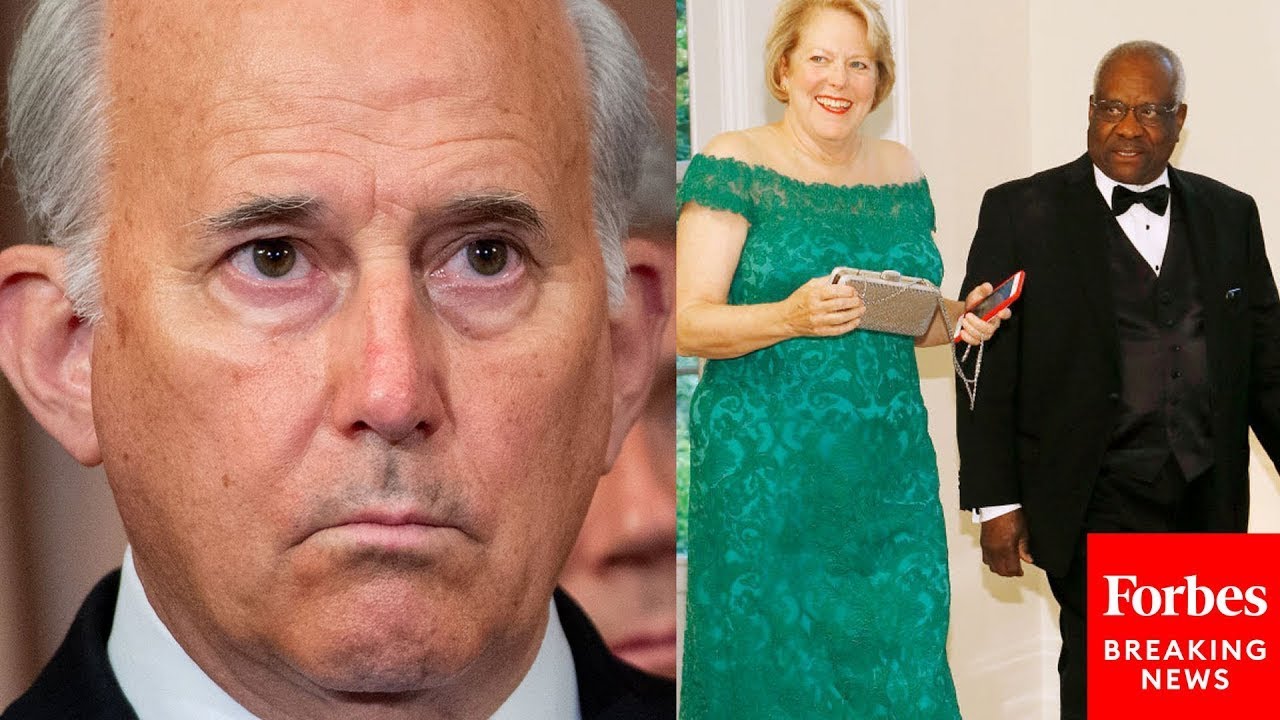 of both Ginni and Clarence Thomas on the House floor, saying Ginni Thomas' activism shouldn't put pressure on the justice to recuse from any cases. Thomas returned to the bench in person at the Supreme Court this week, after being hospitalized for an illness around the same time that the news of his wife's communications with the Trump White House about the election broke.
"Now, Justice Thomas is being told he needs to recuse himself because he has a wife who thinks for herself. We can't have that, these liberals say. Yet the hypocrisy rises higher and higher with every comment they make about Justice Thomas and/or his wife," Gohmert said in his speech.
"What happened to the old ideas of liberals being these caring, compassionate people who would never judge one's spouse by the acts or thoughts of the other?" Gohmert added. "Well, those have gone by the wayside, and we see exactly what is at play here."
Ginni Thomas also has a close friendship with Meadows, and a case involving him landed before the Supreme Court in recent months. In that case, the court allowed the releaseof hundreds of documents from the Trump White House to the House select committee investigating January 6. Clarence Thomas was the only oneto publicly dissent.
The documents in that case did not include Meadows' texts with Ginni Thomas that he had voluntarily turned over to the committee. The committee has saidit will seek to interview Ginni Thomas, CNN has reported.
Dinners with friends
The Thomases have kept in contact with Hair for years, according to several photos and messages shared on Facebook by Hair and others and obtained by CNN.
In 2016, Hair posted about attending a Colbie Caillat concert, sending her thanks for a "fun" evening to Ginni Thomas. Hair posed for photos with Clarence Thomas and at dinner with him, his wife and others the night of the concert, according to Facebook posts.
Hair has worked in Gohmert's office since 2010, according to congressional staffing records.
In 2017, she took a new round of pictures with Clarence and Ginni Thomas, this time inside the justice's chambers. That day, January 20, 2017, Clarence Thomas had sworn in Pence as vice president. In her Facebook post, Hair calls the Thomases "great friends."
And in 2019, Hair took part in a meeting at the White House with Trump and Ginni Thomas to discuss hiring more Trump loyalists in his administration, according to a senior Trump administration official.
Over the past decade, Ginni Thomas and Hair's photos together and posts tagging each other are numerous.
Then after the 2020 election and January 6 Capitol riot, Hair on her Facebook wall shared coverage of Clarence Thomas dissenting on a Supreme Court election case, writing, "GOD BLESS HIM." The case was a too-late attemptby Pennsylvania Republicans to challenge the state's use of mail-in ballots, and Thomas expressed a fearthat mail-in balloting could allow for fraud in future elections.
And in text messages to Meadows, which CNN obtained last month, Ginni Thomas quotes Hair in November 2020 as she implores the Trump White House to stick with its claims of election fraud.
"This war is psychological. PSYOP. It's what I did in the military. They are using every weapon they have to try to make us quit... It is fake, fraud and if people would take a deep breath and look at things through that filter we will see this through and win," Ginni Thomas texted Meadows on November 14, 2020.
She then cites Hair's name in the text, implying the words came from her friend. The source familiar with the Thomases said Ginni Thomas was cutting and pasting Hair's own words from another text chain, to send to Meadows.
Gohmert headed to SCOTUS
Soon after these texts, Gohmert's office took part in two cases that challenged the election result at the Supreme Court.
First, Texas' attorney general went straight to the high court to sue Pennsylvania, Georgia, Michigan and Wisconsin -- all swing states Joe Biden had won -- claiming they had conducted their elections unconstitutionally.
The case theoretically could have given the Supreme Court the power to throw out the presidential election result. Gohmert was one of 126 Republican members of Congress to sign on to an amicus brief supporting Texas before the high court.
On December 11, just days after the case had been filed, a majority of justices rejected the attempt, saying Texas had not shown it had the legal right to challenge how another state conducts its election.
Clarence Thomas signed on to a two-sentence statement, penned by Justice Samuel Alito, arguing a procedural point that the court should not have dismissed the case outright because it fell under the court's "original jurisdiction." But importantly, Thomas and Alito did note that they would grant no other relief to Texas in the case.
A source close to Thomas believes that the justice's position on that case and others shows he was not swayed by his wife's interests.
Even with that swift loss at the Supreme Court, Gohmert's office wasn't finished aiming election challenges at the high court.
In late December, Gohmert tried with a case of his own. The congressman sued Pence directly. The lawsuit asked the court to force Pence to stop the Electoral College certification of Biden's win.
That prompted Pence's lawyers to speak up in court, asking a federal judge to dismiss Gohmert's case. It was a crucial early moment of the vice president publicly defending his role of presiding over the Senate. Pence has stood by his position that the vice president couldn't overturn the election and courts should not have either.
TheGohmert case eventually made its way to the Supreme Court on January 6, the day of the Electoral College certification.
"Our nation stands at the crossroads of a Constitutional crisis fraught by chaos and turmoil brought into play by a viral plague, anti-democratic interference from domestic and foreign sources, and hastily enacted State voting measures ostensibly placed to protect voters from catching the plague," Gohmert's filing said.
The court denied its request the next day, with no dissents noted.
CNN's Ariane de Vogue, Ryan Nobles, Zachary Cohen and Gabby Orr contributed to this report.
===
===
CONFLICTS 2011
https://www.alternet.org/2011/06/8_reasons_justice_clarence_thomas_must_step_down/
Time was when, at any right-wing gathering, chances were you'd hear the justices of the Supreme Court derided as black-robed usurpers of democracy. Today, not so much. Ever since the seating of the Roberts court, the right has been pretty happy with high court's decisions, especially the outcome of Citizens United v. FEC, the case through which the court, in a decision handed down last year, opened the floodgates of corporate money into the electoral system.
No single justice has been more stalwart for the causes of the right -- indeed, even the far right -- than Justice Clarence Thomas, who, notes ThinkProgress, may just be the most ethically challenged justice since Abe Fortas was forced to step down from the court in 1969 for accepting tens of thousands of dollars from wealthy benefactors.
While Thomas does not appear to have accepted direct donations (though he has accepted gifts, and possibly luxury travel aboard private jets and a yacht), it is clear that the conduct of his relationships with the wealthy and powerful -- and one magnate, Harlan Crow, in particular -- present some pretty obvious conflicts of interest, especially in regard to the court's decision in Citizens United, in which Thomas sided with the majority in declaring corporate campaign funding to be constitutionally protected. Thomas could have recused himself from the case, but he did not.
A *New York Times* exposé published on June 19 detailed the role of Clarence Thomas' friend, real estate magnate Harlan Crow, in bankrolling a pet project of the justice's, the Pin Point Museum and Cannery outside Savannah, Georgia. Crow also funded a Savannah library dedicated to Thomas, and Thomas was given a bust of Lincoln valued at $15,000 by the American Enterprise Institute, to which Crow is a donor, and which files briefs in Supreme Court cases. But other aspects of Thomas' relationship with Crow are far more troubling, especially Crow's involvement in providing the seed money for the Tea Party group founded by Thomas' wife, Ginni.
Now, it appears that Ginni Thomas may have derived a direct benefit from the Citizens United decision. And that is not the only ethically troubling incident in the annals of the Thomases' professional lives, which we detail below. But if there's any one big lesson to be learned from the saga of Clarence Thomas and the sullying of the high court, it's that Supreme Court justices are not bound by the code of ethics that applies to other members of the federal bench; it seems they are not legally bound by any code of ethics at all. In the wake of the Thomas problems, that fact has led more than 100 law professors to sign a letter calling on Congress to make the ethics code for federal judges apply to those who grace the bench of the highest court in the land.
Because of this legal loophole, Thomas cannot be forced off the bench. But, for the sake of the republic he claims to love, he could step down -- and should. (A Credo Action petition calling for just that is here. UPDATE: And Rep. Chris Murphy, D-Conn., called today for an investigation of Thomas, as reported by ThinkProgress' Ian Millhiser.) At AlterNet, we've followed the antics of Thomas and his wife, Ginni, closely since the launching of her Tea Party-aligned advocacy groupmade news last year. Here we detail the reasons that Thomas must go -- both for reasons of conflict, and for the appearance of Thomas' alignment with groups that have called for armed insurrection against the U.S. government.
1. Conflict of interest - Citizens Unitedand Liberty Central: In November 2009, just two months before the Supreme Court decision in Citizens United was handed down -- but just after the case was argued before the court -- Ginni Thomas incorporated her Tea Party advocacy group, Liberty Central, as a tax-exempt 501(c)(4). As an issue-advocacy organization that sponsors advertising and endorses candidates, Liberty Central stood to gain directly from the outcome of Citizens United. Assuming that Ginni Thomas drew a salary and/or expenses from the group, the onus on Clarence Thomas was to recuse himself from participating in the Citizens United case, which he did not.
2. Conflict of interest - Harlan Crow's bankrolling of Liberty Central: When AlterNet first reported on the launching of Liberty Central with Ginni Thomas at the helm, we noted that the group was formed with an initial donation of $500,000 by a then-unnamed donor. Politicohas since revealed that donor to be Harlan Crow, a Dallas real estate magnate who is a major donor to political causes, and a good friend of Clarence Thomas -- such a good friend that he bestowed upon the justice a Bible that once belonged to Frederick Douglass, a gift valued at $19,000.
3. Soliciting donations? Unanswered questions: The Times revealed that it was Thomas himself who suggested that Algernon Varn, owner of the Pin Point Cannery (where Thomas' mother once worked), hit up the justice's good friend, Harlan Crow. Varn told *Times* reporter Mike McIntire:
“And Clarence said, ‘Well, I’ve got a friend I’m going to put you in touch with,’ ” Mr. Varn recalled, adding that he was later told by others not to identify the friend.
The land was subsequently purchased from Varn, to the tune of $1.5 million, by a real estate partnership run by Crow. If Thomas felt no compunction at sending Varn to seek backing, with his imprimatur, from Crow for what may have amounted, according to the Times, to $2.8 million in land and construction costs, it is not unreasonable to suspect it was Thomas' influence that compelled Crow to donate $500,000 to Ginni Thomas' organization. Clarence Thomas refused to answer questions submitted by the Times.
4. Calls for insurrection: If Crow's half-million-dollar donation to Ginni Thomas' Liberty Central were not troubling enough, there's Liberty Central itself. As AlterNet reported, at its inception Liberty Central was linked to two groups -- the Missouri Sovereignty Project and Gun Owners of America -- whose leaders called for the making of war on the U.S. government, and one, Tradition Family and Property, whose leader called the Spanish Inquisition "a beautiful thing." Each of these groups were listed on the Liberty Central Web site as "Friends of Liberty Central." Liberty Central officials refused to comment on whether or not the groups had paid a fee or donation to Liberty Central in order to earn the listing.
If a justice of the Supreme Court solicited a donation for a group whose success not only would benefit the justice's own household, but is also linked to groups that called for war on the government whose constitution the justice is sworn to uphold, that should be enough to warrant his stepping down. (In the wake of controversy over Ginni Thomas' role at Liberty Central, she stepped down and Liberty Central merged with the Patrick Henry Center. Ginni Thomas then opened a lobbying shop called Liberty Consulting, run from the same address as Liberty Central -- an address that turns out to be a mailbox in a UPS store, according to this video by Brad Blog.)
5. Conflict of interest - health-care reform: No sooner had the Affordable Care Act -- the health-care reform law that set off the Obama administration's battle royal with the American right -- passed into law than it became apparent that challenges to the law launched by Republican state attorneys general would likely make their way before the Supreme Court. Liberty Central opposed the bill, and appeared at a Tea Party rally sponsored by FreedomWorks calling for its repeal.
It's one thing for the spouse of a justice to be politically active on issues that may appear before the court, but quite another for a justice to solicit donations, whether implicitly or explicitly, for an organization headed by his spouse that advocates for cases that could appear before the court. At the very least, Clarence Thomas needs to account for his role in securing Liberty Central's $500,000 in start-up money from Crow.
6. Conflict of interest - Koch Industries fundraiser: In January 2008, Clarence Thomas addressed a fundraising gathering convened in Palm Springs, California, by Koch Industries, the privately held conglomerate helmed by Charles and David Koch, for major backers of the Tea Party movement and right-wing think tanks, including the Heritage foundation, for which Ginni Thomas worked for a number of years. Although, according to the *New York Times*, a court spokesperson described Thomas' appearance as "a brief drop-by," Thomas' own financial disclosure forms claim reimbursement for an undisclosed sum by the Federalist Society -- an organization that receives Koch funding -- for four days at Palm Springs.
Either way, the justice appeared at a gathering that is designed to raise money for right-wing institutions that advocate legal opposition to policies enacted by Congress and the Obama administration. Revelations of Clarence Thomas' appearances before the Koch gathering prompted Common Cause to launch a petition earlier this year, calling on the Department of Justice to investigate the involvement of both Thomas and Justice Antonin Scalia in the Koch Industries gathering. The Koch brothers, as both donors to and creators of right-wing institutions, were major beneficiaries of the Citizens United decision (in which Scalia, naturally, also sided with the majority).
7. Failure to disclose spouse's income: Taken alone, Clarence Thomas' failure to disclose, for 20 years, his wife's income from such right-wing institutions as the Heritage Foundation -- which also files briefs for Supreme Court cases -- might not be reason enough to demand his ouster from the court. After all, he did amend his disclosure forms to provide the relevant information once the "oversight" was reported in the media. But taken in aggregate with the other ethics breaches and questionable activities noted here, it simply adds more fuel to the fire.
8. Travel questions: Thomas has refused to answer questions about whether or not he has been treated to high-style gratis travel to speaking engagements on Harlan Crow's private plane and his yacht. The Times exposé reveals coincidences that suggest he has.
At a time when Americans' faith in their institutions of governance is at record lows, the continuing presence of Clarence Thomas on the Supreme Court undermines the very underpinnings of democracy. It's time for him to go.
ref
In recent days, the media has turned its attention to Ginni Thomas, wife of Supreme Court Justice Clarence Thomas -- not for her troubling ties to right-wing extremist groups, but for her bizarre demand for an apology from the woman who accused her husband of sexual harassment more than a decade ago. Yet Mrs. Thomas' Tea Party think tank, Liberty Central, promotes the causes of groups that take pride in intolerance, including one right-wing Catholic group, Tradition, Family and Property, whose founder declared the Spanish Inquisition "the most beautiful page in the history of the Church."
Earlier this year, AlterNet reported on Liberty Central's embrace of Gun Owners of America, whose president, Larry Pratt -- guru to the militia movement -- unapologetically addressed a rally of white supremacists in 1992, and more recently told attendees of a gun owners' rally in Washington, D.C., that they are "at war" with the federal government. We also looked at Liberty Central's relationship with the Missouri Sovereignty Project, which threatens armed insurrection against the government. Since then, Thomas has added to the "Friends of Liberty Central" page on her think tank's Web site a plug for Tradition, Family and Property, a virulently anti-gay, anti-woman, anti-democratic Catholic group founded in 1960 in opposition to Brazilian land reform.
TFP has long enjoyed ties to the far right in American politics, including the International Freedom Foundation, which existed primarily as an American front group for the apartheid regime in South Africa during the Reagan years, according to researcher Richard Bartholomew, and was once led by convicted felon and former lobbyist Jack Abramoff. But TFP is better known for its role in promoting and supporting authoritarian regimes in South America. Here's Bartholomew:
TFP played a role in the 1964 coup in Brazil, and in Uruguay it allegedly received explosives from the Brazilian military attaché that were used to attack communist installations. The editor of TFP's Chilean magazine, Jaime Guzmán, became chief ideologist for General Pinochet's regime.
If TFP's activities on behalf of torturers and anti-democratic forces weren't enough to give one pause, there's its status as a cult. TFP is an all-male organization that finds its recruits among adolescent boys, whom it trains in the use of the combat regalia of the Middle Ages -- maces, crossbows, and the like -- according to the late Penny Lernoux's 1989 book,People of God: The Struggle for World Catholicism. The medieval games in which the boys partake are so brutal, Lernoux reported, that one recruit told her his arm had been broken three times in the exercises.
The medieval games continue today. Last July, TFP sponsored a 10-day "Call to Chivalry" camp in rural Louisiana, where, according to the group's Web site, boys and young men took part:
Some new skills were learned such as medieval spear throwing and archery. Mock sword battles with padded weapons were a great success as were paintball wars in the thick tropical-looking forest surrounding the property. An exhausting hike in the Tunica Hills Park taught a poignant lesson of endurance.
At the time Lernoux was reporting, recruits were taught to worship not only the Blessed Virgin Mary, the holiest woman in Catholicism, but also the flesh-and-blood mother of TFP founder Plinio Corrêa de Oliveira, whom he referred to as Santa Monica. Oliveira, who died in 1995, loved the Spanish Inquisition, he wrote, "because, while it went on, the Catholic Church managed to cleanse itself of heretics." (Never mind that many of those so-called heretics were Jews who wanted nothing more than to practice their own faith, or people whose politics were inconvenient to the Spanish throne.)
I first learned of the American branch of TFP by stumbling upon one of their demonstrations in midtown Manhattan in the late 1980s, when the group was coddled by the late Archbishop John Cardinal O'Connor. They often assembled on the sidewalk near St. Patrick's Cathedral on Fifth Avenue, decked out in red polyester sashes emblazoned with a yellow lion. Their big issue at that moment was the criminalization of flag desecration, which was a lure for collecting names and addresses on petition forms. I remember feeling disconcerted by their need to videotape each interaction they had with those they were trying to attract.
The group remains active in New York, though its red-sashed members are as likely to be seen in lower Manhattan than around the cathedral.
The Catholic crusades against the Muslim world are viewed as a time of glory by the devotees of TFP. Roberto de Mattei, who wrote a friendly biography of Oliveira and is said to be close to TFP, presented his revisionist history of the crusades at a 2006 conference at the Regina Apostolorum Pontifical University in Rome. TFP is expressing its embrace of the medieval crusades in the chorus of intolerance raised against the Parc51 Islamic cultural center planned for lower Manhattan, dispatching student volunteers to a September protest at the site where the World Trade Center once stood. (TFP video here.)
TFP maintains a presence on the campuses of U.S. Catholic colleges, and currently sponsors a petition drive to purge them of LGBT rights groups. It describes a Supreme Court decision in Lawrence v. Texas, the suit that struck down anti-sodomy laws, as America's "Moral 9/11." Clarence Thomas, incidentally, joined Antonin Scalia's dissent in that case, which accused the court's majority of having "largely signed on to the so-called homosexual agenda."
Related stories:
Group Allied With Ginni Thomas' Think Tank Threatens Armed Insurrection
Will Clarence Thomas' Wife Demand Apology From Latest Accuser? (It's His Ex-Girlfriend)
===
https://www.alternet.org/2022/07/why-clarence-thomas-has-grown-increasingly-influential-on-the-supreme-court-report/
for many years, Justice Clarence Thomas and the late Antonin Scalia were considered the fringe of the U.S. Supreme Court — far-right social conservatives who frequently butted heads with the late liberal Justice Ruth Bader Ginsburg as well as right-wing libertarian Justice Anthony Kennedy, now retired. But with the High Court handing down one extreme decision after another in 2022, from overturning Roe v. Wade to limiting the Environment Protection Agency’s ability to regulate power plants, it’s obvious that the Court’s Thomas wing is now dominant.
Journalist David Smith, in an article published by The Guardian GUK on July 10, emphasizes that Thomas, now 74, has become increasingly influential on the Court. According to Smith, the days when Thomas was regarded the Court’s “fringe figure with extremist views” are over — and the Court’s “center of gravity” has “moved his way.”
Edward Fallone, a law professor at Marquette University Law School in Milwaukee, told The Guardian, “By virtue of the fact that Clarence Thomas has been on the Supreme Court as long as he has, he has slowly gained much more influence and has now become the dominant ideological leader of the conservatives. He is certainly more confident and more muscular now that he has allies on his side, but he has been strikingly consistent over the decades. He simply waited for the rest of the conservative world to catch up to him.”[koch trumpification of us]
Thomas, appointed by President George H.W. Bush in 1991, has been on the Court for 31 years. His confirmation hearings were incredibly contentious, with a former employee, Anita Hill, accusing Thomas of sexual harassment — which he vehemently denied. Nonetheless, Thomas was confirmed, 52-48, by the U.S. Senate. At the time, the Senate Judiciary Committee was chaired by now-President Joe Biden.
It was during Donald Trump’s presidency, Smith notes, that Thomas’ influence on the Court grew considerably — and he became even more influential than Chief Justice John Roberts.
“Everything changed with the election of Donald Trump as U.S. president and the appointment of Justices Neil Gorsuch, Brett Kavanaugh and Amy Coney Barrett,” Smith explains. “This meant conservatives enjoyed a 6-3 majority and could afford to lose the vote of Roberts in pressing their right-wing agenda. Thomas began finding his voice both figuratively and literally. When the Court began hearing arguments by phone because of the coronavirus pandemic and changed the arguments’ format so justices asked questions one by one, he joined in. He has continued asking questions since the justices returned to their courtroom last autumn. Thomas, not Roberts, stamped his authority on the just completed term.He wrote an opinion that the Constitution protects an individual’s right to carry a handgun in public. His marathon 30-year effort to overturn Roe v Wade, the ruling that protected abortion rights nationwide, ended in victory despite widespread public opposition.”
Smith adds, “Even then, however, Thomas was not satisfied as he urged his fellow justices to revisit precedents acknowledging rights to same-sex marriage, gay sex and contraception. Amid national outrage, thousands of people signed a petition saying he should no longer be allowed to teach a class at George Washington University’s law school, but the university nixed the idea.”
In 2022, an old quote from Thomas has been receiving a great deal of attention. The New York Times, back in 1993, reported thatThomas, in 1992, had told his law clerks, “The liberals made my life miserable for 43 years, and I’m going to make their lives miserable for 43 years.”
The actions of Thomas’ wife, far-right activist Ginni Thomas, have also called the justice’s motivations into question. After the 2020 presidential election, Ginni Thomas aggressively promoted Donald Trump’s Big Lie and falsely claimed that the election had been stolen from Trump. In a series of text messages exchanged with then-White House Chief of Staff Mark Meadows, she plotted to get the election results thrown out. Rep. Alexandria Ocasio-Cortez of New York City has called for Thomas’ impeachment.
“Critics argue that Clarence Thomas should have recused himself from a case involving the (January 6) committee’s access to presidential documents and lawsuits challenging the election results,” Smith observes. “Democrats in Congress wrote, in a letter, that his participation is ‘exceedingly difficult to reconcile with federal ethics requirements.’”
But University of Richmond law professor Carl Tobias doesn’t see Thomas’ influence on the Court decreasing anytime soon.
Tobias told The Guardian, “Clarence Thomas has always been a mystery to many people. He has a long history on the Court and life experiences that are different from many but strongly held views. He’s articulated them, and so, he’s ascendant right now. It will take some time before the Court’s composition changes and before he is less influential.”
You can watch a video on Thomas below or at this link.
==
https://www.nationofchange.org/2022/07/07/opus-dei-supreme-indecency-extreme-deceit/
the current Supreme Court majority that just denied women a legal right to abortion (Dobbs vs. Jackson) consists of religious fanatics whose careers have been fast-tracked (so that young Justices can serve for decades) by ultra-wealthy, like-minded lobbyists and political operatives. The nexus of this activity lies with a powerful arch-conservative organization within the Catholic Church, Opus Dei, that in the U.S. operates out of the Catholic Information Center in Washington D.C.
I am not targeting Catholics but rather the Church’s reactionary, fundamentalist wing. Many Catholic organizations are dedicated to upholding the rights and lives of minorities (and majorities, such as women), victims of pedophilic priests, gays, the poor, immigrants, etc. The fundamentalist wing of any religion has more in common with other creeds’ fundamentalisms than with many of its own co-religionists, whom they often regard as enemies. Catholic fundamentalism is obviously not the only “brand” influencing American politics, but it is the one with a dominant insidious influence on the judiciary.
Opus Dei and its partner organizations have poured tens of millions of dollars into promoting the careers and appointments of Chief Justice Roberts and the five Justices who overturned Roe: Thomas, Alito, Kavanaugh, Gorsuch, and Barrett (Roberts, an arch-conservative, nonetheless dissented on the abortion case).
Opus Dei was founded in Spain by Escriva de Balaguer in 1928 and grew in power, wealth, and influence during the Fascist dictatorship of Francisco Franco who, with significant military help from Nazi Germany, overthrew the legitimate Spanish government and ruled over a police state from 1939-1975.The group extended its power throughout Latin America, supporting Pinochet’s murderous regime in Chile and other terrorizing dictatorships. It consistently opposes gay, sexual, and reproductive rights, and the Catholic liberation movements that champion the poor in Latin America. It has been involved in the Vatican’s banking scandals but still wields enormous influence over Vatican finances, as detailed by Robert Hutchison in his book, Their Kingdom Come.
Opus Dei’s assets as of 2008 were $2.8 billion, but they have undoubtedly grown since. Popes John Paul II and Francisboth elevated Opus Dei officials to the highest Church offices. One of Opus Dei’s core principles, as articulated by its founder, is to engage in “the sphere of public life”, not because they are human or Catholic rights but because “they are God’s rights…May such ‘fanaticism’ for the Faith…become stronger every day.” Opus Dei is not simply a conservative religious group, it is openly dedicated to wielding political and financial power in nations throughout the world. And that often means promoting and aligning itself with the most violent, reactionary regimes and acting in the shadow realms of political influence.
Opus Dei members were prominent in Trump’s White House, including Attorney General William Barr and Pat Cipollone, Trump’s former White House counsel. Opus Dei had access to Trump’s budgetdirector,Mick Mulvaney, along with other noted right-wing lobbyists (Heritage Foundation, Koch Industries), meetings the Trump administrationtried to keep secret. Member Larry Kudlow was Trump’s director of the National Economic Council. It may well be the most powerful political lobby in the world and yet its explicit political agenda is absolutely subservient to its extreme, authoritarian religious agenda.
A key fixer in this effort is Leonard Leo. Leo is on the board of directors of the Catholic Information Center (William Barr was a past director) and Executive Vice Presidentof the Federalist Society, a lobbying group that adheres to an “originalist” interpretation of the Constitution (more on this below). The two organizations are close political allies, as Leo’s dual role suggests. As Trump’s close advisor during his presidency, Leo was responsible for selecting and guiding the Supreme Court nominations of Alito, Barrett, Kavanaugh, and Gorsuch and was instrumental in riddling the lower Federal courts with Trump appointees.
Meanwhile, members of both Opus Dei and The Federalist Society include Alito, Clarence Thomas, and the late Justice Antonin Scalia. Chief Justice Roberts is a Federalist Society member and the Society’s members and supporters are prominent in many of nation’s top law schools and most powerful law firms, which allows it to have an untoward influence over judicial selections. When Clarence Thomas headlined a 2013 Federalist Society fundraiser, guests were seated in proximity to him according to the size of their donations. In effect, the Federalist Society and Opus Dei have become the Supreme Court of the land.
Much of Opus Dei’s influence was exerted via the Wellspring Committee, established and run by Opus Dei members Ann and Neil Corkery in 2008. The Koch brothers were instrumental in providing Wellspring with its first $10 million in seed money. According to Robert Maguire of Citizens for Responsibility and Ethics in Washington, the Corkerys “have been the overseers of massive amounts of money that have gone into federal judicial races.”
Wellspring closed down in 2018 but not before passing its mantle to the Judicial Crisis Network (JCN); in 2017 Wellspring transferred $14,814, 998.00, or 94% of its donations that year, to JCN. JCN was formerly directed by Leonard Leo and now byCarrie Severino, who served as Thomas’s law clerk. (Opus Dei’s Roger Severino, Carrie’s husband, was Director of Trump’s Office for Civil Rights). JCN is a 501(c)(4) organization so its donors can remain secret. JCN poured millions into supporting Bush and Trump’s Supreme Court nominees (Roberts, Alito, Kavanaugh, Gorsuch, and Barrett) and millions blockingObama’s Court nominee, Merrick Garland.
Given Opus Dei’s absolute anti-choice ideology, global power, and influence over the Supreme Court, it is clear the Court’s anti-choice decision was not driven by legal arguments over the right to privacy, strict or “originalist” interpretations of the Constitution, or states rights. These were all just window dressing. The Supreme Court—and much of our judiciary—has been taken over by fanatics with a strictly theologicalagenda: to replace “separation of Church and State” with “the Church runs the state”. It is a narrow, fanatical religious ideology that decided the case.
The so-called “originalist” theory of interpreting the Constitution claims the Constitution only protects rights explicitly mentioned in the text. The Constitution itself rejects the “originalist” idea so central to conservative ideology. The Ninth Amendment reads, “The enumeration in the Constitution, of certain rights, shall not be construed to deny or disparage others retained by the people.” This clearly states that interpreting the Constitution is a living, evolving process, for how else can those “other[s]” rights be “retained by the people”? The Ninth is also a safety valve: “If we left out any important rights, sorry, our bad, it doesn’t mean those rights aren’t protected as well.” The Ninth has been used to uphold such diverse rights as teaching non-English languages, sending kids to private schools, protecting against forced sterilization, and the 1965 Griswold decision overturning bans on contraception, in which privacy was deemed a “penumbra” (also called “unenumerated”) right. The penumbra concept was then applied to abortion in 1973’s Roe decision.
Justice Harry Blackmun wrote the majority decision in Roe v. Wade, citing both the Ninth and Fourteenth Amendments:“This right of privacy, whether it be founded in the Fourteenth Amendment’s concept of personal liberty and restrictions upon state action, as we feel it is, or…in the Ninth Amendment’s reservation of rights to the people, is broad enough to encompass a woman’s decision whether or not to terminate her pregnancy. The detriment that the State would impose upon the pregnant woman by denying this choice altogether is apparent.” The Court also recognized that “When those trained in the respective disciplines of medicine, philosophy, and theology are unable to arrive at any consensus, the judiciary…is not in a position to speculate as to the answer.” Blackmun’s decision includes an overview of the dramatic shifts in cultural and legal attitudes towards abortion, though most views differentiated abortions in the first 12-16 weeks (before the baby is usually felt moving inside the womb) from those occurring later.
The “sanctity of the foetus”, that is, viewing abortion at any stage of pregnancy as equivalent to murder, is the linchpin of the anti-choice position and its driving emotional trigger. However, even the Catholic Church’s historical opposition to abortion had nothing to do with the sanctity of the foetus; it was aimed at the “sin” of sexual pleasure. Church policy varied over the centuries but the foetus’s life was either absent as an issue or secondary to sexual sin and other theological concerns. St. Thomas Aquinas asserted that in its earlier stages a foetus is in a “vegetal” and then “animal” state before achieving person-hood at some point, most likely at the end of the third month.It wasn’t until 1965 that the Church banned abortion on the basis of sanctity of life rather than sexual sin.However, the Bible passages used to justify this claim 1) do not really address abortion (the BIble is much more direct in advising that adulterers be stoned to death); 2) are drawn mostly from the Old Testament, a Jewish document, significant since the Jewish religion allows abortion; and 3) are in the Bible, which has no legal standing in the United States. Or didn’t.
The Court’s decision in Dobbs v. Jacksonis only the beginning, as anti-abortion activists and GOP-led extremists mobilize to assault a wide range of rights. The anti-choice movement was never only about abortion. Abortion was used as the emotional catalyst for a broad attack on the values of tolerance and social commitment embodied in Federal guarantees backed by Constitutional authority. The well-being of Americans and our system of government is now in the hands of religious fanatics on a crusade against all those who do not believe in their degraded, medieval version of truth. They are welcome to their beliefs but are not welcome to impose those beliefs on the rest of us, nor to challenge the fundamental values of the United States, which holds the value of human beings above adherence to extreme and rigid political or religious ideologies.
===
no lnx fluff
10 years later, an inside look at Clarence Thomas
By
KEN FOSKETT
Published Jul. 6, 2001|Updated Sep. 9, 2005
In 1991, Clarence Thomas told the nation he had "died a thousand deaths."
His U.S. Senate confirmation, he said, amounted to a "high-tech lynching" on national TV that stole his dignity, ruined his reputation and robbed him of his manhood.
Today _ 10 years after his nomination to the U.S. Supreme Court, and 34 years after he left Savannah, Ga. _ Thomas has remade himself. He enjoys the respect of his colleagues and of conservatives across America. He has settled into a secluded suburban lifestyle. He has even become a father again, the unlikely consequence of a nephew who succumbed to the lure of illegal drugs.
Yet for all the outward success, Thomas presents a picture of a man still nursing inner wounds. He cries in public _ not often, but suddenly and uncontrollably. The tears suggest an emotional and more complex side to a man the New York Times, in a 1992 editorial, called the "youngest, cruelest justice."
He professes indifference to the withering assault from critics but answers it in kind, insisting he cannot be intimidated.
Thomas, 53, has built a stone wall around his personal life, denying most requests for interviews and shunning friends who make unwelcome public comments about him.
"You don't want to cross him, or he'll cut you off. I know," said talk show host Armstrong Williams, a former aide to Thomas at the Equal Employment Opportunity Commission.
For reasons that remain a mystery even to close friends, Thomas has chosen a public profile that is strikingly at odds with who he is in private. On the bench, he is quiet, sitting hour after hour during oral arguments, rarely asking a question.
But off the court, as Thomas' friends know, he can't stop talking. A 10-minute courtesy call to his chambers can become a two-hour bull session. A phone call from Thomas can last an hour, and his friends never know when to expect them.
Dour and impassive on the bench, Thomas in private regales friends with his quick humor and captivates them with a deep, baritone laugh.
On the court, Thomas is known for his rigid interpretation of the Constitution and the law. In private, Thomas can't say no. He sees hundreds of schoolchildren every year, simply because they ask. One year, he loaned a car to a clerk who couldn't afford to keep his running.
Reviled by critics for his votes that affect minorities, Thomas' life today is distinguished by the hours he spends helping black youths. He has arranged tens of thousands of dollars in financial aid for these young people to attend private schools, but few people know about the help because he discourages publicity.
Thomas' private diversions defy the public's image of a Supreme Court justice. He owns a limited-edition black Corvette ZR-1 and is a fanatic about NASCAR. In 1999, he became the only Supreme Court justice to serve as grand marshal at the Daytona 500, using his booming voice to command, "Gentlemen, start your engines!"
He is a lifelong Dallas Cowboys fan in a city where the archrival Washington Redskins rule. Thomas receives daily team updates by e-mail, and he is a frequent guest in the visiting owner's box when the Cowboys come to town.
An athletic wonder in school, Thomas may be the most macho Supreme Court justice the country has ever seen. His waistline has expanded with age, and once jet-black hair is now mostly silver. But a barrel chest and powerful biceps, sculpted by regular weight lifting, still attest to the prowess of Thomas' youth.
In his leisure time, Thomas roams the country in a 40-foot, custom-built bus, a kind of houseboat on eight wheels he purchased in 1999. Owning the bus was the fulfillment of a dream, and its acquisition was rooted in the longings of his uneducated grandfather, who raised Thomas with strict discipline and tough love after his own parents divorced.
Wrapped in sheets of steel, the bus is Thomas' mobile fortress, a suit of armor that allows him the freedom and anonymity he has long craved.
Its painted upper panels feature a red and orange flame motif sizzling around the sides. Like much of Thomas' life, the smoky black windows are impenetrable from the outside.
Heart on his sleeve
Trips home always evoke strong emotions for Thomas. He left Savannah when he was 19, but he has returned many times, most recently in May to speak at the bar association's annual Law Day luncheon. The evening before, he stopped by to see his 72-year-old mother, Leola Williams, and eat deviled crabs, her specialty, in the home off E Broad Street his grandfather Myers Anderson built.
On other trips Thomas has driven to Midway, Ga., to visit the gravesites of his grandparents and younger brother, Myers Thomas, who died last year. The graves are a short walk from the 75-acre family farm where Thomas and his brother spent their summers.
On this day, among old acquaintances, Thomas spoke of his longing for Savannah and the friends he left behind. He remarked on his 10th anniversary on the court, noting when he went on the bench, the media portrayed him as stupid.
"Now, I don't know what the hell I am," he said.
Toward the end of his speech, Thomas turned to thank Joe Bergen, a local lawyer who handled the custody case of Thomas' grandnephew three years earlier.
Thomas stopped in mid sentence. He trembled. He closed his eyes and pinched the bridge of his nose. Nearly a half-minute passed before he tried to speak again.
"Boy, that's embarrassing," Thomas said.
In the uneasy silence, someone called out softly, "You're home."
"I apologize for the interruption," Thomas said, still unable to continue. Finally, he gave up. "Suffice it to say that I thank God for Joe Bergen."
Thomas has struggled with his emotions in public before. On the day of his nomination, he choked back tears when he invoked the memory of his late grandfather, who demanded Thomas work hard in school so one day he might have a "coat-and-tie job."
Two months after the death of his brother in January 2000, Thomas struggled for composure as he bared his soul to lawyers and judges in Tampa. Thomas described to them his feelings as he gazed at his brother's lifeless body. "Being on the Supreme Court was meaningless," Thomas said. The only things that mattered in life, he said, were faith, family and friends.
Thomas' obsession with privacy dates from 1991, when the media camped outside his Alexandria, Va., house during the nearly two weeks Anita Hill's allegations of sexual harassment dominated coverage of his nomination. Thomas and his wife felt like prisoners in their home. Court marshals, concerned about Thomas' safety, escorted them in and out. The marshals even insisted he wear a bulletproof vest when he faced cameras on the day of his confirmation by the Senate.
A year later, Thomas took steps to ensure he would never live in a fishbowl again. The couple moved to a 10-room house, designed so it would not be visible from the street, on a wooded 5-acre lot in Fairfax County, outside Washington.
During his confirmation, Thomas became convinced someone was trying to kill him, according to former Missouri Sen. John Danforth, who championed Thomas' nomination in the Senate. Today, Thomas still views himself as a victim of liberal interest groups and a biased media.
Explaining his reluctance to be interviewed, Thomas said his experience 10 years ago was far worse than anything the Ku Klux Klan could have done to him.
"I harbor a lot of resentment toward your industry," he told a reporter.
Thomas doesn't discuss his searing confirmation battle with friends, but his anger toward the media, even 10 years later, suggests the wounds are still raw.
:{
}:
"He's never put it out of his mind, and he never can," Danforth said. "That was a very scarring experience for him."
Indeed, one of Thomas' most distinguishing personality traits is his long, almost encyclopedic, memory. The past is always present for Thomas _ never more so than in his memories of his grandfather, who died in 1983.
Myers Anderson is an idealized figure in nearly every speech his grandson gives. Thomas extols his grandfather's work ethic, dignity and values. Anderson, he said, suffered the indignities of discrimination but never complained or made excuses.
Conservative faction
Last September, as Thomas fielded questions at the University of Louisville, a student wanted to know: Does the Supreme Court justice write all his own opinions? Thomas' deadpan rejoinder jolted the audience: "No, Justice Scalia does." The students laughed nervously.
The brief stab at humor was the second time in 30 minutes that Thomas confronted a perception that has dogged him for 10 years: Justice Antonin Scalia, a white man of Italian descent, is the puppeteer who guides his votes and crafts his judicial opinions.
"Because I am black, it is said that Justice Scalia has to do my work for me," Thomas said earlier. "He must somehow have a chip in my brain and controls me that way."
In fact, Thomas has written dozens of provocative opinions and dissents _ none that rank as landmark legal cases _ but brick by brick he is building a judicial legacy.
Thomas has spent his entire public life seeking to distinguish himself as an independent thinker who transcends skin color. But not even the white marble walls of the Supreme Court, hewn from the hills of his native Georgia, have insulated him from racial stereotyping.
Thomas' race played a powerful role in shaping his political beliefs, and it continues to shape his judicial philosophy. Of the nearly 1,000 cases that he has voted on, decisions dealing with affirmative action, school desegregation and voting rights have won the most attention.
His mere presence on the Supreme Court has emboldened black conservatives around the country. But his race and political views continue to make him a lightning rod for criticism.
"I don't see an overwhelming amount of compassion for people less well off in our society," American University law professor Stephen Wermiel said. "I see somebody who seems to care more deeply about the text of the Constitution and the process of reading it than its beneficiaries."
Thomas is an integral part of the conservative faction that has steered the court back from the perceived excesses of the Warren and Burger courts.
He anchors his judicial thinking in the promise of equality spelled out in the Declaration of Independence and the notion of ordered liberty embodied in the Constitution. But echoes of Thomas' experiences with segregation and affirmative action ring throughout his legal writings.
Thomas has concluded that affirmative action stigmatizes blacks in ways that are ultimately destructive. As both black and conservative, he grew to detest the expectation that, because of his skin color, he should be liberal. That mindset drives his decisions on voting rights and redistricting cases affecting racial minorities.
At his core, Thomas believes passionately that God created the races equally, and he loathes laws and programs that assume otherwise. Thomas rejects government paternalism in any form.
He believes in rules _ the fewer the better, and the same ones for everybody. As he told students in Louisville, Ky., he grew up under a system with two sets of books: one for whites and one for blacks. "I'm not going back to two sets of books," he said.
"I don't need people to agree with me," he added a few moments later. "I'm very comfortable being alone in my views."
In 1968, Thomas left Savannah to attend Holy Cross College in Massachusetts. It was there that he developed deep reservations about affirmative action, feeling that people assumed because he was black that he was not qualified to be there, he told others later. The self-consciousness intensified when Thomas was admitted under Yale's affirmative action program as one of 12 blacks in a class of 165.
At Yale, Thomas chose a different career track than other black law students. Rather than civil rights, he focused on business and tax law, some of the most arcane and difficult courses at Yale.
He thought he could earn more money in business law. But when the big law firms interviewed him, Thomas said later, they seemed mostly interested in him because he was black.
"Prospective employers dismissed our grades and diplomas, assuming we got both primarily because of preferential treatment," Thomas told biographer Norman L. Macht.
Danforth, as attorney general of Missouri, initially hired Thomas in 1974 because he was looking for qualified minorities to work for him. When Thomas took the job, he made one request: He would not work on civil rights cases.
"He wanted to be competing with people and dealing with people on a whole range of issues," Danforth said.
Thomas has developed a highly methodical and disciplined approach to deciding cases. He believes that the law is a science and that standardized procedures will invariably lead to the correct outcome. He spends hours reading and studying the briefs _ often at home in the middle of the night. He says he's always thinking about cases, even while mowing the lawn.
Before every oral argument, Thomas sits down with his four clerks to discuss the cases on the docket. Sometimes, these sessions last four or five hours and become quite animated.
"His main instruction to us was that he didn't want to hear an issue or a question in oral argument that he had not already heard about or thought about himself," said Greg Coleman, who worked for Thomas in 1995 and 1996.
Thomas' clerks play a central role in his preparations. He hires only those who have clerked in the federal court system, and only those who finished in the top 10 percent of their law school class.
At the beginning of each term, Thomas gives his clerks two guidelines: They are never to bargain points of law to secure the votes of other justices, and they are never to write opinions that criticize another justice.
"Ideas are open for attack, but the people never are," Coleman said. "He would never permit a draft to come to his desk that had a disparaging remark about another justice."
In legal terms, Thomas is an originalist, meaning he believes in deciding cases based on the original meaning of the Constitution. He views the Constitution as a contract that was entered into by the framers, and he sees his role as enforcing the original terms of the bargain.
He has established himself as an ardent supporter of states' rights, and he's deeply hostile to what he perceives as the encroaching power of the federal government.
Some of his votes break the conservative stereotype. He has been one of the most liberal justices on the First Amendment, a fact often overlooked by his critics. One study found that only Justice Kennedy took a stronger stance on free speech rights, although some of these votes reflect the view that campaign contributions are a form of speech and cannot be regulated.
Life's full circle
Thomas met Virginia Lamp in 1986 while he was still chairman of the EEOC and she was a lobbyist and spokeswoman for the U.S. Chamber of Commerce. A year later they married.
It was Thomas' second marriage and her first. He has a son from his first marriage. But early on, they decided not to have children. It was an extremely difficult decision, but Thomas believed he could not be a responsible father and still fulfill his obligations at the court, according to Clifford Faddis, who has known him for nearly 30 years.
The issue of children resurfaced in 1997 when the couple hosted several of Thomas' grandnieces and nephews at their home in Fairfax Station.
They felt an immediate bond with the oldest child, a 5-year-old boy named Mark, whose family was in turmoil.
The boy's father, Thomas' nephew, had been jailed that summer for his second probation violation in two years. The charges underlying the sentence stemmed from a 1995 conviction for dealing crack cocaine.
Mark's mother, a Head Start teacher living in public housing in Savannah, was raising Mark, his two siblings and a fourth child from another relationship, having divorced Mark's father in 1995.
After the children left, Thomas and his wife wrestled with the idea of taking custody of Mark, whose biracial background mirrored their mixed-race marriage. As they grappled with the ramifications of raising a child, they worried about removing Mark from his immediate family, Faddis said. But they concluded they could offer Mark far more than he would lose.
They pitched the idea to Mark's parents as a way to provide him with a better education, suggesting they call themselves "Team Mark." Susan Martin, the boy's mother, said she cried at the thought of giving up her oldest son, but agreed that the Thomases could offer him more than she could. The boy's father also agreed to the arrangement.
In January 1998, a Savannah judge made Clarence and Virginia Thomas legal guardians of Mark, then 6.
Thomas was just a few months short of his 50th birthday that year, and friends couldn't help notice how much his life appeared to be turning full-circle. He was becoming a father figure to a boy who was the same age Thomas was when his grandfather took Thomas in.
"He wanted to return the favor," Martin said.
===
https://www.rollingstone.com/politics/politics-features/roe-supreme-court-justices-1378046/
no lnx
at? an evangelical victory party in front of the Supreme Court to celebrate the downfall of Roe v. Wade last week, a prominent Capitol Hill religious leader was caught on a hot mic making a bombshell claim: that she prays with sitting justices inside the high court. “We’re the only people who do that,” Peggy Nienaber said.
This disclosure was a serious matter on its own terms, but it also suggested a major conflict of interest. Nienaber’s ministry’s umbrella organization, Liberty Counsel, frequently brings lawsuits before the Supreme Court. In fact, the conservative majority in Dobbs v. Jackson Women’s Health, which ended nearly 50 years of federal abortion rights, cited an amicus brief authored by Liberty Counsel in its ruling.
[Related Stories
Texas' Most Famous Abortion Provider Is Closing Its Doors
The Worst Person You Know Just Made a Great Point: 'Roe v. Wade' Edition]
In other words: Sitting Supreme Court justices have prayed together with evangelical leaders whose bosses were bringing cases and arguments before the high court.
Nienaber is Liberty Counsel’s executive director of DC Ministry, as well as the vice president of Faith & Liberty, whose ministry offices sit directly behind the Supreme Court. She spoke to a livestreamer who goes by Connie IRL, seemingly unaware she was being recorded. “You actually pray with the Supreme Court justices?” the livestreamer asked. “I do,” Nienaber said. “They will pray with us, those that like us to pray with them.” She did not specify which justices prayed with her, but added with a chortle, “Some of them don’t!” The livestreamer then asked if Nienaber ministered to the justices in their homes or at her office. Neither, she said. “We actually go in there.”
Nienaber intended her comments, broadcast on YouTube, to be “totally off the record,” she says in the clip. That’s likely because such an arrangement presents a problem for the Orlando-based Liberty Counsel, which not only weighed in on the Dobbs case as a friend of the court, but also litigated and won a 9-0 Supreme Court victory this May in a case centered on the public display of a religious flag.
The Supreme Court did not respond to a request for comment. Liberty Counsel’s founder, Mat Staver, strenuously denied that the in-person ministering to justices that Nienaber bragged about exists. “It’s entirely untrue,” Staver tells Rolling Stone. “There is just no way that has happened.” He adds: “She has prayer meetings for them, not with them.” Asked if he had an explanation for Nienaber’s direct comments to the contrary, Staver says, “I don’t.”
But the founder of the ministry, who surrendered its operations to Liberty Counsel in 2018, tells Rolling Stone that he hosted prayer sessions with conservative justices in their chambers from the late-1990s through when he left the group in the mid-2010s. Rob Schenck, who launched the ministry under the name Faith and Action in the Nation’s Capital, described how the organization forged ministry relationships with Samuel Alito,Clarence Thomas, and the late Antonin Scalia, saying he would pray with them inside the high court. Nienaber was Schenk’s close associate in that era, and continued with the ministry after it came under the umbrella of Liberty Counsel.
Louis Virelli is a professor at Stetson University College of Law who wrote a book about Supreme Court recusals. He’s blunt in his assessment: “Praying with a group that filed an amicus brief with a court,” he says, “is a problem.”
Barbara Abshire, center, of Baltimore, and Peggy Nienaber of Lorton, Md., unpack flowers for use in the "Encircle the Court in Prayer," event led by Christian faith organizations on the eve of the Supreme Court arguments on President Obama's health care legislation, in Washington, Sunday, March 25, 2012. (AP Photo/Jacquelyn Martin)
Peggy Nienaber, right, at an event outside the Supreme Court led by Christian faith organizations on the eve of the Supreme Court arguments on President Obama’s health care legislation in 2012.
In the shadow of the high court, across the street from its chambers, sits a cluster of unassuming row houses known only to the initiated as “Ministry Row.” The strip is host to evangelical political groups that have spent the past several decades pushing Beltway conservatives to embrace the religious right’s political causes — and, most of all, reverse Roe v. Wade. The street view offers few clues as to what transpires behind the painted brick facades, save for a granite slab inscribed with the Ten Commandments planted in the grassy patch before a modest cream-colored Victorian with maroon trim.
The home serves as Faith & Liberty’s headquarters. The Ten Commandments statue had been placed there by Schenck, an evangelical minister famous for orchestrating high-profile anti-abortion stunts, such as shoving an aborted fetus in a plastic container into the face of former President Bill Clinton during the 1992 campaign. Schenck had opened the ministry in the 1990s as Faith and Action in the Nation’s Capital, a nonprofit dedicated to ending federal abortion rights. The organization operated on a “utopian ‘trickle-up’ theory” of influence: building access “higher and higher up within the government, until we got to the top, my ultimate target — members of Congress, U.S. senators, cabinet secretaries, Supreme Court justices — even presidents,” Schenck wrote in his 2018 autobiography.
The group established a strong foothold in both chambers of Congress and, eventually, the White House. But Faith and Action ultimately directed its energies toward the judicial branch. “There were no pro-life groups directly approaching the judges and justices, who shaped abortion law simply by their precedent-setting decisions,” Schenck wrote. “We knew we were stuck with members of the federal bench — they were appointed for life — so why not convert them while in office?” (Schenck has since reversed course: He is now a fierce critic of evangelical politicking and says Liberty Counsel assumed Faith and Action’s operations in 2018. He says he has no knowledge of the group’s inner workings after he left.)
At first, the high court regarded Faith and Action and its peer organizations as nuisances, according to Schenck. “Justice Thomaswould say to me, ‘You know those groups outside? Are they crazy or are they good people?’” Schenck recalls in an interview with Rolling Stone. When Schenck first began his approach in 1994, prayer activities on the Supreme Court’s property was considered an act of demonstration, and therefore illegal. Eventually, Justices Alito, Scalia, and Thomas would embrace Schenck, he says, and pray with him in various corners of the high court’s grounds — including, occasionally, in their chambers. (Chief Justice John Roberts, meanwhile, remained more guarded and skeptical of such groups’ influence.)
To pray with the justices was to perform a sort of “spiritual conditioning,” Schenck explains. “The intention all along was to embolden the conservative justices by loaning them a kind of spiritual moral support — to give them an assurance that not only was there a large number of people behind them, but in fact, there was divine support for very strong and unapologetic opinions from them.” Prayer is a powerful communication tool in the evangelical tradition: The speaker assumes the mantle of the divine, and to disagree with an offered prayer is akin to sin. “It’s just not common to interrupt or challenge a prayer,” Schenck explains. “That’s not something a devout Supreme Court justice would ever consider doing.” That was true even for the devout Catholic justices, such as Scalia, who joined the evangelical Faith and Action members in prayer, Schenck says.
Sometimes the prayers would be general; other times, on specific subjects, such as ending abortion, according to Schenck. He says Faith and Action took assiduous care to avoid speaking blatantly about cases in the Supreme Court’s pipeline, discussing the political agenda only in broad strokes. Even so, under the time period Schenck describes, prayers with the justices occurred as Faith and Action signed onto several amicus briefs for landmark SCOTUS cases such as Gonzales v. Planned Parenthood, which ultimately upheld the Partial-Birth Abortion Ban Act of 2003.
:{Schenck walked away from his life on the Hill after receiving a late-career doctorate on the teachings of Dietrich Bonhoeffer, the German pastor who questioned the collaborative relationship between Adolf Hitler and 1930s German evangelicals. He drew parallels between the Republican Party and American evangelicalism, concerned that he’d weaponized worship to fuel a hate-filled agenda.No longer an anti-abortion activist, Schenck views his past efforts with regret.“Prayer is a positive exercise, until it’s politicized — and too many prayers that I and my colleagues offered in the presence of the justices were political prayers,” he explains. He also believes the work “contributed to the internal moral and ethical corruption of the justices at the court,” he says.
“I was sure, while we were doing it, it would be a positive contribution to our public life,” Schenck says. “It didn’t have the effect I thought it would. In some ways, it set the stage for the reversal of Roe, which I now think of as a social catastrophe.”}:
When Liberty Counsel absorbed Faith and Action in 2018, Peggy Nienaber, who had worked alongside Schenck since at least 2005, continued with the group. In a July 2021 conversation with Staver, Liberty Counsel’s founder, Nienaber described the group’s new incarnation as similar to Faith and Action’s mission. It’s “the ministry right here on Capitol Hill,” she said, devoted to “changing the hearts and minds of not only our elected officials, but the staffers all the way down.” Nienaber highlighted Faith & Liberty’s proximity to the court by pointing to the window of the conference room where the justices decide their cases. ”When you’re sitting in that conference room, you cannot miss those Ten Commandments,” she said. (Faith & Liberty sits so close to the Supreme Court, in fact, that it has been included in the “buffer zone” surrounding the high court, shut off to protesters and the public. There’s irony here, given that Liberty Counsel has for decades litigated to abolish buffer zones near abortion clinics.)
“There’s a lot of things that Faith & Liberty does — and that you do — that obviously we can’t put in an email, can’t put in a newsletter, can’t put in a press release,” Staver said to Nienaber during their chat, “because it’s private relationships that are spiritually transformative.” Nienaber’s social media accounts show her hobnobbing with high-profile Republicans such as Sen. Lindsay Graham (R-S.C.) and former Vice President Mike Pence. She hung close to the confirmation of Justice Brett Kavanaugh in 2018: She posted photographs from inside the Senate Judiciary Committee’s hearing room, as well as a screenshot of her invitation to Kavanaugh’s swearing-in ceremony.
Nienaber told Rolling Stone, “I do not socialize with the justices.” Yet she has posed for photos with Justices Kavanaugh and Thomas, calling the latter a “friend” in a Facebook post, praising him for “passing by our ministry center to attend church and always taking time to say hello.”
:{
In addition to her proximity to conservative power players, Nienaber has championed the plaintiffs who have brought right-wing religious causes before the Supreme Court. Ahead of oral arguments, she prayed with Joe Kennedy, the football coach who recently succeeded in his suit to allow prayer during football games. Liberty Counsel also filed an amicus brief in that case, calling on the court to rule that the school district “engaged in viewpoint discrimination against Coach Kennedy’s private speech.”}:
Nienaber was recorded telling the livestreamer that she prayed with Supreme Court justices on June 27, the Monday after the high court issued the Dobbs ruling. She was at a celebration she helped organize with Sean Feucht, a prominent Christian-worship musician. Nienaber identifies herself only as “Peggy” in the footage, but she references the ministry she runs behind the court and its 850-pound replica of the Ten Commandments. For most of the interview, Nienaber is not on camera. But when the video pans on her briefly, she can be seen wearing the same dress and necklace she has on in a selfie with Feucht posted to Faith & Liberty’s website.
Last week, Rolling Stone spoke to Patty Bills, the director of constituency affairs at Faith & Liberty. Bills did not want to discuss Faith & Liberty’s ministry practices, citing privacy concerns. Bills would not, however, deny that Faith & Liberty ministers to Supreme Court justices. “I never said we didn’t — I just said we provide privacy,” she said.
Staver, in denying that members of Faith & Liberty prayed with Supreme Court justices, says that such prayers would have been inappropriate, especially given Liberty Counsel’s litigation efforts. “That’s why we wouldn’t do that,” he says. “And especially on cases that are pending before the Supreme Court, we would make a very clear firewall. We just would never do something like that.”
In a written statement to Rolling Stone, Nienaber says of her hot-mic comments: “I do not recall making such a statement. I listened to the livestream, and I did not hear such a statement.” She adds that Covid restrictions have limited public access to the Supreme Court: “The public has not been allowed access, and I am no different.” When she has had access to public areas of the court, she says, “I will generally silently pray for the justices, their staff, and the Court.”
But after this story was published, Nienaber acknowledged her remarks and conceded she has prayed personally with Supreme Court justices. Despite speaking in the present tense on the livestream, Nienaber asserted, “My comment was referring to past history and not practice of the past several years.” Nienaber added: “During most of the history up to early 2020, I met with many people who wanted or needed prayer. Since early 2020, access to the Supreme Court has been restricted due to COVID. It has been many years since I prayed with a Justice.”
Liberty Counsel was founded in 1989 by Staver. The organization is an uncommon hybrid of religious ministry and legal practice, dedicated to “advancing religious freedom, the sanctity of human life and the family through strategic litigation.” Staver is the organization’s senior pastor as well as its top litigator. This mix of law and religion is central to Staver’s career; he previously served as dean of the law school at Liberty University, founded by the televangelist Jerry Falwell.
Staver has argued numerous cases in front of the Supreme Court. He started in 1994 in a case that struck a blow against protest-limiting buffer zones near abortion clinics. In the court’s most recent term, Staver argued and won a 9-0 judgment in Shurtleff v. Boston, a case in which the court ruled a Christian flag couldn’t be excluded from a public flagpole that displayed a rotating assortment of secular flags.
:{
Staver also wrote an amicus brief in the Dobbs case that purports to tie abortion and birth control to eugenics. Calling Roe “the low watermark in this Court’s history,” it argued that Dobbs was ”an ideal vehicle for the Court to finally overrule Roe v. Wade and its progeny, which have constitutionalized eugenic abortions as a fundamental right.”}:
In the Dobbs majority opinion written by Justice Alito, he cited this brief to impugn the motives of pro-abortion-rights advocates, arguing that “some such supporters have been motivated by a desire to suppress the size of the African American population,” adding, “it is beyond dispute that Roe has had that demographic effect,” because “a highly disproportionate percentage of aborted fetuses are Black.”
When Roe v. Wade was reversed, Staver was triumphant: “I have dedicated my life to defend life and overturn the bloody decisions of Roe v. Wade and Planned Parenthood v. Casey,” he wrote. “This global earthquake will impact the world.”
Prayer unto itself in no way presents a conflict of interest for the justices, says Russell Wheeler, a visiting fellow of governance studies at the Brookings Institution, not even with a group like Faith & Liberty that has business before the court. Justices are allowed to visit there with whomever they’d like in their private chambers, and have socialized with interested parties throughout the court’s history. President Franklin Delano Roosevelt, for example, routinely played cards with the high court’s magistrates, and Scalia went duck hunting with former Vice President Dick Cheney. What would amount to an ethical concern would be if they’re discussing those cases as they pray — “or if the prayer sessions would influence how justices rule in a particular case,” says Adam Winkler, a Supreme Court expert at the University of California Los Angeles.
But even among legal experts troubled by the court’s ties, they acknowledge there are few remedies to address ethical conflicts. A federal statute governs when judges and justices should step away from cases, but the Constitution leaves questions of partiality to the justices themselves. Their general unwillingness to step aside isn’t necessarily a bad thing, Virelli, the Stetson law professor, says: When justices recuse themselves from a case, no one replaces them, a scenario that can create more problems than it solves. “The court changes shape,” he explains. “That makes the decision to recuse difficult.”
That the justices are their own keepers in regard to those rules creates complications, however, says Steve Vladeck, a constitutional-law expert at the University of Texas Law School. The relationship between Faith & Liberty and Liberty Counsel, as described by Rolling Stone, “could make a reasonable observer worry about the appearance of partiality,” he says. But the concerns the scenario raised shouldn’t be about recusal. “What that really reveals is how problematic it is that there isn’t an objective mechanism to resolve these sorts of questions.”
For Winkler, the greater concern is not prayers, but the “religious-themed” decisions he’s seen come down from the high court this term, pointing to not only the Roe reversal but also opinions that permit unchecked free exercise of First Amendment rights. “The problematic aspect isn’t whether they’re praying,” Winkler says, “but that several justices seem committed to reading their religion into the Constitution.”
===
===
Adam Winkler on Thomas's Historical Cherry-Picking on Gun Rights | History News Network
clarence
a 6–3 decision, the Supreme Court ruled on Thursday that a New York law restricting the ability to carry a gun in public violated the Second Amendment. The majority opinion, from which the three liberal Justices dissented, raises questions about how cities and states can regulate firearms going forward. It also casts doubt on the constitutional viability of the bipartisan gun bill that passed a procedural vote in the Senate a few hours after the decision was announced. (That bill, which came about largely in response to recent mass shootings in Buffalo and Uvalde, would, if enacted, become the most substantial federal gun-safety law in more than two decades.) To talk about the decision, and what it may mean for future gun-control efforts, I spoke by phone with Adam Winkler, a professor at the U.C.L.A. School of Law and the author of “Gunfight: The Battle Over the Right to Bear Arms in America.” During our conversation, which has been edited for length and clarity, we discussed how Justice Clarence Thomas’s majority opinion cherry-picks history, how states might try to comply with the decision while still regulating firearms, and the meaning of a concurring opinion from Justices John Roberts and Brett Kavanaugh.
What’s your biggest takeaway from this decision?
This decision calls into question a wide variety of gun laws, including several key provisions of the Senate gun bill.
What was New York’s law, and what types of gun laws do you think are most at risk?
New York’s gun law restricted concealed-carry permits to those who could show a special need to have a firearm in public, which the Court said is too onerous a restriction given the Second Amendment. And, in terms of what this will call into question, I think the Court’s ruling will lead to laws in a number of other states being struck down, including California, Massachusetts, Connecticut, and Hawaii, which also have so-called may-issue permitting. Any state that has may-issue permitting will have to rewrite its laws and allow people to carry guns on the street.
Can you describe the differences between may-issue permitting and another kind, which is still allowed, called shall-issue permitting?
May-issue permitting limits concealed-carry permits to people who can show a special individualized need to have a firearm. A general fear of being a victim of crime is not good enough. But if you have had your life threatened, are maybe being stalked, or carry a large amount of cash or jewelry around as part of your job, then you might be eligible for a concealed-carry permit. So a may-issue regime gives the state a lot of discretion over who gets the permit.
A shall-issue-permitting rule is one in which, as the name suggests, the state shall issue a permit to any law-abiding citizen who meets the basic training or educational requirements, and you do not have to show an individualized need
[ see nyer mag]
===
===
775K
Petition Calling for Impeachment of Clarence Thomas Nears 500,000 Signatures (truthout.org)
===
an 7 22
united States Supreme Court Associate Justice Clarence Thomas claimed on Thursday that COVID-19 vaccines are engineered from cells taken from terminated pregnancies.
"The conservative Justice’s statement came in a dissenting opinion on a case in which the Supreme Court declined to hear a religious liberty challenge to New York’s COVID-19 vaccine mandate from 16 health care workers. The state requires that all health care workers show proof of vaccination," Politico reported.
Thomas, one of the six right-wing jurists in the Court's majority who has upended decades of legal precedents in a slew of recent rulings, wrote that the petitioners "object on religious grounds to all available COVID–19 vaccines because they were developed using cell lines derived from aborted children."
Politico explained why Thomas' remarks are preposterous:
None of the COVID-19 vaccines in the United States contain the cells of aborted fetuses. Cells obtained from elective abortions decades ago were used in testing during the Covid vaccine development process, a practice that is common in vaccine testing — including for the rubella and chickenpox vaccinations.
National Geographic also quashed this myth:
The cells are grown in a laboratory and were derived from a few elective abortions performed more than three decades ago. These same cell lines are also used to test and advance our understanding of several routine drugs, including acetaminophen, ibuprofen, and aspirin, and they continue to be used for treatment research in diseases such as Alzheimer’s and hypertension.
"Doctors, legislators, journalists, and casual observers were in utter disbelief and horror that a sitting Supreme Court Justice would peddle such an outrageous conspiracy theory, which washatched by a propaganda outlet called First Draft in 2020 and thoroughly debunked.
===
https://www.alternet.org/2022/06/supreme-court-2657590976/
in spite of the accelerating pace of global warming, the conservative majority of the Supreme Court dealt a major blow to the Biden administration's attempts to slash emissions through regulatory powers resting in federal agencies. In a 6-3 ruling, the Supreme Court on Thursday struck down the federal government's authority to regulate in areas like climate policy or food and worker safety.
The case, first heard by the Supreme Court back in February, was a lawsuit filed last year by West Virginia Attorney General Patrick Morrisey, who argued that the Environmental Protection Agency (EPA) does not have the power to regulate the state's power plant emissions. At the center of the court's debate was how much regulatory authority is enshrined in the Clean Air Act, a 1963 air quality law designed to reduce pollution. That act, Morrissey and 19 other attorneys general argued, does not grant the EPA the ability to put caps on power plant emissions – a matter which they've otherwise said should be settled by the legislature.
"Today, the court strips the EPA of the power Congress gave it to respond to the most pressing environmental challenge of our time," Justice Elena Kagan wrote in dissent. "The Court appoints itself— instead of Congress or the expert agency— the decision-maker on climate policy. I cannot think of many things more frightening."
The case has its roots in the Obama era, when legislators _{drew}_ from the Clean Air Act (CAA) to enact the Clean Power Plan (CPP), a 2014 policy that put formal limits on greenhouse gas emissions, with the explicit goal of mitigating climate change. At the time, numerous coal companies fired off legal challenges against the law, though a court ordered a stay on the law. In 2017, after withdrawing from the Paris Agreement, Donald Trump ordered the EPA to review the CPP and had the CPP repealed with the Affordable Clean Energy Rule, a watered-down version of the CPP that was ultimately shot down by a federal appeals court. Since then, the Biden administration has not explicitly addressed whether the EPA can put restrictions on power plant emissions.
[aoc tweet cataclysmic"]
historically, the authority to administer restrictions under laws like the CAA and the CPP had been broadly _{vested}_ in the executive branch through various federal agencies. That authority was _{affirmed}_ in a ruling handed down by the U.S. Court of Appeals for the District of Columbia Circuit at the beginning of the Biden administration, allowing the EPA to recommend that states use a "best system of emission reduction" as part of the president's push for more renewables.
Last year, President Biden's solicitor general, Elizabeth B. Prelogar, _{asked}_ the Supreme Court not to intervene on the matter, saying that the administration was "taking into account all relevant considerations, including changes to the electricity sector that have occurred during the last several years." She also assured plaintiffs that Biden would not resurrect the CPP.
But that didn't stop the court from taking up the case. During oral arguments in February, many of the court's justices _{cited}_ the major question doctrine, which holds that an agency lacks the authority to regulate something that is not directly addressed in statutory law. At the time, Politico reported that the proceeding suggested the court might ax the EPA's broad authority to regulate power plants and punt the issue to Congress.
===
https://www.alternet.org/2022/06/clarence-thomas-2657580009/
Long before Dobbs v. Jackson Women’s Health Organization reached the U.S. Supreme Court, it was obvious that if Roe v. Wade were ever overturned, two of the offenders would be Justice Clarence Thomas and Justice Samuel Alito. And sure enough, Thomas and Alito were among the far-right social conservatives who voted to overturn *Roe* with the Dobbs decision — a decision that is certain to bring a great deal of misery to poor women who suffer unwanted or unplanned pregnancies, including low-income Black women.
To make matters worse, Thomas also wants to the High Court to “reconsider” the Supreme Court’s 1965 ruling in *Griswold v. Connecticut* — which, for married couples, made access to contraception a constitutional right. Thomas is so radical and extreme that he not only wants to deprive women of access to abortion if they have an unplanned pregnancy — he also wants to deprive them of contraception so that they are more likely to suffer an unplanned pregnancy.
Many abortion rights defenders have been warning that low-income women are going to be in a world of hurt thanks to Roe being overturned — and will be even worse off if the Supreme Court ever overturns Griswold as well. Nonetheless, Thomas and Alito have been masters of fake “racial justice” rhetoric. In an article published by Mother Jones on June 28, New York University law professor/journalist Melissa Murray describes some of the ways in which Thomas and Alito have disingenuously used such rhetoric to push a far-right agenda.
The High Court’s decision in Dobbswas announced on Friday, June 24, which was only a day after the Court announced its decision in New York State Rifle & Pistol Association v. Bruen — striking down the “proper cause” part of the Sullivan Act of 1911, a gun control law in New York State. Under the Sullivan Act, someone applying for a permit to carry a concealed weapon had to show “proper cause.” But Thomas, Alito and other GOP-appointed justices ruled that the “proper cause” requirement was a violation of the 2nd Amendment.
“Abortion and gun rights are the twin pillars of the modern conservative legal movement,” Murray explains. “And while this Court, with its 6-3 conservative supermajority, has just overruled Roe and expanded gun rights, they surely recognize that broad swaths of the country object to their vision of the Constitution — which is why this pivot to race is so attractive…. The appeal to race also usefully complicates the traditional ideological alignments, fracturing the coalition of social justice groups, while uniting the conservative legal movement and some unexpected allies under the banner of racial uplift.”
Murray continues, “And perhaps most importantly, pivoting to race provides the Court with the veneer of racial justice that helps to insulate their most egregious decisions from the inevitable public blowback. After all, when progressives decry the dismantling of Roe and the expansion of the Second Amendment, conservatives need only parrot back these new racial talking points to insist that they are the ones who are centering the needs of minority communities.”
In her article, Murray cites quite a few examples of Thomas or Alito falsely claiming that abortion and gun control are harmful to African-Americans.
“The right’s embrace of racial justice may seem curious — particularly given the conservative assault on identity politics, anti-discrimination laws, and voting rights protections,” Murray observes. “But in some respects, this pivot is entirely predictable. It’s not the first time the conservative movement has repackaged some of its core agenda items in the wrappings of racial equity.”
The abortion rights movement isn’t something that the American Civil Liberties Union (ACLU), Planned Parenthood, the National Organization for Women (NOW), Emily’s List or the National Abortions Rights Action League (NARAL) have been trying to force on Black women. They have defended abortion as an option, not a requirement. Moreover, it is Republicans, not liberals and progressives, who have a long, ugly history of promoting the racist stereotype of Black women having more babies in order to collect more welfare.
Nonetheless, Thomas and Alito have been claiming that the Christian right’s anti-abortion movement is a social justice movement — a claim that Murray slams as “cynical.”
“The right’s newfound interest in race speaks to the left’s success in centering questions of racial justice in contemporary political discourse,” Murray notes. “When millions of protesters lined the streets to mourn George Floyd and challenge the status quo, they made clear that our political and legal discourses would have to grapple with questions of race and racialized violence. The right’s recent embrace of race — even as it decries identity politics and critical race theory — would be amusing if it weren’t so obviously cynical. The Court has cloaked its radically conservative legal agenda in a mantle of wokeness that conservatives would be quick to denounce — if it weren’t so useful for achieving their most deeply cherished goals.”
===
why? cleta citizens united quid pro quo?
An anonymous $500,000 donation to start up Liberty Central came from Harlan Crow, a Dallas real estate investor and Republican financier, Politico reported.
----
MARTENS
...Ginni Thomas, wife of Supreme Court Justice Clarence Thomas, who was firing off all of those emails to Trump’s White House Chief of Staff, Mark Meadows, to press for the attempted coup, had previously received $1,051,214 in compensation from the Heritage Foundation over a number of years. Clarence Thomas failed to report that compensation on his financial disclosure forms at the Supreme Court, even though he was required to do so.
The ties between Ginni Thomas and another attempted coup collaborator, Cleta Mitchell, run deep – with all roads leading to Koch money. As we reported in March:
In the emails that Ginni Thomas sent to Trump’s Chief of Staff, Mark Meadows, one of the people that she told Meadows to listen to was attorney Cleta Mitchell – a woman who has both a longstanding association with Ginni Thomas as well as with Koch front groups. Trump’s phone log for January 6 shows that Cleta Mitchell was one of the people that Trump spoke with at 7 :53 p.m. on the evening of the attack on the Capitol.
Cleta Mitchell has been in the news previously as the lawyer who was on the January 2, 2021 call with Donald Trump when he phoned the Secretary of State of Georgia, Brad Raffensperger, and told him: “I only need 11,000 votes. Fellas, I need 11,000 votes. Give me a break.” That call took place two months after the presidential election. (Mitchell stepped down from her long-term employment at law firm Foley & Lardner after her presence on that call was made public.)
Cleta Mitchell is also the attorney who filed an amicus brief in the Citizens United case before the Supreme Court that was decided on January 21, 2010. That case would be the tipping point to allow unlimited sums from corporations – like Koch Industries — in U.S. elections.
Just eight days after Justice Thomas voted in favor of that decision to open the floodgates to corporate money in campaigns, Cleta Mitchell made a move that looked very much like a quid pro quo to Ginni Thomas. Mitchell, then still a partner at Foley & Lardner, filed an application with the Internal Revenue Service to set up a nonprofit called Liberty Central, Inc. on behalf of Ginni Thomas. According to IRS tax filings, Liberty Central received a combined $1.478 million from dark money donors in 2009 and 2010.
On the IRS tax filings for Liberty Central for 2009 and 2010, Ginni (Virginia) Thomas is listed as President and CEO. The 2010 tax filing shows that Ginni Thomas received $120,511 in compensation from Liberty Central that year. She eventually stepped down from an official post at the nonprofit, stating she would serve as a consultant.
Liberty Central had the fingerprints of Charles Koch all over it. Acting as General Counsel in 2010 for Liberty Central was a former lawyer for the Charles G. Koch Foundation, Sarah Field. A former Koch lobbyist, Matt Schlapp, served on the Board of Liberty Central at inception.
Mitchell’s law firm, Foley & Lardner, employed three attorneys working as lobbyists for a Koch Industries affiliate, Koch Companies Public Sector, LLC in Madison, Wisconsin in 2011. The Koch-related lobbyists were Ray Carey, Jason Childress and Kathleen Walby.
Mitchell was a former lobbyist at the federal level in years 2005 through 2008 for the Alliance for Charitable Reform, a project of The Philanthropy Roundtable, another tax-exempt organization. Donors Trust and Donors Capital Fund, two dark money groups which also have Charles Koch’s fingerprints all over them, were spun off from the Philanthropy Roundtable in 1999. (See our report: Koch Footprints Lead to Secret Slush Fund to Keep Fear Alive.)
The financial disclosure forms filed by Clarence Thomas show that from 2011 through 2017, Ginni Thomas received a “salary” from the Daily Caller, a right-wing spin organization founded in 2010 by Fox News commentator Tucker Carlson and former Dick Cheney aide Neil Patel. Its creation was announced at a gathering at the Heritage Foundation. The Daily Caller’s affiliated News Foundation has received funding from the Koch Family Foundations and the Charles Koch Institute.
Despite the previous scandal over Clarence Thomas failing to report that Ginni Thomas had received income from the Heritage Foundation, there are no dollar ranges listed on his financial disclosure forms to show the range of “salary” Ginni Thomas actually received from the Daily Caller from 2011 to 2017.
From 2011 through 2020, Clarence Thomas shows that his wife was receiving “salary and benefits” from Liberty Consulting. But again, there is no range of salary and benefits shown. Instead, Liberty Consulting is listed under “Investments” and shows a “book value” of $100,000 to $250,000 in 2019, which then drops to $15,000 to $50,000 in 2020....[CONLON CORKERY?]
===
6 22
long before Dobbs v. Jackson Women’s Health Organization reached the U.S. Supreme Court, it was obvious that if Roe v. Wade were ever overturned, two of the offenders would be Justice Clarence Thomas and Justice Samuel Alito. And sure enough, Thomas and Alito were among the far-right social conservatives who voted to overturn *Roe* with the Dobbs decision — a decision that is certain to bring a great deal of misery to poor women who suffer unwanted or unplanned pregnancies, including low-income Black women.
To make matters worse, Thomas also wants to the High Court to “reconsider” the Supreme Court’s 1965 ruling in *Griswold v. Connecticut* — which, for married couples, made access to contraception a constitutional right. Thomas is so radical and extreme that he not only wants to deprive women of access to abortion if they have an unplanned pregnancy — he also wants to deprive them of contraception so that they are more likely to suffer an unplanned pregnancy.
Many abortion rights defenders have been warning that low-income women are going to be in a world of hurt thanks to Roe being overturned — and will be even worse off if the Supreme Court ever overturns Griswold as well. Nonetheless, Thomas and Alito have been masters of fake “racial justice” rhetoric. In an article published by Mother Jones on June 28, New York University law professor/journalist Melissa Murray describes some of the ways in which Thomas and Alito have disingenuously used such rhetoric to push a far-right agenda.
The High Court’s decision in Dobbswas announced on Friday, June 24, which was only a day after the Court announced its decision in New York State Rifle & Pistol Association v. Bruen — striking down the “proper cause” part of the Sullivan Act of 1911, a gun control law in New York State. Under the Sullivan Act, someone applying for a permit to carry a concealed weapon had to show “proper cause.” But Thomas, Alito and other GOP-appointed justices ruled that the “proper cause” requirement was a violation of the 2nd Amendment.
“Abortion and gun rights are the twin pillars of the modern conservative legal movement,” Murray explains. “And while this Court, with its 6-3 conservative supermajority, has just overruled Roe and expanded gun rights, they surely recognize that broad swaths of the country object to their vision of the Constitution — which is why this pivot to race is so attractive…. The appeal to race also usefully complicates the traditional ideological alignments, fracturing the coalition of social justice groups, while uniting the conservative legal movement and some unexpected allies under the banner of racial uplift.”
Murray continues, “And perhaps most importantly, pivoting to race provides the Court with the veneer of racial justice that helps to insulate their most egregious decisions from the inevitable public blowback. After all, when progressives decry the dismantling of Roe and the expansion of the Second Amendment, conservatives need only parrot back these new racial talking points to insist that they are the ones who are centering the needs of minority communities.”
In her article, Murray cites quite a few examples of Thomas or Alito falsely claiming that abortion and gun control are harmful to African-Americans.
“The right’s embrace of racial justice may seem curious — particularly given the conservative assault on identity politics, anti-discrimination laws, and voting rights protections,” Murray observes. “But in some respects, this pivot is entirely predictable. It’s not the first time the conservative movement has repackaged some of its core agenda items in the wrappings of racial equity.”
The abortion rights movement isn’t something that the American Civil Liberties Union (ACLU), Planned Parenthood, the National Organization for Women (NOW), Emily’s List or the National Abortions Rights Action League (NARAL) have been trying to force on Black women. They have defended abortion as an option, not a requirement. Moreover, it is Republicans, not liberals and progressives, who have a long, ugly history of promoting the racist stereotype of Black women having more babies in order to collect more welfare.
Nonetheless, Thomas and Alito have been claiming that the Christian right’s anti-abortion movement is a social justice movement — a claim that Murray slams as “cynical.”
“The right’s newfound interest in race speaks to the left’s success in centering questions of racial justice in contemporary political discourse,” Murray notes. “When millions of protesters lined the streets to mourn George Floyd and challenge the status quo, they made clear that our political and legal discourses would have to grapple with questions of race and racialized violence. The right’s recent embrace of race — even as it decries identity politics and critical race theory — would be amusing if it weren’t so obviously cynical. The Court has cloaked its radically conservative legal agenda in a mantle of wokeness that conservatives would be quick to denounce — if it weren’t so useful for achieving their most deeply cherished goals
===
https://www.citywatchla.com/index.php/cw/guest-words/24209-the-money-trail-ginni-thomas-emails-to-overturn-biden-s-election-leads-to-charles-koch
2020 ELECTION CONSPIRACY - The Washington Post’s Bob Woodward and Bob Costa of CBS News have unleashed a fury of renewed interest in the work of the House Select Committee investigating the January 6 attack on the Capitol.
Last Thursday, Woodward and Costa set off a political firestorm when they released the contents of emails that Ginni Thomas, wife of the sitting Supreme Court Justice, Clarence Thomas, had sent to President Donald Trump’s Chief of Staff, Mark Meadows, in 2020, urging him to overturn the Biden election win and attempting to steer his efforts in that regard.
A total of 29 emails were obtained by Woodward and Costa, with the bulk of the emails occurring in just the month of November 2020, raising questions as to how many more emails are still out there from Thomas to the White House from December 1, 2020 through January 20, 2021 when Biden was sworn in.
Much of the current news debate around the emails is focusing on whether Clarence Thomas should recuse himself from cases involving groups with which his wife is involved and whether the Select Committee should subpoena Ginni Thomas to testify. While those are certainly important issues, what has thus far been ignored is the smoking gun trail that leads directly to the doorstep of billionaire and right-wing Republican political mastermind, Charles Koch, the Chairman, CEO (and majority owner with the heirs of his deceased brother David) of the fossil fuels conglomerate Koch Industries.
Wall Street On Parade has previously documented that at least three of the front groups that fomented the Big Lie that the 2020 presidential election had been stolen from Trump and that actively solicited thousands of people to turn out for the January 6 event at the Capitol, were funded by Koch Industries or its front groups.
The smoking gun in the Ginni Thomas email thread occurs in an email dated November 10, 2020 when she tells Meadows to “Listen to Rush. Mark Steyn, Bongino, Cleta.” Thomas is clearly referring to conservative commentators Rush Limbaugh, Mark Steyn and Dan Bongino, and lawyer, Cleta Mitchell.
Cleta Mitchell is best known in the Trump election saga as the lawyer who was on the January 2, 2021 call with Donald Trump when he phoned the Secretary of State of Georgia, Brad Raffensperger, and told him this: “I only need 11,000 votes. Fellas, I need 11,000 votes. Give me a break.” That call took place two months after the presidential election. (Mitchell stepped down from her long-term employment at law firm Foley & Lardner after her presence on that call made the news cycle.)
But Cleta Mitchell’s relationship with Ginni Thomas dates back at least a decade earlier – and not in a good way.
Cleta Mitchell had filed an amicus brief in the Citizens United case before the Supreme Court that was decided on January 21, 2010. That case would be the tipping point to allow unlimited sums from corporations – like Koch Industries — in U.S. elections.
Just eight days after Justice Thomas voted in favor of that decision to open the floodgates to corporate money in campaigns, Cleta Mitchell made a move that looked very much like a quid pro quo to Ginni Thomas. Mitchell, then still a partner at Foley & Lardner, filed an application with the Internal Revenue Service to set up a nonprofit called Liberty Central, Inc. on behalf of Ginni Thomas. According to IRS tax filings, Liberty Central received a combined $1.478 million from dark money donors in 2009 and 2010.
On the IRS tax filings for Liberty Central for 2009 and 2010, Ginni (Virginia) Thomas is listed as President and CEO. The 2010 tax filing shows that Ginni Thomas received $120,511 in compensation from Liberty Central that year. She eventually stepped down from an official post at the nonprofit, stating she would serve as a consultant.
Liberty Central had the fingerprints of Charles Koch all over it. Acting as General Counsel in 2010 for Liberty Central was a former lawyer for the Charles G. Koch Foundation, Sarah Field. A former Koch lobbyist, Matt Schlapp, served on the Board of Liberty Central at inception.
Mitchell’s law firm, Foley & Lardner, employed three attorneys working as lobbyists for a Koch Industries affiliate, Koch Companies Public Sector, LLC in Madison, Wisconsin in 2011. The Koch-related lobbyists were Ray Carey, Jason Childress and Kathleen Walby.
Mitchell, herself, was a former lobbyist at the federal level in years 2005 through 2008 for the Alliance for Charitable Reform, a project of The Philanthropy Roundtable, another tax-exempt organization. Donors Trust and Donors Capital Fund, two dark money groups which also have Charles Koch’s fingerprints all over them, were spun off from the Philanthropy Roundtable in 1999. (See our report: Koch Footprints Lead to Secret Slush Fund to Keep Fear Alive.)
Mitchell is listed on the 2018 federal tax filing for Steve Bannon’s charity, Citizens of the American Republic, as an officer of the organization, holding the position of Secretary. Bannon and others were charged in August of 2021 by the Department of Justice with bilking donors out of hundreds of thousands of dollars through that charity.
Senator Ron Johnson, a Republican from Wisconsin, was one of those pushing the narrative on television that the election had been stolen from Donald Trump. According to the Center for Responsive Politics, lawyers and staff of Foley & Lardner were the third largest donor to Johnson’s campaign committees since 2015. Employees and officials of Koch Industries ranked fifth.
There were only eight Republican Senators who refused to certify the votes for the challenged states of Arizona and/or Pennsylvania. Those Republican Senators were: Ted Cruz of Texas; Josh Hawley of Missouri; Rick Scott of Florida; Tommy Tuberville of Alabama; Roger Marshall of Kansas; Cindy Hyde-Smith of Mississippi; John Kennedy of Louisiana; and Cynthia Lummis of Wyoming. Every Republican Senator who refused to certify the election results on January 6 received funding from Koch Industries PAC.
Trump’s Chief of Staff, Mark Meadows, whom Ginni Thomas enlisted in the White House to help overturn Biden’s election win, was previously a member of the House of Representatives from North Carolina from 2013 to 2020. He also received campaign funding from the Koch Industries PAC throughout his time in Congress.
Charles Koch is usually very careful in keeping an arm’s length relationship between himself and his political operations. But on at least one occasion Koch conducted a dinner meeting directly with sitting Justice Clarence Thomas at a private club in California.
In January 2008, Justice Thomas attended an all-expenses-paid, four-day trip to the Koch brothers’ semi-annual political gathering in the Palm Springs area of California. (According to his 2008 disclosure form and the Supreme Court’s public information office, Thomas’ expenses for that trip were paid by the Federalist Society, a conservative nonprofit that Koch foundations have generously supported.)
Justice Thomas’ trip to the Koch event occurred in the same year that the Citizens United case was accepted by the Supreme Court. The Court accepts less than two percent of all cases appealed to it.
Wall Street On Parade was previously able to confirm with Scott Markley, Public Information Specialist at the Supreme Court, that during that January 2008 visit to the Koch political gathering, Justice Thomas was hosted by Charles Koch and his wife, Elizabeth, at the private Vintage Club where Charles Koch is a member.
The Citizens United decision did not pass the smell test when it was approved in a 5-4 vote by the Supreme Court. Four of the nine justices wrote a scathing dissent that raised the issue of unprincipled behavior, writing that the majority had ruled on issues that were not even legally before the court.
The money that the Koch political machine pumped into putting Trump in the Oval Office quickly paid big dividends in his first term (and made it clear as to why Charles Koch would have wanted to see a second Trump term).
Koch Industries’ law firm, Jones Day, sent 12 of its law partners to staff up key positions in the Trump administration on the very day Trump was inaugurated. Jones Day has since sacked the press release it issued at the time but you can read the reporting on it at the American Bar Association Journal.
Once Trump was settled in the Oval Office, a Koch front group, then known as Freedom Partners, mapped out the agenda it expected Trump to march to. In a document titled “Roadmap to Repeal: Removing Regulatory Barriers to Opportunity,” the group listed the laws and regulations it expected to be repealed in the first 100 days of Trump’s administration. The Trump administration dutifully marched to the beat. Repeal the Paris Climate Accord – done. Tax cuts for corporations and the wealthy – done. Gutting federal regulations and the Environmental Protection Agency – done.
By the spring of 2018, 12 people who previously worked at Freedom Partners were working in the Trump administration. Freedom Partners has since disbanded but when we last took a look at the nonprofit in July 2018, we found that all but one of Freedom Partners’ 9-member Board of Directors was a current or former Koch company employee. The Board Chair of Freedom Partners at that time was the same Mark Holden that was the General Counsel of Koch Industries.
It’s time for the House Select Committee to subpoena not just Ginni Thomas and Cleta Mitchell. It’s time to hear from Charles Koch directly on how so much money bearing his fingerprints ended up fomenting the attack on the Capitol on January 6.
There will never be a better time than now for the American people to finally get at the truth.
(Pam Martens & Russ Martens are authors at CounterPunch.org. This originally appeared on Wall Street on Parade.)
===
ref 1/20/21
Money Trail to the Siege at the Capitol Leads to Charles Koch and Koch Industries
the FBI has asked the public for help in collecting evidence surrounding the siege at the Capitol on January 6 — an insurrection that left five people dead, dozens injured, and Congressional members’ offices ransacked and laptops stolen. The violent scenes at the Capitol played out live on TV, humiliating the United States around the world. The world will watch President-Elect Joe Biden’s inauguration today, surrounded by 25,000 National Guard Troops in Washington, D.C. These images will further undermine the standing of the United States among world leaders.
Because the FBI seems to have ignored for decades the serial warning signs regarding Charles Koch, Koch Industries and their intrusions into elections, we’re providing the FBI a simple and clear roadmap today.
Charles Koch is the billionaire Chairman and CEO of Koch Industries, one of the largest private corporations in the world. Koch Industries is a conglomerate with interests in fossil fuels, refineries, chemicals, paper products and extensive trading operations. For the past forty years, Charles Koch has been involved in a stealthy network of front groups that seek to gut the federal government of its regulatory functions and kill off popular federal programs like the U.S. Post Office, Social Security and Medicare.
To understand the full scope of Koch’s involvement in the events of January 6, let’s first remember what actually fomented the attack on the Capitol. It was based on the Big Lie that the election had been stolen from Donald Trump through voter fraud — something that Trump’s own cyber security chief, Chris Krebs, and Attorney General, William Barr, dismissed as lacking a factual basis. The playbook for the Capitol attack on January 6 was to intimidate Republican members of the Senate and House into refusing to certify the election results, thus withholding the Presidency from Joe Biden.
These are the red flags that lead to the doorstep of Charles Koch and Koch Industries and should play a significant role in any serious investigation conducted by Congress, the FBI, or U.S. intelligence agencies.
Red Flag # 1: There were only eight Republican Senators who refused to certify the votes for the challenged states of Arizona and/or Pennsylvania. (All Democrats voted to certify all states.) Those Republican Senators are: Ted Cruz of Texas; Josh Hawley of Missouri; Rick Scott of Florida; Tommy Tuberville of Alabama; Roger Marshall of Kansas; Cindy Hyde-Smith of Mississippi; John Kennedy of Louisiana; and Cynthia Lummis of Wyoming.
Every Republican Senator who refused to certify the election results on January 6 received funding from Koch Industries PAC.
On January 2, ten Senators joined with Senator Ted Cruz to announce that they planned to “vote on January 6 to reject the electors from disputed states as not ‘regularly given’ and ‘lawfully certified’ ” until an emergency audit was commissioned. Six of those Senators backed down from challenging the certification after the attack on the Capitol occurred. Those six Senators were: Ron Johnson of Wisconsin; James Lankford of Oklahoma; Steve Daines of Montana; Marsha Blackburn of Tennessee; Mike Braud of Indiana; and Bill Hagerty of Tennessee. All six of these Senators have also been on the receiving end of campaign largesse from the Koch Industries PAC and/or Koch family members.
The money to these 14 Senators from Koch-related entities has been documented by Alex Kotch and David Armiak in a January 5 report at the Center for Media and Democracy. Kotch and Armiak also note that Koch-funded Super PACs boosted the election chances for Blackburn, Daines, Hawley and Marshall, writing that Americans for Prosperity Action has “spent $11.9 million” to promote those candidates.
The authors also note that the Koch-backed Freedom Partners Action Fund, “dropped nearly $3 million into the Wisconsin Senate race to support Johnson and attack his liberal opponent, Russ Feingold.”
Wall Street On Parade also looked at data compiled by the Center for Responsive Politics based on Federal Election Commission records. We found that since 2012 Koch Industries has ranked between the second to six largest donor to Ron Johnson in every fundraising cycle. The Center’s data also shows that Koch Industries was the number one donor to Senator Lankford in the current 2019-2020 cycle. (The money comes from the Koch PAC, employees or family members of employees of Koch Industries, not the corporation itself.)
Red Flag # 2:At least three of the “nonprofit” groups that fomented the Big Lie that the election had been stolen and actively solicited thousands of people to turn out for the January 6 event were funded by Koch Industries or its front groups.
According to the TrumpMarch.com website, which was sponsored by Women for America First, its “Coalition Partners” for the January 6 event at the Capitol included the Rule of Law Defense Fund; the Tea Party Patriots; and Turning Point Action, among others. The TrumpMarch.com website has since been taken down but it was captured on January 2, 2021 (give it a little time to load) by the Internet Archives’ Wayback Machine.
Rule of Law Defense Fund is the dark money arm of Republican Attorneys General Association (RAGA), a group that is raising millions of dollars from corporate felons in order to elect the highest law enforcement officers at the state level. (See our in-depth report of January 14, 2021.) According to IRS filings made by RAGA, it has received $511,400 from Koch Industries and a subsidiary since 2014.
A division of Koch Industries, i360, has a massive voter database that some suggest is far more sophisticated than that of the Republican National Committee. The database includes phone numbers of people likely to turn out for an event of this nature. Its program, Predictive Dialer, says it can “scale call volume quickly so you aren’t let down as you ramp up your campaigns, from hundreds of outbound calls per hour to more than 100,000.” The Congressional Committees that are investigating the attack at the Capitol need to ascertain if Koch’s i360 services were used to make robo calls for the event.
As originally reported by Jamie Corey at the watchdog group, Documented, the dark money arm of RAGA made robo calls to boost turnout for the January 6 event at the Capitol. The message was as follows:
“I’m calling for the Rule of Law Defense Fund with an important message. The ‘March to Save America’ is tomorrow in Washington D.C. at the Ellipse in President’s Park between E St. and Constitution Avenue on the south side of the White House, with doors opening at 7:00 a.m. At 1:00 p.m., we will march to the Capitol building and call on congress to stop the steal. We are hoping patriots like you will join us to continue to fight to protect the integrity of our elections. For more information, visit MarchtoSaveAmerica.com. This call is paid for and authorized by the Rule of Law Defense Fund, 202-796-5838.”
Another of the Coalition Partners, Turning Point Action, Tweeted that it was “honored to help make this happen, sending 80+ buses full of patriots to DC to fight for this president.” The Tweet was first reported by DailyDot.com.
Turning Point Action is a dark money group that does not report its donors to the Federal Election Commission. However, according to the Center for Media and Democracy, its sister group, Turning Point USA, has received $610,000 from Donors Trust since 2017. (We should note that the IRS has not posted the 990 tax filings as yet for Donors Trust’s tax years of 2019 and 2020 so it is quite possible that the cash haul is far greater than $610,000.)
Charles Koch’s footprints are all over Donors Trust, another dark money group, as we exclusively reported in 2010. (See Koch Footprints Lead to Secret Slush Fund to Keep Fear Alive.) We wrote at the time:
“There are shades of Charles Koch all over Donors Capital and Donors Trust. Two grantees receiving repeat and sizeable grants from Donors Capital are favorites of the Koch foundations: George Mason University Foundation and Institute for Humane Studies. Another tie is Claire Kittle. A project of Donor’s Trust is Talent Market.org, a headhunter for staffing nonprofits with the ‘right’ people. Ms. Kittle serves as Talent Market’s Executive Director and was the former Program Officer for Leadership and Talent Development at the Charles G. Koch Charitable Foundation. Then there is Whitney Ball, President of both Donors Capital Fund and Donors Trust. Ms. Ball [now deceased] was one of the elite guests at the invitation-only secret Aspen bash thrown by Charles Koch in June of this year, as reported by ThinkProgress.org. Also on the guest list for the Koch bash was Stephen Moore, a member of the Editorial Board at the Wall Street Journal. Mr. Moore is a Director at Donors Capital Fund. Rounding out the ties that bind is Lauren Vander Heyden, who serves as Client Services Coordinator at Donors Trust. Ms. Vander Heyden previously worked as grants coordinator and policy analyst at the Charles G. Koch Charitable Foundation.”
According to the April 1, 2020 report at the Center for Media and Democracy, “In 2014-15, the Koch’s Knowledge and Progress Fund gave $5.3 million to Donors Trust, and the Charles Koch Foundation has given $980,000 to it since 2014. The connected Donors Capital Fund, to which Koch family foundations have also contributed large sums, donated $100,000 to TPUSA [Turning Point USA] in 2016.”
Another Coalition Partner for the January 6 event, Tea Party Patriots, has received at least $200,000 from Freedom Partners, a Koch front group. Tea Party Patriots has also received donations from Donors Trust.
We are unable to report if Women for America First, which obtained the permit for the speeches and rally that preceded the march on the Capitol, has ties to Koch funding because it is such a new group that it has yet to file an IRS 990 form. However, its Chair, Amy Kremer, held previous positions in two tea party groups. The tea party movement was a Koch Industries and Big Tobacco creation, as insider Jeff Nesbit explains in his book, :{Poison Tea: How Big Oil and Big Tobacco Invented the Tea Party and Captured the GOP:(style="background-image:initial;background-position:initial;background-size:initial;background-repeat:initial;background-attachment:initial;background-origin:initial;background-clip:initial;border:0px;margin:0px;padding:0px;vertical-align:baseline"):}:.
Red Flag # 3: Charles Koch and Koch Industries were heavily vested in wanting to ensure that Donald Trump had another four-years as President.
One of the Koch front groups that played a major role in the 2016 election was Freedom Partners, which closed up shop in 2019. It was hard to tell where Freedom Partners begins and Koch Industries ends. When the group was still active in 2018, we took a look at its Board of Directors. We found that all but one of its Board Members was a current or former Koch company employee. According to the Center for Media and Democracy, Freedom Partners ended up with 12 of its former employees working in the Trump Administration.
Freedom Partners Action Fund, a related organization that ran attack ads against Democrats, had received at least $14 million from Charles Koch and his trust before it shuttered its operations.
Freedom Partners laid down their marching orders for the Trump administration in a formal memo and their handmaidens in the Trump administration delivered: from the withdrawal from the Paris Climate Accord to the massive tax cut for corporations and one percenters to the gutting of federal regulations and putting industry lobbyists in charge of federal agencies.
But that was just the beginning. Koch Industries law firm, Jones Day, sent 12 of its law partners to staff up key positions in the Trump administration on the very day Trump was inaugurated. Jones Day has since removed the press release it issued at the time but you can read the reporting on it at the American Bar Association Journal. Wall Street On Parade also reported on it at the time, finding it unusual that the Trump transition team would give so many key slots to Jones Day when its partners had supported Hillary Clinton for President. This is another matter worthy of Congressional and FBI investigation.
Red Flag # 4: Koch Industries, through its ownership of i360, was deeply entangled in the campaigns of members of Congress who voted against certifying the votes for Joe Biden. (What kind of intelligence agencies and FBI would allow a private fossil fuels conglomerate like Koch Industries to directly run campaign activities for federal candidates for Congress?) We broke the news in 2018 that Koch Industries had purchased i360. We obtained that information from an internal newsletter at Koch that was available online and from the fact that help-wanted ads for i360 sent applicants to apply at Koch Industries. (The company hasn’t denied our reporting over the past two years.)
We reported this at the time:
“The i360 website says that its database now has information on 199 million voters from all 50 states; information on 290 million consumers with 700+ data points; information on precinct election returns as well as data from the Census, NOAA, the Bureau of Labor Statistics and geo-spatial data; individual sentiment information on candidates and issues from its social media operations; and information from its grassroots groups (read Americans for Prosperity) and paid door-to-door knockers who are using a sophisticated hand-held device to update the database in real time in the pivotal weeks before an election.
“But i360 is far more than just a voter database. It has social media targeting operations and really scary data collection that reaches into people’s homes. Consider this from their website:
‘Through an exclusive partnership with D2 Media Sales, the strategic relationship between DirectTV and Dish, i360 is able to identify households that meet your target criteria and serve ads uniquely to those households – no matter which stations or programs they are watching. With dozens of i360 custom segments pre-matched to more than 20 million DIRECTV and DISH homes, campaigns can now reach the largest addressable TV advertising platform in the nation. One-to-one television targeting combines the emotional impact of TV advertising with the precision and accuracy of direct mail marketing – resulting in the most cost-effective and high impact buying solutions.”
According to Federal Election Commission records, a number of Republican House Reps who objected to the certification of Biden’s win utilized the services of i360. For example, Mike Johnson of Louisiana paid i360 $15,580 for what he called “electronic media expense.” Elise Stefanik of New York paid i360 more than $128,000 which she tagged as telephone service, web service, equipment rental, or simply “subscription.” Barry Moore of Alabama paid i360 $12,815 in 2020 for fundraising mailouts and ad buys.
Senator Tommy Tuberville, who objected to the certification of Biden’s win, also engaged the services of i360 in 2020. Tuberville paid i360 $50,875 for data subscriptions and making phone calls. As the Capitol was under siege and Trump was watching these scenes on TV, he spoke with the newly-sworn in Senator Tuberville by phone, urging Tuberville to make more objections to the certification of the vote, according to reporting at CNN.At around 7 p.m., Trump’s attorney, Rudy Giuliani, made a second call to Tuberville. The call went to voice mail. Giuliani left this message for Tuberville, according to CNN, based on a report from The Dispatch:
“Sen. Tuberville? Or I should say Coach Tuberville. This is Rudy Giuliani, the President’s lawyer. I’m calling you because I want to discuss with you how they’re trying to rush this hearing and how we need you, our Republican friends, to try to just slow it down so we can get these legislatures to get more information to you. I know they’re reconvening at 8 tonight, but it … the only strategy we can follow is to object to numerous states and raise issues so that we get ourselves into tomorrow — ideally until the end of tomorrow…”
The nagging question, of course, is what Trump and Giuliani had planned for “tomorrow.”
===
==
nyt
Friendship of Justice and Magnate Puts Focus on Ethics
Justice Clarence Thomas was given a $15,000 bust of Lincoln in 2001 by a group for which a friend is a trustee.
By Mike McIntire
June 18, 2011
PIN POINT, Ga. — Clarence Thomas was here promoting his memoir a few years ago when he bumped into Algernon Varn, whose grandfather once ran a seafood cannery that employed Justice Thomas’s mother as a crab picker.
Mr. Varn lived at the old cannery site, a collection of crumbling buildings on a salt marsh just down the road from a sign heralding this remote coastal community outside Savannah as Justice Thomas’s birthplace. The justice asked about plans for the property, and Mr. Varn said he hoped it could be preserved.
“And Clarence said, ‘Well, I’ve got a friend I’m going to put you in touch with,’ ” Mr. Varn recalled, adding that he was later told by others not to identify the friend.
The publicity-shy friend turned out to be Harlan Crow, a Dallas real estate magnate and a major contributor to conservative causes. Mr. Crow stepped in to finance the multimillion-dollar purchase and restoration of the cannery, featuring a museum about the culture and history of Pin Point that has become a pet project of Justice Thomas’s.
The project throws a spotlight on an unusual, and ethically sensitive, friendship that appears to be markedly different from those of other justices on the nation’s highest court.
The two men met in the mid-1990s, a few years after Justice Thomas joined the court. Since then, Mr. Crow has done many favors for the justice and his wife, Virginia, helping finance a Savannah library project dedicated to Justice Thomas, presenting him with a Bible that belonged to Frederick Douglass and reportedly providing $500,000 for Ms. Thomas to start a Tea Party-related group. They have also spent time together at gatherings of prominent Republicans and businesspeople at Mr. Crow’s Adirondacks estate and his camp in East Texas.
In several instances, news reports of Mr. Crow’s largess provoked controversy and questions, adding fuel to a rising debate about Supreme Court ethics. But Mr. Crow’s financing of the museum, his largest such act of generosity, previously unreported, raises the sharpest questions yet — both about Justice Thomas’s extrajudicial activities and about the extent to which the justices should remain exempt from the code of conduct for federal judges.
Although the Supreme Court is not bound by the code, justices have said they adhere to it. Legal ethicists differed on whether Justice Thomas’s dealings with Mr. Crow pose a problem under the code. But they agreed that one facet of the relationship was both unusual and important in weighing any ethical implications: Justice Thomas’s role in Mr. Crow’s donation for the museum.
The code says judges “should not personally participate” in raising money for charitable endeavors, out of concern that donors might feel pressured to give or entitled to favorable treatment from the judge. In addition, judges are not even supposed to know who donates to projects honoring them.
While the nonprofit Pin Point museum is not intended to honor Justice Thomas, people involved in the project said his role in the community’s history would inevitably be part of it, and he participated in a documentary film that is to accompany the exhibits.
Deborah L. Rhode, a Stanford University law professor who has called for stricter ethics rules for Supreme Court justices, said Justice Thomas “should not be directly involved in fund-raising activities, no matter how worthy they are or whether he’s being centrally honored by the museum.”
On the other hand, the restriction on fund-raising is primarily meant to deter judges from using their position to pressure donors, as opposed to relying on “a rich friend” like Mr. Crow, said Ronald D. Rotunda, who teaches legal ethics at Chapman University in California.
“I don’t think I could say it’s unethical,” he said. “It’s just a very peculiar situation.”
Justice Thomas, through a Supreme Court spokeswoman, declined to respond to a detailed set of questions submitted by The New York Times. Mr. Crow also would not comment.
Supreme Court ethics have been under increasing scrutiny, largely because of the activities of Justice Thomas and Ms. Thomas, whose group, Liberty Central, opposed President Obama’s health care overhaul — an issue likely to wind up before the court. Mr. Crow’s donation to Liberty Central was reported by Politico.
In January, the liberal advocacy organization Common Cause asked the Justice Department to investigate whether Justices Thomas and Antonin Scalia should have recused themselves from last year’s Citizens United campaign finance case because they had attended a political retreat organized by the billionaire Koch brothers, who support groups that stood to benefit from the court’s decision.
A month later, more than 100 law professors asked Congress to extend to Supreme Court justices the ethics code that applies to other federal judges, and a bill addressing the issue was introduced.
It is not unusual for justices to accept gifts or take part in outside activities, some with political overtones.
Justice Stephen G. Breyer has attended Renaissance Weekend, a retreat for politicians, artists and media personalities that is a favorite of Democrats, including former President Bill Clinton. Justice Ruth Bader Ginsburg participated in a symposium sponsored by the National Organization for Women’s Legal Defense and Education Fund, and a philanthropic foundation once tried to give her a $100,000 achievement award. She instructed that the money be given to charity.
[Algernon Varn, whose grandfather once ran a seafood cannery where Justice Clarence Thomas's mother worked, on the site of the old cannery. Mr. Varn said Justice Thomas put him in touch with a buyer to restore the property and build a museum.]
But in the case of Justice Thomas and his dealings with Mr. Crow, the ethical complications appear more complex.
Conservative Ties
Mr. Crow, 61, manages the real estate and investment businesses founded by his late father, Trammell Crow, once the largest landlord in the United States. The Crow family portfolio is worth hundreds of millions of dollars and includes investments in hotels, medical facilities, public equities and hedge funds.
A friend of the Bush family, Mr. Crow is a trustee of the George Bush Presidential Library Foundation and has donated close to $5 million to Republican campaigns and conservative groups. Among his contributions were $100,000 to Swift Boat Veterans for Truth, the group formed to attack the Vietnam War record of Senator John Kerry, the 2004 Democratic presidential candidate, and $500,000 to an organization that ran s urging the confirmation of President George W. Bush’s nominees to the Supreme Court.
Mr. Crow has not personally been a party to Supreme Court litigation, but his companies have been involved in federal court cases, including four that went to the appellate level. And he has served on the boards of two conservative organizations involved in filing supporting briefs in cases before the Supreme Court. One of them, the American Enterprise Institute, with Mr. Crow as a trustee, gave Justice Thomas a bust of Lincoln valued at $15,000 and praised his jurisprudence at an awards gala in 2001.
The institute’s Project on Fair Representation later filed briefs in several cases, and in 2006 the project brought a lawsuit challenging federal voting rights laws, a case in which Justice Thomas filed a lone dissent, embracing the project’s arguments. The project director, an institute fellow named Edward Blum, said the institute supported his research but did not finance the brief filings or the Texas suit, which was litigated pro bono by a former clerk of Justice Thomas’s.
“When it came time to file a lawsuit,” he said, “A.E.I. had no role in doing that.”
Coming Up With a Plan
In addition to his interest in politics and policy, Mr. Crow is well known for his keen devotion to history.
A backyard garden at his $24 million Dallas residence is dominated by old statues of dictators he has collected from fallen regimes, including Lenin and Stalin. His private library is packed with 8,000 rare books and artifacts, including a Senate roll call sheet from Justice Thomas’s confirmation and a “thank you” letter from the justice, according to local news reports.
There are a number of reasons Justice Thomas might be thankful to Mr. Crow. In addition to giving him the Douglass Bible, valued 10 years ago at $19,000, Mr. Crow has hosted the justice aboard his private jet and his 161-foot yacht, at the exclusive Bohemian Grove retreat in California and at his grand Adirondacks summer estate called Topridge, a 105-acre spread that once belonged to Marjorie Merriweather Post, the cereal heiress.
Christopher Shaw, a folk singer who said he had been invited several times to perform at Topridge, recalled seeing Justice Thomas and his family “on one or two occasions.” They were among about two dozen guests who included other prominent Republicans — last summer, the younger Mr. Bush stopped by.
“There would be guys puffing on cigars,” Mr. Shaw said. “Clarence just kind of melted in with everyone else. We got introduced at dinner. He sat at Harlan’s table.”
Mr. Crow’s $175,000 donation to the library in Savannah in 2001 started out anonymous, but it was eventually made public amid opposition to the project by some local black leaders who did not like Justice Thomas’s politics. Similarly, Mr. Crow sought to keep his role in the museum quiet.
At first glance the Pin Point Heritage Museum, scheduled to open this fall, would seem an unlikely catalyst for an ethical quandary. That Pin Point’s history is worthy of preservation is not in dispute.
Part of the Gullah/Geechee Cultural Heritage Corridor designated by Congress, it is representative of tight-knit Southern coastal settlements that trace their roots to freed slaves and were often based around fishing. In Pin Point, the Varn crab and oyster cannery, founded in the 1920s, was a primary source of jobs until it closed in 1985.
Mr. Varn and his wife, Sharon, said they had long hoped the property could be saved from commercial development but had little success coming up with a plan. That changed after their chance encounter with Justice Thomas, who was visiting his childhood home with a television news crew.
Justice Thomas, 62, was born and raised near the cannery overlooking the Moon River, where it was not uncommon for babies to rock in bassinets made of crab baskets while their mothers shucked oysters. He sympathized with the Varns’ wishes and said he had a friend who could help, Mr. Varn said.
The Varns eventually sold their property in April 2008. During a recent interview at their home near the cannery, they made it clear that they were “not supposed to say” who the buyer was, and a news release issued last November by a Savannah public relations firm said the museum was being “privately funded by an anonymous donor.”
But the paper trail leads back to Mr. Crow, and in interviews at the project site, people working on it acknowledged that he was financing it. Property records show a company called HKJRS/Pinpoint bought the land for $1.5 million, and incorporation records say the company is controlled by a Dallas-based partnership run by Mr. Crow.
Project documents reviewed by The Times show a preliminary construction budget of $1.3 million, but it is unclear if that includes expenses related to the content and design of the museum.
Justice Thomas remains closely involved with the project. Emily Owens, a museum spokeswoman who works for Mr. Crow’s company, said the justice “played a big part” in creating a video documentary that will be part of the museum experience. He hosted a design team from Dallas for a four-hour meeting at his Supreme Court offices in February.
And he has had a role in picking people to help with the museum. Barbara Fertig, a history professor at Armstrong Atlantic State University in Savannah, said that she was asked to meet with Justice Thomas last spring and that “by the end of the meeting, he said he would like me to work on this project.”
She said she had “never been particularly curious” about why Mr. Crow is financing it, adding that costly preservation projects are often possible only because of philanthropy motivated by friendships. Justice Thomas and Mr. Crow would seem to fall into that category, Ms. Fertig said.
“I’ve been in the company of the two of them together,” she said, “and they certainly really are friends.”
The Code of Conduct
That friendship is important to determining whether Justice Thomas’s interactions with Mr. Crow conflict with the code, said Raymond J. McKoski, a retired state judge in Illinois who wrote a law review article on charitable fund-raising by judges. If Justice Thomas did not “misuse the prestige of office” in getting Mr. Crow to take on the project, it should not be a concern, he said.
“Some of it depends on the conversations that took place,” Mr. McKoski said. “Who brought up the idea? How willing was Mr. Crow to do it? What exact questions were asked by Justice Thomas?”
Beyond the admonition against fund-raising, the code generally discourages judges from partaking in any off-the-bench behavior that could create even the perception of partiality. It acknowledges the value in judges’ being engaged with their communities, lecturing on the law and doing charitable work, but draws a line where those activities might cause a reasonable person to worry that a judge is indebted to or influenced by someone.
“The code of conduct is quite clear that judges are not supposed to be soliciting money for their pet projects or charities, period,” said Arn Pearson, a lawyer with Common Cause. “If any other federal judge was doing it, he could face disciplinary action.”
The justices are not bound by the federal judiciary’s conduct code, because it is enforced by a committee of judges who rank below the justices. Even so, Justices Breyer and Anthony M. Kennedy said in testimony before Congress in April that the justices followed the code.
Beyond the code, the justices must comply with laws applying to all federal officials that prohibit conflicts of interest and require disclosure of gifts. Justice Thomas’s gift acceptances drew attention in 2004, when The Los Angeles Times reported that he had accumulated gifts totaling $42,200 in the previous six years — far more than any of the other justices.
Since 2004, Justice Thomas has never reported another gift. He has continued to disclose travel costs paid by schools and organizations he has visited for speeches and teaching, but he has not reported that any travel was provided by Mr. Crow.
Travel records for Mr. Crow’s planes and yacht, however, suggest that Justice Thomas may have used them in recent years.
In April 2008, not long after Mr. Crow bought the Pin Point property, one of his private planes flew from Washington to Savannah, where his yacht, the Michaela Rose, was docked.
That same week, an item appeared in a South Carolina lawyers’ publication noting that Justice Thomas was arriving aboard the Michaela Rose in Charleston, a couple of hours north of Savannah, where the Crow family owns luxury vacation properties. The author was a prominent lawyer who said she knew of the visit because of a family connection to Mr. Crow.
Justice Thomas reported no gifts of travel that month in his 2008 disclosure. And there are other instances in which Justice Thomas’s travels correspond to flights taken by Mr. Crow’s planes.
On Jan. 4, 2010, when Justice Thomas was in Savannah for the dedication of a building in his honor, Mr. Crow’s plane flew from Washington to Savannah and returned to Washington the next day. Justice Thomas reported in his financial disclosure that his travel had been paid for by the Savannah College of Art and Design, which owned the building.
In his 2009 financial disclosure, Justice Thomas reported that Southern Methodist University in Dallas — Trammell Crow’s alma mater — had provided his travel for a speech there on Sept. 30. Flight records show that Mr. Crow’s plane flew from Washington to Dallas that day.
Among the questions The Times submitted to Justice Thomas was whether he was on any of those flights, and if so, whether the colleges reimbursed him or Mr. Crow. The colleges declined to comment.
One item not required to be reported in Justice Thomas’s financial disclosures is the millions of dollars Mr. Crow is spending on the museum. That is because the money is not being given to the justice as a gift.
For Algernon and Sharon Varn, who said they were thrilled to see a cherished piece of local history being restored, the museum is a gift to the community. While it is about more than Justice Thomas, they said, he deserves credit for putting them together with someone who had the money and the interest to make the project a reality.
“He was instrumental in getting the process started, because he wanted it preserved to show that no matter where you came from, you can go where you want,” Mr. Varn said. “He had a meager existence, and yet look where he is today. It’s a great American story.”
==
https://www.salon.com/2017/02/16/gini-thomas-wife-of-supreme-court-justice-clarence-thomas-wants-to-lead-a-pro-trump-grassroots-organization/
Gini Thomas, wife of Supreme Court Justice Clarence Thomas, wants to lead a pro-Trump grassroots organization
In an email chain, Ginni Thomas said she wanted to start a group that would counter the resistance from the left
By TAYLOR LINK
PUBLISHED FEBRUARY 16, 2017
In an email chain, Ginni Thomas, wife of Supreme Court Justice Clarence Thomas, asked how she could start a grassroots organization that would support President Donald Trump and combat the resistance coalescing against him.
The emails, uncovered by The Daily Beast, were posted to a conservative listerv this month. They revealed an eager Ginni Thomas determined to make sure Trump's policies were enacted.
"What is the best way to, with minimal costs, set up a daily text capacity for a ground-up grassroots army for pro-Trump daily action items to push back agains the left's resistance efforts who are trying to maker America ungovernable?" she wrote.
"There are some grassroots activists, who seem beyond the Republican party or the conservative movement, who wish to join the fray on social media for Trump and link shields and build momentum," she added. "I met with a house load of them yesterday and we want a daily textable tool to start."
Even though judges are not allowed to "personally participate" in raising money for charitable endeavors, Thomas has maintained a friendship with Dallas-based multimillionaire Harlan Crow, who helped finance a museum dedicated to the justice in Pin Point, Georgia. Crow even provided Ginni Thomas $500,000 so that she could start a Tea Party-related group.
Before the Supreme Court heard arguments about the constitutionality of the Affordable Care Act in 2011, Ginni Thomas "specifically agitated for the repeal of Obamacare," according to The Nation. Democrats, led by then-Rep. Anthony Weiner, said that Justice Clarence Thomas should recuse himself from the case. He didn't, but it turned out to be a moot point, as the Affordable Care Act's constitutionality was upheld.
:{
}:
For Clarence Thomas, his wife's current activism could pose a problem.
Heidi Li Feldman, a professor at Georgetown Law School, told The Daily Beast that the email campaign could force Justice Thomas to recuse himself from a case dealing with Trump's executive order on immigration.
"It's pretty egregious," Feldman said of the emails." It's pretty clear that it's quite partisan."
For a Supreme Court justice, it's a personal judgment call whether to opt for recusal because of possible partiality.
Justice Thomas and his wife did not return The Daily Beast's requests for comment.
By TAYLOR LINK
===
$500K CU 2009 no lnx
https://www.politico.com/story/2011/02/justice-thomass-wife-now-lobbyist-048812
...now, Virginia “Ginni” Thomas, wife of Justice Clarence Thomas, has recast herself yet again, this time as the head of a firm,
Liberty Consulting, which boasts on its website using her “experience and connections” to help clients “with “governmental affairs efforts” and political donation strategies.
Thomas already has met with nearly half of the 99 GOP freshmen in the House and Senate, according to an e-mail she sent last week to congressional chiefs of staff, in which she branded herself “a self-appointed, ambassador to the freshmen class and an ambassador to the tea party movement.”
But her latest career incarnation is sparking controversy again.
Thomas’s role as a de facto tea party lobbyist and — until recently — as head of a tea
no lnx party group that worked to defeat Democrats last November “show a new level of arrogance of just not caring that the court is being politicized and how that undermines the historic image of the Supreme Court as being above the political fray,” said Arn Pearson, a lawyer for Common Cause, the left-leaning government watchdog group.
“It raises additional questions about whether Justice Thomas can be unbiased and appear to be unbiased in cases dealing with the repeal of the health care reform law or corporate political spending when his wife is working to elect members of the tea party and also advocating for their policies.”
Even among congressional Republicans, with whom Thomas boasts she has close ties, the reaction to the entreaties from her new firm, Liberty Consulting ranged from puzzlement to annoyance, with a senior House Republican aide who provided Thomas’s e-mail to POLITICO, blasting her for trying to “cash in” on her ties to the tea party movement.]]
Freshman Rep. David Schweikert (R-Ariz.) — who courted tea party activists and who was endorsed by Liberty Central, the tea party nonprofit group she headed until December — was unaware of Thomas’s new effort.
“This is the spouse of Justice Thomas?” he said, when asked by POLITICO on Tuesday about her outreach. “No, I’ve never met her. It’s not something I’ve heard about. And I hang out with a lot of freshman,” he said.
While Thomas was well-known in conservative circles as an aide to former House Majority Leader Dick Armey, as a midlevel staffer at the U.S. Chamber of Commerce and at The Heritage Foundation and as the spouse of one of the court’s most conservative justices, she did not draw much attention until 2009, when she started speaking at tea party rallies.
Late that year, she establishedLiberty Central, a group she envisioned as forming a bridge between the conservative establishment and the anti-establishment tea party movement. It was a new role and a new measure of prominence for Thomas, and it marked the beginning of a string of headaches for her and her husband.
Legal ethicists asserted that Thomas’s role could compromise her husband’s impartiality, especially since the group is not required to report its donors and could have benefitted from the Supreme Court’s Citizens United ruling last year in which Justice Thomas sided with the majority in a decision that allowed corporations to fund campaign ads, often without disclosing their contributions.
To be sure, other federal judges have politically active spouses, including federal appeals court Judge Marjorie Rendell, whose husband is former Pennsylvania Gov. Ed Rendell, and 9th Circuit Court of Appeals Judge Stephen Reinhardt, whose wife, Ramona Ripston, will step down this month after decades running the Southern California branch of the American Civil Liberties Union.
Rendell’s political committees were required to reveal all donations. But the ACLU is registered under sections of the tax code that do not require public disclosure of donors, as is Liberty Central — and Common Cause, for that matter.
But the Thomases came under particular scrutiny after POLITICO revealed that, while the Supreme Court was deliberating over the Citizens United case, Liberty Central had received a $550,000 anonymous contribution.
Common Cause, in a letter to the Justice Department, suggested that Thomas should have recused himself from the case and charged that “the complete lack of transparency of Liberty Central’s finances makes it difficult to assess the full scope of the ethics issues raised by Ms. Thomas’s role in founding and leading the group.”
In addition, in a letterto the Judicial Conference, Common Cause pointed out that Justice Thomas had failed to report on his disclosure filings his wife’s income over the past decade, prompting the judge to amend13 years of reports to indicate sources — though not amounts — of his wife’s income.
At first, it didn’t seem that the attention affected Thomas’s efforts to build Liberty Central. She assembled an impressive staff and board, while circulating among major conservative establishment donors with whom she and her husband had long, close relationships.
POLITICO has learned, for instance, that the initial $500,000 contribution came from Dallas real estate investor Harlan Crow, a major GOP donor who held an event for Liberty Central at his home a few months after the group launched. He also once gave Justice Thomas a $19,000 “Frederick Douglass Bible” as a gift and donated $150,000 to build a new wing named for Thomas on a Savannah, Ga., library that Clarence Thomas visited frequently in his youth.
But Thomas and Liberty Central ran into problems after it was revealed in October that she had left a voice mail, requesting an apology from Anita Hill, the woman who accused her husband of sexual harassment during his confirmation hearings for the high court in 1991. That prompted another surge of attention and — according to a conservative who knows Ginni Thomas and is familiar with her work at Liberty Central — it “spooked” at least one donor.
About a month later, Thomas stepped down from her leadership post at Liberty Central, and it was announced that the group was merging with another conservative nonprofit group called the Patrick Henry Center for Individual Liberty. Sources told POLITICO that Thomas essentially put Liberty Central on the block because it was struggling to raise enough money to support its big staff and high overhead.
Liberty Consulting filed incorporation papers in Virginia only a day after news broke of the changes at Liberty Central.
reached by phone on Wednesday, Thomas said she was having trouble with the signal, telling a POLITICO reporter: “I would be happy to talk with you, but I really can’t understand clearly what you’re asking, so maybe this is not a good time to talk.”
She did not respond to subsequent voice mail or e-mail messages.
In a December interview with the conservative Daily Caller, though, Thomas said she planned to spend the bulk of her time working as a consultant for Liberty Central and the Patrick Henry Center, and would “help them in any way I can think of, whether it’s lobbying on the Hill or connecting with the grass roots, or helping speak or write or fundraise.”
But lobbying records show no registrations for Thomas, Liberty Consulting, Liberty Central or the Patrick Henry Center.
When asked whether Thomas was being paid through Liberty Consulting as a consultant, Liberty Central general counsel Sarah Field did not answer directly. “She was and continues to be the founder of Liberty Central, and we look forward to working with her and with other passionate conservative activists, and that’s all there is to it,” Field said.
Thomas and her friends reject the suggestion that the call to Anita Hill precipitated Ginni Thomas’s stepping down from Liberty Central — Thomas told The Daily Caller that the story line was “laughable.” She did, however, concede that the call was “probably a mistake on my part,” adding that, if her move to an outside consulting role “has the extra benefit of helping reduce distractions, that’s fine with me.”
And Leonard Leo, an executive at the conservative Federalist Society who is a longtime friend of the Thomases and sits on Liberty Central’s board, told POLITICO in November that the call had no impact on Liberty Central’s fundraising or on Thomas.
“The people that were supportive of Liberty Central were supportive of her,” he said, adding, “I don’t think that they were going to pull back from her at a time when she needed support more than anything else.”
He called the controversy over the Hill call “a nothing burger” for Thomas. “This is a woman who has been through it all. There are few women in Washington who have had to put up with what she has.”
but the source who knows Thomas and is familiar with her work at Liberty Central said her continuing reinvention of herself
— especially so soon after raising big money and assembling a staff for a new nonprofit — has hurt her standing in conservative circles.
“Ginni’s reputation around town is now even more of a fake entitled woman who is only here because of her husband,” the source said. “Now she has opened her own lobbying shop ... not sure how (the) conservative circle will feel when they find that out, or if they’ll care or not.”
So far, they don’t.
Roughly half a dozen aides for new members told POLITICO that their offices received handwritten meeting requests from Thomas the day after they were sworn in, as well as follow-up e-mails requesting a meeting with her — but only one of them had met with her. The rest had no plans to do so.
FILED UNDER: POLITICS, HOUSE REPUBLICANS, DAVID SCHWEIKERT, CLARENCE THOMAS....
===
ref doc 550K$
https://www.politico.com/static/PPM156_liberty_central.html
404 in 2 browser
http://web.archive.org/web/20120225023040/https://www.politico.com/static/PPM156_liberty_central.html
990
diann huber dir
LL
matt schl
bob russell dir
sue hamblen secr
tracy price treas
vt prez
501c4
500k and 50K
lib central inc
5765-f burke ctr pkwy burke va 22015-2264 # 302
ein 27 1222875
703-691-2012
2008
28k $ liabilities?
===
===
after busted for not decl ginnni $ refiled 20 yrs?
2x? apr 2022
https://www.cnbc.com/2022/04/05/inside-the-consulting-firm-run-by-ginni-thomas-wife-of-supreme-court-justice-clarence-thomas.html
virginia “Ginni” Thomas runs a little-known consulting company that some campaign watchdog groups say could create yet another conflict of interest for her husband, Supreme Court Justice Clarence Thomas.
Ginni Thomas shot to national notoriety after text messages surfaced last month showing that she prodded former President Donald Trump’s then chief of staff, Mark Meadows, in late 2020 to try to overturn the presidential election results. The messages prompted calls from top Democrats for Clarence Thomas to recuse himself from cases reviewing the Jan. 6, 2021, riot on Capitol Hill. It’s also led to calls by lawmakers on Capitol hill to create a formal Supreme Court code of ethics. The House select committee investigating what took place on Jan. 6 is reportedly seeking an interview with Ginni Thomas.
[vid]
a spokeswoman for the Supreme Court did not return requests for comment. Attempts to reach Ginni Thomas through an email listed on her website were not returned. The website appears to have been wiped since the recent reports on her texts with Meadows.
Very little is known about her company, Liberty Consulting, which is listed as an asset on her husband’s Supreme Court disclosures. CNBC was able to find some of her conservative-leaning clients by cross-checking Virginia business records, tax forms, Federal Election Commission filings, personal financial disclosure documents and through interviews with people familiar with her work. Even so, watchdogs say such documents may not entirely reveal who she’s represented and whether those groups have ties to any cases before the court, raising increasing calls for more transparency.
‘Very problematic’
“It’s very problematic,” Richard Painter, chief White House ethics lawyer in the George W. Bush administration, said in a recent phone interview of Ginni Thomas’ work. The Supreme Court rules don’t require spouses to publicly disclose how much they earn or if they are working with anyone that could have a stake in a Supreme Court case — which could create a conflict for her husband and force him to recuse himself from certain cases, Painter said.
Kedric Payne, general counsel of the watchdog Campaign Legal Center, similarly said any financial interest tied to a justice’s spouse that could make it’s way to the court might lead to the recusal by the judge.
“The law is clear that a justice with questionable impartiality shall recuse from a case. Cases tied to the financial or other significant interests of a justice’s spouse always raise red flags that may trigger the recusal requirement,” Payne told CNBC. Clarence Thomas has recused himself 54 times since the 1990s, including 17 times to avoid a potential perception of a conflict of interest created by his son, according to the Huffington Post.
Separate careers
Ginni Thomas, in a recent interview with the Washington Free Beacon, pushed back on any potential conflicts of interest from her work. “We have our own separate careers, and our own ideas and opinions too. Clarence doesn’t discuss his work with me, and I don’t involve him in my work,” she recently told the publication. She noted her work for Liberty Consulting in that interview but didn’t divulge her clients.
Still, Democrats, including Senate Majority Leader Chuck Schumer, have said they want to move forward with creating an ethics code for Supreme Court justices that could include more specific disclosure requirements.
In the case of Ginni Thomas, the court’s financial disclosure forms only show that she gets a salary and benefits from her firm, without disclosing the specifics, and it notes the book value of the business.
Located in a nondescript strip mall in suburban Virginia, Liberty Consulting’s few known clients range from the Center for Security Policy, a nonprofit founded by a conservative activist accused of anti-Muslim rhetoric, to a political action committee titled FedUp PAC, according to a review of public filings by CNBC and researchers at watchdog Documented. The political action committee backed failed Alabama Senate candidate Roy Moore, according to Center for Responsive Politics’ data. Moore was accused of sexual misconduct and has denied wrongdoing.
The Center for Security Policy was founded by Frank Gaffney Jr., a former Reagan administration Defense official who has since been flagged by the Anti-Defamation League for pushing “a number of anti-Muslim conspiracy theories.” Both Gaffney and the Center for Security Policy were among a group of advocates who filed an amicus brief with the Supreme Court backing Trump’s travel ban. The center paid Liberty Consulting more than $200,000 over the course of two years, from 2017 and through 2018, according to 990 tax disclosure reports from those years. The work by the firm for the Center for Security Policy was first reported by The New Yorker.
Liberty Central
Thomas is also said to have done past work for companies tied to conservative judicial advisor Leonard Leo, according to a person familiar with the matter, who asked not to be named to speak freely on the matter. Ginni Thomas counts Leo as a mentor, according to The Washington Post. Leo previously served as a director for a Ginni Thomas-led a conservative nonprofit namedLiberty Central during former President Barack Obama’s administration, according to 990 tax disclosures. Ginni Thomas once boasted that she wanted the organization to be “bigger than the tea party,” and was taking aim at Obama’s agenda, including the Affordable Care Act, the Post reported.
In 2010, Ginni Thomas made more than $120,000 as president and CEO of Liberty Central that year, according to a 990 tax filing. The nonprofit has since been closed. Clarence Thomas was among the group of Supreme Court justices who dissented in 2012 from the majority opinion, which upheld Obama’s signature health insurance law, the Affordable Care Act, as constitutional. He later sided with the majority to uphold the law against a Republican challenge in 2021.
Leo has been involved with helping shape the Supreme Court to what it is today, including Trump on who best to select for the high court. Trump’s court picks of Supreme Court Justices Neil Gorsuch, Brett Kavanaugh and Amy Coney Barrett saw support from groups backed by Leo and his allies when they were in the midst of Senate battles over their nominations. The Daily Beast reported that CRC Advisors, Leo’s firm, has been tasked at promoting a documentary on Clarence Thomas.
Supporting Trump
Outside groups run by Leo’s allies advocated in support of Trump’s nominees and have since taken aim at President Joe Biden’s court picks, including Judge Ketanji Brown Jackson. Like their opposing progressive groups, the Leo-tied organizations are known as “dark money” nonprofits who don’t reveal their donors to the public. Leo’s recently [created](https://www.cnbc.com/2021/11/18/trump-ally-leonard-leo-85-fund-received-20-million-in-2020.html?__source=sharebar|twitter&par=sharebar) 85 Fund is part of his extensive network of organizations that seek to influence policy, judicial nominations and the larger conservative movement.
The FedUp PAC, which is chaired by conservative political ad veteran Richard Viguerie, paid Liberty Consulting $5,000 during the 2018 election cycle for what it describes on the PAC’s filing as video production. The name Liberty Consulting and the address listed on the Federal Election Commission disclosure matches that of the firm run by Ginni Thomas. The PAC later backed Trump during the 2020 election cycle, spending more than $100,000 supporting the then commander in chief. Liberty Consulting was not paid for any work by the PAC that cycle, federal campaign disclosure data shows.
Bob Mills, who is listed as director for the super PAC on its website, did not recall what specific work Liberty Consulting conducted for the organization when initially reached by CNBC and didn’t respond to follow up emails requesting further details.
Ginni Thomas’ LinkedIn profile says she’s worked since 2010 as the founder and president of Liberty Consulting with “citizen activists, leaders and nonprofits to succeed and have impact in defending the principles that have made America an exceptional nation. — offer strategic advice, build coalitions, connect people and projects (this is my passion and joy!).” Thomas notes on her page that she’s not a lobbyist, even though a Virginia state record shows that the firm was once called Liberty Lobby.
Beth Rotman, national director of money in politics and ethics at watchdog Common Cause, told CNBC that new ethics laws governing Supreme Court justices should require them to disclose more details of their spouses’ consulting contracts.
“Disclosure must be robust for it to be truly meaningful in this context so financial disclosures should include consulting contracts. As you have seen already, when justices complete their annual reports, they list information that does not give a complete view of their spouse’s financial ties,” Rotman said in an email. “It is key to meaningful disclosure that the rules be updated to include the source and amount of any spouse’s consulting contracts over a reasonable minimum threshold.”
Leo and representatives for most of the group’s mentioned in this story also did not return requests for comment. A spokesman for the Jan. 6 House Select Committee declined to comment.
Business boom
Though it’s unclear how much Ginni Thomas has made from the consulting firm, Liberty Consulting appeared to see a boom in business in the run-up to Trump’s 2016 win.
Clarence Thomas’ financial disclosure reports show that in 2014, the firm’s cash market value was listed as being worth up to $15,000.
===
===
an 6 22
Supreme Court Justice Clarence Thomas on Monday appeared to agree it is a “blatant falsehood” that a far-right Christian ministry that has claimed “homosexuals say yes” to pedophilia and promotes anti-LGBTQ lies is a “hate group” that deserves to be placed on the same map and the KKK and neo-Nazis.
Justice Thomas’ rant appears as the only opposition to the Court’s decision Monday to not take up a case that would effectively revisit the landmark First Amendment case New York Times v. Sullivan, which requires a plaintiff suing for defamation to prove “actual malice.”
Coral Ridge Ministries asked the Supreme Court to review its case, which it lost, against the Southern Poverty Law Center for designating it an anti-LGBTQ hate group. The case is not about whether or not the church is a hate group, but whether or not the Southern Poverty Law Center has the First Amendment right to say so. The court refused, but Thomas in an angry dissent wrote:
“SPLC’s ‘hate group’ designation lumped Coral Ridge’s Christian ministry with groups like the Ku Klux Klan and Neo-Nazis. It placed Coral Ridge on an interactive, online ‘Hate Map’ and caused Coral Ridge concrete financial injury by excluding it from the AmazonSmile donation program. Nonetheless, unable to satisfy the ‘almost impossible’ actual-malice standard this Court has imposed, Coral Ridge could not hold SPLC to account for what it maintains is a blatant falsehood.”
Thomas also writes:
"Coral Ridge maintained that although it 'opposes homosexual conduct' based on its religious beliefs, it is in no sense a 'hate group.' … To the contrary, it 'has nothing but love for people who engage in homosexual conduct' and 'has never attacked or maligned anyone on the basis of engaging in homosexual conduct.'"
That’s false.
In its iconic 2010 report, “18 Anti-Gay Groups and Their Propaganda,” the Southern Poverty Law Center explained that the “late Rev. D. James Kennedy started turning fundamentalist Coral Ridge Presbyterian into a mega-church in the 1960s.”
In an especially nasty 1989 edition of a CRM newsletter, Kennedy ran photographs of children along with the tagline, “Sex With Children? Homosexuals Say Yes!”
“Over the years,” the SPLC report adds, Rev. Kennedy “emphasized anti-gay rhetoric, particularly in his TV ministry. He recommended as ‘essential’ the virulent work of R.J. Rushdoony … who believed practicing gays should be executed.”
===
an
no lnx
Clarence Thomas has 'implicated himself in the insurrection': historian
Tom Boggioni and Raw Story March 27, 2022
In an interview with Rolling Stone's Andrew Cohen, historian Jeff Shesol said he has no doubt that Supreme Court Justice Clarence Thomas and his wife Ginni Thomas are in "lockstep" when it comes to believing Donald Trump should still be in the White House and claimed they see what they are doing as a "holy war."
With Cohen writing, "You don’t need to be a legal expert to know that one spouse shouldn’t sit in judgment in a case in which the other spouse is a witness — or a suspect. That’s as classic a conflict of interest as one can imagine and by refusing to acknowledge it Justice Thomas has brought great discredit on himself and his colleagues on the Court," he asked the author of “Supreme Power: Franklin Roosevelt vs The Supreme Court,” what he thinks is going on after revelations about Ginni Thomas' texts urging overturning the 2020 presidential election results.
According to Shesol, the biggest immediate problem is the fact that there is no mechanism in place to force Supreme Court justices to recuse themselves in cases where they have a personal stake as well as their freedom to take public political stances without consequences.
"I wrote for the NYT back in 2011 on the 'extrajudicial' activities of Thomas, [Samuel] Alito, and others," he explained. "They’re even more brazen today, if only because they have never faced any consequences (other than the opprobrium of the left and the mainstream media, opprobrium they welcome) for making political statements to politically minded crowds. You and I can write as many mean articles about them as we’d like, but short of impeachment, they’re untouchable and they revel in it."
According to the historian, he can't be sure Ginni Thomas was talking about her husband when she referenced support for election interference from her "best friend" -- but he has his suspicions.
After stating, "In a very real sense, Clarence and Ginni Thomas are answerable only to Clarence and Ginni Thomas. The Trump Administration gave us all a hard lesson in how few actual rules bind the behavior of our national leaders, and how much depends on their good judgment and self-restraint," he added. "Even if she’s not referring to Justice Thomas, the recent New Yorker story, among others, underscores the absurdity of the notion that (as they’ve claimed) Ginni does her thing and Clarence does his, and that they don’t discuss their work. This is a holy war, and, again, they are waging it in lockstep."
According to Shesol, Ginni Thomas is up to her neck in involvement t in the Jan 6th insurrection and there is little reason to believe that her husband didn't know it.
Explaining, "Ginni played an active role (which seems, with every passing revelation, to have been a greater role than previously disclosed or imagined) in trying to subvert the Constitution by overthrowing the results of a presidential election," he maintained that her husband's decision to side with Donald Trump on hiding White House documents, and his current silence, makes him suspect.
"Her husband’s role, apart from his dissent from that unsigned order, is less clear—though it is clear enough that he acted (or would have acted, if the other conservatives had joined him) in shielding his wife’s role in the plot from scrutiny," he stated. "Though his dissent is silent to his true motivations he has thus involved and implicated himself in the insurrection."
You can read more here.
FROM YOUR SITE ARTICLES
The pathway to impeaching Clarence Thomas begins here - Alternet ... ›
Watch: Kevin McCarthy defends Clarence Thomas in wake of ... ›
As legal experts call for Clarence Thomas to recuse House ... ›
Watch: Tense moments at House hearing after Republican accuses Dems of 'lynching' Justice Thomas - Alternet.org ›
Clarence Thomas Blasted for Declaring SCOTUS Can’t Be ‘Bullied’ Into Giving ‘Outcomes You Want’ After Spouse’s Actions - Alternet.org ›
Carl Bernstein torches Justice Thomas for criticizing abortion protests amid his own wife's scandals - Alternet.org ›
'Corrupt to the core': Clarence Thomas blasted for whining about 'trust' in the Supreme Court - Alternet.org ›
Clarence Thomas calls on court to undo rulings on same-sex relationships and contraception: 'We have a duty to correct the error' - Alternet.org ›
How Clarence Thomas’ concurring opinion suggests other rights may be vulnerable after Roe: analysis - Alternet.org ›
RELATED ARTICLES AROUND THE WEB
Is Ginni Thomas a Threat to the Supreme Court? | The New Yorker ›
Justice Clarence Thomas: the Supreme Court's influencer | CNN ... ›
Clarence Thomas: supreme court could be 'compromised' by politics ... ›
tom b
===
https://www.nytimes.com/2022/02/22/magazine/clarence-thomas-ginni-thomas.html
2x? no lnx cf WFB BS ~
[pix Clarence and Ginni Thomas at a Heritage Foundation event to celebrate his 30 years on the Supreme Court last October.
The Long Crusade of Clarence and Ginni Thomas
The Supreme Court justice and his wife battled for years for a more conservative America. New reporting shows how far she was willing to go after Donald Trump’s 2020 election loss.
By Danny Hakim and Jo Becker
Published Feb. 22, 2022
Updated Feb. 23, 2022
The call to action was titled “Election Results and Legal Battles: What Now?” Shared in the days after the 2020 presidential election, it urged the members of an influential if secretive right-wing group to contact legislators in three of the swing states that tipped the balance for Joe Biden — Arizona, Georgia and Pennsylvania. The aim was audacious: Keep President Donald J. Trump in power.
The group, theCouncil for National Policy, brings together old-school Republican luminaries, Christian conservatives, Tea Party activists and MAGA operatives, with more than 400 members who include leaders of organizations like the Federalist Society, the National Rifle Association and the Family Research Council. Founded in 1981 as a counterweight to liberalism, the group was hailed by President Ronald Reagan as seeking the “return of righteousness, justice and truth” to America.
As Trump insisted, without evidence, that fraud had cheated him of victory, conservative groups rushed to rally behind him.
The council stood out, however, not only because of its pedigree but also because one of its newest leaders was Virginia Thomas, the wife of Justice Clarence Thomas and a longtime activist in right-wing circles. She had taken on a prominent role at the council during the Trump years andby 2019 had joined the nine-member board of C.N.P. Action, an arm of the council organized as a 501(c)4 under a provision of the tax code thatallows for direct political advocacy. It was C.N.P. Action that circulated the November “action steps” document, the existence of which has not been widely known. It instructed members to pressure Republican lawmakers into challenging the election results and appointing alternate slates of electors:“Demand that they not abandon their Constitutional responsibilities during a time such as this.”
Such a plan, if carried out successfully, would have almost certainly landed before the Supreme Court — and Ginni Thomas’s husband. In fact, Trump was already calling for that to happen. In a Dec. 2 speech at the White House, the president falsely claimed that “millions of votes were cast illegally in swing states alone” and said he hoped “the Supreme Court of the United States will see it” and “will do what’s right for our country, because our country cannot live with this kind of an election.”
The Thomases have long posed a unique quandary in Washington. Because Supreme Court justices do not want to be perceived as partisan, they tend to avoid political events and entanglements, and their spouses often keep low profiles. But the Thomases have defied such norms. Since the founding of the nation, no spouse of a sitting Supreme Court justice has been as overt a political activist as Ginni Thomas. In addition to her perch at the Council for National Policy, she founded a group called Groundswell with the support of Stephen K. Bannon, the hard-line nationalist and former Trump adviser. It holds a weekly meeting of influential conservatives, many of whom work directly on issues that have come before the court.
Ginni Thomas insists, in her council biography, that she and her husband operate in “separate professional lanes,” but those lanes in fact merge with notable frequency. For the three decades he has sat on the Supreme Court, they have worked in tandem from the bench and the political trenches to take aim at targets like Roe v. Wade and affirmative action.Together they believe that “America is in a vicious battle for its founding principles,” as Ginni Thomas has put it. Her views, once seen as on the fringe, have come to dominate the Republican Party. And with Trump’s three appointments reshaping the Supreme Court, her husband finds himself at the center of a new conservative majority poised to shake the foundations of settled law. In a nation freighted with division and upheaval, the Thomases have found their moment.
This article draws on hours of recordings and internal documents from groups affiliated with the Thomases; dozens of interviews with the Thomases’ classmates, friends, colleagues and critics, as well as more than a dozen Trump White House aides and supporters and some of Justice Thomas’s former clerks; and an archive of Council for National Policy videos and internal documents provided by an academic researcher in Australia, Brent Allpress.
The reporting uncovered new details on the Thomases’ ascent: how Trump courted Justice Thomas; how Ginni Thomas used that courtship to gain access to the Oval Office, where her insistent policy and personnel suggestions so aggravated aides that one called her a “wrecking ball” while others put together an opposition-research-style report on her that was obtained by The Times; and the extent to which Justice Thomas flouted judicial-ethics guidance by participating in events hosted by conservative organizations with matters before the court. Those organizations showered the couple with accolades and, in at least one case, used their appearances to attract event fees, donations and new members.
New reporting also shows just how blurred the lines between the couple’s interests became during the effort to overturn the 2020 election, which culminated in the rally held at the Ellipse, just outside the White House grounds, aimed at stopping Congress from certifying the state votes that gave Joe Biden his victory. Many of the rally organizers and those advising Trump had connections to the Thomases, but little has been known about what role, if any, Ginni Thomas played, beyond the fact that on the morning of the March to Save America, as the rally was called, she urged her Facebook followers to watch how the day unfolded. “LOVE MAGA people!!!!” she posted before the march turned violent. “GOD BLESS EACH OF YOU STANDING UP or PRAYING!”
[ImagePresident Donald J. Trump greeting Justice Thomas during Trump’s inauguration ceremony in 2017.
President Donald J. Trump greeting Justice Thomas during Trump’s inauguration ceremony in 2017. Credit...Alex Wong/Getty Images]
But her role went deeper, and beyond C.N.P. Action. Dustin Stockton, an organizer who worked with Women for America First, which held the permit for the Ellipse rally, said he was told that Ginni Thomas played a peacemaking role between feuding factions of rally organizers “so that there wouldn’t be any division around January 6.”
“The way it was presented to me was that Ginni was uniting these different factions around a singular mission on January 6,” said Stockton, who previously worked for Bannon. “That Ginni was involved made sense — she’s pretty neutral, and she doesn’t have a lot of enemies in the movement.”
Ginni Thomas, who turns 65 on April 25, did not respond to requests for comment, and Justice Thomas, who is 73, declined to comment through a court spokesperson. In a posting on a private Facebook group for her high school classmates, Ginni Thomas wrote that “a NYT reporter” might have “contacted you looking for stories, etc on me. This reporter seems to have been told to write a hit piece” and “has knocked on many doors and written many emails. They all contact me and are not responding. ” she wrote. “Whatever. ♀️” (The message was forwarded by one of those classmates to the reporter in question.)
In the weeks that followed Jan. 6, as public condemnation of the insurrection grew to include some Republican leaders like Senator Mitch McConnell, the Council for National Policy circulated in its newsletter another previously unreported memo, written by one of its members, that outlined strategies to make the Capitol riot seem more palatable. “Drive the narrative that it was mostly peaceful protests,”a leading member of the group advised, according to a copy reviewed by The Times. “Amplify the concerns of the protestors and give them legitimacy.”
In the year since the insurrection, a number of friends and allies of the Thomases, and even a former Thomas clerk, have received subpoenas from the congressional committee investigating the events of Jan. 6. Ginni Thomas co-signed a letter in December calling for House Republicans to expel Representatives Liz Cheney and Adam Kinzinger from their conference for joining the Jan. 6 committee. Thomas and her co-authors said the investigation “brings disrespect to our country’s rule of law” and “legal harassment to private citizens who have done nothing wrong,” adding that they would begin “a nationwide movement to add citizens’ voices to this effort.”
:{
}:
A few weeks later, the Supreme Court ruled 8 to 1 to allow the release of records from the Trump White House related to the Jan. 6 attack. Justice Thomas was the sole dissenter.
Nearly 10 months after the dramatic events at the Capitol, Ginni Thomas ventured out onto a small balcony inside the Heritage Foundation, the conservative redoubt that stands on Massachusetts Avenue a few blocks from the Capitol. In a bright red dress, she beamed and waved to friends in the crowd who gathered last October to celebrate her husband’s three decades on the Supreme Court. Beyond a sweeping bank of windows, the sun had sunk to just above the horizon, next to the Washington Monument.
The attendees represented the cream of Washington’s Republican legal establishment, “really a who’s who of all-stars,” as one of them, Donald F. McGahn II, the first White House counsel under Trump, would say when the speeches started. Many had clerked for Justice Thomas, including a number of Trump-appointed judges who are themselves touchstones on the right, like Neomi Rao and James Ho. Others were activists who had worked alongside Ginni Thomas, a Tea Party veteran.
Though efforts to overturn the election had failed and Joe Biden was deep into his first year as president, the mood in the room was buoyant, even triumphal. Justice Thomas, who for years labored at the margins of the court, now found himself with a new 6-to-3 conservative majority. At the Heritage tribute, Mitch McConnell, the Senate Republican leader, called Thomas “a legal titan” and “the brightest possible north star.” Playing to the crowd of nearly 250 of his party’s elite, he dryly asked: “What could I, Mitch McConnell, possibly know about a notable leader who is parsimonious with his public statements? Who shuns the performative aspect of public life? And who is viewed as a boogeyman by the radical left? What would I know about that?” Among the crowd’s laughter, Thomas’s deep baritone was most audible.
‘He has charted a very radical approach to judging — it’s surprising, actually, how far the court has moved in his direction.’
Much has changed since Thomas joined the court in 1991, when the judicial orthodoxy of the right had little traction — including the belief that Roe v. Wade, which established a right to abortion, relied on a phantom “right to privacy” that isn’t explicit in the Constitution, or that there was “no device more destructive to the notion of equality” than affirmative action and racial quotas, as former Chief Justice William H. Rehnquist once wrote in a dissenting opinion. During his first decade on the court, Thomas was often characterized by his critics as a cipher who almost never asked questions from the bench and was an underwhelming understudy to Justice Antonin Scalia.
But on the right, Thomas has come to be regarded as an epochal justice. The man who succeeded Thurgood Marshall, becoming the second Black justice, may end up with a legacy just as consequential. Trump’s conservative appointments have tipped the balance of the Supreme Court toward Thomas and his originalist philosophy, which purports to interpret the Constitution as it would have been in the era in which it was written, transforming him into a shadow chief justice. When the consensus-seeking justice who formally holds that title, John G. Roberts Jr., sides with the court’s shrunken liberal wing, as is increasingly the case, it falls to Thomas, who has served the longest on the court, to assign who will write the majority opinion.
Three decades into his lifetime term, Thomas has not built his reputation by writing landmark majority rulings. Instead, he has been setting the stage for a shift in influence, writing solo opinions on issues like free speech, guns and abortion that are now poised to become majority opinions. “Take his jurisprudence on unborn life,” McConnell told the Heritage Foundation crowd. “Every time, without fail, Justice Thomas writes a separate, concise opinion to cut through the 50-year tangle of made-up tests and shifting standards and calmly reminds everybody that the whole house of cards lacks a constitutional foundation.”
“Justice Thomas does not break, or bend, or bow,” he said. “We need a federal judiciary full of men and women who are as bright as Justice Thomas, as expertly trained as Justice Thomas, but most importantly, most importantly, as committed to total unflinching judicial independence.” But in Thomas’s own remarks, he alluded to the shared purpose of those gathered. “It is a joy, an absolute joy, to be able to stand here and celebrate this moment,” he said, “not because of me but because of you all and what we’re trying to defend in this great country.”
If Thomas has been laying the groundwork for a conservative revolution, so has his wife, who once worked at Heritage herself. Groundswell, the group she founded, plotted what it called a “30-front war” on hot-button issues and seeded talking points throughout the right-wing media, including with Bannon’s own publication at the time, Breitbart News. “She’s an operator; she stays behind the scenes,” Bannon said in an interview. “Unlike a lot of people who just talk, she gets shit done.”
The Thomases have long emphasized how little distance there is between them. As Justice Thomas once wrote, his searing 1991 confirmation, buffeted by sexual-harassment allegations, brought them closer together: “The fiery trial through which we passed had the effect of melding us into one being — an amalgam, as we like to say.” At the Heritage Foundation celebration, he made it clear that bruised feelings about the “very, very dark time” of his confirmation have lingered, thanking “the senators who voted for me, all 52 of them.” He named supporters who had stuck by him, including Heritage’s president at the time, Kay Coles James, who he said was “among my prayer partners 30 years ago.” And he called his wife “the rock of my life.”
[The Thomases during his Supreme Court confirmation hearings in 1991.Credit...Doug Mills/AP Photo
While no one suggests that Thomas is writing his opinions to please his wife, he does speak of a shared Thomas philosophy. And his wife has advocated hard-line positions on many of the cultural and political issues that come before the justices, presenting an unprecedented conundrum for the Supreme Court. Orin Kerr, a law professor at the University of California, Berkeley, said that while there are no clear-cut rules outlining when justices need to recuse themselves, there are appearance concerns. “I’m sure there are justices’ spouses who have had strong opinions about politics,” Kerr said. “What’s unusual here is that Justice Thomas’s wife is an activist in politics. Historically, this is the first example of something like this that I can think of at the Supreme Court.”
Justice Thomas has flipped such criticisms on their head, saying that those who raise such issues were “bent on undermining” the court. And he defended “my bride” in a 2011 speech at an event sponsored by the Federalist Society, a conservative legal group, as reported by Politico at the time. He said she worked “24/7 every day in defense of liberty,” adding, “We are equally yoked, and we love being with each other because we love the same things.” If the Thomases are at the height of their powers, the question, now, is how they will use that power in the years to come.
“He has charted a very radical approach to judging — it’s surprising, actually, how far the court has moved in his direction,” John Yoo, a law professor at U.C.-Berkeley and former Thomas clerk known for drafting some of the “torture memos” under President George W. Bush, said during a discussion at the Heritage event. (Yoo also advised former Vice President Mike Pence that he did not have the authority to reject electoral votes on Jan. 6.) “What do you think is going to happen in the next 10 years when he might have a workable majority of originalists? I think we’re going to see the fruition of the last 30 years in the next 10.”
The founders saw the courts as the guardians of the Constitution. In Federalist No. 78, which laid out the role of American courts, Alexander Hamilton wrote that they “were designed to be an intermediate body between the people and the legislature” and “keep the latter within the limits assigned to their authority.” But at the same time, he wrote, the judiciary would be the weakest of the new government’s three branches. While the executive “holds the sword” and the legislature “commands the purse,” the judiciary “will always be the least dangerous to the political rights of the Constitution; because it will be least in a capacity to annoy or injure them.”
The Supreme Court must rely on public acceptance of its decisions. For decades, the desire to shield the court from charges of partisanship has given rise to institutionalist justices who uphold certain norms. They avoid opinions that get too far out ahead of public opinion or too blithely overturn precedents. Instead they adhere to the doctrine of stare decisis, for the most part treating prior decisions as settled law, and prefer to rule in ways that win broad support. They also steer clear of attending openly partisan events.
But as the court has taken a hard right turn with Trump’s appointments, it is also increasingly seen as composed of clashing ideologues, both liberal and conservative, rather than independent jurists. Even the court’s newest justice, Amy Coney Barrett, is sensitive to the charge. “My goal today is to convince you that this court is not comprised of a bunch of partisan hacks,” she said during a speech last year, accompanying Mitch McConnell at a center named for him at the University of Louisville. And as the court signals an appetite to take up cases that may well overturn settled law, including Roe v. Wade, more Americans view it as increasingly politicized, with a steep decline over the past year to a 40 percent approval rating, a new low in Gallup polling.
[Image
Justice Thomas administering the Constitutional Oath to the newest Supreme Court justice, Amy Coney Barrett, on Oct. 26, 2020, as her husband, Jesse Barrett, and President Trump looked on.
This dynamic has left Chief Justice John Roberts in an increasingly isolated position as the Supreme Court’s leading institutionalist. He refrains from attending partisan legal forums, like those at the Federalist Society. And his wife, Jane, stepped down as a litigator at her law firm after his appointment. Justice Thomas, however, “believes that human beings have free will to chart our own course,” said Helgi Walker, a former Thomas clerk and a partner at Gibson Dunn. “And I have no doubt that applies, perhaps especially so, to his wife.” That said, she added, he “takes direction from no one but the law.”
Thomas has also rejected the institutionalist approach when it comes to the doctrine of stare decisis. “When faced with a demonstrably erroneous precedent, my rule is simple,” he wrote in a 2019 opinion. “We should not follow it.” When he has cited Federalist No. 78, he has underscored Hamilton’s comment that judges “would require an uncommon portion of fortitude” to defend constitutional principles when they are unpopular. “The trait that Hamilton singles out — fortitude — is fundamental to my philosophy of life,” Thomas said in a 2001 speech to the conservative American Enterprise Institute.
He has said the route to safeguarding the Supreme Court is simply through stricter adherence to the Constitution, and he warned at a recent speech at the University of Notre Dame that judges have been exceeding their authority. “There’s always a temptation, I think, to go beyond,” he said, adding that when judges “begin to venture into political, legislative or executive-branch lanes,” they “are asking for trouble.” He laid out the consequences: “I think the court was thought to be the least dangerous branch, and we may have become the most dangerous.”
But more than any other sitting justice, Thomas has stoked concerns of a hyperpartisan court. He has frequently appeared at highly political events hosted by advocates hoping to sway the court. He and his wife sometimes appear together at such events, and their appeal is apparent: He fulfills the hard right’s longing for a judge — and especially a Black judge — oblivious to the howls of the left, while she serves up the red meat the base wants to hear in her speeches. They often portray themselves as standing in the breach amid a crumbling society. “It’s very exciting,” Ginni Thomas said during a 2018 Council for National Policy meeting, “the fact that there’s a resistance on our side to their side.”
Her role became increasingly public in the Trump era, when she started emceeing an annual awards ceremony celebrating some of the best-known Trump allies. The awards are handed out in conjunction with United in Purpose, a group created by Bill Dallas, an evangelical political activist. Some recipients lead organizations that have business before the Supreme Court.
“When the Batphone rings and it’s Commissioner Ginni Gordon, otherwise known as Ginni Thomas, of course you have to show up,” said Dan Bongino, a former Secret Service agent turned popular pro-Trump radio host, after receiving one of Thomas’s Impact Awards in 2017. “I can’t say enough about Ginni,” Bongino told the audience at the event, which included the Fox News pundit Sean Hannity and Ed Meese, a Reagan administration attorney general. “I idolize her husband — he’s an icon to me,” Bongino said, but added that it was Ginni Thomas who connected him with right-wing leaders when he was making several unsuccessful congressional bids. “I think in the long run, when you look at the impact on the conservative movement and the principles we hold dear, I think her and her husband stand toe to toe.”
The federal judicial code of conduct, adopted in 1973, restricts judges from being “a speaker, a guest of honor or featured on the program” at fund-raising events. While the code doesn’t officially apply to the nine justices, Roberts said in a 2011 report that the justices “do in fact consult” it when “assessing their ethical obligations” — a statement reiterated by a spokeswoman for the court when we asked for comment. But according to documents and recordings of such events reviewed by The Times, Justice Thomas has at least twice headlined annual conferences at the Eagle Forum, a conservative grass-roots group opposed to abortion and modern feminism.
The first was in 1996 when he received an Eagle award. “He’s better than Rehnquist, he’s better than Scalia, he’s just wonderful,” Phyllis Schlafly, the founder of the Eagle Forum and one of the most influential conservative activists of her generation, told the audience, according to a cassette recording of the speech. She even recited a poem in his honor, which began: “No high court justice shows such promise/As our favorite, Clarence Thomas/You’re a jurist for the ages/Who sends liberals into rages.”
The couple returned to the Eagle Forum years later, in 2017; this time his wife received the Eagle award. It was the year after Schlafly died, and the organization, which is dependent on member and conference fees, was struggling. They were featured on the event program, and documents show that Ginni Thomas urged attendees to come hear her and “my amazing husband” in a personal letter that was part of the event’s promotional materials, adding, “God can use such an occasion for encouragement and insights!” (Full registration for the group’s annual conference cost $350 as of 2019.) Afterward, the organization tweeted a promotional video aimed at prospective members that included footage of the couple’s appearance.
Image
The Thomases at an Eagle Forum event in 2017.
In 2008, Justice Thomas delivered a keynote speech to donors to the Manhattan Institute and spoke at a secretive political retreat hosted by the billionaire Charles Koch. And he has had a long relationship with the Heritage Foundation, which employed his wife as a liaison to the George W. Bush White House. The group once invoked Justice Thomas’s speech at one of its Leadership for America fund-raisers in a direct appeal that it sent to Philip Morris seeking a $50,000 contribution. And in 2020, he objected to an ethics proposal circulated by the policymaking body of the federal court system that would have barred judges from membership in ideological legal groups like the Federalist Society, while he was speaking at the group’s convention.“I think they’re about to silencethe Federalist Society,” he said. “So I guess I can’t come back.”
:{
}:
Perhaps most important in understanding the couple’s far-reaching philosophy and project is their long relationship with the Council for National Policy,aspects of which have not been previously reported. Justice Thomas headlined an event for the group in 2002, and in 2008 he attended one of its meetings and was photographed with a gavel behind a lectern bearing the group’s name.
Justice Thomas at a Council for National Policy meeting in 2008.
Just over a decade later, Ginni Thomas would join the board of the council’s action arm. During a presentation in 2019, she warned that “conservatives and Republicans are tired of being the oppressed minority,” adding that they were being “falsely vilified, slandered and defamed as extremists and bigots and haters.” The left, she said, was “making it justifiable and normalized to fight us, to hurt us, to kill us even.” For her, this was a fight decades in the making.
Before introducing Justice Thomas at the Eagle Forum in 1996, Schlafly spoke about his mother-in-law. “Now, first I want to present the wife of our distinguished speaker, Ginni Thomas, and I want to tell you that she is, I’m very proud to say, a second-generation Eagle,” she said. “It was back in 1973 that a little group in Omaha, Nebraska, decided that they wouldrescind Nebraska’s ratification of the Equal Rights Amendment, and it was just about half a dozen of them, but Ginni’s mother was in that group,” she added, calling it “a real turning point in our long battle” against the amendment, which the forum said would not “celebrate womanhood” but “erase it.”
“And then later on,” Schlafly continued, “after the feminists moved on to another goal, after we beat them on E.R.A., they took up the goal of comparable worth” — a reference to a largely unsuccessful movement in the 1980s to require equal pay for men and women, which Schlafly called “an effort to give us wage and price control.”
“Ginni was then with the Chamber of Commerce, and she was a great help in that, and now she is a major assistant for our good friend Dick Armey,” Schlafly said, referring to the Republican congressman from Texas who was then the House majority leader. “So, Ginni, stand up. We appreciate your being with us tonight.”
Virginia Thomas is the daughter of a president of a Nebraska architecture firm; the well-to-do family had two houses, one in Omaha and one in a nearby lakeside development called Ginger Cove that her father built. Ginni Lamp, as she was known then, was on a cheer squad for taller girls known as the Squires, brandishing a sword and a shield before football games. “She would march in front with that; she loved doing that,” said Sue Norby, a classmate. “My other friends were on the pompom squad because they were so short, but Ginni was on a different squad because she was tall, with other tall girls. She was the warrior woman.”
Ginni’s mother, Marjorie Lamp, was an outspoken Republican activist and became a towering figure in her daughter’s life. When Schlafly lost a bid to become president of the National Federation of Republican Women in 1967, Marjorie Lamp withdrew from the organization and called the voting “rigged.” She ran unsuccessfully for the Nebraska Legislature in 1972 and was a 1976 Reagan delegate, railing against Gerald Ford’s lack of leadership; “Reagan people are more hard-core,” she once said. She warned in a local paper that if Jimmy Carter was elected, “we’d be heading toward socialism.” Democrats, she wrote in a 1983 letter to The Lincoln Journal Star, “almost brought our great country to its knees with their wild spending policies.”
Ginni Thomas has underscored her parents’ resolve in her own remarks. “Our family didn’t believe Nixon did anything wrong in Watergate until way after he admitted guilt,” she once said. “We believed any Republican until all the evidence was in, and then a little more.” She joined her high school’s Republican club in 1974, the year it started, and she and her mother attended the 1976 Republican National Convention together. It was her mother, she would later say, who “modeled conservative political feminism for her daughters.” She attended Creighton University in Omaha and earned her law degree there while working for a Nebraska congressman, Hal Daub, the first of a string of political jobs that took her far from Omaha.
Clarence Thomas’s journey to Washington was far different. He grew up in poverty, first in Pin Point, Ga., a tiny enclave, now part of Savannah, that was established by formerly enslaved Black people after the Civil War. He and his mother and brother then moved to Savannah itself — his father left the family when he was 2 — and he was largely raised by an exceedingly strict and temperamental grandfather.
For the future justice, conservatism was part of an ideological journey, much of it forged at College of the Holy Cross in Worcester, Mass., where he was among a small group of Black men that did the difficult work of integrating the institution in the late 1960s and early 1970s. He and other students, including the prominent defense attorney Ted Wells, started a Black Student Union, and for a time Thomas protested the Vietnam War. A pivotal moment came after a demonstration in Cambridge, Mass., turned into “a full-scale riot,” he wrote in his memoir. “Horrified,” he rejected what he saw as a posture of anger and resentment and threw himself into his studies.
“Just about every evening, a few minutes after 11, there Clarence would be coming through the door from the library, every single evening,” recalled Edward P. Jones, the Pulitzer Prize-winning fiction writer known for his work chronicling Black lives in Washington, who lived down the hall from Thomas as a sophomore. “There was a fierce determination I sensed from him, that he was going to get as much as he could and get as far, ultimately, as he could.”
Thomas got his law degree from Yale but stuck a 15-cent cigar sticker to the frame of his diploma after failing to get a big law job — such firms, he would write, attributed his academic pedigree to preferential treatment. Instead, he took the only job offer he received and went to work for Missouri’s Republican attorney general, John Danforth, and discovered the writings of the Black conservative Thomas Sowell, who assailed affirmative action as undercutting self-reliance; Thomas wrote that he “felt like a thirsty man gulping down a glass of cool water” to see his own beliefs articulated. A few years later, after he was appointed by Reagan to head the Equal Employment Opportunity Commission, he would complain that Black civil rights leaders “bitch, bitch, bitch, moan and moan, whine and whine.”
Image
President Ronald Reagan and Clarence Thomas in the Oval Office in 1986.
Thomas venerated his grandfather, Myers Anderson, who was as influential in his life as his wife’s mother was in hers, and titled his memoir “My Grandfather’s Son.” But the relationship was often fractious. Anderson, who donated to the National Association for the Advancement of Colored People, “wasn’t happy with his grandson’s choices,” Kevin Merida, now the executive editor of The Los Angeles Times, and Michael A. Fletcher wrote in a 2007 biography, “Supreme Discomfort.” The authors quoted Ketanji Brown Jackson, a Black former clerk for Justice Stephen Breyer whom Biden is now considering for the vacancy being created by Breyer’s retirement. She remembered sitting across from Thomas at lunch and thinking: “ ‘I don’t understand you. You sound like my parents. You sound like people I grew up with.’ But the lessons he tended to draw from the experiences of the segregated South seemed to be different than those of everybody I know.”
Clarence and Ginni met in 1986 at a conference on affirmative action, which they both opposed. After a stint at the civil rights office of the Education Department, he was running the E.E.O.C.; she was an attorney at the U.S. Chamber of Commerce and mused that year to Good Housekeeping about someday running for Congress. She had extracted herself from a New Age-y self-help group called Lifespring, which she would denounce as a cult, but was still attending meetings held by a cult-deprogramming organization, and she took him along to one. He would describe her as a “gift from God,” and they married in 1987 at a Methodist church in Omaha; it was her first marriage, his second. “There’s no other way to politely say this, but the fact she married a Black man must’ve caused an uproar in that family, I can’t even imagine,” said Scott Bange, who dated Ginni in high school. In 1991, one of Ginni Thomas’s aunts told The Washington Post that the future justice “was so nice, we forgot he was Black,” adding, “He treated her so well, all of his other qualities made up for his being Black.”
Thomas had custody of a teenage son, Jamal, from his previous marriage to Kathy Ambush, his college girlfriend. For several years, the couple also raised his great-nephew, Mark Martin. Jamal Thomas, who did not return requests for comment, has spoken warmly, if rarely, of his father on Facebook, writing in a 2015 Father’s Day post: “Dad showed me that you can enjoy all sorts of music. His album collection is legendary. Country, R&B, Classical, Blues, Gospel, Jazz, and yes, even Culture Club. But I kind of compare that to his ability to relate and connect with anyone.”
Together, the Thomases considered themselves happy warriors. If he was estranged in some ways from his own upbringing, he embraced her world, and even became an ardent fan of the Nebraska Cornhuskers. “They have this happy-kindness, Nebraska thing going on,” one longtime friend of the couple’s said. “Ginni can be annoying and obnoxious with the happy talk, but when you’re with her one on one, she can be very kind. And with Clarence too, there’s a kindness too; it’s not just the manipulative happy talk. But there’s an underbelly of pain, and they turn it against other people.”
Clarence Thomas has always maintained that he had to be talked into accepting an appointment to the Court of Appeals for the District of Columbia Circuit when he was nominated as a federal judge in 1989. “I was minding my business,” he said, recounting the story in his remarks at the Heritage celebration. He was championed by Danforth, by then a senator, who said on the Senate floor: “I hope that people would not attack Clarence Thomas because of some stereotype of what they think a Black lawyer should believe.”
Thurgood Marshall announced his retirement from the Supreme Court in 1991, and President George H.W. Bush turned to Thomas. His confirmation hearings, presided over by Joe Biden, then the chairman of the Senate Judiciary Committee, began with an attempt to determine his views on Roe v. Wade. Then, after an F.B.I. report was leaked, Anita Hill, a law professor who worked under Thomas at the Department of Education and the E.E.O.C., testified that he made numerous unwelcome advances, persisted in workplace conversations about his “sexual prowess,” described graphic pornography and said he found a pubic hair on a cola can and asked who had put it there. The future justice flatly rejected the allegations, calling the public inquiry “a high-tech lynching for uppity Blacks who in any way deign to think for themselves, to do for themselves, to have different ideas.”
Asked during the hearing whether he wanted to withdraw, he said, “I’d rather die.” He did not watch Hill’s testimony. “I was the one that tried to watch what was going on for as long as I could,” Ginni Thomas said in a 2020 documentary on Justice Thomas’s life and legal philosophy, “Created Equal,” made with the Thomases’ participation and funded by the far-right Charles Koch and Bradley Foundations. “It was all so wrong,” she continued. “It was so untrue.” When Biden informed Thomas in a phone call that he would vote against him, he tried to reassure him about the process. As she listened in, Ginni Thomas took a spoon from a kitchen drawer and pretended to gag herself, her husband later recounted. (Biden was also criticized for excluding testimony favorable to Hill and, much later, expressed regret.) Friends and associates said that the couple’s rage over the confirmation battle came to both define and unify them.
“He was in a state of shock,” said Armstrong Williams, a Black conservative pundit and longtime friend of Justice Thomas’s, who worked for him at the E.E.O.C. and served as an adviser during the hearings. “Everything that he ever worked so hard for, everything that his grandparents and his mother were proud of him for, was reduced to sexual innuendos. And no one knew anything about his career except for those innuendos. The first time people were hearing about him were these salacious allegations.” And so, Williams said, “he threw himself into the court and becoming the best justice he could be, and that still remains his refuge.”
Thomas’s early years on the court were distinguished by vigorous dissents and iconoclastic opinions. While some justices seek a narrow enough argument to garner five votes, he often staked out a lonelier, more oppositional role as a dissenter. In a 1997 Second Amendment case, he opened the door for future challenges to local gun laws. In a 2000 Nebraska abortion case, he assailed Roe v. Wade, which he called “grievously wrong.”
“He was tilling the ground,” said Leonard Leo, a former executive vice president of the Federalist Society, a Council for National Policy member and a close family friend of the couple’s. “In other words, the field’s not ready for things to blossom or flourish, but he’s doing what he can to prepare it. And that’s what he’s been doing.”
Leo, a Catholic like the justice, first met him when he was clerking on the District of Columbia Circuit. Thomas, then a judge on that court, became a mentor. The justice has spent time at Leo’s New England vacation home, is godfather to one of his children and has supported him through hardships, including the death of his 14-year-old daughter from spina bifida. The two men often discussed religion — Thomas once recommended he read “A History of Christianity” by Paul Johnson — and Leo says Justice Thomas saw parallels between how the church grew and how to build a body of conservative jurisprudence.
“It’s very similar to what happened with the Catholic Church in the Middle Ages,” he said of the justice’s approach, adding that the church and its institutions “did their work during that time, laying the foundations for future Catholic thinking and Catholic thought to sort of grow the church and preserve its traditions. It happened quietly; it did not happen in the grand chambers of the Vatican, but it happened.”
Thomas has described his judicial philosophy as one of natural law, in which liberty and equality are endowed by God. In the Thomas view, slavery and Jim Crow segregation were betrayals of the ideals enshrined in the nation’s founding documents — and so are progressive programs like affirmative action: He is equally opposed to government imposing obstacles or providing special protections. “Whether deemed inferior by the crudest bigots or considered a victim by the most educated elites, being dismissed as anything other than inherently equal is still, at bottom, a reduction of our human worth,” he said in a recent speech. In an essay called “Clarence X?” Stephen F. Smith, a Notre Dame professor and former Thomas clerk who is also Black, argues that his former boss “frequently (if not invariably) seeks to demonstrate that his conservative positions on matters of race are beneficial for Black Americans, as well as legally required.”
But those positions are often out of step with a majority of Black Americans, and in his autobiography, Thomas laments being “branded a traitor to my race” for “daring to reject the ideological orthodoxy that was prescribed for blacks by liberal whites.” Such rejection of orthodoxy was evident in a 1995 concurring opinion on desegregation, when he questioned why majority-Black schools were necessarily a problem: “It never ceases to amaze me that the courts are so willing to assume that anything that is predominantly black must be inferior,” he wrote.
During these years, the couple were embraced on the right; they even hosted Rush Limbaugh’s third wedding at their Virginia home in 1994, with Justice Thomas officiating. Ginni Thomas was laboring in establishment Republican circles, but an ideological ferocity akin to her mother’s simmered. “I’ve been on a mission for a long time,” she told U.S. News & World Report in 1995. “I wouldn’t be in this town if I wasn’t on a mission.” By the time the Tea Party movement arose in opposition to the Obama presidency, her sense of mission was redoubled. “Over the last 30 years, I have worked and struggled inside this Beltway, waiting for you people to show up,” she told Tea Party activists in a 2010 speech at the Conservative Political Action Conference. “I adore all of the new citizen patriots who are rising up across this country, and I am happy to help show you the ropes in the Washington area, ’cause we need help.”
Newly emboldened, that same year Ginni Thomas called Anita Hill, leaving a voice mail message on a Saturday morning. “I just wanted to reach across the airwaves and the years and ask you to consider something.I would love you to consider an apologysometime and some full explanation of why you did what you did with my husband,” she said. “So give it some thought. And certainly pray about this and hope that one day you will help us understand why you did what you did. OK, have a good day.” (Ginni Thomas characterized the call by saying she was “extending an olive branch.”)
When asked if Justice Thomas agreed with making the call, Armstrong Williams was quick to answer. “Of course not! But he had to deal with it,” he said. “It’s his wife, it’s his best friend, his most trusted confidante, and he loves her unconditionally. He doesn’t agree with everything, but they work it out privately.”
Hill was taken aback and made the call public: “She can’t ask for an apology without suggesting that I did something wrong, and that is offensive.” Hill had not been the only woman to level accusations against Clarence Thomas: At the time of his confirmation hearing, another former E.E.O.C. employee, Angela Wright, who was fired by him, detailed inappropriate sexual comments she said he made, including remarking on her bra size. A third former agency employee said, “If you were young, Black, female and reasonably attractive, you knew full well you were being inspected and auditioned as a female.” Neither was called to testify.
In 2010, shortly after news broke of Ginni Thomas’s call to Hill, Lillian McEwen, a former assistant U.S. attorney who dated Clarence Thomas for several years after his separation from his first wife, spoke out: “He was always actively watching the women he worked with to see if they could be potential partners,” she told The Washington Post in support of Hill’s account. “I have no hostility toward him,” she said. “It is just that he has manufactured a different reality over time.” In 2016, Moira Smith, the general counsel at an Alaska natural-gas company, said she was groped in 1999 by Justice Thomas while she was a 23-year-old Truman Foundation scholar, eight years after he joined the court.
The Thomases have rejected all such allegations. “I think, and I’ve said this only a few times publicly, one of the best things that could have happened to me was to have gone through the kind of confirmation I went through,” he told the conservative activists at the Eagle Forum in 1996. “I am the freest person on the court. I have no illusions, no desires for accolades, no desires for praise. I’m there to do a job. I will do it, and I will go home.”
A few weeks after Mitt Romney lost the 2012 presidential election, Ginni Thomas called Steve Bannon, then the chairman of Breitbart, and they had lunch at the Washington townhouse that was both Bannon’s residence and Breitbart’s headquarters. Romney’s loss presaged a battle for the Republican Party’s direction, and Thomas wanted to start a hard-right round table to serve as an alternative to an establishment meeting run on Wednesdays by Grover Norquist, the anti-tax crusader. “She had the idea, ‘I think we need something to counter Grover’s Wednesday meeting,’” recalled Bannon, who didn’t know her well at the time. “And I said, ‘That’s a brilliant idea.’”
The previous year, Thomas’s activism drew scrutiny of her and her husband, when Common Cause, an advocacy group, reviewed I.R.S. filings and criticized Justice Thomas for failing to disclose his wife’s income — nearly $700,000 over five years from the Heritage Foundation — as required by federal law. He subsequently amended 20 years of filings.
After her stint at Heritage, Ginni Thomas ran a Washington-based constitutional studies center for Michigan’s Hillsdale College, a conservative bastion that her husband has called “a shining city on a hill.” She also briefly ran her own advocacy group called Liberty Central, which campaigned against a planned Islamic community center and mosque in Lower Manhattan near ground zero; that group was funded in large measure by Harlan Crow, a friend of the Thomases’ and board member of the American Enterprise Institute, a conservative think tank whose work Justice Thomas has cited. Crow, a major Republican donor, gave $500,000 to Liberty Central. (Ginni Thomas’s 2010 pay of $120,511 was nearly 13 percent of the organization’s revenue that year, tax records show.) In the wake of the financial disclosures, more than 70 House Democrats asked the justice to recuse himself from deliberations about President Barack Obama’s Affordable Care Act, which Ginni Thomas lobbied against. He declined.
‘When you look at the impact on the conservative movement and the principles we hold dear, I think her and her husband stand toe to toe.’
Now her new group, Groundswell, took shape, coupling a theatrical cloak-and-dagger sensibility with an inability to keep secrets. Early participants drew from a number of hard-line interest groups, including Frank Gaffney of the Center for Security Policy, Tom Fitton of Judicial Watch and Ken Blackwell of the Family Research Council, as well as Leonard Leo and Allen West, an outspoken former Florida congressman, and a number of right-wing journalists, including Mark Tapscott, then the executive editor of The Washington Examiner. A trove of internal emails was promptly leaked to Mother Jones magazine, highlighting the group’s use of tactical terms like “OpSec” (“operations security”) and its hatred of establishment Republican figures, in particular Karl Rove, whom they reviled as a moderating influence on the party.
Ginni Thomas oversaw the group’s plan for its “30-front war” as Groundswell became a platform for far-right leaders, donors and media figures — the people Bannon called the “honey badgers” of the movement — to exchange and amplify hard-line positions on immigration, abortion and gun control. It was, as Bannon put it, “all the stuff that became the foundational stuff of the Trump movement.”
Voting was an early focus. Among the early Groundswell participants was Russell J.Ramsland Jr., an influential Texas-based backer of evidence-free voting-fraud claims who would make a failed congressional run. So was James O’Keefe, the founder of Project Veritas, a right-wing group that has used deception and hidden cameras to try to buttress claims of voter fraud. Another participant was Catherine Englebrecht, a Texas activist who in 2009 founded True the Vote, a group that says it is battling “groups who subvert our elections to serve their own purposes” and has pushed for voting restrictions.
The activists were particularly inflamed after Obama signed an executive order on March 28, 2013, that created a commission to study elections. “OBAMA TAKES TOTAL CONTROL OF ELECTIONS,” one Groundswell member wrote in an email to the group. Englebrecht warned in response that the commission, which had no authority beyond writing a report and making recommendations, “has the capacity to wipe out fair elections.”
Bongino,another Groundswell member, wrote: “We need to reframe this. The narrative of the Left has already taken hold.” He added, “The words ‘Voter ID’ are already lost & equated with racism.” Thomas weighed in, listing key House staff members working on elections matters, and asked, “Who else are key working group members on ELECTION LAW, ELECTION REFORM and THE LEFT’S NARRATIVES, Groundswell???”
Three months after the email exchange, Justice Thomas provided a critical vote in the court’s 5-to-4 Shelby County v. Holder decision, which effectively stripped the Voting Rights Act of language that protected voters in places that had historically disenfranchised them on the basis of race. The act had required states and counties with a history of discriminatory practices, mostly in the South, to get federal preclearance of such measures. The case was led in part by one of Thomas’s own former clerks, William Consovoy, whose arguments echoed the justice’s views. In fact, Thomas had advanced the argument for Shelby four years earlier, when he raised concerns about the constitutionality of preclearance in a case from Texas, arguing that there was no longer “a systematic campaign to deny black citizens access to the ballot through intimidation and violence.” Four years later, in his concurring opinion in Shelby, he wrote, “Our Nation has changed.”
The ruling was cheered on the right, with The Wall Street Journal’s editorial board calling it “a triumph of racial progress.” Civil rights groups were dismayed. “The Shelby decision is one of the biggest affronts to our democracy in modern history,” said Janai Nelson, associate director of the NAACP Legal Defense and Educational Fund, arguing that it “unleashed a wave of voter suppression that is like what we witnessed in the Jim Crow era.” The decision freed states to enact restrictive laws, she added, that were “often based on mythical justifications” of supposed voter fraud and “by no coincidence disenfranchise minority voters at alarmingly disproportionate rates.”
That same year, Ginni Thomas turned her attention to internal battles on the right. In 2013, the Republican National Committee came out with areport after Romney’s loss that was known as the “autopsy” of the party’s failures. But its prescriptions — to broaden the base and appeal to minorities and gay people — were roundly rejected by Ginni Thomas and Bannon.“It’s a joke, and it has nothing to do with what happened,” Bannon said in an interview, recalling how he reacted to the report. “We have to have something to counter it.”
Groundswell, in a message circulated among its members after the autopsy, said that “Priebus is sending messages to the party,” referring to Reince Priebus, the R.N.C. chairman at the time. It continued: “If we were all gay illegal aliens, the party likes us. He is preparing the way for a change on social issues by giving a warning, ‘don’t go Old Testament.’”
:{
}:
The Thomases faced other headwinds. In addition to Groundswell, Ginni Thomas had started her own small firm, Liberty Consulting, but was often relegated to symbolic gestures, as when she wrote to the I.R.S. in 2014 protesting that the Obama administration was “attempting to force the disclosure of donors to conservative organizations,” amid criticism from the right that the agency was singling out conservative groups for scrutiny. Justice Thomas, meanwhile, wrote vigorous dissents from what seemed to be a narrowing conservative position; in 2015, he was the only justice to back Abercrombie & Fitch’s dress code, which prevented the hiring of a woman who wore a head scarf. (He said the store was not intentionally discriminating but simply refusing “to create an exception.”)
For their 28th wedding anniversary in May 2015, Justice Thomas bought his wife a charm bracelet. It had knots and ropes and a pixie, because, as she later recounted, he thinks of her as a pixieish troublemaker. But there was another charm too. “I said: ‘Wait, there’s a windmill here. What’s that mean?’” She was, after all, a former attorney for the U.S. Chamber of Commerce, a bastion of Big Oil, and has fumed aloud that kids are being turned into “robots for climate change.” But her husband had an explanation, she said: “He goes, ‘We both tilt at windmills.’”
The death of Antonin Scalia in February 2016 left a void on the court and for Justice Thomas. He delivered an emotional eulogy for his friend, a longtime ideological ally, even if Scalia had once referred to his own brand of originalism as “fainthearted.” “For this, I feel quite inadequate to the task,” Thomas said, adding that the two had “many buck-each-other-up visits, too many to count.” He recounted gleefully chiding Scalia for excoriating an opinion he came across: “Nino, you wrote it.” For years, Thomas was overshadowed by his more voluble colleague, but a reconsideration followed. “For the first year or two, Justice Thomas was seen as Justice Scalia’s lap dog by some, which was wildly denigrating,” said John Malcolm, vice president of the Heritage Foundation’s Institute for Constitutional Government. “Now, in books and notes that have been released, it seems that Justice Scalia was just as influenced by Justice Thomas as Justice Thomas was by Justice Scalia.”
Image
Justice Thomas meeting with his clerks at the Supreme Court in 2002.
Thomas has warm relationships with many of his court colleagues; he called Ruth Bader Ginsburg “simply a joy to work with” and was often seen helping her navigate the courtroom’s steps. But after Scalia’s death, it seemed as if he might become even more ideologically isolated. Mitch McConnell made it clear that Scalia’s successor would be left to the next president, even though nearly a year remained in the Obama administration. But with Hillary Clinton leading in the polls, it seemed that the court could soon see its “first liberal majority in nearly 50 years,” USA Today wrote in October 2016.
Ginni Thomas attended the Republican National Convention as a Virginia delegate, this time on behalf of Senator Ted Cruz. There, she backed a convention-floor effort to overturn the will of Republican primary voters by awarding Trump’s delegates to Cruz. After the plot failed, Thomas expressed her disapproval of the party’s nominee in Facebook posts later compiled by Trump aides. “Donald Trump will have to WIN my vote, along with many others in the Cruz movement,” she wrote. “We were devastated at how he treated Ted” (Trump had lobbed insults and insinuations at Cruz’s wife and father), adding that it “does not bode well for a President worthy to lead this nation.”
But like many others on the right who opposed Trump’s candidacy, she would become a believer. Thomas and her colleagues at the Council for National Policy had for years pushed for the appointment of “constitutionalist” judges in her husband’s image, with some even advocating the impeachment of judges who did not meet that definition. Few things were more important to the conservative base than reshaping the closely divided Supreme Court, and Trump did not disappoint. First he replaced Scalia with another conservative, Neil Gorsuch. Then, in July 2018, Trump nominated Brett Kavanaugh, a judge on the Court of Appeals for the District of Columbia Circuit, to succeed Justice Anthony M. Kennedy, the court’s swing vote, who was retiring. The court’s balance of power was poised to shift. It was the moment both Thomases had awaited.
The Kavanaugh nomination, however, was soon imperiled amid unexpected sexual assault and harassment allegations reminiscent of Thomas’s own confirmation hearings. With the nomination in the balance, Ginni Thomas addressed the Council for National Policy’s membership, mentioning her husband no less than four times. Before introducing an off-the-record session at a council conference in October 2018, Jerry Johnson, a member of the executive committee, reminded attendees to turn their cellphones off and “do not record.” (A video of the event later surfaced.)
Ginni Thomas invoked the shooting of Representative Steve Scalise at a charity baseball practice and the Kavanaugh nomination fight to make a larger claim that conservatives were under attack. “May we all have guns and concealed carry to handle what’s coming,” she said. “And what they’ve done to Brett Kavanaugh,” she continued, “I’m feeling the pain, Clarence is feeling the pain of going through false charges against a good man, and what they’re doing is unbelievable. I thought it couldn’t get worse than Clarence’s, but it did.”
Her anger building, she told the audience that there were signs all around them of existential threats. “You see rainbow flags throughout businesses, sending powerful, subtle messages to all the customers that ‘We’re the kind, decent, compassionate, tolerant people, until the Republican evil conservatives show up, and those are all automatically hateful people,’” she said. “I see things in my veterinarian: ‘Spread Kindness,’ ‘Build Community,’ ‘Hate Is Not Welcome Here,’” she continued. “Look how defensive we are, because they have these cultural foundations.” Returning to the battle at hand, the Kavanaugh fight, she said, “Even if he gets in — I believe he’ll get in, I’m hoping he gets in, but they’re not going to leave him alone.” It was clear it was personal: “They’re trying to impeach him. They’re coming for my husband. They’re coming for President Trump!”
The invitation went out in the weeks following Kavanaugh’s confirmation. Would Justice Thomas care to join the president for what one former Trump aide described as a “working lunch”? Kavanaugh’s elevation had created an opening on the Court of Appeals for the District of Columbia Circuit, considered a prime steppingstone to the Supreme Court. The top contender for the post, Neomi Rao, then serving as the administrator of the White House Office of Information and Regulatory Affairs, had been a Thomas clerk.
Trump had long been intrigued by Justice Thomas. During the transition, in a meeting to discuss the court with Leonard Leo, he expressed an interest in learning more about the justice. “At one point during the conversation, he said to me, ‘You know, when I was out on the campaign trail, you know, when I mentioned Clarence Thomas, his name, sometimes the guy would get more applause than I did,’” Leo recalled. “ ‘What was that all about?’ And I said, ‘Well, you know, he’s a hero to a lot of people.’”
A courting of Thomas followed, prompted as well by rumors that he might retire. His roster of former clerks became a go-to list for Trump judicial picks. (“You did appoint a lot of my kids,” the justice would later thank McGahn, Trump’s first White House counsel, in his Heritage speech.) Early on, there was also a photo-op with Thomas and his clerks, who went to the White House. And later, there was an invitation for the justice, along with his wife, to join the president and first lady for dinner.
The lunch following the Kavanaugh battle, however, was supposed to be a private affair between the justice and the president. But when Thomas arrived, Trump aides said, they were surprised to see that he had brought an uninvited guest — his wife. Trump world was learning, as others have, that the two are a package deal.
The accounts of the Thomases’ meetings and conversations with the White House are based on interviews with nine former Trump aides and advisers, most of whom requested anonymity in order to speak frankly about how the courtship of Thomas created an opening for his wife. (One said he didn’t want “the Ginni prayer warriors coming after me.”) Several said they were never clear as to whether she was there as an activist or a paid consultant. They recounted how she aggressively pushed far-right candidates for various administration jobs and positioned herself as a voice of Trump’s grass-roots base. “Here’s what the peeps think,” she would say, according to one of the aides. “We have to listen to the peeps.”
Shortly after the lunch meeting with her husband, she got a meeting of her own with the president, at her request, arriving in the Roosevelt Room on Jan. 25, 2019, with a delegation that included members of Groundswell in tow. “It was the craziest meeting I’ve ever been to,” said a Trump aide who attended. “She started by leading the prayer.” When others began speaking, the aide remembers talk of “the transsexual agenda” and parents “chopping off their children’s breasts.” He said the president “tried to rein it in — it was hard to hear though,” because throughout the meeting attendees were audibly praying.
It was an event with no precedent, and some of the details of what transpired soon leaked: the wife of a sitting Supreme Court justice lobbying a president when several cases involving transgender rights were making their way through the federal courts. (The following year, Justice Thomas would join a dissent that asserted that the Civil Rights Act did not cover people on the basis of sexual orientation or gender identity.) The meeting grew chaotic. Ginni Thomas and other attendees complained to the president that their favored hard-line job candidates were being blocked and that his own personnel office should be purged, depicting some of his aides as closet liberals and Never Trumpers.
Before the meeting, Trump’s aides assembled the research document outlining concerns with Ginni Thomas and some of her preferred job candidates, the contents of which they shared with the president.
The document, obtained by The Times, detailed howCrystal Clanton, a friend of Ginni Thomas’s whose name had been advanced, had been forced out from Turning Point USA, a conservative student group on whose advisory board Ginni Thomas once served, after The New Yorker reported that she wrote in a text: “I HATE BLACK PEOPLE. Like [expletive] them all. … I hate blacks. End of story.” (Ginni Thomas subsequently hired Clanton, and Justice Thomas, who has called the allegations against Clanton unfounded, helped her get a federal clerkship and wrote in a letter of support that he would consider her for a Supreme Court clerkship.) Other names advanced by Ginni Thomas included Bongino,whom she recommended for a counterterrorism position, and David A. Clarke,a Black former Milwaukee County sheriff whose oversight of a local jail was the subject of multiple investigations and lawsuits, whom she supported for a top post at the Department of Homeland Security.
The report reminded the president that Ginni Thomas had once called him “a nonconservative candidate” whose populism was “untethered and dangerous” and whose tactics did “not bode well for a President worthy to lead this nation.” It even included a photo of her at the 2016 Republican National Convention, where she supported the effort to strip Trump of his delegates, holding her delegate badge, which was decorated with a yellow ribbon emblazoned with the words “trouble maker.”
“In the White House, she was out of bounds many times,” one of Trump’s senior aides said. “It was always: ‘We need more MAGA people in government. We’re trying to get these résumés through, and we’re being blocked.’ I appreciated her energy,but a lot of these people couldn’t pass background checks.”Many of the people she pushed, another former Trump aide said, “had legitimate background issues, security-clearance issues or had done a lot of business overseas.”
The president continued to allow Ginni Thomas access, telling aides that if she were in the White House visiting with other officials, she was welcome to drop by to see him. And she did on several occasions, while also passing notes on her priorities through intermediaries, multiple aides said. With her husband, she also attended a state dinner for the Australian prime minister, and she went to the White House when her husband administered the Constitutional Oath to Amy Coney Barrett, Trump’s third appointment to the Supreme Court, as guests including Laura Ingraham, the Fox News host and former Thomas clerk, celebrated.
Image
The Thomases at the White House in 2019 for a state dinner honoring Prime Minister Scott Morrison of Australia.
With her place in the presidential orbit secure, Thomas became even more outspoken. In posts on Facebook, she shared a George Soros conspiracy-theory meme and criticized the teenage survivors of the school massacre in Parkland, Fla., for supporting gun control. She complained when a town near her Virginia home put up a banner in support of Black Lives Matter, saying the group was filled with extremists “seeking to foment a cultural revolution,” and traded barbs on her public Facebook page. “Hey, are you aware you married a black man?” one commenter wrote, to which she replied: “news tip, whitey, all blacks don’t think alike!”
By 2019, her influence in Republican circles was growing. She took on a leadership role at the Council for National Policy, joining the board of C.N.P. Action, which had become a key cog in the Trump messaging machine. (The council declined to comment.) The board holds breakout sessions on “pressing issues,” then publishes “action steps” for members. That year, she and her friend Cleta Mitchell, a council member and Republican elections lawyer, conducted a joint session at which Mitchell discussed harnessing charitable dollars for political purposesand Thomas spoke on the culture war. Thomas told her listeners that societal forces were arrayed against them, while flashing a slide depicting the left as black snakes coiled around cultural institutions. “Our house is on fire,” she declared, “and we are stomping ants in the driveway.”
:{
}:
During Trump’s presidency, documents obtained by The Times show, the council and its affiliates routinely took on issues that were likely to go before the Supreme Court.Ginni Thomas personally co-moderated a panel called “The Pro-Life Movement on Offense” that laid out strategies to energize “low turnout pro-life voters” and “persuadable Democrats and Hispanics” by talking to them “about late-term abortion, taxpayer funding of abortion, and the Supreme Court,” one of the slides in the presentation read. Amid the pandemic and legal challenges to lockdown restrictions, the organization urged members to “pray for our churches to rise up.” The scope of potential conflicts has little precedent beyond narrower episodes on lower federal courts, as when the wife of Judge Stephen Reinhardt was an A.C.L.U. executive but he did not always recuse himself from cases in which the A.C.L.U. had an interest. But unlike the Supreme Court, litigants there had the right to appeal.
As the 2020 election neared, C.N.P. Action meetings and documents targeted Democratic strategies that make it easier to vote, including the practice of civic groups’ gathering ballot applications, derided by many on the right as “ballot harvesting.” Months later, the Supreme Court upheld an Arizona ban on the practice, with Thomas in the 6-to-3 majority. C.N.P. Action also pressed for mandatory voter-identification laws and even floated the idea of using former Navy SEALs to monitor polls.
Thomas was also busy with displays of devotion: She boasted in an online biography that she “set agendas with President Trump’s White House for quarterly conservative leader briefings” and started a group of Trump supporters called the Northern Virginia Deplorables. But it was after Trump’s November loss that she would prove her loyalty beyond doubt, when she and her group urged on efforts to overturn the election.
In the weeks after Trump’s loss, court challenges began to pile up from his team, his allies and even Republican lawmakers. They echoed the call put out by C.N.P. Action to challenge swing-state outcomes, with one Republican congressman, Mike Kelly of Pennsylvania, filing a lawsuit against his own state to try to stop the certification of its votes. On Dec. 8, the Supreme Court refused a request to hear that case before the certification date in a one-sentence statement. It remains unknown whether the justices were unanimous in their decision.
By then, the network around the Thomases was lighting up. On Dec. 10, a former Thomas clerk and close friend of the couple’s, John C. Eastman, went on “War Room,” a podcast and radio show hosted by Bannon. Eastman argued that the country was already at the point of a constitutional crisis — and he urged the Supreme Court to intervene. Bannon eagerly agreed. Behind the scenes, Eastman was advising Trump and his campaign on a new proposal to change the outcome of the election: Vice President Mike Pence, he asserted, could refuse to accept swing-state votes and send them back to the state legislatures when he presided over the certification of the election in a joint session of Congress on Jan. 6.
As the Trump court challenges to the election multiplied, C.N.P. Action took up the charge once more, training its sights on the Jan. 6 certification. In December, it circulated a newsletter that included a report titled “Five States and the Election Irregularities and Issues,” targeting five swing states where Trump and his allies were already pressing litigation. But time was running out for the courts to “declare the elections null and void,” the report warned. The newsletter advised: “There is historical, legal precedent for Congress to count a slate of electors different from that certified by the Governor of the state.”One co-author of the “Five States” report was Cleta Mitchell, who by that time was among the lawyers advising Trump.
Soon a number of longtime friends and associates of the Thomases were involved in efforts to overturn the election results, or helping plan the Jan. 6 rallies. Besides Eastman and Bannon, there was Mitchell, who took part in Trump’s Jan. 2 call in which he exhorted Georgia’s secretary of state to “find” the votes he needed to claim a victory. Turning Point USA, on whose advisory board Ginni Thomas had served, was a sponsor of the Jan. 6 event and provided buses for attendees. (An early rumor suggesting that she paid for the buses was debunked.)
Other sponsors included two more groups with which Ginni Thomas had long ties. One was the Tea Party Patriots, headed by Jenny Beth Martin, a fellow Council for National Policy activist. The other was Women for America First, which held the permit for the rally at the Ellipse and was run by Amy Kremer. The two women, and Ginni Thomas, had all been early Tea Party activists, though Kremer and Martin had been engaged for years in a bitter legal dispute. “That’s why it was interesting when I learned that they’d been working together on the January 6 coordination,” Dustin Stockton said, adding that he had been told by another organizer, Caroline Wren, on Jan. 5 that it was Ginni Thomas who worked to bring unity ahead of the rally. (Asked about Thomas’s mediating role, Kremer’s daughter Kylie Jane Kremer, the executive director of Women for America First, did not answer that question, instead painting Stockton as someone who makes “inaccurate and attention-seeking statements.” Martin similarly avoided the question, issuing a statement that condemned the violence at the Capitol. Wren disputed Stockton’s account but declined to elaborate.)
The spectacle of a Supreme Court justice’s spouse taking to Facebook to champion the attempt of a defeated president to stay in power, as Ginni Thomas did on the morning of Jan. 6, crossed a line for several people in the Thomases’ circle who talked to The Times. “That’s what she does — it has nothing to do with him,” said Armstrong Williams, Justice Thomas’s longtime friend. “Should she use better judgment? Yes. You can quote me on that.”
Ginni Thomas posted a disclaimer after the protests devolved into an insurrection — “[Note: written before violence in US Capitol]” — but she had also lamented Trump’s loss in a message to “Thomas Clerk World,” a private email group used by Ginni Thomas and former clerks and their spouses that is typically reserved for more anodyne pleasantries. Her use of the forum prompted a bitter debate among the former clerks that soon leaked. It started on Jan. 17, when Smith, the Notre Dame professor, shared an article from Christianity Today denouncing the Jan. 6 violence. Among those who weighed in was Eastman, who was a speaker at the rally. “Rest assured that those of us involved in this are working diligently to ascertain the truth,” he wrote.
Eastman then used the Thomas email group to invite “those of you interested in more information” to get in touch, prompting Smith to reply that he hoped everyone agreed “that the search for truth doesn’t in any way justify insurrection, trying to kidnap and assassinate elected officials, attacking police officers, or making common cause with racists and anti-Semites” because “such things are flatly contrary to authentic Christian faith.” (Details of Eastman’s role continue to emerge, including a message he sent to Pence’s top lawyer during the Capitol attack blaming the vice president for refusing to overturn the election; he repeatedly cited the Fifth Amendment in refusing to answer questions from the Jan. 6 committee.)
By Jan. 18, Ginni Thomas felt compelled to issue a semi-apology on the forum, which also leaked. “I have likely imposed on you my lifetime passions,” she wrote. “My passions and beliefs are likely shared with the bulk of you, but certainly not all. And sometimes the smallest matters can divide loved ones for too long. Let’s pledge to not let politics divide THIS family, and learn to speak more gently and knowingly across the divide,” adding, “I am certainly on the humble side of awareness here. ”
In the year that has passed, Ginni Thomas has deleted one of her two Facebook accounts and has taken a lower profile. But she remains active. Last year, she invited Gov. Ron DeSantis of Florida to join a Groundswell call, describing her group as a “cone-of-silence coalition” in an email to his staff that was obtained by American Oversight, a nonpartisan watchdog group. She invoked her husband, telling DeSantis’s aides that the justice had been in contact with the governor “on various things of late.” (DeSantis, who did not respond to requests for comment, was in the midst of a number of high-profile federal court battles at the time.)
The battle over the election did not land before the court as Bush v. Gore did in 2000. But in February 2021, as Trump and his associates continued pressing for state lawmakers to audit — and reverse — the 2020 election,Justice Thomas sharply dissented when a 6-to-3 majority rejected the case brought by Pennsylvania Republicans that the court had refused to take up in December. Echoing the arguments advanced by C.N.P. Action, he wrote that legislatures have the constitutional authority to determine how federal elections are held, yet in 2020, “nonlegislative officials in various States took it upon themselves to set the rules instead.”
He called the refusal by his colleagues to hear the case “inexplicable,” arguing that “allegations of systemic maladministration, voter suppression, or fraud” go “to the heart of public confidence in election results. That is obviously problematic for allegations backed by substantial evidence. But the same is true where allegations are incorrect.” In other words, election disputes and claims of fraud carried as much weight — and should lead to court hearings, just as Trump and his supporters had wished — whether they were true or not. “By doing nothing,” Thomas continued, “we invite further confusion and erosion of voter confidence.” He did concede in a footnote that the 2020 presidential election had been “free from strong evidence of systemic fraud.”
Though the battle for the presidency is over, the Thomases are winning in the war for the courts — and, some would argue, the country. Some of the most important issues Ginni Thomas has worked for are now barreling toward a Supreme Court redefined by Trump, where her husband is ascendant. Landmark cases loom.
:{
}:
One major test will be elections, particularly after Biden’s Justice Department sued Georgia over a new voting law that the department said discriminates against people of color. The Supreme Court has already agreed to review race-conscious admissions programs at Harvard and the University of North Carolina, setting the stage for a dramatic reversal on affirmative action, as Justice Thomas has long sought. And Roe v. Wade appears likely to be hollowed out, if not overturned: The court, with Thomas as the lone dissenter, recently allowed abortion providers the right to challenge a Texas anti-abortion law, though a conservative majority, joined by Thomas, declined to block the law’s enforcement in the meantime. And oral arguments in another recent case suggest that there may be enough votes to uphold a Mississippi law banning abortion after 15 weeks. Justice Thomas seemingly used his questions to press for a full reversal of Roe v. Wade, demanding: “If I were to ask you what constitutional right protects the right to abortion, is it privacy? Is it autonomy? What would it be?”
Such performances have made him a hero to many on the right. Brigitte Gabriel, a Council for National Policy stalwart who once said that “every practicing Muslim is a radical Muslim”— and whose activism Ginni Thomas once praised in a glowing Daily Caller column — called Justice Thomas “the real chief justice” during December oral arguments and tweeted a doctored photo in which every justice had his face with the caption: “This would be a Supreme Court with Courage.”
“I love calling it the Thomas court,” said Helgi Walker, the former Thomas clerk. “He didn’t change. That’s why it’s been wonderful to watch this arc. The influence he exerts comes from the power of his ideas,” she continued. “That’s what his legacy is built on.”
:{
}:
In September, Justice Thomas stood before the audience at the University of Notre Dame. Asked what he thought was the biggest misconception the public has about the Supreme Court, he said: “I think that they think that we make policy. I think the media makes it sounds as though you are just always going right to your personal preference. So if they think you’re anti-abortion or something personally, they think that that’s the way you always will come out. They think you’re for this or for that. They think you become like a politician. And I think that’s a problem.”
He told his audience that when he talked to his clerks about the real meaning of their work, “why we do what we do,” he insisted that “it’s not about us. It’s not about winning and losing at the court. It is about the entire country and the idea of this country.”
Last summer, the Thomases took a road trip in their 40-foot Prevost bus, repeating visits to R.V. parks and Walmart parking lots that they have made to 42 states over more than two decades. The couple find such journeys restorative, a way to travel semi-anonymously in places where they feel more politically at home. (“It’s the best of America,” Ginni Thomas once said.) Justice Thomas lamented at Notre Dame that “a notable pessimism about the state of our country” had taken hold, with some Americans believing that “America is a racist and irredeemable nation” and seeking to “cancel our founders.”
There are still people who have faith in the country and what it stands for, but it was on the road and beyond the East Coast elites that the couple found those Americans, at least in Justice Thomas’s telling. “My bride and I, Virginia, we were R.V.ing in the mountains of North Carolina and Tennessee. And we noticed something there,” he said. “The large number of flags of people who still believe in the ideal of this country, in an environment when there’s so much criticism, antagonism, and actually people with disdain for the very same. It was very interesting to be with regular people for three weeks.” Here, far from Washington, far from the news media, far from “the interest groups,” far from anyone who recognized him at all, was where he — where they — were at home.
“There are many more of us, I think,” he told his listeners, “who feel that America is not so broken as it is adrift at sea.”
===
FROM CLERKS:
===
https://www.theatlantic.com/politics/archive/2019/07/clarence-thomas-trump/593596/
no lnx
The Clarence Thomas Effect
The notoriously quiet Supreme Court justice has had a far-reaching influence on the personnel of the Trump administration, which may be his most lasting legacy.
By Emma Green
JULY 10, 2019
Clarence Thomas is the longest-serving justice currently sitting on the Supreme Court. For much of his tenure, court watchers and critics have dismissed his jurisprudence as largely irrelevant, demoting him to the late Justice Antonin Scalia’s judicial sidekick. In the public imagination, he is most remembered for his worst moment. Last fall’s confirmation hearings for Justice Brett Kavanaugh resurrected the debate over Anita Hill, the woman who famously accused Thomas of sexual harassment during his 1991 confirmation hearings.
And yet, during his time on the Court, Thomas has written prolifically and introduced ideas that have gradually gained influence among other justices. Of all the Supreme Court justices, Thomas takes an approach to the law that is arguably the purest embodiment of the conservative judicial philosophies known astextualism, which holds that the plain meaning of the text of a law is all that matters in judicial interpretation, and originalism, which holds that the Constitution should be interpreted only as its authors intended.
The most significant part of Thomas’s legacy, however, may take shape long after he has stopped writing opinions. Personnel is policy. Thomas’s vast network, more than that of any other justice, has defined President Donald Trump’s administration and the federal judiciary Trump has built. Through his clerks and mentees, the notoriously silent justice may end up with an outsize voice in the legal system for years to come.
Numbers are the first evidence of the sizable Thomas effect. He has had more of his former clerks nominated to federal judgeships under Trump than any other justice, past or present: 10, compared with Anthony Kennedy’s seven and Scalia’s five. Roughly one-fifth of Thomas’s former clerks either are in the Trump administration or have been nominated to the federal bench by the president. The clerks whom Thomas trained, has mentored, and actively stays in touch with are taking up lifetime appointments, and on the whole, they are quite young: Allison Jones Rushing, who now sits on the Fourth Circuit Court of Appeals, is just in her mid-30s.
[Read: Conservative women are leading the defense of Kavanaugh]
These relatively small numbers offer insight into the broad influence Thomas has had on the Trump-era legal establishment. Even clerks who aren’t in formal positions of public service have gained prominence under Trump: Laura Ingraham, the conservative commentator who clerked for Thomas during his early years on the bench, has hosted one of the top-rated programs on Fox News since October 2017 and is an outspoken supporter of the president. Another former clerk, Carrie Severino, the chief counsel and policy director of the Judicial Crisis Network, has been one of the most vocal advocates for Trump’s judicial nominees, including Kavanaugh.
The Thomas effect started taking shape early on in the Trump administration. As Slate’s Dahlia Lithwick and Mark Joseph Stern noted as early as mid-2017, when the pattern was still nascent, “Everywhere you turn in Trumpland, you’ll find a slew of Thomas’ former clerks in high places.” In part, this effect may have been driven by the people making the hires. Gregory Katsas, who clerked for Thomas on the D.C. Circuit and the Supreme Court, joined the Trump administration right after the inauguration as a deputy assistant to the president and deputy counsel. Later, when Katsas was nominated to his own judgeship on the D.C. Circuit Court, he told U.S. senators that he had been involved in “interviewing and recommending candidates for various executive and judicial appointments.”
At least three other people who have worked in Trump’s White House counsel’s office are also former Thomas clerks: John Eisenberg, David Morrell, and Kate Todd. When the Trump administration released its list of potential Supreme Court nominees in November 2017, four former Thomas clerks were included: Thomas Lee, Margaret Ryan, David Stras, and Allison Eid.
Any new administration has a huge number of positions to fill across the executive branch. When Trump took office, he also faced significant judicial vacancies—142 empty seats, according to data from the American Bar Association. By comparison, when Barack Obama took office in 2008, there were only 53 federal judicial vacancies. These jobs are filled like any other: through personal networks and recommendations. Under Trump, the most influential source of potential candidates for these vacancies has been the Federalist Society, a professional network for conservative and libertarian lawyers. “It happens that a lot of the people in the White House counsel’s office are Federalist Society members, and as a result of having been Federalist Society members, they have their own set of contacts,” said John Malcolm, who works on judicial issues at the Heritage Foundation and is chairman of the Federalist Society’s criminal-law practice group. The organization’s executive vice president, Leonard Leo, has had an influential role in advising the Trump administration on possible nominees.
Although stories about the Federalist Society often focus on the intellectual role and legacy of the late Justice Scalia, who was an early faculty adviser to the group at the University of Chicago, Thomas is a central figure in the Federalist Society universe. William Eskridge, a law professor at Yale known for his work on LGBTQ legal issues, told me the Federalist Society is “a social circle. It’s a professional circle. It’s a circle that gives [the justices] law clerks. It’s a circle that gives them positive publicity.” And, he added, “Thomas is at the center of that.”
[Read: The Supreme Court hands a victory to the pro-life movement]
Scalia famously described himself as a “fainthearted originalist,” although he later repudiated that label. By contrast, Thomas’s originalism has been “unflinching,” as one conservative law professor wrote in a recent column for The New York Times.Scalia himself told a Thomas biographer that Thomas does not believe in the legal principle of generally following settled precedent. “Among Federalist Society members, he probably would be their No. 1 favorite justice of anyone on the Court,” Severino told me. “As wonderful as Justice Scalia is, Thomas is someone who has inspired a lot of young lawyers.”
The Thomas effect may be due to more than just the power of networks, however. Thomas has been on the Supreme Court bench since 1991, and his clerks are entering their professional peaks during a Republican administration. Several former clerks told me Thomas goes out of his way to stay in touch with his clerks and cultivate their careers; they have monthly lunches and regularly get together for intergenerational reunions. Each year, Thomas takes his clerks on a field trip to the site of the deadliest battle in the Civil War. “I want them to go to Gettysburg and to think about … the price that was paid for this country to exist,” he said in an interview with the appeals-court judge Diane Sykes at a Federalist Society event in 2013. “I love my law clerks,” Thomas added. “These kids are my family.”
Thomas’s clerks tend to fit a particular profile. They come from all over the country, including law schools outside the Ivy League, which makes them particularly suitable candidates for federal judgeships. “Judges have to have ties to the local area typically,” said Saikrishna Prakash, a former Thomas clerk and professor of law at the University of Virginia. “The Thomas clerks, because they come from more regions in the country, and certainly go to law schools all over the country, are more apt to go outside of the I-95 corridor.” After their clerkships, these lawyers often go into public service, taking up positions in U.S. attorneys’ offices or as professors, which means they don’t mind the pay cut that often comes with a move to the federal bench. (A federal district-court judge can expect to make slightly more than $200,000 a year; by comparison, partners at top-tier law firms can earn multimillion-dollar salaries.) And, like Thomas, they tend to be very conservative, committed originalists and textualists. As Eskridge put it, they are true believers.
The Trump administration’s most marked achievement in terms of shifting the federal judiciary has come through Circuit Courts of Appeals.Trump has far outpaced his recent predecessors, with 42 confirmed appointments to these courts over the past two and a half years; by comparison, Obama had gotten less than half as many appeals-court judges confirmed by this point in his first term. These seats are where Thomas clerks will have the most influence—and are outpacing the former clerks for conservative justices. Former Thomas clerks have now been confirmed to the Fourth, Fifth, Eighth, Ninth, and Tenth Circuits, along with two judges confirmed to the D.C. Circuit Court of Appeals—Katsas and Neomi Rao, the former head of Trump’s Office of Information and Regulatory Affairs. The D.C. Circuit is particularly influential, because it is responsible for reviewing the actions of federal agencies; in recent years, it has issued important decisions on topics ranging from Obamacare to gun rights.
Thomas is famously silent during oral arguments. But as a writer, he has been prolific: He wrote the most concurrences, dissents, and opinions of any justice during each of the past five terms, according to data from SCOTUSblog. Over time, his work has significantly shifted the window of acceptable legal opinions on various issues, said John Yoo, a former Thomas clerk and law professor at UC Berkeley who is best known for his work on the George W. Bush administration’s torture memos. “When I clerked for him, he published some opinions I thought were really radical, and the legal profession would never be interested,” Yoo told me. “Now those opinions are heavily debated in law schools and are very influential.” He specifically mentioned Thomas’s concurrence in a 1995 case on affirmative action, Adarand v. Peña, and another concurrence in a case on the Constitution’s commerce clause, United States v. Lopez.
On the Court, Thomas’s purist approach may cost him the ability to convince his fellow justices on controversial cases. “He’s less of a traditional politician,” Yoo told me. “I think he’s more interested in saying, ‘This is the correct view of the Constitution,’ rather than assembling five votes. And that’s a trade-off.” Thomas’s views often come out in dissents or concurrences, offered solo or joined by just one or two other justices. “He has not, until recently, written any of the blockbuster majority opinions,” Yoo said, “because to do that, you have to horse-trade to get votes.” (Notable majority opinions by Thomas include a 2001 case concerning the rights of a religious student group, Good News Club v. Milford Central School, and a 2018 First Amendment case involving a crisis-pregnancy center, NIFLA v. Becerra.)
This is all the more reason the rise of Thomas’s former clerks is important. His approach to controversial legal questions—generally opposing affirmative action, favoring limited power for federal agencies, defending gun rights, and more—has been developed and popularized over his decades on the bench, and will be carried forward by a new generation of judges. He openly defies what he sees as bad precedent—just last month, Thomas wrote in a concurrence that “the Constitution itself is silent on abortion.”
[Adam Cohen: Clarence Thomas knows nothing of my work]
Other conservative justices’ clerks have had a significant footprint in the Trump administration. Two of former Justice Anthony Kennedy’s clerks, Neil Gorsuch and Brett Kavanaugh, now sit on the Supreme Court. Trump’s secretary of health and human services, Alex Azar, and his solicitor general, Noel Francisco, both clerked for Scalia, as did the White House counselor Emmet Flood and the recently confirmed Seventh Circuit judge, Amy Coney Barrett, who is widely thought to be on Trump’s short list for any potential future Supreme Court slots.
Thomas’s influence, however, is particularly broad, reaching from the Department of Justice to the White House to the federal bench. Thomas is now 71 years old. If he follows the path of his colleagues Stephen Breyer and Ruth Bader Ginsburg, who are both in their 80s, he could easily have a decade or more to go on the Supreme Court. His greatest legacy, however, may be in the intellectual seeds he has planted in the generation of lawyers who came up studying his work.
Olivia Paschal contributed reporting to this article.
Emma Green is a former staff writer at The Atlantic.
===
https://abovethelaw.com/2017/08/the-clarence-thomas-clerk-mafia-legal-brain-trust-of-the-trump-administration/
....
=