CNBC
---
artl --> sales pitch?! 7 22
AN 7 26
A new list ranking the 10 worst states to live in has just been released, and MAGA is not happy that the whole ranking is deep red.
The list was compiled by CNBC, and according to the Daily Beast, it “factored in several ‘Quality of Life’ issues, such as healthcare and reproductive rights, crime rates, air quality, civil rights laws, and inclusivity.” Using this methodology, CNBC determined that Tennessee delivers the worst quality of life, followed by Texas, Indiana, Louisiana, Georgia, Utah, Missouri, Alabama, Oklahoma and Arkansas. There is a clear red trend to the list, as each state is led by a Republican governor and voted for President Donald Trump in 2024.
CNBC published the list on Saturday, and by Tuesday, MAGA had fomented into a full-blown freakout as Trump loyalists attempted to deflect from failing living conditions in conservative states.
“CNBC says the ability to kill unborn babies and engage in woke racism makes states better to live in,” top Trump ally Tom Fitton, president of the conservative group Judicial Watch, posted on X. Pete Mundo, a conservative Kansas City radio host, echoed these sentiments, fuming, “These are some of the highest in-bound migration states in the country, but because you can’t abort babies til month 9, and trans your kids at will, it ranks low on the CNBC rankings.”
MAGA Representative Brandon Gill (R-TX) argued that the list is inaccurate based on population growth, posting, “If Texas was so bad, people wouldn’t be fleeing blue states in droves to move here.”
Ryan Fournier, co-founder of the group Students for Trump, spewed that the list was “absolute bulls——,” raging, “These states have some of the HIGHEST business rankings and the BEST economies in the entire country. If they are so ‘terrible,’ then why are Americans constantly fleeing blue states to move to them? I guess people just hate Tennessee and Texas so much that they can’t stop packing up their U-Hauls and relocating there!”
Trump frenemy and Florida Governor Ron DeSantis chimed in to defend Tennessee, citing migration as well: “If Tennessee was really the worst state to live in, people wouldn’t be moving there in large numbers, which they are. Typical nonsense.”
MAGA’s appeals to these factors, however, ignore CNBC’s stated emphases, which prioritized quality of life over business attractiveness. “Quality of place, especially investing in quality of place, is the top thing you can do for talent attraction and retention,” said Larry Gigerich, managing executive director of Ginovus in Indianapolis and chairman of the Site Selectors Guild.
California Governor Gavin Newsom’s press office noticed the list too, and took a moment to jab at red states, posting, “Notice something in common? All led by Republicans — many suffering from California Derangement Syndrome.”
---
AN 5 26
I AM GUESSING ON CHANNEL
Jim Cramer becomes totally incoherent trying to explain away Trump’s insider trading - Alternet.org
---
AN 4 26
CNBC host Sara Eisen is going viral on Wednesday after she asked whether there was an upside to the complete annihilation of a "civilization."
During her show Eisen asked on Tuesday, "Let's talk about tonight, this deadline that President Trump has set 8 p.m., has threatened to destroy a civilization. How does an investor process that? Is it a bigger upside risk or downside risk?"
One business leader was quick to say, "This is real," for all of those who might think it never happened.
"The matter-of-fact way she asks what investors should do if Trump destroys Iran. Absolutely wild," said Gizmodo reporter Matt Novak.
Commentator David Sirota asked, "What stage of corporate media is this?"
British broadcaster Afshin Rattansi called the comments "Dystopian, hellish, late-stage capitalism."
Chief commercial officer Daniel Lambert called the question "The evil of the USA in 11 seconds." He rephrased her question to highlight the absurdity of it before characterizing it as, "Genocidal intent reduced to business opportunity..."
One person noted, "Since 2008, I will never understand people who have anything but utter contempt and disgust for people who work for Wall Street."
Another proposed the potential headline: "Nuclear winter: good for the S&P? What about crypto?'"
"Up next: 'How can we monetize nuclear apocalypse?'" commented a film and television writer. "I swear, the following is not a joke. Soulless, cruel, monstrous -- but deadly serious. In every sense of the word."
A like-minded person quipped, "Ugh, nuclear winter is a 4th quarter problem!"
Commentator Sven-Erik Volberg wrote, "Is destroying Iran upside or downside risk for average investor? US is broken, try turning it off and on again."
Eisen was one of the pro-Donald Trump commentators on "The View" last month, as Republican Alyssa Farah Griffin remains on maternity leave. During her exchange with the co-hosts Eisen explained, “I have an alternative view because a lot of Americans agree with the war."
Ex-Republican Ana Navarro asked Eisen if she felt "safer" today.
“I feel safer knowing we are going in to try and remove that nuclear threat," said Eisen.
"I watch CNBC on a daily basis and Sara Eisen has embarrassed herself on several occasions, inserting editorial snippets into reports and interviews constantly," said a viewer. "Biggest highlights. 1) Suggesting a more hawkish fed policy by a fed board gov was 'partisan.' 2) Suggesting Newsom's statement likening Israel to an apartheid state was 'radical' when scholars have been arguing this for years. The worst part of this, as a journalist, was that she offered to answer her own question rather than let the guest she had on do it."
...
49 seconds
SOMETIMES IN A CORRECTION, YOU WANT TO SEE A LOT OF THE HAVENS GET HIT TOO, SO THAT IT FEELS LIKE THERE'S NOWHERE TO HIDE.
0:54
>> SO, MIKE, LET'S TALK ABOUT TONIGHT, THIS DEADLINE THAT PRESIDENT TRUMP HAS SET 8 P.M.
HAS THREATENED TO DESTROY A CIVILIZATION. HOW HOW DOES HOW DOES INVESTOR PROCESS THAT? IS IT IS IT A BIGGER UPSIDE RISK OR DOWNSIDE RISK?
1:07
1 minute, 7 seconds
>> I THINK THE MARKET IS TRYING TO STAY ON BALANCED ON BOTH FEET, BECAUSE I THINK IT'S HARD
1:15
1 minute, 15 seconds
TO DISCERN THAT TYPE OF RHETORIC AS, YOU KNOW, A PROMISE OF SOMETHING VERY DESTRUCTIVE AND LONG LASTING
...
VID 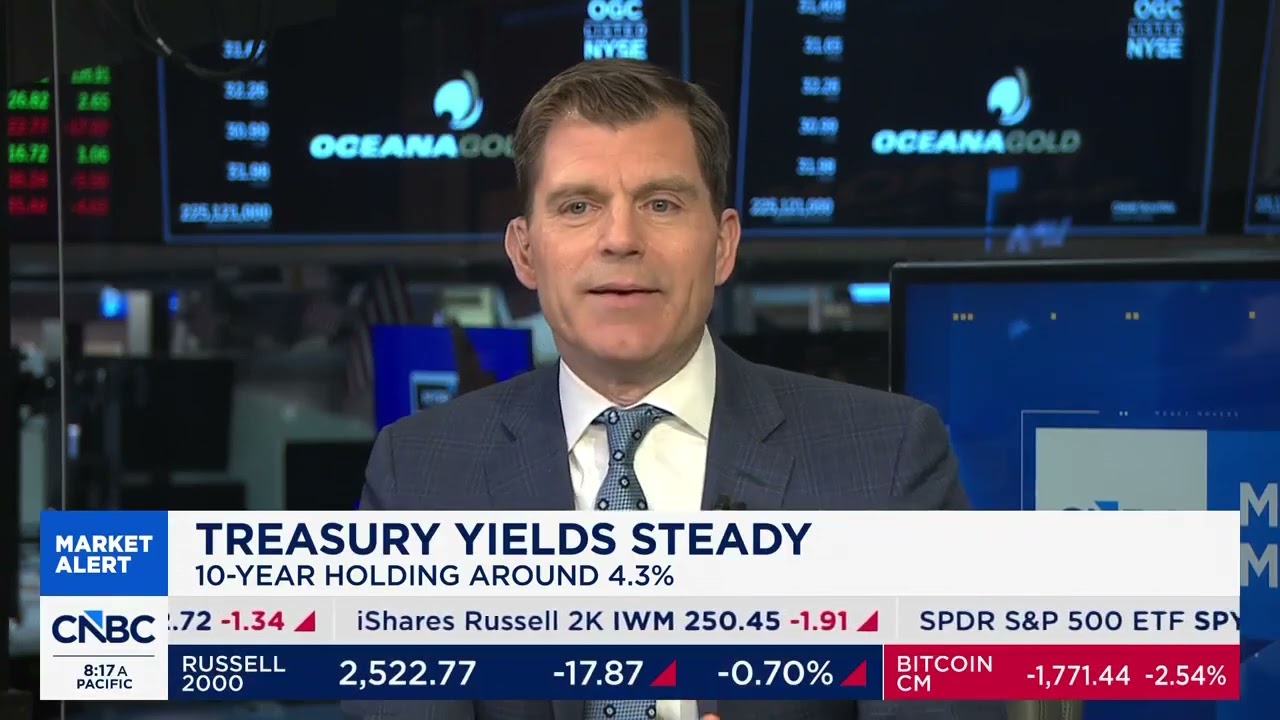
---
desmog murray
February 17, 2017
Speaking with*CNBC,* Murray claimed that global warming was a hoax citing “4,000 scientists.”88
“There’s no scientific analysis either,” Murray said. “I have 4,000 scientists that tell me global warming is a hoax. The Earth has cooled for 20 years.”89
When asked for clarification, a spokesperson for Murray Energy sent links to the Manhattan Declaration on Climate Change, which says “human-caused climate change is not a global crisis,” and the infamous Global Warming Petition Project, also known as the Oregon Petition, a debunked list of those who claim humans don’t cause climate change.90
TheManhattan Declaration is a document devised by theInternational Climate Science Coalition (ICSC) and unveiled at thefossil fuel industry-funded Heartland Institute’s 2008 International Conference on Climate Change. ICSC is run by Tom Harris who formerly worked for a PR company called the High Park Group. ICSC also receives funding from the Heartland Institute, which has been at the forefront of climate change denial.91
As Tom DiChristopher noted at CNBC, “Murray’s claim that there is no scientific analysis behind climate change is not true. […] His second claim that Earth is cooling is also false.”92
---
MMA
On Squawk Box, CBO director discusses how tariffs are “slowing down the economy”
09/15/25
---
---
an 8 25
Peter Navarro, President Donald Trump’s top trade official and the architect of his massively unpopular trade war and sweeping tariff plans, admits that the majority of economists do not agree with the administration’s stance that tariffs are actually “tax cuts.”
Tariffs are taxes paid by importers on goods and services as they enter the country, and those costs often make their way to consumers through higher prices. While some businesses initially absorbed the added expense when President Trump’s tariffs began, July’s wholesale prices jumped 0.9% — more than four times the 0.2% economists expected and the largest monthly increase in over three years — signaling that consumers will be bearing more of the burden.
Not according to Navarro, the Senior Counselor to the President for Trade and Manufacturing who was sentenced to prison for contempt of Congress after the first Trump administration.
“No tariffs, no tax cuts,” Navarro told CNBC on Thursday (video below), referring to the massive tax cut package— central to President Trump’s so-called “One Big Beautiful Bill”—that the administration claims will be partly offset by collected tariff revenue.
READ MORE: Inflation ‘Starting to Boil’: Dire Economic News for Trump — Worst in Three Years
“Are tariffs price hikes or tax cuts?” Navarro posed. “I say they’re tax cuts.”
“I mean, many, many economists would say that they’re tax hikes,” the CNBC host replied, “because ultimately, a consumer will pay for some of those increased prices.”
“Look,” a frustrated Navarro responded, “that debate has been going on since the first [Trump] term, and most economists just don’t agree with us.”
“The problem with most economists is they got it wrong the first time around, just, spectacularly wrong. So, who has credibility here? The Trump administration, or the economists?”
The CNBC host continued, saying, “we’re hearing from retail companies about passing on higher prices to the consumer. Who do you see is paying for all of these tariffs that are coming in? I mean, it’s either the people who buy the stuff, the people who make the stuff, or the people who sell the stuff.”
Navarro was quick to respond.
READ MORE: Trump Melts Down Over Elizabeth Warren’s Accusations
“It’s the foreigners, the exporters who are heavily dependent on this market, and we see this clearly in the data,” he claimed, contrary to multiple reports that show importers and retailers are increasingly passing on the tariff costs to consumers.
“We’ve collected over $100 billion in tariffs already,” he continued. “We’ve had zero inflation from that.”
Experts disagree.
The nonpartisan Congressional Budget Office has said Trump’s tariffs will add about four-tenths of a point onto inflation, according to Reuters. Wholesale prices in July spiked 0.9%, far higher than expected.
Watch the video below or at this link.
---
09/30/24
---
CNBC failed to rebut JD Vance's falsehoods about immigrants during interview
09/12/24 mma
---
3 24 BADASH
U.S. Secretary of Transportation Pete Buttigieg appeared to frustrate CNBC host Joe Kernen when talking about the southern border and reminding viewers that congressional Republicans bowed to Donald Trump’s call to kill a bipartisan border bill.
“People are also frustrated,” Buttigieg acknowledged. “And people are generally frustrated with the negativity they see, every time they see coverage of Washington,” he added, pointing out that “Congress right now has an approval rating last time I checked was, I think in the 20s.”
“I mean, it was especially disappointing to see what happened with the border, right?” Buttigieg told Kernen, who has been described as “pro-Trump.”
“You got congressional GOP, talking about the border every chance they got so you would think they would be interested in addressing it and yet, when a bipartisan bill put together by one of the most conservative members of the Senate, and Democrats working negotiating, making tough, tough decisions that both of their respective bases were going to have trouble with, came in, hammered that out,” he said, noting that Donald Trump, “who’s not even an elected official” came in to “kill it with the chill that he put on congressional Republicans.”
As the conversation continued, Kernen and Buttigieg talked over each other, as the CNBC host insisted, “let me finish.”
READ MORE: ‘Drill Baby Drill’: Trump Has Just One Answer When Asked How He Will Bring Food Prices Down
“Every time we hear those talking points, that suddenly it was Republicans who ruined the border,” Kernen said. “That’s why people get so frustrated. We know what President Biden said about inviting people in. We know that he got rid of all the things that were keeping the border closed that President Trump had put in, we know that he got rid of all those. So when you say it’s not his fault –”
“That’s literally not true,” Buttigieg protested, reminding Kernen that President Biden “got rid of the policy to tear children out of the arms of their parents. That’s true, but it is not true, some of the other things that have been suggested –”
As the two continued to talk over each other, Kernen decried the “disconnect” between what Republicans and Democrats say, and Buttigieg added that “literally since the Reagan administration, right? There have been bipartisan efforts to get something done here” on immigration.
“But I really believe we’ve gotten to the point,” Buttigieg observed, “where many congressional Republicans find it so useful as a cudgel that they would rather keep the problem going for political uses, than solve the problem and risk the chance that the President is sharing credit for that.”
Kernen insisted “the administration keeps saying don’t believe your lying eyes,” but Buttigieg responded, “I think congressional Republicans are saying don’t believe your lying eyes, which is why they’re polling at about 15%.”
“We have economic numbers,” Buttigieg continued, “is it my lying eyes that under Joe Biden, we’ve had the most job creation in American history? Is it my lying eyes telling us that unemployment and inflation are both below 4% and have been that way for the longest time? Is it reality? Or is it spin to point out the fact that manufacturing jobs are up under this President? And were down under the last president,” he added, as Kernen tried to interrupt after looking away from his guest.
“These are matters of simple fact,” Buttigieg said.
“When we heard for three years, the border’s closed and it’s secure. And 7.2 million people have come in to where our big cities have no idea how to handle this,” Kernen claimed, going after the Biden administration.
READ MORE: Video Shows 32 Times Trump ‘Babbled Nonsense’ or ‘Got Confused’ in Just One Day
“And here’s the thing,” Buttigieg interjected. “This is really important. Okay. The common sense position and the position that by the way, a lot of moderate Democrats and moderate Republicans would always say the kinds of things that you hear at the Chamber of Commerce in Indiana, where I come from, is that there ought to be more legal immigration and less illegal immigration.”
” And yet when there’s a chance to actually do that, that’s not what happened. The last administration cut legal immigration, and meanwhile, our economy is pulling people just as much as terrible conditions in Latin America are pushing people, and when there’s finally a bipartisan compromise, that would help address at least some of those issues, Congressional Republicans couldn’t get it done because Donald Trump who’s not even an elected office killed it. That is a fact.”
“I just think you know, the American public just wants something that benefits them. They just don’t want to hear [that] what they see isn’t happening,” Kernen declared.
---
AN 190 24
Donald Trump has just canceled a scheduled interview with CNBC’s Joe Kernen, who has been described as “pro-Trump.”
The cancellation comes as many are watching video and reading reports about Trump’s Monday night town hall in Pennsylvania, during which the Republican presidential nominee, three weeks before Election Day, took just a handful of questions. Then, after two audience medical issues, he turned the night into a music event as he stood and swayed on stage listening to his favorite hits.
Trump “abruptly canceled an interview on his economic plans with business channel CNBC, one of its anchors announced Tuesday,” The Daily Beast reports. “Joe Kernen, the conservative-leaning host of its flagship show Squawk Box, revealed the move during an interview with Charles Phillips, the Oracle chairman who is supporting Vice President Kamala Harris, saying ‘Trump canceled.’ The interview had not previously been announced by either side. Sources told the Daily Beast that the network had invited Trump to an in-studio sit-down on Squawk Box to take place later this week and that his campaign had initially accepted.”
The move comes after Trump pulled out of an agreed-upon “60 Minutes” interview, and one day before Vice President Kamala Harris, his Democratic presidential opponent, will sit down for an interview with Fox News.
READ MORE: Trump Campaign Furious Walz Using Trump’s Own ‘Reckless, Dangerous Rhetoric’ Against Him
“The cancelation continues Trump’s policy of avoiding mainstream television interviews,” The Daily Beast adds. “Instead he has been interviewed repeatedly by friendly Fox News hosts including Maria Bartiromo, and appeared with podcasters including comedian Andrew Schultz. His public schedule said he would be interviewed Tuesday by Bloomberg before an address to the Economic Club of Chicago.”
The Bulwark reports since Trump’s only debate with Vice President Kamala Harris, he isn’t giving interviews to the mainstream media.
“In recent weeks, Trump has almost exclusively decamped to outlets that are already in his tank. Since the September 10 presidential debate, with the exceptions of a Las Vegas ABC affiliate and a quick NewsNation hit, nearly all of Trump’s 14 one-one interviews have been with interviewers ranging from friendly to sycophantic:
“Fox News hosts Maria Bartiromo, Laura Ingraham, Brian Kilmeade, Sean Hannity, and Greg Gutfield.
Chris Salcedo, Carl Higbie, and Rob Schmitt of NewsMax.
Sinclair’s Sharyl Attkisson.
Conservative radio host Dave Ramsey.
Wayne Allyn Root of Real America’s Voice.
Andrew Schultz and Akaash Singh of the comedy podcast Flagrant.
Over the same period, he’s totally eschewed tentpole mainstream outlets—making a point of skipping, for instance, the traditional interview with CBS’s 60 Minutes.”
READ MORE: ‘Is He OK?’: Trump’s Dark of Night Rage Posting Backfires
“Trump still talks with the press and takes questions at events, including (likely) today when Bloomberg News is hosting his speech at the Chicago Economic Club. But when it comes to one-on-one interviews, he’s never been more cloistered within his MAGA media bubble.”
Overnight, Trump lashed out at Harris in a series of social media posts, defending his mental health.
“I’ve put out more Medical Exams than any other President in History, and aced two Cognitive Exams (the Doctor stated that my “cognitive exams were exceptional!”). I am far healthier than Clinton, Bush, Obama, Biden, but especially, Kamala,” Trump alleged. “Also, I am far too busy campaigning to take time, from the 22 days left, as I am using every hour, of every day, campaigning, because we have to take back our Country from the Radical Left people that are destroying it.”
:{RELATED: Buttigieg’s GOP Roast Ruffles CNBC Host
---
-===
September 24, 2024, edition of CNBC's Squawk Box
ANDREW ROSS SORKIN (CO-HOST): As it relates to the tariffs, because you talked about strategically using the tariffs. At least our understanding of it, and a lot of the way these tariff proposals have been quote-unquote “scored” by economists is a broad tariff plan, not necessarily one that looks by an industry-by-industry or even item-by-item. And I think one of the reasons people say, "well that could be a tax on the American public" is there are industries unfortunately, which we, the American public, are not in manufacturing yet. And so the question is, yes, it would be great to induce more folks to manufacture here, but the time it may take to actually get that to work in a meaningful way is going to have at least a short-term cost, if not a longer-term cost, right?
JOHN PAULSON (TRUMP CAMPAIGN ADVISER): Yes. So, I think the 10% is an average tariff. Tariffs will be allocated strategically. First, to industries that are essential for our American industrial base and for defense industry. We can't buy critical minerals from potential adversaries. Second, we have to level the playing field in industries that we haven't had fair competition. And using tariffs will restore a level playing field.
BECKY QUICK (CO-HOST): Well, yesterday, he [Trump] leveled it at John Deere, too. I mean, that was — are we going to see one-offs? You're talking about an orderly form.
PAULSON: Well, that would be an example — yeah, that would be targeted. We want to keep American companies manufacturing in the U.S. And if they're going to close U.S. factories, to relocate abroad, particularly in Mexico, take advantage of their cheap labor, fire American workers. That's not a policy that Trump wants to support. And I think it makes a lot of sense.
JOE KERNEN (CO-HOST): But it seems like some of that — some of it could be inflationary, if it was, you know, not done carefully. The other thing that we have so much disagreement on, just in the economic literature, is who pays tariffs. And when that criticism is levied that it's the American consumer, not China or somebody else that's going to pay the $450 billion, and it's going to be through higher prices and that's going to cause inflation, how do you counter that? And it's an effective argument they use. They just roll their — there's an entire group of economists and voters who roll their eyes when they think that you can tax other countries instead of just taxing American consumers with tariffs.
CNBC’s Joe Kernen blatantly misleads about Kamala Harris’ economic policies
09/10/24 mma
---
// fox BS
Watch an economist disrupt a misleading CNBC segment on Kamala Harris' policy against price gouging
After CNBC anchor Joe Kernen and Project 2025 contributor Veronique De Rugy repeatedly mislabeled the Harris plan as “price controls,” economist Justin Wolfers set them straight
Written by Craig Harrington
Published 08/28/24 mma
Democratic presidential nominee Kamala Harris' proposal to combat price gouging continues to be the subject of misleading accusations from ideological opponents in mainstream and right-wing media. The latest flare-up came from CNBC’s flagship morning news program, which repeatedly and falsely labeled the Harris proposal as a form of “price controls.”
One problem with that narrative, as University of Michigan economist Justin Wolfers noted, is “that’s actually not what Vice President Harris has suggested we do.”
On the August 28 edition of CNBC’s Squawk Box, MAGA co-anchor Joe Kernen introduced the segment by proclaiming that “VP Harris had a choice between telling Americans that they pay higher prices because of the inflation her administration helped create … or she could blame corporations, she chose the latter.”
Conservative columnist and economist Veronique De Rugy responded to Kernen’s softball setup by acknowledging that Harris' proposal was politically popular before dismissively comparing it to the sky-high tariff proposals being floated by convicted former President Donald Trump, which economists across the political spectrum (including De Rugy herself) widely suggest will result in increased consumer prices that may super charge inflation going forward. De Rugy continually labeled the Harris proposal as a form of “price control,” a misleading description she has recently reiterated in columns published by National Review. (De Rugy is often at odds with much of Trump's economic agenda, but she did co-author a chapter of the pro-Trump manifesto Project 2025, where she called for abolishing the Export–Import Bank of the United States.)
After almost three minutes denigrating the Harris proposal, the panel finally pivoted to commentary from Justin Wolfers, who noted an important aspect overlooked by Kernen and De Rugy: Kamala Harris did not propose price controls.
According to Wolfers, “Generally speaking, when markets are functioning well, price controls are a bad idea even though they are often a popular idea.” Quoting Harris, he added that the vice president’s proposal is focused on “opportunistic companies that exploit crises and break the rules” before concluding that “she's not talking about price controls, not once has she used that word.” Wolfers then reiterated that “economists as a tribe, we’re very upset whenever we think there’s price controls happening. We’ve got to look at the policy — that’s actually not what Vice President Harris has suggested we do.”
Faced with this simple fact, Kernen derailed the conversation by complaining that an initiative to fight price gouging ought not to have been among Harris’ first policy proposals while misleadingly boasting that “wages are still down from when her administration came into office.” (Real wages are higher now than they were pre-pandemic, but lower than they were in 2020 and 2021 due to the pandemic’s massive disruptions of the labor market and the government’s infusion of stimulus relief.)
Kernen falsely suggested that Harris was blaming price gouging for the systemic inflation witnessed in the United States over the past four years. Harris did not blame price gouging for inflation, centering blame for that phenomenon on disruptions caused by the global pandemic. (Inflation was also a truly global phenomenon, not one centered in the United States, and the U.S. currently enjoys one of the lowest inflation rates among developed countries.)
Wolfers later responded to Kernen’s outburst by recentering the conversation on the actual policies being forwarded by Harris, which he reiterated are not price controls, and contrasting them with the utter vapidity of Trump’s proposals to tackle higher costs of living.
CNBC is not alone among mainstream news outlets blasting the Harris campaign over nonexistent price controls, and much of the argument in this segment echoed misleading reporting and commentary published in The Washington Post last week, which was actually cited briefly at the end of the segment and has already become fodder for the right-wing media’s campaign to smear Harris.
Watch the full segment below:
---
an 4 23 no lnx vid
CNBC host calls Kevin McCarthy a hypocrite to his face for 'unsustainable' Trump tax cuts
David EdwardsandRaw StoryApril 17, 2023
CNBC host Sara Eisen challenged House Speaker Kevin McCarthy (R-CA) on Monday after he demanded spending cuts in return for raising the nation's debt limit.
During an interview in New York, McCarthy told Eisen that the country was like a child with a credit card.
"Would you just raise the limit?" he asked.
"Well, if it meant playing with America's standing and full faith and credit of U.S. government debt, I feel like you can deal with the spending in other ways, which is totally legitimate," Eisen observed.
McCarthy suggested that there was no other way to reduce the nation's debt.
"You did it three times in the Trump administration," Eisen noted.
"We never raised the debt ceiling by itself," McCarthy insisted.
"And tax cuts," Eisen interrupted. "That was like $2 trillion in deficit."
But McCarthy argued that the Trump-era tax cuts were good for the economy.
"So I was going to ask you about taxes because I wonder, because you want to extend the Trump tax cuts, correct?" Eisen asked. "But isn't that a little hypocritical when you're talking about finding savings everywhere and being on an unsustainable fiscal path?"
:{:{}:
}:
"How's that hypocritical when it's bringing tax cuts, tax savings?" McCarthy retorted. "I will always advocate for the idea that we are streamlining our tax policies, that we're also streamlining our regulation."
Watch the video below from CNBC.
FROM YOUR SITE ARTICLES
Marjorie Taylor Greene unleashes on Kevin McCarthy with chilling warning and post-election prediction ›
Kevin McCarthy instructs House GOP to 'immediately investigate' looming Donald Trump indictments ›
'Godspeed': Senate GOPer’s doubt Kevin McCarthy’s plan to cut food assistance for millions ›
Even Republicans are balking at McCarthy's cruel budget proposal - Alternet.org ›
---
---
Where Did Credit Reporting Come From, and Why is it So Powerful Today? | History News Network
hether you’re signing up for your first-ever credit card or applying for a mortgage, your credit score plays an important role in determining whether or not you’ll be able to reach many of your financial goals. Your credit report and that three-digit credit score number can also make a big difference in how much interest you’ll have to pay on loans as well as the types of loans or credit cards you’ll qualify for.
Credit reports and credit scores as we know them today are a part of a long history of merchants and lenders collecting information and using it to evaluate whether a potential borrower would be able to pay their loans back in full and on time.
Select spoke with Josh Lauer, associate professor of communication at the University of New Hampshire and author of “Creditworthy: A History of Consumer Surveillance and Financial Identity in America,” to understand more about how credit scoring and credit reporting came to be, and how both eventually became such an important part of our lives.
Before there was credit scoring, there was commercial credit reporting. Unlike consumer credit reporting, where individuals are evaluated for their credit risk level, commercial credit reporting was originally used by merchants to evaluate the creditworthiness of potential business customers.
In 1841, the Mercantile Agency was founded as one of the first commercial credit reporting agencies, using people known as correspondents to collect information about lenders and borrowers across the country. In a way, it functioned a bit like a modern-day credit reporting agency, collecting information about a businessperson’s marital status, ethnic background, credit history and age, which was then entered into a ledger that was centralized in one location, New York City.
This type of credit reporting relied on subjective methods of evaluation — in other words, correspondents would provide evaluations of people based on their racial background, gender and moral character.
It wasn’t until the late 19th century, when department stores and mass retailers gained popularity, that consumer credit reporting really took off.
Some mass retailers were installment houses, which would sell items such as furniture and drugs to customers via installment loans. The retailers needed a way to attract consumers and ensure they would be paid back, so they collected information about their customers and submitted it to a local credit bureau.
While there are three major consumer credit bureaus today — Equifax, Experian and TransUnion — it would in fact take hundreds of years to develop a national centralized credit bureau.
It wasn’t until credit reporting became computerized in the 1960s that the industry would become consolidated.
In the 1960s, there were more than 2,000 credit bureaus across the U.S.. Over the course of the next 20 years, that number would shrink to five and, eventually, to the three major credit bureaus that exist today, Lauer explains.
“Before [the 1960s], all the files were in filing cabinets, on papers and cards,” says Lauer. “So we have these bureaus that have lots of money. They come into a town and buy up all the local credit bureaus with all [of] their information and then computerize it.”
It would take longer for credit scoring to gain widespread popularity in the U.S., however, as lenders were hesitant to give up their use of character assessments in the evaluation of someone’s creditworthiness.
no lnx
yikes banner popup ads FOR EXPERION
would take longer for credit scoring to gain widespread popularity in the U.S., however, as lenders were hesitant to give up their use of character assessments in the evaluation of someone’s creditworthiness.
Today, FICO scores are considered to be the most widely used type of credit score.
According to Sally Taylor, vice president and general manager of FICO Scores, the company was founded in 1956 and would initially work with business clients to develop credit scoring models that were specific to that company.
:{:{}:
}:
A company would hire FICO and then use its customer files to produce an individualized model, which would then be used to calculate the credit risk level of its customers, explains Lauer.
In 1989, FICO worked with the national credit bureaus to create a credit scoring model that could be used to evaluate all consumers — this is when the first generalizable credit score was born.
“The idea that there’s a generic model means that lots of different companies can use a credit score for the first time and this makes credit scoring much more accessible and popular among lenders,” says Lauer.
:{:{}:
}:
FICO scores were then cemented as a crucial part of the financial decision-making process when Fannie Mae and Freddie Mac started requiring mortgage applicants to submit them in the mid-1990s.
Credit scores today
Today, there are many different types of credit scoring models used by a variety of lenders. FICO, however, remains one of the most widely used — the company claims its scores are used by 90% of top lenders.
FICO’s credit scoring models have evolved since 1989 to account for ever-changing consumer behaviors. Today, the scores range from 300 to 850, with higher scores indicating a greater likelihood that a consumer will pay back their loans in full and on time.
Unlike credit reporting and credit scoring methods of the past, factors such as race, age, gender and marital status are no longer considered. Instead, the following five factors are used to calculate an individual’s FICO credit score:
Payment history (35%): Whether or not you’ve paid past credit accounts on time
Amounts owed (30%): The total amount of credit and loans you’re currently using compared to your total credit limit — this is also known as your utilization rate
Length of credit history (15%): The length of time you’ve had credit
New credit (10%): How often you apply for and open new accounts
Credit mix (10%): The variety of credit products you have, including credit cards, installment loans, finance company accounts and mortgage loans
In recent years, there’s also been an effort to include data that’s not typically used to calculate credit scores. *Experian Boost™ was launched in 2019, allowing users to include recurring payments such as utility bills and monthly subscription payments on their Experian credit report.
Experian Boost™
Experian Boost™
LEARN MORE
On Experian’s secure site
Cost
Free
Average credit score increase
13 points, though results vary
Credit report affected
Experian
Credit scoring model used
FICO®
Terms apply.
How to sign up for Experian Boost™:
Connect the bank account(s) you use to pay your bills
Choose and verify the positive payment data you want added to your Experian credit file
Receive an updated FICO® Score
Learn more about eligible payments and how Experian Boost™ works.
In the U.S., 26 million Americans are considered to be credit ‘invisible’ due to having a lack of credit history, with the issue affecting more Black, Hispanic and low-income individuals. Experian Boost can be a useful tool for those with poor credit scores — or no credit scores at all — as it allows information regarding on-time payments to be included on their credit reports, which can help bump it up a bit.
For those who want more in depth information on their credit score and to monitor changes to their credit file, consider a credit monitoring service. Both Experian free credit monitoring and Experian IdentityWorks℠ provide you with potential fraud warnings which can help protect against identity theft.
Other free options to view your credit score include CreditWise from Capital One which shows you your VantageScore from TransUnion or Discover Credit Scorecard which shows your FICO Score from Experian.
Experian Dark Web Scan + Credit Monitoring
Experian Dark Web Scan + Credit Monitoring
LEARN MORE
On Experian’s secure site
Cost
Free
Credit bureaus monitored
Experian
Credit scoring model used
FICO®
Dark web scan
Yes, one-time only
Identity insurance
No
Terms apply.
Experian IdentityWorks℠
Experian IdentityWorks℠
LEARN MORE
On Experian’s secure site
Cost
$9.99 to $29.99 per month
Credit bureaus monitored
Experian for Plus plan or Experian, Equifax and TransUnion for Premium plan
Credit scoring model used
FICO®
Dark web scan
Yes
Identity insurance
Yes, up to $500,000 for Plus plan and up to $1 million for Premium plan*
Terms apply.
*Identity Theft Insurance underwritten by insurance company subsidiaries or affiliates of American International Group, Inc. (AIG). The description herein is a summary and intended for informational purposes only and does not include all terms, conditions and exclusions of the policies described. Please refer to the actual policies for terms, conditions, and exclusions of coverage. Coverage may not be available in all jurisdictions.
Catch up on Select’s in-depth coverage of personal finance, tech and tools, wellness and more, and follow us on Facebook, Instagram and Twitter to stay up to date.
Read more
What is a FICO Score and why is it important?
---
---
an 620
Jim Cramer: Coronavirus pandemic triggered ‘one of the greatest wealth transfers in history’
Written by Andrea Germanos / Common Dreams June 5, 2020
CNBC‘s Jim Cramer said Thursday that that coronavirus pandemic has triggered “one of the greatest wealth transfers in history.”
The remark from the network’s “Mad Money” host came amid “ominous” economic data but a rebounding stock market.
:{:{}:
}:
“How can the market rebound without the economy? Because the market doesn’t represent the economy; it represents the future of big business,” said Cramer. “The bigger the business, the more it moves the major averages.”
:{:{}:
}:
“And that matters,” he continued, ‘because this is the first recession where big business—along of course with bigger wealth, but that’s not really by show—is coming through virtually unscathed, if not going for the gold.”
:{:{}:
}:
In contrast, small businesses are “dropping like flies,” Cramer said, attributing those failures to the fact that smaller businesses are struggling to pay rent as “major landlords” don’t appear to be offering relief.
:{:{}:
}:
“That’s the thing about this pandemic,” Cramer continued, “it’s been one of the greatest wealth transfers in history.”
Cramer projected that transfer to have a “horrible effect” on the country.
Further, the CNBC host said, “we’ve barely begun to see the impacts” of the pandemic’s economic fallout. Cramer pointed to the latest corporate bankruptcy figures he said would “chill both Republicans and Democrats.”
The new comments came a day before federal data showed the nation facing a 13.3 percent unemployment rate, and as a new analysis showed the fortunes of U.S. billionaires increased by $565 billion between March 18 and June 4. That 11-week period also saw 42.6 million Americans filing jobless claims.
==
Climate activist Greta Thunberg told the World Economic Forum that governments should divest from fossil fuels given the catastrophe of the climate crisis. In response, United States Treasury Secretary Steven Mnuchin sneered at her activism and told her to go study economics. Just one problem: Thunberg was right.
Mnuchin’s own government released a National Climate Assessment in 2018 that said that climate change, if left unaddressed, would cost the U.S. economy $500 billion per year. A massive new report by the Bank for International Settlements also has linked climate change to a possible financial crisis. Furthermore, actual economist Gernot Wagner told The Washington Post that Mnuchin is completely wrong about Economics 101, using a delightful analogy about rabbits on a communal meadow.
Right-wing media sites were thrilled at Mnuchin’s attack, with some suggesting that Thunberg had a mind full of mush and others saying that people like her should be seen and not heard. In short: it was the standard information-free bullying that you would expect.
Mnuchin then dropped by CNBC's Squawk Box to discuss his remarks. What ensued was a cavalcade of lies and climate denial.
The softball CNBC interview had Mnuchin throwing out a number of right-wing talking points on climate change and generally showing that he has no understanding of the issue. Co-anchor Joe Kernan just egged him on, even suggesting that climate alarmism was driving increasing discussions of the climate crisis.
In fact, the entire conversation seemed to take place in a universe where climate change is not an urgent problem, where Australia is not on fire, where ocean life is not dying, and where the United States is not repeatedly hit with climate-fueled catastrophes like wildfires, hurricanes, and flooding. The only voice of reason in the discussion was co-anchor Andrew Ross Sorkin, who used JPMorgan Chase CEO Jamie Dimon of all people as a counterpoint to what Mnuchin was saying. The media should be touting what experts say, not what bank CEOs are saying.
==
---
https://www.cnbc.com/2019/09/24/how-greta-thunbergs-rise-could-backfire-on-environmentalists.html
How 16-year-old Greta Thunberg’s rise could backfire on environmentalists
PUBLISHED TUE, SEP 24 2019 8:42 AM EDTUPDATED TUE, SEP 24 2019 9:47 AM EDT
Jake Novak
@JAKEJAKENY
KEY POINTS
Sixteen-year-old Greta Thunberg’s ascendancy to the forefront of environmental activism could end up being a major negative to the movement and the environment, writes Jake Novak.
GP: Greta Thunberg World Leaders Gather For United Nations Climate Summit
Youth activist Greta Thunberg speaks at the Climate Action Summit at the United Nations on September 23, 2019 in New York City. While the United States will not be participating, China and about 70 other countries are expected to make announcements concerning climate change.
Stephanie Keith | Getty Images
Sixteen-year-old Greta Thunberg from Sweden is the new face of the environmentalist movement, thanks to a pair of impassioned speeches to the U.S. Congress and the United Nations.
But while personalizing a movement, especially with the innocent face of a child, is usually PR gold, Greta’s ascendancy to the forefront of environmental activism could end up being a major negative to the movement – and the environment.
Just how inspiring or even persuasive you find Greta’s speeches and overall activism likely depends on where you stand on the political spectrum. There are plenty of politicians and regular voters claiming to be inspired by her words and passion. There are also lots of observers expressing general alarm at what they see as an indoctrinated child being coerced by adults to make their political arguments with her youth as a shield from any criticism.
WATCH NOW
VIDEO01:45
Pres. Trump leaves UN climate summit, attends religious freedom summit, instead
Her story signals a clear change in environmental movement tactics, and just how much more divisive and ineffective that change is likely to be.
Greta, and the adults guiding her, are seeking to shift almost all the focus from personal responsibility to governments and big corporations to enact environmental reform. Their argument is that individual people can’t do much to save the world from climate change disaster when energy companies and governments focused mostly on economic growth don’t care enough to make the big changes.
The adult version of that argument emerged earlier this month when Democratic presidential candidate Elizabeth Warren basically mocked personal conservation efforts. Warren told a climate town hall audience and later tweeted that the fossil fuel industry wants the public to discuss issues like plastic straws, lightbulbs, and cheeseburgers so they can continue to get away with producing most of the emissions blamed for climate change.
Elizabeth Warren
?
@ewarren
This is exactly what fossil fuel industries want us to talk about—they want to stir up a lot of controversy around your light bulbs, straws, cheeseburgers. But 70% of the pollution comes from three industries. We can set our targets and say no more by 2035. #ClimateTownHall
19.2K
6:46 PM - Sep 4, 2019
Twitter Ads info and privacy
5,109 people are talking about this
The funny thing about all of this is the free market is already doing these things based on the same capitalist incentives Greta and so many other activists are blaming for environmental disaster.Natural gas is cheaper and produces 50% fewer emissions than coal, nuclear power has been modernized and made much safer in recent decades while producing no emissions. For-profit entities like a company called Carbon Engineering are working on machines that literally suck carbon emissions out of the atmosphere.
Each of these innovations has enjoyed some level of government support here and there, but raw capitalistic profit motives are the primary driver. Warren and those like her are failing to see that millions more Americans who use their consumer spending powers to reduce their carbon footprint will send corporate America chasing after those dollars in a much faster and more effective way than government fiat.
It’s not just die-hard capitalists or environmental skeptics who are pushing back on this focus away from personal responsibility. In a remarkable interview on PBS last week, author Jonathan Safran Foer spoke out against Warren’s comments and pointed out that those who say they believe in the dire effects of climate change would do more than protest if they really believed it. That point is the premise of Foer’s new book, “We Are the Weather: Saving the Planet Begins at Breakfast.”
Based on all the politically partisan slogans and signs we saw at the climate protests over the past few days, are we sure the top motivation is the environment and not politics? If the activists protesting right now could get the most serious climate change threats eliminated, but without politically defeating President Trump and Republicans and/or putting the big oil companies out of business in the process, would they still be interested in the cause?
The shift from the “Think Globally, Act Locally,” environmental philosophy of the 1980s and 1990s makes that question fair game. When we move from encouraging people to change their personal practices to something like Warren’s mocking of that very idea, it guts the very soul of any movement for effective change.
Previous generations of environmental activists knew this. By focusing on what people could do in their own personal lives to cut down on pollution, they presided over an environmental movement that used to be much more bipartisan in America.
This new focus on making environmentalism an angrier protest movement threatens to make the effort to protect the planet just another wedge issue that politicians often use to motivate their base of voters. Similar wedge issues like abortion and gun control have long shifted become tribal controversies with little chance of progress and compromise.
Greta Thunberg is angry.Lots of people are angry. But anger without doing something other than protesting and making speeches won’t protect the environment or do much else other than produce more anger.
Jake Novak is a political and economic analyst at Jake Novak News and former CNBC TV producer. You can follow him on Twitter @jakejakeny.
WATCH: Amazon to meet Paris climate goals 10 years ahead of schedule
---
off bs kudlow 2012 Report with Larry Kudlow and began his additional role as a contributing op-ed columnist for CNBC in 2013. [2]
Novak was named senior columnist in 2016. His columns focus on politics, economic and social issues, and American culture. [2]
Prior to joining CNBC, Novak co-created and oversaw the "Varney and Company" program on the Fox Business Network along with anchor Stuart Varney. He also spent seven years at CNN, producing financial news programs including launching the successful "In the Money" show with anchor Jack Cafferty. [2]
==
gop debate led to revolt? bashed liberal media (a la gingrich on wife?)
he three main moderators -- CNBC’s Carl Quintanilla, Becky Quick and John Harwood -- posed a series of pointed and sometimes contentious questions to the 10 candidates who participated in the third debate of the GOP presidential primary season. And the candidates did not hide their contempt.
“The questions asked in this debate illustrate why the American people don't trust the media,” Texas Sen. Ted Cruz said. “This is not a cage match. Donald Trump, are you a comic book villain? Marco Rubio, why don't you resign? Jeb Bush, why have your numbers fallen?”
http://abcnews.go.com/Politics/cnbc-debate-moderators-face-backlash-3rd-gop-presidential/story?id=34803250
---
charm offensive?
The Morning Joe interview of the Koch Brothers was nothing but an infomercial for the billionaires: http://mm4a.org/1Q8GXhM
It was so bad that Sen. Harry Reid called outMorning Joe on the Senate floor. Watch:http://mm4a.org/1MeEcpY
---
CNBC is an American basic cable, internet and satellite business news television channel that is owned by NBCUniversal News Group, a division of NBCUniversal, owned by Comcast. Headquartered in Englewood Cliffs, New Jersey,[3] the network primarily carries business day coverage of U.S. and international financial markets; following the end of the business day and on non-trading days, CNBC primarily carries financial and business-themed documentaries and reality shows.
Originally established on April 17, 1989 by a joint venture between NBC and Cablevision as the Consumer News and Business Channel,[4] the network later acquired its main competitor, the Financial News Network, in 1991—a move which expanded both its distribution and its workforce, and Cablevision sold its stake to NBC, giving it sole ownership. As of February 2015, CNBC is available to approximately 93,623,000 pay television households (80.4% of households with television) in the United States.[5] In 2007, the network was ranked as the 19th most valuable cable channel in the United States, worth roughly $4 billion.[6]
In addition to the domestic U.S. feed, fourteen localized versions of CNBC also operate, serving different regions and countries. NBCUniversal is the owner, or a minority stakeholder, in many of these versions.[7][8]
Contents
- 1History
- 2Programming
- 3Personalities and coverage
- 4Ratings
- 5On-air presentation
- 6Partnerships
- 7International channels
- 8CNBC.com
- 9High definition
- 10Airport "stores" or "bureaus"
- 11Criticism
- 12Tea Party movement (2009)
- 13See also
- 14References
- 15External links
History[edit]
CNBC had its beginnings around 1980 as the Satellite Program Network (SPN), showing a low-budget mix of old movies, instructional and entertainment programs. The channel later changed its name to Tempo Television. After initially signing a letter of intent to acquire Tempo,[9] NBC eventually opted for a deal to lease the channel's transponder in June 1988.[10] On this platform, and under the guidance of Tom Rogers, the channel was relaunched on April 17, 1989 as the Consumer News and Business Channel. NBC and Cablevision initially operated CNBC as a 50-50 joint venture,[11] choosing to headquarter the channel in Fort Lee, New Jersey.
==
jun 13 mma
...Joe Kernen, the co-anchor of Squawk Box, was the most vocal CNBC figure on climate change in 2013, frequently pointing to cold weather to suggest that global warming is not occurring. Kernen has long pushed climate science misinformation. In a 2007 , he cited the"The Great Global Warming Swindle," a movie that promoted
 claims, to criticize singer Sheryl Crow and "An Inconvenient Truth" producer Laurie David for speaking to college students about climate change. In 2011, Kernen co-authored a book titled Your Teacher Said What?!: Trying To Raise a Fifth Grade Capitalist in Obama's Americathat compared climate scientists to "high priests" whose work should not be trusted.
Larry Kudlow, the host of The Kudlow Report, against cap-and-trade in 2009, by
 climate change ("a lot of scientists are now saying ... this whole thing is just kind of a scam analysis") and citing The Heritage Foundation's exaggerated cost estimates for the proposed cap-and-trade program.
Rick Santelli is a regular CNBC contributor who some claim fomented the Tea Party movement with a well-publicized rant against government assistance for homeowners struggling to pay their mortgages. Santelli denies climate change, including saying in 2013, "when it comes to macroeconomics or climate change, I think trying to say that the scientific method is alive and well is a real stretch."
This climate denial fits in with a troubling pattern at CNBC of what the Columbia Journalism Review called its "newsroom-as-advocate problem." On climate change as with everything from market predictions to birther quotes, CNBC is once again wrong.
UPDATE:Forecast The Facts has created a petition asking CNBC Chief Executive Officer and President Mark Hoffman to tell "on-air personalities to stop promoting global warming denial and start reporting the facts on the economic risks of fossil-fueled climate change."
=
desmog
:{:{}:
}:
This is a guest post by Emily Southard, Campaign Manager of Forecast the Facts
Joe Kernen, co-host of CNBC’s Squawk Box, lashed out on Twitter this month at concerned CNBC viewers and individuals who called on him to accurately report the facts about the economic risks of climate change. Kernen’s comments are indicative of a larger climate coverage problem at CNBC.
Just recently, the network refused to air President Obama’s climate change speech--a surprising choice for a business news and financial network, given that Obama’s remarks dramatically shifted financial markets.
One potential explanation for this blunder? Many of CNBC’s on-air personalities are avid climate deniers--currently, the most vocal being Joe Kernen.
The CNBC Squawk Box co-anchor is so adamant that climate change is a “myth”, that Kernen has dedicated 150 out of his 530 lifetime tweets (over 28% of his all-time Twitter activity) and many business hours to doubling down on climate denial.
Kernen’s tweets have varied from calling concerned climate activists the “eco-taliban” and “sheep” to repeating well-debunked climate denier myths, citing his MIT cancer researchmultiple times, and complaining about public criticisms.
Read more: CNBC Host Squawks Climate Denial in Twitter Meltdown
===
---
REPORT: CNBC Still Deeply In (Climate) Denial
Research››› September 18, 2013 11:30 AM EDT ››› MAX GREENBERG & DENISE ROBBINS
In the first half of 2013, a little more than half of CNBC's climate change coverage cast doubt on the consensus position that it exists and is manmade. In the three months since, little has changed -- in a disservice to its viewers, who will need to factor climate change into their long-term business planning, CNBC has continued to deny the science.
More Than Half Of CNBC's Coverage Cast Doubt On Climate Change
Majority Of Network's Climate Coverage Featured Denial. Between June 14 and September 17, 55 percent (or 11 of 20) of the substantial mentions or segments on climate change featured on CNBC cast doubt on its existence, up from 51 percent in Media Matters' original study. The same percentage dismissed that climate change is an important problem that should be addressed. Only 30 percent of mentions and segments featured one or more figures stating that they accept the science behind manmade climate change. Of three full segments on climate change, only one featured a host or guest accepting that climate change is real. Media Matters*, [6/18/13] [CNBC, *Worldwide Exchange, 7/12/13]
Meanwhile, Scientists Overwhelmingly Agree On The Issue.A recent peer-reviewed survey found that 97 percent of scientific abstracts that stated a position on global warming endorsed the consensus position that humans are causing global warming. A 2009 study published by the American Geophysical Union reported that 97 percent of climate scientists said human activity was a "significant" contributor to rising temperatures. *Media Matters*, [9/5/13] *Media Matters*, [6/25/13]

CNBC Didn't Host Any Scientists To Discuss Climate Change.During the period of this study, CNBC did not host a single scientist to discuss climate change. Guests included advocates, business figures or politicians -- 33 percent of whom cast doubt on climate change. On these counts, CNBC's coverage fared worse than in the initial study. Most statements casting doubt on climate change still came from CNBC hosts -- 75 percent (nine of 12).

Kudlow And Kernen Still Undermine Climate Science. Several CNBC figures who have previously denied climate change science, including host Larry Kudlow and co-anchor Joe Kernen, stayed true to form during the surveyed period. Since the original report, Kudlow and Kernen cast doubt on climate change five and four times, respectively. They have previously referred to climate change as a "scam analysis" and a "bona-fide cult," and Kernen has devoted time on social media this year to inveigh against climate advocates, variously referring to them as "Eco Taliban" and comparing them to "end of days" evangelists. Media Matters*:{, :(style="background-color:#ffffffff"):}:[6/18/13] Media Matters*:{, :(style="background-color:#ffffffff"):}:[8/20/13:{] DeSmog Blog, :(style="background-color:#ffffffff"):}:[7/24/13:{] Twitter, :(style="background-color:#ffffffff"):}:[7/11/13:{]}:

CNBC's "Green Week" Accounted For 33% Of Segments That Accepted Science. One-third of the segments featuring guests who accept the science of climate change were part of CNBC's "special week of climate coverage," which came two months after Media Matters' initial survey. However, that week of programming was limited to Worldwide Exchange, a business show that airs at 4am ET, and during the week Joe Kernen took time to mock it. Media Matters*:{, :(style="background-color:#ffffffff"):}:[8/20/13] Media Matters*:{, :(style="background-color:#ffffffff"):}:[9/3/13]
But Climate Coverage Actually Worsened Since Original Report. In the first half of 2013, Media Matters found that 51 percent of CNBC's climate change coverage cast doubt on the scientific consensus that global warming exists and is manmade. That study helped push activists to organize a petition drive urging CNBC to improve its reporting on the issue. Members of both Environmental Action and Forecast the Facts staged a protest in front of the network's corporate offices to deliver the petitions to a network spokesman in early September. Nonetheless, climate reporting worsened since the original study -- even with the "special week of climate coverage." During the time period of the study, the percentage of substantial segments or mentions that cast doubt on climate change increased from 51 percent to 55 percent. *Media Matters*, [6/18/13] *Media Matters*, [9/3/13]
Strategic Businesses Acknowledge And Evaluate Climate Change Impacts
Top Companies Consider The Impact Of Climate Change On Their Businesses.
- Deloitte: "Climate Risk Should Be Included In All Organisations' Risk Management Strategies."Deloitte, accessed [6/10/13]
- Unilever: Climate Change "Has A Significant Impact On Our Business."Unilever, accessed [6/11/13]
- Kinross Gold Corporation: "Severe Weather Conditions, Including Those Resulting From Global Climate Change, May Adversely Impact Kinross' Operations."Kinross, [2010, via Ceres]
- Coors: "The Effects Of Climate Change Could Have A Long-Term, Material Adverse Impact On Our Business."Coors, [2/22/13]
- Nike::{ "Climate Change May Impact Nike's Global Supply Chain And Our Ability To Deliver The Right Product To The Right Place At The Right Time." Nike, :(style="background-color:#ffffffff"):}:[2011:{, via Ceres]}:
- Johnson & Johnson: "Changes To Global Climate ... Could Affect Demand ... [And] Cause Disruptions." Johnson & Johnson, [2/20/13]
- Delta Airlines: Increases In Severe Weather Events "Including From Changes In The Global Climate" Could "Increase The Potential For Greater Loss." Delta Airlines, [2/12/13]
- Swiss Re: Climate Change Is "An Important Component Of The Company's Long-Term Risk Management Strategy."Swiss Re, accessed [6/12/13]
- AIG: Climate Change Poses "Risks To The Global Economy ... Including Risks To Adequate Water Supply For Human Consumption And Agricultural Use."AIG, issued May 2006, revised [March 2009]
- Starbucks: Climate Change Poses "A Potentially Significant Risk To Our Supply Chain, Which Is The Arabica Coffee Bean."*The Guardian*, [10/13/11]
- Lloyd's: "As Climate Change Takes Hold, Few Businesses Will Be Able To Escape The Impact Of Greater Competition For Resources." Lloyd's, [2009]
Harvard Biz Professor: Climate Change Not Matter Of "Belief"; Better Seen As "Managerial Question."Forest L. Reinhardt of Harvard Business School's Business and Environment Initiative has said that climate change is "better seen as a classic managerial question about decision-making under uncertainty" than a matter of "believing" or not believing widely accepted science:
"It's striking that anyone frames this question in terms of 'belief,' saying things like, 'I don't believe in climate change,' " says John D. Black Professor and BEI faculty cochair Forest L. Reinhardt. "I don't think this ought to be treated as a religious question. I think it's better seen as a classic managerial question about decision-making under uncertainty." Forbes, [9/9/13]
Study: 70% Of Companies Believe Climate Change Can Significantly Affect Their Revenues.The Carbon Disclosure Project (CDP) noted that "three quarters (73%) [of the companies surveyed] say they feel that climate change presents a physical risk to their operations; just 13% identify regulation as a sole driver":
Seventy percent of companies believe that climate change has the potential to affect their revenue significantly, a risk which is intensified by a chasm between the sustainable business practices of multinational corporations and their suppliers, according to research published today by the Carbon Disclosure Project (CDP) and Accenture(NYSE:ACN).
"Reducing risk and driving business value" is based on information from 2,415 companies, including 2,363 suppliers and 52 major purchasing organizations who are CDP Supply Chain program members. These members include Dell, L'Oreal and Walmart and represent a combined spending power of c. US$1 trillion. The research marks CDP's most comprehensive annual update on the impact of climate change on corporate supply chains.
Climate change presents near-term risks to businesses, according to the report. Fifty-one percent of the risks that disclosing companies associate with drought or extreme rain are already having an adverse effect on company operations, or are expected to within five years, say those businesses. Additionally, the destructive nature of extreme weather is likely a catalyst for company action on climate change, with physical climate risk identified in the report as a greater driver of investment than climate policy. Of the 678 companies investing in emissions reduction initiatives, three quarters (73%) say they feel that climate change presents a physical risk to their operations; just 13% identify regulation as a sole driver. Carbon Disclosure Project, [1/22/13]
Some Businesses Already "Hedging Climate Volatility." The Globe and Mail pointed out that while most spending on climate change is not anticipatory, some businesses are "hedging climate volatility" already:
Pick any city, any industry, any business, any government and you will find that most of the spending on climate change comes after the disaster, not in anticipation of it. The U.S. Congress authorized more than $60-billion to pay for Hurricane Sandy's damage last year. In other words, there is no hedging for volatility.
[...]
To be sure, a few smart businesses, big and small, are hedging climate volatility. Some insurers are exiting markets that are particularly prone to climate change disasters, like low-lying areas that get hit with floods a bit too often. *The Globe and Mail*, [5/17/13]
Fmr Goldman Sachs Risk Management Head: Climate Issues Could Develop Quickly. Former Goldman Sachs risk management officer Bob Litterman, who is currently chairman of the risk committee at hedge fund Kepos Capital LP, wrote for LiveScience that the risk-management challenges posed by climate change are related to "time compression," or the problem of risky events "unfold[ing] too quickly, leaving insufficient time to react and manage the consequences," making the need to address climate change even more pressing:
Society should not regard the act of filling the Earth's atmosphere with greenhouse gases lightly. Just as in the financial crisis, when the meltdown in value of the huge investments in risky mortgages unpredictably rippled into other markets, this global chemistry experiment also may spill over into uncontrollable environmental disasters, all compounded by time compression.
[...]
The danger of time compression caused by climate change is real -- thus, society must immediately price the risk. LiveScience, [9/11/13]
Study: Climate Costs Could Be Similar To Financial Crisis.A recent paper found that the costs of delaying action to mitigate climate change before 2030 "are comparable to the costs of the financial crisis the world just experienced":
The economic costs of failing to agree a deal before 2030 "are comparable to the costs of the financial crisis the world just experienced", the paper's lead author, Dr Gunnar Luderer, says in a press release.
The new paper compares the cost of action depending on whether there is a new international agreement in 2015, 2020, or 2030. It calculates that global economic growth could be reduced by about two per cent if an agreement comes in 2015. Economic growth would be reduced by around seven per cent if the new targets are set in 2030, however. Carbon Brief, [9/13/13]
57% Of Small Businesses: Climate Change And Extreme Weather Are "Urgent Problems."According to a June 2013 study from the Small Business Majority, a majority of small businesses believe "Climate change and extreme weather events like Hurricane Sandy are an urgent problem that can disrupt the economy and harm small businesses." A subsequent report from the same group noted that small businesses, as opposed to large corporations, are uniquely susceptible to devastating extreme weather effects -- an estimated 25 percent of small- to mid-sized businesses do not reopen following a major disaster. Small Business Majority, [6/25/13] Small Business Majority, [7/25/13]
Study: Climate's "New Normal" May Force Changes For Insurers.A paper from the Geneva Association, an insurance research group, found that "In some high-risk areas, ocean warming and climate change threaten the insurability of catastrophe risk more generally" because they lead to "a shift towards a 'new normal' for a number of insurance-relevant hazards." As The New York Timesexplains, this means "the past can no longer reliably predict the future," which has traditionally been the tactic of insurers. Geneva Association, [June 2013] *The New York Times*, [9/1/13]
Swiss Re: Sandy May Be Preview Of Extreme Weather's Impact On Insurance Industry. A report from reinsurance company Swiss Re found that 2012 was the third most expensive year on record for the insurance industry at over $77 billion, largely driven by extreme weather events, some of which may be worsened or made more likely by climate change. For example, even without considering climate change's effect on future hurricanes, "the impact of sea-level rise alone is likely to be significant for both those seeking and those providing insurance protection":
The report found that a 10-inch rise in global average sea levels by 2050 would nearly double the probability of extreme flood losses. "For the industry, this means that a $20 billion insured loss event, now expected once in 250 years, would be expected once in 140 years," Swiss Re said in a press release. A 10-inch increase in sea level by 2050 is considered to be a conservative estimate, since it does not include the effects of a potentially rapid melt of land-based ice sheets in Greenland and Antarctica, Swiss Re said.
"So even without considering how climate change may affect future hurricane frequency or severity, the impact of sea-level rise alone is likely to be significant for both those seeking and those providing insurance protection," the report said.
According to Matthias Weber, Swiss Re's group chief underwriting officer, Hurricane Sandy may be a preview of what's to come as rising seas make future coastal storms more destructive. "Sandy challenged the industry with its combination of record wind field and storm surge," Weber said in a press release. "The possibility that such events could increase in frequency and strike densely populated regions such as the northeast U.S. means that extreme storm surges need to be more thoroughly understood." Climate Central, [4/1/13]
Extreme Weather Events Cause Billions In Damages.The National Oceanic and Atmospheric Administration (NOAA) recently aggregated 19 scientific studies of the most extreme weather events from 2012 and found that "approximately half of the analyses found some evidence that anthropogenic climate change was a contributing factor to the extreme event examined." A 2013 report from the Center for American Progress found that "billion-dollar" damage extreme weather events, some of which are made more likely or more damaging by climate change, dealt up to $188 billion in total damage in the U.S. from 2011 to 2012. Bulletin of the American Meteorological Society*,*[9/13] Center for American Progress, [2/12/13]
PricewaterhouseCoopers: "Climate Change Is A Risk 'Multiplier.'"PricewaterhouseCoopers stated that climate change is a "risk multiplier," as the increasing frequency and intensity of certain extreme weather events can, for instance, disrupt the global supply of commodities. This graphic created by PwC shows that the supply of rice will be particularly disrupted by climate change:
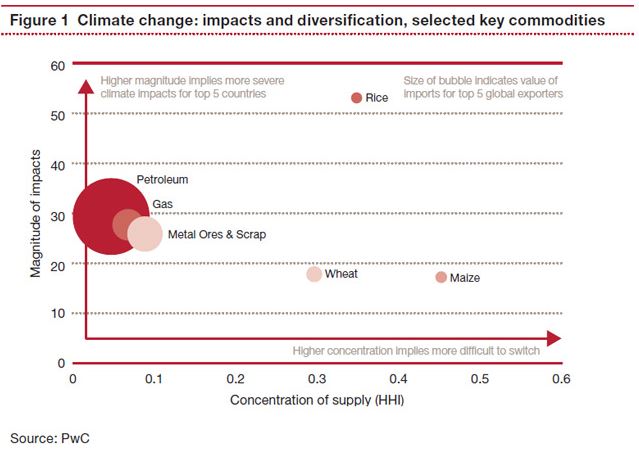
From PwC:
In 2010, Russia suffered a severe heat wave. The resulting economic losses were estimated to be US$15bn as drought and wildfires destroyed crops, particularly wheat. The knock-on effect was export restrictions on wheat in Russia, which contributed to global price increases.
[...]
Often overlooked, climate change adds to complexity. It amplifies or alters existing risks, for example raw material availability (e.g. water, energy) or transport disruption due to extreme weather events. The resulting shocks on the global supply chain can be severe and persistent.
So climate change is a 'risk multiplier'. PricewaterhouseCoopers, accessed [6/10/13]
Munich Re: We Must "Find Improved Solutions For Adaptation, But Also Mitigation" Of Climate Change.In October 2012, a report from Munich Re, an internationally distinguished reinsurer, looked at extreme weather events in North America and reported that storms accounted for about $805 billion in losses from 1980-2011. The study found that while increasing losses were previously "primarily driven by socio-economic factors, such as population growth, urban sprawl and increasing wealth," the report provided "new evidence for the emerging impact of climate change." From Munich Re's press release on the report:
The Head of Munich Re's Geo Risks Research unit, Prof. Peter Höppe, commented: "In all likelihood, we have to regard this finding as an initial climate-change footprint in our US loss data from the last four decades. Previously, there had not been such a strong chain of evidence. If the first effects of climate change are already perceptible, all alerts and measures against it have become even more pressing." Höppe continued that even without changing hazard conditions, increases in population, built-up areas and increasing values, particularly in hazard-prone regions, need to be on Munich Re's risk radar. All stakeholders should collaborate and close ranks to support improved adaptation. In addition, climate change mitigation measures should be supported to limit global warming in the long term to a still manageable level. "As North America is particularly exposed to all kinds of weather risks, it especially would benefit from this", added Höppe.
Peter Röder, Board member with responsibility for the US market, said: "Climate change-related increases in hazards - unlike increases in exposure - are not automatically reflected in the premiums. In order to realize a sustainable model of insurance, it is crucially important for us as risk managers to learn about this risk of change and find improved solutions for adaptation, but also mitigation. We should prepare for the weather risk changes that lie ahead, and nowhere more so than in North America." Munich Re, [10/17/12]
Top Consulting Groups: The Winners In Insurance Industry Will Consider Climate Impacts.In 2008, Ernst & Young named climate change the top risk to insurance companies. PricewaterhouseCoopers states that the "winners in [the insurance] sector will be those companies that understand the [climate] risks and opportunities facing their businesses":
The insurance sector is going to be one of the hardest hit by climate change, from rising claims to losses on investments. The winners in this sector will be those companies that understand the risks and opportunities facing their businesses, and embed it into their strategies and operations. PricewaterhouseCoopers, accessed [6/12/13] Ernst & Young Press Release, [3/24/08]
METHODOLOGY: We searched TV News Search and Borrow and an internal video archive for "climate change OR global warming" from June 14, 2013 through September 17, 2013. Our analysis includes any segment devoted to climate change, as well as any substantial mention (any mention more significant than listing climate change as one of many topics).
Shauna Theel contributed to this report.
Posted in Climate Change, Economy, Environment & Science
Network/OutletCNBC
PersonJoe Kernen, Larry Kudlow
Show/PublicationSquawk Box
---
After Petition, CNBC Unveils A "Special Week Of Climate Coverage"
Blog››› August 20, 2013 3:10 PM EDT ››› DENISE ROBBINS
CNBC has rolled out a week of climate change programming. The special coverage comes after a Media Matters report finding that the majority of CNBC's climate reporting in the first half of 2013 was misleading, leading over 28,000 people to call for improved coverage in a petition organized by the advocacy groups Forecast the Facts and Environmental Action.
On Monday, CNBC host Carolin Roth reported on "CNBC's special week of climate coverage" on her daily news show Worldwide Exchange. Tuesday, Roth again mentioned the "special week on climate change" during a segment on shale gas. On the show, Emily Wurth from Food and Water Watch asserted that "we know that all climate scientists tell us that we need to keep fossil fuels in the ground and we can't drill for every last drop of oil and gas."
However, this special programming has so far been limited to Worldwide Exchange, while CNBC's worst offenders are still misleading their audience on climate change.
Shortly after the petition was announced, Squawk Boxco-anchor Joe Kernen doubled down on climate denial, bashing his critics on Twitter and on the air. During aninterview with John Hofmeister, former president of Shell Oil Company, Kernen complained about the "enviro-socialists," calling them a "bona fide cult." In response, Left Action created an additional petition to tell Kernen that "climate change is real, not a 'cult.'"
And Kernen's attacks on climate science have not abated. Recently, he suggestedthat insurance companies aren't "seeing" climate change. In fact, top reinsurance company Munich Re found in a study that there is "new evidence for the emerging impact of climate change" on increasing storm losses. According to consulting group Ernst & Young, the insurance sector is "going to be one of the hardest hit by climate change" -- and insurance companies must prepare for this to survive in the industry.
And preceding Obama's climate change speech, The Kudlow Report featured Steven Hayward of the fossil fuel industry funded American Enterprise Institute to "counter" Obama's "climate change confusion."
The Forecast the Facts petition can still be signed to tell CNBC: "Climate Denial Is Bad For Business."
UPDATE (8/21/13): On Squawk Box Wednesday morning, Joe Kernen confronted Carolin Roth about CNBC's climate week special. He mockingly asked whether she would cover how "climate warmers" are supposedly "predicting cold, wet, hot, dry summers," continuing his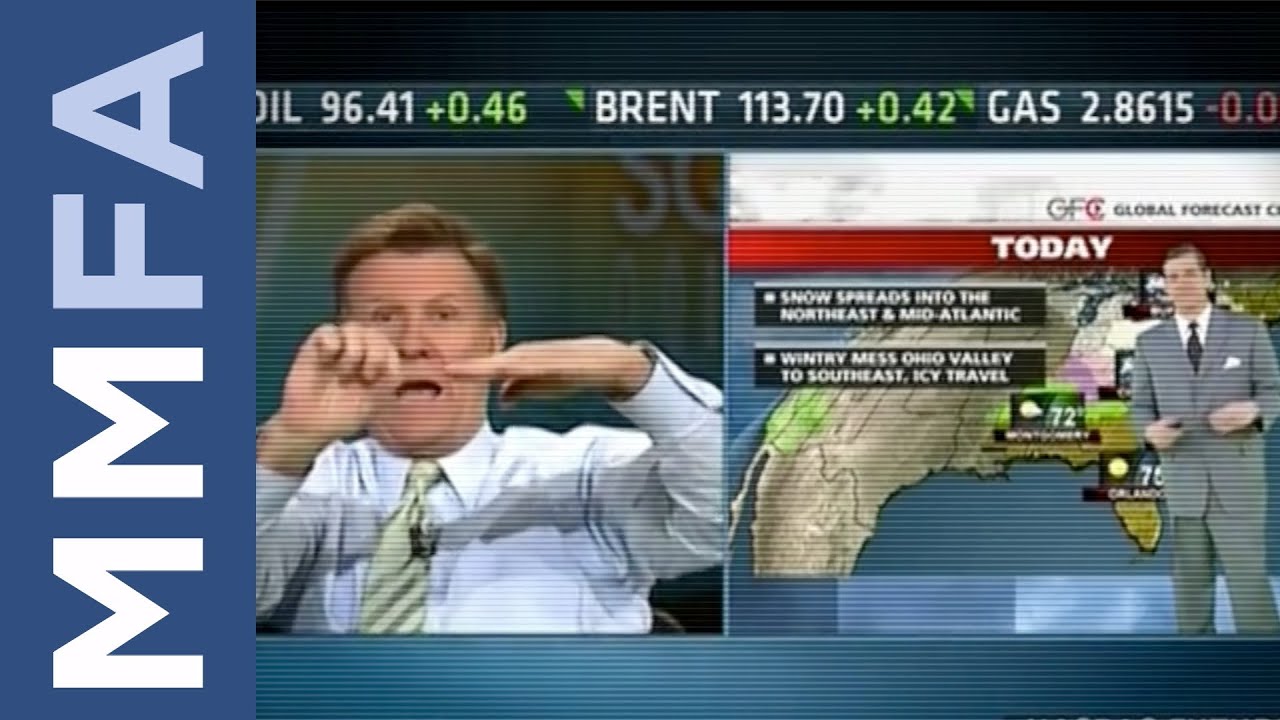 suggestion that climate change advocates attribute everything, including cold weather, to climate change.