fanjule
ASHINGTON ― The White House on Thursday released a list of all the private donors who have agreed to pay for the construction of President Donald Trump’s 90,000-square-foot, $300 million ballroom ― and the entire demolition of the East Wing, which is now complete.
Donors on the list include CEOs, real estate moguls, lots of corporations, and otherwise just really rich people. Defense contractors like Lockheed Martin and Booz Allen Hamilton are kicking in money for the president’s project, as are telecommunications companies like Comcast, and tobacco industry companies like Reynolds American. Tech companies like Amazon and Apple are in the mix, along with crypto companies.
Here’s the full list, provided by a White House official:
- Altria Group, Inc.
- Amazon
- Apple
- Booz Allen Hamilton
- Caterpillar, Inc.
- Coinbase
- Comcast Corporation
- Pepe and Emilia Fanjul
- Hard Rock International
- HP Inc.
- Lockheed Martin
- Meta Platforms
- Micron Technology
- Microsoft
- NextEra Energy, Inc.
- Palantir Technologies Inc.
- Ripple
- Reynolds American
- T-Mobile
- Tether America
- Union Pacific Railroad
- Adelson Family Foundation
- Stefan E. Brodie
- Betty Wold Johnson Foundation
- Charles and Marissa Cascarilla
- Edward and Shari Glazer
- Harold Hamm
- Benjamin Leon Jr.
- The Lutnick Family
- The Laura & Isaac Perlmutter Foundation
- Stephen A. Schwarzman
- Konstantin Sokolov
- Kelly Loeffler and Jeff Sprecher
- Paolo Tiramani
- Cameron Winklevoss
- Tyler Winklevoss
Trump has boasted about his ballroom being funded entirely by private donors and his own money, not public dollars. But the White House hasn’t shared how much money each of these companies and people have pledged to give him – or what they’re expecting in return.
Some donors were reportedly given the option of having their names permanently etched in the White House ballroom’s brick or stone.
The only individual donation that’s been made public is tied to Google’s parent company, Alphabet, which is contributing $22 million to Trump’s ballroom. That money is coming from a recent legal settlement the company reached with Trump after he was banned from YouTube, owned by Alphabet, after he incited the Jan. 6, 2021, insurrection.
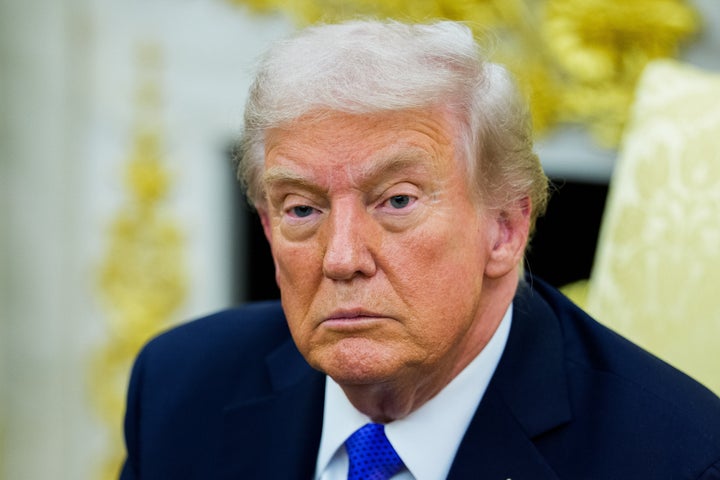
Trump has demolished the entire East Wing of the White House to make way for his 90,000-square-foot, $300 million ballroom.
Bloomberg via Getty Images
HuffPost reached out to all of the companies on the list, and as many of the individuals as we were able to track down, with the same two questions: How much are they donating to Trump’s ballroom, and if they have any comment about Trump destroying the East Wing ― and American history in the process ― to make way for his project.
Most didn’t respond immediately to requests for comment, but a few did.
“I can confirm that Microsoft contributed to the ballroom, as has been publicly reported,” company spokesperson Kaitlin Haskins said in an email. “That’s all I have at the moment, but if anything changes, I will circle back.”
T-Mobile confirmed it gave money to the Trust for the National Mall, the nonprofit overseeing the donations to fund Trump’s ballroom. But beyond that, a spokesperson said the company didn’t have any say on how those dollars were spent.
“Ahead of America’s 250th Anniversary, T-Mobile donated to the Trust for the National Mall, which partners with the National Park Service to restore and enrich the historic landmarks that define our nation’s capital, such as the White House ballroom,” the T-Mobile spokesperson said in an emailed statement.
“T-Mobile has no role in the use of those funds or decisions related to the construction of the ballroom,” they said. They did not share how much money T-Mobile donated.
A Betty Wold Johnson Foundation employee who returned a phone call to HuffPost said she was “not authorized to discuss the donation.”
The woman, whose name we didn’t catch, seemed like she wished maybe she hadn’t called us back.
“I have a lot of activity happening today and a lot of phone calls to return,” she said. “I wasn’t really aware of the nature of this call.”
Asked if the foundation’s president, former U.S. Ambassador Woody Johnson, was aware that the East Wing of the White House had been completely demolished Thursday to make way for Trump’s ballroom, the woman said he doesn’t “generally discuss his philanthropy.”
Johnson, whom Trump tapped to be his ambassador to the United Kingdom in his first term, is also the owner of the New York Jets.
“I don’t know how familiar he is with the nature of the details of the construction,” she said before we hung up.

The rubble that was once the East Wing of the White House, pictured on Wednesday.
via Associated Press
White House press secretary Karoline Leavitt said Thursday that Trump is committed to being transparent about donations to his ballroom. She courted new donors, too.
“Perhaps there will be more people who want to generously contribute to this project,” Leavitt said in her daily press briefing.
Outside the building, a single protester was loudly chanting about Trump breaking laws by razing part of the White House.
“This demolition is illegal,” shouted Suzanne Jordan, a Virginia resident holding a cardboard sign that read, GENEVA. “This demolition is a federal crime.”
Forget BallroomsHelp Build aNewsroom
Become a HuffPost Member
When power gathers under golden ceilings, real journalism stands outside, asking the questions that matter. Join HuffPost Membership and keep independent reporting strong for everyone.
Already a member? Log in to hide these messages.
She told HuffPost she was a student at George Washington University on Sept. 11 and had to evacuate the school when the Pentagon was hit by a plane. The images of part of the Pentagon being in rubble after the attack, with rescue workers spraying hoses on the wreckage, stayed with her, she said, and now she’s seeing similar images with Trump’s destruction of the White House.
“The look, feel, of the hose on a pile, I feel that as well. Like, triggering in the most extreme,” said Jordan. “I was thinking of the New Testament today. Like Jesus has said, ‘Forgive them, Father, they know not what they do.’”
no link img graphs
is the second story in a two-part series. Read the first story, about the working conditions of the cane cutters on Dominican sugar plantations violating labor law, here.
WASHINGTON — Charlotte Ponticelli used to work for the State Department, but when she describes a recent visit to sugarcane plantations in the Dominican Republic, she ditches the diplomat speak.
“What I saw made me sick,” she says of the laborers’ living conditions. “[The cane workers] were skeletons wearing rags. One old man told us, ‘We have no access to anything from our pensions.’ They had worked for 40 to 50 years, and nothing … I wanted to cry all the way home. I thought, ‘After … all this work, this is how these people live?’”
By “all this work,” Ponticelli means the United States Department of Labor’s push to improve conditions for cane workers in the DR, one of the top sugar exporters to the U.S. As part of the Dominican Republic-Central America Free Trade Agreement, or CAFTA-DR, which went into effect in the Caribbean nation in 2007, signatory countries were required to enforce their own labor laws. The deal was promoted as a tool to improve worker conditions — just as the Trans-Pacific Partnership agreement is being advertised now — but such promises are frequently broken. Four years into CAFTA-DR, an activist priest filed a complaint under the treaty about an alleged “laundry list” of abuses on Dominican sugar plantations, from work-hour and wage violations to unhygienic living conditions. Ponticelli, who previously headed the DOL’s Bureau of International Labor Affairs, facilitated meetings between Rev. Christopher Hartley and her old staff in Washington.
In 2013, after a two-year investigation, the department issued a report expressing concern that the Dominican government might be failing to protect sugar workers. The report was followed by three reviews, one every six months, that found working conditions still lacking. But as the DOL pushed for reform in Dominican sugar, members of Congress and other politicians maintained lucrative relationships with the royal family of cane: the Fanjuls.
Fanjul sugar cane florida
Workers at the Florida Crystals facility in Okeelanta, Florida, next to a pile of sugar waiting to be refined. Alex Quesada / Polaris Images
The four Fanjul brothers have an outsize presence in both the Dominican Republic and the United States. In the DR, their American company, Central Romana, produces most of the country’s sugar. In the U.S., the Fanjuls also grow cane and spend heavily in Washington, ranking among the sugar industry’s top political donors and biggest spenders on lobbying. As big players in both countries, they benefit from a highly profitable combination of factors: In the DR, Central Romana pays some of the lowest wages in the country, produces most of the country’s allotment of sugar exported to the U.S. and, thanks to CAFTA-DR, pays dwindling tariffs for those exports. Meanwhile, in the U.S., the Fanjuls sell their sugar at sometimes two to three times the global market price, thanks to import limits and price supports.
Fanjul sugar
From left, Fanjul family members José “Pepe” Jr., José “Pepe” Sr. and Alfonso at their company’s headquarters. Alex Quesada / Polaris Images
It’s the consummate immigrant success story. The Fanjul brothers and one sister, Alfonso, José, Andres, Alexander and Lian, come from a long line of powerful Cuban sugar producers. After Fidel Castro came to power in 1959, the family fled to Florida. They began growing cane in and around the Everglades and in the 1980s expanded production to the Dominican Republic, where their company is now the country’s largest private landowner and employer.
In the United States, too, the Fanjuls are among the biggest cane growers, and they co-own the world’s largest refining company, American Sugar Refining, also known as ASR, which markets its product under the brand names Domino, C&H, Redpath, Tate & Lyle and Florida Crystals. The group owns or is a major shareholder in refineries in four U.S. states and six other countries. While the brothers run the business, Lian tends to the charities she founded to help people living in poverty near the Fanjuls’ business operations in Florida and the Dominican Republic. Representatives of the Fanjuls, including their companies and charities in the DR and Florida, declined to be interviewed for this article.
Despite their international holdings, the Fanjuls have kept their focus on ensuring that their U.S. operations are as secure and profitable as possible, with little pushback from the government. In last year’s election cycle, the Florida Crystals political action committee and the company’s employees together contributed more than $860,000 to candidates and political spending groups. Also in 2014, Florida Crystals spent more than $1 million lobbying Congress, the U.S. Departments of Agriculture and Commerce, and the Office of the U.S. Trade Representative, largely on import tariffs and policies on biofuels and clean water.
The sugar industry, too, is a heavy donor. According to the nonpartisan research group Center for Responsive Politics, the industry gave more than $5 million to members of Congress in the last election cycle, an all-time high. What the industry gets in return for all this are domestic controls and import tariffs that keep prices up and profits high for U.S. sugar producers, perpetuating a controversial system.
Sugar money in politics
Political contributions by cane and beet sugar industries to congressional candidates
Political contributions by cane and beet sugar industries to all candidates
Source: Center for Responsive Politics
Sugar is “more dependent on government support or protection than any other agricultural industry in this country,” says Daniel Pearson, senior fellow of trade policy studies at the Cato Institute, a libertarian think tank. “Government has tended to look out for them, so it is a symbiotic relationship.” The price support system, known as the sugar program, is reinserted into the U.S. farm bill every time it comes up for renewal. The program limits the amount of sugar on the U.S. market, whether imported or grown domestically, to keep prices higher than they are everywhere else. And if there is a glut in the market, the U.S. government buys the surplus, which can cost taxpayers hundreds of millions of dollars.
Critics of the program claim the elevated prices constitute a redistribution of money from consumers to wealthy sugar companies and that they have driven thousands of candy-making jobs out of the country. Still, the program continues, and according to Pearson, the elevated sugar prices add billions to consumer costs. In the face of efforts by some legislators to reform the sugar program, cane and beet growers say the U.S. sugar policy is needed to keep the domestic sweetener competitive and has allowed for the creation of thousands of jobs.
Program keeps prices high
'Sugar Program' ensures prices in the U.S. are higher than in the rest of the world
Raw sugar prices
Source: United States Department of Agriculture Economic Research Service
As exporters to the United States, the Fanjuls have some objectives that the rest of the U.S. sugar industry doesn’t. “They have a balancing act in lobbying,”says Vincent Smith, a professor of agricultural economics at Montana State University and visiting scholar at American Enterprise Institute, a conservative-leaning think tank. According to Smith, the Fanjuls have an interest in limiting imports on sugar to keep domestic prices high, but also for the DR to have the highest proportion of those imports. The tariff rate quota, or TRQ, is the amount a country can export to the U.S. with reduced tariffs. The DR is consistently among the top exporters of sugar to the U.S., and it has the highest TRQ of any country, taking 17 percent of the share. (Brazil is second with 13.7 percent.) Sixty-three percent of the DR’s quota is allocated to the Fanjuls’ company, Central Romana.
Still, what the DR exports to the U.S. is not enough to depress domestic prices. In recent years, the Caribbean country has been far from filling its TRQ because of reduced production due to drought and increased exports to Europe. But even if it did, that wouldn’t lower the price of sugar in the U.S., say analysts. Most of the sugar Americans consume is produced domestically, and the big import threat comes not from the DR, but from Mexico — which is exempt from quotas under the North American Free Trade Agreement. In their lobbying on NAFTA, the Fanjuls’ Florida Crystals and other domestic producers have the same interests. Last fall, U.S. sugar was able to convince the Department of Commerce to impose a tariff on Mexican sugar imports in an ongoing anti-dumping case, in which U.S. sugar representatives claim, ironically, that Mexico is violating NAFTA by subsidizing its sugar. (The tariffs were struck down last winter but replaced with a price floor.)
Fanjul sugar Hillary Rodham Clinton
José Fanjul Sr., left, and Hillary Rodham Clinton at a gala hosted by the Queen Sofia Spanish Institute at the Waldorf Astoria Hotel in New York City in 2013. Clint Spaulding / Patrick McMullan / Sipa
The Fanjul family donates to legislators of both parties as well. Alfonso, aka Alfy, consistently supports Democratic candidates and causes, while his younger brother José, aka Pepe, does the same for Republicans. And two longtime family favorites are current presidential candidates: Hillary Clinton and Sen. Marco Rubio. According to the Center for Responsive Politics, Florida Crystals’ employees and dependents rank among Rubio’s top five contributors since 2009.
Ahead of the 2008 presidential elections, Andres directly contributed almost three times as much as Alfy did to Hillary Clinton’s campaign, but Alfonso’s relationship with the Clintons is more well-known. The Alfonso Fanjul-Bill Clinton friendship dates to Clinton’s first run for president in 1992, when Fanjul co-chaired his campaign in Florida. And after Fanjul visited Cuba in 2012 and 2013, he reportedly told then-Secretary of State Hillary Clinton that his views — once staunchly pro-embargo — were changing. Alfy and Andres also signed letters to President Barack Obama over the past year, urging increased engagement with Cuba.
Sugar money in politics
Source: FEC, Center for Responsive Politics
*Note: Since 2009, employees of Florida Crystals have collectively donated $81,000 to Marco Rubio, and are among his top five donors.
*Note: Because of a lack of clarity in FEC data, this count excludes roughly $200,000 in donations that could have come from either José "Pepe" Sr. or José "Pepe" Jr.
**Note: Because of a lack of clarity in FEC data, this count excludes roughly $200,000 in donations that could have come from either José "Pepe" Sr. or José "Pepe" Jr.
In January, Bill and Hillary Clinton visited their old friend and campaign donor Alfy at Casa de Campo, the Fanjuls’ 7,000-acre residential resort in the DR, where the Fanjuls have a second home. The resort’s website says that over dinner they chatted about Hillary’s possible presidential run.
In addition to the Clintons, Casa de Campo has hosted both George Bushes and Donald Rumsfeld, as well as Beyoncé, Kim Kardashian and Sen. Bob Menendez of New Jersey. According to an April corruption indictment, Menendez was repeatedly flown to Casa de Campo on the private jet of his friend Dr. Salomon Melgen, who has a house there and with whom he stands accused of swapping favors.
Casa de Campo, which Dominican-American author Junot Díaz once called “The Resort That Shame Forgot,” is one of Central Romana’s signature properties in the DR. As the Fanjuls have expanded their Dominican business beyond sugar, Central Romana has become a significant player in tourism and real estate. Here, more than 80 houses are on sale for millions of dollars apiece, including a mansion for $19.5 million that features an elevator, a museum, a gym and a private beach. The over-the-top wealth of Casa de Campo’s predominantly white residents and visitors is also on display in the pages of CasaLife magazine, the resort’s English-language glossy, with photos of VIP parties and sporting events alongside advertorials for cigars, yachts and private jets.
Fanjul sugar
Yachts and other pleasure boats moored at the marina at Casa de Campo.Hemis / Alamy
The contrast between Casa de Campo and the conditions in cane plantations just outside, where cane workers, most of whom are immigrants, make a few dollars a day and live in tiny homes without electricity, is stark.But are those conditions illegal? According to the U.S. Department of Labor, there are many reasons to believe they are. The fact that, as Ponticelli notes, there are elderly cane cutters who paid into social security but have been unable to access their pensions is only one of several problems cited in the DOL report. Other concerns include excessive work hours; children toiling in the fields; workers not getting health and safety protections and making too little money to eat; and conditions that the DOL says could constitute forced labor. But the Dominican government and sugar industry have denied these allegations, so the DOL is reduced to conducting inspections, reaching out to individual government and industry leaders and performing the semiannual reviews — with little response.
Critics say that’s because the sanctions allowed under CAFTA-DR are so minor that the interested parties tend to see more benefit in protracted negotiation than in confrontation. “There’s always a little bit of a mention of the labor standards, but there’s no teeth in any of these agreements,” says Brian Finnegan of the AFL-CIO International Department. The AFL-CIO opposed CAFTA-DR but, after it was passed, joined forces with Guatemalan unions to file a complaint under the deal about the treatment of workers there. Last fall, after more than six years, that case made it to the arbitration phase — the furthest any labor case has ever made it under a U.S. trade deal. Still, Finnegan is not confident that a win would bring change.
Charlotte Ponticelli, meanwhile, is convinced the United States can and should be doing more. “If you have international agreements, you should be able to verify compliance,” she says. “Otherwise the agreement isn’t worth the paper it’s printed on.”
sugar Dominican Republic
Harvesting cane on a plantation in the Dominican Republic. Al Jazeera America
Living conditions on Central Romana’s plantations are not necessarily the worst among Dominican sugar growers. They’re generally more likely to have functioning latrines, potable water, primary schools and adequately constructed homes than the independently owned plantations from which the company buys its cane. And one cane cutter pointed to Lian Fanjul de Azqueta’s local charity, which runs three schools, as proof that the family is made up of people “with a good heart.”
If the workers don’t blame Central Romana or the other sugar companies for their grinding poverty or shabby living conditions, the U.S. Department of Labor doesn’t single them out, either. Finnegan wonders what would happen if it did. “What can the U.S. do with a U.S. company like that?” he asks.
Meanwhile, last fall Obama announced that his administration is developing a national action plan to ensure that U.S. companies uphold certain standards overseas, including respecting the human rights of their workers. Finnegan says that what the government is doing is “a step in the right direction,” as long as — unlike with CAFTA-DR — those standards are binding. But Eston Pierre, a 63-year-old cane cutter on a Central Romana plantation, is fatalistic. When asked who has the power to change his working conditions, he points to the sky and says, “Only God.”
Editor’s note: This article has been amended to reflect that elevated sugar prices in the U.S. add billions of dollars to consumers’ costs, not to sugar companies’ profits. We regret the error.
Additional reporting by Euclides Cordero Nuel.
Reporting for this article was funded by a grant from the Fund for Investigative Journalism.
==
Trade deal fails Haitian workers in DR sugar | Al Jazeera America
america.aljazeera.com/.../blood-sweat-and-sugar-trade-deal-fails-haitian-workers-in-dr...
2.
==
The Fanjul brothers — Cuban born Alfonso "Alfy" Fanjul, José "Pepe" Fanjul, Alexander Fanjul, and Andres Fanjul — are owners of Fanjul Corp., a vast sugar and real estate conglomerate in the United States and the Dominican Republic. It comprises the subsidiaries Domino Sugar, Florida Crystals, C&H Sugar, Redpath Sugar, Tate & Lyle European Sugar,[1] La Romana International Airport, and resorts surrounding La Romana, Dominican Republic.
Contents
[hide]
- :{1:(style="display:table-cell;padding-left:0px;padding-right:0.5em"):}::{History:(style="display:table-cell"):}:
- :{2:(style="display:table-cell;padding-left:0px;padding-right:0.5em"):}::{Business holdings:(style="display:table-cell"):}:
- :{3:(style="display:table-cell;padding-left:0px;padding-right:0.5em"):}::{Cuba activities:(style="display:table-cell"):}:
- :{4:(style="display:table-cell;padding-left:0px;padding-right:0.5em"):}::{Political influence in the United States:(style="display:table-cell"):}:
- :{5:(style="display:table-cell;padding-left:0px;padding-right:0.5em"):}::{Popular culture:(style="display:table-cell"):}:
- :{6:(style="display:table-cell;padding-left:0px;padding-right:0.5em"):}::{References:(style="display:table-cell"):}:
- :{7:(style="display:table-cell;padding-left:0px;padding-right:0.5em"):}::{External links:(style="display:table-cell"):}:
History
The Fanjul brothers were born in Cuba and are descendants of Lebanese immigrants. Alfonso Fanjul married the daughter of Spaniard Andres Gomez-Mena who immigrated to Cuba in the 19th century and built up an empire of sugar mills and property by the time he died in 1910. The couple's holdings were then combined to create a large business of cane sugar mills, refineries, distilleries, and significant amounts of real estate. Due to Fidel Castro's 1959 Marxist Cuban Revolution, the family moved to Florida along with other wealthy, dispossessed Cuban families. In 1960, Alfonso Sr., the father of the current CEO of Fanjul Corp. Alfonso Jr., bought 4,000 acres (16 km2) of property near Lake Okeechobee along with some sugar mills from Louisiana and started over in the US. Alfonso Sr. and his son Alfy Fanjul got the firm off its feet and Pepe, Alexander and Andres joined in the late 1960s and 1970s. Pepe Fanjul Jr. joined the sugar firm in 2002.[2] As of 2008, the company owned 155,000 acres (63,000 ha) in Palm Beach County.[3]
In October 1984, Alfonso Fanjul and J. Pepe Fanjul along with Gulf and Western Industries announced they had reached a deal for Gulf and Western to sell its sugar businesses in Florida and the Dominican Republic, along with associated operations, to the Fanjul companies, for an undisclosed amount. In the Dominican Republic, the transaction included 240,000 acres of land, a sugar mill, two hotels in the capital of Santo Domingo and a resort area in the eastern region of La Romana. Assets included in the Florida purchase were 90,000 acres of land in Palm Beach County, a sugar mill and a sugar refinery.[4]
In 2001, the family expanded into the charter school business. They established a religious elementary school, Glades Academy, which accepts taxpayer-funding for 200 students. They also established a high school Everglades Preparatory Academy, which serves 600 taxpayer-funded students.
The Fanjul family focus their philanthropic activities on the rural communities of western Palm Beach County, including the creation of one single family strengthening center offering limited day care, after-school care and food assistance programs.[5] In 2013, New Hope Charities celebrated 25 years of service to the communities and honored J. Pepe Fanjul, its longtime chairman.[6]
With the region’s desire for expanded economic development in the agricultural area, the Fanjul brothers partnered with the Business Development Board to assist full-time with the recruitment of economic opportunities.[7]
Business holdings
The Fanjuls began vertically integrating their sugar holdings in 1991 with the creation of the company’s own sugar marketing arm. Previously, their Florida sugar was marketed by Savannah Foods & Industries of Georgia.[8]
In a turn of diversification, in 1994, Flo-Sun broke ground on a joint venture with U.S Generating Co. to construct a cogeneration power plant adjacent to the company’s Okeelanta sugar mill in western Palm Beach County. At a cost of $200 million, the power plant would produce energy from sugar cane stalks and woody waste that would be delivered via Florida Power and Light to an estimated 46,000 homes.[9] After the partnership dissolved, Flo-Sun began operating the biomass power plant on its own in 1996 and expanded it to the largest in the nation by 2006 [10]
In 2010, the Fanjul family celebrated the 50th anniversary of their American sugar companies, which at the time included 187,000 acres of farming in Palm Beach County, Florida, with 2,000 jobs and more than 650,000 tons of sugar.[11] Worldwide the Fanjul companies at the time included four raw sugar mills and 10 refineries in six countries, making them the world's largest refiner of cane sugar, producing 6 million tons of sugar annually.[11]
In 2011, Fanjul Corp. was ranked the third largest private company in Florida. CEO Alfonso Fanjul granted a $1 million charitable contribution to the University of Miami to build a research center for the top eye hospital in the nation.[12]
The Fanjul brothers were large shareholders and directors of Southeast Bank before its takeover and liquidation by the U.S. Federal Deposit Insurance Corporation in 1991. In addition, they are the majority shareholders and directors of FAIC Securities, which was investigated by the United States Securities and Exchange Commission for regulatory violations.[13]
Cuba activities
Over the years, the Fanjul brothers had made clear they intend to reclaim their lost properties and mansions in Cuba, and in early in 2014, Alfonso Fanjul announced "business considerations could be explored only if there are political and diplomatic advances" in Cuba.[14][15][16] This brought a sharp response in Washington, D.C., from two of the U.S Congressmen from Florida:
Congressman Mario Diaz-Balart (R-FL) released the following statement on reports of Cuban-American businessman Alfonso Fanjul considering investing in Cuba and its sugar industry.
"I am outraged by reports that a fellow Cuban-American, who has witnessed the atrocities inflicted by the Castro regime, has apparently chosen short-term profit over standing with the Cuban people in their struggle for freedom.
"Some might be blind to the Castro regime's brutality and ruthless oppression, but Alfonso Fanjul's betrayal is compounded because he knows better. He knows very well that any investments made with the Castro regime will not help the Ladies in White, Unión Patriótica de Cuba, the Orlando Zapata Tamayo National Civic Resistance and Civil Disobedience Front, or other pro-democracy groups, but rather, will go straight to the pockets of the Cuban people’s jailers and continue to prop them up.
"Alfonso should cry less for his lost mansion, and more for the imprisoned artists and musicians, oppressed independent journalists, or for the women that are beaten every Sunday for simply wanting to celebrate mass."[17]
U.S. Rep. Ileana Ros-Lehtinen (R-FL), Chairman of the Subcommittee on the Middle East and North Africa, made the following statement on reports of Cuban-American sugar tycoon Alfonso Fanjul considering investing in Cuba:
"At a time when the democracy activists on the island are facing even harsher reprisals from the brutal Cuban regime, it's pathetic that a Cuban-American tycoon feels inspired to trample on the backs of those activists in order to give the communist thugs more money with which to repress. The only little old thing that is standing in Alfy's way of realizing these sleazy business deals with the devil is US law. He doesn't talk about the arbitrary arrests of pro-freedom leaders in Cuba or the continual beatings endured by the peaceful Damas de Blanco. Oh no, for Alfy, the only hindrance to turning a profit off the suffering of the Cuban people is pesky US laws and he is working with groups to undo those laws. It is sickening to read that he brings up the separation of the Cuban family when he is doing all he can to exacerbate that problem. Shame on him..."[18]
Political influence in the United States
Alfy Fanjul has never become a U.S. citizen. He remains a permanent U.S. resident who maintains Spanish citizenship.[14] Alfonso Fanjul served as co-chairman of Bill Clinton's Florida campaign in 1992 and is a major contributor and fundraiser for the Democratic Party. His brother Pepe, who is a U.S. citizen, contributes to the Republicans.[19]
The Fanjul family were explicitly thanked by Marco Rubio for their support in his autobiographical memoir An American Son: A Memoir.[20]
Popular culture
The Fanjul brothers were parodied in Carl Hiaasen's 1993 novel Strip Tease, which features a pair of Cuban brothers who own a large sugar conglomerate, that receives enormous profits from the exploitation of immigrant labor and the subsidies regularly voted to them by the United States Congress.[21]
The brothers also were a focus in the Jamie Johnson documentary The One Percent (2006), which showcases the corrupt use of cane workers and especially "imported" labor. The U.S. Dept. of Labor's "List of Goods Produced by Child or Forced Labor"[22] report lists sugarcane from the Dominican Republic as having child and forced labor. This is a small source of raw sugar that is imported from 40 different companies to be refined then sold by Domino Foods, a marketing cooperative that among its products sells the Florida Crystals brand.
The 2007 film, The Sugar Babies, is a documentary on the lives of Haitians and their children working in the Dominican Republic sugar cane fields and the Central La Romana factory run by the Fanjuls.[23]
José "Pepe" Fanjul was part of the 17 December 2012 BBC2 television edition of fly-on-the-wall documentary Inside Claridge's. He was shown as a regular client of the Claridge's Hotel, enjoying a luxury lifestyle in a £3,500 a night room, with a shooting in Scotland and trips across the world. He was said to have spent 300 nights at the hotel over the past decade.
References
THE WASHINGTON TANGO: AT STATE DINNER FOR ARGENTINA ...
https://www.washingtonpost.com/.../f2a55cb3-2264-4ba4-9204-d877b83c5df0/
1.
Fanjul brothers - Wikipedia
https://en.wikipedia.org/wiki/Fanjul_brothers
2.
Florida Crystals | Opinion - Conservative - Before It's News
beforeitsnews.com/opinion-conservative/2015/01/florida-crystals-2953430.html
1.
Farewell, My Lovely Miami Herald - Biscayne Times
www.biscaynetimes.com/index.php?option=com_content&view...id...
1.
Alfonso Fanjul Jr.: Executive Profile & Biography - Bloomberg
https://www.bloomberg.com/research/stocks/private/person.asp?personId...
1.
Missing: reporter ceo spoken
Sweet Rewards – Mother Jones
www.motherjones.com/politics/1998/11/sweet-rewards/
1.
Peter Archives - SaintPetersBlog
saintpetersblog.com/category/peter/
1.
How Crony Capitalism Dominates the Sugar Business | GreenBiz
https://www.greenbiz.com/blog/.../how-crony-capitalism-dominates-sugar-business
1.
Oct 25, 2011 - U.S. Sugar and Florida Crystals, which is owned by Fanjul family ... he "no longer felt right about their intimate relationship, and he had to ... Florida sugar magnate Alfonso Fanjul Jr. Clinton and Fanjul spoke ... Environmental Journalist ... How the Humane Society's CEO connects empathy and economics ...
=hmmnhttp://www.sap.com/customer-testimonials/consumer/florida.htmlHistoryA family storyFlorida Crystals traces its origins back five generations, when the Fanjul family began farming and producing sugar in Cuba in the 1850’s. After the communist takeover of Cuba, Alfonso left to reestablish the business in South Florida in 1960. Under the leadership of Alfonso “Alfy” Fanjul and Jose “Pepe” Fanjul, the company has grown to be one of the largest, most innovative and successful agriculture companies in the world. It sells products under the Domino, C&H, Florida Crystals, Redpath, Jack Frost, and Tate & Lyle brands.Florida CrystalsAlfonso Fanjulis the chairman & CEO for the Florida Crystals Corporation, a trustee at the Brookings Institution (think tank), and Jose Pepe Fanjul’s brother.Note: Foundation to Promote Open Society was a funder for the Brookings Institution (think tank).George Soroswas the chairman for the Foundation to Promote Open Society, and is a member of the Bretton Woods Committee. David Rockefeller is a member of the Bretton Woods Committee, an honorary chairman for the Americas Society, was a director at the American Friends of Bilderberg, a director at the American Friends of Bilderberg(think tank), and a 2008 Bilderberg conference participant (think tank).Jose Pepe Fanjulis a director at the Americas Society, Alfonso Fanjul’sbrother, the vice chairman & president & COO for the Florida Crystals Corporation, and Chloe Black is his executive assistant.Chloe Black is Jose Pepe Fanjul’s executive assistant, married to Don Black, and was married to David Duke.Don Black is married to Chloe Black, and was the leader of the Ku Klux Klan.David Duke was married to Chloe Black, and the founder of the National Association for the Advancement of White People.Lessons of the Steve Scalise Debacleby Joel B. Pollak1 Jan 2015http://www.breitbart.com/big-government/2015/01/01/lessons-of-the-steve-scalise-debacle/The Steve Scalise controversy had a fairly simple resolution. When the accusation had emerged that he had spoken in 2002 to a white supremacist group associated with former KKK Grand Wizard David Duke, he ought to have stepped aside temporarily and asked the House Republican leadership to conduct a full investigation. That would have confirmed that Republicans would not permit anyone to lead the party who kept such associations, and without punishing Scalise before the facts were known.Robert C. Byrd was a member of the Ku Klux Klan, and Robert G. Liberatore was his staff director.Robert G. Liberatore was Robert C. Byrd’s staff director, a director at the Atlantic Council of the United States (think tank), and is a director at the Economic Club of Washington.Open Society Foundations was a funder for the Atlantic Council of the United States (think tank), and the Committee for Economic Development.George Soros is the founder & chairman for the Open Society Foundations, a member of the Bretton Woods Committee, and was the chairman for the Foundation to Promote Open Society. Foundation to Promote Open Society was a funder for the Brookings Institution (think tank), and the Committee for Economic Development.Lynn Bendheim Thoman is a trustee at the Brookings Institution (think tank), and married to G. Richard Thoman.Alfonso Fanjulis a trustee at the Brookings Institution (think tank), the chairman & CEO for the Florida Crystals Corporation, and Jose Pepe Fanjul’s brother.Cyrus F. Freidheim Jr. is an honorary trustee at the Brookings Institution (think tank), and a member of the Commercial Club of Chicago.Commercial Club of Chicago, Members Directory A-Z (Past Research)Tuesday, December 17, 2013 http://thesteadydrip.blogspot.com/2013/12/commercial-club-of-chicago-members.htmlValerie B. Jarrettis a member of the Commercial Club of Chicago, the senior adviser for the Barack Obama administration, and her great uncle is Vernon E. Jordan Jr.Vernon E. Jordan Jr. is Valerie B. Jarrett’s great uncle, an honorary trustee at the Brookings Institution (think tank), a director at the American Friends of Bilderberg(think tank), was the president of the Economic Club of Washington, and a 2008 Bilderberg conference participant (think tank).David M. Rubenstein is a co-chairman for the Brookings Institution (think tank),and the president of the Economic Club of Washington. Alfonso Fanjulis a trustee at the Brookings Institution (think tank), the chairman & CEO for the Florida Crystals Corporation, and Jose Pepe Fanjul’s brother.Robert G. Liberatore is a director at the Economic Club of Washington, was a director at the Atlantic Council of the United States (think tank), and a trustee at the Committee for Economic Development.G. Richard Thomanis a trustee at the Committee for Economic Development, married to Lynn Bendheim Thoman, and a director at the Americas Society.David Rockefeller is an honorary chairman for the Americas Society, a member of the Bretton Woods Committee, was a director at the American Friends of Bilderberg, a director at the American Friends of Bilderberg (think tank), and a 2008 Bilderberg conference participant (think tank).Jose Pepe Fanjulis a director at the Americas Society, Alfonso Fanjul’sbrother, the vice chairman & president & COO for the Florida Crystals Corporation, and Chloe Black is his executive assistant.Chloe Black is Jose Pepe Fanjul’s executive assistant, married to Don Black, and was married to David Duke.Don Black is married to Chloe Black, and was the leader of the Ku Klux Klan.David Duke was married to Chloe Black, and the founder of the National Association for the Advancement of White People