REGULATION
added as placeholder abstract category
SYSTEMIC // BUFFER
see dereg tag derg
see west va v epa, chev doctrine
see libtard
see gubmint
see scotus chevron doctrine etc
see also corp bad actor 5/22
SEE OSHA WORKER SAFETY
SEE FDA USDA FOOD SAFETY
but 1219 aha-let that itshd not be defined by DE-reg, but also include who put rules in place and why and how
eg?
---
AN 3 26
Raw milk sold by RFK Jr. supporter emerges as possible source of e. coli outbreak - Alternet.org
---
---}:
AHA DOH MODERATION BUFFER
AN 2 25
According to the Washington Post, as many as 200,000 federal workers may be fired because of efforts by the Trump Administration and the Elon Musk-led Department of Government Efficiency (DOGE) to greatly downsize the United States' federal government. And the criticism of their efforts is coming not only from Democrats, but also, from voices on the right.
Former Rep. Charlie Dent (R-Pennsylvania), during a February 17 appearance on MSNBC, slammed Trump and DOGE for carrying out mass government layoffs in a "haphazard" way. And the next morning, MSNBC's Joe Scarborough (a Never Trump conservative and ex-GOP congressman) argued that while government "waste" needs to be reduced and the U.S. needs to balance its federal budget, the Trump Administration and DOGE are recklessly jeopardizing "food safety" and "air safety."
The Guardian's George Monbiot also fears that Trump's second term could trigger some type of major crisis.
READ MORE:George Conway: Trump’s 'pathological narcissism' is fueling 'full-scale' DOJ 'revolt'
In a February 18 opinion column, Monbiot lays out a variety of frightening scenarios and offers some tips for surviving a worst-case scenario.
"Though we might find it hard to imagine," Monbiot warns, "we cannot now rule it out: the possibility of systemic collapse in the United States. The degradation of federal government by Donald Trump and Elon Musk could trigger a series of converging and compounding crises, leading to social, financial and industrial failure…. A financial crisis in the U.S. would immediately become a global crisis."
Monbiot continues, "But the hazards extend much further. Musk, calling for a 'wholesale removal of regulations,' sends his child soldiers to attack government departments stabilizing the entire U.S. system. Regulations, though endlessly maligned by corporate and oligarchic propaganda, are all that protect us from multiple disasters. In its initial impacts, deregulation is class war, hitting the poorest and the middle classes at the behest of the rich. As the effects proliferate, it becomes an assault on everyone's wellbeing."
The columnist warns that undermining regulatory government agencies could make everything from a pandemic to "future climate disasters" worse.
READ MORE:'Brutal': Ex-federal prosecutor reveals why Trump DOJ’s 'illegal order' was 'so corrupt'
"As Trump rips down environmental protections and trashes federal responsiveness," Monbiot explains, "the impacts will spiral. They could include non-linear shocks to either the insurance sector or homeowners, escalating into U.S.-wide economic and social crisis. If, or when, another pandemic strikes, which could involve a pathogen more transmissible and even more deadly than COVID-19 — which has so far killed 1.2 million people in the U.S. — it will hit a nation whose defenses have been stood down."
Monbiot urges Americans — as well as residents of the U.K., where The Guardian is published — by doing a lot of networking.
"So, though there is no substitute for effective government, we must seek to create our own backup systems," the Guardian columnist advises. "Start with this principle: don't face your fears alone. Make friends, meet your neighbors, set up support networks, help those who are struggling. Since the dawn of humankind, those with robust social networks have been more resilient than those without. Yes, we also — and urgently — need national and global action, brokered by governments. But it's beginning to look as if no one has our backs. Prepare for the worst."
READ MORE:John Roberts is to blame for Trump challenge of federal courts: analysis
*George Monbiot's full Guardian column is available at this link.
:{---
---
AN 725
NO LNX
Here's the real reason Republicans hate the middle class
U.S. Senator Lindsey Graham (R-SC) looks on, on the day he meets with German Chancellor Friedrich Merz along with other Senators, on Capitol Hill, in Washington, D.C., U.S., June 5, 2025. REUTERS/Nathan Howard
Thom Hartmann July 02, 2025
A Pew poll published last week finds that 59 percent of Americans say the GOP’s “Big Beautiful Bill” that cuts taxes for billionaires and raises them for working-class people — and was passed by the Senate on Tuesday — “would hurt lower-income people and 51 percent think it would hurt middle-income people.”
And they’re right. According to the nonpartisan Congressional Budget Office, the bill will measurably reduce the income and spending power of low- and middle-income people while giving a ~$4 trillion gift to the morbidly rich.
Americans have figured this out: according to a Fox “News” poll published last week and reported by Newsweek:
“Only 38 percent favored the bill, while 59 percent opposed it, a 21-point gap against the bill. About half of all voters believed the legislation would be detrimental to their families, and just a quarter thought it would deliver any benefit.”
So, why would Republicans want to further reduce the size and wealth of America’s middle class?
Turns out, there are two good reasons that answer that question.
The first and simplest is that ever since five corrupt Republicans on the Supreme Court made it legal for billionaires and big corporations to bribe politicians, the GOP has done the bidding of the morbidly rich to the exclusion of everybody else.
And there’s considerable truth to that argument. The Court opened that door with their Buckley and Bellotti decisions in the late 1970s, laying the foundation for Ronald Reagan’s war against unions and working people and his so-called “Reagan Revolution” on behalf of the wealthy.
As Justice Ketanji Brown Jackson pointed out in the Diamond Alternative Energy v EPA case that was decided on June 20 and made it easier for the fossil fuel industry to challenge environmental regulations:
“This case gives fodder to the unfortunate perception that moneyed interests enjoy an easier road to relief in this Court than ordinary citizens. … Our ruling will no doubt aid future attempts by the fuel industry to attack the Clean Air Act. … I worry that the fuel industry’s gain comes at a reputational cost for this Court, which is already viewed by many as being overly sympathetic to corporate interests. …“For some, this silence will only harden their sense that the Court softens its certiorari standards when evaluating petitions from moneyed interests, looking past the jurisdictional defects or other vehicle problems that would typically doom petitions from other parties. This Court’s simultaneous aversion to hearing cases involving the potential vindication of the rights of less powerful litigants — workers, criminal defendants, and the condemned, among others — will further fortify that impression. …
“The Court’s remarkably lenient approach to standing in this case contrasts starkly with the stern stance it has taken in cases concerning the rights of ordinary citizens. … The Constitution does not distinguish between plaintiffs whose claims are backed by the Chamber of Commerce and those who seek to vindicate their rights to fair housing, desegregated schools, or privacy. But if someone reviewing our case law harbored doubts about that proposition, today’s decision will do little to dissuade them.”
But while it’s true that Republicans have been naked toadies for rich people and big corporations for a century, there’s a larger reason why Trump and the GOP are working so hard to immiserate and impoverish working class Americans.
That reason has to do with something called “modernization theory.”
Back in 1959, one of the inventors of modernization theory, Seymour Martin Lipset, famously wrote:
“The more well-to-do a nation, the greater the chances that it will sustain democracy.”
Lipset argued that industrialization led to unions and higher wages, which in turn funded higher-education opportunities and urbanization, which both grew a larger middle class. As people’s material conditions improved, Lipset noted, their focus shifted from survival issues like food and shelter to more aspirational elements like democratic values, civil and human rights, representation in government, and the rule of law.
In other words, the wealthier the middle class becomes, the more it will demand a vibrant democracy and a government that represents its interests.
On the other hand — and here is the GOP‘s real goal — if you can do away with or diminish the wealth and political power of the middle class, you can more easily loot the government and act exclusively in the interest of the morbidly rich.
As Barrington Moore noted in his book Social Origins of Dictatorship and Democracy: “No bourgeois [middle class], no democracy.”
In 2003, researchers Carles Boix and Susan Stokes found strong evidence that wealthier countries are more likely to be democracies, and once established, democracies are far more stable in richer nations. Similarly, in their bookEconomic Origins of Dictatorship and Democracy", Daron Acemoglu and James Robinson prove that when economic growth empowers new classes (especially the middle class), those groups will demand political reforms.
Using examples including South Korea, Taiwan, Eastern Europe, and Tunisia, multiple cross-national studies using World Bank income data and Freedom House democracy scores show a strong correlation between per capita income and democratic governance; as people become wealthier they more vigorously demand a small-d democratic political system.
This happens because middle class people have economic security, giving them the time and energy to demand their rights; want property protections, honest courts, education, and fair governance; and typically have relied on meritocratic systems (education, hard work) to achieve their status instead of using corruption or inherited wealth and privilege.
By 1981, the American middle class was at its peak because of a 74 percent top personal income tax bracket, a 50 percent top corporate income tax rate, a strong and healthy social safety net, cheap healthcare (because hospitals and insurance companies were required to be nonprofits in most states), and free or near-free college.
Democracy was also arguably at its peak; for the previous 40+ years Congress had passed, one after the other, bills that primarily benefitted average working people and the middle class. Voting was easy, women and minorities were empowered, and we led the world in education and innovation.
This is not, however, what many wealthy oligarchs want, particularly those who become politically active.
Instead of democracy, they want government to protect their wealth and privilege to the exclusion of “the rabble.”
Instead of paying the cost of a government large enough to guarantee the emergence and sustenance of a middle class, they want tax cuts and subsidies for their businesses. Instead of rights for average people, they want police and courts that will, as Justice Jackson noted, focus instead on their unique wants and needs.
When Reagan came into office in 1981 about a third of American workers had good union jobs, meaning that about two-thirds of all American families lived good middle-class lives on a single paycheck (because the union jobs established the wage and benefits floor for non-union employers who had to compete with them for workers).
That was the year the GOP declared war on working-class people because, in the estimation of the Nixon- and Reagan-era Republicans, our democracy had gotten out of hand.
Workers were demanding good pay and benefits; women, racial, and gender minorities were demanding equal rights; and students demanded an end to the war in Vietnam.
Conservative thinkers like Russell Kirk and William F. Buckley saw these demands as symptoms of a “cultural decay” caused by working class people having more wealth and leisure time than they were “intellectually and culturally capable of handling.”
So, in 1981 the GOP set about dismantling the American middle class with their so-called Reagan Revolution.
The result is that today only about 45 percent of Americans are in the middle class, and it takes two jobs to establish that same lifestyle; since Reagan took office fully $50 trillion has been transferred from the homes, savings, and retirement accounts of working class people into the money bins of the top 1 percent.
As the social scientists cited above found, when the middle class shrinks below a certain threshold its demands for democracy are replaced by populist demands for, essentially, revenge.
“Who did this to us?” is the battle cry, and the GOP’s ready answer — first emerging in the 1980s with Rush Limbaugh, going on steroids in the 1990s with Fox “News,” and pounded on by Donald Trump ever since he first came down that escalator in 2015 — is, “It’s the immigrants, Black people, uppity women, college students and professors, and the union bosses.”
MAGA — particularly its white racist base — bought it hook, line, and sinker, leading us to a massive tax-cut bill, court decisions that screw working people and the environment, and an explosion in hate crimes and politically inspired violence.
The bottom line is that the GOP opposes democracy because it interferes with and complicates their very well paid efforts to suck up to — and legislate on behalf of — the morbidly rich. And they disdain the middle class (but love the uneducated poor) because the larger the middle class the louder come the demands for fairness in the distribution of the common wealth and democracy.
So, the next time somebody asks you why Republicans hate the middle class, let them know that, “It’s the democracy, stupid!”
NOW READ: The 'cracks' are showing: Behind the battle for who leads the GOP when Trump is gone
---
---
an 4 25
At over 400 federal agencies, officials appointed by President Donald Trump are reportedly collaborating with tech billionaire Elon Musk's Department of Government Efficiency (DOGE). Their goal is to initiate a significant new phase in their effort to reduce the size of the federal government through "deregulation on a mass scale."
According to a New York Times reportpublished Tuesday, the president has devised a way to reverse regulations "swiftly and permanently" without going through the lengthy legal process that usually takes place before deregulations.
Following Trump's instructions, agency officials are gathering the regulations they plan to discard. They are working quickly to meet a deadline next week, per the report. Once they finish the job, the White House will create a comprehensive list to direct what the president refers to as the "dismantling of the overbearing and burdensome administrative state."
ALSO READ:DOGE'S turn for scrutiny: Government agency demands incident reports on misuse
The agencies being targeted govern "almost every aspect of American life," the report said.
“Many people don’t realize how high the American quality of life is because of the competent and stable enforcement of regulations, and if that goes away a lot of lives are at risk,” Steve Cicala, co-director of the National Bureau of Economic Research’s Project on the Economic Analysis of Regulation, told the Times.
“This affects airplane safety, baby formula safety, the safety of meat, vegetables and packaged foods, the water that you drink, how you get to work safely and whether you’re safe in your workplace," he added.
According to interviews conducted by the Times, Trump and his supporters regard the recent actions as the final blow in a comprehensive restructuring of the federal government that started with significant job cuts and attempts to close down certain agencies.
ALSO READ:Federal judge 'skeptical' of DOGE: report
They think that swiftly eliminating various regulations, along with halting the enforcement of others, will dismantle a wide array of rules that others consider essential protections, but that they perceive as burdensome.
AlterNet reached out to DOGE for comment.
---
an 4 25
A recent study has identified that the United States counties with "the most egregious water quality violations" are mainly found in four states: West Virginia, Pennsylvania, North Carolina, and Oklahoma, all of which supported President Donald Trump in the last presidential election.
According to a studyhighlighted by The Hill, Wyoming County in West Virginia emerged as the worst offender, having the highest number of violations within a single water system. The study was published on Tuesday in the international journal Risk Analysis.
The authors of the study also found that around 2 million Americans — roughly the same as the entire population of Nebraska —lack access to running water, and this issue tends to be concentrated in specific areas.
READ MORE: 'Delete': Trump appointees and DOGE seek 'deregulation on a mass scale' — from flying to food
They wrote that this high number is neither equally nor proportionally distributed across the population.
The study identified various violations, including non-compliance with the Safe Drinking Water Act, such as exceeding maximum contaminant limits, failing to follow mandated water treatment procedures and lacking monitoring schedules or communication with customers.
“Our results suggest that privatization alone is not a solution,” lead author Alex Segrè Cohen, said in a statement, per The Hill.
The author hoped that lawmakers would take note of the study and regulators would be able to utilize the research to improve their water management strategies.
READ MORE: 'Pretending not to know': Musician corners 'Yale-educated' Vance for 'playing dumb' on SCOTUS ruling
However, the administration appears to be expediting its efforts to cut the size of the federal government, including doing away with safety regulations. Over 400 federal agencies, officials appointed Trump are reportedly collaborating with tech billionaire Elon Musk's Department of Government Efficiency (DOGE). Their goal is to initiate a significant new phase in their effort to reduce the size of the federal government through "deregulation on a mass scale."
According to a New York Times reportpublished Tuesday, the president has devised a way to reverse regulations "swiftly and permanently" without going through the lengthy legal process that usually takes place before deregulations.
The agencies being targeted govern "almost every aspect of American life," the report said.
“Many people don’t realize how high the American quality of life is because of the competent and stable enforcement of regulations, and if that goes away a lot of lives are at risk,” Steve Cicala, co-director of the National Bureau of Economic Research’s Project on the Economic Analysis of Regulation, told the Times.
“This affects airplane safety, baby formula safety, the safety of meat, vegetables and packaged foods, the water that you drink, how you get to work safely and whether you’re safe in your workplace," he added.
READ MORE: 'Losing faith': GOP pollster says no one 'can understate how bad' Trump’s popularity is on economy
---
MMA
Project 2025 laid a foundation for Trump’s attacks on workplace safety
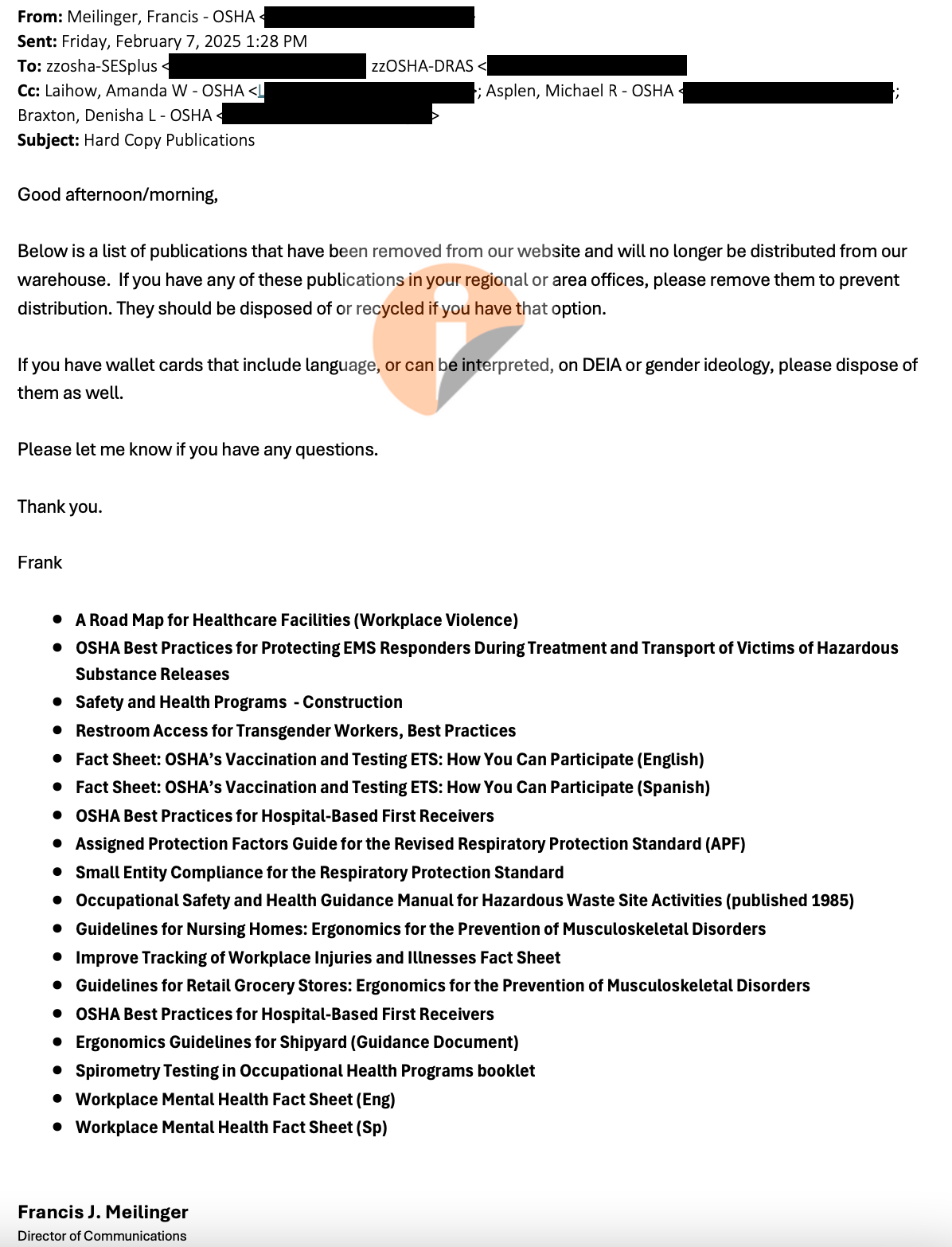
The Trump administration reportedly destroyed 18 publications from the Occupational Safety and Health Administration as part of a larger DEI purge. Most of the guidelines had nothing to do with diversity initiatives.
Written by John Knefel
Published 02/20/25
The Trump administration has reportedly destroyed 18 workplace safety publications as part of a broader attack on diversity initiatives, a development that is largely in line with recommendations made by the sprawling and unpopular presidential transition plan known as Project 2025.
According to Popular Information, 17 of the destroyed workplace guidelines — issued by the Occupational Safety and Health Administration — appeared to have nothing to do with diversity, equity, inclusion, and accessibility programs and instead seem to have been selected because “they include a DEIA-related keyword used in a completely different context.” OSHA is part of the Labor Department and is tasked with making sure U.S. workers “have safe and healthful working conditions free from unlawful retaliation,” according to its official website.
The Trump administration has been targeting diversity programs across the federal government, in some instances using the existence of DEI efforts as a justification for essentially shuttering entire agencies, as in the case of the U.S. Agency for International Development.
The administration’s anti-DEI approach mirrors recommendations made in Project 2025’s nearly 900-page policy book, *Mandate for Leadership*, which called for the elimination of federal DEI programs and for the Department of Justice to investigate private sector programs that promote diversity.
In addition to its direct attacks on DEI, Project 2025 — organized by The Heritage Foundation in collaboration with more than 100 partner groups — proposed drastic rollbacks of labor laws, including dismantling overtime regulations and creating exemptions to the National Labor Relations Act, which protects workers’ rights to collectively bargain and to form a union.
Although the Trump administration’s memo calling for the 18 safety guidelines to be “disposed of or recycled” appears to be a hamfisted and failed attempt to root out DEI programs, it nevertheless fits in with Mandate’s broader approach to dismantling worker protections.
For example, Mandate recommends carve outs to OSHA’s workplace safety regulations, calling on Congress and the Department of Labor to “exempt small business, first-time, non-willful violators from fines issued by the Occupational Safety and Health Administration.”
Mandate further argues that “national employment laws,” like the Occupational Safety and Health Act of 1970, “set out one-size-fits-all ‘floors’ regulating the employment relationship,” and that the protections the law provides could instead be “treated as negotiable defaults rather than non-negotiable floors.” If enacted, this recommendation could allow employers to use safety measures as leverage in contract negotiations, thus increasing the already stark asymmetry in power between workers and bosses. And U.S. workplaces are already deadly; according to the AFL-CIO, in 2022: “344 workers died each day from hazardous working conditions,” and “5,486 workers were killed on the job in the United States.”
The final chapter in Mandate calls on the president to order Cabinet secretaries to “rein in agencies such as the Occupational Safety and Health Administration, which the Biden Administration weaponized to attempt to force COVID-19 vaccine mandates on 84 million Americans through their workplaces.”
That demand built on previous work from The Heritage Foundation, which sued the Biden administration over its Covid-19 workplace vaccine mandate. After the Supreme Court blocked the mandate, Heritage President Kevin Roberts celebrated the decision on former Trump lawyer Jay Sekulow’s radio show. Sekulow is also chief counsel at the American Center for Law and Justice, whose advocacy arm is a partner in Project 2025.
“When it comes to putting government back in the box, it is a series of battles,” Roberts said. “We have won one battle, but we have not won the political and policy war.”
Video
Citation
From the January 14, 2022, edition of Sekulow, streamed on YouTube
Whether the administration adopts the anti-working class OSHA policies in Mandate remains to be seen, but Trump’s pick to head the agency — former Amazon and UPS executive David Keeling — strongly suggests it’s possible. As The New Republic reported, Keeling’s recent job history does not bode well for worker safety:
Both of those companies have been cited for various workplace safety violations by the very agency Keeling is set to control, if confirmed by the Senate. In 2019, OSHA cited UPS for forcing its drivers to work in “excessive heat” with no air conditioning. That same year, UPS was also cited for fire hazards at packaging facilities. Amazon has been cited numerous times for the dangerous, high-pressure environments in its warehouses, as well as the long hours its employees are forced to spend in them. Just last year, Amazon paid a $145,000 settlement over OSHA violations.
Keeling worked as director of safety compliance for UPS from 2011 to 2018 before serving as the vice president of global health and safety from 2018 to 2021, overlapping with OSHA’s 2019 safety citations. The same can be said for Amazon, where he worked from 2021 to 2023—a time when Amazon had one of the highest warehouse injury rates in the country.
Keeling’s nomination hearing has not yet been scheduled, but elsewhere the Trump administration is already waging war on the working class. His pick as general counsel for the National Labor Relations Board just rolled back several major Biden administration policies, including protections for student athletes who want to unionize and guidance that determined most non-compete agreements violate federal labor law.
Many of the Trump administration’s opening salvos against the working class have followed the Project 2025 roadmap and targeted DEI programs. These measures are already making workers’ positions more precarious and less safe, just as Project 2025 recommended.
===
===
AN 1 25
Big Wall Street banks are hoping that President-elect Donald Trump will kill several major regulations imposed on the financial industry — including one set of rules aimed at preventing another 2008-style financial crash.
That's according to a Saturday article in the Guardian, which reported that banks are optimistic about the incoming administration's regulatory agenda. Some bankers are particularly eager about the possibility of Trump taking an axe to the Basel III rules, which were put in place in response to the global banking crisis that preceded the Great Recession of the late aughts.
In a 2024 article, Investopedia described **Basel III as an international set of guidelines developed by 28 countries that established "minimum capital, leverage and liquidity requirements to ensure major banks could survive another upheaval." This was a response to the forced bailouts of banks deemed "too big to fail," requiring an infusion of hundreds of billions of taxpayer dollars to keep financial institutions afloat.
READ MORE:**Wall Street banks accused of trying to sabotage key consumer protection rule**
In addition to Basel III, Trump could undo some of the anti-too-big-to-fail provisions in the 2010 Dodd-Frank financial reform act. This includes a mandatory "stress test" from the Federal Reserve imposed on all financial institutions with more than $50 billion in assets. Dodd-Frank also requires banks to put forth a "living will" that serves as a plan in the event a bank should fail.
A.J. Bell investment analyst Dan Coatsworth told the Guardian that big banks are optimistic about their treatment under Trump's second term given his promises to roll back corporate regulations. He said banks' surging stock prices in the wake of the election symbolizes Wall Street's bullish attitude toward the incoming administration, but emphasized that the industry didn't want so much deregulation that it would risk future instability.
“Trump wants to make things easier for banks, but he won’t want to risk any damage to the financial system,” Coatsworth told the Guardian. “That means being more lenient with rules but not having them too loose."
Financial institutions are also excited about Trump's stated opposition to the environmental, social and governance (ESG) movement in which investors are encouraged to hold their wealth in industries deemed to be more sustainable. JPMorgan Chase CEO Jamie Dimon has already suggested he would roll back the company's previous commitments to address climate change, and "use the word ‘commitment’ much more reservedly in the future" in regard to pro-environment pledges.
READ MORE:**(Opinion) Why Jamie Dimon loves Trump's policies**
=
---
an 1 25
the progressive advocacy group Public Citizen on Tuesday launched a new project aimed at tracking the incoming Trump administration's approach to corporate crime, an effort the watchdog said is particularly urgent given that many of the companies currently under federal investigation have connections to the president-elect.
Public Citizen found that of 192 individual corporations currently facing federal probes or cases, a third "have known ties with the Trump administration."
"They or their executives have either contributed to his inauguration, or Trump has nominated their former employees, investors, and lobbyists," the group noted.
Public Citizen said its new Corporate Enforcement Tracker will serve as "a resource for watchdogging ongoing federal investigations and cases against alleged corporate wrongdoing that are at risk of being dropped, weakened, or otherwise modified by the incoming Trump administration."
Corporate prosecutions plummeted to a 25-year low during Trump's first term, and Public Citizen's Rick Claypool—who is heading the new project—predicted that "it's likely Trump's second term will see a similar or worse dropoff in enforcement.
"Corporate crime enforcement fell during Trump's first term," Claypool noted, "even as his administration pursued 'tough' policies against immigrants, protestors, and low-level offenders."
"The five corporations with the most federal investigations or cases against them are Tesla (7), Amazon (6), Pfizer (5), Wells Fargo (4), and SpaceX (4)."
Four of the companies listed on Public Citizen's tracker—Tesla, SpaceX, Neuralink, and X—are helmed by billionaire Elon Musk, who donated heavily to Trump's presidential campaign and is set to co-lead a new advisory commission tasked with identifying spending and regulations to eliminate.
Tesla is facing investigations by the Justice Department, Securities and Exchange Commission, Occupational Safety and Health Administration, and other agencies—probes that could be shut down by the incoming administration, which is set to be packed with lobbyists and billionaires.
Reutersreported last week that "Musk's potential to have extraordinary clout with the new administration raises questions about the fate of federal investigations and regulatory actions affecting his business empire, of which at least 20 are ongoing, according to three sources familiar with SpaceX and Tesla operations and the companies' interaction with the U.S. government, as well as five current and former officials who have direct knowledge of individual probes into Musk's companies."
"The inquiries include examinations of the alleged securities violations; questions over the safety of Tesla's Autopilot and Full Self-Driving (FSD) systems; potential animal-welfare violations in Neuralink's brain-chip experiments; and alleged pollution, hiring-discrimination, and licensing problems at SpaceX," the outlet noted.
Public Citizen also highlighted 16 companies that have donated to Trump's inaugural fund as they face federal investigations or enforcement actions: Amazon, Apple, AT&T, Bank of America, Coinbase, Ford, Goldman Sachs, Kraken, Meta, OpenAI, Pfizer, Ripple, Robinhood, Stanley Black & Decker, Toyota, and Uber.
"The five corporations with the most federal investigations or cases against them are Tesla (7), Amazon (6), Pfizer (5), Wells Fargo (4), and SpaceX (4)," the group said in a statement.
Concerns about the fate of investigations into major U.S. companies were amplified by Trump's choice to lead the Justice Department. Public Citizen noted Tuesday that Amazon and Republic Services, two lobbying clients previously represented by Trump attorney general pick Pam Bondi, are among the corporations currently facing federal cases or investigations.
In a separate report published Wednesday, Public Citizen said that Bondi's record as a lobbyist raises "serious questions about potential conflicts of interest" and provides "sufficient grounds for senators to deny her confirmation."
"We depend on the DOJ to vigorously enforce our laws, hold corporate wrongdoers accountable, and protect the rule of law," said Public Citizen co-president Lisa Gilbert. "Pam Bondi is simply inappropriate for this post."
===
===
alternet-no lnx
How the morbidly rich are sabotaging the very system that made them wealthy
Thom Hartmann August 19, 2024
Recently, a reporter spoke with one of the chief architects of Project 2025 using a hidden camera and microphone and learned they’re still in tight with Trump, still planning to run his administration if he’s elected, still planning to gut the guardrails America has placed around capitalism over the past 100 years, and even planning to “pull the ladder up” to make it harder for entrepreneurs and small business people to succeed in America.
Their plan relies on a major reinvention of modern capitalism and is being pushed by people suffering from an identifiable metal illness. To see how they’re hoping to pull this off, it’s important and necessary to first understand that there are two types of capitalism: raw and regulated.
Raw capitalism — sometimes referred to as Laissez-faire (“leave alone”) or “unregulated” capitalism — reflects the very essence of predatory activity. As any Libertarian can proudly tell you, the only rule is that no capitalist can commit fraud against another capitalist and the only role for government is to provide a stable currency and a court system to prosecute fraud.
Raw capitalism could be called the law of the jungle; only the strong survive, and those who are the most ruthless and cutthroat end up with all the money and power while everybody else stands on the outside looking in. It favors psychopathy in the executive suite.
A handful of families, typically one for each industry, end up fabulously wealthy while their companies monopolize market sectors to keep new entrants and entrepreneurs out.
Workers, at the bottom of the hierarchy, are screwed: no unions are allowed, wages reflect how desperate working people are, and consumers live in a caveat emptor (“buyer beware”) world where ripoffs are common, food and products are often dangerous, and the environment is poisoned to keep cleanup costs low and thus profits high.
Raw capitalism is how most of the world ran until the first decades of the 20th century. You can read the story of it in most of Dickens’ novels. By the 1880s-1920s era, it had made a handful of families (Rockefellers/oil, Carnegie/steel, Vanderbilt/railroads, Astor/real estate, Armour/meatpacking, Morgan/banking, DuPont/chemicals, etc.) mind-bogglingly rich and succeeded in limiting the middle class to about 10 percent of Americans, mostly doctors, lawyers, and shopkeepers. Everybody else was dirt poor.
Regulated capitalism is an altogether different animal that expands a capitalist system to aid workers and consumers as well as capitalists.
With regulated capitalism, the rules of capitalism are expanded to benefit all of society, rather than exclusively the capitalists themselves. While it was championed in Adam Smith’s books A Theory of Moral Sentiments and Wealth of Nations(1776), and highlighted repeatedly by David Ricardo five decades later, it didn’t really come into fruition until the presidency of Franklin D. Roosevelt. His embrace of Keynesian economics transformed America and, ultimately, the entire free world.
President Roosevelt, when accepting his renomination in 1936, took on the advocates of raw capitalism — which had run the world just four years earlier — head-on:
“[O]ut of this modern civilization economic royalists carved new dynasties. New kingdoms were built upon concentration of control over material things. Through new uses of corporations, banks and securities, new machinery of industry and agriculture, of labor and capital—all undreamed of by the fathers—the whole structure of modern life was impressed into this royal service.”
It was a radical separation from the old order, and his audience cheered wildly as they realized FDR wanted to make capitalism, and America, a fairer and more compassionate nation.
“There was no place among this royalty for our many thousands of small business men and merchants who sought to make a worthy use of the American system of initiative and profit. They were no more free than the worker or the farmer. Even honest and progressive-minded men of wealth, aware of their obligation to their generation, could never know just where they fitted into this dynastic scheme of things.”
He challenged the most powerful men and companies in America, promising to strip them of the power to write laws and control politicians that they’d enjoyed for over a century. He called them out and took them on.
“It was natural and perhaps human that the privileged princes of these new economic dynasties, thirsting for power, reached out for control over Government itself. They created a new despotism and wrapped it in the robes of legal sanction. In its service new mercenaries sought to regiment the people, their labor, and their property. And as a result the average man once more confronts the problem that faced the Minute Man.”
And he pointed out how this corrupt system of raw capitalism had destroyed opportunity in America for average people while making a small group of “princes” richer than the kings of old.
“Throughout the Nation, opportunity was limited by monopoly. Individual initiative was crushed in the cogs of a great machine. The field open for free business was more and more restricted. Private enterprise, indeed, became too private. It became privileged enterprise, not free enterprise.”
Roosevelt beat the oligarchs and was successful in bringing regulated capitalism to America. His policies included the right of workers to unionize, aggressive enforcement of the nation’s new anti-monopoly laws, high levels of taxation on profits and great wealth, and consumer and worker protections guaranteed by government.
The result was the world’s first middle class that included more than half of all citizens.
Donald Trump, JD Vance, their billionaire donors, six Republicans on the Supreme Court, and Project 2025 have declared war on Roosevelt’s regulated capitalism; they want to turn the clock back to the raw capitalism Gilded Age of the 1920s by stripping regulatory agencies out of government, cutting taxes on the morbidly rich, and ending protections for labor.
Russell Vought was the guy who put Donald Trump's executive order banning the teaching of Black history (“CRT”) and other diversity training for federal employees into place when he was director of the Office of Management and Budget. Now he’s a principal architect of Project 2025 and the lead cheerleader for ending regulated capitalism and reverting to raw capitalism.
“Eighty percent of my time is working on the plans of what’s necessary to take control of these bureaucracies,” Vought said in the secretly-taped recording. “And we are working doggedly on that, whether it’s destroying their agencies’ notion of independence.”
In this effort, and the Supreme Court’s recent destruction of the Chevron Deference that authorized regulatory agencies to protect workers, consumers, and the environment, these reactionary (arguably “revolutionary”) Republicans are trying to pull up the ladder so a new generation of entrepreneurs will face a wall of monopolies and other barriers to achieving business success.
They are trying to gut the very system that created a large enough middle class to provide customers for their products, thus making them rich. They want to return us to the era of FDR’s libertarian “economic royalists,” an effort that will impoverish America just as it has every other country that’s tried it (Russia, Venezuela, Ecuador, Peru, etc.).
When psychologist Eric Fromm identified people as having either a “doing” or a “being” orientation, he nailed the personality characteristics of the billionaires and their well-paid toadies who’re promoting this dystopian future for America.
He argued that there’s a specific “hoarder” personality afflicted with a compulsion to constantly accumulate more, more, more stuff. When they’re poor, their apartments fill up with newspapers and tin cans. When they’re rich, their money bins fill up with cash.
In either case, they’re mentally ill and perpetually miserable. If they’re rich enough, their mental illness causes them to mercilessly exploit others for their own gain.
This is the psychology of this generation of wannabee economic royalists, and their plan to replace regulated capitalism with the old laissez-faire system will also destroy the remnants of the American middle class that FDR created.
We can’t let them get away with inflicting their mental illness on the rest of us. Double-check your voter registration and show up this fall!
===
---
https://www.alternet.org/chevron-doctrine/
no lnx twt
'Judicial power grabs': US Supreme Court puts Chevron doctrine 'squarely in the crosshairs'
Brett Wilkins and Common DreamsMay 01, 2023
The U.S. Supreme Court said Monday it will hear a challenge to a nearly 40-year administrative law precedent under which judges defer to federal agencies' interpretation of ambiguous statutes—a case that legal experts warn could result in judicial power grabs and the gutting of environmental and other regulations.
The Supreme Court said it will take up Loper Bright Enterprises v. Raimondo—a case in which fishing companies are seeking to strike down the Chevron doctrine, named after the landmark 1984 Chevron USA v. Natural Resources Defense Council ruling that conservatives have long sought to overturn. The case is one of the most cited precedents in administrative law.
The Chevron doctrine involves a two-step process in which a court first determines whether Congress expressed its intent in legislation, and if so, whether or not that intent is ambiguous.
James Goodwin, a senior policy analyst at the Center for Progressive Reform, toldPolitico that Loper v. Raimondo has "the potential of being one of the most destabilizing decisions that this court has issued."
President Joe Biden's "environmental and energy agencies were already facing a heavily tilted playing field in the federal judiciary," Goodwin added. "I think eliminating Chevron... would make the prospects of surviving judicial review all the more daunting."
At issue in Loper v. Raimondo is whether the federal government can force herring fishers to fund a National Marine Fisheries Service program used to monitor their work. Two fishing companies argue that while the Magnuson-Stevens Act requires owners of fishing vessels to accommodate federal monitors onboard, the proprietors are not required "to pay the salaries of government-mandated monitors who take up valuable space on their vessels and oversee their operations."
The Biden administration's argument in favor of the Chevron doctrine leans heavily upon precedent.
"Federal courts have invoked Chevron in thousands of reported decisions, and Congress has repeatedly legislated against its backdrop," a brief filed by U.S. Solicitor General Elizabeth Prelogar and other officials in support of the doctrine notes. The brief adds that the Chevron doctrine "promotes political accountability, national uniformity, and predictability, and it respects the expertise agencies can bring to bear in administering complex statutory schemes."
In 2020, Justice Clarence Thomas wrote in Howard v. United States that "Chevron is in serious tension with the Constitution," while Justice Neil Gorsuch opined last year in Buffington v. McDonough that the doctrine "deserves a tombstone no one can miss."
"Overruling the Chevron doctrine, and undermining agencies and regulatory authority more broadly, has long been a hobbyhorse of Neil Gorsuch and other conservatives," legal journalist Christian Farias tweeted. "In a sense, the outcome of this case is foreordained. It's part of a continuing agenda."
Liberal Justice Kentanji Brown Jackson has recused herselffrom Loper v. Raimondo, explaining that she sat on the circuit court that initially heard the case.
"I still want to know how Ketanji Brown Jackson feels about all of this," Farias wrote. "Her insights are valuable: She was the vice chair of the U.S. Sentencing Commission, an agency that is given Chevron-like deference in some contexts. Making her sit this one out won't help."
RELATED ARTICLES AROUND THE WEB
Judicial deference and the future of regulation ›
Supreme Court to consider overruling Chevron doctrine | The Hill ›
Kavanaugh And The “Chevron Doctrine” - Legal Aggregate ... ›
---
===
---
an 5 24
created in 1934 during the Great Depression, the Securities and Exchange Commission (SEC) was among the many achievements of President Franklin Delano Roosevelt's New Deal. The SEC has been a prime target of the right-wing legal movement, and the SEC's regulatory powers are being challenged in the U.S. Supreme Court case SEC v. Jarkesy.
But Politico reporters Declan Harty, Josh Sisco and Josh Gerstein, in an article published on May 22, stress that the case has implications that go way beyond the SEC and could, depending on what the High Court ultimately rules, affect other federal regulatory agencies as well.
"A decade-long conservative crusade against financial regulators will come to a head soon with a crucial Supreme Court ruling, part of a legal strategy that has spread across multiple Washington agencies into a broad attack on a core power of the federal government," the journalists explain. "The Court's ruling on Securities and Exchange Commission v. Jarkesy, a case challenging the power of in-house federal judges, could hobble a whole range of agencies in unpredictable ways, cutting the powers of antitrust enforcers, labor regulators and consumer finance watchdogs."
The "legal campaign" surrounding SEC v. Jarkesy, according to Harty, Sisco and Gerstein, is being "driven by an alliance of tech billionaires, conservative legal activists and the business lobby."
"Jarkesy itself is a challenge to the legal legitimacy of the SEC's internal system of judges and courts, which hear cases and impose fines," the reporters note. "Such internal courts are key to enforcement at many federal agencies."
Todd Phillips of the liberal Roosevelt Institute told Politico that the SEC's critics in Jarkesy are "really just trying to get the Supreme Court to tear down the regulatory system that's been in place since before the New Deal."
Harty, Sisco and Gerstein note, "The Jarkesy case itself revolves around a hedge-fund manager, George Jarkesy, also a conservative TV and radio commentator, who was fined for defrauding investors and then sued over the validity of the tribunal that did it. Supporters of the process say there's a good reason to empower such internal courts, especially in complex issues like securities fraud and labor relations."
*Read Politico's full report at this link.
===
cooling in 70's based on probable 4x increase in partic/sox but reversed by clean air act
https://www.alternet.org/2019/12/its-a-wonderful-life-for-bankers/
no lnx
‘It’s a Wonderful Life’… for bankers
Written by Christopher W. Shaw / Common Dreams December 27, 2019
Christmas movies provide a yearly opportunity to imagine a more caring society. Among the favorites that are watched year after year, It’s a Wonderful Life stands out for stressing the importance of banking to such a society. The film’s hero George Bailey is an honest and generous Main Street banker who has helped struggling working people achieve their dreams of homeownership. Yet Bailey is on the brink of committing suicide before discovering just how much his life has meant to the local community. On this fateful night, an alternative future is revealed in which Bailey never existed, and his beloved hometown of Bedford Falls has fallen into the clutches of the greedy Henry Potter, owner of the town’s largest bank and a man who cares nothing for the public welfare. Without Bailey to finance the hopes and aspirations of his neighbors, Potter has created an unrecognizable town that is defined by corruption, slum housing, pawn shops, and seedy bars.
While we often consign the subject of finance to bankers, the annual tradition of watching It’s a Wonderful Life serves as an unexpected reminder of just how much power finance exerts over all of our lives. The figures of Bailey and Potter represent contrasting models for how banking can be conducted. Bailey’s bank is an asset to Bedford Falls, while Potter’s bank exploits the community. Bailey’s bank provides depositors with safety and makes affordable loans available to working people, while Potter’s bank focuses solely on benefiting its owner. Potter will fund only those projects that produce the most profit for himself, and he has no regard for the impact his decisions have on others.
It’s a Wonderful Life may be fiction, yet its release in 1946 registered a half-century long struggle to make banking democratic. During the Gilded Age, when working people thought of bankers they envisioned Henry Potter. Americans were more likely to see J. P. Morgan as a personification of greed than to honor his business achievements. Such economic disasters as the Panic of 1907 and the Great Depression exposed the banking system’s flaws, inspiring everyday Americans to engage in regular discussions of financial policy and proposed banking reforms. All too frequently, small depositors lost their life’s savings in bank failures that resulted from mismanagement and even fraud. And banks typically declined to extend the affordable small loans necessary for homeownership and operating farms.
For decades, working people sought to have the national government make banks safer and loans more accessible. Labor union and farm organization meetingsroutinely backed these reforms. The residents of one Nebraska town declared their support for federal farm loans “at a low rate of interest.” Among the voices that promoted the idea that government should guarantee bank deposits was the Chicago Federation of Labor, which insisted such a program would be “comprehensive and effective.” Meanwhile, bankers vehemently opposed these policy proposals as government overreach.
Amid the severe economic crisis and banking meltdown of the early 1930s—when thousands of banks failed—grassroots agitation for financial reform produced mailbags filled with letters and telegrams demanding government action. In response to the constituent mail piling up on Capitol Hill and at the White House, President Franklin D. Roosevelt’s New Deal reformed the banking system so that it better served ordinary citizens. Roosevelt signed a law creating the Federal Deposit Insurance Corporation (FDIC) to protect bank depositors. The New Deal also introduced important measures that provided farmers and homeowners with reliable supplies of low-cost credit.
Thanks to New Deal financial reform, by the 1940s bankers started looking less like Henry Potter and more like George Bailey. Grassroots engagement with financial issues had made banking more humane. For the first time in American history, bank failures became rare events. Farmers benefited from easier access to credit and homeownership would rise significantly. Once achieved, however, ordinary citizens started to take this reformed financial order for granted. Working people began to neglect financial issues following World War II, leaving an opening forindustry lobbyiststo direct banking policy. By the close of the twentieth century, deregulation had allowed the Potters of the banking world to resume their former practices. The economic crisis of 2008 led many Americans to consider the degree that their nation has come to look less like Bedford Falls and more like Pottersville. When voters cheer on Bernie Sanders and Elizabeth Warren for criticizing Wall Street, it’s a call to bring back George Bailey.
Christopher W. Shaw is the author of Money, Power, and the People: The American Struggle to Make Banking Democratic (University of Chicago Press, 2019). Follow him on Twitter: @chris_w_shaw.
secret sci BS jammed thru
https://insideclimatenews.org/news/23032020/trump-epa-health-secret-science-coronavirus
With the nation in a state of emergency over the coronavirus and Americans confronting a pandemic, the Trump administration has moved to expand and fast-track a proposal to limit the use of human health science in environmental decision-making.
:{
}:
The move by the Environmental Protection Agency on Wednesday has prompted an outcry from public health officials and environmental activists. California's top environmental official, the chair of the House Science Committee, the Union of Concerned Scientists and others have called for the EPA either to abandon the potentially far-reaching proposal or to extend the public comment period on the plan.
The Trump EPA's proposal, called the "Strengthening Transparency in Regulatory Science" rule, would restrict the agency's use of studies that rely on confidential human health data, including some of the seminal studies linking air pollution to premature death. The effort has been in the works for two years, but the Trump EPA published a "supplemental" notice last week that substantially extends the rule's scope—and then gave the public only until April 18 to comment.
Andrew Rosenberg, director of the Union of Concerned Scientists'Center for Science and Democracy, called for the EPA to schedule at least three virtual public hearings and extend the comment period at least 30 days beyond when the federal government lifts the national emergency. Although agencies are not always required to hold public hearings on regulatory proposals, the EPA must do so for proposals related to the Clean Air Act—a mandate some agency critics cited in their call for more time.
"Bringing this extensive proposal forward during the COVID-19 pandemic is reckless and would divert critical public health expertise from the singular mission of protecting the public and controlling the pandemic," Rosenberg wrote in a letter to the agency. "The supplemental greatly expands the scope of the draft rule and the researchers whose work would be subject to it."
California Secretary of Environment Jared Blumenfeld also requested in a letterthat the comment period be extended at least 90 days: "A comment period that short would be inadequate for such a complex and consequential rule even in ordinary circumstances and is especially so in light of the global COVID-19 pandemic," Blumenfeld wrote.
Dena Adler, legal fellow for theEnvironmental Defense Fund,in a letter of protest to the agency, wrote, "It is unconscionable, dangerous and in contravention of due process under our nation's laws, that you would take this action today and require the public—including public health experts on the front lines of saving lives imperiled by the coronavirus, and the millions of Americans heeding government and private sector responses to prevent harm by sheltering in place, closing schools and working remotely—to comment" by the proposed deadline.
An EPA spokeswoman said in an email that the agency is considering all public comments it received on its original 2018 proposal, which numbered some 600,000. The agency said it will also consider the comments received in response to the recently published supplement notice. The spokeswoman noted that after the rule is finalized, there will be additional scientific review; Congress, in approving the agency's budget for the current fiscal year, directed that the EPA commission a National Academy of Sciences assessment of how the rule alters the agency's ability to use publicly available peer-reviewed scientific and medical studies.
"These additions and clarifications to the proposed rule will ensure that the science supporting the agency's decisions is transparent and available for independent validation while still maintaining protection of confidential and personally identifiable information," said EPA Administrator Andrew Wheeler, a former coal industry lobbyist, in a statement earlier this month announcing his plan to amend the proposed rule.
In one sense, the amendments acknowledge the problems that were raised in the wake of its original 2018 proposal—including the logistical andethical issues in making public raw data from all studies used by the EPA in decision-making. The new EPA proposal calls for a "tiered" approach, laying out a process for the regulated industry ("stakeholders," in the words of the proposal) to obtain access to health science data for reanalysis, even if it cannot be made available to the general public.
But Gretchen Goldman, research director of the Union of Concerned Scientists' Center for Science and Democracy, argued that this provision lays bare the Trump administration's motive in advancing the proposal.
"This was never about promoting transparency," she wrotein a blog last week. "It was always about finding ways for those outside of the scientific community to undercut the science supporting EPA decisions."
In its effort to restrict the EPA's use of health science, the Trump administration is taking up a cause that the fossil fuel industry and its allies have been championingfor two decades, ever since studies by the American Cancer Society and researchers at Harvard University established the connection between exposure to particulate matter pollution and premature death.
If the Trump administration succeeds in pushing the regulation through and barring the EPA from using those two studies, it will make it more difficult for the agency to show that the benefits of air pollution regulations outweigh the costs. Without the data to show that reducing air pollution saves lives, the EPA would be more vulnerable to fossil fuel industry challenges of its actions on the basis that they impose unreasonable costs.
When Republicans led the House, it passed legislation three times seeking to restrict the EPA's use of health science based on confidential data, but the Senate never took up any of the bills.
After the Trump EPA published its original proposal in 2018, the agency received an unprecedented response from the academic and scientific community. The editors of four major scientific journals published a rare joint statement in opposition to the move, and Harvard President Lawrence Bacow signed a letter on behalf of nearly 100 other administrators and researchers—the first time such an array of Harvard's most prestigious faculty joined in opposition to any EPA proposal.
The agency's Science Advisory Board requested an opportunity to weigh in, but the board is still working on its final advice to the agency after a contentious public teleconference in January. That advice is not expected to be complete until some time in April, making it unlikely that the board will have an opportunity to weigh in on the revised proposal before the April 18 deadline. An EPA spokeswoman said that the agency expects to receive and consider the SAB's advice before finalizing the rule.
Public comments are a key part of U.S. regulatory decision-making, and the feedback that agencies receive during the comment period can make or break rules in the almost inevitable litigation that follows any major agency decision.
Agencies must catalog and respond to all of the comments that they receive in their final actions on proposed rules. Not doing so would bolster the case that opponents of those rules could muster in federal court to have an agency's actions overturned as "arbitrary and capricious" under the Administrative Procedure Act.
A shorter comment period could mean that the EPA will have fewer public comments to address on the new aspects of its proposal. That could prove important in Wheeler's effort to finalize the rule by the end of this year.
Editor's Note: The story has been updated to add additional comment from the EPA.
PUBLISHED UNDER:
ENVIRONMENTAL PROTECTION AGENCY
==
==