Agribiz/G M O
SEE GMO. also pesticides, GMO2 9/15 (fail on tags. roy)
promoted to primary 1/14 b/c 15% GHG, remove forests too; food will be disrupted by climate
SEE GLYPOSATE MONSANTO RFK SUED 2018
see agribiz CA and 2 (4/17)
capt 717
==
history roots
https://kpfa.org/episode/against-the-grain-march-19-2019/
Ca farm, steinbeck (cotton strike dubious battle woman and ppl of color but --> wht men)
What are the origins of modern conservatism? The failed Goldwater campaign? Or the Cold War era discontent of midwestern small capitalists? Historian Kathryn Olmstead argues that it should be located even earlier, in the intense and massive labor unrest that took place in the fields of California in the 1930s. The response by growers and other elites pioneered methods that have become familiar today, from deploying populist rhetoric in the interests of big business to funding ostensibly grassroots organizations. (Encore presentation.)
Resources:
Kathryn Olmstead, Right Out of California: The Big Business Roots of Modern Conservatism The New Press, 2015
---
maha?
health and Human Services Secretary Robert F. Kennedy Jr. raised his concerns about widely used herbicides containing glyphosate and atrazine, linking them to chronic disease, in a Thursday report by the Make America Healthy Again (MAHA) Commission.
Why It Matters
The report highlights two commonly used weed killers—glyphosate, the active ingredient in Roundup, and atrazine, another widely used herbicide for weed control.
In 2015, the International Agency for Research on Cancer classified glyphosate as "probably carcinogenic to humans." But the U.S. Environmental Protection Agency (EPA), which has reviewed and reevaluated its status, said in 2020, "glyphosate is unlikely to be a human carcinogen." There are conflicting opinions about the toxicity of pesticides and their potential health risks, as well as their impact on the food system and environment. Herbicides are classified as a type of pesticide.
President Donald Trump signed an executive order in February establishing the Make America Healthy Again Commission, which pledged to produce a report within the president's first few months back in office. The assessment, released Thursday, aims to lay the groundwork for understanding what Kennedy calls the "magnitude of crisis" in American children's declining health and the factors driving it.
As the nation's top health official, Kennedy has repeatedly raised concerns about chemicals in food and the environment and their connection to chronic disease. The report's first section focuses on the rise of ultra-processed foods, while the second addresses the "cumulative load of chemicals in our environment."
What To Know
The 69-page assessment took issue with common herbicides, saying that children are exposed to them through food, water, dust, lawn treatment and household sprays.
"The cumulative effect of multiple chemical exposures and impact on children over time is not fully understood," the report says, adding that data and research on the "complex mixtures of chemicals" children encounter have yet to be fully explored.
Kennedy has long opposed pesticides, having helped win a 2018 lawsuit filed against Monsanto, the original producer of Roundup.
Pesticides are widely used in farming across the U.S. In April, a group of 79 Republicans, including some Senators like Chuck Grassley of Iowa, wrote a letter to Kennedy, saying that "regular testing by DFA and USDA finds that more than 99% of all pesticide residues meet extremely conservative limits established by EPA."
As of 2017, the United States Geological Survey reported, "about 1 billion pounds of conventional pesticides are used each year" throughout the country.
Read more Robert F. Kennedy Jr.
Is the FDA Doing Enough About Food Additives?
The MAHA Commission's assessment received expected blowback from agricultural and farming associations, which largely rely on pesticides for their livelihood.
What People Are Saying
The National Corn Growers Association said in a statement:"The Make America Healthy Again Report is filled with fear-based rather than science-based information about pesticides. We are deeply troubled that claims of this magnitude are being made without any scientific basis or regard for a long history of EPA expert evaluations of these products."
American Soybean Association said in a statement: "The American Soybean Association strongly rebukes the May 22 Make America Healthy Again Commission report for being brazenly unscientific and damaging to consumer confidence in America's safe, reliable food system. Should the administration act on the report—which was drafted entirely behind closed doors—it will harm U.S. farmers, increase food costs for consumers, and worsen health outcomes for all Americans. ASA calls on President Trump, who has long been a friend of farmers, to step in and correct the Commission's deeply misguided report."
Dr. Michelle Perro, pediatrician, author and activist for children's health, told The New Lede: "While I support and applaud the MAHA focus on chronic diseases affecting our children, it is disheartening that it took us decades to get here. The environmental toxic impacts on our children's well-being has been known for decades, but not acted upon until now."
The National Council of Farmer Cooperatives said in a Thursday statement:"We have serious concerns over the assessment's allegations about pesticides. The report includes statements that do not reflect the wealth of evidence developed over decades by federal agencies such as the EPA and USDA on the safety of crop inputs and food production methods. These institutions have consistently reaffirmed the safety and efficacy of the systems that help feed our country and the world."
American Farm Bureau President Zippy Duvall said in a statement:"It is deeply troubling for the White House to endorse a report that sows seeds of doubt and fear about our food system and farming practices, then attempts to celebrate farmers and the critical role they play in producing the safest food supply in the world.
Farmers are identified as 'critical partners,' yet were excluded from development of the report, despite many requests for a seat at the table. The report also expresses a desire to ensure farmers continue to thrive, but undermining confidence in our food system directly contradicts that noble goal. The report spotlights outlier studies and presents unproven theories that feed a false narrative and only then does it acknowledge a mountain of evidence about the safety of our food system." zippy
What Happens Next
The report pledges to support "gold-standard scientific research" as part of its effort to address chronic disease. The assessment marks the first step toward developing the commission's strategy, which is due 180 days after Trump's February executive order establishing the panel.
===
Family-Run Paper Wins Pulitzer for Exposing Big Ag Corruption
By Nika Knight
Prestigious Pulitzer Prizes on Monday were awarded to investigations that tackled President Donald Trump, Big Ag and international offshore tax havens, rewarding reporters that took on today's powers-that-be.
The Pulitzer Prizes this year came "in the face of a combative stance from President Trump, who has called the news media 'the enemy of the American people,'" as the New York Times noted.
The prize shed light on a small family-run paper in Iowa that tenaciously challenged large agricultural corporations over water pollution. The Storm Lake Times forced documents to be released that showed powerful agricultural interests were funding a local county's attempt to quell a lawsuit over nitrogen runoff from farms contaminating drinking water.
Art Cullen, the paper's editor, slammed the close financial ties between Big Ag and county government in editorials described by the Pulitzer Committee as "impressive" and "engaging," while also highlighting the catastrophic effects of nitrogen pollution. In one editorial, for example, Cullen wrote:
Anyone with eyes and a nose knows in his gut that Iowa has the dirtiest surface water in America. It is choking the waterworks and the Gulf of Mexico. It is causing oxygen deprivation in Northwest Iowa glacial lakes. It has caused us to spend millions upon millions trying to clean up Storm Lake, the victim of more than a century of explosive soil erosion.
Everyone knows it's not the city sewer plant causing the problem. And most of us recognize that this is not just nature at work busily releasing nitrates into the water. Ninety-two percent of surface water pollution comes from row crop production.
==
cf debt trap suicides
agriz biz 5/16
http://www.latimes.com/business/la-fi-bayer-monsanto-20160519-snap-story.html
Bayer's potential acquisition of Monsanto Co. would create a giant seed and farm chemical company with a strong footprint in the U.S., Europe and Asia, combining two businesses with complementary geographical focus.
But Bayer might have to shed part of its business because of antitrust concerns. And the price tag on any deal would be huge: Monsanto's market value is around $42 billion.
Germany-based Bayer said Thursday in a short statement that its executives had met recently with their Monsanto counterparts “to privately discuss a negotiated acquisition” of the specialist in genetically modified crop seeds.
The news of a potentially costly deal sent Bayer shares tumbling 8.2%. Monsanto shares climbed 3.5%.
Both companies are familiar brands on farms around the globe. Bayer, whose farm business produces seeds as well as compounds to kill weeds, bugs and fungus, said the proposed acquisition would help it “create a leading integrated agriculture business.”
Monsanto, based in St. Louis, said it was reviewing Bayer's proposal. Neither company gave other details.
The possible deal had been rumored for a week, but these were the first comments from either company.
“A combination of both companies would create $67 billion of annual sales and the world's largest seed and crop-chemical company,” analyst Ulrich Huwald at Warburg Research wrote in a research note to investors. “However, the question is if Monsanto would be interested in a deal.”
Huwald said that “the businesses are geographically complementary, with Monsanto having a strong presence in North America and Bayer in Europe and Asia.”
A combination of the two would have 28% of the global market for pesticides and a strong presence in the U.S. corn and soybean seed business.
Huwald said that the two companies do overlap in their vegetable and cotton seed business, which could require divestments due to antitrust issues. Bayer might also have to sell parts of its weed killer business.
See the most-read stories this hour >>
Antitrust regulators scrutinize mergers and takeovers and have the authority to block them if they hinder free-market competition. If companies get too much control over a market, they can charge higher prices and have fewer incentives to innovate.
News of the talks follows a wave of consolidation in the chemical industry: DuPont and Dow Chemical agreed to combine last year, and ChemChina agreed to buy Syngenta of Switzerland in March after Monsanto's own bid for its Basel-based rival failed.
Monsanto has some 20,000 employees and produces seeds for fruits, vegetables and other crops including corn, soybeans and cotton, as well as the popular weed killer Roundup.
Its sales have suffered recently as falling crop prices have reduced farmers' spending on its genetically enhanced seeds. And the strong U.S. dollar has meant its products are more expensive overseas.
Bayer, headquartered in Leverkusen, Germany, specializes in healthcare and agriculture. It employs about 117,000 people worldwide and had sales last year of $52.22 billion
==
http://www.alternet.org/food/how-tpp-fulfills-big-ags-wish-list
==
==
According to a new report, many scientific studies about nutrition, as well as the trusted experts who disseminate this information to the public, are being funded by the very entities that should be scrutinized.The report, "Nutrition Scientists on the Take from Big Food," details the ways that the world’s largest food corporations—aka Big Food—exert their influence on nutrition research and the people who conduct it.
The report’s author, attorney and food advocate Michele Simon, has previously studied the influence of Big Food on the nation’s largest organization of registered dietitians. Together, these reports paint a scary picture of how food corporations collude to manipulate information in order to increase their profits at the public’s expense. The coyote isn’t just guarding the chicken coop here, it built the coop and kept the only copy of the key.
The new report details how the likes of Coca Cola, Nestle, Hershey’s, Monsanto, Cargill, and many other food giants control what studies get funded and published, steering researchers toward projects that benefit the industry, while silencing research that doesn’t. It focuses on the American Society of Nutrition, which Simon characterized as a trade organization for nutrition scientists when we spoke by phone, though casual readers of the ASN’smission statement might not glean this.
“The American Society for Nutrition (ASN) is a non-profit organization dedicated to bringing together the world's top researchers, clinical nutritionists and industry to advance our knowledge and application of nutrition for the sake of humans and animals.”
The researchers, nutritionists and industries in question are brought together twice a year for ASN’s conventions, where industry sponsors pay big money to get access to nutrition researchers, and even host sessions. While most of the sponsored sessions disclose the corporate funder, the report notes, industry ties are not always so obvious. A recent session, “Sweeteners and Health: Current Understandings, Recent Research Findings and Directions for Future,” was sponsored by the Rippe Lifestyle Institute. The Institute’s founder James Rippe, according to the report, has been paid a $41,000 a month retainer by the Corn Refiners Association, which represents the makers of high fructose corn syrup.
One of the session’s ‘learning objectives” was to “Understand whether or not there is a linkage between sugar consumption and obesity, diabetes and cardiovascular disease as well as other metabolic diseases.” The sugar lobby, “has more than a passing interest” in this matter, the report notes. Rippe has consulted for many other members of the junk food industry as well, including Coca-Cola, Dr. Pepper, McDonald’s, Kraft Foods, General Mills, and Kellogg.
Meanwhile, ASN publishes the one of the most respected scientific journals dedicated to nutrition, the American Journal of Clinical Nutrition(AJCN). Several ASN executives with close ties to industry sit on AJCN’s editorial board, where they help decide what gets published and what doesn’t, Simon told me.
“It’s hard for good nutrition researchers to get funding and published, she said. "That’s why people turn to industry sources. But the ones with too much integrity to take money from industry are facing difficulty and hostility in getting published, because the gatekeepers are on the take from industry. So a lot of good science isn’t getting published. That puts a chill on the research climate in general.”
“People need to understand when they see the latest nutrition science story being reported, it’s always good to question where the funding comes from.”
And when the evidence against a mainstay of Big Food grows to the point where it can’t be contained, the food industry uses platforms like AJCN to confuse the issue, or kick the can down the road a little further with claims that “more research is needed.”
The AJCN has repeatedly propagated the notion that processed foods are being unfairly vilified, and that any time a piece of food is cut, frozen or cooked, it’s by definition processed.
Many processed foods contain added sugars, which have frequently been in the news since the FDA recommended they be noted on the nutrition label as distinct from naturally occurring sugars, which are usually associated with fiber and other nutrients that partially counteract the effects of sugar. Not surprisingly, the American Sugar Association, an ASN sponsor, has come out strongly against the FDA’s recommendation. The ASN has too, couching its true motives behind wording that inaccurately suggests its concern is for consumers’ health.
“This topic is controversial and a lack of consensus remains in the scientific evidence on the health effects of added sugars alone versus sugars as a whole. There is also lack of evidence on the usefulness of a declaration of added sugars on the label to improve food choices and the health of consumers.”
...
http://www.alternet.org/food/whoa-huge-number-nutritional-experts-may-be-bought-big-junk-food-companies
==
http://www.alternet.org/environment/how-seed-laws-make-farmers-seeds-illegal
==
Recently introduced legislation (H.R.1599) would prohibit any state efforts to require labeling of genetically engineered foods (GMOs), overruling legislation already passed in Maine, Vermont and Connecticut as well as bills moving in many other states.1
That's why I started a petition to the U.S. House of Representatives, which says:
I urge you to reject Representative Mike Pompeo's "Safe and Accurate Food Labeling Act" (H.R.1599), which would prohibit states from requiring the labeling of genetically engineered foods, or GMOs.
This bill, which is being promoted by the Grocery Manufacturers Association, would prevent states from requiring GMO labels at any time. In fact, this bill is so anti-consumer it is commonly referred to as the "Deny Americans the Right to Know (or DARK) Act."
==
Genetic engineering could make DIY heroin as easy as brewing beer
http://grist.org/list/genetic-engineering-could-make-diy-heroin-as-easy-as-brewing-beer/
==
amestoy vermont (see 4/15 court win)
ben and jerry
NCE BOVINE GROWTH HORMONE IS ASSOCIATED WITH HIGHER INCIDENCE OF SOME CANCERS AS WELL AS THE INCREASE IN ANTI-BIOTIC RESISTANT BACTERIA, AND IS BANNED IN MOST ADVANCED COUNTRIES OF THE WORLD, TELLING THE PEOPLE OF VERMONT THAT THEY DIDN€™T EVEN HAVE THE RIGHT TO KNOW THAT THIS SUBSTANCE WAS IN THEIR FOOD, IS ONE OF THE MOST DRAMATIC EXAMPLES OF HOW EXTENDING CONSTITUTIONAL RIGHTS TO CORPORATIONS HAS TAKEN AWAY FUNDAMENTAL RIGHTS OF PEOPLE.
==
http://www.globalpossibilities.org/self-destruction-genes-could-keep-gmos-from-spilling-into-the-wild/
==
http://www.gmoseralini.org/en/
http://ecowatch.com/2014/02/20/study-differences-gmo-non-gmo-foods/
==
http://www.progressive.org/news/2014/06/187735/pesticide-and-gmo-companies-spend-big-hawaii
==
- Watersheds receiving the highest volumes of toxic pollution were the Lower Ohio River-Little Pigeon River (Indiana, Illinois and Kentucky), the Upper New River (Virginia) and the Middle Savannah River (Georgia and South Carolina).
- Of the top 10 parent-companies releasing the largest amount of toxins, four are corporate agribusiness companies: Tyson, Cargill Inc., Perdue Farms Inc. and Pilgrims Pride Corp.
- Industrial facilities released more than 1.4 million pounds of chemicals linked to cancer into 688 local watersheds during 2012, including arsenic, benzene and chromium. The North Fork Humboldt River watershed in Nevada received the largest release of carcinogens among local watersheds, followed by the Lake Maurepas watershed in Louisiana.
crypto
Concerned about the bees and the butterflies? Interested in celebrating National Pollinator Week? It’s happening next week, June 16-22.
And it’s brought to you, in part, by none other than Monsanto and Bayer.
In 2007, the U.S. Senate designated a week in June as National Pollinator Week. Every year, the Secretary of Agriculture signs a National Pollinator Week proclamation. As the public has grown increasingly concerned about the link between toxic chemicals and the die-off of bees and monarch butterflies, National Pollinator Week has evolved into the Pollinator Partnership. The Pollinator Partnership is a nonprofit that describes itself as “the largest organization in the world dedicated exclusively to the protection and promotion of pollinators and their ecosystems.”
Who supports (i.e. funds) the Pollinator Partnership? Among others, Bayer and Monsanto—the very companies that are killing pollinators with insecticides and genetically engineered crops.
It’s all part of a well-documented, well-funded (and shameless) public relations campaign by the pesticide industry to give the appearance of “caring” about the die-off of bees and butterflies, while diverting attention from the cause of those die-offs—highly profitable products made by Monsanto and Bayer.
Let’s take back National Pollinators Week. By spreading the truth about the connections between Monsanto’s genetically engineered crops, Bayer’s neonicotinoid insecticides andColony Collapse Disorder.
In honor of Pollinator Week, share this article. And make plans to join a pollinators celebration that hasn’t been taken over by the agrichemical and biotech companies: Bee Against Monsanto’s Global Swarm to Save the Bees on Aug. 16.
Three ways Monsanto and Bayer are killing the bees:
1. Monsanto’s genetically engineered, herbicide-tolerant “Roundup Ready” crops
In 2000, scientists discovered that genetically engineered traits in pollen can be transferred to bees though their digestive systems.
Researcher Hans-Hinrich Kaatz, a leading German zoologist, released bees in a field of canola that had been genetically engineered to tolerate Monsanto’s Roundup herbicide. He then fed the canola pollen to younger bees and observed that the bacteria in the guts of the young bees took on the traits of the canola’s modified genes.
Kaatz’s research predated Colony Collapse Disorder. That term, for the disappearance of bees from the hive, wasn’t coined by scientists until 2006.
With the mass death of bees yet to come, the discussion of Kaatz’s findings focused less on how Monsanto’s genetically engineered herbicide-tolerant “Roundup Ready” crops could harm bees, and more on his research’s suggestion that all types of bacteria could be contaminated by engineered genes, including those that live inside the human digestive system. Scientists warned that this would impact the bacteria’s vital role in helping the human body fight disease and aid digestion. Even worse, if the antibiotic-resistant gene used in genetically engineered crops crossed over to bacteria, it would cause human infections to become resistant to antibiotics.
The warnings were prescient. Kaatz’s work foreshadowed the correlation between the increase of Monsanto’s Roundup Ready crops in the human diet, and the rise of gastrointestinal disorders, immune diseases and antibiotic resistant infections.
Inadvertently, he also predicted how the increased use of Monsanto’s Roundup Ready crops would spur Colony Collapse Disorder in bees.
When Colony Collapse Disorder hit in 2006, others picked up where Kaatz left off.
In 2010, Terrence N. Ingram, a commercial beekeeper for 55 years, published an article in 2010 in Mother Earth News that detailed the struggles he’d had since his neighbors started spraying Roundup on their genetically engineered herbicide-tolerant soy in 1996. He went from producing 15 tons of honey a year down to four.
“The bees never had a chance,” he wrote, “and all of the hives were dead before winter.”
In 2012, his bees disappeared while he was out of town. This time it wasn’t the neighbor’s herbicide sprays, it was the Illinois Department of Agriculture (IDA). Under the pretense that Ingram’s hives were infected with foulbrood, the agency destroyed them to prevent the spread of the disease.
Ingram believed IDA’s action had more to do with his 15 years of research into the effect of Roundup on honeybees. His suspicions were fueled by the fact that IDA’s theft included the hive of a queen bee that may have had a genetic resistance to Roundup.
“Knowing that Monsanto and the Department of Agriculture are in bed together, one has to wonder if Monsanto was behind the theft to ruin my research that may prove Roundup was, and is, killing honeybees,” Ingram told local Prairie Advocate reporter Tom Kocal.
Ingram hasn’t been able to get his bees back. But his hunch that Roundup was killing his bees is gathering support.
The suspicions voiced in Ingram’s 2010 Mother Earth News article were backed up with scientific evidence in 2013, when plant pathologist Dr. Don Huber published a paperwritten for the Center for Honeybee Research that names glyphosate, the main ingredient in Monsanto’s Roundup, as a possible cause of Colony Collapse Disorder.
According to Huber, “The exposure, physiological damage, and biological impact of glyphosate are consistent with all of the known conditions related to CCD. Of all of the potential individual factors implicated in CCD, glyphosate is the only compound extensively used worldwide where CCD occurs that impacts all of them.”
2. Monsanto’s insecticide-producing, genetically engineered “Bt” Crops
In research from 2001-2004, Hans-Hinrich Kaatz conducted another investigation into the impact of Monsanto’s genetically engineered crops on honeybees. This time, he looked at “Bt crops” that have been genetically engineered to produce insecticide.
Kaatz found that genetically engineered Bt toxin didn’t kill healthy honeybees.
But as it turned out, not all the bees in his study were healthy. Just by chance, some of the bees were simultaneously exposed to a parasite along with the engineered toxin. In that group, there was a “significantly stronger decline in the number of bees.” According to Kaatz, the bacterial toxin in the genetically modified corn may have “altered the surface of the bee’s intestines, sufficiently weakening the bees to allow the parasites to gain entry.”
Because of the harmful effect that the pollen of Bt crops could have on bees, in 2012, Poland’s Agriculture Minister Marek Sawicki imposed a complete ban on growing MON810 corn, a Bt crop that is the only genetically engineered crop grown in the EU.
3. Monsanto’s genetically engineered seeds treated with Bayer’s insecticides
Looking at the science, it’s hard not to wonder if Monsanto isn’t killing bees intentionally. Especially when the company buys out a bee research firm and proposes use genetic engineering to address Colony Collapse Disorder.
It’s bad enough that Monsanto produces genetically engineered crops that screw with honeybees’ gastrointestinal health, making them more susceptible to disease. But here’s the kicker: Monsanto also treats its genetically engineered seeds with a class of systemic insecticides that’s straight-up toxic to bees.
Insecticides known as neonicotinoids, or “neonics” for short, are the smoking gun of Colony Collapse Disorder. Bee colonies began disappearing in the U.S. one year after the U.S. Environmental Protection Agency allowed these new insecticides on the market in 2004-2005.
A pile of studies implicate neonics in bee die-offs. Neonics are nerve poisons that disorient bees so they can’t make it back to the hive. They also trigger immune system failure, causing the bees to fall prey to opportunistic infections. Last year, the EU imposed a two-year ban on all neonics.
Monsanto routinely treats its seeds with neonics. Unlike insecticide sprays, neonic seed treatments cause the insecticide to spread through every cell of the plant as it grows. The insecticide is present and active in the plant’s pollen and nectar.
Take something that’s toxic to bees, get it to grow in plants’ pollen and nectar, and you’ve got a bee-killing machine.
Monsanto has a partner in this crime. It’s Bayer, the main manufacturer of neonic insecticides, as well as Syngenta, who together with Bayer controls the neonic market. They’re partners in Pollinator.org, part of their massive public relations disinformation campaign to distract the public and policymakers from thinking that pesticides might have something to do with bee death and destruction.
We can’t let these companies control what the American public knows about Colony Collapse Disorder. Celebrate National Pollinator Week by exposing their crime and the cover-up. Share this article and make plans to join the Global Swarm to Save the Bees on Aug. 16.
Alexis Baden-Mayer is political director of the Organic Consumers Association. Ronnie Cummins is national director of the Organic Consumers Association.
http://ecowatch.com/2014/06/12/bee-killers-sponsor-national-pollinator-week-3-ways-they-kill/
===
These "Big 6" pesticide and GMO firms are active on the islands in a big way, making use of the three to four annual growing seasons to develop new GMO seeds more quickly. The development of new GMOs by these pesticide and seed conglomerates goes hand-in-hand with heavy pesticide use in some of the islands' experimental crop fields, new data show.
Kaua'i County -- consisting primarily of the island of Kaua'i, known as Hawai'i's "Garden Isle" and home to Waimea Canyon State Park -- passed alaw in November 2013 that requires disclosure of pesticide use and GMO crops sewn by growers and created buffer zones around schools, parks, medical facilities, and private residences. The law is set to go into effect in August 2014.
Hawai'i County banned GMOs altogether in November 2013, and a Maui County initiative to ban GMOs recentlyobtained enough citizen signatures to be placed on the November 2014 ballot.
Since experiencing these setbacks, the big agricultural firms have retaliated in a big way.
Syngenta, DuPont Pioneer, Agrigenetics (doing business as Dow AgroSciences), and BASF have sued Kaua'i to block its law.
Monsanto, Bayer, Syngenta, DuPont Pioneer, and several associated trade groups spent over $50,000 lobbying the state legislature from January through April 2014, as legislators considered bills to override the county laws, according to data from the Hawaii State Ethics Commission (as reported through June 6, 2014) analyzed by the Center for Media and Democracy/Progressive Inc. (CMD).
Of these, the Hawai'i Crop Improvement Association (whose members include Dow AgroScience, Monsanto, Pioneer Hi-Bred International, Syngenta, and BASF) had the highest expenditures at $10,800; the powerful national trade association the American Chemistry Council (whose members include BASF, Bayer, Dow, and DuPont) and Syngenta each spent $10,000; and Monsanto spent $8,982.
Big Ag Money Moves to the Ballot
==
http://ecowatch.us7.list-manage.com/track/click?u=214ab5fbb3f6015d74ffab4ec&id=8b655ee19d&e=c2e8fdabfa
Australian Supreme Court Rules Against Organic Farmer in GE Contamination Suit
The global fight to establish better protections from genetic contamination caused by genetically engineered ...
==
ORE sellout
http://www.prwatch.org/node/12486
Even though the state of Oregon enacted a law to override the ability of localities to regulate their own food systems, local ballot measures to ban GMO crops passed overwhelmingly in Jackson and Josephine Counties on May 20, according to news reports. "We fought the most powerful and influential chemical companies in the world and we won," Elise Higley, a local farmer with the anti-GMO group Our Family Farms Coalition, toldThe Oregonian.The Progressivemagazine tells the backstory below and reveals that the preemption measure shares language with an ALEC model bill.
When the headline said that Oregon’s Democratic governor, John Kitzhaber, had signed into law a corporate-backed bill overriding local counties’ ability to regulate their own food systems, Lisa Arkin was shocked.
“I can viscerally remember the day I looked at the headline,” she says. “It was such a deep feeling of disgust and disbelief. I couldn’t believe that any amount of money from outside corporations could convince our elected leaders in Oregon to abandon the democratic process in that way.”
Arkin is the executive director of a small nonprofit organization called Beyond Toxics that works to protect human health and the environment in Oregon by reducing the use of toxic herbicides and pesticides on farms, in forests, and along roadsides.
Arkin’s group sees every day the effects of herbicides like Monsanto’s Roundup® glyphosate. Most genetically modified crops (GMOs) in the United States are engineered to withstand especially heavy application of this herbicide.
In a special session called for late September and early October 2013 to address Oregon’s Public Employees Retirement System and education funding, legislators jammed through a bill that preempts Oregon counties from regulating their own agriculture and seeds.
The law, which Arkin and other critics call the “Monsanto Protection Act,” is eerily similar to a piece of “model” legislation from the American Legislative Exchange Council (ALEC). The new law and ALEC’s bill, entitled “Preemption of Local Agricultural Laws Act,” both contain this crucial passage: “A local government may not enact or enforce a . . . measure, including but not limited to an ordinance, regulation, control area or quarantine, to inhibit or prevent the production or use of agricultural seed, flower seed . . . or vegetable seed or products of agricultural seed, flower seed . . . or vegetable seed.”
The effort to block local democratic control of food issues in Oregon began after family farmers and sustainable food advocates in Jackson County gathered enough signatures in January 2013 to put a local GMO ban on the ballot in the spring of 2014.
“Our main goal is to protect family farmers and keep local family farmers sustainable in the Rogue Valley,” says Elise Higley, a Jackson County farmer and director of Our Family Farms Coalition. “Having the counties decide on our own is imperative because in every county the layout of the land is so different.”
“All of a sudden, there was tremendous activity in Salem,” says Oregon state Representative Peter Buckley (D-Ashland). Lobbying groups for agricultural interests, he added, “became very active. They immediately put a statewide preemption bill onto the legislative agenda.”
The “Monsanto Protection Act” was first introduced in February 2013 by state Senator Bill Hansell (R-Athena), along with a bipartisan group of legislators: state Senators Jeff Kruse (R-Roseburg), Arnie Roblan (D-Coos Bay), Herman Baertschiger (R-Grants Pass), and Betsy Johnson (D-Scappoose). Johnson later voted against the bill after protest from her constituents, saying she had “rarely heard from as many constituents as we did on this issue.”
John DiLorenzo is a lobbyist for the pesticide and GMO industry trade group Oregonians for Food and Shelter, which has ties to global giants like Monsanto and Syngenta. He reportedly took credit for having drafted the bill. He testified in support of it before the Senate Committee on Rural Communities and Economic Development in March 2013, recommending it as an extension of another ALEC bill: the “Right to Farm Act,” adopted in Oregon as the “Right to Farm and Forest Act.” The bill passed the Senate in May 2013, but stalled in the House before the end of the session in July.
Family farmers, consumers, and environmentalists thought they had put this one behind them. “There was this sense of victory when the bill ultimately died in the regular session,” says Ivan Maluski of Friends of Family Farmers, a local advocacy group that spearheaded opposition to the bill. “It was a big surprise when it came up out of the blue as part of a negotiated package of five bills in the special session in early October.”
At the time of ALEC’s fortieth Anniversary Annual Meeting in Chicago in August 2013, Oregon state Representative Sal Esquivel (R-Medford) and Jeff Case, senior director of government affairs at CropLife America, a national pesticide and GMO industry trade group, were the co-chairs of the Agriculture Subcommittee of ALEC’s Energy, Environment and Agriculture Task Force. Case said he “couldn’t remember” who sponsored it, but it was “probably” one of the Oregon legislators.
The “Preemption of Local Agricultural Laws Act” became an official ALEC “model” bill to be taken to other states.
Meanwhile, in Oregon, state politicians were gearing up for a special session called by Governor Kitzhaber in order to come to a “grand bargain” on state pensions and education funding.
But a week before the official start of the session, Republican legislators seized on it as a way to do Monsanto a favor. Governor Kitzhaber acknowledged to The Oregonian that the GMO preemption bill had “nothing to do with the purposes for which I originally called the session” and that there was no “rational reason for it to be in” the bill package. But he added: “Apparently, the Republicans needed it to get enough votes.” He said he supported it because “it was the reality of the negotiating process."
Ivan Maluski of Friends of Family Farmers told The Oregonian that “the bill takes away the rights of local communities to set local food and agriculture policies. . . . This bill obviously came up as part of a backroom deal to move the larger package forward. That sort of political trading really isn’t the Oregon way. The governor and legislative leaders should be embarrassed.”
State Representative Buckley was surprised by the amount of lobbying on this. There were “remarkable displays of special interest power,” he says. “These guys came into the legislative process in a way that is rarely equaled in the state of Oregon. We are a small state. There was a lot of money put in, a lot of lobbying effort, far above what is regular procedure in our state, and they were able to force the issue to the top of the agenda for our state.”
Oregonians for Food and Shelter spent more than $200,000 lobbying the Oregon state legislature in 2013, and the Oregon Farm Bureau Federation spent well over $150,000, according to the Oregon Government Ethics Commission.
Governor Kitzhaber signed the preemption bill into law on October 8, 2013, and because the bill also declared an “emergency,” the law went into effect immediately.
In last-minute negotiations, Buckley was able to insert an exemption into the bill for his district, Jackson County, so that its ballot initiative to ban the growth of GMOs in the region remains on the ballot later this spring. All six of the world’s biggest pesticide and GMO companies—BASF, Bayer, Dow, DuPont, Monsanto, and Syngenta—donated $455,000 to the effort to overturn the ballot initiative. Buckley said it was “more than eight times more” than any other county ballot measure has ever received.
“As more money is flooding in from out-of-state,” says Higley of Our Family Farms Coalition, “residents of the county are getting really activated to educate themselves, and getting so frustrated that they’re actually getting more involved in the campaign.”....
==
http://www.prwatch.org/node/12426
muppet This video is being promoted on Twitter by CropLife International, a trade association containing all of the "Big 6" pesticide and GMO corporations -- Monsanto, BASF, Bayer, Dupont, Dow Chemical Company, and Syngenta -- some of the biggest companies in the world. CropLife America is an activemember of the American Legislative Exchange Council (ALEC) and its Energy, Environment, and Agriculture Task Force.
==
http://www.politico.com/story/2014/01/gmo-labeling-bill-101853.html
==
The Food and Drug Administration has approved a new influenza vaccine for sale in the United States containing genetically modified organisms. The vaccine, Flublok, includes recombinant DNA technology and an insect virus called baculovirus. Insect cells programmed to produce hemagglutinin, a flu virus protein necessary for entry of the virus into the body’s cells. Flu […]
==
http://www.alternet.org/print/food/stakes-are-raised-david-and-goliath-battle-food-corporations
==
Connecticut made food history last week when Gov. Dannel Malloy (D) signed the first state law in the nation mandating the labeling of foods that contain genetically modified ingredients.
But there's a catch that's bigger than the fry of an escaped GMO salmon: The new law might never actually lead to the labeling of GMO foods.
THIS STORY CONTINUE
http://www.alternet.org/environment/orangutans-may-go-extinct-just-so-consumers-can-save-few-pennies-junk-food-5-ways-you palm oil orangutan
==
http://www.alternet.org/print/food/monsanto-and-big-foods-new-ploy-win-hearts-and-minds
==
Center for Food Safety[1] / By Michele Simon [2]
Junk Food Lobbyists Sued for Money Laundering in Washington State
October 16, 2013 |
In the final weeks leading up to Election Day, the debate over measure I-522 in Washington State is getting even uglier. As I recently explained [3], the Grocery Manufacturer Association, the nation’s largest trade group for the processed food industry, has been flexing its muscle to oppose the labeling of genetically-engineered food, both at the federal and state levels. Now, a lawsuit [4] brought by a non-profit called “Moms for Labeling” alleges that GMA crossed the line by not properly disclosing who is behind the whopping $7 million-plus the trade group has donated [5] to the No on 522 campaign so far.
The main goal of a lobbying organization like GMA is to pool the massive resources of its members, which include heavy-hitters such as Coca-Cola, PepsiCo, and General Mills; each has a huge stake in this fight. While last year in California, these companies donated millions to stop Proposition 37, this year, the game plan has changed. GMA is now doing industry’s dirty work by donating on behalf of its members and possibly violating Washington State’s lobbying rules in the process. Here is how the Seattle Post-Intelligencerexplains [6] the case:
Under Washington’s public disclosure law, any organization that “bundles” contributions must declare itself as a political action committee. Moms for Labeling is citing underground industry sources to support its claim that the Grocery Manufacturers Association is fronting for the companies that gave heavily in California last year.
While Superior Court judge Chris Wickham recently dismissed [7] the lawsuit, the attorney for the No on 522 campaign may have overstated the decision when she called it a “complete victory [8].” The judge did not actually rule on the merits of the case, so the allegations that GMA is fighting with junk food companies’ money still stands. Instead, the judge said [7] that the timing of the case wasn’t right, “not that there isn’t merit in the underlying claim.” In other words, as the *Post-Intelligencer* put it [7]: “The basic issue of the suit — the public’s right to know where money spent in the I-522 campaign comes from — remains unresolved.”
While dismissing the lawsuit based on timing, Judge Wickam also hit the non-profit with a $10,000 sanction (plus defendant attorney’s fees) under a statute meant, ironically, to protect against frivolous lawsuits brought by large corporations to stop public interest groups from speaking out. Known as Strategic Lawsuits Against Public Participation, anti-SLAPP laws are designed to protect David from Goliath. But GMA turned the tables, accusing Moms for Labeling of making a “strategic attempt to suppress [its] political speech.” And the judge agreed.
Still, the attorney who filed the suit on behalf of Moms for Labeling, Knoll Lowney, says he’s not backing down. Last week, he filed [9]a legal notice to give the state attorney general’s office ten days to file its own case, after which Lowney says Moms for Labeling will have met the requirements to bring the lawsuit again themselves. According to the letter, newly released 2012 tax filings show that GMA received contributions from member companies that it funneled to the No on Prop 37 campaign in California last year. “The new evidence we delivered to the attorney general makes it even more clear that No on 522 is illegally concealing its donors,” says [9]Pam Johnson, co-chair of Moms for Labeling.
In addition, Lowney says sources within these companies told him the $7 million is the result of GMA’s soliciting “voluntary special assessments” (donations on top of usual dues) from its members. While his whistleblowers can’t say with certainty that the special assessments are for I-522, “everyone knows where the money is going.” That GMA has yet to issue a flat out denial is also suspect, Lowney says.
It’s really not hard to figure out. Just take a look at the executives running the show at GMA. The Board of Directors is a veritable who’s who of Big Food. For starters, Ken Powell [10], Chairman and CEO of cereal giant General Mills is board chair. Other notable GMA board members include:
- John Bryant [11], President and CEO of Kellogg
- Brian C. Cornell [12], Chief Executive Officer, PepsiCo Americas Foods
- W. Anthony Vernon [13], Chief Executive Officer, Kraft Foods
- J. Alexander M. Douglas Jr. [14], Senior Vice President and Global Chief Customer Officer, Coca-Cola
Each of these companies relies heavily upon on genetically-engineered ingredients to make its products, so it’s really no mystery what’s going on. During the California fight, food companies suffered significant backlash for opposing Prop 37. No wonder these corporations want to let GMA be the public face of their opposition this time around. But doing so just may be a violation of law. The question is: will they get away with it?
Meanwhile, overall the opposition has donated $17 million to keep Washington State consumers in the dark. You can help support the Yes on 522 campaign by donating here [15
See more stories tagged with:
food [16],
labeling [17],
right to know [18],
gmo [19]
Source URL: http://www.alternet.org/food/junk-food-lobbyists-sued-money-laundering-washington-state
Links:
[1] http://www.centerforfoodsafety.org/
[2] http://www.alternet.org/authors/michele-simon
[3] http://www.eatdrinkpolitics.com/2013/09/17/are-junk-food-corporations-hiding-behind-lobbyists-to-stop-ge-food-labeling-in-washington-state/
[4] http://www.thestranger.com/images/blogimages/2013/09/17/1379461953-complaint.pdf
[5] http://www.pdc.wa.gov/MvcQuerySystem/CommitteeData/contributions?param=Tk81MjIgIDUwNw%3D%3D%3D%3D&year=2013&type=initiative
[6] http://blog.seattlepi.com/seattlepolitics/2013/09/17/grocery-manufacturers-laundered-donations-suit/
[7] http://blog.seattlepi.com/seattlepolitics/2013/10/04/corporate-laundering-suit-dismissed-for-now/
[8] http://www.theolympian.com/2013/10/04/2759071/olympia-judge-rejects-lawsuit.html
[9] http://fusewashington.org/momsforlabeling/
[10] http://www.gmaonline.org/forms/meeting/Microsite/EmergingLeaders13,1
[11] http://www.diversityinc.com/john-bryant/
[12] http://littlesis.org/person/1384/Brian_C_Cornell
[13] http://littlesis.org/person/107194/W_Anthony_Vernon
[14] http://www.coca-colacompany.com/our-company/operations-leadership-j-alexander-m-douglas-jr
[15] https://secure.yeson522.com/page/contribute/default?source=site-header
[16] http://www.alternet.org/tags/food-0
[17] http://www.alternet.org/tags/labeling
[18] http://www.alternet.org/tags/right-know
[19] http://www.alternet.org/tags/gmo
[20] http://www.alternet.org/%2Bnew_src%2B
==
alec conf:
- New ways to thwart local democratic control by prohibiting city or county governments from regulating genetically modified plant seeds. Members of the Agriculture Subcommittee -- which is chaired by Jeff Case of CropLife America -- will consider a bill to thwart local democratic control by prohibiting city or local governments from regulating genetically modified plant seeds, which happens to benefit many members of CropLife's trade association and other big ag companies. Contrary to Jeffersonian principles of local democracy, for years ALEC has promoted bills to preempt local efforts to establish everything from paid sick days to municipal broadband.
==
alec bills:
Agriculture
- 3A8 Right to Farm Act Exposed, Right to Farm Act on SourceWatch
- 3A9 State Pesticide Preemption Act Exposed
- 3A10 State Based Healthy Forest Plan Exposed
- 3A11 Vegetative Filter Strips Act Exposed
- Sagebrush Rebellion Act
==
The Progressive [1] / By Christopher D. Cook [2]
http://www.alternet.org/print/food/how-big-food-has-co-opted-americas-top-nutrition-group
How Big Food Has Co-opted America's Top Nutrition Group
July 17, 2013 |
When thousands of the nation’s nutritionists gathered in Philadelphia for the Academy of Nutrition and Dietetics’ 2012 annual conference, they plunked down $300 apiece to hear the latest thinking on food and health. Many were surprised to find that this thinking included a hefty portion of nutritional advice from food corporations that were major sponsors of the event. The conference featured panel sessions led by industry groups such as the National Dairy Council, and some twenty-three speakers with documented industry ties, while the conference center sported tent-sized informational booths featuring an array of America’s top food and beverage corporations, which had ponied up thousands of dollars for the chance to share their opinions on nutrition. As longtime dietitian Debra Riedesel explains, the Academy’s conferences feature “involvement in educational sessions by the very corporations responsible for creating the worst foods and beverages available on the planet. ... These multinational corporations were actually teaching the sessions to those of us responsible for educating the public.”
The Chicago-based Academy of Nutrition and Dietetics describes itself as “the world’s largest organization of food and nutrition professionals,” devoted to educating the public and safeguarding the dietetics profession. But a list of its top funders and sponsors reads like a who’s who of the American food and beverage industries—the same corporations that many experts blame for causing chronic, often life-shortening diseases among millions of Americans each year. The group’s growing roster of corporate backers includes the National Cattlemen’s Beef Association, processed food giants ConAgra and General Mills, and Kellogg. Other major funders are Kraft Foods, Nestlé, Coca-Cola, and PepsiCo. A recent in-depth report from the group Eat Drink Politics, called “Now a Word from Our Sponsors,” found that between 2001 and 2011, the Academy’s food industry sponsors shot up from ten to thirty-eight.
* * *
Industry involvement in the Academy is far-reaching—from sponsorship of the institution and its conferences, to co-branding of educational materials and products, to designing curriculum used to certify registered dietitians.
The public health stakes of this influence are high: heart disease, stroke, diabetes, and other diet-related ailments “are among the most common, costly, and preventable of all health problems,” according to the Centers for Disease Control and Prevention—killing millions each year and saddling the nation’s health care system with costs in excess of $100 billion annually. As the chief institution producing diet-related advice for Americans, the Academy plays a major role in shaping nutritional opinion and practice. The Academy’s messages “are all science-based,” says media relations manager Ryan O’Malley.
In a detailed response to the Eat Drink Politics report, the Academy stated, “Sponsors do not influence the Academy’s decision-making process nor do they affect policy positions. All materials are reviewed by registered dietitians within the Academy as well as outside member experts in areas of specialization, as needed.” But a closer look at the group’s conferences and educational materials shows extensive corporate involvement, often in ways that benefit the products they sell. The Academy’s charitable foundation sells “nutrition symposia” sponsorships at its annual meeting for $50,000 apiece, according to the Eat Drink Politics report.
In 2012, Nestlé, a top marketer of bottled water, presented a session on “Optimal Hydration.” And at the annual meeting of the Academy, the Corn Refiners Association (lobbyists for high fructose corn syrup) sponsored three informational sessions. The Academy’s “Kids Eat Right” program features kids’ meal menus and advice from corporations such as Kellogg and PepsiCo, both makers of products widely criticized for being too sugar laden. “Through this sponsorship, the companies are attempting to counter any potential criticism by positioning their products as being healthy for children,” the report says.
The Academy also allows major food corporations such as Coca-Cola, ConAgra, Kraft, Nestlé, and PepsiCoto teach accredited continuing education courses to dietitians as part oftheir professional development and credentialing process, the report says. “The food industry’s deep infiltration of the nation’s top nutrition organization raises serious questions not only about that profession’s credibility, but also about its policy positions,” the report argues. “The nation is currently embroiled in a series of policy debates about how to fix our broken food system. A 74,000-member health organization has great potential to shape that national discourse—for better and for worse.” ....
==
http://www.alternet.org/print/food/gluten-intolerance
AlterNet [1] / By Maggie Beidelman [2]

The Trouble With Bread: What I Discovered When I Tried to Get to the Bottom of My Gluten Intolerance
June 6, 2013 |
When I eat standard sliced American bread, I may as well be hung over. I get a stomachache, nausea and become generally exhausted, as if my body is trying to fight off the bread. But the symptoms vary in severity. Because of this, after intermittently giving up bread, I will think I have imagined it all, try to eat bread again, and get sick all over again.
It’s a delirious cycle of love and abuse, a drug I can’t give up. I often find the succulent morsels of a toasted honey wheat or raspberry jam-slathered brioche worth an evening holding my stomach, rocking on my bed.
I love bread so much, I allow myself to forget how bad I feel after eating it. But after about two blissful years of this denial, I finally decided to do something about it.
Until recently, the idea of not being able to eat wheat was preposterous. Bread has been a staple of human life for 10,000 years, since the ancient Sumerians and Egyptians discovered its ability to literally rise above other grains, thanks to this little protein called gluten.
“Gluten is the reason that wheat was able to conquer the planet,” food writer Michael Pollan, who explores the wonders of gluten in his most recent book, Cooked, told me. Gluten, which is a combination of the proteins gliadin and glutenin, gives wheat flour a certain elasticity when mixed with water that makes it easy to work with and helps hold pockets of air within the dough, allowing it to rise....
==
US FOOD BILL GMO CLIMATE
by Marion Nestle
Currently browsing posts about: Farm-bill
May 29 2013
Keeping track of the farm bill: 194 amendments so far, just in the Senate
Congress is in recess this week so nothing new is happening on the farm bill.
I’m indebted to Jerry Hagstrom, who writes the Hagstrom Report and follows farm bill issues closely, for publishing a list of amendments filed to date on the Senate draft of the bill. Would you believe 194?
Of these, the Senate has managed to deal with a few.
The Senate passed:
- Cantwell amendment to allow Indian tribes to participate in certain soil and water conservation programs. (#919)
- Sessions amendment to clarify eligibility criteria for agricultural irrigation assistance. (#945, as modified) by unanimous consent.
- Franken amendment to provide access to grocery delivery for homebound seniors and individuals with disabilities eligible for supplemental nutrition assistance benefits. (#992) by unanimous consent.
- Vitter amendment to end food stamp eligibility for convicted violent rapists, pedophiles, and murderers. (#1056) by unanimous consent.
It rejected:
- Shaheen amendment to reform the federal sugarprogram, and for other purposes. (#925)
- Gillibrand amendment to strike a reduction in the supplemental nutrition assistance program, with an offset that limits crop insurance reimbursements to providers. (#931)
- Roberts amendment to improve and extend certain nutrition programs. (#948)
- Inhofe amendment to repeal the nutrition entitlement programs and establish a nutrition assistance block grant program. (#960)
- Sanders amendment to permit states to require that any food, beverage, or other edible product offered for sale have a label on indicating that the food, beverage, or other edible product contains a genetically engineered ingredient. (#965) by a vote of 71 to 27.
Attempts to eliminate cuts to SNAP failed (sigh) but so did an attempt to leave food stamps up to states (cheers). This means SNAP will have at least a $4 billion cut over 10 years—the best that can be hoped for at this point.
The Senate rejected GM labeling.
Reform the sugar program? Don’t be silly. At some point, I’ll have more to say about that one.
As for the next 190 or so…. And as for what the House will do….
It would be great drama if it weren’t so sad and so much weren’t at stake.
---
WASHINGTON (AP) — The House Agriculture Committee on Wednesday approved a sweeping farm bill that would trim the $80 billion-a-year food stamp program.
The panel rebuffed Democratic efforts to keep the food stamp program whole, as debate on the farm bill turned into a theological discourse on helping the poor.
The House bill would cut about $2.5 billion a year — or a little more than 3 percent — from the domestic food aid program, which is used by 1 in 7 Americans. The committee rejected a Democratic amendment to strike the cuts 27-17, keeping them in the bill.
The legislation would achieve the cuts partly by eliminating an eligibility category that mandates automatic food stamp benefits when people sign up for certain other programs. It would also save dollars by targeting states that give people who don’t have heating bills very small amounts of heating assistance so they can automatically qualify for higher food stamp benefits.
Republicans argued that the cut is small relative to the size of the program, now known as the Supplemental Nutrition Assistance Program, or SNAP, and that people who qualify for the aid could still sign up for it, they just wouldn’t be automatically enrolled. They defended the cuts after Rep. Juan Vargas, D-Calif., quoted the Book of Matthew in opposing them: “When I was hungry you gave me food. When I was thirsty, you gave me drink.”
Several Republicans talked about their Christianity and said the Bible encourages people to help each other but doesn’t dictate what the federal government should do. “We should be doing this as individuals, helping the poor,” said Rep. Doug LaMalfa, R-Calif.
Rep. Jim McGovern, D-Mass., offered the amendment to do away with the cuts. He said taking the hunger assistance away from people will just make the poor “more vulnerable and more miserable.”
“Christians, Jews, Muslims, whatever — we’re failing our brothers and sisters here,” McGovern said.
The cuts are part of massive legislation that costs almost $100 billion annually over five years and would set policy for farm subsidies, rural programs and the food aid. The Senate Agriculture Committee approved its version of the bill Tuesday, and the full Senate is expected to start work on the bill next week. House action is expected this summer. Current programs expire Sept. 30.
Last year more than 47 million people used the SNAP program with the cost more than doubling since 2008. The rolls rose rapidly because of the economic downturn, rising food prices and expanded eligibility under President Barack Obama’s 2009 economic stimulus law.
Republicans criticized Obama in last year’s presidential campaign for his expansion of the program, and many House conservatives have refused to consider a farm bill without cuts to food stamps, which make up about 80 percent of the bill’s cost.
The Senate approved much smaller cuts to the program, about $400 million a year. House Agriculture Committee Chairman Frank Lucas, R-Okla., will have to appease all sides as he tries to push the farm bill through for the third year in a row, balancing calls from House conservatives to cut the program with Senate Democrats who are reluctant to touch it....
http://talkingpointsmemo.com/news/farm-bill-moves-ahead-food-stamps-get-big-cuts.php
==
August 18, 2012
Lawyers From Suits Against Big Tobacco Target Food Makers
By STEPHANIE STROM
Don Barrett, a Mississippi lawyer, took in hundreds of millions of dollars a decade ago after suing Big Tobacco and winning record settlements from R. J. Reynolds, Philip Morris and other cigarette makers. So did Walter Umphrey, Dewitt M. Lovelace and Stuart and Carol Nelkin.
Ever since, the lawyers have been searching for big paydays in business, scoring more modest wins against car companies, drug makers, brokerage firms and insurers. Now, they have found the next target: food manufacturers.
More than a dozen lawyers who took on the tobacco companies have filed 25 cases against industry players like ConAgra Foods, PepsiCo, Heinz, General Mills and Chobani that stock pantry shelves and refrigerators across America.
The suits, filed over the last four months, assert that food makers are misleading consumers and violating federal regulations by wrongly labeling products and ingredients. While there has been a barrage of litigation against the industry in recent years, the tobacco lawyers are moving particularly aggressively. They are asking a federal court in California to halt ConAgra’s sales of Pam cooking spray, Swiss Miss cocoa products and some Hunt’s canned tomatoes.
“It’s a crime — and that makes it a crime to sell it,” said Mr. Barrett, citing what he contends is the mislabeling of those products. “That means these products should be taken off the shelves.”
The food companies counter that the suits are without merit, another example of litigation gone wild and driven largely by the lawyers’ financial motivations. Mr. Barrett said his group could seek damages amounting to four years of sales of mislabeled products — which could total many billions of dollars.
“It’s difficult to take some of these claims seriously, for instance, that a consumer was deceived into believing that a chocolate hazelnut spread for bread was healthy for children,” said Kristen E. Polovoy, an industry lawyer at Montgomery McCracken, referring to a lawsuit that two mothers brought against the maker of Nutella. “I think the courts are starting to look at the implausibility of some of these suits.”
A federal judge in California in 2009 dismissed a case against PepsiCo, which accused the company of false advertising because Cap’n Crunch’s Crunch Berries cereal does not contain real berries. He ruled that “a reasonable consumer would not be deceived into believing that the product in the instant case contained a fruit that does not exist.”
While the lawyers are being questioned about their motives, they are not alone in pursuing the food industry.
In recent weeks, the Center for Science in the Public Interest has sued General Mills and McNeil Nutritionals over their claims on Nature Valley and Splenda Essentials products, and warned Welch’s it would sue unless the company changed the wording on its juice and fruit snacks. The Federal Trade Commission won settlements from companies like Dannon and Pom Wonderful for claims about their products’ health benefits. And PepsiCo and Coca-Cola face lawsuits over claims that their orange juice products are “100% natural.”
The latest playbook — like the one that paid off in the wave of tobacco litigation — could prove potent, as the food companies’ own lawyers have warned.
Other plaintiffs’ lawyers have largely taken aim at food products marketed as “healthy” or “natural,” subjective claims that can be easily disputed by expert witnesses. Unlike foods labeled “organic,” there are no federal standards for foods that are called “healthy” or “natural.”
The new batch of litigation argues that food companies are violating specific rules about ingredients and labels. Mr. Barrett’s group, for example, has brought a case against Chobani, the Greek yogurt maker, for listing “evaporated cane juice,” as an ingredient in its pomegranate-flavored yogurt. The Food and Drug Administration has repeatedly warned companies not to use the term because it is “false and misleading,” according to the suit.
“If you’re going to put sugar in your yogurt, why not just say it’s sugar?” said Pierce Gore, a lawyer affiliated with Mr. Barrett’s group.
Food companies dispute the accusations, defending their packaging and marketing. Nicki Briggs, a spokeswoman for Chobani, said the lawsuit was “frivolous” and “without merit.”
Even so, such cases are raising concerns within the industry.
At a recent food and beverage conference attended by more than 100 lawyers, Madeleine M. McDonough, a lawyer at Shook, Hardy & Bacon who is co-chairwoman of the agribusiness and food safety practice, warned in a session on fraud litigation that it was imperative for companies to comply with federal regulation. “Otherwise, we are dead in the water,” she said, according to two lawyers present, including J. Price Coleman, who is working with Mr. Barrett’s group.
If the lawsuits prove successful, the liability could be sizable. The lawyers are looking to base damages on products’ sales. While companies do not typically break out figures for individual items, Chobani’s revenues are expected to total $1.5 billion this year. The lawsuit filed by Mr. Barrett cites 18 flavors of yogurt, more than half its line.
The lawyers are being selective about where these suits are filed. Most have been filed in California, where consumer protection laws tend to favor plaintiffs. Food companies are already fighting a legal battle there, spending tens of millions of dollars to stop a ballot initiative that would require them to specify genetically modified ingredients.
The lawyers who took on Big Tobacco decided the time was ripe to go after Big Food. Consumers are increasingly conscious of their eating habits as rates of heart disease, Type 2 diabetes, obesity and other health problems rise. State and local governments are also becoming alarmed at the escalating costs of caring for people with those diseases and are putting pressure on food companies.
“People want to put good, healthy, nutritious food in their bodies,” said Keith M. Fleischman, a former federal and state prosecutor who is now working with the tobacco lawyers group. “They are very aware of what’s on labels.”
Plaintiffs’ lawyers realize that critics may counter that their lawsuits do not have real victims.
Mr. Barrett fought tobacco cases for years on behalf of smokers dying of cancer — and lost because juries agreed with the tobacco companies that smoking was a personal choice. Not until he and Richard Scruggs sued on behalf of states, which had spent hundreds of millions of dollars caring for sick smokers, did they win their record settlement.
“Food companies will argue that these are harmless crimes — the tobacco companies said the same thing,” Mr. Barrett said. “But to diabetics and some other people, sugar is just as deadly as poison.”
Consumers like Christine Sturges, one of the plaintiffs in a suit against ConAgra, has gluten allergies and reads labels vigilantly.
When she heard about a lawsuit involving the Pam cooking spray, she took a closer look. “There was nothing scary on it, just this innocuous word, ‘propellant,’ ” said Ms. Sturges, a hairdresser from Los Gatos, Calif.
After digging deeper, she learned that “propellant” included petroleum gas, propane and butane. “I’d been spraying that on muffin tins to make muffins for my grandchildren — oh my God!”
The only way Ms. Sturges could have known what the “propellant” consists of was to have read the materials data safety sheet that ConAgra files separately with the government, according to Mr. Gore.
The suit also claims, among other things, that Swiss Miss and Hunt’s labels bear improper claims about nutrients and antioxidant properties.
“We researched regulations and labels for two years before filing our first case, and our cases don’t remotely resemble the Cap’n Crunch’s Crunch Berries case,” Mr. Gore said. “Frankly, that one made me laugh.” nyt
http://www.nytimes.com/2012/08/19/business/lawyers-of-big-tobacco-lawsuits-take-aim-at-food-industry.html?pagewanted=all&_r=0&pagewanted=print
==
180 ala duke:
http://grist.org/food/are-walmart-and-big-food-pushing-for-gmo-labeling/
===
Pesticides May Lead to Cancer and Autism in Children Pesticides are harmful to the health and intelligence of America’s children, according to an October 2012 report released by the Pesticide Action Network of North America. Titled, “A Generation in Jeopardy,” the study notes how chemicals from pest control products are one key cause of a range of disorders such as ADHD, autism, cancer, disrupted metabolism, and even low IQs.
Laboratory Study of Rats Supports Dangers of GM Corn A study published in September issue of The Food & Chemical Toxicology Journal found that rats fed Monsanto’s genetically modified corn over several months showed significant health problems including premature death and tumors. The study found that over half of the male rats and 70 percent of the females who were fed a lifetime of Monsanto’s corn died prematurely with significant liver and kidney damage. Scientists also found the rats to contain cancerous tumors so large they blocked organ function. While numerous studies have examined their short-term impact, this is the first ever study to examine the long-term effects of GMO consumptions.
hightower :
GMO labeling gathers support
 By Jim Hightower- Mon., 3/4/13
Sometimes, the cost of winning is so great that you really lose.
This little lesson seems to be dawning on several food industry powers. Giant food retailers like ConAgra, PepsiCo, Unilever, and Walmart dumped millions of dollars last year into beating back California's Proposition 37, which would have required corporations to tell consumers if any of their food products contain ingredients with genetically manipulated DNA. Using piles of political cash, de-ceptive advertising, and outright lies--the corporate goliaths squeaked out a narrow victory over a scrappy coalition of consumers, environmentalists, organic producers, and others.
But while Big Money "won" the election, the corporations lost the hearts and minds of their own customers, for they exposed themselves as greedheads going to extremes to deny people's right to know what they're putting into their own bodies--and into their children's bodies.
Meanwhile, the pro-labeling coalition was energized by having flushed-out the big brand names that are secretly putting GMO contaminates in our food supply. Having awakened public consciousness, the grassroots coalition has flummoxed the genetic manipulators by not going away. Instead, it has expanded the political fight for honesty and food purity into Connecticut, Missouri, New Mexico, Vermont, and the state of Washington.
And now, the strength of the issue and the tenacity of the coalition have pushed a couple of dozen major food peddlers--including PepsiCo and Walmart--to begin talking about switching sides and supporting a national labeling law. To keep up and help push, go to www. organicconsumers.org
Prop 37 GMO Labeling Law Defeated By Corporate Dollars And Deception, Proponents Say
Posted: 11/07/2012 8:42 pm EST Updated: 11/07/2012 9:28 pm EST
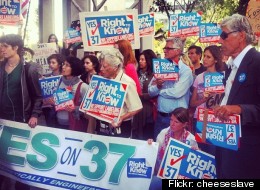
Proponents of Proposition 37, the California ballot measure that would have required labeling of genetically engineered foods, are attributing Tuesday's narrow defeat to corporate dollars and deception, but are also pledging to persist in a battle that they see as key to the health of Americans.
"I think this election was largely a story of money. We didn't have the funds to compete," Stacy Malkan, media director of Yes on 37, said on a Wednesday press call. "Ultimately, we were not able to get the truth out to voters."
The "No on 37" campaign, funded primarily by agro-chemical giants including Monsanto and DuPont, outspent the "Yes on 37" campaign five-to-one. Prior to the opposition's $46 million push, proponents had held a consistent two-fold lead in the polls. But they lost on Tuesday, with voters rejecting the measure 53.1 to 46.9 percent.
"California voters clearly saw through Prop 37," Dr. Henry I. Miller of the Hoover Institution, a conservative think tank at Stanford University, said in a statement on Wednesday. "Food labeling policy should be based on logic and science, not fear. Leading scientific organizations have all agreed that foods containing genetically engineered ingredients are safe and are not materially different from their traditional counterparts."
Malkan highlights Miller's lead role in the opposition's campaign as part of the "lies, deceit and trickery" that, she said, her campaign was unable to publicly correct. The known supporter of oil and tobacco companies and climate change skeptic was misrepresented as a Stanford doctor in a television campaign ad until the university ordered it re-shot. She also pointed to the opposition's distribution of deceptive mailers and its misrepresentation of the positions of scientific organizations and government agencies such as the Academy of Nutrition and Dietetics and the U.S. Food and Drug Administration.
Directly above the official FDA seal, a campaign mailer read that the agency "says a labeling policy like Prop 37 would be 'inherently misleading.'" A FDA spokeswoman later denied that the agency had made "such statements with respect to Prop 37."
As for Miller's point that genetically engineered ingredients are safe, even some proponents of labeling so-called GMOs generally agree.
"A GMO crop, in theory, is not something to be afraid of," said Laura Vandenberg, a biologist at Tufts University and co-author of an editorial published last week in favor of labeling efforts. "The problem is how they are actually used in the real world. It's like talking about guns vs. gun control. Guns don't hurt people, people hurt people."
Most GMO crops in use in the U.S. have been engineered to resist herbicides, which allows growers to spray the chemicals without concern about harming their corn, rice or soy harvest. But as The Huffington Post previously reported, growing resistance among weeds is leading farmers to apply larger quantities of chemicals to achieve the same level of control.
In fact, contrary to biotech industry claims of a reduction in the use of pesticides and herbicides, a recent study estimated that GMO crops have resulted in an additional 404 million pounds of toxic pesticides doused on U.S. fields between 1996 -- when they were first introduced as farm crops -- and 2011. That's about a 7 percent increase.
"This means we're being exposed to a lot more of these chemicals," Vandenberg said. "Some of these chemicals we know very little about in terms of safety. But there are ones we know are endocrine disruptors."
...
Monsanto and other agro-chemical companies have invested more than $20 million -- on top of the food industry's nearly equivalent contribution -- for ads opposing Proposition 37, a California measure that would require labeling of genetically modified foods, or GMOs. Proponents of the bill have raised less than $8 million.
Meanwhile, chemical interests have spent some $375 million since 2005 to help elect and try to influence federal leaders, specifically in regards to a pending overhaul of the Toxic Substances Control Act of 1976 (TSCA), according to a report released this week by Common Cause, a nonprofit, nonpartisan citizen's lobbying organization.
"It's been 36 years since they passed TSCA, and people are showing how it really fails to protect people," said James Browning, Common Cause's regional director for state operations and a principal author of the report. "Public health advocates are starting to win the fight, they have so much evidence on their side. Industry is realizing it needs to start spending more to stop it."
In July, the Safe Chemicals Act passed out of the Senate Environment and Public Works Committee. First introduced by Sen. Frank Lautenberg (D-N.J.) in 2005, the act would replace the TSCA and essentially reverse the burden of proof on chemical safety. In other words, chemicals would be required to be tested and proven safe before they are placed on store shelves -- something that it not the case today. The bill is now awaiting a vote from the full Senate.
The ACC, whose member companies' spending was included in the Common Cause report, has said it is committed to working on a bipartisan bill, but has also expressed concerns with the Safe Chemicals Act.
"As one of America's most significant manufacturing industries, we have a significant interest in seeing good policies enacted that will encourage economic growth and job creation including a balanced approach to regulation, a strong domestic energy policy and sound tax and trade policies, and we believe it is important to support leaders in Congress who share those priorities," Kolton said.
Overall, Common Cause found that chemical industry contributions in the current election cycle have gone predominantly to Republicans: 78 percent compared to 22 percent for Democrats. President Barack Obama received $217,283, for example, compared to Republican presidential candidate Mitt Romney's $704,337.
The report, titled "Toxic Spending," also highlights how the Supreme Court's 2010 Citizens United decision opened up a new "avenue of influence" for the chemical industry in the form of so-called Super PACs. Chemical interests have given $23 million to these groups in the current elections, according to the study.
During the past two decades, the food industry has taken over much of the FDA’s role in ensuring that what Americans eat is safe. The agency can’t come close to vetting its jurisdiction of $1.2 trillion in annual food sales. In 2011, the FDA inspected 6 percent of domestic food producers and just 0.4 percent of importers. The FDA has had no rules for how often food producers must be inspected.
The food industry hires for-profit inspection companies — known as third-party auditors — who aren’t required by law to meet any federal standards and have no government supervision. Some of these monitors choose to follow guidelines from trade groups that include ConAgra Foods Inc., Kraft Foods Inc. and Wal-Mart. The private inspectors that companies select often check only those areas their clients ask them to review. That means they can miss deadly pathogens lurking in places they never examined.
Food sickens 48 million Americans a year, with 128,000 hospitalized and 3,000 killed, the Centers for Disease Control and Prevention estimates. The rate of infections linked to foodborne salmonella, which causes the most illnesses and deaths, rose 10 percent from 2006 to 2010. The U.S. had 37 recalls of fruits and vegetables in 2011, up from two in 2005. Many of the victims of contaminated food are those with under-developed or weakened immune systems, such as children and the elderly. More from Grist
--
The "Big 6" pesticide and genetic engineering corporations -- BASF, Bayer, Dupont, Dow, Syngenta, and Monsanto -- have made millions while providing everyone else with questionable benefits and enormous risks. The riskiness of genetically engineered crops comes in part from their ability to cross-pollinate crops in other fields, spreading their genes far and wide. Once a new genetically engineered crop is introduced, the genie is out of the bottle, and those genes are in our food supply for good. Therefore, it's in everyone's interest (except for the biotech companies that stand to profit) to thoroughly examine any new crop before allowing it on the market.
...
2012 "Ag Approps" Gives Props to the "Big 6"
This regulatory victory was not good enough for industry, however. Quietly, Rep. Jack Kingston (R-GA) wrote a gift to biotech companies into the 2013 agriculture appropriations ("Ag Approps") bill. Opponents of GMOs refer to this as the "Monsanto Protection Act." Beneficiaries of Kingston's "rider" to the bill (Section 733) -- such as Monsanto, which lobbied for it in the second quarter of 2012 -- refer to it as the "farmer assurance provision."
If the Ag Approps bill passes as written, if a court removes a GMO from the market after the USDA has deregulated it, the USDA will be required to grant a permit to plant that crop to any farmer who requests one, even if that crop's safety is in question or under review.
Buried Biotech Treasure in the 2012 Farm Bill
At the same time, another far-reaching provision favoring the biotech industry is in the works. Buried in the House version of the 2012 Farm Bill, sponsored by House Agriculture Committee chair Frank Lucas (R-OK), is an enormous gift to the biotech industry. The bill changes the Plant Protection Act (PPA) to limit the time and scope of future environmental assessments of GE crops.
The House farm bill as changed by Congressman Lucas alters the legal rules to cut corners on the environmental review by requiring only the more limited EA and by requiring the USDA to complete that review in a maximum period of a year and a half -- or else the GE crop is automatically approved. It also restricts the scope of that limited environmental review and forbids the spending of any money on any broader environmental analysis of the effect of the GMO.
In California, the battle over Proposition 37, which would require the labeling of genetically modified organisms (GMOs) in food products, is heating up. In late July, pro-labeling groups obtained a flier sent out by a group opposed to the proposition containing the endorsements of three Democratic California Assemblymembers, even though the Democratic Party of California (and over 90 percent of consumers) supports GMO labeling.
The group that ran the flier is "No on 37: Coalition Against the Deceptive Food Labeling Scheme, Sponsored by Farmers and Food Producers," formerly known as "Coalition Against the Costly Food Labeling Proposition." "No on 37" receives major funding from the Council for Biotechnology Information (CBI) and Grocery Manufacturers Association (GMA), both front groups for the "Big 6" pesticide and genetic engineering companies: Monsanto, Dow Chemical, Syngenta, Bayer, Dupont, and BASF. The flier proudly bears the endorsements of Assemblymembers Henry Perea, Manuel Perez, and Alexandra Rooker, the Vice-Chair of the California Democratic Party. This despite the California Democratic Party announcing its endorsement for Prop 37 on Monday.
Big Food puts its back into fighting GMO labeling in California
http://grist.org/food/big-food-puts-its-back-into-fighting-gmo-labeling-in-california/
In case you had any doubt that California’s Prop 37— which would require labeling of food containing genetically modified organisms (GMOs) — poses a significant threat to the food industry, a top food lobby has now made it perfectly clear that it does.
In a recent speech to the American Soybean Association (most soy grown in the U.S. is GMO), Pamela Bailey, president of the Grocery Manufacturers Association (GMA), said that defeating the initiative “is the single highest priority for GMA this year.”
You may not know the GMA, but its members represent the nation’s largest food producers — those with the most at stake in the battle over GMO labeling. Soft drink and snack giant PepsiCo, cereal makers Kellogg and General Mills, and of course, biotech behemoth Monsanto all belong to the GMA.
According to state filing reports, GMA has already spent $375,000 on its efforts to oppose the labeling measure, with its members adding additional out-of-state lobbying power in the tens of thousands of dollars.
Big Food: “Lobbying is us”
This is hardly the first time the nation’s most powerful trade association of food manufacturers has marshaled its resources to oppose food and nutrition policy — at both the national and state levels.
For years GMA flexed its lobbying muscle in state legislatures all over the country fighting bills that were simply trying to remove junk food and soda from school vending machines.
Big Food lobbyists have also banded together to vociferously fight any attempt to restrict junk food marketing to children. For example, in 2005, GMA was a founding member of the Alliance for American Advertising, whose stated purpose was to defend the food industry’s alleged First Amendment right to advertise to children and to promote voluntary self-regulation as an alternative to government action.
More recently, GMA was among leading trade groups and corporations opposing the federal government’s attempt to improve industry’s own voluntary guidelines for food marketing to children. As this Reuters special report from April explains, GMA’s chief lobbyist visited the White House last July along with several top food industry representatives (from companies including Nestle, Kellogg, and General Mills) to scuttle an effort by four federal agencies that would have protected children from predatory junk food marketing.
Big Food loves labels
It seems ironic that the same companies taking advantage of every inch of packaging space to convince shoppers to purchase their products would object so strongly to labeling for something they claim is not harmful.
In recent years, the federal government has gone so far as to recognize that food companies’ so-called “front of package” labeling is out of control. Federal agencies have commissioned not one but two Institute of Medicine reports in search of solutions to the problem.
Unwilling to tolerate government intervention, the GMA has been aggressively promoting its own new nutrition-labeling scheme called “Facts Up Front.” But as Food Politics author and nutrition professor Marion Nestle has explained, this is an obvious end-run around the feds. Here’s how the food industry describes its own voluntary program:
“Facts Up Front” is a nutrient-based labeling system that summarizes important information from the Nutrition Facts Panel in a simple and easy-to-use format on the front of food and beverage packages.
Translation: We are repeating information already required on the back of the package, but placing it in a format we like better on the front.
See how that works? The food industry is always in charge.
So polls indicating that a whopping 90 percent of Californians want GMOs labeled, and the fact that 40 other nations (including the European Union, Brazil, and China) already require food makers to disclose GMOs, have GMA shaking in its boots.
In her recent speech, GMA President Bailey warned her audience: “If California wins, you need to be worried the campaign will come to your state.”
She’s right. In fact, they should be very worried.
Michele Simon is a public health lawyer specializing in industry marketing and lobbying tactics. She is the author of Appetite for Profit: How the Food Industry Undermines Our Health and How to Fight Back. She is grateful to live in Oakland, Calif., within walking distance of a farmers market. You can follow her on Twitter.
Alliance for American Advertising
The Alliance for American Advertising, the Wall Street Journal reported on January 26, 2005, "is the most ambitious effort yet to deflect government regulation or other intervention in food advertising aimed at kids, which critics link to high rates of childhood obesity."
The new lobbying group includes General Mills, Inc., The Kellogg Company and Kraft Foods, Inc. Wally Snyder, president and chief of the American Advertising Federation, states the purpose of the alliance is to defend corporations' First Amendment rights to advertise to children.
The alliance disputes health concerns raised by advertising food products, stating, "There is not a correlation between advertising trends and reccent childhood obesity trends." Former Federal Trade Commission chairman, Timothy J. Muris, is cited as complaining the advertising bans are "impractical, illegal and ineffective."
Members
- American Advertising Federation
- American Association of Advertising Agencies
- Association of National Advertisers
- General Mills, Inc.
- Kellogg Company
- Kraft Foods, Inc.
Related SourceWatch articles
External links
- Wendy Melillo, "Food Marketers, Ad Groups Form Alliance", Adweek, January 26, 2005.
- "Divided, Companies Fight For Right to Plug Kids' Food" by Sarah Ellison in the *The Wall Street Journal*, January 26, 2005.
- Reed Smith, "Food Advertising Battles Heat up Here and Abroad", American Marketing Association, February 07, 2005.
Categories: Advertising | Advertising industry | Obesity | United States
farm bill:
A so-called “Monsanto rider,” quietly slipped into the multi-billion dollar FY 2013 Agricultural Appropriations bill, would require – not just allow, but require - the Secretary of Agriculture to grant a temporary permit for the planting or cultivation of a genetically engineered crop, even if a federal court has ordered the planting be halted until an Environmental Impact Statement is completed. All the farmer or the biotech producer has to do is ask, and the questionable crops could be released into the environment where they could potentially contaminate conventional or organic crops and, ultimately, the nation’s food supply.
Unless the Senate or a citizen’s army of farmers and consumers can stop them, the House of Representatives is likely to ram this dangerous rider through any day now.
Nothing showcases this often-murky relationship between Big Ag and our political leaders more than emails revealed between Martin O'Malley, the Democratic governor of Maryland (and likely presidential contender in 2016) and poultry giant Perdue, Inc.
The emails we obtained through a Public Information Act request show that Perdue profits from chicken sold in California and Michigan are going to exert inappropriate power over O'Malley through intense lobbying efforts on everything from poultry litter incineration to the cases that a university law clinic engages in.
Most of the emails were between O'Malley and Herb Frerichs, general counsel for Perdue. In one email exchange on Nov. 5 and 6 of last year, in response to criticism from Frerichs about Maryland Secretary of Agriculture Earl "Buddy" Hance on the issue of manure to energy, O'Malley responded, "I'm guessing you don't have the personal email of governors of DE or VA [Delaware and Virginia], so let me know when Buddy can/should be doing more to help you push stuff."
On Nov. 17, 2011, Governor O'Malley released a letterto the University of Maryland Law Clinic criticizing them on their involvement in a case brought against Perdue and contract growers Kristin and Alan Hudson for illegal discharges of poultry waste into surrounding waterways. On the same day, Frerichs sent an email to the Governor that said simply: "Very nice." huffpo
lobbying defeats health:
On July 12, White House visitor logs show a who's who of food company chief executives and lobbyists visited the White House. The group met with Valerie Jarrett, Obama's senior adviser, and Melody Barnes, then director of the president's Domestic Policy Council. Among the group at the meeting: CEOs of Nestle USA, Kellogg, General Mills, and top executives at Walt Disney, Time Warner, and Viacom, owner of the Nickelodeon children's channel -- companies with some of the biggest financial stakes in marketing to children. Those companies have a combined market value of more than $350 billion.
Two people who attended -- lobbyist Scott Faber of the Grocery Manufacturers Association and Kolish of the Better Business Bureau -- said the group told the White House that it opposed government action and favored voluntary initiatives. Other participants and the White House have declined to describe the meeting or did not respond to requests for comment.
all:
http://www.reuters.com/article/2012/04/27/us-usa-foodlobby-idUSBRE83Q0ED20120427
Reuters) - In the political arena, one side is winning the war on child obesity.
The side with the fattest wallets.
After aggressive lobbying, Congress declared pizza a vegetable to protect it from a nutritional overhaul of the school lunch program this year. The White House kept silent last year as Congress killed a plan by four federal agencies to reduce sugar, salt and fat in food marketed to children.
And during the past two years, each of the 24 states and five cities that considered "soda taxes" to discourage consumption of sugary drinks has seen the efforts dropped or defeated.
At every level of government, the food and beverage industries won fight after fight during the last decade. They have never lost a significant political battle in the United States despite mounting scientific evidence of the role of unhealthy food and children's marketing in obesity.
Lobbying records analyzed by Reuters reveal that the industries more than doubled their spending in Washington during the past three years. In the process, they largely dominated policymaking -- pledging voluntary action while defeating government proposals aimed at changing the nation's diet, dozens of interviews show.
In contrast, the Center for Science in the Public Interest, widely regarded as the lead lobbying force for healthier food, spent about $70,000 lobbying last year -- roughly what those opposing the stricter guidelines spent every 13 hours, the Reuters analysis showed.
Industry critics also contend that the White House all but abandoned a multi-agency effort that recommended healthier food be marketed to children, even after First Lady Michelle Obama told a grocery trade group two years ago that food manufacturers needed to "step it up" to protect children.
"I'm upset with the White House," said Senator Tom Harkin (D-Iowa), chairman of the Senate Health Committee. "They went wobbly in the knees. When it comes to kids' health, they shouldn't go wobbly in the knees."
The White House disputed the characterization. Sam Kass, an assistant chef there and senior policy adviser on food initiatives, said in a statement: "We are incredibly proud of the commitments that many food companies have made, and are continuing to work with others to advocate for even more change to make sure our children are getting the healthy, nutritious food they need."
The political battles over what children eat and drink are crucial to the nation's health, experts say, because the tripling in childhood obesity in the last three decades foretells diabetes, heart disease and other illness in decades to come. America is one of the fattest nations on earth, and the Institute of Medicine, in a 2006 report requested by Congress, said junk food marketing contributes to an epidemic of childhood obesity that continues to rise. The institute is the health arm of the National Academy of Sciences.
SHORTER LIFESPAN?
Health experts and Harkin say the food industry has employed some of the same tactics as Big Tobacco in its efforts to fight stricter regulations -- chief among them the argument that the industry should regulate itself.
Although no major legislative action on childhood obesity is pending during this election year, the public debate is expected to resume next month. The Centers for Disease Control and Prevention (CDC) will hold a conference in Washington from May 7-9 called "Weight of the Nation." It will include an Institute of Medicine update and the premiere of an HBO documentary series of the same name. Health advocates also plan a "Sugary Drinks Summit" in Washington from June 7-8.
"We haven't reversed the epidemic," Dr. William H. Dietz, director of the division of nutrition, physical activity and obesity at the CDC, said in an interview. "This may be the first generation of children that has a lower life span than their parents."
Food and beverage manufacturers and advertisers say they aren't to blame for obesity. Indeed, they say they are part of the solution.
The American Beverage Association says its members have cut 88 percent of the calories shipped to schools since 2004 by offering less sugary drinks and emphasizing water, low-fat milk and juice in elementary and middle schools. The drinks now list calories on the front of labels.
Sixteen major companies with about 75 percent of the food ads on TV aimed at children under 12 are regulating themselves under the Children's Food and Beverage Advertising Initiative of the Better Business Bureau. They are limiting ads for certain foods and adopting nutrition standards.
"It's made a big difference," said Elaine D. Kolish, the initiative director and a former head of enforcement at the Federal Trade Commission. More than 100 products have been changed or created to cut salt, fat, sugar or calories, she said. Tougher self-regulation is promised by 2014.
At the same time, Kolish said, there is no proof of "a causal effect between food advertising and obesity."
The Institute of Medicine had found strong evidence that TV watching was associated with child obesity. But researchers have found no proof that obesity is directly caused by ads for sweets or junk food.
Armed with those arguments and a bulging political war chest, the $1.5 trillion food and beverage industry has defeated soda taxes and marketing restrictions in cities and states across the nation, mounting referendums to overturn the taxes in the two states that passed them and persuading 16 states to prohibit lawsuits over fatty foods.
Reuters analyzed spending reported by more than 50 food and beverage groups that lobbied against the federal effort last year to write tougher -- but still voluntary -- nutritional standards for foods marketed to children.
The groups have spent more than $175 million lobbying since President Barack Obama took office in 2009 -- more than double the $83 million spent in the previous three years, during the Bush Administration.
The totals do not include broader lobbying efforts by the Chamber of Commerce, the National Association of Manufacturers, and media and advertising interests that also opposed the federal plan. Those groups lobby on other issues, and lobbying disclosure reports do not specify how much they spent targeting the food marketing proposal. The Reuters analysis was based on records from the Federal Election Commission, the Secretary of the Senate and the Center for Responsive Politics, a nonpartisan group that tracks money in politics.
In a stark example of lobbying muscle, PepsiCo Inc, Coca-Cola Co, bottlers and the American Beverage Association spent more than $40 million lobbying in 2009 when Congress was considering a soda tax. That was more than eight times the $4.8 million they had spent the previous year, the analysis showed. After the proposal died, the groups cut spending to $24 million in 2010 and $10 million in 2011.
In recent interviews, lobbyists, lawmakers, policy leaders and industry insiders described the power of money in politics and the appeal of self-regulation to explain how they have been so successful countering legislation backed by public health interests that they portrayed as overreaching.
The public health advocates "hit a nerve," said Marshall Matz, a Washington lawyer and industry lobbyist who advised the 2008 Obama campaign on agricultural issues. "There's a bipartisan feeling you can tell someone to eat less fat, consume more fiber, more fruits and vegetables and less sugar. But if you start naming foods, you cross the line."
WHITE HOUSE WITHDRAWAL
The effort to defeat the tougher food standards heated up late last spring and summer, when lobbyists said they went on high alert.
On July 12, White House visitor logs show a who's who of food company chief executives and lobbyists visited the White House. The group met with Valerie Jarrett, Obama's senior adviser, and Melody Barnes, then director of the president's Domestic Policy Council. Among the group at the meeting: CEOs of Nestle USA, Kellogg, General Mills, and top executives at Walt Disney, Time Warner, and Viacom, owner of the Nickelodeon children's channel -- companies with some of the biggest financial stakes in marketing to children. Those companies have a combined market value of more than $350 billion.
Two people who attended -- lobbyist Scott Faber of the Grocery Manufacturers Association and Kolish of the Better Business Bureau -- said the group told the White House that it opposed government action and favored voluntary initiatives. Other participants and the White House have declined to describe the meeting or did not respond to requests for comment.
Advocates for tougher standards tried to counter the lobbying surge, calling, emailing and visiting the White House scores of times last year.
Margo Wootan, director of nutrition policy at the Center for Science in the Public Interest, recalled an October 31 White House visit that included 11 other representatives of nonprofit groups who supported the food standards. The group met with Barnes, White House visitor logs show. Among the advocates there that day: the American Heart Association and Children Now.
The effort by the advocacy groups had little effect.
In the weeks after the meetings, proponents of tougher standards said, neither the president nor the First Lady spoke out for the work on healthy food guidelines that had been drafted by the administration's own agencies. And industry representatives said their White House lobbying -- which also included calls, letters and visits to the White House -- proved successful on a hot political issue.
Wootan concedes as much. "There was so much industry pushback that it led to a lot of foot-dragging," she said. "The president and White House were as much to blame as House Republicans."
Meanwhile, Michelle Obama's childhood-obesity campaign pivoted from criticizing foodmakers toward promoting exercise.
"We need you all to step it up," she told the Grocery Manufacturers Association in a March 2010 speech. "We need you not just to tweak around the edges but to entirely rethink the products that you're offering, the information that you provide about these products and how you market those products to our children."
By last November, Mrs. Obama was praising the manufacturers for product improvements -- "a fundamental shift in the Let's Move campaign," according to the widely cited blog Obama Foodorama. Instead, the First Lady (with free advertising from broadcasters) emphasized exercise -- a favored cause of companies that lobbied against stricter food guidelines.
Nicholas W. Papas, a spokesman for the White House, disputed the notion that it had failed to champion the work of its own agencies. "The Obama Administration consistently supported the Interagency Working Group and we were disappointed when Congress granted the food industry's requests and placed new demands on the working group," he said in a statement.
But Papas could not point to any specific example of the president or First Lady voicing support for the working group report. Lobbyists on both sides of the issue and two key members of Congress said the administration stood back at crucial junctures, allowing Congress time to thwart the effort.
Kelly D. Brownell, a Yale professor and director of the Rudd Center for Food Policy and Obesity, said he believes the First Lady has become too friendly with industry even as she has been a passionate, effective advocate for healthier food and exercise. He pointed to the possible influence of a 2010 Supreme Court decision, criticized by the president, that removed limits on corporate and union campaign spending.
"It does seem that there's been a shift in priorities in the Let's Move campaign in an election year," Brownell said. "And with the Citizens United case and the companies being able to lobby almost without limit, it's not surprising that the White House is more friendly toward the industry."
Wootan had a similar view: "I'd focus more on exercise, too, if my husband was up for re-election."
The First Lady's office declined to respond publicly to questions about its support for the agencies' proposed standards for foods marketed to children, or charges that Let's Move had changed focus. Kass, the Let's Move policy adviser, responded to similar criticism last year from New York University nutrition professor Marion Nestle by saying the emphasis on exercise added to previous work on nutrition and was not a pullback from topics that the industry opposes.
BIG TOBACCO'S PLAYBOOK
Although food and beverage companies say they are making dramatic strides in self-regulation, their critics say they are moving too slowly and trying to influence public opinion by using some of the same approaches that tobacco companies used to defend their products.
Kraft Foods, the nation's largest food company, was owned by Philip Morris, the nation's largest tobacco company, from 1988-2007. Philip Morris makes Marlboro cigarettes.
Brownell and Kenneth E. Warner, a professor and former dean of the University of Michigan School of Public Health, have written papers comparing Big Food to Big Tobacco.
Both industries dispute links between their products and ill health, Brownell said -- tobacco companies claiming cigarettes don't cause cancer and food companies saying there is no proof that sugar causes obesity. Both have rewritten product labels without making major changes, he said. And both emphasize self-regulation -- to Brownell, an effort to preempt government standards.
"I can't think of a single thing the food industry is doing that the tobacco industry hasn't done," Brownell said.
Both industries also have relied on marketing to kids, he said, and both use what Brownell called "front groups" with consumer-oriented names that would not show their industry connections.
The Center for Consumer Freedom is a nonprofit group led by Washington lawyer and public relations executive Rick Berman. Formerly known as Guest Choice Network, it was founded in 1995 with a $600,000 pledge from tobacco giant Philip Morris. Today, the center attacks "food radicals" and runs websites including obesitymyths.com. The group says it is funded by food and restaurant companies but declines to name specific benefactors.
A group called Americans Against Food Taxes, calling itself a "coalition of concerned citizens," was formed in 2007 and has been financed by sugary beverage makers to fight soda taxes. It bought a 30-second ad during the 2011 Super Bowl.
Spokesmen for the food and beverage industries say comparing their tactics to tobacco's is unfair.
"Food processing is not an evil thing," said Derek Yach, PepsiCo's senior vice president of global health and agricultural policy and a former World Health Organization official who was well-known as an adversary of sugar and tobacco interests. He was hired by Pepsi, which also owns snack-food maker Frito-Lay, five years ago.
"I might not agree with a lot of things we do, but are we on a track where we're struggling to get to the right place? Absolutely," Yach said. The industry is well-intentioned, he said, focused on improving products and transparent in its fight against higher taxes and marketing restrictions.
CANNING THE SODA TAX
Beverage companies showed their political clout in 2009 when they faced a proposed penny-an-ounce tax on sugary drinks in a Congress eager to raise money to pay for obesity-related health care costs. The soda tax died in committee.
Other plans to tax soda have fizzled from coast to coast in the past two years. Twenty-four states and five cities considered them, according to the beverage association. None passed except in Washington state, where legislators approved a 2-cent-a-can soda tax on the last day of the 2010 session.
Within a month, a trade group for Coca-Cola, PepsiCo and Dr. Pepper Snapple mounted a referendum campaign. It spent $16 million, a state record for an initiative effort, to gather signatures and flood the airwaves. The public voted 60 percent against the tax.
The pro-tax group, outspent $37-to-$1, grumbled that the soda group misled voters with TV ads that the Seattle Times concluded were "mostly false" because they suggested a wide range of grocery items also would be taxed. The beverage industry mounted a similar $3.5 million campaign that knocked out a soda tax in Maine in 2008.
When Governor David A. Paterson of New York proposed an 18 percent tax on sweetened drinks in 2009, he said he wanted to raise money to treat obesity-related disease. Soda makers spent $12.8 million lobbying and advertising against it, and PepsiCo said the tax could affect its decision on whether to move more than 1,000 bottling jobs to Connecticut. The governor withdrew the proposal, and the company decided to keep its headquarters in New York.
"We got smashed," Paterson said in an interview. Labor unions had joined the attack because they worried about losing the Pepsi jobs, he added, comparing the soda lobby to a Mack truck. Paterson also said soda makers "bought off" lawmakers with donations and advertising even in districts where 40 percent of minority children were overweight or obese.
"We ran into the machine the way anti-smoking activists did in the early '60s," he said. "It's not a fight you're going to win right away."
Pepsi spokeswoman Gina Anderson said the proposed soda tax was "a serious concern and consideration" in the company's siting plans before the proposal died. The company decided last year to renew its lease through 2015.
Michael Jacobson, executive director of the Center for Science in the Public Interest, also compared the industry tactics with those of alcohol, tobacco and nuclear power.
"It's all the same playbook, isn't it?" he said. "You lobby. You make campaign contributions. You buy advertising. You threaten to move your plant. You use your workers as lobbyists."
The beverage association rejects the analogy. Its website says, "If anyone is using the ‘tobacco playbook' in their tactics, it is some of these activists." The group pointed to two recent examples, both involving the New York City Department of Health and both first reported by The New York Times.
In one, an email showed a city official asking, "What can we get away with?" in anti-soda advertising. In the other, a photo was altered on a subway poster that warned of the risks of diabetes from sugary soda. It portrayed an overweight man as an amputee. His right leg had been photographically removed. The city health department declined to comment further on these incidents.
Christopher Gindlesperger, a spokesman for the beverage association, explained the group's success in staving off soda taxes this way: "People feel very confident they can decide what to eat or drink without government help."
SEMPER FRIES
Public health officials thought the least nutritional items would drop off the government's $10.5 billion school lunch program last year when they announced the first menu overhaul in 15 years. White bread: gone. Milk: low or no fat only. Fruits and vegetables: doubled. Portions: smaller.
Then Congress got involved -- at the behest of potato and pizza companies -- to preserve French fries as a menu staple and to declare pizza, with its tomato sauce, to be a vegetable.
Senator Amy Klobuchar (D-Minn.) was one champion of the pizza rollback. Minnesota is home to Schwan Food Co, a private company with nearly $3 billion in sales and 70 percent of the school frozen pizza market. Klobuchar, who is running for re-election this year, wrote a letter last June to the Department of Agriculture. One sentence in it was identical to that in a Schwan official's later testimony before a Senate committee. The similarity was first reported by Minnesota Public Radio.
Both documents contained this statement: "By changing the crediting, many tomato-based sauces and salsa-type applications would no longer be factored into the weekly requirements for vegetables."
Klobuchar's spokesman, Linden Zakula, said he could not explain how the same language was used in the senator's letter because the aide who drafted it had left. He said Schwan was among many constituents to contact the office. Schwan declined to comment.
In fighting the menu change, the American Frozen Food Institute spent $543,000 lobbying last year, up from $334,000 in 2010; Schwan spent $50,000, and ConAgra Foods Inc spent $400,000. The companies also financed a group called the Coalition for Sustainable School Meal Programs.
House Republicans, citing "overly burdensome and costly regulations," added language to a budget bill in November to keep French fries and frozen pizza on the school lunch menu. The measure took effect earlier this year.
FIRST AMENDMENT PROTECTION
James H. Davidson believes in the First Amendment. The former college newspaper editor turned lawyer turned Senate aide is now one of the most powerful lobbyists in Washington.
For two decades, Davidson has been the point man for the advertising industry in free speech issues. More recently his clients have also included food and beverage companies in alliance with advertisers. They have joined forces to lead the fight against the proposed government guidelines on sugar, salt and fat in food marketed to 2- to 17-year-olds.
Davidson also says there is no proof that food marketing causes obesity, and without it, there is no legal basis for restricting the ads.
"The First Amendment protects this type of speech," he said.
Other lobbyists pointed to the role of potentially unlimited political donations in explaining how industry has been able to so thoroughly defeat the proposed salt, sugar and fat guidelines.
In 2009, Congress passed a measure proposed by Harkin and Senator Sam Brownback (R-Kansas) to ask the FTC and three other agencies -- the CDC, the Department of Agriculture and the Food and Drug Administration -- to draft voluntary nutrition standards for children's food marketing. The two senators were motivated by studies showing that children develop lifelong preferences from watching ads that target them with saltier, sweeter foods than adults.
"We are calling on the food industry to tackle this threat and boldly reinvent the food marketplace," FTC Chairman Jon Leibowitz said at a hearing in December 2009. As for kids' marketing, he noted, not only Congress but some companies wanted government guidance. "We will have such a uniform framework in place, we expect, by this summer," Leibowitz said.
Summer came and went. Brownback left the Senate at the end of 2010. When the draft guidelines were finally published in April 2011 -- to praise from health groups -- business interests say they were shocked by the low sugar and salt suggestions.
"These are voluntary guidelines," Harkin said. "What's the industry so afraid of?" The companies said the recommendations could become requirements and kill marketing of 88 of the 100 most popular food products, including Cheerios, whole wheat bread and yogurt.
The industry mobilized. Food and media companies hired Anita Dunn, former White House communications chief under Obama, to run media strategy. The industry created a group called the Sensible Food Policy Coalition. And it paid for a report that said the restrictions would result in 75,000 lost jobs and $28.6 billion in lost revenue to companies -- estimates based on the supposition that the guidelines would cut one in five food ads.
Not true, government officials and public health advocates said, arguing that industry had five years to improve the products. A review of the report by three marketing professors for the website politifact.com and the Atlanta Journal-Constitution termed its findings "false."
Nonetheless the report was widely circulated in Washington and repeatedly cited in letters to the administration signed by about 200 members of Congress from both parties. As the effort gained momentum, congressional staff members and lobbyists described calls and visits from chief executive officers of companies.
The industry's campaign, lobbyists say, focused on Representative Jo Ann Emerson (R-Mo.) and Senator Dick Durbin (D-Ill.), who chaired the appropriations subcommittee in each chamber that funded the FTC.
Emerson knew Davidson, who had attended college in Missouri and who had worked for Senator Stuart Symington (D-Mo.). In an interview, Emerson said she opposed the food guidelines because they would inevitably become mandatory. She said she learned how that could hurt business while working for the National Restaurant Association in the early 1990s. "I felt very passionately about anything that's voluntary," she said.
Last December, Emerson wrote the budget bill provision that stopped the guidelines, and she insisted on keeping the language as the bill moved through a House-Senate conference committee. It was a 55-word sentence in a 130-page omnibus budget bill, requiring the agencies to do a cost-benefit analysis of their recommendations before finishing the report. The agencies said such a requirement was unprecedented for a voluntary guideline and would prove far too expensive.
In the Senate, a lobbyist involved with the issue told Reuters, Durbin simply needed to stay quiet so as not to make it a partisan issue and eventually nudge Harkin into accepting Emerson's House provision. A Durbin spokesman, Max Gleischman, said the senator agreed to the House language because the industry was moving to regulate itself.
Durbin's home state of Illinois is home to Kraft. Its political action committee has been a regular contributor to his campaign committee, donating $14,000 since 2007.
"There was an outcry across the spectrum of the business community," said Dan Jaffe, executive vice president of the Association of National Advertisers. The proposal was too extreme, Jaffe said, and in the end, "It fell of its own weight."
Said Jeff McIntyre, policy director for the advocacy group Children Now: "We just got beat. Money wins."
Harkin also pointed to the power of corporate money. "They've scared some Democrats," he said in an interview. "It just shows you how heavy the lobbying is on the part of the industry."
Food and beverage groups targeting the proposed marketing restrictions had given Harkin's campaign more than $75,000 from 2007 through 2009. In 2010, after he helped initiate the push for food marketing restrictions, they contributed nothing. They gave him only $3,000 in 2011.
Comparing the last three years of the Bush administration to the first three years of Obama's, total campaign contributions from the more than 50 food and beverage groups and companies analyzed by Reuters were about the same. But during the Obama administration, the contributions increased substantially to some candidates who played key roles in warding off regulation.
Klobuchar, whose state is home to a number of large food companies, benefitted most. Her campaign received more than $160,000 in donations from 19 food and beverage groups during the last three years, double what they had given her in the three years prior. Her spokesman said there is no link between the donations and policy.
Food companies tripled their contributions to Emerson, who received more than $88,000 from the groups from 2009 through 2011. She received $39,000 in 2010 alone as she was poised to become chair of a key House appropriations subcommittee.
Emerson said most Republicans probably got more contributions when they became the House majority. However, the Reuters analysis shows the food and beverage groups strongly favored Republicans over Democrats, both before and after the 2010 election. On average over the last six years, they gave GOP political committees $2 for every $1 donated to Democrats.
The FTC issued a statement after the budget provision passed: "Congress has clearly changed its mind about what it would like the Interagency Working Group to do with regard to the report on food marketed to children."
On March 5, FTC Chairman Leibowitz, answering a congressman's question in a hearing, said the effort to write voluntary food standards was no longer an agency priority.
"It's probably time to move on," he said.
(Reporting by Duff Wilson and Janet Roberts; editing by Blake Morrison, Michael Williams, and Prudence Crowther)
superweed, superbig
http://www.grist.org/industrial-agriculture/2011-12-13-the-bugs-that-ate-monsanto
BM
Animal Industry Foundation
In response to mounting criticism from animal rights and environmental activists, the agricultural industry in the USA has fought back with SLAPPs (Strategic
Lawsuits Against Public Participation), using libel and defamation laws in order to try to gag their critics. They have also lobbied successfully for ‘food
disparagement laws’, which strengthen the corporate legal position against public criticism.
One group that conducted much of the campaign for food disparagement laws and other protections for the agricultural industry was the B-M funded Animal
Industry Foundation[61], replaced in 2001 by the Animal Agriculture Alliance[62].
4.2 Greenwashing Biotech
rBGH/BST
In the 1980s recombinant bovine growth hormone or bovine somatatrophin (rBGH/BST) was Monsanto’s flagship biotechnology product. A genetically engineered substitute for the cows’ growth hormone, rBGH was developed to increase the milk yield of dairy cows, a market that Monsanto’s CEO R.J. Mahoney estimated in 1985 to be worth $1bn a year. It was also one of the first biotech products to be readied for the market and as such the whole biotech industry had an interest. The only problems were gaining approval for its commercial use and some unfavourable scientific opinions of the artificial hormone. Monsanto’s own tests showed an increased risk of mastitis in rBGH treated cattle, that the milk went off quicker and that it contained higher levels of pus. FDA scientist, Dr Richard Burroughs concluded from analysing test data that Monsanto was manipulating the figures. In 1989 he was sacked after complaining to Congress that his superiors were suppressing his accusations.
To deal with the expected controversy Monsanto assembled an army of PR companies to aid them of which B-M was one. Pro-rBGH information was rapidly distributed to the dairy industry, the press and the general public. In this way a ‘grass-roots’ coalition was formed and extensive lobbying of legislators began[30].
B-M employees were twice exposed working covertly during the rBGH campaign.
Michael Hansen of the Consumers Union was the author of a report on rBGH. Before the report was published, he was contacted by a B-M employee claiming to be a scheduler for ABC Television’s show, “Nightline”. She asked for a preview of the report and Hansen’s CV, under the pretext of researching rBGH for a “Nightline” program on the issue. Hansen was suspicious however and inquiries at ABC revealed that no one from Nightline had called Hansen. The fax number she gave turned out to belong to B-M[31].
B-M also tried to infiltrate the campaign against rBGH, run by academic, author and environmental campaigner Jeremy Rifkin. A B-M employee claiming to represent a non-existent group called Maryland Citizen Consumers Council, attended anti-rBGH meetings, but her manner aroused suspicions amongst the activists who quickly exposed her. Burson-Marsteller disavowed all knowledge of her activities, suggesting that she was attending in her free time[32].
opposed law that usda had to ensure worker safety
The American Meat Institute (AMI) is national trade association and lobbying group which represents "companies that process 70 percent of U.S. meat and poultry and their suppliers throughout America." On its website AMI states that it "keeps its fingers on the pulse of legislation, regulation and media activity that impacts the meat and poultry industry and provides rapid updates and analyses to its members to help them stay informed." [1]
Contents[hide] |
Personnel
Executive Committee Members (accessed September 2005)
Jim Anderson Marlen Research Corporation
- Rich Armstrong Sara Lee Food & Beverage
- Van Ayvazian Boar's Head Provision Co., Inc.
- Bill Barnette, III Greenwood Packing Plant
- Tony Bayat CFS North America, Inc.
- Greg Benedict Rosen Meat Group, Inc.
- Greg Benedict Rosen Meat Group, Inc.
- Dane Bernard Keystone Foods, L.L.C.
- Ed Bleka Quantum Foods, Inc.
- Dick Bond Tyson Foods, Inc. (Treasurer)
- J. Patrick Boyle American Meat Institute (President & CEO)
- Bill Brennan Iowa Lamb Corporation
- Rod Brenneman Seaboard Farms, Inc.
- Reed Brown Brown Packing Company
- Bill Buckner Cargill, Inc./Cargill Meat Solutions Corp. (Vice Chairman)
- John Butts Land O'Frost, Inc.
- Tony Catelli Catelli Brothers, Inc.
- Phil Clemens Hatfield Quality Meats
- Ivo Cozzini Cozzini, Inc.
- Doug Curtis, Curtis Packing Company
- Henry Davis Greater Omaha Packing Co., Inc.
- Tom Davis Specialty Foods Group, Inc.
- Tim Day Bar-S Foods Co.
- Michel Defenbau, Multivac, Inc.
- Lou Eni Dietz & Watson, Inc.
- Bill Fielding Creekstone Farms Premium Beef, LLC
- Tom Fillippo, Devault Foods
- A. J. Follenweider Swissland Packing Company
- Jeff Freirich Julian Freirich Co.
- Neil Genshaft Fresh Mark, Inc.
- John Griffin Griffin Industries, Inc.
- Joel Johnson Hormel Foods Corporation
- Philip Jones Jones Dairy Farm
- Gus Juengling, III Prestige Meat & Foods, Inc.
- Bob Kessler, Jr. Kessler's, Inc.
- Carl Kuehne American Foods Group
- Chris Kunzler, III Kunzler & Company
- Tom Leidy, Leidy's Inc.
- Neal Leonard, L & H Packing Company
- Joe Luter, III, Smithfield Foods, Inc.
- Bo Manly Premium Standard Farms, Inc. (Vice Chairman)
- Chris Mason, AEW THURNE Inc.
- David McDonald OSI Industries, LLC
- Ira Mendelson Murry's, Inc.
- John Miller National Beef Packing Company, LLC
- David Miniat Ed Miniat, Inc. (Secretary)
- Tom Neese, Jr. Neese Country Sausage, Inc.
- Ed Nelson Indiana Packers Corporation
- Stewart Owens, Bob Evans Farms, Inc. (Immediate Past Chairman)
- Larry Odom Odom's Tennessee Pride Sausage, Inc.
- John Oedzes Brown Packing Co., Inc./Dutch Valley Veal
- Stewart Prosser Cryovac Division, Sealed Air Corp.
- Allen Purnell F.B. Purnell Sausage Company, Inc.
- Robert Rebholtz President and CEO Agri Beef Company
- Roger Reiser Robert Reiser & Co., Inc.
- Tom Routh J.H. Routh Packing Company
- Mike Rozanno Plumrose USA
- Bill Rupp Cargill Meat Solutions/Excel Corporation
- T.J. Russell Cloverdale Foods Company
- Rick Searer Kraft Foods Global, Inc.
- Alan Simon, Omaha Steaks International, Inc.
- Lackey Stephens R.L. Zeigler Co., Inc.
- Dwight Stiehl Rose Packing Company
- Launa Stayer-Maloney Johnsonville Sausage
- Dick Veale Harland M. Braun Co./Braun Export
- Dennis D. Vignieri Kenosha Beef International, Ltd.
- Norb Woodhams Pierre Foods, Inc.
- Fritz Usinger Fred Usinger, Inc.
Public Affairs staff
- Janet Riley Senior Vice President Public Affairs and Professional Development
- David Ray Vice President Public Affairs
- Marie E. DeLucia Director Education and Professional Development
Contact
AMI - American Meat Institute
1150 Connecticut Avenue, NW, 12th floor
Washington, DC 20036
Phone: 202-587-4200
Fax: 202-587-4300
Web: http://www.meatami.com/
Articles & sources
SourceWatch resources
- dioxin in US beef
- mad cow disease
- processed food industry
- Meat & Dairy industry
- Meat Promotion Coalition
- War on Animals
- U.S. Government's War on Animals
External links
- John Stauber, Food Flack Nation Attacks Journalist Eric Schlosser, PRWatch.com, May 11, 2006
Categories: Animal commerce | Industry lobby groups | Industry-funded organizations | Food industry | Agriculture | United States