donziger, steven
===
bro big green?
merri ok
see kill step
SEE SLAPP GREENPEACE ETP
native advertising wapo, ggl ads
SEE PAUL DANS 2025
bak 1 23
===
---
Paul Dans, the Man Behind Project 2025’s Most Radical Plans — ProPublica
...
Dans left after three years to become an associate at another large firm, Debevoise & Plimpton, and after two years there eventually landed at a less prestigious firm, where his cases included a lawsuit between Yves Saint Laurent’s beauty line and Costco over perfume labeling. By 2009, having not made partner anywhere, and two years into his marriage to Mary Helen Bowers, a former New York City Ballet dancer, Dans went into solo practice.
Dans has criticized the legal field for what he perceives to be anti-conservative discrimination. “We are, as a profession, really getting snowed under right now,” he said on the “Moment of Truth” podcast. “Republicans and conservatives have not stood up in the face of, kind of, cancel culture, and [these] Marxist, Saul Alinsky attacks.”
Even the moment he has often framed as his biggest triumph affirmed Dans’ alienation from liberal lawyers. In 2009, he was one of hundreds of attorneys hired to defend Chevron and its employees against a multibillion-dollar lawsuit for oil pollution in Ecuador. According to the journalist Michael Goldhaber, Dans was hired at $100 an hour — less than 5% of the top rate at Gibson, Dunn & Crutcher, which was leading Chevron’s defense.
As Dans later told Goldhaber, he had an epiphany: While watching the documentary film “Crude,” an exposé of Chevron in Ecuador that was done in collaboration with the plaintiffs’ lead lawyer on the case, Steven Donziger, Dans realized that the outtakes from the film should be subpoenaed, to see if the filmmaker captured any legal malfeasance by Donziger. Dans put the suggestion in a memo.
As it turned out, the subpoenaed outtakes did prove to be damning. Chevron sued Donziger in U.S. federal court, ultimately resulting in a ruling that the company did not have to pay the $9.5 billion judgment. Dans took full credit: “I came up with a theory that we could get documentary film outtakes, basically caught them doing their nefarious acts on video,” he told Martin on her podcast.
According to other lawyers on the case, the story is more complicated: Although Dans wrote a memo suggesting the outtakes be targeted, others started the push for subpoenas — and came up with the necessary legal basis for seeking the crucial outtakes — independently of Dans raising the idea.
When the Chevron case was over, Dans was back on his own, handling motley litigation, including a patent fight between two manufacturers of sheet-pile wall systems and a class action against Frito-Lay regarding its claims that some of its products were made with all-natural ingredients. The address for Dans’ solo practice was a mail drop at the New York City Bar Association.
Toward the end of the aughts, as President Barack Obama’s first term wore on, Dans’ conservatism began to take on a new shape. He spent a lot of time online. “I’m one of the people sitting at his kitchen counter, you know, on the bench there, on the stool kind of going, How can that be? That’s crazy,” he told Martin. “You’re clicking … you know, refreshing the Drudge Report like 100 times a day.”
One thing he clicked on was Trump’s conspiracist claims about Obama’s origins: “I had some serious academic questioning about the birthplace of a former president, if you will,” he told Sharma and Solheim. Dans got excited when rumors spread in 2011 that Trump would be going to New Hampshire to announce a run for president. Alas, it didn’t happen.
---
ymail 8 25
A pro-corporate judge scheduled a hearing on August 20th on Trump friend Kelcy Warren’s “emergency motion” to force Greenpeace to drop the lawsuit it filed against Warren in Dutch courts. Greenpeace is fighting for survival after it was hit with a crushing $669 million verdict in March after a rigged jury trial in a pro-Trump county in North Dakota.
Let’s be clear: Warren's latest motion is preposterous.
No US judge has the power to order a judge in a foreign country to withdraw a lawsuit.
So why is Judge James Gion even scheduling a hearing?
It’s simple. We believe the entire proceeding is corrupt. Warren’s law firm, Gibson Dunn, has repeatedly been called out by courts around the world for engaging in unethical practices. That's probably why Warren hired them.
The Montana Supreme Court once found the firm engaged in “legal thuggery” on behalf of its corporate clients. This is also the same law firm that locked up for almost three years in retaliation for helping Amazon communities win the landmark Ecuador pollution case.
Warren’s latest move is right out of the Trump playbook – declare a fake “emergency” to grab more power over not only Greenpeace but the entire client movement.
We are not going to take Warren’s bullying. But we need your help.
A donor has agreed to match all donations up to $10,000 from now until the end of the week so we can ensure Judge Gion understands that the world is watching his every move.
We also will use our trial monitoring report – which our attorneys are writing right now – to galvanize millions of people including hundreds of legal scholars to help protect Greenpeace.
---
===
OMFG
On behalf of Steven, we want to share a riveting piece of journalism on the sham trial that resulted in an astonishing $669 million verdict against Greenpeace in the courts of North Dakota.
Renowned environmental journalist Alleen Brown recently released a podcast on the trial called "SLAPP’d Episode 2: The Trial Begins." It is a rare and highly disturbing look at how a SLAPP harassment lawsuit from the fossil fuel industry works from the inside.
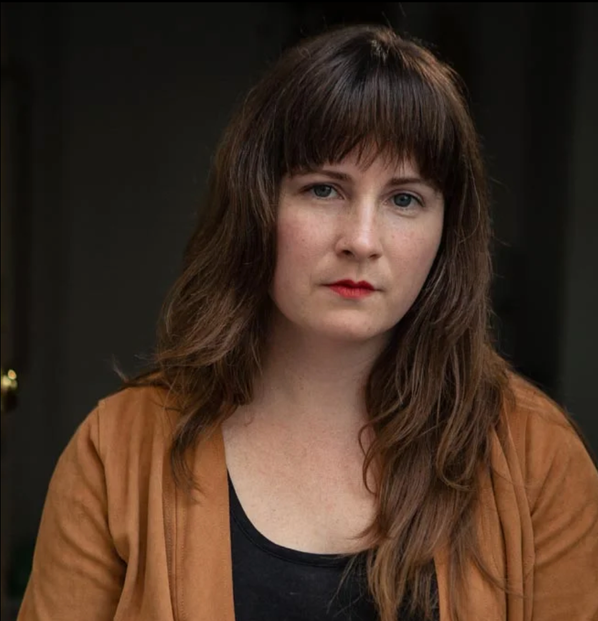
Award-winning environmental journalist Alleen Brown of the "Drilled" podcast team.
The all-out legal assault on Greenpeace is eerily similar to what Steven experienced.
Oil billionaire and Trump friend Kelcy Warren used the same law firm to attack Greenpeace in North Dakota that Chevron used to target Steven after he helped win the landmark Ecuador pollution case. The nefarious activities of this law firm, Gibson Dunn, have been criticized by courts the world over.
They are now documented and exposed by Alleen.
Click here to listen to Alleen’s breathtaking reporting.
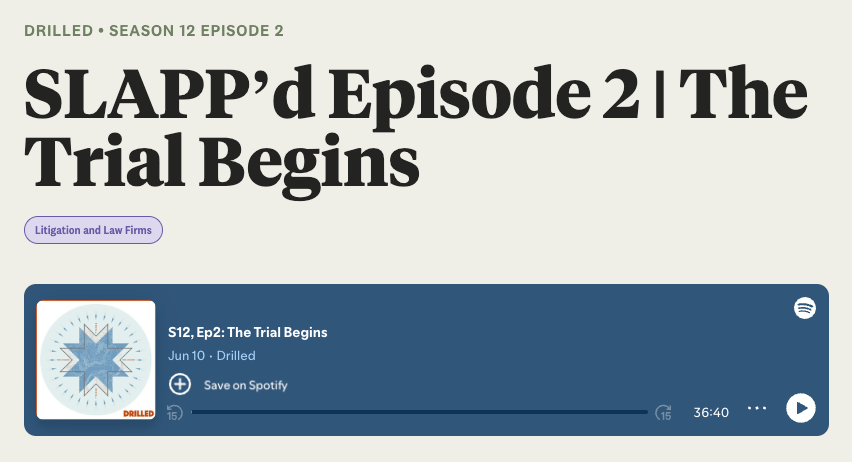
Alleen also included part of Steven’s story. Here is an excerpt:
*“Some of these trial monitors have run into Gibson Dunn and Crutcher before. Gibson Dunn represented Chevron in a notorious RICO case against an environmental lawyer named Steven Donziger.
It turns out, Steven is also in North Dakota. He's one of the people who organized the trial monitoring committee.
Steven is tough to catch outside the courtroom. He's constantly beelining it to his car to look at his phone and post updates on social media about what's happening inside the courtroom. I make arrangements to meet him for an interview at his hotel. For Steven, this case is personal.”*
Steven, Marty Garbus, and several prominent attorneys were on the ground in North Dakota to help protect Greenpeace. They are not done yet.
Our team will be in touch soon with updates on the Greenpeace monitoring project and another important initiative that Steven is about to announce.
Click here to listen to Alleen’s podcast episode today →
Thank you so much for the support!
The Free Donziger Team
---
ymail 6 25 donziger
Greenpeace recently was hit with an outrageous $669 million court verdict in North Dakota. The trial – which I attended with several prominent attorneys – was widely condemned as a SLAPP harassment case designed to silence the environmental movement.
The verdict could be a financial death sentence against Greenpeace – unless we stop it.
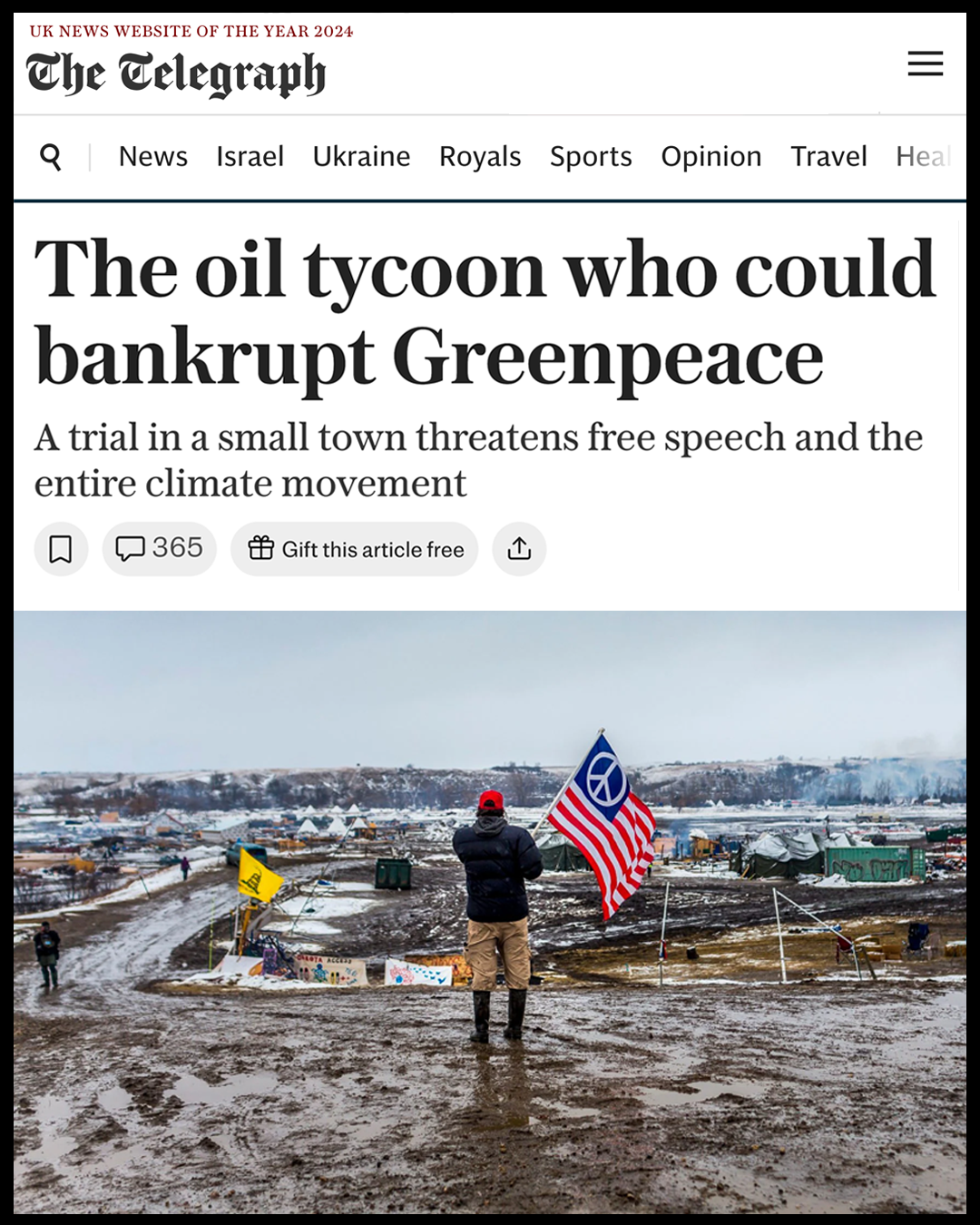
That’s why I’m reaching out for help.
This is the deal: the targeting of Greenpeace was financed by one of the most notorious fossil fuel oligarchs in the world. This man, Kelcy Warren, amassed a net worth of $7 billion by building a network of planet-destroying pipelines in every region of our country.
Warren’s company, Energy Transfer, is so awful that it was convicted of multiple acts of criminality in Pennsylvania because a pipeline leaked toxic waste into waterways. Warren is so hateful he once said all climate activists “should be removed from the gene pool.”
Luckily, there’s a viable plan to stop Warren’s vile attacks.
Greenpeace recently filed an innovative claim in the courts of Amsterdam against Warren’s company. The claim uses a new anti-SLAPP law in the European Union that allows activists to sue the corporations that abuse them.
The case in Amsterdam can turn the tables on Warren and force him to pay damages to Greenpeace rather than the other way around.
This would be a huge victory for the climate movement.
Before I get to what we are going to do about it, I want to tell you about another dirty trick Warren has up his sleeve.
Warren is pressuring the trial judge in North Dakota to require Greenpeace to post a $75 million bond just to appealthe $669 million verdict. If granted, this enormous “bond” is likely to be a financial death sentence.
Warren went after Greenpeace after the group helped support the Indigenous-led protests at Standing Rock against the Dakota Access Pipeline.When 100,000 people turned up to block Warren from building his pipeline across Indigenous territory, he went ballistic.
Warren also personally donated at least $5 million to Trump for his two presidential campaigns. Trump then helped Warren get permits for his leaky pipeline.
The support of the public for this campaign is critical. Without it, we simply cannot do this work.
Our goal is to raise $20,000 before the end of the month. That means we have to raise approximately $12,000 in the next few days.
---
email 3 25
Please join us TONIGHT (March 13) at 7 ET for an important update on the latest major SLAPP legal attack on free speech and the climate movement – and how it connects to the government’s shocking abduction of Columbia grad student Mahmoud Khalil.
This is open to the public and will consist of a short presentation by members of our independent trial monitoring team – including legendary lawyer Marty Garbus and Indigenous rights attorney Natali Segovia
YMAIL 1 25
...I’ve gotten word from inside the Biden team that we were able to push my pardon to the very top. In fact, it was discussed for days by the President’s top advisors. I was told Chevron’s lawyers fought with a bizarre intensity to kill it.
Why in hell were Chevron lawyers allowed in the White House to fight a human rights lawyer seeking a pardon?This is proof of the immense power our campaign has built – and how we pose a serious financial risk to Chevron.
On the day Mr. Biden denied my pardon more than 500,000 people around the world engaged with our social media posts. To put it bluntly, this scares the hell out of Chevron.
I see the result as a capitulation by Mr. Biden to corporate power at the expense of the planet and the rule of law. His decision was extremely disappointing – and also an illustration of the lack of conviction to fight for justice at the top levels of the Democratic Party.
...
ymail 1123
It has been affirmed by six different appellate courts, including Ecuador’s Supreme Court.
*Chevron executives don’t much like it when Indigenous peoples hold them accountable.
In fact, they hate it.
Chevron retaliated by launching a vicious demonization campaign targeting me, my wife Laura, and my son Matthew. They even had me locked up at home and in prison for almost three years on a baseless contempt of court charge resulting from a private prosecution.
In all, the company used 60 law firms and 2,000 lawyers to go after me and our team.
Chevron also paid six operatives to follow me and my family around New York City where we live. They even tracked us as we took our son to school.
*Now Chevron is at it again.
Last week my Twitter-X account with more than 200,000 followers was hacked. We later discovered that several posts related to Chevron’s destruction of the Amazon had vanished.[twt]
---
yahoo 1 23 i can't find site "" in ggl
...We just got news that the company has launched a new gutter-style attack campaign targeting Steven.
A website dedicated to “sharing Chevron’s views and opinions on the Ecuador lawsuit” has begun to put major money to spread misinformation about Steven online.
Why is Chevron suddenly going after Steven again? It appears that Chevron CEO Michael Wirth feels threatened by Steven's existence as a "semi-free" man who is no longer detained at home or in prison.
Wirth is now trying to punish Steven for speaking out against his company's complete failure to comply with court orders that it clean up its toxic waste in Ecuador – waste that has led to an epidemic of cancer and thousands of deaths among Indigenous peoples in the Amazon.
===
sht update
chevron sued via RICO?!
https://insideclimatenews.org/news/18122022/steven-donziger-chevron-ecuador-oil-pollution/
steven Donziger is back in his airy mid-century modern apartment on the Upper West Side of Manhattan, engaged over Zoom on a marketing call with a representative of the online publishing platform Substack.
Back and forth, they wrestle with a complicated question—who is Steven Donziger—and quickly realize there is no easy answer.
Donziger is a crusading lawyer who led a team that won one of the world’s largest pollution judgments against Chevron on behalf of Indigenous peoples and other residents of the Ecuadorian Amazon in 2011.
He’s also wearing an ankle bracelet, having spent the morning checking in at a Bronx halfway house for federal inmates. Connecting those dots is a fraught tale.
The $9.5 billion award he helped secure from an Ecuadorian court covered horrific pollution from oil production by Texaco (acquired by Chevron in 2001) that poisoned the rainforest with oil spills and billions of gallons of toxic wastewater.
But none of Donziger’s original 30,000 Ecuadorian clients—suffering and dying from cancers and other diseases that many believe are related to the oil contamination—have received a penny since the original lawsuit was filed in 1993. Nothing.
Here’s what happened.
Three years after the Ecuadorian court ruled on their behalf, a U.S. federal district judge in New York found in a countersuit brought by Chevron that Donziger’s team had obtained the Ecuadorian judgment through fraud, bribery and extortion.
Among other things, Donziger was accused in the countersuit of forging an expert’s signature, blackmailing a judge, facilitating the ghostwriting of a key piece of evidence and bribing other Ecuadorian judges—acts that Donziger either denies or says were not illegal in Ecuador.
He has criticized the ruling in the U.S. lawsuit, which Chevron filed under the federal Racketeer Influenced and Corrupt Organizations Act (RICO), as a “Manhattan trial judge purporting to overrule Ecuador’s Supreme Court on questions of Ecuadorian law.” Donziger was referring to one of two appellate court decisions in Ecuador that affirmed the $9.5 billion judgment.
Still, the RICO lawsuit, along with a similar decision from an international arbitration tribunal, has so far made the $9.5 billion Ecuadorian judgment unenforceable despite attempts by plaintiffs to collect damages in Canada, Argentina and Brazil, among the many countries where Chevron has assets.
===
10 22
I still cannot travel outside of the United States because Chevron opposes the return of my passport.
❌ I still cannot visit the Indigenous peoples and farmer communities of Ecuador who have been my clients for 28 years and who rely on me in ways big and small.
❌ I still am unable to practice law after Chevron and Judge Kaplan essentially stole my law license without even a hearing
===
https://www.nytimes.com/2021/10/27/business/energy-environment/steven-donziger-chevron.html
Lawyer Who Won $9.5 Billion Judgment Against Chevron Reports to Prison
Steven Donziger, an environmental activist who won what is considered the largest ever lawsuit against an oil company, was found guilty of contempt of court in July
....
---
ref
https://theamazonpost.com/
about: The Amazon Post is maintained by Chevron to express the company’s views and opinions on a fraudulent lawsuit against the company in Ecuador.
---
beware BS
categories
Jan 11, 2023
Chevron Ecuador Blog Posts
Chevron Ecuador Lawsuit News
The Real Climate Change Racket
A lawsuit against oil companies reflects progressive attempts to criminalize disagreement. “The first climate racketeering suit is here,” Slate declares. That is …
Sep 30, 2022
Chevron Ecuador Lawsuit News
Chevron-Ecuador Feud Still Alive In The Netherlands
Law360 (September 29, 2022, 9:02 PM EDT) — Ecuador has asked the Netherlands’ highest court to nix an arbitral award …
Jul 1, 2022
Chevron Ecuador Blog Posts
Dutch appellate court rejects Ecuador’s bid to set aside Chevron arbitration win
A Dutch appellate court has rejected Ecuador’s attempt to set aside a 2018 arbitral award that held the Republic liable under international law for issuing a fraudulent, meritless $9.5 billion judgment against the company more than a decade ago.
Jun 22, 2022
Chevron Ecuador Blog Posts
Donziger’s Contempt Conviction Upheld By 2nd Circ. – Law360
The Second Circuit panel on Wednesday upheld disbarred lawyer Steven Donziger’s conviction for disobeying court orders in civil litigation over a since-overturned $8.7 billion Ecuadorian pollution judgment against Chevron, saying federal judges have the power to appoint special prosecutors.
May 23, 2022
Chevron Ecuador Blog Posts
Revisiting Steven Donziger’s fraud against Chevron in Ecuador
A dishonest campaign is underway to rehabilitate disbarred lawyer Steven Donziger and his Ecuadorian judicial fraud, a scheme he has been trying to profit from for nearly three decades. So, it is time once again to revisit the facts.
May 19, 2022
Chevron Ecuador Blog Posts
Chevron Ecuador Lawsuit News
Steven Donziger’s Attempt To Avoid Disbarment In DC – Forbes
Steven Donziger, the criminally convicted attorney who corruptly sued Chevron over pollution in Ecuador, is fighting to keep his law …
May 9, 2022
Chevron Ecuador Lawsuit News
Our justice system can’t work if the end justifies any means – Lexology
I’m shocked by the news this morning that a Massachusetts Congressman and others are petitioning President Biden to pardon Steve …
Apr 30, 2022
Chevron Ecuador Blog Posts
Chevron sets the record straight on MSNBC
“The wrongful actions of Donziger and his Ecuadorian legal team would be offensive to the laws of any nation that …
Apr 1, 2022
Chevron Ecuador Blog Posts
12 Key Facts Essential to Understanding the Chevron-Ecuador Litigation
- Steven Donziger Is an Adjudicated Racketeer. The U.S. District Court for the Southern District of New York found overwhelming …
Mar 24, 2022
Ecuador Political News
Meet the Ecuadorian Fugitive and Troll Creator Behind Colombia’s Far-Left Presidential Candidate
Gustavo Petro, who became the official candidate of the left for the presidential elections in Colombia, has a series...
---
21 pp?!
Chevron's Views
And Opinions On
The Ecuador Lawsuit.
Lawsuit Facts
News & Blog
Videos
About
Chevron Ecuador Blog Posts
Read the latest blog posts about the Chevron Ecuador lawsuit from The Amazon Post.
AddThis Sharing Buttons
Share to Facebook
FacebookShare to TwitterTwitterShare to More
More
Categories
January 11, 2023
The Real Climate Change Racket
A lawsuit against oil companies reflects progressive attempts to criminalize disagreement. “The first climate racketeering suit is here,” Slate declares. That is …
July 1, 2022
Dutch appellate court rejects Ecuador’s bid to set aside Chevron arbitration win
A Dutch appellate court has rejected Ecuador’s attempt to set aside a 2018 arbitral award that held the Republic liable under international law for issuing a fraudulent, meritless $9.5 billion judgment against the company more than a decade ago.
June 22, 2022
Donziger’s Contempt Conviction Upheld By 2nd Circ. – Law360
The Second Circuit panel on Wednesday upheld disbarred lawyer Steven Donziger’s conviction for disobeying court orders in civil litigation over a since-overturned $8.7 billion Ecuadorian pollution judgment against Chevron, saying federal judges have the power to appoint special prosecutors.
May 23, 2022
Revisiting Steven Donziger’s fraud against Chevron in Ecuador
A dishonest campaign is underway to rehabilitate disbarred lawyer Steven Donziger and his Ecuadorian judicial fraud, a scheme he has been trying to profit from for nearly three decades. So, it is time once again to revisit the facts.
May 19, 2022
Steven Donziger’s Attempt To Avoid Disbarment In DC – Forbes
Steven Donziger, the criminally convicted attorney who corruptly sued Chevron over pollution in Ecuador, is fighting to keep his law …
April 30, 2022
Chevron sets the record straight on MSNBC
“The wrongful actions of Donziger and his Ecuadorian legal team would be offensive to the laws of any nation that …
April 1, 2022
12 Key Facts Essential to Understanding the Chevron-Ecuador Litigation
- Steven Donziger Is an Adjudicated Racketeer. The U.S. District Court for the Southern District of New York found overwhelming …
March 4, 2022
Rafael Correa - president of Ecuador
Steven Donziger, An Idolized, Yet Corrupt Lawyer – El American
Steven Donziger is the best example of how a handful of activists in the world and in the United States …
October 1, 2021
Chevron Ecuador’s Steven Donziger Is Like Elizabeth Holmes Of Theranos Fraud – Donziger Admitted Scheme Was To “Make F-King Money”
Disbarred attorney Steven Donziger will be sentenced Friday, Oct. 1, for criminal contempt by United States District Judge Loretta Preska …
June 23, 2021
Key Facts About Disbarred Lawyer Steven Donziger’s Ecuador Fraud
When Steven Donziger, the lawyer behind the Ecuador fraud against Chevron, was disbarred last year, the New York court cited his “egregious professional misconduct.” Specifically, it called out his “corruption of a court expert and …
June 16, 2021
Follow the money: Why disbarred lawyer Steven Donziger was fired by his Ecuadorian clients
Disbarred lawyer Steven Donziger likes to present himself to the media as a lawyer for the Ecuadorian plaintiffs in the …
April 9, 2021
Ecuador’s Oil Industry Desperately Needs A Miracle
Over the last decade it has been a wild ride for Ecuador’s trouble-plagued but economically crucial oil industry. Former president …
1 2 3 … 21 »
Press Releases|
Chevron Corp.
===
https://www.outsideonline.com/outdoor-adventure/environment/steven-donziger-outsiders-2022/
===
april 2022
https:/**/theintercept.com/2022/04**/27/deconstructed-steven-donziger-chevron-ecuador/
pod
this week, after nearly 1,000 days of arbitrary detention, the environmental and human rights lawyer Steven Donziger was released from house arrest.On this week’s podcast, Donziger talks to Intercept investigative reporter Sharon Lerner and Ryan Grim about his decadelong legal battle with Chevron over land contamination in Ecuador.
[Deconstructed theme music.]
Sharon Lerner:This week on Deconstructed, I’m Sharon Lerner, investigative reporter for The Intercept, sitting in for Ryan Grim.
Our guest this week is Steven Donziger, the environmental lawyer who sued Chevron and won. Donziger helped win a multi-billion dollar judgment against the company for the contamination of land in Ecuador. Specifically, the Lago Agrio region where he’s been fighting on behalf of Indigenous people and farmers for more than 25 years.
As Donziger was arguing the case against Chevron in Ecuador back in 2009, the company said its long-term strategy was to demonize him. And, since then, Chevron has waged an all-out assault on Donziger in what’s become one of the most bitter and drawn-out cases in the history of environmental law.
Chevron has hired private investigators to track Donziger, created a publication just to smear him, and put together a legal team of hundreds of lawyers from 60 firms, who have successfully pursued an extraordinary campaign against him.
As a result, Donziger has been disbarred; his bank accounts have been frozen; he has had alien placed on his apartment; he faces exorbitant fines; and he was prohibited from earning money. A court seized his passport and put him on house arrest. Chevron, which has a market capitalization of $316 billion, has the funds to continue targeting Donziger for as long as it chooses.
In an emailed statement, Chevron wrote that: “any jurisdiction that observes the rule of law should find the fraudulent Ecuadorian judgment to be illegitimate and unenforceable.” The statement also said that: “Chevron will continue to work to hold the perpetrators of this fraud accountable for their actions, including Steven Donziger, who has committed a litany of corrupt and illegal acts related to his Ecuadorian judicial fraud against Chevron.”
Donziger was charged with contempt of court for refusing to hand over his computer, cellphone, and other electronic devices in August of 2019. He had already endured 19 days of depositions and given Chevron large portions of his case file. To him, the request for his devices was beyond the pale, and he appealed it on the grounds that it would require him to violate his commitments to his clients. Still, Donziger said he’d turn over the devices if he lost the appeal. Instead, he ended up confined by the court to his Upper West Side apartment.
Even though the underlying case was civil, the federal court judge who has presided over the litigation between Chevron and Donziger since 2011, Lewis Kaplan, drafted criminal contempt charges against him.
Kaplan ruled in 2014 that the Ecuadorian judgment against Chevron was invalid because it was obtained through “egregious fraud” and that Donziger was guilty ofracketeering, extortion, wire fraud, money laundering, obstruction of justice, and witness tampering.
The decision hinged on the testimony of an Ecuadorian judge named Alberto Guerra, who claimed that Donziger had bribed him during the original trial and that the decision against Chevron had been ghostwritten. In 2015, when Guerra testified in an international arbitration proceeding, he admitted that he had lied and changed his story multiple times.
In another legal peculiarity, in July, Kaplan appointed a private law firm to prosecute Donziger, after the Southern District of New York declined to do so — a move that is virtually unprecedented. And, as Donziger’s lawyer has pointed out, the firm Kaplan chose, Seward & Kissel, likely has ties to Chevron.
Making the case even more extraordinary, Kaplan bypassed the standard random assignment process and handpicked someone he knew well, U.S. District Judge Loretta Preska, to oversee the case being prosecuted by the firm he chose. It was Preska who sentenced Donziger to home detention and ordered the seizure of his passport, even though Donziger had appeared in court on hundreds of previous occasions.
When I visited Donziger in his apartment last year, he had no idea that he would end up spending more than 900 days there on house arrest.
On Monday, Donziger was finally released from house arrest. Ryan Grim and I talked to him shortly afterwards. Here is our conversation.
[Musical interlude.]
Steve Donziger:I’m feeling great.
SL:Yeah. Big day!
Ryan Grim:Yeah. What day did you get off? I mean, what time?
SD:It was around 9:30-10, maybe, in the morning?
RG:Did you get an alert that said — I mean, I saw you got an alert that was kind of penal coming after you at like five in the morning. But then did you get an alert saying that you’re now a free person?
SD:[Laughs.] No, they don’t do that.
SL: What’s the first thing you did?
SD:Well, I came outside, and there were some people there and I taped a little talk and took a picture. And then I went into the subway and came home and my wife was there. And some of my friends and we hugged, and we rejoiced in the moment.
I didn’t really fully understand what freedom was until it was taken away. I’ve lived in my home now for 993 days straight, other than 45 days in federal prison. So it’s been quite the experience. It lasted a long time for various reasons I think related to retaliation by Chevron against me for my successful human rights work in Ecuador. But the cost to me and my family, obviously, was very, very high. Although, I think at the end of the day, it really is backfiring against Chevron and that we now have a much bigger, broader platform to advocate from than we did before.
RG: Does it feel different to be in your home now that you know you can leave? Like, does the home itself feel different that you’re there voluntarily?
SD: It does feel different. Freedom is not only the ability to kind of move around, travel, go out to eat, do what you want to do when you want to do it within reason. It’s also a psychological state. I found that I had taken freedom for granted my whole life. I mean, even just the ability to sort of think: Eh, maybe later today I’ll go to dinner or maybe later today, I’ll go see a show or go visit a friend, you know? And what my house arrest did I mean prison is even worse obviously, but house arrest deprives you of the ability to plan. It cuts you off from your friends and your social life. You can’t even think about the future.
I mean, one bizarre feature of my experience was that when it began, I was pretrial and Covid hit and it was very unclear how long it would last and Judge Preska, who put the ankle bracelet on me and forced me into my house on the theory I was a risk of flight — which was preposterous, and I reject — it was very clear, she was never going to take that ankle bracelet off even if Covid lasted five years, and there were no trials being held.
So for a long, long, long period of time, most of the time I’ve been in detention, it felt like it was an indefinite detention. And it was. There was no endpoint. And it wasn’t until I was denied a jury and I had a contempt trial where Judge Preska, the very person who had locked me up for, by that point, two years and two months prior to trial, she was my sole fact finder. And of course, she convicted me after denying me a fair trial, in my opinion. And then she still — on top of the two years and two months — sentenced me to six months in prison [laughs] when, again, the maximum sentence for a misdemeanor is six months. And she gave me the full sentence, not counting the two years and two months she had already made me stay at home.
So this was a very, in my opinion, corporate-generated politicized effort by two federal judges,Judge Preska and her colleague Judge Kaplan who appointed her to the case and who charged me with these supposed crimes. I mean, his charges, by the way, were rejected by the federal prosecutor, but they prosecuted me anyway with his private corporate law firm that had Chevron as a client.
So there were all sorts of things happening. But it was very clear that this was a Chevron prosecution. All the main witnesses in my supposed trial were Chevron lawyers. The prosecutor was from a Chevron law firm and the judge, Judge Preska, is a major leader of the Federalist Society where Chevron is a major funder. So I was surrounded from almost every angle by Chevron during my supposed trial.
RG:And this is not remotely the same thing. But when I was in my late teens, I got put on supervised probation for basically underage drinking, it was an extremely draconian sentence that was laid out. My travel was restricted. I had to do weekly drug tests. I had to meet with the probation officer. And there was something about the entire like, when you talk about the psychology of it, there’s something about the state, like telling you that the public has decided that you are a person that needs to be controlled that is just kind of psychologically devastating, even if you know that it’s not true. And in my case, I knew it wasn’t true. And in your case, obviously wildly different, you are a human rights attorney getting basically by this judge, but there’s still something weighty about the public having dealt a sentence at you.
Is that related to the restriction of freedom or not?
SD: Well, I think you make a really good point with your question. There’s a certain designed humiliation that takes place —
RG: Mhmm.
SD:— when the state sentences anyone to any kind of punishment, or even subjects them to arrest without a conviction. People assume you’re guilty of something if you’re even arrested or detained pretrial, as I was. And really, I would argue that the whole point of why Chevron had this done to me was to try to criminalize my successful human rights advocacy.
This is not uncommon. A lot of big companies go after environmental lawyers and activists who do their jobs effectively to try to make it look like what they’re doing is criminal when what they’re actually doing is, at least in my case, complying with the law and trying to save the planet.
SL: I guess I would say, I think your case is unusual. It’s super unusual, I think. Have we seen any other human rights or environmental attorneys imprisoned in this way? I haven’t, for sure.
SD:Oh, no, I mean, my case is an absolute extreme outlier, there’s no doubt. You’re totally right. But there are a lot of other cases that are less severe where environmental activists have been prosecuted. I mean, the protests at Standing Rock and Line 3 are a great example.
I mean, these people are generally charged with trespassing, but many of them get locked up for months and months; indigenous peoples are charged with trespassing on their own historical ancestral lands to try to block the pipeline.
SL:Yeah.
SD: So there’s all these legal so-called crimes that can be marshaled by, in that case, public prosecutors, in my case by a private law firm, that can create a supposed legal basis to lock people up.
I’d make this point though, which is that my case is an outlier. But I think the industry, the fossil fuel industry and the Chevron’s of the world, want it to become the new normal. And that’s why I think people really need to focus on this and pay attention. It’s an outlier now, but what happens when it happens again? Or for a third time or a fourth time? And suddenly you’re like: Oh, yeah, yeah, private prosecutions, OK, yeah, that happens now. And we can’t let an outlier — an extreme, I would call it — politically motivated prosecution of a human rights lawyer in the United States of America become the new normal, because this case, in my opinion, is a direct violation of the rule of law.
I mean, who’s ever heard of a private corporate law firm prosecuting a lawyer who won a civil case against a big oil company in that private corporate law firm, has the big oil company as a private client, while it’s prosecuting in the name of the U.S. government the main critic and the biggest adversary of the oil company? I mean, that’s not what happens in any rule of law country, much less the United States of America.
So, look, there’s no doubt Chevron broke new ground in terms of the tools and weapons it has and the larger industry has at their disposal, to capture the public machinery of justice of our criminal justice system and wield it in a way that tries to silence legitimate advocacy. That’s new. But that’s why it’s so scary. And I think that’s why, by the way, I’ve gotten so much support over the last two, three years while I’ve been detained. I mean, it’s just extraordinary the amount of support we’ve gotten, because people are really terrified by this. And they understand that this case goes way, way beyond me personally. It really is a direct assault on the ability to advocate by all environmental justice advocates, human rights lawyers who are on the frontlines trying to defend our Earth.
So more and more people get it, and we can’t let this happen again.
RG:And so Sharon, you’ve done for The Intercept some of the best reporting on this case. For people who are just tuning into it, can you catch people up on the background here?
SL:Yeah, thank you. So this case goes back to 1993, which I guess is what I would call the beginning, which is when a class action suit was filed in New York against Texaco over contamination of land in Ecuador that was the home to farmers and indigenous people, 30,000 people.
So I’m thinking that’s about 30 years ago that we’re talking about. So this case was moving forward in New York and was moved to Ecuador at the request of Chevron, actually. And in 2011, the Ecuadorian court ruled against Chevron ordering it to pay $18 billion, an award that was later reduced to $9.5 billion.
And this was a massive, huge and historic win — a real David and Goliath kind of situation. But, that same year, Chevron filed a RICO suit — a Racketeer Influenced and Corrupt Organizations suit — against Steven in New York. And the company had made it clear a couple of years before in a document that we link in one of my stories, that its long-term strategy was to demonize him. And you can really see that play out both in the RICO suit and again, the RICO suit was, I believe that was 2011. So that’s already 11 years ago, basically that suit — in 2014 the case was decided in federal court by this federal court judge named Louis Kaplan, who ruled that the Ecuadorian judgment was invalid because it was obtained through fraud basically, and that judgment, and I know that’s super complicated, so stay with me, but that hinged on the testimony of an Ecuadorian judge named Alberto Guerra, who claimed that Donziger had bribed him in the original trial.
So it turned out that Guerra was actually paid by Chevron hundreds of thousands of dollars, and later admitted to having lied when Steven tried to get that testimony considered and the court to reconsider that testimony and declined.
And basically, what happened since then, was a sort of snowballing of decisions made by first Louis Kaplan, right, that found against Steven. So there’s the RICO suit, and then following the RICO suit that found that he, based on the testimony of this judge, had bribed the judge, even though we knew that that witness was paid by Chevron, and later admitted to lying; everything sort of hinged on that one decision, including the disbarment of Steven, right? And we should say that the charges that got him into this situation where he was on house arrest, and then spent some time in prison on a contempt of court charge, which is a civil charge, right? He was asked to hand over his cell phone and computer, something few attorneys have been asked to do. He said no, because he felt it would not be fair to his clients, and while this is a kind of strange charge, it is a civil charge, and I believe a misdemeanor — something that does not usually land anyone, no one gets arrested for this — in this case, of course, he was not only arrested, but served as he just said — how many days were you in on house arrest?
SD:Yeah —993 days.
SL: Oh my god. So it’s really an extreme and unusual situation. And obviously an epic ordeal for Steven, as he’s telling us, but the reason, I think, beyond our concern for fellow human beings and for activist-attorneys who are working on behalf of fellow human beings, the reason we all need to worry about this, is because of the implications for activism and for trying to hold big oil companies accountable. And obviously, this has been going on for decades, as we said and when we were first getting the decisions in this case, between just those 9-10 years, I just feel like so much has changed in terms of the climate movement, right?
We’re now realizing that in order to survive, we need to hold accountable these companies and Steven’s case was like really one of the first where they were being held accountable for their oil extraction and the very environmental consequences of it. And they made it super clear that they were gonna fight back. And I feel like he was made an example of. And I’d love to talk more, and hear him talk more, about what the example means. In some ways, I think, as he has pointed out, there is some backlash that basically this can backfire on them.
But Steven, I worry, this has been, as you said, incredibly hard for you. And I’m wondering where this leaves you, financially and your career? Do you have a hope of reversing this disbarment? I’m curious.
SD: OK. So I think what Sharon said is really important. And I want to compliment Sharon on her excellent journalism, generally, and her work on this particular case. My case, in particular, she was really the first reporter to report extensively on my detention. And I appreciate The Intercept. I think you guys do great work.
Look, I feel really good right now. Chevron tried to silence me. I’m now through what they put on me. And I feel stronger and more supported than ever. I mean, we have so much support around the world that we never had before, largely because Chevron, I think, overreached. And the world stepped up to try to protect me and protect the Ecuadorians.
I mean, just as an example, there’s 68 Nobel Peace laureates who have demanded my release. There’s 120 human rights and environmental organizations who have written to President Biden demanding he pardon me. There’s dozens of bar associations around the world who demanded my release. So we’re coming out of this, in some ways, a lot stronger.
Yes, I’ve lost my law license. I hope to get it back. I’m starting a Substack, by the way, to become my own kind of journalist. I used to be a journalist. I’m going to be doing a lot of writing about the Ecuador case, and about the prison experience, and about other human rights issues around the world that I’m going to be working on. So I’m really excited about the future.
And I don’t plan anymore to practice law in a traditional sense. I plan to use my legal skills not to have clients, but to just be able to analyze the law and advocate more broadly for victims of human rights abuses. That’s one of the ways I’m planning on maintaining myself and my family.
SL:Are you still on the hook for legal expenses of Chevron, in this case?
SD: Unclear. Judge Kaplan, as part of these attacks on me, ordered me to literally pay millions of dollars to Chevron to reimburse it for legal expenses it used to persecute me, basically. So, look, there’s some legal issues that are still out there. This is not over just because I’m out of this detention situation. But the case is a civil case, not a criminal case. And we’ll see how it plays out.
SL: I wonder, too, I mean, one of the big tragedies of all of this is that while we have rallied to your defense, and I think rightly so, and have been highlighting the fact that this is a terrible example for other climate activists, the people of the Amazon and Ecuador have not received a penny, right, from this company for the destruction of their land? And I’m wondering what you think the prospects are for any justice to be done for any court, anywhere, forcing the company to pay the judgment?
SD:Well, I think that the prospects for forcing Chevron to pay the judgment are significant. I think that’s one reason why they keep attacking me because they’re so scared that I will somehow exercise what they believe are my powers of sorcery to somehow make them pay billions of dollars. I mean, I think they want to destroy me, because I raised most of the money to finance the case up to this point.
But, look, there’s other lawyers working on it now. I’m not going to be leading anything. I’m no longer a lawyer. We’ll see if the Ecuadorian communities and the rest of their legal team want to or are able to bring an enforcement action. I really don’t know how that’s going to play out. I do know that Chevron has a judgment against it in the courts of Ecuador that’s valid and has been affirmed by multiple appellate courts, both in Ecuador and Canada. So they have a real risk there. They’re fighting every step of the way to try to prevent payment of the money to the people that courts have determined they poisoned in the Amazon. How that plays out remains to be seen.
RG: And we’ve reached out to Chevron multiple times. And Sharon, you’ve gotten a handful of either statements or statements that they’ve offered elsewhere. They even created a propaganda outlet, like an entire newspaper, they call The Amazon Post that is dedicated to — and they don’t really hide that it’s their propaganda outlet. I have it here, they say at the very top of it, “Chevron’s views and opinions on the Ecuador lawsuit.” But it’s called The Amazon Post. And beyond that disclaimer at the top, it looks like a normal news outlet.
SL: I was obsessed with that.
RG:Right. [Laughs.]
SL:I have to say. That’s what drew me to your story, Steven. I used to go and look at that page. And after reading :{Patrick Radden Keefe’s The New Yorker story}:, years before, and it just blew me away — I kept thinking the company has hired people to work on this. And it’s like the massive resources they were enabled to focus on a single individual, you, is really mind blowing.
SD::{Yeah, it is. I can’t believe it. [Laughs] And didn’t anticipate it. }
:
I mean, they’ve set up two websites dedicated to what I would argue is the destruction of my reputation. They have also, on the legal front, used 60 different law firms, 2,000 lawyers, they have six PR firms, designed to control information around the case and what I and other advocates do.
But that was sort of my point earlier. I think they’ve sort of lost control of the messaging around the case, because the truth has caught up with their lives. That’s what I would argue. The evidence is so strong.
And I also think, Sharon, that locking me up for almost three years and people who interview me and who know me, know, that’s not who I am. I don’t commit crimes. I’m a lawyer, OK? So I think the overreach caused people to be, in my opinion, much, much more skeptical of Chevron’s claims than otherwise would have been. And I think the longer my detention lasts, I think the more people are like: Wait a second, if they’re in a private prosecution locking a lawyer up who won a big pollution judgment against them, then maybe they really did do something wrong. Maybe the lawyer’s right, maybe the courts in Ecuador are right in how they decided the case. So I think it shifted the perception greatly when they locked me up — in our favor.
SL: Well, how confident are you that they’re not going to continue to use their vast resources to smear you and attack you? Because, I mean, even when they’re not with public opinion, they’re incredibly powerful, right? Just because of the amount of money they have. So do you think that they’re going to stop going after you? And, if so, why?
SD: I think they’re gonna keep on the same path they’ve been on. I mean, I fully expect it. But I just don’t think it’s going to be that effective. I just don’t. I think people know too much now. And I think there’s enough people, there’s a critical mass of people out there, who have access to the information, outside of the corporate kind of big media companies, like the New York Times has, for years, ignored this critically important story as an example, you can hardly see anything on networks.
So baked into my life is that there’s a big oil company willing to spend lots of money to try and mess up my life.
SL:[Laughs.]
SD:[Laughs.] That’s just how I have to live. And my guess is I’ll have to live that way for the rest of my life. But you know what? It’s like, good! OK? It means we were effective. And I want to emphasize that this stuff’s happening, I mean they’re attacking us, because we were successful and effective, not because of any other reasons.
So if you’re going to get into this field of work, and really go toe-to-toe with a big, powerful company that’s a major polluter in an effort to save our planet, you’re going probably, if you’re effective, to get hit with some version of what I’m getting hit with. I think I’m getting hit with a really extreme version, because of the size of the judgment and just the number of years it’s lasted.
SL:Well. You have said that you really want Biden to pardon you.
SD:Yep.
SL:And obviously that’s meaningful to you in some way. And I’m wondering what that would achieve for you, and, conversely, if he doesn’t do that, what are you stuck with? I think it’ll be helpful to understand what you’ve been weighed down with.
SD:Yeah, thank you.
I mean, so look, the reason we’re asking President Biden to pardon me is because the system failed, the legal system failed, in this case. And the way it failed is I’m the first person in American history to be prosecuted by a private corporation, a private corporate law firm, that had Chevron, in this case, as one of its clients. And I was the lawyer who beat Chevron in court over this significant, I would say epic, pollution case. And they were trying to retaliate against me and deprive me of my liberty. I’m the only lawyer ever in the U.S. to be held pretrial on a misdemeanor and I was held for over two years and two months, even though the longest sentence ever given a lawyer for my offense level prior to my case was 90 days of home confinement.
So this is clearly retaliation by a corporation. And it’s never been corrected by an appellate court. There’s nowhere to go.
So for the rule of law to be restored in our country, vis-a-vis what happened to me in this case, the only option is for President Biden to issue a pardon. That won’t save me from all the other attacks Chevron’s able to do, by the way. That would just be a pardon for the criminal conviction on this contempt case where I was denied a jury, and where I was prosecuted by this private law firm — and also, by the way, denied the right to put on a real defense by an evidentiary ruling of the judge. So I think it’s important that the United States not become a country that locks up its human rights lawyers, like some other countries around the world do. And I think President Biden is the only person at this point who can really address this problem in any kind of fundamental way.
By the way, we’ve asked Attorney General Garland to deal with it by taking back the prosecution from the Chevron law firm and prosecuting me directly under the auspices of the Department of Justice. Look, for a year, I was probably the only lawyer in U.S. history ever begging the DOJ to prosecute him or her.
SL: [Laughs.] Yeah.
SD: Because it was so preposterous. I couldn’t deal with this private law firm. They wouldn’t even negotiate; they wouldn’t talk with any kind of normal prosecutorial sanity or discretion. I mean, they were just out to harm me as much as they possibly could, backed by a judge who also was out to harm me. So the whole system went awry.
So I’m disappointed, by the way, in Attorney General Garland for not taking back the prosecution. I’m disappointed in his performance on other issues, like the January 6 so-called insurrection. But the only place left to go now in my case is President Biden for a pardon.
And by the way, you can go to my website :{freedonziger.com}:, you can read the letter that 10 lawyers signed, prominent lawyers, to President Biden seeking the pardon for me.
SL: But to be clear, for you, this is about the precedent and clearing your name? Or would it materially change anything for you? That’s what I’m curious about.
SD: Well, I think it is about clearing my name. I think it’s about erasing a conviction that’s a violation of international law and violation of the Constitution. I think it would be very powerful on a symbolic level. Look, it’s not going to give me my two years, and eight months, and two weeks — so it’s not going to give me back my 32 months and two weeks, OK? That’s gone forever. But it will restore, I think, some semblance of fairness to the process. And I think it’ll be symbolically extremely important for President Biden to step in to address this and correct this problem.
[Musical interlude.]
RG:And I also wanted to give you a chance to respond to some of Chevron’s claims. They’ve got these multiple PR firms, they have got different propaganda outlets online. And if you peruse those, you’ll see the claims that they’re making.
Sharon mentioned the bribery allegation, which turns out that Chevron actually paid an extraordinary amount of money to this person, and the person has admitted on the stand that they had lied.
So setting that key witness aside, they also make a number of minor claims. They claim that actually all of the damage to the rainforests was done by Petroecuador, not by Texaco or Chevron. They say that your team manipulated environmental reports and submitted them into the Ecuadorian courts. They say that you blackmailed a judge to get him removed from the case and generally improperly pressured the courts and the people around the court. So what’s the response to those various kinds of Chevron allegations?
SD: Yeah, so, look: We did not do anything wrong. Everything we did was in adherence to the law, and the rules and customs of the civil justice system in Ecuador. There was no bribe. First of all, I would never bribe a judge. None of the people on our team bribed the judge. There’s no evidence there was a bribe other than a paid Chevron witness who later admitted he lied. So I want to be very clear about that. These allegations were taken before the real courts in this case, those in Ecuador, and three appellate courts including the Supreme Court of the country and the country’s constitutional court completely rejected these allegations, because there’s no evidence other than from the mouth of this paid Chevron witness — his name is Alberto Guerra — who by the way, was coached for 53 straight days by Chevron’s lawyers in the United States before he took the stand in Judge Kaplan’s court, and came up with this spectacular allegation against me. He claimed I was in a meeting where he saw me approve the bribe of a trial judge — never happened. There was no evidence it happened other than from his mouth. And I’ve rejected it completely, as have courts all over the place.
They allege a lot of things: We manipulated environmental reports. I don’t know what they’re talking about. We worked, as lawyers, with our paid experts to write environmental reports that we thought accurately reflected the evidence, the soil and water samples that undeniably, unassailable-y, showed massive levels of toxic contamination at former Chevron well sites all over the rainforest. So they call that manipulation? Well, this is how the law works. Lawyers work with their experts to help them write reports; they did the same thing with their experts.
Blackmailed the judge?I completely reject that. [Laughs.] Like, what are they talking about? I mean, it’s crazy. What they’re alleging is the kinds of things they did constantly. Like they say we bribed the judge? Actually, no. They say we manipulated environmental reports? False. We wrote accurate environmental reports. They were the ones manipulating the environmental evidence by taking, for example, soil and water samples hundreds of meters away from the waste pits, and they would turn up no contaminants and say: Oh! There’s no contaminants at the site. That was manipulation.
And we did not blackmail a judge. They were constantly intimidating judges, or trying to, and threatening them with criminal charges, if they didn’t rule in their favor. They completely tried to delay and sabotage the trial by filing literally dozens and dozens of duplicative motions in an hour. I mean, there was crazy stuff happening, and Chevron was the party doing it, not us. So these allegations are completely false or highly misleading. And I’m happy to rest on the 220,000 pages of record evidence in the case, the 64,000 chemical sampling results, and the six appellate court decisions from 28 different appellate judges that affirmed the judgment.
RG:To me, one of the most mind-boggling charges to hear from a global oil company, was that it was unfair because you and your team had exerted political influence —
SD: Ha!
RG:— over the judicial process and over the system.
SD:Yeah
RG:It’s like a multinational oil company — Chevron is one of the top five oil companies in the world. Chevron might be top three.
SL:Yeah.
RG:It is one of the most powerful institutions on the planet. And it is a fact, and you could talk a little bit about this, you’ve been in this world a lot longer, and it is a fact that the legal system is also political, and that that is the case here in the United States, that’s the case in Ecuador, that is the case all over the world. We’d like to pretend that the judicial system is entirely divorced from politics, but it’s not. We know that giant law firms have PR strategies and have political strategies around cases.
So what kind of political approach did you take to the case in Ecuador, and do you think that any of it was over the line? Or was it just: This is how you do a class action suit. Because class action suits are, in a lot of ways, inherently political.
SD:Well the debate over whether the law exists kind of in a separate silo free from politics or subject to politics is something I heard about a lot as a law student, and since. But, I mean, let’s get real. Every judicial system reflects the politics of the country within which it exists. And, for example, in the United States, as corporations I think consolidated their power tremendously over the last 10-20 years, with the Koch brothers funding network, and all these sort of trends that are happening with the Federalist Society now naming judges. The Federalist Society is this right-wing legal group that my trial judge is a member of and a leader of, funded by Chevron and a lot of the big corporations in America. I mean, it’s very clear, there’s been a very concerted effort by the corporate right to control the federal judiciary in this country, as well as state judiciaries.
And I think that what happened to me with this private corporate prosecution would not have happened had this 20-to-30-year effort not been implemented with some degree of success by these elements in our society. It is preposterous for Chevron to accuse us of somehow politicizing the case. All we wanted to do was do a legal case based on evidence. They would, for example, take out full-page advertisements in the leading Ecuadorian newspapers during the trial attacking me, or attacking our experts. The websites that Sharon talked about that are used to defame me today that you can get, The Amazon Post, I think it’s called, I urge people to go look at it. It’s crazy. They did that kind of stuff in Ecuador, they do it here, they do it constantly, not just in this case, but in trying to control what people think about climate change and about what they do as a company in terms of clean energy. It’s all very deceptive. And it’s all designed to impact how the law operates and how judges rule based on political pressure.
I mean, they’re trying to generate pressure to win cases through manipulation or abuse, that I don’t think they could ever win fairly on the merits of the actual claim. So they do that constantly. I saw it with my own eyes, in this case in Ecuador and since. And I observe this industry pretty closely because of the work I do. And you see this all the time.
So the idea that a human rights lawyer, for example, would talk to Sharon Lerner or talk to the press, or invite a documentary filmmaker to record the litigation — for them to try to argue that that was somehow inappropriate when they do those exact same things at a much, much higher and more effective level, I think is obviously hypocritical, insincere, and inaccurate.
SL: And let me just jump in about where Chevron ranks. So they’re second to Saudi Aramco in terms of the amount of greenhouse gasses emitted in the modern era.
SD: Wow. Yeah.
SL:So — yes.
SD:I’ll say this: People are obviously watching the war in Ukraine. Few people know that Chevron is literally the only large American company still doing business in Russia during this war. They’re partnering with Putin’s government on a huge gas pipeline that generates literally hundreds of millions of dollars a day in revenue for Russia, for the government, and for Putin to fund his army that is committing all sorts of atrocities in Ukraine. So Chevron is a company that turned its back on the Indigenous peoples of Ecuador whom it poisoned and to whom it owes money. They don’t pay; they leave these vulnerable communities holding the cleanup bill for harm that Chevron caused. And then they go over to Russia and they’re in business with Putin.
I mean, there’s no end it seems, no floor, to what I would argue is the moral bankruptcy of this particular company. But, of course, it’s an industry wide problem. I mean, it’s all about the money. And it’s very clear that our governmental institutions have been so seriously weakened by corporate money, that they’re incapable of actually standing up to this kind of abuse. I mean, that’s what I experienced again, in my private criminal prosecution.
SL: I definitely see how there’s a way in which this has really backfired for Chevron. And we’ve seen Chris Smalls and all these amazing activists kind of stream through your apartment while you’ve been stuck there. People are sort of going to pay tribute and it’s been this amazing thing to watch on your Instagram, right? All the people, the activists, who are recognizing what you’ve been through and pulling together. And I find that really inspiring and encouraging.
And on the other hand, the people of Ecuador who you were representing, again, have not received any of the money that they were supposed to get, the environmental mess is still there. And you have emerged on the other side of this, but you don’t have your law license and you can’t go defend them. And I hesitate to couch this all in terms of winners and losers. But [laughs] I worry about the upshot of all you’ve been through. I just think that there are a lot of lessons to be learned from this, and some of them are positive, and some of them are pretty scary.
SD: I share your concern. This is not all good for me. Look, it’s bad!
SL:Yeah!
SD: I mean, what I’m really trying to convey is I got strengthened through the process of their persecution of me to the point where we’re in a much higher place right now, where I think they actually face more risk now than they did three years ago. But it doesn’t mean that they’re going to pay the Ecuador judgment by any means. It’s unclear how all of this is going to play out.
I think the big loss is for our society. I mean, there was a private corporate criminal prosecution that deprived a human rights lawyer of his liberty for almost three years based on a civil discovery order in a civil case. It’s never happened before. And I think that’s what people really need to focus on.
I mean, I’m confident enough in the support I have, in my resilience to really feel like I will get through whatever they try to throw at me from this point forward. It doesn’t mean I’ll have my old life back, because I have to deal with all sorts of issues and sort of byproduct of what I had to endure the last few years, but, I’m OK. My family’s OK.
I think the real question is: Where are we in the United States of America in terms of corporate control of our judiciary and of our governmental institutions? Because we really should not be living in a society where an oil company can directly prosecute its main adversary and deprive him of his liberty without the U.S. government being involved. That’s wrong. And that’s why I think President Biden, Attorney General Garland, the Congress — where are our leaders? I mean, I know people are busy with lots of obviously critically important issues other than the Ecuador case, and other than Chevron and Steve Donziger, I get it. [Laughs.] But this is a new kind of animal that our criminal justice system has never seen before in terms of the amount of corporate control and allowing someone’s liberty to be taken away, essentially, by a corporate adversary.
So I am hopeful, Sharon, that at least on that issue, enough attention can be drawn to this so that it never happens again to anyone else. At least that’s my hope.
SL: I would also say: You’re right that this is a government story, it’s a judiciary story, it is a climate story. And I think you’re right that it’s also a media story. When I went to see you in January 2020, you had already been on house arrest for a couple of months, and no one had written about it.
SD: I had been on house arrest for five months.
SL:Right!
SD: I got arrested — or put on house arrest August 6, 2019. You came in January of the next year. And by the way, like, I couldn’t believe it lasted seven months. And if you had told me then it was going to last 32 months, I’d be like: There’s no way!
SL:[Laughs.] But it’s also —
SD:So, yes. This has been a story ignored by the mainstream media. Totally. I mean, they don’t know how to deal with it.
SL:And even after that. So after that story, quite a number of publications, I think we can call them lefty publications, have written about this. But I think you’re right, that there’s been a real silence. And I think I know why. You get calls from the attorneys, who scare the bejesus out of editors.
SD:I focus on my own social media; I focus on truly independent outlets like The Intercept, The Nation, and others. And just, we work with what we have. And we have been successful in getting our narrative out there and getting the facts as we see them out there. But I think it’s deeply disappointing that a human rights lawyer was locked up for five months, there were no stories at all, and since you really opened the floodgates — once you wrote, by the way, a lot of other independent outlets started to write. But we still haven’t been able to penetrate the large media companies.
RG:And let me take this opportunity to make a plug, not just for The Intercept but for the independent media sphere. Like if you, as a listener, watch any YouTube shows, you listen to independent podcasts, you read independent websites — become a member. Support that independent media because it’s valuable in a system where the other piece of it is so tightly connected to corporate America, that you can have just absolutely extraordinary stories that go uncovered because of the fear of the consequences of covering them. And so that’s a plug, not just for The Intercept, but for all independent media.
And also, Steven, what was it again, :{stevendonziger.substack.com}:? Is that your newsletter?
SD:Yeah. So I had my first post and launched it last week. I’m going to be writing every week about all sorts of issues related to the criminal justice system. Years ago, I edited a book called “The Real War on Crime.” I used to be a criminal defense lawyer. I just spent 45 days in the belly of the beast in federal prison, and several more months dealing with this home confinement craziness, where I get calls by this for-profit company at all hours of the day and night. So I’m going to be writing about a lot of human rights issues, criminal justice issues, and of course, Chevron and some of the oil industry and climate issues.
And, again, it’s stevendonziger.substack.com. I hope people subscribe, and get interested in some of this material. I’m really no different than The Intercept, just as a person, in the sense that I feel like it’s very hard to create platforms where truly independent reporting and commentary can actually take place. The Intercept is a relatively new institution in our world, but it’s so important. I get so much of my information from y’alls outlet, and I salute all of y’all for what you do — and others as well. The media landscape has changed.
I mean, look, had this happened 25 years ago and The New York Times decided not to cover me, like, I don’t think anyone would have known about this.
RG: Mhmm.
SD:Where would you have gone back then? And now the reality is the story is out. When they arrested me back in 2019, I think I had about 1,000 Twitter followers. And now I have 180,000. Like there’s people very engaged in this story all over the world. By the way, if people want to follow me it’s @sdonziger.
Sorry to keep plugging myself! But I hope you understand why I do that —
RG:I do.
SD: — because it’s the only way I can get support.
So we’re just in a completely different environment where you don’t as much need these big media outlets to get the truth out, like you did years ago. So I’m trying to take full advantage of that. And like even being on this podcast, having The Intercept write about this on a regular basis. You guys read another story about Sen. Gillibrand’s relationship to Chevron and Chevron lawyers. There’s so much interesting reporting going on over there. So I’m just appreciative and I don’t know what to say.
And by the way, I recognize that some of this case is a little complicated. But, to me, it’s real simple. I mean, the Indigenous peoples were poisoned by Chevron, they won a legal case, Chevron’s now trying to destroy the legal case by destroying their lawyer. And if you want to read more about it, you know, on our website, freedonziger.com, there’s a bunch of articles, including from The Intercept, where people can get a lot more background information than we have time to delve into now in this podcast.
RG:Thanks for taking some time out of your first day of freedom. And I hope you enjoy the rest of it. And thank you, Sharon, for joining me as well.
SL: Thank you for having me. And Steven, I hope you take a nice long walk.
SD: [Laughs.]
SL:Look at the sky!
SD:I need a breather. And thank you, Sharon, for your great work and Ryan, appreciate your great journalism as well. And I really appreciate the opportunity to share my thoughts with you guys.
RG:Great. Thank you, Steven.
[Credits music.]
SL:That was Steven Donziger and Ryan Grim.
That’s our show. Deconstructed is a production of First Look Media and The Intercept. Our producer is Zach Young. Laura Flynn is our supervising producer. The show was mixed by William Stanton. Our theme music was composed by Bart Warshaw. Betsy Reed is The Intercept’s editor in chief.
And I’m Sharon Lerner, investigative reporter for the Intercept. If you’d like to support our work, go to theintercept.com/give — your donation, no matter what the amount, makes a real difference.
If you enjoy this podcast, be sure to also check out Intercepted, as well as Murderville, which is now in its second season.
And if you haven’t already, please subscribe to the show so you can hear it every week. And please go and leave us a rating or review — it helps people find the show. And if you want to give us additional feedback, email us at Podcasts@theintercept.com.
Thanks so much!
===
https://gizmodo.com/the-biggest-climate-trial-of-the-year-was-a-chevron-fue-1846920362
no lnx
the Biggest Climate Trial of the Year Was a Chevron-Fueled ‘Charade’
By Dharna Noor
5/19/21
[Attorney Steven Donziger arrives for a court appearance at Daniel Patrick Moynihan United States Courthouse in Manhattan on May 10, 2021 in New York City.
Photo: Michael M. Santiago (Getty Images)]
After a week of proceedings, the criminal trial for attorney Steven Donziger—who won a multibillion-dollar case against Chevron over pollution in the Amazon rainforest—wrapped up on Monday. In his estimation, the trial was a “charade.” And yet he was relatively pleased with the outcome.
“Given that we stood no chance to win the actual trial, the proceeding could not be better for us,” he said.
Donziger led a case against Chevron on behalf of 30,000 Indigenous people and peasant farmers from the Ecuadorian Amazon. In 2013, he won a $9.5 billion judgment against the energy giant, marking the largest human rights and environmental court judgment in history. Chevron refused to pay and instead put all its energy into going after Donziger in court in what is one of the most outlandish cases to wend its way through the courts in recent memory. Donziger has been under house arrest for going on 22 months, a judge with an industry-friendly record has been handpicked to preside over the proceedings, and the prosecuting lawyer worked until recently at a private law firm with ties to Chevron.
The trial, which began on May 10, focused on misdemeanor charges of criminal contempt against Donziger for disobeying court orders, the charge that landed him in home detention. Specifically, Donziger refused to hand over his laptop, cell phone, and other electronic devices when the court ordered him to so back in 2019. He said doing so would violate his legal clients’ privacy.
If found guilty, Donziger could face up to six months of prison time. He and his lawyers have no doubt he’ll be convicted.
“No justice will be done here,” Martin Garbus, an attorney representing Donziger, said in the courtroom on the first day of the trial.
The criminal charges against Donziger are unusual, as they were brought by a private prosecutor, Rita Glavin, who until March was a partner at the law firm Seward and Kissel. Last year, Seward and Kissel admitted that they’d represented Chevron as a client as recently as 2018, confirming Donziger’s lawyer’s suspicions and posing a glaring conflict of interest. U.S. District Court Judge Lewis Kaplan, who presided over a 2012 RICO case against Donziger, appointed Glavin to bring the charges after public prosecutors refused to do so, a move previously unheard of in the American judiciary.
The contempt trial was overseen by Loretta Preska, the same federal judge who placed Donziger on house arrest in 2019. She was also selected to oversee the criminal case by Kaplan. Handpicking a judge for a case went against the standard process of random assignment that the court normally uses, and Preska’s role an advisor to the pro-business Federalist Society and documented history of ruling in favor of energy companies has raised concerns for Donziger’s supporters.
Paul Paz y Miño, the associate director of Amazon Watch, said that Preska has applied the rules of the court selectively. She invoked them last month in her decision to disallow the criminal trial to be broadcast on Zoom despite clear public interest. Then as the trial was beginning, Paz y Miño said, she invoked court rules when Donziger’s supporters wanted to sit in the part of court designated for journalists.
“She said the Southern District doesn’t allow people who aren’t press in the press area,” he said. “But she had no problem ignoring the rules when the case was assigned to her by Kaplan. ... The hypocrisy is full on display.”
Paz y Miño said Preska’s biases only became more clear as the proceedings began. From the first day, she said that she was not interested in hearing from Donziger’s lawyers about why he refused to turn over his laptop and cell phone—namely that doing so would violate attorney-client privileges. A judge for a related trial ruled that the sanctions Kaplan placed on Donziger were not clear and should be overturned in March, but put Preska deemed all of that irrelevant.
“She said he was given an order by a federal judge, he didn’t comply, he’s held in contempt. She pretty much said everything short of ‘you’re guilty’ on the first day of the trial,” Paz y Miño said.
As the trial continued, Paz y Miño said Preska continued to conduct herself unfairly. He said she only sustained one of Donziger’s team’s objections to the proceedings, whereas she upheld all but one of the prosecution’s.
Kaplan’s role in the trial also made supporters raise their eyebrows. It’s Kaplan’s orders Donziger is being accused of disobeying, so he is the aggrieved party. Despite this, he chose the judge to preside over the case. Further, he has not recused himself from the case, so he could still be in communication with Glavin, the private lawyer prosecuting Donziger.
Donziger’s team believed the trial was so clearly unfair that they spent just 10 minutes on defense arguments on Monday. Donziger himself didn’t even testify in court.
“I just was advised by my lawyers that it would not be a good idea, and as I thought it through, it just didn’t make sense,” he said at a press conference. “It wouldn’t have moved the needle.”
Closing arguments will be submitted in writing in two weeks, and a decision is expected sometime after that. Though Donziger has no question he’ll be convicted, he said the trial could actually help him construct a solid appeal if and when he is convicted because it so clearly demonstrated the reasons that the case was unfairly biased and should be thrown out.
“This trial had already been decided and the purpose of the proceeding was to try to glom on a veneer of due process over a decision that I think was made behind closed doors by judges,” he said, noting the circumstances “seriously strengthen our appeal.”
Support for his plight is also building elsewhere. Last month, U.S. representatives including Rep. Alexandria Ocasio-Cortez and Rep. Cori Bush, sent a letter to Attorney General Merrick Garland asking him to review the case. Whatever the verdict, it almost certainly won’t be the end of the case.
===
cr 6/20
https://www.juiciocrudo.com/casorico.php/articulo/steven-donziger-loses-request-for-probe-into-seward-kissel-s-alleged-chevron-ties/13658
federal judge rejected Steven Donziger’s request for a probe into alleged ties between oil giant Chevron and the team of Seward & Kissel attorneys appointed to prosecute his criminal contempt case as “way too attenuated.”
An attorney for Donziger asked U.S. District Judge Loretta A. Preska of the Southern District of New York last week to approve a judicial inquiry after research led him to believe that an unnamed Seward & Kissel partner had served on Chevron’s board, and that the firm served clients who do business with the company or its related entities. Donziger spent years fighting Chevron over environmental contamination in Ecuador.
Rita Glavin, a Seward & Kissel partner assigned to the prosecution team, called those claims “irresponsible and disturbing” Monday, saying they were part of an ongoing attempt by Donziger and his lawyer, Andrew Frisch, to attack the legitimacy of the criminal proceedings against him.
“It is a pattern of Mr. Donziger attacking lawyers, attacking judges and attacking parties at every step of this case,” Glavin said.
She denied that Seward & Kissel had any existing client relationships that would impact the firm’s ability to impartially prosecute the case.
Last August, U.S. District Judge Lewis Kaplan of the Southern District of New York appointed Glavin and fellow Seward & Kissel attorneys Brian Maloney and Sareen Armani to prosecute Donziger for criminal contempt for allegedly flouting a discovery order in a civil lawsuit by Chevron, which wiped out a $9 billion judgment against the company in Ecuador.
The U.S. Attorney’s Office declined to take up the case, citing a lack of resources, leading to the unusual appointment of private prosecutors under the Federal Rules of Criminal Procedure.
With their appointment, Glavin and her team have the power to issue subpoenas and to seek and execute search warrants.
Glavin said Monday that she discussed allegations of conflicts with Frisch during a Dec. 19 call, but the sides were unable to reach a resolution.
In a Dec. 30 letter, Frisch said that, “based on publicly-available information,” it appeared Glavin’s law partner had served on the Chevron board as recently as 2018. Among other supposed conflicts, he said, at least one Seward & Kissel client had received “significant funding” from Chevron, and two more had been paid by Oaktree Capital Management, an investment fund whose vice chairman also sits on the Chevron board.
Frisch also asked for any communications Glavin and her colleagues had with Kaplan’s chambers, saying it was “important to clarify whether and the extent to which Judge Kaplan has played or is playing a continuing role in this prosecution.”
In a response late Friday, Glavin said it was simply not true that any Seward partner had been on Chevron’s board. Seward added the firm did the proper conflict checks before taking on the prosecution.
On Monday, Glavin denied any coordination with Kaplan and said it was “irresponsible” for Frisch to make the allegations.
“The prosecution does not seek Judge Kaplan’s input with respect to our prosecution and strategy, and Judge Kaplan does not weigh in with respect to our prosecution and strategy,” she said.
Frisch, for his part, said he stood by “what I said, word for word.” Though he acknowledged it was inaccurate that a Seward & Kissel attorney had served on the Chevron board, Frisch asked for additional disclosures and an expedited hearing.
“I don’t know all the facts,” he said. “I know what I found publicly available.”
Preska, however, said loose allegations of conflicts were not enough to support Frisch’s request, and that she was “satisfied with the prosecution’s representations” regarding its dealings with Kaplan.
Monday’s ruling comes as Donziger is facing legal threats on three fronts. The suspended attorney, who has been subject to home confinement for months, won a $9 billion judgment against Chevron in Ecuador’s courts in 2011, but Chevron successfully argued in U.S. courts that the judgment was obtained through bribery. The oil giant, in turn, won an $800,000 judgment against Donziger and has tried to enforce it and to have him disbarred.
While the criminal contempt case advances, Donziger has sought to partly pause the civil case brought by Chevron, which is seeking to enforce its judgment. He appealed a Dec. 9 decision by Kaplan rejecting his motion in that case. He has also asked the U.S. Court of Appeals for the Second Circuit to reverse a decision by Preska to keep him subject to home confinement.
In the meantime, potential disbarment proceedings have been ongoing in New York state courts. Referee John Horan heard several days of testimony in October and post-trial briefs were filed in December.
===
wiki 10 22
While presiding over the environmental case brought by Ecuadorian Native groups against Texaco-Chevron, Judge Lewis A. Kaplan appointed Seward & Kissel to prosecute environmental lawyer Steven Donziger.[7] Seward & Kissel partner Rita Glavin claimed that the firm did not have a conflict of interest with regards to the case, even though it has worked directly with Chevron at least twice, including as recently as 2018.[8] This resulted in a law student boycott against Seward & Kissel. The boycott began in February 2021 and involves around 300 law students from around 50 law schools. In a letter, the students state that the firm has a conflict of interest in prosecuting Steven Donziger, saying: "We, the undersigned law students, refuse to consider employment with the firm until it withdraws from its conflicted position as Chevron's private prosecutor".[9][10]
---
https://theintercept.com/2021/04/07/chevron-steven-donziger-law-gibson-dunn-boycott/
no lnx
LAW STUDENTS DENOUNCE CHEVRON’S LAW FIRM OVER STEVEN DONZIGER CASE
Gibson Dunn’s extreme tactics against environmental attorney Steven Donziger spark a backlash.
Sharon LernerSharon Lerner
April 7 2021
ON DAY 608 of his house arrest, Steven Donziger was pacing in his kitchen. Spring was springing outside the window of his Upper West Side apartment, where the temperature had just shot up into the 60s. Nearby, Central Park was filling with picnickers and people tossing Frisbees. But Donziger, the attorney who won an $8.6 billion judgement against Chevron over toxic oil waste in Ecuador, wouldn’t be joining them. Although the criminal contempt charge for which he will soon face trial — which stems from his refusal to hand his computer and cellphone over to the court in 2019 — is a misdemeanor that carries a maximum sentence of six months and Donziger has already spent almost 20 months confined, he still cannot leave his apartment.
“I’m a prisoner in my own home,” he said, as he toasted himself a pumpernickel bagel for lunch. “There has never been a lawyer without a criminal record in the federal system who has been detained for even a day pretrial for a misdemeanor.” Donziger said that his left ankle, on which an electronic monitor has been strapped since August 2019, is chafed, and that his family members, including his 14-year-old son, have suffered immeasurably from the ordeal. “I remember the very first day he came home and I had to tell him,” he said. “And I remember saying this is only going to be a couple of weeks until I can sort this out.”
[Related
How the Environmental Lawyer Who Won a Massive Judgment Against Chevron Lost Everything]
Donziger wasn’t being naive to think his house arrest wouldn’t last. No other lawyer had been subjected to this treatment before. And the Southern District of New York had already declined to prosecute the contempt case against him. The decision of the judge, a former corporate lawyer whom many of Donziger’s supporters have accused of being biased in favor of Chevron, to appoint a private firm to prosecute the case already seemed extraordinarily harsh and punitive. Yet almost two years later, the device remains affixed to his body and foremost in his mind. “It sort of permeates my existence, sleeping, eating bathing,” he said.“It’s designed to psychologically demoralize.”
As this latest installment in the bitter battle between Donziger and Chevron drags on, it can seem that the oil giant has succeeded in its long-term goal of demonizing the human rights lawyer, which the company and its allies laid out in 2009. The 2011 judgment of the Ecuadorian court over pollution of the Lago Agrio region of country might have finally put an end to what was already an epic legal struggle.But Chevron refused to pay the judgment or clean up the toxic mess in Ecuador — and instead removed its assets from the country.
Chevron, which is valued at more than $200 billion, also invested some of its massive resources in a legal counteroffensive against Donziger. Led by the law firm Gibson Dunn, the company’s hot pursuit of the attorney has involved hiring private investigators to track him, creating a publication to smear him, and creating a team of hundreds of lawyers to fight him. As a result, Donziger, who spent decades fighting for Indigenous communities and farmers grappling with the pollution resulting from oil extraction, now faces exorbitant fines and legal costs. He has also lost his passport, his income, his law license (though he’s fighting the decision), and his freedom. And, depending on what happens at a trial scheduled for May 10, he may face up to six months in prison.
[Steven Donziger sits for a portrait at his home in Manhattan, NY, where is on house arrest for his work with Amazon, Wednesday, January 15, 2020. ( Annie Tritt for The Intercept)Steven Donziger shows his ankle monitor at his home in New York on January 15, 2020. Photo: Annie Tritt for The Intercept]
Yet the campaign against Donziger is so brutal and unusual it may ultimately backfire on both the oil giant and the law firms that represent it. The pointed attacks on an individual who was fighting against environmental injustice have drawn the attention of attorneys, scholars, human rights organizations, and climate activists, who are discovering not only Chevron’s penchant for revenge but also its history of refusing to take responsibility for the environmental devastation wrought during oil extraction. The irony is not lost on Donziger.
“Because of their behavior, the support I’ve gotten around the world has expanded explosively,” he said. “Millions of people are now learning about this case and Chevron’s abuse of the Ecuadorians who otherwise would not have known about it.”
Tim Hirschel-Burns, a second-year student at Yale Law School, is one of them. Hirschel-Burns, a member of Law Students for Climate Accountability, found out about Donziger’s house arrest in an article that ran in The Intercept in January 2020. “I remember reading that and thinking this can’t be true,” he said. But his research into the case confirmed that Chevron and Gibson Dunn had personally targeted the lawyer after Donziger’s team won in Ecuadorian court. “I found it wild that Chevron could withdraw its assets from Ecuador and not pay anything.”
Now he and others in the group are launching a campaign to get law students around the country to renounce Gibson Dunn for its representation of Chevron in Ecuador and in the litigation against Donziger, as well as for its larger role in the climate crisis.“Gibson Dunn does fossil fuel work on a ton of extremely objectionable projects,” said Hirschel-Burns, who pointed to the law firm’s work on 18 legal cases in which they represent climate polluters or clients who otherwise exacerbate climate change, such as Dakota Access LLC, the company behind the Dakota Access pipeline. Based on that litigation and the firm’s lobbying on behalf of Koch Industries, the student group gave Gibson Dunn an “F” on its climate change scorecard it issued in March.
[NEW YORK, NY - OCTOBER 15: Following an $18 billion judgment against Chevron from a court in Ecuador, protesters, some in traditional dress and with black hands representing oil, demonstrate in front of a United States courthouse against the Chevron Corp on October 15, 2013 in New York City. This week Chevron, an American multinational energy corporation, will try to persuade a U.S. judge that Ecuadorean villagers supported by their U.S. lawyer used bribery to win an $18 billion settlement. The contentious environmental case stems from disputes over contamination between 1964 and 1992 at an oil field in northeastern Ecuador operated by Texaco, which Chevron bought in 2001. (Photo by Spencer Platt/Getty Images)Protesters, some in traditional Ecuadorian dress and with black hands representing oil, demonstrate against the Chevron Corporation in front of a U.S. courthouse in New York, N.Y., on Oct. 15, 2013. Photo: Spencer Platt/Getty Images]
Today, Law Students for Climate Accountability sent Gibson Dunn a letter asking it to commit to a publicly available ethical standard for its fossil fuel work. “They need to tell us what they would not do for profit,” said Hirschel-Burns. “What is the line they would not cross?”
The law students are also calling out Gibson Dunn’s strategy of shifting its firepower from the environmental case to the individual lawyer presenting it — a tactic that has the power to chill their own ability to represent corporate polluters in the future. “Gibson Dunn’s strategy says we’re going to ruthlessly and frivolously beat down any community or lawyer representing a company that has the gall to take on our clients,” said Aaron Regunberg, another member of Law Students for Climate Accountability. “This suggests that, as lawyers, we can be opening ourselves up to attack.”
Regunberg, who is in his second year at Harvard Law School, noted that the company doesn’t highlight this part of its work when trying to hire young applicants. “When Gibson Dunn does a recruitment event, on their PowerPoint, they’re not talking about, ‘Oh, we masterminded this strategy of going after our opponent’s counsel,’” he said. “They talk about the tiny slice of the pro bono stuff they do. They make it sound like a prestigious thing that’s in line with whatever your worldview is.”
Regunberg hopes that bringing the firm’s objectionable behavior into the light will taint Gibson Dunn to the point where attorneys will be ashamed to work there — a stigma he likens to one that gradually became attached to law firms that work with tobacco companies. “There was a process of that social license being removed,” said Regunberg. “It became less and less OK to say, ‘I’m a prestigious lawyer, a good person, and representing Big Tobacco.”
[Climate Crimes
Read Our Complete Coverage
Climate Crimes]
The group’s campaign, which launches today with the hashtag #DoneWithDunn, follows its past targeting of Paul, Weiss Rifkind, Wharton & Garrison, which represents Exxon Mobil and other fossil fuel companies. It also comes on the heels of a recent law student boycott of another firm tied up in the Donziger litigation,Seward & Kissel. Despite having multiple ties to Chevron, that firm is now prosecuting Donziger for his contempt charge. In a successful bid to prolong his detention, the firm labeled him a flight risk.
In a February letter sent to partners in the firm, hundreds of law students took issue with the firm. “The unethical behavior of Seward & Kissel’s Chevron-linked prosecutors opens the door to future cases in which judges give private law firms the authority to prosecute the critics of multinational corporations,” the students wrote, going on to pledge that they wouldn’t consider working for the firm “until it withdraws from its conflicted position as Chevron’s private prosecutor.”
Seward & Kissel and Gibson Dunn did not respond to requests for comment.In an email, a spokesperson for Chevron, James Craig, denied that the company has anything to do with Donziger’s prosecution.“Chevron is not a party to the criminal case, did not initiate the criminal charges, and played no role in the court’s decision to charge Donziger with criminal contempt of court. The criminal charges were brought by a federal District Court,” Craig wrote in the email, and said that “advocates for human rights do not advance human rights by violating them.” Craig also denied that Chevron withdrew its assets from Ecuador. “They were taken over by Petroecuador, which has operated the fields for nearly 30 years with an abysmal environmental record.”
Meanwhile, the relevance of Donziger’s story to the larger climate crisis has been expounded upon in a growing number of news outlets.Climate activist Greta Thunberg tweeted about Donziger’s plight. And 55 Nobel laureates have demanded that he be released from home detention and have the charges against him dropped.
Some of his numerous supporters have recently reached out to Merrick Garland, the new U.S. attorney general, to request that the Department of Justice review Chevron’s attacks on Donziger. “These attacks … have led to a state of affairs widely viewed by the international human rights and environmental community as one of the most serious ongoing human rights abuses for which the United States has yet to answer,” Bob Goodfeld, the interim executive director of Amnesty International USA, and other human rights leaders wrote to Garland in February.
Despite the growing support, Donziger said he fears that he will be convicted and jailed after hisMay trial, which will be held without a jury.“That’s the Chevron plan. They’re going to falsely imprison me,” he said, as he was winding down yet another day inside his apartment. “It will be bad for me. And it could just make things worse for them.”
===
===
https://fair.org/home/manufacturing-disgrace-reuters-distorts-chevron-v-donziger/
===
9 22 mail
Last week, a prominent group of US attorneys led by Professor Stephen Vladeck of the University of Texas School of Law filed an extraordinary petition before the US Supreme Court seeking to overturn my unjust contempt “conviction” where I was prosecuted by a Chevron law firm after helping Amazon communities win a historic $9.5 billion pollution case against the company. The contempt case was filed by a Chevron-connected judge after the charges were rejected by the regular federal prosecutor.
===
Representative James P. McGovern has issued an important video calling on President Biden to pardon Steven Donziger.
===
EMAIL 4/11/22
...Even though my release date is nearing, I cannot rest easy. The reality is that my family and I are still living on pins and needles. Recently, I received a call in the middle of the night from the halfway house at 2:15 a.m. When that phone rings, I shudder: I never know if the voice will say “pack your bags and get here immediately, per directive of the Bureau of Prisons.” That’s what happened in early February and I ended up locked up for 5 days in the halfway house in the Bronx. If I had not awakened the other night, the Bureau of Prisons could have put me on “escape” status and had federal marshals handcuff me in my home and take me back to prison.
While the peril from these attacks will not completely recede, we are optimistic as we get closer to April 25. Here are the key takeaways:
First, we must have the legal firepower to neutralize the continued harassment by Chevron after my sentence ends. It is even possible Judge Kaplan will try to charge me with the same “contempt” over my ongoing protection of the confidential information of my clients on my computer cell phone. I am going to need even more legal protection in the coming months to deal with these attacks – independent of the legal team needed to help the Indigenous peoples of Ecuador force Chevron to comply with the $9.5 billion pollution judgment (affirmed by six appellate courts) so they can finally clean up their ancestral lands.
Second, several high-profile artists are planning a major “homecoming” to Ecuador’s Amazon this summer to celebrate my release. The objective will be to put the focus back where it should be: on the Indigenous peoples being poisoned by Chevron’s despicable acts of pollution, rather than on me and the lawyers the company is attacking. This trip will be a major pivot point but it will take significant resources. (For those who might want to participate, please let me know).
Third, we are continuing our multi-pronged exoneration strategy to erase my contempt “conviction” by Judge Preska.This includes an international campaign to convince President Biden to pardon me, now backed by 120 human rights and environmental groups (including Amnesty International); our legal work to reverse my conviction in U.S. appellate courts; and our campaign to implement the favorable decision of the United Nations that found my detention to be arbitrary and in violation of international law.
You know what’s really crazy? Not only am I the only lawyer in U.S. history detained for a misdemeanor contempt charge, I am also the only person ever convicted of a misdemeanor forced to serve his entire sentence before the appellate court rules on whether the conviction was legal. That’s one reason why the U.N. concluded my case reflected a “staggering” and “appalling” level of judicial bias by U.S. judges Kaplan and Preska.
https://drillednews.com/category/international/
DONZIGER SENTENCED TO SIX MONTHS FOR CONTEMPT RELATED TO CHEVRON-ECUADOR CASE
Human rights attorney Steven Donziger sentenced to 6 months in prison on criminal contempt charge stemming from Chevron-Ecuador case.
Karen Savage / October 3, 2021
DONZIGER FOUND GUILTY ON CONTEMPT CHARGES RELATED TO CHEVRON-ECUADOR CASE
Karen Savage / July 26, 2021
WE’VE HAD CORPORATE PERSONHOOD FOR A DECADE…WHAT ABOUT ECOSYSTEM PERSONHOOD?
Oil and gas companies are getting nervous about an increased push worldwide for laws governing the rights of nature.
Amy Westervelt / April 10, 2021
===
===
https://www.alternet.org/2021/10/capital/
Judge Loretta Preska, an advisor to the conservative Federalist Society, to which Chevron is a major donor, sentenced human rights attorney and Chevron nemesis Steven Donziger to six months in prison Friday for misdemeanor contempt of court after he had already spent 787 days under house arrest in New York.
This article originally appeared on ScheerPost.]
Preska's caustic outbursts — she said at the sentencing, "It seems that only the proverbial two-by-four between the eyes will instill in him any respect for the law"— capped a judicial farce worthy of the antics of Vasiliy Vasilievich, the presiding judge at the major show trials of the Great Purges in the Soviet Union, and the Nazi judge Roland Freisler who once shouted at a defendant,"You really are a lousy piece of trash!"
Donziger, a graduate of Harvard Law School, has been fighting against polluting American oil companies for nearly three decades on behalf of indigenous communities and peasant farmers in Ecuador. His only "crime" was winning a $9.5 billion judgment in 2011 against Chevron for thousands of plaintiffs. The oil giant had bought Texaco oil company holdings in Ecuador, inheriting a lawsuit alleging it deliberately discharged 16 billion gallons of toxic waste from its oil sites into rivers, groundwater, and farmland. Since the verdict, Chevron has come after him, weaponizing litigation to destroy him economically, professionally, and personally.
The sentencing came a day after Donziger petitioned the court to consider an opinion by the United Nations human rights council that found his house arrest a violation of international human rights law. The U.N human rights council said his house arrest counted as detention under international law and it was therefore illegal for Judge Preska to demand an additional six months in jail. Amnesty International also called for Donziger's immediate release.
Donziger and his lawyers have two weeks to appeal the judge's order that Donziger be sent immediately to jail. Preska denied Donziger bail claiming he is a flight risk. If the Federal Court of Appeals turns down Donziger's appeal he will go to jail for six months. The irony, not lost on Donziger and his lawyers, is that the higher court may overturn Preska's ruling against him, but by the time that decision is made he will potentially have already spent six months in jail.
"What Judge Preska is trying to do is force me to serve the entirety of my sentence before the appellate court can rule," Donziger told me by phone on Monday. "If the appellate court rules in my favor, I will still have served my sentence, although I am innocent in the eyes of the law."
Donziger, his lawyers have pointed out, is the first person under U.S. law charged with a "B" misdemeanor to be placed on home confinement, prior to trial, with an ankle monitor. He is the first person charged with any misdemeanor to be held under home confinement for over two years. He is the first attorney ever to be charged with criminal contempt over a discovery dispute in a civil case where the attorney went into voluntary contempt to pursue an appeal. He is the first person to be prosecuted under Rule 42 (criminal contempt) by a private prosecutor with financial ties to the entity and industry that was a litigantin the underlying civil dispute that gave rise to the orders. He is the first person tried by a private prosecutor who had ex parte communications with the charging judge while that judge remained (and remains) unrecused on the criminal case.
"No lawyer in New York for my level of offense ever has served more than 90 days and that was in home confinement," Donziger told the court. "I have now been in home confinement eight times that period of time. I have been disbarred without a hearing where I have been unable to present factual evidence; thus, I am unable to earn an income in my profession. I have no passport. I can't travel; can't do human rights work the normal way which I believe I am reasonably good at; can't see my clients in Ecuador; can't visit the affected communities to hear the latest news of cancer deaths or struggles to maintain life in face of constant exposure to oil pollution.
In addition, and this is little known, Judge [Lewis A.] Kaplan has imposed millions and millions of dollars of fines and courts costs on me. [Kaplan is the judge for Chevron's lawsuit against Donziger; Preska is his handpicked judge for the contempt charges.] He has ordered me to pay millions to Chevron to cover their legal fees in attacking me, and then he let Chevron go into my bank accounts and take all my life's savings because I did not have the funds to cover these costs. Chevron still has a pending motion to order me to pay them an additional $32 [million] in legal fees. That's where things stand today. I ask you humbly: might that be enough punishment already for a Class B misdemeanor?"
Judge Preska was unmoved.
"Mr. Donziger has spent the last seven years thumbing his nose at the U.S. judicial system," Preska said at his sentencing hearing. "Now it's time to pay the piper."
The six-month sentence was the maximum the judge was allowed to impose;she ruled that his house arrest cannot be counted as part of his detention. From start to finish, this has been a burlesque. It is emblematic of a court system that has been turned over to lackies of corporate power, who use the veneer of jurisprudence, decorum, and civility to make a mockery of the rule of law.
When the law is neutered, judges become the enforcers of injustice. These corporate judges, who epitomize what Hannah Arendt called the banality of evil, now routinely make war on workers, civil liberties, unions, and environmental regulations.
Preska sent Jeremy Hammond to prison for a decade for hacking into the computers of a private security firmthat works on behalf of the government, including the Department of Homeland Security, and corporations such as Dow Chemical. In 2011, Hammond released to the website WikiLeaks and Rolling Stone and other publications some three million emails from the Texas-based company Strategic Forecasting Inc., or Stratfor. The sentence was one of the longest in U.S. history for hacking and the maximum Preska could impose under a plea agreement in the case. I sat through the . I watched Preska spew her bile and contempt at Hammond from the bench with the same vitriol she used to attack Donziger.
Preska is also infamous for her long judicial crusade to force New York public schools to provide tax-subsidized free space for evangelical churches based on blatantly illogical readings of the Constitution.
The persecution of Donziger fits a pattern familiar to millions of poor Americans who are coerced into accepting plea deals, many for crimes they did not commit, and sent to prison for decades. It fits the pattern of the judicial lynching and prolonged psychological torture of Julian Assange and Chelsea Manning. It fits the pattern of those denied habeas corpus and due process at Guantánamo Bay or in CIA black sites. It fits the pattern of those charged under terrorism laws, many held at the federal Metropolitan Correctional Center (MCC) in Lower Manhattan, who cannot see the evidence used to indict them. It fits the pattern of the widespread use of Special Administrative Measures, known as SAMs, imposed to prevent or severely restrict communication with other prisoners, attorneys, family, the media, and people outside the jail. It fits the pattern of the extreme sensory deprivation and prolonged isolation used on those in our black sites and prisons, a form of psychological torture,the refinement of torture as science. By the time a "terrorist" is dragged into our secretive courts the bewildered suspect no longer has the mental and psychological capability to defend themselves. If they can do this legally to the demonized they can, and one day will, do it to the rest of us. The Donziger case is an ominous warning that the American legal system is broken.
Ralph Nader, who graduated from Harvard Law School, has long decried the capture of the courts and law schools by corporate power, calling the nation's attorneys and judges "lucrative cogs in the corporate wheel." He notes that law school curriculums are "built around corporate law, and corporate power, and corporate perpetration, and corporate defense."
Victor Klemperer, who was dismissed from his post as a professor of Romance languages at the University of Dresden in 1935 because of his Jewish ancestry, astutely noted how at first theNazis "changed the values, the frequency of words, [and] made them into common property, words that had previously been used by individuals or tiny troupes. They confiscated words for the party, saturated words and phrases and sentence forms with their poison. They made language serve their terrible system. They conquered words and made them into their strongest advertising tools [Werebemittle], at once the most public and most secret." And, Klemperer noted, as the redefinition of old concepts took place the public was oblivious.
This redefinition of words and concepts has, as Klemperer witnessed during the rise of fascism, allowed the courts to twist the law into an instrument of injustice, revoking our rights by judicial fiat. It has seen the courts permit unlimited dark money into political campaigns under Citizens United, defending our money-saturated elections as the right to petition the government and a form of free speech. The courts have revoked our right to privacy and legalized wholesale government surveillance in the name of national security. The courts grant corporations the rights of individuals, while rarely holding the individuals who run the corporations accountable for corporate crimes.
Very few of the legal rulings that benefit corporate power have popular support. The corporate disemboweling of the country, therefore, is increasingly given cover by Christian fascists, who energize their base around abortion, prayer in schools, guns and breaking down the separation of church and state. These issues are rarely addressed in cases before federal courts. But they distract the base from the slew of pro-corporate rulings that dominate most court dockets.
Corporations such as Tyson Foods, Purdue, Walmart, and Sam's Warehouse have poured millions into institutions that indoctrinate these Christian fascists, including Liberty University and Patrick Henry Law School. They fund the Judicial Crisis Network and the U.S. Chamber of Commerce, which campaigned for Amy Coney Barrett's appointment to the Supreme Court. Barrett opposes abortion and belongs to People of Praise, a far-right Catholic cult that practices "speaking in tongues." She and the other far-right ideologues are hostile to LGBTQ rights. But this is not why she is so beloved by corporations, who are not interested in abortion, LGBTQ equality or gun rights.
Barrett and the Christian fascists embrace an ideology that believes that God will take care of the righteous. Those who are poor, those who are sick, those who go to prison, those who are unemployed, those who cannot succeed in society do so because they have failed to please God. In this worldview there is no need for unions, universal health care, a social safety net or prison reform. Barrett has ruled consistently in favor of corporations to cheat gig workers out of overtime, green-light fossil fuel extraction and pollution and strip consumers of protection from corporate fraud. The watchdog group Accountable.US found that as a circuit court judge,Barrett "faced at least 55 cases in which citizens took on corporate entities in front of her court and 76% of the time she sided with the corporations."
The Christian fascists, allied with organizations such as the Federalist Society, under the Trump administration gave lifetime appointments to nearly 200 judges, roughly 23 percent of all federal judgeships. That included 53 to the nation's appellate courts, the court immediately under the Supreme Court. The American Bar Association, the country's largest nonpartisan coalition of lawyers, has rated many of these appointments as unqualified. There are currently six Federalist Society Supreme Court justices, including Amy Coney Barrett, Neil Gorsuch, and Brett Kavanaugh, who Nader calls "a corporation masquerading as a human being." Two Federalist Society Supreme Court justices, Clarence Thomas and the late Antonin Scalia, who was an original faculty advisor to the organization founded by conservative law students in 1982, were supported in the nomination process by Joe Biden.
The stacking of the courts with corporate puppets, however, began long before Trump. It was carried out by both Republican and Democratic administrations. Preska was appointed by Republican President G.W. Bush. However, the judge who preceded Preska in the Donziger case, Judge Lewis A. Kaplan, a former lawyer for the tobacco industry who had undisclosed investments in funds with Chevron holdings, according to his public financial disclosure statement, was appointed by Democratic President Clinton.
The targeting of the courts was one of the key goals of Lewis Powell, a corporate lawyer later elevated to the Supreme Court by President Nixon. In Powell's 1971 memo to the Chamber of Commerce, a blueprint for the slow-motion corporate coup that has taken place,he called on business interests to pack the judiciary with corporate-friendly judges.
The courts in all tyrannies are dominated by mediocrities and buffoons. They make up for their intellectual and moral vacuity with a zealous subservience to power. They turn courtroom trials into opera buffa, at least until the victim is shackled and pushed out the door to a prison cell. They fulminate in caustic tirades at the condemned, whose sentence is never in doubt and whose guilt is never in question.
"It started when Texaco went into Ecuador in the Amazon in the 1960s and cut a sweetheart deal with the military government then ruling Ecuador," Donziger told me for a column I wrote about his case a year ago. "Over the next 25 years, Texaco was the exclusive operator of a very large area of the Amazon that had several oil fields within this area, 1500 square miles. They drilled hundreds of wells. They created thousands of open-air, unlined toxic waste pits where they dumped the heavy metals and toxins that came up from the ground when they drilled. They ran pipes from the pits into rivers and streams that local people relied on for their drinking water, their fishing, and their sustenance. They poisoned this pristine ecosystem, in which lived five indigenous peoples, as well as a lot of other nonindigenous rural communities. There was a mass industrial poisoning."
"The verdict came down, about $18 billion in favor of the affected communities, which is what it would take at a minimum to clean up the actual damage and compensate the people for some of their injuries," Donziger told me. "That eventually got reduced on appeal in Ecuador to $9.5 billion, but it was affirmed by three appellate courts, including the highest court of Ecuador. It was affirmed by the Canadian Supreme Court, where the Ecuadorians went to enforce their judgment in a unanimous opinion in 2015."
Chevron promptly sold its assets and left Ecuador. It refused to pay the fees to clean up its environmental damage. It invested an estimated $2 million to destroy Danziger. Chevron sued him, using a civil courts portion of the federal law famous for breaking the New York Mafia in the 1970s, the Racketeer Influenced and Corrupt Organizations, or RICO Act. Chevron, which has more than $260 billion in assets, hired an estimated 2,000 lawyers from 60 law firms to carry out its campaign, according to court documents. But the oil giant, which did not want a jury to hear the case, dropped its demand for financial damages, which would have allowed Donziger to request a jury trial. This allowed Judge Kaplan to decide the RICO case against Donziger alone. He found credible a witness named Alberto Guerra, an Ecuadorian judge, relocated to the US by Chevron at a cost of some $2 million, who claimed the verdict in Ecuador was the product of a bribe. Kaplan used Guerra's testimony as primary evidence for the racketeering charge, although Guerra, a former judge, later admitted to an international tribunal that he had falsified his testimony.
John Keker of San Francisco, one of Donziger's lawyers on that case, said he was up against 160 lawyers for Chevron and during the trial he felt "like a goat tethered to a stake." He called the court proceedings under Kaplan "a Dickensian farce" and a "show trial."
In the end, Kaplan ruled that the judgment in the Ecuadorean court against Chevron was the result of fraud. He also ordered Donziger to turn over decades of all client communication to Chevron, in effect eradicating attorney-client privilege, a backbone of the Anglo-American legal system with roots dating to ancient Rome. Donziger appealed what was, according to legal experts following the case, an unprecedented and illegal order. While Donziger's appeal was pending, Kaplan charged him with misdemeanor criminal contempt for this principled stance — carrying a maximum sentence of six months — as well as his refusal to turn over his passport, his personal electronics and to refrain from seeking the collection of the original award against Chevron. When the U.S. attorney's office declined for five years to prosecute his criminal contempt charges against the environmental lawyer, Kaplan, using an exceedingly rare judicial maneuver, appointed the private law firm of Seward & Kissel, to act in the name of the government to prosecute Donziger. Neither the judge nor the law firm disclosed that Chevron has been a client of Seward & Kissel.
Kaplan also violated the established random case assignment protocol to personally assign Preska, who had served on an advisory board of the Federalist Society, a group to which Chevron has been a lavish donor, to hear the case. Kaplan had Preska demand Donziger post an $800,000 bond on the misdemeanor charge. Preska placed him under house arrest and confiscated his passport, which he has used to meet with attorneys around the world attempting to enforce the judgment against Chevron.Kaplan managed to have Donziger disbarred. He allowed Chevron to freeze Donziger's bank accounts, slapped Donziger with millions in fines without allowing him a jury, forced him to wear an ankle monitor 24 hours a day and effectively shut down his ability to earn a living. Kaplan allowed Chevron to impose a lien on Donziger's apartment in Manhattan where he lives with his wife and teenage son.
None of this would surprise those targeted by the tyrannies of the past. What would be surprising, perhaps, to many Americans is how advanced our own corporate tyranny has become. Donziger never stood a chance. Neither does Julian Assange. These judges are not, in the end, focused on Donziger or Assange, but on us. The show trials they preside over are meant to be transparently biased. They are designed to send a message. All who defy corporate power and the national security state will be lynched. There will be no reprieve because there is no justice.
===
dad jerry atty
https://theintercept.com/2021/09/29/steven-donziger-sentencing-nadler-chevron/
===
===
ggl ads top 2 results
Ad·
http://www.theamazonpost.com/
Steven Donziger Firm Can't Shake Court Costs In Fraud Suit By Chevron. Read more
Donziger's Appeal Fails - Chevron Ecuador Lawsuit - chevron.com
Ad·
https://www.chevron.com/
An end to his campaign to profit from the fraudulent Ecuadorian lawsuit. Learn More. U.S. Court of Appeals affirms contempt rulings against Steven Donziger. Get Newsletter. Browse Project Portfolio. Highlights: Project Portfolio Available, Brochure Available.
?Project Portfolio · ?View Sustainability · ?Explore Operations · ?Investor Relations
===
| corporate Retribution: Donziger Sentenced |
|---|
| By: Adam Klasfeldoct, Law & Crime |
| 01 October 2021 |
A ‘Two-by-four between the Eyes’: Judge Sentences Anti-Chevron Crusader to Jail Time — Just Days after U.N. Group Called for His Release An environmental advocate who helped obtain a $9.5 billion judgment against Chevron for oil drilling in Ecuador was sentenced to spend six months in jail after a federal judge found him guilty of contempt of court, following an unusual court-ordered prosecution denounced by Nobel Prize winners, multiple bar associations, U.S. lawmakers and a United Nations working group on arbitrary detention. “This case is wholly unconcerned with any responsibility Chevron might bear for pollution in the Oriente region of the Ecuadorean Amazon,” Senior U.S. District Judge Loretta Preskasaid before issuing a sentence she compared to a “proverbial two-by-four between the eyes.” “Might That Be Punishment Enough Already?” Steven Donziger, now 60, has seen his fortunes change dramatically since 2011, when he helped thousands of indigenous and farmer residents of the Ecuadorean Amazon win a multi-billion-dollar judgment against Chevron. The case then centered around the legacy of decades of drilling by Chevron’s predecessor Texaco in the jungle. “I have thoroughly enjoyed my work and feel blessed in being able to carry out my chosen purpose,” Donziger said in his courtroom address. For more than a decade, Chevron sought to recast the litigation as a story about the conduct of lawyers for the Ecuadoreans. The case against Chevron originated inside a federal court in Manhattan in 1993, where Donziger’s then-clients filed the lawsuit against Texaco. Chevron acquired that company in 2011, inheriting the lawsuit and winning the right to move the case to Ecuador. After Donziger’s defense attorney Ron Kuby described the case’s origins, he said: “It was Chevron that did not trust the U.S. courts, not Mr. Donziger.” As an adverse judgment appeared imminent, Chevron returned to same federal court in New York to sue Donziger under federal anti-racketeering law,a statute designed to fight organized crime. Despite accusations of serious misconduct like bribery, fraud and witness tampering, the civil case was tried without a jury—over Donziger’s objections. U.S. District Judge Lewis Kaplan ruled broadly in Chevron’s favor in 2014. As a result of that decision, Donziger was disbarred during bar proceedings where he was not allowed to contest Judge Kaplan’s findings. Losing his law license, Donziger faced the prospect of paying millions in Chevron’s enormous legal fees, even though the oil company dropped its monetary demand before trial to avoid a jury. He has spent more than two years wearing an ankle bracelet, under home confinement. “I ask you humbly: Might that be enough punishment already for this level of offense?” Donziger asked, getting uncharacteristically emotional. “They Are Not, Nor Have They Ever Been, the Government” Then, a decades-long civil case took a criminal turn. Chevron reportedly lobbied the U.S. Attorney’s office for the Southern District of New York to prosecute him. That office declined the company’s entreaties. Judge Kaplan separately referred criminal charges, accusing Donziger of disobeying his post-trial orders. Instead, in an unusual development, Kaplan ordered Donziger’s prosecution for contempt of court after the U.S. Attorney’s office for the Southern District of New York declined his criminal referral. In mid-2019, the judge hand-crafted six misdemeanor charges himself, appointed attorneys from a Chevron-tied law firm Seward & Kissel to act as private prosecutors and steered the case to another judge, without formally recusing himself from the matter. When Judge Preska referred to Seward & Kissel’s lawyer Rita Glavin as the “government” and the case as “United States v. Donziger,” Kuby mocked the designation. “I understand the confusion, but they are not, nor have they ever been, the government,” Kuby said, repeatedly referring to the “private, for-profit” prosecutors. Glavin characterized the case dramatically differently, pointing out Judge Kaplan’s findings that Donziger obtained the Ecuadorean judgment through fraud and corruption. The appellate court upheld that ruling, and the Supreme Court denied his petition, she added. “The full record of this case is public,” Glavin said. “There are transcripts. There are filings.” She claimed that Donziger left Judge Kaplan with no other choice. “It is unethical for attorneys to not comply or refuse to comply with court orders,” Glavin said. “It simply is.” Eschewing Chevron’s allegations of misconduct, Donziger’s criminal charges accused him of defying six of Kaplan’s orders in a bid to profit off the Ecuadorean ruling the U.S. judge found fraudulent. The case went before Judge Preska, who confined Donziger to house arrest more than two years ago. Calling respect for court orders “all that separates us from trial-by-combat,” Preska said: “It seems that only the proverbial two-by-four between the eyes will instill within him any respect for the law.” Donziger said his opposition to Judge Kaplan’s orders was to protect his clients’ attorney-client privileged materials, but Judge Preska said the defiance of certain orders had a more self-interested motivation — trying to collect on a portion of a multi-billion-dollar judgment that he was forbidden to seek. “Indeed, it had nothing to do with anything other than Mr. Donziger’s refusal to relinquish a potential payday for himself,” Judge Preska said. “A Bit of a Martyr to the Environmental Movement” Donziger’s lawyer Kuby said that the world has taken notice that the process looks irregular. “C’mon, judge, how does this look?” Kuby asked. “How does any of this promote respect for the law?” One of two lawyers demanded by “The Dude” in the Hollywood film Kuby said that the latest prosecution has transformed his client into an iconic figure. “Chevron has succeeded in making Mr. Donziger a bit of a martyr to the environmental movement,” said Kuby, known for taking politically charged cases. Kuby added that it was “up to the court if you want to make him a larger martyr than he is already.” Before proceedings began, several dozens of his supporters congregated outside of court for a rally, including celebrities like Pink Floyd musician Roger Waters and Andrew Cuomoaccuser Lindsey Boylan. In her speech, Boylan noted that Glavin—acting as Donziger’s prosecutor—also represents Cuomo, and she described the Chevron saga as in keeping with the abuser’s playbook “DARVO,” short for “deny, attack, and reverse victim and offender. Multiple speakers made reference to an internal Chevron communication describing their long-term strategy as “demonize Donziger,” and Kuby quoted a Chevron representative describing the litigation strategy in the Ecuador case. “We will fight this until hell freezes over, and then fight it out on the ice,” the representative said. Citing that remark, Kuby said: “Now, here we are about 30 years later, and we’ve still got our skates on.” Speakers angrily denounced the proceedings outside the court, and two protesters held a banner with Judge Kaplan and Judge Preska’s faces with block letters: “SHAME ON YOU.” Judge Preska noted that Donziger’s courtroom address showed no sign of contrition, characterizing the defense as more of an “offense.” “Mr. Donziger does not regret what he did or did not do,” Preska said. “He expressed no remorse and still blamed his predicament on his advocacy.” Surrounded by high-profile legal firepower, Donziger retained prominent University of Texas Law Professor Steve Vladeck—a recent congressional witness for his scholarship relating to the Supreme Court’s “shadow docket“—for the pending appeal of the contempt of court convictions. Bar associations from Ireland and Israel came out in Donziger’s support, and the U.N. Working Group on Arbitrary Detention ruled his years-long house arrest unlawful. Before his sentence on Friday, Donziger’s home confinement lasted787days, wearing an ankle bracelet. Kuby’s announced his plan to appeal to the Second Circuit. |


===
10 20 ggl
Chevron Law Firm Has Billed Taxpayers $464000 to ...
https://www.makechevroncleanup.com › press-releases
Feb 4, 2021 — In an extraordinarily rare maneuver, U.S. Judge Lewis Kaplan charged Donziger in 2019 with criminal contempt after he refused to turn over ...
Steven Donziger Loses Request for Probe Into Seward ...
https://www.juiciocrudo.com › casorico.php › articulo
Jan 6, 2020 — Seward & Kissel partner Rita Glavin on Monday denied the firm had any existing client relationships that would impact the firm's ability to ...
Hundreds of law students announce boycott of Chevron law ...
https://mronline.org › 2021 › February › 26
Feb 26, 2021 — Judge Kaplan then appointed the Seward & Kissel law firm to “prosecute” Mr. Donziger knowing the firm had financial ties to Chevron.
Quarter-Million-Dollar Misdemeanors: Private Feds Cash In on ...
https://www.courthousenews.com › quarter-million-doll...
Jul 29, 2020 — When the Southern District of New York declined to prosecute Donziger, Judge Kaplan appointed Seward & Kissel to pursue the case on July 30, ...
Donziger To Judge: Don't Call Private Prosecutor 'Gov't'
https://www.law360.com › articles › donziger-to-judge-do...
Feb 3, 2021 — Judge Kaplan found in 2014 after a bench trial that Donziger ... The prosecution is represented by Rita Glavin of Seward & Kissel LLP.
https://www.law360.com › articles › donziger-prosecution...
Aug 24, 2021 — Judge Kaplan drew up criminal contempt charges against Donziger in ... between Glavin's former firm Seward & Kissel and the oil company, ...
In closing brief, disbarred environmental lawyer claims his ...
https://www.abajournal.com › news › article › in-closin...
Jun 11, 2021 — Donziger is accused of stonewalling Chevron's efforts to collect a ... Glavin was formerly a lawyer with Seward & Kissel, which is also ...
Corporate Retribution: Donziger Sentenced
http://www.hlrn.org › activitydetails
Oct 1, 2021 — When Judge Preska referred to Seward & Kissel's lawyer Rita Glavin as ... She claimed that Donziger left Judge Kaplan with no other choice.
United Statesn v. Donziger, 19-CR-561 (LAP) - Casetext
https://casetext.com › ... › SD NY › 2021 › July
Jul 26, 2021 — In doing so, Judge Kaplan found that Mr. Donziger and his team had ... law firm Seward & Kissel LLP (“Seward”) and, later, with Glavin PLLC, ...
Donziger To Judge: Don't Call Private Prosecutor 'Gov't'
https://theamazonpost.com › donziger-to-judge-dont-ca...
Feb 4, 2021 — Chevron foe Steven Donziger wants a New York federal court to ban the ... “the government” to describe Rita Glavin of Seward & Kissel LLP, ...
===
https://www.donzigerdefense.com/
vice vid oct 2020 12 min 
telesur vid 24 min
https://www.youtube.com/watch?v=dB7hrQUgIcw
vid secret chev vid knew?
amazonwatch 2 min
petition https://www.makechevroncleanup.com/
521 200 Law Students to DOJ: Investigate Chevron’s Role in Donziger Prosecution
Students from 55 U.S. law schools have signed a letter to U.S. Attorney General demanding the DOJ review Chevron-tainted prosecution of human rights lawyer Steven Donziger
New York, NY — Dozens of Nobel Laureates are demanding the U.S. Department of Justice immediately intervene and block the controversial misdemeanor contempt prosecution of U.S. human rights attorney Steven Donziger by a private Chevron law firm appointed by a judge with investments in Chevron. Donziger was the lead lawyer on a pollution case that resulted in a $9.5 billion judgment against Chevron in Ecuador, prompting the company to launch a “demonize Donziger” campaign.
Key Documents
Chevron Accused of $2 Million Witness Bribery Plot in Ecuador Pollution Case
Unanimous Canada Supreme Court Decision Allowing Lawsuit to Seize Chevron Assets
Chevron’s SLAPP Suit Against Ecuadorians: Corporate Intimidation
Chevron's Star Witness Admits to Lying in the Amazon Pollution Case
---
Chevron's Legacy of Contamination
2014 STUDY CONFIRMING THAT CHEVRON CAUSED "WIDESPREAD" POLLUTION AND HEALTH PROBLEMS IN ECUADOR
The report by the Louis Berger Group, a consultancy that has worked for several U.S. government agencies, found that Chevron caused "widespread" toxic contamination to indigenous ancestral lands in Ecuador's rainforest that persists to this day and also that Chevron engaged in an elaborate cover-up to hide the information from the Ecuador court during the Lago Agrio trial
Executive Summary | Redacted Report | Appendices and accompanying opinions can also be found at the bottom of the page here.
MORE:
- Studies Documenting High Cancer Rates Where Chevron Operated In Ecuador
- Summary of the Overwhelming Evidence of Chevron's Toxic Dumping and Fraud In Ecuador
Trial and Victory in Ecuador
On February 14th, 2011, a court in Lago Agrio, Ecuador ruled in favor of the residents of the Amazonian rainforest who have spent decades trying to force Chevron to clean up its deadly mess. Below are some essential documents for understanding this decision and and its reaffirmation on appeal.
JUDGEMENT ISSUED ON JANUARY 3RD, 2012 BY THE APPELLATE PANEL IN ECUADOR CONFIRMING THE AGUINDA V. CHEVRONTEXACO DECISION AND SUBSEQUENT CLARIFICATION RULING
Appeals Court Decision (Spanish) | Appeals Court Decision (English) | Clarification Ruling (Spanish) | Clarification Ruling (English)
JUDGMENT ISSUED ON FEBRUARY 14, 2011 BY THE ECUADORIAN SUPERIOR COURT OF NUEVA LOJA, AGUINDA V. CHEVRONTEXACO, NO.2003-0002, RULING IN FAVOR OF THE ECUADORIANS
Superior Court Decision (Spanish) | Superior Court Decision (English)
SUMMARY OF JUDGMENT AND ORDER OF SUPERIOR COURT OF NUEVA LOJA, AGUINDA V. CHEVRONTEXACO, NO. 2003-0002, FEBRUARY 14, 2011 AND EXCERPTS FROM JUDGMENT AND ORDER OF SUPERIOR COURT OF NUEVA LOJA
Summary document prepared by plaintiffs' U.S. counsel detailing judicial order finding Chevron liable for environmental contamination from the oil extraction operations of Chevron's predecessor company, Texaco, and ordering the company to pay damages of approximately $9.5 billion, with potential punitive damages of an additional $9.5 billion.
PLAINTIFFS' ALEGATO FINAL(FINAL ARGUMENT) IN ENVIRONMENTAL DISASTER LITIGATION AGAINST CHEVRON, JANUARY 18, 2011
Part One is a summary of the final argument that Aguinda plaintiffs offered to provide background information on the overwhelming amount of scientific evidence filed on the record during trial. Part Two provides background information on the arguments for appropriate damages stemming from Chevron's oil extraction operations in Ecuador.
Download Part One in PDF format | Download Part Two in PDF format
Collecting the Judgement in Canada
- Unanimous Canada Supreme Court Decision Allowing Lawsuit to Seize Chevron Assets
- Ontario Court of Appeal 2013 Decision on Jurisdiction
- Ontario Court of Appeal 2017 Decision on Cost Injunction
Chevron's Retaliatory Attacks
- Chevron’s SLAPP suit against Ecuadorians: corporate intimidation (Greenpeace blog post) - May 11, 2018
- Chevron Accused of $2 Million Witness Bribery Plot in Ecuador Pollution Case (*AlterNet*) - January 31, 2018
- Chevron's Amazon Chernobyl Case moves to Canada (Greenpeace blog post) - September 15, 2017
- Chevron’s Payments to RICO Witness Are Not Just Ugly—They’re Criminal (*HuffPost News*) - June 2, 2017
- Chevron’s RICO Fraud: An Abuse of Indigenous Peoples, the Environment, and U.S. Courts - May 2017
- Chevron's Star Witness Admits to Lying in the Amazon Pollution Case (*VICE News*) - October 26, 2015
- Ecuador’s Battle for Environmental Justice Against Chevron (*The Nation*) - June 2, 2015
- Chevron’s “Amazon Chernobyl” in Ecuador: The Real Irrefutable Truths About the Company’s Toxic Dumping and Fraud (*HuffPost*) - May 27, 2015
- Sludge Match: Inside Chevron's $9 Billion Legal Battle With Ecuadorean Villagers (*Rolling Stone*) - August 28, 2014
- The Unnecessary Truth: Reflections on What Wasn't Told in the Chevron Ecuador RICO Case (*EarthRights International*) - April 15, 2014
The Chevron Pit Blog
POSTS FROM THE TEAM WORKING TO HOLD CHEVRON ACCOUNTABLE FOR ITS HUMAN RIGHTS AND ENVIRONMENTAL ABUSES IN ECUADOR
You can view older posts and more on the Chevron Pit website.
===
https://www.wsj.com/articles/litigation-without-end-chevron-battles-on-in-28-year-old-ecuador-lawsuit-11619975500
many pix]
chevron Corp. was fixated on roses.
The giant U.S. oil company objected last June when Washington proposed allowing duty-free rose imports from the world’s poorest countries, including Ecuador.
A decade earlier, an Ecuadorean court had blamed Chevron for oil pollution and told it to pay $9.5 billion in damages, one of the largest-ever penalties of its kind.
Chevron had since proved the verdict fraudulent, it told the U.S. Trade Representative. But Ecuador refused to render it unenforceable despite an order to do that from an international arbitration tribunal. Letting Ecuador save money on flowers after blatant “acts of defiance” would tell the world the U.S. rewards bad behavior, the oil company said.
Chevron lost the war of the roses. But it still hasn’t paid a cent of the Ecuadorean judgment, and says it won’t stop legally battling until it can ensure that it never has to.
“We’re going to fight this until hell freezes over, and then we’ll fight it on the ice,” a former Chevron general counsel, Charles James, said before his retirement in 2010, a remark that became a watchword at the company.
His successor, R. Hewitt Pate, said this spring that “only the government of Ecuador could deliver a final resolution of this case,” by nullifying the verdict.
Big companies that see lawsuits against them as unfounded often reach a point, after losing a court ruling or two, when settling seems the sensible course. Chevron never did. Twenty-eight years after the Ecuador case was filed, 10 years after it came to a verdict and seven years after Chevron got a different court to find egregious misbehavior by a plaintiffs’ lawyer, Chevron fights on—pressing to make sure that lawyer doesn’t profit from the case, hiring attorneys in countries where it operates and where plaintiffs might try to collect, trying to force Ecuador to pay its legal costs and, as with the roses, asking the U.S. government to penalize Ecuador in the trade arena.
Chevron’s opponents also refuse to back down, making the case what appears to be the oil industry’s longest-running legal slugfest. Aspects of it have been heard by some 100 judges in 36 courts in seven countries. By Chevron’s estimate, it has cost the company nearly $1 billion, including 1.5 million hours of its staff, advisers’ and attorneys’ time. Executives and lawyers who worked on the case have retired or died since it began.
Although the oil industry’s era of global power seems to have peaked, for Chevron part of that era—costly, intractable environmental-pollution litigation—continues unabated. The Ecuador legal fight has lasted even longer than the one that followed the Exxon Valdez oil spill in Alaska.
Well before Chevron lost the damage verdict in 2011, it set out to turn the tables on the litigants. It subpoenaed or sued dozens of people who had helped the plaintiffs’ side, legal records show, and unearthed damaging video clips about the plaintiffs’ legal team’s activities from documentary-film outtakes. Chevron’s lawyers obtained the personal notes of the lead plaintiffs’ lawyer, Steven Donziger, and used his own words against him....The company scored a seminal victory in 2014 when a federal judge in New York found that Mr. Donziger and others on his team had offered a bribe to a judge in Ecuador and had ghost-written the court verdict.
Mr. Donziger’s New York law license was revoked. He faces a criminal contempt-of-court trial this month over his refusal to turn over records to Chevron as ordered. His bank accounts were frozen. He has been under house arrest for nearly two years, unable to leave his Manhattan apartment without court permission, an ankle bracelet tracking his every move.
In December, Mr. Donziger shouted out his window to supporters gathered below to mark his 500th day of detention. “What is happening to me is a sign of our success,” he said, using a bullhorn: “This is a corporate playbook that is designed really by Chevron and the entire fossil-fuel industry to silence advocacy.” Below his window hung a sign saying “SOS Free Steven!”
The company’s strategy “is to pulverize me personally, to criminalize me,” Mr. Donziger said in an interview. “This idea they’ve won and I’ve lost is their view, not my view.”
Chevron is asking the tribunal that ordered Ecuador to void the verdict—a panel of the Permanent Court of Arbitration at The Hague—to also order nearly $800 million of Chevron’s legal costs to be paid by Ecuador, a country whose gross domestic product is about half of Chevron’s stock-market value.
Íñigo Salvador Crespo, an Ecuador justice official whose agency represents the country in the dispute, declined to comment, saying to do so could compromise its legal strategy. A newly elected president of Ecuador who hasn’t yet taken office, Guillermo Lasso, didn’t respond to requests for comment on the dispute.
Chevron officials say they have punched back so hard, for so long, because they found fraud in the litigation and because Ecuador in the 1990s granted a release from liability after a cleanup.
“This was never for Chevron one of these things where we added up potential liability and said we have to fight this because the number is too much,” Mr. James, the former general counsel, said in an interview.
To some longtime observers of the case, it looks more like a grudge match with Mr. Donziger, who has refused to concede anything despite a series of court losses. “They’re making an example of him,” said Ted Folkman, an attorney who has closely followed the legal battle. As the years go on, he said, “it’s not being done for reasons that look rational.”
Chevron’s Mr. Pate said the company has no choice but to continue defending itself because the “perpetrators of the fraud” refuse to acknowledge court and arbitration findings.
Chevron’s defense and Mr. Donziger’s personal case have overshadowed the original plaintiffs, natives of the forested northeast of Ecuador, who say their drinking water and quality of life remain damaged by oil drilling.
“Chevron wants to talk about the injustices they have suffered. Steven wants to talk about the injustice he is suffering. Who is talking about the people on the ground and how they’ve been affected?” said Judith Kimerling, a professor of environmental law and policy at the City University of New York’s Queens College, whose research in Ecuador inspired the original lawsuit.
Chevron inherited the already eight-year-old dispute in 2001 when it acquired Texaco Inc., which operated in Ecuador from the 1960s to 1990 in partnership with government-run Petroecuador. They drilled in an area of the Amazon occupied only by native people and migrant farmers, and gave it the name Lago Agrio.
Texaco spent $40 million on local cleanup and obtained a liability release from Ecuador’s government in the 1990s. Chevron says that means any remaining pollution is the responsibility of its state-owned former partner.
A group of Amazonians sued Texaco in 1993 in federal court in New York, saying they were sickened by water and air polluted from the oil operations. Texaco said the suit belonged in Ecuador, a judge agreed, and a new suit was filed there in 2003. This suit took advantage of a newly passed Ecuadorean law that allowed individuals to sue not only for harm to themselves but also for damage to the environment.
Mr. Donziger, a former public defender fluent in Spanish, joined the plaintiffs’ team early on and became the face of the case in Ecuador, with a strategy that relied heavily on swaying public opinion. He rallied activists in front of the Lago Agrio courthouse. A documentary film crew followed him as he barged into judges’ offices to make demands.
Mr. Donziger spoke to Huaorani women in October 2003 during the trial of the suit filed by Ecuadorean indigenous people who said oil drilling poisoned their homeland.
The plaintiffs’ side brought journalists to villages where residents lived alongside drilling waste in unlined pits. Chevron put on counter-tours to sites reflecting Texaco’s cleanup.
Around 2009, Chevron adopted a strategy of trying to show that plaintiffs’ lawyers were acting improperly. It hired Gibson, Dunn & Crutcher LLP, a law firm that had helped Dole Food Co. defeat litigation by Nicaraguan banana farmers who claimed to be left sterile by Dole pesticides; Gibson Dunn convinced a U.S. judge lawyers had recruited plaintiffs who weren’t sterile or didn’t even work on a Dole banana property.
For Chevron, a Gibson Dunn team led by Randy Mastro, once a top aide to Rudy Giuliani when he was New York City mayor, probed every aspect of the plaintiffs’ case. Using an obscure court process called Section 1782, which allows parties to seek evidence in the U.S. to help with foreign lawsuits, Gibson Dunn gained access to troves of internal documents from people who had worked with the plaintiffs.
It also amassed evidence that Mr. Donziger and his team had pressured Ecuadorean judges to rule in their favor and secretly wrote the bulk of the report of a court-appointed outside expert who said Chevron should pay $27.3 billion.Chevron secured the outtakes of a documentary film on the case and turned up clips such as one where Mr. Donziger recounted a favorite quote to colleagues: “Facts do not exist. Facts are created.”
Mr. Donziger said the plaintiffs’ activities followed Ecuadorean court customs.
In a conference room in lower Manhattan in 2010, Gibson Dunn pitched federal prosecutors on the idea of criminally prosecuting Mr. Donziger. They declined, figuring this was a squabble between a corporation and well-funded adversaries that wasn’t worth their limited resources, said a person familiar with the meeting.
Chevron then civilly sued Mr. Donziger and his team under the Racketeer Influenced and Corrupt Organizations Act, a federal law often used against mobsters. It filed the RICO suit on Feb. 1, 2011.
Two weeks later, a judge in Ecuador handed down the verdict against Chevron, then doubled the damages to $19 billion after Chevron refused an order to apologize. It was later reduced back to $9.5 billion but otherwise upheld by the Ecuadorean courts.
With Chevron refusing to pay, and having no assets in Ecuador, the plaintiffs tried unsuccessfully to collect in places where the oil company operated, such as Argentina, Brazil and Canada. Chevron hired lawyers around the world to resist such efforts.
Its strategy was vindicated in March 2014 when, after a civil trial in New York, a federal judge issued a 485-page opinion concluding that Mr. Donziger and his team had submitted false evidence in Ecuador, paid off a court-appointed expert and ghost-written much of his opinion, and promised $500,000 to an Ecuadorean judge to rule in their favor. Even if they sought to help native people, Judge Lewis Kaplan wrote, “they were not entitled to corrupt the process to achieve their goal.”
Mr. Donziger appealed the ruling and lost. “I believe it is invalid, though I recognize courts have found otherwise,” he said.The ruling came with ramifications: Mr. Donziger couldn’t try to enforce the Ecuadorean judgment in the U.S. and he couldn’t profit from it; he had to relinquish his 6.3% interest in any payout.
Chevron lawyers filed motions every time they thought Mr. Donziger might be violating the judge’s orders. An example was when he asked a hedge-fund firm to finance efforts to collect the damages in return for a share of them.
A portfolio manager at Elliott Management Corp. said Mr. Donziger told him the plaintiffs had raised $33 million, and 15% to 20% of the damage award was committed to investors and others. Elliott turned him down, the portfolio manager said in a sworn affidavit. A spokesman for Elliott declined to comment.
Chevron also told the court Mr. Donziger had hired an executive coach and agreed to pay him 0.007% of whatever was collected from Chevron, out of Mr. Donziger’s share. Chevron said that violated the ban on his profiting from the verdict.
He argued it didn’t, but in May 2019, Judge Kaplan found Mr. Donziger in civil contempt of court. The judge said he violated orders by not turning over all of his electronic devices and email accounts for imaging, for failing to relinquish his stake in the damage award and for his deal with the executive coach.
Two months later, Judge Kaplan ordered a trial to determine whether Mr. Donziger should be held in criminal contempt of court for continuing to ignore the orders.
The Manhattan U.S. attorney’s office, to which the judge referred the criminal matter, declined to pursue it. In an unusual procedure, Judge Kaplan then appointed a private lawyer to serve as prosecutor and assigned another U.S. district judge, Loretta Preska, to handle the case, which is set for trial starting May 10. It was Judge Preska who put Mr. Donziger under house arrest, deeming him a flight risk.
A state appellate court had already suspended Mr. Donziger’s law license. He requested a public hearing on that. There, 15 witnesses testified about the honest human-rights lawyer they said they knew, among them Pink Floyd frontman Roger Waters, a co-founder of Greenpeace and an indigenous Ecuadorean leader. Chevron sent a team to observe[pix]
A New York judicial official found Mr. Donziger posed no threat to the public and recommended letting him keep his license. Describing him as “often his own worst enemy,” the official said: “The extent of his pursuit by Chevron is so extravagant, and at this point so unnecessary and punitive.”
The opinion wasn’t binding. New York state’s appellate court said the official was too dismissive of the severity of the misconduct, and it disbarred Mr. Donziger last August. He is seeking an appeal of the decision.
For years, Chevron separately pursued an international arbitration case. It argued that Ecuador’s government had violated an investment treaty with the U.S., both by not upholding the liability release granted in the 1990s and later by allowing a fraudulent court verdict to stand.
In 2018 the international arbitration panel sided with Chevron. It ordered Ecuador to wipe out all consequences of the court verdict and preclude anyone from enforcing it, on grounds it was obtained fraudulently.
Though Ecuador hasn’t done this, Chevron officials point to instances where, they say, its representatives have admitted the verdict was fraudulent.
In one, Ecuador’s ambassador told the U.S. Trade Representative in a letter last July that Ecuador had been in touch with authorities in countries where plaintiffs sought to enforce what she called “the fraudulent Lago Agrio judgment.”
SHARE YOUR THOUGHTS
The letter from the ambassador, Ivonne Baki, added that Ecuador didn’t know what steps it could take to satisfy the arbitration order, saying its laws and international law constrained it from intervening in the court system. Efforts to reach Ms. Baki for comment were unsuccessful.
At a virtual shareholders’ meeting in May 2020, the actor Alec Baldwin told the CEO Chevron was using shareholders’ money to personally attack Mr. Donziger. Mr. Wirth called Mr. Baldwin’s summary of the case false and offensive, saying: “Mr. Donziger is an adjudicated racketeer.”Investors in Chevron appear to have largely ignored the judgment’s potential financial impact. But its chief executive, Michael Wirth, continues to face questions about the case.
There have been no settlement discussions since 2012. At a meeting that year, held while the damage award was temporarily doubled to $19 billion, Mr. Pate walked out after the plaintiffs’ side proposed a nearly $10 billion settlement, according to Mr. Donziger. Chevron didn’t dispute that account.
Said Dylan Mefford, a California attorney who worked on the case as a Gibson Dunn associate: “Both sides genuinely felt the others were criminals.”
—Ryan Dube and Silvina Frydlewsky contributed to this article.
Write to Sara Randazzo at sara.randazzo@wsj.com
Copyright ©2020 Dow Jones & Company, Inc. All Rights Reserved. 87990cbe856818d5eddac44c7b1cdeb8
Appeared in the May 3, 2021, print edition as 'Lawsuit Without End: 28 Years S
===
rudy pal masrtro
aoc etc ltr but no action by AG garland
https://kpfa.org/episode/a-rude-awakening-june-4-2021/
==
===
peter coyote narr; stuart and Kissel NY oil chev law form paid prolly 500K$ taxpayer $ to prosecute misdemeanor
DN 3/15/21
===
https://kpfa.org/episode/a-rude-awakening-may-1-2020/
rude awakening 5/1/20
60 min pulled ; RICO intim used DAPL; donors told assocoated w/ RICO conspiracy by feds (3rs party unindighted?); Kaplan hon shareholder; nadler, alec baldwin;
richmond PR firm tobacco playbk: fight hard forever b/c big $ at stake, plus grift; need sunsidy to go on and then must leave mess [pvt goods, socialize bad]; donz sued for 60b$; amazon post BS PR; shareholder resistance gp; 60 law firms, 2k liars, 2B$ in legal fees?; 9.5B settlement? cda; #3 corp?
===
https://www.thenation.com/article/activism/steven-donziger-chevron/
no lnx
More than a quarter-century ago, Steven Donziger, a young American human rights lawyer, joined the legal effort to force Texaco to clean up the Ecuadoran headwaters of the Amazon rain forest. Between 1972 and 1992, the company dumped toxic waste and spilled billions of gallons of oil-exposed water across 1,700 square miles, an area larger than Rhode Island. In response, a coalition of rural Ecuadorans in the Lago Agrio region sued the US oil giant, and Donziger signed on to help and soon became the lead attorney on the case.
In 2013, after a legal campaign that stretched across two continents, the 30,000 indigenous people and small farmers whom Donziger represented in a class-action lawsuit won a $9.5 billion judgment in Ecuadoran courts against Chevron, which acquired Texaco in 2001. It was one of the largest financial judgments ever against an oil company. It looked like a historic warning to polluters across the Global South. Paul Paz y Miño, the associate director of the environmental group Amazon Watch, described it as “the most important corporate accountability case in history.”
Fast-forward to today, and Donziger is under house arrest in New York City, forced to wear an ankle monitor. The lawyer, now 59, is fighting contempt charges.Meanwhile, his clients in Ecuador have received nothing from Chevron. Without that funding, they have no way to cleanse the poisoned soil or treat what they say is an elevated number of cancer cases.
The mainstream press has largely ignored the legal attacks against Donziger, but Chevron’s counteroffensive could endanger human rights and environmental work around the world. Donziger’s fate, Paz y Miño said, will set a precedent: “Whether it’s Chevron or BP or Shell or any other oil company, if you cannot hold them to account and the lawyer advocating for that case is personally attacked, who else is going to fight those kinds of cases?”
Chevron’s legal onslaught succeeded largely because of a single federal judge in New York named Lewis A. Kaplan. In 2014, Kaplan found Donziger and his Ecuadoran allies guilty of bribery and fraud, which makes it extremely difficult for the plaintiffs to collect their damages in the United States. Then Kaplan asked federal prosecutors in the Southern District of New York to bring criminal contempt charges against Donziger for refusing to turn over his electronic devices, which contain communications with his clients.When the prosecutors declined, Kaplan appointed private attorneys to prosecute Donziger—a nearly unprecedented step by a federal judge.
Judge Lewis Kaplan took the nearly unprecedented step of appointing private attorneys to prosecute Donziger. (Courtesy of Richard Baker / University of Rochester)
Kaplan’s hostility toward Donziger has been on ample display in his 21st-floor wood-paneled courtroom in downtown New York for nearly a decade. At times, he has said the pollution case in Ecuador was “not a bona fide litigation” and dismissed the Lago Agrio residents as “so-called plaintiffs.”
Martin Garbus, the legendary human rights lawyer who is part of Donziger’s legal team, is 86 years old and has appeared at hundreds of trials, including in the Deep South during the segregation era. He told me that Kaplan’s treatment of Donziger is the worst he has ever witnessed. “In the courtroom, Kaplan displayed a rage, a fury, that he channeled against Steve,” Garbus said. “He tried to humiliate him. You wouldn’t have to be an expert on the law to recognize it. It was brutal. I’ve never seen a guy eviscerated the way Kaplan tried to eviscerate Steve.”
For his part, Donziger said he hopes the Ecuadorans and their lawyers will hold Chevron accountable. He is a tall man—6 feet, 4 inches—and has been pacing restlessly around his Upper West Side apartment, reading law briefs or talking with his contacts in Ecuador by phone. These days, the coronavirus has driven almost everyone into their homes, but Donziger has already spent months “detained in a small apartment not because we did anything wrong,” he said, “but because we were successful and did a lot of things right. Facing the loss of one’s liberty not because one committed a crime but because of something dark and unaccountable in the system is terrifying. It calls into question most everything I believe about our country and my role in it.”
In an open letter to his supporters last August, Donziger wrote, “I never knew when I started working on this case in 1993 that I would face jail for standing up for the rights of my clients, who have been victimized by what is probably the world’s worst oil pollution…. Quite simply, Judge Kaplan and Chevron are working in lockstep to try and destroy me and my clients.”
Alberto Guerra, a former Ecuadoran judge who admitted to lying about his interactions with Donziger, became the target of outrage after he testified in support of Chevron.
The saga began in the 1980s, when Ecuadorans in the rain forest started to protest Texaco’s contamination. The company left Ecuador in 1992, after having dumped crude oil, drilling muds, and an oily, watery mixture known as formation water into unlined waste pits—a procedure that has been outlawed in Texas since 1969. Texaco also released billions of gallons of oil-laced water into the rain forest’s streams and lakes, even though the standard procedure in the United States has long been to inject the potentially toxic compounds safely deep underground.
Five peer-reviewed scientific studies have shown an increased incidence of cancer and other health risks in the area. (Chevron funded its own peer-reviewed study, which claimed to find no such cancer risk.)
About 20 grassroots organizations formed the Amazon Defense Coalition in the mid-1990s, and Donziger, a recent graduate of Harvard Law School, started representing the group in 1993.The Ecuadorans originally sued Texaco in the United States, but after years of delay, a federal judge in New York sent the case to Ecuador in 2001. More than a decade later, Chevron lost. Three levels of Ecuadoran courts up to the Supreme Court ratified the verdict and awarded the plaintiffs $9.5 billion. (Though even if Chevron honored the decision, none of the rain forest residents would receive a check. Instead, the Amazon Defense Coalition would use the money to scour the soil of toxins and build treatment centers for cancer patients.)
RELATED ARTICLE
The Nation
ECUADOR’S BATTLE FOR ENVIRONMENTAL JUSTICE AGAINST CHEVRON
James North
Chevron defended itself at every stage of the proceedings in Ecuador, and for years it never challenged the legitimacy of the process. But in 2010 it changed strategies. Chevron launched a countersuit in a New York federal court, alleging that Donziger and his allies had committed bribery and fraud in Ecuador to win the case. The company invoked the Racketeer Influenced and Corrupt Organizations Act, originally designed to prosecute the Mafia, and in 2011, Kaplan presided over a new trial. Donziger and the Ecuadoran codefendants expected that such serious charges would be tried before a jury, but at the last minute, Chevron dropped its demand for monetary damages.Under RICO law, this meant Donziger and the others lost their right to appear before a jury and Kaplan alone would decide the facts of the case. Charles Nesson, a Harvard law professor, wrote recently in the Harvard Law Record that “Chevron amended its demands to cheat Donziger out of a jury.”
From the beginning of the RICO trial, Kaplan made his pro-business outlook clear. He lauded Chevron as “a company of considerable importance to our economy that employs thousands all over the world, that supplies a group of commodities—gasoline, heating oil, other fuels, and lubricants—on which every one of us depends every single day. I don’t think there is anybody in this courtroom who wants to pull his car into a gas station to fill up and finds that there isn’t any gas there.”
During the case, Chevron claimed that Donziger and his clients had bribed the original trial judge in Ecuador. Chevron’s star witness was Alberto Guerra, a former judge who lost his position on the Ecuadoran bench because of corruption accusations and later, in testimony before an international trade tribunal, admitted to lying about his interactions with Donziger. The oil giant acknowledged paying Guerra and moving him and his family to a secret location in the United States. In all, Donziger estimated that Chevron has spent $2 million on the ex-judge.
Catastrophe: Cofan women stand near a pool of oil. Texaco spilled billions of gallons of contaminated water in Ecuador’s Amazon region. (Dolores Ochoa / AP)
Chevron’s lawyers rehearsed Guerra’s testimony with him 53 times and then put him on the stand in front of Kaplan. In his testimony, the disgraced ex-judge asserted that Donziger and an Ecuadoran lawyer, Pablo Fajardo, had offered him a $500,000 bribe and that Donziger and Fajardo had ghostwritten the final judgment against Chevron. Nicolás Zambrano, the judge who had rendered the decision in Ecuador, denied Guerra’s testimony, but Kaplan accepted Guerra’s account, dismissed Zambrano, and found Donziger and his Ecuadoran colleagues guilty in 2014.
Chevron’s legal offensive is an example of a Strategic Lawsuit Against Public Participation, or SLAPP, suit. Over the past few decades, corporations have brought an increasing number of SLAPP suits against environmental and human rights groups. The idea is to spend so much money that your underfunded opponents are forced to give up.The oil giant presumably also has a related aim: to prevent the plaintiffs from ever collecting their cleanup money. Kaplan’s verdict in the RICO case means Chevron can refuse to pay them in the United States. Chevron has long since sold its remaining holdings in Ecuador, so now Donziger and the Amazon Defense Front have to chase the corporation to other countries where it still does business. Chevron’s lawyers are already trying to use the New York RICO judgment to discredit legal efforts against the company in Canada and elsewhere.
Kaplan’s persecution of Donziger did not stop after the RICO verdict. Donziger faces criminal contempt charges because he has so far refused to turn over his personal computer and cell phone to Chevron, as Kaplan ordered him to do last March. Donziger said in a press release that he is defending his clients, because his electronic communications would give Chevron’s lawyers “backdoor access to spy on everything we are planning, thinking, and doing.” He said he wants to wait until the US Court of Appeals hears his defense, after which he will promptly hand over his computer and phone if the higher court confirms Kaplan’s directive.
Sean Comey, Chevron’s senior adviser on corporate issues, litigation, and financial communications, declined to comment for this article. As a result, I was unable to ask him a series of questions, including: Is your company still paying Guerra for his cooperation? How much is it continuing to spend on the legal case? Why do attorneys representing Chevron appear at every hearing against Donziger, even ones that don’t involve the oil company? And what is Chevron’s role, if any, in the multiple legal attacks against Donziger?
Show of hands: Protesters in New York City, some with symbolically oil-stained hands, demonstrate against Chevron in 2013. (Spencer Platt / Getty Images)
Meanwhile, residents in the Amazon rain forest live and work on poisoned land. Donziger cautions that their plight must remain the center of the case. He works closely with Luis Yanza, the elected leader of the Amazon Defense Coalition and a lifelong defender of the environment; in 2008, Yanza won the prestigious Goldman Environmental Prize, an award for frontline activists. Donziger and Yanza have talked and e-mailed regularly for more than 25 years, and Donziger, who is fluent in Spanish, estimated that he has visited Ecuador 250 times to consult with his clients.
Yanza told me that cancer continues to afflict people in the rain forest. “I visited several of our communities just last weekend, and each one had two or three cases of cancer, including a girl,” he said. And there is no adequate treatment facility in the Lago Agrio area, he added. “The closest cancer treatment center is in Quito, which is seven to 12 hours by bus, depending on where you live.”
Luis Yanza, the elected leader of the Amazon Defense Coalition, speaks at a protest against Chevron in 2008. (AP Photo / Paul Sakuma)
He is indignant about the attacks on Donziger. “Steven is totally the opposite of how Chevron portrays him,” Yanza said. “He’s dedicated his life—a great part of his life—to defending people in our poor communities.” Yanza also dismissed the insinuations of critics that Donziger is manipulating the unsophisticated rain forest inhabitants. “This is the mentality of imperialism, saying that we don’t have the capacity to think and to act, to make decisions about our own lives. Steven and others in the United States do provide technical and legal help, but the fundamental decisions are made by us here.”
Donziger’s critics say that he is mainly after his percentage of the judgment, that he’s an ambulance-chasing attorney who found his way to the rain forest. But if that were true, wouldn’t Donziger have given up by now? Surely he would have cut his losses, dusted off his Harvard Law diploma, and found another potential money-making scheme. Instead, he has remained under house arrest for nearly eight months.
Donziger is also fighting to get his law license reinstated. (It was suspended in 2018 without a hearing, based on Kaplan’s findings in the contempt case.) In September and October, he appeared several times at a New York Bar Association hearing in lower Manhattan, before a polite referee named John Horan. The cramped, low-ceilinged hearing room was filled with human rights lawyers and environmentalists who support Donziger—as well as a few conservatively dressed attorneys representing Chevron. A parade of witnesses testified to Donziger’s honesty and integrity, including Rex Weyler, a founder of Greenpeace; Roger Waters of the rock band Pink Floyd; and Simon Taylor, one of the directors of Global Witness, the influential international anti-corruption organization. On February 24, Horan found in Donziger’s favor and recommended that his law license be restored. Horan, a former prosecutor, sharply criticized Chevron’s vendetta, writing, “The extent of [Donziger’s] pursuit by Chevron is so extravagant, and at this point so unnecessary and punitive, [that] while not a factor in my recommendation, [it] is nonetheless background to it.” Horan’s decision must now be reviewed by a New York state court.
Steven Donziger addresses a press conference in Ecuador in 2014. Today he’s under house arrest. (Rodrigo Buendia / AFP via Getty Images)
On November 25, Donziger appeared before Senior US District Judge Loretta Preska, who will preside over his criminal contempt trial, to ask that his confinement be ended and replaced by an $800,000 bail bond, guaranteed by a number of his supporters. His attorney, Andrew Frisch, reminded the court that Donziger has a family and is not likely to abandon it to flee the United States. What’s more, Frisch pointed out, doing so would mean abandoning his clients in Ecuador. “For 25 years,” he noted, “Mr. Donziger has had his skin, his heart, and his soul in this cause, which is bigger than him.”
In the end, Preska turned down the request. “Mr. Donziger has ties to Ecuador, we know, indeed, to high-ranking government officials,” she said. “We know he has traveled to Ecuador on numerous, numerous occasions…. I find that he remains a flight risk, and accordingly, the request to eliminate monitoring and home confinement is denied.”
Donziger’s trial isn’t scheduled to begin until June 15. He is again challenging his home detention, but he could remain confined to his apartment until then. If this effort fails, he will have spent more than 300 days under house arrest.
Donziger described what it’s like to live under these circumstances. “Sleep is difficult because my ankle bracelet actually blinks and talks,” he said. “A voice reminds me to recharge the battery, which allows the state to monitor my every movement.” The bracelet is “like a giant black claw that clings to your lower leg. It’s designed to be a constant reminder of your banishment, to disorient you psychologically. Of course,” he added, “Chevron and Judge Kaplan want me to be consumed with my survival—rather than helping the indigenous people of Ecuador collect their judgment.”
James North has reported from Africa, Latin America, and Asia for four decades. He lives in New York City.
https://www.thenation.com/article/archive/ecuadors-battle-environmental-justice-against-chevron/
https://www.greenpeace.org/international/story/16448/chevrons-slapp-suit-against-ecuadorians-corporate-intimidation/
https://hlrecord.org/collateral-estoppel/
https://www.inredh.org/archivos/pdf/las_voces_de_las_victimas.pdf
https://www.greenpeace.org/international/story/16448/chevrons-slapp-suit-against-ecuadorians-corporate-intimidation/
==
2x?
==
no lnx
https://www.thenation.com/article/archive/ecuadors-battle-environmental-justice-against-chevron/
The Nation
ENVIRONMENTAL ACTIVISMFOSSIL FUELSFEATUREJUNE 22-29, 2015 ISSUE
Ecuador’s Battle for Environmental Justice Against Chevron
For more than two decades, impoverished indigenous people have been seeking restitution from the oil giant for polluting their region.
By James North JUNE 2,2015
Quito—Rafael Correa, Ecuador’s popular president, does not mince words when he talks about the Chevron Corporation. In an interview with The Nation here recently, Correa accused the oil giant—the third-largest company in the United States, as measured by gross revenue—of “deliberately polluting” the Amazon rain forest in eastern Ecuador, of “shamelessly lying” to evade its legal responsibility to clean up, and of waging a ferocious international campaign “to destroy the reputation of our justice system and government.” In a wide-ranging, hourlong interview in the centuries-old presidential palace, Correa was intense and passionate as he spoke about how Texaco—which was taken over by Chevron in 2001—had dumped toxic waste into nearly 1,000 pits and spilled billions of gallons of oil-exposed water into a 1,700-square-mile area between 1972 and 1992. Correa said that Texaco could have chosen not to pollute. “Back then, better techniques [of waste disposal] already existed,” he said. “The techniques they used here were against the law in their own country. They weren’t interested in the human beings who lived in the Amazon region. To me, it is a question of racism.”
For more on Rafael Correa, see James North at TheNation.com.
Correa’s outspoken comments are just one of the latest developments in a massive international legal case that has pitted 30,000 poor Ecuadorans who live in the rain forest against a corporation that reported $19.2 billion in profits last year—more than half of Ecuador’s entire government budget. The battle has already lasted 22 years, spanned several countries on three continents, and shows no signs of ending anytime soon.
The American public is largely uninformed about this epic struggle, even though it’s as important as the dispute over the Keystone XL oil pipeline. The mainstream US media, when it hasn’t ignored the case, has often taken Chevron’s side, implicitly (and sometimes explicitly) endorsing the company’s view that an alliance of Ecuadoran extortionists and crooked US lawyers is using the corrupt Ecuadoran court system to shake down an innocent corporation.
On closer inspection, the truth is totally different. If the plaintiffs finally win in the end, the rain-forest inhabitants will not just have their habitat start to be cleansed of the oil muck that oozes into their water supply, or enjoy improved health facilities to treat what they argue are elevated levels of cancer and other diseases. They will also have proved the success of an innovative legal strategy that recruits financial help in the rich developed world to provide at least a fighting chance against a corporate colossus like Chevron, which has already spent, by some estimates, $2 billion in its massive legal and propaganda campaign. But if Chevron prevails, it will be one more depressing proof that multinational corporations can defy national and international law and pollute with impunity.
Here, as briefly as possible, is what has happened so far:Texaco left Ecuador in 1992, having disposed of its wastes by methods that in some cases would have been illegal, and in others unethical, in the United States. The company dumped a combination of drilling muds, “formation water,” and actual crude oil into unlined waste pits—a procedure that Texas outlawed back in 1969. It released billions of gallons of oil-laced “produced” waters straight into the streams and lakes, even though standard procedure in the United States was to “reinject” the potentially toxic compounds safely deep underground. In 1995, Texaco agreed to “remediate” part of the mess, which it later said cost $40 million. In 1998, Ecuador’s government certified that the purported cleanup had been successfully completed, thus relinquishing its right to bring further legal action.
But popular movements in the rain forest that had already started organizing against Texaco’s pollution were outraged, charging that their government had sold them out. They brought their own lawsuit against Texaco in a New York federal court in 1993. Eventually, the plaintiffs would represent some 30,000 people, known as the afectados (affected ones) in Spanish.
In 2001, Chevron took over Texaco.The oil giant’s lawyers were already fighting to dismiss the case in the United States and move it to Ecuador. That same year, federal judge Jed Rakoff finally agreed, ruling that the case “had everything to do with Ecuador and nothing to do with the United States.” So, in 2003, the legal battle reopened in the eastern oil-frontier town of Lago Agrio. The Ecuadorans would soon be led by Pablo Fajardo, a young lawyer who had grown up in the region and lived through the contamination firsthand.
In 2007, Chevron, probably sensing that the case was going against it, sold all of its assets in Ecuador—which now meant that even if the plaintiffs won a judgment, they would struggle to collect; they would be forced to bring lengthy and costly legal action in other countries where the company still had operations. Finally, in 2011, the local court found in favor of the rain-forest residents. The original judgment was for $19 billion. Chevron appealed to higher courts, and the case ended up in Ecuador’s National Court of Justice, which in 2013 reduced the judgment to $9.5 billion. The amount may sound large, until you consider that another major oil corporation, BP, has already spent $27 billion to clean up its 2010 Deepwater Horizon spill in the Gulf of Mexico, and could face an additional US fine of nearly $14 billion.
By then, Chevron’s intransigence was drawing some unwanted attention in the financial world. A respected oil analyst, Fadel Gheit of Oppenheimer & Co., said in 2013 that the litigation was damaging the corporation’s stock price and encouraged it to settle. New York State Comptroller Thomas DiNapoli, who is responsible for some $540 million of Chevron stock in a state pension fund, had also pointedly suggested in 2011 that Chevron come to an agreement.
Instead, Chevron launched a publicity counterattack. The oil giant’s home page includes a prominent banner linking to its views on the case.It ran large ads in print, on television, and online—not to encourage readers to buy its products, but to boast in general terms about its purported social and environmental conscience.
Other tactics in Chevron’s onslaught were vicious, and historically unprecedented in their scope and intensity. In 2011, the corporation came back to a federal district courtroom in New York, this time before Judge Lewis Kaplan, and counter-charged a group of Ecuador’s lawyers and plaintiffs under the notorious RICO Actwith “racketeering” and “fraud.” The corporation’s main target was Steven Donziger, an American attorney who had been part of the Ecuadoran legal team almost from the start.
Here is where the Chevron/Ecuador legal saga becomes truly bizarre. After a three-year trial without a jury, a US judge, in a US courtroom, somehow found the predominantly Ecuadoran defendants guilty of fraud in the Ecuadoran courts, and then issued a legal injunction that would almost certainly prevent them from collecting on the judgment they’d won in Ecuador anywhere else in the world. Judge Kaplan did concede that “there is pollution” in Ecuador’s rain forest, and that “On that assumption, Texaco and perhaps even Chevron—although it never drilled for oil in Ecuador—might bear some responsibility.” But he insisted that his chief concern was the fraud that he decided had taken place in an Ecuadoran courtroom more than 3,000 miles away.
It’s little wonder that legal scholars have been scratching their heads over Kaplan’s verdict. The US Court of Appeals for the Second Circuit, which had already reversed one of Kaplan’s earlier rulings in the Ecuador case, heard arguments from Donziger and his codefendants on April 20 of this year. Meanwhile, the Ecuadoran legal team remains undeterred: The plaintiffs are already taking action to collect their judgment in other countries. Canada, where Chevron has an estimated $15 billion in assets, is their first target, and a leading Canadian trial attorney is already fighting their case there.
Chevron’s ferocious counteroffensive didn’t stop in Judge Kaplan’s courtroom. Even though Ecuador’s government is not a party to the lawsuit, President Correa denounced, in our interview, what he called Chevron’s “multimillion-dollar publicity campaign” against his country and its judicial system. He also criticized Chevron for bringing a case against his government at the Permanent Court of International Arbitration in The Hague,where the corporation alleged that its rights under the Bilateral Investment Treaty between the United States and Ecuador had been violated. Chevron’s demands are brazen: It’s asking the Hague tribunal to either order the government of Ecuador to quash the lawsuit brought on behalf of the 30,000 rain-forest residents, or to financially compensate the company for any verdict against it.
Correa has visited the polluted Amazon region several times and criticized what he’s witnessed there. Chevron’s supporters contend that his comments reveal bias—and imply an interference in the judicial process. Correa was indignant at this assertion. “It is a monstrous lie,” he said. “Of course I spoke out about our citizens in the affected zone; they have all our sympathy. But it is an independent judicial system. When President Obama said that BP had to take responsibility for the oil spill in the Gulf of Mexico, that did not mean he was interfering in court cases.” Correa concluded, with feeling: “If they can show that the president interfered in this case, I will resign the same day.”
Chevron doesn’t deny that there is substantial pollution in eastern Ecuador. But it blames Petroecuador, the state-owned oil company, which took over some operations after Texaco left in 1992. President Correa counters Chevron’s assertion by arguing that some of the most polluted waste pits are right alongside wells that have not pumped any oil since Texaco departed. “Just ask the people in the community: Who contaminated? I invite the readers of your magazine—the entire world—to come to Ecuador and put your hands in those waste pits. Your hands will come out black with oil.”
* * *
I had, in fact, already visited the polluted rainforest zone three years earlier. My guide back then was Donald Moncayo, a serious, even somber man, now in his 40s, who belongs to the Amazon Defense Coalition, a popular organization that represents the 30,000 rain-forest afectados. Over the years, he had led several hundred of what he calls “toxi-tours,” but he hasn’t gotten tired, or lost his indignation at Texaco for poisoning his home area. He seemed to know many of the waste pits by name; he said there were 953.
Our two-day tour started in Lago Agrio, the raw, ramshackle oil town 120 miles east of Quito that Texaco founded after it struck oil in the 1960s. Lago Agrio is a shabby place, with no sign that the oil boom had much local benefit. The courtroom in which Chevron first lost the historic decision is on the third floor of an unprepossessing building trimmed in yellow paint.
Here are the tools of Moncayo’s trade as a toxi-tour guide: a machete to cut through the forest underbrush; a spade for digging up the shallower waste pits; a coring device for taking soil samples at other dumps, where the waste is more deeply covered up; and rubber gloves for when he does unearth the oozing poison.
We set off into the rain forest. Oil pipelines of various sizes run alongside the roads; in one spot, you can count dozens of them, like strands of spaghetti. Moncayo uses the tour to rebut, point by point, Chevron’s main claims, such as blaming Petroecuador for the pollution. He started at Aguarico 2, a well that has been closed for years and that Petroecuador never operated. The oily residue is still floating on the surface. Then he marched down a steep slope to a stream, where you could see and smell the oil as well.
Chevron says that during the mid-1990s, Texaco “remediated”—cleaned up—some of the waste pits where it did acknowledge responsibility for the pollution. Moncayo went to Pozo Lago 2, which is near the modest wood-frame house where he lives with his wife and baby daughter. He pulled out his core sampler and set to work. After only a meter and a half, he struck some viscosity; before two meters, he hit heavy oil soak. “Texaco said they cleaned up here,” he said. “All they really did was dump some soil over the mess.” Less than 50 yards away, people were washing in a stream. (An irony is that the word in Spanish for the waste pits—piscinas—actually means “swimming pools.”)
Chevron’s supporters insinuate that the local people are the pawns of ambulance-chasing lawyers in the United States. Halfway through the tour, we crossed La Victoria River; people were doing their laundry as children splashed in the water. Moncayo explained that the fight against Texaco started there, back in 1986—not in the offices of US attorneys. He said that local people carried out a paro—a work stoppage and road blockade—to protest the pollution, then formed the grassroots organizations that launched the long campaign for environmental justice.
During the two days of the toxi-tour, Moncayo regularly asked by name about cancer sufferers all over the area. The 30,000 afectados cite five peer-reviewed scientific studies that show an increased incidence of cancer and other health risks in the area; one article in the International Journal of Epidemiology reported on the “statistically significant higher rates of cancer found in people living in oil-producing areas compared to people living in similar regions of the Ecuadorian Amazon unaffected by oil operations.” (Chevron funded its own peer-reviewed study, which claimed to find no such increased cancer risk.) As Moncayo pointed out, “Our local hospital is not capable of diagnosing cancer properly, much less treating it. So we really don’t know how many cases there have been.” Some cancer patients have to travel all the way to Quito, or even farther, for treatment.
Moncayo emphasized that the legal case is not about winning cash payments. “None of us is going to get a check,” he said. “The damages will be used for environmental repair, not individual indemnifications. We have discussed this all in our Assembly of Affected People. The money will be used to genuinely clean up the piscinas and to set up a proper hospital to treat our cancer patients.”
The final stop on the toxi-tour was the Sacha 41 oil well, which Moncayo said had been truly fixed. You see a deep excavation, from which tons of earth had evidently been removed and scoured, rather than waste covered up by spreading a few feet of soil over it. “Only 28 of the 953 pits have been remediated like this,” Moncayo told me. “This is what must happen all over our region.”
* * *
Burt Neuborne, 74, is a nationally respected human-rights attorney who is also a professor at the New York University Law School. He’s appealing on behalf of Hugo Gerardo Camacho Naranjo and Javier Piaguaje Payaguaje, two of the Ecuadoran defendants who got snared in Chevron’s “racketeering” case against Steven Donziger in Judge Kaplan’s New York courtroom. Neuborne declines to comment publicly while the Chevron/Ecuador case is pending before the federal appeals court in Lower Manhattan, where he appeared on April 20 on behalf of his clients. But his vigorous, closely reasoned, and biting arguments are publicly available in the two appellate briefs he has filed. He apparently finds it hard to hide his astonishment at Judge Kaplan’s verdict.
Neuborne notes that Kaplan’s decision included a sweeping indictment of Ecuador’s entire judicial system, but he reminds the appeals court that it was actually Chevron that argued hard and successfully back in the early 2000s to transfer the case to Ecuador. Neuborne writes that “scarcely a decade ago,” Chevron fought “to send the case to Ecuador by swearing that its courts were fully capable of resolving this dispute justly.” He argues that Chevron should not be permitted to get away with shopping around for a more sympathetic venue. In passing, he also notes that Chevron has not produced “an iota of evidence” suggesting that President Correa has interfered in the case.
Neuborne reserves some of his most compelling language for Chevron’s star witness, a disgraced former judge in Ecuador named Alberto Guerra, who testified in Kaplan’s New York courtroom that Donziger and Fajardo had agreed to pay a $500,000 bribe to let them ghost-write the Ecuadoran trial judge’s final opinion. Judge Kaplan accepted Guerra’s testimony as convincing.
Neuborne is scathing in response. He notes that Chevron admitted in court that it had given Guerra cash and benefits that added up to $2 million, including relocating his family to the United States. Neuborne’s appeal argues: “The uncorroborated word of Alberto Guerra, a conceded liar and cheat who was paid at least $2 million by Chevron for his intensely rehearsed testimony (Guerra met with Chevron’s lawyers at least 53 times to prepare his testimony), cannot possibly be deemed clear and convincing evidence of judicial bribery…. If such thin, uncorroborated testimony by a conceded liar and crook justifies a finding of judicial bribery, no verdict (or judge) is safe from corrupt collateral attack.”
Neuborne observes that Judge Kaplan was forced to acknowledge that pollution had taken place in the Ecuadoran rain forest, even though he ignored the extent of the environmental poisoning. His brief asserts that “the District Court’s preoccupation with Mr. Donziger’s alleged wrongdoing in the Ecuadorian trial court cannot erase the independent legal rights of thousands of innocent inhabitants of the environmentally ravaged areas….”
* * *
To hear Chevron’s side of the story, I offered to visit the oil giant’s world headquarters, a leafy 92-acre campus in the San Francisco Bay Area.The corporation declined my request, but Morgan Crinklaw, whose job title is “manager, issues management communications,” did answer my questions by e-mail. In response to Correa’s claim that Chevron is waging a “multimillion-dollar publicity campaign” against Ecuador and its judicial system, Crinklaw said: “If President Correa has evidence to support his claims, he has yet to present it….” And in response to the claim that Texaco “deliberately polluted” the rain forest, Crinklaw answered: “President Correa’s rhetoric is nothing more than an effort to evade his government’s own responsibility for addressing the environmental, social and economic needs of the people of the Amazon.” I asked him how much Chevron had paid ex-judge Guerra; if the company was still paying him; and whether he could put me in touch with Guerra. Crinklaw’s complete response: “In his sworn declaration to the U.S. court, Judge Guerra testified under oath that he was not being compensated for his testimony.” Crinklaw didn’t answer my query as to why Chevron had sold all its assets in Ecuador.
Steven Donziger, the American lawyer who is the main target of Chevron’s counterattack, lives on New York’s Upper West Side. In person, he is tall and intense, but also friendly and open. He said that his ongoing status as a defendant in the racketeering case meant that he would prefer to speak on the record by e-mail.
Donziger commenced by pointing out: “Since the legal case began 22 years ago, we estimate that Chevron has spent at least $2 billion to pay at least 60 law firms, 2,000 lawyers, 200 private investigators, dozens of lobbyists and at least eight different public-relations firms. Most of that amount has been spent in the past four years as part of an unprecedented retaliation campaign designed by Chevron management to cover up the company’s misconduct from its own shareholders, and to silence anybody who helped to hold the company accountable for its wrongdoing and fraud in Ecuador.”
(I asked Chevron spokesman Crinklaw, “How much does Chevron estimate that it has spent so far on this legal case? How many attorneys has Chevron used?” His answer: “We have not disclosed the resources that we have dedicated to defending ourselves in this case. The amount of resources we have expended is commensurate with the level of fraud perpetrated against the company.”)
Donziger contrasts Chevron’s bitter resistance with the actions of BP after its 2010 disaster in the Gulf of Mexico. “It is instructive to compare Chevron’s model of perpetual litigation in the Ecuador matter with BP’s response,” he wrote. “In the immediate aftermath of that spill, BP created a $20 billion fund to compensate its victims without so much as a trial.”
The central mystery in this epic battle, noted by many who have followed the case over more than two decades, is simply this: Why didn’t Chevron cut its losses and settle long ago, avoiding the expenses and the damaging publicity of the endless intercontinental litigation? Donziger argues that the case is about more than just Ecuador’s contaminated rain forest. He believes that a victory for the rain-forest plaintiffs would set an important precedent: It would prove the success of a business model that can inspire other communities around the world to confront Chevron and other multinational corporations with some chance of success.
Donziger uses the expression “monetize hope” to describe this new business model. He explains that the affected Ecuadoran communities could never have financed legal action on their own—“not even the filing fee for the original lawsuit.” So he and others found investors around the world: American law firms, hedge funds, and other backers. “When there is a recovery on the judgment,” he explained, “many of these individuals and entities will receive their investment back plus a modest percentage of the overall recovery. This is just like thousands of other contingency-fee cases filed every year in the United States and around the world.
“What is unusual about this one,” he continued, “is that it involves indigenous groups in Ecuador. These folks usually don’t figure out how to access funds and lawyers to carry on year after year and ultimately win against a big oil company and its army of sophisticated lawyers, lobbyists, political consultants, and public-relations propagandists.”
Donziger emphasized that the fight against Chevron concerns more than just money: “Chevron is trying to kill off the idea that impoverished indigenous groups and lawyers can pool their talents and resources like we have to take on Big Oil and be successful.”
* * *
On April 20, a three-judge panel of the US Court of Appeals in Lower Manhattan heard oral arguments in Chevron Corporation v. Steven Donziger, et al. Chevron was represented by a phalanx of corporate lawyers headed by Theodore Olson, solicitor general of the United States in the George W. Bush administration. Olson continued the attack against Rafael Correa and Ecuador’s entire legal system, asserting that “the president of Ecuador has laid his hands on this case.” As Donziger looked on in the visitors’ gallery, attorneys for him and the Ecuadoran rain-forest plaintiffs vigorously countered these arguments; Neuborne charged that the decision in Judge Kaplan’s lower court “stands on sand.”
Later, Donziger met the press outside the courtroom. “I’m as strong as I’ve ever been,” he said. “I represent the people of Ecuador, who will continue to fight to get this valid judgment enforced, to force Chevron to comply with the law. This case is not about Steven Donziger; it’s about the people of Ecuador. The people of Ecuador will continue to fight with all the tools at their disposal. This battle will continue.”
James North has reported from Africa, Latin America, and Asia for four decades. He lives in New York City.
==
==
https://theintercept.com/2020/01/29/chevron-ecuador-lawsuit-steven-donziger/
LAST AUGUST, DURING the second-hottest year on record, while the fires in the Amazon rainforest were raging, the ice sheet in Greenland was melting, and Greta Thunberg was being greeted by adoring crowds across the U.S., something else happened that was of great relevance to the climate movement: An attorney who has been battling Chevron for more than a decade over environmental devastation in South America was put on house arrest.
Few news outlets covered the detention of Steven Donziger, who won a multibillion-dollar judgment in Ecuador against Chevron over the massive contamination in the Lago Agrio region and has been fighting on behalf of Indigenous people and farmers there for more than 25 years. So on August 6, Donziger left a Lower Manhattan courthouse unnoticed and boarded the 1 train home with an electronic monitoring device newly affixed to his ankle. Save for the occasional meeting with his lawyer or other court-sanctioned appointment, he has remained there ever since.
“I’m like a corporate political prisoner,” Donziger told me as we sat in his living room recently. The attorney, who is 6-foot-3, graying, and often used to be mistaken for New York Mayor Bill de Blasio when he was able to walk the city streets, was surprisingly stoic and resigned about his predicament during my two visits to the apartment he shares with his wife and 13-year-old son. But on this particular Wednesday, as the winter sunlight in his living room was dimming and the charger for his spare ankle bracelet battery flashed on a nearby shelf, his optimism about his epic battle against one of the biggest oil companies in the world seemed to be flagging. “They are trying to totally destroy me.”
Donziger is not exaggerating. As he was arguing the case against Chevron in Ecuador back in 2009, the company expressly said its long-term strategy was to demonize him. And since then, Chevron has continued its all-out assault on Donziger in what’s become one of the most bitter and drawn-out cases in the history of environmental law. Chevron has hired private investigators to track Donziger, created a publication to smear him, and put together a legal team of hundreds of lawyers from 60 firms, who have successfully pursued an extraordinary campaign against him. As a result, Donziger has been disbarred and his bank accounts have been frozen. He now has a lien on his apartment, faces exorbitant fines, and has been prohibited from earning money. As of August, a court has seized his passport and put him on house arrest. Chevron, which has a market capitalization of $228 billion, has the funds to continue targeting Donziger for as long as it chooses.
In an emailed statement, Chevron wrote that “any jurisdiction that observes the rule of law should find the fraudulent Ecuadorian judgment to be illegitimate and unenforceable.” The statement also said that “Chevron will continue to work to hold the perpetrators of this fraud accountable for their actions, including Steven Donziger, who has committed a litany of corrupt and illegal acts related to his Ecuadorian judicial fraud against Chevron.”
The developments that led to Donziger’s confinement were, like much of the epic legal battle he’s been engaged in for decades, highly unusual. The home confinement is his punishment for refusing a request to hand over his cellphone and computer, something that’s been asked of few other attorneys. To Donziger, who had already endured 19 days of depositions and given Chevron large portions of his case file, the request was beyond the pale, and he appealed it on the grounds that it would require him to violate his commitments to his clients. Still, Donziger said he’d turn over the devices if he lost the appeal. But even though the underlying case was civil, the federal court judge who has presided over the litigation between Chevron and Donziger since 2011, Lewis A. Kaplan, drafted criminal contempt charges against him.
In another legal peculiarity, in July, Kaplan appointed a private law firm to prosecute Donziger, after the Southern District of New York declined to do so — a move that is virtually unprecedented. And, as Donziger’s lawyer has pointed out, the firm Kaplan chose, Seward & Kissel, likely has ties to Chevron.
Making the case even more extraordinary, Kaplan bypassed the standard random assignment process and handpicked someone he knew well, U.S. District Judge Loretta Preska, to oversee the case being prosecuted by the firm he chose. It was Preska who sentenced Donziger to home detention and ordered the seizure of his passport, even though Donziger had appeared in court on hundreds of previous occasions.
[pix]
A Tainted Witness
Despite Donziger’s current predicament, the case against Chevron in Ecuador was a spectacular victory. The twisted legal saga began in 1993, when Donziger and other attorneys filed a class-action suit in New York against Texaco on behalf of more than 30,000 farmers and Indigenous people in the Amazon over massive contamination from the company’s oil drilling there. Chevron, which bought Texaco in 2001, has insisted that Texaco cleaned up the area where it operated and that its former partner, the national oil company of Ecuador, was responsible for any remaining pollution.
At Chevron’s request, the legal proceedings over the “Amazon Chernobyl” were moved to Ecuador, where the courts were “impartial and fair,” as the oil company’s attorneys wrote in a filing at the time. The move to Ecuador, where the legal system does not involve juries, may have also appealed because it spared Chevron a jury trial. In any case, an Ecuadorian court ruled against Chevron in 2011 and ordered the company to pay $18 billion in compensation, an amount that was later reduced to $9.5 billion. After years of struggling with the health and environmental consequences of oil extraction, the impoverished Amazonian plaintiffs had won a historic judgment from one of the biggest corporations in the world.
But Donziger and his clients never had a moment to savor their David-over-Goliath victory. Even though the ruling was subsequently upheld by the Ecuadorian Supreme Court, Chevron immediately made clear that it would not be paying the judgment. Instead, Chevron moved its assets out of the country, making it impossible for the Ecuadorians to collect.
That year, Chevron filed a Racketeer Influenced and Corrupt Organizations, or RICO, suit against Donziger in New York City. Although the suit originally sought roughly $60 billion in damages, and civil trials involving monetary claims of more than $20 entitle a defendant to a jury, Chevron dropped the monetary claims two weeks before the trial.
In its statement, Chevron wrote that the company “focused the RICO case on obtaining injunctive relief against the furtherance of Donziger’s extortionate scheme against the company.”
Instead, that case was decided solely by Kaplan, who ruled in 2014 that the Ecuadorian judgment against Chevron was invalid because it was obtained through “egregious fraud” and that Donziger was guilty of racketeering, extortion, wire fraud, money laundering, obstruction of justice, and witness tampering.The decision hinged on the testimony of an Ecuadorian judge named Alberto Guerra, who claimed that Donziger had bribed him during the original trial and that the decision against Chevron had been ghostwritten.
Guerra was a controversial witness. Chevron had prepped him on more than 50 occasions before his testimony, paid him hundreds of thousands of dollars, and arranged for the judge and his family members to move to the United States with a generous monthly stipend that was 20 times the salary he received in Ecuador. In 2015, when Guerra testified in an international arbitration proceeding, he admitted that he had lied and changed his storymultiple times. According to Chevron, Guerra’s inaccuracies didn’t change the thrust of his testimony.For his part, Judge Kaplan wrote that his court “would have reached precisely the same result in this case even without the testimony of Alberto Guerra.” In its statement, Chevron said that Guerra was relocated to the U.S. for his safety and noted that the court found that the company’s contacts with the Ecuadorian judge were “proper and transparent.”
Lawyers for Donziger said the changes in Guerra’s testimony completely undermined his original bribery allegations, which Donziger has consistently denied. In any case, that evidence emerged after the trial, and an appeals court declined to consider the new information and ruled against Donziger in 2016.
:{
“He has effectively been convicted of bribery by the finding of a single judge in a case in which bribery wasn’t even the charge.”
}:
Had Donziger been criminally charged with bribery, a jury would have assessed Guerra’s credibility. Instead, in the RICO case, which was civil, the decision about a key witness came down to one person — Kaplan — who chose to believe him. That choice has set the stage for the legal losses Donziger has suffered since, according to some close watchers of the Chevron case.
“On the basis of Kaplan saying, ‘I believe this witness; I find Donziger guilty of the crime of bribery of the judge’ — on the basis of that, he’s been destroyed. That is the pinnacle element of all of the other claims against him. And if you take that one out, the rest of them — they’re just not there,” said Charles Nesson, an attorney and Harvard Law School professor. “He has effectively been convicted of bribery by the finding of a single judge in a case in which bribery wasn’t even the charge,” Nesson said of Donziger. “I teach evidence, that you have to prove what you assert. But the proof in this case is the thinnest.”
Nesson, who represented Daniel Ellsberg in the Pentagon Papers case and the plaintiffs in the suit of W. R. Grace featured in the book and film “A Civil Action,” teaches Donziger’s case in his “Fair Trial” course, using it as an example of a decidedly unfair trial. “Donziger epitomizes a person in asymmetric civil litigation who can now be denied a fair trial,” he explains to his students.
Nesson is one of several legal scholars who have opined that Kaplan has a soft spot for Chevron, which the judge once described as “a company of considerable importance to our economy that employs thousands all over the world, that supplies a group of commodities, gasoline, heating oil, other fuels, and lubricants on which every one of us depends every single day.”
In contrast, the judge has exhibited antipathy for Donziger, according to his former lawyer, John Keker, who saw the case as a “Dickensian farce,” in which “Chevron is using its limitless resources to crush defendants and win this case through might rather than merit.” Keker withdrew from the case in 2013 after notingthat “Chevron will file any motion, however meritless, in the hope that the court will use it to hurt Donziger.”
Donziger’s current prohibition from working, traveling, earning money, and leaving his home shows how successful Chevron’s strategy has been. But even as his fate hangs in the balance, Donziger’s case matters far beyond the life of this one lawyer.
“It should be nothing short of terrifying for any activist challenging corporate power and the oil industry in the U.S.,” said Paul Paz y Miño, associate director of Amazon Watch, an organization devoted to the protection of the rainforest and Indigenous people in the Amazon basin. “They’ve made it clear there’s no amount of money that’s too much to spend on this case,” he said of Chevron. “They will stop at nothing.”
Related
Under Left- and Right-Wing Leaders, the Amazon Has Burned. Can Latin America Reject Oil, Ranching, and Mining?
The Chevron case may be most devastating for the plaintiffs in the Amazon, who never received their judgment despite being left with hundreds of unlined waste pits and contaminated water and soil from millions of gallons of spilled crude oil and billions of gallons of dumped toxic waste. Everything that’s happened to Donziger “is small potatoes compared to the fact that Kaplan has rendered the damage the company actually did as totally irrelevant,” said Nesson.
But the latest twists and turns in the Chevron case may also be particularly bad news for climate activists. A mere 20 companies are responsible for a third of the greenhouse gases emitted in the modern era; Chevron ranks second only to Saudi Aramco among them. And it’s increasingly clear that addressing the climate crisis will require confronting these mega-emitters, whose resources for litigation dwarf that of any individual.
Making Chevron and other companies clean up the messes created by their oil production will speed the transition away from fossil fuels, according to Rex Weyler, an environmental advocate who co-founded Greenpeace International and directed the original Greenpeace Foundation. “If hydrocarbon companies are forced to pay for the true costs of their product, which include these environmental costs, it will make the alternative energy systems more competitive,” said Weyler.
Accordingly, Weyler feels that the climate movement should focus on Chevron’s case — and Donziger’s legal battle. “One of the most effective things climate activists can do right now to change the system would be to not let Chevron get away with polluting in these countries, whether Ecuador, Nigeria, or anywhere” said Weyler. While some human rights and environmental advocates have tried to call attention to Donziger’s case and Chevron’s bullying of him, Weyler felt that the outcry should be louder.
After seeing what’s happened to Donziger, and some of his former allies, whom Chevron has gone after as “nonparty co-conspirators,” people may be afraid to stand up to the company. Donziger himself is living in fear. There is no set punishment when a judge files for criminal contempt of court, so he spends his days worrying over what will happen to him next. “It’s scary,” he told me. “I don’t know what they’re thinking.”
But Weyler pointed out that Chevron, which could still be forced to pay the multibillion-dollar judgment by courts in another country, is also afraid. “They are afraid of the precedent. Not only is Chevron afraid, the entire extraction industry is afraid of the precedent,” said Weyler. “They do not want to be held responsible for the pollution of their industry.”
===
omfg
NEW YORK, Aug. 15 /CSRwire/ - The New York bar’s unprecedented attempt to suspend prominent corporate accountability attorney Steven Donziger without a hearing after he helped Ecuadorian Indigenous peoples win a $9.5 billion environmental judgment against Chevron is based on false testimony from a paid company witness coached 53 days by lawyers at the firm Gibson Dunn & Crutcher, according to a bombshell report produced by one of the world’s leading forensic computer investigators.
Donziger still maintains his law license and is helping his clients in Ecuador’s Amazon rainforest enforce their judgment by trying to seize Chevron’s substantial assets in Canada, where three appellate courts have issued unanimous rulings in their favor. (See here.) But behind the scenes,Chevron’s batallion-sized U.S. legal team – it has included 2,000 lawyers from at least 60 firms at a cost of at least $2 billion – has trained its sites on demonizing Donziger as part of a new corporate “playbook” invented by the company’s attorneys at the Gibson Dunn firm and marketed to scandal-plagued clients facing major liabilities.
(See this article for background on Chevron’s intimidation campaign and here for an article in the Huffington Post about how Chevron’s defense has unraveled.)
According to multiple sources, the Gibson Dunn marketing playbook involves what the firm calls the “kill step” to defeat the enforcement in the U.S. of civil money judgements obtained from foreign courts. The “kill step” usually involves accusing opposing counsel of “fraud” and other misconduct to try to intimidate them into withdrawing, thereby leaving the corporation’s victims defenseless and unable to continue with their cases. If actual evidence of fraud does not exist, as in the Ecuador matter, the Gibson Dunn lawyers will hire investigators to bribe foreign witnesses to concoct false stories of “fraud” about opposing counsel to be presented in U.S. courts; the firm’s lawyers are theoretically protected from any downside risk by the general inability of U.S. courts to force foreigners to appear or be deposed.
The Gibson Dunn “kill step” is now being deployed against Donziger, who faces an interim suspension by the New York bar after staff attorneys designated him as an “immediate threat to the public order” based on highly disputed testimony from a Chevron-paid witness who has admitted under oath that he repeatedly lied to the company. Prominent members of the legal community, including First Amendment lawyer Marty Garbus and Harvard Law Professor Charles Nesson, expressed “shock” and “dismay” at the bar’s decision to suspend Donziger without a hearing. Donziger is fighting the allegations in a post-suspension hearing that likely will take place in September and be open to the public.
Gibson Dunn used the same “kill step” strategy roughly ten years ago on behalf of the Dole Food Company, which faced major liability in Nicaraguan courts for causing infertility in banana workers after it used an illegal pesticide that had been banned in the United States. According to multiple sources, evidence emerged in the Dole case that Gibson Dunn’s lawyers and investigators engaged in perjury, witness bribery, and fabrication of evidence to have the company’s liability thrown out of a California state court, according to legal documents. A key part of the strategy was an attack campaign leveled against the U.S. lawyer for the Nicaraguan victims, Jorge Dominguez, that included an attempt to have him disbarred, according to lawyers and others who worked on the matter.
Among other violations in the Dole case, Gibson Dunn’s lawyers hired an investigations firm in Mexico (called Investigative Research and headed by ex-CIA agent, Douglas Beard) to recruit and pay a Nicaraguan man, Jamie Gonzalez, to provide a false affidavit that fabricated a meeting attended by the Nicaraguan trial judge where the case supposedly was “fixed” against Dole. Although the meeting never took place, lawyers at the Gibson Dunn firm – including Scott Edelman, Ted Boutrous, and Andrea Neumann, all of whom orchestrated the scheme -- used the fabricated “evidence” of the meeting to have an ethics complaint filed against California lawyer Dominguez, much as the firm is now doing to Donziger with testimony from an admittedly corrupt witness from Ecuador bribed with at least $2 million from Chevron to concoct his story. (The attempt to disbar Dominguez failed; the attempt to disbar Donziger in New York is pending but he still maintains his law license in another jurisdiction.)
Donziger, a Harvard Law graduate who has not received even a single client complaint in 25 years of legal practice, is fighting back against what he called a “wide-ranging conspiracy” hatched in Chevron’s executive suits and Gibson Dunn’s New York offices to try to taint him with “fraud” by using false or distorted evidence as a way to evade the liability to the Indigenous groups in Ecuador. Those involved in the conspiracy, he said, include Chevron General Counsel R. Hewitt Pate, Gibson Dunn’s chief of litigation Randy Mastro, as well as several Gibson Dunn lawyers who had previously been involved in corrupting the Dole cases, including Neumann and Boutrous. In a letter to the U.S. Department of Justice, Donziger laid out evidence that the Gibson Dunn firm and Chevron have carried out a conspiracy to falsify evidence as part of its “kill step” strategy to attack the Ecuador pollution judgment, now worth $12 billion with statutory interest.
“What Chevron and Gibson Dunn are doing to Steven is lawless and the kind of thing one normally sees in North Korea or Saudi Arabia, not in New York,” said Rex Weyler, the co-founder of Greenpeace and a supporter of the Ecuadorian communities. “It is shocking to witness how the New York judiciary has allowed itself to be used by Chevron and Gibson Dunn as a key arm of the company’s unethical litigation strategy that ultimately is designed to screw over some of the most vulnerable people on the planet who trust and rely on Steven to advocate for them. The Department of Justice needs to open an investigation of this law firm for its pattern of engaging in unethical and even criminal acts in the Ecuador case and others.”
The Gibson Dunn “kill step” in the Ecuador case resulted in a highly controversial civil “racketeering” judgment in 2014 from New York trial judge Lewis A. Kaplan against Donziger and his Ecuadorian clients that was based largely on the false testimony of Chevron’s paid witness, Alberto Guerra. Guerra’s payments have included an enormous monthly salary at least 20 times higher than his prior salary in Ecuador, health care, and the reimbursement of all income tax payments as well as expenses to move his entire family from Ecuador to the United States. Guerra admitted to taking bribes in Ecuador and has been on the Chevron payroll for several years at an undisclosed location in the United States without doing any work other than serving as a witness. (See this summary of Guerra’s perjury and this legal brief documenting Chevron’s and Gibson Dunn’s corrupt conduct.)
Guerra also has admitted under oath that he was coached for 53 days by Gibson Dunn’s lawyers, including Mastro and Avi Weitzman, before he went into Kaplan’s court and accused Donziger of approving a bribe to an Ecuador trial judge so the plaintiffs could “ghostwrite” the judgment against the oil major. Later, Guerra recanted key parts of his testimony under oath in a private arbitration proceeding while a forensic report proved he lied about both the bribe and the allegation that Donziger orchestrated the “ghostwriting” of the judge. Donziger has consistently denied Guerra’s allegations.
Despite what appear to be the many deep-seated and even fatal problems with Guerra’s testimony, two staff attorneys at the New York bar grievance committee – who oversee attorney conduct – relied on his story about judicial bribery in Ecuador to suspend Donziger from the practice of law without a hearing by designating the New York lawyer an “immediate threat to the public order”. Yet Kaplan’s findings, used by the New York bar in its decision, have been rejected by at least 17 appellate judges in Ecuador and by Canada’s entire Supreme Court when it ruled unanimously in favor of the Ecuadorians in a judgment enforcement action in that country. Four layers of courts in Ecuador – including the country’s Constitutional Court – have affirmed voluminous evidence that the oil major dumped billions of gallons of toxic waste into the rainforest, decimating indigenous groups and causing an outbreak of cancer that has killed or threatens to kill thousands of people.
(See here and here for comments by prominent lawyers, including Harvard Law Professor Charles Nesson and trial attorney Richard Friedman, in support of Donziger. See this article on how Ecuador’s Constitutional Court recently ruled 8-0 to affirm the judgment against Chevron. Here is a summary of the evidence against Chevron.)
Donziger, who has been widely lauded for his public service work, criticized the New York bar for refusing to consider the extensive evidence that emerged after Kaplan’s trial that renders his findings erroneous or at least highly problematic. Donziger maintains wide support in the legal and environmental communities; several prominent environmental groups and lawyers, including Amazon Watch and Earth Rights International, have weighed in against Chevron with amicus briefs while Greenpeace Founder Weyler calls him a “hero” of the environmental movement. Musician Roger Waters even released a video on behalf of the Ecuadorians criticizing Kaplan.
Among the evidence ignored by the two staff attorneys of the bar grievance committee who are handling the matter – Jorge Dopico and Naomi Goldstein -- is a critical report from noted forensics expert J. Christopher Racich submitted in a parallel private arbitration proceeding initiated by Chevron against Ecuador’s government. The Racich report completely undermines Chevron’s defense strategy and renders Kaplan’s findings that the Ecuador judgment was “ghostwritten” as false, according to Aaron Page, a human rights lawyer who represents the Ecuadorians. (See here for the Racich report proving Chevron’s witness lied and here for a summary of that report.)
Racich’s investigation undermines Kaplan’s core findings that were then used by the bar grievance committee to suspend Donziger as follows:
**The report demonstrates that increasing amounts of the Ecuador judgment against Chevron were added to Word documents on the office computers of the Ecuador trial judge and that those documents were edited and saved in painstaking fashion more than 400 times. This corroborates the sworn testimony of the Ecuador trial judge, Nicolas Zambrano, that he wrote the judgment in his office and debunks the testimony of paid Chevron witness Guerra that it was given to the judge on a flash drive just prior to its issuance, after being written by the plaintiffs.
**There is no evidence from the Ecuador trial judge’s computers that any document was copied from a flash drive to create any part of the trial court judgment, as Chevron paid witness Guerra had claimed in testimony relied on by the New York bar staff attorneys to suspend Donziger.
**Chevron’s paid expert, Spencer Lynch, independently examined the same computers and presented no evidence suggesting that any part of the Ecuador trial court judgment was received by trial judge Zambrano via email or from a flash drive – again debunking Guerra’s testimony.
**There is no document on the computer of Chevron witness Guerra that became the trial court judgment, directly undermining Guerra’s sworn testimony that he edited the judgment on his computer at the behest of the plaintiffs just before it was issued.
According to the Racich report, the text and metadata of the documents on the computers of Ecuador trial judge Zambrano that contain the trial court judgment show that “these computers were used to create a document, add text to it, edit text within it, and save the document repeatedly over a four-month period of time.” “Furthermore, there is no evidence in the metadata that the versions of the [judgment documents] were provided in any way by Mr. Guerra, Pablo Fajardo [the lead Ecuadorian lawyer for the villagers], or anybody else,” Racich concluded.
Donziger criticized the bar grievance committee for relying on Kaplan’s findings and ignoring the Racich report and other critical evidence, while demanding that his designation as an “immediate threat to the public order” be lifted. He also demanded to be allowed a fact hearing to present the Racich report and other critical evidence that will demonstrate that Kaplan’s findings are erroneous and therefore cannot be used by the bar grievance committee as a basis for attorney discipline, although he believes they could be used as a basis for discipline against the Gibson Dunn lawyers who falsified evidence. Further underscoring the problems with the decision of the New York grievance committee is that the District of Columbia bar has decided to not move against Donziger based on the Kaplan decision given that the many problems with his findings and the fact that several issues involved are still being litigated in Canadian courts.
(For a detailed rebuttal of Kaplan’s erroneous findings, see Chevron’s RICO Fraud.)
“The bar grievance committee needs to demonstrate independence from Judge Kaplan and Chevron’s powerful and unethical law firm and really look hard at the evidence,” said Donziger. “In my opinion, it is a dereliction of duty for the New York grievance committee to assume that obviously flawed findings from a federal judge cannot be questioned when the judge never reviewed the Racich report or other critical evidence before coming to his conclusions, and when his findings have been contradicted by 17 appellate judges in another jurisdiction.
“Further, in my view there is indisputable evidence that Chevron’s lawyers at Gibson Dunn engaged in unethical and criminal activity to frame me with false witness testimony to please their most lucrative client, and that they have done this in other cases as part of a playbook marketed to high-paying corporations,” he added. “This begs the question: why is the New York bar grievance committee not investigating Chevron’s lawyers at Gibson Dunn for their patently unethical conduct, and instead focusing on me, a sole practitioner and human rights advocate?”
Gibson Dunn’s aggressive approach and willingness to cross the ethical line for its clients has frequently backfired against the law firm.
In a case eerily similar to Donziger’s experience, Gibson Dunn recently was sanctioned by the High Court of London for fabricating evidence to try to frame a political opponent of its client, then the President of the African nation of Djoubati. The Montana Supreme Court fined the firm $9.9 million for engaging in “legal thuggery” while a New York federal judge sanctioned Gibson Dunn for engaging in “unacceptable shenanigans” including hiding documents and outright lies. In the Ecuador case, the firm threatened the Ecuador trial judge with prison time unless he ruled in Chevron’s favor. (See this article by Greenpeace’s Weyler for a summary of Gibson Dunn’s many problems.)
Some of Donziger’s defenders, including human rights lawyer Page (see here), say he has been targeted with what is probably the most well-financed corporate retaliation campaign in history. Chevron in 2011 sued Donziger for $60 billion – thought to be the largest potential personal liability ever – before dropping the entire damages claim on the eve of Kaplan’s “racketeering” trial to avoid a jury of impartial fact-finders. Under the U.S. Constitution, a claim not involving money damages can be heard by a judge alone – a fact understood by Chevron that Donziger said guaranteed he would not be able to mount a meaningful defense given Kaplan’s obvious bias in favor of the company. (See this press release and this report for the many procedural and ethical problems with the Kaplan trial.)
The Racich report also corroborates :{the sworn testimony of Donziger:(style="padding:0px;margin:0px;border:0px;font-weight:inherit;font-style:inherit;vertical-align:baseline"):}:, who repeatedly has said under oath he engaged in no wrongdoing and that Guerra's testimony was false. For Donziger’s main appellate brief challenging Kaplan’s factual findings, see :{here:(style="padding:0px;margin:0px;border:0px;font-weight:inherit;font-style:inherit;vertical-align:baseline"):}:.
For purposes of protecting his due process rights and bearing witness to a flawed process, Donziger said he plans to invite the public to his post-suspension hearing where he will try to reverse the bar’s decision to designate him as an “immediate threat to the public order.” However, the first “referee” appointed to oversee that hearing, corporate defense attorney Paul Doyle, resigned after several prominent lawyers backed Donziger and criticized the lack of due process afforded by the grievance committee. It also turns out that Doyle had represented Union Carbide in the Bhopal disaster in India.
==
ref 1
https://www.greenpeace.org/international/story/16448/chevrons-slapp-suit-against-ecuadorians-corporate-intimidation/
many lnx
Chevron’s SLAPP suit against Ecuadorians: corporate intimidation
by Rex Weyler 11 May 2018|
These days, when powerful corporations get caught breaking the law, polluting the Earth, violating human rights, or all of those crimes simultaneously, they don’t pay the fine and make amends, like normal citizens. They attack.
Corporate lawyers spend millions to assault victims withSLAPPs (Strategic Lawsuit Against Public Participation).The most recent SLAPP strategy in the US, popularized by attack-dog New York law firm Gibson Dunn, employs US “racketeering” (RICO) laws against environmental groups, victims of pollution, and their lawyers.
The purpose of a SLAPP lawsuit is not necessarily to win in court, but rather to intimidate, harass, demonize, and bankrupt the weaker opponent. “The powerful use their abundance of resources to enact revenge,” explains the American Civil Liberties Union. Many jurisdictions now ban SLAPP suits, but corporations still shop around for lax jurisdictions and sympathetic judges.
In 2013, for example, when Greenpeace Canada exposed Resolute Forest Products’ destructive logging in Québec, Resolute filed a retaliatory $7-million lawsuit against Greenpeace Canada and two staff members in Ontario, which did not yet have anti-SLAPP laws. Later, Resolute used US courts to attack Greenpeace USA and Greenpeace International under the Racketeer Influenced and Corrupt Organizations (RICO) Act, created in 1970 to prosecute organized crime syndicates. “This lawsuit,” said Greenpeace US director Annie Leonard, “is an attempt to silence, vilify, and criminalize activism.” As with most of these intimidation lawsuits, the RICO case in the US was thrown out of court, but Resolute promptly filed an amended suit.
In perhaps the most vindictive SLAPP in history, Chevron — one of the world’s largest corporations, with over $260-billion in assets — found a sympathetic New York judge to accept a RICO lawsuit against the victims of its vast oil pollution in Ecuador’s Amazon basin.
Legal thuggery
Chevron’s Amazon troubles began in 2000 when it purchased Texaco, inheriting liability for the company’s oil field pollution in Ecuador, known as theAmazon Chernobyl.Texaco/Chevron had dumped some 16 billion gallons of toxic wastewater into rivers and abandoned over 900 carcinogenic waste pits. The Indigenous rainforest inhabitants claim they were left with destroyed land, polluted water, and an epidemic of cancer and birth defects.
[pix Abandoned toxic oil dump, Ecuador. Courtesy of Amazon WatchAbandoned toxic oil dump, Ecuador. Courtesy of Amazon Watch © Amazon Watch]
In 1993, the victims sued for damages in the US. Chevron fought for nine years to shift the case to Ecuador, where they may have expected to influence the courts. Chevron fully accepted jurisdiction in Ecuador, where the case began in 2003. Six years later, in light of overwhelming scientific evidence, Chevron realized that they would likely lose. In 2009 the oil company hired the notorious “rescue squad” law firm of Gibson Dunn, found a corporate-friendly Judge, Lewis A. Kaplan in New York, and began a series of SLAPP attacks on the victims, on their lawyers, and on the Ecuadorian judicial system. Over the next five years, Kaplan allowed virtually any Chevron motion, denied defendant motions, mocked the victims and their lawyers, and allowed a RICO racketeering case against two Ecuadoreans — Secoya Indigenous leader Javier Piaguaje and farmer Hugo Camacho — and their American lawyer, Steven Donziger.
Meanwhile, in Ecuador, the Indigenous and peasant villagers won a $9.5 billion compensation judgment, confirmed by appellate courts and by Ecuador’s Supreme Court (Court of Cessation). In response, Chevron sold its assets in Ecuador, fled the country, refused to pay, and threatened the victims with a “lifetime of litigation.”
The company has since retained over 60 law firms, 2,000 lawyers, paralegals, six public relations firms, squads of private investigators, and at least one bribed witness, who later admitted to lying. Lawyers for the victims estimate Chevron has spent over $2 billion to avoid payment of the court judgement, the largest collection of SLAPP suits in history.
Gibson, Dunn & Crutcher (Gibson Dunn) promotes itself as a corporate “rescue squad” specializing in “shielding clients” from “billions in liability”. They boast of getting George W. Bush installed as US president by stopping a Florida vote recount, and shielding Lehman Brothers from liabilities in the largest bankruptcy filing in U.S. history.
Randy Mastro co-chairs the firm’s litigation department; infamous for a string of court censures for fabricating evidence, lying and other criminal misconduct. In 2015, the High Court of England sanctioned Gibson Dunn for fabricating evidence to frame the political rival of the firm’s client, the President of Djibouti, Africa.
In 2005, a federal court in California sanctioned Gibson Dunn for tampering with a witness, “obstruction, gamesmanship and flagrant disregard” of Court orders.In 2007, the Montana Supreme Court assessed a $9.9 million fine against Gibson Dunn for “blatantly and maliciously trying to intimidate” its adversary, using the judicial system for “legal thuggery”. The following year, a New York federal judge sanctioned the firm for “unacceptable shenanigans”, including hiding documents and outright lies. A California federal judge concluded that the firm’s misconduct is “a product of a culture which permeates” Gibson Dunn.
As Chevron faced losing the pollution case in Ecuador, CEO John Watson and General Counsel R. Hewitt Pate turned to Gibson Dunn’s “rescue squad” for help. The lawyers, led by Mastro, soon revealed their abusive tactics. An Oregon federal judge sanctioned the Gibson Dunn lawyers for using the discovery process — intended to provide information to opposing counsel — to harass a small legal non-profit assisting the Ecuadorian victims. In Ecuador, appellate judges rebuked Chevron’s new lawyers for threatening trial Judge Nicolas Zambrano with criminal charges and prison unless he dismissed the case.
However, the Ecuadorian decision stood, Chevron owed its victims $9.5 billion, and Randy Mastro went to work harassing the victims, their lawyers, and the Ecuadorian justice system before a gleefully encouraging Judge Kaplan in New York.
Judge as prosecutor
Chevron and Gibson Dunn knew precisely whoJudge Kaplanwas, when they launched their series of SLAPP suits through his court.
In 2004, Kaplan allowed the NY Police Department to arrest any “recognizable group” of 50 or more cyclists riding together, as a way of stopping bicycle protests, specifically by the environmental group Critical Mass. Although the First Amendment of the US Constitution protects “freedom of assembly”, Kaplan argued that “traffic flow” held precedent over the right of citizens to assemble in peaceful protest. When Lehman Brothers employees sued Lehmans for failing to protect their pension plan, violating the Employee Retirement Security Act, Kaplan simply dismissed the case.
At The Robing Room, a judicial review forum, one commenter warned, “if you are representing big business interests, Judge Kaplan will find a way to rule in your favor. If you going up against big business interests, you are out of luck.” Others describe Kaplan as “working for business interests” and “part of the old-boy network.”
“We knew that Gibson Dunn and Chevron had selected Judge Kaplan as an ally,” said Steven Donziger, lawyer for the original Ecuadorian plaintiffs, Frente de Defensa de la Amazonía (FDA). “A normal judge’s responsibility is to insure impartiality, decorum, and legal integrity. In the RICO SLAPP suit, Kaplan served more as a member of the prosecution team. He mocked defendants, laughed at defense motions, praised Chevron, granted their every wish, and insulted the entire Ecuadorian justice system.”
Marathon of preliminaries
:{
}:
The highly unusual three year discovery and deposition process, prior to the actual trial, revealed a succession of nightmarish legal irregularities:
No media confidentiality: The SLAPP began in April 2010, when Kaplan forced filmmaker, Joseph Berlinger to turn over 600 hours of outtakes from his acclaimed 2009 documentary, Crude: The Real Price of Oil. Kaplan ridiculed the journalist’s request to protect confidential sources. “If this is your best argument,” jeered Kaplan, “you’re in a lot of trouble.” A media coalition — including The New York Times, NBC, and HBO — filed a First Amendment objection with the court, and Robert Redford, writing in the Huffington Post, called the decision a “shocking” betrayal of US First Amendment rights.
Insulting a foreign Court: Kaplan and Chevron lawyer Mastro used the Berlinger hearings to insult the courts in Ecuador, where Chevron had insisted the trial be held. Mastro called the Ecuador courts “a sham” that would cause “any American to shudder at … what passes for a judicial system.” Kaplan openly laughed when asked to delay until an Ecuadorian court could provide input. “If this were the High Court in London,” Kaplan taunted, “you can be sure I’d wait.” Despite Mastro and Kaplan’s disdain here, the Ecuadorian justice system appears as impartial and honourable as any such system in any modern nation.
Insulting the defendants: Throughout the proceedings and in written memoranda, Kaplan referred to the 30,000 class-action victims in Ecuador as “so-called plaintiffs”, suggesting that their “standing in this matter is debatable to say the least.” He referred to their case in Ecuador as “the game” and “not a bona fide litigation.” When Donziger’s attorney made a routine request for time to review thousands of documents, Kaplan scoffed, “Don’t tell me about how long Mr. Donziger needs. I know the game here.”
No attorney-client confidentiality:Kaplan invoked a minor technicality to claim that Donziger, the victims’ US lawyer, had “waived” all attorney-client privilege, and insisted he turn over to Chevron lawyers 17-years of confidential communications with his clients, including, emails, notes, and his entire hard drive. Defense attorneys called this “the most sweeping forced production of privileged documents in history.”
Monster deposition: Federal rules typically limit individual depositions to one day, possibly two days in extraordinary cases. Once Chevron had all of Donziger’s confidential client files, they forced him, with Kaplan’s approval, to endure an unorthodox 18 days of discovery deposition, during which 20 or more Chevron/Gibson Dunn lawyers pelted him with petty and personal questions. According to Donziger’s RICO case rebuttal, Chevron’s lead PR consultant, revealed in 2009: “Our L-T [long-term] strategy is to demonize Donziger.”
Special Master: Judge Kaplan appointed his former law partner, Max Gitter, as “Special Master” or private judge to rule over the protracted deposition, paid entirely by Chevron. According to the Amazon Defense Coalition, Kaplan approved secret payments to Gitter, totaling “likely well over $1 million.” Like Kaplan, Gitter approved Chevron requests and dismissed defense requests. He revealed his conspiratorial relationship with Mastro and Chevron when he made a ruling based on the contents of a future Chevron document that had not yet been filed with the court. Upon realizing his error, he muttered, “Mr. Mastro, am I correct about that?” Mastro responded, “absolutely correct.”
Judge proposes Chevron strategy: During the discovery hearings, Judge Kaplan exclaimed: “Do the phrases Hobbs Act, extortion, RICO, have any bearing here?” signaling to Chevron lawyers that they should file a racketeering complaint. Shortly thereafter, on February 1, 2011, Chevron filed their RICO complaint against Donziger, Piaguaje, and Camacho, claiming that the 10-year case before three levels of Ecuadorian courts amounted to criminal extortion. Chevron asked for billions of dollars in damages, from Donziger, a sole practitioner, and two impoverished villagers, which required a jury trial. Kaplan accepted the claim and assigned the case to himself.
:{
}:
International powers: After the RICO filing, Judge Kaplan presumed to issue a universal injunction, allegedly prohibiting any court in any nation from enforcing the environmental judgment against Chevron, two days before the Ecuadorian court announced that judgment. In September, 2011, the US Court of Appeals vacated the injunction, chastizing Kaplan for inflicting damage on international comity, the principle among modern nations to show respect for each other’s legal systems.
Implacable hostility: By this time, Donziger and the Ecuadorian victims were almost broke, which Donziger claims, “was the whole point of Mastro’s and Chevron’s strategy.” Nevertheless, renowned defense attorney, John Keker, a former US marine, highly respected for legal integrity, offered to help the beleaguered defendants. “This case has degenerated into a Dickensian farce,” Keker said. “Encouraged by this Court’s implacable hostility toward Donziger, Chevron will file any motion, however meritless, in the hope that the Court will use it to hurt Donziger.”
Fishing expeditions: Chevron served Donziger, Piaguaje, and Camacho, with hundreds of new document requests and over a thousand “requests for admission,” disputed claims that Chevron could argue were “admitted” if the defendants could not respond. The impoverished Ecuadorian peasants kept almost no documents and rarely engaged in written communication. The requests imposed a massive new expense for the defendants. Kaplan also allowed Chevron to serve subpoenas on Amazon Watch, Google, Microsoft, and others, seeking email accounts to track the activities of some 100 lawyers, students, journalists, and academics that supported the Ecuadorian’s cause. “These were fishing expeditions,” Donziger explained, “that violated everyone’s right to privacy.”
Scorched Earth: By May 2013, before the actual trial had even begun, the defendants were thoroughly destitute, and their defense attorneys — Keker and Craig Smyser, who had been deferring payment — could no longer continue. Both attorneys expressed outrage at Kaplan’s refusal to grant common sense measures to streamline the burdensome process. “Through scorched-earth litigation, executed by its army of hundreds of lawyers,” said Keker, “Chevron is using its limitless resources to crush defendants and win this case through might rather than merit.” Smyser, called the lawsuit a “legal blitzkrieg” that Kaplan not only tolerated but “encouraged”.
After four years of gruelling discovery depositions and document demands by Chevron — the exhausted defendants’ best hope for justice rested on the trial jury. A jury would remove some decision-making power from Kaplan, and would hear overwhelming evidence of Chevron pollution and legal misdeeds. However, Kaplan had new surprises in store.
[pix Ecuadorians and P. Bellegarde, court, 2018 © Johanna LunaHugo Camacho, Amazon Defense Coalition (second from left) was one of the villagers named in the US RICO case. Here, he joins Domingo Paes, Achuar; Canadian Assembly of First Nations Grand Chief Perry Bellegarde, Janeth Cuji, Kichwa; and Rafael Pandam, President of the Indigenous Amazonian Parliament of Ecuador, in a Canadian court © Johanna Luna]
The RICO Trial
No jury: On the eve of the trial, Chevron decided, with Kaplan’s approval, to drop their financial damages claim, which meant that Kaplan could drop the jury and decide the outcome himself. “Chevron,” said Donziger, “apparently panicked at the notion of trying to sell their fraud and extortion claims to anyone other than Kaplan.” The defense demanded a jury trial, based on their right to a jury in a RICO case, a long-standing legal principle in cases that carry criminal implications. Kaplan refused. He would decide himself about the defendants’ guilt or innocence.
No pollution talk: Even though Kaplan had presumed the authority to “set aside” an Ecuadorian environmental judgment with a 10-year, 220,000-page evidentiary record of Chevron’s environmental crimes, and to characterize that entire proceeding as an act of “extortion,” the corporate-friendly judge barred the defense from even mentioning anything “related to the existence of pollution in Ecuador.” The pollution, he said, was “not relevant.”
No dirty-tricks talk: Furthermore, Kaplan ruled that the defense could not mention evidence of Chevron’s campaign or Gibson Dunn’s campaign of “dirty tricks” operations, past courtroom crimes, lies, and fabricated evidence. Chevron, of course, was allowed to discuss any alleged history of the defendants, dredged up from four years of ruthless depositions, spies, and private investigators.
Tsunami of paper: On the first day of trial, Chevron placed over 2,500 exhibits into evidence en masse, nearly 10,000 separate assertions, to which the impoverished defense was given less than a week to respond. If they failed, Kaplan could deem the defendants’ objection “waived.”
Anonymous witnesses: Kaplan accepted testimony from Chevron witnesses whose identity they kept hidden from the defense,preventing the normal investigation necessary for effective cross-examination. The defense expressed outrage at this violation of “basic legal principles,” which they said would “be right at home in the Spanish Inquisition.”
Editing the evidence: At this point, the defense caught Randy Mastro presenting edited video, in which he had cut out critical contextual words from Mr. Donziger’s comments. According to trial transcripts, when the defense brought this to the judge’s attention, Kaplan adjourned, did some research, and responded: “About 15 words were edited out … I assume there was no attempt to mislead.”
Chevron’s claim that the entire Ecuadorian judicial process — ten years of court trials and appellate reviews in three levels of courts — had been “fraudulent” rested, however, almost entirely upon one, single witness.
[pix Steven Donziger at oil well © Lisa GibbonsSteven Donziger, lawyer for the Ecuador plaintiffs for 25 years, at oil site in Ecuador’s Amazon © Lisa Gibbons
The Witness]
In American Lawyer magazine, in 2009, David Hechler, describes Gibson Dunn’s “game plan,” to shield clients from liability in foreign pollution cases: “find witnesses” who will accuse the foreign court of “fraud.” In a separate American Lawyer story, Gibson, Dunn lawyer Robert Cooper, explains, “We prepared the witnesses to tell our story.”
In Ecuador, on behalf of Chevron, Gibson Dunn found one such witness, Alberto Guerra, a former Ecuadorian judge who had been removed for misconduct, including accepting bribes. According to Amazon Watch, Chevron lawyer Andres Rivero and Chevron private investigator Yohi Ackerman paid Guerra $48,000 in cash, and agreed to pay him $12,000 a month for at least three years. Chevron lawyers allegedly negotiated and smoothed Guerra’s immigration into the US, paid for his family to move, hired lawyers to get them green cards, and bought them a car, auto insurance, and health insurance.
[ pix Justice Now protest, Ecuador. Photo courtesy of amazonwatch.orgJustice Now protest, Ecuador. Photo courtesy of amazonwatch.org © Amazon Watch]
According to a letter from the defense to the US Department of Justice, Chevron has paid Guerra at least $2 million in cash and benefits, in exchange for false testimony. According to an affidavit by legal ethicist Erwin Chemerinsky— Founding Dean of the University of California at Irvine School of Law and a prominent US legal scholar — these payments to Guerra violated fundamental ethical rules of law.
In New York, over 53 days by Guerra’s admission, Gibson Dunn’s Randy Mastro helped him prepare his testimony about “fraud” in Ecuador. On the stand before judge Kaplan, Guerra claimed that Ecuadorian lawyers promised presiding judge Nicolas Zambrano $500,000 to allow them to write the final judgment, which Guerra claimed they gave to Zambrano on a flash drive. Guerra also claimed that he possessed a draft copy of the fraudulent judgment and that he met with the plaintiffs’ American lawyer Steven Donziger to discuss the alleged “bribe”.
Quickly, however, Guerra’s story fell apart. Immigration records showed that Donziger was not even in Ecuador when Guerra claims the meeting took place. No evidence of a flash drive was ever produced, and Guerra’s computers did not turn up the draft judgment, or even a single email from the plaintiffs’ attorneys. When this came to light, Guerra changed his story, claiming that after “strengthening my memory” he now recalled working on this draft, not at home, but rather had taken an eight-hour bus ride into the jungle, where he claimed he edited the judgment on a laptop handed to him by one of the Ecuadorians’ lawyers.
However, this story crumbled as well when forensic analysis showed that the trial judge had never downloaded the judgement from a flash drive and, rather, had opened and saved his own written judgement document more than 400 times over three months on his own office computer.
Furthermore, after the RICO trial, in a separate arbitration under the US-Ecuador Bilateral Investment Treaty, Guerra admitted under oath that he had lied to Chevron’s lawyers about his involvement in the alleged attempt to influence the Ecuadorian judgement. “I did exaggerate about [some things], yes,” said Guerra under questioning. When a lawyer asked him, “And among the ways you tried to leverage your position was to falsely tell the Chevron representatives that the Plaintiffs had offered you $300,000?” Guerra answered, “Yes, sir. I lied there.”
Nevertheless, Kaplan accepted Guerra’s testimony and rejected defense efforts — Motion to strike testimony and Motion for terminating sanctions — to strike Guerra’s testimony, which the defense claims was fabricated during the 53-day session with Chevron lawyers.
The final twist appeared as Judge Kaplan crafted a judgment. By dropping the money claim, Chevron had avoided a jury but also undermined its own case. A plaintiff must seek either money for damages or an injunction, a court-ordered condition placed on the defendant. The Court of Appeals had already reversed Kaplan’s earlier injunction and could do so again. Without a money claim or injunction, Chevron lacked standing.
Perhaps to avoid this problem, Kaplan based his guilty verdict on a “non-statutory claim for equitable relief” from an allegedly fraudulent judgment.According to Donziger’s rebuttal, the decision lacked “due process,” since the claim had never been presented by Chevron or argued in court, and “relied on vague 18th and 19th century treatises” that “had been effectively repealed and replaced by the statutory framework for enforcement of foreign judgments … during the twentieth century.” Typically, a judge can’t invent a new claim for the plaintiff after a trial has ended.
The Republic of Ecuador filed an Amicus Brief, stating that “Judge Lewis Kaplan reached far beyond the issues presented to unfairly—and unnecessarily—impugn the integrity of the Republic of Ecuador.” They stated that Kaplan’s “unfounded commentary”, against a “sovereign democracy”, was based on “unreliable evidence”. The Ecuadorian court charged that Kaplan relied almost exclusively on one Vladimiro Álvarez Grau, an avowed political opponent of the Ecuadorian government. “Chevron sought out a favorable forum,” the Ecuadorian court wrote. “The District Court [Kaplan], fulfilling Chevron’s wishes, chose to make far-reaching judgments based primarily on the opinions of a single partisan.”
Finally, the Ecuadorian court confirmed that Chevron Corporation remained responsible for the impact of its pollution.“In 2005,” the court wrote, “ChevronTexaco dropped the name ‘Texaco’ and reverted to its original name, Chevron Corporation. There is no indication in the record before us that shortening its name had any effect on ChevronTexaco’s legal obligations. Chevron Corporation therefore remains accountable.”
Furthermore, in a separate discovery hearing, the US Third Circuit court cautioned: “The circumstances supporting [Chevron’s] claim of fraud largely are allegations and allegations are not factual findings.”
This historic SLAPP lawsuit, possibly the most expensive in history, appears to have failed, even after Kaplan’s decision.Foreign courts have ignored Kaplan’s injunction, and Donziger and his clients are making progress in Canadian courts, where the victims are attempting to collect the Ecuadorian judgment by seizing Chevron Canada’s assets, and where they have won three consecutive unanimous appellate court decisions. Donziger and the Ecuadorian villagers have said they would welcome Chevron to claim in Canada that the Ecuadorian judgment was fraudulent. “If they had to bring Guerra to Canada before a neutral judge,” says Donziger, “we believe the company’s entire RICO narrative will collapse.”
SLAPP suits represent a threat to public protest and free speech. They have no place in a democracy.
References and Links
Ecuador Supreme Court (Court of Cessation): court ruling in Ecuadorean class action vs. Chevron Corporation.
ACLU, Slapped: A Tool for Activists: ACLU
Chevron assets: Fortune magazine.
Chevron: 60 law firms and 2000 lawyers: Amazon Watch, CSR.
Chevron threatens plaintiffs with a “Lifetime of litigation.”: (1) “Chevron Accused of $2 Million Witness Bribery Plot in Ecuador Pollution Case, Alternet, January 31, 2018; and (2) Writ of Mandamus, Feb. 6, 2011: pdf
Gibson Dunn, “rescue squad,” “shielding clients”: Gibson Dunn promotions
Gibson Dunn censure by High Court of England: “Chevron Law Firm Gibson Dunn Blasted by High Court of England For Falsifying Evidence: Chevron Pit, March 25, 2015.” Montana Supreme Court assessed a $9.9 million fine against Gibson Dunn: Montana Supreme Court document, 05-378, 2007, MT 62.
Ecuador, appellate judges rebuke Chevron’s lawyers for threatening trial Judge Nicolas Zambrano.
Gibson Dunn in Ecuador: under scrutiny for trying to mislead Congress
California, 2005, censure of Gibson Dunn
Gibson Dunn sanctioned by a federal judge for harassing a witness in a discovery action in Oregon.
Comments about Judge Lewis A. Kaplan on legal review site: The Robing Room
Robert Redford objects to Kaplan denial of media confidentiality: Huffington Post
New York Times, NBC, and HBO file a First Amendment objection with the court. NPR
Kaplan and Mastro insult the courts in Ecuador: “Writ of Mandamus, US Court of Appeals, Second Circuit, Hugo Gerardo Camacho Naranjo and Javier Piaguaje Payaguaje, petitioners, filed by Attorneys: James E. Tyrrell Jr. NY, Julio C. Gomez, NY, and Carlos A. Zelaya, II, Feb. 6, 2011: pdf
Allegations of bias by Kaplan: Writ of Mandamus, Feb. 6, 2011: pdf; and “Chevron’s RICO Fraud” pdf
“Our L-T [long-term] strategy is to demonize Donziger.” — Chevron’s lead PR consultant, 2009: (1) “Chevron’s RICO Fraud” pdf and (2) “Chevron Accused of $2 Million Witness Bribery Plot in Ecuador Pollution Case, Alternet, January 31, 2018
Chevron’s RICO Fraud: An Abuse of Indigenous Peoples, the Environment, and U.S. Courts in the Chevron v. Donziger Case; S. Donziger and the Ecuadorian Legal Team: pdf.
Defendant’s right to a jury in a RICO case: CSR, 6 February, 2014.
Defense calls anonymous witnesses a violation of “basic legal principles … right at home in the Spanish Inquisition.”: US District Court, Southern District of New York, Case 1:11-cv-00691-LAK-JCF Document 1154 Filed 05/14/13, “Opposition to Chevron’s Motion for an order to Further protecting the Confidential declaration of Doe3.”
Gibson Dunn “game plan”: (1) “District Court Denies Enforcement of $97 Million Nicaraguan Judgment,” Gibson Dunn; and (2) “The Kill Step,” David Hechler, Sept. 20, 2009, The American Lawyer
Randy Mastro and Gibson Dunn lawyers preparing Guerra over 53 days: Huffington Post, Paul Paz y Miño, May 30, 2017.
Guerra bribed by Chevron: (1) “Chevron Accused of $2 Million Witness Bribery Plot in Ecuador Pollution Case, Alternet, January 31, 2018; (2) “Chevron’s RICO Fraud,” legal rebuttal: pdf. Guerra bribed by Chevron: Huffington Post, Dec. 6, 2017; (3) “Chevron Executives Misused Millions of Shareholder Dollars To Bribe a Witness,” Amazon Watch, May 30, 2017.
Alberto Guerra admits lying in RICO testimony: (1) US Court of Appeals for the Second Circuit, Chevron Corporation vs. Steven Donziger, Hugo Gerardo Camacho Naranjo, et. al.; No. 14-826-cv(L), November 5, 2015. (2) “Chevron’s Star Witness Admits to Lying in the Amazon Pollution Case, Vice News, Eva Hershaw, October 26, 2015 (with Testimony from arbitration under the US-Ecuador Bilateral Investment Treaty); (3) U.S. Courts Endorsed Chevron’s Fabricated Evidence: Ecuadorian Villagers and Counsel Slam Chevron’s Star Witness for Lying and Offer Rebuttals to 12 False Findings by Second Circuit Court of Appeals”: CSR wire, May 16, 2017; and (4) Chevron’s RICO Fraud: pdf.
“Judge Kaplan Drastically Overreached With “Unlawful” Injunction To Protect Chevron, International Law Experts Say,” Rainforest Action Network.
Defense documents requesting to strike Guerra’s false testimony, citing evidence that Guerra lied, and admitted to lying: (1) Motion to strike testimony of Alberto Guerra Bastides, pdf and (2) Motion for terminating sanctions, pdf.
“Rainforest Groups Blast U.S. Judge Kaplan for Ruling Designed to Help Chevron Evade $9.5b Pollution Liability,” CSR wire, March 9, 2018.
Republic of Ecuador’s Amicus Brief denouncing the Kaplan judgement based on false testimony from a bribed witness, and denouncing Kaplan’s insults toward Ecuadorian courts.
US Third Circuit court, Chevron’s claim of fraud are allegations, not facts: Writ of Mandamus, US Court of Appeals, Case: 11-2259, 06/02/2011.
Kaplan’s judgement based on 18th and 19th century treatises: Judgement transcript: District Court, Southern District of New York: Case 1:11-cv-00691-LAK-JCF, Document 1874, Filed 03/04/14, Page 330 of 497.
Chevron lacked standing: (Article III , U.S. Constitution; the US Supreme Court has held that federal courts may hear “cases and controversies” but many not simply issue advisory opinions if there is no claim for “relief.”
“In Canada, Chevron Faces New Risks From $12b Ecuador Pollution Judgment As Shareholders Step up Pressure,” Amazon Defense Coalition, FDA, March 23, 2018
==
ref2
https://www.huffpost.com/entry/chevrons-ghostwriting-cha_b_7191074
no lnx many
Karen Hinton Contributor
Chief Strategy Officer/Fenton
Chevron’s “Ghostwriting” Charge Unraveling in Ecuador Pollution Case
05/05/2015 10:38 am ET Updated Dec 06, 2017
Will U.S. Appellate Court Consider New Evidence Or Close Its Eyes?
Chevron’s “ghostwriting” charge against Ecuadorian villagers and their attorneys, who together have held the oil giant accountable for toxic dumping in the Amazon rainforest, is unraveling.
In the unraveling is a string of “missing” serial numbers on USB drives or flash drives that Chevron’s lawyers and forensic experts have failed to produce.
Before I explain, though, let me set the scene.
The Ecuadorian villagers, who two decades ago sued Chevron for intentionally contaminating their ancestral lands in the Amazon rainforest, have obtained a game-changing forensic report that blows apart Chevron’s fake narrative that it was the victim of a fraud.
This report, explained by Courthouse News, concluded that Chevron’s explosive charge that lawyers for the villagers “ghostwrote” a $9.5 billion Ecuador judgment against Chevron is a crock.
I say “game-changing” because the forensic report — by J. Christopher Racich, one of the leading experts in the field of computer forensics — will be used by the villagers in enforcement courts in Canada, Brazil and possibly other countries to prove the judgment is valid and Chevron has been falsifying evidence.
Arrogantly, Chevron has refused to pay the $9.5 billion to clean up its toxic mess, forcing the Ecuadorians to try to seize company assets in other countries. Chevron previously sold off all of its assets in Ecuador to make itself judgment proof even though it insisted the trial be conducted in the courts of the South American country.
This new forensic analysis found that the 188-page Ecuador judgment was written gradually over a four-month period, from October 2010 to February 2011, when the Ecuador court issued the ruling. (See the 20-page report here.) Importantly, the report also found no evidence “that a litigation document was transferred to (the judge’s) computers while he was drafting the judgment.” (Racich reviewed the hard drives of the two computers used by the Ecuador judge to write the judgment against Chevron.)
After losing the case in its chosen forum of Ecuador, Chevron filed a retaliatory “racketeering” lawsuit against the villagers and their lawyers in the U.S. in a last-ditch attempt to try to block enforcement of the judgment. (See my previous blogs for more details about the history of the case.) This new recent forensic analysis was conducted after that trial for a separate but related arbitration claim filed by Chevron against the Government of Ecuador.
This finding could be the most important one in this seemingly never-ending litigation.
That’s because Chevron General Counsel R. Hewitt Pate and his top lawyer, Randy Mastro of the controversial law firm Gibson Dunn & Crutcher (which recently was found by the High Court of England to have falsified evidence in another case), hoped the forensic analysis would corroborate testimony by their discredited witness, Alberto Guerra.
[2015-05-01-1430506034-8262307-photomastro.jpeg
Chevron Lawyer Randy Mastro
2015-05-01-1430505960-2939122-photoGuerra.jpeg
Chevron’s Discredited Witness Alberto Guerra]
Chevron has paid Guerra an estimated $2 million in cash and benefits and moved him and his family to the U.S., apparently in exchange for his testimony. The former Ecuador judge is an admitted criminal; he testified under oath to taking numerous bribes before he was removed from the bench. See here.
After being coached for 53 straight days by Chevron’s lawyers, Guerra testified in a U.S. court that one of the Ecuadorians’ lawyers gave the Ecuador judgment to Judge Nicolas Zambrano in late January 2011, just days before the judgment was issued. Racich found no evidence that this occurred.
Meanwhile, neither Chevron nor the arbitration panel hearing the company’s claim that it has not been treated fairly in Ecuador’s court system has released Chevron’s own forensic analysis of the judge’s computers conducted by Spencer Lynch of the New York-based digital firm Stroz Friedberg. From various legal motions filed in the arbitration and the Racich report, though, we know this:
Chevron expert Lynch agrees with Racich that no evidence exists that documents having to do with the judgment were transferred to Zambrano’s computers during the period of time that he was writing the judgment between October 2010 and February 2011, directly contradicting Guerra’s testimony.
However, here is where the plot thickens.
The 32-year-old up and coming Stroz Friedberg examiner, based in London and schooled at Duke University, claims that five USBs he obtained from Guerra were connected to Zambrano’s computers.
The only problem is that nothing — as in zero — has been found on Guerra’s computer that resembles the judgment, even though he testified at one point the judgment was on his computer. (We note that Guerra and Zambrano served on the same court at one time and it would not have been unusual for them to share documents.)
And, finally, the Chevron bombshell:
Lynch did not provide the serial numbers of the five USBs.
Now, forensic experts never forget to write down the serial numbers of flash drives. That would be like a police officer forgetting to write down the tag number of a speeding car he’s stopped.
Here’s what Racich had to say about Lynch’s missing serial numbers.
“Because the serial numbers were not recorded by (Chevron’s) forensic examiners from Mr. Guerra’s original USB devices (a standard and fundamental step during imaging of any Computer equipment), no forensic examiner can conclude with a degree of scientific certainty that the images currently in our possession are of the USB devices that were attached to Mr. Zambrano’s computers....
“In a forensic case involving the acquisition of electronic data, it is highly unusual that these serial numbers were not recorded — Stroz Friedberg recorded them for all other devices they imaged from Mr. Guerra .... Without this information, Mr. Lynch is merely speculating that the USB images taken from Mr. Guerra’s USB devices that we have both examined are in fact the same USB devices that were attached to Mr. Zambrano’s computers.”
Forgot the serial numbers? Mistake? Not a chance. Holding back the serial numbers allows Chevron’s lawyers to do nothing but sow seeds of doubt when, in truth, they have nothing but bad news in their own forensic analysis.
During the recent oral argument in the appeal of the “fraud” charges, Judge Richard Wesley of the United States Court of Appeals for the Second Circuit indicated a “dispute” existed among the three judges on whether they could consider the Racich report in the appeal. Significantly, the lower court judge in that extremely problematic case did not have the Racich report.
I realize that sometimes evidence obtained after a trial cannot always be used in an appeal, but we are talking about delaying and possibly denying justice to tens of thousands of Ecuadorians because they could not afford the costs to do the same forensic analysis prior to the “fraud” trial and Chevron could afford to pay a witness up to $2 million.
We also are talking about the reputation of human rights lawyers Steven Donziger* and Pablo Fajardo, who should have a legal path of some sort to clearing their names.
I don’t know about you, but I will take the word of a highly-respected American forensic expert with a stellar reputation over a self-confessed corrupt judge who’s been paid a king’s ransom by an oil company trying to evade responsibility for its contamination.
PS: If Stroz Friedberg sounds familiar to you, it’s because that’s the firm Chevron lawyer Mastro hired to conduct a forensic analysis of the State of New Jersey’s computers, used by Governor Chris Christie and his entourage of political appointees involved in Bridgegate.
Mastro’s “independent” and “exhaustive” review of Bridgegate produced no incriminating findings.
Meanwhile, indictments against the Governor’s political staff have been handed down by the U.S. Attorney’s office.
It would appear Stroz Friedberg and Mastro “missed” something again.
*Disclosure: I work pro-bono for a group of indigenous Ecuadorians and their U.S. legal adviser, Steven Donziger, to help hold Chevron accountable for one of the world’s largest environmental disasters in the Amazon rainforest. From May 2008 to March 2013, I was paid by Donziger to represent the Ecuadorians as their U.S. media spokesperson.
==
punked by api
https://theintercept.com/2019/04/03/branded-content-fossil-fuel-companies/
lerner
there IT WAS in black and white — or black, white, and a palette of gentle greens and blues. With a headline predicting that natural gas “will thrive in the age of renewables,” the article made the case that there are limitations on solar and wind power and that — as a subhead spelled out in aquamarine type — natural gas “is part of the solution.” Why was the Washington Post weighing in on the need for continued production of this fossil fuel in the face of climate change?
:{
}:
Or was it? On closer inspection, the report wasn’t coming from the D.C. paper’s newsroom. Though the link takes you to a page published by WashingtonPost.com, the story is actually a publication of WP BrandStudio, the paper’s branded content platform. In other words, the article is really an advertisement, and the copy was paid for by the American Petroleum Institute. The tagline — “Content from American Petroleum Institute” — is plain to see if you’re looking for it, though easy to miss if you’re not.
It’s not surprising that the trade group representing the oil and gas industry would want to leap to the defense of natural gas now. The notion that the energy source is a “bridge fuel” that will somehow safely deliver us to wind and solar — and past the threat of climate change — has been vaporized by recent science.
The combustion of natural gas does in fact create less carbon dioxide than the burning of coal, as the API “article” notes, pointing out that “new natural gas plants emit 50 to 60 percent less carbon into the atmosphere than new coal facilities.”
But what the piece doesn’t mention is that the drilling, extraction, and transport of natural gas also releases methane. And though carbon dioxide is the best-known greenhouse gas and stays in the atmosphere longer than methane, methane traps at least 86 times more heat than carbon dioxide before it degrades.
Nor does it reference the fact that the amount of methane in the atmosphere has increased sharply in the past few years and, scientists warn, threatens to derail efforts to limit warming. While there are questions as to which of several global sources of methane — including cows, wetlands, and coal mines — is driving the recent spike in emissions, evidence has tied it to the boom of natural gas production. And that in turn has led many scientists to assail the idea that natural gas is a “greener” fuel. In fact, depending on the leakage rate during production, natural gas may be even worse for the climate than coal.
“This idea that natural gas is better than coal is just a distraction,” said Robert Howarth, a biogeochemist at Cornell whose has tied the particular type of methane newly found in the atmosphere to shale gas production. “If you’re serious about keeping the planet below 2 degrees of warming, you can’t do that without cutting down on methane. We need to move away from all fossil fuels as quickly as we can.”
Not surprisingly, the Washington Post piece — or rather, the American Petroleum Institute piece in the Washington Post — doesn’t include any comments from independent scientists like Howarth. Instead, it quotes Wayne Winegarden, a businessperson affiliated with climate-denying organizations such as the Heartland Institute and the Pacific Research Institute.
Fossil fuel companies aren’t the only ones using stories that appear to be part of a journalistic publication, but are actually paid for by advertisers in attempt to improve an image suffering in the coverage done by actual journalists. Native advertising, as it’s called, has spread misinformation on everything from the “superfood” moringa to Thai seafood slavery, and has raised serious questions about journalistic ethics.
And WP BrandStudio, which has also produced spots for BP and Lockheed Martin, is hardly the only example of a branded content shop associated with a mainstream newspaper helping fossil fuel companies spin their message. T Brand Studio, a brand marketing unit within the New York Times, has produced pieces for Chevron, , and
 .
[pix
sponsored content by the American Petroleum Institute, published on the Washington Post’s website.
Screenshot: The Intercept]
At a time when many publications are struggling to stay afloat — and cover the costs of environmental reporting — native advertising is an increasingly important piece of the financial puzzle. The paid features that mimic actual reporting brought in 20 percent of all advertising income for news media organizations in 2017, according to the World Association of Newspapers and News Publishers and the Native Advertising Institute.
But the issue of fossil fuel companies’ massive spending to greenwash their image is quickly heating up as scientific evidence — and unbiased reporting on it — is pointing to the need to phase out fossil fuels as soon as possible. Industry trade groups spent almost $1.4 billion on PR, advertising and communications contractors over the past decade, according to the Climate Investigations Center, almost half of which came from the American Petroleum Institute.
The five largest publicly traded oil and gas companies have spent some $1 billion on “narrative capture” and lobbying since the Paris Agreement was struck in 2016, according to a report published this month by Influence Map. That spending includes $195 million on “often misleading branding campaigns.”
Even before they kicked into high gear to counter the growing public awareness of climate change, some oil and gas companies were engaged in sly, aggressive, and destructive media efforts to counter their opponents.
In 2014, Chevron launched a publication that appears to exist for the sole purpose of defending its refinery in Richmond, California. The refinery had a long history of chemical leaks, fires, dangerous emissions, and unsafe conditions before a leak led to a massive explosion in 2012. The incident sent a “toxic fireball of smoke” over Richmond and prompted 15,000 residents to seek medical help, as the East Bay Express reported after the federal Chemical Safety and Hazard Investigation Board issued its final report on the incident in 2015.
But the Richmond Standard, a local publication Chevron launched in 2013, didn’t cover the report that way — and doesn’t appear to have covered it at all. The Standard “produces news about what is going on in the surrounding community,” according to Braden Reddall, an external affairs advisor for Chevron. And a recent edition of the site, which included an article on the announcement of a date for the coming Little League parade and a review of the local hot dog joint, bears that out.
Despite appearing to be an unbiased news source, the Standard also includes a section of feel-good news about the refinery that includes no mention of the health and safety issues other publications have reported as linked to the refinery. Chevron’s Reddall pointed out in an email that the section on the refinery is “clearly marked as editorial under the ‘Chevron Speaks’ heading.” His email also noted that “The West Contra Costa County region has embraced the publication.”
But not all locals have a positive view of the Standard. “They created it so they could control the narrative,” said Greg Karras, senior scientist at Communities for a Better Environment, a group that has been calling attention to health impacts of the refinery for decades. “When there’s something they want or don’t want and is really important to the business, they want their story about it to get out, rather than rely on independent reporting.”
Chevron seems to have had an even darker purpose in mind when it created the Amazon Post. The website, which has a “breaking news” column and “most read” section, identifies itself in small type as “Chevron’s Views and Opinions on the Ecuador Lawsuit.” But the Post’s real purpose appears to be the targeting of Steven Donziger — an attorney with whom the company has been engaged in a pitched legal battle over massive pollution in the Amazon rainforest in Ecuador for more than two decades.
Chevron’s Reddall says that the company maintains the Amazon Post “to express the company’s views and opinions on a fraudulent lawsuit against the company in Ecuador” and that “the information about Steven Donziger chronicles his long history of illegal activity.”
For his part, Donziger, who was part of a legal team that won a $9.5 billion judgment in the Ecuadorian courts against Chevron over the pollution, says that the Post is just one of the tools the giant energy company hasused to personally and professionally destroy him. While three Ecuadorian courts, including the highest court in the land, upheld the judgment, U.S. District Court Judge Lewis A. Kaplan ruled that it should not be enforced because parts of it were “corruptly ghostwritten” in return for the promise of a bribe.
Chevron, which has employed at least 2,000 lawyers and legal personnel from more than 60 firms to work on litigation around the pollution in Ecuador, also filed a lawsuit against Donziger in 2011 alleging that he won the judgment in Ecuador through fraud and racketeering. Kaplan decided the case in Chevron’s favor in a trial held without a jury. And recently that decision was the basis for Donziger having his legal license suspended without a hearing and his bank account frozen. While Donziger has denied that he committed misconduct and contested his suspension in court, the company has delighted over his suffering in the Amazon Post.
There may soon be more fossil fuel company publications entirely devoted to smearing the reputation of individuals, according to Robert Brulle. “They’re likely going to attack Alexandria Ocasio Cortez personally and demonize her. They’ve already begun that,” said Brulle, a sociologist and visiting professor of environment and society at Brown University. “It’s an old strategy — to delegitimize your opponents.”
Brulle also thinks that there will soon be more native advertising from oil and gas companies, which he classifies as “classic propaganda.” “We’re going to see a lot more from API, Exxon Mobil, and other companies,” said Brulle, who notes that the share of oil and gas industry spending on think tanks, such as Heartland, is about a tenth of its expenditures on communications. “As the threat of possible change to the fossil fuel industry increases, they ramp up their resources.”
And of course, change to our energy system is not just possible — it’s necessary.
“Nations have barely a decade to take ‘unprecedented’ actions and cut their emissions in half by 2030 to prevent the worst consequences of climate change,” as a December article about the climate talks in Poland explained. That article appeared in the Washington Post — the real one.
===
===
sw
on April 13, 2008 the Goldman Environmental Prize announced that one of it's annual prizes for 'eco-leaders' had been awarded to Pablo Fajardo Mendoza, 35, and Luis Yanza, 46, from Ecuador. "In the Ecuadorian Amazon, Fajardo and Yanza lead one of the largest environmental legal battles in history against oil giant Chevron, demanding justice for the massive petroleum pollution in the region," the prize announcement stated.[1]
- :{1:(style="display:table-cell;padding-left:0px;padding-right:0.5em"):}::{Defending Communities and Defending A Clean Up}:
- :{2:(style="display:table-cell;padding-left:0px;padding-right:0.5em"):}::{Chevron's Reaction}:
- :{3:(style="display:table-cell;padding-left:0px;padding-right:0.5em"):}::{Chevron's Legal Woes}:
- :{4:(style="display:table-cell;padding-left:0px;padding-right:0.5em"):}::{Chevron's Advertising Artillery}:
- :{5:(style="display:table-cell;padding-left:0px;padding-right:0.5em"):}::{Countering Chevron's Parry}:
- :{6:(style="display:table-cell;padding-left:0px;padding-right:0.5em"):}::{Chevron's 'Victim' Pitch Doesn't Cut Much Ice With Readers ....}:
- :{7:(style="display:table-cell;padding-left:0px;padding-right:0.5em"):}::{Articles and Resources}:
Defending Communities and Defending A Clean Up
In the supporting statement, the Goldman Environmental Prize sketched an overview of what is described as "an unprecedented community-driven legal battle against a global oil giant". Led by Luis Yanza and Pablo Fajardo, local residents have launched legal action against Chevron, which took over Tewxaco in 2001, demanding that they pay for a cleanup of what they allege was "nearly 17 million gallons of crude oil and 20 billion gallons of drilling wastewater" that were dumped "directly into the Ecuadorian Amazon". (The legal action is referred to in legal parlance as as Aguinda v. ChevronTexaco.) Yanza co-founded the Amazon Defense Front, which launched the legal action against Chevron on behalf of the the northern Ecuadorian Amazon while Pablo Fajardo, is the lead lawyer in the case.
The Goldman Environmental Prize found that the work of pair has prompted the government of Ecuador to pass stronger environmental laws and had a substantial effect on public thinking.The foundation also noted that "Yanza, Fajardo, their families and a number of their colleagues have become targets of death threats, harassment and intimidation. In December 2005, the Inter-American Commission on Human Rights of the Organization of American States issued precautionary measures for Yanza and Fajardo in an effort to protect their lives. Fajardo’s brother was killed just months after he joined the legal team; no investigation has taken place and no one has been arrested for the homicide. Fajardo has been forced to vary his daily routine, often sleeping in a different place each night."[2]
Chevron's Reaction
In a classic PR crisis management counter-attack, Chevron responded early and aggressively, seeking to position itself as the 'victim' and ensure that any media coverage of the awards for Fajardo and Yanza mentioned Chevron's counter-claims. Writing in the San Francisco Chronicle, Phillip Matier and Andrew Ross wrote that "once San Ramon's Chevron got wind of the Goldman Foundation selections, the oil giant began gearing up for a full-scale media counterattack" including hiring "high-priced San Francisco PR crisis manager Sam Singer to push its assertion that the company is the victim of trumped-up charges and greedy lawyers." It also sent a letter on Friday - two days before the awards ceremony -- to Richard Goldman, the founder of the Goldman Environmental Prize.[3]
On the Sunday, the day that the prize for the Ecuadorian activists was announced, Chevron's public affairs spokesman, Kent Robertson,circulated a media advisory. Instead of of criticizing the Goldman Environmental Prize directly, they also sought to portray them as having been duped. "Chevron regrets that the organizers of the Goldman Environmental Prize were skillfully misled into naming Mr. Fajardo and Mr. Yanza as prize winners ... These two men have twisted the facts in a legal case waged against Chevron for pure financial gain. Fictitious claims of cancer made by their associates have been thrown out of Federal Court in San Francisco. Mr. Fajardo and Mr. Yanza are ignoring the ongoing pollution in Ecuador by Petroecuador and are using it to seek billions of dollars in damages for decades ago operations in the region by Texaco Petroleum. Chevron became a convenient but unjust lawsuit target after it acquired Texaco in 2001," Robertson claimed.[4]
At 7am the the following morning, Roberston issued a further media alert announcing that Chevron officials would be available at the Fairmont Hotel "to speak with reporters about the company's objection to the Goldman Foundation" over Fajardo and Yanza being awarded the prize. (In its alert, Chevron tagged Fajards as a "personal injury lawyer").[5] After discovering that Fajardo and Yanza had scheduled a news conference at the Fairmont Hotel on Monday at 10 a.m.,[6] "Chevron held one of its own one floor up, at 9," Lisa Richardson reported in the Los Angeles Times.[7]
While the Goldman Environmental Prize defend the duo as being "motivated by a single desire: to ensure that their corner of the Amazon – one of the world’s most contaminated industrial sites – is cleaned up" - Chevron had further counter-attacks in the pipeline. In an interview with Associated Press reporter Michael Liedtke, Chevron spokesman, Don Campbell, foreshadowed that the company would run an aggressive full-page advertisement in the San Francisco Chronicle on the Tuesday after the awards ceremony. "We feel these guys are nothing but con men," Campbell said.[8]
Chevron's Legal Woes
The air of desperation to Chevron's claims reflected their increasingly dire legal situation in the case before to Ecuadorian courts. Several weeks earlier, a geologist appointed by the court had estimated that the range of costs for the cleanup of Texaco's operations ranged between $7 and $16 billion.[9]In late March 2008, Amazon Watch revealed that in a February 2008 submission to the the office of the U.S. Trade Representative, Chevron wrote that it expected "a near-term unfavorable finding from the Ecuadorian court and potentially enormous ... financial liability." In a letter urging the U.S. Securities and Excahnge Commission to take action against the company for failing to keep shareholders informed, Amazon Watch executive director, Atossa Soltani, argued that "Chevron misleads its shareholders by claiming in public that it has no liability in Ecuador, while in private it claims to face an enormous liability."[10]
In an interview with Business News Americas, a Chevron attorney, Sylvia Garrigó, explained the company's legal and PR predicament. "The cards do seem to be increasingly stacked against us. For the first couple years of the trial, things were going pretty well," she said.
"What can we do?," Garrigó rhetorically asked. "First and foremost, we're defending ourselves in court because we're creating a record to demonstrate we're not getting a fair and impartial trial and that there are external influences on the judge that don't permit him to act in an independent and objective manner," she said.
"Our second strategy," she continued, "is to have the public and opinion leaders and US constituents made aware of the fact the process has been completely corrupted, that the expert analysis also is corrupt. Eventually, any judgment that comes out of the court system in Ecuador, if it continues on this track, is also going to be a product of this fraud and corruption. As such, if there is a political agenda against the company in Ecuador and an adverse judgment is issued, that political agenda will only have effect in Ecuador. In other words, the judgment will not be enforceable outside Ecuador. No court that adheres to due process, adheres to the rule of law and looks at this judgment to determine whether it was based on legitimate evidence, will enforce it."
Of particular concern to the company, is that in return for pushing to have the case moved from the U.S. court system to the Ecuadorian court, it had agreed to have any findings enforceable in the U.S. With the realization that the case wasn't going its way, Chevron has determined that it will do everything to avoid complying with any adverse findings. Chevron's PR adviser, Kent Robertson, explained to Business News Americas that "we do have to work through the in-country process first. We have to exhaust our options there, which still will take several years." Once their options before the Ecuadorian courts are exhausted, Chevron is anticipating it could seek international arbitration.
Chevron's Advertising Artillery
For Chevron, its reaction to the Goldman Environmental Prize award to Fajardo and Yanza was simply designed to dovetail int to its long-term legal strategy of avoiding U.S. enforcement of an adverse judgment from the Ecuadorian courts. The company's advertisement in theSan Francisco Chronicleand its public commentary on the awards was less designed for a local audience and more to help gain national coverage aimed at discrediting the Ecuadorian courts.
To maximise the impact of an ad in a local paper, Chevron's Kent Robertson dispatched a media alert with the full text of the ad. While the preamble to the ad text once more re-iterated the claim that Fajardo and Yanza "are deceiving the Goldman Foundation, the public and the media about oil pollution in Ecuador's rainforest" the advertisement itself zeroed in solely on Fajardo.
Chevron's ad:
- described Fajardo as a "trial lawyer" who was a "front man for a group of Ecuadorian and American trial lawyers pursuing a claim against Chevron" and that its was the trial lawyers - and by implication not a broad base of Ecuadorian residents of the areas where Texaco had operated - who "are the driving force behind a proceeding that has been marred by judicial irregularities, attorney misconduct and interference by the Government of Ecuador."
- that the lawsuit was "an attempt to blame the current environmental damage caused by government-owned Petroecuador's ongoing oil production entirely upon Chevron" and that he had "purposely ignored the real polluters, Petroecuador, and has even waged an active campaign to prevent the state-owned company from cleaning up its polluted sites."
- that evidence of the deception promoted in the case against Chevron could be "found in a U.S. Federal Court decision handed down just last year. An Ecuadorian lawyer who initiated the case, with whom Mr. Fajardo has worked closely, was fined and sanctioned in San Francisco for bringing knowingly false cancer claims against Chevron on behalf of Ecuadorian clients." (emphasis added).
- the advertisement concluded that "an honest conversation about the environmental problems in the Ecuadorian Amazon region is long overdue. People truly are suffering. It is unconscionable that these individuals present themselves as environmental champions while complicit in protecting polluters. These are not the actions of someone deserving of The Goldman Environmental Prize."[11]
The same day as the advertisement, Chevron's vice president and general counsel, Charles A. James, had an opinion column in the San Francisco Chronicle -- titled "Chevron victim of a shakedown" -- echoed the themes of the advertisement.In its James argued that the Texaco subsidiary, TexPet, which had been a one-third shareholder in an oil operation with Petroecuador until 1992 had spent $40 million as its share of clean up costs and been given a release of liability by Petroecuador and the then government. James argued that as the lawsuit was solely against Chevron "Petroecuador has been given a free licence to pollute", that the legal proceedings were biased as "Ecuador's judicial system has allowed itself to be compromised" and that "the very lawyer responsible for all the Ecuador litigation was recently fined and sanctioned by a federal judge in San Francisco after bringing a new case against Chevron." James concluded by posing a rhetorical question: "If the environmentalists truly care about the environment and lawyers act in the interests of their clients, why haven't they also waged their campaign against Petroecuador?"
(Curiously, neither Chevron's advertisement or James's opinion column are featured in Chevron's main website[12] or its Ecuador specific website.[13])
Countering Chevron's Parry
The day after Chevron's advertisement and Charles A. James's opinion column were published, Luis Yanza and Pablo Fajardo responded to their key claims in a detailed four-page rebuttal as a letter to the Chevron's CEO and Chairman of the Board, David O'Reilly. "Chevron’s assertions that use false information to hide the likelihood of a massive potential liability from shareholders, and which put us and others leading the lawsuit at even greater personal risk of harm, cross the line that separates healthy debate from outright misinformation," they wrote.[14]
in particular they took issue with:
- James's claim that the plaintiffs had "first filed a lawsuit in 1993 against Texaco Inc., which Chevron acquired in 2001. That lawsuit was dismissed by a federal court in New York because the judge determined that the claims did not belong in a U.S. court."
In their letter, Yanza and Fajardo wrote that "as a former Assistant Attorney General of the United States and a sophisticated lawyer, Mr. James must surely know he is falsifying information. The Aguinda matter has never been dismissed by any court. It was sent to Ecuador in 2001 by a U.S. judge at Chevron’s request because the U.S. court accepted Chevron’s argument that Ecuadorian courts were transparent and impartial. As a condition of this removal, Chevron consented to jurisdiction in Ecuador. Only recently, when the evidence in the Ecuador trial began to clearly point to Chevron as being responsible for the contamination, and when it became clear that Chevron itself was proving the existence of extensive contamination at its former sites, did your company launch a misinformation campaign that claimed the trial was unfair."
- They also dismissed James's claim, which was also referred to in the advertisement, that "the very lawyer responsible for all the Ecuador litigation was recently fined and sanctioned by a federal judge in San Francisco after bringing a new case against Chevron."
"The San Francisco court case referenced," Yanza and Fajardo wrote, "had no connection to the Aguinda case and never involved anybody we represent; the lawyer in that case has no ties to the current litigation in Ecuador. Again, Mr. James and your public relations representatives are falsifying information by trying to conflate the claims in the dismissed case with our own, when in fact they are completely different."
- They also rejected James's claim that in return for the company's $40 million remediation plan the company "had received a full and complete release of liability from not only Petroecuador, but also the government of Ecuador."
In response Yanza and Fajardo wrote that Chevron's 'remediation' was for "a limited, cosmetic clean up of a small portion of the total number of waste pits in Ecuador" and that "Chevron excluded most of the pits, the soils around all of the pits, groundwater contamination under and near the pits, health and economic impacts, impacts to indigenous culture, and infrastructure problems that continue to produce contamination from the oil production system Chevron installed."As for the company's claim that it had been granted indemnity from liability Yanza and Fajardo wrote that "the release Chevron received from the Ecuadorian government did not apply to the claims in the Aguinda case, which at the time was already pending in a New York court. Those claims and all others held by private citizens were clearly carved out in the plain language of the release. Yet Chevron falsifies the scope of its limited release to try to convince the public that it applies to all claims, when in fact it applies only to claims the government could bring. Further, the court expert found that Chevron’s so-called remediation had no impact – trial results demonstrate there is simply no difference in the levels of toxins found at Chevron sites that were remediated compared to those that were not. As a result, Ecuador’s government has filed a fraud against Chevron with the U.S. Department of Justice, raising the possibility Chevron used deception to secure the limited release."
- Yanza and Fajardo also rejected Chevron's claim that current environmental problems were the fault of Petroecuador which has operated the oil facilities since TexPet left in 1992. They noted that while the extent of Chevron's liability will be determined by the court case, the Texaco subsidiary"it bears mention that Chevron’s predecessor company, Texaco (now Chevron), was for 26 years the exclusive operator of a consortium that built 356 wells and 22 production stations in Ecuador’s Amazon in an area roughly the size of Rhode Island. Chevron built this system with greater concern for its production costs than for the value of human life, indigenous culture, and the preservation of the rainforest ecosystem."
"Chevron had admitted at trial that it dumped on a daily basis millions of gallons of toxic waste water into the Amazon instead of re-injecting into wells, which had been the customary oil industry practice for decades before Chevron entered Ecuador. In addition, Chevron gouged roughly 1,000 waste pits out of Ecuador’s jungle floor and filled them with toxic and carcinogenic drilling muds and sludge. These contaminated pits, some the size of football fields, still leech toxic substances into the soil and groundwater and decades later their grotesque forms are visible to anybody who visits the region. Chevron knew that the state-owned oil company that inherited this flawed production system would continue to use it, yet Chevron never invested the capital to upgrade the system before leaving Ecuador in 1992. Therefore, Chevron continues to bear responsibility not only for the contamination it caused, but also for the contamination others have caused using the same negligent system Chevron designed, built, and operated knowing it violated legal standards. That said, base communities in the Amazon work closely with the existing oil company in Ecuador to deal with underlying problems left by Chevron – but that does not alter Chevron’s ultimate responsibility for these problems," they continued.
- as for Chevron's claim that the legal case was simply a 'scam' perpetrated by a 'trial lawyer', they pointed out that Fajardo had come from a poor background to gain a legal degree via correspondence and that the personalised attack on his credibility potentially increased the risk of harassment. in their letter they noted that Fajardo had received "numerous death threats" and that "your company’s personal attacks on Mr. Fajardo increase the danger he faces in Ecuador, and therefore can be seen as extrajudicial attacks on the trial process itself and the rights of the people Mr. Fajardo represents to assert their claims against Chevron. We again ask that you cease targeting Mr. Fajardo personally with distorted information and that you respect the trial process in which he plays such a vital role."
"In the interests of basic decency and your own fiduciary obligations to shareholders, we ask that you correct these factual inaccuracies immediately and order your General Counsel and public relations representatives to cease repeating them. We are copying this letter to Chevron’s Board of Directors, the Securities and Exchange Commission, and the United States Department of Justice," they concluded.
Chevron have not responded to their letter.
Chevron's 'Victim' Pitch Doesn't Cut Much Ice With Readers ....
The public reaction to Chevron's counter-attack on the Ecuadoran activists was skeptical. "If someone hires San Singer, then that is sufficient evidence that they are guilty," wrote one in a comment posted to the website of the San Francisco Chronicle.[15] Another reader echoed the sentiment: "Sam Singer has no credibility, and Chevron has shown their true colors hiring him."[16]
If Charles James was playing for the sympathy vote with his disingenuous opinion column, he didn't get far. "Now that an independent expert has said they need to pay up to $16billion to clean up their mess, they are going after environmental activists in a desperate attempt to hide the truth and divert attention. It's pathetic and it won't work. Chevron can lie and hide, but the reality is they are responsible for the worst oil related environmental disaster in the world, and they WILL pay to clean it up," wrote one.[17] "For shame! Caught red handed perpetrating one of the worst environmental disasters in history, Chevron now goes on the offensive, calling itself the "victim" and blaming everybody but itself: the Ecuadoran government and courts, the indigenous people themselves, other oil companies, and "trial lawyers" (an irony for a hatchet job written by the company's general counsel, who oversees a huge litigation budget)," wrote another.[18] "Scapegoating activists who won an international prize for pointing out the pollution you swept under your rugs and stacked in your closets is poor form and unworthy of the company your advertising insists you are,"wrote another.[19]
Another was more blunt: "Public relations can save you for the moment but you will end up as just another chapter in the history books of Corporate Criminality. Hope your grandchildren are better than you are."[20] They also had a practical suggestion for Chevron executives and lawyers: "Why not truck up some of the water from the areas that have been so effectively cleaned up? Have all of the Chevron lawyers and CEOs drink it for a year. And have their wives and children drink it for a year. Any takers Chevron? It is clean water after all."[21]
While some respondents to James's op-ed did echo his themes, one took issue with the San Francisco Chronicle itself. "If the Chronicle dared to have an Open Forum to the let Chevron's VP air its sad victim story, it should have allowed a similar space for the activists on the other side: Pablo Fajardo Mendoza and Luis Yanza. The way the Chronicle handled this story was far from objective. Shame on the Chronicle!"[22] (The Chronicle has not published an equivalent op-ed presenting Fajarado and Yanza's point of view).
... But Impresses A Wall Street Journal Editorialist
While James's "victim" pitch didn't get far in San Francisco audience, not surprisingly it got a far more receptive hearing on the editorial page of the Wall Street Journal (WSJ), which echoed Chevron's central complaints. The company, they wrote, "will seek international arbitration should it lose in Ecuador's kangaroo courts" and opined that the case "deflects attention from the real source of Ecuador's pollution while burnishing the country's reputation as a banana republic." The estimate by a consultant appointed the Ecuadoran court estimated that Chevron should pay, at the low end, $2.9 billion and, at the high end, and additional $8.3 billion for "unjust enrichment", also came in for derisive treatment from the anonymous WSJ editorial writer. The consultant, Richard Stalin Cabrera, was tagged "'expert'" - a designation the editorial writer was clearly wary of accepting.[23]
The WSJ also echoed Chevron's claim that in return for the $40 million remediation plan the government of Ecuador "'absolved, liberated and forever freed' the company from 'any claim or litigation by the Government of Ecuador concerning the obligations acquired' by Texaco." The editorial also implied that the Fajardo and Yanza case was a re-incarnation of another case against Chevron that had been dismissed by the U.S. courts. In all respects, the WSJ's was entirely uncritical of Chevron's claims.[23]
However, the WSJ editorialist's embrace of Chevron's arguments didn't go without challenge. Steven Donziger, a legal adviser to the plaintiffs, wrote that "the special master whom Mr. James accuses of being part of an "extortion" plan is a respected geologist whom Chevron paid in the past for his work as a court-appointed expert."As for both Chevron and the WSJ editorial writer's disdain for the Ecuadoran legal system, Donziger had little time. "Once the weight of the evidence started to tilt against Chevron, Mr. James launched a full-scale assault on the court. What had once been a trial Chevron sought in courts it praised became an 'extortion' plot. I think we can identify the animating principle: Praise the fairness of foreign courts when you think you can win and claim 'extortion' when it appears you are going to lose."[24]
Ecuador's Ambassador to the U.S., Luis Gallegos, also took issue with the WSJ editorial writer's characterization of his country's judicial system. "To avoid trial in the U.S., Chevron filed 10 affidavits before U.S. federal judges praising the fairness of Ecuador's court system. Chevron then stipulated to a U.S. federal court that it consented to jurisdiction in Ecuador as a condition of transferring the case.," he wrote.[25]
"President Rafael Correa's government has drawn a clear line between where sympathy for contamination victims ends and interference in an ongoing complex legal dispute begins. The same cannot be said for Chevron, which has lobbied various Ecuadorian presidents, including Mr. Correa, to use their authority to halt litigation. It is Chevron, not Ecuador, that would like to "politicize" the case. Happily, its PR efforts have been frustrated by the fact that Ecuador no longer has "banana republic" institutions that can be controlled through extrajudicial pressure. Chevron should respect the legal process and let it conclude," he wrote.[25]
Atossa Soltani, the Executive Director of Amazon Watch, took issue with both Chevron and the WSJ editorial's claim that Chevron was being unfairly singled out despite being in a joint venture with Petroecuador and the suggestion that Fajardo and Yanza's case was the same as one that had been dismissed by U.S. courts. "Chevron," she wrote, "was the sole operator of the concession and as such is entirely responsible for building a system that was designed to pollute. The dismissed San Francisco case against Chevron has no connection to the Ecuador matter and involved entirely different legal claims."[26]
Articles and Resources
...
===
==
law360
A Cheat Sheet To Chevron's Epic Feud With Ecuador
By Caroline Simson
Law360, New York (June 14, 2016, ) -- The U.S. Supreme Court's decision last week to not consider Ecuador's challenge to a $96 million arbitration award issued toChevron Corp. is just one element of a much larger dispute that has spanned three continents and proceeded over decades.
:{
The high court's decision leaves in placea D.C. Circuit decision finding that the South American nation owed Chevron $96 million following a dispute stemming from a 1973 agreement with Chevron subsidiary Texaco Petroleum Co}:., which Chevron acquired in 2001, under which TexPet agreed to develop Ecuadorean oil fields in exchange for providing below-market oil to the country for domestic use.
The Supreme Court's decision is noteworthy enough for the court's affirmation of the D.C. Circuit's decision affirming jurisdiction over the country under the arbitration provision in Ecuador's bilateral investment treaty with the U.S., even though the agreement between TexPet and Ecuador had expired when it came into effect. But according to Milbank Tweed Hadley & McCloy LLP partner Michael Nolan, this case has attracted attention not just because of the legal questions it poses.
"Of course, Chevron v. Ecuador presents some interesting legal issues, relating for example to the fact that the investment as such was no longer being pursued when the BIT came into effect, but jurisdiction was nonetheless found based upon the ongoing lawsuits and the like," he said. "But the matter attracts attention mostly because of the sheer spectacle of the thing. It is a long-running, multipart drama."
Here, Law360 looks at the major events and legal decisions that have shaped this dispute and resulted in shocking revelations of the type more typically associated with Hollywood than a New York federal court.
The Beginnings
The relationship between Ecuador and TexPet began in 1964, when the company was granted a concession by Ecuador to explore for and extract oil in the Oriente region, also known as the country's Amazon region. In 1973, TexPet and Ecuador signed another agreement allowing TexPet to develop Ecuadorean oil fields in exchange for providing below-market oil to the Ecuadorean government for domestic use.
In the years that followed, Ecuador's state-owned oil company, EP Petroecuador, gradually increased its interest in a consortium formed between TexPet and Ecuadorian Gulf Oil Co. until 1976, when Petroecuador acquired Ecuadorian Gulf Oil's remaining interest to bring its share in the consortium to 62.5 percent.
In the early 1990s, it became clear that the area where the consortium had operated would need environmental remediation. Meanwhile, the 1973 concession agreement was set to expire in 1992, and the parties were unable to agree to an extension.
TexPet filed several breach of contract suits against Ecuador in the country's courts, alleging that the Ecuadorean government had overstated its true domestic consumption needs and taken additional barrels of oil that belonged to TexPet and exported them.
In May 1995, Ecuador, Petroecuador and TexPet signed a settlement, under which TexPet agreed to undertake the remedial environmental work in exchange for being released from further liability for any environmental impact arising out of the consortium's operations. The deal provided for the continuation of TexPet's pending lawsuits.
Thereafter, Chevron says that TexPet spent $40 million on the environmental remediation and received a complete release from Ecuador's national, provincial and municipal governments.
Meanwhile, Texaco Inc. had been hit with a putative class action lawsuit in New York's Southern District in 1993 by a group referred to as the Aguinda plaintiffs, claiming to represent 30,000 people from the Oriente region of Ecuador. They claimed that TexPet had "improperly dumped ... toxic byproducts of the drilling process into the local rivers" and constructed a pipeline that "leaked large quantities of petroleum into the environment," causing both personal injuries and catastrophic environmental damage.
Things Start Heating Up
The Second Circuit affirmed the dismissal in 2002 of the Aguinda suit after Texaco agreed to face the plaintiffs' claims in Ecuador, which "a different but overlapping" group of Ecuadorean plaintiffs refiled in Lago Agrio a year later, according to Chevron.
In 2006, Chevron initiated international arbitration before a three-member tribunal based out of The Hague, claiming that Ecuador hadviolated its bilateral investment treatywith the U.S. by failing to resolve its breach of contract lawsuits in a timely fashion. The arbitration was administered by the Permanent Court of Arbitration under United Nations Commission on International Trade Law arbitration rules.
Three years later, in September 2009, Chevron initiated separate arbitrationbefore a different tribunal administered by the Permanent Court of Arbitration in The Hague in relation to the Lago Agrio litigation, claiming that any judgment issued against it would violate the terms of TexPet's previous 1995 settlement agreement with Ecuador. Moreover, Chevron said, the Ecuadorean government improperly interfered with the Lago Agrio proceedings by publicly announcing its support for the plaintiffs.
The company also sought a declaration that they have no liability or responsibility for environmental impact arising from the TexPet concession.
Enter Chevron's Suit Against Steven Donziger
2011 was a big year for Chevron, which initiated its now-infamous attack on attorney Steven Donziger in New York's Southern District under the Racketeer Influenced and Corrupt Organizations Act that February.
In the suit, Chevron claimed that Donziger and his cohorts in Ecuador, who represented or otherwise worked on behalf of the Lago Agrio plaintiffs, engineered the lawsuit through a host of illegal acts, including paying thousands in bribes for favorable court orders and offering the presiding judge a cut of the eventual award in exchange for passing off a ghostwritten judgment as his own.
Later that month, the company was dealt a huge loss when a court overseeing the Lago Agrio case issued an approximately $18.2 billion award, in part for soil remediation, health care considerations for the local population and groundwater remediation, which was later reduced to $9.5 billion.
But the company's fortunes changed in August 2011, when the Permanent Court of Arbitration tribunal overseeing the 2006 arbitration awarded the company the $96 million award after finding in a March 2010 award on the merits that Ecuador had breached its BIT with the U.S. by allowing Chevron's breach of contract suit to languish in the Ecuadorean courts.
In March 2014, Chevron's efforts in the New York court paid off. In an exhaustive, 497-page opinion, U.S. District Judge Lewis A. Kaplan **declared** the $9.5 billion Amazon pollution judgment against Chevron to be the product of an "egregious fraud" by Donziger, and he enjoined the Lago Agrio plaintiffs from instituting any enforcement proceedings in the United States.
:{The judge concluded that Donziger and his cohorts had used coded emails to describe their private interactions with judges and a court-appointed expert, as well as their payments to a supposedly neutral expert out of a secret account and an Ecuadorean judge who purportedly wrote the multibillion-dollar decision "but who was so inexperienced and uncomfortable with civil cases that he had someone else (a former judge who had been removed from the bench) draft some civil decisions for him, an 18-year-old typist who supposedly did internet research in American, English and French law for the same judge, who knew only Spanish."
Judge Kaplan's decision is currently on appeal.}:
Other Courts Start Weighing In
In September 2015, the Supreme Court of Canada ruled thatthe plaintiffs seeking to enforce the $9.5 billion judgment in the country could proceed. Chevron had challenged the suit on jurisdictional grounds, saying it has no connection to the country except through an indirect subsidiary. But the high court found that the only prerequisite to establishing jurisdiction to recognize and enforce a foreign judgment is that the foreign court has to be substantially connected to the litigants or the subject matter in dispute.
This past January, the District Court of The Hague **rejected efforts** by Ecuador to nullify several interim awards issued in the 2009 arbitration, including an award in which the tribunal rejected Ecuador's arguments that the tribunal lacked jurisdiction over the dispute and required that the country take all measures to suspend the enforcement or recognition of the $9.5 billion award.
In a fourth award issued in February 2013, the tribunal concluded that Ecuador had violated the previous awards by attempting to enforce the judgment in Canada, Brazil and Argentina.
Thereafter, Ecuador said it would appeal the District Court of The Hague's decision.
--Editing by Katherine Rautenberg and Catherine Sum.
Related Articles
- Arbitrators Tell Ecuador To Stop $18B Chevron Judgment
- Arbitrator Upholds Chevron's Challenge Of $18.2B Ecuador Case
- Crooked $27B Suit Violates Trade Treaty: Chevron
- Hague Court Won't Nix Chevron Awards In Fight With Ecuador
===
http://trofire.com/2014/03/21/chevron-seeking-millions-fees-evading-justice-polluting-rainforest/
Just weeks after US District Judge Lewis Kaplan prohibited the enforcement of a $9.5 billion Amazon rainforest pollution judgment against Chevron Corp., the company is seeking $32 million in attorney fees. On Tuesday, Chevron, the multi-billion-dollar oil giant, demanded $32 million be paid to Gibson Dunn and other outside counsel, Law360 reports.
On March 4, Judge Kaplan ruled that the unprecedented $9.5 billion judgment against Chevron was a product of fraud on behalf of Ecuadorian plaintiffs and their attorney Steven Donziger. The $9.5 billion judgment would have compensated Ecuadorians for Chevron predecessor Texaco’s dumping of more than 18 billion gallons of toxic wastewater in the Amazon rainforest.
Texaco, which Chevron acquired in 2011, drilled for oil in the Amazon between 1964 and 1992 and deliberately dumped billions of gallons of highly toxic sludge into more than 900 unlined, open-air waste pits, which have contaminated streams and rivers and continue to spread toxins that sicken local, indigenous populations. Water systems and food have been contaminated and hundreds of locals have died from cancers attributed to the pollution.
In his March 4 ruling, Kaplan said he found “clear and convincing evidence” that American attorney Steve Donziger used “corrupt means” to secure the multi-billion-dollar pollution judgment. Donziger has appealed the decision, which he called “appalling.”
“This decision is full of vitriol, is based on paid evidence from a corrupt former judge, and ignores the overwhelming evidence that Chevron committed environmental crimes and fraud in Ecuador,” Donziger said after the ruling earlier this month.
Chevron meanwhile called the judgment “a resounding victory for Chevron and our stockholders.” The company now says it is authorized to recover $32 million in attorney fees under the Racketeer Influenced and Corrupt Organizations Act under which it obtained the injunction prohibiting Donziger and Ecuadorian plaintiffs from monetizing the $9.5 billion pollution award.
Chevron’s counsel, Gibson Dunn, billed an average of $950 an hour for its partners’ work on the case, Law360 reports. About $18.9 million of the requested $32 million relates to discovery.
Donzinger’s lead appellate counsel said Chevron’s request for fees is a thinly-veiled attempt at intimidation on the tail of its recent victory. “Steven is a solo environmental lawyer who works from the kitchen table of his apartment. Chevron knows he can’t actually pay those fees – and that’s the point,” said lead counsel Deepak Gupta of Gupta Beck PLLC.
“This is a transparent attempt to intimidate anyone from ever having the temerity to sue over wrongdoing that, in this case, devastated thousands of people’s lives, their culture, and their environment,” he added.
In 2012, Chevron Corp. had a net income of $26.2 billion on sales and other operating revenues of $231 billion, according to its 2012 Annual Report. The company also increased its dividend payout to stockholders for the 25th consecutive year in 2012.
In 2009, a coalition of human rights activists released a report entitled, “The True Cost of Chevron,” which documents environmental and human rights abuses by the company. Earlier this year, Chevron was hit with a $5 billion lawsuit over a 2012 offshore gas exploration rig explosion off the coast of Nigeria that killed two workers.
Nigerian plaintiffs allege that the company failed to remove workers who were “pleading to be evacuated” from the rig, which kept drilling until the explosion engulfed the platform in flames. The suit says that Chevron was primarily concerned with profit and disregarded environmental and human health and safety.
==
bs
http://www.forbes.com/sites/michaelkrauss/**2016/**07/01/the-latest-outrage-in-steven-donzigers-suit-against-chevron/#4184798e5c05
As readers of this column know, I have devoted several entries to the massive litigation by Ecuadorean nationals against Chevron Corporation for damages allegedly inflicted on them by Texaco (purchased by Chevron) following Texaco’s joint oil extraction venture with the government of Ecuador. [If you’re a new reader, here’s a link to a posting on the matter that contains other links to the rest of the story. That will put you up to speed.] The suit was ill-founded from the get-go: Ecuador, not Texaco, was the culprit, and some of the damages were exaggerated or even invented. Indeed, as United States District Court Judge Lewis A. Kaplan stated in exhaustive findings of fact, the final Ecuadorean judgment against Chevron was obtained through corruption.
Judge Kaplan’s decision determined that the Ecuadorean plaintiffs, through their US counsel, Steven Donziger, in fact committed multiple racketeering (RICO-qualifying) infractions as part of a plot to purchase and even ghost-write the Ecuadorean judgment against Chevron. He therefore enjoined enforcement of the Ecuadorean ruling in the USA.
Now, on the heels of the Donziger plaintiffs’ appeal of Judge Kaplan’s decision, comes their latest outrage. They invoke an unrelated Supreme Court case, RJR Nabisco, Inc. v. European Community, decided on June 20, 2016. In Nabisco, the Supreme Court restricted RICO actions against foreigners to racketeering that caused domestic injury. The Nabisco Court declined to allow an American plaintiff to launch a RICO suit for damages suffered abroad and inflicted by a foreigner. RICO, the Supreme Court ruled, does not have such a long international arm.
The self-styled “Amazon Defense Coalition” has triumphantly declared Nabisco to constitute a “major setback” for Chevron.The Donziger plaintiffs assert that the ruling “underscores why Chevron cannot win” in its opposition to the plaintiffs’ appeal of Judge Kaplan’s decision. Donziger seems to be claiming that since Chevron was defrauded by Ecuador’s judicial process, Nabisco prevents Chevron from invoking RICO to attack the adverse judgment.
Recommended by Forbes
Ecuador, Chevron and Steven Donziger: The Travesty Described in Detail
Scalia/Reid And Chevron: Holiday Reflections On The Rule Of Law
]
A weaker legal argument is hard to imagine. Far from hurting Chevron CVX -1.10%’s case, Nabisco helps it. Judge Kaplan’s factual findings are totally compatible with the framework laid out in Nabisco. For Judge Kaplan made factual findings that the pattern of racketeering took place in the USA. In addition, almost all of Chevron’s (an American corporation’s) damages (tens of millions in legal fees, loss of goodwill among American consumers who heard of the litigation, critical hemorrhaging of assets were the Ecuadorean judgment to be enforced, etc.) were suffered in America. And the Donziger plaintiffs’ predicate acts of racketeering were largely committed in the USA.
In fact, Judge Kaplan anticipated, endorsed, and applied the logic of Nabisco. Here is a quote from the Judge’s findings (on pp. 352-353 of the decision), with important language in boldface:
“In this case, the evidence at trial established that Donziger, a New York lawyer and resident, here formulated and conducted a scheme to victimize a U.S. company through a pattern of racketeering. That pattern included substantial conduct in the United States – e.g., the bulk of Donziger’s overall supervision of the entire operation; much of Donziger’s fundraising activity; the ghostwriting of the Cabrera Report, which occurred mainly in Boulder, Colorado, and was supervised by Donziger from New York; much of the pressure and lobbying campaign designed to injure Chevron’s reputation and impact its bottom line and its stock price, a campaign micromanaged by Donziger that employed many U.S. public relations advisors and lobbyists; the making of Crude by a New York-based and recruited filmmaker; and the improper efforts to ward off discovery through U.S. courts of what really had taken place with Cabrera, Stratus, and the LAPs. Much of the funding came principally from Kohn in Philadelphia and Burford, which operated at least partly in the United States. Absent the U.S. activity, there would have been no scheme. Even had there been one, it would have been doomed to failure, without that activity.
“As we demonstrate below, all of the elements of the RICO claims, including the existence of a domestic pattern of racketeering activity, have been proved. It therefore suffices for purposes of this case to hold that the application of RICO to that domestic pattern of racketeering activity would not be extraterritorial.”
This was not a ruling against the little man. Permit me to quote myself from my initial analysis of the case:
“Let there be no mistake: Judge Kaplan is far from a conservative partisan. Nominated by President Clinton in 1994, he has famously rendered procedural rulings in favor of Guantanamo detainees. But he is a straight shooter who does not believe that the poverty of an alleged tort victim and the wealth of a defendant entitles the plaintiff to judgment. ”There is no ‘Robin Hood’ defense to illegal and wrongful conduct,” he wrote.”
Chevron has persuaded non-biased observers across the globe that it was railroaded in Ecuador. Far from having to pay for damages that Texaco didn’t cause, Chevron has in fact been awarded $96 million plus compound interest by the Permanent Court of Arbitration in the Hague, as a result of Ecuador’s breach of its contractual obligations to Texaco in the joint venture. In August 2015 the United States Court of Appeals for the District of Columbia Circuit upheld the “domestication” of this arbitral award. On June 6, 2016, the United States Supreme Court refused to hear Ecuador’s appeal of that ruling. Now, in an excess of chutzpah, Ecuador concedes that it owes Chevron that money, but its courts want Ecuador to pay this sum directly to the Donziger plaintiffs, on the amazing grounds that these plaintiffs are Chevron’s creditors by virtue of the corrupt Ecuadorean judgment. Needless to say, Donziger agrees with this “logic.”
Memo to the government of Ecuador: if you pay over $100 Million to the Donziger plaintiffs, it won’t liquidate your debt to Chevron under American law. You will have to pay that amount again. Your political grandstanding about Big Oil notwithstanding, reliance on corrupt proceedings won’t prevail — not if the Rule of Law still means something.
ADDENDUM: LAST WEEK ECUADOR PAID $112 MILLION TO CHEVRON, ABANDONING ITS RIDICULOUS IDEA TO PAY THE DONZIGER PLAINTIFFS. HERE’S HOPING THIS SIGNALS A DESIRE BY ECUADOR TO RESPECT THE RULE OF LAW. IF SO, WE WILL SEE THE COUNTRY RECOGNIZE, AND ABANDON, THE FRAUD THAT MEMBERS OF ITS JUDICIAL SYSTEM ATTEMPTED TO PERPETRATE.
Michael Krauss is Professor of Law at the Antonin Scalia School of Law at George Mason University, and is a nationally known scholar of Tort Law and Legal Ethics. His home page is here.
==
-
https://earthrights.org/blog/the-unnecessary-truth-reflections-on-what-wasnt-told-in-the-chevron-ecuador-rico-case/
Last November, Marissa took a leave of absence from ERI to volunteer on the Chevron v. Donziger trial in support of the Ecuadorian defendants. These are her thoughts from the case.
Lago Agrio, Ecuador: It is a Sunday afternoon in the Sucumbíos province in Northeastern Ecuador. Donald Moncayo navigates his way across a series of floating logs at the Aguarico 4 pit. He stops and dips his hand into a thick black pool and holds it up for us to see: black crude left by Texaco’s operations.
Each year, several dozen delegations of people come down to the Oriente region of Ecuador to participate in one of Donald’s “toxic tours.” Learning about the history of contamination from Donald is how they bear witness to one of the greatest environmental justice battles of the past century.
I first met Donald under very different circumstances – when he traveled to New York last November to serve as a witness in :{the now infamous trial for the retaliatory lawsuit that Chevron brought against dozens of }::{Ecuadorian “afectados” (affected peoples)}::{, their lawyers, and supporting scientists in an effort to collaterally attack a judgment issued against it by an Ecuadorian court for decades of deliberate contamination in the Oriente}:.
At the time, I had taken a leave of absence from ERI to serve as a volunteer on the trial team in support of the Ecuadorian defendants – the Lago Agrio plaintiffs (the LAPs). ERI has supported justice for the LAPs at various stages, but ERI was not directly involved in the trial, and my work there was independent of my work for ERI. For several months, I worked alongside an amazing team of young volunteer human rights lawyers, a handful of plaintiff-side trial lawyers, their family members and children who volunteered as paralegals, and law student externs. But the most meaningful work I did was alongside witnesses like Donald, who had traveled from Ecuador to tell their story.
Donald had never left Ecuador before; but he decided to come to New York and testify – to tell a courtroom full of Chevron lawyers and a federal judge about the legacy of contamination that he saw, smelled, and lived every day in the Ecuadorian Amazon. Donald came to New York thinking that he might speak truth to power. But when he arrived in New York, he learned that his truth had had little place.
In Kafka’s, The Trial, there is a line that reads:“No,” said the priest, “you don’t need to accept everything as true, you only have to accept it as necessary.” “Depressing view,” said K. “The lie made into the rule of the world.”
What is necessary then – necessary for the powerful to retain power, necessary for those who run the global economy to remain in control – becomes the rule of world. Other truths, like Donald’s, become unnecessary.
At issue in the trial in New York was the validity of a judgment decided by Ecuadorian courts about facts in Ecuador under Ecuadorian law. Chevron had spent the better part of a decade arguing that the facts of the case should be heard in Ecuador, and that the courts there were competent to consider the case. That is, until Chevron lost. Badly. And then Chevron came back to New York, seeking to avoid paying the hefty judgment issued against it in Ecuador. And insisted that, when considering whether or not the Ecuadorian judgment was valid, the judge should not consider any evidence whatsoever of the existence of contamination. The judge agreed.
During the trial, witnesses like Donald were told that they could not speak about the contamination of their lands and water that Chevron’s predecessor, Texaco, had deliberately caused. The attorneys were not allowed to use the word “contamination” without approaching the bench, even in a case involving one of the largest environmental justice disputes in recent history.
As lawyers, we learn about basic rules of legal procedure designed specifically to prohibit the type of behavior that Chevron exhibited in this case. Concepts such as “comity,” “judicial and equitable estoppel,” “forum non conveniens,” “freedom of speech,” and “prohibitions upon paying fact-witnesses.” These concepts operate to prevent a party from adopting completely opposite positions on an issue for purely strategic reasons. They operate to ensure that courts in the United States respect the sovereign decisions of foreign judiciaries. They protect the right of individuals and activists to demand justice when they are wronged. They prevent parties from purchasing fact witness testimony in order to ensure that testimony is not influenced by money.
Each of these fundamental principles was flipped on its head in deference to Chevron.The company was allowed to first argue that the case should be heard in Ecuador and then change its tune when it turns out it played its hand wrong. Rather than respecting the foreign judgment, the court subjected the Ecuadorian judge to a cross-examination “pop-quiz” about his 188-page, single-spaced ruling – all done through translation where much was lost and little more was understood.
Rather than protecting freedom of expression, we watched as Chevron was allowed to turn good-faith advocacy campaigns and litigation into “conspiracy” or “extortion” under a law that was intended to be used by the government to prosecute mobsters. The court condoned the expense of millions of dollars to issue wide-reaching third-party subpoenas against activists, lawyers, journalists and artists who did nothing more than speak out against what Chevron’s predecessor did in Ecuador. The court was even willing to tolerate Chevron’s practice of hiring private corporate espionage firms to spy on us and on activists and affected peoples.
And rather than considering whether testimony was improperly purchased from a fact-witness, the court credited Chevron’s star witness, a man who has admitted to both giving and receiving bribes in legal cases and who Chevron will pay upwards of $300,000 by 2015 in exchange for his testimony in the case.
As a young attorney who has decided to dedicate my career to advocating on behalf of communities like those harmed by Chevron, this new upside-down world – where the necessary becomes true, where power decides truth – is a terrifying prospect.
There is much that I could say about what it was like to be a part of that trial – from the small things: the everyday discrepancies between the size of Chevron’s army of lawyers versus our small team of attorneys and volunteers; or how Chevron waited until the eve of trial to drop its claims for monetary damages and thus deprived us of our right to insist upon a jury trial, after we had spent months preparing for a jury trial; or how, without a jury present, the court gave the large, comfortable jury room to the Chevron lawyers while we were left with two small rooms only large enough for three people to stand at once; to the overwhelmingly large things like the weak legal basis upon which Chevron has proceeded – without (in my opinion) any showing of such basic legal requirements as causation, injury, standing, or the ability to seek injunctive relief under a statute that many courts agree only provides for damages in civil actions.
But when Judge Kaplan’s March 4, 2014 decision in the case came down, I could think only of Donald.
When Donald arrived in New York, he was told that he could not speak his truth about the massive contamination in the Ecuadorian Amazon – that is was not necessary. Instead, with the Court’s approval, Chevron counsel served Donald with a subpoena while he was on the witness stand in open court requesting a mirror image copy of his hard drive and then told he would go to jail if he didn’t hand over what Chevron was seeking. This was so even though the discovery period had ended months before; even though the deadline for serving subpoenas had ended nearly one year before; and even though Donald Moncayo had no lawyer and spoke no English. Donald’s courage to speak the truth became just one more casualty in this upside-down world.
That night our team stayed awake well into the morning hours – trying to find Donald a lawyer. The next day, I watched as Donald got into a black car with his new lawyer, a Chevron lawyer, and a digital forensic technician hired by Chevron. Donald was gone for nearly ten hours, and when he came back, he was in tears (but no less courageous). We sat down to write a declaration together to be read in open court the next day – to express the humiliation, invasion of privacy and loss of dignity that Donald had felt. When we tried to read the declaration in open court, we were told that Chevron would seek a bench warrant which could put Donald in jail.
Some weeks ago I was down in Lago Agrio with Donald, walking out upon the pits and wells left by Texaco (now Chevron) after their nearly 30 years of operations in the Oriente region. I watched as Donald showed me how pits that were supposedly “remediated” still contain thick dried black crude within a few feet of the soil. “It’s a lie,” he says as he runs the dirt through water and the water takes on the thick black sheen of crude. But a necessary lie.
During the trial, Chevron could never really deny the truth: that the contamination in the Oriente is real. This was so regardless of whether there was any merit to their RICO allegations.
One night I stayed up until 3am helping to put together a pile of evidence – Chevron’s own experts’ samples of the illegal presence of heavy metals that were submitted to the court in Lago Agrio. But when we went to introduce those samples at trial the following day during the cross-examination of Chevron’s lead scientist, Sara McMillen, the judge stopped us. The evidence never made its way in. Donald’s truth was never told.
In our own way, we each bear witness even when we act as attorneys. We watch the law decide histories, decide futures. We watch the power that the law wields and the manifold ways in which power wields the law. And a trial, an American trial – at bottom – is about story telling. But there were stories that were never told during that trial. As I sit down now to read through Judge Kaplan’s 497-page decision, it is as though our side wasn’t even in the room – or that we didn’t need to be. The story that Donald tells to any traveler willing to go out to the Oriente region of Ecuador never had its day in that New York courtroom.
During the closing arguments of the trial, the lawyer for the LAPs, Julio Gomez, began his comments by saying: “La sabiduria nos llega cuando ya no sirve para nada.” Julio then went on to say “Perhaps not a lot of people in this Court understood what I just said. And perhaps those who didn’t understand what I have just said now have, for one brief moment, a sense of what my clients felt like to participate in this. Translated into English, what I have just said means, wisdom comes to us when it is no longer useful. Those are the words of Gabriel Garcia Marquez, not mine. And he means to say, I think, wisdom often comes too late.”
In this case, wisdom might have come too late for many of us – for those activists and lawyers who never envisioned a day when fundamental First Amendment activity becomes the basis for invasive subpoenas or worse – a RICO case; for Chevron who thought it could win in Ecuador, and then came running home when it didn’t.
[pix "War Room" (Steven Donziger is third from the left)
Because, as Rick Friedman, the trial attorney for Steven Donziger(Donziger is the New York lawyer who assisted the Ecuadorians in their legal struggle and become a defendant in Chevron’s RICO suit) – told the Court in his closing arguments:This case is bigger than just Mr. Donziger or even the 30,000 people in Ecuador who may be affected by the Court’s ruling.…The legal compass that the Court has, the principles that it has to guide itself through these facts are important beyond this case. Your decision will be read by people around the world, and they will be looking for something more than whether somebody ghostwrote an expert report, or even whether somebody bribed a judge in Ecuador. They will also be looking to see if American courts will follow their own rules of law. They will also be looking to see whether there is going to be special exceptions, special rules for large American corporations.
Thousands of miles away, courts on several continents are being asked to decide what happened in the Oriente and who is to blame. They are being asked to draw lines between advocacy and extortion, between asserting rights and participating in a conspiracy. As Judge Kaplan’s opinion faces scrutiny in a court of appeals and other courts consider Chevron’s tactics and responsibility, I hope that wisdom will not come too late.
Photo courtesy of Rainforest Action Network
==
endit1