Reuters
CAVED TO EXXON?
APR 2024 JT REPT RASKIN
...Another shows Exxon tracking social media content, including public posts on Facebook and Twitter discussing ExxonMobil and climate change, including “a review of tweets that use the hashtags #ExxonKnew and #EnergyLiesHere.”266
Internal documents show companies pressuring news outlets pursuing stories that the companies believed were instigated by activists. In a 2016 email, an Exxon Media Relations Manager reacted angrily to questions from a Reuters journalist on Exxon’s relationship with the American Legislative Exchange Council (ALEC), a nonprofit organization that has frequently undertaken political advocacy activities that appear to violate Internal Revenue Service (IRS) rules governing its tax-exempt status.267
Providing a statement that could be used “if Reuters is taking this crap seriously,” the official responded “how tone deaf are these guys for asking the IRS to investigate ALEC – an organization made up of more than 2000 conservative state lawmakers – after the IRS scandal last year? Of course anything passes for news when you slap the ‘climate denier’ label on it.” When the journalist responded, “I hear
you,” the Exxon media relations manager replied, “Don’t hear me. Kill the story.”268
CHAPTER 6: OBSTRUCTION OF THE CONGRESSIONAL INVESTIGATION5 JT REPT RASKIN
...
random eg
no lnx
Kristi Noem's latest 'absurd' claim fuels ridicule
(REUTERS)
Jordan Green
October 16, 2025
A dramatic claim by Homeland Security Secretary Kristi Noem to have arrested “the girlfriend of one of the founders of antifa,” therefore putting the Trump administration in position to “eliminate” the leftwing “network,” was dismissed by both the activist the arrested woman was said to have dated and a leading expert on such leftwing groups.
“I want to make it absolutely clear that I am not now, nor have I ever been, the ‘founder’ of ‘Antifa’ — in Portland [Oregon], the United States, or anywhere else,” said Luis Enrique Marquez, the activist, in a statement on a website promoting a book.
“It’s an absurd claim, no matter how they try to frame it,” Stanislav Vysotsky, an associate professor of criminology at the University of Fraser Valley in British Columbia, told Raw Story.
Nonetheless, Noem’s trumpeting of the arrest of Katherine Vogel, 39, showed the administration’s determination to make headlines as it seeks to paint “antifa” activists as a danger to the American public, and Portland as the supposed base of such groups.
‘Root them out’
Seated alongside President Donald Trump during a White House roundtable last week, Noem said: “One of the individuals we arrested in Portland was the girlfriend of one of the founders of antifa.
“We are hoping that as we go after her, interview her and prosecute her, we will get more and more information about the network and how we can root them out and eliminate them from the existence of American society.”
On Sept. 30, Vogel was the subject of a targeted arrest carried out by Federal Protective Services and U.S. Border Patrol agents, after she was allegedly observed with a group of people spilling red paint on the sidewalk outside an Immigration and Customs Enforcement (ICE) facility.
A federal criminal complaint alleges that “while Vogel was being escorted into the facility for processing, she actively resisted by flailing her body” and struck one of the agents on the jaw with a closed fist.
She told an investigator she did not recall striking the agent.
Vogel was a contractor with the U.S. General Services Administration. As a result of her arrest “she was found unsuitable” and will no longer work for the agency, a spokesperson told Raw Story.
Noem’s description of Vogel as a potential linchpin for a nationwide network supposedly posing a terrorist threat appears to have been sourced to Andy Ngo, a right-wing media figure who Trump said at the roundtable was “a very serious person.”
Ngo was previously represented in a lawsuit for assault against Rose City Antifa, a Portland group, by Harmeet Dhillon, now assistant attorney general for civil rights at the Department of Justice. Rose City Antifa was dismissed as a defendant. Ngo and Dhillon frequently share each other’s posts on X.
A week before Noem’s White House remarks, Ngo posted that Vogel was “a veteran Rose City Antifa member” and “the previous girlfriend of violent Rose City Antifa member Luis Enrique Marquez.”
Vogel, who was released from custody on Oct. 1, could not be reached for comment.
Marquez, the author of the book Antifascist: A Memoir of the Portland Uprising, refuted Ngo’s claim. The statement on his website said: “I have never been a member of Rose City Antifa or any other Antifa group.”
Marquez also said his relationship with Vogel ended in 2020, adding, “Any insinuation of an ongoing connection between us is false and disingenuous.”
The Department of Homeland Security (DHS) did not respond to a request to clarify Noem’s reference to Vogel as “the girlfriend of one of the founders of antifa.”
Vysotsky, who has extensively interviewed antifascist activists, said that notion was difficult to square with reality, given that the movement dates back to the early 20th century.
“If we’re talking about the girlfriend of the founder of antifa, then we’re talking about someone who would have to be 120 years old or 130 years old,” Vysotsky told Raw Story.
While antifascism emerged in Europe in the 1920s and 1930s, in response to the rise of fascism in Italy and Germany, Vysotsky said the modern antifascist movement in North America can generally be dated to the mid- to late-1980s.
Rose City Antifa, the Portland-based group referenced by Ngo, was founded in 2007. Vysotsky said that to the best of his knowledge, Marquez was not a founder.
“He came on the scene in 2016 or 2017,” Vysotsky said. “He happens to be someone who is prominent and outspoken on social media. It’s an absurd claim, no matter how they try to frame it.”
A DHS spokesperson, Tricia McLaughlin, said Vogel’s activist connections were the subject of “an ongoing investigation,” adding: “We will release more information when we can.”
‘A militarist, anarchist enterprise’
In a Sept. 26 X post, DHS described Rose City Antifa as a “domestic terrorist organization.” The post followed an executive order issued by Trump days earlier, which described “Antifa” as “a militarist, anarchist enterprise.”
But Vysotsky said Noem’s vow to “root out” and “eliminate” an “antifa” network was likely to go nowhere because there is no formal membership organization or international network.
“It’s an orientation, because it’s a set of beliefs by people opposed to fascism,” Vysotsky said.
“What they mean when they say ‘fascism’ is a movement based on a belief in an inherent inequality between people that is enforced by violence. What antifa stands for is equality between people, and what drives antifascism is a desire to create a more just and equal world.”
The idea that the Trump administration will be able to use Vogel’s arrest to identify a leadership cadre and, as Noem put it, “eliminate” an “antifa” network “from the existence of American society” is “an almost absurd claim,” Vysotsky said.
“Antifa activism, as it exists, is highly decentralized,” Vysotsky said, adding that antifascist activity ranges from individuals engaged in intelligence gathering and educational work “to small, local affinity groups that are organized in a direct, democratic manner.
“There’s no leadership,” he said.
The Sept. 26 DHS post accused Rose City Antifa of doxing ICE agents.
On Sept. 19 a website called Rose City Counter-Info did post two profiles that showed the names and images — and in one case, information about the employment history of a spouse — of two individuals purported to be ICE agents active in the Portland area. The DHS post included a photo of a flyer soliciting information about ICE agents that appears to include Rose City Antifa's email address, although it is partially redacted.
A statement published on Rose City Antifa's behalf denies that the group has doxed ICE agents or had anything to do with the flyer. The statement references a Bluesky post two months earlier that acknowledges the flyers but indicates Rose City Antifa was not responsible for putting them out.
The DHS X post referencing Rose City Antifa came a day after Trump issued a national security memorandum, NSPM-7, which argued that domestic terrorists organized under the banner of “anti-fascism” are engaged in “sophisticated, organized campaigns of targeted intimidation.”
The memo claims campaigns “escalate to organized doxing, where the private or identifying information of their targets (such as home addresses, phone numbers, or other personal information) is exposed to the public with the explicit intent of encouraging others to harass, intimidate, or violently assault them).”
The memo specifically references activists targeting ICE agents.
“For the Trump administration to argue that antifa activists are terrorists, they’re going to have to greatly expand what acts constitute terrorism,” Vysotsky said.
They’re already doing that, he argued, by “talking about doxing as a form of terrorism.”
‘Exceptionally broad’
Vysotsky said rhetoric from the Trump administration linking antifascism to terrorism appears to be calculated to distract attention from ICE activities and violence by far-right actors.
“This serves as a distraction to focus Trump supporters away from the negative images of families being separated,” Vysotsky said. “It’s also a way to distract away from political violence, which has overwhelmingly been right-wing political violence.”
Antifascists, with journalists and observers, confront white supremacists in Charlottesville, Va in 2017. Picture: Anthony Crider
Vysotsky and Marquez said they saw the campaign against “antifa” as signaling a crackdown on all who oppose Trump’s policies — not just the far left.
“It’s exceptionally broad, because when they talk about antifa, they’re creating this image that ranges from the bogeyman of black-clad protesters to mainstream politicians like Adam Schiff [the Democratic senator from California] to the Ford Foundation, which is a major philanthropic organization,” Vysotsky said.
NSPM-7 charges that an “‘anti-fascist’ lie has become a rallying cry used by domestic terrorists to wage a violent assault against democratic institutions, constitutional rights and fundamental American liberties.”
Core tenets of antifascism, the memorandum claims, “include anti-Americanism, anti-capitalism, and anti-Christianity; support for the overthrow of the United States government; extremism on migration, race, and gender; and hostility towards those who hold traditional American views on family, religion, and morality.”
Marquez said that “by targeting innocent people and fabricating threats that do not exist,” the Trump administration is “attempting to build a mythical enemy in order to expand control over our lives.”
// RETALIATE BC JDV? BUT ALSO // THUGSWARM
AN 11 25
Two months after the assassination of MAGA podcaster Charlie Kirk, over 600 people have been targeted by the government with firings, suspensions, investigations and other actions, Reuters reports.
Educators, they note, are the main target, noting that "more than 350 education workers were fired, suspended or investigated in the days following the assassination, including 50 academics and senior university administrators, three high school principals, two cheerleading coaches and a theology instructor."
Reuters reports that "Republican officials publicly threatened to deprive universities and schools of taxpayer funds unless specific critics of Kirk were fired."
One of those people, Lauren Vaughn, a kindergarten assistant in South Carolina, was fired from her job after posting a Kirk quote defending the Second Amendment on social media followed by the now ubiquitous liberal rallying cry for gun control, "thoughts and prayers."
According to a Reuters review of court records, public statements, local media reports and interviews with two dozen people who were fired or otherwise disciplined, Vaughn "was one of more than 600 Americans fired, suspended, placed under investigation or disciplined by employers for comments about Kirk’s September 10 assassination."
At least 15 people were punished for "allegedly invoking 'karma' or 'divine justice,'" they note, "and at least nine others were disciplined for variations on 'good riddance.'"
"Other offending posts appeared to exult in the killing or express hope that other Republican figures would be next," they add.
But others like Vaughn were disciplined for simplycriticizing Kirk's politics, they note.
"This account is the most comprehensive to date of the backlash against Kirk’s critics, tracing how senior officials in President Donald Trump’s administration, local Republican lawmakers and allied influencers mobilized to enforce the Trump movement’s views," Reuters explains.
"The story maps the pro-Trump machinery of retaliation now reshaping American political life, detailing its scale and tactics, ranging from shaming on social media to public pressure on employers and threats to defund institutions," they add.
While Reuters notes that "Americans sometimes lose their jobs after speaking out in heated political moments," the post-Kirk situation was different "because of its reach and its public backing from Trump, Vice President JD Vance and other top government officials."
"It represents a striking about-face for Republicans, who for years castigated the left for what they called 'cancel culture' – the ostracism or punishment of those whose views were deemed unacceptable," they add.
Vaughn is challenging her dismissal in a federal lawsuit filed September 18, seeking reinstatement, they write, but the school district maintains that her post “appeared to endorse Mr. Kirk’s murder or indicate that it was ‘worth’ him losing his life to protect Americans’ constitutional rights.”
Like Vaughn, Julie Strebe, a sheriff’s deputy in Salem, Missouri, lost her job after posting comments on Facebook about the shooting, including, “Empathy is not owed to oppressors.'
"She said her bosses were besieged with calls for her dismissal and that, at one point, a hand-drawn sign appeared across from her home reading, 'Julie Strebe Supports the Assassination of Charles Kirk,'" and has since had to install five surveillance cameras at her house to protect herself.
Reuters notes that "many Republican officials have embraced the punitive campaign," proposing "extraordinary measures," from lifetime social media bans to revoking visas over those they deem to have reveled in Kirk's death.
"Some academics compared the backlash to the 'Red Scare,' the anti-Communist purge that peaked in the 1950s, when officials, labor leaders and Hollywood figures were accused of Communist ties," Reuters notes.
Landon Storrs, a University of Iowa history professor, agrees, saying, "there are very disturbing parallels."
Even Trump loyalist Sen. Ted Cruz (R-TX) says it has gone too far, warning on his podcast that letting government decide “what speech we like and what we don’t” sets a dangerous precedent. Silencing voices like Jimmy Kimmel's might feel good, he said, but “when it’s used to silence every conservative in America, we will regret it.” BC DEMS GUBMINT EVIL SO THEY WILL USE PWR WE GIVE THEM FOR EVIL, AND WE ARE ALREADY PERSUCUTED VICTIMS OF BIG TECH WOKISM
Far right social media influencers like the X account Libs of TikTokstarted the revenge campaign almost immediately following Kirk's death, Reuters says.
"In the week after the shooting, Libs of TikTok shared the names and profiles of at least 134 people accused of celebrating violence or mocking Kirk’s memory, frequently tagging Trump administration officials including Defense Secretary Pete Hegseth and Attorney General Pam Bondi. At times, the influencer posted disciplinary actions taken against specific government employees," they write.
The people Reuters has identified may not be accurate, they say, noting that "the tally of more than 600 people punished for criticizing Kirk is likely an undercount. Many companies and government organizations haven’t publicly disclosed terminations or suspensions."
The fallout has led to many peoples' silence, they report, saying, "The retaliation has silenced many voices. Scores of people who posted anti-Kirk comments have since scrubbed or locked their accounts, Reuters found. Others said in interviews that they are pushing back."
One of those, Kimberly Hunt, an HR worker in Arizona who was fired for her Kirk comments, is doing just that.
Hunt says she has raised more than $88,000 from a GoFundMe campaign titled, “Doxxed, Fired, but Not Silenced," saying she wants to use the money to further her education, become a content creator, and keep calling out people like Kirk.
“It’s definitely just emboldened me,” she says.
Not so for Florida Atlantic University associate professor Karen Leader, who was placed on administrative leave for her comments after a former staffer of Governor Ron DeSantis (R-FL) shared screenshots of her posts and tagged her employer.
“Whether my career is over or not, I don’t know,” Leader says. “But my life has changed.”
---
-=-=
mma
9 26
-=-=
-=-=
The Charlie Kirk purge: How 600 Americans were punished in a pro-Trump crackdown
Two months after Charlie Kirk’s assassination, a government-backed campaign has led to firings, suspensions, investigations and other action against more than 600 people. Republican officials have endorsed the punishments, saying that those who glorify violence should be removed from positions of trust.
By Raphael Satter and A.J. Vicens
:{November 19, 2025
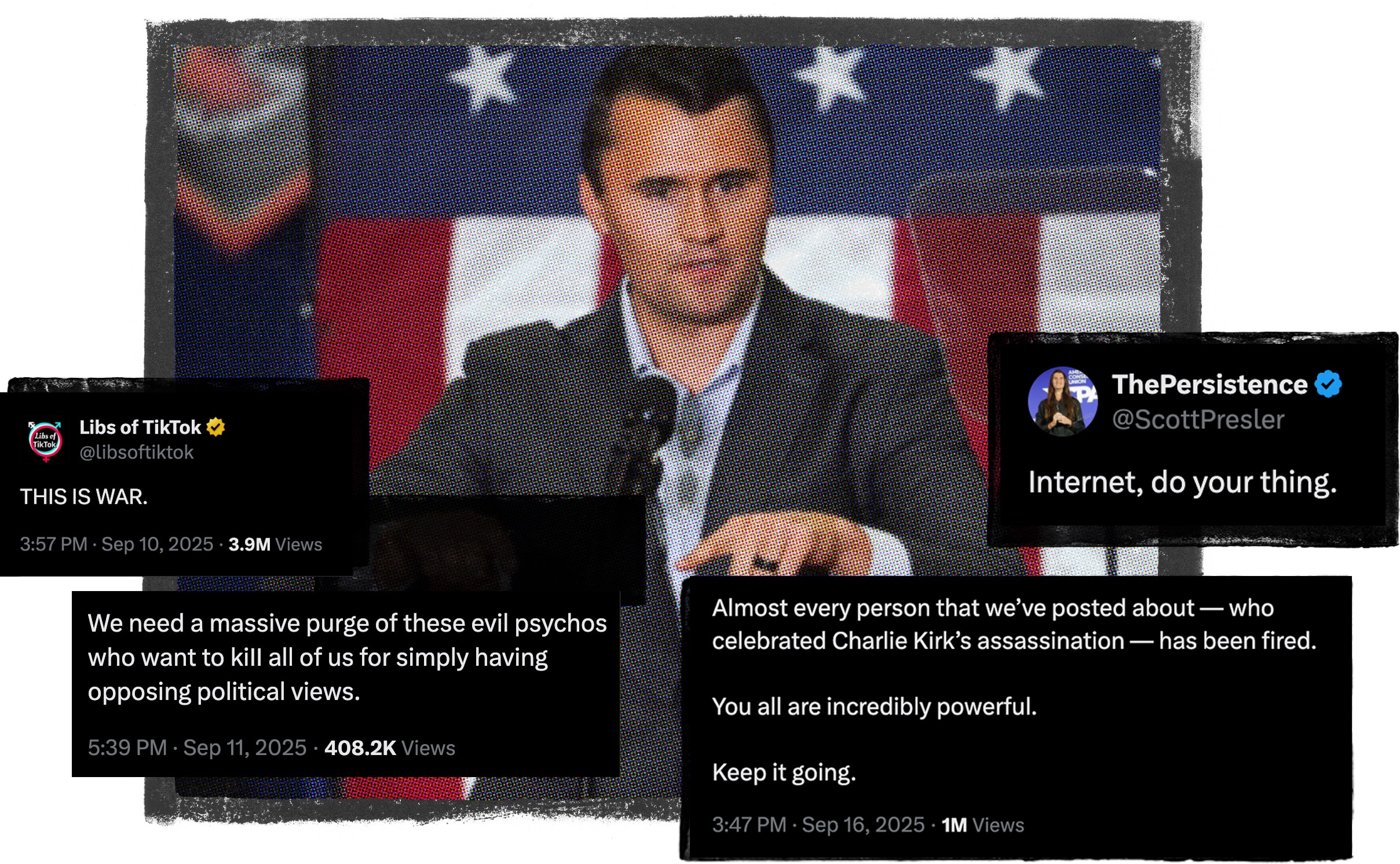
Illustration: John Emerson, photo: REUTERS/Go Nakamura
When Lauren Vaughn, a kindergarten assistant in South Carolina, saw reports that right-wing influencer Charlie Kirk had been shot at an event in Utah, she opened Facebook and typed out a quote from Kirk himself.
Gun deaths, Kirk said in 2023, were unfortunate but “worth it” if they preserved “the Second Amendment to protect our other God-given Rights.” Following the quote, Vaughn added: “Thoughts and prayers.”
Vaughn, a 37-year-old Christian who has taken missionary trips to Guatemala, said her call for prayer was sincere. She said she hoped reading Kirk’s words in the context of the shooting might prompt her friends to rethink their opposition to gun control.
“Maybe now they’ll listen,” she recalled thinking.
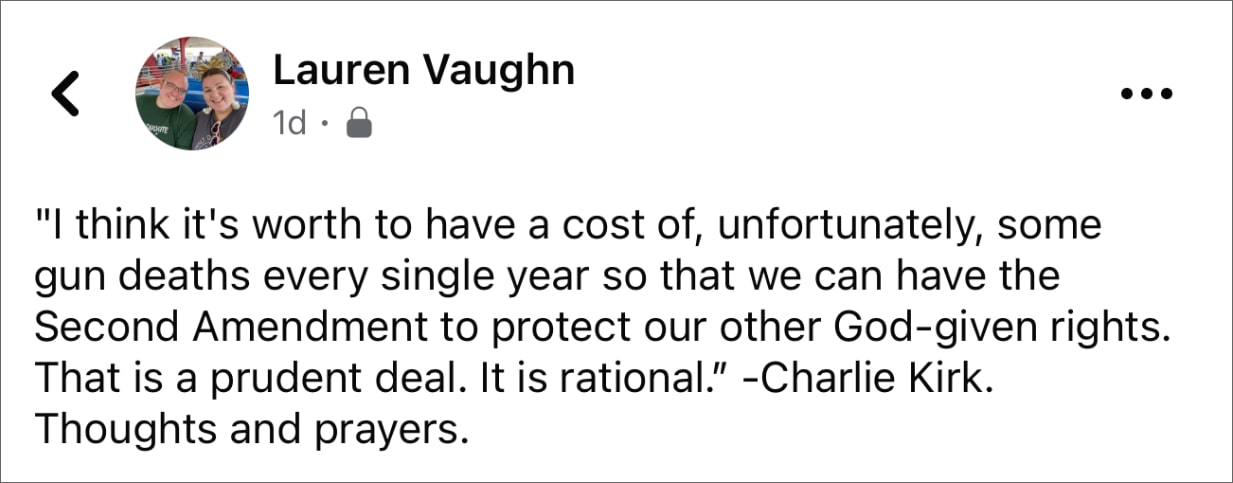
Social media post by Lauren Vaughn quoting Charlie Kirk
A few days later, Vaughn lost her job. She was one of more than 600 Americans fired, suspended, placed under investigation or disciplined by employers for comments about Kirk’s September 10 assassination, according to a Reuters review of court records, public statements, local media reports and interviews with two dozen people who were fired or otherwise disciplined.
Some were dismissed after celebrating or mocking Kirk’s death. At least 15 people were punished for allegedly invoking “karma” or “divine justice,” and at least nine others were disciplined for variations on “Good riddance.” Other offending posts appeared to exult in the killing or express hope that other Republican figures would be next. “One down, plenty to go,” one said.
Lauren Vaughn, a teacher assistant in South Carolina, was fired after she posted on social media a quote from Charlie Kirk about gun violence. REUTERS/Allison Joyce
Others, like Vaughn, say they simply criticized Kirk’s politics.
In the pro-Kirk camp, at least one academic was put on administrative leave after threatening to “hunt down” those celebrating the assassination.
This account is the most comprehensive to date of the backlash against Kirk’s critics, tracing how senior officials in President Donald Trump’s administration, local Republican lawmakers and allied influencers mobilized to enforce the Trump movement’s views. The story maps the pro-Trump machinery of retaliation now reshaping American political life, detailing its scale and tactics, ranging from shaming on social media to public pressure on employers and threats to defund institutions. Earlier reports by Reuters have documented how Trump has purged the federal government of employees deemed opponents of his agenda and cracked down on law firms defending people in the administration’s crosshairs.
Americans sometimes lose their jobs after speaking out in heated political moments. Twenty-two academics were dismissed in 2020, the year George Floyd was murdered by a Minneapolis police officer, most for comments deemed insensitive, according to the Foundation for Individual Rights and Expression, a free-speech advocacy group. In 2024, the first full year following the outbreak of the latest Israel-Gaza war, more than 160 people were fired in connection with their pro-Palestinian advocacy, according to Palestine Legal, an organization that protects the civil rights of American supporters of the Palestinian cause.
The backlash over comments about Kirk’s shooting stands apart because of its reach and its public backing from Trump, Vice President JD Vance and other top government officials. It represents a striking about-face for Republicans, who for years castigated the left for what they called “cancel culture” – the ostracism or punishment of those whose views were deemed unacceptable.
Supporters of the firings say that freedom of speech is not freedom from consequence. Standards of behavior should be high for people like doctors, lawyers, teachers or emergency workers who are in positions of public trust, they said.
In a statement, White House spokesperson Abigail Jackson said: “President Trump and the entire Administration will not hesitate to speak the truth – for years, radical leftists have slandered their political opponents as Nazis and Fascists, inspiring left-wing violence. It must end.” She added: “no one understands the dangers of political violence more than President Trump” after he survived two assassination attempts.
Trump compared Kirk to assassinated civil rights icon Martin Luther King Jr. when posthumously awarding him the Presidential Medal of Freedom. REUTERS/Cheney Orr
Turning Point USA, the youth movement Kirk founded in 2012, said in a statement that it supported the right to free speech, “including that of private employers to determine when a bright line has been crossed and an employee deserves to be terminated.” The organization, however, cautioned that while celebrating or gloating over Kirk’s death was “evil and disqualifying behavior, respectfully disagreeing with his ideas, statements, or values is every American’s right.”
Vaughn is challenging her dismissal in a federal lawsuit filed September 18, seeking reinstatement. As part of the case, she submitted a letter she received from the Spartanburg County School District superintendent that described her remarks as “inflammatory, unprofessional, and inappropriate.” Responding to the lawsuit, the district said Vaughn’s post “appeared to endorse Mr. Kirk’s murder or indicate that it was ‘worth’ him losing his life to protect Americans’ constitutional rights.”
The district declined further comment.
The punishments have often been driven by social media campaigns that circulate screenshots of the offending remarks, along with the names and phone numbers of employers, and appeals such as, “Internet, do your thing.” What typically follows are hundreds of angry or threatening messages, Reuters found. Several individuals who were targeted said in interviews they were inundated with phone calls. One recalled receiving a call every minute for an entire day. At least two said the harassment was so intense they plan to sell their homes.
Julie Strebe, a sheriff’s deputy in Salem, Missouri, lost her job after posting comments on Facebook about the shooting, including “Empathy is not owed to oppressors.” She later said she viewed Kirk as an oppressor because, in her words, he sought to marginalize vulnerable groups and used his platform to rally conservative white Christians behind “racist, sexist, hateful views.” She said her bosses were besieged with calls for her dismissal and that, at one point, a hand-drawn sign appeared across from her home reading, “Julie Strebe Supports the Assassination of Charles Kirk.”
Message posted outside Julie Strebe’s house. Handout via REUTERS
Strebe said she installed five surveillance cameras at her home and now fuels her car only at night to avoid neighbors. Moving from Salem would mean leaving extended family, but she said the small city has grown too hostile to stay. “I just don’t feel like I could ever let my guard down,” she said in an interview. Strebe’s former employer, the Dent County Sheriff’s Office, declined to comment.
Many Republican officials have embraced the punitive campaign. Some have proposed extraordinary measures, including lifetime bans from social media for those deemed to be revelling in Kirk’s death. The U.S. State Department revoked visas for six foreigners who the agency said “celebrated the heinous assassination of Charlie Kirk.” Speaking on a special episode of Kirk’s podcast on September 15, Vice President JD Vance urged his listeners to inflict consequences on those celebrating Kirk’s death.
“Call them out, and, hell, call their employer,” Vance said. Vance’s office pointed Reuters to comments made earlier this year in which the vice president said, “where I draw the line is encouraging violence against political opponents.”
Vice President JD Vance hosts an episode of 'The Charlie Kirk Show' at the White House, following the assassination of the show's namesake. Doug Mills/The New York Times/Pool via REUTERS
Call them out, and, hell, call their employer.
Vice President JD Vance
Some academics compared the backlash to the “Red Scare,” the anti-Communist purge that peaked in the 1950s, when officials, labor leaders and Hollywood figures were accused of Communist ties. Thousands were investigated in a climate of fear that shaped U.S. politics and culture for a generation. There are “very disturbing parallels,” said Landon Storrs, a University of Iowa history professor.
Several prominent Republicans have voiced unease at the clampdown, especially after the Federal Communications Commission openly pressured broadcaster ABC to suspend talk show host Jimmy Kimmel following a monologue in which he suggested that Kirk’s assassin hailed from the political right. Police haven’t fully detailed the findings of their investigation into suspect Tyler Robinson and his motives. Robinson hasn’t entered a plea to the murder and other charges against him.
Republican Senator Ted Cruz warned on his podcast that letting government decide “what speech we like and what we don’t” sets a dangerous precedent. Silencing voices like Kimmel’s might feel good, he said, but “when it’s used to silence every conservative in America, we will regret it.” His spokesperson declined further comment.
Screen capture of Jimmy Kimmel after returning to television on September 23, 2025
‘MASSIVE PURGE OF THESE EVIL PSYCHOS’
The campaign to punish Kirk’s critics began almost immediately.
About 30 minutes after Trump’s announcement that Kirk had died, right-wing influencers mobilized. Among the first was Chaya Raichik, operator of the widely followed Libs of TikTok account, which had posted on X, “THIS IS WAR,” before highlighting a Massachusetts teacher who had written: “Just a reminder, We’re NOT offering sympathy.”
By night’s end, Libs of TikTok had published or reposted the professional details of 37 individuals, often accompanied by commentary such as “absolutely vile,” “Your tax dollars pay her salary,” or “Would you want him teaching your kids?”
“It’s actually terrifying how many of them are teachers, doctors and military members,” Libs of TikTok wrote the next day. “We need a massive purge of these evil psychos who want to kiII all of us for simply having opposing political views.”
In the week after the shooting, Libs of TikTok shared the names and profiles of at least 134 people accused of celebrating violence or mocking Kirk’s memory, frequently tagging Trump administration officials including Defense Secretary Pete Hegseth and Attorney General Pam Bondi. At times, the influencer posted disciplinary actions taken against specific government employees.
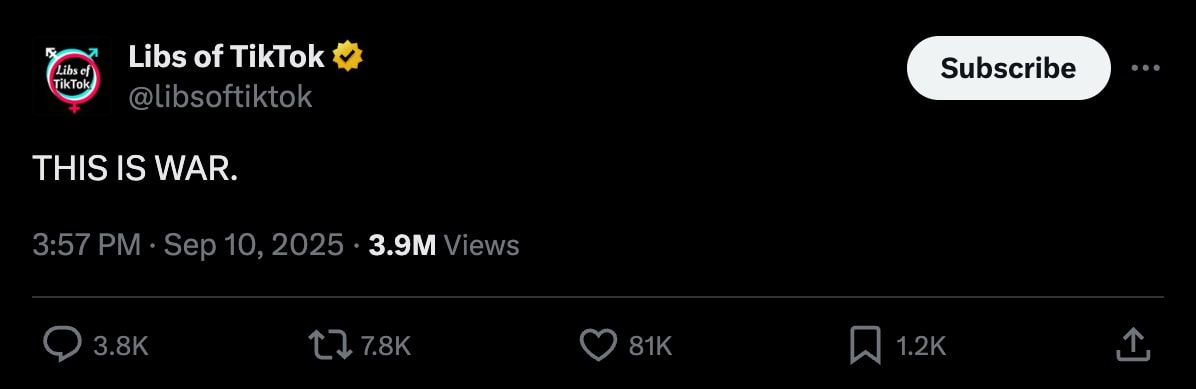
Screenshot of the Libs of TikTok X account on September 10, 2025
“BREAKING: This marine was fired,” Libs of TikTok posted on September 12, a day after calling out a Marine Corps captain. The officer had responded to Kirk’s death by posting an emoji of clinking beer mugs, according to a screenshot the influencer shared with followers. Reuters could not verify the authenticity of the beer-mug post; the captain declined to comment. Libs of TikTok also reported similar disciplinary actions involving an Army Reserve officer and an Army colonel who had commented on the death on social media.
The Pentagon and the Justice Department issued statements condemning celebrations of Kirk’s death but did not address questions about their relationship with Libs of TikTok.
Right-wing influencer Scott Presler began posting screenshots of Kirk commentary, too.
“Take a screenshot of EVERY single person celebrating today,” he told his followers on September 10. “You bet your behind we will make them infamous.” Over the next week, Presler shared posts on X about 70 people who had commented on the killing, and wrote in one message: “Almost every person we’ve posted about – who celebrated Charlie Kirk’s assassination – has been fired.” Presler didn’t respond to requests for comment.
For many on the right, outraged by celebratory reactions from the left, the wave of firings became a form of catharsis.
“It’s good that they are shamed and humiliated and must live with the repercussions for the rest of their lives,” right-wing podcaster Matt Walsh told his audience as he discussed the firings. “It’s good if they wake up every day until they die wishing they had not said what they said.” Asked for comment, Walsh emailed back: “f**k off.”
On YouTube, video blogger and recovery coach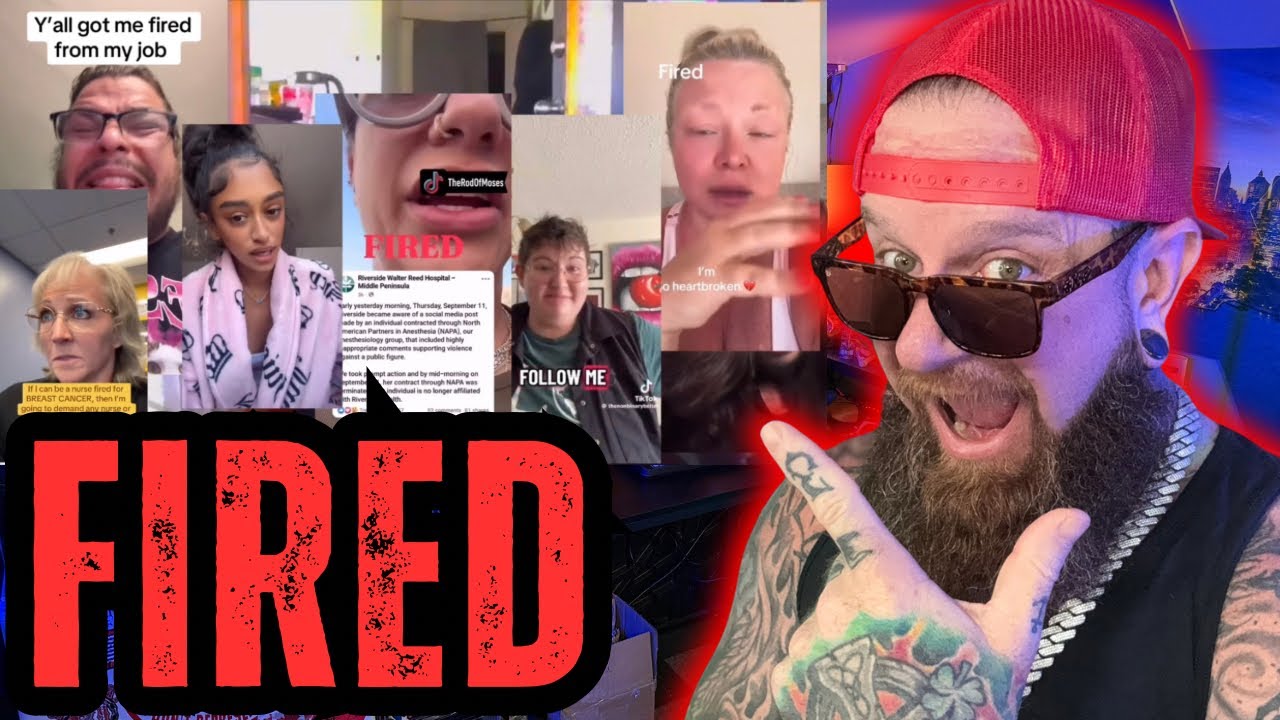 as he read aloud names of those who had lost their jobs over their remarks.
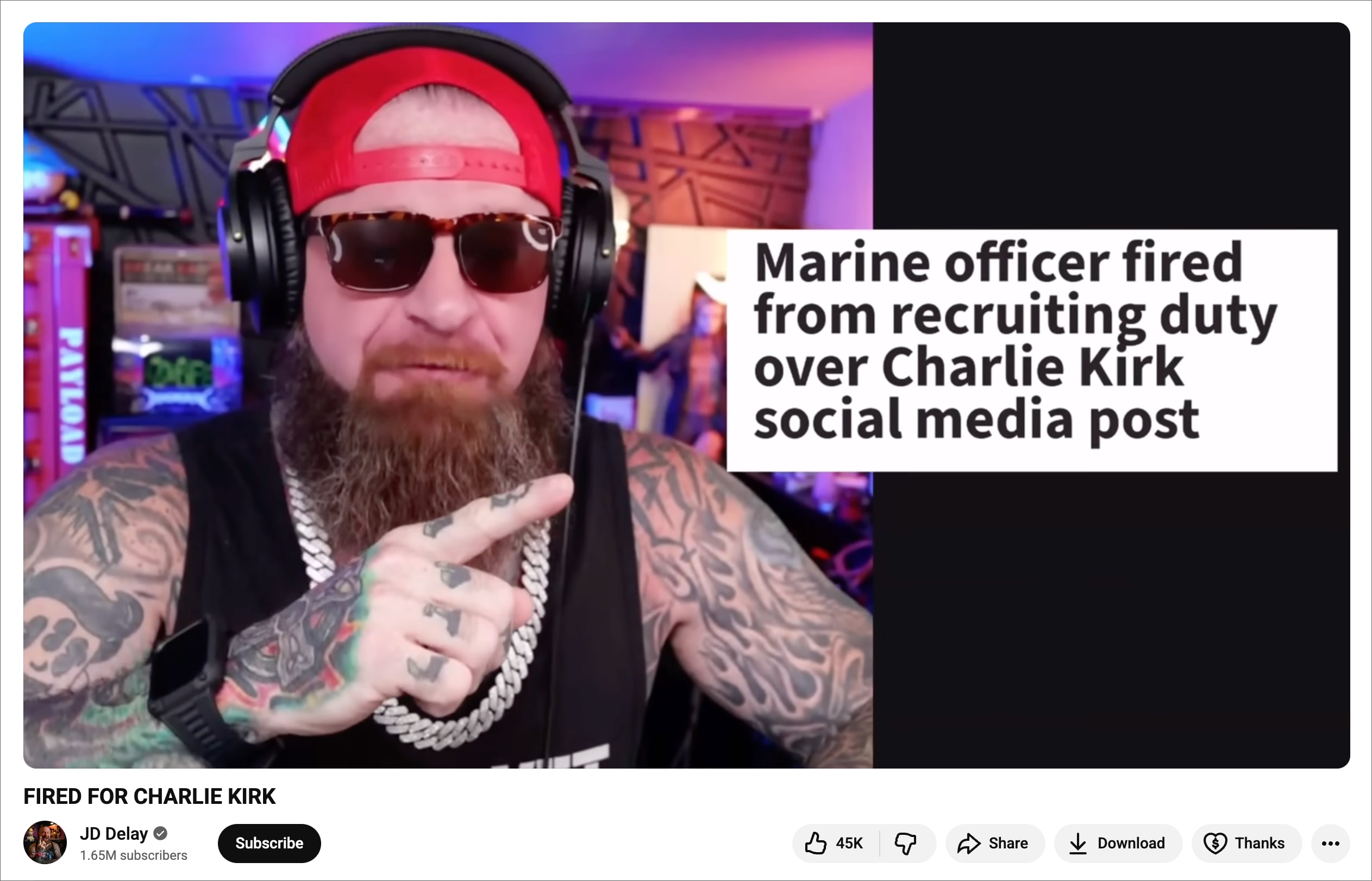
Screen capture of JD Delay on YouTube
“I’m having fun! This is so much fun!” he shouted, raising his hands in excitement. Delay told Reuters that he believes in “accountability and consequences” and that “if you publicly say abhorrent things and get fired from your job, I’m going to laugh at you.”
The punishment campaign sometimes veered off course. In at least five cases, people were wrongly blamed for comments made by others. In another case, a website that drew up a blacklist called “Expose Charlie’s Murderers” vanished after taking in tens of thousands of dollars in cryptocurrency donations. Attempts to identify and seek comment from the site’s creators were unsuccessful.
Several online influencers said they received hundreds – sometimes thousands – of tips from individuals seeking to get Kirk’s detractors fired. Reuters was unable to verify those figures. But at various points, Presler, Libs of TikTok and other right-wing personalities publicly urged tipsters to be patient as they worked through the volume of submissions.
“Can’t keep up with all of you,” Presler wrote on X on September 12. “Post your submissions below & I’ll go through them as I can.”
A day later, the post had drawn more than 2,700 replies.
Scott Presler (R) shared posts on X about dozens of people who had commented on Kirk's killing. REUTERS/Leah Millis
The tally of more than 600 people punished for criticizing Kirk is likely an undercount. Many companies and government organizations haven’t publicly disclosed terminations or suspensions.
Those punished came from at least 45 states and represented a cross-section of society, from soldiers and pilots to doctors, nurses and police officers.
In Michigan, an Office Depot employee was fired after being filmed refusing to print a poster memorializing Kirk. In Ohio, a Starbucks barista lost her job after she was accused of writing an anti-Kirk message on a cup of mint tea.
Reuters couldn’t determine the identities of the Office Depot worker or the barista. Office Depot and Kroger – the grocery store chain that runs the Ohio Starbucks – condemned the anti-Kirk incidents and said the people involved were no longer employees.
Requests to 21 federal agencies – including Homeland Security, Veterans Affairs and the Defense Department – for the number of suspensions or dismissals tied to the Kirk assassination were either ignored or declined. When the Office of the Director of National Intelligence was contacted, its deputy chief of staff responded on social media, accusing Reuters of trying to generate sympathy “for the ghouls who celebrate his death.”
EDUCATORS AMONG THE MAIN TARGETS
Teachers, academics and university administrators were among those most frequently punished for criticizing Kirk. More than 350 education workers were fired, suspended or investigated in the days following the assassination, including 50 academics and senior university administrators, three high school principals, two cheerleading coaches and a theology instructor.
The prominence of educators in the backlash may stem from several factors. As leaders tasked with shaping young minds, teachers have long been cast by some conservatives as ideologues who aim to pull their students left. Their status as taxpayer-funded employees made any perceived partisan commentary especially combustible.
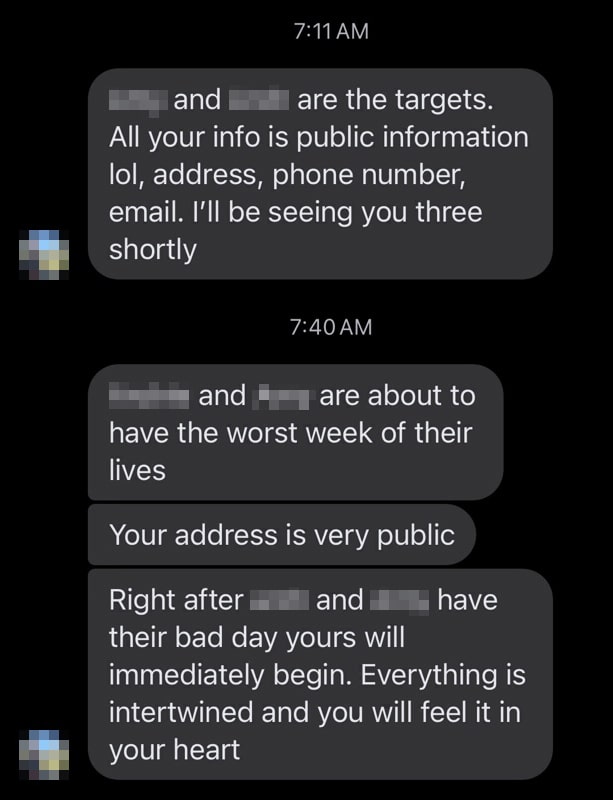
Screen capture of a threatening message received by an individual who posted comments about Kirk’s death. Photos and names pixelated by Reuters.
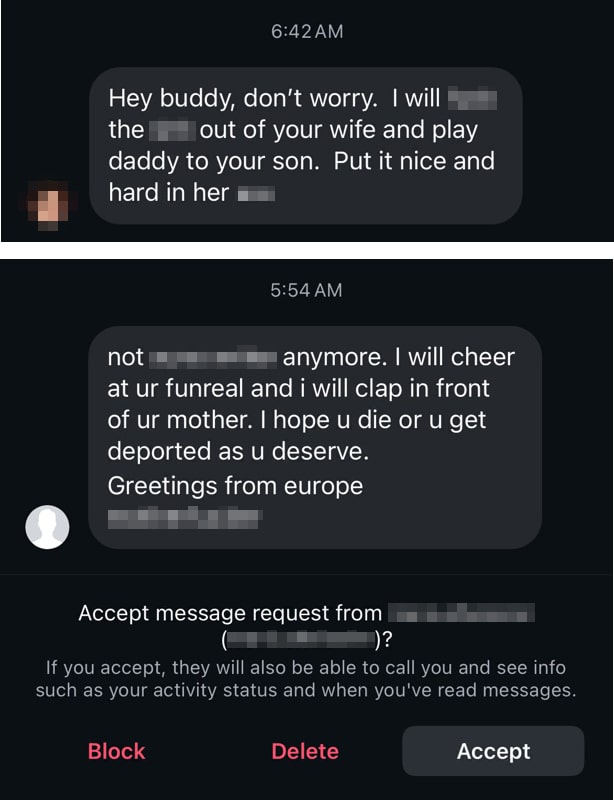
Additional menacing messages received by the individual. Photo and offensive language pixelated by Reuters.
In interviews and public statements, at least six teachers cited another reason for speaking out: concern over the frequency of gun violence at schools nationwide – and anger at those, like Kirk, who have championed widespread access to firearms.
Vaughn, the South Carolina kindergarten assistant, said that was front of mind when she went to Facebook to quote Kirk’s 2023 remark dismissing some fatal shootings as the price to pay to protect gun rights. Like other teachers across the country, she said she regularly practiced active-shooter drills at her elementary school and saw fear on her five-year-olds’ faces as they learned how to hide from a gunman.
As she defended her post on the day of Kirk’s death, she told a Facebook friend that she felt “no satisfaction” at the assassination. “Just heartbreak for everyone and anyone affected by gun violence and the hope that one day, enough will be enough.” Speaking to Reuters later, she said, “The one thing I want people to know is that my message was out of concern for the kids.”
Related Content
Many educators did celebrate Kirk’s death, including a Virginia teacher who wrote, “I hope he suffered through all of it,” and a Texas middle school intern who said the shooting “made me giggle.” Screenshots of both posts were circulated by right-wing influencers. Reuters could not locate the original posts, which may have been deleted or made private. The Virginia teacher was suspended and the Texas intern was fired. Neither could be reached for comment.
While schools that suspended or fired educators cited disruptions to the learning environment, some private employers pointed to a violation of company values or safety concerns as the basis for terminations. Corporations caught up in the backlash gave a variety of explanations: Delta Air Lines CEO Ed Bastian said in a statement some employees’ comments were in “stark contrast” to the company’s values and violated its social media policy, while a United Airlines statement said the company had “zero tolerance for politically motivated violence or any attempt to justify it.”
At least a dozen Kirk critics who took pains to condemn the shooting also found themselves out of jobs or suspended, sometimes after Republican lawmakers got involved.
In the wake of Kirk’s death, Joshua Bregy, a climate scientist at Clemson University in South Carolina, shared another user’s Facebook post that read, in part: “No one should be gunned down – not a school child, not an influencer, not a politician – no one. But am I going to allow people to make a martyr out of a flawed human being whose rhetoric caused notable damage? Not a chance.”
The Clemson College Republicans reposted part of his message, labeling him “ANOTHER leftist professor” and calling for his termination. The post was amplified by right-wing influencers and Republican state lawmakers who threatened to defund the public university unless Bregy was fired.
Clemson initially pledged in a September 12 statement to “stand firmly on the principles of the U.S. Constitution, including the protection of free speech.”
The next day, Trump himself reposted a state lawmaker’s call to “Defund Clemson.” On September 16, after South Carolina’s House speaker and Senate president sent a letter to Clemson’s trustees demanding they “take immediate and appropriate action,” the school fired Bregy. Bregy’s Facebook post was “blatantly unprofessional” and “seriously prejudicial to the university,” Clemson said in a letter informing Bregy he had been dismissed.
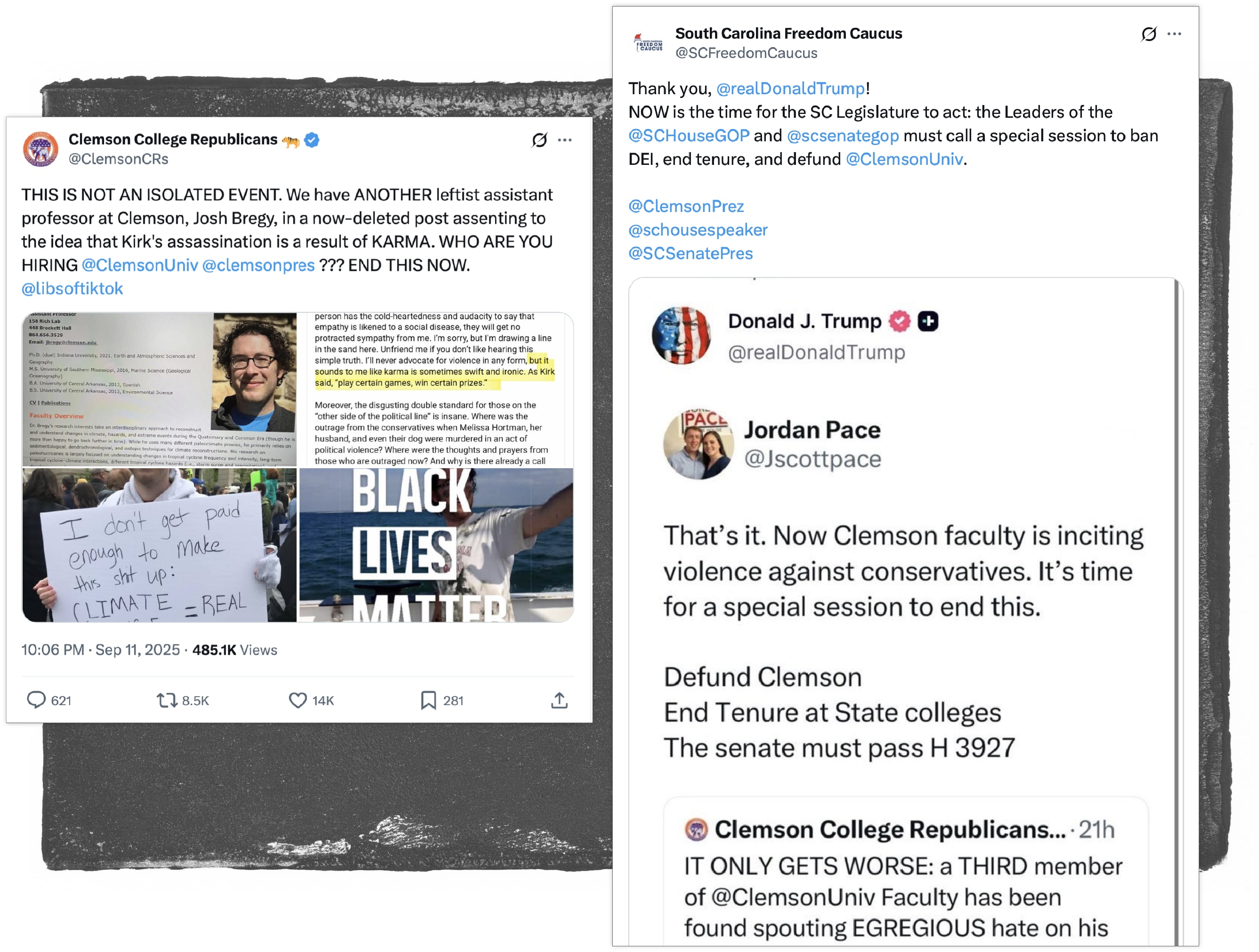
Screen captures of social media posts urging Clemson University to fire Josh Bregy
Bregy is suing Clemson in a South Carolina federal court in a bid to be reinstated. His lawyer, Allen Chaney, said the academic would have kept his job “but for the really aggressive, coercive tactics of elected officials in South Carolina.”
Clemson, State House Speaker Murrell Smith and Senate President Thomas Alexander did not respond to requests for comment. Clemson has yet to file a response to Bregy’s suit.
In at least six other cases, Republican officials publicly threatened to deprive universities and schools of taxpayer funds unless specific critics of Kirk were fired.
Chaney, who serves as legal director of the South Carolina chapter of the American Civil Liberties Union, said the threats to defund Clemson and others crossed a constitutional line. “The government can’t police speech by pressuring third parties,” he said. Last year, the Supreme Court unanimously held that government officials cannot use their authority to “attempt to coerce” private parties into punishing or suppressing speech they dislike.
The threats to defund schools that resist firing Kirk’s critics were “stunning,” said Paul McGreal, a constitutional law professor at Creighton University Law School in Nebraska. “Government officials are threatening speakers with punishment because they disagree with what they’re saying. These are core First Amendment protections that they’re violating.”
KIRK PRAISED AS CHRIST’S ‘13TH DISCIPLE’
Since Kirk’s assassination, many Republicans have cast him as a saintly champion of free expression. Evangelical figures have likened him to Saint Stephen, revered as Christianity’s first martyr. One Republican lawmaker told Congress “he’d have been the 13th disciple” had he lived in Biblical times. Trump compared Kirk to the ancient Greek philosopher Socrates, slain President Abraham Lincoln and assassinated civil rights icon Martin Luther King Jr. when posthumously awarding him the Presidential Medal of Freedom.
Kirk’s legacy is complicated, however. He gained fame for debating college students as part of his work with Turning Point. Kirk also advocated criminalizing expression – such as pornography – that clashed with his Christian views. When Black football players started kneeling during the national anthem in protest at police brutality, he backed Trump’s call to strip the National Football League of taxpayer subsidies. The White House later said Trump was making a statement, not a proposal.
Kirk repeatedly denigrated minorities, calling transgender people an “abomination,” warning of “prowling Blacks” in cities, accusing wealthy Jews of stoking “hatred against Whites,” and declaring Islam incompatible with Western civilization. He also dismissed Pope Francis as a Marxist.
Some of those who spoke out against Kirk after his death said they were disturbed by the hagiography.
Kimberly Hunt, a human resources worker in Arizona, was fired after posting a critical video message about Kirk. REUTERS/Caitlin O'Hara
“I just felt compelled to remind people who he was and what he stood for,” Kimberly Hunt, a human resources worker in Arizona, said in an interview. She had posted a video captioned, “Save your tears for his victims, not him.”
In the video, Hunt cited Kirk’s record of using derogatory language about transgender people and Muslims, before adding that his children “are better off without him.” Hunt was fired soon after. Her employer, an Arizona construction firm, did not respond to requests for comment.
Hunt told Reuters she understood her words sounded harsh but stood by them. She said they reflected Kirk’s stance in a debate last year that if he had a 10-year-old daughter who was impregnated through rape, “the baby would be delivered.”
The retaliation has silenced many voices. Scores of people who posted anti-Kirk comments have since scrubbed or locked their accounts, Reuters found. Others said in interviews that they are pushing back.
Hunt said she has raised more than $88,000 from a GoFundMe campaign titled, “Doxxed, Fired, but Not Silenced.” She said she wants to use the money to further her education, become a content creator, and keep calling out people like Kirk.
“It’s definitely just emboldened me,” she said.
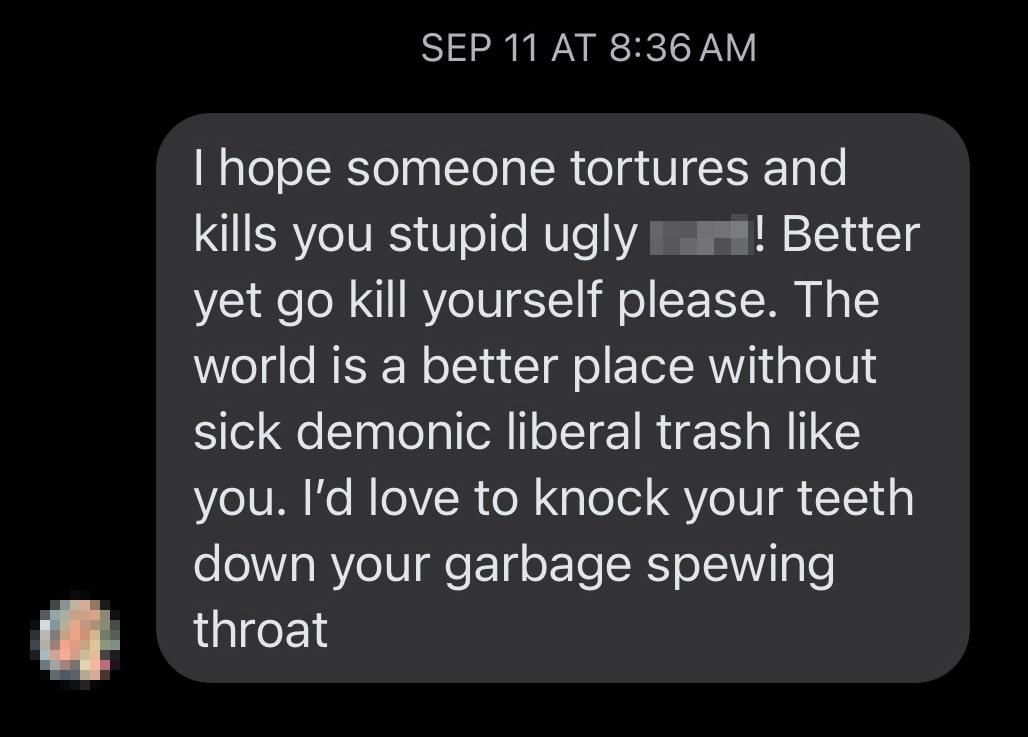
Screenshot of a threatening message Kimberly Hunt received on Facebook. Photo and offensive language pixelated by Reuters.
At least 19 lawsuits have been filed against employers who punished Kirk critics, state and federal court records show. At least two plaintiffs have succeeded, including an academic in South Dakota who got his teaching job back.
Karen Leader, an associate professor at Florida Atlantic University, took to social media after Kirk’s death to protest a narrative that he “was a shining inspiration to youth and a noncontroversial figure who just wanted to have open and civil dialogue,” she said. “Anyone who’s in higher education knows that it’s not that simple.”
She noted that Turning Point rose to prominence through its Professor Watchlist, a site that encouraged students to report faculty for allegedly holding “radical left” views or being a “terror supporter.”
Kirk had described the Watchlist as an awareness tool, not a blacklist. Those on it have said in interviews, social media posts and public forums that it fostered harassment and intimidation. In 2023, a Turning Point reporter was accused of assaulting an Arizona professor who was on the watchlist after confronting him on camera about his sexuality and shoving him to the ground. The reporter admitted to harassment, assault and disorderly conduct and was ordered to complete a diversion program. A Turning Point cameraman admitted to harassment in the case.
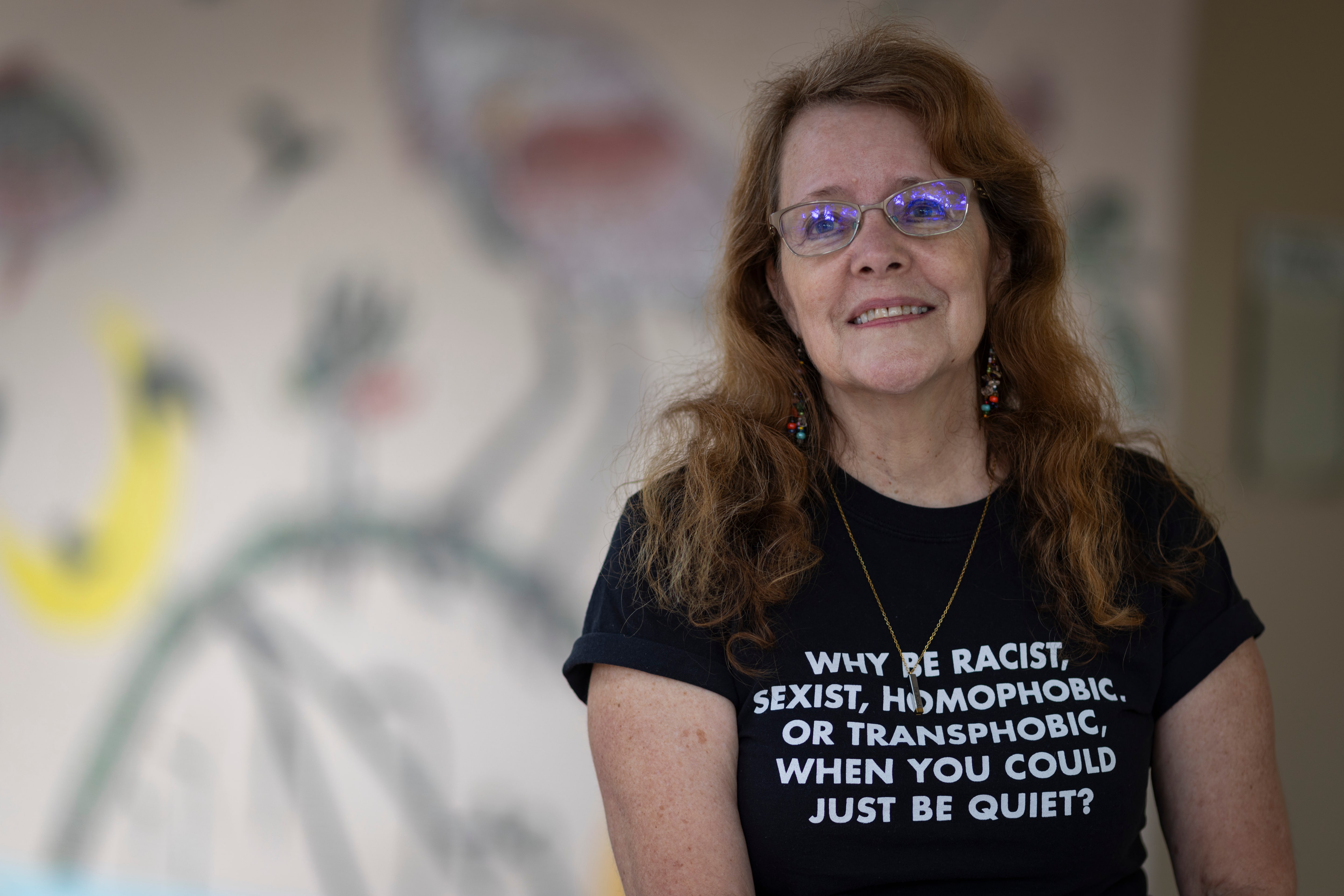
Karen Leader, an associate professor of art history at Florida Atlantic University, was placed on administrative leave after she posted about Kirk on social media. REUTERS/Marco Bello
On September 10, Leader began posting Kirk’s past statements on X. She said she made a mistake by incorrectly accusing Kirk of having uttered an ethnic slur and then deleted it. The rest of her posts she said she stands behind, including one highlighting Kirk’s claim that Black Americans were “better” during Jim Crow.
“None of it was me encouraging violence,” Leader said. “I was sharing evidence.”
Jordan Chamberlain, a former staffer of Florida Governor Ron DeSantis, shared screenshots of several of Leader’s posts and tagged her university, asking if it approved of the content. Libs of TikTok shared Leader’s faculty headshot. The university’s president announced she had been put on administrative leave. Her address and phone number appeared online, and menacing messages followed.
A voicemail left in September for associate professor Karen Leader after she posted online about Kirk
In one voicemail reviewed by Reuters, the caller said: “We’re coming to get you. Karen Leader, we know where you work. We’re gonna come to your home as soon as we have your location.” Leader said she has rarely left her apartment since.
She reported the threats to Boca Raton police, which referred the case to campus officers, according to a police report. Florida Atlantic University police said their report could not be released because of an active criminal investigation.
Florida Atlantic University confirmed Leader was one of three academics who were on leave pending investigations. It declined further comment. Chamberlain also didn’t return an email seeking comment.
“Whether my career is over or not, I don’t know,” Leader said. “But my life has changed.”
The Reuters Daily Briefing newsletter provides all the news you need to start your day. Sign up here.
Additional reporting by Phil Stewart, Jana Winter, and Courtney Rozen in Washington and Isaac Vargas in Los Angeles. Edited by Jason Szep and Linda So.
---
---
YIKES TRUMP ATTACKS AP THO COURTS BACK; KARI CUTS FOR OANN --> EARTH2 --> FASCISM NO SHARED FACTS
OMFG
mma
Kari Lake says Voice of America will push OAN content abroad. This is how network personalities discussed foreign policy since Trump took office.
Written by Jane Lee, Helena Hind & Isabella Corrao
Published 05/16/25
Trump adviser Kari Lake has announced that international broadcasting network Voice of America will include content from One America News Network, a pro-Trump propaganda network.
Since Donald Trump's inauguration, OAN personalities have pushed bizarre and inflammatory foreign policy commentary, including referring to Canada as “our vassal state,” calling Greenland ”the new Africa,” and pushing for a revival of “manifest destiny.” They’ve also run cover for Trump over his planned acceptance of a luxury jet from Qatar.
The Trump administration wants to feed content from OAN to Voice of America — after canceling contracts with existing wire services
- Kari Lake, senior adviser for the U.S. Agency for Global Media, announced that the government-funded broadcaster would be fed content from One America News, a notoriously pro-Trump network.Lake announced that the agency will provide “newsfeed services” to Voice of America, and to the Office of Cuba Broadcasting and Radio Martí, which distribute news into Cuba. NPR, [4/22/25, 5/7/25; Washington Post, 5/7/25]
- Voice of America, an international broadcasting network, is funded by the federal government but required by law to maintain editorial independence. NPR writes: “The … networks deliver information to countries around the world that lack a robust or free press. The networks are intended to promote American democratic values by broadcasting news that models independent journalism, incorporates political debate and dissent even inside the U.S.” NPR, [4/22/25; Society of Professional Journalists, 3/17/25]
- The government agency that runs the Voice of America moved to terminate contracts with The Associated Press, Reuters, and Agence France-Presse. The AP reported that VOA staffers were told to stop using wire service material for their reports. Associated Press, [3/14/25]
- After the 2020 election, OAN promoted false claims that the election had been stolen from Trump and was repeatedly sued for those claims, ultimately settling the suits.The network repeatedly accused Smartmatic, Dominion Voting Systems, and two Georgia election workers of helping rig the election, with Trump even recycling one of the election conspiracy theories it helped mainstream. The network was subsequently sued for defamation in separate lawsuits and has since reached settlements. Media Matters, [12/16/20, 12/22/20, 4/15/21; NPR, 5/7/25]
- ## What One America News personalities have said about foreign affairs in 2025 so far
- Discussing the challenges of next steps for the Gaza Strip, host Dan Ball said, “That’s why Trump says maybe we need to relocate everyone, Jordan or Egypt,” adding, “And then you rebuild it. … It’s going to look like a whole different world in the Gaza Strip and the Middle East after this is done.” One America News, *Real America with Dan Ball*, [2/17/25]
---
---
fail
https://fair.org/home/manufacturing-disgrace-reuters-distorts-chevron-v-donziger/
---
===
Financial Times, Reuters Pull Saudi Aramco-sponsored Climate Content - DeSmog
5 24
---
How Oil Companies Manipulate Journalists | The Nation
drilled
“kill the story.”
That’s what Alan Jeffers, a media relations manager at ExxonMobil, told the :{Houston bureau chief of Reuters in October 2016, about a year after InsideClimate News, the Los Angeles Times, and Columbia Journalism School began publishing reports revealing ExxonMobil’s decades-long campaign to deny climate science.}:
https://www.thenation.com/
The Reuters bureau chief had forwarded Jeffers a press release from the Center for Media and Democracy about a filing the group made to the IRS alleging that the American Legislative Exchange Council was abusing its nonprofit status by lobbying for Exxon’s climate-denial policies. (The Reuters journalist did not respond to requests for comment.)
“It’s inaccurate and misleading to your readers and part of the activists’ stated objective to delegitimize a company that obeys the law, provides a product we couldn’t live without and generates significant jobs and economic activity for the country and the world,” Jeffers wrote.
“Hey man, I just said somebody asked me to file on it,” the Reuters bureau chief responded. “I didn’t say a story was going to run.”
Jeffers apologized (“clearly need more coffee… sorry again for the rant”) and forwarded the exchange to Cynthia White, Exxon’s then–government affairs manager.
“This is so great,” White wrote back. She joked that all Exxon employees should change their e-mail signatures to include Jeffers’s claims about activists trying to delegitimize the oil giant.
**This exchange is part of a trove of 4,700 internal oil-and-gas-industry documents released by House Oversight Committee Democrats in late April in advance of its bicameral hearing with the Senate Budget Committee, “Denial, Disinformation, and Doublespeak: Big Oil’s Evolving Efforts to Avoid Accountability for Climate Change.” The documents are the second cache of materials obtained from a House Oversight investigation into the industry’s campaign to deceive the public on how its products drive the climate crisis.
As a reporter, it’s satisfying to see how the companies we cover talk about journalists in private. The documents range from company materials discussing marketing strategy to moments of internal strife as execs clash with colleagues and reporters. I have to confess to loving some of the mess, from higher-ups at Shell expressing frustrations about the company’s president to Exxon CEO Darren Woods taking issue with the use of spacing in a document.
Stepping back, these documents also reveal what coverage these fossil-fuel companies are pleased to receive, the kinds of reporters they try to curry favor with, and the ways they try to manipulate journalists. They also show how Big Oil could actually get a more pliant media it so desperately wants.
In September 2015, InsideClimate News and the Los Angeles Times, in collaboration with Columbia University, published their first reports on how ExxonMobil conducted its own climate-science research and yet for decades continued to fund climate denial and lobby for inaction on climate change. In an internal e-mail sent in early December of that year, Pamela Kevelson, then a corporate communications writer at Exxon, discussed how the company could continue to push back on the stories.
“We don’t actually dispute much of what these stories report…but it’s how you interpret the facts,” Kevelson wrote (emphasis in the original).
The question is why did THEY interpret the facts so negatively?
It helps to really hammer home the difference between these advocacy-funded journalists and traditional journalists. If I am an energy reporter at the New York Times…am I looking at these stories and thinking, “Wow. That’s a great scoop. Wish I got that.” Or am I thinking, “The story seems pretty thin, and it sucks that these guys are getting attention for that article.” My guess is it’s the latter.
(InsideClimate News was nominated for a Pulitzer Prize for its reporting on Exxon.)
For nearly a century, the oil and gas industry has been obsessed with controlling its image in the media, especially in outlets that cater to elite audiences. Beginning in 1970, Mobil Oil Corporation ran advertisements promoting its product and views in the New York Times opinion section that were designed to look like columns—material that later became known as “advertorials”—and also sponsored PBS’s Masterpiece programs. The partnership, the company’s vice president for public affairs, Herb Schmertz, later said, helped establish Mobil, which merged with Exxon in the 1990s, in the public’s eye as “the thinking man’s oil company.”
But in the middle of the last decade, that carefully constructed image began to crumble. Kevelson was both correct and off the mark in her predictions of how journalistic powerhouses would react to the story that Exxon lied to the public. Though outlets like The Washington Post, The New York Times, and the television networks were slow to cover the Exxon revelations, a number of outlets began to examine what Big Oil knew about how its product was driving climate change and when the industry knew it.
A slew of legal action followed. First, investigations from attorneys general in New York, Massachusetts, and the US Virgin Islands, and then, beginning in 2017, a cascade of lawsuits from cities, states, tribes, and municipalities. There were nearly 30 ongoing cases as of the start of this year, according to the Center for Climate Integrity. Meanwhile, the 2015 Paris Agreement, for the first time, got the world to promise to bring down emissions. Many major oil companies, sensing a PR opportunity, put out statements in support of the accords.
The documents released by the Senate Budget Committee, which range from 2015 to early 2022, portray an industry searching for a foothold in a changing world. While publicly declaring support for the Paris Agreement and touting “green” initiatives and projects, executives strategized how to spin narratives with journalists that would help protect their bottom lines and insulate them from further climate criticism.
One BP strategy document set a goal for the company to “get more stories placed,” including ones around “our climate position,” and to “focus on engaging non-traditional, specialty publications and outlets, while getting stories placed in national news outlets, ideally on the front page.”
Controlling the narrative—particularly in business publications—took top priority for executives. In early 2021, BP produced a five-page memo for an unnamed executive to prepare for an “on-the-record, exclusive to [The Wall Street Journal] about bp’s journey to net zero and how we are reducing methane at our Permian Basin assets”—a favorite topic of oil majors eager to demonstrate good behavior in order to head off government methane regulations. That same year, a lengthy internal e-mail chain prepared BP executives for an upcoming Bloomberg Businessweek story on gas flaring. “We expect this to be neutral/fair coverage but could be negative,” BP’s head of corporate communications warned.
Collecting information about reporters has also been part of oil companies’ media strategies. The five-page BP memo defines the Journal as a “highly regarded global outlet,” and says the reporter “has always been a fair and balanced reporter when working with bp.” In 2018, Shell executives compared similar notes on a Seattle Times reporter writing on a carbon price who had asked a question of the company. The reporter “is not a media activist,” one media manager wrote, but “he’s shown a personal enthusiasm for some form of a carbon tax in Washington (and California).” The e-mail notes Shell’s efforts to have an off-the-record call with the reporter “in an attempt to reason with him.”
One particularly clarifying exchange came in June 2019, as BP executives wrestled with how to respond to a question from The Guardian—a left-of-center publication in the United Kingdom, BP’s home country—regarding calls for the European Union to more ambitiously cut its emissions. (Later that year, the EU introduced a proposal to become “carbon-neutral” by 2050.).
“I think how we answer this question, to the Guardian in particular, is important, and not straightforward,” one executive wrote. “Whereas our comments on ambitious targets in the past might have been that they are costly, damaging and difficult to achieve, comments that might have been perceived as opposition, I don’t think we can make such comments any longer on targets that are intended to deliver the Paris goals.”
Sometimes, oil companies misjudged the types of reporters they were dealing with—with disastrous results. In 2019, Shell invited journalist Malcom Harris, author of a book on millennials and a*Nation* contributor, to speak at an internal company workshop. Harris did what any good journalist would do: He checked to see if there was an NDA, then attended the meeting and took notes. The resulting report in New York magazine, “Shell Has a Plan to Profit From Climate Change,” is a PR person’s nightmare: an on-the-ground account of how Shell is “hoping to leverage their incumbency, and fossil-fuel wealth, to lay claim to the world’s clean-energy future as well.”
In internal e-mails after Harris’s article was released, Shell PR executives were appropriately apologetic. “I am really sorry that there was nothing we could do in this instance,” a senior spokesperson wrote.
Other executives, however, were more blasé. “I don’t know this publication,” one wrote. “Does anyone read it? I hope not…”
“New York mag is a local rag,” another replied. “It’s often confused with the prestigious New Yorker magazine—but there is really no comparison.”
This year has already been one of the worst for working journalists: More than 500 jobs have been slashed in 2024 alone. Award-winning outlets that made their names fearlessly challenging big businesses, like Vice and BuzzFeed News, no longer exist, while others, like *The Intercept* and the Center for Public Integrity, are teetering on the edge. Even more worrying, more than half of US counties are no longer covered by a local news outlet.
The very nature of how media is supported and paid for is also changing. Many outlets that have managed to survive—and even thrive—in this media hellscape have a blatantly corporate bent, relying on pricey company subscriptions: Start-ups like Punchbowl, Axios, The Information, and Politico offer premium access for hundreds or thousands of dollars a year. Media reporter Max Tani wrote for Semafor last month about how outlets are increasingly shying away from tough investigative stories, as a worsening legal climate and a greater emphasis on the bottom line make editors less eager to take on stories that could have costly legal fees down the line.
Big Oil, meanwhile, is supporting the business model of the remaining major US outlets. A recent investigation by *Drilled* and *The Nation* found that Bloomberg, Reuters, Politico, The Washington Post, and The New York Times all count major fossil fuel producers as clients for their in-house production studios, events businesses, and other branded content. The New York Times alone took in more than $20 million from fossil fuel companies over a three-year period. (Climate reporters that Drilled and The Nation spoke to for the piece on paid content panned the practice, saying running ads from oil and gas companies undermined the work they were doing to report accurately on climate.)
I can easily see how the crumbling journalism ecosystem could give Big Oil the media environment of its dreams: one that is increasingly favorable to executives who pay for subscriptions, staffed with journalists under pressure from owners to stick to corporate-friendly coverage rather than investigative work that could undercut their funding.
At the very least, these documents released by the Senate Budget Committee provide lessons for journalists dealing with oil companies—to know that they’re keeping notes on you, your outlet, your potential opinions on climate action, and whether or not you can come around to their narrative. Journalists now know that Big Oil has a playbook, and it’s our responsibility to study it and factor that into our coverage.
I hope reporters on all beats get savvier about how they cover business, especially oil and gas. But it’s tough just to keep any kind of job in journalism these days, especially when you’re sticking your neck out there. The Reuters bureau chief, for what it’s worth, after 12 years with Reuters, now works in corporate communications for Aramco Americas, a subsidiary of Saudi Aramco, the world’s largest oil-and-gas company.
---
chris h with asks what if next time it's FBI making offer?
it's just ye now ;) lang rhet interesting/odd
loose end to tidy up = kill?!
https://www.alternet.org/2021/12/kanye-trump-voter-fraud/
grifter/ ideol entre?
publicist for rapper Kanye West is accused of traveling to Georgia in the weeks after the 2020 presidential election and pressuring a poll worker to confess to voter fraud,as alleged by then-President Donald Trump and his allies. Despite their extensive efforts to prove Trump actually won the election, their claims of voter fraud have been consistently debunked and rejected by courts.
According to Reuters, the publicist Trevian Kutti attempted to confront 62-year-old grandmother and poll worker, Ruby Freeman. On Jan. 4, Kutti reportedly arrived at Freeman's home with an unidentified male to discuss the election. Kutti is said to have insisted that she'd come as a representative of a "high-profile individual” to deliver a clear ultimatum: "confess to Trump’s voter-fraud allegations, or people would come to her home in 48 hours, and she’d go to jail."
Out of fear, Freeman called 911. “They’re saying that I need help, that it’s just a matter of time that they are going to come out for me and my family,” Freeman said on the call. When a Cobb County police officer arrived at the home, he suggested that they all speak at the station. After going there, Kutti spoke with Freeman as she continued to explain the purpose for her visit.
Audio recordings of Kutti's discussion with Freeman have also come to light in the Reuters article. While she did not detail specific consequences, Kutti did appear to issue a veiled threat to Freeman.
“I cannot say what specifically will take place,” Kutti is reportedly heard saying to Freeman in the audio recording. “I just know that it will disrupt your freedom," she said, "and the freedom of one or more of your family members.”
Kutti continued, “You are a loose end for a party that needs to tidy up."
According to Mark Bowden and Matthew Teague, the co-authors of the previously-released book, "The Steal,” Kutti went a step further with her remarks suggesting that Freeman and her daughter provide statements to a U.S. attorney.
“What I would like for you to do is consider talking to a U.S. attorney in the Northern District of Georgiawho is willing to take a statement from you and your daughter. And who in turn, if you are honest about the course of events that took place at State Farm Arena, will possibly be willing to grant you and your daughter immunity from charges that will imminently be brought,” Kutti told Freeman.
Kutti has not responded to any requests for comments. Watch the video below:
===
1021
an
The far right wing cable network One America News (OAN) is funded almost entirely by telecom and tech giant AT&T.
OAN, which is even more far right than Fox News or Newsmax, served as a mouthpiece for the Trump administration and is being sued in a $1.6 billion defamation case by Dominion Voting Systems. The extremist network regularly promotes far right wing conspiracy theories as it attacks Democrats and the left.
OAN, according to a Reuters special report, is "at the center of a bitter national divide over politics and truth."
But it's how OAN got there that is disturbing for the AT&T brand.
"AT&T has been a crucial source of funds flowing into OAN," Reuters notes, adding: "Ninety percent of OAN's revenue came from a contract with AT&T-owned television platforms, including satellite broadcaster DirecTV, according to 2020 sworn testimony by an OAN accountant."
AT&T, the world's largest telecom company and majority owner of DirecTV, has funneled "about $57 million" into OAN. The "news" network's founder and CEO, Robert Herring Sr., "has testified he was offered $250 million for OAN in 2019. Without the DirecTV deal, the accountant said under oath, the network's value 'would be zero.'"
"If Herring Networks, for instance, was to lose or not be renewed on DirecTV, the company would go out of business tomorrow," OAN lawyer Patrick Nellies told the court, a transcript shows.
How did a far right wing "propaganda machine," as The Daily Beast called OAN in 2019, come into being, seemingly overnight?
"They told us they wanted a conservative network," Herring said during a 2019 deposition seen by Reuters. "They only had one, which was Fox News, and they had seven others on the other [leftwing] side. When they said that, I jumped to it and built one."
Numerous reports have documented OAN's lies, propaganda, and mistruths, yet despite – or because of – that, Reuters notes, over a two-year period "Trump touted the network, known as @OANN online, to his 88 million Twitter followers at least 120 times."
Read the entire Reuters report here.
===
punked
le monde
In fall 2015, the European Union was to decide whether or not it would renew its authorization for glyphosate for at least another decade. As the basis for that decision, EFSA’s opinion on glyphosate was much-awaited. By November, Monsanto could take a breath. EFSA’s conclusions contradicted IARC: EFSA concluded that glyphosate was neither genotoxic nor carcinogenic. Shortly afterwards, Monsanto’s breath was taken way again.
Attack against a scientist
A few weeks later, around a hundred scientists severely criticized EFSA’s conclusions in a respected journal, considering them flawed by numerous shortcomings. Behind the initiative was a U.S. scientist who had helped the scientists working on IARC’s monograph as an “invited specialist.”
It was on him that the attacks concentrated.
In environmental health circles, Christopher Portier is certainly not a nobody. “I have read here and there that Chris Portier has no competence and it’s probably one of the most ridiculous things I have ever heard,” said Dana Loomis, the Vice Director of the IARC monographs. “He developed many of the analytic tools that are used everywhere to interpret toxicological studies!” Mr Portier is one of those scientists whose CV does not fit in less than 30 pages.
Author of more than 200 scientific publications, he has been Director of the National Center for Environmental Health at the Centers for Disease Control and Prevention (CDC), director of the U.S. Agency on Toxic Substances and Disease Registry, associate director of the National Institute of Environmental Health Sciences (NIEHS) and of the National Toxicology Program. “That’s undoubtedly a unique career,” said Robert Barouki, director of a toxicology research unit at INSERM.
Newly retired, Christopher Portier now offers his competence as an expert and adviser to several international organizations, including the Environmental Defense Fund (EDF), a U.S. environmental protection NGO.
And it is this man who was to become the target of an attack … On April 18, 2016, the news agency Reuters published along article on IARC in which the agency was described as a “semi-autonomous” WHO agency guilty of “confus[ing] consumers.”
The article referred to “concerns about potential conflicts of interest at IARC: It involves an adviser to the agency who is closely linked to the Environmental Defense Fund, a U.S. campaign group opposed to pesticides”.
Rants and recriminations
“Critics,” wroteReuters,“argue that IARC shouldn’t have allowed him to be involved in the assessment of glyphosate.” Remarkable detail: the news agency—which declined to respond to Le Monde— meanwhile quoted three scientists who castigate the institution, without ever mentioning that all three are widely known to be industry consultants. But who are these nameless “critics”? In reality, the criticism of IARC can be traced back to the blog of David Zaruk, a former lobbyist for the chemical industry, who has worked at some point for the public relations firm Burson-Marsteller.
In Brusssels, where he is based, Zaruk is infamous for his penchant for insults (the authors of this article have been his targets several times). He was the first to protest against Portier’s conflicts of interest, which he considers undermine IARC’s opinion. And he has persistently flayed the American scientist in the course of no less than twenty long posts around the topic of glyphosate – not to mention his tweets.
Related: The Monsanto Papers, Part 1—Operation: Intoxication
Professor Portier is described successively as an “activist”, a “rat”, a “demon”, a “weed”, a “mercenary”, and even a “little shit”, who “wormed his way” into the fruit that is IARC. To him, the agency is like a “scab”, and “the more” he “pick[s] at it”, “the more pus [he sees] coming out” because IARC is “infected by its hubris,” and “infected by politicised activist science” and “infected by anti-industry bias.”
Zaruk says he has had “three contacts” with Monsanto but denies he has been remunerated for his writing. “I did not receive a penny for my blogs on glyphosate,” he stated in an email to Le Monde. In April 2017, he published again a diatribe against NGOs, Christopher Portier and several journalists, which he illustrated with a photograph of Nazis burning books on the Opernplatz in Berlin in 1933.
Zaruk’s ramblings could have been easily checked and invalidated. But the prestigious guarantee of a Reuters’ article gave the go-ahead to their wide dissemination. Within a few weeks, the accusations of conflicts of interest were transmitted and quoted in The Times of London, the daily The Australian, and in the U.S. in National Review and The Hill under the signature of Bruce Chassy, an emeritus professor of the University of Illinois funded by Monsanto—as confidential documents obtained by the association US Right to Know (USRTK) in September 2015 have shown.
Conflicts of interests
Zaruk’s “work” was also cited in Forbes magazine in an op-ed signed by a biologist affiliated with the Hoover Institution, a think tank close to the Republican party. His name appears in declassified archives of the tobacco industry. At that time, this man would offer to write columns or land media appearances to “communicat[e on] risks and science”. Rates between $5,000 and $15,000.
The attacks of the Brussels blogger were also echoed by well-known propaganda websites, such as the American Council on Science and Health and the Genetic Literacy Project.Fed by PR people linked to the pesticides and biotechnology industries, the latter published an article about Christopher Portier and IARC signed by Andrew Porterfield, who describes himself quite simply as a “communications consultant for the biotechnology industry.”
And what about the suggestion that Portier faces conflicts of interest? Did theEnvironmental Defense Fund—through him—weigh in in favor of IARC’s decision to classify glyphosate as a “probable carcinogen”? “Because he had a link to this organization, Portier had the status of ‘invited specialist’,” explains Kathryn Guyton, IARC’s scientist in charge of Monograph 112. This means that he was consulted by the working group but didn’t contribute to the decision to classify the chemical in one category or the other. Real conflicts of interest however exist—but elsewhere.
In May 2016, while the press and the blogosphere were all out in relaying suspicions of malpractice at IARC, it was the turn of another group of UN experts to release their opinion. The Joint Meeting on Pesticides Residues (JMPR), a joint WHO and UN Food and Agriculture (FAO) organization group that rules on risks related to food (and not to exposure via inhalation, skin contact, etc) cleared glyphosate.
Almost one year earlier, a coalition of NGOs had warned WHO about conflicts of interest in the JMPR. Three of its members collaborate with the International Life Science Institute (ILSI), a scientific lobby organization financed by major agribusiness, biotechnologies and chemical industries—from Mars to Bayer and from Kellogg to Monsanto.
Serious allegations
Toxicologist Alan Boobis (Imperial College, United Kingdom) was serving as copresident of JMPR but also chair of ILSI’s board of trustees. Angelo Moretto (University of Milano, Italy) was rapporteur in the JMPR while acting as an industry consultant and member of the board of trustees of a structure created by ILSI. Vicky Dellarco, also a member of JMPR, was an industry consultant and a member of various ILSI working groups.,,,
==
Jair Bolsonaro, the far-right president of Brazil, has attracted condemnation from across the world because of his open misogyny, homophobia, and racism. Now, some corporations are pulling their sponsorship from an upcoming gala in New York City that will honor Bolsonaro.
But not Wall Street.
The Brazilian-American Chamber of Commerce is set to host a gala on May 14 to celebrate Bolsonaro as its 2019 “Person of the Year.” The gala was originally scheduled to take place at the American Museum of Natural History in New York City, but the Museum cancelled the gala’s reservation due to outrage that a science and nature museum would host a president intent on rolling back protections of Brazil’s Amazon rainforest for mining and agribusiness corporations.
The gala is now set to be held at the Marriott Marquis in New York City. (CNBChas pointed out that the hotel’s decision to host the award ceremony for Bolsonaro seems to contradict company’s statements in support of LGBTQ right.)
In the face of growing pressure, several original corporate sponsors of the gala, including Delta Air Lines, Bain & Company, and the Financial Times, have pulled their sponsorship. But many well-known banks, hedge funds, and other companies – discussed more below – have not.
Bolsonaro has a history of making extremely homophobic and misogynist remarks. For example, he told a newspaper in 2002: “I will not fight nor discriminate, but if I see two men kissing in the street, I’ll hit them.” He told a Brazlian Congresswomen in 2003: “I would never rape you, because you do not deserve it … slut!” (You can read a compilation of some of his other remarks at the *Intercept*).
Bolsonaro has also been condemned for opening up Amazon’s rainforest to big corporations whose mining and agribusiness operations could further degrade and destroy it. Major questions also exist over Bolsonaro’s family connections to the mafia, as well as to the 2018 assassination of Rio de Janeiro councillor Marielle Franco. Bolsonaro has also praised Brazil’s U.S.-backed dictatorship – including its torture of leftists – that lasted from 1964 to 1985.
Bolsonaro’s popularity has plummeted in the few months since he has been in office. This makes the upcoming gala all the more important for him, since it will offer a chance for his administration to seek more support from corporate America in the face of Bolsonaro’s growing isolation.
By sponsoring a gala that honors Bolsonaro, major banks and Wall Street firms – including household brands like Bank of America and JP Morgan, and the powerful private equity firm Blackstone – are helping to prop up Bolsonaro’s legitimacy and power.
What corporations are sponsoring the gala honoring Bolsonaro?
A host of major U.S. banks and hedge funds remain sponsors of the gala that will honor Bolsonaro.
- Big U.S. banks: JP Morgan, Bank of America, Citi, BNY Mellon, and Morgan Stanley are all gala sponsors. Other major banks that are headquartered outside of the U.S. but have significant U.S. operations include Santander, HSBC, UBS, and Credit Suisse.
- Blackstone: The Blackstone Group, the powerhouse Wall Street hedge fund led by billionaire Stephen A. Schwarzman is a 55% owner of Refinitiv, a financial markets data firm that is sponsoring Bolsonaro’s award dinner. Schwarzman is worth $14.6 billion and is a major Trump ally.
Other notable sponsors of the gala include:
- Forbesand Thomas Reuters: Media empire Forbesis a gala sponsor, andThomson Reuters is a 45% owner of Refinitiv, a sponsor.
- UnitedHealth Group: A major U.S. for-profit healthcare company that the U.S. Justice Department has accused of overbilling Medicare by billions of dollars.
- Law firms: Shearman & Sterling and McLarty Associates are powerhouse law firms that works with businesses and in international affairs. McLarty, in particular, sells itself as a firm of former ambassadors and diplomats that “understand the complexities of international markets and help our clients navigate the strategic and operational challenges they face around the globe.”
==
http://www.alternet.org/environment/republicans-rush-monsantos-aid-industry-biased-reuters-report
In their latest attempt to shield Monsanto from accountability, House Republicans have seized upon the flawed and biased reporting of a Reuters journalist whose work has emerged as a key lobbying tool for the embattled agrichemical companyas it faces lawsuits, regulatory threats and a wave of awful press coverage about allegations of improper influence over research.
On Tuesday, House Oversight Committee Chairman Trey Gowdy demanded answers about “possibly withheld information” that “could change” a cancer panel’s decision to list glyphosate, the main chemical in Monsanto’s Roundup herbicide, as a probable human carcinogen. Gowdy’s letter was heavily referenced with one source: a June 14 Reuters article by Kate Kelland.
But the Kelland article that drove Rep. Gowdy’s lobbying was deeply flawed and contained errors Reuters has refused to correct.
What’s more, as I reported last month in FAIR, the flawed Reuters-article-turned-lobbying-tool was only the latest in a series of biased articles Kelland has written about the World Health Organization’s International Agency for Research on Cancer (IARC) since the agency listed glyphosate as a Class 2 carcinogen.
The IARC working group of scientists—now the chief target of Monsanto’s “war on science,” as the French newspaper Le Monde reported—did not conduct new research, but reviewed years of published and peer-reviewed research before concluding there was limited evidence of cancer in humans from real-world exposures to glyphosate and “sufficient” evidence of cancer in studies on animals. IARC also concluded there was strong evidence of genotoxicity for glyphosate alone and for Roundup herbicide, whose use has skyrocketed alongside Monsanto’s genetically engineered “Roundup Ready” crops.
In her stories about the IARC decision, Kelland has ignored much of the published research backing the classification and has instead parroted industry’s criticisms of the scientists. Her reporting has relied heavily on pro-industry sources, failed to disclose their industry connections and presented cherry-picked information out of context from documents she did not provide to readers.
Raising further questions about Kelland’s objectivity as a science reporter are her close ties to the Science Media Centre, a controversial nonprofit PR agencythat connects scientists with reporters and gets its largest block of funding from industry groups.
Multiple researchers have accused SMC, which launched in 2002 partly as an effort to tamp down news stories driven by groups like Greenpeace and Friends of the Earth, of downplaying the environmental and human health risks of controversial products and technologies that are important to its funders.
Kelland’s bias in favor of SMC is evident; she appears in the PR agency’s promotional video and promotional report, regularly attends SMC briefings, speaks at SMC workshops and attended meetings in India to discuss setting up an SMC office there.
Neither Kelland nor her editors at Reuters would respond to questions about her relationship with SMC or to specific criticisms about her reporting. SMC Director Fiona Fox said her group did not provide Kelland with sources for her IARC stories beyond those included in SMC’s press releases.
It is clear, however, that Kelland’s reporting on glyphosate and IARC mirrors the views put forth by SMC experts and industry groups on those topics—and also raises serious concerns about bias and fairness in science reporting.
Reuters takes on cancer scientist
On June 14, 2017, Reuters published a special report by Kelland accusing Aaron Blair, an epidemiologist from the U.S. National Cancer Institute and chair of the IARC panel on glyphosate, of withholding important data from its cancer assessment.
Kelland’s thesis that Blair withheld crucial data was at odds with the source documents on which she based her story, but she did not provide readers with links to any of those documents, so readers could not check the veracity of the claims. Her bombshell allegations were then widely circulated, repeated by reporters at other news outlets (including Mother Jones) and immediately deployed as a lobbying tool by the agrichemical industry.Kelland’s story went so far as to suggest that the information supposedly withheld could have changed IARC’s conclusion that glyphosate is probably carcinogenic. Yet the data in question was but a small subset of epidemiology data gathered through a long-term project known as the Agricultural Health Study (AHS). An analysis of several years of data about glyphosate from the AHS had already been published and was considered by IARC, but a newer analysis of unfinished, unpublished data was not considered, because IARC rules call for relying only on published data.
After obtaining the actual source documents, Carey Gillam, a former Reuters’ reporter and now research director of U.S. Right to Know (the nonprofit group where I also work), laid out multiple errors and omissions in Kelland’s piece.
The analysis provides examples of key claims in Kelland’s article, including a statement supposedly made by Blair, that are not supported by the 300-page deposition of Blair conducted by Monsanto’s attorneys, or by other source documents.
Kelland’s selective presentation of the Blair deposition also ignored what contradicted her thesis—for example, Blair’s many affirmations of research showing glyphosate’s connections to cancer, as Gillam wrote in a Huffington Post article.
Kelland inaccurately described Blair’s deposition and related materials as “court documents,” implying they were publicly available; in fact, they were not filed in court, and presumably were obtained from Monsanto’s attorneys or surrogates. (The documents were available only to attorneys involved in the case, and plaintiff’s attorneys have said they did not provide them to Kelland.)
Reuters has refused to correct the errors in the piece, including the false claim about the origin of the source documents and an inaccurate description of a key source, statistician Bob Tarone, as “independent of Monsanto.” In fact, Tarone had received a consultancy payment from Monsanto for his efforts to discredit IARC.
In response to a USRTK request to correct or retract the Kelland article, Reuters global enterprises editor Mike Williams wrote in a June 23 email:
We have reviewed the article and the reporting on which it was based. That reporting included the deposition to which you refer, but was not confined to it. The reporter, Kate Kelland, was also in contact with all the people mentioned in the story and many others, and studied other documents. In the light of that review, we do not consider the article to be inaccurate or to warrant retraction.
Williams declined to address the false citing of “court documents” or the inaccurate description of Tarone as an independent source.
Since then, the lobbying tool Reuters handed to Monsanto has grown legs and run wild. A June 24 editorial by the St. Louis Post Dispatch added errors on top of the already misleading reporting. By mid-July right-wing blogs ,were using the Reuters story to accuse IARC of defrauding U.S. taxpayers, pro-industry news sites were predicting the story would be “the final nail in the coffin” of cancer claims about glyphosate and a fake science news group was promoting Kelland’s story onFacebook with a phony headline claiming that IARC scientists had confessed to a cover-up.
Bacon attack
This was not the first time Kelland had relied on Bob Tarone as a key source and failed to disclose his industry connections in an article attacking IARC.
An April 2016 special investigation by Kelland—“Who Says Bacon Is Bad?”—portrayed IARC as a confusing agency that is bad for science. The piece was built largely on quotes from Tarone, two other pro-industry sources whose industry connections were also not disclosed, and one anonymous observer.
IARC’s methods are “poorly understood,” “do not serve the public well,” sometimes lack scientific rigor, are “not good for science,” “not good for regulatory agencies” and do the public “a disservice,” the critics said.
The agency, Tarone said, is “naïve, if not unscientific”—an accusation emphasized with capital letters in a sub-headline.
Tarone works for the pro-industry International Epidemiology Institute and was once involved with a controversial cell phone study, funded in part by the cell phone industry, that found no cancer connection to cell phones, contrary to independently funded studies of the same issue.
The other critics in Kelland’s bacon story were Paulo Boffetta, a controversial ex-IARC scientist who wrote a paper defending asbestos while also receiving money to defend the asbestos industry in court; and Geoffrey Kabat, who once partnered with a tobacco industry-funded scientist to write a paper defending secondhand smoke.
Kabat also serves on the advisory board of the American Council on Science and Health (ACSH), a corporate front group.
The day the Reuters story hit, ACSH posted a blog item bragging that Kelland had used its advisor Kabat as a source to discredit IARC.
The industry connections of her sources, and their history of taking positions at odds with mainstream science, seems relevant, especially since the IARC bacon exposé was paired with a Kelland article about glyphosate that accused IARC advisor Chris Portier of bias because of his affiliation with an environmental group.
The conflict-of-interest framing served to discredit a letter, organized by Portier and signed by 94 scientists, that described “serious flaws” in a European Union risk assessment that exonerated glyphosate of cancer risk.
The Portier attack, and the good science/bad science theme, echoed throughchemical industry PR channels on the same day the Kelland articles appeared.
IARC pushes back
In October 2016, in another exclusive scoop, Kelland portrayed IARC as a secretive organization that had asked its scientists to withhold documents pertaining to the glyphosate review. The article was based on correspondence provided to Kelland by a pro-industry law group.
In response, IARC took the unusual step of posting Kelland’s questions and the answers they had sent her, which provided context left out of the Reuters story.
IARC explained that Monsanto’s lawyers were asking scientists to turn over draft and deliberative documents, and in light of the ongoing lawsuits against Monsanto, “the scientists felt uncomfortable releasing these materials, and some felt that they were being intimidated.” The agency said they had faced similar pressure in the past to release draft documents to support legal actions involving asbestos and tobacco, and that there was an attempt to draw deliberative IARC documents into PCB litigation.
The story didn’t mention those examples, or the concerns about draft scientific documents ending up in lawsuits, but the piece was heavy on critiques of IARC, describing it as a group “at odds with scientists around the world,” which “has caused controversy” with cancer assessments that “can cause unnecessary health scares.”
IARC has “secret agendas” and its actions were “ridiculous,” according to a Monsanto executive quoted in the story.
IARC wrote in response (emphasis in original):
The article by Reuters follows a pattern of consistent but misleading reports about the IARC Monographs Programme in some sections of the media beginning after glyphosate was classified as probably carcinogenic to humans.
IARC also pushed back on Kelland’s reporting about Blair, noting the conflict of interest with her source Tarone and explaining that IARC’s cancer evaluation program does not consider unpublished data, and “does not base its evaluations on opinions presented in media reports,” but on the “systematic assembly and review of all publicly available and pertinent scientific studies, by independent experts, free from vested interests.”
PR agency narrative
The Science Media Centre—which Kelland has said has influenced her reporting—does have vested interests, and has also been criticized for pushing pro-industry science views.Current and past funders include Monsanto, Bayer, DuPont, Coca-Cola and food and chemical industry trade groups, as well as government agencies, foundations and universities.
By all accounts, SMC is influential in shaping how the media cover certain science stories, often getting its expert reaction quotes in media stories and driving coverage with its press briefings.
As Kelland explained in the SMC promotional video, “By the end of a briefing, you understand what the story is and why it’s important.”
That is the point of the SMC effort: to signal to reporters whether stories or studies merit attention, and how they should be framed.
Sometimes, SMC experts downplay risk and offer assurances to the public about controversial products or technologies; for example, researchers have criticized SMC’s media efforts on fracking, cell phone safety, Chronic Fatigue Syndrome and genetically engineered foods.
SMC campaigns sometimes feed into lobbying efforts. A 2013 Nature article explained how SMC turned the tide on media coverage of animal/human hybrid embryos away from ethical concerns and toward their importance as a research tool—and thus stopped government regulations.
The media researcher hired by SMC to analyze the effectiveness of that campaign, Andy Williams of Cardiff University, came to see the SMC model as problematic, worrying that it stifled debate. Williams described SMC briefings as tightly managed events pushing persuasive narratives.
On the topic of glyphosate cancer risk, SMC offers a clear narrative in its press releases.
The IARC cancer classification, according to SMC experts, “failed to include critical data,” was based on “a rather selective review” and on evidence that “appears a bit thin” and “overall does not support such a high-level classification.” Monsanto and other industrygroups promoted the quotes.
SMC experts had a much more favorable view of risk assessments conducted by the European Food Safety Authority (EFSA) and the European Chemicals Agency (ECHA), which cleared glyphosate of human cancer concerns.
EFSA’s conclusion was “more scientific, pragmatic and balanced” than IARC’s, and the ECHA report was objective, independent, comprehensive and “scientifically justified.”
Kelland’s reporting in Reuters echoes those pro-industry themes, and sometimes used the same experts, such as a November 2015 story about why European-based agencies gave contradictory advice about the cancer risk of glyphosate. Her story quoted two experts directly from an SMC release, then summarized their views:
In other words, IARC is tasked with highlighting anything that might in certain conditions, however rare, be able to cause cancer in people. EFSA, on the other hand, is concerned with real life risks and whether, in the case of glyphosate, there is evidence to show that when used in normal conditions, the pesticide poses an unacceptable risk to human health or the environment.
Kelland included two brief reactions from environmentalists: Greenpeace called the EFSA review “whitewash,” and Jennifer Sass from the Natural Resources Defense Council said IARC’s review was “a much more robust, scientifically defensible and public process involving an international committee of non-industry experts.” (An NRDC statement on glyphosate put it this way: “IARC Got It Right, EFSA Got It From Monsanto.”)
Kelland’s story followed up the environmental group comments with “critics of IARC…say its hazard identification approach is becoming meaningless for consumers, who struggle to apply its advice to real life,” and ends with quotes from a scientist who “declares an interest as having acted as a consultant for Monsanto.”
When asked about the criticisms of pro-industry bias of the SMC, Fox responded:
We listen carefully to any criticism from the scientific community or news journalists working for U.K. media, but we do not receive criticism of pro-industry bias from these stakeholders. We reject the charge of pro-industry bias, and our work reflects the evidence and views of the 3,000 eminent scientific researchers on our database. As an independent press office focusing on some of the most controversial science stories, we fully expect criticism from groups outside mainstream science.
Expert conflicts
Scientific experts do not always disclose their conflicts of interest in news releases issued by SMC, nor in their high-profile roles as decision-makers about the cancer risk of chemicals like glyphosate.
Frequent SMC expert Alan Boobis, professor of biochemical pharmacology at Imperial College London, offers views in SMC releases on aspartame (“not a concern”), glyphosate in urine (no concern), insecticides and birth defects(“premature to draw conclusions”), alcohol, GMO corn, trace metals, lab rodent diets and more.
The ECHA decision that glyphosate is not a carcinogen “is to be congratulated,” according to Boobis, and the IARC decision that it is probably carcinogenic “is not a cause for undue alarm,” because it did not take into account how pesticides are used in the real world.
Boobis declared no conflicts of interest in the IARC release or any of the earlier SMC releases that carry his quotes. But he then sparked a conflict-of-interest scandal when news broke that he held leadership positions with the International Life Sciences Institute (ILSI), a pro-industry group, at the same time he co-chaired a U.N. panel that found glyphosate unlikely to pose a cancer riskthrough diet. (Boobis is currently chair of the ILSI Board of Trustees, and vice president ad interim of ILSI/Europe.)
ILSI has received six-figure donations from Monsanto and CropLife International, the pesticide trade association. Professor Angelo Moretto, who co-chaired the U.N. panel on glyphosate along with Boobis, also held a leadership role in ILSI. Yet the panel declared no conflicts of interest.
Kelland did not report on those conflicts, though she did write about the findings of the “U.N. experts” who exonerated glyphosate of cancer risk, and she once recycled a Boobis quote from an SMC press release for an article about tainted Irish pork. (The risk to consumers was low.)
When asked about the SMC conflict of interest disclosure policy, and why Boobis’ ISLI connection was not disclosed in SMC releases, Fox responded:
We ask all researchers we use to provide their COIs and proactively make those available to journalists. In line with several other COI policies, we are unable to investigate every COI, though we welcome journalists doing so.
Boobis could not be reached for comment, but told the Guardian lnx, “My role in ILSI (and two of its branches) is as a public sector member and chair of their boards of trustees, positions which are not remunerated.”
But the conflict “sparked furious condemnation from green MEPs and NGOs,” the Guardian reported, “intensified by the [U.N. panel] report’s release two days before an EU relicensing vote on glyphosate, which will be worth billions of dollars to industry.”
And so goes it with the tangled web of influence involving corporations, science experts, media coverage and the high-stakes debate about glyphosate, now playing out on the world stage as Monsanto faces lawsuits over the chemical due to cancer claims, and seeks to complete a $66 billion deal with Bayer.
Meanwhile, in the U.S., as Bloomberg reported on July 13: “Does the World’s Top Weed Killer Cause Cancer? Trump’s EPA Will Decide.”
A version of this story originally ran in Fairness and Accuracy in Reporting.
Stacy Malkan is co-director of U.S. Right to Know,
==
https://www.ecowatch.com/reuters-monsanto-2465156788.html
Are Corporate Ties Influencing Reuters Science Coverage?
By Stacy Malkan
Ever since they classified the world's most widely used herbicide as "probably carcinogenic to humans," a team of international scientists at the World Health Organization's (WHO) cancer research group have been under withering attack by the agrichemical industry and its surrogates.
In a front-pageseries, The Monsanto Papers, the French newspaper Le Monde described the attacks as "the pesticide giant's war on science," and reported, "to save glyphosate, the firm [Monsanto] undertook to harm the United Nations agency against cancer by all means."
One key weapon in industry's arsenal has been the reporting of Kate Kelland, a veteran Reuters reporter based in London.
With two industry-fed scoops and a special report, reinforced by her regular beat reporting, Kelland has aimed a torrent of critical reporting at the WHO's International Agency for Research on Cancer (IARC), portraying the group and its scientists as out of touch and unethical, and leveling accusations about conflicts of interest and suppressed information in their decision-making.
The IARC working group of scientists did not conduct new research, but reviewed years of published and peer-reviewed research before concluding that there was limited evidence of cancer in humans from real-world exposures to glyphosate and "sufficient" evidence of cancer in studies on animals. IARC also concluded there was strong evidence of genotoxicity for glyphosate alone, as well as glyphosate used in formulations such as Monsanto's Roundup brand of herbicide, whose use has increased dramatically as Monsanto has marketed crop strains genetically modified to be "Roundup Ready."
But in writing about the IARC decision, Kelland has ignored much of the published research backing the classification, and focused on industry talking points and criticisms of the scientists in seeking to diminish their analysis. Her reporting has relied heavily on pro-industry sources, while failing to disclose their industry connections; contained errors that Reuters has refused to correct; and presented cherry-picked information out of context from documents she did not provide to her readers.
Raising further questions about her objectivity as a science reporter are Kelland's ties to the Science Media Centre (SMC), a controversial nonprofit PR agency in the UK that connects scientists with reporters, and gets its largest block of funding from industry groups and companies, including chemical industry interests.
SMC, which has been called "science's PR agency," launched in 2002 partly as an effort to tamp down news stories driven by groups like Greenpeace and Friends of the Earth, according to its founding report. SMC has been accused of playing down the environmental and human health risks of some controversial products and technologies, according to multiple researchers who have studied the group.
Kelland's bias in favor of the group is evident, as she appears in the SMC promotional video and the SMC promotional report, regularly attends SMC briefings, speaks at SMC workshops and attended meetings in Indiato discuss setting up an SMC office there.
Neither Kelland nor her editors at Reuters would respond to questions about her relationship with SMC, or to specific criticisms about her reporting.
Fiona Fox, director of SMC, said her group did not work with Kelland on her IARC stories or provide sources beyond those included in SMC's press releases. It is clear, however, that Kelland's reporting on glyphosate and IARC mirrors the views put forth by SMC experts and industry groups on those topics.
Reuters Takes on Cancer Scientist
On June 14, Reuters published a special report by Kelland accusing Aaron Blair, an epidemiologist from the U.S. National Cancer Institute and chair of the IARC panel on glyphosate, of withholding important data from its cancer assessment.
Kelland's story went so far as to suggest that the information supposedly withheld could have changed IARC's conclusion that glyphosate is probably carcinogenic. Yet the data in question was but a small subset of epidemiology data gathered through a long-term project known as the Agricultural Health Study (AHS). An analysis of several years of data about glyphosate from the AHS had already been published and was considered by IARC, but a newer analysis of unfinished, unpublished data was not considered, because IARC rules call for relying only on published data.
Kelland's thesis that Blair withheld crucial data was at odds with the source documents on which she based her story, but she did not provide readers with links to any of those documents, so readers could not check the veracity of the claims for themselves. Her bombshell allegations were then widely circulated, repeated by reporters at other news outlets (includingMother Jones) and immediately deployed as a lobbying tool by the agrichemical industry.
After obtaining the actual source documents, Carey Gillam, a former Reuters reporter and now research director of U.S Right to Know (the nonprofit group where I also work), laid out multiple errors and omissions in Kelland's piece.
The analysis provides examples of key claims in Kelland's article, including a statement supposedly made by Blair, that are not supported by the 300-page deposition of Blair conducted by Monsanto's attorneys, or by other source documents.
Kelland's selective presentation of the Blair deposition also ignored what contradicted her thesis—for example, Blair's many affirmations of research showing glyphosate's connections to cancer, as Gillam wrote in a Huffington Post article.
Kelland inaccurately described Blair's deposition and related materials as "court documents," implying they were publicly available; in fact, they were not filed in court, and presumably were obtained from Monsanto's attorneys or surrogates. (The documents were available only to attorneys involved in the case, and plaintiff's attorneys have said they did not provide them to Kelland.)
Reuters has refused to correct the errors in the piece, including the false claim about the origin of the source documents and an inaccurate description of a key source, statistician Bob Tarone, as "independent of Monsanto." In fact, Tarone had received a consultancy payment from Monsanto for his efforts to discredit IARC.
In response to a USRTK request to correct or retract the Kelland article, Reutersglobal enterprises editor Mike Williams wrote in a June 23 email:
We have reviewed the article and the reporting on which it was based. That reporting included the deposition to which you refer, but was not confined to it. The reporter, Kate Kelland, was also in contact with all the people mentioned in the story and many others, and studied other documents. In the light of that review, we do not consider the article to be inaccurate or to warrant retraction.
Williams declined to address the false citing of "court documents" or the inaccurate description of Tarone as an independent source.
Since then, the lobbying tool Reuters handed to Monsanto has grown legs and run wild. A June 24 editorial by the St. Louis Post Dispatch added errors on top of the already misleading reporting. By mid-July, right-wing blogs were using the Reuters story to accuse IARC of defrauding U.S. taxpayers, pro-industry news sites were predicting the story would be "the final nail in the coffin" of cancer claims about glyphosate, and a fake science news group was promoting Kelland's story on Facebook with a phony headline claiming that IARC scientists had confessed to a cover-up.
Bacon Attack
This was not the first time Kelland had relied on Bob Tarone as a key source, and failed to disclose his industry connections, in an article attacking IARC.
An April 2016 special investigation by Kelland, Who Says Bacon Is Bad?, portrayed IARC as a confusing agency that is bad for science. The piece was built largely on quotes from Tarone, two other pro-industry sources whose industry connections were also not disclosed, and one anonymous observer.
IARC's methods are "poorly understood," "do not serve the public well," sometimes lack scientific rigor, are "not good for science," "not good for regulatory agencies" and do the public "a disservice," the critics said.
The agency, Tarone said, is "naïve, if not unscientific"—an accusation emphasized with capital letters in a sub-headline.
Tarone works for the pro-industry International Epidemiology Institute, and was once involved with a controversial cell phone study, funded in part by the cell phone industry, that found no cancer connection to cell phones, contrary to independently funded studies of the same issue.
The other critics in Kelland's bacon story were Paulo Boffetta, a controversial ex-IARC scientist who wrote a paper defending asbestos while also receiving money to defend the asbestos industry in court; and Geoffrey Kabat, who once partnered with a tobacco industry-funded scientist to write a paper defending secondhand smoke.
Kabat also serves on the advisory board of the American Council on Science and Health (ACSH), a corporate front group. The day the Reuters story hit, ACSH posted a blog item bragging that Kelland had used its advisor Kabat as a source to discredit IARC.
The industry connections of her sources, and their history of taking positions at odds with mainstream science, seems relevant, especially since the IARC bacon exposé was paired with a Kelland article about glyphosate that accused IARC advisor Chris Portier of bias because of his affiliation with an environmental group.
The conflict-of-interest framing served to discredit a letter, organized by Portier and signed by 94 scientists, that described "serious flaws" in a European Union risk assessment that exonerated glyphosate of cancer risk.
The Portier attack, and the good science/bad science theme, echoed through chemical industry PR channels on the same day the Kelland articles appeared.
IARC Pushes Back
In October 2016, in another exclusive scoop, Kelland portrayed IARC as a secretive organization that had asked its scientists to withhold documents pertaining to the glyphosate review. The article was based on correspondence provided to Kelland by a pro-industry law group.
In response, IARC took the unusual step of posting Kelland's questions and the answers they had sent her, which provided context left out of the Reuters story.
IARC explained that Monsanto's lawyers were asking scientists to turn over draft and deliberative documents, and in light of the ongoing lawsuits against Monsanto, "the scientists felt uncomfortable releasing these materials, and some felt that they were being intimidated." The agency said they had faced similar pressure in the past to release draft documents to support legal actions involving asbestos and tobacco, and that there was an attempt to draw deliberative IARC documents into PCB litigation.
The story didn't mention those examples, or the concerns about draft scientific documents ending up in lawsuits, but the piece was heavy on critiques of IARC, describing it as a group "at odds with scientists around the world," which "has caused controversy" with cancer assessments that "can cause unnecessary health scares."
IARC has "secret agendas" and its actions were "ridiculous," according to a Monsanto executive quoted in the story.
IARC wrote in response (emphasis in original):
The article by Reuters follows a pattern of consistent but misleading reports about the IARC Monographs Programme in some sections of the media beginning after glyphosate was classified as probably carcinogenic to humans.
IARC also pushed back on Kelland's reporting about Blair, noting the conflict of interest with her source Tarone and explaining that IARC's cancer evaluation program does not consider unpublished data, and "does not base its evaluations on opinions presented in media reports," but on the "systematic assembly and review of all publicly available and pertinent scientific studies, by independent experts, free from vested interests."
PR Agency Narrative
The Science Media Centre—which Kelland has said has influenced her reporting—does have vested interests, and has also been criticized for pushing pro-industry science views. Current and past funders include Monsanto, Bayer, DuPont, Coca-Cola and food and chemical industry trade groups, as well as government agencies, foundations and universities.
By all accounts, SMC is influential in shaping how the media cover certain science stories, often getting its expert reaction quotes in media stories and driving coverage with its press briefings.
As Kelland explained in the SMC promotional video, "By the end of a briefing, you understand what the story is and why it's important."
That is the point of the SMC effort: to signal to reporters whether stories or studies merit attention, and how they should be framed.
Sometimes, SMC experts downplay risk and offer assurances to the public about controversial products or technologies; for example, researchers have criticized SMC's media efforts on fracking, cell phone safety, Chronic Fatigue Syndrome and genetically engineered foods.
SMC campaigns sometimes feed into lobbying efforts. A 2013 Nature article explained how SMC turned the tide on media coverage of animal/human hybrid embryos away from ethical concerns and toward their importance as a research tool—and thus stopped government regulations.
The media researcher hired by SMC to analyze the effectiveness of that campaign, Andy Williams of Cardiff University, came to see the SMC model as problematic, worrying that it stifled debate. Williams described SMC briefings as tightly managed events pushing persuasive narratives.
On the topic of glyphosate cancer risk, SMC offers a clear narrative in its press releases.
The IARC cancer classification, according to SMC experts, "failed to include critical data," was based on "a rather selective review" and on evidence that "appears a bit thin" and "overall does not support such a high-level classification." Monsanto and other industrygroups promoted the quotes.
SMC experts had a much more favorable view of risk assessments conducted by the European Food Safety Authority (EFSA) and the European Chemicals Agency (ECHA), which cleared glyphosate of human cancer concerns.
EFSA's conclusion was "more scientific, pragmatic and balanced" than IARC's, and the ECHA report was objective, independent, comprehensive and "scientifically justified."
Kelland's reporting in Reuters echoes those pro-industry themes, and sometimes used the same experts, such as aNovember 2015 story about why European-based agencies gave contradictory advice about the cancer risk of glyphosate. Her story quoted two experts directly from an SMC release, then summarized their views:
In other words, IARC is tasked with highlighting anything that might in certain conditions, however rare, be able to cause cancer in people. EFSA, on the other hand, is concerned with real life risks and whether, in the case of glyphosate, there is evidence to show that when used in normal conditions, the pesticide poses an unacceptable risk to human health or the environment.
Kelland included two brief reactions from environmentalists: Greenpeace called the EFSA review "whitewash," and Jennifer Sass from the Natural Resources Defense Council said IARC's review was "a much more robust, scientifically defensible and public process involving an international committee of non-industry experts." (An NRDC statement on glyphosate put it this way: "IARC Got It Right, EFSA Got It From Monsanto").
Kelland's story followed up the environmental group comments with "critics of IARC ... say its hazard identification approach is becoming meaningless for consumers, who struggle to apply its advice to real life," and ends with quotes from a scientist who "declares an interest as having acted as a consultant for Monsanto."
When asked about the criticisms of pro-industry bias of the SMC, Fox responded:
We listen carefully to any criticism from the scientific community or news journalists working for UK media, but we do not receive criticism of pro-industry bias from these stakeholders. We reject the charge of pro-industry bias, and our work reflects the evidence and views of the 3,000 eminent scientific researchers on our database. As an independent press office focusing on some of the most controversial science stories, we fully expect criticism from groups outside mainstream science.
Expert Conflicts
Scientific experts do not always disclose their conflicts of interest in news releases issued by SMC, nor in their high-profile roles as decision-makers about the cancer risk of chemicals like glyphosate.
Frequent SMC expert Alan Boobis, professor of biochemical pharmacology at Imperial College London, offers views in SMC releases on aspartame ("not a concern"), glyphosate in urine (no concern), insecticides and birth defects ("premature to draw conclusions"), alcohol, GMO corn, trace metals, lab rodent diets and more.
The ECHA decision that glyphosate is not a carcinogen "is to be congratulated," according to Boobis, and the IARC decision that it is probably carcinogenic "is not a cause for undue alarm," because it did not take into account how pesticides are used in the real world.
Boobis declared no conflicts of interest in the IARC release or any of the earlier SMC releases that carry his quotes. But he then sparked a conflict-of-interest scandal when news broke that he held leadership positions with the International Life Sciences Institute (ILSI), a pro-industry group, at the same time he co-chaired a UN panel that found glyphosate unlikely to pose a cancer riskthrough diet. (Boobis is currently chair of the ILSI Board of Trustees, and vice president ad interim of ILSI/Europe).
ILSI has received six-figure donations from Monsanto and CropLife International, the pesticide trade association. Professor Angelo Moretto, who co-chaired the UN panel on glyphosate along with Boobis, also held a leadership role in ILSI. Yet the panel declared no conflicts of interest.
Kelland did not report on those conflicts, though she did write about the findings of the "UN experts" who exonerated glyphosate of cancer risk, and she once recycled a Boobis quote from an SMC press release for an article about tainted Irish pork. (The risk to consumers was low).
When asked about the SMC conflict of interest disclosure policy, and why Boobis' ISLI connection was not disclosed in SMC releases, Fox responded:
We ask all researchers we use to provide their COIs and proactively make those available to journalists. In line with several other COI policies, we are unable to investigate every COI, though we welcome journalists doing so.
Boobis could not be reached for comment, but told the Guardian, "My role in ILSI (and two of its branches) is as a public sector member and chair of their boards of trustees, positions which are not remunerated."
But the conflict "sparked furious condemnation from green MEPs and NGOs," the Guardian reported, "intensified by the [UN panel] report's release two days before an EU relicensing vote on glyphosate, which will be worth billions of dollars to industry."
And so goes it with the tangled web of influence involving corporations, science experts, media coverage and the high-stakes debate about glyphosate, now playing out on the world stage as Monsanto faces lawsuits over the chemical due to cancer claims, and seeks to complete a $66 billion deal with Bayer.
Meanwhile, in the U.S., as Bloomberg reported on July 13: Does the World's Top Weed Killer Cause Cancer? Trump's EPA Will Decide.
Stacy Malkan is co-founder and co-director of the consumer group U.S. Right to Know. Reposted with permission from FAIR.
===
unsourced blind quotes?atz roundup
https://www.yahoo.com/news/u-lawmakers-whether-epa-staff-influenced-glyphosate-review-194036039.html?ref=gs
==
Appeals Court Denies Monsanto's Request for Reconsideration Post Controversial Reuters Story
Monsanto, the maker of the glyphosate-based herbicide Roundup, filed a motion June 16 in U.S. District Court, Northern District of California to reconsider the chemical's addition to California's Proposition 65 list of agents known to cause cancer.
The agrochemical giant made this move based on a June 14 Reuters investigation of Dr. Aaron Blair, a lead researcher on the World Health Organization's International Agency for Research on Cancer (IARC) committee, that classified glyphosate as a "2A probable human carcinogen" in March 2015.
On June 22, Monsanto's petition for review and application for stay were denied by the court.
Earlier this year, California became the first state to consider requiring Monsanto to label glyphosate as a chemical "known to the state to cause cancer" in accordance with the Safe Drinking Water and Toxic Enforcement Act of 1986, better known as Prop 65. The designation was compelled by the IARC's glyphosate classification.
Glyphosate is at the center of hundreds of cancer lawsuits in which plaintiffs across the U.S. claim that they or their loved ones developed non-Hodgkin's lymphoma due to exposure to Monsanto's Roundup, pointing in part to the IARC cancer classification.
But the St. Louis-based agrochemical maker has vehemently defended the safety of its star product and has previously attempted to block the herbicide from California's cancer list.
The Reuters piece accused Dr. Blair, a top epidemiologist from the U.S. National Cancer Institute, for failing to share "important" scientific data from the Agricultural Health Study (AHS) he conducted with other scientists to assess the herbicide glyphosate for the IARC. IARC scientists, including Dr. Blair, reviewed a wide body of published, peer-reviewed scientific research on glyphosate and determined in March of 2015 that glyphosate should be classified as a probable human carcinogen. :{The Reuters' article assumed that IARC scientists were unaware of the additional AHS data and that if the IARC had known of this missing data, its conclusion could have been different. However, Dr. Blair, who worked on the AHS study and the IARC analysis testified [starting on page 70] that he supported IARC's carcinogenicity finding notwithstanding the AHS results, repeatedly asserting that the AHS study was unfinished and unpublished, and IARC required that findings only rely upon studies that were complete, therefore the incomplete AHS data could not have been relied upon by IARC scientists.
}:
Monsanto and its industry allies accused Blair of deliberately concealing data. Blair called the accusations "absolutely incorrect." Reuters reported that IARC is "sticking with its findings." As stated above, the organization only considers published, peer-reviewed research.
Some scientists have since voiced concerns with the AHS cited in the story. Michael Hansen, senior scientist at Consumers Union, said the Reuters report "omits the fact that the data from the other epidemiology studies (all case control studies), and the meta-analyses, clearly show a statistically significant increase in non-Hodgkin's lymphoma with glyphosate exposure."
Other concerns of the study include the failure to use an appropriate latency period for cancers, the control group having an elevated risk of non-Hodgkin's lymphoma and exposure misclassification.
Some consumer advocates have also suggested "flaws" within the Reuters story itself. Carey Gillam, a veteran journalist who spent 17 years at Reuters before joining the nonprofit consumer group U.S. Right to Know in 2016, claimed "Monsanto clearly planted that false and misleading story with Reuters and now is exploiting the carefully spun story to try to gain political advantage."
"A careful reading of the documents that the story is based on indicates that Reuters cherry-picked points that furthered Monsanto's agenda while ignoring points that ran counter to Monsanto's position," Gillam continued. "It certainly is also noteworthy that while Reuters described the documents as 'court documents,' implying their reporter got them through the court system rather than from Monsanto and friends, they were not in fact filed in court and so had to be hand-fed to Reuters. It's unfortunate that Reuters has allowed itself to be used to promote Monsanto's propaganda, but hopefully regulators can see through the ruse."
Robert F. Kennedy, Jr. called Monsanto's motion "a classic smoke and mirrors flimflam." The environmental attorney is co-leading lawsuits on behalf of dozens of California residents and hundreds of people with non-Hodgkin lymphoma throughout the U.S. who allege Roundup causes cancer.
"Its basis is the company's deceptive spin on a study so badly flawed that it could not pass peer review and was never published," Kennedy added. "Like all of its other products and campaigns, Monsanto's motion is equal parts poison, deception and chutzpah."
==
==
punked
==
http://www.alternet.org/environment/climate-deception-investigations-gain-momentum-exxonmobil-plays-victim
With several state attorneys general now investigating whether ExxonMobil misled its shareholders and the public about climate change risks, it was more than a little ironic when the company recently cried foul.
“Collaboration, collusion, conspiracy,” charged ExxonMobil spokesman Alan Jeffers, “pick a word.”
Pick a word? How about nonsense? If anyone could be accused of collusion and conspiracy, it’s ExxonMobil. But more on that later.
What prompted Jeffers’ ludicrous allegation was a meeting that took place on March 29. My colleague Peter Frumhoff, lead climate scientist at the Union of Concerned Scientists, and environmental attorney Matt Pawa briefed a handful of state attorneys general, including New York’s Eric Schneiderman, who launched an investigation of ExxonMobil last November. Later that day, Schneiderman and 16 other attorneys general joined former Vice President Al Gore at a press conference to declare their support for more aggressive government action on climate change. During the event, AGs from the U.S. Virgin Islands and Massachusetts announced that they, too, would initiate investigations of ExxonMobil.
On April 15, Reuters broke the story that Frumhoff and Pawa had met behind closed doors with the state prosecutors before the press conference. The news organization had obtained emails disclosing the meeting through an open records request filed by a group called theEnergy & Environment Legal Institute (E&E Legal).
“The previously unknown level of coordination with outside advisers offered a glimpse behind the scenes in an increasingly pitched battle between Exxon and environmental groups,” Reuters reported. “Exxon has said it has been unfairly singled out and that climate activists are conspiring to rally public opinion against it.”
Unfortunately, not only did the Reuters story fail to adequately identify E&E Legal, it also mischaracterized what amounted to a routine meeting in an ongoing legal investigation.
Confidentiality is standard operating procedure
Reuters described E&E Legal, a small, three-person nonprofit, as a “free-market think tank with ties to the Competitive Enterprise Institute [CEI], whose website says it opposes U.S. Environmental Protection Agency regulation of greenhouse gas emissions.” What it didn’t mention is that E&E Legal — which could hardly be called a think tank — is at least partly funded by the coal industry and has repeatedly harassed prominent climate scientists, including Katharine Hayhoe and Michael Mann, by filing intrusive open records requests that have tied them up for weeks and wasted hundreds of thousands of public university dollars.
What’s more, the story didn’t explain that the group’s connection with CEI is through CEI staff attorney Chris Horner, who handles E&E Legal’s open records filings. CEI has been peddling lies about climate science on behalf of fossil fuel interests for decades, and Horner is associated with other climate science denier groups as well as the coal industry, a relationship that was recently revealed by coal company bankruptcy filings.
More important, Reuters failed to clarify that the attorneys general were merely doing their jobs. By their very nature, legal investigations can entail gathering information privately from a wide variety of sources.
This is a key point. State attorneys general have the authority to meet with anyone they choose — be it a scientist, an environmental lawyer or a corporate official — in the course of an investigation on a confidential basis. In other words, there was no hint of collusion or conspiracy. Meeting privately with experts is part of the legal discovery process. Moreover, in New York — under the state’s Martin Act — the attorney general can initiate a completely confidential investigation of potentially fraudulent practices.
But that didn’t stop FoxNews.com, the Daily Caller, the Washington Examiner and the Washington Times — the climate science denial echo chamber — from providing ExxonMobil and E&E Legal a platform to make bogus charges about “collusion” and “conspiracy” in subsequent stories.
ExxonMobil’s disinformation network
Schneiderman’s investigation, and one launched in January by California’s attorney general, followed the release of documents by the Union of Concerned Scientists and reporters atInsideClimate Newsand Columbia Journalism School revealing that Exxon scientists conducted cutting-edge climate research decades ago and warned top management of the potentially catastrophic risks posed by global warming. Schneiderman’s staff is now reviewing the company’s statements to investors regarding those risks to see if they contradicted what it was hearing from its own scientists.
The New York AGs office also is taking a close look at ExxonMobil’s support for a network of think tanks and advocacy groups that has been spreading disinformation about climate science for nearly 20 years. Here is where questions about “collusion” and “conspiracy” come into play.
That network was exposed back in 2007 when UCS documented that ExxonMobil had spent at least $16 million between 1998 and 2005 on more than 40 climate science denier groups. The group that got the most money? CEI, which received more than $2 million. Despite the fact that it had no scientists on its staff, CEI established itself as the go-to group to provide “the other side” of a manufactured scientific debate. It is perhaps best remembered for reassuring Americans that global warming is nothing to worry about in a TV commercial extolling the virtues of carbon dioxide. The spot’s unforgettable tagline: “They call it pollution. We call it life.”
ExxonMobil publicly ended its direct support for CEI in 2005, but the company continues to spend millions of dollars annually on denier groups and congressional climate science denier political campaigns. CEI, meanwhile, may have lost ExxonMobil as a benefactor, but according to the most recent available tax records, it is still receiving money from billionaire industrialist Charles Koch, co-owner of the coal, oil and gas conglomerate Koch Industries.
In any case, it is difficult to determine just where CEI gets its funding these days. Much of it comes from a secretive, pass-through foundation called Donors Trust and its affiliate Donors Capital Fund. Since 2002, the intertwined funds have laundered more than $457 million from anonymous corporations, foundations and individuals and distributed that money to hundreds of anti-regulation groups, including the American Enterprise Institute, the Heartland Institute, and of course, CEI.
The First Amendment doesn’t protect fraud
As one of ExxonMobil’s top climate science denier grantees, CEI now finds itself in the hot seat. U.S. Virgin Islands Attorney General Claude Walker not only launched an investigation of ExxonMobil for defrauding investors and the general public, he also subpoenaed communications between ExxonMobil and many of its denier network groups. He specifically asked CEI for all its climate change and energy policy materials, as well as its donor lists, over a 10-year period beginning in 1997.
CEI has filed to quash the subpoena and pushed back in an April 23 op-ed in the Washington Post. CEI president Kent Lassman and his general counsel, Sam Kazman, insisted that their organization and ExxonMobil are being unfairly harassed for exercising their First Amendment rights. A week later, the Wall Street Journal editorial board chimed in, calling Walker’s subpoena of CEI documents “a form of harassment” and “a dangerous turn for free speech.”
But the real issue is not CEI’s or ExxonMobil’s First Amendment rights. CEI, which has been exercising its right to mislead the public about climate change for quite some time, is being investigated to determine the extent to which it functioned as ExxonMobil’s paid surrogate. ExxonMobil, meanwhile, is being investigated to ascertain if it is guilty of fraud. As Attorney General Schneiderman has noted, “The First Amendment, ladies and gentlemen, doesn’t give you the right to commit fraud.”
==
:{===
}:
omg
:{ :{:{ }::{All the president's PR men: Raw Story investigation reveals revolving door on Iraq PR}::{}:
Larisa Alexandrovna and Muriel KanePublished: Wednesday October 17, 2007
New questions are being raised about political operatives who have promoted President Bush?s Iraq war agenda and their role in spreading ?good news? about Iraq, illustrating a public relations revolving door among the Republican Party, the White House and the private sector.
A month long investigation by RAW STORY, originally prompted by the pro-Iraq war advertising of a ?grassroots? group called Freedom?s Watch, has unearthed a series of connections between the Bush administration and two subsidiaries of the PR giant Burson-Marsteller, particularly BM?s own ?grassroots? firm, }:Direct Impact.:{:{}:
}:Founded in 1988, Direct Impact boasts of over ?1,200 field representatives covering every Designated Market Area in the nation, ready to engage their community in a moment's notice. Self-designated as a ?grass roots? company, Direct Impact's community operations include media and online advocacy.:{:{}:
Direct Impact began working with Burson-Marsteller by 1997 and became a full-fledged subsidiary in late 2001. Following the acquisition, the formerly low-profile firm began hosting a steady stream of powerful Republican Party political and communications figures.
For example, Burson-Marsteller, which had hired former }:National Republican Congressional Committee communications director Craig Veith to oversee their Media Relations Practice, appointed him CEO of Direct Impact in late 2002.:{:{}:
As head of Media Relations, Veith and }:Prince Bandar, then Saudi ambassador to the US, had signed an agreement for Burson-Marsteller to work on repairing Saudi Arabia's image in the wake of 9/11 ? just three days after the attacks.:{:{}:
Veith was joined at Direct Impact in 2003 by a prominent }:GOP campaign strategist, Steve Schmidt, who had held Veith?s former job of communications director for the NRCC since 2001. Schmidt left Direct Impact a year later to become a top strategist in the Bush-Cheney ?04 campaign, where he ran the rapid response operation. He then joined the White House staff as a Senior Adviser to the President and a Counselor to the Vice President.:{:{}:
In April 2005, former Bush-Cheney '04 Midwest regional political director Dave DenHerder joined Direct Impact. DenHerder would become Direct Impact's COO in September after Veith, who had been both CEO and COO, departed to found his own firm.
Freedom's Watch and Democracy Data
}:In August 2007, a ?grassroots? organization called Freedom?s Watch began running a series of ads attacking those who disagree with the Bush administration?s strategy in Iraq as ?anti-victory.?:{ According to their mission statement, the group seeks to give voice to Iraq war issues which it claims have been underrepresented because ?those who want to quit while victory is possible have dominated the public debate about terror and Iraq since the 2004 election.?:{}:
Although Freedom?s Watch is a non-profit corporation ?dedicated to educating individuals about and advancing public policies that protect America?s interests at home and abroad,? the }:group was exposed by the online publication, Politico, as largely consisting of wealthy Republican donors, Neoconservatives, and, most prominently, former White House Press Secretary Ari Fleischer.:{:{}:
In his role as press secretary, Fleischer had helped sell the Iraq war to the American people. At a September 2002 press briefing, he said, ?There is already a mountain of evidence that Saddam Hussein is gathering weapons for the purpose of using them. And adding additional information is like adding a foot to Mount Everest.? (WH Press Briefing 9/6/2002).
But Freedom?s Watch's relationship to Fleischer, as well as other political operatives in the RNC, is not the only issue surrounding the startup ?grassroots? effort.
}:Freedom's Watch is hosted on servers belonging to Democracy Data and Communications (DDC) ? DEMOCRACYDATA.COM ? which for many years had common ownership, leadership, and even shared office space and telephone numbers with Direct Impact.:{:{}:
According to public records, in 2001 both Direct Impact and Democracy Data were located at 1029 North Royal Street, Alexandria, VA. They also shared the following telephone number: 703-684-9690 and the following fax number: 703-683-9626. In 2005, well after Burson-Marstellar had acquired Direct Impact and also well after Veith had become CEO, they continued to share the same address as well as the same phone and fax numbers.
Although there is no apparent current direct link between Freedom?s Watch and Direct Impact, the overlapping of relationships raises questions about the true origin of the ?Freedom?s Watch? grassroots effort and a larger, more political use of domestic organizations to convey a message that mirrors that of the Administration.
Blackwater USA
The most recent news buzz about Burson-Marsteller has been about their contract with the embattled security contractor Blackwater USA.
According to the Nation?s blog, Blackwater?s subsidiary BKSH was "tasked with salvaging Blackwater's tattered image and allegedly murderous conduct. ... The account is being handled by Robert Tappan, a former State Department official who directed communications for the Coalition Provisional Authority in 2004."
Reached for comment last Tuesday, Paul Cordasco ? a spokesman for Burson-Marsteller ? said that the engagement with Blackwater was short term.
}:"Through a personal relationship, BKSH, a subsidiary of Burson-Marsteller, helped Blackwater prepare for their recent hearing before Congress,? Cordasco said. ?With the hearing over, BKSH's temporary engagement has ended.":{:{}:
Cordasco did not respond when asked to elaborate on what ?a personal relationship? means, nor to questions asking about what exactly the firm did for Blackwater.
}:Robert Tappan is not part of BKSH, however. In July 2006, Tappan became head of Burson-Marsteller?s Washington office with responsibility for overseeing the marketing operations of Direct Impact, a position he still maintains.:{:{}:
Prior to joining Burson-Marsteller, Tappan had served as Principal Deputy Assistant Secretary of State for Public Affairs, holding that position from November 2002 to June 2006. Tappan?s case, one of many, illustrates the vanishing boundaries between the private sector of public relations and government communications.
While at the State Department, Tappan was said to have been involved in the distribution of domestic pro-Afghanistan war propaganda, in the form of a ?feel good? Administration pre-packagedpiece about Afghanistan that appeared on local tv outlets in 2003, without a disclaimer, as a news story.
?Tracking precisely how a ?good news? report on Afghanistan could have migrated to Memphis from the State Department is far from easy,? wrote two reporters for the New York Times. ?}:The State Department typically distributes its segments via satellite to international news organizations like Reuters and Associated Press Television News, which in turn distribute them to the major United States networks, which then transmit them to local affiliates.?:{:{}:
??}:Once these products leave our hands, we have no control,? Robert A. Tappan, the State Department's deputy assistant secretary for public affairs, said in an interview. The department, he said, never intended its segments to be shown unedited and without attribution by local news programs. ?We do our utmost to identify them as State Department-produced products.:{??:{}:
Tappan was sent to Iraq in early 2004 to serve as Director of Strategic Communications for the Coalition Provisional Authority. At this point in the war, optimism about the US endeavor in Iraq was beginning to fade and the Pentagon was turning to public relations to bolster popular support.
?U.S. occupation in Iraq has led to progress, in spite of what the media say, according to Robert Tappan,? a news story after his return remarked. ?Tappan and the CPA were also responsible for an advertising campaign in Iraq, he said. The messages in the three-commercial series were ?We all yearn to live in a free Iraq,? ?I want my children to live in peace? and ?I want a prosperous Iraq.??
}:For his services, Tappan earned the Secretary of Defense Medal for Outstanding Public Service ? the highest Defense Department civilian honor.:{:{}:
Immediately before joining the State Department, Tappan had been a senior vice president with public relations firm Powell Tate, whose co-founder and vice-chairman wasSheila Tate, a onetime press secretary to Nancy Reagan and George H.W. Bush. Tate was a participant in the Rumsfeld Group,named for the then-Secretary of Defense Donald Rumsfeld, a kitchen cabinet of lobbyists and Republican insiders who met informally to help the White House and the Defense Department produce sellable talking points about Iraq.}: In particular, they worked on ?linking the anti-terrorism cause with efforts to convince the public 'of the need to engage ?rogue states? ? including Iraq ? that are likely to harbor terrorists.??:{:{}:
The group was brought together after 9/11 by Assistant Secretary of Defense for Public Affairs Victoria "Torie" Clarke, who had advised Rumsfeld ?that in order to get the American public to buy into the war on terrorism, they needed to suggest a link to nation states, not just nebulous groups such as al-Qaeda.?
Like Tappan and his superiors at State, Clarke appeared to view news and the nature of reporting as a product to be delivered to the American people, ordered by a third party and often filtered through the foreign press.
In 2006, Direct Impact and Democracy Data appear to have parted ways. This was confirmed to Raw Story by Tappan in September.
?Burson-Marsteller does not have any role with Freedom?s Watch in any way, shape or form,? Tappan declared in an email to RAW STORY. ?Neither our firm, nor any of its subsidiary or affiliate companies, are involved with Freedom?s Watch. To the best of my knowledge, none of our principals, including me, have been involved with this organization, either on a personal or professional level, at any time.?
Taken in concert, this group of people suggests a pattern whereby GOP campaign and public relations expertise has been applied to selling the administration?s policies, particularly in the Middle East and Iraq, in a series of advertising campaigns where private PR and government advocacy become almost indistinguishable.
The privatization of propaganda
The National Security Act of 1947, Section 503(f), defines domestic propaganda as illegal. The Act states that ?no covert action may be conducted which is intended to influence United States political processes, public opinion, policies, or media.?
}:However, when asked specifically by Sen. Diane Feinstein (D-CA) in February 2006 about his views of the President?s power to conduct domestic covert propaganda, then-Attorney General Alberto Gonzales said he was unable to answer the question::{:{}:
FEINSTEIN: Can the president suspend, in secret or otherwise, the application of Section 503 of the National Security Act, which states that no covert action may be conducted which is intended to influence United States political processes, public opinion, policies or media? In other words, can he engage in otherwise illegal propaganda?
GONZALES: Senator, this will probably be my response to all of your questions of these kind of hypotheticals. Questions as to whether or not ? can Congress pass a statute that is in tension with the President?s constitutional authority? Those are very, very difficult questions, and for me to answer those questions sort of off the cuff, I think would not be responsible.Bush Administration propaganda efforts have been well-documented.
In 2004, for example, local stations were found to have received videos produced by more than 20 different federal agencies to promote the administration?s policies, many of which aired as if they were the network?s own reporting. The Army and Air Force?s Hometown News Service has delivered ?good military news? to an estimated 41 million homes. Nor were commentators immune: In January 2005, news emerged that conservative commentator Armstrong Williamshad received $240,000 from the Education Department to promote the No Child Left Behind Act.
Larisa Alexandrovna is managing editor of investigative news for Raw Story and regularly reports on intelligence and national security stories. Contact: larisa@rawstory.com
Muriel Kane is director of research for Raw Story.http://rawstory.com/news/2007/All_presidents_PR_men_Raw_Story_1017.html===}:}:
==
2013-08-27 05:00Graham Readfearn
Reuters Boss Accused Of Climate Scepticism Denies Agency Has Cut Climate Reporting
“At Thomson Reuters, we’re in the business of turning change into opportunity,” say the owners [1] of one of the world’s biggest and most influential news agencies.
But the commitment of Reuters to reporting on arguably the most pressing issue in human history – climate change – is now being questioned.
In January, after almost 20 years working for Reuters, the agency’s Asia climate change correspondent David Fogarty was told his role was being axed, but that he could be the correspondent for the shipping industry. He resigned. While Fogarty’s position has apparently not been filled, the agency in late July appointed a dedicated “Gaming Correspondent” to “drive casino coverage in Asia”.
Fogarty had spent four and a half years as the agency’s climate change correspondent for Asia. But things started to change in early 2012. He was told that climate and environment stories were “not a priority” and as time went on, he says it became harder and harder to get climate change stories published.
In a blog post for the Reuters-focussed The Baron [2] website, Fogarty recalled meetingReuters boss Paul Ingrassia, who at the time was deputy editor-in-chief and is now managing editor.
He told me he was a climate change sceptic. Not a rabid sceptic, just someone who wanted to see more evidence mankind was changing the global climate. Progressively, getting any climate change-themed story published got harder. It was a lottery. Some desk editors happily subbed and pushed the button. Others agonised and asked a million questions. Debate on some story ideas generated endless bureaucracy by editors frightened to take a decision, reflecting a different type of climate within Reuters – the climate of fear.
Research by Media Matters [3], reported in The Guardian [4], found climate change coverage at Reuters had almost halved since Paul Ingrassia was hired in April 2011.
The Columbia Journalism Review [5]’s Alexis Sobel Fitts spoke to “several” Reuters journalists, who, Fitts wrote, “said that since Ingrassia was hired, they’ve felt pressure from management to add “balance” to climate change stories by including the views of global-warming sceptics".
“I’m really glad someone outside the company is looking into this,” said one staffer who did not wish to be identified. “I think this is the most worrying thing any of us have seen here.”
Reuters still retains some respected climate change writers, including the experienced reporter Alister Doyle and columnist Gerard Wynn. But Fogarty told DeSmogBlog:
Reuters remains one of the great names, a trusted brand, for news unbiased coverage. That hard-earned reputation has immense value because clients, the public and staff know they can trust the accuracy of Reuters news and that major issues will be covered fully and insightfully. So when there’s a major policy shift on coverage of an issue of global importance, it is fair to ask for an honest explanation. Reuters management has not done this and it is a fair question to ask why.
The Baron [6] has also reported that a senior editor had clashed with Ingrassia over the way a climate change story was being covered. DeSmogBlog asked Ingrassia if there had been a policy shift at Reuters, if he classed himself as a climate science sceptic and if the agency would be hiring a replacement climate correspondent for Asia. Responding for the first time to the accusations that climate change has been pushed down the editorial pecking order, Ingrassia emailed DeSmogBlog:
My side of the story is that there is no story. On all issues that we cover, Reuters covers all sides and takes none, as our Trust Principles[7] require. Just a few days ago Reuters exclusively broke [8] the need [sic] of the latest IPCC climate report. Other major news organisations credited us with the scoop. That fact speaks louder than the claims of a disgruntled former employee.
The Trust Principles operate across the Thomson Reuters business. Reuters’ news agency service accounted for only three per cent of the company’s $12.4 billion revenue base in 2012. But the reach and influence of the agency is large.
According to Thomson Reuters,its news service employs more than 2,700 journalists in almost 200 offices writing 2.1 million unique news stories a day. “Reuters news and insight reaches over 1 billion people each day,” the company claims.
Ingrassia was hired by Reuters in April 2011 [9] from Dow Jones where he had been the president of Dow Jones Newswires from 1998 to 2006. Ingrassia had held various positions, including an editor and journalist with the Wall Street Journal, which was owned by Dow Jones. He won a Pulitzer Prize 20 years ago for his reporting on the auto industry while in the Detroit bureau of the WSJ.
Also during his time at Dow Jones, Ingrassia served as an unpaid director for several years with the free market think tank the Property and Environment Research Center [10]. Tax forms and PERC newsletters suggest Ingrassia was on the PERC board from 2004 until around September 2006.
PERC, one of many think tanks to have accepted funds from ExxonMobil [11] and Koch foundations [12], advocates environmental protection based on property rights and argues “the market process can be used to improve environmental quality”. PERC fellows have taken a number of positions on climate change, including citing scientists who claim climate impacts may be manageable and in some cases beneficial.
The think tank generally downplays the impacts of rising greenhouse gas emissions, opposes any subsidies for environmental protection and opposes regulations to cut greenhouse gas emissions.
Ingrassia has also voiced beliefs that the free market should be preferenced over government intervention when it comes to solving environmental issues.
In a September 2008 interview on National Public Radio [13], Ingrassia was asked if it was in the US government’s interest to invest in ways to make cars greener. He answered: “Well, why is government investment going to make it happen more quickly and more efficiently and more effectively than the free market?”
Earlier this year, PERC’s long-standing president Terry Anderson argued renewable energy [14] would have little impact on reducing climate change impacts, so people should take out insurance instead.
Two PERC associates have also written climate change books aimed at schoolchildren [15] – one published in 2002 and another in 2007 - and which both cited several climate science denial groups as reference material.
More recently, PERC fellow Jonathan Adler appeared to attack climate change deniers in conservative ranks, arguing it was possible [16] to oppose regulating greenhouse gases while still acknowledging that human-caused climate change was a “serious problem”.
If the claims of David Fogarty and others within Reuters are right, then perhaps Adler might be the right person to make a phone call to fellow free marketer Paul Ingrassia.
Tags:
paul Ingrassia [17]
reuters [18]
PERC [19]
desmogblog [20]
david fogarty [21]
climate change [22]
climate denial [23]
exxon [24]
Thomson Reuters [25]
Property and Environment Research Center [26]
Read more: Reuters Boss Accused Of Climate Scepticism Denies Agency Has Cut Climate Reporting [27]
Source URL: http://www.desmogblog.com/2013/08/27/reuters-boss-accused-climate-scepticism-denies-agency-has-cut-climate-reporting
Links:
[1] http://ar.thomsonreuters.com/home.html
[2] http://www.thebaron.info/blog/files/38aa654bc00bdf2bac925993875a7b67-694.php
[3] http://mediamatters.org/blog/2013/07/23/reuters-climate-change-coverage-declined-signif/195015
[4] http://www.theguardian.com/environment/2013/jul/26/reuters-climate-change-scepticism-coverage
[5] http://www.cjr.org/the_observatory/reuterss_global_warming_about-.php?page=all
[6] http://www.thebaron.info/news/files/a24cc2de4ab115e4c0cf607673ed2323-875.php
[7] http://thomsonreuters.com/about-us/trust-principles/
[8] http://www.reuters.com/article/2013/08/16/us-climate-report-idUSBRE97F0KM20130816
[9] http://www.reuters.com/article/2011/04/19/us-thomsonreuters-idUSTRE73I3ON20110419
[10] http://perc.org/
[11] http://www.exxonsecrets.org/html/orgfactsheet.php?id=62
[12] http://www.greenpeace.org/usa/en/campaigns/global-warming-and-energy/polluterwatch/koch-industries/property-and-environment-resea/
[13] http://www.npr.org/templates/transcript/transcript.php?storyId=94617099
[14] http://perc.org/articles/does-climate-change-worry-you-how-about-insurance-cover-its-consequences
[15] http://www.dailykos.com/story/2009/05/18/724973/-Making-Global-Warming-Controversial-in-Public-School-Classrooms?via=blog_624201
[16] http://www.theatlantic.com/business/archive/2012/05/a-conservatives-approach-to-combating-climate-change/257827/
[17] http://www.desmogblog.com/directory/vocabulary/13508
[18] http://www.desmogblog.com/tags/reuters
[19] http://www.desmogblog.com/directory/vocabulary/10963
[20] http://www.desmogblog.com/directory/vocabulary/2540
[21] http://www.desmogblog.com/directory/vocabulary/13509
[22] http://www.desmogblog.com/directory/vocabulary/939
[23] http://www.desmogblog.com/directory/vocabulary/3062
[24] http://www.desmogblog.com/directory/vocabulary/640
[25] http://www.desmogblog.com/directory/vocabulary/13510
[26] http://www.desmogblog.com/directory/vocabulary/9025
[27] http://www.desmogblog.com/2013/08/27/reuters-boss-accused-climate-scepticism-denies-agency-has-cut-climate-reporting
===
anon found teksys sloppy hack of B of A
In addition to the overwhelming amount of “research” about Bank of America’s antagonists, the Anonymous group also discovered an extra 4.8 gigabytes of “detailed career and salary information of hundreds of thousands of executives and employees from various corporations all around the world.” Anonymous noted that the folder was named “Bloomberg,” while the entries were tagged with “reuterscompanycontent,” which could mean Bloomberg LP and/or Thomson Reuters could have been involved or targeted as well.
---
I asked Sassoon,ICN fresh off his Pulitzer win, what he thought of the news of Koch Industries potentially bidding on the Tribune Company newspapers. "We reported on the Kochs' involvement in the tar sands, and they played hardball to try to shut us up," he wrote in an email."They pressured Reuters to drop us as a content partner, and ran ads on Google andFacebook calling me liar…. What we've experienced of them firsthand makes me think they would not be trustworthy stewards of the honorable traditions of journalism."
:{
}:
--
Koch Industries has, at times, a fractious relationship with the media. The company says much of the reporting about Charles and David Koch and their privately-held company is inaccurate or unfair. That sense of grievance led to the creation of KochFacts.com [14], a website where Koch Industries posts requests for corrections, company statements, testy correspondence between Koch officials and reporters, and favorable news and commentary.
One journalist with whom Koch Industries has clashed is David Sassoon, the publisher of**InsideClimate News** [15], a nonprofit website devoted to environmental journalism. InsideClimate News recently won a Pulitzer Prize [16] for its reporting on the dodgy oversight of US oil pipelines. After InsideClimate News reported on Koch Industries' ties to the Canadian tar sands business, Koch Industries blasted [17] the site's "agenda-driven, dishonest journalism" and pressured Reuters [18], the global news service, to reconsider its decision to publish InsideClimate News' stories. (Reuters stood by Sassoon and his small team of reporters.)
I asked Sassoon, fresh off his Pulitzer win, what he thought of the news of Koch Industries potentially bidding on the Tribune company newspapers. "We reported on the Kochs' involvement in the tar sands, and they played hardball to try to shut us up," he wrote in an email. "They pressured Reuters to drop us as a content partner, and ran ads on Google and Facebook calling me liar...What we've experienced of them first-hand makes me think they would not be trustworthy stewards of the honorable traditions of journalism."
:{
}:
Secret deals with media organizations and journalists
Stratfor did secret deals with dozens of media organisations and journalists – from Reuters to the Kiev Post. The list of Stratfor's "Confederation Partners", whom Stratfor internally referred to as its "Confed Fuck House" are included in the release. While it is acceptable for journalists to swap information or be paid by other media organisations, because Stratfor is a private intelligence organisation that services governments and private clients these relationships are corrupt or corrupting.
http://www.huffingtonpost.com/ken-roseboro/biotechs-assault-on-balan_b_5432699.html
MO proponents pressuring Reuters to remove journalist who presents both sides of GMO debate
Good journalism is founded on balance and fairness. This means presenting several sides of a story or points of view to help readers gain a more comprehensive perspective on a topic. Without balance, news can be skewed to a particular point of view.
Reuters' journalist Carey Gillam has covered issues surrounding genetically modified foods for the past 16 years, no easy task with the growing GMO controversy and its polarized pro- and anti-GMO perspectives. But Gillam's reporting has been balanced and objective, giving both sides equal treatment. Civil Eats, an award-winning daily news source focusing on food issues, recently cited Gillam in an article, "24 Women Food and Agriculture Reporters You Should Know About."
In an April 9th Reuters article, "Bill seeks to block mandatory GMO food labeling by states," Gillam wrote: "Advocates of labeling say consumers deserve to know if the food they eat contains GMOs, or genetically modified organisms." A paragraph later she wrote: "Makers of biotech crops and many large food manufacturers have fought mandatory labeling, arguing that genetically modified crops are not materially different and pose no safety risk."
That is balanced journalism, presenting both sides to the story.
Attacks by GMO proponents
Unfortunately, GMO proponents object to Gillam's balanced reporting and have pressured her editors at Reuters to remove her from covering GMO topics and to even fire her.
In an attack on Gillam's April 9th article, Val Giddings, former executive vice president of the Biotechnology Industry Organization (BIO), accuses Gillam of fueling the "astroturf" anti-GMO campaign with her articles. Giddings then criticized Gillam for writing that "some scientific studies warn of potential human and animal health problems, and GMO crops have been tied to environmental problems, including rising weed resistance." Giddings wrote: "the claim is false and flagrantly so."
But the reality is that there have been studies published that show harm to human health and the environment. Even though GMO proponents consistently tear apart any studies that show harm, such studies have been published in peer reviewed journals.
It is also true that GMO crops are "tied to" the increasing problem of weed resistance in the US that now affects more than 60 million acres of farmland. Farmers are using large quantities of glyphosate herbicide, which is causing weeds to develop resistance to the herbicide. Glyphosate is designed to be used with glyphosate-tolerant GM crops. Is there a connection between the use of GM crops and herbicide resistance? I'd say so.
The website, Academics Review, which is co-founded by Bruce Chassy, a retired professor of food science at the University of Illinois, has published articles attacking Gillam's coverage. One article,"Reuters' Gillam earns failing grade, again, for coverage of GMO science issues,"featured a big red "F" over her article. Keith Kloor, who writes for Discover magazine's "Collide-a-Scape" blog, also attacks Gillam. In a blog, "GMOs, Journalism, and False Balance," Kloor claims there is overwhelming scientific consensus backing the safety of GM foods. In an April 16th article, Gillam wrote: "Last October, a group of 93 international scientists issued a statement saying there was a lack of empirical and scientific evidence to support what they said were false claims the biotech industry was making about a 'consensus' on safety."
On Twitter, Kloor accused Gillam, "You are willfully ignoring the scientific consensus on this." He dismissed the group, European Network of Scientists for Social and Environmental Responsibility (ENSSER), which published the statement, as "a smattering of outliers and GMO opponents."
ENSSER members include Hans Herren, Ph.D., founder and president of Biovision Foundation and winner of the World Food Prize; Angela Hilbeck, senior scientist at the Institute of Integrative Biology at the Swiss Federal Institute of Technology, and David Schubert, Ph.D., professor and director of cellular neurobiology, The Salk Institute for Biological Studies, among others.
Such respected scientists are hardly "outliers."
Jon Entine, executive director of the Genetic Literacy Project, has written about Gillam: "This writer is known for her sloppy and biased writing."
In 2013 Entine wrote a vicious response to an article, "The Bad Seed," by Caitlin Shetterlythat appeared in Elle magazine. Shetterly wrote about health problems she attributed to a protein in GM corn. In describing Shetterly's return to health after discovering the source of the problem, Entine wrote: "Like a cripple cured by the laying of hands, Shetterly is now forever grateful, and set out to evangelize her experience of salvation." Elle's editor responded by backing Shetterly's account.
Attacks based on fear
Unfortunately, Reuters may not be providing the same support for Gillam. According to a source, who spoke on the condition of anonymity, individuals from pro-GMO companies and organizations, have been pressuring Reuters and Gillam's editors to remove her from covering GM food topics and to even fire her.
In a blog, Giddings suggested that Reuters move Gillam to a "beat that would give her less opportunity to exercise the prejudices she is obviously unwilling to check."
I contacted Reuters to ask about pressure from GMO proponents, and a Reuters' spokesperson responded: "We stand by our coverage." I then asked if Gillam would be removed from covering GMO issues, and Reuters didn't respond.
Why do GMO proponents like Giddings, Chassy, Kloor, Entine, and others respond with attacks?
"They are scared to death," says Marion Nestle, professor of nutrition, food studies, and public health at New York University and author of several books on food policy.
"They have an industry to defend and are attacking in the hope that they'll neutralize critics," says Nestle who has covered GMO issues for many years. "It's a paranoid industry and has been from the beginning."
Gillam recently tweeted: "A bit astonished at the level of fear out there over truthful reporting..."
GMO proponents don't believe there is a GMO debate. They say the science is settled, GMOs are safe, and don't ask that they be labeled. They are intolerant to another perspective. Carey Gillam's balanced articles threaten their worldview so they respond with attacks and demand her head.
The question is: Will Reuters show journalistic integrity by keeping Gillam on the GMO "beat" or will they succumb to industry bullying?
The latter would be a loss to balanced journalism and encourage GMO proponents to attack and smear other journalists who provide both sides to the GMO controversy.
Let's hope Reuters does the former.
MORE:
GMOBiotechBalanced JournalismFood for ThoughtJournalismReuters
==
academicsreview.org › Grading Science
-
by J Smith - Related articles
:{
Apr 9, 2014 - Reuters' Gillam earns failing grade, again, for coverage of GMO ...Reuters Cary Gillam earns, another, failing grade on GMO science coverage ... Hold the weed/herbicide resistance issue for a moment, and let's look at the ...
}:
www.geneticliteracyproject.org/.../anti-gmo-journalist-maharishi-institute...
-
[:{ Jun 5, 2014 - One article, “:{Reuters}:' :{Gillam earns failing grade}:, :{again, for coverage of GMO science issues}:,” featured a big red “F” over her article. Keith Kloor ...
}:](http://webcache.googleusercontent.com/search?q=cache:8L9yt8Al1RwJ:www.geneticliteracyproject.org/2014/06/05/anti-gmo-journalist-maharishi-institute-follower-calls-anti-gmo-journalist-reuters-carey-gillam-balanced/+&cd=2&hl=en&ct=clnk&gl=us)
www.naturalnews.com/046532_GMOs_Reuters_censorship.html
-
[:{ Aug 20, 2014 - On that note, :{Reuters}: reporter Carey :{Gillam}: has :{covered}: a number of ... :{earns failing grade}:, :{again, for coverage of GMO science issues}:," was ...
}:](https://www.google.com/search?es_sm=122&q=related:www.naturalnews.com/046532_GMOs_Reuters_censorship.html+Reuters%27+Gillam+earns+failing+grade,+again,+for+coverage+of+GMO+science+issues&tbo=1&sa=X&ei=7J2QVauwKMTEogSo_4PgDg&ved=0CDMQHzAC)
www.huffingtonpost.com/.../biotechs-assault-on-bal...
-
[:{ Jun 4, 2014 - One article, ":{Reuters}:' :{Gillam earns failing grade}:, :{again, for coverage of GMO science issues}:," featured a big red "F" over her article. Keith Kloor ...
}:](https://www.google.com/search?es_sm=122&q=related:www.huffingtonpost.com/ken-roseboro/biotechs-assault-on-balan_b_5432699.html+Reuters%27+Gillam+earns+failing+grade,+again,+for+coverage+of+GMO+science+issues&tbo=1&sa=X&ei=7J2QVauwKMTEogSo_4PgDg&ved=0CDoQHzAD)
https://www.radio-utopie.de/.../angriff-auf-redakteurin... - Translate this page
:{
Aug 12, 2014 - Dort heisst es, dass Gilliam in Reportagen über den Einsatz, die Folgen und ... in “Reuters' Gillam earns failing grade, again, for coverage of GMO .... The fiddling with temperature data is the biggest science scandal ever ... The news program added that the two men also ^exchanged (ideas) about issue.
}:
academicsreview.org.pagestudy.com/
-
[:{ Academics Review | Testing Popular Claims Against Peer-reviewed :{Science}: ... the:{Science}:: USDA’s Economic Research Report & :{Coverage}: by :{Reuters}: ...:{Gillam earns failing grade}:, :{again, for coverage of GMO science issues}:.
}:](http://webcache.googleusercontent.com/search?q=cache:8aNTzNEuFg0J:academicsreview.org.pagestudy.com/+&cd=6&hl=en&ct=clnk&gl=us)
https://twitter.com/EcoSenseNow/status/456178156735434752
-
[:{ Apr 15, 2014 - Val Giddings attacks @:{careygillam}: over her balanced journalism on:{GMOs}:. ... Yes, and more push-back on agenda-driven ":{science}:" is needed.
}:](http://webcache.googleusercontent.com/search?q=cache:NoyLAVtjrBAJ:https://twitter.com/EcoSenseNow/status/456178156735434752+&cd=7&hl=en&ct=clnk&gl=us)
de.sott.net/.../15194-Angriff-auf-Redakteurin-von-Re...
-
:{
Aug 12, 2014 - ... verdammte die Redakteurin für ihre Berichterstattung in “Reuters'Gillam earns failing grade, again, for coverage of GMO science issues”.
}:
- ### [PDF]
July 2014 Journal - International Childbirth Education ...
==