SLAPP 3 offense
320
IS THIS LEGAL SUPPRESSION?! (actually that was already 2ndary link)
===
---
ymail 6 25 donziger
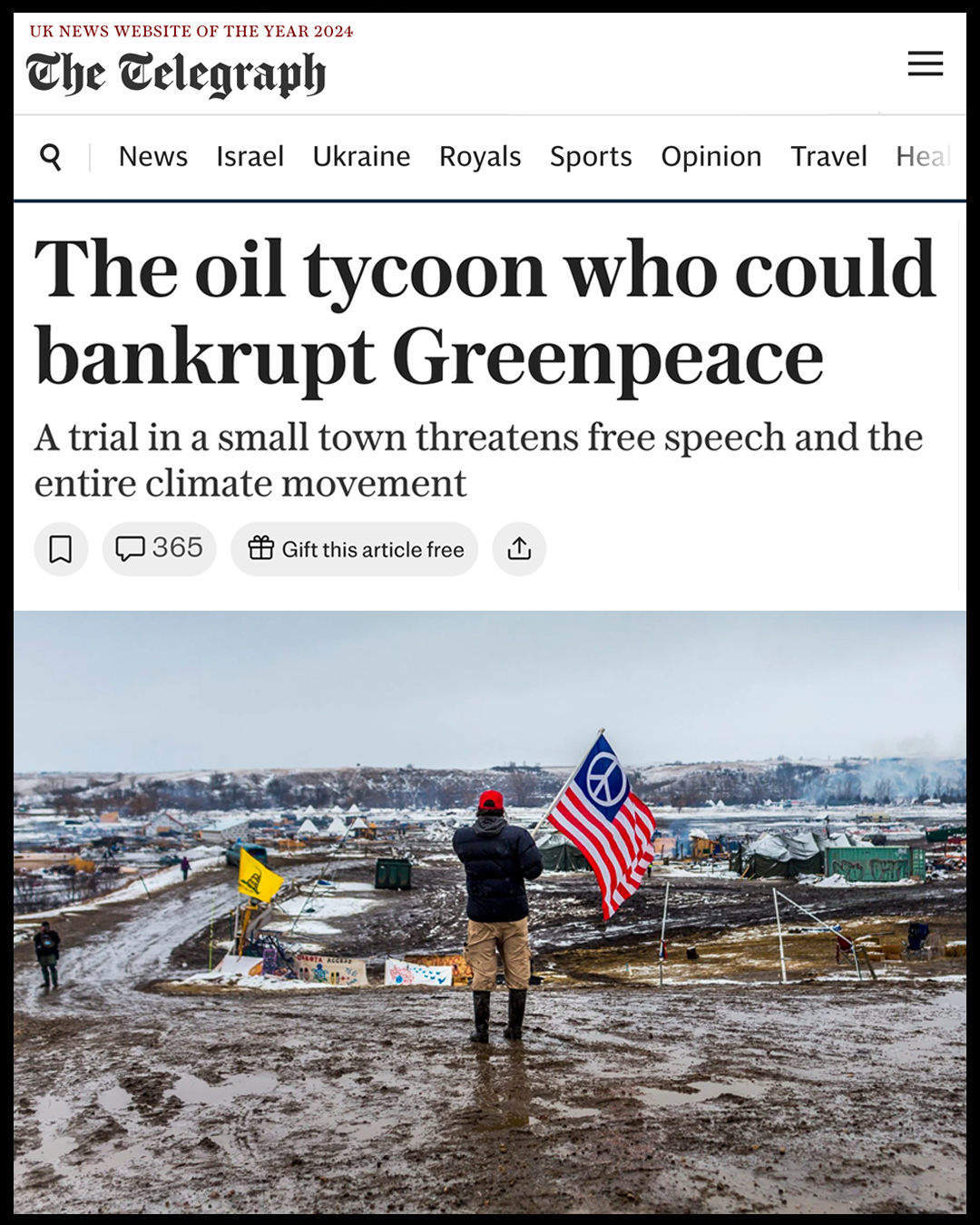
Greenpeace recently was hit with an outrageous $669 million court verdict in North Dakota. The trial – which I attended with several prominent attorneys – was widely condemned as a SLAPP harassment case designed to silence the environmental movement.
The verdict could be a financial death sentence against Greenpeace – unless we stop it.
That’s why I’m reaching out for help.
This is the deal: the targeting of Greenpeace was financed by one of the most notorious fossil fuel oligarchs in the world. This man, Kelcy Warren, amassed a net worth of $7 billion by building a network of planet-destroying pipelines in every region of our country.
Warren’s company, Energy Transfer, is so awful that it was convicted of multiple acts of criminality in Pennsylvania because a pipeline leaked toxic waste into waterways. Warren is so hateful he once said all climate activists “should be removed from the gene pool.”
Luckily, there’s a viable plan to stop Warren’s vile attacks.
Greenpeace recently filed an innovative claim in the courts of Amsterdam against Warren’s company. The claim uses a new anti-SLAPP law in the European Union that allows activists to sue the corporations that abuse them.
The case in Amsterdam can turn the tables on Warren and force him to pay damages to Greenpeace rather than the other way around.
This would be a huge victory for the climate movement.
Before I get to what we are going to do about it, I want to tell you about another dirty trick Warren has up his sleeve.
Warren is pressuring the trial judge in North Dakota to require Greenpeace to post a $75 million bond just to appealthe $669 million verdict. If granted, this enormous “bond” is likely to be a financial death sentence.
Warren went after Greenpeace after the group helped support the Indigenous-led protests at Standing Rock against the Dakota Access Pipeline.When 100,000 people turned up to block Warren from building his pipeline across Indigenous territory, he went ballistic.
Warren also personally donated at least $5 million to Trump for his two presidential campaigns. Trump then helped Warren get permits for his leaky pipeline.
The support of the public for this campaign is critical. Without it, we simply cannot do this work.
Our goal is to raise $20,000 before the end of the month. That means we have to raise approximately $12,000 in the next few days.
---
ymail donz 3 14 25
The First Amendment is under a shocking level of attack right now in the United States.
From the illegal arrest of a Columbia University student leader to the $300 million harassment lawsuit filed by the Energy Transfer pipeline company against Greenpeace, our right to free speech is under greater threat than ever before.
As you know, Steven has joined a group of prominent civil rights attorneys and citizens who traveled to North Dakota to monitor Energy Transfer’s SLAPP harassment lawsuit against the environmental group Greenpeace. The lawsuit is being funded by Trump ally and right-wing billionaire Kelcy Warren, who once said all activists “should be removed from the gene pool.”
*Warren’s lawsuit is actually a direct assault on Indigenous peoples, the climate movement, and free speech. Steven is out there helping to resist this unconstitutional weaponization of the law to silence activists.
We wanted to make sure you saw this firsthand update from Steven on the trial against Greenpeace in North Dakota:
*To be clear: the lawsuit against Greenpeace is rigged.
The lawsuit is not only an intimidation play to target the entire climate movement, it’s also a slap in the face to the Standing Rock Sioux and dozens of other Indigenous nations who led the historic protests against the company’s Dakota Access Pipeline in 2016.
Energy Transfer and Warren are attacking Greenpeace on the preposterous theory that the group is responsible for all “damages” related to construction delays of pipeline caused by the Indigenous-led protests, even though Greenpeace had virtually nothing to do with the protests.
Energy Transfer recently admitted to dozens of criminal violations of environmental laws in Pennsylvania. Credible reports in the North Dakota trial suggest up to 1 million gallons of drilling fluids have been discharged into waterways that millions of people rely on for their drinking water.
Evidence from Greenpeace also indicates the pipeline traverses Sioux ancestral lands and has desecrated sacred cultural sites, both in violation of the law. Yet the pipeline is operating anyway, while Greenpeace faces bankruptcy.
This trial is being structured so Greenpeace loses; the jury clearly is not impartial, with the majority having ties to the fossil fuel industry and no Native American or person of color seated on the panel. This is part of the “dark art” of a corporate SLAPP s...
---
russel mok
greenpeace Goes to Trial in North Dakota to Defend Against Energy Transfer SLAPP Suit
:{By Editor Filed in Uncategorized February 13th, 2025
On February 24, 2025, Greenpeace USA is scheduled to go to trial in state court in Mandan, North Dakota. Greenpeace is being sued by Energy Transfer – the operator of the Dakota Access Pipeline – for nearly $300 million related to the 2016 protests at Standing Rock.
Deepa Padmanabha
The stakes are high, and not just for Greenpeace USA as an organization. This trial is testing out legal tactics that, if successful, could be widely applied against protesters, and indeed, anyone who speaks out or criticizes a deep-pocketed corporation.
The lawsuit filed against Greenpeace has been called a SLAPP suit – a Strategic Lawsuit Against Public Participation.
We rang up Deepa Padmanabha, a senior legal advisor to Greenpeace USA, to get some details on the lawsuit and upcoming trial.
What are the allegations of the lawsuit?
“Both sides have said this is likely the biggest case ever in the history of the North Dakota state courts,” Padmanabha toldCorporate Crime Reporterin an interview last week. “It’s three buckets of claims. The first bucket of claims are claims of defamation. Energy Transfer alleges that the Greenpeace entities made false statements. And those false statements caused damages. In the state case, we originally started out with over 80 statements that Energy Transfer alleged were defamatory. And now we are down to nine.”
“Those nine statements fall into three categories. The first category of statements are statements that we made that the Dakota Access Pipeline crosses Standing Rock Sioux tribal ancestral lands.”
“The second category are statements that Energy Transfer deliberately desecrated Standing Rock Sioux tribe cultural resources.”
“And the third category of statements are statements that we made that Energy Transfer and its contractors used excessive force against peaceful protestors.”
“The important thing to note here is that by the time Greenpeace entities made any of these statements that are at issue, these were statements that were already widely circulated in the public. Anybody familiar with the resistance at Standing Rock had heard these statements. These were not statements that Greenpeace invented.”
“Yet Energy Transfer is suing the Greenpeace entities for these statements.”
“That’s the first bucket of claims. The second bucket of claims are claims of tortious interference. They are related to defamation. Energy Transfer alleges that Greenpeace made these alleged false statements to financial institutions – institutions that were involved with financing the Dakota Access Pipeline. And the allegation is that based on those statements, the financial institutions took action that cost Energy Transfer hundreds of millions of dollars in damages – lost financing, financing costs from delays.”
“We know that many of these financial institutions had their own commitments. They did their own due diligence to understand what was happening with the Dakota Access Pipeline. In fact, no bank or financial institution made any decision based on a Greenpeace statement.”
“That’s the second bucket of claims. The third bucket of claims are on the ground claims such as trespass, conversion, and aiding and abetting. This is a bucket that is quite dangerous for the movement. These claims make it clear that Energy Transfer’s target is much bigger than Greenpeace. It really is an attack on our First Amendment rights.”
“What they are trying to do is create this idea of collective protest liability where if you have any involvement with, for example, training at a protest, you can be held accountable for anything that happens there by unknown people.”
“For example, if you are engaged in training in principles of non-violence, de-escalation, principles of safety, you can be held accountable for the actions of unknown protesters who, for example, destroy construction equipment. This idea is dangerous – that you can be held accountable for anything that happens by unknown people, especially at a time when we know that many protests are being infiltrated.”
“And you can imagine that this would have a serious chilling effect on anybody who wants to engage in protests. This idea that you can be held accountable for anything that happens is quite a dangerous one. It’s very clear that Energy Transfer – and the larger fossil fuel industry – is trying to send a message to everybody – watch out, you could be next.”
This lawsuit has been going on for eight years. Have there been any settlement talks?
“I can’t get into too much detail about that. But I will say that we are prepared to go to trial, and we are expecting to go to trial. It’s very important for us that no matter the outcome of this lawsuit, our decisions will be in line with our values and our principles and our commitments to our own indigenous peoples policies.”
There have been public reports about settlement talks in this lawsuit. And last year, Greenpeace settled with Shell Oil over another lawsuit. Did you work on that lawsuit?
“That was not Greenpeace USA. That was Greenpeace UK.”
Greenpeace UK agreed to pay something like $375,000 to settle that lawsuit. What are the odds this case will actually go to trial?
“As of now, we are fully prepared to go to trial. Trial is in three weeks. That’s where we are headed.”
Will you be in court at trial?
“Yes.”
You say this is a SLAPP suit. What is that?
“SLAPP stands for Strategic Lawsuit Against Public Participation. At their core, they are attacking First Amendment protected behavior. You look at the parties. It’s often activists, non-profit organizations, journalists, even concerned citizens who are speaking out about a matter of public concern.”
“In this instance, the concerns about the Dakota Access Pipeline, its routing and risks were absolutely a matter of public concern.”
“What is the nature of the activity targeted? Often the activity is First Amendment protected activity, such as free speech or non-violent protest. These lawsuits are often disguised as defamation lawsuits. That is very much the case here where many of the claims at issue are defamation claims.”
“The other issue is peaceful protest. Any involvement we had on the ground was 100 percent in line with our 50 plus year history of nonviolent direct action, bearing witness, and no property damage.”
“Another tell-tale sign of a SLAPP lawsuit is the power imbalance between the parties. To Energy Transfer, this lawsuit is just a drop in the bucket for them. But for Greenpeace, it represents a significant financial investment to put on this kind of defense.”
“Another tell-tale sign – the amount of damages. Energy Transfer is seeking $300 million. SLAPP suits have these huge damage claims to send a message. Even if they lack the evidence to support such a damage claim, which is absolutely the case here, just by making the allegation, it can have a chilling effect on anyone watching the case.”
“These corporations use the litigation process as punishment. This has been eight years. The first case was thrown out of federal court. But they kept the fight going.”
“When they filed the federal court action, they already had the green light to construct the Dakota Access Pipeline. It was constructed. So why would you still use the litigation process?”
“Because they know these kinds of lawsuits take years and years and years. You put a stress and burden on the powerful voice they are trying to shut down.”
“Even though it’s only the Greenpeace entities that have been served in this case, there have been a number of third party subpoenas. There have been wild attempts to draw in smaller groups and individuals into this lawsuit – not as named defendants, but to instill a sense of fear that they too are being watched.”
“As someone who has been involved in SLAPP lawsuits for a long time, this case hits every single aspect.”
The Wall Street Journal published an article last year titled – The Texas Billionaire Who Has Greenpeace USA on the Verge of Bankruptcy. That billionaire is Kelcy Warren. What did you make of that article?
“One of the most interesting points of that article was toward the end. The journalist wrote this: ‘The lawsuit poses its own risks for Warren. Some oil-and-gas investors expressed concerns about the claim, saying it makes the industry look vindictive and could result in a reinvigorated protest movement.’”
“Basically, some investors are concerned about a backlash. That is the truth. This lawsuit has galvanized the movement in a powerful way. Greenpeace is getting support from so many allies, allies we have never worked with before. They are now watching this case because they realize the implications this case could have.”
“There is what happens in court, but there is what happens outside the court. And corporations need to take the possible backlash into account. You could reinvigorate a movement. People have really come together to fight back against this kind of abuse of power.”
Were you able over the years to depose Energy Transfer executives, including the CEO Kelcy Warren?
“There were over 100 depositions in this case – Greenpeace employees, third parties, Energy Transfer contractors and Energy Transfer employees, including Kelcy Warren.”
Is the Kelcy Warren deposition public?
“I don’t know if that deposition is publicly available. There is quite a bit in this case that is subject to a protective order.”
Greenpeace wasn’t at the forefront of these protests. The native Americans groups were at the forefront of these protests.
“That is accurate. Greenpeace entities had limited involvement and that was intentional. This was not a Greenpeace campaign. This was a grassroots indigenous resistance. Greenpeace supported it by being an ally. Greenpeace supported the indigenous resistance in a very, very limited way.”
“Energy Transfer is trying to rewrite history. The first question I always get from people involved was – did Greenpeace have any involvement at Standing Rock? I had never heard about Greenpeace being involved. Greenpeace was really not involved.”
“Greenpeace was known for its big, bold campaigns. And that was not the case here.”
There were other major public interest groups who supported the resistance at Standing Rock. Why did Greenpeace get sued by Energy Transfer and not the other groups?
“Let’s go back to the first case that was dismissed, the RICO case. That was the second RICO case brought by the same law firm in back to back years. One of the lawyers made public statements and he was basically shopping this tactic around. There was this idea that civil RICO would be the new tactic used to go against advocacy groups.”
“Why Greenpeace? We are known for bearing witness, taking big, bold actions and not being intimidated. The idea was – if we can knock out Greenpeace, if we can scare them, then who else is going to step into their shoes? Who else will take on this level of risk?”
“We recognize that intention. And that also speaks to why we have been fighting the case the way we have been. We have been fighting this case for the movement. We know that the intent is to reach beyond the Greenpeace entities. And we take that fight seriously.”
---
email 3 25
Please join us TONIGHT (March 13) at 7 ET for an important update on the latest major SLAPP legal attack on free speech and the climate movement – and how it connects to the government’s shocking abduction of Columbia grad student Mahmoud Khalil.
This is open to the public and will consist of a short presentation by members of our independent trial monitoring team – including legendary lawyer Marty Garbus and Indigenous rights attorney Natali Segovia
1 15
e xxon resorts to “intimidation” in legal battle over plastics recycling
The oil giant is accusing its opponents of engaging in a “deliberate smear campaign” at the cost of Exxon’s reputation and business prospects.
Months after California Attorney General Rob Bonta and a group of nonprofits separately sued ExxonMobil for a “decades-long campaign of deception” about the viability of plastic recycling, Exxon is suing them back, accusing Bonta and the nonprofits of defaming the oil giant and intentionally harming its efforts to develop new “advanced” recycling technologies.
Bonta’s lawsuit argues that despite knowing that recycling couldn’t effectively handle significant amounts of plastic waste, Exxon marketed it to the public to assuage environmental concerns and delay limits on plastic production. Now that it’s clear traditional recycling methods are insufficient, California’s lawsuit says, Exxon is once again deliberately misleading the public to believe that “advanced” or chemical recycling technologies are a safe and effective solution to plastic waste. A group of environmental nonprofits — including Sierra Club, Surfrider, Heal the Bay, and Baykeeper — filed a similar lawsuit against Exxon on the same day in September.
Exxon’s new complaint says those cases and accompanying public statements amount to a conspiracy between Bonta, advocates, and “foreign interests” to falsely “attack and defame ExxonMobil’s integrity and reputation.” But others say Exxon’s case is a textbook SLAPP — or strategic lawsuit against public participation — intended to ensnare its opponents in lengthy legal battles and prevent them from speaking out.
“This is a classic lawfare and SLAPP suit,” said Pat Parenteau, an environmental law professor and senior fellow at Vermont Law School. “Intimidation is the whole point of lawsuits like this.”
Exxon’s chemical recycling claims have come under sharp scrutiny in recent years, with government and nonprofit reports and Exxon’s own internal documents obtained by California’s attorney general revealing a widening gap between the company’s promotion of chemical recycling and the technology’s capacity to work as promised, even in the future. Those reports also documented the harm caused by the process of chemical recycling, which involves releasing toxic and carcinogenic pollutants, in close proximity to people — and how these facilities have been most often sited in low-income communities and communities of color.
According to Exxon’s complaint, such criticism — and the legal actions that followed — have derailed Exxon’s existing and prospective business deals, and “further threaten to derail advanced recycling by preventing it from achieving the scale necessary to ensure effective and efficient recycling.” But advocates say that’s a diversion from the fact that chemical recycling doesn’t work to significantly reduce plastic waste, and would only perpetuate the increased production of plastic.
"There is consistent data showing that plastics recycling does not achieve a high level of recycling and that chemical recycling is not a real solution to the growing problem of plastic waste,” said Judith Enck, president of U.S. nonprofit Beyond Plastics and former EPA regional administrator. “It would be so much more productive if ExxonMobil simply told the truth and refrained from attempting to intimidate elected officials and advocates who are working to actually solve the problem."
In the complaint against Bonta, Exxon reports having recycled 70 million pounds of plastic waste to date — just 7% total of its goal of recycling one billion pounds per year via chemical recycling by year-end 2026, which appeared on its website as recently as October 31, 2024. Their website now says that goal will be reached by 2027.
A history of retaliation
The new lawsuit was filed Monday in a federal court in Texas, where Exxon’s chemical recycling operations are focused and where the company says defendants’ “disparaging and defamatory conduct” was targeted. According to law professor Parenteau, the venue was more likely seen as a friendlier court than where the original cases were filed, as “California has one of the strongest anti-SLAPP laws in the country to protect constitutional rights of free speech and access to justice.”
It isn’t the first time that Exxon has dragged its critics into a Texas court. In 2016, the company asked a federal court in Dallas to block investigations by New York and Massachusetts attorneys general into whether Exxon deceived investors and the public about climate change. That case was eventually transferred to New York, where it was dismissed.
After California municipalities sued Exxon for climate deception in 2017, the company requested that a Texas state court allow pre-suit depositions of municipal officials and lawyers involved in the case to determine whether they were aiming “to suppress the Texas energy sector’s Texas-based speech.” Their request was ultimately denied.
Since California brought its plastics suit against Exxon, the oil giant has been named in two separate class-action suits that focus on plastic recycling deception, one filed by Ford County, Kansas, and the other by four individuals in a federal court in Missouri. By Exxon’s own admission, the oil giant “is likely to become involved in additional legal matters bringing similar allegations against ExxonMobil in the near future.” To protect the company from facing “a multiplicity of suits in various forums throughout the country,” Exxon is asking the Texas court to issue a declaratory judgement making clear that the company has a legal right to “engage in and promote advanced recycling.”
That may be an unusual request. “Courts do not normally issue that kind of blanket declaration on an emerging technology with all kinds of technical, economic and environmental considerations that are better left to the legislative and executive branches,” said Parenteau.
The case could be part of a growing trend — by Exxon and other fossil fuel majors including Chevron, Italian oil giant Eni, and oil pipeline company Energy Transfer — to use SLAPPs, and defamation claims in particular, as a way to silence opposition and dodge accountability.
Rebecca Tushnet, a First Amendment professor at Harvard Law School, said Exxon’s lawsuit against Bonta and advocates should be considered a SLAPP. “Under current doctrine, the First Amendment strongly protects the speech at issue,” she said. “Even though we're in a period of rapid constitutional change, speech in connection with a lawsuit is really at the core of First Amendment protection, and this is pretty appalling (though perhaps not surprising).”
A matter of public concern
In its complaint, Exxon argues that chemical recycling is in fact “part of the solution to plastic waste,” and that the company “has not engaged in a decades-long secret mission to brainwash or deceive the public.” But the complaint hinges on another central point: that criticisms about chemical recycling have gotten in the way of Exxon’s business deals.
“As a result of Defendants’ false statements, major international brands have refused to jointly promote advanced recycling with ExxonMobil,” the complaint reads. “Potential customers have expressed concern and hesitancy to work with ExxonMobil and explicitly referenced statements by Bonta and the US Proxies as the cause of that concern. And, a number of companies have backed out of proposed transactions with ExxonMobil for advanced recycling.”
Exxon claims Attorney General Bonta worked in concert with U.S. nonprofits and Australian-based Intergenerational Environmental Justice Fund (IEJF) — a charity initiative of nonprofit group Minderoo, funded by Australian mining company Fortescue, a competitor of Exxon’s in the “low carbon solution” sector — to falsely malign Exxon’s chemical recycling business and file their lawsuits as “proxies.” Exxon also accuses IEJF of hiring the nonprofits’ law firm, Cotchett, Pitre, & McCarthy, LLP, to “recruit and enlist willing plaintiffs to stand in for the foreign interests’ agenda.” Bonta, IEJF, Minderoo, Fortescue, and the law firm have refuted Exxon’s descriptions of their connections and work
The company is now asking for an injunction requiring the named parties to “take down and retract defamatory statements and to cease interfering with existing and prospective business relationships.”
Michael Gerrard, director of the Sabin Center for Climate Change Law at Columbia University, suggested that the case could face challenges for its attempts to rein in public debate — even in Texas. “The anti-SLAPP laws adopted by almost every state, including Texas, are designed to protect citizens from defamation and similar claims over matters of public concern,” he said. “The viability of plastics recycling is certainly a matter of public concern.”
===
exxonknews gmail 12 24
Who’s funding this ‘newspaper’ mailed to potential jurors in Greenpeace’s trial?
A dark money trail linked to pipeline company Energy Transfer could be behind a mysterious mailer targeting North Dakota residents in the lead-up to its major trial with Greenpeace.
The following piece was co-published by DeSmog and ExxonKnews.
In early September, fossil fuel executive and Donald Trump megadonor Kelcy Warren quietly made a large donation to a political action committee few people have ever heard of. Warren is CEO of Energy Transfer, the company behind the infamous Dakota Access Pipeline, which in 2016 faced thousands of protesters including members of the Standing Rock Sioux Tribe and other opponents.
The timing is potentially significant because Warren made his $5 million donation to the super PAC called Turnout for America while his company pushed forward with a lawsuit against the nonprofit Greenpeace related to the Standing Rock protests.
Two weeks after receiving Warren’s contribution, Turnout for America paid $250,000 to Northern CB Corp. — an Illinois publishing and printing company — for “media services.”
One of the listed directors for Northern CB Corp. is Brian Timpone, a conservative businessman who owns Chicago-based company Metric Media, a Koch-linked network that runs more than 1,100 partisan websites masquerading as local news.
In October, residents in Morton County, where the Greenpeace trial is scheduled to take place, received a mailed publication called “Central ND News,” which featured articles decrying the Dakota Access protests and praising Energy Transfer. Central ND News is produced by Metric Media.
While news of this “weird” paper was first reported by Floodlight and the North Dakota News Cooperative, additional details related to Warren’s Super PAC donation are now being debated in the lawsuit itself.
Greenpeace is urging a North Dakota court to allow further investigation into who paid to send the publication attacking Dakota Access protestors to Morton County residents — and whether there was an attempt to exert “improper influence” over potential jurors in Energy Transfer’s favor.
“Given the importance of securing a fair and impartial jury … knowing who was directing these actions, to whom they directed the information, and why they did so are important issues to the fair administration of justice,” a Greenpeace brief shared with ExxonKnews and DeSmog reads.
A closely watched lawsuit
Energy Transfer’s $300 million lawsuit accuses the environmental group Greenpeace of unlawfully orchestrating protests against the Dakota Access pipeline in 2016 and 2017, during which time hundreds of protestors were arrested near the Standing Rock Sioux Indian Reservation — including climate activists and Indigenous water protectors.
Energy Transfer, which worked with law enforcement agencies to curtail the protests and used an international security firm to surveil and shift public opinion about the company’s opponents, claims that Greenpeace waged an “unlawful, malicious, and coordinated attack” to damage and defame the pipeline and the company itself.
**According to Greenpeace USA, Energy Transfer is suing the group because it “dared to uplift the Indigenous-led opposition movement at Standing Rock.”
The lawsuit could have implications for whether the fossil fuel industry is able to silence protesters as it embarks on major expansions, including the buildout of new gas and carbon dioxide pipelines, Gulf Coast LNG facilities, and petrochemical infrastructure. Experts and advocates say the case has all the hallmarks of a SLAPP, or strategic lawsuit against public participation — a larger legal tactic fossil fuel companies have been using to suppress dissent and drain their opposition of resources and time.
As the February 2025 trial draws near in the closely watched case, Greenpeace is now asking a state district court to grant an emergency motion to reopen discovery in the case, which would allow the environmental group to get more information about who funded the mailer to North Dakota residents.
In its new court filing, Greenpeace alleges that “there may have been improper influence over potential Morton County jurors through direct mailers containing negative reporting about Standing Rock protests that took place eight years ago, and benefits which Energy Transfer conferred on the local community six years ago.”
Greenpeace cites new details indicating that Kelcy Warren’s donation came around the same time as a surge of coverage from Central ND News targeting the Dakota Access protests. Central ND News began running a series on its website in August, called “On This Date in 2016.” The series contained six articles in August, three of which accused protestors of “unlawful” activities in their headlines. Subsequent articles in the series appeared a few times each month up until this week. There is no record of the paper covering those protests before this year.
The same day Turnout for America paid the Illinois publishing company, Central ND News published a story praising a donation that Energy Transfer made to a university in North Dakota six years ago. That story, written by C.D. Marsden (a name that Floodlight first found yields no results in a Google search), was featured in the October newspaper delivered to Morton County residents’ homes, juxtaposed with stories about Dakota Access pipeline protestors.
The 12-page paper included those stories in a section called “This Month in History: October 2016,” featuring one article titled “Area schools locked down as authorities respond to pipeline protests.” Another recounts the details of a felony arrest warrant accusing a pipeline protestor of charging a police officer on horseback.
“The purpose of that publication is quite clearly to remind people about what was happening eight years ago,” a lawyer for Greenpeace, Everett Jack, told the court at a December 9 hearing requesting the reopening of discovery. “We should be entitled to find out who made that decision.”
pix
One of Greenpeace’s lawyers — Derrick Braaten, who resides in Mandan, a city in Morton County — received the Central ND News at his home in October. The paper doesn’t appear to have any physical presence in North Dakota — it directed readers to the outlet’s website, and didn’t include any local advertisements, according to Greenpeace.*
Jack told Southwest Judicial District Court Judge James Gion that reopening discovery would allow Greenpeace’s attorneys to question the Texas-based printing company that sent the newspaper, FMC Printing. The group would seek to subpoena FMC Printing to determine whether the mailer was targeted only to Morton County residents, who directed that the mailer be sent there, and why. Depending on the results of that investigation, Greenpeace would consider requesting a change in venue for the trial.
“We’re filing this motion and seeking this discovery because I think this court would agree there’s nothing more sacred in the legal system than the right to a fair, impartial jury, and every lawyer knows that direct efforts to influenc[e] the jury pool are not okay,” Jack said.
‘Playing both sides’
Greenpeace has been fighting varying iterations of Energy Transfer’s case — which was originally filed under state and federal racketeering charges — for eight years, with individual Indigenous protestors and journalists also brought into the mix. This week, the Minnesota Supreme Court heard an appeal from Energy Transfer in its attempts to subpoena journalists who reported on the protests at Standing Rock, seeking to force them to produce confidential, unpublished material.
The Dakota Access pipeline began operating through North Dakota in 2017 after an executive action from then-President Trump. The pipeline, which protestors warned would threaten water supplies, sacred sites, and the climate, leaked 5 times in its first year of operation alone.
This fall, the day before the October mailing was sent, the Standing Rock Sioux Tribe filed a new lawsuit against the U.S. Army Corps of Engineers arguing that the pipeline is operating illegally and should be shut down. Energy Transfer CEO Warren gave $5 million in campaign donations to Trump, who recently promised “fully expedited approvals and permits” to companies who invest $1 billion in the U.S.
:{Energy Transfer’s case, originally filed by the firm Kasowitz Benson Torres (long-time lawyers for Donald Trump), was taken over in 2023 by Gibson Dunn, a law firm with a record of “playing both sides” of the First Amendment on behalf of its corporate clients. }:{:Gibson Dunn}: lawyer Trey Cox represented Energy Transfer in its opposition to Greenpeace’s motion this week, arguing that juror questionnaires are the appropriate method to ensure a fair trial — and that whether or not Morton County residents received or read the newspaper was irrelevant.
ND Central News, he said, was a local newspaper that existed before the mailer was sent, and was simply covering matters involving a high-profile trial. Cox accused Greenpeace of trying to delay the trial date (which Greenpeace denied), and said its motion did not have “any basis in law or in fact.”
Energy Transfer, Metric Media, and Trey Cox did not respond to requests for comment.
“We don’t have any evidence that this newspaper in any way prejudiced potential jurors,” Cox told the court.
---
defamation?
musk slapp suit legal suppression; macho libtard requires retaliation, punish - money [ sorta explains musk FU to corps that pulled ads after anti sem and now pizzagate reboot?
Media Matters for America names counsel in X Corp. v. Media Matters for America
:{WASHINGTON, D.C. – Today, Media Matters for America named Elias Law Group as counsel in the case of *X Corp. v. Media Matters for America
On Monday, November 20, X Corp. sued Media Matters for America following publication of a report which revealed that ads for major brands appeared on X next to content that touts Adolf Hitler and his Nazi Party, despite CEO Linda Yaccarino’s claims that brands are “protected from the risk of being next to” toxic posts on the platform.
Media Matters President Angelo Carusone said, “Media Matters stands by its reporting. This case is not only significant for us, but has major First Amendment implications for all. With Elias Law Group, we look forward to continuing our work unabated and ultimately winning in court."
Abha Khanna, Partner, Elias Law Group, added, “Elias Law Group is proud to represent Media Matters for America in this case. X Corp.’s lawsuit against MMFA is a clear attempt to bully and silence anyone who dares to hold them accountable. X Corp. has fallen far short of its commitment to protect its users and advertisers from hateful, extremist content. We look forward to ensuring that MMFA is able to continue its important work."
Media Matters for America is a nonprofit media watchdog dedicated to monitoring and exposing conservative misinformation. Through real-time monitoring, comprehensive research and analysis, and rapid response work, Media Matters combats lies, propaganda, and extremism to ensure that all Americans have access to truthful information.
---
---
soft power PR BS crypto
NO lnx guk?
in the spring of 2019, Phil Goldberg, a lawyer and hired gun for a front organization serving some of America’s most powerful oil firms, spotted an opportunity to serve his masters.
The University of Hawaii was holding a conference about a wave of lawsuits against the oil industry, and Goldberg was alarmed the event failed to include representatives from the energy business. So the day before the symposium, he fired off an email to the university demanding that big oil be heard alongside its critics.
The event was to interrogate the oil industry’s decades-long cover-up involving the climate crisis. But a one-sided debate, Goldberg wrote, “does students and the general public a significant disservice.” He insisted the meeting be postponed.
Denise Antolini, associate dean at the university’s law school who organized the conference, said in her 23-year-career as a law professor, she had never received such demands. “Your request to disrupt our public event was quite surprising, especially coming from far across the continent, from someone I’ve never heard of, on behalf of a private client with an apparently direct financial interest in chilling debate about climate litigation,” she replied.
The conference went ahead, but Goldberg chalked up his intervention as a win. He had managed to pressure Antolini into reciting his objections to the conference in her opening statement. He also convinced the university to post his blogs on its website alongside a letter published by the Honolulu Star-Advertiser denouncing the meeting for daring to suggest there was a solid legal case against the oil companies.
Goldberg is part of a network of enablers working to preserve big oil’s power and reputation as it faces a barrage of litigation. More than two dozen cities, states and municipalities allege the industry lied to Americans for decades by downplaying and outright denying that fossil fuels caused climate change. The lawsuits demand companies use some of their vast profits to help pay for the human toll of the climate crisis, including the damage brought by rising seas and increasingly severe weather disasters.
Big Oil “has this ability to really take command of the societal narrative on a whole level that the tobacco industry just didn’t.”
Desperate to avoid costly settlements, the fossil fuel industry relies on front organizations to discredit the litigation and sway public opinion in its favor. So nearly three years ago, the friends of big oil turned to Goldberg, a former Democratic congressional aide and self-described “committed environmentalist,” HIPPIE CHICK to persuade Americans that the companies responsible for the growing climate disaster are now the ones to fix the problem.
Though Goldberg heads an ostensibly independent initiative called the Manufacturers Accountability Project, much of its funding comes from some of the biggest names in the oil business. MAP hired Goldberg to push back against litigation on the fossil fuel industry’s behalf,allowing oil companies to keep their hands clean in the process.
Goldberg is leading a charge in local media to discredit those suing the fossil fuel industry as a “fringe litigation movement” conspiracy of opportunistic politicians, environmental extremists, and money-grasping lawyers who pose a threat to the American way of life. // ENTINE
“There are two goals of this litigation—drive climate policy and wage a public relations campaign against the energy industry,” Goldberg told the Guardian. “It has no foundation legally and, more to the point, is not the right way to fight climate change.” LOMBORGIAN
Karen Sokol, a law professor at Loyola University who specializes in climate litigation, likens the strategy to that pursued by the tobacco industry when it faced litigation over what it knew about cigarettes causing lung cancer. But, she said, the strategy may prove more successful for big oil.
“The fossil fuel industry has this ability to really take command of the societal narrative on a whole level that the tobacco industry just didn’t because, although we were definitely a cigarette culture for a time, not everybody was so dependent on cigarettes in the same way we are on fossil fuels,” she said.
Kert Davies, founder and director of Climate Investigations Center, is scathing about Goldberg’s part in that. “Phil Goldberg is a useful pawn on a much larger chessboard. If he doesn’t know that, it’s a shame,” Davies said. “If he does know his role, it’s worse.”
Outwardly, Goldberg seems an unusual bearer of the torch to snuff out climate lawsuits. The New Jersey-born lawyer characterizes himself as a “progressive, pro-environmentalist” with a long commitment to Democratic causes. With that, he has positioned himself as a voice of reason as he leads the fossil fuel industry’s campaign to distract Americans from the scene of the crime and embrace big oil as a necessity in the struggle to contain global heating.
But Goldberg is also a former coal lobbyist now working as an attorney for a Kansas City law firm—Shook, Hardy and Bacon—that made its name decades ago as the cigarette industry’s attack dog. The legal practice even gained public notoriety for inspiring the fictional law firm of Smoot, Hawking in the satirical book turned film, Thank You for Smoking.
“What a sad and disquieting chapter in the history of an honorable and often courageous profession.”
Shook, Hardy pioneered a strategy toward avoiding corporate accountability—a denial strategy the oil companies followed not many years later. Starting in the mid-80s, the firm convinced cigarette companies to shut down research into the dangers of nicotine, warning it could be used against them in court. It also hired specialists with advanced scientific degrees to cast doubt on the evidence that smoking causes lung cancer. The firm’s lawyers soon developed a reputation for probing the lives of people who dared to sue the tobacco firms and for using court procedure to draw out cases until plaintiffs ran out of funds.
All of this so disgusted one federaljudge, Gladys Kessler, that in a damning 2006 civil judgment against the cigarette makers she said Shook, Hardy and other firms played “an absolutely central role in the creation and perpetuation” of a 50-year campaign of deceit.
“They devised and coordinated both national and international strategy; they directed scientists as to what research they should and should not undertake; they vetted scientific research papers and reports as well as public relations materials to ensure that the interests of the (tobacco industry) would be protected,” she wrote. “What a sad and disquieting chapter in the history of an honorable and often courageous profession.”
The chapter cemented Shook, Hardy’s reputation for vigorously defending clients and drew other contentious industries to the firm. And since joining Shook, Hardy in 2003, Goldberg has lived up to its reputation for playing hardball.
Throughout his career, Goldberg has developed an expertise at combatting public accountability lawsuits on the behalf of many embattled corporate clients, includingcoal companies, the asbestos industry, and pharmaceutical companies accused of medical malpractice.
Goldberg has also advised the American Legislative Exchange Council on drafting laws to make it harder to sue big corporations.
Simultaneously over the last two decades, he has led a wing of the Democratic think tank, the Progressive Policy Institute, that works to protect corporations from lawsuits and to keep regulatory changes in the hands of politicians who can be influenced by industry money and lobbyists. Goldberg has also advised the right-wing American Legislative Exchange Council on drafting laws to make it harder to sue big corporations.
Goldberg’s current defense of the fossil-fuel industry is equally focused.He deflects questions about Big Oil’s cover-up of its own scientific research on global heating by claiming that raking over the past is not going to help find solutions to the climate crisis. He also avoids answering questions about parallels with the tobacco industry’s actions.
Instead, Goldberg has sought to nurture a progressive image with claims to be dedicated to the climate fight but concerned that suing oil companies is getting in the way of solutions. He goes out of his way to say that he “cares deeply about climate change” and, in his answers, returns repeatedly to “the important work that needs to be done on the climate.”
This image was carried through to the Guardian‘s photographs for this article, which Goldberg agreed to pose for only while riding his bicycle. He declined to remove his helmet for any of the pictures.
Today, Goldberg is at the face of a PR campaign to squash climate litigation against Big Oil. He calls his strategy the “iron triangle defense.” One side of the triangle is dedicated toward shaping the public narrative, the second is for pressuring legislatures to write laws that discourage corporate accountability litigation, and the third side influences the judicial process with amicus briefs in cases that might have a bearing on those lawsuits.
A key part of the iron triangle strategy is that its beneficiaries should not be seen as the ones who are pulling the strings. Corporations fighting legal battles learned long ago that Americans are not particularly trustful of executives in suits. So major industries seek to influence public opinion and political action by funding front organizations to work on the behalf of corporate interests, but under a different name.
It was an obvious move for the fossil-fuel industry to turn toward front groups as it grew increasingly alarmed in recent years at a surge in lawsuits demanding compensation for damage caused by the climate crisis. Oil executives feared a repeat of the tobacco industry’s fate when public opinion turned sharply against the cigarette makers, forcing the largest civil settlement in US history.
“Say a new locality files a suit … Suddenly the local press is infiltrated with Goldberg quotes. He fires out op-eds.”
Major oil firms, including Exxon, Shell and Chevron, looked to the National Association of Manufacturers, one of the US’s most powerful business lobby groups, with a long history of creating front organizations at the behest of various industries, to help“combat frivolous, politically motivated lawsuitsagainst energy manufacturers.”
Four years ago, NAM launched a group, the Manufacturers Accountability Project, to take the campaign in defense of big oil on to the streets and into the local media. A year later, it recruited Goldberg to lead the initiative. While much of their strategy is an attempt to intimidate litigants through the legal process, Goldberg’s role is to take the fight to local communities in an attempt to mold public opinion—and potential jurors—before the cases come to court.
From local newspapers to NPR, Goldberg pushes arguments designed to deflect from the fossil fuel industry’s responsibility for the climate crisis. “Those of us who care deeply about climate change, our economy, and our way of life must focus our elected leaders on game-changing innovations, not these politically-driven litigations,” he wrote in the New Jersey Globe after three New Jersey senators pressed the state to sue Big Oil to pay up for the costs caused by their deceptions.
Goldberg has pursued similar lines after the attorneys general of Vermont and Connecticut filed cases against the oil industry. “We should be fighting climate change instead of each other,” he reasoned in the local press.
Sokol, the law professor and climate litigation specialist, said she saw Goldberg’s intervention tactics everywhere there is a lawsuit against the fossil fuel industry. “Say a new locality files a suit… Suddenly the local press is infiltrated with Goldberg quotes. He fires out op-eds,” she said. “It’s a concerted battle against this litigation, which in many ways is a testament to how powerful the industry suspects this could be if it’s allowed to have its day in court.”
Still, even in Goldberg’s home state, there are plenty who are not buying it. In 2020, three New Jersey state senators pressed the state to sue Big Oil to pay up for the past and present costs caused by their deceptions.
“Rather than alert the public and help usher in the transition to clean energy, big oil took a page out of big tobacco’s playbook and funded and led a decades-long campaign to lie, deceive, and confuse the public about the science of climate change,” two of the senators, one Democrat and one Republican, wrote in USA Today. “It’s only fair that these fossil fuel companies who got rich while igniting the climate crisis are made to pay their fair share of the costs to our communities.”
slapp
https://www.desmog.com/2022/12/20/environmental-activists-fight-back-as-companies-resort-to-lawfare-to-quash-criticism/
In 1999, when Shpresa Loshaj was 19, she fled her home town of Deçan, Kosovo, as a refugee and moved to Canada. When she returned in 2018, long after the war had ended, a journalist encouraged her to go into the hills and take a look at some new hydropower plants on the river Lumbardhi i Deçanit. The journalist was investigating claims by local people that the plants run by KelKos, a subsidiary of Austrian energy firm Kelag, were operating without permits and potentially damaging the local ecosystem and water infrastructure.
“We are a mountainous town where we depend on the river and the mountain,” Loshaj told DeSmog. “I remember how when we grew up we could not even break a branch because our parents said this is our livelihood. And that became my motivation — to either accept that all my sacrifices for Kosovo are just down the drain, or I have to believe that it was worth something and I can still speak up.”
Having hit a wall trying to obtain responses from public authorities, Loshaj started campaigning to raise awareness of what she believed she had uncovered, including the company allegedly damaging drinking water pipes, putting cement into the river, and drawing too much water leaving the riverbed dry, claims the company has denied.
She also claimed the upper part of the river had been destroyed because it was dug for gravel to build the power plants further downstream. The company does not deny extracting some material but says it was done with permission and that it is working on a plan with local authorities to remediate the damage. The company also blames some of the gravel extraction on local road building.
In 2020, while drafting a letter to the Austrian embassy detailing her allegations, Loshaj received a notice from KelKos’ lawyers. They requested that she issue a public apology for her claims that the plants had been operating without permission and destroying the environment, which the company considered defamatory. Loshaj ignored the warning and sent the letter.
Defamation Case
The company now maintains that “no power plant was in operation without legal permission,” as Josef Stocker, spokesperson for KelKos’ parent company Kelag told DeSmog. However, in a defamation suit the company filed against Loshaj after she sent the letter, KelKos said it had “licenses for electricity generation for all its hydropower plants” but argued that it did not have environmental permits because a lack of legal and administrative capacity at Kosovo’s Ministry of Environment and Spatial Planning meant that no hydropower plant in the country had been provided with one.
In June 2021, Amnesty International criticized KelKos for its “baseless defamation lawsuits” against Loshaj and another activist, Adriatik Gacaferi. The human rights organization characterized the company’s filings as a Strategic Lawsuit Against Public Participation, or SLAPP, to “intimidate and silence activists from speaking out about the possible environmental damage caused by the company’s exploitation of Kosovo’s natural resources.”
SLAPPs arose in the United States in the 1970s and ’80s, where they remain a serious problem. They can take different forms across various jurisdictions and legal contexts, but they are an increasingly popular “lawfare” tactic used by powerful companies and individuals around the world to chill free speech and suppress dissent.
The Business & Human Rights Resource Centre (BHRRC), a London-based nonprofit seeking to advance human rights in business and eradicate abuse, has recorded 418 SLAPPS around the world since the start of 2015, with well over half relating to the environment.
Latin America is a hotspot.Last year, the BHRRC identified that since 2015, at least 149 claims bearing the hallmarks of SLAPPs have been brought against individuals and groups defending human rights and the environment in the region. Honduras, Peru, Mexico, and Guatemala were the most affected countries.
Another 104 cases were recorded across Asia and the Pacific, mostly in Thailand, Cambodia, and the Philippines.
Although there are various reasons why SLAPPs are concentrated in particular places, Lady Nancy Zuluaga Jaramillo, legal researcher at the BHRRC, says there is a “direct connection between the most affected regions and regions heavily dependent on natural resource sectors, such as mining, agriculture and livestock, logging and lumber and palm oil.”
Elsewhere, a 2017 paper in the South African Journal on Human Rights identified SLAPPs as an emerging obstacle to public interest environmental litigation in the country.
Europe is another problem area.According to a 2020 study commissioned by the European Commission, SLAPPS are “increasingly used across EU member states, in an environment that is getting more and more hostile towards journalists, human rights defenders and various NGOs.”
Flutura Kusari, senior legal advisor at the European Centre for Press and Media Freedom, says SLAPPs have become a serious threat to public participation in Europe. “When [people and organizations] are forced to spend money and time in courts, this discourages them from activism,” she says.
Speaking Out
With the lawsuit hanging over her for more than a year, Loshaj was concerned that others would be intimidated by it. “My lawyer, when we submitted our response to the lawsuit, called on the court to immediately review this and try to set a precedent and send a message to the people that this is not something to be scared of.” And in fact, she found herself supported by other activists and human rights, free speech, and environmental groups who did not think KelKos’ suit would succeed.
However, Loshaj concedes that her ability to speak out is partly due to her living in Canada, which shielded her from some of the potential risks facing environmental campaigners in Kosovo – some of whom fear their employers may come under political pressure to dismiss them if their protests garner too much attention. It also gave her a different political frame of reference. “I knew nowhere is perfect,” she says, “but I knew what kind of level of democracy I’m living for.”
Last year, at a joint session by the UN Working Group on Business and Human Rights, the UN special rapporteur on human rights defenders and civil society organizations raised awareness of SLAPPs as a global problem, and concluded that immediate action by states and business actors is needed to stop their use “against people who are bravely and legitimately speaking out against injustice in the context of business operations.”
Jaramillo says these sorts of legal challenges jeopardize a fast and just transition to renewable energy. “Environmental, land rights, climate and labour rights defenders — the very people on the front lines of driving a just transition — are under attack because they are raising concerns about business actions harmful to human rights and the environment.”
Jaramillo adds that there is a concerning lack of understanding by the business community of the crucial role human rights defenders play in driving that just transition. “Many companies and businesses have made public commitments to climate action yet have failed to conduct meaningful engagement with [human rights defenders] and their communities, including Indigenous People, prior to launching operations on their lands.”
According to Kusari, SLAPPs need to be countered at various levels, including via national and international laws, awareness campaigns, and practical support for targets, such as legal and financial aid.
Public Interest
A number of countries outside the United States have implemented laws containing anti-SLAPP provisions over the past 15 years, including Canada and Australia.
Although a global hotspot for SLAPPs, Southeast Asia is also a pioneer for anti-SLAPP legislation. In Indonesia, for example, laws banned the filing of criminal or civil cases against persons “struggling for a right to proper and healthy environment” and against journalists and informants providing information on deforestation. These have not been extensively used, although last year a group of Indonesian villagers protesting local pollution were acquittedof impersonating public officials.
In South Africa, the Constitutional Court recently recognized that a legal defense from SLAPPs exists, in the latest stage of a long-running dispute between a mining company and environmental campaigners. It also limited the damages that companies can claim.
No EU member state has yet enacted targeted rules to provide protection against SLAPPs. But civil society organizations have joined forces through the European Anti-SLAPP Coalition to push for action through European institutions, and a proposed EU directive (an EU-level law that applies to all member states) is now in the works.
Introducing the bill, the EU’s Vice-President for Values and Transparency, Věra Jourová, said it would “help to protect those who take risks and speak up when the public interest is at stake,” including on “environmental and climate matters.”
The European Commission has also adopted a recommendation to encourage member states to align their rules with the proposed EU law for domestic cases and in all proceedings, not just civil matters. And it calls on member states to take a range of other measures, such as training and awareness raising to help legal professionals and potential SLAPP targets to fight these kinds of lawsuits.
Kusari says these are important initial steps. “The recommendation has already entered into force and we expect member states to start implementing it. The proposed directive is undergoing through the legislative process and [we] are optimistic that member states will support it.”
New Powers
Meanwhile the UK government recently announced plans to grant courts in England and Wales new powers to dismiss SLAPPs, following allegations that oligarchs close to Russian president Vladimir Putin are using expensive litigation in UK courts to shut down criticism and deter investigations into their affairs. In November, UK journalists, publishers, and media lawyers sent a letter to Dominic Raab, urging the justice secretary to back a proposed anti-SLAPP law.
A prominent case referenced in the letter is a libel claim against former Financial Times journalist Tom Burgis by Kazakh mining conglomerate Eurasian Natural Resources Corporation. The claim against Burgis was thrown out of court earlier this year. The case was described as a SLAPP last year by 15 civil society organizations, including freedom of expression group PEN International and corporate human rights organization RAID.
Europe is not the only place where environmental activists are finding common ground with free speech advocates to try to stem the tide of SLAPPs.
In South Africa, civil society free speech campaign Asina Loyiko was set up in response to what it described as SLAPP suits brought by Australian mining company Mineral Resources Commodities and its South African subsidiary Mineral Sands Resources against environmental defenders, lawyers, and activists. ...
https://www.desmog.com/2022/10/07/slapp-lawsuits-exxon-chemrisk-dapl-climate-change-raskin/
Emily Sanders
In 2018, Krystal Two Bulls received notice that she was being sued for criminal conspiracy.
Two Bulls, who is Oglala Lakota and North Cheyenne, has been organizing for environmental justice for much of her life. She was raised on the North Cheyenne Indian Reservation of Lame Deer, Montana, part of a community that had resisted coal developments for nearly 40 years. In 2016, she helped defeat Arch Coal’s plans to build a massive strip mining operation on the reservation’s border. The project would’ve been one of the largest coal mines in the United States.
Later that same year, Two Bulls received an urgent call for assistance from land and water protectors at Standing Rock, North Dakota, who were working to oppose the construction of the Dakota Access pipeline, which transports crude oil from North Dakota to Illinois.
When Two Bulls arrived, the conflict between protestors and local police was escalating. Her auntie, Dr. Sara Jumping Eagle, had recently been arrested after standing in the path of a bulldozer set to dig up human remains at an ancestral burial site. Two Bulls spent three-and-a-half months supporting and sustaining the camp — handling basic logistics like providing protestors with food, warm clothing, and other necessities — all in the face of violence by state police. She then helped to launch the No DAPL Solidarity Campaign, a global movement to back the Indigenous opposition to the pipeline.
It wasn’t until a year after camp was shut down that Two Bulls, who came to North Dakota on her own dime and left in debt, found out she was being sued for millions of dollars by the pipeline developer, Energy Transfer Partners. The charges were brought under the Racketeering Influenced Corrupt Practices (RICO) Act, a law originally designed to prosecute the mafia. The company claimed that through her “calls to action,” including a statement on Greenpeace’s website asking “all people from around the world to take action” and “come stand with us” against the Dakota Access pipeline, Two Bulls and others had conspired to interfere with Energy Transfer’s business operations and engaged in organized crime. The individuals and groups’ opposition, the company claimed, was defamatory and cost key investments in its pipeline.
In 2017, The Intercept reported on documents leaked from former personnel at an international security firm, TigerSwan, revealing that Energy Transfer had paid the firm to use military-style surveillance and infiltration tactics to gather information that could be deployed in a RICO lawsuit against the anti-pipeline activists.
Two Bulls is just one of many victims of the fossil fuel industry’s use of SLAPPs— strategic lawsuits against public participation — to silence and intimidate its critics. A report released last month by legal advocacy nonprofit EarthRights International identified 152 instances of legal and judicial harassment by fossil fuel corporations to suppress dissent in the United States over the past 10 years, including 93 SLAPP lawsuits.
Just this week, a California oil industry trade association paid nearly $650,000 in fees to the city of Los Angeles and several environmental advocacy groups the company had targeted in court for years following the city’s implementation of new environmental safety requirements for drilling applicants. After declaring bankruptcy, the California Independent Petroleum Association was allowed to pay only a fraction of a judgment initially awarded to the city and groups by a trial court that ruled the lawsuit was a SLAPP.
“With the strengthening of our movements, the revelation of how long the fossil fuel industry has been aware of how their practices impact and contribute to climate change, and the rise of legal cases against oil and gas corporations, these companies are becoming more desperate to silence the voices of their critics,” said Deepa Padmanabha, deputy general counsel at Greenpeace USA.
A wide range of concerned groups, from community organizers to members of Congress, are taking up the fight against SLAPPs. Last month, the House Oversight Subcommittee on Civil Rights and Civil Liberties held a hearing to expose the fossil fuel industry’s use of SLAPPs and its backing of bills to criminalize protest. The committee’s witnesses, including Padmanabha and others, explained that corporations were using these tactics to suppress activists’ ability to freely voice dissent.
The day after the hearing, Rep. Jamie Raskin (D-MD), the subcommittee chairman, introduced the SLAPP Protection Act of 2022 — the first federal legislation that would “establish a procedure to dismiss, punish, and deter strategic lawsuits against public participation.” Advocates say the bill could create a sorely needed protection for individuals and community groups who speak out against fossil fuel infrastructure, and an important safeguard for free speech at large.
According to EarthRights International, the proposed legislation would provide a federal mechanism for SLAPP suits to be quickly identified and dismissed while balancing the rights of plaintiffs and defendants. The bill would also force those bringing SLAPP suits to pay their opponents’ legal fees if the lawsuit is proven to have abusive intent.
Advocacy organizations are also tackling the issue. EarthRights is a member of the Protect the Protest coalition, an initiative created in response to the rise of SLAPP suits. “If a corporation can sue a nonprofit organization out of business for criticizing its activities, then that’s extremely dangerous,” Kirk Herbertson, senior policy advisor at EarthRights International, said.
About a year after Energy Transfer filed its lawsuit against Two Bulls and others, a district court judge in North Dakota dismissed the case, denying the RICO claims with prejudice — meaning the company could not refile those claims.
RICO claims, which can triple the amount of damages sought in a SLAPP suit, can be financially devastating — even for a larger, well-resourced organization like Greenpeace USA, which was named in the original suit. While Energy Transfer’s RICO claims against the organization have been dismissed, the pipeline company filed a second lawsuit in North Dakota state court, which is scheduled for trial in June 2023. In its current case, which also names Two Bulls as a defendant, Energy Transfer argues that Greenpeace USA conspired with others to defame, trespass, and interfere with business relationships, among many other charges.
Energy Transfer did not respond to a request for comment.
“Companies are becoming more desperate to silence
the voices of their critics”
– Deepa Padmanabha
Fighting these lawsuits not only takes vast amounts of money, but also time and energy. Padmanabha said that since mid-2016, her career has been almost entirely dedicated to advocating against corporate lawfare — corporations’ use of the legal system to attack opponents — preventing her from engaging more in the dire work needed to prevent climate catastrophe.
“The next decade is so critical in our fight against climate change. And if we didn’t have to deal with these lawsuits, we would really be putting every penny and every minute we have into fighting the existential threat of climate change,” Padmanabha said, adding that they are also intended to intimidate and deter individuals and lesser-resourced, smaller groups from speaking out.
Karen Savage was working in Massachusetts as a middle-school math teacher when she got hit with a SLAPP suit. In 2013, she and another environmental activist, Cherri Foytlin, wrote an unpaid article for the Huffington Post about a so-called independent study fromscientific consulting firm ChemRisk. The study had claimed that there was no connection between chemicals released during the BP Deepwater Horizon oil spill and the serious health problems reported by cleanup workers and coastal residents in its aftermath.
As their reporting revealed, ChemRisk — a company with a long history of working with polluters, including defendant PG&E in the infamous Erin Brockovich case — produced “science” on behalf of BP that the oil major could use to defend itself from liability in court.
After the article was published, the Huffington Post received an immediate request from the company to retract it, which they forwarded on to Cherri Foytlin. (In a note on her Facebook page, Foytlin told ChemRisk to “kiss my derriere.”)
Foytlin’s Facebook post, along with many other social media posts from the two writers, appeared in a defamation suit filed against them by ChemRisk in New York state. The company claimed their article contained falsehoods — though, according to Savage, ChemRisk couldn’t explain what those falsehoods were — and that as long as it was kept online, the article would “continue to do substantial harm to ChemRisk’s reputation.”
“Basically what they wanted to do was shut us up,” Savage told me. “It was an intimidation tactic.”
With pro-bono representation, Savage and Foytlin were able to get the suit dismissed in New York. Within two weeks, the company refiled in Massachusetts, where Savage lived. At one point, she said, the company’s lawyers even attempted to serve her in her classroom while she was teaching.
Cardno ChemRisk, the parent company of ChemRisk, did not respond to a request for comment.
The case was eventually dismissed under the state’s anti-SLAPP laws, and ChemRisk was forced to pay Savage and Foytlin’s attorney’s fees. Savage said she believes that ChemRisk never sued them in Louisiana, where Foytlin lived, because of the three states, Louisiana’s anti-SLAPP laws were the strongest, and the suit would’ve been dismissed faster and with greater consequences for the company.
That tactic of searching for the most favorable court, called forum shopping, is something Raskin’s anti-SLAPP statute would address by creating a standard applicable across the United States. At present, 32 states and the District of Columbia have anti-SLAPP laws, yet they have varying degrees of efficacy. And while the fate of a federal bill could depend on the outcome of midterm elections, most state anti-SLAPP laws have passed with bipartisan support.
Savage — who has since become a journalist and haswritten for DeSmog about being arrested by pipeline security while reporting — said she hopes Raskin’s bill would help put an end to this tactic. “If you know the truth, and you’ve got factual backup, and someone comes at you, you can’t back down on that,” Savage said. “The whole reason they’re coming at you is because they also know that you have the truth.”
While the fossil fuel industry works to stamp out the speech of environmental advocates on the one hand, it is now arguing that its climate denial is protected speech on the other. At the same time that Raskin held his hearing into the fossil fuel industry’s assault on the First Amendment, the House Natural Resources Oversight and Investigations Subcommittee held a separate hearing to examine how public relations firms market climate disinformation and delay action on behalf of Big Oil. In that hearing, chaired by Rep. Katie Porter (D-CA), Republicans and their witness argued that the committee was attacking the corporations’ right to free speech.
“Taken together, the two [hearings] are a perfect illustration of the industry’s First Amendment strategy: expand free speech for corporations, curb it for citizens,” Amy Westervelt recently wrote in The Intercept. The fossil fuel industry, she explained, has been developing the argument that its public statements on climate policy are protected speech since the late 1960s, all while working to expand the right of corporations to buy influence over politics behind the scenes.
In a paradoxical twist, fossil fuel companies are even attempting to wield existing anti-SLAPP laws to shield themselves from legal accountability. After a Massachusetts court ruled that Attorney General Maura Healey’s climate fraud lawsuit against Exxon could proceed in state court, the oil giant told the state’s supreme court that the case was actually a conspiracy to silence Exxon’s views on climate policy in violation of the state’s anti-SLAPP statute.But so far, the idea that Exxon’s fraud is protected free speech has not gone over well with judges.
“We have seen that the industry is trying to build up this argument around a conspiracy against them, and it’s coming up in things like anti-SLAPP motions in courts. But they have continued to fail in that effort so far,” Herbertson of EarthRights International said. Raskin’s newly proposed federal legislation, he said, is clearly and explicitly designed to be used by real peopleand organizations that have been victim to SLAPP suits,and will be harder for corporations to use in their own defense.
But if you ask Padmanabha of Greenpeace, the industry’s tactics are on thin ice. “There is this recognition and an increasing awareness that speech should not be bought,” she said. “And I think that the [Oversight Civil Rights and Civil Liberties] hearing and the bill that followed it are really just emblematic examples of how these attempts to control the narrative are crumbling.”
Emily Sanders writes ExxonKnews, a newsletter covering climate accountability and the oil and gas industry. She is editorial lead at the Center for Climate Integrity, and is based in New York City. This piece was co-published by DeSmog and ExxonKnews, a project of the Center for Climate Integrity.
frente de defense
- Chevron’s SLAPP suit against Ecuadorians: corporate intimidation (Greenpeace blog post) - May 11, 2018
- Chevron Accused of $2 Million Witness Bribery Plot in Ecuador Pollution Case (*AlterNet*) - January 31, 2018
- Chevron's Amazon Chernobyl Case moves to Canada (Greenpeace blog post) - September 15, 2017
- Chevron’s Payments to RICO Witness Are Not Just Ugly—They’re Criminal (*HuffPost News*) - June 2, 2017
- Chevron’s RICO Fraud: An Abuse of Indigenous Peoples, the Environment, and U.S. Courts - May 2017
- Chevron's Star Witness Admits to Lying in the Amazon Pollution Case (*VICE News*) - October 26, 2015
- Ecuador’s Battle for Environmental Justice Against Chevron (*The Nation*) - June 2, 2015
- Chevron’s “Amazon Chernobyl” in Ecuador: The Real Irrefutable Truths About the Company’s Toxic Dumping and Fraud (*HuffPost*) - May 27, 2015
- Sludge Match: Inside Chevron's $9 Billion Legal Battle With Ecuadorean Villagers (*Rolling Stone*) - August 28, 2014
- The Unnecessary Truth: Reflections on What Wasn't Told in the Chevron Ecuador RICO Case (*EarthRights International*) - April 15, 2014
prosec by chevron, almost 2 yrs house arrest, disbarred, no one ever jailled for misdemeanor; he cd still do 6 mos in actual jail on top
rudy pal mastro, she was assigned case by pal louis hon vs law random assign
read paper during trial, all objections but one denied; only one question, did you disobey kaplan order?
aoc etc ltr but no action by AG garland
https://kpfa.org/episode/a-rude-awakening-june-4-2021/
- Trump Coronavirus Adviser Threatens to Sue Stanford Doctors over Criticism
- https://www.democracynow.org/2020/9/18/headlines/trump_coronavirus_adviser_threatens_to_sue_stanford_doctors_over_criticism
- Trump’s personal lawyer Marc Kasowitz has threatened to sue scores of Stanford professors and researchers after they published an open letter denouncing the qualifications of Scott Atlas, a colleague at Stanford who is now advising Trump on the pandemic. Atlas is a neuroradiologist with no expertise in infectious diseases. The Washington Post recently reported Atlas is pushing Trump to promote a controversial herd immunity strategy which could result in the deaths of millions of more Americans....
https://www.alternet.org/2020/04/how-trump-it-ratcheting-up-his-dangerous-war-on-the-first-amendment/
no lnx
How Trump is ratcheting up his dangerous war on the First Amendment
Written by Bill Blum / Independent Media Institute April 24, 2020
Donald Trump is at war with the First Amendment and the free press. The war is on full display nearly every day in his rage-filled press conferences on the COVID-19 pandemic, in which he regularly condemns the “fake news” media and bashes reporters who dare to ask the slightest probative questions about his handling of the ongoing public-health crisis.
Trump’s war is also longstanding. And it is waged not only on television and in angry tweets and at campaign rallies (which have been put on hold because of the coronavirus), but also in courtrooms across the country in the form of defamation lawsuits designed to shame, silence and punish his critics.
The latest victim of the president’s intimidation-by-litigation strategy is TV station WJFW, an NBC affiliate located in Price County in the rural reaches of northern Wisconsin. On April 13, Trump’s principal reelection campaign committee—Donald J. Trump for President, Inc., headquartered in New York City—sued the station in the county’s circuit court. The suit alleges that the station had libeled the campaign and harmed the reputation of the president by airing an anti-Trump attack ad produced by Priorities USA Action, a pro-Democratic Super PAC.
Entitled “Exponential Threat,” the ad features audio and video clips of Trump downplaying the severity of the virus and disavowing any responsibility for his administration’s slow and incompetent response to the virus overlaid against a graph displaying the exponential rise in the number of COVID-19 cases in the U.S. since January.
The lawsuit contends that the ad stitched together Trump’s statements about the virus in a false, misleading, deceptive and malicious manner to make it appear that he had called the virus a “hoax.” According to the complaint, Trump never termed the virus itself a hoax, but instead said at a rally in Charleston, South Carolina, on February 28, that the Democrats were perpetrating a hoax by politicizing his record on the virus.
The lawsuit comes on the heels of other recent threats made by the Trump campaign to take legal action against TV outlets in Florida, Michigan, Minnesota and Pennsylvania for broadcasting the same ad.
The president’s campaign committee has also been busy suing print media. In March, the committee sued the Washington Post for defamation allegedly arising from opinion columns written by journalists Greg Sargent and Paul Waldman in June 2019 on the possibility of renewed foreign collusion in the 2020 election. And in February, Trump’s 2016 campaign committee sued the New York Times, claiming defamation stemming from an op-ed about Russian collusion written in March 2019 by Max Frankel, who had served as the paper’s executive editor from 1986-94.
Sadly, the president’s latest round of defamation revenge is part of a pattern that dates back to his formative days as a real-estate developer and publicity-seeking huckster in New York City.
As detailed in a 2016 study published by the Media Law Resource Center, Trump filed his first major libel suit in 1984, when he took the Chicago Tribune and architecture columnist Paul Gapp to court, claiming that he had sustained $500 million in damages as a result of an article Gapp had written, maligning Trump’s plans to build a 150-story skyscraper in lower Manhattan. The case was dismissed the following year after the presiding judge determined Gapp’s article was a constitutionally protected expression of opinion.
The Media Law Resource Center study also summarizes Trump’s failed defamation lawsuit against writer Timothy O’Brien and the Time Warner Book Group, Inc. Now a senior columnist with Bloomberg Opinion, O’Brien asserted in a 2005 book—TrumpNation: The Art of Being the Donald—that Trump wasn’t actually a billionaire. O’Brien’s estimate of Trump’s net wealth so rankled the future president that he demanded “a whopping $5 billion in damages.” Like the lawsuit against Gapp, the case was eventually dismissed.
In addition, the study chronicles Trump’s case against comedian Bill Maher. Trump targeted Maher in 2013 for a disparaging joke he told on NBC’s Tonight Show, in which he offered to donate $5 million to charity if Trump could prove he was not “the spawn of his mother having sex with an orangutan.” After Trump sent a copy of his birth certificate to Maher and the comedian refused to pay up, Trump sued Maher for breach of contract in California. Trump voluntarily withdrew the case eight months later, however. Although his then-spokesperson, Michael Cohen, told Politico that Trump planned to amend and renew the lawsuit, he never did.
Like most of Trump’s past defamation forays, the president’s latest round of defamation lawsuits seems destined to crash and burn. The cases will falter for one simple reason: they are utterly devoid of legal merit.
Under the Supreme Court’s landmark 1964 ruling in New York Times Co. v. Sullivan, criticism of public officials is entitled to stringent First Amendment protections. As the great liberal Justice William Brennan wrote for a unanimous court in Sullivan, the Constitution embodies our “profound national commitment to the principle that debate on public issues should be uninhibited, robust, and wide-open, and that it may well include vehement, caustic and sometimes unpleasantly sharp attacks…”
Public officials, Brennan instructed, must be precluded from recovering damages for allegedly defamatory statements related to official conduct unless they prove that the statements are made with “actual malice”—that is, that they are made with the knowledge that they are false or with “reckless disregard” of whether they are true or false.
In subsequent cases, the Supreme Court extended Sullivan’s “actual malice” holding to defamation lawsuits initiated by “public figures” and business entities that have obtained public-figure status, such as Trump’s political campaign committees.
Sullivan is one of the Supreme Court’s most consequential decisions, providing the press with the safeguards needed to keep the public informed and hold the rich and powerful to account. Among the court’s current members, only Clarence Thomas has gone on record to suggest that Sullivan be reconsidered.
Why, then, does the president persist? The answer, it appears, is purely political.
At a rally in Fort Worth, Texas, in February 2016, Trump told a throng of cheering red-meat followers, “I think the media is among the most dishonest groups of people I’ve ever met. They’re terrible. … If I become president, oh, do they have problems. They’re going to have such problems.”
And then he added, in a veiled reference to Sullivan:
“One of the things I’m going to do if I win, and I hope we do, and we’re certainly leading, is I’m going to open up our libel laws so when they write purposely negative and horrible and false articles, we can sue them and win lots of money. We’re going to open up those libel laws so that when the New York Times writes a hit piece, which is a total disgrace, or when the Washington Post, which is there for other reasons, writes a hit piece, we can sue them and win money instead of having no chance of winning because they’re totally protected.”
As of now, the president is losing his war on the First Amendment and the free press. But as Trump’s improbable rise to power confirms, the future remains uncertain. If we have learned anything in the Trump era, it is that our constitutional rights can never be taken for granted.
Bill Blum is a retired judge and a lawyer in Los Angeles. He is a lecturer at the University of Southern California Annenberg School for Communication. He writes regularly on law and politics and is the author of three widely acclaimed legal thrillers: Prejudicial Error, The Last Appeal, and The Face of Justice.
This article was produced by the Independent Media Institute.
==
==
https://www.thenation.com/article/activism/steven-donziger-chevron/
no lnx
More than a quarter-century ago, Steven Donziger, a young American human rights lawyer, joined the legal effort to force Texaco to clean up the Ecuadoran headwaters of the Amazon rain forest. Between 1972 and 1992, the company dumped toxic waste and spilled billions of gallons of oil-exposed water across 1,700 square miles, an area larger than Rhode Island. In response, a coalition of rural Ecuadorans in the Lago Agrio region sued the US oil giant, and Donziger signed on to help and soon became the lead attorney on the case.
In 2013, after a legal campaign that stretched across two continents, the 30,000 indigenous people and small farmers whom Donziger represented in a class-action lawsuit won a $9.5 billion judgment in Ecuadoran courts against Chevron, which acquired Texaco in 2001. It was one of the largest financial judgments ever against an oil company. It looked like a historic warning to polluters across the Global South. Paul Paz y Miño, the associate director of the environmental group Amazon Watch, described it as “the most important corporate accountability case in history.”
Fast-forward to today, and Donziger is under house arrest in New York City, forced to wear an ankle monitor. The lawyer, now 59, is fighting contempt charges.Meanwhile, his clients in Ecuador have received nothing from Chevron. Without that funding, they have no way to cleanse the poisoned soil or treat what they say is an elevated number of cancer cases.
The mainstream press has largely ignored the legal attacks against Donziger, but Chevron’s counteroffensive could endanger human rights and environmental work around the world. Donziger’s fate, Paz y Miño said, will set a precedent: “Whether it’s Chevron or BP or Shell or any other oil company, if you cannot hold them to account and the lawyer advocating for that case is personally attacked, who else is going to fight those kinds of cases?”
Chevron’s legal onslaught succeeded largely because of a single federal judge in New York named Lewis A. Kaplan. In 2014, Kaplan found Donziger and his Ecuadoran allies guilty of bribery and fraud, which makes it extremely difficult for the plaintiffs to collect their damages in the United States. Then Kaplan asked federal prosecutors in the Southern District of New York to bring criminal contempt charges against Donziger for refusing to turn over his electronic devices, which contain communications with his clients.When the prosecutors declined, Kaplan appointed private attorneys to prosecute Donziger—a nearly unprecedented step by a federal judge.
Judge Lewis Kaplan took the nearly unprecedented step of appointing private attorneys to prosecute Donziger. (Courtesy of Richard Baker / University of Rochester)
Kaplan’s hostility toward Donziger has been on ample display in his 21st-floor wood-paneled courtroom in downtown New York for nearly a decade. At times, he has said the pollution case in Ecuador was “not a bona fide litigation” and dismissed the Lago Agrio residents as “so-called plaintiffs.”
Martin Garbus, the legendary human rights lawyer who is part of Donziger’s legal team, is 86 years old and has appeared at hundreds of trials, including in the Deep South during the segregation era. He told me that Kaplan’s treatment of Donziger is the worst he has ever witnessed. “In the courtroom, Kaplan displayed a rage, a fury, that he channeled against Steve,” Garbus said. “He tried to humiliate him. You wouldn’t have to be an expert on the law to recognize it. It was brutal. I’ve never seen a guy eviscerated the way Kaplan tried to eviscerate Steve.”
For his part, Donziger said he hopes the Ecuadorans and their lawyers will hold Chevron accountable. He is a tall man—6 feet, 4 inches—and has been pacing restlessly around his Upper West Side apartment, reading law briefs or talking with his contacts in Ecuador by phone. These days, the coronavirus has driven almost everyone into their homes, but Donziger has already spent months “detained in a small apartment not because we did anything wrong,” he said, “but because we were successful and did a lot of things right. Facing the loss of one’s liberty not because one committed a crime but because of something dark and unaccountable in the system is terrifying. It calls into question most everything I believe about our country and my role in it.”
In an open letter to his supporters last August, Donziger wrote, “I never knew when I started working on this case in 1993 that I would face jail for standing up for the rights of my clients, who have been victimized by what is probably the world’s worst oil pollution…. Quite simply, Judge Kaplan and Chevron are working in lockstep to try and destroy me and my clients.”
Alberto Guerra, a former Ecuadoran judge who admitted to lying about his interactions with Donziger, became the target of outrage after he testified in support of Chevron.
The saga began in the 1980s, when Ecuadorans in the rain forest started to protest Texaco’s contamination. The company left Ecuador in 1992, after having dumped crude oil, drilling muds, and an oily, watery mixture known as formation water into unlined waste pits—a procedure that has been outlawed in Texas since 1969. Texaco also released billions of gallons of oil-laced water into the rain forest’s streams and lakes, even though the standard procedure in the United States has long been to inject the potentially toxic compounds safely deep underground.
Five peer-reviewed scientific studies have shown an increased incidence of cancer and other health risks in the area. (Chevron funded its own peer-reviewed study, which claimed to find no such cancer risk.)
About 20 grassroots organizations formed the Amazon Defense Coalition in the mid-1990s, and Donziger, a recent graduate of Harvard Law School, started representing the group in 1993.The Ecuadorans originally sued Texaco in the United States, but after years of delay, a federal judge in New York sent the case to Ecuador in 2001. More than a decade later, Chevron lost. Three levels of Ecuadoran courts up to the Supreme Court ratified the verdict and awarded the plaintiffs $9.5 billion. (Though even if Chevron honored the decision, none of the rain forest residents would receive a check. Instead, the Amazon Defense Coalition would use the money to scour the soil of toxins and build treatment centers for cancer patients.)
RELATED ARTICLE
The Nation
ECUADOR’S BATTLE FOR ENVIRONMENTAL JUSTICE AGAINST CHEVRON
James North
Chevron defended itself at every stage of the proceedings in Ecuador, and for years it never challenged the legitimacy of the process. But in 2010 it changed strategies. Chevron launched a countersuit in a New York federal court, alleging that Donziger and his allies had committed bribery and fraud in Ecuador to win the case. The company invoked the Racketeer Influenced and Corrupt Organizations Act, originally designed to prosecute the Mafia, and in 2011, Kaplan presided over a new trial. Donziger and the Ecuadoran codefendants expected that such serious charges would be tried before a jury, but at the last minute, Chevron dropped its demand for monetary damages.Under RICO law, this meant Donziger and the others lost their right to appear before a jury and Kaplan alone would decide the facts of the case. Charles Nesson, a Harvard law professor, wrote recently in the Harvard Law Record that “Chevron amended its demands to cheat Donziger out of a jury.”
From the beginning of the RICO trial, Kaplan made his pro-business outlook clear. He lauded Chevron as “a company of considerable importance to our economy that employs thousands all over the world, that supplies a group of commodities—gasoline, heating oil, other fuels, and lubricants—on which every one of us depends every single day. I don’t think there is anybody in this courtroom who wants to pull his car into a gas station to fill up and finds that there isn’t any gas there.”
During the case, Chevron claimed that Donziger and his clients had bribed the original trial judge in Ecuador. Chevron’s star witness was Alberto Guerra, a former judge who lost his position on the Ecuadoran bench because of corruption accusations and later, in testimony before an international trade tribunal, admitted to lying about his interactions with Donziger. The oil giant acknowledged paying Guerra and moving him and his family to a secret location in the United States. In all, Donziger estimated that Chevron has spent $2 million on the ex-judge.
Catastrophe: Cofan women stand near a pool of oil. Texaco spilled billions of gallons of contaminated water in Ecuador’s Amazon region. (Dolores Ochoa / AP)
Chevron’s lawyers rehearsed Guerra’s testimony with him 53 times and then put him on the stand in front of Kaplan. In his testimony, the disgraced ex-judge asserted that Donziger and an Ecuadoran lawyer, Pablo Fajardo, had offered him a $500,000 bribe and that Donziger and Fajardo had ghostwritten the final judgment against Chevron. Nicolás Zambrano, the judge who had rendered the decision in Ecuador, denied Guerra’s testimony, but Kaplan accepted Guerra’s account, dismissed Zambrano, and found Donziger and his Ecuadoran colleagues guilty in 2014.
Chevron’s legal offensive is an example of a Strategic Lawsuit Against Public Participation, or SLAPP, suit. Over the past few decades, corporations have brought an increasing number of SLAPP suits against environmental and human rights groups. The idea is to spend so much money that your underfunded opponents are forced to give up.The oil giant presumably also has a related aim: to prevent the plaintiffs from ever collecting their cleanup money. Kaplan’s verdict in the RICO case means Chevron can refuse to pay them in the United States. Chevron has long since sold its remaining holdings in Ecuador, so now Donziger and the Amazon Defense Front have to chase the corporation to other countries where it still does business. Chevron’s lawyers are already trying to use the New York RICO judgment to discredit legal efforts against the company in Canada and elsewhere.
Kaplan’s persecution of Donziger did not stop after the RICO verdict. Donziger faces criminal contempt charges because he has so far refused to turn over his personal computer and cell phone to Chevron, as Kaplan ordered him to do last March. Donziger said in a press release that he is defending his clients, because his electronic communications would give Chevron’s lawyers “backdoor access to spy on everything we are planning, thinking, and doing.” He said he wants to wait until the US Court of Appeals hears his defense, after which he will promptly hand over his computer and phone if the higher court confirms Kaplan’s directive.
Sean Comey, Chevron’s senior adviser on corporate issues, litigation, and financial communications, declined to comment for this article. As a result, I was unable to ask him a series of questions, including: Is your company still paying Guerra for his cooperation? How much is it continuing to spend on the legal case? Why do attorneys representing Chevron appear at every hearing against Donziger, even ones that don’t involve the oil company? And what is Chevron’s role, if any, in the multiple legal attacks against Donziger?
Show of hands: Protesters in New York City, some with symbolically oil-stained hands, demonstrate against Chevron in 2013. (Spencer Platt / Getty Images)
Meanwhile, residents in the Amazon rain forest live and work on poisoned land. Donziger cautions that their plight must remain the center of the case. He works closely with Luis Yanza, the elected leader of the Amazon Defense Coalition and a lifelong defender of the environment; in 2008, Yanza won the prestigious Goldman Environmental Prize, an award for frontline activists. Donziger and Yanza have talked and e-mailed regularly for more than 25 years, and Donziger, who is fluent in Spanish, estimated that he has visited Ecuador 250 times to consult with his clients.
Yanza told me that cancer continues to afflict people in the rain forest. “I visited several of our communities just last weekend, and each one had two or three cases of cancer, including a girl,” he said. And there is no adequate treatment facility in the Lago Agrio area, he added. “The closest cancer treatment center is in Quito, which is seven to 12 hours by bus, depending on where you live.”
Luis Yanza, the elected leader of the Amazon Defense Coalition, speaks at a protest against Chevron in 2008. (AP Photo / Paul Sakuma)
He is indignant about the attacks on Donziger. “Steven is totally the opposite of how Chevron portrays him,” Yanza said. “He’s dedicated his life—a great part of his life—to defending people in our poor communities.” Yanza also dismissed the insinuations of critics that Donziger is manipulating the unsophisticated rain forest inhabitants. “This is the mentality of imperialism, saying that we don’t have the capacity to think and to act, to make decisions about our own lives. Steven and others in the United States do provide technical and legal help, but the fundamental decisions are made by us here.”
Donziger’s critics say that he is mainly after his percentage of the judgment, that he’s an ambulance-chasing attorney who found his way to the rain forest. But if that were true, wouldn’t Donziger have given up by now? Surely he would have cut his losses, dusted off his Harvard Law diploma, and found another potential money-making scheme. Instead, he has remained under house arrest for nearly eight months.
Donziger is also fighting to get his law license reinstated. (It was suspended in 2018 without a hearing, based on Kaplan’s findings in the contempt case.) In September and October, he appeared several times at a New York Bar Association hearing in lower Manhattan, before a polite referee named John Horan. The cramped, low-ceilinged hearing room was filled with human rights lawyers and environmentalists who support Donziger—as well as a few conservatively dressed attorneys representing Chevron. A parade of witnesses testified to Donziger’s honesty and integrity, including Rex Weyler, a founder of Greenpeace; Roger Waters of the rock band Pink Floyd; and Simon Taylor, one of the directors of Global Witness, the influential international anti-corruption organization. On February 24, Horan found in Donziger’s favor and recommended that his law license be restored. Horan, a former prosecutor, sharply criticized Chevron’s vendetta, writing, “The extent of [Donziger’s] pursuit by Chevron is so extravagant, and at this point so unnecessary and punitive, [that] while not a factor in my recommendation, [it] is nonetheless background to it.” Horan’s decision must now be reviewed by a New York state court.
Steven Donziger addresses a press conference in Ecuador in 2014. Today he’s under house arrest. (Rodrigo Buendia / AFP via Getty Images)
On November 25, Donziger appeared before Senior US District Judge Loretta Preska, who will preside over his criminal contempt trial, to ask that his confinement be ended and replaced by an $800,000 bail bond, guaranteed by a number of his supporters. His attorney, Andrew Frisch, reminded the court that Donziger has a family and is not likely to abandon it to flee the United States. What’s more, Frisch pointed out, doing so would mean abandoning his clients in Ecuador. “For 25 years,” he noted, “Mr. Donziger has had his skin, his heart, and his soul in this cause, which is bigger than him.”
In the end, Preska turned down the request. “Mr. Donziger has ties to Ecuador, we know, indeed, to high-ranking government officials,” she said. “We know he has traveled to Ecuador on numerous, numerous occasions…. I find that he remains a flight risk, and accordingly, the request to eliminate monitoring and home confinement is denied.”
Donziger’s trial isn’t scheduled to begin until June 15. He is again challenging his home detention, but he could remain confined to his apartment until then. If this effort fails, he will have spent more than 300 days under house arrest.
Donziger described what it’s like to live under these circumstances. “Sleep is difficult because my ankle bracelet actually blinks and talks,” he said. “A voice reminds me to recharge the battery, which allows the state to monitor my every movement.” The bracelet is “like a giant black claw that clings to your lower leg. It’s designed to be a constant reminder of your banishment, to disorient you psychologically. Of course,” he added, “Chevron and Judge Kaplan want me to be consumed with my survival—rather than helping the indigenous people of Ecuador collect their judgment.”
James North has reported from Africa, Latin America, and Asia for four decades. He lives in New York City.
==
==
WExmr
PETA
People for the Ethical Treatment of Animals operates a shelter in Virginia with a 72.8% kill rate in 2014. (Associated Press/File)]
By Matt Mackowiak - - Wednesday, May 15, 2019
ANALYSIS/OPINION:
Let me confess a (popular) opinion: I love dogs. My wife and I own two rescue dogs and one foster dog. As a kid, we grew up with cats. I have a soft spot in my heart for anyone who works to oppose animal abuse.
But righteousness is not the same thing as being right.
And a high-profile organization on the left is the poster child for what’s wrong in activism today.
With headquarters in Norfolk, Virginia, the People for the Ethical Treatment of Animals was founded in the 1980s to focus on animal issues by demonstrating and at times performing nefarious and outrageous activities to make their statements. Unfortunately, a lot of PETA’s efforts have been misguided, ill-informed and, on certain occasions, potentially illegal.
While PETA as an organization makes it its business to attack private enterprise as evil and lacking transparency, the group has been trying to hide a few secrets itself.
Would it surprise you to learn that PETA operated a kill shelter?
Indeed, PETA killed most of the animals at its Norfolk, Virginia, shelter and headquarters in 2014, according to the Virginia Department of Agriculture and Consumer Services. That year, PETA euthanized 2,454 of its 3,369 cats, dogs and other animals — a 72.8% kill rate.
Conversely, state-run shelters have adoption rates that nearly double that of PETA’s facilities while facing more limited funding and lacking a massive donor and activist network to tap.
Many in the public turned to the organization’s donors and asked if they knew that the nearly $51 million they donated to PETA that year was going to fund animal killings.
As a result of PETA’s actions becoming public, Virginia enacted a bill in 2015 clarifying that the purpose of a private animal shelter is to find permanent adoptive homes for animals, in an effort to take away PETA’s status as a shelter if it kept up the barbaric practice.
Last year, the euthanasia rate at comparable private shelters in Virginia was 9.4% and the state’s overall rate was 17.3%. PETA’s euthanasia rate was an astonishing 74% in 2017, according to state data.
Would it surprise you to learn that PETA was under FBI investigation for domestic terrorism?
In May 2002, the FBI opened an investigation into PETA as a terrorist enterprise because it was suspected of supporting and providing legal funding to arsonists and the Animal Liberation Front (ALF). ALF uses protest techniques that include arson and bombings that cause maximum economic damage to businesses.
The investigation ended three years later when the FBI decided that evidence was insufficient to warrant converting the case to a full terrorist enterprise investigation. The Justice Department’s inspector general found in 2010 that there was “little or no basis” for a full investigation.
Apart from these troubling facts, PETA’s organizational strength is misleading the press and the public.
While protest and sabotage continue to be integral parts of PETA’s tactics, the group has begun co-opting the spread of false information as a way of adapting to the digital world.
Would it surprise you to learn that the media blindly accepts PETA’s claims?
In 2008, a PETA ad campaign tried to suggest a link between cow’s milk and autism with a “Got autism?” billboard.
The animal rights group on its website cites two studies by researchers at the University of Rome as reason for the purported “link,” even though the studies do not prove any connection between milk and autism.
These tactics are not used just to mislead the public; they are used to harass and pressure private businesses.
PETA’s latest crusade is against the pet supply company PetSmart, spreading false narratives about PetSmart’s grooming services. Unfortunately, the media have been all too eager to quote PETA as a credible source without any follow-up questions.
In Nashville, Tennessee, PETA pushed a story that three PetSmart employees were arrested on felony animal cruelty charges after a raid of the store. PETA supplied reporters with an outrageous and salacious quote that claimed “injured animals were left to die in the back room, hidden from the public.” This inaccurate information was published by a local Fox affiliate without confirmation of the facts. A few days later, the outlet corrected PETA’s false claims, deleted PETA’s statement entirely and added a statement from PetSmart.
Another case that was co-opted by PETA was a situation involving the death of a dog in Florida during a grooming session at a PetSmart. PETA immediately blamed the company in a blog post shared with reporters. However, following a necropsy report performed by the University of Florida, it was revealed that the dog had a collapsed trachea and 16 adult heartworms, which, paired with the stress and excitement of a visit to the groomer, were major contributing factors to the dog’s cardiac arrest.
PETA’s tactics now appear to be catching up with it.
PetSmart is suing PETA for running a covert operation and paying an operative to engage in a yearslong pattern of unlawful conduct intended to damage PetSmart and its employees.
A recent filing from PetSmart states that “defendant PETA is amilitant, activist organization headquartered in Norfolk, Virginia, using its cloak as a nonprofit organization to commit criminal wrongdoing to further its fundraising activities and fund its litigation war chest to advance its two goals: ending private ownership of animals and bestowing human rights upon animals.”
PetSmart says the operative, who was hired as an employee, unlawfully captured on video numerous hours of private conversations on PETA’s behalf and under its instruction.
PETA is just one example of how the modern left operates.
The group takes a worthy cause, protecting animals from abuse, and then uses manipulation and outrageous tactics to an extreme that goes well outside decency and fairness and may be even illegal.
This case study is instructive for the future. We will see more organizations use these tactics.
? Matt Mackowiak is president of Austin, Texas, and Washington, D.C.-based Potomac Strategy Group. He’s a Republican consultant, a Bush administration and Bush-Cheney reelection campaign veteran and former press secretary to two U.S. senators.
===
==
aha: corps have found various ways of converting their economic power into other kinds/ leverage (eg campaign donation and lobbyists convert $ into political power): they have always had in-house liars counsel who can tell them how to avoid regs, (and taxes), they can threatened to sue activists SLAPP (foia forces enemy to waste time and resources, but so does any kinds of lawsuit/discovery;
but this node was sparked by superpac slush fund of dark$ mostly used to create neg attack ads trying to neutralize another pac for telling the truth about massive fail/threat of covid pandemic [crpto?] , then in totalitarian/ authoritarian prot0-fascist move, try to use levers of power (tho also leverage in sys sense amplify power/effect) get FCC to take away the license/thus revenue of media/tv station [tho they prolly know no station has lost one for decades, but also true that trump is massively into retaliation and wants above all to be re-elected and thus validated, in the the middle of massive fail; has there been any other pushback on his retaliation?
and then i was reminded of recent jones day getting AG to stand down on waltons selling opioids
cohen lawsuit st'd technique centr to trump strategy forever; threat to sue bimbos backfired?
etp trump pal went after greenpeace for RICO?!
aha: censorship seems like a bad thing, anti-transparency which has all kinds of neg downstream effects such as corruption, but with soc med we have lost quality assurance filters, so we need some form of it but eternal question is who will/can do it well fairly? (who decides who decides?)
[aha: kind of scary that a superpac (which is spozed to be indep?) is throwing around its wt as if it's a legit org, not a effing slush fund of dark $ whose main purpose is to give cover to funder and cand on neg attack ads (often right before election when cannot be countered/debunked?)
one wonders if this is local tv stations stading up for democracy and free speech, or their refusal to play ref, or more darkly, they just want the massive ad revenue flowing from dark money superpacs]
OMG
https://www.alternet.org/2020/03/read-the-letter-trumps-campaign-sent-to-tv-stations-threatening-the-fcc-could-pull-their-licenses-over-coronavirus-ad/
no lnx
Read the letter Trump’s campaign sent to TV stations threatening the FCC could pull their licenses over coronavirus
Written by David Badash / The New Civil Rights Movement March 26, 2020
Lawyers for President Donald Trump’s official Super PAC, America First Action, tried to get TV stations in key battleground states to stop airing an anti-Trump ad that focuses on his horrific mismanagement of the coronavirus crisis. The TV stations refused to pull the ad, placed by the pro-Biden Super PAC Priorities USA (PUSA), which rightly noted that the pro-Trump Super PAC did not even have standing to make the demand.
So President Trump’s official campaign stepped in to do what his Super PAC could not.
Attorneys for the Donald J. Trump for President campaign sent a Cease and Desist letter to those TV stations demanding they stop airing the anti-Trump ad.
Not only did they make that demand, but they threatened that the Federal Communications Commission (FCC), which the President controls in that he appoints its commissioners, could pull their broadcast licenses if they did not comply.
The letter reads in part: “your station has an obligation to cease and desist from airing [the ad] immediately to comply with FCC licensing requirements, to serve the public interest, and to avoid costly and time-consuming litigation.”
It also says “we formally demand that your station refuse to continue airing it to meet your responsibilities not to broadcast false information,” which is ironic given the number of falsehoods and lies Trump tells on a daily basis which are often broadcast by news networks.
It adds, “your station has a responsibility to ‘protect the public from false, misleading or deceptive advertising,’” and threatens that “your failure to remove this deceptive ad … could put your station’s license in jeopardy.”
This is the ad the Trump campaign claims is “patently false, misleading, and deceptive,” says he did not call the coronavirus a “hoax,” and essentially claims the ad says he did.
Trump refused to take the threat of the coronavirus seriously, now he won’t take responsibility as his administration has been totally unprepared for this crisis. pic.twitter.com/Jdh1GY9HHS
— Priorities USA (@prioritiesUSA) March 23, 2020
The letter can be read on the Trump campaign’s website.
===
:{
}:
==
https://www.alternet.org/2020/03/walmart-was-almost-criminally-charged-over-opioids-trump-appointees-killed-the-indictment/
no lnx
Walmart was almost criminally charged over opioids. Trump appointees killed the indictment
Written by Jesse Eisinger, James Bandler / Pro Publica March 25, 2020
On a Tuesday just before Halloween in 2018, a group of federal prosecutors and agents from Texas arrived in Washington. For almost two years, they’d been investigating the opioid dispensing practices of Walmart, the largest company in the world. They had amassed what they viewed as highly damning evidence only to face a major obstacle: top Trump appointees at the Department of Justice.
The prosecution team had come to Washington to try to save its case. Joe Brown, the U.S. attorney for the Eastern District of Texas, led the group, which included Heather Rattan, an over-20-year veteran of the office who had spent much of her career prosecuting members of drug cartels.
They first went to the Drug Enforcement Administration’s headquarters to meet the acting administrator, Uttam Dhillon. There Rattan laid out the evidence. Opioids dispensed by Walmart pharmacies in Texas had killed customers who had overdosed. The pharmacists who dispensed those opioids had told the company they didn’t want to fill the prescriptions because they were coming from doctors who were running pill mills. They pleaded for help and guidance from Walmart’s corporate office.
Investigators had obtained records of similar cries for help from Walmart pharmacists all over the country: from Maine, North Carolina, Kansas and Washington, and other states. They reported hundreds of thousands of suspicious or inappropriate opioid prescriptions. One Walmart employee warned about a Florida doctor who had a “list of patients from Kentucky that have been visiting pharmacies in all of central Wisconsin recently.” That doctor had sent patients to Walmarts in more than 30 other states.
In response to these alarms, Walmart compliance officials did not take corporate-wide action to halt the flow of opioids. Instead, they repeatedly admonished pharmacists that they could not cut off any doctor entirely. They could only evaluate each prescription on an individual basis. And they went further. An opioid compliance manager told an executive in an email, gathered during the inquiry and viewed by ProPublica, that Walmart’s focus should be on “driving sales.”
After they finished their presentation, Dhillon sat back in his chair and exclaimed, “Jesus Christ,” according to five people familiar with the investigation. “Why aren’t we talking about this as a criminal case?”
That’s precisely what had occurred seven months earlier: Rattan had informed Walmart that she was preparing to indict the corporation for violating the Controlled Substances Act. Indictments of Fortune 500 companies are unheard of, let alone of one with $500 billion in annual revenue and over 2 million employees. But Rattan, with support from her boss Brown, believed the evidence justified such an unprecedented step.
Before the Texas prosecutors could file their case, however, Walmart escalated concerns to high-ranking officials at the DOJ, who then intervened. Brown was ordered to stand down. On Aug. 31, 2018, Trump officials officially informed Walmart that the DOJ would decline to prosecute the company, according to a letter from Walmart’s lawyer that lays out the chronology of the case.
But the Texas prosecutors hadn’t given up. Now, two months later, they still thought they had a chance to bring the then-deputy attorney general, Rod Rosenstein, and other top officials around. After the first presentation at the DEA offices that day, the Texas group — now accompanied by the DEA’s Dhillon — caravanned over to the DOJ.
They filed into a big, bright conference room, where they were received by Rosenstein and a collection of political appointees and career staff. Rattan and her team were given a half-hour to make their presentation. She explained that dispensing opioids without a legitimate medical purpose is legally akin to dealing heroin. Criminal law says if a person or entity is willfully blind or deliberately ignorant, they are as liable as if they had acted intentionally. Once Walmart’s headquarters knew its pharmacists were raising alarms about suspicious prescriptions, but the compliance department continued to allow — even push — them to fill them, well, that made the company guilty, the Texas prosecutors contended.
This was not a question of a few rogue employees, Rattan explained. Walmart had a national problem. Worse, the prosecutors contended, the company was a repeat offender. Walmart had agreed to a settlement with the DEA seven years earlier in which it had promised to improve its controls over the abuse of opioid prescriptions. Still the problems persisted. That’s why the prosecutors believed they needed to pursue the extraordinary path of a criminal prosecution. As they concluded, Brown was emphatic, telling Rosenstein: “We have to act.”
A fine would not be a sufficient deterrent, the DEA’s Dhillon added, since Walmart “has more money than it knows what to do with.”
“Not that there’s anything wrong with that,” Rosenstein responded, according to five people familiar with the investigation. “We are all capitalists here.”
Rosenstein’s quip brought the prosecutorial team up short. They weren’t pursuing Walmart because it was profitable but because, in their view, the company had put its customers at deadly risk.
Not long after, Rosenstein’s assistant entered the room to say he had a call. He left. The prosecutors’ push to persuade Rosenstein to revive the criminal case had failed.
Still, there were multiple avenues left to pursue: After the meeting, the Texas prosecutors focused on bringing criminal charges against individual employees, as Rosenstein and other Trump DOJ officials directed them to do. But later, when the prosecutors sought to indict a mid-level Walmart manager, the Trump officials blocked that, too.
That left potential civil claims. After the meeting with Rosenstein, Brian Benczkowski, the head of the criminal division, had told Brown, “You have a whopper of a civil case,” according to four people familiar with the investigation.
But the civil case, too, was stymied by Trump appointees in the DOJ who continued to side with Walmart.
In its dealings with the DOJ, Walmart pursued a classic strategy. It relied on Jones Day, an influential law firm that has salted officials throughout the Trump administration. Walmart conceded mistakes and opened the door for a civil settlement. But the company consistently denied that any of its employees committed crimes.
In the view of many prosecutors and agents, Walmart never fully cooperated. (From the beginning of the investigation, Walmart said it was cooperating and taking action to fix its opioid dispensing practices. Still, the company acknowledged that it halted its cooperation in mid-2018 after it became convinced prosecutors were not acting in good faith.)
And Walmart and Jones Day added a Trumpian tactic: At a moment when the president had established a habit of attacking the investigators in his own government, the company followed a similarly aggressive approach. Walmart lawyers complained to Washington about the Texas prosecutors, accusing them of seeking to “embarrass” the company while using the threat of criminal charges to extort a larger civil fine. Criminal and civil investigations can run in parallel, but it’s an ethical violation for prosecutors to use the threat of criminal penalties to generate a higher civil settlement.
In a statement to ProPublica, Walmart spokesman Randy Hargrove reiterated the company’s complaints: “The United States Attorney’s Office for the Eastern District of Texas (EDTX) engaged in misconduct multiple times as it investigated Walmart, including threatening to bring meritless criminal charges against Walmart in order to extort an unjustified civil settlement from the company. This behavior was clearly improper, violated the Department of Justice’s own internal policies and rules of legal ethics, and was entirely inconsistent with the Department’s long-standing policies.”