PARTIC 3 SOOT
EST 5 24
SEE ZELDIN EPA
asthma kid killer? EJ
---
OMFG
note temp
MMA 7 25
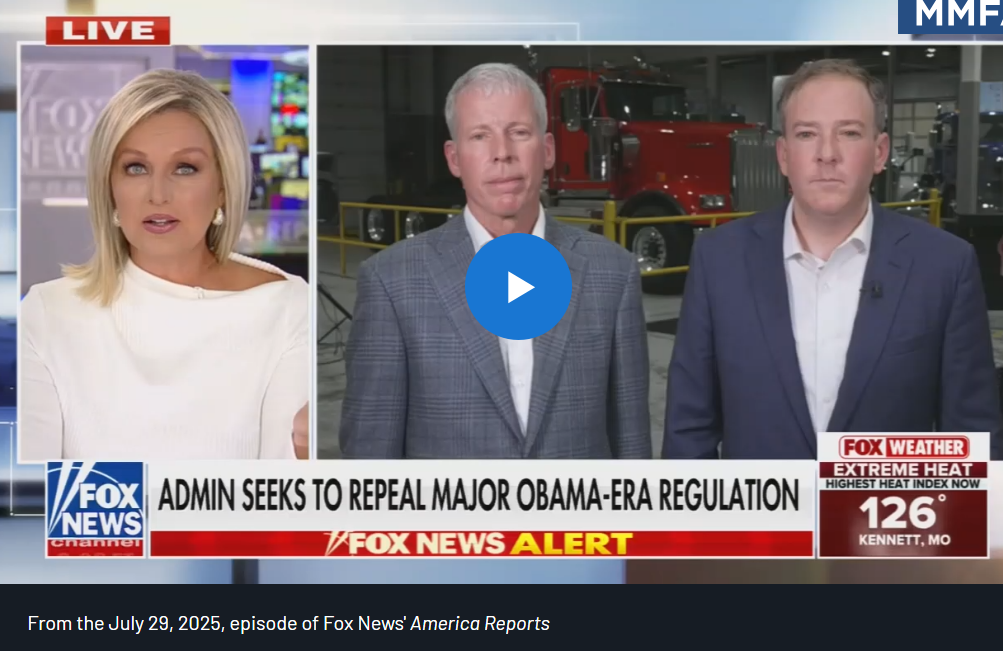
Fox News’ America Reports hosted Environmental Protection Agency Administrator Lee Zeldin and Energy Secretary Chris Wright to discuss the Trump administration's proposal to repeal the EPA’s 2009 endangerment finding, which affirmed that greenhouse gases endanger public health and welfare and which has served as the legal foundation for regulating emissions under the Clean Air Act.
Zeldin and Wright used the appearance to frame the repeal as a return to scientific integrity and regulatory restraint, ignoring the harms that this repeal would have on vulnerable communities. Fox anchor Sandra Smith did not challenge the claims and made no mention of the public health implications or regulatory consequences of revoking the finding. The exchange typified Fox’s pattern of amplifying Trump administration narratives about climate and energy while downplaying their real-world impacts.
Video
Citation
From the July 29, 2025, episode of Fox News' America Reports
The segment typified Fox’s role in obscuring the consequences of climate deregulation
During their appearance, Zeldin and Wright were not pressed on the public health, environmental, or legal implications of the proposal to reverse the endangerment finding. Instead, the host framed the discussion around economic themes and legal processes, asking whether repeal would make it easier to “undo a lot more of the Biden-Obama era climate rules.” Viewers heard nothing about the policy’s real-world impacts, but they did hear climate advocates characterized as ideological or extreme. Zeldin referred to them as “climate zealots,” while Wright framed the repeal as a return to “rationalism” — signaling to Fox’s audience that those who defend public protections are unserious.
This approach mirrors Fox’s longstanding pattern of covering regulatory actions through the lens of efficiency, growth, and personal freedom, while sidelining the communities most affected by the Trump administration's harmful actions. The result is a consistent minimization of climate risk and a distorted narrative in which climate and environmental outcomes are treated primarily as a political liability rather than a public necessity.
By allowing unchallenged repetition of misleading claims, and by omitting the central consequences of the policy under discussion, Fox News once again advanced a message strategy that serves to normalize and obscure the dismantling of basic climate and environmental protections.
Zeldin and Wright advanced a series of unsupported or misleading claims
During their appearance on the July 29 episode of Fox News' America Reports, Zeldin and Wright made a series of unsupported or misleading claims about the endangerment finding and what its repeal would mean for Americans.
Zeldin, for example, asserted that repealing the endangerment finding would yield “$1 trillion in savings”—a figure with no grounding in published EPA analyses or historical regulatory assessments. In contrast, EPA data has consistently shown that rules issued under the endangerment finding and the broader Clean Air Act generate substantial net benefits.
The agency’s Second Prospective Study of the Clean Air Act found that “the central benefits estimate exceeds costs by a factor of more than 30 to one," with most benefits stemming from reduced mortality linked to particulate pollution. By 2020, Clean Air Act programs were projected to prevent over 230,000 premature deaths, as well as millions of asthma attacks, heart attacks, and lost workdays annually.
More recently, the EPA’s Regulatory Impact Analysis for vehicle greenhouse gas standards projected net societal benefits of $272.7 billion between 2022 and 2050, with annualized gains of more than $14 billion, driven by fuel savings, reduced emissions, and avoidance of climate damages. These figures underscore that, far from being a financial burden, regulations grounded in the endangerment finding generate substantial and enduring public and economic value.
Similarly, Wright’s claim that the repeal reflects a return to scientific rigor collapses under scrutiny, relying on a report authored by a small group of contrarian scientists, including Steven Koonin and John Christy, who reject the well-established conclusion that greenhouse gas emissions from human activity are driving global warming and endangering public health. Their views stand in opposition to the broader scientific community, which includes the consensus positions of federal agencies such as the National Aeronautics and Space Administration and the National Oceanic and Atmospheric Administration, as well as the Fifth National Climate Assessment, which was produced by the U.S. Global Change Research Program.
Beyond economic distortions and scientific misrepresentation, Zeldin and Wright also ignored the far-reaching legal consequences of repeal — including for the fossil fuel industry itself.
As Grist reported, rescinding the endangerment finding would not only eliminate the federal government’s core authority to regulate greenhouse gases, it could also expose fossil fuel companies to a wave of climate liability lawsuits previously blocked by federal preemption. Some industry groups have reportedly urged the administration not to proceed, warning that repeal could unravel their legal defenses and leave them vulnerable to a patchwork of state regulations and courtroom challenges.
Fox viewers heard nothing about how repeal would harm the very communities most at risk
Zeldin and Wright also failed to mention what rescinding the endangerment finding would mean for public health, environmental protection, or the EPA’s ability to respond to pollution that threatens the air we breathe, the water we rely on, and the land we depend on to live and work. Viewers were not told that the standards targeted for repeal are central to reducing industrial emissions that worsen heat, flooding, and wildfire risk — or that dismantling these protections would increase illness, displacement, and hardship for older adults, children, low-income households, and rural communities, including many in Fox’s own audience.
---
---
MMA
In his first 100 days as EPA administrator, Lee Zeldin has used his frequent Fox appearances to shape the climate discourse
Special ProgramsClimate & Energy
Written by Allison Fisher
Research contributions from Harrison Ray
Published 05/16/25
Environmental Protection Agency Administrator Lee Zeldin has used his many appearances on Fox News and Fox Business to become one of the most visible members of the Trump administration so far. A Media Matters analysis found that Zeldin made at least 36 appearances on cable news during his first 100 days as EPA administrator, with 35 of those occurring on Fox networks — the most of any Trump Cabinet official.
Appearing on networks that are friendly to Trump’s agenda has allowed Zeldin to push climate-related misinformation and shape the discourse around environmental issues as he emerges “as one of the most devoted public champions” of Trump’s quest to “demolish the Biden agenda.”
Staples of Zeldin’s Fox appearances have included promoting rollbacks of environmental safeguards, hyping cuts and the elimination of programs at the EPA, and pushing the campaign to claw back congressionally allocated climate funds. He has also appeared on Fox to defend Trump’s orders to boost coal and muddy the waters on the root causes of the Tijuana River sewage issue.
- ## Zeldin appeared twice as much as Trump’s first EPA administrator, Scott Pruitt, in half the time.
- Lee Zeldin is far outpacing his recent Trump administration predecessors in cable news appearances.
During the first six months of his tenure, Trump’s first-term EPA administrator, Scott Pruitt, appeared 15 times across cable news — Fox News (12 appearances), CNN (2) and MSNBC (1).
Andrew Wheeler, who served as Pruitt’s deputy and assumed the top spot after Pruitt resigned amid scandal, appeared only 3 times on cable while serving in the position, all on Fox.
- ## Zeldin is using Fox to push misinformation about climate funding
- Fox News has aired more than 50 segments amplifying Zeldin’s false claims that $20 billion in federal climate grants allocated by Congress through the Inflation Reduction Act were mired in waste, fraud, and abuse. In fact, the network's coverage has been largely informed by Zeldin while Fox has omitted important details of the story reported by other news outlets that challenge his claims.
The administration tried to freeze the IRA funds, using the claims of waste and fraud, but a federal judge chastized the agency for failing to provide “credible evidence” for the claims. Even after the EPA was rebuffed in court, Zeldin’s public campaign to demonize the climate grants — many of which were intended to reduce climate and air pollution and mobilize public and private capital in underserved communities — and their recipients has continued undeterred on Fox networks.
- ## Here’s how Zeldin is using Fox appearances to shape the discourse around a number of environmental issues.
- ##### Environmental protections
On March 12, Zeldin announced sweeping measures to undo environmental protections and radically reshape the agency’s mission in what he has proudly called the “largest deregulatory announcement in U.S. history.”
As part of these actions, Zeldin has redefined the mission of the EPA. Rather than focusing on the agency’s twin tenets of environmental protection and public health, Zeldin has promised to fulfill “President Trump’s promise to unleash American energy, lower cost of living for Americans, revitalize the American auto industry, restore the rule of law, and give power back to states to make their own decisions.” And he has used Fox networks to promote and justify this shift.
Zeldin has claimed on Fox programs that current environmental protections need to be rolled back because they are "suffocating the economy” and that they have nothing to do with environmental protection but rather are part of former President Joe Biden’s “green new scam.” Zeldin’s arguments neatly position environmental safeguards into a pre-existing Fox News narrative that demonizes all climate action.
On the March 16 edition of Fox & Friends Weekend, host Charlie Hurt reflected this characterization of regulations back to Zeldin, saying: “Green New Deal things have nothing to do with actually cleaning the environment or clean air or clean water. It more has to do with spending money on pet projects that benefit basically, like, political supporters of the Democrat party.”
Such claims discount the role of environmental protections in public health and corporate polluter accountability. For example, Zeldin wants to loosen wastewater regulations for coal and other steam-powered power plants and relax limits to the amount of mercury and other toxic metals power plants can emit. Zeldin claims these regulations “improperly targeted coal-fired power plants,” even though coal plants emit “the vast majority of mercury and other toxic air pollution.”
The EPA also wants to make it easier for manufacturers to release more particulate matter, or soot, even though “exposure to these tiny particles has been linked to asthma attacks, heart attacks, strokes and other ailments.” In fact, one analysis, based on a 2024 report from the Environmental Protection Network that assessed the public health benefits of various EPA regulations, found that the targeted rules “were set to save the lives of nearly 200,000 people in the years ahead.”
Environmental justice
Zeldin is redefining environmental justice efforts as “forced discrimination programs” in order to nix it as part of Trump’s executive order on “ending radical and wasteful government DEI programs and preferences.”
To that end, he has closed the Office of Environmental Justice and External Civil Rights and signaled that he is “eliminating all diversity, equity and inclusion and environmental justice offices and positions immediately,” leaving under-resourced grassroots environmental justice groups to take over these efforts. Hundreds of environmental justice grants are being canceled as well.
On Fox, Zeldin has repeatedly suggested that the EPA previously used terms like “environmental justice” to “justify spending money not on actually directly remediating challenges to land, air, and water in America, but to funding left-wing activist groups.”
Zeldin used similar language in Fox coverage when he announced the closure of the EPA museum, calling it “another tribute to environmental justice” and saying: “What's amazing is over the course over this last administration, all this talk about environmental justice and climate change, it was really to justify giving out tens of billions of dollars to their friends through self-dealing conflicts of interests, unqualified recipients.” Zeldin’s closure of the EPA museum was covered by at least 5 other Fox News programs.
Tijuana River sewage issue
The Tijuana River sewage issue is one of the first specific environmental issues Zeldin discussed on Fox News. Every year, billions of gallons of sewage and toxic industrial waste flow down the Tijuana River, across the U.S.-Mexico border, and into the Pacific Ocean. It is a complex, decades-old, transjurisdictional issue that environmentalists and governments at the local, state, and federal level have been grappling with for years.
Zeldin has predominately characterized this issue as Mexico’s failure to stop pollution from crossing the border, while largely ignoring Mexico’s efforts to improve the problem and other progress made by the Biden administration.
For example, in March 2024, federal funding was secured to make the repairs and updates needed at California’s South Bay International Wastewater Treatment Plant. And in December, Biden approved $250 million in additional funding “towards the full repair and expansion of the South Bay International Wastewater Treatment Plant,” which is expected to be functional in the next five years.
In January 2024, Mexico began rehabilitating a shuttered wastewater treatment plant, the San Antonio de los Buenos plant, and on April 28 of this year, the plant started treating waste again. Taken together, the improvements to the U.S. waste treatment plant and the wastewater infrastructure in Mexico are “intended to eliminate up to 90% of untreated wastewater reaching the coast.”
Fox News has aired at least a dozen segments on the issue, many of which have been shaped by Zeldin’s framing.
- ## Here’s how Fox personalities are responding to Zeldin’s deregulatory efforts.
- Zeldin's Fox-heavy communications strategy has allowed him to dodge tough questioning and push misleading talking points with limited rebuttal. Fox hosts have rarely probed the consequences of cutting climate and environmental programs and rolling back safeguards, instead echoing his argument that previous government climate initiatives “didn’t really have anything to do with protecting the environment.”
Here are three examples of Fox News and Fox Business hosts teeing up Zeldin to talk about deregulation of environmental protections, efforts to boost coal, and “media attacks” on his actions.
On Sunday Night in America, host Trey Gowdy set up Zeldin to push the narrative that the protections he’s rolling back were part of a political agenda rather than pertinent to public health and safety:
- > TREY GOWDY (HOST): We all want clean water and air, period. But regulation has gotten out of control, and it’s used to advance political agendas. Lee Zeldin aims to change that. He recently terminated a $2 billion grant that started doling out money after Harris lost. He joins us now. Welcome to you, Mr. Administrator. Have you already identified areas of regulation which do nothing to advance safety or health, but simply advance a political agenda?
- On the April 1 edition of Larry Kudlow’s Fox Business program, Kudlow hosted Zeldin to discuss the EPA’s efforts to “grow the economy” and slash “red tape.” Kudlow congratulated the administrator on his recent deregulatory actions: “Thirty-one rule changes in one day at EPA. That's probably a world record, Lee Zeldin.”
Kudlow went on to reflect Zeldin’s characterization of environmental protection as radical: “A lot of the Biden stuff didn't really have anything to do with protecting the environment. It had to do with their radical Green New Deal climate change stuff. I mean, protecting the environment is very important. ... But this stuff has nothing to do with that.”
On April 10, Fox Business anchor Maria Bartiromo asked for Zeldin’s reaction to Trump’s so-called “clean coal” plan. She also applauded the agency for stripping grants from environmental justice projects and gave him a platform to respond to recent reporting from Politico on his shift from “‘pro-climate Republican to ‘one of the Trump disruptors”:
- > MARIA BARTIROMO (ANCHOR): You’ve said that the EPA is already reinvigorating America’s clean coal industry?
LEE ZELDIN (EPA ADMINISTRATOR): … At EPA just over four weeks ago, we announced what amounted to the largest deregulatory action in the history of the country. Just one agency was able to do that. Why? Because at the end of the Biden administration in 2023 and 2024, there were all sorts of regulations coming out. And as it related to the coal industry, the Biden EPA was trying to strangulate the coal industry out of existence.
…
BARTIROMO: I mean, look, you've been doing so well. I love the fact that you're taking costs out while also opening up the spigot of opportunities in energy. Your interview with Laura Ingraham recently was fantastic as you walked us through the building. Now the EPA is refusing to give Oregon an $85 million Biden-era grant meant to fund environmental justice projects in the state. You have uncovered lots of things that aren't exactly what they seem, Lee. These actions ramp up media attacks on you. Politico wrote this: “From pro-climate Republican to one of the Trump disruptors, EPA administrator Lee Zeldin's attacks on his agency’s spending and regulations have made him a rising star in the Trump cabinet but left some former colleagues mystified.”
Methodology...}:
---
===
3/24
wASHINGTON (AP) — A new Biden administration rule that sets tougher standards for deadly soot pollution faced a barrage of legal challenges Wednesday, as 25 Republican-led states and a host of business groups filed lawsuits seeking to block the rule in court.
Twenty-four states, led by attorneys general from Kentucky and West Virginia, filed a joint challenge stating that new Environmental Protection Agency rule would raise costs for manufacturers, utilities and families and could block new manufacturing plants and infrastructure such as roads and bridges. Texas filed a separate suit, as did business groups led by the U.S. Chamber of Commerce and National Association of Manufacturers.
“The EPA’s new rule has more to do with advancing President (Joe) Biden’s radical green agenda than protecting Kentuckians’ health or the environment, said Kentucky Attorney General Russell Coleman, who is leading the joint lawsuit along with West Virginia Attorney General Patrick Morrisey.
The EPA rule “will drive jobs and investment out of Kentucky and overseas, leaving employers and hardworking families to pay the price,” Coleman said.
READ MORE
Watchdog: EPA’s lead pipe fix sent about $3 billion to states based on unverified data
Racial bias did not shape Mississippi’s water funding decisions for capital city, EPA says
US’s largest public utility ignores warnings in moving forward with new natural gas plant
The soot rule is one of several EPA dictates under attack from industry groups and Republican-led states. The Supreme Court heard arguments last month on a GOP challenge to the agency’s “good neighbor rule,” which restricts smokestack emissions from power plants and other industrial sources that burden downwind areas.
Three energy-producing states — Ohio, Indiana and West Virginia — challenged the rule, along with the steel industry and other groups, calling it costly and ineffective. The rule is on hold in a dozen states because of the court challenges.
In opposing the soot rule, Republicans and industry groups say the United States already has some of the strictest air quality standards in the world — tougher than the European Union or major polluters such as China and India.
Tightening U.S. standards “wouldn’t improve public health, but it would put as many as 30% of all U.S. counties out of compliance under federal law, leading to aggressive new permitting requirements that could effectively block new economic activity,’' Coleman said.
The EPA rule sets maximum levels of fine particle pollution — more commonly known as soot — at 9 micrograms per cubic meter of air, down from 12 micrograms established a decade ago under the Obama administration.
Environmental and public health groups hailed the rule as a major step to improve the health of Americans, including future generations. EPA scientists have estimated exposure at previous limits contributed to thousands of early deaths from heart disease and lung cancer, along with other health problems.
EPA Administrator Michael Regan said the new soot rule, finalized last month, would create $46 billion in net health benefits by 2032, including prevention of up to 800,000 asthma attacks and 4,500 premature deaths. The rule will especially benefit children, older adults and those with heart and lung conditions, Regan said, as well as people in low-income and minority communities adversely affected by decades of industrial pollution.
“We do not have to sacrifice people to have a prosperous and booming economy,″ Regan said.
Biden is seeking reelection, and some fellow Democrats have warned that a tough new soot standard could harm his chances in key industrial states such as Pennsylvania, Michigan and Wisconsin.
The EPA and White House officials brushed aside those concerns, saying the industry has developed technical improvements to meet previous soot standards and can adapt to meet the new ones. Soot pollution has declined by 42% since 2000, even as the U.S. gross domestic product has increased by 52%, Regan said.
The new rule does not impose pollution controls on specific industries. Instead, it lowers the annual standard for fine particulate matter for overall air quality. The EPA will use air sampling to identify counties and other areas that do not meet the new standard. States would then have 18 months to develop compliance plans for those areas. States that do not meet the new standard by 2032 could face penalties, although EPA said it expects that 99% of U.S. counties will be able to meet the revised annual standard by 2032.
Industry groups and Republican officials dispute that and say a lower soot limit could put hundreds of U.S. counties out of compliance.
The U.S. Chamber of Commerce warned the White House in January that 43% of total particulate emissions come from wildfires, and called the pollution standard “the wrong tool to address this problem.’'
The EPA said it will work with states, counties and tribes to account for and respond to wildfires, an increasing source of soot pollution, especially in the West, where climate change has led to longer wildfire seasons, with more frequent and intense fires. The agency allows states and air agencies to request exemptions from air-quality standards due to “exceptional events,” including wildfires and prescribed fires.
Besides Kentucky, West Virginia and Texas, other states challenging the EPA rule include: Alabama, Alaska, Arkansas, Florida, Georgia, Idaho, Indiana, Iowa, Kansas, Louisiana, Mississippi, Missouri, Montana, Nebraska, North Dakota, Ohio, Oklahoma, South Carolina, South Dakota, Tennessee, Utah and Wyoming.
All three cases were filed before the U.S. Court of Appeals for the District of Columbia.