Asthma
---
promoted to 2nd 11/17
see zeldin wright endangerment 7 25
SAB CASAC partic PM 2/5?
note red links are the Good guys
purple makes it worse
EJ is proxy for all? this //?
kid killer?
---
---
OMFG
note temp
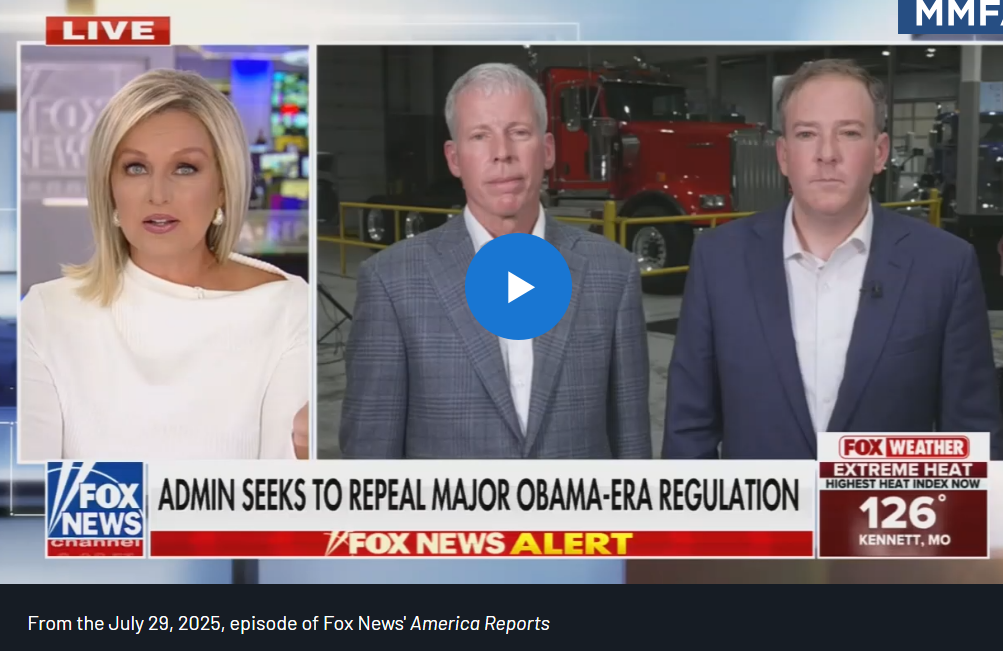
MMA 7 25
Fox News’ America Reports hosted Environmental Protection Agency Administrator Lee Zeldin and Energy Secretary Chris Wright to discuss the Trump administration's proposal to repeal the EPA’s 2009 endangerment finding, which affirmed that greenhouse gases endanger public health and welfare and which has served as the legal foundation for regulating emissions under the Clean Air Act.
Zeldin and Wright used the appearance to frame the repeal as a return to scientific integrity and regulatory restraint, ignoring the harms that this repeal would have on vulnerable communities. Fox anchor Sandra Smith did not challenge the claims and made no mention of the public health implications or regulatory consequences of revoking the finding. The exchange typified Fox’s pattern of amplifying Trump administration narratives about climate and energy while downplaying their real-world impacts.
Video
Citation
From the July 29, 2025, episode of Fox News' America Reports
The segment typified Fox’s role in obscuring the consequences of climate deregulation
During their appearance, Zeldin and Wright were not pressed on the public health, environmental, or legal implications of the proposal to reverse the endangerment finding. Instead, the host framed the discussion around economic themes and legal processes, asking whether repeal would make it easier to “undo a lot more of the Biden-Obama era climate rules.” Viewers heard nothing about the policy’s real-world impacts, but they did hear climate advocates characterized as ideological or extreme. Zeldin referred to them as “climate zealots,” while Wright framed the repeal as a return to “rationalism” — signaling to Fox’s audience that those who defend public protections are unserious.
This approach mirrors Fox’s longstanding pattern of covering regulatory actions through the lens of efficiency, growth, and personal freedom, while sidelining the communities most affected by the Trump administration's harmful actions. The result is a consistent minimization of climate risk and a distorted narrative in which climate and environmental outcomes are treated primarily as a political liability rather than a public necessity.
By allowing unchallenged repetition of misleading claims, and by omitting the central consequences of the policy under discussion, Fox News once again advanced a message strategy that serves to normalize and obscure the dismantling of basic climate and environmental protections.
Zeldin and Wright advanced a series of unsupported or misleading claims
During their appearance on the July 29 episode of Fox News' America Reports, Zeldin and Wright made a series of unsupported or misleading claims about the endangerment finding and what its repeal would mean for Americans.
Zeldin, for example, asserted that repealing the endangerment finding would yield “$1 trillion in savings”—a figure with no grounding in published EPA analyses or historical regulatory assessments. In contrast, EPA data has consistently shown that rules issued under the endangerment finding and the broader Clean Air Act generate substantial net benefits.
The agency’s Second Prospective Study of the Clean Air Act found that “the central benefits estimate exceeds costs by a factor of more than 30 to one," with most benefits stemming from reduced mortality linked to particulate pollution. By 2020, Clean Air Act programs were projected to prevent over 230,000 premature deaths, as well as millions of asthma attacks, heart attacks, and lost workdays annually.
More recently, the EPA’s Regulatory Impact Analysis for vehicle greenhouse gas standards projected net societal benefits of $272.7 billion between 2022 and 2050, with annualized gains of more than $14 billion, driven by fuel savings, reduced emissions, and avoidance of climate damages. These figures underscore that, far from being a financial burden, regulations grounded in the endangerment finding generate substantial and enduring public and economic value.
Similarly, Wright’s claim that the repeal reflects a return to scientific rigor collapses under scrutiny, relying on a report authored by a small group of contrarian scientists, including Steven Koonin and John Christy, who reject the well-established conclusion that greenhouse gas emissions from human activity are driving global warming and endangering public health. Their views stand in opposition to the broader scientific community, which includes the consensus positions of federal agencies such as the National Aeronautics and Space Administration and the National Oceanic and Atmospheric Administration, as well as the Fifth National Climate Assessment, which was produced by the U.S. Global Change Research Program.
Beyond economic distortions and scientific misrepresentation, Zeldin and Wright also ignored the far-reaching legal consequences of repeal — including for the fossil fuel industry itself.
As Grist reported, rescinding the endangerment finding would not only eliminate the federal government’s core authority to regulate greenhouse gases, it could also expose fossil fuel companies to a wave of climate liability lawsuits previously blocked by federal preemption. Some industry groups have reportedly urged the administration not to proceed, warning that repeal could unravel their legal defenses and leave them vulnerable to a patchwork of state regulations and courtroom challenges.
Fox viewers heard nothing about how repeal would harm the very communities most at risk
Zeldin and Wright also failed to mention what rescinding the endangerment finding would mean for public health, environmental protection, or the EPA’s ability to respond to pollution that threatens the air we breathe, the water we rely on, and the land we depend on to live and work. Viewers were not told that the standards targeted for repeal are central to reducing industrial emissions that worsen heat, flooding, and wildfire risk — or that dismantling these protections would increase illness, displacement, and hardship for older adults, children, low-income households, and rural communities, including many in Fox’s own audience.
---
---
update
https://cei.org/content/cei-comments-epas-proposed-review-national-ambient-air-quality-standards-particulate-matter
CEI Comments on EPA's Proposed Review of the National Ambient Air Quality Standards for Particulate Matter
Docket ID No. EPA-HQ-OAR-2015-0072
Marlo Lewis, Jr. • June 29, 2020
>
Thank you for the opportunity to comment on EPA’s review of the national ambient air quality standards (NAAQS) for particulate matter (PM).[[1]](https://cei.org/content/cei-comments-epas-proposed-review-national-ambient-air-quality-standards-particulate-matter#_ftn1)
EPA proposes to retain the existing PM standards without revision. EPA’s proposal is consistent with the advice of the agency’s Clean Air Scientific Advisory Committee (CASAC) on the primary 24-hour PM2.5 standard, the primary PM10 standard, and the secondary standards. However, not all CASAC members agree with EPA’s proposal to retain the annual primary PM2.5 standard. That proposal, moreover, is strongly opposed by many blue state politicians, progressive punditry, and, for want of a better term, the Regulatory Industrial Complex.[[2]](https://cei.org/content/cei-comments-epas-proposed-review-national-ambient-air-quality-standards-particulate-matter#_ftn2)
Accordingly, this letter addresses only EPA’s proposal to retain the annual primary PM2.5 standard. The Competitive Enterprise Institute (CEI) strongly supports EPA’s proposed decision not to tighten the standard.
Summary of Argument...
==
---
https://www.ecowatch.com/air-pollution-cardiac-arrests-2644941669.html
Researchers now say there is "no safe level" of air pollution exposure after a large-scale study found a correlation between exposure to fine particle matter, known as PM2.5, and cardiac arrests, according to the The Sydney Morning Herald.
The researchers found that exposure to PM2.5 that even fell below global standards was hazardous, suggesting that tighter regulations and cleaner energy is required, according to the study, which was published in the journal Lancet Planetary Health.
Scientists from the University of Sydney led the study, which analyzed air quality in Japan against 249,372 cases of out-of-hospital cardiac arrests. They concluded that even low-level exposure was associated with an increased risk of cardiac arrest for people over 65, as The Sydney Morning Herald reported.
The researchers noticed that the risk of cardiac arrest grew by up to 4 percent for every increase of 10 units in the PM2.5 levels.
"Our study supports recent evidence that there is no safe level of air pollution — finding an increased risk of cardiac arrest despite air quality generally meeting the standards,"said report author professor Kazuaki Negishi from the University of Sydney School of Medicine, as The Canberra Times reported.
Negishi pointed out that previous research into air pollution and acute cardiac events had been inconsistent, particularly at PM2.5 levels that met the World Health Organization guidelines. However, the large scale of this study meant that past inconsistencies could be addressed.
"Out-of-hospital cardiac arrest is a major medical emergency – with less than one in 10 people worldwide surviving these events – and there has been increasing evidence of an association with the more acute air pollution, or fine particulate matter such as PM2.5," said Negishi in a University of Sydney statement. "We analyzed almost a quarter of a million cases of out-of-hospital cardiac arrests and found a clear link with acute air pollution levels."
The findings are troubling for Australia, which has seen its usually pristine air plummet in quality due to the recent bushfires.In the study, more than 90 per cent of out-of-hospital cardiac arrests occurred at levels below the Australian standard of 25 micrograms per cubic meter. Put another way, the air quality levels ranked as "fair," "good" or "very good" under Australian standards, as the The Sydney Morning Herald reported. The U.S. and Japanese standard is less strict at 35 micrograms per cubic meter.
Australia had a particularly awful year, with air quality in Canberra ranking as the worst in the world on Dec. 31. Sydney had 81 days of hazardous, very poor or poor air quality in 2019, which was more days of bad air than the last decade combined, according to The Sydney Morning Herald.
The researchers expect the worsening air quality will lead to more heart attack fatalities in Australia, especially among older people.
"Given the fact that there is a tendency towards worsening air pollution – from increasing numbers of cars as well as disasters such as bushfires – the impacts on cardiovascular events, in addition to respiratory diseases and lung cancer – must be taken into account in health care responses," said Negishi in a university statement.
Unfortunately, the researchers did not identify a threshold that is safe for exposure to PM2.5. Instead, Negishi said that existing standards should be reevaluated.
"It might not be a good idea to continue to seek [a new] threshold, but try to continuously improve our air quality. If a threshold exists, it should be very, very close to zero," Negishi said, as The Sydney Morning Herald reported.
---
==
https://www.ecowatch.com/african-americans-air-pollution-2509714660.html
African Americans Disproportionately Suffer Health Effects of Oil and Gas Facilities
African American communities face a disproportionate risk of health issues caused by gas and oil pollution, according to a report issued Tuesday by two advocacy groups.
The report from the National Association for the Advancement of Colored People and the Clean Air Task Force noted the importance of Obama-era U.S. Environmental Protection Agency (EPA) regulations that finalized standard for methane and ozone smog-forming volatile organic compound (VOCs). The report states that if the Trump administration's dismantling of environmental regulations continues, the situation for African Americans will worsen.
The study found oil and natural gas facilities were built or currently exist within a half-mile of more than one million African Americans, exposing these communities to higher risks of cancer due to toxic emissions. "African-Americans are exposed to 38 percent more polluted air than Caucasian Americans, and they are 75 percent more likely to live in fence-line communities than the average American," the report said, referring to neighborhoods near to gas and oil facilities.
Counties located in the Gulf Coast Basin are home to the most counties with oil refineries and higher percentages of African Americans. Michigan, Louisiana and Tennessee, the report found, have the highest percentage of African American residents living in oil refinery counties. Texas and Louisiana, both in the Gulf Coast Basin, were home to the largest African American individuals at risk for cancer, with nearly 900,000 living in areas above the EPA's level of concern.
"The effects of oil and gas pollution are disproportionately afflicting African Americans, particularly cancer and respiratory issues, and the trend is only increasing," said Dr. Doris Browne, the National Medical Association President.
The report also found that oil and natural gas industries violate the EPA's air quality standards from natural gas emissions-related ozone smog in numerous African communities, causing more than 130,000 asthma attacks among school children. This results in more than 100,000 missed school days each year.
Defending the environmental protections finalized during the Obama administration and advocating for additional protections against pollution from the oil and gas industry will help improve the health of many African American communities, the study noted.
But the Trump administration has already begun to dismantle Obama-era EPA steps taken in 2016 that aimed to clean up toxic air pollutants such as benzene, formaldehyde and sulfur dioxide. It is also taking aim at 2016 EPA actions that address the 1.2 million existing sources of methane pollution and other airborne pollution. The White House claims these regulations are unnecessary industry burdens. The Trump administration's moves are being challenged in courts around the country.
"What this administration is discovering as it attempts to undo vital health and environmental protections is that these sensible standards cannot simply be wished away, only to the benefit of the oil and gas industry," said Sarah Uhl, program director of short-lived climate pollutants for Clean Air Task Force.
...
---
==
ref
http://www.lung.org/local-content/california/documents/sota-2017_ca-overview.pdf
State of the Air 2017
finds that California remains home to some of the worst air pollution in the country,
affecting the health of millions of Californians. The Los Angeles, Bakersfield and Visalia metropolitan areas
top the list of the most polluted in the country for ozone pollution and particle pollution, with many other
California cities among the Top 10 polluted areas.
- Statewide, over 35 million Californians (91%) live in counties affected by unhealthy air during the year.
Almost 17 million Californians live in counties that received three failing grades in State of the Air 2017. At
risk populations include children, seniors, those with asthma, COPD, lung cancer, heart disease, diabetes,
and disadvantaged communities.
- There is good news in the 2017 report. Despite remaining challenges, the Federal Clean Air Act and state
and local clean air policies are driving steady progress in the fight for clean air, and a number of cities have
had their cleanest year yet. Eight cities that saw their lowest ozone averages in any report, including Los
Angeles, Bakersfield, Visalia and Sacramento.
- The air is cleaner today because of the Federal Clean Air Act, California’s groundbreaking clean air and
clean energy laws, and local air pollution control programs. California must continue to ramp up
investments in zero emission vehicles including electricity and hydrogen, zero emission freight, renewable
power, non-polluting residential heating, and more sustainable community planning to reduce air pollution.
- State of the Air annually highlights the real public health crisis caused by air pollution. Millions of
California residents live in polluted areas and are at increased risk for health emergencies. Air pollution can
cause asthma attacks and other lung diseases, send people to hospitals and emergency rooms, and even
slow the development of children’s lungs.
6. Climate change is impacting California’s fight for healthy air. Climate impacts include warming
temperatures, droughts, heat waves and wildfires which can all create conditions for poor air quality and
have devastating impacts on lung health. While California experienced a wet winter this year, the report
continues to demonstrate the impacts of drought weather conditions slowing progress in reducing particle
pollution in the San Joaquin Valley over the past few years. Without continued actions at the local, state,
federal and global levels, extreme weather events will become the new normal for California.
- San Joaquin Valley residents continue to face significant air pollution challenges. The San Joaquin Valley
is home to the four the most particle-polluted cities in the United States, and has seen significant challenges
in reducing particle pollution. Additionally, despite more steady progress on ozone, residents in three Valley
counties face more than 90 unhealthy ozone days per year.
- All communities deserve healthy air. Many California communities face higher exposures and health risks
due to their proximity to freeways, refineries, rail yards, ports, freight corridors and other local soot
pollution sources. The Lung Association supports stronger regulations and targeted investments to ensure
that all Californians can breathe healthy air where they live, work or go to school.
9. Health leaders support California’s leadership on clean air and climate policies. Health leaders have
demonstrated strong support for the Federal Clean Air Act and full implementation of federal programs to
control smog, soot and climate pollution. Over 300 health leaders and experts from across the country
recently sent a letter expressing strong support for California’s leadership on advanced clean cars and zero
emission vehicles and urging stronger standards in the next round. Now is a critical time for state and local
elected officials and all Californians to join health leaders in showing strong support for California’s climate
targets and the transition to zero emissions to help meet those targets.
- Everyone can make a difference for clean air. Making decisions to drive less, carpool, walk or bike where
possible, switch to electric transportation instead of gasoline cars, avoid wood burning and use less energy
all contribute to cleaner air.
==
==
http://cencalasthma.org/resources/county-level-statistics/
Lifetime Asthma Prevalence Rates for School Aged Children
(Ages 5-17)
California
16.6%
==
Children in California increasingly are flocking to emergency rooms for treatment of asthma, despite millions of dollars spent on programs to control the disease.
Statewide, the rates of ER visits for asthma symptoms rose by about 18 percent for California children ages 5 to 17 and by 6 percent for children under 5 between 2005 and 2012, according to a Kaiser Health News analysis of the latest available rates by county.
In some parts of the state, especially the Central Valley, the increases were far higher. The rate of emergency room visits for children 5 and older more than doubled in rural Madera County and nearly doubled In Merced. In Sacramento County, they rose by 48 percent and in Los Angeles, the largest county in the nation, by 17 percent.
Asthma ER visits on the rise, ages 5-17
KAISER HEALTH NEWS
All told, more than 72,000 California children under 18 visited the ER for asthma in 2012.
"There's clearly more work to be done if this many kids are going to the emergency department," said Anne Kelsey Lamb, director of the Regional Asthma Management and Prevention program of the Oakland-based Public Health Institute. "We know a lot about what works. We absolutely should be able to reduce the rates we're seeing."
At the national level, asthma-related emergency room visit rates have declined in recent years, according to federal health data through 2010, the latest available.
Although ER visits declined in some counties, including Alameda, San Mateo and Marin, the overall rise in California has frustrated public health experts who have spent millions of dollars and countless hours to improve and expand asthma prevention programs around the state. The state and federal governments alone spend $1.54 million annually on such projects in California, including grants to schools to improve indoor air quality and training community health workers.
Non-Emergency Patients Shift Away From ERs
The good news is fewer kids are actually being admitted into hospitals. Overnight-or-longer stays are declining statewide and nationally. That's due largely to better medicines and more aggressive treatment in the ER, asthma specialists say.
==
http://www.californiabreathing.org/images/pdfs/burden_of_asthma_summary_110507.pdf
modified on: Thursday, 01 September 2016
In Santa Clara County, approximately 257,000 children and adults have been diagnosed with asthma.
Age Santa Clara County California
Children 0-4 -- 9.7 (7.2-12.3)
5-17 14.5 (7.9-21.1) 17.1 (15.5-18.7)
hospitaliztion 326/10K
==
California:
About 3.7 million adults (13.7%) and 1.7 million children (13.3%)
have been diagnosed with asthma (lifetime asthma).
About 2.1 million adults (7.6%) and 827,000 children (8.6%) have
current asthma.
Adult lifetime asthma prevalence has been increasing since 1995
and has been consistently higher than the national average.
Native Americans (23.6%) and Blacks (18.2%) have the highest
lifetime asthma prevalence, followed by White (14.1%), Hispanic
(10.7%), and Asian/Pacific Islander (9.9%).
In adults, asthma prevalence (both lifetime and current) is higher
in females than males. In children, it is higher for males than
females.
---
Among children/youth with lifetime asthma:
One out of every three children had an asthma attack or episode in the
past year.
12% experience symptoms at least on a weekly basis.
Among those with weekly or daily symptoms, 27.8% do not take daily
asthma medications.
60% could not do physical activity sometime in the past year because of
their asthma.
Almost two-thirds (61.6%) have not received an asthma management
plan from their healthcare provider.
On average, a child with current asthma missed 2.6 days of school/day
care per year because of their asthma.
---
Asthma emergency department (ED) visits are preventable with proper
asthma management and regular health care.
In 2005 in California:
There were 144,945 asthma ED visits, resulting in a rate of 39.1 visits
per 10,000 residents.
Blacks have the highest rate of asthma ED visits (106.9 per 10,000)–
three times as high as for Whites (34.9 per 10,000).
In children under age 15, males (92.8 per 10,000) have higher rates of
asthma ED visits than females (49 per 10,000). Among people over age
15, the rate for females (38.9 per 10,000) is higher than males (22.4 per
10,000).
Medicare and Medi-Cal were the payers for 39% of asthma ED visits.
Private insurers covered 37%.
Because data on ED visits is only available for 2005, trends cannot be
identified.
---
Like asthma ED visits and hospitalizations, asthma deaths are preventable
with proper disease management and regular health care.
On average, a person dies from asthma 16 years prematurely (e.g.,
potential life lost).
From 1999 to 2004, there was an average of 508 asthma deaths per
year, or a rate of 15.5 per million California residents.
Asthma death rates in California has been decreasing, from 26.1 per
million in 1999 to 13.0 per million in 2004.
Blacks have consistently had the highest asthma death rate across all
race/ethnicity groups. In 2004, it is two times higher than the next highest
group, Asian/Pacific Islanders.
Asthma death rates are highest in adults over age 65 (56.9 per million).
There are large differences in asthma death rates by county, ranging
from 9.9 per million (Solano County) to 37.8 per million (Merced County)
==
Children in California increasingly are flocking to emergency rooms for treatment of asthma, despite millions of dollars spent on programs to control the disease.
Statewide, the rates of ER visits for asthma symptoms rose by about 18 percent for California children ages 5 to 17 and by 6 percent for children under 5 between 2005 and 2012, according to a Kaiser Health News analysis of the latest available rates by county.
In some parts of the state, especially the Central Valley, the increases were far higher. The rate of emergency room visits for children 5 and older more than doubled in rural Madera County and nearly doubled In Merced. In Sacramento County, they rose by 48 percent and in Los Angeles, the largest county in the nation, by 17 percent.
Asthma ER visits on the rise, ages 5-17
KAISER HEALTH NEWS
All told, more than 72,000 California children under 18 visited the ER for asthma in 2012.
"There's clearly more work to be done if this many kids are going to the emergency department," said Anne Kelsey Lamb, director of the Regional Asthma Management and Prevention program of the Oakland-based Public Health Institute. "We know a lot about what works. We absolutely should be able to reduce the rates we're seeing."
At the national level, asthma-related emergency room visit rates have declined in recent years, according to federal health data through 2010, the latest available.
Although ER visits declined in some counties, including Alameda, San Mateo and Marin, the overall rise in California has frustrated public health experts who have spent millions of dollars and countless hours to improve and expand asthma prevention programs around the state. The state and federal governments alone spend $1.54 million annually on such projects in California, including grants to schools to improve indoor air quality and training community health workers.
Non-Emergency Patients Shift Away From ERs
The good news is fewer kids are actually being admitted into hospitals. Overnight-or-longer stays are declining statewide and nationally. That's due largely to better medicines and more aggressive treatment in the ER, asthma specialists say.
https://www.usnews.com/news/articles/2015/05/30/er-visits-for-asthma-rising-among-kids-in-california
---
cdc conf ~
THE SENATE VOTED to confirm Donald Trump’s pick for administrator of the Environmental Protection Agency today over the objections of Democratic senators, hundreds of former EPA officials, and hundreds of current EPA employees. Although an Oklahoma judge had ruled on Thursday that Pruitt’s office had to release more than 2,500 emails he had exchanged with energy and gas companies and industry groups, Republicans crammed through his confirmation in a 52-46 vote (with Democrats Joe Manchin and Heidi Heitkamp voting with the Republican majority) before anyone had a chance to review the emails exchanged with the companies he’s now in charge of regulating.
Meanwhile, on Thursday, while Republicans in Washington were holding the first of two votes to confirm an EPA chief who will roll back regulations on the oil and gas companies responsible for most global warming, hundreds of climate scientists gathered in Atlanta to talk about the way climate change is already sickening and killing people around the country and the world.
The Climate and Health Meeting, which was organized in January after the CDC cancelled a similar conference, was far from being a litany of the gloom and doom predictions and statistics that you might expect from the scientists studying increases in temperature, rising sea levels, and extreme weather. Those things were present, of course, summed up perhaps most frighteningly by former Vice President Al Gore, the meeting’s host, who noted that humans emit 110 million tons of global warming pollution into the atmosphere every 24 hours — and that the heat energy trapped by this daily dump is the equivalent of “exploding 400,000 Hiroshima-class atomic bombs.” Or the graph that showed how the continued release of these greenhouse gases could lead to a 12-degree temperature rise by 2300, a change that would render large swaths of the earth uninhabitable.
Instead, the focus was on the extremes that have already happened— and, more importantly, their human consequences. Gore pointed out the parts of the world that are already on the outer limits of human habitability, a spot in Iran where the heat index hit 165 for the first time in 2015, for instance, or a town in India, where the temperature hit a record 123.8 degrees last year. He showed people in Pakistan digging mass graves in advance of killer heat waves because they now know what to expect and traced how warmer temperatures contributed to the spread of the virus that causesdengue fever in India, where there are now 37 million infections each year.
While poor countries are being hit the hardest, the U.S. is already seeing its fair share of human casualties. Air pollution, which is worsened by heat — and produced by the same fossil fuel combustion that warms the climate — already kills 200,000 Americans each year and costs the country almost 4 percent of GDP in 2010. Two-thirds of water-borne disease outbreaks in the U.S. are set off by extreme weather events. We saw pictures of refrigerator trucks for bodies that couldn’t fit into the morgue after a Chicago heat wave, elderly people felled by heat stress in the American Southwest, and children forced to carry around backpacks of emergency asthma supplies for their heat-exacerbated asthma.
In what was may have been the saddest presentation in a day of sad presentations, psychiatrist Lise Van Susteren described the mental health consequences of climate change on children, telling of kids suffering from clinical anxiety about the climate and the particular difficulty of reckoning with human-caused crises. “What happens from intentional negligence is harder to put behind us,” she explained. Van Susteren predicted that children, as they grow older, will experience their parents’ “destructive inaction on climate” as child abuse.
If the unsparing presentations about the mounting human toll of climate change begged for “bowls of Prozac and certificates for free vasectomies,” as one scientist joked, they also reflected the recognition that past efforts to convey the urgency of climate change to voters had failed — and were partly responsible for the fact that the climate experts were presenting their calamitous news essentially in exile.
With its focus on climate reality, the meeting paid less attention to the political reality that is the biggest obstacle to addressing it. Most presenters made just the barest nods to our anti-science president who derides climate change as a hoax. Ashish Jha, director of the Harvard Global Health Institute, noted dryly that walls won’t keep out the malnutrition, diseases, and death that await us if we don’t reduce our burning fossil fuels.
Former President Jimmy Carter, who made the Carter Center available for the conference, was also restrained, referring only obliquely to “this last election.” At the same time that the victor of that last election was signing a bill that will reverse protections on waterways from coal mining ash, Carter, who has devoted his life to humanitarian causes, was talking about the impact of climate change on “the lives of the poorest people on earth.” Carter acknowledged his relative freedom to speak his mind on the subject, noting, “I have secret service protection the rest of my life.”
The few representatives of the CDC who attended the meeting were more constrained. Only about 12 staff members from the federal agency originally slated to host the conference were in attendance, according to CDC Spokesperson Bernadette Burden. And many of them were using personal or vacation time to be there, exercising “their right to attend as private citizens,” as Burden put it.
George Luber, a CDC epidemiologist who attended the meeting in an official capacity, gave a clear presentation showing the agency’s efforts to prepare cities and states for the health changes brought by climate change. The program helps project local disease burdens, draft response plans, and develop “the best science so we can make the best decisions,” Luber said.
What was less obvious was whether that government work will continue under the new administration. “No one knows what will happen,” said Julia Gold, who manages the Rhode Island’s climate change program, which is funded by a grant from the CDC.
Patrick Breysse, director of the CDC’s National Center for Environmental Health, of which the Climate and Health program is part, told me he’s confident the agency’s health-focused work will continue. While there may be disagreement over the root causes of climate change, Breysse said, “The good news is that people generally agree that there are increasing temperatures, more wildfires.” He even expressed hope that the agency would reschedule its climate meeting, but was unable to say when that might happen.
As government scientists find themselves less able to communicate about the environmental disaster to which they’ve devoted their professional lives, those free to speak are trying to figure out how to rectify the communications failures that have cast them politically powerless. Climate change used to be understood mostly as a problem of the planet and the endangered species on it. But this meeting made it clear that the emphasis will no longer be on shrinking habitats or abstract graphs with lines pointing off into the distant future. However poignant, the plight of the polar bear is out.
In its place, we’ll be seeing images of kids like Will, a 7-year-old in Texas, who is now forced to wear a cooling vest because of a medical condition that makes him particularly susceptible to heat and to stay inside on the increasing number of very hot days in his hometown in Texas.
The best strategy, according to Ed Maibach of the Center for Climate Change Communication at George Mason University, is to keep the message simple — that climate change is real and — if we cut back on fossil-fuel use — reversible.
Maibach, who has divided the American public into six categories according to their beliefs about climate change, presented perhaps the most encouraging message of the event: that much of the country is open to learning about climate change. The good news, according to Maibach, is that only 9 percent of the country are “dismissers,” the most ideologically extreme end of the spectrum who are dead-set against recognizing the reality of climate change. The bad news is that that many of them are now leading our government.
==
==