air pollution Action
disambig 719 see clean air act
merri ok
oddly sep from global warming 420
belated?
see particulate pm 2.5
see ozone
see wildfires arboreal forest
SEE ZELDIN ENDANGERMENT EJ ASTHMA KID KILLER
milloy rolodex?
SEE EJ
see methane
html incinerator.”
---
-=-=
-=-=
DK 9 26
 NPR
Trump's EPA repeals pollution limits on fossil fuel power plants
The Trump administration is repealing limits on greenhouse gas emissions emitted by the nation's fossil fuel-fired power plants. The head of the Environmental Protection Agency called it the largest deregulatory action of the U.S. power sector in history.
This action eliminates rules the EPA finalized during the Biden administration that required existing coal and new natural gas-fired power plants to significantly reduce their carbon dioxide pollution, starting in the 2030s. Carbon dioxide from human activity is the main driver of global warming.
Power plants are the second largest source of planet-heating carbon dioxide emissions in the U.S., behind transportation.
At a press conference on Monday, EPA Administrator Lee Zeldin said that the actions to curtail planet-heating pollution under the Biden and Obama administrations led to higher energy prices and prevented the country from reaching its full energy potential.
"The days of Biden and Obama working to destroy natural gas and coal are over," said the EPA administrator.
Large solar and wind projects, however, provide more cost-competitive energy than natural gas and coal projects, according to financial services firm Lazard.
Zeldin made his remarks in Houston, where the U.S. is hosting the G20 Energy Summit. The administrator said that the EPA was also proposing to rescind all remaining greenhouse gas emissions standards for power plants. "All of them," he said.
Environmental groups say the move to repeal power plant rules will increase pollutants that harm human health. "These rules are really important, not just for our climate, but also to protect public health from the dangers of local air pollution," says Gudrun Thompson, senior attorney at the Southern Environmental Law Center.
Trump has rejected the basic tenets of climate science and has called climate change a "con job." This is his latest effort to reverse former President Biden's climate agenda and make it more difficult for future administrations to limit the human-caused greenhouse gas pollution heating the planet. Environmental groups plan to challenge the decision in court.
Power plant regulations that never happened
The legal basis for rules to limit climate pollution from power plants started with the Supreme Court's 2007 Massachusetts v. EPA decision. It concluded that the EPA is required to regulate carbon dioxide and other greenhouse gas emissions under the Clean Air Act. That led to the EPA's 2009 endangerment finding that designated greenhouse gas pollution as a threat to human health.
In 2014, the Obama administration proposed the "Clean Power Plan" aimed at cutting carbon dioxide emissions from power plants by 32%, from 2005 levels, by 2030. That plan faced legal challenges and never went into effect. Still the country met that goal well before 2030, as coal-fired power plants were replaced by natural gas plants that emit less carbon dioxide and renewable energy projects began producing more electricity.
Five years later, Trump replaced the Obama-era Clean Power Plan with his Affordable Clean Energy rule, which allowed power plants to emit more climate pollution.
Then Biden came into office in 2021 with the most ambitious plan to address climate change of any major party candidate in U.S. history. The administration set a goal of eliminating climate pollution from the power sector by 2035.
In 2022, the U.S. Supreme Court weighed in again and restricted the EPA's options for regulating power plant emissions. Justices said that without a specific law, the agency cannot force the entire power generation industry to move away from fossil fuels toward less-polluting energy sources.
So, instead, the EPA created regulations governing individual power plants. The agency and environmental groups believed that would allow the rules to survive scrutiny from a court dominated by conservative justices. But now the Trump administration is eliminating the limits altogether.
Last month was the hottest ever recorded month globally, because of human-caused climate change and a developing El Niño climate pattern.
The EPA's decision to repeal emission regulations on power plants comes at a time when the world needs to be limiting planet-heating greenhouse gas emissions, not allowing more emissions, says Michael Gerrard, law professor at Columbia University and director of the Sabin Center for Climate Change Law.
" 2026 is shaping up to be the warmest year in recorded history," Gerrard says, "and we ain't seen nothing yet."
-=-=
Trump repeals emissions regulations of fossil-fuel power plants
-=-=
-=-=
polluted air inflame lungs makes covid more likely?
5 26
Climate Change is Destroying Lives... Now - YouTube
2 26 yt? ex regulator Says basically no meaNINGFUL EMISSION STDS ANYMORE; POST EPA ENDANGER GUT
BILL MCK SAYS 1:5 DEATHS?
---
---
bill gates ignores
11 25
his artl long lomborgian ai play energy nuke tmi?
1 in 8 kia air pollute 8 million 2021
---
OMFG
note temp
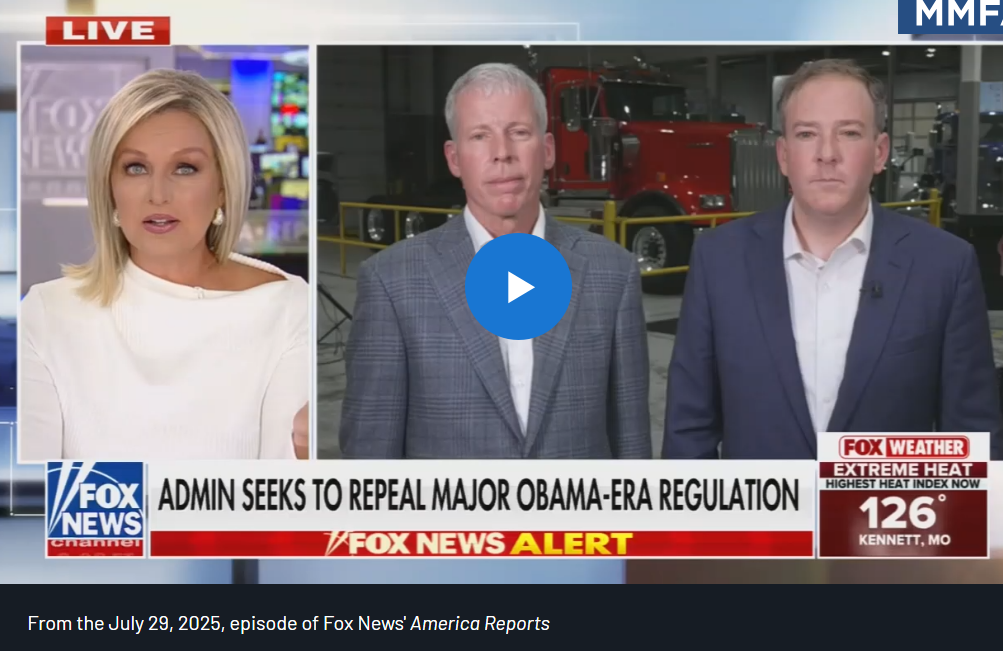
MMA 7 25
Fox News’ America Reports hosted Environmental Protection Agency Administrator Lee Zeldin and Energy Secretary Chris Wright to discuss the Trump administration's proposal to repeal the EPA’s 2009 endangerment finding, which affirmed that greenhouse gases endanger public health and welfare and which has served as the legal foundation for regulating emissions under the Clean Air Act.
Zeldin and Wright used the appearance to frame the repeal as a return to scientific integrity and regulatory restraint, ignoring the harms that this repeal would have on vulnerable communities. Fox anchor Sandra Smith did not challenge the claims and made no mention of the public health implications or regulatory consequences of revoking the finding. The exchange typified Fox’s pattern of amplifying Trump administration narratives about climate and energy while downplaying their real-world impacts.
Video
Citation
From the July 29, 2025, episode of Fox News' America Reports
The segment typified Fox’s role in obscuring the consequences of climate deregulation
During their appearance, Zeldin and Wright were not pressed on the public health, environmental, or legal implications of the proposal to reverse the endangerment finding. Instead, the host framed the discussion around economic themes and legal processes, asking whether repeal would make it easier to “undo a lot more of the Biden-Obama era climate rules.” Viewers heard nothing about the policy’s real-world impacts, but they did hear climate advocates characterized as ideological or extreme. Zeldin referred to them as “climate zealots,” while Wright framed the repeal as a return to “rationalism” — signaling to Fox’s audience that those who defend public protections are unserious.
This approach mirrors Fox’s longstanding pattern of covering regulatory actions through the lens of efficiency, growth, and personal freedom, while sidelining the communities most affected by the Trump administration's harmful actions. The result is a consistent minimization of climate risk and a distorted narrative in which climate and environmental outcomes are treated primarily as a political liability rather than a public necessity.
By allowing unchallenged repetition of misleading claims, and by omitting the central consequences of the policy under discussion, Fox News once again advanced a message strategy that serves to normalize and obscure the dismantling of basic climate and environmental protections.
Zeldin and Wright advanced a series of unsupported or misleading claims
During their appearance on the July 29 episode of Fox News' America Reports, Zeldin and Wright made a series of unsupported or misleading claims about the endangerment finding and what its repeal would mean for Americans.
Zeldin, for example, asserted that repealing the endangerment finding would yield “$1 trillion in savings”—a figure with no grounding in published EPA analyses or historical regulatory assessments. In contrast, EPA data has consistently shown that rules issued under the endangerment finding and the broader Clean Air Act generate substantial net benefits.
The agency’s Second Prospective Study of the Clean Air Act found that “the central benefits estimate exceeds costs by a factor of more than 30 to one," with most benefits stemming from reduced mortality linked to particulate pollution. By 2020, Clean Air Act programs were projected to prevent over 230,000 premature deaths, as well as millions of asthma attacks, heart attacks, and lost workdays annually.
More recently, the EPA’s Regulatory Impact Analysis for vehicle greenhouse gas standards projected net societal benefits of $272.7 billion between 2022 and 2050, with annualized gains of more than $14 billion, driven by fuel savings, reduced emissions, and avoidance of climate damages. These figures underscore that, far from being a financial burden, regulations grounded in the endangerment finding generate substantial and enduring public and economic value.
Similarly, Wright’s claim that the repeal reflects a return to scientific rigor collapses under scrutiny, relying on a report authored by a small group of contrarian scientists, including Steven Koonin and John Christy, who reject the well-established conclusion that greenhouse gas emissions from human activity are driving global warming and endangering public health. Their views stand in opposition to the broader scientific community, which includes the consensus positions of federal agencies such as the National Aeronautics and Space Administration and the National Oceanic and Atmospheric Administration, as well as the Fifth National Climate Assessment, which was produced by the U.S. Global Change Research Program.
Beyond economic distortions and scientific misrepresentation, Zeldin and Wright also ignored the far-reaching legal consequences of repeal — including for the fossil fuel industry itself.
As Grist reported, rescinding the endangerment finding would not only eliminate the federal government’s core authority to regulate greenhouse gases, it could also expose fossil fuel companies to a wave of climate liability lawsuits previously blocked by federal preemption. Some industry groups have reportedly urged the administration not to proceed, warning that repeal could unravel their legal defenses and leave them vulnerable to a patchwork of state regulations and courtroom challenges.
Fox viewers heard nothing about how repeal would harm the very communities most at risk
Zeldin and Wright also failed to mention what rescinding the endangerment finding would mean for public health, environmental protection, or the EPA’s ability to respond to pollution that threatens the air we breathe, the water we rely on, and the land we depend on to live and work. Viewers were not told that the standards targeted for repeal are central to reducing industrial emissions that worsen heat, flooding, and wildfire risk — or that dismantling these protections would increase illness, displacement, and hardship for older adults, children, low-income households, and rural communities, including many in Fox’s own audience.
---
---
YMAIL 4 24 CMD
CMD in the News
Our research has recently been cited by or featured in the following publications:
Clean Technica: “Repugnican States Sue To Block Already Weakened Exhaust Emissions Rules”
Jason Garcia/Seeking Rents: “A National Insurance Company Wrote a Bill To Obstruct Asbestos Lawsuits In Florida”
Accountable.US: “Leonard Leo’s Network Is RAGA’s Top Funder Once Again”
The Guardian: “Powerful conservative funds hand out millions to pro-Trump far-right groups”
Talking Points Memo: “Republican AGs Are Teaming Up With The Corporations Poisoning Their States To Gut The Clean Air Act. Why?”
Texas Observer: “TPPF’s Long Love Affair With Ken Paxton”
Law360: “Do New Laws Seek To Regulate Charitable Bail, Or End It?”
---
---
no lnx twit vid
With Canadian wildfires, Fox News follows its COVID playbook
Fox guest on hazardous smoke: “There's no health risk. … Particulate matter is very fine soot. It's just carbon particles — they're innocuous.”
Special PROGRAMS
CLIMATE & ENERGY
WRITTEN BY MATT GERTZ
PUBLISHED 06/08/23
Fox News hosts and guests and other right-wing media figures are minimizing the public health risk of the cloud of particulate matter from Canadian forest fires that descended on much of the United States this week and mocking people for taking steps to protect themselves.
:{:{}:
}:
The coverage is reminiscent of Fox’s disastrous handling of the COVID-19 pandemic, particularly its early days, when the network downplayed the potential danger posed by the virus.
Smoke from wildfires in Ontario and Quebec inundated the Midwest and East Coast on Wednesday. Major metropolises were under hazardous air quality warnings, and a reddish-orange haze choked New York City, which at one point had the lowest air quality of any major city in the world. On Thursday, the smoke-filled air is expected to spread further into the Midwest and South even as conditions improve in the Northeast.
Scientists say such wildfires are becoming larger and more frequent as “forests around the world increasingly dry out amid the warming climate,” a fact calmly observed by Rupert Murdoch’s Wall Street Journal but furiously derided by his Fox employees.
Many major news outlets published reports noting that experts recommend people in affected areas wear high-quality masks to prevent health problems caused by the smoke. Those can include “trouble breathing, burning eyes, dizziness, headache or nausea,” particularly among high-risk populations including children, seniors, and people with respiratory problems including asthma. As Fox medical correspondent Dr. Janette Nesheiwat put it during a Wednesday appearance on Fox News Tonight, “If you do have to go outside, an N-95 can help protect you from that large particulate matter.”
Nesheiwat has a lot of work to do within Fox’s own building if she hopes that message will sink in for its audience. Hosts elsewhere on the network treated the idea of wearing masks in response to the wildfire smoke as a punch line.
On Wednesday afternoon, Jeanine Pirro presented the notion as a left-wing conspiracy, saying, “Democrats are pumping upclimate hysteriaand bringing back, you guessed it, mask insanity.” That night, Sean Hannity mocked “young, healthy people” for putting on masks, Jesse Watters lashed out at government officials for recommending their use, and Laura Ingraham claimed they “seem a little giddy to be back in the masks” and arepromoting “panic porn.”
In fact, Fox’s influential hosts repeatedly downplayed the idea that the wildfire smoke poses any health risk at all.
:{:{}:
}:
“I keep reading and hearing reports and people being interviewed — 'I had a hard time breathing' — and I'm like, I'm walking in the same place you're walking in and I don't feel a thing, and I'm trying to understand, and my -- I work out regularly, so I think I'm relatively in tune with my body,” Hannity said. “I think if it was difficult -- if I was having difficulty breathing, I would notice. But these are young people saying this. Are they all snowflakes?”
“Yes,” OutKick host Charly Arnolt replied. “I think people just like to make a big deal out of nothing.”
“Everybody is saying stay inside, but I didn't listen,” Watters said at the top of his show over the chyron “Jesse Braves ‘Hazardous’ Air Quality.”
“Why? Because I love you,” he continued. “I came into the city for you tonight. I braved the smoke so you could watch your favorite show. The air quality is hazardous. ‘Worse than 9/11.’ But, I said, I don't care. The show must go on.”
Ingraham decided that the perspective her viewers needed to hear about the potential health impacts of smoke on the respiratory system was that of Steve Milloy, a notorious climate denier and former cigarette and coal lobbyist who told them they had nothing to fear.
“Steve, no one's denying it is unpleasant. My eyes are pretty itchy and watery, yesterday and a little bit today, and it might go on for a couple more days,” Ingraham said after introducing her guest. “But is this wholly out of the ordinary?”
“No. This happens anytime there's a wildfire in the West. I mean, it's unusual in the East. Look, the air is ugly, it's unpleasant to breathe, and for a lot of people, they getanxietyover it. But the reality is there's no health risk,” Milloy replied. “We have this kind of air in India and China all the time — no public health emergency.” (Both countries reportedly see more than 1 million premature deaths a year from air pollution.)
“This doesn't kill anybody, this doesn't make anybody cough, this is not a health event,” he further explained.
:{:{}:
}:
“Particulate matter is very fine soot. It's just carbon particles — they’re innocuous,” Milloy later added. “There's nothing in them. They have no effect.”
Video
CitationFrom the June 7, 2023, edition of Fox News' The Ingraham Angle
Meanwhile, at Fox’s cable news competitor Newsmax, host Greg Kelly highlighted the upside of the hazardous levels of smoke blanketing New York City. “I'll tell you, it actually smells like wood smoke. It's not an unpleasant odor, to be honest,” he said. “It is pretty, it actually is pretty. It's a beautiful, interesting aura the city has right now.”
The modern right-wing media ecosystem is defined less by its ideology than its grievances. Popular figures within that milieu,for reasons financial and partisan, despise Democrats, liberals, experts, and the mainstream press, which they consider one and the same, and reflexively oppose whatever those hated entities support.
That reflexive opposition became lethal when COVID-19 spread across the United States. Fox News hosts initially told their viewers, incorrectly, that the virus was no more deadly than the flu and urged them to treat it as a Democratic hoax to damage President Donald Trump. Later, they endorsed untested and ineffective COVID-19 “cures” while downplaying the effectiveness of masks, social distancing, and vaccines.
This irresponsible coverage assuredly led to the deaths of Fox viewers. But virtually no one at the network was held accountable for their actions during a public health crisis, so now they are following the same playbook.
THE LATEST
With Canadian wildfires, Fox News follows its COVID playbook
06/08/23 12:19 PM EDT
Ben Shapiro says Trump mishandled classified documents “not for any nefarious purpose, but because Trump likes things and so he takes them”
06/08/23 12:05 PM EDT
Fox News continued to provide the worst and least amount of coverage of violence against trans people while platforming figures falsely branding the trans community as violent
06/08/23 11:00 AM EDT
Linda Yaccarino just started as Twitter’s new CEO, but Elon Musk already destroyed the platform for advertisers
06/08/23 9:27 AM EDT
200+ things that Fox News has labeled “woke”
06/08/23
Related
Sean Hannity mocks New Yorkers for wearing masks to protect themselves from wildfire smoke
06/07/23
Fox News host Jeanine Pirro calls it “insanity” to wear a mask to protect yourself from wildfire smoke
06/07/23
Fox News' Jesse Watters attacks government officials for suggesting masking to protect against wildfire smoke
06/07/23
---
---
As NYC is inundated with wildfire smoke, Rupert Murdoch’s WSJ calmly shows link to climate crisis, while Murdoch's Fox News mocks it
WRITTEN BY JOHN WHITEHOUSE
RESEARCH CONTRIBUTIONS FROM SAGE HODIL
PUBLISHED 06/07/23
New York City is currently inundated with a hazardous level of wildfire smoke, making the skies appear yellowish-orange.
The smoke is from wildfires in Canada, which scientists say are “becoming bigger and more frequent” due to climate change, as reliably explained by Rupert Murdoch’s Wall Street Journal:
Wildfires like those ravaging Canada are becoming bigger and more frequent as forests around the world increasingly dry out amid the warming climate, many scientists say.
Some of the biggest fires are breaking out in the boreal forests of the Northern Hemisphere such as most of the ones in Canada. That is because the Arctic region has warmed nearly four times faster than the rest of the world, said Carly Phillips, a Boston-based research scientist at the Union of Concerned Scientists.
In the boreal areas—mostly conifer forests with long winters and short summers—of Canada and Alaska, she said the annual area burned has nearly doubled in the past 60 years, along with an increase in the frequency of large fires. Russia’s vast Siberian forests have been consumed by giant fires too. Phillips said this year’s outbreak, while unprecedented in size, is just following the trend.
“I don’t know if it’s a tipping point, but what this underscores is that the climate crisis is here and now,” Phillips said.
The link is so obvious and uncontroversial that Journal staff members have no problems tweeting it.
And yet, over at Murdoch’s Fox News Channel, this is just another reason for hosts to punch left, this time at frequent target Rep. Alexandria Ocasio-Cortez (D-NY), who dared to point out that the country has work to do to adapt to the climate crisis.
Video file
Video CitationFrom the June 7, 2023, edition of of Fox News' Outnumbered
None of this is novel. Fox News (and the Journal’s right-wing editorial board) have for years pushed climate denial on the body politic. Now that the effects of the climate crisis are impossible to miss, the network is still refusing to recalibrate.
Like the Dominion case shows, it’s not clear if Fox’s audience — or whatever is left of it — will allow the network to speak the truth.
Either way, I’d recommend that people working at Fox News headquarters in Manhattan buy some high-quality masks. They might even still have some sitting around.
THE LATEST
Linda Yaccarino just started as Twitter’s new CEO, but Elon Musk already destroyed the platform for advertisers
06/08/23 9:27 AM EDT
200+ things that Fox News has labeled “woke”
06/08/23 8:58 AM EDT
Newsmax's Greg Kelly praises the smoke from Canadian wildfires: “It's a beautiful, interesting aura”
06/08/23 8:45 AM EDT
Sean Hannity mocks New Yorkers for wearing masks to protect themselves from wildfire smoke
06/07/23 9:58 PM EDT
Fox News' Jesse Watters attacks government officials for suggesting masking to protect against wildfire smoke
06/07/23 The Wall Street Journal
Wall Street Journal
Climate deniers
climate deniersMORE
Related
Sean Hannity mocks New Yorkers for wearing masks to protect themselves from wildfire smoke
06/07/23 9:58 PM EDT
Fox News' Jesse Watters attacks government officials for suggesting masking to protect against wildfire smoke
06/07/23 7:59 PM EDT
---
PBS NEWSHOUR la OIL WELLS 5 26
---
NO LNX
How Trump's DOJ is quietly protecting billionaires — and destroying poor neighborhoods
Sabrina Haake May 08, 2026
The barely- acknowledged silver lining in Trump’s war in Iran is that it has pushed 30% of the world’s economic power into a race toward renewable energy. Market volatility of fossil fuels, already complex, has become so intolerable due to the oil chokehold in the Strait of Hormuz that nearly 60 nations are mapping out their accelerated plan to abandon fossil fuels.
Legacy cities, built around heavily polluting industries from 1940-1970, inherited dystopian realities, including toxic brownfields, disappearing populations, poverty, declining birth rates, and diminished life expectancy from airborne particulates. Study after study has shown that people of color, many of whom live in legacy cities, face disproportionate health problems from pollution including benzenes, coal ash, airborne particulates, industrial waste, and lead. One study showed that a 10 mile difference in where someone lives can make a 33 year difference in life expectancy due largely to differences in air, soil, and water quality.
As we watch our coastlines sink while fires, droughts and floods increase in intensity, it is only a matter of time before courts begin to compensate victims of mass environmental injury. While legacy cities, comprised of poor and/or black majorities, would make ideal class-action plaintiffs, the best way to avoid a forced national restructuring of the energy map is for state lawmakers to relieve legacy cities from state-sanctioned monopolies that have harmed them for decades.
Republicans should not have a monopoly on energy
Enter the utility monopoly, comprised predominantly of white, mid-to-upper wealth, males. Thirty-four states have created regulated energy monopolies under which competition is eliminated in exchange for “heightened state control”; these controls are exercised to guarantee regulated utilities a certain rate of return on their capital investments, regardless of injuries and pollution caused along the way. The statutes guarantee that the more power plants utilities build, the more financial rewards for their investors, regardless of whether or not those projects injure public health. Even project overruns, where a projected $5 billion plant ends up costing $10 billion, results in greater profits to shareholders, while 100% of the overrun costs are paid for by the consumer.
There is no industry in the free market economy of United States — other than the energy industry — where a given, controlled, highly lucrative ROI is legally guaranteed.
Utility monopoly states have established public utility monopolies to control local electricity production and distribution. Through public utility commissions (PUCs), they govern and regulate monopolies conceived as vertically integrated businesses, meaning the monopoly provides service from front (generation) to end (the consumer meter.) The entrenched array of state-controlled monopolies throughout the U.S. resulted in increased reliance on coal and coke powered facilities that leach chemicals toxic to human life in predominantly black, brown, Asian, and poor communities.
Follow the Money
The Trump administration is fighting climate progress in unprecedented ways. This month, Trump’s Justice Department sued Minnesota to block a state-level lawsuit against oil companies, arguing that the well-pleaded lawsuit is an attempt to regulate greenhouse gas emissions. This action follows a 2025 executive order directing the DOJ to protect energy production from state-level climate lawsuits, and complements Trump’s relentless efforts to increase reliance on fossil fuels to enrich and protect his deep-pocket fossil fuel donors.
While litigation winds through the federal courts, states could take matters into their own hands by transferring green energy generation to legacy cities and away from monopolistic utilities. The policy change would bring a profound economic shift by offering sustained economic opportunity to poor people, people of color, and others who live next to industry that ravages its host. This is an economic restitution approach based on evidence that black, brown, and poor citizens are disproportionately harmed by industrial pollution, toxic brownfields, and airborne particulates linked to living in legacy cities.
Redress is not suggested — nor recoverable — for decisions made in the 40s and 50s about where to site polluting industry. Demographics have shifted, and many entities have engaged in corporate shell games designed to insulate them from misdeeds of their corporate forbears.
But today there is no shortage of alternative energy firms with green energy expertise to share with municipalities in exchange for a share of the profits, if only they were not barred by artificial market constraints of Public Utility Commissions. It’s not hard to draft a 30-year lease where the energy developer provides expertise and equipment, and the city provides land, tax and permitting incentives. Over time, shared profits would gradually shift to the city while private investment is recovered.
Environmental justice would benefit the planet
Bringing energy autonomy to legacy cities would present a viable and sustainable economic justice model. Exempting legacy cities from PUCs, or state restraint, as compensation for decades of pollution and diminished life expectancy seems like a win-win, especially compared to the potential devastation of a well-funded class action.
A simple exemption for legacy cities would free 48 cities to set up green utilities through public-private ventures of their own choosing, and would soon provide cash-strapped cities more than enough money to enhance city services and possibly pay dividends to residents. Instead of drowning in debt, legacy cities could soon pave roads, buy municipal EV fleets for police and fire, and provide the kind of early education that gives urban youth a real chance at succeeding.
The war in Iran hits home how absurd it is to extract limited fossil fuels and export them around the globe when wind and solar power exists in everyone’s back yard. Black, brown, and poor communities disproportionately poisoned by fossil fuels own the wind and sun as much as anyone else, and should not have to sue the richest defendants in the world just to get their fair share. As long as we inhabit a spinning ball that circles the sun, we will have all the wind and solar energy we will ever need.
Sabrina Haake is a columnist and 25+ year federal trial attorney specializing in 1st and 14th A defense. She writes the free Substack, The Haake Take.
---
---
https://apps.publicintegrity.org/united-states-of-petroleum/fueling-dissent/
no lnx many? twt
FUELING DISSENT
How the oil industry set out to undercut clean air
After casting doubt on climate change for decades, industry consultants have turned their attention to air pollution
Illustration by Robert Fresson
by Jie Jenny Zou
Tom Dart of Guardian US contributed reporting
December 12, 2017
SAN ANTONIO, Texas ― On sunny days, when his classmates at St. John Bosco Elementary School run out to play, Gabriel Rosales heads to the school nurse for a dose of Albuterol. The fine mist opens his airways, relaxing the muscles in his chest. Without it, recess could leave the 9-year-old gasping for breath. He gets a second dose at the end of the day before heading home.
Over the past year, Gabriel’s asthma has worsened. Visits to the emergency room, shortened trips to the park, and reliance on inhalers have become his new norm. “It got to the point where I couldn’t even leave him with anybody,” said his father, Gabe, who works as a consultant to the National Association of Public Employees, a workers’ advocacy group, and a seasonal field director of the Bexar County Democratic Party. “One time he almost looked blue.”
Gabriel’s health is deteriorating alongside air quality in San Antonio, where oil and gas development, a hotter climate and a growing population have combined to spell misery for a city that once boasted clean air compared to other Texas metropolitan areas. Part of the problem lies southeast of the city in the Eagle Ford Shale, a 400-mile-long hub of hydraulic fracturing that unleashes microscopic particles and smog-causing, ground-level ozone.
The state’s environmental regulator — the Texas Commission on Environmental Quality — hasn’t made things better.In fact, it’s followed in the footsteps of Big Oil’s biggest lobby, the American Petroleum Institute, which has forestalled progress on ozone for decades. Using consultants also hired byAPI,the commission has spent millions of taxpayer dollars in an effort to undercut scientific evidence linking particulate matter and ozone with bronchitis, asthma and premature death.
Read more about API's history of climate denial and its ties to the White House ]
Air quality is the new frontier for climate-change skeptics long tied to API. The institute has fueled uncertainty on climate by producing what critics call misleading scientific and economic studies. Now, by attempting to discredit established research on ozone and fine particles, API and its cadre of doubters are trying to undermine the Clean Air Act — the landmark U.S. law credited with saving millions of lives. Working in concert with other free-market groups, they’re taking their message to Capitol Hill. API officials did not grant interview requests from the Center for Public Integrity.
Residents of San Antonio’s low-income, mostly Latino neighborhoods — like Hillcrest, where Gabriel Rosales lives — bear the brunt of poor air quality even if they aren’t in ozone hot spots, said Mario Bravo, an outreach specialist with the Environmental Defense Fund. “They have less access to health care,” Bravo said. “They have less access to transportation to get to the health-care providers.”
‘A lot like climate’
In June, two peer-reviewed studies trumpeted a conclusion at odds with years of solid science: fine-particle pollution long linked to premature death and chronic illness isn’t as dangerous as health advocates contend. If true, the findings would call into question health benefits claimed by the U.S. Environmental Protection Agency, which has set ever-tightening air-quality standards.
There was a catch, however. The articles — which were published within a week of one another — appeared in Critical Reviews in Toxicology and Regulatory Toxicology and Pharmacology, two journals favored by industry consultants alleged to promote pay-for-play science. And both studies were funded by API, a trade group that has spent $40 million since 2013 to lobby Congress on topics ranging from taxes to global warming.
“Our study is published...air quality does not kill. $600 million of EPA junk science up in smoke,” climate-change skeptic and Donald Trump acolyte Steve Milloy tweeted in June, linking to the Regulatory Toxicology article. During a congressional luncheon a month later, the former coal executive took credit for conceiving the study before turning it over to friend, S. Stanley Young, and two other statisticians, who authored the final article. No mention of Milloy’s involvement is made in the publication.
Read more about how Big Oil is trying to sow skepticism of science among judges ]
Some of the same data were used in the Critical Reviews article published by Louis Anthony “Tony” Cox Jr., which also disputed the link between fine particles and mortality. Cox, a biostatistician from Colorado, started consulting for API in 1988. Cox disclosed that his paper “benefitted from close proofreading and copy-editing suggestions from API” but denied in an interview that his findings were influenced.In November, he was named the next chair of the EPA’s Clean Air Scientific Advisory Committee, drawing criticism from groups like the Union of Concerned Scientists.
The science on particle pollution, much like the science on global warming, is exhaustive and widely accepted, with thousands of studies pointing to serious health implications. The World Health Organization notes that particulate matter “affects more people than any other pollutant,” with effects observed at even “very low concentrations.” The particles — found in automotive and industrial exhaust and smaller than one-fifth of the width of a strand of hair — form a toxic mix with ozone that lodges deep in the lungs. Unlike Cox, most researchers are no longer fixated on whether this form of pollution is fundamentally dangerous; they worry instead about whether it can cause — not just exacerbate — chronic illness.
Attacking the science is one way of undermining the Clean Air Act, said John Walke of the Natural Resources Defense Council, which advocates for more protective air-quality standards. The Clean Air Act is routinely hailed as one of the most cost-effective federal laws, even by business groups. In 2015, the EPA estimated that the law will have saved the U.S. economy $2 trillion by 2020 while costing $65 billion to implement. About 85 percent of the act’s benefits come from reducing fine-particle pollution, which raises the risk of early death. Opponents of the law “deny that air pollution is deadly … or even harmful in order to try to pretend that no benefits are delivered,” Walke said.
Steve Milloy
Milloy’s July luncheon at the Rayburn House Office Building — billed as a “congressional staff and media briefing” — was little more than a plug for his latest book, “Scare Pollution: Why and How to Fix the EPA,” which condemns the “echo chamber of deceptive science” on ozone and fine particles. The event was hosted by Myron Ebell, who chairs the Cooler Heads Coalition, a climate-skeptics’ group that began as an alliance of free-market think tanks. “It’s a lot like climate,” Milloy told the audience. “This stuff is pulled out of thin air.”
“It’s a lot like climate... This stuff is pulled out of thin air.”
Reached for comment, Milloy said the study is not an attack on the Clean Air Act but part of his 20-year effort to expose the EPA’s “garbage-in, garbage-out” air pollution research. He denied having any formal ties to API. “I am very, very disappointed in the American Petroleum Institute and all the oil companies for not defending their products, for leaving the science to people like me,” he said.
Young, who authored the study, stood behind its findings and disputed the idea that industry funding presents ethical conflicts. His study data are publicly available, he said, but the EPA isn’t as transparent. Ebell agreed, accusing the agency of using “junk science” to justify air-quality and greenhouse-gas regulation.
Despite their misgivings about the EPA, all three men have become tethered to the agency. Earlier this year, Ebell oversaw the EPA transition for Trump, leading a group that included Milloy. Young was named to the EPA’s Science Advisory Board in October.
Sen. Sheldon Whitehouse, D-R.I., co-founder of the Senate Climate Action Task Force, complained that such appointments have become all too common. “These people were fringe fanatics and industry stooges fighting on behalf of the industry a propaganda war against science,” he said.
Milloy and Ebell were listed among the authors of a $2 million plan to amplify uncertainty in climate science — as revealed in a 1998 API memo leaked to The New York Times. Both say the memo grew out of an API brainstorming session that never resulted in concrete action, with Milloy calling it “just a big joke.”
Years before, API had refuted the very concept of global warming under President Charles DiBona, who joined the institute shortly after a stint as energy policy advisor to Richard Nixon in the 1970s. White House communications show that DiBona regularly met with then-API President Frank Ikard, a close friend of Nixon’s, before becoming Ikard’s deputy in 1974.
“You heard that a scientific consensus now exists,” DiBona said during API’s annual meeting in 1996. “This claim is beyond misleading; it is dead wrong.” He borrowed an analogy from MIT physicist Richard Lindzen, who likened climate models to Ouija boards. By 2003, a group of scientists funded by API had turned out the first of several studies characterizing the warming trend as a natural phenomenon.
The same year, however, the United Nations was holding its ninth conference on climate change — focusing on how to mitigate warming. In 2001, an international consortium of scientists had delivered its third report on the trend, reaffirming findings that climate change was real and manmade.
Reached by phone recently, DiBona declined to answer any questions about the organization he led for 18 years. Months after retiring from API in 1997, DiBona joined the board of Halliburton, an oilfield-service company then headed by future vice president Dick Cheney. DiBona is now an API honorary lifetime director and an advisory chairman for a mining investment company based in the Cayman Islands.
In recent years, fringe views espoused by API have found a receptive audience in U.S. Rep. Lamar Smith (R-Texas), whose climate-denial credentials rival those of Republican Sen. James Inhofe of Oklahoma. Since Smith became chairman of the House Committee on Science, Space, and Technology in 2013, the panel has handed out dozens of subpoenas — many to scientists at regulatory agencies and environmental groups — aiming to debunk climate research.
Smith — whose district includes San Antonio — has opened the committee’s hearing rooms to Cooler Heads Coalition events such as Milloy’s book promotion and briefings that urged the United States to drop out of the 2015 Paris climate agreement. In February, he reissued a controversial subpoena to New York Attorney General Eric Schneiderman, who is investigating ExxonMobil’s historical knowledge on climate change. Since he joined Congress in 1989, Smith’s top campaign donors have been from the oil and gas sector, which gave him at least $764,000, according to the Center for Responsive Politics. Smith did not respond to requests for comment.
:{:{}:
}:
In 2016, Influence Map, a nonprofit environmental research group, estimated that ExxonMobil had spent about $27 million on “climate obstruction” lobbying and advertising campaigns. That amount was dwarfed by the $65 million API spent on similar efforts, the group found. ExxonMobil is one of the oldest and largest API members.
‘Tired, old industry argument’
In July, the House passed a bill targeting what its proponents called “job-killing regulations” — namely, bedrock air-quality standards. Its lead author was Rep. Pete Olson, a Republican from the ozone-plagued Houston area. All but four of the 229 “aye” votes were cast by Republicans, Lamar Smith among them.
Under Olson’s bill, states would have until 2025 to meet the EPA’s latest ozone limit, which was supposed to take effect in October. The agency, which is legally required to update air standards to keep pace with evolving science, would be obligated to review rules for pollutants once a decade, as opposed to once every five years.
The 2017 bill is the latest iteration of a proposal Olson first floated in 2015, seeking to delay regulation of ozone. The same day his bill passed, 144 trade groups, including regional offshoots of API, pledged their support in a letter to Congress. Oil and gas interests have been Olson’s top political contributors, donating more than $1 million to his campaigns since 2007. A Senate version of the bill has not come up for a vote.
In an email, Olson’s office wrote that the congressman “believes the Clean Air Act is critically important” but has “fundamental concerns” about Texas’ ability to meet tighter standards. Pollution control, the email said, “can be done rationally and with an eye on our economy.”
By law, the EPA is not allowed to consider cost when setting ozone standards, but that hasn’t stopped API and other industry groups from injecting economics into the policy debate. Much like scientists for hire, economists have provided API with grist to challenge regulations. Armed with seemingly authoritative studies from firms such as NERA Economic Consulting, the institute has recast issues such as action on climate change as reckless moves that could tank the U.S. economy. NERA, whose clients include API collaborators such as the National Association of Manufacturers and the American Chemistry Council, was co-founded by Irwin Stelzer, an economist who works at the Hudson Institute, a free-market think tank.
Such studies, like the NERA report Trump cited when he announced the U.S. exit from the Paris climate agreement earlier this year, can be “extremely misleading,” often tallying every conceivable cost and ignoring every possible benefit, saidBen Franta, a Stanford University researcher investigating API’s climate activities. Because data underlying these reports are proprietary, Franta said, in many cases they can neither be verified or debunked. What’s left are unsupported arguments: “New ozone rules could be the most expensive ever,” reads an API webpage linking to dozens of NERA findings.
The Texas Commission on Environmental Quality has taken a tack similar to API’s. Since 2013, the TCEQ has paid NERA more than $870,000 for economic research on ozone — a topic the firm studied earlier for API. More than $2.2 million in taxpayer funds have also been spent on contracts with Gradient — a consultancy previously hired by API to question the benefits of a stricter ozone limit. The TCEQ declined to comment on this story but on its website describes its mission as protecting the “state’s public health and natural resources consistent with sustainable economic development.”
Anne E. Smith, a managing director at NERA, did not respond to emails and phone calls seeking comment. She was among several industry-friendly voices at a 2015 TCEQ ozone workshop in Austin led by Michael Honeycutt, the agency’s director of toxicology. Other speakers included Gradient scientists, the editor of Critical Reviews in Toxicology, industry toxicologist Michael Dourson and air researcher Robert Phalen, known for saying the air “is a little too clean for optimum health.”
The group’s findings were later referenced by Honeycutt at a House Science Committeehearing, where he argued against a tighter EPA ozone standard. Honeycutt said the risks posed by the pollutant were “small” and any change could discourage people from “outdoor exercise.”
Speakers at the Austin workshop have risen to prominence in the Trump administration. This fall, Honeycutt, Anne Smith, Dourson and Phalen were all named to key EPA science positions as either advisers or staff. Their fringe views on ozone — championed by API — have alarmed public-health advocates and run counter to the EPA’s own findings. The agency strengthened its ozone standard in 2015 after reviewing more than 1,000 new studies.
Economics has long figured into API’s strategy to derail ozone rules. In 1971, the newly formed EPA set the ozone standard at 80 parts per billion, but in 1979 took an unexpected U-turn and weakened it to 120 ppb — angering industry and environmentalists alike. The latter called the reversal scientifically indefensible and accused the EPA of prioritizing economics over health. API promptly sued the EPA, with President DiBona claiming the relaxed standards would still cost “billions of dollars without significantly improving the quality of the environment or the health of the public.”
Spurred by lawsuits from the American Lung Association that compelled it to update air standards based on the latest science, the EPA reverted to its original 80 ppb ozone limit in 1997. The cap is now at 70 ppb, though even that number may not be protective enough, as some research has found health effects at 60 ppb.
Nonetheless, EPA Administrator Scott Pruitt — a former Oklahoma attorney general with deep ties to oil and gas — tried to keep the 70 ppb standard from taking effect. He backed off on the delay after 16 state attorneys [teAm BLUE] general sued the agency in August. In a lawsuit filed this month, however, environmental groups accused the EPA of failing to enforce the rule.
Pruitt had put forth what Dr. Greg Diette — a lung specialist at Johns Hopkins University who has testified in favor of tighter ozone standards — calls “a tired, old industry argument. They say, ‘It’s going to put us out of business,’ and it doesn’t,” Diette said. “All this stuff always comes down to who has to pay.”
But not all costs are economic. High ozone days are the hardest for Diette’s patients. “It can be terrifying — it’s the sensation of not being able to breathe,” he said. “Some feel as if they're going to pass out. Some feel as if they're going to die.”
Asthmatics can do little more than hide indoors in an air-conditioned environment. The only other option, Diette said, is to move.
Relocating isn’t possible for the Rosales family of San Antonio, who are uninsured and struggling to keep up with the cost of Gabriel’s medications. The air he breathes is expected to degrade further as oil prices rebound and drilling picks up in the Eagle Ford.
---
---
icn
https://insideclimatenews.org/news/31122020/germany-angela-merkel-clean-energy-transition/
https://insideclimatenews.org/news/30122020/chemical-plant-nitrous-oxide-climate-warming-emissions/
---
---
https://www.eenews.net/stories/1063720073
wheeler on way out the door 12/20 ignores sci
with six weeks left in President Trump's term, EPA has cemented plans to bypass tighter soot standards, despite agency career staff conclusions and concerns about tens of thousands of additional deaths every year.
EPA Administrator Andrew Wheeler has signed a final rule to keep the existing ambient air quality standards for soot in place at least another five years,according to people familiar with the matter both inside and outside the agency, who spoke on the condition that they not be identified. A formal public announcement is scheduled for later this afternoon.
An EPA spokesman declined to comment in advance of that announcement.
The decision, which marks a victory for the fossil fuel industry but is certain to be challenged in court, comes as no surprise. In signing the draft rule this spring, Wheeler said he believed the existing limits sufficed to protect public health (Greenwire, April 14).
But his determination bypassed the findings of EPA air office employees who concluded in a report this year that the existing annual limit on soot exposure could be too weak to prevent "a substantial number" of premature deaths each year. An overview of 30 urban areas, for example, tied exposure to as many as 45,000 annual deaths from heart disease and other causes, with minority communities at greater risk. Those findings didn't take into account more recent research suggesting that long-term exposure to soot may also heighten vulnerability to COVID-19 (Greenwire, April 30).
As E&E News has previously reported, critics are already angling to reverse the decision under the incoming administration of President-elect Joe Biden (Greenwire, Nov. 23). In a letter late last month, for example, Democratic attorneys general from 16 states urged EPA to reopen the review on the grounds that fresh evidence of soot's perils had surfaced.
Equally contentious was the process by which the Trump administration pursued the legally required review of standards for what is formally known as fine particulate matter or PM2.5.
Under a fast-track timetable put in motion in mid-2018, the review is ending roughly two years ahead of its previous schedule.
While Wheeler cited the recommendation of an agency advisory committee in opting to stick with the status quo, that committee is chaired by a consultant who had previously done work for the American Petroleum Institute and was nominated for the position by the U.S. Chamber of Commerce. In late 2018, in what he later described as a streamlining move, Wheeler fired an auxiliary panel of researchers who were providing additional expertise to the review.
In statements today, environmental and scientific advocacy groups denounced his decision to stick with the status quo.
"The Trump administration rigged the rule-making process to achieve exactly this result by cutting science and scientists out of the picture at every turn," said Gretchen Goldman, research director of the Union of Concerned Scientists' Center for Science and Democracy, which last year reconvened the fired panel to conduct a competing unofficial review, which found the evidence warranted tighter standards.
"The worst part of all of this is that low income communities and communities of color will bear the brunt of Wheeler's heartless decision," said Al Armendariz, an Obama-era EPA official who is now a senior director at the Sierra Club. "We look forward to the new administration following the scientific evidence and setting the air quality standard that meets legal requirements to protect public health."
Soot is known as PM2.5 because it is no bigger than 2.5 microns in diameter, or one-thirtieth the width of a human hair; its formation is closely associated with the burning of coal and oil products. With an ability to penetrate deep into the lungs and even get into the bloodstream, the tiny particles are associated with an array of respiratory and cardiovascular problems, including a greater risk of premature death under some circumstances.
EPA's current annual exposure threshold for PM2.5, set in 2012, is 12 micrograms per cubic meter of air; the daily limit, dating back to 2006, is 35 micrograms. In this year's report, EPA career staff concluded that the evidence justified an annual standard as low as 8 micrograms per cubic meter of air.
Under the Clean Air Act, particulate matter is among a half-dozen common pollutants for which EPA must set and periodically review ambient air quality standards at least every five years. While the agency rarely meets that timetable, the newly signed final rule is intended to keep the existing standards in place through 2025 at a minimum.
On Friday, the White House Office of Information and Regulatory Affairs completed a routine review of the final draft rule, according to a government tracking website. In sending the rule back to EPA, OIRA officials canceled several meetings that had previously been scheduled with the California Air Resources Board, Environment America and the Natural Resources Defense Council, representatives for the three organizations confirmed in email messages and via Twitter.
---
---
https://www.alternet.org/2020/10/is-the-republican-party-over/
...[rats from ship egs]
And yet another story from the day: a third career prosecutor from the Department of Justice resigned after publicly attacking Attorney General William Barr for abusing his power to get Trump reelected."After 36 years, I'm fleeing what was the U.S. Department of Justice," Phillip Halpern wrote. "[T]he department's past leaders were dedicated to the rule of law and the guiding principle that justice is blind. That is a bygone era, but it should not be forgotten." Noting that "Barr has never actually investigated, charged or tried a case," Halpern expressed deep concern over Barr's "slavish obedience to Donald Trump's will." "This career bureaucrat seems determined to turn our democracy into an autocracy," he warned.
Georgetown Law Professor Paul Butler, who worked as a federal prosecutor under Barr when he was George H. W. Bush's Attorney General, told Katie Benner of the New York Times that such criticism is "unprecedented," and reflects Trump's pressure on the AG. "I have never seen sitting prosecutors go on the record with concerns about the attorney general," he said.
And yet, Barr's willingness to bend the Justice Department to Trump's personal will may, in the end, not be enough to keep Trump's favor. Angry that Barr did not produce a report attacking the Russia investigation before the election, Trump just yesterday said he wasn't happy with Barr's performance, and might not keep him on as AG if he wins a second term.
There are signs people in the administration are preparing for Trump to lose the election. His cabinet is rushing to change regulations to lock in Trump's goal of giving more scope to businessmen to act as they see fit. Normally, changes in regulations require setting aside time for public comment on the changes, but the administration is shortening or eliminating those periods over changes in, for example, rules allowing railroads to move highly flammable liquefied natural gas on freight trains, what constitutes "contract" work, how much pollution factories can emit, and who can immigrate to America.
Russell Vought, the director of the White House Office of Management and Budget, said in a statement: "President Trump has worked quickly from the beginning of his term to grow the economy by removing the mountain of Obama-Biden job-killing regulations," and that the current push simply continues that effort. But no one is missing the quiet distancing going on in Washington as Republican lawmakers are shifting away from public support for the president.
Meanwhile, at his rally tonight in Georgia, Trump told the crowd "You should… lock up the Bidens, lock up Hillary." The crowd then began to chant "Lock them up." But one thing about a bully: when people finally start to turn on him, there is a stampede for the exits.
Tonight, at his Georgia rally, Trump outlined all the ways in which he was being unfairly treated, then mused: "Could you imagine if I lose?… I'm not going to feel so good. Maybe I'll have to leave the country, I don't know."
---
==
https://theintercept.com/**2020/09**/19/wildfires-trump-election-epa-environment/
sharon lerner
as WILDFIRES DESTROY millions of acres in California, Oregon, and Washington, and an unprecedented series of hurricanes cause historic flooding in the South, leaving parts of the region uninhabitable, the Trump administration has been racing to reverse rules designed to prevent exactly these kinds of climate disasters.
Throughout his presidency, Donald Trump has presided over the rollback of more environmental rules and regulations than any other president. The result has been that, even as climate change is on track to soon force millions of Americans from their homes and eventually heat the Earth to temperatures not seen for 34 million years, the leader of the country that bears more responsibility for the climate change than any other has doubled down on the decimation of efforts meant to combat both pollution and the climate crisis.
“The Trump administration is the first in the history of the agency to devote itself so relentlessly to a rollback agenda without even a pretense of meaningfully reducing environmental pollution,” said John Walke, an attorney and senior adviser to the NRDC Action Fund.
starting with his choice of Scott Pruitt, a climate denier whose rise through Oklahoma politics was fueled by the oil and gas industry, to lead the Environmental Protection Agency, Trump has has signaled his disregard for the climate and public health throughout his time in office. While Trump has called climate change a “Chinese hoax” and a “con,” federal agencies under him have taken countless actions — from the removal of information about climate change on the EPA website to the decision to withdraw from the Paris climate agreement;the retooling of models used by the U.S. Geological Survey; and the cancellationof NASA’s carbon monitoring program — that set back the effort to address the climate crisis, and ultimately endanger the environment.
In recent months, the pace of these assaults has quickened. The frenzied efforts of federal agencies during the last months before a presidential election are often referred to as “midnight regulation.” But the work the Trump administration has recently been hurrying to complete would be more accurately described as “midnight deregulation.”
A sign with the words “Trump Digs Coal” can be seen on a factory building in a coal mining area in Hazleton, Penn., on Feb. 2, 2017.
Photo: Maren Hennemuth/Picture Alliance/Getty Images
Protections Obliterated
As soon as he entered office, Trump began the environmental reversals that will likely be the most enduring legacy of his administration. In March 2017, the Environmental Protection Agency signaled that it would not complete the planned ban of a neurotoxic pesticide called chlorpyrifos. The decision came after consulting closely with industry groups and after the Dow Chemical Company, which makes the pesticide, donated $1 million to the Trump inaugural committee. The Trump EPA has since completed dozens of other environmental rollbacks, including gutting the Clean Water Act; weakening restrictions on facilities that emit toxic air pollution; scrapping a rule that required mining companies to set aside money to cover the costs of cleaning up pollution; rewriting the National Environmental Policy Act so that it no longer requires government to consider the cumulative environmental impacts of major federal projects on communities; and ensuring that the coal industry is now able to dump mining waste in streams.
Among the recently finalized actions that will have devastating and long-lasting climate consequences are the rescinding of limits on methane emissions during oil and gas production and processing. Methane is a climate pollutant that traps over 80 times more heat than carbon dioxide in a 20-year period, and the U.S. is already releasing way too much of it. The rollback of methane rules, which was finalized in August — and opposed by many of the major oil companies that will be affected by it — is specifically designed to ignore climate considerations and is expected to increase the amount of the greenhouse gas released each year by 4.5 million metric tons. The additional pollution released will have the same impact as 100 coal-fired power plants each year, according to the Environmental Defense Fund, which is suing the administration over the rule.
The EPA’s weakening of fuel economy standards for cars and light trucks, which was finalized in March while most people were focused on the coronavirus pandemic, will also speed climate change and lead to more catastrophic weather events and wildfires. The change, which reduces fuel efficiency for these vehicles by 27 percent, is expected to result in at least 867 million metric tons of additional carbon dioxide pollution, the equivalent of the annual emissions from 216 coal plants.
The EPA has also reversed its policy of requiring businesses to inspect for leaks from refrigerators and air conditioners. The revision to the regulations, which was finalized in February, affects the release of hydrofluorocarbons, chemicals that can cause hundreds of times more warming than carbon dioxide and often leak from cooling equipment. According to the agency’s own science, the new rulewill result in an increase of greenhouse gas emissions that has the same warming potential as 2.9 metric tons of carbon dioxide each year.
Meanwhile, the Department of Interior finalized its plan to open up Alaska’s Arctic National Wildlife Refuge to oil drilling, a move that environmentalists expect to not only be devastating to the 700 species of plants and animals that live there but also greatly increase carbon emissions. In 2018, the Federal Energy Regulatory Commission limited its consideration of greenhouse gas emissions from natural gas projects. And, through an executive order, Trump weakened regulations that were put in place to mitigate flooding from sea-level rise.
Perhaps most devastating is the loss of the Clean Power Plan. That Obama-era plan was designed to reduce climate pollution by more than 400 million tons by 2030. Instead, Trump replaced it with the far weaker Affordable Clean Energy Rule in 2019.
Deadly Consequences
In many cases, this deregulation will have a measurable human toll. Changes to the Mercury and Air Toxics Standards, which the EPA made in April, undermined limits on mercury and other toxic air pollution coming from coal-fired power plants that were put in place in 2011. Those regulations had prevented between 4,000 and 11,000 premature deaths each year, according to the agency’s own calculations. But under Trump, the EPA has decided that it is no longer necessary to regulate this pollutant, which causes brain damage in developing fetuses and increases heart attacks in adults.
If it stands, the methane rollback, which is being challenged by environmentalists, will also result in illness and death. In addition to hastening climate change,methane turns into ozone, which causes chronic diseases, including respiratory damage, cancer, asthma, and heart disease. Fence-line communities, which are disproportionately made up of people of color, including the more than 1 million African Americans who livewithin a half-mile of an oil and gas facility, will be among the hardest hit by the pollution. And the replacement of the Clean Power Plan is expected to lead to thousands of deaths.
With less than seven weeks until the election, and the wildfires and flooding continuing to spread along with the recognition that they are part of a larger climate apocalypse, the Trump administration is still scrambling to finish the deadly destruction of some of the rules and processes that were put in place to protect human health.
Among other hugely consequential rules still hanging in the balance are the standards for particulate matter and ozone, both of which stem from power plants. Since 1977, the law has required that a Clean Air Scientific Advisory Committee, orCASAC, made up of independent scientists help set the standards. While the committee still exists, the Trump EPA has gutted it, removing many of the independent scientists from it and all of the epidemiologists, and instead stacked it with industry-friendly experts. CASAC is now headed byLouis Anthony “Tony” Cox Jr., an industry consultant who disputes well-established science showing that particulate matter kills by increasing rates of heart and lung disease. He has worked for Exxon Mobil, the American Chemistry Council, and the American Petroleum Institute.
EPA administrator Andrew Wheeler fired a panel of scientists that historically advised CASAC on particulate matter — which includes dust, dirt, soot, and smoke — and dispensed with a panel of ozone experts in what he claimed was an effort to “streamline” the standard-setting process. The result is that the EPA is now trying to finalize the current standards for both particulate matter and ozone, which independent scientists say are not protective of health. Although weather affects ozone levels, the proposed standard doesn’t consider the effects of climate change.
Maintaining the standards for the air pollutants, both of which result from power plant emissions, is a “sop to the oil and gas industry” that will prove deadly, according to Bernie Goldstein, a physician who served as chair of CASAC and a Reagan-appointed EPA assistant administrator who is now a member of the Environmental Protection Network.Already more than 100,000 people in the U.S. die because of air pollution, including particulate matter and ozone. “More people will die because the pollutant standards aren’t high enough,” said Goldstein.
Goldstein is particularly concerned about the increased vulnerability to these air pollutants during the coronavirus pandemic — something the EPA did not factor into its standard-setting process, even though it issued its proposal after the pandemic began. “The idea that something that violently attacks the heart and lungs the way Covid-19 does will interact with air pollutants that also attack the heart and lungs is a no-brainer,” he said.
Trump is working with the Agriculture Secretary Sonny Perdue to expand logging in Alaska’s Tongass National Forest, removing decades-old protections from the 10 million acres that absorb more carbon than any other national forest. And the administration is attempting, through the Department of the Interior, to fast-track the environmental reviews of oil and gas drilling projects, including the Mountain Valley natural gas pipeline and a natural gas terminal in Oregon.
Also among the unfinished business at EPA is the rollback of 2015 protections that protect farm workers and agricultural communities from pesticide exposure. If the Trump administration succeeds with its change, farm workers — who are overwhelmingly Latino and already dozens of times more likely to be poisoned by pesticides than non-farm workers — will face even greater exposure.
And the EPA is taking the last steps to finalize its “Strengthening Transparency in Regulatory Science” rule, which would limit the use of independent science in the agency’s decision-making by employing a strategy first devised by tobacco companies. The proposal was sent to the White House regulatory review office earlier this week, and Wheeler said he hopes to finalize it by the end of the year.
Meanwhile, the administration is still at work on two proposed rules affecting the Endangered Species Act: One will open up designation of critical habitat to challenges by industry, and the other will institute changes in the interpretation of the Migratory Bird Treaty Act, pushed by the oil and gas industry, that “will result in the deaths of many birds,” according to Noah Greenwald, endangered species director at the Center for Biological Diversity.
The Trump administration has already been “devastating for endangered species,” according to Greenwald. “It’s been a terrible waste of four years at a time when we don’t have four years,” he said. “While scientists around the world have been raising alarms about the extinction crisis, they’re rushing to finalize these rules.”
:{:{}:
A melted pro-Trump sign remains at a burned residence during the Bear fire, in the Berry Creek area of unincorporated Butte County, Calif., on Sept. 14, 2020.
]]}:
Reversing the Damage
The Center for Biological Diversity is just one of the environmental organizations that have been using the courts to challenge the Trump rollbacks.Overwhelmingly, these suits have succeeded. Only 12 out of 81 lawsuits related to environment, energy, and natural resources deregulation were decided in the Trump administration’s favoras of August 31, according to the Institute of Policy Integrity at New York University School of Law.
If Trump loses the election, a Democratic administration could fairly easily resolve many of the suits that are still pending. “Biden could quickly signal that he won’t defend Trump rollbacks in court,”said William Buzbee, a professor of law at Georgetown University Law Center. “Administrative law is flexible and always gives a future president the ability to reverse the damage of his predecessor.” A Biden administration could also simply reverse the Trump administration’s withdrawal from the Paris climate agreement — a move that won’t be finalized until a day after the election and will take a new president 30 days to reenter.
Depending on the date of the rollback, if Biden is elected and there is also a Democratic majority in both the House and Senate, some of the changes could be reversed through a law called the Congressional Review Act.
But other damage inflicted by the Trump administration on environmental protections will take longer to reverse. Some finalized rules will require years of formal rule-making to change. And there will be no way to revive the Clean Power Plan. “It is pretty close to dead,” Thomas McGarity, professor at the University of Texas at Austin School of Law, said of the centerpiece of the Obama administration’s climate initiative. “If the next administration wants to do something on climate change and they try to do it administratively they’re going to have to start over.”
Some of the harm that Trump has inflicted by disputing established climate science and rolling back desperately needed climate protections is irreparable. “It will be impossible make up for the four years spent ignoring and worsening the climate crisis,” said Buzbee. “The amount of additional CO2 and methane in the atmosphere will linger for decades if not centuries. That loading into the Earth’s atmosphere cannot be recovered and that time cannot be recovered.”
The climate reversals have irrevocably undercut the international effort to address the most pressing issue of our time. “Climate change is in the end a trust game,” said Buzbee. “Nations constraining their own polluters have to trust that others will step up and also do their part. But by stepping back, the U.S. has lost credibility.”
Buzbee, who judges Trump as already “the worst president for the environment in U.S history,” predicts that the environmental impact of a second Trump term would be immeasurably more destructive. “They’d have the time to finish and defend all the first-term rollbacks,” he said. “I’m not sure the EPA and the major environmental statutes could withstand the onslaught.”
While the administration is racing to complete its rollbacks, the Sunrise Movement has sent its members door-to-door to convey the stakes of the election to voters. “Our movement is talking to hundreds of thousands of young people in swing states across the country to communicate the opportunity we have to organize and mobilize under a Biden admin,” said Stephen O’Hanlon, a co-founder of the Sunrise Movement. “Biden wasn’t the first choice of many young people, but he is the clear choice.”
Activist and writer Bill McKibben has put a finer point on the environmental consequences of unseating Trump. “This is going to be the most important election for the next few million years,” McKibben tweeted on Tuesday, sending out a video of the president once again denying climate science even while being briefed on the fires that have killed dozens of people and destroyed millions of acres of land.
EPA Spokesperson James Hewittprovided the following comment in response to an inquiry from The Intercept:
This story is pushing a false narrative that isn’t rooted in fact. Under this EPA, air pollution in this country has fallen 7 percent, we’ve delisted 61 Superfund sites, invested $40 billion in water infrastructure, collected more in criminal and civil penalties than the Obama Administration did in their first term, and are finalizing a final Lead & Copper rule. All regulatory decisions are grounded in science and our legal statutes unlike the last administration.
Environmental experts took issue with all of the claims in the EPA’s response. Asked about the air pollution reductions, Elena Craft, senior director of climate and health at the Environmental Defense Fund, said she was unclear of any measure by which air pollution has fallen by 7 percent and added that “I can’t think of a single action that this administration has done that would result in a reduction of emissions.”
While the EPA has delisted many Superfund sites, it also has the largest backlog of unfunded construction projects at Superfund sites in 15 years. According to Betsy Southerland, who retired after 30 years of working for the EPA, the agency is trying to take credit for work done under previous administrations. “Delisting is just a paperwork exercise documenting that a project was completed in previous years,” she said. “This administration has the worst record of any previous in terms of the number of projects that were ready for construction that they did not fund. Rather than request the funding needed for these sites, they actually asked for cuts in the Superfund budget every year.”
Southerland also said that the agency’s touting of the lead and copper rule was disingenuous: “The proposed lead rule did not lower the concentration that would trigger lead pipe replacement. And they slowed the required rate of replacing lead pipes.”
As for the penalties, EPA’s own data shows that in fiscal 2019, the agency conducted the smallest number of inspections of polluters in at least 18 years,with about half the number of inspections conducted a decade earlier.A 2019 report from The Environmental Integrity Project documents these trends and shows that the number of criminal environmental cases opened and polluters charged fell sharply under Trump.
---
820
https://www.ecowatch.com/trump-epa-2647067465.html
toxic 10 epa rollbacks ewg
From the beginning, the Trump administration has aggressively slashed environmental regulations. A New York Times analysis identified 100 environmental protections that have been reversed or are in the process of getting rolled back. The administration's record on chemical safety has been especially hazardous for the health of Americans, especially children.
One year into President Trump's term, EWG detailed how the Trump administration has stacked the Environmental Protection Agency with industry lawyers and lobbyists, undermined worker safety and cooked the books on chemical safety assessments. Midway through his second year, we reported how the EPA reversed a ban on a brain-damaging pesticide, delayed chemical bans and killed a rule to protect kids from toxic PCBs in schools. Last year, we reported that the EPA had rescinded safety rules at chemical plants, rubber-stamped untested new chemicals and silenced researchers.
As Trump's first term nears its end, things are even worse. Here are 10 more ways the Trump administration has continued to make life more toxic for Americans.
1. Failed to Aggressively Regulate Toxic ‘Forever Chemicals’
The toxic fluorinated chemicals known as PFAS contaminate more than 2,200 sites across the nation. Because they never break down in the environment, PFAS are often called "forever chemicals." They build up in our bodies and are linked to cancer, reproductive and developmental harms and reduced effectiveness of vaccines. Even though the EPA has known about the risks from PFAS chemicals since at least 1998, they remain virtually unregulated.
In February 2019, the EPA released a toothless PFAS "action plan" that lacked deadlines for action and failed to address the use of PFAS in everyday products, contamination from PFAS air emissions or disposal of PFAS waste, among other concerns. A year and a half later, key goals from the plan, including regulating PFAS under the Superfund law and setting drinking water standards, remain unfulfilled.
When Congress stepped in and sought to designate PFOA and PFOS – the two most notorious and well-studied PFAS – as "hazardous substances" and to set deadlines for agency action, Trump threatened a veto. Trump's EPA also weakened a rule designed to regulate PFAS in consumer products.
2. Allowed a Rocket Fuel Chemical to Stay in Drinking Water
Perchlorate is a component of rocket fuel that also frequently contaminates drinking water sources. Perchlorate can interfere with thyroid function, which can also harm childhood brain development.
Almost a decade ago, the EPA determined that these harms warranted regulation under the Safe Drinking Water Act. The agency then dragged its feet for years. In 2016, the Natural Resources Defense Council sued to force the EPA to finally set a legal limit for perchlorate in drinking water. In a court-approved consent decree, the EPA agreed to propose a standard by October 2018 and finalize it by 2019. However, the EPA sought extensions and failed to meet these deadlines.
The EPA finally proposed a drinking water standard in June 2019 but also suggested that it might not regulate perchlorate after all. A year later,the EPA withdrew its decision to regulate perchlorate in drinking water.
3. Allowed Scores of New Chemicals, Including New Toxic PFAS, Onto the Market Without Adequate Oversight
In 2016, Congress substantially changed the way new chemicals are approved under the Toxic Substances Control Act, or TSCA.
Under the old law, chemicals were frequently approved by default, often without any health and safety information. As a result, unsafe chemicals were allowed to be used for years or decades before the health and environmental hazards came to light. Inadequate oversight of new chemicals can also lead to regrettable substitution – when chemicals are finally found to be unsafe, they are often replaced by unstudied chemicals that may be just as or even more toxic.
The 2016 update was supposed to fix the new chemicals program by requiring the EPA to make an affirmative safety finding on new chemicals and restrict use if industry failed to provide sufficient safety data. Nonetheless, the Trump EPA has approved scores of new chemicals in a process that lacks transparency and contravenes the 2016 law.The EPA has also ignored known health concerns, limited its consideration of worker risks and denied requests for public files in the new chemicals program.
The EPA has also exploited loopholes in the new law to quickly approve new chemicals, including toxic PFAS. A recent investigation found that the EPA has been quietly approving new PFAS chemicals, through a provision known as the low volume exemption in the new chemicals program. As a result, the EPA is greenlighting new PFAS chemicals on an expedited basis, without public scrutiny. One PFAS, used in ski wax, was approved despite a finding that the chemical could "waterproof the lungs," resulting in severe health impacts.
Since the law was updated in 2016, the EPA has reviewed more than 3,000 new chemicals submissions. More than 1,000 of these chemicals have been approved through the low volume exemption, and since 2016, manufacturers have begun producing at least 900 new chemicals, many without adequate safety data. Environmental groups have sued the EPA over its failures to protect the public and the environment from risks from new chemicals.
4. Failed to Protect Workers From a Deadly Paint-Stripping Chemical
Methylene chloride is a highly toxic chemical used in paint strippers that is responsible for more than 60 deaths since 1980. In the final days of the Obama administration, the EPA proposed a ban on "methylene chloride for consumer and most types of commercial paint and coating removal."
After significant pressure from families who lost loved ones due to methylene chloride exposure, the Trump EPA eventually issued a final rule in 2019. However, the EPA narrowed the rule so that it would apply only to consumeruses of methylene chloride, not commercial uses. That means workers are not protected, even though a Center for Public Integrity investigation found that most deaths from methylene chloride take place at work.
A separate EPA evaluation of methylene chloride found that manufacturing, disposal and several other uses of methylene chloride pose no "unreasonable risk." Environmental groups have filed lawsuits challenging the rule and the recent evaluation.
5. Cooked the Books on the “Civil Action” Chemical
Trichloroethylene is a chemical solvent made infamous by the book and movie  ." The EPA considers it to be a known carcinogen, and it is one of the primary contaminants that sickened scores of veterans who served at Camp Lejeune, in North Carolina.
As with methylene chloride, in the final days of the Obama administration, the EPA proposed banning three uses of TCE: spot cleaning, aerosol degreasing and vapor degreasing. In December 2017, the Trump EPA shelved these proposed bans, claiming that it would study those uses in a separate ongoing risk evaluation of TCE.
However, the EPA dramatically rewrote the accepted science on TCE in the draft risk evaluation released in February. As EWG warned in 2018, the solvents industry aggressively lobbied the EPA to ignore a key 2003 study finding that TCE causes heart deformities in developing fetuses. TCE's connection with fetal heart defects was an important basis for the Obama EPA's decision to ban three uses of TCE. An independent review of the EPA's science found that "prenatal exposure to TCE can cause human cardiac defects" and that the study "remains a valid choice" for assessing risk.
The lobbyists succeeded. The EPA's draft risk evaluation questioned the study's design and minimized its significance. An investigation by Reveal News compared the draft risk evaluation with a leaked earlier draft. It found that the earlier draft had relied extensively on the 2003 study and used it as a benchmark for the risk calculations. Reveal also reported that then-EPA chemicals safety chief Nancy Beck – "the scariest Trump appointee you've never heard of" – ordered that the risk evaluation be rewritten to downplay the risks of TCE. With the EPA giving significantly less weight to risks from fetal heart deformities, it's unlikely the agency will finalize the proposed bans.
6. Pressured EPA Scientists to Drop Evaluations of Toxic Chemicals – Including Formaldehyde
The Trump EPA is undermining the work of independent scientists within the Integrated Risk Information System program, known as IRIS. The program's work is supposed to be impartial and non-political. Its scientific assessments are intended to support the work of other EPA program offices and regional offices. IRIS is a frequent target of chemical industry attacks because its independent safety assessments often don't align with industry objectives.
In 2018, the Trump EPA tried to defund the IRIS program. EPA leadership also pressured IRIS to drop critical health assessments. In March 2019, a Government Accountability Office report disclosed that EPA leadership directed agency offices to limit the number of chemicals they wanted IRIS to review, and cut in half the number of IRIS's ongoing or upcoming assessments.
One of the halted assessments was IRIS's decades-long review of formaldehyde, a widely used chemical and known human carcinogen. This is surprising because former EPA Administrator Scott Pruitt indicated to the Senate Environment and Public Works Committee in January 2018 that the report was complete and ready for release. However, answering questions for the record following a 2019 Senate hearing, EPA Administrator Andrew Wheeler said formaldehyde was "not a top priority."
Instead of releasing the IRIS study on formaldehyde to the public, the EPA has instead decided that the Office of Chemical Safety and Pollution Prevention – under the leadership of Nancy Beck – should conduct its own assessment of formaldehyde. As with TCE, this action will give the agency an opportunity to distort the science and minimize risks. Because these reviews take years, it will also significantly delay any EPA regulatory action on formaldehyde.
7. Rolled Back Clean Water Protections
Industrial chemical pollutants are often discharged into drinking water supplies. But the Trump administration has made it a priority to roll back theClean Water Rule, which more clearly defined which kinds of bodies of water are subject to the Clean Water Act. EWG's analysis found that the Clean Water Rule, if implemented as proposed by the Obama administration, would have protected drinking water sources for more than 117 million Americans.
The EPA's own science advisors have opposed the rollback of the Clean Water Rule, but the Trump administration repealed it in 2019, proposed its own rule in January and finalized it in April. The new rule covers far fewer bodies of water and would leave 234,000 miles of small streams unprotected. EWG estimates that at least 72 million Americans draw at least half their drinking water from small streams.
Because of the repeal, those bodies of water will no longer be subject to pollution limits. Protection for small and seasonal streams and wetlands is important because they often flow into larger bodies of water, including sources of drinking water. Polluted drinking water sources strain municipal water utilities tasked with filtering out contaminants regulated under the Safe Drinking Water Act, and risk exposing the public to more contaminants that aren't regulated under the act.
8. Cooked the Books on Asbestos
Asbestos is a highly toxic, naturally occurring chemical linked to a particularly deadly form of cancer called mesothelioma.An estimated 40,000 Americans die every year from asbestos-related diseases. Although the toxicity of asbestos is well understood, the EPA has never actually banned most uses. The EPA attempted a ban in 1989, but most of the rule was overturned by the Fifth Circuit Court of Appeals in 1991.
After Congress reformed TSCA in 2016, the EPA announced that asbestos would be one of the first 10 chemicals reviewed under the new law. Many hoped that this time, the EPA would finally ban asbestos.
Instead, when the EPA released its draft risk evaluation in May, it found that several uses of asbestos, including import of asbestos and asbestos-containing products and distribution of asbestos-containing products, did not pose an unreasonable risk. The EPA made its risk determinations by ignoring exposure from "legacy" uses of asbestos, such as old insulation and building tiles. Although in November the Ninth Circuit Court of Appeals ordered the EPA to fix this error, it has yet to do so.
Instead of banning asbestos, in April 2019 the EPA published a rule requiring notice and approval before manufacturers could resume using it in some applications the agency considered abandoned. However, leaked documents show that more than a dozen EPA staffers urged an outright ban on asbestos instead.
9. Proposed a Loophole for Toxic Air Pollution
In July 2019, the Trump EPA proposed to reverse a longstanding policy requiring large power plants, refineries and other industrial polluters to always meet certain strict controls, even after reducing emissions. The new rule creates a loophole in the Clean Air Act regulations that would allow large industrial facilities to reclassify themselves, from "major sources" of air pollution to "area sources."
That change would allow them to opt out of strict pollution control standards, called "maximum achievable control technology," and substantially increase their emissions of dangerous air pollutants. EPA's own data shows that more than 3,900 large facilities that emit pollutants like mercury and :{benzene could take advantage of this loophole. The Environmental Defense Fund estimates the loophole could increase toxic air emissions by as much as 480 percent, or almost 50 million pounds per year.}:
This rollback is especially alarming in the midst of the global coronavirus pandemic. Studies have found that people who live in areas with high levels of air pollution are at greater risk for severe cases of COVID-19.
10. Continuing Its Quest to Censor Science
In 2018, the EPA proposed a disastrous rule significantly limiting the kinds of science the agency can rely on to justify environmental regulations. The rule would have prohibited the agency from using studies that don't make their underlying data publicly available or whose results can't be replicated. That change would prevent the EPA from including in its future risk assessments most human health studies, because personal medical data must remain confidential. The rule would undermine studies that are foundational to clean air regulations.
The proposal sparked enormous opposition from scientists, academics and environmental health advocates. More than 600,000 public comments were submitted to the agency, the vast majority in opposition. In September 2019, the EPA dropped the proposal from its regulatory agenda.
But the Trump EPA is at it again. In March, the agency issued a supplemental proposal that is actually worse than the original proposal. The 2018 proposal applied to all "dose response" studies, but the new proposal applies to all studies. The new proposal also applies retroactively, which means the EPA could use it to gut existing regulations.
As these actions – and dozens of others – show, the Trump EPA has aggressively worked to erode and eliminate vital environmental and public health protections. The public needs an EPA that will prioritize people and planet over polluters and profit.
---
---
https://www.alternet.org/2020/08/epa-chiefs-former-lobbying-clients-are-getting-a-long-list-of-favors-from-agency
At least three former lobbying clients of Environmental Protection Agency chief Andrew Wheeler have received favorable decisions from the EPA under his leadership.
Wheeler spent years as an energy lobbyist at the law firm Faegre Baker Daniels, where he represented companies like the coal giant Murray Energy, whose owner RobertMurray is a major Trump donor. Wheeler signed a pledge in May 2018 to recuse himself from matters related to former clients after he replaced embattled former EPA administrator Scott Pruitt. But the two-year pledge expired earlier this year and he has been repeatedly accused of violating the agreement by approving rules that he lobbied for as a lobbyist for Murray Energy and others.
At least three of Wheeler’s former clients have pushed for rules that the EPA has proposed or implemented under his leadership.
“Andrew Wheeler is overseeing policies that damage the air we breathe and water we drink while his associates benefit,” Chris Saeger, a spokesperson for the progressive watchdog group Accountable.US, told Salon. “This is a clear abuse of his taxpayer-funded position and ethics agreement."
in April, the EPA weakened regulations on the release of mercury and toxic metals from oil and coal-fired power plants, which experts said was aimed at “potentially constraining or handcuffing future efforts by the EPA to regulate air pollution.”
The New York Times described the change as a “particular victory” for Murray, who pressed for the change in a “wish list” of environmental regulation rollbacks he handed to President Trump just weeks after his inauguration. Murray donated $300,000 to Trump’s inaugural committee.
The Trump administration and federal agencies “have completed or are on track to fulfill most of the 16 detailed requests” in Murray’s wish list, the Times reported in 2018. But Murray had “unsuccessfully pressed the administration in 2017” to roll back the mercury emissions rule, E&E News reported, before it was rescinded under Wheeler.
The government watchdog group Citizens for Ethics and Responsibility in Washington filed an ethics complaint against Wheeler last yearover his involvement in the rule change, noting that he “participated in the matter less than a year” after signing the pledge.
“It is becoming more and more clear why coal and energy companies are happy to have their former lobbyist Andrew Wheeler in charge of the EPA,” CREW Executive Director Noah Bookbinder said at the time. “Administrator Wheeler’s apparent failure to abide by ethics obligations and to avoid the reality or appearance of conflicts continues to undermine the EPA’s integrity and weakens public confidence in our government.”
Earlier this year, the EPA also finalized a rule that would extend deadlines to start closing unlined coal ash ponds. Coal ash from coal plants is dumped into excavated holes in the ground, where it mixes with water to create “coal ash ponds,” which can leak if they are not properly lined. The proposed rule would allow some coal plants five more years before requiring them to close the unlined ash ponds.
One of the major backers of the rule is the Utility Solid Waste Activities Group (USWAG), a secretive trade group whose members include Xcel Energy, a longtime former Wheeler client. Xcel Energy called for the rule change and the USWAG petitioned Pruitt for the rule in 2017. The USWAG praised the EPA for proposing the change under Wheeler last year.
Accountable.US criticized the EPA for rolling back regulations on coal ash at the behest of Wheeler’s former client.
“Administrator Wheeler is part of a corrupt pattern in the Trump administration, putting the interests of his allies above the public he is supposed to serve,” Saeger said last month. “This administration is abusing its power to hand out favors to corporate lobbyists, selling out Americans’ health and the environment in the process.”
In May, the EPA proposed no additional measures to mitigate negative air quality impacts associated with renewable fuel standards as required under the Clean Air Act. The proposed rule has been open for public comment ever since but has only received 16 thus far, including one supporting the rule from Growth Energy. The company has been one of the biggest supporters of the rule.
Growth Energy was one of Wheeler’s clients before he joined the EPA, according to his financial disclosure, which said he provided the company “strategic advice and counseling.” Wheeler had pledged to recuse himself from matters related to Growth Energy until shortly before the proposed rule was published.
The trend has played out in other agencies whose heads were appointed by the president. The Interior Department has made at least 15 policy changes or proposals that benefited Secretary David Bernhardt’s former energy industry clients. Several of acting Homeland Security SecretaryChad Wolf’s former lobbying clients have alsoreceived millions in government contracts while he held senior positions in the department. More than 280 of Trump’s political appointments have been former lobbyists, according to an analysis by ProPublica.
CREW has repeatedly called for the EPA’s inspector general to investigate whether Wheeler violated his ethics pledge in connection to rules that benefited his former clients.
“Administrator Wheeler has repeatedly used his government position at EPA to benefit the former clients that made him rich, and to the detriment of the agency’s critical mission,” CREW Deputy Director Donald Sherman said in a statement to Salon. “Administrator Wheeler’s continued lobbying on behalf of industry from within EPA, is clear evidence that patronage is a feature, not a bug, of the Trump administration.”
---
---
https://www.alternet.org/2020/08/trump-epa-plan-to-gut-emission-rules-for-oil-and-gas-industry-denounced-as-beyond-comprehension/
no lnx twt
trump EPA plan to gut emission rules for oil and gas industry denounced as ‘beyond comprehension’
Written by Julia Conley / Common Dreams August 12, 2020
In a move one green group said shows the Trump EPA’s approach is “manifestly inconsistent with the agency’s legal obligations” and with science, the agency is under fire for preparations to roll back methane rules for U.S. oil and gas producers.
Before Friday, the New York Times reported, the EPA is expected to unveil two new rules regarding methane, a greenhouse gas with 80 times the heat-trapping power of carbon dioxide in the first two decades after emission.
One would eliminate federal regulation of methane emissions from oil and gas wells across the country and would prevent future regulation at sites built before 2015, and another would weaken remaining requirements for companies, including one directing them to locate and fix leaks in wells.
With the new rules in place, meteorologist and climate reporter Eric Holthaus said, voting Trump out of office in November will be imperative to protect communities across the country from methane emissions, which the EPA itself has said are linked topremature death, stroke, chronic bronchitis, and low birth weight as well as the warming of the planet.
“If Trump is reelected and this rule sticks, it is probably the single most consequential near-term climate decision of his presidency,” wrote Holthaus on social media. “A U.S. oil and gas industry unconcerned with methane would produce a surge in global warming with essentially irreversible consequences.”
Epidemiologist Eric Feigl-Ding denounced the expected rules as “sickening.”
About 10% of U.S. greenhouse gas emissions are made up of methane, and according to the Environmental Defense Fund, the EPA’s new rules could result in an additional five million metric tons of methane pollution to the atmosphere per year.
The expected rollback follows other significant EPA decisions to weaken environmental protections, including ones targeting the release of toxins from coal plants and tailpipe emissions.
“Our federal methane safeguards have been in place since 2016, protecting Americans from unhealthy and climate-damaging pollution. The Trump administration’s decision to reverse course is deeply and fundamentally flawed,” said Peter Zalzal, lead attorney for EDF, in a statement. “Eliminating these safeguards would ignore the overwhelming body of scientific evidence documenting the urgent need to reduce methane pollution.”
With public support for coal extraction waning significantly, the fossil fuel industry has in recent years promoted natural gas as a “cleaner” alternative and is concerned that methane leaks from gas wells will “undermine that marketing message and hurt demand,” the Times reported.
Meanwhile, advocates for climate action are focused on promoting solar, wind, and other sustainable energy sources that don’t involve fossil fuel extraction at all.
Minneapolis-based meteorologist Sven Sundgaard called the planned rollback “yet another destructive and stupid act of this administration.”
“Rather than trying to reduce greenhouse gas emissions to protect this planet for our children and grandchildren, this administration is now easing regulations on polluters,” tweeted Sen. Angus King (I-Maine). “Let’s call this what it is: environmental sabotage.”
==
---
update
https://cei.org/content/cei-comments-epas-proposed-review-national-ambient-air-quality-standards-particulate-matter
CEI Comments on EPA's Proposed Review of the National Ambient Air Quality Standards for Particulate Matter
Docket ID No. EPA-HQ-OAR-2015-0072
Marlo Lewis, Jr. • June 29, 2020
Thank you for the opportunity to comment on EPA’s review of the national ambient air quality standards (NAAQS) for particulate matter (PM).[[1]](https://cei.org/content/cei-comments-epas-proposed-review-national-ambient-air-quality-standards-particulate-matter#_ftn1)
EPA proposes to retain the existing PM standards without revision. EPA’s proposal is consistent with the advice of the agency’s Clean Air Scientific Advisory Committee (CASAC) on the primary 24-hour PM2.5 standard, the primary PM10 standard, and the secondary standards. However, not all CASAC members agree with EPA’s proposal to retain the annual primary PM2.5 standard. That proposal, moreover, is strongly opposed by many blue state politicians, progressive punditry, and, for want of a better term, the Regulatory Industrial Complex.[[2]](https://cei.org/content/cei-comments-epas-proposed-review-national-ambient-air-quality-standards-particulate-matter#_ftn2)
Accordingly, this letter addresses only EPA’s proposal to retain the annual primary PM2.5 standard. The Competitive Enterprise Institute (CEI) strongly supports EPA’s proposed decision not to tighten the standard.
Summary of Argument...
==
==
#3 ny nj navajo (frack and coal air pollution?
https://ecowatch.us7.list-manage.com/track/click?u=214ab5fbb3f6015d74ffab4ec&id=9b9df2bc17&e=c2e8fdabfa
==
==
https://www.alternet.org/2020/05/trumps-gutting-of-environmental-rules-will-lead-to-hundreds-of-thousands-of-deaths
...
nyt 100 rules ~
...this article will focus on just four major attacks on environmental protections initiated by the Trump Administration. Three of the attacks have significantly weakened the standards for soot, mercury and carbon dioxide. I chose these three because EPA staff has actually estimated the number of deaths that will occur due to the roll back of each of these protections. In addition, I will examine the administration’s unprecedented suspension of all environmental regulations/enforcement under cover of the COVID-19 pandemic. This suspension gives corporations control over major environmental decisions. The administration’s deregulatory offensive reflects a value system that literally prioritizes corporate profits over American lives.
Weakening Mercury & Air Toxic Standards: 110,000 Preventable Deaths over a Ten-Year Period...
==
---
520
almost half of Americans are living in places with unhealthy air? That’s the conclusion of the latest report from the American Lung Association, which also lays out the public health implications of the Trump administration’s environmental rollback
---
==
https://insideclimatenews.org/news/08042020/science-denial-coronavirus-covid-climate-change
American science denialism, deployed for years against climate change and, most recently, the coronavirus, can be traced back to the early 1950s during the fight over smog in Los Angeles.
When a Cal-Tech biochemist fingered nitrogen oxide emissions and uncombusted hydrocarbons from automobiles and refineries as the cause of the thick smog that often blanketed the city, the American Petroleum Institute counter-attacked by highlighting the alleged uncertainty of his science.The tactic was a test run for the fossil fuel industry's assault 40 years later on climate science.
Decades of climate denial now appear to have paved the way for denial of Covid-19 by many on the right, according to experts on climate politics. After the fossil fuel industry spent hundreds of millions of dollars attacking climate scientists and accentuating the supposed uncertainty of climate science, it isn't hard to understand how that happened.
President Trump, who denies climate change, has brushed off Covid-19's seriousness until recently by relying on many of the same arguments he uses to dismiss global warming, such as ignoring government scientists or blaming China. ...
---
CAFE smash crisis
https://www.alternet.org/2020/03/trump-to-announce-his-most-disastrous-environmental-policy-so-far/
no lnx
Trump to announce his most disastrous environmental policy so far
Written by Andrea Germanos / Common Dreams March 31, 2020
As the nation grapples with the coronavirus outbreak crisis, the Trump administration intends to further threaten public health and advance its attacks on environmental regulations with a new rule neutering Obama-era vehicle mileage standards, according to multiple news reports Monday.
The administration is expected to announce the new rule Tuesday.
The Obama administration in 2012 ordered automakers to have a 5% annual increase in fuel efficiency for model years beginning in 2021‚ a standard that would bring the equivalent of 54.5 miles per gallon by 2025. The Trump administration will significantly weaken that standard and instead require a 1.5% annual increase, putting the 2025 at 40 mpg.
“Of all the bad things President Trump has done to the environment, this is the worst,” said Dan Becker, director of Safe Climate Campaign.
“Amid a spiraling health crisis and economic turmoil, Trump is recklessly driving us over a climate cliff,” Becker added.
As Bloomberg reported,
The final regulation’s release will conclude a years-long effort to dismantle the ambitious standards, which supporters have called the most effective policy ever enacted to reduce greenhouse gas emissions linked to climate change.
The expected regulatory change drew criticism from climate experts who said it spells bad news for consumers and the planet alike.
“This is an enormous license for car companies to lock in and profit from decades more pollution from SUVs,” meteorologist and journalist Eric Holthaus said on Twitter Monday. “This rule change alone is expected to result in a billion tons of needless CO2.”
Ken Kimmell, president of Union of Concerned Scientists, concurred.
:{:{}:
}:
“This new rule leaves the country worse off. In the near term, it’s a massive transfer of tens of billions of dollars from drivers to oil companies, as consumers will spend more on gasoline due to less efficient cars. It also cedes American leadership in vehicle manufacturing, putting the automakers at risk in a global market. In the long term, it’s even worse—a deliberate decision to steer us at high speed toward a more dangerous climate,” said Kimmell.
“To add insult to injury, the Trump administration has barely even attempted to justify this new rule, basing its decision on flimsy or outright false arguments,” he continued. “The stated rationale defies common sense, science, and the public interest. This new rule will face a difficult test in the federal courts, which should have no patience for this kind of shoddy reasoning.”
---
==
Texas Petroleum Chemical Plant Explosion, And Our Petrochemical 'Collective Suicide'
https://www.desmogblog.com/2019/11/30/texas-petroleum-chemical-plant-explosion-and-our-petrochemical-collective-suicide
teqc says no problem w/ air
...Since the explosion, the TCEQ has stated that its air monitoring indicates no human health concerns, even though its website warns that “the incident is causing the release of chemicals called volatile organic compounds (VOCs). Elevated levels of VOCs from this facility are odorous. Short-term exposure to high concentrations of VOCs can cause eye, nose, and throat irritation, shortness of breath, headaches, and nausea.”
Sharon Wilson, Texas coordinator of Earthworks, thinks that looking to the Texas Department of Environmental Protection for help isn’t a good bet considering its track record.
“The Texas oil and gas and petrochemical facilities have one disaster after the other, driving the globe further into climate crisis and causing local communities intense health impacts,” she told me following the incident. “The TCEQ and EPA cannot regulate existing facilities yet they continue to permit more fracking and more oil and gas infrastructure. It's past time for Texas to stop permitting new oil and gas and rapidly transition to clean renewable energy,” Wilson said.
“I woke up this morning tired, depressed and scared. I cannot be the only person terrified of this disastrous path we’re on,” Angela Blanchard, a Houston-based long-term disaster recovery expert and Brown University senior fellow, told me in an email. She is known for her work as head of the nonprofit Baker Ripley, that helped countless people after Hurricane Harvey by rapidly opening shelters.
Although she has been committed to developing solutions for community challenges that the rest of the country will face due to sea level rise from climate change, she didn’t offer any of the optimistic, uplifting thoughts she usually dispenses.
Instead she concluded, “The plant expansions continue at a record pace. We are committing a kind of collective suicide.”
---
==
secondhand smoke you’re breathing may have come from another state
Sebastian Eastham, Steven Barrett, The Conversation
According to a new study, about four in 10 air pollution deaths in the US are due to emissions crossing state lines.
==
India: Toxic Smog Sparks Public Health Emergency in Delhi
==
https://insideclimatenews.org/news/07122019/south-portland-oil-tank-farm-air-pollution-health-hazard-asthma-testing
benzene VOC's
---
With Coal’s Decline, Pennsylvania Communities Watch the Rise of Natural Gas-fueled Plastics
https://www.desmogblog.com/2019/11/27/clairton-pennsylvania-air-pollution-shell-petrochemical
==
==
omfg
https://www.alternet.org/2019/10/that-1970s-scourge-acid-rain-is-back/
1970s scourge acid rain is back
Starting in the 1970s acid rain turned hundreds of lakes and streams in Adirondack Park in upstate New York so acidic that fish could not survive. Acid rain can be…
no lnx
That 1970s scourge acid rain is back
Written by Sarah Okeson / DC ReportOctober 26, 2019
Starting in the 1970s acid rain turned hundreds of lakes and streams in Adirondack Park in upstate New York so acidic that fish could not survive. Acid rain can be so toxic that it etches paint off cars.
The good news: some naturally reproducing trout were recently found in one body of water in the Adirondacks. Lake Colden had been without such naturally grown fish for 32 years. This revival comes after decades of government work to reduce the toxic air emissions that cause acid rain.
The bad news: Team Trump seems determined to create a comeback for acid rain. That would mean 500 other Adirondack ponds and lakes would continue without naturally breeding fish. Worse, some of the sprawling park’s 2,300 other bodies of water might also become too toxic for other wildlife such as crayfish, salamanders and frogs. And because acid rain leaches aluminum in the soil it also kills trees.
For people in the Northeast, it would also mean more asthma and heart disease as people breathe in air laced with greater amounts of sulfur dioxide, a toxic gas that causes acid rain.
The Trump EPA wants to squash Obama era rules that would force owners of electric power plants to clean up their toxic wastes.
To understand how Team Trump helps polluters and hurts everyone else, consider the coal-burning Martin Lake Power Plant in east Texas. It spews more sulfur dioxide than any other power plant in America. Last year it spit out 56,198 tons of sulfur dioxide, a 54% increase over 2017.
Acid rain, then and now.(From Environmental Defense Fund)]
Now the Trump EPA wants to squash Obama era rules that would force owners of this and other power plants to clean up their toxic wastes. Owners who escape these clean-up costs reap bigger profits. The rest of us pay the price: more sickness, shorter lives for some and hundreds of lakes with no fish surrounded by dying forests.
To help polluters escape those costs the Trump administration puts executives, lawyers and lobbyists for polluting companies in charge of various units of the Environmental Protection Agency and other regulatory bodies. Instead of enforcement of clean air laws, Team Trump runs a protection racket for polluters.
Plant Owners Identified
The Texas power plant is owned by Luminant Generation Co., part of Vistra Energy. One of Vistra’s lobbying firms once employed a lawyer who was hired to head the Trump EPA air office. Vistra is one of nine politically connected polluters being scrutinized by Congressional investigators. In 2018 alone it gave more than $101,000 to members of Congress at a three-to-one ratio favoring Republicans.
The lawyer was Bill Wehrum, who oversaw the Trump EPA’s air policy office until he resigned in June during a federal ethics investigation.Previously Wehrum was a partner at Hunton & Williams where he made $2.1 million. That law firm is now known as Hunton Andrews Kurth. A Congressional report dubbed the law firm “industry’s secret pipeline to EPA.”
Vistra Energy paid $140,000 in lobbying fees last year to Hunton Andrews Kurth.
Wehrum was accused of repeatedly violating his ethics pledge and legal duty to refrain from EPA matters involving his former clients. Citizens for Responsibility and Ethics in Washington, known as CREW, in May filed a detailed 14-page complaint against Wehrum with the EPA’s acting inspector general.
Other big sulfur dioxide polluters include DTE Energy Co., represented by Hunton Andrews Kurth in a long battle with the EPA over pollution from its coal-fired power plant in Monroe, Mich. David Harlow, attorney for the EPA Office of Air and Radiation, previously represented DTE for Hunton Andrews Kurth.
Lobbyists As Regulators
Soon after Harlow and Wehrum joined the EPA, the agency changed its position on a core issue in DTE’s case, adopting the company’s view.
A slightly different pro-polluter tactic was adopted for the power plant in east Texas. With former lobbyists for polluters in charge, the EPA made a mistake during the Obama years when it declared that parts of two counties near the Martin Lake plant exceeded the standard for sulfur dioxide emissions.
Trump’s EPA now wants to say the two-county area is “unclassifiable.” That would allow the plant to continue spewing tons of toxic air.
Because of actions assisting polluters, environmentalists fear acid rain is back.
While rain typically is slightly acidic with a pH reading of close to 6, acid rain is sometimes 3.2. That may not seem like much because pH is a scale. But acid rain can be more than 200 times more acidic than pollution-free rainfall.
Acid Rain Effects
EPA infographic]
Today 500 of 2,800 lakes and ponds in Adirondack State Park cannot support the plants and aquatic life that once existed in them.
Worse, acid rain can cause people to develop asthma as they breathe in even small concentrations of sulfur dioxide and the tiny particles it can form in the air. And it’s deadly for trees, trout and turtles.
“The numbers are going in the wrong direction,” said William Janeway, executive director of the Adirondack Council, about rising acidity in Northeast rainfall.
Adirondack, a state park, covers more than six million acres, making it bigger than the combined acreage of Yosemite, Yellowstone, Glacier, Grand Canyon and the Great Smokies National Parks.
When power plants in the heartland burn coal laced with sulfur the toxic waste goes up smokestacks. Prevailing winds that tend to blow eastward then carry pollution from these coal-burning power plants to the Northeast where much of it falls in rain that kills. Team Trump not only thinks that is fine, it wants more acid rain.
---
icn 1019
Court Rules Trump's EPA Can’t Erase Interstate Smog Rules
BY MARIANNE LAVELLE
==
Air Pollution Exposure Is Linked to Increased Violent Crime, Domestic Violence
1 hour ago
---
EW 919
https://www.ecowatch.com/air-pollution-childrens-mental-health-2640650546.html
Climate change is making air pollution worse and is exacerbating smog-related health risks such as heart and lung diseases, pregnancy complications and development issues. Now, a study by the Cincinnati Children's Hospital Medical Center has identified another health risk associated with rising air pollution: childhood psychiatric issues.
According to the study, published in the journal Environmental Health Perspectives, short-term spikes in ambient air pollution are linked with an increase in hospital visits for childhood psychiatric issues. Also, children in low-income neighborhoods with poor access to healthcare appeared to be more susceptible to the mental health effects of air pollution.
CNN reported that while previous research has shown an association between particulate matter pollution in the air and adult mental health issues, this is the first time researchers have looked into its effect on children.
During the five-year study, researchers focused on a very small type of particulate matter called PM 2.5— fossil fuel-powered vehicles and power plants, cooking, dust and brush fires are all sources — can be easily inhaled and end up in organs and the bloodstream, causing inflammation in the lungs or brain, and, in the long term, may trigger cancer and heart attacks.
The researchers looked at more than 13,000 visits by children to Cincinnati Children's emergency psychiatric unit and compared it with data on the concentrations of PM 2.5 where they live. Results showed that spikes in PM 2.5 concentration were associated with increased childhood psychiatric visits one or two days later for adjustment disorder, anxiety and suicidal thoughts, while same-day visits were usually related to schizophrenia.
All daily exposures to PM 2.5 in the study were below levels set in the U.S. Environmental Protection Agency's National Ambient Air Quality Standards, researchers said.
These spikes in air pollution increased the risk of hospitalization for suicidal thoughts by 44 percent overall, the Daily Mail reported, but the risk for children from disadvantaged areas was almost double that. These children were also 39 percent more likely to need treatment for anxiety.
The researchers noted that the study was observational and more research would be needed to rule out other causes, Newsweek reported.
"More research is needed to confirm these findings, but it could lead to new prevention strategies for children experiencing symptoms related to a psychiatric disorder," lead author Cole Brokamp said in a press release. "The fact that children living in high poverty neighborhoods experienced greater health effects of air pollution could mean that pollutant and neighborhood stressors can have synergistic effects on psychiatric symptom severity and frequency."
While this study only looked at PM 2.5, it builds on other recent research by Cincinnati Children's demonstrating that exposure to air pollution in general during childhood may contribute to a host of mental health issues at an early age.
In May, researchers at the Cincinnati Children's published a study in Environmental Research showing a link between increased exposure to high traffic related air pollution (TRAP) and generalized anxiety. Another study published in June found that exposure to TRAP shortly in early childhood was linked with symptoms of anxiety and depression in 12-year-olds.
...
- Young People in Polluted Cities at Greater Risk for Alzheimer's ... ›
- Study Links Air Pollution and Teenage Psychotic Experiences ... ›
RELATED ARTICLES AROUND THE WEB
- Counties Where Traffic Air Pollution Hurts Children Most | Healthiest ... ›
- Pollution From Traffic Harms Kids' Academic Performance - CityLab ›
- Toxic air will shorten children's lives by 20 months, study reveals ... ›
- More than 90% of the world's children breathe toxic air every day ›
---
---
great: environmental justice for the win as Detroit shuts down nation’s largest municipal trash incinerator
- Environmental justice activists in Detroit have fought for decades to get a polluting trash incinerator named “Detroit Renewable Power” shut down.
- Their efforts succeeded earlier this year, when the plant finally shut down, on March 27, although the site still operates as a garbage transfer station.
- “Most of the waste” — one million tons of solid waste from 13 southeastern Michigan counties — “[came] from whiter, more affluent communities, placing the burden of disposal on a mostly African American, lower-income community — classic environmental racism,” Kim Hunter, an environmental justice activist with Breathe Free Detroit, told a reporter.
- Air pollution from the incinerator has caused spiking asthma rates and lung health problems in nearby African American neighborhoods, which also have endured daily life amid nauseating garbage odors.
- A 2016 state report found that asthma rates for Detroit adults are nearly 30 percent greater than those in the rest of the state.
- U.S. Rep. Rashida Tlaib, the congresswoman representing the neighborhoods near the incinerator, wants local residents to have “legal recourse” and “include the community in conversations about what will happen next with the property surrounding the incinerator.”
- Read all about it in Midwest Energy News.
---