fusion ctr 2
main lost blank 819
SEE TERROR BS 3
SEE NSPM 7
---
-=-=
boguslaw
10 26
https://www.wired.com › story › us-law-enforcement-warns-of-anti-tech-extremism
US Law Enforcement Warns of 'Anti-Tech Extremism' as AI ... - WIRED
May 26, 2026As Americans stew over the looming risk of job-stealing AI and data centers in their back yards, the feds are raising the alarm about a new category of threat, documents obtained by WIRED show.
no lnx
in the wake of attacks on CEOs, a nationwide protest movement targeting data centers, and increasing concerns about AI job replacement, federal intelligence agencies and domestic law enforcement are circulating reports with a new domestic target in mind: anti-technology extremists.
More than 1,000 pages of unpublished reports from the Department of Homeland Security, FBI, and fusion centers obtained by WIRED show a national shift taking place to surveil this new and worryingly broad category of people and activities deemed an emerging threat.
This new effort follows President Donald Trump's National Security Presidential Memo 7, which instructs the Department of Justice to target anyone holding “anti-American,” “anti-Christian,” and "anti-capitalism” beliefs. Earlier this month, Trump's counterterrorism czar, Sebastian Gorka, released a public counterterrorism strategy claiming that left-wing extremists are one of the three top counterterrorism priorities facing the United States.
Featured Video
Hundreds Of Millions Of iPhones Can Be Hacked With A New Tool Found In The Wild
Taken together, these Trump administration directives have commandeered the domestic surveillance apparatus to surveil and criminalize speech and assembly that challenges the ideology of the White House. A new focus on anti-technology extremism adds an unreported category to already public designations under a presidency that has heavily invested political and material capital in AI and data center proliferation.
Among the documents in the tranche obtained by WIRED is a New York Intelligence and Counterterrorism Bureau report that warns of widespread upheaval in response to AI adoption. Of particular note is a novel term for what the bureau purports to be an emerging extremism threat.
"The chaotic atmosphere that may result from emergent AI technology in the next five years may fuel large-scale protests that devolve into civil unrest and anti-tech violent extremist activity, especially in large urban areas such as New York City," the report reads. The term "anti-tech violent extremism" does not appear in any publicly available DHS or FBI domestic extremism reports or guides and represents a novel grouping of a wide range of ideologies under a single extremist category.
In the same Intelligence Bureau assessment, analysts also describe a novel threat emerging in the wake of the arrest and trial of Ziz Laota, an extreme rationalist who allegedly led a small cultlike group, three members of which have been charged with murder, tied to an obsessive ideology focused on the existential risk posed by AI.
While the Zizian ideology is extremist in nature, a less extreme version of the same fears surrounding the cataclysmic potential of AI are a common concern among AI alignment experts, machine learning engineers, and even frontier AI companies. Nonetheless, the Intelligence Bureau warns that "paranoid views regarding AI" may proliferate in the aftermath of the Zizians' trial, thanks to their "attempt to reason the belief that a godlike incarnation of AI is imminent," and belief that "humans must best use their time in the present to devote themselves to ensuring its compliance with human morality, or face existential consequences for failing to do so."
The NYPD intel assessment follows the department’s collaboration with the FBI last year to monitor the Signal chat of an activist group coordinating volunteers to monitor public hearings at immigration courts in New York. According to documents obtained by The Guardian, the FBI surveilled activists as part of a broader investigation into "anarchist violent extremist actors," one of the threat categories named in the new counter terrorism strategy.
Created in the wake of 9/11, 80 fusion centers now pockmark the country and serve as go-betweens for federal intelligence agencies and state and local law enforcement. In addition to concerns about portions of the American populace disturbed by the rapid proliferation of AI, these centers are also gathering and circulating “intelligence” about alleged threats to data centers.
A Western Pensylvania fusion center, for example, claimed that "adversarial actors, including state-sponsored entities, criminal groups, and extremists, such as homegrown violent extremists or environmental extremists, may target US data centers" and that "these actors could also exploit the strategic importance of data centers to the US economy, using them for activities like cryptocurrency mining or leveraging third-party entities, such as front companies, to gain access to US data and infrastructure."
A report from the Northern Virginia Regional Intelligence Center warned that AGAAVEs—anti-government, anti-authority violent extremists—influenced by government-related grievances and conspiracy theories, have engaged in pre-operational planning targeting data centers and other critical infrastructure facilities to disrupt government operations. But in the breakdown of Suspicious Activity Reporting indicators, the intelligence report lists activities that could easily be carried out by peaceful protesters, legal experts say.
"These intelligence reports are part of a long tradition of agencies identifying protest or even simply having strong opinions as precursors to violence," Spencer Reynolds, senior counsel at the NAACP Legal Defense Fund, tells WIRED. “Suspicious activity reports are incredibly unreliable, often about vague or innocent behavior, issued under permissive standards. These reports, often received in large volumes, allow officers to inject their own biases and see what they want to see in the facts.”
Among the vaguely defined activities flagged by the Northern Virginia intelligence center as suspicious are "expressed/implied threat," "observation/surveillance," "photography," "testing/probing of security," and "attempted intrusion."
“The FBI investigates individuals who commit or intend to commit violence and criminal activity that constitutes a federal crime or poses a threat to national security,” the FBI wrote in a statement to WIRED. “We have no additional comment.”
Meanwhile, the same intelligence center also circulated a report in March showing monitoring of constitutionally protected events and demonstrations related to critical views on technology. These events included multiple "Tesla Takedown" protests against Elon Musk’s ransacking of the US government and a “Break Up With Tech Rager" sponsored by Eject Elbit, an activist group organizing to halt investment in the Israeli weapon’s manufacturer Elbit.
In addition to intelligence analysts working inside fusion centers and federal law enforcement agencies, open source intelligence companies that contract with federal law enforcement agencies appear to be scouring the web for what they claim to be anti-technology sentiment as well. In January 2025, SITE Intelligence circulated bulletins to fusion centers alleging that conversations in a "neo-Luddite" Discord server had turned violent, with one user of the group called for violence against tech CEOs and power plants.
“SITE is a for-profit private intelligence firm that monitors social media for its law enforcement customers. It promises to do an incredibly difficult if not impossible job, consistently mining social media written by anonymous posters, full of in-jokes, slang, different languages, vagueness, and so on, to deliver credible information that can predict threats,” Reynolds says. “Instead, this type of activity tends to focus on people's views about things like policing, abortion, economic inequality, vaccines, or any other hot-button topic of the day.” (SITE told WIRED post-publication that its customers do not direct what it monitors.)
“By narrowing our OSINT focus exclusively to communities with a proven link to real-world harm, even trolling remarks have an informative value, demonstrating sentiment within a community toward a target, and our reports have shown a notable spike in online threats advocating for sabotage against data centers, which is a true cause for concern,” Rita Katz, founder of SITE, tells WIRED in an email.
The documents obtained by WIRED also show that fusion centers are currently keeping tabs on in-person assemblies. The Northern Virginia center generated a report about demonstrations at local civic events, including the Arlington County budget meeting and the Fairfax County School Board meeting. Across the country, town halls and budget committee meetings have been among the chief forums for local residents to express their dissent with data centers being built in their neighborhoods.
According to Data Center Watch, a project by AI security firm 10a Labs that tracks opposition to data centers, hundreds of organizations across 42 states have organized to block data center construction in their towns and counties. These efforts are often contentious. In California, Illinois, Indiana, New Jersey, Oklahoma, and Wisconsin, state and local police have removed or arrested speakers at town halls who criticize data centers, in one case before they were even allowed to speak.
Under US law, domestic terrorism is not a stand-alone crime that is brought to bear during trial. Instead, domestic terrorism laws allow for targeting and surveillance of extremists, with charges sometimes bearing terrorism enhancements and sometimes excluding them altogether. This has led to protesters and activists being surveilled under domestic extremism provisions while being charged with crimes like criminal trespass and vandalism.
The zeroing in on anti-tech activity by federal agencies is evident in an invitation to a lecture by extremism researcher Mauro Lubrano circulating in fusion centers across the country. Lubrano has emerged as one of the foremost experts on anti-technology extremism. He is the author of Stop the Machines: The Rise of Anti-Technology, which describes three main strains of a newly minted threat matrix: insurrectionary anarchists, eco-extremists, and ecofascists.
Lubrano's book identifies followers of “Unabomber” Ted Kaczynski, German anarchists, Mexican eco-extremists, and far-right fascists in the Terrorgram Collective as distinct but aligned components of an emerging tech extremism movement. In Lubrano’s analysis, these groups are united by the fact that they have all plotted or carried out acts of violence in furtherance of their ideological goals.
‘Nightmare Scenario’: Zero-Click Spyware Is Infecting Phones via Targeted Ads
By Matt Burgess
Lubrano said he was not surprised that his lecture turned up in a fusion center but cautioned that any anti-tech extremism framework must be exercised carefully. “I hope the warning I, along with other colleagues, raised is being acknowledged. While anti-technology violence is unacceptable, it should not be used as an excuse to securitize AI and emerging technologies, thereby silencing those who are critical of the current trajectory,” Lubrao tells WIRED.
But Spencer Reynolds says that, despite the real if limited threat posed by these groups, a category like “anti-tech extremism” could be drawn so broad as to ensnare peaceful data center protesters, AI skeptics, and anyone with a bone to pick with technology that permeates modern life.
“As people continue to organize for a better future, we're likely to see more surveillance and criminalization of this opposition, just as we have of Black Lives Matter, Occupy Wall Street, and environmental movements in recent decades,” Reynolds says.
A January 2025 DHS Office of Intelligence and Analysis report furthers this perspective by attempting to connect Luigi Mangione—the alleged assassin of UnitedHealth CEO Brian Thompson—with Kaczynski. “Law enforcement reports that the individual may have drawn inspiration from Ted Kaczynski (the Unabomber) and his anti-technology beliefs,” the report reads, without offering further evidence. It concludes with a warning alleging that executives “are at a heightened risk for targeted acts of violence or threats of violence” when they are “perceived as taking advantage of individuals of lesser means.”
But perhaps the clearest-cut example of how nonviolent critiques of technology can be swept up along with threats is found in an open-source report circulated by SITE Intelligence in April 2025. The report flags a video from the progressive nonprofit More Perfect Union on the destructive effects of a data center to nearby residents in Georgia. Nothing in the video advocated for violence against property or people. But thanks to fusion center targeting, the advocacy group is now circulating among US intelligence and law enforcement across the country as a potential threat vector.
-=-=
---
nspm 7
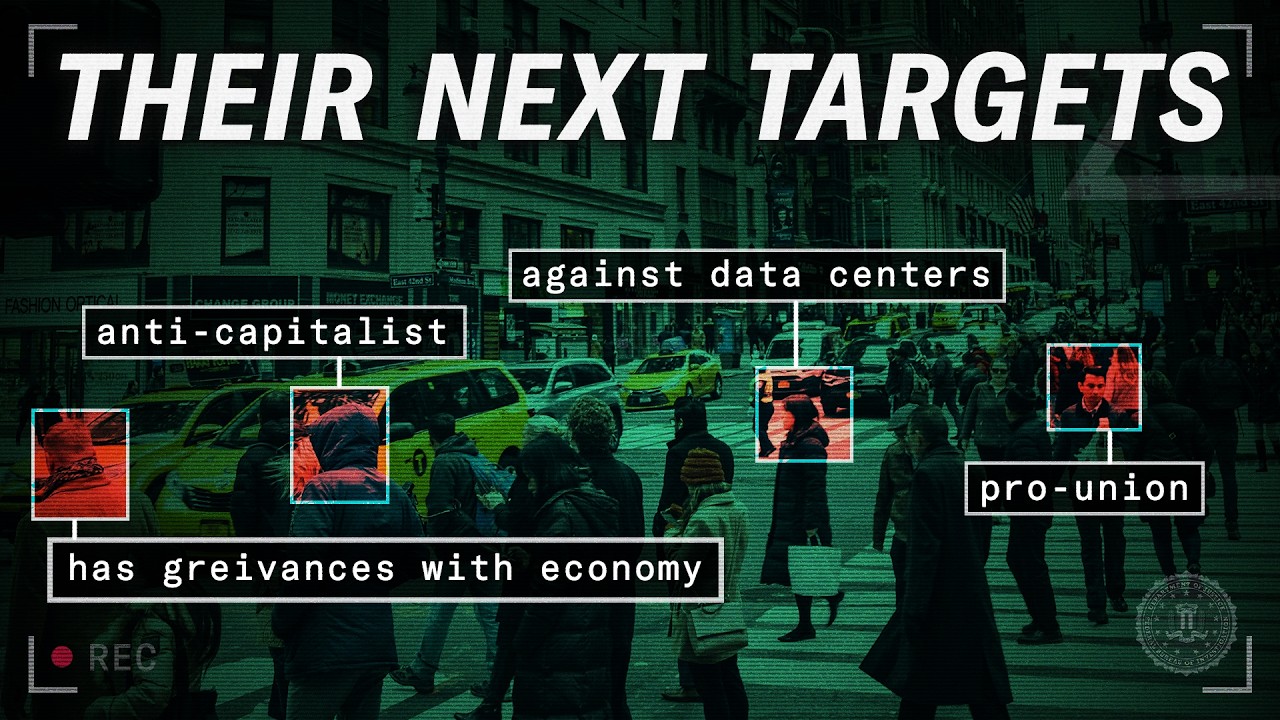
Jun 25, 2026 MPU
We Uncovered A New Government Watchlist. Are You Their Next Target?
You could end up on a watchlist for fighting back in the class war. The feds now consider opposition to data centers, inequality, and Big Tech as potential domestic terrorism. We uncovered how the FBI is colluding with corporate America to surveil ordinary Americans.
...
do not need judge warant, just the pattern says
4:18
4 minutes, 18 seconds
health insurance rates isn't about to commit an act of political violence, they're being targeted by the same powers used to target lunatic assassins.
4:26
4 minutes, 26 seconds
It’s unusually open about what they're targeting.
4:29
4 minutes, 29 seconds
And on the list are things like anti-Christian sentiment, anti “traditional family” sentiment, anti-Americanism. What about anti-capitalism?
4:37
4 minutes, 37 seconds
Is that on the list? Yes. Anti-capitalism is also on the list.
4:40
4 minutes, 40 seconds
Anti-tech sentiment has also shown up in federal law enforcement documents as a focal point of surveillance.
4:46
4 minutes, 46 seconds
Ken told me that these extremely broad and vague categories aren't just talking points, but massive dragnets to swoop up all kinds of speech and dissent.
4:54
4 minutes, 54 seconds
So, this is telling the Justice Department, the FBI, the DEA, the Secret Service, all these agencies, hey, guys, we have to focus on this.
5:01
5 minutes, 1 second
And what we're focused on is that list of so-called indicators that I was describing before.
5:06
5 minutes, 6 seconds
They’re supposed to tell you, or the administration says it's supposed to tell you, what will portend future acts of terrorism.
5:13
5 minutes, 13 seconds
this is something on which, people are being promoted, resources are being allocated at the field office level in all 52 FBI field offices across the country.
5:22
5 minutes, 22 seconds
NSPM-7 is a public record, but confidential documents Ken obtained show how it's been interpreted by intelligence agencies to become a guiding force in intelligence collection.
5:31
5 minutes, 31 seconds
So I was leaked a copy of the Department of Homeland Security's strategy.
5:35
5 minutes, 35 seconds
And it had a new term: “class-based or economic grievances.” They were worried about terrorism as defined by class-based or economic grievances, typically, when you have a counterterror approach that's supposed to be focused groups like Al Qaeda or ISIS.
5:49
5 minutes, 49 seconds
This is something that you don't want to be deploying against U.S. residents or U.S. citizens.
...
no judge warrant
fusion ctrs
6:09
6 minutes, 9 seconds
So, under this counterterrorism approach, they have a lot more authority than police normally have, because they don't have to go to a judge.
6:14
6 minutes, 14 seconds
They can just say, oh, these indicators predict that something might be committed later, After the rollout of NSPM-7, I got curious about how the new powers were playing out at the local level across the country.
6:25
6 minutes, 25 seconds
I began contacting sources in towns, big and small, trying to extract records from federal intelligence agencies.
6:31
6 minutes, 31 seconds
A few months ago, I finally got my hands on records that show NSPM-7 investigations are already taking place in FBI field offices from Boston to San Francisco.
6:41
6 minutes, 41 seconds
The bureau even made this handy map, which was not supposed to leak to the public.
6:45
6 minutes, 45 seconds
I also discovered that briefings, intelligence reports, and investigative notes are being circulated in over 70 government buildings across the country, ominously called fusion centers.
6:56
6 minutes, 56 seconds
These dystopian centers serve as a two-way street between local and state law enforcement and federal agencies like the Department of Homeland Security and FBI.
7:05
7 minutes, 5 seconds
By “fusing” state and federal intelligence, these centers give federal surveillance agencies far greater power to shape how local and state police think about domestic threats, like normal people pissed off about the price of groceries and health insurance.
7:18
7 minutes, 18 seconds
These are local law enforcement entities that was essentially warning all the other CEOs, “Oh, there's some campaign against CEOs, so we need to worry about the threat posed by this.”
7:27
7 minutes, 27 seconds
In the wake of the killing of UnitedHealth CEO Brian Thompson by alleged killer, Luigi Mangione, a state fusion center analyst warned in a document I obtained that, quote, “the public may view
7:37
7 minutes, 37 seconds
the ensuing manhunt and subsequent arrest of Mangione as NYPD and largely policing as a whole, as a tool that is willing to expend massive resources
7:46
7 minutes, 46 seconds
to protect the wealthy, while the average citizen is left to their own means for personal security.”
7:53
7 minutes, 53 seconds
This report seemed to even acknowledge that viewing CEOs as the main demographic to protect would only further enrage working people.
8:01
8 minutes, 1 second
Quote: “It is not an unfair comparison to equate to current reaction towards Mangione to the reactions to Robinhood.
8:08
8 minutes, 8 seconds
Citizens may see manganese alleged actions as an attack against a system designed to work against them. ” As I wrapped
8:17
8 minutes, 17 seconds
up my time with Ken, we reflected on the fact that his home state is also where Joseph McCarthy launched the Red Scare over a half a century ago.
8:24
8 minutes, 24 seconds
this is also the home state of one Senator Joseph McCarthy.
8:29
8 minutes, 29 seconds
the guy who really created nationwide frenzy around left wing movements, infiltrating labor unions, scaring the bejesus out of anyone that seemed “un-American,”
8:38
8 minutes, 38 seconds
very similar in some sense to the architecture laid out by NSPM-7, no?
8:44
8 minutes, 44 seconds
Yeah, and it's interesting because Wisconsin historically was one of the test beds for the New Deal and for progressive legislation.
8:51
8 minutes, 51 seconds
And it's interesting because you have in these two tendencies, the two different visions that exist for this society: one of paranoia
8:58
8 minutes, 58 seconds
and security and control and just worrying about threats everywhere, and another one being building some kind of a, you know, social fabric.
9:08
9 minutes, 8 seconds
We have a long history in this country of these sorts of agencies targeting the black Civil Rights Movement, targeting the multiracial Poor People's Campaign, targeting Occupy Wall Street.
9:19
9 minutes, 19 seconds
This is the latest iteration in that. That was Spencer Reynolds.
9:23
9 minutes, 23 seconds
He understands the internal apparatus of intelligence agencies because he used to work at one.
9:28
9 minutes, 28 seconds
I was at the Department of Homeland Security for about seven years, where I was a domestic intelligence and counterterrorism attorney.
9:34
9 minutes, 34 seconds
Spencer told me that corporations and Wall Street firms get a direct line to the spy agencies seeking to batter down dissent.
9:42
9 minutes, 42 seconds
In other words, CEOs literally have their own seat at the deep state's table.
DHS, the FBI, Department of Justice are deeply-enmeshed with big business and corporate security offices, and they do that in a few key ways.
9:58
9 minutes, 58 seconds
First, they all sit together at those fusion centers where information is swirling back and forth.
10:04
10 minutes, 4 seconds
And in that environment, they can provide intelligence to security offices at businesses that will then use it for their own business interests.
10:15
10 minutes, 15 seconds
They can also collect, they might call “tips and leads” from corporate partners, who give them people to look into, or incidents or events and protests, for instance, to look into.
10:26
10 minutes, 26 seconds
So that's one thing. It turns out, though, that in addition to actually sending liaisons to fusion centers, the Department of Homeland Security also has a two-way newsletter between businesses and intelligence analysts.
10:37
10 minutes, 37 seconds
DHS has platforms like the Homeland Security Information Network.
10:42
10 minutes, 42 seconds
The information that's provided on there can often include information about protests, constitutionally-protected speech and activity.
10:49
10 minutes, 49 seconds
But that's not all.
10:50
10 minutes, 50 seconds
There are also entire conferences dedicated to corporations snitching on consumers to the deep state.
10:57
10 minutes, 57 seconds
One of those is the Domestic Security Alliance Council, which is a consortium of business members, and it promises on its website a direct line to DHS the FBI.
11:09
11 minutes, 9 seconds
The result of all these systems is a vast intelligence apparatus, trained on people standing up to billionaires.
11:16
11 minutes, 16 seconds
During Occupy Wall Street, after the banking industry had gutted the world's economy and plunged us into recession
11:23
11 minutes, 23 seconds
there were, again, organic uprisings of people who were concerned, upset about that, felt alienated and left out by our economic system.
11:33
11 minutes, 33 seconds
And DHS spent a lot of time monitoring those protesters, the intelligence offices.
11:41
11 minutes, 41 seconds
To showcase what corporations working hand in hand with the government looks like.
11:44
11 minutes, 44 seconds
Let's go back to 2015, when workers at Walmart, the largest retailer in the world, launched a campaign for living wages and benefits.
11:53
11 minutes, 53 seconds
Internal Walmart documents obtained by Bloomberg showed that after the mega retailer hired a Lockheed Martin contractor to monitor union activists and protesters, the internal tracking and monitoring wasn't enough.
12:06
12 minutes, 6 seconds
They also contacted one of the FBI's Joint Terrorism Task Forces, when union activists planned to protest the annual shareholder meeting.
12:14
12 minutes, 14 seconds
But while the FBI is one of the most well-known offenders when it comes to violating constitutional rights, a different agency, one that was created for the very purpose of protecting workers, is now going after them.
12:26
12 minutes, 26 seconds
The Department of Labor doesn't have an official intelligence component, but its office of the Inspector General holds powerful investigative capabilities and liaisons with the FBI and other intelligence agencies, including DHS.
12:39
12 minutes, 39 seconds
It has also shown up on the Department of Homeland Security's joint task forces across the country. DOL’s top cop is literally a former cop.
12:47
12 minutes, 47 seconds
Inspector General Anthony D’Esposito, who previously served as an NYPD officer.
12:52
12 minutes, 52 seconds
And he was accused of stealing a golden chain from an arrestee and then lying to put a different guy in jail. The NYPD later paid out a six figure settlement to that guy.
13:01
13 minutes, 1 second
But even more concerning than D’Esposito is the top DOL lawyer, Jonathan Berry, the Solicitor General.
13:07
13 minutes, 7 seconds
While working as a corporate lawyer, Berry penned the chapter on the Department of Labor in the Policy Manual developed by the anti-worker Heritage Foundation, known as Project 2025.
13:19
13 minutes, 19 seconds
In the chapter, Berry calls for the transformation of the Department of Labor from a watchdog to ensure workers are protected from predatory corporations to an investigative arm targeting workers and unions.
13:30
13 minutes, 30 seconds
The chapter calls for using the office of the Inspector General to look into worker centers across the country, but it also calls for investigating unions
13:38
13 minutes, 38 seconds
without any initiating complaint, meaning investigations into workers and their unions could be undertaken without probable cause—at any time, and at any location across the country.
13:48
13 minutes, 48 seconds
While Jonathan Berry's playbook takes shape, Spencer told me there's another element from the Department of Labor already in play.
We talk about these Homeland Security task forces and the Department of Labor, through its Office of Inspector General, participates in those task forces.
14:05
14 minutes, 5 seconds
When you look at the press releases touting DOJ successes, they often include Department of Labor there, and it's usually through the Office of Inspector General.
It's concerning, because I think there is that risk to investigate workers. In other words, the Department of Labor has found a way to inject itself into the dirty business of intelligence work.
So where does this leave you, the American worker? Well, believe it or not, there's a vast range of tools to fight back against government surveillance.
Cities across the country have used their city council to terminate partnerships with the FBI's Joint Terrorism Task Forces carrying out NSPM-7.
Unions, like the American Federation of Teachers and United Auto Workers, are suing the government to shut down unconstitutional surveillance.
14:54
14 minutes, 54 seconds
And whether in Minneapolis, Minnesota, where local residents drove agencies like ICE and CBP out of their communities, or in the nationwide upheaval
15:03
15 minutes, 3 seconds
to force the FBI to release its files on Jeffrey Epstein, the demands of the public continue to have a massive impact on the federal government's actions.
15:11
15 minutes, 11 seconds
The three letter agencies, whether DHS, FBI, or CIA, would have the American public believe that their war on working people is already won, but that lie couldn't be further from the truth.
---
5 minutes, 49 seconds
This is something that you don't want to be deploying against U.S. residents or U.S. citizens.
...
no judge warrant
fusion ctrs
6:09
6 minutes, 9 seconds
So, under this counterterrorism approach, they have a lot more authority than police normally have, because they don't have to go to a judge.
6:14
6 minutes, 14 seconds
They can just say, oh, these indicators predict that something might be committed later, After the rollout of NSPM-7, I got curious about how the new powers were playing out at the local level across the country.
6:25
6 minutes, 25 seconds
I began contacting sources in towns, big and small, trying to extract records from federal intelligence agencies.
6:31
6 minutes, 31 seconds
A few months ago, I finally got my hands on records that show NSPM-7 investigations are already taking place in FBI field offices from Boston to San Francisco.
6:41
6 minutes, 41 seconds
The bureau even made this handy map, which was not supposed to leak to the public.
6:45
6 minutes, 45 seconds
I also discovered that briefings, intelligence reports, and investigative notes are being circulated in over 70 government buildings across the country, ominously called fusion centers.
6:56
6 minutes, 56 seconds
These dystopian centers serve as a two-way street between local and state law enforcement and federal agencies like the Department of Homeland Security and FBI.
7:05
7 minutes, 5 seconds
By “fusing” state and federal intelligence, these centers give federal surveillance agencies far greater power to shape how local and state police think about domestic threats, like normal people pissed off about the price of groceries and health insurance.
7:18
7 minutes, 18 seconds
These are local law enforcement entities that was essentially warning all the other CEOs, “Oh, there's some campaign against CEOs, so we need to worry about the threat posed by this.”
7:27
7 minutes, 27 seconds
In the wake of the killing of UnitedHealth CEO Brian Thompson by alleged killer, Luigi Mangione, a state fusion center analyst warned in a document I obtained that, quote, “the public may view
7:37
7 minutes, 37 seconds
the ensuing manhunt and subsequent arrest of Mangione as NYPD and largely policing as a whole, as a tool that is willing to expend massive resources
7:46
7 minutes, 46 seconds
to protect the wealthy, while the average citizen is left to their own means for personal security.”
7:53
7 minutes, 53 seconds
This report seemed to even acknowledge that viewing CEOs as the main demographic to protect would only further enrage working people.
8:01
8 minutes, 1 second
Quote: “It is not an unfair comparison to equate to current reaction towards Mangione to the reactions to Robinhood.
8:08
8 minutes, 8 seconds
Citizens may see manganese alleged actions as an attack against a system designed to work against them. ” As I wrapped
8:17
8 minutes, 17 seconds
up my time with Ken, we reflected on the fact that his home state is also where Joseph McCarthy launched the Red Scare over a half a century ago.
8:24
8 minutes, 24 seconds
this is also the home state of one Senator Joseph McCarthy.
8:29
8 minutes, 29 seconds
the guy who really created nationwide frenzy around left wing movements, infiltrating labor unions, scaring the bejesus out of anyone that seemed “un-American,”
8:38
8 minutes, 38 seconds
very similar in some sense to the architecture laid out by NSPM-7, no?
8:44
8 minutes, 44 seconds
Yeah, and it's interesting because Wisconsin historically was one of the test beds for the New Deal and for progressive legislation.
8:51
8 minutes, 51 seconds
And it's interesting because you have in these two tendencies, the two different visions that exist for this society: one of paranoia
8:58
8 minutes, 58 seconds
and security and control and just worrying about threats everywhere, and another one being building some kind of a, you know, social fabric.
9:08
9 minutes, 8 seconds
We have a long history in this country of these sorts of agencies targeting the black Civil Rights Movement, targeting the multiracial Poor People's Campaign, targeting Occupy Wall Street.
9:19
9 minutes, 19 seconds
This is the latest iteration in that. That was Spencer Reynolds.
9:23
9 minutes, 23 seconds
He understands the internal apparatus of intelligence agencies because he used to work at one.
9:28
9 minutes, 28 seconds
I was at the Department of Homeland Security for about seven years, where I was a domestic intelligence and counterterrorism attorney.
9:34
9 minutes, 34 seconds
Spencer told me that corporations and Wall Street firms get a direct line to the spy agencies seeking to batter down dissent.
9:42
9 minutes, 42 seconds
In other words, CEOs literally have their own seat at the deep state's table.
DHS, the FBI, Department of Justice are deeply-enmeshed with big business and corporate security offices, and they do that in a few key ways.
9:58
9 minutes, 58 seconds
First, they all sit together at those fusion centers where information is swirling back and forth.
10:04
10 minutes, 4 seconds
And in that environment, they can provide intelligence to security offices at businesses that will then use it for their own business interests.
10:15
10 minutes, 15 seconds
They can also collect, they might call “tips and leads” from corporate partners, who give them people to look into, or incidents or events and protests, for instance, to look into.
10:26
10 minutes, 26 seconds
So that's one thing. It turns out, though, that in addition to actually sending liaisons to fusion centers, the Department of Homeland Security also has a two-way newsletter between businesses and intelligence analysts.
10:37
10 minutes, 37 seconds
DHS has platforms like the Homeland Security Information Network.
10:42
10 minutes, 42 seconds
The information that's provided on there can often include information about protests, constitutionally-protected speech and activity.
10:49
10 minutes, 49 seconds
But that's not all.
10:50
10 minutes, 50 seconds
There are also entire conferences dedicated to corporations snitching on consumers to the deep state.
10:57
10 minutes, 57 seconds
One of those is the Domestic Security Alliance CouncilI., which is a consortium of business members, and it promises on its website a direct line to DHS the FB
Domestic Security Alliance Council
Wikipedia
https://en.wikipedia.org › wiki › Domestic_Security_All...
The Domestic Security Alliance Council (DSAC) is an American Public–private partnership created at the request of corporations for an FBI-led organization.Read more
AI Overview
The Domestic Security Alliance Council (DSAC) is an American public–private partnership created at the request of corporations "for an FBI-led organization that would bridge the information divide between America’s private and public sectors" ^[1] in December 2005. The program facilitates information sharing and cooperation between the FBI and over 509 of the largest American companies, which altogether account for over one half of the gross domestic product of the United States and employ more than 20 million people. In December 2012, released documents showed that the DSAC and counter-terrorism programs conducted surveillance of nonviolent Occupy Wall Street protesters in 2011.
History
The Overseas Security Advisory Council (OSAC) was established by the Diplomatic Security Service of the United States Department of State in 1985 as a mechanism for sharing security information between the U.S. private sector and the U.S. government.[2]^ The FBI Criminal Investigative Division (CID) began to advise OSAC in 1996. In November 2005, by corporate request, the FBI hosted a steering committee composed of Chief Security Officers for major American companies including Citibank, Coca-Cola and Federal Express; this committee founded the Domestic Security Alliance Council (DSAC) the following month.[2]^ All three of these founding corporations cross-affiliate with the Business Roundtable.
The mission statement of DSAC states that the program is "a strategic partnership between the FBI and the U.S. private sector," that it promotes the "effective exchange of information" between them, and that it allows the FBI to more easily detect and prevent criminal activity involving interstate commerce.[2]^ DSAC is also supervised by the Department of Homeland Security.[3]^
In July 2006, DSAC created a leadership board of 29 business leaders from major companies in the United States. These include companies in the airline, banking, entertainment, food, and other industries.[2]^ Two-thirds of the members of the leadership board cross-affiliate with the Business Roundtable. In 2010, over 200 companies participated in DSAC, constituting over one third of the US GDP and almost 10% of its labor force.[2]^ Merck Vice President Grant Ashley, American Undersecretary Dawn Scalici, and assistant FBI director Ronald C. Ruecker are all chairpersons of and executives for DSAC.[2]^
Merck also cross-affiliates with the Business Roundtable. Other American companies participating in DSAC include Bank of America, Barclays, American Express, MasterCard, United Airlines, Boeing, General Electric, and Walmart.[4]^ Of these, Bank of America, Barclays, American Express, MasterCard, Boeing, General Electric and Walmart all cross-affiliate with the Business Roundtable.
As of May 2021, DSAC is led by Senior Executives FBI Director Christopher Wray and Secretary of Homeland Security Alejandro Mayorkas. The three co-chairs of the Executive Working Group (EWG), representing the FBI, DHS, and private sector, respectively, are assistant director of the Office of Private Sector Michael Sullivan, director of Private Sector Engagement Tamara Hutchinson, and Disney Senior Vice President and Chief Security Officer Ronald L. Iden.[5]^
Domestic surveillance
Following successful freedom of information requests by the Partnership for Civil Justice Fund, the FBI released redacted documents in December 2012 showing that the FBI had spied on Occupy Wall Street (OWS) organizers and passed OWS information to financial firms via DSAC prior to the first OWS protests in Zuccotti Park.[6]^ FBI officials met with New York Stock Exchange representatives on August 19, 2011, notifying them of planned peaceful protests.[7]^ FBI officials later met with representatives of the Federal Reserve Bank of Richmond and Zions Bank about planned protests.[7]^
The FBI used informants to infiltrate and monitor protests; information from informants and military intelligence units was passed to DSAC, which then gave updates to financial companies.[8]^ Surveillance of protestors was also carried out by the Joint Terrorism Task Force.[8][9] DSAC also coordinated with security firms hired by banks to target OWS leaders.[10]^
Previously, in December 2011, DSAC had written a report on law enforcement agencies' plans for a 12 December protest at US ports, which involved investigation of links between OWS and port trade unions by the Naval Criminal Investigative Service.[11]^
The Partnership for Civil Justice, a non-profit, said that espionage facilitated by DSAC treated "protests against the corporate and banking structure of America as potential criminal and terrorist activity," and said that DSAC was "functioning as a de facto intelligence arm of Wall Street and corporate America."[7]^ Naomi Wolf wrote in The Guardian that surveillance of OWS by the FBI was conducted with the knowledge of the Obama Administration.[12]^
A DSAC brochure[1]^ states that the benefits of membership in the DSAC include:
- Centralized access to security information not only from the FBI, but from all federal government entities, including the Department of Homeland Security, FEMA, the IRS, U.S. Coast Guard, and the U.S. Secret Service
- Ongoing access to a network of diverse security experts at the highest government and corporate levels
- Continuing education for CSOs through the semi-annual Domestic Security Executive Academy at the FBI Academy, Quantico, VA
- Continuing education for intelligence analysts through quarterly regional Intelligence Analyst Symposiums
- Additional opportunities through participation in DSAC’s committees
See also
- Joint Terrorism Task Force
- Law enforcement and the Occupy movement
- OSAC
- Public-private partnerships in the United States
+5
Domestic Security Alliance Council Marks 20 Year Anniversary ...The Domestic Security Alliance Council (DSAC) is a strategic public-private partnership created in 2005 by the FBI and Department of Homeland Security. It bridges the information divide between the U.S. government and the private sector, enabling the exchange of vetted intelligence, threat trends, and coordinated responses to protect critical infrastructure.
The Security Foundation
+2
Key Functions & Benefits
Intelligence Sharing: Provides a two-way pipeline for real-time security information, helping businesses detect, prevent, and deter criminal and cyber threats.
ISAO Standards Organization
+1
Exclusive Access: Members gain direct, priority access to FBI leadership, DHS intelligence analysts, and FBI field office private sector coordinators.
The Security Foundation
+1
Programming & Networking: Organizes national, regional, and local meetings featuring tabletop exercises, cyber briefings (such as recent initiatives), and peer networking opportunities.
The Security Foundation
+1
Membership Criteria
DSAC is an exclusive corporate membership program geared toward large-scale organizations that impact national security or economic stability. To qualify for membership, companies must meet the following baseline requirements:
www.dsac.gov
Be a for-profit organization.
Generate a minimum of $2 billion in annual U.S. revenue.
Maintain a security component based in the United States.
Have established engagement with a local FBI Field Office for at least six months.
Have direct relevance to national security or economic resilience.
Applications for membership must be submitted by the organization's U.S.-based senior security executive (such as a CSO or CISO) via the DSAC Membership Application Form.
- Financial Services: Bank of America, American Express, MasterCard, Capital One
- Technology & Telecom: Roblox, Lumen Technologies
- Industrials & Aerospace: Boeing, General Electric
- Retail & Consumer: Walmart
- Other participants: Barclays, United Airlines [1, 2]
Due to the sensitive nature of the security partnerships, a full roster of the 800+ corporate members is only available internally on the secure DSAC Member Portal. [1, 2, 3]
11 minutes, 9 seconds
The result of all these systems is a vast intelligence apparatus, trained on people standing up to billionaires.
11:16
11 minutes, 16 seconds
During Occupy Wall Street, after the banking industry had gutted the world's economy and plunged us into recession
11:23
11 minutes, 23 seconds
there were, again, organic uprisings of people who were concerned, upset about that, felt alienated and left out by our economic system.
11:33
11 minutes, 33 seconds
And DHS spent a lot of time monitoring those protesters, the intelligence offices.
11:41
11 minutes, 41 seconds
To showcase what corporations working hand in hand with the government looks like.
11:44
11 minutes, 44 seconds
Let's go back to 2015, when workers at Walmart, the largest retailer in the world, launched a campaign for living wages and benefits.
11:53
11 minutes, 53 seconds
Internal Walmart documents obtained by Bloomberg showed that after the mega retailer hired a Lockheed Martin contractor to monitor union activists and protesters, the internal tracking and monitoring wasn't enough.
12:06
12 minutes, 6 seconds
They also contacted one of the FBI's Joint Terrorism Task Forces, when union activists planned to protest the annual shareholder meeting.
12:14
12 minutes, 14 seconds
But while the FBI is one of the most well-known offenders when it comes to violating constitutional rights, a different agency, one that was created for the very purpose of protecting workers, is now going after them.
12:26
12 minutes, 26 seconds
The Department of Labor doesn't have an official intelligence component, but its office of the Inspector General holds powerful investigative capabilities and liaisons with the FBI and other intelligence agencies, including DHS.
12:39
12 minutes, 39 seconds
It has also shown up on the Department of Homeland Security's joint task forces across the country. DOL’s top cop is literally a former cop.
12:47
12 minutes, 47 seconds
Inspector General Anthony D’Esposito, who previously served as an NYPD officer.
12:52
12 minutes, 52 seconds
And he was accused of stealing a golden chain from an arrestee and then lying to put a different guy in jail. The NYPD later paid out a six figure settlement to that guy.
13:01
13 minutes, 1 second
But even more concerning than D’Esposito is the top DOL lawyer, Jonathan Berry, the Solicitor General.
13:07
13 minutes, 7 seconds
While working as a corporate lawyer, Berry penned the chapter on the Department of Labor in the Policy Manual developed by the anti-worker Heritage Foundation, known as Project 2025.
13:19
13 minutes, 19 seconds
In the chapter, Berry calls for the transformation of the Department of Labor from a watchdog to ensure workers are protected from predatory corporations to an investigative arm targeting workers and unions.
13:30
13 minutes, 30 seconds
The chapter calls for using the office of the Inspector General to look into worker centers across the country, but it also calls for investigating unions
13:38
13 minutes, 38 seconds
without any initiating complaint, meaning investigations into workers and their unions could be undertaken without probable cause—at any time, and at any location across the country.
While Jonathan Berry's playbook takes shape, Spencer told me there's another element from the Department of Labor already in play.
We talk about these Homeland Security task forces and the Department of Labor, through its Office of Inspector General, participates in those task forces.
14:05
14 minutes, 5 seconds
When you look at the press releases touting DOJ successes, they often include Department of Labor there, and it's usually through the Office of Inspector General.
It's concerning, because I think there is that risk to investigate workers. In other words, the Department of Labor has found a way to inject itself into the dirty business of intelligence work.
---
3 23 yahoo greg c also https://www.**opednews**.com/articles/East-Palestine-Train-Derai-Democracy_Democracy-History_Real-Democracy_Train-Crash-230309-199.html
Norfolk Southern Corporation train derailment and subsequent hazardous chemical release in and beyond East Palestine, Ohio are the inevitable result of multiple anti-democratic realities.
Many are interconnected and are the same for the roughly 1000 train derailments per year.
Private ownership of railroads
Norfolk Southern Corporation’s record earnings in 2022 benefited its top managers, speculators and investors. Maximizing profits have been prioritized over necessary investments in technology upgrades and worker safety. The Railroad Workers United in response is calling for public ownership of railroads, as they once were in WWI.
Lack of worker power
Strikes are powerful tactics of workers to exert leverage against management on safety issues and fair treatment. Unions representing rail workers have been virtually unable to strike since passage of the Railway Labor Act in 1926, which gives the government, specifically the President and Congress, vast powers to force workers to accept alternative means of resolving disputes.
No community rights
Communities have little authority to control material coming into or even passing through their jurisdictions by trains or trucks if that material can be defined as “commerce,” based on the Constitution’s Commerce Clause. Ohio state and E. Palestine officials weren’t even notified the Norfolk Southern train that derailed was carrying vinyl chloride, ethylhexyl acrylate and other highly toxic chemicals.
Corporate campaign contributions
The Railroad industry has poured $85 million into federal candidate campaigns, political parties and outside spending groups since 2002. Norfolk Southern’s political investments have been $17 million since 1990.At the state level, the corporation invested $98,000 into Ohio political races since 2018, with Gov. Mike DeWine (who at first didn’t call for federal assistance following the E. Palestine disaster since he didn’t see a problem) being the largest recipient. At the very least, political campaign contributions buy access to public officials; at worst, buys favors.
Corporate lobbying
The railroad industry invested $24.6 million to employ 265 reported lobbyiststo influence the federal government in 2022 – Norfolk Southern’s portion was $1.8 million. Rail lobbyists and $6 million from the rail industry to GOP campaigns in 2017 effectively reversed requirements that rail cars carrying hazardous flammable materials have modern electronic braking systems. Lobbyists have sought for fewer workers on trains, trains to be longer and heavier, and reduced fines for penalties– as well as against installing modern electronic braking systems, paid sick leave for workers and having to define trains carrying hazardous chemicals like the Norfolk Southern that derailed in E. Palestine as “high hazard,” which would increase additional safety requirements, costs and public notification.
Supreme Court decisions
The High Court decided that corporate entities have the constitutional right to contribute to political campaigns. This has permitted corporations like Norfolk Southern to corrupt the political process favorable to their interests, such as the previously mentioned laws and regulations profitable to railroads, Supreme Court-granted corporate Fourth Amendment search and seizure rights prevent surprise inspections of corporate property like trains meant to protect workers and communities.
Ineffective and/or captured regulatory agencies
Public safety inspections are not only limited by constitutional rights, but by regulatory agency funding. The Federal Railroad Administration, the major railroad regulatory agency, has only 400 inspectors. This has forced the FHA to increasingly allow railroad corporations to inspect their own trains, tracks and signals. The EPA recently announced that its requiring Norfolk Southern to directly test for dioxins in East Palestine. Where’s the public accountability when, in effect, an entity guilty of crime gets to be the prosecutor, judge and jury?
Criminalization of protest
Forty-five states have considered 265 “anti-protest” bills, 39 of which have already passed in 20 states since 2017. Penalties of felonies serve as a deterrent to individuals to attend public events and send the message that those who protest must be extremists. This mindset is reflected in the reaction by federal and Ohio “law enforcement” agencies to therecent visit of whistleblower Erin Brockovich to E. Palestine. A report by the agencies "assesses that special interest extremist groups will continue to call for changes in governmental policy, which may lead to protests in/around East Palestine and/or at the Statehouse in Columbus.”
The East Palestine tragedy is sadly just a symptom of current political realities and calls for fundamental systemic change.
Enacting the We the People Amendment, HJR48 that would abolish all corporate constitutional rights and political money defined as free speech, is urgent. But fundamental self-governance goes beyond the amendment.
Independent people's movements led by individuals who’ve been historically treated unjustly is a prerequisite for how to get real democracy on track – for the very first time.
---
ref
ohio law enforcement issued a report late last month warning that events planned in East Palestine by the environmental activist Erin Brockovich could prompt a terrorist threat from violent extremists,according to an intelligence bulletin obtained by Yahoo News.
Dated Feb. 24 and distributed to law enforcement agencies by the Department of Homeland Security (DHS), the Ohio Statewide Terrorism Analysis & Crime Center Terrorism Analysis Unit Situational Awareness [STACC TAU] report obtained by Yahoo News "assesses that special interest extremist groups will continue to call for changes in governmental policy, which may lead to protests in/around East Palestine and/or at the Statehouse in Columbus.”
The report then singles out the reaction by Brockovich, a whistleblower who helped build a successful lawsuit against the California utility company Pacific Gas and Electric in a case involving contaminated groundwater, to the Feb. 3 train derailment and release of toxic chemicals in East Palestine.
"On 24 February, environmental activist Erin BrockovichUSPER [United States person] is scheduled to be in East Palestine to explain residents’ legal rights. Brokovich has urged the community to use common sense and ask questions. Brockovich is also placing blame solely on Norfolk Southern. The STACC TAU assess this event could potentially increase tensions within the community.”
The report assesses the risk posed by Brockovich and other activist groups that have planned events in East Palestine in the wake of the Norfolk Southern train derailment and the controlled burn of vinyl chloride, a carcinogenic ingredient used in the production of plastic products after the derailment.
“According to the FBI, special interest terrorism differs from traditional right-wing and left-wing terrorism in that extremist special interest groups seek to resolve specific issues, rather than effect widespread political change,” the report states. “Such extremists conduct acts of politically motivated violence to force segments of society, including the general public, to change attitudes about issues considered important to the extremists’ cause.”
Drone footage shows the freight train derailment in East Palestine, Ohio, on Feb. 6. (NTSB Gov/Handout via Reuters)]
Brockovich, who was played by the actress Julia Roberts in the 2000 film named after her, was in East Palestine on Thursday afternoon to host an event. She did not immediately respond to Yahoo News’ request for comment.
This situational awareness report is highly problematic, said former FBI agent Mike German, who worked on a recent Brennan Center report about issues with DHS fusion centers.
“Obviously, there is no reason to have included Erin Brockovich's name or a description of her advocacy in a law enforcement intelligence report, much less a ‘situational awareness’ report by a state fusion center's terrorism analysis unit,” German told Yahoo News. “Almost all of the activity described in this report is rightly protected by the First Amendment and poses no threat of harm, and therefore should be of no interest to terrorism intelligence units.”
Contacted by Yahoo News, the Ohio Department of Public Safety denied that it had issued a report identifying Brockovich as a possible terrorist threat.
“Erin Brokovich is listed as an ‘environmental activist’ and the brief mention of her falls under the heading of ‘various individuals or groups have responded to the train derailment,’” the Ohio Department of Public Safety’s Jay Carey told Yahoo News in an email. “The fact that she is an ‘environmental activist’ that has ‘responded to the train derailment’ is factual and has been well documented by media accounts. Any inference otherwise is incorrect.”
DHS posted the report on its intelligence sharing platform on Feb. 28, making it available to its more than 150,000 local, state and federal police and other partners nationwide.
“Fusion Centers are state and locally owned and operated centers that actively share, analyze, and operationalize threat-related information between federal, state, local, tribal, territorial, and private sector partners,” a DHS spokesperson said in an emailed statement to Yahoo News. “DHS supports Fusion Centers through the presence of DHS personnel and information sharing technology, but DHS does not run or operate Fusion Centers.”
The report also referred to the environmental group Earthjustice, which, it stated “called on Governor DeWineUSPER to declare a state of emergency," pointing to the "contaminated waterways" and subsequent deaths of thousands of fish.
[Environmental activist Erin Brockovich, right front, speaks to concerned residents as the host of a town hall meeting at East Palestine High School on Thursday. (Michael Swensen/Getty Images)
“Earthjustice works with communities across the country to protect people’s health,” Debbie Chizewer, managing attorney for Earthjustice’s Midwest Regional office, told Yahoo News.
“In East Palestine, Earthjustice is supporting partners that have been exposed to toxic chemicals as they call for much needed resources, monitoring, cleanup of the contamination, as well as protections to prevent disasters like the explosion of a chemical-carrying cargo train in the future.”
The report obtained by Yahoo News stated that East Palestine police and fire department officials reported having received threats but had determined they were not credible. It was not clear, however, why they were mentioned in the report.
“This report should not have described any noncriminal activity, particularly after it stated that the terrorism analysis unit is ‘unaware of any credible direct threats regarding the East Palestine train derailment,’” German said. “This flawed reporting only clogs our national intelligence networks with inappropriate materials that undermine effective counterterrorism and law enforcement analysis, by overwhelming intelligence analysts with unhelpful misinformation that dulls the response to genuine threat warnings.”
Former DHS Acting Undersecretary John Cohen agreed that the inclusion of Brockovich’s name was, as he put it, “a bit problematic,” and said that law enforcement needed to be more careful in describing what is and is not considered a threat.
“When reporting on online or other activity that may be protected speech, authorities need to be very clear how that speech relates to threat-related activities or other public safety issues,” Cohen told Yahoo News. “It’s fine to catalog what different people are saying, but from a law enforcement perspective, they need to be clear where there is a nexus with the need for an operational response.”
---
---
https://theintercept.com/2020/09/12/homeland-security-whistleblower-corruption/
If CHAD WOLF, the man currently running the largest law enforcement agency in the country, had any idea of what was coming, he didn’t show it. On Wednesday, the acting secretary of the Department of Homeland Security stood before his colleagues and delivered the 2020 “State of the Homeland Address,” detailing the many ways in which his department was living up to its post-9/11 mission and supporting President Donald Trump’s agenda. Everyone on the DHS livestream was socially distanced and wearing masks — everyone, that is, but KenCuccinelli, the department’s “senior official performing the duties of the deputy secretary.”
Last month, the Government Accountability Office issued a report concluding that both Wolf and Cuccinelli are illegally occupying their positions atop DHS. But what the two men lack in legal authorization to work, they make up for in fealty to the president. Teeing up the crowd for Wolf’s remarks this week, Cuccinelli spoke of threats to “our cherished homeland” and said that “after decades of putting globalinterests ahead of the safety and the prosperity of our citizens, this administration has boldly put America first.”
Wolf, a former Transportation Security Administration lobbyist, struck a similar tone in his prepared remarks, drawing applause when he mentioned Homeland Security’s role in policing protests in Portland, Oregon, and his department’s ongoing efforts to build a wall between the United States and Mexico. The event had just barely concluded when the House Permanent Select Committee on Intelligence published a 24-page whistleblower complaint accusing Wolf, Cuccinelli, and other current and former DHS leaders, including former Secretary Kirstjen Nielsen, who was also present at Wednesday’s address, of illegally manipulating and politicizing intelligence to bolster the president’s talking points and policy objectives in numerous ways across multiple years.
The man behind the complaint was Brian Murphy, a war on terror veteran who ran Homeland Security intelligence operations and served as a principle adviser to the secretary of DHS and the director of national security. Though complicated by the fact that Murphy himself had previously been accused of overseeing disturbing surveillance practices earlier this year, the whistleblower complaint marked the latest revelation in a long line of stories suggesting that DHS has become the armed extension of a Trumpian political project.
Murphy’s allegations ranged from inflating the number of known or suspected terrorists crossing the border, to the suppression of intelligence on right-wing terrorists, to the stifling of reports on Russian interference in the coming election. Murphy claimed that his efforts to push back on the senior DHS officials were met with retaliation and a demotion. Rep. Adam Schiff, D-Calif., the chair of the intelligence committee, described his complaint as “grave and disturbing,” adding in a statement, “We will get to the bottom of this, expose any and all misconduct or corruption to the American people, and put a stop to the politicization of intelligence."
john Sandweg, a former acting director of Immigration and Customs Enforcement, said the politicization of Homeland Security operations under the Trump administration has been “tremendous,” and that it first began in the border and immigration realms and steadily expanded to include militarized Border Patrol BORTAC units deployed to arrest protesters in a major American city against the wishes of local officials.
“It’s at the point now where it’s really undermining the operational capability of DHS to work with the state and local governments,” Sandweg told The Intercept. “There’s going to be repercussions.”
In his complaint, Murphy claimed that in a series of meetings, Wolf and Cuccinelli personally intervened in an effort to doctor information related to the recent protests surrounding the killing of George Floyd, instructing him to “modify intelligence assessments to ensure they matched up with the public comments by President Trump on the subject of ANTIFA and ‘anarchist’ groups.” Murphy also claimed that the men improperly inserted themselves in the creation of a “Homeland Treat Assessment” report earlier this year, blocking circulation of the document out of concerns over how it “would reflect upon President Trump.”
“Two sections were specifically labeled as concerns: White Supremacy and Russian influence in the United States,” Murphy’s complaint said. The complaint went on to describe a series of meetings in May and June, as protests against police brutality spread to every state in the country, in which “Mr. Cuccinelli stated that Mr. Murphy needed to specifically modify the section on White Supremacy in a manner that made the threat appear less severe, as well as include information on the prominence of violent ‘left-wing’ groups.”
Murphy’s allegations come two months after an investigation by The Intercept that analyzed a trove of hacked law enforcement documents that were posted online under the title “BlueLeaks.” The materials included documents produced at the local, state, and federal level, including Homeland Security’s Office of Intelligence and Analysis, otherwise known as I&A, where Murphy worked. The Intercept’s analysis focused on hundreds of documents produced during the recent protests that referenced “antifa,” a loose movement of antifascist political activists, and revealed glaring disparities between law enforcement’s depiction of groups on the right and the left.
In the case of antifa, the documents revealed that law enforcement intelligence was often vague, mixed up in online conspiracy theories or untethered to evidence of suspected criminal activity. On the far right, on the other hand, the documents showed law enforcement agencies across the country sharing detailed and specific information on the mobilization of armed groups looking to use the unrest as cover to attack law enforcement and protesters and set off a civil war. In July, the sergeant of an elite Air Force security unit with ties to the so-called boogaloo movement was arrested on suspicion of assassinating a federal court security officer and killing a California sheriff’s deputy, strongly suggesting that the online threats circulating at the time went beyond mere posturing.
Read Our Complete CoverageBlueLeaks
During the protests, I&A shared intelligence that was both dubious and disturbing. On June 2, for example, the office circulated a tweet to law enforcement agencies across the country reporting that antifa was stashing bricks to “fuel protests.” As Mainer magazine later reported, the original source of the information was a pro-Trump biker who called himself “the wolfman” and previously spread conspiracy theories online.
At the same time, I&A circulated intelligence in late May detailing conversations inside an encrypted white supremacist Telegram channel, in which thousands of followers were encouraged to use guns, Molotov cocktails, and chainsaws to attack police and “spread racial hatred.” The following day, I&A published an intelligence note again describing conversations in another white supremacist Telegram channel, in which followers were encouraged to “engage in violence and start the ‘boogaloo’ — a term used by some violent extremists to refer to the start of a second Civil War — by shooting in a crowd.”
At the time, Trump, along with Wolf, Cuccinelli, and U.S. Attorney General William Barr were agitating for a crackdown on antifa, with Trump calling the movement a terrorist organization and Barr announcing that Joint Terrorism Task Forces across the country would be called to root out leftist “agitators.”
The Justice Department has launched hundreds of domestic terrorism investigations in the weeks since, while a Trump Super Pac has used the antifa crackdown to raise money for the president’s reelection efforts.
On June 1, Trump boosted a tweet from Brian Kilmeade, in which the “Fox and Friends” co-host said he saw no evidence of white supremacists mobilizing in response to the protests. “TRUE!” Trump tweeted. Later in the day, Trump delivered an address in the Rose Garden threatening to use the military in response to the “professional anarchists” and antifa elements in the streets. He made no mention of groups on the far right. The next morning, DHS circulated a report acknowledging “media reports” indicating “that neo-Nazi, and other paramilitary far-right groups, are calling for terror attacks during the ongoing unrest throughout the United States.” According to a distribution list at the bottom of the report, the document was shared with the White House Situation Room, DHS headquarters, federal interagency operations centers, and state and local partners.
Despite the intelligence circulating in his own office regarding threats from the far right, Cuccinelli continued to keep the focus on the left, tweeting, “Their silence is deafening. Cities across America burn at the hands of antifa and anarchists while many political leaders are refusing to call it what it is: domestic terrorism.”
Murphy and his office drew national attention in late July, when news broke that I&A had disseminated three Open Source Intelligence Reports summarizing the tweets of a New York Times reporter and the editor of a prominent Washington, D.C. national security blog; both had published unclassified DHS documents related to the Portland protests. At the time, Wolf said he had ordered a stop to the intelligence gathering and launched an investigation into the matter. Murphy was singled out as the official driving the intelligence collection, with sources telling the Washington Post that the former FBI agent had “earned a reputation at DHS for aggressively trying to expand the operations of the intelligence office.”
In his complaint, Murphy said the media reports concerning the collection of information on journalists were “significantly flawed and, in many instances, contained completely erroneous assertions,” and that “I&A never knowingly or deliberately collected information on journalists, at least as far as Mr. Murphy is aware or ever authorized.”
The expansive network of law enforcement fusion centers where I&A directs much of its work product have been the subject of years of criticism for exhibiting a “persistent pattern of violating Americans’ privacy and civil liberties, producing unreliable and ineffective information, and resisting financial and other types of standard public accountability.” As The Intercept reported in late July, I&A under Trump has repeatedly directed its intelligence-gathering efforts at immigration advocates on the border. DHS officials in San Diego oversaw a sweeping, binational intelligence-gathering operation targeting lawyers, journalists, and asylum advocates associated with the migrant caravans that became a key political talking point for the Trump administration during the 2018 midterm elections.
Related
Federal Agents at Protests Renew Calls to Dismantle Homeland Security
It is unclear what role, if any, Murphy played in those events, though his complaint notes that during his March 2018 to July 2020 tenure, he was “responsible for all intelligence activities in DHS.” He has been called to testify before Congress later this month, where those questions may come up.
Throughout the past three and half years, the leadership of DHS has been steadily hollowed out, resulting in a department increasingly run by allies of Trump’s anti-immigration adviser, Stephen Miller. To many Homeland Security veterans, the ascent of Wolf and Cuccinelli is the disturbing encapsulation of that trend — one former DHS official, speaking to The Intercept on background, described Wolf as a “back bencher” and “literally a joke.”
On Thursday, one day after Murphy’s complaint made news across the country, the White House sent a letter to the Senate formally nominating Wolf to head DHS. Twenty-four hours later, Rep. Bennie G. Thompson (D-MS), Chairman of the Committee on Homeland Security, subpoenaed Wolf to testifybefore his committee, noting in a statement that the acting secretary had been dodging the lawmakers’ questions since protests picked up in June.
“This administration has so completely fueled the negative stereotype of the agency, that is going to have real world implications for the agency for years to come, not just in dealing with Congress,” Sandweg said. “I think they’ve done incalculable damage.”
==
---
https://theintercept.com/2020/08/24/fbi-fusion-center-environmental-wind/
fEDERAL AND STATE law enforcement officers gathered in the Midwest in February 2019 to practice their responses to a fictional threat: wind farm sabotage. They divided into four teams and pretended to be the bad guys, environmental saboteurs targeting the large grids of turbines that turn the wind into electric power. The Federal Bureau of Investigation’s Omaha, Nebraska, field office and the Iowa Division of Intelligence and Fusion Center had organized the “red hat” exercise, meant to provide insight into the minds of environmental activist adversaries that didn’t exist.
Each team developed an attack plan. One proposed ramming wind turbine infrastructure with a vehicle. Another sought to plant explosives on electrical transformers. And — although U.S. environmental saboteurs tend to not use guns — two of the teams suggested using firearms to attack electrical substations from a distance. The fact that cops themselves planned the attacks may have created a “bias toward the use of firearms,” the FBI later acknowledged in a pair of reports on the exercise obtained by The Intercept. However, the federal agents also concluded that “Environmental Extremists Likely Would Use Firearms To Circumvent Perceived Electrical Infrastructure Site Security Measures.”
The exercise was not conducted due to any imminent threat — a carefully noted fact included in the December 2019 and March 2020 reports. “Neither FBI Omaha nor the Iowa DOI/FC has intelligence suggesting environmental extremists intend to attack wind farms in Iowa,” both reports repeatedly state.
Why, then, spend public dollars on FBI role-playing?Because the energy industry wanted it. The exercise came “at the request of an USBUS private energy sector partner, following 14 environmental extremist attacks against transportation infrastructure in Iowa that services the energy sector, particularly oil pipelines,” said one of the documents about the exercise. Privately owned and operated companies and industry groups — none of which were named in the reports — were intimately involved in the exercise: An Iowa utility company and a wind energy lobbyist group provided information to help judge the fake attack plans and assess the fake “threat environment,” and an industry representative joined two of the teams, posing as an insider accomplice.
Though there was no indication an attack on wind power sites would occur, the report went on to say, if one hypothetically did, it could proliferate into many, with each set of attackers becoming more skilled in evading security and capture. “As attack methods become more sophisticated,” the report warned, “the chance for large-scale failure of the electrical grid becomes more likely.” Law enforcement ought to be on the lookout for activists undergoing gun training, activists in rural locations with large infrastructure, and activists casing wind power sites, the report advised. Neither the FBI, the Iowa Division of Intelligence and Fusion Center, nor the federal Department of Homeland Security, which helps coordinate regional fusion centers, responded to the Intercept’s questions about the documents.
The red hat exercise was the product of a national network of public-private law enforcement and security partnerships forged in the wake of 9/11. The Iowa fusion center is one of 79 intelligence hubs like it, designed to enhance coordination between federal and local police as well as select private sector players. Given their close collaboration with corporate partners, the centers serve as a vector for transmitting industry interests to law enforcement.
Read Our Complete CoverageBlueLeaks
The reports on the joint wind power security exercise were obtained by The Intercept as part of BlueLeaks, a massive trove of law enforcement documents hacked from government web sites and published by the transparency collective Distributed Denial of Secrets. The documents provide a detailed picture of how state, federal, and local law enforcement agencies have used the label “environmental extremist”to guide their policing. More than a dozen documents collected and disseminated by law enforcement fusion centers and reviewed by The Intercept describe the wild speculation, threat inflation, and close collaboration with the private sector inherent in law enforcement’s pursuit of eco-activists branded as extremists.
With industry encouragement and cooperation, the FBI, Department of Homeland Security, and local law enforcement agencies have long kept a wary eye on activists organizing against energy projects. Government officials have slapped the label of “environmental extremist” on individuals who have locked themselves inside oil and gas pipelines, turned off the valves controlling oil flow, or physically damaged construction equipment — as well as a range of people who have shared viewpoints or had contact with such activists. The moniker serves to place Indigenous and environmental defenders linked to relatively minor property damage or civil disobedience in a category alongside white supremacists conducting mass killings. Both are officially declared “domestic extremists” for the federal government’s purposes.
Information about such “environmental extremists” then gets shared, as it did in the wind power exercise, through the fusion centers, to both government officials and private sector partners. From the beginning, energy industry projects have received favored status and attention from the centers as “critical infrastructure.”
Brendan McQuade, a sociologist at the University of Southern Maine and the author of “Pacifying the Homeland: Intelligence Fusion and Mass Supervision,” said he had never seen anything like the Iowa fusion center documents. “It’s paranoid threat inflation and a totally indefensible depoliticization of what might be the most important political question of our time, which is, What are we going to do about climate change? This erases that question and views anyone who is seriously committed to it as criminal.”
“I’m worried about the way this will polarize the struggle and justify aggressive responses to direct action,” he said.
Mike German, a liberty and national security fellow with the Brennan Center, who formerly worked as an FBI agent, added that the collaboration with the private sector serves to misplace public resources. “There are many entities out there that are at possible risk of some kind of criminal act. And yet you don’t see community groups who are at a threat of white supremacy being invited by the FBI to talk about how they can protect themselves,” he said. “They’re spending security resources on hypothetical threats against favorite entities while ignoring real threats against other communities or private entities.”
The Elusive “Environmental Extremist”
“Environmental extremism” is among a handful of categories of so-called domestic extremism — including “racially motivated violent extremism,” “anti-government extremism,” “animal rights extremism,” and “abortion extremism” — that the FBI monitors closely.
Who exactly are these eco-extremists? Under a section titled “environmental rights extremism,” a November 2019reference guide to “violent extremism” published by the Colorado Information Analysis Center, a fusion center, and other state security agencies, which was released as part of BlueLeaks, lists a range of groups. Among others, they listed the animal liberation group Direct Action Everywhere, which has removed animals from factory farms in rescue actions, and the Earth Liberation Front, which had its heyday committing arsons in the ’90s. Also listed were East Boulder County United, a grassroots organization that promotes community consultation on oil and gas development; and 350 Colorado, the local chapter of a well-known national climate organization. Both groups have participated in and promoted nonviolent civil disobedience as a tactic to force public officials to appropriately address the climate crisis.
In a statement,Colorado Information Analysis Center spokesperson Micki Trost provided a justification for the labels, “We want to ensure that individuals have the opportunity to exercise their First Amendment rights in a safe and impactful manner,” Trost said. “We believe that information sharing on groups that have perpetrated crimes and disrupted peaceful protests helps local law enforcement better protect those that are lawfully exercising their First Amendment rights.”
According to an FBI and Department of Homeland Securitydocument, “environmental extremists” primarily target the “extraction, use, and transportation of fossil fuels.” BlueLeaks documents from various regional fusion and homeland security centers, as well as other federal agencies, point to an array of fossil fuel industry opponents, including the climate direct action group Extinction Rebellion; the Oglala Lakota opponent of the Dakota Access pipeline Red Fawn Fallis, who remains imprisoned after being accused of firing gunshots during a struggle with law enforcement at a Standing Rock protest; Arctic drilling protesters who chained themselves to a ship in Washington; and anti-oil industry activists, who shut off a pipeline by turning a valve.
the only recent U.S. incident listed in the documents that resulted in loss of life involved Rory Gunderman, who, according to the South Dakota Fusion Center and Wyoming Criminal Intelligence Center, wasassociated with the movement Deep Green Resistancebefore he allegedly attempted to carry out a plot in 2015 to shut down the power grid. After police attempted to apprehend Gunderman, he took his own life.
Indeed, in various documents law enforcement agencies underline something that many environmental activists have themselves pointed out: Unlike other types of extremism, “environmental extremism” is aimed at property, not people. One bulletin published by the FBI and DHS noted the threat that such activists pose has decreased over the years and is lower than other types of extremism. However, their “desire” to commit crime “has not waned.”
Nevertheless, authorities are keen to view “environmental extremists” as a major threat. An FBI memo urges partner law enforcement agencies to coordinate with the Bureau on any incident involving environmental extremism. Federal agents, the memo says, are interested in who is training “environmental extremists,” in addition to knowing which purported extremists are involved in domestic or international criminal organizations, where they have traveled, and how they communicate.
Protesters gather in front of San Francisco City Hall during a protest in solidarity with the Standing Rock Sioux Tribe against the construction of the Dakota Access pipeline on March 10, 2017.
Photo: Joel Angel Juarez/Anadolu Agency/Getty Images
And so law enforcement has continued to monitor activists’ activity, including through an online discussion forum, an environmental organization’s web site, and a bulletin that described how tactics utilized in the resistance to the Dakota Access pipeline could be repurposed against the Enbridge Line 3 tar sands oil pipeline in Minnesota, documents show.
To prepare law enforcement for encountering such alleged extremists, police attended trainings, including one offered in October 2019 by the Northern California Regional Intelligence Center. According to one of the documents, a flyer, the training would be led by Steven Stanley, a “certified anti-terrorism specialist” working for the Sigma Group who planned to cover a remarkable range of “domestic terrorism topics.” His focus would be on ideologically left-leaning viewpoints, including “Global Anarchist Activity, Social and Global Justice Groups, Anti-War Activists/Militants, Anti-Nuclear Activists/Militants, Anti-Pipeline Activists/Militants, Anti-Police Movement, AntifaMovement (Antifascists), Animal Liberation Activists/Militants, Eco-Terrorism, Radical Environmental Groups, Radical Unions, [and] Protests Protest Activity/Dynamics.” Stanley also promised to show attendees a “private collection consisting of 40 years of radical books, magazines, patches, stickers, clothing, pictures, videos, DVD’S and much more.” Fifty-eight people registered for the course.
German, the former FBI agent, said that the result of so much attention on environmental activists is visible in police’s response to protests. “We’ve had a variety of unruly protests by armed, far-right militia groups that the police react to in a very calm manner,” he said. “And yet when you see a group of environmentalists or people who might look similar to the way environmentalists at a protest look, you see a hyper-aggressive police response, even though the level of violence coming from those groups is significantly lower.”
Comparing Pipeline Activists to Al Qaeda
In most of the fusion center documents revealed by BlueLeaks, it’s the language of “extremism” that suggests that law enforcement officers perceive a common thread between environmental activists and violent militants. One document, though, explicitly applied the lens the U.S. military used on groups like Al Qaeda in Afghanistan and Iraq to community members opposing two natural gas pipelines in Virginia.
In September 2019, the Virginia Fusion Center issued a briefing titled “Criminal Environmental Groups Study and Adopt Militant Insurgent Strategiesto Advance Goals in Virginia.” The Atlantic Coast and Mountain Valley pipeline projects were in the midst of approval processes and under construction in the state at the time. A range of activists, environmental experts, and neighbors had organized to observe construction, file lawsuits, voice their dissent at public meetings, and hold protests — including a series of tree sits, where project opponents camped out in trees in the pathway of the pipeline.
The document concluded that “criminal environmental groups” organizing against pipeline construction would likely use the same four tactics as Al Qaeda: provocation, intimidation, protraction, and exhaustion.
Asked for comment, Virginia State Police Public Relations Director Corinne Geller explained to The Intercept: “This particular report was designed to provide regional law enforcement with an enhanced awareness of criminal activity that has been associated with various groups protesting environmental interests nationwide and worldwide. Sharing common tactics and strategies associated with criminal activity is invaluable to law enforcement agencies’ efforts to engage with and for the protection of local citizens/communities, as well as for the purpose of officer safety.”
Related
How a Movement That Never Killed Anyone Became the FBI’s No. 1 Domestic Terrorism Threat
Provocation was used by Al Qaeda, the fusion center report claimed, when militants destroyed the Al-Askari Mosque in Karbala, Iraq, in 2004 in an effort to set off a violent response in the majority Shia country toward the Sunni minority. (The mosque bombing actually took place in Samarra in 2006.) In turn, provocation, the document claimed, was also used by “criminal environmental groups” in 2016 in North Dakota, when private security contractors unleashed their dogs on Dakota Access pipeline opponents —the suggestion being that the Indigenous water protectors strategically incited the dog attacks to stir up conflict.
Insurgent groups use the tactic of intimidation, the document continued, by threatening violence against local community members who don’t submit to their cause. An individual associated with a “criminal environmental group” deployed a comparable tactic in Virginia, the document suggests, when they posted a comment on the Facebook page of a hotel that provided rooms to pipeline construction workers. “I hope that money lasts you for a lifetime because the people will be there every day making sure you never earn another dollar for the rest of your existence,” the comment said. The threat of protest was apparently comparable to a threat of physical violence.
The fusion center even quoted 9/11 mastermind Osama bin Laden describing his goal of exhausting the U.S. government by “bleeding America to the point of bankruptcy.” Then it went on to note that “criminal environmental groups” would likely try to exhaust law enforcement and private businesses’ resources by building camps and distributing “extremist propaganda” to residents impacted by construction. Although the document title suggested activists were studying these tactics, the fusion center provided no evidence that was so.
In small print at the bottom, the fusion center wrote, “This document is not designed to compare criminal environmental groups to al-Qa’ida and associated movements” — despite the fact that it did exactly that.
The report repeatedly cited the book “The Accidental Guerrilla,” by David Kilcullen, a senior counterinsurgency adviser to the U.S. during the wars in Iraq and Afghanistan, as a source. “Overall, in terms of content, the document doesn’t strike me as objectionable,” Kilcullen said when asked to comment on the document. “I am sure if they knew it was going to be leaked the authors might have framed the language differently, but it is an accurate reflection of how things work in these kinds of situations.”
In a recent article for theFoundation for the Defense of Democracies, a neoconservative Washington think tank where he is an adviser, Kilcullen argued that, in the wake of the murder of George Floyd, the U.S. might considered as being amid an “incipient insurgency.” He told the Intercept, “What’s perhaps a bit confronting is that people are now applying that logic to the United States — but the shocking thing is not that this is inaccurate, but rather that it’s now an increasingly accurate way of thinking about what’s happening on our streets and elsewhere.”
McQuade, the University of Southern Maine sociologist, said that, although this document was distinct from other fusion center documents he’s reviewed throughout his research, it shouldn’t be viewed as an aberration. “This is an insight into how security professionals view politics,” he said. “When your job is to defend the status quo at all costs, it isn’t a ridiculous overreach to apply a theory for defeating an armed movement in a developing country that has been in a civil war for decades against a protest movement in a country that isn’t at civil war.”
The danger, German said, was that law enforcement officers might unthinkingly take the document seriously. “I would put myself in the place of a brand-new police officer trying to protect his or her community, and not having a deep background in terrorism research, receiving this document,” German said. “Now anybody doing any activism in my community, I would automatically perceive as a threat — not just a threat of engaging in civil disobedience or vandalism but actually a terrorist threat.”
The fusion center claimed some individuals would be recruited into Virginia’s “criminal environmental groups” through what the unnamed author called “accidental guerrilla syndrome,” a process that leads someone who normally would not join an insurgent group to fight alongside one.
State and local law enforcement monitor an anti-pipeline protest site to make sure that no attempts are made to give protesters food or water. The pipeline opponents are occupying trees high above the ground outside Roanoke, Va., to protest the Mountain Valley Pipeline Project on April 2, 2018.
Photo: Michael S. Williamson/The Washington Post via Getty Images
The proliferation of tree sits were signs that “accidental guerrilla syndrome” was already in the “contagion phase,” the document says. The memo pointed to Giles County, where tree-sitters with Appalachians Against Pipelines had gained support from neighbors, and Montgomery County, where a tree sit called Yellow Finch has been in place for two years. “If tree sits like these continue to develop, it may become more difficult for pipeline construction to continue and support for it may decrease,” the fusion center document concluded.
“If they can compare us to Al Qaeda, they can do anything to us,” said Dustie Pinesap, commenting from atop the Yellow Finch tree sit. “Last I checked we never picked up a Kalashnikov. We tend to see property damage or denial of use of property or any sort of damage or impeding of property rights as violent.”
Indeed, the document makes crystal clear that the fusion center conflated support for the projects with security. “Collaborative relationships between law enforcement and businesses, working with contractors or the energy companies may help identify criminal actors before violence or property destruction takes place,” the fusion center document says. It points to a suite of “counter insurgency strategies,” drawn from a Kunar Province road-building project in Afghanistan, that police — as well as the pipeline companies — could deploy to build community support.
“Organizations involved in pipeline construction” should consider “contracting local restaurants to provide lunch to pipeline workers each day,” the fusion center advises, in order to “spread economic engagement across the community.” Similarly, implementing the Kunar road’s “10 kilometer rule,” hiring workers within a certain radius of the construction zone, could “provide local residents a sense of pride and connection to the project.”
The pipeline companies might even consider a “youth employment campaign,” the publicly funded fusion center suggested. “If such a project was implemented in local Virginia communities, families would not support outside groups, individuals, or local opposition groups that hinder their children’s economic and skill gaining opportunities, much like the Afghan communities that rejected the Taliban and al-Qa’ida in their attempts to delay and disrupt the Kunar Road project because it directly affected their livelihood.”
“The constituency is clearly the private sector,” said McQuade, highlighting that the document’s goal did note even seem to be to protect the broader community that may be ambivalent about pipeline construction. “Those people are just pawns whose support needs to be won.”
German sees the fusion centers as captured by corporate PR campaigns seeking to portray themselves as victims of extremist violence. “Many of these are multinational corporations —they’re not even necessarily U.S. corporations — yet law enforcement seems to favor protecting them over their own communities,” German pointed out. “How many fusion center reports have we seen that document environmental damage done by criminal actions or negligent actions of corporations? Those are also criminal — those are within the jurisdiction of these law enforcement agencies — and arguably cost a whole lot more in economic damage to these communities than somebody turning a valve on a pipeline. Yet that’s not where we see law enforcement resources being spent.”
Law Enforcement Goes Don Quixote
Despite the comparisons to Al Qaeda and the descriptions of widespread monitoring of activists, several fusion center documents acknowledge that environmental defenders pose little threat to people — or even property. But intelligence analysts still had plenty of guesses about what might spark “environmental extremists” to commit so-called violence, defined to include property damage.
“Media attention given to related issues, such as exotic game hunting, may compel some individuals who had not been associated with the extremist movements to make threats of violence or commit other crimes,” a 2016 FBI report suggests.
The arrests of high-profile activists could also push people over the edge. When Ruby Montoya and Jessica Reznicek were arrested last October for using a welding torch to poke holes in the Dakota Access Pipeline, the FBI and DHS assessed that “it is possible environmental extremists may commit criminal acts potentially destructive of critical infrastructure, such as property damage, to express solidarity with those arrested in the near term.” However, the document adds, there existed “no specific targeting or threat information” suggesting that this was actually true.
In the eyes of some intelligence analysts, even Covid-19 provided potential spark for environmental extremism. A daily intelligence briefing by the New York Metropolitan Transportation Authority’s Interagency Counterterrorism Task Force provided analysis about how “Europe’s terrorists” might take advantage of the pandemic. “The Covid-19 outbreak could also lead to a rise of violent actions by the hands of environmental extremists. Economic difficulties, a lack of public support, and more urgent needs might thwart advances in the global warming agenda and interrupt green investments by national governments,” the document states. “Moreover, having witnessed the immediate environmental benefits due to radical actions like a global lockdown and economic disruption, eco-activists could be triggered to resort to violence.”
German framed much of the speculation as noise. “One of the problems with the buildup of these intelligence reporting platforms and the information sharing environment that was built after 9/11 was that they hired all these analysts who aren’t given a very specific mandate on what to report,” he explained. “They’re measured by the number of reports. After you’ve written about one problem in the criminal justice system, you run out of things to write about.”
Ultimately, the wind energy exercise in Iowa was inconclusive. The attacks might happen, or they might not: “Based on the Red Hat exercise, FBI Omaha and the Iowa DOI/FC estimated that, as wind energy projects become more common, there is a roughly even chance that attacks against wind energy assets in Iowa by environmental extremists will occur.” Even in the face of that analysis, though, the FBI declined to back down from its hypothesis: “The FBI’s official assessment is environmental extremists possibly will increase their criminal activity against the industrial wind industry.”
If anything, Germain said, the FBI’s foray into attacking windmills was counterproductive. “It is just dangerous for the FBI to be brainstorming ways for groups to attack private companies, putting that on paper, and then putting it in systems where it can leak out,” he said. “They created a security situation. This is a blueprint for how to attack wind turbines, and it doesn’t come from any terrorist group, it comes from the FBI.”
Down the road, police learning to view environmentalists as saboteurs could become a self-fulfilling prophecy. “It’s creating a likelihood that when there are more confrontations over energy infrastructure,” McQuade said, “that the response will be extremely punitive and will escalate the struggle.”
==
California National Guard provided military surveillance equipment to the University of California at Santa Cruz’s Police Department in order to surveil and police the UC Santa Cruz graduate student wildcat strike earlier this year, documents acquired through the California Public Records Act show.
California National Guard, the state’s federally funded military force, provided so-called “friendly force trackers,” a military surveillance technology used to track U.S. troops in military combat, to monitor pickets, according to emails dated February 11 and 13. Police responding to the strike also had access to LEEP, a federal surveillance portal operated by the FBI. The emails show that law enforcement was monitoring student protest groups and social media to plan its response.
:{:{:{}:
}:}:
The California Office of Emergency Services (Cal OES) also assisted with law enforcement response.
The unauthorized wildcat strike began in early February when teaching assistants at UC Santa Cruz walked off the job and withheld grades to demand an $1,412 increase to their cost of living stipend. The so-called Cost of Living Adjustment (COLA) strike then spread to UC Santa Barbara, UC San Diego, and UC Davis, and protests broke out at nearly every campus in the University of California system. In late February, UC Santa Cruz fired more than 70 striking workers who were withholding grades from their teaching appointments.
A spokesperson for UC Santa Cruz told Motherboard that the trackers had been used “to know the location of on-duty officers who were helping keep people safe. To infer anything else about the use of the trackers would be erroneous.”
“Throughout the strike, UC Santa Cruz police officers were focused on supporting the safety of our community on and off campus and protecting the rights of everyone in our campus community, including those engaged in expressive activity,” the spokesperson continued, while also calling the action an "unsanctioned strike."
Emails show that Cal OES provided extensive support to UC Santa Cruz police throughout the strike, including a mobile command van.
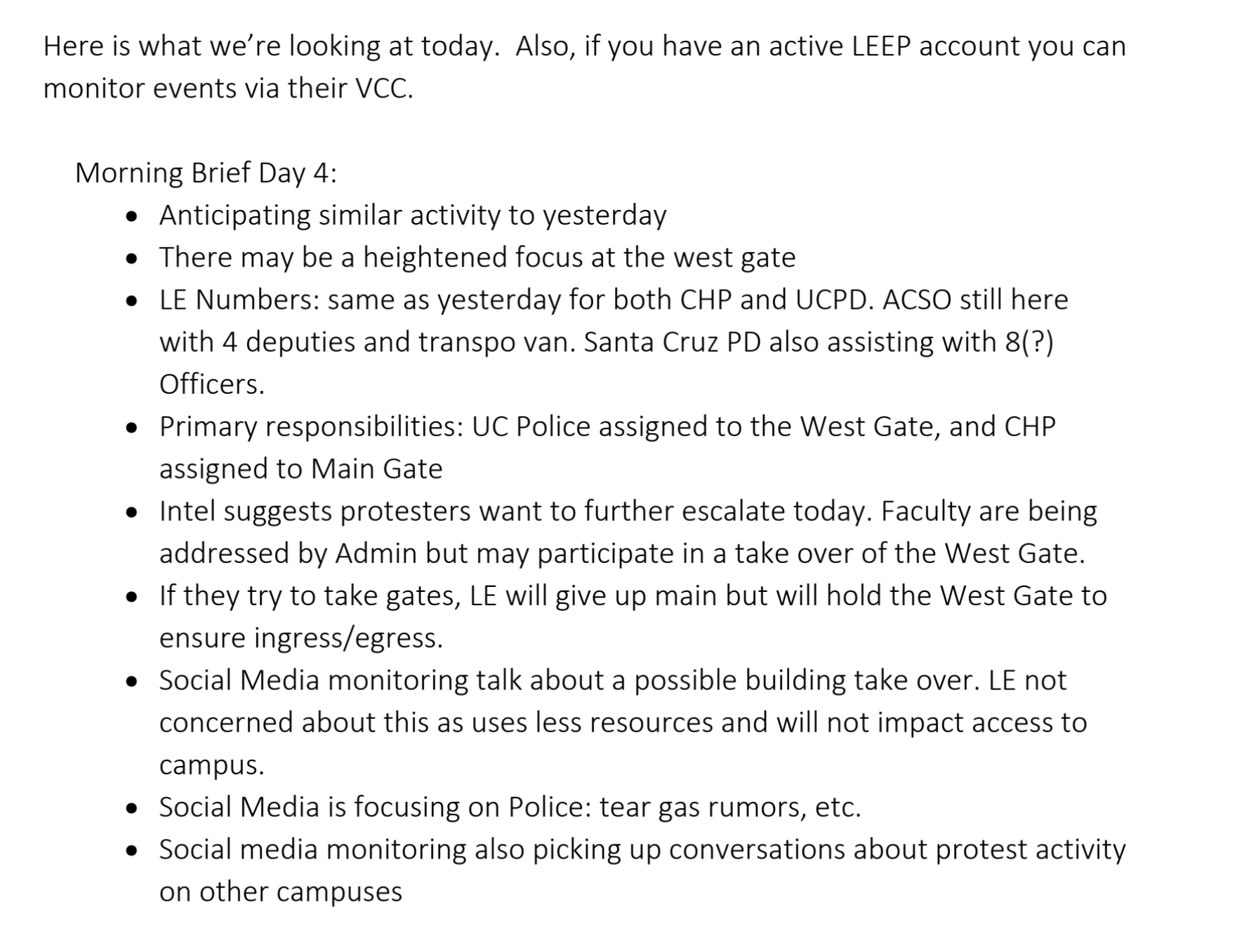
After Bernie Sanders tweeted on February 19 in support of striking graduate students at UC Santa Cruz, a Cal OES officer emailed the California State Threat Assessment Center (STAC) commander Eli Owen to request assistance to “verify/validate Mr. Sanders schedule,” writing that “initial intel suggested that Mr. Sanders may appear on the UC Santa Cruz campus.”
The Cal OES official claimed of Sanders’ tweet and the possibility of his visit to the campus, “Check this out. UCSC is vying to be ground zero for the 2020 election. This is the shot across the bow.”
:{:{:{}:
}:}:
In regards to Sanders’ tweet, the UC Santa Cruz spokesperson said, “with Bernie Sanders tweeting about the unsanctioned strike, UC Santa Cruz was paying attention to his publicly posted campaign schedule so that it could begin planning in case he chose to visit the campus. A visit by a presidential candidate would create significant impacts to our campus and surrounding community.”
The request for assistance came from UC Santa Cruz Police Chief Nader Oweis. Funded in part by the Department of Homeland Security, the California Threat Assessment Center is a “fusion center,” set up to monitor terrorism and other extremist activities.
The emails—and the surveillance tech—show that in many ways law enforcement treated this as something like a military operation. One morning briefing sent to law enforcement discusses how "intel suggests protesters want to further escalate today … if they try to take gates, LE will give up main but will hold the West Gate to ensure ingress/egress." Other emails talk about a "skirmish."
“The university acts like they don’t have any money and can’t afford to pay people living wages, but the amount of money they spent on this is such overkill,” Veronica Hamilton, a PhD student in Psychology who was fired from her teaching appointment, told Motherboard.
“The police weren’t around for the safety of protestors. They were there for the repression of protesters. Everyone should be so angry that they would bring in the National Guard and use FBI information systems.”
:{:{:{}:
}:}:
The graduate students who have been fired from their teaching positions for withholding grades could lose their tuition remission, making it impossible for them to return to their PhD programs. The University of California’s graduate student union filed two unfair labor practice complaints in February and March, which could overturn the firings.
“We’re in a small surf town and here they are spending $300,000 a day to police grad students who are just calling out wage disparities and rent burden. The university sees that as a threat for them and a reason to engage in violence,” Carlos Cruz, a UC Santa Cruz PhD student who has been suspended for two years for his participation in the strike, told Motherboard.
Cruz, a first generation college student, says that without his teaching position, he will not qualify for tuition remission and will have to leave the program. During pickets and rallies, Cruz, who frequently led rallies in front of a megaphone, said police officers approached him reciting his full name, date of birth, and hometown in what felt like an attempt to intimidate him.
Another graduate student alleges that an officer clubbed her over the head during a demonstration on February 10, causing a concussion and other injuries.
Throughout the strike, which was sparked over the cost of housing in Santa Cruz and began on the beachside campus on February 6, the University of California Santa Cruz Police Department relied on support of law enforcement from nine other University of California police departments as well as the Alameda County Sheriff’s Office.
:{:{:{}:
}:}:
UC Santa Cruz has closed its campus during the pandemic, but continued to conduct summonses and disciplinary proceedings in May, accusing graduate students of “theft” and “forgery” for removing grades from the university’s digital gradebook Canvas. Many of the suspended students lost access to student health and emergency services as the pandemic broke out.
“I worry that the students who were fired and disciplined won’t come back. It’s going to eviscerate the activist community and the general graduate student community, especially during Coronavirus,” Hannah Newman, a PhD student in literature, who was suspended, and has been denied her $2,500 housing stipend for the semester, told Motherboard. “UCSC is not a viable place for people who don’t have family support or solid savings.”
All the documents used to report this story can be found here.
==
https://yyy.theguardian.com/us-news/2019/aug/08/fbi-oregon-anti-pipeline-jordan-cove-activists
no lnx
Law enforcement groups, including the FBI, have been monitoring opponents of a natural gas infrastructure project in Oregon and circulated intelligence to an email list that included a Republican-aligned anti-environmental PR operative, emails obtained by the Guardian show.
The South Western Oregon Joint Task Force (SWOJTF) and its members were monitoring opponents of the Jordan Cove energy project, a proposal by the Canadian energy company Pembina to build the first-ever liquefied natural gas export terminal on the US west coast, as well as a new 232-mile pipeline that would carry fracked natural gas to the port of Coos Bay.
The Trump administration has named Jordan Cove as one of its highest-priority infrastructure projects. Jordan Cove opponents have raised concerns about the project’s significant environmental impacts, impacts on public lands, indigenous rights and climate change.
The emails, obtained via open records requests, reflect the increased scrutiny and surveillance to which law enforcement agencies are often subjecting indigenous and environmental groups, activists say.
'Protesters as terrorists': growing number of states turn anti-pipeline activism into a crime
Read more
It also comes amid an uptick in civil disobedience and direct actions challenging fossil fuel infrastructure projects – particularly in the wake of the Native American-led struggle against the Dakota Access Pipeline in 2016 and 2017. They also reflect a nationwide tendency for rightwing partisans, law enforcement agencies and the fossil fuel industry to ally with one another in the suppression of such activities.
An email distribution list associated with the taskforce included addressees in the FBI, the Bureau of Land Management, the Department of Justice (DoJ), the National Forest Service (NFS), Oregon state police (OSP), and various Oregon municipal police and sheriffs departments. But some of its recipients are outside any government agency, most notably Mark Pfeifle, the CEO of the political consultancy Off The Record Strategies.
Pfeifle was previously a Bush administration PR adviser on national security. More recently, Pfeifle worked with law enforcement on a counter-information operation against the Dakota Access Pipeline protesters.
When contacted by telephone about the Jordan Cove project, Mr Pfeifle said “I just don’t have anything for you, I’m not up on it,” before ending the conversation.
Emails circulated on the SWOJTF email list include activists’ social media posts, emails and rally announcements.
Pfeifle appeared on the distribution list of a November 2018 email from the list’s apparent keeper, theCoos county deputy sheriff, Bryan Valencia, which described a recent protest action by Southern Oregon Rising Tide, a direct action climate justice group.
“These are thetactics that are currently being used to forcibly insert their narrative into the conversation,”Valencia wrote. He noted: “There has long been a call for a ‘Standing Rock’ action by the Klamath Tribe in Klamath county.”
Don Gentry, the chairman of the Klamath Tribes, said Valencia’s characterization is false – his tribe has never put out such a call. “We’re working through the readily available channels to get this project stopped,” Gentry said.
In January 2019, Valencia circulated information on Facebook event attendance to a smaller group of SWOJTF officers, related to an upcoming Oregon department of state lands hearing, to some members of the taskforce, despite stating there was a “lack of a criminal nexus”.
The Coos county sheriffs office (CCSO) public information officer, Gabriel Fabrizio, wrote in response to emailed questions that SWOJTF had been set up to “ensure a multi-agency approach to any and all contingencies”.
Fabrizio added: “As potential dangers to the safety of the citizens and businesses of the county are identified, we monitor groups as long as necessary to determine if they will become a danger to others. Once it’s determined a group has not or likely will not conduct criminal activity, we discontinue monitoring.”
He also wrote that “Mr Pfiefle has no relationship with the Coos county sheriff’s office or with the SWOJTF. He was involved with training that was presented by the National Sheriffs Association to emergency responders in Coos county.”
He also denied that SWOJTF had been engaged in surveillance. “Surveillance implies an active gathering of data and images, and any monitoring we have conducted has been passive, simply watching for information,” he said.
The records reveal the existence of other law enforcement intelligence activities related to monitoring the work of environmental groups.
In a November 2018 email to Valencia, a BLM law enforcement analyst noted her role in the “Forest Intelligence Group (FIG)” that is also tracking activists. “I appreciate anything you find, and I am glad to share likewise,” the analyst wrote.
Fabrizio said in an email response to questions that FIG “began its life as a timber investigators meeting in the mid eighties … It has been sharing information about activity including criminal activity in our regions forests since that time. The intent of the group is to identify activities that may require sharing of resources or have an impact across traditional jurisdictional lines.”
In a telephone interview, a spokesman for the US attorney in Oregon also confirmed the existence of another body mentioned in the emails: a “domestic terrorism working group”led by the assistant US attorney, Craig Gabriel, that meets “roughly quarterly” in Portland. He said that the group was mostly made up of federal agencies but included some local law enforcement.
“It’s really just to discuss any current issues in the domestic terrorism arena. This could be local issues, all the way up to international issues,” the spokesman said. He said protest movements would be “within the scope” of its discussions even if no criminal activity had occurred.
In another email exchange, an FBI agent, Michael Frost, offered “open source and social media training” to the Coos county sheriffs, writing to Valencia that “with the significant social media presence of the anti-pipeline individuals, I figured your office would be a good place to start”.
The flyer for the training promises law enforcement officers information on tracking individuals online while minimizing their “digital footprint”, and indicates that it would be hosted by yet another law enforcement “task force”: the FBI’s Joint Terrorism Task Force (JTTF) in Portland.
A spokesperson for the FBI’s Portland field office said in an email: “The FBI does not comment on what may or may not be an ongoing investigation. However, it is important to note that the FBI can never initiate an investigation based solely on first amendment-protected activity.”
On the training session, the spokesperson said: “The FBI’s Portland field office regularly provides training to local law enforcement agencies. This training covers a wide range of law enforcement topics, includingappropriate and legal use of open source material in investigations.”
Fabrizio said that the offer of training had not been taken up.
Although Coos Bay is located more than 200 miles away from Portland, the Portland police bureau (PPB) officer Andrew Hearst is also part of the SWOJTF email list. Hearst told Valencia in January 2019: “As always if we hear anything about our people heading down to your area we will alert asap.”
Jordan Cove opponents expressed alarm upon learning about the level of scrutiny they are receiving from so many different law enforcement entities.
“It is outrageous that our Oregon public agencies are actually working to plan how to stifle the very southern Oregonians whose drinking water, property and communities are threatened by this project,” said Sylvia Mangan, a retired public health nurse who lives on one of the proposed pipeline routes.
Asked why Pfeifle was included in the distribution of intelligence on protest groups, Fabrizio wrote: “Open source information is posted on public forums and not considered sensitive.”
He added: “Anyone who may be affected by potential actions are involved as an effort in community outreach and according to the tenets of community policing.”
Pfeifle previously described his work with law enforcement at Standing Rock during a 2017 presentation to oil, gas and banking executives during a pipeline conference in Houston. “A lot of things that we were doing were being done to put a marker down for the protesters. And, ‘OK, if you’re going to go protest somewhere? There’s going to be consequences from it.’”
In an email comment, the ACLU of Oregon questioned the legality of the activities revealed in the emails.
“Monitoring and compiling information about Oregonians’ political or social views, activities, or associations violates Oregon law,” said the spokeswoman Sarah Armstrong.
Lauren Regan, the executive director of the Oregon-based Civil Liberties Defense Center, says the SWOJTF’s activities reflect a nationwide trend. “Police and corporations are working together to suppress movements against fossil fuels,” she said.
Holly Mills of Southern Oregon Rising Tide, a group regularly subjected to scrutiny in the records obtained by the Guardian, said: “We know that the state, police and corporations have often tried to stop movements like this one by using fear as a tactic and repressing dissent. We have prepared ourselves with this in mind, and we communicate on social media and over email with the assumption that cops might be reading.”
==