Hart, Gary
===
new movie frontrunner
===
kurt a evil geniuses says laffer an advisor also jerry brown?
===
donna rice ~ porn
On the cover of its June 2, 1987 edition,[16] the celebrity tabloid National Enquirer published a photograph of Rice sitting on Hart's lap. The pair were pictured on a dock during a yacht trip to Bimini that Hart, Rice and others took before he announced his campaign for President of the United States.[17] Hart is wearing a T-shirt bearing the words Monkey Business, the name of the yacht. The photo was published alongside the headline "Gary Hart Asked Me to Marry Him".[16] It was published weeks after Hart suspended his campaign, but has been subsequently collectively confused as the reason for Hart's exit.[15][18] There are allegations that the photo was a set up by Republican operative Lee Atwater to discredit Hart.[19]
===
ref
as he wrapped up nine years as the federal government's chief scientist for global warming research, Michael MacCracken lashed out at ExxonMobil for opposing the advance of climate science.
His own great-grandfather, he told the Exxon board, had been John D. Rockefeller's legal counsel a century earlier. "What I rather imagine he would say is that you are on the wrong side of history, and you need to find a way to change your position," he wrote.
Addressed to chairman Lee Raymond on the letterhead of the United States Global Change Research Program, :{his}::{ September 2002 letter}: was not just forceful, but unusually personal.
No wonder: in the opening days of the oil-friendly Bush-Cheney administration, Exxon's chief lobbyist had written the new head of the White House environmental council demanding that MacCracken be fired for "political and scientific bias."
Exxon was also attacking other officials in the U.S. government and at the UN's Intergovernmental Panel on Climate Change (IPCC), MacCracken wrote, interfering with their work behind the scenes and distorting it in public.
Exxon wanted scientists who disputed the mainstream science on climate change to oversee Washington's work with the IPCC, the authoritative body that defines the scientific consensus on global warming, documents written by an Exxon lobbyist and one of its scientists show. The company persuaded the White House to block the reappointment of the IPCC chairman,[ROBERT ----] a World Bank scientist. Exxon's top climate researcher, Brian Flannery, was pushing the White House for a wholesale revision of federal climate science. The company wanted a new strategy to focus on the uncertainties.
MacCracken had a long history of collaboration with Exxon researchers. He knew that during the 1970s and 1980s, well before the general public understood the risks of global warming, the company's researchers had worked at the cutting edge of climate change science. He had edited and even co-authored some of their reports. So he found it galling that Exxon was now leading a concerted effort to sow confusionabout fossil fuels, carbon dioxide and the greenhouse effect."To call ExxonMobil's position out of the mainstream is thus a gross understatement," MacCracken wrote. "To be in opposition to the key scientific findings is rather appalling for such an established and scientific organization."
Exxon had turned a colleague into its enemy.
It was a vivid example of Exxon's undermining of mainstream science and embrace of denial and misinformation, which became most pronounced after President George W. Bush took office. The campaign climaxed when Bush pulled out of the Kyoto Protocol in 2001.Taking the U.S. out of the international climate change treaty was Exxon's key goal, and the reason for its persistent emphasis on the uncertainty of climate science.
This in-depth series by InsideClimate News has explored Exxon's early engagement with climate research more than 35 years ago – and its subsequent use of scientific uncertainty as a shield against forceful action on global warming. The series is based on Exxon documents, interviews, and other evidence from an eight-month investigation.
"What happened was an incredible disconnect in people trained in physical science and engineering," recalled Martin Hoffert, a New York University professor who collaborated with Exxon's team as its early computer modeling confirmed the emerging scientific consensus on global warming. "It's an untold story of how we got to the point where climate change has become a threat to the world."
The Uncertainty Agenda
As the Bush-Cheney administration arrived in the White House in 2001, ExxonMobil (NYSE: XOM) now had partners for a climate uncertainty strategy.
Just weeks after Bush was sworn in, Exxon's top lobbyist Randy Randol sent the White House a memo complaining that "Clinton/Gore carry-overs with aggressive agendas" were still playing a role at the IPCC as it prepared its next assessment of the climate science consensus.
MacCracken and three colleagues should be replaced, or at least kept out of "any decisional activities," he wrote. Meanwhile, U.S. input to the IPCC should be delayed.
Further, two scientists highly critical of the prevailing consensus should be enlisted: John Christy of the University of Alabama should take the science lead and Richard Lindzen of MIT should review U.S. submissions to the IPCC.
Exxon had been circulating a proposal to fundamentally overhaul MacCracken's global change research program, by emphasizing the uncertainties of climate science.
The timing was not coincidental because the administration, as required by law, was about to lay out a new federal climate research strategy. Exxon and its allies wanted the work done during the Clinton-Gore years to be marginalized.
In March 2002, Flannery, Exxon's science strategy and programs manager, contacted John H. Marburger, the president's incoming assistant for science and technology, to pitch the company's favored approach of emphasizing the uncertainty. Earlier discussions, he asserted, "have not sought to place the uncertainty in the context of why it is important to public policy."
Exxon's position paper, attached to his letter, took a dig at the work of the IPCC.
"A major frustration to many is the all-too-apparent bias of IPCC to downplay the significance of scientific uncertainty and gaps," the memo said.
A Seat at the Table
Exxon had not always been so at odds with the prevailing science.
Since the late 1970s, Exxon scientists had been telling top executives that the most likely cause of climate change was carbon pollution from the combustion of fossil fuels, and that it was important to get a grip on the problem quickly. Exxon Research & Engineering had launched innovative ocean research from aboard the company's biggest supertanker, the Esso Atlantic.ER&E's modeling experts, by the early 1980s, had confirmed the consensus among outside scientists about the climate's sensitivity to carbon dioxide.
"The facts are that we identified the potential risks of climate change and have taken the issue very seriously," said Ken Cohen, Exxon's vice president of public and government affairs, in a press release on October 21 addressing the ICN reports. "We embarked on decades of research in collaboration with many parties."
Exxon has declined to answer specific questions from InsideClimate News.
[grfx dialogue]
A 1980 memo proposed an ambitious public-relations plan aimed at "achieving national recognition of our CO2 Greenhouse research program."
"It is significant to Exxon since future public decisions aimed at controlling the build-up of atmospheric CO2 could impose limits on fossil fuel combustion," said the memo. "It is significant to all humanity since,although the CO2 Greenhouse Effect is not today widely perceived as a threat, the popular media are giving increased attention to doom-saying theories about dramatic climate changes and melting polar icecaps."
Most of all, Exxon wanted a seat at the policy-making table, and the credibility of its research had earned that. In 1979, David Slade, manager of carbon dioxide research at the Energy Department, called it "a model for research contributions from the corporate sector."
Sen. Gary Hart, a Colorado Democrat, invited Henry Shaw, an early Exxon scientist, to join the policy deliberations. He was the only industry representative invited to an October 1980 conference of the National Commission on Air Quality,newly set up by Congress, to discuss "whether potential consequences of increased carbon dioxide levels warrant development of policies to mitigate adverse effects."
Shaw's bosses agreed that he should attend, "both to be informed as to what actions or proposals that result and to bring objective thinking and information to the meeting," Harold Weinberg, Shaw's boss in Exxon Research and Engineering, wrote in a memo. But first, he said, Shaw needed to be briefed by public affairs executives "on possible hidden agenda and individual biases of which we may not already be aware."
When Shaw gave feedback to the commission in December, he noted the uncertainties about carbon dioxide and climate change.At the same time, he wrote that it was "important" to place CO2 on the nation's public policy agenda,as the commission was recommending, and supported the panel's suggestion that it was "timely to consider ways of reducing CO2 emissions now."
He also backed a recommendation that the U.S. "seek to develop discussions on national and international policies."
In late spring of 1981, Flannery was one of the few industry representatives at a large gathering of accomplished scientists at Harper's Ferry, W. Va., for a Department of Energy "Workshop on First Detection of Carbon Dioxide Effects." He sat on a panel with NASA's James Hansen, who was about to publish a landmark study in Science magazine warning of significant warming even if controls were placed on carbon emissions.
The workshop's proceedings would declare that "scientists are agreed" that carbon dioxide was building up in the atmosphere, that the effects "are well known" and "will bring about an increase in the mean global temperature," and that it is "commonly accepted" that warming "will affect the biosphere through a change in climate."
Working with Hoffert, Flannery wrote a highly technical 50-page chapter to a 1985 Energy Department report. Their modeling projected up to 6 degrees Celsius of warming by the end of the 21st century unless emissions of greenhouse gases were curtailed.[grfx]
the influential government report said the models provided a "firm basis" for this kind of projection, and that "we are already committed to some of this warming as a result of emissions over the last several decades."
The Harper's Ferry conference was chaired by MacCracken; he also edited the warming report. He recalled recently that "the underlying push was for a level of understanding that was convincing enough to let policymakers become aware of what the issue was that society faced."
As Hoffert put it in a recent interview, in those days at Exxon "there were no divisions, no agendas. We were coming together as scientists to address issues of vital importance to the world."
Fork in the Road
In 1988, James Hansen told Congress that there was now enough warming to declare that the greenhouse effect had arrived. Also that year, the United Nations set up the Intergovernmental Panel on Climate Change.
It was a moment that Exxon's climate experts had been forecasting for a decade: that as warming became unmistakable, governments would move to control it.
Looking backward, one Exxon document from the early 1990s reflects a trail of research into global warming stretching back "long before the issue achieved its current prominence."
An internal compendium of the company's environmental record, on file in the official ExxonMobil historical archives at the University of Texas-Austin, acknowledged the uncertainties that have always faced climate researchers, but it didn't downplay the risks.
"Fossil fuel use dominates as the source of man-made emissions of carbon dioxide," said one section of the encyclopedic review. "Current scientific understanding demonstrates the potential for climate change to produce serious impacts."
"For Exxon and the petroleum industry, potential enhancement of the greenhouse effect and the possibility of adverse climate are of particular and fundamental concern," it said.
Drilling for Uncertainty
The IPCC published its first report in 1990. Despite the scientific gaps, the panel warned that unrestrained emissions from burning fossil fuels would surely warm the planet in the century ahead. The conclusion, the IPCC said after intense deliberations, was "certain." It prescribed deep reductions in greenhouse gas emissions to stave off a crisis in the coming decades.
At this crucial juncture, Exxon pivoted toward uncertainty and away from the global scientific consensus.
At the IPCC's final session to draft its summary for policymakers, Exxon's Flannery was in the room as an observer. He took the microphone to challenge both the certainty and the remedy. None of the other scientists agreed with Flannery, and the IPCC brushed off Exxon's advice to water down the report, according to Jeremy Leggett's eyewitness account in his book, The Carbon War.
At a conference in June 1991, MacCracken joined a panel chaired by Flannery to work together on a climate change project involving geo-engineering.
The contact, according to MacCracken, led to an unexpected solicitation from the oil lobby in Washington. Will Ollison, a science adviser at the American Petroleum Institute, in a fax marked urgent, asked MacCracken, then at the Lawrence Livermore National Laboratory, to write a paper highlighting the scientific uncertainties surrounding global warming.
The API, where Exxon held enormous sway, wanted him to write up the complex nuances in plain English – with an emphasis on the unknown, not the known.
Ollison said the IPCC's 1990 report "may not have adequately addressed alternative views."
"A review of these alternative projections would be useful in illustrating the uncertainties inherent in the 'consensus' views expressed in the IPCC report," Ollison wrote.
MacCracken rejected the task as "fruitless."
"I would caution you about too readily accepting whatever the naysayers put forth as a means of achieving balance," MacCracken wrote back.
Flannery, for his part, continued to emphasize uncertainty. And so didExxon's new chairman and chief executive, Lee Raymond, who spoke of it repeatedly in public.
"Currently, the scientific evidence is inconclusive as to whether human activities are having a significant effect on the global climate," Raymond claimed in a speech delivered in 1996 to the Economic Club of Detroit.
"Many people, politicians and the public alike, believe that global warming is a rock-solid certainty," he said the next year in a speech in Beijing."But it's not."
Addressing the World Petroleum Congress, which was meeting just before the conclusion of the Kyoto Protocol negotiations, Raymond even disputed that the planet was warming at all. "The earth is cooler today than it was 20 years ago," he said.
That was false. Authoritative climate agencies declared 1997 the warmest year ever measured. Decade by decade, the warming has continued, in line with the climate models.
But Raymond, turning his back on Exxon researchers and their state-of-the-art work, mocked those climate models.
"1990's models were predicting temperature increases of two to five degrees Celsius by the year 2100. Last year's models say one to three degrees. Where to next year?"
"It is highly unlikely," he said, "that the temperature in the middle of the next century will be significantly affected whether policies are enacted now or 20 years from now."
The Doubt Industry
Exxon and its allies had been working hard to spread this dilatory message.
First, they set up the Global Climate Coalition (GCC), a lobbying partnership of leading oil and automobile companies dedicated to defeating controls on carbon pollution.
"As major corporations with a high level of internal scientific and technical expertise, they were aware of and in a position to understand the available scientific data," recounts an essay on corporate responsibility for climate change published last month in the peer-reviewed journal Climatic Change.
[grfx]
"From 1989 to 2002, the GCC led an aggressive lobbying and advertising campaign aimed at achieving these goals by sowing doubt about the integrity of the IPCC and the scientific evidence that heat-trapping emissions from burning fossil fuels drive global warming," says the article, by Harvard climate science historian Naomi Oreskes and two co-authors.
Then, in 1998 Exxon also helped create the Global Climate Science Team, an effort involving Randy Randol, the company's top lobbyist, and Joe Walker, a public relations representative for API.
Their memo, leaked to The New York Times, asserted that it is "not known for sure whether (a) climate change actually is occurring, or (b) if it is, whether humans really have any influence on it." Opponents of the Kyoto treaty, it complained, "have done little to build a case against precipitous action on climate change based on the scientific uncertainty."
The memo declared: "Victory will be achieved when average citizens 'understand' (recognize) uncertainties in climate science," and when "recognition of uncertainty becomes part of the 'conventional wisdom.'"
Exxon wholeheartedly embraced that theme. For example, an advertisement called "Unsettled Science" that ran in major papers in the spring of 2000, prompted one scientist to complain that it had distorted his work by suggesting it supported the notion that global warming was just a natural cycle. "It's a shame," Lloyd Keigwin later told the Wall Street Journal. "The implication is that these data show that we don't need to worry about global warming."
Another ad, one of a series placed in The New York Times, cast aspersions on scientists who "believe they can predict changes in climate decades from now."
Then, in the heat of the 2000 presidential race between climate champion Al Gore and erstwhile oilman George W. Bush, Exxon placed an ad in the Washington Post accusing MacCracken's office of putting the "political cart before a scientific horse."
Blowing the Whistle
The collaboration between Exxon, its surrogates, and the Bush administration to emphasize uncertainty and stave off action came to light in 2005. A whistleblower named Rick Piltz disclosed that Philip Cooney, an oil lobbyist who had become chief of staff at the White House environmental council, had been heavily editing the work of government researchers. Cooney resigned, and was hired by Exxon.
But the clashes continued between the scientific establishment and Exxon's purveyors of uncertainty.
The Royal Society of the United Kingdom, for centuries a renowned arbiter of science, harshly criticized Exxon in 2006 for publishing "very misleading" statements about the IPCC's Third Assessment Report. The IPCC found that most of the observed warming of the planet in the late 20th century was probably caused by humans.[CEI ebell ctr-slap?]
The Society's communications manager Bob Wardreminded Exxon pointedly that one of its own scientists had contributed to the IPCC chapter in question.
The Royal Society said it had no problem with Exxon funding scientific research, but "we do have concerns about ExxonMobil's funding of lobby groups that seek to misrepresent the scientific evidence relating to climate change."
Ward said Exxon was funding at least 39 organizations "featuring information on their websites that misrepresented the science on climate change, by outright denial of the evidence that greenhouse gases are driving climate change, or by overstating the amount and significance of uncertainty in knowledge."
appendix b]
exxon's uncertainty campaign was detailed in three exhaustive reports published in 2007 by the Union of Concerned Scientists and the Government Accountability Project.
At a Congressional hearing in 2007, Harvard scientist James McCarthy, who was a member of the UCS board and the newly elected president of the American Association for the Advancement of Science, declared: "The Bush administration and a network of Exxon-funded, ExxonMobil funded organizations have sought to distort, manipulate and suppress climate science so as to confuse the American public about the urgency of the global warming problem, and thus, forestall a strong policy response."
===
===
https://www.theatlantic.com/magazine/archive/2018/11/was-gary-hart-set-up/570802/
fallows
In the spring of 1990, after he had helped the first George Bush reach the presidency, the political consultant Lee Atwater learned that he was dying. Atwater, who had just turned 39 and was the head of the Republican National Committee, had suffered a seizure while at a political fund-raising breakfast and had been diagnosed with an inoperable brain tumor. In a year he was dead.
Atwater put some of that year to use making amends. Throughout his meteoric political rise he had been known for both his effectiveness and his brutality. In South Carolina, where he grew up, he helped defeat a congressional candidate who had openly discussed his teenage struggles with depression by telling reporters that the man had once been “hooked up to jumper cables.” As the campaign manager for then–Vice President George H. W. Bush in 1988, when he defeated Michael Dukakis in the general election, Atwater leveraged the issue of race—a specialty for him—by means of the infamous “Willie Horton” TV ad. The explicit message of the commercial was that, as governor of Massachusetts, Dukakis had been soft on crime by offering furloughs to convicted murderers; Horton ran away while on furlough and then committed new felonies, including rape. The implicit message was the menace posed by hulking, scowling black men—like the Willie Horton who was shown in the commercial.
-
In the last year of his life, Atwater publicly apologized for tactics like these. He told Tom Turnipseed, the object of his “jumper cables” attack, that he viewed the episode as “one of the low points” of his career. He apologized to Dukakis for the “naked cruelty” of the Willie Horton ad.
And in a private act of repentance that has remained private for nearly three decades, he told Raymond Strother that he was sorry for how he had torpedoed Gary Hart’s chances of becoming president.
Strother, 10 years older than Atwater, had been his Democratic competitor and counterpart, minus the gutter-fighting. During the early Reagan years, when Atwater worked in the White House, Strother joined the staff of the Democratic Party’s most promising and glamorous young figure, Senator Gary Hart of Colorado. Strother was Hart’s media consultant and frequent traveling companion during his run for the nomination in 1984, when he gave former Vice President Walter Mondale a scare. As the campaign for the 1988 nomination geared up, Strother planned to play a similar role.
In early 1987, the Hart campaign had an air of likelihood if not inevitability that is difficult to imagine in retrospect. After Mondale’s landslide defeat by Ronald Reagan in 1984, Hart had become the heir apparent and best hope to lead the party back to the White House. The presumed Republican nominee was Bush, Reagan’s vice president, who was seen at the time, like many vice presidents before him, as a lackluster understudy. Since the FDR–Truman era, no party had won three straight presidential elections, which the Republicans would obviously have to do if Bush were to succeed Reagan.
Gary Hart had a nationwide organization and had made himself a recognized expert on military and defense policy. I first met him in those days, and wrote about him in Atlantic articles that led to my 1981 book, National Defense. (I’ve stayed in touch with him since then and have respected his work and his views.) Early polls are notoriously unreliable, but after the 1986 midterms, and then–New York Governor Mario Cuomo’s announcement that he would not run, many national surveys showed Hart with a lead in the Democratic field and also over Bush. Hart’s principal vulnerability was the press’s suggestion that something about him was hidden, excessively private, or “unknowable.” Among other things, this was a way of alluding to suspicions of extramarital affairs—a theme in most accounts of that campaign, including Matt Bai’s 2014 All the Truth Is Out.Still, as Bai wrote in his book, “Everyone agreed: it was Hart’s race to lose.”
Strother and Atwater had the mutually respectful camaraderie of highly skilled rivals. “Lee and I were friends,” Strother told me when I spoke with him by phone recently. “We’d meet after campaigns and have coffee, talk about why I did what I did and why he did what he did.” One of the campaigns they met to discuss afterward was that 1988 presidential race, which Atwater (with Bush) had of course ended up winning, and from which Hart had dropped out. But later, during what Atwater realized would be the final weeks of his life, Atwater phoned Strother to discuss one more detail of that campaign.
Atwater had the strength to talk for only five minutes. “It wasn’t a ‘conversation,’ ” Strother said when I spoke with him recently. “There weren’t any pleasantries. It was like he was working down a checklist, and he had something he had to tell me before he died.”
What he wanted to say, according to Strother, was that the episode that had triggered Hart’s withdrawal from the race, which became known as the Monkey Businessaffair, had been not bad luck but a trap. The sequence of events was confusing at the time and is widely misremembered now. But in brief:
In late March 1987, Hart spent a weekend on a Miami-based yacht called Monkey Business.Two young women joined the boat when it sailed to Bimini. While the boat was docked there, one of the women took a picture of Hart sitting on the pier, with the other, Donna Rice, in his lap. A month after this trip, in early May, the man who had originally invited Hart onto the boat brought the same two women to Washington. The Miami Herald hadreceived a tip about the upcoming visit and was staking out the front of Hart’s house. (A famous profile of Hart by E. J. Dionne in The New York Times Magazine, in which Hart invited the press to “follow me around,” came out after this stakeout—not before, contrary to common belief.) A Herald reporter saw Rice and Hart going into the house through the front door and, not realizing that there was a back door, assumed—when he didn’t see her again—that she had spent the night.
Amid the resulting flap about Hart’s “character” and honesty, he quickly suspended his campaign (within a week), which effectively ended it. Several weeks later came the part of the episode now best remembered: the photo of Hart and Rice together in Bimini, on the cover of the National Enquirer.
Considering what American culture has swallowed as irrelevant or forgivable since then, it may be difficult to imagine that allegations of a consensual extramarital affair might really have caused an otherwise-favored presidential candidate to leave the race. Yet anyone who was following American politics at the time can tell you that this occurred. For anyone who wasn’t around, there is Bai’s book and : The Front Runner, starring Hugh Jackman as Hart.
But was the plotline of Hart’s self-destruction too perfect? Too convenient? Might the nascent Bush campaign, with Atwater as its manager, have been looking for a way to help a potentially strong opponent leave the field?
“I thought there was something fishy about the whole thing from the very beginning,” Strother recalled. “Lee told me that he had set up the whole Monkey Businessdeal. ‘I did it!’ he told me. ‘I fixed Hart.’ After he called me that time, I thought, My God! It’s true!”
Strother’s conversation with Atwater happened in 1991. He mainly kept the news to himself. As the years went by, he discreetly mentioned the conversation to some journalists and other colleagues, but not to Gary Hart. “I probably should have told him at the time,” he said recently. “It was a judgment call, and I didn’t see the point in involving him in another controversy.”
Crucially, Strother realized, he had no proof, and probably never would. Atwater was dead. Although Hart did not run in later elections, he was busy and productive: He had earned a doctorate in politics at Oxford, had published many books, and had co-chaired the Hart-Rudman Commission, which memorably warned the incoming president in 2001, George W. Bush, to prepare for a terrorist attack on American soil. Why, Strother asked himself, should he rake up an issue that could never be resolved and might cause Hart more stress than surcease?
But late last year, Strother learned that the prostate cancer he had been treated for a dozen years ago had returned and spread, and that he might not have long to live. The cancer is now in remission, but after the diagnosis Strother began traveling to see people he had known and worked with, to say goodbye. One of his stops was Colorado, where he had a meal with Gary Hart.
Aware that this might be one of their final conversations, Hart asked Strother to think about the high points of the campaign, and its lows. Hart knew thatStrother had been friends with Billy Broadhurst, the man who had taken Hart on the fateful Monkey Businesscruise. According to Strother and others involved with the Hart campaign, Broadhurst was from that familiar political category, the campaign groupie and aspiring insider. Broadhurst kept trying to ingratiate himself with Hart, and kept being rebuffed. He was also a high-living, high-spending fixer and lobbyist with frequent money problems.
Strother talked with Hart this spring; Broadhurst had died about a year earlier. In retrospect, Hart asked, what did Strother make of the whole imbroglio?
“Ray said, ‘Why do you ask?’ ” Hart told me, when I called to talk with him about the episode. “And I said there are a whole list of ‘coincidences’ that had been on my mind for 30 years, and that could lead a reasonable person to think none of it happened by accident.
“Ray replied, ‘It’s because you were set up. I know you were set up.’
“I asked him how he could be so certain,” Hart told me. Strother then recounted his long-ago talk with Atwater, and Atwater’s claim that the whole Monkey Businessweekend had occurred at his direction. According to Hart, that plan would have involved: contriving an invitation from Broadhurst for Hart to come on a boat ride, when Hart intended to be working on a speech. Ensuring that young women would be invited aboard. Arranging for the Broadhurst boat Hart thought he would be boarding, with some unmemorable name, to be unavailable—so that the group would have to switch to another boat, Monkey Business. Persuading Broadhurst to “forget” to check in with customs clearance at Bimini before closing time, so that the boat “unexpectedly” had to stay overnight there. And, according to Hart, organizing an opportunistic photo-grab.
“There were a lot of people on the dock, people getting off their boats and wandering up and down on the wharf,” Hart told me. “While I was waiting for Broadhurst and whatever he was working out with the customs people, I sat on this little piling on the pier.” Hart said that Donna Rice’s friend and companion on the boat, Lynn Armandt, was standing a short distance away. “Miss Armandt made a gesture to Miss Rice, and she immediately came over and sat on my lap. Miss Armandt took the picture. The whole thing took less than five seconds, with lots of other people around. It was clearly staged, but it was used after the fact to prove that some intimacy existed.”
What are we to make of Strother’s late-in-life revelation of Atwater’s deathbed confession? Hart’s reputation, deserved or not, certainly gave Atwater something to work with, if that’s what he did. (“It would be just like the perversity of history for someone to undertake an effort that might well have happened by itself,” Matt Bai told me when I spoke with him recently.) What would have induced Broadhurst to participate in an entrapment scheme? (When I asked Strother this question, he said, “Money.”) How exactly was the scheme supposed to work? Hart had been introduced to Donna Rice at least once before (briefly, at an event at the musician Don Henley’s house, in Colorado, that Hart attended with his wife), and he phoned her after the Monkey Businessweekend. Both Rice and Hart denied any affair. A few people still living may know what happened that weekend, and why. (Rice, who now leads an internet-safety group called Enough Is Enough and goes by her married name, Donna Rice Hughes, did not respond to repeated requests for comment.) Most likely the rest of us never will.
Like other political calamities, the Hart downfall had consequences that will be debated for as long as the man’s name is remembered. History is full of unknowable “What if?” questions. What if whatever happened that weekend in Bimini had not happened? “I was going to be the next president,” Hart told me, clinically. He was, or might have been—and then he wasn’t.
If history had gone in a different direction in 1987, and Hart had become the 41st president rather than Bush, then Bill Clinton would not have had his chance in 1992, or perhaps ever. George W. Bush, who found his footing with a place on his father’s winning campaign, would probably never have emerged as a contender. When and whether Barack Obama and Donald Trump might ever have come onto the stage no one can say. “No first Bush if things had turned out differently,” Gary Hart told me. “Which means no second Bush—at least not when he arrived. Then no Iraq War. No Cheney. Who knows what else?”
In announcing the suspension of his campaign, Hart angrily said, “I believe I would have been a successful candidate. And I know I could have been a very good president, particularly for these times. But apparently now we’ll never know.”
We won’t.
==
1988 presidential campaign
Hart declined to run for re-election to the Senate, leaving office when his second term expired with the intent of running for president again. In January 1987, he was the clear frontrunner for the Democratic nomination in the1988 election.[9]

Photo of Donna Rice with Gary Hart
Hart officially declared his candidacy on April 13, 1987.[10] Rumors began circulating nearly immediately that Hart was having an extramarital affair. In an interview that appeared in The New York Times on May 3, 1987, again with Raymond Strother as the manager. Hart responded to the rumors by daring the press corps: "Follow me around. I don't care. I'm serious. If anybody wants to put a tail on me, go ahead. They'll be very bored."[11]The Miami Herald had been investigating Hart's alleged womanizing for weeks before the "dare" appeared inThe New York Times.
Two reporters from The Miami Herald had staked out his residence and observed a young woman leaving Hart's Washington, D.C., townhouse on the evening of May 2. The Herald published the story on May 3, the same day Hart's dare appeared in print, and the scandal spread rapidly through the national media. Hart and his allies attacked the Herald for rushing the story into print, claiming that it had unfairly judged the situation without finding out the facts. Hart said that the reporters had not watched both entrances to his home and could not have seen when the young woman entered and left the building. TheMiami Herald reporter had flown to Washington, D.C. on the same flight as the woman, identified as 29-year-old model Donna Rice. Hart was overwhelmed with questions regarding his views on marital infidelity. His wife, Lee, supported his position that the relationship with the young woman was innocent.[12] A poll of voters in New Hampshire for the New Hampshire primary showed that Hart's support had dropped in half, from 32% to 17%, placing him suddenly ten points behind Massachusetts governor Michael Dukakis.
On May 5, the Herald received a further tip that Hart had spent a night in Bimini on a yacht called the Monkey Business with a woman who was not his wife.[13] The Herald obtained a photograph of Hart sitting on a dock wearing a Monkey Business T-shirt, with Rice sitting on his lap. The photograph did not appear in print until it was published on the cover of the National Enquirer on June 2, 1987.[14] On May 8, 1987, a week after the story broke, Hart dropped out of the race. At a press conference, he lashed out at the media, saying "I said that I bend, but I don't break, and believe me, I'm not broken." A Gallup Poll found that nearly two-thirds (64 percent) of the U.S. respondents it surveyed thought the media treatment of Hart was "unfair." A little over half (53 percent) responded that marital infidelity had little to do with a president's ability to govern.
Not everyone was impressed with Hart's diatribe against the press. Television writer Paul Slansky noted that Hart had tried to deflect blame for his downfall from himself to the media, and that he offered no apology to betrayed supporters who now suddenly had to find other candidates to back. To many observers, the press conference was redolent of Richard Nixon's "Last Press Conference" of November 7, 1962, in which Nixon blamed the media for his loss in the 1962 California gubernatorial election. Hart, in fact, received a letter from Nixon himself commending him for "handling a very difficult situation uncommonly well".[15]
Having withdrawn from the presidential race, Hart left for Ireland to spend time away from the media with his son. He rented a cottage in Oughterard, though remained in contact with key members of his team. What news did filter out was that he was not excluding a return to the race.[16] The New York Times also pointed to his odd ambivalence towards the presidency even before being caught by "the system": "Only half of me wants to be President [...] The other half wants to go write novels in Ireland. But the 50 percent that wants to be President is better than 100 percent of the others."[17]
Former National Security Council member Roger Morris suggests in his book Partners in Power, the Clintons and Their America that the alleged Hart-Rice sex scandal was really an intelligence operation to deny Hart the presidency. CIA agent Chip Tatum claims to have been tasked with "neutralizing" Hart. Hart's biggest offense, according to Morris, was his advocacy of "further investigation and exposure of the alliance between the mob and the U.S. intelligence community."[18] The Miami Herald's account of how it researched and produced the Gary Hart-Donna Rice story was said to be closely examined by investigative reporters from the national media after allegations were made that the story may have been initiated by conspirators to eliminate Hart as a viable candidate. Since then, no story has ever been published by the national media challenging the Herald's account of how one of Ms Rice's own girl friends called the paper with the original tip that Rice was planning to meet with Hart at his home in Washington. According to theHerald, after the original tip, no one outside the Herald's reporting team influenced the surveillance and reporting that produced the story.
In December 1987, Hart returned to the race, declaring "Let's let the people decide!"[19] He competed in the New Hampshire primary and received 4,888 votes, approximately four percent. After the Super Tuesday contests on March 8, he withdrew from the campaign a second time.
Later career
After his Senate service and presidential races, Hart resumed his law practice. He remained moderately active in politics, serving on the bipartisan US Commission on National Security/21st Century, also known as the Hart–Rudman Commission, commissioned on behalf of Bill Clinton in 1998 to study U.S. homeland security. The commission issued several findings calling for broad changes to security policy, but none was implemented until after theSeptember 11, 2001 terrorist attacks.[20] He earned a doctorate in Philosophy (D.Phil.) from the University of Oxford in 2001, where he was a member of St Antony's College.
Hart gave a speech before the American international law firm Coudert Brothers on September 4, 2001, exactly one week before the September 11 attacks, warning that within the next 25 years a terrorist attack would lead to mass deaths in the U.S.[21] In an interview with Salon.com, Hart accused President George W. Bush and other administration officials of ignoring his warnings.[20]
In late 2002, urged by former Oxford classmates, Hart began testing the waters for another run for the presidency, launching a website at GaryHartNews.com and a related speaking tour to gauge reactions from the public. He started his own blog in the spring of 2003, the first prospective presidential candidate to do so. After a few months of speaking, Hart decided not to run for president and instead endorsed DemocratJohn Kerry. According to an October 23, 2004, National Journal article and later reports in the Washington Post, Hart was mentioned as a probable Cabinet appointment if Kerry won the presidency. He was considered a top candidate for either Director of National Intelligence, Secretary of Homeland Security, or Secretary of Defense.
Since May 2005 he has been a contributing blogger at The Huffington Post. He is a member of the Council on Foreign Relations (better known as the CFR). Hart also sits on the Advisory Board of Operation USA, a Los Angeles-based international relief and development agency. It was announced in January 2006 that Hart will hold an endowed professorship at the University of Colorado. He is the author of James Monroe, part of the Times Booksseries on American presidents, ISBN 0-8050-6960-7, published in October 2005. Hart is an Honorary Fellow of the Literary & Historical Society ofUniversity College Dublin. He is an Advisory Board member for the Partnership for a Secure America, a not-for-profit organization dedicated to recreating the bipartisan center in American national security and foreign policy.
In September 2007, The Huffington Post published Hart's letter, "Unsolicited Advice to the Government of Iran", in which he stated that "Provocation is no longer required to take America to war" and warns Iran that "for the next sixteen months or so, you should not only not take provocative actions, you should not seem to be doing so." He went on to suggest that the Bush-Cheney administration was waiting for an opportunity to attack Iran. ("Don't give a certain vice president we know the justification he is seeking to attack your country.")
Hart linked American energy policy with national security in an essay published in 5280, the Denver city magazine, in November 2007. Hart wrote, "In fact, we do have an energy policy: It’s to continue to import more than half our oil and sacrifice American lives so we can drive our Humvees. This is our current policy, and it is massively immoral." Hart currently sits on the board of directors for the Energy Literacy Advocates. He founded the American Security Project in 2007 and he started a new blog, "Matters of Principle", in 2009. He and his wife, Lee, are residents of Kittredge, Colorado.
Publication
===
https://grist.org/article/dnc-the-hart-of-the-matter/
2008 kate s
energy, climate, and national-security concerns are inextricably joined in the modern political environment, says former Democratic Colorado Sen. Gary Hart. This fact should elevate sound climate and energy policy to a top-tier issue in this year’s election, he said, for both politicians and voters.
“I think if ordinary, everyday Americans understood that we are sacrificing the lives of our sons and daughters to get somebody else’s oil to drive energy-inefficient vehicles that pollute the atmosphere, that would dramatize it a lot more,” Hart told Grist in an interview this morning. “I would hope that leaders in our country would let people know that we are in fact trading the lives of young people for a corrupt energy policy.”
Hart represented Colorado in the U.S. Senate from 1975 to 1987, and he ran for the Democratic presidential nomination in 1984 and 1988. Since then, he’s served as a consultant on national-security issues, focusing on homeland security and the environment. He’s currently a scholar in residence at the University of Colorado Denver and chair of the Council for a Livable World, and he serves as an advisor for the Presidential Climate Action Project.
Hart is appearing on a panel on climate change and energy policy Tuesday morning as part of the Rocky Mountain Roundtable series. He’ll be discussing PCAP’s Presidential Climate Action Plan [PDF] — a detailed policy outline intended to guide the incoming president.
“Foreign policy, climate and environment and energy policy, and military policy all arrive at the same place, and that’s the Persian Gulf,” said Hart. “The old days of saying, now we’re going to talk about the environment, and after that we’ll talk about energy, and after that we’ll talk about foreign policy, and after that we’ll talk about national security, those days are over. They all are inextricably intertwined.”
Hart also touched on the continuing partisan divide on the issue, which will be a challenge for the future president.
“It’s unfortunately too much a partisan issue. I wish more Republicans took it seriously,” said Hart. “Off and on, Sen. McCain has expressed some concern, but I don’t think he’s followed that up with much of a voting record. The objective should be to get rid of the partisanship, to get more Republicans and corporate America to take the issues seriously and to coalesce around an action plan
---
1984 United States presidential election - Wikipedia
Presidential elections were held in the United States on November 6, 1984. Incumbent Republican president Ronald Reagan and his running mate, incumbent vice president George H. W. Bush, were reelected to a second term in a landslide. They defeated the Democratic ticket of former vice president Walter Mondale and Congresswoman Geraldine Ferraro.
Reagan and Bush faced only token opposition in their bid for re-nomination. Mondale faced a competitive field in his bid, defeating Colorado senator Gary Hart, activist Jesse Jackson, and several other candidates in the Democratic primaries. He eventually chose New York representative Geraldine Ferraro as his running mate, the first woman to be on a major party's presidential ticket.
Reagan touted a strong economic recovery from the 1970s stagflation and the 1981–1982 recession, and the widespread perception that his presidency had overseen a revival of national confidence and prestige.[2] At 73, Reagan was the oldest person to be nominated by a major party for president, a record that stood until 2020. The Reagan campaign produced effective television advertising and deftly neutralized concerns regarding Reagan's age. Mondale criticized Reagan's supply-side economics and budget deficits. He called for the reduction of U.S. public debt, a nuclear freeze, and ratification of the Equal Rights Amendment.
Reagan won re-election in a landslide victory, carrying 525 electoral votes, 49 states, and 58.8% of the popular vote. Mondale won 13 electoral votes: 10 from his home state of Minnesota, which he won by a narrow margin of 0.18% (3,761 votes), and 3 from the District of Columbia, which has always voted overwhelmingly for the Democratic candidate.[3] Reagan won the second-largest share of the Electoral College since 1820 (second only to Franklin D. Roosevelt in 1936 and the largest for a Republican), and the most raw electoral votes ever received by a candidate. As of 2025, Reagan is the last Republican to sweep all of New England, and this is the last time any candidate won the popular vote by double digits and more than 500 electoral votes.[4]
Background
Ronald Reagan entered the presidency with an unemployment rate of 7.3% and it peaked at 10.6% in December 1982. The United States had a negative gross domestic product growth in 1982.[5] The Republicans performed poorly in the 1982 elections. Dwight D. Eisenhower, John F. Kennedy, Richard Nixon, and Jimmy Carter lost an average of 12 seats in the United States House of Representatives in their first midterm. The Republicans lost 26 seats in the House elections. The Republicans lost seven governorships as well.[6] Reagan's approval rating fell to 35% by January 1983. Polling showed him losing to Democratic candidates, including Walter Mondale and John Glenn;[6] however, unemployment fell to 7.7% by March 1984,[5] and Reagan's approval rating was at 54% in January 1984. His approval rating was aided by the 1983 Beirut barracks bombings and the invasion of Grenada.[7] Polling by CBS News and The New York Times in January 1984 showed him leading Mondale by 16%.[8]
...
Hart, from Colorado, was a more serious threat to Mondale, and after winning several early primaries it looked as if he might take the nomination away from Mondale. Hart finished a surprising second in the Iowa caucuses, with 16.5% of the vote. This established him as the main rival to Mondale, effectively eliminating John Glenn, Ernest Hollings and Alan Cranston as alternatives.[28] Hart criticized Mondale as an "old-fashioned" Great Society Democrat who symbolized "failed policies" of the past. Hart positioned himself (just as Bill Clinton would eight years later) as a younger, fresher, and more moderate Democrat who could appeal to younger voters. He emerged as a formidable candidate, winning the key New Hampshire, Ohio, and California primaries as well as several others, especially in the West. However, Hart could not overcome Mondale's financial and organizational advantages, especially among labor union leaders in the Midwest and industrial Northeast.
Hart was also badly hurt in a televised debate with Mondale during the primaries, when the former vice president used a popular television commercial slogan to ridicule Hart's vague "New Ideas" platform. Turning to Hart on camera, Mondale told Hart that whenever he heard Hart talk about his "New Ideas", he was reminded of the Wendy's fast-food slogan "Where's the beef?" The remark drew loud laughter and applause from the viewing audience and caught Hart off-guard. Hart never fully recovered from Mondale's charge that his "New Ideas" were shallow and lacking in specifics.
[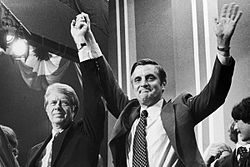 ](https://en.wikipedia.org/wiki/File:Carter_and_Mondale_celebrate_primary_victories_in_Minneapolis,_MN._3-13-84..jpg)Mondale celebrates several victories in March 13 primaries with Jimmy Carter (under whom Mondale had previously served as vice president) at his campaign headquarters.
At a roundtable debate between the three remaining Democratic candidates moderated by Phil Donahue, Mondale and Hart got into such a heated argument over the issue of U.S. policy in Central America that Jackson had to tap his water glass on the table to help get them to stop.
Mondale gradually pulled away from Hart in the delegate count, but, as Time reported in late May, "Mondale ... has a wide lead in total delegates (1,564 to 941) ... because of his victories in the big industrial states, his support from the Democratic Establishment and the arcane provisions of delegate-selection rules that his vanguard helped draft two years ago."[29] After the final primary in California, on June 5, which Hart won, Mondale was about 40 delegates short of the total he needed for the nomination.[30] However, at the Democratic National Convention in San Francisco on July 16, Mondale received the overwhelming support of the unelected superdelegates from the party establishment to win the nomination.
...
Hart had received endorsements from:
United States House of Representatives
- Representative Patricia Schroeder of Colorado[44]
- Representative Chuck Schumer of New York[45]
- Representative and 1976 Democratic presidential candidate Mo Udall of Arizona[46]
- Representative Henry A. Waxman of California[47]
Celebrities, political activists, and political commentators
- Actor and director Warren Beatty[48]
==
===
minne
Nov 11, 2009 - Gary Hart calls on China, America to build a global warming accord ... create a substantial platform for 21st century solutions to climate change.
Climate group: Next president must act on global warming - Vail Daily
www.vaildaily.com › news › climate-group-next-presid...
Former Sen. Gary Hart urges more urgency by Obama on ...
www.americansecurityproject.org › former-sen-gary-ha...
1.
Group outlines plan for next president to fight global warming ...
www.summitdaily.com › news › group-outlines-plan-fo...
1.
Hart hopes U.S. will warm to climate change discussions – The ...
thesuffolkjournal.com › news
1.
New Nonpartisan Coalition Launches Presidential Climate Action Plan
www.csrwire.com › press_releases › 15007-New-Nonparti...
"As most Americans now realize, global climate change is very real," said retired U.S. Sen. Gary Hart, co-chair of the PCAP National Advisory Committee.
Climate change deal reached at Cancun summit - BBC News
www.bbc.com › news › science-environment-11976745
1.
Plan for Addressing Climate Change Charts a Path for New ...
www.coloradoindependent.com › ... › Environment/Energy
Jan 2, 2007 - Human-caused climate change is advancing rapidly, they said. ... a running start on addressing the complex challenge of global warming. ... Gary Hart and Ray Anderson, founder and chairman of Interface Inc. (one of the ...
Gary Hart talks to Grist about climate and energy policy and ...
grist.org › article › dnc-the-hart-of-the-matter
1.
Missing: global | Must include:global
Climate group: Next president must act quickly on global ...
www.aspentimes.com › news › climate-group-next-pres...
1.