Gulf War 2
---
18 tags 619
12/15 promoted to primary, evil pending
aha POSTER CHILD FOR CASCADE OF FAILS:
no merrri
set off refugee surge --> brexit CAMBRIDGE anal ] , alt rt, authoritarian [eu la penn] ; wolfie neo-cons wanted it for decades , cooked the intel, hunted the whistleblowers Plame
SEE WMD BS YELLOWCAKE CHENEY
de-Bathification --? al queda, CNP fail ministry of oil
capt 619
---
---
AN 2 26
President Donald Trump is costing US taxpayers “billions” with his various military ventures, an expert wrote on Tuesday, even though both he and his critics have been strangely silent on the subject.
From his quite real military action in Venezuela to his threatened activities in Colombia, Mexico, Nigeria, Gaza, Iran and Greenland, Trump is repeatedly actually or potentially engaging in multibillion dollar military campaigns all over the globe, according to a report by Bloomberg. For example Operation Southern Sphere in January, during which Trump captured Venezuelan President Nicolás Maduro, cost $31 million per day, according to an analysis by the Washington think tank the Center for Strategic & International Studies.
“That comes to more than $11 billion a year if the US maintains its current level there,” reported Bloomberg’s Wes Kosova. If Trump successfully pushes US oil companies to spend $100 billion to rebuild Venezuela’s energy industry, “that means you’re bringing in some kind of occupation,” explained Heidi Peltier, director of programs at Brown University’s Costs of War project. “US taxpayers would be rebuilding the oil industry and paying for a military presence there to stabilize the country and make it a safe enough investment.”
Similarly Trump’s threatened attacks against Iran, which he said would be “far worse” than the B-2 bomber attacks from last year, would cost $8 million daily or $2.9 billion annually.
“That’s on top of the at least $2 billion the US spent on military action against Iran and its proxies in 2025, according to calculations by the Costs of War project,” Bloomberg wrote. “Needless to say, those numbers will climb dramatically if Trump orders further strikes.” And that doesn’t include the cost of Trump’s threatened occupation of Greenland (roughly $700 billion).
“No matter how compelling a president’s argument may be for missile strikes or troop deployments, the current practice of heaping war costs atop the nation’s already staggering pile of debt can last only so long,” Bloomberg reported. “At the start of the Iraq War, US debt held by the public was $3.7 trillion, or 33 percent of the nation’s gross domestic product. Today it’s more than $30 trillion, equal to 97 percent of GDP.”
Bloomberg is not alone within the business world in looking askance at Trump’s invasion of Venezuela. TotalEnergies CEO Patrick Pouyanné told reporters that he quit the country in 2022 and Trump’s invasion has not changed that.
"It was too expensive and too polluting," Pouyanné said, "and that is still the case.”
Similarly Exxon CEO Darren Woods has described the Venezuelan market as “uninvestable.” Trump replied by threatening to sideline the Exxon leader by “playing too cute.” Trump’s former National Security Adviser John Bolton also observed in January that oil companies might not feel comfortable investing in Venezuela because of the instability injected by Trump’s policies.
“If I were an oil company executive being pressured by Trump to invest billions of dollars of capital expenditures to revive Venezuela's oil infrastructure, I would want a regime in place committed to the rule of law,” Bolton said.
Overall the economic risk involved in Venezuela stems from the uncertainty baked into the military operation’s future, said one expert.
"Tactically, it was executed with precision," retired U.S. Army Lt. Gen. Mark Hertling said for the conservative publication The Bulwark. "But the immediate aftermath revealed a strategic uncertainty. Even in the (Trump) Administration's first press briefings, it was unclear who was in charge in Caracas, what authority Washington claimed to exercise, and what political end state the United States was pursuing. That ambiguity has not improved with time."
---
---
an 1 24 no lnx
The 56-year-long crisis of treasonous & illegitimate GOP presidents is happening again
Thom Hartmann
January 27, 2024
Once again, America and the world are watching with horror as a Republican candidate for president — just to win an election — manipulates world affairs in a way that will cause widespread death and destruction while damaging the interests and reputation of America.
There’s a long tradition of Republicans running for president committing what can best called treason, or at least criminal manipulation of international affairs, to advantage themselves and hurt incumbent Democratic presidents.
Yesterday, Mitch McConnell let the proverbial cat out of the bag. A bipartisan group of senators had been working on a bill to provide funding to Ukraine and Israel, with money for the southern border, and when it looked like they were going to produce something that would actually pass the House and Senate, Donald Trump inserted himself, telling the Republicans they should kill the bill.
Trump apparently wants to run on chaos at the border, and solving the problem as this legislation is intended to do would take that issue away from him. But he’s also explicitly opposed to any further US aid to Ukraine. This is a treasonous twofer, putting Trump’s election above the interests of the United States and world peace.
Trump, of course, knows that if it weren’t for Putin’s intervention in the 2016 election, he never would have been president. And he desperately needs a repeat to hold onto his fortune and stay out of jail: he’s in a far greater bind now than when he first ran for president as a hustle to get GE to pay him more for his TV show.
His 2016 Campaign Manager Paul Manafort, after all, admitted that during that election he was handing secret internal campaign polling and strategy information off to Russian intelligence, so they could successfully use it to micro-target vulnerable voters via Facebook, an effort that reached 26 million targeted Americans in 6 swing states.
Now, Trump wants Putin’s help again for 2024. He knows that Putin can do things from overseas, including using deepfakes and posing as Americans to spread explicit lies on social media, that would send people to prison for election interference if done here in the US.
Putin’s number one goal, of course, is to seize control of Ukraine while destabilizing western democracies. So, Trump, wanting Putin’s help, is now trying to deliver Ukraine to Putin by killing US aid.
This pattern of Republican presidential candidates criminally intervening in foreign policy just to win elections started in 1968 and has been a feature — not a bug — of every Republican president who succeeded in taking the White House since: it’s time to seriously discuss the five-decade-long problem we have with treasonous and illegitimate GOP presidents.
It started in 1968, when President Lyndon Johnson was desperately trying to end the Vietnam war. It had turned into both a personal and political nightmare for him, and his vice president, Hubert Humphrey, who was running for President in the election that year against a “reinvented” Richard Nixon.
Johnson spent most of late 1967 and early 1968 working back-channels to North and South Vietnam, and by the summer of 1968 had a tentative agreement from both for what promised to be a lasting peace deal they’d both sign that that fall.
But Richard Nixon knew that if he could block that peace deal, it would kill VP Hubert Humphrey’s chances of winning the 1968 election. So, Nixon sent envoys from his campaign to talk to South Vietnamese leaders to encourage them not to attend upcoming peace talks in Paris.
Nixon promised South Vietnam’s corrupt politicians that he’d give them a personally richer deal when he was President than LBJ could give them then.
The FBI had been wiretapping South Vietnam’s US agents and told LBJ about Nixon’s effort to prolong the Vietnam War. Thus, just three days before the 1968 election, President Johnson phoned the Republican Senate leader, Everett Dirksen, (you can listen to the entire conversation here):
President Johnson: Some of our folks, including some of the old China lobby, are going to the Vietnamese embassy and saying please notify the [South Vietnamese] president that if he’ll hold out ’til November 2nd they could get a better deal. Now, I’m reading their hand. I don’t want to get this in the campaign. And they oughtn’t to be doin’ this, Everett. This is treason.
Sen. Dirksen: I know.
Those tapes were only released by the LBJ library in the past decade, and that’s Richard Nixon who Lyndon Johnson was accusing of treason.
At that point, for President Johnson, it was no longer about getting Humphrey elected. By then Nixon’s plan had already worked and Humphrey was being wiped out in the polls because the war was ongoing.
Instead, Johnson was desperately trying to salvage the peace talks to stop the death and carnage as soon as possible. He literally couldn’t sleep.
In a phone call to Nixon himself just before the election, LBJ begged him to stop sabotaging the peace process, noting that he was almost certainly going to win the election and inherit the war anyway. Instead, Nixon publicly said LBJ’s efforts were “in shambles.”
But South Vietnam had taken Nixon’s deal and boycotted the peace talks, the war continued, and Nixon won the White House thanks to it.
An additional twenty-two thousand American soldiers, and an additional million-plus Vietnamese died because of Nixon’s 1968 treason, and he left it to Jerry Ford to end the war and evacuate American soldiers.
Nixon was never held to account for that treason, and when the LBJ library released the tapes and documentation long after his and LBJ’s deaths it was barely noticed by the American press.
Gerald Ford, who succeeded Nixon, was never elected to the White House (he was appointed to replace VP Spiro Agnew, after Agnew was indicted for decades of taking bribes), and thus would never have been President had it not been for Richard Nixon’s treason. He pardoned Nixon.
Next up was Ronald Reagan.
During the Carter/Reagan election battle of 1980, then-President Carter had reached a deal with newly-elected Iranian President Abdolhassan Bani-Sadr to release the fifty-two hostages held by students at the American Embassy in Tehran.
Bani-Sadr was a moderate and, as he explained in an editorial for The Christian Science Monitor, successfully ran for President of Iran that summer on the popular position of releasing the hostages:
“I openly opposed the hostage-taking throughout the election campaign…. I won the election with over 76 percent of the vote…. Other candidates also were openly against hostage-taking, and overall, 96 percent of votes in that election were given to candidates who were against it [hostage-taking].”
Carter was confident that with Bani-Sadr’s help, he could end the embarrassing hostage crisis that had been a thorn in his political side ever since it began in November of 1979.
But behind Carter’s back, the Reagan campaign worked out a deal with the leader of Iran’s radical faction — Supreme Leader Ayatollah Khomeini — to keep the hostages in captivity until after the 1980 Presidential election. Khomeini needed spare parts for American weapons systems the Shah had purchased for Iran, and Reagan was happy to promise them.
This is the story that was finally confirmed just last year with The New York Times’ reporting that we now know how the deal was conveyed to the Ayatollah and by whom, including the lieutenant governor of Texas.
This was the second modern-day act of treason by a Republican wanting to become president.
The Reagan campaign’s secret negotiations with Khomeini — the so-called “Iran/Contra October Surprise” — sabotaged President Carter’s and Iranian President Bani-Sadr’s attempts to free the hostages.
As President Bani-Sadr told The Christian Science Monitor in March of 2013:
“After arriving in France [in 1981], I told a BBC reporter that I had left Iran to expose the symbiotic relationship between Khomeinism and Reaganism.
“Ayatollah Khomeini and Ronald Reagan had organized a clandestine negotiation, later known as the ‘October Surprise,’ which prevented the attempts by myself and then-US President Jimmy Carter to free the hostages before the 1980 US presidential election took place. The fact that they were not released tipped the results of the election in favor of Reagan.”
And Reagan’s treason — just like Nixon’s treason — worked perfectly.
The Iran hostage crisis continued and torpedoed Jimmy Carter’s re-election hopes. And the same day Reagan took the oath of office — to the minute, as Reagan put his hand on the bible, by way of Iran’s acknowledging the deal — the American hostages in Iran were released.
Keeping his side of the deal, Reagan began selling the Iranians weapons and spare parts in 1981, and continued until he was busted for it in 1986, producing the so-called “Iran/Contra” scandal.
But, like Nixon, Reagan was never held to account for the criminal and treasonous actions that brought him to office. Which is one reason Bush Jr. and Trump believed they could get away with anything.
After Reagan — Bush senior was elected — but like Jerry Ford — Bush was really only President because he served as Vice President under Reagan. And, of course, the naked racism of his Willie Horton ads helped boost him into office.
The criminal investigation into Iran/Contra came to a head with independent prosecutor Lawrence Walsh subpoenaing President George HW Bush after having already obtained convictions for Weinberger, Ollie North and others.
And Walsh was now looking into actual criminal activity by Bush himself in support of the Iran/Contra October Surprise.
Bush’s attorney general, Bill Barr, suggested he pardon them all to kill the investigation and protect himself, which Bush did.
The screaming headline across the New York Times front page on December 25, 1992, said it all: “BUSH PARDONS 6 IN IRAN AFFAIR, AVERTING A WEINBERGER TRIAL; PROSECUTOR ASSAILS ‘COVER-UP’”
And if the October Surprise hadn’t hoodwinked voters in 1980, you can bet Bush senior would never have been elected in 1988. That’s four illegitimate Republican presidents.
Which brings us to George W. Bush, the man who was given the White House by five right-wing justices on the Supreme Court.
In the Bush v. Gore Supreme Court decision in 2000 that stopped the Florida recount — and thus handed George W. Bush the presidency — Justice Antonin Scalia wrote in his opinion:
“The counting of votes … does in my view threaten irreparable harm to petitioner [George W. Bush], and to the country, by casting a cloud upon what he [Bush] claims to be the legitimacy of his election.”
Apparently, denying the presidency to Al Gore, the guy who actually won the most votes in Florida and won the popular vote nationwide by over a half-million, did not constitute “irreparable harm” to Scalia or the media.
And apparently it wasn’t important that Scalia’s son worked for a law firm that was defending George W. Bush before the high court (with no Scalia recusal).
Just like it wasn’t important to mention that Justice Clarence Thomas’s wife worked on the Bush transition team — before the Supreme Court shut down the recount in Florida — and was busily accepting resumes from people who would serve in the Bush White House if her husband stopped the recount in Florida…which he did. (No Thomas recusal, either.)
More than a year after the election a consortium of newspapers including The Washington Post, The New York Times, and USA Today did their own recount of the vote in Florida — manually counting every vote in a process that took almost a year — and concluded that Al Gore did indeed win the presidency in 2000.
As the November 12th, 2001 article in The New York Times read:
“If all the ballots had been reviewed under any of seven single standards and combined with the results of an examination of overvotes, Mr. Gore would have won.”
That little bit of info was slipped into the seventeenth paragraph of the Times story so that it would attract as little attention as possible because the 9/11 attacks had happened just weeks earlier and journalists feared that burdening Americans with the plain truth that George W. Bush actually lost the election would further hurt a nation already in crisis.
To compound the crime, Bush could only have gotten as close to Gore in the election as he did because his brother, Florida Governor Jeb Bush, had ordered his Secretary of State, Kathrine Harris, to purge at least 57,000 mostly-Black voters from the state’s voter rolls just before the election. Thousands of African Americans showed up to vote and were turned away from the polls in that election in Florida that Bush “won” by fewer than 600 votes.
The simple reality is that Al Gore won Florida in 2000, won the national popular vote by a half-million, and five Republicans on the Supreme Court denied him the presidency.
Florida Governor and George W. Bush’s brother Jeb had his Secretary of State, Kathryn Harris, throw thousands of African Americans off the voting rolls just before the election but then — when the votes had come in and it was clear former Vice President Al Gore had still won — she invented a brand new category of ballots for the 2000 election: “Spoiled.”
As The New York Times reported a year after the 2000 election when the consortium of newspapers they were part of finally recounted all the ballots:
“While 35,176 voters wrote in Bush’s name after punching the hole for him, 80,775 wrote in Gore’s name while punching the hole for Gore. [Florida Secretary of State] Katherine Harris decided that these were ‘spoiled’ ballots because they were both punched and written upon and ordered that none of them should be counted.
“Many were from African American districts, where older and often broken machines were distributed, causing voters to write onto their ballots so their intent would be unambiguous.”
George W. Bush “won” the election by 537 votes in Florida, because the statewide recount — which would have revealed Harris’s crime and counted the “spoiled” ballots, handing the election to Gore (who’d won the popular vote by over a half-million nationwide) — was stopped when George HW Bush appointee Clarence Thomas became the deciding vote on the Supreme Court to block the recount order from the Florida Supreme Court.
Harris’ decision to not count the 45,599 more votes for Gore than Bush was completely arbitrary: there was no legal category and no legal precedent, outside of the old Confederate states simply refusing to count the votes of Black people, to justify it.
The intent of the voters was unambiguous. And the 5 Republicans on the Supreme Court jumped in to block the recount ordered by the Florida Supreme Court (in violation of the 10th Amendment) just in time to prevent those “spoiled” votes from being counted, cementing Bush’s illegitimate presidency.
So, for the third time in 4 decades, Republicans took the White House under illegitimate electoral circumstances. Even President Carter was shocked by the brazenness of that one. And Jeb Bush and the GOP were never held to account for that crime against democracy.
To get re-elected in 2004, Bush used an old trick: become a “wartime president.” In 1999, when George W. Bush decided he was going to run for president in the 2000 election, his parents hired Mickey Herskowitz to write the first draft of Bush’s autobiography, A Charge To Keep.
Although Bush had gone AWOL for about a year during the Vietnam war and was thus apparently no fan of combat, he’d concluded (from watching his father’s “little 3-day war” with Iraq) that being a “wartime president” was the most consistently surefire way to get reelected and have a two-term presidency.
“I'll tell you, he was thinking about invading Iraq in 1999,” Herskowitz told reporter Russ Baker in 2004.
“One of the things [Bush] said to me,” Herskowitz said, “is: ‘One of the keys to being seen as a great leader is to be seen as a commander-in-chief. My father had all this political capital built up when he drove the Iraqis out of (Kuwait) and he wasted it.
“[Bush] said, ‘If I have a chance to invade Iraq, if I had that much capital, I'm not going to waste it. I’m going to get everything passed I want to get passed and I'm going to have a successful presidency.’”
Bush lying us into that war was an act of treason against America that cost 900,000 Iraqi lives, over 7,000 American lives (on the battlefield: veterans are still committing suicide daily), and over $8 trillion added to the national debt.
But it did what it was supposed to do: it got Bush re-elected in 2004.
Which brings us to this year’s election.
In 2016, Trump ally Kris Kobach and Republican Secretaries of State across the nation used Interstate Crosscheck to purge millions of legitimate voters — most people of color — from the voting rolls just in time for the Clinton/Trump election.
Meanwhile, Russian oligarchs and the Russian state, and possibly pro-Trump groups or nations in the Middle East, are alleged to have funded a widespread program to flood social media with pro-Trump, anti-Clinton messages from accounts posing as Americans, as documented by Robert Mueller’s investigation.
It was so blatant that it provoked the U.S. Intelligence Community’s assessment of their similar actions during the 2020 election (done while Trump was still president but released in March, 2021) pretty much declaring Trump a “Russian asset.”
It was a repeat, in many ways (albeit unsuccessful this time) of the Russian efforts in 2016. Then, as mentioned, Republican campaign data on the 2016 election, including which states needed a little help via phony influencers on Facebook and other social media, was not only given to Konstantin Kilimnik by Paul Manafort, but Kilimnik transferred it to Russian intelligence.
And now Trump is trying to exacerbate a crisis on our southern border and screw Ukraine in a way that will lead to mass causalities and disrupt the international order — all to give Putin what he wants — the same way Nixon used Vietnam, Reagan used Iran, and Bush used Iraq, just to win a damn election.
While we can’t rewrite history, at least we can try to prevent it from being repeated. Call your members of Congress — your representative and both your senators — and let them know if you agree that Ukraine aid and resolving the issue at the southern border shouldn’t be held hostage to Trump’s need for Putin’s help and approval.
The number for the congressional switchboard is: 202-224-3121.
It’s way past time that America ceased to be the dog wagged by the tail of corrupt Republicans who want to be president.
an 7 22
During an appearance on Newsmax on Saturday, former United States National Security Advisor and Ambassador to the United Nations John Bolton refused to elaborate on his confession to CNN's Jake Tapper that he had personally been involved in foreign coups d'état.
Anchor Eric Bolling was curious about the specifics.
"Care to elaborate?" Bolling asked Bolton.
"Well, Venezuela's a good example. I wrote about it in my book. You know, this is something that some of the snowflakes on the left really were kinda shocked at but when you're looking out for America's best interests you do what's necessary to protect those interests," Bolton replied.
He called for toppling the governments of some of the United States' most prominent adversaries.
"So, take the current threat of countries getting nuclear weapons or engaged in international terrorism like Iran and North Korea. To protect the United States against the threat of nuclear weapons, would a coup d'état with regime change against their governments be appropriate? I think the answer is entirely yes," Bolton continued. He did not mention Russia's genocidal invasion of Ukraine.
"Okay, you mentioned coup d'état in the plural form. Can you tell us some of the others?" Bolling pressed Bolton, who avoided answering the question.
READ MORE: [Trump says he has 'no idea' what a 'burner phone' is — but John Bolton says otherwise
"Well, I'm just saying if you're looking for examples of what the United States has done over the years under presidents, Democratic and Republican..." Bolton said. But he was cut off by Bolling, who repeated his request for Bolton's experience.
"No sir, no sir, sir, sir sir, I'm asking for your examples. You said you had been involved in coups d'état in other places," said Bolling.
"Well and as I said, as I said, I'm obviously not gonna get into details because I did write about the Venezuela example at some length in my book..." Bolton noted as Bolling interjected for a second time.
"That's what I want to do. I want to talk about the details. I get Maduro, I get the whole Venezuela thing, but, I dunno, was, would you consider Iraq a coup d'état?" Bolling wondered.
Bolton defended former President George W. Bush's war in Iraq.
"No I wouldn't consider Iraq a coup d'état although it had the effect of regime change and I think that was the right thing to do, and I think George W. Bush pursued the right policy to protect America and its national interests," Bolton said, again hocking his book.
"I'm not going to get into the others because the chapter on Venezuela went through a very rigorous pre-publication review process as did my entire book to make sure there's no classified information in it. So I'm not gonna talk about it here without that."
Bolton's dodges began to visibly fluster Bolling.
"You don't have to talk about specifics. You can tell us where the United States was involved in behind-the-scenes support for coups d'état," he insisted, although he changed the subject to the January 6th insurrection.
Watch below or at this link.
:{The Best Movie Ever Made About the Truth Behind the Iraq War Is “Official Secrets”:(style="box-sizing:border-box"):}:
**2 big SYSTEMIC fails uncorrected led to djt: gt recess and gulf war 2**
**isis started in prison camps after gulf 2 ?**
David Altheide and Jennifer Grimes trace the history of how the
Project for the New American Century, a neoconservative think
tank, helped plan the propaganda campaign for the second Iraq
CET: ABC airs the first of a six-episode reality series entitled *Profiles from the Front Line*, which purports to document the war in Afghanistan from the soldiers’ point of view.:{It was conceived and produced with the extensive help and oversight of the Pentagon:(style="color:#313131;;background-color:#ffff66;"):}:. [CHICAGO TRIBUNE, 2/26/2003] Filming for the show began in May 2002. [LOS ANGELES TIMES, 2/6/2003] ABC executives say that the show will tell the “compelling personal stories of the US military men and women who bear the burden of the fighting” in Afghanistan. The series was quickly approved by Victoria Clarke, the head of the Pentagon’s public relations office (see Early 2002 and Beyond), and by Rear Admiral Craig Quigley, the public relations commander of US Central Command. Clarke and Quigley granted the series producers unprecedented access to the troops, technical advice, and even the use of aircraft carriers for filming. In return, the Pentagon received the right to review and approve all footage before airing (in the interests of national security, Pentagon officials said). [RICH, 2006, PP. 32-33] The Pentagon denies that it asked for any changes in the series’ broadcast footage.[WASHINGTON POST, 3/9/2003]
Producers Insist Show Not Propaganda, No Censorship from Pentagon - Though the show is widely considered to be tied in to the Bush administration’s push for war with Iraq (some question the fact that the show was shelved for months before suddenly being approved just as news of the impending invasion began hitting the news), series producerBertram van Munster says he came up with the idea after 9/11. “We were all kind of numb, I certainly was extremely numb for two or three weeks,” he will recall. “And I said I’ve got to do something.” Van Munster and his co-producer, famed movie and television producerJerry Bruckheimer (an acknowledged Bush supporter best known for his action-film blockbusters such as Top Gun, Black Hawk Down, and Pearl Harbor, as well as the CSI television series), put together a proposal that van Munster says does not necessarily support President Bush’s war plans. Instead, he says, the show is intended to personalize America’s fighting forces. “There’s nothing flag-waving about death. We have people getting killed on the show,” he says. “In many ways, I see this thing as much anti-war as it is a portrait of what these people are doing out there.” Bruckheimer insists that the Defense Department did not exercise any censorship whatsoever except in minor instances, such as the withholding of a Special Forces soldier’s last name. “They didn’t use any censorship whatsoever,” Bruckheimer says. “They were very cooperative.… They were very receptive to the concept of showing what US forces were doing in Afghanistan.” The show’s own film, shot on location in Afghanistan, is bolstered by Defense Department footage. [LOS ANGELES TIMES, 2/6/2003; CHICAGO TRIBUNE, 2/26/2003;WASHINGTON POST, 3/9/2003; PROGRESSIVE, 4/1/2003; RICH, 2006, PP. 32-33]
==
SURGE booster:
3. Ed Snider hearts Ayn Rand and War
Ed Snider, CEO of the Philadelphia-based sports and entertainment firm Comcast Spectator, owns two sports teams: the Philadelphia Flyers (NHL) and the Philadelphia 76ers (NBA). Along with hockey and basketball, Snider is an admirer of Ayn Rand, so much so that he co-founded the Ayn Rand Institute in the mid-1980s. He was also theexecutive producer [20]of a movie based on his all-time favorite book, Rand’s Atlas Shrugged.
Besides funding the Institute, Snider remained largely passive in the political arena until the 2001 terrorist attacks. It was after 9/11 that Snider aggressively engaged in politics by becoming the number one donor to Freedom’s Watch, a group that pushed for war with Iraq in support of George W. Bush’s war on terror.
According to Politico [21], one of the organization's first projects involved a $15 million propaganda campaign that pushed for a troop surge in Iraq by conflating the war with 9/11. For five weeks radio, web and television ads featuring military veterans filled the airwaves. In the opening ad, a military veteran said:
I re-enlisted after Sept. 11 because I don’t want my sons to see what I saw. I want them to be free and safe. I know what I lost. I also know that if we pull out now, everything I’ve given and the sacrifices will mean nothing. They attacked us, and they will again. They won’t stop in Iraq. We are winning on the ground and making real progress. It’s no time to quit. It’s no time for politics.
When John McCain chose the self-described hockey mom Sarah Palin as his running mate in the 2008 election, Snider jumped at the opportunity to continue his push for endless war by supporting the pro-war duo. He used his hockey stadium, along with its audience, to play PR agent for Sarah Palin by inviting her to drop the puck at the Flyers' season opener.
In the Flyers' press release [22], Snider is quoted as saying, “Because of the tremendous amount of publicity she has brought to our sport, we invited the most popular hockey mom in North America to our home opener to help us get our season started."
Snider was doing nothing illegal in his position as team owner, but as Will Bunch [22] of the Philidelphia Daily News put it prior to the event, "he's making a huge in-kind donation to the McCain-Palin campaign in the arena that we taxpayers kicked in for, giving her a chance to skate her stuff in front of 19,500 mostly upscale male hockey fans from the swing suburbs outside Philly,” adding that “Flyers fans should be outraged -- even conservative ones, because this misuse of a hockey game for his political agenda is flat-out wrong.”
Snider's plan ultimately backfired when fans at Philidelphia's Wachovia Center [23] when Palin came onto the ice. In the midst of this spectacle, writes Zirin, "the JumboTron, our twenty-first-century altar of truth, sent forth a simple request: 'Flyers fans, show Philadelphia’s class and welcome America’s number-one hockey mom, Sarah Palin!'"
“The problem,” Zirin argues, “is when owners use the platform handed to them by taxpayers to play propagandist,” in which case Ed Snider is guilty.
http://www.sourcewatch.org/index.php/Category:Iran_War_Drummer
A<ul style=" line-height: 1.5em; margin: 0.3em 0px 0.5em 1.6em; padding: 0px; list-style-image: url(data:image/png;base64,iVBORw0KGgoAAAANSUhEUgAAAAUAAAANAQMAAABb8jbLAAAABlBMVEX///8AUow5QSOjAAAAAXRSTlMAQObYZgAAABNJREFUCB1jYEABBQw/wLCAgQEAGpIDyT0IVcsAAAAASUVORK5CYII=);"><li style=" margin-bottom: 0.1em;"><a href="http://www.sourcewatch.org/index.php/American_Israel_Public_Affairs_Committee" title="American Israel Public Affairs Committee" style=" text-decoration: none; color: rgb(11, 0, 128); background: none;"><font size="4" face="Times New Roman">American Israel Public Affairs Committee</font></a></li></ul> B<ul style=" line-height: 1.5em; margin: 0.3em 0px 0.5em 1.6em; padding: 0px; list-style-image: url(data:image/png;base64,iVBORw0KGgoAAAANSUhEUgAAAAUAAAANAQMAAABb8jbLAAAABlBMVEX///8AUow5QSOjAAAAAXRSTlMAQObYZgAAABNJREFUCB1jYEABBQw/wLCAgQEAGpIDyT0IVcsAAAAASUVORK5CYII=);"><li style=" margin-bottom: 0.1em;"><a href="http://www.sourcewatch.org/index.php/Ronen_Bergman" title="Ronen Bergman" style=" text-decoration: none; color: rgb(11, 0, 128); background: none;"><font size="4" face="Times New Roman">Ronen Bergman</font></a></li><li style=" margin-bottom: 0.1em;"><a href="http://www.sourcewatch.org/index.php/Talk:Bipartisan_Policy_Center" title="Talk:Bipartisan Policy Center" style=" text-decoration: none; color: rgb(11, 0, 128); background: none;"><font size="4" face="Times New Roman">Talk:Bipartisan Policy Center</font></a></li><li style=" margin-bottom: 0.1em;"><a href="http://www.sourcewatch.org/index.php/Julian_Borger" title="Julian Borger" style=" text-decoration: none; color: rgb(11, 0, 128); background: none;"><font size="4" face="Times New Roman">Julian Borger</font></a></li><li style=" margin-bottom: 0.1em;"><a href="http://www.sourcewatch.org/index.php/Erin_Burnett" title="Erin Burnett" style=" text-decoration: none; color: rgb(11, 0, 128); background: none;"><font size="4" face="Times New Roman">Erin Burnett</font></a></li></ul> C<ul style=" line-height: 1.5em; margin: 0.3em 0px 0.5em 1.6em; padding: 0px; list-style-image: url(data:image/png;base64,iVBORw0KGgoAAAANSUhEUgAAAAUAAAANAQMAAABb8jbLAAAABlBMVEX///8AUow5QSOjAAAAAXRSTlMAQObYZgAAABNJREFUCB1jYEABBQw/wLCAgQEAGpIDyT0IVcsAAAAASUVORK5CYII=);"><li style=" margin-bottom: 0.1em;"><a href="http://www.sourcewatch.org/index.php/Tucker_Carlson" title="Tucker Carlson" style=" text-decoration: none; color: rgb(11, 0, 128); background: none;"><font size="4" face="Times New Roman">Tucker Carlson</font></a></li><li style=" margin-bottom: 0.1em;"><a href="http://www.sourcewatch.org/index.php/Talk:Bob_Casey" title="Talk:Bob Casey" style=" text-decoration: none; color: rgb(11, 0, 128); background: none;"><font size="4" face="Times New Roman">Talk:Bob Casey</font></a></li></ul> E<ul style=" line-height: 1.5em; margin: 0.3em 0px 0.5em 1.6em; padding: 0px; list-style-image: url(data:image/png;base64,iVBORw0KGgoAAAANSUhEUgAAAAUAAAANAQMAAABb8jbLAAAABlBMVEX///8AUow5QSOjAAAAAXRSTlMAQObYZgAAABNJREFUCB1jYEABBQw/wLCAgQEAGpIDyT0IVcsAAAAASUVORK5CYII=);"><li style=" margin-bottom: 0.1em;"><a href="http://www.sourcewatch.org/index.php/Emergency_Committee_for_Israel" title="Emergency Committee for Israel" style=" text-decoration: none; color: rgb(11, 0, 128); background: none;"><font size="4" face="Times New Roman">Emergency Committee for Israel</font></a></li></ul> F<ul style=" line-height: 1.5em; margin: 0.3em 0px 0.5em 1.6em; padding: 0px; list-style-image: url(data:image/png;base64,iVBORw0KGgoAAAANSUhEUgAAAAUAAAANAQMAAABb8jbLAAAABlBMVEX///8AUow5QSOjAAAAAXRSTlMAQObYZgAAABNJREFUCB1jYEABBQw/wLCAgQEAGpIDyT0IVcsAAAAASUVORK5CYII=);"><li style=" margin-bottom: 0.1em;"><a href="http://www.sourcewatch.org/index.php/Talk:Foundation_for_the_Defense_of_Democracies" title="Talk:Foundation for the Defense of Democracies" style=" text-decoration: none; color: rgb(11, 0, 128); background: none;"><font size="4" face="Times New Roman">Talk:Foundation for the Defense of Democracies</font></a></li></ul> | G<ul style=" line-height: 1.5em; margin: 0.3em 0px 0.5em 1.6em; padding: 0px; list-style-image: url(data:image/png;base64,iVBORw0KGgoAAAANSUhEUgAAAAUAAAANAQMAAABb8jbLAAAABlBMVEX///8AUow5QSOjAAAAAXRSTlMAQObYZgAAABNJREFUCB1jYEABBQw/wLCAgQEAGpIDyT0IVcsAAAAASUVORK5CYII=);"><li style=" margin-bottom: 0.1em;"><a href="http://www.sourcewatch.org/index.php/Lindsey_Graham" title="Lindsey Graham" style=" text-decoration: none; color: rgb(11, 0, 128); background: none;"><font size="4" face="Times New Roman">Lindsey Graham</font></a></li></ul> H<ul style=" line-height: 1.5em; margin: 0.3em 0px 0.5em 1.6em; padding: 0px; list-style-image: url(data:image/png;base64,iVBORw0KGgoAAAANSUhEUgAAAAUAAAANAQMAAABb8jbLAAAABlBMVEX///8AUow5QSOjAAAAAXRSTlMAQObYZgAAABNJREFUCB1jYEABBQw/wLCAgQEAGpIDyT0IVcsAAAAASUVORK5CYII=);"><li style=" margin-bottom: 0.1em;"><a href="http://www.sourcewatch.org/index.php/Fred_Hiatt" title="Fred Hiatt" style=" text-decoration: none; color: rgb(11, 0, 128); background: none;"><font size="4" face="Times New Roman">Fred Hiatt</font></a></li></ul> I<ul style=" line-height: 1.5em; margin: 0.3em 0px 0.5em 1.6em; padding: 0px; list-style-image: url(data:image/png;base64,iVBORw0KGgoAAAANSUhEUgAAAAUAAAANAQMAAABb8jbLAAAABlBMVEX///8AUow5QSOjAAAAAXRSTlMAQObYZgAAABNJREFUCB1jYEABBQw/wLCAgQEAGpIDyT0IVcsAAAAASUVORK5CYII=);"><li style=" margin-bottom: 0.1em;"><a href="http://www.sourcewatch.org/index.php/David_Ignatius" title="David Ignatius" style=" text-decoration: none; color: rgb(11, 0, 128); background: none;"><font size="4" face="Times New Roman">David Ignatius</font></a></li><li style=" margin-bottom: 0.1em;"><a href="http://www.sourcewatch.org/index.php/Talk:Intelligence_Summit" title="Talk:Intelligence Summit" style=" text-decoration: none; color: rgb(11, 0, 128); background: none;"><font size="4" face="Times New Roman">Talk:Intelligence Summit</font></a></li><li style=" margin-bottom: 0.1em;"><a href="http://www.sourcewatch.org/index.php/Iran_Policy_Committee" title="Iran Policy Committee" style=" text-decoration: none; color: rgb(11, 0, 128); background: none;"><font size="4" face="Times New Roman">Iran Policy Committee</font></a></li></ul> L<ul style=" line-height: 1.5em; margin: 0.3em 0px 0.5em 1.6em; padding: 0px; list-style-image: url(data:image/png;base64,iVBORw0KGgoAAAANSUhEUgAAAAUAAAANAQMAAABb8jbLAAAABlBMVEX///8AUow5QSOjAAAAAXRSTlMAQObYZgAAABNJREFUCB1jYEABBQw/wLCAgQEAGpIDyT0IVcsAAAAASUVORK5CYII=);"><li style=" margin-bottom: 0.1em;"><a href="http://www.sourcewatch.org/index.php/Talk:Joseph_Lieberman" title="Talk:Joseph Lieberman" style=" text-decoration: none; color: rgb(11, 0, 128); background: none;"><font size="4" face="Times New Roman">Talk:Joseph Lieberman</font></a></li><li style=" margin-bottom: 0.1em;"><a href="http://www.sourcewatch.org/index.php/Talk:Clare_M._Lopez" title="Talk:Clare M. Lopez" style=" text-decoration: none; color: rgb(11, 0, 128); background: none;"><font size="4" face="Times New Roman">Talk:Clare M. Lopez</font></a></li></ul> M<ul style=" line-height: 1.5em; margin: 0.3em 0px 0.5em 1.6em; padding: 0px; list-style-image: url(data:image/png;base64,iVBORw0KGgoAAAANSUhEUgAAAAUAAAANAQMAAABb8jbLAAAABlBMVEX///8AUow5QSOjAAAAAXRSTlMAQObYZgAAABNJREFUCB1jYEABBQw/wLCAgQEAGpIDyT0IVcsAAAAASUVORK5CYII=);"><li style=" margin-bottom: 0.1em;"><a href="http://www.sourcewatch.org/index.php/Joshua_Muravchik" title="Joshua Muravchik" style=" text-decoration: none; color: rgb(11, 0, 128); background: none;"><font size="4" face="Times New Roman">Joshua Muravchik</font></a></li></ul> O<ul style=" line-height: 1.5em; margin: 0.3em 0px 0.5em 1.6em; padding: 0px; list-style-image: url(data:image/png;base64,iVBORw0KGgoAAAANSUhEUgAAAAUAAAANAQMAAABb8jbLAAAABlBMVEX///8AUow5QSOjAAAAAXRSTlMAQObYZgAAABNJREFUCB1jYEABBQw/wLCAgQEAGpIDyT0IVcsAAAAASUVORK5CYII=);"><li style=" margin-bottom: 0.1em;"><a href="http://www.sourcewatch.org/index.php/Emanuele_Ottolenghi" title="Emanuele Ottolenghi" style=" text-decoration: none; color: rgb(11, 0, 128); background: none;"><font size="4" face="Times New Roman">Emanuele Ottolenghi</font></a></li></ul> | P<ul style=" line-height: 1.5em; margin: 0.3em 0px 0.5em 1.6em; padding: 0px; list-style-image: url(data:image/png;base64,iVBORw0KGgoAAAANSUhEUgAAAAUAAAANAQMAAABb8jbLAAAABlBMVEX///8AUow5QSOjAAAAAXRSTlMAQObYZgAAABNJREFUCB1jYEABBQw/wLCAgQEAGpIDyT0IVcsAAAAASUVORK5CYII=);"><li style=" margin-bottom: 0.1em;"><a href="http://www.sourcewatch.org/index.php/Richard_N._Perle" title="Richard N. Perle" style=" text-decoration: none; color: rgb(11, 0, 128); background: none;"><font size="4" face="Times New Roman">Richard N. Perle</font></a></li></ul> R<ul style=" line-height: 1.5em; margin: 0.3em 0px 0.5em 1.6em; padding: 0px; list-style-image: url(data:image/png;base64,iVBORw0KGgoAAAANSUhEUgAAAAUAAAANAQMAAABb8jbLAAAABlBMVEX///8AUow5QSOjAAAAAXRSTlMAQObYZgAAABNJREFUCB1jYEABBQw/wLCAgQEAGpIDyT0IVcsAAAAASUVORK5CYII=);"><li style=" margin-bottom: 0.1em;"><a href="http://www.sourcewatch.org/index.php/Talk:Dennis_B._Ross" title="Talk:Dennis B. Ross" style=" text-decoration: none; color: rgb(11, 0, 128); background: none;"><font size="4" face="Times New Roman">Talk:Dennis B. Ross</font></a></li><li style=" margin-bottom: 0.1em;"><a href="http://www.sourcewatch.org/index.php/Marco_Rubio" title="Marco Rubio" style=" text-decoration: none; color: rgb(11, 0, 128); background: none;"><font size="4" face="Times New Roman">Marco Rubio</font></a></li></ul> S<ul style=" line-height: 1.5em; margin: 0.3em 0px 0.5em 1.6em; padding: 0px; list-style-image: url(data:image/png;base64,iVBORw0KGgoAAAANSUhEUgAAAAUAAAANAQMAAABb8jbLAAAABlBMVEX///8AUow5QSOjAAAAAXRSTlMAQObYZgAAABNJREFUCB1jYEABBQw/wLCAgQEAGpIDyT0IVcsAAAAASUVORK5CYII=);"><li style=" margin-bottom: 0.1em;"><a href="http://www.sourcewatch.org/index.php/Talk:David_E._Sanger" title="Talk:David E. Sanger" style=" text-decoration: none; color: rgb(11, 0, 128); background: none;"><font size="4" face="Times New Roman">Talk:David E. Sanger</font></a></li></ul> T<ul style=" line-height: 1.5em; margin: 0.3em 0px 0.5em 1.6em; padding: 0px; list-style-image: url(data:image/png;base64,iVBORw0KGgoAAAANSUhEUgAAAAUAAAANAQMAAABb8jbLAAAABlBMVEX///8AUow5QSOjAAAAAXRSTlMAQObYZgAAABNJREFUCB1jYEABBQw/wLCAgQEAGpIDyT0IVcsAAAAASUVORK5CYII=);"><li style=" margin-bottom: 0.1em;"><a href="http://www.sourcewatch.org/index.php/Raymond_Tanter" title="Raymond Tanter" style=" text-decoration: none; color: rgb(11, 0, 128); background: none;"><font size="4" face="Times New Roman">Raymond Tanter</font></a></li></ul> W<ul style=" line-height: 1.5em; margin: 0.3em 0px 0.5em 1.6em; padding: 0px; list-style-image: url(data:image/png;base64,iVBORw0KGgoAAAANSUhEUgAAAAUAAAANAQMAAABb8jbLAAAABlBMVEX///8AUow5QSOjAAAAAXRSTlMAQObYZgAAABNJREFUCB1jYEABBQw/wLCAgQEAGpIDyT0IVcsAAAAASUVORK5CYII=);"><li style=" margin-bottom: 0.1em;"><a href="http://www.sourcewatch.org/index.php/Mark_D._Wallace" title="Mark D. Wallace" style=" text-decoration: none; color: rgb(11, 0, 128); background: none;"><font size="4" face="Times New Roman">Mark D. Wallace</font></a></li><li style=" margin-bottom: 0.1em;"><a href="http://www.sourcewatch.org/index.php/Talk:Washington_Institute_for_Near_East_Policy" title="Talk:Washington Institute for Near East Policy" style=" text-decoration: none; color: rgb(11, 0, 128); background: none;"><font size="4" face="Times New Roman">Talk:Washington Institute for Near East</font></a></li></ul> |
http://www.cooperativeresearch.org/entity.jsp?entity=victoria_clarke_1
2nd 1/2 pr:
see clarke v
Fall and Winter 2002: Pentagon Sends Analysts to Networks, Press with Talking Points about Iraq War

As the administration’s push to convince Americans that the Iraq war is necessary is reaching its height, the Pentagon sends its military analysts out to the television networks and the press (see April 20, 2008 and Early 2002 and Beyond) with talking points portraying Iraq as an imminent threat. The analysts are to emphasize that Iraq has chemical and biological weapons that it can and will use, that it is developing nuclear weapons, and that it is sure to provide these weapons to al-Qaeda. A military invasion, the talking points state, is not only a necessity, but will be a relatively quick, relatively bloodless, and relatively inexpensive “war of liberation.” Pentagon public relations chief Victoria Clarke and her staff are thrilled at how well the analysts incorporate Pentagon talking points into their own presentations. Clarke’s aide Brent Krueger recalls: “You could see that they were messaging. You could see they were taking verbatim what the secretary was saying or what the technical specialists were saying. And they were saying it over and over and over.” Some days, “We were able to click on every single station and every one of our folks were up there delivering our message. You’d look at them and say, ‘This is working.’” [NEW YORK TIMES, 4/20/2008]
Entity Tags: Bush administration (43), Brent T. Krueger, Al-Qaeda, US Department of Defense, Victoria (“Torie”) Clarke
Timeline Tags: US Military, Events Leading to Iraq Invasion, Domestic Propaganda
Early January, 2003: Navy’s General Counsel Continues to Battle Use of :{Harsh Interrogation Techniques:(style="background-color:#ffff66;"):}:
Alberto Mora, the Navy’s general counsel, learns to his dismay that the torturing and abuse of prisoners at Guantanamo Bay is continuing (see December 17-18, 2002), even after a meeting with the Pentagon’s chief counsel, William J. Haynes. Mora had hoped that Haynes would put a stop to the extreme techniques being used (see December 20, 2002). Mora has read an article in the Washington Post detailing allegations of CIA mistreatment of prisoners at Bagram Air Force Base in Afghanistan; the story notes that the director of Human Rights Watch, Kenneth Roth, believes that US officials who knew about such treatment could be charged with crimes under the doctrine of command responsibility.[WASHINGTON POST, 12/26/2002; NEW YORKER, 2/27/2006] The specific allegations detailed in the story closely parallel what Mora knows were authorized at Guantanamo Bay. Mora continues to argue against the intense interrogation techniques, and his arguments quickly reach the ears of top Pentagon officials such as Deputy Defense Secretary Paul Wolfowitz; Captain Jane Dalton, the legal adviser to the Joint Chiefs of Staff; Pentagon spokeswoman Victoria Clarke; and Defense Secretary Donald Rumsfeld, who had authorized harsh interrogation techniques at Guantanamo a month before (see December 2, 2002). [NEW YORKER, 2/27/2006]
Entity Tags: Victoria (“Torie”) Clarke, Kenneth Roth, Alberto Mora, Paul Wolfowitz,Central Intelligence Agency, Jane Dalton, Donald Rumsfeld, William J. Haynes
Timeline Tags: Torture of US Captives, Civil Liberties
February 2003: Pentagon PR Chief Proposes Idea of:{ ‘Embedding’ Reporters with Troops:(style="background-color:#ffff66;"):}:
Victoria “Torie” Clark, the head of public relations for the Defense Department (see May 2001), develops the idea of embedding reporters with troops during the US invasion of Iraq. In a memo for the National Security Council, Clarke, with the approval of Defense Secretary Donald Rumsfeld, argues that allowing journalists to report from the battlefields and front lines will give Americans the chance to get the story, both “good or bad—before others seed the media with disinformation and distortions, as they most certainly will continue to do. Our people in the field need to tell our story. Only commanders can ensure the media get to the story alongside the troops. We must organize for and facilitate access of national and international media to our forces, including those forces engaged in ground operations.” [US DEPARTMENT OF DEFENSE, 2/2003  ; BILL BERKOWITZ, 5/10/2008]
Entity Tags: National Security Council, Victoria (“Torie”) Clarke, Donald Rumsfeld, US Department of Defense
Timeline Tags: Iraq under US Occupation, Domestic Propaganda
February 27, 2003: ABC, Pentagon Air ‘Reality TV’ Series about Afghanistan Fighting
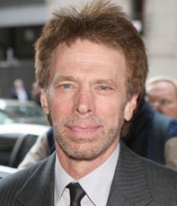 Jerry Bruckheimer. [Source: Thomas Robinson / Getty Images / Forbes]ABC airs the first of a six-episode reality series entitled Profiles from the Front Line, which purports to document the war in Afghanistan from the soldiers’ point of view. It was conceived and produced with the extensive help and oversight of the Pentagon. [CHICAGO TRIBUNE, 2/26/2003] Filming for the show began in May 2002. [LOS ANGELES TIMES, 2/6/2003] ABC executives say that the show will tell the “compelling personal stories of the US military men and women who bear the burden of the fighting” in Afghanistan. The series was quickly approved by Victoria Clarke, the head of the Pentagon’s public relations office (see Early 2002 and Beyond), and by Rear Admiral Craig Quigley, the public relations commander of US Central Command. Clarke and Quigley granted the series producers unprecedented access to the troops, technical advice, and even the use of aircraft carriers for filming. In return, the Pentagon received the right to review and approve all footage before airing (in the interests of national security, Pentagon officials said). [RICH, 2006, PP. 32-33] The Pentagon denies that it asked for any changes in the series’ broadcast footage.[WASHINGTON POST, 3/9/2003]
Producers Insist Show Not Propaganda, No Censorship from Pentagon - Though the show is widely considered to be tied in to the Bush administration’s push for war with Iraq (some question the fact that the show was shelved for months before suddenly being approved just as news of the impending invasion began hitting the news), series producer Bertram van Munster says he came up with the idea after 9/11. “We were all kind of numb, I certainly was extremely numb for two or three weeks,” he will recall. “And I said I’ve got to do something.” Van Munster and his co-producer, famed movie and television producer Jerry Bruckheimer (an acknowledged Bush supporter best known for his action-film blockbusters such as Top Gun, Black Hawk Down, and Pearl Harbor, as well as the CSI television series), put together a proposal that van Munster says does not necessarily support President Bush’s war plans. Instead, he says, the show is intended to personalize America’s fighting forces. “There’s nothing flag-waving about death. We have people getting killed on the show,” he says. “In many ways, I see this thing as much anti-war as it is a portrait of what these people are doing out there.” Bruckheimer insists that the Defense Department did not exercise any censorship whatsoever except in minor instances, such as the withholding of a Special Forces soldier’s last name. “They didn’t use any censorship whatsoever,” Bruckheimer says. “They were very cooperative.… They were very receptive to the concept of showing what US forces were doing in Afghanistan.” The show’s own film, shot on location in Afghanistan, is bolstered by Defense Department footage. [LOS ANGELES TIMES, 2/6/2003; CHICAGO TRIBUNE, 2/26/2003;WASHINGTON POST, 3/9/2003; PROGRESSIVE, 4/1/2003; RICH, 2006, PP. 32-33]
The Progressive’s Andrea Lewis calls the show “reality television, war movie, documentary video, and military propaganda all rolled into one.” Other critics call it “a Pentagon infomercial.” Bruckheimer denies that the show is propaganda, but admits that he ensured the show would present the positive face of the military: “Put it this way. If I were to rent your apartment, I’m not going to trash it. It wouldn’t be right. So I’m not going to go and expose all their blemishes.” [PROGRESSIVE, 4/1/2003;TELEVISION WEEK, 7/14/2003]
Documentary or Reality TV? - Chicago Tribune reviewer Allan Johnson writes of the first episode: “Stirring orchestral music and editing, framing and [quick] pacing… succeed in instilling enough patriotic feelings so that Bush should give the producers a cheer. Which raises the question of whether such advocacy is appropriate in these sensitive times.” The first episode provides what Johnson calls a reflection of standard reality-show characters: the serious-minded father figure (a captain who commands 150 soldiers from the 82nd Airborne Division); a gung-ho aircraft mechanic who tells the camera that the terrorists “had better be ready for some payback, and it’s going to continue until we end it;” a roguish Special Forces sergeant who says his job is to “find and kill all al-Qaeda;” the stockbroker-turned-soldier whose wife weeps uncontrollably as he leaves for Afghanistan; and others. One soldier says with a smile, “I couldn’t think of any place I’d rather be than right here doing my job, knowing I’m doing my part to keep America free.” Lewis calls the soldiers who are profiled for the series “good looking, articulate, and enthusiastic about what they’re doing… archetypes of characters you’d expect to see in a big-budget Bruckheimer film.” Answering the question of whether the show is reality television or straight documentary, Bruckheimer says, “I think it’s a little bit of both.” Van Munster adds: “I think documentary and reality are actually brother and sister. And it’s also cinema verite.” [CHICAGO TRIBUNE, 2/26/2003; PROGRESSIVE, 4/1/2003] Others disagree. “It raises all sorts of questions, which are exacerbated by the entertainment factor,” says Robert Lichter, president of the Center for Media and Public Affairs. “One check on war news becoming propaganda is the professionalism of journalists, which will be ostentatiously lacking.… Documentaries are inherently more informative than entertainment. ‘Reality’ programming turns the tables.” [LOS ANGELES TIMES, 2/6/2003]
Journalists Shocked at Wide Access Enjoyed by Show's Producers, Camera Teams- Many war correspondents are shocked at the level of access, and the amount of cooperation, between the Pentagon and ABC, especially considering the difficulties they routinely encounter in getting near any battlefields. Even a complaint from ABC News regarding the show’s broad access as contrasted to the restrictions forced upon their reporters is rejected by ABC’s parent company, Disney. “There’s a lot of other ways to convey information to the American people than through news organizations,” Quigley says. [RICH, 2006, PP. 32-33] Lewis writes: “During the months when Profiles was filmed, ‘real’ journalists weren’t allowed anywhere near the front lines, and news organizations had to survive on a limited diet of highly coordinated military briefings. Meanwhile, Profilescamera crews were given nearly unlimited access to US soldiers in Afghanistan.” CBS anchor Dan Rather says: “I’m outraged by the Hollywoodization of the military. The Pentagon would rather make troops available as props in gung-ho videos than explain how the commanders let Osama bin Laden and al-Qaeda leaders escape or target the wrong villages.” [PROGRESSIVE, 4/1/2003]
Show Used to 'Train' Pentagon for Embedding Journalists in Iraq - The Pentagon’s project officer for the series, Vince Ogilvie, later says that the interactions of the Profiles film crews and military personnel provided “a prelude to the process of embedding” media representatives in military units for war coverage in Iraq. The series had a number of different crews in different military units over its shooting schedule, Ogilvie will say: “Though they were not reporting on a daily basis, they were with the unit—living with the unit and reporting on what different individuals or units were involved in. With each passing day, week, month came a better understanding.” [WASHINGTON POST, 3/9/2003]
Show Not Renewed - The show will do extremely poorly in the ratings, and after its six-episode run is completed, it will not be renewed. [RICH, 2006, PP. 32-33] Van Munster will become involved in a shadowy Pentagon-driven project to document the Iraq occupation, of which little will be known. A Cato Institute official will say of that project: “This administration is fighting a PR battle over weapons of mass destruction and whether we’re getting bogged down in a quagmire. So maybe they want to frame their own message and own history about their time in Iraq.” [TELEVISION WEEK, 7/14/2003]
Entity Tags: American Broadcasting Corporation, Allan Johnson, Andrea Lewis, Cato Institute, Bush administration (43), Craig Quigley, Bertram van Munster, Robert Lichter,Jerry Bruckheimer, Dan Rather, Vince Ogilvie, Victoria (“Torie”) Clarke, US Department of Defense
Timeline Tags: Domestic Propaganda, War in Afghanistan
March 19-20, 2003: US Television News Begins Enthusiastic but Inaccurate Coverage of Opening Hours of War; Coverage Hews Close to Pentagon Outlines
US broadcast and cable news outlets begin covering the first US strikes against Iraqi targets (see March 19, 2003 and March 19-20, 2003), but, as author and media critic Frank Rich will later note, their coverage often lacks accuracy. News broadcasts report “a decapitation strike” (see March 20, 2003) that lead US viewers to believe for hours that Saddam Hussein has been killed. CNN’s title card for its strike coverage reads, “Zero Hour for Iraq Arrives”; during its initial coverage, CNN features New York Times reporter Judith Miller, who credits “a slew of information from defectors” and other “intelligence sources”—those who had provided the foundation for Secretary of State Colin Powell’s “impressive speech to the United Nations” (see February 5, 2003)—with the imminent discovery and destruction of Iraq’s WMD stockpiles.
“One person in Washington told me that the list could total more than 1,400 of those sites,” Miller says. Pentagon PR chief Victoria Clarke, who had created both the Pentagon’s “embed program” of reporters going into battle with selected military units (see February 2003) and the “military analysts” program of sending carefully selected retired flag officers to the press and television news programs to give the administration’s views of the war (see Early 2002 and Beyond), has overseen the construction of a briefing room for press conferences from US CENTCOM headquarters in Qatar: the $200,000 facility was designed by a production designer who had worked for, among others, Disney, MGM, and illusionist David Blaine. Clarke and the Pentagon marketing officials succeed in having their term to describe the initial assault, “shock and awe,” promulgated throughout the broadcast and cable coverage. (Fox and MSNBC will soon oblige the Pentagon by changing the name of their Iraqi coverage programming to the official administration name for the invasion, “Operation Iraqi Freedom.”) During the assault, as Rich will later write, “the pyrotechnics of Shock and Awe looked like a distant fireworks display, or perhaps the cool computer graphics of a Matrix-inspired video game, rather than the bombing of a large city. None of Baghdad’s nearly six million people were visible.” Pentagon spokesman Kenneth Bacon later says, “If you had hired actors [instead of the network news anchors], you could not have gotten better coverage.” [RICH, 2006, PP. 73-75]
Entity Tags: US Department of Defense, CNN, David Blaine, Frank Rich, Victoria (“Torie”) Clarke, Judith Miller, Kenneth Bacon
Timeline Tags: Iraq under US Occupation, Domestic Propaganda
March 22, 2003: Pentagon Official Continues to Assert that US Knows Location of WMDs in Iraq
Victoria Clarke, Assistant Secretary of Defense for Public Affairs, says during a televised briefing at the Pentagon that the administration knows about “a number of sites” where Iraq has weapons of mass destruction. Clarke refuses to provide any estimate of how many sites the US knows of. [WASHINGTON POST, 3/23/2003, PP. A27]
Entity Tags: Victoria (“Torie”) Clarke
Timeline Tags: Events Leading to Iraq Invasion, Iraq under US Occupation
April 2, 2003: Jessica Lynch Flown to US Military Hospital in Germany; Gunshot Wounds Reported
Army Private Jessica Lynch, rescued from an Iraqi hospital by US Special Operations forces (see April 1, 2003), arrives at a US military hospital in Landestul, Germany. Military officials describe her as in “stable” condition, with multiple broken limbs and multiple gunshot and stab wounds. Pentagon spokeswoman Victoria Clarke tells reporters that Lynch is “in good spirits and being treated for injuries.” Another military officer tells reporters that she is conscious and was able to communicate with her rescuers, but “she was pretty messed up.” Lynch has spoken with her parents by telephone, who describe her as in good spirits, but hungry and in pain. [WASHINGTON POST, 4/3/2003]
The New York Times reports that Lynch suffered from gunshot wounds: “Details of what happened to Private Lynch were scarce. An Army official said Tuesday night that Private Lynch had been shot multiple times. The official said that it had not been determined whether she was shot during the rescue attempt or before it.” The Associated Press reports, “Officials who spoke on condition of anonymity said she was suffering from broken legs, a broken arm, and at least one gunshot wound.”[PROJECT FOR EXCELLENCE IN JOURNALISM, 6/23/2003] It is later determined that Lynch was not, in fact, shot (see April 15, 2003).
Entity Tags: Victoria (“Torie”) Clarke, Jessica Lynch, US Department of Defense
Timeline Tags: US Military, Domestic Propaganda
April 12, 2003: :{Rumsfeld Suggests Using Military Analysts to:(style="background-color:#ffff66;"):}: Continue Selling Iraq Occupation
Defense Secretary Donald Rumsfeld, pleased with the propaganda effort of his assistant Victoria Clarke and her use of retired military officers as media analysts to boost the administration’s case for war with Iraq (see Early 2002 and Beyond), sends a memo to Clarke suggesting that the Pentagon continue the propaganda effort after the war has run its course. He writes, “Let’s think about having some of the folks who did such a good job as talking heads in after this thing is over.” As the occupation lasts through the summer and the first signs of the insurgency emerge, the Pentagon quickly counters with its military analysts to reassure the American populace that everything is going well in Iraq (see Summer 2003). [NEW YORK TIMES, 4/20/2008]
Entity Tags: Donald Rumsfeld, Victoria (“Torie”) Clarke, US Department of Defense, Bush administration (43)
Timeline Tags: US Military, Iraq under US Occupation, Domestic Propaganda
May 29, 2003: Pentagon PR Chief Blasts Los Angeles Times Columnist for ‘Outrageous’ Criticism of Reporting on Jessica Lynch Story
Assistant Secretary of Defense for Public Affairs Victoria Clarke lambasts Los Angeles Times columnist Robert Scheer for his reportage on the Jessica Lynch story (see April 3, 2003 and May 30, 2003). Scheer is frankly disbelieving of the sensational reporting surrounding Lynch’s capture and rescue, especially in light of recent reports that indicate the Pentagon’s version of events is anything but accurate (see May 4, 2003). In a letter to the Times, Clarke calls Scheer’s recent work a “tirade” and adds: “Scheer’s claims are outrageous, patently false and unsupported by the facts.… Official spokespeople in Qatar and in Washington, as well as the footage released, reflected the events accurately. To suggest otherwise is an insult and does a grave disservice to the brave men and women involved.” [NATION, 5/30/2007] It is later shown that Clarke, who heads the Pentagon’s military analyst (see Early 2002 and Beyond) and journalist embed (see February 2003) programs, is entirely wrong about her claims as to the accuracy of the Pentagon’s depiction of events (see June 17, 2003).
Entity Tags: Victoria (“Torie”) Clarke, Jessica Lynch, US Department of Defense, Robert Scheer
Timeline Tags: Domestic Propaganda
May 30, 2003: Los Angeles Times Columnist Counters Pentagon Attacks on Credibility Regarding Jessica Lynch Reporting
Los Angeles Times columnist Robert Scheer, one of the first American political reporters to question the official Pentagon version of the capture and rescue of Private Jessica Lynch (see April 3, 2003), provides an overview of the personal and professional attacks launched against him by the Pentagon and by right-wing pundits (see May 27, 2003). Scheer, an unabashed liberal, notes that many of the attacks come from newspapers and news broadcasters owned by Rupert Murdoch, whose HarperCollins book publishing firm is preparing a book to be written by Mohammed Odeh al-Rehaief. Al-Rehaief is the Iraqi lawyer who provided key information leading to Lynch’s rescue and was rewarded by being granted asylum in the US, given the book deal, and given a job with a Washington lobbying firm (see April 10, 2003 and After).
Scheer is more discomfited by the attack from the Pentagon, whose public relations chief, Victoria Clarke, called Scheer’s reporting a “tirade… unsupported by the facts” (see May 29, 2003). Further reporting will show that the official story did not accurately reflect the events (see June 17, 2003). Scheer observes, “[W]hat is a grave disservice is manipulating a gullible media with leaked distortions from unnamed official sources about Lynch’s heroics in battle.” He notes that the Pentagon refused to allow the BBC or any other news organization to view the complete, unedited video footage of the April 1 rescue (see April 1, 2003), instead insisting that the media use only the edited footage provided by the Pentagon. Scheer adds that Clarke and other Pentagon officials continued to insist that the original reporting—Lynch had fought fiercely with her attackers and finally succumbed to multiple gunshot wounds—was accurate long after reports from US military doctors disputed those claims, and even after top US military officials began questioning that version of events. The Pentagon, Scheer writes, was intent on producing what “quickly became the main heroic propaganda myth of the US invasion of Iraq.” Scheer concludes: “What is particularly sad in all of this is that a wonderfully hopeful story was available to the Pentagon to sell to the eager media: one in which besieged Iraqi doctors and nurses bravely cared for—and supplied their own blood to—a similarly brave young American woman in a time of madness and violence. Instead, eager to turn the war into a morality play between good and evil, the military used—if not abused—Lynch to put a heroic spin on an otherwise sorry tale of unjustified invasion.” [NATION, 5/30/2007]
Entity Tags: Rupert Murdoch, US Department of Defense, British Broadcasting Corporation, HarperCollins, Jessica Lynch, Mohammed Odeh al-Rehaief, Robert Scheer,Victoria (“Torie”) Clarke
Timeline Tags: Domestic Propaganda
Summer 2003: Pentagon Uses Military Analysts to Counter Bad News of Iraq Insurgency
As the first signs of the insurgency in Iraq begin emerging, and journalists begin reporting on the increasing violence in that supposedly liberated country, the Pentagon quickly counters with propaganda from its proven cadre of “military analysts”—returned military officers who proved during the run-up to war that they could present the Pentagon’s message about the invasion and occupation in an independent, authoritative, and effective manner (see April 20, 2008 andEarly 2002 and Beyond). An internal Pentagon memo encourages its public relations officials to “re-energize surrogates and message-force multipliers,” beginning with its military analysts. The PR staff, led by Assistant Secretary of Defense for Public Affairs Victoria Clark, suggests taking a group of analysts on a tour of Iraq timed to coincide with President Bush’s upcoming request for $87 billion in emergency war financing. [NEW YORK TIMES, 4/20/2008]
Entity Tags: Victoria (“Torie”) Clarke, US Department of Defense, George W. Bush
Timeline Tags: US Military, Iraq under US Occupation, Domestic Propaganda
September 23, 2003: Former Pentagon PR Secretary Joins CNN as Political Analyst
Victoria “Torie” Clarke, the Pentagon’s former public relations secretary who developed the Pentagon’s Iraq propaganda operation (see May 2001), joins CNN as a political and policy analyst. Her propaganda operation relied on retired military officers to serve as network analysts, promoting the administration’s Iraq policies and touting the occupation as a success. [NEW YORK TIMES, 9/23/2003] Several months later, Clarke will also join Comcast Communications, the nation’s largest cable television corporation, as its senior adviser for communications and government affairs. [PRWATCH, 12/15/2003]
Entity Tags: Victoria (“Torie”) Clarke, CNN, US Department of Defense
Timeline Tags: US Military, Iraq under US Occupation, Domestic Propaganda
April 20, 2006: Press Secretary Announces Impending Resignation
White House press secretary Scott McClellan, who has faced an increasingly disbelieving and hostile Washington press corp in his role as Bush administration spokesman in handling the Plame Wilson identity leak (see July 11, 2005), announces his upcoming resignation. Possible successors include Fox News commentator Tony Snow, former Pentagon spokeswoman Victoria Clarke, and Dan Senor, a former coalition spokesman after the invasion of Iraq, though Clarke says she is not interested in the job. President Bush says McClellan has had “a challenging assignment.” He adds: “I thought he handled his assignment with class, integrity. It’s going to be hard to replace Scott, but nevertheless he made the decision and I accepted it. One of these days, he and I are going to be rocking in chairs in Texas and talking about the good old days.” McClellan tells reporters that he has been considering leaving for weeks, ever since chief of staff Andrew Card announced his own resignation. “With a new chief of staff coming on board,” McClellan says, “it was a good time to make this decision. And three years would have been an awfully long time in this position. I’ve been at this for a long time and I didn’t need much encouragement to make this decision, even though you all [reporters] kept tempting me.” [MSNBC, 4/20/2006; NEW YORK TIMES, 4/20/2006]
Neither Bush nor McClellan tell the press that McClellan did not decide on his own to leave, but was asked to resign by Card’s successor, Joshua Bolten. In his 2008 book What Happened, McClellan will write that he had indeed considered leaving his position, perhaps by July 15, 2006, but was taken aback when Bolten informed him the week before that he had made the decision for him to leave. “[T]his is a White House that is severely crippled and in need of change,” Bolten told McClellan. “One area that I have decided needs to change is your position.” McClellan will write that his first, emotional response was, “He’s ready to throw me to the wolves,” but rationally, he understands that Bolten is just making a decision he feels he needs to make. “I had been on the defensive too often since the Rove revelations in July” (see July 10, 2005 and July 10, 2005), McClellan will write. “A press secretary cannot survive for long under such circumstances.” McClellan will add that when he discusses his upcoming resignation with Bush, the president seems regretful that he is leaving, but McClellan is not entirely convinced of Bush’s sincerity, even when Bush tears up during their brief conversation. [MCCLELLAN, 2008, PP. 298-301]
Entity Tags: George W. Bush, Dan Senor, Victoria (“Torie”) Clarke, Tony Snow, Joshua Bolten, Scott McClellan, Bush administration (43)
Timeline Tags: Niger Uranium and Plame Outing
April 22, 2008: Media Willing Participant in Pentagon Psyops Campaign, Experts Say
 Peter Hart. [Source: Seattle Post-Intelligencer]Following up on the New York Times’s story of the Pentagon “psyops” campaign to manipulate public opinion on the Iraq war in 2002 and beyond (see April 20, 2008 andEarly 2002 and Beyond), Democracy Now! examines the almost-total lack of antiwar voices “analyzing” the Iraq war and occupation on the mainstream news broadcasts and in the nation’s newspapers.
Disdain for Democracy - Retired Air Force colonel Sam Gardiner, who has taught at the National War College, says the program—which is still in effect—shows a “painful… disdain of the Pentagon for democracy.… They don’t believe in democracy. They don’t believe that the American people, if given the truth, will come to a good decision. That’s very painful.” He is disappointed that so many retired military officers would present themselves as independent analysts without disclosing the fact that they were (and still are) extensively briefed by the Pentagon and coached as to what to say on the air. The networks and newspapers function as little more than cheerleaders for the Pentagon: “[t]hey wanted cheerleaders, and they could have—without knowing the background that the analysts were being given inside information, they wanted cheerleaders, and they knew that cheerleaders gave them access.”
Media Complicity - Peter Hart, a senior official of the media watchdog organization Fairness and Accuracy in Reporting (FAIR), says that the Pentagon’s propaganda operation isn’t as shocking to him and his organization as is the level of complicity and enthusiasm from the news media. “They didn’t care what military contractors these guys were representing when they were out at the studio,” Hart says. “They didn’t care that the Pentagon was flying them on their own dime to Iraq. Just basic journalistic judgment was completely lacking here. So I think the story is really about a media failure, more than a Pentagon failure. The Pentagon did exactly what you would expect to do, taking advantage of this media bias in favor of having more and more generals on the air when the country is at war.”
Psyops Campaign - Gardiner says that the way he understands it, the Pentagon’s psychological operations (psyops) campaign had three basic elements. One was “to dominate the news 24/7.” They used daily morning briefings from Baghdad or Kuwait, and afternoon press briefings from the Pentagon, to hold sway over televised news programs. They used embedded journalists to help control the print media. A Pentagon communication consultant, public relations specialist John Rendon, said that early in the program, the Pentagon “didn’t have people who provided the context. We lost control of the military analysts, and they were giving context.” The Pentagon quickly began working closely with the networks’ military analysts to control their messages. The Pentagon’s PR officials rarely worked with analysts or commentators who disagreed with the administration’s stance on the war, Gardiner says, and that included Gardiner himself. “People that were generally supportive of the Pentagon were the ones that were invited.” Gardiner notes: “We’re very close to violating the law. They are prohibited from doing propaganda against American people. And when you put together the campaign that [former Pentagon public relations chief] Victoria Clarke did with these three elements, you’re very close to a violation of the law.” [DEMOCRACY NOW!, 4/22/2008]
Entity Tags: US Department of Defense, Victoria (“Torie”) Clarke, Peter Hart, Fairness and Accuracy in Reporting, Sam Gardiner
Timeline Tags: US Military, Iraq under US Occupation, Domestic Propaganda
April 24, 2008: Six TV News Organizations Refuse to Take Part in PBS Report on Pentagon Propaganda Operation
PBS reports on the recent revelations about a Pentagon propaganda operation that uses retired military officers as “independent military analysts” to further its goal of promoting the Iraq war and occupation (see April 20, 2008 and Early 2002 and Beyond). Reporter Judy Woodruff notes, “And for the record, we invited Fox News, CNN, MSNBC, CBS, ABC and NBC to participate, but they declined our offer or did not respond.” Neither does the Pentagon send anyone to take part in the report. Woodruff discloses that PBS’s NewsHour with Jim Lehrer put five military analysts on retainer in 2003, but says that none of them attended Pentagon briefings while being paid by PBS, as so many of the other network analysts did.
Selling and Managing the War - The Center for Media and Democracy’s John Stauber says, “[S]hame on the networks who were duped this way that they didn’t show up to defend or explain their actions.” Stauber calls the Pentagon operation “a psyops campaign, an incredible government propaganda campaign whereby Donald Rumsfeld and Torie [Victoria] Clarke, the head of public relations for the Pentagon, designed a program to recruit 75, at least 75 former military officers… most of them now lobbyists or consultants to military contractors, and insert them, beginning in 2002, before the attack on Iraq was even launched, into the major networks to manage the messages, to be surrogates. And that’s the words that are actually used, ‘message multipliers’ for the secretary of defense and for the Pentagon. This program continues right up to now.” Stauber says that the Pentagon program is patently illegal (see April 28, 2008), though the Pentagon may dispute that contention. “It is illegal for the US government to propagandize citizens in this way,” he says. “In my opinion, this war could have never been sold if it were not for this sophisticated propaganda campaign. And what we need is congressional investigation of not just this Pentagon military analyst program, but all the rest of the deception and propaganda that came out of the Bush administration and out of the Pentagon that allowed them to sell and manage this war.”
Full Disclosure Needed - Former ABC news correspondent Robert Zelnick, now a professor of journalism at Boston University, says the only thing that surprised him about the New York Times report that broke the story was its length. Zelnick says that when he covered the Pentagon: “I often sought information from retired generals and admirals and colonels because I knew they were well-informed. I knew they kept in touch. I knew they had drinks at the Army-Navy Club. I know they went to Army-Navy football games on special trains together. I knew that many of them were serving as what we called Beltway bandits or consultants.” Zelnick says: “[I]f you have an admiral on who is or a general who is currently a consultant to the Pentagon, that should be disclosed right at the top of the interview. But we don’t—as networks, we didn’t have these people on because they were neutral; we had them on because they knew what they were talking about. They had spent their lives in military affairs.” Zelnick says that to conclude the Pentagon actually “recruited” analysts for ABC or another network or cable broadcaster is an overgeneralization; the Pentagon merely “recommended, perhaps, former generals or admirals to the various networks and, once they had them, they kept them informed. And I think that’s to the good. It meant that more information was available. If occasionally a general or an admiral or a colonel who was retired and used in this fashion allowed himself to be dictated to, that’s his fault. And I think any solid news person or executive editor running one of these programs would have discerned that early on and quit using him.”
'Agents of Pentagon Propaganda' - Stauber retorts that he is “shocked to hear Bob Zelnick depict and misrepresent what’s going on here. And I have to wonder, Professor Zelnick, if you even read the New York Times article very closely. This is an instant where these people were recruited by Secretary of Defense Rumsfeld as agents of Pentagon propaganda and inserted into the networks. Now, you can fault—and we should fault—the networks for not vetting these people properly, for not being much more careful about their credentials. But the fact is this program began with the Pentagon, with the Bush administration, recruiting these people to be their surrogates. And those are the words that the internal documents used. This is the Pentagon Papers of this war.” Zelnick responds that the networks had just as many analysts on their payrolls during the 1991 Gulf War, “[s]o it was something that the networks perceived was in their own interest to develop these kinds of contacts. And it was in their interest. It certainly was in my interest as a Pentagon correspondent.” Zelnick says that while the networks should always disclose their analysts’ business connections with whatever defense firms they represent, “what do we expect these guys to do after 30 or 40 years in the service, during which time they’ve risen to the ranks of the most senior officers? We would expect them to wind up as consultants or, as I said, we call them Beltway bandits. I just don’t get upset over something that’s completely natural, completely to be expected, and widely known throughout the industry.” Stauber disputes Zelnick’s characterization, and notes that the structure of the operation was guided from Rumsfeld and Clarke, not from the networks initiating contact with the Pentagon on behalf of their military analysts. “The flow was illegal government propaganda, recruiting these people, and inserting them into the news, and then hiring a company to measure and quantify how good a job they did of selling the war and managing press and public opinion. This is Goebbels-like.” [PBS, 4/24/2008]
Entity Tags: Victoria (“Torie”) Clarke, Robert Zelnick, US Department of Defense, Judy Woodruff, Donald Rumsfeld, Center for Media and Democracy, CNN, CBS News, ABC News, Fox News, John Stauber, New York Times, MSNBC, NBC, Public Broadcasting System
Timeline Tags: US Military, Iraq under US Occupation, Domestic Propaganda
THE ARCHITECTS OF WAR: WHERE ARE THEY NOW?
By Faiz Shakir on Mar 22, 2006 at 2:48 pm
Click here to comment on this report.
President Bush has not fired any of the architects of the Iraq war. In fact, a review of the key planners of the conflict reveals that they have been rewarded — not blamed — for their incompetence.
PAUL WOLFOWITZ
Role In Going To War: Wolfowitz said the U.S. would be greeted as liberators, that Iraqi oil money would pay for the reconstruction, and that Gen. Eric Shinseki’s estimate that several hundred thousand troops would be needed was “wildly off the mark.” Washington Post, [12/8/05; Wolfowitz, 3/27/03]
Where He Is Now: Bush promoted Wolfowitz to head the World Bank in March 2005. Two years into his five-year term, Wolfowitz was rebuked by the World Bank investigative committee for engineering an unethical pay and promotion package for his girlfriend and, after repeated calls for his resignation, stepped down on May 17, 2007. Wolfowitz is now a visiting scholar at the American Enterprise Institute, a right-wing think tank that “has the President’s ear” on national security issues. Washington Post, [3/17/05, 5/18/07; Financial Times, 6/28/07]
Key Quote: “The truth is that for reasons that have a lot to do with the U.S. government bureaucracy, we settled on the one issue that everyone could agree on which was weapons of mass destruction as the core reason [for going to war].” USA Today, [5/30/03]
DOUGLAS FEITH
Role In Going To War: As Undersecretary of Defense for Policy, Feith spearheaded two secretive groups at the Pentagon — the Counter Terrorism Evaluation Group and the Office of Special Plans — that were instrumental in drawing up documents that explained the supposed ties between Saddam and al Qaeda. The groups were “created in order to find evidence of what Wolfowitz and his boss, Defense Secretary Donald Rumsfeld, believed to be true.” Colin Powell referred to Feith’s operation as the Gestapo. In Bob Woodward’s Plan of Attack, former CentCom Commander Gen. Tommy Franks called Feith the “f***ing stupidest guy on the face of the earth.” LAT, [1/27/05; NYT, 4/28/04; New Yorker, 5/12/03; Plan of Attack, p.281]
Where He Is Now:Feith voluntarily resigned from the Defense Department shortly after Bush’s reelection. He is currently writing a memoir of his Pentagon work and teaching a course at Georgetown University “on the Bush Administration’s strategy behind the war on terrorism.” The Defense Department’s Inspector General found that Feith’s secretive groups at the Pentagon “developed, produced, and then disseminated” deceptive intelligence that contradicted “the consensus of the Intelligence Community.” These groups are still under investigation by the Senate Intelligence Committee. Washington Post, [1/27/05;Georgetown press release, 5/1/06; NYT, 2/9/07]
Key Quote: “I am not asserting to you that I know that the answer is — we did it right. What I am saying is it’s an extremely complex judgment to know whether the course that we chose with its pros and cons was more sensible.” Washington Post, [7/13/05]
WILLIAM LUTI
Role In Going To War: Luti worked under Douglas Feith, overseeing the Office of Special Plans, a Pentagon intelligence shop used to produce intelligence supporting the Bush administration’s claims about the threat represented by Saddam Hussein. LA Weekly, [2/19/04, New Yorker, 5/12/03]
Where He Is Now: In May 2005, Luti was promoted to Special Assistant to the President and Senior Director for Defense Policy and Strategy for the National Security Council. White House [5/3/05]
Key Quotes: A Pentagon official on Luti: “It’s very difficult to inform people who already know it all.”;”Basically, he [Luti] didn’t like other people’s information if it didn’t agree with his opinion,” a former DIA analyst agreed. Washington Post, [10/22/03]
STEPHEN HADLEY
Role In Going To War: As then-Deputy National Security Advisor, Hadley disregarded memos from the CIA and a personal phone call from Director George Tenet warning that references to Iraq’s pursuit of uranium be dropped from Bush’s speeches. The false information ended up in Bush’s 2003 State of the Union address. Washington Post, [7/23/03]
Where He Is Now: On January 26, 2005, Stephen Hadley was promoted to National Security Advisor. White House [bio]
Key Quote: “I should have recalled at the time of the State of the Union speech that there was controversy associated with the uranium issue. … And it is now clear to me that I failed in that responsibility in connection with the inclusion of these 16 words in the speech that he gave on the 28th of January.” Hadley, [7/22/03]
RICHARD PERLE
Role In Going To War: Richard Perle, the so-called “Prince of Darkness,” was the chairman of Defense Policy Board during the run-up to the Iraq war. He suggested Iraq had a hand in 9-11. In 1996, he authored “Clean Break,” a paper that was co-signed by Douglas Feith, David Wurmser, and others that argued for regime change in Iraq. Shortly after the war began, Perle resigned from the Board because he came under fire for having relationships with businesses that stood to profit from the war. Guardian, [9/3/02, 3/28/03; AFP, 8/9/02]
Where He Is Now: Currently, Perle is a resident fellow at the American Enterprise Institute where he specializes in national security and defense issues. He has been investigated for ethical violations concerning war profiteering and other conflicts of interest. Washington Post, [9/1/04]
Key Quote: “And a year from now, I’ll be very surprised if there is not some grand square in Baghdad that is named after President Bush. There is no doubt that, with the exception of a very small number of people close to a vicious regime, the people of Iraq have been liberated and they understand that they’ve been liberated. And it is getting easier every day for Iraqis to express that sense of liberation.” Perle, [9/22/03]
ELLIOT ABRAMS
Role In Going To War: Abrams was one of the defendants in the Iran-Contra Affair, and he pled guilty to two misdemeanor counts of withholding information from Congress. He was appointed Special Assistant to the President and Senior Director on the National Security Council for Near East and North African Affairs during Bush’s first term, where he served as Bush’s chief advisor on the Middle East. His name surfaced as part of the investigation into who leaked the name of a undercover CIA operative Valerie Plame. Washington Post, [5/27/03, 2/3/05]
Where He Is Now: Abrams was promoted to deputy national security adviser in February of 2005. In that position, he has led a smear campaign to attack Speaker Nancy Pelosi for visiting Syria. Slate, [2/17/05; IPS, 4/9/07; Washington Post, 2/15/07]
Key Quote: “We recognize that military action in Iraq, if necessary, will have adverse humanitarian consequences. We have been planning over the last several months, across all relevant agencies, to limit any such consequences and provide relief quickly.” CNN, [2/25/03]
SCOOTER LIBBY
Role In Going To War: As Vice President Dick Cheney’s chief of staff, Libby repeatedly pressured CIA analysts to report that Iraq had weapons of mass destruction and links to al Qaeda. He also provided classified government information to New York Times reporter Judith Miller that formed the basis of a series of articles highlighting Iraq’s weapons of mass destruction that were later entirely discredited. Along with Hannah, Libby was a principal author of the discredited draft UN presentation. Washington Post, [6/5/03; National Journal, 4/6/06; FAIR, 3/19/07; NYT, 10/30/05]
Where He Is Now: On June 5, 2007, Libby was sentenced to 2.5 years in prison and a fine of $250,000 for perjury and obstruction of justice for his role in the CIA leak case. On July 2, 2007, Bush commuted Libby’s prison sentence, ensuring he would serve no time in jail. NYT, [6/5/07; Bush, 7/2/07]
Key Quote: “I’m a great fan of the Vice President,” Libby told Larry King in 2002. “I think he’s one of the smartest, most honorable people I’ve ever met.” Time, [10/28/05]
JOHN HANNAH
Role In Going To War: As deputy national security advisor to Vice President Cheney, Hannah served as the conduit between Ahmad Chalabi’s Iraqi National Congress and the Bush administration, passing along false information about Iraq’s alleged weapons of mass destruction that the administration relied upon to justify the invasion. Hannah was also a principal author of the draft speech making the administration’s case for war to the UN. Then-Secretary of State Colin Powell and CIA director George Tenet rejected most of the content of the speech as exaggerated and unwarranted. Newsweek, [12/15/06; NYT, 10/30/05]
Where He Is Now: On October 31, 2005, Cheney promoted Hannah to be his national security adviser, a position previously held by Scooter Libby. CNN, [10/31/05]
Key Quote: Reprising his role in misleading the country to war with Iraq, Hannah has told a U.S. ambassador that 2007 is “the year of Iran” and that a U.S. attack is “a real possibility.” Washington Post, [2/11/07]
DAVID WURMSER
Role In Going To War: At the time of the war, Wurmser was a special assistant to John Bolton in the State Department. Wurmser has long advocated the belief that both Syria and Iraq represented threats to the stability of the Middle East. In early 2001, Wurmser had issued a call for air strikes against Iraq and Syria. Along with Perle, he is considered a main author of “Clean Break.” Asia Times, [4/17/03; Guardian, 9/3/02]
Where He Is Now: In 2003 Wurmser was promoted to Principal Deputy Assistant to the Vice President for National Security Affairs; he was in charge of coordinating Middle East strategy. His name has been associated with the Plame Affair and with an FBI investigation into the passing of classified information to Chalabi and AIPAC. In August 2007 Wurmser left the Office of the Vice President to start a private consulting business. Raw Story, [10/19/05; Washington Post, 9/4/04; Huffington Post, 7/24/07]
Key Quote: “Syria, Iran, Iraq, the PLO and Sudan are playing a skillful game, but have consistently worked to undermine US interests and influence in the region for years, and certainly will continue to do so now, even if they momentarily, out of fear, seem more forthcoming.” Washington Post, [9/24/01]
ANDREW NATSIOS
Role In Going To War: Shortly after the invasion of Iraq, Andrew Natsios, then the Administrator of the U.S. Agency for International Development, went on Nightline and claimed that the U.S. contribution to the rebuilding of Iraq would be just $1.7 billion. When it became quickly apparent that Natsios’ prediction would fall woefully short of reality, the government came under fire for scrubbing his comments from the USAID Web site. Washington Post, [12/18/03; ABC News, 4/23/03]
Where He Is Now: Natsios stepped down as the head of USAID in January and was teaching at Georgetown University’s Edmund A. Walsh’s School of Foreign Service as a Distinguished Professor in the Practice of Diplomacy and Advisor on International Development. In September 2006, Bush appointed him Special Envoy for Darfur. AP, [2/20/06; Georgetown, 12/2/05; Washington Post, 9/19/06]
Key Quote: “[T]he American part of this will be $1.7 billion. We have no plans for any further-on funding for this.” Nightline, [4/23/03]
DAN BARTLETT
Role In Going To War: Dan Bartlett was the White House Communications Director at the time of the war and was a mouthpiece in hyping the Iraq threat. Bartlett was also a regular participant in the weekly meetings of the White House Iraq Group (WHIG). The main purpose of the group was the systematic coordination of the “marketing” of going to war with Iraq as well as selling the war here at home. Washington Post, [8/10/03]
Where He Is Now: Bartlett was promoted to Counselor to the President on January 5, 2005, and was responsible for the formulation of policy and implementation of the President’s agenda. He announced his resignation on June 1, 2007 to pursue his “prospects in the private sector.” Washington Post, [6/2/07]
Key Quote: “Most people would argue we are part of the solution in Iraq, not part of the problem.” CNN, [10/23/06]
MITCH DANIELS
Role In Going To War: Mitch Daniels was the director of the Office of Management and Budget from January 2001 through June of 2003. In this capacity, he was responsible for releasing the initial budget estimates for the Iraq War which he pegged at $50 to $60 billion. The estimated cost of the war, including the full economic ramifications, is approaching $1 trillion. MSNBC, [3/17/06]
Where He Is Now: In 2004, Daniels was elected Governor of Indiana. In June 2007, Daniels announced that he was running for re-election. USA Today, [11/3/04; ABC 6/16/07]
Key Quote: Mitch Daniels had said the war would be an “affordable endeavor” and rejected an estimate by the chief White House economic adviser that the war would cost between $100 billion and $200 billion as “very, very high.” Christian Science Monitor, [1/10/06]
GEORGE TENET
Role In Going To War: As CIA Director, Tenet was responsible for gathering information on Iraq and the potential threat posted by Saddam Hussein. According to author Bob Woodward, Tenet told President Bush before the war that there was a “slam dunk case” that Saddam possessed weapons of mass destruction. Tenet remained publicly silent while the Bush administration made pre-war statements on Iraq’s supposed nuclear program and ties to al Qaeda that were contrary to the CIA’s judgments. Tenet issued a statement in July 2003, drafted by Karl Rove and Scooter Libby, taking responsibility for Bush’s false statements in his State of the Union address. CNN, [4/19/04; NYT, 7/22/05]
Where He Is Now: Tenet voluntarily resigned from the administration on June 3, 2004. He was later awarded a Presidential Medal of Freedom. He released a memoir in April 2007 critical of many in the Bush administration for their roles in the Iraq war and currently teaches at Georgetown University’s Edmund A. Walsh’s School of Foreign Service. Washington Post, [6/3/04; CBS, 4/29/07]
Key Quote: “It’s a slam dunk case.” CNN, [4/19/04]
COLIN POWELL
Role In Going To War: Despite stating in Feb. 2001 that Saddam had not developed “any significant capability with respect to weapons of mass destruction,” Powell made the case in front of the United Nations for a United States-led invasion of Iraq, stating that, “There can be no doubt that Saddam Hussein has biological weapons and the capability to rapidly produce more, many more. And he has the ability to dispense these lethal poisons and diseases in ways that can cause massive death and destruction.” Powell, [2/5/03; Powell, 2/24/01]
Where He Is Now: Shortly after Bush won reelection in 2004, Powell resigned from the administration. Powell now sits on numerous corporate boards. He succeeded Henry Kissinger in May 2006 as Chairman of the Eisenhower Fellowship Program at the City College of New York. In September 2005, Powell said of his U.N. speech that it was a “blot” on his record. He went on to say, “It will always be a part of my record. It was painful. It’s painful now.” ABC News, [9/9/05]
Key Quote: “‘You are going to be the proud owner of 25 million people,’ he told the president. ‘You will own all their hopes, aspirations, and problems. You’ll own it all.’ Privately, Powell and Deputy Secretary of State Richard Armitage called this the Pottery Barn rule: You break it, you own it.” Bob Woodward, [Plan of Attack]
DONALD RUMSFELD
Role In Going To War: Prior to the war, Rumsfeld repeatedly suggested the war in Iraq would be short and swift. He said, “The Gulf War in the 1990s lasted five days on the ground. I can’t tell you if the use of force in Iraq today would last five days, or five weeks, or five months, but it certainly isn’t going to last any longer than that.” He also said, “It is unknowable how long that conflict will last. It could last six days, six weeks. I doubt six months.” Rumsfeld, [11/14/02; USA Today, 4/1/03]
Where He Is Now: After repeated calls for his resignation, Donald Rumsfeld finally stepped down on November 8, 2006, one day after the 2006 midterm elections. Rumsfeld is now “working on setting up a new foundation…to promote continued U.S. engagement in world affairs in furtherance of U.S. security interests” so that he can “remain engaged in public policy issues.” He is also shopping a memoir, in the hopes of receiving “a large cash advance.” AP, [11/8/06; Reuters, 3/19/06; Washington Times, 5/18/07; NY Sun, 6/27/07]
Key Quote: “You go to war with the Army you have. They’re not the Army you might want or wish to have at a later time.” CNN, [12/9/04]
CONDOLEEZZA RICE
Role In Going To War: As National Security Adviser, Rice disregarded at least two CIA memos and a personal phone call from Director George Tenet stating that the evidence behind Iraq’s supposed uranium acquisition was weak. She urged the necessity of war because “we don’t want the smoking gun to be a mushroom cloud.” Washington Post, [7/27/03; CNN, 9/8/02]
Where She Is Now: In December of 2004, Condoleezza Rice was promoted to Secretary of State. ABC News, [11/16/04]
Key Quote: “We did not know at the time — maybe someone knew down in the bowels of the agency — but no one in our circles knew that there were doubts and suspicions that this might be a forgery. Of course it was information that was mistaken.” Meet the Press, [6/8/03]
DICK CHENEY
Role In Going To War: Among a host of false pre-war statements, Cheney claimed that Iraq may have had a role in 9/11, stating that it was “pretty well confirmed” that 9/11 hijacker Mohammed Atta met with Iraqi intelligence officials. Cheney also claimed that Saddam was “in fact reconstituting his nuclear program” and that the U.S. would be “greeted as liberators.” Meet the Press, [12/9/01, 3/16/03]
Where He Is Now: Cheney earned another four years in power when Bush won re-election in 2004. Despite some conservatives calling for him to be replaced, Cheney has said, “I’ve now been elected to a second term; I’ll serve out my term.” Cheney continues to advocate for preemptive military intervention, recently delivering threats toward Iran in a speech aboard an aircraft carrier off Iran’s coast. CBS Face the Nation, [3/19/06; NYT, 5/11/07]
Key Quote: “I think they’re in the last throes, if you will, of the insurgency.” Larry King Live, [6/20/05]
GEORGE W. BUSH
Role In Going To War: Emphasizing Saddam Hussein’s supposed stockpile of weapons of mass destruction, supposed ties to al Qaeda, and supposed nuclear weapons program, Bush built public support for — and subsequently ordered — an invasion of Iraq. State of the Union, [1/28/03]
Where He Is Now: In November 2004, Bush won re-election. Since that time, popular support for the war and the President have reached a low point — nearing the levels of Richard Nixon during Watergate. Chicago Sun-Times, [6/19/07]
Key Quote: “Facing clear evidence of peril, we cannot wait for the final proof — the smoking gun — that could come in the form of a mushroom cloud.” Bush, [10/7/02]
http://thinkprogress.org/report/the-architects-where-are-they-now/?mobile=nc
On the tenth anniversary of the American-led invasion of Iraq, Media Matters looks back at the work of some of the media's most prominent pro-war voices. Instead of facing consequences for backing the invasion based on information that turned out to be false and criticizing war opponents, many of these media figures continue to hold positions of influence and continue to provide foreign policy reporting and commentary.
**Paul Gigot /***Wall Street Journal***Editorial Page**
**Fred Hiatt /** *Washington Post* **Editorial Page**
==
fabricate gulf2 plamed intel:http://www.washingtonpost.com/lifestyle/magazine/sunk/2012/08/21/96209788-cebd-11e1-aa14-708bac2c7ee9_print.html
gangs of america: Consider the decision to go to war against Iraq. In its public statements
justifying the attack, the Bush Administration cited the heightening
of national security concerns since September 11, 2001. Yet ideas
such as “regime change” and “preemptive war” had actually been developed
by corporate-supported policy development groups even before
the 2000 election. The founders of one such think tank, the Project for a
New American Century (PNAC), included a number of men who would
later become top members of the Bush Administration: Donald Rumsfeld,
Dick Cheney, Paul Wolfowitz. Indeed, former executives, consultants,
and shareholders of top defense contractors fairly peppered the
policy-making ranks. Eight came from Lockheed Martin, the largest
defense contractor; seven came from Northrop Grumman, the third largest
defense contractor. One investigator of the relationship between the
Bush Administration and the defense industry described it as a “seamless
web.” Yet, aside from a few allegations of conflict of interest, that
web did not appear to depend on any actual illegalities. In that regard,
the defense industry followed a pattern that can be seen in any number
of other areas where corporate influence has an overriding effect on
public policy: energy, finance, pharmaceuticals, telecommunications,
media, agriculture, tobacco, high tech, criminal justice, and many more.
journalism fail:
Of course, the only reliable sources from which such large sums can be raised continuously are business lobbies. Organized labor, a shadow of its former self, struggles to compete, and individuals are limited by law to making small contributions. During the 2008 campaign, there was a bubble of hope that Internet-based fundraising might even the scales, but in the end, Democrats as well as Republicans relied far more on traditional sources of large contributions. Moreover, the recent deregulation of unlimited — and secret — donations by wealthy corporations has made the imbalance even worse.
In the new ecology of political discourse, special-interest contributors of the large sums of money now required for the privilege of addressing voters on a wholesale basis are not squeamish about asking for the quo they expect in return for their quid. Politicians who don't acquiesce don't get the money they need to be elected and re-elected. And the impact is doubled when special interests make clear — usually bluntly — that the money they are withholding will go instead to opponents who are more than happy to pledge the desired quo. Politicians have been racing to the bottom for some time, and are presently tunneling to new depths. It is now commonplace for congressmen and senators first elected decades ago — as I was — to comment in private that the whole process has become unbelievably crass, degrading and horribly destructive to the core values of American democracy.
Largely as a result, the concerns of the wealthiest individuals and corporations routinely trump the concerns of average Americans and small businesses. There are a ridiculously large number of examples: eliminating the inheritance tax paid by the wealthiest one percent of families is considered a much higher priority than addressing the suffering of the millions of long-term unemployed; Wall Street's interest in legalizing gambling in trillions of dollars of "derivatives" was considered way more important than protecting the integrity of the financial system and the interests of middle-income home buyers. It's a long list.
Almost every group organized to promote and protect the "public interest" has been backpedaling and on the defensive. By sharp contrast, when a coalition of powerful special interests sets out to manipulate U.S. policy, their impact can be startling — and the damage to the true national interest can be devastating.
In 2002, for example, the feverish desire to invade Iraq required convincing the American people that Saddam Hussein was somehow responsible for attacking the United States on September 11th, 2001, and that he was preparing to attack us again, perhaps with nuclear weapons. When the evidence — the "facts" — stood in the way of that effort to shape the public mind, they were ridiculed, maligned and ignored. Behind the scenes, the intelligence was manipulated and the public was intentionally deceived. Allies were pressured to adopt the same approach with their publics. A recent inquiry in the U.K. confirmed this yet again. "We knew at the time that the purpose of the dossier was precisely to make a case for war, rather than setting out the available intelligence," Maj. Gen. Michael Laurie testified. "To make the best out of sparse and inconclusive intelligence, the wording was developed with care." Why? As British intelligence put it, the overthrow of Saddam was "a prize because it could give new security to oil supplies."
That goal — the real goal — could have been debated on its own terms. But as Bush administration officials have acknowledged, a truly candid presentation would not have resulted in sufficient public support for the launching of a new war. They knew that because they had studied it and polled it. So they manipulated the debate, downplayed the real motive for the invasion, and made a different case to the public — one based on falsehoods.
And the "referee" — the news media — looked the other way. Some, like Fox News, were hyperactive cheerleaders. Others were intimidated into going along by the vitriol heaped on any who asked inconvenient questions. (They know it; many now acknowledge it, sheepishly and apologetically.)
Senators themselves fell, with a few honorable exceptions, into the same two camps. A few weeks before the United States invaded Iraq, the late Robert Byrd — God rest his soul — thundered on the Senate floor about the pitiful quality of the debate over the choice between war and peace: "Yet, this Chamber is, for the most part, silent — ominously, dreadfully silent. There is no debate, no discussion, no attempt to lay out for the nation the pros and cons of this particular war. There is nothing."
The chamber was silent, in part, because many senators were somewhere else — attending cocktail parties and receptions, largely with special-interest donors, raising money to buy TV ads for their next campaigns. Nowadays, in fact, the scheduling of many special-interest fundraisers mirrors the schedule of votes pending in the House and Senate.
By the time we invaded Iraq, polls showed, nearly three-quarters of the American people were convinced that the person responsible for the planes flying into the World Trade Center Towers was indeed Saddam Hussein. The rest is history — though, as Faulkner wrote, "The past is never dead. It's not even past." Because of that distortion of the truth in the past, we are still in Iraq; and because the bulk of our troops and intelligence assets were abruptly diverted from Afghanistan to Iraq, we are also still in Afghanistan.
actual reconstr plan axed, w/ ppl who could do it replaced by hacks and frat boys; feith wanted failurte to get chalabi in Wreck crew 253-4 blackwater ; iraqi army training outsrc
bloggers: generals on payroll?
War propaganda program: bypass mainstream media
The Bloggers' Roundtable is a unit of the Defense Department's "Communications Outreach" war propaganda program operated by the Pentagon's Office of Public Affairs and "headed up by Erin Healey [sic], a former junior assistant press secretary at the White House," Ken Silverstein wrote July 19, 2007, in Harper's Magazine.[12]
"In 2006, when the press and retired senior military officials were pummeling Donald Rumsfeld," Dorrance Smith, Assistant Secretary of Defense for Public Affairs, "created a rapid-response team of die-hard loyalists to defend the then-defense secretary," Silverstein wrote in a July 16, 2007, Harper's Magazine article.[13]
"The rapid-response team has been shut down but several sources tell me that another of Smith's spin projects is ongoing," Silverstein wrote.[13]
Originally named the "Surrogates Operation", the unit "seeks to bypass the mainstream press by working directly with a carefully culled list of military analysts, bloggers, and others who can be counted on to parrot the Bush Administration's line on national security issues," Silverstein wrote.[12]
The unit "also reportedly provides talking points and briefings to retired military officials who now support the administration in appearances as media pundits," Silverstein wrote.[13]
"Surrogates Operation" members
Members of the "Surrogates Operation", Ken Silverstein wrote, include the following.[12]
- Julie George, a "former campaign worker for ex-Senator Rick Santorum"
- Jocelyn Webster, "who formerly worked in the White House's political operation" for Karl Rove aide Sara Taylor
Jocelyn Webster was a Staff Assistant in the White House Office of Political Affairs during the George W. Bush administration.[1]
Contents[hide] |
Resources
Related SourceWatch articles
References
- ↑ Document: Letter from Rep. Henry A. Waxman (D-Calif.), Chair, House Committee on Oversight and Government Reform, to Mike Duncan, Chairman, Republican National Committee, April 4, 2007.
External articles
- Nico Pitney, "RNC Releases Partial List Of White House Officials With Party Email Accounts," Think Progres, April 25, 2007.
- Ken Silverstein, "How the Pentagon’s 'Surrogates Operation' Feeds Stories to Administration-Friendly Media and Pundits," Harper's Magazine, July 19, 2007.
--
Sara M. Taylor is the former White House political director for President George W. Bush from 2003 to 2007. Taylor, a registered lobbyist since August 2007[1] for Renewable Energy Group, which produces biodiesel fuel,[2][3] is a partner with Designated Market Media,[4] a leading Republican media consulting firm.[5]
Taylor "says she'll be concentrating on the firm's new issue advocacy group rather than on politics ...[which she says] plays to her strengths in advertising and message development."[6]
Taylor, who worked for Karl Rove, resigned in May 2007[7] and was replaced in June 2007 by Jonathan Felts.[8]
Contents[hide] |
Bush administration U.S. attorney firings controversy
"Taylor is reportedly intimately involved in the U.S. Attorney scandal. According to Kyle Sampson, Taylor was directly promoting[9] efforts to appoint attorneys without Senate confirmation."[10]
On July 11, 2007, Taylor testified before the Senate Committee on the Judiciary.[11]
Bush-Cheney '04 Inc.
Taylor worked on President George W. Bush's reelection campaign, "where she helped refine the emerging political art of microtargeting. Working with Alex Gage of TargetPoint Consulting, Taylor was among those who helped use sophisticated analysis of consumer data to enable the Bush campaign to target potential voters even when they resided in Democratic-leaning voting districts."[7]
Profiles
Beginning July 2, 2003, Taylor served as Deputy to the Chief Strategist, Matthew Dowd, for the Bush-Cheney '04 Inc. re-election campaign: "Taylor worked for the White House as an associate political director (Midwest) doing political and public affairs outreach. During the 2000 campaign she worked from late April 1999 through Januay 2000 as coalitions director for Bush's Iowa caucus campaign, then did field work in the SC, VA, WA and IL primaries, and finally served as executive director of the Michigan campaign. Previously Taylor worked for two years at the Tarrance Group, the No. Va. polling firm headed by Ed Goeas. In 1995-96 she worked on Sen. Phil Gramm's presidential campaign in Iowa"[12] "under John Weaver, who [in 2005] was a chief consultant" for Sen. John McCain (R-Ariz.).[13]
Resources
Related SourceWatch articles
- Bush administration
- Bush administration misuse of government agencies controversy
- Bush's White House Staff
- gwb43.com
- vote caging
- James Davis, a "political ally of former senator and GOP presidential candidate Fred Thompson"
Criticism
The Department of Defense was using "selected military analysts, bloggers, former defense officials, opinion-makers, and others who are almost all highly sympathetic to the Bush Administration's national security agenda and initiatives," Ken Silverstein wrote in August 2007 in Harper's Magazine.[14]
Clearly stated by one of the "selected" bloggers, Ward Carroll, editor of Military.com, "an online military and veteran membership organization, some of the best milbloggers have the ability to shape opinions on the war."[3]
Silverstein wrote three articles about the Bloggers' Roundtable in July 2007, followed by an August 2007 article in which he reported on a conversation with David Axe, an administration critic who had "participated in the conference calls". Silverstein, who has been critical of the program from the beginning, was told by Axe "A lot of the conference calls are very clearly PR ... The more I've thought about it the more it becomes clear that something is fishy and that [the conference calls] are part of an orchestrated agenda."[14]
For example, Axe said, "some military officials who have already briefed the bloggers are returning for repeat appearances and they talk about subjects that have been well covered at past events." One officer, speaking with the Roundtable for the second time, "basically repeated himself". Also, Axe said, "the format and design of the program almost inevitably produces, on balance, Pentagon-friendly outcomes."[14]
Note: A read through of the conference call and teleconference transcripts indicates, at the very least, that some officers were reading talking points rather than honest opinions, particularly in their introductory and summary statements.
==
So Wrong for So Long. on Iraq and the media, [gulf 2]
http://www.democracynow.org/2008/3/24/so_wrong_for_so_long_greg
http://books.google.com/books?id=WAZNHKWqAbIC&dq=so+wrong+for+so+long&source=gbs_navlinks_s
other palast:
And when it comes to oil, the Plan leaves nothing to chanceâor to the Iraqis. Beginning on page 73, the secret drafters emphasized that Iraq would have to "privatize" (i.e., sell off) its "oil and supporting industries." The Plan makes it clear thatâeven if we didn't go in for the oilâwe certainly won't leave without it.
If the Economy Plan reads like a Christmas wishlist drafted by U.S. corporate lobbyists, that's because it was.
From slashing taxes to wiping away Iraq's tariffs (taxes on imports of U.S. and other foreign goods), the package carries the unmistakable fingerprints of the small, soft hands of Grover Norquist.
Norquist is the capo di capi of the lobbyist army of the right. In Washington every Wednesday, he hosts a pow-wow of big business political operatives and right-wing muscle groupsâincluding the Christian Coalition and National Rifle Associationâwhere Norquist quarterbacks their media and legislative offensive for the week.
Once registered as a lobbyist for Microsoft and American Express, Norquist today directs Americans for Tax Reform, a kind of trade union for billionaires unnamed, pushing a regressive "flat tax" scheme.
Acting on a tip, I dropped by the super-lobbyist's L-Street office. Below a huge framed poster of his idol ("NIXONâ NOW MORE THAN EVER"), Norquist could not wait to boast of moving freely at the Treasury, Defense and State Departments, and, in the White House, shaping the post-conquest economic plansâfrom taxes to tariffs to the "intellectual property rights" that I pointed to in the Plan.
Norquist wasn't the only corporate front man getting a piece of the Iraq cash cow. Norquist suggested the change in copyright laws after seeking the guidance of the Recording Industry Association of America.
http://www.globalresearch.ca/index.php?context=va&aid=551
plame
rathergate