goreham CSCA
===
Fossil fuel interests are working to kill solar in one Ohio county. The hometown newspaper is helping.
A retired gas industry executive, a shadowy 'grassroots' group and a controversial media company are spreading misinformation while turning residents against a proposed solar farm — and each other
Miranda Green/Floodlight, Jennifer Smith Richards/ProPublica, Priyanjana Bengani/Tow Center for Digital Journalism
Oct 8, 2024 — 17 min read
Rich Piar farms soybeans in Knox County, Ohio. “We try to be good stewards of the ground,” he said. The solar project he hopes will be built on his land, “from my research, is a decent thing. We have electric power plants shutting down, coal fire plants. We need energy.” (Sarahbeth Maney / ProPublica)
Co-published with*ProPublica*, a nonprofit newsroom that investigates abuses of power.*Sign up for Dispatches*, a newsletter that spotlights wrongdoing around the country, to receive our stories in your inbox every week.
Word tends to spread fast in rural Knox County, Ohio. But misinformation has spread faster.
The first article in the Mount Vernon News last fall about a planned solar farm simply noted that residents were “expressing their concern.” But soon the county’s only newspaper was packed with stories about solar energy that almost uniformly criticized the project and quoted its opponents.
Then a new “grassroots” organization materialized and invited locals to an elaborate event billed as a town hall, with a keynote speaker who denied that humans cause climate change.
Someone sent text messages to residents urging them to “stop the solar invasion” and elect two county commission candidates who opposed the solar farm. And one day this past March, residents received an unfamiliar newspaper that contained only articles attacking Frasier Solar, a large project that would replace hundreds of acres of corn and soybeans with the equivalent of 630 football fields of solar panels.
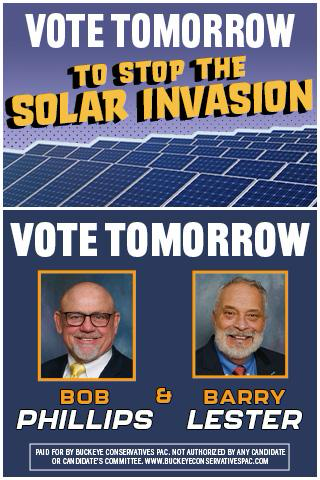 An anti-solar group sent text messages to residents of Knox County, Ohio urging them to “stop the solar invasion.”
To many in the deep-red central Ohio community, it seemed that solar had become the focus of news and politics. They were right. Fossil fuel interests were secretly working to shape the conversation in Knox County.
Floodlight is a nonprofit newsroom that investigates the powers stalling climate action.
Subscribe
Each cog in the anti-solar machine — the opposition group, the texts, the newspaper, the energy publication — was linked to the others through finances and overlapping agendas, an investigation by Floodlight, ProPublica and The Tow Center for Digital Journalism found.
The campaign against solar power benefited from a confluence of two powerful forces funded by oil and gas interests. A former executive at Ariel Corporation, the county’s largest employer and one of the world’s biggest manufacturers of methane gas compressors, was working behind the scenes. And helping in a more public way is the Mount Vernon News, a newspaper now in the hands of Metric Media, which operates websites that reportedly engage in pay-to-play coverage.
Rural Knox County, Ohio, is home to extensive farmland and has deep ties to the gas industry. (Sarahbeth Maney / ProPublica).
Ariel and the former executive did not respond to requests for comment. Metric Media’s leader did not answer questions for this story; he has previously denied that his news outlets are partisan.
Across the country, the oil and gas industry and power companies have exploited a struggling news industry and a fraught political process to fight the transition to clean energy and maximize profits, Floodlight and its partners have reported. In Florida, two power companies paid a consulting firm to hire newspapers to attack a pro-solar politician. In Alabama, the state’s largest monopoly electric company purchased a historic Black newspaper, then didn’t write about soaring power bills. In California, Chevron launched its own newsroom when other papers shuttered; it doesn’t cover itself critically.
In Mount Vernon, a city of 17,000 where the local university named its new sports complex CH4 after the chemical formula for methane, a variety of tactics have been deployed simultaneously, creating an anti-solar echo chamber.
Mount Vernon Nazarene University’s CH4 Stadium was partially funded by Ariel Foundation, the philanthropic arm of Ariel Corporation, one of the world’s biggest manufacturers of methane gas compressors.(Sarahbeth Maney / ProPublica).
Residents are bombarded with dubious claims: Solar panels are toxic. Their construction depletes the soil and floods fields and depresses home values. China is using them to invade. The campaign has stoked their skepticism and ignited their passions. It intensified the debate in a conservative county that prizes its roots in the gas industry.
Bright yellow “No Industrial Solar” yard signs have sprung up everywhere, competing with a smattering of green “Yes Solar” ones. Citizens packed local government meetings. More than 4,000 public comments, both for and against, were filed with the state regulator that will decide if the solar project can be built — triple the number for any previous solar project in Ohio. And all those opinions have drowned out the voices of the nine landowners, mostly farmers, who’ve signed leases with Frasier’s developer and for whom a total of about $60 million is at stake.
“People are so radicalized and they’re not thinking clearly,” said Rich Piar, a third-generation farmer who hopes to secure his financial future by leasing a portion of his 1,650 acres to Open Road Renewables, the Texas-based company developing the Frasier Solar project.
A plaque on the Mount Vernon Nazarene University’s CH4 Stadium explains that, like the chemical bonds in methane, the bond between the university and Ariel is strong. (Sarahbeth Maney / ProPublica).
Politicians who didn’t forcefully denounce the solar project were attacked in Mount Vernon News stories. Thom Collier, a long-serving Republican on the county commission who thinks landowners should be able to choose whether to use their property for solar infrastructure, ultimately lost his reelection bid after a barrage of misleading coverage about his stance on solar.
“I pin this on one or two people from Ariel and some close friends that they have,” Collier said of the anti-solar offensive. “They determined it didn’t matter how much money it would take, they were going to fight this and make it ugly, and they have.”
The Yellowbud Solar project in Pickaway County, Ohio, shown in 2022, became operational last year. It is about 90 miles southwest of Knox County. (Dan Gearino / Inside Climate News)
‘They want everybody to buy gas’
Just 20 days after Knox Smart Development was registered as an LLC in Ohio, the anti-solar group hosted a town hall at a historic Georgian revival theater in Mount Vernon with 1,000 red velvet seats. Attendees were offered free food and alcohol.
The November 2023 event centered on a presentation from Steve Goreham, who argues global warming is natural and who is the author of several books, including “The Mad, Mad, Mad World of Climatism: Mankind and Climate Change Mania.”
The Mount Vernon News’ new owners opened an office in the Woodward Opera House, a historic downtown building that the Ariel Foundation helped renovate. (Sarahbeth Maney / ProPublica)
“When I think of a town hall meeting, I think of a meeting where everybody from the community can go, everybody has their say. That’s not how their meeting was,” said Kathy Gamble, who said organizers only reluctantly agreed to let her in. She’s pro-solar and not quiet about it.
The town hall established Knox Smart Development as a leading voice against the Frasier Solar project. The group calls itself a simple grassroots defender of Knox County.
It isn’t.
The man who registered the group as a business — and who is its sole member and spokesperson — was an Ariel Corporation employee two decades ago and remained an acquaintance of a top executive there, Tom Rastin. The group’s website was owned for a time by a woman working as an executive assistant at Ariel.
And one of Knox Smart Development’s larger funders is Rastin, a Republican megadonor and a retired executive vice president at Ariel, according to records and sworn testimony. Rastin’s father-in-law founded Ariel and, until recently, Rastin and his wife, Karen Buchwald Wright, led the company. Wright is still the chairman, and her son operates it now. Rastin and Wright did not respond to questions for this story.
Ariel Corporation expanded in 2017, adding a training center for employees and customers near its headquarters in Mount Vernon, Ohio. (Sarahbeth Maney / ProPublica).
The group’s founder, Jared Yost, said in an email that Rastin has not tried to steer its activism. “As a local resident, I believe he should be allowed to donate to whatever cause he aligns with, regardless of his former employment, and to state otherwise is to suggest Mr. Rastin should be censored,” Yost wrote in an email. He said the group relies on volunteers and “our intentions are genuine.”
He added: “The oil and gas industry is not involved in our fight.”
Jared Yost, founder of Knox Smart Development, testifies in August during an Ohio Power Siting Board hearing about his group’s opposition to the Frasier Solar project.(Sarahbeth Maney / ProPublica).
The town hall event headliner, Goreham, said he appeared as a favor to Rastin and Wright. In 2019, he had dinner with the couple when Goreham and his wife were passing through town from Illinois on a road trip to their second home in Virginia Beach. Goreham said that he and Rastin connected over their mutual feelings on the benefits of gas. He said he was glad to accept the invitation to speak at the anti-Frasier Solar event.
“First off, it’s in his county there. Mount Vernon is his city where he lives and where they are based,” said Goreham. “They’re pretty much opposed to renewables and they want everybody to buy gas. That’s their business.”
Goreham says he wasn’t paid to speak, but Wright bought 200 copies of his latest book, “Green Breakdown: The Coming Renewable Energy Failure,” which warns about a net-zero-emissions agenda that will cause energy grids to fail. Local officials were given copies of the book that included a personal note from Wright: “Hello! Given the significant misinformation surrounding solar and wind arrays, I bought you this book that really lays out the facts.” She signed the note “Karen Wright, Chairman — Ariel Corporation.”
Shortly after the group was formed, Knox Smart Development’s “No Solar” ads became a fixture on the Mount Vernon News website and in the paper.
‘You believe people’
The Mount Vernon News had been owned by the same family since 1939, and for decades it chronicled local doings from city council meetings to the county fair.
At its height in the early 2000s, before newspapers started hemorrhaging advertising revenue and readers, the News employed about 15 full-time local reporters. An orange Maine coon cat named Scoop roamed the newsroom.
But by 2020, the News was barely hanging on. Its reporters were still using clunky 20-year-old computers. The back wall of the building was falling down and needed $250,000 in repairs. Kay Culbertson, who owned both the paper and the building, said that she knew it was time to sell. Paying for the repairs would be impossible; even making payroll was a stretch.
The former Mount Vernon News building, home to the paper since 1939, sits empty. (Sarahbeth Maney / ProPublica)
An acquaintance of Culberston’s connected her with Metric Media, part of an eight-company network operating more than 1,100 online local news sites. These sites have been described by media researchers and journalists as “pink slime,” named for a filler in processed meat. The final product looks natural, but it’s been tampered with.
A Syracuse University researcher concluded in a journal article published in February that sites like Metric’s “that seem like original news outlets and that appeal to local identity are filling the void” left by the decline of local news. And The Washington Post reported last year that Republican campaigns requested customized news stories that appeared on Metric-owned sites.
Both conservative and liberal pink slime sites exist. But Metric is run by Brian Timpone, an Illinois-based former broadcast reporter who has contributed tens of thousands of dollars to conservative campaigns and causes. Timpone’s ventures have been criticized for using foreign-based writers to produce material. Some also have been accused of plagiarism and fabricating quotes. Timpone has blamed the problems on foreign writers providing content, and he apologized to readers.
Metric Media’s nonprofit arm has received $1.4 million “for general operations” from DonorsTrust, a dark-money group that has received significant funding from Charles and David Koch, who made their billions in oil pipelines and refineries. The eight-company network that Metric is part of also has ties to conservative billionaires, including oil-and-gas-industry titan Tim Dunn, shipping magnate Richard Uihlein and PayPal co-founder Peter Thiel. (Political groups that organize as nonprofits do not have to disclose donors, which is why they’re called “dark money.”)
DonorsTrust CEO and President Lawson R. Bader said in an email that the organization makes about 4,000 grants a year and that it does not dictate how those donations are spent.
Timpone responded to a request for an interview by writing, “We at the Mount Vernon News are now also working on a story — about Pro Publica and Floodlight’s efforts to promote taxpayer-funded ‘solar energy’ businesses in Central Ohio.” He did not respond to detailed questions.
But in interviews, he has said his business keeps local news alive when many outlets are scaling back or shutting down. Timpone told the Deseret News in Utah that his sites have no political leaning and are “data-driven and fact-centric.”
Research and news investigations have found that Timpone’s publications tend to champion conservative causes and politicians; they often are linked to mysterious newspapers distributed during key elections.
Culbertson and assistant publisher Liz Lutwick said in an interview that they knew little about Metric Media before the sale. But the company’s promises sounded good and, Lutwick said, “You believe people.”
“They were going to keep everything the same for a while. Lo and behold, they didn’t,” Culbertson said.
Metric paid at least $1 million for the Mount Vernon News, the first time it had purchased an established news organization printing a local paper. When the new owners visited the paper after the sale, they told the staff they’d stop printing every day and would no longer provide benefits; instead, employees would become contractors. Half the staff quit on the spot.
“It was awful. You feel like you’ve betrayed people,” Culbertson said.
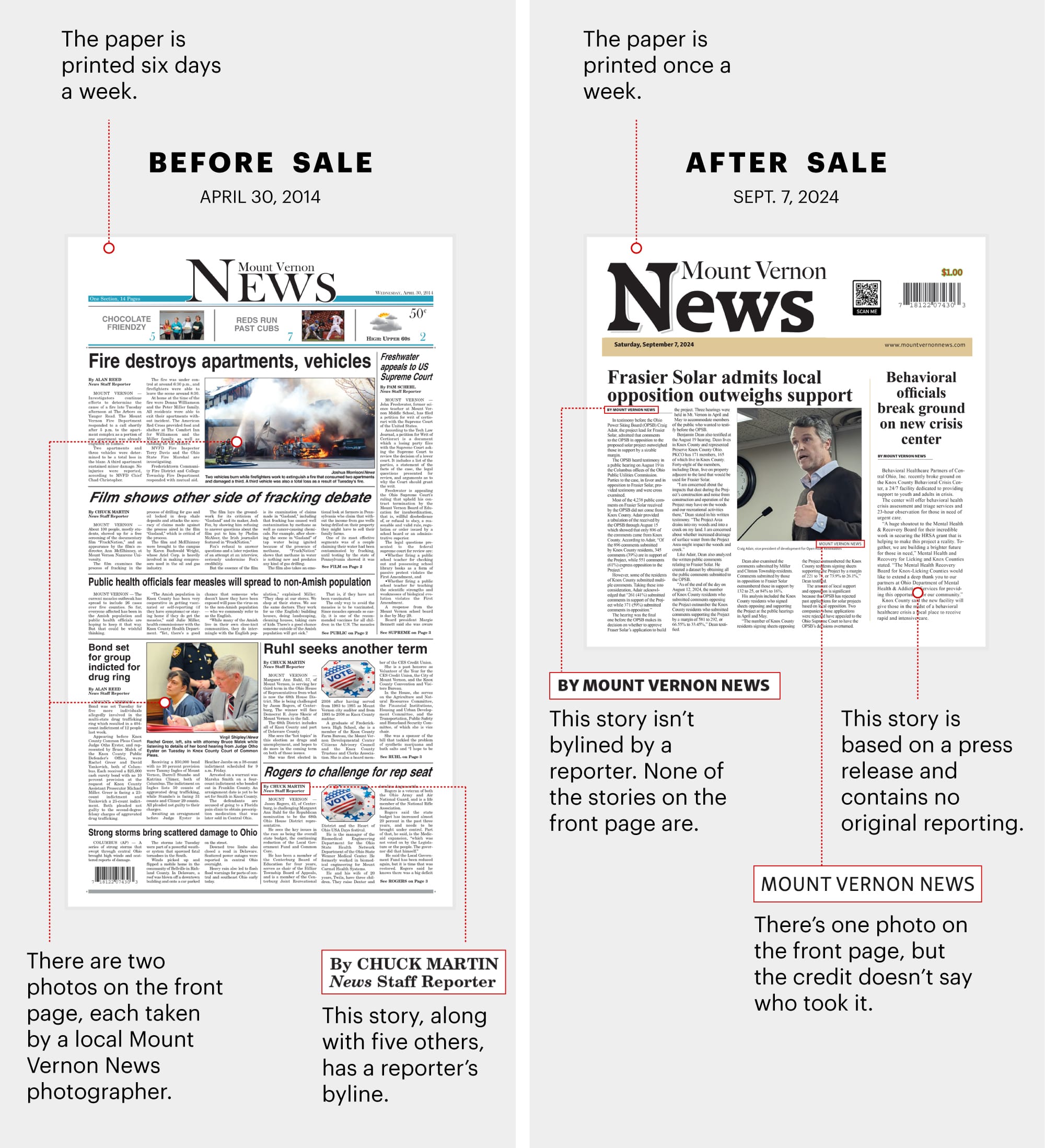
‘We call it the Solar Times’
Today, the Mount Vernon News only publishes once a week and has no local reporters or photographers.
“It’s obvious when you read the stories, either they’re AI-generated or they’re written by somebody who’s sitting in an office in Chicago who has never been here,” said Bill Davis, a sports editor who said he worked at the paper from 2010 to 2019.
Since Metric took over, only 11% of stories credited the work to authors working for Metric or its sister companies. Most of what it publishes are press releases or content submitted by companies and community groups, according to an analysis by the Tow Center, ProPublica and Floodlight.
After the sale, residents said they could no longer get timely obituaries — people were buried by the time funeral announcements were published — but they could read a lot about endangered farmland and concerns that the sun’s reflection off solar panels could blind nearby pilots.
Even Mount Vernon’s mayor, who was once a sports reporter at the paper, said he stopped reading it. Tanner Salyers, a former Mount Vernon city council member who now oversees public safety for the city, said quality dropped after the sale. “Then Frasier kicked up and they were like, ‘No more news.’ We call it the Solar Times.”
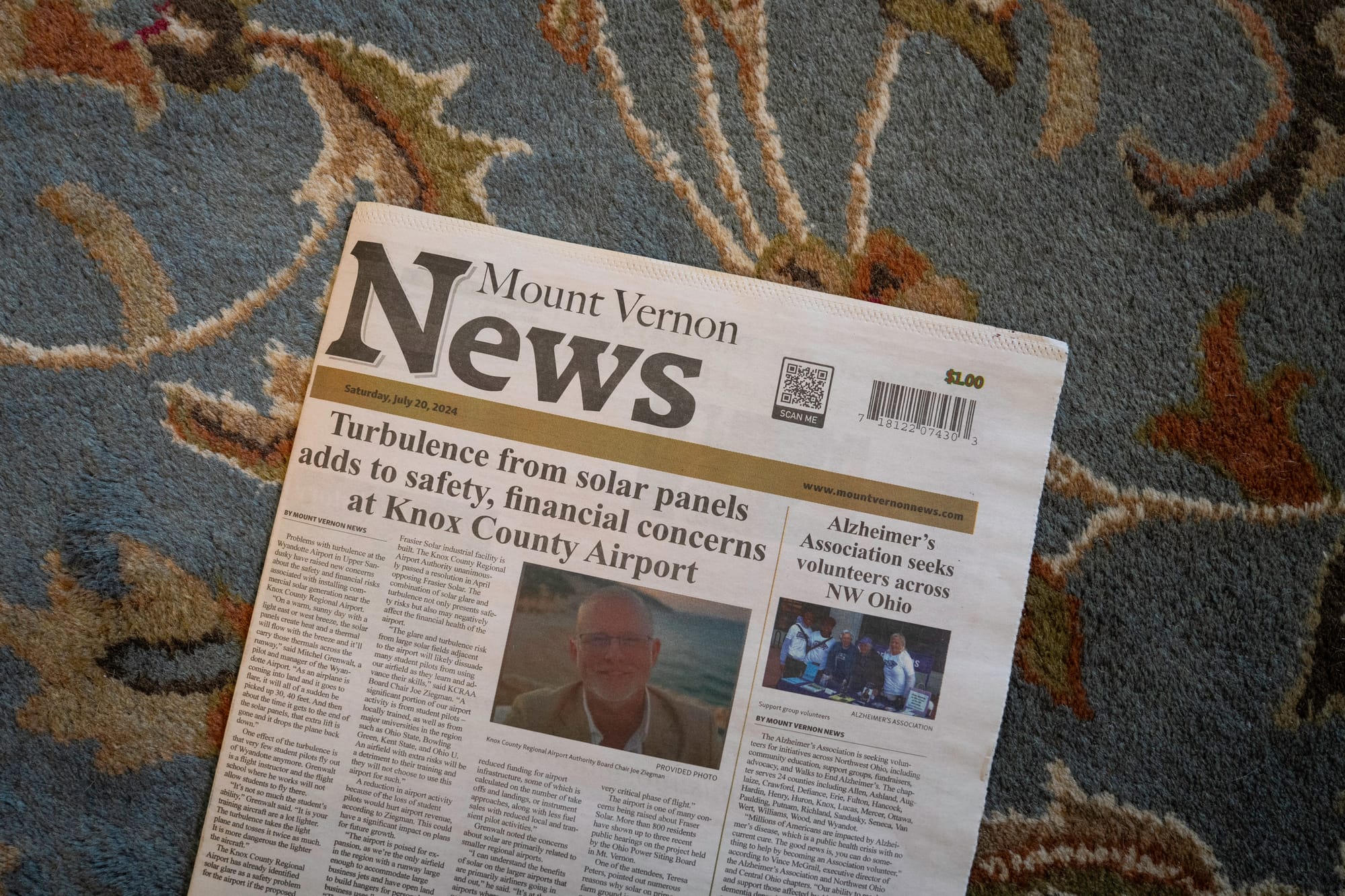 A summer issue of the Mount Vernon News on the floor of the paper’s business office, where one local employee now works. There are no local reporters or photographers. (Sarahbeth Maney / ProPublica).
Over the last 12 months, the paper has published at least 52 online news stories on solar energy — 42 of them about the Frasier proposal, the analysis found. Of the 40 print editions published this year, 17 have featured front-page stories about solar. And though the paper has occasionally run a pro-solar letter to the editor, nearly all of the stories slanted anti-solar, according to an analysis of coverage by Floodlight, ProPublica and the Tow Center.
The paper began publishing a weekly opinion column called “Afternoon TEA” — TEA being an acronym for The Empowerment Alliance, a dark-money gas advocacy group Rastin leads.
The columns extolled the superiority of gas as a fuel source.
It isn’t clear if The Empowerment Alliance paid the Mount Vernon News to run the “Afternoon TEA” columns.
But tax filings show that since 2020 The Empowerment Alliance has spent at least $6.3 million on a “public education campaign,” which included publishing “Afternoon TEA.” The goal was to promote “the importance of natural gas to the economy and national energy independence.”
One of The Empowerment Alliance’s stated goals is “fighting the nonsense of turning corn fields into solar fields.” It has financed online advertisements attacking President Joe Biden’s energy policies and spearheaded an Ohio bill that defined gas as a “green” fuel source.
Half of the Frasier stories published in the Mount Vernon News over the past year have mentioned Knox Smart Development, the anti-solar group linked to Rastin. Articles often quoted people or cited work from a Koch-backed think tank, The Buckeye Institute, but did not interview Frasier or farmers willing to lease land to it.
The Buckeye Institute is part of the State Policy Network, a group of think tanks that has received millions in funding from organizations connected to the Koch family. Rastin’s wife has served as a director on the State Policy Network board, and in 2019 she gave it $700,000, according to a tax record that typically would’ve been redacted but was posted to a government site.
The Mount Vernon News and pro-gas political groups also were working to influence local elections. The text messages that boosted anti-solar candidates were from a conservative Ohio PAC tied to a group that ran a pro-gas campaign.
And, leading up to the primary, a newspaper called the Ohio Energy Reporter was mailed to Knox County homes. The 8-page paper reprinted several Mount Vernon News stories on solar and featured other articles with headlines including “Ohio’s coming ‘solar trash wave’ ” and “Could the Texas Power Crisis happen in Ohio?”
The publication did not disclose its owners. The Floodlight, ProPublica and Tow Center investigation used source code from the website, its IP address and business mailing addresses to confirm that it is a product of the wider Metric Media network.
The stories the Mount Vernon News published began undermining politicians who were seen as insufficiently anti-solar and boosting the profiles of solar power’s outspoken critics.
In one article, the News accused Mount Vernon Mayor Matthew Starr of bowing to “energy activists” and pledging to try to remove natural gas from the city. It was not true. Starr was furious and asked the editors to take down the article, but they would not.
And in nearly a dozen stories that mentioned Collier, the county commissioner who was later ousted, the paper consistently misused a comment he’d given about newly placed solar panels at the county jail to falsely insinuate he supported the Frasier project.
Collier was never interviewed for those stories. Yet the paper ran a story devoted entirely to anti-solar commissioner candidate Drenda Keesee, a megachurch pastor who’d never run for office before; the article said she had “emerged as a vocal opponent of solar projects encroaching on the community.” Keesee, whose property would border a portion of the solar site, was the only source in the story.
She won the primary against Collier and is unopposed in the November general election.
Drenda Keesee, right, is a pastor at Faith Life Church and a candidate for a seat on the Knox County Commission. Keesee, who’s running on an anti-solar platform, attended a Ohio Power Siting Board hearing in Columbus in August. (Sarahbeth Maney / ProPublica)
‘You can’t eat solar panels’
For the community, the debate over solar has been passionate and persistent. What it hasn’t always been is civil. Yard signs have been stolen. Insults hurled. Middle fingers extended. Friendships frayed.
“Other than solar, we don’t have any problems with each other,” said Kathy Gamble, who runs the pro-solar group Knox County For Responsible Solar.
Many people in the community say they don’t view the debate through the lens of climate science or fossil fuels; they care about land rights and preserving rural life. Members of Preserve Knox County, an anti-solar group with several members whose land borders the proposed solar arrays, said they worry the solar project will scare off the sandhill cranes and bald eagles that visit their backyards.
Many members are distrustful of Biden’s renewable energy initiatives; they are staunch supporters of former President Donald Trump, who questions the scientific consensus that the climate is undergoing dangerous changes. They also don’t trust the solar developer’s promises to plant enough trees to block the panels from view. And they don’t want to lose the farmland that gives the area its agricultural identity.
Knox County residents Connie and Jim Boeshart, who live next to property where solar panels would be built if the Frasier Solar project is approved, attend an Ohio Power Siting Board hearing in August. (Sarahbeth Maney / ProPublica)
“You can’t eat solar panels,” said Jim Boeshart, whose home would be adjacent to solar arrays.
Keith Strait, a farmer who lives not far from Boeshart, agreed: “Let’s face it,” he said, pointing at the ground, “They’re not making any more of this. There will be a time when there won’t be any farm left. Where’re you going to get your food from?”
Keith Strait, a farmer in Knox County, said, “I don’t like it,” of the solar proposal. “They’re taking away a lot of farm ground.” (Sarahbeth Maney / ProPublica)
The farmers who want to lease their land feel their voices have been lost in the debate. For them, a 40-year land contract with Frasier Solar would be steady income. One farmer said he could make four times as much money per acre leasing to the solar project as he’d make renting to another farmer.
Rich Piar, the third-generation farmer, is looking to the solar panels as a retirement plan. He said he has no one to take over the operation when he retires, and he doesn’t think anyone should dictate what he does with his land or when he stops farming.
“Most farmers’ exit strategy is their health,” Piar said. “I don’t want to have that kind of predetermined exit strategy.” He went to one of the public meetings about Frasier but said it was so packed he didn’t get to speak until almost midnight.
Rich Piar stands near his cornfield in Knox County, Ohio. He is one of the local farmers who plans to lease his land for the Frasier Solar project. (Sarahbeth Maney / ProPublica)
In August, the Ohio Power Siting Board, which will rule on whether the project can be built, held a final hearing to accept evidence from both sides. One of the attorneys who spoke on behalf of a farmer who is leasing land for the project was from the Sabin Center for Climate Change Law at Columbia University. (The Tow Center also is based at Columbia, but its work is separate.)
Frasier lawyers cross-examined Knox Smart Development spokesperson Jared Yost at the hearing, where he testified that Rastin, the retired Ariel executive, was one of the group’s biggest donors. To Open Road Renewables’ vice president of development, Craig Adair, the confirmation pierced the veil.
Everything changed, Adair said in an interview, “when The Empowerment Alliance decided to use its vast financial resources” to shape the debate in Knox County and in the Mount Vernon News.
Craig Adair, vice president of development at Open Road Renewables, the company developing the Frasier Solar project, testifies at the Ohio Power Siting Board hearing on the project in August. (Sarahbeth Maney / ProPublica),
The News published two stories on the hearing but did not mention the public admission of Knox Smart Development’s ties to Rastin, the Ariel Corporation and The Empowerment Alliance.
The board’s decision is likely to take months.
In the meantime, construction has started at the old Mount Vernon News building, which is being turned into an academic hub for a local university. The building will be named after Rastin’s stepson, a former president of Ariel Corporation.
Floodlight*is a nonprofit newsroom that investigates the powerful interests stalling climate action.
===
---
legit BBC docu 2022 -->
https://www.dailymotion.com/video/x6yxjeh
Climate Science and the Myths of Renewable Energy- Steve Goreham
J Michael Wilson
5 years ago
Global warming is a long-term rise in the average temperature of the Earth's climate system, an aspect of climate change shown by temperature measurements and by multiple effects of the warming.
Wikipedia
Steve Goreham is a speaker, author, researcher on environmental issues, and an independent columnist. He’s the Executive Director of the Climate Science Coalition of America, a non-political association dedicated to informing about the realities of climate science and energy economics. Steve gave this presentation at the Friends of Science 'Climate Dogma Exposed' event in Calgary on May 9th 2017. He says "contrary to what your political leader, professor, and newspaper tell you, global warming is dominated by natural factors. As a result, thousands of climate and energy laws across hundreds of nations, all summed together, are not going to have a measurable effect on Earth’s temperatures."
(Originally uploaded to YouTube on Jul 1, 2017, by: Friends of Science)
---
===
Steve Goreham
Day Job: Author, The Mad, Mad, Mad World of Climatism; executive director of the Climate Science Coalition of America.
Industry Ties: Prior to the page being apparently hacked, "Goreham's profile on Climatism.net describes him as an engineer and business executive with extensive experience at Fortune 100 public companies and private firms," DeSmogBlog reported.
Fox News guest: Yes
Climate Expertise: None
He said it: "I'm just a layperson ... I'm also a relative newcomer to the climate battle."
==
climatescienceamerica.org/
-
-
www.exxonsecrets.org/html/personfactsheet.php?id=1357
-
en.wikipedia.org/wiki/Tom_Harris_(mechanical_engineer)
-
---
bs
NIPCC Report
National Research Council (North) Report
Wegman Report
Wegman's Reply to Questions
Wegman's Testimony to US House Committee
Wegman - US House Transcript (235pp)
North & Wegman Reports - Overview & Links
Must Read Sites
International CSC
Australian CSC
New Zealand CSC
Climate Depot
Friends of Science
Global Warming Facts
Climate Debate Daily
ICECAP
SPPI - Science and Public Policy Institute
Audit the IPCC?
Climate Audit
Pielke Sr. Research
The Heartland Institute
| ABOUT THE CLIMATE SCIENCE COALITION OF A |
The Climate Science Coalition of America (CSCA) is an apolitical, non-profit association of scientists, engineers, energy experts, and concerned citizens. Our focus is intentionally on outreach regarding climate science only. The American people have been repeatedly told that Anthropogenic Global Warming (AGW) or manmade climate change is today’s most significant “threat,” and that the science is “settled.” If it is settled, why do the United States and the European Union still pour billions of dollars into more climate studies each year? Our goals are to provide the American people with an independent, unbiased source of information on climate science because public does not appear to have adequate access to such information now. Americans should be more readily aware of the status and complexity of climate science, the many data gaps and uncertainties underlying the AGW theory, the current phase of “negative discovery,” and the actual limitations associated with the AGW theory’s “evidence.” The American public also likely needs access to information on the many scientific studies that continue to be published each year that either:
Proposed government solutions are highly complex, carry a high price tag, and bring numerous unanticipated consequences. In addition, the US EPA has admitted before Congress that the effects of legislation debated during 2009 will be minimal: global temperature reductions are projected to generate mere tenths of a degree “savings” or reductions in global temperatures by 2050, a difference impossible to measure. One analysis (assuming a 83% reduction in US carbon dioxide emissions, a goal of the House-passed Waxman-Markey bill) indicates global temperature reductions as low as:
\__ [[1]](http://climatescienceamerica.org/index.php?option=com_content&view=article&id=18&Itemid=27#\_ftnref) Knappenberger, C., Climate Impacts of Waxman-Markey (the IPCC-based arithmetic of no gain), 6 May 2009. Available on-line at http://masterresource.org/?p=2355, last accessed 20 December 2009. \__ **THE CSCA TEAM** The CSCA executive team is a group of seasoned experts, with extensive experience in the fields of climate science, engineering, meteorology and business. The executive team is backed by the Technical Advisory Board, a prestigious group of United States technical experts. **EXECUTIVE TEAM** **Roy W. Spencer, Ph.D., Chairman** Dr. Spencer is the leader of the CSCA Technical Advisory Board and the Corporate Chairman. Dr. Spencer earned a Ph.D. in Meteorology at the University of Wisconsin-Madison in 1981. Before becoming a Principal Research Scientist at the University of Alabama in Huntsville in 2001, he was a Senior Scientist for Climate Studies at NASA’s Marshall Space Flight Center, where he received NASA’s Exceptional Scientific Achievement Medal for global temperature monitoring work with satellites. Dr. Spencer’s work with NASA continues as the U.S. Science Team leader for the Advanced Microwave Scanning Radiometer flying on NASA’s Aqua satellite. He has provided congressional testimony several times on the subject of global warming. Dr. Spencer is the author of two climate science books:
Dr. Spencer also maintains a blog on issues related to global warming science: www.drroyspencer.com Steve Goreham, Executive Director Steve Goreham is an engineer and business executive with over 30 years of experience at Fortune 100 public companies and private firms. He is also author of the book: Climatism: Science, Common Sense, and the 21st Century’s Hottest Topic, which provides a complete overview of the science, politics, and energy policy implications of the world’s misguided efforts to stop global warming. Steve holds an M.S. in Electrical Engineering from the University of Illinois and an MBA from the University of Chicago. Eugene Langschwager, Director An engineer by training, Eugene Langschwager has consulting experience for all levels of government, not-for-profit enterprises, and various industry groups. Most of his original training experience is in the environmental field, and includes projects related to wastewater treatment and biosolids treatment/disposal, tropospheric ozone control, and toxic chemicals in the community. Eugene also spent more than a decade in business advocacy and technical project management with the Cincinnati USA Regional Chamber of Commerce. C. Bruce Richardson, Director With a degree in Microbiology from the University of Houston, Bruce Richardson understands the scientific method well. He also brings to the CSCA corporate board extensive not-for-profit leadership and knowledge. Bruce has effectively analyzed the climate science data that needs to be communicated to the American public. Rich Apuzzo, Director Rich Apuzzo is an American meteorologist and broadcaster, currently the Chief Meteorologist and Chief Operating Officer atSkyeye Weather LLC, a national weather entertainment, education and consulting firm based in Cincinnati, Ohio. Rich received a bachelor's degree in geology and meteorology from Valparaiso University, and has worked as a meteorologist in four different US communities; including 13 years at the Fox affiliate WXIX-TV in Cincinnati. He has been a member of the National Weather Association (NWA) since 1988, and was awarded the Seal of Approval in 1990. In 1998, Rich joined an evaluation panel for the NWA Seal. CSCA TECHNICAL ADVISORY BOARD Syun Akasofu, Ph.D., Professor of Physics, Emeritus and Founding Director, International Arctic Research Center of the University of Alaska, Fairbanks (Physics, Arctic & Auroral Research) J. Scott Armstrong, Ph.D., The Wharton School, University of PA (Forecasting) Don J. Easterbrook, Ph.D., Emeritus Professor of Geology, Western Washington University (Glacial Geology) , Bellingham, Washington Robert H. Essenhigh, Ph.D., E.G. Bailey Professor of Energy Conversion, Dept. of Mechanical Engineering, The Ohio State University (Mechanical Engineering) Lee C. Gerhard, Ph.D., Senior Scientist Emeritus, University of Kansas; Director (Ret.), Kansas Geological Survey David R. Legates, Ph.D., Professor of Geography, College of Earth, Ocean, and Environment, University of Delaware, Newark, Delaware Gary Sharp, Ph.D., Center for Climate/Ocean Resources Study (Weather/Climate processes effects on fisheries, ocean ecological changes), Salinas, California Anthony Watts, chief meteorologist for KPAY-AM radio, Chico, California, and founder of ItWorks and SurfaceStations.org; Anthony also maintains the highly popular science blog WattsUpWithThat David E. Wojick, Ph.D., PE (energy & environmental consultant), Star Tannery, Virginia George H. Taylor, Certified Consulting Meteorologist (CCM), Applied Climate Services, LLC, Former State Climatologist (Oregon), President, American Association of State Climatologists (1998-2000), Corvallis, Oregon |
http://www.desmogblog.com/international-climate-science-coalition
International Climate Science Coalition (ICSC)
Background
The International Climate Science Coalition (ICSC) describes itself as “a non-partisan group of independent scientists, economists and energy and policy experts who are working to promote better understanding of climate science and policy worldwide.”
ICSC was launched in 2007 by the :{New Zealand :(style="background-color:#ffff66;"):}:Climate Science Coalition when the group “received such positive feedback from around the world … that they decided they needed an international group.” Their aim is “moving the debate away from implementation of costly and ineffectual 'climate control' measures.”
According to their website, “ICSC also focuses on publicizing the repercussions of misguided plans to solve the 'climate crisis'. This includes, but is not be limited to, the dangerous impacts of attempts to replace conventional energy sources with wind turbines, solar power, biofuels and other ineffective and expensive energy sources.”
ICSC describes its purpose as providing a “international response to what has become a very international, heavily funded climate alarmist effort around the world.”ICSC has created the :{Australian:(style="background-color:#ffff66;"):}: Climate Coalition as well as the Climate Science Coalition of America whose executive director is Steve Goreham. [7]
Stance on Climate Change
ICSC lists the following as their “core principles” regarding climate science:
- Global climate is always changing in accordance with natural causes and recent changes are not unusual.
- Science is rapidly evolving away from the view that humanity's emissions of carbon dioxide and other 'greenhouse gases' are a cause of dangerous climate change.
- Climate models used by the IPCC* fail to reproduce known past climates without manipulation and therefore lack the scientific integrity needed for use in climate prediction and related policy decision-making.
- The UN IPCC Summary for Policymakers and the assertions of IPCC executives too often seriously mis-represent the conclusions of their own scientific reports.
- Claims that ‘consensus’ exists among climate experts regarding the causes of the modest warming of the past century are contradicted by thousands of independent scientists.
- Carbon dioxide is not a pollutant - it is a necessary reactant in plant photosynthesis and so is essential for life on Earth.
- Research that identifies the Sun as a major driver of global climate change must be taken more seriously.
- Global cooling has presented serious problems for human society and the environment throughout history while global warming has generally been highly beneficial.
- It is not possible to reliably predict how climate will change in the future, beyond the certainty that multi-decadal warming and cooling trends, and abrupt changes, will all continue, underscoring a need for effective adaptation.
- Since science and observation have failed to substantiate the human-caused climate change hypothesis, it is premature to damage national economies with carbon taxes, emissions trading or other schemes to control 'greenhouse gas' emissions.
Funding
According to ICSC, “Since its formation in 2007, ICSC has never received financial support from corporations, foundations or governments. 99% of all donations have come from private individuals in the United Kingdom, New Zealand, United States and Canada.” [1]
According to SourceWatch, despite this claim, ICSC received $45,000 from the Heartland Institute in 2007 alone. [2]
Key People
- Tom Harris — Executive Director.
- Bob Carter — Chief Science Advisor.
- Terry Dunleavy— Strategic Advisor and Founding Chairman.
- Bryan Leyland — Energy Issues Advisor.
ICSC Science Advisory Board
- William Alexander
- J. Scott Armstrong
- Tim Ball
- David Bellamy
- Ian D. Clark
- Paul Copper
- Hans Erren
- Christopher Essex
- Lee C. Gerhard
- Vincent Gray
- Kesten C. Green
- J. Herold
- Ole Humlum
- Albert F. Jacobs
- Madhav L. Khandekar
- William Kininmonth
- R.W.J. (Rob), Kouffeld
- Hans H.J. Labohm
- Jay Lehr
- Fred Michel
- Nils-Axel Mörner
- Brian Pratt
- Peter Stilbs
- Gerrit J. van der Lingen
ICSC Consultant Science Advisers
- Chris R. de Freitas
- Willem de Lange
- Tad Murty
ICSC Policy Advisory Board
- Ferdinand Hohenlohe-Bartenstein
- Alan Gibbs
- Michael Limburg
- Owen McShane
- John McLean
- Christopher Monckton
- Julian Morris
- Rob Scagel
- Viv Forbes
ICSC Consultant Policy Advisers
Canadian Speakers Bureau
- Tim Ball
- Susan Crockford
- **Chris Essex**
- **Tom Harris**
- **Madhav Khandekar**
- **Tad Murty**
- **Tim Patterson**
- Brian Pratt
- **L. Graham Smith**
- Charlene Adam
Actions
May 21 - 23, 2012
The ICSC is listed as an official Co-sponsor of the Heartland Institute's Seventh International Conferenece on Climate Change (ICCC7).
March, 2009
ICSC was a sponsor of the Heartland Institute's 2009 International Conference on Climate Change.
Collectively sponsors for the conference received over $47 million from oil companies and right-wing organizations.
December 8, 2009
ICSC hosted the “Copenhagen Climate Challenge” [3] which was signed by numerous prominent climate change skeptics. [4]
See the video (hosted by CFACT) of Tom Harris presented the Climate Challenge.
March 4, 2008
ICSC promotes the “Manhattan Declaration,” a document that was presented at the Heartland Institute's 2008 International Conference on Climate Change.
The Declaration states that “That there is no convincing evidence that CO2 emissions from modern industrial activity has in the past, is now, or will in the future cause catastrophic climate change” and “That human-caused climate change is not a global crisis.”
It concludes “That all taxes, regulations, and other interventions intended to reduce emissions of CO2 be abandoned forthwith.” [5]
March, 2008
At the 2008 International Conference on Climate Change” hosted by the Heartland Institute, ICSC Executive Director Tom Harris gave a speech in which he discussed what he called “information sharing” and “coordinated local activism”: (Archived mp3)
”[…] We need regular high-impact media coverage of the findings of leading scientists — not just one or two publications, but we need to have hundreds all over the world. We need to have a high degree of information sharing and cooperation between groups, so that when Vincent Gray for example has an article published in New Zealand, we can take the same piece and we can (say) submit it to newspapers all over North America and Europe.
“Then we have a nicely well-coordinated response, where letters to the editor and phone calls are made. “Congratulations on publishing that article!” You know, it's interesting because I've had many of my articles opposed so strongly, by environmentalists through phone calls and letters to the editor, that they just simply dry up, they just won't publish us again. So this does have feedback, I mean, these are people that run these newspapers, and they're scared, and impressed, and encouraged, depending on the feedback they get.
We have to have grassroots organizations doing exactly that kind of thing: coordinated local activism.”
See a video of his speech below:
Related Organizations
- Australian Climate Science Coalition (ACSC)
- **Science and Public Policy Institute (SPPI)**
- Climate Audit
- **Friends of Science (FoS)**
- New Zealand Climate Science Coalition [6]
Resources
- “ICSC Funding,” ICSC. Accessed December 24, 2011.
- “International Climate Science Coalition,” SourceWatch Profile.
- “UN Challenged to Provide Sound Evidence for Catastrophic Forecasts,” CNW Newswire Release, December 8, 2009.
- “Copenhagen climate Challenge Signatories,” copenhagenclimatechallenge.org, December 10, 2009.
- “THE MANHATTAN DECLARATION ON CLIMATE CHANGE,” International Climate Science Coalition. Accessed December 24, 2011.
- “Meet Alan Gibbs, builder of amphibious HumVees and 'climate science' coalitions,”Deep Climate, August 1, 2009.
- Youtube Video,
 .” Uploaded by TomHarrisICSC on June 13, 2011.
- ExxonSecrets Factsheet: International Climate Science Coalition, ICSC.
- “Winning Hearts and Minds to Climate and Energy Reality: ICSC’s Strategic Plan” (PDF), International Climate Science Coalition, June 12, 2011.
TAGS:
International Climate Science Coalition
dreissen refs on gagging of rt:
https://www.masterresource.org/climategate/revisting-climategate-climatism-falters/
Revisiting Climategate as Climatism Falters
By Steve Goreham -- June 6, 2013
Climatism, the belief that man-made greenhouse gases are destroying Earth’s climate, is on the wane. Once riding high, the ideology of man-made climate change is losing its influence in governments across the world. Climategate, the release of e-mails from the University of East Anglia, called the science of dangerous warming into question and turned the tide of global opinion.
Background
On November 19, 2009, and unidentified hacker or internal whistle-blower downloaded more than 1,000 documents and e-mails from the Climatic Research Unit (CRU) at East Anglia University in the United Kingdom and posted them on a server in Russia. Within hours, these documents were accessed by websites around the world.
These e-mails were a subset of confidential communications between top climate scientists in the United Kingdom, the United States, and other nations over the last fifteen years. These were the very same scientists that developed the surface temperature data sets, promoted the Mann Hockey Stick Curve, and wrote and edited the core of the Intergovernmental Panel on Climate Change (IPCC) assessment reports.
The incident was branded “Climategate” by British columnist James Delingpole, a label soon adopted by the world. These e-mails provide an insight into practices by researchers that are poor science at best and fraudulent at worst. Bias, manipulation of data, avoidance of freedom of information requests, and efforts to subvert the peer-review process are apparent, all to further the “cause” of man-made global warming. The e-mails were released on the eve of the 2009 United Nations Climate Conference in Copenhagen.
Climatism’s Apex
Just two years earlier, Climatism had swept almost all in its path. The IPCC 2007 Fourth Assessment Report declared that mankind was very likely the cause of global temperature increase. That same year, former Vice President Al Gore and the IPCC shared the Nobel Peace Prize.
In December of 2007, The RENIXX index of the world’s largest renewable energy companies soared to over 1,900. Barack Obama was elected President of the United States in 2008, heralding the rebirth of a more environmentally conscious nation. After securing the majority of primary delegates in June, 2008, candidate Obama declared, “…this was the moment when the rise of the oceans began to slow and our planet began to heal…”
The year 2009 was set to be a year of triumph for Climatism. The US House of Representatives passed the Waxman-Markey cap-and-trade bill in June and sent it to the US Senate. The Copenhagen Climate Conference in December 2009 was to be the major next step to control global emissions. But the release of the Climategate e-mails just one week prior to the start of the conference shook the science of man-made warming.
Climatism’s Downward Spiral
Today, the man-made global warming movement is headed for a crash. United Nations climate conferences at Cancun (2010), Durban (2011), and Doha (2012) failed to produce an agreement to reduce greenhouse gas emissions. The Kyoto Protocol climate treaty expired at the end of 2012 without a successor agreement. The Waxman-Markey bill was ignored by the US Senate and climate legislation is now a non-starter in the US Congress.
Contrary to climate model predictions, global temperatures have failed to increase for the last fifteen years, confounding the sirens for dangerous climate change. In January of this year, the UK Met Office revised their global temperature forecast downward for the next decade. The early release of a chart from the upcoming Fifth Assessment Report of the IPCC showed that temperatures are running far below IPCC projections. Scientists and leading publications, such as The*Economist*, now question whether the climate models are too sensitive to greenhouse gas levels.
Meanwhile, renewable energy subsidies have been cut in Germany, Greece, Netherlands, Spain, the UK, and the US. Governments across the world are rethinking their commitment to green energy. The RENIXX index has fallen to 250, down almost 90 percent from the 2007 peak. In April, the European Parliament rejected an effort to prop up the Emissions Trading System. The price of a carbon allowance dropped to under €3 per tonne, down from €20 per tonne in 2011. Climatism, in short, has become shaky business.
The Climategate e-mail release has played an important role in shifting global opinions about the theory of man-made warming. Below are some of the most important quotes from Climategate emails. More quotes on climate change, energy, and the environment can be found here.
Emails: On the Theory of Man-Made Warming
“I know there is pressure to present a nice tidy story as regards ‘apparent unprecedented warming in a thousand years or more in the proxy data’ but in reality the situation is no quite so simple.”
—Dr. Keith Briffa, Climatic Research Unit, disclosed Climategate e-mail, Sep. 22, 1999
“Keith’s [Briffa] series…differs in large part in exactly the opposite direction that Phil’s [Jones] does from ours. This is the problem we all picked up on (everyone in the room at IPCC was in agreement that this was a problem and a potential distraction/detraction from the reasonably consensus viewpoint we’d like to show w/ the Jones et al and Mann et al series).”
—Dr. Michael Mann, IPCC Lead Author, disclosed Climategate e-mail, Sep. 22, 1999
“…it would be nice to try to ‘contain’ the putative ‘MWP’ [Medieval Warm Period]…”
—Dr. Michael Mann, IPCC Lead Author, disclosed Climategate e-mail, June 4, 2003
“By the way, when is Tom C [Crowley] going to formally publish his roughly 1500 year reconstruction??? It would help the cause to be able to refer to that reconstruction as confirming Mann and Jones, etc.”
—Dr. Michael Mann, IPCC Lead Author, disclosed Climategate e-mail, Aug. 3, 2004
“I gave up on Judith Curry a while ago. I don’t know what she thinks she’s doing, but it’s not helping the cause, or her professional credibility.”
—Dr. Michael Mann, IPCC Lead Author, disclosed Climategate e-mail, May 30, 2008
“Well, I have my own article on where the heck is global warming…The fact is that we can’t account for the lack of warming at the moment and it is a travesty that we can’t.”
—Dr. Kevin Trenberth, IPCC Lead Author, disclosed Climategate e-mail, Oct. 12, 2009
Emails: Manipulating Temperature Data
“I’ve just completed Mike’s [Mann] Nature trick of adding in the real temps to each series for the last 20 years (i.e. from 1981 onwards) and from 1961 for Keith’s [Briffa] to hide the decline.”
—Dr. Phil Jones, Director of the Climatic Research Unit, disclosed Climategate e-mail, Nov. 16, 1999
“Also we have applied a completely artificial adjustment to the data after 1960, so they look closer to observed temperatures than the tree-ring data actually were…”
—Dr. Tim Osborn, Climatic Research Unit, disclosed Climategate e-mail, Dec. 20, 2006
“…If you look at the attached plot you will see that the land also shows the 1940s warming blip (as I’m sure you know). So, if we could reduce the ocean blip by, say 0.15 deg C, then this would be significant for the global mean—but we’d still have to explain the land blip…”
—Dr. Tom Wigley, University Corporation for Atmospheric Research, on adjusting global temperature data, disclosed Climategate e-mail to Phil Jones, Sep. 28, 2008
“We, therefore, do not hold the original raw data but only the value-added (i.e. quality controlled and homogenized) data.”
—Climatic Research Unit web site, the world’s leading provider of global temperature data, admitting that it can’t produce the original thermometer data, 2011
Emails: Data Suppression and Freedom of Information (FOI) Avoidance
“…We have 25 or so years invested in the work. Why should I make the data available to you, when your aim is to try to find something wrong with it…”
—Dr. Phil Jones, Director of the Climate Research Unit at East Anglia University, email to Warwick Hughes, 2004
“I’m getting hassled by a couple of people to release the CRU station temperature data. Don’t any of you three tell anybody that the UK has a Freedom of Information Act.”
—Dr. Phil Jones, Director of the Climatic Research Unit, disclosed Climategate e-mail, Feb. 21, 2005
“Mike [Mann], can you delete any e-mails you may have had with Keith [Trenberth] re AR4? Keith will do likewise…Can you also e-mail Gene and get him to do the same? I don’t have his e-mail address…We will be getting Caspar to do likewise.”
—Dr. Phil Jones, Director of the Climatic Research Unit, disclosed Climategate e-mail, May 29, 2008
“You might want to check with the IPCC Bureau. I’ve been told that IPCC is above national FOI Acts. One way to cover yourself and all those working in AR5 [the upcoming IPCC Fifth Assessment Report] would be to delete all e-mails at the end of the process. Hard to do, as not everybody will remember it.”
—Dr. Phil Jones, Director of the Climatic Research Unit, on avoiding Freedom of Information requirements, disclosed Climategate e-mail, May 12, 2009
Emails: Subverting the Peer-Review Process
“…I can’t see either of these papers being in the next IPCC report. Kevin [Trenberth] and I will keep them out somehow, even if we have to redefine what the peer-review literature is!”
—Phil Jones, Director of the Climatic Research Unit, disclosed Climategate e-mail, July 8, 2004
——————
Steve Goreham is Executive Director of the Climate Science Coalition of America; environmental researcher at the Heartland Institute; and author of the influential expose, The Mad, Mad, Mad World of Climatism: Mankind and Climate Change Mania.