local labs timpone
see main fake newspaper
see ULINE ETP FRACK
THIEL
WA EXMR
see star news fredericks EG TENN STAR
-=-=
WIKI
Involvement in conservative media
In the lead-up to the 2014 U.S. Senate race in Texas, Richard donated $450,571.65 to finance a newspaper that published false stories about Representative Steve Stockman's opponent, Senator John Cornyn, suggesting that he "wanted to ban veterans from having guns, had voted to fund abortion, and was secretly working with Democrats to grant amnesty to illegal immigrants".[74][75] This was discovered when the donation was investigated as an attempt by Stockman to subvert limits on coordinated campaign spending.[74]
Richard Uihlein has had a longstanding financial relationship with conservative newspaper producer Brian Timpone.[39] Since 2004, Timpone has worked to build a network of locally published free Internet and print news.[76] These newspapers often employ names that are similar to respected local institutions but are unaffiliated with them.[77] The articles he publishes often reference real events, but he has been accused of severely distorting facts to create emotional responses in his readers.[76] Timpone's companies have been known to offer pay-for-play articles to conservative clients.[39] From 2016 to 2018, a political action committee the Uihleins funded gave at least $646,000 to a network of newspapers and websites Timpone created.[39]
People Who Play By The Rules PAC, which contributed money to Timpone's operations during the 2022 Illinois races, received more than $42 million from Richard Uihlein.[78][51][52] During the lead-up to the 2022 election, Timpone's operations blanketed the state in confusingly titled free newspapers that attacked Governor JB Pritzker and other Illinois Democrats.[78]
In October 2024, ProPublica traced a newspaper delivered to Wisconsinites, The Wisconsin Catholic Tribune, which was unaffiliated with the Catholic Church and painted Trump as pro-Catholic and Biden as anti-Catholic, to Timpone and Uihlein.[79] The company producing the newspapers, which is owned by Timpone, was paid by Restoration PAC, which had received $125 million from Richard between 2020 and the article's publication.[79]
Richard is a supporter of Turning Point USA, a conservative youth organization formed in 2012 with a strong media arm.[80][81] Between 2014 and 2016, he donated $275,000 to it.[82] On January 13, 2021, shortly after the January 6 attack, he donated $250,000 to it.[83]
RealClearPolitics and The Federalist are also significant recipients of funds from the Ed Uihlein foundtation, Richard Uihlein's philanthropic entity.[84][85]
Philanthropy
---
10 25
velshi fasc author TO 40 academics fired (diff fields wapo AA woman?) much worse than maccarthy
---
fox bs
e president of the Turning Point USA chapter at the University of Chicago wants repercussions for a faculty member who was arrested for suspected violent crimes on Oct. 3 at an anti-ICE rally.
"Professor Eman Abdelhadi’s history of inflammatory and anti-American rhetoric is deeply concerning. Students deserve a safe and open campus environment where they can express their views without fear of intimidation or retaliation from faculty," Tyler Shasteen told Fox News Digital.
Abdelhadi, an associate professor in the school's Department of Comparative Human Development, was arrested on Oct. 3 and charged with two felony counts of aggravated battery to a government employee and two misdemeanor counts of resisting/obstructing peace stemming from a rally outside the Broadview, Illinois ICE facility.
A mugshot of Eman Adbelhadi from Oct. 3, 2025. (Cook County Sheriff's Office)
Rallies, some of which have turned violent, have been ongoing there for weeks.
"Professor Abdelhadi’s statements, which clearly endorse violence, are unacceptable and undermine the safety and well-being of our community," said Shasteen. "I call on the University of Chicago to review her position and ensure accountability for any actions that violate university policy or the law."
Last week, the school condemned violence, but has resisted answering questions about whether Abdhelhadi has been disciplined.
Abdelhadi has been largely silent, too. However, she thanked her supporters on Bluesky early last week.
"Thank you so much everyone for the messages of love and support," she said on the platform. "I feel fortified by your presence in my life and in the world. I keep thinking about all our neighbors and siblings—hundreds in Chicago alone—who’ve been detained into the unknown of horrendous facilities. We owe them resistance."
Police clash with demonstrators during a protest outside an immigrant processing and detention center on Oct. 03, 2025 in Broadview, Illinois. The site has been the target of frequent protests as federal law enforcement agents continue Operation Midway Blitz in the Chicago area, an operation designed to apprehend and deport undocumented immigrants living in the area. (Scott Olson/Getty Images)
Just a day before her arrest, she accused ICE of "terrorizing our communities" on a far-left podcast.
"I mean, in Broadview, ICE has been setting up shop in our backyard. Just brazenly taking up community resources to terrorize this very same community," she said.
She also put out a call for resistance, and lambasted those who she believes aren't taking extreme enough action.
"At this point, you are either on the side of protecting our neighbors and protecting our community, or you’re on the side of this administration. There is no neutral ground in this moment. There’s no center left. You’re either resisting or you’re complicit," she said.
At the Socialism 2025 conference earlier this year, she also slammed her employer.
"F--- the University of Chicago, it’s evil, you know it’s a colonial landlord. Like, why would I put any of my political energy into this space? I kind of had a little bit of disdain for people who spent their time doing that," she said on a panel during the far-left gathering.
A demonstrator is detained as people protest outside the U.S. Immigration and Customs Enforcement (ICE) Broadview facility in Chicago, Ill., Oct. 3, 2025. (Jim Vondruska/Reuters)
LICK HERE TO GET THE FOX NEWS APP](//www.foxnews.com/apps-products?pid=AppArticleLink)
"Turns out, I work at one of the biggest employers in the city of Chicago. I work at a place that is a landlord, a healthcare provider, a police force, f--- that s---, but, they are, and a place where I have access to thousands of people that I could potentially organize… actually, this is where I need to build power. That’s possible structural leverage," she said.
The University of Chicago and Abdelhadi did not return comment requests.
Peter D'Abrosca joined Fox News Digital in 2025. Previously, he was a politics reporter at The Tennessee Star.
Follow Peter on X at @pmd_reports. Send story tips to peter.dabrosca@fox.com.
Related Topics
---
===
exxonknews gmail 12 24
Who’s funding this ‘newspaper’ mailed to potential jurors in Greenpeace’s trial?
A dark money trail linked to pipeline company Energy Transfer could be behind a mysterious mailer targeting North Dakota residents in the lead-up to its major trial with Greenpeace.
The following piece was co-published by DeSmog and ExxonKnews.
In early September, fossil fuel executive and Donald Trump megadonor Kelcy Warren quietly made a large donation to a political action committee few people have ever heard of. Warren is CEO of Energy Transfer, the company behind the infamous Dakota Access Pipeline, which in 2016 faced thousands of protesters including members of the Standing Rock Sioux Tribe and other opponents.
The timing is potentially significant because Warren made his $5 million donation to the super PAC called Turnout for America while his company pushed forward with a lawsuit against the nonprofit Greenpeace related to the Standing Rock protests.
Two weeks after receiving Warren’s contribution, Turnout for America paid $250,000 to Northern CB Corp. — an Illinois publishing and printing company — for “media services.”
One of the listed directors for Northern CB Corp. is Brian Timpone, a conservative businessman who owns Chicago-based company Metric Media, a Koch-linked network that runs more than 1,100 partisan websites masquerading as local news.
In October, residents in Morton County, where the Greenpeace trial is scheduled to take place, received a mailed publication called “Central ND News,” which featured articles decrying the Dakota Access protests and praising Energy Transfer. Central ND News is produced by Metric Media.
While news of this “weird” paper was first reported by Floodlight and the North Dakota News Cooperative, additional details related to Warren’s Super PAC donation are now being debated in the lawsuit itself.
Greenpeace is urging a North Dakota court to allow further investigation into who paid to send the publication attacking Dakota Access protestors to Morton County residents — and whether there was an attempt to exert “improper influence” over potential jurors in Energy Transfer’s favor.
“Given the importance of securing a fair and impartial jury … knowing who was directing these actions, to whom they directed the information, and why they did so are important issues to the fair administration of justice,” a Greenpeace brief shared with ExxonKnews and DeSmog reads.
A closely watched lawsuit
Energy Transfer’s $300 million lawsuit accuses the environmental group Greenpeace of unlawfully orchestrating protests against the Dakota Access pipeline in 2016 and 2017, during which time hundreds of protestors were arrested near the Standing Rock Sioux Indian Reservation — including climate activists and Indigenous water protectors.
Energy Transfer, which worked with law enforcement agencies to curtail the protests and used an international security firm to surveil and shift public opinion about the company’s opponents, claims that Greenpeace waged an “unlawful, malicious, and coordinated attack” to damage and defame the pipeline and the company itself.
**According to Greenpeace USA, Energy Transfer is suing the group because it “dared to uplift the Indigenous-led opposition movement at Standing Rock.”
The lawsuit could have implications for whether the fossil fuel industry is able to silence protesters as it embarks on major expansions, including the buildout of new gas and carbon dioxide pipelines, Gulf Coast LNG facilities, and petrochemical infrastructure. Experts and advocates say the case has all the hallmarks of a SLAPP, or strategic lawsuit against public participation — a larger legal tactic fossil fuel companies have been using to suppress dissent and drain their opposition of resources and time.
As the February 2025 trial draws near in the closely watched case, Greenpeace is now asking a state district court to grant an emergency motion to reopen discovery in the case, which would allow the environmental group to get more information about who funded the mailer to North Dakota residents.
In its new court filing, Greenpeace alleges that “there may have been improper influence over potential Morton County jurors through direct mailers containing negative reporting about Standing Rock protests that took place eight years ago, and benefits which Energy Transfer conferred on the local community six years ago.”
Greenpeace cites new details indicating that Kelcy Warren’s donation came around the same time as a surge of coverage from Central ND News targeting the Dakota Access protests. Central ND News began running a series on its website in August, called “On This Date in 2016.” The series contained six articles in August, three of which accused protestors of “unlawful” activities in their headlines. Subsequent articles in the series appeared a few times each month up until this week. There is no record of the paper covering those protests before this year.
The same day Turnout for America paid the Illinois publishing company, Central ND News published a story praising a donation that Energy Transfer made to a university in North Dakota six years ago. That story, written by C.D. Marsden (a name that Floodlight first found yields no results in a Google search), was featured in the October newspaper delivered to Morton County residents’ homes, juxtaposed with stories about Dakota Access pipeline protestors.
The 12-page paper included those stories in a section called “This Month in History: October 2016,” featuring one article titled “Area schools locked down as authorities respond to pipeline protests.” Another recounts the details of a felony arrest warrant accusing a pipeline protestor of charging a police officer on horseback.
“The purpose of that publication is quite clearly to remind people about what was happening eight years ago,” a lawyer for Greenpeace, Everett Jack, told the court at a December 9 hearing requesting the reopening of discovery. “We should be entitled to find out who made that decision.”
pix
One of Greenpeace’s lawyers — Derrick Braaten, who resides in Mandan, a city in Morton County — received the Central ND News at his home in October. The paper doesn’t appear to have any physical presence in North Dakota — it directed readers to the outlet’s website, and didn’t include any local advertisements, according to Greenpeace.*
Jack told Southwest Judicial District Court Judge James Gion that reopening discovery would allow Greenpeace’s attorneys to question the Texas-based printing company that sent the newspaper, FMC Printing. The group would seek to subpoena FMC Printing to determine whether the mailer was targeted only to Morton County residents, who directed that the mailer be sent there, and why. Depending on the results of that investigation, Greenpeace would consider requesting a change in venue for the trial.
“We’re filing this motion and seeking this discovery because I think this court would agree there’s nothing more sacred in the legal system than the right to a fair, impartial jury, and every lawyer knows that direct efforts to influenc[e] the jury pool are not okay,” Jack said.
‘Playing both sides’
Greenpeace has been fighting varying iterations of Energy Transfer’s case — which was originally filed under state and federal racketeering charges — for eight years, with individual Indigenous protestors and journalists also brought into the mix. This week, the Minnesota Supreme Court heard an appeal from Energy Transfer in its attempts to subpoena journalists who reported on the protests at Standing Rock, seeking to force them to produce confidential, unpublished material.
The Dakota Access pipeline began operating through North Dakota in 2017 after an executive action from then-President Trump. The pipeline, which protestors warned would threaten water supplies, sacred sites, and the climate, leaked 5 times in its first year of operation alone.
This fall, the day before the October mailing was sent, the Standing Rock Sioux Tribe filed a new lawsuit against the U.S. Army Corps of Engineers arguing that the pipeline is operating illegally and should be shut down. Energy Transfer CEO Warren gave $5 million in campaign donations to Trump, who recently promised “fully expedited approvals and permits” to companies who invest $1 billion in the U.S.
:{Energy Transfer’s case, originally filed by the firm Kasowitz Benson Torres (long-time lawyers for Donald Trump), was taken over in 2023 by Gibson Dunn, a law firm with a record of “playing both sides” of the First Amendment on behalf of its corporate clients. }:{:Gibson Dunn}: lawyer Trey Cox represented Energy Transfer in its opposition to Greenpeace’s motion this week, arguing that juror questionnaires are the appropriate method to ensure a fair trial — and that whether or not Morton County residents received or read the newspaper was irrelevant.
ND Central News, he said, was a local newspaper that existed before the mailer was sent, and was simply covering matters involving a high-profile trial. Cox accused Greenpeace of trying to delay the trial date (which Greenpeace denied), and said its motion did not have “any basis in law or in fact.”
Energy Transfer, Metric Media, and Trey Cox did not respond to requests for comment.
“We don’t have any evidence that this newspaper in any way prejudiced potential jurors,” Cox told the court.
===
Fossil fuel interests are working to kill solar in one Ohio county. The hometown newspaper is helping.
A retired gas industry executive, a shadowy 'grassroots' group and a controversial media company are spreading misinformation while turning residents against a proposed solar farm — and each other
Miranda Green/Floodlight, Jennifer Smith Richards/ProPublica, Priyanjana Bengani/Tow Center for Digital Journalism
Oct 8, 2024 — 17 min read
Rich Piar farms soybeans in Knox County, Ohio. “We try to be good stewards of the ground,” he said. The solar project he hopes will be built on his land, “from my research, is a decent thing. We have electric power plants shutting down, coal fire plants. We need energy.” (Sarahbeth Maney / ProPublica)
Co-published with*ProPublica*, a nonprofit newsroom that investigates abuses of power.*Sign up for Dispatches*, a newsletter that spotlights wrongdoing around the country, to receive our stories in your inbox every week.
Word tends to spread fast in rural Knox County, Ohio. But misinformation has spread faster.
The first article in the Mount Vernon News last fall about a planned solar farm simply noted that residents were “expressing their concern.” But soon the county’s only newspaper was packed with stories about solar energy that almost uniformly criticized the project and quoted its opponents.
Then a new “grassroots” organization materialized and invited locals to an elaborate event billed as a town hall, with a keynote speaker who denied that humans cause climate change.
Someone sent text messages to residents urging them to “stop the solar invasion” and elect two county commission candidates who opposed the solar farm. And one day this past March, residents received an unfamiliar newspaper that contained only articles attacking Frasier Solar, a large project that would replace hundreds of acres of corn and soybeans with the equivalent of 630 football fields of solar panels.
 An anti-solar group sent text messages to residents of Knox County, Ohio urging them to “stop the solar invasion.”
To many in the deep-red central Ohio community, it seemed that solar had become the focus of news and politics. They were right. Fossil fuel interests were secretly working to shape the conversation in Knox County.
Floodlight is a nonprofit newsroom that investigates the powers stalling climate action.
Subscribe
Each cog in the anti-solar machine — the opposition group, the texts, the newspaper, the energy publication — was linked to the others through finances and overlapping agendas, an investigation by Floodlight, ProPublica and The Tow Center for Digital Journalism found.
The campaign against solar power benefited from a confluence of two powerful forces funded by oil and gas interests. A former executive at Ariel Corporation, the county’s largest employer and one of the world’s biggest manufacturers of methane gas compressors, was working behind the scenes. And helping in a more public way is the Mount Vernon News, a newspaper now in the hands of Metric Media, which operates websites that reportedly engage in pay-to-play coverage.
Rural Knox County, Ohio, is home to extensive farmland and has deep ties to the gas industry. (Sarahbeth Maney / ProPublica).
Ariel and the former executive did not respond to requests for comment. Metric Media’s leader did not answer questions for this story; he has previously denied that his news outlets are partisan.
Across the country, the oil and gas industry and power companies have exploited a struggling news industry and a fraught political process to fight the transition to clean energy and maximize profits, Floodlight and its partners have reported. In Florida, two power companies paid a consulting firm to hire newspapers to attack a pro-solar politician. In Alabama, the state’s largest monopoly electric company purchased a historic Black newspaper, then didn’t write about soaring power bills. In California, Chevron launched its own newsroom when other papers shuttered; it doesn’t cover itself critically.
In Mount Vernon, a city of 17,000 where the local university named its new sports complex CH4 after the chemical formula for methane, a variety of tactics have been deployed simultaneously, creating an anti-solar echo chamber.
Mount Vernon Nazarene University’s CH4 Stadium was partially funded by Ariel Foundation, the philanthropic arm of Ariel Corporation, one of the world’s biggest manufacturers of methane gas compressors.(Sarahbeth Maney / ProPublica).
Residents are bombarded with dubious claims: Solar panels are toxic. Their construction depletes the soil and floods fields and depresses home values. China is using them to invade. The campaign has stoked their skepticism and ignited their passions. It intensified the debate in a conservative county that prizes its roots in the gas industry.
Bright yellow “No Industrial Solar” yard signs have sprung up everywhere, competing with a smattering of green “Yes Solar” ones. Citizens packed local government meetings. More than 4,000 public comments, both for and against, were filed with the state regulator that will decide if the solar project can be built — triple the number for any previous solar project in Ohio. And all those opinions have drowned out the voices of the nine landowners, mostly farmers, who’ve signed leases with Frasier’s developer and for whom a total of about $60 million is at stake.
“People are so radicalized and they’re not thinking clearly,” said Rich Piar, a third-generation farmer who hopes to secure his financial future by leasing a portion of his 1,650 acres to Open Road Renewables, the Texas-based company developing the Frasier Solar project.
A plaque on the Mount Vernon Nazarene University’s CH4 Stadium explains that, like the chemical bonds in methane, the bond between the university and Ariel is strong. (Sarahbeth Maney / ProPublica).
Politicians who didn’t forcefully denounce the solar project were attacked in Mount Vernon News stories. Thom Collier, a long-serving Republican on the county commission who thinks landowners should be able to choose whether to use their property for solar infrastructure, ultimately lost his reelection bid after a barrage of misleading coverage about his stance on solar.
“I pin this on one or two people from Ariel and some close friends that they have,” Collier said of the anti-solar offensive. “They determined it didn’t matter how much money it would take, they were going to fight this and make it ugly, and they have.”
The Yellowbud Solar project in Pickaway County, Ohio, shown in 2022, became operational last year. It is about 90 miles southwest of Knox County. (Dan Gearino / Inside Climate News)
‘They want everybody to buy gas’
Just 20 days after Knox Smart Development was registered as an LLC in Ohio, the anti-solar group hosted a town hall at a historic Georgian revival theater in Mount Vernon with 1,000 red velvet seats. Attendees were offered free food and alcohol.
The November 2023 event centered on a presentation from Steve Goreham, who argues global warming is natural and who is the author of several books, including “The Mad, Mad, Mad World of Climatism: Mankind and Climate Change Mania.”
The Mount Vernon News’ new owners opened an office in the Woodward Opera House, a historic downtown building that the Ariel Foundation helped renovate. (Sarahbeth Maney / ProPublica)
“When I think of a town hall meeting, I think of a meeting where everybody from the community can go, everybody has their say. That’s not how their meeting was,” said Kathy Gamble, who said organizers only reluctantly agreed to let her in. She’s pro-solar and not quiet about it.
The town hall established Knox Smart Development as a leading voice against the Frasier Solar project. The group calls itself a simple grassroots defender of Knox County.
It isn’t.
The man who registered the group as a business — and who is its sole member and spokesperson — was an Ariel Corporation employee two decades ago and remained an acquaintance of a top executive there, Tom Rastin. The group’s website was owned for a time by a woman working as an executive assistant at Ariel.
And one of Knox Smart Development’s larger funders is Rastin, a Republican megadonor and a retired executive vice president at Ariel, according to records and sworn testimony. Rastin’s father-in-law founded Ariel and, until recently, Rastin and his wife, Karen Buchwald Wright, led the company. Wright is still the chairman, and her son operates it now. Rastin and Wright did not respond to questions for this story.
Ariel Corporation expanded in 2017, adding a training center for employees and customers near its headquarters in Mount Vernon, Ohio. (Sarahbeth Maney / ProPublica).
The group’s founder, Jared Yost, said in an email that Rastin has not tried to steer its activism. “As a local resident, I believe he should be allowed to donate to whatever cause he aligns with, regardless of his former employment, and to state otherwise is to suggest Mr. Rastin should be censored,” Yost wrote in an email. He said the group relies on volunteers and “our intentions are genuine.”
He added: “The oil and gas industry is not involved in our fight.”
Jared Yost, founder of Knox Smart Development, testifies in August during an Ohio Power Siting Board hearing about his group’s opposition to the Frasier Solar project.(Sarahbeth Maney / ProPublica).
The town hall event headliner, Goreham, said he appeared as a favor to Rastin and Wright. In 2019, he had dinner with the couple when Goreham and his wife were passing through town from Illinois on a road trip to their second home in Virginia Beach. Goreham said that he and Rastin connected over their mutual feelings on the benefits of gas. He said he was glad to accept the invitation to speak at the anti-Frasier Solar event.
“First off, it’s in his county there. Mount Vernon is his city where he lives and where they are based,” said Goreham. “They’re pretty much opposed to renewables and they want everybody to buy gas. That’s their business.”
Goreham says he wasn’t paid to speak, but Wright bought 200 copies of his latest book, “Green Breakdown: The Coming Renewable Energy Failure,” which warns about a net-zero-emissions agenda that will cause energy grids to fail. Local officials were given copies of the book that included a personal note from Wright: “Hello! Given the significant misinformation surrounding solar and wind arrays, I bought you this book that really lays out the facts.” She signed the note “Karen Wright, Chairman — Ariel Corporation.”
Shortly after the group was formed, Knox Smart Development’s “No Solar” ads became a fixture on the Mount Vernon News website and in the paper.
‘You believe people’
The Mount Vernon News had been owned by the same family since 1939, and for decades it chronicled local doings from city council meetings to the county fair.
At its height in the early 2000s, before newspapers started hemorrhaging advertising revenue and readers, the News employed about 15 full-time local reporters. An orange Maine coon cat named Scoop roamed the newsroom.
But by 2020, the News was barely hanging on. Its reporters were still using clunky 20-year-old computers. The back wall of the building was falling down and needed $250,000 in repairs. Kay Culbertson, who owned both the paper and the building, said that she knew it was time to sell. Paying for the repairs would be impossible; even making payroll was a stretch.
The former Mount Vernon News building, home to the paper since 1939, sits empty. (Sarahbeth Maney / ProPublica)
An acquaintance of Culberston’s connected her with Metric Media, part of an eight-company network operating more than 1,100 online local news sites. These sites have been described by media researchers and journalists as “pink slime,” named for a filler in processed meat. The final product looks natural, but it’s been tampered with.
A Syracuse University researcher concluded in a journal article published in February that :{sites like Metric’s “that seem like original news outlets and that appeal to local identity are filling the void” left by the decline of local news. And The Washington Post reported last year that Republican campaigns requested customized news stories that appeared on Metric-owned sites.}:
Both conservative and liberal pink slime sites exist. But Metric is run by Brian Timpone, an Illinois-based former broadcast reporter who has contributed tens of thousands of dollars to conservative campaigns and causes. Timpone’s ventures have been criticized for using foreign-based writers to produce material. Some also have been accused of plagiarism and fabricating quotes. Timpone has blamed the problems on foreign writers providing content, and he apologized to readers.
Metric Media’s nonprofit arm has received $1.4 million “for general operations” from DonorsTrust, a dark-money group that has received significant funding from Charles and David Koch, who made their billions in oil pipelines and refineries. The eight-company network that Metric is part of also has ties to conservative billionaires, including oil-and-gas-industry titan Tim Dunn, shipping magnate Richard Uihlein and PayPal co-founder Peter Thiel. (Political groups that organize as nonprofits do not have to disclose donors, which is why they’re called “dark money.”)
DonorsTrust CEO and President Lawson R. Bader said in an email that the organization makes about 4,000 grants a year and that it does not dictate how those donations are spent.
Timpone responded to a request for an interview by writing, “We at the Mount Vernon News are now also working on a story — about Pro Publica and Floodlight’s efforts to promote taxpayer-funded ‘solar energy’ businesses in Central Ohio.” He did not respond to detailed questions.
But in interviews, he has said his business keeps local news alive when many outlets are scaling back or shutting down. Timpone told the Deseret News in Utah that his sites have no political leaning and are “data-driven and fact-centric.”
Research and news investigations have found that Timpone’s publications tend to champion conservative causes and politicians; they often are linked to mysterious newspapers distributed during key elections.
Culbertson and assistant publisher Liz Lutwick said in an interview that they knew little about Metric Media before the sale. But the company’s promises sounded good and, Lutwick said, “You believe people.”
“They were going to keep everything the same for a while. Lo and behold, they didn’t,” Culbertson said.
Metric paid at least $1 million for the Mount Vernon News, the first time it had purchased an established news organization printing a local paper. When the new owners visited the paper after the sale, they told the staff they’d stop printing every day and would no longer provide benefits; instead, employees would become contractors. Half the staff quit on the spot.
“It was awful. You feel like you’ve betrayed people,” Culbertson said.
‘We call it the Solar Times’
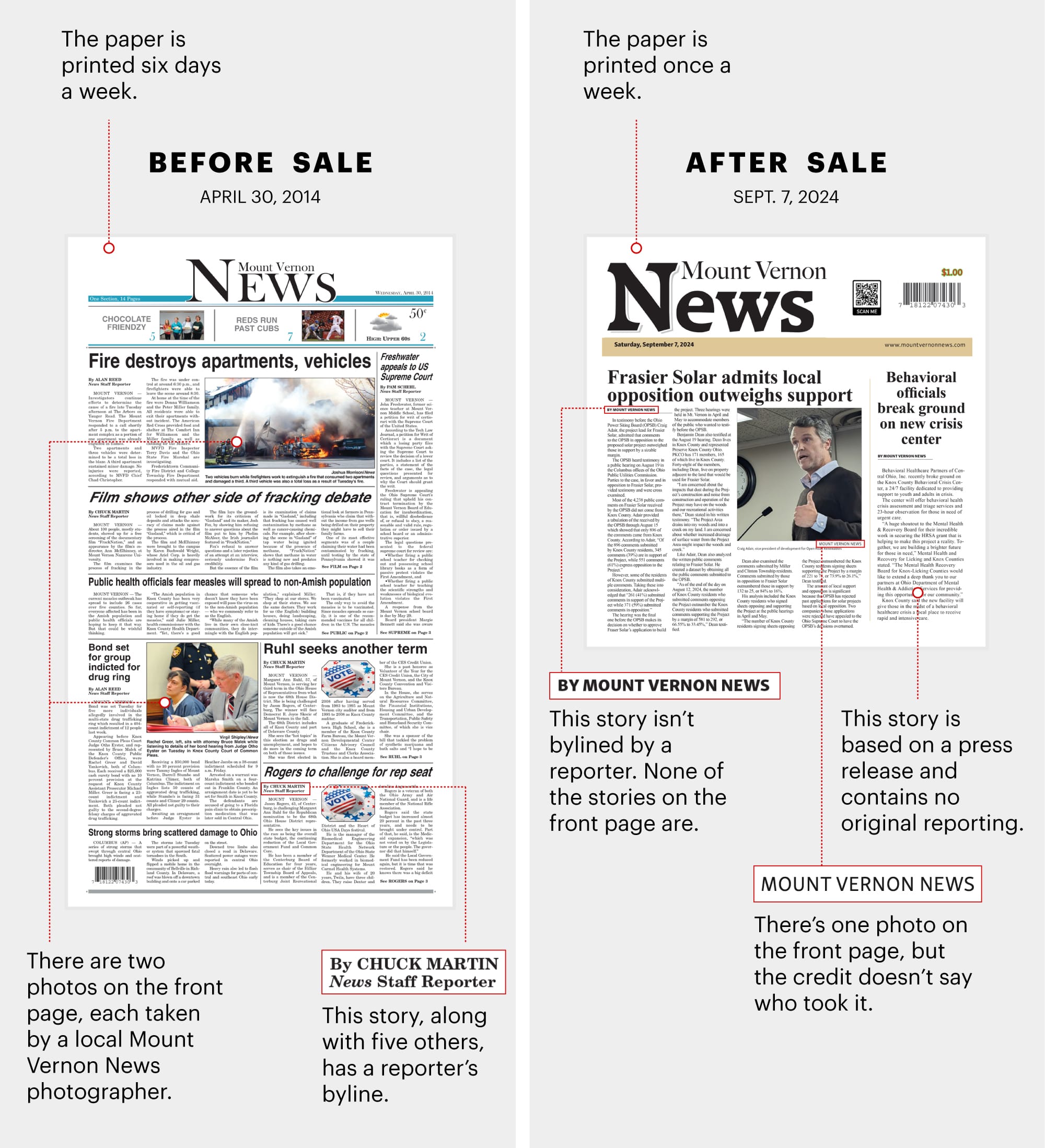
Today, the Mount Vernon News only publishes once a week and has no local reporters or photographers.
“It’s obvious when you read the stories, either they’re AI-generated or they’re written by somebody who’s sitting in an office in Chicago who has never been here,” said Bill Davis, a sports editor who said he worked at the paper from 2010 to 2019.
Since Metric took over, only 11% of stories credited the work to authors working for Metric or its sister companies. Most of what it publishes are press releases or content submitted by companies and community groups, according to an analysis by the Tow Center, ProPublica and Floodlight.
After the sale, residents said they could no longer get timely obituaries — people were buried by the time funeral announcements were published — but they could read a lot about endangered farmland and concerns that the sun’s reflection off solar panels could blind nearby pilots.
Even Mount Vernon’s mayor, who was once a sports reporter at the paper, said he stopped reading it. Tanner Salyers, a former Mount Vernon city council member who now oversees public safety for the city, said quality dropped after the sale. “Then Frasier kicked up and they were like, ‘No more news.’ We call it the Solar Times.”
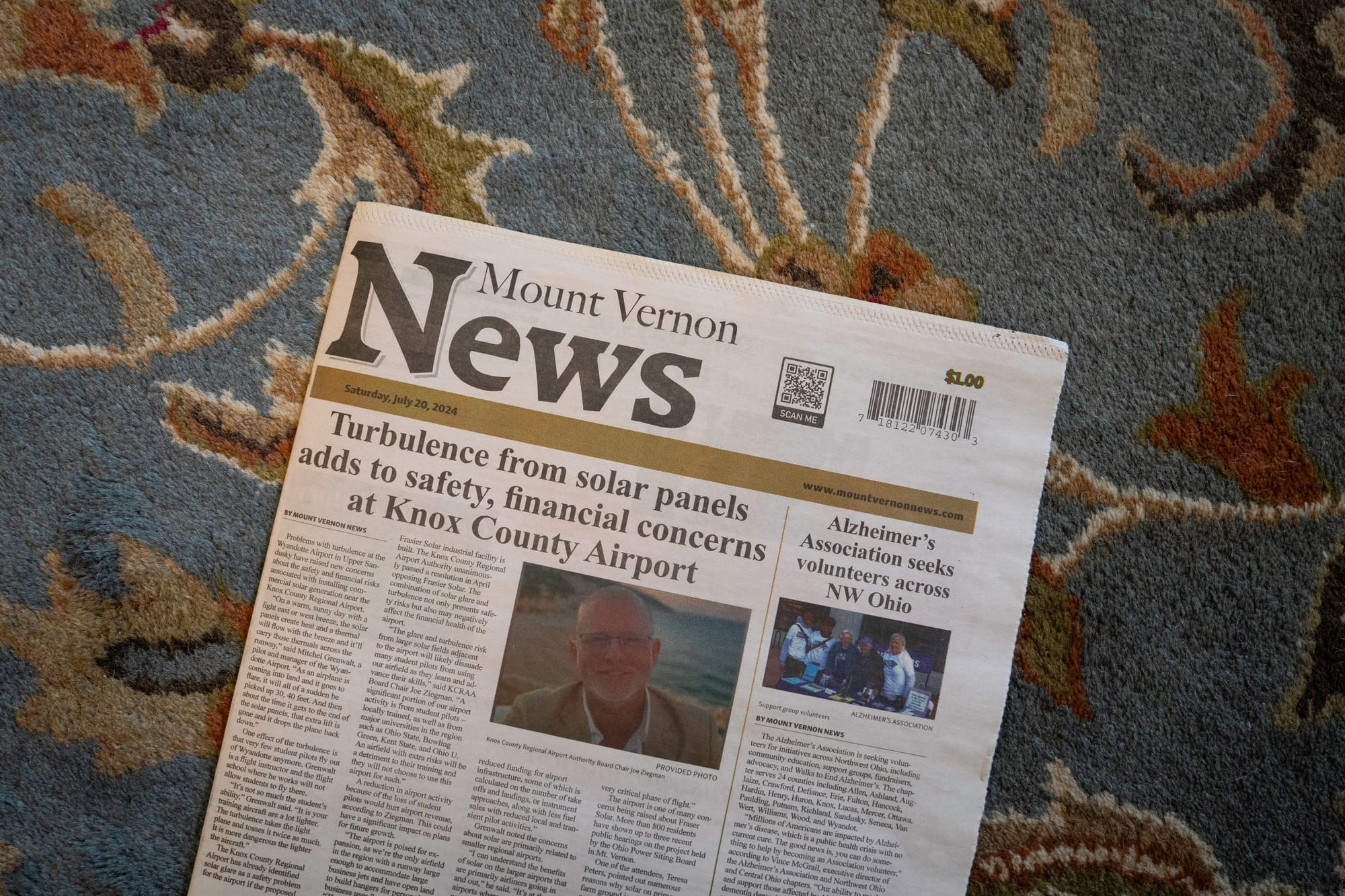 A summer issue of the Mount Vernon News on the floor of the paper’s business office, where one local employee now works. There are no local reporters or photographers. (Sarahbeth Maney / ProPublica).
Over the last 12 months, the paper has published at least 52 online news stories on solar energy — 42 of them about the Frasier proposal, the analysis found. Of the 40 print editions published this year, 17 have featured front-page stories about solar. And though the paper has occasionally run a pro-solar letter to the editor, nearly all of the stories slanted anti-solar, according to an analysis of coverage by Floodlight, ProPublica and the Tow Center.
The paper began publishing a weekly opinion column called “Afternoon TEA” — TEA being an acronym for The Empowerment Alliance, a dark-money gas advocacy group Rastin leads.
The columns extolled the superiority of gas as a fuel source.
It isn’t clear if The Empowerment Alliance paid the Mount Vernon News to run the “Afternoon TEA” columns.
But tax filings show that since 2020 The Empowerment Alliance has spent at least $6.3 million on a “public education campaign,” which included publishing “Afternoon TEA.” The goal was to promote “the importance of natural gas to the economy and national energy independence.”
One of The Empowerment Alliance’s stated goals is “fighting the nonsense of turning corn fields into solar fields.” It has financed online advertisements attacking President Joe Biden’s energy policies and spearheaded an Ohio bill that defined gas as a “green” fuel source.
Half of the Frasier stories published in the Mount Vernon News over the past year have mentioned Knox Smart Development, the anti-solar group linked to Rastin. Articles often quoted people or cited work from a Koch-backed think tank, The Buckeye Institute, but did not interview Frasier or farmers willing to lease land to it.
The Buckeye Institute is part of the State Policy Network, a group of think tanks that has received millions in funding from organizations connected to the Koch family. Rastin’s wife has served as a director on the State Policy Network board, and in 2019 she gave it $700,000, according to a tax record that typically would’ve been redacted but was posted to a government site.
The Mount Vernon News and pro-gas political groups also were working to influence local elections. The text messages that boosted anti-solar candidates were from a conservative Ohio PAC tied to a group that ran a pro-gas campaign.
And, leading up to the primary, a newspaper called the Ohio Energy Reporter was mailed to Knox County homes. The 8-page paper reprinted several Mount Vernon News stories on solar and featured other articles with headlines including “Ohio’s coming ‘solar trash wave’ ” and “Could the Texas Power Crisis happen in Ohio?”
The publication did not disclose its owners. The Floodlight, ProPublica and Tow Center investigation used source code from the website, its IP address and business mailing addresses to confirm that it is a product of the wider Metric Media network.
The stories the Mount Vernon News published began undermining politicians who were seen as insufficiently anti-solar and boosting the profiles of solar power’s outspoken critics.
In one article, the News accused Mount Vernon Mayor Matthew Starr of bowing to “energy activists” and pledging to try to remove natural gas from the city. It was not true. Starr was furious and asked the editors to take down the article, but they would not.
And in nearly a dozen stories that mentioned Collier, the county commissioner who was later ousted, the paper consistently misused a comment he’d given about newly placed solar panels at the county jail to falsely insinuate he supported the Frasier project.
Collier was never interviewed for those stories. Yet the paper ran a story devoted entirely to anti-solar commissioner candidate Drenda Keesee, a megachurch pastor who’d never run for office before; the article said she had “emerged as a vocal opponent of solar projects encroaching on the community.” Keesee, whose property would border a portion of the solar site, was the only source in the story.
She won the primary against Collier and is unopposed in the November general election.
Drenda Keesee, right, is a pastor at Faith Life Church and a candidate for a seat on the Knox County Commission. Keesee, who’s running on an anti-solar platform, attended a Ohio Power Siting Board hearing in Columbus in August. (Sarahbeth Maney / ProPublica)
‘You can’t eat solar panels’
For the community, the debate over solar has been passionate and persistent. What it hasn’t always been is civil. Yard signs have been stolen. Insults hurled. Middle fingers extended. Friendships frayed.
“Other than solar, we don’t have any problems with each other,” said Kathy Gamble, who runs the pro-solar group Knox County For Responsible Solar.
Many people in the community say they don’t view the debate through the lens of climate science or fossil fuels; they care about land rights and preserving rural life. Members of Preserve Knox County, an anti-solar group with several members whose land borders the proposed solar arrays, said they worry the solar project will scare off the sandhill cranes and bald eagles that visit their backyards.
Many members are distrustful of Biden’s renewable energy initiatives; they are staunch supporters of former President Donald Trump, who questions the scientific consensus that the climate is undergoing dangerous changes. They also don’t trust the solar developer’s promises to plant enough trees to block the panels from view. And they don’t want to lose the farmland that gives the area its agricultural identity.
Knox County residents Connie and Jim Boeshart, who live next to property where solar panels would be built if the Frasier Solar project is approved, attend an Ohio Power Siting Board hearing in August. (Sarahbeth Maney / ProPublica)
“You can’t eat solar panels,” said Jim Boeshart, whose home would be adjacent to solar arrays.
Keith Strait, a farmer who lives not far from Boeshart, agreed: “Let’s face it,” he said, pointing at the ground, “They’re not making any more of this. There will be a time when there won’t be any farm left. Where’re you going to get your food from?”
Keith Strait, a farmer in Knox County, said, “I don’t like it,” of the solar proposal. “They’re taking away a lot of farm ground.” (Sarahbeth Maney / ProPublica)
The farmers who want to lease their land feel their voices have been lost in the debate. For them, a 40-year land contract with Frasier Solar would be steady income. One farmer said he could make four times as much money per acre leasing to the solar project as he’d make renting to another farmer.
Rich Piar, the third-generation farmer, is looking to the solar panels as a retirement plan. He said he has no one to take over the operation when he retires, and he doesn’t think anyone should dictate what he does with his land or when he stops farming.
“Most farmers’ exit strategy is their health,” Piar said. “I don’t want to have that kind of predetermined exit strategy.” He went to one of the public meetings about Frasier but said it was so packed he didn’t get to speak until almost midnight.
Rich Piar stands near his cornfield in Knox County, Ohio. He is one of the local farmers who plans to lease his land for the Frasier Solar project. (Sarahbeth Maney / ProPublica)
In August, the Ohio Power Siting Board, which will rule on whether the project can be built, held a final hearing to accept evidence from both sides. One of the attorneys who spoke on behalf of a farmer who is leasing land for the project was from the Sabin Center for Climate Change Law at Columbia University. (The Tow Center also is based at Columbia, but its work is separate.)
Frasier lawyers cross-examined Knox Smart Development spokesperson Jared Yost at the hearing, where he testified that Rastin, the retired Ariel executive, was one of the group’s biggest donors. To Open Road Renewables’ vice president of development, Craig Adair, the confirmation pierced the veil.
Everything changed, Adair said in an interview, “when The Empowerment Alliance decided to use its vast financial resources” to shape the debate in Knox County and in the Mount Vernon News.
Craig Adair, vice president of development at Open Road Renewables, the company developing the Frasier Solar project, testifies at the Ohio Power Siting Board hearing on the project in August. (Sarahbeth Maney / ProPublica),
The News published two stories on the hearing but did not mention the public admission of Knox Smart Development’s ties to Rastin, the Ariel Corporation and The Empowerment Alliance.
The board’s decision is likely to take months.
In the meantime, construction has started at the old Mount Vernon News building, which is being turned into an academic hub for a local university. The building will be named after Rastin’s stepson, a former president of Ariel Corporation.
*Floodlight**is a nonprofit newsroom that investigates the powerful interests stalling climate action.
===
{{{ ===
https://www.alternet.org/gop-megadonor-citizen-ballot-initiatives/
https://yyy.theguardian.com/us-news/2023/jun/23/foundation-government-accountability-democracy
an 6 23
no lnx
This GOP megadonor is funding efforts to 'derail citizen-led ballot initiatives': report
Alex HendersonJune 23, 2023
Over the years, Illinois-based shipping magnates Richard and Elizabeth Uihlein have been major donors to the Republican Party. And these days, they have a preference for far-right MAGA candidates, including 2022 Pennsylvania gubernatorial nominee Doug Mastriano (who lost by double digits to Democratic now-Gov. Josh Shapiro).
In 2023, The Guardian reports, Richard Uihlein has been a major funder of a Florida-based group known as theFoundation for Government Accountability (FGA) — who are trying to make it more difficult to get initiatives on ballots.
The Guardian's Brendan Fischer, in an article published June 23, reports, "These efforts are designed to derail citizen-led ballot initiatives to protect abortion rights, raise the minimum wage or expand Medicaid. In effect, FGA and its allies seek to give 41 percent of the voting population an effective veto over the wishes of the other 59 percent."
READ MORE: 'A stark illustration of our broken campaign finance system': Here's how rich mega-doners hacked US politics
Fischer notes that in "at least four states," FGA has "lobbied or testified in favor of changing ballot initiative rules to enshrine minority rule."
He then explains, "The latest fight is in Ohio, where Republican lawmakers last month passed a measure requiring future constitutional amendments to receive at least 60 percent support from voters — rather than a simple majority — and that would make it harder for proposed amendments to make it on to the ballot. Ohioans will now vote in August on whether to approve the higher thresholds…. FGA's tactics in Ohio echo those used previously — and unsuccessfully — in Arkansas and South Dakota."
In 2021, Fischer reports, FGA "issued a legal memo arguing for the constitutionality of a 60 percent requirement for enacting ballot initiatives, and a report decrying how voters in red states like Missouri, Oklahoma and Nebraska had approved Medicaid expansion through the ballot initiative process."
READ MORE: Appeals court dismisses GOP megadonor’s lawsuit against Beto O’Rourke: report
The Guardian's full report is available at this link.
FROM YOUR SITE ARTICLES
Meet the billionaire Trump donor pushing for recall of Wisconsin’s governor over stay-at-home order after claiming 'the media is overblowing COVID-19' ›
GOP billionaire donor who funded Clarence Thomas’ lavish lifestyle also donated heavily to Sinema, Manchin ›
'You sort of just gasp': Clarence Thomas’ billionaire GOP donor hoards Hitler artifacts ›
RELATED ARTICLES AROUND THE WEB
How Richard Uihlein became one of the GOP's biggest megadonors ... ›
The Most Powerful Conservative Couple You've Never Heard Of ... ›
How the Uline Box Empire Has Fueled Election Denial — ProPublica ›
ref guk?
no lnx
Florida group primarily funded by an Illinois billionaire is driving the recent attacks on direct democracy in states such as Ohio, Missouri, South Dakota and Arkansas.
The Foundation for Government Accountability, a Florida-based group affiliated with the alliance of conservative thinktanks called the State Policy Network, has played a key role in recent efforts to raise the threshold for passing citizen ballot initiatives from a simple majority to a supermajority, and to make it harder to place measures on the ballot in the first place.
These efforts are designed to derail citizen-led ballot initiatives to protect abortion rights, raise the minimum wage or expand Medicaid. In effect, FGA and its allies seek to give 41% of the voting population an effective veto over the wishes of the other 59%.
In at least four states, FGA and its lobbying arm, the Opportunity Solutions Project, have lobbied or testified in favor of changing ballot initiative rules to enshrine minority rule, and in some cases have financed ballot committees advocating for those changes. FGA has also issued reports, legal memos, op-eds and polling that advocate for gutting direct democracy.
The latest fight is in Ohio, where Republican lawmakers last month passed a measure requiring future constitutional amendments to receive at least 60% support from voters – rather than a simple majority – and that would make it harder for proposed amendments to make it on to the ballot. Ohioans will now vote in August on whether to approve the higher thresholds.
The controversial plan is designed to derail an abortion rights initiative expected to be on the ballot in November.
Deuel Ross, center, plaintiff’s counsel in Allen v Milligan, speaks with members of the press after oral arguments outside the supreme court on 4 October 2022.]
‘Historic and significant’: key lawyer’s verdict on Alabama supreme court ruling
Read more
When Ohio Republicans first proposed the supermajority requirement last year, a representative of FGA’s lobbying arm was the only person who testified in favor. FGA’s lobbying arm again testified in support of the proposal earlier this year, in hearings before the House and Senate. FGA argued that the proposal was necessary to“make it more difficult for out of state billionaires and dark money groups” to change Ohio law.
As the measure moved through Ohio’s Republican-controlled legislature, the Illinois billionaire Dick Uihlein gave $1.1m to the newly created “Save Our Constitution PAC”, which ran ads pressuring state lawmakers to support the measure; Uihlein is expected to contribute more as the August vote approaches.
A foundation controlled by Uihlein is also the largest known source of FGA’s funding, giving $17.6m since 2014. Uihlein has also been one of the key funders of election denial. Among other things, Uihlein has poured tens of millions into his “Restoration of America” network that promotes ludicrous election conspiracy theories and which created a controversial database that published voters’ personal information online in the name of uncovering election fraud. In the 2022 cycle, Dick Uihlein and his wife, Liz, were also top donors to election-denying candidates like the Pennsylvania gubernatorial hopeful Doug Mastriano and Nevada secretary of state candidate Jim Marchant.
FGA itself began to focus on “election integrity” in 2021, and boasted that it “achieved more than 70 election integrity policy wins across 19 states” last year.
FGA has also been promoting a supermajority requirement in Ohio and other states since at least 2021.
That year, FGA issued a legal memo arguing for the constitutionality of a 60% requirement for enacting ballot initiatives, and a report decrying how voters in red states like Missouri, Oklahoma and Nebraska had approved Medicaid expansion through the ballot initiative process. FGA and its lobbying arm also began testifying in support of state efforts to make it harder to enact ballot measures, andits in-house polling firm released Ohio polling showing voter support for a 60% threshold and for placing other restrictions on the initiative process.
FGA’s tactics in Ohio echo those used previously – and unsuccessfully – in Arkansas and South Dakota.
In Arkansas last year, FGA’s lobbying arm produced a fact sheet, an op-ed and social media posts advocating for Issue 2, which would have raised the ballot initiative threshold to 60%. As the billionaire-backed dark money group warned of “shady groups funded by billionaires you’ve never heard of” pushing ballot measures in Arkansas, it also gave $65,000 to the ballot committee advocating for the supermajority requirement. Arkansas voters defeated the measure by 19 percentage points.
In South Dakota, a representative of FGA’s lobbying arm testified in February 2021 in support of HJR 5003, which would require 60% approval for constitutional amendments. The legislation passed and was placed on the June 2022 ballot, with a goal of thwarting a Medicaid expansion initiative slated for the November 2022 ballot. FGA’s lobbying arm then gave $50,000 to the ballot committee advocating for the supermajority requirement – but voters rejected the measure by 35 points. Later that year, South Dakota voters approved Medicaid expansion.
FGA has also pressed Missouri lawmakers to create new hurdles for the initiative process.In 2021, FGA’s lobbying arm released polling claiming to show public support for “initiative integrity”, then sent a letter to Missouri legislative leadership arguing for a supermajority requirement and other changes to the initiative process. “Without reform,” the letter warned, “[o]ut-of-state billionaires will continue to pump millions of dollars to [promote] destructive, leftist policies like Medicaid expansion.” The group testified in support of Missouri HJR 22 that year, which would have created new requirements for putting measures on the ballot.
FGA’s lobbying arm would go on to testify in support offour different Missouri proposals to erect barriers to the ballot initiative process in 2022, and four more similar proposals this year. The Missouri house passed a measure to raise the initiative threshold, but it unexpectedly failed in the state senate.
This article was produced in partnership with Documented, an investigative watchdog and journalism project. Brendan Fischer is deputy executive director with Documented
ref https://documented.net/investigations/the-foundation-for-government-accountabilitys-attack-on-voting-rights
the Foundation for Government Accountability (FGA) and its 501(c)(4) arm, the Opportunity Solutions Project, have emerged as key drivers of state policies that undermine the freedom to vote.
Founded in Florida in 2010, FGA is part of the alliance of state-based think tanks called the State Policy Network.Although initially focused on Florida state policy, FGA has since expanded its focus nationwide, and following President Trump’s lies about the 2020 election being “rigged,” added “election integrity” as a top priority in 2021.
FGA boasted that it “achieved more than 70 election integrity policy wins across 19 states” in 2022, with Missouri enacting 13 of FGA”s “election integrity solutions” and South Carolina passing an election bill “containing 18 of our reforms," according to FGA's annual report. In 2021, FGA claimed “65 [election reform] policy victories across 14 states including Arizona, Florida, Georgia, Ohio, and Texas,” according to its 2021 annual report.
FGA is not a grassroots operation; instead, it largely provides technical expertise and support to state lawmakers and advocates. FGA has boasted of its role in helping to craft dozens of election bills, and FGA staff regularly provide expert testimony on election legislation in state legislative hearings—in some cases, FGA staff are the only people testifying.
In 2023, one of FGA’s top priorities has been blocking states and local communities from enacting ranked choice voting (RCV), a reform that allows voters to rank their preferred candidates and which has long had bipartisan support. FGA has issued multiple reports, talking points, op-eds, and model state bills to block voters from having a ranked choice voting option. FGA has testified in favor of ranked choice voting bans in states like South Dakota, Texas, Idaho, and Montana, and reportedly played a key role in thwarting bipartisan RCV reforms in Georgia and Virginia. FGA says that in 2023 it is also focusing on “promoting election integrity reforms to prevent ballot harvesting, enforce existing election laws, and stop outside influence in the election process.”
Since 2021, FGA has had a particular focus on promoting “Zuck bucks” laws that ban outside support for under-resourced election offices. Those laws, which have passed in over a dozen states, are a response to conspiracy theories pushed by Trump and his allies alleging Facebook’s CEO and his wife “rigged” the 2020 election by funding a nonprofit that supported local election offices in red, purple, and blue municipalities.
FGA launched an in-house polling center in 2021, the “Center for Excellence in Polling,” which has conducted polling on "election integrity" in dozens of states, as well as widely cited polling and messaging guidance to shape public support for restrictive voting laws.
FGA’s single largest financial backer is a foundation controlled by billionaire Dick Uihlein, who has been one of the key funders of election denial. Since 2014, FGA has received $17.6 million from Uihlein’s foundation. FGA has also received substantial funding from the Milwaukee-based Bradley Foundation, which the New Yorker’sJane Mayer has described as “an extraordinary force in persuading mainstream Republicans to support radical challenges to election rules,” and in 2020 FGA received $2 million from the Leonard Leo-tied 85 Fund.
ref 2
the Ohio House effort to make amending the state constitution more difficult has been notable thus far for its lack of public support. In committee hearings and press conferences opponents have lined up against the proposal. Indeed, despite the resolution’s rapid progress, 140 interest groups have already signed on denouncing the plan.
Although three organizations have voiced support for HJR 6 with written testimony, none had shown up to advocate for the proposal in person. That changed Thursday.
Opportunities Solutions Project
Travis N. Taylor, of Hamilton County, holds a PhD in political science and serves as a visiting fellow with the Opportunity Solutions Project (OSP). The Florida-based organization isnon-partisan but describes its mission as “advocating for public policies based on the principles of free enterprise.”
OSP has had an in-state visiting fellow advocate for raising requirements to pass constitutional amendments previously in Arkansas. OSP has also advocated for election changes in Pennsylvania, Florida, Iowa, and Kansas.
The Kansas City Star reported in a profile of OSP, “In the wake of former President Donald Trump’s lies about the 2020 election being stolen, the organization has become a leading advocate for state bills to place restrictions on election administration.”
The Opportunity Solutions Project’s CEO, Tarren Bragdon, is also the CEO of the Foundation for Government Accountability, which has close ties to the American Legislative Exchange Council (ALEC). Founded by right-wing billionaire Charles Koch, ALEC crafts model policy bills for legislators to use around the country.
Ohio state Rep. Rep. Bill Seitz, R-Cincinnati, who sits on the Ohio House Government Oversight Committee, also sits on ALEC’s Board of Directors. Seitz currently has a separate bill moving to install photo voter ID in Ohio, as well as legislation to overhaul the Ohio Elections Commission.
In line with the ALEC priorities listed on the FGA website regarding welfare program reform, the OSP also has a track record of lobbying around the country for new restrictions on public benefit programs. In Kentucky it advocated for work requirements for food assistance, and in Wisconsin it backed similar requirements for Medicaid recipients. In Kansas, OSP lobbied for both.
As a 501(c)(4)organization, OSP doesn’t need to list its donors. In its native Florida, OSP has backed and even helped draft legislation that would further shield the identity of entities that contribute to organizations like itself.
The argument
Taylor argued the changes proposed for Ohio’s Constitution are a “simple reform with strong roots in American constitutionalism.” Demanding broad consensus for passage, he argued, insulates the constitution from frivolous changes.
“Out of state interests,” Taylor argued, “have made it their mission in recent years to drop into states, skirt the people’s representatives — you all — produce slick and at times misleading advertising campaigns, and pass their preferred policies by a slim margin of the vote.”
He insisted that approach undermines the integrity of the process. A higher threshold for passage, he argued, “would give Ohioans an important layer of trust in the initiative process.”
“Constitutions are fundamental law,” he said, “and changing that fundamental law should be more difficult than simply enacting a statute.”
Taylor went on to note excepting the Bill of Rights, the U.S. Constitution has been amended just 17 times in 231 years. He argued the proposed changes won’t foreclose access to the ballot.
The questions
Taylor spent the better part of the next hour fielding questions from Democratic committee members. The irony of Taylor warning of out of state interests while speaking on behalf of a Florida-based dark money group wasn’t lost on Rep. Bride Rose Sweeney, D-Cleveland.
“Isn’t that an out of state based organization?” Sweeney asked about Opportunity Solutions Project.
“I know you’re an Ohioan yourself,” she went on, “but you’re here representing an organization that, your work is to go into states — which I’m not saying that’s wrong or bad — but your organization comes in to share your perspective, your agenda in multiple different states on ballot issues like this.”
Reps. Bishara Addison, D-Cleveland Heights, and Elgin Rogers, D-Toledo, both pressed Taylor on dark money. If Taylor’s complaint is with well-funded out of state interests, they asked, why aren’t you advocating for financial transparency legislation?
“It sounds like philosophically, you have an issue with out of state interests or out of state money coming into Ohio’s electoral process,” Addison said, “So do you have a position on the kinds of money that come into our campaigns?”
Chair Shane Wilkin, R-Hillsboro, batted those questions down, however, arguing they strayed too far from the content of the resolution.
Rep. Richard Brown, D-Canal Winchester, grilled Taylor on the proposal’s timing. If greater consensus will better protect the constitution, Brown asked, why would the amendment go to voters during a low-turnout, odd-year primary election? Taylor didn’t offer much in response.
“I can’t speak to the intent of the sponsors, or to the wisdom of which ballot this should go on should it pass the House,” he said. “This is about restoring trust in democracy, and I believe that this resolution would accomplish that.”
The road ahead
The committee schedule for the coming week isn’t set. Before gaveling out, though, Chair Wilkin noted they may meet again Monday. That likely gives the committee time to vote on the resolution, and get it to the House floor next week.
Speaking after the hearing, Wilkin explained they held back a planned vote on the resolution because a few members weren’t able to attend. As for next week’s hearing, Wilkin said he expects the resolution will get a vote.
Follow OCJ Reporter Nick Evans on Twitter.
ref 4
intercept
no lnx
MARCH, TWO former Ohio Republican Party leaders were convicted on racketeering and bribery charges in a scheme that federal prosecutors described as the state’s largest-ever corruption case. In total, five Republican operatives were indicted in the plot, which involved a power company bankrolling efforts to elect industry-friendly lawmakers and a new state House speaker who would support a $1.1 billion bailout of a failed nuclear power plant.
Now, despite the departure of the convicted Ohio Republican state House speaker and state party chair, the vestiges of Ohio’s GOP are still trying to undermine democracy in the state — and getting help from powerful outside groups.
In November, Ohio voters could decide on ballot measures covering abortion, cannabis legalization, and qualified immunity, the legal principle that protects government officials, including police, from many civil suits. Before those proposals are voted on, however, a separate measure put forward for an August special election could determine their fate. The measure would amend the state constitution to require more votes to approve the November ballot measures.
The constitutional amendment is deeply unpopular — it was first introduced in January and faced bipartisan opposition — but the proposal counts a major national political force among its supporters: Chicago-area billionaire Richard Uihlein, a GOP megadonor who supported groups involved in the January 6 attack in Washington and subsequent efforts to overturn elections.
The amendment is one of a raft of efforts in states across the country where extremist Republicans are taking drastic measures to circumvent the will of the public on issues like abortion, criminal justice, and education.
“It’s a broader project of enforcing political power for the hard-right-end of the Republican party.”
“It’s hard to come up with a better example of one individual — who, by the way, is of course not from Ohio and has no connection whatsoever to Ohio — using nothing but raw financial power to interrupt democracy,” Eli Szenes-Strauss — political director at Public Wise,a watchdog organization that has tracked Uihlein’s spending on election denial efforts — said of Uihlein. “It’s a broader project of enforcing political power for the hard-right-end of the Republican party.”
Uihlein’s support for the amendment to preempt the ballot measures is being funneled through a new political action committee formed in March called Save Our Constitution PAC, which is running ads in support of the change. Uihlein, founder of the shipping company Uline, gave the PAC $1.1 million last month. The contribution has not yet appeared in public financial disclosures and was first reported by the Columbus Dispatch. Uihlein has also funded smaller independent expenditures backing the measure, according to Public Wise, which also operates a PAC. (Neither Save Our Constitution PAC nor representatives for Uihlein responded to requests for comment.)
[MOST READ
Kyrsten Sinema Moves to Slash Pilot Training After Taking Airline Cash
Daniel Boguslaw
LexisNexis Is Selling Your Personal Data to ICE So It Can Try to Predict Crimes
Sam Biddle
Pentagon’s Secret Service Trawls Social Media for Mean Tweets About Generals
Daniel Boguslaw, Sam Biddle, Ken Klippenstein]
One of the country’s biggest conservative political donors, Uihlein was the primary funder of the group that organized the rally that preceded the January 6 attack on the Capitol.In the days after the attack, he and his wife gave more than $5 million to groups seeking to overturn the results of the presidential election. Last month in Wisconsin, the Uihleins poured money into a competitive state Supreme Court race and backed a conservative candidate who lost.
CRITICS OF THE constitutional amendment have pointed out that voting on the proposal in August, instead of November, could mean that Republicans pushing the measure are violating a recently passed election law — that was advanced by Republicans. The August vote, however, will go ahead as planned unless the state Supreme Court decides otherwise in response to a pending lawsuit.
An advocacy group called One Person One Vote filed the suit against the Ohio Ballot Board earlier this month, arguing that putting the measure on the August ballot would violate the GOP’s new voting law that went into effect this year. The law prohibits elections with statewide ramifications from occurring outside of the regular primary or general election, partially because of the low attention voters pay to elections held in off-months.
One Person One Vote filed a second suit on Tuesday against the ballot board, claiming that it adopted a “misleading, prejudicial ballot title and inaccurate, incomplete ballot language that improperly favor[s] the Amendment in flagrant violation [of] Ohio’s Constitution and laws and this Court’s jurisprudence.”
The irony of Republicans trying to break their own law by holding an election in a summer month when voters won’t be paying attention was not lost on political observers: Republicans could use low turnout to advance a measure that would allow a minority to stop constitutional changes with support from the majority of Ohio voters.
[Related
Huge Jan. 6 Funder Is Pouring Money Into the Wisconsin Supreme Court Election]
The proposed constitutional amendment asks voters to relinquish “the power of our majority vote and elevate minority rule in Ohio,” Ohio Capital Journal columnist Marilou Johanek wrote last week. Giving a minority of voters the power to block the majority could have an affect on hot-button issues, as in the case of abortion in Ohio, where a majority of voters — nearly 60 percent — support abortion rights.
Should it win in August, the constitutional change could make it harder to pass two other proposed November ballot initiatives that would legalize recreational cannabis and make it easier to hold police accountable for violating people’s civil rights. The second proposed change would prohibit the use of qualified immunity as a legal defense to civil actions brought under the amendment.
“Call it the tyranny of the minority over the will of most Ohio voters on abortion rights, on fair legislative districts, on commonsense gun safety, on minimum-wage increases,” Johanek wrote. The measure’s GOP sponsor and his colleagues “openly admit their plan is to thwart a likely pro-choice amendment on the November ballot with a preemptive legislative amendment to obliterate majority rule.”
Republicans claim the measure is an effort to fight outside special interests pushing a pro-abortion agenda. Those claims are belied by the fact that a billionaire from Illinois is funding the Republicans’ own anti-abortion effort.
“I’ll give them this, they’re very good at what they do,” said Szenes-Strauss, of Public Wise. “If I worked for them, I’d be pleased with their progress. It’s just a rolling effort to find a place where your money can make sure that people don’t do with democracy things that you’d rather they not do.”
some lnx
...The constitutional amendment is deeply unpopular — it was first introduced in January and faced bipartisan opposition — but the proposal counts a major national political force among its supporters: Chicago-area billionaire Richard Uihlein, a GOP megadonor who supported groups involved in the January 6 attack in Washington and subsequent efforts to overturn elections.....
Uihlein’s support for the amendment to preempt the ballot measures is being funneled through a new political action committee formed in March called Save Our Constitution PAC, which is running ads in support of the change. Uihlein, founder of the shipping company Uline, gave the PAC $1.1 million last month. The contribution has not yet appeared in public financial disclosures and was first reported by the Columbus Dispatch. Uihlein has also funded smaller independent expenditures backing the measure, according to Public Wise, which also operates a PAC. (Neither Save Our Constitution PAC nor representatives for Uihlein responded to requests for comment.
one of the country’s biggest conservative political donors, Uihlein was the primary funder of the group that organized the rally that preceded the January 6 attack on the Capitol. In the days after the attack, he and his wife gave more than $5 million to groups seeking to overturn the results of the presidential election. Last month in Wisconsin, the Uihleins poured money into a competitive state
...:
---?
https://www.propublica.org/article/voter-ref-foundation
Billionaire-Backed Group Enlists Trump-Supporting Citizens to Hunt for Voter Fraud Using Discredited Techniques
database
At a wedding hall in rural northwest Wisconsin, an evangelist hollered a question to an eager crowd of conferencegoers: “Who thinks Wisconsin can be saved?”
He was answered with enthusiastic whistles and cheers. The truth, he said, would be revealed. “We need transparency!”
The subject: the nation’s election systems. The preacher was among a group of conservative speakers, including politicians, data gurus and former military officers, who theorized on the mechanics of voter fraud in general — and specifically distrust in the voter rolls, the official lists of eligible voters.
“Voter rolls are very, very important to the process,” Florida software and database engineer Jeff O’Donnell told the gathering of 300 in late January in Chippewa Falls, deeming the rolls “the ground zero” of what he called Democratic plots to steal elections. The only way former President Donald Trump could have lost his reelection campaign in 2020, O’Donnell said in an interview, was if voter rolls had been inflated with people who shouldn’t have been able to cast ballots.
Ever since Trump failed to convince the world that he lost the 2020 election because of fraud, like-minded people across the country have been taking up the same rallying cry, revisiting that vote with an eye toward what will happen in 2022.
Now, a new group is stepping into a more conspicuous role in that world by providing easily accessible tools for people in Wisconsin, other Midwest battleground states and, eventually, the entire country to forge ahead with a quest to prove election irregularities.
Calling its work unprecedented, the Voter Reference Foundation is analyzing state voter rolls in search of discrepancies between the number of ballots cast and the number of voters credited by the rolls as having participated in the Nov. 3, 2020 election.
The foundation, led by a former Trump campaign official and founded less than a year ago, has dismissed objections from election officials that its methodology is flawed and its actions may be illegal, ProPublica found. But with its inquiries and insinuations, VoteRef, as it is known, has added to the volume in the echo chamber.
Its instrument is the voter rolls, released line by line, for all to see.
In early August, the foundation published on its website the names, birthdates, addresses and voting histories for 2 million Nevada voters, information that is normally public but only available on request, for a fee. It claimed to have found a significant discrepancy between the number of voters and the number of ballots cast, despite being warned by state election officials that its findings were “fundamentally incorrect.”
In the months since, VoteRef has reported similar discrepancies in rolls posted for 18 other states, including the 2020 election battlegrounds of Michigan, Georgia, Ohio and Wisconsin. Most recently, it added Texas. It intends to post the rolls of all 50 states by year’s end.
“Voter File Transparency site adds Michigan; large discrepancy found,” read a headline on a Dec. 6 press release put out by the organization, which is led by Gina Swoboda, a high-ranking officer in the Republican Party of Arizona.
The project is still in its early stages, and the people at the Chippewa Falls conference did not mention VoteRef specifically.
Still, the VoteRef initiative is an important indication of how some influential and well-funded Republicans across the country plan to encourage crowdsourcing of voter rolls to find what they consider errors and anomalies, then dispute voter registrations of specific individuals. Visitors to the VoteRef site are able to scroll through data on more than 106 million people in a free, easy-to-use format. The VoteRef data includes personal identifying information of every voter and the years they voted, but not how they voted.
[People line up at a polling place in Franklin, Wisconsin, on Nov. 3, 2020. VoteRef has posted that state's voter rolls. Credit:Chang W. Lee/The New York Times via Redux
VoteRef’s methods have already led to pushback from state officials. The New Mexico Secretary of State believes posting data about individual voters online is not a permissible use under state law and has referred the matter to the state attorney general for criminal investigation.
And an attorney for the Pennsylvania Department of State notified VoteRef in January that state law prohibits publishing the voter rolls on the internet and asked that the data be removed. VoteRef complied.
ProPublica contacted election officials in a dozen of the states where VoteRef has examined voter rolls, and in every case the officials said that the methodology used to identify the discrepancies was flawed, the data incomplete or the math wrong. The officials, a mix of Democrats and Republicans, were in Colorado, Connecticut, Georgia, Michigan, Nevada, New Jersey, New Mexico, North Carolina, Ohio, Pennsylvania, Virginia and Wisconsin.
“The accuracy and integrity of Michigan’s election has been confirmed by hundreds of audits, numerous courts and a GOP-led Oversight Committee analysis,” said Tracy Wimmer, director of media relations for Michigan’s secretary of state.
“This is simply another meritless example of election misinformation being disseminated to undermine well-founded faith in Michigan’s election system, and from an organization led by at least one former member of the Trump campaign,” Wimmer said.
VoteRef, records show, is an initiative of the conservative nonprofit group Restoration Action and its related political action committee, both led by Doug Truax, an Illinois insurance broker and podcaster who ran unsuccessfully in the state’s GOP primary for the U.S. Senate in 2014.
A ProPublica review found that VoteRef’s origins and funders are closely linked to a super PAC predominantly funded by billionaire Richard Uihlein, founder of the mammoth Wisconsin-based packaging supply company Uline. A descendant of one of the founders of the Joseph Schlitz Brewing Company, Uihlein is a major Trump supporter and a key player in Wisconsin and Illinois politics. Among his political donations:$800,000 in September 2020 to the Tea Party Patriotspolitical action committee, a group that helped organize the Jan. 6 rally that led to the Capitol insurrection.
Uihlein and his wife, Elizabeth Uihlein, have contributed in excess of $30 million combined over two decades to mainly Republican candidates on the state and local level, particularly in Illinois and Wisconsin, according to OpenSecrets, a nonpartisan organization that tracks campaign donor information. The total includes money given to groups that advocate on behalf of candidates as well as direct contributions.
Doug Truax during his unsuccessful 2014 campaign in Illinois for the Republican nomination for the U.S. Senate. VoteRef is an initiative of Truax’s nonprofit group Restoration Action and its political action committee. Credit:Joe Lewnard/Daily Herald via AP Photo
Voter rolls are public information, typically used by campaigns to identify potential supporters, target messages or persuade people to go to the polls. Journalists and some businesses also at times use the rolls for newsgathering or commercial purposes.
VoteRef has said its aim is to increase transparency in the elections process, echoing the language used to justify door-to-door address checks, painstaking ballot audits and other efforts that Trump supporters are continuing to employ to parse the 2020 election. To publicize the results of its analysis of ballot inconsistencies, it crafted press releases that then were parroted on sites that purport to be legitimate news outlets and were connected to a media network that received large sums of money from VoteRef.
“VoteRef is the beginning of a new era of American election transparency,”Swoboda, VoteRef’s executive director, said in its Nevada press release. “We have an absolute right to see everything behind the curtain.”
Until a few months before the 2020 election, Swoboda, a resident of Scottsdale, a Phoenix suburb, was a professional in Arizona’s election system, working as the campaign finance and lobbying supervisor in the Arizona Secretary of State’s Office.
Swoboda then served as Election Day operations director for the Trump campaign in Arizona, according to a sworn court affidavit she gave in Arizona in November 2020 as part of Trump’s legal challenge to election results there. She described how she took complaints from people who thought poll workers allowed defective ballots to be submitted, in what later became known as “SharpieGate.” (Votes made with a Sharpie do count, the state said.)
She and others associated with VoteRef declined to be interviewed for this story. But Swoboda did respond via email.
“In each of the states we’ve researched to date, the election data math simply doesn’t add up,” she wrote. “That requires reform. We seek to spur this reform through the sustained spotlighting of inaccuracies or wrongdoing.”
Flawed Methodology
As of late February, VoteRef showed 431,173 more ballots cast overall than people credited by voter rolls with having participated in the 2020 election.
To those unschooled in the mechanics of elections, VoteRef’s approach could seem reasonable: Compare the total number of ballots cast in the Nov. 3, 2020 election with the number of current voters on the rolls who have recorded histories of having participated in the vote.
For example, the VoteRef table for Nevada shows 8,952 more ballots cast than individuals credited with voting, based on histories obtained in February 2021.
“Theoretically, these numbers should match,” VoteRef claimed in an August press release.
But there are valid reasons the numbers do not match.
Nevada election officials explained it this way in a press release: “If ‘John Doe’ votes and has his ballot counted in Lander County, then moves to Mineral County, once he is registered in Mineral County, he will show no vote history because he has no vote history in Mineral County. The farther away from the election the data is acquired, the more it will have changed.”
In Connecticut, there were 1,839,714 ballots cast in 2020, according to VoteRef, but the group’s examination of voter histories in October, 2021, showed 1,802,458 people voting. VoteRef’s conclusion is that there was a discrepancy of 37,256 ballots.
But state election officials said that the registration database is “live,” and voting histories of those who moved out of state or died in the months after the election would have been removed from the rolls, accounting for the discrepancy.
“The list is not a static list,” said Connecticut Secretary of State Denise Merrill. “It changes all the time.”
In Michigan, where VoteRef found a difference of more than 74,000 votes, an elections official said that state’s qualified voter file also constantly changes as it's updated, making the data the foundation relied on in late May 2021 — more than six months after the election — out of date.
In a recent email to ProPublica, Swoboda conceded as much.
“It's up to election officials who run election offices to reconcile their data, not the Voter Reference Foundation, which merely publishes their information in a consumer-friendly format,” she said. “Of course, our election experts are well aware of the time lag between certification and data pulls — we posted the documents online for all to see!”
Federal law requires that election supervisors make reasonable efforts to update voter lists, but provides leeway in how states carry out the task. The law prohibits administrators from removing people for simply not voting in repeated elections, unless notices go unanswered and officials wait for two federal election cycles before putting the voters on an inactive list.
Counties haven’t always done a good job, however, in maintaining the voter rolls, leading some people to distrust the system. One of VoteRef’s key aims is to task ordinary people with the chore of finding anomalies.
Scrutinizing Voter Rolls and Neighbors
In announcing the launch of its website, the Voter Reference Foundation touted it as a “first of its kind” searchable tool for all 50 states “that will finally give American citizens a way to examine crucial voting records.”
“Citizens will be able to check their voting status, voting history, and those of their neighbors, friends and others. They will be able to ‘crowd-source’ any errors,” the press release stated.
The group’s backers have encouraged scrutiny outside of one’s own household.
“With VoteRef.com you can find out who voted and who didn’t. Did your aunt who died 10 years ago ‘vote’ after she died? Did your ‘neighbor’ who moved to another state vote? Did 55 votes emerge from a five-unit apartment complex?” Jeffrey Carter, a partner in a venture capital group who earlier had appeared on Truax’s podcast, wrote on the newsletter site Substack in December.
Matt Batzel, whose organization American Majority recently highlighted VoteRef’s efforts in Wisconsin, said in an interview with ProPublica that VoteRef’s vision is for citizens to detect and then report potential problems with the voter rolls, such as people who are registered to vote at vacant lots or unusually high numbers of votes coming from nursing homes.
Election experts say the type of work being done by VoteRef risks leading to further misinformation or being weaponized by people trying to undermine the legitimacy of the past election or give the sense that voter fraud is a more encompassing problem than it’s proven to be. Or it could be used to harass or intimidate valid voters under the guise of challenging their legitimacy.
[A woman votes in Columbus, Ohio, on Nov. 3, 2020. The Voter Reference Foundation has posted that state’s voter roll. Credit:Maddie McGarvey/The New York Times via Redux
Even without any clear evidence of fraud during the 2020 election, the vast, decentralized election system still is drawing scrutiny from those who believe that the system can be easily manipulated. At the daylong voter integrity conference in Chippewa Falls, speakers invoked war imagery, spoke of coverups, and urged people to “expose the tactics” of the political left. The group —saluted via video by Trump acolyte and MyPillow CEO Mike Lindell — is seeking to put like-minded individuals in vote-certifying secretary of state offices nationwide.
The voter rolls have been targeted, too, by others in Wisconsin, including special counsel Michael J. Gableman, a former state Supreme Court justice and Trump supporter who the state’s Republican Assembly speaker appointed in June to conduct a review of Wisconsin’s administration of the 2020 election. On March 1, Gableman released a report blasting what he called “opaque, confusing, and often botched election processes.”
Gableman urged the Legislature to consider legal methods to enable citizens or civil rights groups to help maintain election databases.
“As it stands, there is no clear method for individuals with facial evidence of inaccurate voter rolls to enter state court and seek to fix that problem,” he wrote. He envisioned a system that “could even provide nominal rewards for successful voter roll challenges.”
While information about voters is available in most states, it comes at a cost and with limits on how it can be distributed to avoid having some private information be easily accessible.
In January, an official with the Pennsylvania Department of State wrote to Truax warning that it appeared that the Voter Reference Foundation had “unlawfully posted Pennsylvania-voter information on its website” and demanding that the organization “take immediate action” to remove the information.
Soon, Pennsylvania data disappeared from the website. Swoboda declined to answer questions about the matter. Attempts to reach Truax were unsuccessful.
In New Mexico, Secretary of State Maggie Toulouse Oliver also said the undertaking is not an allowable use of voter data. By state law, she said, the rolls can only be used for governmental or campaign purposes.
“Having voter registration data ‘blasted out across the internet’ violates state law limiting use of the voter rolls solely for campaign or government activities,” she said. In December, Toulouse Oliver’s office referred the matter to the state attorney general for investigation and possible prosecution.
Associates of the Voter Reference Foundation dismiss these privacy concerns.
"You are joking, right?” said Bill Wilson, chairman of the conservative-leaning Market Research Foundation of Fairfax, Virginia, which paid more than $11,000 to the state of Virginia in March 2021 for the voter roll data and shared it with the Voter Reference Foundation.
“Big tech, both political parties and big media have no interest or concern for privacy and have mountains of data on individuals that is shared and sold on an hourly basis. You called me at my home, after all.’’
Support in GOP Circles
Restoration Action/PAC describes itself on its website as an “effective dynamo against those trying to destroy our country.” It produces ads on behalf of state and national candidates, castigates Planned Parenthood, “biased liberal media” and “Big Tech” and advocates for fair elections.
Truax, the group’s head, frequently assumes the role of news anchor to host the First Right video podcast, interviewing far-right conservatives. In early June last year, he introduced his audience to VoteRef, telling them: “We helped create the organization, and we’ll have much more to say about it in the coming weeks.”
Gina Swoboda, left, who leads VoteRef, appears with Truax on his video podcast. Credit:Screenshot via RestorationPAC, YouTube
Richard Uihlein’s quiet role was essential. He’s been the primary funder of Restoration PAC since its inception in 2015, contributing at least $44 million, according to the data from OpenSecrets. In May 2021, Federal Election Commission records show, Uihlein donated $1.5 million to Restoration PAC. That same month, the Voter Reference Foundation was incorporated in Ohio.
Two weeks after the Uihlein donation, money started flowing from Restoration PAC to a media network that did some data procurement and analysis for VoteRef, with payments totalling more than $955,000 as of the end of 2021, the FEC records show.
The network, which includesPipeline Media, is operated by Bradley Cameron, a Texas business strategist, state corporation records show. Brian Timponeis listed as a manager at Pipeline Media. He made headlines a decade ago after his firm, then called Journatic, came under fire for outsourcing hyperlocal news offshore using phony bylines.
In recent months, VoteRef has released press releases about its activities that have been turned into stories on sites owned by Metric Media, which Cameron leads, according to his online profile. The sites mimic legitimate news outlets but print press releases, shun bylines, do little to no original reporting and rely on automated data. “New website to publish which Arlington residents voted, did not vote in gubernatorial election,” read an Oct. 28 headline in the Central Nova News of Virginia, a Metric Media site.
Uihlein did not respond to calls or emails from ProPublica seeking comment. Cameron and Timpone also did not reply to messages seeking an interview.
Political figures with ties to Trump have been touting the efforts of VoteRef.
Among them: former Virginia Attorney General Ken Cuccinelli, an immigration hard-liner appointed by Trump to serve as acting head of U.S. Citizenship and Immigration Services.
Cuccinelli now heads the Election Transparency Initiative, a Virginia organization opposed to expanding early voting or easing registration requirements. The initiative, a project of the conservative group Susan B. Anthony List, says it partners with The Heritage Foundation’s political arm.
[The Biotech Edge: How Executives and Well-Connected Investors Make Exquisitely Timed Trades in Health Care Stocks]
Cuccinelli spoke in September to about 100 party loyalists at a gathering at a suburban Milwaukee hotel about how they could use the VoteRef tools and become involved in securing the elections process.
Similarly, J. Hogan Gidley, former national press secretary for the 2020 Trump campaign, promoted the work of VoteRef on Philadelphia conservative talk radio before Christmas.
“We’re doing some work with them, too. We know the folks over there really well,” said Gidley, who is now with the America First Policy Institute, a nonprofit packed with Trump administration alums.
Truax, meanwhile, brought in Swoboda for his podcast last summer. They talked about the Arizona ballot audit and briefly referenced her work with the Voter Reference Foundation.
“It always feels like to me that the states, in general, have gotten a little sloppy in different areas and just you know nobody’s really paying a lot of attention to it,” Truax said.
He added: “Now I think as conservatives we’re in a place we really got to pay a lot more attention. There’s a lot of energy now on this.”
===}}}
an 10 22
no lnx
Inside the Peter Thiel-backed 'opaque media organization' that’s funding conservative propaganda: report
Alex Henderson October 11, 2022
In the past, billionaire venture capitalist and PayPal co-founder Peter Thiel was described by many pundits as a libertarian. But in the 2022 midterms, the far-right U.S. Senate candidates he has been promoting — from “Hillbilly Elegy” author J.D. Vance in Ohio to Blake Masters in Arizona — are decidedly MAGA, pushing a severe social conservatism that is far removed from libertarianism.
:{
}:
Steve Bannon, host of the “War Room” podcast and former White House chief strategist in the Trump Administration, has praised the 54-year-old Thiel for trying to make Congress as MAGA as possible.
One of the tricks that Thiel and his Republican allies are using in the midterms, according to Daily Beast reporter Kelly Weill, is sending out “newspapers” that are meant to look like regular publications but are pushing MAGA candidates. In Arizona, Weill reports in an article published on October 11, such a publication is theGrand Canyon Times — which is promoting Masters, the MAGA Republican trying to unseat incumbent Democratic Sen. Mark Kelly.
:{
}:
“It was as if the Grand Canyon Times’ sports section had put a list of local football stars in a blender and printed the results,” Weill explains. “A brief profile on star running back Bijan Robinson was topped with a picture of tight end Aaron Greene, whose own biography showed a professional headshot of long snapper Ethan Nguyen. Other athletes’ profile pictures and biographical details also appeared randomized in the full-page spread on ‘former area high school football players.’ The rest of the paper—which was shared online by bemused Arizona sports fans — was chock-full of conservative political content, particularly articles championing Republican Senate candidate Blake Masters.”
READ MORE: Peter Thiel invested $1.5m in right-wing dating app 'The Right Stuff']
The Grand Canyon Times, Weill emphasizes, “isn’t a traditional newspaper,” but rather, is “part of an opaque media organization that recycles right-wing news articles across a network of hyperlocal-sounding news websites, which are padded out with press releases.”
“As the 2022 midterm elections approach, conservative campaigns have tapped the network to send realistic-looking, and unsolicited, newspapers to voters in critical districts,” Weill reports. “In publications like the Grand Canyon Times, the line between newspaper and political advertisement can be porous. At least two print editions of the paper, reviewed by The Daily Beast, contained disclaimers that described thecontents as ‘paid for by the Saving Arizona PAC.’ The PAC, which supports Masters’ Senate campaign, has received more than $13 million from conservative billionaire Peter Thiel.”
The Grand Canyon Times, according to Weill, is “an affiliate of Metric Media, a network of conservative websites tailored to look like local news outlets.” Metric, Weill reports, is “run by Brian Timpone, a former news anchor turned political spokesman.”
https://www.mediamatters.org/fake-news/right-wing-disinformation-about-electoral-fraud-wisconsin-got-its-start-site-disguised
parker m
The march of election-related disinformation continues unabated. On Wednesday, an article published at a website called Milwaukee City Wire falsely claimed that a number of Milwaukee, Wisconsin, wards were reporting more votes than registered voters. Though untrue, the article spread widely across social media among supporters of President Donald Trump in search of evidence to back up baseless claims of widespread voter fraud.
Nothing about the numbers in the article added up. For example, the article claimed that voting ward 274 in Milwaukee was home to 640 registered voters, but received 1,290 votes, a turnout of an impossible 202%. The actual numbers, according to the Milwaukee County Clerk’s office, showed 611 out of 702 registered voters cast ballots.
On Thursday, Wisconsin Elections Commission Administrator Meagan Wolfe addressed this claim during a public briefing:
Every ballot cast in the state of Wisconsin has a paper audit trail. Every voter registration and absentee request is maintained and available during that public process. And to address some of the questions head-on, Wisconsin does not have more votes cast than registered voters. There were no absentee ballots found in the middle of the night. There were lawyers and observers from both parties on site and involved the entire time.
Wisconsin ABC affiliate WISN investigated the claims made in the City Wire article. When reporter Hillary Mintz reached City Wire publisher Brian Timpone,he tried to play it off as an honest mistake. When confronted with the fact that his numbers appeared to be completely invented, he defended the post and said, “The change in the records doesn't change the story's point materially at all.”
Milwaukee City Wire is part of a growing trend in which right-wing propaganda is packaged to look like it’s coming from a legitimate local news source.
The site is one of dozens of locally branded conservative content farm sites run by Timpone’s Metric Media. In October 2019, The New York Times reported on the sudden emergence of a number of Metric Media sites in Michigan in June of that year. Metric Media’s outlets often have anodyne-sounding names like The Kalamazoo Times, Waterford Today, and The Grand Rapids Reporter. If you didn’t know better, you would assume that these were the names of local newspapers -- this is by design.
The Columbia Journalism Review published its own profile of Metric Media and similar companies that December. CJR called these “pink slime” outlets, a reference to the meat byproduct often found in fast food-quality ground beef. The article criticized these entities as “partisan outlets masquerading as local news organizations” and a source of electoral disinformation.
Though the Milwaukee City Wire article was updated with more accurate information after WISN’s investigation, it had already served its purpose as a catalyst for right-wing conspiracy-mongering.
Josh Hammer, the editor of Newsweek’s increasingly right-wing opinion section and co-author of a note defending the once-respectable news outlet’s racist “birther” smear aimed at Democratic vice presidential nominee Kamala Harris, was one of the fairly prominent Twitter users to share the article. Hammer has previously praised Trump’s attacks on institutions like legitimate news organizations, and shared articles making unsubstantiated claims of voter fraud.
Washington Examiner reporter Mike Brest shared the story on his Twitter account. Wall Street Journal columnist Kimberley Strassel shared the story on Twitter, though she would later delete it, explaining that there were “discrepancies” between the fake story she shared and actual data. Unfortunately, other right-wing opportunists regurgitated the fictitious report in their own work, spreading it even further.
Pro-Trump former CNN commentator Jeffrey Lord posted a blog to his personal websitecentered around the story, incorrectly calling the false City Wire numbers “a data graph from the Milwaukee County Clerk,” which it assuredly was not. Fox News host Sean Hannity tweeted multiple links to Lord’s blog.
Another story that cited the City Wire story, written by Michael Anton at American Greatness, was tweeted out by Republican Party national spokesperson Elizabeth Harrington. Marjorie Dannenfelser, the president of the anti-abortion Susan B. Anthony List, tweeted out another version of Anton’s blog post published by the conservative **Claremont Institute** as well as the original City Wire story.
Predictably, dumbest man on the internet Jim Hoft cited the invented data in a post at his Gateway Pundit blog.
This surely won’t be the last time a “pink slime” news outlet is used to launder a narrative into the conservative media ecosystem, but it serves as a case study about how freely disinformation spreads online, leaving readers and reputable journalists to fight it.
see below for local news relevance :
in recent weeks, a number of political campaigns and committees have received letters from the Federal Election Commission notifying them that they may have violated federal rules and regulations governing campaign finance, such as inaccurately reporting expenditures or accepting campaign donations in excess of the legal limit from dozens of people.
These letters are not uncommon, and not necessarily indicative of wrongdoing — the assumption is that campaigns want to follow the rules but may have made mistakes in the heat of the contest. When the FEC notifies a campaign that it has taken too much money from donors, for instance, the letter lists the names and donation histories of the supporters who gave too much, so the campaign can isolate the over-limit amounts and refund, reattribute or redesignate that money. They have 60 days to do this before they must report back to the FEC.
Some of those lists this year, however, have been exceptionally long — a phenomenon that election experts attribute to automated recurring donations over a long and particularly intense campaign season.
For instance, Sen. Martha McSally, R-Ariz., received two separate notices last week, one of them 38 pages long and the other 41 pages. Each flagged excessive contributions from around 60 donors, for adjacent reporting periods. Her colleague, Sen. Lindsey Graham of South Carolina, received a nine-page list that alone flags a total well above $150,000 in excessive donations that the campaign must explain to the FEC.
In a similar letter to President Trump's re-election campaign last month, the FEC flagged more than 35,000 contributions from 1,045 donors, totaling more than $4.5 million in donations that the campaign needs to explain and reconcile. That list was 855 pages long. On Oct. 1, the FEC sent the campaign another letter flagging excessive donations, this one 814 pages long.
"You have to consider the possibility that some of these serial donors may not have fully appreciated what they were doing when they signed up for recurring contributions," Kappel said.
The McSally notices illustrate this point. The contribution history of one single recurring donor, Bruce P. Bengtson, accounts for more than 10 full pages, or 25% of the list. Other donors take up multiple pages, such as Bill Deaton, whose name appears on 215 line items in one letter.
Deaton, founder of a Kentucky-based data-processing company, was fined $1 million and sentenced to a year of home detention in a federal fraud case in 2010. FEC records show he has contributed $6,706 to McSally this year. The individual limit for a full election cycle is $5,600.
The Graham campaign also appears to have erred in some of its bookkeeping, according to the FEC, and the Harrison campaign needs to explain several donors with foreign addresses and three sources identified as "possible prohibited entities." (While the letter does not elaborate on the latter, one of the names — PCCC, LLC — appears to have been identified as a difficult-to-trace entity in a Center for Public Integrity analysis of 2016 donations to Hillary Clinton.)
One of the over-limit donors to Graham, who has taken to begging for campaign cash in recent Fox News appearances, was Washington attorney Ty Cobb,formerly a lawyer for Trump during the Russia investigations. Cobb has given Graham $1,000 above the $2,800 general election maximum.
A handful of names, however, are on the lists for both Graham and McSally. All those people, according to FEC searches, appear to be retirees. A closed-quote Google search of these donors brings up something unusual: Their names also appear in the headlines of what look like online news articles announcing their donations.
For instance, a man named Henry L. Collins III gave $4,350 to Graham's campaign between April 30 and June 30, in a series of dozens of donations between $50 and $500. During that same period, he gave $4,425 to McSally. FEC records show that as of July 15, Collins had contributed a total $14,745 to McSally, nearly $10,000 above the individual limit, and as of June 30 had given about $8,400 to Graham, an excess of $2,800.
On July 1, Collins' name was featured in a headline for an article in something calling itself PHX Reporter that read: "Martha McSally's campaign committee receives $2,705 from Henry L. Collins III."
But PHX Reporter is identical to another site called Western South Dakota News, which on July 14 announced Collins' $500 contribution to Liz Marty May, a Republican congressional candidate. (Collins did not reply to Salon's request for comment.)
For that matter, Western South Dakota News looks exactly like the Treasure Coast Sun, which looks like the Columbia Standard — a site that published stories about individual contributions to both Graham and Harrison. Collins' name appears in a list of top donors for the month of May on a Columbia Standard article — and three other donors on the list appear to have exceeded the legal limit with contributions from that month alone.
These sites are part of a larger network of what could fairly be described as fake news sites — webpages that publish algorithm-driven content, much of it anonymous and automated, targeted at hyper-local audiences. Those networks of sites — dubbed "pink slime," a play on "yellow journalism" — have tripled in size as Election Day approaches. And they're part of an even larger network, connected to a conservative PAC.
That network, however, also appears to publish campaign refunds at times. One repeat McSally donor who spoke with Salon said that he had been refunded money multiple times over the last year, most recently last week, after the McSally campaign's most recent FEC letter. Earlier refunds made it into the pink slime headlines. The latest news apparently has yet to break.
The McSally, Graham and Harrison campaigns declined to comment for this article.
ref1
https://www.cjr.org/analysis/as-election-looms-a-network-of-mysterious-pink-slime-local-news-outlets-nearly-triples-in-size.php
tHE RUN-UP TO THE 2020 November elections in the US has produced new networks of shadowy, politically backed “local news websites” designed to promote partisan talking points and collect user data. In December 2019, the Tow Center for Digital Journalism:{reported on an intricately linked network of 450 sites:(style="box-sizing:border-box;margin:0px;padding:0px;list-style:none"):}: purporting to be local or business news publications. New research from the Tow Center shows the size of that network has increased almost threefold over the course of 2020, to over 1,200 sites.
Identifying these new sites is a result of further analysis of the closely linked entities with conservative ties illustrated in Figure 1 (below). The Tow Center focused predominantly onMetric Media, Franklin Archer, Local Government Information Services (LGIS), and Locality Labs. Both Metric Media and Franklin Archer claim to be the largest local news provider in the US, though many of their sites have low visibility in both search and social media. Over 90 percent of their stories are algorithmically generated using publicly available data sets or by repurposing stories from legitimate sources.
In the remaining stories that have an authentic byline there is often a conservative bent. As reported by the *Lansing State Journal* and The Guardian, [guk] this includes articles about voter fraud using data from the Heritage Foundation, negative pieces about elected Democratic representatives, and stories supporting conservative candidates. This low-cost automated story generation has come to be known as**pink slime journalism**. In addition to the hundreds of titles that ape the look and feel of local news, our research has detected new sites in this network that address single subjects, appeal to religious orientation, and focus on business news.
no pix ]Figure 1: The organizational structure of the network]
The recent increase in activity is in line with the election cycle. It is becoming an increasingly common campaign strategy for pacs and single-interest lobbyists to fund websites that borrow credibility from news designto help advance particular agendas. The proliferation of politically funded local news sites across the political spectrum raises questions about how these entities represent themselves to the public, and how they are categorized by search engines and social platforms.
The number of news media properties funded by often obscure political interests has been growing for a number of years and will reach a new peak in the 2020 election cycle. A recent report from Open Secrets highlighted “dark money” networks funded by liberal-leaning donors. Academics Jessica Mahone and Phil Napoli recently plotted some of these known entitieson a mapto show the geographic concentration of the networks. But the definitions of what constitutes a politically funded network are hard to establish, particularly if the financial and ownership structures are not clear.
A :{recent report from :(style="box-sizing:border-box;margin:0px;padding:0px;list-style:none"):}:*:{Politico:(style="box-sizing:border-box;margin:0px;padding:0px;list-style:none"):}:* outlined how Courier Newsroom, a group of politically affiliated local news sites, was spending large amounts of advertising money on Facebook on articles promoting Democratic candidates. Establishing how politically funded networks are intrinsically different from news organizations with strong political affiliations such as Breitbart or Fox News is often difficult.Politically funded networks can appear on Facebook pages classified as “Media/News company,” and articles from partisan sites are indexed by Google News.
Today, along with further analysis of this network, we are publishing the full list of websites, the geographic focus of each publication where one exists, and the corresponding organizational entity each site belongs to. However, due to the convoluted connections between these organizations, precise ownership is difficult to establish. Often a site will carry different information about its provenance on its “About” page, its Facebook page, and in the terms and conditions it publishes on its own site.
The overlapping networks seem designed to confuse casual observers as to their provenance and ownership, and delineations between them are fuzzy.The publishers involved are incorporated in different states, have different business models, and provide different services. However, they all share certain distinguishing traits that suggest close overlapping relationships, such as the same authors, story templates, analytics identifiers, and other technological resources.
to identify these new sites and the evolution of the networks, we adopted the same techniques we used for our investigation in December, relying heavily on third-party tools like RiskIQ and Farsight DNSDB.
In our latest research, we found the vast majority of the domains were under the umbrella of Metric Media, a Delaware limited-liability company that is a division of Situation Management Group. Metric Media properties now account for over 960 sites, or 80 percent of all the domains we’ve identified that belong to this network. All publishing is done “under a licensing agreement with the Metric Media Foundation, a 501(c)(3) non-profit news content provider.”
Over seven hundred of these local sites have been activated in 2020, pointing to a sharp acceleration in activity in the lead-up to the November elections. The new activity has seen a host of titles such as the Philly Leader and San Francisco Sun added to the network, with the number of states expanding from ten to all but one. (While Metric Media doesn’t have any titles for Illinois, LGIS does.)
Beyond Metric Media’s rapid expansion, our research showed that Franklin Archer had also expanded the number of networks under its umbrella. The organization boasts that it is “the largest producer of local news in the United States,” with 200-plus active websites and two networks: Metro Business Network and Local News Network. A third network, American Catholic Tribune Media Network, was created in March 2020. There are currently six sites in the network, including the American Catholic Tribune. Further, Franklin Archer products now also include a handful of stand-alone titles that are either single-subject (e.g., Current Science Daily) or geographically focused on specific towns or neighborhoods (e.g., West Loop Today), as well as two podcasts hosted by the Freedom Media Network. Franklin Archer also lists public relations activities on its website, where user testimonials boast about the effectiveness of sponsored content as a marketing tool. [pix]
Evolution and Sprawl of the Network in 2020
The bulk of sites that went live in 2020 are under the Metric Media banner. In 2019, when we were first looking at Metric Media, its:{stated goal:(style="box-sizing:border-box;margin:0px;padding:0px;list-style:none"):}: was to launch “hundreds [of sites] nationwide to inform citizens about news in their local communities.” Today, the language on the same page indicates it has reached the goal of creating “hundreds” of sites. A:{website:(style="box-sizing:border-box;margin:0px;padding:0px;list-style:none"):}: lists its publications by state, along with a one-line explanation of what the company is: “a digital firm managing the online presence of the portfolio of local news sites known as Metric Media.” Based on passive DNS data (RiskIQ and DNSDB Scout),by the end of January 2020, Metric Media had publications devoted to all but one of the forty states that weren’t already covered in 2019; the domains for these were registered in the second half of 2019. The one exception was Illinois, which we cover in more detail further down.
Some sites cover entire states, whereas others are devoted to specific cities and metropolitan areas. The nomenclature is often formulaic, combining compass directions with the names of the states or cities and then generic terms for news publications. Site names include SW Oklahoma News, NE Ohio Times, and West SFV Today (in California’s San Fernando Valley). Many major cities get their own “wire” publication: Detroit City Wire, Dallas City Wire, Seattle City Wire.

Figure 3: Metric Media and LGIS# sites per state
Figure 3 illustrates the number of publications present in each state. Rhode Island has the fewest devoted to it (four), California the most (seventy-four). We didn’t find any publications for either of these two states in 2019; in fact, we only found Metric Media properties in ten states then. Now there are sites covering forty-nine states; only Illinois and Washington, DC, are absent from the Metric Media network.
The absence of Illinois publications may have a relatively simple explanation: LGIS, a stand-alone corporation devoted to covering Illinois since 2015, is part of the extended network, with connections to Metric Media. LGIS has:{ties to conservative figures in the state:(style="box-sizing:border-box;margin:0px;padding:0px;list-style:none"):}:, including Dan Proft and Brian Timpone. Proft, who through his pacs:{has raised millions to back conservative candidates:(style="box-sizing:border-box;margin:0px;padding:0px;list-style:none"):}: in Illinois,:{shut down two :{pac:(style="box-sizing:border-box;margin:0px;padding:0px;list-style:none;font-variant-numeric:normal;font-variant-east-asian:normal;font-variant-caps:small-caps"):}:s earlier this year:(style="box-sizing:border-box;margin:0px;padding:0px;list-style:none"):}:. Timpone has a long history creating businesses focusing on automated low-cost journalism (or “pink slime” journalism), including the:{controversial Journatic:(style="box-sizing:border-box;margin:0px;padding:0px;list-style:none"):}: and its successor:{Locality Labs:(style="box-sizing:border-box;margin:0px;padding:0px;list-style:none"):}:. Locality Labs appears to be the organization creating the technology that allows for the automation of news stories using publicly available data sets across this entire ecosystem of 1,200 websites. One of Proft’s now-shuttered pacs has paid one of Timpone’s other companies, Newsinator, for “Advertising – newspaper,” according to campaign finance records.
Until December, the:{About Us:(style="box-sizing:border-box;margin:0px;padding:0px;list-style:none"):}: page of the Illinois sites stated they were a “product of LGIS—Local Government Information Services,” while the:{Terms of Service:(style="box-sizing:border-box;margin:0px;padding:0px;list-style:none"):}: and:{Privacy:(style="box-sizing:border-box;margin:0px;padding:0px;list-style:none"):}: pages indicated they were properties of Locality Labs LLC. As of March, however, the:{Terms of Service:(style="box-sizing:border-box;margin:0px;padding:0px;list-style:none"):}: and:{Privacy:(style="box-sizing:border-box;margin:0px;padding:0px;list-style:none"):}: pages are blank. The language on their:{About Us:(style="box-sizing:border-box;margin:0px;padding:0px;list-style:none"):}: pages hasn’t changed, maintaining that the sites are part of LGIS and funded in part “by advocacy groups who share our beliefs in limited government.” (Most of the Illinois websites have similar language in their About Us pages, where they mention details specific to the publication, and then details about the objectives of LGIS and its funding. However, for some sites, like the:{Grundy Reporter:(style="box-sizing:border-box;margin:0px;padding:0px;list-style:none"):}: and:{Southern Illinois News:(style="box-sizing:border-box;margin:0px;padding:0px;list-style:none"):}:, the About Us pages have been blank since at least last year, based on snapshots in the Internet Archive.)
In March, these Illinois sites adopted the same website theme (and thus the same look and feel) as the sites that Metric Media explicitly states it runs.
Additionally, Metric Media has at least two single-subject sites: Insurance Rate Reporter and Education Daily Wire. The About Us page for the former is blank, but its Privacy Policy and Terms of Service pages say the site is operated by Metric Media LLC. Education Daily Wire’s Privacy and Terms of Service pages are blank, but its About Us page says it’s funded by the Metric Media Foundation. These publications are not mentioned on either Metric Media website: the LLC or the foundation.
Also absent from any Metric Media website are the fifty-one Metro Business Network publications operated by Metric Media LLC, per their privacy policies and terms of service. According to the:{Metro Business Network site:(style="box-sizing:border-box;margin:0px;padding:0px;list-style:none"):}:, these publications “aim to cover news from Fortune 500’s to SMB’s on Main Street [sic].” While the site does not mention anything about the ownership or funding of these publications, the Privacy Policy and Terms pages state that the network is operated by Locality Labs.
Tracing the ownership of sites within the network is made more complicated by how the sites label themselves on Facebook. The Facebook pages for the business news sites include information about the page owner, which is where information about news and media properties on the platform can be found. However, sites within the same subnetwork (Metro Business Network, in this case) have different confirmed page owners, and in a handful of cases, no confirmed owner at all. Those with confirmed page ownership are split between Franklin Archer and Metric Media, and while the addresses for the two owners are different, their phone number is the same. The social presence of the network is very small, with negligible interactions (followers, likes, and shares) on each page.
Franklin Archer, a fictitious name for Iowa-incorporated DirecTech LLC, “brings coverage to underreported areas of American life,” according to its website. It has two networks: the “Metro Business Daily Network” and the “Local News Network.” As reported by*:{The Guardian:(style="box-sizing:border-box;margin:0px;padding:0px;list-style:none"):}:*, the CEO of Franklin Archer is Timpone’s brother, Michael Timpone. On the corporate front, the relationship between Metric Media LLC and Franklin Archer remains unclear, but they appear to share not only technology resources and authors, but also the publications themselves. To wit, as can be seen below in Figure 4: at the time of writing, the Arizona Business Daily is owned by Franklin Archer, according to Facebook, and the Michigan Business Daily by Metric Media LLC. The New Jersey Business Daily has no confirmed page owner.
[pix]
2020, a third network was added to the Franklin Archer portfolio, although it is not mentioned on its website: the American Catholic Tribune Media Network, which includes five state-specific publications (in Wisconsin, Minnesota, Michigan, Florida, and Arizona) and one national one (the American Catholic Tribune). These sites relay information about parishes and churches, including updates on how various churches intend to conduct Mass every week. Earlier this year, the sites mentioned they are “a product of Franklin Archer,” but that disclaimer no longer exists. Their Facebook pages, however, state they are owned by Franklin Archer.
These sites follow the exact same model as all the other sites in the extended network: rewrite original reporting from existing sources, including diocesan newspapers, repurpose announcements (including Mass timings and homilies) published by various churches under the guise of “press release submissions,” and sprinkle on some original reporting.
:{Yet another new product of Franklin Archer is the Freedom Media Network, which hosts podcasts and a YouTube channel with just under a thousand subscribers. The channel is described as “your source for positive news and content aimed at helping you become more purposeful, productive, and prosperous.” One of the podcasts, Freedom Mindset Radio, is rife with anti-science positions,} :{the suggestion that getting a diagnosis is dangerous, as “they’re labeling a bag of symptoms.” The YouTube videos started being uploaded in January, and the website went live in March. }:
One-off sites continue to be created alongside these dedicated networks and channels. Sites created since our last investigation include the Neighbourhood Guardian, West Loop Today, the Midland Times, and Current Science Daily.
If you have examples of similar networks operating in your area or would like access to more granular data, please get in touch with us here.
ref 2
https://mainebeacon.com/anonymous-maine-news-site-tied-to-conservative-pac-funded-network/
at first glance, Maine Business Daily seems like some kind of local corporate newsletter, combining niche industry reports, localized data summaries, and press releases from regional Maine Chambers of Commerce. The earliest articles on the site date back to spring 2018 and the vast majority of the articles are attributed to anonymous bylines “Maine Business Daily reports” or “Local Labs News Service.”
However, nestled amid the banal business reporting are two recent stories on the allegations that Democratic Maine House Speaker Sara Gideon, who is mounting a challenge to U.S. Senator Susan Collins, violated campaign finance rules. Jason Savage, executive director of the Maine GOP, is quoted heavily in the posts, which are attributed to West Virginia-based freelance journalist Kyla Asbury (and are the only stories on Maine Business Daily that have an actual name as a byline).
The publication and promotion of these pieces raised some flags for Maine readers, with one Reddit user writing “I’ve never heard of Maine Business Daily, but two of the top three articles in their ‘public policy’ section right now are political articles about Sara Gideon that have nothing to do with policy.”
Screenshot of a portion of the Maine Business Daily website featuring stories on House Speaker Sara Gideon.
Maine Business Daily’s “About” section also provides scant information about who is operating the site, though it does note that part of its mission is to “inspire productive discussion among policy makers, business leaders and the public.”
The Maine State Chamber of Commerce told Beacon that, despite the reposting of local chamber releases, it is not affiliated with the website.
The homepage of Maine Business Daily includes a link to theMetro Business Network, which lists 30 other state-based sites as part of its organization. According to its website, the Metro Business Network “provides a fresh take on business news. Launching in all 50 states plus DC, we aim to cover news from Fortune 500’s to SMB’s on Main Steet [sic].”
Matt Gertz, a senior fellow with Media Matters for America who specializes in conservative media infrastructure, says that these kinds of networks have flourished amid the decline of local news.
“As local newspapers get wiped out or bought out by big chains and reporters get laid off and chains try to seek efficiencies, you see a void around local news and these news networks try to fill that void,” Gertz said. “A lot of sites are providing information about local events that previously you would get from local newspaper, so you come for information about a local event and if you end up with some sort of ideological screed about the terrors of government, it’s a win for them.”
The Metro Business web
The Metro Business Network sites are uniform in appearance and content. The same stories appear across the entire network, with each “Education” page filled with versions of this story: “Graduates earn 91 degrees, certificates from the University of Maine at Machias” and each “Public Policy” section has a regional version of this one: “Maine ranks 3rd for rental car tax rates, study finds.”
Gertz said the content is likely being generated by an algorithm, which provides “a way to mass produce seemingly local content almost with no overhead, because you are paying no reporters to write stories but you can pump out a huge amount of stuff.”
Buried amid the posts, however, are partisan landmines such as this op-ed that appeared on numerous publications in the network, “Next Step in Dismantling Obamacare: Independent Payment Advisory Board (IPAB),” that concludes: “This is America. Rationing is for commies. Repeal IPAB now!” The column is written by notorious fake pollster and right wing conspiracy theorist Dean Chambers.
Other articles are more subtle, such as this Illinois news story arguing against the local minimum wage increase.
Anonymous news with a worldview
The website’s privacy policy states that Maine Business Daily and these other business news sites are operated by theDelaware-based Locality Labs, LLC, which, according to an April 2018 investigation by the Chicago Tribune, is owned by the conservative Chicago-based media entrepreneur Brian Timpone.
“A firm of Timpone’s called Journatic once used database mining and low-cost freelance writers to create hyperlocal news stories for the Tribune until complaints emergedof plagiarism and faked bylines,” the Tribune reported. That firm is “now known as Locality Labs.”
An earlier piece published in the Columbia Journalism Review in 2016 revealed that Locality Labs, or Local Labs as it is often called, is part of a web of content creators, online and print publications run by Timpone and his cohorts that were accused of electioneering due to their coverage of and connection to candidates and political action committees. Some of Timpone’s news ventures received hundreds of thousands of dollars in funding from theLiberty Principles PAC, whose objective is to “support candidates for state and local offices who are committed to the economic liberty policy agenda.”
Ashbury, who authored the two stories on Gideon, has bylines published on other Locality Labs-owned sites, including the Cook County Record, West Virginia Record, and Legal Newsline — the website of which explains that its coverage is focused on how state court rulings impact the “legal landscape for corporate executives.”
Asbury’s LinkedIn profile says that for the past year she has worked as a freelance writer for a company called Interactive Content Services. The 2018 Tribune article said that another Trimpone-owned firm Newsinator “has a history of doing paid political work and offers marketing services to companies under the name Interactive Content Services.”
It’s not clear if the Liberty Principles PAC has a stake in Maine’s U.S. Senate race, or if it or another entity are funding the specific, anti-Gideon coverage. The articles feature no campaign finance disclosures.
This is not the first time an anonymous, conservative news site has been launched in Maine. In January 2018, evidence was released connecting Savage and the Maine Republican Party to the Maine Examiner, a then-anonymous publication which often published false and misleading attacks against Democratic candidates.
ref
https://www.cjr.org/united_states_project/illinois_pac_newspapers.php
When reports first surfaced that a Republican PAC was spending money on his behalf, Chris Harris wasn’t happy.Harris, a Democrat running to unseat an incumbent in today’s primary for a state legislative district just west of Chicago, put out a statement disavowing the support and distancing himself from Bruce Rauner, the state’s Republican governor, who has backed the PAC.
:{
}:
But when the fruit of some of the PAC’s spending became apparent, Harris didn’t seem to mind. The *West Cook News*,a new local “newspaper” in western Cook County, offers short stories on school boards, pet safety, and infrastructure reports—oh, and front-page editorials blasting his opponent, Chris Welch, along with lengthy looks at years-old accusations against Welch. The paper’s print version is funded byLiberty Principles PAC, which is run by Dan Proft, a conservative radio personality and Rauner ally.
Harris, though, doesn’t see a problem with it. “The coverage of this race is just a small component of that paper,” he told me, adding that the PAC-funded paper was no “opinion rag.” (Welch did not return telephone calls seeking comment.)
Not everyone agrees. But whatever you make of it, if the paper and a group of others launched at the same time do stay around—and Proft said they will—they seem like a notable development: the revival, at the hyperlocal level, of the partisan press. Or maybe we should call it the PAC press now.
In many ways, the papers function as standard election mailers. They are delivered by mail to registered voters and left in high traffic areas for people to pick up; support for Harris notwithstanding, the favored candidates are largely Republicans.
In addition to coverage of the campaign, they provide standard community news (such as an adult-themed Easter Egg Hunt) and updates on the minutiae of library boards and zoning boards. They have also published stories on local pensions and property taxes—some bland, and others more pointed or one-sided, with an emphasis on runaway spending.
proft, whoonce ran for governor himself, is upfront that he has an agenda. He said the papers are designed to cover issues ignored by other media and also to influence policy and elections. In an interview, he defended the integrity of the content in the publications, even as he argued against the basic idea that journalism could be objective or disinterested.
“You tell me if those are slanted or unfair stories or stories not properly sourced,” he said. “If you think because I’m a conservative that it’s right-wing propaganda, I will let the work product speak for itself.”
Mainstream news outlets “pretend that they are just objective scribes detailing the passing scene, and they’re not,” he continued. “Everybody has a perspective. Everybody has an agenda. I’m transparent about mine.” (And, as he told the*Daily Herald*, the leading daily devoted to the region: “If another candidate doesn’t like our newspaper, they can start their own.”)
If Proft’s motives are clear, the source of the content is a little less so. The “About Us” section of the online version of the papers credits Locality Labs, which according to Bloomberg publishes Blockshopper, an online real estate and data news site. A web search for Locality Labs leads to the site for LocalLabs, the corporate descendant of the troubled hyperlocal content creator Journatic, which is owned by the media entrepreneur Brian Timpone.
Some content on the websites is directly attributed to LocalLabs News Service, including a story in the McHenry Timesthat describes**government pensions**as “at best, despicably exorbitant.” But Ben Ashkar, chief operating officer for LocalLabs and a former account executive with Journatic, said the PAC is not a client of the company. (He didn’t reply to a follow-up questions about why the sites cite Locality Labs.)
Meanwhile, Proft told me that a separate company,Newsinator, is responsible for the content. Little is known about Newsinator, whose registered agent in Illinois is Andrew J. McKenna Jr., the former chairman of the state Republican Party.
In another wrinkle, the publications have recently been the subject of complaints to the state board of elections. At a hearing Monday, the board did not find that the PAC had engaged in illegal coordination with the candidates it is supporting. But it did find that better attribution of the connection between the PAC and the newspapers was needed, said James Tenuto, assistant executive director of the election board.
Scott L. Althaus, a political science professor and director of the Cline Center for Democracy at the University of Illinois at Urbana-Champaign, said it’s hard to know how effective the papers might be in achieving their goals. Mainstream media outlets, after all, know all too well the declining influence of print, and it’s hard to see the digital version of West Cook News catching on in a big way.
On the other hand, there is not a lot of coverage of individual local legislators from other sources, and people tend not to know much about these campaigns. There may be an opening to reach some voters.
Madeleine Doubek, chief operating officer for ReBoot Illinois, worries that most readers will not make the connection between the PAC and what they are reading.
“This looks to me like very questionable and not professional journalism,” Doubek said. “I’m not seeing any bylines. There’s not the balance there in the stories that I’ve seen or all sides of the story. It looks to me like a piece of campaign literature masquerading as a newspaper.”
Jackie Spinner is CJR’s correspondent for Illinois, Indiana, Ohio, and Wisconsin. She is an associate journalism professor at Columbia College Chicago and aformer staff writer for The Washington Post. Follow her on Twitter @jackiespinner.
https://www.alternet.org/2020/10/liberal-journalism-faces-an-uphill-visibility-battle-as-gop-backs-more-propaganda-outlets/
A new report highlights the decline in liberal journalism outlets over the last 15 years with more than 25% of America's newspaper publications and news communities slowly becoming "news deserts" amid the rise of right-wing publications.
A report titled, "The Expanding News Desert," released by the University of North Carolina's Hussman School of Journalism and Media which revealed statistics about the decline in publications and the disappearance of nearly half of the journalists in the United States. According to the report, thousands of communities are now being described as "news deserts" as paid politically-charged journalism attempts to take centerstage.
Another issue that contributes to the war on journalism is the fast-paced production of algorithmically generated content. In 2019, the Lansing State Journal became aware of a website called, The Lansing Sun. At first glance, the website looked like a typical news outlet, but a closer look revealed that the site was, in fact, part of a network of sites baring only the appearance of an actual community news outlet.
Additional reports expounded on Columbia University's Tow Center's reporting of "at least 450 websites in a network of local and business news organizations, each distributing thousands of algorithmically generated articles and a smaller number of reported stories."
By August of 2019, the network of pseudo news outlets had expanded to more than 1,200 websites. In fact, The New York Times recently revealed a former journalist by the name of Brian Timpone was behind the rise of the "pay-for-play" network which fuels the spread of right-wing propaganda.
"Employees at the Illinois Opportunity Project, a conservative advocacy group, requested dozens of articles about specific Republican politicians in Illinois. The group has paid $441,000 to Mr. Timpone's companies, according to the nonprofit's tax records." - The New York Times
According to one report, the ongoing scheme further perpetuates the war on "the entire concept of media literacy."
"The scheme takes advantage of how profit-chasing has blown up the entire concept of 'media literacy.' When your local paper's website is as larded up with spammy-looking ad crud as an illegal Monday Night Football stream, these spare sites cannot possibly look any less 'real.' And as newspapers die and people get more and more of their news from social media, fewer people recognize which news 'brands' are supposed to be 'trustworthy.'
As these types of platforms continue to rise, American journalism is at stake.