DAPL 3
bak 2 below
see legal /activist suppression RICO
KASOWITZ GIBSON DUNN
see gov noem activist suppress omg
---
omfg
no lnx
Jury Orders Greenpeace to Pay Pipeline Company More Than $660 Million
The environmental group had said the lawsuit, over its role in a protest movement, could mean an end to its operations in the United States.
A crowd of 100 or more people walk along a dirt road, some carrying flags.
Demonstrators against the Dakota Access Pipeline near Cannon Ball, N.D., in 2016.Credit...Andrew Cullen/Reuters
By Karen Zraick
Reporting from Mandan, N.D.
March 19, 2025
A North Dakota jury on Wednesday awarded damages totaling more than $660 million to the Texas-based pipeline company Energy Transfer, which had sued Greenpeace over its role in protests nearly a decade ago against the Dakota Access Pipeline.
The verdict was a major blow to the environmental organization. Greenpeace had said that Energy Transfer’s claimed damages, in the range of $300 million, would be enough to put the group out of business in the United States. The jury on Wednesday awarded far more than that.
Greenpeace said it would appeal. The group has maintained that it played only a minor part in demonstrations led by the Standing Rock Sioux Tribe. It has portrayed the lawsuit as an attempt to stifle oil-industry critics.
The nine-person jury in the Morton County courthouse in Mandan, N.D., about 45 minutes north of where the protests took place, returned the verdict after roughly two days of deliberations.
It took about a half-hour simply to read out the long list of questions posed to the jurors, such as whether they found that Greenpeace had committed trespass, defamation and conspiracy, among other violations, and how much money they would award for each offense.
Afterward, outside the courthouse in Mandan, both sides invoked the right to free speech, but in very different ways.
“We should all be concerned about the attacks on our First Amendment, and lawsuits like this that really threaten our rights to peaceful protest and free speech,” said Deepa Padmanabha, a senior legal adviser for Greenpeace USA.
Just moments before, Trey Cox of the firm Gibson Dunn & Crutcher, the lead lawyer for Energy Transfer, had called the verdict “a powerful affirmation" of the First Amendment. “Peaceful protest is an inherent American right,” he said. “However, violent and destructive protest is unlawful and unacceptable.”
Earlier in the week, during closing arguments on Monday, Energy Transfer’s co-founder and board chairman, Kelcy Warren, an ally and donor to President Trump, had the last word for the plaintiffs when his lawyers played a recording of comments he made in a video deposition for the jurors. “We’ve got to stand up for ourselves,” Mr. Warren said, arguing that protesters had created “a total false narrative” about his company. “It was time to fight back.”
Energy Transfer is one of the largest pipeline companies in the country. The protests over its construction of the Dakota Access Pipeline drew national attention and thousands of people to months-long encampments in 2016 and 2017.
The demonstrators gathered on and around the Standing Rock Sioux Reservation, arguing that the pipeline cut through sacred land and could endanger the local water supply. The Standing Rock Sioux Tribe sued to stop the project, and members of other tribes, environmentalists and celebrities were among the many who flocked to the rural area, including two figures who are now members of Mr. Trump’s cabinet: Robert F. Kennedy Jr. and Tulsi Gabbard.
But the protests erupted into acts of vandalism and violence at times, alienating people in the surrounding community in the Bismarck-Mandan area.
Greenpeace has long argued that the lawsuit was a threat to First Amendment rights, brought by a deep-pocketed plaintiff and carrying dangerous implications for organizations that speak out about a broad range of issues. Greenpeace has called the lawsuit a strategic lawsuit against public participation, or SLAPP suit, the term for cases meant to hinder free speech by raising the risk of expensive legal battles. Many states have laws that make it difficult to pursue such cases, though not North Dakota.
Mr. Cox laced into Greenpeace during closing arguments on Monday. The company accused Greenpeace of funding and supporting attacks and protests that delayed the pipeline’s construction, raised costs and harmed Energy Transfer’s reputation.
Image
A large, blue-and-brown section of pipe is lifted from a pile of about a dozen similar sections of pipe as a person in a fluorescent vest and hard hat looks on.
Sections of pipe destined to become part of the Dakota Access Pipeline in 2015.Credit...Nati Harnik/Associated Press
Jurors, Mr. Cox said, would have the “privilege” of telling the group that its actions were “unacceptable to the American way.” He laid out costs incurred that tallied up to about $340 million and asked for punitive damages on top of that.
“Greenpeace took a small, disorganized, local issue and exploited it to shut down the Dakota Access Pipeline and promote its own selfish agenda,” he said. “They thought they’d never get caught.”
The 1,172-mile underground pipeline has been operating since 2017 but is awaiting final permits for a small section where it crosses federal territory underneath Lake Oahe on the Missouri River, near Standing Rock. The tribe is still trying to shut down the pipeline in a different lawsuit.
Lawyers for Greenpeace called the case against the group a “ridiculous” attempt to pin blame on it for everything that happened during months of raucous protests, including federal-government delays in issuing permits.
Three Greenpeace entities were named in the lawsuit: Greenpeace Inc., Greenpeace Fund and Greenpeace International. Greenpeace Inc. is the arm of the group that organizes public campaigns and protests. It is based in Washington, as is Greenpeace Fund, which raises money and awards grants.
The third entity named in the lawsuit, Greenpeace International, based in Amsterdam, is the coordinating body for 25 independent Greenpeace groups around the world.
It was principally the actions of Greenpeace Inc. that were at the heart of the trial, which began Feb. 24. They included training people in protest tactics, dispatching its “rolling sunlight” solar-panel truck to provide power, and offering funds and other supplies. Greenpeace International maintained that its only involvement was signing a letter to banks expressing opposition to the pipeline, a document that was signed by hundreds and that had been drafted by a Dutch organization. Greenpeace Fund said it had no involvement.
Image
Three activists stand next to a river holding yellow signs with bold black writing that read, in part, "Energy Transfer: Leave Greenpeace Alone!" The Eiffel Tower is prominent in the background.
Greenpeace activists in Paris protested Energy Transfer and its lawsuit on Feb. 20.Credit...Thibaud Moritz/Agence France-Presse — Getty Images
On Wednesday, the jurors found Greenpeace Inc. liable for the vast majority of the damages awarded, which came to more than $660 million, according to representatives for both Greenpeace and Energy Transfer. The damages cover dozens of figures that were read out in court for each defendant on each claim.
Separately, Greenpeace International this year had countersued Energy Transfer in the Netherlands, invoking a new European Union directive against SLAPP suits as well as Dutch law.
During closing arguments on Monday in North Dakota, Everett Jack Jr. of the firm Davis Wright Tremaine, the lead lawyer for the Greenpeace Inc., was a study in contrast with Mr. Cox. Both men wore dark suits and red ties to make their final arguments before the jury. But their demeanors were polar opposites.
Mr. Cox was energetic, indignant, even wheeling out a cart stacked with boxes of evidence during his rebuttal to argue that he had proved his case. Mr. Jack was calm and measured, recounting the chronology of how the protests developed to make the case that they had swelled well before Greenpeace got involved.
Given the months of disruptions caused locally by the protests, the jury pool in the area was widely expected to favor Energy Transfer.
Among the observers in the courtroom were a group of lawyers calling themselves the Trial Monitoring Committee who criticized the court for denying a Greenpeace petition to move the trial to the bigger city of Fargo, which was not as affected by the protests. The group included Martin Garbus, a prominent First Amendment lawyer, and Steven Donziger, who is well-known for his yearslong legal battle with Chevron over pollution in Ecuador.
After the verdict, Mr. Garbus called it “the worst First Amendment case decision I have ever seen” and expressed concern that an appeal that reached the Supreme Court could be used to overturn decades of precedent around free-speech protections.
The group also took issue with the number of jurors with ties to the oil industry or who had expressed negative views of protests during jury selection. But Suja A. Thomas, a law professor at the University of Illinois and an expert on juries, said the precedent in North Dakota courts was not to use “blanket disqualifications of jurors just because they might have some kind of interest,” whether it’s financial or based on experience or opinion.
Rather, the judge has to determine whether each individual juror can be impartial. “There can be interest; they have to determine whether the interest is significant enough such that the person cannot be fair,” Ms. Thomas said.
Natali Segovia is the executive director of Water Protector Legal Collective, an Indigenous-led legal and advocacy nonprofit group that grew out of the Standing Rock protests. Ms. Segovia, who is also a member of the trial monitoring group, said her organization was involved with about 800 criminal cases that resulted from the protests. The vast majority have been dismissed, she said.
What had gotten lost during the Greenpeace trial, she said, was the concern about water that had spurred so much protest. She said she saw a larger dynamic at play. “At its core, it’s a proxy war against Indigenous sovereignty using an international environmental organization,” she said.
Karen Zraick covers legal affairs for the Climate desk and the courtroom clashes playing out over climate and environmental policy. More about Karen Zraick
A version of this article appears in print on March 20, 2025, Section A, Page 21 of the New York edition with the headline: Protest Over Pipeline Will Cost Greenpeace Hundreds of Millions.
---
===
exxonknews gmail 12 24
Who’s funding this ‘newspaper’ mailed to potential jurors in Greenpeace’s trial?
A dark money trail linked to pipeline company Energy Transfer could be behind a mysterious mailer targeting North Dakota residents in the lead-up to its major trial with Greenpeace.
The following piece was co-published by DeSmog and ExxonKnews.
In early September, fossil fuel executive and Donald Trump megadonor Kelcy Warren quietly made a large donation to a political action committee few people have ever heard of. Warren is CEO of Energy Transfer, the company behind the infamous Dakota Access Pipeline, which in 2016 faced thousands of protesters including members of the Standing Rock Sioux Tribe and other opponents.
The timing is potentially significant because Warren made his $5 million donation to the super PAC called Turnout for America while his company pushed forward with a lawsuit against the nonprofit Greenpeace related to the Standing Rock protests.
Two weeks after receiving Warren’s contribution, Turnout for America paid $250,000 to Northern CB Corp. — an Illinois publishing and printing company — for “media services.”
One of the listed directors for Northern CB Corp. is Brian Timpone, a conservative businessman who owns Chicago-based company Metric Media, a Koch-linked network that runs more than 1,100 partisan websites masquerading as local news.
In October, residents in Morton County, where the Greenpeace trial is scheduled to take place, received a mailed publication called “Central ND News,” which featured articles decrying the Dakota Access protests and praising Energy Transfer. Central ND News is produced by Metric Media.
While news of this “weird” paper was first reported by Floodlight and the North Dakota News Cooperative, additional details related to Warren’s Super PAC donation are now being debated in the lawsuit itself.
Greenpeace is urging a North Dakota court to allow further investigation into who paid to send the publication attacking Dakota Access protestors to Morton County residents — and whether there was an attempt to exert “improper influence” over potential jurors in Energy Transfer’s favor.
“Given the importance of securing a fair and impartial jury … knowing who was directing these actions, to whom they directed the information, and why they did so are important issues to the fair administration of justice,” a Greenpeace brief shared with ExxonKnews and DeSmog reads.
A closely watched lawsuit
Energy Transfer’s $300 million lawsuit accuses the environmental group Greenpeace of unlawfully orchestrating protests against the Dakota Access pipeline in 2016 and 2017, during which time hundreds of protestors were arrested near the Standing Rock Sioux Indian Reservation — including climate activists and Indigenous water protectors.
Energy Transfer, which worked with law enforcement agencies to curtail the protests and used an international security firm to surveil and shift public opinion about the company’s opponents, claims that Greenpeace waged an “unlawful, malicious, and coordinated attack” to damage and defame the pipeline and the company itself.
**According to Greenpeace USA, Energy Transfer is suing the group because it “dared to uplift the Indigenous-led opposition movement at Standing Rock.”
The lawsuit could have implications for whether the fossil fuel industry is able to silence protesters as it embarks on major expansions, including the buildout of new gas and carbon dioxide pipelines, Gulf Coast LNG facilities, and petrochemical infrastructure. Experts and advocates say the case has all the hallmarks of a SLAPP, or strategic lawsuit against public participation — a larger legal tactic fossil fuel companies have been using to suppress dissent and drain their opposition of resources and time.
As the February 2025 trial draws near in the closely watched case, Greenpeace is now asking a state district court to grant an emergency motion to reopen discovery in the case, which would allow the environmental group to get more information about who funded the mailer to North Dakota residents.
In its new court filing, Greenpeace alleges that “there may have been improper influence over potential Morton County jurors through direct mailers containing negative reporting about Standing Rock protests that took place eight years ago, and benefits which Energy Transfer conferred on the local community six years ago.”
Greenpeace cites new details indicating that Kelcy Warren’s donation came around the same time as a surge of coverage from Central ND News targeting the Dakota Access protests. Central ND News began running a series on its website in August, called “On This Date in 2016.” The series contained six articles in August, three of which accused protestors of “unlawful” activities in their headlines. Subsequent articles in the series appeared a few times each month up until this week. There is no record of the paper covering those protests before this year.
The same day Turnout for America paid the Illinois publishing company, Central ND News published a story praising a donation that Energy Transfer made to a university in North Dakota six years ago. That story, written by C.D. Marsden (a name that Floodlight first found yields no results in a Google search), was featured in the October newspaper delivered to Morton County residents’ homes, juxtaposed with stories about Dakota Access pipeline protestors.
The 12-page paper included those stories in a section called “This Month in History: October 2016,” featuring one article titled “Area schools locked down as authorities respond to pipeline protests.” Another recounts the details of a felony arrest warrant accusing a pipeline protestor of charging a police officer on horseback.
“The purpose of that publication is quite clearly to remind people about what was happening eight years ago,” a lawyer for Greenpeace, Everett Jack, told the court at a December 9 hearing requesting the reopening of discovery. “We should be entitled to find out who made that decision.”
pix
One of Greenpeace’s lawyers — Derrick Braaten, who resides in Mandan, a city in Morton County — received the Central ND News at his home in October. The paper doesn’t appear to have any physical presence in North Dakota — it directed readers to the outlet’s website, and didn’t include any local advertisements, according to Greenpeace.*
Jack told Southwest Judicial District Court Judge James Gion that reopening discovery would allow Greenpeace’s attorneys to question the Texas-based printing company that sent the newspaper, FMC Printing. The group would seek to subpoena FMC Printing to determine whether the mailer was targeted only to Morton County residents, who directed that the mailer be sent there, and why. Depending on the results of that investigation, Greenpeace would consider requesting a change in venue for the trial.
“We’re filing this motion and seeking this discovery because I think this court would agree there’s nothing more sacred in the legal system than the right to a fair, impartial jury, and every lawyer knows that direct efforts to influenc[e] the jury pool are not okay,” Jack said.
‘Playing both sides’
Greenpeace has been fighting varying iterations of Energy Transfer’s case — which was originally filed under state and federal racketeering charges — for eight years, with individual Indigenous protestors and journalists also brought into the mix. This week, the Minnesota Supreme Court heard an appeal from Energy Transfer in its attempts to subpoena journalists who reported on the protests at Standing Rock, seeking to force them to produce confidential, unpublished material.
The Dakota Access pipeline began operating through North Dakota in 2017 after an executive action from then-President Trump. The pipeline, which protestors warned would threaten water supplies, sacred sites, and the climate, leaked 5 times in its first year of operation alone.
This fall, the day before the October mailing was sent, the Standing Rock Sioux Tribe filed a new lawsuit against the U.S. Army Corps of Engineers arguing that the pipeline is operating illegally and should be shut down. Energy Transfer CEO Warren gave $5 million in campaign donations to Trump, who recently promised “fully expedited approvals and permits” to companies who invest $1 billion in the U.S.
:{Energy Transfer’s case, originally filed by the firm Kasowitz Benson Torres (long-time lawyers for Donald Trump), was taken over in 2023 by Gibson Dunn, a law firm with a record of “playing both sides” of the First Amendment on behalf of its corporate clients. }:{:Gibson Dunn}: lawyer Trey Cox represented Energy Transfer in its opposition to Greenpeace’s motion this week, arguing that juror questionnaires are the appropriate method to ensure a fair trial — and that whether or not Morton County residents received or read the newspaper was irrelevant.
ND Central News, he said, was a local newspaper that existed before the mailer was sent, and was simply covering matters involving a high-profile trial. Cox accused Greenpeace of trying to delay the trial date (which Greenpeace denied), and said its motion did not have “any basis in law or in fact.”
Energy Transfer, Metric Media, and Trey Cox did not respond to requests for comment.
“We don’t have any evidence that this newspaper in any way prejudiced potential jurors,” Cox told the court.
https://www.desmog.com/2022/10/07/slapp-lawsuits-exxon-chemrisk-dapl-climate-change-raskin/
Emily Sanders
In 2018, Krystal Two Bulls received notice that she was being sued for criminal conspiracy.
Two Bulls, who is Oglala Lakota and North Cheyenne, has been organizing for environmental justice for much of her life. She was raised on the North Cheyenne Indian Reservation of Lame Deer, Montana, part of a community that had resisted coal developments for nearly 40 years. In 2016, she helped defeat Arch Coal’s plans to build a massive strip mining operation on the reservation’s border. The project would’ve been one of the largest coal mines in the United States.
Later that same year, Two Bulls received an urgent call for assistance from land and water protectors at Standing Rock, North Dakota, who were working to oppose the construction of the Dakota Access pipeline, which transports crude oil from North Dakota to Illinois.
When Two Bulls arrived, the conflict between protestors and local police was escalating. Her auntie, Dr. Sara Jumping Eagle, had recently been arrested after standing in the path of a bulldozer set to dig up human remains at an ancestral burial site. Two Bulls spent three-and-a-half months supporting and sustaining the camp — handling basic logistics like providing protestors with food, warm clothing, and other necessities — all in the face of violence by state police. She then helped to launch the No DAPL Solidarity Campaign, a global movement to back the Indigenous opposition to the pipeline.
It wasn’t until a year after camp was shut down that Two Bulls, who came to North Dakota on her own dime and left in debt, found out she was being sued for millions of dollars by the pipeline developer, Energy Transfer Partners. The charges were brought under the Racketeering Influenced Corrupt Practices (RICO) Act,a law originally designed to prosecute the mafia. The company claimed that through her “calls to action,” including a statement on Greenpeace’s website asking “all people from around the world to take action” and “come stand with us” against the Dakota Access pipeline, Two Bulls and others had conspired to interfere with Energy Transfer’s business operations and engaged in organized crime. The individuals and groups’ opposition, the company claimed, was defamatory and cost key investments in its pipeline.
In 2017, The Intercept reported on documents leaked from former personnel at an international security firm, TigerSwan, revealing that Energy Transfer had paid the firm to use military-style surveillance and infiltration tactics to gather information that could be deployed in a RICO lawsuit against the anti-pipeline activists.
Two Bulls is just one of many victims of the fossil fuel industry’s use of SLAPPs— strategic lawsuits against public participation — to silence and intimidate its critics. A report released last month by legal advocacy nonprofit EarthRights International identified 152 instances of legal and judicial harassment by fossil fuel corporations to suppress dissent in the United States over the past 10 years, including 93 SLAPP lawsuits.
Just this week, a California oil industry trade association paid nearly $650,000 in fees to the city of Los Angeles and several environmental advocacy groups the company had targeted in court for years following the city’s implementation of new environmental safety requirements for drilling applicants. After declaring bankruptcy, the California Independent Petroleum Association was allowed to pay only a fraction of a judgment initially awarded to the city and groups by a trial court that ruled the lawsuit was a SLAPP.
“With the strengthening of our movements, the revelation of how long the fossil fuel industry has been aware of how their practices impact and contribute to climate change, and the rise of legal cases against oil and gas corporations, these companies are becoming more desperate to silence the voices of their critics,” said Deepa Padmanabha, deputy general counsel at Greenpeace USA.
A wide range of concerned groups, from community organizers to members of Congress, are taking up the fight against SLAPPs. Last month, the House Oversight Subcommittee on Civil Rights and Civil Liberties held a hearing to expose the fossil fuel industry’s use of SLAPPs and its backing of bills to criminalize protest. The committee’s witnesses, including Padmanabha and others, explained that corporations were using these tactics to suppress activists’ ability to freely voice dissent.
The day after the hearing, Rep. Jamie Raskin (D-MD), the subcommittee chairman, introduced the SLAPP Protection Act of 2022 — the first federal legislation that would “establish a procedure to dismiss, punish, and deter strategic lawsuits against public participation.” Advocates say the bill could create a sorely needed protection for individuals and community groups who speak out against fossil fuel infrastructure, and an important safeguard for free speech at large.
According to EarthRights International, the proposed legislation would provide a federal mechanism for SLAPP suits to be quickly identified and dismissed while balancing the rights of plaintiffs and defendants. The bill would also force those bringing SLAPP suits to pay their opponents’ legal fees if the lawsuit is proven to have abusive intent.
Advocacy organizations are also tackling the issue. EarthRights is a member of the Protect the Protest coalition, an initiative created in response to the rise of SLAPP suits. “If a corporation can sue a nonprofit organization out of business for criticizing its activities, then that’s extremely dangerous,” Kirk Herbertson, senior policy advisor at EarthRights International, said.
About a year after Energy Transfer filed its lawsuit against Two Bulls and others, a district court judge in North Dakota dismissed the case, denying the RICO claims with prejudice — meaning the company could not refile those claims.
RICO claims, which can triple the amount of damages sought in a SLAPP suit, can be financially devastating — even for a larger, well-resourced organization like Greenpeace USA,which was named in the original suit. While Energy Transfer’s RICO claims against the organization have been dismissed, the pipeline company filed a second lawsuit in North Dakota state court, which is scheduled for trial in June 2023. In its current case, which also names Two Bulls as a defendant, Energy Transfer argues that Greenpeace USA conspired with others to defame, trespass, and interfere with business relationships, among many other charges.
Energy Transfer did not respond to a request for comment.
“Companies are becoming more desperate to silence the voices of their critics”– Deepa Padmanabha
Fighting these lawsuits not only takes vast amounts of money, but also time and energy. Padmanabha said that since mid-2016, her career has been almost entirely dedicated to advocating against corporate lawfare — corporations’ use of the legal system to attack opponents — preventing her from engaging more in the dire work needed to prevent climate catastrophe.
“The next decade is so critical in our fight against climate change. And if we didn’t have to deal with these lawsuits, we would really be putting every penny and every minute we have into fighting the existential threat of climate change,” Padmanabha said, adding that they are also intended to intimidate and deter individuals and lesser-resourced, smaller groups from speaking out.
Karen Savage was working in Massachusetts as a middle-school math teacher when she got hit with a SLAPP suit. In 2013, she and another environmental activist, Cherri Foytlin, wrote an unpaid article for the Huffington Post about a so-called independent study fromscientific consulting firm ChemRisk. The study had claimed that there was no connection between chemicals released during the BP Deepwater Horizon oil spill and the serious health problems reported by cleanup workers and coastal residents in its aftermath.
As their reporting revealed, ChemRisk — a company with a long history of working with polluters, including defendant PG&E in the infamous Erin Brockovich case — produced “science” on behalf of BP that the oil major could use to defend itself from liability in court.
After the article was published, the Huffington Post received an immediate request from the company to retract it, which they forwarded on to Cherri Foytlin. (In a note on her Facebook page, Foytlin told ChemRisk to “kiss my derriere.”)
Foytlin’s Facebook post, along with many other social media posts from the two writers, appeared in a defamation suit filed against them by ChemRisk in New York state. The company claimed their article contained falsehoods — though, according to Savage, ChemRisk couldn’t explain what those falsehoods were — and that as long as it was kept online, the article would “continue to do substantial harm to ChemRisk’s reputation.”
“Basically what they wanted to do was shut us up,” Savage told me. “It was an intimidation tactic.”
With pro-bono representation, Savage and Foytlin were able to get the suit dismissed in New York. Within two weeks, the company refiled in Massachusetts, where Savage lived. At one point, she said, the company’s lawyers even attempted to serve her in her classroom while she was teaching.
Cardno ChemRisk, the parent company of ChemRisk, did not respond to a request for comment.
The case was eventually dismissed under the state’s anti-SLAPP laws, and ChemRisk was forced to pay Savage and Foytlin’s attorney’s fees. Savage said she believes that ChemRisk never sued them in Louisiana, where Foytlin lived, because of the three states, Louisiana’s anti-SLAPP laws were the strongest, and the suit would’ve been dismissed faster and with greater consequences for the company.
That tactic of searching for the most favorable court, called forum shopping, is something Raskin’s anti-SLAPP statute would address by creating a standard applicable across the United States. At present, 32 states and the District of Columbia have anti-SLAPP laws, yet they have varying degrees of efficacy. And while the fate of a federal bill could depend on the outcome of midterm elections, most state anti-SLAPP laws have passed with bipartisan support.
Savage — who has since become a journalist and haswritten for DeSmog about being arrested by pipeline security while reporting — said she hopes Raskin’s bill would help put an end to this tactic. “If you know the truth, and you’ve got factual backup, and someone comes at you, you can’t back down on that,” Savage said. “The whole reason they’re coming at you is because they also know that you have the truth.”
While the fossil fuel industry works to stamp out the speech of environmental advocates on the one hand, it is now arguing that its climate denial is protected speech on the other. At the same time that Raskin held his hearing into the fossil fuel industry’s assault on the First Amendment, the House Natural Resources Oversight and Investigations Subcommittee held a separate hearing to examine how public relations firms market climate disinformation and delay action on behalf of Big Oil. In that hearing, chaired by Rep. Katie Porter (D-CA), Republicans and their witness argued that the committee was attacking the corporations’ right to free speech.
“Taken together, the two [hearings] are a perfect illustration of the industry’s First Amendment strategy: expand free speech for corporations, curb it for citizens,” Amy Westervelt recently wrote in The Intercept. The fossil fuel industry, she explained, has been developing the argument that its public statements on climate policy are protected speech since the late 1960s, all while working to expand the right of corporations to buy influence over politics behind the scenes.
In a paradoxical twist, fossil fuel companies are even attempting to wield existing anti-SLAPP laws to shield themselves from legal accountability. After a Massachusetts court ruled that Attorney General Maura Healey’s climate fraud lawsuit against Exxon could proceed in state court, the oil giant told the state’s supreme court that the case was actually a conspiracy to silence Exxon’s views on climate policy in violation of the state’s anti-SLAPP statute.But so far, the idea that Exxon’s fraud is protected free speech has not gone over well with judges.
“We have seen that the industry is trying to build up this argument around a conspiracy against them, and it’s coming up in things like anti-SLAPP motions in courts. But they have continued to fail in that effort so far,” Herbertson of EarthRights International said. Raskin’s newly proposed federal legislation, he said, is clearly and explicitly designed to be used by real peopleand organizations that have been victim to SLAPP suits,and will be harder for corporations to use in their own defense.
But if you ask Padmanabha of Greenpeace, the industry’s tactics are on thin ice. “There is this recognition and an increasing awareness that speech should not be bought,” she said. “And I think that the [Oversight Civil Rights and Civil Liberties] hearing and the bill that followed it are really just emblematic examples of how these attempts to control the narrative are crumbling.”
Emily Sanders writes ExxonKnews, a newsletter covering climate accountability and the oil and gas industry. She is editorial lead at the Center for Climate Integrity, and is based in New York City. This piece was co-published by DeSmog and ExxonKnews, a project of the Center for Climate Integrity.
9 22 email
For nearly two years, The Intercept has been fighting an expensive legal battle to obtain 60,000 pages of public documents about pipeline giant Energy Transfer and TigerSwan, the private security firm that surveilled Indigenous-led activists who were brutally attacked protesting against the Dakota Access pipeline in 2017.
The law is on our side. We’ve won key rulings at the North Dakota Supreme Court. These documents should already be public.
But Energy Transfer continues to oppose the release of all the documents, and it’s hired one of the most famously combative law firms in the country: Kasowitz Benson Torres LLP.
The firm’s founder, Marc Kasowitz, has been described as the “toughest lawyer on Wall Street,” an “uberlitigator,” and “the Donald Trump of lawyering.”
In fact, according to public reports, Kasowitz and his firm represented Trump himself for over 15 years in countless legal fights from Atlantic City to the White House. Kasowitz has also represented the tobacco industry and corporate raider Carl Icahn. He even represented Bill O’Reilly after he was fired by Fox News for sexual harassment.
Now, with the nearly unlimited resources of an oil company behind it, Kasowitz Benson Torres is fighting our pipeline lawsuit tooth and nail.We won’t stop fighting for the truth, but we have to be prepared for whatever they throw at us — and as a nonprofit news outlet, we rely on reader donations as a key source of funding for our reporters and legal team
NDN Collective, inspired by the Standing Rock Sioux movement, releases a report on Dakota Access Pipeline.
Climate justice means something different to everyone but when it brings to mind images of shrinking glaciers, islands of floating garbage, or oil leaking into the soil from a cross-country pipeline, the associations being made are actually examples of climate injustices, according to climate justice campaign organizer for NDN Collective, Kailea Frederick.
This article was produced by Local Peace Economy, a project of the Independent Media Institute.
“We often envision climate injustices first before we talk about climate justice,” says Frederick. “It’s because we see a lot of injustice in terms of what has created climate change and continues to exacerbate it, [along with those] in the front-line communities that are most impacted, who happen to be our people,” says Frederick.
The concept of climate justice conforms to the belief that global warming and climate change are social, economic and political issues as much as they are environmental or scientific dilemmas. For organizers like Frederick and her colleague, Jade Begay, climate justice campaign director for NDN Collective, climate justice is more than just an acknowledgment that climate change is man-made and rooted in socioeconomic issues, it stands for a better future where the economy thrives while ethical considerations are made for the environment and all people—rich and poor, white or BIPOC (Black, Indigenous, and people of color).
“Climate justice is part of the social movement or activism lexicon, which isn’t always the most accessible to regular everyday people,” says Begay. “The unfortunate part is that climate justice is centered around meeting the needs of everyday people. In practice, climate justice is really about health and safety, having clean jobs and dignified wages for everyone.”
Founded in 2018 by Nick Tilsen of the Oglala Lakota Nation, NDN Collective is an Indigenous-led nonprofit organization focused on building the power of Indigenous people through organizing, activism, philanthropy and narrative change. Based in Rapid City, South Dakota, the collective’s formation was inspired by the efforts of the Standing Rock Sioux Tribe and many other Indigenous groups, and their struggle to stop the construction of the Dakota Access Pipeline (DAPL), which began in 2016.
“Thousands of Indigenous people came together and self-organized a fairly low-impact town that was partially fueled on solar power and governed by Indigenous people,” says Begay. “People first came together to fight the pipeline [DAPL], but it wasn’t just about the pipeline, it was about systemic racism.”
While forming NDN Collective, Tilsen was also heavily influenced by his work with the Thunder Valley Community Development Corporation, which seeks to preserve the culture of the Oglala Lakota Nation in South Dakota through community and economic development.
“Tilsen was already leading this incredible model in his own community and saw the need at Standing Rock for the growth and expansion of [the work being done by] Thunder Valley,” says Begay. “That was when the idea of NDN Collective came to be.”
Before committing to creating the collective, Tilsen and others decided to seek the counsel of their ancestors in the spirit world. The message they received in their ceremony was a question, “How long are you going to let other people decide the future for your children? Are you not warriors?” The question spurred Tilsen and his colleagues to proceed with forming the collective.
Begay and Frederick were drawn to the organization through their similar paths. Begay, a descendant of the Diné people and a citizen of the Tesuque Pueblo of New Mexico, had worked with Indigenous organizations in the past. She began consulting for NDN Collective in 2018 and was soon hired as a creative director. Now, as the climate justice campaign director, she focuses on informational campaigns and impacting governmental policy, while also serving as a member of the White House Environmental Justice Advisory Council.
“In my relatively short career and life, I’d never seen something so ambitious, and so exciting in terms of moving resources directly to Indigenous folks,” says Begay while referring to the work being done by NDN Collective.
Frederick, who came aboard NDN Collective’s climate justice team in 2021, identifies as a Black American and is a descendent of the Tahltan and Kaska nations. In addition to her work with NDN Collective, she is the editor of Loam and serves as a member of the City of Petaluma Climate Action Commission in California.
“I met Jade some years ago, so when I heard NDN Collective was starting a climate justice team, I was excited,” says Frederick. “It felt like a good fit to have the opportunity to work on a team that was focused on advocacy and capacity building for Indigenous communities in a climate-changed world.”
In March 2022, NDN Collective’s climate justice team released the report, “Faulty Infrastructure and the Impacts of the Dakota Access Pipeline,” which provides an analysis about the safety issues associated with the pipeline and chronicles the lack of due diligence that occurred throughout the planning and construction process. Begay and Frederick worked with contractors and engineers to compose the report, which includes a demand that the Biden administration drain and shut down the pipeline permanently.
“The report is the first to lay out a full and factual timeline of the DAPL process, and by laying out the entirety of the process, it became clear that there was a co-conspiracy happening between the Army Corps of Engineers [that granted permission for the construction of the pipeline] and the owners of DAPL,” says Frederick.
Even with the report published, and a full environmental review by the Army Corps of Engineers ongoing, oil continues to be transported through the pipeline. Despite the U.S. government’s refusal to shut the pipeline down, the work of NDN Collective’s climate justice team, who wrote the report, has created a precedent and structure for those who want to fight against the development of projects similar to DAPL down the road.
“We’re now stuck in the regulatory space,” says Begay. “But we can share the knowledge we’ve gained over this process with our partners and community members so that if we have to fight another pipeline, we’ll be that much better at shutting it down.”
Moving forward, NDN Collective’s climate justice team is focused on influencing policymaking at the state and federal levels and building climate-resilient communities through traditional ecological knowledge like executing safe prescribed burns and building low-impact adobe architecture.
“We are giving Indigenous people the knowledge, skills and tools that will help us prepare better for the shifts we will soon start experiencing in our ecosystem,” says Begay.
Author Bio: Aric Sleeper is an independent journalist whose work, which covers topics including labor, drug reform, food and more, has appeared in the San Francisco Chronicle and other publications local to California’s Central Coast. In addition to his role as a community reporter, he has served as a government analyst and bookseller.
https://theintercept.com/2021/02/19/standing-rock-indigenous-water-protector-imprisoned/
nat len
FOLLOWING PRESIDENT JOE BIDEN’S executive order to revoke the permit for the Keystone XL pipeline, activists and organizers are escalating calls for similar actions to shutter other major pipelines. They are addressing projects like Enbridge’s Line 3 tar sands pipeline and the Dakota Access pipeline, which run through and devastate Indigenous lands and lives, threatening water sources and our collective futures. Just this month, celebrities joined Indigenous leaders and environmentalists in urging the president to shut down the Dakota Access pipeline.
While Biden’s action on Keystone XL and court rulings over Dakota Access constitute victories for the Indigenous-led climate movement, water protectors who stood on the frontlines of these battles continue to face grave repression and punitive consequences from the government.
A full four years since the powerful Oceti Sakowin prayer camp at Standing Rock fought the pipeline’s construction, Indigenous water protector Steve Martinez was jailed this month in relation to his presence there — although he has not been convicted or even accused of a criminal offense. In no uncertain terms, Martinez’s current detention by federal authorities makes clear that state violence against Indigenous climate struggle is far from a thing of the past.
[A photograph of Steve Martinez as provided by his legal team.
Photo: Courtesy of the Water Protector Legal Collective]
Martinez is being held for his refusal to give testimony before a federal grand jury, a notoriously secretive judicial process that has historically been weaponized against activist communities. Grand jury resisters like Martinez are detained under a torturous peculiarity in U.S. law that permits a judge to hold a person in contempt of court if they refuse to cooperate with a grand jury subpoena. The grand jury resister can then be imprisoned with the express purpose of coercing testimony. If it can be shown that the coercion will not work, and the imprisonment is thus punitive, rather than coercive, such incarceration becomes illegal.It was for grand jury resistance that the incoercible Chelsea Manning was also recently imprisoned for over a year.
In Martinez’s case, the grand jury appears to fit within a pattern of the state using such processes to browbeat activists engaged in struggle. The grand jury ostensibly revolves around a 2016 incident in which another water protector at Standing Rock, Sophia Wilansky, was seriously injured; Wilansky has claimed that the police were responsible. Though grand juries are opaque, the authorities seem to have convened this latest assembly in an effort to prove a fanciful theory that the injury was caused by water protectors themselves — perhaps even the injured young woman. This is the context of Martinez’s resistance.
“The state should not be intimidating people and trying to blame us for harm they caused,” Martinez said in a statement released by supporters. “I didn’t want to lose my freedom, but they are not going to break me.”
THE U.S. IS near unique among nations for its continued use of grand juries. The U.N. Special Rapporteur for Torture last year suggested that coercive confinement to force people to testify against their conscience meets the definitional criteria of torture and violates international human rights law. For over a century in the U.S., federal grand juries have been used to investigate and intimidate social movements — from the late-19th-century labor movements, to the Puerto Rican independence fighters and black liberationists of the last century, to environmentalists, anarchists, and Indigenous activists more recently. The grand jury before which Martinez has been called to testify appears particularly suspect.
While the black-box nature of such proceedings permits the government dangerous secrecy over its prosecutorial intents, this grand jury ostensibly relates to the investigation of events leading to the maiming of Wilansky in November 2016. Wilanksy almost lost her arm when she was struck by a high-impact munition during a standoff with police during the Standing Rock protests.Martinez, who had access to a car and was near the scene, drove a bleeding Wilansky, bone and tissue protruding from her mutilated arm, to meet an ambulance at a nearby casino.

Related
The Law Says Chelsea Manning Must Be Freed From Prison
Wilansky and those present with her that night insist that her grave injury was caused by a concussion grenade lobbed by a sheriff’s deputy of the Morton County, North Dakota, sheriff’s office, whose officers were attacking water protectors that night. Morton County has continuously denied accusations of excessive force, blaming the water protectors, and even Wilansky herself, for her injury. The county claims that it was a protester’s propane canister that exploded and ripped through Wilansky’s arm, despite the fact that medical reports deemed that the injuries are not consistent with a propane tank explosion.
For Martinez, the latest grand jury constitutes a demand to assist the government’s effort to blame water protectors for Wilansky’s injury. Martinez had already resisted a grand jury subpoena in 2017, which the government withdrew before he could be jailed for contempt. It beggars belief that the government is in earnest calling a new grand jury for a criminal investigation around Wilansky’s injury, four years after the fact.
Prosecutors say that the delay is due to their previous inability to locate Martinez — a preposterous claim, given that the water protector has since 2017 primarily been living in the small city of Bismarck, North Dakota, a town of just 70,000, where the federal court is small enough to share a building with the post office.
This grand jury’s timing is all the more suspect: It was assembled hurriedly just four days after a significant ruling in the civil case brought by Wilansky against Morton County. A judge ordered that the parties involved in the civil case could subpoena federal law enforcement to hand over shrapnel taken from Wilansky’s arm during her eight-hour surgery. FBI agents visited Wilansky in the hospital and seized both shrapnel and items of the young woman’s clothing. Ever since, Wilansky has been fighting to have the items returned; the shrapnel is expected to serve as dispositive evidence that she was struck by a law enforcement grenade.
Since 2018, attorneys for Wilansky have expressed concerns that the FBI may have damaged or even lost the evidence. The government, meanwhile, justified their refusal to return the property with reference to an ongoing criminal investigation, although no arrests were made, and indeed no available evidence suggests that anyone but law enforcement bears responsibility for her injuries. In calling a grand jury now, the government has grounds to claim that it cannot hand over the shrapnel for the civil case, as it requires the evidence for its own federal investigations.
Moira Meltzer-Cohen, one of the attorneys representing Martinez, who has defended a number of previous grand jury resisters, including Manning, told me that it is “inherently suspect that they” — the federal government — “expect us to buy that, after four years, after voluntarily withdrawing one subpoena, that they are suddenly interested in pursuing a criminal investigation, just four days after they are put on notice that they may now, finally, be compelled to hand over the critical evidence in this matter.”
“THERE IS A long history of grand juries being used to intimidate politically disfavored groups, from abolitionists to union organizers, anti-war advocates, and civil rights activists,” Meltzer-Cohen said in a separate statement. “This grand jury, which criminalizes movements for native sovereignty and environmental justice, is one more instance of such abuse.”
Given the secretive nature of federal grand jury proceedings, the government is under no obligation to prove the legitimacy of its actions. Martinez, meanwhile, is caged as collateral damage: yet another victim of this country’s unending violence against Indigenous life. He can be held for the length of the grand jury, up to 18 months. If the overseeing judge agrees with what is clearly the case — that Martinez will not be coerced to speak — he should by law be immediately released.
Martinez’s lawyers are challenging his incarceration on both procedural terms and by stressing that it is already punitive and thus illegal. The contempt statute governing grand jury witness incarceration explicitly states that coercive imprisonment must be at a “suitable place.” In the midst of a global pandemic in which prisons serve as petri dishes and incarcerated people are contracting Covid-19 and dying in vastly disproportionate numbers, the excessively punitive nature of any imprisonment is undeniable. Martinez has a number of health issues that place him at high risk for complications were he to contract Covid-19, including hypertension and diabetes. Numerous incarcerated individuals with similar health issues who have been convicted of crimes have been given compassionate release due to the coronavirus pandemic. Martinez’s continued imprisonment, without criminal charge or conviction, is, as Meltzer-Cohen put it, “definitionally punitive.”
Anyone who cares about the fight for life against environmental devastation should recognize the necessary centrality of Indigenous-led struggle. Appeals to the Biden administration for robust climate policies cannot overlook those who have been, and remain, on the very frontlines: the water protectors like Martinez who continue to face and fight repression.
“Standing Rock may have been four years ago, but it’s not over,” said Martinez’s partner, Leta Killer, an Oglala Lakota and Arikara water protector, in a video rallying supporters. Killer, who met Martinez at the Oceti Sakowin camp, added in a statement: “Feds are still grasping straws trying not to be held accountable for the terrible things law enforcement did to peaceful, prayerful Water Protectors.”
1/21 mma NOT DAPL?
| As Biden takes climate action. Fox News and Sinclair respond with lies |
Some of President Joe Biden's first actions were in response to climate change -- like rejoining the Paris accords and canceling the Keystone XL Pipeline once and for all. Fox News responded to Biden's executive actions by hosting climate deniers and climate "contrarians." One Fox host declaredthat climate activists just want to "fight the weather." Contrary to claims aired on Fox, taking action on climate change will create jobs. It wasn't just Fox. Sinclair Broadcasting also aired claims on local news stations across the country that canceling the Keystone XL Pipeline would destroy jobs. Longtime readers will remember these accusations being debunked repeatedly, but they've again gained steam on the right in the early days of the Biden administration, with some inflating the number to tens of thousands of jobs. The actual number is a few hundred jobs to construct the pipeline, and a few dozen to maintain it after that; the number is dwarfed by the number of clean energy jobs that already exist, much less ones that could exist with further investment. Additionally, the jobs number doesn't take into account the risks of oil spills or threats to drinking water. For instance, the already-existing Keystone Pipeline (that is, the non-XL version) has already seen at least 21 oil spills and leaks. |
==
Judge rules that Dakota Access Pipeline must be shut down and emptiedMatthew Rozsa / Salonan 720
320
D**ecision expected soon on Dakota Access Pipeline challenge**
https://www.invisiblehandfilm.com/
INVISIBLE HAND is a “paradigm shifting” documentary about the creation of ‘Rights of Nature.’ The defining battle of our times where nature, democracy and capitalism face off in rural America.
SHORT SYNOPSIS
Produced by award-winning actor Mark Ruffalo, INVISIBLE HAND takes you behind the curtain of the global economy where ‘Rights of Nature’ becomes “capitalism’s one true opponent.”
In the fall of 2014, for the first time in United States history, an ecosystem filed to defend itself in a lawsuit claiming its ‘right to exist' in Grant Township, Pennsylvania. For attempting such a radical act, Grant’s rural community of 700 people were sued by a corporation, then by the state government, and are now locked in a battle to defend the watershed they call home through civil disobedience. The water they drink, the Rights to Nature laws they've passed are all on the line in this exclusive story.
In Toledo, Ohio an earth-shattering vote was passed to enact the Lake Erie Bill of Rights (LEBOR), granting personhood to international waters.
Half a continent away in Standing Rock, North Dakota, the same industry threatening Grant Twp. is using militarized force against indigenous tribes and allies fighting to protect Mother Earth.
Activists leaving Standing Rock are rejoined on the Pennsylvania and New York border where the Seneca Nation of Indians aligns with communities in the Triple Divide to stop radioactive fracking waste from entering Ohi:yo’ waters. Terry Pegula, owner of Buffalo Bills and Sabres, threatens to sue INVISIBLE HAND filmmakers and whoever continues to speak out about his oil and gas company and their efforts.
The four, Grant Township, Lake Erie Bill of Rights, Defend Oh:yo’ and Standing Rock, are joined in an international fight to protect more than just water. They fight for their community, democracy, and for Nature as a living entity unto itself.
In the end, "Who will speak for Nature?"
==
https://www.investigativepost.org/2018/05/08/pegula-back-fracking-and-violating-regulations/
no lnx audio
Pegula back fracking – and violating regulations
By Jim Heaney
==
https://www.ecowatch.com/trump-dakota-access-pipeline-1998966014.html
2x?
no lnx pix grafs twt
Trump's Connection to Dakota Access Pipeline
DeSmogBlogSep. 07, 2016
By Steve Horn
Continental Resources—the company founded and led by CEO Harold Hamm, energy adviser to Donald Trump's presidential campaign and potential U.S. Secretary of Energy under a Trump presidency—has announced to investors that oil it obtains via fracking from North Dakota's Bakken Shale basin is destined for transport through the hotly-contested Dakota Access Pipeline.
The company's 37-page September 2016 Investor Update presentation walks investors in the publicly-traded company through various capital expenditure and profit-margin earning scenarios. It also features five slides on the Bakken Shale, with the fifth one named "CLR Bakken Differentials Decreasing Through Increased Pipeline Capacity" honing in on Dakota Access, ETCOP and how the interconnected lines relate to Continental's marketing plans going forward.
In a section of that slide, titled "Bakken Takeaway Capacity," a bar graph points out that the opening of Dakota Access would allow more barrels of Continental's Bakken fracked oil to flow through pipelines.
Dakota Access is slated to carry the fracked Bakken oil across South Dakota, Iowa and into Patoka, Illinois. From there, it will connect to the company's Energy Transfer Crude Oil Pipeline (ETCOP) line, which terminates in Nederland, Texas at the Sunoco Logistics-owned refinery.
Continental Resources
From Keystone XL to Dakota Access
Previously, Harold Hamm was as an outspoken supporter of TransCanada's Keystone XL pipeline, deploying the lobbying group he founded named the Domestic Energy Producers Alliance to advocate for KXL and a Bakken on-ramp which would connect to it. Once he realized the northern leg was doomed politically, Hamm began singing a different tune on Keystone.
"We're supporting other pipelines out there, we're not waiting on Keystone XL. Nobody is," Hamm, also an energy adviser to Mitt Romney's 2012 presidential campaign, told Politico in November 2014. "That thing … needed action on it six years ago. I just think it's too late and we need to move on."
One of those "other pipelines" Hamm appears to have taken an interest in is Dakota Access (DAPL). Although to date, neither Hamm nor Trump have commented publicly on the DAPL project. Continental Resources told DeSmog that it does not comment on pipeline shipping contracts.
As The Intercept's Lee Fang pointed out in a recent article, some oil from Dakota Access could feed export markets, despite Energy Transfer's claims in a presentation that it will feature "100% Domestic produced crude" that "supports 100% domestic consumption."
Hamm's Domestic Energy Producers Alliance, as revealed in a December 2015 DeSmog investigation, led the successful public relations and lobbying campaign charge for lifting the crude oil export ban.
The battle over the fate of Dakota Access has pitted Native American Tribes, environmentalists and libertarian private property rights supporters against Energy Transfer Partners and state- and federal-level agencies which have permitted the project.
The Standing Rock Sioux Tribe awaits a decision by a Judge in the U.S. District Court for the District of Columbia in its lawsuit against the U.S. Army Corps of Engineers, set for Sept. 9.
"Hamm is an oil profiteer exploiting the health of the water, farmland and communities in the Dakotas and all downstream," Angie Carter of the Women, Food and Agriculture Network—one of the more than 30 groups comprising the Iowa-based Bakken Pipeline Resistance Coalition—told DeSmog. "In Iowa, we've called upon both Trump and Clinton to speak out against the pipeline."
Like Trump, Clinton has yet to comment on the pipeline.
Five things to know about the Dakota Access Pipeline fight | TheHill ›
Dakota Access Pipeline, Standing Rock Sioux Tribe ›
Report: More Than 2 Dozen Banks Financing Dakota Access Pipeline ›
==
https://www.cshagen.com/tag/kyle-thompson/
cshagen kyle t tags no lnx no pix
Second DAPL whistleblower to testify
JULY 20, 2017 / CSHAGEN / 0 COMMENTS
Former guard on life along the pipeline and why he is speaking out
By C.S. Hagen
BISMARCK – When Kyle Thompson decided to speak out against tactics used along the Dakota Access Pipeline, it wasn’t because of a change of heart.
“I’ve always tried to look out for the best interests of everyone,” said Thompson, the former program manager for Leighton Security Services, Inc. “Just because I did security for the pipeline, that doesn’t mean that I necessarily wanted the pipeline in the ground. I didn’t really have a view on the pipeline.”
He waited half a year to speak out because he didn’t want his name dragged through the mud any more than it has been in recent months.
“I figured it’s time now, and everyone’s court cases are coming up soon,” Thompson said. “Coming out now didn’t really give people a chance to discredit my side of things. I waited so long so that people couldn’t talk more shit about me. I knew once I came out, there were people on water protector side that hate me, and I get it. There’s a lot of people that got charged that were just trying to help each other out.”
Thompson, 30, took his first step on July 12 during a live feed with Myron Dewey, owner of Digital Smoke Signals, promising information pertaining to security work along the Dakota Access Pipeline. Less than a week after Thompson went live, the state dropped charges against Brennon Nastacio, the Pueblo Native American who was arrested for terrorizing after disarming Thompson while the security employee was en route to Standing Rock’s main camps.
Kyle Thompson (right) – Facebook page
Thompson was on his way to photograph burning trucks, he said, property he was charged to protect, when he was run off the road by another vehicle. He fled, AR-15 in hand, toward a nearby pond where Nastacio and two others approached him.
“It was just me out there, I was by myself,” Thompson said. “He did go overboard a little bit, he had his knife out, and I had my gun on him, I had it out because all these people were coming down on me. I didn’t know what to do, I guess, I did what I had to do to keep everyone back then and there. I’m not necessarily doing this for him personally, I’m just doing it because I don’t believe he should have a felony charge for what he did.
“In his mind he was looking out for the best interest of the people. I’m glad his charges got dropped.”
The decision to speak out was not taken lightly, he said.
“I hate to say I’m coming out, I’m not out for everyone,” Thompson said. “There were some protesters that were aggressive, antagonistic; there were people on both sides doing it. Tensions were high. There are two sides to it: Pro-DAPL and No-DAPL. And if you’re going to be out there, people expect you to be on one side or the other.”
A friend introduced Thompson to the security company in August 2016, and when he began working, TigerSwan was already firmly in command of all security companies involved. TigerSwan operatives led the daily briefings, which were attended by law enforcement, and coordinated intelligence reports.
Soon after he began working for Leighton Security Services, Thompson met Kourtni Dockter, who became a security employee with EH Investigations, and became the first former security worker to blow the whistle on TigerSwan’s illegal activity on June 8.
As a former veteran, serving three tours in the Middle East, Thompson received an honorable discharge in 2013 as a sergeant. He’s also a recipient of the Purple Heart, and he never expected to come back home safely.
“I made it my personal mission to ensure that everyone made it home before I did,” Thompson said. “However, that wasn’t always the case. I always felt I was well prepared, mentally and physically, to do whatever needed to be done to look out for everyone around me.
“The only thing that was difficult for me was having to witness the families of those who never made it back.”
Once, he had to return a friend’s wedding band to family, his friend’s wife, after he was taken off life support in Germany, he said.
Native Americans call Thompson War Eagle, for being a veteran and a warrior. While working security, coworkers called him “DAPL Apple,” for being part Lakota Sioux, or “red on the outside and white on the inside,” he said.
Thompson and Dockter broke up shortly after he was arrested on domestic abuse and drug paraphernalia charges last April. He also quit his job with Leighton Security Services the same month. For approximately three more months, Thompson and Dockter remained apart, but recently patched their relationship, admitting drugs had no more room in their relationship.
“She does mean the world to me,” Thompson said. “I’d do anything for her.”
The couple isn’t in hiding any longer, but Thompson is taking extra precautions to make sure they’re safe.
“Hopefully more of these charges will get dropped,” Thompson said. “So it will prove that I’m not out for anyone. I’m not trying to go against security or law enforcement, I’m not trying to go against the protectors, I’m just trying to do the right thing for the right people.”
While working along the pipeline route, Thompson’s main goal, just as it was during tours of duty in Iraq and Afghanistan, was to look out for everyone involved, he said. “My personal mission was to look out for people in general. I wasn’t really scared. I was more worried about our guys getting surrounded, or overtaken by protesters. I didn’t know the reality of the threat out there, I was more worried about the guys under me.”
Thompson had at least two-dozen employees he oversaw, he said. Never once did he train with TigerSwan or the North Dakota National Guard. He went into the camps twice – more from curiosity than for any kind of mission, he said.
His daily routine included driving between construction sites, relaying information, scheduling, and ensuring construction workers were brought to safety, he said.
“I would do whatever I could to get the workers out,” Thompson said. “They knew where my heart was at.”
Soon after the October 27 incident with Nastacio, Thompson was involved in an argument with a TigerSwan operative, he said.
Brennon Nastacio and Kyle Thompson on October 27, 2016 – online sources
“They talked down on our company,” he said. “We were just tasked to watch out for construction workers and equipment, but it kept getting under my skin and our guys were actually doing more reporting than anyone else at the time. I was always on top of it, we weren’t out there for any other reason.”
During a morning meeting he decided he’d had enough.
“One day it just got to me, and I said f*ck it, I don’t need this and walked out. We didn’t work for the other security elements. We didn’t work for DAPL directly, even from the beginning the owners of the company and my boss told me not to get affiliated too much with other security elements.
“They didn’t want to get tied up with anything illegal or have any more headaches.”
Leighton Security Services is an active private security company based out of Texas. Kevin Mayberry, the owner and president, feels confident his company left as good an impression as possible on locals and Standing Rock leadership and activists. Leighton Security Services was subcontracted to EH Investigations and two other companies along the Dakota Access Pipeline.
“Kyle is a good dude,” Mayberry said. “We’ve done a lot for Kyle and his family, and he did do a good job while he was out there, and then he went south a little bit. He’ll get his life straightened out.”
Mayberry’s company steered clear of the drama while in North Dakota, he said. “We told our people to stay away from that crap. There was a lot of stuff up there that happened that’s 100 percent true,” Mayberry said. “And there’s a lot of stuff that went on up there that is 100 percent false. I couldn’t put my finger on exactly who did what, but I was made aware of different situations and we put two and two together and figured out who it was.”
[pix Two trucks burned at Backwater Bridge – photo by C.S. Hagen
He once received an anonymous email from someone claiming to be a TigerSwan employee who leaked that the international security company was actively trying to sabotage other security companies in the area and shift blame, Mayberry said.
“TigerSwan didn’t have a license, and everyone they used didn’t have a license and we wondered for months how they were even operating up there,” Mayberry said. “They had hundreds of guys who were carrying weapons and all types of military equipment that wasn’t even licensed to carry in that state. Energy Transfer didn’t know half the crap that was going on.
“TigerSwan was out there running crazy.”
TigerSwan Inc., with offices in Iraq, Afghanistan, Jordan, Saudi Arabia, India, Latin America, and headquartered in North Carolina, has won more than 13 contracts with the U.S. Department of State, the U.S. Department of Defense, the Department of Homeland Security since 2014, worth more than $9 million, according to USASpending.gov.
TigerSwan, its founder James Reese, and EH Investigations currently face civil lawsuits filed by the North Dakota Private Investigation and Security Board, a governor-appointed committee that licenses and regulates private security industries in North Dakota.
When called to a site that included activists, Mayberry said that Standing Rock leaders and activists showed him and his company respect.
“We would go out there and they wouldn’t do anything to us, we were just doing our job,” he said. “But if any other security company went out there, we would have to like break it up. They respected us and we respected them.”
When asked about illegal tactics used by TigerSwan or other security companies, Thompson said he needed to wait to testify in court. Intelligence reports were an integral component of daily security briefings he attended.
“TigerSwan controlled the way the meetings went, it was common knowledge that they were running the show,” Thompson said.
He has only one regret, he said. “I wish I could go back to October 27 and not drive up to take that picture. It’s almost embarrassing because people think I was doing so much more.”
Despite working odd jobs since working security for DAPL, Thompson isn’t uncertain about his future. He is quietly confident, answering questions briefly but succinctly.
“My plans for the future will continue to be to help others in need,” Thompson said. “I’ll do whatever I can in my power to achieve that goal.”
IT specialists investigate cyber warfare crimes at Standing Rock
JULY 12, 2017 / CSHAGEN / 0 COMMENTS
State worked with TigerSwan to ensure “battle rhythm,” second DAPL security worker whistleblower steps forward
By C.S. Hagen
CANNON BALL – The lawsuit against TigerSwan for illegally working security in North Dakota is a civil case, but proof now exists that cyber warfare tactics were used against activists at the Standing Rock camps, according to IT analysts. One question remains: who was responsible for launching the attacks?
Hundreds of mobile phones and vehicles were damaged as batteries were suddenly drained of power, or were “fried,” during warm and cold weather. Incidents of random hot spots for Internet reception with alternating GPS locations, hacked laptops and cellphones, are too many to count. Bugs or listening devices were planted in meeting rooms at the nearby Prairie Knights Casino & Resort. Fiber cable boxes were broken into. Additionally, cars en route to and from Oceti Sakowin broke down without warning, and have not been the same since.
Morton County Sheriff’s Department denied that their deputies used cyber weaponry, but leased a mobile cellular tower from Verizon to boost reception. The Office of the Governor of the State of North Dakota claims it was unaware that TigerSwan was operating illegally, and yet was in the loop, keeping the “battle rhythm” alive. The National Guard is considered a “law enforcement multiplier” under emergency situations, and police are not in the business of digital disruption, preferring to operate in the legal gray zone of electronic intelligence gathering. Possible suspects that remain include the federal government and TigerSwan, the North Carolina security firm whose services were paid by Energy Transfer Partners, the parent company of Dakota Access LLC.
Headed by former Delta Force officer James Reese, both Reese and TigerSwan face a civil lawsuit filed by the North Dakota Private Investigation and Security Board for illegally working in the state despite repeated warnings.
The cyber and cellular attacks at Standing Rock on activists ranged from malware, IMSI catchers, to electromagnetic field devices, IT analysts report. Malware typically comes as viruses through emails, links, or attachments and acts with stealth, not programed to alert the owner. IMSI Catchers – sometimes known by the brand Stingrays – act as fake cellular towers, forcing GSM phones to connect and then suck in data. The electromagnetic field device is a cyber weapon used in the Middle East to block cellular phones sending data to Improvised Explosive Devices, or IEDs. It is a short burst of electromagnetic energy meant to disrupt or damage nearly any equipment with a microchip.
[pix: hmn Semi-mobile Stingray rogue field intercept cell tower antenna array with collection/detection gear powered by a grid utility pole with a backup battery, photographed by drone near to where Standing Rock Chairman was arrested – photo by Myron Dewey
Only government entities can authorize a cyber or cellular attack.
Plucked from the war-torn fields of Afghanistan and Iraq, TigerSwan employees are well trained in military tactics, and the company not only advertises its military-grade data and human intelligence capabilities on its website, it has a history of partnering with hi-tech companies, such as its 2012 partnership with Saffron Technology.
Saffron Technology is a small data analytics company that uses technology to mimic the human brain’s capability to connect people, places, and things, at lightning speed, according to the company’s website. Saffron Technology’s products were originally used in Iraq to predict where bombs were located, according to Reuters, but now it offers its services to corporations such as Boeing Co., to forecast weather, and to TigerSwan.
While IT technicians continue the hunt for additional proof of cyber weaponry used at the Standing Rock camps, the Water Protector Legal Collective, which operates in partnership with the National Lawyers Guild in defending many activists, reports Kourtni Dockter, a former DAPL security employee, is not the only whistleblower.
On Tuesday night, Kyle Thompson, the former project manager for Leighton Security Security Services, came forward live on Digital Smoke Signals with owner Myron Dewey, and began to tell his side of the Dakota Access Pipeline story, making hints that more is to come. Thompson’s burgeoning testimony comes after his former girlfriend and Leighton security employee, Dockter, blew the whistle on TigerSwan activities.
[Kyle Thompson during interview on Digital Smoke Signals
“We are starting to see some of the security workers defect,” Water Protector Legal Collective staff attorney Andrea Carter said. “When you look at Kyle’s interview yesterday, i think he feels very troubled about what happened, and a part of him really wants to connect to the camps.”
Thompson plans on sharing more information about his experience working security along the Dakota Access Pipeline, but “not yet,” he said.
“I feel like I can help a lot of people with me coming out with my truth, which could benefit the people facing charges,” Thompson said during the recorded interview.
“The healing has started,” Dewey said. “And it’s not easy.”
The casualties
As the Dodge Ram’s engine sputtered, Alex Glover-Herzog wasn’t thinking of the military-Internet complex or of TigerSwan, or of the DAPL helicopter that swooped low along the Missouri River’s banks.
Late November outside of Standing Rock, Glover-Herzog was trying to stay warm. His 4×4’s engine was purring normally, pouring much-needed heat from the vents before the engine coughed, then suddenly died.
“It was way too cold to think about anything else at that moment,” Glover-Herzog said. “The only thing I can say is that my truck died twice for no reason while at Oceti.”
Hundreds of others camped outside of Standing Rock during the Dakota Access Pipeline controversy experienced the same phenomena, Myron Dewey, owner of Digital Smoke Signals, said. It resembled a futuristic nightmare straight from the movie “Matrix,” executive director for Geeks Without Bounds, Lisha Sterling, said. She spent months at the camps training people and helping improve communication technology. Geeks Without Bounds is a Washington-based humanitarian organization that works toward improving communication and technology.
Two automobiles that suddenly lost battery power at Standing Rock camps – photo provided by Myron Dewey
“When the squids were coming at them.” Sterling said about the comparison of the “Matrix” scene and what happened at the Standing Rock camps. “They powered down their machine and did an EM pulse, which fries electronics… and the squids coming at them.”
Cooper Quentin, the staff technologist on the cyber team with Electronic Frontier Foundation, a nonprofit organization defending liberties in the digital world, spent a few days at the Standing Rock camps.
“While I was there I was looking for evidence of Stingrays, and I did not find any evidence,” Quentin said. “But they could have been using them before I got there.”
He looked at computers, mobile phones, but said he found nothing conclusive.
“There is definitely some weird stuff, and I don’t think it’s a coincidence, but it doesn’t have to be malware. Extreme temperatures can do weird things to phone batteries. There were definitely a lot of weird things going on at the camps, but none of that is exclusive.”
Quentin is still interested in investigating further, however, but the case needs a digital forensics expert, which is costly.
“Even if we do find malware that looked like spyware, and we were able to prove from time stamps that they got it while they were at Standing Rock, we would still need to prove where it came from. If the server is owned by law enforcement or TigerSwan, then you have solid attribution. If that’s not the case then it becomes much harder to figure out who to blame.
“But my opinion is not shared by some of the other experts. If people have solid evidence I would happily continue to investigate.”
Colorado resident Christina Arreguin’s first phone at Standing Rock became little better than a paperweight in mid-October, she said. She had 80 percent battery left when it got hit, but even after trying three separate chargers, her phone was never able to call or text again. She learned to adapt quickly; stowed the battery in one pocket, and her new phone in the other when she went to the frontlines.
The attacks weren’t isolated to the frontlines. Cars broke down when a helicopter flew by, she noticed.
“The sound from the planes so much became like part of the background, just a familiar noise, kinda like how you get used to the beep from a smoke detector after a while,” Arreguin said. “I do remember a helicopter though, when the Blazer broke down it looked different than the other ones.”
[The omnipresent white helicopter over Standing Rock camps – photo provided by Myron Dewey
“When the Cessna flew by, that’s when cellphones got zapped,” Lisa Ling, also with Geeks Without Bounds, said. Ling is a former Air Force technical sergeant who worked in America’s armed drone program in what is known as a Distributed Ground System, a secret networked killing operation capable of sucking up personal data to be able to track and shoot people anywhere, and at any time. Ling turned whistleblower in 2014, and her testimony was featured in the 2016 documentary film National Bird.
On Ling’s first trip to the Standing Rock camps, Internet connection was difficult.
“When we first got there the only place you could get any connectivity was Facebook Hill,” Ling said. “If you left Facebook Hill there was no connectivity.” On her second trip, she said random places in the camps had connectivity. She knocked on tent and tipi doors asking people if they had boosters. No one had any.
“My phone actually got zapped a number of times by some sort of EMP,” Ling said. “These cellular disruptors, as we call them, can do physical damage to the phone.” Such an attack is not legal for a private company to issue, and Ling said it should not be legal for law enforcement to utilize without warrants.
FOIA requests to the Office of the Governor of North Dakota, to the Bureau of Indian Affairs, to the North Dakota National Guard, so far, have revealed that no warrants were issued for the use of cyber weapons outside of Standing Rock.
Such attacks are an invasion of privacy, a right protected by the Fourth Amendment of the US Constitution, which states: “The right of the people to be secure in their persons, houses, papers, and effects, against unreasonable searches and seizures, shall not be violated, and no warrants shall issue, but upon probable cause.”
Fiber optic box broken into near Standing Rock – photo provided by Lisa Ling
“I paid close attention to what things flying above us when certain things happened,” Ling said. “And there was a small white plane, and that’s the thing that flew when our phones got zapped. So if you managed to turn your phone off when that thing came by, then your phone wouldn’t get zapped. When that Cessna was up, cellphones got zapped, and it wasn’t because of the cold, as they’re trying to say, it happened before the winter as well.”
Ling brought radios to the camps to help with communication and safety during sub-zero temperatures, she said, but TigerSwan operatives discovered their frequencies and harassed them. Internet cables were cut inside the dome by infiltrators, she said.
“They were intentionally interrupting that,” Ling said, adding that during the freezing winter months such interruptions could have cost lives.
The automobile breakdowns coincided with either the private Cessna that circled the camps, or with helicopters.
“I documented, I have proof,” Dewey said. Proof was easy to obtain because of the “digital divide” separating Indian country and the rest of the modernized world. He spotted and photographed a Stingray device near Highway 1806 where Standing Rock Sioux Tribe Chairman Dave Archambault II was arrested.
[Myron Dewey with drone, all charges against him dropped earlier this week – Facebook page
The device has been identified by multiple sources as a semi-mobile Stingray rogue field intercept cell tower antenna array with collection and detection gear powered by a grid utility pole with a battery backup.
“It was easy to identify cyber warfare out there, because we already were in a digital divide,” Dewey said. Dewey is also a filmmaker, uses drones, and lost at least three to gunfire and electromagnetic field devices, he said. Charges against Dewey were dropped this week, and he is waiting the return of one of his drones in Mandan.
“Indian country has been in a digital divide since America has had access to technology.”
Dewey claims that TigerSwan operatives on snowmobiles chased him while he was driving, and he has video to prove the harassment. One of his drones was hit at Treaty Camp, which was taken over by law enforcement on October 27, 2016.
“The drones were hit several different ways, so I sent one drone up and another to film it and see what happened,” Dewey said. “It seemed like an EMP charge, but it was more like a wave, and it dropped into the water.”
His mobile phone also got hacked, Dewey said. “It started recording my voice right in front of me and another guy, and then sent to text. I was really paranoid a lot of the times, but I had people to protect me some times.”
In addition to the cyber attacks, TigerSwan operatives, or security personnel working under the TigerSwan umbrella, boarded vehicles like pirates to a ship, he said, smashed out windows, stole radios to report misleading information, and curse.
“‘We’re going to rape your women and have half-breed babies,’” Dewey said the security operatives would yell over frequencies activists used. The threats were difficult to ignore as they brought on old fears from native oral stories and traditions handed down for generations.
“If the military catches you, stuff your insides with dirt in the hopes that they kill you,” Dewey said. “We thought the police were there to keep the peace, but it was like Custer who wanted the gold. History repeating itself, the second wave of Custer’s cavalry, and they felt the need to win.”
Dewey drives a Yukon Hybrid, and had just installed a new battery when it too was fried at the Standing Rock camps. The first electromagnetic pulse hit the camps in August, Dewey said. “Several hoods were up, and I went over and asked them what happened and they said they’re batteries were dead as well.”
The cyber field of battle sits in a legal gray zone, but inside the United States only a government entity has the authority to utilize use cyber weapons. Private companies, even if they are attacked first, cannot legally reciprocate on their own volition.
“So my educated guess is that the IMSI Catchers were owned and authorized by either or both the Morton County Sheriff’s Department and the National Guard, but the chances are similarly high that they would not have had the experience to manage them, so that is where TigerSwan comes in,” Sterling said.
“It is also possible that nobody really cared, and that they were owned by TigerSwan themselves.”
Outside of the NSA, the CIA, the FBI, and a handful of other government agencies, only criminal organizations and massive corporations have the funds to purchase and store high-end disruptive cyber weapons. A zero-day vulnerability exploit targeting Apple products can cost as much as $500,000.
IMSI Catchers used to be difficult to obtain, but now can be bought online for under $2,000 on Alibaba, or from dozens of companies online some of whom specify their products are for law enforcement use only.
“What we got now is the lull between battles,” Sterling said. “It will more likely be seen in the big cities soon, Standing Rock Part Two, in terms of the cyber warfare, the strong-armed tactics, and not just militarized police, but the militarized contractors as well.”
[North Dakota National Guard vehicles at Standing Rock camps – photo provided by Myron Dewey
The gray zone
Cyber weapons are not lethal in the sense of traditional weapons, but can also be dangerous and disruptive far beyond an intended target, Shane Harris, the author of the 2014 book “@ War: The Rise of the Military-Internet Complex,” wrote. Harris is a senior correspondent at the Daily Beast and covers national security, intelligence, and cyber security.
Cyber warfare began in the 1990s. Early pioneers, or cyber warriors, blazed a complicated legal trail into the 2000s until 2013, when former President Barack Obama issued executive order PDD-20, effectively paving the way for more streamlined cyber defense and offense.
[Black helicopter flying over the Standing Rock camps – photo provided by Myron Dewey
The president must order all cyber strikes internationally; no private companies are authorized for digital, cellular, or cyber offensive actions. Despite a contentious relationship between government agencies and private companies, “there’s an alliance forming between government and business in cyberspace,” Harris wrote.
“It’s born of a mutual understanding that US national security and economic well-being are fundamentally threatened by rampant cyber espionage and potential attacks on vital infrastructure,” Harris wrote.
Oil pipelines are included under the infrastructure category by the Department of Homeland Security, as are dams, chemicals, emergency services, communications, critical manufacturing, healthcare, water and wastewater, transportation, information technology, and government facilities, along with other sectors of economy.
Approximately 85 percent of the computer networks in the United States are owned and operated by private groups and individuals, and any one of the telecom companies, the tech titans, the financial institutions, the defense contractors, could be the weak link against cyber attacks.
“The government has decided that protecting cyberspace is a top national priority,” Harris wrote. “But the companies have a voice in how that job gets done. That’s the alliance at the heart of the military-Internet complex.”
[pix Masked TigerSwan employee – photo provided by Myron Dewey
The Homeland Security Presidential Directive, or HSPD-7, signed by former president George W. Bush on December 17, 2003, seeks to protect infrastructure from “terrorist attacks.”
During the months TigerSwan was illegally involved as the chief security organizer for Energy Transfer Partners’s oil interests, the security company called activists camped against the Dakota Access Pipeline terrorists, even jihadists.
“Terrorists seek to destroy, incapacitate, or exploit critical infrastructure and key resources across the United States to threaten national security, cause mass casualties, weaken our economy, and damage public morale and confidence,” HSPD-7 reports.
“While it is not possible to protect or eliminate the vulnerability of all critical infrastructure and key resources throughout the country, strategic improvements in security can make it more difficult for attacks to succeed and can lessen the impact of attacks that may occur. In addition to strategic security enhancements, tactical security improvements can be rapidly implemented to deter, mitigate, or neutralize potential attacks.”
The lines between spies, saboteurs, or intelligence gathering and military operations are blurred. Intelligence gathering techniques fall into a legal gray area and while the tactic may not be illegal for a federal or police agency to conduct on US citizens, the evidence obtained by such means may still not be allowed in a court of law.
Daily, TigerSwan coordinated and provided intelligence to Energy Transfer Partners and others. TigerSwan placed operatives in the law enforcement joint operations center, and were responsible for in-depth analyses of cyber, workforce, facility, electronic, and environmental security threats, according to the North Dakota Private Investigation and Security Board.
Emails shared between Morton County Sheriff’s Department Public Information Officer Rob Keller and Office of the Governor of North Dakota Communications Director Mike Nowatzki, the governor’s office was knowledgeable of TigerSwan’s activity, but reported they did not know the security company was working illegally.
“I wanted to give you a heads up on this Energy Transfer and TigerSwan meeting with Kyle [Kirchmeier],” Keller wrote to Nowatzki on January 16. “I don’t know the intent and the PIOs will not be there.”
“If it is a closed session, it’s fine,…” Nowatzki wrote back. “Our JIC PIO and Unified Command meet from 0830 to 1000 (CT) every Tuesday so that battle rhythm should be protected with our state team.”
Battle rhythm is a military term, meant to describe the maintenance of synchronized activity and process among distributed “warfighters,” according to the Defense Technical Information Center.
“I was deployed to the Middle East, and the term was used there,” Ling said. “I worked in the drone program, and the term was there. I worked in the National Guard and the term was used there, but I have never heard the term battle rhythm used in a civilian setting. It would imply that there is an enemy.”
– This story is part of the ongoing investigation into government and TigerSwan’s actions during the Dakota Access Pipeline controversy.
Former DAPL Security Speaks Out, Damning TigerSwan Tactics
JUNE 8, 2017 / CSHAGEN
By C.S. Hagen
CANNON BALL – Speaking from a nondescript hotel room, a former DAPL security employee revealed secret agendas, illegal activities, and widespread drug use among private security employees hired by Energy Transfer Partners to protect the company’s interests along to the Dakota Access Pipeline in North Dakota.
Kyle Thompson and Kourtni Dockter – Facebook page
Describing an agenda that included setting company vehicles on fire, stealing equipment, and intentionally riling up protesters, Kourtni Dockter, 22, of Bismarck, exposed that the security firms involved actively attempted to pin illegal activities on activists.
Dockter contacted Michael Fasig, who worked Oceti Sakowin security during the controversy, and Aubree Peckham, both affiliated with ActivateNow, an independent news network, for the interview. Days before she spoke, she made an announcement.
“Free bird,” she wrote on her Facebook page on June 5. “Prepare for a major info drop my fellow ex-DAPL workers… I’m about to expose everything that illegally happened during my job working security.”
Appearing slightly nervous, Dockter first said that she was speaking of her own free will, and had not been coerced in any way. “I’m doing this because I want to expose the truth,” she said.
Dockter is also the former girlfriend of Kyle Thompson, the Thompson-Gray LLC security employee who was disarmed by activists of a AR-15 on October 27, 2016 while reportedly driving his pickup truck at high speeds toward the Oceti Sakowin camps.
Starting early November 2016, Dockter said she worked with Leighton Security Services, and “never left his [Thompson] side after that.” She would frequently meet at the Mandan Yard where the security firms, TigerSwan Inc., Leighton Security Services, LLC, established in 2011 in Honey Grove, Texas, and 10 Code Security, established in 2010 in Bismarck, frequently met with pipeline executives and law enforcement.
Leighton Security Services owner Kevin Mayberry, said he has never heard of Dockter, but that if she had worked for his company it would have been indirectly withEH InvestigationsLLC.
“We subcontracted to them,” Mayberry said. “I got some word about some lady who was saying something about TigerSwan, but we didn’t have anything to do with anything like that what was going on. Our only part up there was watching welding equipment and working in the main yards.”
“Our company was never mentioned in any type of scandalous way up there,” Mayberry said. “We pretty much kept to the sidelines, and I wouldn’t let my company get involved in the things that were going on up there.”
When asked if he knew about any illegal activity committed by pipeline security personnel, he said that he would need to talk to his company’s legal counsel before divulging any more information. “I got my opinion, but it would all be speculation,” Mayberry said. “My company, me, I would not let our guys get involved because I didn’t think it was right.”
EH Investigations LLC is listed as a limited liability company involved with private investigations and security, and established on November 5, 2015 in Bismarck, according to the North Dakota Secretary of State. Other media have listedHE Security, Russell Group Security, and SRG Security, along with other security agencies, worked the Dakota Access Pipeline route, and were responsible for equipment safety, drilling operations, and filming operations.
Dockter said illegal activity was encouraged by security companies, who used agents to infiltrate the camps, and commit crimes that were later pinned on activists.
“They [security companies] had incentives for people to hurt other people,” Dockter said.” They wanted the protesters to be riled up, they wanted their guns shown, they even sent in people from the other side that would have guns to make it seem that the protesters had guns and they could jump in and act on it.”
TigerSwan at times authorized deadly force, and looked favorably at employees who incited violence that led to arrests, Dockter said.
“They did have deadly force authorized, but there were times like the incident with the horse when TigerSwan authorized deadly force and they’re not even supposed to be doing that. They acted above the law.”
She went on to describe a day when Thompson allegedly swerved into the opposite lane into oncoming traffic and intentionally sideswiped youth on horseback.
The live feed frequently suffered interruption, garbling some of Dockter’s responses. “We’ve been DAPLed,” was a response many watchers joked about, referring to the cyber warfare activists reported they experienced while at the camps outside of Standing Rock.
Thompson did not have a driver’s license, or a security license, Dockter said. On the day he was arrested by the Bureau of Indian Affairs and turned over to the Federal Bureau of Investigation, he was snorting methamphetamine on a hill overlooking the camps, she said.
[Brennon Nastacio and Kyle Thompson on October 27, 2016 – online sources
“Once he was up for a week,” Dockter said. He was very high and strung out. When he’s high his voice changes. Kyle was trying to keep it all together, he was the only one who could do it, because he was high on meth. It’s ridiculous that Kyle pulled a gun, but doesn’t get in trouble. It’s crazy some of the things he pulled he gets away with, but the protesters would get arrested, maced right on the spot.”
Thompson has been repeatedly contacted for comment, but offered no reply to the accusations made by his former girlfriend.
Security employees were also overworked, and security firms frequently overcharged their employer, Energy Transfer Partners, Dockter said.
“We had these positions filled, inserted these fake names on timesheets… to turn in to DAPL,” Dockter said. Out of 12 positions allocated for, only seven people worked security for Leighton Security Services, Dockter said.
Dockter painted a picture resembling a Wild West show, with security personnel’s disregard for law and order, and a desire to become their employer’s hero of the week.
“He said he ran into people, he ran into horses, he didn’t care,” Dockter said. “He wanted to. He liked it. He said ‘We didn’t know what they were capable of. We feared for our life.’”
After the Treaty Camp was cleared on October 27, TigerSwan mercenaries set fire to the five-ton trucks on the bridge, she said.
“TigerSwan sent people out at night to light equipment on fire,” Dockter said. “John Porter was sent to set equipment on fire overnight. He did it solo, he had backup, had some drone coverage, but they set their own equipment on fire.”
[pix Private security personnel along pipeline route – online sources
Porter was the chief security officer for Energy Transfer Partners, according to documents leaked to media outlet The Intercept. Porter’s LinkedIn profile lists that he was the principal logistics advisor to the Afghan National Army and the Afghan Ministry of Defense from 2016, where he was responsible for advising, mentoring, and training for intelligence systems. Energy Transfer Partners is the parent company of Dakota Access LLC, who was responsible for construction of the 1,172-mile-long, $3.78 billion pipeline.
Thompson also allegedly stole a radio from an elder at the camps, Dockter said, and went inside the camps on multiple occasions. Security personnel used the radio to spy on camp organizer’s radio frequencies.
On November 21, the night of the standoff on Backwater Bridge, where law enforcement used water cannons, concussion grenades, rubber bullets and other non-lethal means against hundreds of activists in sub-freezing temperatures, security personnel infiltrated the “other side” to provoke, she said.
“They were saying that protesters were throwing propane tanks,” Dockter said. “What actually happened was that TigerSwan sent people to the other side to start it. That’s why, they provoked it. Lots of money…
“That was definitely a provoked incident. Definitely.”
She referred to the same night that Sophia Wilansky, from New York, nearly had her arm blown off by what activists say was a concussion grenade, and what law enforcement claim was a homemade Coleman propane tank bomb.
In an unrelated incident, Thompson, 30, was arrested April 18 for simple assault domestic violence, carrying a concealed weapon, and for possession of schedule I, II, and III drug paraphernalia, according to the Burleigh County arrest records. By the following afternoon, the domestic abuse charge was dropped, leaving two Class A misdemeanor charges: carrying a concealed firearm in his vehicle, and possessing drug paraphernalia, namely syringes and spoons, to consume methamphetamine, according to the Burleigh County Clerk of Court.
Dockter’s interview comes partway through a series of stories first revealed by leaked documents given to The Intercept, describing the private security company, TigerSwan Inc., and its relationship to local law enforcement, Energy Transfer Partners, and government agencies.
TigerSwan Inc., with offices in Iraq, Afghanistan, Jordan, Saudi Arabia, India, Latin America, and headquartered in North Carolina, has won more than 13 contracts with the U.S. Department of State, the U.S. Department of Defense, the Department of Homeland Security since 2014 worth more than $9 million, according to USASpending.gov.
The North Dakota Secretary of State holds one record for TigerSwan, LLC, established in Fargo on November 7, 2016, seven months after the controversy began. The company led a massive misinformation campaign to infiltrate local and national media calling activists “jihadists” with a religious agenda, and worked closely with law enforcement from five different states, using military-style counterterrorism measures against the movement opposed to the Dakota Access Pipeline.
[“Make America Great Again” and private security personnel – online sources
“If you or someone got the protesters riled up and got them arrested, they looked at you way better for that,” Dockter said. “There was definitely incentive for that. They wanted that to happen. They wanted the protesters provoked so they could act on that.”
Ten Code Security was contacted for comment, but did not reply or refused to comment. TigerSwan Inc. was also contacted for information, but did not comment. Additionally at press time, it was unsure if Dockter is prepared to testify in any potential court proceedings.
This is a breaking story, updates to continue when available.
Cover of HPR Magazine - December 21, 2016
More Than News is Fake News
DECEMBER 22, 2016 / CSHAGEN / 0 COMMENTS
Fake news is on the rampage across the nation, including inside the Peace Garden State
By C.S. Hagen
FARGO – The time-honored Fourth Estate, governments’ watchdog for centuries, faces an enemy more brutal than any dictator.
Fake news.
Governments, police departments, and corporations all spread their versions of truth, propaganda, that many in the Peace Garden State accept as irrefutable truth. Their reports must be scrutinized at least as much as private reports if journalists are to live up to the title first given by British politician Edmund Burke in 1797.
A new group, recently recognized as the Fifth Estate, consisting of bloggers, non-mainstream journalists, and social media, received steroids with the Internet’s birth. Some argue the Fifth Estate was conceived in 1975 with the birth of a periodical by the same name in Detroit, Michigan.
Their information is fast, sometimes live; the reporters savvy, willing to go where few mainstream journalists dare. They’re typically biased, covering only one side of a story, and their reports are clicked on social media platforms such as Facebook.
Comet Ping Pong pizzeria – online sources
Fake news reports on social media sites such as Facebook, Twitter, and Instagram led to the December 5 arrest of Edgar Welch after he read that Comet Ping Pong, a pizzeria in northwest Washington, was harboring young children as sex slaves as part of a child-abuse ring led by Hillary Clinton.
Fact-checker Snopes.com recently unveiled what they believe is a hoax about a terminally ill child dying in Santa Claus’ lap, first printed by the Knoxville News-Sentinel and later by USA Today.
Closer to home, information disseminated by both sides of the Dakota Access Pipeline contains far less humor, but is on a par nationwide for conspiracy theories, retired rancher and former candidate for the North Dakota House of Representative Tom Asbridge said.
Misinformation is “to a very large extent at the state and county level here,” Asbridge said. “I don’t think the protesters have figured out how to do it very well. I would suggest that Morton County is well organized, and they’re getting their press releases way far away from Morton County.
“That’s right here at home,” Asbridge said. “It is so easy today apparently to do fake news. Partly because it is so easy to disseminate stuff, and it goes around the public in an eye blink, and I really don’t know what our defenses are against it when you have a population incapable of thinking.”
Asbridge is a baby boomer, and remembers grade school’s atomic bomb drills and threats of Soviet communist invasion. He believes the CIA’s claim that Russia assisted President-elect Donald Trump’s election is fake news, partly because the CIA is well known to be a campaign influencer.
The Fifth Estate’s rise heralds a paradigm shift that is altering informational sources, newly elected Governor Doug Burgum said during his first day speech to cabinet members and press.
“There’s a whole battle going on around abundance of information and that’s the world all our agencies in the state have to learn to play in,” Burgum said. “We have to become more sophisticated in how we think about communicating not only with our constituents here, but how do we communicate to the world.” He also called upon the government to “stop defending institutions, and start reinventing them.”
Burgum said the paradigm shift for information is altering the need for brick and mortar schools and universities. Information today can be obtained anywhere, which effectively questions the use behind future houses of learning. “We have to look at everything through a new lens.”
In his first-day message Burgum plans to organize the information and misinformation pertaining to DAPL, and begin meeting with tribal leaders immediately. He further called upon the White House to authorize the easement for the Dakota Access Pipeline. “Failing to finish it will send a chilling statement to those in any industry who wish to invest in our state and play by the rules… If the current administration will not act then I will ask the Trump administration for the same thing.”
The official version
Morton County Sheriff’s Department and the Peace Garden State claim they are following rule of law, and have stated repeatedly no one but police officers have been injured during confrontations because the injuries have not been verified by their own agencies. Activists using live video streams and posted mostly on Facebook heatedly condemn the state’s tactics and their reports on many issues.
To counter the information coming against them, former Lieutenant Governor Drew Wrigley stated before Fargo’s City Commissioners and Mayor Tim Mahoney that there are no verified reports of injured activists. Additionally, Morton Countyhas begun posting video footage primarily featuring Cass County Sheriff Paul Laney describing the situation to viewers. The videos are entitled “Know the Truth,” and are reports coming from what both sides call the frontlines a short distance from the Standing Rock Sioux reservation.
“Protesters are using social media to get their agitator message to the public,” Morton County Sheriff Kyle Kirchmeier said. “‘Know the Truth’ is a series of videos to provide the public with accurate and factual information coming directly from my agency. These are short narratives that will tell you the real story of what’s occurring in our communities.”
The Morton County Sheriff’s Department reported on its Facebook page that false social media accounts have been claiming to be their department, and is working with Facebook and Twitter to disperse accurate information.
“Both organization have been working closely with us to shut down these sites that are promoting false rumors and hatred.”
On November 12, Facebook Founder Mark Zuckerburg said his company’s goal is to give everyone a voice.
“After the election, many people are asking whether fake news contributed to the result, and what our responsibility is to prevent fake news from spreading,” Zuckerburg said. “These are very important questions and I care deeply about getting them right.
“We don’t want any hoaxes on Facebook.”
[Mark Zuckerburg – Facebook profile
Facebook has begun flagging hoaxes and fake news. “Identifying truth is complicated. While some hoaxes can be completely debunked, a greater amount of content, including from mainstream sources, often gets the basic idea right but some details wrong or omitted.”
On December 15, Facebook announced they’re making the process of reporting hoaxes easier, by clicking the upper right hand corner of a post. They’ve also initiated a program to work with third-party fact checking organizations that are signatories to the Poynter’s International Fact Checking Code of Principles.
Poynter, a journalistic training and strengthening organization, said it will base its assessments on five principles: commitments to nonpartisanship and fairness, transparency of sources, transparency of funding and organization, transparency of methodology, and open and honest corrections.
A wanted man
One DAPL controversy that has been the target of polarized reports is the October 27 arrest of Kyle Thompson, a Bismarck man who worked security for Thompson-Gray LLC, according to paperwork found in his truck. Brandishing a semi-automatic AR-15, he was run off the road while speeding toward Oceti Sakowin or the Seven Council Fires camp, was disarmed by activists, and arrested by the Bureau of Indian Affairs.
[Brennon Nastacio – Facebook
Law enforcement released him soon after his arrest calling him a victim; activists said Thompson was an agitator and a terroristic threat. The man who initially disarmed Thompson has made the Morton County Sheriff’s Department’s Top Ten Most Wanted List. Brennon Nastacio, a Pueblo Native American, is the man officials want to arrest. He faces charges of felony terrorizing.
“To be on Morton County’s most wanted list sends me a message that Morton County doesn’t care about the people at the camp,” Nastacio said. “They would have rather let Kyle Thompson come in and shoot everybody at camp than for me to disarm him. I hope they realize that I saved lives that day, and drop this arrest warrant that they have out for me. You know, I approached Kyle Thompson to disarm him because I was concerned about the safety of the camp.”
An injured women
A more recent incident involved New Yorker Sohpia Wilansky, 21, who was hauling water to the front line when a concussion grenade thrown by police nearly took her arm off, Standing Rock Medic Healer Council reported.
[Sophia Wilansky – Facebook page photo
Morton County and the Peace Garden State deny the accusation, saying they reported no incidents of activists harmed by law enforcement’s less-than-lethal armaments. Wilansky was injured by an explosion from the activists’ side, Morton County Sheriff’s Department reported, even after many eyewitnesses came forward saying that Wilansky was first struck with a rubber bullet, and then targeted by a compression grenade while she was on the ground. Another eyewitness said she was hit first by a rubber bullet, and then by the grenade as she crossed the guardrail south of Backwater Bridge, approximately 30 feet from the frontline.
Bismarck Police Sgt. Noah Lindlow attempted to counter the statements on Morton County Sheriff’s Department “Know the Truth” campaign.
“We’re here today to attempt to dispel some of the misinformation that’s been on social media about the less lethal munitions out at the North Dakota DAPL protest site,” Lindlow said.
He fired a rubber bullet, tear gas, which he called CS gas, threw a flash sound diversionary device, called a concussion grenade. He tossed the grenade 15 feet away, the metal canister exploded, but did not shatter.
[pix Sophia Wilansky’s injured arm on December 13, 2016, 22 days after being hit by non-lethal weapons – Facebook page photo
Many posts on social media and legitimate news sources claimed that Wilansky lost her left arm.
Wilansky posted a picture of her arm on December 13, pointing out the bullet wound from where she was shot “right before I was hit with the grenade,” she said. She has undergone intensive surgeries, black rods are screwed into her bonesto hold them in place, she was on blood thinners to halt clots, and veins and skin from across her body has been used to replace and repair tissues in her arm.
You decide
Law enforcement involved in Morton County began preparing for riot control long before many of the arrests began.
According to August 18, 2016 invoices from Streicher’s in Minneapolis, the Bismarck Police Department ordered 255 riot-control ammunition rounds including military-style canister max-smoke grenades,40mm exact impact sponge rounds, continuous discharge CS gas for riot control – many of which the department ordered as “need a rush for protest.” Streicher’s has been providing gear and tactical products for law enforcement and public safety officials since 1953, according to its website.
Morton County has stated activists are making pipe bombs, and using horses to charge police lines.
Activists stated they were smoking sacred pipes, not making pipe bombs, and the horse show was a traditional ceremony for introducing their horses.
Morton County stated their use of water cannons were to put out fires at Backwater Bridge. Activists stated they made fires to keep warm.
Morton County stated Backwater Bridge is unsafe, and activists are dangerous.
Activists said they’re peacefully protesting and protecting water rights among other issues.
Activists are butchering buffalo; buffaloes, once an endangered species, are deemed sacred beasts by Native Americans. State politicians primarily Congressman Kevin Cramer R-N.D., made implications that activists were responsible for the butchered buffalo, but the North Dakota Stockmen’s Association reported the case is still under investigation.
Former Governor Jack Dalrymplepublished an editorial in the StarTribune on December 15 saying mob rule triumphed over law and common sense and a “weak-kneed Army Corps” days after praising the US Army Corps of Engineers and law enforcement agencies during an address before state legislature.
“The Dakota Access Pipeline… has been marred by a steady stream of misinformation and rumor,” Dalrymple stated. He stated that “not one person from the Standing Rock Sioux Tribe attended any meetings or public hearings during the 13-month review process.
Standing Rock Sioux Chairman Dave Archambault II refuted the argument after posting audio feed of a meeting the tribe attended. He has also been accused of “selling out” the movement by asking people to go home in the face of deadly Dakota blizzards, and for accepting monies from Energy Transfer Partner’s CEO Kelcy Warren, according to the Billings Gazette.
Supplies were being stored in a warehouse belonging to the tribe, but the goods were stored due to the first blizzard when UPS and FedEx delivery semis were unable to make drop offs at the former Oceti Sakowin, now known as the All Nations Camp.
Dalrymple’s office also stated they are in constant contact with the tribe, but after requests for records made by HPR Magazine the governor’s office reported they have had no contact with Archambault during the most intense weeks of the standoff.
Truth
Satirical news websites such as The Onion and the China Daily Show have had their reports circulated across the world, and in at least two cases plagiarized by credible newspapers such as China’s central government’s mouthpiece, the China Daily.
At a glance, websites like the China Daily Show appear legitimate, headlining stories such as “Japan halts porn exports to China over Diaoyu controversy” and “Tainted milk causes Chinese women to ‘grow breasts.’” The design is professional, like any other online news source. A short dig into the site reveals the content is witty satire, and that its office is located in a Ukrainian warship.
In the same light pictures can easily be mistaken for truth. Tampered pictures create rumors. Rumors spark fear. Fear spreads lies, and if enough half-truths are told, people begin to believe, attorney Chase Iron eyes said. Iron Eyes is from the Standing Rock Sioux Tribe, he ran for congress in 2016, and has recently immersed himself in the fight against the Dakota Access Pipeline.
“Ignore all the rumors and fear,” Iron Eyes said. “Someone died at camp. They’re flooding the camp. The tribe dropped its lawsuit. The tribe is closing the camp. They’re not letting anyone into camp.”
The only way to truly know what is going on inside the frontlines is to have boots on the ground – something the Peace Garden State has not attempted once since the controversy began, other than to form militarized lines to force activists back from the pipeline route.
What is factual is that to date, law enforcement has arrested 571 individuals since August 10. Only 6.8 percent of all arrested are from the Peace Garden State, 53 percent or all arrested are white and 41 percent are Native American, Morton County Sheriff’s Department reported.
Also true is that the No DAPL movement initiated by Standing Rock Sioux Tribe has gathered more tribes from across the world than any other time in history. The majority of the activists gathered are peaceful, but believe that civil disobedience is necessary to halt the Dakota Access Pipeline. Disagreements between activists and tribes have arisen, mostly between the elders and the youth. Some want to take more aggressive steps against police and pipeline workers; most want peaceful resolutions.
The U.S. Army Corps of Engineers has denied the final easement for DAPL to cross the Missouri River at Lake Oahe, and has initiated a full environmental impact assessment along the pipeline’s entire route.
Energy Transfer Partners has invested heavily into North Dakota’s politicians electoral campaigns; many state politicians have invested personally into Bakken oil and Bakken oil projects. Failure of the pipeline would hurt future infrastructure investments, politicians say, and for some their own pocketbooks.
To combat the spread of fake news, or at the very least, control the inner rumormonger, nonprofit consumer advocate FactCheck suggested a few tips:
Consider the source
Read beyond the headlines
Check the author
Check the date
Check your biases
Consult the experts
Ask yourself: is this some kind of joke?
While the United States battles an addiction to fake news and defamatory information, Canada has laws that protect both sides, but adds importance to “responsible communication on matters of public interest,” a law that does not only apply to journalists, but also to bloggers, and anyone communicating with the public, Julian Porter, Q.C. a specialist in civil litigation stated.
“The best investigative reporting often takes a trenchant or adversarial position on pressing issues of the day,” the Supreme Court of Canada stated in Grant v. Torstar Corporation. “An otherwise responsible article should not be denied the protection of the defense simply because of its critical tone.”
Basically, in Canada, if a journalist reports responsibly, covering both sides to any controversy, they are protected with “qualified immunity” even if they report incorrect information, according to the Canadian Journalists for Free Expression.
Of Mercenaries, Prairie Fires, and “Illegal” Treatment of Inmates in North Dakota
NOVEMBER 1, 2016 / CSHAGEN /
No county or state charges filed against DAPL mercenary, paper trail leads to private military security companies, prairie fire threatens Standing Rock’s main camp, and inmates locked in dog cages
By C.S. Hagen
BISMARCK – The man who dressed as a “water protector” and reportedly drove his white Chevy toward Standing Rock’s main camp, armed with a semi-automatic Colt AR15, is a mercenary for Dakota Access Pipeline.
[Kyle Thompson from Facebook page
Kyle Thompson, of Bismarck, also known as “War Eagle” after a native naming ceremony ten years ago, according to a 2007 story published in the Bismarck Tribune, was arrested by the Bureau of Indian Affairs Thursday, October 27. He was an “armed agitator” who fired shots with his assault rifle, according to the Standing Rock Sioux Tribe Facebook page.
Thompson worked security for a company called Thompson-Gray LLC, according to paperwork found in his truck. The company’s legal trail, long and twisted, leads to private military contractors named Pathfinder Security Services/Consultant and AMGI Global Ltd. Co.
The Paper Trail
Insurance papers and an employee identification badge found in Thompson’s truck linked him to Dakota Access Pipeline, according to Dallas Goldtooth, campaign organizer for the Indigenous Environmental Network. The truck was licensed to Thompson-Gray LLC doing business as Knightsbridge Risk Management, of Springfield, Ohio, according to the insurance papers. The description of operations listed at the bottom of the paperwork is to protect to Dakota Access LLC, its parent and affiliates, its officers, directors, employees, and agents.
Thompson-Gray LLC is an active company established October 27, 2015 in Cincinnati, Ohio, under Silverton Consulting International according to the Ohio Secretary of State. The company has no paperwork on file with the North Dakota Secretary of State. In Ohio, however, Thompson-Gray LLC’s business scope includes security consulting and management services for “any legal service.” The company is considered by some to be an emerging leader providing solutions to the Department of Defense.
Charles Graham Clifton is listed as the owner of Silverton Consulting International. The company is ten months old, and has an identical business scope as Thompson-Gray LLC, according to the Ohio Secretary of State. One online review of the company was that it is “very shady,” and “does not pay its employees on time.”
Knightsbridge Risk Management is a private security firm also owned by Clifton and headquartered in Dallas that primarily serves the oil and gas industry. Its registration with the Texas Department of Public Safety has expired, but it is listed as a guard, guard dog, investigation, and security consultant company. Knightsbridge Risk Management is also registered in Colorado, where it is in good standing and established by Barbara Colliton of Ohio.
Knightsbridge Risk Management is active in western North Dakota, according to 2015 media reports. Another inactive company Clifton is linked to along with Grady Emmons is Precision Risk Management Group, LLC, according to the Florida Secretary of State, however; Emmons is listed as the registered agent for Precision Risk Management Group out of Saginaw, Michigan established in 2006, according to the Michigan Secretary of State. Knightsbridge Risk Management’s Texas company license expired on June 30, 2016, according to the Texas Department of Public Safety, and it lists Clifton and Colliton as owners.
Clifton is also the owner of AMGI Global, Ltd. Co., according to the Texas Department of Public Safety, and Pathfinder Security Services LLC operates under its name. Pathfinder Security Services was dissolved in 2010 in Wyoming, and its parent company, Pathfinder Tactical Inc., was dissolved for failure to pay taxes in 2011, according to the Wyoming Secretary of State. Clifton is reported as the qualifying agent for both AMGI Global and Pathfinder Security Consulting, a company that specializes in oil and gas security, is a private military contractor reportedly active in the United Arab Emirates.
“For whatever reason, he has always used multiple companies and multiple names,” Emmons said of Clifton. “Whenever he gets a new direction, he forms a new company.”
Clifton also charged to train his employees as owner and manager of Castle Peaks Training Center – license also expired – according to Texas Department of Public Security. Clifton is further listed as the director of the Humanitarian Defense Inc., a non-profit security organization.
Emmons and Clifton have worked together in the past, Emmons said, in fact, they used to be friends. “We had a falling out about this Dakota Access debacle,” Emmons said. Emmons is the owner of Precision Risk Management Group, LLC, a security company that also provides investigative solutions. “He reached out to me when this contract came into his hands.”
They fought over tactics; Clifton’s tactics were far too heavy handed, he said.
“I could just see the writing on the wall, and once I saw the dogs and the way he was handling some things, it was one of the best decisions I made in my life.”
The security companies involved during the day of the attack dogs, and the recent DAPL security procedures on law enforcement’s flanks last week were illegal, Emmons said.
“It was an idiotic move, and way outside of standard practice.”
As private security employees they are allowed to defend themselves, establish a perimeter, ask and then direct people to leave an area. “But when it comes down to a violent encounter, you don’t have the right to get violent with them if you’re not defending yourself. The point of where you’re kidnapping people and things like that, you become the aggressor. That’s the job for the police; it’s their decision. On the security side, you’re becoming the aggressor, and generally speaking that is illegal.”
Emmons said he would have used a different approach to the Dakota Access Pipeline controversy.
“I certainly wouldn’t have used dogs, and wouldn’t have had employees out there with assault rifles and handguns. This isn’t 1955 anymore. Guns and dogs don’t have anything to do with a protest. There’s no place for dogs, and certainly untrained dogs.” He showed videos to friends pertaining to the day of the attack dogs, and noticed the dogs were not trained well.
“I’ve dealt with protests in my career, and trying to handle people like this with more and more levels of force, it’s just going to lead to more situations like this. These people have very strong beliefs, right, wrong, or indifferent,” Emmons said. “You can’t think you can hit them with hammer, or use a scare tactic and then think things will go your way.”
He has heard that G4S is active in western North Dakota. “If it’s true, it’s probably one of their umbrella companies.”
[ pix Activists on top of burned out DAPL machinery, fires still burning in gas tank - photo by C.S. Hagen
A long paper trail jumping state to state, a crooked path of registered agents, leads to the security company G4S Secure Solutions (USA) Inc., registered in Florida with Corporation Service Company listed as its registered agent list. Corporation Service Company is a worldwide leader for business, legal, and financial services, according to its website.
An employee search in the Texas Department of Public Safety shows workers jump from G4S or G4S Secure Solutions formerly known as The Wackenhut Corporation to companies such as Knightsbridge Risk Management frequently. Knightsbridge Risk Management security officers Joshua Paul Franke-Hyland and Robert Alvarado both worked forG4S in 2013 and 2009 respectively.
Standing Rock camp attorney Angela Bibens said she also has heard of G4S involvement in western North Dakota. G4S denied any of their employees are working along the DAPL line, according to the company’s communication director Monica Garcia, and technically, she may not be wrong. However, there are shadows that link the security companies involved in the Dakota Access Pipeline and G4S.
[Activists on front lines facing off with law enforcement from four states - photo by C.S. Hagen
G4S, a U.K.-based security company, goes by many nicknames such as the “Chaos Company” in an April 2014 article for Vanity Fair, and as “spy for hire” in Tim Shorrock’s 2009 book Spies for Hire. Historically, G4S is hired by companies and governments to enter dangerous situations such as Nigeria, Israel, Colombia, Iraq, Afghanistan, and now, in western North Dakota, although in an extremely twisted and complicated route.
G4S has registered companies registered in North Dakota, according to the North Dakota Secretary of State:
G4S Compliance & Investigations, Inc., registered in 1997 in Bismarck
G4S Retail Solutions (USA) Inc. registered in March 2015 and located in Bismarck
G4S Secure Integration LLC, registered for protective and detective services in 2004 in Bismarck
G4S Technology Software Solutions LLC registered in 2010 in Bismarck for security and building management software and services
G4S USA, owned by G4S Secure Solutions (USA) Inc., had its license renewed in Bismarck in August 2015 and is authorized for security guard work and security systems consultation
G4S Youth Services, LLC, established in 2012 in Bismarck and authorized for juvenile facility management.
The G4S press office did not return telephone calls or emails related to whether their companies have security personnel at the Dakota Access Pipeline, or what if any is the relationship between the companies involved today and G4S.
All efforts were made to contact Clifton and the companies he owns; telephone numbers were listed as non-working numbers or had busy signals; Clifton could not be reached for comment.
The “Mercenary”
Thompson’s alleged attack against activists came to a halt on Thursday evening after he was stopped by a SUV when it smashed into the side of his car, activists and videos report. He was chased into a nearby pond waiving his weapon, and was later arrested by the Bureau of Indian Affairs.
Thompson’s description of events posted Sunday on his Facebook page, and his Facebook profile, raise more eyebrows than answers questions.
The DAPL worker, activists name as Kyle Thompson, just before his arrest - photo provided by Steve Gross
Mercenary Kyle Thompson, just before his arrest – photo provided by Steve Gross
“Three days ago on October 27th, I was in a situation in which myself and others were faced with the difficult decision to take another’s life or not,” Thompson said. “A decision in which most people are never faced with and I hope never will, a decision in which changes a person’s outlook on life forever.
“I’m not here to defend myself or the others who stood their ground on the opposite side, (opposite for some reason doesn’t sound like the right word to use, however it paints the picture for those who weren’t there), we both know damn well we did enough of it that day.”
Thompson was asked to take pictures of DAPL equipment on fire, he said. “So I attempted to go and do just that, nothing more nothing less.”
He primarily stayed on Highway 1806 until he was forced off the road. He said he was also attempting to leave the area “as directed by the protestors on 1806.”
“I drew out my rifle after my vehicle was disabled and over 300 protesters were rapidly approaching my location, a few had knives and were dead set on using those knives.”
He then retreated into the pond to escape being surrounded. He denied firing his weapon. “That rifle hasn’t had a single round pass through the barrel in well over three months, the FBI can confirm,” he said.
During the confrontation an activist fired a flare at him, and his truck was set on fire, he said.
“I’m not out there for the money, fame, or personal gain,” Thompson said. “I will never stop, at any cost, defending those who I care for and those who put their trust in me.”
His Facebook profile reports he works for Rock Point, a bar and grill, and he was a former “door kicker” for the U.S. Army. A December 2007 article published by the Bismarck Tribune reported Thompson returned from a 15-month tour in Iraq with the U.S. Army 1-89th, 2nd Brigade to a hero’s welcome. At a Bismarck airport former Three Affiliated Tribes Chairman Tex Hall also presented him with an eagle feather headdress, and he was previously given the name War Eagle at a naming ceremony.
“It meant a lot to me because of my heritage,” Thompson said in the article.
On Facebook, Thompson has liked pages such as Unicorn Riot, Native Lives Matter, and Young Americans for Liberty,but also liked Predator Tactics, a company that manufactures night hunting lights for outdoorsmen. He left the Army in 2013, and graduated from State University of New York at Oswego with a major in business administration, according to his Facebook Page.
But, according to documents found inside his vehicle, he also works for the Dakota Access Pipeline as private security. After activists cornered him in the pond, Bureau of Indian Affairs officers arrived and took him into custody. He was jailed in Fort Yates, bonded, and then released, according to Bibens.
Friends of his on Facebook inquired of his well-being. His reply was that he was fine, “Always, you know that.” He also thanked friends for defending him online. “I can only hope that this will open up some minds to what could happen when you push someone so far that you force them into doing something that cannot be undone. Luckily for them it was someone like me on that other end.”
“We are doing our own investigation,” Bibens, said. “It’s a little too soon to say, but there are some key witnesses who can give a truer version of what happened.” Bibens is also the ground coordinator for the Red Owl Legal Collective, and works with the National Lawyers Guild.
Bibens said there are loopholes when it comes to prosecuting such cases. Pending charges against Thompson must come from the federal government.
“White guy on the rez,” Bibens said. “This is a major crime, and reservations don’t have authority over major crimes. This is a felony; this isn’t a simple assault. Someone brandishes a killing machine, that’s a felony.
“But maybe it’s not so much of a thing if law enforcement that does have jurisdiction over this guy doesn’t pick up the case. There are predatory white men who go to the reservation and victimize… and they know they can get away with it because there is a huge loophole in the jurisdiction law. This is the same loophole in the jurisdiction of criminal offenses.”
“I’m not worried about this whole situation because I know that whatever happens will happen for a good reason,” Thompson said. “I will always be fine no matter what happens. If only this lesson reaches the ones who truly need it, then we will be able to call it a success.”
Kyle Loven, chief division counsel and media coordinator for the Federal Bureau of Investigation Minneapolis Office, was familiar with the incident, but refused to comment on Thompson’s situation, or any other aspects of the Dakota Access Pipeline controversy.
Morton County State’s Attorney Brian Grosinger did not reply to repeated requests for information on whether the county or any other state agency will be investigating or filing charges on Thompson. The North Dakota Secretary of State also did not return requests for information, and hung up the telephone halfway through a request.
Morton County Sheriff’s Department called Thompson a victim, and reported they were unable to confirm if any shots were fired. “The victim was instructed to get pictures of construction equipment,” Morton County Sheriff’s Department said in a press release. “In order to do so, the victim disguised himself so he would be able to gain access without being singled out as a construction worker.
“The man grabbed a rifle to defend himself, he retreated toward the Cannonball River and was pursued. No charges will be filed against this man as he was using the weapon to protect himself.”
Chairman of the Cheyenne River Sioux Tribe Harold Frazier said he will be seeking charges of attempted murder against Thompson.
Prairie fire east of Oceti Sakowin, or Big Camp - photo provided by Morton County Sheriff's Department
Prairie fire east of Oceti Sakowin, or Big Camp – photo provided by Morton County Sheriff’s Department
Prairie Fire, Numbers, and Dog Kennels
Three days after Thompson’s arrest by the BIA, when law enforcement from four states violently cleared Standing Rock’s northern Treaty Camp, a fire ravaged the grasslands west of Highway 1806.
The fire was reported at 1 a.m., near Backwater Bridge, which is separated from the main camp, Oceti Sakowin, or the Seven Fires Council camp, by the highway.
“Mandan Rural Fire responded to the fire,” Morton County Sheriff’s Department reported. “However, due to the terrain, Mandan Rural was unable to access the fire.”
Winds swept the fire east, burning a large swath of prairie land owned by the U.S. Army Corps of Engineers. The land formerly belonged to the Standing Rock Sioux Tribe but was taken by the Corps after it was condemned. At 8:45 a.m., North Dakota National Guard units suppressed the fire. Black Hawk helicopters with 600-gallon water buckets assisted, Morton County Sheriff’s Department reported.
“For three hours they let that fire burn,” Bibens said. Her legal team, now fully staffed, is investigating the case as arson. “The hillsides are scorched. Somebody was talking about this was a controlled burn. Who does that at 2 o’clock in the morning?
“It was to cause fear and confusion. There’s video of someone with a flashlight walking along the ridge with fire following them. What does that tell you?”
More people than she can count reported injuries from Thursday’s events, Bibens said. “The numbers are stacking up. We’re taking instant reports. People are knocking on the tent before we open, and we’re there until 6:30 at night. It’s intense. It’s really intense.”
Treatment of the 117 people arrested on Thursday was “deplorable and illegal,” Bibens said. Activists were thrown into dog kennels at Bismarck’s airport; inmates’ forearms were numbered, an action many are comparing to the Nazi’s practice of tattooing Jews and others in concentration camps during World War II.
Activists hugging each other as law enforcement issue final warning to move - photo by C.S. Hagen
Activists hugging each other as law enforcement issue final warning to move – photo by C.S. Hagen
“Not only illegal, but dehumanizing to put people in dog kennels,” Bibens said. “They had this all planned out. People were denied their medication; diabetics were denied food in a timely manner, denied insulin. Just the medical neglect alone is illegal.
“We have a lot of people coming out of custody who have some stories to tell.”
Since August 10, 411 people have been arrested on charges related to resisting the Dakota Access Pipeline, according to Morton County Sheriff’s Department. Most, if not all of those arrested have been strip searched before incarceration, according to Bibens and activists. One woman was left naked in a cell overnight for the viewing of male guards, according to Bruce Ellison, a long-term criminal defense lawyer and legal team coordinator of the Lawyer’s Guild Mass Defense Committee.
On Monday, the Morton County States Attorney’s office charged 37-year-old Red Fawn Fallis with attempted murder, among other charges, after she allegedly fired three shots at law enforcement on October 27, according to Morton County Sheriff’s Department.
Since Governor Jack Dalrymple’s emergency declaration in August, the state has spent approximately USD 9 million of taxpayer’s money, according to the Morton County Sheriff’s Department.
Standing Rock Sioux Tribe Chairman Dave Archambault II has asked for an official U.S. Department of Justice investigation into the actions of both law enforcement and Dakota Access Pipeline. His plea has been heard in Fargo and city leaders have echoed the call, asking for DOJ boots on the ground at Cannon Ball. Over the weekend, the United Nations and Amnesty International announced plans to visit the Oceti Sakowin to collect information and record testimonies, according to media outlet Indigenous American Network.
see primary for older
819 bak
CALPERS DIVEST
omg NB Tswan peddled continued threat after dapl to keep $ flowing
https://www.washingtonexaminer.com/warnings-of-eco-terrorism-mass-casualties-at-new-okla-tenn-oil-pipeline
OPINION: WASHINGTON SECRETS
Warnings of eco-terrorism, 'mass casualties' at new Okla-Tenn oil pipeline
by Paul Bedard
| April 18, 2017 02:13 PM
[odd pix, scary? Dakota Access pipeline opponents burn structures in their main protest camp in southern North Dakota near Cannon Ball, N.D., on Wednesday, Feb. 22, 2017, as authorities prepare to shut down the camp in advance of spring flooding season. (AP Photo/James MacPherson)
Just months removed from the violence and attacks on police by environmental extremists fighting the Dakota Access Pipeline, state and federal officials are warning of similar, potentially catastrophic, attacks against another new pipeline between Oklahoma and Tennessee that enters service in the fall.
A report from the Department of Homeland Security, and Arkansas, Tennessee, and Oklahoma, warns of attacks from eco-terrorists to anti-government militia on the Diamond Pipeline project.
"Law enforcement are assessing what environmental extremists did to disrupt Dakota Access Pipeline – Molotov cocktails, rocks, arson, roadblocks, chaining themselves to equipment, improvised explosive devices, etc – and seeing many of the same activities potentially happening around Diamond pipeline," according to a police representative.
[map pipe route]
The 11-page "field analysis report," stamped "Unclassfied//For Official Use Only," said that there are no pending threats to the $900 million, 440-mile pipeline under construction, but that the potential is very real.
"While the Diamond Pipeline project has not seen the same level of disruption as the Dakota Access Pipeline (DAPL), we are concerned that negative perceptions about enforcement efforts against DAPL opponents could inspire like-minded individuals to seek out reprisal violence against similar targets, including the Diamond Pipeline," said the report, provided to Secrets.
Some peaceful protests have already occurred.
The report revealed that five oil pipelines crossing the U.S.-Canada border were shutdown in October, and it provided photographic evidence of the arson and sabotage of the Dakota Access Pipeline.
Police are keen consumers of the report because it was sheriffs and local cops that felt the brunt of the pressure at Dakota, sometimes getting in violent clashes with protesters.
According to the report, "Pipeline construction projects frequently arouse concerns about environmental and land-use issues. While most opposition activity related to pipeline construction remains nonviolent and lawful protest activity, some violent extremists may take advantage of lawful gatherings to attempt to threaten, incite, or commit violent acts against public safety officers or facility staff."
The biggest concerns cited in the report:
— "DHS and the authoring fusion centers assess the most likely potential domestic terrorist threat to the Diamond Pipeline construction project or associated entities is fromenvironmental rights extremists motivated by resentment over perceived environmental destruction."
— "We assess that the second most likely potential domestic terrorist threat to the Diamond Pipeline or associated entities—including law enforcement and private contract security guards—is from militia extremists opposed to government enforcement of eminent domain policies."
— "We assess that potential attacks against the Diamond Pipeline or related entities would most likely be simple and designed to damage physical infrastructure or equipment by sabotage or arson. Previous attacks against pipelines or related targets have included assaults on law enforcement, private contract security guards, or construction personnel."[where? Fallin gun?]
— "We assess the primary potential threat of violence against the Diamond Pipeline and related entities is from lone offenders who adhere to environmental rights extremist beliefs and believe violence is justified against such projects due to their perceived harm to the environment. Previous incidents involving lone offenders committing violent acts against targets associated with similar energy projects suggest that the pipeline and associated entities could be attractive targets for an attack by lone environmental rights extremists."
— "Militia extremists have engaged in armed standoffs, threats, and disrupted IED plots targeting law enforcement entities perceived to be enforcers of oppressive government land-use policies, according to media reporting. Although their capabilities vary, some militia extremists have well-rehearsed paramilitary skills, as well as access to and proficiency using firearms and explosives. As a result, successful violent attacks have the potential to cause mass casualties."
Paul Bedard, the Washington Examiner's "Washington Secrets" columnist, can be contacted at pbedard@washingtonexaminer.com
==
energy in depth
primary on WSJ, FTI, frack?
not technically a trade front gp like api, but look at all mjr players
wash exam bedad quotes dhs rept but does not link to it (i can find nowhere online) also cited by EID (nope, eid links to WT)
https://www.energyindepth.org/department-of-homeland-security-warns-of-eco-terrorism-threats-on-pipeline/
DEPARTMENT OF HOMELAND SECURITY WARNS OF ECO-TERRORISM THREATS ON PIPELINE
BY NICOLE JACOBS APR. 19, 2017 1
The Department of Homeland Security (DHS) has issued a new report warning that the $900 million Diamond Pipeline — which will carry crude oil from Cushing, Okla., to a refinery in Memphis, Tenn. — could be the target of eco-terrorism attackssimilar to those against the Dakota Access Pipeline (DAPL). The DHS report explains,
“DHS and the authoring fusion centers assess the most likely potential domestic terrorist threat to the Diamond Pipeline construction project or associated entities is from environmental rights extremists motivated by resentment over perceived environmental destruction.” (emphasis added)
The report also states,
“While most opposition activity related to pipeline construction remains nonviolent and lawful protest activity, some violent extremists may take advantage of lawful gatherings to attempt to threaten, incite, or commit violent acts against public safety officers or facility staff.”
As EID recently explained, #NoDAPL-style protest camps have been set up in multiple states to oppose pipeline and oil and natural gas infrastructure projects. Many of the same #NoDAPL protesters who left behind big environmental messes and added to already burdened municipal budgets that taxpayers are forced to pay for in North Dakota are now traveling to these copycat camps.
A #NoDAPL camp in North Dakota. Source: NPR
DHS acknowledged in the report that the agency “is concerned negative perceptions about enforcement against DAPL opponents could inspire likeminded individuals to seek out reprisal violence against similar targets” and that these attacks would “likely be simple and designed to damage physical infrastructure or equipment by sabotage or arson” targeting “law enforcement, private contract security guards, or construction personnel,” as was the case in previous attacks against pipelines.
The DHS report explains that “environmental rights extremists have a long history of using arson attacks to inflict economic damage and disrupt projects or infrastructure they believe present a danger to the environment.” The multiple arson attacks against DAPL detailed in the report are listed below.
- “On 1 August 2016, unknown individual(s) set fires in Iowa’s Jasper County targeting heavy machinery at three construction sites associated with DAPL, resulting in over $1 million in damages to equipment, including a bulldozer and a track hoe, according to media reporting. According to media reports citing local law enforcement, the fires damaged the vehicles’ engine and cab compartments, likely resulting in a total loss of the equipment. There have been no arrests or claims of responsibility for the attacks, which were the first local criminal incidents related to the project.”
- “On 15 October 2016, unknown individual(s) committed a fourth arson against DAPL construction equipment in Jasper County, according to local news reports. According to media reporting citing local law enforcement, there have been no arrests. The attack occurred in the same area as one of the August arsons and involved similar tactics, possibly suggesting it was related to the earlier arsons. The arson resulted in over $2 million worth of damage. In both the August and October attacks, the targets’ proximity and relationship with DAPL, and the tactics, techniques, and procedures used suggest this incident was plausibly carried out by environmental right extremists. “ (emphasis added)
The report explains that although other methods such as homemade bombs or improvised explosive devices (IED) are not frequently used in attacks against pipelines, these types of weapons were recovered from #NoDAPL camps. From North Dakota’s *Valley News*:
“Law enforcement say they are investigating the use of homemade explosives at a Dakota Access Pipeline (DAPL) protest. They have recovered weapons and are investigating whether or not they are related to injuries a female protester suffered.”
…
“Law Enforcement received information that protesters were using one-pound propane cylinders as explosives and the North Dakota Bureau of Criminal Investigation with support from Federal Bureau of Alcohol, Tobacco and Firearms recovered three of these propane canisters from the site of the explosion.
Investigators also collected rocks and glassjarsconsistent with the design of Molotov cocktails that were used as weapons against law enforcement.” (emphasis added)
https://www.valleynewslive.com/content/news/Propane-cylinders-recovered-at-explosion-site-of-DAPL-protest-402544435.html
Homemade explosive device recovered from #NoDAPL camp. Source: *Valley News*
While this report focuses specifically on one pipeline, its cautionary message can be applied to any of the projects currently facing opposition from extremists involved in the Keep It In The Ground movement (KIITG), who have a goal to stop all fossil fuel development by any means necessary. Whether or not these copycat camps leave a path of environmental destruction like they did in North Dakota or are successful in harming local contractors’ equipment with their well-documented tactics remains to be seen.
There are some certainties in the wake of what occurred in North Dakota, however: there will be extremists among the peaceful protesters and the local communities in their path will carry the financial burden of all of the protesters’ actions.
TAGS:
Department of Homeland Security, Diamond Pipeline, eco-terrorism, Energy In Depth, nodapl, pipelines
==
ref
https://www.valleynewslive.com/content/news/Propane-cylinders-recovered-at-explosion-site-of-DAPL-protest-402544435.html
Propane cylinders recovered at explosion site of DAPL protest

Posted: Tue 6:10 PM, Nov 22, 2016 |
Updated: Tue 6:13 PM, Nov 22, 2016
:{:{
}:}:
odd no byline?]
:{:{
}:}:
MORTON COUNTY, N.D. (Valley News Live) – Law enforcement say they are investigating the use of homemade explosives at a Dakota Access Pipeline (DAPL) protest. They have recovered weaponsand are investigating whether or not they are related to injuries a female protester suffered.
Law enforcement say around 3:00 a.m. November 21, protester activity had de-escalated near the Backwater Bridge, but they noticed two males and a female using a barricade to hide their activity.
Officials say they gave repeated orders for the three people to come out from behind the barricade and they attempted to force them out with “less than lethal” bean bags and sponge rounds. It was then the officers noticed the protesters approach and roll multiple metallic cylinder objects.
“The subjects were given opportunities to retreat back, but it became obvious that they were tampering with the vehicle or planting a device,” said Highway Patrol Lieutenant Tom Iverson. “Their strange mannerisms led law enforcement to believe they were there for a purpose with a calculated effort to either cause harm or breach the line.”
Lt. Iverson says after the cylinders were rolled, law enforcement witnessed an explosion. Several protesters ran to the area, pulled a female from under the vehicle, and fled the scene.
Law Enforcement received information that protesters were using one-pound propane cylinders as explosives and the North Dakota Bureau of Criminal Investigation with support from Federal Bureau of Alcohol, Tobacco and Firearms recovered three of these propane canisters from the site of the explosion.
Investigators also collected rocks and glass jars consistent with the design of Molotov cocktails that were used as weapons against law enforcement.
Meantime, a news conference and vigil were held in Minneapolis on Tuesday. In a news release from the American Indian Movement (AIM), they say Sophia Wilansky, 21, of New York, was hit in the arm with a concussion grenade and she was airlifted to Hennepin County Medical Center in Minneapolis.
Wilansky underwent surgery Monday, and is currently in recovery.
"This latest escalation in excessive police force and violence against peaceful water protectors just shows what the state is willing to do to protect the interests of oil companies. A young woman almost lost her arm today so that Energy Transfer Partners can build their dangerous pipeline on Indigenous lands," said Alex Lundberg, of Minneapolis, and a friend of Wilansky.
Lt. Iverson says they are investigating whether or not the explosives mentioned above are linked to a woman who claims to have suffered injuries at a protest.
“We are aware of the information about the woman on social media who has claimed she sustained injuries to her arm due to law enforcement tactics. The injuries sustained are inconsistent with any resources utilized by law enforcement and are not a direct result of any tools or weapons used by law enforcement,” said Iverson. “This incident remains under investigation by the North Dakota BCI and ATF. Additional details will be released as the investigation progresses.”
Law enforcement also address the use of water on protesters, saying the fire department trucks were initially brought in to put out several fire set by protesters. They made the following statement about the use of water:
“Law enforcement used CS gas to control the protestors but wind conditions caused it to be ineffective.Law Enforcement commanders had to assess the violent acts of protestors and determine how to maintain the safety of officers. Those commanders made the decision to use water and warned the protestors repeatedly that water would be used and gave them opportunity to disperse.
Instead of dispersing, agitators yelled at law enforcement, “Hit me! Hit me!” and many were running directly toward the water. The water was used once protesters attempted to tow away the remaining burned truck and comments being yelled by protesters included, “We are willing to die for this,” and “We get paid for this.” The protesters were also taunting officers saying, “You are outnumbered.” This led law enforcement to believe the protesters were preparing to overrun the barricade [made of? put there when/ why?]
on the north side of the bridge. Because of this threat and that other law enforcement tactics were not effective, water was the chosen less-than-lethal tool to use to hold back protesters.”
omfg
STAND DOWN
National Guard Pulls Missile Launchers Away From Standing Rock Protesters
A day after The Daily Beast reported heavy-duty weapons were brought to the Dakota Access Pipeline sight, they’ve been removed—for now.
David Axe
01.18.176:05 PM ET
https://www.thedailybeast.com/national-guard-pulls-missile-launchers-away-from-standing-rock-protesters
North Dakota National Guard is withdrawing the two unloaded missile launchers it had stationed near the Dakota Access Pipeline construction site in order to “observe” peaceful protestors, which The Daily Beast first reported on Tuesday.
“Its removal demonstrates our commitment to deescalating any tensions its presence may have caused,” Guard spokesman William Prokopyk said in a statement.
Two Avengers launchers, Humvee trucks with rotating turrets that can be armed with guns and eight Stinger surface-to-air missiles, were deployed a day after protestors from the nearby Standing Rock Indian Reservation had spotted one of them deployed on private landoverlooking a pipeline work site.
Several of the protestors were arrested for trespassing.
The U.S. Army Corps of Engineers denied Dakota Access, LLC an easement to extend its pipeline under Lake Oahe, which lies on federal land and borders Standing Rock. Dakota Access has vowed to continue building the 1,200-mile oil pipeline, most likely on private land in Morton County.
Jon Ziegler, a self-described “citizen journalist” covering the Standing Rock movement, described the Avenger as an “anti-drone missile system.”
On Oct. 23, 2016, the Morton County Sheriff’s Department announced it had shot down an activist’s drone after it had approached a police helicopter “in a threatening manner” —an accusation the drone’s operator denied.
But Prokopyk said Army Guardsmen—who have deployed alongside local police to guard the pipeline—were using the unloaded Avengers strictly as observation platforms. The Avengers boast sophisticated night-vision equipment that many other Guard vehicles lack.
“It was employed for over a month in a passive role to observe areas within Morton County where numerous incidences of criminal trespass and mischief have occurred,” Prokopyk said of the pair of Avengers.
“In the same vein as when we used unarmed Blackhawk helicopters to put out a fire near the protest camp in October of 2016, the unarmed Avenger was used in an observation only role to support public safety in southern Morton County.”
Not only were the Avengers not armed while stationed near the work site—there aren’t even any missiles for the vehicles anywhere in North Dakota, Prokopyk explained. “All munitions are strictly controlled by the United States Army.”
Prokopyk denied that authorities sent in the Avengers in order to intimidate anti-pipeline activists.
“If they were placed to intimidate anyone, it wouldn’t have taken a month for someone to notice them.”
The North Dakota Guard selected the Avengers for the “observation” mission not only because of the launchers’ night-vision equipment, but also owing to their enclosed, heated cabins, Prokopyk said. Taking into account wind chill, winter temperatures in North Dakota can dip below negative 40 degrees.
Having withdrawn the Avengers, Guardsmen will continue monitoring protestors using handheld night-vision equipment, Prokopyk said.
“Good thing we’re in a heat wave,” he added. “It’s almost 30 degrees!”
==
3 yr anniv
https://kpfa.org/episode/letters-and-politics-april-1-2019/
npr
https://www.npr.org/2019/03/06/700013728/our-history-is-the-future-puts-standing-rock-in-broader-native-american-story
Modern Indigenous American history is a history of resistance. It's often assumed that Indigenous resistance to white settlers and enterprisers is often considered an act of self-defense, when it was — and is — also a battle between starkly different value systems.
For the Oceti Sakowin, or Sioux Nation, resistance is not just based on a claim to land that invaders have sought to usurp and exploit; it's also about what "land" means. In Our History Is The Future,Nick Estes poignantly describes an idea of what land means from an Indigenous perspective:
"During the last ice age, massive glaciers carved up the land. After the ice retreated, it left rolling hills and tunneling valleys that became buffalo roads, where herds that once blackened the plains traveled during seasonal migrations to and from water. The buffalo followed the stars, and the people followed the buffalo."
In this scene, land means interconnectedness, humility before the sublime rhythms of the earth.
The book's primary purpose is to situate the resistance to the Dakota Access pipeline (DAPL) at Standing Rock in the broader story of Indigenous American resistance (specifically Indigenous people of the central plains) to land incursion and dispossession. And Estes succeeds more often than not throughout the book by balancing an emphatic but accessible tone with academic (but not too academic) scrupulousness.
He writes about Indigenous forms of resistance that resorted to force when necessary, and negotiation and the courts when possible, even if, in the end, all often proved futile. For the people of Standing Rock and Indigenous people more broadly, DAPL was yet another violation of sovereignty by outsiders with an entirely different notion of what land means. To white settlers and enterprisers by and large, land meant power and property and corresponding violence in the service of wealth, resulting in the widespread annihilation of Indigenous peoples and their cultures.
The book also provides specific historical context for notions of land and property that animated white settlers and enterprisers. Former Supreme Court Chief Justice John Marshall articulated the precarious status of Native Americans in the 1823 decision, Johnson vs. M'Intosh. Estes relates that "Indigenous people, [Marshall] ruled, only possessed 'occupancy' rights, meaning their lands could be taken by powers that 'discovered' them: 'The Doctrine of Discovery'." To unpack this decision, Estes cites Onondaga international jurist Tonya Gonnella Frichner, who argues that the "newly formed United States needed to manufacture an American Indian political identity and concept of Indian land that would open the way for the United States in its westward colonial expansion."
Estes deserves praise for having written a very well-paced, highly detailed, morally urgent book in which he keeps his eye trained on the profound injustice he catalogs, condemns, and portrays, really, as beyond immediate redress. Although he traces Indigenous resistance back to the first white settlers, his focus is particularly sharp in his recounting the resistance at Standing Rock, the central form of opposition around which the book makes its case. At Standing Rock, and in the history of Oceti Sakowin resistance, existential threat has permeated a broader struggle of ideas, it should be said, not sought out by Indigenous people, but, rather, thrust upon them.
Again, it comes down to what "land" means. Tasunka Witko, also known as Crazy Horse, once said "my land is where my dead lie buried." And Estes echoes this sentiment and its betrayal in the context of Standing Rock:
"Because Native people remain barriers to capitalist development, their bodies needed to be removed — both from beneathand atopthe soil — and therefore eliminating their rightful relationship withthe land."
For instance, the changing of the course of the DAPL by the Army Corps of Engineers was an early perceived affront to the dignity of Standing Rock's land and people. The Army Corps planned to shift the pipeline's course from upriver of the capital of North Dakota, Bismarck, to upriver of the Standing Rock Reservation, or Sioux County, where 47 percent of the population lives in poverty. Estes writes:
"In its environmental analysis, the Army Corps had concluded that the Bismarck path crossed a 'high consequence area', which meant that the spill would have an adverse effect. Not once did it mention Standing Rock, for which a spill half a mile upriver was of no consequence to the Army Corps."
In August of 2018, AP reported that in "its initial analysis of the Missouri River crossing that skirts the northern edge of the Standing Rock Reservation along the North Dakota-South Dakota border, the Corps studied the mostly white demographics in a half-mile (0.8-kilometer) radius, which the agency maintained is standard. But if the Corps had gone another 88 yards (80 meters) — not quite the length of a football field — the study would have included the reservation." There's a clear disparity of concern here, one could argue, and it's exceedingly hard to characterize it as a mere oversight concerning vulnerable people and their land.
The protests at Standing Rock eventually developed into a full-fledged city of sorts, with Indigenous people not just from the plains states, but from all over. It was an Indigenous utopia of resistance. Estes describes it as such:
"All one had to do was walk through the camp to witness that dream. Flag Row — a half-mile procession of more than 300 Indigenous national flags that lined each side of the road — cut through the heart of the camp. Starting at the north gate, where new arrivals checked in with camp security, it was the 'main drag' of the 'Indian city' — the tenth-largest city in North Dakota at its peak. Alcohol and drugs were strictly prohibited. Media were required to report to the media tent. No photographs of children, or of anyone, were permitted without consent. Nor was the recording of prayers or ceremonies."
This was not only a protest; this was a community of collective resistance and cooperation pitched against the forces of greed and exploitation. And it was, in Estes' words, "Indigenous generosity — so often exploited as a weakness — that held the camp together."
Our History Is The Futurepoints a way forward, with solidarity and without sentimentality, to an idea of Indigenous land alive with ancestry and renewal. Standing Rock is the model for the present, bound to the past, to reckon with the future.
Now, as the Trump Administration has reauthorized not only the Dakota Access pipeline but also the Keystone XL pipeline, Indigenous people, their water, their lives, are once more under direct threat — their land once again imperiled by forces more concerned with the land's uses than its meaning.
Though the resistance at Standing Rock is very recent history, it is also the future.
nick estes kpfa event mod dunbar-oriz 3/19?
Our History Is the Future: Standing Rock Versus the Dakota Access Pipeline, and the Long Tradition of Indigenous Resistance
https://www.amazon.com/Our-History-Future-Indigenous-Resistance/dp/1786636727
==
RICO!
https://insideclimatenews.org/news/22012019/greenpeace-racketeering-lawsuit-rico-claims-dismissed-federal-court-resolute-forest
U.S. judge on Tuesday dismissed the most serious claims in a lawsuit brought by a Canadian logging company that accused Greenpeace and another advocacy group of running a criminal enterprise to damage the company.
The case, and a similar one filed later by the developer of the Dakota Access oil pipeline, had gained the attention of civil liberties and environmental advocacy organizations who warned it could set a dangerous precedent if it were allowed to proceed.
(Read:
These groups argued that the lawsuit, filed by Resolute Forest Products, aimed to silence legitimate advocacy by characterizing the basic elements of activists' campaign work as a criminal conspiracy.
By invoking the Racketeer Influenced and Corrupt Organizations Act, or RICO, a federal conspiracy law that was devised to ensnare mobsters, the lawsuit threatened the defendants with a lengthy and complex legal battle and potentially hundreds of millions of dollars in damages. "
"The judge's decision to throw out the abusive racketeering charges is a positive development and a win for advocacy," said Tom Wetterer, general counsel for Greenpeace USA, in a statement. "From day one, it was clear Resolute intended to bully legitimate advocacy organizations and forest defenders by abusing laws designed to curtail the mafia."
While U.S. District Judge Jon S. Tigar dismissed the racketeering claims, he also ruled that defamation and unfair competition claims against Greenpeace could continue. All of the claims again the other organization, Stand.earth, were dropped.
This was the second time Tigar has ruled in the case. In 2017, he dismissed the entire lawsuit but allowed Resolute to refile the allegations in a more focused complaint.
The environmental groups had been campaigning against Resolute for years, arguing that its logging practices were particularly damaging. The lawsuit grew out of statements Greenpeace made in which it erroneously said Resolute was logging in a particular protected forest. Greenpeace later retracted the statements. The judge ruled the defamation case over this question could proceed.
Michael Bowe, a lawyer representing Resolute, welcomed that development.
"We are pleased that the Court has correctly held that Resolute has properly alleged defamation and unfair competition claims and we will be proceeding aggressively through discovery to trial," Bowe said.
In the Dakota Access case, a federal judge in North Dakota dismissed the racketeering case against some defendants, but the charges against Greenpeace are still pending. Wetterer said he's optimistic that Tuesday's ruling in federal court in California will deal a blow to those claims.
PUBLISHED UNDER:
==
tear gas started as WWI weapon kpfa book 1848 commune? fr 1st to use in ww1.
https://kpfa.org/episode/letters-and-politics-november-26-2018/
anna feigenbaum bournemouth u UK
1920's mil org gav mfg to pals; combined systems inc; safari world?
arab spring?
dancing ballerina to reduce throw back; rapid deliver mult rounds, even by drone.
water cannon sprays gas
infographics at http://riotid.com/
black diamond outdoor gear, on bd of whitney 1%er
SIX MONTHS AFTER SIGNING ON AS PRESIDENT of Mountain Hardwear, John Walbrecht is making another big move to a company that has seenits share of struggles recently: Black Diamond.
Walbrecht, who announced his resignation yesterday, is known in the industry as a brand-builder, and a fixer. When he joined Mountain Hardwear in March, his goal was “to shake things up and bring the company back to its alpine roots,” he told SNEWS.
condor non-lethal brazil mfg
chinese sells to cty undersanction
french co to fmr colonies
==
https://truthout.org/articles/democracy-should-not-be-suppressed-by-tear-gas/
Tear Gas: From the Battlefields of World War I to the Streets of Today,Anna Feigenbaum traces the toxic history of how tear gas became a police weapon. Get the book with a contribution to Truthout.
The use of tear gas to disperse protests has become all too common an occurrence. Anna Feigenbaum explores the history of tear gas, which started out as a military weapon before migrating over to police use. The following is a Truthout interview with Feigenbaum about her research.
Mark Karlin: How did you come to focus on tear gas as the subject of a book?
Anna Feigenbaum: While I’ve been packing handkerchiefs and lemons in my backpack to go to protests for over two decades, the idea to write a book about the history of tear gas actually came from the archives. Back in 2012, I was looking for photographs to use in my first co-authored book on the history of protest camps.
I kept coming across smoke-filled images. A newspaper clipping from the 1932 eviction of the Bonus Army protest encampment in Washington D.C.struck me. While I knew tear gas was heavily used in the 1960s, I had never questioned how old it really was, or where it came from. That night I stayed up for hours Googling “tear gas.” By morning, I’d sent a book proposal out to a handful of publishers. I became determined to answer a seemingly simple question: How did it become normal to police people with poison gas?
Anna Feigenbaum.
As the name suggests, tear gas is most often associated with making people’s eyes stream with tears. But tear gas actually effects many parts of the body, and can cause vomiting, digestive problems, respiratory problems, skin irritation and burns. In severe cases it can contribute to asphyxiation and heart attacks. It has also been linked to miscarriages and higher rates of cancer.
I became determined to answer a seemingly simple question: How did it become normal to police people with poison gas?
In addition, a major cause of injuries from tear gas comes from ammunition canisters striking people, particularly on the head. Since the earliest “peacetime” uses of tear gas, there has been a steady stream of reports of lost eyes, cranial damage and deaths due to direct hits from tear-gas canisters. Another way that tear-gas canisters or grenades cause harm is through their pyrotechnic devices or flammable components. For the tear-gas chemical compound to heat and disperse, other substances must be present. The use of these incendiary forms of tear gas has caused damaging and sometimes lethal fires in homes, vehicles and agricultural fields.
Of course, as with all weapons, there are different scales of violence used in deployments of tear gas. If I toss a tear gas grenade on the ground in front of a crowd where there are clear exit points (as protocol suggests), it is less likely that someone will die than if I lob that same grenade into a car or a prison cell or a subway station. Likewise, if I shoot you in the foot you are less likely to die than if I shoot you in the head. However, this does not mean that the bullet shot into your foot is a “humanitarian agent” and one shot into your head is a violent weapon.
What has been the military use of tear gas?
The first use of tear gases in war was during World War I. Trench warfare had caused a stalemate and new tactics were needed to get people out of trenches so that other forms of gas or artillery fire could be used on them. During the Vietnam War, tear gas was used to ‘smoke’ people out of the bunkers they were hiding in, again in order either hit them with a stronger form of gas, artillery fire or a bomb.These kinds of military uses are the reasons why these weapons are banned from warfare under the Chemical Weapons Convention. And yet, this convention contains an exemption clause that allows riot control agents to be used against civilians by law enforcement officers.
How did tear gas come to be used to disperse protests?
While troops were still returning home from the frontlines of World War I, active and retired military officers began lobbying to keep chemical weapons development afloat during peacetime. General Amos Fries, Chief of the Chemical Warfare Services through much of the 1920s, enlisted fellow WWI veterans, now working as lawyers and businessmen, to reach out to the press and help create a commercial market for war gases. They used newspaper and magazine articles to promote the benefits of tear gas for “isolating the individual from the mob spirit.” Learning from wartime experiences, they knew that tear gas could both demoralize and disperse a crowd, without firing live ammunition. The ephemerality of tear gas, they advertised, would prove better for police-public relations. Rather than leaving traces of blood and bruises, tear gas could evaporate from the scene. Taking these messages on the road, early tear gas salesman targeted factory owners and colonial administrators, traveling around with demonstration suitcases containing tear gas canisters and promises of a quick solution to social unrest.
Who profits from the use of tear gas?
The United States is the largest supplier of the world’s less lethal weapons, home to Combined Systems Inc, Safariland Group, and Sabre Red pepper sprays, among other major distributors. But the transnational trade in tear gas spans six continents. Rio-based Condor Nonlethal Technologies is the largest company of its kind in Latin America, exporting through international sales offices around the world. Rheinmetall Denel, a venture between Germany and South Africa, uses its military insights to bridge law enforcement markets. In France, SAE Alsetex and Verney Carron profit from sales both domestically and abroad. Operating from South Korea, C.N.O. Tech is one of several South Korean companies that sells less lethal weapons including tear gas and foam rounds. And Norinco in China is also growing on the scene, recently making headlines for its sales to the repressive regime in Venezuela.
What are some strategies that can be employed to try and stop the use of tear gas to halt protests?
From making DIY gas masks and eyewash-remedy infographics to filing lawsuits against the city for excessive use of force, there are myriad ways to resist the abusive use of tear gas against people protesting. Campaign actions can be targeted at the international policy level or around a local police department’s policies or trainings. Citizens can call for their governments to halt or embargo shipments, putting pressure on politicians to intervene when weapons are being sent to repressive regimes. In addition, arms expos, SWAT trainings and tactical conferences are all sites for intervention. As are the corporate manufacturing plants of riot control weaponry and the wealthy elites that profit off of protest.
Right now we are launching a Dump the Diamond campaign that calls on climbers and climbing gyms to boycott Black Diamond products. The executive chairman of the company’s holding group also runs the Safariland Group — one of the largest police equipment suppliers in the world, whose products are frequently used against peaceful protesters and disenfranchised people.
We also run a project called Riot ID that helps people identify, monitor and record the use of riot control agents against civilians. Making accurate identifications of less lethals can help people medically respond to the effects of exposure and injury, monitor human rights violations, challenge use of force abuses, and identify the manufacturer and country of origin of these devices. The project is a collaboration between researchers from Bournemouth University, Birmingham University and Omega Research Foundation, with Minute Works graphic design. We now also have infographics on the specific harms of tear gases and impact munitions. And this summer we are working on a board game version of these materials as part of the United Nation’s Education 4 Justice program.
PROGRESSIVE PICK
Insightful books, DVDs, and other products hand-picked weekly by Truthout staff. By purchasing a Progressive Pick you are supporting Truthout's non-profit mission.
Tear Gas: From the Battlefields of WWI to the Streets of Today
Anna Feigenbaum traces the toxic history of how tear gas became a police weapon.
==
Safariland, LLC is a United-States-based major designer and manufacturer of equipment for sporting, military, law enforcement, investigation and public safety personnel, formerly a division of BAE Systems, Inc. a subsidiary of the United Kingdom-based defence and aerospace company BAE Systems PLC. In late 2016 the company was the target of various protests after its "less lethal" munitions products, sold under the Defense Technology brand, were used during the highly publicized resistance to the Dakota Access Pipeline in North Dakota.
History
The company was founded in Sierra Madre, California in 1964 by Neale Perkins, following his father's request for a custom holster. He named his new company after the African safaris he and his father took together.[1]
In 1996, American Body Armor and its shareholders joined forces to form Armor Holdings, a diversified holding company with three manufacturing sites. Over 11 years, Armor Holdings acquired various brands in the law enforcement industry, including Safariland.[2]
In July 2007, BAE Systems acquired Armor Holdings, forming the BAE Systems Products Group of which Safariland was a part. In August 2008, its products were launched under the name Safariland.[3]
In May 2012, BAE Systems announced that Safariland would be sold to an acquisition vehicle affiliated with Kanders & Co., Inc.; sale was finalized at the end of July 2012 for US$124 million.[4]
In December 2015, Safariland acquired Atlantic Tactical, the largest Law Enforcement equipment distributor in the northeastern United States. Safariland went on to make other acquisitions in the distribution channel starting in January 2016 with Lawmen's, headquartered in Raleigh, NC and followed in March 2016 with the purchase of United Uniforms in western New York.[5]
Products
Safariland manufacturers a wide array of products in the law enforcement space, but only markets a small number of them under the Safariland brand name. The majority of products are sold under other brand names that were acquired when the company became a part of Armor Holdings.
Products includes holsters, duty gear and restraints under the Safariland and Bianchi brands. Body armor is sold under the American Body Armor, Second Chance, SAVVY and PROTECH brands. Brands of firearms accessories and cleaning kits are B-Square, SpeedFeed, Kleen-Bore and BreakFree. Protective gear, such as riot helmets, shields and protective police gloves, and sold under the Hatch and Monadnock brands.[6]
Less lethal munitions and chemical OC, CN and CS sprays and foams are sold under the Defense Technology brand. A field narcotics testing line of products is produced under the NIK Public Safety and ODV brands, as well as consumable supplies for forensics and investigation personnel under the Forensics Source and Projectina brands.[7]
References
- Smith, K. (1966). "Safariland Holsters". American Rifleman. National Rifle Association: 101.
- Barnett, Cynthia (October 1, 2012). "Safariland". Florida Trend – via HighBeam Research (subscription required).
- "Warren Kanders to Buy Safariland from BAE Systems". Manufacturing Close Up – via HighBeam Research (subscription required). August 2, 2012.
- Clinton, Michael (July 30, 2012). "Safariland sale finalized for $124 million". Jacksonville Business Journal. Retrieved October 25, 2012.
- "Safariland makes major East Coast acquisition". Biz Journal. Retrieved 30 December 2015.
- Wagner, Scott W. (22 October 2009). Own the Night: Selection and Use of Tactical Lights and Laser Sights. Iola, Wisconsin: Gun Digest Books. p. 97. ISBN 1-4402-0371-7.
- Laska, Paul (April 1, 2008). "Shot Show 2008: a report for the forensic and technical investigator". Law Enforcement Technology – via HighBeam Research (subscription required).
External links
==
==
pipelines
on October 16, JPMorgan Chase, Wells Fargo, Crédit Agricole and 91 other global banks met in Washington, DC, to revise the Equator Principles, industry-led due diligence standards meant to prevent banks from supporting environmentally and socially harmful projects.
On the very same day, in a bitter irony, many of those same banks**re-upped their support for Enbridge,** the Canadian company behind the Line 3 tar sands pipeline, which tramples Indigenous rights and is flatly incompatible with the goals of the Paris climate agreement. They did so just days after the publication of a landmark United Nations report showing the desperate urgency of taking concrete steps to tackle the climate crisis. It’s as if the banks wanted to supply their own headline example of exactly why the Equator Principles are broken and in dire need of repair.
The current round of soul-searching around the Equator Principles dates back to the Dakota Access Pipeline (DAPL) and the Indigenous-led campaign calling out the banks behind the project. DAPL was a crisis for those banks, and it was a scandal for the Equator Principles Association. How did such an obviously flawed project pass muster?
In response to activist pressure, in 2017, the Equator Principles Association agreed to a revision process, including examining how the principles deal with the internationally accepted standard that projects cannot be built unless directly impacted Indigenous communities give their free, prior and informed consent. The Equator Principles currently ignore these principles in rich countries like the US — and ignore climate impacts everywhere.
It’s astonishing that the banks were discussing those revisions on exactly the same day that many of them reaffirmed their support for Enbridge, when the Line 3 pipeline — the company’s largest new investment — is in danger of becoming DAPL 2.0.In a clear echo of DAPL, Enbridge has failed to secure the free, prior and informed consent of Indigenous communities impacted by Line 3: three Ojibwe tribes in the Minnesota portion of the pipeline’s proposed path remain staunchly opposed. There’s been a steady and growing drumbeat of Indigenous-led legal and direct action, up to and including peaceful civil disobedience.
Of course, all this comes on the heels of the historic report recently released by the Intergovernmental Panel on Climate Change that describes food shortages, growing wildfires and massive coral reef destruction by 2040 unless we take immediate action to curb greenhouse gas emissions.
We urgently need to stop expanding and start phasing out fossil fuels to have any chance of meeting the goals of the Paris climate agreement. Flying in the face of these facts, the Line 3 pipeline would increase extraction and burning of tar sands, one of the dirtiest forms of oil. Enbridge is a company going in exactly the wrong direction: Last year, it even sold off a huge wind farm to free up capital to build Line 3.
JPMorgan Chase, Wells Fargo and Crédit Agricole are the lead banks behind two key Enbridge credit facilities, loans that act like giant credit cards for Enbridge to use as it pleases. :{They are crucial for Enbridge’s ability to build :(style="background-color:#ffffff;"):}:**Line 3**. When these loans are set to mature, banks have a choice: They can let them expire, or they can renew their support. One of Enbridge’s credit facilities was renewed recently, with another scheduled for renewal in December. At the beginning of October, Minnesota-based Native rights group Honor the Earth and a coalition of Indigenous and environmental organizations sent a letter to those three banks laying out the case against Line 3 and calling on them not to renew their support.
Because Enbridge is funding Line 3 from its general corporate coffers, the pipeline illustrates another fundamental shortcoming of the Equator Principles: Since the standards only cover direct finance for projects, Line 3 is outside of their scope, despite the project’s clear impacts on Indigenous rights and the climate. This is a litmus test for the current revision of the Equator Principles, which should cover projects like Line 3 if they’re going to be worth anything. As a start for companies sponsoring harmful projects, the Equator Principles evaluation should be triggered when these companies are up for credit renewals as well.
But JPMorgan Chase, Wells Fargo and Crédit Agricole can’t hide behind the revision of the Equator Principles. They should immediately end their support for Line 3 by dropping their financing for Enbridge, so long as the company is pushing forward this destructive project. The December credit renewal will serve as another test. This time they should make sure they pass it.
This article was produced by Earth | Food | Life, a project of the Independent Media Institute, and originally published by Truthout
==
==
links to cointelpro
https://www.aljazeera.com/indepth/opinion/2017/06/criminalising-standing-rock-environmental-activism-170619090436488.html
==
sacbee but // cal watchdog?
The State Worker
Chronicling civil-service life for California state workers
THE STATE WORKER
Before CalPERS can save the world, public workers want it to save their pensions
BY ADAM ASHTON
aashton@sacbee.com
July 17, 2017 11:30 AM
Updated July 18, 2017 08:39 AM
Police Lt. Jim Auckmakes a regular 400-mile trip to Sacramento delivering a message to the state’s biggest public pension fund.
He says his department can’t hire more cops in part because investment misses at CalPERS require cities like his to chip in more taxpayer money for public employee pensions.
That’s why he’s been urging the California Public Employees’ Retirement System at its monthly meetings to resist a recent wave of appeals for it to divest from politically unpopular industries, such as fossil fuels and firearms.
“We cannot afford to lose funding for law enforcement officers in exchange for a socially responsible investment policy,” Auck, treasurer of the Corona Police Officers Association, told the CalPERS’ Board of Administration at a May meeting.
His recent appearances at CalPERS meetings are signs that some law enforcement and labor organizations are speaking up against proposals that would force the retirement fund to withdraw its investments from specific industries.
The International Union of Operating Engineers, which represents some 12,000 state maintenance workers, is another organization urging CalPERS to focus on making money.
“It’s time for CalPERS to re-evaluate their investment strategies and focus more on improving their investment returns and less on ‘socially responsible’ investments,” said Steve Crouch, its director of public employees.
Opponents to divestment say those decisions are costly. CalPERS has missed about $8 billion in potential earnings because of its divestment choices dating back to the 1980s, according to a February report by Wilshire Associates.
That matters because both CalPERS and the California State Teachers’ Retirement System are badly underfunded, with each holding assets worth about two-thirds of what they’d need if they had to pay all of the benefits they owe immediately. If the funds don’t catch up, taxpayers eventually could be forced to make up the difference.
“The CalPERS board has a fiduciary responsibility to the membership to deliver the best returns possible,” Auck said. “While we don’t necessarily promote tobacco or some of the issues that they’re divesting from, they’re legal. Whatever is delivering the return they need, that’s where they need to put our money.”
Calls for divestment at CalPERS are not new to the fund. It pulled out of South African investments in 1986 as a statement against apartheid. It sold its tobacco stocks in 2000.
But the pace of divestment requests has increased recently.
In 2015, the Legislature approved a bill calling on CalPERS and CalSTRS to reconsider their coal investments. CalSTRS subsequently divested from coal; CalPERS next month is expected to release its decision.
The most prominent proposal this year would have compelled CalPERS to divest from companies that do business with the Dakota Access Pipeline, the controversial 1,200-mile pipeline opposed by the Standing Rock Sioux tribe in South Dakota. Assemblyman Ash Kalra, D-San Jose, later modified his bill to require CalPERS to publish a report on its pipeline-related investments.
Another bill would force CalPERS to cut its investments in Turkey. One more would have triggered divestment from businesses that work on the Trump administration’s proposedborder wall.
RELATED STORIES FROM SACRAMENTO BEE
CalPERS beats earnings target for first time in three years
CalPERS beats earnings target for first time in three years
CalPERS just lost a lawsuit at the U.S. Supreme Court. That decision will cost Californians
CalPERS just lost a lawsuit at the U.S. Supreme Court. That decision will cost Californians
Those proposals all have passionate supporters.
Dozens of Dakota Access Pipeline opponents packed CalPERS’ February meeting, where they implored the board to shed its investments in the pipeline’s builder. Many of them were retired public workers and teachers, who viewed global warming as a greater threat to their retirement security than CalPERS’ unfunded pension obligations.
“You have my permission to divest,” retired teacher Martha Dragovich, 74, told CalPERS in February.
Some major labor organizations also favor divestment.
State government’s largest union, Service Employees International Local 1000, is one of them. Theresa Taylor, one of the local’s vice presidents, is a member of the CalPERS Board of Administration.
Local President Yvonne Walker said she’d support divestment from fossil fuels in general.
“We all understand the need to make profitable investments but fossil fuels pose a threat to everyone. We’ve learned this lesson before – placing dollars over principles is one of the key factors in today’s income inequality. We can’t change the past, but let’s make the right decisions for our future,” she said in a written statement.
CalPERS has sent its lobbyist to the Capitol repeatedly this year to argue against divestment. The pension fund contends that banning certain investments increases risk for the overall fund and diminishes its voice on corporate boards as a shareholder.
CalPERS has been nudging companies to disclose climate risks with shareholder votes this year, including major oil producers like Exxon Mobil and Chevron. It advertises those votes to demonstrate its impact on social and environmental issues.
State Controller Betty Yee, who has a seat on both CalPERS and CalSTRS, has made that case at public meetings where activists press the funds to divest from fossil fuels. But she joined CalSTRS last month in voting to cut its last investments in foreign coal companies.
“I consider divestment proposals on a case-by-case basis and CalSTRS’ divestment from non-U.S. thermal coal was clear-cut because the holdings were minimal, returns inadequate, and liabilities and risks significant,” she said. “With a fiduciary responsibility to keep retirement benefits funded, I believe full divestment from fossil fuels is not yet feasible. Even as we depend less and less on fossil fuels, the sheer volume of energy and magnitude of pension assets that need to be replaced is still too big.”
Most of the state’s unions have been trying to convey their worries about divestment while maintaining relationships with the Democratic leaders behind the proposals. Senate President Pro Tem President Kevin DeLeon, D-Los Angeles, backed the 2015 coal divestment bill, for instance.
:{
}:
Unions held back on Kalra’s Dakota Access Pipeline bill until he rewrote it in a way that did not force divestment. The new version, which simply requires disclosure of pipeline-related investments, cleared a Senate committee last week with endorsements from the powerful California Teachers Association and the state’s largest firefighter union, California Professional Firefighters.
California Professional Firefighters spokeswoman Carrol Wills said the union usually does not take positions on divestment proposals.
“We think the practice of direct engagement, currently employed by CalPERS and CalSTRS, is the appropriate way to effect change without sacrificing its fiduciary responsibility to act in the best interests of beneficiaries and employers,” she said.
Members of Auck’s police union in Corona of Riverside County plan to keep showing up at CalPERS meetings. Auck, 60, said officers followed news about the divestment proposals and decided to dip into their union funds to pay for the travel, worrying that CalPERS would hear only from people who favor divestment.
The department has about 30 fewer positions for sworn police officers than it had a decade ago, he said. The city expects to pay more money to CalPERS every year for pensions since the fund in December voted to lower its investment rate forecast, a decision that requires governments to kick in more money up front for their workers. That leaves Corona less room to bring back some of those law enforcement jobs, Auck said.
“We’ve lost billions of dollars because of divestment. That’s billions of dollars we could have had. Maybe we’d still have these same issues, but we don’t know that,” he said.
no lnx
==
https://www.yesmagazine.org/planet/water-protectors-take-action-to-keep-pipeline-out-of-black-and-indigenous-communities-20180814
bayou
https://www.ecowatch.com/bayou-bridge-pipeline-louisiana-2566981602.html
Louisiana State Court Declares Bayou Bridge Pipeline Permit Illegal
A Louisiana judge recently ruled that the state regulators violated guidelines when it issued Energy Transfer Partners' controversial Bayou Bridge pipeline a coastal use permit.
The permit was issued for the last 18-mile stretch of the fracked oil pipeline that would have run through the riverside town of St. James Parish, where dozens of refineries and industrial facilities are already fueling a public health crisis in the mostly African-American community.
The proposed 162-mile Bayou Bridge pipeline would connect the contentious Dakota Access Pipeline to the Gulf of Mexico.
As noted by the Bridge the Gulf Project, the judge ruled that the permit granted by the state's Department of Natural Resources (DNR) was illegal because it did not take into consideration the impacts the project would have on the town.
In his April 30 decision, made public on Monday, 23rd Judicial District Court Judge Alvin Turner Jr. held, "Once constructed, this pipeline has the potential to impact some of Louisiana's most coveted and ecologically sensitive areas such as the Atchafalaya Basin, as well as other wetlands through Louisiana."
He also wrote, "the permit application does not include an emergency response plan nor does it address potential spills that may occur after construction once the pipeline is operational."
Among other decisions, the court ordered DNR to require the pipeline builders "to develop effective environmental protection and emergency or contingency plans relative to evacuations in the event of a spill or other disaster."
The plaintiffs include St. James residents, H.E.L.P. association, the Gulf Restoration Network, the Atchafalaya Basinkeeper and Bold Louisiana. They were represented by the Tulane Environmental Law Clinic.
"Here in St. James, we are in desperate need for an evacuation plan that will allow us to get out fast when something spills or explodes," said Genevieve Butler, resident of St. James and petitioner in the lawsuit, in a statement received by EcoWatch.
"More facilities keep coming, and each one puts us at more risk, but none of them want to do anything about our situation. Well, now Bayou Bridge has to step up. I hope all the others see this ruling as a sign that they have to give our community the protection we deserve."
Pastor Harry Joseph of Mt. Triumph Baptist Church and another petitioner added, "It seems like the state agency didn't think too much about the people who live here when it was giving Bayou Bridge this permit, and neither did Bayou Bridge. So we went to court, to somebody who we felt would listen to us, and he did."
...
==
https://www.alternet.org/environment/former-senator-exposed-major-conflict-interest-over-pipeline-approval
From Dakota Access to Keystone to Atlantic Coast, there has been no shortage of controversies over major proposed oil and gas pipelines in recent years. We can add the Bayou Bridge Pipeline to this list.
Energy Transfer Partners and Phillips 66’s Bayou Bridge Pipeline is a proposed connection to ETP’s Bakken Pipeline network that will ship between 280,000 and 480,000 barrels of crude oil per day through southern Louisiana’s bayous and wetlands to petroleum refineries in Lake Charles.
The pipeline is facing committed resistance, both from environmental activists concerned about climate change and the impact of inevitable pipeline leaks and accidents on the environmentally sensitive Atchafalaya Basin, as well as from the communities of people whose homes and ways of life are threatened by the project.
On the other side are the oil and gas corporations that stand to profit from building the pipeline, the banks seeking interest payments on loans to oil and gas companies, and the politicians and academics dependent on oil and gas industry largesse for their careers.
PAI’s latest report, "The Power Behind the Pipelines: Bayou Bridge Pipeline," examines the interests pushing Bayou Bridge despite the substantial public opposition.
Former Senator Mary Landrieu working for ETP and key environmental regulator
The most shocking find in our investigation was that Mary Landrieu, the former Democratic senator from Louisiana, has been working as a consultant for Energy Transfer Partners touting the pipeline in public testimony and in print media at the same time as she is registered as a lobbyist for the Louisiana Coastal Protection and Restoration Authority, which needed to approve Bayou Bridge before the project could move forward.
It is not entirely clear whether Landrieu is being paid by Energy Transfer Partners, and if so, how much. She is not registered to lobby on behalf of ETP at the state or federal level, however, the former senator identified herself as a consultant for the firm in an article endorsing the pipeline and reportedly told protesters that “she would support the project even if she wasn’t working for the company.”
At the same time, Landrieu is registered to represent the Louisiana Coastal Protection and Restoration Authority, one of the final remaining regulatory agencies to approve of Bayou Bridge, to the federal government.
These dual roles—working both for an environmental regulator and an energy company with a project that must be approved by the regulator—pose an extraordinary conflict of interest.
Landrieu is a powerful politician who served in the US Senate for 18 years and whose family is heavily involved in Louisiana politics. During her time there, she received more than $1.7 million from the oil and gas industry, including $41,400 from Energy Transfer Partners. Her formidable connections and conflicting positions raise questions of whether she may be influencing CPRA on behalf of ETP.
map]
Our other most notable finding was that two banks—US Bank and DNB Capital—that had pledged they would stop financing ETP’s Dakota Access Pipeline after public pressure on them to do so were lending to the companies behind Bayou Bridge.
In the case of US Bank, after Food & Water Watch’s Hugh MacMillan revealed the banks financing Dakota Access spurred a pressure campaign that included a banner drop at a Minnesota Vikings game at US Bank Stadium, the bank announced to great accolades that it would cease “project financing for the construction of oil or natural gas pipelines.”
Crucially, US Bank did not pledge to stop lending to the companies building pipelines but merely pledged to stop financing individual projects. This distinction is academic, however, since corporate debt is, in fact, financing pipeline construction. In its most recent annual report, Energy Transfer Equity, ETP’s parent company, said that ETP’s credit facility would provide “temporary financing for growth projects,” which includes Bayou Bridge.
In December 2017, eight months after their announcement US Bank joined other banks in two new agreements to lend up to $5 billion to Energy Transfer Partners, the main company behind Dakota Access and the majority owner of Bayou Bridge. US Bank is also party to credit agreements to lend up to $5.75 billion to Phillips 66.
DNB Capital, a Norwegian bank which had been a member of credit agreements with Energy Transfer Equity and both Energy Transfer Partners and Sunoco Logistics Partners before their merger, announced that it would sell off its loans to Energy Transfer Partners “to signal how important it is that the affected indigenous population is involved and that their opinions are heard in these types of projects.”
However, DNB Capital remains party to credit agreements with Phillips 66, which is a 25 percent owner of Dakota Access and a 40 owner of Bayou Bridge.
The banks’ announcements about pulling financing from Dakota Access show that public pressure campaigns like Mazaska Talks have had an impact, however, the fact they are still finding ways to finance pipeline construction that threatens the environment and the sovereignty of indigenous people shows that the promise of oil profits still has major allure.
map of banks
...
For more information on the power behind Bayou Bridge Pipeline—including other politicians backing the pipeline, the major investors like Blackstone and Berkshire Hathaway invested in the companies behind it, and the significant conflicts of interest at Louisiana State University which published a report touting the pipeline—see the full report, available at the Public Accountability Initiative website.
==
rebut dapl bs champagne (https://www.sheriffs.org/blog/Presidents-Podium-Dakota-Access-Pipeline ?)
http://bridgethegulfproject.org/blog/2016/letter-st-charles-parish-sheriff-greg-champagne-response-comments-about-standing-rock
December 2, 2016
Sheriff Greg Champagne
President, National Sheriffs’ Association
St. Charles Parish Sheriff
15025 River Rd.
Hahnville, LA 70057
Dear Sir,
We write to you today concerning your recounting of your recent visit to North Dakota, published on November 27 to the WWLTV website, as President of the National Sheriff’s Association.
We too have been to Standing Rock, yet our experiences appear to have been very different than yours. While there, and at adjacent resistance camps, we have seen and participated in only prayerful ceremony and actions - all of which included prayers for yourself, the other officers and the families of all involved.
If you are looking as to who has engaged in acts of war, sir, it might be best to see who came for one. A simple Internet search will produce countless images of unarmed Water Protectors being confronted by military-grade weaponry pointed at them by law enforcement.
The several key points that you left out of your assessment require bearing to the public in a way that travels beyond your extreme bias and obvious misunderstanding of both the issue and of the local Louisiana landscape as well.
For instance, you neglected to mention that the Army Corps of Engineers – a U.S. federal agency under the Department of Defense – has ordered a halt to any construction of the Dakota Access Pipeline under the Missouri River until a deeper environmental review can be completed.
Additionally, in your response, you infer that it is only the Missouri River where water protectors have their concern. I assure you, strong opposition to this pipeline can be found all along the route, particularly at the Mississippi River as well.
With reference to your assertion that the Standing Rock Sioux Tribe has no claim to the lands that the Dakota Access Pipeline disturbs, you show a complete and utter disregard to both history and the Constitution of the United States, which openly declares that treaty law is the law of the land.
Under the 1868 Fort Laramie Treaty between the U.S. and the Great Sioux Nation, Article 11, the tribe not only retains off-reservation hunting rights to the area, but also under article 12, “no cession of land would be valid unless approved by three-fourths of the adult males.” Yet, in an act of continuing land theft, the U.S. government has never obtained that consent, an issue the U.S. Supreme Court has addressed, stating, "A more ripe and rank case of dishonorable dealings will never, in all probability, be found in our history."
You also mentioned sacred sites and burial grounds in your writings, yet you failed to discuss the fact that on September 3 of this year, only hours after Standing Rock Sioux legal representation filed evidence in court that documented a culturally significant site in direct line of the pipeline route, Energy Transfer sent bulldozers to destroy the location. Paid company mercenaries - armed with dogs and pepper spray - were used to shield this egregious and cowardly act, which ended with peaceful protectors being assaulted and bitten.
It is funny to us how you can, as you say, photograph and document “at least half a million dollars in damage to bulldozers and excavators,” yet not one department or DAPL security force has been able to snap a photo of the alleged Molotov cocktails or “various missiles, such as rocks and logs” being thrown.
Nor have you - or any rancher or department - been able to produce a single photo or physical evidence of even one carcass of any so-called “dozen of buffalo” you claim have been killed by protecters. A person would think after 200 years or so, these false allegations would change or evolve in some way.
Regarding your claim that the tribe did not participate or engage in discussions much earlier in the process of approving DAPL, your rumination is unfounded. The Standing Rock Sioux Tribal Council went on record back in 2012, and again in 2014, as standing in opposition to this pipeline crossing the Missouri River.
So you see, sir, the argument has always been about the water and protecting it for the millions of Americans who depend upon it for drinking and thus for life.
Yet of all the ignorant and misguided remarks in your accounting, I take the most extreme offense to the false idea and narrative that the environment and people of the state in which you and I both reside have not suffered largely, due to the disproportionate number of pipelines below our feet.
By your assertion, the opposition to the pipeline “is not reasonably based upon legitimate environmental concerns,” yet since 2010, there have been over 3,300 leaks or ruptures of crude oil or other hazardous liquids from pipelines in the United States. These incidents have not only released toxic chemicals into soil, water, and air, but have also killed 80 people, injured 389 more, and collectively cost $2.8 billion in damages.
Louisiana is not excluded from these pipeline disasters. Since 1996, there have been 391 significant pipeline spills or leaks in Louisiana, spilling 216,166 barrels of hazardous liquids, including crude oil, refined petroleum products, propane, ethane, etc. In just crude oil alone, there were 208 reported leaks or spills, resulting in 124,861 barrels released.
The most recent oil spill from a pipeline in Louisiana was last September, in which over 5,300 gallons of crude oil was discharged, and 200 birds were oiled.
In late July of this year, there were three pipeline spills in ten days. These are not uncommon incidents. In fact, the National Response Center receives approximately 1,500 oil spill notifications for Louisiana each year. This represents approximately 20 percent of all spills occurring in the United States.
Supplementary to your concern for our “energy independence,” it might be noted that Dakota Access parent company Energy Transfer is also building the Bayou Bridge Pipeline here in Louisiana.
The Bayou Bridge Pipeline that will cross 11 parishes in our state, displace 600 acres of wetlands, cross 700 bodies of water, and endanger life and livelihoods of fisherfolk in the Atchafalaya Basin. The end point for this sister pipeline to Dakota Access is being constructed with the singular goal of Energy Transfer and its partners receiving opportunity for the best refining cost for their product, before exporting through our ports to foreign countries across the globe. Both the Dakota Access and the Bayou Bridge Pipelines are for the profit of this corporation only.
However, we will agree with you on one thing with regard to your report. “Facts do not weigh in favor” of the tribe or the water protectors, or the State of Louisiana - but only when you refuse to see them.
Further, we stand with you when you say that it is “time for everyone to move on in reference to the Dakota Access Pipeline and stop putting further strain on the citizens and law enforcement officers.”
It is time to end both the Dakota Access and the Bayou Bridge pipelines.
#NoDAPL #NoBayouBridge #WaterisLife
Sincerely,
Monique Verdin
Citizen of the United Houma Nation
Cherri Foytlin
Louisiana Resident
State Director of Bold Louisiana
===
graphic pix injuries, sophia. vid
Standing Rock Trapped, Hundreds Injured At Backwater Bridge
NOVEMBER 21, 2016 / CSHAGEN / 0 COMMENTS
One woman’s arm nearly blown off, activists report, authorities receive no verified reports of injuries
By C.S. Hagen
BACKWATER BRIDGE – An all-night battle at Backwater Bridge between police and Standing Rock activists left hundreds injured, according to camp medics.
:{
}:
Morton County Sheriff’s Department has reported it planned to remove a blockade on Highway 1806, but has done nothing for three weeks, Tara Houska, national campaigns director for Honor the Earth, said. Instead, when activists attempted to move the blockade, they were met with potentially deadly force.
“They did say they were going to remove the blockade because it’s a huge public health concern that blocks the major highway going to the Standing Rock Sioux reservation, but still have not moved it,” Houska said. “So the camp went up to move it, and this was their response.”
:{
}:
Standing Rock Sioux Tribe Chairman Dave Archambault II said the blockade is unnecessary, and condemned Morton County’s responses. “What water protecters wanted to do was open up that access, they started to move a vehicle that was burned off that bridge and law enforcement came with some aggression that we haven’t seen before,” Archambault said.
“They need to be held accountable, that’s not happening in this case because it feels like law enforcement is taking orders from Dakota Access Pipeline and Energy Transfer Partners.”
:{
}:
Law enforcement used high-powered water cannons in sub-freezing weather, teargas, pepper spray, concussion grenades, and shot rubber bullets, according to live videofeeds made available by Kevin Gilbertt. A new line of razor wire and angled hedgehogs, iron traps to impede movement, were stretched along the front line. Activists used prayer and traditional ceremonies to oppose the Dakota Access Pipeline, according to activists, but police reports say activists hurled stones and burning logs.
:{
}:
“These are lethal weapons now,” Archambault said. “We have wounds where people got shot in the face with projectiles or whatever they’re using. That is a lethal act. They’re putting people’s lives at risk now.”
Law enforcement in padded riot gear faced the stones, burning logs, and rocks fired by slingshots, and one officer was reportedly injured after being hit in the head with a rock, according to Morton County Sheriff’s Department. Approximately a dozen fires were set near Backwater Bridge and Turtle Hill, according to press releases.
Activists made fires for warmth after being hosed down with cold water, and not acts of civil disobedience, according to activists. According to Gilbertt’s video feed – watched by more than 2 million people – activists extinguished grass fires caused by exploding tear gas canisters and concussion grenades. A total of 20 people were taken to hospital emergency rooms, two elders were treated for injuries, more than 160 people were treated for blunt force trauma, hypothermia, and the effects of tear gas, according to Houska. One person lost consciousness and CPR was used to resuscitate the injured person.
“We found an incredibly brutalized response by police to try and clear a public road,” Tara Houska said. “There are photos coming out right now of a woman who had her arm nearly blown off her body. It looks like live ammunition.”
(Graphic) Injured woman with arm nearly blown off (face blurred to protect identity of victim) - photo provided by Keven Gilbertt
Morton County Sheriff’s Department said Monday morning that no reports “can be verified of protesters that were injured.”
Some activists sang “Love Will Find A Way” and danced while being hosed in sub-freezing temperatures. Others ran for the gas canisters, belching smoke, and threw them to the sides. Teargas fired over the activists’ line and water sprayed directly into the crowd’s front trapped hundreds on Backwater Bridge. Some involved passed out, others vomited; reports were also made public about people urinating in their clothing because of the effects from pepper spray and tear gas, according to activist reports.
“I watched them use high pressure hoses to soak the crowd in 27 degree weather,” activist Evan Ulibarri from California said. “I also witnessed a beautiful human I had met the day before get shot in the face with a rubber bullet. Blood oozing from the gash in her face, all while she cared about helping me deal with the effect of tear gas burning my lungs and face. I saw women and children, innocent, peaceful, trapped, attacked, and hurt.”
front-lines-at-standing-rock-video-footage
Teargas irritates the mucous membranes of the eyes, nose, mouth, and lungs. The burning effects begin about 30 seconds after inhalation, can cause difficulty breathing, chest pain, excessive saliva, and skin irritation. Many activists who were hit described the sensation as an uncontrollable release of fluids from the eyes, nose, and mouth, making one blind.
“Law enforcement is currently involved in ongoing riots on Backwater Bridge, north of the protest camp in Morton County,” Morton County Sheriff’s Department reported. “Protesters in mass amounts, estimated to be around 400, are on the bridge and attempting to breach the bridge to go north on Highway 1806.”
Pictures of injuries stemming from Sunday nights activities - photo provided by Steve Gross
Morton County Sheriff’s Department reported the action was “very aggressive,” and that activists engaged in organized tactical movement attempting to flank and attack law enforcement’s western line. By 8:30 p.m., one person was arrested, which raises the total number of activists arrested to 489. “In order to keep protesters from crossing the bridge, law enforcement have utilized less-than-lethal means, including launching CS gas.”
The fight began at approximately 6 p.m. Sunday when activists hauled the wreckage of a truck off Backwater Bridge. One burned-out vehicle, which was placed by law enforcement on Backwater Bridge on October 27, remains, according to activists.
“It’s starting to cause a grave concern for everybody,” Archambault said. “They’re starting to use water cannons in temperatures that are below freezing. These water cannons were used, Morton County Sheriff’s said, to put out fires. We have reports as well as video where the water cannons were used directly on human beings, and this is with temperatures below freezing.”
By mid morning Monday, the fight was ongoing. Neither side gained any ground. “There aren’t any violent interactions going on right now, but the police are all there,” Houska said.
Officials deem Backwater Bridge unsafe for travel. The Indigenous Environmental Network has condemned Morton County’s inaction for not clearing Highway 1806, adding 30 minutes to travel time to and from the camps to the nearest hospital.
“North Dakota Department of Transportation has closed the Backwater Bridge due to damage caused after protesters set numerous fires on the bridge October 27,” Morton County Sheriff’s Department reported. “In addition, the U.S. Army Corps of Engineers has requested Morton County to prevent protesters from trespassing on USACE land north of the camp.”
Archambault said reports Backwater Bridge is damaged are not true, and an excuse for law enforcement to block Highway 1806.
Since October 27 when law enforcement evacuated the northern Treaty Camp, repeated attempts have been made by activists to reach Dakota Access Pipeline’s drill pad, surrounded by ditches and a 15-foot tall HESCO bastion topped with razor wire, less than a mile north of Oceti Sakowin, or the Seven Council Fires camp. The drill pad sits less than a quarter of a mile from the Missouri River.Horizontal drilling equipment has arrived, according to drone footage released by media outlet Digital Smoke Signals. A promise the company made two weeks ago that workers would begin drilling under the Missouri River at Lake Oahe has reached its deadline.
Woman hit in head by “less-than-lethal” ammunition – photo provided by Steve Gross
The U.S. Army Corps of Engineers has still not issued the easement needed for Dakota Access Pipeline to dig under the river.North Dakota Highway Patrol has stated that if Dakota Access Pipeline begins drilling without the proper permits, workers will be arrested, and construction will be shut down.
“I don’t know if they’re actually boring, but it wouldn’t surprise me,” Archambault said. “I do know they told the Army Corps of Engineers that they’re going to start drilling whether or not they have the easement. It’s very possible they are drilling right now.”
The Standing Rock Medic & Healer Council called upon Morton County Sheriff’s Department to “immediately stop the potentially lethal use” of force late Sunday night.
“The physicians and tribal healers with the Standing Rock Medical & Healer Council call for the immediate cessation of use of water cannons on people who are outdoors in 28F ambient weather with no means of active rewarming in these conditions. As medical professionals, we are concerned for the real risk of loss of life due to severe hypothermia under these conditions.”
North Dakota Human Rights Coalition organizer Berry Nelson said he is appalled at Sunday night’s violence.
“I think from the very beginning this has been over militarized, in my opinion,” Nelson said. “I just feel that the level of response for all practical purposes appeared to be peaceful protest, some civil disobedience, there’s no question about that, but the level of response, the escalation has occurred up to this point almost exclusively on the authority’s side.”
Police are not the ones who should be held responsible for the escalation in militarization and violence at Standing Rock.
“I keep saying I don’t think it’s the people on the ground responsible, it’s the people making decisions at the top that should be held responsible for this escalation. They also have it within their means to do something, to go down and talk this through and deescalate the situation, and they consistently refuse to do that. And that shows a lack of leadership, and it’s unconscionable.”
One-sided discrepancies exist, Nelson said, in media reports, in police reports, and with state leaders.
Concerning police reports, Nelson said it wasn’t only activists starting fires. “The discrepancy that I’ve seen in the reporting is that police were saying protesters were starting fires, and I see in the other reports that police launched flares that started the fires.”
The North Dakota Human Rights Coalition is in contact with Amnesty International asking for more on-the-ground observers. Additionally, Nelson believes state legislature and leadership are ignoring native input.
Another example pertains to the next “Eggs & Issues” meeting set for early December and organized by the Fargo, West Fargo, and Moorhead Chamber of Commerce, when Lieutenant Governor Drew Wrigley, Public Service Commissioner Julie Fedorchak, and Cass County Sheriff Paul Laney plan to discuss the Dakota Access Pipeline.
“They have no native representation on that panel,” Nelson said. “We’ve called on them to reconsider how they’re presenting this issue to business leaders here in the community. We’ve heard nothing in response to that. They’re having Drew Wrigley, Julie Fedorchak, and Paul Laney to present the whole story.
“I think it’s indicative 500 years of history, there isn’t more – well, there is growing national outrage, but it really hasn’t gotten legs until recently as well – it’s just really indicative of how we’ve treated indigenous people since their beginning.”
Chamber President and CEO Craig Whitney said the Chamber meeting is for informational purposes only, and that the Chamber long ago publicized its position for supporting pipelines.
“We’re still working on this, I think this has kind of taken a bizarre turn or twist, because this was never an event for a discussion on talking about whether or not we should have a pipeline or should not have a pipeline,” Whitney said. “It’s a discussion to let people know, from the lieutenant governor and the state’s point what really is going on out there.
“People have kind of twisted this to say that somebody should have a native present to debate if we should have a pipeline or not.” The meeting is not to arrange policy, but to inform the public about “what is really going on” at Standing Rock.
The monthly event is set for Tuesday, December 6 at 7:30 a.m., and is sponsored by companies such as Wells Fargo, Sanford Health, Xcel Energy, Cornerstone Bank, Bremer Bank, and costs USD 30 in advance, and USD 45 at the door.
http://www.cshagen.com/standing-rock-trapped-hundreds-injured-at-backwater-bridge/
live video water cannon, LRAD sound cannon, mace , tear gas
https://www.nytimes.com/2017/06/01/nyregion/sound-cannon-protest-lawsuit-long-range-acoustic-device.html
no pix links
Noise as a Weapon? Police Use of Sound Cannons Questioned
By COLIN MOYNIHAN
JUNE 1, 2017
A police officer with a Long Range Acoustic Device at a protest in Times Square. The use of such devices against protesters in 2014 is at issue in a federal lawsuit accusing the Police Department of excessive force. Credit John Minchillo/Associated Press
The bulky black squares have been seen at protests in New York for years, sometimes hoisted on the shoulder of a police officer. Though they resemble heavy-duty speakers of the sort used to make announcements at high school football games, they are actually powerful sound cannons known as Long Range Acoustic Devices, or LRADs.
The police have often used LRADs to issue commands in an extra-loud voice. But the devices also have what the manufacturer calls a “deterrent” function. That was used during protests in Midtown Manhattan after a Staten Island grand jury declined to indict a police officer who had placed Eric Garner in a chokehold, killing him.
About 1 a.m. on Dec. 5, 2014, the police used a model called the 100X to emit a series of sharp, piercing beeps directed at people who in some cases were less than 10 feet away. Soon afterward, six of those who were nearby at the time and said they had developed migraines, sinus pain, dizziness, facial pressure and ringing in their ears filed a lawsuit challenging the police’s use of the device.
On Wednesday, a federal judge ruled that the sound it emitted could be considered a form of force.
The use of the device “as a projector of powerfully amplified sound is no different than other tools in law enforcement’s arsenal that have the potential to be used either safely or harmfully, one example being distraction devices — items like stun grenade, flash bang, or concussion grenades,” Judge Robert Sweet of Federal District Court in Manhattan wrote, adding, “It can be plausibly inferred that the use of a high-powered sound magnifier in ‘close proximity’ to plaintiffs was not appropriate.”
Judge Sweet dismissed the plaintiffs’ claims against William J. Bratton, who was the police commissioner at the time of the episode, and agreed with the argument by lawyers for New York City that the use of the device did not violate First and Fourth Amendment rights.
RELATED COVERAGE
Concerns Raised Over Shrill Device New York Police Used During Garner Protests DEC. 12, 2014
But Judge Sweet’s finding that the plaintiffs had a “cognizable claim” that their 14th Amendment rights had been violated, by an excessive use of force, means that their suit against the city and two members of the Police Department’s Disorder Control Unit can proceed.
“This is a decision that we are very proud of that we think has national significance,” Gideon O. Oliver, one of the lawyers for the plaintiffs, said, at a news conference on Thursday outside federal court in Lower Manhattan. “And it puts police departments on notice that they can no longer treat LRADs as glorified bullhorns.”
A Police Department spokesman did not respond to a request for comment on the ruling.
A spokesman for the city’s Law Department said by email: “The Long Range Acoustic Device is an effective and safe communication tool. We are reviewing the decision and evaluating our next steps.”
The device was developed in part as a response to a terrorist attack on a Navy destroyer, the U.S.S. Cole, off the coast of Yemen in 2000. It is capable of emitting sound bursts loud enough to repel potential attackers.
The Police Department first bought two of the devices in 2004, when the Republican National Convention was held in New York. The device’s shrill deterrent function was first employed by the police in Pittsburgh in 2009 during protests against Group of 20 meetings, resulting in a lawsuit that was settled without a ruling on whether the sound qualified as a form of force.
In a briefing written in 2010, the Disorder Control Unit said the device could produce a “piercing sound” that could “cause damage to someone’s hearing and may be painful.”
The model at issue in the lawsuit can be heard up to 600 meters (almost 2,000 feet) away, Judge Sweet wrote, and can produce a maximum continuous output of 136 decibels at a distance of one meter. The judge also wrote that when it was used during the 2014 protest, “the N.Y.P.D. did not have written policies and training materials in place for police officers using LRAD devices in the field.”
At one point during the protests, Judge Sweet wrote, “unidentified protesters threw objects, likely glass bottles,” while the police were making arrests. He added that the situation appeared to be “broadly in control.”
Two officers used one of the acoustic devices to order protesters onto sidewalks, but they also “employed the deterrent tone between fifteen to twenty times over a span of three minutes and at a rate that was ‘almost continuously,’” the judge wrote, adding that at points the officers used the device within 10 feet of the plaintiffs and angled it toward them.
One plaintiff in the case, Shay Horse, a photographer, said on Thursday that the sound that night was earsplitting and seemingly without respite.
“This is a sound version of a fire hose,” he said. “It’s like a noise flamethrower.”
11/11/16
pop resistance
Departments Cite Personal and Public Objections that Make Police Activities in Standing Rock “Inappropriate”
Standing Rock, North Dakota(TFC)—Widespread outrage over both the construction of the Dakota Access Pipeline and violent police crackdowns rages on. That outrage is spreading even to police agencies now returning from deployment to the reservation. Two departments have already refused to return, citing personal and public objections. As if that wasn’t enough, an army of sympathizers is re-purposing social media to combat police efforts in Standing Rock.
Minnesota’s Hennepin County Sheriff’s Department is among that group. Lawmakers, according to MPR News, found police activities in Standing Rock “inappropriate”. It’s to the point where they’re considering rewriting legislation to avoid future deployments to incidents like the pipeline resistance.
Police officials, of course, declined to comment on their return from North Dakota or their feelings on what’s happening there. It’s also made the task of rebuilding trust with the community an even loftier uphill battle. “I do not support Sheriff Stanek’s decision to send his deputies to North Dakota”, says LT. Governor Tina Smith, “nor did we approve his decision to begin with. I do not have any control over the Sheriff’s actions, which I think were wrong, and I believe he should bring his deputies home if he hasn’t already.”
Smith’s comments split the state’s government, however, and she was targeted. Minnesota State Rep. Tony Cornish condemned Smith for prioritizing “the rights of protesters over the needs of law enforcement”, saying she should apologize to the cops.
Sheriffs from Wisconsin’s Dane County were more empathetic, pulling out and refusing to return. According to the Bismarck Tribune, Sheriff Dave Mahoney made the decision after a “wide cross-section of the community” decried the deployment. “All share the opinion that our deputies should not be involved in this situation”, says Mahoney. Dane County’s deputies were deployed to Standing Rock for around a week. Sources report Dane County wasn’t involved in recent arrests, a string of which scooped up an alderwoman from Madison Wisconsin.
Ald. Rebecca Kemble traveled to North Dakota as a “legal observer”, filming and participating in prayer ceremonies. When Morton County officers–if they cans till be called that–grabbed and arrested her for engaging in a riot. According to Kemble, no riot was happening. Other Wisconsin departments have been recalled, with at least one staying behind for a more couple weeks.
Many other citizens have been charged for trespassing and participating in non-existent riots, including journalists. One of the most renowned reporters who’s faced DAPL (Dakota Access Pipeline)-related charges was Amy Goodman of Democracy Now. Goodman’s team filmed dog attacks by DAPL contractors who lacked proper K9 licenses. The contractors have also been accused of unethical surveillance, intimidation, and sabotaging the movement by attempting to make authorities believe the protesters have finally turned violent.
Other journalists, including documentarian Deia Schlosberg, face decades in prison for filming climate activists at a separate oil project. Journalists from the independent outlet Unicorn Riot, who recently reported use of a sound cannon on water protectors, have also been arrested.
Thousands of opponents to the pipeline have flooded Standing Rock to repel construction and police brutality. More still have taken to the internet, spreading information in the form of writing, video, photography, and art. Among the renegade tactics is using Facebook to “check-in” at Standing Rock. According the Guardian, over a million people–even people I know–have joined the action.
It began with a Facebook post, disclosing that Morton County sheriffs are allegedly using Facebook check-ins to track protesters. “Checking in”–whether you’re at a friend’s, restaurant, or escalating resistance–pinpoints your location to a tee. Once you check in, a notification is sent out to, yes, your friends, but theoretically anyone who’s capable of watching. It’s yet another tool in the bag of tricks authorities have deployed against civilians, and are likely utilizing in Standing Rock.
Some detractors have dismissed the social media action as a waste of time. An editor at The Fifth Column challenged these in a Facebook post, narrating a debate on the subject he’d had. Editor Justin King pointed out that even if the check-in’s wasted two minutes of time, multiplied by hundreds of thousands, that equates to two months of wasted police work. Now imagine how ineffective the surveillance may be with millions continuously checking.
Morton County Sheriff’s, Guardian reports, called claims of police surveillance misguided “rumors”. Morton County, by their own account, isn’t “monitoring Facebook check-ins for the protest camp or any location for that matter.” Before you trust them, consider that Facebook access for water protectors was reported as “blocked’ during a military-style raid on a camp.
–Data Collection Nationwide–
Other police departments are similarly sketchy when pressured to speak on their surveillance technologies. Wisconsin’s Milwaukee PD hid the use of cell site simulators, or Stingrays, from courts for months.Stingrays mimic cellphone towers, thus tricking phones into providing all manner of user information and data.
Nearby, the Wauwatosa Police Department, despite having admitting to “collecting and analyzing cell phone data” in its public reports, denied ever even coming close to a Stingray. It took the department 5 weeks to respond to that open records request, which is considered unusually long. It remains unknown how Wauwatosa PD, which has been blasted for lack of transparency before, collects cell phone data.
–The Hand’s Fingers In Open Rebellion–
In addition to the general retreat of departments, two officers have already turned in their badges in support of the protesters. North Dakota water protector Redhawk, MintPress reports, disclosed the revelation. The individual also pointed out “you can see it in some of them, that they do not support the police actions.” “Some are waking up”, they continued, “we must keep reminding them that they are welcome to put down their weapons and badge and take a stand against the pipeline as well.” Hints of shame could be seen in the faces of officers who confronted protesters as they blocked them from prayer grounds. As the protesters condemned officers, some of whom looked down or off to the horizon in shame.
The modern era of internet and technology gifts us with a plethora of ways to express ourselves, and help one another. Standing Rock is quickly becoming a stand out of that fact. Citizens, journalists, and activists are all using the internet to achieve their own goals. Whether that be spreading information being blocked, tracking police movements, sending food and rations or just voicing opinions. Standing Rock’s resistance is spreading globally, with protests occurring in Europe and elsewhere. As long as construction doesn’t stop, the movement won’t rest.
Related Posts:
- #NoDAPL Vow to Stay All Winter, File Lawsuit Against Police October 31, 2016
- #NoDAPL: What You Can Do To Help October 30, 2016
- War Crimes Committed Against #NoDAPL Resisters November 3, 2016
- Newsletter: Solidarity With #NoDAPL Strengthens All Of Us October 30, 2016
- Nov 15 #NoDAPL Day Of Action At Army Corps Of Engineers November 4, 2016
==
http://hpr1.com/index.php/feature/news/battle-for-backwater-bridge-ends-peacefully/
==
“BATTLE” FOR BACKWATER BRIDGEENDS PEACEFULLY
by HPR Contributor | Contact | NEWS | October 29th, 2016
By C.S. Hagen
CANNON BALL – The battle for Backwater Bridge erupted hours after law enforcement cleared “Treaty Camp,” arresting 142 people and pushing activists back two miles making room for Dakota Access Pipeline construction. Two Dakota Access trucks and one vehicle were set on fire near the bridge; an electronic billboard sat charred between them making the road impassable.
“It was a very active and tense evening as law enforcement worked through the evening to clear protesters from the north camp,” Morton County Sheriff’s Department reported in a press release.
The conflict lasted all night Thursday and by mid-morning Friday tensions were high, activists reported. They were tired, hungry, frustrated, and feeling trapped as DAPL construction crews hurriedly plowed the earth toward the three-mile easement. Between the activists and the DAPL construction crews, at least 10 Humvees, two bearcats, and hundreds of police formed a roadblock.
“You’re on treaty land,” an activist said to the law enforcement line.
“You are not peaceful,” an officer said through a megaphone. “Look behind you at the DAPL truck.”
“You are not peaceful,” activists said back.
The conversation, yelled back and forth, became taunts.
“Why do you hide behind your bandanas?” the officer asked.
:{
}:
“Because of the pepper spray you use on us,” an activist said. “You aren’t tough. You are disobeying natural law.”
:{
}:
Smudging ceremonies began. Activists moved particleboard shields into a line north of the bridge. Law enforcement used DAPL workers to begin stringing razor wire across their cement barricade, but stopped, citing the situation was becoming dangerous.
“Drop your guns and come here and fight like men,” an activist said.
Law enforcement said they saw weapons; activists said it was an agitator. One white person was seen sitting in the back of a pickup truck holding a broken toy gun with batteries before the vehicle sped south.
“You must move south,” the officer said. “Everyone, you must understand your decision, if you continue to move forward we will be forced to move you back. Does everyone understand that?”
Law enforcement closing in - photo by C.S. Hagen
The activists whooped in response, and moved the line forward three steps. Hundreds of law enforcement took formation and began marching downward toward the bridge. Snipers protruding from Humvee tops pointed weapons at the activists. The officer on the megaphone issued a final warning.
And then, a Standing Rock elder, white hair, dressed in a running suit, pipe in hand, stepped between the activists and the police. His sudden appearance quieted both sides.
Elder Miles Allard of Standing Rock approaches police line to negotiate - photo by C.S. Hagen
“We went to ceremony, the medicine people told us, the spirits told us the only way we can win this thing is through prayer and non-violence,” the elder, Miles Allard, owner of the Camp of the Sacred Stone land, said. “We have to be respectful to these people.”
“They need to be respectful to us,” an activist said.
“That’s true,” Allard said. “Listen, one heart, one mind, one spirit, is what they told us. You’re doing your job by standing here, be non-violent please. The spirits told us we will not win if we do this with violence. The violence comes from them; we have to be able to be brave enough and strong enough in prayer to resist that.
“I talk to you because I love you all, I love this water, that’s what we’re here for, the Mni Wiconi. We stand in solidarity. But we cannot create violence, if we do we’re going to lose.”
An eagle flew overhead and the activists cheered. Police beckoned Allard to their line to parley. He negotiated a deal where both sides could back away, personal property from the Treaty Camp returned to activists, and the county could clear the highway. Treaty Camp was built on land tribal council members reclaimed under their own eminent domain declaration, and on private land formerly owned by Cannon Ball Ranch and sold to Dakota Access LLC on September 23, according to Morton County Sheriff’s Department.
Although the activists were still effectively trapped at Backwater Bridge as they could not proceed to the DAPL construction pathway two miles north, Allard said the deal did not deter their determination to stop the “black snake.”
“It has no effect at all, we’re just opening up the highway, our determination, our drive, our prayers to save our river, our Missouri River,” Allard said. “I told them we will never back down from that because that’s life and death to us. Our water is very important to us, we cannot live, nothing can live, without water, let alone those that are in the water, the animals that go there, the insects, the land if it gets polluted. My major concern was nobody needed to get hurt here.
Backwater Bridge - photos by C.S. Hagen
“I’ve never before stepped up, because I always pray in the background. That’s my job. I was concerned when I heard what was going on… so I came up here to talk to the people and that’s what I did.”
The decision disappointed some within the activist’s crowd, who had spent the night running, defending themselves and other activists. According to some who were present, activists at times counted coup with law enforcement. Counting coup is a winning prestige tradition against an enemy where the most prestigious acts included touching an enemy warrior with the hand and escaping unharmed.
:{
}:
One DAPL security employee armed with an automatic AR-15 was surrounded by activists and then arrested by the Bureau of Indian Affairsafter he attempted to drive into the main camp, Dallas Goldtooth said. Goldtooth is a campaign organizer for the Indigenous Environmental Network.
He said he was pepper sprayed on Thursday. Tribal leaders from across the United States were arrested, he said. “They were rounded up and arrested. It was really, really chaotic… Dakota Access is still trying to move ahead with construction.”
:{
}:
Noah Morris, a front line medic, said more than 50 people were treated for pepper spray on Thursday. Twelve people suffered blunt-force injuries from nightsticks and percussion grenades, and another activist had a Taser barb imbedded in his cheek.
Law enforcement also targeted medics on Thursday, Morris said.
“They arrested two of our medics, forcibly removed myself and my partner by hitting us from the back of our medical vehicle, and the driver was pulled out while the car was still in drive and arrested. So any reports of restraint on behalf of law enforcement from medics’ perspective were completely false and those folks came as instigators, those folks are the problem, they caused the problem.”
:{
}:
Law enforcement also used “stingballs,” he said, projectiles the size of tennis balls used mostly in prison uprisings, packed with hard rubber pellets. When detonated the projectiles release a “large bang” and send pellets in 360 degrees, hitting and stinging anyone nearby. “They were using their whole arsenal of “less-than-lethal” weapons, Morris said.
One woman fired multiple shots at police officers,[red fawn?] and two officers received minor injuries after being hit by logs and debris, Morton County Sheriff’s Department reported. At least nine vehicles plus construction equipment were torched, sixty activists’ vehicles were impounded, and seven activists used sleeping dragons to attach themselves to DAPL equipment. Most activists arrested were charged with conspiracy to endanger by fire/explosion, engaging in a riot, and maintaining a public nuisance. Those arrested for using sleeping dragons were arrested for reckless endangerment. Since August 10, 411 people have been arrested with charges related to resisting the Dakota Access Pipeline, according to Morton County Sheriff's Department.
:{
}:
The arrests included one elder was taken while praying in a sweat lodge, Harold Frazier, chairman of the Cheyenne River Sioux Tribe said. He met with President Obama this week and said he “was a little disappointed” with the results.
“There are no weapons on our side,” Goldtooth said. “The only things we had were our bodies and prayer. At a moment that police were pushing us south, a herd of bison came running over the hills, stampeding, and everyone was ‘wooh,’ letting it out.” Several hundred bison stampeded behind the police line, creating panic, and spurred on by activists on horseback. Police helicopters swooped low, scaring the buffalo away, and the horsemen escaped, Goldtooth said.
The armed DAPL security employee was in his vehicle driving toward main camp when activists smashed his car off the road and tracked him into a nearby pond within sight of the main camp. The Bureau of Indian Affairs arrived and arrested the DAPL worker. The incident is under investigation by the Morton County Sheriff’s Department.
“This is just another part of 500 years of colonization and aggression that is predicated upon our oppression,” Goldtooth said. “The question I have to ask… is what’s it going to take for you to take accountability for your law enforcement officers? We’ve seen the lengths they’re willing to go support and back up a multi-billion dollar oil company in the face of peaceful protesters and protectors. We ask for prayers, we ask for thoughts, we ask for guided action from each and every one of you to help us stop this pipeline.”
“We request individuals here to protest the Dakota Access Pipeline to remain at the Seven Councils Fire Camp if they wish to continue lawful and peaceful activities,” Morton County Sheriff Kyle Kirchmeier said in a press release. “We thank also the Standing Rock tribal members and members of the Seven Council Fires Camp for assisting with de-escalating the situation at the Backwater Bridge.”
The north camp, or the Treaty Camp, was turned over to the Morton County Sheriff’s Department.
“There were things that were wrong,” Standing Rock Sioux Tribe Chairman Dave Archambault II said.
“It seems that Energy Transfer Partners is getting protection. We’re standing up for water, and not just for us, we’re standing up for water for everybody. We have the state officials supporting oil protection, we have elected state officials accepting contributions from oil companies. We have police who are militarized… we have unions who are trying to say we’re trying to take jobs away from them.
:{
}:
“Look at Trump who has direct interest in Dakota Access. This is a powerful conglomerate. And what do we have? Who are we? All we have is support, all we have is unity, all we have is our prayers. And it’s strong. We still have a chance. Everyone can still benefit, and everyone can still be happy. It can be done, and everyone will be happy.”
Energy Transfer Partners, the parent company of Dakota Access LLC run by oil tycoonKelcy Warren, is being sued for illegally using dogs that attacked people, and for buying land [Cannon Ball Ranch] they should not have, Archambault said. Archambault also said that the individual arrested by the Bureau of Indian Affairs was an infiltrator, sent by Energy Transfer Partners, and that they have proof he was an employee of Energy Transfer Partners. “These agitators are put there for a reason, to make us look like villains… He had an assault rifle, and he fired it. We are not villains. This is the type of company everyone is protecting. What is driving this company is money and greed.”
:{
}:
Frazier added that he will be seeking charges of attempted murder against the infiltrator as there is video of the individual pointing a weapon at activists. Additionally, when asked for information about the individual he was told he would have to follow regular information protocol.
The U.S. Department of Justice has been to Standing Rock, and will assist in negotiation, according to Archambault. “But no matter how much we come together the company continues to construct… and everyone is protecting them. So they want us to sit down and talk while this company continues construction, and that’s difficult.
“This is not about protectors, not about state law enforcement, it’s about this company. It’s a bad company. Nobody should be protecting this company. We all should be focused on what we can do to protect water, and if we don’t do that, life is no more.”
==
During recent legislative processes, oil companies have frequently opposed changes, and continue to do so stating the “crackdown” is too expensive and that the timing is bad – oil price decline has caused steep inactivity in drilling in North Dakota.No oil companies stepped forward to oppose the “interested party” amendment, according to Commission records.
North Dakota, the second-biggest oil producing state in the U.S., and among the ten largest oil patches in the world, has historically been lackadaisical about instituting stricter regulations. A spirit of leniency toward oil companies has been fostered in North Dakota, analysts said. Criticism over lowering fines for oil and saltwater spills has mounted. In January 2016 the Commission agreed to scrutinize the issues, but behind closed doors.
Some of the state’s top politicians are chairmen or members of regulating agencies governing big oil and Native American interests. Additionally, big oil supports the political campaigns of Governor Dalrymple, Senator John Hoeven, Senator Heidi Heitkamp, and Rep. Kevin Cramer, making their voices, according to some, tainted.
- Congressman Kevin Cramer, R-N.D., is a member of the House Energy and Commerce Committee,where some of the biggest legislative battles regarding oil regulation are fought. Cramer is also a member of the Subcommittee on Oversight and Investigations (Energy and Commerce), and a member of the Subcommittee on Environment and the Economy, and has served on the North Dakota Indian Affairs Committee. Cramer’s largest campaign contributor is the oil and gas sector with a total of USD 138,500, Xcel Energy contributed USD 12,000, and Tesoro Corp. contributed USD 11,000.
- Senator John Hoeven,R-N.D., is on the United States Senate Committee on Energy and Natural Resources, and also a member of the U.S. Senate Committee on Indian Affairs. Hoeven is a member of the Subcommittee on Energy, the Subcommittee on Energy and Water Development, Subcommittee on Public Lands, Forests, and Mining, and the Subcommittee on Rural Development and Energy. Hoeven’s largest campaign contributor is the oil and gas sector with a total of USD 327,963, including Continental Resources, Inc. and its CEO, Harold Hamm, who collectively donated USD 18,200. ExxonMobil contributed USD 10,000, and Whiting Petroleum Corporation contributed USD 2,750. Energy Transfer Partnersdonated USD 5,000 to Hoeven’s 2016 campaign.
- Governor Jack Dalrymple, R-N.D., a long-time advocate of oil interests, chairman of the Commission, is also the chairman of the North Dakota Indian Affairs Commission. The top supporter of Dalrymple’s most recent campaign is the oil and gas sector with USD 467,290 in donations, and Hamm personally donated USD 20,000, while Hess Corporation’s CEO John Hess gave USD 25,000.
- Senator Heidi Heitkampis a ranking member of the Subcommittee on Rural Development and Energy, and a member of the U.S. Senate Committee on Indian Affairs. The tenth-ranking supporter for Heitkamp’s campaign is the energy and natural resource sector, according to Vote Smart, and the oil and gas sector is the third-largest contributor to Heitkamp’s 2016 campaign, with a total of USD 258,379, according to Open Secrets. Hess Corp donated USD 19,600, BP contributed USD 17,750, Continental Resources, Inc. donated USD 17,500, American Petroleum Institute donated USD 13,250, and Xcel Energy donated USD 13,000.
- Chase Iron Eyes has raised USD 82,127 in 2016, running as the challenger for District 1 as a Democrat. Iron Eyes has no support from oil and gas or energy and natural resources sectors, and his largest contributing sector is casinos and gambling. Ho-Chunk Nation is top supporter with a donation of USD 5,400.
- Kelcy Warren, the main force behind the Dakota Access Pipeline, founder of Energy Transfer Partners, is worth USD 7.3 billion, according to Bloomberg, Dakota Access Pipeline quietly purchased 6,000 acres last week of private ranch land near to Camp of the Sacred Stone – the historic Cannon Ball Ranch, which begs the question of how the purchase was made possible. Energy Transfer Partners donated USD 304,200 in 2016 and USD 581,300 in 2014 to political campaigns.
- Harold Hamm, Bakken fracking mogul and Continental Resources CEO, long-time financial supporter of North Dakota’s politicians, and worth approximately USD 13.8 billion, according to Forbes, is currently the campaign energy advisor to Republican presidential candidate Donald Trump, and is acandidate for energy secretaryof the United States if Trump is elected in 2016.
- Top national recipients of support from Continental Resources, Inc. 2016
- 3rd Place: Heidi Heitkamp – USD 11,300
- 4th Place: Donald Trump – USD 10,928
- 5th Place: John Hoeven – USD 10,200
- 14th Place: Kevin Cramer – USD 5,000
- In 2014, Continental Resources donated USD 6,200 to Heidi Heitkamp, and USD 3,500 to Kevin Cramer
- Top national recipients of support from Hess Corp. 2016
- 2nd Place: John Hoeven – USD 20,800
- 8th Place: Kevin Cramer – USD 10,000
- 19th Place: Heidi Heitkamp – USD 3,500
- In 2014, Hess Corp donated USD 15,600 to Heidi Heitkamp and USD 2,600 to Kevin Cramer
- Top national recipients of support from BP 2016
- 5th Place: Heidi Heitkamp – USD 15,700
- 100th Place: John Hoeven – USD 1,000
- In 2014, BP donated USD 2,000 to both Heidi Heitkamp and John Hoeven
- Top national recipients of support from Energy Transfer Partners 2016
- 6th Place: John Hoeven – USD 5,000
- In 2014, Energy Transfer Partners donated USD 1,500 to both Kevin Cramer and Heidi Heitkamp
==
emac:
States which have recently deployed personnel to North Dakota include Wisconsin, Indiana, South Dakota, Minnesota, Wyoming, and Nebraska, according to an October 23 press release from the Morton County Sheriff’s Department.
vlad
https://www.dailykos.com/stories/2017/3/1/1638549/-Trump-s-push-for-American-Steel-to-be-used-for-DAPL-and-KXL-pipe-will-profit-company-w-Putin-ties
==
11/21/16
...
It was the most tense conflict between law enforcement and opponents of the 1,168-mile crude oil pipeline in weeks, and led to at least 26 serious injuries among protesters, according to a camp medical group, and one officer was reportedly hit in the head with a rock.
The use of water to repel the protesters has come under criticism from people who say it made dozens hypothermic, but law enforcement defended its use Monday as “the best option we had.”
Morton County Sheriff Kyle Kirchmeier, who said police used fire hoses not water cannons as reported by numerous protesters, said water is not normally used by his department as a method to disperse a crowd. He said field commanders on scene who made the decision to use fire hoses on protesters considered the effect the water would have on people in the cold temperatures.
“We’re just not going to let people, protesters, in large groups, come and threaten officers,” he said.
Mandan Police Chief Jason Ziegler added, “It was effective. Wasn’t it?” when asked whether the use of force was necessary to keep officers safe. Law enforcement would consider using water again, he said.
Kirchmeier said local law enforcement has begun getting federal aid in the form of Customs and Border Patrol officers.
Protesters have voiced concerns that a leak in the pipeline would contaminate the Missouri River and Angela Bibens, an attorney who works at the camp, did not miss the irony that people protesting about protecting water were being repelled with it.
“It’s using our medicine as a weapon against us to inflict pain and suffering,” she said. “I am appalled by Morton County’s utter lack of regard for the sanctity of human life.”
Bibens said her team was taking statements throughout the day in preparation for a potential lawsuit alleging police brutality. Amnesty International said Monday they would send human rights observes to the pipeline protests, for their fourth visit since August.
Treating injuries
Michael Knudsen, a member of the Standing Rock Medic and Healer Council, was giving medical treatment at the front line of the protest on Sunday night. He said people were suffering mostly from hypothermia, as well as blunt trauma from the rubber bullets and tear gas contamination.
He said the medics started campfires to warm people, handed out emergency blankets and organized warmer, “winterized” beds in camp for cold people to sleep.
“This was a disaster zone yesterday,” Knudsen said.
Knudsen said ambulances from Standing Rock, Cheyenne River, Kidder and Morton counties were present.
According to a release from the medic and healer council, 300 people in total were injured in some form. At least 26 seriously injured people had to be evacuated by ambulance to three area hospitals, according to the release.
...
==
http://www.npr.org/sections/thetwo-way/2017/02/22/514988040/key-moments-in-the-dakota-access-pipeline-fight
no links pix map
Key Moments In The Dakota Access Pipeline Fight
February 22, 20174:28 PM ET
REBECCA HERSHER
People protesting the Dakota Access Pipeline demonstrate at the Standing Rock Sioux Reservation in North Dakota on Thanksgiving Day 2016.
Cassi Alexandra for NPR
The Dakota Access Pipeline's route takes it over four states and nearly 1,200 miles, from the Bakken oil fields in northwestern North Dakota through South Dakota, Iowa and down to a terminal in Illinois.
But one Missouri River crossing just north of the Standing Rock Sioux Reservation in North Dakota has become the focal point of a fight over how the pipeline's route was analyzed and approved by the federal government.
In legal challenges and public demonstrations, members of the tribe and their supporters have argued that they were not adequately consulted about the route. Running the pipeline under a Missouri River reservoir called Lake Oahe, member say, would jeopardize the primary water source for the reservation, and construction would further damage sacred sites near the lake, violating tribal treaty rights.
After more than six months of legal wrangling, the Trump administration reversed a decision by the Obama administration and announced it is allowing the pipeline company, Energy Transfer Partners, to drill under Lake Oahe and finish building the last section of the pipeline.
Here are some key moments in the fight over the Dakota Access Pipeline.
This story has developed over many months, and this timeline captures only a portion of the newsworthy developments that have occurred, focusing largely on legal and policy decisions.
Dec. 2015 - Jan. 2016
The U.S. Army Corps of Engineers for the Omaha District publishes a draft of its plan to approve the Dakota Access Pipeline route under the Missouri River.
The Corps opened the plan up to public comments, including comments on environmental and cultural impacts.
April 2016
The U.S. Army Corps of Engineers office determines that no historic properties will be affected by the pipeline crossing.
A letter from the Corps' senior field archaeologist for the project lists five "recorded cultural sites" within the area that could be affected by construction of the pipeline, and more than 30 others that are thought to be within a 1-mile radius.
Army Approves Dakota Access Pipeline Route, Paving Way For The Project's Completion
THE TWO-WAY
Army Approves Dakota Access Pipeline Route, Paving Way For The Project's Completion
The letter supports the determination that "no historic properties will be subject to effect," by the crossing under Lake Oahe, and notes that the Standing Rock Sioux has requested further archaeological survey of the area.
June 2016
The U.S. government's Advisory Council on Historic Preservation disputes the Corps determination in a letter to the assistant secretary of the Army, citing the need for cooperation with tribal leaders to identify areas of concern to them.
In the letter, the advisory council director asks the Corps to justify its decision.
July 25, 2016
The U.S. Army Corps of Engineers approves the portion of the Dakota Access Pipeline route that crosses the Missouri River at the Lake Oahe reservoir. The crossing is on Army Corps-controlled land.
The 1,261-page report announcing the approval said of the public review process: "No significant comments remain unresolved."
The Omaha district commander, Col. John Henderson, wrote, "I have evaluated the anticipated environmental, economic, cultural, and social effects, and any cumulative effects" of the river crossing and found it is "not injurious to the public interest."
Aug. 4, 2016
The Standing Rock Sioux Tribe sues the U.S. Army Corps of Engineers. The tribe alleged that the Corps had failed to adequately consult tribe members before approving the pipeline, and had violated the National Historic Preservation Act when it "effectively authorized construction of the vast majority of the pipeline in and around federally regulated waters without any provision to ensure against destruction to culturally important sites."
"There is a high risk that culturally and historically significant sites will be damaged or destroyed in the absence of an injunction," the tribe wrote in its court filing.
In August 2016, demonstrators rally near the Standing Rock Sioux Reservation. That same month, a subsidiary of the company building the pipeline, accused protesters of halting construction activities.
Aug. 15, 2016
Dakota Access LLC, a subsidiary of the pipeline company Energy Transfer Partners, countersues leaders of the Standing Rock Sioux, alleging that protesters near the Lake Oahe river crossing have "halted construction activities" that had been scheduled to begin five days earlier.
"On Wednesday August 10, 2016, representatives of Dakota Access arrived at the Construction Site and were met with resistance by approximately 15 to 30 individuals ... who were protesting the construction of the Pipeline. By the afternoon, the number of individuals protesting at the Construction Site increased to approximately 100," the company wrote.
:{
}:
AUG 19 gov declare state of emergency?]
Native American protesters and their supporters approach construction crews during a demonstration against work being done for the Dakota Access Pipeline near Cannon Ball, N.D., on Sept. 3, 2016.
Sept. 3, 2016
The Standing Rock Sioux Tribe issues a statement saying Energy Transfer Partners demolished an area that contained "significant Native artifacts and sacred sites" when construction crews bulldozed a two-mile-long area near the Lake Oahe river crossing and north of the Standing Rock Sioux Reservation.
"I surveyed this land and we confirmed multiple graves and specific prayer sites," the tribe's historic preservation officer, Tim Mentz, said in the statement. "Portions, and possibly complete sites, have been taken out entirely."
N.D. Pipeline Protester: 'It's About Our Rights As Native People'
And protests in North Dakota turned violent when private security guards clashed with some protesters.
As reporter Amy Sisk of the public radio collaboration Inside Energy said in an NPR Live discussion on Facebook, "What happened is some protesters who've been camped out near this construction area broke through a fence to access this construction site and were met with some private security guards and guard dogs hired by the pipeline company. ... Law enforcement says the protesters attacked the security guards and the dogs." She added that demonstrators said thedogs "actually bit some of the protesters."
Demonstrators march from an encampment on the banks of the Cannonball River to a nearby construction site for the Dakota Access Pipeline to perform a daily prayer ceremony in September 2016.
Sept. 6, 2016
U.S. District Judge James Boasbergtemporarily halts constructionon the portion of the Dakota Access Pipeline that crosses the Missouri River at Lake Oahe, pending a full decision on the tribe's earlier lawsuit against the Army Corps.
Sept. 8, 2016
North Dakota Gov. Jack Dalrymple activates the North Dakota National Guard to assist local law enforcement that had been monitoring demonstrations. In early December, a spokesperson for the guard told NPR that more than 500 National Guard members were on active duty and that multiple buses and military vehicles had been used to "aid law enforcement."
Protesters (left) wade into the Cannonball River as others (right) pray and hold flags while marching across a wooden pedestrian bridge across a creek north of the main protest camp near the Standing Rock Sioux Reservation.
Sept. 9, 2016
U.S. District Judge James Boasberg denies the Standing Rock Sioux's request to stop construction. In his decision, he writes that "the United States' relationship with the Indian tribes has been contentious and tragic." But he went on to say that the Army Corps "likely complied" with its obligation to consult the tribe, adding that the tribe "has not shown it will suffer injury that would be prevented by any injunction the Court could issue."
But the Justice Department, the Department of the Army and the Interior Departmentannounced that construction on Army Corps-controlled land near the Lake Oahe river crossing should not proceed — and asked that the pipeline company honor the request — pending further evaluation and consultation with the tribe.
oct 4 mil raid on camp http://thefifthcolumnnews.com/2016/10/dakota-access-black-out-praying-protesters-raid-by-military-style-police-facebook-access-blocked2/
Oct. 12, 2016
Energy Transfer Partners proceeds with construction despite the request by the three federal agencies that itvoluntarily halt activities near the Lake Oahe river crossing.The Morton County Sheriff arrests 27 peopledemonstrating at the site.
Oct. 24, 2016
The chairman of the Standing Rock Sioux, Dave Archambault II, sends a letter to then-U.S. Attorney General Loretta Lynch requesting an investigation "to protect civil rights" of protesters, citing the "overallmilitarization of law enforcement response."
:{
}:
[“BATTLE” FOR BACKWATER BRIDGEENDS PEACEFULLY
| October 29th, 2016 posted hagen
:{
}:
Nov. 2, 2016
Then-President Obama says in an interview that the U.S Army Corps of Engineers is "examining whether there are ways to reroute this pipeline in a way. So we're going to let it play out for several more weeks and determine whether or not this can be resolved in a way that I think is properly attentive to the traditions of the first Americans."
Military veterans protesting the pipeline stand opposite police guarding a bridge at the edge of the Standing Rock Sioux Reservation on Dec. 1, 2016.
Scott Olson/Getty Images
Nov. 21, 2016 [protestors try to move burned out vehicles from bridge?]
Law enforcement uses tear gas and sprays water at crowds of demonstrators as the temperature drop below freezing, reports Amy Sisk of Inside Energy.
Nov. 25, 2016
The U.S. Army Corps of Engineers tells protesters to leave some encampments on federal land by Dec. 5, and North Dakota Gov. Jack Dalrymple follows up with an evacuation order for the area, citing "harsh weather." Nonetheless, many people stay.
Oceti Sakowin Camp occupied by protesters can be seen in the distance on Dec. 4, 2016.
12/1 vets at backwater bridge?
Dec. 4, 2016
The Army Corps halts construction of the Dakota Access Pipeline and says it intends to issue an environmental impact statement with "full public input and analysis" before it approves the river crossing at Lake Oahe.
:{
}:
On December 4th, the US Army ruled that the Dakota Access Pipeline, planned to run underneath the Standing Rock Sioux Tribe’s water source, would not be allowed to cross the Missouri River. In the wake of the decision, community leaders and authorities encouraged protesters — who prefer to be called water protectors — to claim their victory, and disband. Yet many still remain, camping on the river’s edge, worried that the pipeline operator might ignore the order to halt construction. They point to a concrete and razor-wire barricade that has become a focal point for the community here as a sign that their fight is not yet won.
The county sheriff’s department erected the barricade at the end of October, ostensibly because the Backwater Bridge had been damaged by fires during protests against the pipeline. The roadblock is now nearly two months old, and it continues to choke travel in and out of the reservation and protest camps. The state has started taking steps to remove it, but it could be at least another month before the barricade is taken down. That means another month of delays and detours on snow-slicked roads as people travel from the camps to get supplies, or reach hospitals.The barricade stands on the Backwater Bridge between the Standing Rock Sioux Reservation and Bismarck, the capital of North Dakota and the closest big city. Massive concrete blocks typically used to wall off lanes of traffic span the bridge’s northern end, linked with razor wire and lit by floodlights. More blocks run lengthwise down the the snow-covered bridge, askew where a white car plowed into them. The car is still there....https://www.theverge.com/2016/12/22/14064412/police-barricade-oil-dapl-protest-nodapl-north-dakota-access-pipeline
:{
}:
Jan. 18, 2017
The Army publishes a notice in the Federal Register saying it is preparing the environmental impact statement and soliciting public comments until Feb. 20, 2017, on whether to grant the easement necessary to cross under Lake Oahe.
Jan. 24, 2017
President Trump signs an executive memorandum instructing the Army to expedite the review and approval process for the unbuilt section of the Dakota Access Pipeline.
Jan. 31, 2017
The Army says it has been directed to expedite the review process for the easement request, and that "the Assistant Secretary for the Army Civil Works will make a decision on the pipeline once a full review and analysis is completed in accordance with the [president's] directive."
Feb. 7, 2017
The U.S. Army Corps of Engineers grants the easement allowing the Dakota Access Pipelineto cross under the Missouri River at Lake Oahe, north of the Standing Rock Sioux Reservation.The Corps also issues a memo saying it intends to terminate the public comment period and rescind its notice of intent to prepare an environmental impact assessment.
:{
}:
The pipeline company immediately began construction near the crossing under Lake Oahe.
Feb. 9, 2017
The Cheyenne River Sioux tribe asks the U.S. District Court to issue a restraining order to block construction of the final piece of the pipeline. The Standing Rock Sioux Tribe officially joins the request a few days later. Both reservations get their water downstream of the Lake Oahe crossing.
Feb. 13, 2017
U.S. District Judge James Boasberg denies the tribes' joint motion, noting that oil is not yet flowing under the reservoir. In his decision, Boasberg requires Dakota Access LLC to update the court on Feb. 21, "and every Monday thereafter as to the likely date that oil will begin to flow beneath Lake Oahe."
Feb. 15, 2017
The Standing Rock Sioux Tribe and Cheyenne River Sioux tribe request a summary judgement against both the Army Corps and Dakota Access LLC, a subsidiary of the pipeline company.
The plaintiffs cite tribal land rights under the 1868 Ft. Laramie Treaty and argue that the Corps decision to grant the easement was "arbitrary, capricious, and contrary to law."
Feb. 17, 2017
The Corps formally terminates its environmental review in a notice published in the Federal Register.
Feb. 22, 2017
North Dakota Gov. Doug Burgum [Dary quit?]sets this date as a deadline for the remaining protesters to leave an encampment on federal land near the area of the pipeline company's construction site.
March 7, 2017
U.S. District Judge James Boasberg denies the motionby the Standing Rock Sioux and Cheyenne River Sioux tribes for a preliminary injunction against the pipeline company.
:{
}:
In his decision, Boasberg explains that he believes the tribes will be unlikely to prevail in their lawsuit at this point, and denies their request to either halt construction on the pipeline, or stop oil from flowing through it once it is complete.
:{
}:
The previously filed motion for summary judgement is still outstanding.
https://en.wikipedia.org/wiki/Dakota_Access_Pipeline
The Dakota Access Pipeline (DAPL) or Bakken pipeline is a 1,172-mile-long (1,886 km) underground oil pipeline in the United States. It begins in the Bakken shale oil fields in northwest North Dakota and continues through South Dakota and Iowa to theoil tank farm near Patoka, Illinois. Together with the Energy Transfer Crude Oil Pipelinefrom Patoka to Nederland, Texas, it forms the Bakken system.
The $3.78 billion project was announced to the public in June 2014, and informational hearings for landowners took place between August 2014 and January 2015.[3] Dakota Access, LLC, a subsidiary of Energy Transfer Partners, L.P., started constructing the pipeline in June 2016. Its minor partners are Phillips 66, Enbridge, and Marathon Petroleum. The pipeline was completed by April and first oil was delivered on May 14, 2017.[4] The pipeline became commercially operational on June 1, 2017.[5][6]
The pipeline has been controversial regarding its impact on the environment. A number of Native Americans in Iowa and the Dakotas have opposed the pipeline, including the Meskwaki and several Sioux tribal nations, under the assertion that the pipeline would threaten sacred burial grounds as well as the quality of water in the area. A protest at the pipeline site in North Dakota, near the Standing Rock Indian Reservation, has drawn international attention.
- :{1:(style="display:table-cell;padding-left:0px;padding-right:0.5em"):}::{Description:(style="display:table-cell"):}:
- :{2:(style="display:table-cell;padding-left:0px;padding-right:0.5em"):}::{Purpose:(style="display:table-cell"):}:
- :{3:(style="display:table-cell;padding-left:0px;padding-right:0.5em"):}::{Ownership:(style="display:table-cell"):}:
- :{4:(style="display:table-cell;padding-left:0px;padding-right:0.5em"):}::{Financing:(style="display:table-cell"):}:
- :{5:(style="display:table-cell;padding-left:0px;padding-right:0.5em"):}::{Route:(style="display:table-cell"):}:
- :{6:(style="display:table-cell;padding-left:0px;padding-right:0.5em"):}::{History:(style="display:table-cell"):}:
- :{6.1:(style="display:table-cell;padding-left:0px;padding-right:0.5em"):}::{Planning, 2014-2016:(style="display:table-cell"):}:
- :{6.2:(style="display:table-cell;padding-left:0px;padding-right:0.5em"):}::{Construction, 2016-2017:(style="display:table-cell"):}:
- :{6.3:(style="display:table-cell;padding-left:0px;padding-right:0.5em"):}::{Operation:(style="display:table-cell"):}:
- :{7:(style="display:table-cell;padding-left:0px;padding-right:0.5em"):}::{Federal agencies permissions:(style="display:table-cell"):}:
- :{8:(style="display:table-cell;padding-left:0px;padding-right:0.5em"):}::{Concerns:(style="display:table-cell"):}:
- :{8.1:(style="display:table-cell;padding-left:0px;padding-right:0.5em"):}::{Health and environment:(style="display:table-cell"):}:
- :{8.2:(style="display:table-cell;padding-left:0px;padding-right:0.5em"):}::{Disturbance of land:(style="display:table-cell"):}:
- :{8.3:(style="display:table-cell;padding-left:0px;padding-right:0.5em"):}::{Eminent domain:(style="display:table-cell"):}:
- :{8.4:(style="display:table-cell;padding-left:0px;padding-right:0.5em"):}::{Tribal opposition:(style="display:table-cell"):}:
- :{8.5:(style="display:table-cell;padding-left:0px;padding-right:0.5em"):}::{Archaeological surveys:(style="display:table-cell"):}:
- :{8.6:(style="display:table-cell;padding-left:0px;padding-right:0.5em"):}::{Political ties:(style="display:table-cell"):}:
- :{9:(style="display:table-cell;padding-left:0px;padding-right:0.5em"):}::{Protests:(style="display:table-cell"):}:
- :{10:(style="display:table-cell;padding-left:0px;padding-right:0.5em"):}::{See also:(style="display:table-cell"):}:
- :{11:(style="display:table-cell;padding-left:0px;padding-right:0.5em"):}::{References:(style="display:table-cell"):}:
- :{12:(style="display:table-cell;padding-left:0px;padding-right:0.5em"):}::{External links:(style="display:table-cell"):}:
Description
The pipeline, which initially was described by local media as the Bakken pipeline, has a permanent easement of 50 feet (15 m) and a construction right-of-way of up to 150 feet (46 m). The 30-inch (760 mm) diameter pipeline is at least 48 inches (1.2 m) underground from the top of the pipe or 2 feet (0.61 m) below any drain tiles.[7]
The pipeline is planned to carry 470,000 barrels per day (75,000 m3/d) of crude oil "based on contractual commitments to date".[8] The capacity may be increased up to 570,000 barrels per day (91,000 m3/d).[9]
The company estimated the pipeline would cost $3.78 billion, of which $1.4 billion would be invested in the North Dakota portion, $820 million in the South Dakota portion, $1.04 billion in the Iowa portion, and $516 million in the Illinois portion.[9] Of this, $189 million would be paid to landowners.
Energy Transfer Partners has estimated that the pipeline would create up to 40 permanent jobs and 8,200 to 12,000 temporary jobs, of which between 12 and 15 permanent jobs and from 2,000 to 4,000 temporary jobs will be in Iowa. The $1.35 billion capital investment in Iowa was projected to generate $33 million sales tax in Iowa during construction and $30 million property tax in 2017.[10] According to the Des Moines Register, Energy Transfer hired "Strategic Economics Group" in West Des Moines to prepare this analysis.[11] Dave Swenson, an Iowa State University economics professor, said that "a strong fraction of work will accumulate to out-of-state employers who will bring in their skilled labor and then subcontract what they can along the way" to local concerns.[12]
Purpose:{:(style="margin-right:0.25em"):}:[edit:{]}:
:{
Evaluating which is best for the cost of transport and human and environmental safety is difficult and involves a variety of factors. Rail offers greater flexibility and adaptability and has had fewer spill volume per Billion-Ton-Miles, but costs significantly more than pipeline transportation and, similar to pipeline, still requires additional investment.}:[16]The ETP desires the pipeline to provide an outlet for oil to be transferred across the country and then sold to international countries and corporations.[citation needed] Dakota Access, LLC's planning applications argued that the pipeline improves the overall safety to the public, would help the US to attain energy independence, and is a more reliable method of transport to refineries than rail or road. Proponents have argued that the pipeline will free up railroads, which will allow farmers to ship more Midwest grain.[13] About 70% of Bakken oil is transported by rail because of pipeline limitations.[14] As of July 2014 Bakken shale oil was transported through nine Iowa counties exclusively via three freight trainsper week.[15] As of June 2014, 32 trains per week carrying Bakken oil traveled through Jo Daviess County in northwestern Illinois.[14]
Ownership:{:(style="margin-right:0.25em"):}:[edit:{]}:
Dakota Access, LLC, owns 75% of the pipeline while Phillips 66 owns a 25% stake.[17] Energy Transfer Partners LP and Sunoco Logistic Partners LP owns together 51% and MarEn Bakken Company, the joint venture of Enbridge (75%) and Marathon Petroleum, owns 49% of the Dakota Access, LLC. It gives the following indirect stakes in the pipeline:
- Energy Transfer Partners LP and Sunoco Logistic Partners LP together – 38.2%
- Enbridge – 27.6%[18]
- Phillips 66 – 25%[17]
- Marathon Petroleum – 9.2%[18]
Energy Transfer Partners and Sunoco Logistic Partners, both subsidiaries of Energy Transfer Equity LP, has announced their merger.[19]
Bakken Holdings Company and Phillips 66 also co-own another part of the Bakken system, the Energy Transfer Crude Oil Pipeline which runs from Patoka to storage terminals in **Nederland, Texas**.[20][17]
Financing
The pipeline project costs $3.78 billion, of which $2.5 billion has been financed by loans, while the rest of the capital would be raised by the sale of a 49% stake in Dakota Access, LLC (36.8% indirect stake in the pipeline) to Enbridge and Marathon Petroleum.[21] The loans have been provided by a group of 17 banks, including Citibank, Wells Fargo, BNP Paribas, SunTrust, Royal Bank of Scotland, Bank of Tokyo-Mitsubishi, Mizuho Bank, TD Securities, ABN AMRO Capital, ING Bank, DNB ASA, ICBC, SMBC Nikko Securities and Société Générale.[22]
Due to protests against the pipeline, the Norwegian bank DNB ASA announced in November 2016 to use its position as a lender of over $342 million credit "to encourage a more constructive process to find solutions to the conflict that has arisen."[23][24] In February 2017, Seattle, Washington's city council unanimously voted to not renew its contract with Wells Fargo "in a move that cites the bank's role as a lender to the Dakota Access Pipeline project as well as its "creation of millions of bogus accounts" and saying the bidding process for its next banking partner will involve "social responsibility." The City Council in Davis, California, took a similar action voting unanimously to find a new bank to handle its accounts by the end of 2017.[25] In March 2017, ING sold its stake in the loan, while retaining a potential risk in case of non-payment under the loan.[26][27]
Route:{:(style="margin-right:0.25em"):}:[edit:{]}:

Bakken and Three Forks sites. It starts in Stanley, North Dakota, and travels in a southeastward direction to end at the oil tank farm near Patoka, Illinois.[20] It crosses 50 counties in four states.[28]
In North Dakota, the 346-mile (557 km) route traverses seven counties.[9] The project consists of 143 miles (230 km) of oil gathering pipelines and 200 miles (322 km) of larger transmission pipeline. The route starts with a terminal in the Stanley area, and runs west with five more terminals in Ramberg Station, Epping, Trenton, Watford City and Johnsons Corner before becoming a transmission line going through Williston, the Watford City area, south of Bismarck, and crossing the Missouri River again north of Cannon Ball.[29] It also includes six tank farm locations, one electric pump station.[9]
In the early stages of route planning, it was proposed laying the pipeline 10 miles (16 km) northeast of Bismarck, North Dakota.[30][31] The Bismarck route was 11 miles (18 km) longer and was rejected by on the basis its potential threat to Bismarck's water supply. It was rejected by the United States Army Corps of Engineers (USACE) in an early environmental assessment before submitting a request to the North Dakota Public Service Commission (NDPSC) for a permit.[31][32] This decision was described by some activists like Jesse Jackson as environmental racism.[32] The change of the route put the pipeline into the existing pipeline corridor parallel to the already existing Northern Border Pipeline, a natural gas pipeline built in 1982.[32][33][34] The Dakota Access pipeline selected a "nearly identical route" and planned to cross the Missouri River near the same point.[33] The plans call for the pipeline to be directionally bored so that it will not come in contact with the Missouri River. It is planned to be "as deep as 90 feet (27.4 m)" below the riverbed.[35][36] The pipeline does not cross the Sioux land but by a point it is only about 500 feet (150 m) from the Standing Rock reservation.[34]
In South Dakota, the pipeline travels 274 miles (441 km) through 12 counties: Campbell, McPherson, Edmunds, Faulk and Spink.[37] The system includes one electric pump station.[9]
In Illinois, the 177-mile (285 km) route traverses 12 counties.[9]In Iowa, the pipeline extends about 347 miles (558 km) diagonally through 18 Iowa counties: Lyon, Sioux, O'Brien, Cherokee, Buena Vista Sac, Calhoun, Webster, Boone, Story(which will have a pumping station), Polk, Jasper, Mahaska Keokuk, Wapello, Jefferson, Van Buren, and Lee.[citation needed] The system includes one electric pump station.[9]
History
==
up to 9 states?
North Dakota Governor Jack Dalrymple
600 East Boulevard Avenue
Bismarck, ND 58505-0100
701 – 328 – 2200
Morton County Sheriff Kyle Kirchmeier
205 1st Ave NW
Mandan, ND 58554
701 – 667 – 3330
kyle.kirchmeier@mortonnd.org
NORTH DAKOTA
:{Beulah Police Department:(style="box-sizing:border-box;font-weight:700"):}:
701 – 873 – 5252
beulahpd@westriv.com
:{City of Bismarck Police Department:(style="box-sizing:border-box;font-weight:700"):}:
701 – 223 – 1212
:{Dickinson Police Department:(style="box-sizing:border-box;font-weight:700"):}:
701 – 456 – 7759
:{City of Fargo Police Department:(style="box-sizing:border-box;font-weight:700"):}:
701 – 241 – 1437
:{Hazen Police Department:(style="box-sizing:border-box;font-weight:700"):}:
701 – 748 – 2414
:{Jamestown Police Department:(style="box-sizing:border-box;font-weight:700"):}:
701 – 252 – 2414
Chief Jason J. Ziegler 701 – 667 – 3250
:{City of Minot Police Department:(style="box-sizing:border-box;font-weight:700"):}:
Chief of Police Jason Olson
701 – 857 – 4715
jason.olson@minotnd.org
:{Steele Police Department:(style="box-sizing:border-box;font-weight:700"):}:
701 – 475 – 2700
:{Grand Forks Police Department:(style="box-sizing:border-box;font-weight:700"):}:
701 – 787 – 8000
:{Williston Police Department:(style="box-sizing:border-box;font-weight:700"):}:
701 – 577 – 1212
Chief of Police James Lokken
lokken@ci.williston.nd.us
:{Rolla City Police:(style="box-sizing:border-box;font-weight:700"):}:
701 – 477 – 5623
:{West Fargo Police Department:(style="box-sizing:border-box;font-weight:700"):}:
701 – 433 – 5500
:{Wishek City Police Department:(style="box-sizing:border-box;font-weight:700"):}:
701 – 452 – 2469
:{Watford City Police Department:(style="box-sizing:border-box;font-weight:700"):}:
701 – 842 – 2280
701 – 444 – 2400
:{City of Grafton Police Department:(style="box-sizing:border-box;font-weight:700"):}:
Chief of Police Anthony Dumas
701 – 352 – 1411
tgdumas@nd.gov
701 – 222 – 6551
Sheriff Paul D. Laney
701 – 241 – 5800
:{Dunn County Sheriff’s Department:(style="box-sizing:border-box;font-weight:700"):}:
701 – 573 – 4449
Emmons County Sheriff’s Office
701 – 254 – 4411
:{McKenzie County Sheriff’s Office:(style="box-sizing:border-box;font-weight:700"):}:
701 – 444 – 3654
:{McLean County Sheriff’s Office:(style="box-sizing:border-box;font-weight:700"):}:
Sheriff Jerry Kerzmann
701 – 462 – 8103
jkerzmann@nd.gov
:{Mercer County Sheriff’s Office:(style="box-sizing:border-box;font-weight:700"):}:
701 – 745 – 3333
:{Stark County Sheriff’s Department:(style="box-sizing:border-box;font-weight:700"):}:
Sheriff Terry Oestreich
701 – 456 – 7610
Stutsman County Sheriff’s Office
701 – 252 – 9000
:{Ward County Sheriff’s Department:(style="box-sizing:border-box;font-weight:700"):}:
Sheriff Steve Kukowski
701 – 857 – 6500
:{Williams County Sheriff’s Office:(style="box-sizing:border-box;font-weight:700"):}:
Sheriff Scott Busching
Williams County Law Enforcement
701 – 577 – 7700
Grand Forks County Sheriff’s Department
701 – 780 – 8280
:{Divide County Sheriff’s Department:(style="box-sizing:border-box;font-weight:700"):}:
Sheriff Lauren W. Throntveit
701 – 965 – 6461
:{Kidder County Sheriff’s Department:(style="box-sizing:border-box;font-weight:700"):}:
Sheriff Brandt Weisenburger
701 – 475 – 2422
:{Grant County Sheriff:(style="box-sizing:border-box;font-weight:700"):}:
[no phone listed]
106 2nd Ave. NE
Carson, ND 58529
:{Bowman County Sheriff’s Office:(style="box-sizing:border-box;font-weight:700"):}:
701 – 523 – 5421
:{Benson County Sheriff’s Department:(style="box-sizing:border-box;font-weight:700"):}:
Sheriff Steven Rohrer
701 – 473 – 5357
srohrer@nd.gov
:{Burke County Sheriff’s Department:(style="box-sizing:border-box;font-weight:700"):}:
Sheriff Jeremy Grohs
701 – 377 – 2311
:{McIntosh County Sheriff’s Office:(style="box-sizing:border-box;font-weight:700"):}:
701 – 288 – 5140 [ext. 7]
:{Barnes County Sheriff’s Office:(style="box-sizing:border-box;font-weight:700"):}:
Sheriff Randy McClaflin
701 – 845 – 8530
:{Bottineau County Sheriff Department:(style="box-sizing:border-box;font-weight:700"):}:
Sheriff Steve Watson
701 – 228 – 6720
steve.watson@co.bottineau.nd.us
:{Logan County Sheriff’s Department:(style="box-sizing:border-box;font-weight:700"):}:
Sheriff Andrew Bartholomaus
701 – 754 – 2495
abartholomaus@nd.gov
:{Traill County Sheriff’s Department:(style="box-sizing:border-box;font-weight:700"):}:
Sheriff Steve Hunt
701 – 636 – 4510
SOUTH DAKOTA
:{Pennington County Sheriff’s Office:(style="box-sizing:border-box;font-weight:700"):}:
Sheriff Kevin Thom
605 – 394 – 6113
:{South Dakota Highway Patrol:(style="box-sizing:border-box;font-weight:700"):}:
Division Headquarters
605 – 773 – 3105
LOUISIANA
St. Charles Parish Sheriff’s Office [champagne?] LOPITO? just visit? roadshow?
985 – 783 – 6237
WISCONSIN
Wisconsin State Patrol
Superintendent J.D. Lind
Colonel Charles R. Teasdale
844 – 847 – 1234
Sheriff David J. Mahoney NAS trump mtg
608 – 284 – 6800 [main number]
:{St. Croix County Sheriff’s Office:(style="box-sizing:border-box;font-weight:700"):}:
Sheriff John Shilts
715 – 381 – 4320
:{Rock County Sheriff’s Office:(style="box-sizing:border-box;font-weight:700"):}:
Sheriff Robert D. Spoden
608 – 757 – 7948
:{Marathon County Sheriff’s Office:(style="box-sizing:border-box;font-weight:700"):}:
Sheriff Scott Parks
715 – 261 – 1200
MINNESOTA
Sheriff Richard W. Stanek NAS trump mtg
612 – 348 – 3744
:{Anoka County Sheriff’s Office:(style="box-sizing:border-box;font-weight:700"):}:
Sheriff James Stuart
763 – 323 – 5000
:{Washington County Sheriff’s Office:(style="box-sizing:border-box;font-weight:700"):}:
Sheriff William M. Hutton
651 – 439 – 9381
WYOMING
:{Wyoming Highway Patrol:(style="box-sizing:border-box;font-weight:700"):}:
307 – 777 – 4301
Sheriff Danny Glick NAS trump mtg?
301 – 633 – 4700
Nebraska
:{Nebraska State Patrol:(style="box-sizing:border-box;font-weight:700"):}:
402 – 471 – 4545
INDIANA
Sheriff John Buncich NAS? convicted of corruption
219 – 755 – 3333
:{Schererville Police Department:(style="box-sizing:border-box;font-weight:700"):}:
219 – 322 – 5000
:{Hammond Police Department:(style="box-sizing:border-box;font-weight:700"):}:
Chief of Police John D Doughty
219 – 852 – 2900
:{Griffith Police Department:(style="box-sizing:border-box;font-weight:700"):}:
219 – 924 – 7503
:{Michigan City Police Department:(style="box-sizing:border-box;font-weight:700"):}:
219 – 874 – 3221
:{Munster Police Department:(style="box-sizing:border-box;font-weight:700"):}:
Chief of Police Steve Scheckel
219 – 836 – 6655
877 – 463 – 6367
317 – 232 – 4200
:{Marion County Sheriff’s Office:(style="box-sizing:border-box;font-weight:700"):}:
Sheriff John R. Layton
317 – 327 – 1700
Brookville Police Department
765 – 647 – 4178
:{Porter County Sheriff’s Department:(style="box-sizing:border-box;font-weight:700"):}:
219 – 477 – 3000
:{LaPorte County Sheriff’s Office:(style="box-sizing:border-box;font-weight:700"):}:
800 – 548 – 5374
219 – 326 – 7700
:{Jasper County Sheriff’s Department:(style="box-sizing:border-box;font-weight:700"):}:
219 – 866 – 4950
:{Newton County Sheriff’s Office:(style="box-sizing:border-box;font-weight:700"):}:
Sheriff Thomas VanVleet
219 – 474 – 3331
OHIO
:{Ohio State Highway Patrol:(style="box-sizing:border-box;font-weight:700"):}:
[no non-emergency phone number provided]
wwwohp@dps.ohio.gov
Source:
http://thefreethoughtproject.com
==
https://www.unicornriot.ninja/2017/dapl-security-leak-shows-coordinated-surveillance-repression-water-protectors/
2x?
DAPL Security Leak Shows Coordinated Surveillance and Repression of Water Protectors
MAY 29, 2017
Bismarck, ND – Leaked documents created by military intelligence contractor TigerSwan, recently obtained and published by The Intercept, provide a previously unseen look inside the operations taken by Dakota Access Pipeline (DAPL) security contractors against the #NoDAPL movement. TigerSwan was contracted to coordinate DAPL security operations in September 2016. The extensive coordinating role of a private nonprofit, the National Sheriffs Association, also turns up in the documents.
TigerSwan, founded by Delta Force veteran Jim Reese, first worked for the State Department doing counter-terrorism operations in Afghanistan. Reese has formerly advised Blackwater, the disgraced paramilitary firm whose employees gunned down seventeen Iraqi civilians in the 2007 Nisour Square Massacre.
The leaked DAPL security documents show a vast, interstate private surveillance network aimed at identifying, tracking, profiling, and repressing anyone affiliated with the #NoDAPL movement.Emails also show that TigerSwan has never been licensed to operate as a private security company in North Dakota, despite doing so for nearly the entire span of the #NoDAPL movement.
The emails, briefings, and situation reports show a high level of coordination between TigerSwan and local and state law enforcement in North Dakota, with DAPL security employees often providing intelligence or directing law enforcement’s response to pipeline opponents. TigerSwan records also show pipeline security working directly with the ‘Intel Group’ – a collection of federal, state, and local law enforcement working to collect information to identify and prosecute people allegedly involved in #NoDAPL direct actions.
As Shadowproof reported earlier this month, this “Intel Group” is also directly tied to the aggressive federal prosecutions of several water protectors on serious felony charges, including the extremely rare charge of “Federal Civil Disorder.”
“The FBI, Bureau of Indian Affairs, U.S. Marshal’s Service, and the U.S. Attorney’s Office for North Dakota—coordinated with state and local police as part of an inter-agency “intelligence group” that monitored Standing Rock protests in real-time, with a focus on ferreting out “instigators” and “leaders of the movement”.” – Shadowproof,The Federal Government is Trying To Imprison These Six Water Protectors
TigerSwan provided direct assistance to the US government “Intel Group” by directly forwarding them photo and video they collected at #NoDAPL demonstrations as well as providing them with access to a live helicopter video feed during their daily flyovers of water protector encampments.
[pixcamp snow]
One Intel Group email thread from November 20, 2016 (published in part two of the Intercept’s reporting on the TigerSwan leaks) shows personnel from various local, state, and federal agencies monitoring livestreams and social media postings from the incident that came to be known by some water protectors as “the Battle of Backwater Bridge.” One of the emails mentions Unicorn Riot by name, in which assistant U.S. Deputy Marc Nordquist comments on the presence of our reporters on the scene that night.

Screenshot from Intel Group Email Thread 2016-11-10
Many of the reports also show DAPL security and/or law enforcement closely monitoring peaceful, legal events, such as fundraiser concerts and permitted first amendment rallies, as opportunities to conduct surveillance and gather personal information on activists. TigerSwan repeatedly sought out anti-DAPL events and gatherings in Illinois, where the pipeline ends, despite no direct actions against the pipeline ever having occurred there.
One TigerSwan report-back from a #NoDAPL protest at an Army Corps of Engineers office in Chicago signs off with the assurance that “manifestation of the anti-DAPL sentiment will continue to be monitored closely.” The same report also demonstrates TigerSwan’s heavy use of Open Source Intelligence (or ‘OSINT’) gathered via social media, at one point referring to analysts “data mining” the personal information of Chicago-area people who signed up to attend a pro-Standing Rock event on Facebook.
In addition to gathering information on individual “persons of interest,” part of TigerSwan’s stated mission is to protect DAPL’s reputation. Many of the leaked documents show concern with both the public’s perception of the pipeline as well as efforts by water protectors and journalists to uncover information about DAPL security contractors. Online content monitored and forwarded by TigerSwan included the hashtag #NoDAPL on Twitter, a DeSmogBlog investigation into TigerSwan’s past work for BP, as well as the Facebook page Bakken Pipeline Resistance.
TigerSwan is also closely involved with the National Sheriffs Association, a little-known nonprofit organization that played a large role in coordinating security operations to protect the Dakota Access Pipeline from Indigenous resistance.
.@NationalSheriff thanks for the follow, good to be part of the team
 :(style="position:absolute;display:inline-block;top:0px;left:0px;width:36px;height:36px;overflow:hidden;border-radius:4px"):}::{TigerSwan:(style="font-weight:700"):}: @TigerSwan
:{
[
Nat Sheriffs' Assoc. :{
✔
}:@NationalSheriff](https://twitter.com/NationalSheriff)
}:
proud to have you guys!
:{:(style="background-color:#ffff66;"):}::{:{:(style="background-color:#ffffff;"):}::(style="background-color:#ffff66;"):}:

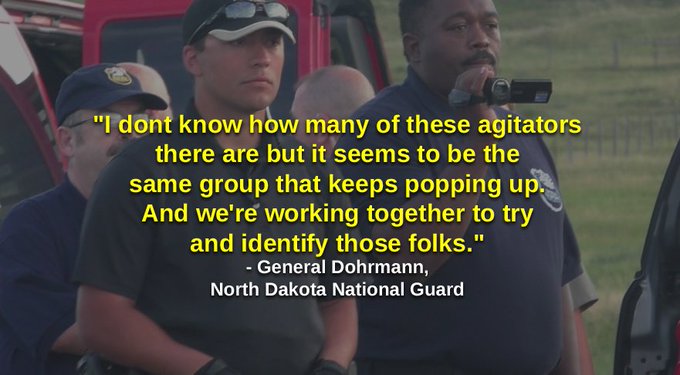
:{
}:
General says North Dakota National Guard working with law enforcement to identify "agitators" at #NoDAPL protests.
 :(style="position:absolute;display:inline-block;top:0px;left:0px;width:36px;height:36px;overflow:hidden;border-radius:4px"):}::{Unicorn Riot:(style="font-weight:700"):}: @UR_Ninja

Twitter Ads info and privacy